Author! Author! :: Anne Mini's Blog

Author! Author!

The dreaded Frankenstein manuscript, part VI: I’ve got rhythm…rhythm…rhythm…

June 7th, 2010

broken-record8broken-recordbroken-record3
broken-record4broken-record5broken-record2

I got so carried away last time — urging all of you (a) to regard the revision process as an opportunity to discover the strengths in your manuscript, rather than the far more common method of concentrating exclusively upon the weaknesses, (b) being delighted to discover that you’re really, really talented at some very specific type of writing (who knew that you were the go-to writer for descriptions of buggy wheels in motion, for instance?), and (c) conceivably acting upon that discovery by reworking the manuscript to emphasize your strengths — that I fear one of my more important subsidiary points might have gotten a bit lost in the public rejoicing. Therefore, let me begin today by un-burying that lead.

Even if you chose to blow off 99.2% of my advice in general, please, I implore you, follow it in this one respect: make absolutely, positively certain that your first five pages do not read like a Frankenstein manuscript — or definitely will not before you even consider slipping them into an envelope with a SASE and mailing them off to an agent, editor, or contest.

Don’t just make a vague, affirmative-sounding noise in response to that. I’m waiting to hear an actual promise.

Why, you ask, when I’m writing this on a blog stuffed to the proverbial gills with literally thousands of pages of advice for writers, am I being so adamant about this little gem — and why only the first five? I’m requesting it for your long-term happiness, especially if you happen not to be the lucky beneficiary of limitless time on your hands to devote to revision.

I’m just being practical here, you see. Naturally, you will want your entire narrative to be in a consistent, well-crafted voice; indeed, that should be the long-term goal for any book-length piece. Were it entirely up to me, every writer would have the time to polish his work until it was positively reflective before submitting it.

But that’s not a luxury an aspiring writer has in this rough-and-tumble world, is it?

The fact is, if you’re in a rush to get your submission out the door — and who isn’t, right after pitching at a conference or receiving that long-awaited query response — you may not have either the time or the patience for a complete revision. And while I would NEVER suggest that ANY writer should send even a single page of requested materials WITHOUT having read that submission IN ITS ENTIRETY, IN HARD COPY, and OUT LOUD, and every conference season, I type my fingers to the elbow pointing out to any writer who will listen that it’s actually a really, really poor idea to send out those materials immediately after receiving the request, precisely because doing so by definition doesn’t leave time for a last-minute read-through, I do recognize that deadlines, self-imposed and otherwise, do exist.

I do not concede, however, that anyone who has the time to write a manuscript does not have time to quadruple-check that her first five pages are written in a consistent, flowing, entertaining narrative voice. Nor can I easily envision a real-world submission situation where even the agent of that writer’s wildest dreams would not be willing to wait a week or two — nay, prefer to wait a week or two — to receive requested materials if they would be better-written after the lull.

Hey, it’s not as though that requesting agent is just going to drop everything, waiting for your submission to show up, or is even likely to blink if it takes them a month or two to arrive. Agents are busy people, after all, and they ask to see quite a few manuscripts.

Besides, isn’t submitting incompletely-revised writing a trifle self-defeating? It’s up to you how to invest your time and energy, of course; it’s not as though the Submission Police are going to break down your door to prevent you from hitting the SEND button with the first 50 pages of a Frankenstein manuscript attached. But given the rate at which Frankensteinery tends to get rejected, isn’t it worth taking the time to improve your odds of acceptance a little?

Which brings me to the question of why the first five pages are so important. As we’ve been discussing throughout this series, Millicent is not merely on the look-out for a well-written manuscript, or one that is simply free of technical errors: she is searching for a narrative voice that she believes her boss will (a) like and (b) be able to sell.

If the first five pages of a submission do not establish that voice, few professional readers will continue reading beyond them. While an agent will occasionally pick up an uneven manuscript if she enjoys the overall voice, the Millicent who screens her submissions will, in all likelihood, have made up her mind about the marketability of that voice by the bottom page 5, at the latest.

And that’s assuming that page 1 was close enough to flawless, technically speaking, to tempt her to keep going. Not to mention well-written, presenting an interesting story, and sounding like the kind of book Millicent’s boss habitually represents.

So again: please promise me that you’ll tinker with at least those first five pages until they’re lovely. It’s in your book’s best interest.

After you’ve roll up your metaphorical sleeves to launch into that worthy endeavor, you might want to start by keep an eye out for a very, very common type of textual repetition, especially in book openings end endings: invocatory rhythms that don’t quite work.

Invocatory rhythms are one of the most popular tools aspiring writers use to beautify their narratives, a kind of sing-song rhythm that alerts the reader that Something Literary is Going on Here. Often couched in generalities about the human condition, a well-written invocatory opening can provide a philosophical starting-point, preparing the reader’s mind, as it were, for the specific story to come — or that has just concluded.

More importantly, though, an invocatory rhythm is a species of seduction: conveys a sort of music that draws the reader irresistibly. I’ve read openings that one could practically sing. Take, for instance, the opening paragraph of Truman Capote’s Breakfast at Tiffany’s:

I have always been drawn back to places where I have lived, the houses and their neighborhoods. For instance, there is a brownstone in the East Seventies where, during the early years of the war, I had my first New York apartment. It was one room crowded with attic furniture, a sofa and fat chairs upholstered in that itchy, particular red velvet that one associates with hot days of a train. The walls were stucco, and a color rather like tobacco-spit. Everywhere, in the bathroom too, there were prints of Roman ruins freckled brown with age. The single window looked out on a fire escape. Even so, my spirits heightened whenever I felt in my pocket the key to this apartment; with all its gloom, it still was a place of my own, the first, and my books were there, and jars of pencils to sharpen, everything I needed, so I felt, to become the writer I wanted to be.

Feel that gently galloping rhythm? Compelling, no? we could quibble about some of dear Truman’s editorial choices — I, for one, probably would have taken him to task for those two ands in the final sentence, and many a modern-day Millicent might reject this opening on sight as leaning too heavily on the passive voice — but you can’t deny that it sets a mood.

Partially, the narrative achieves that through invocatory rhythm — and to many a writer, and to many a professional reader, too, that “Ready or not, Muses, here I come!” rhythm is what differentiates the opening of a good book from the writing in the rest of the text. That, and because those golden words happen to fall on page 1, so they’re the first taste the reader gets of the author’s voice.

I’m sensing that some of you out there are shaking your heads, perplexed. “Rhythm?” you call out between well-timed shakes 34 and…35. “I’m not really getting what you mean. I can see that it’s well-written, crammed with the telling details you’re always…” (36) “…going on about, but rhythm is something heard with the ears, right, not seen with the eyes?” (37)

Well, no — although it’s a moot point if you’re reading the page IN ITS ENTIRETY and OUT LOUD. An experienced reader can feel rhythm on the page; it’s part of what keeps Millicent turning pages. To a professional reader, it’s a manuscript’s heartbeat.

Which is why, in case you’d been wondering, I’m bringing it up in this series on Frankenstein manuscripts. All too often, a manuscript will open with a nice, musical rhythm, only to drop it somewhere around page 5. (Hey, I didn’t pick that barrier arbitrarily — that’s around the end of most manuscript’s first scenes.) Or to begin another halfway down page 2. Sometimes, the switch is jarring enough that the text just before and just after the switch read like two different authorial voices.

Sound familiar? It should: it’s one of the defining characteristics of the Frankenstein manuscript. Need I say more?

I should, actually — or so the head-shakers from a few paragraphs ago tell me. Try reading the opening of Jerzy Kosinski’s marvelous political satire, Being There, first silently, then, if you haven’t taken a vow of silence (or are not perusing this blog at work), read it again out loud.

It was Sunday. Chance was in the garden. He moved slowly, dragging the green hose from one path to the next, carefully watching the flow of water. Very gently he let the stream touch every plan, every flower, every branch in the garden. Plants were like people; they needed care to live, to survive their diseases, and to die peacefully.

Did you catch it that time? This is a particularly nice example: the rhythm begins slowly, then gradually builds up speed, as if the garden were awakening in the first light of morning; by the third sentence, the narrative moving forward at a strong beat. That’s far from accidental: the third sentence repeats the same word thrice, a rhythm continued by the list of three essential needs of people in the final sentence. Well done, Jerzy!

Still not hearing it? Okay, you’ve left me no choice; I’m going to get completely ruthless. Take a gander at what is arguably the most famous example of invocatory rhythm in American literature, the ending of The Great Gatsby, by F. Scott Fitzgerald. (Yes, he of “Oh, I’m so beautiful — why can’t I be happy?” fame.)

And as I sat there brooding on the old, unknown world, I thought of Gatsby’s wonder when he first picked out the green light at the end of Daisy’s dock. He had come a long way to this blue lawn, and his dream must have seemed so close that he could hardly fail to grasp it. He did not know that it was already behind him, somewhere back in that vast obscurity beyond the city, where the dark fields of the republic rolled on under the night.

Gatsby believed in the green light, the orgiastic future that year by year recedes before us. It eluded us then, but that’s no matter — tomorrow we will run faster, stretch our arms out farther…and one fine morning–

So we beat on, boats against the current, borne back ceaselessly into the past.

If you can’t sense the rhythm in that passage, I can only suggest that drum lessons might be a waste of your time.

Perhaps because so many of us in this great nation spent our formative years being fed THE GREAT GATSBY, THE OLD MAN AND THE SEA, ROMEO AND JULIET, and other rhythm-heavy broken-off bits of literary nourishment intravenously through our English classes, capital-L Literature tends to be heavily associated with these types of very rhythmic narrative. The Great American Novel construction kit might as well come with a drum machine, if the submissions Millicent sees are any indication.

Which is to say: literary fiction manuscripts tend to be stuffed to the margins with invocatory rhythms, as do, for some reason, high-end science fiction and sophisticated women’s fiction. Forget about grabbing the reader with a good, old-fashioned hook: these openings are evidently intended to stun Millicent into cries of delight over the magnificence of this new literary voice.

Which is grand — when the device works. The problem is, it often doesn’t.

But that doesn’t stop a driving rhythm from being a hugely popular way to open Chapter 1, is it? As so many writers have been delighted to discover, one of the easiest ways to add this music to a text is through word and phrase repetition:

Geraldine ran through the corridor, ran like the wind, ran as though lions were behind her and the open arms of a knight in shining armor in front. Didn’t she deserve her freedom, after all this time? Didn’t she deserve a life free of the incessant demands of boss, husband, co-worker, photocopy machine, cat? Of best friend, illicit lover, that grim-faced police sergeant on the night shift? Didn’t she, in fact, deserve to breathe the fresh air of autonomy?

That’s a relatively moderate use of the kind of invocatory rhythm that tends to turn up in manuscript submissions and contest entries. Here’s a galloping case of it:

Bewildered, Paul hung his head in shame. Not in shame, precisely: he hung his head partially in pride, a fierce pride that he had done the right thing, made the brave choice, under extremely trying circumstances. No, it was not in shame that he hung his head — that much was clear to him, even while trying to find his way of the wilds of bewilderment without so much as a map and his trusty Boy Scout compass. He was proud, pleased-proud, surprised-proud, PROUD. He wouldn’t have canceled out his supposed shame even if he could have turned back time with a wave of his hand.

Yes, the rhythm here is indeed driving, but what a heck of a lot of word repetition! That’s what a professional reader is likely to take away from this paragraph, by the way, not the emotional intensity. In fact, here’s how it’s likely to burn itself into Millicent’s overworked retinas:

Bewildered, Paul hung his head in shame. Not in shame, precisely: he hung his head partially in pride, a fierce pride that he had done the right thing, made the brave choice, under extremely trying circumstances. No, it was not in shame that he hung his head that much was clear to him, even while trying to find his way out of the wilds of bewilderment without so much as a map and his trusty Boy Scout compass. He was proud, pleased-proud, surprised-proud, PROUD. He wouldn’t have canceled out his supposed shame even if he could have turned back time with a wave of his hand.

To put it less graphically, it’s the repetition that Millicent is likely to notice, rather than the poetic rhythm. Notice, too, that it’s not only the verbatim word and phrase repetition that would make her grind her teeth: words that scan similarly, like wild and bewildered are likely to stick in her craw as well. As will different forms of the same verb appearing within too few lines of text.

Just in case any of you were thinking of featuring have, having, and had within the course of a single paragraph anytime soon.

I’ve been sensing more head-shaking throughout my discussion of these examples. “I see that there are repeated words here, Anne, but surely that is a stylistic choice on the author’s part, a matter of bending the ordinary rules of writing in order to produce a particular type of voice — in this case, one that sounds like chanting the same words over and over again. Unless you have just inadvertently proven your oft-made point about not every reader’s liking every voice, and you are demonstrating yourself to be the kind of knuckle-dragging troglodyte who eschews the joys of literary fiction in favor of novels that — ugh — have a plot?”

Actually, I’ve been known to read and enjoy both, oh ye quick to judge — and what’s more, I’ve read plenty of literary fiction with strong plots and genre fiction that features beautiful language. I cut my editing teeth on high-end fantasy with a literary voice. So there.

But you are right that the example above is far more likely to have dropped from the fingertips of a writer with specifically literary aspirations than one who was aiming for a more mainstream market. Since invocatory rhythms are quite common in poetry, this style turns up very frequently in prose by writers who also write poetry. Unfortunately for Millicent’s aching eyes, it’s also a frequent guest device in novel and memoir submissions, particularly in those that are either literary fiction or are other types of manuscript written with an overtly literary voice.

It just sounds pretty, somehow. Blame our high school English teachers.

Oh, some of you head-shakers are at it again. Aren’t your necks getting tired? “Wait — if the writing’s pretty, how could THAT be problematic in a submission?”

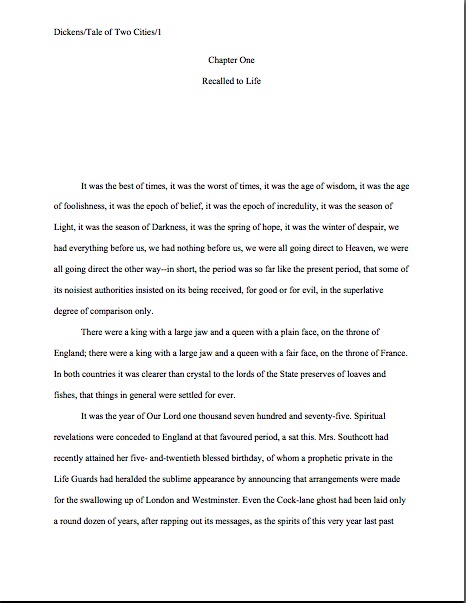
In many ways, believe it or not. Rather than telling you why, let’s look at the single most famous piece of invocatory prose in English literature, the opening to Charles Dickens’ A Tale of Two Cities. (Yes, yes, I know: I’m fond of this particular example, but honestly, it’s one of the best how-tos for writing redundant prose ever produced. Bear with me here.) Just for kicks, pretend that your tenth-grade teacher didn’t force you to write a critical essay about it. Instead, try to read like an agency screener:

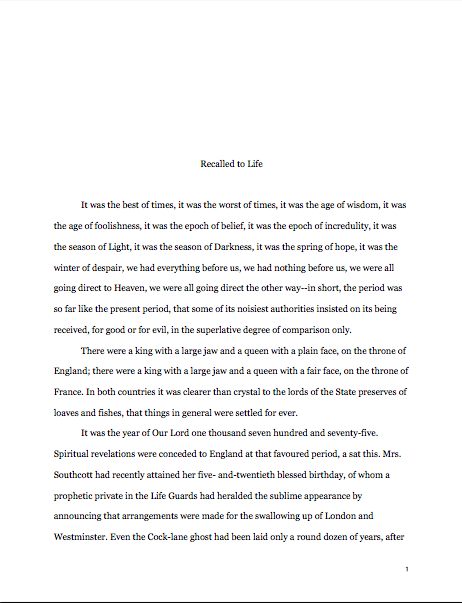
It was the best of times, it was the worst of times, it was the age of wisdom, it was the age of foolishness, it was the epoch of belief, it was the epoch of incredulity, it was the season of Light, it was the season of Darkness, it was the spring of hope, it was the winter of despair, we had everything before us, we had nothing before us, we were all going direct to Heaven, we were all going direct the other way – in short, the period was so far like the present period, that some of its noisiest authorities insisted on its being received, for good or for evil, in the superlative degree of comparison only.

There were a king with a large jaw and a queen with a plain face, on the throne of England; there were a king with a large jaw and a queen with a fair face, on the throne of France. In both countries it was clearer than crystal to the lords of the State preserves of loaves and fishes, that things in general were settled for ever.

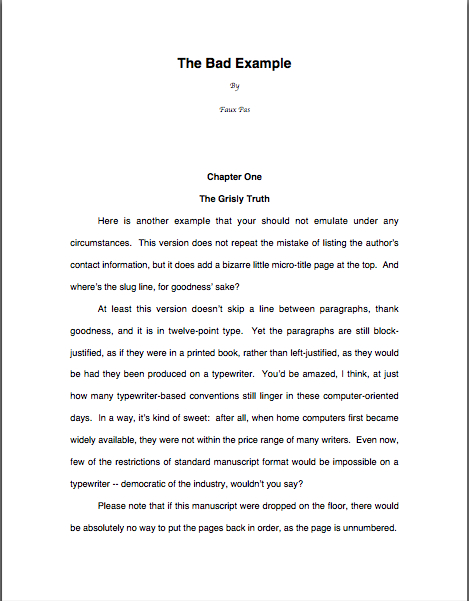
Or, if you want to don Millicent’s eyeglasses even more thoroughly, take a gander at it in standard manuscript format:

2-cities-good

Now, this voice is certainly distinctive, isn’t it? Hard to conceive of a more memorable opening, rhythmically speaking. But it’s also true that if these were the first two paragraphs of a submission, pretty much any professional reader today would have rejected it by line three.

Close your eyes, channel Millicent, and tell me why.

If you said that it was because the first paragraph is one interminable run-on sentence — 119 words, connected incorrectly by commas, rather than semicolons, sacre bleu! — give yourself lollipop, a pat on the head, and an A for the day.

Ditto if you zeroed in upon the apparently random capitalization of nouns, the criminal punctuation choices, the ubiquitous logical contradictions. (Yes, I know Dickens meant it to be ironic; stop parroting your high school English teacher, or I’ll be forced to pull out my tattered copy of OF MICE AND MEN.) Or the fact that two paragraphs into the piece, the reader still has absolutely no idea who the protagonist is or what’s going on.

And can’t you just picture an editor furiously scribbling in the margins: “Which was it — the best of times or the worst of times? Commit to one or the other! Remember, the reader only knows what you tell him!”

However, there is a simpler, less obvious reason this first page just cries out for rejection — which will be abundantly apparent if you stand up right now, take two steps backward from your computer monitor, and take another look at Dickens’ opening.

See the visual pattern of word and phrase repetition? Millicent would have spotted it as soon as she pulled the first page out of the envelope.

I’ve seen wallpaper with more pattern variation. If you’ve been revising for a while (or if you paid close attention to the title of this post), you might have caught that the problem was repetition without backing away from your computer: the first ten verbs in the piece are identical, after all.

Yet it’s not just the repeated words and phrases that would raise professional readers’ weary eyebrows here: it’s the structural repetition, the phenomenon of consecutive sentences being set up in the same way. Or, in the disease’s more advanced form, when every second or third sentence boasts practically the same structure. Narratives where most sentences contain two verb phrases joined by the word and, for instance, or the ever-popular As X was happening, I did Y.

Dickens, bless his now-still heart, has provided us with a lulu of an example of why structural repetition is problematic in print. No matter how great your high school English teacher told you this particular opening was, it’s an undeniable fact that it’s dull for the reader to read the same It was X, it was Y sentence structure over and over again.

To be fair, though, any given sentence structure can become tiresome to a reader, if it is repeated often enough within too few lines of text. Even had Dickens wielded all of those semicolons correctly (which he didn’t, by current grammatical standards), Millicent would have known at a glance that an opening this repetitious was unlikely to be an easy sell, either to readers or to her boss, the agent.

And for precisely the same reason in both cases: it’s conceptually boring and hard on the eyes to read that many similarly-structured sentences in a row.

As we saw in all of today’s examples, a certain amount of structural repetition can provide a genuine forward momentum to a narrative. Many aspiring writers see that rhythm in the work of authors they admire and say, “Wow, that’s cool. By jingo, I’m going to make my paragraphs read like that!”

That’s a perfectly legitimate voice choice — provided that it is used sparingly. Like any magic trick, however, repetitive structure loses its ability to charm when the reader sees it too often; after a while, it can start to come across less as an interesting stylistic choice than as a sort of narrative tic.

How often is too often? Well, let me ask you: how many iterations of It was… did Dickens put you through before you first murmured, Oh, come on, Chuck; get on with it?

For Millicent, that number is likely to be as low as two, even if the repetition isn’t in consecutive sentences. Why so few? Well, editors are trained to zero in on redundancy and excise it, so it shouldn’t come as too much of a surprise to anybody that the contest judges, agents, and Millicents who cull the herd of submissions should develop a sensitivity to something likely to offend an editor’s sensibilities. If a particular stylistic choice is unlikely to sell to a publishing house, those whose job it is to find the bestsellers of tomorrow have to pay attention that editorial preference.

So yes, in answer to what practically all of you were thinking at the beginning of the last paragraph, a professional reader who has been at it a while — honestly may notice structural repetition the first time it occurs, not the seventh. But that’s a matter of speculation, as she is very, very unlikely to still be reading long enough to stumble upon #7.

Heck, it’s not all that uncommon for a professional reader to sit bolt upright in the middle of page 172, exclaiming indignantly, “Hey, this writer is reusing sentences!” if the first iteration occurred on page 3. Millicents tend to have good memories for text. So do agents, editors, contest judges, writing coaches, and pretty much everyone else who reads work-in-progress for a living.

Which is why, in case you’ve spent years speculating on the subject, recipients of professional feedback are so often stunned by assertions that their manuscripts use particular words or phrases constantly. To someone with a memory trained for editing, four times in a 300-page submission may feel pretty constant.

Don’t repeat yourself more than is absolutely necessary.

“Okay, okay,” I hear some of you rules lawyers out there murmuring, “I understand that Millicent is hyper-sensitive to reused sentences and repeated sentence structures. But as you pointed out yourself, Anne, many writers like to open and close their books with poetic rhythms; that doesn’t necessarily mean that the entire book will be written that way. A TALE OF TWO CITIES doesn’t continue repetitively, after all. So why doesn’t Millicent just assume that the device will end in a page or two and read on?”

Long-time readers, feel free to sing along: because Millicent seldom makes it all the way to the end of page one. She’s not in the habit of reading on until she gets to a patch of text she likes. (Too bad our pal Chuckles blew his chance by repeating himself so much, eh?)

I could sidestep the crux of the question by leaving it at that, but the real issue is why a professional reader would assume that the way a manuscript opens is necessarily indicative of what is to come. It’s an excellent question, because this assumption does underlie any rejection on page one. The fact is, though, that this presumption is not always inaccurate, at least with regard to redundancy. More often than not, when a manuscript opens with repetitive structure, it will continue with repetitive structure.

Hey, the writer thinks it sounds pretty. He’s been re-reading THE GREAT GATSBY lately.

Obviously, this renders invocatory repetition dangerous for a writer to use in the first pages of a submission. Or book proposal. Agents and editors are just so used to seeing structural repetition dotting submissions end to end that they’re all too likely — fairly or not — to conclude that to read on would be to be treated to the same type of sentence over and over, ad infinitum.

And that, my friends, would be less poetic than soporific.

Next time, I shall talk about ways to tell which is which in your writing, to figure out when and how invocatory rhythms will help your work. Keep up the good work!

Partials, part III: “Wait — what do you mean, they wanted 50 CONSECUTIVE pages?” and other cris de coeur of submitters and contest entrants

March 20th, 2010

neighbor's tulip tree

No, I shan’t be writing about tulip trees today — I just wanted to share my favorite of my latest batch of yard-in-bloom photos, for the benefit of those of you in stormier climes. While I was setting up this shot, I did invest a few moments’ thought to how I could possibly work these outrageous blooms into this post as a metaphor.

That’s the problem with metaphors: they actually have to relate to something.

In non-floral news, I’m feeling especially virtuous this evening: my excuse for running outside with my camera on this beautiful day (other than searching for images to divert you fine people, of course) was that I finally finished incorporating my first readers’ EXTENSIVE feedback into my recently-completed novel. Yes, even writers who edit for a living solicit opinion, technical and otherwise, from readers before showing their work to their agents.

The smart ones do, anyway; professional critique is so cut-and-dried that emotionally, it just doesn’t make sense to have an agent be the first soul on earth to read your work. (Hear that, aspiring writers planning to submit before showing those pages to anyone local?) Not to mention the practical pluses of good feedback — contrary to popular opinion amongst the shy, even the most battle-hardened pro can benefit from objective critique.

Emphasis upon objective, of course. Long-time readers, whip out your hymnals and sing along, please: no matter how extensively your kith and kin happen to read in your book category, by definition, people who love you cannot give you completely objective feedback on your writing. Even if your significant other is a published author, your best friend a Pulitzer Prize recipient, and your father the chief librarian of an archive devoted exclusively to your type of book, it is in your — and your manuscript’s — best interest to hear the unvarnished opinions of people who do not love you.

Trust me on this one. The sterling soul who gave birth to me has been editing great writers for fifty years, and even she doesn’t clap eyes upon my manuscripts until I’ve incorporated the first round of feedback. (Not that she hasn’t asked.)

I’m bringing this up at the end of our mini-series on partials not merely to celebrate polishing off that always rather taxing job — if any writer actually enjoys working critique into a manuscript, line by line, I’ve never met her — but also to remind those of you planning to rush those requested materials off to the post office that it’s an excellent idea to have another set of eyes scan those pages first.

Ditto with contest entries and residency applications; it’s just too easy to miss a crucial typo yourself. Particularly if you’re really in a hurry to meet a deadline — and what entrant or applicant isn’t? — and neglect to read your submission IN ITS ENTIRETY, IN HARD COPY, and OUT LOUD.

Oh, as if I would let an opportunity to slip that golden piece of editorial advice into yet another post. Why repeat it so often? Because I can already feel some of you gearing up to blow it off, that’s why?

Specifically, those of you who huffed impatiently at that last paragraph. “But Anne,” those of you who pride yourself on your attention to detail point out, “I must have read those pages 75 times while I was revising them. I’ve read them so many times that two-thirds of my brain cells think they’re already published. What could I possibly learn by reading them again, much less IN THEIR ENTIRETY, IN HARD COPY, and OUT LOUD?”

Quite a lot, actually. Like, for instance, if when you changed your protagonist’s sister’s name from Mona to Maura, you changed every reference. Or if every line of the requested synopsis printed out legibly. Or — brace yourselves; this may be a hard one for some of you – if the minor changes you made in the course of the 71rst read are consistent with the ones from read 72.

Shall I rephrase that, to drive home the point a little harder? Okay, how’s this: had you re-read every syllable of your partial, contest entry, or writing sample tucked into a residency application between the time you made those final few changes and when you popped your last submission into the mail? Or since you popped your last submission into the mail?

Wow, the crowd’s gone so quiet all of a sudden.

And for those of you who were not suddenly flung into retrospective panic about what kind of typo or printing snafu you might have inadvertently passed under Millicent the agency screener or Mehitabel the contest judge’s weary eyes, you needn’t take my word for how often writers realize only after something’s out the door that it wasn’t quite right. Many members of the Author! Author! community have already shared their horror stories on the subject; it makes for some enlightening reading.

Feel free to add stories of your own on that list; sharing them honestly will help other aspiring writers. But do not, I beg you, set yourself up for a spectacularly instructive anecdote by failing to read the very latest version of your partial, contest entry, or writing sample IN ITS ENTIRETY, IN HARD COPY, and OUT LOUD.

While I’m hovering over you like a mother hen, here’s a post-submission regret I hope I can wipe from the face of the earth forever: including a business-size (#10) envelope as the SASE for a partial or a contest that returns materials, rather than an envelope (and appropriate postage) large enough to send back everything in the submission or entry packet.

That made some of you do a double-take, didn’t it? “But Anne!” half of those with submissions currently languishing at agencies across the U.S. cry. “I thought the point of the SASE — that stands for Self-Addressed Stamped Envelope, right? — was so the agent who requested the partial could mail me a letter, asking me to send the rest of the manuscript — or, heaven forfend, a rejection letter!”

Well, the agent (or, more likely, the agent’s Millicent-in-residence) usually does include at least a form-letter rejection in a homeward-bound SASE, but that’s not the SASE’s primary purpose, from the agency’s point of view. Its primary use is to get all of those pages out of its office and back to the aspiring writers who sent them.

That’s not just because if they didn’t, the average agency’s halls would be so filled with rejected pages by the end of the first month that Millicent wouldn’t be able to fight her way to the coffeemaker through the chest-high stacks of pages. (She would have had to give up her traditional lattes by the end of the first week, since she couldn’t find the front door during her lunch break.) They also return the pages because it’s in the writer’s copyright interest to know precisely where his pages are at any given time — and if that seems paranoid to you, you might want to take a gander at the SHOULD I WORRY ABOUT MY WORK BEING STOLEN? category on the archive list at right.

If, on the other hand, the idea of a submission’s tumbling into unscrupulous hands doesn’t strike you as particularly outrageous, but the logic behind the writer’s providing the postage to convey her own rejection to her does, I would recommend a quick read through the posts under the SASE GUIDELINES category.

And for those of you reading this post in a tearing hurry because you’re frantically trying to get a partial out the door and into the mail, or whose fingers are itching to hit the SEND key for electronic submissions, let me just go ahead and state it as a boldfaced aphorism: with any submission, always include a SASE sufficiently large for the agent to send the entire submission back to you, with enough stamps attached to get it there safely.

Yes, I said stamps. Attaching metered postage to a SASE is another fairly common mistake in submitting a partial. Generally speaking, agencies will not use a stamp-free SASE. (If you’re interested in the rather convoluted logic behind that one, I would refer you again to the SASE GUIDELINES category. Otherwise, moving swiftly on…)

A third common mistake submitters of partials often make comes not when they are packing up the partial, but later, after the agent has approved the partial and asked to see the entire manuscript. That’s the agency parlance for the request, anyway; in writer-speak, it’s usually called asking to see the rest of the book.

Therein lies the root of the mistake: the semantic difference is crucial here. All too often, successful partial submitters think that a request for the entire manuscript equals a request for only the part of the manuscript the agent has not yet seen.

The agent asked to see the rest of the book, right?

Actually, she didn’t — what asking to see the rest of the book means in agent-speak is that the agent is expecting the ENTIRE manuscript to show up in her office, neatly boxed and accompanied by a return mailing label and enough postage to get the whole shebang back to the sender, if it’s rejected. (If that last bit came as any sort of a surprise to you, I would strongly urge you to peruse the posts under the MAILING REQUESTED MATERIALS category at right before you comply with any request for your manuscript.)

Starting to see a pattern here?

I do — and have for years: when aspiring writers just assume that they know what a request for materials entails, submissions often go awry; when they take the time to do their homework, irritating Millicent by such mistakes is 99.999% avoidable. (Hey, there’s no accounting for how moody she might get when she burns her lip on that too-hot latte for the fiftieth time this year.) Much of the time, the difference isn’t even the result of conscious step-skipping: first-time submitters frequently don’t know that there are rules to be followed.

Want to know what half the Millicents currently screening would say in response to that last sentence? It’s illuminating about the harshness of professional evaluation: “So I’m supposed to make allowances because these writers didn’t do their homework, effectively penalizing all of those conscientious writers out there who take the time to learn the ropes? I’ll bet that most of these mistaken submitters didn’t even bother to check if my agency’s website has submission guidelines.”

To which Mehitabel would add: “And virtually every contest on earth includes very specific submission guidelines in its rules, yet I’m continually astonished by how few entrants seem to read them. I’ll seldom actually disqualify an entry because it violates a presentation rule, but how can I justify penalizing all of those nice entrants who did follow the rules by allowing a violator to proceed to the finalist round of judging?”

Okay, so maybe they wouldn’t be quite that forthcoming. Or prolix. If I’m going to be completely honest, I would have to admit that this is what either of them is most likely to say when such a submission crossed their line of vision: “Next!”

Please, do your homework about the recipient’s stated preferences before you submit any requested materials. Not every agency is kind enough to writers to post specific guidelines, but if you happen to be dealing with one that has, you absolutely must follow them, or risk the wrath of Millicent.

It’s not pretty. Neither is Mehitabel’s, or the as-yet-to-be-named individual screening applications for that writers’ retreat you would give your eyeteeth to attend.

I’m taking christening suggestions for the application screener, by the way. I’d originally dubbed her Petunia, but that doesn’t exactly inspire awe and fear, does it?

Another major mistake that dogs contest entries involves confusing a partial with a writing sample. What’s the difference, you ask? Well, chant it with me now, followers of this series:

A partial is the first X number of pages of a manuscript assumed already to be complete, numbered consecutively and stopping at the bottom of the exact page the requester specified as the maximum. A writing sample is a selection of a book’s best writing, regardless of where it falls in the book.

In a pitching situation — the place an agent-seeking writer is most likely to be asked to produce a writing sample — 5 pages is usually the maximum length. However, a lengthy writing sample might include more than one scene, and those scenes might not run consecutively.

Everybody clear on all that? Now would be a marvelous time to ask a question, if not — I want to make absolutely, positively sure that every single member of the Author! Author! community not only understands these two separate concepts to be separate concepts, but can explain the difference to any confused fellow writers he might encounter.

Are you wondering why am I being so very adamant about this one? A deep and abiding dislike for seeing good writers waste their time and money: being unaware of this distinction trips up a simply phenomenal number of contest entrants every year.

How, you ask? Sadly, they misinterpret the rules’ call for X number of pages from, say, a novel, as permission to send X number of pages from anywhere in the novel. Sometimes, these hapless souls take the misunderstanding one step further, sending in a few pages from Chapter 1, a few from Ch. 8, perhaps a couple of paragraphs from Ch. 17…in short, they submit a bouquet of writing samples.

Understandable mistake, right? And extremely common, particularly in entries for contests that simply ask entrants to send a specified number of pages of a novel, without mentioning that those pages should be consecutive — oh, and if the entrant might by some odd chance want to win the contest, those pages had better begin on page 1 of Chapter 1 of the book.

Shall I take that gigantic collective gasp of indignation as an indication that some of you past contest entrants wish you had heard one or more of those tidbits before you entered?

Again, let’s state it as an aphorism, for the benefit of last-minute skimmers: unless a literary contest’s rules specifically state otherwise, assume that the entry should begin on page 1 and proceed consecutively. Part of what entrants in any prose contest are being judged upon is the ability to construct a strong narrative and story arc.

In answer to the question that most of you are probably screaming mentally, I have no idea why so few contests’ rules don’t just state this point-blank. It’s not as though it’s a rare problem — every contest judge I’ve ever met tells a sad story about the well-written entry that knocked itself out of finalist consideration via this error. And I’ve judged in a heck of a lot of literary contests, so I’ve met a whole lot of judges over the years.

I could spend a few more minutes of my life shaking my head over this, but over the years, my neck has gotten sore. I’m going to take the warning as heard — it was, wasn’t it? — and move on.

Writers asked to submit partials occasionally fall into the writing sample trap as well, but frankly, it’s less common. Perhaps writers marketing books harbor an inherent desire to have their stories read from beginning to end, just as a reader would encounter their work in a published book. Perhaps, too, agents’ requests for materials tend to be for much heftier portions of a manuscript than many contest entries would tolerate: 50 or 100 pages for a partial is fairly normal, but many contests for even book-length works call for as few as 10, 20, or 30 pages, sometimes including a synopsis.

But just to head any problems off at the pass, as well as to illustrate why a nonconsecutive partial made up of even superlative writing would not be a good marketing packet for any manuscript, from an agency perspective, let’s close out this short series by going over the expectations for a partial one more time. Come on; it’ll be fun.

When an agent or editor requests a partial, she’s not asking for a writing sample consisting of 50 or 100 pages of the writer’s favorite parts of the book, a sort of greatest hits compilation — if that’s what she wants, she (or her submission guidelines; check) will tell you so point-blank. She is unlikely to prefer a writing sample as a submission, however, because part of what her Millicent is looking for in submissions is storytelling acumen.

Think about it: in an unconnected series of scenes gleaned from across your manuscript, how good a case could you make for your talent at arranging plot believably? How well could you possibly show off your book’s structure, or character development, or even ability to hold a reader’s interest, compared to the same story as you present it in your manuscript, beginning on page 1?

If you have any doubt whatsoever about the answer to that last question, run, don’t walk, to an objective first reader to help you figure out whether the current running order of events tells your story effectively. (Didn’t think I’d be able to work in another plug for feedback from an independent-minded first reader, did you?)

What an agent or editor does expect to see in a partial, then, is the opening of the manuscript as you plan to market it to, well, agents and editors: it’s precisely the same as the full manuscript, except it doesn’t include the pages after, say, page 50.

And if Millicent loves that partial and asks for the rest of the book, what will you do? Send the entire manuscript, right? Right?

I couldn’t resist tossing in the pop quiz, to see if you’d been paying attention. I wouldn’t want any of you to end the post still confused about any of this. (And if you are: please, I implore you, leave a question in the comments.)

And remember, read any submission guidelines very thoroughly before you invest your heart, hopes, energy, and/or precious time in preparing a partial packet or contest entry. This is no time to be skimming; make a list and check it twice, like Santa Claus.

Yes, even if the request consisted of a grand total of three lines of text in an e-mail. In fact, I always advise my editing clients to read the guidelines once — then, on the second read, make a checklist of everything you are being asked to do. Wait a day before going back to triple-check that the list is accurate.

Then, and only then, put together the submission or entry, checking off each item as you place it in the envelope. Re-read the original guidelines or letter before you even think of sealing the envelope. If you’re not much of a detail person, you might also want to hand your list to at least one person who happens to love you, ask him/her/that ungainly mob to check it against the guidelines or contest rules, then to verify that what’s in your envelope is in fact what you have been asked to send.

You didn’t think I was going to leave the kith and kin I’d disqualified from giving you objective feedback from helping you altogether, did you? Everyone has a task here at Author! Author!

That’s what how a supportive community works, isn’t it? Keep up the good work!

The mysteriously mysterious strictures of standard format, part III: pretty is as pretty does

February 11th, 2010

yard with petals

Another pretty picture for you today, campers, to soothe the fractured soul and as a refresher for those you trapped in that magnificent East Coast blizzard. As Shelley wrote, if winter comes, can spring be far behind?

It’s also a reward for virtue, both for those brave enough to be learning the contours of standard format for the first time and those dedicated many who stick with it every time I revisit the topic. Believe me, feedback and questions from both categories of intrepid reader have made Author! Author! an infinitely better, more useful, and friendlier place for writers. You all deserve far more than a nice photo of my back yard, of course, but I am, as always, most grateful.

So here’s another gift, a little trifle that I was going to save for the end of this series: working your way first through this series, then through your manuscript, while undoubtedly time-consuming, will in the long term save you a whole heck of a lot of time.

Was that massive sound wave that just washed over my studio two-thirds of you suddenly crying, “Huh?”

It’s true, honest. While the applying these rules to a manuscript already in progress may seem like a pain, practice makes habit. After a while, the impulse to conform to the rules of standard format becomes second nature for working writers. Trust me, it’s a learned instinct that can save a writer oodles of time and misery come deadline time.

How, you ask? Well, to a writer for whom proper formatting has become automatic, there is no last-minute scramble to change the text. It came into the world correct — which, in turn, saves a writer revision time. Sometimes, those conserved minutes and hours can save the writer’s proverbial backside as well.

Scoff not: even a psychic with a very, very poor track record for predictions could tell you that there will be times in your writing career when you don’t have the time to proofread as closely as you would like, much less check every page to make absolutely certain it looks right. Sometimes, the half an hour it would take to reformat a inconsistent manuscript can make the difference between making and missing a contest deadline.

Or between delighting or disappointing the agent or editor of your dreams currently drumming her fingers on her desk, waiting for you to deliver those minor requested changes to Chapter 7. (You know, that lighthearted little revision changing the protagonist’s sister Wendy to her brother Ted; s/he is no longer a corporate lawyer, but a longshoreman, and Uncle George dies not of a heart attack, but of 12,000 pounds of under-ripe bananas falling on him from a great height when he goes to the docks to tell Ted that Great-Aunt Mandy is now Great-Uncle Armand. If only Ted had kept a better eye on that load-bearing winch!)

Or, for nonfiction writers, delivering the finished book you proposed by the date specified in your publishing contract. Trust me, at any of these junctures, the last thing you’ll want to have to worry about are consistent margins.

Perversely, this is a kind of stress that makes writers happy — perhaps not in the moment we are experiencing it, but on a career-long basis. The more successful you are as a writer — ANY kind of writer — the more often you will be in a hurry, predictably. No one has more last-minute deadlines than a writer with a book contract.

Just ask any author whose agent is breathing down her neck after a deadline has passed. Especially if the writer didn’t know about the deadline until it had already come and gone. (Oh, how I wish I were kidding about that.) And don’t even get me started on the phenomenon of one’s agent calling the day after Thanksgiving to announce, “I told the editor that you could have the last third of the book completely reworked by Christmas — that’s not going to be a problem, is it?”

Think you’re going to want to be worrying about your formatting then? Believe me, you’re going to be kissing yourself in retrospect for learning how to handle the rote matters right the first time, so you can concentrate on the hard stuff. (What would many tons of bananas dropped from that height look like, anyway?)

That’s the good news about how easily standard format sinks into one’s very bones. The down side, is that once people — like, say, the average agent, editor, or Millicent — have spent enough time staring at professionally-formatted manuscripts, anything else starts to look, well, unprofessional.

The implications of this mindset are vast. First, as I mentioned yesterday, if an agent or editor requested pages, it would behoove you to send them in standard format, unless s/he SPECIFICALLY tells you otherwise. Ditto with contest entries: it’s just what those who read manuscripts professionally expect to see. It’s so much assumed that s/he probably won’t even mention it, because most agents and editors believe that these rules are already part of every serious book-writer’s MO.

So much so, in fact, that agents who’ve read my blog sometimes ask me why I go over these rules so often. Doesn’t everyone already know them? Isn’t this information already widely available? Aren’t there, you know, books on how to put a manuscript together?

I’ll leave those of you reading this post to answer those for yourselves. Suffice it to say that our old pal Millicent the agency screener believes the answers to be: because I like it, yes, yes, and yes.

Second, this mindset means that seemingly little choices like font and whether to use a doubled dash or an emdash — of which more below — can make a rather hefty difference to how Millicent perceives a manuscript. (Yes, I know: I point this out with some frequency. However, as it still seems to come as a great surprise to the vast majority aspiring writers; I can only assume that my voice hasn’t been carrying very far the last 700 times I’ve said it.)

I hate to be the one to break it to you, but professional-level critique is HARSH; it’s like having your unmade-up face examined under a very, very bright light by someone who isn’t afraid to hurt your feelings by pointing out flaws. In the industry, this level of scrutiny is not considered even remotely mean.

Actually, if your work generates tell-it-like-it-is feedback from a pro, you should be a bit flattered — it’s how they habitually treat professional authors. Yet the aforementioned vast majority of submitting writers seem to assume, at least implicitly, that agents and their staffs will be hugely sympathetic readers of their submissions, willing to overlook technical problems because of the quality of the writing or the strength of the story.

I’m not going to lie to you, though — every once in a very, very long while, the odd exception that justifies this belief does in fact occur. If the writing is absolutely beautiful, or the story is drool-worthy, but the formatting is all akimbo and the spelling is lousy, there’s an outside chance that someone at an agency might be in a saintly enough mood to overlook the problems and take a chance on the writer.

You could also have a Horatio Alger moment where you find a billionaire’s wallet, return it to him still stuffed with thousand-dollar bills, and he adopts you as his new-found son or daughter. Anything is possible, of course.

But it’s probably prudent to assume, when your writing’s at stake, that yours is not going to be the one in 10,000,000 exception.

Virtually all of the time, an agent, editor, contest judge, or screener’s first reaction to an improperly-formatted manuscript is the same as to one that is dull but technically perfect: speedy rejection. From a writerly point of view, this is indeed trying. Yet as I believe I may have mentioned once or twice before, I do not run the universe, and thus do not make the rules.

Sorry. No matter how much I would like to absolve you from some of them, it is outside my power. Take it up with the fairy godmother who neglected to endow me with that gift at birth, okay?

Until you have successfully made your case with her, I’m going to stick to using the skills that she did grant me, a childhood surrounded by professional writers and editors who made me learn to do it the right way the first time. As in my fifth-grade history paper was in standard format; I can still hear my mother blithely dismissing my poor, befuddled teacher’s protests that none of the other kids in the class were typing their papers with, “Well, honestly, if Annie doesn’t get into the habit of including slug lines now, where will she be in twenty years?”

Where, indeed? The strictures of standard format are hardly something that she would have wanted me to pick up on the street, after all.

So let’s start inculcating some lifetime habits, shall we? To recap from earlier posts:

(1) All manuscripts should be printed or typed in black ink and double-spaced, with one-inch margins around all edges of the page, on 20-lb or better white paper.

(2) All manuscripts should be printed on ONE side of the page and unbound in any way.

(3) The text should be left-justified, NOT block-justified. By definition, manuscripts should NOT resemble published books in this respect.

(4) The preferred typefaces are 12-point Times, Times New Roman, Courier, or Courier New — unless you’re writing screenplays, in which case you may only use Courier. For book manuscripts, pick one (and ONLY one) and use it consistently throughout your entire submission packet.

(5) The ENTIRE manuscript should be in the same font and size. Industry standard is 12-point.

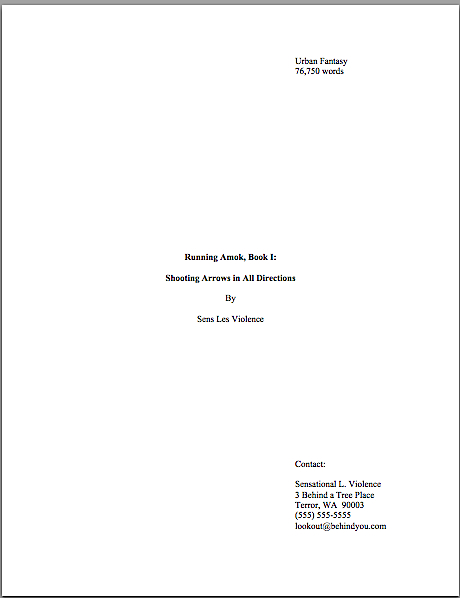
(6) Do NOT use boldface anywhere in the manuscript BUT on the title page — and not even there, necessarily.

(7) EVERY page in the manuscript should be numbered EXCEPT the title page.

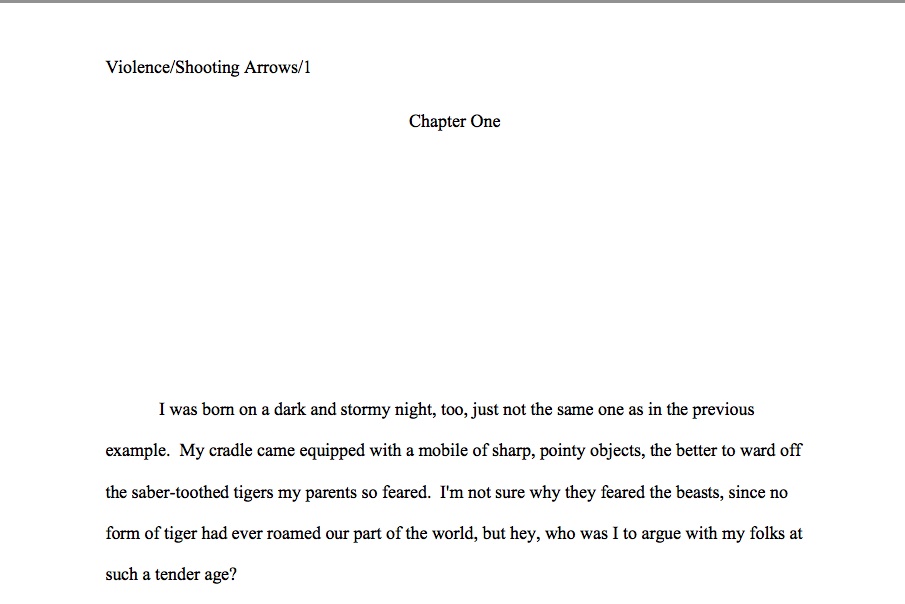
(8) Each page of the manuscript (other than the title page) should have a standard slug line in the header. The page number should appear in the slug line, not anywhere else on the page.

(9) The first page of each chapter should begin a third of the way down the page, with the chapter title appearing on the FIRST line of the page, NOT on the line immediately above where the text begins.

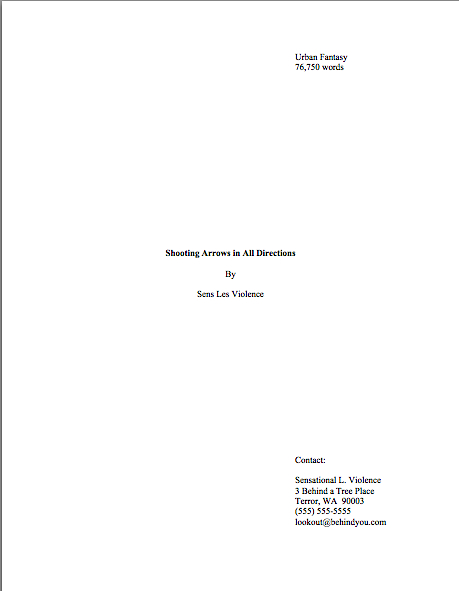
(10) Contact information for the author belongs on the title page, NOT on page 1.

(11) Every submission should include a title page, even partial manuscripts.

Everyone clear on all that? If not, this would be a dandy time to pipe up with questions. While you’re formulating ‘em, let’s move on.

(12) The beginning of EVERY paragraph of text should be indented .5 inch. No exceptions, ever.
The usual way this rule is expressed — and, indeed, the way I expressed it as recently as the last time I went over standard format — is indent every paragraph 5 spaces. MS Word, however, the standard word processing program of the publishing industry, automatically sets its default first tab at .5 inch.. Yet unless you happen to be using an unusually large typeface like Courier, you’ve probably noticed that hitting the space bar five times will not take you to .5 inches away from the left margin; in Times New Roman, it’s more like 8 spaces.

This discrepancy leaves some aspiring writers perplexed, understandably. Clearly, a choice needed to be made here — so why is standard indentation at .5 inch now, rather than at five characters?

History, my dears, history: the five spaces rule is from the days of typewriters. Back in the days when return bars roamed the earth, there were only two typefaces commonly found on typewriters, Pica and Elite. They yielded different sizes of type (Pica roughly the equivalent of Courier, Elite more or less the size of Times New Roman), but as long as writers set a tab five spaces in, and just kept hitting the tab key, manuscripts were at least consistent.

After the advent of the home computer, however, computer-generated manuscripts have become the norm. The array of possible typefaces exploded. Rather than simply accepting that every font would have slightly different indentations, the publishing industry (and the manufacturers of Word) simply came to expect that writers everywhere would keep hitting the tab key, rather than hand-spacing five times at the beginning of each paragraph. The result: the amount of space from the left margin became standardized, so that every manuscript, regardless of font, would be indented the same amount.

So why pick .5 inch as the standard indentation? Well, Elite was roughly the size of Times New Roman, 12 characters per inch. Pica was about the size of Courier, 10 characters per inch. The automatic tab at .5 inch, therefore, is pretty much exactly five spaces from the left margin in Pica.

All of which is a long-winded way of saying that in this instance, at least, Word’s default settings are the writer’s friend. Keep on hitting that tab key.

Which brings me back to the no exceptions, ever, part: NOTHING you send to anyone in the industry should EVER be in block-style business format. And for a pretty good reason: despite the fact that everyone from CEOs to the proverbial little old lady from Pasadena has been known to use block format from time to time (blogs are set up to use nothing else, right?), technically, non-indented paragraphs are not proper for English prose.

Period. That being the case, what do you think Millicent’s first reaction to a non-indented page 1 is likely to be?

That loud clicking sound that some of you may have found distracting was the sound of light bulbs going on over the heads of all of those readers who have been submitting their manuscripts (and probably their queries as well) in block paragraphs. Yes, what all of you newly well-lit souls are thinking right now is quite true: those submissions may well have been rejected at first glance by a Millicent in a bad mood. (And when, really, is she not?)

Yes, even if the writer submitted those manuscripts via e-mail. (See why I’m always harping on how submitting in hard copy, or at the very worst as a Word attachment, is inherently better for a submitter?) And that’s a kinder response than Mehitabel the veteran contest judge would have had: she would have looked at a block-formatted first page and sighed, “Well, that’s one that can’t make the finals.”

Why the knee-jerk response? Well, although literacy has become decreasingly valued in the world at large, the people who have devoted themselves to bringing good writing to publications still tend to take it awfully darned seriously. To publishing types, any document with no indentations, skipping a line between paragraphs, and the whole shebang left-justified carries the stigma of (ugh) business correspondence — and that’s definitely not good.

Why, you ask? Well, do you really want the person you’re trying to impress with your literary genius to wonder about your literacy?

I thought not. And which do you think is going to strike format-minded industry professionals as more literate, a query letter in business format or one in correspondence format (indented paragraphs, date and signature halfway across the page, no skipped line between paragraphs)?

Uh-huh. And don’t you wish that someone had told you THAT before you sent out your first query letter?

Trust me on this one: indent your paragraphs in any document that’s ever going to pass under the nose of anyone even remotely affiliated with the publishing industry.

Including the first paragraph of every chapter, incidentally. Yes, published books — particularly mysteries, I notice — often begin chapters and sections without indentation. But again, that lack of indentation was the editor’s choice, not the author’s, and copying it in a submission, no matter to whom it is intended as an homage, might get your work knocked out of consideration.

(13) Don’t skip an extra line between paragraphs, except to indicate a section break.

I’m serious about that being the ONLY exception: skip an extra line to indicate a section break in the text, and for no other reason.

Really, this guideline is just common sense — so it’s a continual surprise to professional readers how often we see manuscripts that are single-spaced with a line skipped between paragraphs (much like blog format, seen here in all of its glory).

Why surprising? Well, since the entire manuscript should be double-spaced with indented paragraphs, there is no need to skip a line to indicate a paragraph break. (Which is, in case you were not aware of it, what a skipped line between paragraph means in a single-spaced or non-indented document.) In a double-spaced document, a skipped line means a section break, period.

Also — and this is far from insignificant, from a professional reader’s point of view — it’s practically impossible to edit a single-spaced document, either in hard copy or on screen. The eye skips between lines too easily, and in hard copy, there’s nowhere to scrawl comments like Mr. Dickens, was it the best of times or was it the worst of times? It could hardly have been both!

So why do aspiring writers so often blithely send off manuscripts with skipped lines, single-spaced or otherwise? My guess would be for one of two reasons: either they think business format is proper English formatting (which it isn’t) or they’re used to seeing skipped lines in print. Magazine articles, mostly.

But — feel free to shout it along with me now; you know the words — a professional book manuscript or proposal is not, nor should it be, formatted like any published piece of writing.

A few hands have been waving urgently in the air since I started this section. “But Anne!” those of you who have seen conflicting advice point out, “I’ve always heard that there are specific markers for section breaks! Shouldn’t I, you know, use them?”

I wouldn’t advise including these throwbacks to the age of typewriters — the * * * section break is no longer necessary in a submission to an agency or publishing house, nor is the #. So unless you’re entering a contest that specifically calls for them, or the agency to which you’re planning to submit mentions a preference for them in its submission requirements, it’s safe to assume that professional readers won’t expect to see them in a book manuscript or proposal.

Why were these symbols ever used at all? To alert the typesetter that the missing line of text was intentional.

That being said, although most Millicents will roll their eyes upon seeing one of these old-fashioned symbols, they tend not to take too much umbrage at it, because the # is in fact proper for short story format. A writer can usually get away with including them. However, since every agent I know makes old-fashioned writers take these markers out of book manuscripts prior to submission, it’s going to save you time in the long run to get into the habit of trusting the reader to understand what a skipped line means.

(Actually, I do know a grand total of one agent who allows his clients to use short-story formatting in book manuscripts. But only if they write literary fiction and have a long resume of short story publications. He is more than capable of conveying this preference to his clients, however.)

One caveat to contest-entrants: do check contest rules carefully, because some competitions still require * or #. You’d be amazed at how seldom many long-running literary contests update their rules.

(14) NOTHING in a manuscript should be underlined. Titles of songs and publications, as well as words in foreign languages and those you wish to emphasize, should be italicized.

Fair warning: if you consult an old style manual (or a website that is relying upon an old style manual), you may be urged to underline the words and phrases mentioned above. And just so you know, anyone who follows AP style will tell you to underline these. As will anyone who learned how to format a manuscript before the home computer became common, for the exceedingly simple reason that the average typewriter doesn’t feature italic keys as well as regular type; underlining used to be the only option.

DO NOT LISTEN TO THESE TEMPTERS: AP style is for journalism, not book publishing. They are different fields, and have different standards. And although I remain fond of typewriters — growing up in a house filled with writers, the sound used to lull me to sleep as a child — the fact is, the publishing industry now assumes that all manuscripts are produced on computers. In Word, even.

So DO NOT BE TEMPTED. In a submission for the book industry, NOTHING should be underlined. Ever.

Professional readers are AMAZED at how often otherwise perfectly-formatted manuscripts get this rule backwards — seriously, it’s a common topic of conversation at the bar that’s never more than 100 yards from any writers’ conference in North America. (You already knew that the conference center’s bar is the single best place to meet most of the agents, editors, and authors presenting at the average writers’ conference, didn’t you?) According to this informal and often not entirely sober polling data, an aspiring writer would have to be consulting a very, very outdated list of formatting restrictions to believe that underlining is ever acceptable.

Again, since your future agent is going to make you change all of that underlining to italics anyway, you might as well get out of the habit of underlining now. Like, say, before submitting your manuscript — because if Millicent happens to be having a bad day (again, what’s the probability?) when she happens upon underlining in a submission, she is very, very likely to roll her eyes and think, “Oh, God, not another one.”

Italics are one of the few concessions manuscript format has made to the computer age — again, for practical reasons: underlining uses more ink than italics in the book production process. Thus, italics are cheaper. So when should you use them and why?

(a) The logic behind italicizing foreign words is very straightforward: you don’t want the agent of your dreams to think you’ve made a typo, do you?

(b) The logic behind using italics for emphasis, as we’ve all seen a million times in print, is even more straightforward: writers used to use underlining for this. So did hand-writers.

(c) Some authors like to use italics to indicate thought, but there is no hard-and-fast rule on this. Before you make the choice, do be aware that many agents and editors actively dislike this practice. Their logic, as I understand it: a good writer should be able to make it clear that a character is thinking something, or indicate inflection, without resorting to funny type.

I have to confess, as a reader, I’m with them on that last one, but that’s just my personal preference. There are, however, many other agents and editors who think it is perfectly fine — but you are unlikely to learn which is which until after you have sent in your manuscript, alas.

Which means — again, alas — there is no fail-safe for this choice. Sorry. You submit your work, you take your chances.

I have a few more rules to cover, but this seems like a dandy place to break for the day. Don’t worry if you’re having trouble picturing what all of this might look like on the page: next week, I’m going to be showing you so many images of actual manuscript pages that you’re going to feel as if you’d gotten locked inside Millicent’s mailbag.

You want to be able to recognize a pretty manuscript when you see one, right? Keep up the good work!

The getting-a-book-published basics, part XII: things change — but not as fast as many writers would like

January 26th, 2010

Yes, yes, I know: I usually open our discussion and gladden your hearts with a pretty picture, or at any rate one to get you thinking about our topic du jour. Today’s marginally pretty pictures, however, require a bit of initial explanation. Specifically, I want to give you a heads-up about how I would like you to use them.

So: please stare at the photos I am about to show you for a good, long minute before moving on to the rest of the post. I would like these images burned into your cranium before we return to our ongoing topic, how manuscripts move from the writer’s brainpan, through an agency, through a publishing house, to end up on your local bookstore’s shelves.

Never mind why; just stare. First, at this snapshot I took in my yard a year ago:

a-windchime-in-the-snow

Clear in your mind? Excellent. Now contemplate, if you will, the same view at a later date (and from slightly farther away, I now notice):

crabtree-blossoms-and-windchime

Four months separate those pictures — either a very short time for such a radical alteration of the environment or an interminable one, depending upon how you choose to look at it. But whatever your attitude, the fact remains that both the wind chime and its observer feel quite different sensations now than they did then, right?

Bear that gentle observation in mind for the rest of this post, please. This series has, after all, been all about gaining a broader perspective on a great, big, time-consuming process whose built-in delays aspiring writers all too often — mistakenly — regard as completely personal.

Yes, it’s all happening to you, but the upcoming change of seasons will happen to you, too. Does that mean that nobody else experiences it? Or that today’s frosty blast of winter air was aimed at you personally?

Realistic expectations and the management of resentment
For the last couple of weeks, I’ve been sticking to the basics: an overview of the trajectory a manuscript typically travels from the writer’s hands to ultimately sitting on a shelf at your local bookstore. Since what most aspiring writers have in mind when they say they want to get their books published is publication through great big New York City-based publishing houses — GBNYCBPH for short, although admittedly, not very short — I’ve been concentrating upon that rather difficult route.

As we have seen, in order to pursue that particular path — which is, as we shall see later in the week, not the only possible route to publication; people merely act as though it is — a writer needs an agent. Yet as we also saw earlier in this series, that was not always the case: aspiring writers used to be able to approach editors at GBNYCBPH directly; until not very long ago, nonfiction writers still could. Instead, writers seeking publication at GBNYCBPH invest months — or, more commonly, years — in attracting the agent who can perform the necessary introduction.

So a historically-minded observer could conclude that over time, the road to publication has become significantly longer for the average published author, or at any rate more time-consuming. Should we writers rend our garments over this, bearding the heavens with our bootless cries, complaining to an unhearing collection of muses that it’s just a whole lot more difficult to get good writing published than it used to be?

Well, we could — and a startlingly high percentage of the public discussion of the writing life is devoted to just that. One can hardly walk into any writers’ conference in North America without tripping over a knot of writers commiserating about it. Certainly, you can’t Google how to get a book published without pulling up an intriguingly intense list of how-to sites and fora where aspiring writers complain about their experiences, sometimes helpfully, sometimes not. And don’t even try to total up all of the blogs on the subject.

Two things are clear: there’s quite a bit of garment-rending going on, and this process is hard.

Although I am never averse to a little light self-inflicted clothing damage if the situation warrants it, I am inclined to think that most aspiring writers expend too much energy on resentment. Without question, most take it too personally, given that the GBNYCBPH didn’t suddenly rearrange their submission policies the day before yesterday in order to avoid having to deal with any individual submission they might otherwise have received within the next six months. Using agents as the North American literary world’s manuscript screeners, effectively, has been going on for quite some time.

Did I just hear a few dozen cries of “Aha!” out there? Yes, your revelation is quite correct: at one level, an agency is to a major NYC-based publishing house what Millicent the agency screener is to the agent, the gatekeeper who determines which manuscripts will and will not be seen by someone empowered to make a decision about publishing it.

But it’s laughably easy for an aspiring writer in the throes of agent-seeking to forget that, isn’t it? All too often, aspiring writers speak amongst themselves and even think about landing an agent as though that achievement were the Holy Grail of publishing: it’s a monumentally difficult feat to pull off, but once a writer’s made it, the hard work’s over; the sweets of the quest begin.

It’s a pretty image, but let me ask you something: have you ever heard a writer who already has an agent talk about it this way?

I’m guessing that you haven’t, because I’m hear to tell you: seldom are garments rent more drastically than amongst a group of agented writers whose books have not yet been picked up by GBNYCBPH.

Why, the agent-seekers out there gasp, aghast? Because typically, signing with an agent doesn’t mean just handing the manuscript over to another party who is going to do all the work; it means taking on a whole host of other obligations, frequently including biting one’s lip and not screaming while absolutely nothing happens with a manuscript for months at a time.

To put it lest histrionically, working with an agent is work. Just not the same work that a writer was doing before.

In other words: things change. And that’s only natural.

Okay, so what is it like to work with an agent?
Are you sitting down? You should, because the answer to that question generally comes as a gargantuan surprise to those in the throes of agent-seeking: the main change most newly-agented writers report is no longer feeling that they have control over what happens to their books.

That’s not paranoia talking, by the way, nor is it merely the inevitable emotional letdown inherent in reaching a goal one has pursued for an awfully long time. It’s a ruthlessly accurate perception, usually.

How so, you ask with horror? Well, for starters, the agent, not the writer will be the one making decisions about:

* when the manuscript is ready for submission to editors at GBNYCBPH;

* given that the agent’s initial answer to that first question will almost certainly be not yet, what revisions need to be made in order to render it ready;

* when the market is ripe for this particular submission (hint: not necessarily when the country’s flailing its way out of a serious recession);

* what additional materials should be included in the submission packet, and your timeline for producing them (because yes, Virginia, you will be the one producing most of marketing materials your agent will wield on your behalf);

* which editors should see it and in what order;

* how it should be submitted (one at a time, in a mass submission, or something in between);

* how soon to follow up with editors who have been sitting on the submission for a while (in general, quite a bit longer than strikes an impatient first-time author as appropriate);

* whether it’s even worth bothering to follow up with certain editors (especially if it’s rumored that they’re about to be laid off or are toying with an offer from another publishing house);

* whether to pass along to the writer the reasons that an editor gave for rejecting the manuscript (not all agents do — and not all agents who do pass along all of the feedback they receive from editors, especially if it contradicts their own views of the book);

* whether enough editors have given similar excuses that the writer really ought to go back and revise the manuscript before it gets submitted again;

* when a manuscript has been seen by enough to stop submitting it, and

*when to start nagging the writer to write something new, so s/he can market that.

I make no pretense of foretelling the future, but I don’t need to be the Amazing Kreskin to state with 100% certainty that those of you who land agents between the time I post this and two years from now will disagree with those agents on at least one of the points above. Probably more. And the vast majority of the time, you will not win that particular debate, because the agent is the one who is going to be doing the submitting.

Oh, you would rather not have known about this until after you signed a representation contract? And aren’t you glad that you already had those nice, peaceful windchime images rattling around in your head? (I thought you might like a brain-soother right about now.)

Now that you’ve calmed down — oh, like the list above didn’t make you even the teensiest bit angry — let’s take another gander at it. Notice how much work the writer is expected to do under this arrangement? You produce the manuscript or proposal, revise it according to the agent’s specifications, write any additional marketing material (trust me, you’ll be glad that you already have an author bio — and if you don’t, consider devoting next weekend to going through the HOW TO WRITE AN AUTHOR BIO category on the list at right to come up with one), make any subsequent revisions (editors have been known to ask for some BEFORE they’ll acquire a book)…

And all the while, you’re supposed to be working furiously on your next book project. Why? Because “So, what are you working on now?” is one of the first questions any editor interested in your current book will ask.

Nice, deep breaths. That dizzy feeling will pass before you know it.

In fact, don’t be surprised if your agent starts asking about your next book roughly 42 seconds after you deliver the full manuscript of the book that attracted his attention in the first place. A career writer — one who has more than one book in him, as they say — is inherently more valuable to an agent or a publishing house than one who can only think in terms of one book at a time; there’s more for the agent to sell, and once a editor knows she can work with a writer (not a self-evident proposition) whose voice sells well (even less self-evident), she’s going to want to see the next book as soon as humanly possible.

And no, at that point, no one will care that you still have a day job. It’s a reasonable objection, though.

A word to the wise: you might want to start working on your next during that seemingly endless period while your agent is shopping your book around — that’s agency-speak for showing it to editors — or getting ready to shop your book around. Yes, it’s a whole lot of work to wrest your fine creative mind out of the book currently in your agent’s beefy hands — but it’s a far, far more productive use of all of that nervous energy than sitting around and fretting about whether your agent is submitting your last book quickly enough.

Or rending your garments. Trust me on this one.

Wait — so what will my agent actually do with my manuscript once s/he deems it ready to go?
Let’s assume that you’ve already made the changes your agent requests, and both you and he have pulled it off in record time. Let’s also say that he’s taken only three months to give you a list of the changes he wanted, and you’ve been able to make them successfully in another three.

If that first bit sounds like a long time to you, remember how impatient you were after you submitted your manuscript to the agent? The agent has to read all of his current clients’ work AND all of those new submissions; it can take a long time to get around to any particular manuscript.

What happens next? Well, it depends upon how the agency operates. Some agencies (like mine, as it happens) will ask the writer to send them 8-15 clean copies of the entire manuscript for submission.

Other agencies will simply photocopy the manuscript they have to send it out and deduct the cost of copying from the advance. Sometimes the per-page fee can be rather steep with this second type of agency; if it is, ask if you can make the copies yourself and mail them. Many agents will also ask for an electronic copy of the manuscript, for submission in soft copy.

While some of you are cringing, furtively adding up how much it would cost to produce 15 impeccable copies of a 400-page manuscript, I can feel others of you starting to get excited out there. “Oh, boy, Anne!” a happy few squeal. “This is the part I’ve been waiting for — the agent takes my writing to the editors at the GBNYCBPH!”

Well, probably not right away: agencies tend to run on submission schedules, so as not to overtax the mailroom staff. It also makes keeping the submission lists straight easier — because you don’t want your manuscript to be sent to either the wrong editor or the same editor twice, do you?

In a large agency, it may take a while for a new client’s book to make its way up the queue. Also, not all times of the year are equally good for submission.

That just made half of you sit up ramrod-straight in your chairs, didn’t it? Remember how I told you that much of the publishing industry goes on vacation between the second week of August and Labor Day? And that it’s virtually impossible to get an editorial committee together between Thanksgiving and the end of the year? Not to mention intervening events that draw editors away from their desks, like the spring-summer writers’ conference season and the Frankfurt Book Fair in the autumn?

The inevitable result: your manuscript may be in for a wait. Depending upon your relationship with your new agent, you may or may not receive an explanation for any delays.

But the usual reason is — shout it with me now — things change. The manuscript that couldn’t interest an editor even if the agent did a striptease during the pitch (oh, there are stories) five years ago might get snapped up in a flash two years from now. And while the bookstores may be crammed with vampires and zombies now, they will be just as crammed with future fads next year.

See why it’s of critical importance to sign with not just any agent, but one whose judgment you trust, one who believes in your talent? A good agent is not just some guy who can take a brilliantly-written book and sell it — ideally, he’s the writer’s partner in long-term strategic planning of the literary variety.

And that kind of partnership, my friends, is well worth searching a while to find.

Because although this is a hard business, it’s also an ever-changing one. You want an agent who understands that ultimately, literary success is a long-term game. Myopically insisting that is true today is eternally true of the book market is just, well, historically ill-informed.

Things change — and that’s only natural. Keep up the good work!

The getting-a-book-published basics, part II: the control conundrum

January 7th, 2010

tug-of-war-photo

My last post was so excessively long that I wore myself out, apparently: I barely had the energy to work my way through the couple of hundred e-mails from well-meaning readers of the Wall Street Journal, asking if (a) I’d seen this article and (b) whether those mentioned within its paragraphs were the same who kept threatening to sue my publishers (although not, perversely, yours truly) over my as-yet-to-be-released memoir, A FAMILY DARKLY: LOVE, LOSS, AND THE FINAL PASSIONS OF PHILIP K. DICK. I appreciate all of you kind souls taking the time to make sure I had (a), but since the answer to (b) is yes (and with arguments similar to those mentioned in the article), it would probably be prudent for me not to comment upon it here. Or, indeed, anywhere.

Except to say: ever get that feeling of déjà vu?

Back to the business at hand. For those of you who happened to miss yesterday’s epic post, I’m going to be devoting the next couple of weeks to explaining briefly how a manuscript moves from the writer’s fingertips to publication. There are several ways that this can happen, of course, and but for starters, let’s concentrate upon what most people mean by a book’s getting published: being brought to press and promoted by a large publisher. In the US, that publisher’s headquarters will probably be located in New York.

Everyone clear on the parameters — and that what I am about to say might not be applicable to a big publishing house in Paris, Johannesburg, or Vladivostok? Or indeed, a small, independent US publisher? Good. Let’s recap a bit from last time — and while we’re at it, let’s get conversant with some of the terms of the trade.

How a manuscript typically comes to publication at a major U.S. publishing house these days (as opposed to way back when)
As we discussed last time, fiction is typically sold as a completed manuscript; nonfiction is usually sold as a book proposal, a packet of marketing materials that includes a sample chapter and a competitive market analysis, showing how the proposed book will offer the target readership something different and better than similar books already on the market. While the proposal will also include a summary of each of the chapters in the book-to-be-written (in a section known as the annotated table of contents; for tips on how to construct this and the other constituent parts of a book proposal, please see the perversely-named HOW TO WRITE A BOOK PROPOSAL category on the archive list located at the lower right-hand side of this page), the editor will often ask the writer to add or subtract chapters or change the book’s running order.

Which underscores a point I made last time: a nonfiction book proposal is essentially a job application wherein the writer is trying to convince the publisher to pay him to write the book being proposed; a novel is a product that the author is trying to sell.

I can already feel some of your eyes glazing over from jargon fatigue, can’t I? Hang in there; I assure you that there are plot twists to come. (Not to mention a self-editing tip for those of you who long for the return of my December series of same!)

A hundred years ago, writers who wished to get their books published went about it in a fairly straightforward manner, by approaching editors at major publishing houses directly. If the editor liked the book, he would take it to what was (and still is) known as an editorial committee, a group of editors and higher-ups who collectively decided what books the house would bring out in the months and years to come. If the editorial committee decided to go ahead with the project, the publisher would typically pay the author an advance against projected royalties, edit the manuscript, and have it typeset (by hand, no less).

Today, a writer who intends to approach a large U.S. publisher generally must do so through an agent. The agent’s job is to ferret out which editors might be interested in her clients’ books and pitch to them. Unless an editor happens to be exceptionally well-established at his or her house, however, s/he is not the only one who needs to approve a book’s acquisition: typically, the book will still go before an editorial committee.

At that point, back in the day as well as now, it’s the editor’s turn to be the advocate for the book s/he wants to publish — and that’s not always an easy task, because other editors will be fighting for their pet projects at the meeting as well. Since a publishing house can only afford to bring out a very small number of books in any given marketing season, the battle for whose project will see print can become quite intense, and not only amongst the editors around the table. At a large publishing house, the marketing and legal departments might weigh in as well.

If a manuscript makes it through the hurly-burly of editorial committee debate, the editor will offer the writer a publication contract. (Actually, s/he will offer it to the writer’s agent, but it amounts to the same thing.) Contractual terms vary widely, but at base, a publishing contract will state that in return for pocketing the lion’s share of the profits, the publisher would bear all of the production and promotional costs, as well as responsibility for getting the book onto bookstore shelves.

In return, the author will agree to provide the manuscript for by a particular date (usually quite soon for a novel — which, as you will recall, is already written before the agent takes it to the editor) or as much as a year and a half later for a book proposal. After the author delivers the completed manuscript (usually in both hard copy and as a Word document), if the editor wants changes, s/he will issue an editorial memo requesting them.

If your heart rate went up by more than a third at the very suggestion of being asked to alter your manuscript, you might want to sit down, put your feet up, and sip a soothing beverage whilst perusing the next section. (Chamomile tea might be a good choice.)

Why? Because when an author signs a book contract, she’s agreeing to more than allowing the publisher to print the book.

Control over the text itself
The author gets to decide what her own book does and doesn’t say, right? Not to mention how it’s expressed.

Actually, no, if she sells the rights to a publisher. While the author may negotiate over contested points, the editor will have final say over what will appear on the pages of the finished book. The contract will say so.

And no, in response to what you’re probably thinking: you’re almost certainly not going to be able to win an argument over whether something your editor wants changed will harm the artistic merit of the book. (Sorry about that, but it’s better that you’re aware of this fact going in.)

How do I know? Experience, mostly. After all, pretty much every first-time author faced with editorial demands has attempted to declare something along the lines of, “Hey, buddy, I’m the author of this work, and what you see on the page represents my artistic vision. Therefore, I refuse to revise in accordance with your (boneheaded) suggestion. Oh, well, that’s that.” Or at least thought it very loudly indeed.

That’s an argument that might conceivably work for a well-established, hugely marketable author, but as virtually all of those aforementioned first-time authors could tell you, no one, but no one, at a publishing house is going to find the “My art — my way!” argument particularly compelling.

Or even original.

Why? Well, remember my earlier quip about how publishing houses can only bring out a few titles in any book category per year, far, far more than their editors would like to bring to press?

Uh-huh. It’s never wise to issue a take-it-or-leave-it ultimatum to people so well equipped with alternatives that they can easily afford to leave it. Especially if the issue in question is something as small as cutting your favorite paragraph.

I’m telling you all this not to depress you — although it’s not all that difficult to imagine what I just typed having that effect, admittedly — but so that you will not waste your energy and reputation on battling over every single requested change with your editor. If you bring a book to successful publication, I can virtually guarantee that you will have to compromise on something; editorial control is built into the publishing process. Learning to pick your battles, figuring out when give in gracefully and when to go to the mat, will serve both your interests and your book’s best in the long run.

May I hear an amen? No? How about a few begrudging grunts of acknowledgment? Well, suit yourself, but if you found that last argument trying, you might want to find something to bite down upon before you read on.

Why, you ask with trembling voice? Well, final say over the actual text and the ability to determine the timing of publication are not generally the only authorial rights one signs over via a publishing contract.

Other matters that aspiring writers generally assume that they will control after they sign a book contract, but usually don’t
Just a few of the tidbits that most first-time authors are stunned to learn that they cannot dictate for their own books: the typeface, the type of binding, the use of italics or special fonts, the number of illustrations, if any, when it will come out, and what the cover will look like.

Also almost always beyond a first-time author’s ability to do anything about: the book’s title (that’s generally the marketing department’s call, believe it or not) and whether there is an acknowledgments page (the reason that they have become rarer in recent years is not that authors as a group have magically become less grateful, but that, like the dedication and epigraphs — those nifty quotes from other authors that often appear in published works — they take up extra page space, and thus render publishing a book more expensive).

I feel you glowering, but don’t blame me — I’m just the messenger here. As a memoirist whose title was summarily changed by her publisher from something she expected to be changed (Is That You, Pumpkin?) to one that was bizarrely ungrammatical (A Family Darkly), believe me, my sympathies are mostly on the writers’ side here. (And no, no publishing house employee was ever able to explain to me with any degree of precision what they thought their preferred title meant. The marketing department just thought it would be a good idea for the cover to make a vague reference to A SCANNER DARKLY, because the movie would be coming out around the same time.)

My point is, while landing a publication contract for a first book is certainly a coup, you’ll have a much, much happier life as a professional writer if you don’t expect it all to be one big literary luncheon where the glitterati congratulate you warmly on the beauty of your prose and the insight of your book’s worldview. It’s going to be hard work — for a crash course in just how hard many first-time authors find it, please see the GETTING GOOD AT INCORPORATING FEEDBACK category on the list at right — and if you’re going to be successful at it, you’re going to need to come to terms with what you can and cannot control.

Speaking of which…

The hows and whens of book publishing
Another matter that the publication contract will specify is the format in which the publisher will release the book. Translation: it won’t be up to you whether your book will be released in hardcover or not. That may not distress you now, but it may well come the release date: historically, the author’s percentage of the cover price (a.k.a. the royalty) has been higher for a hardcover book than for a paperback.

One reason for that: hardcover books were considered more serious, literarily speaking, than a volume a reader could fold and stuff into a back pocket. In fact, until fairly recently, newspapers and magazines habitually reviewed only hardcovers for most novel categories, since that was the standard for high-quality fiction releases.

In the last 15-20 years, however, fiction (and quite a bit of nonfiction, too) has been released in trade paper, those high-quality softcovers that so conveniently may be rolled and stuffed into a purse or backpack, so the earlier review restriction has softened. That’s definitely good news for first-time novelists, as well as those of us who like to lug around several different books when we travel. Typically, the author’s royalty on a trade paper release is lower than for a hardback, but higher than for paper.

Everyone with me so far, or are you mentally calculating how much you will end up making per hour for writing your novel. Don’t even go there; that way lies madness.

Once an editor has acquired a manuscript, it is assigned a place in the publisher’s print queue. In other words, the publisher will tell the author when the book will actually be printed. Since much must happen between the time the editor receives a finished manuscript and when it goes to press, the contracted date by which the author must provide the book is generally months prior to the print date.

This, too, often comes as a surprise to a first-time author. If you wish to see your books published, though, you will have to come to terms with the fact that an author’s life is a hurry up/wait/hurry up/wait existence.

Its main manifestation: how long it takes for a major publisher to bring out a book. Although they sometimes will do a rush job to meet the demands of a current fad, the typical minimum time between an author’s signing a book contract and the volume’s appearance in bookstores is at least a year.

And that’s for fiction — which, as you will no doubt recall, is already written before the publisher has any contact with the book at all. For nonfiction, the time lapse is often substantially longer, in order to permit the author to write the book in question.

The moral: although one does indeed see books on current news stories hitting the shelves within a matter of weeks (the OJ Simpson trial, anyone?), that is most emphatically not the norm. A savvy writer takes this into account when constructing a narrative, avoiding references that might seem absolutely up-to-the-minute when he first types them, but will be as stale as last year’s fashions a year or two hence, when the book is finally available for readers to buy.

The publishing world’s term for a book that contains references likely to spoil over time is easily dated. Unless you are trying to tie your characters to a very specific time and place (as most contemporary fiction doesn’t), excising such references prior to submission usually increases its marketability.

A market-savvy self-editing tip for novelists and memoir-writers: go through your manuscript, highlighting any cultural reference that might not make sense to a reader five years hence. When in doubt, whip out your highlighting pen. Mention of a character on a TV show? Mark it. Complaint about a politician currently in office? Mark it? Any reference at all to Paris Hilton? Perez Hilton?

You get the idea. This is not a moral judgment you’re making, but a calculation about pop culture longevity.

While you’re reading, take the time to note what the reference is and the manuscript page on which it appears. After you finish, go back and read through the list: would your target reader have recognized each of these five years ago? If you’re writing for adults, would a reader in high school now know what you’re talking about? Are you really willing to bank on whether Arby’s latest moniker for a sandwich is here to stay — or that your target reader will even know about it?

If you aren’t sure about the long-term cultural resonance of, say, the McRib, walk into your local community library, find the person reading the 19th-century novel (if you can’t find one in the stacks, try behind the check-out desk), and offer to buy that kind soul a nice cup of coffee if s/he will be nice enough to take a gander at your list. If the lady with her nose in a minor Charlotte Brontë novel doesn’t recognize a cultural reference, chances are that it’s not as pervasive a phenomenon as you may have thought.

After you have figured out which references need to be changed or omitted, go back and examine the ones you decided could stay. Is that reference actually necessary to the paragraph in which it appears? Is there another way that you could make the same point without, for instance, using a brand name?

Meanwhile, back at the ranch…
As I was walking you through that last exercise, I spotted some raised hands out there. “Um, Anne?” the folks attached to those hands inquire timidly. “I don’t mean to seem shallow about my writing, but I notice that you haven’t said much about how and when an author actually gets paid for her work. Since I will have invested years of unpaid effort in writing a novel or perhaps months in constructing a marketable book proposal, is it unreasonable for me to wonder when I might start to see some sort of a tangible return on that investment?”

Of course it isn’t shallow. Let’s take a closer look at how and when a writer might conceivably start cashing in for those manuscripts and/or book proposals she’s written on spec.

How authors get paid for their books
As I mentioned in passing above, an author who publishes through a large publisher is paid a pre-agreed proportion of the book’s sale price, known as a royalty. An advance against royalties (known colloquially just as an advance) is an up-front payment of a proportion of what the publisher expects the author’s percentage of the jacket price for the initial print run (i.e., the total number of books in the first edition).

Generally speaking, the more spectacularly the publisher expects the book to sell, the larger the advance. That’s a calculation based upon a lot of factors: how much it will cost to print the book (anything over 500 pages requires more expensive binding, for instance, and color photos are expensive to reproduce), how large the already-existing market is for similar books, how difficult the marketing department thinks it will be to reach those readers, whether Barnes and Noble is having a bad year, and so forth.

It is, in fact, a guesstimate — and as such, tends to be low, especially for first-time authors.

Why not aim high, let the author quit her day job, and hope for the best? Because the advance is by definition an estimate of a number that no human being could predict with absolute accuracy, if the publisher’s estimate was too high, and thus the advance too large for the royalties to exceed, the author is seldom expected to pay back the advance if the book doesn’t sell well. However, once the book is released, the author does not receive further royalty payments until after her agreed-upon share of the books sold exceeds the amount of the advance.

Since approximately 2/3rds of you just gasped audibly, let me repeat that last bit: the advance is not in addition to royalties, but a prepaid portion of them. An advance is not a signing bonus, as most people think, but a down payment toward what a publisher believes it will eventually owe the author.

While your jaw is already dropped, let me hasten to add that royalties over and above the advance amount are usually not paid on an as-the-books-sell basis, which could entail the publisher’s cutting a check every other day, but at regularly-scheduled intervals. Once every three or six months is fairly standard.

The moral: read your publication contract carefully. If you don’t understand what it says, ask your agent to explain it to you; it’s her job.

Those hands just shot up again, didn’t they? “I’m glad you brought that up, Anne. You’ve made it clear why I would need an agent to help me though this process, which sounds like a drawn-out and somewhat unpredictable one. So how do I go about finding the paragon who will protect me and my work?”

I’m glad you asked, hand-raisers — but I’m afraid agent-seeking is a topic for another day.

Before I signed off, allow me to add: don’t feel bad if you were previously unaware of how writers get paid; half the published authors I know were completely in the dark about that last point until their first books had been out for five months or so. It’s not something that we talk about much in the writing community, perversely. And that’s a shame, because In the current market, when advances for new are often reflective of the gloomiest projections, while those for bestselling authors keep rising, I suspect that a significant percentage of the authors who sign their first publication contracts in the months to come are going to be mystified at being offered an honorarium when they expected enough dosh, if not to allow them to retire to write full-time, at least to permit cut back their hours.

Don’t panic; conditions change. One thing you may rely upon to remain the same, however: the writer who is in it for the love of literature probably going to be happier enduring the ups and downs of getting published than the one who walks into it with dollar signs in his eyes. Good writing is a gift to humanity, after all, every bit as much as it is a commodity for its author to sell.

Keep up the good work!

SOIA, part VII: when it’s been a REALLY long time since the request

November 25th, 2009

calendar

A quick programming note before I get to the business du jour: I’m extending the deadline of the share your favorite inspirational writing-related quote contest to midnight Pacific Standard Time on Sunday, December 6. Not so much out of the goodness of my warm little heart as due to the fact that a member of my immediate family is in the hospital right now; I’m not convinced that my sense of the uplifting is particularly strong at the moment. Or maybe what I really need is to hear as many of your favorite quotes as possible, to lift me out of my funk.

So please ransack your writing notebooks for those great, soul-supporting quotes, people! Let’s get a really good haul, so I can share the best with you in a post here — because, really, couldn’t every writer use a bit of cheering up from time to time?

Laughably simple contest entry requirements are posted here. Now back to work.

Are your brains still buzzing from the implications of my last post, where I invited all of you out there to help me diagnose a SIOA (Send It Out, Already!) problem? No sooner had I finished typing the last syllable of that post when the nagging little voice in the ether that all serious bloggers associate with their reading public started to niggle at me.

“Okay, so now they can spot SIOA-avoidance in the wild,” that ever-dissatisfied opinion-giver conceded. “You even slipped in that homily about the reasonableness of expecting an agent who hasn’t heard from a writer for a couple of years to drop everything to read requested materials once they do arrive, purely so the reformed SIOA-avoider will not have to wait too long to hear back, along with your perennial saw about the advisability of continuing to query and submit to other agents during the consideration period. But beyond that, you left ‘em hanging. How precisely is a writer fresh from doing battle with SIOA-avoidance to approach a long put-off agent?”

Funny you should ask that, Disembodied Voice. Clever and incisive reader Joon posted a practical question on the subject just the other day. Quoth Joon:

I am afraid this particular series was written with me in mind (though, with your prodding, I am sending my pages out this week – whee! – so hopefully not for much longer). I have a question about extensive time passed. I know you’re a busy person, but if you have time to answer it or to touch upon it in the continuation of your SIOA series, it would really help me (and probably others who’ve helped put the Pro in Procrastination).

Back when I was a real newbie, I submitted the first 20 pages of my first novel for critique at the SCBWI conference where it was read by Stephanie Meyer’s agent (!!!). She told me she loved it, nominated it for a conference award, and wanted to see the rest of it. Problem was, she’d read almost all of it that was presently to be had (yes, I now know it was really unprofessional to submit something that wasn’t essentially ready to go. No, I would never do such a thing again. Yes, I know editors and agents hate people like me. Mea culpa!). I confessed as much and she said she still wanted to read it, in any amount or condition, as soon as I had written more. She gave me her e-mail address and a code word to put in the subject heading, and asked me (against her agency’s submission guidelines) to e-mail it to her. I went home with a will and got back to work.

It took three years!

My question is not whether to send it (you’ve amply answered that), but how? Has too much time passed for me to use the secret e-mail? Should I go back to the end of the line and send in a query as though we’d never met? Should I not send it to this agent at all (and let that be a lesson to me)? And should I still reference the fact that we met at this long distant conference?
I want to break away from my prior SIOA folly, but I’d like to take advantage of my chance to snag the AOMD if I haven’t already bungled it too badly.

Any advice?

This is an excellent question, Joon — and I love the line about putting the Pro in Procrastination so much that I almost lifted it for the title of this post. And I think you’re dead right (to continue the Stephanie Meyers theme) about this being an issue that dogs other writers; in my experience, SIOA-avoiders are legion.

First, congratulations on being brave enough to pitch your work that early in your writing process. Some writing coaches might castigate you for this — as you have learned since, the assumption at any fiction pitch meeting (or with any query for a novel, for that matter), the ambient assumption is that a manuscript will be at least in first full time before the writer approaches an agent with it — but since verbal pitching is so tough, I think it’s not a bad idea to take a practice run at it first. That way, when the book is done, the writer already has some experience pitching it before the stakes go sky-high.

That’s the theory, anyway. In practice, however, early pitchers who are good at it can run into the same problem Joon did: receiving a request for materials that one is in no position to fulfill anytime soon. This is why, in case anyone was curious, I generally advise members of the Author! Author! community that a good compromise between getting in that practice and avoiding panic is not to pitch a novel until it’s within a year of completion.

I can sense those of you raring to go chafing at that a little, so let’s take a moment to talk about why agents and editors from small presses — i.e., the folks to whom one can pitch productively at writers’ conferences — have such a strong and universal preference for fiction to be in completed form before aspiring writers approach them with it. (Agented and published writers approach their agents with ideas-in-progress all the time, of course, but that’s a subject for another post.) And it may surprise some of you to hear that, unusually for the submission process, the primary answer to this question is not because that’s not how it’s done.

That’s the secondary reason. The main one: because no agent, however talented, can say for sure what kinds of manuscripts will be in demand at publishing houses years from now; in order to do her job well, an agent has to be conversant with what editors want to acquire NOW.

Did that cause the hearts of multi-year SIOA-avoiders to skip a beat? Especially those whose dream agents were, like Joon’s, terrifically excited three years ago about the book project in question? As in before the radical contraction of the literary market?

I’d like to set your minds at ease here, but that little flash of panic was completely rational: what an agent can and cannot sell changes all the time, and sometimes very rapidly. So it’s only reasonable to expect that what an agent will wax enthusiastic over at a conference would differ annually.

Fortunately for Joon, Stephanie Meyers’ work continues to sell very well indeed, so it’s highly likely that Ms. Meyers’ agent will still be looking for similar work. Fingers crossed that what you write is similar, Joon!

More points in favor of her still being interested: she’s read some of your work and liked it. That’s a significant advantage of a conference where pitch-hearers agree to read a writing sample first, by the way. (Double-check before you sign up, and don’t be afraid to e-mail conference organizers to ask a few questions not covered on the conference’s website. Even at conferences where pitches are cold, there are often intensive courses for an extra fee where a pro will go over at least a few pages with you — and if the pro is good, the extra fee is often well worth it. Such intensives tend to fill up early, though.)

I see a few hands raised out there. “But Anne,” some sharp-eyed readers point out, and who could blame them? “I thought you were saying that agents prefer fully-written (and edited) novels at pitching and/or querying time. Yet Joon was able to impress this agent with writing sample. So doesn’t that mean that you’re, you know, wrong, and we should all be pitching our ideas as soon as the muses stuff them into our busy minds?”

No, it doesn’t, and for a very fine reason: because that’s not the way it’s done.

You knew the brief break from that one was too good to last, didn’t you? The industry expectation is that fiction will be fully drafted before it’s pitched or queried — nonfiction, including memoir, is different, since that is generally sold on a book proposal, not an entire manuscript — and not merely because a partial look at an incomplete manuscript forces an agent to guess what the market will be like by the time the book reaches complete first draft form. A brief excerpt, no matter how beautifully-written or how good the premise, is not an infallible indicator of how well put-together the eventual novel will be.

That made those of you who have entered partials in novel competitions do a double-take, didn’t it? Yet it’s true: even the most careful perusal of the first 50 pages (or less, usually, for a contest) will not necessarily provide conclusive evidence that a writer can structure an entire novel convincingly. There are plenty of perfectly wonderful short story writers, after all, who don’t know how to sustain a plot over 350 pages.

Which is why, should any of you have been wondering agents who represent fiction virtually never make an offer based upon a partial. Contrary to pervasive rumor on the writers’ conference circuit, they honestly do need to read the manuscript first.

Thus, SIOA-avoiders are quite right to feel some trepidation about sending out long-delayed requested pages. However, Joon did something very smart here: communicated with the agent about it during the delay.

What was that everyone’s second grade teacher said about honesty being the best policy? It’s as true in early interactions with an agent as anywhere else — provided, of course, that the impulse toward honesty doesn’t result in a mountain of extraneous e-mails, letters, or (heaven help us) telephone calls. As we discussed just the other day, a single, simple, polite, professional missive will generally do the trick without giving the agent the sense that you’re going to be bugging her every fifteen minutes for the rest of her life.

Again, in case you were wondering: that’s the very last impression you want her to have of you. Clients who need a whole lot of hand-holding tend to be turn-offs.

So actually, Joon, it sounds like you’ve handled a genuinely awkward situation quite well so far. Certainly too well to have generated any basis for resentment on the agency end — and that’s something I’m quite happy to hear. Some SIOA-avoiders devote way, way, WAY too much of energies they should be gearing toward their submissions toward trying to keep confirming that the agent in question remains interested.

To drive home that last point, I’m going to veer away from Joon’s dilemma for a moment to share one of the many anonymous missives I have received over the years from a SIOA-avoider who was, well, not quite so strategic. Quoth Delaying Writer (as the nimble-brained among you may have already guessed, all names here changed to protect the participants):

HELP! How do I approach an agent I’ve already insulted by not having sent the chapter she asked me for a long time ago?

When I pitched my novel last year at the Conference-That-Shall-Remain-Nameless, Loretta Lovable was incredibly nice to me, totally psyched about my book and I really did mean to get the chapter out to her before the end of the summer. But then it was Labor Day, then Christmas…well you know how these things go. And now I have an appointment to pitch to her again at this year’s conference. We really clicked before, so I’m terrified.

Please don’t yell at me if this is a stupid question, but would it be okay if I just walked into our meeting and pretended that I’d never met her before? I’m afraid she’ll think I’m an idiot if I walk in and throw myself on her mercy.

Quite a sad story, isn’t it? I’m bravely pushing aside my temptation to go on and on about the sheer number of e-mails and blog comments I receive during conference season that contain the word HELP to ask all of you: how do you think Delaying Writer should handle this touchy situation?

Before I weigh in, let’s run through all of DW’s options, not just the ones she is weighing. She could conceivably:

(a) obey her instincts, keep the pitch appointment, and hope that Loretta Lovable is either too nice or too forgetful to mention that she’s heard this pitch before;

(b) bite the bullet, keep the pitch appointment, and confess that she pitched too soon the previous year, in the hope that LL will tell her to go ahead and send it now;

(c) cancel the pitch appointment and just send the materials now with a nice note, hedging her bets by pitching to another few agents at this year’s conference;

(d) cancel the appointment, either to pitch to other agents or not, but make a point of buttonholing LL at the conference to explain what happened?

(e) send LL a query letter now, explaining what happened and asking if she’s still interested in reading the now-completed work?

(f) write off LL entirely and forever, and just move on, even though LL is DW’s dream agent.

Okay, so none of these possibilities is particularly appetizing, nor would any of them be particularly easy to pull off without feeling a bit chump-like. What would you do in DW’s place?

If you chose (f), I hate to tell you this, but you’re thinking like a SOIA-avoider. For this option to make sense to pursue, the possibility of offending LL by getting back to her later than anticipated has to outweigh any other consideration. Or — and this is even more common reasoning — the writer would have to assume that the only possible outcome from approaching LL again would be rejection.

But those of us who have worked our way through this series know better than that, don’t we? Don’t we?

If you said (a), you at least have no illusions to shatter about how well agents being pitched at by 150 eager aspiring authors at a conference a year ago is likely to remember even one whose pitch she really, really liked. However, this strategy could easily backfire: if LL does recall either the book concept or DW, this is not going to end well.

(b), (d), and (e) are actually three different versions of the same strategy: apologize and ask again for permission to send the materials. While this is unquestionably polite, it’s also a bit of a waste of LL’s time. Why should she have to give consent twice for the same set of pages, especially since the only reason she might conceivably need to do so was that DW responded to her initial request slowly?

If you selected (c), give yourself a gold star for the day — you’ve either been paying very close attention throughout the SIOA series, are unusually confident for a writer (we tend to be a timid lot), and/or have been reading this blog long enough that you have a pretty good idea of the advice I tend to give. (c) maximizes DW’s possibilities for finding an agent for her book without either impinging unnecessarily upon LL’s time or wasting a pitch session by repeating it.

In short, the answer is SIOA! And at the same time, move on, DW.

Of course, should DW happen find herself sitting next to LL at a luncheon, there’s no reason to avoid talking about their past connection, but let it be in positive terms, and brief: “Oh, how nice to see you again, Loretta — the pages you requested last year are already printed out and on my desk, ready to be sent off to you. Sorry about the delay, but I got caught up in a revision that was more complicated than I anticipated. I’m really happy with the results, though. So, what’s your favorite client project right now?”

Quick, simple, grovel-free. And, perhaps most importantly, it doesn’t give LL an easy opening to say, “Gee, I’m not representing that kind of work anymore.” (Naturally, DW should check that she still does take on your book category, but there’s no reason to try LL’s patient by bearding her about it in person. Most of the time, that info is easily available on the agency’s website, in the latest edition of one of the standard agency guides, or oftentimes by being a good listener at the agents’ forum held at most literary conferences.

Do I hear some harrumphing out there? “Easy for you to say, Anne,” a few inveterate SIOA-avoiders protest, their manuscripts folded tightly to their tense chests, “because you’re assuming that Loretta will not be annoyed about the time lapse. But how can DW be sure about that — or Joon, for that matter? If either of these agents have been waiting long enough to get irritated, what’s the point of their submitting at all, at this point?”

Ah, you’re falling into option (f)-think, again, harrumphers, classic SIOA-avoidance logic, and expressing it in a form that conference-going agents do occasionally report finding grating: the oh-so-common writerly assumption that — how to put this as gently as humanly possible? — each of our situations is both absolutely unique and utterly memorable to virtual strangers. Because, you see, unless an aspiring writer believes in both, the assumption that a requesting agent would care enough (or even think enough) about a project he heard pitched or saw queried a year ago to become actually angry about it…well, let’s just say that it doesn’t make any sense. Think about it: from the perspective of someone who receives in the neighborhood of 800-1200 queries per week, attends perhaps three conferences per year, and hears hundreds of verbal pitchers, why would any of those thousands of individual approachers expect to be the single one for which the agent has been waiting?

The fact that aspiring writers do indeed believe that the agents whom they pitch and query are sitting around for months or even years on end, angrily twiddling their thumbs and wondering why a particular requested manuscript hasn’t shown up yet, and address agents accordingly is one major contributor to the widespread belief amongst agent that all writers are born great, big egos. In case anyone was wondering.

That particular misapprehension saddens me, because in my experience, the opposite is usually true: writers, aspiring and established both, are more apt to be insecure than otherwise. DW’s instinct to double-check with LL about sending the requested materials was probably the result of wanting reassurance. Unfortunately, agents aren’t really in the reassurance biz.

As those of us who have agents already know to our grave disappointment. But that’s a subject for another post.

Right now, let’s focus on the kind of cover letter that will help Joon, DW, and SIOA-avoiders like them pull off delayed submitting with aplomb. Given DW’s quite limited earlier contact with LL, I would opt for keeping it almost as simple as their lunch conversation:

Dear Ms. Lovable, (at this point, they’re certainly not on a first-name basis, right?)

Thank you so much for asking to see the first chapter of my women’s fiction book, LOST IN LOVE WITHOUT A WRISTWATCH. I enjoyed speaking with you about it at last year’s Conference That Shall Not Be Named.

Please excuse the delay in my getting these pages to you — after the conference, I got rather carried away in the revision process. I hope you enjoy the result.

Thank you for your time in considering these pages. I look forward to hearing from you soon.

Sincerely,

Delayed Q. Writer

See? Professional, elegant, yet adequately explanatory — and all ready to be popped into an envelope or attached to an e-mail with REQUESTED MATERIALS written on the outside of the envelope or in the subject line.

Everyone comfortable with that?

Joon’s situation is a trifle more complex, both because more time has passed and because there was more interaction with the agent previously. However, the basic principles here are the same. But while we’re at it, why not sweeten the missive with a bit of flattery?

Dear Ms. Great Big Agent,

Thank you so much for asking to see the full manuscript of my novel, THE NEXT BIG YA SENSATION. Please find it attached.

Thank you, too, for your great patience in my getting these pages to you. As you may recall from when I pitched it to you at the SCBWI conference some time ago, I had not yet completed the novel at the time. After we spoke, one of your suggestions so took wing in my mind that I wanted to flesh it out on the page before submitting this. Obviously, I hope you enjoy the result, but either way, you decide, I cannot thank you enough for the great advice.

Thank you for your time in considering these pages; I may reached at (telephone number), as well as by return e-mail. I look forward to hearing from you soon.

Sincerely,

Joon Pensmith

Hard to quibble with a compliment like that — I’ve never met a working agent who didn’t wish her clients took her writing suggestions a bit more seriously. Having established that here at last is a writer who is both charming and grateful, all Joon has to do plop that code into the subject line, and SIOA! (And, of course, thank me in the acknowledgments when the book comes out.)

One last raised paw, then time to go indeed. “But Anne, I notice that you have not mentioned the amount of time that’s passed since the initial request for pages. That doesn’t seem very honest. Won’t the respective agents want to know how long it’s been?”

Um — why? So they can get annoyed about it now?

That’s a serious set of questions: what possible purpose could it serve to call the agents’ attention to the specific length of the delay? There’s honest, and then there’s selectively revelatory. Everything in both of these missives is factually accurate, isn’t it? (Okay, so I made up that stuff about it taking a long time to incorporate the agent’s suggestion. Plausible, though, isn’t it?) And if either agent remembers the initial requests, she will already know how long it’s been, won’t she?

Remember, this is a professional relationship, not a personal one: both the writer and the agent are hoping to make some money out of this interaction. Even the most inveterate SIOA-avoider hasn’t let the requesting agent down personally, after all.
So approaching an agent who has requested manuscript pages, even after a long delay, should be done in a professional spirit.

But whatever you do, SIOA. Yes, the agent of your dreams may reject it, but you won’t know for sure unless you try, will you?

Keep up the good work!

SIOA, Part IV: some tips on combating the “Oh, God — have I blown it?” blues

November 19th, 2009

billie

Still hanging in there, everyone? Or have my several days of admonitions to SIOA — Send It Out, Already! — materials requested in months past sent some of you scurrying into the back of your coat closets, whimpering amid the cast-off galoshes of Januaries past?

I certainly hope not. I was kind of hoping that significant numbers of you would find this series empowering — at least enough to, say, spend this coming weekend frantically reading requested pages IN THEIR ENTIRETY, IN HARD COPY, and preferably OUT LOUD before popping them in the mail next week. You know, before agents and editors go on their traditional long winter’s nap.

In other words: rah, rah, Team Literate!

Earlier this week, I told you the story of SIOA-avoider Zack, who had talked himself into a fairly common agent-seeking writer’s dilemma. He had pitched successfully at a conference last summer — so much so that he had been asked to send both the first 50 and the whole manuscript, respectively, to a number of different agents, so well done, Zack — but he had become so intent upon revising the book into a pinnacle of perfection that he never quite managed to get any of those requested materials packets out the door.

Not that he intended not to send them out when he was pitching, of course. No, at the time, and even for a few weeks after the conference, he was willing — nay, eager! — to place his work under as many agents’ noses as possible. He certainly stressed out often enough about it. But somehow, he kept delaying making those last crucial changes.

And one day, he woke up to realize that five months had gone by. Or seven. Or a year.

It may have been as little as three or four weeks, but regardless of the actual number of cast-off calendar pages involved, it was long enough to prompt that thought always so close to the front of a writer gearing up for submission’s mind:

“Oh, God, have I blown my big chance?”

From that cri de coeur, it was only a small step to Zack’s talking himself into believing that the agents in question would be miffed over the delay, so his submission really didn’t have a chance, anyway. Why, he reasoned, waste postage, now that rejection was a foregone conclusion?

For one very, very good reason, Zack: it wasn’t.

What doomed the submission was not anything that happened on the agent’s end; what guaranteed failure was Zack’s not pulling out of the SIOA-avoidance spiral. There are, of course, plenty of things a submitter can do to render rejection more LIKELY, but — take out your hymnals and sing along, please, long-time readers — the only manuscript that has absolutely no chance of being picked up by an agent is one that no agent ever sees.

So today I’m going to ask the Zacks of the world: if you’ve already decided that rejection is a foregone conclusion because so much time has passed, what precisely do you have to lose by sending it out at this point? ,

And yes, that’s a perfectly serious question.

Admittedly, I wouldn’t ADVISE waiting 7 or 8 months to submit requested materials (or pushing it for longer than a year, regardless of the reason), but it’s not as though Millicent the manuscript screener will take one look at the return address, consult a list of expected arrivals, and toss it aside unread, muttering, “Well, we’ll never know if THAT one had potential, will we?”

For one thing, handling it this way would require her to take the 14 seconds required to check a list — and for someone to have gone to the trouble of creating and maintaining such a list in the first place. Yes, the requesting agent probably jotted a few words down next to your name on his conference appointment sheet, but it’s unlikely to the point of hilarity that our pal Millicent will have that sheet next to her when she receives your manuscript. So the only point at which anyone concerned is at all likely to take a peek at that who-pitched-me list is the agent for whom Millicent is screening — which means that Millicent has to think your submission is very, very good indeed.

What is she likely to do instead of going off to double-check precisely when her boss originally requested Zack’s long-delayed manuscript? Well, here’s a hint: ripping open an envelope marked REQUESTED MATERIALS and starting to read is a pretty time-consuming task, when multiplied by a hundred manuscripts.

That’s right: she’s almost certainly just going to — you guessed it — rip open the envelope and start reading. Oh, she may roll her eyes at the line in Zack’s cover letter that mentions at which conference her boss requested the enclosed pages (all of you conference pitchers are mentioning where the agent or editor heard your pitch, right?), if she happens to recall off the top of her head how long ago it was. But in all likelihood, she’s going to take a gander at the first page, at least.

And if the agent or editor requested pages in response to a written query, she’s not going to blink twice if it took 11 months to reach her desk. Unless, of course, the agency or publishing house is not longer handling that type of book.

Yes, it happens — all the time, in fact. If it’s been a VERY long time since the agent of your dreams requested those pages, you might want to double-check — but not, I beg of you, by sending the agent another query letter, asking if it’s still okay to send those long-awaited materials. A quick, discreet trip to the agency’s website or listing in the most recent edition of one of the standard agency guides should tell you whether the AOYD has moved on to other book categories while you’ve been revising.

PLEASE do not, however, regard the likelihood that Millicent simply will not care how long ago her boss requested materials as carte blanche to push off revising that requested material until some dimly-imagined future point when you’ll have unbroken time to revise. Some agents do take umbrage at long delays, particularly after face-to-face pitching.

You can see their point, can’t you? Listening to many pitches in a row is pretty exhausting, after all, and one of the first reactions someone who makes her living by selling books is likely to have to the pitch that truly excited her is to start brainstorming quietly about which editors might be interested in the book in question. Don’t you want to keep that train of thought going — or at least (hold on, racking my brains for a train metaphor here) place your good writing under her nose while that moment of excitement is still within living memory?

(Couldn’t come up with an appropriate follow-up railroad metaphor, obviously. We all have our off days.)

If you want to build upon the excitement generated by a pitch or query letter, it’s prudent to try to get it out the door within 6 weeks of the request (not counting standard publishing not-at-home periods, like the three weeks leading up to Labor Day). The common wisdom dictates 3, but since agents hear SO many pitches at conferences and Millicent sees SO many queries, it’s unlikely that either is going to recall details of a pitch or query.

It IS nice, though, if you can get it to ‘em soon enough so something about your project seems at least vaguely familiar. More recognition than that isn’t necessary, strictly speaking, because you will have written REQUESTED MATERIALS in big, fat marker on the outside of the envelope and reminded them in the first line of your cover letter that they did, in fact, ask to see it. (If anything in the last sentence came as a surprise to you, I would highly recommend taking a gander at the HOW TO PUT TOGETHER A SUBMISSION PACKET category at right.)

Less than 6 weeks is ideal, but if you can send it out in under 3 months, there really is no need to apologize for the delay, or even to mention it. (As writers often do, and at great length. Often whilst groveling.) Longer than that, though, and it’s a good idea to add a sentence to your cover letter, apologizing for the delay.

What you most emphatically do not need to do is — wait for it — query again and ask for permission to send it at all. A crisp, businesslike cover letter set on top of your requested materials will do beautifully. Something like this is ample:

Dear Mr./Ms. (Requesting Agent’s Last Name),

Thank you for asking to see the first fifty pages of my novel, INVISIBLE INK. Please find it enclosed, along with a SASE for its safe return.

I had hoped to get these pages to you a trifle sooner, but the confluence of an unusually protracted work crisis and a bright idea for improving Chapter Two rendered my proofreading eye a bit slower than usual. I apologize for the delay.

Thank you for considering this, and I look forward to hearing from you soon.

Sincerely,

Charlotte Brontë

See? No obsequiousness required at all; just the facts, ma’am. If our Charlotte had pitched at a conference last March, she should mention it, but without calling attention to how long it’s been. If she has overcome her SOIA-avoidance sufficiently to send requested materials out to everyone who has asked to see them, she should bring that up, too:

Dear Mr./Ms. (Requesting Agent’s Last Name),

Thank you for asking to see the first fifty pages of my novel, INVISIBLE INK. Please find it enclosed, along with a SASE for its safe return.

I enjoyed speaking with you at the Desperate Writers’ Proving Ground Conference. I had hoped to get these pages to you sooner, but each of the agents and editors I pitched there asked for something slightly different. Please be aware that several of them will be considering this project simultaneously with you.

Thank you for your interest in my writing, and I look forward to hearing from you soon.

Sincerely,

Charlotte Brontë

Nice, clean, professional — and most importantly, not maudlin. No need to go on at length about what actually delayed you; you’re just being polite here, not filling in a long-lost buddy about the last six months of your life. (If you don’t like the work crisis motif, try a computer meltdown: everyone can identify with that.) All you really need to do here is to establish that you realize that you may have been slow to SIOA, and that you don’t plan to make a habit of it.

If you DO plan on making a habit of it — a way of life I do not recommend any writer’s embracing — you can buy yourself some additional time if you are polite about any anticipated delays early on. Naturally, if you experience a genuine life crisis, that’s beyond your control. If one occurs within the first couple of months after a request, it is perfectly proper to send out a courteous (and BRIEF) e-mail or letter to the requesting agent, stating that there’s going to be an unavoidable delay in sending those pages he asked to see. Perhaps something along the lines of…

Dear Mr./Ms. (Requesting Agent’s Last Name),

Thank you for requesting the full manuscript of my novel, INVISIBLE INK. Unfortunately, a fire has just consumed half of my neighborhood, so it may be a few months before I can reconstitute the text from my back-ups. I shall send it to you just as soon as I am able.

Thank you in advance for your patience — and I am looking forward to submitting to you soon.

Sincerely,

Charlotte Brontë

See? Even if the writer has a genuinely tragic justification for the delay, it’s possible — indeed, preferable, not to make a big deal of it. Just provide a simple, straightforward explanation, and leave it at that.

Do everything in your power, though, to keep the lapse between request and submission under a year, especially for a follow-up on a conference pitch. (Since conferences are annual, and agencies frequently send different agents in different years, it can be really, really obvious if a submitter’s cover letter refers to the 2009 or 2008 conference.)

One more piece of practical advice: if you are SIOAing after a substantial delay, I would HIGHLY recommend submitting your work via regular mail, rather than as an e-mail attachment, unless the agency categorically refuses to consider hard copy submissions. Yes, even if the agent or editor originally suggested that you send it via e-mail.

Why? Because while Millicent will almost certainly open even a months-late envelope, she may not open a months-late attachment. Especially if the first line of the e-mail runs something like, “Please, please, PLEASE forgive me for taking eighteen months to send these pages to you…”

Or she may not read the accompanying e-mail at all, if she mistakes it for an unsolicited submission. (Since e-mailed queries and submissions typically have swifter turn-around times, the probability of a what’s-been-requested list is substantially higher.) Most agencies will not open unrequested e-mail attachments, ever, due to fear of viruses, and the chances of your submission’s being mistaken for unsolicited grows as your name recognition at the agency fades.

If, knowing all this, you still find yourself firmly in the do-not-send-it-out-until-Groundhog-Day camp, I have one last question for you: are you absolutely positive that you really want to submit this book to professional scrutiny at all?

That may sound flippant, but listen: chronic SIOA-avoidance is a extremely common phenomenon, but in my experience, its severity does not correlate with how ready the book in question is to be marketed or the inherent talent of its writer. It’s very frequently a manifestation of fear of rejection, a way to protect one’s baby from criticism.

Completely understandable, right? A manuscript that is never submitted cannot be rejected; it’s logically impossible.

So for many aspiring writers, it just feels more comfortable to cut the process short by not mailing requested materials — in essence, rejecting their own work before the agent can do it — than to take the risk of exposing their books to professional critique. That way, they can never learn for sure whether their books are marketable or not.

Let me be clear here: I have absolutely nothing negative to say about writers who create solely for their own pleasure. Bless the Emily Dickinsons of this world, I say, who limit their audience to people they already know. That route can be wonderfully fulfilling, if the writer is honest about it, embracing the desire for an intimate readership — and doesn’t torture herself by continually trying to find an agent and/or editor she doesn’t really want or need.

However, the VAST majority of writers write in order to be read by people they DON’T know. To do that necessarily means risking rejection.

And let’s not kid ourselves about the kind of personal strength taking that level of risk requires: you have to be damned brave to send your work out to hyper-critical strangers. There aren’t a lot of professions where the practitioner’s FIRST official act is to take a piece of her soul and allow people a couple of time zones away to examine it under a microscope for minute flaws.

So, just for today, let’s celebrate how courageous we are when we do send out our work, rather than castigating ourselves when we don’t. Just for today, let’s clap our hands for all of us who have taken the great leap of submission. And for those who are going to pluck up the courage to break the SIOA spiral now.

I would swear that I can still hear some of you SIOA avoiders out there saying, “But…but…” Next time, I’m going to tackle some of the lingering buts that have troubled readers past.

In the meantime, chins up, my friends, and keep up the good work!
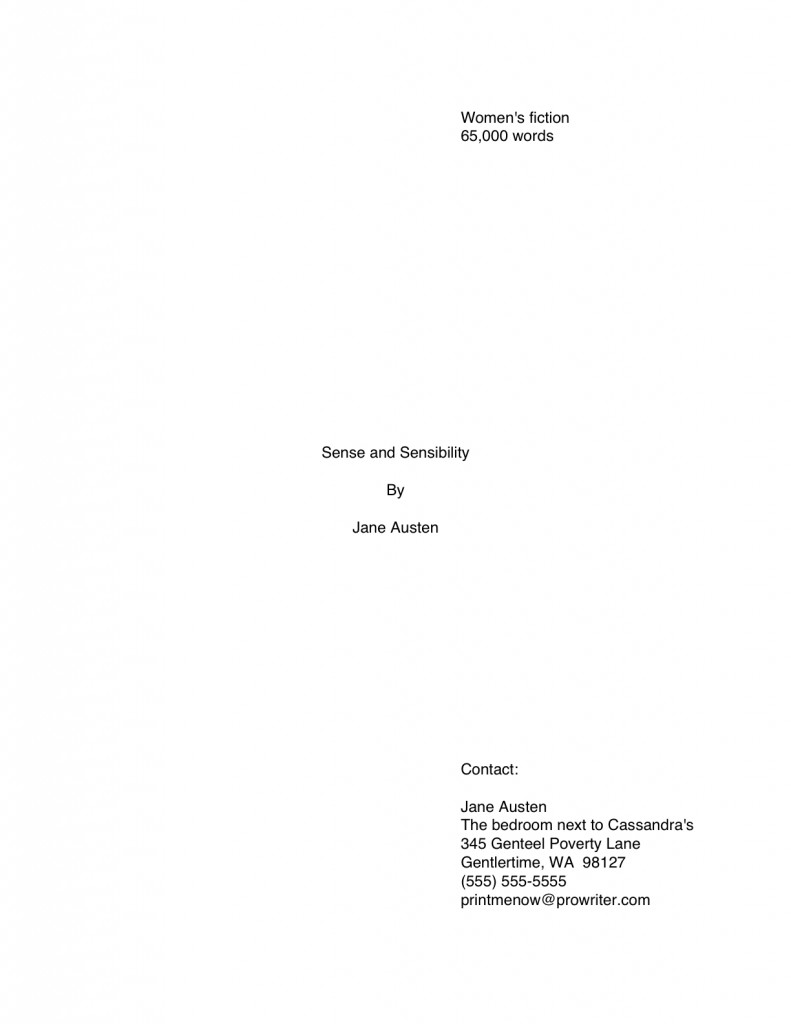
SIOA! Part III, in which your humble hostess takes on the “what if” demons on your behalf

November 18th, 2009

attacked by squid

For the last couple of days, I have been urging those of you who received requests to submit all or part of your manuscripts to an agent or editor more than a season ago to take some swift steps to get them out the door as soon as possible. And I could feel a great many of you tensing up more each time I mentioned it.

I understand the hesitancy, believe me. Naturally, you want your work to be in tip-top shape before you slide it under a hyper-critical reader’s nose — lest we forget, agency screeners who are not hyper-critical tend to lose their jobs with a rapidity that would make a cheetah’s head spin — but once you’ve shifted from your summer to winter wardrobe without popping that those pages requested when your Fourth of July decorations were up into the mail, it’s easy to keep sliding down the slippery slope toward never sending it out at all.

Whoa, Nelly, that was a long sentence! Henry James would be so proud. But you get my point.

I also understand the temptation to put off those last few revisions until you have some serious time to devote to them — like, say, the upcoming Thanksgiving long weekend or a Christmas vacation. Even if we disregard for the moment the distinct possibility that days off from work during family-oriented holidays might get filled up with, say, family activities, the wait-until-I-have-time strategy tends to backfire.

Why? Well, for many aspiring writers, holding on to requested materials too long allows an increasing sense of shortcoming to develop. Over time, as-yet-to-be-done revisions loom larger and larger in the mind, necessitating (the writer thinks) setting aside more and more future time to take care of them. So what started out as a few hours to carve out of a busy schedule transmogrifies into a few days, or even a few weeks.

Hands up, if you habitually can take that much unbroken time off work at a stretch. Working Americans typically cannot.

What I’m about to say may make working writers everywhere break into gales of hysterical laughter, but sometimes, a deadline is a writer’s friend. When you have too long to consider how to polish a manuscript, the process can easily mushroom. While giving serious thought to manuscript changes is good, extended fretting prior to sitting down and making those alterations can easily start to color the editing process — rendering it MORE difficult to make those last-minute changes as time goes on, not less.

Even if task escalation does not assault your project like the giant squid in the photo above (native to the cold, murky waters bordering Seattle!), the demons of self-doubt just love a delayed deadline. It allows them so much more time to apply their pitchforks to writers’ latent insecurities.

“If my pitch/query were really so wonderful,” a nasty little voice starts to murmur in writers’ heads, “why hasn’t that agent followed up with me, to see why I haven’t sent it? Maybe s/he was just being nice, and didn’t want to see it at all.”

Little voice, I can tell you with absolute certainty why that agent or editor hasn’t followed up: BECAUSE THE INDUSTRY DOESN’T WORK THAT WAY. It has exactly nothing to do with what the requester did or did not think of you or your book, then or now. Period.

You wanna know why I can say that with such assurance? Because at the point your manuscript arrives for an agent’s perusal, his office looks like this:

agent's office

And not, as aspiring writers worldwide would prefer to believe, like this:

cherubs reading

Yes, Virginia, all of those fuzzy piles in the first photo are precisely what you think they are: manuscripts waiting to be read. Trust me on this one: the agent who requested your manuscript seven months ago is not currently staring listlessly out her office window, wishing she had something to read. She’s been keeping herself occupied with those thousands of pages already blocking her way to her filing cabinet.

Which is why a writer who is waiting, Sally Field-like, to be told that the agent likes her, really, really likes her before submitting is in for a vigil that would make Penelope think that Odysseus didn’t take all that long to meander back from the Trojan War.

I hate to disillusion anybody (although admittedly, that does seem to be a large part of what I do in this forum), but unless you are already a celebrity in your own right, no agent in the biz is going to take the initiative to ask a second time about ANY book that she has already requested, no matter how marvelous the premise or how much she liked the writer — or even how great the query letter was.

And before you even form the thought completely: no, Virginia, there ISN’T a pitch you could have given or a query you could have sent that would have convinced her to make YOUR book her sole lifetime exception to this rule. The Archangel Gabriel could have descended in a pillar of flame three months ago to pitch his concept for a cozy mystery, and it still would not occur to the slightly singed agent who heard the pitch to send a follow-up skyward now to find out why the manuscript has never arrived.

Gabriel got sidetracked at work, apparently. I suspect it’s due to all those manuscripts he has to read.

So while that agent who legitimately fell in love with your pitch five months ago might well bemoan over cocktails with her friends that great book concept that the flaky writer never finished writing — which is, incidentally, what she will probably conclude happened — but she is far more likely to take up being a human fly, scaling the skyscrapers of Manhattan on her lunch hour on a daily basis than to pick up the phone and call you to ask for your manuscript again.

Sorry. If I ran the universe, she would start calling after three weeks, overflowing with helpful hints and encouraging words. She would also order your boss to give you paid time off to finish polishing, bring you chicken soup when you are feeling under the weather, and scatter joy and pixie dust wherever she tread.

But as I believe I have pointed out before, due to some insane bureaucratic error at the cosmic level, I do not, evidently, rule the universe. Will somebody look into that, please?

By the same token, however, the agently expectation that the writer should be the one to take the initiative to reestablish contact after an extended lull can be freeing to someone caught in a SIOA-avoidance spiral. If you have not yet sent requested materials, it’s very, very unlikely that the requesting agent is angry — or will be angry when the material arrives later than she originally expected it.

What makes me so sure of that? Because agents learn pretty quickly that holding their breath, waiting for requested manuscripts to arrive, would equal a lifetime of turning many shades of blue. SIOA-avoidance is awfully common, after all.

Oh, didn’t you know that? Hadn’t I mentioned that about 70% of requested materials never show up on the agent’s desk at all?

So a writer who has hesitated for six months before sending in requested materials can mail them off with relative confidence that a tongue-lashing is not imminent. 99.998% of the time, the agent in question’s first response upon receiving the envelope WON’T be: “Oh, finally. I asked for this MONTHS ago. Well, too late now…”

I hate to break this to everyone’s egos, but in all probability, there won’t be any commentary upon its late arrival at all — or, at any rate, no commentary that will make its way back to you. But that is a subject best left for a later post.

For now, suffice it to say that even if it has been four or five months since an agent requested your manuscript, I would still strongly advise sending it out anyway — with perhaps a brief apology included in your “Thank you so much for requesting this material” cover letter. (You HAVE been sending polite cover letters with your submissions, right?) And I would recommend this not only because the agent might pick it up, but because it’s important to break the SIOA-avoidance pattern before it becomes habitual.

Think about it: once you have put your ego on the line enough to pitch or query a book and then talked yourself out of sending it, do you honestly think either the pitch/query or submission processes are going to be emotionally easier the next time around?

For most aspiring writers, the opposite is true: after one round of SIOA-avoidance, working up the gumption to send out requested materials, or even query again, is considerably harder, because the last time set up the possibility of not following through as a viable option. The psyche already knows that nothing terrible will happen in the short term if the writer, to use the vernacular, chickens out.

Yet in the long term, something terrible can and often does occur: a good book doesn’t find the right agent to represent it, nor the right editor to publish it, because its writer didn’t want to risk sending it out until it was 100% perfect.

Whatever that means when we’re talking about a work of art.

Please don’t take any of this personally, should you happen to be in the midst of a SOIA-avoidance spiral. It is a legitimate occupational hazard in our profession: I know literally hundreds of good writers who have been in pitch/reedit/talk self out of submitting yet/reedit/pitch again at next year’s conference cycles for years. One meets them at conferences all over North America, alas: always pitching, always revising, never submitting.

Please, I implore you, do not set up such a pattern in your writing life. SIOA. And if you have already fallen into SIOA-avoidance, break free the only way that is truly effective: SIOA now.

As in stop reading this and start spell-checking.

I can tell that all of this begging is not flying with some of you. “But Anne,” the recalcitrant protest (blogging gives one very sensitive ears, capable of discerning the dimmest of cries out there in the ether), “what if I’ve been feeling ambivalent toward sending my manuscript out because there is actually something seriously wrong with it? Shouldn’t I listen to my gut, and hang onto my book until I feel really good about showing it to the pros?”

Yes and no, reluctant submitters; if a manuscript is indeed deeply flawed, I would be the last person on earth (although I know other professional readers who would arm-wrestle me for the title) who would advise the writer against taking serious steps to rectify it. Joining a first-rate writers’ group, for instance, or hiring a freelance editor to whip it into shape. Almost any such steps, however, are going to take some time.

Before anyone screams, “AHA! Then I shouldn’t send it out yet!” let me hasten to add: your garden-variety agent tends to assume that a conscientious writer will have implemented some kind of extensive long-term strategy to improve a manuscript before querying or pitching it, not after.

So if you are already certain that your manuscript is free of spelling and grammatical errors and formatted correctly (if you’re not absolutely positive about the latter, please see the HOW TO FORMAT A MANUSCRIPT category on the archive list at the bottom-right side of this page), go ahead and send it now anyway, just in case your sense of shortcoming is misplaced, AND take steps to improve it thereafter. It might be accepted, you know.

And even if it isn’t, there’s nothing to prevent you from querying the agent again in a year or two with a new draft, gleaming with all of that additional polishing.

(For the benefit of those of you who have heard that apparently immortal writers’ conference circuit rumor: no, agencies do NOT keep such meticulous records that in 2012, the Millicent du jour will take one glance at a query, go rushing to a database, and say, “Oh, God, THIS book again; we saw another version of it in the autumn of 2009. I need to reject it instantly.” Although she might start to think it if you submitted the same manuscript three times within the same year.)

Again, PLEASE do not be hard on yourself if you wake up in a cold sweat tomorrow morning, screaming, “Wait — she was talking about ME! I’m in SIOA-avoidance mode!” (For your ease in waking your bedmates, I pronounce it SEE-OH-AH.) The important thing is to recognize it when it is happening — and to take steps to break the pattern before it solidifies.

Whatever you do, don’t panic — SIOA-avoidance can be overcome. Before I’m done with this topic, I’ll give you some pointers on how to phrase a cover letter to accompany a much-delayed submission without sounding like you’re groveling or requiring you to pretend that you’ve been in a coma for the last six months, unable to type.

You can move on with dignity, I promise. No one’s going to scream at you, and no one is going to laugh at you, but your book will be grateful. I promise.

Keep up the good work!

SIOA! Part II: why can’t I seem to send the darned thing out?

November 17th, 2009

vermeerwomanholdingscales

No time for a long-winded post today, I’m afraid. Once I start nagging, though, I do like to be consistent about it, so allow me to repeat: SIOA!

For those of you who missed yesterday’s post, that nifty little acronym stands for Send It Out, Already! It, in case you are curious, refers to requested materials that an agent or editor asked to see more than three months ago that the writer has yet to submit. At this time of year, manuscripts in need of SOIA-ing are generally those either pitched or queried last summer.

Or at that conference last winter. Or the summer before that.

While such a piece of advice may come as something of a surprise falling from the fingertips someone who routinely advises going over submissions with the proverbial fine-toothed comb — and a diverse array of highlighter pens — before sending it off, many aspiring writers get stuck between the query (or pitch) and submission stages of agent-finding, excited that a real, live agent wants to read the manuscript, yet afraid that it’s not quite ready to pass muster under Millicent the agency screener’s eagle eye.

This week, I’m concentrating on helping those writers become unstuck.

If you’ve found yourself in this kind of stasis: don’t be too hard on yourself. All too often, writers (and their well-meaning non-writing kith and kin) attribute not sending requested materials is attributed to procrastination, lack of ambition, an affection for self-sabotage, or even just plain laziness, but in my experience, none of these are usually what’s going on when a writer can’t seem to carry the manuscript to the mailbox.

Many, many writers lose the vim to submit, despite beginning with excellent intentions, yet they certainly don’t start out intending to be slow in getting their work out the door. They just want to make absolutely sure it’s perfect before they head off to the post office or hit the SEND button.

Perfection, as we all know, can take time — and the longer the revision drags on, the more likely the aspiring writer is to talk himself out of sending it at all. Here’s the progression I see most often:

1. The writer believes the manuscript to be in good shape; query or pitch is full of enthusiasm.

2. The agent says (or writes) some permutation of, “Sure, send me the first 50 pages.”

3. The writer is THRILLED for a week. (During which time the aforementioned non-writer friends and relatives may be relied upon to ask the ego-dampening question: “So when is your book coming out?”)

4. Upon looking over the piece again, the writer begins to wonder if the book IS good enough. (Oftentimes, this is accompanied by a rising feeling that this particular submission opportunity is the ONLY chance the book may have to be read by an agent.)

5a. The writer starts to revise the first 50 pages wildly in order to make it perfect.

OR

5b. The writer starts to panic and puts off submission until after some future defined period when he’ll have time to rework the entire manuscript completely. (“By Christmas” is a popular choice for writers attending summer and autumn conferences, I notice.)

6. Revising — or thinking about revising — continues for weeks or months. Since the self-appointed task is to make the submission 100% perfect, the amount of time the writer mentally allots to the task of revision continues to grow exponentially over time. (Here, “years on end” is often the preferred option.)

7. One day, the writer looks at the calendar and finds that X amount of time has gone by since the original request for materials, and decides that the agent will actually be angry (translation: will reject it without reading it) if the requested pages are sent now.

8. Since the revision process has been so stressful, this conclusion often comes as something of a relief to the writer. So when the urge to get back to the book project resurfaces — as it invariably does — the merciful psyche leaps from oh-my-God-is-it-good-enough to it-doesn’t-matter-because-it’s-too-late-anyway in about tenth of the time it took to make that step initially.

9. Repeat until the very idea of sending the pages seems too ridiculous to contemplate.

10. Result: the requested materials are never sent.

This scenario is slightly more likely to play out when agents and editors ask to see the whole book, as opposed to the first 50. Or — and I’ll deal with this option a bit more next time — if the writer has already been through steps 1-8 before.

Yes, really. For some aspiring writers, this process can go on for years.

Yet each step of the progression is perfectly understandable, right? That’s what makes it hard to diagnose in the early stages.

Because, you see, what is happening here is the opposite of lazy: many of these writers run straight to their desks after receiving a positive response and throw themselves into a revising frenzy. Often, far from procrastinating, SIOA-avoiders put in many, many productive editing hours before they give up on submitting.

“I just want to get this ONE part right in Chapter Two,” they say, “so the agent of my dreams can see my best work.”

Which is, of course, a laudable and even professional sentiment — if the writer can complete this worthwhile endeavor within a reasonable amount of time. But when the writer starts thinking things like, “Well, okay, I didn’t get it out by Labor Day, as I intended — but I have some vacation time coming to me at Christmas; I can work on it then,” that should start setting off a few alarm bells.

Why? Because a lot can happen between Labor Day and Christmas. Thanksgiving, for instance.

Some of you perfection-seekers out there are shifting uncomfortably in your chairs right about now, aren’t you? “But Anne,” I hear some of you say, “that’s not the only issue. I care more about this book than anything else I’ve ever done, and once it’s published, this book is going to be bearing my name for the rest of my life, possibly even after. I don’t anything less than my absolute best writing to end up between those covers.”

Ah, but the draft you’re going to submit to the requesting agent isn’t going to be the book in its final form. It will be the version upon which future revisions will be based.

Did some coffee-drinker out there just do a spit-take? It’s quite true — yet the vast majority of unpublished writers do not seem to be aware of it.

Yes, your book does need to be as polished as possible before submission, but realistically, you will almost certainly be expected to revise it between signing a publishing contract and publication. Perhaps between signing with an agent and signing with a publisher as well. And it’s not entirely unheard-of for an agent to tell an aspiring writer to revise a promising manuscript and resubmit it before the agent makes any commitment at all. (That last one has gotten quite rare, however.)

I don’t need a crystal ball to predict any of this, either. Merely simple observation: almost every book you see on the shelves at Barnes & Noble was revised significantly AFTER an agent or editor picked it up.

It may seem almost sacrilegious to say about a work of art, but the author’s vision of the book is not the only one that matters to the publisher. Your editor will definitely have some opinions on the subject; your agent probably will as well. It’s not unheard-of for a publishers’ marketing department to weigh in, as well as the legal department, copy editors, proofreaders…

In short, even if you produced the Platonic version of your book concept for submission, chances are that it would not be the version that would see print. Sorry to be the one to burst that particular pretty bubble.

Another early warning sign that a writer may be beginning to fall prey to SIOA-avoidance behaviors is when the intended changes are in Chapter 10, and the writer is unwilling to send out the first 50 pages the agent requested until Chapter 10 is completely ready to go.

“But what if she asks for the rest?” the writer worries. “I want to be absolutely ready to send the entire book, so I can send it the instant she asks. Because otherwise, she’s going to know that I wasn’t 100% ready to submit when I queried/pitched/had a torrid affair with her college roommate and got a referral, and then she won’t even consider picking me up.”

Remember what I was saying last time about how good writers are at talking themselves out of things? A vivid imagination is not an unmitigated blessing.

I hear this one all the time, too, and my answer is invariably the same: “if you send the first 50 now, won’t you have until AFTER the agent asks to see the rest to polish the book? From where I’m sitting, that’s likely to be at least 2-3 months from now! SIOA, and get right to work on the rest of the book!”

How do I figure 2-3 months, you ask? Well — and those of you who have not yet begun querying might want to avert your eyes for a moment; this news might make those new to the biz a bit queasy — at almost every agency on the planet, turn-around times for submissions are SIGNIFICANTLY longer than for queries. four to eight weeks to read a requested 50 pages is what a CONSCIENTIOUS agency strives to achieve/

I tremble to tell you how long the ones who don’t respect writers take. For an entire manuscript, it can often run 2-3 months or longer, even at the writer-friendliest agency.

A quick digression, to remind you of a former admonition: from a professional perspective, 2-3 months is too long to wait between queries; there is no legitimate reason that your marketing efforts must be stymied by an agency’s slow turn-around time.

So keep sending out queries while your submissions are being considered, please: trust me, if the agent reading your first 50 decides to pass, you will be much, much happier if you already have Plan B queries in the pipeline.)

Was that pause long enough for those of you new to the industry to pick your chins up off the floor? See why I always advise writers that under no circumstances should they overnight their books to agents or editors unless THEY agree to pay for it? (99% of the time, they won’t.) Why overnight something that’s going to be sitting in a file drawer for the next month?

And if THAT’s not enough incentive to give serious pause to those of you with the opposite problem to SIOA-avoidance — the compulsion to send out requested materials instantly, without giving them a last-once over — I should like to know what would be.

Trust me: a LOT of those manuscripts moldering unread in piles at this very moment were overnighted by their authors; the overnight packaging doesn’t get a submission read any faster. Save your sheckles, and send requested materials via regular mail — or Priority Mail, if you really want to rush.

I’m bringing this up again as a precursor to suggesting something fairly radical: under these predictably slow turn-around conditions — over which, after all, we writers have absolutely no control, right? — I would argue that no writer is under any obligation to send the rest of a book within a nanosecond or two of receiving an agent’s request for it.

I’m quite serious about this: you may well have 2 months, and possibly as much as 4, of reasonably predictable rest-of-the-book revision time AFTER sending a requested first 50 pages. If you sent off the initial chapters and an agent asked for more, you could legitimately (after an initial polite e-mailed explanation, of course) take an additional month or six weeks AFTER the request to finish revising, if you felt it necessary.

So you can SIOA those early chapters with a relatively clear conscience, knowing that you have some time at your disposal to fiddle with the rest of the book.

And you know what? You should seriously consider doing both.

Why? So you can move on as a writer without feeling that you might have let a wonderful opportunity slip through your grasping fingertips. So you do not label yourself as a procrastinator, because that’s a hard, hard self-label to peel off from yourself before the next round of queries. So you can act like a professional writer, one who knows that to risk success is also to risk rejection, and that the only book that has absolutely no chance of being picked up is the one that’s never submitted.

And, last but certainly not least, because a REAL, LIVE agent or editor asked to see YOUR writing! That coup deserves sustained excitement, does it not?

Or are you already trying to talk yourself out of being happy at the very notion? Promise me that you’ll freeze your speculations right there until next time, and keep up the good work!
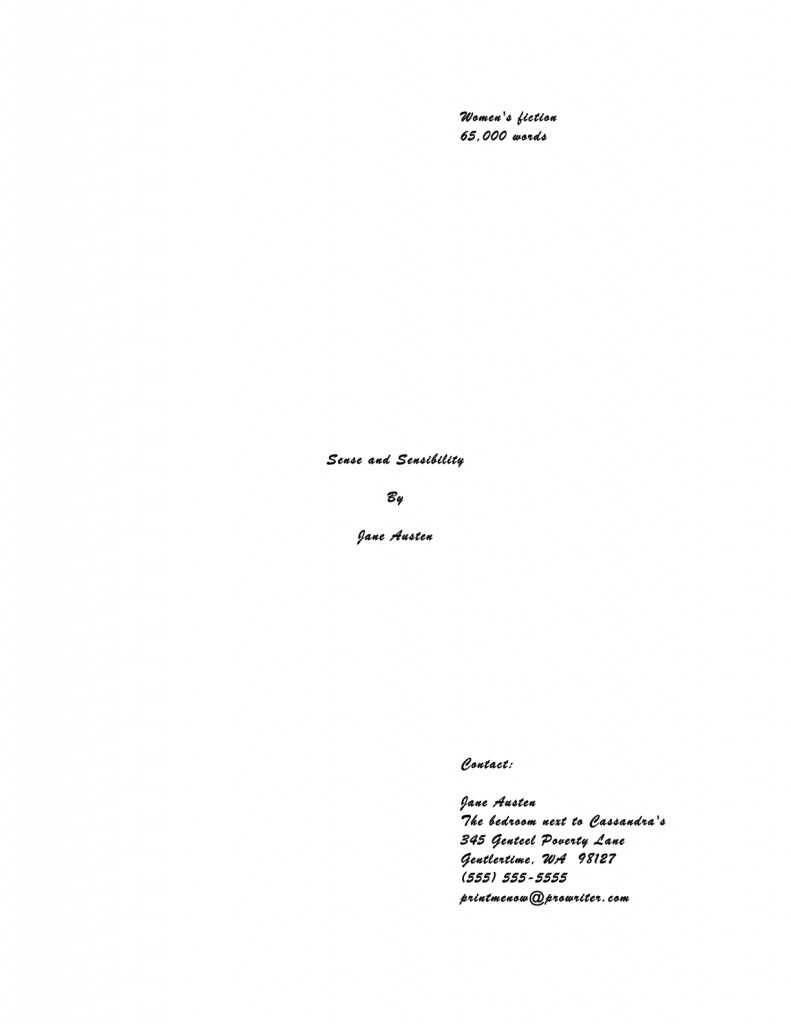
SIOA, my friends! SIOA!

November 16th, 2009

mailbox

I woke up this morning fully intending to dig through my embarrassingly tall stack of readers’ questions so trenchant that they deserve a post of their very own and find a topic du jour, honest. I genuinely am looking forward to plowing through ‘em all, possibly followed by a nice, leisurely stroll through common red flags that tend to traject submissions into the reject pile faster than a writer new to the process can say, “But I didn’t know that there WAS a standard format for manuscripts, or that a manuscript page wasn’t supposed to look just like the same page in a published book!” (If that last sentence didn’t make you smirk knowingly, you might want to check out the HOW TO FORMAT A MANUSCRIPT category at on the archive list at the lower right-hand side of this page before you proceed much farther in your writing career.)

And then I happened to glance at the calendar. It’s a week and a half until Thanksgiving — or, as those of us who deal on a regular basis with the publishing industry like to call it, the annual slow-down.

Before I depress you all by explaining why anyone would call it that, let’s be proactive: I would like to take the opportunity to urge those of you who have owed requested materials to an agent for a full season — from, say, having pitched successfully at a summer conference or received a positive response to a query prior to the annual August holidays — to send it out, already.

As in, if humanly possible, within the next week and a half.

Did that request make panic-generated fireworks go off in some writerly heads out there? I shouldn’t wonder; the last time I checked, over 70% of requested manuscripts were never actually sent to the agents and editors that requested them.

Yes, you read that correctly — the vast majority never turn up on Millicent’s desktop. That’s a whole lot of potentially publishable writing sitting in a whole lot of desk drawers. Let’s give some thought to why that might be the norm.

Consider, if you will, Zack, a good-but-as-yet-unagented novelist. Zack has been looking for an agent for quite some time now for a well-written, complex book — the kind of book that folks in the industry like to describe, if they’re feeling charitable, as “needing precisely the right agent/editor/push campaign.” (If they’re not feeling charitable, they describe it as “good, but difficult to place.”)

In short, Zack’s novel is original, and the perfect agent has yet to fall in love with it.

We’ve all been there, right? If I haven’t said it again recently, allow me to remind you that the time elapsed between when a writer begins to seek an agent for a particular project and when she finally signs with one is NOT necessarily an especially reliable predictor of the writer’s talent — or of how likely a book is to appeal to readers.

In fact, it usually isn’t predictive of anything at all: if the writing quality were the only factor involved, we wouldn’t ever see a bad book on the tables at the front of a chain bookstore, would we?

But try convincing a well-meaning friend or relative — the kind that might lecture one over turkey at a certain annual family gathering about the desirability of dropping a time-consuming hobby that has not yet yielded fortune or fame — that even the best books often take time to find the right home, eh? Non-writers tend to assume that talent is the ONLY factor, but then, the non-writing world lives under the happy delusion that the only reason a book would not get published right away is that it isn’t any good!

Long-time readers, chant it with me now: plenty of good writers have queried for years before getting picked up, and frankly, it’s harder to land an agent today than it was even two years ago, due to the slow economy. Let alone the ten or fifteen that may have elapsed since that established author whose interview you just read landed hers in — how many tries did she mention? Two? Three?

Okay, pep talk administered. Back to our saga already in progress.

Like a sensible writer, Zack knows that his book’s only chance of getting published lies in his promoting it to agents and editors, so he routinely spends the spring and summer going around to literary conferences, and the autumn to sending out queries. Since he both has an interesting story to tell and is a talented pitcher/querier, he always picks up a few requests to see all or part of the book.

Yet invariably, when I see him at holiday parties, he responds uncomfortably to my eager inquires about how agents have responded to his submissions. “I’m still revising the end of the book,” he says, eyes averted.

We have this exchange down to a ritual now. I this is my cue to ask, “Does that mean that you haven’t sent out the first 50 to the agents who asked you for it, either?”

Zack looks sheepish, self-righteous, and fearful all at once, a facial feat I would have sworn was not possible. “I want to be completely ready when they ask to see the rest.”

Readers, care to know how often you are on my mind? Exactly three seconds before I start to read him my annual riot act on the virtues of SIOA (Send It Out, Already!), I routinely think, “Gee, how long has it been since I’ve blogged about this? I really should do a reminder post.”

So here I am, telling you: if you got a request for materials prior to the first week of September (and I mean this LAST September, not the one before) to send all or part of a manuscript to an agent or editor, please, please, please SIOA!

Yes, even if it isn’t perfect. Requests for materials are like vitamins, boxes of cereal, and hunks of meat: they come with expiration dates.

Not firm ones, of course, or especially short ones, but when a request is made, it is considered professional to follow up on it in a timely manner. It shows what a good client you would be: after all, your agent would like to be able to tell editors, “Oh, she’s great about meeting deadlines.”

More to the point, I’ve never met an agent or editor yet whose raving praise about an author included the words, “And when I ask for something, she doesn’t get back to me for eight months!”

Sounds flippant, I know, but from a business perspective, how quickly a writer can churn out impeccable pages is a legitimate concern for an agent or editor. After all, an author working under a book contract would not have the luxury of setting aside a manuscript for a few months until she had a few unbroken weeks’ time to make requested revisions, right?

Most of the time, of course, a requesting agent is not going to be drumming her nails on her desk for months on end, wondering where a particular submission is, unless the submitter is already a client. If a project that particularly excited her in query or pitch form doesn’t appear, she’s likely to assume that the writer went with another agent — or dropped the project entirely.

In other words, she’s going to move on without following up. Possibly without even considering following up.

Please, please don’t wait for her to nag you about sending those requested materials; it’s not going to happen. Just SIOA.

I see some of you SIOA-avoiders scuffing your toes against the floor. “But Anne,” some of you protest, clinging to your manuscript as though it were a life raft and the tidal wave was headed your way, “The agent was REALLY interested at the conference four months ago, but I didn’t manage to get the pages out the door. Life intervened, at least to the extent that I haven’t had time to polish it to a high gloss yet. I feel like I’ve let the agent down. And despite what you say about his probably having assumed that I’ve signed elsewhere, I know in my heart that if he were truly the right agent for me, he would have defied all of the rules and contacted me to ask where the manuscript was. Because our pitch meeting wasn’t like any other in the history of the world, and…”

Let me stop you right there, Sparky: I hate to be the one to break it to you, but if a pitch (or query, for that matter) goes well, it results in a professional connection, period. Not a personal commitment — a necessary precondition to letting someone down, no? — and not a guarantee to stop work when the requested materials arrive. Nor, with certain EXTREMELY rare exceptions, an incentive for the agent to track down and ask twice for a book he’s never read.

So how is it possible to read anything at all into the agent’s not contacting Sparky to beg for an opportunity to see pages requested months ago? Many aspiring writers misinterpret silence from the requester’s end as a lapse of interest, but that isn’t necessarily the case; a good agent simply has too many books on the brain — and too many eager writers clamoring for her attention — to badger writers slow to submit.

And even if she were so inclined, remember, this person doesn’t know you. From the requester’s end of the relationship, there isn’t necessarily any visible difference between not receiving requested materials because the writer’s obsessing over whether every comma is right, because the writer just hasn’t had time to give it a once-over, because the writer has had a sudden bout of massive insecurity, and because the writer had been pitching or querying a book not yet written.

And frankly, most pros would expect that if, say, the first 50 pages of a book did need to be written from scratch post-request, it could be done successfully between midsummer and Thanksgiving, anyway. From a writer’s point of view, that may not be a particularly realistic expectation, given how most aspiring writers are already struggling to sandwich their writing between work and family and friends and a million other demands upon their time, but remember, at the submission stage, intentions don’t count for much.

Agents and editors want to judge a writer by what’s on the page, and they can’t do that without having pages to read. Thus the general expectation –for fiction, at least — is that if the book is at the querying/pitching point, it ought to be ready to send out.

Which isn’t always the case in practice, I’m afraid. An aspiring writer might jump the gun on querying for a number of reasons: because conferences fall at particular times of year, for instance, or because that terrific new character didn’t pop into the mind until a week after the query letter went out. Or because some darned fool of an Internet expert told you that the industry moves with glacial speed during certain parts of the year (like the one coming up in a week and a half, hint, hint) and you wanted to beat the post-New Year’s rush.

Heck, I once won a major literary award for a memoir for which I had written only the first chapter and synopsis. But I knew enough about the industry to respond to agents’ requests for a book proposal with a chipper, “Great! I can have a proposal to you in six weeks.” Then I sat down and wrote it during the annual August publishing world’s vacation.

But the point is, I did send it out, and that’s how my current agency was able to figure out that it wanted to sign me.

“But Anne,” I hear those who had planned on spending another few months polishing their submissions piping up, “you said that the industry shuts down between Thanksgiving and Christmas, and that it’s not a good idea to query just after the New Year. Why does it make any difference if I send it in mid-November or in February?”

A couple of very good reasons, actually: first, enthusiasm is not a permanent condition, but a fleeting one.

The fact is, the chances of the requester’s remembering you (and, more importantly, your book) are significantly higher now than three months from now. A long lapse is not necessarily a deal-breaker, but it’s not unheard-of for an agent to respond to a submission that arrives six months after a pitch with a statement that she doesn’t remember having requested it.

The second reason is that many, many agents and editors are planning to spending the next month and a half catching up on their READING while their offices are quiet. The industry slows down not because everyone who works in a publishing house takes six weeks off, but because there are so many Judeo-Christian holidays during that period that it’s hard to get enough bodies together for an editorial meeting.

Why is that significant? Well, unlike agencies, where an individual agent can decide to take a chance on a new author, a publishing house’s acquiring a book requires the collective agreement of a great many people. If the requisite bodies are heading over the river and through the woods to Grandmother’s house, it’s kinda hard to obtain their consent to anything.

But as anyone who has had much contact with the industry knows, it’s full of folks who tend to deal with the most immediate crisis of any given moment. Naturally, this workplace orientation results in much work being put off until some nebulous future date when the agent or editor has time to deal with it. Any wild guesses as to when they typically get around to it?

Right: between Thanksgiving and the end of the year. And because agents know that editors will be occupied with what is already on their overburdened desks, they tend to curl up with a few good manuscripts and take a well-deserved breather, too.

In other words, it behooves a submitting writer to adhere to their calendar, rather than expecting them to follow any individual writer’s.

“Why,” I hear one plaintive-but-reasonable voice out there demanding querulously, “in an industry where it is considered perfectly acceptable for an agent to take several months to get back to a writer who has submitted a manuscript, and six months or more for an editor to read a submission via an agent,” (yes, it happens) “should there be ANY restrictions on how long I have to send out requested materials? Why is the writer the only one expected to adhere to a tacit deadline?”

Want the honest answer? (Look away NOW if you don’t.) Because the writer is the one with the least power in this situation, and the competition for scarce representation and publishing slots is fierce.

Any well-established agent or editor sees hundreds upon hundreds of perfectly-formatted, well-written submissions per year: they don’t worry too much about the one who got away. And that gives them the power to set unreasonable (and, yes, as regular readers of this blog already know, often unwritten and unspoken) rules for writerly conduct.

Unfortunately, it honestly is as simple as that.

Amongst agents and editors, the writer who pitches well but never sends in the requested follow-up materials is as notorious as the guy who doesn’t call again after the first date. As is the nonfiction writer who pitches a stellar book idea but never actually submits a book proposal. And the already-agented writer who comes up with a great premise for a next book, gets her agent all excited about it, then two years pass without a peep.

Ask any agent: they find this phenomenon genuinely frustrating.

But it is common enough that after an agent has been in the biz for a while, she usually isn’t holding her breath waiting for ANY pitched or queried book to show up on her desk just because she asked for it. No, she’s not the kind of girl to sit by the phone.

Now, logically, one might expect that this ambient cynicism would mean that the writer had MORE time leeway, rather than less. Even an agent who flatly fell in love with a pitch wouldn’t be at all upset if the requested pages didn’t show up for a couple of months; if he’s at all experienced, he would already be aware that almost every writer on the planet likes to give the book one last read-through before submitting it, to catch any rookie, grammatical, or continuity mistakes. And, of course, he’s not the kind of boy to sit by the phone.

However, as I mentioned above, publishing is very much a seasonal business; the pros even talk about the year that way. Is your book a summer novel, a fall culture book, or a late winter special interest release? In practice, this means that submissions that might be tossed into a pile of fifty to molder during one month might be being placed in much, much shorter piles in another, where they might be read within a week or two.

But that’s not the only reason you should SIOA now — as in NOW, before the Thanksgiving holiday, if you can possibly manage it. As any of my editing clients (they’re the ones cringing in that corner over there) can tell you, I am the last person on earth who would advise submitting a manuscript that has fundamental problems. And realistically, if you absolutely had to, you might be able to get away with sending requested materials as much as 7 or 8 months after the request, if you were polite enough to send a letter explaining the need for delay quite early in the process.

However, it has been my experience that if a writer puts off sending requested materials for more than a couple of months, they may not get sent at all. Let me repeat that statistic from above: somewhere in the neighborhood of 70% of requested materials are NEVER sent to their requestors.

That’s a whole lot of lost opportunity, isn’t it? And that’s just sad. SIOA, my friends: it may be scary, but it’s a necessary – and indispensable — step in becoming a professional writer.

But don’t beat yourself up if you recognized yourself in this post; many, many good writers sometimes have a hard time SIOA-ing, and for a hefty percentage, that reluctance to send out requested materials becomes habitual. Next time, I’m going to talk about the major reasons that SOIA-avoidance happens, and what a writer can do to snap out of the pattern.

Keep up the good work!
« Previous Entries