Author! Author! :: Anne Mini's Blog

Author! Author!

Naming names, part III: hey, I don’t make the rules

July 1st, 2010

tvmountietvmountietvmountietvmountietvmountietvmountie

Happy Canada Day, neighbors to the north! Way to combine those provinces and keep them together!

At the risk of sounding trite, my most memorable Canadian experience actually was Mountie-related. I was leaving an exhibit of ancient Egyptian artifacts in a museum in Victoria, I thought the sudden transition to bright sunlight had done something terrible to my eyes: everywhere I looked, I saw blaring red. Every square foot of public space was filled with Mounties in uniform — scarlet jacket, shiny black boots, the works — chatting with friends and relatives. Hundreds, at least, a veritable red sea.

The sight was, I need hardly say, staggering. I felt as though I had accidentally stumbled into a recruitment poster.

Back to business. In the roughly 24 hours since I wrote my last post on name selection, I have sensed a certain amount of reader bewilderment. (Never mind how I know that. Blogging imbues one with super-sharp sensory perceptions.) At least a few hands, I suspect, are still raised from Wednesday. Not too surprising, I suppose, since I have been writing all week about how to avoid confusing readers.

For the last couple of posts, I have waxed long on the Cast of Thousands phenomenon, manuscripts that name every character, no matter how minor, down to the dogs and the goat tethered in the back yard in Chapter 3. “Who,” the befuddled reader cries helpfully, “are Ernest, James, and Algernon, and what are their respective relationships to Delilah, the character I have been caring about for the last hundred pages? Have they been mentioned earlier in the book, and I have simply forgotten them, or is this their first appearance?

Don’t dismiss this cri de coeur as the just punishment of an inattentive reader, my friends — from a reader’s perspective, manuscripts afflicted with COT can get overwhelming pretty fast. Especially, as we have discussed, if the COT members have similar names, either beginning with the same capital letter (to which the skimming eye is automatically drawn, right?), ones that replicate letter patterns and sounds, or — and we have not yet talked about this much — are too like the other proper names in the book.

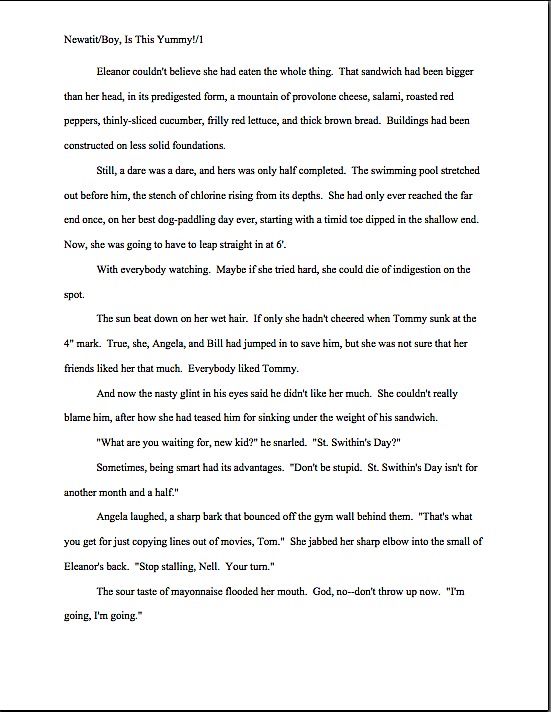
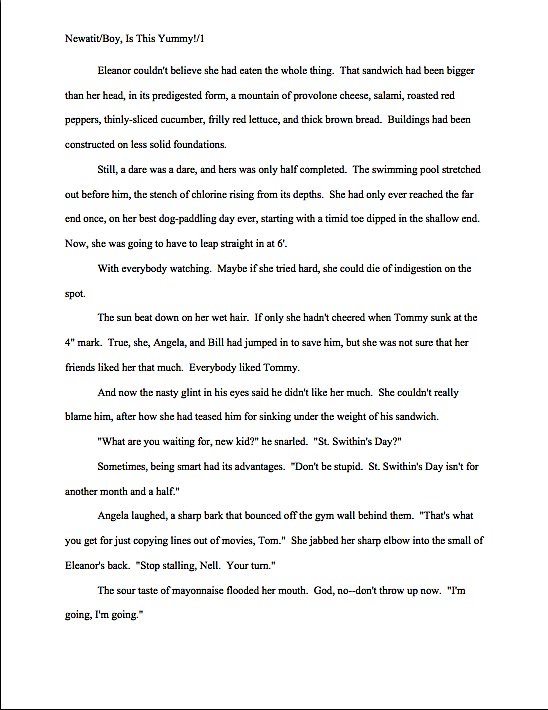
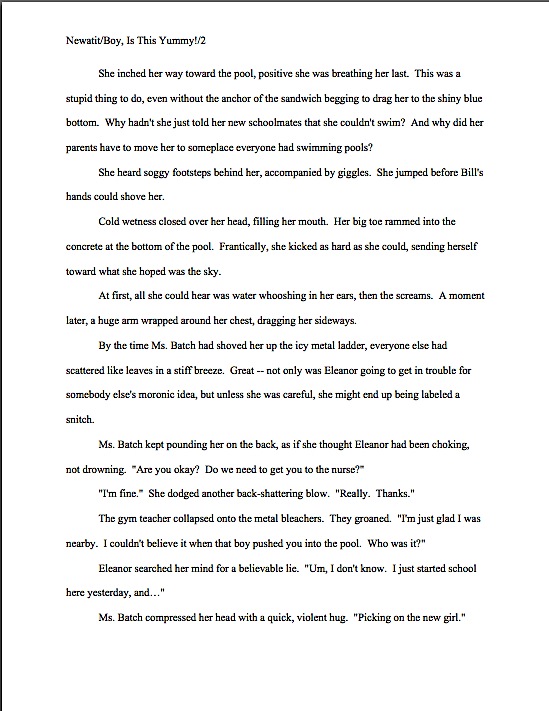
Still in doubt about the eye-distracting effect of all of those capitals? I wouldn’t want you to have to take my word for something like that — cast your gaze over this sterling piece of prose.

Names first letters

See the problem? No? Okay, get up from your desk chair, take two giant steps backward, and look at it again. Notice where your eye is drawn first?

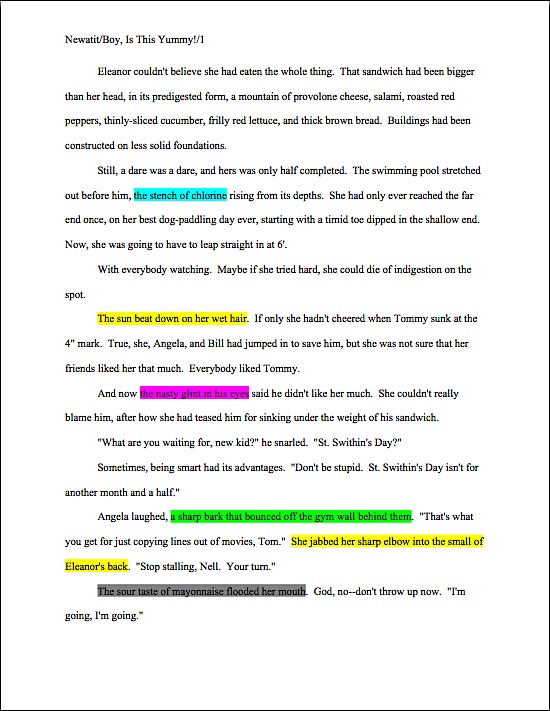
Even when the names don’t look anything alike, introducing too many of them in one fell swoop can prove equally frustrating to the reader. Again, take a gander:

Names in abundance

An avalanche of characters on page 1, in particular, before the narrative has established a context in which they might be understood, tends to have a character-blurring effect.

“Who are all these people?” the reader muses. “And why are they all dressed in the quite striking uniform of the Royal Canadian Mounted Police?”

Either variety of confusion, it pains me to say, causes readers to cast otherwise well-written books aside, it pains me to report. If that’s not a strong enough reason for a writer self-editing a Frankenstein manuscript to say, “Hmm, perhaps I should devote a few hours of my precious revision time to weeding out some of the extras lurking in the corners of my story,” here’s another: our old pal Millicent, the agency screener, tends to become impatient when characters pile up.

As, indeed, do editorial assistants, contest judges, and other professional readers; just because it’s their job does not mean that they possess a magical ability to absorb 23 names in a single page without mixing them up. “How,” the hapless peruser of a COT-riddled manuscript wonders, “am I supposed to keep all of these characters straight? Is this writer planning to market this book with a program, or perhaps dress the background characters in numbered jerseys, so the reader can possibly tell the individual members of this mob apart?”

Or, as Millicent likes to put it, “Next!”

Ooh, the notion of the pros not putting in the necessary effort to keep track of all of your characters ruffles a few writerly feathers, doesn’t it? “Wait just a minute” I hear some of you murmuring indignantly. “An ordinary reader may not have options if s/he forgets who is who, but Millicent does. If she finds she’s forgotten who a character is, she has a perfectly easy way to find out — her boss asked that I send a synopsis along with my submission. All she has to do is flip to the back of the packet. Or are you saying that if I have a lot of characters in my opening scenes, I should place my synopsis first in the packet?”

To take the last question first, no — at least, not unless an agency specifies in its submission guidelines that it prefers to see submissions packaged that order. Why is it in your interest to pay attention to such minor niceties? Long-time readers, chant it with me now: a submitter should always send a requesting agent PRECISELY what s/he asked to see.

No more, no less. Yes, even if she asked for the first 50 pages and your chapter ends a paragraph into page 51. No fudging.

And please trust a frequent literary contest judge (hey, I don’t spend all of my scant leisure time wandering around Canadian museums) when she tells you that rule applies to stated length restrictions in contest rules, too. Part of what you are demonstrating by your submission or entry is that you can follow directions, after all. Professional readers tend to harbor great affection for writers who pay attention to the details of requests; it’s so rare. Writers who start printing out pages after reading only the first line of a request for materials seem to be the norm, unfortunately, not the exception.

That giant tsunami-like rush of air you just heard was every agent, editor, and denizen of every publisher’s marketing department sighing in unison. They honestly do have a reason to be cranky on this point.

But enough of their pain — I’m sensing more conceptually-based disturbances of the ether out there, especially from those of you just on the cusp of stuffing synopses into submission envelopes. “But Anne,” the more literal-minded ether-rockers cry en masse, “I just read a blog by an anonymous agent/heard an agent say at a conference/happened to be eavesdropping in that bar that’s never more than 100 yards from the dais at any writers’ conference, and this guy said he didn’t care about exact page count in requested materials; he just wanted the first three chapters. So aren’t you, you know, wrong about the importance of sticking to 50 pages?”

Actually, literal rockers, you’ve provided evidence in support of my point, not against it. Remember, no matter how much aspiring writers would like for there to be an absolutely uniform set of expectations for submissions — and a well-publicized one, at that — individual differences do exist. So once again, long-time readers, please take out your hymnals and sing along: if your submission-requester says he wants to see something specific in your submission packet, for heaven’s sake, give it to him.

Ditto with contest rules, incidentally. General submission or entry guidelines only kick in when the requester doesn’t ask for something different — which is to say, the vast majority of the time. (As always, if you’re unfamiliar with how professional manuscripts differ from printed books or other commonly-scene formats, I implore you to check out the STANDARD FORMAT BASICS and/or STANDARD FORMAT ILLUSTRATED categories on the list at right. Actually, I would strongly recommend any reader new to this blog to take a gander at those categories first.)

Which is to say: if the agent you overheard wants four chapters, you should send four chapters. If she asks you to give your pitch in mime while juggling seventeen oranges, you should consider doing that, too, because she’s the one who is going to be deciding whether she wants to represent you or not.

That being the case, is your first professional contact with her truly the best time to say (at least implicitly), “Look, I know what you said you wanted to see, and that request was based upon your far greater knowledge of both how the publishing industry works and how you like to read, but I’m just going to assume that I’m right and you’re wrong. Got a problem with that?”

I can tell you now: she will. So will her Millicent and any contest judge you might see fit to treat in a similar fashion.

That being said, don’t revere such requests so highly that you fall into the extremely common trap of generalizing any such quirky individual preferences into industry-wide expectations. Writers brand-new to the biz make this mistake all the time, learning only through hard experience that such extrapolations seldom pay off. Just because one agent, small publisher, and/or contest has a wacky preference doesn’t mean that any other agent, small publisher, and/or contest will share it.

Or, to express it in mathematical terms, 1 agent’s preference ≠ every agents’ preference.

Bear that in mind, please, the next time you find yourself confronted with the latest panicky iterations of “Oh, my God, I heard an agent speak last week, and submission standards have completely changed!” that trouble the literary world in the wake of every conference season.

Whenever you encounter any hyper-specific submission guidelines that deviate sharply from the rules of standard manuscript format that an agency might post on its website or an agent might specify at a conference — like, say, specifying that submissions may only be in Helvetica or that they should be bound, both usually no-nos — should be treated as applicable to THAT REQUESTER ALONE, rather than to every authors’ representative currently walking the earth.

Everyone clear on that? Good.

Back to the original question, and thence to my argument already in progress: why wouldn’t a professional reader who got a large character list mixed up simply fish out the synopsis for reference? And if helping a busy Millicent keep the characters straight is a legitimate purpose for a synopsis, shouldn’t it come first in the packet?

In a word, no. If you put the synopsis at the front of your packet, Millicent is just going to toss it aside and go straight to the first page of your manuscript. If dear Millie reads all the way through your submission and likes what she sees, THEN she will read the synopsis.

Maybe.

You’re hoping that I’m kidding, aren’t you? Bizarre but true, that synopsis you slaved to make short enough is not always considered at the submission stage. Reading the synopsis is often not necessary to determining whether to ask to see the rest of the book — and why would Millicent bother to read the synopsis of a manuscript she has just finished reading in its entirety?

Seriously — ask at the next writers’ conference you attend. There’s a certain logic to this, at least for fiction. After all, if a book made it to the submission stage, presumably, the novel’s premise was deemed acceptable by the query screener or the agent to whom the writer pitched it. The only reason to read the synopsis at the submission stage, then, would be to find out what happens after the last page of the submission.

Try not to waste any energy being annoyed about this. If Ernest, James, and Algernon appearance in Ch. 2 was brief enough, chances are that they wouldn’t have shown up in the synopsis, anyway.

While I’m apparently free-associating about any and all topics related to character names, and since this contest entry season, this seems like a dandy time to talk about character name choice that could get a writer into a whole lot of trouble. Yes, Virginia, I’m talking about that pesky but oh-so-common literary contest rule that forbids entrants from mentioning their own names anywhere in a submission.

Kind of inconvenient for memoirists and other writers of the real, isn’t it? In practice, this ubiquitous rule means that entrants in memoir and personal essay categories, not to mention those many fiction writers who like to blur the line between fiction and nonfiction by making themselves characters in their own narratives, have to select new monikers for themselves.

Stop laughing, oh writers of thinly-veiled autobiographies passing as fiction. For a writer who has embraced the unique difficulties of thinking of herself as a character in a book, renaming himself can be a genuine chore. Novelists attached to their characters’ names should be sympathetic to that: if it’s trying to track down and change every mention of Monique to Madge when she’s your creation, imagine the emotional difficulties involved when Monique has to rechristen herself.

That’s not to say that the no-name rule itself is objectionable. However annoying renaming may be to contest-entering writers of the real, it exists for a very good reason: for a contest to be worth its salt, it must be able to claim that its judging procedures are not biased; the first step to assuring lack of personal bias is to institute blind judging, where no judge knows the name of any given author. Admittedly, some competitions are only apparently unbiased, but for the most part, contest organizers take authorial anonymity very seriously indeed.

So no, finding a clever way to get around the rules is not going to endear you to them. Not at all.

Which is why I am about to turn very hard-line: if you are submitting a memoir entry, FOLLOW THE RULE ABOUT NOT HAVING YOUR OWN NAME APPEAR ANYWHERE IN THE MANUSCRIPT. And do bear in mind that this rule applies to not only your entire name, but either your first or your last appearing alone as well.

That may seem like rather redundant advice — every contest entrant everywhere should follow all the rules in the contests he enters, right? — but this is the single most common way memoir entries get themselves disqualified. For a memoir entry, you should never just print up the opening chapter of your book and send it in; check the rules very carefully and apply them to your pages first.

You could, of course, sidestep the issue entirely by not entering a piece of writing in which dear self is a character — which is, again, a trifle difficult for memoirists and other habitual writers of the real. The second-best way that I’ve found is to christen oneself anew with the name that you wish your parents had had the wit and wisdom to give you in the first place.

Come on — none of us had the name we wanted in junior high school. Pick the one you believe would have made your life lovely and do a search-and-replace.

Obviously, you’re going to want to make a duplicate document of the chapter or essay you’re planning on entering in the contest before you perform this bit of minor surgery — as I said, it’s never a good idea just to print up the requisite number of pages from your already-existing manuscript and send off to a contest. (Your slug line in your submitting-to-agents version will have your name in it, for one thing.) Perhaps less obviously, you’re going to need to perform the search-and-replace function for both your first and last name, as well as any nicknames you might have incorporated into the manuscript.

Even when you’ve gone to all the trouble of using a pseudonym, it is a good idea to add a note on the title page, saying that since the contest forbids the author to mention his own name, you will be using “Bobby” (not your real name) throughout.

Why take that extra precaution, you ask? Because it’s practically impossible not refer to yourself by name in the story of your own life. Since judges are aware of that, and become accordingly eagle-eyed.

And don’t think being coy about it will help you evade their scrutiny, either. Make yourself comfortable; I’m going to tell you a little story.

I went to college with Danny, a very clever, very ambitious writer who eagerly contributed pieces to the on-campus humor magazine. (As those who happened to be hanging around Harvard at the time would no doubt be quick to point out, I use the term humor loosely here: the magazine was seldom actually funny to those who were not in the writers’ clique, but bear with me.) Danny had every reason to try to get his articles published: the magazine had long ago spawned an extremely profitable off-campus humor magazine, so a successful Lampoon piece could be a stepping-stone to a career as a comedy writer.

Despite or perhaps because of these articles’ worth as resume-candy, it was the practice of the magazine to publish all of its pieces without bylines, to encourage collaboration amongst members of the writing club. But as I said, Danny was ambitious: he, like many of the other writers in the club, was anxious to graduate with clippings he could use to promote his work later on. So Danny did something exceptionally crafty: he inserted his own name into every ostensibly anonymous piece he wrote, much as Jerry Lee Lewis used to refer to himself in his own lyrics, so radio listeners would know who sang the song.

His favorite way of doing this was to insert an imaginary conversation with himself into the text, so an alter ego could address him by name, as in, “Danny boy, you’re really in trouble now!” Occasionally, he would vary it by having an authority figure yell at his narrator: “Wilson, you’re out of line!” (Because Danny is now a fairly prominent magazine writer, I should say straight away: to protect his identity, Wilson is not Danny’s actual last name. See me practicing what I’ve been preaching?)

Now, as my parenthetical aside just told you indirectly, Danny’s little stratagem actually did help him generate the clippings he coveted, but he was relying upon his club’s editorial indulgence to let him get away with breaking the rules. In a contest, however, this practice would have gotten him disqualified immediately.

I bring this up not because I suspect that there are legions of Machiavellian-minded rule-breakers out there, but because I have seen so many contest entrants apparently doing inadvertently what Danny did on purpose. Within the first-person narrative common to memoirs, narrators tend to talk to themselves all the time, à la Hamlet: “Danny, you get ahold of yourself, now.” And that single reference, to a judge who was looking to pounce upon contest rule violations, could get a memoir entry disqualified.

Yes, Virginia (if that’s even your real name), even though it would be highly unlikely, without the judge’s having the list of memoir entrants by his side for first-name cross-referencing purposes, for the judge to guess the author’s identity. Simply the implication that the author might have referred to himself can appear to be a rule violation.

So a word to the wise: innocent naming mistakes can knock your entry out of competition. It would behoove you, then, to prepare your entry, like your queries, under the assumption that the judge who is going to read it is the nastiest, most curmudgeonly nit-picker since, well, me.

“But Anne,” I hear you cry, quite rightly pale at the prospect of encountering yours truly as a contest judge, “if this mistake is usually made inadvertently, how can I hope to avoid it?”

Well asked, oh fearful trembler. Experience sharpens the editing eye. Rest yourself upon the judge’s reading couch for a moment, and take a look at where these slips most commonly occur.

Let’s say the memoir’s author is named Biddy MacAlister-Thames, not a name anyone’s eye is likely to encounter on a page without noticing. Even if Biddy has had the foresight to rename herself Libby McPherson-Seine and do a search-and-replace accordingly, she should double-check her entry especially carefully in the following places:

(1) When another character directly addresses the narrator: “Biddy, have you seen the our pet tiger, Max?”

(2) When another character is talking about the narrator behind her back: “Ward, I’m worried about the Beaver. He’s paying too much attention to that Biddy next door.”

(3) When another character refers to the narrator by an abbreviation that a search-and-replace might not catch. “I’m talking to you, Bid,” is substantially less likely to get changed automatically than, “I’m talking to you, Biddy.”

(4) And, in the VAST MAJORITY of childhood memoirs, when the narrator gets in trouble, some adult shouts some version of: “Elizabeth Deirdre MacAlister-Thames, you come in this house this instant!”

Remember, in order to violate the rule, even if a character other than the author appears with the author’s last name, it can cost you. So keep our Biddy should keep her eye out for these kinds of situations, too:

(5) When a third party addresses a family member: “Mrs. MacAlister-Thames, your daughter is under arrest.”

(6) When the narrator refers to her family collectively, or to a possession as theirs: The Easter Bunny had been unusually generous to the MacAlister-Thames family that year.

Remember, as I pointed out above, self-references to either your first or last name, not just to both together, count as rule violations. So Biddy would be wise to do a search-and-replace for BOTH her first AND last names in her entry before she printed it up, would she not?

Yes, it’s a tedious thing to have to do, Biddy (or whatever you’re calling yourself these days), and yes, you have my sympathies for having to do it. But frankly, I would rather see you annoyed and on the finalist list than not proofread and disqualified.

I’m funny that way, at least since I was partially blinded by a Mountie convention. Keep up the good work!

The getting-a-book-published basics, part XI: a few more observations on offer-acceptance etiquette, and a cautionary tale

January 25th, 2010

lily tomlin operator

There I was, peacefully enjoying some well-deserved rest this weekend, when a prime specimen of that species so justly dreaded by writers, the hobgoblins of self-doubt, abruptly pulled up a pillow and sat down on my bed. “Um, Anne?” the wily fellow asked, playfully poking at my cat with his tail. “You know those last couple of posts about what to say and do when an agent calls and offers representation. What if some gifted writer out there mistakenly believes that the questions you recommended are the only ones it’s polite, reasonable, and necessary to ask?”

I yanked the pillow out from under him. “Demon Joe,” — that’s the name of the hobgoblin who specializes in tormenting advice-giving bloggers in the dead of night, so you’ll know should you ever run into him — “Author! Author!’s readers are much, much smarter than that. They know that just as every manuscript requires different revision, and that every book category requires a slightly different kind of agent, every offer from an agent and every subsequent conversation will differ. Now unhand my cat and get out of here.”

Demon Joe slithered across the comforter until he was nose-to-nose with me. “Perhaps. But did you talk about what a writer’s supposed to say if she has manuscripts out with other agents at the time that she receives the offer?

“I talked about that indirectly,” I said defensively, extracting my cat’s tail from Joe’s grasp. “Last weekend, when I was discussing what to do if an agent asks for an exclusive while another agent is already reading the manuscript. You ought to remember — you yanked me out of bed to write it.”

“True enough.” Demon Joe stroked his small, pointed beard thoughtfully. “And I wouldn’t want to disturb your sleep. I Just can’t help worrying about whether an excited aspiring writer, burbling with glee over a phone call from a real, live agent, is going to be in any mood to, you know, extrapolate. But if you’re confident that you’ve covered all of your bases…”

I hate it when Demon Joe is right. If you’ve ever wondered why some of my posts bear timestamps at three or four in the morning, blame him.

I certainly do.

Here, then, is an extra-special bonus middle-of-the-night end-of-the-weekend post, devoted to that most burning of problems most aspiring writers pray someday to have: what you to say to an agent who wants to represent you, when one or more other agents are also considering your manuscript?”

Seem like an unlikely scenario? It isn’t, actually, for any aspiring writer sending out simultaneous submissions. Any time more than one agent is considering the same manuscript, one possible outcome — the best one, actually — is that the writer will need to say something along the lines of, “Gee, I’m flattered, but I’m afraid that I shall have to talk to the X number of other agents currently reading my book. May I get back to you in, say, two weeks?”

The very idea of saying that to an agent who wants to represent you made some of you faint, didn’t it? Believe me, I’ve been there.

Seriously, I have. I wish I had known from the very beginning that having more than one agent reading a manuscript at a time is actually a very good thing for a writer. At least, if all of the agents concerned are aware that they’re in competition over the book.

“What makes you do darn sure of that?” Demon Joe demands. “Stop eyeballing that head-shaped indentation in your pillow and share your experience.”

Okay, okay — I’ll tell the story, but then I’m going back to sleep. Everybody but me comfortable? Excellent. Let’s proceed.

Many years ago, I had just sent out a packet of requested materials — memoir book proposal plus the first three chapters of a novel — when another agent asked to see my book proposal as well. Naturally, when I sent off the second package, I mentioned in my cover letter that another agent was already considering the project.

Thanks, Demon Joe, but I’m way ahead of you on this one: all of you multiple submitters do know that you should always mention it in your submission cover letter if another agent is already reading any part of your manuscript or book proposal? And that you should always drop any agent already reading your work an e-mail if you submit your work to another agent thereafter?

Well, now you do.

Although I knew to be conscientious about that first part, back in those long-ago days of innocence, I was not aware of the second. Indeed, the hobgoblin of doubt dedicated to torturing aspiring writers waiting to hear back on their submissions — Demon Milton, if you must know his name — would have forbidden my acting upon it if I had known: unfortunately, the old conference-circuit advice about never calling an agent who hasn’t called you first was deeply engrained in my psyche.

In other words, I was too afraid to bug Agent #1 to let her know that Agent #2 was looking at my book proposal. Big, big mistake.

Okay, Demon Joe, stop battering my head with your tail: I’m going to show them how to avoid that particular pitfall before I reveal the hideous consequences of not playing by this particular not-very-well-known rule.

So what should I have done instead? If more than one agent asks to see my manuscript (or, in this particular case, book proposal), I should have informed all of them, pronto, so they could adjust their reading schedules accordingly.

No need to name names, of course, or even to go back and tell Agents #1 and #2 that Agents #4-6 also asked to see it a month later. All that any given agent in the chain needs to know is that she’s not the only one considering it.

But I didn’t know that; frankly, I was too tickled to have attracted so much interest. Having stumbled into this rather common error, I set myself up for another, more sophisticated one.

A month later, Agent #2 called me to offer to represent the book. Since Agent #1 had at that point held onto the proposal for over six weeks without so much as a word, I assumed — wrongly, as it turned out — that she just wasn’t interested. So I accepted the only offer on the table, and sent Agent #1 a polite little missive, thanking her for her time and saying that I had signed with someone else.

Demon Joe is prompting me to pause here to ask: did that sweeping, unjustified conclusion make you gasp aloud?

It should have, especially if you have been submitting within the last couple of years. Six weeks really isn’t a very long time for an agent to hold onto a manuscript, after all; now, six months isn’t an unusual turn-around time. But even back then, when about eight weeks was considered the outside limit of courtesy, I should not have leapt to the conclusion that Agent #1 had simply blown me off.

Two days later, the phone rang: you guessed it, an extremely irate Agent #1. Since she hadn’t realized that there was any competition over the project, she informed me loudly, she hadn’t known that she needed to read my submission quickly. But now that another agent wanted it, she had dug my materials out of the pile on her desk, zipped through them — and she wanted to represent it.

I was flattered, of course, but since I had already told her that I’d accepted another offer, I found her suggestion a trifle puzzling. I had, after all, already burbled an overjoyed acceptance to Agent #2. I couldn’t exactly un-burble my yes, could I?

Yet when I reminded her gently that I’d already committed to someone else, all Agent #1 wanted to know was whether I had actually signed the contract. When I admitted that it was in the mail, she immediately launched into a detailed explanation of what she wanted me to change in the proposal so she would be able to market it more easily.

Had I been too gentle in my refusal? What part of no didn’t she get? “I don’t think you quite understood me before,” I said as soon as she paused to draw breath; #1 must have been a tuba player in high school. “I’ve already agreed to let another agent represent this book.”

“Nonsense,” #1 huffed. “How could you possibly have made up your mind yet, when you haven’t heard what I can do for you?”

I’ll spare you the 15-minute argument that ensued; suffice it to say that she raked me over the coals for not having contacted her the nanosecond I received a request for materials. Agent #1 also — and I found this both fascinating and confusing — used every argument she would invent to induce me to break my word to Agent #2 and sign with her instead.

Unscrupulous? Not exactly. She was merely operating on a principle that those of you who have been following this series should have by now committed to heart: until an agent offers a representation contract and a writer actually signs it, nothing that has passed between them is binding.

As I so often tell first-time pitchers who have just been asked to send pages: until there’s a concrete offer on the table, that nice conversation you just had with that agent about your book is just that, a nice conversation.

Of course, #1 may have taken the axiom to heart a little too much — I had, after all, already said yes to another agent, somebody equally enthusiastic about my proposal — but as it turned out, I should have listened to her. I should also have done my homework better: Agent #2, a charming man relatively new to my book category, actually had very few connections for placing the book.

Yes, Demon Joe: that is something I might have learned had I asked him a few more questions before saying yes. Thank you for pointing that out. Now stop rolling around on my flannel sheets.

What happened here? Well, my initial mistake in not keeping both agents concerned equally well-informed allowed an agent who probably knew that acting quickly was his best chance of competing in a multiple submission situation to shut out a better-qualified agent by the simple expedient of asking first.

So what should I have done instead? Contacted Agent #1 as soon as I received the second request, of course — and called her before I gave Agent #2 an answer.

Admittedly, that second part would have required some guts and finesse to pull off; if #2 was deliberately rushing me to commit before I asked too many questions about his track record in selling my type of book, I doubt that he would have been particularly thrilled about my asking for some time to make up my mind. (His agency went out of business within the year, after all; he gave up on my proposal after showing it to only five editors. I received a letter from one of them, saying that he had not submitted it through the proper channels.)

In the long run, though, it would have clearly been far better for me and my book proposal had I taken the time to make sure that I knew what my options were before I took what I deemed to be an irrevocable step. (For a more tips on handling simultaneous submissions far, far better than I did that first time around, please see the WHAT IF MORE THAN ONE AGENTS ASKS TO SEE MY MANUSCRIPT? category on the archive list at right.)

The story does have a happy ending, however: fortunately, the next time I was lucky enough to be in this position, right after having won a major award for my memoir, I had the experience to know how to handle it. I was also fortunate enough to know several previous winners of that particular contest who were kind enough to give me excellent advice on what to do if I won. (It’s always worth tracking down past winners, if you happen to be a finalist: it’s amazing how nice most authors are one-on-one.)

Just so I can convince Demon Joe to remove his pitchfork from my foot region, let’s recap what a writer should do if more than one agent is considering a manuscript when a representation offer gladdens his heart:

(1) Thank the offering agent, but remind her that other agents are currently considering the manuscript.
That should not be news to her, right?

(2) Ask for 3 weeks to check in with the others and make up your mind.
Since this is precisely what she would expect you to do for her if another agent had made an offer first, she should be fine with this. If she isn’t, offer not to commit to anyone else until you have spoken to her again — and set up an appointment a couple of weeks hence to do just that.

Why as much as three weeks? Because it’s entirely possible that none of the other agents have yet so much as glanced at the manuscript. You don’t expect them to make a representation decision before they’ve read your book, do you?

Demon Joe likes that so much that he’s doing a little jig on my bedroom slippers. “Let me be the one to draw out the implication here: yes, some agents who are aware that a manuscript is being multiply-submitted will wait to hear that someone else has made an offer before they give the manuscript a serious once-over.”

The hobgoblin in charge of that particularly nasty (from the writer’s point of view, anyway) game of chicken is called Harold, in case you were wondering. You might want to mutter at him under your breath, should you ever be the writer caught in this situation.

Which is, lest we forget, a good outcome for a submitter. Back to our to-do list:

(3) Then ask all of the other questions you would have asked Agent #1 if she had been the only agent to whom you submitted.
You want to have a basis to decide between her and any of the other agents who say yes, don’t you?

(4) As soon as you get off the phone with #1, e-mail ALL the other agents currently reading any part of your manuscript. Let them know that you have had another offer — and that if they are interested, you will need to hear from them within the next ten days.
Seem fast? It is. It’s also a reasonable amount of time for a rush read, and it gives you a little leeway if any of the other agents needs more time.

After all, the fact that others are reading it isn’t going to come as a surprise to any of them, right? Besides, you don’t want to keep Agent #1 waiting too long, do you?

Stop poking me in the kidneys, Demon Joe. I was getting to the leeway issue.

It’s not uncommon for agents in this situation to ask for more time to read your work. That’s up to you, but do be aware that if you grant extensions, you’re going to have to tell Agent #1 about them.

Doesn’t sound like such an attractive prospect, does it? Wouldn’t you rather build a little extra time into your arrangement with #1, so #2-16 can miss the mark by a few days without sending you into a nail-gnawing panic?

(5) Try to obtain similar information from every agent who makes an offer.
That way, you will be comparing apples to apples, not apples to squid. So if you ask one for a client list — and you should — ask each one that makes an offer. If you talk to a client of #1, talk to #3’s client as well. Otherwise, it’s just too tempting to sign with the one who spontaneously offered you the most information — who may or may not be the best fit for your work.

(6) Make up your mind when you said you would — or inform everyone concerned that it’s going to take a little longer.
But don’t push it too long, and don’t try to use what one agent has said to hurry another. (Over and above simply informing them that another has made an offer, that is.) This is not a bargaining situation; it’s a straightforward collection of offers from businesspeople about whom you should already have done your homework.

And try not to move the deadline more than once. Why? Well, you’re going to want to have a pleasant working relationship with whomever you choose — and although writers often feel helpless when torn between competing agents, that is not how they will see it. The last impression you

(7) After you’ve chosen, inform the agent with whom you will be signing first.
This is basic self-protection, especially if you’ve had to push the decision deadline back more than once. It’s unusual for an agent to change her mind after making an offer, but if she does, you will be a substantially happier camper if you have other offers in reserve.

(8) After you have sealed the deal with your favorite, inform the others promptly and politely.
Do this even if some of the others didn’t bother to get back to you at all — some agents do use silence as a substitute for no, but it’s not courteous to bank on that. They honestly do need to know that they’re no longer in the running.

Resist the urge — and believe me, you will feel it — to explain in thanks, but no thanks e-mails why you selected the agent you did. The agenting world is not very big, after all, and the other agent(s) really don’t need to know anything but that you have indeed made a decision.

Above all, make sure to thank them profusely for their time. After all, they were excited enough about your writing to consider representing you; don’t you want them to buy your book when it comes out?

Hey, my cats are asleep, my various body parts seem to be free of pitchforks, and the hobgoblin all-clear has sounded. (It sounds a lot like a snore from my SO.)

That means it’s time for me to turn in, campers. Good night, sleep tight, and don’t let the hobgoblins of self-doubt bite. Oh, and keep up the good work!

The romance — and limitations — of exclusivity, part II

January 17th, 2010

1885-proposal-caricature

Last time, I took a break from our ongoing series to respond to a readers’ question about how to handle an exclusive request from an agent. Specifically, she wanted to know what she should do if she had already agreed to let one agent sneak an exclusive peek at her manuscript, but another agent had asked afterward to see it non-exclusively. What’s a writer to do?

The short answer: abide by her commitment to Agent #1 for the duration of the agreed-upon period of exclusivity, then move on to Agent #2. The only apparently shorter answer: what honoring that agreement means vis-à-vis approaching other agents really depends upon the terms of the exclusivity agreement.

Have I lost those of you who walked in halfway through this discussion? Okay, I’ll recap: an exclusive is an arrangement whereby a writer allows an agent to read a particular manuscript while no other agent will be reviewing it. The agent requests an exclusive because he would prefer not to compete with other agents over the manuscript; the writer agrees, presumably, because if this agent says yes, she will neither need nor want to approach other agents.

Let’s be clear about what that means in practice, campers: the writer guarantees that nobody else will be in the running while the requesting agent is pondering the pages. Anyone see a potential problem with that?

Give yourself a large, shiny gold star and a pat on the back if you instantly asked, “Wait a minute — what happens if the request for an exclusive comes in while another agent is already considering the manuscript?” That would indeed present a problem, because by definition, a writer cannot grant an exclusive if any agent is currently reading any part of the manuscript in question; in order to comply with a request for an exclusive, the writer must wait until all of the agents reading it at the time the exclusivity request arrived have informed him of their decisions.

Doesn’t seem like all that complicated a premise, does it? Yet hardly a month goes by when I some exclusive granter doesn’t tap me on the shoulder (physically or electronically) to ask, “Um, Anne, do you remember that request for an exclusive I was so excited about a week and a half ago?” (Or a month and a half, or six months.) “I’ve heard from another agent. What should I do?”

Which leads me to the other potential problem that I sincerely hope some of you came up with two paragraphs ago: what happens if an agent who asked for an exclusive doesn’t get back to the writer within a reasonable amount of time? Is the writer still bound by the exclusivity agreement? Or is there some point at which it’s safe to assume that silence = thanks, but we’re not interested?

The short answers to each of those last three questions, in order: it depends on the terms of the original agreement; it depends on the terms of the original agreement; it depends on the terms of the original agreement.

What does it depend upon? Those of you who read breathlessly through yesterday’s post, shout it along with me now: it depends upon whether the writer had the foresight to set an end date for the exclusive. If an exclusive is open-ended, the writer cannot ethically send out requested materials to other agents until one of two things happens: the exclusive-requester informs the writer that she has rejected the manuscript, or so many months have passed without word from the agent that it’s safe to assume that the answer is no.

Even then — say, six months — I’d still advise sending an e-mail, asking if the exclusive-seeking agent is finished with the manuscript. It’s only polite.

Or avoid this dilemma entirely by hedging your bets from the get-go: grant the exclusive, but send the manuscript along with a cover letter that mentions how delighted you are to agree to a six-week exclusive. The agent can always come back with a request for more time, but at least you won’t be left wondering six months hence whether you’ll offend her if you move on.

I’m sensing some severe writerly disgruntlement out there. “But Anne!” exclaim aspiring writers who want there to be more options. “Why should I borrow trouble? Surely, you don’t expect me to run the risk of offending an agent by implying that he’s not going to get back to me in a timely manner?”

Hey, I don’t expect anything; do as you think best. I’m just the person that aspiring writers keep asking how to get out of an exclusive that hasn’t panned out as they had hoped.

To help you weigh the relevant risks, let’s look at the phenomenon from the other side of the agreement. Generally speaking, agents will request exclusives for only one of three reasons: they fear that there will be significant competition over who will represent the project, they don’t like to be rushed while reading, or it is simply the agency’s policy not to compete with outside agencies, ever.

Do I feel some of you out there getting tense over that third possibility, doing the math on just how many years (if not decades) it could take to make it through your list of dream agents if you had to submit to them one at a time? Relax, campers: requests for exclusives are actually fairly rare.

Why rare? Well, the first kind of exclusive request I mentioned yesterday, the one Agent A might use to prevent Agents B-R from poaching your talents before A has had a chance to read your manuscript (hey, A’s desk is already chin-deep in paper), tends to be reserved for writers with more than just a good book to offer. Celebrity, for instance, or a major contest win fifteen minutes ago. Basically, the agent is hoping to snap up the hot new writer before anybody else does.

Or before the HNW realizes that s/he might prefer to be able to choose amongst several offers of representation. Since pretty much every respectable agency offers the same service, such choices are often made on the basis of connections, how well-established the agency is, or even how well the writer and the agent happen to hit it off. If an agent fears that the other contenders might be able to offer a rosier prospect, it might well be worth her while to buttonhole the HNW and get her to commit to an exclusive before anyone else can get near.

So if you suddenly find yourself the winner of a well-respected literary contest or on the cover of People, remember this: just because an agent asks for an exclusive does not mean you are under any obligation to grant it.

Oh, pick your chin up off the floor. If your work is in demand, it’s not necessarily in your best interest to sign with the first agent who makes an offer — you will want the one with the best track record of selling books like yours, right? Ideally, you would like to be in a position to compare and contrast offers from different agents.

Why not pick the one who asks first and be done with it? Chant it with me now, long-time readers: you do not want to land just any agent; you want the best agent for your work.

If you shouted, “Yes, by Jove: I want to query and submit in a manner that maximizes the probability to be fielding several offers at once!”, then I suggest you consider two questions very carefully before you decide which agents to approach first:

(1) If an agency has an exclusives-only policy, should it be near the top of my query list, potentially forcing me to stop my submission process cold until they get back to me? Or are there agents who permit simultaneous submissions that I could approach all at once before I queried the exclusive-only agency?

(2) Is there an agent on this list to whom I would be OVERJOYED to grant an exclusive, should he happen to request it after seeing my query or hearing my pitch, or would I be equally happy with any of these agents? If it’s the former, should I approach that agent right off the bat, before sending out queries to any exclusives-only agents on the list?

The disgruntled murmur afresh: “Okay, Anne, I get it; an ounce of prevention is worth a pound of cure. But where does this leave Virginia and the many other writers out there who have granted exclusives to the first agent who asked, only to find themselves chafing under the agreement down the line, when other agents asked to see the manuscript? Can’t you offer then just a few ounces of cure?”

Again, it depends: why did the agent asked for the exclusive in the first place, and how long it has been since the writer granted it?

If the agent asked for it because her agency has an advertised policy that it will only consider exclusive submissions, then the writer is indeed obligated to hold off on further submissions. If the agreed-upon period has elapsed, Virginia can always contact the agent and ask point-blank if s/he needs more time.

What the writer should most emphatically NOT do when dealing with an exclusives-only agency is contact the agent, explain that others want to read the work, and ask if it’s okay to submit simultaneously — which, incidentally, is very frequently the writer’s first impulse, if those who contact me on the sly to ask my advice are any indication. Bless their optimistic little hearts, they seem to believe that of only the agent in question understood how eagerly they want to find representation, the agent’s heart would melt.

“Of course, you may indulge in multiple submissions,” the agent would say, tossing candy to the world’s children from Santa’s sleigh, assisted by the Easter Bunny, Bigfoot, and a miraculously still-alive Amelia Earhart. “My agency was just kidding about that whole exclusives-only thing.”

Call me a pessimist, but I simply don’t believe that’s going to happen.

This desire to throw oneself upon the agent’s mercy appears even stronger, if that’s possible, in writers who already have submissions out with other agents, and THEN receive a request for an exclusive from an agent. For many such submitters (who, let’s face it, have a problem most aspiring writers would LOVE to have), the fact of previous submission seems to obviate the agent’s request, or even an exclusives-only agency’s policy.

They couldn’t really mean it in my case, these writers think.

I hate to burst your bubble, Glinda, but I can assure you that they could — and do. Trying to negotiate one’s way out of this situation only tends to change the representation question from whether the agent likes the writer to whether he really wants to deal with someone who has difficulty following directions.

Don’t believe me? Okay, let’s take a gander at an e-mail exchange between an agent and a writer who already has a submission out to another agent:

Dear Melissa:
Thank you for querying me with your novel, TERMINAL INDECISIVENESS. Please send the first fifty pages.

As you may already know, our agency will accept only exclusive submissions. Please enclose a SASE.

Regards,
Clinton McPicky

Dear Clint:
Thank you for your interest in my novel. I would be happy to give you an exclusive, but the fact is, two other agents already have partial manuscripts, and I don’t know when I shall be hearing back from them. I’m really impressed with your agency, though, and I certainly don’t want to knock it out of consideration.

Since it would obviously be impossible for me to give you an exclusive on material that’s already elsewhere, is it okay if I just go ahead and send you what I’ve sent the others?

Melissa

Dear Melissa:
As I mentioned, my agency only accepts submissions on an exclusive basis.

Clinton

What happened here? Melissa tried to shift responsibility for solving her dilemma onto Clinton’s shoulders, that’s what. (Also, she addressed him by a familiar nickname, rather than the name with which he signed his letter; a small thing, but rather rude.) From her point of view, this strategy made perfect sense: his request had caused a problem, so she asked him to modify his request.

From Clinton’s point of view, however, Melissa was asking him to change agency policy for the sake of a single writer who, for all he knows, simply did not bother to check what those policies were before querying. What possible incentive could he have for saying yes?

Got the impulse to quibble out of your system, Melissa? Good. Next time, abide by your agreement: allow Clinton an exclusive until the agreed-upon time has elapsed, then inform him that unless he would like an extension upon his exclusive (which you are under no obligation to grant, Mel), you will be submitting it to the other agents who have requested it.

What’s that you say, Melissa? Isn’t Clinton likely to say no at that point? Perhaps, but not necessarily — and you will have done your level best to conduct your submission process honorably.

“Okay,” the formerly disgruntled agree reluctantly, “I guess that makes some sense. But what about the writer — say, Melissa’s brother Melvin — who has an open-ended exclusive arrangement with Jade, an agent whose agency does not insist upon solo submissions? She’s had it for a while, and four other agents have asked to see his book! Given how many are interested, can’t he just move on without telling her, and hope that she will be the first to make an offer, so he doesn’t have to ‘fess up about sending his manuscript elsewhere?”

The short answer is no. The long answer is that it depends upon how much time has elapsed.

Melvin should check the agency’s website, its agency guide listing, and the letter Jade sent him, asking for an exclusive: has it been at least as long as any mentioned turn-around time — or, to be on the safe side, a couple of weeks longer? If not, he cannot in good conscience send out requested materials to any other agent regardless of whether others requested exclusives in the meantime.

Don’t even consider it, Melvin. Otherwise, your word to Jade would be meaningless, no?

For some reason, the vast majority of the Melvins who creep into my atelier in the dead of night to ask my advice on the subject — a practice I discourage, incidentally; the comment section is there for a reason — almost always seem surprised, or even hurt, by this response. But the situation honestly is pretty straightforward, ethically speaking: Melvin agreed to the exclusive, so everyone in the industry would expect him abide by it.

And as we saw above, contacting everyone concerned to explain the dilemma will not eliminate it; all that will do is tell all of the agents involved that Melvin is trying to change the rules. Either trying to renegotiate with Jade at this point or telling the others they will need to wait, will not win him points with anybody; it will merely look as though he didn’t understand what an exclusive was.

Here’s how I would advise Melvin to handle this dilemma with his integrity intact: wait it out for the stated turn-around time (plus two weeks), then send the polite note I mentioned above: remind her that she asked for an exclusive, but inform her that he has had other requests for materials. Do not leave that last bit out: it’s imperative that Jade is aware before she makes a timing decision that others are indeed interested.

If Jade writes back and says she wants to represent him, he has only two options — saying yes without sending out further submissions or saying no and sending out to the other four. If Jade does make an offer he wishes to accept, it would be courteous of Melvin to send a polite note to the other four, saying precisely what happened: another agent made an offer before he could send out the materials they requested. They’ll understand; this happens all the time.

If Jade asks for more time, Melvin should consider carefully whether he is willing to grant it. If he does, he should set a date — say, a month hence — beyond which he will start sending out manuscripts to the other four.

If, however, Jade doesn’t respond to his polite e-mail within six weeks, he should not, as many writers in this situation are tempted to do, overload her inbox with increasingly panicked e-mails. On day 43 (six weeks + 1 day), Melvin should send the requested materials to the four agents, along with cover letters explaining that others are looking at it simultaneously. No need to specify who is doing the looking, just that they are.

To deal courteously with Jade at this point, he should send a letter, saying that while she is still his first choice (the implication of an exclusive, always), since the exclusive has now expired, he is now sending out requested materials to other agents. As, indeed, he had already given her notice that he might do if she didn’t get back to him.

Again, this happens all the time. As long as a writer does what he said he was going to do, he’s unlikely to run into much trouble with an exclusive — but remember, this is an industry where reputations count; in the long run, it’s in your interest every bit as much as the agent’s that you honor the exclusivity agreement, if you grant it.

A tip for figuring out how long to suggest a requested exclusive should be: take the amount of time you feel you could wait calmly if you had a second request for materials burning a hole in your pocket. Now double it.

Take a gander at that number: is it in days, rather than weeks or months? If so, may I suggest gently that you may be too impatient to be happy with any length of exclusive?

You can always say no, right? Right? Can you hear me?

Frankly, I think most submitters in this situation overreact to the prospect of a comparatively short wait — or did not have a realistic sense of how long it can take these days for an agent to make up his mind about a manuscript. 3-6 month turn-around times are not uncommon, and let’s face it, holding off for a few days or weeks is not going to harm the writer’s chances with the other requesting agents.

Chances are that they’re reasonable people. After all, it’s not as though they requested the materials, then cleared their schedules for the foreseeable future in order to hold their respective breaths until the submission arrived.

And, please, I implore you, do not grant de facto exclusives. If an agent did not ask for an exclusive and the writer did not agree to it, the writer is perfectly at liberty to continue to submit, query, and pitch until a representation contract is signed. While not continuing to pursue other leads while an agent is perusing your work may seem like a well-deserved break, a reward for successful querying, it’s effectively like applying to only one college per year: you might get in eventually, but it’s a far more efficient use of your time to apply to many simultaneously.

So submit widely — and keep those queries and submissions circulating until you land an agent. Just make sure that when you have requested materials out to more than one agent, you tell each that others are looking at it.

Trust me, they’ll want to know, even if they aren’t exclusive-minded. Gives ‘em just a touch of incentive to read faster.

Next time, I shall resume the Back to Basics series. Keep those expectations reasonable, folks, and keep up the good work!

PS: I really was serious yesterday when I asked if any of you lovely readers had any bright ideas for a category title on this subject; people seem to have a hard time finding EXCLUSIVES AND MULTIPLE SUBMISSION. So if you can think of a pithy-yet-eye-catching description less than 40 characters long, please let me know — I shall be eternally grateful, and so will all of the many, many submitters who find themselves in this situation every year.

Entr’acte: when an agent asks for pages, but you’ve already granted an exclusive to somebody else, and other soap opera-worthy dilemmas

January 17th, 2010

Proposal-woodcut

I’m taking a break from my ongoing series on how getting published does and doesn’t work — as those of you following the series may have noticed with alarm, an awful lot of the common wisdom on the subject just isn’t true, or at any rate, just isn’t true anymore — to address a question that I get about once per month from aspiring writers. The latest iteration, courtesy of a comment from intrepid reader Virginia a few days back:

Here’s my question: I submitted only two queries to two agents. One got back to me quickly and did ask for exclusive right to review. A few days after I agreed to this, the second agent replied and asked for pages. I don’t want to violate my agreement, but how do I tell the second agent I’m really happy she wants to see more but she has to wait?

Queriers end up in this kind of dilemma all the time, often without understanding how they got there. An exclusive is always a good thing, right, a sign that an agent was unusually eager to see a queried or pitched book, and thus decided to bypass her usual method of requesting manuscripts?

Not always, no. Sometimes, a request for an exclusive genuinely is the result of an agent’s being so excited by a query or pitch (especially if that book has just won a contest) that she’s afraid that another agent will snap it up first. But far more often, it is the natural and should-have-been-expected outcome when a writer queries an agency that has an exclusives-only policy that the querier simply didn’t do enough research on the agency to know about, and so is surprised by the request.

Especially gobsmacked by this (usually predictable) outcome: queriers who do what virtually every aspiring writer asked to submit materials does (and what I suspect occurred here), sending out requested pages immediately upon receipt of the request. Overjoyed at what they assume (in this case, wrongly) will be the only interest their queries will generate, many multiply-querying writers don’t pause to consider that multiple requests for manuscripts are always a possible outcome while sending out simultaneous queries. So is a situation where one of those agents requests an exclusive.

This is why, in case any of you inveterate conference-goers have been curious, agents, editors, and those of us who teach classes on marketing writing invariably sigh when an aspiring writer raises his hand to ask some form of this particular question — and it’s not for the reason that other aspiring writers will sigh. (The latter will sigh because they wish they had this problem.) They will sigh because they’re thinking, “Okay, did this writer just not do his homework on the agents he approached? Or is he asking me to tell him that he can blithely break the commitment he’s made to Agent #1?”

That’s why everyone else will sigh. I, however, sigh whenever I hear this question because I think, “Okay, I have to assume that the questioner is someone who hasn’t read any of my blog posts on querying or submission, as much as that possibility pains me to consider. But since I have no fewer than four explicitly-named categories on my archive list — conveniently located at the bottom right-hand side of my website’s main page: EXCLUSIVES AND MULTIPLE SUBMISSION, EXCLUSIVES TO AGENTS, SIMULTANEOUS SUBMISSIONS, and WHAT IF MORE THAN ONE AGENT ASKS TO SEE MY MANUSCRIPT? — directly aimed at answering this question, and eight more that deal with it within the larger context of submission (AFTER YOU RECEIVE A REQUEST FOR PAGES, AFTER YOU SUBMIT, HOW LONG BEFORE THE REQUEST FOR PAGES EXPIRES? HOW SOON MUST I SEND REQUESTED MATERIALS? INDUSTRY ETIQUETTE, IS IT OKAY TO SUBMIT TO SEVERAL AGENTS AT ONCE? and REQUESTED MATERIALS), as well as a dramatically-reenacted scenario in the Industry Etiquette series, I also have to assume that the questioner is in a situation that I have managed to overlook addressing in any of these posts. So I shall eschew the temptation just to send the questioner to any or all of those categories, try to understand how and why this situation is unique, and answer the darned question for the 475th time.”

Yes, I can think with that much specificity in mid-sigh, thank you very much. It’s just one of my many talents.

All that being said — or at any rate thought loudly — it actually isn’t fair to leap to the conclusion that if aspiring writers read agents’ websites and agency guide listings more thoroughly, they would never end up in this situation. Sometimes, this request does come out of a genuinely blue sky, whacking a conscientious multiple querier or submitter right in the noggin.

In fact, it seems to be happening to aspiring writers more and more these days, and for good reason: as a group, you’re querying more widely. That’s a good thing.

Now that many agencies routinely just don’t respond to queries at all if the answer is no, it would be equally silly for a savvy writer to query them one at time and to wait to hear back from all of those simultaneous query recipients before submitting to the first agent who asks to see pages.

Often, the writer simply will not know that exclusivity is a possibility until an agent asks for it, and the request is seldom formulated in a manner that informs a writer not already aware of the fact that she can say no. Or put a time restriction on the exclusive, if she grants it at all.

All of these things are true, incidentally. Unless an agency informs would-be queriers in advance that it has an exclusives-only submission policy, a submitting writer is under no obligation to grant a request for an exclusive to an individual agent. And, as with any other favor, the writer has the right to place conditions on it if she grants it.

But widespread misunderstanding of how exclusives work is not the primary reason it isn’t fair for the pros to be dismissive of writers in this situation. We should all have sympathy, because 99.999% of the time, what an aspiring writer asked for an exclusive hears is not, “Okay, this sounds interesting and marketable, but I don’t want to have to rush to beat competing agents in reading the manuscript. Please remove the necessity of my having to hurry by agreeing not to show it to anyone else until I’ve gotten back to you.”

Which is, by the way, what a request for exclusivity means, at base. Deflating to think of it that way, isn’t it?

What 99.999% of aspiring writers in this situation hear is “Oh, my God — this is the most exciting book premise/pitch/query I’ve ever heard. I’m almost positive that I want to represent it, even though I have not yet read a word of the manuscript or book proposal. If you grant my request, I’m going to clear my schedule so I may delve into this submission the nanosecond it arrives in my office.”

And then the giddy aspiring writer is astonished when weeks or months pass before the agent makes a decision, precisely as if there had been no exclusive involved. The only difference, from the writer’s point of view, is that she was honor-bound not to approach other agents until she heard back.

Pardon my asking, but what precisely did the writer gain by granting that exclusive? And does anybody out there have a good suggestion for a new category title that would more quickly catch the eye of (a) submitters who find themselves in this situation, (b) queriers or pitchers who MIGHT find themselves in this situation soon, and (c) readers not patient enough to scroll through a couple of hundred categories to find what they want?

Okay, so the last is a tall order for a 40-character max category title. Believe it or not, the main reason there are so many categories is because I keep hearing from panicked writers who did not instantly find what they were seeking.

I think that a couple of factors contribute the confusion so many agent-seeking writers seem to feel on this subject. First, many writers confuse initial interest with a commitment — why would an agent ask to see a manuscript exclusively, they reason, unless they already thought they might want to sign the author?

The short answer: typically, an agent won’t ask for an exclusive (or for pages, for that matter) unless he thinks representing it as a possibility; since, however, agents who ask for exclusives seldom make the request of only one writer, a writer should not assume that his is the only exclusive on the agent’s desk.

If that last bit made your stomach drop to somewhere around your knees, don’t feel blue, or even slightly mauve: the vast majority of writers who have ever been asked for an exclusive peek at their work were under the same misconception. The temptation to believe the request means more than it actually does is vast.

Compounding this misconception is the cold, hard fact that when aspiring writers agree to an exclusive, they don’t necessarily understand what it actually entails. So let’s invest some blog space into going over the basics.

Hey, maybe this post does belong in my Getting a Book Published Basics! Who’d have thought it?

An exclusive, for those of you new to the concept, is when a writer agrees to allow an agent a specific amount of time to consider representing a particular manuscript, during which no other agent will be reviewing it. In practice, both the agent and the writer agree to abide by certain rules during the specified period:

– ONLY that agent will have an opportunity to read the materials;

– no other agent is already looking at it;

– the writer will not submit it anywhere else;

– in return for this significant advantage (which, after all, pulls the manuscript out of competition with other agents), the agent will make a legitimate effort to read and decide whether or not to offer representation within the specified time period.

Is everyone clear on the rules? If not, please leave a comment with a question — just the second I come up with a brand-new category name covering this particular dilemma, today’s post is going to be popping into it. So if you ask now, future writers-in-a-bind will enjoy the full benefit of your having asked.

Okay, now that we know what Virginia agreed to do, let’s take a gander at her options. If she wants to play by the rules — and she should, always — her choices are three.

If she specified a time limit on the exclusive — which the agent will very seldom propose spontaneously; it’s not in her interest — the answer is very simple: if less than that amount of time has passed, don’t send the manuscript to anyone else until it has.

What is she to tell the other agent? Nothing, if the agreed-upon length of the exclusive is reasonable — say, between three and eight weeks. Agents are perfectly used to writers taking some time to revise before submitting requested materials. Virginia’s second agent probably wouldn’t blink twice if she didn’t get back to him before then; remember, it’s not as though an agent who requests materials sit there, twiddling his thumbs, until he receives it.

And what would she gain by telling him she’d already promised an exclusive to another agent, other than informing him that she had already decided that if the other Agent #1 offered representation, she would take it? How exactly would that win her Brownie points with #2 — or, indeed, help her at all?

In practice, all waiting on fulfilling the second request means is that Virginia will have an attractive alternative if Agent #1 decides to pass on the manuscript. That’s bad because…?

Oh, wait: it isn’t. Actually, it’s an ideal situation for a just-rejected submitter to find herself occupying. Way to go, Virginia!

Worrying about what might happen to Virginia if Agent #1 doesn’t get back to her within the specified time frame? Relax; she still has three pretty good options, one completely above-board, one right on the board, and the last slightly under it.

First, the high road: about a week after the agreed-upon exclusive expires, Virginia could send Agent #1 an e-mail (not a call), reminding her that the exclusive has elapsed. Would A1 like more time to consider the manuscript solo, or should Virginia send the manuscript out to the other agents who have requested it?

I can already tell you the answer will be the former. The writer doesn’t achieve much by taking the high road, usually, other than a bit of comfort from the fact that the agent hasn’t forgotten her altogether.

The level road is cosmetically similar, but frees the writer more. Virginia could write an e-mail to the agent, informing her politely that since the agreed-upon period of exclusivity has elapsed, she’s going to start sending out requested materials to other agents. Then she should actually do it, informing Agent #2 in her cover letter that another agent is also considering the work.

That way, she gets what she wants — the ability to continue to market her work — while not violating her agreement with Agent #1. All she is doing is being up front about abiding by the terms of the exclusive.

The slightly subterranean but nevertheless justifiable third option would be not to send an e-mail at all, but merely wait until the exclusive has lapsed to send out the manuscript to Agent #2, informing him that there’s also another agent reading it. I don’t favor this option, personally, because despite the fact that Virginia would be perfectly within her rights to pursue it — the agent is the one who breached the agreement here, not the writer — if Agent #1 does eventually decide to make an offer, Virginia will be left in a rather awkward position.

Enviable, of course, but still a bit uncomfortable.

When an exclusive does not carry an agreed-upon time limit — and most don’t — the ethics are more nebulous, the costs to the writer significantly higher. Sometimes enough so that being asked to grant an exclusive turns out to be a liability.

As exciting as a request for an exclusive may be, it does tie the writer’s hands, for precisely the reason Virginia feels conflicted: throughout the duration of the exclusive, the writer agrees not to show the manuscript to any other agent. If, as in Virginia’s case, other agents are also interested, this can mean a substantial delay in getting the manuscript onto their desks — not to mention the fact that if Agent A offers to represent it, B and C may not see it at all.

In an environment where it often takes 3-6 months to hear back on a submission, it’s not all that hard to envision a situation where a writer might actually want to say no to an exclusive, is it?

While you’re pondering the implications, I’ll be changing the subject slightly, to underscore a few points. But never fear: I’m going to talk about the perils and escape hatches of the unlimited exclusive tomorrow; it’s too complex to toss off in just a few paragraphs.

For now, let’s concentrate on the kind of exclusives a savvy writer should be delighted to grant. To that end, I want to make absolutely certain that each and every querier and submitter out there understands two things — no, make that three:


1) As flattering as a request for an exclusive is to an aspiring writer, granting it is optional;

2) Since by definition, a writer cannot submit to other agents during the exclusive period — yes, even if the writer queried the others first — it’s ALWAYS a good idea to set a time limit;

3) Since granting it limits the writer’s options, it’s best reserved for situations where one’s top-choice agents are interested in the book.

Why limit it to your favorite picks? Try to think of granting an exclusive as if you were applying for early admission to an Ivy League school: if the school of your dreams lets you in, you’re not going to want to apply to other universities, right?

By applying early, you are saying that you will accept their offer of admission, and the school can add you to its roster of new students without having to worry that you’re going to go to another school instead. It’s a win/win, in other words.

So if the best agent in the known universe for your type of writing asks for an exclusive, you might genuinely want to say yes. But if you have any doubt in your mind about whether Harvard really is a better school for your intended studies than Yale, Columbia, or Berkeley — to mix my metaphors again — you might want to apply to all of them at the same time, so you may decide between those that do admit you.

To put it another way, if you are asked for an exclusive because your work is sought-after, it is up to you whether you would prefer to go steady right off the bat or date around a little. Got it?

If not, I can keep coming up with parallel cases all day, I assure you. Don’t make me start sending you to past posts.

That doesn’t mean you should necessarily say no to this type of exclusivity request, but if you say yes, set a reasonable time limit on it, so you don’t keep your book off the dating market too long. This prudent step will save you from the unfortunately common dilemma of the writer who granted an exclusive seven months ago and still hasn’t heard back.

Yes, in response to that gigantic collective gasp I just heard out there: one does hear rumors of agents who ask for exclusives, then hold onto the manuscript for months on end. Within the past couple of years, such rumors have escalated astronomically.

Set a time limit. Four to six weeks is ample.

No need to turn asking for the time limit into an experiment in negotiation, either: simply include a sentence in your submission’s cover letter along the lines of I am delighted to give you an exclusive look at my manuscript, as you requested, for the next month.

Simple, direct — and trust me, if the agent has a problem with the time you’ve specified, s/he’ll contact you to ask for more.

Of course, protecting your ability to market your work isn’t always that simple: negotiation is not possible with the other type of exclusive request, the kind that emerges from an agency that only reviews manuscripts that no one else is; the writer is not offered a choice in the matter. Consequently, a request for an exclusive from these folks is not so much a compliment to one’s work (over and above the sheer desire to read some of it, that is) as a way of doing business.

In essence, exclusive-only agencies are saying to writers, “Look, since you chose to query us, you must have already done your homework about what we represent — and believe us, we would not ask to see your manuscript if we didn’t represent that kind of writing. So we expect you to say yes right away if we make you an offer.”

Noticing a homework theme in all of these unspoken assumptions? Good. Let me pull out the bullhorn to reiterate: because agents tend to assume that any serious writer would take the time to learn how the publishing industry does and doesn’t work — oh, if only some reputable blogger would run a series on THAT, eh? — querying and submitting writers who don’t do their homework are much more likely to get rejected than those who do.

Okay, bullhorns down; back to the issue at hand. Why might an exclusive submissions policy be advantageous for an agency to embrace?

Well, for one thing, it prevents them from ever having to experience the fear associated with the first type of exclusive request. If you send them pages, they may safely assume that you won’t be e-mailing them in a week to say, “Um, Agent Q has just made me an offer, slowpoke. I still would like to consider your agency, so could you hurry up and finish reading my manuscript so you can give me an answer? As in by the end of the week?”

Okay, so you wouldn’t really be that rude. (PLEASE tell me you wouldn’t be that rude.) But let’s face it, agents who don’t require exclusive submissions do receive these types of e-mails fairly often. And nobody, but nobody, reads faster than an agent who has just heard that the author of the manuscript that’s been propping up his wobbly coffee table is fielding multiple offers.

Agencies who demand exclusivity are, by definition, unlikely to find themselves in a similar Oh, my God, I have to read this 400-page novel by tomorrow! situation. After even the third or fourth panicked all-nighter, exclusives might start to look like a pretty good policy.

What does the writer get in return for agreeing not to submit to others for the time being? Not a heck of a lot, usually, unless the agency in question is in fact the best place for his work. But if one wants to submit to such an agency, one needs to follow its rules.

Fortunately, agencies that maintain this requirement tend to be far from quiet about it. Their agents will trumpet the fact from the conference dais. Requires exclusive submissions or even will accept only exclusive queries will appear upon their websites, in their listings in standard agency guides, and on their form replies requesting your first 50 pages.

(Yes, in response to that shocked wail your psyche just sent flying in my general direction: positive responses are often form-letters, too, even when they arrive in e-mail form. I sympathize with your dismay.)

If exclusives-only agencies had company T-shirts, in short, there would probably be an asterisk after the company’s name and a footnote on the back about not accepting simultaneous submissions. If they’re serious about the policy, they’re serious about it, and trying to shimmy around such a policy will only get a writer into trouble.

Do I feel some of you tensing up again? Relax — agencies with this requirement are not very common.

Why? It limits their querying pool. Because they require their potential clients to bring their often protracted agent search to a screeching halt while the submission is under consideration, such agencies are, in the long run, more time-consuming for a writer to deal with than others. As a result, many ambitious aspiring writers, cautious about committing their time, will avoid querying agencies with this policy.

Which, again, is a matter of personal choice. Or it is if you happened to notice before you queried that the agency in question had this policy.

Hey, check their T-shirts. Because I assure you, no one concerned is going to have any sympathy for a writer complaining about feeling trapped in an exclusive. They’ll just assume that he didn’t do his homework.

So check submission policies before you query, everyone; it can save you a world of chagrin later.

Thanks for asking the question, Virginia; I’ll discuss other aspects of your dilemma next time. To you and all of your fellow conscientious writers, keep up the good work!

SIOA! Part II: why can’t I seem to send the darned thing out?

November 17th, 2009

vermeerwomanholdingscales

No time for a long-winded post today, I’m afraid. Once I start nagging, though, I do like to be consistent about it, so allow me to repeat: SIOA!

For those of you who missed yesterday’s post, that nifty little acronym stands for Send It Out, Already! It, in case you are curious, refers to requested materials that an agent or editor asked to see more than three months ago that the writer has yet to submit. At this time of year, manuscripts in need of SOIA-ing are generally those either pitched or queried last summer.

Or at that conference last winter. Or the summer before that.

While such a piece of advice may come as something of a surprise falling from the fingertips someone who routinely advises going over submissions with the proverbial fine-toothed comb — and a diverse array of highlighter pens — before sending it off, many aspiring writers get stuck between the query (or pitch) and submission stages of agent-finding, excited that a real, live agent wants to read the manuscript, yet afraid that it’s not quite ready to pass muster under Millicent the agency screener’s eagle eye.

This week, I’m concentrating on helping those writers become unstuck.

If you’ve found yourself in this kind of stasis: don’t be too hard on yourself. All too often, writers (and their well-meaning non-writing kith and kin) attribute not sending requested materials is attributed to procrastination, lack of ambition, an affection for self-sabotage, or even just plain laziness, but in my experience, none of these are usually what’s going on when a writer can’t seem to carry the manuscript to the mailbox.

Many, many writers lose the vim to submit, despite beginning with excellent intentions, yet they certainly don’t start out intending to be slow in getting their work out the door. They just want to make absolutely sure it’s perfect before they head off to the post office or hit the SEND button.

Perfection, as we all know, can take time — and the longer the revision drags on, the more likely the aspiring writer is to talk himself out of sending it at all. Here’s the progression I see most often:

1. The writer believes the manuscript to be in good shape; query or pitch is full of enthusiasm.

2. The agent says (or writes) some permutation of, “Sure, send me the first 50 pages.”

3. The writer is THRILLED for a week. (During which time the aforementioned non-writer friends and relatives may be relied upon to ask the ego-dampening question: “So when is your book coming out?”)

4. Upon looking over the piece again, the writer begins to wonder if the book IS good enough. (Oftentimes, this is accompanied by a rising feeling that this particular submission opportunity is the ONLY chance the book may have to be read by an agent.)

5a. The writer starts to revise the first 50 pages wildly in order to make it perfect.

OR

5b. The writer starts to panic and puts off submission until after some future defined period when he’ll have time to rework the entire manuscript completely. (“By Christmas” is a popular choice for writers attending summer and autumn conferences, I notice.)

6. Revising — or thinking about revising — continues for weeks or months. Since the self-appointed task is to make the submission 100% perfect, the amount of time the writer mentally allots to the task of revision continues to grow exponentially over time. (Here, “years on end” is often the preferred option.)

7. One day, the writer looks at the calendar and finds that X amount of time has gone by since the original request for materials, and decides that the agent will actually be angry (translation: will reject it without reading it) if the requested pages are sent now.

8. Since the revision process has been so stressful, this conclusion often comes as something of a relief to the writer. So when the urge to get back to the book project resurfaces — as it invariably does — the merciful psyche leaps from oh-my-God-is-it-good-enough to it-doesn’t-matter-because-it’s-too-late-anyway in about tenth of the time it took to make that step initially.

9. Repeat until the very idea of sending the pages seems too ridiculous to contemplate.

10. Result: the requested materials are never sent.

This scenario is slightly more likely to play out when agents and editors ask to see the whole book, as opposed to the first 50. Or — and I’ll deal with this option a bit more next time — if the writer has already been through steps 1-8 before.

Yes, really. For some aspiring writers, this process can go on for years.

Yet each step of the progression is perfectly understandable, right? That’s what makes it hard to diagnose in the early stages.

Because, you see, what is happening here is the opposite of lazy: many of these writers run straight to their desks after receiving a positive response and throw themselves into a revising frenzy. Often, far from procrastinating, SIOA-avoiders put in many, many productive editing hours before they give up on submitting.

“I just want to get this ONE part right in Chapter Two,” they say, “so the agent of my dreams can see my best work.”

Which is, of course, a laudable and even professional sentiment — if the writer can complete this worthwhile endeavor within a reasonable amount of time. But when the writer starts thinking things like, “Well, okay, I didn’t get it out by Labor Day, as I intended — but I have some vacation time coming to me at Christmas; I can work on it then,” that should start setting off a few alarm bells.

Why? Because a lot can happen between Labor Day and Christmas. Thanksgiving, for instance.

Some of you perfection-seekers out there are shifting uncomfortably in your chairs right about now, aren’t you? “But Anne,” I hear some of you say, “that’s not the only issue. I care more about this book than anything else I’ve ever done, and once it’s published, this book is going to be bearing my name for the rest of my life, possibly even after. I don’t anything less than my absolute best writing to end up between those covers.”

Ah, but the draft you’re going to submit to the requesting agent isn’t going to be the book in its final form. It will be the version upon which future revisions will be based.

Did some coffee-drinker out there just do a spit-take? It’s quite true — yet the vast majority of unpublished writers do not seem to be aware of it.

Yes, your book does need to be as polished as possible before submission, but realistically, you will almost certainly be expected to revise it between signing a publishing contract and publication. Perhaps between signing with an agent and signing with a publisher as well. And it’s not entirely unheard-of for an agent to tell an aspiring writer to revise a promising manuscript and resubmit it before the agent makes any commitment at all. (That last one has gotten quite rare, however.)

I don’t need a crystal ball to predict any of this, either. Merely simple observation: almost every book you see on the shelves at Barnes & Noble was revised significantly AFTER an agent or editor picked it up.

It may seem almost sacrilegious to say about a work of art, but the author’s vision of the book is not the only one that matters to the publisher. Your editor will definitely have some opinions on the subject; your agent probably will as well. It’s not unheard-of for a publishers’ marketing department to weigh in, as well as the legal department, copy editors, proofreaders…

In short, even if you produced the Platonic version of your book concept for submission, chances are that it would not be the version that would see print. Sorry to be the one to burst that particular pretty bubble.

Another early warning sign that a writer may be beginning to fall prey to SIOA-avoidance behaviors is when the intended changes are in Chapter 10, and the writer is unwilling to send out the first 50 pages the agent requested until Chapter 10 is completely ready to go.

“But what if she asks for the rest?” the writer worries. “I want to be absolutely ready to send the entire book, so I can send it the instant she asks. Because otherwise, she’s going to know that I wasn’t 100% ready to submit when I queried/pitched/had a torrid affair with her college roommate and got a referral, and then she won’t even consider picking me up.”

Remember what I was saying last time about how good writers are at talking themselves out of things? A vivid imagination is not an unmitigated blessing.

I hear this one all the time, too, and my answer is invariably the same: “if you send the first 50 now, won’t you have until AFTER the agent asks to see the rest to polish the book? From where I’m sitting, that’s likely to be at least 2-3 months from now! SIOA, and get right to work on the rest of the book!”

How do I figure 2-3 months, you ask? Well — and those of you who have not yet begun querying might want to avert your eyes for a moment; this news might make those new to the biz a bit queasy — at almost every agency on the planet, turn-around times for submissions are SIGNIFICANTLY longer than for queries. four to eight weeks to read a requested 50 pages is what a CONSCIENTIOUS agency strives to achieve/

I tremble to tell you how long the ones who don’t respect writers take. For an entire manuscript, it can often run 2-3 months or longer, even at the writer-friendliest agency.

A quick digression, to remind you of a former admonition: from a professional perspective, 2-3 months is too long to wait between queries; there is no legitimate reason that your marketing efforts must be stymied by an agency’s slow turn-around time.

So keep sending out queries while your submissions are being considered, please: trust me, if the agent reading your first 50 decides to pass, you will be much, much happier if you already have Plan B queries in the pipeline.)

Was that pause long enough for those of you new to the industry to pick your chins up off the floor? See why I always advise writers that under no circumstances should they overnight their books to agents or editors unless THEY agree to pay for it? (99% of the time, they won’t.) Why overnight something that’s going to be sitting in a file drawer for the next month?

And if THAT’s not enough incentive to give serious pause to those of you with the opposite problem to SIOA-avoidance — the compulsion to send out requested materials instantly, without giving them a last-once over — I should like to know what would be.

Trust me: a LOT of those manuscripts moldering unread in piles at this very moment were overnighted by their authors; the overnight packaging doesn’t get a submission read any faster. Save your sheckles, and send requested materials via regular mail — or Priority Mail, if you really want to rush.

I’m bringing this up again as a precursor to suggesting something fairly radical: under these predictably slow turn-around conditions — over which, after all, we writers have absolutely no control, right? — I would argue that no writer is under any obligation to send the rest of a book within a nanosecond or two of receiving an agent’s request for it.

I’m quite serious about this: you may well have 2 months, and possibly as much as 4, of reasonably predictable rest-of-the-book revision time AFTER sending a requested first 50 pages. If you sent off the initial chapters and an agent asked for more, you could legitimately (after an initial polite e-mailed explanation, of course) take an additional month or six weeks AFTER the request to finish revising, if you felt it necessary.

So you can SIOA those early chapters with a relatively clear conscience, knowing that you have some time at your disposal to fiddle with the rest of the book.

And you know what? You should seriously consider doing both.

Why? So you can move on as a writer without feeling that you might have let a wonderful opportunity slip through your grasping fingertips. So you do not label yourself as a procrastinator, because that’s a hard, hard self-label to peel off from yourself before the next round of queries. So you can act like a professional writer, one who knows that to risk success is also to risk rejection, and that the only book that has absolutely no chance of being picked up is the one that’s never submitted.

And, last but certainly not least, because a REAL, LIVE agent or editor asked to see YOUR writing! That coup deserves sustained excitement, does it not?

Or are you already trying to talk yourself out of being happy at the very notion? Promise me that you’ll freeze your speculations right there until next time, and keep up the good work!

Submission packet mystery theatre, continued: the race is not always to the swift

October 31st, 2009

monk writing at desk

Before I launch back into my ongoing spate of darkly illustrative tales of Submitters Gone Wrong (hey, it’s Halloween — what could possibly be scarier to a writer than a submission gone horribly awry?) I have a bit of procedural business: I’m going to be taking a brief hiatus from posting here at Author! Author!, probably about a week, to lock myself in a suitably arty and consumption-inducing attic somewhere to perform a bit of intensive writing. In the interim, please feel free to post questions and comments; I shall be checking in every couple of days. Do talk amongst yourselves.

To provide you with some mental chewing gum to munch while I’m off doing an intensive rewrite, I shall be wrapping up this week’s micro-series on SASEs and other things an aspiring writer might conceivably ship to an agent or editor with a bit more discussion of the submission process — specifically, more cautionary tales where completely well-meaning aspiring writers go wrong in pulling together and sending off requested materials.

Or at the very least, cause themselves some unnecessary chagrin.

Case in point: too many aspiring writers waste scads of money speeding up the delivery time between their houses and a requesting agency. Overnighting a submission is utterly unnecessary; it won’t win you any Brownie points whatsoever with Millicent the agency screener, and it most assuredly will not get her boss to read your manuscript any faster.

Save your money for something else — nice paper upon which to print the submission, for instance. Or a bottle of aspirin for the stress headache induced by waiting for the response.

With an eye to helping submitting writers figure out what is and isn’t a necessary expense, I have spent the last few posts talking (in part) about ways to save money when shipping requested materials to an agent or editor. We writers don’t talk about this very much amongst ourselves, but the fact is, the process of finding an agent can be pretty expensive.

Did a few of you new to the process just choke on your cornflakes? “Wait just a minute, Anne,” a sputtering few still working up to the marketing stage cry. “Surely, you’re talking about the entire agent-finding process being expensive, right, not just the shipping-off part? I mean, really, I’ve just shelled out hundreds of dollars to attend a writers’ conference so I could meet agents to query — I hadn’t thought at all about the next step, mailing off requested materials, taxing my scant savings.”

I hate to be the one to break it to you, but better to shatter your illusions than your piggy bank: the submission process itself can be quite expensive. Especially if you decide, as many a savvy writer does, to submit to several agents simultaneously.

Why might it add up? Well, let’s take a gander at what’s involved. At minimum, the costs of producing a professional-looking submission packet include:

shipping (both there and back),
boxes,
paper,
ink cartridges or photocopying expenses,
wear and tear on your computer, and
a ton of your time that could be used for, well, anything else.

While individually, these may not seem as potentially scarifying to your checking account as the even greater optional costs of attending conferences, entering contests, and hiring freelance editors like me to help pull your submission into tip-top shape, if you’re printing out five different packets, the cumulative cost can be significant.

So much so that if you’re a US citizen and marketing a book, it’s worth looking into the possibility of filing a Schedule C for your writing as a business, so you can deduct these expenses. Talk to a tax professional about it (I am not a tax professional, so I cannot legally give you advice on the subject), but do try to find one who is familiar with artists’ returns in general and writers’ returns specifically: ones who are not will almost invariably say that a writer must actually sell some writing in a given year to claim associated expenses. That’s not necessarily true.

Or so I’m told. Had I mentioned that I’m not a professional tax advisor, and that you absolutely shouldn’t take my word on any of this?

Last time, as part of my ongoing quest to save you a few sous, I brought up the case of Antoinette, the writer who rushed out and overnighted her manuscript, then waited seemingly endlessly by the phone for the agent of her dreams to respond. I went into her possible reasons for doing this — rather than sending the book regular mail or the more affordable 2-3 day Priority Mail rate.

Today, I want to talk a bit about the other two primary motivators for jumping the proverbial gun and springing for swifter-than-normal shipping: clawing, pathological fear and nail-gnawing eagerness.

To let one of the most poorly-hidden cats out of one of the most hole-ridden bags in the business, few souls walking the planet are in a greater hurry than a writer who has just received a request for materials. Especially if that request comes at the end of a long period of querying or after a particularly intense conference, it’s far from uncommon for the lucky writer to decide, wrongly, that the only possible response is to drop everything else in her life — by calling in sick to work, evading kith and kin, pretending to have emigrated to Morocco, that sort of thing — to throw together the requested materials and get them out the door as close to instantly as possible.

One of two rationales may prompt this super-speedy response. In the first, the writer cries, “Oh, my God, this request to see all or part of my manuscript must be a fluke. I’d better get these materials under the agent or editor’s nose within the next few hours, before either (a) s/he changes her/his mind, (b) the malignant forces that rule the universe cause the wall of indifference to art to rise again, this temporary fissure mended, or (c) both!”

Whichever thunderbolt the hostile gods of publishing are planning to send his way, the hyper-fearful writer wants to make absolutely sure that his submission is out of his hands well before it strikes. Who cares that he hasn’t had time to double-check his submission for easily-overlooked gaffes that a few hours invested in proofreading (IN HARD COPY, IN ITS ENTIRETY, and read OUT LOUD, preferably), or that overnighting that package will cost four times as much as sending it via regular mail? He’s trying to submit before the agent of his dreams comes to his/her senses.

In reality, of course, it just doesn’t work like that: a request to submit materials will be every bit as good two weeks from the day it was made as it was in the moment. Or two months hence.

As I MAY have hinted gently above, the writer’s speed in getting the submission to the agent typically does not make one scintilla of difference in how quickly a manuscript is read — or even the probability of its moldering on an agent’s desk for months. Certainly, whether the agent’s receiving the manuscript the next day or in the 2-3 days offered by the much more reasonably priced Priority Mail will make no appreciable difference to response time.

Especially during summer conference season, since most of the industry goes on vacation from early August through Labor Day. Or between Thanksgiving and Christmas, when the NYC-based part of the biz more or less shuts down. Or in January, when half the aspiring writers in North America are trying to live up to their New Year’s resolution to get those queries and submissions out the door, pronto.

The other, more common rationale for too-swift submission is eagerness. “Whew!” the writer who has just received a request to submit exclaims. “The hard part is over now: my premise has been recognized as a good one by an agent who handles this sort of material. From this point on, naturally, everything is going to happen in a minute: reading, acceptance, book sale, chatting on Oprah.”

You know, the average trajectory for any garden-variety blockbuster. Who wouldn’t want to cut a week, or even a few days, out of the delivery time for that brilliantly fabulous future?

I sincerely hope that yours is the one in eight million submissions that experiences this second trajectory — and that’s the probability in a good year for publishing — but writerly hopes to the contrary, a request for submission is the beginning of the game, not the end. The fact is, as small a percentage of queries receive a positive response (and it’s usually under 5%, even in a brisk economy), even fewer submissions pass the initial read test.

Or, to put it the terms we typically use here at Author! Author!, it generally takes even less provocation to cause Millicent shout “Next!” over the first page of a manuscript than over a query. (If that’s news to you and you’re in the mood for a good, old-fashioned Halloween scare, I would strongly urge you to set aside a few hours to run through the posts in the HOW NOT TO WRITE A FIRST PAGE category on the archive list at right. It’s sent many a strong writer running screaming from the room.)

There’s a reason that I grill you on the details, you know: I want your queries and submissions to be in that top few percentiles. Which is why I would rather see your resources and energy going toward perfecting the submission itself, rather than getting it there with a rapidity that would make Superman do a double-take.

This is true, incidentally, even when the agent has ASKED a writer to overnight a project. Consider the plight of poor Gilberto:

Submission scenario 2: Gilberto has just won a major category in a writing contest with his thriller, DON’T PAY ANY ATTENTION TO THE MAN BEHIND THE CURTAIN; HE’S NOT REALLY CARRYING AN AXE. During the very full pitching day that follows his win, five agents ask him to send submissions. Seeing that he was garnering a lot of interest, Maxine, the most enthusiastic of the agents, requests that he overnight the manuscript to her, so she can respond to it right away.

Over the vehement objections of every previous winner of this particular contest (and, incidentally, yours truly), Gilberto says yes. When his local post office opens the next day, he’s already waiting in line, all set to overnight the submission packet he stayed up all night preparing..

However, being a savvy submitter, he submits simultaneously to the other five via regular mail right away. Yet he does not tell Maxine — or any of the others — that he is letting many agents read his manuscript at the same time. He writes REQUESTED MATERIALS — FIRST PLACE, CONTEST NAME on the outside of every submission and mentions the request in the first line of his cover letter, to minimize the possibility of his work being lost in amongst the many submissions these agencies receive.

Within three weeks, he’s heard back from all but one of them; puzzlingly, the super-eager Maxine is the very last to respond. And when she finally does, six weeks after he overnighted her the manuscript, it’s with a form letter. This most enthusiastic of agents has rejected him without even telling him why.

What did Gilberto do wrong? Not much, really, except for saying yes to an unreasonable request — and not telling all of the agents concerned up front that they were competing over his work. That not made his submission process more expensive than it needed to be, but also more or less eliminated any benefit he might have derived from the contest-generated buzz about his book.

Let’s take Gil’s missteps one at a time. Why was Maxine’s request that he overnight the manuscript unreasonable?

In essence, the situation was no different than if Maxine had asked him to leave the conference, jump in his car, drive three hours home to print up a copy of his manuscript for her, drive three hours back, and hand it to her. In both cases, the agent would have been asking the writer to go to unnecessary effort and expense for no reason other than her convenience. Yet as Maxine’s subsequent behavior abundantly demonstrated, she had no more intention of reading Gilberto’s manuscript within the next couple of days than she did of reading it on the airplane home.

So why did she ask him to overnight it at all?

Give yourself full marks if you said it was to get a jump on other interested agents. Lest we forget, agents tend to be competitive people — to many of them, a book project’s value will increase in direct proportion to how many other agents are interested in it. (Also true of many editors, incidentally.) The give-me-first-peek request is one way it manifests.

Yet another reason that — chant it with me now, long-time readers — it is always in an aspiring writer’s best interest to make simultaneous submissions and queries, rather than approaching them one at a time.

Not clear why? For the same reason Gilberto’s not telling all of the agents concerned that they were in potential competition over his work was a mistake: had they known that, they would probably have been a bit more interested. Or at any rate aware that they might miss out if they put off reading his submission for too long. Thus, not using his manuscript’s being in demand as a selling point may actually have harmed Gilberto’s chances of landing an agent.

That out-of-the-blue pop quiz worked so well, I’m going to spring another one upon you: why do you think Maxine didn’t get back to him sooner?

In practice, of course, she could have had a lot of reasons — a death in the family, a problem with an existing client’s relationship with her editor, a particularly exciting negotiation, rehab…the list goes on and on. But any other possible factors aside, Maxine knew that if any of those other agents at the conference had made an offer, Gilberto would have contacted her — and when he didn’t, she could treat his might-have-been-hot property just like any other submitted manuscript.

In other words, jumping in and asking for a first peek cost Maxine nothing — it obviously affected her subsequent treatment of Gilberto’s work not at all — but guaranteed that she would be first to know about how his other submissions fared. And once she could safely assume that he had not been picked up by anyone else, the shiny gleam of being the most sought-after new writer at the conference faded from his manuscript.

Now pause and consider the ramifications of Maxine’s attitude toward other agents’ interest levels for a moment. Picture them spread thickly across the industry. Let the possible effects ripple across your mind, like the concentric circles moving gently outward after you throw a stone into a limpid pool, rolling outward until…OH, MY GOD, WHAT DOES THIS MEAN FOR THE AVERAGE QUERY-GENERATED SUBMISSION?

Uh-huh. Not high on the average Maxine’s to-do list.

Explains quite a bit about why the agent who requested your first 50 pages two months ago hasn’t gotten back to you, doesn’t it? While an agent expects that the writer querying her will be simultaneously querying elsewhere, the converse is also true: she will assume, unless you tell her otherwise, that the packet you send her is the only submission currently under any agent’s eyes.

This is why it is ALWAYS a good idea to mention in your submission cover letter that other agents are reading it, if they are. No need to name names: just say that other agents have requested it, and are reading it even as she holds your pages in her hot little hand.

I heard that thought go through some of your minds: I would have to scold you if you lied about this, just to ramp up the agent’s sense of urgency. Sneaky writer; no cookie.

Okay, here’s the extra credit question: in the scenario above, Maxine already knows that other agents are interested in Gilberto’s work; she is hoping to snap him up first. So why didn’t she read it right away?

Give up? Well, I don’t know her personally, so this is merely an educated guess, but I strongly suspect that Maxine’s goal was to get the manuscript before the other agents made offers to Gilberto, not necessarily to make an offer before they did.

Is that a vast cloud of confusion I feel wafting from my readers’ general direction? Was that loud, guttural sound a collective “Wha–?”

It honestly does make sense, when you consider the necessary level of competition amongst agents. Maxine is aware that she has not sufficiently charmed Gilberto to induce him to submit to her exclusively; since he won the contest, she also has a pretty good reason to believe he can write up a storm. So she definitely wants to read his pages, but she will not know whether she wants to sign him until she reads his writing.

Because, as agents like to say, it all depends upon the writing.

Maxine’s met enough writers to be aware that it is distinctly possible that Gilberto’s response to his big contest win will be to spend the next eight months going over his manuscript with the proverbial fine-toothed comb, perfecting it before showing it to anyone at all. She would like to see it before he does that, if at all possible.

To beat the Christmas rush, as it were, of his submitting to other agents. And to increase the chances of being able to see it at all.

Even if she doesn’t get an advance peek, Maxine is setting up a situation where Gilberto will automatically tell her if any other agent makes an offer: he’s probably going to call or e-mail her to see if she’s still interested before he signs with anyone else. By asking him to go to the extraordinary effort and expense of overnighting the manuscript to her, she has, she hoped, conveyed her enthusiasm about the book sufficiently that he will regard her as a top prospect.

If she gets such a call, Maxine’s path will be clear: if she hasn’t yet read his pages, she will ask for a few days to do so before he commits to the other agent. If she doesn’t, she will assume that there hasn’t been another offer. She can take her time and read the pages when she gets around to it.

What’s the hurry, from her perspective? (Hey, I promised you a serious Halloween scare, didn’t I?)

Asking a writer to overnight a manuscript is a compliment, not a directive: it’s the agent’s way of saying she’s really, really interested, not that she is going to clear her schedule tomorrow night in order to read it. And even if so, the tantalization will only be greater if she has to live through another couple of days before cloistering herself to read it.

So what should Gilberto have done instead? The polite way to handle such a request is to say, “Wow, I’m flattered, but I’m completely booked up for the next few days, and several other agents have already asked to see it. I can get a copy to you by the end of the week, though, when I send out the others.”

And then he should have sat down, read it IN HARD COPY and OUT LOUD to catch any glaring mistakes, and Priority Mailed it a few days later, accompanied by a cover letter reiterating that other agents are also reading it. (Tick, tick, Maxine.)

Sound daring? Well, let me let you in on a little secret: after a publisher acquires your book, the house will generally be paying for you to ship your pages overnight if they need them that quickly, not you; after you’ve signed with an agent, you’ll probably be asked to e-mail anything s/he needs right away, because it’s cheaper for everyone concerned.

You need some time to wrap your brain around that last point, don’t you? Perfect — I shall slip away into my studio while nobody’s looking. Just keep looking in the other direction…

That didn’t work, did it? Well, boo! And keep up the good work!

Chance favors the prepared mind

August 15th, 2005

The great thing about getting serious about being a writer – and yes, there ARE upsides to struggling for years on end – is that you can add so many nifty gadgets to your bag of writing tools, ones that will allow you to produce work quickly and revise it with dispatch. And how do you acquire these tools? Not merely by sitting in front of your computer every day, typing feverishly in an otherwise empty room, but by sending your writing out, sharing it with other writers, workshopping it with people you trust. Through getting feedback and applying it to your work, you not only improve your manuscript, but also to add skills to your repertoire.

Once you have those tools assembled, you can move rapidly from one writing project to another – Edith Wharton, for instance, claimed that once she became a professional, she never went more than a week between projects. Ideally, you want to hone your craft (to use a phrase I hate, but it does convey the message) to the point that if you were handed a brilliant story idea by the Muses today, you would be at work on it by tomorrow morning.

That’s how ordinary mortals make livings as writers, generally speaking, not by producing one or two works per decade – or per lifetime. I once met a brilliant writer at an artists’ colony, a short story specialist who squirreled herself away in a corner to sob after she gave a reading. The praise for her story, which was honestly excellent, had been tempered with constructive criticism from the writers in the audience. I tried to comfort her by pointing out that the feedback had been overwhelmingly positive; averted eyes and “Gee, that was great” commentary is generally reserved for public readings of books that aren’t that good. Couldn’t she see that by offering her substantive feedback, her fellow writers were showing respect for her work?

She shook her head as violently as if I had suggested that she throw herself off the nearest bridge. “You don’t understand. I worked on that story for eight years! I thought it was perfect!” She looked crushed. “Now I’ll have to revise it again before I send it out.”

I sympathized with her, but privately, I found myself thinking that she might have better spent those eight years acquiring, in addition to an honestly lyrical writing style, a thicker skin and a more rapid revision pen. Had she launched this story on its professional trajectory, say, six years sooner, via readings or a writers’ group or a contest, she might well have gotten the necessary feedback to perfect it many years before.

Everyone’s writing cycles run within different timeframes, of course, but professionals produce work, get it out the door, and move on to the next, yet most struggling writers will hang their hopes on a single piece. All too often, the piece in question is one that has not been seen by human eyes before the query letter is sent or the pitch is made, or at any rate, by human eyes that do not belong to oneself, one’s mother, one’s partner, or one’s best friend. As marvelous as these first readers may be, they are unlikely to give one unbiased feedback – and a hunger for unbiased feedback is one of the most important tools in the writer’s kit.

You have only to talk to a random selection of people standing around in the hallway at any writers’ conference to see for yourself how important this particular tool is. Secretly, most aspirants walk away from their first writers’ conference crushed that their single pieces were not instantly pounced upon by the perfect agent and carried off like trophies to New York, where they naturally would sell instantly. Despite the fact that this scenario almost never happens, most of us expect it, and question our talent when it doesn’t occur, not our professional readiness.

Yet scratch the rare overnight success, and there’s usually a decade of preparation lying underneath it. You have probably heard the story of the PNWA’s own Jean Auel: walked into the PNWA conference, met the perfect agent, and CLAN OF THE CAVE BEAR was sold at auction for what was at the time the highest advance ever paid a first-time novelist. An overnight success story, right? Unless you count the years she spent polishing her writing skills and essentially home-schooling herself into a doctorate-level understanding of anthropology. Never was an overnight success more earned by years and years of hard work.

Contrary to the unfortunately pervasive myth of the writing genius who sits down at a keyboard for the first time and instantly produces, on his first draft, a work of such staggering genius that agents fall down and weep before it and editors cannot touch it with a critical pen, most good books, and pretty much all great ones, started life as a first draft that needed work. Crucial tools that a writer needs in his kit are the flexibility to recognize that, the courage to go out and find feedback he can trust, and the tenacity to revise accordingly.

“Yeah, right,” I hear you saying. “Anne’s a fine one to talk – she won a contest, and BOOM, she found an agent and sold her memoir before her FINALIST ribbon had time to wrinkle. What could she possibly know about waiting for results of her hard work?”

Oh, how I would have loved it if that were the sum total of my writing life, but it wasn’t like that. I published my first piece when I was ten – and I have been adding tools to my kit ever since, under very unglamorous circumstances. I have written everything from travel guide entries (I like to think that my LET’S GO piece on recognizing and avoiding poison oak in Pacific forests is a minor classic) to wine tasting guides (the trick is recognizing that there are only a few adjectives that can legitimately be applied to any given varietal) to political platforms (where so much as a comma in the wrong place can misrepresent an entire policy). Most of my writing experience for publication was on very, very dull topics – but it taught me to write economically and quickly, to be open to critique, and to meet my deadlines, all invaluable tools in the writer’s toolbag.

Having these tools was the key to the swift progression of my post-award life – and, if you must know, to my winning the award in the first place. All right, I am going to be honest with you: when I won the Zola Award last year for my memoir, IS THAT YOU, PUMPKIN? LOVE, LOSS, AND THE FINAL PASSIONS OF PHILIP K. DICK, I had not actually written the book. To be precise, all I had written were what the contest required for entry: the first chapter, the synopsis, and the title page.

I hope all of you out there who have been waiting until your book is perfect before you enter it in a contest find this encouraging. Consider entering contests — especially those like the PNWA, where entrants are guaranteed significant amounts of written feedback — before your work is completely polished. Get your work out there where it can be seen, if only for the experience.

So when a writing friend dared me in February to prepare an entry with only eight hours to go before the contest deadline, I looked upon it as an interesting challenge, one from which I might learn something new. Since I was used to writing on a tight deadline, the chapter tumbled off my fingertips in six hours, the synopsis in half an hour. A quick spell-check (you’d be surprised at how few contest entrants remember to do that), and I was off to the post office.

I want to point out something very important here: I certainly would not have been able to do this if I had not spent YEARS preparing for that day professionally: years sharpening my writing skills so that I was confident that I could write with speed and accuracy; years going to conferences and getting tips on what contest judges like to see in a manuscript; years meeting writing deadlines, and years being brave enough to show my work not only to prospective agents and editors, but also my writing peers, people I knew would give me honest, unsentimental feedback. In a way, I had spent my entire adult life preparing for that day.

So believe me when I tell you: chance favors the prepared mind. Cram that bag of tools as full as you can.

I really did intend to write the book someday, honest I did. There aren’t that many books that show positive relationships between young girls and men in their fifties, and so many of the biographies and articles that have been written about Philip K. Dick are filled with myths about his life – myths, I should add, that he often originated himself. Someday, I knew I was going to have to write a book to set the records straight at last.

But since there was no chance that I was going to win the contest, I figured I had years. I looked upon it as a wonderful opportunity to gain experience I would need later on, when I launched the project for real. Pitch the book, test the waters, and garner some names of agents for down the road. In the meantime, I had a novel that I wanted to finish and ship off to my writing group before I pitched it at the conference.

I had just wrapped up BUDDHA in June when I received the notification that PUMPKIN was a finalist in the PNWA contest. I was pleased to win the five dollars from my friend, but still, I wasn’t too nervous. I had a pitch ready, in the unlikely event that anyone would want to hear about my memoir, and being a finalist could only help me promote my novel. There was no way I was going to win, right?

Except that in this case, chance did indeed favor the prepared mind. Hooray for a well-stuffed bag of tools – and the effort I expended acquiring them. Every last socket wrench helps.

Keep up the good work!

– Anne Mini