Author! Author! :: Anne Mini's Blog

Author! Author!

Calling Out the Tyrant: The Voice You Save May be Your Own, by guest blogger Paula Neves

May 14th, 2009

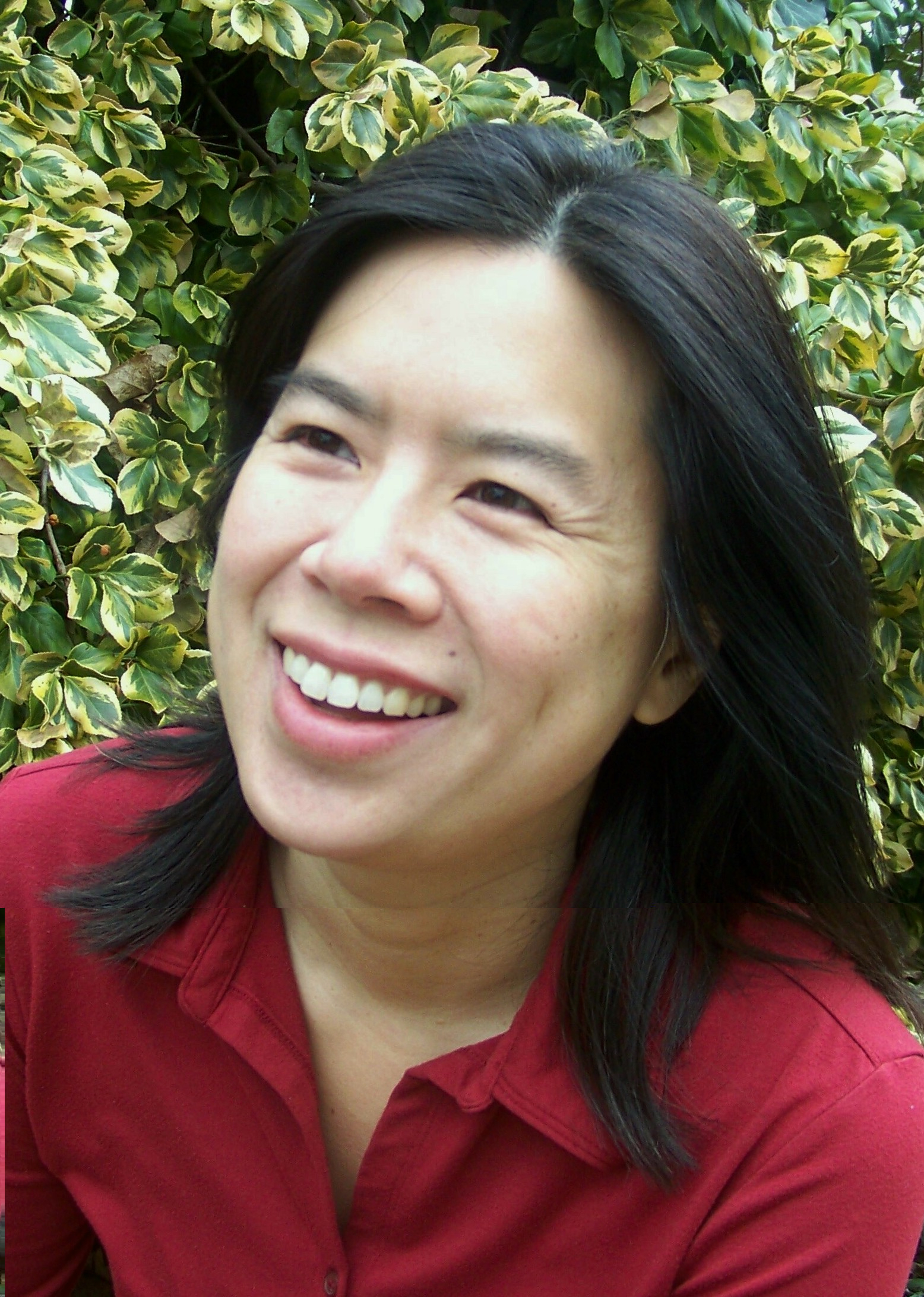
paulaheadshot
Welcome back to our ongoing series of guest posts by interesting authors on the subject of censorship, subtle and otherwise. Not entirely coincidentally, as I hope all of you have noticed, this is also the topic for the First Periodic Author! Author! Awards for Expressive Excellence, for which the deadline is a week hence. Join in the conversation, and make me proud with your entries, people!

After Tuesday’s rather downbeat post about the writing path of a gifted poet, I am delighted to be able to bring you a much happier tale today. I think today’s installment in our ongoing series on censorship, subtle and otherwise, is going to speak very directly not just to poets (although many little birds have told me over the years that quite a few long-time Author! Author! readers do indeed write poetry), but to all of you writers who have either been submitting your work — and thus exposing it to the risk of rejection — or scared off from doing so by the sense that it might not be good enough.

Hmm…where have I heard that sentiment before?

Poet, writing coach, and blogger Paula Neves has some words of wisdom on the subject, ones that I hope you will take very, very seriously. Because contrary to what naysayers on the writers’ grapevine so constantly tell aspiring writers, literally the only writing that has NO possibility of getting published is the manuscript that’s never submitted.

Think about that, please, the next time you hesitate about entering your work in a literary contest or querying yet another agent. As we discussed yesterday, no force on earth so effectively prevents a piece of writing from reaching readers as its author’s not allowing it to see the light of day.

Which is not to say that there’s anything wrong with choosing not to try to get one’s work published — I have enormous respect for the Emily Dickinsons of this world who elect to keep their brilliance to themselves, or limiting it to a select few readers, provided that it’s an active choice. There’s a certain nobility to deciding that the world at large is not one’s audience. As Aunt Emily herself wrote:

THE SOUL selects her own society,
Then shuts the door;
On her divine majority
Obtrude no more.

Unmoved, she notes the chariot’s pausing
At her low gate;
Unmoved, an emperor is kneeling
Upon her mat.

I’ve known her from an ample nation
Choose one;
Then close the valves of her attention
Like stone.

Hard to argue with that, eh? But I’m jumping the gun here.

Please join me in welcoming a good poet who has been through the publication mill, has lived to tell the tale — and has been kind enough to share her experiences with all of us here at Author! Author! Many thanks, Paula, and take it away!
emily-dickinsonemily-dickinsonemily-dickinsonemily-dickinsonemily-dickinsonemily-dickinson

When Anne first approached me to guest blog on Author! Author! about my unique take on censorship in poetry, my immediate reaction (after being flattered) was, no problem—I’ve got plenty of “take” on that. But not in the way you’d expect.

The fact is I haven’t experienced much in the way of censorship in my poetry—if for no other reason than I actually haven’t published much of it yet. How’s that for an admission from someone whose been writing the stuff since falling in love with Emily Dickinson and the glamour of her reclusiveness as an impressionable teen almost three decades (eegads!) ago? Ok, so maybe it is typical for someone who would fall in love with the Belle of Amherst’s hermit tendencies as much as her funky slant rhymes.

Regardless, I haven’t yet experienced the tyranny of editors/agents the way many of you have experienced with your work. But it’s not for lack of want. In short, censorship is something for which I secretly long if only because it means people are actually reading my work (or at least saying they are)!

Certainly, throughout my life, I have experienced censorship in ways related to other kinds of writing/thinking. In college, there was that politically correct academic type, the subtle or not-so-subtle expectation of classroom opinions and written critiques following in the tradition of the paradigm du jour. I recall a particular moment in my undergrad days when I took a course called Homosexuality and Society (taught by a fairly well-known lesbian feminist poet du jour with whom my then girlfriend had previously had a torrid affair, and who had a hand in getting said girlfriend’s thinly veiled verses published –echoes of Marilyn Hacker’s Love, Death, and the Changing of the Seasons here—but that’s another story).

This was a course where all were expected to participate and actively relate their own experience to the material. For me as a young gay woman, this meant I was expected to “represent” and be a vocal lesbian feminist spitfire. I was 19, and, although American-born, a good sheltered girl from an insular Portuguese immigrant community far from home (i.e., 30 miles away) for the first time in my life and just coming out/Uhauling: what did I know about spitting fire? Both naturally shy and innately suspicious of “expectations,” I kept my mouth shut and passed the course with a C by the grace of the goddess.

Was it jealousy of the professor’s previous entanglement with my girlfriend that made me stubbornly refuse to “participate”? Was it that I didn’t actually believe in the homophobic origins of women’s oppression? Heck, no. Like I said, I was a young gay and sheltered Portuguese woman, the first in my immediate family to even go to college, never mind take a course like Homosexuality and Society. That alone was enough to keep me quiet and reflective.

Not long after this experience, two of my poems were published in fairly rapid succession. I had been writing poetry for nearly a decade at that point, but these pieces were the first I had sent out to legitimate (i.e., non-vanity) venues (with the exception of the time I was 17 and, after getting encouraging feedback from the editor at the Plains Poetry Journal, made the classic amateur’s mistake of overwhelming the poor soul for months with other examples of my “promise”). One of the poems was about sex and appeared in a Tee Corinne-edited anthology called (what a surprise) The Poetry of Sex, which became a Lambda Literary Award finalist; the other was about being the child of immigrants and ran in the (now defunct) The Portuguese Heritage Journal.

Although the yawping silence between these two major life themes was disconcerting, the response from the editors of these publications was surprisingly positive. The folks at The Portuguese Heritage Journal encouraged me to send more work and ended up publishing a couple of my articles, all I ever sent them before they folded the venture a few years later. Tee Corinne solicited work, a short fiction piece this time, which she ended up accepting and placing as the opening story, for her next anthology, The Body of Love. She also graciously accepted my request to interview her for one of the profiles I was writing for Uncommon Heroes, an anthology of queer role models. And she said to keep in touch. I never did.

Sure, I could chalk up some of this lack of follow-through to being young and dumb.

After college, out in the “real world,” I found work on the other side of the writing spectrum as a technical writer/editor and experienced the endemic censorship of office politics. You know, the kind where, no matter how much you write, rewrite and tighten sentences in a report, article or two-line ad copy, the boss always changes a semi-colon to a comma, active voice to passive, or adds a few more adjectives or prepositional phrases because

1. He’s older and went to a better school than you;

2. He’s a member of Mensa and of course knows grammar better anyone in the office; or

3. Because he’s the boss and can.

He then passes the masterpiece on to his boss and the process begins anew. You get the idea.

Despite these workplace entertainments, my personal writing and poetry remained fairly unaffected. Again, not for lack of being written (and rewritten) in hundreds of computer files, notebook pages, grocery receipts, envelopes, napkins (no scrap of tree pulp was safe), but for lack of being shown. During my nine years in the traditional 9-to-5 hitch, I sent poems to perhaps two-dozen outlets of various kinds. The results:

* two pieces appeared successively in a Princeton-based newspaper’s annual fiction and poetry issue, which paid an honorarium (miniscule, but still);

* I was accepted to do readings at three state-funded poetry/performance events—also paid;

* I did one-on-one critiques of high school student poems for a teen arts festival—also paid;

* various poems appeared in several issues of the literary magazine of the English department in the community college at which I worked;

* numerous poems have appeared in The Newark Metro, an online journal affiliated with my grad school; apart from the publication itself, this has resulted in my developing a good working relationship with the well-respected editor, a big fan of my work.

(On these latter two points, never underestimate the value of “small” or school-related publications: exposure is exposure and there are some incisive and often well-connected literary people behind these journals.)

Of course, I don’t mean this to sound like an ad for “You too can be published simply by submitting your work.” I’ve had plenty of rejections from publications, across genres. However, considering that I think of myself as a poet first and how relatively few poems I’ve actually sent out, my stats are in that area are pretty good. I’m also not saying this because I think I’m to Emily what Hart Crane wanted to be to Walt Whitman.

I’m saying it because my own worst editor/agent/critic has been…me.

Some of you may recognize this siren song of self-censorship. It sounds something like, “It’s not good enough”; “Maybe this isn’t really my genre”; “It’s going to get rejected anyway; it was already rejected several times”; “There would only be a limited audience for this anyway/This can get in local publications but not the really big ones” (one of my favorites); or variations thereof. Even for experienced writers these doubts can creep in and result in dejection, procrastination and missed opportunities.

Sure, maybe my early follow-through had to do with being young and inexperienced, but what was my excuse in my mid-thirties when, with reams of poems written, plenty of workshops, classes, and even encouragement under my belt, I brought nothing with me to a writer’s conference, and had nothing to show a small press publisher who was actively seeking new work and specifically asked to see some of my poems?

In my case, my failure to “show” had a lot to do with insecurity and trouble reconciling two integral parts of my identity. Since my poetry is, for the most part, confessional, my reticence to expose it was telling. Literally.

Eventually, I got that it was telling me to take the gamble, put the work out there. Not everyone will “get” it or like it, or understand what the big deal is/was about holding back. Maybe some of it still shows developmental tics.

Who cares? Take the risk.

Or risk missing other opportunities. At some point “it’s not good enough” has to be examined for whether it means the work or you.

emily-dickinsonemily-dickinsonemily-dickinsonemily-dickinsonemily-dickinsonemily-dickinson

paulaheadshotPaula Neves has been writing across genres since she was a teen, but has always loved poetry, to which she keeps returning. Her poetry has appeared in The Newark Metro, The Princeton Packet’s US1 Summer Fiction and Poetry series, a href=”http://www.amazon.com/Poetry-Sex-Lesbians-Write-Erotic/dp/0934411506″>The Poetry of Sex, and The Portuguese Heritage Journal. She has read all over the New York metropolitan area, most recently as the “sunrise poet” (a one-hour daybreak reading) at the Newark Museum’s Centennial Celebration. She has studied poetry and fiction under writers such as J. D. McClatchy, Rachel Hadas, Jayne Anne Phillips, and Alice Dark and was recently accepted into the MFA in Poetry program at Rutgers-Newark.

Paula is the founder of Technical Writing Service and blogs at Itinerant Muse.

An antidote to literary naysaying — or at least a slim volume to keep within reach of your writing space

May 13th, 2009

burn-this-book-cover

Before I begin today’s show-and-tell, I want to blandish those of you who haven’t yet done so into entering the First Periodic Author! Author! Awards for Expressive Excellence. Entry is free, the topic interesting (your very own contribution to our fascinating ongoing series on subtle censorship and other factors that discourage writers from writing what and how they want), and fabulous prizes await the winners.

Not to mention the immortal fame and ECQLC (eye-catching query letter candy) that winning such an award would doubtless entail.

The deadline for entry is Monday, May 18. To get those of you who have not yet entered inspired, I shall be devoting the rest of this week to continuing our discussion of ways in which writers are discouraged from sharing their stories, their writing, or even their opinions with the world at large.

In other words, to further exposition on the contest’s essay topic.

Not entirely coincidentally, today, I’d like to talk about a brand-new collection of essays on censorship edited by Nobel laureate Toni Morrison, BURN THIS BOOK: PEN Writers Speak Out on the Power of the Word (HarperStudio). Given the subject matter, I had picked it up in the expectation that it would provide a tremendous amount of food for thought about our ongoing subject; what came as a pleasant surprise was how squarely some of the essays in it spoke to writers about the problems of self-expression that are not externally imposed.

Before I get too carried away, here’s the publisher’s blurb for the book. I added the links, so anyone who is interested may learn more about the authors cited:

Published in conjunction with the PEN American Center, Burn this Book is a powerful collection of essays that explore the meaning of censorship, and the power of literature to inform the way we see the world, and ourselves. Contributors include literary heavyweights like Toni Morrison, Salman Rushdie, Orhan Pamuk, David Grossman, Nadine Gordimer discusses the role of the writer as observer, and as someone who sees “what is really taking place.” She looks to Proust, Oe, Flaubert, and Graham Greene to see how their philosophy squares with her own, ultimately concluding, “Literature has been and remains a means of people rediscovering themselves.” “In Freedom to Write,” Orhan Pamuk elegantly describes escorting Arthur Miller and Harold Pinter around Turkey and how that experience changed his life.

As Americans. we often take our freedom of speech for granted. When we talk about censorship, we talk about China, the former Soviet Union. But the recent presidential election has shined a spotlight on profound acts of censorship in our own backyard. Both provocative and timely, Burn this Book includes a sterling list of award winning writers; it is sure to ignite spirited dialogue.

If some of those names sound familiar, it’s because the only reason that some of them aren’t on the current short list for the Nobel Prize in Literature is that most of these writers have already won it, and some of the others have already passed on to That Great Literary Salon in the Sky. (That, and the fact that I mentioned Graham Greene on this very blog only yesterday might have left him rattling around regular readers’ brainpans.)

This is, in other words, not just a book of commentary by writers on writing. It’s a book of commentary by WRITERS on WRITING.

The Who’s Who line-up is part of the fun of this book, actually, insofar as a serious collection of essays on the horrors of censorship can be said to be fun: quite a number of these essays involve exceedingly well-known authors whom we all admire writing about the work of exceedingly well-known authors that they admire. Let me tell you, if you’ve never seen John Updike gush about the bravery of Henry Miller’s early novels, or Francine Prose sigh about how she wishes she had known Roberto Bolaño — well, suffice it to say the besotted reader is a side of an Eminènce Grise one seldom sees.

Since pretty much all writers start out life as besotted readers, it’s rather refreshing to behold the greats owning up to it. And hey, I’m not too proud to admit it: I did feel incrementally cooler, literarily speaking, upon seeing that Ms. Prose and I share an admiration for Wallace Shawn’s THE DESIGNATED MOURNER — but of that excellent play, more follows below.

This volume’s tendency to praise means, among other things, that BURN THIS BOOK is an absolutely terrific source for what I like to call good book surfing — learning what books have influenced authors one loves, tracking those works down, and reading them. I know of few better ways to gain a sense of being part of a literary tradition.

(The months I spent following the reading tips Jane Austen so carefully laid out in NORTHANGER ABBEY completely changed my understanding of 18th-century female authorship, for instance. Aunt Jane’s shelves were apparently stuffed to the gills with women’s writing — which I imagine would come as something of a surprise to all of the compilers of English literature syllabi who habitually present her as having sprung into literary history as a complete anomaly. And don’t even get me started on what Anne Brontë — whose brilliant novel about substance abuse, THE TENANT OF WILDFELL HALL, was dismissed by contemporary critics as “utterly unfit to be put into the hands of girls,” speaking of disregarded voices — or Mary Wollstonecraft Shelley were reading in their spare time.)

I also found it both fascinating and amusing to see really, really famous authors incorporate the same essay-writing tactics that, say, a high school junior might use in making a case against censorship. Who’d have thought, for instance, that Updike, surely enough of a literary name to express his own opinions unaided, would feel the need to justify his statements about how difficult writers find their work by citing what Flaubert said of his own struggles?

And after having spent many years patiently explaining to university students that defining one’s terms in an essay did not mean just opening the nearest dictionary and reproducing what’s printed there, what was I to make of Nadine Gordimer’s using the Oxford English Dictionary in precisely that manner in her essay? Oh, how glad I was that I’m no longer lecturing when I saw that. My students would surely have waved Ms. Gordimer’s piece in my face endlessly, as proof positive that it is possible to incorporate a verbatim dictionary definition gracefully into a written argument without boring readers to death.

But I would still urge amateurs not to try it at home. The twins goals of defining one’s terms in an essay are to demonstrate that one knows what one is talking about and to make sure that the reader does as well, not merely to plagiarize what some underpaid linguist at Funk & Wagnall’s said about a particular word or phrase. For this reason, hyper-literalists tend not to make the best essay-writers.

Despite undermining one of my first rules of academic essay-writing, I would highly recommend BURN THIS BOOK to readers of high school and college age. Why? Well, because this book contains so many good examples of the kinds of essays high school and college students are so frequently asked to write, it’s an inadvertently helpful how-to manual on how to structure and argue a piece on an abstract topic.

(Are the standardized test folks still giving vaguely provocative essay topics like, Censorship: is it ever a good idea? and Should a government try to legislate morality? They seem so open-ended, but the graders are invariably looking for a particular type of argument. In my day, the Achievement Test scorers would automatically spot you quite a few points if you managed to work Rosa Parks’ historic bus ride into your essay, regardless of the topic. The point of academic writing is not necessarily knock-your-socks-off style, if you catch my drift.)

For this reason, BURN THIS BOOK seems like a natural to assign in a composition course, to teach young writers the tricks o’ the trade, as it were. Or perhaps it would make more sense in a literature class. I would slap it onto the syllabus right after THE GRAPES OF WRATH, to provoke some interesting discussion about the hows and whys of banning books, and just before THE CATCHER IN THE RYE.

Speaking of Nobel laureates, are you surprised to hear that THE GRAPES OF WRATH was ever banned? No kidding: schoolteachers all over the US had a hard time assigning it for decades, and not always because of that left-leaning speech that Henry Fonda, the Tom Joad of the movie, gives at the end. (But usually. You’d be amazed at how seldom clamorers against a book have actually read it; it’s not unheard-of for parents to go roaring into school board meetings to scream about a scene from the movie version of an assigned book, only to learn that the objectionable bits were the filmmaker’s invention. The protests over the movie version of THE LAST TEMPTATION OF CHRIST, for instance, were over a love scene that wasn’t particularly startling in the book; what brought the threat of excommunication onto novelist Nikos Kazantzakis’ head was the book’s treatment of Judas‘ role in the story, not the Big Guy’s.)

Wondered long enough what anyone who wasn’t worried about Communist infiltration of America’s high schools might have had against THE GRAPES OF WRATH? Not surprisingly, it’s a scene that didn’t make it into the movie, although it’s far from explicitly written: Rose of Sharon feeds a man who’s starved too long to be able to ingest solid food what, ahem, she might otherwise have fed her stillborn baby.

The reason I’m being a bit vague here, incidentally, is that some of my readers have access to this blog only through their school or public library computers. If I described the ending of the book any more clearly, the individual words that I would have to use might result in this page getting blocked by what are euphemistically known as parental control programs.

I know; it’s not pleasant to contemplate. But like it or not, it is the world in which we write.

By suggesting that BURN THIS BOOK might make for some interesting classroom discussion, I don’t mean to imply that that all of the essays here are equally good; they’re not. At times, the reader is left wondering what some of this undoubtedly well-written rambling has to do with the topic at hand, or even if there is a single topic tying the book’s many entries together. (Also, semicolons are not always used correctly throughout, something that’s likely to bug a teacher charged with explaining to students that ; and is in fact redundant in a list that contains a series of semicolons, since the earlier semicolons were ostensibly replacing and.)

The authors’ assigned briefs seem to have been rather disparate, as if contributors were merely asked to contribute an essay, rather than an essay on book-banning: collectively, this is a better collection of writing about writing than writing about censorship. As a result, the subtitle (PEN Writers Speak Out on the Power of the Word) is a substantially more accurate indication of what lies between the covers than the title.

Of course, being a book about writing is not necessarily a drawback in a collection of essays whose target market is writers. As one would expect from an edited volume by such a terrific bunch of writers (a contributor list that also includes Paul Auster, Pico Iyer, Russell Banks, and Ed Park, in case you were wondering), BURN THIS BOOK abounds in really glorious quotes, the kind that aspiring writers like to jot down on little scraps of paper and tape to their computer monitors to inspire them in moments of creative desperation.

Seriously, there is some lovely, inspiring stuff here. Take, for instance:


“A writer’s life and work are not a gift to mankind; they are its necessity.” -Toni Morrison

“When we write, we feel the world in flux, elastic, full of possibilities — unfrozen…I write, and the world does not close in on me. It does not grow smaller. It moves in the direction of what is open, future, possible. I imagine, and the act of imagination revives me. I am not fossilized or paralyzed in the face of predators. I invent characters. Sometimes I feel as if I am digging people out of the ice in which reality has encased them. But perhaps, more than anything, the person I am digging out at the moment is myself.” — David Grossman

“Thus the true task of the novelist is to dramatize first for himself or herself and ultimately for the rest of us what it is to be human in our time and for all time. What it is to be human in our place and in every place. As a species, we have always depended upon our storytellers to tell us what it means to be human. To be ourselves.” — Russell Banks.

“The artist’s personality has an awkward ambivalence: he is a cave dweller who yet hopes to be pursued into his cave…J.D. Salinger wrote a masterpiece, The Catcher in the Rye, recommending that readers who enjoy a book call up the author; then he spent his next twenty years avoiding the telephone.” — John Updike

Okay, so I thought that last one was sort of funny. My point is, there’s a lot of rich ore here for the writer searching for insight to mine.

Finally — and most relevant to our ongoing series — despite a certain range of topic, most of these essays have quite a few interesting things to say on censorship. Or, more precisely, about the kinds of things than can happen to people who write the truth when those in power don’t want those truths bruited about.

As Wallace Shawn’s THE DESIGNATED MOURNER (I told you I’d be coming back to it) makes so mournfully clear, the writers, the artists, the truth-tellers tend to be among the first carted off in times of great fear. The world is substantially less interesting for it — and less safe, my friends, for people like us.

BURN THIS BOOK reminds us to ask ourselves every so often when we look at the world around us, gathering impressions to inform our writing: what stories are going unheard? Whose voices are not particularly audible, from a literary perspective? Which voices are actively discouraged, and which do the fine folks who run publishing houses just not think will sell very well?

To share some questions that popped into my mind when I first began to contemplate running this series: what does the reader of mainstream memoir currently know about the kind of prison conditions that guest blogger Shaun Attwood told us about last weekend? Heck, how much does the mainstream novel reader know about the other side of the legal equation, what goes on behind the beautifully-veneered doors of the high-powered law firms Mary Hutchings Reed wrote about? If those inside these institutions don’t share with the world how they run, how precisely are the rest of us to find out? Telepathy?

And how much does the fear of riling nay-sayers affect what we ask readers are able to find on the shelves? Considering how hot narrators with mental disabilities have been over the last few years, why do readers so seldom see book either about or by people with physical disabilities, as Eileen Cronin brought to our attention in April? Does a hot-button political debate actually have to be over before the publishing world would get excited about an intriguing memoir like Beren deMotier’s, which couldn’t possibly be more timely? How much does the prospect of negative reader reaction cause even established authors to alter their content in order to avoid controversy, as Bob Tarte discussed?

These questions trouble me in the dead of night; honestly, they do. And what’s more, they should.

Yet while all writers are potentially affected by censorship, subtle and otherwise, we don’t tend to talk much amongst ourselves the more draconian ways in which it is wielded, up to and including imprisoning or even killing outspoken authors. Those possibilities certainly deserve more of a place in writerly discussion of what does and doesn’t get published than we usually hear — and, to be candid, what you hear from me here on this blog.

For the most part, the untold stories and as-yet-undiscovered voices we discuss are ones that are having trouble pleasing someone with the authority to get them published, rather than the ones that must overcome actual legal barriers or strong social taboos in order to see the light of day at all. As a result, writers’ conferences, writers’ fora, and yes, blogs like this one tend to focus upon finding a market for our work, or better ways to touch the heart of a reader, or decoding the often perplexing ways of agencies and publishing houses.

So an alien from another planet landing in the middle of your garden-variety North American writers’ gathering would probably assume that a great undiscovered writer’s voice not being heard is primarily the result of her submissions being rejected or ignored, rather than, say, a heavily-enforced prohibition upon writing anything remotely critical about her government, or laws that ban a writer from offending someone else religious sensibilities. “My, what a lot of freedom creative artists have here,” E.T. might conclude.

That’s not meant as a criticism of the very practical concerns of those trying to get published — far from it. It’s completely natural that worrying about freedom of expression worldwide may not be the most immediate concern for a writer who is trying to find an agent for a torrid romance involving a country doctor and a cowgirl or hoping to publish a science fiction trilogy on the colonization of the Crab Nebula. At that juncture, it’s certainly understandable if trying to second-guess what the gatekeepers of the book world want to see is of far more absorbing interest than which might be happen to a writer one doesn’t know personally someplace else.

Heck, after seemingly endless rounds of querying, a series of rejected submissions, and/or being told flatly by an agent or editor after a verbal pitch, “Oh, there’s just no market for that kind of book right now,” plenty of writers feel that there’s an active conspiracy against their kind of work.

In a moment of feeling unheard — which, let’s face it, forms a large part of the frustration of trying to find an agent or waiting for one’s agent to sell one’s books — a collection of essays like this that deals with more drastic means of keeping writing (and writers) out of the public eye can be very useful for reestablishing perspective. Sometimes, we could all use someone who has been down the path before us to remind us that it is indeed worth taking — and that as writers, we are all part of a global community that some people are always going to find threatening.

I just mention.

While I’m at it, I’ll also mention that BURN THIS BOOK is available on Amazon and at Borders.

Does all of this high-falutin’ talk about the importance of considering the situation of writers worldwide mean that I’m abandoning the attention to nit-picky, practical details for which Author! Author! has become so justly famed? Of course not; rest assured, bread-and-butter issues will once again abound here soon.

But in the meantime, consider giving some thought to the big picture. And, as always, keep up the good work!

The tragedy of the self-silenced writer

May 12th, 2009

candle-flames-at-lourdes
I had planned to write my own post on subtle censorship today, as it’s the first day in quite some time that I’m not going to be yammering at you about the rigors of standard format and I’ve been dying to jump into the conversation. Over the weekend, however, a couple of the comments on guest blogger Shaun Attwood’s post — who knew it would generate such a plethora of responses from readers? — got me thinking about a deadly form of censorship: the kind writers sometimes impose upon themselves.

Since I’ve depressed myself into a stupor thinking about it (not the best state of mind while on a writing retreat, alas), rather than write about it afresh and be-glumming myself still more, I’m going to re-run an earlier post on the subject. Some of you may remember the story; I try to honor Marc’s memory by telling some version of it here about once per year.

This is the story that Marc did not live to tell. He censored himself in many, many ways, including the ultimate one, before he could.

A moment of silence, please: I’m giving a eulogy today.

My friend Marc, a genuinely gifted poet and playwright, died a few years ago, and I, as one of the few people in our college class who was reading his writing hot off the keyboard, was asked to give his eulogy at our reunion. One of the liabilities (or joys, depending upon how one looks at it) of going to a reunion-happy school lies in the inevitability of, as time passes, more and more of one’s classmates requiring eulogies.

Today, it’s my turn to step up to the podium.

Marc was only 39; I had known him since we were both 18. Brilliantly talented, he lost faith in his own writing before he could find the right agent for his work. And so, out of respect for him, I am going to step aside from our ongoing series and devote today to urging you to maintain faith in your own writing talent.

Marc was one of those writers whose promise was obvious to everyone early. Year after year, all throughout school, he won poetry and essay prizes; his English teachers adored him as the kind of super-creative, insightful student who comes along only once in a blue moon; his basketball coach praised him as the ideal of a hard-working athlete with natural talent. Confident in his abilities, he never doubted that triumph would continue to follow triumph for the rest of his life.

Yet as every high school hero is shocked to learn, the rules change radically after graduation.

The talents that spelled success within the sheltered confines of a private school are not automatically lauded in the world outside, and as many a crestfallen college freshman can tell you, there are always more than enough highly-praised high school Juliets on campus to fill all the roles in a college production of ROMEO AND JULIET forty times over.

Big fish, welcome to the ocean; you’re not in your little pond anymore.

At Harvard, Marc was surrounded by brilliant young writers from all across the country and all around the world. His work was appreciated, because it was very good, but no longer was he the outstanding talent. While some writers might have embraced a new-found community of very talented people, Marc went the more common route: in the midst of such stellar competition, despite the fact that he was clearly able to hold his own with the best of them, he started to doubt himself.

Heaven help us, he started to wonder if he could really write.

Oh, if only we could all rewind our lives back to the point before we started to question our own talent! To before the demons of self-doubt and endless internal criticism started to nag us! How many among us have not been turned away from our computers at least once by the fear that our best was just not good enough?

Marc did keep writing, but increasingly, he kept his work to himself, thus reducing to zero the chance that it might see publication. He ceased entering contests; he gave up querying magazines; his writing resume languished. Like so many aspiring writers, he began to believe that the slightest defect poisoned an entire work, so he stopped being able to incorporate good criticism.

So what did he do with all of that pent-up creative energy? He wrote a solid first draft of an interesting novel — I know, because I’m one of the few human beings he allowed to read it. It would have been very marketable after a single revision, news that should have brought joy to his heart.

Instead, after only one or two rejections from agents, he stuffed it in a drawer, never to see the light of day again. As thousands of aspiring writers do every day.

He next turned his talents to writing plays, but there, too, even the most minor criticism seemed to make his confidence wilt. Eager at first, he soon came to regard attaining finalist status in a competition as evidence that he had failed abysmally.

Like so many aspiring writers, he fell into the trap of expecting every word that sprang from his fingertips to be perfect without revision. As, again, do thousands.

It’s very seldom the case, even with the most brilliant of writers, but it’s an easy trick to play on yourself: if you were truly talented, the imp of perfectionism whispers in our ears late at night, you wouldn’t have to struggle. The world would be beating a path to your door, unasked, to read your work.

This isn’t plausible, of course. It is utterly impossible to sell work that you don’t send out, just as it is impossible to win contests that you don’t enter. Yet self-doubt would rather not try than to risk defeat.

Because I’m a generally upbeat person, Marc and I frequently argued over our respective expectations of the literary market. He was astonished that I just kept plowing ahead, regardless of rejection, until agents and editors started saying yes; having attained success so easily in the past, he was suspicious of incremental gains made through persistent effort. Yet by insisting that his own work had to be born perfect before he would allow others to see it, he made it harder and harder to get himself to sit down and write at all.

This is a very common logical conundrum for writers, one I tried to understand at the time by incorporating an analogy gleaned from Neil Fiore’s excellent book on procrastination, THE NOW HABIT (without which, truth compels me to state, I probably would not have completed my master’s thesis). Fiore compares any major task to walking the length of a ten-foot board that is six inches wide.

When the board is sitting on the ground, getting across it would be an easy task, right? Yet the procrastinator worries about crossing the board perfectly — and thus waits until conditions are perfect. As the deadline nears, it becomes clearer and clearer that the task is getting harder to do well — thus emotionally raising that board until it feels like it is stretched between two five-story buildings.

Now, crossing the board is terrifying, as the stakes of failing are much more severe. What a procrastinator does to end this situation, Fiore argues, is to set fire to his own end of the board, metaphorically speaking: with absolutely no time to spare, perfection in execution does not matter nearly so much as simply scooting across the board as fast as possible.

For Marc, as for many, many writers, a similar logic applies to completing a book — or a play, or a poem, or a contest entry. They do not want just to walk across that board — they want to do so in such a memorable style that the admiring multitude will be telling their grandchildren about it for generations to come.

With such lofty intentions, that board is not just stretched between adjacent buildings; it is wavering in the wind between the Empire State building in New York and the Transamerica pyramid in San Francisco.

No wonder it’s terrifying: effectively, every sentence the writer produces has to be the greatest since the invention of the pen.

Marc, and writers like him, expect inspiration to waft them into a state of such divine creativity that all of their latent promise as artists will undergo some sort of instantaneous alchemy that produces the philosopher’s stone of writing, the book that is perfect with no revision.

Then, and only then, will they believe in their hearts that they are genuinely talented.

Every single time that inspiration, as is the way with muses, comes and goes at its own sweet pleasure, the self-doubter comes to doubt his own talent more. And even when, as in Marc’s case, inspiration does hit hard enough to produce a stellar short piece, that success apparently does not count as proof: it could have been a fluke, or it wasn’t a big enough success.

Or it was a short story, rather than a novel, or it was a genre work instead of literary fiction, or it was literary fiction and unlikely to appeal to a broad mainstream market. Any excuse will do, because there is no one more voracious for justification than a talented person in the throes of self-doubt.

Painful? You bet. And painful to watch? Absolutely.

I am telling you this, not to criticize Marc — that’s not usually the point of a eulogy, is it? — but in the hope that his story might help inspire those of you out there who are afraid that you’re not talented enough to start the book you’ve always dreamed of writing, or whose fears have paralyzed you into stopping in mid-draft or mid-revision to give yourselves a bit of a break.

Instead of abusing yourself for not producing perfection every time you sit down at a keyboard, why not reward yourself for sitting down there at all? Instead of berating yourself for being in the midst of writing a novel for a year or two or ten, why not break the task up into manageable smaller goals, and celebrate those achievements as you reach them?

There’s no better cure for self-doubt than tangible evidence of talent, and you’re more likely to convince yourself that you are indeed gifted if you don’t demand that you produce THE DIVINE COMEDY every time you sit down to write a poem.

Regardless of how talented you are.

Start small — remember, even the best-upholstered ego is a fragile thing, and it needs to be rebuilt with care. You could start by setting time goals for your writing, logging in the minutes as you go, or set yourself a page goal for each writing session. Keep track of your successes, so later on, when you start to berate yourself for not writing as often as you should, or as much, you can look back in your log and say, “Hey! I wrote for ten hours last week!” or “Hey! I have been averaging three pages per day!”

Start there, because no matter what the imps of doubt whisper in your ear, there’s never been a book written yet without the author’s sitting down day after day and writing.

So there.

If these goals seem too tiny to you, requiring too many added together to reach the goal of a completed book, remember this: prolific writer Graham Greene wrote only 147 words per day.

Which, I suspect, is why his dialogue exchanges are so short. Most of us can easily expend 147 words in debating where to go for lunch.

Greene carried around a little notebook, and (the story goes) would not allow himself his first drink of the day until after he had penned word 147. Now, I wouldn’t recommend emulating the drink part, at least not on a daily basis, but his strategy was basically sound: those words, few in and of themselves, added up to many very highly-respected novels.

Oh, and a Nobel prize in literature.

However you decide to go about it, please start easing up on yourself soon, because there isn’t always time to change.

I tell you this from experience, because I shall never be able to wipe from my mind that saddest of literary sights: a brilliant, partially-revised novel sitting in a drawer, awaiting the beneficial touch of a writer who can never come back to it again.

Keep up the good work, my friends. Your talent is worth it.

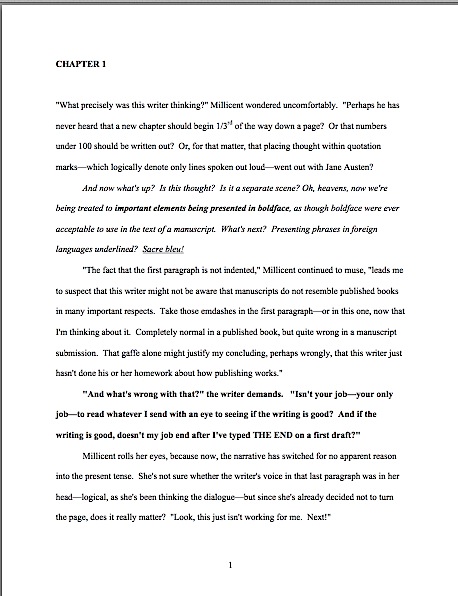
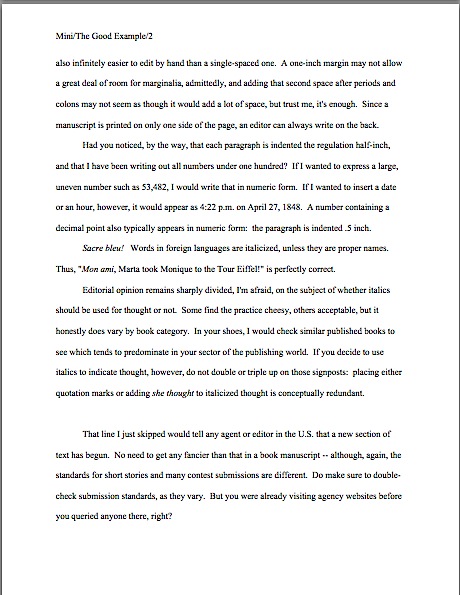
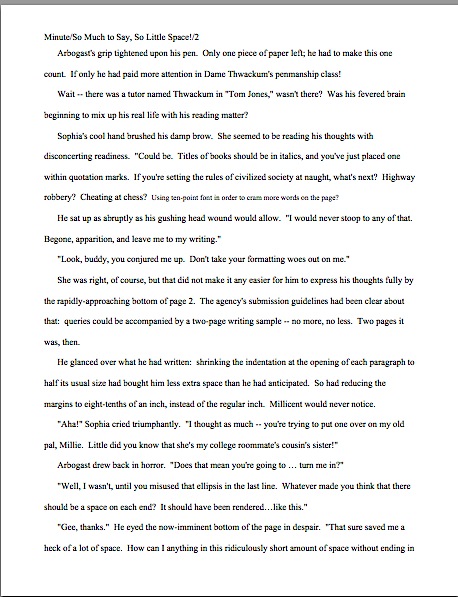
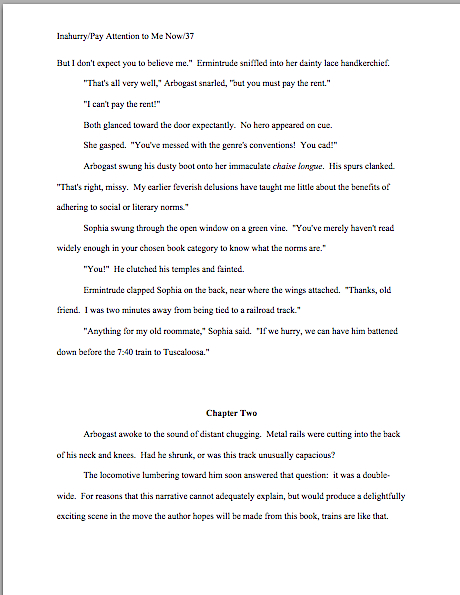
How to format a book manuscript properly, part XII: not all truths are self-evident, or, why a sensible writer should hang onto that massive grain of salt

May 11th, 2009

signing-the-constitution

I’ve been making a Herculean effort not to gloat too much here at Author! Author! about being on a writing retreat in France — or at least to hold off on it until we’ve made it through this series on standard format so I can settle into a nice, luxurious series on how to apply for and what to expect from formal artists’ retreats. But I shall burst if I don’t chortle about just two things today — no, make it three.

First, this is my writing space:
la-muse-writing-room
I’m ALONE in that, incidentally. You can’t see the other fireplace or the wood stove, but I assure you that they’re there.

Second, this is the view from one of the four six-foot-high French windows in my writing space:
window-view
Third, when I asked the very kind proprietors if I might have another lamp in my writing space, they promptly installed what appears from here to be a early 20th century chandelier:
other-end-of-la-muse-writing-space
I’d been thinking something more along the lines of a $20 lamp from IKEA, but hey, I’ll live with it. I could throw an intimate dinner party in the armoire.

I’m just saying: La Muse is a very, very nice place to write. And yes, there are fellowships available — but you’ll be hearing more about all of this in the weeks to come.

Okay, the chortling is out of my system now, more or less. Back to business.

The last few times I have come to the end of an extended series on manuscript formatting — book manuscripts, that is; please be aware that short stories, magazine articles, theses, dissertations, and other types of writing are subject to other restrictions — I’ve ended with a rather peevish little discussion about why, in the face of so much conflicting information about submission requirements floating around these days, professional advice-givers like me don’t either:

(a) check out every other source out there to make sure that we’re all saying precisely the same thing (which would be so time-consuming that none of us would have time to give any further advice),

(b) take it upon ourselves to force every single individual who is empowered to pass judgment upon a manuscript within the confines of North America to agree upon a single (and preferably single-page) set of rules to which everyone without exception would adhere (which would require a convention so large that the framers of the U.S. Constitution would turn pale at the very thought), or

(c) shut up entirely and let those new to the biz try to figure out some genuinely counter-intuitive rules all by themselves.

I can’t speak for everyone currently giving advice on the subject, of course, but in my own case, the answer is really pretty straightforward: the norms I’ve been explaining throughout this series are in fact the ones I have used successfully myself for many, many years. Since neither I, any of my editing clients, or (as far as I know) any reader of this blog who has followed this advice to the letter has ever been asked by an agent or editor to make a single purely formatting change to his/her manuscript, I feel quite confident in continuing to give this particular set of advice.

But I will say something that one seldom hears advice-givers say: whether you choose to adhere to the rules of standard format I’ve set out here is ultimately up to you. But once you choose to follow a particular rule, you must obey it 100% of the time in your manuscript.

Let me repeat that, because it’s monumentally important: it’s not enough to adhere to a formatting rule most of the time; you must cleave to it in every single applicable instance in the text.

Why? You should know the words to the song by now: because inconsistency isn’t going to look professional to people who read manuscripts for a living.

I used to think that I didn’t actually need to state this requirement — after all, isn’t the part of the point of a rule that it should be followed on a regular basis, rather than just periodically? However, within the last year, I’ve seen enough manuscripts and contest entries (yes, I still judge from time to time) by good writers who sometimes use a single dash and sometimes a doubled one (if you’re not absolutely certain which is correct, I can only suggest that you return to the first post of this series and read through it again), or whose Chapters 1-3, 6, and 17 have a (ugh) single space after periods and colons, whereas Chs. 4, 5, and 10-12 have two, and the rest feature both…

Well, you get the picture. Apparently, the need for consistency is not as self-evident as I had previously believed.

I would point the finger at a few culprits for this astonishingly pervasive manuscript problem. First — and I’m quite positive that those of you who have been hanging around Author! Author! for a while have felt this one coming practically since the top of this post — the vast majority of aspiring writers simply do not reread their own work enough. I’m not talking about revision here (although most submissions could use more liberal helpings of that, frankly), but rather actually sitting down and scanning a manuscript IN ITS ENTIRETY, IN HARD COPY, and OUT LOUD.

What tips me off that very few writers actually do this before submitting their pages to an agent or a contest? Well, for starters, inconsistent formatting. And spelling errors. And repeated words. And scenes where characters do or say things that they’ve done or said half a page before.

You know, the kind of stuff that any reader would catch if s/he sat down with the actual pages and read them closely.

Often, such errors are not the result of compositional carelessness, but of repeated revision –the second culprit I’m dragging before the court in irons today. Zeroing in on the same page, paragraph, or even sentence over and over again without re-reading the entire section can easily result in what I like to call a Frankenstein manuscript, one that reads in hard copy as though it were cobbled together from the corpses of several drafts, sometimes ones written in different voices.

Come closer, and I’ll let you in on a secret of good writing: it flows smoothly. A sure narrative voice is a consistent one. That’s why writers brand-new to the writing game so often labor under the quite mistaken impression that their favorite books were their respective authors’ first drafts, and thus (one assumes) that their own first drafts should be marketable without further revision: because a the author of a well-crafted narrative works hard to create the illusion of spontaneous consistency.

Awfully hard. Seamlessness is no accident, you know.

So what do you think a professional reader like Millicent the agency screener, her cousin Maury the editorial assistant, or their aunt Mehitabel the veteran contest judge thinks when they encounter, say, one sentence that’s in the past tense, followed by three that are in the present? Or a character named George on page 8 and Jorge on page 127?

“Inconsistency,” they breathe in unison. “This manuscript needs more work.”

Or at least a good authorial read-through IN ITS ENTIRETY, IN HARD COPY, and OUT LOUD.

I’m going to be talking at greater length about the Frankenstein manuscript phenomenon soon, you’ll no doubt be happy to hear. Since it’s such a natural follow-up to the standard format series, I may defer my discussion of writing retreats to attend to it first. I’ll have to give it some thought. (Don’t worry: either way, you’ll be seeing some nice pictures of France.)

The third culprit — and I have yet another excellent question from a reader to thank for reminding me to bring it to your attention — is the fact that sometimes presenting a manuscript professionally means breaking one of the standing rules.

Yes, you read that correctly. Among the many, many things that those new to submitting to agencies and publishing houses are magically expected to know is the one instance where using boldface is not only acceptable, but generally expected. No one will hurt you if you don’t use it, mind you, but your future agent may ask you to change your book proposal if you don’t.

I’m talking, in case you’re wondering, about section headings in book proposals. And sometimes in nonfiction manuscripts, but it really depends upon the agent or editor’s personal preference. Brace yourselves, because this logic is going to be a bit convoluted: boldface shouldn’t be used for emphasis, but it’s okay to use in a section heading in nonfiction; some agents actively prefer it, as did my memoir’s publisher.

But seriously, don’t use boldface anywhere else.

Confused? You’re not alone. Quoth curious reader Odin:

I’m having trouble finding a credible source which discusses how to format when there are location headings at the start of sections within a chapter. In a published book, they’d be left-justified with a blank line between it and the start of the text. After a section, there would be two or three blank lines, then the next left justified heading.

How do I do this in a manuscript? Left-justified chapter heading, then a # for the blank line, then start the section. At the end of the section, one # for the blank line, then the heading, etc? I don’t like the # between the heading and the text it heads because when the manuscript is double spaced, it tends to float all alone. I put the headings directly above the text and just used one blank line with a # between the end of one block and the next. It gets the idea across and I’m consistent with it throughout the manuscript, but I’d love to know how to do it right.

I freely admit it: I’m always a bit nonplused when I get a question like this, one that cites as law a rule that just isn’t used in professional manuscripts. But since I do hear from readers who have stumbled across advice like this quite often, I shall pass along a tip for assessing its helpfulness: if the sources you’ve been consulting are telling you to mark skipped lines with # or *, you probably haven’t been consulting sources conversant with the current book market. (The # is used for short stories and articles, not book manuscripts, and I’ve never seen a professional manuscript (as opposed to a contest entry) use * to mark a skipped line.)

It’s also — again, brace yourself, if you’ve been hobnobbing with old rule lists — not at all necessary in a current book manuscript to add any marker at all to indicate a skipped line in the text. Just hit the return key and call it good.

Before those of you who have fallen under the spell of short story and article rules start shouting, “But…but…” allow me to remind you that as we discussed earlier in this series, NOT EVERYTHING THAT FALLS UNDER THE RUBRIC OF WRITING SHOULD BE FORMATTED IDENTICALLY.

Have you happened to notice that amazingly few sources out there bother to tell aspiring writers that?

I suspect that it’s not entirely a coincidence, therefore, that so many aspiring writers assume that all writing should be formatted precisely the same way, regardless of where it will be submitted. That’s just not true — but without some fairly hefty cross-source research, how is someone new to the professional writing to know that?

Case in point: Odin’s dilemma. Pretty much any US-based agent would make her take the #s out of her manuscript, because short story formatting would imply to an editor that both the author and the agent are inexperienced in dealing with book manuscripts. In a submission process where tiny details often make an immense difference, that’s a chance that few agents are going to be willing to take.

So as you make your way through the bewildering forest of advice out there, toting your massive grain of salt, be aware of the fact that many seemingly authoritative sources out there disagree on certain points for the very simple reason that they’re talking about different things, although they often do not say so explicitly. Bear in mind that because such a high percentage of the aspiring writers’ market wants easy answers, preferably in the form of a single-page list of rules universally applicable to every writing venue, the temptation to produce a short, one-size-fits-all list of rules is considerable.

That doesn’t mean you should disregard such lists entirely, of course. Just keep in mind that any list that purports to cover every type is necessarily going to run afoul of some established standard somewhere.

Just to make it perfectly clear: if anyone is looking for terse, bullet-pointed to-do lists for writers, I think any of my long-term readers can tell you that this blog is NOT the place to start. As the thousands of pages of archived posts here can attest, I am the queen of elaboration.

Lots and lots of elaboration.

Which is why Odin’s question so delighted me, I must say: in compiling my own quite specific list, I had overlooked the section heading exception. Yet another opportunity to elaborate and clarify!

So I am pleased to present the two options for what a section heading in a nonfiction book (or proposal) should look like — first, utilizing boldface:

wharton-section-break-example11

Quite straightforward, isn’t it? This format also — and this is important in a book proposal, as they are often read very quickly — renders skimming easy.

That being said, there are anti-boldface hard-liners who might object to this; they’re rare, but they exist. So here is an alternate, bold-free version:

wharton-section-break-example2

Again: simple, elegant, non-confrontational. And — again, important — it would be clear what is happening where, even to a rapidly-skimming eye.

I must confess, however, that I don’t like it as much as the first. Why? Pull out your hymnals, everyone: because it just doesn’t look right.

While I’m on the subject of unnecessary doohickeys writers are sometimes told to shoehorn into their book manuscripts and proposals, let’s talk about what should happen on the last page. For a BOOK manuscript, the proper way to end it is simply to end it.

No bells, no whistles, no # # #, no -86-. Just stop writing.

Even the ever-popular THE END is not needed. In fact, I know plenty of Millicents (and their bosses, and editors, and contest judges) who routinely giggle at the use of THE END to indicate that a manuscript is not, in fact, going to continue. “What is this writer thinking?” they ask one another, amused. “That I’m going to keep reading all of that blank space after the last paragraph, wondering where all of the ink went? That I’m incapable of understanding why there aren’t any more pages in the submission? Please!”

Remember what I was saying earlier in this series about professional critique being harsh? Don’t even get me started on professional ridicule.

Personally, I have sympathy for how confusing all of the various advice out there must be for those who have never seen a professional manuscript up close and personal — that is, as I have said many times, why I revisit this decidedly unsexy topic so often. But honestly, some of the rules that commenters have asked about over the last three years must be from sources that predate World War II, or perhaps the Boer War. I’ve been editing book manuscripts for most of my adult life (and proofing galleys since early junior high school), and I have to say, I’ve literally never seen a single one that ended with “-86-”

So truth compels me to admit that I can sort of see where Millicent might find it amusing to see in a submission.

But you can sort of see her point of view here, can’t you? To people who read book manuscripts for a living in the US, the very notion of there NOT being a consensus is downright odd: why, the evidence that there is a consensus is sitting right in front of them. The mailman brings stacks of it, every single day.

“Oh, come on — everyone doesn’t already know these rules?” Millicent asks, incredulous. “This information is widely available, isn’t it?”

That’s a QUOTE, people — but as someone who regularly works with folks on both sides of the submission aisle, I have come to believe that the wide availability of the information is actually part of the problem here. The rules governing book manuscripts haven’t changed all that much over the years, from an insider’s perspective, but from the POV of someone new to the game, the fact that they have changed at all, ever — coupled with these rules not being applicable to every conceivable type of professional writing — can look an awful lot like inconsistency.

And we all know how Millie, Maury, and Mehitabel feel about that, don’t we?

Which is why, in case you have been wondering, I always spend so much time and space here explaining the logic behind each rule I advise using. I’m just not a fan of the do-it-because-I-say-so school of teaching, and besides, I want the right way to sink into your bones, so it may save you time for the rest of your writing career.

If the flurry of rules starts to seem overwhelming, remind yourself that although submissions do indeed get rejected for very small reasons all the time, it’s virtually unheard-of for any manuscript to have only ONE problem. They seldom travel alone.

So I would caution any aspiring writer against assuming that any single problem, formatting or otherwise, was the ONLY reason a manuscript was getting rejected. Most of the time, it’s quite a few reasons working in tandem — which is why, unfortunately, it’s not all that uncommon for Millicent and her cohorts to come to believe that an obviously improperly-formatted manuscript is unlikely to be well-written. The notion that changing only ONE thing, even a major one, in the average manuscript would render it rejection-proof is not particularly easy for a professional reader to swallow.

There is no such thing as a rejection-proof manuscript, you know. While it would indeed be dandy if there were a magical formula that could be applied to any manuscript to render it pleasing to every Millicent out there, that formula simply doesn’t exist; individual tastes and market trends vary too much.

This is vital to understand about standard format: it’s not a magic wand that can be waved over a submission to make every agent, editor, and contest judge on the face of the earth squeal with delight at the very sight of it.

But it is a basic means of presenting your writing professionally, so your garden-variety Millicent will be able to weigh it on its non-technical merits. All I can claim for standard format — and this isn’t insignificant — is that adhering to it will make it less likely that your submission will be rejected on a knee-jerk basis.

However, I’m not going to lie to you: even a perfectly-formatted manuscript is going to garner its share of rejections, if it’s sent out enough. Why? Because every agent out there, just like every editor, harbors quirky, individuated ideas about how the perfect book should be written.

Sorry. If I ran the universe…well, you know the rest.

Whatever set of rules you decide to embrace, though, make it YOUR decision — and stick to it. Don’t leap to make every change you hear rumored to be an agent’s pet peeve unless you are relatively certain in your heart of hearts that implementing it will make your manuscript a better book.

Yes, even if the suggestion in question came from yours truly. It’s your manuscript, not mine.

Keep up the good work!

Jon’s Jail Journal, by guest blogger Shaun Attwood

May 8th, 2009

shaun-attwood-author-photo

Welcome again to our ongoing series on censorship, subtle and otherwise. Fair warning: today’s is of the not-so-subtle variety, so as they say on television, viewer discretion is advised.

I’m quite serious: this is most emphatically not going to be a guest post for the queasy. It is, however, an important voice talking about often-taboo subjects — and, I think, a fairly stunning tale about a writer struggling against incredible odds to tell a story that desperately needed (and still needs) to be told.

Therefore, I’m delighted to be introducing today’s guest author, Shaun Attwood, blogger extraordinaire. Since 2004, he has been writing Jon’s Jail Journal — and yes, in response to what half of you just thought, it was not safe for him to write under his own name when he first began trying to expose the grim realities of prison life.

Inexplicably, the folks who ran the prison took exception to that. I imagine that the authorities in the Dreyfus case objected to Emile Zola’s writing about that, too.

As my parents liked to point approximately once every 42 seconds throughout my excruciatingly literary childhood, that’s precisely what good writers are supposed to do, isn’t it?

To give you a sense of the scope of the incredible story Shaun has to tell, here is a blurb for his memoir-in-progress — which I, for one, cannot wait to read — that he was kind enough to share with me:

Green Bologna and Pink Boxers: Surviving Sheriff Joe Arpaio’s Jail is an account of my journey through America’s most notorious jail system, a netherworld revolving around gang violence, drug use and racism. It provides a revealing glimpse into the tragedy, brutality, comedy and eccentricity of jail life and the men inside. It is also a story of my redemption, as incarceration leads to introspection, and a passion for literature, philosophy, and yoga. The book ends with me starting Jon’s Jail Journal, exposing the conditions in the jail.

Call me zany, but I suspect he knows more than most of the rest of us about institutional censorship. So I am positively overjoyed that he has agreed to share some of his thoughts on the subject with all of us here at Author! Author!

Those of you reading in the UK may already be familiar with Shaun’s writing, either through excerpts of his prison diary published in The Guardian or the numerous articles on his efforts to bring public attention to appalling conditions for prisoners. He also speaks to young people about his jail experiences and the consequences of his drug use.

Even if prison memoir is not your proverbial cup of tea — even if memoir isn’t your usual reading material — please try not to turn away from the horrendous story Shaun is about to share with you. Read it, and read his bio, below. Consider visiting his blog to read what a talented writer has to say about being denied the right to share his writing with the world.

As writers, no one knows better than we the vital importance of self-expression to the human soul; this entire series has been about that, hasn’t it? After all, telling the truth, regardless of obstacles, is what good writers are supposed to do.

So please join me in welcoming a very brave and interesting writer, Shaun Attwood. Take it away, Shaun!

arpaios-underweararpaios-prisonersarpaios-underwear

Towards the end of my stay at the Madison Street jail in Phoenix, Arizona, I asked a guard how Sheriff Joe Arpaio got away with flagrantly violating federal law by maintaining such subhuman conditions.

“The world has no idea what really goes on in here,” he replied.

I decided that was about to change.

sheriff_joeSome of you may be familiar with Sheriff Joe Arpaio, the star of the reality TV show, Smile…You’re Under Arrest! He’s the sheriff who feeds his prisoners green bologna, puts them to work on chain gangs, and makes them wear black-and-white bee stripes and pink underwear.

He has labelled himself “America’s toughest sheriff,” but he never mentions that he is the most sued sheriff in America due to the deaths, violence and medical negligence in a jail system subject to investigation by human rights organisations including Amnesty International and the American Civil Liberties Union.

In a maximum-security cell — about the size of a bus-stop shelter, with two steel bunks and a seatless toilet — I used a golf pencil sharpened on the cement-block wall to document the characters, cockroaches, suicide attempts, and deaths. Wearing only pink boxers, I wrote at the tiny stool and table bolted to the wall, trying to ignore the discomfort from my bleeding bedsores. Outdoor temperatures — that sometimes soared up to 120 °F — converted the cell into a concrete oven, making it difficult to write without the sweat from my hands and arms moistening the paper.

Here are the first few paragraphs I wrote:

19 Feb 04

The toilet I sleep next to is full of sewage. We’ve had no running water for three days. Yesterday, I knew we were in trouble when the mound in our steel throne peaked above sea level.

Inmates often display remarkable ingenuity during difficult occasions and this crisis has resulted in a number of my neighbours defecating in the plastic bags the mouldy breakfast bread is served in. For hours they kept those bags in their cells, then disposed of them downstairs when allowed out for showers. As I write, inmates brandishing plastic bags are going from cell door to door proudly displaying their accomplishments.

The whole building reeks like a giant Portaloo. Putting a towel over the toilet in our tiny cell offers little reprieve. My neighbour, Eduardo, is suffering diarrhoea from the rotten chow. I can’t imagine how bad his cell stinks.

I am hearing that the local Health Department has been contacted. Hopefully they will come to our rescue soon.

Fearing reprisals from guards notorious for murdering prisoners, I wrote under the pseudonym Jon. As the mail officer could inspect outgoing letters, posting my words was too risky. To get my words out undetected by the staff, I employed my aunt.

She visited every week, and I was allowed to release property to her, such as mail I’d received, legal papers, and books I’d read. The visitation staff’s chief concern was stopping incoming contraband such as drugs and tobacco, so they never thoroughly examined outgoing property.

I hid my words in the property I released to my aunt. She smuggled them out of the jail, typed them up and emailed them to my parents who posted them to the Internet. Considering the time involved in maintaining a blog, I was lucky to have such outside help.

That’s how Jon’s Jail Journal came about. It was one of the first prison blogs, and went on to attract international media attention after excerpts were published in The Guardian.

After serving almost six years for money laundering and drugs, I’m now a free man. I’ve kept Jon’s Jail Journal going, so the friends I made inside can share their stories.

Like most prisoners, those in Arizona do not have Internet access. To get their writing online, they need outside help. Unfortunately, most of them do not have family members willing to run a blog for them.

I started Jon’s Jail Journal unaware Arizona had been the first state to censor its prisoners from the Internet. This came about after the widow of a murder victim read an online pen-pal ad in which her husband’s murderer described himself as a kind-hearted lover of cats. A law passed in 2000 carried penalties for prisoners writing for the Internet. Privileges could be taken away, sentences lengthened.

The freedom to speak without censorship or limitation is guaranteed by the First Amendment, so the ACLU stepped in and challenged this law. In May 2003, Judge Earl Carroll declared the law unconstitutional. Since then, no other state has attempted to introduce such a law.

But even with that law repealed, any inmate writing openly about prison is running the risk of reprisals from the staff and the prisoners. The threat of being harmed or killed by your custodians or neighbours is a strong form of censorship.

I always got permission from the prisoners I wrote about. I hate to think of the consequences if I hadn’t. But even with that safeguard in place, I still ran into occasional problems.

I once wrote about how the prisoners made syringes from commissary items. A prisoner received a copy of that blog in the mail, and circulated it on the yard. Some of the older white gang members gave the order to have me smashed, claiming they were concerned the staff would read that blog and stop the inmate store from selling the items the prisoners needed to make the syringes.

Fortunately, I was writing stories about some well-established prisoners at the time. Like Two Tonys, a Mafia associate classified as a mass murderer. Frankie, a Mexican Mafia hitman. C-Ducc, a Crip with one of the toughest reputations on the yard. They intervened, pointing out that the staff were well aware of how the prisoners made syringes, and that I hadn’t divulged anything that the staff didn’t already know about. After a few tense days during which they instructed me not to walk the yard alone, the matter died down.

sheriffarpaioprisonerspinkshirts

To avoid conflict with the administration, I never used real staff or prisoner names. Using real names would have enabled the administration to classify me as a threat to the security of the institution. If you are deemed such a threat, the administration can invoke laws that strip you of your standard human rights. You can lose your privileges, be housed in the system’s darkest quarters, and if the staff really have it in for you, you may suddenly receive a gorilla-sized cellmate intent on using you as his plaything.

On that front, I must credit Shannon Clark — my friend in prison who writes the blog Persevering Prison Pages — for being a much braver man than I. He has sprinkled guards’ names liberally throughout his blog, and he’s not exactly praising them for their humanity. Shannon has a reputation for being fast to slap lawsuits on the staff, which I hope continues to protect him from major retaliation.

After my release in December 2007, I figured my censorship battles with the Arizona Department of Corrections were over. I was maintaining the blog mostly for the stories of the friends I’d made inside, stories they were mailing to me in England. But in August 2008, I stopped receiving mail from them. Then in September, I received a disturbing email:

I wanted to let you know that *** called me today with a message for you. I guess the prison spoke to all of the guys that write to you and told them they are not allowed to write to you anymore. He thinks it’s because they (the prison) don’t like what is being said on your blog. It is a free country isn’t it? Can they do that? It’s ridiculous!

Attempting to sabotage Jon’s Jail Journal, certain staff members had ordered the contributors to stop writing to me. If they continued to write to me, they would receive disciplinary sanctions such as losing their visits, phone calls, and commissary.

This violation of their freedom of speech earned me a nerve-racking live spot on Sky’s headline news. The publicity attracted a prisoners’-rights attorney, and the problem eventually went away.

With all of these obstacles, it’s unsurprising that so few prisoners are writing for the Internet.

Googling for prison bloggers, I immediately noticed the absence of women in this fledgling community. I found one writer, but she had been released. Hoping to bring the voices of women prisoners online, I wrote to two women — Renee, a lifer in America serving 60 years, and Andrea, a Scottish woman arrested for the attempted murder of her abusive boyfriend in England. I’m delighted that these two women are now regular contributors to Jon’s Jail Journal, giving their unique insights on what it’s like in women’s prisons.

To keep Jon’s Jail Journal going, I’ve had to overcome censorship from many angles, some foreseen, some unexpected. The blog has managed to survive these challenges, and to build up a loyal readership over the years. It has become a bridge to the outside world for my prisoner friends. They really enjoy the feedback from the public, and some of them receive pen pals from around the world. Through blogging, they are cultivating their own writing skills, and focusing on something positive in such a negative environment. Jon’s Jail Journal has come a long way since when I lived with the cockroaches.

shaun-attwoodShaun Attwood grew up in North West England where he was an early participant in the burgeoning rave scene that soon took over the whole country. Graduating from Liverpool University in 1991 with a business degree, he immigrated to Phoenix, Arizona to try his luck in the world of finance, and rose quickly through the ranks to become a top-producing stockbroker.

But it was not quite plain sailing. Shaun lost control of his life and finances in the mid-nineties, declared bankruptcy and quit his job.

The rave bug had never left him, and Shaun started to throw raves in Arizona while investing in technology stocks online. By 1999, he was living in a luxurious mountainside home in Tucson’s Sin Vacas, working as a day trader in the day and partying at night. It was the time of the dot-com bubble and he made over a million on paper, but the bubble was soon to burst and Shaun lost most of his fortune and moved back to Phoenix.

In May 2002, he was arrested in Scottsdale during a SWAT-team dawn raid, and alleged to be the head of an organisation involved in a club-drug conspiracy. The local media described him as “bigger than Sammy the Bull.” Facing a life sentence, he entered a lengthy legal battle.

In 2004, Shaun started the blog,Jon’s Jail Journal, documenting the inhumane conditions at the cockroach-infested Madison Street jail run by Sheriff Joe Arpaio. After two years of being held on remand while three trial dates were cancelled, Shaun signed a plea bargain admitting guilt to money laundering and drug offences. He was sentenced to 9 ½ years, of which he served almost 6.

Shaun had only read finance books prior to his arrest. While incarcerated, he submerged himself in literature – reading 268 books in 2006 alone, including many literary classics. By reading original texts in philosophy and psychology he sought to better understand himself and his past behaviour. His sister sent him a book on yoga, which he still practices.

In September 2004, blog excerpts were published in The Guardian attracting further media attention, including several BBC news stories.

Shaun was released in December 2007, and has since kept Jon’s Jail Journal going by posting prison stories sent to him from the friends he made inside. In July 2008, Shaun won a first prize, a Koestler/Hamish Hamilton Award, for a short story, which he read to an audience at the Royal Festival Hall. In February 2009, Shaun moved to London to work for the McLellan Practice speaking to audiences of youths about his jail experiences and the consequences of his drug taking. He is presently working on his memoir, Green Bologna and Pink Boxers: Surviving Sheriff Joe Arpaio’s Jail.

How to format a book manuscript properly, part XI: if everyone else jumped off the Golden Gate Bridge…or a brick cathedral…

May 7th, 2009

gargoyle-at-albi

Perhaps I am cathedral-ignorant, but I hadn’t previously been aware that anyone had ever saw fit to build cathedrals out of red brick; even the gargoyle seems a bit dubious about it, doesn’t it? Speaking as someone who grew up in earthquake country, where bricks tend to become either projectiles or integral components of piles of rubble when one least expects it, my first instinct when I see a brick structure this large is to cover the back of my neck with my clasped hands and crawl under the nearest desk, as I was taught in elementary school earthquake drills.

This particular structure is indeed large: in fact, according to the copious signage at this particular cathedral at Albi, it’s the largest brick church in the world. Which actually isn’t all that surprising when you consider that the rest of the town looks like this:

pont-vieux-at-albi

Oh, you thought I had been traipsing around Cathar country and you weren’t going to be seeing some pictures of very old architecture? Don’t you remember how many sea-and-sand photos graced the blog after my retreat last fall to the Oregon coast? You might want to brace yourself for a few months of flying buttresses, stained glass, and Gothic shadows, my friends.

Speaking of hedging one’s bets (which is, as I understand it, largely the point of a flying buttress), one doesn’t like to tempt the easily-affronted gods by predicting TOO far into the future, but I believe I can state with assurance that I SHALL polish off this series on standard format early next week, or at any rate quite soon (see earlier comment about god-tempting).

Since we are so very close to the finish line (and since we have a protective gargoyle watching over this post), I’m going to take a bit of a risk and revisit what seems to be a perennial controversy amongst aspiring writers: whether to place a chapter title (or just “Chapter One”) on the first line of a page or on the line just above where the text starts.

Don’t laugh, those of you who are new to this particular debate: this one has generated quite a body count over the years. Former comrades in arms, veterans of the writing trenches, have ceased speaking altogether over this particular debate; even judges within the same literary contest have been known to differ sharply on the subject.

Which is a trifle puzzling to those of us who deal with professional manuscripts for a living, because there actually isn’t a debate on our end. The answer here is really as simple as the title belongs in one place if the manuscript is a book, and another if it’s a short story or article.

Why, then, the rampant confusion? I shall let you see for yourselves. To place the possibilities before you in all of their lush magnificence, should the first page of a book chapter look like this:

Or like this?

Now, I could just tell you what to do here, because, to be blunt about it, the first version is in standard format; the second is not. Which renders it a perfect case study to test whether you’ve been paying attention throughout this series: given that the difference is a relatively small one that’s not particularly reflective of the quality of the writing involved, why might a professional reader like Millicent the agency screener prefer the first?

Chant it with me now, dutiful followers of this series: BECAUSE IT LOOKS RIGHT TO THEM.

Oh, how tempting it is to leave it at that…but truth does compel me to tell you (and if not truth, those pesky mercurial gods I was talking about earlier), Millicents, the agents who employ them, and contest judges see far, far more examples of version #2 than #1. Many, many times more. So much so that — brace yourselves, because I haven’t said this very often throughout this series — at this point in publishing history, you could get away with either.

I know — it sort of creeps me out to hear myself saying such a thing, too.

That being said, I would be reluctant to buy into the astonishingly pervasive theory that if masses and masses of people do something, it automatically becomes correct. As anyone who screens manuscripts for a living could tell you, a much higher percentage of them are incorrectly formatted than presented properly.

And really, as everyone’s mother was wont to say (at least on the West Coast, the land of earthquakes), if everyone else jumped off the Golden Gate Bridge, would you, too?

I was delighted to discover when I moved to the East Coast for college that the moms out there were prone to asking the same question with reference to the Empire State Building. There must be something about that particular period of architecture (the GGB was built in 1933-37, the ESB in 1930-31) that promotes suicidal ideas.

Speaking of body counts.

The weird thing about this particular formatting oddity is how often the incorrect version appears in otherwise perfectly presented manuscripts. That fact sets Millicent’s little head in a spin. As, I must admit, it does mine, as well as the brainpan of virtually every other professional reader I know.

Why is it so very puzzling to us, you ask? Because at least in my case — and I don’t THINK I’m revealing a trade secret here — I have literally never seen an agent submit a manuscript to a publishing house with format #2. Heck, I have literally never even heard of an agent, editor, or anyone else in the publishing industry’s ASKING for a chapter heading to be moved from the top of the page to just above the text.

And that strikes me as odd, because as I’ve heard some pretty strange requests from agents and editors in my time, believe me; I’m not easily shocked anymore. But to hear a pro insist upon placing the chapter heading where you have to skip down a third of a page to read it…well, that would have me reaching for my smelling salts.

(Do they even make smelling salts anymore? And if everyone else jumped off the Golden Gate Bridge clutching them, would I?)

Clearly, somebody out there is preaching the place-it-just-above-the-text gospel, because agents, editors, and contest judges are simply inundated with examples of this formatting anomaly. We see bushels of ‘em. Hordes of aspiring writers are apparently absolutely convinced that the sky will fall in if that chapter heading is located anywhere but immediately above the text. And sometimes, when those die-hard advocates become contest judges, they even dock correctly-formatted first pages for having the title in the right place.

In fact, many aspiring writers are SO convinced of the rightness of the drooping title heading that it’s not all that uncommon for an editor to find that after she has left a couple of subtle hints like this that the writer should change the formatting…

…the subsequent drafts remain unchanged. The writer will have simply ignored the advice.

(Off the record: editors HATE it when their advice is ignored. So do agents. Contest judges probably wouldn’t be all that fond of it, either, but blind submissions mean that in order to get dunned for brushing off a judge’s feedback, a writer would have to submit the same chapter two years running to the same contest, have the entry land in the same judge’s pile — in itself rather rare — AND the judge would have to remember having given that feedback. Oh, and for the entrant to hear about it, the contest would have to be one of the few that gives editorial feedback.)

The up v. down debate may seem like a rather silly controversy — after all, in the cosmic scheme of things, why should it matter if the white space is above or below the title? — but sheer repetition and writerly tenacity in clinging to version #2 have turned it from a difference of opinion into a vitriol-stained professional reader pet peeve. (See earlier comment about how we tend to react to our advice being ignored; it isn’t pretty.)

Which, unfortunately, tends to mean that in discussions of the issue at conferences degenerate into writing-teacher-says-X, editor-at-Random-House-says-Y: lots of passion demonstrated, but very little rationale produced, beyond each side’s insisting that the other’s way just looks wrong.

However, there is a pretty good reason that moving the chapter heading information to just above the text looks wrong to someone who edits book manuscripts for a living: it’s a formatting tidbit borrowed from short stories, whose first pages are supposedto look quite, quite different from those belonging to book manuscripts or proposals. Take a gander:

As you may see for yourself, for a short story like this one, there’s a mighty fine reason to list the title just above the text: a heck of a lot of information has to come first on the page, because short stories, unlike book manuscripts, are not submitted with a title page.

But that would not be proper in a book-length manuscript, would it? Let’s see what Noël’s editor might have said upon viewing this as the first page of a book:

Ouch. (That last bit would have been funnier if the entire page were readable, by the way, but my camera batteries were running low. Sorry about that.) But as Millicent and that angry mob of pitchfork-wielding ignored editors would be only too happy to tell you, short stories don’t HAVE chapters, so who on earth are they to be telling those of us in the book world how to format our manuscripts?

Stick with version #1.

Which is not to say, of course, that this particular small deviation will automatically and invariably result in instantaneous rejection. It won’t, even in the latté-stained hands of the most format-sensitive Millicent. (See, she spilled coffee on her hands after she took a sip while it was still too hot — and if you didn’t get that joke, you probably haven’t been reading this blog for very long.) If a submission is beautifully written AND technically correct in every other respect, she might only shake her head over the location of the chapter heading, making a mental note to tell you to change it between when her boss, the agent, signs the writer and when they will be submitting the manuscript to editors at publishing houses.

But if you don’t mind my saying so, that’s a mighty hefty set of ifs.

While I’ve got the camera all warmed up, this would probably be a good time to illustrate another ubiquitous agent and editor pet peeve, the bound manuscript — and you’re going to want to pay close attention here, as this one IS almost universally an automatic-rejection offense.

Manuscripts, and I don’t care who hears me say it, should not be bound in any way. There’s an exceedingly simple reason for this: binding renders it impossible (or at least a major pain in the fingertips) to pull out a chapter, stuff it in one’s bag, and read it on the subway.

Hey, paper is heavy. Would YOU want to lug home ten manuscripts every night on the off chance you’ll read them?

As with other ploys to make a manuscript appear identical to a published book, binding the loose pages of a manuscript for submission will NOT win you friends in the publishing world. Not only does this not look right (I spared you the chanting this time), but it seems so wrong that Millicent will be positively flabbergasted to see a submitter to do it.

She might, for instance, forget that her latte is still too hot to drink, take a sip, and scald her tongue. It’s been known to happen.

Seriously, the unbound manuscript is one of those rules so engrained in the professional reader’s mind that it seldom even occurs to authors, agents, or editors to mention it as a no-no at writers’ conferences. Heck, I’m not sure that I’ve mentioned it once within the first two years I was writing this blog — and by anyone’s standards, I’m unusually communicative about how manuscripts should be presented.

Talk about it all day, I will.

So I’m going to repeat myself, because you’re not going to hear this very often: by definition, book manuscripts should NEVER be bound in any way. Not staples, not spiral binding, not perfect binding. If you take nothing else away from this series, binding-lovers, I implore you to remember this.

Why? Well, in practice, I’m sorry to report, a bound manuscript will seldom survive long enough in the screening process for the chapter-separation dilemma to arise, because — and it pains me to be the one to break this to those of you who’ve been submitting bound manuscripts, but if I don’t tell you, who will? — those pretty covers tend never to be opened at all.

Did you just exclaim, “Ye gods, WHY?” again? I can’t say as I blame you, but try for a moment to envision what a bound manuscript might look like from Millicent’s perspective.

To ramp up your stress levels to the proper level to understand her, envision a desk simply smothered with an immense pile of submissions to screen before going home for the day. Envision further that it’s already 6:30 PM, and eyeballs already dry as dust from a long, hard day of rejecting query letters.

Just lost your sympathy, didn’t she? Try, try again to place yourself in her proverbial moccasins.

Picturing the pile of envelopes clearly again? Okay, now slit open an envelope that reads REQUESTED MATERIALS on the outside. (You DO know that you should ALWAYS scrawl that in two-inch letters in the lower left-hand corner of a submission envelope, don’t you, so your requested materials don’t get buried in the slush pile?)

If you’re Millicent — and right now, you are, singed tongue and all — you fully expect to see something like this lurking between the cover letter and the SASE tucked underneath:

But in the case of the bound manuscript, you would instead encounter something like this:

Kind of hard to miss the difference, isn’t it? Unfortunately, 999 times out of 1000, the next sound a bystander would hear would be all of that nice, expensive binding grating against the inside of the SASE, just before Millicent tucks a photocopied form rejection letter on top of it.

Honestly, it’s not that she is too lazy to flip open the cover; she just doesn’t see why she should. Her logic may not seen particularly open-minded, from a writerly perspective, but it’s a fairly common argument throughout the industry: if this submitter does not know this very basic rule of manuscripts, how likely is he to know the rules of standard format?

And if he does not know either, how likely is he to be producing polished prose? If he hasn’t taken the time to polish his prose, is this manuscript really finished? And if it isn’t finished, why should I (you’re still Millicent, remember?) bother to invest my time in reading it before it is?

I know, I know — this logic often does not hold water when it comes down to an individual case; despite my best efforts over the last few years, there are plenty of good writers out there who happen to be clueless about the rules of standard format.

But even if they all jumped off the Golden Gate Bridge, you shouldn’t.

Here’s why: from Millicent’s perspective, the fact that good writers aren’t necessarily born aware of the norms of the industry matters less than we writers would like — because, as unpleasant as it is for aspiring writers to realize, her agency is going to see enough technically perfect submissions this week to afford to be able to leap to unwarranted conclusions about this one.

The moral: don’t waste your money on binding.

Seem arbitrary? From a professional reader’s point of view, it isn’t — the enforcement of standard formatting isn’t actually any more complicated than the simple axiom that any game has rules, and you will play better if you take the time to learn them.

Think about it: if you saw a batter smack a baseball, then dash for third base instead of first on his way around the diamond, would you expect his home run to count? Would an archer who hit the bulls-eye in her neighbor’s target instead of her own win the grand prize? If you refused to pay the rent on Park Place because you didn’t like the color on the board, would you win the Monopoly game?

I can go on like this for days, you know. Please say that you are getting the parallels, so I may move on.

Submitting art to the marketplace has rules, too, and while your fourth-grade P.E. teacher probably did not impart them to you (as, if I ran the universe, s/he would have), you’re still going to be a whole lot better at playing the game if you embrace those rules, rather than fight them.

You’ll also, in the long run, enjoy playing the game more. I know that it may not seem that way the first time one is struggling to change an already-written manuscript into standard format, but trust me, it will be much more fun when you finish your next manuscript and realize that there’s nothing that needs to be changed.

Let all of those other folks jump off the Golden Gate Bridge without you, I say. Remember, you’re playing this game by choice: you could, after all, make your own rules and publish your book yourself. If you want to play with the big kids, you’re going to need to abide by their rules.

And if you’re not absolutely positive that you have been abiding by them, why not submit an entry to the First Periodic Author! Author! Awards for Expressive Excellence, deadline May 18? Since only entries in standard format will be considered for awards, I have it on pretty good authority that entrants whose formatting is problematic will be informed of the fact by the judges.

Yes, really.

I’ll wrap up this series on Monday, I promise –although there’s another terrific reader question that I want to make sure to address before I do — but first, I’ve got a tremendous treat in store for you in Friday’s post, a guest blog by a memoirist I think you’re going to enjoy being able to say in future years that you read him way back when. Fair warning, however: his subject matter is most emphatically not for the faint of heart.

No, I’m not going to give you any more hints. You’ll just have to tune in tomorrow and see for yourself.

Keep up the good work!

How to format a book manuscript properly, part X: I’m gonna sit right down and write myself a letter/and make believe it came from you…

May 6th, 2009

gaudi-door

What? No Fats Waller fans out there?

I would bet a nickel that those of you who have been reading this blog for a year or more have been thinking for the last couple of weeks, My, but Anne revisits the topic of standard format frequently. She must really feel passionate about a properly put-together manuscript! And I hope that the more charitable among you at least considered adding mentally, Although that might not be an altogether common passion, I consistently find Anne’s rather peculiar taste in subject matter interesting/helpful/not very annoying yet.

I am passionate about it — as I am about any skill that helps good aspiring writers get their work the positive attention it deserves. Also, I don’t want any of you to feel that I didn’t prepare you properly for the First Periodic Author! Author! Awards for Expressive Excellence, a competition for which adherence to standard format is the sina qua non of success.

Not to nag you, but were you aware that the deadline is Monday, May 18 (at midnight wherever you are), and that there are fabulous prizes involved, not to mention undying glory and a semi-permanent place in my good graces? For another gander at the rules (or your first, if you haven’t yet begun to contemplate your entry), please click here.

To be completely honest, though, I have had an ulterior motive for indulging this particular passion over this particular period, the best possible ulterior motive for a writer: to finagle myself some extra time to immerse myself in my current novel.

That’s right, boys and girls: it’s writing retreat time again.

And this time around, it’s somewhere pretty incredible: a tiny, magical artists’ space in a medieval village in the Montaigne Noir of southwestern France. Four writers, two painters, one nice dog, a whole lot of quiet — just what I need to plunge into a flurry of revision. So while you fine folks have been reading in daily installments about the joys of standard format and hearing weekly from guest posters, I have been wending my way up Spain’s Costa Brava on my way to the Langedoc.

I know — even I get jealous when I think about it.

So I’ll be signing off for the next few weeks. Best of luck on your submissions, and I’ll post again when I get back!

May I kid myself that at least a small handful of you believed that for a few consecutive seconds? Enough of you, say, to form an intramural softball league where the Credulous could pitch to the Easily Duped?

No? How about enough to play on a single team? Or to pull off a really good game of chess?

Okay, so my reputation for posting early, often, and long is evidently well-established. Besides, we still have some formatting business on our collective plate, a series on subtle censorship to pursue, and a contest to run here, people.

Not to mention the fact that I have scores of nifty pictures that I’m just dying to post. (That’s a side view of Gaudì’s cathedral door, in case you were wondering.)

I also have a sneaking suspicion that at least enough of you to form a truly sizzling mah johnng tournament are curious enough about how a hardcore, write-your-way-in artists’ retreat works that blogging about it while I’m actually here would be a worthwhile experiment. So in the weeks to come, I shall be talking about how a formal, intensive, artists colony-type retreat works, how to apply for such a thing (fellowships and/or work exchanges are often be available if one knows in advance that they exist), and how one prepares to go into hiding with one’s work, never fear.

Step one, in my case: hit up interesting authors to write guest posts. (We’ve got a lulu coming up on Friday, incidentally, so don’t forget to tune in this weekend to check it out.) Step two: spend a month revising posts on a well-beloved topic so I may post them later, while I’m on the road.

Because, let’s face it, I’m probably not going to be in the mood to think seriously about manuscript formatting just after staring at a street musician in Carcassonne reproduce Me and Bobby McGee phonetically, am I? (Freedom’s just another word for napping in Toulouse, apparently.)

Step three: steal a few spare moments whilst on the road to address some excellent questions from readers that honestly do deserve posts of their own — or, in this case, a shared post written while I was waiting in a train station in Figueres for an car rental clerk whose advertised 30-minute lunch break lasted a good two and a half hours.

So if what follows seems a trifle giddy at times, blame the train fumes and the concept of the siesta.

Instead of fuming, let’s turn our attention to a great formatting question inveterate commenter Dave posted some time back:

While I have your attention, it seems that some time ago you were going to mention something about manuscript format. To be exact, I think you were going to tell us how to format longer passages that a character is voicing or reading, those that in published form are often printed with wider margins, in italics, or even with a different font. As a more concrete example, I’m thinking of a letter the protagonist might receive that is presented to the reader in its entirety. To be direct, do you intend to post anything about that in the near future?

As I told Dave when he first asked this, sometime back in the Paleolithic era before I knew that I would be going on retreat, I did indeed intend to post something on the subject. In fact, I’ve been intending it for quite some time. (Hey, my to-blog list is of epic length — I get scads of provocative questions.) The time will never be riper than now, however, to address this particular question, because we’re already talking about formatting issues.

The short answer is, as it so often is in this game, it depends.

Upon what, you ask? Well, upon the length of the letter one wants to include, for one thing — but of that, more follows later. Also, if we want to get technical about it (and the masses cry, We do! We do!), it depends upon whether the manuscript in question is an academic work or not — or is a nonfiction work of the type often produced by academics.

Why on earth would it make a difference whether a professor — or someone else who aspired to that level of expertise — wrote the darned thing? Sure that you really want to know?

Okay, you asked for it: because a university press would expect any quotation longer than 3 lines of text to be offset, devoid of quotation marks, and single-spaced, PROVIDED that the quote in question is not longer than a page; quotes less than three full lines long are simply placed within quotation marks. Offsetting, for the benefit of those intrepid readers who did not automatically skip the rest of this paragraph immediately after the words university press, is achieved by skipping a line, then indenting the quoted material five spaces (or half an inch, in Word) on both the left and right margins. After the quote comes another blank line, then the text resumes normally.

In practice, then, a page featuring quotations in an academic manuscript might look a little something like this:

academic-sample2

Why mark quotes from other works so VERY well? That way, there can be absolutely no question about when a professor is borrowing material from somebody else’s published or unpublished work. (There tends to be a lot of unpublished work floating around the average university.)

“That’s all very well and good,” enough of you to get together and raise a barn are probably muttering, “but this doesn’t really address Dave’s question, does it? Or are we to conclude that a letter in a novel manuscript should be treated like a quote one academic lifted from another and stuffed wholesale into her dissertation?

Not exactly — but again, it depends.

If the letter in question is short (or the excerpt being reproduced in the narrative is), there’s no need to treat it as anything BUT a quote:

novel-letter-example1

Perfectly obvious what’s going on here, isn’t it?

Some writers prefer to use italics for short letters (probably because, as Dave pointed out, they’ve seen them used that way in books), but frankly, I wouldn’t recommend it; it implies an ignorance of the fact that the editor, not the author, is ALWAYS the one who makes decisions about how text will appear in a published version. However, since some of you are undoubtedly not going to listen to me on this one, here is how to use italics properly in this context:
novel-letter-example2

I sense some of you shaking your heads. “But Anne,” note-lovers everywhere cry in protest, “that doesn’t LOOK like a letter. I like a letter to look like a letter on the page; that’s part of its charm. So how do I convey that without seeming as though I’m usurping editorial authority?”

I had a feeling I would be hearing from you folks: there’s no shortage of writers who feel very strongly that every single syllable of every note passed between characters MUST be reproduced faithfully in the text, as if the reader had never seen a letter before and thus could not even begin to imagine what one might look like. Frankly, it’s seldom actually necessary to a plot to include the parts of a letter that would be hard to squeeze within the strictures of standard format: the letterhead, if any; the date; the salutation; the signature.

But you head-shakers are not convinced by that, are you? And I’m not going to be able to convince you that the 15-page letter starting on pg. 82 might work better simply broken off into its own chapter entitled The Letter, am I?

Okay, here are the two acceptable ways of formatting a letter like a letter in a manuscript — which, not entirely coincidentally, will also work beautifully for letters that go on for pages and pages. First, unsurprisingly, it may be presented like dialogue, within quotes:
novel-letter-example-long

As with any other multi-paragraph quote, quotation marks do not appear at the end of a paragraph if the opening of the next paragraph is still part of the letter. They do, however, show up at the beginning of each paragraph within the letter, to alert the reader that this is not normal text.

The other option — and this will work with long quotes in nonfiction as well — is to offset the letter text, as one would with a long quote in an academic work. In a non-academic manuscript, however, the offset quote should be double-spaced, like the rest of the text:

novel-letter-example-long2

Although this last format does work well for long quotes, I’m not a huge fan for letters. Frankly, I don’t think it’s as distinctive, and there’s always the off chance that a rapidly-skimming reader (like, say, Millicent) might not realize that the salutation is the opening of an offset section.

But it’s really up to you. Do bear in mind, though, that the goal here is not to reproduce the letter exactly as it appeared in the story, or as you would like to see it in the published book — it’s to make it absolutely clear when the text is an excerpt from a letter and when it is not.

Like academic publishers, Millicents don’t like to leave such things open for interpretation. Don’t make her guess where a letter — or any other long quote — begins or ends.

The tardy car clerk did eventually return, you’ll be happy to hear, but she was not able to handle the necessary paperwork to exchange the faulty GPS system. Her supervisor, she said, would be able to handle that when he came back from lunch.

Keep up the good work!

How to format a book manuscript properly, part IX: ladies and gentlemen, I am delighted to present a brand-new chapter, brought to you in part by readers’ excellent questions

May 5th, 2009

purple-tulips

One of the bizarre side effects of this year’s unusually cold winter in Seattle is that the bulbs that usually come up in mid-March suddenly popped up a couple of weeks ago, along with all of the ones that were supposed to be blooming now. I’m hoping that it’s a good omen for the economy, especially the part of it that affects how many books publishers decide it’s prudent to acquire in the near future and thus how many new clients agents see fit to take on.

See why I was so adamant in the recent HOW DO MANUSCRIPTS GET PUBLISHED, ANYWAY? series (conveniently gathered under that very name on the category list on the lower right-hand side of this page) that aspiring writers be aware of how the publishing industry actually works? It’s cyclical; it’s harder to break into the biz at some points than others. If a writer believes — as so many seem to do — that the only issue determining whether an agent chooses to represent a particular manuscript, or whether a publishing house elects to publish it is the quality of the writing, frustration is practically inevitable. The response is different for every writer, of course, but let’s just say that it’s pretty easy for someone querying and submitting like crazy during a period like this that his writing just isn’t very good.

Which is sad if the actual culprit is the economy, right?

All of which is to say: this is a tremendous time to hunker down and revise. Or to write something new — when your first book lands an agent, I can guarantee that you will be astonished at just how short a time passes before she’s bugging you for your next work. Or even to add some ECQLC to your writing résumé — that’s eye-catching query letter candy, for those of you new to this blog — by entering the running for First Periodic Author! Author! Awards for Expressive Excellence.

Oh, you thought I was going to allow a day to pass without plugging it? When the deadline is as close as midnight on May 18?

Since the rules specify that only entries submitted in standard format can win some pretty fabulous prizes, let’s move swiftly to cover the last few rules of standard format left in this series. Before you start dancing in the streets accordingly, I want to make sure that I’ve covered the basics clearly enough so that you can all spot correct and incorrect format in the wild, outside of this laboratory environment. Before I institute a pop quiz, I want to go over how to format the opening to a new chapter, whether or not it’s also the first page of your manuscript.

To get the discussion ball rolling, let’s take a gander at a properly-formatted chapter opening. Here is the first page of Chapter Six of my memoir:

Every chapter of a manuscript should begin like this: on a fresh page, 12 single lines (or 6 double-spaced) from the top. (For those of you who do not know how to insert a hard page break into a Word document, it’s located under the INSERT menu. Select BREAK, then PAGE BREAK.)

Notice how both the chapter number and the chapter title appear, centered, within these parameters. If there were no chapter title in this instance, the first page of Chapter 6 would look like this:

Since sharp-eyed reader Allison asked so very nicely, here’s what it would look like if Chapter 6 were the beginning of Part II of the book (it isn’t, but we aim to please here at Author! Author!):

And since inveterate question-asker Ken inquired about how one might identify a narrator-du-chapter in a multiple POV novel, let’s pretend this is fiction (which it isn’t) and place the narrator’s name in the traditional spot:

a-memoir-title-with-narrator-name

That’s the way one might do it in a manuscript like Barbara Kingsolver’s THE POISONWOOD BIBLE, where the narrator changes with the chapter. If there were also a chapter title (perhaps not advisable in this case, as there’s already significant information at the top of that page for the reader to absorb), it would go between the chapter heading and the narrator identifier. (I would show you an example of that, but it’s late, I’m tired, and I’m positive that you can extrapolate.)

Thinking that there must be an easier way to format the first page of a chapter than to memorize the way it should look and reproduce it from scratch each time? You’re not alone, if so; even seasoned authors worry that someday they will forget to hit return one of the necessary times, so that Chapter 5 will begin ten lines from the top, while Chapter 1-4 and 6 on will begin twelve lines down.

Why, curious reader David asked not all that long ago about how to get that formatting to stick, so to speak: “The chapter line will appear at the top of each page,” quoth he, “so I leave five doublespaced blank lines so the first paragraph starts six lines down? Is there something I can do in Microsoft Word so it will stay that way?”

Standard format templates do exist, of course, but frankly, Word is already equipped with two perfectly dandy features for reproducing formatting exactly in more than one place in a document: COPY and PASTE.

Or, to put it another way, the easiest way I know to make sure each chapter opening is identical is to create your own template. Copy from “Chapter One” down through the first line of text, then paste it on the first page of chapter 2, 3, etc. Once the format is in place, it’s a snap to fill in the information appropriate to the new chapter.

Does that make sense to everyone? Excellent.

Now I want to talk a bit about pagination — don’t groan; it’s an important issue. Let’s take another gander at our first example:

This time, I would like you to notice that in each of these examples, the only reference to the author’s name or the title should appear in the slug line, located in the upper left-hand margin. This is as proper on page 139 of a book manuscript as on page one. While you’re going around noticing things, notice that the page number belongs within the slug line, rather than anywhere else on the page.

The slug line confuses a lot of aspiring writers; until you have seen piles and piles of professional manuscripts, it looks kind of funny. And when you’ve been told over and over again that a manuscript should have a 1-inch margin on all sides, it can seem counterintuitive to add a line of text, even such a short one, IN that margin.

But I assure you, it’s always been done that way. And why? Followers of this series, chant it with me now: BECAUSE IT LOOKS RIGHT.

Yes, that logic IS tautological, now that you mention it. If you have a problem with that, I would suggest taking it up with the powers that rule the universe. As I believe the fact that my memoir has been in the hands of a reputable publisher for years and still has yet to be released (due to lawsuit threats concerning who owns my memories, believe it or not) makes abundantly clear, I apparently do not rule the universe.

If I did, Microsoft Word would be set up to create documents in standard format automatically, Word for Mac and Word for Windows would be set up so those using one could easily give formatting advice to those using the other, air pollution would be merely a thing of distant memory, and ice cream cones would be free on Fridays.

As none of these things seems to be true, let’s get back to business: how does one create that pesky slug line, anyway?

Back in the days when typewriters roamed the earth, it was perfectly easy to add a slug line to every page: all a writer had to do was insert it a half-inch down from the top of the page, left-justified, floating within the 1-inch-deep top margin. For word-processed documents, it’s a trifle more complicated.

The slug line still belongs in the same place, .5 inches from the top of the paper, but instead of laboriously typing it on each page individually as writers did in the bad old days, one simply inserts it in the header. In most versions of Word (I can’t speak for all of them), the header may be found under the VIEW menu.

Before the Luddites out there trot out their usual grumble about tracking down the bells and whistles in Word, think about this: placing the slug line in the header (located in Word under the VIEW menu) also enables the writer to take advantage of one of the true boons of the advent of word processing, pages that number themselves. Every so often, I will receive a manuscript where the author has, with obviously monumental effort, typed a slug line onto the first line of TEXT of each page, so it looks like this:

See how pulling the slug line down into the text messes with the spacing of the page? An entire line of text is sacrificed to it — and let me tell you, that line is not going to go quietly.

Why not? Well, what’s going to happen if new writing is inserted on a page formatted this way? That’s right: the author is going to have to go back and move each and every one of those slug lines to match the NEW pagination.

I’d show you a picture of this, but it’s just too ugly to contemplate. Trust me, it would be a heck of a lot of work, and writers who do it are likely to end up beating their heads against their studio walls.

But wait a minute — I promised you a pop quiz, didn’t I? Okay, try this on for size: see any other problems with this last example?

How about the fact that the slug line includes the word PAGE? Shouldn’t be there; just the numbers will suffice.

Did I just hear some huffs of indignation out there? “But Anne,” I hear the formatting-ambitious cry, “it looks kind of nifty to include PAGE before the page number, isn’t it? If it’s just a matter of personal style, who could possibly be hurt by including it, if I like the way it looks?”

Well, you, for starters. And why? (Chanters, ready your lungs.) BECAUSE IT JUST WOULD NOT LOOK RIGHT TO A PROFESSIONAL READER.

I’m quite serious about this; I’ve seen screeners get quite indignant about this one. “Does this writer think I’m STUPID?” Millicent is prone to huff. (Don’t bother to answer that question; it’s rhetorical.) “Does she think I DON’T know that the numeral that appears on every page refers to the number of pages? Does she think I’m going to go nuts and suddenly decide that it is a statistic, or part of the title?”

Don’t bait her; the lady has a hard life. Do it the approved way.

Okay, did you spot any other problems? What about the fact that the first paragraph of the chapter is not indented, and the first character is in a different typeface?

The odd typeface for the first letter, in imitation of the illuminated texts hand-written by monks in the Middle Ages, doesn’t turn up all that often in manuscripts other than fantasy and YA, for one simple reason: books in that category are more likely to feature this it’s-a-new-chapter signal than others. But once again, what an editor may decide, rightly or wrongly, is appropriate for a published book has no bearing upon what Millicent expects to see in a manuscript.

Save the manuscript illumination s for someone who will appreciate it. Hop in your time machine and track down a medieval monk to admire your handiwork, if you like, but in this timeframe, keep the entire manuscript in the same typeface and size.

The non-indented first paragraph of a chapter is fairly common in mystery submissions, I have noticed, and starting to become more prevalent in other kinds of fiction as well of late. (For an interesting discussion about why, please see the comments on this post and this one..) In fact, I’ve been told by many mystery writers — and rather tersely, too — that this is an homage to the great early writers in the genre, an echo of their style, so who is yours truly to try to talk them out of that gesture of respect?

Well, someone familiar with what Millicent expects to see on a page — as well as someone who is aware that almost without exception, in Edgar Allan Poe’s time all the way down to our own, the EDITOR has determined the formatting that appeared on any given printed page, not the author.

To professional eyes, especially peevish ones like Millicent’s, a manuscript that implicitly appropriates this sort of decision as authorial might as well be the first step to the writer’s marching into Random House, yanking off a well-worn riding glove, and striking the editor-in-chief with it. It’s just not a good idea for someone brand-new to the biz to do.

Yes, you read that correctly: it’s sometimes seen as a challenge to editorial authority. And while we could speculate for the next week about the level of insecurity that would prompt regarding a minor formatting choice as a harbinger of incipient insurrection, is the manuscript of your first book REALLY the right place to engender that discussion?

Exactly. Save the formatting suggestions for a long, intimate discussion over coffee with your editor AFTER he acquires the book. You’ll probably lose any disagreement on the subject, but at least you will have made your preferences known.

Until that happy, caffeine-enhanced day, just accept that the industry prefers to see every paragraph in a manuscript indented the regulation five spaces. It just looks right that way.

While we’re at it, how about the bolded chapter number and title? Nothing in a manuscript should be in boldface. Nothing, I tell you. Uh-uh. Not ever.

Well, there is an exception, a single one, but I’ll be getting to that tomorrow. And I have seen authors get away with the title itself on the tile page, but frankly, I wouldn’t chance it on a first book.

Nor should anything be underlined — not even names of books or song titles. Instead, they should be italicized, as should words in foreign tongues that are not proper nouns.

I heard that gigantic intake of breath out there from those of you who remember constructing manuscripts on typewriters: yes, Virginia, back in the day, underlining WAS the norm, for the simple reason that most typewriters did not have italic keys.

If you consult an older list of formatting restrictions or one intended solely for short story formatting — both of which seem to be circulating at an unprecedented rate on the web of late, pretty much always billed as universally-applicable rules for any type of writing, anywhere, anyhow, a phenomenon which simply does not exist — you might conceivably be told that publications, song titles, and/or foreign words (sacre bleu!) should be underlined. But trust me on this one: any agent is going to tell you to get rid of the underlining, pronto.

And why? All together now: because IT JUST DOESN’T LOOK RIGHT THAT WAY.

All right, campers, do you feel ready to fly solo? Here are two pages of text, studded with standard format violations for your ferreting-out pleasure. (I wrote these pages, too, in case anyone is thinking about suing me over it. Hey, stranger things have happened. To my memoir, even.)

How did you do? Are those problems just leaping off the page at you now? To reward you for so much hard work, here are a couple of correctly-formatted pages, to soothe your tired eyes:

Whenever you start finding yourself chafing at the rules of standard format, come back and take a side-by-side gander at these last sets of examples — because, I assure you, after a professional reader like Millicent has been at it even a fairly short time, every time she sees the bad example, mentally, she’s picturing the good example right next to it.

And you know what? Manuscripts that look right get taken more seriously than those that don’t. And regardless of how you may feel about Millicent’s literary tastes, isn’t a serious read from her what you want for your book?

We’re in the home stretch of going over the formatting rules, everyone. Hang in there, and as always, keep up the good work!

How to format a book manuscript properly, part VIII: yet another cosmic mystery solved — sort of

May 4th, 2009

I hope that those of you who were alarmed by the lost Ms on my keyboard at the end of last Friday’s post will be delighted to see them fully functional today. Unfortunately, that doesn’t mean that my laptop survived its brush with a fellow airline passenger’s spilled drink — he said it was club soda, but my keyboard still smells strongly of gin; perhaps that explains the wedge of lime he sent flying into my lap –entirely unscathed, alas. My poor baby is going to have to go into the shop.

What it does mean is that compulsive worriers like yours truly are right to hang onto the paraphernalia of long-retired computers. Turns out that my old Mac’s keyboard plugs right into the M-less laptop, and on we go. Hurrah!

In a not entirely unrelated note, when’s the last time you backed up your writing files? Naturally, I wish your computer well in its travels, but somehow, I suspect that the clumsy gin-swiller next to me is not the only threat to the health and welfare of all the laptops traveling around out there.

Better safe than sorry, I always say. (As proof of that: for those of you who don’t know what your backing-up options are, you’ll find a slew o’ advice on the subject under the BACK-UP COPIES category on the archive list at right.)

Back to business, Ms and all. The lovely lady above is Nike, the wingèd goddess of victory, bringing a laurel wreath for reader ACD, who will be famed in song and story forevermore for the comment she posted on an earlier formatting blog. Why? Because she, clever soul, wrote in with a method for using Word’s Find and Replace feature to change single spaces between sentences into double spaces within sentences.

Actually, ACD was kind enough to share this information quite some time ago, but if that’s not a piece of generosity worthy of a laurel leaf or two in perpetuity, I should like to know what is.

If ACD’s contribution to human knowledge isn’t enough to meet whatever standard you may be cherishing for what constitutes a reason to initiate dancing in the streets, long-time reader Chris gone far above and beyond the call of duty and written an entire blog post on the subject.

Retrospective and perpetual thanks to Chris, ACD, and everyone who participated in the genuinely useful discussions on the subject here and here. Laurel leaves all around!

For the last couple of weeks, I have been running through the strictures of standard manuscript format and some common deviations from it, to demonstrate just how clearly our old pal, Millicent the agency screener, discerns the differences between a professionally-formatted manuscript and, well, everything else. At the end of a long day’s reading, they definitely jump out at her, and with good reason: once a professional reader gets used to seeing the similarities that pretty much all professional manuscripts share, submissions formatted in other ways might as well have UNPROFESSIONAL stamped on them in bright red ink.

And while Millicent may strive valiantly NOT to allow that impression to color her reading of the submission itself, it’s just not a good idea to assume that it won’t. She’s only human, after all.

It’s an even worse idea to assume a charitable reading for a contest entry, by the way. If anything, contest judges tend to be even more sensitive to the beauty of standard format than Millicent, for the simple reason that they’ve usually been reading a whole lot longer.

The agency gig may well be Millie’s first job out of college, but the judge handed your entry may well have just retired from a long and fruitful career teaching English composition. Her fingers positively ache for the red pen of correction.

This is not accidental — most well-respected contests require some professional credentials from their judges, either as writers, editors, or teachers. Which means, in practice, that judges have often been writing in standard format themselves for years or bludgeoning other writers into compliance with its requirements. Translation: other kinds of formatting won’t look right to them, either.

By now, you’re probably having a similar reaction, aren’t you?

Don’t think you’re developing professional eyes? Or don’t want to believe you could conceivably share any traits with Millicent? Let’s test the proposition by trying a little Aphra Behn on for size.

If you don’t know her work, you should, at least historically: as far as we know, she was the first woman paid for writing in English — which, as Virginia Woolf pointed out, means that every female writer who earns so much as a sou from it now should be laying wreaths on her grave in gratitude.

She’s also hilarious.) Here is a page from THE FAIR JILT (1688):

You clever souls could tell instantly that there was something wrong here, couldn’t you, and not just because Miranda’s trying to seduce her priest? (For convent, read monastery.) Set aside her practically Dickensian affection for semicolons for the moment — which would tend to turn off a modern Millicent pretty quickly — and try to tote up in your mind all of the deviations from standard format.

To refresh your memory and gladden your now-sharpened eyes, here’s what it should have looked like in standard format:

Let’s take the problems on the first version from the top of the page: the incorrect version does not have a proper slug line. (For those of you who aren’t already aware of it, a slug line is AUTHOR’S LAST NAME/TITLE/PAGE #, repeated in the header of every page of the text; it’s how professional manuscripts are numbered.)

Seeing this lone page out of context, it’s quite obvious why a slug line is a dandy idea, isn’t it? Without it, how would it be even remotely possible to return this wandering page back into the manuscript from whence it came.

“Who wrote this?” Millicent cries in ire, glaring around her cubicle at the 47 manuscripts lying there. “This stray piece of paper could be from any of these!”

At least Ms. Behn thought to number the pages of Example #1 — but did you catch the problem with how she did it? The page number is in the bottom right-hand margin, rather than in the slug line, where it belongs.

Did you catch any other problems that might register on Millicent’s umbrage meter??

What about the 10-point type, which will strain Millicent’s already overworked eyes? Or the Ariel typeface? There is nothing inherently wrong with either, but when she’s used to see practically every manuscript that heads out of the agency to publishing houses in 12-point Times New Roman, it (chant it with me here) just doesn’t look right.

Anything else? What about that right margin? Mighty straight, isn’t it? That look proper to you?

What’s going on here is called block-justification, and it’s another problem that can be laid squarely at the feet of those who insist that a manuscript and a published book should be identical. The text in many published books, and certainly in many magazines and newspapers, is spaced so that each line begins at exactly the same distance from the left-hand edge of the page and ends (unless it’s the last line of a paragraph) at exactly the same distance from the right-hand edge of the page.

Which, to let you in on why this type of neatness bugs professional readers, renders skimming quite a bit more difficult.

Why? Well, as you may see for yourself, block formatting provides fewer landmarks, as it were; to the glancing eye, practically every line of narrative text resembles every other. To those of us used to the ragged right margins and even letter spacing of standard format, it’s actually kind of hard to read.
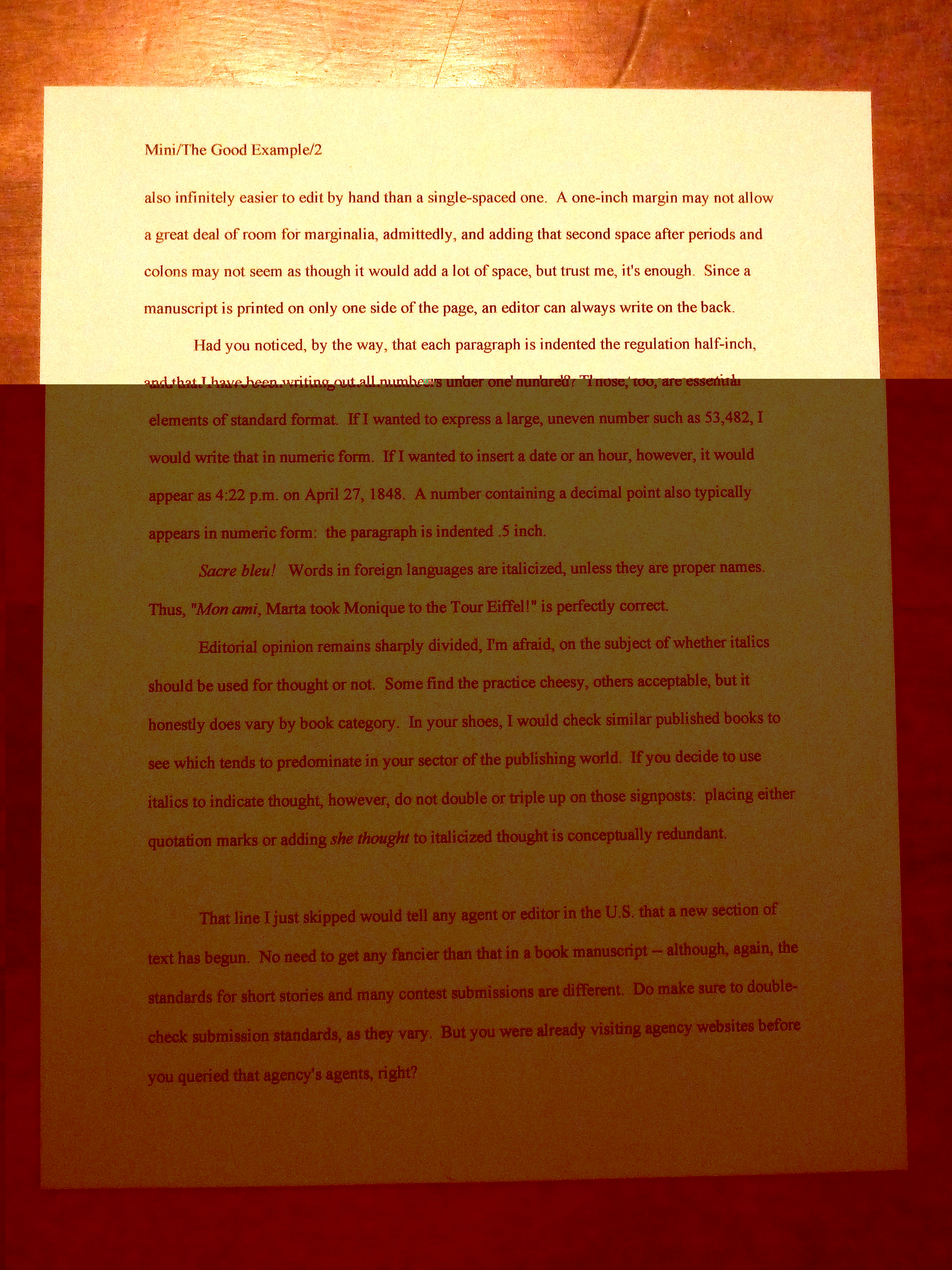
So there’s quite a bit in Example #1 that’s distracting from the actual writing, isn’t there? Doesn’t help sell the text, does it?

Okay, all of these rhetorical questions in a row are beginning to make me dizzy, so I’m going to wind down for the day. But before I do, let’s take one more look at Example #2, the one Millicent and a contest judge would like:

Now, let’s take a gander at the same page in — ugh — business format:

Startlingly different, isn’t it, considering that I made only two formatting changes? Did you catch them on your skim through?

All I did was I eliminate the indentations at the beginning of each paragraph and skipped a line between paragraphs to produce the norm for business correspondence, as well as for most of the text currently posted on the Internet.

Including this blog, unfortunately. As a professional writer and reader of manuscripts, it drives me NUTS that my blogging program won’t allow me to indent paragraphs.

Why? Because it just doesn’t look right. So much so that in a contest entry, as in a submission, business formatting is often grounds all by itself for knocking a manuscript out of finalist consideration.

Finding yourself asking why again? Well, technically, indented paragraphs are grammatically requisite, so to a judge, non-indented paragraphs may well seem as great a violation of everything we hold dear as frequent misspellings or use of the wrong form of there, their, and they’re.

Fortunately for judges and Millicents who care deeply about the health of the language, errors seldom come singly in entries and submissions. Like spelling errors, formatting mistakes are apparently social: they like to travel in packs, roving all over a manuscript like Visigoths sacking Rome.

Nike was apparently out of town that day. Visiting the ancient Greeks, perhaps.

As a result of this phenomenon, a manuscript that contains errors within the first few lines (or on the first page) is easy for a professional reader to dismiss; statistically speaking, it’s a pretty good bet that if Millicent kept reading after a technically flawed opening, she would find more causes for — you guessed it — umbrage.

Given how many submissions she has to screen between now and lunch, do you think she is going to (a) press on in the hope that the first error was a fluke, or (b) leap to the (perhaps unwarranted) assumption that there is more of the same to come and reject it right away?

I leave that one to your fine critical faculties to answer. Let’s just say that her umbrage-taking threshold tends to be on the low side.

Why am I bringing this up in the middle of a discussion of the perils of business format, you ask? Because — are you sitting down, dislikers of indentation? — one hears rumors that there are Millicents out there (and agents, editors, and contest judges as well) who will leap directly from noticing a lack of indentation and unwarranted spaces between paragraphs to our friend, option (b): if the submitter is not aware of how to format a paragraph of English prose properly, she reasons, aren’t there inevitably more snafus to come?

Not every Millicent — or agent, judge, etc. — will have this knee-jerk reaction, of course. But do you really want to take the chance that she’s not going to seize the opportunity to save herself a little time?

The specter of illiteracy is not the only reason using business format is likely to cost you, either. To a professional reader, the differences between the last two examples would be more than visually jarring — they’d be downright confusing. In standard format, the only reason for a skipped line between paragraphs would be a section break, so Millicent would be expecting the second paragraph to be about something new.
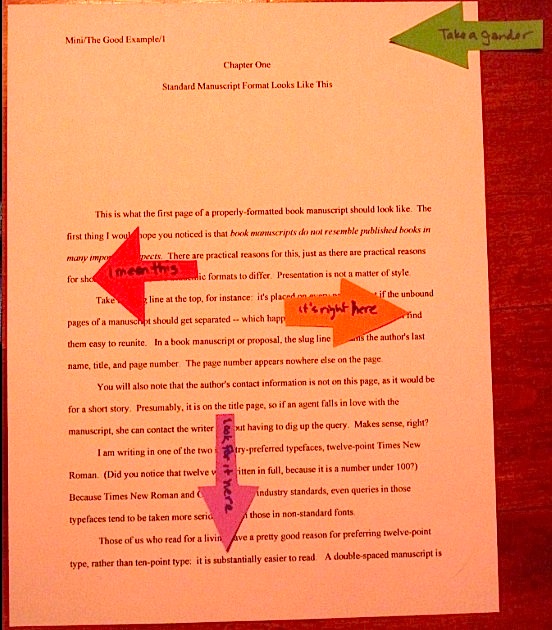
Okay, so a misconception like that might distract her attention for only few consecutive seconds, but let’s not kid ourselves: your garden-variety Millicent is spending less than a minute on most of the submissions she rejects — it’s actually not all that uncommon for her not to make into the second or third paragraph before reaching for the SASE and a copy of that annoying form rejection letter.

Take a moment for the implications of that to sink in fully. Don’t worry; I’ll wait.

While those of you new to the speed with which rejection typically occurs are already in shock, let me add for the sake of anyone who doesn’t already know: those who regard business format as a symptom of creeping illiteracy — hey, I just report the news; I don’t dictate it — are likely to frown upon it just as much in a query letter or synopsis as in a manuscript submission.

Time loss is not the only reason she might take umbrage at momentary confusion. Let me let you in on a little secret: professional readers, especially those who inhabit agencies and publishing houses, tend not to be overly fond of having their mental image of the story they are reading at the moment jarred.

How do I know this? Well, for one thing, they commonly refer to it as being tricked. As in, “I hate being tricked by a first paragraph that is about someone other than the protagonist.”

There’s a practical basis to this dislike, of course, but it’s kind of complicated. I wrote a couple of fairly extensive posts on the subject a while back (here’s a link to the first, and here’s a link to the second, in case you’re interested), but I’ll run over the thumbnail version now.

Is everybody comfortably seated? My thumbnails are a tad long. (Just try to get THAT image out of your head anytime soon.)

To get through all of those manuscripts she’s assigned to screen each week, Millicent has to read quite quickly, right? If she doesn’t, she’ll get buried in paper, as basically, she’s got to make it through WAR AND PEACE several times over in a week.

That’s a whole lot of material to remember, by anyone’s standards — and remembering actually is important here. If she decides to allow a manuscript to make it to the next level of consideration, she is going to need to be able to tell her boss what the book is about: who the protagonist is, what the conflict is, why that conflict is important enough to the protagonist for the reader to be drawn into it, and so forth.

In essence, she’s going to need to be able to pitch it to the higher-ups at the agency, just as the agent is going to have to do in order to sell the book to an editor, and an editor is going to have to do in order to convince HIS higher-ups that the publishing house should acquire the book.

And, often, as first-round contest judges will need to do on an evaluation form in order to pass an entry onto the next round.

Okay, brace yourself, because explaining what comes next involves delving into one of the great cosmic mysteries that has long perplexed aspiring writers the world over. It’s not for the faint of heart.

Remember earlier in thus series, when I mentioned that agents and editors don’t read like other people? Well, one of the primary differences is that from line one of page one, they’re already imagining how they’re going to pitch this book. So if paragraph 2 or 3 (or page 2 or 3) suddenly informs them that their mental patter has been about the wrong character, they feel as if they’ve been backing the wrong horse.

And while there may have been any number of perfectly reasonable narrative reasons for the text to concentrate upon an alternate character for the opening, unless the writing AND the story have already really wowed Millicent, her resentment about being trickedwrong about the identity of the protagonist is often sufficient to make her reach for that SASE and form letter.

Feel free to go scream into the nearest pillow over that last piece of convoluted logic; you don’t want to keep that kind of existential cri de coeur pent up inside. I’ll wait until it’s out of your system.

Feel better? Good.

Before you go rushing off to see if your opening paragraphs might possibly be open to an interpretation of trickery — because, for instance, you might have taken the bold authorial step of noticing that there is more than one human being in the world, and reported a piece of action accordingly — let’s return to the formatting issue that prompted my little segue into the psychology of resentment. Can we extrapolate any practical lesson about business format from it?

You bet your boots we can: it’s not a good idea to give the impression of a section break where there isn’t one. And when producing pages for people who read all day, you might want to stick to the rules governing written English and indent your paragraphs.

Still a bit confused? Don’t worry: the show-and-tell is far from over. Hang in there for the rest of this series, and keep up the good work!

PS: Hey, I know a great way to distract yourself from confusion and potentially rack up some pretty great ECQLC (eye-catching query letter candy) at the same time) — why not work on your entry to the First Periodic Author! Author! Awards for Expressive Excellence? The deadline is midnight on May 18; don’t say I didn’t warn you.

Marriage Rights Fight Not Enough of a Conflict? by guest blogger Beren de Motier

May 1st, 2009

berensmiling
Welcome back to the ongoing Author! Author! series on various stripes of censorship and how they affect writers. As those of you who have enjoyed these posts in previous weeks are already aware, in an effort to provoke serious thought and spur some interesting conversation, I have blandished a select group of some of the most interesting authors I know to share their thoughts on the forces that discourage writers from writing (or publishing) what they want — or writing in the way that they prefer.

I’m very pleased that today’s guest blogger, Beren deMotier, author of the multiple award-winning memoir THE BRIDES OF MARCH has agreed to share her insights with us.

I discovered her memoir — a beautifully-written, quirky look at the pros and cons of same-sex marriage from the inside out, smart without being preachy, funny without being bitter, emotional without being maudlin — as a judge in a well-respected writing competition. Since, like all respectable literary contests, the judging was blind (meaning that the judges do not know who the entrants are), I read her first chapter anonymously. I spent the long intervening months between my round of judging and the announcement of the winners gnawing on my nails, waiting to discover who this gifted memoirist was, so I could get my mitts on the rest of the manuscript. When I was able to track her down at the awards ceremony (after the judge’s ethical imperative to remain silent had evaporated), I more or less demanded to read the rest of it.

Nor was I disappointed in the result. This is a pretty amazing book.

I’m not the only reader — or the only contest judge — who has felt this way about it, either. In the years since THE BRIDES OF MARCH placed in my contest, it has won a National Indie Excellence Award, a , an Independent Publisher Book Award. It garnered Honorable Mentions in both the Writer’s Digest International Self-Published Book Awards and the Reader Views Awards.
It was also a finalist in creative nonfiction at the Oregon Book Awards, a pretty impressive achievement in any year. The head judge praised the book’s skillful “veering from laughter to despair and at times a breathless ‘you-are-there’ intensity…Beren deMotier manages to create a spirited romp out of a contentious and often painful civil rights issue.”

So you would think that a book like that would have agents and editors clamoring for it, wouldn’t you? Wouldn’t you?

Well, I’ll let Beren tell the story — I think it will be of vital interest to all of you memoirists out there. (For a more in-depth look at the book’s rocky road to publication, please see my interview series on the subject beginning here.)

Please join me, then, in welcoming today’s guest blogger, Beren de Motier. Take it away, Beren!
brides-of-march-cover-tinybrides-of-march-cover-tinybrides-of-march-cover-tinybrides-of-march-cover-tinybrides-of-march-cover-tinybrides-of-march-cover-tiny

I have become an expert, over the years, at receiving rejection letters. I know their feel, their smell; I can almost sense one in my mailbox.

When I first started sending manuscripts out years ago, rejection letters were crippling, leading to self-doubt, a re-questioning of priorities, and an aversion to completing any further literary projects. Then, I adapted somewhat, and though they didn’t stop me in my tracks upon arrival, they slowed me to a crawl, and three weeks could mysteriously pass without a word to paper. For a period they were depressing, requiring a day on the couch, much moaning, and an impulse purchase of lipstick or a half-gallon of ice cream. Nowadays, while I don’t rejoice over an envelope in the mail that contains a form letter or the personal note that still says “no,” I am definitely capable of surviving it intact and moving forward.
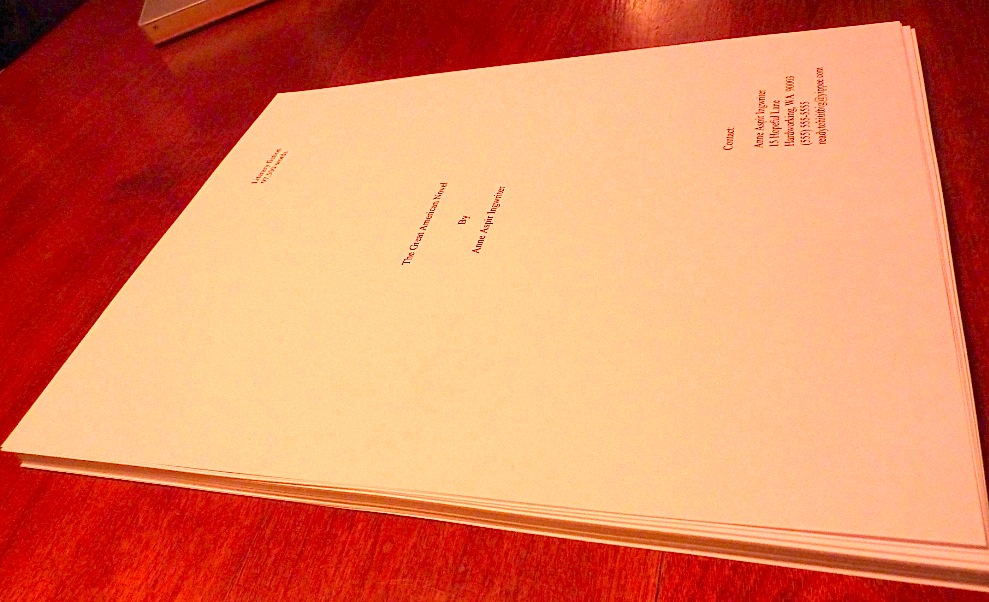
I got a lot of practice getting my memoir published.

Five years ago my spouse and I got married on a rainy Wednesday morning in March, and the next day I started writing a book about it. Not that I knew I was writing a book at the time. It began as a piece for my column, “I Kid You Not,” which ran in GLBTQ newspapers for over ten years. I called the piece “They Can’t Take This Away From Me.”

That morphed into a longer piece with a “you-are-there” urgency, trying to capture the day in its socio-political/romantic glory for those who couldn’t think of same-sex marriage other than theoretically. Then, when I heard a local gay rights advocate was pondering writing a book about the three thousand Multnomah County, Oregon, marriages, I decided I should write one, too; hadn’t I been writing articles about same-sex marriage for a decade?

The irony is that by the time I was finished writing my book, The Brides of March: Memoir of a Same-Sex Marriage, they had taken the marriage away from me — the marriages were annulled by state Supreme Court decision and declared null, void and legally non-existent. No gray area in that language. The book went from a joyous celebration of love conquering all after seventeen years and three kids together, to what I describe as “a giddy leap through a legal window, straight onto the barbeque pit of public debate.” History made it a better book (how many pages can you spend saying, “We finally got to get married and it was great!”), but I’d have bagged the book gladly and written a mystery if the marriages could have just stayed put.

After a strenuous campaign to get my memoir traditionally published, I self-published it so that I could add my two cents before same-sex marriage was off the political plate. This was definitely not my first choice for getting it in the hands of readers; having already published over a hundred articles, I had some confidence that I could write my way out of a paper bag, and the story seemed au courant and important. I was reasonably optimistic that it could find a publisher, however small, and maybe even an agent, after I did my leg work.

I know I did some of the right things (and read through Author! Author! to find out what these are, you won’t find better or more detailed writing advice anywhere) because not only were a good quarter of my rejection letters personally written by friendly editors and agents seemingly sorry that they couldn’t put my book on the best seller list (though that could have been an understandable desire to appear queer-friendly), but several agents and editors took it to the “send three chapters” and “send whole manuscript” level before deciding it was not for them. I was experienced enough to consider these rejections compliments, though a girl can’t help but get her hopes up.

However, some themes emerged among the rejection letters over time. One was of the “good writing/important story/can’t make any money” variety, and the low number of GLBTQ publishers who publish nonfiction (one, two?) indicates that the money part may be either a cold hard fact or an industry-wide assumption.

Another theme was “We don’t handle this kind of thing; you should send this to a gay-specific publisher, maybe Alyson?” I have a feeling that Alyson Books must get piles of submissions from writers rejected by “mainstream” publishing houses, but they can’t accept all of us.

The last and hardest to hear was the “not a big enough story” variety. One editor didn’t think it was a book — maybe a screenplay or a story for the New Yorker? One agent thought it could be “a novella or a terrific article.” Another agent said my writing was “charming, sexy, appealing and fun”… but that nothing dreadful happened; everyone lived, the couple was together in the beginning, still together at the end, and getting marriage rights denied, granted and taken away again wasn’t enough of a problem. She also said she’d have a better time getting my memoir published if I was an alcoholic, single mother—not that she wished that on me.

My wife, when I told her about it, responded, “Well, just rewrite the ending and have me killed by a hate crime; that should sell.”

Umm, talk about bad karma.

To give the agent credit, she read three edits of the book, which was darned generous.

But back up to the part about being denied the right to marry not being dreadful or enough of a problem; surely an author writing about interracial marriage before 1968, and how it impacted their family, wouldn’t be told that the subject lacked gravitas? Though the number of social commentary/humor memoirs about an interracial couple getting a marriage license with cries of “Why Don’t You Marry Your Dog?” and “God Hates This!” echoing from protesters outside the building, exchanging vows covered in cracker crumbs, holding a wedding reception only slightly marred by the additions of dog doo and razor blades in front of the house, mourning a constitutional amendment making sure their kind can never get married in that state again, and then their marriage being annulled by legal decision, must be low.

Anger was also something the book elicited; a literary contest judge (in which the unpublished manuscript won second place) began his comments with quotes from the synopsis of the book’s conclusion (“…devastated that the state we love, does not love us… How do you go on, in a nation that finds you so worthless?”) and wrote “That tone isn’t present in the chapters, but if it were it would make this reader stop at once. This book calls for humor, candor, insight, vulnerability and courage. Not self pity, and not made-up ideas of what the state or nation thinks.”

To paraphrase, it’s my memoir and I’ll cry if I want to.

But seriously, even though the lines he quoted are included in a synopsis of the book’s conclusion, and he himself says the tone isn’t present in the chapters he read, he found the lines so offensive, he put them at the top of his comments page.

The truth can be disconcerting; okay, all you queers reading this, raise your hand if you ever felt “devastated” and alienated when constitutional bans on same-sex marriage were passed? Anyone?

Yes, I’ve heard from you. Having our relationships legally defined as unworthy of marriage can make a person feel pretty worthless. I consider the ban on same-sex marriage character assassination on a national scale, and the idea that I shouldn’t find it “dreadful” enough to ponder repatriation involves a level of self-hate I’m not going back to. That’s what high school is for.

Not that, as a lesbian writer, I haven’t encountered the attitude again and again that “our” issues are less important than others, that all topics are straight unless otherwise specified, and that anything related to the queer community cannot be considered “universal.” I couldn’t count the number of times I’ve been asked by well-meaning people, “When are you going to write for real publications?” or been challenged by heterosexuals who think I’ve wasted my time writing about queer topics, i.e. the right to marry, my children (who happen to have two moms, making them a queer topic apparently), and, as a memoirist, my life.

There was the children’s book editor who asked why my main character needed to have two moms, instead of a mom and a dad, and I thought, well why not? About three million kids in the United States have gay parents. There was the literary journal editor who, looking at my list of published work, went on a tirade about one issue authors and found the issue of sexual orientation and gay relationships “tiring” and “looked forward to a day when gay men and women… can ‘forget’ about orientation and just write about all kinds of things.”

To the woman who writes about autism, Diet Coke, maggots, catching frogs, rejection letters, sex ed and being a high school “Band-aide,” among other things.

Fortunately, I’ve become a pro at receiving rejection letters and disparaging remarks with grace (and I wouldn’t share this story except that it does illustrate the subtle censorship that surrounds queer writing), so I didn’t give up on my book. After a whopping one hundred and ten rejections (ten percent “not without an agent,” forty-percent form letter, ten-percent hand-written note on returned query letter, ten percent “not at this address,” twenty-five percent individually written friendly letter, five-percent going on to request chapters or whole manuscript before saying no), I decided to self-publish through iUniverse, which was significantly less expensive at the time.

Since it was published in April 2007, The Brides of March : Memoir of a Same-Sex Marriage was a Finalist in the Oregon Book Awards in Creative Nonfiction, won a National Indie Excellence Award in Current Events: Political/Social, a in Gay/Lesbian Nonfiction, an Independent Publisher Book Award in Gay/Lesbian and Honorable Mentions in both the Writer’s Digest International Self-Published Book Awards in Life Stories and a Reader Views Award in Memoir/Autobiography.

I’m working on a Young Adult novel now, and yes, there are queer characters. There are also straight characters, Goth characters and a Pit Bull named Grendel. When it is time to send it out to agents and editors I will be interested to see if I get some of the same comments when the manuscript is fiction, not memoir, and lots of dreadful things happen (that’s what YA is all about, Charlie Brown).

Last fall I was on the “Queer Portland” panel at Wordstock, in Oregon, a sleeper hit of the literary festival full to the brim with writers and readers there to see Ariel Gore, Diane Anderson-Minshall, Marc Acito, Jake Anderson-Minshall, and me read and talk about our writing, and the invisibility/marginalization of queer writers. What seemed clear is that despite the success of specific GLBTQ authors, we are not at the place the literary journal editor described, where we can “forget” about orientation when it comes to where we can be published and what audience we reach, and that being “too gay” means limited options as an author.

Strangely enough, the underlying message of my memoir, wrapped in loopy conversational layers of relationship history, weaning the baby, exchanging vows, assembling a wedding reception in three days, and walking the beach in Canada with our kids, is that love is love, gay people are people, that the similarities vastly outweigh any differences between straight and gay, and that taking part in the culture we were raised in is not too much to ask.

The pronouns we employ in our writing shouldn’t limit access to an audience because publications and publishers find “queer topics” too marginal for the (assumed to be heterosexual) reading public. Right now, they do.

brides-of-march-cover-tinybrides-of-march-cover-tinybrides-of-march-cover-tinybrides-of-march-cover-tinybrides-of-march-cover-tinybrides-of-march-cover-tiny

berensmilingBeren de Motier spent her first 21 years in three seven-year stints in California, on Vancouver Island, and in Seattle, resulting in a Californadian accent confusing to her peers. After graduating from the University of Washington, she leapt head first into domestic bliss, moving increasingly south of Seattle, until coming to a full stop in cozy liberal Portland, Oregon. During that time, she wrote humor and social commentary about life as a lesbian mom for Curve, ecomagazine green*light.com, award-winning And Baby, prideparenting.com, on her website, and for newspapers across the country. She contributed to The Complete Lesbian & Gay Parenting Guide by Ari Istar Lev, and wrote for eHow as an expert in Gay/Lesbian Family and Relationships. The Brides of March was published in April 2007.

When she’s not up to her elbows in dishes, driving kids across town, or trying to find something funny to write about the flu, she paints portraits of dogs and horses. She lives with her spouse, their three children, and a Labrador the size of a small horse. You can read all about it on her blog, That Lesbian Mom Next Door.

Next Entries »