Author! Author! :: Anne Mini's Blog

Author! Author!

Synopsis-writing 101, part II: the dreaded single-page synopsis, or, what to do when you can’t allow those mushrooms to multiply

September 23rd, 2008

We begin today on a note of triumph: long-time reader and fab lady Auburn McCanta has had a political essay selected (amid some SERIOUS competition, I’m guessing, at this point in the election cycle) for publication on the Huffington Post. Congratulations, Auburn!

Please, everyone, keep sending in word of your writerly triumphs, large and small. One of the great benefits of community is being able to share good news!

Good news comes in many forms for writers — as does, lest we forget ECQLC (Eye-Catching Query Letter Candy). Many aspiring writers become so focused on imagining a single track to literary success — which typically runs thus: write book, land agent, sell book to Random House, book signings, Oprah, wash, rinse, and repeat — that they forget that other writerly achievements can look awfully good in a query letter and in an author bio. Publications — paid or not, in print or on the Internet — definitely count, as do degree programs, certificate programs, contest placing, and so forth.

So please join me, everyone, in applauding Auburn for doing some smart long-term career promotion — and set aside some time in your no doubt busy schedule to brainstorm what ECQLC you might add to your query letter candy bowl to render it more attractive to Millicent.

Who, for those of you joining us late, is Author! Author!’s pet agency screener, the one who is so very efficient at zipping through stacks and stacks of query letters with a latte in one hand and a pile of form-letter rejections in the other. She’s also often the gal who weeds out submissions before they reach the desk of the agent of one’s dreams — who, if s/he happens to work at one of the larger agencies, might even have two or three Millicents pre-reading submissions.

We here at A! A! try not to annoy Millicent. It’s not good marketing strategy.

In further pursuit of that laudable goal, I launched yesterday into a discussion one of the more frustration-generating tasks a writer faces on a routine basis: compressing a deliciously complex, breathtakingly nuanced 400-book into a 5- (or 1)-page summary in standard format.

Or whatever length the agent of your dreams or contest of your desires has seen fit to request.

It’s well worth double-checking who is requesting what these days, especially if you’re planning on including a synopsis with your query letters. This information that’s usually easily available in the agency’s listing in one of the standard agency guides, on its website (if it has one; a surprisingly hefty percentage still don’t), or even, in the case of a REQUESTED synopsis to be included with a submission, in the communication containing the request for materials.

Yes, I AM saying what you think I’m saying: you wouldn’t believe how often queriers seem to forget to consult either of the former (or both, since sometimes they contain different information) or, in the heat of post-request excitement, simply disregard the instructions about what they’re supposed to send.

A good trick to help avoid the first mistake: do your homework; if the agency has made the information publicly available, Millicent will expect any querier or submitter to be familiar with it.

A couple of good tricks to avoid the second: when you receive a request for materials, immediately sit down and make a checklist of what should be in the submission packet. Then have a non-writer go over the request for materials, the agency in question’s guidelines, AND its website, making a separate list of all the agency’s requirements and requests. (Why a non-writer, you ask? S/he’s less likely to get swept up in the excitement of the moment.) Afterward, compare and consolidate the two lists.

Before you seal the submission packet, dig out the final version of that to-do list and triple-check that you did everything on it.

Pay extra-close attention to length restrictions for synopses — Millicents are known for rejecting a too-long or too-short synopsis on sight. Why? Well, one that is much shorter will make you look as if your story is unable to sustain a longer exposition; if it is much longer, you will look as though you aren’t aware of the standard.

Either way, the results can be fatal to your submission.

So what DOES work in a synopsis? It’s not going to sound sexy, I’m afraid, but here is the secret:

For fiction, stick to the plot of the novel, including enough vivid detail to make the synopsis interesting to read. Oh, and make sure the writing is impeccable.

For nonfiction, begin with a single paragraph about (a) why there is a solid market already available for this book and (b) why your background/research/approach renders you the perfect person to fill that market niche. Then present the book’s argument in a straightforward manner, showing how each chapter will build upon the one before to prove your case as a whole. Give some indication of what evidence you will use to back up your points.

For either, make sure to allot sufficient time to craft a competent, professional synopsis — as well as sufficient buffing time to render it gorgeous. Let’s face it, unlike some of the more — let’s see, how shall I describe them? — fulfilling parts of writing and promoting a book (see above; wash, rinse, repeat), a synopsis is unlikely to spring into your head fully-formed, like Athene; most writers have to flog the muses quite a bit to produce a synopsis they like.

To quote the late, great Billie Holiday: the difficult/I’ll do right now./ The impossible/will take a little while.

Too few aspiring writers do, apparently preferring instead to toss together something at the last minute before sending out a submission or contest entry. (Especially a contest entry. I’ve been a judge; I know.)

I have my own theories about why otherwise sane and reasonable people might tumble into this particular strategic error. Not being aware that a synopsis would be required seems to be a common reason, as does resentment at having to produce it at all. Or just not being familiar with the rigors of writing oe.

Regardless, it’s just basic common sense to recognize that synopses are marketing materials, and should be taken as seriously as anything else you write.

Yes, no matter how good your book may happen to be. Miss America may be beautiful au naturale, for all any of us know, but you can bet your last pair of socks that at even the earliest stage of going for the title, she takes the time to put on her makeup with care.

On the bright side, since almost everyone just throws a synopsis together, impressing an agent with one actually isn’t as hard as it seems at first blush. Being able to include a couple of stunning visceral details, for instance, is going to make you look like a better writer — almost everyone just summarizes vaguely.

My readers, of course, are far, far too savvy to make that mistake, right?

Even if you are not planning to send out queries or submissions anytime soon (much to those sore-backed muses’ relief), I STRONGLY recommend investing the time in generating and polishing a synopsis BEFORE you are at all likely to need to use it. That way, you will never you find yourself in a position of saying in a pitch meeting, “A 5-page synopsis? Tomorrow? Um, absolutely.”

Hey, there was a reason that I introduced you to that Billie Holiday song; it’s the mantra of the working writer. Or so my agent tells me.

Actually, if you can bear it — you might want to make sure your heart medication is handy before you finish this sentence –it’s a great idea to pull together a couple of different lengths of synopsis to have on hand, so you are prepared when you reach the querying and submission stages to provide whatever the agent in question likes to see.

What lengths might you want to have in stock? Well, a 5-page, certainly, as that is the most common request, and perhaps a 3 as well, if you are planning on entering any literary contests anytime soon. As I mentioned yesterday, it’s getting more common for agents to request a 1-page synopsis, so you might want to hammer out one of those as well.

I can tell from here that you’ve just tensed up. Take a deep breath. No, I mean a really deep one. This is not as overwhelming a set of tasks as it sounds.

In fact, if you have been reading this blog all summer or have worked through some of the exercised in the archives, you probably already have a 1-page synopsis floating around in your mind.

You may know it by its other name: the 2-minute pitch. (For tips on how to construct one of these babies, please see the aptly-named 2-MINUTE PITCH category at right.)

Don’t believe me, oh ye of little faith? Okay, here’s a pitch I used as an example just a couple of months back:

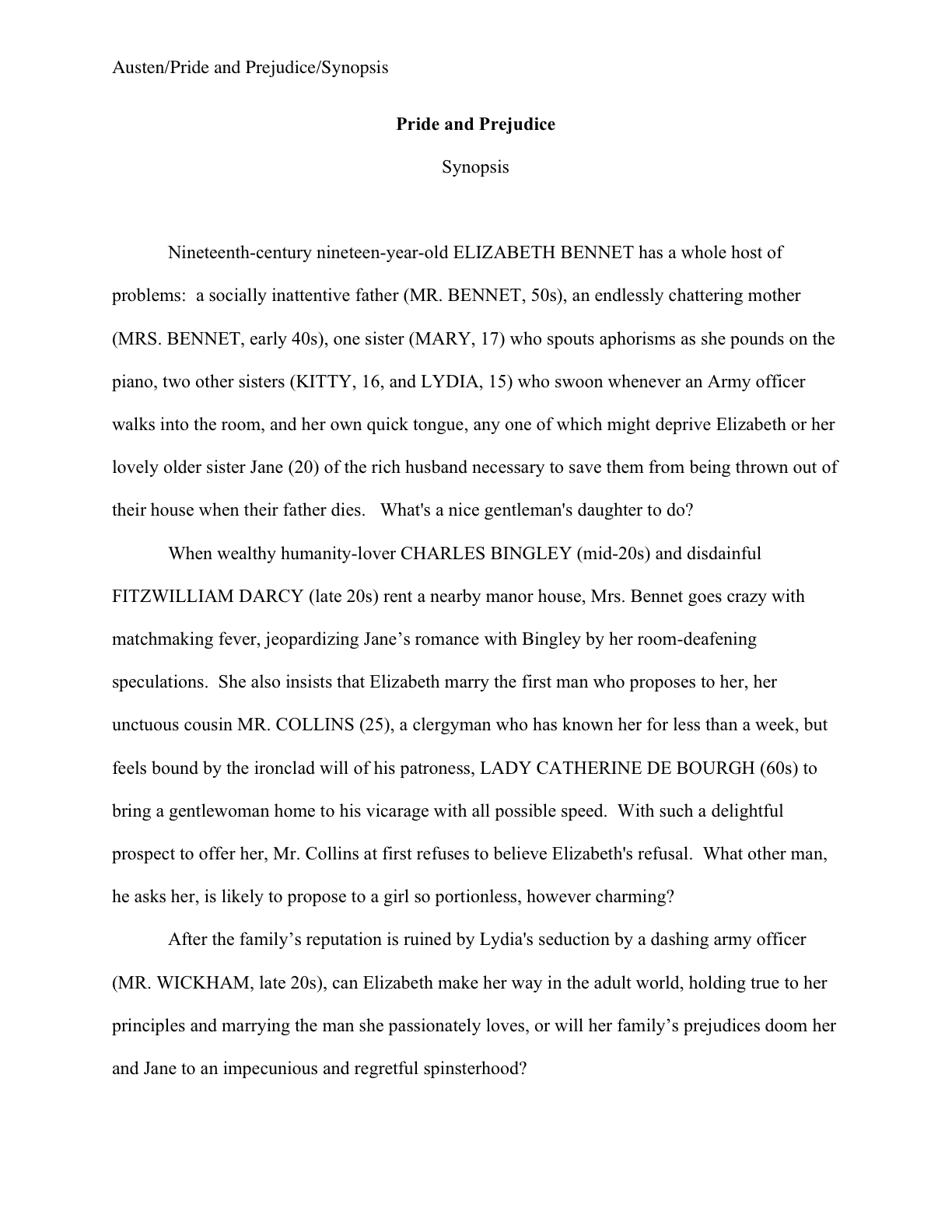
19th-century 19-year-old Elizabeth Bennet has a whole host of problems: a socially inattentive father, an endlessly chattering mother, a sister who spouts aphorisms as she pounds deafeningly on the piano, two other sisters who swoon whenever an Army officer walks into the room, and her own quick tongue, any one of which might deprive Elizabeth or her lovely older sister Jane of the rich husband necessary to save them from being thrown out of their house when their father dies. When wealthy humanity-lover Mr. Bingley and disdainful Mr. Darcy rent a nearby manor house, Elizabeth’s mother goes crazy with matchmaking fever, jeopardizing Jane’s romance with Bingley and insisting that Elizabeth marry the first man who proposes to her, her unctuous cousin Mr. Collins, a clergyman who has known her for less than a week. After the family’s reputation is ruined by her youngest sister’s seduction by a dashing army officer, can Elizabeth make her way in the adult world, holding true to her principles and marrying the man she passionately loves, or will her family’s prejudices doom her and Jane to an impecunious and regretful spinsterhood?

PRIDE AND PREJUDICE, right? As I vaguely recall having mentioned at the time, this would be a trifle long as an elevator speech — which, by definition, needs to be coughed out in a hurry — but it would work fine in, say, a ten-minute meeting with an agent or editor.

It also, when formatted correctly, works beautifully as a one-page synopsis with only a few minor additions. Lookee:

Okay, so if I were Jane (Austen, that is, not Bennet), I MIGHT want to break up some of the sentences a little, particularly that last one that’s a paragraph long, but see how simple that was? The trick to the 1-page synopsis lies in realizing that it’s not intended to summarize the entire plot, merely to introduce the characters and the premise.

Yes, seriously. Like the descriptive paragraph in a query letter or the summary in a verbal pitch, no sane person seriously expects to see the entire plot of a book summarized in a single page. It’s a teaser, and should be treated as such.

Doesn’t that make more sense than driving yourself insane, trying to cram your entire storyline or argument into 22 lines? Or trying to shrink that 5-page synopsis you have already written down to 1?

Bears pondering, doesn’t it?

Yes, yes, I know: even with reduced expectations, it’s still a tall order. That’s why you’re going to want to set aside some serious time to write it — and don’t forget that the synopsis is every bit as much an indication of your writing skill as the actual chapters that you are submitting. (Where have I heard that before?) Because, really, don’t you want YOURS to be the one that justified Millicent’s heavily-tried faith that SOMEBODY out there can tell a good story in 3 – 5 pages?

Or — gulp! — 1?

Don’t worry; you can do this. There are more rabbits in that hat, and the muses are used to working overtime on good writers’ behalves. Keep up the good work!

What should a query letter look like, anyway? Part III: suspense novel seeks LTR with agent

August 27th, 2008

Throughout this latest barefoot run through the often rocky field of query letters, I have been thinking a lot about querying fatigue, that dragging, soul-sucking feeling that every querier — and submitter, and contest entrant — feels if and when that SASE comes back stuffed with a rejection. “Oh, God,” every writer thinks in that moment, “I have to do this again?” Unfortunately, if an aspiring writer wants to land an agent, get a book published by press large or small instead of self-publishing, or win a literary contest, s/he DOES need to pick that ego off the ground and keep moving forward.

That’s just a fact. So I hope that my last post, about the very, very short amount of time a writer has to grab an agent’s attention in a query letter, did not discourage anyone from trying.

Yes, querying is a tough row to hoe, both technically and psychologically. But here’s a comforting thought to bear in mind: someone who reads ONLY your query, or even your query and synopsis, cannot logically be rejecting your BOOK, or even your writing; to pass a legitimate opinion on either, she would have to read some of your work.

I’m quite serious about this — aspiring writers too often beat themselves up unduly over rejections, and it just doesn’t make sense. Unless the agency you are querying is one of the increasingly rare ones that asks querants to include a brief writing sample, what is rejected in a query letter is either the letter itself (for unprofessionalism, lack of clarity, or simply not being a kind of book that particular agent represents), the premise of the book, or the book category.

So, logically speaking, there is NO WAY that even a stack of rejection letters reaching to the moon could be a rejection of your talents as a writer, provided those rejections came entirely from cold querying. Makes you feel just the tiniest bit better to think of rejections that way, doesn’t it?

The sole goal of querying, as of pitching, then, is to generate a request to read some of it — not, as many queriers and pitchers seem to believe, to sell the book per se.

Why am I bringing this up in mid-series, you ask, other than to be a ray of sunshine on a rainy Seattle day? Well, it’s all part of a longer-term plan: earlier in the summer, if you will recall, I promised that learning how to pitch would help make you a better querier; last week and this, I have discussed how a savvy pitcher might apply those lessons to constructing a query letter; yesterday, I broached the often-neglected subject of the difference between query letters that claim to be the next bestseller, and those that provide an agent with some reasons to believe it.

Beginning to descry the outlines of my evil plan? I don’t want any of you to follow my querying guidelines blindly, but to UNDERSTAND the goals and pieces of the query letter well enough to write one that is actually original. I would like to see my readers not merely sending out professional-looking query letters, but ones that shout, “Hey, I’m not just a writer who has slapped my ideas into a boilerplate query — I’m a smart, thoughtful person with a good idea for a book who has taken the time to learn how the industry works.”

Overkill? Perhaps. But in my experience, more effective than just changing the words in the same template half the aspiring writers in North America are using this week — and believe me, fashions in querying change almost as often as fashions in hemlines.

All of which brings me back to a question thoughtful reader Jake wrote in to ask earlier in the summer, in the middle of my rhapsodies on pitching:


I’ve been applying this series to query writing, and I think I’ve written a pretty good elevator speech to use as a second paragraph, but there’s something that bothers me.

We’ve been told countless times not to write teasers or book-jacket blurbs when trying to pick up an agent. (”Those damned writer tricks,” I think was the term that was used)

I’m wondering exactly where the line between blurbs and elevator speeches are, and how can I know when I’ve crossed it. Any tips there?

Jake, this is a great question, one that I wish more queriers would ask themselves. The short answer:


A good elevator speech/descriptive paragraph of a query letter describes the content of a book in a clear, concise manner, relying upon intriguing specifics to entice a professional reader into wanting to see actual pages of the book in question.


whereas


A blurb is a micro-review of a book, commenting upon its strengths, usually in general terms. Usually, these are written by someone other than the author, as with the blurbs that appear on book jackets.

The former is a (brief, admittedly) sample of the author’s storytelling skill; the latter is promotional copy. As I mentioned in yesterday’s post, many, if not most, queriers make the mistake of regarding query letters — and surprisingly often synopses, especially those submitted for contest entry, as well — as occasions for the good old American hard sell, boasting when they should instead be demonstrating.

Or, to put it in more writerly language, telling how great the book in question is rather than showing it. From Millicent’s perspective, the difference is indeed glaring.

So how, as Jake so insightfully asks, is a querier to know when he’s crossed the line between them? As agents like to say, it all depends on the writing, and as my long-term readers are already aware, I’m no fan of hard-and-fast rules. However, here are a couple of simple follow-up questions to ask while considering the issue:

(1) Does my descriptive paragraph actually describe the book, or does it pass a value judgment on it?

Generally speaking, agents and editors tend to be wary of aspiring writers who praise their own work, as I mentioned yesterday. To use a rather crude analogy, boasts in queries come across like a drunk’s insistence that he can beat up everybody else in the bar, or (to get even cruder) like a personal ad whose author claims that he’s a wizard in bed.

That’s at MAKING the bed, naturally, children.

My point is, if the guy were really all that great at either, wouldn’t otherpeople be singing his praises? Isn’t the proof of the pudding, as they say, in the eating?

The typical back-jacket blurb isn’t intended to describe the book’s content — it’s to praise it. And as counter-intuitive as most queriers seem to find it, the goal of a query letter is not to praise the book, but to pique interest in it.

See the difference? Millicent does.

(2) Does my query present the book as a reviewer might, in terms of the reader’s potential enjoyment, assessment of writing quality, speculation about sales potential, and assertions that it might make a good movie? Or does my query talk about the book in the terms an agent might actually use?

Does this question sound eerily familiar? It should, at least to those of you who followed me through the pitching series earlier this summer.

I’ve said it before, and I’ll no doubt say it again: an effective query or pitch describes a book in the vocabulary of the publishing industry, not in terms of general praise.

(3) Are the sentences that strike me as possibly blurb-like actually necessary to the query letter, or are they extraneous?

I hate to be the one to break it to you, but the average query letter is crammed to the gills with unnecessary verbiage. Just as your garden-variety unprepared pitcher tends to ramble on about how difficult it has been to find an agent for her book, what subplots it contains, and what inspired her to write the darned thing in the first place, queriers often veer off-track to discuss everything from their hopes and dreams about how well the book could sell (hence our old friend, “It’s a natural for Oprah!”) to mentioning what their kith, kin, and writing teachers thought of it (”They say it’s a natural for Oprah!”) to thoughtfully listing all of the reasons that the agent being queried SHOULDN’T pick it up (”You probably won’t be interested, because this isn’t the kind of book that ends up on Oprah.”)

To Millicent and her fellow screeners, none of these observations are relevant.

A successful query letter has ALL of the following traits: it is clear; it is less than 1 page (single-spaced); it describes the book’s premise (not the entire book; that’s the job of the synopsis) in an engaging manner; it is polite; it is clear about what kind of book is being pitched; it includes a SASE, and it is addressed to an agent with a successful track record in representing the type of book it is pitching.

You would not BELIEVE how few query letters that agencies receive actually have all of these traits. And to be brutally blunt about it, agents rather like that, because, as I mentioned in my last, it makes it oh-so-easy to reject 85% of what they receive within seconds.

No fuss, no muss, no reading beyond, say, line 2. Again, sound familiar?

A particularly common omission: the book category. Because, you see, many writers just don’t know that the industry runs on book categories; it would be literally impossible for an agent to sell a book to a publisher without a category label. And other writers, bless their warm, fuzzy, and devious hearts, think that they are being clever by omitting it, lest their work be rejected on category grounds. “This agency doesn’t represent mysteries,” this type of strategizer thinks, “so I just won’t tell them until they’ve fallen in love with my writing.”

I have a shocking bit of news for you, Napolèon: the industry simply doesn’t work that way; if they do not know where it will eventually rest on a shelf in Barnes & Noble, they’re not going to read it at all.

Yes, for most books, particularly novels, there can be legitimate debate about which shelf would most happily house it, and agents recategorize their clients’ work all the time (it’s happened to me, and recently). However, people in the industry speak and even think of books by category – trust me, you’re not going to win any Brownie points with them by making them guess what kind of book you’re trying to get them to read.

If you don’t know how to figure out your book’s category, or why you shouldn’t just make one up, please, I implore you, click on the BOOK CATEGORIES section of the list at right before you send out your next query letter. Or pitch. Or, really, before you or anything you’ve written comes within ten feet of anyone even vaguely affiliated with the publishing industry.

But I’m veering off into specifics, amn’t I? We were talking about general principles.

I find that it often helps aspiring writers to think of their query letters as personal ads for their books. (Oh, come on: everyone reads them from time to time, if only to see what the new kink du jour is.) In it, you are introducing your book to someone with whom you are hoping it will have a long-term relationship – which, ideally, it will be; I have relatives with whom I have less frequent and less cordial contact than with my agent – and as such, you are trying to make a good impression.

So which do you think is more likely to draw a total stranger to you, ambiguity or specificity in how you describe yourself?

To put it another way, are you using the blurb or demonstration style> Do you, as so many personal ads and queries do, describe yourself in only the vaguest terms, hoping that Mr. or Ms. Right will read your mind correctly and pick yours out of the crowd of ads? Or do you figure out precisely what it is you want from a potential partner, as well as what you have to give in return, and spell it out?

To the eye of an agent or screener who sees hundreds of these appeals per week, writers who do not specify book categories are like personal ad placers who forget to list minor points like their genders or sexual orientation.

Yes, it really is that basic, in their world.

And writers who hedge their bets by describing their books in hybrid terms, as in “it’s a cross between a political thriller and a gentle romance, with helpful gardening tips thrown in,” are to professional eyes the equivalent of personal ad placers so insecure about their own appeal that they say they are into, “long walks on the beach, javelin throwing, or whatever.”

Trust me, to the eyes of the industry, this kind of complexity doesn’t make you look interesting, or your book a genre-crosser. To them, this at best looks like a rather pitiful attempt to curry favor by indicating that the writer in question is willing to manhandle his book in order to make it anything the agent wants. At worst, it comes across as the writer’s being so solipsistic that he assumes that it’s the query-reader’s job to guess what “whatever” means in this context.

And we all know by now how agents feel about writers who waste their time, don’t we?

Don’t make ‘em guess; be specific, and describe your work in the language they understand. Because otherwise, they’re just not going to understand the book you are offering well enough to know that any agent in her right mind — at least, anyone who has a substantial and successful track record in selling your category of book — should ask to read all or part of it with all possible dispatch.

I know you’re up to this challenge; I can feel it.

Don’t worry, though — you don’t need to pull it off within the next thirty seconds, regardless of what that rush of adrenaline just told you. More discussion of the ins and outs of querying follows in the days to come, so take a nice, deep breath and keep up the good work!

Okay, I get it about standard format for manuscripts. Now what does a query letter look like?

August 22nd, 2008

Hello, campers —

No time for a long-winded missive today, I’m afraid, but I’m anxious to start fulfilling a promise I made earlier in the summer. Cast your mind back to those thrilling days of yesteryear, way back in mid-June, and you’ll find that when I first began talking about how to pull together a verbal pitch, I promised that doing so it would help you crank out a stellar query letter.

Well, now’s the time to prove it.

In that spirit, I’m going to be re-running a few posts (edited) from last year’s interminable-but-useful Book Marketing 101 series. Today, we’re going to talk about how to construct a query letter from the building blocks of the pitch. (And if you’re not clear about what they are, check the category list at right — each has its own category, for easy reference.)

This is a perfect time of year to be working on polishing a query — as I’ve mentioned before, the vast majority of the publishing industry goes on vacation from mid-August until after Labor Day, so waiting until early-to-mid-September (after Labor Day, but before the Frankfort Book Fair, to be precise) makes good strategic sense.

Enjoy!

Here’s a startling statement for an online writing guru to make: I wish writers talked amongst themselves about the nuts and bolts of querying more.

Why? Well, although I know that my readers are too savvy to fall into the pitfalls of the average writer, the vast majority of query letters agents receive are either uncommunicative, petulant in tone, just poor marketing — or obviously copied from a standard one-size-fits all boilerplate.

We can do better than that, I think.

For those of you absolutely new to the process, a query letter is a 1-page (single-spaced) polite, formal inquiry sent out to an agent or editor in the hope of exciting professional interest.

It is not, contrary to popular practice, an occasion for either begging or boasting; you will want to come across as a friendly professional who has done her homework. (Or his, as the case may be.) A good query introduces the book and the author to a prospective agent in precisely the terms the industry would use to describe them.

This should sound familiar to those of you who have stuck with me all the way through Book Marketing 101: this was the purpose of the Magic First Hundred Words, wasn’t it? (For those of you new to the concept, please see a category on the list at right entitled, straightforwardly enough, THE MAGIC FIRST HUNDRED WORDS.)

And, like the hallway pitch, your goal here is not to make the agent fall down on the floor, foaming at the mouth and crying, “I will die if I do not sign this author immediately!” but to prompt a request to submit pages.

That’s a much less formidable goal, isn’t it?

How does one pull that off? By being businesslike without using business format (long-time readers, chant it with me now: documents without indented paragraphs appear illiterate to folks in the publishing industry).

There are a zillion guides out there, each giving ostensibly foolproof guidelines for how to construct a positively stellar query letter, but in my experience, simple works better than gimmicky. (Possibly because the former is rarer.) Typically, a query letter consists of five basic elements:

1. The opening paragraph, which includes the following information:

* A brief statement about why the writer is approaching this particular agent (Hint: be specific. “I enjoyed hearing you speak at Conference X,” “Since you so ably represent Author Q,” and “Since you are interested in (book category), I hope you will be intrigued by my book” all work better than not mentioning how you picked the agent in the first place.)

*The book’s title

*The book’s category (i.e., where your book would sit in Barnes & Noble. Most queries leave this off, but it’s essential. If you don’t know what this is, or are not sure where your book will fall, please see the BOOK CATEGORIES section at right).

*Word count. (Optional. Actually, I have never included this, because it makes many novels easier to reject right off the bat, but many agents to have it up front. Because, you see, it makes it easier to reject so many queries off the bat. If your work falls within the normal word count for your genre – for most works of fiction, between 80,000 and 100,000 words – go ahead and include it. And if you don’t know how to estimate word count — most of the industry does not operate on actual word count — please see the WORD COUNT category at right.)

2. A paragraph pitching the book.

3. A BRIEF paragraph explaining for whom you have written this book (that’s the target market, mind you, not a paraphrase of your dedication page) and why this book might appeal to that demographic in a way that no other book currently on the market does. If the demographic is not especially well-known (or even if it is; agents tend to underestimate the size of potential groups of readers), go ahead and include numbers.

Don’t make the very common mistake, though, of having your book sound like a carbon copy of a current bestseller: you want to show here that your work is unique. If you can compare your book to another within the same genre that has sold well within the last five years, this is the place to do it, but make sure to make clear how your book serves the target market differently and better.

4. An optional paragraph giving your writing credentials and/or expertise that renders you the ideal person to have written this book — or, indeed, absolutely the only sentient being in the universe who could have. Actually, it’s not optional for NF, and it’s a good idea for everyone.

Include any past publications (paid or unpaid) in descending order of impressiveness, as well as any contest wins, places, shows, semi-finalist lists, etc., and academic degrees (yes, even if they are not relevant to your book).

If you have no credentials that may legitimately be listed here, omit this paragraph. However, give the matter some serious, creative thought first. If you have real-life experience that gives you a unique insight into your book’s topic, include it. (Again, it need not have been paid experience.) Or any public speaking experience – that’s actually a selling point for a writer, since so few have ever read in public before their first books have come out. Or ongoing membership in a writers’ group.

Anything can count, as long as it makes you look like a writer who is approaching the industry like a professional. Or like a person who would be interesting to know, read, and represent.

5. An EXTREMELY brief closing paragraph, thanking the agent for her time, mentioning any enclosed materials (synopsis, first five pages, whatever the agent lists as desired elements), calling the agent’s attention to the fact that you’ve sent a SASE, and giving your contact information, if it is not already listed at the top of the letter. (If you can’t afford to have letterhead printed up, just include your contact information, centered, in the header.) Say you look forward to hearing from her soon, and sign off.

There, that’s not so impossible in a single page, is it?

Before you tense up at the prospect, here’s the good news: if you have been prepping your pitch, you’ve already constructed most of the constituent parts of a professional-looking query letter.

Don’t believe me? Look at how easily the building blocks snap together to make a log cabin:

Dear Ms./Mr. agent’s last name (NEVER just “Dear Agent”),
I enjoyed hearing you speak at the Martian Writers’ Conference. Not many New York-based agents take the time to come to Mars to meet the local writers; we really appreciate the ones who do.

Since you so ably represented BLUE-EYED VENUSIAN, I hope you will be interested in my book, {TITLE}. It is a {BOOK CATEGORY} that will appeal to {TARGET MARKET} because {#1 SELLING POINT}.

{ELEVATOR SPEECH}

I am uniquely qualified to tell this story, because {the rest of your SELLING POINTS, including any writing credentials}.

Thank you for your time in reviewing this, and I hope that the enclosed synopsis will pique your interest. I may be reached at the address and telephone number above, as well as via e-mail at {e-dress}. I enclose a SASE for your convenience, and I look forward to hearing from you soon.

Sincerely,

Aspiring Q. Author

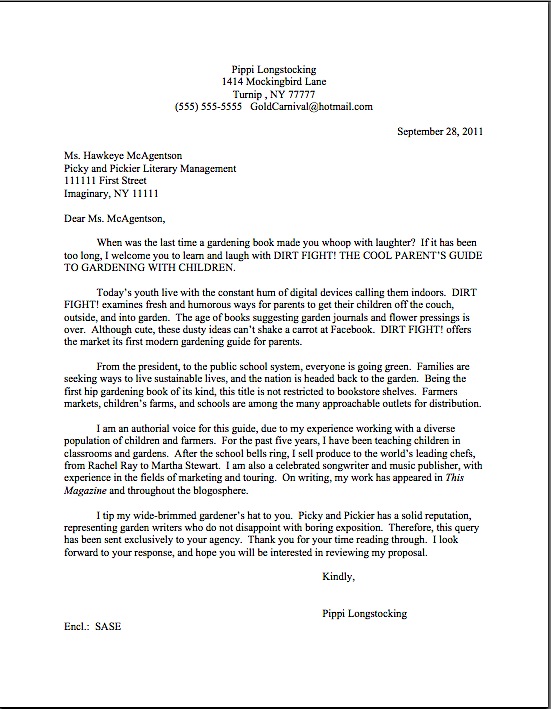
Or, to show it as it might appear on an actual piece of paper (white, please; this is not the time to break out the solar yellow in an misguided effort to grab Millicent’s attention), like this:

You can pull that off without breaking a sweat, right?

Don’t worry; this structure isn’t my last word on the query, by any stretch of the imagination, and I’m going to be showing you precisely what a properly-formatted query letter looks like on the page. For today, however I’m going to leave you to ponder the possibilities. A big part of staying in this business for the long haul is knowing to pace oneself, after all.

Keep up the good work!
PS to those of you who are reading this post for the first time in the archives: this is my basic how-to post for query writing, but there is a wealth of further information located in the QUERY LETTER 101 category on the list at right. For tips on technical formatting, please see the QUERY LETTERS ILLUSTRATED category. Best of luck!

Surviving a conference with your sanity — and energy — in one piece, or, if a stone can smile, so can you

July 18th, 2008

That’s an actual stone in my yard, by the way, one that apparently went out of its way to anthropomorphize for our viewing pleasure. If rocks can be that friendly, it gives me great hope for human beings.

Which is my subtle way of leading into asking: after these last few weeks of posts, are you starting to have dreams yet about pitching?

If they’re not nightmares, and you’re scheduled to pitch at a conference anytime soon, you’re either a paragon of mental health, a born salesperson — or I’ve underemphasized the potential pitfalls. For the purposes of the rest of this series, I’m going to assume that you either ARE waking up in the night screaming or that I haven’t yet explained this adequately.

Hey, it always helps to be prepared.

A technologically-savvy reader wrote in to ask if it was considered appropriate to take notes on a laptop or Blackberry during conference seminars. It’s still not very common — surprising, given how computer-bound most of us are these days — but yes, it is acceptable, under two conditions.

First, if you do not sit in a very prominent space in the audience — and not solely because of the tap-tap-tap sound you’ll be making. Believe it or not, it’s actually rather demoralizing for a lecturer to look out at a sea of heads that are all staring at their laps: are these people bored, the worried speaker wonders, or just taking notes very intensely?

Don’t believe me? The next time you attend a class of any sort, keep your eyes on the teacher’s face, rather than on your notes. I guarantee that within two minutes, the teacher will be addressing half of her comments directly to you; consistent, animated-faced attention is THAT unusual. The bigger the class, the more quickly s/he will focus upon you.

Back to the Blackberry issue. It’s also considered, well, considerate to ask the speaker before the class if it is all right to use any electronic device during the seminar, be it computer or recording device.

Why? Think about it: if your head happens to be apparently focused upon your screen, how is the speaker to know that you’re not just checking your e-mail?

Enough about the presenters’ problems; let’s move on to yours. Do be aware that attending a conference, particularly your first, can be a bit overwhelming. You’re going to want to pace yourself.

“But Anne!” I hear conference brochure-clutching writers out there crying, “The schedule is jam-packed with offerings! I don’t want to miss a thing!”

Yes, it’s tempting to take every single class and listen to every speaker, but frankly, you’re going to be a better pitcher if you allow yourself to take occasional breaks. Cut yourself some slack; don’t book yourself for the entire time.

And make a point of doing something other than lingering in the conference center. Go walk around the block. Sit in the sun. Grab a cup of coffee with that fabulous SF writer you just met. Hang out in the bar that’s never more than 100 yards from any writers’ conference; that tends to be where the already-agented and already-published hang out, anyway.

This is NOT being lax about pursuing professional opportunities: it is smart strategy, to make sure you’re fresh for your pitches. If you can’t tear yourself away, take a few moments to close your eyes and take a few deep breaths, to reset your internal pace from PANIC! to I’m-Doing-Fine.

I know that I sound like an over-eager Lamaze coach on this point, but I can’t overemphasize the importance of reminding yourself to take deep breaths throughout the conference. A particularly good time for one is immediately after you sit down in front of an agent or editor.

Trust me: your brain could use the oxygen right around then, and it will help you calm down so you can make your most effective pitch.

And at the risk of sounding like the proverbial broken record, please remember: writing almost never sells on pitches alone. You are not going to really know what an agent thinks about your work until she has read some of it.

Your goal here is NOT to be discovered on the spot, but to get the industry pro in front of you to ask to read your writing. Period.

Yes, I know: I’ve said this before. And I’m going to keep saying it as long as there are aspiring writers out there who walk into pitch meetings expecting to hear the agent cry, “My God, that’s the best premise since OLIVER TWIST. Here’s a representation contract — and look, here’s my favorite editor now. Let’s see if he’s interested.”

Then, of course, the editor falls equally in love with it, offers an advance large enough to cover New Hampshire in $20 bills, and the book is out by Christmas. As an Oprah’s Book Club selection, of course.

Long-time readers, sing along with me now: this is not how the publishing industry works.

The point of pitching is to skip the querying stage and pass directly to the submission stage. So being asked to send pages is a terrific outcome for this situation, not a distant second place to an imaginary reality.

Admittedly, though, is SO easy to forget in the throes of a pitch meeting. Almost as easy as forgetting that a request to submit is not a promise to represent or publish.

To reiterate: whatever an agent or editor says to you in a conference situation is just a conversation at a conference, not the Sermon on the Mount or testimony in front of a Congressional committee. Everything is provisional until some paper has changed hands.

This is equally true, incidentally, whether your conference experience includes an agent who actually starts drooling visibly with greed while you were pitching or an editor in a terrible mood who raves for 15 minutes about how the public isn’t buying books anymore. Until you sign a mutually-binding contract, no promises — or condemnation, for that matter — should be inferred or believed absolutely.

Try to maintain perspective.

Admittedly, perspective is genuinely hard to achieve when a real, live agent says, “Sure, send me the first chapter,” especially if you’ve been shopping the book around for eons. But it IS vital to keep in the back of your mind that eliciting this statement is not the end of your job as a marketer, because regardless of how much any given agent or editor says she loves your pitch, she’s not going to make an actual decision until she’s read at least part of it.

So even if you are over the moon about positive response from the agent of your dreams, please, I beg you, DON’T STOP PITCHING IN THE HALLWAYS. Try to generate as many requests to see your work as you can.

I’m serious about this. No matter who says yes to you first, you will be much, much happier two months from now if you have a longer requested submissions list. Ultimately, going to a conference to pitch only twice, when there are 20 agents in the building, is just not efficient.

Also, it is VERY much in your interest to send out submissions to several agents at once, rather than one at a time. And no, there is absolutely nothing unethical about this, unless (a) one of the agencies has a policy precluding multiple submissions (rare) or (b) you promised one agent an exclusive. (I would EMPHATICALLY discourage you from granting (b), by the way — and if you don’t know why, please see the EXCLUSIVES TO AGENTS category at right before you even CONSIDER pitching at a conference.)

And don’t worry — I’ll be talking next week about how to cover your proverbial donkey whilst sending out multiple submissions. For now, all you really need to know is that the old saw about agents’ getting insulted if you don’t submit one at a time is absolutely untrue; unless an agent ASKS for an exclusive look at your work, it’s neither expected nor in your interest to act as if s/he has.

So there.

Back to why you should keep on pitching in those hallways: it tends to be a trifle easier to get to yes than in a formal pitch.

Counter-intuitive, isn’t it? Yet in many ways, casual pitches are easier, for one simple reason: time. In a hallway pitch, agents will often automatically tell you to submit the first chapter, in order to be able to keep on walking down the hall, finish loading salad onto their plates, or be able to move on to the next person in line after the agents’ forum.

If the agent handles your type of work, the premise is interesting, and you are polite, they will usually hand you their business cards and say, “Send me the first 50 pages.”

Okay, pop quiz to see who has been paying attention to this series so far: after the agent says this, do you:

(a) regard this as an invitation to talk about your work at greater length?

(b) say, “Gee, you’re a lot nicer than Agent X. He turned me down flat,” and go on to give details?

(c) launch into a ten-minute diatribe about the two years you’ve spent querying this particular project?

(d) thank her profusely and vanish in a puff of smoke?

If you said anything but (d), go back and reread the whole series again — and the entirety of the INDUSTRY ETIQUETTE category at right as well. You need to learn what’s considered polite in the industry, pronto.

In a face-to-face pitch in a formal meeting, agents tend to be more selective than in a hallway pitch. (I know; counterintuitive, isn’t it?) Again, the reason is time. In a ten-minute meeting, there is actual leisure to consider what you are saying, to weigh the book’s merits — in short, enough time to save themselves time down the line by rejecting your book now.

Why might this seem desirable to them? Well, think about it: if you send it to them at their request, someone in their office is ethically required to spend time reading it, right? By rejecting it on the pitch alone, they’ve just saved Millicent the screener 5 or 10 minutes.

Also, sitting down in front of an agent or editor, looking her in the eye, and beginning to talk about your book can be quite a bit more intimidating than giving a hallway pitch — it helps to be aware of that in advance, I find. In a perverse way, a formal pitch can be significantly harder to give successfully than a hallway one.

So get out there and pitch, pitch, pitch! Think of it this way: every time you buttonhole an agent and say those magic first hundred words is one less query letter you’re going to need to send out.

Still hanging in there? Still breathing at least once an hour? Good; I’ll move on.

As a veteran of many, many writers’ conferences all over the country, I can tell you from experience that they can be very, very tiring. Especially if it’s your first conference. Just sitting under fluorescent lights in an air-conditioned room for that many hours would tend to leech the life force out of you all by itself, but here, you will be surrounded by a whole lot of very stressed people while you are trying to learn as much as you possibly can.

As you may have noticed, most of my advice on how to cope with all of this ambient stress gracefully is pretty much what your mother probably said to you when you went to your first party: be polite; be nice to yourself and others; watch your caffeine and alcohol intake, and make sure to drink enough water throughout the day. Eat occasionally.

And you’re not wearing THAT, are you?

Oops, slipped too far into Mom mode. Actually, on the only occasion when my mother actually made that comment upon something I was wearing, she had made the frock in question; she hastened to alter it. For my senior prom: a backless little number in midnight-blue Chinese silk that she liked to call my “Carole Lombard dress,” for an occasion where practically every other girl was going to be wearing something demure and flouncy by Laura Ashley; not what anyone expected the valedictorian to wear. Even with the alterations, most of the male teachers followed me around all night long.

Oh, what a great dress that was. Oh, how inappropriate it would have been for a writers’ conference — or really, for any occasion that did not involve going out for a big night on the town in 1939. But then, so would those prissy Laura Ashley frocks.

Which brings me back to my point (thank goodness).

I wrote on what you should and shouldn’t wear to a conference at some length in an earlier post, but if you find yourself in perplexity when you are standing in front of your closet, remember this solid rule that will help you wherever you go within the publishing industry: unless you will be attending a black-tie affair, you are almost always safe with what would be appropriate to wear to your first big public reading of your work.

And don’t those of you who have been hanging around the industry for a while wish someone had shared THAT little tidbit with you sooner?

To repeat a bit more motherly advice: do remember to eat something within an hour or two of your pitch meeting. I know that you may feel too nervous to eat. but believe me, if you were going to pick an hour of your life for feeling light-headed, this is not a wise choice. If you are giving a hallway pitch, or standing waiting to go into a meeting, make sure not to lock your knees, so you do not faint. (I’ve seen it happen, believe it or not.)

And practice, practice, practice before you go into your meetings; this is the single best thing you can do in advance to preserve yourself from being overwhelmed. As I pointed out yesterday, you will also be surrounded by hundreds of other writers. Introduce yourself, and practice pitching to them.

Better still, find people who share your interests and get to know them. Share a cookie; talk about your work with someone who will understand. Because, really, is your life, is any writer’s life, already filled with too many people who get what we do? You will be an infinitely happier camper in the long run if you have friends who can understand your successes and sympathize with your setbacks as only another writer can.

I know this from experience, naturally. The first thing I said to many of my dearest friends in the world was, “So, what do you write?”

To which the savvy conference-goer replies — chant it with me now, everyone — the magic first hundred words.

In fact, the first people I told about my first book deal — after my s.o. and my mother, of course — were people I had met in precisely this manner. Why call them first? Because ordinary people, the kind who don’t spend all of their spare time creating new realities out of whole cloth, honestly, truly, sincerely, often have difficulty understanding the pressures and timelines that rule writers’ lives.

Case in point: the FIRST words by mother-in-law uttered after hearing that my book had sold: “What do you mean, it’s not coming out until the autumn of 2009? Why the delay?”

This kind of response is, unfortunately, common. I don’t think any writer ever gets used to seeing her non-writer friends’ faces fall upon being told that the book won’t be coming out for a year, at least, after the sale that’s just happened, or that signing with an agent does not automatically equal a publication contract, or that not every book is headed for the bestseller list.

Thought I got off track from the question of how to keep from getting stressed out, didn’t you? Actually, I didn’t: finding buddies to go through the conference process with you can help you feel grounded throughout.

Not only are these new buddies great potential first readers for your manuscripts, future writing group members, and people to invite to book readings, they’re also folks to pass notes to during talks. (Minor disobedience, I find, is a terrific way to blow off steam.) You can hear about the high points of classes you don’t attend from them afterward.

And who wouldn’t rather walk into a room with 300 strangers and one keynote speaker with a new-found chum than alone?

Making friends within the hectic conference environment will help you retain a sense of being a valuable, interesting individual far better than keeping to yourself, and the long-term benefits are endless.

To paraphrase Goethe, it is not the formal structures that make the world fell warm and friendly; friends make the earth feel like an inhabited garden.

So please, for your own sake: make some friends at the conference, so you will have someone to pick up the phone and call when the agent of your dreams falls in love with your first chapter and asks to see the entire book! And get to enjoy the vicarious thrill when your writing friends leap their hurdles, too.

This can be a very lonely business; I can tell you from experience, nothing brightens your day like opening your e-mail when you’re really discouraged to find a message from a friend who’s just sold a book or landed an agent.

Well, okay, I’ll admit it: getting a call from your agent telling you that YOU’ve just sold a book is rather more of a day-brightener. As is the call saying, “I love your work, and I want to represent you.” But the other is still awfully darned good.

One more little thing that will help keep you from stressing out too much: while it’s always nice if you can be so comfortable with your pitch that you can give it from memory, it’s probably fair to assume that you’re going to be a LITTLE bit nervous during your meetings.

So do yourself a favor — write it all down; give yourself permission to read it when the time comes, if you feel that will help you. Really, it’s considered perfectly acceptable, and it will keep you from forgetting key points.

I would advise writing on the top of the paper, in great big letters: BREATHE!

Do remember to pat yourself on the back occasionally, too, for being brave enough to put yourself on the line for your work. As with querying and submitting, it requires genuine guts to submit your ideas to the pros; I don’t think writers get enough credit for that.

In that spirit, I’m going to confess: I have one other conference-going ritual, something I do just before I walk into any convention center, anywhere, anytime, either to teach or to pitch. It’s not as nice or as public-spirited as the other techniques I have described, but I find it is terrific for the mental health. I go away by myself somewhere and play at top volume Joe Jackson’s song Hit Single and Jill Sobule’s (I Don’t Want to Get) Bitter.

The former, a charming story about dumbing down a song so it will hit big on the pop charts, includes the PERFECT lyric to hum walking into a pitch meeting:

And when I think of all the years of finding out
What I already knew
Now I spead myself around
And you can have 3 minutes, too…

If that doesn’t summarize the difference between pitching your work verbally and being judged on the quality of the writing itself, I should like to know what does. (Sorry, Joe: I would have preferred to link above to your site, but your site mysteriously doesn’t include lyrics.)

The latter, a song about complaining, concludes with a pretty good mantra for any conference-goer:

So I’ll smile with the rest, wishing everyone the best
And know the one who made it made it because she was actually pretty good.
‘Cause I don’t want to get bitter
I don’t want to turn cruel

I hum that one a LOT during conferences, I’ll admit. Helpful, I find, when a bestselling author whose agent is her college roommate’s cousin tells a roomful of people who have been querying for the past five years that good writing always finds a home. Perhaps, but certainly not easily.

What you’re trying to do certainly is not easy, or fun, but you can do it. You’re your book’s best advocate. And remember, all you’re trying to do is to get these nice people to take a look at your writing. No more, no less.

It’s a perfectly reasonable request, and you’re going to be terrific at making it, because you’ve been sensible and brave enough to face your fears and prepare like a professional.

Take a deep breath on me, everyone, and keep up the good work!

Working up the nerve to pitch — or to ask pointed questions, for that matter

July 17th, 2008

Sorry to have missed posting yesterday, campers, and during conference season, too: I had a lulu of a migraine, so my activities yesterday were limited to (a) moaning, (b) telling the cats to keep it DOWN, already, and (c) contemplating rolling over, then not doing it. Miserable stuff; I don’t recommend its cultivation.

As my SO (and cats) can attest, a fairly high percentage of my moans were about the fact that I really wanted to post yesterday, because I had planned to talk about a rather important topic for conference season: working up nerve to approach agents to pitch.

And — brace yourselves — to start to think of the pitching process as your interviewing agents as much as their interviewing you.

Okay, perhaps not quite as much, given just how competitive the agent-finding market is these days, but certainly, it’s not a face-to-face meeting to approach uncritically. As, alas, the vast majority of pitchers — and queriers, for that matter — seem to do.

Oh, I’m not saying that it isn’t understandable — undoubtedly, it is. In the flurry of pitching and querying, signing with an agent can start to feel like the end goal, the point at which all of the hard work is going to end, rather than a victory to be celebrated along the way. Yes, you do want an agent to fall in love with your writing — but never forget that the point of having an agent is to market your book.

Before you shout, “Well, duh!” at me, allow me to add that this means it is very much in your interests be considering if the person in front of you is a good bet for helping you meet your ultimate goal of publication, rather than whether you happen to like this person.

Because believe me, the author’s work does not end when the ink dries on the agency contract: its nature merely changes. So you’re going to want to ask some questions about who these people are, what they typically represent, and how they like to work with writers.

Stop cringing — if you’re going to be a successful author, this is CRUCIAL information.

Why? Well, agenting styles are very different: some are very hands-on, line-editing the work they represent, and some prefer to, as the saying goes, “leave the writing to the writers.” Some enjoy explaining the publishing process to their clients, and some are infuriated by it.

It really does behoove everyone concerned, therefore, that such preferences be aired up front.

I know: it’s intimidating, and you don’t want to offend anybody. But remember, these people come to a conference to discover people like YOU. Don’t talk yourself out of approaching them. Yes, the deck is stacked, but that does not mean that it’s impossible to make it: writers find agents at conferences all the time.

Including, incidentally, yours truly. After asking simply mountains of very pointed questions.

Fortunately, you need not wait until your pitching appointment or you have buttonholed an agent in the hallway to ask such questions: most writers’ conferences, including this coming weekend’s Conference That Shall Not Be Named, feature panels where agents and editors talk about their work. Almost universally, the moderator will ask for questions from the audience.

That prospect should make you start rubbing your hands in glee like the villain in a melodrama: here’s a risk-free chance to ask many agents at once about what they like in a book — and in a client.

It’s a golden opportunity — yet much of the time, it’s is squandered with the too-specific question of the conference newbie who thinks this is an invitation to pitch. “Would you be interested,” such a fellow will stand up and ask, “in a book about a starship captain who finds himself marooned on a deserted planet where only mistletoe grows, and his only chance of escape is to court the ancient Druidic gods?”

Now, personally, I would probably want to take a gander at that particular book, if only for giggles, but question time at an agents’ forum is NOT an appropriate venue for pitching.

Let me repeat that, as it may sound a bit strange coming from the fingertips of the queen of the hallway pitch: the agents’ and editors’ forums should NOT be construed as pitch sessions. You should feel free to walk up to the panelists afterward to try out your hallway pitch, but you will make a much, much better impression if you use the question time for, um, questions.

What is likely to happen when our misguided friend above ignores this dictum — as, I assure you, someone invariably does? One of two things, depending upon the mood and generosity level of the agents so approached. If they’re feeling kind, one of them will try to turn this too-specific question into an issue of more general concern, as in, “It’s interesting that you ask that, because the SF market right now is very much geared toward…”

The other, less charitable and more common response is for the agents all to say no and the moderator to ask for the next question from the audience.

Just don’t do it. It will get you talked about negatively in the bar that’s never more than 100 yards from any writers’ conference in North America. Trust me on this one.

A popular variation on this faux pas is a questioner’s standing up, describing his book, and asking how much he could expect to receive as an advance.

From the writer’s point of view, this certainly seems like a reasonable question, doesn’t it? Yet to industry-trained ears, it says very clearly that the asker has not gone to the trouble of learning much about how publishing actually works.

Why is that so evident? Well, in the first place, advances vary wildly. Think about the deal memo: pretty much everything that has to do with the author’s cut is a matter of negotiation.

Which leads to the second point: a book that attracts competitive bidding today may not interest any editor at all six months from now.

So really, when an aspiring writer asks such a question, what an agent tends to hear is, “I want you to predict the market value of a book you know absolutely nothing about, which may or may not be any good, and I expect this advice to be applicable at any time I may try to market this book concept.”

Again: not the best idea.

So how does one use question time correctly, you ask? You’re going to want to keep your question general and, if at all possible, have everyone on the panel answer it, so you don’t appear to be targeting one of them for something he said.

Oh, it happens. It’s pretty to see how quickly agents — who, after all, are in competition with one another just as much as writers are — will rush to defend one of their own.

Another common faux pas is to challenge what an agent on the panel has already said. Often, the writers who go this route will cite another source, for added credibility, “You said X ten minutes ago, but Miss Snark says…”

If you take nothing else I say into the Q&A session, remember this: this question format will not help you win friends and influence people.

Why? Well, no one particularly likes to be contradicted in front of a roomful of people, right? Being told that someone out there is laying down rules of her conduct is far more likely to raise hackles than provide clarification.

And it’s not as though the average agent reads the many writing blogs out there, even if she happens to write one herself. So any name you cite — up to and including Miss S’s, who enjoys at best a mixed reputation amongst agents — is unlikely to seem like an unimpeachable source.

Although should you happen to bump into MY fabulous agent at a conference, you may certainly feel free to preface your remarks to him with, “I really like Anne Mini’s blog,” should you be so moved.

As long, that is, as you did not add immediately thereafter, “…and she says that what you told us before is wrong.” Trust me: as an opening gambit, it just doesn’t work.

So what should you ask that intimidating row of agents? A few suggestions that designed to elicit information you would probably have a hard time gleaning anywhere else — and will generally provoke interesting comments, rather than the usual bleak diagnoses of how tough the market is right now:

“What was the last book each of you picked up at a conference? What made that book stand out from the others you heard pitched?” (I love this question, as it gives pitchers hints about how the agents like to hear a book described; darned useful information.)

“Who is your favorite client, and why?” (This is a question they tend to love, as it enables them to promote a client’s work. Make a great show of writing down names.)

“How long do you stick with a book you really love that’s not selling before you give up on it?” (In many ways, this is the single most important thing to know about an agent with whom you’re considering signing — and it’s an agent-friendly question, because they almost invariably answer it by talking about a pet project that was hard to place, but eventually succeeded.)

If I were looking to understand what a great first novel from an agent’s point of view read like, what books recently out would you suggest I read?” (Another question that tends to be popular — because, trust me, no agent on earth is going to name a book that s/he DIDN’T represent.)

“How is selling a first-time author’s book different from selling the work of someone more established?” (They’ll like this question less, but it will give you a pretty good idea of who has sold a debut novel lately and who hasn’t.)

“Are you looking for a career-long relationship with a writer when you consider a submission, or are you only thinking about the book in front of you? If you thinking in the long term, how often do you expect your clients to produce new books?” (This last varies a LOT.)

“How much feedback to you give your clients before you submit their books? Do you usually ask for a revision before you send a book out? How much do you like to get involved in the revision process?” (Yes, this is an enormous question, but the agents who never edit at all will usually say so immediately.)

“Is there any kind of book you specifically do NOT want to hear pitched this weekend” (Hey, someone’s got to pull the pin on that grenade. Sometimes they will answer this question unsolicited, however, so do keep an ear out during the forum.)

“I’ve been hearing that many of the big agencies employ submission screeners. How many other people need to read a submission before it will reach your desk — and what kinds of comments to you like to see from them?” (It can be difficult to get an answer to this question — some agents who normally employ screeners pride themselves on reading requested materials from pitchers themselves — but it can reveal quite a lot about the unwritten rules of screening.)

“What’s the worst query letter you ever got, and why?” (This is a great question to ask if you’re not planning to do any hallway pitching, but only intend to query the attending agents after the conference. The responses are usually pretty colorful. It’s also worth asking if they have any automatic red flags for submissions.)

These are pretty fundamental questions, but you are well within your rights to ask them. Every agent has a different representation style, and you will want to know about any pet peeves or preferences before you stick your pages under their respective noses, right?

You’ll be pleased to hear, after all that, that there is really only one question that someone absolutely needs to ask at the editors’ forum — although most of the questions above will work in this context, too. Since most publishing houses now have policies forbidding their editors from picking up unagented work, everyone in the room will be happier in the long run if you just pull the pin on the grenade:

“If you found a fabulous book here at the conference, which of you could sign the author directly, and which of you would have to refer her to an agent?”

Yes, it’s a bit in-your-face, but the fact is, the editors from houses that have this policy tend to assume that pitchers are already aware of it. Asking to know whether you’ll be pitching to someone who could act directly or not can help you streamline your pitching attempts.

These questions will also help you decide to whom to pitch (in the hallways, probably) on a more professional basis than whether the agent or editor struck you as a nice person whilst speaking on the dais. This is not the best criterion to use, and certainly not the best ONLY criterion to use, because:

(a) Most people are rather different when speaking to large groups than one-on-one, which is how a signed writer would be dealing with them; your first impression might not be an accurate one.

(b) Agent and editor fora tend to be rather early in the morning, and folks in the arts are often not morning people (see conclusion on previous point).

(c) The pro who comes across as nastiest may in fact just be trying to save writers some chagrin. Telling the hard truth from a podium is not usually conducive to popularity, but the truth about the publishing industry is what you paid to come to the conference to hear, right?

(d) The pro who just oozes affection for writers and good writing may not have the best track record for picking up clients. (Of which, more in a couple of days.)

Finding out more about these people’s personal tastes and professional interests is also just good manners — and this is an industry where manners do count to a surprisingly great extent. From a more self-interested perspective, wouldn’t you rather learn in an impersonal forum that Agent A isn’t remotely interested in your kind of book than during a face-to-face, one-on-one meeting?

Of course you would. See why I was so adamant about your picking a book category?

Once you have figured out which agents and editors from small houses (again, all of the major US publishers currently have policies against picking up unagented authors) represent books in your category and like your type of voice (not always the same thing, in practice), try to get appointments with ALL of them.

Standing by the appointment desk and listening for cancellations is a good way to do this — although fair warning: this does tend to annoy the volunteers manning the appointment desk. If you can’t get appointments, try to pitch to them in the hallways.

I felt your chest seize up, but please, don’t be afraid: you’re there to learn how to market your work better, and they are there to pick up new writers. You are not a second-class citizen begging the nobility for a favor, as so many first-time pitchers seem to think: you are trying to find the best collaborators for your writing career.

As Francis I of France put it: “The sun shines for me as for others. I should very much like to see the clause in Adam’s will that excludes me from a share of the world.”

You deserve to be heard, in short. Don’t let ‘em intimidate you.

But if you DO find yourself too intimidated to walk up to someone in the industry and gasp out your magic first hundred words, do not despair: that information you gathered at the agents and editors’ forum will still serve you well. After the conference, you can query ALL of them — or at least the ones on your narrowed-down list.

And do you know what I would do in your quivered-in shoes? I would go ahead and write the name of the conference on the outside of the envelope or put it in the subject line an e-mailed query.

Why? Because in most agencies, conference-goers are regarded as a bit savvier than the average querier; their queries, therefore, tend to be taken a bit more seriously AND read with greater attention. So it’s well worth your while.

Oh, and for those of you who will be pitching this weekend and are already determined to ignore my advice about waiting until after my submission packet series next week to send off requested materials: make sure to write REQUESTED MATERIALS in great big letters on the outside of the envelope or place it in the subject line of your e-mail, for the reasons above.

Assuming, of course, that an agent or editor DID request those materials. Don’t scrawl it otherwise.

Tomorrow, a few hints on maintaining your energy throughout what can be a pretty exhausting event — that is, if my head remains clear. Keep up the good work!

Enough of this serious, practical information about pitching — what about the frivolous stuff?

July 15th, 2008

As we head into the final days of prep before the Conference That Shall Not Be Named (which happens to be my local one), I’m feeling pretty good about our collective level of pitch preparedness, aren’t you? We’ve covered acres of ground over the last few weeks: we’ve gone over how to narrow down your book’s category (June 26-27), figured out who your target market is (June 27-28), brainstormed selling points for your book (June 29-July 1) and a platform for you (June 19, July 1, July 6), and constructed a snappy keynote statement (July 1-2). We’ve practiced introducing ourselves and our work with the magic first 100 words (July 2), learned to keep it pithy with the elevator speech (July 3-6), and to be ready for the happy accidents chance may provide with a hallway pitch (July 7-8).

Finally, we’ve spiced up your pitch with great details (July 9, 11), and pulled it all together into an attention-grabbing formal 2-minute pitch (July 10, 12, 13, 14). Not only that, but we’ve talked about forming realistic expectations (June 20-21; July 12-13), dealing with some of the bogeymen that frighten pitchers (June 20, 21, 24; July 6 and 9), including what to do if a pitch session goes hideously awry (June 24);

Since we’ve all been so very good for so very long, I have a fun-but-practical topic for today: what materials should you bring with you to a conference — and, more importantly, to your agent and editor meetings?

Other than good, strong nerves, an iron stomach, and faith that your book is the best literary achievement since MADAME BOVARY, of course.

At minimum, you’re going to want a trusty, comfortable pen and notebook with a backing hard enough to write upon, to take good notes. You’ll also want to bring all of the paperwork the conference organizers sent you, including a copy of your conference registration, information about your agent and/or editor appointments, and tickets to any dinners, luncheons, etc. for which you may have paid extra (as, alas, one almost invariably does now at literary conferences).

Do NOT assume that the conference organizers will have this information on hand — remember, most writers’ conferences are organized by hard-working volunteers; details occasionally fall through the cracks –or even access to their computers to double-check. Few literary conferences are held in the offices or homes of the organizers, after all, and while being able to get into the dinner where you paid $60 to hear the keynote speaker may be vitally important to you, the volunteers on site will probably neither have the time nor the inclination to run home to double-check a misprinted list of attendees.

All of which is to say: if you registered electronically, make sure to bring a hard copy of the confirmation. And if everything goes perfectly when you check in, please remember to thank the volunteer who helped you.

As my grandmother used to say: manners cost nothing.

While you’re printing things out, go ahead and produce a hard-copy confirmation of your hotel reservation as well, if you’re not attending a conference that permits you to sleep in your own bed at night. I hate to be the one to break it to you, but it is not at all unheard-of for a hotel hosting a conference to over-book.

Also, it’s a good idea to bring a shoulder bag sturdy enough to hold all of the handouts you will accumulate and books you will buy at the conference. This is not an occasion for a flimsy purse.

Don’t underestimate how many books you may acquire. It’s rare that a literary conference doesn’t have a room devoted to convincing you to buy the collected works of conference speakers, local writers, and the folks who organized the conference. (At the Conference That Shall Not Be Named, for instance, only organization members’ and conference presenters’ work are typically featured.)

Don’t expect any discounts — because the conference typically gets a cut of sales, offering a members’ discount seldom seems to occur to organizers — but it’s usually child’s play to get ‘em signed. Even if the author is not hovering hopefully behind a pile of his literary output, if he’s at the conference at all, he’s going to be more than happy to autograph it. Don’t be shy about walking up to ‘em in hallways and after speeches to ask; this is basic care and feeding of one’s readership.

Do be aware, though, that when major bookstore chains organize these rooms (and at large conferences, it’s often a chain like Barnes & Noble), they often take an additional payment off the top, so a self-published author may well make less per book in such a venue.

This is not to say that you should hesitate to purchase a book from the writer with whom you’ve been chatting in the book room for the last half an hour. You should. However, if the book is self-published, you might want to ask the author if s/he would prefer for you to buy it elsewhere.

Speaking of requests folks in the industry are thrilled to get, if you are struck by a particular agent or editor, you can hardly ask a more flattering question than, “So, are there any books for sale here that you worked upon? I’d like to read a couple, to get a sense of your taste/style/why on earth anyone would want to spend years on end editing books about horses and flamingos.”

By the way, at a conference that offers an agents’ or editors’ panel (and most do), do not even CONSIDER missing it. Attendees are expected to listen to what the agents and editors are seeking at the moment and — brace yourself for this — it does not always match what was said in the conference guide blurb.

There was a reason that I used to post the recent sales of agents and editors scheduled to attend the Conference That Shall Not Be Named: tastes change. So does the market. But blurbs tend to get reused from year to year.

No comment — except to say that you will be a much, much happier camper if you keep an ear cocked during the agents’ and editors’ fora to double-check that the agent to whom you were planning to pitch a vampire romance isn’t going around saying, “Heavens, if I see ONE more vampire romance…”

In addition to noting all such preferences in my notebook, I always like to carry a few sheets of blank printer paper in my bag, so I can draw a diagram of the agents’ forum, and another of the editors’, to keep track of who was sitting where and note a few physical characteristics, along with their expressed preferences in books.

Why do I do this? Well, these fora are typically scheduled at the very beginning of the first full day of the conference — a very, very long day.

By the time people are wandering into their appointments at the end of the second day, dehydrated from convention hall air and overwhelmed with masses of professional information, I’ve found that they’re often too tired to recall WHICH editor had struck them the day before as someone with whom to try to finagle a last-minute appointment.

Being able to whip out the diagrams has jogged many a memory, including mine. It’s also a great help a month or two after the conference, to help you remember which of the dozen agents who spoke struck you as worthwhile to query instead of pitching, and which left you with the impression that they eat books, if not aspiring writers, for breakfast.

On my diagrams, the latter tend to be depicted with horns, pitchfork, and tail. But that’s just me.

I always, always, ALWAYS advise writers to bring bottled water to conferences — even to ones where the organizers tend to be very good about keeping water available. A screw-top bottle in your bag can save both spillage and inconvenience for your neighbors.

Why? Well, when you’re wedged into the middle of a row of eager note-takers in a classroom, it’s not always the easiest thing in the world to make your way to the table with the pitcher on it, nor to step over people’s legs with a full glass in your hand.

If I seem to be harping on the dehydration theme, there’s a good reason: every indoor conference I have ever attended has dried out my contact lenses, and personally, I prefer to meet people when my lenses are not opaque with grime.

I’m wacky that way. If your eyes dry out easily, consider wearing your glasses instead.

Even if you have perfect vision, there’s a good reason to keep on sippin’. If you are even VAGUELY prone to nerves — and who isn’t, while preparing to pitch? — being dehydrated can add substantially to your sense of being slightly off-kilter. You want to be at your best. Lip balm can be helpful in this respect, too.

Both conferences and hotels, like airports, see a lot of foot traffic, so the week leading up to the conference is NOT the time to skip the vitamins. I go one step further: at the conference, I dump packets of Emergen-C into my water bottle, to keep my immune system strong.

If this seems like frou-frou advice, buttonhole me at a conference sometime, and I’ll regale you with stories about nervous pitchers who have passed out in front of agents. Remember, if you find yourself stressed out:

-Take deep breaths.

-Don’t lock your knees when you’re standing.

-If you need to sit down, say so right away, no matter who happens to be standing in front of you.

-Don’t drink too much coffee, tea, or alcohol.

-If you’re feeling nervous or scared, talk about it with some nice person you met in the hallway, rather than keeping it bottled inside.

Trust me, this is a time to be VERY good to yourself. A conference should not be an endurance test. If I had my way, the hallways at any pitching conference would be lined with massage chairs, to reduce people’s stress levels.

While I’m sounding like your mother, I shall add: don’t try to pitch on an empty stomach.

I’m VERY serious about this — no matter how nervous you are, try to eat something an hour or so before your pitch appointment. When I ran the Pitch Practicing Palace (a safe space for those new to the game to run their pitches by agented writers BEFORE trying them out on an agent or editor, to weed out potential problems), I used to keep a bowl of candy on hand, because so few pitchers had remembered to feed themselves.

Trust me, even if your stomach is flipping around like the Flying Wallendas on speed, you’ll feel better if you eat something. If you are anticipating doing a lot of hallway pitching, or dislike the type of rubber chicken and reheated pasta that tends to turn up on conference buffets, you might want to conceal a few munchies in your bag, to keep yourself fueled up.

It’s also not a bad idea to bring along some mints, just in case you start to feel queasy. As a fringe benefit, the generous person with the tin of Altoids tends to be rather popular in the waiting area near the pitching appointments.

Since you will most likely be sitting on folding chairs for many, many hours over the course of the conference, you might want to bring a small pillow. I once attended a conference where instead of tote bags, the organizers distributed portable seat cushions emblazoned with the writers’ organization’s logo.

You should have heard the public rejoicing.

In the spirit of serious frivolity, I’m going to make another suggestion: carry something silly in your bag, a good-luck charm or something that will make you smile when your hand brushes against it. It can work wonders when you’re stressed, to have a concealed secret.

Honest, this works. I used to advise my university students to wear their strangest underwear on final exam day, for that reason — it allowed them to know something that no one else in the room knew.

(It also resulted in several years’ worth of students walking up to me when they turned in their bluebooks and telling me precisely what they were wearing under those athletic department sweats — and, on one memorable occasion, showing me à la Monica Lewinsky. Allegedly. So I say from experience: resist the urge to share; it’s disconcerting to onlookers.)

If you suspect you would be uncomfortable wearing your 20-year-old Underroos or leather garter belt (sorry; you’re going to have to find your own link to that) under your conference attire, a teddy bear in your bag can serve much the same purpose. Anything will do, as long as it is special to you.

So far, my advice has been concerned with your comfort and welfare. From here on out, the rest of today’s tips will be all about networking.

That’s right, I said networking. Conferences are about CONFERRING, people.

Because you will, we hope, be meeting some God-awfully interesting at your next writers’ conference, you will want to bring some easily transferable pieces of paper with your contact information printed on it: a business card, for instance, or comparably sized sheets from your home printer.

I mention this now, so you may prepare in advance. Having to scrabble around in your tote bag for a stray scrap of paper upon which to inscribe your vitals every time you meet someone nice gets old FAST.

Besides, if you file a Schedule C to claim your writing as a business, the cost of having the cards made is usually tax-deductible – and no, in the US, you don’t necessarily have to make money as a writer in every year you file a Schedule C for it. Talk to a tax advisor experienced in working with artists. Heck, all of those books you buy might just be deductible as market research.

Seriously, it is VERY worth your while to have some inexpensive business cards made, or to print some up at home, for two excellent reasons. First, it’s always a good idea to be able to hand your contact info to an agent or editor who expresses interest in your work. They don’t often ask for it, but if they do — in a situation, say, where an editor from a major press who is not allowed to pick up an unagented book REALLY wants to hook you up with an agent — it’s best to be prepared.

Second, unless you make a point of sitting by yourself in a corner for the entire conference, you are probably going to meet other writers that you like — maybe even some with whom you would like to exchange chapters, start a writers’ group, or just keep in contact to remind yourself that we’re all in this together.

The easier you make it for them to contact you, the more likely they are to remain in contact. It’s just that simple.

I would urge you to avoid the extremely common mistake of walking into ANY writers’ gathering thinking that the only people it is important for you to meet are the bigwigs: the agents, the editors, the keynote speakers. It requires less energy to keep to yourself, true, but it is a tad elitist, not to say short-sighted: in the long run, casting a wider acquaintance net will pay off better for you.

For one very, very simple reason: the more writer friends you have, the easier it is to learn from experience.

Why make your own mistakes, when you can learn from your friends’, and they from yours? What better source for finding out which agents are really nice to writers, and which are not? And who do you think is going to come to your book signings five years from now, if not that nice writer with whom you chatted about science fiction at lunch?

Obviously, if you can swing a one-on-one with the keynote speaker, go for it — I once spent several hours stranded in a small airport with Ann Rule, and she is an absolutely delightful conversationalist. Especially if you happen to have an abnormally great interest in blood spatter patterns. But I digress.

But try not to let star-watching distract you from interacting with the less well-known writers teaching the classes — who are there to help YOU, after all — or the writer sitting next to you in class. I have met some of the best writers I know by the simple dint of turning to the person rummaging through the packaged teas on the coffee table and saying, “So, what do you write?”

Don’t tell me that you’re too shy to handle this situation — I happen to know that you have a secret weapon. Remember those magic first hundred words? This is the time to use ‘em.

Believe me, it’s worth doing. Someday, some of your fellow conference attendees are going to be bigwigs themselves — realistically, can you rule out the possibility that the person sitting next to you in the session on writer’s block ISN’T the next Stephen King? — and don’t you want to be able to say that you knew them when?

And even if this were not true (but it is), writing is an isolating business — for every hour that even the most commercially successful writer spends interacting with others in the business, she spends hundreds alone, typing away. The more friends you can make who will understand your emotional ups and downs as you work through scenes in a novel, or query agents, or gnaw your fingernails down to the knuckle, waiting for an editor to decide whether to buy your book, the better, I say.

No, but seriously, folks, even the most charmed writer, the one with both the best writing AND the best pure, dumb luck, has days of depression. Not all of us are lucky enough to live and work with people who appreciate the necessity of revising a sentence for the sixth time. Writers’ conferences are the ideal places to find friends to support you, the ones you call when your nearest and dearest think you are insane for sinking your heart and soul into a book that may not see print for a decade.

So stuff some business cards into your conference bag along with a folder containing several copies of your synopsis AND five copies of the first five pages of your book, as a writing sample.

Why five pages, specifically? Well, not all agents do this, but many, when they are seriously taken with a pitch, will ask to see a few pages on the spot, to see if the writing is good enough to justify the serious time commitment of reading the whole book.

Having these pages ready to whip out at a moment’s notice will make you look substantially more professional than if you blush and murmur something about printing it out, or simply hand the agent your entire manuscript.

Don’t, however, bother to bring your entire manuscript with you to the conference, UNLESS you are a finalist in one of the major categories. You will never, ever, EVER miss an opportunity by offering to mail or e-mail it instead.

In fact, agents almost universally prefer it. This is often true, bizarrely, even if they insist that they want to read it on the airplane home.

Why the exception for the contest finalists? Well, agents tend to be pretty competitive people. The primary reason that an agent would ask for the whole thing right away, in my experience, is if he is afraid that another agent at the conference will sign you before he’s had a chance to read it — and the writers who tend to be the objects of such heart-rending scenes of jealousy are almost invariably those sporting blue ribbons.

So while I have known agents to read a chapter or two of the winners’ work in their hotel rooms, the chances of its happening in the normal run of a pitch day are roughly the same as finding the complete skeleton of a dinosaur in your back yard.

It could happen — but it doesn’t really make sense to plan your life around a possibility that remote.

Otherwise, don’t hurt your back lugging the manuscript box around; the sample will do just as well. And no, don’t bother to bring an electronic copy of your book — it’s actually considered rather rude to hand out CD-ROMs willy-nilly.

Why? Well, because not everyone is as polite as my lovely readers. It’s not at all uncommon for a total stranger to come charging up to an agent, editor, or someone like yours truly at a conference, shove a soft copy into our astonished hands, and disappear, calling back over her retreating shoulder, “My contact information’s on there, so you can let me know what you think of it.”

Without exception, electronic media presented in this manner ends up in the trash, unread.

Why? Well, apart from the general impoliteness involved in insisting that just because someone is in the industry, s/he has an obligation to read every stranger’s work, there’s also the very real risk that a stranger’s disk is going to be infected with a computer virus; it would be rather imprudent even to try to check out its contents.

Even if the recipient happened to have a really, really good firewall, this method also conveys a tacit expectation that the recipient is going to go to the trouble and expense of printing the book out — or risk considerable eyestrain by reading an entire book onscreen. Not very likely.

These days, if an agent or editor wants an electronic copy of your book, s/he will ask you to e-mail it. Trust me on this one.

Regardless, your 5-page sample should be in hard copy. If you feel that an excerpt from the end of the book showcases your work better, use that, but if you can at all manage it, choose the first five pages of the book as your sample — it just exudes more confidence in your writing, as these are the first pages a screener would see in a submission.

From the writer’s POV, the sole purpose of the writing sample is to get the agent to ask you to send the rest of the book, so although I hammer on this point about twice a month here, I’m going to say it again: as with everything else you submit to any industry pro, make sure that these pages are impeccably written, totally free of errors, and in standard format.

Seriously, this is not a moment when you want your pages to cry out, “The author’s unfamiliar with the standards of the industry!”

If the fact that there IS a standard format for manuscripts — and that it does NOT resemble the formatting of published books — is news to you, rush into the archives at right immediately, and take a gander at the STANDARD FORMAT BASICS and STANDARD FORMAT ILLUSTRATED categories at right. Or you could simply hold off on showing anything to anyone in the industry for a couple of weeks, until I’ve gone over these topics again.

Stop groaning, long-time readers; we all could use a refresher from time to time. As long as I am writing this blog, no reader of mind is going to have his or her work rejected simply because s/he didn’t know what the rules of submission were.

For the rest of this week, I shall be wrapping up the last loose ends of conference lore and etiquette, before moving on to how to put together a submission packet (you didn’t think I’d let you jump into THAT alligator pit all by yourself, did you?), how to apply the skills you’ve learned in this pitching series to query letters (ditto) — then finally, restfully, coming back to what we all love best, issues of craft, just about the time that the publishing industry will be heading off on its yearly collective vacation.

Never a dull moment here at Author! Author! Keep practicing those pitches, avoid dehydration like the plague, and keep up the good work!

Le jour de gloire est arrivé!

July 14th, 2008

Happy Bastille Day, everyone!

Somehow, it seems appropriate that at the end of a series about building the pitch, brick by brick, we should be celebrating the anniversary of a whole lot of very fed-up people’s having torn down, brick by brick, that famous prison at 232 Rue Saint-Antoine. And that it should be the same day that I discovered, when a reader’s question caused me to take a gander at the offerings at the Conference-That-Shall-Remain-Nameless, a bit of advice to writers to limit their pitches to a single sentence.

Quoth our own Thomas Jefferson (himself a lifelong fan of liberté, égalité, et fraternité AND writers), “I have sworn upon the altar of God eternal hostility against every form of tyranny over the mind of man.”

Yesterday, I tackled a reader’s question about pitching a novel that features multiple protagonists. Since I had a lot to say on the subject, I didn’t quite finish — but conveniently enough, the part I left for today dovetails nicely with a few other readers’ concerns about what should and shouldn’t make its way into the formal 2-minute pitch.

Last time, I went over a few reasons that it’s a better idea to pitch the overall story of a multiple perspective book, rather than try to replicate the various protagonists’ personal story arcs. It tends to be substantially less confusing for the hearer this way, but there’s another very good reason not to overload the pitch with too much in-depth discussion of HOW the story is told, rather than what the story IS.

Writers very, very frequently forget this, but the author is not the only one who is going to have to pitch any given book.

Think about it. A writer has chosen the multiple POV narrative style because it fits the story she is telling, presumably, not the other way around, right? That’s the writer’s job, figuring out the most effective means of telling the tale. That doesn’t change the fact that in order for an agent to sell the book to an editor, or the editor to take the book to committee, he’s going to have to be able to summarize the story.

That’s right — precisely the task all of you would-be pitchers out there have been resenting for a month now.

If the story comes across as too complex to be able to boil down into terms that the agent or editor will be able to use to convince others that this book is great, your pitch may raise some red flags.
So it really does behoove you not to include every twist and turn of the storyline — or every point of view.

If you really get stuck about how to tell the overarching story, you could conceivably pick one or two of the protagonists and present his/her/their story/ies as the book, purely for pitching purposes.

“But Anne,” I hear some of you upright souls cry, “isn’t that misleading?”

Not really. Remember, the point of the pitch is NOT to distill the essence of the book: it is to convince the agent or editor to ask to READ it.

No one on the other side of the pitching table seriously expects to learn everything about a book in a 2-minute speech. If they could, how much of a storyline could there possibly be? Why, in fact, would it take a whole book to tell it?

“But Anne,” the upright whimper, “I don’t want to lie. Won’t I get in trouble for implying that my book has only two protagonists when it in fact has twelve?”

Trust me, this strategy is not going to come back and bite you later, at least not enough to fret over, because frankly, it would require the memory banks of IBM’s Big Blue for a pitch-hearer to recall everything he heard over the average conference period. After an agent or editor has heard a hundred pitches at a conference this weekend, and two hundred the weekend after that, he’s not going to say when he receives your submission, “Hey! This has 4 more characters than the author told me it did!”

I know, I know: we all want to believe that our pitches are the exception to this — naturally, the agent of our dreams will remember every adjective choice and intake of breath from OUR pitches, as opposed to everyone else’s. But that, my dears, is writerly ego talking, the same ego that tries to insist that we MUST get our requested submissions out the door practically the instant the agent or editor’s request for them has entered our ears.

In practice, it just isn’t so.

And shouldn’t be, actually, in a business that rewards writing talent. Given the choice, it’s much, much better for you if the agent of your dreams remembers what you said in your submission than what you said in your 10-minute meeting.

As to the question of being misleading…well, I’ll get back to the desirability of telling the truth, the whole truth, and nothing but the truth a little later in this post. For now, let’s move on to the next reader question.

Insightful long-term reader Janet wrote in some time ago to ask how to handle the rather common dilemma of the writer whose local conference happens whilst she’s in mid-revision: “What do you do when you realize that you might have to change the structure of the novel? Pitch the old way?”

I hear this question all the time during conference season, Janet, and the answer really goes back to the pervasive writerly belief I touched upon briefly above, the notion that an agent or editor is going to remember any given pitch in enough detail a month or two down the road to catch discrepancies between the pitch and the book.

Chant it with me now, experienced pitchers: they’re going to be too tired to recall every detail by the time they get on the plane to return to New York, much less a month or two from now, when they get around to reading your submission.

Stop deflating, ego — this isn’t about you. It’s about them.

Remember last week, when I was talking about pitch fatigue? At a conference, the average agent or editor might be hearing as many as hundred pitches a day. Multiply that by the number of days of the conference — multiply THAT by the number of conferences a particular agent or editor attends in a season, not to mention the queries and submissions she sees on a daily basis, and then you can begin to understand just how difficult it would be to retain them all.

I hate to bruise anyone’s ego, but now that you’ve done the math, how likely is it that she’s going to retain the specifics of, say, pitch #472?

But you shouldn’t fret about that, because — pull out your hymnals, long-term readers — the purpose of ANY book pitch is to get the agent or editor to ask to read it, not to buy the book sight unseen. Since that request generally comes within a few minutes of the writer’s uttering the pitch, if it’s going to come at all, what you need to do is wow ‘em in the moment.

Although it IS nice if yours is the pitch that causes an agent to scrawl in her notes, “Great imagery!”

The upside: you don’t really need to worry if your story changes between the time you pitch or query it and when you submit the manuscript pages. That’s par for the course. Writers rewrite and restructure their books all the time; it’s not considered particularly sinister.

That being said, your best bet in the case of a book in the throes of change is to tell the story that you feel is the most compelling. If you haven’t yet begun restructuring, it will probably be the old one, as it’s the one with which you are presumably most familiar, but if you can make a good yarn out of the changes you envision, it’s perfectly legitimate to pitch that instead.

It really is up to you. As long as the story is a grabber.

The final questions du jour, which the various askers have requested be presented anonymously, concern the ethics of not mentioning those aspects of the book one is afraid might negatively influence a pitch-hearer’s view of the book. I refer, of course, to the book’s length and whether it is actually finished on the day of your pitching appointment.

Let me take the second one first, as it’s easier to answer. There is a tacit expectation, occasionally seen in print in conference guides, that a writer will not market a novel until it is complete, because it would not be possible for an agent to market a partial first novel.

So it would most definitely be frowned-upon to pitch a half-finished book that might take a year or two to polish off — unless, of course, the book in question is nonfiction, in which case you’d be marketing it as a book proposal, not as an entire manuscript, anyway. (Yes, even if it’s a memoir; although some agents do prefer to see a full draft from a previously unpublished writer, the vast majority of memoirs are still sold in proposal form.)

Like so many of the orders barked at conference attendees, however, the expectation of market-readiness has mutated a bit in translation. You’re most likely to hear it as the prevailing wisdom that maintains you should have a full draft before you pitch BECAUSE an agent or editor who is interested will ask you for the entire thing on the spot.

As in they will fly into an insensate fury if you’re not carrying it with you at the pitch meeting.

But as I have mentioned earlier in this series, that doesn’t happen all that often anymore (and the insensate fury part never happened in the first place). 99.9% of the time, even an agent who is extremely excited about a project will prefer that you mail it — or e-mail it.

I’ll bring this up again when I go over submission packets next week — so PLEASE, if you’re pitching this weekend, hold off on sending anything until we’ve had a chance to go over the most frequent submission mistakes — but I always advise my clients and students not to overnight anything to an agency or publishing house unless the receiving party is paying the postage.

Yes, even if an agent or editor asks you to overnight it.

I heard that horrified gasp out there, but the fact is, it’s a myth that overnighted manuscripts get read faster — yes, even if the agent asked you to send it instantly. FedEx and other overnight packaging is just too common to attract any special notice in a crowded mailroom these days.

If you’re worried about speed, Priority Mail (which gets from one location to another within the US in 2-3 days) is far cheaper — and if you write REQUESTED MATERIALS in great big letters on the outside of the package, might actually get opened sooner than that spiffy-looking overnight mail packet.

Besides, even if you did go to the trouble and expense to get your manuscript onto the requester’s desk within hours of the request, it can often be months before an agent reads a manuscript, as those of you who have submitted before already know. Which means, in practical terms, that you need not send it right away.

And that, potentially, means that a savvy writer could buy a little time that could conceivably be used for revision. Or even writing.

Catching my drift here? After all, if you’re going to mail it anyway…and pretty much everyone in the industry is gone on vacation between the second week of August and Labor Day…and if you could really get away with sending requested materials anytime between now and Christmas…and if they’ve asked for the first three chapters only…

Or, to put it in querying terms: if the agencies are going to take a month to respond to my letter…and then ask for the first 50 pages…and that has to get by a couple of screeners before they can possibly ask for the rest?

Starting to get the picture? Naturally, I would never advise anyone to pitch a book that isn’t essentially done, but the fact is, it may well be months before the person sitting across the table from you in a pitch meeting asks to see the entire manuscript.

And you know what? You’re under no obligation to send it out instantly, even then.

Although I would not encourage any of you to join the 40% of writers who are asked to submit requested materials but never do, anyone who has ever written a novel can tell you that where writing is concerned, there is finished — as in when you’ve made it all the way through the story and typed the words THE END on the last page — and then there is done — as in when you stop tinkering with it.

Then there’s REALLY done, the point at which you have revised it so often that you have calculated the exact trajectory of the pen you will need to lob toward Manhattan to knock your agent or editor in the head hard enough to get him to stop asking for additional changes.

And then there’s REALLY, REALLY done, when your editor has changed your title for the last time and has stopped lobbying for you to transform the liberal lesbian sister into a neo-conservative professional squash player who wrote speeches for Ronald Reagan in his spare time.

But frankly, from the point of view of the industry, no manuscript is truly finished until it is sitting on a shelf in Barnes & Noble. Until the cover is attached to the book, it is an inherently malleable thing.

The fact that everyone concerned is aware of this, I think, renders a bit of sophistry on the writer’s part over the question of whether a manuscript is completed somewhat pardonable.

This does NOT mean, however, that it is in your best interests to waltz into a pitch meeting and ANNOUNCE that the book isn’t finished yet — and because agents and editors are, as a group, perfectly aware that writers are prone to levels of tinkering that would make Dante’s inferno appear uncomplex, it’s actually not a question that gets asked much.

If you are asked? Sophistry, my dears, sophistry: “I’m not quite happy with it yet, but I’m very close.”

You are close to finishing it, aren’t you?

I’m sensing that the hands that shot into the air a dozen paragraphs ago are waving frantically by now. “Um, Anne?” the observant owners of those hands cry. “What do you mean, pretty much everyone in the industry is gone on vacation between the second week of August and Labor Day? I’m going to a conference two weeks from now — surely, despite what you said above about not needing to overnight my submission, I have to send out requested materials immediately?”

No, actually — it means that it might behoove you to tinker with them (see distinctions amongst types of doneness above) until after the mass exodus from Manhattan is over. Because, really, do you WANT your submission to be the last one Millicent needs to read before she can head out the door to someplace cooler than sweltering New York?

Naturally, there are exceptions to the closed-until-after-Labor-Day norm; many agencies arrange to have one agent remain on-site, in case of emergencies. But since editorial offices tend to clear out then, too, it would be a kind of quixotic time to be pitching a book: even if an editor loved it, it would be well-nigh impossible to gather enough bodies for the necessary editorial meeting to acquire it.

(If all that sounded like Greek to you, and you’re not particularly conversant with the tongue of ancient heroes, you might want to take a gander at the AFTER YOU LAND AN AGENT category on the list at right, as well as the WHEN ARE THE BEST AND WORST TIME TO QUERY? sections.)

The question of length is a bit more tortured, as it tends to generate a stronger knee-jerk response in pitches and query letters than the question of submission timing. Or so I surmise, from the response to the inevitable moment at every writers’ conference I have ever attended when some stalwart soul stands up and asks how long a book is too long.

And without fail, half the room gasps at the response.

I hesitate to give limits, for fear of triggering precisely the type of literalist angst I deplored a couple of days ago, but here are a few ballpark estimates. Currently, first novels tend to run in the 65,000 – 100,000 word range — or, to put it another way, roughly 250 – 400 pages. (That’s estimated word count, by the way, 250 x # of pages in Times New Roman, standard format. For the hows and whys of estimation vs. actual word count, please see the WORD COUNT category at right.)

So if your book runs much over that, be prepared for some unconscious flinching when you mention the length. Standards do vary a bit by genre, though — check the recent offerings in your area to get a general sense.

And remember, these are general guidelines, not absolute prohibitions. Few agency screeners will toss out a book if it contains a page 401. Do be aware, though, that after a book inches over the 125,000 word mark (500 pages, more or less), it does become substantially more expensive to bind and print. (For more on this point, please see the rather extensive exchange in the comment section of a recent post.)

If at all possible, then, you will want to stay under that benchmark.

And not just for marketing reasons, or at any rate not just to preclude the possibility of an instinctive response to a book’s length. If a manuscript is too long (or too short, but that is rarer since the advent of the computer), folks in the industry often have the same response as they do to a manuscript that’s not in standard format: they assume that the writer isn’t familiar with the prevailing norms.

And that, unfortunately, usually translates into the submission’s being taken less seriously — and often, the pitch or query as well.

If your book IS over or under the expected estimated length for your genre, you will probably be happier if you do not volunteer length information in either your pitch or your query. This is not dishonest — neither a pitcher nor a querier is under any actual obligation to state the length of the manuscript up front.

I’m not recommending that you actually lie in response to a direct question, of course — but if the question is not asked, it will not behoove you to offer the information. Remember, part of the art of the pitch involves knowing when to shut your trap. You will not, after all, be hooked up to a lie detector throughout the course of your pitch.

Although that would be an interesting intimidation strategy, one I have not yet seen tried on the conference circuit. Given the current level of paranoia aimed at memoirists, I wouldn’t be at all surprised to see it come into fashion.

Yes, I know, many experts will tell you that you MUST include word count in your query, but as far as I know, no major agency actually rejects queries where it’s not mentioned. Some agents will say they like to see it, for the simple reason that it makes it easier to weed out the longest and the shortest manuscripts — but if your book would fall into either of those categories, is it really in your interest to promote a knee-jerk rejection?

Whew! We covered a lot of ground today, didn’t we? Well, the path to glory has never been an easy one, right?

Marchons! Marchons! Or, to put it in more familiar terms, keep up the good work!

Building blocks of the pitch: but what if I’m pitching a book with multiple protagonists? Huh? Huh?

July 13th, 2008

Yesterday’s post about hyper-literalism lifted a weight off my weary shoulders, campers: at this point in my long and checkered career, I feel like the kid who pointed out that the emperor was slightly under-dressed. It does become rather a strain, conference after conference, year after year, not to stand in the back of the room and bellow, “But don’t knock yourself out following that advice to the letter!”

I guess it’s a corollary of what I find myself saying here every few months: it’s honestly not a good idea to take anyone’s word as Gospel, even if the speaker purports to be an expert.

Perhaps especially if.

Logically, this sterling advice must apply to yours truly, right, and what I say here? In that spirit, I’m going to tackle a couple of excellent questions about the pitch proper sent in by readers over the years. (Keep ‘em coming, folks!)

Sharp-eyed reader Colleen, for instance, wrote in to ask how one adapts the 2-minute pitch format to stories with multiple protagonists — by definition, it would be pretty hard to pitch it as just one of the characters’ being an interesting person in an interesting situation; in theory, a GOOD multiple-protagonist novel is the story of LOTS of interesting people in LOTS of interesting situations.

So what’s the writer to do? Tell the story of the book in your pitch, not the various stories of the characters.

Does that sound like an oxymoron? Allow me to explain.

For a novel with multiple protagonists to work, it must have an underlying unitary story — it has to be, unless the chapters and sections are a collection of unrelated short stories. (Which would make it a short story collection, not a novel, and it should be pitched as such.) Even if it is told from the point of view of many, many people, there is pretty much always some point of commonality.

That commonality should be the focus of your pitch, not how many characters’ perspectives it takes to tell it. Strip the story to its basic elements, and pitch that.

Why? Well, there’s a practical reason — and then there’s a different kind of practical reason.

Let’s take the most straightforward one first: from a pitch-hearer’s point of view, once more than a couple of characters have been introduced within those first couple of sentences, new names tend to blur together like extras in a movie, unless the pitcher makes it absolutely clear how they are all tied together.

Typically, therefore, they will assume that the first mentioned by name is the protagonist.

So if you started to pitch a multiple protagonist novel on pure plot — “Melissa is dealing with trying to run a one-room schoolhouse in Morocco, while Harold is coping with the perils of window-washing in Manhattan, and Yvonne is braving the Artic tundra…” — even the most open-minded agent or editor is likely to zone out. There’s just too much to remember.

And if remembering three names in two minutes doesn’t strike you as a heavy intellectual burden, please see my earlier post on pitch fatigue.

But it’s easy to forget that yours is almost certainly not the only pitch that agent or editor has heard within the last 24 hours, isn’t it, even if you’re NOT trying to explain a book that has several protagonists? Often, pitchers of multiple-protagonist novels will make an even more serious mistake than overloading their elevator speeches with names — they will frequently begin by saying, “Okay, so there are 18 protagonists…”

Whoa there, Sparky. Did anyone in the pitching session ASK about your perspective choices? So why present them as the most important fact about your novel?

Actually, from the writer’s point of view, there’s an excellent reason: the different perspectives are an integral part of the story being told. Thus, the reader’s experience of the story is going to be inextricably tied up with how it is written.

But that doesn’t mean that this information is going to be helpful to your pitch.

I mean, you could conceivably pitch Barbara Kingsolver’s multiple-narrator THE POISONWOOD BIBLE as, “Well, a missionary takes his five daughters and one wife to the middle of Africa. Once they manage to carve out a make-do existence in a culture that none of them really understand, what little security the daughters know is ripped from them, first by their father’s decreasing connection with reality, then by revolution.”

That isn’t a bad summary of the plot, but it doesn’t really give much of a feel for the book, does it? The story is told from the perspectives of the various daughters, mostly, who really could not agree on less and who have very different means of expressing themselves.

And that, really, is the charm of the book. But if you’ll take a gander at Ms. Kingsolver’s website, you’ll see that even she (or, more likely, her publicist) doesn’t mention the number of narrators until she’s already set up the premise.

Any guesses why?

Okay, let me ask the question in a manner more relevant to the task at hand: would it be a better idea to walk into a pitch meeting and tell the story in precisely the order it is laid out in the book, spending perhaps a minute on one narrator, then moving on to the next, and so on?

In a word, no. Because — you guessed it — it’s too likely to confuse the hearer.

Hey, do you think that same logic might apply to ANY complicated-plotted book? Care to estimate the probability that a pitch-fatigued listener will lose track of a grimly literal chronological account of the plot midway through the second sentence?

If you just went pale, would-be pitchers, your answer was probably correct. Let’s get back to Barbara Kingsolver.

Even though the elevator speech above for THE POISONWOOD BIBLE does not do it justice, if I were pitching the book (and thank goodness I’m not; it would be difficult), I would probably use the speech above, then add AT THE END, “The reader sees the story from the very different points of view of the five daughters, one of whom has a mental condition that lifts her perceptions into a completely different realm.”

Not ideal, perhaps, but it gets the point across.

But most pitchers of multiple POV novels are not nearly so restrained, alas. They charge into pitch meetings and tell the story as written in the book, concentrating on each perspective in turn as the agent or editor stares back at them dully, like a bird hypnotized by a snake.

And ten minutes later, when the meeting is over, the writers have only gotten to the end of Chapter 5. Out of 27.

I can’t even begin to estimate how often I experienced this phenomenon in my pitching classes, when I was running the late lamented Pitch Practicing Palace at the Conference-That-Shall-Remain-Nameless, and even when I just happen to be passing by the pitch appointment waiting area at your average conference. All too often, first-time pitchers have never talked about their books out loud before — a BAD idea, by the way — and think that the proper response to the innocent question, “So, what’s your book about?” is to reel off the entire plot.

And I do mean ENTIRE. By the end of it, an attentive listener would know not only precisely what happened to the protagonist and the antagonist, but the neighbors, the city council, and the chickens at the local petting zoo until the day that all of them died.

Poor strategy, that. If you go on too long, they may well draw some unflattering conclusions about the pacing of your storytelling preferences, if you catch my drift.

This outcome is at least 27 times more likely if the book being pitched happens to be a memoir, incidentally: because most memoir submissions are episodic, rather than featuring a strong, unitary story arc, a rambling pitching style is likely to send off all kinds of warning flares in a pitch-hearer’s mind.

Word to the wise: keep it snappy, and emphasize the storyline.

Which brings me to the second reason that it’s better to tell the story of the book, rather than the story of each of the major characters: POV choices are a WRITING issue, not a storyline issue per se. And while you will want to talk about some non-story issues in your pitch — the target audience, the selling points, etc. — most of the meat of the pitch is about the story (or, in the case of nonfiction, the argument) itself.

In other words, the agent or editor will learn HOW you tell the story from reading your manuscript; during the pitching phase, all they need to hear is the story.

Which is why, in case you are curious, so many agents seem to zone out when a writer begins a pitch (and believe me, many do) with, “Well, I have these three protagonists…”

It’s an understandable thing to say, of course, because from the writer’s perspective, the structural choices are monumentally important. But from the marketing POV, they’re substantially less so.

Don’t believe me? When’s the last time you walked into a bookstore, buttonholed a clerk, and asked, “Where can I find a good book told from many points of view? I don’t care what it’s about; I just woke up this morning yearning for multiplicity of perspective.”

I thought not. Although if you want to generate a fairly spectacular reaction in a bored clerk on a slow day, you could hardly ask a better question.

I have a bit more to say on this subject, but if I don’t post this soon, it will be tomorrow’s blog, not today’s. (Speaking of being over-literal…and over-tired) Get a good night’s rest, everybody, and keep up the good work!
Building block of the pitch #10: lingering on the right track, or, how NOT to drive yourself crazy during the pitch preparation process

July 12th, 2008

Since I would like to do a few bread-and-butter what-do-I-wear and how-can-I-avoid-insulting-the-people-I-came-to-impress posts before the advent of my local writers’ conference (which is — gasp!) next weekend, today’s post is going to be, in sheet-makers’ parlance, twin extra-long. Fair warning.

And before anyone complains (again!) about how long it takes to read my posts, trust me, it takes far, far longer to write them. I’m trying to help people here.

Okay, okay, so I’d also like to take next weekend off from blogging. This is time-consuming stuff, you know.

Last time, I brought up a couple of the more common conceptual stumbling-blocks writers tend to encounter while prepping their elevator speeches and formal pitches. The first, and one I have dealt with a bit before, is coming to terms with the necessity of marketing one’s writing at all.

From an artistic perspective, of course, the primary issue should be the quality of the writing, followed distantly by the inherent interest of the story. For many writers, the burning question of whether a market for the book already demonstrably exists doesn’t even crop up during the composition process.

Naturally, it comes as something of a shock to learn that one must make the case that this is not only a great yarn, but one that will fit into the current book market neatly, BEFORE anyone in the industry is willing to take a gander at the actual writing.

I know, I know: it seems backwards. But as I believe I have mentioned before, I did not set up the prevailing conditions for writers.

If I ran the universe — which, annoyingly, I evidently still don’t — writers would be able to skip the pitch-and-query stage entirely, simply submitting the manuscripts directly with no marketing materials, to allow the writing to speak for itself. Every submitter would get thoughtful, helpful, generous-minded feedback, too, and enchanted cows would wander the streets freely, giving chocolate- and strawberry-flavored milk to anyone who wanted it.

Being omniscient, I would also naturally be able to tell you why the industry is set up this way. Heck, I’d be so in the know that I could explain why Nobel Prize winner José Saramago is so hostile to the conventions of punctuation that he wrote an entire novel, SEEING, without a single correctly punctuated piece of dialogue.

I would be THAT generous.

But I do not, alas, run the universe, however, so Señor Saramago and certain aspects of the publishing industry remain mysteries eternal. (Would it kill him to use a period at the end of a sentence occasionally? Or a question mark at the end of a question?)

But I seem to be digressing, don’t I?

The fact is, if a writer hopes to get published, the marketing step is a necessity, NO MATTER HOW TALENTED YOU ARE. Even if you were Stephen King, William Shakespeare, and Madame de Staël rolled into one, in the current writers’ market, you would still need to approach many, many agents and/or editors to find the right match for your work.

So please, I implore you, do not make the very common mistake of believing that not being picked up by the first agent whom you pitch or query means that your work is not marketable. Or adhering to the even more common but less often spoken belief that if a book were REALLY well written, it would somehow be magically exempted from the marketing process.

Why am I bringing this up now, while so many of you are cobbling together your pitches? Because unfortunately, unrealistic expectations about the pitching process can and do not only routinely make aspiring writers unhappy at conferences the world over, but frequently also prevent good writers from pitching well.

Yes, you read that correctly. Misinformation can really hurt here — as can a fearful or resentful attitude. Part of learning to pitch — or query — successfully entails accepting the fact that from the industry’s point of view, you are presenting a PRODUCT to be SOLD.

So it is a TEENY bit counter-productive to respond — as an astonishingly high percentage of first-time pitchers do — to the expectation that you should be able to talk about your book in market-oriented terms as evidence that you are dealing with Philistines who hate literature.

To clear up any possible confusion: you’re not, and they don’t.

Which begs certain questions: why do so many pitchers respond to the pros as though they were evil demons sent to earth for the sole purpose of tormenting the talented and rewarding the illiterate? Why even mention that the book has been rejected before, or that its author has submitted 700 queries for it already?

Selling books is how agents and editors make their livings, after all: they HAVE to be concerned about whether there’s a market for a book they are considering. They’re not being shallow; they’re being practical.

Okay, MOST of them are not just being shallow. My point is, a pitching appointment is not the proper venue for trying to change the status quo. Querying or pitching is hard enough to do well without simultaneously decrying the current realities of book publishing.

And yes, in response to that question your brain just shouted, aspiring writers DO bring that up in their pitches and queries. All the time.

This isn’t just poor strategy, I suspect — it’s a fundamental misunderstanding of what makes an author successful. Selling is a word that many writers seem to find distasteful when applied to trying to land an agent, as if there were no real distinction between selling one’s work (most of the time, the necessary first step to the world’s reading it) and selling out (which entails a compromise of principle.)

C’mon — you know what I’m talking about; if not, just bring up the issue over a sandwich at your next writers’ conference. When aspiring writers speak of marketing amongst themselves, it tends to be with a slight curl of the lip, an incipient sneer, as if the mere fact of signing with an agent or getting a book published would be the final nail in the coffin of artistic integrity. While practically everyone who writes admires at least one or two published authors — all of whom, presumably, have to deal with this issue at one time or another — the prospect of compromising one’s artistic vision haunts many a writer’s nightmares.

That’s a valid fear, I suppose, but allow me to suggest another, less black-and-white possibility: fitting the square peg of one’s book into the round holes of marketing can be an uncomfortable process. But that doesn’t mean it is deadly to artistic integrity — and it doesn’t mean that any writer, no matter how talented, can legitimately expect to be commercially successful without going through that process.

That is not to say there are not plenty of good reasons for writers to resent how the business side of the industry works — there are, and it’s healthy to gripe about them. Resent it all you want privately, or in the company of other writers.

But do not, I beg you, allow that resentment to color the pitch you ultimately give.

I know, I know: if you’ve been hanging out at conferences for a while, deep-dyed cynicism about the book market can start to sound a whole lot like mere professionalism. One can get a lot of mileage, typically, out of being the battle-scarred submission veteran who tells the new recruits war stories — or the pitcher in the group meeting with an editor who prefaces his comments with, “Well, this probably isn’t the right market for this book concept, but…”

But to those who actually work in the industry, complaining about the current market’s artistic paucity will not make you come across as serious about your work — as it tends to do amongst other writers, admittedly. Instead, it’s likely to insult the very people who could help you get beyond the pitching and querying stage.

Yes, you may well gulp. To an agent’s ears, such complaints tend to sound more like a lack of understanding of how books actually get published than well-founded critique of a genuinely difficult-to-navigate system.

Besides, neither a pitch meeting nor a query letter is primarily about writing, really: they’re both about convincing agents and editors that here is a story or topic that can sell to a particular target audience.

Yes, you read that correctly — and out comes the broken record again:

Contrary to what the vast majority of aspiring writers believe, the goal of the pitch (and the query letter) is NOT to make the business side of the industry fall in love with your WRITING, per se — it’s to get the agent or editor to whom it is addressed to ASK to see the written pages.

Then, and only then, is it logically possible for them to fall in love with your prose stylings or vigorous argument. I’ve said it before, and I’ll doubtless say it again: No one in the world can judge your writing without reading it.

This may seem obvious — especially to those of you who read my comments-in-passing on the subject earlier in this series — outside the context of a pitching or querying experience, but it’s worth a reminder during conference season. Too many writers walk out of pitching meetings or recycle rejections from queries believing, wrongly, that they’ve just been told that they cannot write.

It’s just not true — but by the same token, a successful verbal pitch or enthusiastically-received query letter is not necessarily a ringing endorsement of writing talent, either. Both are merely the marketing materials intended to prompt a request to see the writing itself.

Which means, of course, that if you flub your pitch, you should not construe that as a reflection of your writing talent, either; logically, it cannot be, unless the agent or editor takes exception to how you construct your verbal sentences.

I know, I know, it doesn’t feel that way at the time, and frankly, the language that agents and editors tend to use at moments like these (“No one is buying X anymore,” or “I could have sold that story ten years ago, but not now.”) often DOES make it sound like a review of your writing.

But it isn’t; it can’t be.

All it can be, really, is a statement of belief about current and future conditions on the book market, not the final word about how your book will fare there. Just as with querying, if an agent or editor does not respond to your pitch, just move on to the next on your list.

Does all of that that make you feel any better about the prospect of walking into a pitch meeting? Did it, at any rate, permit you to get good and annoyed at the necessity of pitching and querying, to allow all of that frustration to escape your system?

Good. Now you’re ready to prep your pitch.

Did I just sense some eye-rolling out there? “But Anne,” I hear some chronically sleep-deprived preppers cry, “I’ve been working on my pitch for WEEKS now. I keep tinkering with it; I know I have the perfect pitch in me, but I can’t seem to bring it out.”

I know precisely what you mean — after staring for so long at a single page of text (which is, after all, what a formal pitch ends up being, at most), it can feel like it’s taken over one’s life.

One of the dangers of being embroiled for too long in the editorial process, I find, is becoming a bit too literal in one’s thinking. As with any revision process, either on one’s own work or others’, one can become a touch myopic, both literally and figuratively.

How myopic, you ask? Well, last summer, I went on a week-long writing retreat in another state in order to make a small handful of revisions to a novel of mine. Small stuff, really, but my agent was new to the project (he had taken it over from another agent within my agency) and wanted me to give the work a slightly different spin before he started submitting it.

Basically, he wanted it to sound a bit more like his type of book. Perfectly legitimate, of course (if it doesn’t sound like that to you, please see both the GETTING GOOD AT ACCEPTING FEEDBACK and HOW TO BE AN AGENT’S DREAM CLIENT categories on the list at right before you even consider getting involved with an agent), and I’m glad to report that the revisions went smoothly.

At the end of my week of intensive revision, a friend and her 6-year-old daughter were kind enough to give me, my computer, and my many bottles of mineral water (revision is thirsty work, after all) a ride back from my far-flung retreat site. Early in the drive, my friend missed a turn, and made a slight reference to her Maker.

Nothing truly soul-blistering, mind you, just a little light taking of the Lord’s name in vain. Fresh from vacation Bible school, the little girl pointed out that her mother had just broken a commandment. (Apparently, they hadn’t yet gotten to the one about honoring thy father and thy mother.)

“Not if God wasn’t capitalized,” I said without thinking. “If it’s a lower-case g, she could have been referring to any god. Apollo, for instance, or Zeus. For all we know, they may kind of like being called upon in moments of crisis.”

Now, that was a pretty literal response, and one that I now recognize is probably generated a certain amount of chagrin when the little girl repeated all or part of it in her next Sunday school class. Not that I wasn’t right, of course — but I should have let the situation determine what is an appropriate response.

Sometimes, you just have to go with the flow.

That’s true in pitching, too, you know. (You were wondering how I was going to work this back to the topic at hand, weren’t you?) Hyper-literalism can cause quite a bit of unnecessary stress during conference prep as well.

In part, that’s the nature of the beast: since aspiring writers are not told nearly enough about what to expect from a pitching appointment (or a potential response to a query), they tend to follow what few guidelines they are given to the letter.

And to a certain extent, that makes perfect sense: when going into an unfamiliar, stressful situation, it’s natural to want to cling to rules.

The trouble is, as I have pointed out throughout this series, not everything writers are told about pitching, querying, or even — dare I say it? — what does and doesn’t sell in writing is applicable, or even up-to-date. Adhering too closely to rules that many not be appropriate to the moment can actually be a liability.

Anyone who has ever attended a writers’ conference has seen the result: the causalities of hyper-literalism abound.

Let me take you on a guided tour: there’s the writer who lost precious hours of sleep last night over the realization that her prepared pitch is four lines long, instead of three; there’s the one who despairs because he’s been told that he should not read his pitch, but memorize it. The guy over here is working so many dashes, commas, and semicolons into his three-sentence pitch that it goes on for six minutes with only three periods. In another corner mopes the romance writer who has just heard an agent say that she’s not looking for Highland romances anymore — which, naturally, the writer hears as NO ONE’s looking to acquire them.

You get the picture. As writers listen to litanies of what they are doing wrong, and swap secrets they have learned elsewhere, the atmosphere becomes palpably heavy with depression.

By the end of the conference, after the truisms all of these individuals have been shared, bounced around, and mutated like the messages in the children’s game of Telephone, and after days on end of every word each attending agent, editor, and/or teacher says being treated with the reverence of Gospel, there is generally a whole lot of rule-mongering going on.

Take a nice deep breath. The industry is not trying to trick you into giving the wrong answer.

What it IS trying to do is get you to adhere to under-advertised publishing norms. And while some of those norms are indeed inflexible — the rigors of standard manuscript format, for instance — most of the time, you are fine if you adhere to the spirit of the norm, rather than its letter.

In other words: try not to take every piece of advice you hear literally. (Except that one about keeping your query letter down to a single page.)

Which is to say, those of you who are freaking out about a few extra words in your elevator speech: don’t. It needs to be short, but it is far better to take an extra ten seconds to tell your story well than to cut it so short that you tell it badly.

Yes, you read that correctly: no agent or editor in the world is going to be standing over you while you pitch, abacus in hand, ready to shout at you to stop once you reach 101 words in a hallway pitch, any more than they will be counting its periods.

Admittedly, they may begin to get restive if you go on too long — but in conversation, length is not measured in number of words or frequency of punctuation. It is measured in the passage of time.

Let me repeat that, because I think some reader’s concerns on the subject are based in a misunderstanding born of the ubiquity of the three-sentence pitch: the purpose of keeping the elevator speech to 3-4 sentences is NOT because there is some special virtue in that number of sentences, but to make sure that the elevator speech is SHORT, brief enough that you could conceivably blurt it out in 30-45 seconds.

To recast that in graphic terms, the elevator speech should be short enough to leave your lips comprehensibly between the time the elevator shuts on you and the agent of your dreams on the ground floor and when it opens again on the second floor.

Remember, though, that no matter what you may have heard, AN ELEVATOR SPEECH IS NOT A FORMAL PITCH, but a shortened version of it. The elevator speech, hallway pitch, and pitch proper are primarily differentiated by the length of time required to say them.

So if you feel the urge to be nit-picky, it actually makes far more sense to TIME your pitch than it does to count the words.

Try to keep your elevator speech under 45 seconds, your hallway pitch to roughly 60 – 75 seconds max, and your pitch proper to 2 minutes or so. While these may not seem like big differences, you can say a lot in 30 seconds.

But DO NOT, I beg you, rend your hair in the midnight hours between now and your next pitching opportunity trying to figure out how to cut your pitch from 2 minutes, 15 seconds down to 2, or plump it up from a minute seventeen to 2, just because I advise that as a target length.

I’m not going to be standing there with a stopwatch, after all, any more than an agent is — and no matter what any writing guru tells you, none of us advice-givers is right 100% of the time. Don’t treat any rule that any of us give you as inviolable.

Seriously, not even mine. While I am fortunate enough to enjoy a large acquaintance in the industry, until I rule the universe, I can pretty much guarantee that no agent or editor, even my own, is ever going to say, “Well, that WOULD have been a great pitch, but unfortunately, it was 17.4 seconds longer than Anne Mini says it should be, so I’m going to have to pass.”

Even if I DID rule the universe (will someone get on that, please?), no one would ever say that to you. It’s in your best interest to adhere to the spirit of my advice on the pitch — or anyone else’s — not necessarily the letter.

How might one go about doing that? Well, remember that elevator speech I wrote a couple of weeks ago for PRIDE AND PREJUDICE?

19th-century 19-year-old Elizabeth Bennet has a whole host of problems: a socially inattentive father, an endlessly chattering mother, a sister who spouts aphorisms as she pounds deafeningly on the piano, two other sisters who swoon whenever an Army officer walks into the room, and her own quick tongue, any one of which might deprive Elizabeth or her lovely older sister Jane of the rich husband necessary to save them from being thrown out of their house when their father dies. When wealthy humanity-lover Mr. Bingley and disdainful Mr. Darcy rent a nearby manor house, Elizabeth’s mother goes crazy with matchmaking fever, jeopardizing Jane’s romance with Bingley and insisting that Elizabeth marry the first man who proposes to her, her unctuous cousin Mr. Collins, a clergyman who has known her for less than a week. After the family’s reputation is ruined by her youngest sister’s seduction by a dashing army officer, can Elizabeth make her way in the adult world, holding true to her principles and marrying the man she passionately loves, or will her family’s prejudices doom her and Jane to an impecunious and regretful spinsterhood?

Because I love you people, I went back and timed how long it would take me to say: one minute two seconds, counting gestures and vocal inflections that I would consider necessary for an effective performance.

That’s perfectly fine, for either a hallway speech or pitch proper. Actually, for a pitch proper, I would go ahead and add another sentence or two of glowing detail.

To be fair, though, it is a bit long for an elevator speech, if I intended to include any of the first hundred words as well. If I were planning to walk around the halls of the Conference-That-Shall-Not-Be-Named, for instance, buttonholing agents for informal hallway pitches, I might try to shear off ten seconds or so, so I could add at the beginning that the book is women’s fiction and the title.

Oh, and to have the time to indicate that my parents loved me enough to give me a name, and manners enough to share it with people when I first meet them.

But seriously, I would not lose any sleep over those extra ten seconds, if I were pinched for time. Nor should you.

To do so would be a literal reaction to the dicta of the proponents of the three-sentence pitch, those scary souls who have made many writers frightened of adding interesting or even necessary details to their pitches. They don’t do this to be malicious, really: they are espousing the virtue of brevity, which is indeed desirable.

It is not, however, the ONLY virtue a pitch should have, any more than every single-page letter in the world is automatically a stellar query.

As I’ve been arguing for the last few days, if you’re marketing a novel, you need to demonstrate two things: that this is a good story, and that you are a good storyteller. Similarly, if you are pitching a NF book, you need to show in your pitch that this is a compelling topic, and that you are the person to write about it.

As any good storyteller can tell you, compelling storytelling lies largely in the scintillating details. I have been listening to writers’ pitches for significantly longer than I have been giving them myself (in addition to my adult professional experience, I also spent part of my wayward youth trailing a rather well-known writer around to SF conventions), so I can tell you with authority: far more of them fail due to being full of generalities than because they have an extra fifteen seconds’ worth of fascinating details.

Embrace the spirit of brevity, not the letter. If you must add an extra second or two in order to bring in a particularly striking visual image, or to mention a plot point that in your opinion makes your book totally unlike anything else out there, go ahead and do it.

Revel in this being the one and only time that any professional editor will EVER tell you this: try not to be too anal-retentive about adhering to pre-set guidelines. It will only make you tense.

As the song says, spirits high, pulses low. Keep up the good work!

Building block of the pitch #8 revisited, or, “Interesting. I’ve never heard that before.”

July 11th, 2008


Last time, I went over the basic format of a 2-minute pitch, the kind a writer is expected to give within the context of a scheduled pitch meeting. Unlike the shorter elevator speech or hallway pitch (and if you remain unclear on those, please see the appropriate categories at right), the formal pitch is intended not just to pique the hearer’s interest in the book, but to convey that the writer is one heck of a storyteller, whether the book is fiction or nonfiction.

In case that’s too subtle for anyone, I shall throw a brick through the nearest window and shout: no matter what kind of prose you write, your storytelling skills are part of what you are selling here.

Which is why, in case you were wondering, we’re going to jump backwards in the series to Building Block of the Pitch #8, the part where I asked you to cram your souped-up elevator speech with simply fascinating details and fresh twists that will hold your hearer in thrall.

At least for two minutes.

Because this is a genuinely tall order, it is absolutely vital that you prepare for those two minutes in advance, either timing yourself at home or by buttonholing like-minded writers at the conference for mutual practice. Otherwise, as I mentioned in passing last time, it is very, very easy to start rambling once you are actually in your pitch meeting, and frankly, 10 minutes — a fairly standard length for such an appointment — doesn’t allow any time for rambling or free-association.

This can dangerous, and not just because you may run out of time before you finish your story.

Rambling, unfortunately, tends to lead the pitcher away from issues of marketing and into the kind of artistic-critical (“What do you think of multiple protagonists in general?”), literary-philosophical (“I wanted to experiment with a double identity in my romance novel, because I feel that Descartian dualism forms the underpinnings of the modern Western love relationship.”), and autobiographical points (“I spent 17 years writing this novel. Please love it, or I shall fling myself out the nearest window.”) that he might bring up talking with another writer.

Remember, you are marketing a product here: talk of art and theory can come later, after you’ve signed a contract with these people.

A great rule of thumb, incidentally, even if you happen to feel an instant personal rapport with the person across the pitching table. However simpatico this person may be, a pitching situation is not primarily about making friends.

Don’t forget that that the formal pitch is, in fact, is an extended, spoken query letter, and it should contain, at minimum, the same information. And, like any good promotional speech, it needs to present the book as both unique and memorable.

One great way to increase the probability of its seeming both is to include beautifully-phrased telling details from the book, something that the agent or editor is unlikely to hear from anybody else. What specifics can you use to describe your protagonist’s personality, the challenges he faces, the environment in which he functions, that render each different from any other book currently on the market?

See why I suggested earlier in this series that you might want to gain some familiarity with what is being published NOW in your book category? Unless you know what’s out there, how can you draw a vibrant comparison?

I sense a touch of annoyance out there, don’t I? “But Anne,” a disgruntled soul or two protests, “I understand that part of the point here is to present my book concept as FRESH, but I’m going to be talking about my book for two minutes, at best. Do I really want to waste my time on a compare-and-contrast when I could be showing (not telling) that my book is in fact unique?”

Well, I wasn’t precisely envisioning that you embark upon a master’s thesis on the literary merits of the current thriller market; what I had in mind was your becoming aware enough of the current offerings to know what about your project is going to seem MOST unique to someone who has been marinading in the present offerings for the last couple of years.

Regardless of HOW your book is fresh, however, you’re going to want to be as specific as possible about it.

Think back to the elevator speech I developed a few days back for PRIDE AND PREJUDICE: how likely is it that anybody else at the conference will be pitching a story that includes a sister who lectures while pounding on the piano, or a mother who insists her daughter marry a cousin she has just met?

Not very — which means that including these details in the pitch is going to surprise the hearer a little. And that, in turn, will render the pitch more memorable.

In a hallway pitch, of course, you don’t have the luxury of including more than a couple of rich details, but the 2-minute pitch is another kettle of proverbial fish. You can afford the time to flesh out the skeleton of your premise and story arc. You can, in fact, include a small scene.

So here’s a wacky suggestion: take fifteen or twenty seconds of those two minutes to tell the story of ONE scene in vivid, Technicolor-level detail.

I’m quite serious about this. It’s an unorthodox thing to do in a pitch, but it works all the better for that reason, if you can keep it brief AND fresh.

Yes, even if the book in question is a memoir — or a NF book about an incident that took place in 512 BC, for that matter. To make any subject interesting to a reader, you’re going to need to introduce an anecdote or two, right? This is a fabulous opportunity to flex your show-don’t-tell strategic muscles.

Which is, if you think about it, why a gripping story draws us in: good storytelling creates the illusion of BEING THERE. By placing the pitch-hearer in the middle of a vividly-realized scene, you make him more than a listener to a summary — you let him feel a PART of the story.

Do be specific, and don’t be afraid to introduce a cliffhanger — scenarios that leave the hearer wondering “how the heck is this author going to get her protagonist out of THAT situation?” work very, very well here.

Another technique that helps elevate memorability is to include as many sensual words as you can.

Not sexual ones, necessarily, but referring to the operation of the senses. As anyone who has spent even a couple of weeks reading submissions or contest entries can tell you, the vast majority of writing out there sticks to the most obvious senses — sight and sound — probably because these are the two to which TV and movie scripts are limited.

So a uniquely-described scent, taste, skin sensation, or pricking of the sixth sense does tend to be memorable. I just mention.

The best way to find examples of this in your story is to comb the text itself. Is there an indelible visual image in your book? Work it in. Are birds twittering throughout your tropical romance? Let the agent hear them. Is your axe murderer murdering pastry chefs? We’d better taste some fois gras.

And so forth. The goal here is to include a single original scene in sufficient detail that the agent or editor will think, “Wow, I’ve never heard that before,” and ask to read the book.

There is a terrific example of a pitch with this kind of detail in the Robert Altman film THE PLAYER, should you have time to check it out before the next time you enter a pitching situation. The protagonist is an executive at a motion picture studio, and throughout the film, he hears many pitches. One unusually persistent director, played by Richard E. Grant, chases the executive all over the greater LA metro area, trying to get him to listen to his pitch. (You’re in exactly the right mental state to appreciate that now, right?) Eventually, the executive gives in, and tells the director to sell him the film in 25 words or less.

Rather than launching into the plot of the film, however, the director does something interesting: he spends a good 30 seconds setting up the initial visual image of the film: a group of protestors holding a vigil outside a prison during a rainstorm, their candles causing the umbrellas under which they huddle to glow like Chinese lanterns.

”That’s nice,” the executive says, surprised. “I’ve never seen that before.”

Pitching success!

If a strong, memorable detail of yours can elicit this kind of reaction from an agent or editor, you’re home free! Give some thought to where your book might offer up the scene, sensual detail, or magnificently evocative sentence that will make ‘em do a double-take.

Or a spit-take, if your book is a comedy.

Again, I’m serious about this. A good pitch for a funny book makes it seem entertaining; a great pitch contains at least one line that provokes a spontaneous burst of laughter from the hearer.

Which leads me to ask those of you whose works are still in the writing phase: are there places in your manuscript where you could beef up the comic elements, sensual details, elegant environmental descriptions, etc., to strengthen the narrative and to render the book easier to pitch when its day comes?

Just something to ponder. More on the pitch follows over the weekend, so keep tuning in, prospective pitchers — and everybody, keep up the good work!

« Previous Entries