Author! Author! :: Anne Mini's Blog

Author! Author!

Speaking of dialogue revision, part IV: sins of excess, prose that flushes purple (or at least mauve), and the effect of all of that caffeine on Millicent’s reading sensibilities

August 25th, 2010

St Therese at Albi 2St Therese at Albi 3

I think that revisiting some of our well-beloved (and much-hated) list of reasons agents give for rejecting submissions on page 1 is being very fruitful, but it’s a mite depressing, isn’t it? I’m re-posting only selected ones, moving through the dialogue-relevant ones, as swiftly as I can, but still, it feels a bit like wading through mud. Thick mud, the kind that doesn’t come off easily in the wash.

Not to nag, but I suspect it feels that way in part because folks have been chiming in less than usual in the comments. That could mean one of three things: you don’t have anything to say, you’re all off madly pulling together queries and submissions in anticipation of the annual Return of the Literary to New York-based agencies and publishing houses after Labor Day , or even this limited dip back into the dreaded rejection list has stunned and shocked half of you into a coma.

Present-day Anne here: the comments on this post the first time I ran it indicated that the coma option was the most popular response, followed closely by manuscript-shredding despair. As honest and incisive reader Reba pointed out:

Having spent the afternoon reading this entire series, I am struggling to not permanently trunk everything I’ve ever written. Fortunately, that whinging reaction triggered my stubborn streak and I have come to accept that what is necessary is a good, hard look at what I’ve written and, I shudder to say, an enormous amount of actual WORK before I subject the poor Millicents of the world to my prose.

I find this attitude very healthy, truth be known. Naturally, it’s annoying to hear that professional standards for breaking into the biz are quite a bit higher — as well as quite a bit more specific — than the average aspiring writer has been lead to believe, or even than what that same writer may have seen done in books published ten years ago or by already-established authors. Those of you who have poured your heart, time, and intellect into producing a manuscript have every right to find that news irritating. Have a good, old-fashioned tantrum about it, then do what Reba did: take a critical look at your own work and move on.

Why am I bringing this up just before we launch into today’s blast from the archived past, you ask nervously? Well, I’m hoping to be winding up out trip down memory lane fairly soon — before Labor Day, we’ve got contest-winning first pages to discuss at length and a truly exciting guest blog (more on that later). In this interval, I also hope many of you are busily preparing your entries for the Author! Author!/Hard Time Words Across the Water literary contest; deadline for entries is midnight (in whatever time zone you happen to be occupying) on September 6.

Why the rush to get through all of that before Labor Day? Well, that’s when the NYC publishing world’s annual exodus ends. While it might be a bit much to expect dancing in the streets, it will once again make sense to send queries and submissions in Manhattanite agents’ general direction.

Not entirely coincidentally, I like to mark the occasion with an intense discussion of what does and does not make a good query letter. Heck, we’re close enough to this exciting time of the year that I have punched up today’s revisited post, to alter its original January-specific submission advice to some that’s more applicable to this time of year.

So why are we sitting around gabbing? We have a lot to do this hot August evening. As the saying goes (or should, at any rate), no rest for the weary, the wicked, and the agent-seeker.

One caveat about the post to come: although some of the points below are not directly related to the construction and the revision of dialogue per se, all of them could be applied to dialogue scenes. In their rush toward reproducing dialogue realistically, aspiring writers often overlook opportunities to use dialogue for character development. But shouldn’t interesting characters say interesting things?

Worth pondering, at least. Enjoy!

Does that large-scale collective whimpering I’ve been hearing over the last week, a sort of humanoid version of a slightly rusted machine cranking gears in stasis back into unaccustomed action, mean that many of you have leapt back into action and are laboring feverishly to prep those queries and long-requested submissions with an eye to popping those materials into the mail in a couple of weeks? If so, good thinking: early to mid-September is a grand time to be getting those marketing materials out the door.

Since some of you are probably planning to labor toward that laudable goal during the upcoming (and aptly-named) Labor Day weekend, this seems like an apt time to remind everyone of something I haven’t mentioned in a while: if you’re planning to query or submit electronically, either via e-mail or through an agency or small publisher’s website, don’t do it between Friday afternoon and Monday at noon.

Stop laughing; I’m quite serious about this. Anecdotal evidence strongly suggests that rejection rates are higher for queries and submissions sent over the weekend.

I’m not talking merely about this particular weekend, mind you, but any weekend, especially those that contain a national holiday on either end. Trust me, you don’t want your e-query or e-submission lost in the just-back-from-vacation backlog.

Why avoid weekend e-submissions, when it’s usually the most convenient time for the writer? For precisely that reason: because weekends are far and away the most popular time for contacting agents, their inboxes are almost invariably stuffed to the gills on Monday morning. If you wait to send off your missive until after lunchtime in New York, you will probably be dealing with a less surly and thus easier to please agent.

Or, more likely, a less overwhelmed screener, a Millicent who has had time to let her scalding-hot latte cool — or possibly be on her second or third — before reading what you sent. That increase in caffeine and concomitant decrease in grumpiness gives your query or submission a slight competitive edge over those that she finds stacked up in her inbox first thing Monday morning, when all she wants to do is weed through them as quickly as humanly possible.

Admittedly, this is often her goal, especially with queries, which routinely arrive at any well-established agency by the truckload. But as the Carpenters so often whined back in the 1970s, rainy days and Mondays always get her down.

So tell me: if you were she, would you be more or less likely than usual to shout “Next!” over the first submission or query that happened to run afoul of one of your pet peeves?

On a not entirely unrelated note, shall we get on with the many, many reasons Millicent is likely to reject a submission on page 1, so you can continue prepping to send out those submissions? As you may have noticed over the course of this series, most of the professional readers’ pet peeves we’ve been discussing are at the larger level — paragraph, conception, pacing, choosing to include a protagonist with long, flowing red hair, etc. — but today’s subsection of the list falls squarely at the sentence level:

55. Took too many words to tell us what happened.

56. The writing lacks pizzazz.

57. The writing is dull.

58. The writing is awkward.

59. The writing uses too many exclamation points.

60. The writing falls back on common shorthand descriptions.

61. Too many analogies per paragraph.

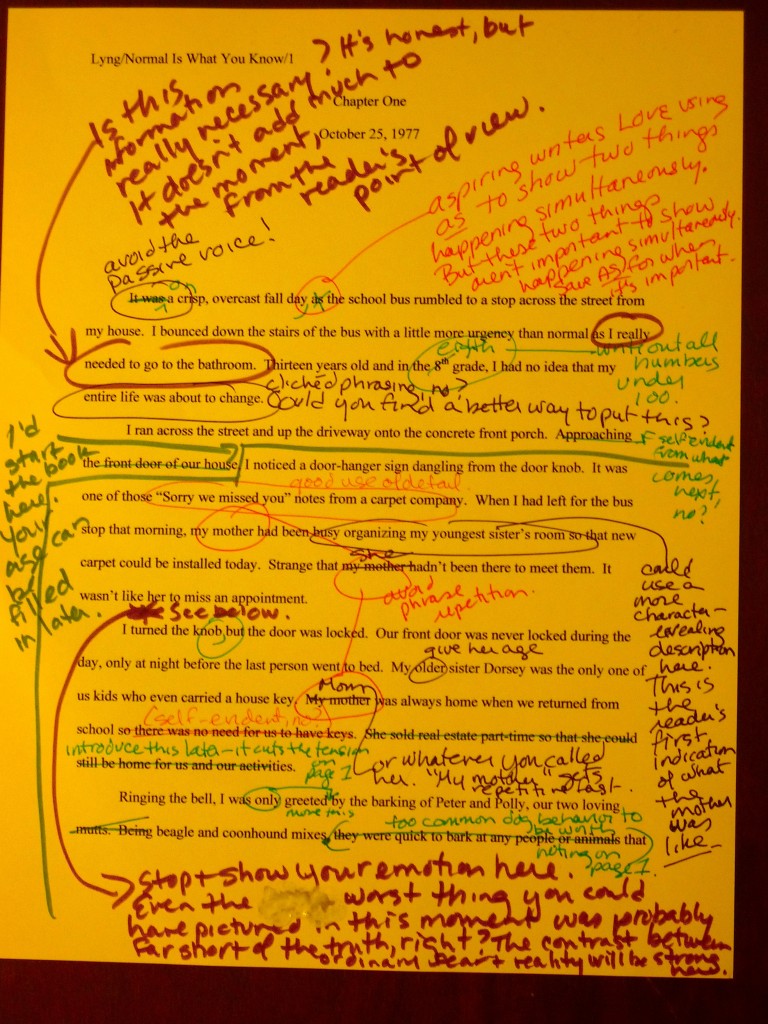
Most of these are fairly self-explanatory, but I want to zero in on a couple of them before I talk about sentence-level red flags in general. Objection #55, took too many words to say what happened, is to a great extent the offspring of our old friend, the thirty-second read-prior-to-rejection, but to professional eyes, text that takes a while to get to the point is not problematic merely because Millicent has to wait too long to see the action in action. To an agent or editor, it is a warning signal: this is probably a book that will need to be edited sharply for length.

Translation: this manuscript will need work.

Why might that in and of itself raise a raise flag for Millicent? Well, as we have learned over the course of this series, your garden-variety NYC-based agent would much, much rather that any necessary manuscript reconstruction occur prior to their seeing the book at all. Rather ironic, considering that same agent may well ask the producer of that 1-in-10,000 camera-ready manuscript for some fairly hefty revisions after signing her, but hey, the pros reason, an aspiring writer capable of producing a clean, compelling draft might reasonably be expected to produce a clean, compelling revision, too.

The reverse expectation applies as well, of course — and that can be most unfortunate for a Frankenstein manuscript that needs only one more solid revision pass to be market-ready. While the writer might well ( and with good reason) regard such a manuscript as close enough to perfect that it’s worth starting to submit, it can be pretty hard for a swiftly-scanning Millicent to differentiate between a voice that’s uneven because the writer was in a hurry to get it out the door and a voice that’s uneven because the writer has not found the proper narrative voice for the book yet.

Why might that difficulty be problematic for a submitter? Because Millicent’s boss would have to invest a great deal more time and energy in giving guidance to the writer still experimenting with voice; by contrast, all the agent would have to do for the writer who just hasn’t ironed out the kinks yet is make a few generalized revision requests. By the same token, when faced with writing that’s not polished, our Millie is left to guess whether the writer just hasn’t had a chance to go back and buff it up a bit (and thus might be relied upon to do so without much coaching) or if — heaven forfend — the writer simply isn’t experienced enough to be able to tell which sentences flow well and which do not.

That’s why, in case you’d been wondering, even a quite beautifully-written submission that takes a while to warm up will often find itself in the rejection pile. Millicent does not want to risk running into her boss’ office, exclaiming, “Here’s one that you’ll really like — but fair warning, the writer doesn’t seem to realize that the book doesn’t start until page 17. You don’t mind explaining that to her, do you?”

Chances are that he will mind. Quite a lot, actually.

Which is a pity, especially for the large contingent of writers enamored of either most books written before 1920 or quite a lot of the literary fiction still being published in the British Isles, which often take pages and pages to jump into the story proper. Many’s the time that I’ve picked up a volume that’s the talk of London, only to think, “This is lovely, but Millicent would have been tapping her fingers, toes, and anything else that was handy four pages ago, muttering under her breath, ‘Will you please get on with it?’”

This should sound at least a trifle familiar, yes? US-based agents tend to prefer books that start with action, not character development for its own sake, even in literary fiction. And I’m not necessarily talking about CGI-worthy fireworks, either: for the purposes of literature, conflict is action.

Which means, in practice, that even an unquestionably gorgeous 4-page introduction that deftly situates the protagonist with respect to time, space, social status, costume, dialect, educational level, marital status, voting record, and judgment about whether ice dancing is too harshly judged in the Olympics is less likely to be read in its entirety than a substantially less stylistically sound scene that opens, say, mid-argument.

The same principle applies to a dialogue scene that dwells on the same argumentative point for too long — or, even more common, consists entirely of people being polite and pleasant to one another. Remember, the point of good dialogue is not to hold a tape recorder up to actual speech; it’s a tool to show interpersonal conflict, develop character, and move the plot along.

What should a reviser do when confronted with dialogue that does none of these things? Well, I don’t know about you, but I find it warms up my editing shears wonderfully to imagine Millicent muttering, “Get ON with it!”

I know; it’s limiting to have to think in these terms. But being aware of the pacing imperative prior to submission enables the talented writer with the 4-page opening to move it later in the book, at least in the draft she’s marketing, and open with an equally beautiful conflict, right? As I’ve said many, many times before: a manuscript is not set in stone until it’s set in print — and not always even then.

Translation: you can always change it back after the agent of your dreams signs you, but that can’t happen unless you get your book past Millicent first.

To be fair, her get on with it, already! attitude doesn’t emerge from nowhere, or even the huge amounts of coffee, tea, and Red Bull our Millicent consumes to keep up with her hectic schedule. Just as most amateur theatrical auditions tend to be on the slow side compared to professional performances, so do most submissions drag a bit compared to their published counterparts.

Sorry to be the one to break that to you, but the tendency to move slowly is considerably more common in manuscript submissions than an impulse too move too fast. As in about 200 to 1. Millicent often genuinely needs that coffee.

Yes, even to make it through dialogue scenes. When a reader sees as much dialogue as our Millie does, it’s genuinely rare that a character says something that simultaneously makes sense for the ongoing scene, adds to character development, AND surprises her.

But that doesn’t mean you shouldn’t try. Especially on page 1.

Also, because so few submissions to agencies come equipped with a professional title page, most screeners will also automatically take the next logical (?) step and assume that a prose-heavy first page equals an overly long book. (Interestingly, they seldom draw the opposite conclusion from a very terse first page.) See why it’s a good idea to include a standard title page — if you are not already aware of the other good reasons to do this, please see the TITLE PAGE category at right — that contains an estimated word count?

In short, it is hard to over-estimate the size of the red flag that pops out of an especially prolix first page.

And in answer to the question that half of you mentally howled at me in the middle of the last paragraph about how long is too long, it obviously varies by book category and genre, but for years, the standard agents’ advice to aspiring writers has been to keep a first novel under 100,000 words, if at all possible.

Again, in case you’re wondering: that’s 400 pages in standard format, Times New Roman.

Before any of you start rushing toward the COMMENTS function below to tell me that you asked an agent at a recent conference about your slightly longer work, and she said rather evasively that it was fine, 60,000 – 110,000 words is fairly universally considered a fine range for a novel. (This is estimated word count, of course, not actual; if you do not know why the pros figure it this way, or how to estimate the way they do, please see the WORD COUNT category at right.)

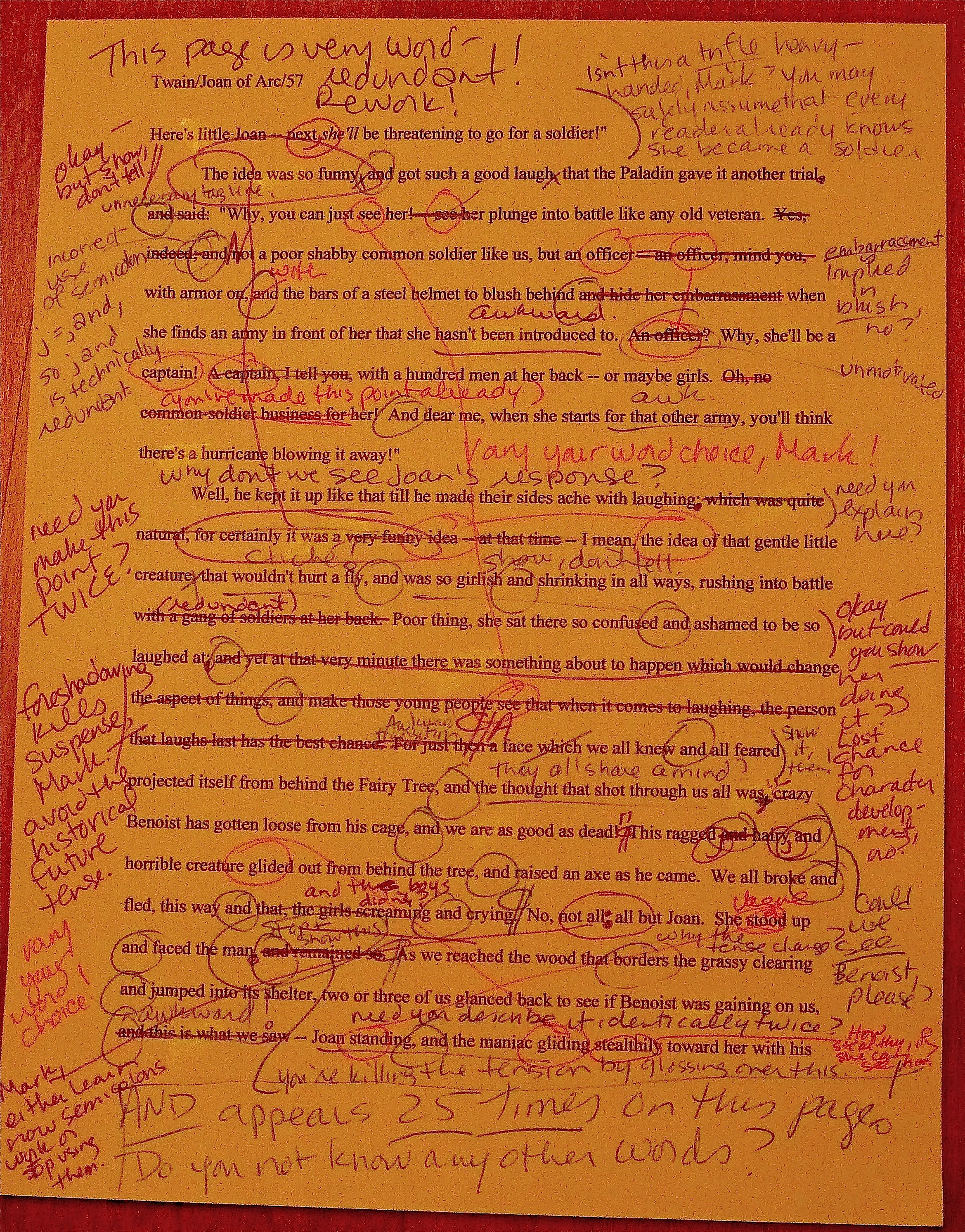
Shorter than 60,000, and it’s really a novella, which would usually be packaged with another work (unless the author is already very well-established); longer than 110,000, and it starts becoming substantially more expensive to print and bind (and yes, they really do think about that as soon as they lay eyes on a novel). Do check, though, about the standards in your particular genre and sub-genre: chick lit, for instance, tends to be under 90,000 words, and a quick romp through any well-stocked bookstore will demonstrate that many romances, mysteries, and humor books weigh in at a scant 40,000 – 60,000.

If your manuscript falls much outside that range, don’t despair. Or at least don’t despair until you’ve worked your way step by step through this checklist:

(1) Double-check that it is indeed in standard format

If you’re not positive, please see the MANUSCRIPT FORMATING 101 and STANDARD FORMAT ILLUSTRATED categories on the archive list at right. If the margins are too wide or the font too big (Times New Roman is one of the most space-efficient), those choices can apparently add specious length to a manuscript.

(2) Make sure that you are estimating correctly

Actual word count is typically quite a bit higher than estimated. (Again, if you’re unsure, please see the WORD COUNT category at right.) If actual and estimated are wildly different, use the one that’s closest to the target range.

(3) If your word count is well out of range, don’t include the word count in your query letter or title page.

I heard that great big gasp out there; I know that I’m one of the rare online writing advice-givers that recommends this. But frankly, since agents routinely have their clients leave the word count off too-length manuscripts, I don’t see an ethical problem with an omission that will help your work get past the querying stage so it can be judged on the merits of the writing.

(4) Consider editing for length.

If it’s too long to render that feasible, consider chopping the storyline into a pair of books or a trilogy, for marketing purposes. (What was that I said earlier about the possibility of changing it back later?)

(5) If 1-4 fail to solve the problem, you have my permission to panic.

Well, that took us rather far afield from sentence-level red flags, didn’t it? Let’s get back to those proverbial brass tacks.

Like taking too long to come to the point, #59, too many exclamation points and #61, too many analogies are also sins of excess, but the uncharitable conclusion screeners tend to draw from them are more about their perpetrators than about the books in question. What is that conclusion, you ask? The writer doesn’t think this story or these characters are interesting enough to retain a reader’s attention, and thus relies on punctuation and/or writing tricks to compensate.

Hey, I warned you that it was uncharitable.

To a professional reader, a manuscript sprinkled too liberally with exclamation points just looks amateurish. In much the same way that an insecure comedy writer will depict characters rocking with laughter in order to convey that a situation or speaker is supposed to be funny, a barrage of exclamation points reads like an artificial attempt to make prose exciting through punctuation.

Since these particular prejudices are shared by most of the writing teachers in North America, agents and editors will automatically assume that such a manuscript was produced by someone who has never taken a writing class. Not a good one, anyway. And while that is not necessarily a bad thing (professional readers often complain that they see too much over-workshopped writing), they tend, as a group, to eschew writers whom they perceive to still be learning their craft, because — wait for it — such writers are more time-consuming clients.

Yes, yes: of course, we’re all still learning our craft as long as we live, but to be on the safe side, save the exclamation points for dialogue.

That made some of you dialogue-revisers sit up and take notice, didn’t it? Generally speaking, exclamation points are far more comfortable in dialogue than in narrative paragraphs — but even then, take care not to go overboard. Punctuation is not really designed to take the place of description, after all; if a character is excited, there are a million ways to show it over and above simultaneously hitting the SHIFT and 1 keys.

If you suspect that your dialogue is exclamation point-heavy, try this experiment: select a chapter and circle all of the exclamation points. Then pick up a highlighting pen (you knew I wouldn’t let you keep ‘em in the drawer for long, didn’t you?) and mark every non-dialogue sentence that ends in one of the pesky things. Take another color and highlight every piece of dialogue spoken by the protagonist that ends in an exclamation point. Using different colors for each speaker, repeat.

Now flip back through the chapter. What color predominates? How many pages between highlighting? How many paragraphs? How many lines?

Once you have identified patterns, you can begin to make strategic choices. If you find, for instance, that exclamation points tend to congregate in scenes between particular characters, ask yourself: am I using punctuation as a substitute for character or relationship development here? If you are using the exclamation points primarily for younger characters (a rather common unconscious authorial choice, by the way), are there speech patterns or vocabulary choices that would make the same point? What would happen if you picked the most exclamation point-using character, and removed the exclamation points from other characters’ speech, to make the emphasis a character trait?

And so forth. There is no formula for how much exclamation point use is too much, but as with semicolons, norms vary from book category to book category. For most adult fiction and memoir, though, you should seriously consider removing most or all of the exclamation points from narrative sentences.

While over-use of exclamation points is often a mark of inexperience, #61, too many analogies, on the other hand, is often the result of having been exposed to too much writing advice. Most of us, I think, had similes and metaphors held up to us as examples of good writing at some point in our formative years, and I, for one, would be the last to decry the value of a really good analogy.

But too many in a row can make for some pretty tiresome reading. An amazingly high percentage of first pages are feature narration positively peppered with as if, as though, and our old friend like. While all of these analogy-introducers are perfectly acceptable in moderation, a too-heavy reliance upon them is one of the classic birthmarks of a first manuscript.

Why, you ask? Well, descriptive flights of fancy are by definition deviations from what’s going on in the moment, right? As such, they can slow down a nice, dramatic scene considerably — and can weigh down an opening so much that it can’t get off the ground. Take a gander at this lightly lavender-tinted passage, for instance:

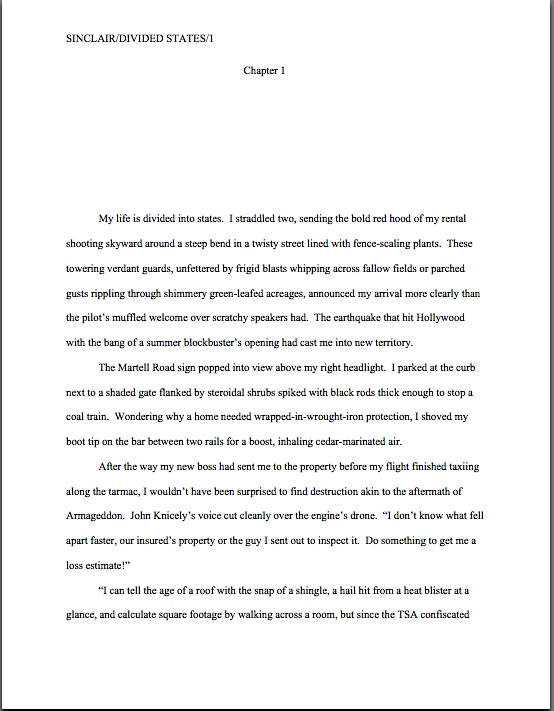
Like a rat in a maze, Jacqueline swerved her panther of a sports car through the Habitrail of streets that is Nob Hill as if she were being pursued by pack of wolves howling for her blood. Her eyes were flint as she stared through the rain-flecked windshield, as reflective as a cat’s eye at night. She had left her heart behind at Roger’s apartment, bloodied and torn; she felt as though she had put her internal organs through a particularly rusty meat grinder, but still, she drove like a woman possessed.

Now, that’s not a bad piece of writing, even if I do say so myself. The prose isn’t precisely purple, but still, the analogies are laid on with a trowel, not a tweezers.

Taken individually, of course, there is nothing inherently wrong with any of the clauses above, but all in a row, such writing starts to sound a bit evasive. It reads as though the author is actively avoiding describing the car, the streets, or Jacqueline’s feelings per se. To a screener who is, after all, in a hurry to find out what is going on in the book, all of those things that are like other things could provide distraction from what the story is ABOUT.

#60, writing that falls back on common shorthand, could be interpreted as a subsection of the discussion of clichés earlier in this series, but actually, you would have to read an awful lot of manuscripts before you started identifying these as tropes. Still, tropes they are, radically overused in submissions as a whole.

There are far too many stock phrases to list here, of course, but the agents on the panel specifically singled out She did not trust herself to speak, She didn’t want to look, and a character thinking, This can’t be happening — all of which are, from a writer’s POV, are simple descriptions of what is going on.

But then, so is the opening, It was a dark and stormy night, right? Many a night has been devoid of significant light, and a significant proportion of those see storms. However, that doesn’t mean It was a dark and stormy night isn’t the champagne of clichéd first lines.

Or that Millicent doesn’t see pointlessly resentful teenagers rolling their eyes, protagonists sighing as the sole indicator of disgruntlement, children growing up too fast, women pressuring men to get married, and men wanting more physical contact than their partners (possibly with those half their partners’ ages) dropped into every third manuscript she sees. To a professional reader, such overused phrases and hackneyed concepts represent wasted writing opportunities.

Yes, they convey what is going on concisely and clearly, but not in a way that hasn’t been done before. Remember, you want an agent to fall in love with YOUR unique voice and worldview, so using the phrases of others, even when apt, is not the best way to brand your work as your own.

Ultimately, though, you should tread lightly around all of today’s objections for strategic reasons, because they imply something to a professional reader that you might not want to convey: because virtually any good first reader would have called the writer’s attention to these problems (well, okay, perhaps not #60), they make it appear as though the screener is the first human being to read the submission. (Other than the author’s mother, spouse, lover, best friend, or anyone else who has substantial incentive not to give impartial feedback, that is, but of that, more another time) To the pros, these mistakes make a submission read like a work-in-progress, not like one that is ready to market.

Uh-oh. Did that red flag just mean that this submission needs further work?

Remember, it’s not all that uncommon for any given agent or editor to perceive him/herself to be the busiest human being on the planet. (Try not to dwell on the extremely low probability of this being true; it will only confuse the issue.) Your chances of impressing them favorably rise dramatically if your work cries out, “I will not make unwarranted inroads onto your time! You can sell my work as is!”

Please, I implore you, do not make an agency screener the first impartial reader for your work. Frankly, they just are not going to give you the feedback you need in order to learn how to bring your book to publication. They simply don’t have — or believe they don’t have– the time.

Acknowledging that you need feedback to bring your work to a high polish does not make you a bad writer; it makes you a professional one who recognizes that there is more going on in a submission that your expressing yourself. It makes you a savvy one who knows that a book is a product to be sold, in addition to being a piece of art.

It also makes you, if I may be blunt about it, a better self-marketer than 98% of the aspiring writers who enthusiastically fulfill their New Year’s resolutions by licking stamps for SASEs on January first, or who will be blithely hitting the SEND button on their electronic queries and e-mails just after Labor Day.

Don’t worry, weary first page-revisers: we’re very close to being done with the rejection reason list. Hang in there, and keep up the good work!

The scourge of the passive interviewer, part VII: wait, did I doze off in the midst of all that loving harmony?

August 17th, 2010

"If you call me muffin ONE more time, I will turn you into lover tartare!"

“If you call me Snuggums ONE more time, I will turn you into husband tartare!”

I had to laugh earlier today, campers: less than twenty-four hours after going on at great length in this very forum about how professors seldom sit around lecturing one another in real life, I found myself embroiled in a conversation with a professor wherein we were blithely lecturing each other. Actually, she had taken issue with my minor-league gloating over a Wikipedia spokesman’s coming out against using Wikipedia as the sole source for attribution in a footnote or article reference; even though many, many people use it as their primary research source, it’s intended to give an overview of a topic, rather than be the authority.

Quoth the spokesman: “Wikipedia should not be used as a primary source. We completely support that. We would not encourage people to cite Wikipedia in their [academic] papers. That’s not what it’s for.”

Editors have been telling indignant nonfiction writers this for years. So have professors nonplused by term papers whose references have all apparently been gleaned from open-media sources. But that didn’t stop my professor friend from gleefully implying all of us who would prefer bibliographies and footnotes to refer to books and articles, rather than to a source that is designed to change between the time an author uses it for reference and a reader could possibly try to follow up on that reference, are Luddites, fuddy-duddies, and destined to go the way of the dodo. Naturally, I responded by asking her whether she actually believed that the Knowledge Fairy was watching over all open-source media, assuring that in the long run, the only corrections anyone would ever post would be factually accurate, rather than simply adjustments to render the post closer to what the latest contributor had heard someplace might be true.

It was a rather interesting debate, actually. But can you guess why I’m not going to reproduce it as dialogue here? That’s right: because, like the vast majority of real-life exchanges, it would be deadly dull to read.

My friend’s willingness — nay, eagerness — to debate with me on a social networking site, despite the fact that she’s aware I have a hand injury did get me thinking about the Author! Author! community, I confess. And about the self-professed regular reader who selected this particular week to pick a fight with me over — and even I find this hard to believe — something I posted in 2006. I should not, he told me flatly, have written about this topic at all; he hoped, he said, that I had evolved since I’d written it.

Although I’m quite positive that reader’s sainted mother would cringe at his manners, being told to shut up was not the part of his comment that most annoyed me; as those of you who participate in the discussions in the comments are already aware, I like a lively debate about the topic du jour. Nor was it entirely that I felt compelled to waste my scant daily typing time responding to his fit of pique.

No, it was the fact that there was an entire CATEGORY on the archive list that would have shown him, at the low, low cost of a couple of minutes’ worth of scrolling, that I had already addressed his objections at length in the intervening years — that, in fact, we were not fundamentally in disagreement on his primary point. He merely hadn’t bothered to check.

Normally, I wouldn’t trouble my regular readership with the story of a single ill-mannered reader, but as I have been posting less since the car crash (and, as today, rerunning some older posts), more readers than usual have been combing the archives. Or so I surmise, because for the last few weeks, I have been positively inundated with questions posted in the comment section of posts I first ran years ago.

While I applaud those of you who have made the effort to leave your questions on posts related to the topic about which you are inquiring — that way, there’s a significantly greater probability of the next reader with a similar question discovering my reply — in practice, this has meant quite a bit of extra writing during my ostensible rest time. Although I have not been writing new posts every day, I have been one-handedly writing pages and pages of responses to these questions.

Buried in the bowels of the archives, where those of you who tune in regularly to read the top posts may never see them. Sometimes on topics for which there are three or four directly-related categories on the archive list.

Like the guy who hushed me, quite a few commenters evidently have not noticed how specific some of the category headings are — or that there is a keyword search engine located in the upper-right corner of this page. I’m certainly not averse to repeating myself from time to time (do I hear a few cheeky souls murmuring my mantra, read your submission IN ITS ENTIRETY, IN HARD COPY, and OUT LOUD before you send it out?), but this does not seem like the most efficient use of my scant blogging time, does it?

So may I ask an indulgence of all of you archive-divers? If the post in question is more than a year old, would you mind checking the category list (conveniently located at the lower right-hand side of this page for your perusal) to see if (a) I’ve written a more recent post on the topic that may address your concerns and/or (b) since I wrote that post, I’ve added an entire category or done an entire series on that particular topic.

It honestly won’t take all that long to check, and it really will save me quite a bit of typing time. Not to mention freeing up my sore hands for adding more new material to the blog.

But enough about research methodologies; today, we are going to be talking about love. Or, more specifically, writing and revising love scenes. Enjoy!

In my last post, I clued you in to the dangers of including too much physical description of your characters and/or backstory in your interview scenes, particularly in ones near the opening of the book. (If you have not given a physical description of your protagonist or some insight into her primary relationships by page 182, the manuscript has a different problem.) Within this context, I asserted — perhaps rashly — that conversation where Person A describes Person B’s physical attributes TO Person B are relatively rare.

It hit me in the wee hours, however, that I had neglected to mention the primary real-life situation where speakers routinely engage in this sort of banter: in the first throes of being in love. Especially if one or both are in love for the first time, their vocal cords are likely to emit some otherwise pretty unlikely dialogue. As in:

Wow, your eyes are so blue, Yummikins!” (Giggle.)

“Your nose is adorable, Muffin. I love that little freckle right there especially.” (Smack.)

“Who’s a little snuggle bunny? Is it you? Is it?”

Or the ever-popular mutual protestation of affection:

“Do you love me?”

“Of course I love you. Do YOU love ME?”

“How can you even doubt it? I love you twice as much every time I blink. You can’t possibly love me even half as much as I love you.”

“That can’t be true, because I already love you five times more than anyone has ever loved anyone else.”

“Oh, darling, what a wonderful thing to say. I love you so much.”

“And you know what? I love you.”

Zzzz…oh, pardon me; I must have been indulging in a well-deserved nap while waiting for something interesting to happen during this love scene.

Do I sound cynical? I have nothing against love, in principle — truly, I don’t. It has produced some fairly spectacular poetry, as well as much of the human race. But allow me to suggest that this particular species of conversation, even when spoken live, is properly only interesting to Yummikins and Muffin themselves.

Why? Well, it’s just a TAD conceptually repetitious, is it not? Not to mention the fact that entirely self-referential dialogue becomes intensely boring to any third-party listener with a rapidity that makes the average roller coaster ride seem languid by comparison.

Don’t believe me? Tag along on a date with two people (or heck, three or four) deep in the grip of the early stages of infatuation with each other. Count the seconds until the quotidian problems of which way to hang the toilet paper roll and not being able to sleep for more than five consecutive minutes before being awakened by a snore that would put Godzilla to shame have reared their ugly heads. They may be charmed by it, but are you?

News flash: such banter can be equally deadly to continued consciousness on the page — but naturally, as writers, when we write about the enamored, we want to capture that breathless feeling of discovery inherent in infatuation.

Nothing wrong with that, if it’s done well. Yet in print, rhapsodies on eyes of blue all too often produce prose of purple:

”Tiffany, your eyes are the most astonishing color, blue like Lake Tahoe on a cloudless day. Not a cloudless day in midwinter, mind you, when you might drive by the lake on your way to a ski slope, but the blue of midsummer, of long, dreamy days on Grandfather’s boat. Or still later, when you and I were in junior high school, and our parents shipped us off to that Episcopalian summer camp — the one that used the 1929 prayer book, not the modern edition – when we swam beneath skies of azure…”

True, someone might conceivably say something like this in real life, but let’s not kid ourselves here: you’d have to be Charles Boyer to pull off a speech like this without prompting gales of laughter in Tiffany and bystander alike. And snores from Millicent the agency screener.

Generally speaking, extensive physical descriptions like this work far, far better in narration than as dialogue. Most people already have some fair idea what they look like: while it’s always nice to be told that one is pretty (anyone? anyone?), one seldom needs to be told that one is 5’6” (”Ooh, darling, I love all 66 inches of your length, as well as your half-meter of bouncy brown hair!”), even if that is indeed the case.

In fact, mentioning the latter fact in real life might actually engender some resentment. Height and weight are the two self-descriptors the average person is most likely to fudge. Lopping 20 pounds off your weight in casual conversation isn’t usually considered lying, precisely — after all, you’re not standing on a scale at that very moment, are you?

It’s not completely inconceivable that you’ve shrunk radically since breakfast, but it’s not precisely court testimony, either.

I find this kind of misrepresentation fascinating, as it so seldom fools anyone. Most people would never dream of perjuring themselves about their eye color on a driver’s license application — but don’t most people subtract a few pounds, or perhaps 30 or 40, on general principle, on the same form?

While we’re on the subject of doubting self-serving statements, aren’t personal ads living proof that many people are, at best, rather optimistic about their height? Don’t we all get at least a vague sense that the average movie star’s date of birth is somewhat variable, when she admitted to being five years older than we are when her first movie came out, two years older at the time of her first real hit, and yet asserts that she has now, a long, full career behind her, aged at about half the normal human rate?

Can’t we all live with that? I mean, River Phoenix’s four years at nineteen were good years for all of us, weren’t they?

Ethically, I don’t have much of a problem with these harmless little pieces of self-aggrandizement; for the most part, they’re victimless crimes. (“That’s he, officer – he says he’s six feet tall, but he’s 5’9″ in his stocking feet!”) In fact, being aware of this tendency can add a certain piquancy to an interview scene.

Love scenes in particular. Again, I hate to seem cynical, but is it entirely beyond the bounds of probability the Boyer-wannabe above might have slightly exaggerated the blueness of Tiffany’s eyes for romantic effect?

In other words, what if instead of depicting your infatuated lovers commenting upon the REAL physical attributes of one another, the dialogue made it plain that a certain amount of hyperbole was going on? Or if one professed blindness to a physical defect in the other?

Such a scene might not provide just-the-facts-ma’am physical descriptions of the characters, but it might conceivably be more character-revealing — and more interesting to the reader — than the usual transcripts of either sweet nothings or undiluted praise.

If a writer really wanted to get tricky, the narrative might not even make it clear in the moment precisely how and why Lover A is choosing to lie to Lover B. Conveying a subtle sense that there’s something more going on in this scene than meets the enamored eye is a great to increase tension.

Provided, of course, that the narrative doesn’t immediately stab the rising conflict in the heart by explaining in minute detail precisely what’s going on. This has been the death blow to many a promising love scene.

What might that look like in print, you ask? Let’s take a look at a scene where mixed motives have been handled with restraint.

Angelica backed off slightly, instinctively when Desmond kissed her, but lips pressed to hers, he failed to notice. Or if he did, her enthusiastic embraces soon quelled any qualms he may have had.

After a few minutes’ slurping passion, she loosed her lips enough to ask, “When do you need to be back at the White House, darling?”

He toyed with the come-hither straps of her meter maid uniform. “Not until half-past one. And even if I’m late, the republic won’t fall if the President gets his security briefing is a few minutes behind schedule.”

Angelica sighed, pulling him closer. “Promise me that I’ll always be more important to you than national security.” She glanced over his shoulder at the alarm clock. “Right now, I feel as though we’re the only two human beings left on earth.”

“Oh, sweetheart,” he murmured into her shapely neck.

Gives a pretty strong impression that Angelica’s motives in pursuing the tryst might not be completely identical to his, doesn’t it? The slight tension between her actions and her words convey that easily, without a lot of heavy-handed justification or acres of internal monologue.

Which, alas, is how many manuscript submissions would have approached it. Here’s a sample — note all of the named emotions, explanations through thought, and just how quickly the reader’s ability to speculate about what might be going on evaporates:

Oh, God, Angelica thought, stunned by the onslaught of Desmond’s cologne, not again. Didn’t this lummox ever think of anything but sex, sex, sex? Still, she had been ordered to keep him here until after the President had been assassinated, and if a little nookie was the most pleasant way to achieve that goal, well, so be it.

She hoped that it would not take very long; her husband, Ivan, would be expecting her home soon. “When do you need to be back at the White House, darling?”

“Not until half-past one,” Desmond panted. “And even if I’m late, the republic won’t fall if the President gets his security briefing is a few minutes behind schedule. It’s not as though anyone out there is planning to perch atop the Washington Monument during his speech on the Mall and shoot him with a crossbow in front of 210,000 people, right?”

Angelica stiffened with fear. How on earth had he ferreted out the details of their plan? Had she been betrayed by a careless or treacherous fellow spy? Was Desmond merely toying with her, in order to extract further information?

She pulled him close. “Promise me that I’ll always be more important to you than national security,” she whispered, shuddering inwardly at the irony of her own words. She glanced over his shoulder at the alarm clock; if only she could keep him here until after Reginald had charged the herd of maddened elephants into the assembled throng, all might still be well. “Right now, I feel as though we’re the only two human beings left on earth.” Little did he know how soon they might be.

“Oh, sweetheart,” he murmured into her shapely neck.

Kind of stops the tension dead in its tracks, doesn’t it? The suspense builds naturally when the narrative merely hints at the underlying plot, rather than screams it from the rooftops.

The same technique also works beautifully in anti-love scenes, by the way. If you want to ramp up the tension, try both muddying the players’ motivations a little and conveying those mixed emotions through action, rather than having them say precisely what they mean at all times.

Yes, yes, I know: your tenth-grade composition teacher told you that good dialogue should be able to convey all of the emotional nuances of a scene without additional narration. Let me guess — s/he came up with that pearl of wisdom while either trying get you to read Hemingway or to stop relying so heavily upon adverbs to express a character’s feelings, right?

Adults don’t let ten-year-olds drive Mac trucks, either; one needs to be trained to use dangerous tools safely before running amok with them.

Which is to say: I tend to doubt that s/he intended it as a lifetime embargo upon certain parts of speech. The kind of writing s/he was probably trying to train you to avoid with her prohibition runs a little something like this:

“I can’t pay the rent!” Polly exclaimed distressedly.

“But you must pay the rent,” dastardly Donald declaimed determinedly.

“But I can’t pay the rent!” she wailed helplessly.

“But you must pay the rent,” Donald insisted violently.

“But I can’t pay the rent!” she sobbed unhappily.

“I’ll pay the rent!” nattily-dressed Nathan called helpfully.

“My hero!” Polly cried relievedly.

“Curses,” Donald said morosely, “foiled again.”

I seriously doubt that s/he was hoping you would never use another adverb as long as you lived. The dear thing was merely hoping that you would learn to use them with discretion.

But as with so many of the old writing saws, the creaky old chestnut has mutated over time in the conversation of the literal-minded from

don’t use adverbs to describe how every speech was said; how about letting the dialogue itself show tone?

to

it’s bad writing to use an adverb ever, under any circumstances. Purge your manuscript NOW of all -ly verbs, or you’ll tumble into a pit of burning pitch.

Just a SLIGHT difference between those two iterations of that rule of thumb, eh? I know I’m going out on an editorial limb here, but I suspect you’ve progressed enough as a writer to be trusted not to over-use adverbs, haven’t you?

There, I absolve you: from now on, you’re allowed to use all available parts of speech, if you do it with discretion. Fly on your merry way, allowing your shackles to fall to the ground.

Just don’t start using adverbs to describe how every character says every speech, okay? Oh, and while you’re at it, you don’t need to add a tag line (he said, she averred, they bellowed) to every line with quotation marks. Use them sparingly, just enough to keep the reader abreast of who is speaking when.

Which means, in case your tenth-grade composition teacher forgot to mention it to you, that in a two-person exchange where the opinions expressed are not identical, simply alternating speeches after the text identifies who is saying what initially is usually sufficient.

It’s perfectly acceptable to tuck narrative sentences between the bursts of dialogue, but surely you can come up with something more character-revealing than he said morosely, can’t you? There’s more to conflictual dialogue than just tone, after all.

If you feel ready to implement a more advanced writing technique, try varying the tone a little throughout confrontation scenes. Watching two characters spit vitriol at each other unceasingly can get a rather old rather fast. For instance:

“I hate you, Ted Fairfax, more than any human being I’ve ever known in my life.”

“Yeah? Well, I’ve got a message for you, Tammy: I haven’t been able to stand you since high school.”

“But you and I dated in high school!”

“Precisely.”

“Ooh, you’re a jerk, Ted.”

Perhaps I’m an overly-critical reader (actually, I’d better be, or I wouldn’t be good at my job), but a little bit of barb-trading goes a long way for me. Call me zany, but I would rather be shown Tammy and Ted’s mutual loathing through action, rather than merely hearing it in their words.

Or, to put it as your crusty old writing teacher might have, by showing, rather than telling.

Ted could, for instance, be lying about what his feelings for her were in high school. That would automatically render their relationship more complex — and thus more interesting — than simple mutual hatred. Mixed emotions are almost always more intriguing on the page than simple, straightforward feelings.

Especially if, as we’ve seen in pretty much all of today’s examples, the characters are going around bellowing about their feelings at the top of their lungs, as if they were traipsing about in the last act of La Bohème — and expressing those emotions with a pinpoint accuracy that would make living and dead poets alike turn bright green with envy.

Allow me to make a subversive suggestion: people aren’t always telling the truth when they say that they’re in love. Or in hate, for that matter.

Occasionally, they have been known to change their minds on the subject. Some are reluctant to name their emotions at all, and still others are prone to aping the emotion that they believe the person sitting across from them expects them to be feeling.

Here’s a shocker of a revelation: human beings are complex critters, far more so than they appear in the average interview scene in a manuscript submission. Individuals have even been known — sacre bleu! — to mislead total strangers who show up, demanding information about that set of sextuplets who fell down the well thirty years ago.

Or did they?

Actually, in any interview scene, it’s worth giving some serious thought to having the information-imparter lie, distort, or soften the facts he’s conveying. If the protagonist has to guess what is and is not true, the scene automatically becomes more dynamic than if she’s just passively nodding and saying, “Oh, that must be so hard for you,” or spouting Hollywood narration like “What do you mean, Uncle George has left me his once-lucrative sheep ranch in Bolivia?”

After all, logically speaking, in scenes where the protagonist is extracting information from a stranger, why SHOULD the imparter tell the absolute and complete truth? Would you tell your deepest, darkest secret to a complete stranger who showed up on YOUR doorstep demanding answers?

I ask this rhetorically, coming from a family where total strangers routinely show up on our respective doorsteps and demand answers about what certain well-known deceased authors were REALLY like.

But even among those not used to being trapped into impromptu interviews by would-be biographers who evidently just tumbled out of the sky, I would suspect that compulsive truth-telling to strangers is not the norm. People have been known to equivocate a bit when someone they’ve never seen before abruptly appears and demands to be told intimate life details. Even very nice people.

I know; shocking.

But such a possibility amazingly seldom seems to trouble the daydreams of your garden-variety protagonist. A good 90%, interviewers in novel submissions apparently just assume that they are being told the truth, the whole truth, and nothing but the truth.

And most of the time, that assumption turns out…to be…zzzz…correct. (Oh, did I doze off again?)

Yet in an interview scene — especially one that opens a book — certainty is almost always less interesting than doubt, just as reading about complete amity is less gripping than interpersonal friction. And in the real world, complete understanding, let alone agreement, between any two people is rare enough that I think it should be regarded as remarkable.

There’s a reason that most professional readers will advise against writing much in the first person plural, after all, despite the success of the Greek chorus first person plural narration in Jeffrey Eugenides’ THE VIRGIN SUICIDES: interpersonal conflict is, generally speaking, far more interesting than pages at a time of harmonious agreement.

Let your characters disagree; allow them to quibble, providing that they do so in character-revealing ways. And let them lie to one another occasionally. Both your plot and your characters will thank you for allowing them to be more complex.

More thoughts on dialogue revision follow next time. In the meantime, keep up the good work!

The scourge of the passive interviewer, part VI: as my dear old professor used to say…

August 16th, 2010

masters-hoods-en-masse

Happy Monday, campers –

Well, I have a bit of good news on the recovery front: I’ve been cleared to type a bit with my right hand again. Before anyone gets too excited, I should add: it’s not an all-clear, by a long shot, but it does mean that I’m moving closer to being able to get back to composing brand-new blog posts again.

However, I typed that last paragraph with both hands. I shall probably be completing this one the same way. And some people say there’s no such thing as progress.

In the spirit of necessary moderation, then, here is today’s revisit to a former post on our current topic. Its holiday references may not be quite apt for August’s annual publishing industry break, but its dialogue-revision suggestions could not be more so for late-summer self-editors. Enjoy!

Did everyone have a nice Fourth of July? In order to teach me a lesson about realistic dialogue, apparently, Someone Up There arranged for me to spend it with a bevy of college professors. Nice people, all, full of charming chat about…

Wait a minute; I’ll bet I can read your minds. 90% of you have already decided that the conversation was stuffy, learned, and generally uninteresting to anyone who doesn’t happen to be conversant with particle physics, James Joyce, and/or the Bourbon Dynasty, haven’t you?

What makes me leap to that (in your case, possibly unwarranted) conclusion? Reading manuscripts for a living, that’s what. Rare is the professorial character who walks into a bar, sits down, and doesn’t immediately start spouting the greatest hits from his latest lecture.

Usually right before he does something spectacularly absent-minded.

Seriously, the prating professor is one of the great unsung stereotypes of the literary world. Just ask any professional reader (agent, editor, contest judge, writing teacher, Millicent the agency screener) who happens to hold an advanced degree herself: it’s bound to be among her pet peeves.

And with good reason: even manuscripts that conscientiously eschew the sulky teenager, the ditsy flight attendant, the corrupt politician, and the unattractive computer genius have been known to embrace the ever-lecturing lecturer with a vim that makes one wonder just how many aspiring writers were bored to death in college. Or high school. Or merely have never had the good fortune to hobnob with doctorate-holders at a social function.

The ugly, ugly result: like many a reader before her, a Millicent with a master’s degree is fated to roll her eyes over unrealistic dialogue.

Why, we were talking about that just the other day, weren’t we? If memory serves — and I’m quite positive that it does — just before I elected to ski down the slippery slope of dissecting all of the problems Hollywood narration can bestow upon a manuscript, I was already perched upon a soapbox, pointing out the pacing, voice, and storytelling dangers inherent to sneaking too much background information or physical description into interview scenes early in a novel submission.

Today, I’m clambering back up on that soapbox. Because, honestly, I’m reading as fast as I can, but I’m just not going to be able to read every manuscript in the English language before it lands upon the always-crowded desk of our old pal Millicent.

No doubt spilling her too-hot latte on her master’s hood, like the ones depicted above. Because, naturally, like everyone who has ever earned an advanced degree, she never takes of her robes, right?

While I’m adjusting my purple velvet doctoral tam — yes, really — allow me to recap a bit for those of you who missed the earlier posts in this series: an interview scene is one where a character, generally the protagonist, obtains information critical to the plot and/or character development from another character, extracted through dialogue. An inefficient interview scene is one in which, as is all too often the case in submissions, the narrator is not a particularly good interviewer. Or thinks that s/he is being clever by not just coming out and demanding the information s/he has ostensibly walked into the scene to collect.

Can you blame a reader for becoming a tad impatient with an interviewer who NEVER ASKS THE LOGICAL FOLLOW-UP QUESTION or JUST SITS THERE WITHOUT ASKING ANYTHING, waiting for the interview subject to spill his guts spontaneously?

If the reader in question happens to be Millicent, her cousin Maury the editorial assistant, or her Aunt Mehitabel the noted contest judge (hey, they’re a literary-minded family; advanced degree-holders, all), the consequences are usually even more serious: if s/he loses interest in the manuscript before her, she tends to stop reading.

In other words, “Next!”

How may a writer avoid this grisly fate? Here’s a good rule of thumb: while not everything that people say in real life makes good dialogue, it’s an excellent idea to make sure that all of your dialogue is in fact something a real person in the real-life equivalent of your fictional situation might CONCEIVABLY say.

And here’s a secondary rule of thumb — a rule of forefinger, so to speak: that goes double for any dialogue that sounds anything remotely like Hollywood narration.

Yes, even if you have heard with your own tiny, shell-like ears a real person speak that way. Present-day Anne here: or perhaps — brace yourself for this one — even if you actually heard a real-life professor once speak like the fictional professor in your book. Just because it might theoretically be possible to produce a recording of someone like your character speaking in that manner does not mean a transcript of it will ring true on the printed page. At least, not to someone personally acquainted with more than one professor.

Or doctor. Or firefighter. As convenient as it might be for writers on a deadline if adopting a profession immediately caused an individual’s speech to drop all personal characteristics and simply become representative of that profession, that just doesn’t happen in real life.

That absent-minded professor you met once notwithstanding.

And don’t even get me started on how often fictional male professors are depicted as having affairs with students (which, over and above being a very tired cliché, would be a very good way to get fired on most U.S. campuses today), female psychiatrists with their patients (ditto), detectives with murder suspects, and so forth. Hackneyed actions are just as likely to strike Millicent as clichéd as jargon-stuffed dialogue, after all.

They are also, just in case anyone doesn’t find the threat of her writing being dismissed as not containing original ideas sufficiently terrifying to eschew the practice, often used as shortcuts, substitutes for honest-to-goodness character development. Introducing stock characters can save a writer a lot of time, after all. (Burly thugs, anyone? Mousy librarians or schoolteachers? Dumb jocks?) But there is more to telling a story enjoyably than telling it rapidly, isn’t there?

The funny thing is, from a professional reader’s perspective, aspiring writers are often STUNNED to hear that such character behavior is clichéd, because, you guessed it, they have actually met real people who acted and spoke that way. I once read a manuscript where the philandering prof spent the opening scene sharing a friendly drink — and talking about Wittgenstein, naturally — with a Native American spouting earth-worshiping wisdom, a sympathetic bartender dispensing amateur psychology, a burnt-out teacher who had just had his faith restored by a single student’s abrupt progress, and a corrupt — wait for it — politician.

When I gently suggested to the author that perhaps the reader might have seen these characters before someplace, and that he might want to consider individuating them more, he acted as though I’d just recommended that he feed his left foot to a school of piranha. Since he had never seen precisely that array of characters together on the page, it had never occurred to him that these were stock characters, more representatives of their professions than fleshed-out characters.

Okay, I need to rest my hand now; back to the post already in progress.

Remember, please, that dialogue is not automatically realistic just because a real person has at some point uttered it. As I have been pointing out none too gently throughout this series, real human beings tend not to tell one another things they already know — except, of course, about the weather (“Some heavy rains we’ve been having, eh?”), the relative progress sports teams (“How about them Red Sox?”), and tidbits from the latest celebrity death scandal (in the interests of moving this along, I’ll spare you all my eulogistic renditions of Ben and I’ll Be There, despite the fact that they happen to fall smack in the middle of my flute-like soprano range).

In print, such iterations of mundane issues are notably primarily for their soporific value. (Translation: zzzzz.) As storytelling, such homely gems just tend to slow down the action of the scene.

Interestingly enough, adhering to these few rules while revising almost always results in trimming interview scenes substantially. This is particularly true for interviews that provide the opening conflict in novels, where Hollywood narration and dialogue stuffed to the gills with visual clues about characters tend to congregate — and thus are likely to do the most damage at submission time.

I sense some shifting in seats out there. “Yeah, yeah,” the impatient are murmuring. “You already yammered at us about this last week, Anne. Cut to the chase, already.”

Funny, that last sentence is precisely what Millicent is often heard muttering over interview scenes. Without the last week part, that is.

But you have a legitimate point, impatient mutterers. However, in my earlier discussion of the phenomenon, I left out one of the primary reasons Millicent tends to have that particular knee-jerk reaction: if the first couple of pages of text are a bit heavy-handed, agency screeners, contest judges, and other professional readers usually leap to the conclusion that the ENTIRE text reads the same way.

An assumption, as you no doubt have already guessed, that conveniently enables Millie and her ilk to reject the descriptively front-loaded submission immediately and move swiftly on to the next.

I have seen a LOT of good manuscripts done in by this tendency. Because this is such a common problem, as an editor, one of the first places I look to trim is that first scene — which, as I mentioned a few days back, is very, very frequently an interview scene. My editing antennae perk up particularly strongly if the opening scene relies far more heavily upon dialogue than narration.

Why, all of you interview-writers ask in trembling tone? Well, see for yourself, in this piece of purple-tinted prose:

“Don’t you go rolling those large hazel eyes at me, Thelma,” Marcel warned. “It hasn’t worked on me since our days in the chorus twelve years ago, in that bizarre road company of Auntie Mame. And you can save the eyelash fluttering, too. You’re wearing too much mascara, anyway.”

Thelma laughed. “That’s a fine criticism, coming from a man wearing false eyelashes. Just because you’re a drag queen doesn’t mean you can’t dress with some taste. I mean, bright red lipstick with a pale lavender sweater? Please.”

“What about you?” Marcel shot back. “In your puce bathrobe with purple magnolias dotted all over it still, at this time of day!”

Thelma walked around him, to check that the seams on his stockings were straight. “Because you’re my best friend in the world, I’m going to be absolutely honest with you: you’re too heavy-set for a miniskirt now, darling. Certainly if you’re not going to shave your legs. What are you now, forty-five and a size twenty-four?”

Marcel smoothed down his Technicolor orange wig. “At least at six feet, I’m tall enough to wear Armani with style. Your cramped five foot three wouldn’t even be visible on a catwalk.”

Admittedly, the banter here is kind of fun, but a judicious mixture of dialogue and narration would convey the necessary information less clumsily, without rendering the dialogue implausible. Try this moderately snipped version on for size:

Thelma rolled her large hazel eyes. Even draped in a ratty puce bathrobe that barely covered her short, round form, she carried herself like the Queen of the Nile.

Unfortunately for her dignity, her icy hauteur act had grown old for Marcel twelve years ago, three weeks into their joint chorus gig in that chronically under-attended road tour of Auntie Mame. “You can save the eyelash fluttering, sweetheart. You’re wearing too much mascara, anyway.”

Thelma laughed. “You’re a fine one to talk taste. Bright red lipstick with a pale lavender sweater? Please.”

His thick, black false eyelashes hit where his pre-plucked eyebrow had originally been; his current fanciful impression of an eyebrow swooped a good four inches higher, threatening to merge with his Technicolor orange wig. Even for a career drag queen, his moue of surprise was a bit overdone. “Will you be getting dressed today, darling?” he asked brightly. “Or should I just get you another bottle of gin, to complete your Tallulah Bankhead impression?”

Thelma walked around him, to check that the seams on his stockings were straight. He was getting too heavy to wear fishnets every night. Still, not bad gams, for a forty-five-year-old. “If you insist upon wearing a miniskirt, my sweet, you might want to consider shaving your legs.”

Same information, but more naturally presented, right? By having the narration take over the bulk of the descriptive burden, a rather amusing narrative voice has emerged, conveying a point of view distinct from either Marcel or Thelma’s.

I can hear my mutterers murmuring again, can I not? “Okay, so the second version has a stronger narrative voice,” they concede. “But even so, all of that physical description makes the scene drag a bit, doesn’t it?”

Yes, and that brings me back to my closing question from earlier in this series: other than the fact that television and movies have accustomed us all to having an instantaneous picture in our heads of a story’s protagonist, is there a reason that a narrative must include a photographic-level description of a character the instant s/he appears in the book?

I’ll go ahead and answer that one myself: no, there isn’t. TV and movies have simply accustomed us to the notion that our first impressions of any character should be visual, just as in radio, we first hear him speak.

In a visual medium, there’s plenty of reason to give the audience a snapshot, but books are not visual media; narratives can appeal to all of the senses. So the next time you sit down to ponder revising the first few pages of a novel, it’s worth investing a moment or two in pondering the possibility that your opening scene may actually read better without a meticulous up-front description of every character in the scene, his backstory, and where he bought his clothes. Or even how he got there.

Consider it, perhaps, while sitting with a hard copy of your first few pages in your hand. Is there backstory or physical description in your opening dialogue that could come more gradually, later in the chapter — or even later in the book?

Or – and this is a possibility that occurs frequently to professional readers of interview scenes, let me tell you — is that Hollywood narration or description-laced dialogue the book’s way of telling us that perhaps the book opens at the wrong part of the story?

I hope that didn’t make anyone out there faint; my kind of doctorate doesn’t allow me to resuscitate the fallen with impunity.

Might, for instance, we learn more about Thelma and Marcel in a more graceful manner if, instead of beginning the novel with the dialogue above, it opened with a short prologue showing them twelve years ago, bright-eyed, innocent, and slim — and then jumped ahead to this scene, to show how they and their relationship have changed?

Dramatic, eh? One might even say character-revealing.

Of course, front-loading an opening scene with physical description is not necessarily an indicator of a structural problem. I suspect that often, writers who use this technique as a means of introducing description are driven primarily by a panicked sense that the reader must be told what the characters look like the instant they appear in the text — combined with a recollection that their high school writing teachers said that extensive physical descriptions later in the narrative confuse readers who have already formed a mental image of the character. So they’re sort of trying to, you know, sneak the physical description in when the reader isn’t looking, so to speak, in that opening scene.

Trust me, a professional reader is ALWAYS looking. It’s her job.

Looking specifically, in the case of an agency screener or editorial assistant plugging through a mountain of submissions, for a reason to reject the manuscript in front of her. By avoiding the common twin traps of overloading the first scene with crammed-in backstory and physical description, a manuscript stands a much greater chance of cajoling Millicent into reading on to scene #2.

And we all want that, don’t we?

I sense more impatient shifting in the peanut gallery. “Um, Anne?” these fed-up folks say. “Isn’t this the same point you made above? I get it, already: using dialogue to have characters describe one another is a species of Hollywood narration, and therefore to be eschewed. Have you considered that there might not be a reason to keep telling us this?”

Ah, but you’re assuming that I’ve already made my primary point. Far from it; like other doctors, we book medicos bill for our advice by the hour. Relax: we’ve still got some time left in our session.

So here comes some professional wisdom: after a screener has had the privilege of scanning a thousand manuscripts or so, it becomes pretty clear that many aspiring writers don’t really understand what the writing gurus mean when they urge us all to open with a hook.

A hook, for those of you new to the term, is a grabber located within the first paragraph of a story or book — preferably within the first sentence, according to some writing teachers — that so intrigues the reader that s/he is instantly sucked into the story. (This is not to be confused with a Hollywood hook, a one- or two-sentence pitch for a script or book. See the so-named category on the list at right, if you are curious about the care and feeding of the latter.)

Often, aspiring writers will interpret the advice to open with a hook to mean that a storyline must open with violent or even bloody action, a mystery that the reader will want to solve, or a conflict-ridden scene. While admittedly Millicent sees a whole lot of manuscripts that open with a bang (with or without gushes of blood), all of these strategic choices can indeed work, if handled well.

Although let me tell you, they are such common choices that it’s a downright relief to most professional readers when a writer elects to open with a powerful visual or sensual image instead. Hint, hint. Especially if that strong opening image leads into a scene packed with character- or situation-revealing conflict.

What’s even more common than the submission that kicks off with conflict? An beginning that insists that the reader must be 100% up to speed on the plot and characters by the bottom of page 1 — or page 5 at the latest.

Again, that vexing question rears its ugly head: is this strictly necessary?

Brace yourselves, because I’m about to suggest a revision technique that may shock some of you: just as an experiment, try removing the first scene of your book.

Not permanently, mind you — and certainly not without having made a backup copy of the original first, in case you decide after mature and careful consideration that what I’m about to suggest next was a stupid idea: cut it just long enough to find out whether the story would make sense to the reader without it. If it can fly that way, consider cutting the scene entirely and starting fresh slightly later in the plot.

I’m quite serious about this — you wouldn’t believe how many good manuscripts don’t actually begin until a couple of scenes in, or that allow absolutely gorgeous opening sentences or images to languish on page 4. Or page 15.

Or, if I’m honest about it, the beginning of Chapter Three. Which, in a Frankenstein manuscript, may well have originally been the opening of Chapter One, before the writer heard that speech at a conference about hooks and decided to front-load the manuscript.

Yes, I know: what I’m suggesting is potentially pretty painful; as we discussed in the GETTING GOOD AT ACCEPTING FEEDBACK series (still conveniently accessible in the category list at right, in case you missed it), many, many aspiring writers regard the approach of the reviser’s pen with every bit of the fear and loathing that the published writer feels for governmental censorship. But it’s just a fact that when we’re first constructing a narrative, we writers are not always right about where the story should begin and end.

If you don’t believe this, I can only suggest that you take a gander at THE BROTHERS KARAMAZOV, an undoubted masterpiece that could have lost most of the first 200 pages without bugging the reader much at all.

(That’s a professional opinion, by the way. One of the great fringe benefits of having walls lined with diplomas from prestigious institutions is the ability make sweeping judgments like that about classics without fear of sounding ignorant. While I’m at it, allow me to add: THE TAMING OF THE SHREW is a stupid play, and I found A TALE OF TWO CITIES far-fetched. So there.)

Try to keep an open mind while you’re revising. Be willing to consider the possibility that your story might be more effective — and hook the reader better — if you began it at a different point. Or at least do a little field testing to rule it out.

Believe me, you’ll sleep better at night if you do.

How do I know this, you ask? Because now, I’ve planted the doubt in your mind. As much as you might pooh-pooh the idea that all or part of your opening could be snipped away without fundamental harm to the storyline, you can’t be ABSOLUTELY sure that it’s a stupid suggestion without going back over it pretty rigorously, can you?

You’re welcome — and I mean that very seriously, because an aspiring writer who is willing to examine and reexamine her writing before she submits it is going to have a much, much easier time coping with editorial feedback later on in the process.

Trust me; I’m a doctor. That diploma over there says so.

By the way, what the group of professors were discussing when I walked into the Fourth of July party was Charles Dickens’ BLEAK HOUSE. After I laughed and told them that this was precisely the type of conversation people who didn’t know any professors would write for them, one of them said, “Yes, but the funny thing is, this is a conversation we normally wouldn’t have outside a Dickens conference.”

I rest my case. Keep up the good work!

The scourge of the passive interviewer, part IV: don’t go casting your novel’s characters QUITE yet

August 11th, 2010

royal-tenenbaumsposter

Hello, campers –

Here, as promised, is a re-run of an earlier post on a topic we were all blithely discussing in the happy days before those two cars decided to adhere themselves to mine so abruptly. While I would have preferred to embellish it with a practical exercise or two, designed to send you running toward your respective manuscripts, highlighting pens in hand, I suspect that as it stands, it will provide abundant fodder for discussion.

Before I let you get on with it, I can’t resist adding both a well-deserved plug and a bit of scolding for the movie shown in poster form above (and used as an example below). Novelists and memoirists — perhaps especially memoirists — interested in learning the difficult art of giving the slight spin to realistic dialogue to make it witty would do well to invest an hour or two in watching THE ROYAL TENENBAUMS. The screenplay’s lovely, full of the kind of banter writers love but filmgoers don’t always appreciate; it’s really a film best seen by oneself, to appreciate the dialogue fully.

That being said, it contains perhaps the single least excusable character-naming joke I have ever heard: the mother of the family, an urban archeologist, is called Etheline. Leaving aside the fact that this would be a rather surprising name for wealthy New Yorkers to have chosen for their daughter in the 1940s or 50s — it would have made far more sense in Dallas, right? — part of the plot of the movie concerns Etheline’s relationship with her long-gone-but-still-not-divorced husband and the man she may or may not marry.

Thus, one could say that Etheline is polyandrous, the possessor of more than one husband. Rendering her — and remember, this is the screenwriters’ joke, not mine — poly-Etheline.

Or, as manufacturers of plastic prefer to spell it, polyethylene. Call her the Original Inflatable Mother.

The moral, if you’re quite finished squirming over that bad pun: as funny as an oddball name may seem to the author, if it seems out of step with a character’s ostensible background, it can be a distraction from the story. (Yes, even in a comedy.) So even if you were already reader-savvy enough to axe your first idea of christening a waiter character Trey, you might also want to think twice before you allow a manuscript out the door with a name that’s too reminiscent of something else.

Unless, of course, you are a fan of plastic mothers. Enjoy the post!

So far in this series, I have bent our overall focus upon effective interview scenes — i.e., dialogue wherein one character, usually the protagonist, elicits information from another — toward one of my pet peeves, Hollywood narration. For those of you who missed the last couple of posts (hey, I’m aware that some of you are on vacation, cajoling children not to blow their fingers off with firecrackers, creating Jell-O molds, and similar Independence Day-related pursuits), Hollywood narration occurs when one character tells another something that both already know perfectly well, purely for the sake of conveying those facts to the reader.

How common, you ask? Well, if you’ve ever watched a movie or a television show starring a character who did not suffer from amnesia, you’ve almost certainly encountered some; it’s one of the standard ways that screenplays introduce background information. Because we’ve all heard so much Hollywood narration, many aspiring writers think it’s perfectly okay, if not downright clever, to fill in backstory in this manner.

The result: our old pal, Millicent the agency screener, spends day after over-caffeinated day leafing through hundreds and thousands of pages of Hollywood dialogue. Embracing it as a narrative tactic, then, is not the best means of convincing her that your writing is fresh and original.

The problem is, it’s not always a tactic. Precisely because this kind of dialogue flies at all of us from the screen every day, it’s easy to mistake for the patterns of actual speech — until, of course, a writer sits down with it and says, “All right, what is this character’s motivation for telling his long-lost aunt about his graffiti spree in 1943? Wouldn’t she already know that his father, her brother, was a wayward youth?”

Which, in case you were wondering, is the single best way to weed out Hollywood narration from a manuscript: reading every line of dialogue OUT LOUD to see if it’s plausible. Ideally, a writer would also — wait for it — perform this reading IN HARD COPY and on the manuscript IN ITS ENTIRETY before submitting it to an agent, editor, or contest, but as I mentioned, it’s a holiday weekend, so I shan’t be holding you to ordinary weekday standards.

Why out loud? Well, in part, to see if speeches can be said within a single breath; in real life, dialogue tends to be. If you find yourself gasping for breath mid-paragraph, you might want to re-examine that speech to see if it rings true. Also, reading dialogue out loud is the easiest way to catch if more than one character is speaking in the same cadence — which, contrary to what the dramatic works of David Mamet and Aaron Sorkin may have lead you to believe, is not how people speak on the street.

Or in offices. Or in the White House. Individual people have been known to have individual speech patterns.

There’s one other excellent reason to hear your own voice speaking the lines you have written for your characters: in this celebrity-permeated culture, many, many writers mentally cast actors they’ve seen on television or in movies as at least the major characters in their novels.

C’mon, admit it: practically every aspiring writer does it. In some ways, it’s a healthy instinct: by trying to imagine how a specific actor might sound saying a specific set of words, and how another specific actor might respond, a writer is less likely to allow the two characters speak in the same rhythms.

Unless, of course, the writer happens to cast multiple actors best associated for portraying the characters of Aaron Sorkin or David Mamet.

This practice has an unintended consequence, however: due to the pernicious ubiquity of Hollywood narration in screenplays, we’re all used to actors glibly telling one another things that their characters already know. As a result, imagining established actors speaking your dialogue may well make passages of Hollywood narration sound just fine in the mind.

It can be genuinely hard to catch on the page. Especially difficult: ferreting out what filmmakers call bad laughter, a giggle that the author did not intend for the reader to enjoy, but arise from the narrative anyway. A bad laugh can be sparked by many things, typically arises when the reader (or audience member; it’s originally a moviemaker’s term) is knocked out of the story by a glaring narrative problem: an obvious anachronism in a historical piece, for instance, or a too-hackneyed stereotype, continuity problem, or unbelievable plot twist.

Or, lest we forget, a line of dialogue that no real person placed in a similar position to the character speaking it would actually say.

It’s the kind of chuckle an audience member, reader, or — heaven forfend! — Millicent gives when an unintentionally out-of-place line of dialogue or event shatters the willing suspension of disbelief, yanking the observer out of the story and back into real life.

You know, the place where one uses one’s critical faculties to evaluate probability, rather than the desire to be entertained.

Hollywood narration is notorious for provoking bad laughter, because by this late date in storytelling history, the talkative villain, the super-informative coworker, and the married couple who congratulate themselves on their collective history have appeared so often that even if what they’re saying isn’t a cliché, the convention of having them say it is.

Take it from a familiar narrator-disguised-as-onlooker: “But wait! Up in the sky! Is it a bird? Is it a plane? No, it’s Superman!” Sheer repetition has made that one sound like plausible speech, hasn’t it?

To resurrect one of my all-time favorite examples of Hollywood narration’s power to jar a reader or audience member into a shout of bad laughter, last year, I was dragged kicking and screaming to a midnight showing of a Korean horror film, Epitaph, in which a good 10 out of the first 20 minutes of the film consisted of characters telling one another things they already knew. Most of the other ten consisted of silent shots of sheets blowing symbolically in the wind — in a ghost story; get it? — and characters standing frozen in front of doors and windows that they SHOULD NOT OPEN UNDER ANY CIRCUMSTANCES.

I pass along this hard-earned nugget of wisdom to those of you who may not have a chance to catch the flick: should you ever find yourself in a haunted hospital in Korea, don’t touch anything with a latch and/or a doorknob. Especially if you happen to be standing in front of the body storage wall in the morgue. And don’t under any circumstances have truck with your dead mother; it will only end in tears.

Trust me on this one.

Now, I would be the first to admit that horror is not really my mug of java — I spent fully a quarter of the film with my eyes closed and ears blocked, which I suppose is actually a rather high recommendation for those fond of the genre — so I did not see every syllable of the subtitles. But the fact is, my film-going companions and I were not the only ones giggling audibly during the extensive backstory-by-dialogue marathons. An actual sample, as nearly as I can reproduce it:

Grown daughter: Dad, are you lonesome?

Doctor-who-interned-in-haunted-hospital: (chuckling ruefully) No, of course not.

Grown daughter: You’re too hard on yourself, Dad. Stepmother had a heart condition long before you married her.

Doctor-who-interned-in-haunted-hospital: But we were married for less than a year!

Grown daughter: You can’t blame yourself. Mother died in having me, and Stepmother had been sick for a long time. It’s not your fault. It’s nothing you did.

Doctor-who-interned-in-haunted-hospital: (clearly weighed down by Ominous Guilt) Both marriages lasted less than a year.

I’m sure that you can see the narrative problem — can you imagine a more blatant telling, rather than showing, presentation? — but the laughter from the audience was a dead giveaway that this dialogue wasn’t realistic. Bad laughter is a sure sign that the audience has been pulled out of the story.

Too addled with a surfeit of Hollywood narration to sleep — and, frankly, not overly eager to dream about a maniacally-laughing, high C-singing dead mother standing by her small, terrified daughter’s hospital bed in a ward where there were NO OTHER PATIENTS — I ran home, buried myself under the covers, and reached for the nearest book to sooth my mind and distract my thoughts from the maniacally-laughing, high C-singing dead woman who was clearly lurking nearby.

As luck would have it, the volume in question was a set of Louisa May Alcott’s thrillers; I had used it as an example on this very blog not long before. Yet no sooner had I opened it when my eye fell upon this sterling opening to a story promisingly entitled THE MYSTERIOUS KEY AND WHAT IT OPENED. Because I love you people, I have excised the scant narration of the original, so you may see the dialogue shine forth in untrammeled splendor:

“This is the third time I’ve found you poring over that old rhyme. What is the charm, Richard? Not its poetry, I fancy.”

“My love, that book is a history of our family for centuries, and that old prophecy has never yet been fulfilled…I am the last Trevlyn, and as the time draws near when my child shall be born, I naturally think of the future, and hope he will enjoy his heritage in peace.”

“God grant it!” softly echoed Lady Trevlyn, adding, with a look askance at the old book, “I read that history once, and fancied it must be a romance, such dreadful things are recorded in it. Is it all true, Richard?”

“Yes, dear. I wish it was not. Ours has been a wild, unhappy race till the last generation or two. The stormy nature came in with the old Sir Ralph, the fierce Norman knight, who killed his only sun in a fit of wrath, by a glow with his steel gauntlet, because the boy’s strong will would not yield to his.”

“Yes, I remember, and his daughter Clotilde held the castle during a siege, and married her cousin, Count Hugo. ‘Tis a warlike race, and I like it in spite of the mad deeds.”

“Married her cousin! That has been the bane of our family in times past. Being too proud to mate elsewhere, we have kept to ourselves till idiots and lunatics began to appear. My father was the first who broke the law among us, and I followed his example: choosing the freshest, sturdiest flower I could find to transplant into our exhausted soil.”

“I hope it will do you honor by blossoming bravely. I never forget that you took me from a very humble home, and have made me the happiest wife in England.”

“And I never forget that you, a girl of eighteen, consented to leave your hills and come to cheer the long-deserted house of an old man like me,” her husband returned fondly.

“Nay, don’t call yourself old, Richard; you are only forty-five, the boldest, handsomest man in Warwickshire. But lately you look worried; what is it? Tell me, and let me advise or comfort you.”

“It is nothing, Alice, except my natural anxiety for you…”

By this point in the text, tangling with the maniacally-laughing, operatic dead harpy was beginning to look significantly better to me. Clearly, the universe was nudging me to set forth again like the Ghosts of Christmas Past, Present, and Future to warn writers to alter their sinful ways before it was too late.

But if I had the resources to commission Gregory Peck and Kate Winslet to read those very lines to you, I think it’s a fairly safe bet that they wouldn’t have struck you as so clearly contrived. It’s their job to make speeches seem plausible, after all, and they have, bless their respective hearts and muses, given us all abundant reason to expect them to be very, very good at it.

So are theirs really the best voices to employ in your head to read your dialogue back to you?

Just in case anyone out there didn’t spot the logic problem above: generally speaking, in real life, people do not recite their basic background information to kith and kin that they see on a daily basis. Unless someone is having serious memory problems (see earlier quip about amnesiac characters), it is culturally accepted that when a person repeats his own anecdotes, people around him will stop him before he finishes.

Because, among other things, it’s BORING.

Yet time and again in print, writers depict characters wandering around, spouting their own résumés without any social repercussions. Not to mention listing one another’s physical and mental attributes, informing each other of their respective ages and marital histories, listing the articles of furniture in the room, placing themselves on a map of the world, and all of the other descriptive delights we saw above.

So yes, you’re going to find examples in print occasionally; as we may see from Aunt Louisa’s example, authors have been using characters as mouthpieces for background for an awfully long time. Dickens was one of the all-time worst violators of the show, don’t tell rule, after all. Since the rise of television and movies — and going back even farther, radio plays — certain types of Hollywood narration have abounded in manuscripts.

See dialogue above, lifted from the Korean horror movie. Or any of the films of Stephen Spielberg — but of that notorious Hollywood narrator, more below.

There’s another way in which movies and TV have warped the cultural understanding of storytelling, and thus prompted many aspiring writers to incorporate Hollywood Narration in their manuscripts, to Millicent’s teeth-gnashing chagrin. As I pointed out yesterday, openings of novels are more likely to contain Hollywood narration than any other point in a book, because of the writer’s perceived imperative to provide all necessary backstory — and usually physical description of the main characters and environment as well — the nanosecond that the story begins.

Here again, we see the influence of film upon writing norms: since film is a visual medium, we audience members have grown accustomed to learning precisely what a character looks like within seconds of his first appearance. We’ve all grown accustomed to this storytelling convention, right? Yet in a manuscript, there’s seldom a good narrative reason to provide all of this information to the reader right off the bat.

Listen: TV and movies are technically constrained media; they rely upon only the senses of sight and sound to tell their stories. While a novelist can use scents, tastes, or physical sensations to evoke memories and reactions in her characters as well, a screenwriter can only use visual and auditory cues. A radio writer is even more limited, because ALL of the information has to be conveyed through sound.

So writers for film, TV, and radio have a pretty good excuse for utilizing Hollywood narration, right? Whatever they cannot show, they must perforce have a character (or a voice-over) tell.

Generally speaking — fasten your seatbelts; this is going to be a pretty sweeping generalization, and I don’t want any of you to be washed overboard by it — a screenplay that can tell its story through sight and sound with little or no unobtrusive Hollywood narration is going to speak to the viewer better than, to put it bluntly, characters launching upon long lectures about what happened when.

Unfortunately for the current state of literature, I gather that not all movie producers share my view on the subject. How many times, for instance, have you spent the first twenty minutes of a film either listening to voice-over narration setting up the premise (do I hear a cheer for the otherwise excellent THE ROYAL TENENBAUMS, where an unseen but undoubtedly huge and Godlike Alec Baldwin told us all we needed to know? Anybody?) or listening to the protagonist fill in the nearest total stranger on his background and goals?

Again, in film, it’s an accepted convention; movies have trained their audiences to continue to suspend their disbelief in the face of, among other things, giant-voiced Alec Baldwins in the Sky. It’s shorthand, a quick way to skip over action that might not be all that interesting to see played out. Here’s a very common opening gambit:

Pretty neighbor (noticing the fact that our hero is toting several boxes clearly marked ACME MOVING AND STORAGE): “So, are you just moving into the building?”

Hunky hero (leaning against the nearest doorjamb, which happens to be beautifully lit, as doorjambs so frequently are): “Yeah, I just drove in from Tulsa today. This is my first time living in the big city. When my girlfriend left me, I just tossed everything I owned into the car and drove as far as I could.”

Pretty neighbor (stepping into his good lighting as much as possible): “Well, I’m a New York native. Maybe I could show you around town.”

Hunky hero: “Well, since you’re the first kind face I’ve seen here, let me take you to dinner. I haven’t eaten anything but truck stop food in days.”

Now, this economical (if trite) little exchange conveyed a heck of a lot of information, didn’t it? It established that both Hunky and Pretty live in the same building in New York, that he is from the Midwest and she from the aforementioned big city (setting up an automatic source of conflict in ideas of how life should be lived, if they should get romantically involved), that he has a car (not a foregone conclusion in NYC), that they are attracted to each other, and that he, at least, is romantically available.

What will happen? Oh, WHAT will happen?

When the scene is actually filmed, call me nutty, but I suspect that this chunk of dialogue will be accompanied by visual clues to establish that these two people are rather attractive as well; their clothing, hairstyles, and accents will give hints as to their respective professions, upbringings, socioeconomic status, and educational attainments.

Writers of books, having been steeped for so many years in the TV/movie/radio culture, sometimes come to believe that such terse conveyance of information is nifty — especially the part where the audience learns everything relevant about the couple within the first couple of minutes of the story. They wish to emulate it, and where restraint is used, delivering information through dialogue is a legitimate technique.

The problem is, on film, it often isn’t used with restraint — and writers of books have caught that, too. It drives the Millicents of the worlds nuts, because she, I assure you, will not automatically cast Johnny Depp as your protagonist — or voiceover artist — in her mind. She will respond not as a filmgoer, but as a reader.

Oh, wait, I’m talking about Hollywood narration again, amn’t I? Funny how I keep getting goaded into that. Keep up the good work!
The scourge of the passive interviewer, or, maybe if I hold my bill open, a worm will just drop into my mouth…

July 22nd, 2010

bizarre crow

Sorry that I missed our daily confab yesterday, campers. I got a new pair of eyeglasses the other day, with spiffy cutting-edge lenses that optometrist and optician alike assure me will be the optical standard ten years hence, and my eyes have been rather baffled by them. Headaches, blurriness, the works. I’m told that these minor side effects (such as NOT BEING ABLE TO SEE WELL) will pass off in a few days, as my eyes become used to the space-age materials currently before them, but on the whole, I thought it would be better if I did not share my thoughts with you fine people while I could not confirm that what I thought I was typing was actually what was appearing on the screen.

Hey, no one is that good a touch-typist.

Speaking of one’s eyes playing tricks on one, no, yours are not: the photo above does indeed depict a crow bending over backwards, for reasons best known to itself. When I first spotted him outside my studio window, I feared he had a broken neck. Ten minutes later, however, he startled me horribly by switching to this dignified pose:

bizarre crow 4

Followed closely by this equally majestic stance:

bizarre crow 2

He seemed to find this last position quite comfortable: he remained like that for the better part of an hour, squawking irritably at passing birds, presumably because they did not spontaneously drop food into his waiting gullet. Had he been a small bird, of a size and shape one might expect from a fledgling recently tumbled from a nearby nest, this behavior might have made more sense, but our hero was immense, a titan among crows.

He should, in short, have known better. And so should protagonists who go around asking other characters questions.

That’s right, campers. It’s time once again for my annual foray into concentrate upon one of my all-time favorite species of expendable text: the kind of dialogue that results from a protagonist’s being a really, really poor interviewer.

Oh, don’t roll your eyes; this is a serious manuscript megaproblem. A protagonist who doesn’t ask good questions — or necessary follow-up questions — can slow a novel, memoir, or creative nonfiction book to a limping crawl.

Why does it matter how skilled a questioner the protagonist is, you ask, unless s/he is a journalist of some sort? Simple: many, many, MANY novel plots require their protagonists to learn something that they do not already know — and, more importantly, that the reader does not already know. Who killed the Earl of Cheswick, for instance, or why so many people are interested in that darned ugly Maltese Falcon.

Don’t heave a sigh of relief, writers of anything but mystery or suspense. Most fiction plots feature at least one interview scene, regardless of book category. Let’s face it, few human beings currently treading the earth’s crust are omniscient; as a result, an extremely high percentage of plots involve the protagonist(s) trying to find something out. Why does everyone in town refuse to talk about the day the old mill burned down? Why does Uncle Mortimer limp? Why is the boss suddenly acting so standoffish? What’s in that casserole, anyway? Why don’t you love me like you used to do, when my hair’s still curly and my eyes are still blue?

Getting the picture?

In the pursuit of answers to these and other burning questions, the protagonist is, necessarily, frequently forced into the role of interviewer, trying to extract information from other characters. What a pity, then, that protagonists have a nasty habit of slowing down the collective search for truth by neglecting to promising lines of questioning, failing to follow up on something just said, or just plain being too polite to ask the questions the reader is dying to ask herself, but can’t.

The result? A protagonist standing there with his beak open, waiting for some passerby to drop something yummy into it.

The last time I wrote about this particular manuscript megaproblem, as so often happens when I have planned to attack a particular issue, craft or promotional, in this venue, the Fates trundled up with a wheelbarrow and dumped an excellent example right at my feet, the kind of real-life incident that novelists and memoirists alike love to incorporate into their narratives. It would have been ungrateful of me not to use it as an example, right?

Heaven forfend that we should disregard the gift of the Fates. See if you can catch the interviewing problem in the following story. To render it a trifle more instructive, I shall present it in standard manuscript format — and as usual, if you should have difficulty making out the words, try enlarging the image by holding down the COMMAND key and pressing +.

Pansy story 1
Pansy story 2

Okay, what did you identify as the problem here? If you pointed out the extremely common one of an actual event’s being substantially funnier to live through than to read, give yourself a gold star for the day. If, on the other hand, it occurred to you that I told the story, as so many recorders of real life do, as if any reader’s reactions would have been identical to mine in the moment, award yourself another.

Memoirs and fictionalized reality frequently suffer from both of these defects. And why? Haul out your hymnals and sing along with me, campers: just because something actually happened does not mean that it will be interesting, amusing, or even worth recording on the page.

But these were not the only weaknesses you spotted in this narrative, were they? If you blurted out something about my having told what happened, instead of showing it — an interpretive dance could cover a lot of different types of action, right? — be mighty pleased with yourself. If you said that I was attributing thoughts to Pansy that the first-person narrator of this piece could not possibly have heard without being as clairaudient as Joan of Arc, pat yourself on the back yet again.

Good job. Now — what would be the single easiest way to revise this scene to render it more engaging to the reader? That’s right: by making the narrator a better interviewer.

Had I asked more insightful questions of either myself (why did the song disturb me so much? Did it have something to do with the time I heard an entire van full of 11-year-olds sing Madonna’s “Like a Virgin” at the top of their lungs on my first day as an after school program volunteer all those years ago?) or of Pansy (did she realize that adults associate that particular kind of music with something she’s not supposed to know about for years to come, or had she simply heard in on a commercial? Was she trying to provoke a specific reaction in me, her uncle, the gerbil?), I could have rendered the situation more dramatic while simultaneously doing more character development. Had I written the dialogue with an eye to increasing conflict, I might even have avoided that hackneyed scene ender that we’ve all seen so often in TV shows and movies, the protagonist’s running out of the situation in order to avoid conflict that would have been interesting on the page.

Some of you are just dying to register an objection, aren’t you? “But wait — you were reproducing real-life dialogue,” all of you would-be objectors point out. “Wouldn’t it be less realistic if you changed it?”

In a word, no. In several words, not if I write the scene well.

As I’ve observed many times before and shall no doubt again, just because something actually happened doesn’t mean it will automatically read realistically on the page. It’s the writer’s job to craft dialogue — or any scene, for that matter — so it’s plausible, not the reader’s to make allowances because the writer observed someone saying or doing what ended up on the page. Besides, real-life dialogue is often dull.

That’s especially true in interview scenes, incidentally: few standard narrative devices annoy professional readers (like agents, editors, contest judges, and our old pal, Millicent the agency screener) who’ve been at it for a while than a narrator — or protagonist — who is a lousy interviewer.

Why? Well, for starters, lousy interviewers are so very common in submissions. On a manuscript’s page, a poor interview scene tends to run a little something like this:

“I swear,” Romeo claimed, one hand over his heart and the other hovering over the graying head of his sainted mother, “that’s all I know. Please don’t ask me any more questions.”

Juliet drummed her long piano-player’s fingers on the rich mahogany tabletop. Her every instinct told her that he was not telling the truth — or at least not the whole truth. The very fate of Western civilization rested upon her solving this puzzle before midnight tomorrow, and this one well-protected, diamond-encrusted lady obviously held the key.

She stood and offered her hand to the old woman. “Charming to meet you, Mrs. Montague. You must come to my house for brunch sometime. I hate to boast, but I make extraordinary deviled eggs.”

Romeo detached their clasped hands so quickly that Juliet’s hand burned. “Must you go so soon? Here’s your coat — I’ll walk you down to the cab stand on the corner before I release the vicious dogs that prowl our estate at night to discourage post-midnight visitors.”

Juliet fumed, but what could she do? “Goodbye,” she called back from the hallway.

“Don’t forget to sprinkle your eggs with paprika,” she could hear Mrs. Montague bellowing after her. “I love paprika.”

Why might an exchange like this prove annoying to a professional reader? For the same reasons that my anecdote about Pansy might strike ‘em as underdeveloped: because a poor interview scene represents a lost opportunity for intriguing conflict — rich potential for drama presented then abandoned by the narrative for no apparent reason.

Okay, so that’s not quite fair: writers often have what they consider pretty strong reasons for rushing their protagonists away from conflict. Trying to make them more likeable to the reader by demonstrating common courtesy, for instance, or forcing them to work harder to learn the Awful Truth.

Or wanting to stretch the novel from 100 pages to 200. My point is, regardless of the motive, this practice tends to render those of us who read manuscripts for a living a tad impatient.

Why? Well, think about it: in a first-person or tight third-person narrative, the protagonist is the reader’s surrogate in ferreting out information; as a reader, it’s not as though I can jump into the storyline, grab a microphone and tape recorder, and start grilling the usual suspects. After a while, an inept interviewer can start to annoy the reader simply by being a poor tour guide to the plot.

I sense some uncomfortable squirming out there, don’t I? “But Anne,” I hear some of you suspense-lovers cry, “a too-good interview could give the entire plot away! What about building tension?”

You have a fine point, suspense-mongers: revealing the truth in slow increments is one way to create suspense. It’s such a fine point that I’m going to spend most of the rest of the post talking about how to do just that.

Before I do, however, allow me to observe that making information unavailable through the simple expedient of not having the protagonist ask anyone about it for 200 pages tends to fall very, very flat with readers. And not only professional ones like Millicent, who tend to harbor a well-founded objection to narratives that toy with them too much.

Why might a lay reader object, you ask? Well, while readers do like to second-guess what’s going to happen next, trust me, it’s going to make your protagonist substantially less likeable if the reader keeps thinking, “Ask about the elephant in the room, you fool! Don’t just walk away!”

A professional reader — such as an agent, editor, contest judge, Millicent, or yours truly — is likely to react with even less sympathy, because a disproportionate percentage of submitted manuscripts create suspense by deliberately withholding information from the reader.

Especially if that information happens to be something that the protagonist already knows. We pros like to call this creating false suspense.

The most famous example, of course, is the sleuth from whose perspective the reader has viewed the entire case suddenly stops communicating his thoughts on the page — then gathers all of the still-living characters in the nearest drawing room (there always seems to be one handy, doesn’t there?) and announces, “You may be wondering why I asked you all here…”

Darned right we’re wondering — the reader wants to know why you suddenly withdrew your confidence from him, Mssr. Poirot.

Again, don’t start feeling too smug, those of you who write something other than mysteries — protagonists’ playing interviewer role is hardly limited to that genre. If you have ever constructed a narrative that involved dialogue, you’ve almost certainly written at least one interview scene.

What makes me so darned sure of that? It’s rare that any novel — or, indeed, any book with a plotline — does not contain a one scene where somebody is trying to extract unknown facts from someone else. Queries ranging from “Does that cute boy in my homeroom REALLY like me, Peggy?” to “Where did the cattle go, Tex?” aren’t just dialogue filler — typically, they call for character-developing and/or plot-satisfying responses.

In fact, it’s a fair bet that any scene that contains one character exclaiming, “What happened?” is the precursor to an in-text interview.

Are those of you who have survived previous craft series with me already warming up your highlighting pens, in anticipation of my ordering you to aim them at the interview scenes in your work? Good idea. Such scenes often beg to be flagged for revision, because they are so very hard to pace well.

Yes, even when the information being revealed is inherently exciting (“If you do not cross the bridge before sunset, giant bats will eat you, Evelyn.”), emotionally revealing (“The reason I turned to piracy is — YOU, Father!”), or just plain necessary to make the plot work (“Yes, Herbert, although I haven’t seen fit to mention it once in the course of our sixty-two-year marriage, I have always dreamed of going spelunking!”).

Why might presenting any of these plot points present pacing problems? (Try saying that seven times fast!) Well, when the point of a scene is for information to be revealed to the protagonist (and thus the reader), many writers become so focused upon that data’s being revealed entertainingly that they run to the opposite end of the reticence spectrum and have characters (secondary ones, usually) blurt out the necessary information practically BEFORE the protagonist asks for it.

This, too, is an interviewing problem — and one of the greatest sappers of narrative tension the world has ever known.

Many, many submissions where secrets that have been kept successfully for 25 years burst out of the mouths of the secretive practically the moment that the protagonist walks into the room. So why, the reader is left to wonder, if these secret-keepers are so willing to spill their guts to the first person to ask a direct question, has this information not been revealed before?

The apparent answer: because the plot required that it not be revealed before. And that, my friends, is never a sufficient motivation from the reader’s point of view. Or Millicent’s.

To be blunt about it, too-easy detective work makes the mystery seem less important. It’s hard to care much about a secret if the narrative makes it evident that the hidden information would have been laughably easy to get all along, if only someone had thought to knock on the door of the only person who actually observed that the setting of that fire a decade before that shaped the entire town’s subsequent history.

You can just imagine all of the townsfolk slapping their heads in unison behind closed doors after that perky newcomer digs up the arsonist’s name in a single afternoon: “Why oh why didn’t it occur to any of us to ask Aunt Bessie why her nephew kept the garage stuffed to the rafters with matches? How could we have missed so self-evident a clue?”

I can answer that, perplexed villagers: because the author didn’t want you to solve the mystery before her protagonist arrived on the scene.

Astonishingly often, the protagonist doesn’t even need to ask a question to elicit the revelations of tremendous secrets from minor-but-essential characters. Often, all she has to do is show up, and the legendary recalcitrant loner begins singing like a Rhine maiden: “So, Mr. Bond, now that I have you tied to that chainsaw, it’s time for me to reveal my evil plan…”

Or, as our friend the crow might put it: where’s my breakfast?

In many instances, the protagonist is reduced to helpful nods and murmured promptings on the order of, “Oh, really?” while the imparter engages in a soliloquy so long that Hamlet himself would start looking at his watch four paragraphs into it.

Yet a novel, the last time I checked, was not an opera: in real life, most people do not go around shouting out their deepest, darkest secrets at the top of their lungs to relative strangers. Yet when was the last time you heard an advocate of realism on the page object to the formerly mild-mannered librarian suddenly bursting into florid epic storytelling mode the instant a protagonist asks for a particular book?

What makes secrets interesting, generally speaking, is the fact that not everyone knows them. Good mysteries are hard to solve; intriguing truths are hard to dig up. In real life, it is actually rather difficult to convince folks to cough up the truth — partially because after one has lived with a lie long enough, one often starts to believe it oneself.

How’s that for an intriguing narrative possibility?

When you are trying to increase the overall level of tension throughout a novel, recognizing that truth is often difficult to elicit is a powerful tool, one that can revolutionize how you handle interview scenes. They do not need to be essentially one-sided information dumps they so often are. Instead of regarding them as just necessary exposition-through-dialogue, to be rushed through quickly, why not use the opportunity to introduce some conflict?

Or heck, if you really want to get adventurous, some character development?

How does one pull that off? Actually, there’s a pretty simple revision trick: try making the information-imparter more reluctant to cough up the goods.

This both forces the protagonist to become a better interviewer and renders the information-seeking process more difficult. Automatically, this small switch will render the scene more interesting, by introducing viable (if brief) conflict between Character A (who wants to learn something) and Character B (who has very good reasons not to pass on the information).

Yes, this will probably make the scene longer, but remember, the role of a hidden truth in any narrative is not to be solved as quickly as possibly, but as enjoyably for the reader as possible. Not to mention — and this isn’t an insignificant consideration when trying to get a submission past Millicent to her boss, the agent of your dreams — being less like the kind of clichéd interview scenes we’ve all so often seen in TV cop dramas, where the most common interview techniques consists of:

(a) asking the suspected criminal/accomplice/victim-who-turns-out-to-be-in-on-it direct questions,

(b) instead of asking follow-up questions, threatening him/her/the accomplice if the interviewee doesn’t instantly blurt out what the interviewer wants to know (what used to be known in old pulp mysteries as “singing like a canary”),

(c) if no blurting occurs, the interviewer’s stomping off in a huff to pursue other clues, thus prematurely ending a potentially interesting conflict.

Yes, there are probably real-life police officers who interview this way, but I can’t believe that they’re very good at their jobs. And even if they are, would reproducing this kind of dialogue in every interview situation be compelling in a book? Probably not.

Again, perish the thought that this basic principle applies only to mysteries. Let’s take a look at the interviewing strategy my narrator took vis-à-vis young Pansy:

(a) Auntie asks Pansy where she learned that, um, charming little ditty.

(b) Upon not receiving an adequate explanation, Auntie does not ask follow-up questions, but instead

(c) scurries off, embarrassed, to score some cupcakes, thus prematurely ending a potentially interesting conflict.

In real life, of course, it’s not all that surprising that someone might side-step the particular conflict in this anecdote. I’m not, after all, one of the girl’s parents; I have no idea how they might or might not have explained the musical scoring choices of adult filmmakers to their offspring. (Or at any rate I didn’t know at the time; I’ve since mentioned the incident to Pansy’s mom, to minimize the possibility that the child’s next bravura performance of that musical number will take place in school, where she might get into some real trouble. Or in church.) As a protagonist in a novel or memoir, however, slinking away from conflict just because it might prove uncomfortable is about the most boring choice I could have made.

Come on: you wouldn’t have liked that story to end with my telling you how and where Pansy learned the song? Or that you wouldn’t have liked me — in the story, at least — to have asked some follow-up questions? Or that as a reader, it doesn’t annoy you just a little bit to know that I did in fact learn the answer, but I’m just not telling you what it was?

Starting to empathize more with Millicent’s impatience when she sees this sort of interview scene in fourteen consecutive submissions in any given week? And she’s not the only one who is notoriously touchy about it: ineffectual interviewing and false suspense are both legitimately annoying narrative practices.

Take a page from the time-honored pirate’s manual: make your treasures hard to dig up, and don’t have your protagonist walk away from potentially interesting interview subjects at the first sign of resistance. The more difficult it is for your protagonist to ferret out the truth, the more engaged the reader will be in the search process.

Or, to put it another way: go forage for yourself, Mr. Crow.

How might a savvy reviser take this principle to heart? Consider eschewing the magic wand that turns the timid secretary who saw her boss murdered 15 years ago and ran off to live in a cave to avoid talking to the police into the operatic diva belting out precisely the information she has devoted to her life to hiding, simply because someone finally asked her a direct question about it. Banish the clue that only required someone opening the right cupboard drawer to find. Give your protagonist some killer interview skills — and give your interview subjects stronger backbones.

Your manuscripts will be more interesting for it, I promise. Keep up the good work!
The dreaded Frankenstein manuscript, part XXI: Millicent holds these truths to be self-evident. Trust me.

July 15th, 2010

signingdec

Ah, another evening, another installment in our gargantuan self-editing series. I have to say, I’ve been having a good time with it — usually, I spend this time of year talking at length about how to construct a winning conference pitch, followed by another couple of weeks devoted to concocting a professional-looking query letter. We’ve been having so much good, productive fun working on revision issues lately, however, that I haven’t wanted to break up the party.

So a summer of craft it is. Onward and upward!

I’m still very much at your service if you are interested in pulling together a pitch, query letter, or synopsis, of course — as always, feel free to ask questions. If you’re in the market for in step-by-step instructions, hie yourself to the quite detailed archive list at the bottom right-hand side of this page, where you will find categories helpfully labeled HOW TO WRITE A PITCH, HOW TO WRITE A REALLY GOOD QUERY LETTER, HOW TO WRITE A REALLY GOOD SYNOPSIS, and HOW TO PUT TOGETHER A QUERY PACKET. After your have pitched or queried successfully, you might want to avail yourself of the posts in the HOW TO FORMAT A BOOK MANUSCRIPT and HOW TO PUT TOGETHER A SUBMISSION PACKET categories.

Or, if you should happen to be perusing these categories in a panic the night before or just after a writers’ conference, searching frantically for the absolute basics, try the HOW TO WRITE A PITCH AT THE LAST MINUTE, HOW TO WRITE A QUERY LETTER IN A HURRY, and HOW TO WRITE A SYNOPSIS IN A HURRY.

In short, please don’t assume that because I’m spending the summer reveling in manuscript problems — because, let’s face it, insofar as anyone can actually revel in manuscript problems, I do — I’m not still interested in helping members of the Author! Author! community with practical marketing. If you don’t find answers to your questions in the archives, please, I implore you, speak up.

Everyone clear on that? Good. Now let’s plunge back into the full enjoyment of revision.

What’s that you say? Enjoy doesn’t precisely capture the emotion current swelling your breast at the prospect of another discussion of manuscript megaproblems? Well, may I at least assume that everyone’s been learning a little something each time?

I sincerely hope that the learning curve has been sharp for many of you, because honestly, I do not think we writers talk amongst ourselves nearly enough about these issues. The art of self-revision is so difficult to teach that many writing gurus eschew it altogether –- and not merely because there is no magical formula dictating, say, how often it’s okay to repeat a word on the page or how many summary statements a chapter can contain before our buddy, Millicent the agency screener, rends her garments and cries, “Enough with the generalizations, already! Show, don’t tell!”

Although experience leads me to believe that the answer is not all that many.

If you take nothing else away from this series, please let it be a firm resolve not to resent Millicent for this response. As we discussed last time, there’s just no getting around the fact that professional readers — i.e., agents, editors, contest judges, agency screeners, editorial assistants, writing teachers — tend to read manuscript pages not individually, like most readers do, but in clumps.

One after another. All the livelong day.

Which, of course, is necessarily going to affect how they read your manuscript — or any other writer’s, for that matter. Think about it: if you saw the same easily-fixable error 25 times a day (or an hour), yet were powerless to prevent the author of submission #26 from making precisely the same rejection-worthy mistake, wouldn’t it make you just a mite testy?

Welcome to Millicent’s world. Help yourself to a latte.

If you’re at all serious about landing an agent, you should want to get a peek into her world, because she’s typically the first line of defense at an agency, the hurdle any submission must clear before a manuscript can get anywhere near the agent who requested it. In that world, the submission that falls prey to the same pitfall as the one before it is far, far more likely to get rejected on page 1 than the submission that makes a more original mistake.

Why, you cry out in horror — or, depending upon how innovative your gaffes happen to be, cry out in relief? Because — feel free to chant along with me now, long-term readers — from a professional reader’s point of view, common writing problems are not merely barriers to reading enjoyment; they are boring as well.

Did the mere thought of your submission’s boring Millicent for so much as a second make you cringe? At this point in our Frankenstein manuscript series, it should.

In not entirely unrelated news, today, I shall be acquainting you with a manuscript problem frequently invisible to the writer who produced it, yet glaringly visible to a professional reader, for precisely the same reason that formatting problems are instantly recognizable to a contest judge: after you’ve see the same phenomenon crop up in 75 of the last 200 manuscripts you’ve read, your eye just gets sensitized to it.

I’m talking, of course, about yet another eminently cut-able category of sentences, statements of the obvious. You know, the kind that draws a conclusion or states a fact that any reader of average intelligence might have been safely relied upon to have figured out for him or herself.

I heard some of you out there chuckle ––you caught me in the act, didn’t you? Yes, the second sentence of the previous paragraph IS an example of what I’m talking about; I was trying to test your editing eye.

Here I go, testing it again. See how many self-evident statements you can catch in this sterling opening. (Sorry about the slight fuzziness of the page here. As always, if you’re having trouble reading the individual words in the example, try holding down the Command key while hitting +.)

obvious example 1

Do correct me if I am wrong, but is not night usually dark? Where else would the moon rise except on the horizon? What else could one possibly shrug other than shoulders — or, indeed, nod with other than a head? Is there a funny bone located somewhere in the body other than the arm, or toes not on the foot?

Seeing a pattern? Are you also seeing abundant invitation for revision, I hope?

Ideally, this sort of statement should send your fingers flying for the DELETE key. Why do I want you to develop a sensitivity to this kind of statement on the page? Well, let me put it this way: any sentence in a submission that prompts Millicent to mutter, “Well, duh!” is a likely rejection-trigger.

Yes, all by itself, even if the rest of the submission is pretty darned clean, perfectly formatted, and well-written to boot. Read on to find out why.

I mention that, obviously, because I fear that some of you might not have understood that in a written argument, discussion of a premise often follows hard upon it, often in the paragraphs just below. Or maybe I just thought that not all of you would recognize the difference between a paragraph break and the end of a blog. I still have a lot to say on the subject.

Rather insulting to the intelligence, isn’t it? That’s how your garden-variety Millicent feels when a sentence in a submission assumes she won’t catch on to something self-evident.

“Jeez,” she murmurs indignantly, “just how dim-witted does this writer think I am? Next!”

Lest that seem like an over-reaction to what in fact was an innocent line of text, allow me to remind you: when you’re reading in order to catch mistakes — as every agency screener, agent, editor, and contest judge is forced to do when faced with mountains of submissions — you’re inclined to get a mite testy. Liability of the trade.

In fact, to maintain the level of focus necessary edit a manuscript really well, it is often desirable to keep oneself in a constant state of irritable reactivity. Keeps the old editing eye sharp.

Those would be the eyes in the head, in case anyone was wondering. Located just south of the eyebrows.

To a professional reader in such a state, the appearance of a self-evident proposition on a page is like the proverbial red flag to a bull: the reaction is often disproportionate to the offense. Even — and I tremble to inform you of this, but it’s true — if the self-evidence infraction is very, very minor.

Don’t believe me? Okay, here is a small sampling of some of the things professional readers have been known to howl at the pages in front of them, regardless of the eardrums belonging to the inhabitants of adjacent cubicles:

In response to the seemingly innocuous line, He shrugged his shoulders: “What else could he possibly have shrugged? His kneecaps?” (Insert violent scratching sounds here, leaving only the words, He shrugged still standing in the text.)

In response to the ostensibly innocent statement, She blinked her eyes: “The last time I checked, eyes are the only part of the body that CAN blink!” (Scratch, scratch, scratch.)

In response to the bland sentence, The queen waved her hand at the crowd: “Waving ASSUMES hand movement! Why is God punishing me like this?” (Scratch, maul, stab pen through paper repeatedly.)

And that’s just how the poor souls react to all of those logically self-evident statements on a sentence level. The assertions of the obvious on a larger scale send them screaming into their therapists’ offices, moaning that all of the writers of the world have leagued together in a conspiracy to bore them to death.

As is so often the case, the world of film provides some gorgeous examples of larger-scale obviousness. Take, for instance, the phenomenon film critic Roger Ebert has dubbed the Seeing-Eye Man: after the crisis in an action film has ended, the male lead embraces the female lead and says, “It’s over,” as though the female might not have noticed something as minor as Godzilla’s disappearance or the cessation of gunfire or the bad guys dead at their feet. In response to this helpful statement, she nods gratefully.

Or the cringing actor who glances at the sky immediately after the best rendition of a thunderclap ever heard on film: “Is there a storm coming?”

Taken one at a time, such statements of the obvious are not necessarily teeth-grinding events – but if they happen too often over the course of the introductory pages of a submission or contest entry, they can be genuine deal-breakers.

Oh, you want to see what that level of Millicent-goading might look like on the submission page, do you? I aim to please. Here’s a little number that I like to call the Walking Across the Room (WATR) problem:

obvious example2

This account is a completely accurate and believable description of the process, right? As narrative in a novel, however, it would also be quite dull for the reader, right because it requires the retailing of so many not-very-interesting events in order to get that door answered. Any reasonably intelligent reader could be trusted to understand that in order to answer the door, she would need to put down the book, rise from the chair, and so forth.

Or, to put it in the terms we’ve been using over the past few days: is there any particular reason that the entire process could not be summed up as She got up and answered the door, so all of the reclaimed page space could be devoted to more interesting activity? Or, if we really wanted to get daring with those editing shears, why not have the narrative simply jump from one state of being to the next, trusting the reader to be able to interpolate the connective logic:

When the ringing became continuous, Jessamyn gave up on peaceful reading. She pushed aside Mom’s to-do list tacked to the front door and peered through the peephole. Funny, there didn’t seem to be anyone there, yet still, the doorbell shrilled. She had only pushed it halfway open when she heard herself scream.

Think Millicent’s going to be scratching her head, wondering how Jessamyn got from the study to the hallway? Or that she will be flummoxed by how our heroine managed to open the door without the text mentioning the turning of the knob?

Of course not. Stick to the interesting stuff.

WATR problems are not, alas, exclusively the province of scenes involving locomotion — many a process has been over-described by dint of including too much procedural information in the narrative. Instead of narrowing down the steps necessary to complete a project to only the most important, or presenting the full array in such a manner that the most vital and interesting steps, a WATR text mentions everything, up to and sometimes including the kitchen sink.

What WATR anxiety — the fear of leaving out a necessary step in a complex process — offers the reader is less a narrative description of a process than a list of every step involved in it, an impression considerably exacerbated by all of those ands. Every detail here is presented as equally important, but the reader is left with no doubt that the account is complete.

WATR problems are particularly likely to occur when writers are describing processes with which they are very familiar, but readers may not be. In this case, the preparation of a peach pie:

Obvious example 3

As a purely factual account, that’s admirable, right? Should every single pastry cookbook on the face of the earth suddenly be carried off in a whirlwind, you would want this description on hand in order to reconstruct the recipes of yore.

As narrative text in a novel, however, it’s not the most effective storytelling tactic. All of those details, while undoubtedly accurate, swamp the story. Basically, this narrative voice says to the reader, “Look, I’m not sure what’s important here, so I’m going to give you every detail. You get to decide for yourself what’s worth remembering and what’s not.”

Not sure why that’s a serious problem? Be honest now: didn’t your attention begin to wander after just a few sentences? It just goes to show you: even if you get all of the details right, this level of description is not very likely to retain a reader’s interest for long.

Or, as Millicent likes to put it: “Next!”

Do I hear some murmuring from those of you who actually read all the way through the example? “But Anne,” you cry, desperately rubbing your eyes to drive the sleepiness away, “the level of detail was not what bugged me most about that pie-making fiesta. What about all of the ands? What about all of the run-on sentences and word repetition? Wouldn’t those things bother Millicent more?”

I’m glad that you were sharp-eyed enough to notice those problems, eye-rubbers, but honestly, asking whether the repetition is more likely to annoy a professional reader than the sheer stultifying detail is sort of like asking whether Joan of Arc disliked the burning or the suffocating part of her execution more.

Either is going to kill you, right? Mightn’t it then be prudent to avoid both?

In first drafts, the impulse to blurt out all of these details can be caused by a fear of not getting the entire story down on paper fast enough, a common qualm of the chronically-rushed: in her haste to get the whole thing on the page right away, the author just tosses everything she can think of into the pile on the assumption that she can come back later and sort it out. It can also arise from a trust issue, or rather a distrust issue: it’s spurred by the author’s lack of faith in either her own judgment as a determiner of importance, her profound suspicion that the reader is going to be critical of her if she leaves anything out, or both.

Regardless of the root cause, WATR is bad news for the narrative voice. Even if the reader happens to like lists and adore detail, that level of quivering anxiety about making substantive choices resonates in every line, providing distraction from the story. Taken to an extreme, it can even knock the reader out of the story.

Although WATR problems are quite popular in manuscript submissions, they are not the only page-level red flag resulting from a lack of faith in the reader’s ability to fill in the necessary logic. Millicent is frequently treated to descriptions of shifting technique during car-based scenes (”Oh, how I wish this protagonist drove an automatic!” she moans), blow-by-blow accounts of industrial processes (”Wow, half a page on the smelting of iron for steel. Don’t see that every day — wait, I saw a page and a half on the intricacies of salmon canning last week.”), and even detailed narration of computer use (”Gee, this character hit both the space bar and the return key? Stop, my doctor told me to avoid extreme excitement.”)

And that’s not even counting all of the times narratives have meticulously explained to her that gravity made something fall, the sun’s rays produced warmth or burning, or that someone standing in line had to wait until the people standing in front of him were served. Why, the next thing you’ll be telling her is that one has to push a chair back from a table before one can rise from it, descending a staircase requires putting one’s foot on a series of steps in sequence, or getting at the clothes in a closet requires first opening its door.

Trust me, Millicent is already aware of all of these phenomena. You’re better off cutting ALL such statements in your manuscript– and yes, it’s worth an extra read-through to search out every last one.

That’s a prudent move, incidentally, even if you are absolutely positive hat your manuscript does not fall into this trap very often. Remember, you have no control over whose submission a screener will read immediately prior to yours. Even if your submission contains only one self-evident proposition over the course of the first 50 pages, if it appears on page 2 and Millicent has just finished wrestling with a manuscript where the obvious is pointed out four times a page, how likely do you think it is that she will kindly overlook your single instance amongst the multifarious wonders of your pages?

You’re already picturing her astonishing passersby with her wrathful comments, aren’t you? Excellent; you’re getting the hang of just how closely professional readers read.

The trouble is, they’re hard to catch. Self-evident statements virtually always appear to the writer to be simple explanation. Innocuous, or even necessary. “What do you mean?” the writer of the obvious protests indignantly. “Who could possibly object to being told that a character lifted his beer glass before drinking from it? How else is he going to drink from it?”

How else, indeed?

Provide too much information about a common experience or everyday object, and the line between the practical conveyance of data and explaining the self-evident can become dangerously thin. I’ve been using only very bald examples so far, but let’s take a look at how subtle self-evidence might appear in a text:

The hand of the round clock on the wall clicked loudly with each passing second, marking passing time as it moved. Jake ate his cobbler with a fork, alternating bites of overly-sweetened ollallieberry with swigs of coffee from his mug. As he ate, farmers came into the diner to eat lunch, exhausted from riding the plows that tore up the earth in neat rows for the reception of eventual seedlings. The waitress gave bills to each of them when they had finished eating, but still, Jake’s wait went on and on.

Now, to an ordinary reader, rather than a detail-oriented professional one, there isn’t much wrong with this paragraph, is there? It conveys a rather nice sense of place and mood, in fact. But see how much of it could be trimmed simply by removing embroideries upon the obvious:

The round clock on the wall clicked loudly with each passing second. Jake alternated bites of overly-sweetened ollallieberry cobbler with swigs of coffee. As he ate, farmers came into the diner, exhausted from tearing the earth into neat rows for the reception of eventual seedlings. Even after they had finished eating and left, Jake’s wait went on and on.

The reduction of an 91-word paragraph to an equally effective 59-word one may not seem like a major achievement, but in a manuscript that’s running long, every cut counts. The shorter version will make the Millicents of the world, if not happy, at least pleased to see a submission that assumes that she is intelligent enough to know that, generally speaking, people consume cobbler with the assistance of cutlery and drink fluids from receptacles.

Who knew?

Heck, a brave self-editor might even go out on a limb and trust Millicent to know the purpose of plowing and to understand the concept of an ongoing action, trimming the paragraph even further:

The round clock on the wall clicked loudly with each passing second. Jake alternated bites of overly-sweetened ollallieberry cobbler with swigs of coffee. Farmers came into the diner, exhausted from tearing the earth into neat rows. Even after they had left, Jake’s wait went on and on.

That’s a cool 47 words. Miss any of the ones I excised, other than perhaps that nice bit about the seedlings?

Fair warning: self-evidence is one of those areas where it honestly is far easier for a reader other than the writer to catch the problem, though, so if you can line up other eyes to scan your submission before it ends up on our friend Millicent’s desk, it’s in your interest to do so.

In fact, given how much obviousness tends to bug Millicent, it will behoove you to make a point of asking your first readers to look specifically for instances of self-evidence. Hand ‘em the biggest, thickest marking pen in your drawer, and ask ‘em to make a great big X in the margin every time the narrative takes the time to explain that rain is wet, of all things, that a character’s watch was strapped to his wrist, of all places, or that another character applied lipstick to — wait for it — her lips.

I am now going to post this blog on my website on my laptop computer, which is sitting on a lap desk on top of — you’ll never see this coming — my lap. To do so, I might conceivably press buttons on my keyboard or even use my mouse for scrolling. If the room is too dark, I might switch the switch on my lamp to turn it on. After I am done, I might elect to reverse the process to turn it off.

You never can tell; I’m wacky that way. Keep up the good work!

The dreaded Frankenstein manuscript, part XX: banishing that dreaded feeling of déjà vu

July 14th, 2010

pear blossoms1pear blossoms3
pear blossoms2pear blossoms

Since we’ve been on such a roll, discussing dialogue with vim, I’ve been rather reluctant to wrest us back to a subject that we absolutely must cover before we round out the Frankenstein manuscript series, conceptual redundancy. (Don’t worry, dialogue-huggers; I’ll be getting back to it in a few days.)

Actually, as topics go, it’s not all that far removed from edit-worthy dialogue: as I mentioned in passing just a few days ago, real-life dialogue tends to be rife with both phrase, idea, and even fact repetition. Add to that the simple truth that since it can take a heck of a long time to write a book, a writer does not always remember where — or even if — he’s made a particular point before, and even if he does, he may not be confident that the reader will remember it from 200 pages ago, and our old pal, Millicent the agency screener, ends up grinding her teeth and muttering, “You TOLD us that already!” a great deal more than any of us might like.

Yes, do take a moment to admire that last epic sentence. I doubt we’ll see its like again.

We’ve already talked about some reasons that redundant dialogue bugs your garden-variety Millicent so much, but at least the problem is easy for a reviser to spot. Heck, if your antagonist favors a catchphrase — please tell me she doesn’t — the fix is downright easy: a quick confab with Word’s FIND function, a few creative substitutions, and voilà! Problem solved.

Conceptual redundancy, however, requires both time for close reading of the entire manuscript and a retentive memory for a reviser to catch. Even if that reviser happens to have been blessed with both, after slaving over a Frankenstein manuscript for months or years on end, repeated or largely similar snippets of dialogue, explanations, and even relatively important plot points can seem…well, if not precisely fresh, at least not memorable from earlier in the latest draft.

Unfortunately, this quite predictable byproduct of revision burnout does not always fill professional readers with sympathy for the writer’s dilemma. Quite the opposite, in fact.

“Great jumping Jehoshaphat!” Millicent groans over many a submission. “Didn’t this writer bother to read this manuscript before sending it to us? Couldn’t she see that she TOLD us this already!”

To give you a sense of just why she might have this reaction, allow me to regale you with an anecdote from the dim reaches of my past. Some of you may remember it; it’s an example I have often used before when discussing conceptual redundancy.

I was six years old, standing in line for the Peter Pan ride at Disneyland, back in the days when the quality and popularity of the ride was easily discernable by the level of ticket required to board it. E was the best; I believe this particular ride was somewhere in the B- range.

Frankly, my tepid-to-begin-with enthusiasm had begun to fade practically as soon as I stepped into a queue of inexplicable length to cruise around an ersatz London with Peter, Wendy, and the gang. All brown eyes and braids, I had already spent several hours holding my mother’s hand while my father took my older brother on D and E ticket rides. And I was not particularly enamored of PETER PAN as a story: the business of telling children that if they only wish hard enough, their dead loved ones will come back from the dead has always struck me as rather mean.

Because, honestly, what does that story about the motivations of all of those kids whose late relatives persistently remain dead?

So I was not especially psyched to take this particular ride. It was merely one of the few the guidebook deemed appropriate to literary critics of my tender age. The longer we stood in line, the harder I found it to muster even the appearance of childish joie de vivre.

Why was I feeling so oppressed, the six-year-old in all of us cries? Because as each ship-shaped car took a new crew of tourists whirring into the bowels of the ride, Peter’s voice cried out, “Come on, everybody, raring to go-o-o-o!”

After about five minutes of listening to that annoying howl while inching toward the front of line, I started counting the repetitions. By the time it was our turn to step into the flying ship, Peter had barked that inane phrase at me 103 times.

It’s all I remember about the ride. I told the smiling park employee who liberated us from our ship at the end of the ride that it would have been far, far better without all of that phrase at the beginning.

He patted me on the back as he hurried me toward the exit. “I know,” he whispered. “By the end of the day, I want to strangle someone.”

I was mightily impressed by the power of so much mindless repetition. And that, my friends, is how little girls with braids grow up to be editors.

Actually, it’s probably fortunate that I was aurally assaulted by a cartoon character chez Mouse in my formative years — it’s helped make me very, very aware of just how much repetition is constantly flung at all of us, all the time. Not just in everyday conversations, but in TV and movies as well.

Most of us become inured through years of, well, repetition to the film habit of repeating facts and lines that the screenwriter wants to make sure the viewer remembers, information integral to either the plot (“Remember, Mortimer — cut the RED cord hanging from that bomb, not the yellow one!”), character development (“Just because you’re a particle physicist, Yvette, doesn’t mean you’re always right!”), or both (“You may be the best antiques appraiser in the British Isles, Mr. Lovejoy, but you are a cad!”)

My all-time favorite example of this phenomenon — again, this may seem a tad familiar to some of you, but that sort of is the point here — came in the cult TV series Strangers With Candy, a parody of those 1970s Afterschool Special that let young folks like me into esoteric truths like Divorce is Hard on Everyone in the Family, Outsiders are Teased, and Drugs are Bad. In case, you know, kids might not have picked up on any of that.

The writers and producers of the Afterschool Specials seemed genuinely concerned about the retentiveness of its young viewers’ memories, or perhaps our general level of intelligence: it was rare that any point was made only once — or that the fate of the Good Kid Who Made One Mistake was not obvious from roughly minute five of the program. True to this storytelling tradition, Strangers With Candy’s heroine, Jerri Blank, often telegraphed upcoming plot twists by saying things like, “I would just like to reiterate, Shelly, that I would just die if anything happened to you.”

Moments later, of course, Shelly is toast.

It was funny in the series, of course, but foreshadowing is substantially less funny to encounter in a manuscript, particularly if your eyes are attuned to catching repetition, as many professional readers’ are. Characters honestly do say things like, “But Ernest, have you forgotten that I learned how to tie sailors’ knots when I was kidnapped by pirates three years ago?”

Seriously, Millicent sees this all the time. Yes, even when the first 50 pages of the manuscript dealt with that very pirate kidnapping. And every time such a reference is repeated, another little girl with braids vows to grow up to devote her life to excising all of that ambient redundancy.

At base, conceptual repetition is a trust issue, isn’t it? The writer worries that the reader will not remember a salient fact crucial to the scene at hand, just as the screenwriter worries that the audience member might have gone off to the concession stand at the precise moment when the serial killer first revealed — wait for it — that he had a lousy childhood.

Wow — who could have predicted THAT? How about anyone who has seen a movie within the last two decades?

Television and movies have most assuredly affected the way writers tell stories. As we discussed earlier in this series, one of the surest signs that a catch phrase or particular type of plot twist has passed into the cultural lexicon is the frequency with which it turns up in manuscript submissions.

That’s a problem, because one of the best ways to assure a submission’s rejection is for it to read just like half the submissions that came through the door that day. We all know how agents and editors feel about manuscripts that bore them, right? In a word: next!

Come closer, and I’ll tell you a secret: repetition is boring. Really boring. As in it makes Millicent wish she’d gone into a less taxing profession. Like being a test pilot or a nuclear physicist.

Why, you ask? Here’s another secret: people who read manuscripts for a living are MORE likely to notice repetition of every variety than other readers, not less. (Perhaps Peter Pan traumatized them in their younger days, too.) Not only repetition within your manuscript, but repetition across manuscripts as well.

Yes, I am indeed saying what you think I’m saying. If 6 of the last 10 submissions Millicent has screened were conceptually redundant — a proportion not at all beyond the bounds of probability; it’s hard to strip a manuscript of them entirely, because they are so pervasive — your first repetition may annoy her as much as the eighth in her first manuscript of the day.

And no, there’s absolutely nothing you can do to affect where your work falls in her to-read stack. Thanks for asking, though.

All a savvy reviser can do is — speaking of concept repetition — re-read his submission or contest entry IN ITS ENTIRETY, IN HARD COPY, and OUT LOUD before allowing it to see the inside of a mailbox or hitting the SEND key. Minimizing the conceptual redundancy within the manuscript is the best (indeed, the only) insurance policy a writer can take out against the submissions read just before hers is to make hers as clean as possible.

I see some of you shrugging. You don’t think your manuscript could possibly fall prey to that level of bad luck? Okay, oh confident ones, here’s a challenge for you: sit down with your first 50 pages and highlight every line of dialogue in there that you’ve ever heard a TV or movie character say verbatim. Ever.

Was that giant slurping noise I just heard the sound of the blood rushing out of everyone’s faces at the realization of just how much dialogue that might potentially cover?

Did you find even one? Then you actually do need to worry about Millicent’s cry of, “Oh, no, not THIS again!”

For those of you who did not turn pale: what if I also ask you to highlight similar and culturally-common phrases in the narration, as well as the dialogue?

First-person narration is notorious for echoing the currently popular TV shows. So is YA. Often, it’s unconscious on the writer’s part: it’s brainwashing from all of that repetition.

Honestly, it would be surprising if common dialogue hadn’t made its way into all of our psyches: according to CASSELL’S MOVIE QUOTATIONS, the line, “Let’s get outta here!” is heard in 81% of films released in the US between 1938 and 1985.

Care to take a wild guess at just how often some permutation of that line turns up in submissions to agencies? Better yet, care to take a wild guess at how many agents and editors notice a particular phrase the second time it turns up in a text? Or the second time it’s turned up in a submission this week?

“Come on, everybody, raring to go-o-o-o!”

Unfortunately, just because a writer doesn’t realize that he’s been lifting lines doesn’t mean that an agency screener won’t notice and be annoyed by it. Particularly if three of the manuscripts she’s seen today have used the same line.

It happens. Or, to put it in Afterschool Special terms, Checking for Both Types of Repetition is Good.

I know, I know, it’s tempting to assume that you haven’t used any of the standard catchphrases or plot twists, but believe me, even the most innovative writers do it from time to time. And for good reason: the rest of the population is subjected to the same repetitive teleplays and screenplays as writers are.

Over time, people do tend to start to speak the way they would if they were playing themselves onscreen. A writer of very good hardboiled mysteries tells me that he is constantly meeting private detectives who sound like Sam Spade, for instance.

But remember — once again, this concept should be at least slightly familiar by now — just because people do or say something in real life doesn’t mean it will necessarily be interesting translated to the printed page.

Check. Weed out both repetition within your manuscript AND material unconsciously borrowed from TV and movies. Or, better yet, have a good reader you trust check for you. (And if you’re not sure whether a particular twist or line is common enough to count, film critic Roger Ebert maintains a database of them.)

Often, it’s surprising how small a textual change will turn an incipient cliché into a genuinely original moment. A writer cannot perform that magic trick, however, without first identifying where it should be applied.

Is your head aching from all of the homework I’ve heaped upon you already today? Oh, but I’m far from done.

For starters, here’s a pop quiz: did any of you sharp-eyed self-editors happen to catch the really, really subtle test of your conceptual editing skills cleverly concealed in this post so far?

If your hand immediately shot into the air, accompanied by a vigorous shout of, “By Jove, Anne, I’m glad you brought this up; it’s been driving me mad. Your comments on conceptual redundancy were themselves conceptually redundant. You’ve made some of the points above two or three times — and via examples you’ve used before, too. How relieved I am to hear that you did it on purpose!” not only should you award yourself a full seventeen gold stars for the day, but you should start thinking about offering your services to your writer friends as a first reader.

You, my friend, are starting to read like Millicent the agency screener and Mehitabel the contest judge. Please, for the sake of your sanity, do not attempt to ride the Peter Pan ride anytime soon.

Even if you were not actively annoyed by my repeating myself, you may well have been a trifle insulted by it. Repeating a concept, fact, or sentence too often — or even once, if the bit in question was particularly memorable the first time around — does convey an impression to readers that the author does not trust them to be able to recall salient matters without a narrative nudge. Or perhaps does not believe they are intelligent enough to figure out even self-evident logical connections without assistance.

What other purpose, after all, would a writer have for producing a sentence like I would just like to reiterate, Shelly, that I would just die if anything happened to you?

“In heaven’s name, why must anyone leap to such an unflattering conclusion?” scream those who currently have pages under Millicent’s critical eye. “I could see being a trifle annoyed by hearing a similar argument a week apart, but why would any sane creature have such an intensely negative reaction to it?”

A couple of very sane reasons, actually. First, the Millicents of this world aren’t typically reading just one manuscript in any given day, but dozens. (Rejecting most of them on page 1 speeds up the screening process like you wouldn’t believe.) So in all likelihood, the manuscript that irritates her by repeating herself isn’t the only redundant submission she has handled that day — and certainly not that week. Conceptual redundancy is one of the more common manuscript megaproblems out there, cutting across lines of genre, book category, and the fiction/nonfiction divide.

All of which should sound annoyingly familiar by now, right? Getting the picture?

To be fair, Millicent was probably pretty even-tempered the first fifty times a narrative assumed that she couldn’t remember basic plot elements. Around the 750th time, however, it had gotten old.

By then, too, she would probably have figured out what an experienced editor could have told her — and this is the second sane reason a professional reader might find conceptual redundancy annoying: writers quite frequently retain multiple iterations of the same point simply because they like the writing of each section that discusses it.

Or, as I did above, because they have an illustrative anecdote that they’d really like to shoehorn into the text. (I admit it: I love the Peter Pan example.) Either way, conceptual redundancy is a signal that a manuscript requires quite a bit more revision.

You can feel more homework coming, can’t you? Clever you; you must have seen this movie before.

(1) Print out all or part of any pages you plan to submit to Millicent or anyone remotely like her.

You may use any part of your manuscript, of course, but as submissions tend to get rejected in the early pages — thus leaving the rest unread unfortunately often — page 1 is a dandy place to start.

(2) Read through it, using a highlighting pen — say, yellow — to mark every time the text repeats the same information.

If you have the time to get fancy, it will make your post-exercise life easier if you take the time to make notes on a separate sheet of every time a specific repetition occurs. That list will render figuring out which iteration to keep much, much easier.

(3) Using a different color of highlighter — pink is nice — mark the first couple of paragraphs (or even the scene) that immediately follows the repeated information.

Why, you ask? Hold your horses; I’m building suspense.

(4) Go back and re-read the yellow sections. Are all of them genuinely necessary for the reader to follow what’s going on? Or could some of them be cut without endangering the reader’s ability to follow the plot?

In answering question #4, assume that the reader is of normal intelligence and average memory, but is reading your book in a single sitting. (Millicent’s boss probably will read it in installments, but Millicent often will not.) Ditto with a contest entry: Mehitabel generally reads each one just once.

(5) Immediately after reading each yellow section, re-read the pink section that follows it. Are all of the highlighted bits actually adding something new to the plot, characterization, or argument? Or are they included primarily because you kind of liked how they sounded?

If it’s the latter, don’t be too hard on yourself: the old writing chestnut kill your darlings was coined for a reason. Remember, this is need not be the only book you ever write; you needn’t include every nice piece of writing that falls off your fingertips.

Save something for the sequel, for heaven’s sake. You needn’t always be raring to go-o-o-o.

(6) Be especially attentive to those pink bits in first-person narratives, memoirs — or in a real-life story told as fiction. Are these sections necessary to the story you’re telling, or are they included merely because these things happened in real life?

Often, this is another of Millicent’s most cherished pet peeves — and this one is usually shared by her boss and the editors to whom the agent typically sells. Far too much of the time, memoirists (and novelists who write in the first person) forget that writing the truth from a sympathetic point of view is not enough to make a good book — it must also be an engaging story.

Ditto with novelists who incorporate the real into the texts: just because something actually happened does not mean that it will necessarily be interesting to read. Or add to the storyline of a book.

Gee, where have I heard all of this before?

Judicious cutting is especially important when writing the real. No reader, however intrigued by a premise, wants to hear everything that ever happened to a character, any more than he wants to plow through a complete list of every object in a room where an important scene occurs. Include only what your story needs to make it shine.

Now that I have alerted you to the twin dangers of factual redundancy intended to remind readers of salient points (”As I mentioned back in Ch. 2, Eleanor, I stand to inherit a hefty chunk of change when my Uncle Fritz dies.”) and screen clichés that have made their way into real life (“Say ‘ah,’” kindly Dr. Whitehairedman told the terrified child.), it’s only fair to mention that both types of repetition also tend to be, I am happy to report, some of the easiest lines for a self-editor to identify and cut.

Redundant sentences can often be trimmed wholesale, with no cost to the text at all. And clichés, like pop culture references and jokes that don’t quite work, are often digressions in a scene or dialogue, rather than integral to it. Much of the time, they can be deleted without adding any additional writing.

Which is a pretty good indicator all by itself that a line should be cut anyway, actually: if you wouldn’t miss a sentence if it were gone, it should probably go.

Take, for instance, the following piece of purple prose, full of sentences just begging to hop into the tumbrel and ride to the guillotine. As you read, think about just how much trimming could occur without harming the relationships or plot of the scene:

Marcus Aurelius paced the room, frowning, revisiting in his mind his last encounter with Cardinal Richelieu, two months before, when they had shot those rapids together in the yet-to-be-discovered territory of Colorado. Despite hours of manly good fellowship and moments of undeniable passion, they had not parted friends. The powerful holy man was known for his cruelty, but surely, this time, he would not hold a grudge.

“Can I bum a cigarette?” Marcus asked, to buy more time to recap the plot in his head.

Richelieu laughed brutally, but with an undertone of affection. “How on earth did you pick up the habit? Tobacco had not come to Europe in your time.” He shook two out of the pack and stuck both into his mouth. “And barely in mine.”

He lit the pair and handed both to his erstwhile lover. They sat in silence for a moment, the smoke winding its way around the cardinal’s red hat and through the halo of St. Jerome, who was standing nearby.

Finally, Marcus Aurelius decided he could take this brutal wordlessness no longer. “I’ve come for some information, Armand.”

Richelieu’s hand tightened on the sawed-off shotgun that seldom left his side. “You’re wasting your time.”

“I’m not leaving until you tell me what I need to know.”

“It might,” St. Jerome suggested gently, “go a little faster if you were more specific.”

“Yes, do come to the point.” Richelieu waved a bejeweled hand toward his wall-sized TV screen. “American Idol is on in an hour.”

Yes, text-retentive ones you are correct: I’ve used this example before, too. No exertion of laziness has been spared to drive today’s points home. (Oh, and happy Bastille Day, Cardinal.)

But tell me, how much cutting did you manage to do? Other than the obvious, that is — as a major Stoic, Marcus Aurelius clearly would not have folded so quickly under the pressure; I give you that.

Even ignoring the philosophical problems and the time travel that seems to have happened here, there’s room for some fairly painless trimming that would speed up the scene. Take a gander:

Marcus Aurelius paced the room, frowning. The powerful holy man before him was known for his cruelty, but surely, he could not still be holding a grudge about how they’d parted in Colorado. “Please tell me, Armand. For old times’ sake.”

Richelieu laughed brutally, but with an undertone of affection. The smoke from his cigarette wound its way around his red hat and through the halo of St. Jerome, leaning against the fridge.

“It might,” St. Jerome suggested gently, “be helpful if you were more specific about what you wanted.”

“Yes, do come to the point.” Richelieu lifted a bejeweled hand from his sawed-off shotgun to wave languidly toward his wall-sized TV screen. “American Idol is on in an hour.”

That’s 123 words, down from 253, a substantial cut obtained through the simple expedient of removing the movie clichés (the double cigarette bit was straight out of the Bette Davis vehicle NOW, VOYAGER, right?) and unnecessary conceptual repetition.

How did I know, within the context of an isolated excerpt, that the references to the Colorado scene probably referred to something that happened earlier in the book? Call it well-honed editorial instinct: this kind of micro-flashback almost invariably recaps a scene told more fully elsewhere – and when it isn’t shown at some point in the book, it probably should be.

Seem paradoxical? It isn’t.

A micro-flashback usually provides one or more characters’ motivation(s) in the scene occurring at the moment: here, the earlier romantic interlude has set the stage for Marcus’ belief that Richelieu would do him a favor, as well as Richelieu’s current attitude toward Marcus. Clearly, then, this past episode is important enough to the development of both characters that the reader would benefit from seeing it in its entirety.

Which makes removing the micro-flashback from this scene an easy editorial call. To work as character development — as explanatory asides that deal with motivation must, right? — the reader really should have this information prior to the scene.

What would that mean for our example? Well, if the Colorado rapids scene did happen earlier in the book, the micro-flashback would be redundant; if it did not, the micro-flashback is not memorable enough in itself to make a lasting impression upon the reader.

In other words: snip, snip.

Long-time readers of this blog, chant it with me now: emotionally important scenes are almost always more powerful if they are SHOWN as fully-realized scenes, rather than merely summarized. (Oh, come on — you don’t want to know what happened on those rapids?) Keep an eye out for those micro-flashbacks, my friends: they’re often signposts telling the editor what needs to be done to improve the manuscript.

In this case, the cut can only help: by removing the explanatory summary here, the author will need to make sure that the earlier scene made enough of an impression upon the reader that she will remember it by the time Marcus Aurelius comes looking for information on page 348.

Yes, even if that means going back and writing the earlier scene from scratch. Sometimes, adding a fresh scene is actually a quicker and easier fix for a manuscript that drags than merely trimming the existing text.

The metaphor that I like to use for this kind of revision comes from flower arranging, believe it or not — and yes, I’ve used it before. I simply will not have my long-time readers walking away from this post willing to tolerate conceptual redundancy.

Think of your draft as a wonderful bouquet, stocked with flowers you have been gathering over the last couple of years. It’s lovely, but after it has been rejected a few dozen times, you’ve come to realize that maybe it’s too big for the room in which the agent of your dreams wants to place it; it does not fit comfortably into the only vase she has.

So you need to trim it — but how? A good place to start would be to pull out half of the daisies; a few are nice, but handfuls make the daisy point a bit more often than necessary.

Then you could start searching for the flowers that have wilted a little, or are not opening as well as others. Pulling out the wilted flowers renders the bouquet both smaller and prettier – and the ones that wilt the fastest are the ones that are borrowed from other sources, like movie tropes, which tend to date a book, anyway.

Already, your bouquet is looking lighter, more vibrant, but you liked the color that some of the discarded flowers added. Rather than pulling the cast-off blooms out of the compost bin and putting them back into the vase (as most self-editors will do), adding a fresh flower here and there is often more beneficial to the overall beauty of the bouquet.

Be open to the possibility that trimming your manuscript may well mean writing a fresh scene or two, for clarification or character development. Search your manuscript for micro-flashbacks that may be telling you what needs further elucidation, as well as darlings that could be, if not killed, then at least set aside to grace another book. If you apply a truly diligent eye, you may well find that a single, well-developed scene inserted early on will replace scores of micro-flashbacks down the line.

It happens. All the time. Like a good joke, motivation goes over better with the reader if it can be presented cleanly, without excess in-the-moment explanation.

Okay, it’s well past the time for me to go-o-o (curse you, Pan!) for today. Keep those creative spirits riding high, everyone, and as always, keep up the good work!
The dreaded Frankenstein manuscript, part XVII: minimizing dialogue predictability, or, hot enough for you?

July 8th, 2010

beach day

Okay, I’ll admit it: I’m rather proud of this photograph, one of the best I’ve taken in an awfully long time. Over and above the fact that I like how it turned out (especially the wave details), I shot it while flat on my back (my injured back, to be specific) at an extremely crowded beach, yet it looks as though these two fine fellows were the only beachcombers for miles around.

It just goes to show you: whether you are taking a snapshot of friends or constructing a narrative, perspective choice is key. So is knowing what to cut out — in this case, the three surfers, arguing couple, and half a dozen assorted tanners lying around just outside this shot.

Ah, once the urge to edit creeps into the soul, it’s hard not to let it creep into every aspect of one’s life. Wouldn’t those of you caught in the heat wave currently sweeping the U.S., for instance, just love to have the ability to cut from reality iterations #2 – 742 of “Hot enough for ya?” you’ve heard within the last week?

Oh, you laugh now. But just see if you aren’t reaching mentally for the Liquid Erase the next time you hear someone say it.

On the page, of course, such conversational redundancy tends to make one reach for something else — a scissors, to cut the repetitive (and thus predictable) dialogue right out of the book. Of course, Millicent the agency screener and Mehitabel the veteran contest judge don’t need to slice and dice dull dialogue literally; all they have to do is reject or disqualify it.

Not sure why characters echoing one another — which, after all, people do all the time in real life; there’s a reason most sitcoms lean so heavily on catchphrases for laughs — gets old fast on the page? Okay, let’s listen in on a representative sample:

Absent-mindedly, Barb wheeled her loaded grocery cart into the next aisle. “Oh, hi, Ellen.”

“Hello, Barb,” Ellen replied. “Hot enough for you?”

“Sure is. How are the kids?”

“Oh, fine. They grow up so fast, don’t they? How are yours?”

“Oh, I can’t complain. We sure could use some rain.”

“We sure could. Oh, here’s Ed. Hello, Ed.”

Ed was indeed slouching his way toward the canned goods. “Hi, Ellen. Hi, Barb. Hot enough for ya?”

“Hi, Ed,” said Barb. “It sure is. How’s the wife?”

“Oh, fine, fine. How’s yours?”

“Just fine,” Barb said.

“Mine, too,” Ellen added. “How are your twins doing, Ed?”

He shook his head ruefully. “They grow up so fast. Hey, here comes Jeremy. Hi, Jeremy! Hot enough for ya?”

Everyone laughed merrily. “It sure is,” Jeremy said, clutching a swiftly-melting carton of ice cream to his chest.

Had enough? They haven’t — but Millicent, I assure you, abandoned this page long ago. Why? Well, it’s just not very interesting, is it?

That made some of you drop your ice cream cones, didn’t it? “But Anne,” lovers of realism exclaim, mopping your dripping brows, “that’s how people talk in real life! You don’t seriously expect us to believe that Millicent finds realistic dialogue annoying, are you?”

Actually, yes, I do. At least the parts of real-life speech that are redundant. Or not germane to what’s going on in a scene. Or not character- or situation-revealing. Or, as we’ve seen above, just not all that exciting.

To put it as Millicent might: is it the writer’s job to be a transcriptionist, furiously scribbling down everything a real person does or might say in a particular situation — or is the goal of writing well to improve upon reality, offering the reader not merely what s/he might hear on any street corner, but dialogue that exposes emotion, creates conflict,

That immense mouthful was a rhetorical question, by the way. From Millicent’s perspective, if any given line of dialogue doesn’t either advance the plot, reveal character, increase conflict, or add some new dimension to the scene, it should go.

Yes, even if people say it all the time in real life. That’s the way the cookie crumbles, and excu-u-u-se me!

(Note to readers under 30: that last bit would amuse readers who happened to be watching American TV in the late 1970s, just as “You look mahvaleous,” might still bring a grin to viewers who recall the mid-1980s. As you will note, the phrase that had ‘em rolling in the aisles then are not particularly amusing now, but people did in fact repeat them with astonishing frequency back then. You had to be there, I guess.)

Nothing dates a manuscript so fast as TV or movie catchphrases. (”I don’t know karate, but I do know car-azy.” Anyone? Anyone? Bueller?) That may not sound like much of a problem for those of you planning to see your work in print imminently, but frankly, it’s likely to worry Millicent or Mehitabel.

Why, you ask? Because — long-time readers, feel free to sing along with me now — manuscripts take a while to make it into print. A catchphrase that’s sweeping the nation today may well be passé or even forgotten by the time a book containing it hits the shelves.

Let’s be practical for a moment, shall we? Even if a manuscript wins an agent’s heart tomorrow, the agent will probably request revisions before submitting it to agents at publishing houses. Editors’ desks are almost invariably piled high with a backlog of submissions, so again, even if it wows the first editor who reads it, she may not have time to read it for a few months. Few novel manuscripts sell on their first round of editorial submissions, so multiply the number of editors your agent wants to see it by even a couple of months, and the book may be circulating for a year or two. Then, once some lucky editor acquires it, even if he does not want revisions (which he probably will), it’s usually at least a year between contract signing and book release. Sometimes more.

For nonfiction, the timing’s even less predictable. Yes, it’s substantially less time-consuming to write a book proposal than an entire book, but once you have it in hand, all of the same time restrictions on agents and editors’ reading time still apply. And don’t forget to add in the time you will need to write the book itself after a publisher picks it up — publication contracts vary, but anywhere from six months to a year and a half is fairly standard. After that, the publisher will have to approve the manuscript (which may entail, you guessed it, more revision) before it can be placed in the print queue…and that’s not even taking into account the fact that certain types of books tend to be released at certain times of year…

Oh, and some of you are working on revising Frankenstein manuscripts, aren’t you? How long do you anticipate that will take?

Getting the picture? More importantly, are you still absolutely certain that the catchphrase that seemed so hip and trendy when you originally typed it last spring will still read as fresh when the first edition of your book first falls into grateful readers’ hands?

To compress all of this into a revision tip: unless your story is set in a specific period in the past, consider cutting current cultural references and colloquialisms. Believe it or not, the day will come — and it’s probably not all that far in the future — when teenagers will roll their eyes when adults-trying-to-be-cool say, “Whatever!”

That’s SO 2005, Grandpa.

Even if your chosen catchphrase is historically appropriate for the setting of your book (dig it, man!), keep an eye on how often it crops up in the text. Repetition is repetition, after all, and a character who repeats herself too often is, among other things, predictable.

It’s also very, very easy to go overboard with the cultural references; one too many, and your character may come across as a stereotype. It’s perfectly fine to differentiate between a pair of sisters by having one’s junior high crush be on David Cassidy, while her young sister later swooned over Shaun, for instance, but must the elder also continually hum John Denver tunes, creating macramé plant holders, and talking about Watergate while wearing her Laurie Partridge pantsuit over a burned bra as she sports a yin-yang ring to P.E. classes still unaffected by Title 9? And is it really necessary for the younger to toss her Farrah over her Leif Garrett albums while simultaneously watching the Muppets and mourning the demise of Sid Vicious?

Hands up, any of you who caught all of those cultural references. If you did, please turn to the blank-eyed person next to you and explain them. Don’t be deterred by their persistent yawns; I’m sure the young will be amused to learn what albums were.

And if your first instinct was to point out huffily that there was never actually an event where bras were burned (the cliché actually comes from the public burnings of Vietnam-era draft cards, transposed into a different social movement), or that a Leif Garrett fan would NEVER have been listening to the Sex Pistols, well, you’re right. But having a firm grip on historical realism does not give you carte blanche to start carting in cultural references by the wheelbarrow load.

I assure you, they are not indispensable. Whenever you find one in your text, ask yourself: is this detail meaningful enough to keep? Or could I convey an accurate feeling of the time and place through more unusual — and therefore less expected — means?

While you are scanning your text for redundant dialogue, catchphrases, and soon-to-be-dated cultural references, bear in mind that television and movies often shape day-to-day speech in other ways, too. Take, for instance, the standard first response upon hearing that someone has experienced bereavement: I’m so sorry for your loss.

Now, there’s nothing wrong with expressing sympathy that way, inherently, but think back a decade or two: did real people say this much before police officers on TV shows and in movies began spouting it every time they encountered a victim’s family?

Even if you want your characters to sound as though they’re playing bit parts on a Law & Order spin-off (because that’s not a cultural reference that will puzzle stumblers upon this post ten years hence), is parroting a standard impersonal phrase really the most character- or situation-revealing way those characters could respond to something as inherently dramatic as the news of a death? Isn’t saying precisely what anyone might say something of a waste of dialogue space?

I’ve said it before, and I’ll say it again: predictability is the enemy of snappy dialogue, and while the polite phrases that everybody uses are nice to encounter in real life, they can be deadly dull on the page. Compare, please, this series of events, ripped from real-life dialogue:

Shane wiped his eyes with the back of his hand. “Thank you for telling me, Sergeant Jones.”

“I’m sorry for your loss.” The officer gave a sympathetic smile. “But I’m afraid you will need to fill out some paperwork.”

“Oh, of course, of course.”

Becoming overwhelmed the midst of a seemingly endless series of questions, Shane excused himself on the pretext of wanting a cigarette. He called his boss to explain that he wouldn’t be coming to work in the afternoon, either.

“Oh, I’m sorry for your loss,” Ted said. “Is there anything I can do?”

“No, nothing.”

Two cigarette breaks, five cups of watery coffee, and a bad case of writer’s cramp later, Sgt. Jones said he could go. “The rest can wait until tomorrow.” He stood up to shake Shane’s hand. “Again, I’m sorry for your loss.”

“That’s okay,” Shane said vaguely, wondering if thank you were actually the proper response.

Just when he thought he had taken care of everything, he remembered the newspaper. Actually, his wife did. At Jennie’s prompting, he made a detour to the Tribune Dispatch Examiner Times.

“Oh, I’m so sorry for your loss,” the desk clerk said. “You’ll find the forms you need over there.”

Eloquence did not come easily. Shane crumpled the half-filled-out obituary form in his hand. “I don’t think I can fill this out right now.”

“Well, you can take it home and bring it in later.” The clerk smiled at him. “Don’t worry.”

“We’re sorry for your loss,” the receptionist called after him as he stalked out of the building.

As you may see, these characters are simply say what is socially acceptable these days. Again, people do this all the time in real life, but does it make for either exciting or character-revealing dialogue? Are at least some of these stock responses substitutes for some potentially interesting dialogue.

You be the judge — but before you decide, let me stack the deck with some evidence that this scene could have been handled to better effect.

Shane wiped his eyes with the back of his hand. “I suppose I should be grateful, Sergeant Jones.”

“Nobody likes hearing bad news.” The officer gave a sympathetic shrug. “Or what I have to say next: I’m afraid you will need to fill out some paperwork.”

“Of course,” Shane muttered. “It’s not as though I have to break the news to my great-grandmother or anything.”

Becoming overwhelmed the midst of a seemingly endless series of questions, her excused himself on the pretext of wanting a cigarette. He called his boss to explain that he wouldn’t be coming to work in the afternoon, either.

“Well, I suppose we could have somebody else rearrange the cat food display.” Ted’s tone implied that the lack of Shane’s unique stacking savvy might well send Cats R Us into immediate bankruptcy. “But get here as soon as you can.”

No, thanks: there’s nothing you can do. I’m fine, really. “I appreciate it.”

Two cigarette breaks, five cups of watery coffee, and a bad case of writer’s cramp later, Sgt. Jones said he could go. “The rest can wait until tomorrow.” He stood up to shake Shane’s hand. “I know it’s hard, but you’re doing a great job.”

“Thank you?,” Shane said vaguely.

Just when he thought he had taken care of everything, he remembered the newspaper. Actually, his wife did. At Jennie’s prompting, he made a detour to the Tribune Dispatch Examiner Times.

“Oh, God, you’re the third walk-in today.” The desk clerk pointed to a cluttered table on the far side of the room. “You’ll find the forms you need over there. The deadline for tomorrow’s edition is in ten minutes, so chop-chop.”

Eloquence did not come easily to him under normal circumstances, but with the clerk helpfully counting down the minutes like some misplaced staffer from the NASA launch command center, he found it difficult even to spell Terry’s middle name correctly. Feeling like a failure, Shane crumpled the half-filled-out obituary form in his hand and went sheepishly back to the front desk. “I don’t think I can fill this out right now.”

The clerk sighed gustily. “Well, I didn’t know the guy.”

The obituary editor caught him just as he was in the act of slamming the office door. “You can take the form home and fill it out there, you know.” He produced a fresh copy. To Shane, its very blankness was a threat. “You can bring it back whenever you want. Or,” he lowered his voice, presumably so the clerk would not hear him, “mail it in.”

Just one of a multiplicity of possibilities, of course. Frequently, too-polite interactions stifle genuine human interaction. While manners ease social tensions, drama demands conflict.

So here’s a suggestion for revising polite chatter: make at least one of the parties less polite, and see what happens. Maybe it will be interesting.

Speaking of interesting reactions, I have been hearing faint howls of protest for paragraphs on end. “But Anne,” I hear some of you protest, “that first version felt more real to me. Surely Millicent will be willing to put up with the occasional polite platitude in the interests of realism?”

Think of what you’re saying. Remember, in addition to being predictable, canned polite responses tend to be clichés. Why precisely would Millicent be inclined to skim over hackneyed phrases, except in the hope that something more original may ensue?

More importantly, why would a reader — especially if those predictable courtesies make up any or all of the dialogue on page 1? (Oh, it happens.)

Lest any of you be tempted to dismiss those questions as yet more evidence that marketing concerns are antithetical to art, let me provide you with a solid creative reason to excise the stock responses: real-life dialogue is seldom character-revealing — and thus reproducing it in a manuscript will often not convey as much about a character as writers sometimes expect.

Or, as Millicent likes to put it, “Move ON with it!”

Take, for instance, the oh-so-common writerly habit of placing the speeches of an annoying co-worker, relative, ex-lover, nasty dental receptionist, etc. into fictional mouth of a minor novel character as a passive-aggressive form of revenge. (Come on, every writer’s at least thought about it.) To a professional reader, the very plausibility of this type dialogue often labels it as lifted from real life:

“Oh, wait a minute, Gary.” Monique picked up the crumpled wad of paper before anyone else could step on it, placing it neatly on the administrative assistant’s desk.

Celeste glared at it as if it was covered in baboon’s spit. “Don’t you dare leave your trash on my desk. Do you think I have nothing to do but clean up your messes?”

“It was on the floor,” Monique stammered awkwardly. “I thought you had dropped it.”

“Don’t you give me your excuses.” Celeste grew large in her seat, a bullfrog about to emit a great big ribbet. “You walk that right over to the trash can. Now, missie.”

“But the recycling bin’s right under your desk!”

“March!”

“I’ll save you a seat in the meeting,” Gary offered, embarrassed.

Celeste turned to him with exaggerated courtesy. “How kind of you, Mr. Coleman, and what a nice tie. It sure is hot out today, isn’t it?”

Inwardly seething and repenting of her Good Samaritanism, Monique obediently took the walk of shame to the garbage receptacles on the far end of the hall. Her boss hated it when anyone missed his opening remarks.

Tell me: what about this scene would tip off Millicent that this really happened, and that Celeste is a character from the author’s past? And why would her being able to tell this be a liability? Why, in fact, would Millicent be surprised if Celeste ever showed later in the book any side other than the touchy one displayed here — or, indeed, if she ever appeared again?

Actually, that was a trick set of questions, because the answer to each part is the same: because the narrative doesn’t provide enough motivation for the intensity of Celeste’s response; fairly clearly, the writer doesn’t think that any such explanation is necessary. That’s usually an indication that the writer has a fully-formed mental image (negative, in this case) of the villain in question.

Nor does the scene achieve much than make Monique seem like the better person. But if Celeste is not important enough to the storyline to be fleshed out as a character, why should the reader care?

This, in short, is a rather subtle manifestation of the telling, rather than showing phenomenon: because the writer experienced this exchange as nasty, because Celeste was nasty, she has assumed that the reader will perceive it that way as well. But without more character development for Celeste — or indeed, some indication of whether this kind of insistence was typical for her — the reader isn’t really getting enough information to draw that conclusion…or any other. It’s just an anecdote.

Most self-editing writers wouldn’t notice this narrative lack — any guesses why?

If you attributed it to the fact that his memory of Celeste the real person is so strong, run out and get yourself a great big popsicle. (Because it’s hot where you are, isn’t it?) In his mind, the character is so well established that he can just write about her, rather than helping the reader get to know her.

The other tip-off that this was a real exchange, in case you were wondering, is that Monique is presented as a completely innocent victim of an unprovoked attack. The pure villain vs. completely blameless protagonist is a dead giveaway that dear self is concerned.

And yes, I was darned annoyed, now that you mention it. Yet because I am a good writer and most excellent human being (better than some I could name, at least), I have changed the names, the context, and several significant details to protect the guilty.

But if I crave well-deserved vindication from the total strangers who might conceivably read this tale of woe and uproar, I’m going to have to do quite a bit more character development. Not to mention integrating the incident into the storyline well enough that it’s actually interesting to read AND it advances the plot.

I also might want to keep in mind, while I’m at it, that it’s both unnecessary and annoying to keep reminding the person visibly baking in front of you that it is in fact a hot day. Or humid night, as it is right now. Excuse me while I go drink 17 glasses of ice water, and keep up the good work!
The dreaded Frankenstein manuscript, part XIV: lookee, lookee! Or, could you possibly stand yet another post on redundancy?

June 24th, 2010

new world map detail

I’ve got show-and-tell on my mind today, campers, and not only because this lengthy series on Frankenstein manuscripts — works that have been written and rewritten so often and/or over such a long period of time that they read like the stitched-together remnants of several authors’ voices — has been quite heavy on practical examples of late. No, I’ve been thinking about concept illustration because the author reading I attended yesterday was provided such a glorious pragmatic illustration of a point I brought up last time, the necessity for a good reviser (or good writer, for that matter) to consider not only his own point of view when deciding whether a passage of text was clear, but also a reader’s.

To recap for the benefit for those of you who missed it: I suggested, albeit gently, that if the action on the page is confusing to a reader — say, our old nemesis, Millicent the agency screener — it’s the writer’s responsibility to clarify the writing, not the reader’s to figure out what is going on. Especially if that would mean going back and re-reading the sentences in question; Millicent simply doesn’t have time to do that.

So what is her usual response to prose that leaves her guessing? Chant it with me, those of you who have been following this series faithfully: “Next!”

Because writing is a solitary art — yes, even after one lands an agent and sells one’s book to an editor — it’s astonishingly easy to lose sight of the end reader, particularly in the revision stage. When we writers are up on our high horses, we tend to talk about our artistic visions and the importance of being true to our voices, but while we’re being down-to-earth about it, we have to admit that if we can’t (or won’t) take the time to make those visions and voices accessible to the reader AND at least somewhat pleasant to read, we aren’t completing our mission.

Does that mean dumbing down complex concepts or compromising original voices? No, not if revision is performed intelligently. It does mean, however, that the writer of a Frankenstein manuscript owes it to any complex concept that might be lingering with in it, as well as to her own narrative voice, to try to read the text as a reader might.

Why, you may be wondering, was I pondering this necessity at an author reading? For the same reason that I often find myself musing about how easy it is for a writer to get stuck thinking about his text from only a writerly perspective: as is lamentably often the case at such readings, the author read excerpts from her book in a monotone, without once lifting her eyes from the page to connect with her audience.

A great pity, because actually, the scene she chose to read was well-written, beautifully paced, and contained some genuinely surprising plot twists. As if the Muses had gone out of their way to demonstrate to this author just how much she was underselling her own excellent prose stylings, the venue had booked a second author to read at the same event, one whose obviously well-rehearsed, excitingly voiced reading, punctuated by frequent merry glances up at her fans, kept the crowd enthralled.

Now, I have nothing but sympathy for the shy; I happen to enjoy public speaking, but I know that it positively terrifies many. Reading one’s own work in public is hard — which is why, incidentally, I would STRENUOUSLY recommend that any and all of you who intend to see your work in print some day start practicing reading it in front of others as soon as humanly possible. Reading well out loud is something that few of us manage to pull off the very first time we try, after all.

Like so many other skills required of a professional writer, public reading is a learned skill, one that requires practice to perfect. It also requires — you saw this coming, didn’t you? — the writer to take the time to consider what that passage of perfect prose might sound like to someone who, unlike herself, might not have read it before.

Sounds familiar, right? It should: a writer’s ability to step outside his own head and consider what’s actually on the page, rather than what he thinks is on the page, is crucial to good revision.

Case in point: the question we have been discussing over the last couple of posts, the delicate balance between referring to characters by name often enough for clarity, but not so much that all of those capital letters distract the reader’s eye and send Millicent’s hand groping for the form-letter rejection stack. This is a problem that’s not likely to trouble the sleep of a writer who doesn’t think much about what her readers might be taking away from any particular page of her story, right?

In fact, the very question might strike her as just a little bit stupid. “Why, I should have thought that was obvious,” she would huff.

If the writing on that page is clear, her intended meaning may well be obvious; if not, her submission could well end up confusing Millicent — or, still worse, expecting her to fill in gaps in logic, background scenery, character motivation…

You know, all of those thrilling, character- and plot-revealing details that we talk about so much here at Author! Author! as the hallmark of expressive prose. Millicent’s on the lookout for style, recall, not just a gripping story. If she — or any reader, for that matter — has to devote even a few seconds of her scant time with your submission to sorting out confusing logistics, unclear character motivations, or just plain trying to figure out what’s going on, that’s a few less seconds she is spending noticing how likable your protagonist is and how gracefully you describe cloud patterns, right?

I couldn’t help but notice that not all of you immediately shouted, “Right, by Jove!” Does it seem a trifle hostile to literature that our Millie tends to concentrate far more on a submission’s faults than its beauties? Okay, let’s step into in her practical two-inch heels for a moment, and consider the strengths and weaknesses of the kinds of manuscripts we’ve been discussing.

Got your Millicent cap firmly pulled down around your ears? Excellent. Picture four manuscripts before you, each written by a talented writer eager for a break. Which one will you decide to show to your boss, the bigwig agent, and which three will you reject? Your choices are (1) a narrative that assumes you will put in extra effort to sort out what is going on in certain confusing passages, like so:

He woke up with her hair in his mouth. She rolled sideways. Trees swayed outside the unfamiliar window, giving him no clue of his whereabouts. Ow — his knee! He pulled on his boots.

(2) A submission that just summarizes the story, leaving you to fill in most of the details, rather than providing interesting and surprising specifics from which you might derive your own impression of what’s going on, thus:

Fritz woke up dazed, disoriented, under what seemed to be a pouf of somebody else’s hair. There was a girl next to him; for the life of him, he could not remember her name, nor did the trees swaying outside the window give him any clue about where he was. His knee hurt, as if something had smashed against it recently. He had to get out of there. He crept out of bed, pulled on his boots, and left.

(3) the most extreme form of Frankenstein manuscript, one so rife with spelling, grammar, perspective, and consistency problems that even its author appears not to have taken the time to read it all the way through.

But, I wake up with her hair in his mouth. She rolled sideways, pearing at the unshaven face near to her foot. No help there so quite as a mouse, I syruptitiously looked at the trees outside the window, but they didn’t tell me where I had managed to get myself to. Something had cracked against his knee. Where had those darned boots gotten to, and who was this girl anyway?

(That one was genuinely hard for me to write, by the way; I kept having to undo my instinctive corrections.)

(4) A manuscript where the writer has clearly taken the reader’s perspective into account sufficiently to clarify all of the relevant issues of the page, skillfully using a plethora of telling details to convey to the reader a complex reality and consistent enough in tone that you can discern, however faintly, an individual authorial voice.

Fritz woke up gasping for breath. Was he being smothered under a fuzzy scarlet blanket, or had his bangs grown down to his mouth, choking him with a lamb-like pouf of curly hair? Wait — his hair hadn’t been curly since he had been the spelling champion of Mrs. Chellini’s third-grade class. His dim memories of her classroom seemed like Technicolor spectaculars, compared to his recollection of last night.

He yanked a particularly wavy red lock from the corner of his mouth, following it gingerly — better not move too much, head — across the rough Navaho blanket to its source. The mascara-streaked face wasn’t familiar, but the Hooters t-shirt was. Tammy, maybe? Tina? And was that blood on his bare knee? No wonder it hurt: that gash would need stitches.

Tell me, Millicent-for-a-day: which would you choose to pass on to your boss, and which would you reject?

There’s nothing wrong with expecting your reader to draw conclusions from what you say on the page, but much of the time, style lies in the essential difference between showing and telling. If the writer chooses to beguile the reader with enough details about a situation that he walks away from the scene with the mental image the author intended, that’s showing. If, on the other hand, the writer elects to tell her tale in generalities, or to spell all of the necessary conclusions for the reader instead of allowing the reader to draw them for himself, that’s telling.

Of course, to write a complex tale, you’re probably going to have to do both. Let’s face it, telling can be quite useful from time to time, particularly in a fast-paced action scene or a chunk of narrative that needs to cover a hefty chunk of passing time. More often than not, however, writers use summary statements as a kind of shorthand writers to get past activities that are necessary to the plot, but just don’t interest them that much.

Which brings me, conveniently enough, to one of the most commonly over-used verbs in manuscript submissions — and, not entirely coincidentally, to one of Millicent’s lesser-known pet peeves. Contest judges complain vociferously about it, too, so I could not in good conscience polish off our discussion of textual redundancy without talking about it. Not that I mind: this particular phenomenon is a favorite bugbear of mine as well, because its astonishingly pervasive use tends, in my experience, to flatten description and characterization.

Have I piqued your curiosity sufficiently yet? And have I given you strong enough evidence that withholding information from the reader purely for the sake of building suspense is darned annoying?

Actually, one forward-thinking reader was apparently thinking about it before I even started building up the false suspense, for she brought it up in the comments just the other day. Quoth Elizabeth — not the same one with the excellent pronoun question from last time, as it happens, but another frequent bringer-up of thought-provoking points:

I did buts and thens and I’m working on ands right now.

I had a lot of “looked” in there, too, I noticed, after my first revision. That’s a very hard word to avoid.

Elizabeth is quite right that looked is ubiquitous. Aspiring writers rely upon it, and upon vision-related verb phrases in general, quite heavily, and not always because most human beings glean most of their information about the world around them through their eyes.

Often, characters — particularly protagonists — will look things as a means of introducing those things into the narrative. This is particularly common in first-person or tight third-person narratives, as a means of reminding the reader from whose perspective she’s seeing. As in:

I looked at the beautiful blue sky and the hopeful buds on the green trees; they made me sad.

That’s one way to alert the reader to the existence of the buds on the trees and the beauty of the sky — which is, we are told explicitly, blue, as opposed to all of those other colors beautiful skies are always sporting — but it’s not the only narrative possibility, and usually not the most imaginative one. Think about it: what’s more interesting, the fact that the trees are budding hopefully, or the fact that our narrator saw the buds?

Even if the image hitting the narrator’s cornea actually were the most important part of this particular sentence, in most storylines, the point of the protagonist’s looking at things is not the action itself, but to alert the reader that the objects being seen exist. Unless this device is used — wait for it — very sparingly, though most readers will tire pretty quickly of being told over and over again that the protagonist is seeing or noticing everything around her. To them, it’s self-evident: the object is present in the environment, so naturally, the protagonist sees it. So?

Millicent’s reaction, as usual, is quite a bit less forgiving. “Stop telling me over and over that the protagonist is seeing things!” she will mutter, reaching for her third latte of the afternoon. “You don’t need to keep reminding me of the narrative perspective!”

So what’s a reviser to do with this type of Millicent-annoying look? Cut ‘em without mercy. With a little careful planning, it’s almost always possible simply to have stimuli external to the protagonist just show up, without reminding the reader that the players in the scene have seen them or having the protagonist acknowledge their existence.

Once a reviser accepts that principle, it’s usually quite a bit easier to winnow out most of those looks. Fringe benefit: because this approach encourages the things in question to be more active, the result is often a more vibrant narrative. Lookee:

The sun shone in a cloudless sky, sending a caressing warmth to encourage the hopeful buds on the green trees. Their very exuberance made me sad.

Another extremely common use of looked is as a substitute for other reactions or emotions. Frequently, characters look at one another instead of evincing a more revealing response to something that has just happened.

All of a sudden, the wind chime over Vanessa’s left shoulder began ringing violently; Gerry’s chair seemed to be slipping sideways beneath him. They looked at each other.

“What’s happening?” Imogene cried.

Doesn’t add all that much to the scene, does it? That’s because from the reader’s perspective, the mere fact that Vanessa and Gerry chose that moment to look at each other isn’t all that illuminating. Described this flatly, it’s such a generic act that mentioning it doesn’t either advance the plot or reveal character. As you are revising a passage like this, ask yourself: how did they look at each other? Why did they look at each other?

Or, better still: is there something that one or both of them could do or say here that would do a better job of advancing the plot and/or revealing what these people are thinking or feeling in this particular moment?

Be on the lookout, so to speak, for versions of she looked away, a sentence widely used as shorthand for a character’s conscious attempt to avoid conveying emotion to another character. While flesh-and-blood people do actually look away from one another from time to time, and for that very reason, this phrasing, too, can start to feel pretty redundant if characters do it very often.

Besides, looking away is also not usually the most interesting reaction a character can have to a stressful situation. Frequently, this action is a drama-killer, a means of allowing a character to avoid a direct confrontation. That may be desirable in real life, but since Millicent likes to see conflict on every single page of a novel or memoir, do you really want to squander a golden opportunity for injecting more of it into your story?

In short, you’re going to want to take a close look at all of those looks, evaluating on a case-by-case basis. Each time it appears, ask yourself: is this an effective way to convey the meaning I want to the reader, or is this just shorthand? Would the plot or characterization would benefit from a different kind of sentence?

What you should NOT do, however, is simply do a search for the word and cut every use indiscriminately. You’re going to want to exercise your judgment — always bearing in mind, of course, that the reader cannot read your mind, and thus may not interpret shorthand in quite the way you intended. You can’t blame her for that: since all she knows about the story you are telling is what the narrative shows and tells her, if you don’t fill in the details, she has to rely upon her imagination.

Don’t believe that little old look could do quite so much damage all on its own? Oh, but it is used in so many context to mean so many things. To sharpen your eye to the sneaky little verbs many tricks, let’s take a gander at few frolicking in their natural habitat.

He looked at me passionately. “But I want you to marry me, Mary!”

Quickly, I looked down at the fringe decorating my skirt. “I think you should go, George.

“Go?” He gave me a look of disbelief. “Didn’t you hear what I just said?”

I looked up. “Didn’t you hear what I just said?”

Taken individually, each of these uses of look is perfectly legitimate, right? But the problem here isn’t just the word repetition — it’s that looking is acting as a stand-in for a whole lot of potentially interesting human interaction.

Don’t look away — we already know what do in this situation, right? When confronted with characters merely looking in response to stimuli, we ask: could they have more character-revealing (or situation-revealing) responses?

The possibilities are endless, of course — which is precisely why I’m a big fan of this particular revision strategy; it can open a simple scene up in some fascinating ways. For instance:

He kissed my hand passionately. “But I want you to marry me, Mary!”

I abruptly became absorbed in studying the fringe decorating my skirt. “I think you should go, George.

“Go?” His tone implied that I’d just asked him to leap off a fifty-foot cliff. “Didn’t you hear what I just said?”

So much for sparing his feelings. “Didn’t you hear what I just said?”

Is everyone comfortable with the prospect of tackling all of those looks in context, retaining some, and coming up with interesting and creative substitutes for others? Good. Now that you’ve started thinking about revising with your reader’s reaction in mind, let’s go back and apply the principles we’ve been discussing to the problem of proper noun repetition in a manuscript.

Oh, did you think we were through with that? Not a chance — over the past few posts, we have established a method for dealing with word repetition, right? Now that we have added the last tool, placing ourselves behind the reader’s spectacles in order to figure out whether the over-used word in question is serving the narrative well, to our writer’s tool belt, aren’t you just dying to trot out the whole set of wrenches?

I’m going to take that look you’re all giving me as a yes.

Suppose for a moment that in mid-revision, you have suddenly become overwhelmed with doubt: have you been over-using proper names? Rather than panic in the face of such a dreadful possibility, you know precisely what to do: first, ascertain just how many of the darned things there are in your manuscript, so you may see just how serious the problem is — and where to begin to attack it.

So you, wise soul, print up a hard copy of your manuscript, pull out your trusty highlighter pens, and mark every time a character’s name appears, dedicating one color to each character. After highlighting up a storm for a chapter or two, you go back and flip through the pages. If a single color appears more than a couple of times on a page, you know that you might want to see where you could trim.

This test, which can be used to diagnose any suspected repetitive pattern in a manuscript, will reveal the most about Millicent’s probable reaction if you begin marking on page 1, of course, rather than at some random point in Chapter 12. If you can only find time to do a few pages, though, you might not want to start marking on page 1. A good, quick check on your name-usage habits is to highlight a two-person dialogue between major characters from the middle of the manuscript.

Why a two-character scene, you ask? See if this pattern seems at all familiar:

”I’ve never seen that giant centipede before,” Tyrone lied. “It just crawled into the house, Mom.”

Angela placed her fists upon her ample hips. “I suppose it opened the back door by itself?”

“It certainly has enough legs to do it,” Tyrone said, examining it. “Or it could have crawled through the keyhole.”

“Next you’ll be telling me that the cat is the one who has been opening the kitchen cabinets,” Angela retorted.

“I’ve seen her do it!” Tyrone insisted.

Angela placed her hand upon his head. “Tyrone, I hate to break it to you, but cats don’t have opposable thumbs. Neither do centipedes. So unless you’re harboring a chimpanzee I don’t know about, I’m going to assume that human hands did all these things.”

The boy cast a nervous glance at his closet door; did Mom know about Archie? “If you say so.”

Did you catch the problems here? If you immediately said, “By gum, a skimming reader’s eye might mix up Angela and Archie, since they both start with the letter A,” give yourself a gold star for being able to remember that far back in this series. Take another star out of petty cash if you also murmured, “This writer is identifying speakers far, far more often than necessary. I wonder if the same pattern persists throughout the manuscript?”

In this excerpt, the pattern is clear, right? In case those baleful looks you’re giving me mean no, let me ask a follow-up question: how do we know that this scene doesn’t really require this many tag lines?

After the first set of exchanges, there really isn’t any doubt about who is speaking when, is there? So why does the reader need to be reminded so frequently who is who, when the speeches are alternating in a predictable rhythm?

The over-use of tag lines is quite pervasive in submissions, and for good reason: like over-abundant proper names, aspiring writers often believe that they reduce confusion. But to professional eyes, the author of the example above has apparently invented unnecessary opportunities for repeating her characters’ names.

Be on the lookout, too, for frequent use of relational terms as substitutes for names: her mother, my brother, her boss. Often, writers who lean heavily upon name usage will pepper their manuscripts with these, too — and again, physically marking them in the text is generally the best way to figure out if there’s too much pepper in your manuscript.

Okay, so that was a bad joke, but it was intended to soften a hard reality: until repetitions of these phrases are actually highlighted in a text, it’s well-nigh impossible for most aspiring writers to understand fully why this particular type of repetition drives the pros mad. Relationship repetition may seem merely descriptive or innocuous to a casual reader, but it leaves professional readers apoplectic; they read it as the writer’s insecurity about the reader’s caring enough – or not being smart enough — to remember how these people are related.

Speaking of over-reactions: “Criminy,” Millicent has been known to mutter. “Is there a REASON you feel the need to tell me three times per page that Roger is Yvette’s son?” Do you think I have no memory at all?”

Sound at all familiar?

In this instance, I think Millicent has some justification for feeling that the writer is talking down to the reader. Unless you are writing a story that will be published in serial form, as so many of Dickens’ works were, it’s not necessary, and can be downright annoying, to keep referring to a character by her relationship to the protagonist.

Especially when, as often happens, the reader is presented with the relationship from several different perspectives. As in:

Brenda looked up at her mother. “Are you sure he’s dead? Couldn’t it be another false alarm?”

Mona cradled her husband’s blue-tinted face in her wrinkled but bejeweled hands. “You’re thinking of my last husband, Martin, the swimmer. Bert’s not capable of holding his breath this long.”

“I didn’t say he was faking it.” Brenda lifted her stepfather’s lifeless arm, dropped it. “I’m just saying that there’s a big difference between comatose and dead.”

“Fine.” Mona kicked her purse at her daughter. “Root through there until you find my compact, and hold the mirror under his nose. If he’s alive, it’ll fog up.”

“For heaven’s sake!” Millicent will be crying by this point in the manuscript, startling fellow screeners in adjacent cubicles. “If Mona is the mother, OF COURSE Brenda is the daughter! What do you think, I’m an idiot?”

Generally speaking, the formal relationship between two characters, particularly if one of those characters is the protagonist, needs to be mentioned to the reader only once in a chapter, at most. If it’s a significant relationship, it may well need to be brought up only once in the book, unless there honestly are issues of mistaken identity involved.

Otherwise, try giving the reminders a bit of a rest.

While you have your marking pens out, it’s not a bad idea to check your submission pages for other instances of phrase repetition as well. I’m not talking about pet phrases here — come on, admit it: every writer has a few phrases and words he likes enough to reuse with some frequency — but overworked nouns and descriptive phrases. Those have a nasty habit of offending the professional eye, too.

You’d be astonished at how much the repetition of even a single verb in two consecutive sentences, for instance, can make a manuscript seem less interesting. Especially — and this is almost impossible to catch when editing on screen, but genuinely irksome to see on a printed page — if the same word or phrase begins or ends two or more sentences in a row.

If you are clever and professional-minded enough to scan your manuscript IN ITS ENTIRETY, IN HARD COPY and OUT LOUD (gee, where have I heard THAT advice before?), it will immediately become clear why: it reads as though the point of the paragraph is to get through the information within it as quickly as possible, rather than to write about it as beautifully as possible.

In a race run amongst the stylish, my friends, even a couple of lines that fall down on the job can cost you a head start. You’re in this to express yourself marvelously: try to be consistent about it, but use your best judgment on a case-by-case basis.

That’s such a pretty thought that I am going to sign off here for the day. Keep your reader in mind as you revise, campers — and keep up the good work!
The dreaded Frankenstein manuscript, part XI: yes, I am fully aware that real people use run-on sentences in everyday speech, and good dialogue strives for realism, and first-person narratives should sound like real speakers, but honestly, must we go overboard?

June 20th, 2010

gin and tonic 4

Before we joined hands in my last post to skip merrily through several different levels of feedback on a single page, we were embroiled in an energetic discussion of that most overused of words in manuscripts, and. As we have seen close up and personal in my last couple of posts, too great an affection for this multi-purpose word can lead, to run-on sentences, dull action sequences, and contracting nasty warts all over one’s kneecaps.

Well, okay, perhaps not the last. But the results still aren’t pretty, as far as Millicent the agency screener is concerned. Seriously, any reasonably busy professional reader sees and in print so often that she might as well have a WANTED poster with its image plastered on the wall above her desk.

And’s crime? Accessory to structurally repetitive prose.

Let’s face it: no other individual word is as single-handedly responsible for text that distracts the eye, enervates the mind, and wearies the soul by saying different things in more or less the same way over and over again on the page. Take, for instance, that immensely popular sentence structure, X happened and Y happened:

Vivian had her cake and ate it, too.

There’s nothing inherently wrong with this sentence, of course, standing alone. Solitude, however, tends not to be its writer-preferred state. A perennial favorite in both submissions and contest entries, the X happened and Y happened sentence structure all too often travels in packs.

Vivian had her cake and ate it, too. Jorge ate what was left of Vivian’s cake and then went out and baked his own. After having tried his cake, Frankenstein’s monster broke into his apartment and destroyed his oven.

“I’m stopping him,” the monster told reporters, “before he bakes again.”

See the problem? Like any kind of sentence that appears too often within a short run of text, its tends to bore the reader after a while, even if the subject matter is inherently interesting — and yes, Virginia, even if every sentence in the run isn’t put together in precisely the same way. That’s and’s fault, you know; when too many of them appear on a page, even the untrained eye starts unconsciously counting them up.

How does a trained eye like Millicent’s respond, you ask, especially if the ands in question have rampaged all over page 1 of a submission — or even, heaven help us, a query letter? Here’s a clue: what’s the most over-used word in Millicent’s vocabulary?

That’s right: “Next!”

That’s not to say, naturally, that the X happened and Y happened sentence structure doesn’t have some legitimate uses. It is appealing to writers because, let’s face it, it can provide a quick way to inform the reader of quite a bit of action in a short amount of text.

Instead of having to write a brand-new sentence for each verb with the same subject, all of the action can be presented as a list, essentially. That can be especially handy if the individual activities mentioned are necessary to plot, characterization, or clarity, but not especially interesting in and of themselves.

Weary from a long day at work, Ernie sat down and removed his heavy steel-toed boots.

Nothing wrong with that, right? The reader doesn’t need to spend two sentences mulling over Ernie’s rather predictable post-workday actions. Now, while we’ve got our revision spectacles on, we could debate from now until next Tuesday whether the reader actually needs to be told that Ernie sat down — it’s not exactly a character-revealing move, is it? — but that’s a matter of style, not proper presentation, right? Technically, this is a perfectly legitimate way to convey what’s going on.

Often, though, aspiring writers will treat even quite a thrilling string of events in this manner, purely in the interest of telling a tale rapidly. This tactic is particularly popular amongst synopsis-writers trying to compress a complex plot into just a page or two.

ERNIE (27) comes home from work one day, removes his steel-toed boots, and discovers that the third toe on his left foot has transformed into a gecko. He cuts it off in a panic and takes it to a veterinarian, DR. LAO (93). Dr. Lao examines the gecko-toe and determines it has the capacity to knit exquisite sweaters. He and the gecko kill Ernie, go into business together, and soon take the skiwear market by storm.

Not the most scintillating way of describing the story, is it? The repetitive structure gives the impression that none of these potentially quite exciting plot developments is important enough to the story to rate its own sentence. Obviously, that’s a problem in a synopsis, where the goal is to present the story you’re telling as interesting and exciting.

Perhaps less obviously — brace yourself, and-lovers; you’re not going to like this — this structure can create a similarly dismissive impression on a manuscript page. I hate to be the one to break it to you, but skimming eye like You-Know-Who’s will frequently note only the first verb in a sentence and skip the rest.

Before any and-hugger out there takes umbrage at the idea of every sentence in his submission or contest entry not getting read in full, let’s take a moment to think about verb-listing sentences from Millicent’s perspective — or, indeed, any reader’s viewpoint. If an action is not crucial enough to what’s going on for the writer to have devoted an entire sentence to it, why shouldn’t a reader assume that it’s important to the scene?

I sense some squirming out there. “But Anne,” some of you and partisans hasten to point out, “while I admit that sometimes I lump a bunch of activity together in a few short, list-like sentences in order to speed things up a bit, that’s not the primary way I use and in my prose. As you yourself have mentioned, and not all that long ago, stringing together sentences beginning with but or yet, it creates the impression conversation-like flow. Isn’t that essential for a convincing first-person narrative?”

Actually, partisans, echoing recognizable speech patterns is only one technique for constructing a plausibly realistic first-person narrative voice — far and away the most popular technique, as it happens; just ask Millicent how often she sees it on any given day of submission-screening. There’s a pretty good reason for that, of course; it would be hard to denying that

I woke up the next morning and poisoned my husband’s cornflakes.

is chatty, casual, echoing the way your local spouse-poisoner is likely to describe her activities to her next-door neighbor. True, it doesn’t quite match the arid eloquence of Ambrose Bierce’s

Early one June morning in 1872, I murdered my father — an act which made a deep impression on me at the time.

But then, what does?

You would not be alone, then, if you feel that the heavy use of and is downright indispensable in constructing dialogue or a first-person narrative. Many actual living, breathing, conversation-producing people do incorporate the X happened and Y happened structure into their speech with great regularity.

In many cases, with monotonous regularity. Certainly, it can feel awfully darned monotonous to the reader, if it appears on the printed page with anywhere near the frequency that it tumbles out of the average person’s mouth.

Yes? Do those of you who have been following this series have anything you’d like to add here? Perhaps the observation that no matter why a word, phrase, sentence structure, and/or narrative device appears over and over again within a short span of text, it’s likely to strike a professional reader as repetitive?

No? Were you instead thinking of my oft-repeated axiom that just because something happens in the real world doesn’t necessarily mean that a transcript of it will make compelling reading?

Despite the sad fact that both of these observations are undoubtedly true, few real-world patterns are as consistently reproduced with fidelity in writing as everyday, mundane verbal patterns. Sociological movements come and go unsung, jargon passes through the language literarily unnoted, entire financial systems melt down without generating so much as a mention in a novel — but heaven forfend that redundant or pause-riddled speech should not be reproduced mercilessly down to the last spouted cliché.

And don’t even get me started on the practically court-reporter levels of realism writers tend to lavish on characters who stutter or — how to put this gracefully? — do not cling tenaciously to the rules of grammar when they speak. In some manuscripts, it seems that if there’s an ain’t uttered within a five-mile radius, the writer is going to risk life and limb to track it down, stun it, and pin it to the page with quotation marks.

Again, I’m not saying that there aren’t some pretty good reasons for this impulse. Many aspiring writers consciously strive for prose that echoes the kind of conversational rhythms and structures one hears every day, particularly when they are penning first-person or present-tense narratives.

“I want it to sound real,” they say with engaging earnestness. “My goal is to hold, as ’twere, the mirror up to nature.”

Unfortunately, from Millicent’s perspective, most of these writers don’t realize just how widespread this particular goal is — or that much real-life conversation would be either deadly dull, logically incoherent, or at minimum not literarily interesting transferred directly to the printed page.

Why? Well, for plenty of reasons, but to concentrate upon the one most relevant to us today: because real-life speakers repeat both words and sentence structures to an extent that would make even the most patient reader rip her hair out at the roots in frustration.

And I’m talking arm hair here, people. If you doubt the intensity of this reaction, here’s a little experiment:

(1) Sit in a crowded café for two hours, jotting down the conversations around you verbatim.

No fair picking and choosing only the interesting ones; you’re striving for realistic dialogue, right?

(2) Go home and type up those conversations as scenes, using only the dialogue that you actually overheard.

No cheating: reproduce ALL of it.

(3) Wait a week.

(4) Seat yourself in a comfy chair and read the result in its entirety.

If you can peruse the result without falling into a profound slumber, congratulations! You have an unusually high threshold for boredom; perhaps you have a future as an agency screener. Or maybe you have cultivated an affection for the mundane that far outstrips that of the average reader.

(5) Ask yourself honestly: does the dialogue you overheard have any entertainment value at all when reproduced in its entirety? Or are only selected lines worth preserving — if, indeed, any lines deserve to be passed down to posterity at all?

Even if you are lucky enough to stumble upon an unusually witty group of café denizens, it’s highly unlikely that you would be able to get the result past Millicent, either as dialogue or as narrative. In professional writing, merely sounding real is not enough; a manuscript must also be entertaining enough to hold a reader’s interest.

Yes, Virginia, even if the manuscript in question happens to be literary fiction, if it’s book-length. Most of what goes on in the real world, and nearly everything that’s said, doesn’t rise to the standards of literature.

Not of good literature, anyway. And that’s as it should be, as far as I’m concerned.

There’s more to being a writer than having adequate transcription skills, after all; merely reproducing the real isn’t particularly ambitious, artistically speaking. Think about it: wouldn’t you rather apply your unique worldview and scintillating ability with words to create something better than reality?

In that spirit, let’s revisit that sentence structure beloved of the real-life speaker, X happened and Y happened and see if we can’t improve upon it. Why, here’s an example of it wandering by now.

Ghislaine blanched and placed her lily-white hand upon her swiftly-beating heart. Orlando nodded with satisfaction and strode toward her, grinning. She grabbed a poker from next to the fire and glanced around for an escape. He chortled villainously and continued to move closer.

Did it bug you that time? Each of these sentences is in fact grammatically correct, and this structure reads as though it is merely echoing common spoken English. It’s also pretty much the least interesting way to present the two acts in each sentence: the and is, after all, simply replacing the period that could logically separate each of these actions.

By contrast, take a look at how varying the sentence structure and adding the odd gerund livens things up:

Ghislaine blanched, her lily-white hand clutching her swiftly-beating heart. Orlando strode toward her, grinning. She grabbed a poker from next to the fire and glanced around for an escape. He chortled villainously, moving closer every second.

Easier to read, isn’t it? Admittedly, the prose is still pretty purple — or at least a blushing lilac — but at least the paragraph is no longer jumping up and down, screaming, “My author knows only one way to structure a sentence!”

Most agents, editors, and contest judges would agree with the paragraph’s assessment of its creator, alas. They tend to have a very low tolerance for over-use of this particular sentence structure. Seriously, I’ve seen pens poked through manuscripts at the third instance of this kind of sentence within half a page. Screaming has been known to ensue after the sixteenth use within the same space.

If that seems like an over-reaction, consider this: most professional readers go into the job because they like to read. Adore it. Can’t get enough of lovely prose. Lest we forget, people who work at agencies are individuals with personal preferences, rather than the set of automatons sharing a single brain that many aspiring writers presume them to be. I can guarantee, however, that they all share one characteristic: they love the language and the many ways in which it can be used.

What does that mean in practice, you ask? Millicent screens manuscripts all day at work, pulls a battered paperback out of her bag on the subway home, and reads herself to sleep at night; her boss totes submissions back and forth on that same subway because he’s so devoted to his job that he does half of his new client consideration at home. And no matter how many manuscripts they reject in a given week, both wake up each and every day hoping that today, at last, will bring an amazing manuscript into the agency, one to believe in and shepherd toward other lovers of good literature.

With such an orientation, it’s genuinely frustrating to see a great story poorly presented, or an exciting new voice dimly discernible through a Frankenstein manuscript. Or — and this happens more often than any of us might care to think — when a talented writer was apparently in such a hurry to get a scene down on paper that a series of potentially fascinating actions degenerated into a list that barely hints at the marvelous passage that might have been.

I sense that some of you still don’t believe me. “But Anne,” you cry, “I just love the charge-ahead rhythm all of those ands impart to a passage! If the writing is strong enough, the story gripping enough, surely a literature-lover like Millicent would be able to put her repetition reservations aside?”

I see that it’s time to get ruthless: I’m going to have to show you just how much damage an injudicious application of ands can inflict upon even the best writing. To make the lesson sting as much as possible, let’s resurrect an example I used a week or two ago, the exceptionally beautiful and oft-cited ending of F. Scott Fitzgerald’s THE GREAT GATSBY. To refresh your memory:

And as I sat there brooding on the old, unknown world, I thought of Gatsby’s wonder when he first picked out the green light at the end of Daisy’s dock. He had come a long way to this blue lawn, and his dream must have seemed so close that he could hardly fail to grasp it. He did not know that it was already behind him, somewhere back in that vast obscurity beyond the city, where the dark fields of the republic rolled on under the night.

Gatsby believed in the green light, the orgiastic future that year by year recedes before us. It eluded us then, but that’s no matter — tomorrow we will run faster, stretch out our arms farther… And one fine morning–

So we beat on, boats against the current, borne back ceaselessly into the past.

Even before I finished typing this, I could sense hands shooting up all over the ether. “Aha, Anne! He began two sentences with and! And he used the very X happened and Y happened structure you’ve been complaining about for the last two posts. So you must be wrong about them both, right?”

No, actually — I selected this passage precisely because he does incorporate them; he also uses the passive voice in one sentence. He does it sparingly, selectively.

Look at the horror that might have resulted had he been less variable in his structural choices. (I apologize in advance for this, Scott, but I’m making a vital point here.)

And I sat there brooding on the old, unknown world, and I thought of Gatsby’s wonder when he first picked out the green light at the end of Daisy’s dock. He had come a long way to this blue lawn, and his dream must have seemed so close that he could hardly fail to grasp it. He did not know that it was already behind him, and that it was somewhere back in that vast obscurity beyond the city, and it was where the dark fields of the republic rolled on under the night.

Gatsby believed in the green light, and in the orgiastic future that year by year recedes before us. And it eluded us then, but that’s no matter — tomorrow we will run faster and we will stretch out our arms farther… And one fine morning–

So we beat on, boats against the current, borne back ceaselessly into the past.

The moral: even when the writing is very good indeed, structural repetition can be distracting. (Take that, writers who believe that they’re too talented for their work ever to require revision.)

Where might one start to weed out the ands, you ask? Glance over your pages for sentences in which and appears more than once.

Chances are high that such a sentence will be a run-on, in any case. So you may be sure to spot them in the wild, a multiple-and run-on will probably look something like this:

In avoiding the police, Babette ran down the Metro stairs and out onto the platform and into the nearest train.

This is a classic run-on — too much information crammed into a single sentence, facilitated by those pesky conjunctions. Ask yourself: is there another, more interesting way I could convey all of this information? If not, is all of this information even necessary?

Some writers, of course, elect to include run-on sentences deliberately in their work, for specific effect: to make the narrator sound less literate, for instance, or more childlike, or to emphasize the length of a list of actions the protagonist has to take to achieve a goal. Or sometimes, the point is to increase the comic value of a scene by the speed with which it is described, as in this excerpt from Stella Gibbons’ immortal comedy, COLD COMFORT FARM:

He had told Flora all about his slim, expensive mistress, Lily, who made boring scenes and took up the time and energy which he would much sooner have spent with his wife, but he had to have Lily, because in Beverly Hills, if you did not have a mistress, people thought you were rather queer, and if, on the other hand, you spent all your time with your wife, and were quite firm about it, and said that you liked your wife, and, anyway, why the hell shouldn’t you, the papers came out with repulsive articles headed “Hollywood Czar’s Domestic Bliss,” and you had to supply them with pictures of your wife pouring your morning chocolate and watering the ferns.

So there was no way out of it, Mr. Neck said.

Quite the sentence, eh? (Not the second, silly — the first.) I’m going to part company with pretty much every other editor in the world for a moment and say that I think that a writer can get away with this sort of run-on every once in a while, under three very strict conditions:

(1) IF it serves a very specific narrative purpose that could not be achieved in any other manner (in this example, to convey the impression that Mr. Neck is in the habit of launching into such diatribes on intimate topics with relative strangers at the drop of the proverbial hat),

(2) IF it achieves that purpose entirely successfully (not a foregone conclusion, by any means), and

(3) If the writer chooses to do this at a crucial point in the manuscript, s/he doesn’t use it elsewhere — or at least reserves the repetition of this choice for those few instances where it will have the greatest effect.

Why minimize it elsewhere? Well, as we have seen above, this device tends to create run-on sentences with and…and…and constructions, technically grammatical no-nos. You may be doing it deliberately, but as with any grammatical rule, many writers who do not share your acumen with language include them accidentally.

Let me ask you this: how is a speed-reading Millicent to tell the difference between a literate submitter pushing a grammatical boundary on purpose and some under-read yahoo who simply doesn’t know that run-ons are incorrect?

Usually, by noticing whether the device appears only infrequently, which implies deliberate use, or every few lines, which implies an ingrained writing habit.

I’ve been sensing disgruntled rumblings out there since point #3. “But Anne,” I hear some of you protest, “I read a great deal, and I see published literary fiction authors break this rule all the time. Doesn’t that mean that the language has changed, and people like you who go on and on about the rules of grammar are just fuddy-duddies who will be first up against the wall come the literary revolution?”

Whoa there, disgruntled rumblers — as I believe I may have pointed out before, I invented neither the rules of grammar nor the norms of submission evaluation. If I had, every agency and publishing house would post a clear, well-explained list of standard format expectations on its website, along with explanations of any personal reading preferences and pet peeves its staff might happen to have. Millicent would be a well-paid, under-worked reader who could spend all the time she wanted with any given submission in order to give it a full and thoughtful reading; her boss would be able to afford to take on a difficult-to-market book project every month or so, just because he happens to like the writing, and the government would issue delightful little checks to compensate writers for all of the time they must now spend marketing their own work.

As simple observation will tell you that these matters are not under my personal control, kindly take me off your literary hit lists.

Even in literary fiction, it’s dangerous to include grammatically incorrect sentences in a submission — to someone who hasn’t read more of your work than the first few pages of your manuscript, it’s impossible to tell whether you are breaking the normal rules of grammar in order to create a specific effect, or because you just don’t know the rule. If an agency screener concludes that it’s the latter, she’s going to reject the manuscript, almost invariably.

Then, too, the X happened and Y happened structure is just not considered very literary in the business. So the automatic assumption if it shows up too much is that the material covered by it is to be read for content, rather than beauty of prose.

To quote Millicent’s real-life dialogue: “Next!”

Unless you are getting an extremely valuable effect out of a foray into the ungrammatical, it’s best to save your few opportunities to do so intentionally for when it serves you best. At the very least, make sure that two such sentences NEVER appear back-to-back.

Why? To avoid that passage appearing to Millicent as the work of — horrors! — a habitual runner-on, or even — sacre bleu! — the rushed first draft of a writer who has become bored by what’s going on in the scene.

Neither may be a fair assessment in your case, of course. But when you do find patches of ands in your text, step back and ask yourself honestly: “Do I really NEED to tell the reader this so tersely — or all within a single sentence? Or, indeed, at all?”

“Perhaps,” (you’re still speaking to yourself here, in case you were wondering) “I could find a way that I could make the telling more interesting by adding more detail? I notice by reading back over the relevant paragraphs that my X happened and Y happened sentences tend to be light on telling specifics.”

My, you’re starting to think like an editor, reader. A Frankenstein manuscript just isn’t safe anymore when you’re in the room.

Since your eye is becoming so sophisticated, take another look at paragraphs where ands abound and consider the opposite possibility: are you rushing through the action of the scene too quickly for the reader to enjoy it? Are some of those overloaded sentences cramming four or five genuinely exciting actions together — and don’t some of these actions deserve their own sentences?

Or, to put it a bit more bluntly, is the repeated use of and in fact your manuscript’s way of saying COME BACK AND FLESH THIS OUT LATER?

C’mon, admit it — almost every writer has resorted to this device at the end of a long writing day, haven’t we? Or when we have a necessary-but-dull piece of business that we want to gloss over in a hurry?

You thought you were the only one who did this, didn’t you?

Don’t be so hard on yourself — writers do this all the time. When the point is just to get lines down on a page — or to get a storyline down before the inspiration fades — X happened and Y happened and Z happened is arguably the speediest way to do it. It’s a perfectly acceptable time-saving strategy for a first draft — as long as you remember to go back later and vary the sentence structure. Oh, and to make sure that you’re showing in that passage, not telling.

When we forget to rework these flash-written paragraphs, the results may be a bit grim. Relying heavily on the and construction tends to flatten the highs and lows of a story.

But we all already know that, right? When actions come across as parts of a list, rather than as a sequence in which all the parts are important, the reader tends to gloss over them quickly, under the mistaken impression that these events are being presented in list form because they are necessary to the plot, but none is interesting enough to sustain an entire sentence.

Which, I’m guessing, is not precisely the response you want your sentences to evoke from Millicent, right? Call me psychic — and keep up the good work!
« Previous Entries