Trimming that overstuffed manuscript down to size

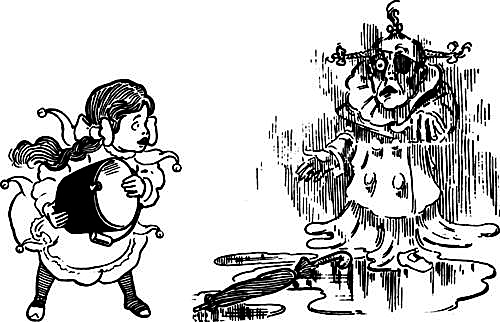
dorothy melting witch

Before I launch into today’s musings, here’s a heads-up for Washington writers: applications are due December 7 for the 2010 EDGE Program for Writers, sponsored by the Artist Trust. Designed to help working writers at all levels of their careers expand their professional acumen, the EDGE program provides six weeks of intensive professional development classes, including topics such as:

*professional presentation on paper, on the web and in live readings
*how to research and take advantage of funding resources and opportunities available to writers
*how to prepare a successful grant proposal and budget
*time management, goal setting and developing a brand as a writer
*how to identify key audiences and determine marketing directions for literary works
*financial management; legal issues such as copyright and intellectual
property, and working with and as independent contractors

Not to mention the ECQLC (Eye-Catching Query Letter Candy) value of winning a place in this prestigious program! For a full description and printable application, click here.

While I’m at it, a quick reminder about an ongoing contest right here on this site: there are just a few short aphorism-gathering days left in the the share your favorite inspirational writing-related quote contest. Specifically, entries will be accepted through midnight Pacific Standard Time on Sunday, December 6.

This is a fun and easy opportunity not only to share your favorite keeping-the-faith quote with the rest of the Author! Author! community, the one that keeps you going through those dark nights of the soul when the muses seem to have left the building permanently — and to win a free copy of LIFELINES: THE BLACK BOOK OF PROVERBS.

A description of the latter and substantially more encouragement to enter the contest appears here, of course, but here’s a recap of the rules:

1. Pick your all-time favorite proverb or quote about writing.

2. Figure out why you love it so much, and write a paragraph about why it inspires you. (Keep it under 100 words, please.)

3. E-mail the quote and your paragraph, along with the quote’s original source (if you know it) and your name to anneminicontest@gmail.com by midnight Pacific Standard time on Sunday, December 6th.

4. Wait in eager anticipation for me to announce the winner, when I’ll post the most stirring quotes.

There endeth the public service announcement portion of the day’s proceedings. Let’s get back to talking about revision — specifically, about how to tackle revising with an eye toward picking up the pace.

Why, some of you may be asking, might a savvy aspiring writer want to take some steps make an exciting plot — or an unexciting one, for that matter — go just a touch faster before subjecting the manuscript to the ever-critical eye of Millicent the agency screener, her cousin Maury the editorial assistant, and/or their Aunt Mehitabel, the veteran contest judge? One very, very simple reason: as Millicent, Maury, and Aunt Mehitabel are all quite aware, slow manuscripts make editors grind their teeth and agents shake their heads in sorrow.

I won’t even tell you what pacing that drags makes the celebrity judges brought in to pick the winners amongst the finalists at literary contests do; this is a family-friendly blog, after all. Suffice it to say that a story or argument that crawls along is not typically the best way to impress Millicent or any of her relatives enough to cause them to long to read the rest of the book.

Antipathy toward being bored by submissions is virtually universal amongst the professional readers of this world, yet astonishingly few writing books and seminars address the issue at all. Except, of course, to opine that for the purposes of submission, a faster read is, on the whole, better than a slower one.

That’s not a guideline; that’s an aphorism. (But not a very inspiring one. I wouldn’t recommend entering it in any contests.)

There are a couple of good reasons for this genteel avoidance of an unpleasant subject, I suspect. First, editing for length and pace is an unpleasant subject for contemplation where dear self is concerned, isn’t it? I don’t know about you, but most of the writers of my acquaintance (including, I’ll admit it, yours truly) get kind of annoyed when an agent or editor says, “I absolutely love your writing! How about giving us 15% less of it?”

Or, to take what used to be a stock agents’ pronouncement a decade ago, when we were all flatly told that a first novel should be no more than 100,000 words, regardless of what might actually work best for the text. (That’s 400 pages in Times New Roman, by standard estimation techniques; if you don’t know how to estimate word count, or why any sane person would want to do so when MS Word will simply tell you how many words are in a manuscript, please see the opaquely-named WORD COUNT category on the archive list at right. ) The truism on the subject has become a little more lax in the past couple of years, thank goodness: now, pronouncement-mongers tend to say anywhere between 80,000 (320 pages) to 120,000 (480) is usually fine.

Unless you happen to be submitting to someone who thinks it isn’t. To be on the safe side, I’d try to keep it as closer to 100,000 than 120,000, unless you happen to be writing in a book category where longer is routine; above 500 pages or so, printing costs leap dramatically.

As someone who attends quite a few writers’ conferences in any given year, I, for one, was pretty darned relieved when the wisdom du jour changed. During the arbitrary 100,000 period, I always hated that inevitable moment when someone stood up at the agents’ forum and asked how long was too long for a manuscript. The air of gloom that descended upon the room at the reply was palpable.

As much as I object to arbitrary standards – 125,000 words strikes me as less arbitrary, because binding costs do get higher at that point – I have to say, like most of us who edit for a living, I’m a fan of the tightly-paced manuscript. I practice what I preach, too: in the novel currently in my agent’s hands, I cut 20 pages entirely through eliminating individual lines.

So believe me, I feel your pain, self-editors. But like most people who read manuscripts by the score, that doesn’t mean that I don’t start muttering, “Get on with it, already!” when a plot begins to drag. Sorry.

The second reason I think the issue of manuscript-tightening doesn’t get much attention in conference classes, writing seminars, and publications aimed at writers is that just as it’s genuinely difficult to say with any precision how long a book one has never read should be, it’s also hard to give general advice about pacing that applies to every single manuscript that might conceivably fall off a gifted writer’s fingertips onto a keyboard.

Every writer has different ways of slowing down or speeding up text. Which is precisely why it’s so vitally important to examine your own manuscript to learn what yours are.

You can feel me about to ask you to do something, can’t you? Don’t worry — it won’t be too painful; I’m not going to ask you to kill your darlings, at least not today.

Why in heaven’s name not, as writing teachers all over North America have been shouting at their students to axe their favorite bits of prose since practically the moment the classic piece of advice fell out of Dorothy Parker’s well-rouged lips sometime during Prohibition? Well, in my experience, most talented writers — published and as-yet-to-be-published alike — actually have a pretty good sense about the little things that shine in their manuscripts.

You know what I’m talking about, right? Those telling little details that bring joy to the eyes of agents, editors, and contest judges everywhere when they appear nestled in a manuscript – particularly on the first page of the text, where they act like miniature neon signs reading, “Hello? This one can WRITE!” causing Millicent to sit up straight for perhaps the first time that screening day and cry, “By gum, maybe I should NOT toss this one into the rejection pile.”

As lovely as eliciting this reaction is, there is more to catching a professional reader’s attention than a charming and detailed first page, I’m afraid. Of course, it’s a necessary first step to that reader’s moving on eagerly to the second, and the third, and so forth. But an initial good impression is not enough, however much writing teachers emphasize the importance of including an opening hook: in order to wow an agent into asking to see the entire manuscript, or into reading the entirety of the one you’ve already sent, the impressive writing needs to continue consistently throughout.

Was that chill I just felt the cumulative effect of all of you first page-perfecters out there going pale? “I just spent eight months on my first five pages,” I hear these wan wraiths stammer. “If I brought the entire book to that level of polish, I would need to live to be 112. I doubt that I’ll still be up to a book tour by then.”

I hate to be the one to tell you this, oh pale ones, but most writers revising for submission stop the high-gloss treatment far too soon. Around page 50, on average, because we’ve all been told that’s the first chunk an agent will ask to see.

The result is a whole lot of manuscripts that raise tremendous expectations in screeners’ breasts — only to lapse into what is fairly obviously less worked-upon writing around page 52. It’s so common a phenomenon that professional readers have a pet name for it: sagging in the middle.

While it is true that having brilliant early pages is one of the best calling cards a book can have, consistency is a far more appreciated writerly skill than writing advice-givers tend to admit. (And before the quote-mongers who emblazon famous thoughts on calendars start shouting that consistency is the hobgoblin of little minds, let me remind you that the early part of the quote is almost always omitted: the original read, “A FOOLISH consistency is the hobgoblin of little minds.” Just in case anyone has proverbs on her mind or anything.)

Here are some facts to chill creative blood: while the vast majority of submissions are in fact rejected prior to page 5, with a hefty percentage dismissed by Millicent before the bottom of page 1, a book’s audition period can — and generally does — go on for most of the manuscript. An excellent agent of my acquaintance, for instance, tells me that he reads the first 185 pages of any manuscript he is considering actively looking for reasons to reject it. Beginning on page 186, he is looking for reasons to ACCEPT it, because he’s already invested so much time in it.

So, naturally, whenever I meet a writer who is planning on querying him, I say, “Psst! Make sure your pp. 150-200 are magnificent!”

Why might a professional reader toss aside a book after having loved it for, say, 190 pages? Usually, a lack of consistency in the writing: great writing early in the book raises expectations for the writing later in the book, necessarily. In the industry, a book that achieves this difficult feat is declared to have lived up to the promise of its first chapter.

Naturally, this is a little unfair, but after one has read approximately 7 million early chapters chock-full of telling little details, one has generally become resigned to seeing their frequency diminish later in the text – but not like it. It’s kind of a letdown, like when that the terrific conversationalist with whom you had three great dates blurts out on Date #4 a glowing paean to a politician whom you have considered for years at best a corrupt megalomaniac.

We’ve all been there, I’m sure.

I must admit it: as an editor, once I have seen evidence that a writer possesses the twin gifts of observation and the ability to handle detail deftly, I have been known to mutter angrily at the manuscript before me, “You’re a better writer than this! Give me your best work!”

So now that I have scared you to pieces about the importance of consistency, how can a revising writer tell if, say, the proportion of telling little details falls off throughout a manuscript enough to start enough to displease a professional reader’s eye?

Glad you asked. Try this experiment:

1. Print out three chapters of your manuscript, the first, one from the middle, and one toward the end of the book.
Don’t use the final chapter; most writers polish that one automatically, doubtless the effect of our high school English teachers making us read the final pages of THE GREAT GATSBY so often.

2. Make yourself comfy someplace where you will not be disturbed for a few hours, and start reading.
Easier said than done, of course, especially for those of you with young children gladdening your daily lives, but this isn’t relaxation: this is work. So don’t you dare feel guilty about taking the time.

3. While you are reading, highlight in nice, bright yellow every time the narrative gives information about a character in summary form.
I’m deadly serious about this. Mark everything from Angelique felt envious to Georgine was a shop welder of immense proportions to “Edward was a compassionate soul, drawn to injured children, limping dogs, and soup kitchens.”

4. Now use a different color of pen — red is nice — to underline any character-revealing information that the narrative conveys indirectly, through specific detail or speeches that demonstrate a characteristic or an environment that is reflective of a character’s internal mood.
Remember, you are not judging the quality of the sentences here — what you are looking for are passages that encourage the reader to draw his or her own conclusions about what the character is like. To revisit the trio from above, red-marked sentences might include:
Unable to contain herself, Angelique surreptitiously poked her rival with a pin

or Georgine’s broad shoulders barely fit through the doors to her metal shop

or even Edward was late for work again, having been sidetracked by a child’s scraped knee, a search for the same little girl’s lost cocker spaniel, and the absolute necessity to track down and fund the homeless person he had been forced to overlook yesterday because he’d already given away the last dollar in his pocket.

Beginning to see some patterns here? Good.

5. Now that you’ve identified these different species of sentences, double-check immediately before and after the indirect indicators in red for summary statements telling the reader precisely how these dandy little details should be interpreted.
Such summaries tend to lurk in their environs. When you find them, ask yourself, “Self, is this summary absolutely necessary here, or does the indirect statement cover what I wanted to say? Could it in fact be cut, and would the manuscript be both shorter and better for it?”

Applied consistently, this question can strip a lot of unnecessary verbiage from a manuscript relatively painlessly. It’s a good strategy to know, because it’s often difficult for a writer to notice redundancy on a page he has written himself — from a writerly perspective, saying something in two different ways often just looks like creative emphasis.

Or — and this is more common — we may not trust the reader to draw the correct conclusion from the more delicate indirect clues, and so rush to provide the logical extrapolation. But readers are pretty smart, especially those lovers of good writing who dote on telling little details.

Okay, I need to sign off for today, but please don’t throw those marked-up pages away: I have more plans for them — and their little dog, too.

Yes, going through your manuscript with a fine-toothed comb is a whole lot of work, but believe me, when your book is on the uphill side of page 185, and the agent of your dreams is trying to decide whether you have the consistency of style to pull off an entire book, you’ll be very, very glad you bought those marking pens.

Maybe you should ask the Furtive Non-Denominational Gift-Giver to sneak some more into your stocking later this month. Keep up the good work!

Slicing and dicing life into interesting shapes, or, ordinary is as ordinary does

barcelona market

As I mentioned last time, I’m planning to spend the next few weeks going through my to-blog-about stack, concentrating on all of those great questions from readers that I answered briefly in the comments, but never managed to get around to devoting a entire post or two to expanding upon, as I intended. I’m well aware of the old saying the road to hell is paved with good intentions, but until today, I was not aware that the highway markers were provided by procrastination.

Case in point: intelligent and insightful reader Jen posted today’s question onmy post commemorating John Updike’s passing, an event that my archives tell me happened way back in January, and have I devoted a post yet to answering it? Well, have I?

I’m asking semi-seriously, because as of this morning, I honestly didn’t remember. I often so go to town in answering questions in the comments that I have the illusion that I have indeed blogged on a subject. But since the comments aren’t searchable via the wee-but-powerful engine at the upper right-hand corner of this page (I know; I think it’s weird, too), my waxing poetic over a question doesn’t really help anyone but the people who happen to check — and re-check — the comments on that particular post.

It’s kind of like forgetting to post any of my photos of Barcelona until seven months after I took them. The market’s pretty, isn’t it?

Okay, that’s one goal checked off my list. Here’s another. Quoth Jen way back when:

Anne, —in 2002, Dr. James Plath, an English professor, friend of the late writer, and specialist in John Updike’s work said, “While other people were writing about characters in the extreme, John Updike spoke and wrote about people who lived middling lives in the middle of the United States which is the anchor of this country.”

Especially with the higher standard unpublished writers must reach, middling Midwesterners, on the surface, have an extra challenge in getting past criteria #1 on panelists’ dream-date list. Yet, like the character development shown in your excerpt, isn’t it how we expose our characters that pushes them past the bell curve (or not)?

I should admit my Midwestern protagonist is feeling a bit ordinary today.

Jen, this is a question I hear in my craft classes all the time: how does one write about ordinary characters and ordinary life without the result being, well, ordinary?

I’m not sure that I would agree with your professor’s assessment — Updike was hardly the ONLY portrayer of Middle America in the post-war era. (Andre Debus, anyone? Rachel Ingalls? About a thousand other writers?) But it’s absolutely true that the portrayal of a so-called ordinary character can elevate that character above a dull normal.

In order to pull that off, however, that character — or lifestyle, or workplace, or situation — cannot be merely sketched out, however. The writer has to imagine a fully-rounded protagonist who is more complicated than what a casual observer would consider typical of his job, class, sex, race, political affiliations, sexual preferences, and so forth, because unless the writer conceives him as an individual, he’s likely to come across as a mere representative of a group, trend, or background.

Taken far enough, of course, the result is a stereotype. But haven’t we all seen enough mean-spirited cheerleaders (who invariably rule the school in fiction), sulky teenagers (rolling their eyes and sighing perpetually in submissions), absent-minded professors (or, even more common on the page, professors who constantly speak as though they were giving a lecture), intolerant small-town denizens (with or without pitchforks in their hands), and soulless corporate lawyers (okay, I’ll give you that one) to last a lifetime?

Or several lifetimes, if we happen to read a lot of submissions?

Updike was very, very good at elevating ordinary characters into something beyond representatives, at least for male characters. His men are not just stand-ins for their position in society or backgrounds, but fully-realized individuals operating within the rubric of what Wallace Stevens called the time and space in which we breathe.

So that’s the short answer, Jen: fashion characters that do not feel like characters, but people, occupying a world that is very much like ours, only more interesting. Not only to the author, or to people who live within the environment being depicted, but to readers who know nothing about them.

Well, that’s another craft problem neatly polished off. Moving on…

Oh, how I wish it were that simple — or that fewer good writers mistook the classic writing advice write what you know for a directive to reproduce even the not-very-interesting life around them. Bordering-on-boring slice-of-life submissions are so common that I’ve seen more than a couple agents and editors march into writers’ conferences and declare that slice-of-life fiction is just bad writing.

I think that’s a pretty radical overstatement — there’s plenty of excellent slice-of-life writing out there — but I can certainly understand how someone who read manuscripts for a living might be annoyed into that extreme a conclusion. Many, many aspiring writers take write what you know far too literally; originally, the advice was meant to discourage writers from speculating in print about social conditions and situations they knew little or nothing about.

Why? Well, in part, because doing that tends to result in stereotype-generation. Not to mention fiction that may not ring true. So a more sensible version of write what you know might be do your homework, then write what you find out.

Another unfortunate interpretation of write what you know is the quite untrue supposition that just because something happens in real life, it will necessarily be interesting on the page. Editors have been driven into madhouses by this one since the Brontë sisters first got the idea of placing pen to paper. Including too many details — or uninteresting ones — makes it hard for the reader to figure out what is and isn’t important in a scene.

Those of us who read manuscripts for a living have a number of terms for manuscripts that include mentions of every paper clip on a desk, as if each were as important to the scene as the dead body lying on top of them, but you probably don’t really want to know. They are not very polite. About the nicest is lazy writing.

That made some of you realism-lovers out there sit up in your chairs, didn’t it? “But Anne,” fans of the mundane sputter indignantly, “how can doing too much work possibly be construed as lazy? I can understand how it might be irritating to an agent or editor to have to edit out extraneous details, but isn’t it far better to over-describe than to leave the reader guessing what the physical environment is like?”

I understand your ire, oh sputterers, but the question misses the point, from a professional reader’s point of view: ideally, you shouldn’t be picking between two extremes, but finding an ideal balance between too much information and too little. And since it’s the writer’s job, not the editor’s, to discover where that happy medium lies for any particular story, I don’t think you can really blame the pros for regarding writers who shirk this duty as lazy.

Think about it: if all that were necessary in order to convey the feel of a room or truth of a situation was to describe it down to the last dust mote and/or stray frown on a bystander, film would trump good writing, every time. The old cliché that a picture’s worth a thousand words is often true, in the sense that if there’s a lot going on in a photo, it would take a great many words to describe it.

But there’s also a pretty good reason that novels don’t typically contain photographs: part of the point of the art form is to describe things, people, and situations not by depicting them in exhaustive detail, but rather by the author’s selecting what is most important to the truth of the scene and concentrating on it.

To put it a bit more bluntly: a large part of a writer’s value to the reader lies in her ability to winnow out the unimportant. Just because something is real — or realistic — doesn’t mean it’s going to capture a reader’s interest. And every writer on earth should be pretty happy about that, because if every aspect of quotidian life were hugely entertaining, novelists and memoirists would be rendered obsolete, replaced by film cameras and court reporters.

But what we fiction and creative nonfiction writers do to reality is far, far more complex than simply holding, as ’twere, the mirror up to nature, right?

That’s something that writers of the ordinary are prone to forget, alas: the novelist’s job is not merely to tell a good story and to provide trenchant insight into the world he’s depicting, but to entertain. No matter how true-to-life your protagonist may be or how realistic the situation, if the way you write about it isn’t entertaining on some level, people will have a hard time reading it.

I see some of you turning up your nose at that, murmuring about how pandering to the lowest common denominator is death to literature. That may be comforting to believe, but actually, the imperative to entertain applies equally well to the least accessible literary fiction as to the most mainstream. The audience expected to enjoy the book in question is merely different.

Instead of regarding the need to interest and entertain the reader — and Millicent, as the gatekeeper of the agency that is, we hope, going to bring your book to the publishing house who will get your book into the hands of that reader — as a burden, why not think of it as a useful reminder that one of the biggest distinction between a professional writer and a hobbyist is not whether she gets paid, but whether she is willing to write with a target reader’s literary desires in mind, as well as her own? Wouldn’t you rather that your ideal reader found your work scintillating, rather than a chore to read?

Chew on that for a while, lovers of abundant and unimportant detail: wading through a sea of irrelevancies is no fun. And frankly, your reader would prefer for you to make the decision about what is and isn’t important for him to know. How you draw the line is part of your authorial voice.

Far more frequently, though, slice-of-life fiction suffers from the opposite problem: many writers assume — again, wrongly — that if they’re writing about everyday life, they don’t need to fill in the details of the environment, social relations, characterization for minor players, etc. Everybody knows what an office is like, right, and a gas station? Everyone has known an incompetent middle manager, an annoying co-worker, a bored check-out girl?

This, too, tends to get labeled as lazy writing, for obvious reasons: it’s the writer’s job to create a full and interesting world for her readers to inhabit, not the reader’s job to fill in the details from his own experience or imagination. And as any Millicent would be only too glad to tell you, it’s not the agent or editor’s, either.

Before any literal-minded reader demanding to know whether I’m saying that it’s always imperative to provide a physical description of every character as soon as she appears on the page, I hasten to reiterate: how much detail serves the story best is ultimately the writer’s decision, and an important one. Although each book category does have its own storytelling conventions, the choices involved are creative, not absolute.

So matter how much any given aspiring writer out there would like for there to be a hard-and-fast rule governing, say, the timing (or inclusion) of physical descriptions, or a foolproof formula for a dialogue-to-narration balance, there aren’t. What will work best for any given story is different.

Hey, this is an art we’re talking about here, not a science. Constructing an enjoyable narrative is hard work.

I see a few hands raised out there. “Okay, Anne, I get that as the writer of a story, I’m ultimately responsible for how I tell it. But I genuinely want to give my readers an accurate feeling for real life as I perceive it — and that means having to take them to some pretty ordinary places. Offices. Traffic jams. Supermarket aisles. How can I make that kind of place interesting to the reader while still remaining true to life?”

Oh, that’s a snap to answer: by how you write about it.

I know, I know — that sounds like I’m being flippant, but actually, I’m not. Often, the author’s perception of the protagonist’s ordinariness is more problematic than the locale: in the vast majority of submissions that deal with so-called ordinary people, their lives and characters are depicted as dull, as composite or representative of an entire group of people rather than as we encounter people in real life, as individuals with personal quirks. Interesting personal quirks, ones that the reader might not expect.

Not having any surprising depths would be problematic for any protagonist, anywhere, anytime — and frankly, with most readers, not just the professional ones.

Why? Well, Millicent and her ilk simply see more dull normal characters than the average reader, for the simple reason that they read many more books, at least in part. From their point of view, reading about an ordinary character from a generic background — even a background that a great many potential readers share — is rather like listening to an actor doing a generalized foreign accent, rather than one tailored specifically to the background of the character she’s portraying.

If you doubt this, try listening to some of the faux Irish brogues that turn up on US stages — they tend to be better on Canadian ones — that wander from County Cork to Dublin and back again with a winsome disregard for geographic probability, or ersatz American accents on British stages, evident hangovers from WWII GIs, with adjectives evidently from Brooklyn, nouns from Houston, and verbs from the movie lots of LA.

Genuine accents are always individuated, to a certain extent — and thus potentially a source of surprise and interest on the page. A close listener to my speech might discover, for instance, that my vocabulary changes when I’m talking about politics (the result of years of graduate school), my hometown boasts a specific cadence unshared by people who live 15 miles away that pops up when I talk about my childhood, and when I’m embarrassed, some of my English grandmother’s vowels come tripping out of my mouth. (“Oh, I’m so very sorry!”) And don’t even get me stared on the kid I knew in college who was from New Jersey, but tried to speak like a Cambridge graduate in tribute to his deep and abiding love of Monty Python.

My point is, real accents are a seething mass of influences and choices, so when we hear an actor produce a voice seemingly representative, it can sound rather fake. So, too, with characterization. No one is absolutely the product of a monolithic background, any more than anyone remains in character 100% of the time.

It’s the deviations and moments of departure that render us interesting. So if your ordinary protagonist is in danger of becoming too predictable, why not have him act out of character every now and then, as people do all the time in real life? Why not have one of the minor characters flip out about something out of a clear blue sky? Or have his love interest be in a lousy mood not because of anything that’s going on in the plot, but because she’s just gotten a parking ticket?

Starting to get the picture?

Ordinary does not have to mean uneventful or unquirky. It’s far from impossible to portray an ordinary person in an ordinary situation in a manner that will be interesting to a reader.

It does, however, require thinking about the character and scene differently than most writers were taught in their composition classes. Most beginning writing classes fall into the write-what-you-know school, tending to encourage neophyte writers to concentrate upon building their craft through acutely observed everyday life — a good place to start, certainly, but not one that necessarily takes the reader’s point of view into account as much as Millicent might like to see.

We all know why by now, right? From the industry’s point of view, it’s the writer’s job to render the protagonist and the situation fascinating, not the reader’s job to say, “Oh, this is supposed to be an everyday character; I guess I don’t mind his being predictable.”

Predictability is the enemy of interesting fiction — which renders writing about the mundane especially challenging. Yet virtually any plot or character is capable of generating something that the reader will not have expected, and the essence of freshness as the industry defines it is placing a new narrative twist on the world we all share.

The ability to surprise isn’t exclusive to any particular time zone, after all.

But that doesn’t mean that an agent, editor, or contest judge fond of good writing would seriously expect a writer portraying an average Joe or Janet to have them do something they would never do, either. The challenge in portraying any culture foreign to Millicent — and I think a good case could be made that quotidian life in the rest of the country is often rather foreign to NYC-based agents — is to present it to her in a manner that will both educate and intrigue her.

Oh, and entertain her as well.

Ditto with a so-called ordinary protagonist: instead of concentrating upon what makes her typical, why not figure out what makes her different from what a reader might expect? Or, to put it with the bluntness which is actually a bit out of character for me, what makes this character interesting enough for a reader to want to follow her for an entire book?

That, too, was a serious suggestion, not a flippant one: why write this character’s story, and not another ordinary person’s?

If you don’t know, chances are that the reader will not, either. Unpleasant to contemplate, but true. If a protagonist’s creator feels that a protagonist is a bit nondescript, readers will usually draw the same conclusion.

Unlike readers, however, the writer has the opportunity to do something about it. Again, instead of thinking of that as a drawback, try regarding it as an interesting challenge: if you’re feeling that your protagonist is ordinary, perhaps your fine writer’s sense is telling you that it may be time to make him more complex.

That’s easier than it may seem on first blush, you know. Most people are actually pretty interesting if you take the time to get to know them: not their daily habits, which may have been formed externally, but who they are inside, what memories they hold, how they reacted on the day that a giant redwood fell onto the local schoolhouse, etc. Try giving your protagonist a secret shame, a bizarre hobby, a long-ago childhood determination to become an astronaut — even if those elements never actually make it onto the stage, as it were, your knowing that they are in her background will probably make a difference in how ordinary you feel she is.

Not all black sheep carry their wool on the outside, if you catch my drift. Play with the past a little, or tinker with long-held desires to create an intriguing view of the future.

Not everything that’s going on in a story should be right on the surface, after all.

There you go, sitting up straight in your chairs again, but think about it. Giving your protagonist a more intricate past than a dismissive, “Oh, he’s an ordinary Midwesterner,” can inform his actions, even if you choose never to let the reader in on that past.

Besides, I can’t be the only writer out there who has met fascinating Midwesterners, can I? I’ve known many who were positively bristling with quirks. Not to mention secret plans for personal pleasure-seeking, business re-envisioning, and world domination that would make some of us more timid souls on the coasts gasp.

A good way to jump-start brainstorming about ways in which your protagonist as interesting is to invest some time in drafting a brief bio for him. Try going back a generation or two. I’m often surprised at how infrequently US writers discount the family backgrounds of characters whose kin have been in this country for more than a generation or two; go back far enough, and you’re bound to find a dandy Ellis Island or that’s-when-they-moved-us-off-the-reservation story that can be tied to the current generation’s worldview or habits in some surprising way.

Even a practically inert character with a swashbuckling great-grandmother is kind of intriguing.

Don’t laugh — I know an agent who claims descent from pirates. One of the thing I love about living on the West Coast is that practically everybody whose family migrated prior to World War II has a genuinely quirky relative or two lurking about the family tree; there’s a middle school named after a forebear of mine who…well, I might want to use that in a book someday. Let’s just say that I’d be rather surprised if the school board had been aware of the rich variations within his character when they decided to put his picture up in the principal’s office.

All they knew about him was that he was a pillar of the community. How ordinary, right?

I’m not saying that it’s going to be a walk in the park to render an everyday character scintillating — naturally, it’s going to be a bit more of a challenge than retailing the exploits of that agent’s pirate forebears. (Oh, like you weren’t already picturing them.) But if we writers are being absolutely honest about it, didn’t we take up this most complex of human art forms not because it was a snap to achieve the effects we imagined, but because we wanted the glory of creating entire new worlds and taking our readers for a field trip into them?

That’s as noble an aspiration if that new world is a small Midwestern town as if it’s Manhattan. Or the planet Targ. Keep making things interesting for your characters — and keep up the good work!

The chapter of forgotten moods, or, a few thoughts on submission and the passage of time

I read in the paper this morning that only one American veteran of the War to End All Wars — World War I’s armistice is why there’s no mail delivery today, in case any of you stateside had been wondering; it’s also why the banks are closed and all of those mattresses are on big, big sale — was still alive and kicking. He’s 108 years old.

And I’ve been steeped in the life literary for so long that my very first thought was, “Gee, I wonder if anyone’s approached him about dictating a memoir. I could practically write the book proposal off the top of my head!” rather than, “How nice that he’s gotten to see so many Veterans’ Days go by; I wonder if he was annoyed when they changed it from Armistice Day,” or even “Gee, sir, thank you for helping show the world that trench warfare was a really, really stupid idea.”

Fair warning: this could happen to you, too. Just keep on writing those books.

My father was a child during WWI (no, I’m not that old; he was when he had me); he recalled the day when the local doughboys came home. He would tell vivid anecdotes about watching protest marches in the streets, rationing, how his mother’s views on military service varied markedly as her only son approached draft age.

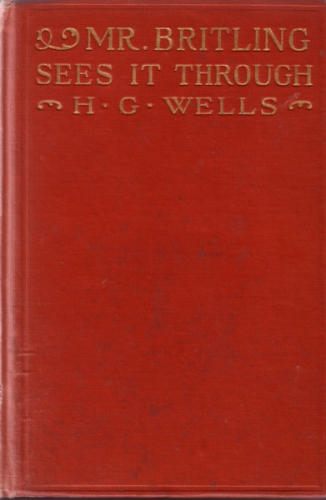
It was from him, and not from my school’s history books, that I learned that here in the States, it had been quite an unpopular war; years later, it was his stories of the home front that I would contrast with H.G. Wells’ brilliant 1916 description of the British home front, MR. BRITLING SEES IT THROUGH. (In case you missed my oh-so-subtle plug for it above, here goes: if you’ve never read it and are even remotely interested in how human beings respond to their countries’ being at war, you might want to have the Furtive Non-Denominational Gift-Giver* add it to his list for you this year. I just mention.)

I love this book — and not just because it’s a genuinely thoughtful, well-written work by an author whose non-science fiction writings have since his death fallen into undeserved obscurity. Which is a bit surprising, since Wells’ social novels were so very popular around World War I.

How steep has his plummet from notice as a mainstream novelist been? Well, let me ask you: were you aware that he coined the phrase the war to end all wars?

MR. BRITLING SEES IT THROUGH is also one of the great examples of why write what you know is often such great advice. What writer living in wartime — and when aren’t we all? — would not resonate with a paragraph like this:

The battle of the Marne passed into the battle of the Aisne, and then the long lines of the struggle streamed north-westward until the British were back in Belgium failing to clutch Menin and then defending Ypres. The elation of September followed the bedazzlement and dismay of August into the chapter of forgotten moods; and Mr. Britling’s sense of the magnitude, the weight and duration of this war beyond all wars, increased steadily. The feel of it was less and less a feeling of crisis and more and more a feeling of new conditions. It wasn’t as it had seemed at first, the end of one human phase and the beginning of another; it was in itself a phase. It was a new way of living. And still he could find no real point of contact for himself with it at all except the point of his pen. Only at his writing-desk, and more particularly at night, were the great presences of the conflict his. Yet he was always desiring some more personal and physical participation.

Not that why write what you know is as self-explanatory and all-encompassing a piece of advice as many writing teachers seem to think. As those of you who have been hanging around Author! Author! for a good, long while are already aware, I’m no fan of one-size-fits-all writing advice — beyond the basic rules of grammar and formatting restrictions, of course. What works in one genre will not necessarily work in another, after all, nor are the stylistic tactics that made ‘em swoon in 1917 or 1870 particularly likely to wow an agent or editor now.

Doubt that, all of you Dickens-huggers out there? Okay, I dare you: try submitting the paragraph above to an agent or editor now. Even if it actually made it onto an agent’s desk — if, that is, Millicent the agency screener didn’t reject it out of hand for the repetitive word use, over-employment of the passive voice (pretty much universally regarded as bad writing in submissions now), and misuse of the semicolon (by definition, a semicolon followed by and is redundant, since a semicolon is implicitly an abbreviation for comma + and) — the sheer number of semicolons within this short paragraph would automatically raise both eyebrows and questions about the intended target audience. If the book in question were, say, a mainstream novel rather than literary fiction or an academic book, all of those semicolons would seem, well, a bit much.

But then, in Wells’ day, novelists had the luxury of being able to write about current events in the reasonable expectation that the book would be in readers’ hands before today’s headlines were distant memories. He was able to write about the home front while the war was still going on — and not merely as a journalist.

Now, journalists, politicians, and academics who have studied the field for twenty years are generally the only ones who can reliably pitch a book on what’s happening right now socio-politically with success — and even then, only as nonfiction. Partially, this is a matter of platform (if you write any kind of nonfiction whatsoever and don’t know what that is, run, don’t walk to the PLATFORM category on the archive list at the lower right-hand side of this page), but it’s also a symptom of how much longer it takes to get a book into print.

Not only after it’s written and found an agent, but thereafter.

How much longer, you ask with fear and trembling? Well, let’s assume that the manuscript is already absolutely clean (the professional term for completely free of typos and other errors; few submissions are completely clean, despite my perpetual nagging in this forum) and the agent is completely happy with it (also rare for a submission; agents often request extensive revisions before sending anything out). The agency will almost certainly have a backlog of manuscripts ready to go, so yours will have to wait its turn.

When its time does roll around, the agent may send out anywhere from one to a dozen copies to different editors, depending upon the agency’s preferred submission policy. If it’s a single submission, the agent will wait until she hears back from the editor before sending out the next; if she’s chosen to make multiple simultaneous submissions, she may send out a copy to another editor when a rejection arrives.

Or she may not; my agency, for instance, does submissions in waves, pausing sometimes six months before sending out the next set of manuscripts to the next set of editors. This is not at all an unusual practice.

Take a nice, deep breath. You’ll feel better.

So it’s fairly common for an agent to be circulating a manuscript, even a very good one, not to sell it for a year, year and a half, two. That’s an awfully long time, if any portion of the book’s market appeal relies upon relevance to current events; it’s not altogether surprising, then, that agents so often tell aspiring writers of up-to-the-minute stuff that the book will be dated too quickly to render marketing it worthwhile.

Why, you ask? Um, are you sitting down?

Comfy? Here goes: even if the manuscript in question was absolutely timely when it was written, and remains absolutely timely a year or two later, when the agent manages to sell it to an editor at a publishing house, to remain relevant, the same world conditions will have to prevail a year or more later, when the book actually becomes available for sale to readers.

This is one reason, in case any of you submitters have been wondering, that writers who go batty if an agent who requested a manuscript doesn’t respond right away strike the pros as potentially difficult to work with: the agented life is largely one of waiting for something to happen. So if a writer walks into it expecting that everyone who comes in contact with his manuscript will instantly drop everything else in order to read it, he’s going to expend HUGE amounts of energy feeling his work is being ignored.

It isn’t; the process just takes a while.

And that — phew! — brings me back to my overarching topic du jour, the passage of time in the submission process. I’ve been meaning to get back to it for a while, since I receive so many private questions about it. (Why private? Beats me. For some reason that defies understanding from my side of the agent-landing process, I very frequently receive e-mailed questions from submitters who are absolutely convinced that no other aspiring writer in North America has ever been in their particular situation — or so I surmise from the fact that so many of them are unwilling to post the questions here, lest an agent recognize the situation.) For the next few weeks, however, I’m going to be tackling that backlog of readers’ questions, so let’s launch right into it.

A periodic reader who, for reasons best known to himself, has requested anonymity, has brought up the perennial issue of turn-around times on submissions. Since I know that many aspiring writers share his concerns, I have changed the identifiable information to preserve the secret identities of both author and agent:

Agent Pablo Picasso (how’s that for an undetectable pseudonym?) requested the full manuscript and I sent it three weeks ago. How long should I wait for him to make contact? Is it all right for me to call? I don’t want to pressure him, but I am desperate to move forward with the project. Oh, the anxiousness. Ah, the sleepless nights. I have never wanted anything more than to be a published author…

I know there are no set timelines for responses and such, but roughly how long should I wait before moving on?

Here’s the short answer, Mystery Reader (another undetectable cover): don’t even think about following up for 6-8 weeks (or at least a week past the agency’s stated turn-around time, and when you do, DON’T CALL; e-mail or write.

In the meantime, Mysterious One, you should most definitely be moving on now: get back to your writing projects. You might even consider sending out a few more queries, just in case. And if any other agent has requested materials, you should already have sent them.

Well, that cleared everything up, didn’t it? Moving right along…

Just kidding. On to the long answer: three weeks is most definitely not a long time to wait for a response from an agent on a submission. I would be extremely surprised if you heard back in under a month. But if ol’ Pablo didn’t give you a timeframe in the request for materials (as many agents do), 6-8 weeks is average.

I can feel heart rates rising all over the English-speaking world. “But Anne,” those of you either on the cusp of sending out manuscripts or waiting breathlessly to hear back from agents protest, “Mystery Reader said that Pablo Picasso asked for the full manuscript — that must mean he was really, really interested, right? Surely not hearing back indicates that he’s lost interest, right?”

Actually, not necessarily, and not even probably. What not hearing back generally means is either (a) nobody at the agency has read it yet, (b) it hasn’t made it past Millicent, or (c) it did make it past Millicent, but the agent hasn’t had time to get to it.

Don’t pull that long face; it’s nothing personal. Long-time readers, pull out your hymnals and sing along with me: because a request for pages does not equal a promise to drop everything the second those materials turn up at the agency.

Like so many other aspects of the biz, an agent requesting materials will expect a serious aspiring writer to be familiar enough with the biz to be aware of that. Consequently, badgering an agent interested in your work will definitely NOT get him or her to read faster — in fact, it sometimes produces the opposite effect — it is not a good course to pursue. Most agents will regard follow-up calls or too-soon e-mails as a sign that the prospective client does not understand how the business works.

Which is not an impression you want to give an agent you would like to sign you. Why? Well, it tends to translate, in their minds, into a client who is going to require more attention at every step of the process. While such clients are often rewarding on many levels, they are undoubtedly more expensive for the agency to handle, at least at first.

Think about it: Pablo Picasso, like every other reputable agent in the country, makes his living by selling books to publishing houses. This means a whole lot of phone calls, meetings, and general blandishment, all of which takes a lot of time, in order to make sales.

So which is the more lucrative way to spend his time, hard-selling a current client’s terrific novel to a wavering editor or taking anxious phone calls from a writer he has not yet signed?

Uh-huh. Trust me, Pablo Picasso (too obvious a pseudonym?) already knows that you want to be published more than anything else in the world; unfortunately, telling him so will not impress him more.

How does he know Mystery Writer’s innermost feelings? Because he deals with writers all the time — and this is such a tough business to break into that the vast majority of those who make it to the full-manuscript request are writers who want to be published more than anything else in the world.

Mystery Reader, you will be a much, much happier human being if you bear this in mind. I can assure you that an agent who receives 800 or 1000 queries per week from glorious dreamers does not have the luxury of forgetting it.

You’re certainly not alone in thinking of your query or submission as if it emits a come-hither glow in the agency’s mail room, however. The average aspiring writer, bless his or her heart, tends to forget that the dream of publication is a fairly common one — thus that huge volume of queries through which Millicent sifts five days per week, each of which is presumably from someone who yearns for publication.

Let’s face it, querying and submission are FAR too hard on the heart (not to mention the wrists) to keep doing if you don’t want success that much, right?

The very intensity of the longing can sometimes blur an aspiring writer’s view of the agent-finding process — or indeed, the period when one’s agent is shopping one’s book around to editors. Even the most successful author’s career is stuffed to the gills with periods when s/he can do nothing but wait.

And as anyone who has ever been a teenager with a crush can tell you, every minute devoted to waiting for the phone to ring, for That Special Someone to declare his intentions, is eighteen times longer than a normal minute. Nothing extends a second like not having someone else determine what’s going to happen to you at the end of it.

This is precisely Mystery Reader’s dilemma, I’m afraid. All you can do is wait — at least for 6 weeks or so, or (to trot out my favorite rule of thumb) for twice the turn-around time the agency has listed in an agency guide blurb or on its website.

Which is yet another reason that a prudent submitter should always double-check the agency’s own guidelines before submitting materials. Why? Long-time readers, chant it with me now: there is no hard-and-fast rule that may be applied to every agent at every agency, every time.

This information is usually easily available either on the agency’s website or its listing in one of the standard agency guides. And if either of those sources say anything along the lines of Please do not contact us to make sure we received your materials or We do not respond to submissions that do not interest us, do not even consider waiting around until you hear back from them.

Because you may not.

Before anyone starts pouting about it: yes, it would be much, much simpler for aspiring writers everywhere if each and every agency on the face of the earth agreed to adhere to a single standard for turn-around times, but the fact is, there is no incentive for them to do so. Quite the opposite, in fact: a TREMENDOUS amount of paper passes through the average agency’s portals, and yours is almost certainly not the only full manuscript requested by Señor Picasso within the last couple of months. Yours goes into the reading pile after the others that are already there — and if that feels a little unfair now, think about it again in a month, when a dozen more have come in after yours.

And how long it will take our pal Pablo to make his way through that queue can vary not only from agency to agency, but month to month, or even week to week. One day’s workload for an agent may be quite different from another, and it’s not as though a really successful agent will have inviolable reading times built into his work schedule.

In fact, many agents read submissions not at work, but in their off hours. In all probability, yours will not be the only MS sitting next to his couch. Also, in a big agency like Picasso’s (he happens to be an agent I know), it’s entirely possible that before it gets to the couch stage, it will need to be read by one or even two preliminary readers.

Again, all that takes time.

In the meantime, though, you are under no obligation not to query or follow up with any other agent. (See earlier comment about the advisability of sending out a few queries now.) That, too, is SO easy for an excited writer to forget: until you sign an agency contract, you are free to date other people, literarily speaking. And you should.

Really. No matter how many magical sparks there were between the two of you at your pitch meeting, even if Picasso’s venerable eyes were sparkling with book lust, it honestly is in your best interest to keep querying other agents until he antes up a concrete offer. Until that ring is on your finger, keep playing the field.

And where does that leave Mystery Reader in the meantime? Waiting by the phone or mooning by the mailbox, of course. It’s hard to act cool when you want so much to make a connection. Yes, he SAID he would call after he’s read my manuscript, but will he? If it’s been a week, should I call him at the agency, or assume that he’s lost interest in my book? Has he met another book he likes better? Will I look like a publication-hungry slut if I send an e-mail after three weeks of terrifying silence?

Auntie Anne is here to tell you: honey, don’t just sit by the phone; you are not completely helpless here. Get out there and date other agents, so that when that slow-reading Picasso DOES call, you’ll have to check your dance card.

Of course, if another agent asks to see the manuscript, it is perfectly acceptable, even laudable, to drop Mr. Picasso an e-mail or letter, letting him know that there are now other agents checking out your work. For the average agent, this news is only going to make your work seem all the more attractive.

See? I told you it was just like dating in high school.

Even after 6-8 weeks has elapsed, e-mail, instead of calling. The last thing you want is to give the impression that you would be a client who would be calling three times per week. Calling is considered a bit pushy, and it almost certainly won’t get your work read any faster — unlike, say, an e-mail that mentions politely that there is now another agent reading it.

And yes, Agent #1 WILL want you to tell him that immediately. Over and above that, though, all you can do is (sing it out now) WAIT.

Another great reason to keep querying and submitting while Agent #1 is taking his own sweet time getting back to you is the increasingly common phenomenon I mentioned above, agents not responding to queries or even submissions at all. Within the last few years, literally dozens of very talented writers of my acquaintance have had manuscripts out to agents for four, five, or even six months without any response. Requested materials.

This places the writer in a quandary, of course, because from the other side of the country (or the world), how on earth is it possible to tell the difference between a delay caused by a submission’s sitting on an agent’s coffee table, holding up take-out cartons until she has time to read it, one that springs from an unannounced rejection, and one triggered by the manuscript’s having gotten lost in the mail?

For this reason, I used to advise my clients and students to include a self-addressed, stamped postcard with every submission, along with a request in the cover letter (you HAVE been including cover letters with your submissions, haven’t you?) that Millicent would write the date it arrived upon it and pop it in the mail upon opening the packet of requested materials. I historically, this works far, far better than asking for e-mail confirmation, since complying requires far less effort on the part of agency personnel.

Hey, they’re busy. Have you seen that stack of manuscripts Pablo has to read through?

The USPS now offers a much less obtrusive option for making sure your manuscript arrived where it should, and when: Track & Confirm. For a negligible fee, you can receive an e-mail confirming delivery of your package, without anyone at the agency’s having to lift a finger to inform you of it.

Unfortunately, there’s no similar service for e-mailed submissions — and since many agencies that accept e-mailed queries and submissions specifically request in their guidelines that writers not follow up to ask if materials were received. Yet another reason that given the choice, I would always opt for a hard copy submission over an electronic one.

What you SHOULDN’T do whilst waiting for a reply is waste your energy constructing a vivid justification for why the agent of your dreams has not yet gotten back to you — an exercise in creative fantasy in which I’ve seen aspiring writers starting mere hours after dropping the submission into the mail.

Trust me, it won’t help your chances; it will only enervate you.

Let me preemptively take the wind out of the sails of the most common of these middle-of-the-night musings: if you haven’t heard back, it’s not because the agent thinking about it or wants to talk with every other employee in the agency before talking it on; it’s because he hasn’t read it yet.

See why most agents get a bit defensive if a writer calls, demanding to know why it’s taking so long? Much like, if memory serves, teenage boys.

Oh, how I wish we had all outgrown that awkward stage.

Try to think of a slow response in positive terms. At many agencies, a submission has to make it past more than one level of Millicent before making it onto the agent’s desk at all — and yes, Mystery Reader, that’s usually still true even if one has met the agent at a conference. If Millie #1, Millie #2, or the agent had taken a dislike to your manuscript, it would have been stuffed into the SASE right away. (See why it’s fairly safe to assume that if you haven’t yet heard back, it hasn’t been read?) Rejections tend to be quicker than acceptances.

I know that this isn’t exactly the answer you wanted, Mystery Reader, but please, try to chill out for the next month or so. Get working on your next book, because if this goes through, you will want to have it well in motion. Keep approaching other agents, because it can only be good for you if several are clamoring to represent you.

And be very, very proud of yourself for getting to the point in your writing that an agent as prestigious as Pablo Picasso WANTS to read the whole manuscript. He doesn’t ask just anybody on a date, you know.

Believe it or not, if you’re successful in submission, the anxiety of waiting will become almost routine, just one of the many swiftly-alternating moods of the working writer’s career. Try to be patient, and keep up the good work!

* For the benefit of those of you who weren’t reading this blog regularly throughout holiday seasons past, the Furtive Non-Denominational Gift-Giver (FNDGG) is a jolly elf who regularly graces this page in the winter months, ho, ho, hoing his way toward the end of the year. Better not pout, better not cry — and better get used to hearing about him, because he’s bound to keep cropping up in the months to come.

The mysteries of the human memory — and a few more words of wisdom about the SASE

life of brian crosses

I’ve had Monty Python on the brain quite a bit lately, I notice — and not just because my neighbor was playing an apparently all-parrot-sketch-all-the-time station while I was planting bulbs this afternoon. I’m working on revising a novel with a 17-year-old narrator, set roughly at the time when — surprise, surprise — yours truly was 17, and since it’s a comedy, I’ve been having to recreate what I would have thought funny at the time. Since, as any memoirist could tell you, hunting internally for one type of memory often pulls up another entirely, I found myself procrastinating today by writing about the time in junior high school when my family and I actually had to cross a picket line in San Francisco — San Francisco! — to see The Life of Brian.

Strange much how the public perception of what’s upsetting changes, isn’t it?

A psychologist friend of mine told me recently that recent research demonstrates that the brain can respond as dramatically to recalled memories as to present life; sometimes, she says, the mind will experience flashbacks AS current events. I’m fascinated by this, not only as a memoirist (and yes, the memoir that was supposed to come out a few years ago is still tied up in legal knots; thanks for asking), but as a novelist. To be specific: I’m on a tight deadline with this revision, and if my cats didn’t remind me occasionally that they do not possess opposable thumbs or the ability to open cabinets (well, okay, MOST cabinets), they would probably be forced to start nibbling on my toes under my desk to stave off imminent starvation.

I’m inclined to blame this on the way that the creative process colonizes the writer’s brain. The cats seem inclined to blame it on me, which I suppose amounts to more or less the same thing: if it can’t wait until I polish the scene in front of me to a high gloss, it’s probably not going to happen.

Don’t know what I’m talking about? Ask your kith and kin what you’re like during periods of intensive writing. You may be unusually good at jumping back and forth between the creative and observational parts of your brain, but if you’re writing on a regular basis, I’m betting that those who have the good fortune to live and work with you have built up a stockpile of anecdotes about how you space out on the minutiae of quotidian life when you’re writing hard.

Oh, you thought you were the only one? Far from it. Little things like laundry, taking vitamins, watering plants, and checking e-mail seem to slip unnoticed out of the working writers’ consciousness in the middle of a writing jag — and don’t even get me started on how the amnesia about practicalities can intensify in the face of an imminent deadline.

I suspect that this is a necessary side effect of the alchemy of creation. Because, really, in order to render our characters’ lifeworlds gripping on the page, we writers have to create them in our minds every bit as vividly and in all of the detail of a vitally important memory. That’s a pretty absorbing task, isn’t it?

With a pretty gratifying payoff, potentially: if we do our job very well indeed, we might create a story, a situation, a character that seems to the reader to have stepped straight out of real life. Only better.

Is it that same is-it-real-or-is-it-Memorex trick of the brain, I wonder, that would allow a reader to fall in love with a character in a novel? As Mario Vargas Llosa wrote in THE PERPETUAL ORGY:

A handful of fictional characters have marked my life more profoundly than a great number of the flesh-and-blood beings I have known.

He’s talking about a literary orgy, incidentally, not a physical one: quite a lot of the book is about his passionate decades-long love affair with the entirely fictional Emma Bovary. And who can blame for falling in love with her, really? She’s a pretty absorbing character.

Do I sense those of you who are trying to get queries and/or submissions out the door within the next couple of weeks becoming a bit restless in the face of these musings? “I’m as fond of the creative haze as anyone else,” I hear some of you stalwart souls say, “but right now, most of my writing time is getting eaten up by the process of trying to sell my work. So if you don’t mind my asking, what does any of this have to do with the very practical concerns we’ve been discussing for the last few weeks?”

A couple of things, actually. First, in the throes of agent-seeking, it can be pretty easy to forget that Millicent and others like her who screen queries and submissions actually are looking to fall in love with some writer’s work.

Yes, you read that correctly: even the most virulent rejection-generator is usually eager to discover a novel that pulls him immediately into its lifeworld, or a memoir that wrings his heart, or the next Emma Bovary. I don’t think it’s at all coincidental that agents and editors so often describe their first responses to submissions in the language of attraction: you’re going to love this book, it’s a sexy topic, it didn’t grab me, I can’t get this book off my mind, I just didn’t fall in love with the protagonist.

Set those to music, and you’ve got a pop song. As hard as it may be to believe, Millicent is waiting to be swept off her feet.

Which is why, in case any of you fine souls out there have been wondering, I tend to discuss querying and submission in romantic terms: the query letter is a personal ad for your book; you want attract not just any agent, but the one that’s the best match for you and your work; the first page needs to seduce Millicent into wanting to read on; the chemistry between an agent and a book matters deeply. Ditto between a book and an editor. So in addition to everything else we writers are trying to create, our writing also need to inspire love.

The interminable and annoying querying/submission process sounds substantially more noble put that way, doesn’t it? Feel free to use this argument the next time some non-writer gapes at the amount of time you’ve invested in trying to land an agent; generating love can take some time.

My second reason for bringing up this high-falutin’ topic is, I’m afraid, disappointingly prosaic. Yesterday, I started to answer a very practical question about SASEs (Self-Addressed Stamped Envelope), and I seem to have gotten sidetracked.

I can only plead that I was absorbed in a revision. Excuse me a moment while I feel my languishing cats.

To remedy at least the first of these situations, let’s recap: why, in these days of growing environmental awareness, is the writer expected to send a SASE (that’s stamped, self-addressed envelope to the rest of the population) in anticipation of a rejected manuscript’s return? “I understand why I need to include a SASE for a query,” aspiring authors tell me, “but do I really need it for the submission? It’s not as though I’m going to be able to reuse the manuscript after it’s passed through the mail twice, anyway. Can’t I just ask them to recycle it instead?”

In a word, no. In several words, no, no, no, no, no, no, NO!

To help us all understand this cosmic mystery, I explained the history behind the SASE last time: part of its original purpose was not just to save agencies the cost of postage, but also to render submissions cheaper for the writer. It was also intended to preserve copyright by allowing the author ostensible control about whose grimy paws were on the manuscript when.

Writers tend to forget this in the cyber age, when huge chunks of writing can be transferred from one end of the planet to the other with the simple push of a button (yes, of course I know that the world is not as flat as that image implies. Don’t quibble at me now; I’m on a roll), but technically, in order to retain copyright over your own writing, you need to control where and when it is read by others. Writing I post on this blog, for instance, is under my control, since I dictate where people can view it; I could disable RSS feeds, if I wanted. (Oh, the power! The power!) If I sent the same posts out via e-mail, they could end up anywhere, forwarded far beyond my knowledge.

When you send uncopyrighted material off to an agency or publishing house — to a credible one, anyway — you and your readers there are both operating on the tacit assumption that they will not reproduce your work without your permission. You are not, in effect, authorizing them to show it to anyone else until you sign a contract that explicitly grants them the right to do so.

When you send a SASE, you are implicitly asserting your right to control where your work is sent next. It conveys an expectation that if they reject it, they will mail it back to you, rather than forwarding it to the kind of pirate press that is currently cranking out the 8th, 9th, and 10th installments in the Harry Potter series.

I hear the one in which Harry fights a dragon actually isn’t bad.

As I believe I have mentioned seventeen or eighteen hundred times before, this is a tradition-bound industry; it has historically been slow to change. No matter how good the logic against some of its long-held norms, this one did not change at all until there were some very tangible benefits on the agents’ end to altering it.

For example, the anthrax scare convinced some agencies to accept e-mailed queries and submissions. And the post 9/11 requirement to tote heavy packages to the post office prompted some agencies to start recycling rejected manuscripts, rather than having the lowest intern on the totem pole — the one who aspires to Millicent’s job someday — wheel a paper-loaded dolly up out of the building.

But practice, most agencies still adhere to the old norms. Don’t believe me? Thumb through any of the standard agency guides, and count how many agencies mention that they recycle.

Spoiler alert: your thumb is probably going to get pretty tired before you find even one.

Like so many other aspects of the querying and submission process, at one time, the use of the SASE carried greater benefits to the writer than it does now, but time has hardened courtesies into demands, and habits into traditions. Today, if you do not include a SASE with your submission, you may well be perceived as thumbing your nose at the traditions of people you are trying to impress.

As satisfying as that may be, allow me to suggest that it might not be the best way to convince an agent of your Socratic intellect and lamb-like willingness to take direction. So while my long-standing affection for writers, trees, and the printed pages both work to produce would LOVE to be able to say dispense with the SASE for the manuscript’s return in favor of a simple #10 envelope, it would not be in your best interest to fling away the old norms.

The only alternative that I have seen work in practice — and that only rarely — is to include a line in the cover letter, POLITELY asking the agency to recycle the manuscript if they decide not to offer representation and mentioning the business-sized SASE enclosed for their reply. Do be aware, however, that this strategy sometimes backfires with screeners trained to check first for a manuscript-sized SASE: as I mentioned yesterday, it’s not unheard-of for the Millicents of the world to toss aside such a manuscript to be tossed aside without reading the cover letter.

As I believe I may have mentioned before, I don’t make the rules of submission; I only try to render them comprehensible. Let’s all pray that when Millicent does engage in the summary rejection of the SASEless, she flings that precious ream of paper into a recycling bin.

Knowing the likelihood of that happening, I feel as though I should go off and plant a tree now. Or perhaps reread MADAME BOVARY.

Instead, I’m going to be intensely practical for a few moments and tell you PRECISELY how to play the SASE game correctly. The basic rule of thumb is to include a container and enough postage for the recipient to be able to ship any materials you may have submitted back to you. Thus:

When you send a paper query (as opposed to the e-mail variety), include a stamped envelope addressed to yourself. Do this EVERY time, regardless of whether the agency you’re querying actually asks for a SASE on its website or in its blurb in the standard agency guides.

A few technicalities: if you are sending more than 4 pages of text along with your query — if the agent asked for an author bio, for instance, or a synopsis — make sure that the postage on your query’s SASE is sufficient to get all of those pages back to you. A #10 (business-size) envelope is the norm to accompany queries, and stamps are universally preferred over metered postage. Since the agency will be popping the returned materials into the nearest mailbox, the stamps you use should be those currently in use in the AGENCY’s country of residence, not yours.

This means that if you are submitting to a US-based agency or publishing house from outside the country, you will need to dig up some US stamps. Since foreign post offices often sell these at a considerable mark-up, you can save a lot of money if you buy the stamps directly from the US Postal Service online.

When you send requested materials via mail (again, as opposed to e-mail submissions), include in your submission packet an envelope or box addressed to yourself, along with sufficient postage for the safe return of EVERYTHING you have submitted. If you want to be really considerate, you may also include a #10 SASE, so the agent may contact you to ask for more pages, but in the age of e-mail and relatively inexpensive long-distance calling, that particular request is unlikely to come via regular mail.

Again, do this EVERY time, regardless of whether the agency (or publishing house) to whom you are submitting has actually asked for a SASE. Omit it only if the agency specifically asks in its guidelines that you not include it. (I know of only one agency that currently makes this request; need I remind you to read EACH agency’s submission guidelines, in case they differ?)

If the requested pages fit in a Manila envelope, it’s perfectly acceptable to fold a second one in half, stamp and address it, and tuck it in the submission package. If you have been asked to send so many pages that you need to pack ‘em in a box, paper-clip a return mailing label and stamps to your cover letter, along with a polite request that the agent would affix both to the shipping box in the event of rejection.

You HAVE been sending cover letters with your submissions, right? Just sending a manuscript all by itself is considered a bit rude.

Relax, those of you who just clutched your chests: I’ll be talking about how to put together a cover letter for a submission packet as soon as I polish off this series on SASEs.

Who knew there were so many different things that needed to go into a submission packet, eh?

Speaking of tactics I hope each and every one of you was using long before you met me: every time you send requested materials, you should write REQUESTED MATERIALS in great big letters in the lower right-hand corner of the submission envelope. If you have been asked to submit electronically, include the words REQUESTED MATERIALS in the subject line of the e-mail.

This will help your submission to land on the right desk, instead of in the slush pile. Or the non-existent recycling bin.

That 17-year-old voice wants me to pay attention to her now; so do my cats. I think all of us novelists already know which side is going to win that little tug-of-war, don’t we? Keep up the good work!

How to write a really good author bio, part IV: resisting the temptation to be terse, or, yet another reason to admire Amy Tan. Oh, and you might want to steer clear of those carnivorous toads.

scary toads

For the last couple of posts, I’ve been encouraging you — yes, YOU, you fabulous writer — to mine your background for intrigue-producing tidbits for your author bio. Not for its own sake, mind you: the creation of a lengthy list of everything about you that either:

1. Renders you the best possible candidate currently wandering the earth’s surface for writing your particular book (and no, novelists and memoirists, you may NOT skip this step), or

2. Renders you fascinating in any way perceptible to a person of at least average intelligence.

is merely the first step in the creation of a stellar author bio to tuck into your query or submission packets.

Why bother? Because an author bio that doesn’t make the author sound interesting is an author bio that’s not going to be all that helpful to Millicent the agency screener when trying to decide whether to recommend that her boss, the agent of your dreams, invest serious time in reading your manuscript or book proposal or to reject your query or submission. While it is necessary to be terse — 1 page double-spaced or 1/2 – 2/3 page single-spaced if you plan to include a photo — it’s also necessary to present yourself as fascinating.

In other words: if the agency had wanted a résumé, it would have asked you for one. Instead, it asked for bio.

Contrary to popular opinion, when an agency’s guidelines or an agent who has already received a query asks for an author bio, they’re not asking to be bored to death. Nor are they asking for a tombstone-like deadpan list of a writer’s achievements — just the facts, ma’am, and make sure not to mention anything that might conceivably surprise the reader the least little bit.

I can certainly understand where so many aspiring writers picked up the idea that they should just be producing résumés in paragraph form, however — and so should you, if you have been taking my advice and wending your way down to your local bookstore to take a gander at what’s turning up on book jackets these days. To grab a random work from the shelf nearest my desk — no, not entirely random. To render the test more interesting, I’m going to limit all of today’s examples to literary fiction authors:

The author of nine works of fiction, Andre Dubus received the PEN/Malamud Award, the Rea Award for Excellence in short fiction, the Jean Stein Award from the American Academy of Arts and Letters, The Boston Globe’s first annual Lawrence L. WInship Award, and fellowships from both the Guggenheim and MacArthur foundations. Until his death in 1999, he lived in Haverhill, Massachusetts.

Now, all of the listed facts are undoubtedly true, but this biographical blurb doesn’t exactly make you want to leap out of your nice, comfy office chair and rush out to buy a copy of We Don’t Live Here Anymore, does it? And that’s genuinely a pity, because if you’re even vaguely interested in the art of the novella, that would be a pretty grand book for you to pick up. (After you read it, consider seeking out the movie version one of the better adaptations of contemporary literary fictions I’ve seen in my lifetime.)

It’s also kind of surprising, as Mssr. Dubus was by all accounts a pretty interesting guy. So, I’m told, is Paul Auster, but you’d never know it from this jacket bio:

Paul Auster was born in New Jersey in 1947. After attending Columbia University {sic} he lived in France for four years. Since 1974 {sic} he has published poems, essays, novels and translations. He lives in Brooklyn, New York.

Tell me honestly: would it even have occurred to you from that bio that the gentleman would have penned a novel opening as grabbing as the first paragraph of The Music of Chance:

For one whole year he did nothing but drive, traveling back and forth across America as he waited for the money to run out. He hadn’t expected it to go on that long, but one thing kept leading to another, and by the time Nashe understood what was happening to him, he was past the point of wanting it to end. Three days into the thirteenth month, he met up with the kid who called himself Jackpot. It was one of those random, accidental encounters that seem to materialize out of thin air — a twig that breaks off in the wind and suddenly lands at your feet. Had it occurred at any other moment, it is doubtful that Nashe would have opened his mouth. But because he had already given up, because he figured there was nothing to lose anymore, he saw the stranger as a reprieve, as a last chance to do something for himself before it was too late. And just like that, he went ahead and did it. Without the slightest tremor of fear, Nashe closed his eyes and jumped.

Now, we could quibble about whether a writer who wasn’t already established could have gotten away with including a cliché like materialize out of thin air in the first paragraph of a submission, or induced Millicent to overlook the slips into the passive voice — remember, what an author with a long-term readership can get into print and what an aspiring writer can hope will make it past Millicent are often two very different things — but I don’t think that’s why some of you have been shifting uncomfortably in your seats. Let me guess why: when you looked at those two bios, all you saw was the mention of publications and awards, right?

No wonder writing your own bio seems intimidating. With expectations like that, it must feel as though an aspiring writer would have to be published already in order to produce a bio at all.

So you should be both delighted and relieved to hear that listing professional credentials is not the point of a query or submission author bio. What is the point? To depict the writer as an interesting person well qualified to write the book s/he is marketing.

How does one pull that off, short of beginning one’s bio Penster McWriterly is a fascinating person? By showing, not telling, of course, and the use of creative detail.

Don’t believe me? Okay, let’s take a gander at a book jacket bio (hey, I’m trying to play fair by choosing examples you might actually discover in a bookstore) that does include details over and above the professional basics. Here’s the jacket bio from The Bonesetter’s Daughter:

Amy Tan is the author of The Joy Luck Club, The Kitchen God’s Wife, The Hundred Secret Senses, and two children’s books, The Moon Lady and The Chinese Siamese Cats, which will adapted as a PBS series for children. Tan was a co-producer and co-screenwriter of the film version of The Joy Luck Club, and her essays and stories have appeared in numerous magazines and anthologies. Her work has been translated into more than twenty-five languages. Tan, who has a master’s degree in linguistics from San Jose State University, has worked as a language specialist to programs serving children with developmental disabilities. She lives with her husband in San Francisco and New York.

That third sentence is the one that jumps out at you, isn’t it? Could that be because it’s both interesting and unexpected?

The bio on her website is even more eye-catching. I shan’t reproduce it in its entirety — although I do encourage you to take a peek at it, as a good example of a longer author bio than you’re likely to find on the dust jacket of a living author — but I can’t resist sharing its final paragraph:

She created the libretto for The Bonesetter’s Daughter. Ms. Tan’s other musical work for the stage is limited to serving as lead rhythm dominatrix, backup singer, and second tambourine with the literary garage band, the Rock Bottom Remainders, whose members include Stephen King, Dave Barry, and Scott Turow. In spite of their dubious talent, their yearly gigs have managed to raise over a million dollars for literacy programs.

Let’s face it: of the facts mentioned in this paragraph, only writing the opera libretto is actually a literary credential, strictly speaking. But don’t you like Ms. Tan better after having read the rest of it. And aren’t you just a tiny bit more likely to pick up The Bonesetter’s Daughter if you happen upon it in a bookstore?

Brava, Ms. Tan!

Including quirky, memorable details is very smart marketing in an author bio, even at the query or submission stage: memorable is good, and likable even better. Who wants to fall in love with an author without a face? Yet most aspiring writers are afraid to take the risk, calculating — not entirely without reason that dull and businesslike is more likely to strike Millicent as professional than memorable and unexpected.

Come closer, and I’ll let you in on a little secret: any agent worth her proverbial salt thinks about whether a prospective client might make a good interview subject. Based upon the bio blurbs shown above, which of the three authors would you expect to give the most intriguing interview?

Which is to say: professional and interesting are not mutually exclusive. Just as a well-written, interesting query letter packed with unusual specifics is more likely to captivate Millicent than a dull, just-the-facts presentation of the same literary qualifications and book project, an author bio that shows the writer to be a complex individual with whom someone might conceivably want to have a conversation tends to go over better than the typical list of publications.

Some of you are still shaking your heads. I see that I shall have to pull out the big guns and revert to my all-time favorite example of a fascinating author presented as dull.

What follows is perhaps the Platonic bad author bio, the one that most effectively discourages the prospective reader from perusing what is within. And to render it an even better example for my purposes here, this peerless bio belongs to one of my all-time favorite authors, Rachel Ingalls. Her work is brilliant, magical, genuinely one-of-a-kind.

And as I have read every syllable she has ever published, I can state with confidence: never have I seen an author bio less indicative of the quality of the actual writing in a book. (Yes, dear readers, that is what writing this blog for the last four+ years has done to my psyche: discovering a specimen that might do you good, even if it disappoints me personally, now makes me cackle with glee.)

I don’t feel bad about using her bio as an example here, because I shall preface it with some awfully high praise: I think everyone on earth should rush right out and read Ingalls’ Binstead’s Safari before s/he gets a minute older. (In fact, if you want to open a new window, search for some nice independent bookstore’s website, and order it before you finish reading this, I won’t be offended at all. Feel free. I don’t mind waiting.)

But my God, her bios make her sound…well, I’ll let you see for yourself. This bio is lifted from the back of her most recent book, Times Like These:

Rachel Ingalls grew up in Cambridge, Massachusetts. She has lived in London since 1965 and is the author of several works of fiction — most notably MRS. CALIBAN — published both in the United States and United Kingdom.

Just this, accompanied by a very frightening author photo, one that looks as though she might take a bite out of the photographer:

I have no problem with the photo — actually, I REALLY like it, because after all, this is a writer who gave the world a very beautiful story in which more than one protagonists was consumed by carnivorous toads, so a sense of menace seems downright appropriate. But have you ever seen a piece of prose less revealing of personality?

Admittedly, U.K. author bios do tend to be on the terse side, compared to their American brethren (as H.G. Wells wrote, “the aim of all British biography is to conceal”), but even so, why bother to have a bio at all, if it is not going to reveal something interesting about the author?

I have particular issues with this bio, too, because of the offhand way in which it mentions Mrs. Caliban (1983), which was named one of America’s best postwar novels by the British Book Marketing Council. Don’t you think that little tidbit was worth at least a PASSING mention in her bio?

I take this inexplicable omission rather personally, because I learned about Rachel Ingalls’ work in the first place because of the BBMC award. We’re both alumnae of the same college (which is to say: we both applied to Harvard because we had good grades, and both were admitted to Radcliffe, because we were girls, a bit of routine slight-of-hand no longer performed on applications penned by those sporting ovaries), and during my junior and senior years, I worked in the Alumnae Records office. Part of my job involved filing news clippings about alumnae. Boxes of ‘em. In the mid-1980s, the TIMES of London ran an article about the best American novels published since WWII, using the BBMC’s list as a guide.

Rachel Ingalls’ MRS. CALIBAN was on it, and the American mainstream press reaction was universal: Who?

Really, a novel about a housewife who has a torrid affair with a six-foot salamander is not VERY likely to slip your mind, is it? The fact is, at the time, her work was almost entirely unknown — and undeservedly so — on this side of the pond.

Naturally, I rushed right out and bought MRS. CALIBAN, rapidly followed by everything else I could find by this remarkable author. Stunned, I made all of my friends read her; my mother and I started vying for who could grab each new publication first. She became my standard for how to handle day-to-day life in a magical manner.

The Times story was picked up all over North America, so I ended up filing literally hundreds of clippings about it. And, I have to confess: being a novelist at heart in a position of unbearable temptation, I did read her alumnae file cover to cover. So I have it on pretty good authority that she had more than enough material for a truly stellar author bio — if not a memoir — and that was almost 20 years ago.

And yet I see, as I go through the shelf in my library devoted to housing her literary output, that she has ALWAYS had very minimal author bios. Check out the doozy on 1992’s Be My Guest:

Rachel Ingalls was brought up and educated in Massachusetts. She has lived in London since 1965.

I’ve seen passports with more information on them. But quick: can you tell me what Amy Tan does in her spare time?

You remembered, didn’t you? So which bio do you think Millicent would be more likely to recall five minutes after she read it?

But Ms. Ingalls’ value as an exemplar does not stop there. Occasionally, the travelogue motif has varied a little. Here’s a gem from a 1988 paperback edition of The Pearlkillers:

Rachel Ingalls, also the author of I SEE A LONG JOURNEY and BINSTEAD’S SAFARI, has been cited by the British Book Marketing Council as one of America’s best postwar novelists.

Better, right? But would it prepare you even vaguely for the series of four scintillating novellas within that book jacket, one about an apparently cursed Vietnam widow, one about a long-secret dorm murder, one about a failed Latin American exploratory journey turned sexual spree, and one about a recent divorcée discovering that she is the ultimate heiress of a plantation full of lobotomized near-slaves?

No: from the bio alone, anyone would expect her to write pretty mainstream stuff.

Once, some determined soul in her publisher’s marketing department seems to have wrested from her some modicum of biographical detail, for the 1990 Penguin edition of Something to Write Home About:

Rachel Ingalls grew up in Cambridge, Massachusetts. At the age of seventeen, she dropped out of high school and subsequently spent two years in Germany: one living with a family, the second auditing classes at the universities of Göttingen, Munich, Erlangen, and Cologne. After her return to the United States, she entered Radcliffe College, where she earned a degree in English. She has had six books published, including BINSTEAD’S SAFARI and THE PEARL KILLERS {sic}. In 1964 {sic} she moved to England, where she has been living ever since.

Now, typos aside, that’s a pretty engaging personal story, isn’t it? Doesn’t it, in fact, illustrate how a much more interesting author bio could be constructed from the same material as the information-begrudging others were?

(And doesn’t it just haunt you, after having read the other bios: why does this one say she moved to London a year earlier than the others? What is she hiding? WHAT HAPPENED DURING THAT MYSTERIOUS YEAR, RACHEL? Were you eaten by wolves — or carnivorous toads?)

I was intrigued by why this bio was so much more self-revealing than the others, so I started checking on the publication history of this book. Guess what? The original 1988 edition of this book had been released by the Harvard Common Press (located not, as the name implies, within easy walking distance of Radcliffe Alumnae records, but a couple of bus transfers away). Could it be that I was not the only fan of her writing who had gone file-diving in a desperate attempt to round out that super-terse bio?

”Talent is a kind of intelligence,” Jeffrey Eugenides tells us in Middlesex, but all too often, writers’ faith in their talent’s ability to sell itself is overblown. Good writing does not sell itself anymore; when marketing even the best writing, talent, alas, is usually not enough. Especially not in the eyes of North American agents and editors, who expect to see some evidence of personality in prospective writers’ bios.

I can only repeat: if they didn’t want the information, they wouldn’t ask for it.

Think of the bio as another marketing tool for your work. They want to know not just if you can write, but also if you would make a good interview. And, not entirely selflessly, whether you are a person they could stand to spend much time around. Because, honestly, throughout the publication process, it’s you they are going to have to keep phoning and e-mailing, not your book.

Meet ‘em halfway. Produce an interesting author bio to accompany your submissions. Because, honestly, readers like me can only push your work on everyone within shouting distance AFTER your books get published.

Speaking of which, if I have not already made myself clear: if you are even remotely interested in prose in the English language, you really should get ahold of some of Rachel Ingalls’ work immediately.

You don’t want to be the last on your block to learn how to avoid the carnivorous toads, do you?

Practical advice on how to sound fascinating follows next time, I promise. Keep up the good work!
How to write a really good author bio, part II: the impossible will take a little while

billie-holiday bluebillie-holiday blue

As will this series of series on < a href=”https://www.annemini.com/?p=6634″>what goes into a query or submission packet, apparently. As those of you who read your way through yesterday’s long-but-I-hope-entertainingly-persuasive post already know, the necessity of writing an author bio is often sprung upon an aspiring writer. Not in a delightful, hands-over-the-eyes way, but in brusque, business-like manner: “You’ll have it to me in the morning, right?” requesting agents and editors are prone to say. “Or you can just e-mail it to me right now, if you like.”

Some writers never get the resulting lump out of their throats again.

Those of us who have been at the writing game for a while have learned not to voice dismay at this kind of request. Surviving in the ultra-competitive literary environment is just easier for be an upbeat, can-do kind of writer, the sort who says, “Rewrite WAR AND PEACE by Saturday? No problem!” than the kind who moans and groans over each unreasonable deadline. Or reasonable one, for that matter.

Hey, the energy that you expend in complaining about an outrageous request could be put to good use in trying to meet that deadline. As the late great Billie Holiday so often sang – and all of you blues lovers out there should feel free to join in:

The difficult
I’ll do right now.
The impossible
will take a little while.

Will it vitiate my moral too much if I add that the name of the song was “Crazy, He Calls Me”? (Clearly, Billie must have spent a lot of time hanging out with my agent.) Which reminds me: if memory serves, I also spent yesterday encouraging you to put together an author bio for yourself as soon as possible, against the day that you might need to produce one, immediately and apparently effortlessly, in response to a request from an agent or editor.

And a good two-thirds of you groaned audibly.

I know, I know: we writers are expected to produce a LOT on spec; it would be nice, especially for a fiction writer, to be able to wait to write SOMETHING affiliated with one’s first book after an advance was already cooling its little green heels in one’s bank account.

I hate to be the one to break it to you, but when that happy day comes, you may not have the time. At that point, you’ll be asked to write more for your publisher’s marketing department, a whole lot more –heck, if you’re a nonfiction writer, you’ll be asked write the rest of the book you proposed — so you’ll be ecstatic to have even one task already checked off the list.

In other words: get the bio out of the way now.

Even if juggling the demands of your publishers’ many departments seems impossibly far away to you, think of bio-writing as another tool added to your writer’s toolkit. Not only the bio itself, although it’s certainly delightful to have one on hand when the time comes, but the highly specialized skills involved in writing one.

I’m deadly serious about this — just knowing in your heart that you already have the skills to write this kind of professional document can be marvelously comforting. Every time I have a tight deadline, I am deeply, passionately grateful that I have enough experience with the trade to be able crank out the requisite marketing materials with the speed of a high school junior BSing on her English Literature midterm. It’s definitely a learned skill, acquired through having produced a whole lot of promotional materials for my work (and my clients’, but SHHH about that) over the last decade or so.

Frankly, at this point, I can make it sound as if all of human history had been leading exclusively and inevitably to my acquiring the knowledge, background, and research materials for me to write the project in question. ANY project. The Code of Hammurabi, you will be pleased to know, was written partially with my book in mind.

Which book, you ask, since I have several in progress? Which one would you like to acquire for your publishing house, Mr. or Ms. Editor?

Another reason to start penning the thing well in advance of when you need it (and you WILL need it, if your writing career is at all successful) is that it will give you time to experiment with how you would like to present yourself to the literary world — and to your future fans. And I’m not merely talking about the many, many tries it takes most of us to come up with an author photo we like enough to want to see on a dust jacket.

Those of you who have been following this blog for a while are probably not be astonished to hear that your author bio, like any other promotional material for a book, is a writing sample. The bio is also a creative writing opportunity. Not an invitation to lie, of course, but a chance to show what a fine storyteller you are.

This is true in spades for nonfiction book proposals, by the way, where the proposer is expected to use her writing skills to paint a picture of what does not yet exist, in order to call it into being. Contrary to popular opinion (including, I was surprised to learn recently, my agent’s — I seem to be talking about him a lot today, don’t I? — but I may have misunderstood him), the formula for a NF proposal is not

good idea + platform = marketable proposal

regardless of the quality of the writing, or even the ever-popular recipe

Take one (1) good idea and combine with platform; stir until well blended. Add one talented writer (interchangeable; you can pick ‘em up cheaply anywhere) and stir.

Just as which justice authors a Supreme Court decision affects how a ruling is passed down to posterity, the authorship of a good book proposal matters. Or should, because unlike novels, which are marketed only when already written (unless it’s part of a multi-book deal), NF books exist only in the mind of the author until they are written. That’s why it’s called a proposal, and that’s why it includes an annotated table of contents: it is giving a picture of the book that already exists in the author’s mind.

For those of you who don’t already know, book proposals — the good ones, anyway — are written as if the book being proposed were already written; synopses, even for novels, are written in the present tense. It is your time to depict the book you want to write as you envision it in your fondest dreams.

Since what the senior President Bush used to call “the vision thing” is thus awfully important to any book, particularly a NF one, the author bio that introduces the writer to the agents and editors who might buy the book is equally important. It’s the stand-in for the face-to-face interview for the job you would like a publisher to hire you to do: write a book for them.

The less of your writing they have in front of them when they are making that hiring decision — which, again, is usually an entire book in the case of a novel, but only a proposal and a sample chapter for nonfiction, even for memoir — the more they have to rely upon each and every sentence that’s there, obviously. Do you really want the words that describe your background to be ones that you wrote in 45 minutes in the dead of night so you could get your submission into the mail before you had to be at work in the morning?

Let me answer that one for you: no, you don’t.

Are you chomping at the bit to get at your own author bio yet? Good. Then you are in the perfect mindset for your homework assignment: start thinking about all of the reasons you — yes, you — are far more interesting than anyone else on the planet.

I’m not talking about boasting, mind you; I’m talking about uniqueness. What makes you different from anyone else who might have written the book you are trying to sell?

Don’t worry for the moment about how, or even whether, these things have any direct connection to the subject matter of the book you’re writing or don’t sound like very impressive credentials. Just get ready to tell me — and the world! — how precisely you are different from everybody else currently scurrying across the face of the planet.

Don’t tell me that you’re not. I shan’t believe it.

Why? Because I know, as surely as if I could stand next to God and take an in-depth reading of each and every one of your psyches, that there is no one out there more truly interesting than someone who has devoted her or his life to the pursuit of self-expression. I’ve met writers I didn’t like, certainly, but I’ve never met a genuinely boring one.

Okay, so maybe I need to get out more. I spend an awful lot of time at my keyboard, expressing myself.

But I digress. And I’m about to do it some more, so bear with me here. Feel free to keep brainstorming about your qualifications as I continue. I have a couple of thoughts I’d like to share with you before any of you tell me that you don’t have any writing credentials worth including in your author bio.

How did I know that some of you were thinking that already? Read on, MacDuff.

As long-time Author! Author! devotées are no doubt already aware, I have mixed feelings about the utility of much of the traditional old chestnuts. I often advise all of you dear folks to take the usual old writing truisms with a massive grain of salt? Write what you know, for instance, has been radically over-used, and not always to good effect. All too often, it’s been used as a battering ram to deprecate the genuinely original and exciting work of science fiction and fantasy writers, for instance. “Stop being all imaginative,” WWYK-mongers have historically snarled at those who have eschewed slice-of-life storylines. “Stick to what actually happened; it won’t be plausible otherwise.”

Don’t you just hate it when someone uses imaginative as an insult? In some genres, it’s one of the highest compliments a writer can get on her work.

As a freelance editor, I see a heck of a lot of manuscripts in any given year, and I hate to tell you this, WWYK-huggers, but being lifted from real life most emphatically does NOT render something plausible on the page. Or even enjoyable. And who said that holding the mirror, as ’twere, up to nature was the only way to produce good writing, anyway?

Well, perhaps most famously, the renowned editor Maxwell Perkins, for one. I imagine that many of you who have spent much time in writing classes have already been bored by the oft-repeated story of how Perkins browbeat poor Marjorie Kinnan Rawlings into abandoning her first love — historical romance, if memory serves — to delve deep into real life and produce THE YEARLING, so I’ll spare you.

And yes, I’ll grant you, THE YEARLING is a very good book; it won the Pulitzer Prize in 1939, and I’m quite fond of it. Rawlings was an exceptionally talented writer, by virtually everyone’s admission.

So why is it that one NEVER hears this particular write-what-you-know story told as though Rawlings were a talented enough writer to genre-jump, or as evidence that even the greatest editors harbor personal tastes that may or may not have anything to do with the actual demands of the marketplace? Literally every time I have ever heard a writing teacher share this anecdote, it’s always been told with sense a smug satisfaction that Rawlings hadn’t managed to gain literary recognition until she stopped fighting her editor.

Of course, I wouldn’t want to rewrite history so THE YEARLING was never written. But aren’t you just a bit curious about what might have happened if Rawlings had bumped into a publisher who actually liked historical romance?

Instead of one who rolled his eyes over her manuscripts and sighed, “”Stop being so imaginative, Marjorie.”

Why do I bring this up today, other than because the overuse of write what you know is, as you may perhaps have noticed, a pet peeve of mine? Because the author bio is one instance where Perkins’ advice to Rawlings is indeed quite applicable: in an author bio, you should absolutely write what you know — and only what you know — rather than trying to inflate your background into something it is not.

Didn’t see that conclusion coming after all that build-up, did you?

Before I get too carried away on the vital importance of sticking to the truth in your bio, let’s define what we’re talking about for those of you joining us in mid-series: an author bio is an entertaining overview of the author’s background, an approximately 200-250 word description of your writing credentials, relevant experience, and educational attainments, designed to make you sound like a person whose work would be fascinating to read.

Go back and re-read that last bit, because it will prevent your making the single biggest mistake to which first time bio-writers fall prey. If your bio does not make you sound interesting, it is not a success. Period.

Aren’t you glad that I asked you to come up with a list of all the ways that you are fascinating before I mentioned that last little tidbit? I thought it might make you feel better at this juncture.

While you are going to want to hit many of the points you brainstormed earlier in this series (if you don’t have a list of your book’s selling points handy, please see the category at right that I have named, with startling originality, YOUR BOOK’S SELLING POINTS), you will also want to include some of your quirks and background oddities, especially if they are relevant to the book.

I can hear the wheels of your brains turning, reeling at the possibilities. While they do, let me get the logistics out of the way:

(1) Use the third person, not the first.

(2) Start with whatever fact on your fascination list is most relevant to the book at hand, not with “The author was born…”

(3) Mention any past publications (in general terms), columns, lecturing experience, readings, as well as what you were doing for a living at the time that you wrote the book.

(4) Also toss in any and all educational background (relevant to the book’s subject matter or not), as well as any awards you may have won (ditto). But naturally, if your last book won the Pulitzer Prize, for instance, this would be the place to mention it. (I’m looking at you, Marjorie.)

(5) If the most interesting thing about you is not even remotely relevant to the book, consider mentioning it anyway. You want to be memorable, don’t you?

(6) Bios are virtually always single-page documents. Don’t make it longer unless an agent, editor, or contest guidelines ask you to do so.

#6, at least, should sound bit familiar. In case it doesn’t (and so I don’t get an avalanche of comments from readers worried that their bios are 15 words too long), what we’re talking about here is 2-3 paragraphs, a 1/3 — 1/2 page (single-spaced) or 2/3 — 1 full page (double-spaced) in 12-pt. type, Times, Times New Roman or Courier, with 1-inch margins.

(If that last sentence read like Urdu to you or just seemed like micro-managing, PLEASE hie you hence to the STANDARD FORMAT ILLUSTRATED category on the list at right with all possible speed. Trust me, your work will be much, much better received if it conforms to the norms of the biz.)

I sense some restlessness out there, don’t I? “But Anne,” I hear some conscientious rule-followers murmur, “haven’t you misspoken here? I could have sworn that you just said that the bio could be single-spaced — but that’s absurd, because you’re always telling us that everything that passes under professional eyes MUST be double-spaced with standard margins.”

Well-caught, rule-followers: this is indeed an exception to the general rule. Stand back, and I’ll shout it: unlike positively everything else you will ever produce for passing under an agent or editor’s beady eyes, it is sometimes acceptable to single-space an author bio.

Generally speaking, though, bios are only single-spaced when the author bio page contains a photograph of the author, and…wait, did I just feel the photo-shy amongst you just seize up? Don’t worry; it’s optional at this stage, and I shall talk about this contingency later in this series.

Like pretty much everything else in a query or submission packet, the tone and parameters of what is and isn’t acceptable content vary by book category. So before you launch into writing your own bio, you might want to slouch your way into a bookstore on your day off and start pulling books of the shelves in the area where you hope one day to see your book sitting. Many of my clients find this helpful, as it assists them in remembering that the author bio is, like a jacket blurb, a sales tool, not just a straightforward list of facts.

Don’t just look at books in general; be category-specific. Find books like yours. If you write tragic romances, read a few dozen bio blurbs in tragic novels already on the market. If you write cyberpunk, see what those authors are saying about themselves, and so forth. Is there a pattern?

In good bios, there tends to be: the tone of the author bio echoes the tone of the book. This is a clever move, as it helps the potential book buyer (and, in the author bio, the potential agent and/or editor) assess whether this is a writer in whose company she wants to spend hours of her life.

For two FABULOUS examples of such matching, check out ENSLAVED BY DUCKS and FOWL WEATHER author Bob Tarte’s bio, as well as Author! Author! guest blogger and comic genius Jonathan Selwood’s. Both of these writers do an AMAZING job of not only giving a genuine taste of the (wildly different) senses of humor inherent to their books, but making themselves sound like no one else on the face of the earth.

Yet if you read their bios closely, apparently, the Code of Hammurabi itself was written as a precursor to their bringing their respective works to the reading world. Now that’s a great author bio.

Why? Because it’s a terrific way to establish a credible platform without hitting the reader over the head with one’s credentials — yet, true to the bio-writing author’s brief, it presents the author as he actually is: interesting.

REALLY interesting.

Don’t believe me? Think a stodgy list of credentials might have done it better? Take another gander at Bob Tarte’s. His animal-related background is genuinely impressive and might well look good just listed, but doesn’t this:

Bob Tarte and his wife Linda live on the edge of a shoe-sucking swamp near the West Michigan village of Lowell…Bob and Linda currently serve the whims of parrots, ducks, geese, parakeets, rabbits, doves, cats, hens, and one turkey.

make you more likely to pick up his books than a simple, straightforward list of credentials?

Clever authors often tailor their bios to the book being promoted — because, let’s face it, the personality traits and background that might help a writer push a dead-serious political book would probably not be all that useful if the same writer was trying to sell chick lit. Fortunately, most of us creative types are pretty darned complex people; few writers have so few quirks in their backgrounds that they cannot afford to pick and choose the bits most appropriate to the book being promoted.

Are you not believing me AGAIN? Okay, you asked for it — here’s the opening to the bio Jonathan Selwood posted on his website to promote his serious comic novel, THE PINBALL THEORY OF APOCALYPSE, a story of pop art, dinosaur bone theft, and partying with billionaires punctuated by a massive earthquake, LA style:

I was born in Hollywood, California. In other words, the first time I played doctor as a kid was on a neighbor’s circular fur-covered waterbed with a mirror on the ceiling. The girl’s parents and two younger siblings were busy out by the pool hosting a nude cocaine party.

Not a traditional author bio, admittedly — but do you believe that Mssr. Selwood might have just a bit of insight into the partying habits of that part of the world? Absolutely.

And that’s one of the reasons that I really like these two authors’ bios: they have not — and this is unusual for an author bio — leaned on their formal credentials too heavily. In fact, I happen to know (my spies are everywhere, after all) that one of these gentlemen holds an MFA from a rather prestigious writing program, but you’d never know it from his bio.

And no, I’m not going to tell you which it is.

Why might he have left it off? Well, this is just a hunch on my part — my spies may be everywhere, but they’re not mind-readers — but I would imagine it’s because he’s a savvy marketer: mentions of Ivy League MFAs generally conjure heavily introspective books of exquisitely-crafted literary short stories about tiny, tiny slices of life in the suburban world. (Such exquisite little gems are known in the biz as “MFA stories,” a term that is often spoken with a slight, Elvis-like curl of the lip. Since they tend not to sell very well, they have as many detractors in the industry as enthusiasts.)

In short, I would imagine that he left off that genuinely impressive credential so he wouldn’t send the wrong single about the book he is trying to sell NOW. Because an author bio is, ultimately, not a cold, impersonal Who’s Who blurb, designed merely to satisfy the reader’s curiosity, but a piece of marketing material. If it doesn’t help sell the book, it’s just book flap decoration.

Happy bio hunting, folks: ferret out some good ones. If you find any that strike you as especially effective/unusual/genre-appropriate, drop a line in the comments about them — examples are always helpful, and I’m never averse to helping good authors attract a little attention to their books. (Fair warning, though: I will be double-checking all of them to make sure they’re legit.)

Next time, I shall talk a bit about what makes a less-effective bio less effective, and then delve further into the mechanics of constructing your own. Because like so many other things worth doing, writing a good author bio isn’t something that should be done at the very last minute — or the very last hour.

Like the impossible, it will take a little while. Keep up the good work!
How to write a really good synopsis, part XVI: what’s black and white and read all over?

skunk on a rampageglasses on newspaperold-fashioned police car

Answer: not a synopsis, necessarily. It’s only read sometimes.

That double-take you just did was well-justified. “You drive me to distraction, Anne,” many synopsizers cry, rending their garments. “Here we have been spending weeks on perfecting the darned thing, and now you’re raising the possibility that no one will read it? Just what kind of sick torture-fest are you running here?”

Now, now, I didn’t suggest that synopses are never read. Once you’re signed with an agent, s/he will undoubtedly read your synopsis of your next book.

Before that point, however, it’s a bit hit-and-miss. Although agents routinely ask submitters to send along a synopsis with requested manuscript pages, and agency guidelines frequently call for one to be tucked into a query packet, it’s seldom the first thing read. And if Millicent the agency screener has already decided yea or nay on a book project, why should she invest another minute or two in reading the attached synopsis?

You were doing further damage to your garments by the end of that last paragraph, weren’t you? “But Anne,” some of you protest through gritted teeth, “you just said yourself that they ask us to send the wretched things; it’s not as though any sane person would sit around tossing off synopses for pleasure. Why would they request a synopsis if they don’t intend to read it?”

Ah, but they do — at least, they intend to read some of them.

Allow me to explain before you rip that nice shirt any further. Let’s take the synopsis tucked into the query packet first. As most of us in the Author! Author! community know to our sorrow, it’s Millicent’s job to make up her mind pretty quickly about queries. As in under 30 seconds a piece.

Before you get your hackles up about all of your hard work on your query receiving that little scrutiny, do the math. If the average agency receives somewhere between 800 and 1500 queries per week — or more, if it has a compelling website featuring an easy-to-fill-out submission form that allows a querier to bypass the tedium of writing a query letter — and each takes 30 seconds to open and read, that’s between 6.5 and 12.5 hours of agency time just to read them. And that’s not counting all of the additional hours to read requested materials.

If that doesn’t seem like a huge time investment to you, consider this: agencies do not make any money off reading queries at all; they make money by selling the work of their already-signed clients. Oh, they might see some cash from taking on any writer in today’s query pile, but that’s going to take time.

And that, in case any of you have been wondering, is why many agencies do not accept queries at all. Instead of investing in at least a half-time employee to screen queries, they obtain new clients through recommendations from current clients, or by blandishing authors unhappy with their agents into switching.

Back to Millicent’s comparatively writer-friendly agency. Let’s say that the agency in question calls for a 1-page synopsis to be included in every query packet. If she read all of them in their entirety, even assuming that each took her only an additional minute, that would raise the agency’s investment in query processing to 20 to 37.5 hours per week.

Or, to put it another way, a half- or full-time employee. Given the additional cost, what do you think the probability is that a newly-trained Millicent will be directed to give every query synopsis submitted a thorough once-over?

Uh-huh. Depressing, but logistically necessary, I’m afraid.

So how will she decide which to read and which to skip? The ones that are not professionally formatted would be the obvious ones to pass by, as would those whose query letters prompted a rejection. If Millie’s already decided to give the project a pass, she doesn’t need to spend any more time on the query packet, right?

By the same token, she doesn’t have a tremendous amount of incentive to take the time to peruse the synopses accompanying queries that immediately caught her interest. If she already knows that she wants to see the manuscript, why spend the extra minute on the synopsis?

So which ones virtually always get read? The ones where she’s on the fence about requesting pages — which means that the synopsis is a very, very important writing sample.

Not clear on why? Okay, here are two different 1-page synopses — and continuing my trend of summarizing works in the public domain, I’ve tackled ROMEO AND JULIET. Again, if you are having trouble reading any of these examples, try double-clicking on the image and either enlarging it in a new window or downloading it to your desktop. (Also again: if I find out that anyone is lifting any part of what follows and turning it in to a freshman English teacher, noggins will be rapped mercilessly.)

Wiggle your tootsies into Millicent’s moccasins, and tell me which is more likely to induce her to tumble down on the by gum, I’d like to see this manuscript side of the fence, and which would send her reaching for the stack of form-letter rejections:

Romeo and Juliet synopsis

Or:

Bad R + J synopsis

Both summarize the plot in a single page, but there’s really no contest here, is there? (If there was any hesitation at all about your shout of “YES!” or if you’re perplexed about why the bad example does not have indented paragraphs and the good example does, please rush with all possible dispatch to the SYNOPSIS ILLUSTRATED and HOW TO FORMAT A MANUSCRIPT categories on the archive list at the bottom right-hand side of this page. Millicent probably would not read even a line of this one.)

I’m going to level with you here: on any given day, a Millicent working at an agency that expects synopses to be included in a query packet would see many, many more of the second type than the first. It makes her job significantly easier and speedier, of course, because she barely would have to glance at the second in order to decide to reject it. Yet setting aside the obvious formatting and presentation problems — everyone caught the lack of slug line, block-justified paragraphs, and insane typeface choice, right?— what else would strike Millicent as less professional about the second example if she did go ahead and read it?

How about the fact that it’s terribly vague? Compared with the first example, it’s stuffed to the gills with generalities — and that makes this story downright hard to follow. The first example contains summary statements, but because they are grounded in specifics, Millicent will be able to follow what is going on with ease,

Also, who are the characters here? This guy is not an adequate character-identifying phrase. Where does this story take place? What century is it? Why are these people using poison and daggers instead of guns?

And so forth. My point is, Millicent’s assumption that the unprofessional formatting was representative of the polish of the synopsis in general would have been accurate in this instance. Just something to ponder the next time you find yourself resenting how quickly the average query packet gets screened.

Another factor that Millie is going to work into her yea-or-nay decision on the query packet is whether the manuscript in question seems to be a good fit for her agency. The descriptive paragraph in the query letter may not have given her a clear enough sense of what the book is about. And frankly, if the query letter did not include the book category — and a good 90% do not, despite my years of griping here on the subject — she may need to read the synopsis to figure out what kind of book it is.

Which provides me with a perfectly glorious segue into demonstrating a couple of matters I touched upon briefly earlier in this series. As I devoutly hope those of you who have been paying close attention recall,

(a) regardless of the tense of the manuscript, the synopsis should be in the present tense, and

(b) even if the manuscript is written in the first person, the synopsis should be written in the third person, UNLESS

(c) the manuscript being synopsized is a memoir, in which case the synopsis should be written in the past tense and the first person.

Everyone clear on that? I see most of you nodding, but so that the notion that one or two of you might find this somewhat convoluted rule a trifle confusing won’t keep me up fretting in the dead of night, I’ve come up with a couple of concrete examples. First, let’s take a gander at a synopsis for one of the best-selling memoirs of the 20th century:

Kon-Tiki synopsis

It only makes sense for the author (well, not the author — me, but play along with my conceit here) to synopsize his work in these terms, right? He’s describing something that happened to him, a story that only he could tell. In fact, a large part of his platform is that only he and five other people could possibly give a first-person account of this remarkable voyage.

As an interesting contrast, let’s now look at the synopsis for a novel that’s written as though it were a memoir: in the first person and as if the author were actually the titular woman’s nephew.

Auntie Mame synopsis

See how the use of the proper tense and voice for a fiction synopsis renders it instantly plain that this book is a novel, not a memoir? If the query letter fell into the oh-so-common traps of not mentioning whether the book is fiction or nonfiction (you’d be astonished at how common that is) or mentioning up front that it’s based on real events, Millicent could know right away from the synopsis into which book category it should fall.

Everyone with me so far? This is counter-intuitive stuff.

Oh, and in answer to what a panicked few observant souls out there just thought very loudly: yes, the slug line in that last example was entirely in capital letters; some writers prefer to do it that way. Use either that looks best to you, but be consistent between the synopsis and the manuscript.

Speaking of manuscripts, while the query synopsis is intended to prompt Millicent to ask to see the manuscript, a synopsis tucked into a submission packet of requested materials serves a slightly different purpose — or rather, a couple of different purposes, potentially. Which of those purposes is operative determines how likely the synopsis is to get read.

Again, the crucial factor here is saving time. If a synopsis accompanies a partial manuscript, Millicent will seldom read it before scanning the requested pages of the book. Why? Well, if the opening pages don’t grab her, she’s going to reject the submission, right? So why would she invest several minutes in perusing a synopsis for a manuscript she’s already decided to reject?

By the same token, it’s not necessarily in her interest to read it if she likes the partial manuscript. Oh, she might be curious about what happens next, but isn’t far and away the best way to find out to request the rest of the manuscript?

Generally speaking, the shorter the number of requested pages — and this applies equally well to query packets for agencies that ask for a writing sample up front, by the way — the more likely Millicent is to read the submission synopsis.

Do I sense some head-scratching out there? “But Anne, a lot of agents ask for a synopsis even when they request the entire manuscript. But by the logic above, why would Millicent bother to read the synopsis when she has the whole shebang in front of her?”

Good question, head-scratchers: often, she won’t. But her boss might want to take a gander at it before reading the manuscript herself, and she certainly would want to have that synopsis on hand when she picks up the phone or sits down and writes an e-mail to an editor about your work.

Who’d have thought that something so annoying could be so beneficial down the line? Polishing your synopsis is not only good short-term marketing strategy, but an excellent long-term investment in your writing career.

You are in this for the long haul, aren’t you? This isn’t the only book you’re ever planning to write, is it?

Kudos to you for knuckling down and learning this challenging-but-essential writerly skill. When you’re effortlessly tossing off the synopsis for your eighth book while your agent eagerly waits for it, you’ll be awfully glad you took the time now.

Speaking of things you might want to get a head start upon, next week, I shall be guiding all of you through the mysteries of the author bio. Increasingly, agencies are requesting these in submission packets, and even in query packets — and even if the agent of your dreams doesn’t ask you for yours until your manuscript is ready to head out the door to editors, you’ll be much, much happier if you don’t try to crank it out at the last minute. Like a well-crafted synopsis, it benefits from advance thought.

My, I have high expectations for you, don’t I? The agent you deserve will as well. Take it as a compliment to your talent — and the seriousness with which you have chosen to develop it.

Keep up the good work!
How to write a really good synopsis, part XV: I’m okay, you’re okay, and so is a little definitional ambiguity, or, all right, already — I’ll do a post on synopsis length

medic waving white flag

I thought that I’d tied up the last few dangling loose ends of this extended (not to mention new and improved!) series on synopsis-writing, honest I did. I fully expected to be moving on to that last common query and submission packet ingredient, the author bio.

The muses had other ideas about how I should spend my day, apparently.

How do I know what the Old Girls are up to these days? Oh, I interpret omens, like everybody else involved in publishing: for some reason mortals are powerless to explain, for instance, Dan Brown’s prose continues to be super-popular while the work of many a fine author wielding subtle plot devices and interesting sentence structures languishes on the remainder table. While many a book-watcher would conclude that this is a sure sign that the Muses are either in a collective coma or on a very, very long vacation, I choose to take it as an indication that the Ladies on High would simply like all of us to pay a trifle less attention to the bestseller lists.

Sometimes, though, the messages from the muses are a trifle more direct. Take, for instance, the three nearly identical questions posted by three apparently unrelated readers within the last few weeks:

But what if the directions don’t give a specific length? Are you expected to include a 5-pg or the 1-pg version? (I’m assuming the 1-pg is this mysteriously vague “brief synopsis.”)

Could you mention again what each {length of} synopsis is used for? So many agents on my list ask for a “brief synopsis” and I have no idea how many pages “brief” is supposed to be.

I do have a question, though, which you may have already addressed: If submission guidelines don’t state the length of the synopsis, what should I assume? Five pages, or one? I’ve also seen the term, “two-page treatment.”

Strikingly similar, aren’t they? Is there some sort of epidemic of vagueness suddenly striking agencies’ websites this month, or are aspiring writers not reading as well as they were a month ago? Or is that rumor going around again, the one that maintains that agents have started deliberately adding misleading guidelines in the hope of confusing aspiring writers into being afraid to query?

Oh, yes, one does hear that little gem from time to time. It’s one of the great writerly urban legends, second only to the whopper about every agency in the country’s subscribing to a secret service that tells them at a click of a button whether any other agency has already rejected the query in front of them. Another popular myth: agencies keep such meticulous records of queries that if an aspiring writer queries, spends five years completely revising the manuscript, then queries again, the agency screener will instantly recognize it as a book they’ve been offered before and reject it accordingly.

Those of us whose job it is to translate between writers and those on the other side of the submission desk spend a lot of time quelling those sorts of fears. No matter how many times you hit them with the stick of truth, they rise again to trouble the sleep of aspiring writers.

Even if these questions were in response to a new set of urban myths or a fad in submission guideline-writing, it would have been tempting to assume that they weren’t: since none of the askers showed the ambiguity in context (by including more than a couple of words they found confusing in quotes, for instance), I’m basically having to guess what they find objectionable about the phrase brief synopsis.

Is it the fact that the term is redundant by definition? Or are they just miffed because not every set of agency guidelines gives specific length restrictions for synopses?

Experience tells me that it’s almost certainly the latter. How do I know? Because not only am I constantly hearing from writers panicked because they’re not certain that they are following rules correctly — sometimes because the guidelines are ambiguous, sometimes because they’re simply uncomfortable with not having their work checked for accuracy before they submit it, both completely legitimate reasons to consult a freelance editor — but I am constantly hearing from agents and editors who complain that writers can’t seem to follow directions.

Why, there’s a perfectly clear set of guidelines posted on the agency’s website, isn’t there? Isn’t there?

In short, while the popularity of this particular question may be new, the essential tension isn’t. Generally speaking, aspiring writers want far more guidance about what agents and editors expect than they’re getting, and those on the business side of the business believe that anyone seriously interested in writing professionally either knows the ropes already or can easily find out what to do.

Having recently done a virtual tour of a few dozen agency websites, checking out submission requirements, my sense is that they haven’t changed much recently; there are simply more agencies with websites than five years ago. The fact that they display less uniformity of expectations between sites than aspiring writers might like isn’t new — it’s just better-advertised.

Nor was there a particularly strong trend toward using either the dreaded term brief synopsis or asking for treatments of any length. (The latter is a movie industry term, not a publishing one, though, so it may well pop up in the guidelines of those relatively rare agencies that represent both screenplays and books.) Oh, plenty of agencies did not specify a particular length for the synopsis, but since the 5-page synopsis is so commonly used in agencies and publishing houses, and since agency guide listings have been asking for 3-5 page synopses for decades, everyone would just know to be in that ballpark.

Which is the short answer to the question, incidentally: if the guidelines don’t give a firm length, the agency does not have a firm expectation on the subject. As long as it’s in the general ballpark of what’s expected, you’ll be fine. Next question?

I heard that vast collective moan. Just then, I sounded like an agent or editor who was asked at a conference how long a synopsis should be, didn’t I?

Well, not completely, bit not merely because I didn’t automatically roll my eyes at the question — which, to save all of you conference-enthusiasts the trouble of trial and error, half the folks on the agents’ and editors’ forum dais would automatically do at this particular question. What they would actually say is, “Read the agency’s submission guidelines,” then call on the next would-be questioner, pleased at having evaded helping out someone who just hadn’t bothered to learn how the game is played.

Which would, of course, miss the point of the question entirely.

Let me run through the underlying logic here, because being able to place oneself in an agent or editor’s shoes is a really, really useful professional skill for a writer at any stage of her career. As I mentioned above, it’s rare that you’ll meet one who doesn’t believe that a writer’s not knowing how agencies work is a pretty good indicator of professionalism; that’s the basic justification for automatically rejecting Dear Agent letters and queries that run longer than a page, right? A writer who sends a three-page query is not only unlikely to be able to follow directions, they reason — her writing probably isn’t very polished, either.

Unfair to the talented individual who doesn’t happen to know the ropes yet? Undoubtedly. But statistically provable, based upon ALL of the queries and submissions the average agency receives over the course of a year? Absolutely.

So to them, the ability to follow an agency’s stated submission guidelines is not only a prerequisite for a writer’s getting her work read by an agent — it’s an indicator of professionalism. Thus, when a writer stands up at a conference and asks to be told how to write a synopsis, what they tend to hear is, “I haven’t bothered to learn anything about how the industry works. Because I’m lazy, I’m coming to you for a quick answer.”

Is that assumption disrespectful to the questioner? Of course. But doesn’t the habitual terseness and even sometimes downright anger many agents and editors display at being asked such questions make more sense now? They’re not responding to the question so much as the perceived tell-me-a-secret-so-I-don’t-have-to-do-my-homework attitude.

I hear all of you gnashing your teeth. “But Anne,” frustrated queriers and submitters across the English-speaking world wail, “don’t they realize that every agency’s guidelines seem to call for something different? Or that many of them are vague? How am I supposed to know whether what they have in mind by a brief synopsis is 1 page, 3 pages, 5 pages, or 117? What’s next — are they going to ask me to guess what color they’re thinking?’

Before I answer that, take a nice, deep breath. Not that wimpy shallow one you just took: a real one.

Feeling calmer now? Good, because it’s going to make what I’m about to tell you much, much easier to accept: If they don’t ask for a specific length for the synopsis, it’s because they don’t care how long it is — unless it is wildly out of keeping with professional standards.

See why I wanted your brain nice and oxygenated for that one? Given how easily it is for aspiring writers to fall into the trap of believing (inaccurately, as it happens) that guidelines are just a bunch of arbitrary tests designed to trick writers, I’m betting that the last paragraph came as a great, big surprise to quite a few of you.

Especially to those of you who have stared at an agency’s website until your eyes blurred with tears, muttering, “What length do they want me to guess?”

Seriously, they’re not trying to trick you, and they’re not expecting you to read their minds. These are people who spend their lives nitpicking over commas; believe me, if seeing a 4-page synopsis rather than a 3-page synopsis would ruin their days, they’d specify. So here’s a rule of thumb in which you may absolutely place your trust:

If the agency’s guidelines ask for a particular length of synopsis, send one of that length; if they don’t specify, then it’s up to the submitter how long it should be. Just don’t go over 5 pages — or less than 1 full page.

Oh, dear — that last bit sent your arbitrariness-sensors blaring, didn’t it? Actually, this is a matter of aesthetics: as I mentioned last time, in a synopsis, fuller pages tend to look more intentional to the pros than those less than half-full of text, probably because professional authors are used to having page limits. A synopsis that just sort of peters out 3 lines into page 4 is likely to strike Millicent as a first draft, rather than something tightly edited.

That was catnip to the paranoids out there, wasn’t it? “Aha, Anne — we’ve caught you. If that’s a secret handshake sort of thing, how do I know that the term a brief synopsis isn’t some sort of code? How do you know that every agent who uses it doesn’t have a specific length in mind?”

Um, experience? Not to mention a strong understanding of probability: what precisely would be the benefit to these folks in coming up with a secret definition of a term that is on its face deliberately ambiguous? And why on earth would people who spend their lives in cutthroat competition with one another waste their all-too-precious time getting together to conspire on something that couldn’t possibly benefit them?

Look deeply into my eyes and repeat after me: there is no secret definition here, and 100% of the demand for standardization of submission guidelines comes from aspiring writers, not agents. No matter how much aspiring writers might like for there to be absolute standards, agencies have different expectations for a lot of parts of the query packet — that’s why they post guidelines.

Think about it: if there were one set of expectations governing the entire industry, why would individual agencies bother to post guidelines?

In short, everyone has something different in mind by the term brief synopsis. They each want what they want, period; if they care about a specific length, they will say so up front. If they just want a synopsis to try to find out what the book is about, and they don’t want to get sent a 20-page diatribe, they may well employ the adjective brief.

It isn’t any more complicated than that, honest.

I realize that the explanation above may seem a bit out of character for me — usually, I’m encouraging in-depth analysis, not bottom-lining things. But in my experience, aspiring writers usually ask this sort of question because they believe (sometimes rightly) that their queries and submissions will be rejected on sight if they guess wrong, essentially, in gray areas. They want all of the grayness removed.

That’s understandable, of course. But remember how I showed above how differently folks in the biz sometimes hear writers’ questions? That perfectly legitimate longing to be told precisely what to do tends to be interpreted on the other side of the querying desk as either a lack of confidence or — brace yourselves; this one’s nasty — as a lapse in creativity.

Seem odd? Think about it from an agent’s perspective: writers are constantly going out on interpretive limbs in their manuscripts, right? So why should it be scary to apply their own judgment to something that could be seen as a creative decision, the length of the book summary?

So when she omits mention of how long the synopsis should be from her guidelines, she doesn’t merely misunderstand the writerly terror of doing something wrong; she doesn’t get why you don’t consider the freedom from length restrictions a gift.

It might even strike her as a trifle arrogant: is this writer really so sure that everything in his query or submission packet is so marvelous that the ONLY reason she might reject it is the length of the synopsis?

The fact is, it’s really quite rare that a submission, or even a query, has only one red flag. There’s a bright flip side to that: if a writer follows all of the actually posted guidelines and adheres to standard format, sending in a four-page brief synopsis rather than the 5-page one the agent might have had in mind is not going to make the difference between acceptance and rejection.

95% of the time, the writing and the content determine that.

What are we to conclude from all of this? Well, for starters, that an aspiring writer’s energy would be better invested in the actual writing, rather than obsessing over whether there’s a secret handshake imbedded in the submission guidelines. Follow what directions are there, use standard manuscript format as your guide where an individual agency’s rules are silent, and accept that agents tend to assume that writers are intelligent people, not psychic ones.

Do your best to follow the guidelines you’re given, then move on.

Believe it or not, becoming comfortable with ambiguity is great training for working with an agent or an editor: it’s not at all uncommon for an editor to expect an author to revise an entire book based upon just a couple of sentences of commentary, or for an agent to expect a client to structure a submission one way for submission to editor A and another for editor B without having to hold the client’s hand every step of the way.

Try to think about navigating every agency’s slightly different expectations as a dry run for those more glamorous challenges.

Is everyone clear on the length issue? Or is someone planning to e-mail me the dreaded question again six hours from now? No, but seriously, folks, I guess I should have devoted a post entirely to this question years ago; how lucky that the muses poked three readers in a row to ask the relevant question.

Many thanks to whichever muse coordinated that effort. But if you found this post at all helpful, may I ask you to do me a favor right now?

Please leave a comment with your suggestion for the category name under which this post should repose on the archive list at right. It shouldn’t be more than about 30 characters (slug line length!), but it should catch the eye of someone running down the list, looking for an answer to the question, “If guidelines don’t specify a length, how long should a synopsis be?”

If you were about to suggest HOW LONG SHOULD A SYNOPSIS BE? as the heading, I’m way ahead of you: in my experience, people scanning the S section of the list tend to miss categories that begin with Hs.

Why am I asking for your help in this? Because I happen to know from past questions that all three of the readers who brought this up are quite good at finding answers online. My guess — and my own brief research on what else is out there for aspiring writers bears this out — is that while this question comes up in writers’ forums, pros in the field seldom take it on.

See earlier comment about thinking like an agent or editor. It’s just not a question that someone who has been at it a while would think to ask.

I was also kind of disturbed by the responses I got when I asked a few fellow writers-on-writing if they’d been getting this particular question more lately. (Hey, when I do research, I do research.) Literally all of them advised me to ignore the questions BECAUSE they were repeated, perhaps with the addition of telling question-repeaters that on a blog where readers ask really good questions all the time, reading the earlier comments on an ongoing series might make some sense. They also pointed out, with some justification, that I’ve provided so many categories on the archive list at the lower right-hand side of this page that readers don’t always take the time to do a site search using the easy-to-use search engine located at the upper right-hand side of this page. Those bloggers over 35 concluded their feedback with diatribes about how much it annoys them that so many people now believe that if the answer to a question doesn’t pop up in the first three pages of a Google search, that’s the extent of research possible on the subject.

As you may have noticed, I chose to eschew this collective advice. Oh, I’m not saying that I don’t occasionally want to follow their lead and bellow at readers to check the archives, or that I might from time to time think about not revisiting topics for which there are already several hundred well-identified posts clearly labeled on the right-hand side of this page. I’m aware that most readers don’t archive-dive on a regular basis; that’s why I come back to pitching once per year and standard format at least twice. Some readers peruse only the latest issue; others read intensely for a short period, then stop; still others come tearing up, breathlessly wanting one very specific question answered. To make it accessible for everyone without boring the daily readers into a stupor, I try to keep things lively.

And I’m not going to claim that it isn’t kinda annoying to receive several e-mails three times per week accusing me of never having covered subjects that have their own categories on the archive list. Which makes this a good time to reiterate my question policy for the benefit of those of you who missed my last request on the matter: if you have a question or suggestion, PLEASE post it as a comment; it’s infinitely more time-consuming for me to answer one question a hundred times via e-mail than to answer it once as a comment. Trust me, it’s highly unlikely that you’re the only person who has your question; if you ask it in public, then everyone else who is curious can benefit from the answer.

But frankly, I worry about the reader who stumbles upon my blog at 3 AM when the query or submission packet is going into the mail at 9 AM. There’s a LOT of material here — don’t take my word for it; read any of the 15 e-mails I receive per week telling me that it’s intimidating and I really should a narrow it down to four or five pages that tell every aspiring writer everything he needs to know about the publishing process and leave it at that.

As those of you who have been reading this blog for a while already know, I find the notion of barking unexplained orders at confused aspiring writers really distasteful. I spend a lot of time here trying to make a genuinely opaque process more comprehensible, so I’m certainly not going to dumb down my approach. (And the 30 e-mail admirers I hear from every week cheer! Thanks for the support, but my agent’s going to be a lot more impressed if you post your kind thoughts here.)

But I do want the panicked to be able to find the answers to their questions. So I ask again: how should I title it in order to catch that bleary 3 AM eye?

A final wrap-up on synopses follows next time — and I mean that, muses. Keep me abreast of those new writerly legends, everybody (via the comments, please). And keep up the good work!
How to write a really good synopsis, part XIV: alas, poor synopsis; I knew him, Horatio

alas poor yorick
No, I haven’t been avoiding posting because I regretted my promise to construct 1-, 3-, and 5-page synopses for the same story in my next post. Oh, I may have had a few moments when I wondered why on earth I was doing such a thing to myself — and voluntarily, too — or when I was struck with the difficulty of coming up with a story sufficiently well-known to render such examples useful, yet not a recent bestseller, but the delay was for quite another reason, I assure you. I’ve been ill.

Actually, I still am, but I wanted to chase my recent series on synopsis-construction as quickly as possible with these examples. So contrary to my usual practice, I’m not going to dissect them immediately after they appear. Instead, I’m going to leave them to you to analyze — in the comments, if you like, or in the privacy of your own head.

You see, my purpose in posting these examples is not so much to show you what does and doesn’t work well in the dreaded synopsis format — we’ve just spent 13 posts going over that, right? — but to give you a sense of the scope of storytelling appropriate to each. Because deny it as some of you might, I still harbor the sneaking suspicion that there are a whole lot of aspiring writers out there who are mistakenly trying to cram the level of detail appropriate to a 5-page synopsis into a 3- or 1-page synopsis.

That way lies madness. Just don’t do it.

As I’ve pointed out repeatedly throughout this series, the goal of a 1-page synopsis is not the same as a longer one. No one who requests a single-page synopsis seriously expects to see the entire plot summarized in it, as is routinely expected in a 5-page synopsis.

What’s the difference? Glad you asked; read on.

A couple of things to know before you do: again, these are not intended to be the final synopses on this particular story; they’re quick-and-dirty stabs at it in a couple of hours on a sickbed. (Literally; I’m reclining on pillows as I write this. And yes, after you’ve been at it a while, tossing off three synopses in a couple of hours is not all that intimidating a task.)

So kindly spare me quibbles about how I could have improved these or made them conform more closely to the text. I already know that once or twice, I presented some of the events out of chronological order, for ease of storytelling.

But guess what? If Millicent asks to read your entire manuscript based upon your synopsis, she is not going to call you up to yell at you because they did not match up precisely. What’s important here is the story arc and that it comes across as a good story.

I am anticipating that many of you will know the story well enough to catch the rearrangement, by the way; this is a far more useful exercise if it’s a story with which you’re familiar. Besides, I wanted to stick with something in the public domain.

So you’re about to read three synopses of HAMLET.

Why HAMLET, and not, say, ROMEO AND JULIET, which is a bit better-known in this country? Partially, I chose it because in many ways, it’s the ultimate literary fiction storyline: it’s about a passive guy who sits around thinking about all of the negative things going on in his life and planning that someday he’ll do something about them.

Okay, so that’s a stereotype about literary fiction, but it’s a cliché for a reason. As any Millicent working in an agency that represents LF could tell you, far too many would-be LF writers mistakenly believe that the less that happens, the more literary the manuscript is. (To clear up some of the confusion on the subject: what differentiates LF from other fiction is usually the vocabulary and sentence structure choices; LF assumes a college-educated readership.)

The other reason to choose HAMLET is that while most of you have probably seen it at least once, I’m betting that very few of you have ever seen it performed live in its entirety. Even the most text-hugging of theatre companies usually cuts an hour or so out of the play. (The major exception, and the reason I used the photo above: Kenneth Branaugh’s film version does in fact contain every word.)

So I’m synopsizing a story that pretty much everybody has seen or heard synopsized, at least a little.

To head off whining at the pass: yes, the lettering here is rather small; that’s the nature of the format. If you’re having difficulty reading the typeface, double-click on the image so that it pops up in its own window. From there, you can enlarge it. Or you can download it to your hard drive.

But before anybody out there gets the bright idea to steal any of this and turn it in as a term paper, this is copyrighted material. So you wouldn’t just be cheating; you’d be breaking the law.

So there. I didn’t go to all of this trouble so some con artist could avoid reading a classic. (Hey, I said that writing synopses was easy for a pro, not that it was even remotely enjoyable.)

Here goes, then. Welcome to the 5-page version:

Hamlet 5 page 1

Hamlet 5 page 2

Hamlet 5 page 3

Hamlet 5 page 4

Hamlet 5 page 5

Okay, pop quiz: I’ve deliberately made a really, really common mistake here, to show you all just how easy it is not to notice. Anyone catch it?

If you immediately raised your hand and shouted, “You misspelled Yorick’s name!” give yourself a gold star. You wouldn’t BELIEVE how often writers misspell the names of their own characters in synopses.

And what’s the cure for that, everyone? Sing out loudly, please: read your synopsis IN HARD COPY, IN ITS ENTIRETY, and OUT LOUD.

The 5-page version has been, as I mentioned, the industry standard for many years. However, one is occasionally asked (by guidelines, by contest rules) to produce something shorter.

As I believe I have mentioned about 1700 times on the blog at this point, READ THE GUIDELINES BEFORE YOU SUBMIT. If the requester doesn’t specify, then the length is up to you.

Just keep it under 5 pages. Longer than that, and you’ll just look as though you don’t have any idea how long it should be. If you go less than 5, fill the pages in their entirety (or close to it), so the length will seem intentional.

Tell the entire story in a 3- or 4-page synopsis. If you already have a 5-page version handy, you can often get there by simply lightening the level of detail:

Hamlet 3 page 1

Hamlet 3 page 2

Hamlet 3 page 3

For a 1- or 2-page synopsis, the brief is different — if you don’t know how, go back and re-read the earlier posts in this series. Don’t even try to cut down a 5-page synopsis into a 1-page; it will only irritate you to the hair-yanking stage.

Instead, start fresh:

1-page Hamlet

As you may see, I actually have covered the entire plot here, if a bit lightly. I’ve introduced the major characters and conflict — and no more. I didn’t waste a paragraph describing the castle; I didn’t feel compelled to show what the characters looked like; I avoided clichés about motivation. Yet I’ve demonstrated that this story is interesting and holds together.

In other words, I did my job, which was to write a 1-page overview of the plot.

If you’re still having trouble either seeing the difference between these three levels of detail and/or are having trouble translating from theory into practice, don’t start out trying to synopsize your own book. Pick a story you know very well and try writing these three versions of it.

If you’re not close to the story, it’s often easier to catch the essence. Repeat as often as necessary until you get the hang of it, then go back to your own opus.

Hey, it’s a learned skill. What makes you think you’ll be good at it without some practice?

Food for thought, anyway. Keep up the good work!
How to write a really good synopsis, part XIII: building your synopsis from solid wood, or, do you think it’s EASY to come up with a thematically-appropriate photo every day?

window corner

Did you enjoy your day off, everyone? I like to think of it as step one in declaring my birthday (and Truman Capote’s, and Euripedes’. as it happens) an international holiday. Rested and refreshed, let’s meander back to our ongoing list of questions designed to ferret out the most pervasive of synopsis problems. The hit parade so far:

(1) Does my synopsis present actual scenes from the book in glowing detail, or does it merely summarize the plot?

(2) If the reader had no information about my book other than the synopsis, would the story or argument make sense? Or is more specific information necessary to render the synopsis able to stand alone?

(3) Does the synopsis make the book sound compelling? Does it make me eager to read it?

(4) Does the synopsis tell the plot of the book AS a story, building suspense and then relieving it? Is it clear where the climax is and what is at stake for the protagonist? Or does it merely list all of the events in the book in the order they appear?

(5) Have I mentioned too many characters in the synopsis? Does each that I mention come across as individually memorable?

(6) In a novel synopsis, is it clear who the protagonist is?

(7) Does my protagonist/do my protagonists come across as an interesting, unusual person(s) involved in an interesting, unusual situation?

(8) In a memoir synopsis, is it clear who the protagonist is? (Other than I.) Does s/he come across as an interesting, unusual person involved in an interesting, unusual situation?

(9) In either a novel or a memoir synopsis, is it clear what the protagonist wants and what obstacles are standing in the way of her getting it? Is it apparent what is at stake for the protagonist if s/he attains this goal — and if s/he doesn’t?

(10) In a nonfiction synopsis that isn’t for a memoir, is it clear what the book is about? Does the subject matter come across as interesting, and does the synopsis convey why this topic might be important enough to the reader to make him/her long to read an entire book about it?

(11) Does my synopsis make the book sound just like other books currently on the market, or does it come across as original?

(12) If I’m marketing fiction, does my synopsis make the story I’m telling seem plausible?

(13) If my book is nonfiction, does it come across as both plausible and as though I’m a credible source?

Is everyone happy with all of those? More importantly, is everyone’s synopsis happy with all of those?

For the sake of getting on with it, I’m going to assume that the answer is a resounding, “By gum, Anne, YES!” But if you have any questions about what I’ve covered so far, please feel free to bring ‘em up in the comments. (And for those of you new to how blogs work: to leave a comment, go to the very bottom of the post, after the category listings, and click on the green word COMMENTS. That will take you to a form where you can leave, well, comments.)

Moving on — and all of these apply equally well to a synopsis intended to rest within a query packet, a submission packet, and a contest entry, by the way:

(14) Does the first couple of paragraphs of my synopsis contain an indelible image that the reader can take away?

Since part of the goal in a synopsis is to convince Millicent the agency screener that the manuscript is fresh, unique, and well-written, wowing her with the first paragraph is essential. So wiggle your way into Millicent’s moccasins and ask yourself: does the opening of the synopsis contain something both unique and memorable? A vivid sensual image, for instance? A surprising juxtaposition of words? A fresh emotional dilemma?

In short, something that she hasn’t already seen — preferably never, but at least not within the hour?

Don’t tell me, please, that there’s something terrific at the bottom of the page, or that if Millie will only have the patience to make it to the middle of page 3, she’ll be hooked. All of that may well be true, but remember, you can’t be sure that Millicent will make it to page 3, or even the bottom of the page.

Why, you exclaim in horror? Long-time readers of this blog, pull out your hymnals and sing along: screeners stop reading as soon as they’ve reached a conclusion about a submission.

Again, this isn’t a matter of laziness, meanness, or a hatred of literature — Millicent has to get through a lot of these in any given workday. So as with a contest entry, screeners tend to pass judgment upon synopses pretty fast. Also, in order to approve a query or submission for continuing on to the next step of the screening process, screeners often need to be able to describe the book in just a sentence or two. Giving Millicent (or a contest judge) a fantastic detail will make that part of her job significantly easier.

Trust me, you want to make her job easier.

Still want to believe that she’ll read on if the writing is good enough? Okay, let’s assume for a moment that she will. (Although 9 times out of 10, she won’t.) Let’s further assume that she likes what she sees when she does read on. Which would you rather be, the synopsizer whose pages prompt Millie to run into her boss’ office and cry, “Wow, I’ve just seen an image I’ve never seen before!” or the one whose synopsis requires two minutes of explanation about why it caught her interest?

Believe me, Millicent isn’t the only one who keeps glancing at her watch. Her boss’ timepiece is set even faster than hers.

What you DON’T want to do — oh, you may think you do, but it’s not in your best interest — is to make your job as a synopsizer easier by reusing text from the first chapter of the book. Especially, as synopsis-writers for contests so often do, by recycling the opening paragraph of the book.

Which leads me to…

(15) Does the opening of the synopsis read too like the opening of the book?

This may make some of you giggle — this list has been a real laugh riot, hasn’t it? — but you wouldn’t believe how often the first paragraph or two of manuscript are actually identical to the first paragraph or two of its synopsis.

Yes, even in contest entries, where the synopsis and chapter are almost always read within the same sitting. Strategically, that’s just not very bright, in a context where a writer is trying to prove within a scant allotment of pages that it’s worthwhile to read his entire book.

Millicent and her ilk tend to regard this as a symptom of authorial laziness, but I suspect that there is usually more to it than that: I think that aspiring writers, having slaved to create a memorable opening for their books, often regard those opening paragraphs as some of their best writing. If it really is so, they reason, why not feature it in a document where it’s likely to do them some good?

If you believe nothing else I tell you today, please believe this: it won’t do you any good. People in the publishing industry remember what they’ve read; make sure every sentence you submit within a packet is different.

(16) Is my synopsis in the present tense and the third person, regardless of the tense and voice of the book itself? For a memoir, is it in the first person and past tense?

This is one of those secret-handshake things that render a rookie’s submission so apparently different from an experienced writer’s, from Millicent’s perspective: a professional synopsis is ALWAYS in the present tense and third person, unless the book in question is a memoir.

Yes, even if the book being synopsized is written in the first person. Don’t bother to try to fight this one; it’s just a convention of the trade.

(17) If the synopsis is longer than one page, are its pages numbered?

Even after years of reading both synopses intended for submission and contest entries, I remain perennially shocked at how few of them identify either themselves or the author, due no doubt to a faith in the filing systems of literary agencies that borders on the childlike.

Why do I attribute this to faith? Well, like everything else in a manuscript or book proposal, the synopsis should not be bound in any way; like pretty much everything else on earth, paper responds to gravity.

Translation: things fall; pages get separated, and some luckless soul (generally, the person under Millicent the screener on the agency’s totem pole, if you can picture that) is charged with the task of reordering the tumbled pages.

Place yourself in that unhappy intern’s Doc Martens for a moment: given the choice between laboriously guessing which page follows which by perusing content, and pitching the whole thing (into what we devoutly hope is the recycling bin, but is probably merely the overloaded wastepaper basket) and moving on to the next task, which would YOU choose?

Okay, so maybe you’re ultra-virtuous. Allow me to rephrase: what if you were Millicent, had 20 other submissions to screen before lunch, and had just scalded your tender tongue on a too-hot latte?

Even if you cried, “Of course I would take the time!” in each instance, Pollyanna Karenina, don’t rely upon the kindness of strangers. Especially busy ones who have been trained to believe that unnumbered pages are unprofessional in a submission. Make it easy to put the pages back in the proper order.

(18) Does the first page of the synopsis SAY that it’s a synopsis? Does it also list the title of the book, or does it just begin abruptly? And does every page of the synopsis contain the slug line AUTHOR’S LAST NAME/TITLE/SYNOPSIS/#?

Standard format for a synopsis dictates that the title (either all in caps or bolded) is centered at the top of the first page of the synopsis, with “Synopsis” on the line below it. Then skip one double-spaced line, and begin the text of the synopsis.

Having trouble picturing that? Here’s a crib for the visually-minded:

Looking familiar, I hope? Everyone clear on why those paragraphs need to be indented?

And if it seems a bit silly to tell the nice people who asked you to send a synopsis that what they’ve got in their trembling hands is in fact a synopsis, remember that in a largish agency, the person who requests a submission is often not the person who subsequently reads it. Not the first person, anyway.

Even if it were, from the envelope-opener’s perspective, being expected to recall one request for further materials from — how long? Perhaps a month? — before is tantamount to being asked to guess how many fingers the author is holding up.

In Nebraska, when the guesser is standing in midtown Manhattan. Don’t make ‘em guess.

(19) Is the synopsis absolutely free of errors of any kind? Not just what your word processing software tells you is an error, but an actual error?

Naturally, like every other piece of paper you intend to send anywhere near an agency, you should both spell-check and read the ENTIRETY of your synopsis IN HARD COPY, ALOUD, before you send it anywhere.

Period. No excuses. I’m not listening.

Why double-up on the proofing? 95% of writers — and 99.98% of non-writers — fall into the trap of thinking that if a document passes muster with their computers’ spelling and grammar checkers, it must therefore be spelled correctly and grammatically sound. That is, alas, generally not true.

Word processing programs’ dictionaries are NOTORIOUSLY inaccurate — and often surprisingly outdated. I am fascinated by the fact that mine evidently does not contain any words that relate to the Internet or computer operations.

Don’t believe me? At this point in human history, should I really have had to introduce “blogger” into my spell-checker’s vocabulary?

And don’t even get a professional editor started on the chronic inadequacies of most word processing programs’ grammar checkers. Mine disapproves of gerunds and semicolons, apparently on general principle, strips necessary accent marks off French words, leaving them obscenely naked, and regularly advises me to use the wrong form of THERE. (If anybody working at Microsoft does not know the ABSOLUTELY IMMUTABLE rules governing when to use THERE, THEIR, AND THEY’RE, I beg you, drop me a comment, and I shall make everything clear.) Once, when I was not looking, it incorrectly changed a word in this very blog from “here” to “hear.”

Editors like to fantasize about the special circle of hell reserved for those amoral souls who teach our children that the differences between these don’t matter. I’ll spare you the details, but they include the constant din of fingernails on chalkboards, a cozy relationship with angry skunks, and the liberal application of boiling oil to tender parts.

Grammar checkers also typically butcher dialogue, especially if it contains necessary slang. Suffice it to say, most standard word processing spelling and grammar checkers would condemn the entirety of Mark Twain’s opus outright.

My point is, like a therapist who doesn’t listen well enough to give good advice, a poor grammar checker cannot be sufficiently disregarded. Even in the unlikely event that your grammar checker was put together by someone remotely familiar with the English language as she is spoke, you should NEVER rely solely upon what it tells you to do.

Read the manuscript for yourself.

And if you’re in doubt on a particular point, look it up. In a well-regarded dictionary, not on the Internet: contrary to popular opinion, most search engines will list both the proper spelling of a word and the most common misspellings. There is no gigantic cosmic English teacher monitoring proper spelling and grammar on the web.

So get up, walk across the room, and pick up a physical dictionary, for heaven’s sake. After so much time spent sitting in front of a monitor, the walk will do you good.

(20) Are all of the proper nouns spelled correctly?

This is a perennial agents’ pet peeve, and with good reason: believe it or not, misplaced cities, states, and even character names are rife in synopses.

Why? Because these are words that are generally omitted from standard spell-checkers — or are entered with a number of possible variations. So unless you have inserted all of the proper nouns in your work into your spell-checker’s memory, it will often overlook the difference between your elegant heroine, Sandy, and that trollop who wandered into your synopsis unbidden, Sandie.

Triple-check all character and place names. Seriously.

(21) Does the synopsis read as though I am genuinely excited about this book and eager to market it, or does it read as though I am deeply and justifiably angry that I had to write a synopsis at all?

Yes, I’ve talked about this one before, and recently, but this is a subtlety, a matter of tone rather than of content, so it bears repeating. It’s often not as visible to the author as it is to a third party.

So once more, with feeling: writerly resentment shows up BEAUTIFULLY against the backdrop of a synopsis, even ones that do not breathe an overt word about marketing. The VAST majority of synopses (particularly for novels) simply scream that their authors regarded the writing of them as tiresome busywork instituted by the industry to satisfy some sick, sadistic whim prevalent amongst agents, a hoop through which they enjoy seeing all of the doggies jump.

If you have even the vaguest suspicion that your synopsis — or, indeed, any of your marketing materials — may give off a even a whiff of that attitude, hand it to someone you trust for a second opinion.

Made it through all of the questions above? After you have tinkered with the synopsis until you are happy with all of your answers, set your synopsis aside. Stop fooling with it.

Seriously — there is such a thing as too much editing. Then, just before you send it out, read it again (IN HARD COPY and OUT LOUD, of course), and ask yourself a final question:

(22) Does my synopsis support the image of the book I want the requesting agent or editor to see? Would it be worth my while to modify it slightly in order to match more closely to what I told this sterling individual my book was about?

”Wait!” I hear some sharp readers out there cry. “Is Anne saying that it’s sometimes a good idea to tailor the synopsis to the particular agent or editor? Catch me — I’m about to faint with surprise!”

Well caught, oh ironic fainters. Yes, I am the queen of specialized submission packets. Down with genericism, I say!

It’s just common sense, really. If you heard an agent or editor expresses a strong personal preference for a particular theme or style in her speech at an agents’ and editors’ forum or during a pitch meeting, isn’t it just common sense to tweak your already-existing synopsis so it will appeal to those specific likes? If your dream agent let slip in your meeting that she was really intrigued by a particular aspect of your story, doesn’t it make sense to play that part up a little in the synopsis?

Doesn’t it? Huh?

A word of warning about pursuing this route: do NOT attempt it UNLESS you have already written a general synopsis with which you are pleased AND have saved it as a separate document. Save your modified synopsis as its own document, and think very carefully before you send it out to anyone BUT the agent or editor who expressed the opinions in question.

Why? Well, contrary to popular belief amongst aspiring writers and as I have been pointing out for several years now in this very forum, agents and editors are not a monolithic entity with a single collective opinion on what is good and what is bad writing. They are individuals, with individual tastes that vary wildly, sometimes even moment to moment — and certainly over the course of a career.

Think about it: was your favorite book when you were 13 also your favorite book when you were 30? Neither was any given agent’s.

And isn’t your literary opinion rather different on the day you learned that you were being promoted at work and the day that your cat died? Or even the moment after someone complimented your shirt (that color brings out your eyes, you know, and have you lost a little weight?), as opposed to the moment after you spilled half a cup of scalding coffee on it?

Again, what’s true for you is true for any given agent, editor, or screener: a LOT of factors can play into whether they like the pages sitting in front of them — or the pitch they are hearing — right now. As the old international relations truism goes, where you stand depends upon where you sit.

Bear this in mind when you are incorporating feedback into your synopsis — or, indeed, any of your work. Just because one agent (or an editor, or a contest feedback form, or every last member of your writers’ group, or the Wizard of Oz) has advised you to tweak your story this way or that, it doesn’t necessarily mean everyone in the industry will greet that tweak rapturously.

Use your judgment: it’s your book, after all. But by all means, if you can modify your synopsis for the SPECIFIC eyes of the individual who expressed the particular opinion in question, do it with my blessings.

Okay, that’s enough poking at your synopsis for now. Next time, by popular request, I am going to make a jump from a fairly high dive: I’m going to show you a 5-page, 3-page, and 1-page synopsis for the same book, to help give those of you new to the game a clearer idea of the scope of each. Yes, that’s right: I’m VOLUNTARILY sitting down and writing three separate synopses of the same story.

Never say I didn’t do anything for you, people. Keep up the good work!
How to write a really good synopsis, part XII: originality, plausibility, and burning all of those candles at both ends

candles at Lourdes

Brace yourselves, campers: today is going to be a long one. Think of it as a candle that’s going to stay lit for a while.

I’m not going to be waxing lengthy today merely because I’m returning my list of questions to put to your synopsis before you send it on its merry way, although that’s part of the reason. Once a year, I like to bring readers a sort of hit parade of the most commonly-made mistakes. Normally, I draw it out a bit more, arranging the problems by topic and devoting different days to different species.

But I’ve got to be honest: tomorrow is my birthday, and I’m not planning on spending it blogging. (Yes, I know that I have in previous years; my personal new year’s resolution is to try to reduce my 16-hour work day to something closer to 12. Since it’s hard to pry me away from the computer mid-scene, my first step toward chiseling away at my average hours is to take days off a bit more frequently.)

So let’s get right to business, shall we?

For those of you joining us mid-series, this checklist is intended less to help any aspiring writer who might happen to stumble upon it to create a jim-dandy synopsis from scratch, but to improve an already-existing draft. That, and to encourage you to regard synopsis-writing as an opportunity to encapsulate your writerly brilliance in capsule form, rather than treating it as a tedious bit of marketing trivia, yet another annoying hoop for the aspiring writer to jump through on the way to landing an agent.

Okay, so it’s still probably going to be tedious and annoying to produce. But addressing these questions will help it show off your talent more effectively. (Hint: you’re going to want to have a hard copy of your synopsis and a few highlighter pens in front of you. Go ahead and print it out; I’ll wait.)

All ready? Excellent. Before I suggest anything new, however, let’s take a gander at the points we’ve hit so far:

(1) Does my synopsis present actual scenes from the book in glowing detail, or does it merely summarize the plot?

(2) If the reader had no information about my book other than the synopsis, would the story or argument make sense? Or is more specific information necessary to render the synopsis able to stand alone?

(3) Does the synopsis make the book sound like a good story? Does it hang together? Does this presentation make me eager to read it?

(4) Does the synopsis tell the plot of the book AS a story, building suspense and then relieving it? Do the events appear to follow logically upon one another? Is it clear where the climax falls? Or does it merely list all of the events in the book in the order they appear?

(5) Have I mentioned too many characters in the synopsis? Does each that I mention come across as individually memorable, or are some mentioned so quickly that they might start to blur together in the reader’s mind?

Is everyone happy with those? Or, if not precisely happy, because revising a synopsis can be a heck of a lot of work, at least conversant with why I might have suggested such darned fool things?

I’m electing to take all of that silence out there in the ether as a resounding, “By jingo, yes!” from each and every one of you. (If by some strange fluke that’s not your personal reaction, by all means, chime in with a question in the comments.) Let’s move on.

(6) In a novel synopsis, is it clear who the protagonist is?

That question made some of you giggle, didn’t it? Actually, fiction synopses that imply the book is about every character, rather than following the growth of a single one. For a multiple-protagonist or multiple point of view novel, this kind of ambiguity is a bit hard to avoid, but for the vast majority of novels that focus on a particular individual, or at most two, it’s unnecessarily confusing to Millicent the agency screener if the synopsis doesn’t specify who the protagonist is.

And no, in answer to what some of my more literal-minded readers just thought very loudly indeed, you should NOT clarify this point by the inclusion of such English class-type sentences as The protagonist is Martha, and the antagonist is George, any more than you should come right out and say, the theme of this book is… Industry types tend to react to this type of academic-speak as unprofessional in a query, synopsis, or book proposal.

Why? Veteran synopsis-writers, take out your hymnals and sing along: because a good novel synopsis doesn’t talk ABOUT the book in the manner of an English department essay, but rather tells the story directly. Ideally, through the use of vivid imagery, interesting details, and presentation of a selected few important scenes.

I sense the writers who love to work with multiple protagonists squirming in their chairs. “But Anne,” these experimental souls cry, “my novel has five different protagonists! I certainly don’t want to puzzle Millicent, but it would be flatly misleading to pretend that my plot followed only one character. What should I do, just pick a couple randomly and let the rest be a surprise?”

Excellent question, lovers of many protagonists. Essentially, my suggestion for handling this particular dilemma in a synopsis would be the same as my advice for handling it in a pitch: tell the story of the book, not of a particular character.

And before anybody point it out: yes, I’m aware that this approach might cause a conscientious writer to run afoul of Point #6 for a paragraph or two, but honestly, the multiple-protagonist format doesn’t leave the humble synopsizer a whole lot of strategic wiggle room. Concentrate on making it sound like a terrific story.

And, above all, be certain that your synopsis doesn’t violate Point #7. Oh, hadn’t I brought up #7 yet?

(7) Does my protagonist/do my protagonists come across as an interesting, unusual person(s) involved in an interesting, unusual situation?

Again, this question may make some of you chortle, but you’d be surprised at how often novel synopses stress the averageness of their protagonists, the everydayness of their dilemmas, and seem to taunt Millicent with a lack of clear motivation or major plot twists. “How on earth,” she is wont to exclaim, “is this super-ordinary character/this very common situation going to maintain my interest for 350 pages, when s/he/it is already starting to bore me a little in this 5-page…zzzz.”

Trust me, you don’t want Millicent to have to take an extra a sip or two from one of her favorite too-hot lattes to make it through your synopsis. Contrary to popular opinion amongst enthusiasts of slice-of-life literature, if a story sounds mundane on the synopsis page, particularly at the query packet stage, most Millicents are not going to be eager to read the book. Everyman may be a popular protagonist, but super-ordinariness has been the death knell for many a novel synopsis.

Which I suspect may come as something of a surprise to many of you. Many aspiring writers deliberately go out of their respective ways in order to present their protagonists as completely ordinary, normal people leading lives so aggressively mainstream that George Gallop is inclined to sit up in his grave at the very mention of them and shout, “At last! People so average that we don’t need to perform broad-based polling anymore! We’ll just ask these folks!”

Or, to put it in a less melodramatic manner, these writers are fond of slice-of-life writing.

The problem is, book-length slice-of-life writing is usually pretty hard to sell — and nearly impossible to synopsize excitingly. Even the most character-driven of literary fiction needs to have a plot of some sort and a protagonist engaging enough (or appalling enough) to render the reader willing to follow him/her through the relevant high jinks, right?

Stop wailing, please, literary fiction writers: yours is a highly specialized market, and you shouldn’t be sending out synopses to agents who don’t represent your kind of book, anyway.

“Okay, Anne,” some of you literary fiction writers say, bravely wiping your eyes, “I realize that I’ve chosen to write in a book category that represents only about 3-4% of the fiction market; I know that I’m going to have to target my queries very carefully. But I have a wonderful slice-of-life novel here about Everyman and Everywoman’s universal struggles to deal with the everyday. How should I go about synopsizing it?”

In a way that may well strike you as running counter to your goal in writing such a book: by emphasizing what is different, fresh, and unusual about your protagonist and his/her dilemmas.

Before any of you get huffy at the prospect of soft-selling your aim of holding, as ’twere, the mirror up to nature, listen: in the current market, no agent, no matter how talented, is going to be able to sell a novel to an editor by saying, “Oh, this book could be about anybody”; no matter how beautiful the writing may be, the agent of your dreams is eventually going to have to tell an editor what your book is about.

In industry-speak, ordinary is more or less synonymous with dull. Sorry to have to be the one to break that to you, but it’s true. I’m guessing, though, that your protagonist actually isn’t dull.

So why isn’t s/he, precisely? How is s/he different from every other potential protagonist out there? What quirks render her or him fascinating on the page? What about her/his situation is unique?

Getting the picture? The synopsis needs to demonstrate not only that you can write, but that your book concept is fresh.

Actually, the questions above are dandy ones to ask about any fictional protagonist, not just those who grace the pages of literary fiction. What makes this character interesting and different from the protagonist of any other novel currently on the market — and how can you make those traits apparent on the synopsis page?

But what about a nonfiction story? Glad you asked.

(8) In a memoir synopsis, is it clear who the protagonist is? Does s/he come across as an interesting, unusual person involved in an interesting, unusual situation?

Sounds eerily familiar, doesn’t it?

And you would have thought that the identity of a memoir’s protagonist would be awfully hard to hide for long, wouldn’t you? If you walked a mile in Millicent’s shoes (sipping her latte, no doubt), or cozied up to her aunt Mehitabel the contest judge, you would know otherwise. To your sorrow, probably.

Just make it clear who the narrator is, okay?

Actually, memoir synopses scuttle themselves even more frequently by running afoul of that second criterion — the one about being an interesting character embroiled in an interesting situation — for the very simple reason that memoirists are prone to regard their stories as self-evidently interesting just because the events in them really happened.

As any memoir-representing agent could tell you, that’s not always the case. In fact, s/he is very likely to tell you that s/he sees very dull-sounding memoir synopses all the time.

So the synopsis-writing memoirist has an additional goal: not only to present her life story as important and intriguing, but also to render it pellucidly clear precisely how her life has differed from other people’s. A memoir synopsis that doesn’t convey this information within the first paragraph or so — ideally, by showing, rather than telling — tends not to maintain Millicent’s interest thereafter.

If you find it hard to figure out what to emphasize, try thinking of yourself as a fictional character. Why would a novel-reader want to follow you throughout a 500-page plotline?

While we’re on the subject, another good way to determine what might make dear self interesting to others…

(9) In either a novel or a memoir synopsis, is it clear what the protagonist wants and what obstacles are standing in the way of her getting it? Is it apparent what is at stake for the protagonist if she attains this goal — and if she doesn’t?

Or, to twist these questions in a slightly different direction, does the synopsis present the book’s central conflict well?

If ordinariness tends to raise Millicent’s uncannily sensitive am-I-about-to-be-bored? sensors, the prospect of conflict usually makes her ooh-this-is-interesting antennae twirl around in circles — but nothing flattens a reader’s perception of conflict like the impression that the outcome doesn’t matter very much to the characters.

Admittedly, not every good novel features life-or-death stakes. Nevertheless, your story is going to be more memorable to someone who reads synopses for a living if the conflict appears to be vitally important to the protagonist.

Trust me on this one. In Millicent’s mind, conflict = interesting. She probably works for an agent who goes around spouting the old industry truism, a good manuscript has conflict on every single page.

Yes, yes, I know: that’s debatable. But if Millicent rejects your query packet or submission at the synopsis-reading stage, that’s a debate you’re never going to get to have with the agent of your dreams.

(10) In a nonfiction synopsis that isn’t for a memoir, is it clear what the book is about? Does the subject matter come across as interesting, and does the synopsis convey why this topic might be important enough to the reader to make him/her long to read an entire book about it?

Again, this is a stakes issue: remember, however passionately you may feel about your chosen topic, Millicent, her cousin Maury the editorial assistant, and her Aunt Mehitabel will probably not already be conversant with it. It’s your job as the writer to get them jazzed about learning more.

Yes, even at the synopsis stage.

One of the more reliable methods of achieving this laudable goal is not only to present your subject matter as fascinating, but also to demonstrate precisely why your readers will find it so. In other words, why does your subject matter, well, matter?

Which leads me to…

(11) Does my synopsis make the book sound just like other books currently on the market, or does it come across as original?

When agents specialize in a particular kind of book (and virtually all of them do limit themselves to just a few types), you would obviously expect that they would receive submissions within their areas of specialty, right? So it’s reasonable to expect that an agency screener at an agency that represents a lot of mysteries would not be reading synopses of SF books, NF books, romances, and westerns, mixed in with only a few mysteries. Instead, that screener is probably reading 800 mystery synopses per week.

Translation: Millicent sees a whole lot of plot repetition in any given pay period.

This may seem self-evident, but it has practical ramifications that many aspiring writers do not pause to consider before blithely sending off their query or submission packets. That screener is inundated with plots in the genre…and your synopsis is the 658th she’s read that week…so what is likely to happen if your synopsis makes your book sound too much like the others?

Most likely, the application of Millicent’s favorite word: next!

“Wait just a cotton-picking second!” I hear those of who have attended conferences before protesting. “I’ve heard agents and editors jabbering endlessly about how much they want to find books that are like this or that bestseller. They say they WANT books that are like others! So wouldn’t an original book stand LESS of a chance with these people?”

Yes, you are quite right, anonymous questioners: any number of agents and editors will tell you that they want writers to replicate what is on the bestseller lists right now. Actually, though, this isn’t typically what they mean in practical terms.

Since it would be completely impossible for a book acquired today to hit the shelves tomorrow, and extremely rare for it to come out in under a year — and that’s a year after an editor buys it, not a year from when an agent picks is up — what is selling right now is not what agents are seeking, precisely.

They are looking for what will be selling well, say, a couple of years hence. Which, common sense tells us, no one without highly-specialized psychic abilities can possibly predict with absolute accuracy.

So when agents and editors tell writers at a conference that they are looking for books that resemble the current bestseller list, they really mean that they want you to have anticipated two years ago what would be selling well now, have tracked them down then, and convinced them (somehow) that your book was representative of a trend to come, and thus had your book on the market right now, making them money hand over fist.

I’ll leave you to figure out by yourselves the statistical probability of that scenario’s ever happening in our collective lifetimes. Just make your book sound original, okay?

Some of you are pouting at that last bit, aren’t you? “But Anne,” some of you inveterate bestseller-readers point out, “I’ve done my homework; I’ve gone to conferences. The same authors sell well year after year, so I’ve written a manuscript that’s more or less in the style of (fill in bestseller here), except mine is far, far better. Why wouldn’t that excite any market-minded agent?”

Your question made me smile, oh pouters: there was a good joke on the subject making the rounds of agents a couple of years back.

A writer of literary fiction reads THE DA VINCI CODE, doesn’t like it, and calls his agent in a huff. “It’s not very well written,” he complains. “Why, I could write a book that bad in a week.”

“Could you really?” The agent starts to pant with enthusiasm. “How soon could you get the manuscript to me?”

Given how fast publishing fads fade, I will make a prediction: the same agent who was yammering at conference crowds last month about producing book X will be equally insistent next months that writers should write nothing but book Y. You simply cannot keep up with people who are purely reactive.

Frankly, I don’t think it’s worth your time or energy to get mixed up in someone else’s success fantasy. The fact is, carbon copies of successful books tend not to have legs; the reading public has a great eye for originality.

What DOES sell quite well, and is a kind of description quite meaningful to agents, is the premise or elements of a popular work with original twists added. So at this point in literary history, you’re better off trying to pitch LITTLE WOMEN MEETS GODZILLA than LITTLE WOMEN itself, really.

Don’t believe me? Have you checked out the sales figures on PRIDE & PREJUDICE & ZOMBIES?

The fact is, a too-close imitation of a bestseller is always going to strike Millicent as rather derivative of the bestseller — and doubly so if the bestseller in question happens to be a classic. Which is why, I suspect, that much-vaunted recent experiment where someone cold-submitted (i.e., without querying first, and without going through an agency) a slightly modified version of PRIDE AND PREJUDICE to an array of major publishers, only to have it summarily rejected by all.

At the time of the experiment, there was much tut-tutting discussion of how this outcome was evidence that editors wouldn’t know great literature if it bit them, but my first thought was, how little would you have to know about the publishing industry to think that an unsolicited, unagented novel would NOT be rejected unread by the big publishers? Mightn’t this have actually been a test not of how literature fares, but what happens to submitters who do not follow the rules?

My second thought, though, was this: at this point in publishing history, wouldn’t even an excellent rehashing of PRIDE AND PREJUDICE seem old hat? How could the submitter possibly have presented it in a manner that seemed fresh?

After all, it’s been done, and done brilliantly — and re-done in many forms, up to and including PRIDE & PREJUDICE & ZOMBIES and BRIDGET JONES’ DIARY. I can easily imagine pretty much any English-speaking editor’s taking one look, roll her eyes, and say, “Oh, God, here’s somebody ripping off Jane Austen again.”

My point, in case you were starting to wonder, is that agents and editors tend to be pretty well-read people: a plot or argument needs to be pretty original in order to strike them as fresh. The synopsis is the ideal place to demonstrate how your book differs from the rest.

And what’s the easiest, most direct way of doing that, for either fiction or nonfiction? By including surprising and unique details, told in creative language.

Even if your tale is a twist on a well-known classic (which can certainly work: THE COLOR PURPLE is a great retelling of the Ugly Duckling, right?), you are usually better off emphasizing in the synopsis how your book deviates from the classic than showing the similarities. Here again, vivid details are your friends.

One big caveat, however: please bear in mind that Millicent (like Maury and Mehitabel) tends to make a strong distinction between original and weird, as well as between plausible and implausible. Which brings me to…

(12) If I’m marketing fiction, does my synopsis make the story I’m telling seem plausible?

I could sense some of the novelists out there rolling their eyes before I even finished typing that one. “Um, Anne?” a few of you scoffed. “What part of FICTION don’t you understand? By definition, fiction writers make things up.”

Quite true, oh scoffers, but for even the most outrageously fantastic storyline to hang together, it must be plausible — at least in the sense that the characters would actually do and say the things they do and say on the page. If the internal logic of the premise doesn’t seem to be applied consistently in the synopsis (or in the manuscript, for that matter), Millicent is likely to pass.

Yes, even if the synopsis in question happens to be for a novel where obeying the law of gravity is merely optional and every other character has a couple of extra arms, toes, or senses. If a plot doesn’t seem to be following its own rules, it’s hard for the reader to remain involved in the story.

Why? Well, when a reader is swept up in a drama (or a comedy, for that matter), she engages in behavior that Aristotle liked to call the willing suspension of disbelief. Basically, she enters into a tacit understanding with the author: the rules that govern the world of the book, no matter how wacky or impractical they may be for the reader’s world, are precisely what the narrative says they are. Most of the time, as long as the narrative abides by them, the reader will be willing to go along for the ride.

Note that as long as clause. If a narrative violates its own rules, the agreement is violated: in thinking, “Wait, that doesn’t make sense,” the reader is knocked out of the story.

(Ditto, incidentally, when a first-person or tight third-person narrative suddenly switches, however momentarily, from the protagonist’s perspective to something that the protagonist could not possibly perceive. That’s usually an automatic-rejection offense for Millicent. But perspective-surfing is a subject for another blog post when I finally polish off this run of series on practicalities and get back to craft issues.)

Millicents are notoriously sensitive to being pulled out of a story by a plausibility problem. So are their bosses, the agents who employ them to reject as high a percentage of submissions as possible, and the editors to whom those bosses sell books.

I just felt some of you go pale. “How sensitive?” those of you who have submitted recently enough that you haven’t yet heard back squeak in unison. “Is it one of those automatic-rejection reasons you mentioned up there in the parentheses when you thought nobody was looking? I’d really have to do it a lot to annoy her, right?”

Got the smelling salts handy? In a manuscript submission, a single instance is often an automatic rejection offense.

Yes, even in a synopsis.

Why? Well, any gaffe that breaks the reader’s suspension of disbelief is, ultimately, a storytelling problem. Thus, Millicent may be excused for thinking as soon as she casts her hyper-critical eye over one, “Oh, this writer isn’t a very consistent storyteller.”

Okay, so this may be an unfairly broad conclusion to draw from a line or two in a synopsis — especially when, as we’ve discussed earlier in this series, many, many talented aspiring writers simply throw together their synopses at the last possible minute prior to sealing the submission or contest entry envelope. But lest we forget, Millicents are in the BUSINESS of making snap judgments; they couldn’t get through the hundreds of queries and submissions they see every week otherwise.

Aren’t you glad you had those smelling salts handy?

If you’re not absolutely certain that your synopsis is internally consistent enough to pass the plausibility test, have someone else (NOT someone who has read the manuscript, ideally) read it and tell the story back to you. Better yet, have someone else read it, tell the story to a third party, and have the third party try to reproduce it for you AND a fourth person.

Why such a mob? You may not catch the “Hey, wait a minute!” moments, but chances are that #4, at least, will. Listen carefully to any follow-up questions your experimental victims may have; address them in the synopsis, so that Millicent will not be moved to ask them of the ambient air at the screening stage.

Pay particular attention to any spot in the synopsis that provokes an unexpected giggle. Few narrative gaffes provoke bad laughter — the giggles that spring from readers or audience at a spot where the writer did not intend for them to laugh — as readily as deviations from the internal logic of a story.

This isn’t a bad fix-it strategy for nonfiction, either, especially for memoir. Which brings me to…

(13) If my book is nonfiction, does it come across as both plausible and as though I’m a credible source?

Too often, NF writers in general and memoirists in particular assume that just because they are recounting true events, their narratives will be inherently plausible. Unfortunately, it’s just not true.

Just as a novel’s plausibility depends upon the narrative’s consistently following its story’s internal logic, a nonfiction account or argument needs to hang together, with no missing steps. In a manuscript, plausibility problems tend to arise from incomplete set-ups and telling stories out of chronological order.

Where nonfiction synopses usually fall down on the job is by providing insufficient background — prompting questions like, “Why did this happen?” Again, you will be much, much better off if you can solicit such questions from someone other than Millicent, so you may address them before she reads your synopsis.

I think I’m going to leave you with that lovely conceptual cliffhanger and sign off for a couple of days. Those birthday candles aren’t going to blow themselves out. Many happy returns of tomorrow for all of us, and keep up the good work!
How to write a really good synopsis, part X: the seductive power of the well-constructed synopsis. (Or several.)

Yesterday, in the midst of a discussion about how to banish the appearance of annoyance about having to summarize your beautifully complex plotline or subtly nuanced argument in just a few pages from your synopsis — because nothing, but nothing, frames writerly resentment about practicalities better than a synopsis, unless it’s a query letter or pitch — I suggested working out your (quite possibly completely legitimate) aggressions in other, more constructive manners.

Like screaming at your imaginary friend or jousting with the end of your couch. Try christening a particularly unattractive throw pillow Millicent and giving it to your favorite dog to worry; pull up a chair, grab some popcorn, and enjoy the show.

I don’t mean any of this humorously. (Okay, so I don’t mean it only humorously.) For years, I’ve been giving writers published and unpublished alike those old-fashioned Bozo Bop Bags — inflatable plastic with a weight in the bottom so every time you hit it, it bounces up again — as birthday and congratulations-on-landing-an-agent presents. Everyone laughs at first, but most of my recipients do report that they end up using them, possibly because it’s a whole lot more comforting to imagine Millicent looking like this:

Bozo Bop Bag

Than like this:

Harpy

My point is, the agent-seeking process and road to publication is genuinely frustrating, even for the lucky few for whom it is speedy. Don’t keep it inside, festering in your guts: do something constructive with it.

At least don’t do anything self-destructive with it. And for heaven’s sake, don’t loose it on an agent or editor until after you’ve signed a contract with ’em.

Ideally, not even then. (And if you don’t understand why, please see my recent post on the self-defeating nature of most writerly resentment aimed at the folks on the business side of the industry.)

Instead, show that you are professional enough to approach the synopsis as a marketing necessity it is — and that you understand agents’ and editors’ time constraints by getting to your point as rapidly as possible.

Here’s a novel thought on how to do that: what if you crafted the first paragraph of your synopsis as carefully as the first paragraph of your book?

Not merely by including a hook, that much-recommended-by-English-comp-teachers-everywhere grabber of an initial sentence intended to suck the reader directly into the story of a novel or memoir, but by presenting a vivid impression of your fascinating protagonist in a situation rife with conflict, bolstered by juicy and unusual details that appeal to one or more of the reader’s visceral senses?

Or, for a nonfiction book that isn’t a memoir, how about opening with a blazingly interesting anecdote that illustrates the vital impact of your subject matter upon real life, told in similarly rich detail?

It’s just a suggestion. I can tell you from long experience, though, that it’s just as effective a way to grab Millicent’s attention in a synopsis as it is to wow a contest judge in an entry. Acting fast, literarily speaking, is great strategy when dealing with super-fast readers.

Speed of probable reading should never be far from a savvy synopsis-writer’s mind. Why? Well, as we discussed yesterday, agents do NOT ask writers for synopses because they are too lazy to read entire books or because they cherish a secret antipathy for literature: they ask for synopses because they receive so many submissions that, even with the best of wills, they could never possibly read them all.

Sorry. If I ran the universe, not only would manuscripts be judged purely upon the quality of their writing by book-loving souls who would read every submission in full, but there would be free merry-go-rounds in every schoolyard, college tuition would cost nothing, lions and tigers would want nothing more than to cuddle up to humans and purr — and writers and editors with my years of experience would not allow themselves to be cajoled into pulling all-nighters in order to comply with suddenly-moved deadlines and the brand-new demands of someone who has had three months to give feedback, but didn’t actually get around to it until three and a half days before he wanted the revised pages.

However, as even the most cursory glance at my schedule for the last week would tell you, I apparently do not run the universe. Unfortunate for all concerned, I think.

Let me approach this diamond-hard truth from a slightly different angle, because understanding this complex phenomenon is vitally important to a writer’s mental health and happiness during the querying and submission stages: in order to get picked up, a submission not only needs to strike an agent (and, at a big agency, her screeners) as both wonderful and marketable — it needs to do so QUICKLY.

Why, I hear you shout in the general direction of the heavens? Long-time readers, chant it with me now: the sheer volume of manuscripts from which they have to select the handful they will represent. As a direct result of the imperative to narrow down the competition as early in the game as possible, most submissions are — are those of you new to this blog sitting down? — rejected on the first page, most query letters within the first paragraph, and most synopses within the first two.

The synopsis, then, is one of your few chances to make your work jump up and down and scream: “Me! Me! I’m the one out of 10,000 that you actually want to read, the one written by an author who is willing to work with you, instead of sulking over the way the industry runs!”

Mind you, I’m not saying that you SHOULDN’T sulk: actually, it would be merely Pollyannaish NOT to do that from time to time. Vent as often as you please.

But it simply is not prudent to vent anywhere near an agent or editor whom you want to take on your work — and certainly not in the tone of the synopsis. The synopsis’ tone should match the book’s, and unless you happen to be writing about deeply resentful characters, it’s just not appropriate to sound clipped and disgruntled.

Actually, you might want to avoid it even if your characters are deeply resentful, because Millicent and her cronies see so many synopses written in that particular tone. Cleaving to it, even if it’s genuinely representative of the book’s voice, may well render it harder for your submission to get noticed as unique.

It’s human nature, I’m afraid, for past experience to color one’s perception of the new. In Millicent’s case, the foibles of last 150 synopses she’s read — or 1500, or 15,000 — will almost certainly affect her assessment of the next one she reads.

I believe the colloquial term for this sort of reaction is knee-jerk.

Again, I’m sorry to have to report just how easy it is for a synopsis to trigger the rejection response. As I believe I have mentioned before, I don’t run the universe; I only write about it.

Because it is safe to assume that Millicent’s super-itchy finger will be on the rejection button for the entire time she’s reading your synopsis — perhaps even literally on the rejection button, if you have submitted it via e-mail; as I’ve mentioned often before, it’s significantly easier and faster to reject an e-mailed submission or query — you’re not only going to want to grab her attention quickly. You’re also going to want to make sure that the synopsis you send her serves precisely the purpose you wish.

Is this a good time to suggest that a synopsis that a writer might choose to send with a query letter actually serves a slightly different purpose than one that an agent asks one to send along with the first 50 pages or the entire manuscript?

Yes, Virginia: I am about to suggest that you might want to come up with different versions to suit the different occasions, and not merely, as I intimated earlier in this series, to meet various length restrictions.

Take some nice, deep breaths, and that dizzy feeling will pass in a few seconds. While you’re regaining your bearings, I’m going to try to make the differences as clear as humanly possible.

The Query Synopsis
Naturally, any synopsis is going to summarize the book’s contents, but the synopsis accompanying a query packet has to meet a few specialized criteria in order to be successful. If a query letter is a verbal hallway pitch, the synopsis destined to be tucked into a query envelope is the surrogate for the book itself, enabling you to lay out the plot at greater length than a paragraph in a query letter permits.

The primary purpose of a query synopsis, then, is to prompt the agent or editor to ask to see the first 50 pages — or, if you’re lucky, the entire manuscript, right?

Let me repeat that, because it’s important: the SOLE purpose of the query synopsis is to garner a request for pages, not to cause the agency screener to set it down with a sigh and say, “What a beautiful story. Now I don’t need to read the book.”

Remember how during the summer, I talked at length about how landing an agent and/or finding a publisher is about convincing them to fall in love? If the query letter is the personal ad, the query synopsis is the coffee date.

But let’s not kid ourselves here: its goal is seduction.

Which is why you’re going to want to include all of those juicy, original details early on — as with any good seduction, you’re going to want to make a great first impression that conveys an intriguing promise of untold glories to come. Make it clear what is fresh and different about this book from anything else they’re likely to read this year — or this decade, for that matter.

How are you going to pull that off? For starters: make the book sound well-rounded and satisfying, providing enough detail to pique Millicent’s interest, but not so much that the screener begins to wonder if you’ve sent the synopsis or the first few pages of the book. When in doubt, stick to the strongest dramatic arc or argument in the book.

In other words, tell a good story, but don’t get bogged down in the details. For heaven’s sake, though, don’t be a tease; PLEASE don’t make the very common mistake of not explaining how the plot is resolved.

Yes, yes, I know — I brought this up earlier in this series, but leaving out the ending is such a common rookie synopsizer mistake that it bears revisiting. A synopsis is the place to show off what a clever plotter or argument-monger you are, not to tease with vague hint about what might happen.

To put it even more bluntly: this is not the time to conceal your favorite plot twist, as a delightful surprise for when the agent requests the entire book. Revealing it now will SUBSTANTIALLY increase the probability that the rest of the book will get read, in fact.

Why? Well, agents and editors tend not to be very fond of guessing games — or, as Millicent likes to call them, “those damned writer tricks that waste my time.”

So ending your synopsis on a cliffhanger on the theory that they will be DYING to read the rest of the book to find out how it all ends seldom works. Remember, agency screeners are suspicious people: if you don’t show how the plot works itself to a conclusion, they may well conclude that you just haven’t written the ending yet.

And what’s Millicent likely to do if she even flirts with that conclusion, campers? That’s right: next!

Realistically, there tends to be a fairly large time gap between when an agent or screener reads a query synopsis and when our Millicent can expect to be holding the manuscript in her hot little hands to find out what’s going to happen next. It’s not a profession that attracts the type of person who automatically skips to the last page of a murder mystery to find out who dunnit, after all.

Even if it did, trust me, anyone who is going to be reading a synopsis in an agency is going to be aware of the probable time lag before the suspense can possibly be relieved. If she scans the mail eagerly every day and pounces upon the submission the instant it appears, it’s still bound to be at least a few weeks.

Tell me, cliffhanger-lovers: when’s the last time that you set a book down at an exciting point, walked away for a month, then came back to it? I thought so.

The Submission Synopsis
Within your submission packet, a requested synopsis serves quite a different function from the query synopsis, which (as I mentioned above) is expected to summarize the entire book. In a packet of requested materials, though, the synopsis has a different goal: to convince the agent or editor that the rest of the book is every bit as interesting and action-packed as your first 50 pp.

From the requesting agent’s point of view, a submission synopsis is the substitute for the rest of the book. Therefore, from the writer’s point of view, the submission synopsis is a marketing tool, intended to get the agent or editor to ask to see the rest of the book.

Repeat that last paragraph like a mantra while you are constructing your synopsis. Or while you’re punching out your Bozo.

Before any super-literal reader reaches for a hatchet and chops every bit of premise from his synopsis, let me caution against going too wild with the cuts — it would be a mistake, obviously, not to mention anything that happens in the first 50 pages at all. Since the agent already has your partial in hand, however, your submission query can gloss over the premise much more quickly than in a query synopsis.

If you’re thinking, “My, but something about this rings half a dozen bells in the back of my weary head,” give yourself a gold star: I discussed this strategy in a post last week, in talking about clever ways to chop lines and paragraphs off a too-long synopsis. As I mentioned then, the vast majority of synopses spend FAR too much page space establishing the premise; move along.

I hear some of you out there grumbling. “But Anne,” you cry, “isn’t it the job of the first 50 pp. to inspire such interest in the reader that she wants — nay, longs — to read the rest of the book?”

In a word, yes, but not alone.

In several words: usually, agents (and their screeners; remember, even if an agent asks you to send pages, she is usually not the first person in the building to read them, even if she REALLY liked you in a pitch meeting) will read the requested chapter(s) first, to see if they like the authorial voice, THEN turn to the synopsis.

Thus, it is relatively safe to assume that Millicent doesn’t need you to spend a page of the synopsis setting up the premise and introducing the protagonist. Remember, her eyes, like most agents’ and editors’, have been trained to spot and regard repetition as one of the seven deadly sins.

The others, in case you’re interested, are Boring, Incorrectly Formatted, Rude Approach, Confusing, Been Done, and Vague.

The submission synopsis is where you demonstrate to their hyper-critical eyes that you are not merely a writer who can hold them in thrall for a few isolated pages: you have the vision and tenacity to take the compelling characters you have begun to reveal in your first chapter through an interesting story to a satisfying conclusion.

The synopsis, in short, is where you show that you can plot out a BOOK.

For this reason, it is imperative that your synopsis makes it very, very clear how the first 50 pp. you are submitting fits into the overall arc of the book, regardless of whether you are submitting fiction or nonfiction. But don’t forget to make the rest of the book sound interesting, too.

If your head is whirling from all of this, or if it’s starting to sound as though your synopsis will need to be longer than the book in order to achieve its goals, don’t worry. On Monday — or after I’ve caught up on my sleep, whichever comes first — I shall cover some tips on how to avoid the most common synopsis bugbears, as well as how to slim it down if it becomes overlong.

That’s right, gang: it’s time for another of my trademark troubleshooting checklists. You know you love ‘em, even though they madden you. Keep up the good work!
How to write a really good synopsis, part III: keeping some of those plot cats in the bag

concealed cat

Last time, I let the cat out of the bag, all right: I divulged the secret that just because many different people — agents, editors, contest rule-writers, fellowship committees, etc. — use the term synopsis, it does not mean that they are necessarily all talking about an identical document. Different individuals, agencies, and institutions want different lengths, so it always behooves an aspiring writer to double-check the requirements.

Being an intrepid soul, I jumped right in and tackled the most feared of such requests, the single-page synopsis. Unlike a longer synopsis, where the writer actually is expected to provide an overview of the book in question’s plot or argument, a 1-page synopsis is essentially a teaser for the book, intended only to perform a limited number of functions.

What functions, you ask? Glad you asked:

(1) introduce the major characters and premise,

(2) demonstrate the primary conflict(s),

(3) show what’s at stake for the protagonist, and

(4) ideally, give some indication of the tone and voice of the book.

This goal should sound very, very familiar to those of you who made the hard trek through my recent Pitching 101 series. In both verbal pitching and 1-page synopsizing, the goal is NOT to tell everything there is to tell about the book — these formats are simply too short to permit it — but to give the reader/hearer enough of a taste to whet his or her appetite.

In order to provoke what kind of response, campers? Everybody open your hymnals and sing along with me now: to get the agent reading it to ask to see the manuscript, not provide so much information that reading it would be redundant.

Actually, this isn’t a bad list of goals for any length synopsis. Certainly, it’s quite a bit more than most that cross our pal Millicent the agency screener’s desk actually achieve. However, for a longer synopsis — say, the 5-page version most frequently requested by agents of their already-signed clients, or a slightly shorter one intended for contest submission — I would add to the list:

(5) for a novel or memoir, show the primary story arc through BRIEF descriptions of the most important scenes.

For nonfiction that isn’t story-based, present the planks of the overarching argument in logical order, along with some indication of how you intend to prove each point.

(6) show how the plot’s primary conflict is resolved or what the result of adopting the book’s argument would be.

Does that sound like an overwhelming set of tasks to pull off in a few short pages? I can see how it might feel that way, but believe it or not, the vast majority of synopsis-writers attempt to do far, far more.

How so? Well, the first time you tried to write a synopsis, didn’t you try to tell the entire story of the book?

I shall take that giant-sized sigh of disgusted recognition as a yes — and if I had to guess (do I? Do I? Apparently, I do), I would wager that those of you who DIDN’T answer that question in the affirmative have not yet tried to write a synopsis.

At least, not since you learned what they were for; I’m not talking about those oh-so-common soi-disant synopses that don’t summarize the book so much as promote it. (This is the best novel since MIDDLEMARCH, only less depressing!) But of that pitfall, more follows anon.

If you find the necessity for brevity intimidating, you are hardly alone; I am perpetually meeting aspiring writers agonizing over it. Some years ago, I met a marvelous writer at a conference; naturally, as conference etiquette demands, I asked her over crawfish etouffée what her first novel was about.

Forty-three minutes, two excellently-becreamed courses, and a dessert that the waiter took great delight in lighting on fire later, she came to the last scene.

“That sounds like a great novel,” I said, waving away a waiter bent upon stuffing me until I burst. “And I really like that it’s an easy one to pitch: two women, misfits by personality and disability within their own families and communities, use their unlikely friendship to forge new bonds of identity in a lonely world.”

The author stared at me, as round-eyed as if I had just sprouted a second head. “How did you do that? I’ve been trying to come up with a one-sentence summary for two years!”

Of course, it was easier for me than for her: I have years of experience crafting synopses and pitches; it’s a learned skill.

I also hadn’t lived through any of the real-life events that I had every reason to expect formed major incidents in the book. (What tipped me off? What tips off so many pitch-hearers and query-readers: the fact that the author not only prefaced her summary with that statement so beloved of first-time novelists, “Well, it’s sort of based on something that really happened to me…” but she also very kindly told me after her descriptions of the fact-based incidents how the actual events had been different, as an interesting compare-and-contrast exercise. Quick hint to those of you writing autobiographical fiction: to a professional reader like an agent, editor, or contest judge, such statements almost never render a writer more credible as a narrator; if people in the publishing industry want real stories, they turn to memoirs and other nonfiction. Save the accounts of how closely your novel mirrors your life for interviews after your book is published; trust me, your biographers will be agog to hear it.)

Still more importantly, because I had not yet read the book, I did not know the subtle character nuances that filled her pages. I could have no knowledge of how she had woven perspective with perspective in order to tease the reader into coming to know the situation fully. I was not yet aware of the complex ways in which she made language dance. All I knew was the premise and the plot – which put me in an ideal position to come up with a pithy, ready-for-the-conference-floor pitch.

Or — and I can feel that some of you have already jumped ahead to the next logical step here — a synopsis.

This is why, I explained to her, I always write the pitch before I write the piece. Less distracting that way. You can always tweak it down the road, but why not get the basic constituent parts on paper first, while the plot elements are still painted in broad strokes in your head?

Ditto for synopses, as I suggested in passing yesterday. Naturally, they will evolve as the book develops and the plot thickens in writing, but I’ve never known a writer who could not easily give a one-page synopsis of her book when she was two weeks into writing it — and have seldom known the same author to be able to do so without agony a year later.

Those of you locked in mid-novel know what I’m about to advise, don’t you?

That lump in the pit of your stomach is not lying to you: I am seriously suggesting that you sit down and write at least a concise summary of the major themes of the book — if not actually a provisional 1-page synopsis (and, to be on the safe side, a 5-page one as well) — BEFORE you finish writing it.

At least a rough draft: you’ll have more time to tweak later on, and in the long run, if you multi-task throughout the creation process, your work will hit the agent market faster. How so? Well, think how much happier you will be on the blessed day that an agent asks you for one. Wouldn’t you rather be able to say, “Sure; I’ll get that out to you right away,” instead of piping through mounting terror, “Wow, um, I guess I could pull one together and send it with the chapter you requested…”

Synopses, like pitches, are often easier to write for a book that has not yet come to life. At the beginning of the writing process, it is easy to be succinct: there are not yet myriad plot details and marvelous twists to get in the way of talking about the premise.

Everyone who has ever sighed in response to the ubiquitous question, “Gee, what is your book about?” knows this to be true, right?

As I mentioned earlier in this series, too many aspiring writers seem to forget that the synopsis is a writing sample, too — and will be judged accordingly. A panicked state is not, I have noticed, the most conducive to smooth summarization.

But just what does summarization mean in this context? Is it, as my dinner companion assumed, simply a shortened version of a long tale, including all of the twists, turns, subplots, and descriptions of what perspective and voice each of the mentioned scenes is in? Of course not. In a synopsis, a writer is supposed to tell a compelling story: basically the plot of the book, minus the subplots.

Which is why, in case you’d been wondering, it’s a mistake to overload the synopsis with detail, instead of sticking to the major plot points:

Contrast that, if you please, with the solid 1-page synopsis for the same book we discussed yesterday:

The difference is pretty stark, isn’t it? At the rate that the first example is crawling, it would almost be quicker to read the manuscript itself.

I heard you think that, synopsis-writers who already have requests to send pages: sorry to be the one to break it to you, but in a submission that includes a synopsis, Millicent will NOT immediately turn to the manuscript if she finds the synopsis unsatisfying. In the rather unlikely circumstance that she reads the synopsis first (submission screeners tend to pounce upon the first page of the manuscript right away, to see if they like the writing, then move on to a requested synopsis later), all a poorly-constructed synopsis is likely to impel her to do is reach for her already-prepared stack of form-letter rejections.

Hey, I don’t make the rules; I merely tell you about them.

The other common panicked response to the demand for brevity, particularly in a 1-page synopsis, is to turn it into a projected back jacket blurb for the book. Contest judges see this all the time: the requested synopsis is, after all, not all that much longer than a standard back jacket blurb, many contest entrants apparently think, so why not use it as an opportunity for promotional copy?

The result, alas, tends to be a series of vague generalities and unsupported boasts, looking a little something like this:

Yes, I know that there’s a typo in the last paragraph, smarty pants — and I sincerely hope that you caught some of the many standard format violations as well. (If you didn’t spot any, or if this is the first you’ve ever heard that there is an expected format for book submissions, please dash as swiftly as your little legs will carry you to the archive list at right, click on the HOW TO FORMAT A MANUSCRIPT or STANDARD FORMAT ILLUSTRATED heading, and absorb, absorb, absorb.)

If you can bring yourself to ignore the many cosmetic excesses of that last example, take a close gander at the content. Setting aside the most important writing distinction between these three examples — the third TELLS that the book is good, whereas the second and third SHOW that why it might be appealing through specifics — let me ask you: how well does each fulfill the criteria for 1-page synopsis success that we established above? To recap:

(1) introduce the major characters and premise,

(2) demonstrate the primary conflict(s),

(3) show what’s at stake for the protagonist, and

(4) ideally, give some indication of the tone and voice of the book.

Obviously, the last example fails in almost every respect. It does (1) introduce a few of the main characters and part of the premise, but dumbs it down: Lizzy seems to be the passive pawn of Mr. Wickham, and not too bright to boot. It mentions (2) one of the conflicts, but neither the most important nor the first of the book, but it entirely misses the book’s assessment of (3) what’s at stake for Lizzy (other than the implied possibility of falling in love with the wrong man).

Most seriously, (4) this blurb pretty actively misrepresents the tone and voice of the book, presenting it as a torrid romance rather than a comedy of manners. Why is this a mistake? Well, think about it: would an agent who represents steamy romances be a good fit for PRIDE AND PREJUDICE? Would s/he be likely to have the editorial connections to place it under the right eyes quickly?

And when you come right down to it, isn’t an agent who gets excited about the book described in this third example likely to be hugely disappointed by the opening pages of PRIDE AND PREJUDICE?

Example #1 — what I like to call the run-on synopsis — performs better on a lot of levels, doesn’t it? It presents both (1) the characters and premise fairly well, but in getting sidetracked by a minor conflict, its writer rapidly runs out of room to present the (2) primary conflict of the book. By focusing so exclusively on what happens, rather than upon establishing, say, the protagonist’s motivations and desires, it underplays (3) what’s at stake for her.

Isn’t it interesting, though, how little actual quotation from the book (as I’ve done several times throughout) helps demonstrate the tone and voice of the book? PRIDE AND PREJUDICE is one of the great comedies of the English language — so shouldn’t this synopsis be FUNNY?

The middle example — the one that, if you will recall, is little more than a reformatted and slightly expanded version of the summary portion of a 2-minute pitch — succeeds in fulfilling each of our goals.

Or does it? Can you think of ways to improve upon it without extending the length beyond a single page?

Quick, now: Aunt Jane needs to know immediately, because the agent of her dreams asked her today to send the first 50 pages and a synopsis, and she’s just about to finish printing up the former. Can you pick up the pace of revision, please?

See how much harder it is when you’re trying to do it in a hurry? Wouldn’t have been nice if Aunt Jane already had a synopsis on hand to send when the request came in?

I know, I know: it’s exceedingly tempting to procrastinate for as long as you possibly can about embarking upon a task as difficult and as potentially annoying as this, but working on the synopsis well before anyone in the industry might reasonably ask to see it guarantees that yours will have a significant advantage over the vast majority that cross Millicent’s desk: it won’t have been tossed together at the last possible nanosecond before sealing the submission packet.

The results, as Millie herself would be the first to tell you, are not always pretty. Your manuscript deserves better treatment than that, doesn’t it?

I’ll leave you chewing on all of these big issues for the nonce. Next time, we’re going to be returning to these same examples with a more technical eye, to see how the smaller structural and presentation issues play into a synopsis’ success.

Keep up the good work!
How to write a really good query letter, part XI: what do you mean, you want me to talk about my writing credentials?

Janet Leigh shower
You know how I’m always talking about how I glean some of my best ideas for posts from readers’ questions and comments? Quite recently and in our very midst, it happened again. Earlier in this series, thoughtful readers Gayton and Anni were kind enough to bring up an issue that troubles many a conscientious would-be querier and book proposer: what kind of credentials are literary enough to constitute a legitimate platform?

Or, to put it a bit more practically: other than previous publications, what’s going to impress Millicent the agency screener?

This is a terrific question, I think, one that looks deeper than the mere what-might-you-conceivably-include-in-your-pitch list I ran in this summer’s Pitching 101 series (conveniently gathered under the heading of that same name in the archive list at right, for those of you who missed it). And, conveniently enough for my evil plan for the weeks to come, it’s also a fabulous way to get all of you thinking about the author bio that I’m going to be nudging you to write later in the month. (Yes, really — it’s an increasingly-common part of a query packet.)

More to the point of our current series, the question also speaks to an incredibly common insecurity: plenty of aspiring writers — novelists in particular, I notice — become abashed when asked about their platforms, and downright depressed while trying to write the credentials paragraph for their query letters. Even for a writer crammed to the gills with self-esteem tend to wilt a little when confronted with that seemingly hostile agency guide notation, prefers previously published writers.

That’s the kind of statement that makes those talented souls trying to break into the biz wander down the street, grumbling and kicking the nearest tin can. “What credentials do I have?” they murmur mournfully. “It’s a Catch-22: I have to be published in order to get published.”

A not-unreasonable argument, oh can-kickers, but I can’t help feeling that as a querying concern, it’s a trifle misplaced. I ask you: when would you rather learn that an agency would rather represent writers who already have a book or article out, after you queried — or before, when you could save yourself a stamp by not approaching such agents at all?

It may not be nice to hear, but let’s face it: in terms of stamp-consumption, agencies willing to state in print or on their websites that they only want to hobnob with those with clippings are actually doing aspiring writers a favor.

Besides, even the quickest flip through the rest of that agency guide that drove you onto the streets, abusing recyclables, will abundantly demonstrate that there are plenty of wonderful agencies out there that represent first-time writers. Why not start with them, instead of wasting your energies resenting the others?

I hear that can rattling against the curb again, don’t I? “Fine, Anne,” the credentials-impaired reluctantly concede, “I won’t fritter away my time dwelling on the others. But I still have to write a platform paragraph for my query letter, and I have no idea what to say.”

Again, a fair worry. May I make a couple of suggestions for alleviating it? What if you thought of that paragraph as dealing with your book’s selling points, rather than yours personally? And while we’re on the subject of your personal credentials, is it possible that you’re thinking too narrowly?

Those got you to stop kicking that can, didn’t they?

Let me take the second suggestion first, the one about expanding one’s conception of platform. Technically, any fact about your background or the book’s appeal could conceivably be a legitimate platform plank. As long as it might spur readers to buy the book, it’s fair game..

So if you have previous publications, and thus a readership, you’re definitely going to want to mention it — yes, even if those publications don’t happen to be books. Articles are great, as are online publications and even blogs: what you are proving here is that you have an existing audience, one that might conceivably recognize your name enough to pick up a volume in a bookstore.

That, in case you had been wondering, is the primary reason agents harbor a preference for working with previously-published authors, as well as why self-published books don’t tend to work well as platform credentials unless they’ve sold a ton of copies: a previously-published author has already demonstrated that somebody out there is interested in what s/he has to say.

That’s a perfectly legitimate selling point, isn’t it?

But that’s not the only reason that you might want to list any previous publications — and I do mean any — in your query letter. The previously published tend to have an edge because, presumably, they have experience pleasing an editor.

Why might that conceivably be important to an agent? Well, for one thing, that experience implies that the writer in question has met at least one deadline — a perennial concern of agents and editors alike. It shows that the writer can follow directions. It also implies that the writer has at some point in his or her checkered existence successfully accepted editorial feedback without flying into bits — again, something about which agents and editors worry, because a writer unable or unwilling to handle feedback professionally makes their jobs harder.

Getting the picture? Previous publications of ANY sort silently signal that you are a pro. Why wouldn’t you mention any and all that you might have?

The can just bounced off the lamppost again, didn’t it? “I can think of one might good reason, Anne: I wasn’t paid for my past publications.”

The professional response to that is complicated, of course, but here goes: so what?

Seriously, why should it matter, as long as readers got to see your work? Admittedly, Millicent is probably going to be more impressed if you can legitimately state that you have published three short stories in The New Yorker than if you were the periodic book reviewer for your community’s free newspaper, but you had to meet a deadline, didn’t you? You had to conform to submission standards without throwing a tantrum, didn’t you?

Don’t you want the agent of your dreams to be aware of that experience?

Ditto with contest wins and placings, incidentally: since they are tangible proof that others have liked your writing, you’re going to want to mention them in your query letter.

Yes, even if the writing for which you received recognition is completely unlike the manuscript you’re querying. In the first place, what makes you think Millicent has the time to check whether the Edna St. Vincent Millay Award was for poetry, plays, or prose? Even if she made an educated guess that you won for a poem and you are marketing an urban vampire fantasy, she’s still going to regard it, rightly, as a sign that you might conceivably know how to write.

And the down side is?

Successful contest entries also demonstrate — out comes the broken record again — that the writer who won them can, you guessed it, follow directions and meet deadlines. In case the sheer number of times I have brought up these laudable traits hasn’t tipped you off yet, these are surprisingly rare abilities in writers, especially those new to the publishing process.

Why? Well, you didn’t hear it from me, but all too often, neophyte writers are under the impression that they should be concerned with only the artistic side of getting their books published. Artsy writers chafe at deadlines, because they want to write only when inspiration hits; they become enraged at editorial suggestions, because after all, who is the publishing house that bought their manuscript to interfere with their artistic vision? And, if you believe the horror stories agents and editors like to tell in that bar that’s never more than 100 yards from any writers’ conference in North America, plenty of art-loving writers simply throw a fit if anyone at all suggests at any point in the publication process that they should change a sentence or two.

Such writers are, in short, a pain to the agents and editors unfortunate enough to work with them.

But you’re willing to be reasonable, right? And if you’ve published before, in any context, you worked and played well with the editorial staff, didn’t you?

Any particular reason you don’t want Millicent to know that when she’s considering your query?

“Okay, Anne,” the can-kickers admit, “that makes some sense, in theory. But my previously-published writing has nothing to do with my current book! Won’t Millicent just laugh at it?”

Probably not, for precisely the reasons I mentioned above: those publications tell her that you already have an audience (albeit in a different field), that you can follow directions, that you can meet deadlines…need I go on?

Perhaps I do, because the question implies that the asker is unaware that many, many professional authors write in different genres. So if the Millicents of the world discounted journalists who had never written memoirs before, or nonfiction writers who have just produced their first novels, what would we prefer working with previously-published writers even mean, in practice? That they were only interested in reading work by those who already had a book out from a small press — or authors with larger presses already represented by other agents?

Okay, so that is what some of them mean. But most of the time, they’re just looking for writers who have worked with an editor before, have an existing audience…

You know the tune by now, right?

“Back up a minute,” some of you are saying. “What do you mean, many pros write in different book categories? Why on earth would they do that?”

Finances, usually. Most aspiring writers seem unaware of it, but since it’s gotten pretty hard to make a living solely by being a novelist — or from a single book in any category, unless it sells awfully well — authors often supplement their incomes with other writing. Magazine articles, for instance, or nonfiction books. They might even develop another voice and write books in their own genre.

Which is why, in case you had been wondering, Millicent is going to want to hear about your educational degrees and certificates, even if they have nothing to do with your writing.

Yes, really. While an MFA certainly makes for some ECQLC (Eye-Catching Query Letter Candy), so does a master’s degree in anything else, especially to a Millicent whose boss happens to like nonfiction book proposals. While an exciting new novelist is, well, exciting for Millicent to discover, she knows how the business works: if that particular book category’s sales slow, a writer with an unrelated degree might be able to write a book about something else.

If that argument doesn’t appeal to you, try this one on for size: in order to make it through most degree programs, somebody generally needs to be able to follow directions, met deadlines, etc. And you never know whether Millicent or her boss shares an alma mater with you — it shouldn’t make a difference, of course, but occasionally, it does.

Try not to think of it as nepotism. Think of it as the industry’s liking demonstrably smart people.

Speaking of nepotism, Is that a much-dented can I see hurtling in my general direction? “I’m totally confused, Anne,” an aspiring writer with remarkably good aim calls out. “You asking us to cram an awful lot of argument into just three or four lines of letter. Or had you forgotten that this missive must be only a page long?”

No, I hadn’t, oh can-thrower: you’re going to have to be brief.

And that, in case you’d been wondering, is why agents and editors who talk about platforms at conferences so often use celebrities as examples: the market appeal of their names may be described very briefly — not an insignificant advantage in a context where only a 1-page argument is permitted.

It takes only a couple of words to explain that an author had been a Monkee, after all.

The more visible one is, the higher one’s platform, generally speaking. Try not to get huffy about that: it’s purely a marketing reality. (If you are puzzled about why Millicent might believe that already-existing fame might prove useful in moving some books, all I can say is that maybe you should get out more.)

Yet fame and platform are not synonymous, as many aspiring writers depress themselves by believing: fame is just one of the better-known ways to construct one. Another way is by establishing one’s credibility as the teller of a particular story.

Again, nonfiction book proposers have been expected to do this for quite some time, but it often doesn’t occur to novelists or even memoirists that their credibility might be a factor in how Millicent responds to their queries. Obviously, one’s 9 years as a marriage counselor, would add credibility to one’s self-help book for couples experiencing problems sharing the medicine cabinet — so why wouldn’t that same experience add credibility to a memoir on the same subject, or even a novel?

Don’t believe me? Would it surprise you to learn that although my doctorate has absolutely nothing to do with the subject matter of my memoir, my agents mentioned it every time they pitched the book? Or the novel she pitched after it?

Why? For the same reason that any skilled lawyer would establish my credentials if I were called as a witness to a crime: my Ph.D. would certainly not make me a better observer of a hit-and-run accident, but it would tend to make the jury believe that I was a reasonable human being.

A personal platform, I have been known to say over and over again like a mantra, is like a pitch for oneself, rather than one’s book: whereas a pitch makes it plain to people in the industry why the book is marketable and to whom, the platform demonstrates why people in the media – might be interested in interviewing the author.

So while your extensive background as a supermodel might not be relevant to your credibility if you are writing the definitive book on weevils, for instance, it would most assuredly mean that you would be a welcome guest on TV shows. Perhaps not to talk about weevils, but hey, any publicity you can garner is bound to be good for your book, right?

Which is yet another reason that celebrities enjoy a considerable advantage in marketing their books. Case in point, as gleaned from the original Publishers’ Marketplace announcement of the sale:

Jenna Bush’s ANA’S STORY: A Journey of Hope, based on her experiences working with UNICEF in Central America, focusing on a seventeen-year-old single mother who was orphaned at a young age and is living with HIV, with photographs by Mia Baxter, to Kate Jackson at Harper Children’s, for publication in fall 2007 (Harper says they’ll print about 500,000 copies), by Robert Barnett at Williams & Connolly (world). Her proceeds will go to UNICEF, where she is working as an intern.

Hands up, anyone who thinks that the phrase First Daughter appeared nowhere in the query for this book.

I haven’t read the book in question, but I find this listing a miracle of platform-raising, both for what it says and what it doesn’t say. Plenty of people write books based upon time living and working abroad, and a YA book of this sort is certainly a good idea. However, this is an unheard-of run for such a volume, so we must look elsewhere for an explanation of what made the publisher decide that this particular YA book is so very valuable: the author is, of course, the President’s daughter, presumably following in the well-worn footsteps of Amy Carter, the author of a YA book herself.

Amy Carter, however, was not summarily ejected from any major Latin American country for hardcore partying at any point in her long and colorful career, unlike Ms. Bush and her sister. (How much carousing would one have to do to be declared undesirable in Rio, one wonders?) Ms. Carter did occasionally turn up chained to South African embassies next to Abbie Hoffman during the bad old days of apartheid, though, if memory serves.

It just goes to show you: when you’re building a platform, any kind of fame is a selling point.

Some cans have started their forward motion again, haven’t they? “All that sounds great, Anne — for folks who happen to have previous publications, degrees, or presidents for fathers. All I have is 27 years volunteering in a hospice, which provided the inspiration for my novel, HOSPICE HA-HAS. What am I supposed to use for a platform?”

Um, how about those 27 years of experience directly applicable to the book?

Again, it doesn’t matter whether you were paid or not — ANY experience that makes you an expert on your topic is worth including in your platform. Extensive interviews you’ve done on the subject, for instance, or years of reading.

Seeing where I’m going with this? If you do not already have a platform that makes the case that you are an expert in your subject area, you can go out and get some.

I’m quite serious about this — constructed platforms can be every bit as convincing ECQLC as professional ones. So why not spend the fall making a wise time investment or two?

Think about it: if you’re writing about wild animals, what’s a better use of your time, sitting around for six months regretting that you don’t have a doctorate in zoology, or spending every other Saturday volunteering at your local zoo? I’m betting that Millicent is going to want to read the manuscript by the lady who fondles juvenile tigers in her spare time.

Or if your subject matter is not conducive to practical application, why not approach your local free paper with an article idea? Heck, with the current level of layoffs in journalism, you might try the local not-free paper, too — good unpaid labor is hard to come by.

You’re an expert in something, right?

If you’d rather not beard an editor face-to-face, the Internet is rife with writing opportunities. Fair warning, though: Millicent is unlikely to regard a blog as a writing gig per se; if it’s going to impress her, it will be due to its potential as a promotional platform for your book and your understanding of the Internet, whose promotional potential the major publishing houses have been slow to exploit.

Conference goers, are those statements from the dais about how agents now expect to see some sort of writing credential in a query letter making more sense now? The folks who spout those sentiments almost certainly were not thinking only of books; they meant the kind of credential that a good writer with persistence can manage to get.

Think of it as DIY ECQLC.

Ready to stop abusing that can yet? No? “Okay, Anne,” some impatient souls say, “I can see where this would be very good advice for a writer who was halfway through her first novel, or even someone who is still a few months away from being ready to query. But I’ve been querying my book for a few years now — perhaps not many agents at a time, but I’ve been persistent. As much as I would love to take a season or two off to build up some ECQLC, I barely have time to get out a query a month and still write. Any advice for me, something that I can apply to my already-existing query letter to beef up my platform paragraph?”

This kind of question drives those of us who teach querying nuts, just so you know; asking something like it is not typically a particularly good way to become teacher’s pet in a conference seminar. Basically, my straw man is saying, “I’m not willing to put in the time to follow the advice you’ve already given — how may I get the same results with less work?”

Shame on you, straw man. Go ask the wizard to give you some brains.

But I have to say, I understand our stuffed friend’s frustration: good writers who have not yet cracked the query code often send out letters for years without landing an agent. So I’m going to go ahead and answer the question.

The quickest way to upgrade a manuscript’s apparent marketability in Millicent’s eyes is to add statistics to the platform paragraph, demonstrating that your target market is larger than she might think. For this tactic to work, though, you’re going to have to make the case that the target market you identify is likely to be interested in your book.

This advice should sound a bit familiar to those of you who hung out here at Author! Author! during this summer’s Pitching 101 series, as well as to anyone who has ever written a nonfiction book proposal, yet it often seems to come as a shock to novelists and memoirists that the market appeal of their manuscripts is not self-evident.

The single best thing you can do for your querying prospects is to assume that it isn’t.

Why? Well, among other things, it may prompt you to do a spot of market research. Who is your target reader, and why does s/he need your book? Not in general terms, but specifically: what in particular will appeal to him or her? What will she learn? Why will she enjoy it?

Yes, yes: the beautifully-written summary paragraph that presents your premise or argument intriguingly will go a long way toward answering that last question, but a well-argued platform paragraph can only bolster the book’s appeal. Don’t go overboard and claim that everyone in the continental U.S. will rush out and buy your book; instead, give a couple of interesting (and truthful) selling points that would render your book attractive to your target reader.

Again, why? Well, I hate to be the one to break it to you, but if Millicent gets to the end of your query letter and doesn’t still doesn’t know what your manuscript’s appeal to an already-established market is, she is very, very unlikely to ask to see the manuscript.

Yes, even if the query letter is very well written. Remember, she’s on the business side of the business; you’re on the artistic side.

No cans seem to be flying at my head this time, but I do spot a few raised hands. “Okay, Anne,” some ECQLC-seekers murmur wearily, “I can understand how each of these types of platform might appeal to Millicent. But heavens, woman, make up your mind! You’ve told us to put two very different things in a single paragraph: a statement of our credentials, up to and including our possibly irrelevant academic degrees and any years we might have spent on television, and an argument for why the book is marketable, complete with supporting statistics. Can’t I just pick one and be done with it?”

You could — and should, if that’s the best way to produce an intriguing, brief platform. However, for most aspiring writers, a composite paragraph pulling from several different types of selling point makes the most credible case.

In other words, you’re the one who is going to have to make up your mind. I’m just the advice-giver here; it’s your book. Which is the most important reason why the query should make your credentials shine.

Your mother is not the only one who should be proud of you, after all; let Millicent know why she should be as well. Keep up the good work!

How to write a really good query letter, part X: making the book sound like a real page-turner

Did everyone have a delightful Labor Day weekend — or, even better, one filled with productive writing and/or querying time?

I hope you’ve been whipping those manuscripts into shape for submission, because this week, I’m going to be wrapping up my ongoing series on writing a compelling query letter. In fact, I anticipate polishing off the infamous checklist today. I’m going to be tackling a few readers’ questions on the subject later in the week, so now would be a great time to leave a comment with any lingering concerns on the subject that might be troubling your mind in the dead of night.

Hey, it happens. Writers have magnificently creative minds, gifted at creating angst.

The last batch of questions focus upon conveying that your book is INTERESTING, in addition to being marketable. Contrary to what most aspiring writers seem to think, that’s not necessarily self-evident in a plot description for an interesting book, or even an exciting one.

You’d be surprised at how many query letters for genuinely interesting books fail to make them sound so. It’s as though half the aspiring writers out there believe that the mere fact of having completed the manuscript is in itself a merit badge of fascination.

Just not true, I’m afraid. Truth be known, an astonishingly high percentage of the query letters that fall onto agents’ desks make the books sound dull as the proverbial dishwater.

Which, I hasten to add, isn’t necessarily a reflection upon the books being queried at all. It is, however, a damning indictment of the effectiveness of the query letter.

Some of you are already annoyed, aren’t you? “But Anne,” a few purists protest, “I’m a NOVELIST/MEMOIRIST/NARRATIVE NONFICTION WRITER, not an ad copywriter. If everything I had to say could be summarized in a single-page letter, I wouldn’t have much material for a 400-page book, now would I? Surely Millicent the agency screener must be aware of that — and if she isn’t, why doesn’t she have the intellectual curiosity/open-mindedness/common decency to take a gander at my manuscript before deciding that it and I are dull, rather than leaping instantly at that conclusion?”

The short answer: time.

The long answer: our Millie has a heck of a lot of queries to plow through on any given day. Since her boss agent could not possibly read every manuscript queried, it’s her job to weed out the ones that don’t seem like good fits, are not well written, are not likely to do well in the current market — and yes, the dull ones.

Darned right, that requires a snap judgment, and certainly a subjective one. A Millicent who bores easily tends to be very, very good at her job — which, lest we forget, primarily involves rejecting aspiring writers.

Still seem unfair? Think about that massive pile of queries on her desk for a moment: the authors of every single one of those find their own books fascinating, too, but that’s not enough to intrigue our favorite agency screener. To be the one query out of a hundred for which she will request pages (a more generous proportion of acceptance to rejection than most, incidentally), the letter is going to have to make HER believe that the book is fascinating.

Which is a pretty tall order — and virtually impossible when a writer forgets that the query letter is a writing sample, just as much as the manuscript is.

Long-time readers of this blog, please open your hymnals and sing along: realistically, every English sentence a writer looking to sell a book places under an agent or editor’s nose is a writing sample: the query, the synopsis, the bio, the book proposal. Every paragraph is yet another opportunity to show these people that you can write.

And that your book — and you — are interesting enough for them to want to be embroiled with for the next couple of years.

Again, this is where adhering to a pre-set formula for query letter perfection can really harm a book’s chances. By definition, cooking-mix prototypes are generic; you really don’t want to add your title to one of the many samples out there and stir.

It’s conducive to boredom, amongst other drawbacks. Instead, you will want to use every ounce of writing skill to make that agency screener forget that you are hitting the basic points that a solid, professional query letter hits.

Yes, cramming all of that info into a page is an annoying exercise — your job is to make it look easy. Not entirely coincidentally, the next couple of items on the query checklist speak to these very issues. But first, let’s recap what we’ve covered so far, shall we?

(1) Is my query letter longer than a single page in standard correspondence format?

(2) If my query letter just refuses to be shorter, am I trying to do too much here?

(3) If my query letter is too long, am I spending too many lines of text describing the plot?

(4) Is my query letter polite?

(5) Is it clear from the first paragraph on what precisely I am asking the agent to represent?

(6) Does my letter sound as though I am excited about this book, or as if I have little confidence in the work? Or does it read as though I’m apologizing for querying at all?

(7) Does my book come across as genuinely marketable, or does the letter read as though I’m boasting?

(8) Have I addressed this letter to a specific person, rather than an entire agency or any agent currently walking the face of the earth? Does it read like a form letter?

(9) Do I make it clear in the first paragraph of the letter SPECIFICALLY why I am writing to THIS particular agent — or does it read as though I could be addressing any agent in North America?

(10) If I met this agent or editor at a conference, or am querying because I heard him/her speak at one, or picked him/her because s/he represents a particular author, do I make that obvious immediately?

(11) Am I sending this query in the form that the recipient prefers to receive it? If I intend to send it via e-mail, have I double-checked that the agency accepts e-mailed queries?

(12) Am I absolutely positive that I have spelled the agent’s name correctly, as well as the agency’s? Am I positive that the letter I have addressed to Dear Mr. Smith shouldn’t actually read Dear Ms. Smith? Heck, am I even sure that I’m placing the right letter in the right envelope?

(13) Is the first paragraph of my query compelling? Does it get to the point immediately? If I were an agency screener, would I keep reading into the next paragraph?

(14) Is my brief summary of the book short, clear, and exciting? Have I actually said what the book is ABOUT?

(15) Does my description use unusual details and surprising juxtapositions to make my story come across as unique or my argument as original? Or is the descriptive paragraph a collection of generalities that might apply to many different books within my chosen category?

(16) If I am querying anything but a memoir, is my summary paragraph in the present tense?

(17) Is the tone and language in my summary paragraph representative of the tone and language of the manuscript?

(18) Am I telling a compelling story in my summary paragraph, or does it read as though I’ve written a book report about my own manuscript?

(19) Does my summary paragraph emphasize the SPECIFIC points that will make the book appeal to my target audience?

(20) Does my summary paragraph read like a back jacket blurb, full of marketing-talk and generalization, or like a great elevator speech, grounded in details that will appeal to my ideal reader?

(21) If my summary paragraph were the only thing a habitual reader in my book category knew about my manuscript, would s/he think, Oh, that sounds like a great read? Or would s/he think, I can’t tell what this book would be like, because this summary could apply to a lot of different kinds of books?

(22) Wait — have I given any indication in the letter who my target audience IS?

(23) If I intend to submit this query to agents based in the United States, have I used ONLY US-spellings throughout my query packet? Or UK spellings, if I am sending it there or to Canada?

(24) Have I mentioned the book category within the first paragraph of my letter?

(25) When I mentioned the book category, did I use one of the established categories already in use by the publishing industry, or did I make up one of my own?

(26) Have I listed my credentials well in my platform paragraph? Do I come across as a competent, professional writer, regardless of my educational level or awards won?

(27) If I am querying nonfiction, have I made my platform absolutely plain? Would even a reader in a hurry understand why I am uniquely qualified to write this book, if not actually the best-qualified person in the known universe to do it?

(28) Have I made any of the standard mistakes, the ones about which agents often complain?

Anyone being kept up at night by any of those, or experiencing any difficulties in putting one or more into practice? If so, please speak up — my goal here is to be helpful.

While you’re framing your questions, let’s get back to the imperative to be interesting.

(29) Is my query letter 100% free of clichés?
In a manuscript, the desirability of steering clear of the hackneyed and well-worn is self-evident — or should be — the goal here, after all, is to convince an agent or editor that the manuscript is original; by definition, clichés have been done before.

Yet clichés turn up with surprising frequency in query letters, synopses, and even author bios.

There are some pretty good reasons for that, actually: generalities are the next-door neighbors of clichés, and anybody who has ever had any contact with marketing copy, particularly for movies, might easily fall into the mistaken belief that using the usual shorthand (boy meets girl, doctor who can’t heal himself, protagonist in high-risk job who cannot commit, etc.) is just the way that creative people talk about their projects amongst themselves.

It isn’t. So don’t. Use the space instead to make her exclaim, “Wow, I’ve never seen that before.”

How? Remember what I was saying earlier in this series about wowing Millicent with amazing details? That’s the best cure for the common cliché.

The other way that clichés often creep into queries and synopses is when writers invoke stereotypes, either as shorthand (that descriptive paragraph can’t be very long, after all) or in an attempt to put a spin on a hackneyed concept.

News flash: the first almost never works, especially for fiction.

If you’re wondering why, please see my earlier comment about how the industry wants to see YOUR ideas, not the common wisdom.

The second is just hard to pull off in a short piece of writing, for much the same reason that experimental spellings, innovative sentence structures, and imaginative punctuation tend not to lend magic to a writing sample. (Unfortunately for writers of cutting-edge literary fiction.) To a professional eye seeing any given writer’s work for the first time, it’s pretty hard to tell what is a deliberate play upon language and what is simply evidence that the submitter did not pay very close attention in English class.

Similarly, on a quick read of a short sample, it can be pretty hard to tell the difference between a reference to a tired old concept like:

she’s a ditsy cheerleader who dominates her school, but learns the true meaning of caring through participation in competitive sport

and a subtle subversive twist on a well-worn concept:

she’s a ditsy cheerleader, but in reality, she’s young-looking nuclear physicist acting a role so she can infiltrate the local high school to ferret out the science teacher bent upon world domination.

I don’t mean to shock anyone, but it’s just a fact that skimmers will often read only the beginnings of sentences. And since both descriptions begin with she’s a ditsy cheerleader

Get the picture?

Save the subtle social criticism for the manuscript; in your query letter and synopsis, stick to specifics, and avoid stereotypes like the proverbial plague. Cut anything that has even the remotest chance of being mistaken for a cliché.

(30) Is my query letter free of catchphrases?
Sometimes, writers will include hackneyed phrases in an effort to be hip — notoriously common in older writers’ queries for books aimed at the YA or twentysomething market, incidentally. However, there can be a fine line between a hip riff on the zeitgeist and a cliché, and few human creations age faster than last year’s catchphrase.

And nothing signals an older writer faster to Millicent than a teenage character who rolls her eyes, pouts, habitually slams doors, and/or quotes the latest catchphrase every 42 seconds at the dinner table. Certainly if he does it in the summary paragraph of a query letter.

Yes, some teenagers have been known to do all of these things in real life; Millicent’s seen it, too. Telling her again is just going to bore her.

When in doubt, leave it out, as my alcoholic high school expository writing teacher used to hiccup into my cringing ear.

Why? Well, many people in the publishing industry have a hatred of clichés that sometimes borders on the pathological. “I want to see THIS writer’s words,” some have been known to pout, “not somebody else’s.”

Don’t tempt these people — they already have itchy rejection-trigger fingers.

(30) Is my query letter free of jargon?
Not all boredom springs from predictability,: sometimes, it’s born of confusion. A common source of the latter: the over-use of technical terms in a query letter.

Predictably, jargon pops up all the time in nonfiction queries and proposals, especially for manuscripts on technical subjects: how better to impress Millicent with one’s expertise, the expert thinks, than by rattling off a bunch of terms a layperson couldn’t possibly understand?

I can think of a better way: by presenting one’s credentials professionally — and by explaining complex concepts in terms that even someone totally unfamiliar with the subject matter will understand.

Remember, even if Millicent works for an agent who happens to specialize in your type of nonfiction book, she’s almost certainly not a specialist in your area. Nor is her boss — or, in all probability, the editor. For marketing purposes, it’s safest to assume that they were all English majors, and choose your words accordingly.

Novelists also tend to use jargon quite a bit in their queries, especially if their protagonists are doctors, lawyers, physicists like our cheerleader friend, or members of another legitimately jargon-ridden profession. These writers believe, not entirely without cause, that incorporating jargon will not only make these characters sound credible (“But they really sound that way!”), but will make the writers themselves sound as though they know what they’re talking about.

Laudable goals, both — but if Millicent can’t understand what either is saying, this strategy is not going to work. (The same holds true with contest judges, by the way.)

Remember, one of the things any successful query needs to demonstrate is that the sender can write; since jargon is by definition shorthand, it tends to be a substitute for evocative descriptions.

Wow Millicent with your vivid descriptions — in layman’s terms. Speaking of writing talent…

(31) Does the sentence structure vary enough to show off my writing talent?
Writers tend not to think about sentence structure much in this context: your garden-variety query letter is stuffed to the brim with simple declarative sentences (or with four-line beauties with two semicolons in them). As in,

I have written a book called Straightforward Metaphors. I hope you will be interested in representing it. It is about two sailors who go to sea. They get wet.

Sorry, writer-who-loves-simplicity, but THE OLD MAN AND THE SEA has already been done. There’s a reason that book is taught to 15-year-olds: the sentence structure is definitely YA. Today, using YA language is not the best way to pitch adult fiction.

Too-simple sentence structures are not the only reason Millicent might draw unflattering conclusions about a writer’s skill level from a query letter — far more common reason is poor grammar and spelling. However, even subtle structural repetition can set off some red flags, as in this example.

I have written a novel, Straightforward Metaphors, and I hope you will be interested in representing it. Two sailors put to sea, and they find their clothing all wet in record time. They toss their uniforms into the ocean, and their captain sees them dancing about the deck in their very non-regulation underwear. Hilarity ensues, and a court-martial has never been funnier.

Did you catch the problem?

As I have argued about manuscripts, it’s tiring for a reader to scan the same sentence structures back-to-back, line after line. Mixing it up a little is a relatively painless way to make your writing seem more sophisticated and lively without altering meaning.

After all, that single-page letter is your big chance to wow Millicent with your writing acumen.

(32) Have I avoided the passive voice altogether in my query letter?
Avoiding the passive voice in every piece of writing you submit to an agency or a publishing house is an excellent idea because — not to put too fine a point on it — most professional readers have been trained to believe passive voice equals poor writing, inherently.

Yes, I was aware that you already knew that. I bring it up, though, because when a writer is in the throes of trying to sum up the appeal of a 400-page book in the space of a single paragraph (or a 3-5 page synopsis, even), it can be awfully tempting to trim some space by letting the sentence structure imply that actions happened entirely of their own accord.

So instead of Harold’s teacher went around the room, rapping the students who had received grades of B- or lower over their quivering knuckles with a ruler, many queries will opt for The students who had received grades of B- or lower got their knuckles rapped, or even after receiving a C, Harold found himself with rapped knuckles, as if ruler-wielding cherubim descended from the heavens and did the rapping without human intervention of any kind.

And the Millicents of this world roll their eyes, just like the teenage characters in so many novel submissions.

There’s another, subtler reason to avoid the passive voice in queries and synopses: on an almost subliminal level, the passive voice tends to imply that your protagonist is being acted-upon, rather than being the primary actor in an exciting drama. Which conveniently brings us to…

(33) Does my summary make my protagonist come across as the primary actor in an exciting drama?
As I have pointed out before, agents and editors see a LOT of novel submissions featuring passive protagonists, stories about characters who stand around, observing up a storm, being buffeted about by the plot.

We’ve all read stories like this, right? The lead watches the nasty clique rule the school, silently resenting their behavior until the magic day that the newly-transferred halfback notices her; the amateur detective goes to the prime suspect’s house and instead of asking probing questions, just waits to see what will happen. The shy couple is madly in love, but neither will make a move for 78 pages — until that hurricane forces them to share the same cramped basement.

I’ve ranted at length in earlier posts (see the PURGING PROTAGONIST PASSIVITY category, right) about why first novels with passive protagonists tend to be harder to sell than ones with strong actors. My point at the moment is that in the course of trying to summarize a complex premise, many queriers present their protagonists as mere pawns buffeted about by forces beyond their control, rather than interesting people in interesting situations.

Yes, it’s unfair to leap to conclusions about an entire book’s writing choices based upon only a paragraph’s worth of summary. But lest we forget, that exercising that particular bit of unfairness forms a crucial part of Millicent’s job description.

Don’t risk it.

(34) Is my query letter in correspondence format, with indented paragraphs?
For a paper query, it’s absolutely imperative that the paragraphs are indented. No exceptions. Business format is simply inappropriate for a query letter.

Yes, yes, I know: I brought this up in question #1, but enough queries get rejected every year on this basis alone that I couldn’t resist an end-of-list reminder.

(35) Does my query letter read as though I have a personality?
I like to save this question for last, since it so frequently seems to come as a surprise to writers who have done their homework, the ones who have studied guides and attended workshops on how to craft the perfect query letter.

Personality?” they cry, incredulous and sometimes even offended at the very thought. “A query letter isn’t about personality; it’s about saying exactly what the agent wants to hear about my book.”

I beg to differ. A cookie-cutter query is like a man without a face: he may dress well, but you’re not going to be able to describe him five minutes after he walks out of the room.

The fact is, the various flavors of perfect query are pervasive enough that a relatively diligent agency screener will be familiar with them all inside of a week. In the midst of all of that repetition, a textbook-perfect letter can come across as, well, unimaginative.

In a situation where you are pitching your imagination and perceptiveness, is this the best impression you could possibly make?

Your query letter should sound like you at your very best: literate, polished, and unique. You need to sound professional, of course, but if you’re a funny person, the query should reflect that. If you are a writer whose prose tends to be quirky, the query should reflect that, too.

And, of course, if you spent your twenties and early thirties as an international spy and man of intrigue, that had better come across in your query. Because, you see, a query letter is not just a solicitation for an agent to pick up your book; it is an invitation to an individual to enter into a long-term relationship with you.

As I mentioned earlier in this series, I firmly believe that there is no 100% foolproof formula, my friends, whatever the guides tell you. But if you avoid the classic mistakes, your chances of coming across as an interesting, complex person who has written a book worth reading goes up a thousandfold.

Keep up the good work!
Pillory This, by guest blogger Flavia Alaya

under the rose alaya coverPhoto:  Ellen Denuto

Hello, campers –

Yes, I know: we’ve been trying to polish off our ongoing series on polishing up a query letter, but now that the holiday weekend is upon us, I thought we should pause, take a breath, and celebrate just how much work all of you have done throughout this series — or, depending upon your reading habits, give some of you time to catch up. Hey, query-writing is hard stuff.

Which is why I am so delighted to bring you my promised reward for virtue: a fascinating post on dealing with having one’s book reviewed by memoirist and nonfiction writer Flavia Alaya, author of the incredibly brave and revealing UNDER THE ROSE: A CONFESSION, among many, many other works. (Seriously, her bio will astound you — see the end of this post.) From the publisher’s blurb:

Beneath its “scandalous” surface, Flavia Alaya’s story goes to the heart of women’s struggles for independence, self-definition, and sexual agency. When she first met Father Harry Browne, Alaya was a vibrant but sheltered young woman on a Fulbright scholarship to Italy. When the attraction that began in a cafe in Perugia became too compelling to resist, they embarked on a love affair that violated some of the deepest taboos of society, the Church, and her Italian American family, yet endured for over two decades, through years of shared dedication to social activism and through the birth of three children.

Intriguing, no? From the slightly more revealing Library Journal review:

At 22 years of age, in a cafe in Italy, Alaya met fellow Fulbright recipient Harry Browne, 16 years her senior. Raised in New York’s Hell’s Kitchen, Browne was a social activist, a historian — and a Catholic priest. Their relationship endured for over 20 years, producing three children and seemingly sustaining both extraordinary parties quite well. Not a martyr to love, Alaya was able to hold onto independence and self-possession while experiencing a profoundly passionate attachment to a fascinating human being. Through the bonding of social activism, Browne and Alaya weathered many civil rights storms, the 1960s antiwar movement, and a grass-roots campaign against a New York real estate grab. Browne championed the poor and fought to better their housing situation; Alaya wrote scholarly articles on 19th-century literature. The relationship’s secrecy (it was hidden “under the rose”), its continual trials and stress, and the ousting of Browne as priest when it was discovered pull the reader along for the ride with elegiac style.

And the still more descriptive ForeWord review:

She was a twenty-two-year-old Fulbright scholar from New York fleeing her immigrant Italian family’s claustrophobic love, he was a thirty-eight year old Catholic priest from the city’s Irish tenements of Hell’s Kitchen, researching Church archives. They met in a Perugia café in 1957: a thunderbolt, opera’s grand coup de foudre of destiny.

Their affair, shamelessly shameful, was to be sub rosa, under Cupid’s rose of secrecy. In small rented rooms, in the fervid, emotive culture, Italy itself seemed to become their duenna and collaborator. They returned to New York, she to an apartment on the Upper West Side, he (as fate would have it) to a parish blocks away, the fiction of their friendship so carefully maintained that not even her own family knew the father of her children. Ironically, their private war against the Church’s conservative patriarchy augured the decade’s larger battles of civil disobedience and feminist freedom. With their own adopted neighborhood soon slated for massive urban renewal, which would displace so many working poor, Father Harry Browne moved quickly into political activism. (It was in Father Browne’s office that the FBI arrested Father Berrigan, notorious for burning Pentagon draft records to protest the Vietnam War.) Thus, as in opera as in life, love and politics are ever held close, one of the many paradoxes Alaya so lovingly, so wisely ponders in Under the Rose.

Those asking for theology or psychotherapy may be disappointed, but those asking for well-written honesty will be handsomely rewarded. In a poignant, lucid language that combines the pace of fiction with the intimacy of a love letter, her “memory-ghosts” bring private and social history to full circle, the story of an immigrant’s search for freedom of expression. Under the Rose is the very model of memoir writing, of a woman’s voice finally finding perfect pitch.

Why am I showing you three different plot summaries, you ask, rather than just the usual publisher’s blurb? For a couple of reasons, one pertaining to our series-in-progress, one to today’s topic.

First, did you notice anything about those three descriptions of the same book? The first two were of reasonable lengths to use as the summary paragraph of a query letter — 99 and 162 words, respectively. So what makes the first strong back jacket copy, but the second a better bet for a query or pitch?

If you immediately cried, “By gum, Anne, the vivid details in the second!” give yourself a gold star for the week: you’ve been paying attention. The specifics really make a difference in the storytelling department, don’t they, even in so short a piece?

If you also shouted, “The blurb reviews, while the second demonstrates why a reader might be interested in the book,” award yourself a second gold star. Heck, take yourself out for an ice cream sundae: that was an astute observation.

But wait; today’s pop quiz is not over yet. Since the first two descriptions illustrated my ongoing point so beautifully, any guesses about why I saw fit to include the third?

Hint: the answer lies in the word count.

Okay, I’ll just give you this one: at 302 words, it would make a pretty good 1-page synopsis. You know, the kind that agencies’ websites and agency guides’ listings keep asking writers of 350-page books to send with their queries and/or pages. True, the last paragraph is pure review, as is the last sentence of the second.

But it just goes to show you: it is indeed possible to give the contours of a story in that number of words without resorting to blurry generalities. No matter how many times you re-checked that requirement on the agent of your dreams’ website, hoping you had misread it, it’s actually not all that unreasonable a request.

The second reason to walk you through all of those reviews was even more straightforward: Flavia’s going to talk to us today about what it’s like to get a book reviewed. And not necessarily nicely.

One of the classic writerly fears, right? Flavia is going to tell us how to confront it straight-on, instead of running away screaming.

I’m very excited about this guest post, and not merely because, as those of you who have been dropping by Author! Author! for a while are no doubt already aware, I’m a huge fan of wrestling those big, bad writerly fears out into the open, examining them thoroughly, and talking about how to deal with them practically. There’s been a lot of talk on the conference circuit lately about career writers, the kind who have more than one book in ‘em.

Career writers’ work used to be considered the backbone of the publishing business, you know. A blockbuster may sell a million copies on a fluke, but authors whose established readerships kept returning for subsequent books provide publishers with consistent, relatively predictable income. With the decline of the multi-book contract, however, many agents in recent years had become less interested in hearing about a prospective clients’ other book ideas than in whether the manuscript in front of them might be the next breakout hit.

With the economic downturn, however, the phrase career writer has been turning up on more and more lips. It’s not even all that unusual these days for agents to ask newly-signed clients to come up with one-paragraph descriptions of their next three or four projects, just to have at the ready in case an editor impressed with a manuscript asks.

Don’t tense up; start brainstorming.

As this trend has been heating up in recent months, I’ve been eagerly blandishing career writers to come and share their insights with our little writing community. You want to know what a long-term career strategy looks like, don’t you?

So please join me in welcoming Flavia Alaya, career writer and memoirist extraordinaire. But before I hand you over to her, let me add: UNDER THE ROSE is available on Amazon and, of course, directly from the publisher. Oh, and that lovely photo of Flavia above was taken by Ellen Denuto.

Take it away, Flavia!

under the rose alaya covermilk-of-almonds-cover-alayareconciling-catholicism-coverunder-the-rose-alaya-cover-2

Under the Rose is memoir as collage—less in style than in process. When it began its manuscript life, the book was the relatively brief and tidy account (with a few flashbacks) of my first 13 or so years with Harry, in Italy, then in New York—essentially our secret life together…sub rosa, or “under the rose.” When the manuscript (which was sold three times over 16 years of writing and rewriting—long story!) was finally acquired by The Feminist Press and positioned for their Cross-cultural Memoir Series, publisher Florence Howe asked to see the core theme in the context of a “life.” This meant weaving two or three more complex narratives into the original—the back-stories (what was it in both our early lives made us able to tolerate, maybe even need, that kind of secrecy?) and the post- and post-post-scripts: how we both met the critical test of going public, and then how I faced life without him when he died.

A challenge. Many challenges. First, unpacking more hard truths about my family—and his—than I’d ever intended to. Then (harder) untangling the sticky weave of that final public decade together in the ‘70s, when we struggled to float the flimsy raft of a “liberated” partnership—with three small kids nailed to it—through virtual tsunamis of academic and ecclesiastical politics. Not only did I have to tear the book apart and reassemble it. I had to back off from it. I had to take the entire project (which had seemed so obvious and simple, once) more seriously…and myself less. Much less.

Which is one reason this review struck me as so baffling:

What is the point of her ‘confession’? That she’s a good and put-upon person? If so, it is better left to others to make the point for her; none of us can afford the luxury of publishing our questionable righteousness.

A bite, a mere rebarbative nine-year-old mouthful of what used to be standard Barbara Grizzuti Harrison agita in The New York Times Book Review…except that it was directed at me and my memoir.

Baffling. Because if I’d had my way, Under the Rose would have been subtitled, with obvious irony: “A Life in Six Operas.” Even the present “Confession” has its edge—absolution was the last thing I was looking for! But here was the Press again, hoping a more salty subtitle might trump their off-putting imprint and win them some new readers. Inside, however, opera names still define the book’s six parts (Tosca, Gioconda, Traviata, etc.), and adjust the tone (or so I thought) in two self-satirical ways, denoting the spectacular Italian American family culture I grew up in, first, and then caricaturing the over-the-top romanticism I’d internalized with it. Maybe it was a complex way to suggest, as a part of the theme, why my inner diva took so very long to outgrow, and why it cost so much tearing of heart muscle. But I didn’t think it inaccessible, especially to a Times reviewer.

On the other hand…

Well, on the other hand, Harry was a very funny man. You couldn’t take him anywhere—not without pulling a crowd that would quickly be doubled over in bodily pain. No invidious comparisons with great Italian literature are intended, but maybe Under the Rose should come with a warning label: if clerical sex doesn’t make you laugh, close the book. Or burn it.

I girded myself to reread the review for this blog, but I was sure I could deal with it. I was way too sensitive then. And besides, she’s dead. And besides, nine years is long enough.

But no, the bloody thing still had its ghoulish way with me, like a Dracula lover. Be objective, I tell myself. And I am. Objectively, it must be one of the most venomous reviews of a memoir ever to appear in The New York Times Book Review. OK, limit the sample to ex-editor Charlie McGrath’s wrathful-God Book Review universe, where there were body-counts. The citation still stings.

Right now, you know what I’m thinking? I’m thinking it would be really nice if you’d take my word for it, but I bet you feel double-dared to go and read it. Well, damn you, go ahead. But come back afterward, because that review never should have been the end of it—not for me, but not even for her.

Here it is.

OK. Agree with me on this, that what Harrison’s maundering few-hundred words are unleashing is disgust, a given, a natural response to the book’s basic and objectively revolting premise, that I actually had an underground career as a priest’s “wife.” Well, it is objectively revolting, isn’t it? For an Opus Dei sort like herself, of whom it could be said—and was—that the Curia was kindlier and less Roman? Please.

And now, seeing as Roman is the only form of Catholicism to demand a pretense of lifelong eunuchry in its priesthood, channel the fair-minded editor of the Book Review assigning the book to her: who could be more qualified to review a challenge to the ideal of Catholic celibacy? Let her rip! “Fortunately Alaya loves herself sufficiently, {sic} to relieve the reviewer of any obligation to protect her ego.”

Ah, what fortress faith, what crusading passion, to crush the nano-flash of pity that inspired that line. I still find it hard to get past it.

Pearl of Writerly-Wisdom #1:
A brutal review goes straight to your voice. For a while it’s as if somebody has carved out your larynx with a bread-knife and you keep on trying to make the breath you still push through the replacement tube sound like you.

For years I’ve twitched whenever people said they’d come across that review on the web. Sure, I was onto Grizzuti’s rap-sheet as hitwoman, but what was I supposed to say? That she’d slashed the likes of Joan Didion and Spike Lee too, and look at the company I’m in?

There are some reviews you should never read twice, unless you have another larynx to turn. No, nine years are not enough. And now Google can serve up Grizzuti’s little murder, on demand, to me or anybody looking for me, almost always at the top of the hit-list. Maybe forever—all the forever that matters to a writer.

There’s a silly analogy to Keats’s urn in here somewhere. Instead of those lovers forever yearning toward each other to the sound of a silent flute, there’s this worthless writer forever pinioned by this bloody reviewer’s disgust, somehow never able to “love herself sufficiently” to get outside that shell of ego-protecting denial.

But…

Pearl of Writerly-Wisdom # 2:
You don’t stop talking just because you get told to shut up. I’m not saying you shouldn’t, just that you don’t. And, yes, you probably shouldn’t.

Maybe stories like this don’t end till you really go silent. As self-writing goes, let’s just say I’m probably at the end of the middle of whatever story this is, where I gravitate to scholars of autobiography and reflect on their wisdom. Lauren Berlant is one. She says in pretty good academy-speak that to write the self is to try to create “a spectacular interiority worthy of public notice” (The Queen of America Goes to Washington City, 1997).

I love the compression of this. Right at the top it says that you’re making a spectacle of yourself, which I admit I have done, and still do.

But the “worthy of public notice” part? That’s the paradox for Berlant to unfold. If the interior self you’re exposing isn’t normative, if it’s different in a way not embraced by the larger culture, or if what you’re exposing—maybe a hidden truth or reality, an injustice—is something the majority culture (or somebody in its service) would rather not see exposed, then it’s difficult to make it “worthy” of public notice, isn’t it.

Except perhaps over time, and in this sense, to write the truly “spectacular” self is to write to the future. Because as you write it, in that time, it must be by definition unworthy, and by somebody’s standards even shameful, or better, shameless. Something to be pilloried, in service to the spectacle of your shamelessness.

Pillory this. Grizzuti and the Times did, bless ‘em, and I guess from that perspective there‘s an edge of flattery in it. Otherwise, why me? Under the Rose, my first non-academic book, had come out of CUNY’s Feminist Press, so minor and semi-academic a publishing house by Times standards that not one of its best books had yet had a single dedicated review within their pages. Mine should have been an equivalent non-event, yet they gave it a full-page that Sunday, with artwork, no less, page 9.

John Updike was there a week later.

Maybe BGH hated my book for good literary reasons, but I doubt it. Her deft surgical skills were simply at the service of a special version of the normative—hers, of course, but also the Times‘ then, before the scandals that made Catholic pretensions to purity fair game. You and I know that if it were true that “none of us can afford the luxury of publishing our questionable righteousness,” there’d be a lot fewer book reviews than memoirs.

This is good to remember, to score up there on the wall (as one of my writer-friends does) with other great self-help mantras. It also self-helped (it still does) that Under the Rose went to press with the imprimaturs not just of Marilyn French but of Nuala O’Faolain and Sandra Gilbert, both brilliant memoirists, both sometime Catholics, and both household saints in my calendar. I wonder by my own litmus test whether I really was “writing to the future” if some pretty testy other reviewers said some pretty nice things about Under the Rose in some pretty good places.

But back then, of course, in the fresh wake of Grizzuti, it didn’t matter who liked it. Behind that thick bark of ego she gave me there was barely a trickle of self-love left for savoring praise. Only weeks before that review was published my father had died—the patriarch who’d figured so huge in my story that I’d once actually thought of calling it Father—and the very Sunday it appeared I was in flight to California to help empty his house.

For a while, I’d say his death probably silenced me more than Grizzuti. Remembering it now makes me wonder what else I lost, or had to lose? Well, some things I thought I wanted, like the respect of my academic colleagues, the more careerist of whom instantly smelled Times roadkill and cut me off. It took awhile for me to see that academic cachet was something I’d already begun to de-value—otherwise why write a memoir in the first place? Maybe they’d known that before I did.

Could be, then, whatever else I lost, whatever still hangs somewhere in that vague .alt universe, was some of the same stuff—stuff I only thought I wanted.

Pearl of Writerly-Wisdom #3:
We have more than one life to live, and more than one voice to give.

I had a lot of possible voices from the beginning. So it could be that the right analogy for that review was not a laryngectomy but a stink-bomb. It emptied the building. But it didn’t take long to hear the riot of squatters rumbling up the stairs to fill the place. All those voices! They may have been attached to the same maimed name, but they had something, spectacular or not, still left in them to say.

milk-of-almonds-cover-alaya

I was nearly immediately invited to contribute to two anthologies, one a group of Italian American women writing on food and culture (a short story, “Love Lettuce,” to The Milk of Almonds (Feminist Press, 2002); and an essay for a gathering of mostly Catholic feminists on their complicated attachments to the Church (“The Elephant is Slow to Mate” in Reconciling Catholicism and Feminism?, the University of Notre Dame Press, 2003, a publication that, by the way, merits a special little Grizzuti-star).

reconciling-catholicism-cover

But my favorite re-gift came from an Italian scholar with a passion for sex and the sacred, Serena Anderlini-D’Onofrio, who trumped the grimly silent Academy (and it must be my formidable ego that makes me LOVE to repeat this story) by making Under the Rose a cameo text at a conference session of the MLA’s annual meeting in New York. (Serena is a serious trip: see her own memoir, Eros: A Journey of Multiple Loves, 2006, and her website.)

eros-jacket-1

And then, as you know, the future—or one of the futures—I was writing to came maybe sooner than anybody expected, and what is fondly termed the Priestly Pedophilia Scandal burst on the culture scene.

Almost immediately, a Dublin publisher (New Island Press) contracted to do their own edition of Under the Rose.

under-the-rose-alaya-cover-2

Whereupon the Irish—who live in such an intimately conflicted family relationship with the Church, bought it, read it, reviewed it (quite soberly and generously), eventually made a half-hour TV movie about it, and seemed generally delighted to deflect attention away from the boys, and in the direction of my consensual, heterosexual, and mostly cavorting relationship with an utterly charismatic, brilliantly political, and howlingly funny Irish-American person who was, as it happened, also a priest “to the bone.”

Still, I have never published another book. Those “squatter” voices, a half-dozen or so like this one, slip in and slip away. Some are quite true, not ringers, slowly reclaiming the place now that the furniture in the apartment is a bit ratty but less odiferous.

I keep telling myself I have to get some new furniture. Or a whole new apartment—my ever recidivist self-love certain that there’s an absolutely brilliant historical novel in me…or maybe a series of murder mysteries, a theme on which I’ve become more expert with time.

But I cannot tell a lie. I was probably never meant to tell anything but true stories, truly. I regret that I didn’t devote more craft to making my one big book three smaller and better ones. And now I’d love to pull together a collection of hilariously picaresque true tales about my rogue of a lover-husband on this, my second time around.

flavia-and-husband

FLAVIA ALAYA, who dubs herself “a writer of all work,” professed cultural history at Ramapo College of New Jersey and helped found its original School of Intercultural Studies. (Sub)versions of infamy and secrecy attract her: her first book, a Harvard Press biography of Anglo-Scot writer William Sharp, is the still-standard account of his masquerade as a female poet (“Fiona Macleod”). Later work pioneered a feminist revaluation of Elizabeth Barrett Browning, the disparaged English poet who was, of course, also a consummate (if more discreet) memoirist.

But a little like Elizabeth, Flavia has always been too love-struck for the perfect feminist, and when her partner, star labor and immigration historian—and Roman Catholic priest—Harry Browne, died of leukemia in 1980, the project of writing about him—about them—seemed a way to prolong their life together. The adventures detailed inside this memoir made for a rocky manuscript adventure outside it that didn’t end (as you’ll see) with its publication by the Feminist Press in 1999.

But the “writer of all work” scrubs on, maybe more in the kitchen than the front parlor. As a civil rights advocate post-9/11 she wrote immigration detention exposés (and recounted anti-detention street activism) for the online journal CounterPunch. But always under the spell of city life and culture, her skills have turned not just to preservation activism but to “scripting the (local) landscape” as a form of community resistance to change, a vaguely subversive culture underground. From New York’s West Side to Paterson, New Jersey, small books—hidden histories revealed—like Gaetano Federici: The Artist as Historian, Silk and Sandstone, and Bridge Street to Freedom (a multi-layered account of the landmarking of a station of the Underground Railroad) have become a favorite medium. In collaboration with a local sports maven, she recently unpacked the lively story of Paterson’s Depression-era Negro Leagues stadium into a successful National Register application and a website.

Two Geraldine R. Dodge Foundation writing fellowships at the Vermont Studio Center helped complete her memoir and then carry forward a draft novel on the life and amazing disappeared career of Joseph McDonnell, once-flamboyant Fenian, cofounder of the First International, editor of the long-lived Paterson Labor Standard, and pioneer author of the first progressive labor legislation in New Jersey. She has paused in this unfinished business to script narratives of industrial, labor and women’s history into the landscape of Bridgeton, New Jersey, her new base, as well as home of the largest historic district in the state.

How to write a really good query letter, part VIII: spinning one heck of a good yarn — for the space of a paragraph

wildfire
Before I launch back into our ongoing efforts to elevate a merely okay query letter into a really good one, allow me to pause a moment to express the hope that all of the writers living in the path of the California wildfires are and will continue to be safe, sound — and if they have to evacuate, either did or will have time to take copies of their works-in-progress with them.

To those who did not: the hearts of all of us here at Author! Author! go out to you.

In honor of what I devoutly hope were very few lost manuscripts, would the rest of you do me a favor, please? Would you make a complete copy of your writing files now and store it in a safe place? Or if you’re not in a position to do that at the moment, will you please take the precautionary step of e-mailing the files to yourself as Word attachments?

Weren’t expecting that last one, were you?

It’s not ideal, of course, and it isn’t really a substitute for making complete backups early and often. I wanted to mention it, though, because if one were in a hurry — if, say, one’s governor had just ordered the evacuation of one’s neighborhood and one had to choose between saving the family photos, the deed to the house, or the heavy computer — it is something one could conceivably do within just a couple of minutes. It would also — and this is no small consideration in an emergency situation — create back-up copies of one’s work that would be accessible from another computer.

Say, one far, far away from where anything was likely to burst into flame anytime soon.

I’m just saying. Of the many, many hideously sad results of a home or business lost to flames, the manuscript whose only copy was on a lost computer is one of the few against which a prudent person can prepare in advance — and one of the many that can strike prudent people who have prepared.

How so? Well, tell me: where is your primary computer? How close to it do you store your back-ups? And if they’re in the same room, or even the same structure, how long would it take you to reconstruct your book if you couldn’t get to them?

In the longer term, of course, regular back-ups by more conventional methods probably make more sense. I have a terrific little thingamabob that automatically backs up my entire hard disk from time to time, and it’s small enough to shove into a coat pocket if I suddenly had to dash from the building. It wasn’t cheap, but it’s certainly portable.

Less expensive but more trouble: saving back-ups to disks or DVRs. Admittedly, it’s kind of a pain to burn a new one after each significant revision (rule of thumb: if you couldn’t reconstruct what you’ve changed in your manuscript since your last back-up, either from memory or by reading through the backed-up version, it’s time to make another back-up), but disks are easily stashable. So much so that you could store a set somewhere other than the building that houses your computer.

Sound paranoid? Perhaps. But again: how much of your manuscript would you have if your current computer went up in flames? Or got stolen? Or even simply had a hard disk meltdown?

Please, don’t let your only copy get lost forever. Take the time to make regular back-ups, and either don’t store them right next to your computer or encase them in a fireproof box. Someday, you may be very, very happy that you did.

And to those who did not get the chance to take preventative action: again, my condolences.

Back to work. For those of you joining us mid-series, I’ve been spending the past few days going over some common query letter faux pas, so all of us here in the Author! Author! community may avoid them. Let’s recap our checklist so far:

(1) Is my query letter longer than a single page in standard correspondence format?

(2) If my query letter just refuses to be shorter, am I trying to do too much here?

(3) If my query letter is too long, am I spending too many lines of text describing the plot?

(4) Is my query letter polite?

(5) Is it clear from the first paragraph on what precisely I am asking the agent to represent?

(6) Does my letter sound as though I am excited about this book, or as if I have little confidence in the work? Or does it read as though I’m apologizing for querying at all?

(7) Does my book come across as genuinely marketable, or does the letter read as though I’m boasting?

(8) Have I addressed this letter to a specific person, rather than an entire agency or any agent currently walking the face of the earth? Does it read like a form letter?

(9) Do I make it clear in the first paragraph of the letter SPECIFICALLY why I am writing to THIS particular agent — or does it read as though I could be addressing any agent in North America?

(10) If I met this agent or editor at a conference, or am querying because I heard him/her speak at one, or picked him/her because s/he represents a particular author, do I make that obvious immediately?

(11) Am I sending this query in the form that the recipient prefers to receive it? If I intend to send it via e-mail, have I double-checked that the agency accepts e-mailed queries?

(12) Am I absolutely positive that I have spelled the agent’s name correctly, as well as the agency’s? Am I positive that the letter I have addressed to Dear Mr. Smith shouldn’t actually read Dear Ms. Smith? Heck, am I even sure that I’m placing the right letter in the right envelope?

(13) Is the first paragraph of my query compelling? Does it get to the point immediately? If I were an agency screener, would I keep reading into the next paragraph?

(14) Is my brief summary of the book short, clear, and exciting? Have I actually said what the book is ABOUT?

(15) Does my description use unusual details and surprising juxtapositions to make my story come across as unique or my argument as original? Or is the descriptive paragraph a collection of generalities that might apply to many different books within my chosen category?

(16) If I am querying anything but a memoir, is my summary paragraph in the present tense?

Everyone comfortable with all of those? Or, if comfortable is too strong a word, at least no longer breaking out in hives at the mere mention of these concepts?

Good. Let’s move on.

(17) Is the tone and language in my summary paragraph representative of the tone and language of the manuscript?
Just as a stellar verbal pitch gives the hearer a foretaste of what the manuscript is like, so does a well-constructed summary paragraph in a query letter. So if the book is funny, go for a laugh here; if it’s scary, make sure to include at least one genuinely frightening image; if it’s sexy, make Millicent pant in her cubicle.

Getting the picture?

Some of you find this suggestion a trifle wacky, don’t you? “But Anne,” a scandalized few protest, “didn’t you say earlier in this series — nay, in this post — that part of the goal here was to come across as professional? Won’t making the summary paragraph sound like my surly protagonist/my whiny narrator/a lighthearted romp through the merry world of particle physics make me seem like a grump/annoying to work with/like I don’t know what I’m talking about?”

Good questions, scandalized few. Your concerns are precisely why I’m advising that ONLY the summary paragraph match the tone of the book, rather than the entire letter.

Surprised? Don’t be. Millicent might well draw the wrong conclusions if your ENTIRE query letter were written in an entertaining tone. But let’s face it, it’s kind of hard to turn the platform paragraph of a query letter into much of a comedy.

Seriously. Even if you happen to have taught comedic theory for 52 years at the Sorbonne, it’s hard to turn that into a giggle line.

But in the part of the letter where you’re supposed to be telling a story, why not let your manuscript’s voice come out to play for a few lines? Can you think of a better way to demonstrate to Millicent how your book is unique?

(18) Am I telling a compelling story in my summary paragraph, or does it read as though I’ve written a book report about my own manuscript?
This one should sound at least a little bit familiar — I brought it up back in Pitching 101. (That seems so long ago, doesn’t it, now that the weather has calmed down a bit?) All too often, aspiring writers will construct their summary paragraphs as though they were writing high school English papers.

There’s usually a pretty good reason for that: writers tend to have been excellent high school English students. So were most agents and editors, as it happens, and certainly most Millicents who screen submissions.

But it doesn’t mean that a summary paragraph that demonstrates that glorious past too clearly is smart book marketing at the query stage. Take a gander:

The protagonist is a troubled man, caught up in a realistic conflict with his boss. Told in alternating first person voices and the present tense, character is revealed through slice-of-life episodes before reaching the denouement.

Not the best descriptive paragraph, is it? All of these things may well be true of the book being discussed, but tell me: what is this book ABOUT? WHO is it about? What’s the central conflict?

As a rule, Millicent is eager to know the answer to those questions. She is also likely to roll her eyes and mutter, “English term paper,” and swiftly move on to the next query.

Why? Well, the presentation of the storyline is distancing; she would much, much rather that the querier simply told the story directly. Here’s the same plot, presented in a manner she’s far more likely to find pleasing:

Troubled Harry (47) can’t seem to make it through even a single work day at the squid ink pasta factory without running afoul of his boss, chronic aquatic creature abuser Zeke (52). Since the pasta factory is the town’s only employer, Harry has little choice but to stomach the flogging of innocent carp — until Zeke’s merciless sarcasm at the expense of a dolphin cracks his stoic veneer. After an unsuccessful attempt to unionize the squid, Harry must face the truth: Zeke has been just stringing him along for the last seventeen years about that promotion. But now that he is cast adrift in a rudderless sailboat, what is he going to do about that?

I spot some hands raised out there, do I not? “But Anne,” some terrific English essay-writers point out, “doesn’t the second version leave out a couple of pretty important items? Like, say, that the book is written in the first person, or that it has multiple protagonists?”

Actually, I left those out on purpose; as important as those facts may be to the writer, they would only distract Millicent at the querying stage. Or in a synopsis.

Do you English majors want to know why? Because neither the point of view choice nor the number of protagonists is germane: the goal of the summary paragraph is to show what the book is ABOUT, not how it is written.

That’s what the manuscript is for, right? As Millicent’s boss the agent likes to say, it all depends on the writing. Let the narrative tricks come as a delightful surprise.

(19) Does my summary paragraph emphasize the SPECIFIC points that will make the book appeal to my target audience?
Since a query letter is, at base, a marketing document (and I do hope that revelation doesn’t startle anybody, at this juncture; if so, where oh where did I go wrong, I had such high hopes when I raised you, etc.), it should be readily apparent to anyone who reads your summary what elements of the book are most likely to draw readers. Or, to put it another way, if you printed out your list of selling points and read it side-by-side with your query, would the summary paragraph demonstrate that at least a few of those elements you identified as most market-worthy?

If not, is the summary paragraph doing your book justice as a marketing tool?

Don’t look at me that way: there is absolutely nothing anti-literary about making it clear why habitual readers of your book category will be drawn to your work. No matter how beautifully your book is written or argued, Millicent isn’t going to know you can write until she reads your manuscript.

Sorry to be the one to break it to you, but if your query letter does not convince her that your book is potentially marketable, she’s not going to ask to see the manuscript. Even if she happens to work at one of the increasingly many agencies that allow aspiring writers to send pages of text along with their queries, the query letter is going to determine whether Millicent reads anything else you sent.

So just in case any of you have been receiving form-letter rejections based upon query + pages agent approaches: I know that it’s tempting to assume that the problem is in the text itself, but strategically, the first place you should be looking for red flags is your query letter. In a query + approach, it’s the gatekeeper for your pages.

I’m going to take that chorus of great, gusty sighs as a sign that I’ve made my point.

And here’s the good news: once again, if those of you who did your homework throughout the recent Pitching 101 series are already well equipped to tackle #19: you’ve already sat down and figured out who will be buying your book and why, right? If you have not assembled a list of selling points for your book, there are a series of posts that will walk you through it relatively painlessly, cleverly hidden under the category YOUR BOOK’S SELLING POINTS at right.

Stop groaning. Yes, it’s more work, but if it’s any consolation, it’s great experience for working with an agent: when their clients bring them book ideas, the first question they tend to ask is, “Okay, who needs this book, and why?”

(20) Does my summary paragraph read like a back jacket blurb, full of marketing-talk and generalization, or like a great elevator speech, grounded in details that will appeal to my ideal reader?
One of the most common mistakes made in summary paragraphs is to confuse vague statements about who MIGHT conceivably buy the book with specific, pithy descriptions of what in the book might appeal to the market you’ve already identified in your first paragraph. Compare, for instance:

CANOE PADDLING MAMAS is designed to appeal to the wild, romantic adventurer in every woman. Set along the scenic Snake River, well known to whitewater rafters, the story follows two women in their journey through fast water and faster men. It belongs on the bookshelf of every paddle-wielding woman in America.

With:

Caroline Bingley (26) and Elizabeth Bennet (20) are floating down a lazy river, the sun baking an uneasy outline around their barely-moving paddles. Suddenly, the rapids are upon them — as is a flotilla of gorgeous, shirtless, rapids-navigating men on generous inner tubes. When a violent hailstorm traps them all in a dank, mysterious cave that smells of recently-departed grizzly bear, shivering in their thin, wet clothes, tempers flare — and so does romance.

The first sounds an awful lot like the summary a publisher’s marketing department might construct for a book’s back jacket, doesn’t it? It’s all breathless hype and promotional persuasion, leaving the reader thinking, “Um, I know where this story takes place, but what is this book about?”

Trust me, that’s not a question Millicent is fond of muttering in the middle of reading a query. Which is a shame, really, as so many queriers give her such excellent provocation to mutter it.

The second version answers that question very directly: CANOE PADDLING MAMAS is about Caroline and Elizabeth’s trip down a river, where they meet some sizzling potential love interests.

“Now that’s what I like to see,” Millicent cries, reaching for the seldom-used Yes, please send us the first 50 pages boilerplate. (Oh, come on — you thought that they wrote a fresh letter for every acceptance?)

Unfortunately, as we saw earlier in this series, most aspiring writers are so used to reading marketing copy that they think the first version is inherently more professional than the second. In fact, it’s far from uncommon to see this type of marketing rhetoric in synopses, or even in contest entries.

To clear up this misconception once and for all, I’m going to ask you to join me in a little experiment. Scroll down so both examples above are hidden, please.

All gone? Good. Now take this multi-part pop quiz.

1) What do you remember most from the first summary paragraph?

The title? The Snake River? The bad cliché? Your speculation that my reference to “every paddle-wielding woman in America” might cause this blog to spring up in some unlikely Internet searches from now until Doomsday?

2) What do you remember about the second?

As a writer, I’m betting that the image that popped first into your mind was that floating phalanx of nearly naked hunks.

3) If you were an agent handling romances, which image would impress you as being easiest to market to outdoorsy heterosexual women?

I rest my case.

Except to say: in the first summary, a reader is unlikely to remember the BOOK, rather than the query. And in the second, the query-reader is encouraged to identify with the protagonists — who are, like the reader, contemplating all of those inner tube-straddling guys.

Okay, try to shake that image from your mind now, so we can move on. No, seriously: stop picturing those floating bodies. We have work to do.

The other reason that the second summary is better is that it presumably echoes the tone of the book. Which brings me to…

(21) If my summary paragraph were the only thing a habitual reader in my book category knew about my manuscript, would s/he think, Oh, that sounds like a great read? Or would s/he think, I can’t tell what this book would be like, because this summary could apply to a lot of different kinds of books?
This is a question that often makes even seasoned queriers do a double-take, but actually, it’s closely related to #17, is the tone and language in my summary paragraph representative of the tone and language of the manuscript?

As I mentioned last time, most query letters share one of two tones: unprofessional or serious, serious, serious. The first is never a good idea, but the second is fine — if you happen to have written the 21rst century’s answer to MOBY DICK.

Which I’m guessing no one currently reading this actually has.

If, however, you’ve written this year’s answer to BRIDGET JONES’ DIARY, a super-serious summary paragraph is probably not the best marketing tactic. Quite apart from the fact that it’s hard to make a lighthearted romp seem either lighthearted or like a romp if it’s described in a turgid manner, a deadpan presentation is probably not the best strategy for convincing Millicent that you can write comedy.

So why not use the summary paragraph as a writing sample to demonstrate that you can? In fact, why not take the opportunity to show how well you understand your target readership by including images, wording, and details likely to appeal to them?

The same logic applies to any type of book — and it’s a great way to figure out whether a plot point is worth mentioning in your summary paragraph. If you have written a steamy romance, select the sexy detail over the mundane one. If it’s a western, make sure there’s at least one line in the summary that elicits a feeling of the open range. If it’s a horror novel, opt for the creepy detail.

And so forth. Again, this is basic pitching strategy, right?

The sole exception to this rule is if you happen to have written a really, really dull book on a mind-bendingly tedious topic. Then, and only then, do you have my permission to construct a descriptive paragraph that doesn’t sound anything at all like the tone of the book.

Hey, you have to pique Millicent’s interest somehow.

(22) Wait — have I given any indication in the letter who my target audience IS?
Despite my utmost efforts in spreading advice on the subject, most query letters include no reference whatsoever to the target audience, as though it were in poor taste to suggest to an agent that somebody somewhere might conceivably wish to purchase the book being pitched.

Call me mercenary, but I think that is rather market-unwise, don’t you? If an agent is going to spend only about thirty seconds on any given query letter before deciding whether to reject it out of hand, is there really time for the agent to think, “Hmm, who on earth is going to want to buy this book?”

No extra credit for guessing the answer to that one: no.

As those of you who went through the identifying your target market exercises in my earlier series on pitching (easily found under the obfuscating category title IDENTIFYING YOUR TARGET AUDIENCE on the archive list at right) already know, figuring out the ideal readership for a book is not always a simple or straightforward task, even for someone who knows the text as intimately as its author. Don’t expect its appeal to be self-evident.

Yes, even for a book like CANOE PADDLING MAMAS, where the appeal is pretty close to self-evident.

To revisit one of my earlier mantras: structure your marketing materials to make it as easy as possible for folks in the industry to help you. You want Millicent to cast her eyes over your query and go running to her boss, the agent, saying, “Oh, my God, we have to see this manuscript.”

Once again, we see that it is a far, far better thing to induce the screener to exclaim, “This book belongs on the bookshelf of every paddle-wielding woman in America!” than to have the query tell her that it does. Even if it’s true.

Just a little something to ponder while some wild, largely unexplored river with scantily-clad men who obviously spend a suspiciously high percentage of their time at the gym.

Since I’m not going to be able to wrest that image from your mind, this seems like an excellent place to stop for the day. More probing questions follow tomorrow, of course.

Keep up the good work!

How to write a really good query letter, part VII: differentiating yourself from the rest of the crowd intent upon storming the castle

angry-mob
Still hanging in there, everyone? Or are you getting a trifle impatient to pop those query letters into the mail?

Actually, I wouldn’t be at all surprised if some of you had the opposite reaction: visiting the site, glancing at the title, exclaiming, “Oh, I don’t want to think about that!” and clicking hastily away to another, less challenging writerly forum. Who could blame the hasty retreaters? For the past few posts, I have been urging you to take a long, hard look at your query letter, to make sure that you are projecting the impression that you are an impressively qualified, impeccably professional writer waiting to be discovered.

As opposed to the other kind, who in agents’ minds swarm in legions like the mobs in Frankenstein movies, wielding pitchforks, pitch-soaked flaming torches, and unbound manuscripts, chanting endlessly, “Represent my book! Represent my book!” It’s like a bad horror film: no matter how many of those manuscripts Millicent the agency screener rejects, they just keep coming, relentlessly, pouring into the agency seemingly through every crack and crevice, appearing magically from some ever-renewing source.

You hadn’t been thinking of your query letter as part of an implacable daily onslaught, had you? Today, I’m going to talk a bit about the inevitability of a query letter’s being part of that perpetually angry mob — and how to avoid sounding in your query letter as if you are wielding the third pitchfork from the left.

Why might that be to your advantage, you ask? Novelty, among other things: you wouldn’t believe how many query letters read virtually identically. (If you don’t know why a query letter’s sounding generic is a bad idea, please see my earlier post in this series on the dreaded cloning effect.)

The other reason is — wait for it — professionalism. Too many aspiring writers mistakenly believe that a generic query filled either with overly-broad summary statements (my protagonist is Everyman struggling with quotidian life), promotional copy (this is the most exciting book featuring childbirth since GONE WITH THE WIND!”), or just plain one-size-fits-all rhetoric (Dear Agent: please read my book) makes their work seem professional. If the query reads just like what they’ve seen online, they reason, it has to be good, right?

Not necessarily. Typically, if it reads that way, it’s just like a good half of the query letters Millicent’s seen that week, and thus hardly likely to stand out amongst the forest of torches storming the castle. Next!

But when a query is unique and yet professional, the result can be semi-miraculous. For a talented querier, the ubiquity of poorly-constructed queries is actually helpful.

Why? Call up that angry mob in your mind, the one that’s casually dropping by en masse to ask Dr. Frankenstein if that undead thing lurching about Geneva belongs to him. Now picture yourself pushing through that crowd, impeccably dressed, to knock on that castle door. For Dr. F to open the door, she’s going to have to believe that you’re not merely a cleverly-disguised villager intent upon destroying her secret laboratory where he dabbles in revivifying the dead.

So, too, with Millicent: a politely-worded, grammatically impeccable, well-written query is going to catch her eye, simply because such a low percentage of what crosses her desk meets those criteria. And frankly, that fact is very useful to her, because she can quickly reject the angry mob’s attempts to get her attention.

Okay, so that analogy was a trifle forced; very few of the screeners of my acquaintance actually make a habit of prying open those well-known doors that mankind is not meant to open, and not all rejections are that knee-jerk. But you can’t deny that picturing Millicent triple-bolting the castle door made a change from imagining her burning her lip on yet another too-hot latte, right?

My point is, in the face of a constant barrage of queries, even the most prose-loving Millicent is going to have to reject the vast majority that cross her desk, if only in self-defense. Our goal in this series is to rid your letter of the most common rejection-provokers.

And before anyone says it: yes, yes, I know that it seems impossibly nit-picky to concentrate this hard upon a page of text that isn’t even in your manuscript. I’m just trying to save you some time, and some misery — and a whole lot of rejection.

So print up your latest query letter draft, please, and let’s ask ourselves a few more probing questions before we pop that puppy in the mail.

To pull out my broken record again: please, before you ask yourself the following questions, read the entire letter aloud, so it is clear in your mind — and to catch any lapses in logic or grammar, of course. I don’t care if you did it yesterday: do it again, because now you’re doing it in hard copy, where — long-time readers, chant it with me now — you’re significantly more likely to catch itty-bitty errors like missed periods.

Why aloud? Because it’s the best way to catch a left-out word or logic problem.

Don’t feel bad if you find a few: believe me, every successful author has a story about the time that she realized only after a query or a manuscript was in the mailbox that it was missing a necessary pronoun or possessive. Or misspelled something really basic, like the book category.

Yes, it happens. All the time.

And if you don’t read it aloud IN HARD COPY one final time between when you are happy with it on your computer screen and when you apply your soon-to-be-famous signature to it…well, all I can do is rend my garments and wonder where I went wrong in bringing you up.

All right, I’ll hop off the guilt wagon now and back onto the checklist trail. Let’s recap what we’ve covered so far:

(1) Is my query letter longer than a single page in standard correspondence format?

(2) If my query letter just refuses to be shorter, am I trying to do too much in it?

(3) If my query letter is too long, am I spending too many lines of text describing the plot?

(4) Is my query letter polite?

(5) Is it clear from the first paragraph on what precisely I am asking the agent to represent?

(6) Does my letter sound as though I am excited about this book, or as if I have little confidence in the work? Or does it read as though I’m apologizing for querying at all?

(7) Does my book come across as genuinely marketable, or does the letter read as though I’m boasting?

(8) Have I addressed this letter to a specific person, rather than an entire agency or any agent currently walking the face of the earth? Does it read like a form letter?

(9) Do I make it clear in the first paragraph of the letter SPECIFICALLY why I am writing to THIS particular agent — or does it read as though I could be addressing any agent in North America?

(10) If I met this agent or editor at a conference, or am querying because I heard him/her speak at one, or picked him/her because s/he represents a particular author, do I make that obvious immediately?

(11) Am I sending this query in the form that the recipient prefers to receive it? If I intend to send it via e-mail, have I double-checked that the agency accepts e-mailed queries?

(12) Am I absolutely positive that I have spelled the agent’s name correctly, as well as the agency’s? Am I positive that the letter I have addressed to Dear Mr. Smith shouldn’t actually read Dear Ms. Smith? Heck, am I even sure that I’m placing the right letter in the right envelope?

Everyone clear on those? Now would be an excellent time to speak up, if not. While you’re formulating questions, let’s move on.

(13) Is the first paragraph of my query compelling? Does it get to the point immediately? If I were an agency screener, would I keep reading into the next paragraph?
This may seem like a draconian question, but think about it from Millicent’s perspective: if you had to get through 200 queries before the end of the afternoon, would you keep reading the one in front of you if the first paragraph rambled? Or, heaven forefend, contained a typo or two?

Oh, yes, you SAY you would. But honestly, would you?

I have been dwelling upon the first paragraph of the query letter because — oh, it pains me to be the one to tell you this, if you did not already know — countless query letters are discarded by agents and their screeners every day based upon the first paragraph alone. (Yet another reason I advise against e-mail queries, incidentally, except in the case of agents who specifically state they prefer them over the paper version: it’s too easy to delete an e-mail after reading only a line or two of it.)

Take a good, hard look at your first paragraph, and make sure it is one that will make the agent want keep reading. Does it present the relevant information — why you are querying this particular agent, book category, title, etc. — in a professional, compelling manner?

Cut to the chase. All too often, when writers do not make their intentions clear up front — say, by neglecting to mention the book category — the letter simply gets tossed aside after the first paragraph.

All right, on to paragraph two:

(14) Is my brief summary of the book short, clear, and exciting? Have I actually said what the book is ABOUT?

Frequently, authors get so carried away with conveying the premise of the book that they forget to mention the theme at all. Or they try to cram the entire synopsis into the query letter. Given that the entire query letter should never be longer than a page, your summary needs to be very short and sweet, just like your hallway pitch.

Here’s a quick way to tell if your letter is hitting the mark: unearth that book keynote you came up with earlier in this series for a pitch, and compare it with your summary paragraph in the query. Do they read as though they are describing the same book?

If you’re worried about leaving out salient points, here’s an idea: include the synopsis in your query packet. While you have an agency screener’s attention, why not have a fuller explanation of the book ready to hand? That’s 1-5 entire, glorious pages to impress an agent with your sparkling wit, jaw-dropping plot, and/or utterly convincing argument.

Did I hear a few gasps out there? “But Anne,” I hear those timorous about storming the castle cry, “the agency’s listing in the standard agency guide and/or website does not mention sending a synopsis with my query. I thought I was supposed to send only EXACTLY what the agent requested?”

Well caught, oh anonymous voices: sending only what is requested is indeed the rule for SUBMISSIONS. And obviously, you should check what the particular agency wants to see. If an agency asks for something special in its querying guidelines, such as the first 5 pages of your manuscript (the agency that represents yours truly encourages writers to send a first chapter, but that’s rare), you should send precisely that.

However, most agencies do not spell out so clearly what they want to see stuffed in that query envelope: even the most cursory flip through the Writer’s Digest Guide to Literary Agents will produce many repetitions of the minimal phrase query with SASE that it becomes slightly hypnotic.

In my experience, the Millicents at such agencies may not always read an included synopsis, but they don’t go around automatically rejecting queries that include them, either. With one exception: if a synopsis is sent as an attachment with an e-mail query.

Actually, it’s pretty much always a mistake to send an attachment with either a query or a submission; unless the agent specifically requests it, it will almost always go unread. Most agencies have policies against opening unrequested attachments, so if you include a synopsis with your e-query, add it in the body of the message, after the letter itself.

In a paper query, I think a good synopsis is usually worth including, provided that it is brief, well-written, and professional. (If the very idea of producing such a synopsis makes you wince, I would urge you to consult the HOW TO WRITE A SYNOPSIS category on the list at right.) Including it will free you to concentrate on the point of the query letter, which is to capture the reader’s attention, not to summarize the entire book.

Within the query letter itself, you honestly do have only — chant it with me now, long-time readers — 3-5 sentences to grab an agent’s interest, so generally speaking, you are usually better off emphasizing how interesting your characters are and how unusual your premise is, rather than trying to outline the plot.

(15) Does my description use unusual details and surprising juxtapositions to make my story come across as unique or my argument as original? Or is the descriptive paragraph a collection of generalities that might apply to many different books within my chosen category?
This is a tough one for most queriers — as we discussed in my recent Pitching 101 series, the overwhelming majority of queriers and pitchers resort to vague generalities in order to cram as much plot into that short descriptive paragraph as humanly possible.

The result: a whole lot of summaries that sound pretty generic. One of those torches waving in the night might be pretty, but when everyone in the village is brandishing one, it gets old fast.

Not the best strategy when one is trying to convince an agent that the book in question is DIFFERENT from what’s already on the market. As in a pitch, the first commandment is thou shalt not bore, and believe me, nothing is more boring to someone who reads for a living than seeing the same kind of descriptions over and over again.

So why not spice things up with details that only you could devise?

Remember, too, that a query letter, like everything else an aspiring writer submits to an agency, is a writing sample; you’re going to want your summary to show off your well-honed storytelling skills (for fiction or creative NF) and/or argumentative acumen (for NF). In addition, you’re going to want to make your story concept or argument sound fresh.

Hark! Do I hear an angry mob beating on my battlements, chanting, “How may we pull all that off in a brief paragraph? In a word: juicy details.

Okay, so that was two words. It’s still a great strategy.

As I argued in an earlier post on pitch construction, what makes a book summary memorable, whether it is fiction or nonfiction, is not usually its overall arc but its vividly-rendered details. Especially to a reader like Millicent who reads 50 such descriptions in a sitting, the difference between a ho-hum descriptive paragraph and one that makes her sit up and say, “Hey, I’d like to read this book!” tends to lie in the minutiae.

Not in a superabundance of minutiae, mind you: just a few careful-selected details. Remember, your goal in the query letter is not to tell the book’s entire plot or reproduce its primary argument, but to present its premise in a way that invites further scrutiny.

Unsure where the line between too many generalities and too much detail lies, flaming torch-bearers? When in doubt, stick to the central conflict.

Why, you ask? Okay, let’s step into an agency screener’s shoes for a minute. Read these three summaries: which would make you ask to see the first fifty pages of the book and why?

<>Basil Q. Zink, a color-blind clarinetist who fills his hours away from his music stand with pinball and romance novels, has never fallen in love — until he meets Gisèle, the baton-wielding conductor with a will of steel and a temper of fire. But what chance does a man who cannot reliably make his socks match have with a Paris-trained beauty? Ever since Gisèle was dumped by the world’s greatest bassoonist, she has never had a kind word for anyone in the woodwind section. Can Basil win the heart of his secret love without compromising his reputation as he navigates the take-no-prisoners world of the symphony orchestra?

Quite a few unique and unexpected quirks packed in there, aren’t there? I’d ask to read that book. Contrast this description with the far more common style of entry #2:

Clarinetist Basil Zink has fallen hopelessly in love with his conductor, temperamental and beautiful Gisèle. On the rebound from a ten-year marriage with Parisian bassoonist Serge, Gisèle scarcely casts a glance in Basil’s direction; she hardly seems to be aware that he’s alive. Menaced by an ultra-competitive co-worker, Basil must overcome his fears to capture the woman he loves and save his orchestra.

Interesting how different it is from the first, isn’t it, considering that both describe the same story? Yet since #2 relies so heavily on generalities and is so light on unusual details, it comes across as a tad generic, not to say clichè-ridden.

Let’s take a gander at version #3, where a love of detail has apparently run amok:

BATON OF MY HEART is a love story that follows protagonist Basil Q. Zink, whose congenital color-blindness was exacerbated (as the reader learns through an extended flashback) by a freak toaster-meets-tuning-fork accident when he was six. Ever since, Basil has hated and feared English muffins, which causes him to avoid the other boys’ games: even a carelessly-flung Frisbee can bring on a flashback. This circle metaphor continues into his adult life, as his job as a clarinetist for a major symphony orchestra requires him to spend his days and most of his nights starting at little dots printed on paper.

Life isn’t easy for Basil. Eventually, he gets a job with a new symphony, where he doesn’t know anybody; he’s always been shy. Sure, he can make friends in the woodwind section, but in this orchestra, they are the geeks of the school, hated by the sexy woman conductor and taunted by the Sousaphonist, an antagonist who is exactly the type of Frisbee-tossing lunkhead Basil has spent a lifetime loathing. The conductor poses a problem for Basil: he has never been conducted by a woman before. This brings up his issues with his long-dead mother, Yvonne, who had an affair with little Basil’s first music teacher in a raucous backstage incident that sent music stands crashing to the ground. Basil’s father never got over the incident, and Basil’s…

Okay, ersatz agency screener: how much longer would you keep reading? We’re all the way through a lengthy paragraph, and we still don’t know what the essential conflict is!

Worn out from that extensive compare-and-contrast exercise? Let’s take a break with a simple yes or no question.

(16) If I am querying anything but a memoir, is my summary paragraph in the present tense?
This is one of those industry weirdnesses: one-paragraph summaries, like pitches and synopses, are ALWAYS written in the present tense. Even when the author is describing events that happened before the fall of the Roman Empire. Go figure.

And apparently, writers are supposed to know this because the synopsis fairy descends from the heavens when one reaches a certain level of craft and bops one on the head with her magic wand. Or because they have attended an expensive class or conference that told them so.

I’m not a big fan of keeping expectations like this secret, so let’s shout it to the rooftops: THE SUMMARY SHOULD BE IN THE PRESENT TENSE.

The only major exception is, interestingly enough, memoir, probably because it simply doesn’t make sense for an adult to say: “Now I am six, and my father tells me to take out the garbage. But I don’t want to take out the garbage, and in a decision that will come back to haunt me in high school, I choose to bury it in the back yard.”

It’s confusing to a sane person’s sense of time. But then, so are the querying and submission processes, frequently.

Oh, and before it slips my mind: all too often, memoirists refer to themselves in the third person in query letters, pitches, and synopses of their books, puzzling Millicents exceedingly. If your memoir is about you, say so; go ahead and use the perpendicular pronoun.

That was restful, wasn’t it? I could shift back to the knottier questions, but I think that’s enough for you to think about for the nonce.

As long as you remember this: what makes a manuscript or book proposal great is not how similar it is to already-published books, but rather how it is different.

Oh, I don’t mean that a querier is likely to get anywhere with Millicent by claiming that his manuscript is like nothing she has ever seen before — that, too, has been said so often in queries that it has become a cliché— or that it’s a good idea to ignore the current literary market. You won’t, and it isn’t. In order to sell any first book, however, a writer needs to be able to demonstrate that (a) it fits into an existing book category but (b) offers readers who already buy books in that category something they can’t already get by just walking into a bookstore.

Or, to cast it in grander terms: what will your book add to the literary world that it hasn’t already got? Why will the reading world be a better place if your book is published?

Deep questions, eh? I leave you to ponder them.

But as you do, never forget that part of what a writer is marketing is her unique voice. How could a query letter that sounds just like everyone else’s possibly do justice to that?

Keep up the good work!

How to write a really good query letter, part VII: differentiating yourself from the rest of the crowd intent upon storming the castle

angry-mob
Still hanging in there, everyone? Or are you getting a trifle impatient to pop those query letters into the mail?

Actually, I wouldn’t be at all surprised if some of you had the opposite reaction: visiting the site, glancing at the title, exclaiming, “Oh, I don’t want to think about that!” and clicking hastily away to another, less challenging writerly forum. Who could blame the hasty retreaters? For the past few posts, I have been urging you to take a long, hard look at your query letter, to make sure that you are projecting the impression that you are an impressively qualified, impeccably professional writer waiting to be discovered.

As opposed to the other kind, who in agents’ minds swarm in legions like the mobs in Frankenstein movies, wielding pitchforks, pitch-soaked flaming torches, and unbound manuscripts, chanting endlessly, “Represent my book! Represent my book!” It’s like a bad horror film: no matter how many of those manuscripts Millicent the agency screener rejects, they just keep coming, relentlessly, pouring into the agency seemingly through every crack and crevice, appearing magically from some ever-renewing source.

You hadn’t been thinking of your query letter as part of an implacable daily onslaught, had you? Today, I’m going to talk a bit about the inevitability of a query letter’s being part of that perpetually angry mob — and how to avoid sounding in your query letter as if you are wielding the third pitchfork from the left.

Why might that be to your advantage, you ask? Novelty, among other things: you wouldn’t believe how many query letters read virtually identically. (If you don’t know why a query letter’s sounding generic is a bad idea, please see my earlier post in this series on the dreaded cloning effect.)

The other reason is — wait for it — professionalism. Too many aspiring writers mistakenly believe that a generic query filled either with overly-broad summary statements (my protagonist is Everyman struggling with quotidian life), promotional copy (this is the most exciting book featuring childbirth since GONE WITH THE WIND!”), or just plain one-size-fits-all rhetoric (Dear Agent: please read my book) makes their work seem professional. If the query reads just like what they’ve seen online, they reason, it has to be good, right?

Not necessarily. Typically, if it reads that way, it’s just like a good half of the query letters Millicent’s seen that week, and thus hardly likely to stand out amongst the forest of torches storming the castle. Next!

But when a query is unique and yet professional, the result can be semi-miraculous. For a talented querier, the ubiquity of poorly-constructed queries is actually helpful.

Why? Call up that angry mob in your mind, the one that’s casually dropping by en masse to ask Dr. Frankenstein if that undead thing lurching about Geneva belongs to him. Now picture yourself pushing through that crowd, impeccably dressed, to knock on that castle door. For Dr. F to open the door, she’s going to have to believe that you’re not merely a cleverly-disguised villager intent upon destroying her secret laboratory where he dabbles in revivifying the dead.

So, too, with Millicent: a politely-worded, grammatically impeccable, well-written query is going to catch her eye, simply because such a low percentage of what crosses her desk meets those criteria. And frankly, that fact is very useful to her, because she can quickly reject the angry mob’s attempts to get her attention.

Okay, so that analogy was a trifle forced; very few of the screeners of my acquaintance actually make a habit of prying open those well-known doors that mankind is not meant to open, and not all rejections are that knee-jerk. But you can’t deny that picturing Millicent triple-bolting the castle door made a change from imagining her burning her lip on yet another too-hot latte, right?

My point is, in the face of a constant barrage of queries, even the most prose-loving Millicent is going to have to reject the vast majority that cross her desk, if only in self-defense. Our goal in this series is to rid your letter of the most common rejection-provokers.

And before anyone says it: yes, yes, I know that it seems impossibly nit-picky to concentrate this hard upon a page of text that isn’t even in your manuscript. I’m just trying to save you some time, and some misery — and a whole lot of rejection.

So print up your latest query letter draft, please, and let’s ask ourselves a few more probing questions before we pop that puppy in the mail.

To pull out my broken record again: please, before you ask yourself the following questions, read the entire letter aloud, so it is clear in your mind — and to catch any lapses in logic or grammar, of course. I don’t care if you did it yesterday: do it again, because now you’re doing it in hard copy, where — long-time readers, chant it with me now — you’re significantly more likely to catch itty-bitty errors like missed periods.

Why aloud? Because it’s the best way to catch a left-out word or logic problem.

Don’t feel bad if you find a few: believe me, every successful author has a story about the time that she realized only after a query or a manuscript was in the mailbox that it was missing a necessary pronoun or possessive. Or misspelled something really basic, like the book category.

Yes, it happens. All the time.

And if you don’t read it aloud IN HARD COPY one final time between when you are happy with it on your computer screen and when you apply your soon-to-be-famous signature to it…well, all I can do is rend my garments and wonder where I went wrong in bringing you up.

All right, I’ll hop off the guilt wagon now and back onto the checklist trail. Let’s recap what we’ve covered so far:

(1) Is my query letter longer than a single page in standard correspondence format?

(2) If my query letter just refuses to be shorter, am I trying to do too much in it?

(3) If my query letter is too long, am I spending too many lines of text describing the plot?

(4) Is my query letter polite?

(5) Is it clear from the first paragraph on what precisely I am asking the agent to represent?

(6) Does my letter sound as though I am excited about this book, or as if I have little confidence in the work? Or does it read as though I’m apologizing for querying at all?

(7) Does my book come across as genuinely marketable, or does the letter read as though I’m boasting?

(8) Have I addressed this letter to a specific person, rather than an entire agency or any agent currently walking the face of the earth? Does it read like a form letter?

(9) Do I make it clear in the first paragraph of the letter SPECIFICALLY why I am writing to THIS particular agent — or does it read as though I could be addressing any agent in North America?

(10) If I met this agent or editor at a conference, or am querying because I heard him/her speak at one, or picked him/her because s/he represents a particular author, do I make that obvious immediately?

(11) Am I sending this query in the form that the recipient prefers to receive it? If I intend to send it via e-mail, have I double-checked that the agency accepts e-mailed queries?

(12) Am I absolutely positive that I have spelled the agent’s name correctly, as well as the agency’s? Am I positive that the letter I have addressed to Dear Mr. Smith shouldn’t actually read Dear Ms. Smith? Heck, am I even sure that I’m placing the right letter in the right envelope?

Everyone clear on those? Now would be an excellent time to speak up, if not. While you’re formulating questions, let’s move on.

(13) Is the first paragraph of my query compelling? Does it get to the point immediately? If I were an agency screener, would I keep reading into the next paragraph?
This may seem like a draconian question, but think about it from Millicent’s perspective: if you had to get through 200 queries before the end of the afternoon, would you keep reading the one in front of you if the first paragraph rambled? Or, heaven forefend, contained a typo or two?

Oh, yes, you SAY you would. But honestly, would you?

I have been dwelling upon the first paragraph of the query letter because — oh, it pains me to be the one to tell you this, if you did not already know — countless query letters are discarded by agents and their screeners every day based upon the first paragraph alone. (Yet another reason I advise against e-mail queries, incidentally, except in the case of agents who specifically state they prefer them over the paper version: it’s too easy to delete an e-mail after reading only a line or two of it.)

Take a good, hard look at your first paragraph, and make sure it is one that will make the agent want keep reading. Does it present the relevant information — why you are querying this particular agent, book category, title, etc. — in a professional, compelling manner?

Cut to the chase. All too often, when writers do not make their intentions clear up front — say, by neglecting to mention the book category — the letter simply gets tossed aside after the first paragraph.

All right, on to paragraph two:

(14) Is my brief summary of the book short, clear, and exciting? Have I actually said what the book is ABOUT?

Frequently, authors get so carried away with conveying the premise of the book that they forget to mention the theme at all. Or they try to cram the entire synopsis into the query letter. Given that the entire query letter should never be longer than a page, your summary needs to be very short and sweet, just like your hallway pitch.

Here’s a quick way to tell if your letter is hitting the mark: unearth that book keynote you came up with earlier in this series for a pitch, and compare it with your summary paragraph in the query. Do they read as though they are describing the same book?

If you’re worried about leaving out salient points, here’s an idea: include the synopsis in your query packet. While you have an agency screener’s attention, why not have a fuller explanation of the book ready to hand? That’s 1-5 entire, glorious pages to impress an agent with your sparkling wit, jaw-dropping plot, and/or utterly convincing argument.

Did I hear a few gasps out there? “But Anne,” I hear those timorous about storming the castle cry, “the agency’s listing in the standard agency guide and/or website does not mention sending a synopsis with my query. I thought I was supposed to send only EXACTLY what the agent requested?”

Well caught, oh anonymous voices: sending only what is requested is indeed the rule for SUBMISSIONS. And obviously, you should check what the particular agency wants to see. If an agency asks for something special in its querying guidelines, such as the first 5 pages of your manuscript (the agency that represents yours truly encourages writers to send a first chapter, but that’s rare), you should send precisely that.

However, most agencies do not spell out so clearly what they want to see stuffed in that query envelope: even the most cursory flip through the Writer’s Digest Guide to Literary Agents will produce many repetitions of the minimal phrase query with SASE that it becomes slightly hypnotic.

In my experience, the Millicents at such agencies may not always read an included synopsis, but they don’t go around automatically rejecting queries that include them, either. With one exception: if a synopsis is sent as an attachment with an e-mail query.

Actually, it’s pretty much always a mistake to send an attachment with either a query or a submission; unless the agent specifically requests it, it will almost always go unread. Most agencies have policies against opening unrequested attachments, so if you include a synopsis with your e-query, add it in the body of the message, after the letter itself.

In a paper query, I think a good synopsis is usually worth including, provided that it is brief, well-written, and professional. (If the very idea of producing such a synopsis makes you wince, I would urge you to consult the HOW TO WRITE A SYNOPSIS category on the list at right.) Including it will free you to concentrate on the point of the query letter, which is to capture the reader’s attention, not to summarize the entire book.

Within the query letter itself, you honestly do have only — chant it with me now, long-time readers — 3-5 sentences to grab an agent’s interest, so generally speaking, you are usually better off emphasizing how interesting your characters are and how unusual your premise is, rather than trying to outline the plot.

(15) Does my description use unusual details and surprising juxtapositions to make my story come across as unique or my argument as original? Or is the descriptive paragraph a collection of generalities that might apply to many different books within my chosen category?
This is a tough one for most queriers — as we discussed in my recent Pitching 101 series, the overwhelming majority of queriers and pitchers resort to vague generalities in order to cram as much plot into that short descriptive paragraph as humanly possible.

The result: a whole lot of summaries that sound pretty generic. One of those torches waving in the night might be pretty, but when everyone in the village is brandishing one, it gets old fast.

Not the best strategy when one is trying to convince an agent that the book in question is DIFFERENT from what’s already on the market. As in a pitch, the first commandment is thou shalt not bore, and believe me, nothing is more boring to someone who reads for a living than seeing the same kind of descriptions over and over again.

So why not spice things up with details that only you could devise?

Remember, too, that a query letter, like everything else an aspiring writer submits to an agency, is a writing sample; you’re going to want your summary to show off your well-honed storytelling skills (for fiction or creative NF) and/or argumentative acumen (for NF). In addition, you’re going to want to make your story concept or argument sound fresh.

Hark! Do I hear an angry mob beating on my battlements, chanting, “How may we pull all that off in a brief paragraph? In a word: juicy details.

Okay, so that was two words. It’s still a great strategy.

As I argued in an earlier post on pitch construction, what makes a book summary memorable, whether it is fiction or nonfiction, is not usually its overall arc but its vividly-rendered details. Especially to a reader like Millicent who reads 50 such descriptions in a sitting, the difference between a ho-hum descriptive paragraph and one that makes her sit up and say, “Hey, I’d like to read this book!” tends to lie in the minutiae.

Not in a superabundance of minutiae, mind you: just a few careful-selected details. Remember, your goal in the query letter is not to tell the book’s entire plot or reproduce its primary argument, but to present its premise in a way that invites further scrutiny.

Unsure where the line between too many generalities and too much detail lies, flaming torch-bearers? When in doubt, stick to the central conflict.

Why, you ask? Okay, let’s step into an agency screener’s shoes for a minute. Read these three summaries: which would make you ask to see the first fifty pages of the book and why?

<>Basil Q. Zink, a color-blind clarinetist who fills his hours away from his music stand with pinball and romance novels, has never fallen in love — until he meets Gisèle, the baton-wielding conductor with a will of steel and a temper of fire. But what chance does a man who cannot reliably make his socks match have with a Paris-trained beauty? Ever since Gisèle was dumped by the world’s greatest bassoonist, she has never had a kind word for anyone in the woodwind section. Can Basil win the heart of his secret love without compromising his reputation as he navigates the take-no-prisoners world of the symphony orchestra?

Quite a few unique and unexpected quirks packed in there, aren’t there? I’d ask to read that book. Contrast this description with the far more common style of entry #2:

Clarinetist Basil Zink has fallen hopelessly in love with his conductor, temperamental and beautiful Gisèle. On the rebound from a ten-year marriage with Parisian bassoonist Serge, Gisèle scarcely casts a glance in Basil’s direction; she hardly seems to be aware that he’s alive. Menaced by an ultra-competitive co-worker, Basil must overcome his fears to capture the woman he loves and save his orchestra.

Interesting how different it is from the first, isn’t it, considering that both describe the same story? Yet since #2 relies so heavily on generalities and is so light on unusual details, it comes across as a tad generic, not to say cliché-ridden.

Let’s take a gander at version #3, where a love of detail has apparently run amok:

BATON OF MY HEART is a love story that follows protagonist Basil Q. Zink, whose congenital color-blindness was exacerbated (as the reader learns through an extended flashback) by a freak toaster-meets-tuning-fork accident when he was six. Ever since, Basil has hated and feared English muffins, which causes him to avoid the other boys’ games: even a carelessly-flung Frisbee can bring on a flashback. This circle metaphor continues into his adult life, as his job as a clarinetist for a major symphony orchestra requires him to spend his days and most of his nights starting at little dots printed on paper.

Life isn’t easy for Basil. Eventually, he gets a job with a new symphony, where he doesn’t know anybody; he’s always been shy. Sure, he can make friends in the woodwind section, but in this orchestra, they are the geeks of the school, hated by the sexy woman conductor and taunted by the Sousaphonist, an antagonist who is exactly the type of Frisbee-tossing lunkhead Basil has spent a lifetime loathing. The conductor poses a problem for Basil: he has never been conducted by a woman before. This brings up his issues with his long-dead mother, Yvonne, who had an affair with little Basil’s first music teacher in a raucous backstage incident that sent music stands crashing to the ground. Basil’s father never got over the incident, and Basil…

Okay, ersatz agency screener: how much longer would you keep reading? We’re all the way through a lengthy paragraph, and we still don’t know what the essential conflict is!

Worn out from that extensive compare-and-contrast exercise? Let’s take a break with a simple yes or no question.

(16) If I am querying anything but a memoir, is my summary paragraph in the present tense?
This is one of those industry weirdnesses: one-paragraph summaries, like pitches and synopses, are ALWAYS written in the present tense. Even when the author is describing events that happened before the fall of the Roman Empire. Go figure.

And apparently, writers are supposed to know this because the synopsis fairy descends from the heavens when one reaches a certain level of craft and bops one on the head with her magic wand. Or because they have attended an expensive class or conference that told them so.

I’m not a big fan of keeping expectations like this secret, so let’s shout it to the rooftops: THE SUMMARY SHOULD BE IN THE PRESENT TENSE.

The only major exception is, interestingly enough, memoir, probably because it simply doesn’t make sense for an adult to say: “Now I am six, and my father tells me to take out the garbage. But I don’t want to take out the garbage, and in a decision that will come back to haunt me in high school, I choose to bury it in the back yard.”

It’s confusing to a sane person’s sense of time. But then, so are the querying and submission processes, frequently.

Oh, and before it slips my mind: all too often, memoirists refer to themselves in the third person in query letters, pitches, and synopses of their books, puzzling Millicents exceedingly. If your memoir is about you, say so; go ahead and use the perpendicular pronoun.

That was restful, wasn’t it? I could shift back to the knottier questions, but I think that’s enough for you to think about for the nonce.

As long as you remember this: what makes a manuscript or book proposal great is not how similar it is to already-published books, but rather how it is different.

Oh, I don’t mean that a querier is likely to get anywhere with Millicent by claiming that his manuscript is like nothing she has ever seen before — that, too, has been said so often in queries that it has become a cliché — or that it’s a good idea to ignore the current literary market. You won’t, and it isn’t. In order to sell any first book, however, a writer needs to be able to demonstrate that (a) it fits into an existing book category but (b) offers readers who already buy books in that category something they can’t already get by just walking into a bookstore.

Or, to cast it in grander terms: what will your book add to the literary world that it hasn’t already got? Why will the reading world be a better place if your book is published?

Deep questions, eh? I leave you to ponder them.

But as you do, never forget that part of what a writer is marketing is her unique voice. How could a query letter that sounds just like everyone else’s possibly do justice to that?

Keep up the good work!

If this is Tuesday, it must be Minneapolis, by guest blogger Stanley Trollip

stan-trollip-at-book-signing
Hello, campers –

Today, I’m giving us all a much-deserved respite from our rather taxing ongoing series on conference pitching to bring you all a reward for virtue — no, make that several rewards for virtue. Remember earlier this summer, when award-winning police procedural author and fab guy Stanley Trollip stopped by to give us his insights on publication contracts, promising to return to tell us all about his book tour for his second novel, THE SECOND DEATH OF GOODLUCK TINUBU?

Well, jump for joy, fans of thrillers and book signings: he has proven as good as his word.

For those of you who have joined the Author! Author! community only recently, Stan is best known as Michael Stanley, nom de plume of Stan Trollip and Michael Sears. It’s one of the great thriller collaborations of our time.
But don’t take my word for that: the Los Angeles Times named their last novel, A CARRION DEATH, as one of the top ten crime novels of 2008. It also raked in finalist honors for the Minnesota Book Award, Strand Magazine’s Critics Award for Best First Novel, and Mystery Readers International Macavity Award for Best First Novel.

The flattering buzz has been even louder for their new novel, THE SECOND DEATH OF GOODLUCK TINUBU. Here’s the publisher’s blurb for it, along with both the US cover and the cover and title you’d see if you happened to be browsing in a Canadian or UK-based bookstore:

seconddeath cover michael stanleydeadlytrade cover Michael StanleyHow can a man die twice?

That is the question facing Detective David “Kubu” Bengu when a mutilated body is found at a tourist camp in Northern Botswana. The corpse of Goodluck Tinubu displays the classic signs of a revenge killing. But when his fingerprints are analyzed, Kubu makes a shocking discovery: Tinubu is already dead. He was slain in the Rhodesian war thirty years earlier.

Kubu quickly realizes that nothing at the camp is as it seems. As the guests are picked off one by one, time to stop the murderer is running out. With rumors of horrifying war crimes, the scent of a drug-smuggling trail, and mounting pressure from his superiors to contend with, Kubu doesn’t notice there is one door still left unguarded – his own. And as he sets a trap to find the criminals, the hunters are closing on him…

Not a bad pitch, is it? Notice how those one-of-a-kind details just leap out at you? Out comes the broken record again: never, ever forget that even the most tedious chore in book description is an opportunity to show what a good storyteller you are.

I digress, however. I promised you goodies, and goodies you shall have.

A whole literary cornucopia of them, too: to keep things interesting, not only will Author! Author! be bringing you Stan’s insights today, but a newfangled high-tech treat and a good, old-fashioned contest. To avoid scaring any technophobes out there away from winning a copy of THE SECOND DEATH OF GOODLUCK TINUBU free, gratis, and entirely without encumbering your monetary worth even tangentially, allow me to fill you in about the contest first.

To prepare you to enter, please study this lovely photo of precisely the kind of literary event most aspiring writers would happily give their little toes to attend:

Seated at the round table are Stanley (left), Michael (right), with their agent, Marly Rusoff

Stan (left) and Michael at the round table with their agent, Marly Rusoff

To win a copy of Michael Stanley’s latest book, all you have to do is answer this question: where are Stan and Michael hobnobbing with their agent? (Hint: as public places in New York City go, it could hardly be more literary.)

Answers should be emailed to michaelstanley@detectivekubu.com with subject line “Author! Author! contest” before September 15th. Three lucky winners will be drawn randomly from all correct answerers shortly thereafter, and the results shall be announced here and on the Detective Kubu website.

So this is a chance for fame as well as (modest) fortune!

Okay, now on to the technofest. As it happens, it directly relates to what you might be winning.

HarperCollins is beta-testing a nifty promotional feature that not only enables potential readers to browse books on its website, but allows me to offer my readers that opportunity, too. It’s not the whole book, mind you, and it’s not printable, but this feature does allow you to see more than most readers skim in a bookstore before buying. Take a gander, and see what you think:

What do you think? Like it as a promotional device, or would you rather be turning pages in a brick-and-mortar bookstore? Would you feel differently about it if it were your book being promoted this way — in other words, do you prefer it as a writer than as a reader, or vice-versa?

As if all that weren’t exciting enough for one post, we haven’t yet gotten to the watermelon at the heart of the cornucopia (oh, you had a better metaphor in mind?): Stan’s promised insights into the mysteries of book tours, working with publicists, and every author’s nightmare, what happens if no one shows up to a book signing.

So please join me in a big Author! Author! welcome for Stan Trollip! Take it away, Stan!

seconddeath cover michael stanleyseconddeath cover michael stanleyseconddeath cover michael stanleyseconddeath cover michael stanleyseconddeath cover michael stanley

June 2nd saw the launch of our second Detective Kubu mystery — The Second Death of Goodluck Tinubu — at the wonderful Once Upon a Crime bookstore in Minneapolis, and kicked off something of a whirlwind book tour of the US. We visited 12 cities and 20 bookstores over about six weeks, but most of the trip was concentrated over a three-week period. During that time, we were in New York, Minneapolis, Urbana-Champaign IL, Chicago, Milwaukee, Detroit, Ann Arbor, Houston, San Diego, and Los Angeles. Book signings were interspersed with radio and TV slots and online interviews, and surrounded by Book Expo, Thrillerfest, and the American Library Association convention.

We were fortunate to have strong support from HarperCollins, particularly from our in-house publicist Heather Drucker, and things went smoothly as a result. And external publicist Susan Schwartzman buzzed around getting media slots for us. It would be a big challenge to arrange this sort of tour without the support of such knowledgeable and energetic people.

Michael with HarperCollins publicist Heather Drucker in New York City

Michael with HarperCollins publicist Heather Drucker in New York City

Many writers don’t understand the role of the publicist at a major house. So here is how we see it. Several months before the book is released, the in-house publicist sends out review copies of the book to influential reviewers in the various media. This list is often compiled in collaboration with the authors, who may have insights into niche areas. If you have a publisher like HarperCollins, this can amount to well over a hundred books.

Then the publicist works with the authors to map out a book-tour itinerary. The extent of this depends on the publisher’s budget, which was zero for our first book, A Carrion Death, and small but significant for the second book, as well as how much the author is willing to contribute. For both books, we chipped in a sizeable amount of our advance to fund our tours.

Then the publicist contacts the bookstores or other organizations, such as libraries, and coordinates everything with them, including providing publicity materials if available, ensuring they have enough books to sell, helping to publicize the event, and so on. The publicist also coordinates the travel and accommodation arrangements. We try to stay with friends whenever possible, not only because it reduces costs, but is also much more fun.

Finally, the in-house publicist works with the external publicist to ensure that their efforts are coordinated. For example, Heather from HarperCollins worked with Susan (an external publicist whom we hired) to support her efforts to find radio and TV spots. She did this by supplying additional review copies of the book, providing book reviews as they came out, and coordinating the sale of books if appropriate.

We have heard stories of the in-house and external publicists competing. This is not a good situation! Before you hire an external publicist, you should coordinate with your in-house publicist so that you are building a team not a pair of competitors. In our case, Heather and Susan worked together wonderfully.

So what is our perspective on our book tour, looking back two months later?

Michael and Stanley answering questions at Once Upon A Crime

Michael and Stanley answering questions at Once Upon A Crime

From the moment we launched The Second Death of Goodluck Tinubu, it was great fun. We talked to people who enjoy our books and had read both or intended to do so. We met booksellers who care about mystery books and have an intimidating knowledge of them and their authors. And we spent a lot of time together, enjoying the travel, sharing the experiences, and talking about our third book.

Second, we learned a lot. We discovered that people really care about the ongoing characters in the book, particularly our protagonist, Botswana police detective David Bengu (known as Kubu) and his family. Interestingly, few questions or comments related to Kubu himself, other than whether he was based on a real person (he isn’t). Perhaps people have already formed their own mental pictures of him and where he is going.

Readers really like his wife Joy and wonder what is happening with the relationship between Joy’s sister, Pleasant, and an occasional suitor, Bongani. We also heard a lot of positive comments about Kubu’s aging parents (Wilmon and Amantle). We were told they added to an understanding of the Botswana culture. This was very satisfying as we had decided early on in our writing to purposefully deal with the physical and cultural attributes of Botswana. We realized that doing so would slow the pace of the mystery a little, but hoped what it added would compensate. Our tour and the reviews we have received tell us that most readers like the style.

Michael and Stanley being pleased at readers' reactions to A Carrion Death

Michael and Stanley being pleased at readers’ reactions to A Carrion Death

Third, the tour was hard work. We did the Midwest, travelling by car from Chicago; there are long distances involved and the June weather was — to be polite — variable. We had plenty of good dinners with old friends, who turned out across the country to support us, but we had a few twists and turns along the way. One pit-stop restaurant we could only find sugared pop, other than tap water, and fried food. We were caught up in a demonstration in Los Angeles urging democracy in Iran. We were becalmed on the LA freeway. We had sessions with standing room only, and an event to which no one showed up.

We suspect that it is every writer’s nightmare to stand expectantly at the front of a room, and wait, and wait. Look at your watch. How long should we wait? Fifteen minutes? Thirty minutes. Feel embarrassed, awkward. Not sure what to say to the bookstore manager. She’s not sure what to say to you. It happened to us on a Sunday lunchtime on the city’s first nice summer day of the year. “Sundays are always busy,” she told us apologetically. But the first sight of the sun tempted even the most ardent readers and every chair was vacant.

In some ways, we were quite pleased it happened. We had got it out of the way — the nagging fear of an empty room. More importantly, we survived! And our egos were still intact. People on the street didn’t point at us surreptitiously and snigger. And it gave us something to write about in this blog.

All we can say is that it is going to happen. We are lucky to tour together, so at least we have each other to talk to. And maybe there is a lesson to be learned. Perhaps new authors should consider doing events in tandem with another author. At least then, when there is no audience, you have a companion with whom to share the disappointment.

Stan making the most of a book signing

Stan making the most of a book signing

At a more practical level, one can ask what these book tours achieve. Certainly we find it of value to learn in person what readers think and feel about our writing, even though we get similar feedback by email and over our website. We think the readers enjoy the events and find them interesting. In addition, bookstore owners and managers now have a personal experience of us to link to the books when they sell them.

But our feeling is that this sort of discussion is irrelevant for most people in the publishing industry, especially in the current weak economic environment. Their question would be: does the time and money spent on a book tour improve book sales?

It’s a difficult question to answer. One publicist told us that they know that only half of their marketing has any impact on sales — they just don’t know which half.

The same goes for us. We are both scientists and have a constant discomfort that there are no data about the effectiveness of what we do for publicity. In reality, we believe that book tours and so on are valuable, but don’t ask us to prove it.

Then there is the 90:10 rule – ninety percent of the marketing budget goes on the ten percent of authors who are best known, best sellers, and who need marketing the least. Since we are not in that ten percent, we are grateful for the slice we got of the other ten percent. We work hard and spend a considerable amount of our advances on marketing and touring. It is reassuring that HarperCollins is willing to support us in this.

Book tours outside North America seem to be uncommon except for well-known authors. We have done no more than a few signings in other countries. Declining to organize a function in Johannesburg for our second book, our South African publicist told us that launches don’t sell books; publicity sells books. We pointed out that the launch of A Carrion Death in Johannesburg sold over a hundred copies and attracted at least twice that number of people. Her response was: “Yes, it was an excellent launch. You have a lot of friends in Johannesburg.” So we threw our own party to which 100 or so people came, and we sold seventy books.

Would the same number of books have been sold anyway? We don’t know.

So how would we sum up our feelings about the book tour? Let’s put it this way. If we’re asked to do one next year for our third book, we’ll dip into our pockets and start buying the plane tickets.

carrion-death-us-small.jpgcarrion-death-us-small.jpgcarrion-death-us-small.jpg
Michael Stanley smiling with catMichael Stanley is the writing team of Michael Sears and Stanley Trollip.

Both are retired professors who have worked in academia and business. They were both born in South Africa. Michael is a mathematician, specializing in geological remote sensing. He lives in Johannesburg, South Africa, and is a tournament bridge player. Stanley is an educational psychologist, specializing in the application of computers to teaching and learning, and a pilot. He splits his time between Knysna, South Africa, and Minneapolis in the United States. He is an avid golfer.

Their first novel, A CARRION DEATH, featuring Detective David “Kubu” Bengu, was published in 2008 and received critical acclaim. The Los Angeles Times listed it as one of its top ten crime novels of 2008. It is a nominee for the Minnesota Book Award, Strand Magazine’s Critics Award for Best First Novel, and Mystery Readers International Macavity Award for Best First Novel.