Author! Author! :: Anne Mini's Blog

Author! Author!

Querypalooza, part II: state your business!

September 4th, 2010

ozgatemanozgatemanozgateman

Are some of you still feeling a bit shell-shocked after this morning’s Querypalooza post? I wouldn’t be at all surprised if you were: in it, I set out a very basic structure for a query letter. In deference to everyone’s possibly strained nerves, I’m going to take it a bit more gently in this post, assuaging the fears of the nervous, adding nuances to the prototype, and generally spreading joy and enlightenment abroad.

And then I’m going to plunge you back into shock again. Don’t say I didn’t warn you. It’s for your own good, I promise.

Querying, I think we can all agree, is a necessary evil: no one likes it. It generates a whole lot of inconvenience for writer and agency alike, and to engage in it is to put one’s ego on the line in a very fundamental way.

Rejection hurts, and you can’t be rejected if you never send out your work, right? So you can either try to lie low, keeping your dreams to yourself, or you can attempt to approach those high-and-mighty gatekeepers of the industry, asking to be let inside the Emerald City.

Sounds a lot like high school social dynamics, doesn’t it?

Just as many people stay away from their high school reunions because they fear exposing themselves to the judgment of people whom past experience has led them to believe to be, well, kinda shallow and hurtful, many, many writers avoid querying, or give up after just a handful of queries, because they fear to be rejected by folks they have heard are — wait for it — kinda shallow and prone to be hurtful.

There are a variety of ways to deal with such fears. One could, for instance, not query at all, and resign oneself to that great novel or brilliant nonfiction book’s never being published. Alternatively, one could query just a couple of times, then give up.

Or — and if you haven’t guessed by now, this would be my preferred option — you could recognize that while some of the people at the reunion may in fact turn out to be kind of unpleasant, you really only need to find the one delightful person who finds you truly fascinating to make the entire enterprise worthwhile.

You’ll be pleased to hear, though, that unlike a hapless ex-school kid gearing up to attend a reunion, there are certain things an aspiring writer can do before querying to increase the probability of a positive reception. Certain elements mark a query letter as coming from someone who has taken the time to learn how the publishing industry works.

Agents like writers who bother to do that, you know, and with good reason. Such new clients are much less time-consuming than those whose ideas of how books are sold bear only scant relation to reality. Aspiring writers harboring unrealistic expectations tend not only to express resentment when their work encounters stumbling-blocks — they often end up feeling disappointed when things are going well.

I just mention.

The query letter structure I proposed last time — which is, I must reiterate, NOT the only one possible by any means, or even the only one that works; it’s just what has worked best in my experience — also frees the writer from the well-nigh impossible task of trying to cram everything good about a book into a single page. Which is, I have noticed over the years, precisely what most aspiring writers try to do.

No wonder they get intimidated and frustrated long before they query the 50 or 100 agents (yes, you read that correctly) it often takes these days for a good book to find the right fit. To put this in perspective, a truly talented writer might well end up querying the equivalent of my entire high school graduating class before being signed.

Believe it or not, masses of rejected queries are not necessarily a reflection on the manuscript in question. Rejection is often a function of heavy competition, agent specialization, and aspiring writers not being aware of what information a query letter is supposed to contain.

Apart from doing the necessary homework to get a query that DOES contain the right information onto the desk of an agent who does habitually represent that type of book, the only way that I know to speed up that process is to make the query letter itself businesslike, but personable.

Don’t tense up — I’m not talking about spilling your soul onto a single sheet of paper. I’m talking about making your query letter unique.

And not in the all-too-common misdefinition of the word as a synonym for special. I mean unique in its proper sense of one of a kind.

A tall order, you say? Well, keep in mind that the SOLE purpose of the query is to engender enough excitement in an agent (or, more commonly, in Millicent the agency screener: it is rare for agents at the larger agencies to screen query letters themselves; thus Millicent’s being the one to get the paper cuts) that she will ask to see a representative chunk of the book itself, not to reproduce what you would like to see on the book’s back jacket or to complain about having to work through an agent at all.

If either of the last two options made you chuckle in disbelief, good. Believe it or not, I’ve seen both turn up many, many times in unsuccessful query letters. Boasting and petulance both abound, and both tend to discourage positive response.

Now, I know that my readers are too savvy to do either of those things deliberately, but isn’t it worth sitting down with your query letter and asking yourself: could an exhausted Millicent — in a bad mood, with a cold, having just broken up with her boyfriend AND burned her lip on that over-hot latte yet again — possibly construe that letter as either?

Yes, querying is a chore, and an intimidating one at that; yes, ultimately it will be the agent’s job, not yours, to market your work to publishers, and an agent or editor probably would have a far better idea of how to spin your book than you would.

Agents and their screeners are in fact aware of all of these things. You don’t need to tell them.

Your query letter needs to market your book impeccably anyway, in a tone that makes you sound like an author who LOVES his work and is eager to give agent and editor alike huge amounts of his time to promote it. Not a walk in the park, definitely, but certainly doable by a smart, talented writer who approaches it in the right spirit.

Sound like anyone you know?

So start thinking, please, about how to make your query the one that waltzes into the reunion with a positive attitude, not the one who storms in with a chip on its little shoulder. Or, heaven forefend, the one that doesn’t stick its nose through the door at all.

The gates of the Emerald City are not going to open unless you knock, people. The only manuscript that has absolutely no chance of getting published is the one that is never queried or pitched.

Yet even as I typed that, I could sense some ardor-deflation out there. “”My God,” the little voice in the back of my head which I choose to attribute to my readership is saying, “how is all of that possible within the context of a single-page missive? How can I cram all I need to say to grab their attention in that little space, much less seem unique while doing it?”

Um, are you sitting down? You don’t actually have the entire page to catch their attention; to be on the safe side, figure you have only about five lines to convince them to keep reading.

Yes, you read that correctly. While you already have the heart medication and/or asthma inhaler at the ready, it seems like a good time to add: most query letters are not even read to their ends by Millicent and her ilk.

Are you rending your garments and shouting, “Why, oh Lord, why?” Because the vast majority of query letters disqualify themselves from serious consideration before the end of the opening paragraph.

Hey, I told you to sit down first.

At the risk of repeating myself, this is largely attributable to aspiring writers’ not being aware of what information a query letter should and should not contain. Unfortunately, Americans are so heavily exposed to hard-sell techniques that many aspiring writers make the mistake of using their query letters to batter the agent with predictions of future greatness so over-inflated (and, from the agent’s point of view, so apparently groundless, coming from a previously unpublished writer) that they may be dismissed out of hand.

Like what, you ask? Here are some popular favorites:

This is the next (fill in name of bestseller here)!

You’ll be sorry if you let this one pass by!

Everyone in the country will want to read this book!

Women everywhere will want to buy this book!

It’s a natural for Oprah!

This book is like nothing else on the market!

I hate to burst anyone’s bubble (yet I do seem to be doing it quite a bit lately, don’t I?), but to professional eyes, these are all absurd statements to discover in a query letter. Yes, even if the book in question IS the next DA VINCI CODE.

Why? Because these aren’t descriptions of the book; they’re back-jacket blurbs, marketing copy, equally applicable to (and equally likely to be true about) any manuscript that crosses their desks.

After one has heard the same claim 1500 times, it starts to lose a little vim. “Why do these queriers keep telling me that their books are unique?” Millicent grumbles, reaching for her fourth latte of the afternoon. “Why aren’t they SHOWING me?”

Ah, there’s the rub: assertions like these simply are not as effective at establishing a writer’s ability or a story’s appeal as demonstrating both practically, through well-written sentences and a summary containing lively and unusual details. Even in the extremely rare instances that these statements aren’t just empty boasts based upon wishful thinking, consider: whose literary opinion would you be more likely to believe in Millicent’s shoes, the author’s vague claim of excellence about his own book or another reader’s recommendation?

To put it another way, if someone you’d never met before came up to you on the street and said, “Hey, I bake the world’s best mincemeat pies, the kind that can change your life in a single bite,” would you believe him? Would you trustingly place that total stranger’s good-looking (or not) slice of God-knows-what into your mouth?

Or would you want some assurances that, say, this hard-selling yahoo knows something about cooking, had produced the pie in a vermin-free kitchen, and/or hadn’t constructed the mincemeat out of ground-up domestic pets?

Oh, you may laugh, thinking that this isn’t really an apt parallel, but why would agents and editors’ desire to hear about a new writer’s past publication history — or educational background, or even platform — if NOT to try to figure out if that pie is made of reasonable materials and in a manner up to professional standards of production?

That’s why, in case you’ve been wondering, a good query letter includes what I like to call ECQLC, Eye-Catching Query Letter Candy, platform information and/or selling points that will make Millicent sit up and say either, “Wow, this writer has interesting credentials,” “Wow, this writer is uniquely qualified to tell this story,” and/or “Wow, this book has greater market appeal/a larger target audience/is significantly more important to human existence than I would have guessed.”

The crucial exclamation to elicit, obviously, is “Wow!” Not merely because Millicent honestly does enjoy discovering exciting new writing projects (yes, even though it’s her job to reject 98% of the ones that cross her desk), but because a query letter that mentions either the writer’s credentials or the book’s selling points is genuinely rare.

I sense some disgruntled muttering out there, do I not? “Here we go again, Anne,” some mutterers, well, mutter. “I can’t STAND it when the pros start rattling on about platform. Isn’t that just code for we’re not interested in taking a chance on previously unpublished authors?”

Actually, it isn’t. Agents and their Millicents don’t ask to see platform information in queries in order to seem exclusionary toward previously unpublished writers (okay, not merely to seem exclusionary). They want it to be there because specific references to specific past literary achievements are signals to a quick-scanning screener that this is a query letter to take seriously.

As will an opening paragraph that states clearly and concisely why the writer decided to query this agent, as opposed to any other; a well-crafted single-paragraph elevator speech for the book; some indication of the target market, and a polite, respectful tone.

The same basic elements, in short, as an effective verbal pitch.

Did some light bulbs just flicker on over some heads out there? That’s right, campers — the difference between a vague boast and solid information about your book and why THIS agent is the best fit for it is actually a show, don’t tell problem, at base. Part of your goal in the query letter is to demonstrate through your professional presentation of your project that this is a great book by an exciting new author, not just to say it.

So you might want to eschew such statements as, “My friends say this is the greatest novel since THE GRAPES OF WRATH. It’s also a natural for Oprah.” You can make better arguments for your manuscript’s relevance.

“But Anne,” I hear some of you protest, “my book really is a natural for Oprah! I’m going on her show next week!”

Well, congratulations — go ahead and open your query letter with the date of your appearance on the show, and the best of luck to you. For the overwhelming majority of you who have not already negotiated with her production staff, I would recommend against mentioning your book’s Oprah potential at all, either in the query letter or, if you write nonfiction, in the book proposal.

Why? Because, conservatively speaking, at least 40% of book proposals Millicent sees mention the possibility of appearing on Oprah. As will most marketing plans, a hefty percentage of verbal pitches, and a higher percentage of query letters than I even like to say.

What’s the result of all of that repetition? Usually, Millicent will simply stop reading if a query letter opens with an empty boast like that, because to her, including such statements is like a writer’s scrawling on the query in great big red letters, “I have absolutely no idea how the publishing industry works.” Which, while an interesting tactic, is unlikely to get an agent or her screener to invest an additional ten seconds in reading on to your next paragraph.

That’s right, I said ten seconds: as much as writers like to picture agents and their screeners agonizing over their missives, trying to decide if such a book is marketable or not, the average query remains under a decision-maker’s eyes for less than 30 seconds.

That doesn’t seem like a lot of time to make up one’s mind, does it? Actually, it is ample for a query letter rife with typos and unsubstantiated claims about how great the book is to turn a professional reader off.

Try not to blame Millicent for this. I can’t stress enough that agency screeners do not reject quickly merely to be mean. It’s their job, and to a certain extent, developing pet peeves and shortcuts is a necessary psychological defense for someone handling hundreds of people’s hopes and dreams in any given day’s work.

Even the best-intentioned Millicent might conceivably, after as short a time as a few weeks of screening queries, might start relying pretty heavily upon her first impressions. Consider, for instance, the English major’s assumption that business format is in fact not proper formatting for either query letters or manuscripts. Think about it from a screener’s point of view: it’s true, for one thing, and let’s face it, improper formatting is the single quickest flaw to spot in either a query or manuscript.

So why wouldn’t Millicent free up an extra few seconds in her day by rejecting paper query letters devoid of indentation on sight? Especially when empirical experience has shown her that aspiring writers who don’t use grammatically-necessary indentation in their query letters often eschew it in their manuscripts as well?

I’m hearing more huffing. “But Anne,” some of you demand indignantly, and who could blame you? “What does indentation have to do with the actual writing in a manuscript? Or a query, for that matter?”

Potentially plenty, from Millicent’s point of view: remember, the competition for both client spots at agencies and publication contracts is fierce enough that any established agent fill her typically scant new client quota hundreds of times over with technically perfect submissions: formatted correctly, spell- and grammar-checked to within an inch of their lives, AND original. So there’s just not a lot of incentive for her to give a query with formatting, spelling, or grammatical problems the benefit of the doubt.

Some of you still don’t believe me about the dangers of using business formatting, do you? Okay, let’s take a gander at what Millicent expects to see, a letter formatted observing standard English rules of paragraph-formation:

mars query indented

Now let’s take a look at exactly the same letter in business format:

biz style mars query

Interesting how different it is, isn’t it, considering that the words are identical? And isn’t it astonishing how many paces away a reader can be for the difference to be obvious?

One lone exception to the intent-your-paragraphs rule: in an e-mailed query, of course, the business format would be acceptable, but on paper, it’s not the best strategic choice. Ditto with requested materials, even if you are sending them via e-mail. (Unless her agency specifies otherwise, Millicent will expect you to send any requested pages as Word attachments, not as inserts in the body of an e-mail; thus, all pages should include indented text. FYI, agencies that tell queriers to include sample pages or chapters with their queries are not technically requesting material: they simply like for Millie to have more information at her fingertips before she makes a decision. For an in-depth discussion of the differences between query packets and submission packets, please see the HOW TO PUT TOGETHER A QUERY PACKET and HOW TO PUT TOGETHER A SUBMISSION PACKET on the archive list at right.)

Indented paragraphs are, to put it bluntly, the industry standard. Unfortunately, a lot of aspiring writers seem not to be aware that business format tends to be regarded as less-than-literate, regardless of whether it appears in a query letter, a marketing plan, or — heaven forfend! — a submitted manuscript. (If you don’t know why I felt the need to invoke various deities to prevent you from using business format your manuscripts, please run, don’t walk to the HOW TO FORMAT A MANUSCRIPT category at right.)

In fact, I am perpetually meeting writers at conferences and in classes who insist, sometimes angrily, that a query letter is a business letter, and thus should be formatted as such. They tell me that standards have changed, that e-mail has eliminated the need for observing traditional paragraph standards, that it’s the writing that counts, not the formatting.

I understand the logic, of course, but it simply doesn’t apply here: not all businesses work in the same way. As anyone who works in an agency or publishing house would no doubt be delighted to tell you, there are many, many ways in which publishing doesn’t work like any other kind of business. One does not, for instance, require an agent in order to become a success at selling shoes or to become a well-respected doctor.

If you’re looking for evidence of the biz’ exceptionalism, all you have to do is walk into a bookstore with a good literary fiction section. Find a book by a great up-and-coming author that’s sold only 500 copies since it came out last year, and ask yourself, “Would another kind of business have taken a chance like this, or would it concentrate on producing only what sells well? Would it continue to produce products like this year after year, decade after decade, out of a sense of devotion to the betterment of the human race?”

Okay, so some businesses would, but it’s certainly not the norm.

Yet almost invariably, when I try to tell them that publishing is an old-fashioned industry fond of its traditions, and that agents and their screeners tend to be people with great affection for the English language and its rules, I receive the same huffy reply from writers who dislike indenting: some version of, “Well, I heard/read/was told that a query/marketing plan had to be businesslike. Therefore, it must be in business format. QED, tradition-hugger.”

I’m always glad when they bring this up — because I strongly suspect that this particular notion is at the root of the surprisingly pervasive rumor that agents actually prefer business format. I can easily envision agents stating point-blank at conferences that they want to receive businesslike query letters.

But businesslike and business format are not the same thing. Businesslike means professional, market-savvy, not overly-familiar — in short, the kind of query letter we talked about last time.

Business format, on the other hand, doesn’t dictate any kind of content at all; it’s purely about how the page is put together. There’s absolutely nothing about this style, after all, that precludes opening a query with the threat, “You’ll regret it for the rest of your natural life if you let this book pass you by!”

All of these negative examples are lifted from actual query letters, by the way. My spies are everywhere.

All that being said, there’s another reason that I would strenuously advise against using business format in your query letters. A comparative glance at the two letters above will demonstrate why.

Take another look, then put yourself in Millicent’s shoes for a moment and ask yourself: based upon this particular writing sample, would you assume that Aspiring Q. Author was familiar with standard format? Would you expect Aspiring’s paragraphs to be indented, or for him/her (I have no idea which, I now realize) NOT to skip lines between paragraphs?

Okay, would your answer to those questions change if you had a hundred query letters to read before you could get out of the office for the day, and you’d just burned your lip on a too-hot latte? (Millicent never seems to learn, does she?)

No? Well, what if it also contained a typo within the first line or two, had odd margins, or began with, “This is the best book you’ll read this year!” or some similar piece of boasting? Wouldn’t you be at least a LITTLE tempted to draw some negative conclusions from the format?

Even if you wouldn’t, Millicent would — and perhaps even should. Why? Because although most aspiring writers seem not to be aware of it, every sentence a writer submits to an agency is a writing sample.

Even if the writer doesn’t treat it as such, a screener will. After all, when that stranger comes up to sell you a meat pie, you’re going to be looking for whatever clues you can to figure out if he’s on the up-and-up.

I can feel some of you getting depressed over this, but actually, I find it empowering that the high rejection rate is not arbitrary. Quick rejections are not about being mean or hating writers — they’re about plowing through the mountains of submissions that arrive constantly. The average agency receives 800-1200 queries per week (that’s not counting the post-Labor Day backlog or New Year’s Resolution Rush, folks), so agents and screeners have a very strong incentive to weed out as many of them as possible as rapidly as possible.

That’s why, in case you were wondering, that agents will happily tell you that any query that begins “Dear Agent” (rather than addressing a specific agent by name) automatically goes into the rejection pile. So does any query that addresses the agent by the wrong gender in the salutation. (If you’re unsure about a Chris or an Alex, call the agency and ask; no need to identify yourself as anything but a potential querier.)

So does any query that is pitching a book in a category the agent is not looking to represent. Yes, even if the very latest agents’ guide AND the agency’s website says otherwise. This is no time to play rules lawyer; these people know what their own connections are.

And you know what? These automatic rejections will, in all probability, generate exactly the same form rejection letter as queries that were carefully considered, but ultimately passed upon.

So how precisely is an aspiring writer to learn what does and doesn’t work in a query? By finding out what Millicent has been trained to spot — and learning what appeals to her.

A great place to start: go to writers’ conferences and ask questions of agents about what kind of queries they like to see. Attend book readings and ask authors about how they landed their agents. Take writers who have successfully landed agents out to lunch and ask them how they did it.

But do not, whatever you do, just assume that what works in other kinds of marketing will necessarily fly in approaching an agent. After all, almost universally, agency guidelines specifically ask aspiring writers not to use the hard-sell techniques used in other types of business: writers seeking representation are expected not to telephone to pitch, send unrequested materials, or engage in extracurricular lobbying like sending cookies along with a query letter.

Instead, be businesslike, as befits a career writer: approach them in a manner that indicates that you are aware of the traditions of their industry. Tune in late tonight for some more tips on how. And, of course, keep up the good work!

Improving those opening pages, part IV: there’s life beyond page one. Honest, Millicent, there is.

May 26th, 2010

willie wonka screaming

Willy Wonka: Don’t you know what this is?
Violet Beauregarde: By gum, it’s gum.
Willy Wonka: [happily, but sarcastically] Wrong! It’s the most amazing, fabulous, sensational gum in the whole world.
Violet Beauregarde: What’s so fab about it?
Willy Wonka: This little piece of gum is a three-course dinner.
Mr. Salt: Bull.
Willy Wonka: No, roast beef. But I haven’t got it quite right yet.

After my last post in this series, I pondered starting on a new topic altogether. After all, I reasoned, most submissions get rejected on page 1; why pursue our practical example beyond that? Surely, there’s value in realism.

Then, after a couple of days, the writerly part of my brain began to rebel against the limitation. Realism, shmealism, my creative psyche cried: let’s go ahead and turn the page, already.

Besides, there’s a line on page 2 of our real-life example that would not only cause Millicent the agency screener to burn her lip on her too-hot latte; she would choke, gag, and have to be pounded on the back by the screener in the next cubicle. Here are the first two pages of our sample submission; see if you can spot the choke line. (If the type is too small for you to read, try holding down the command key while hitting the + key to increase the magnification.)

page 1 example wrong
page 2 example

Remember, we’re talking a real coffee-down-the-windpipe-inducer here, not just merely the normal Millicent pet peeves. But now that you’ve brought up the more common pet peeves — you just couldn’t resist, could you? — let’s quickly run over the Millicent-distracters on page 2, just to get them out of our field of vision, so to speak. In the order they appear on the page:

1. The incorrectly-formatted slug line, with the page number on the wrong location on the page

Yes, I wrote this up as several infractions last time — but as you already know about them now, I thought I’d skim over them quickly.

Except to say: I’ve been seeing quite a few manuscripts lately with inappropriate spaces between the elements in the slug line. Just to make absolutely certain that everyone’s aware of the proper format, a slug line should not contain any spaces between the slashes and the words. So in our example above, the slug line should read: Wantabe/Wannabe Novel/2, not Wantabe/ Wannabe Novel/ 2.

Everybody clear on that? Good. Let’s press on.

2. An incorrectly-formatted ellipsis on line 2…and again on the last line of the page.

I’m kind of glad to see this one crop up here (twice!), because it’s quite a common punctuation gaffe. When an ellipsis appears in the middle of a sentence, there should not be spaces at either end. Thus, the rather funny line

Emma did not have more money than God … but she could call that loan in any day now.

should instead read:

Emma did not have more money than God…but she could call that loan in any day now.

Naturally, this is not the only context in which a writer might choose to use an ellipsis. For a run-down on how to employ them properly, please see this recent post on the subject.

3. A misspelled word in line 5, and another in line 11.

Oh, you may shrug, but most Millicents will stop reading at the first misspelling; the rest will stop reading at the second. The same basic rule applies to graduate school applications, by the way. College application essays tend to be read a bit more leniently: their screeners often will not stop reading until the fourth or fifth misspelling.

Yes, seriously.

The moral: NEVER submit ANY writing to a professional reader without proofreading it — preferably IN HARD COPY, IN ITS ENTIRETY, and OUT LOUD. While you’re at it, it never hurts to run a computer spell-check.

It especially never hurts to re-run a spell-check after you’ve made revisions in a scene. As we shall be discussing later in the week, even writers with sterling spelling and grammatical skills often end up with errors in their submissions simply because they forgot to proofread between Revision A and Revision B.

“Oh, I’ve already submitted an earlier draft of this scene to another agent,” revisers murmur blithely to themselves. “I’m quite positive that I spell-checked before I submitted. Since all I’ve made is a minor tweak or two to the scene, I don’t really need to proof it again…”

Bite your tongue, revisers: you most certainly do need to proof it again before you submit. Half-finished revisions are very, very common in submissions, as are misspelled words. Diligent re-checking is the only means of preventing this type of completely preventable error.

4. Single-sentence paragraphs in paragraphs 4 and 6.

This one has been on the rise, too, so I’m quite pleased to have the excuse to talk about it: in English, at least two sentences are technically required to form a narrative paragraph. In a paragraph of dialogue, only one is required. So while

“You don’t say!” Edgar exclaimed.

is a perfectly acceptable paragraph, one that would not give Millicent a microsecond’s worth of pause,

Going through grade school as “Casey Jones” was also that trainwreck-kind-of-interesting.

usually would. While this rule is not as closely observed as some others, when coupled with quotation marks around words that are not actually attributable to anyone (more on that later) and two words stuck together as one (trainwreck instead of train wreck), even a fairly tolerant Millicent might start to frown.

Some of you have been jumping up and down, hollering, trying to get my attention for this entire section, haven’t you? “But Anne,” single-line paragraph lovers everywhere pant breathlessly, “I see single-line paragraphs in published books all the time, and you can’t open a newspaper or magazine without being positively overwhelmed with them. So isn’t it safe to assume that this rule is, you know, obsolete?”

In a word, no — at least, not if you happen to write literary fiction, high-end women’s fiction, or aspire to the more literary end of most fiction categories, where the better-educated agents and editors dwell. Lest we forget, even people on the business side of publishing tend to go into it because they love good writing; scratch a Millicent at a prominent agency, and you’re very likely to find a former honors English major from a minor Ivy League school.

So you might want to ask yourself: is the impact of any given a single-sentence paragraph worth the risk of Millicent’s disapproving of my having broken the rule? Or, still worse, of her concluding that I simply am not aware of the rule, and thus every subsequent syllable in my manuscript should be scrutinized with unusual intensity, lest I run grammatically amok again?

While you’re pondering that one, I should concede: in AP format (you know, the standard for newspapers and magazines), single-sentence paragraphs are considered quite acceptable these days — which is why, in case you had been wondering, you will see even highly literate nonfiction authors dropping the occasional single-line paragraph into their books. Since journalists write so many books, journalism’s standards have (unfortunately, according to some) bled very heavily into the nonfiction literary market.

We could all sit around and blame Joan Didion, but I, for one, have better things to do with my time.

Some of you single-line lovers are flailing about again, are you not? “But Anne, I’ve seen it in fiction, too. What do you have to say about that, huh? Huh?”

Well, for starters, I sincerely hope that those authors’ old English teachers don’t know what liberties they’ve been taking with the language. It might kill anyone who got her teacher training prior to 1950. Second, and more seriously for our purposes, it has become (begrudgingly) increasingly acceptable for fiction writers to use the OCCASIONAL single-sentence paragraph for emphasis.

You know, when the information revealed in it is genuinely going to surprise the reader. As in:

The town certainly knew how to throw a good funeral; nobody, not even the grim Sisters Katzenberg, denied that. For even the poorest departed citizens, the locals would throw a potluck of the Stone Soup variety: everyone brought what she happened to have in her pantry, and somehow, out of that chaos was born a meal for several hundred grieving souls.

Or it had, until the time the grizzly bear family decided to drop by and pay its respects.

Admit it — you didn’t see that last bit coming, did you? Breaking off that sentence into its own paragraph emphasizes the twist. Not only does that format imply a pause both before and after the sentence, setting it off from the rest of the narrative, but it is also significantly more likely to be caught by a skimming eye.

That’s the most reasonable use of the single-sentence paragraph: rarely, and only when introducing a legitimate surprise.

Unfortunately, the vast majority of writers radically over-use it, incorporating it for rhythm’s sake when the actual content of the sentence doesn’t justify it. All too often, it’s simply used automatically for a punch line, as in today’s example:

She ended the joke by getting married. The name on her books was K.C. Winter. The train stayed around, but it wasn’t her dad’s anymore.

Since Casey’s divorce, at least, Emma was its conductor.

Allow me to let you in on a little secret: a joke needs to be pretty uproarious in order not to be deflated by having its punch line offset like this. Especially to Millicent, who sees hundreds of offset punch lines in any given screening day, there’s no apparent reason that the narrative should not run like this:

She ended the joke by getting married. The name on her books was K.C. Winter. The train stayed around, but it wasn’t her dad’s anymore. Since Casey’s divorce, at least, Emma was its conductor.

Hasn’t really lost anything by being made grammatically correct, has it? Save the dramatic paragraph breaks for moments that are actually dramatic; the device will have a greater impact that way.

5. Use of the passive voice in paragraph 7, line 2.

Before anyone starts to panic at the invocation of the passive voice, let me hasten to point out that generally speaking, a narrative usually needs to have many sentences in the passive voice on a single page in order to ruffle Millicent’s nerves. Admittedly, if more than a couple should appear on page 1, some Millicents might become antsy.

And then there are the Miliicents who will automatically stop reading upon encountering a single such a sentence. Suffice it to say that no type of sentence annoys a broader array of Millicents in a broader variety of ways than one in which things apparently happen all by themselves — or at any rate, by actors relegated to subordinate clauses:

The coat was brown.
Traffic prevented Trevor from keeping his appointment with Maurice.
The candle floated around the room, carried by unseen hands.
Karen was stunned into silence.

You may have stopped jumping out of sheer shocked depression, oh hand-wavers, but I can tell that you still have a question to ask. “Seriously? There’s a type of sentence so toxic that Millicent won’t read it at all? In heaven’s name, why is she so afraid of the passive voice?”

For one exceedingly simple reason: she has been taught to regard it as style-free writing, at least in fiction. Nor are screeners the only ones who harbor such opinions: ask any ten agents, editors, contest judges, or even writing teachers for the shortest possible definition of lazy writing, and five of them will instantly spout, “The passive voice.”

You must admit, they have a point: writing a sentence in the passive voice is seldom the most interesting way to convey information. Most of the time, it’s relatively easy to work the information into a more complex sentence, particularly if those details previously appeared in the dreaded X was Y) structure.

Unseen hands carried the candle from tabletop to mantelpiece, pausing in the dead center of the room. Stunned into silence, Karen hugged her brown coat around her shoulders. Dimly, she could hear the normal sounds of ordinary life passing by the window: birds chirping, pedestrians chatting, traffic whizzing toward a collective destination. Fleetingly, she wondered if Trevor had been able to fight his way through the rush-hour crowds to keep his appointment with Maurice.

Okay, so I took a few creative liberties in that revision, but isn’t it more interesting now? With that qualitative shift in mind, let’s revisit the use of the passive voice in page 2 of today’s example. Actually, let’s take a gander at this whole section. If you were Millicent, would it give you pause?

Emma was in there. She wanted to talk. This was frightening.

I’m not going to second-guess our generous example-provider by reworking this, but I’m quite confident that there’s a more interesting way to express Casey’s thoughts and fears in this moment. The emotion here feels real, but it’s not fleshed out: the reader is told how Casey feels and what she fears, rather than showing those thoughts and fears in action.

Actually, that’s a pretty good revision rule of thumb: if an emotionally important moment summarizes the protagonist’s feelings (This was frightening.), ask yourself: is the narrative telling, not showing here? Is there a way I could convey that my protagonist is frightened, instead of just stating it in the passive voice?

6. Use of a cliché in paragraph 7.

Remember the ten professional readers we asked to define lazy writing? The five who didn’t immediately mention the passive voice instantly thought of clichés.

Agents, editors, and contest judges will not pick up your manuscript expecting to read other people’s voice — they are hoping to be wowed by yours. By definition, clichéd phraseology is not going to achieve that goal: phrases that everyone uses are, after all, not original.

Which is precisely why they roll so easily off the narrative tongue, right? They seem so natural — which is why a writer can occasionally (VERY occasionally) get away with incorporating them into dialogue. But think about it: in a narrative paragraph, what are the chances that Millicent is going to read a stock phrase like world enough and time and think, “Wow, I’ve never heard it put that way before.”

Roughly nil, I’m afraid. Avoid clichés like the plague; keep an eagle eye out for them while revising, and always let your conscience be your guide. Remember, a stitch in time saves nine.

Annoying, isn’t it? Multiply that by a few hundred per day, and you’ll see why even the hint of a cliché will set an experienced Millicent’s teeth on edge.

7. Placing words within quotation marks that are not in fact quotes.

This one is such a common professional readers’ pet peeve that I remain perpetually astonished that agents and editors don’t run screaming into writers’ conferences, bellowing, “Don’t stick quotation marks around those words unless someone is actually speaking them!” at the top of their lungs. In a submission, the mere sight of misused quotations (particularly the odious advertising practice of placing words within quotes simply to emphasize them) is usually enough to make even the most hardened Millicent turn green.

Reserve quotation marks for when people are actually speaking. In a pinch, you can sometimes get away with the common use of quotation marks to indicate so-called (”What do you think of this “Louis XIV” table, Gerald?”), but as with any other tone in dialogue, it’s unwise to rely upon punctuation to convey every possible conversational nuance.

Generally speaking, italics are the safest way either to indicate verbal emphasis or to set off words from the rest of the sentence. To illustrate the difference using in the last paragraph of today’s example, this is likely to annoy virtually any Millicent:

If you looked up “hole in the wall” and cross-checked it with “Corpus Christi, Texas” you might find a photograph of a little yellow resturant named The Halyard.

But what about this version?

If you looked up hole in the wall and cross-checked it with Corpus Christi, Texas you might find a photograph of a little yellow resturant named The Halyard.

Actually, that was a trick question: one spelling mistake and two punctuation errors still remain. Did you catch them, or could you use a bit more proofreading practice?

To help sharpen your eye, here is a version that Millicents everywhere would approve:

If you looked up hole in the wall and cross-checked it with Corpus Christi, Texas, you might find a photograph of a little yellow restaurant named the Halyard.

8. And then there’s the conceptual stuff.

All of those little points aside, the second page of this example exhibits one very common structural reason that submissions get rejected — and one very specific content problem that writers occasionally include innocently. They don’t mean to fluster anyone, but pop goes the envelope, and before you know it, Millicent’s latte is all over her nice ivory-colored blouse.

Let’s take the structural reason first. Go back to the section break on page 1, then read on. Notice anything about the pacing?

If you instantly shot your hand into the air and shouted, “By gum, the plot seemed to stop cold while the narrative gave us backstory!” give yourself a gold star for the day. First novels — and memoirs, too — are notorious amongst Millicents for establishing conflict in an opening scene (or part of a scene), then setting the conflict on the proverbial back burner while the narrative tells about what has gone on before, what the participants are like, how they got their names…

That’s a whole lot of telling, rather than showing, isn’t it? Little does Millicent know that the original version of many of these stop-and-go novels featured seven pages of backstory before the plot even began; that opening half-scene prior to the three-page digression was just a teaser, added because somebody told the writer that Millicent likes to see conflict on page 1.

News flash: she likes to see conflict on EVERY page. So does her boss — and so do editors and contest judges. Keeping that opening momentum going is a great way to win friends and influence people at agencies.

Unfortunately, even very promising manuscripts often start with a bang, then peter out almost immediately. Partially, this problem may be traced to how introductory writing teachers push hooks. Most fledgling writers learn about opening with a hook — a grabber that draws the reader into the story at the top of page 1 — without learning that in order to sell a book, a writer has to keep the reader hooked for a long time. Digressing from the story for paragraphs or even pages at a time in Chapter 1 is seldom the most effective means of keeping the tension high.

The good news: if the opening scene is compelling and character-revealing enough, including backstory usually isn’t necessary at all. Instead, save it, then reveal it in increments, later in the book.

Stop shaking your head — or at least try writing an opening scene unencumbered by backstory before you insist that it’s not possible. Concentrate on the conflict; keep your characters focused on what they want in the scene and how they are going to overcome the obstacles to getting it.

I could go on for days and day about the ubiquitous early tension-sagging phenomenon (and probably shall, in the weeks to come), but I’m already running long for today. Before I sign off, though, I should ask: did anybody catch the line of text that would have sent Millicent’s coffee flying?

No? Try this on for size:

She worked as a literary agent. God knew why. Casey certainly didn’t.

Didn’t jump off the page at you, did it? It would to Millicent, for the same reason that an orchestra conductor’s eyes light up when someone she meets at a party suddenly starts talking about piccolos: this story is apparently set in the world she knows. And because it does include types of characters she knows intimately in real life — in this case, an author and an agent — she’s going to increase her scrutiny a thousandfold, eager to catch lapses in realism.

Were this submission a meticulously-researched exposé of conditions in the publishing industry, that hyper-intense gaze might prove helpful to the writer: if he got everything right, no reader is going to appreciate that more that Millicent. But had I mentioned yet that this book is a fantasy?

Let’s assume for the sake of argument, though, that the writer in this instance has done all of the necessary research to present an agent and her client believably to those who know them best. Take another look at the paragraph where Emma’s vocation is revealed — can you spot any reason Millicent might take umbrage at it?

Here’s a very good reason: not only is the Emma character presented as unreasonable (and, to some readers, unlikable) in these opening pages, but this paragraph implies either that (a) Emma is entirely unsuited to being an agent, for reasons not divulged to the readers, or — and this is the one most likely to occur to Millicent — (b) the narrative is implying that no one in her right mind would want to pursue that line of work.

See the problem, when submitting to people who have chosen to devote their lives to that line of work? Who are, in fact, sensitive human beings, longing to be treated with respect, like everyone else? Whose feelings might conceivably get a trifle bruised by an insensitive portrayal of someone like themselves?

You hadn’t thought of Millicent as someone whose feelings could be hurt by a submission, had you? Sort of changes how you think of the submission process, doesn’t it?

Don’t be disappointed, if you didn’t catch the negative implication. Many, if not most, writers who have not yet had the pleasure of working with an agent probably would not have caught it — or did not think that it might have ruffled Millicent’s feathers. It may even have struck some of you at first glance as humorous.

To someone working within the publishing industry, though, that paragraph of text would have come as something of a shock. Over-sensitive? Perhaps, but in a way that it’s certainly possible to predict and plan a way around, no?

Next time, I shall begin talking about a completely different set of submission perils, pitfalls into which even the most conscientious of self-editors often tumble. Keep plowing forward with those revisions, everybody, and keep up the good work!

Improving those opening pages, part II: preparing your manuscript for its first target reader

May 18th, 2010

public market sign

Last time, I posted an honest-to-goodness reader’s honest-to-goodness page one and began to examine it as any professional reader — an agent, say, or editor, or contest judge — might. As those of you who joined me in that endeavor no doubt recall with a shudder, what a pro would consider a fairly cursory examination of presentation issues would strike most aspiring writers as a no-holds-barred critique.

Why would I do such a thing to a perfectly nice manuscript, other than to drum up enthusiasm for the Author! Author!/WHISPER Great First Page Made Even Better Contest (entry deadline next Monday, in case anybody’s forgotten)? For starters, to encourage all of you self-editors out there to start to look at your work not like a writer, or even like your ideal reader, but like an agency screener.

You know, the person who culls the hundreds of queries and dozens of submissions the average agent receives in any given week down to the happy few that the agent actually has time to read. Here at Author! Author!, that dreaded first line of defense and most critical first reader is known as Millicent.

Learning to read through Millicent’s eyes is an exceedingly useful skill for an aspiring writer to develop; in fact, for a writer intent upon landing an agent in North America, it’s a necessary skill. No matter how delightfully apt a manuscript may be for its intended ultimate readership — you know, the fine folks who are going to buy your book in a brick-and-mortar bookstore, take it home, and cherish it for the rest of their reading lives — if a submission can’t please the Millicent screening for the agent of your dreams, you’re bound to be out of luck.

With that dire warning ringing in our collective ears, let’s take another gander at yesterday’s example, shall we?

page 1 example wrong

Last time, I mentioned in passing that the italicized part would raise most Millicents’ eyebrows, if not red flags over the manuscript. While indicating thought by either using italics or saying she thought is acceptable in many book categories (but not all; taking the time to learn the conventions of your chosen book type will serve you well at submission time), it’s never considered right to use both simultaneously.

In other words, while Millicent would never consider this correct:

Casey swallowed. “Do you know how bad off she is?” she said, all the while thinking I should have known. I should have known.

Of course this would happen today.

depending upon the book category, she would be perfectly happy with either:

Casey swallowed. “Do you know how bad off she is?” she said, all the while thinking: I should have known. I should have known. Of course this would happen today.

or:

Casey swallowed. “Do you know how bad off she is?” I should have known. I should have known. Of course this would happen today.

The trick is to pick one method of indicating thought and stick to it consistently throughout the manuscript — ideally, the method utilized in the current bestsellers in your chosen book category. If a conscientious flip through recent releases of your type of book does not reveal a category convention, don’t stress out about it; just use the method that appeals most to you.

Bearing in mind, of course, that there are quite a few professional readers out there — yes, including a hefty minority of Millicents — who simply don’t like italicized thought on general principle. “Humph!” they say, wrinkling their noses over type dancing across the page. “Is this honestly necessary? Shouldn’t a good writer be able to make it clear that a character is thinking something, or indicate inflection, without resorting to funny type?”

I have to admit, as a reader, I’m seldom inclined to argue with them on this point, particularly if the manuscript in question also uses italics (correctly) for emphasis (”I’m talking to you, Reginald!”), to indicate foreign words (”You left off the requisite accent grave, Marie.”), or includes a lot of song or book titles (”I know — let’s play Rubber Band Man while reading My Life as a Contortionist by I.M. Bendy!”). Used rarely, there’s nothing wrong with italics, but in a manuscript with a lot of italicized words, the skimming eye can easily become confused, even to the point of skipping lines.

There’s another reason an aspiring writer might want to be sparing in his use of italics, especially on page one. It’s very, very popular to use italics on an opening page to highlight a brief opening scene or image.

Everybody knows what I’m talking about, right? In theory, the italics are intended to alert the reader to the fact that the paragraphs in the funny type aren’t in the time, place, and/or mindset of the ACTUAL opening scene that follows immediately thereafter. On the manuscript page, it usually looks a little something like this:

Ima's italics

One often sees this done in published books, right? Unfortunately — feel free to chant along with me now, long-time Author! Author! readers — manuscripts are not supposed to look like published books; they differ in many significant respects. Still more unfortunately, many, if not most, aspiring writers are not aware of those differences when they submit.

The usual result? Well, we saw a bit of it yesterday, didn’t we? Instead of treating the deviation from expected formatting as an intriguing authorial choice, Millicent usually just regards it as (a) a mistake, (b) an indicator of the submitter’s lack of familiarity with the publication process, (c) carte blanche to take the submission less seriously, or (d) all of the above.

So when Millie spots an italicized opening paragraph or two, she tends not to exclaim, “Oh, here is a suggestion to the editor about what the formatting of the published book should look like,” as italics-loving submitters hope. Instead, she says, “Oh, here’s another one who doesn’t know that italicization choices are the province of a book’s editor, not the author.”

In other words, she tends to regard block italicization in much the same way as she would any other deviation from standard format — if she doesn’t happen to work for an agent who has a pet peeve against this type of opening. As many, many agents do, I’m afraid.

How would that affect how Millicent would read such an opening? 99% of the time, like so:

italicized opening

In response to that vast collective gasp: yes. The vast majority of Millicents will simply skip over italicized opening text, treating the first normal line after it as the opening sentence of the manuscript.

My, the group’s gasping a lot today. “Why on earth,” italics-lovers the world over croak in aghast unison, “would any literature-loving human do such a thing? Published books open all the time with italicized bits!”

A fair question — but actually, there’s a pretty fair answer. Most Millicents just assume, often not entirely without justification, that if it’s in italics, it doesn’t really have much to do with the story at hand, which, they conclude (and not always wrongly), begins with the first line of plain text. In their experience, that’s where the action usually begins.

In other words, they’re apt to skip the italicized bits to save themselves some time.

Which is, as some of you may have noticed, the justification for many, many of the instant rejection norms that plague the nightmares of submitters. Millicent’s workday moves along at quite a clip, after all.

To distract you from any well-justified artistic seething you might be tempted to do over that last observation, take another look at that italicized section. Can you spot any other problems our pal Millie might have with it?

page 1 example wrong

Any luck? Actually, to Millicent’s eye, the problem is pervasive throughout the entire page. Here it is again, with the words that would jump out at her highlighted.

Ima's first with reps

Easier to see the word and phrase repetition now, isn’t it? (Although the slug line seems to have vanished mysteriously in the transition, I notice.) Trust me, Millicent would swoop down on each and every one of ‘em like a bird of prey.

Why is she so much more likely than the average reader to notice word and phrase repetition and be bugged by it? Like most professional readers, Millicent’s eye for redundancy has been sharpened not only by years and years of reading manuscripts, but also by training: textual repetition is one of the first things fledgling editors are taught to spot.

Why might a savvy submitter want to avoid tripping her delicate redundancy sensors on page one? Because of an underlying assumption necessary to justify quick rejections: almost universally, professional readers will assume that the writing on page 1 is a representative sample of the writing throughout the entire book.

Which it usually isn’t, in practice. Most first-time writers improve as they work their way from Chapter One to The End, so it’s not all that unusual for the sentence style and word choice to be quite different in Chapter 2 than in Chapter 18. It’s also quite common for writers to revise sporadically, resulting in a highly polished Chapter 6 followed by a virtually first-draft Chapter 7. And don’t even get me started on the number of submissions in which the first ten pages are impeccable (possibly because their writers had heard someone like me point out that unless the opening pages are buffed to a high shine, Millicent is unlikely to read past them), while the rest of the text remains largely unrevised.

Be that as it may, Millicent has a LOT of submissions to get through in any given day — and it’s her job to narrow the field of applicants for the post of agency client, isn’t it? So while she may decide to keep reading past the bottom of page 1 to see if the writing becomes less repetitious, or more exciting, or more genre-appropriate, or more anything else she knows that her boss is looking for in a new client’s work, structurally, there isn’t a great deal of incentive for her to invest the extra minute or two.

In case I’m being too subtle here: it’s in your best interest to revise the opening pages so that they reflect your most polished writing style. If page 1 doesn’t wow Millicent, page 2 may not get a chance to impress her.

Fortunately, redundancy can usually be removed at little or no cost to the meaning of a paragraph, and without even much effort. Take a peek at our example after roughly 43 seconds of revision:

example no reps

Do I spot a few eagerly-raised hands out there in the ether? “But Anne,” a few sharp-eyed souls point out, “that’s not the same text as before — it’s a few lines longer.”

Well spotted, sharp-eyed ones. More space on page 1 to show off your good writing is a dandy fringe benefit that often results from minimizing repetition. Don’t say I never gave you a present.

I have quite a bit more to say about this first page as a submission, believe it or not, but let’s save it for next time. Then, if we’re very brave indeed, we may take the plunge into page 2!

Clearly, we like to live dangerously here at Author! Author! Keep up the good work!

The getting-a-book-published basics, part IV: what happens AFTER a successful query or pitch?

January 11th, 2010

smiling-rock

Still hanging in there, campers? I know, I know: there’s a LOT of information in this basic overview series, but if you start to find it overwhelming, just try to concentrate on the big picture, the broad strokes, rather than feverishly attempting to memorize every detail.

Even if you are not new to the business side of art, it’s good from time to time to distance yourself from the often-trying process of trying to get your writing published. And if you doubt that, do me a favor: rise from your chair, take two steps away from the monitor, and take a gander at the photograph above.

If you don’t see the rock smiling at you, you may be focusing too much on the small picture.

Besides, you can always come back and refresh your memory later. Seriously, it’s easy, if a bit time-consuming. One of the many charms of the blog format lies in its archives: as long as I am running Author! Author!, these posts aren’t going anywhere, and the archives are organized by subject. So please feel free to use this series as a general overview, delving into the more specific posts on individual topics grouped by topic for your perusing convenience on a handy list on the lower right-hand side of this page. There is also a search engine in the upper-right corner, so searchers may type in a word or phrase.

And, as always, if you can’t find the answer to a particular writing question, feel free to ask it in the comments. I’m always on the look-out for new subjects for posts, and readers’ questions are far and away my best source.

Last time, I went over the three basic means of bringing your book to an agent’s attention: querying, either by sending a letter via regular mail (the classic method), approaching by sending an e-mail (the newfangled method) or through the agency’s website (the least controllable), and verbal pitching (far and away the most terrifying. Today, I’m going to talk about the various possibilities of response to your query or pitch.

Which, you may be happy to hear, are relatively limited and very seldom involve anyone being overtly mean. Or calling you and demanding that you give a three-hour dissertation about your book on the spot. Not that these are unreasonable fears, by any means: given how intimidating the querying and pitching processes can be but I find it hard to believe that the possibility of an agent’s being genuinely rude in response hadn’t occurred at least once to all of us before the first time we queried or pitched.

I heard that chortling, experienced pitchers and queriers; I said overtly mean, not dismissive or curt. There’s a big difference. Dismissive and/or curt responses are not personal, usually; overt meanness is.

So to those of you who have never queried or pitched before, I reiterate: the probability that an agent will say something nasty to you about your book at the initial contact stage is quite low. S/he may not say what you want him or her to say — which is, of course, “Yes! I would absolutely love to read the book you’ve just queried/pitched!” — but s/he is not going to yell at you. (At least, not if you’re polite in your approach and s/he is professional.)

At worst, s/he is going to say “No, thank you.”

You can handle that, can’t you? I hope so, because any writer who is in it for the long haul just has to get used to the possibility of hearing no. Because hear it you almost certainly will, no matter how good your manuscript is.

Yes, you read that correctly, newbies: pretty much every writer who has landed an agent within the last decade heard “No, thank you,” many, many times before hearing, “Yes, of course.”

Ditto with virtually every living author who has brought a first book out within the last ten years. At least the ones who were not already celebrities in another field; celebrities have a much easier time attracting representation. (Yes, life is not fair; this is news to you?) That’s just the way the game works these days.

Translation: you should not feel bad if your first query or pitch does not elicit a positive response. Honestly, it would be unusual if it did, in the current market.

Some of your hearts are still racing at the prospect anyway, aren’t they? “Okay, Anne,” a few of you murmur, clutching your chests and monitoring your vital signs, “I understand that it may take a few nos to get to yes. But if an agent isn’t likely either to go into raptures or to fly into an insult-spewing rage after reading a query letter or hearing a pitch, what is likely to happen? I’d like to be prepared for either the best or the worst.”

An excellent plan, oh ye of the racing heart rates. Let’s run through the possibilities.

How can a writer tell whether a query or pitch has been successful?
As we discussed last time, the query letter and pitch share a common goal: not to make the agent stand up and shout, “I don’t need to read this manuscript, by gum! I already know that I want to represent it!” but rather to induce her to ask to see pages of the manuscript. These pages, along with anything else the agent might ask the writer to send (an author bio, for instance, or a synopsis) are known in the trade as requested materials.

So figuring out whether a query or pitch did the trick is actually very simple: if the agent requested materials as a result of it, it was. If not, it wasn’t.

Enjoying this particular brand of success does not mean that a writer has landed an agent, however: it merely means that he’s cleared the first hurdle on the road to representation. First-time pitchers and queriers often get carried away by a provisional yes, assuming that a request for materials means that they will be able to bypass the heart-pumping, nerve-wracking, ego-shredding, and time-consuming process of continuing to query and/or pitch.

And then, a week or a month or three months later, they’re shattered to receive a rejection letter. Or, still worse, they’re biting their nails six months later, waiting to hear back from that first agent who said yes. Shattered hope renders it harder than ever to climb back onto the querying horse.

That’s the bad news. Here’s the good news: writers who walk into the querying and pitching process armed with a knowledge of how it works can avoid this awful fate through a simple, albeit energy-consuming, strategy. Send what that first agent asks to see, but keep querying other agents, just to hedge your bets.

In other words, be pleased with a request for materials, but remember, asking to see your manuscript does not constitute a promise to love it, even if an agent was really, really nice to you during a pitch meeting; it merely means that she is intrigued by your project enough to think that there’s a possibility that she could sell it in the current publishing market.

How can a writer tell whether a query or pitch has been unsuccessful?
If the agent decides not to request materials (also known as passing on the book), the query or pitch has been rejected. If so, the writer is generally informed of the fact by a form letter — or, in the case of e-mailed queries, by a boilerplate expression of regret. Because these sentiments are pre-fabricated and used for every rejection, don’t waste your energy trying to read some deeper interpretation into it; it just means no, thanks. (For more on the subject, please see the FORM-LETTER REJECTIONS category on the archive list.)

Whether the response is positive or negative, it will definitely not be ambiguous: if your query has been successful, an agent will tell you so point-blank. It can be a trifle harder to tell with a verbal pitch, since many agents don’t like watching writers’ faces as they’re rejecting them — which is one reason that a writer is slightly more likely to receive a request for materials from a verbal pitch than a written query, by the way — and will try to let them down gently.

But again, there’s only one true test of whether a pitch or query worked: the agent will ask to see manuscript pages.

Let’s get back to the happy stuff: what if I’m asked to send pages?
If you do receive such a request, congratulations! Feel free to rejoice, but do not fall into either the trap I mentioned above, assuming that the agent has already decided to sign you (he hasn’t, at this stage) or the one of assuming that you must print off the requested pages right away and overnight them to New York (or wherever the agent of your dreams may happen to ply his trade). Both are extremely common, especially amongst pitchers meeting agents for the first time, and both tend to get those new to submission into trouble.

Take a deep breath — and realize that you have a lot of work ahead of you. You will be excited, but that’s precisely the reason that it’s a good idea to take at least a week to pull your requested materials packet together. That will give you enough time to calm down enough to make sure that you include everything the agent asked to see.

How to pull together a submission packet is a topic for another day, however — specifically, the day after tomorrow. Should you find yourself in the enviable position of receiving a request for submissions between now and then, please feel free to avail yourself of the in-depth advice under the HOW TO PUT TOGETHER A SUBMISSION PACKET category on the list at right.

In the meantime, let’s talk about some other possible agently reactions.

What if a writer receives a response other than yes or no?
If you receive a response that says (or implies) that the agency requires writers seeking to be clients to pay for editorial services or evaluation before signing them to contracts, do not say yes before you have done a little homework. In the US, reputable agencies do not charge reading fees — for a good list of what an agent may charge a client, check the Association of Authors’ Representatives website. It’s also an excellent idea to look up an agency that asks for money on Preditors and Editors to see if the agency is legit. You may also post a question about the agency on Absolute Write; chances are, other aspiring writers will have had dealings with the agency. (The last has a lot of great resources for writers new to marketing themselves, by the way.)

Why should you worry about whether an agency is on the up-and-up? Well, every year, a lot of aspiring writers fall prey to scams. Call me zany, but I would prefer that my readers not be amongst the unlucky many.

The main thing to bear in mind in order to avoid getting taken: not everyone who says he’s an agent is one. The fact is, anyone could slap up a website with the word AGENCY emblazoned across the top. Some of the most notorious frauds have some of the most polished and apparently writer-friendly websites.

Scams work because in any given year, there literally millions of English-speaking writers desperate to land an agent and get published, many of whom don’t really understand how reputable agencies work. Scammers prey upon that ignorance — and they can often get away with it, because in the United States, there are no technical qualifications for becoming an agent. Nor is there any required license.

Yes, really: it’s possible just to hang up a shingle and start taking on clients. Or in the case of many scams, start asking potential clients to pay them fees, either directly (as in the notorious We don’t work like other agencies, but we require a paid professional evaluation up front dodge; to see a full correspondence between an actual writer and such a business, check out the FEE-CHARGING AGENCIES category at right) or by referring writers to a specific editing service (i.e., one that gives the agency kickbacks), implying that using this service is a prerequisite to representation.

Reputable agents decide whether to represent a manuscript based upon direct reading; they do not require or expect other businesses to do it for them. Nor do they charge their clients up front for services (although some do charge photocopying fees). A legitimate agency makes its money by taking an agreed-upon percentage of the sales of its clients’ work.

If any so-called agent tries to tell you otherwise, back away, quickly, and consult the Association of Authors’ Representatives or Preditors and Editors immediately. (For a step-by-step explanation of how others have successfully handled this situation, run, don’t walk to the FEE-CHARGING AGENCIES category at right.)

Heck, if you’re not sure if you should pay a requested fee, post a question in the comments here. I would much, much rather you did that than got sucked into a scam.

Better yet, check out any agent or agency before you query. It’s not very hard at all: the standard agency guides (like the Writers Digest GUIDE TO LITERARY AGENTS and the Herman Guide, both excellent and updated yearly) and websites like Preditors and Editors make it their business to separate the reputable from the disreputable.

Fortunately, such scams are not very common. Still, it pays to be on your guard, especially if your primary means of finding agents to query is trolling the internet.

What if a writer receives no response at all?
More common these days is the agency that simply does not respond to a query at all. Agencies that prefer to receive queries online seem more prone to this rather rude practice, I’ve noticed, but over the last few years, an ever-increasing number of queries — and even submissions, amazingly — were greeted with silence.

In many instances, it’s actually become a matter of policy: check the agency’s website or listing in one of the standard agency guides to see if they state it openly. (For tips on how to decipher these sources, please see the HOW TO READ AN AGENCY LISTING category on the list at right.)

A complete lack of response on a query letter does not necessarily equal rejection, incidentally, unless the agency’s website or listing in one of the standard agency guides says so directly. Queries do occasionally get lost, for instance. The single most common reason a writer doesn’t hear back, though, is that the agency hasn’t gotten around to reading it yet.

Be patient — and keep querying other agents while you wait.

Seeing a pattern here?

I certainly hope so. There’s a good reason that I always urge writers to continue querying and pitching after an agent has expressed interest: as I mentioned last time, it can take weeks or even months to hear back about a query, and many agencies now reject queriers through silence. A writer who waits to hear from Agent #1 before querying Agent #2 may waste a great deal of time. Because agents are aware of this, the vast majority simply assume that the writers who approach them are also querying other agents; if they believe otherwise, they will say so on their websites or in their listings in agency guides.

For some guidance on how to expand your querying list so you may keep several queries out at any given time, please see the FINDING AGENTS TO QUERY category on the list at right.

What should a writer do if her query was rejected?
Again, the answer is pretty straightforward: try another agent. Right away, if possible.

What it most emphatically does not mean is that you should give up. Contrary to what virtually every rejected writer believes, rejection does not necessarily mean that the book concept is a poor one; it may just means that the agent doesn’t represent that kind of book, or that she just spent a year attempting to sell a similar book and failed (yes, it happens; landing an agent is no guarantee of publication), or that this book category isn’t selling very well at the moment.

The important thing to bear in mind is that at the query or pitching stage, the book could not possibly have been rejected because the manuscript was poorly written.

The query might have been rejected for that reason, naturally, but it’s logically impossible for an agent to pass judgment on a manuscript’s writing quality without reading it. Makes sense, right?

One piece of industry etiquette to bear in mind: once a writer received a formal rejection letter or e-mail, it’s considered rude to query or pitch that book project to the same agent again. (See why it’s so important to proofread your query?) At some agencies, that prohibition extends to all of the member agents; however, this is not always the case. Regardless, unless a rejecting agent actually tells a writer never to approach him again — again, extremely rare — a writer may always query again with a new book project.

Contrary to an annoyingly pervasive rumor that’s been haunting the conference circuit for decades, being rejected by one agency has absolutely no effect upon the query’s probability of being rejected by another. There is no national database, for instance, that agents check to see who else has seen or rejected a particular manuscript (a rumor I have heard as recently as last week), nor do agencies maintain databases to check whether they have heard from a specific querier before. If you’re going to get caught for re-querying the same agency, it will be because someone at the agency remembers your book project.

You really don’t want to tempt them by sending the same query three months after your last was rejected, though. People who work at agencies tend to have good memories, and an agent who notices that he’s received the same query twice will almost always reject it the second time around, on general principle. In this economy, however, it’s certainly not beyond belief that an agent who feels that he cannot sell a particular book right now may feel quite differently a year or two hence.

I leave the matter of whether to re-query to your conscience, along with the issue of whether it’s kosher to wait a year and send a query letter to an agent who didn’t bother to respond the last time around.

If your query (or manuscript, for that matter) has been rejected, whatever you do, resist the temptation to contact the agent to argue about it, either in writing or by picking up the phone. I can tell you now that it will not convince the agent that his rejection was a mistake; it will merely annoy him, and the last thing your book deserves is for the agent who rejected it to have a great story about an unusually obnoxious writer to tell at cocktail parties.

In answer to what you just thought: yes, they do swap horror stories. Seldom with names attached, but still, you don’t want to be the subject of one. In an industry notorious for labeling even brilliant writers difficult for infractions as innocuous as wanting to talk through a requested major revision before making it, or defending one’s title if the marketing department wants another, or calling one’s agent once too often to see if a manuscript has been sent to an editor, writers new to the game frequently find themselves breaking the unwritten rules.

The no-argument rule is doubly applicable for face-to-face pitching. Trying to get a rejection reversed is just not a fight a writer can win. Move on — because, really, the only thing that will genuinely represent a victory here is your being signed by another agent.

It’s completely natural to feel anger at being rejected, of course, but bickering with or yelling at (yes, I’ve seen it happen) is not the most constructive way to deal with it.

What is, you ask? Sending out another query letter right away. Or four.

Something else that might help you manage your possibly well-justified rage at hearing no: at a good-sized agency — and even many of the small ones — the agent isn’t necessarily the person doing the rejecting. Agencies routinely employ agents-in-training called agency screeners, folks at the very beginning of their careers, to sift through the huge volume of queries they receive every week. Since even a very successful agent can usually afford to take on only a small handful of new clients in any given year, in essence, the screener’s job is to reject as many queries as possible.

Here at Author! Author!, the prototypical agency screener has a name: Millicent. If you stick around this blog for a while, you’re going to get to know her pretty well. And even come to respect her, because, let’s face it, she has a hard job.

Typically, agents give their Millicents a list of criteria that a query must meet in order to be eligible for acceptance, including the single most common reason queries get rejected: pitching a type of book that the agent does not represent. There’s absolutely nothing personal about that rejection; most of the time, it’s just a matter of fit.

What is fit, you ask, and how can you tell if your book and an agent have it? Ah, that’s a subject for tomorrow’s post.

For today, let’s concentrate on the bigger picture. Finding an agent has changed a lot over the last ten or fifteen years; unfortunately, a great deal of the common wisdom about how and why books get picked up or rejected has not. The twin myths that a really good book will instantly find an agent and that any agent will recognize and snap up a really good book are just not true anymore, if indeed they ever were.

I’m not going to lie to you: finding an agent is work; it is often a lengthy process, even for the best of manuscripts. More than ever before, an aspiring writer needs not just talent, but persistence.

I know you have it in you. Keep up the good work!
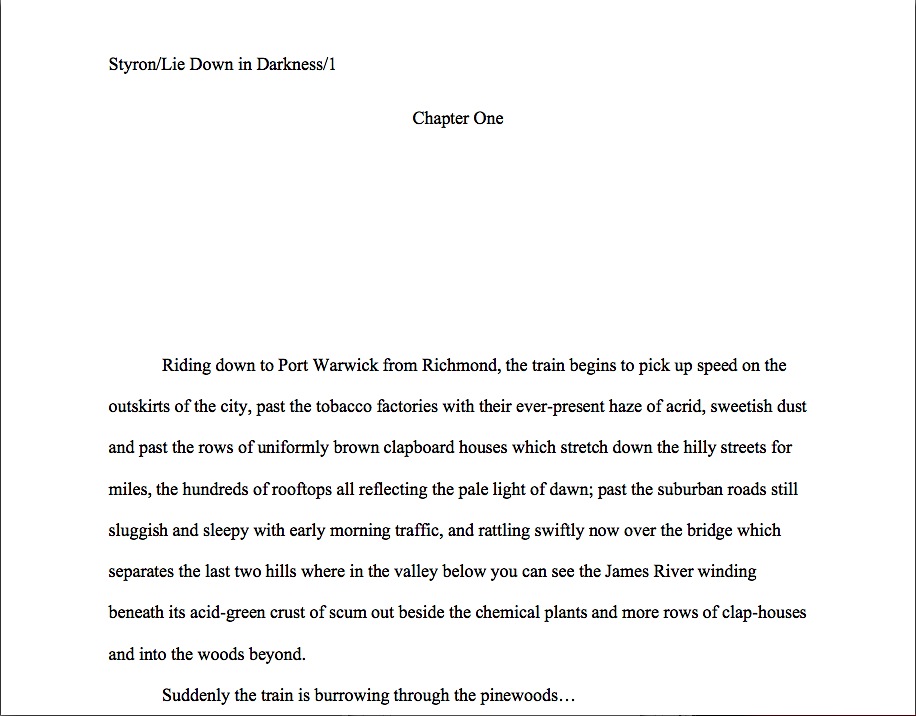
The New Year’s resolution a savvy writer definitely shouldn’t keep, or, the necromancer’s out right now, but could I interest you in a date in mid-February?

January 2nd, 2010

gazing into a crystal ball

Time for a quick poll for all of you who spent some or all of the recent holiday season hobnobbing with kith and/or kin who happened to be aspiring writers: hands up if you bumped into at least one within the last month who confided that that his new year’s resolution was — wait for it — to get those long-delayed queries out the door. Raise a hand, too, if a friendly soul astonished you by swearing that come January 1, that postponed-for-months submission was finally going to be making its way to the agent who requested it. Or that this was the year that novel was going to make its way out of that drawer and onto bookshelves everywhere.

Okay, legions with your hands in the air: keep ‘em up if you had ever heard these same writers make similar assertions before. Like, say, December of 2007, 2006, 2005, or any year before that.

I’m guessing that very few of you dropped your hands. Why on earth do we writers do this to ourselves every year?

The scourge of the New Year’s resolution, that’s why. Due to social conditioning that encourages us to believe, usually wrongly, that it’s easier to begin a new project at a time of year so energy-sapping that even the sun appears to be least interested in doing its job with any particular vim, millions of aspiring writers all across North America are going to spend the next few weeks rushing those queries into envelopes, hitting those SEND buttons, stuffing those requested materials into envelopes, and forcing themselves to sit in front of a keyboard at a particular time each day.

The predictable, inevitable, and strategically unfortunate result: for the first three weeks of January every year, agencies across the land are positively buried in paper. Which means, equally predictably, inevitably, and unfortunately, that a query or manuscript submitted right now stands a statistically higher chance of getting rejected than those submitted at other times of the year.

So again, I ask: why do writers impose New Year’s resolutions on themselves that dictate sending out queries or submissions on the first Monday of January?

Oh, I completely understand the impulse, especially for aspiring writers whose last spate of marketing was quite some time ago. Last January, for instance, after their last set of New Year’s resolutions. Just like every other kind of writing, it’s easier to maintain momentum if one is doing it on a regular basis than to ramp up again after a break.

Just ask anyone who has taken six months off from querying: keeping half a dozen permanently in circulation requires substantially less effort than starting from scratch — or starting again. Blame it on the principle of inertia. As Sir Isaac Newton pointed out so long ago, an object at rest tends to remain at rest and one in motion tends to remain in motion unless some other force acts upon it.

For an arrow flying through the air, the slowing force is gravity; for writers at holiday time, it’s often friends, relatives, and sundry other well-wishers. And throughout the rest of the year, it’s, well, life.

But you’re having trouble paying attention to my ruminations on physics, aren’t you? Your mind keeps wandering back to my earlier boldfaced pronouncement like some poor, bruised ghost compulsively revisiting the site of its last living moment. “Um, Anne?” those of you about to sneak off to the post office, stacks of queries in hand, ask with quavering voices. “About that whole more likely to be rejected thing. Mind if I ask why that might be the case? Or, to vent my feelings a trifle more adequately, mind if I scream in terror, ‘How could a caring universe do this to me?’”

An excellent question, oh nervous quaverers: why might the rejection rate tend to be higher at some times than others?

To answer that question in depth, I invite you yourself in the trodden-down heels of our old pal Millicent, the agency screener, the fortunate soul charged with both opening all of those query letters and giving a first reading to requested materials, to weed out the ones that her boss the agent will not be interested in seeing, based upon pre-set criteria. At some agencies, a submission may even need to make it past two or three Millicents before it lands on the actual agent’s desk.

We all understand why agencies employ Millicents, right? As nice as it might be for agents to cast their eyes over every query and submission personally, most simply don’t have the time. A reasonably well-respected agent might receive 1200 queries in any given week; if Millicent’s boss wants to see even 1% of the manuscripts or book proposals being queried, that’s 10 partial or full manuscripts requested per week.

Of those, perhaps one or two will make it to the agent. Why so few? Well, even very high-volume agencies don’t add all that many clients in any given year — particularly in times like these, when book sales are, to put it generously, slow. Since that reasonably well-respected agent will by definition already be representing clients — that’s how one garners respect in her biz, right? — she may be looking to pick up only 3 or 4 clients this year.

Take nice, deep breaths, sugar. That dizzy feeling will pass before you know it.

Given the length of those odds, how likely is any given submission to make it? You do the math: 10 submissions per week x 52 weeks per year = 520 manuscripts. If the agent asks to see even the first 50 pages of each, that’s 26,000 pages of text. That’s a lot of reading — and that’s not even counting the tens of thousands of pages of queries they need to process as well, all long before the agent makes a penny off any of them, manuscripts from current clients, and everything an agent needs to read to keep up with what’s selling these days.

See where a Millicent might come in handy to screen some of those pages for you? Or all of your queries?

Millicent, then, has a rather different job than most submitters assume: she is charged with weeding out as many of those queries and submissions as possible, rather than (as the vast majority of aspiring writers assume) glancing over each and saying, “Oh, the writing here’s pretty good. Let’s represent this.” Since her desk is perpetually covered with queries and submissions, the more quickly she can decide which may be excluded immediately, the more time she may devote to those that deserve a close reading, right?

You can feel the bad news coming, right?

Given the imperative to plow through them all with dispatch, is it a wonder that over time, she might develop some knee-jerk responses to certain very common problems that plague many a page 1? Or that she would gain a sense — or even be handed a list — of her boss’ pet peeves, so she may reject manuscripts that contain them right off the bat?

You don’t need to answer those questions, of course. They were rhetorical.

Now, the volume of queries and submissions conducive to this attitude arrive in a normal week. However, as long-term habitués of this blog are already no doubt already aware, certain times of the year see heavier volumes of both queries and submissions of long-requested materials than others.

Far and away the most popular of all: just after New Year’s Day.

Why, I was just talking about that, wasn’t I? That’s not entirely coincidental: this year, like every year, Millicent’s desk will be piled to the top of her cubicle walls with new mail for weeks, and her e-mail inbox will refill itself constantly like some mythical horn of plenty because — feel free to sing along at home — a hefty proportion of the aspiring writers of the English-speaking world have stared into mirrors on New Year’s eve and declared, “This year, I’m going to send out ten queries a week!” and/or “I’m going to get those materials that agent requested last July mailed on January 2!”

While naturally, I have nothing against these quite laudable goals — although ten queries per week would be hard to maintain for many weeks on end, if an aspiring writer were targeting only agents who represented his type of book — place yourself once again in Millicent’s loafers. If you walked into work, possibly a bit late and clutching a latte because it’s a cold morning, and found 700 queries instead of the usual 200, or 50 submissions rather than the usual 5, would you be more likely to implement those knee-jerk rejection criteria or less?

Uh-huh. Our Millicent’s readings tend to be just a touch crankier than usual right about now. Do you really want to be one of the mob testing her patience?

This is the primary reason, in case I had not made it clear enough over the last couple of months, that I annually and strenuously urge my readers NOT to query or submit during the first few weeks of any given year. Let Millie dig her way out from under that mountain of papers before she reads yours; she’ll be in a better mood.

How long is it advisable to wait? Well, in previous years, I have suggested holding off on sending anything to a North American agency for a full three weeks. I did not select that length of time arbitrarily: the average New Year’s resolution lasts three weeks, so the queries and submissions tend to drop off around then. Conveniently enough, US citizens get a long weekend at that point in January, the Martin Luther King, Jr., holiday, to start stamping those SASEs.

This year, I am not recommending holding off for three weeks. In 2010, I am urging every writer within the sound of my voice to hold off for six.

No, in answer to that question 33% of my readers just shouted indignantly at my screen, I have not taken leave of my senses, thank you; I am merely trying to help you maximize your query or submission’s chances of success. I have my fingers crossed, hoping madly that by mid-February — say, just after Valentine’s Day, a holiday few aspiring writers are likely to commemorate by sending roses or chocolates to Millicent, anyway — Millie, her boss the agent, her agent’s boss who owns the agency, the editors to whom the agent habitually pitches, and those editors’ bosses will have finished freaking out at the stunning news that for the first time, e-books outsold hard copies at Amazon on Christmas.

Okay, so those sales figures were just on Christmas Day itself, an occasion when, correct me if I’m wrong, folks who had just received a Kindle as a present might be slightly more likely to download books than, say, the day before. But that’s not what the headlines screamed the next day, was it? I assure you, every agency and publishing house employee in North America has spent the intervening days fending off kith and kin helpfully showing him articles mournfully declaring that the physical book is on the endangered species list. Or ought to be.

Once again, I invite you to step into Millicent’s ballet flats. She’s been hearing such dismal prognostications as often as the rest of us while she’s been off work for the past week or two. When she steps across the agency threshold on Monday, too-hot latte clutched in her bemittened hand, the Millicent in the cubicle next to hers will be complaining about how his (hey, Millicents come in both sexes) kith and kin has been cheerfully informing him that he will be out of a job soon. So will half the people who work in the agency — including, as likely as not, Millicent’s boss.

It’s only reasonable to expect, of course, that through the magic of group hypnosis, the more everyone repeats it, the more of a threat the Kindle news will seem; the scarier the threat, the more dire the predictions of the future of publishing will become. By lunchtime, half the office will be surreptitiously working on its resumes.

Given the ambient mood in the office, do you really want yours to be the first query she reads Monday morning? Or the fiftieth? Or would you rather that your precious book concept or manuscript didn’t fall beneath her critical eye until after everyone’s had a chance to calm down?

Quick disclaimer: six weeks may well not be long enough for this particular shock to pass. I am not a necromancer of any stripe; please don’t imagine that I am typing this with one hand and clutching a crystal ball with the other. I picked six weeks because, by law, US-based agencies must issue tax documentation on royalties by the end of January. Might as well wait until the stressed people have one less reason to be stressed, right?

Will another two weeks honestly make any difference? Again, I don’t have a crystal ball — but by then, those of you who each year stubbornly reject my annual admonition to eschew writing-related New Year’s resolutions will have had a nice, long chunk of time to see if you could, say, up your writing time by an extra hour per week. Or per day. Or prepared a contest entry for that literary contest you’d always meant to enter.

Far be it from me to discourage keeping that kind of resolution, whether you choose to put it into action on New Year’s Day, the fourth of July, or St. Swithin’s day. Only please, for your own sake, don’t set the bar so high that you end up abandoning it within just a couple of weeks.

If you must resolve, resolve to set an achievable goal, one that you can pull off without wearing yourself out quickly. In the long term, asking yourself to write two extra hours per week is more likely to become a habit than eight or ten; committing to sending out one query per week is much easier than twenty. Heck, if Millicent resolved to get through those masses of queries and submissions currently completely concealing her desk from the human eye, she’d fling her latte in disgust within the first hour. Steady, consistent application is the way to plow through an overwhelming-seeming task.

Okay, if I’m sounding like Aesop, it’s definitely time to sign off for the night.

Except to say: because so many aspiring writers will be acting on their (sigh) New Year’s resolutions, and thus may be relied upon to be surfing the net rabidly for sensible guidance, I’m going to take a break from self-editing issues for the next couple of weeks to deal with the absolute basics that every writer needs to know. What a query is, for instance, and why a novelist typically needs an agent. Why generic queries seldom work. How to format a manuscript.

You know, the kind of things folks in the publishing industry assume that talented writers already know. Presumably because the muses showed up next to each of our cradles and gave us the knowledge at birth. Just in case the muses are thirty or forty years behind schedule, I’m going to start filling in the gaps with Monday’s post.

Please keep those craft and revision questions, coming, though — I’m far from done talking about how to get the best out of a manuscript. Just let me get all of these New Year’s resolutions out of the way first.

As always, keep up the good work!

Am I hallucinating, or is the screen going wavy again?

December 18th, 2009

oil spill on beach

Did any of you sharp-eyed self-editors happen to catch the really, really subtle test of your conceptual editing skills cleverly concealed in yesterday’s post? Nobody left a comment about it, so I assume nobody noticed. Or perhaps those who did were merely too kind to point it out. Any guesses?

If your hand immediately shot into the air, accompanied by a vigorous cry of, “By Jove, Anne, I’m glad you brought this up; it’s been driving me mad since first I read that otherwise excellent post. It was a post on conceptual redundancy that was itself conceptually redundant. You had already lectured us about the dangers of repeating salient plot points in a post the previous week. How relieved I am to hear that you did it on purpose!” not only should you award yourself a full seventeen gold stars for the day, but you should start thinking about offering your services to your writer friends as a first reader.

You, my friend, are starting to read like Millicent the agency screener.

Or indeed, like most people who read manuscripts or contest entries on a regular basis. She and her ilk wouldn’t merely have noticed my conceptual redundancy over the course of a week; she would have been outraged by it.

“In heaven’s name, why?” scream those who currently have pages under Millicent’s critical eye. “I could see being a trifle annoyed by hearing a similar argument a week apart, but why would any sane creature have an intensely negative reaction to it?”

A couple of very sane reasons, actually. First, the Millicents of this world aren’t typically reading just one manuscript in any given day, but dozens. (Rejecting most of them on page 1 speeds up the screening process like you wouldn’t believe.) So in all likelihood, the manuscript that irritates her by repeating herself isn’t the only redundant submission she has handled that day — and certainly not that week. Conceptual redundancy is one of the more common manuscript megaproblems out there, cutting across lines of genre, book category, and the fiction/nonfiction divide.

To be fair, Millicent was probably pretty even-tempered the first fifty times a narrative assumed that she couldn’t remember basic plot elements. Around the 750th time, however, it had gotten old.

By then, too, she would probably have figured out what an experienced editor could have told her — and this is the second sane reason a professional reader might find conceptual redundancy annoying: writers quite frequently retain multiple iterations of the same point because they like the writing of each section that discusses it.

Or, as I did yesterday, because they have an illustrative anecdote that they’d really like to shoehorn into the text. (I admit it: I love the Peter Pan example.) Either way, conceptual redundancy is often a signal that some editing is needed.

You can feel your homework coming, can’t you?

Who am I to disappoint you? Here it is:

(1) Print out all or part of any pages you plan to submit to Millicent or anyone remotely like her.

You may use any part of your manuscript, of course, but as submission tend to get rejected in the early pages (thus leaving the rest unread unfortunately often), page 1 is a dandy place to start.

(2) Read through it, using a highlighting pen — say, yellow — to mark every time the text repeats the same information.

If you want to get fancy, it will make your post-exercise life easier if you take the time to make notes on a separate sheet of every time a specific repetition occurs. That list will render figuring out which iteration to keep much, much easier.

(3) Using a different color of highlighter — pink is nice — mark the first couple of paragraphs (or even the scene) that immediately follows the repeated information.

Why, you ask? Hold your horses; I’m building suspense.

(4) After you finish, go back and re-read the yellow sections. Are all of them genuinely necessary for the reader to follow what’s going on?

In answering that question, assume that the reader is of normal intelligence and average memory, but is reading your book in a single sitting. Millicent’s boss probably will read it in installments, but Millicent often will not.

(5) Go back and re-read the pink sections. Are all of them actually adding something new to the plot, characterization, or argument? Or are they included primarily because you kind of liked how they sounded?

If it’s the latter, don’t be too hard on yourself: the old writing chestnut kill your darlings was coined for a reason.

Remember, this is need not be the only book you ever write; you needn’t include every nice piece of writing that falls off your fingertips. Save something for the sequel.

(6) Be especially attentive to those pink bits in first-person narratives, memoirs — or in a real-life story told as fiction. Are these sections necessary to the story you’re telling, or are they included merely because these things happened in real life?

This is another of Millicent’s most cherished pet peeves — and this one is usually shared by her boss and the editors to whom the agent typically sells. All too often, memoirists (and novelists who write in the first person) forget that writing the truth from a sympathetic point of view is not enough to make a good book — it must also be an engaging story.

Ditto with novelists who include the real: just because something actually happened does not mean that it will necessarily be interesting to read. Or add to the storyline of a book.

Judicious cutting is especially important when writing the real. No reader, however intrigued by a premise, wants to hear about everything that ever happened to a character, any more than he wants to plow through a complete list of every object in a room where an important scene occurs. Include only what your story needs to make it shine.

Okay, that’s enough looking backward for today. Time to move ahead.

Of course, in order to do so, I’m going to need to backtrack a little first. In my last installment on self-editing, I went to town on the twin dangers of factual redundancy intended to remind readers of salient points (”As I mentioned back in Ch. 2, Maude, I stand to inherit a hefty chunk of change when my Uncle Mortimer dies.”) and screen clichés that have made their way into real life (“Say ‘ah,’” kindly Dr. Whitehairedman told the child.). As I pointed out, both species are problematic in submissions, because they are so common.

Translation: professional readers get really, really tired of seeing examples of them.

But both types of repetition also tend to be, I am happy to report, some of the easiest lines for a self-editor to identify and cut. Redundant sentences can often be trimmed wholesale, with no cost to the text at all. And clichés, like pop culture references and jokes that don’t quite work, are often digressions in a scene or dialogue, rather than integral to it. Much of the time, they can be deleted without adding any additional writing.

Which is a pretty good indicator all by itself that a line should be cut anyway, actually: if you wouldn’t miss it if it were gone, it should probably go.

Take, for instance, the following piece of purple prose, full of sentences just begging to hop into the tumbrel and ride to the guillotine. Note just how much trimming could occur without harming the relationships or plot of the scene:

Marcus Aurelius paced the room, frowning, revisiting in his mind his last encounter with Cardinal Richelieu, two months before, when they had shot those rapids together in the yet-to-be-discovered territory of Colorado. Despite hours of manly good fellowship and moments of undeniable passion, they had not parted friends. The powerful holy man was known for his cruelty, but surely, this time, he would not hold a grudge.

“Can I bum a cigarette?” Marcus asked, to buy more time to recap the plot in his head.

Richelieu laughed brutally, but with an undertone of affection. “How on earth did you pick up the habit? Tobacco had not come to Europe in your time.” He shook two out of the pack and stuck both into his mouth. “And barely in mine.”

He lit the pair and handed both to his erstwhile lover. They sat in silence for a moment, the smoke winding its way around the cardinal’s red hat and through the halo of St. Jerome, who was standing nearby.

Finally, Marcus Aurelius decided he could take this brutal wordlessness no longer. “I’ve come for some information, Armand.”

Richelieu’s hand tightened on the sawed-off shotgun that seldom left his side. “You’re wasting your time.”

“I’m not leaving until you tell me what I need to know.”

“It might,” St. Jerome suggested gently, “go a little faster if you were more specific.”

“Yes, do come to the point.” Richelieu waved a bejeweled hand toward his wall-sized TV screen. “American Idol is on in an hour.”

Tell me, how much cutting did you manage to do? Other than the obvious, that is — as a major Stoic, Marcus Aurelius clearly would not have folded so quickly under the pressure; I give you that.

But even ignoring the philosophical problems and the time travel that seems to have happened here, there’s room for some fairly painless trimming that would speed up the scene:

Marcus Aurelius paced the room, frowning. The powerful holy man before him was known for his cruelty, but surely, he could not still be holding a grudge about how they’d parted in Colorado. “Please tell me, Armand. For old times’ sake.”

Richelieu laughed brutally, but with an undertone of affection. The smoke from his cigarette wound its way around his red hat and through the halo of St. Jerome, who was standing nearby.

“It might,” St. Jerome suggested gently, “be helpful if you were more specific about what you wanted.”

“Yes, do come to the point.” Richelieu lifted a bejeweled hand from his sawed-off shotgun to wave languidly toward his wall-sized TV screen. “American Idol is on in an hour.”

That’s 123 words, down from 253, a substantial cut obtained through the simple expedient of removing the movie clichés (the double cigarette bit is straight out of the Bette Davis vehicle NOW, VOYAGER, right?) and unnecessary conceptual repetition.

How did I know, within the context of an isolated excerpt, that the references to the Colorado scene probably referred to something that happened earlier in the book? Call it well-honed editorial instinct: this kind of micro-flashback almost invariably recaps a scene told more fully elsewhere – and when it isn’t shown at some point in the book, it probably should be.

Seem paradoxical? It isn’t.

A micro-flashback usually provides one or more characters’ motivation(s) in the scene occurring at the moment: here, the earlier romantic interlude has set the stage for Marcus’ belief that Richelieu would do him a favor, as well as Richelieu’s current attitude toward Marcus. Clearly, then, this past episode is important enough to the development of both characters that the reader would benefit from seeing it in its entirety.

Which makes removing the micro-flashback from this scene an easy editorial call. To work as character development — as explanatory asides that deal with motivation must, right? — the reader really should have this information prior to the scene.

So if the Colorado rapids scene did happen earlier in the book, the micro-flashback would be redundant; if it did not, the micro-flashback is not memorable enough in itself to make a lasting impression upon the reader.

In other words: snip, snip.

Long-time readers of this blog, chant it with me now: emotionally important scenes are almost always more powerful if they are SHOWN as fully-realized scenes, rather than merely summarized. (Oh, come on — you don’t want to know what happened on those rapids?)

Keep an eye out for those micro-flashbacks, my friends: they’re often flares telling the editor what needs to be done to improve the manuscript.

In this case, the cut can only help: by removing the explanatory summary here, the author will need to make sure that the earlier scene made enough of an impression upon the reader that she will remember it by the time Marcus Aurelius comes looking for information on page 348.

Yes, even if that means going back and writing the earlier scene from scratch. Sometimes, adding a fresh scene is actually a quicker and easier fix for a manuscript that drags than merely trimming the existing text.

The metaphor that I like to use for this kind of revision comes from flower arranging, believe it or not. Listen:

Think of your draft as a wonderful bouquet, stocked with flowers you have been gathering over the last couple of years. It’s lovely, but after it has been rejected a few dozen times, you’ve come to realize that maybe it’s too big for the room in which the agent of your dreams wants to place it; it does not fit comfortably into the only vase she has.

So you need to trim it — but how? A good place to start would be to pull out half of the daisies; a few are nice, but handfuls make the daisy point a bit more often than necessary.

Then you could start searching for the flowers that have wilted a little, or are not opening as well as others. Pulling out the wilted flowers renders the bouquet both smaller and prettier – and the ones that wilt the fastest are the ones that are borrowed from other sources, like movie tropes, which tend to date a book, anyway.

Already, your bouquet is looking lighter, more vibrant, but you liked the color that some of the discarded flowers added. Rather than pulling the cast-off blooms out of the compost bin and putting them back into the vase (as most self-editors will do), adding a fresh flower here and there is often more beneficial to the overall beauty of the bouquet.

Be open to the possibility that trimming your manuscript may well mean writing a fresh scene or two, for clarification or character development. Search your manuscript for micro-flashbacks that may be telling you what needs further elucidation, as well as darlings that could be, if not killed, then at least set aside to grace another book. If you apply a truly diligent eye, you may well find that a single, well-developed scene inserted early on will replace scores of micro-flashbacks down the line.

It happens. All the time, in fact. Like a good joke, motivation goes over better with the reader if it can be presented cleanly, without excess in-the-moment explanation. Bear that in mind, please, and keep up the good work!

Trimming that overstuffed manuscript down to size

December 3rd, 2009

dorothy melting witch

Before I launch into today’s musings, here’s a heads-up for Washington writers: applications are due December 7 for the 2010 EDGE Program for Writers, sponsored by the Artist Trust. Designed to help working writers at all levels of their careers expand their professional acumen, the EDGE program provides six weeks of intensive professional development classes, including topics such as:

*professional presentation on paper, on the web and in live readings
*how to research and take advantage of funding resources and opportunities available to writers
*how to prepare a successful grant proposal and budget
*time management, goal setting and developing a brand as a writer
*how to identify key audiences and determine marketing directions for literary works
*financial management; legal issues such as copyright and intellectual
property, and working with and as independent contractors

Not to mention the ECQLC (Eye-Catching Query Letter Candy) value of winning a place in this prestigious program! For a full description and printable application, click here.

While I’m at it, a quick reminder about an ongoing contest right here on this site: there are just a few short aphorism-gathering days left in the the share your favorite inspirational writing-related quote contest. Specifically, entries will be accepted through midnight Pacific Standard Time on Sunday, December 6.

This is a fun and easy opportunity not only to share your favorite keeping-the-faith quote with the rest of the Author! Author! community, the one that keeps you going through those dark nights of the soul when the muses seem to have left the building permanently — and to win a free copy of LIFELINES: THE BLACK BOOK OF PROVERBS.

A description of the latter and substantially more encouragement to enter the contest appears here, of course, but here’s a recap of the rules:

1. Pick your all-time favorite proverb or quote about writing.

2. Figure out why you love it so much, and write a paragraph about why it inspires you. (Keep it under 100 words, please.)

3. E-mail the quote and your paragraph, along with the quote’s original source (if you know it) and your name to anneminicontest@gmail.com by midnight Pacific Standard time on Sunday, December 6th.

4. Wait in eager anticipation for me to announce the winner, when I’ll post the most stirring quotes.

There endeth the public service announcement portion of the day’s proceedings. Let’s get back to talking about revision — specifically, about how to tackle revising with an eye toward picking up the pace.

Why, some of you may be asking, might a savvy aspiring writer want to take some steps make an exciting plot — or an unexciting one, for that matter — go just a touch faster before subjecting the manuscript to the ever-critical eye of Millicent the agency screener, her cousin Maury the editorial assistant, and/or their Aunt Mehitabel, the veteran contest judge? One very, very simple reason: as Millicent, Maury, and Aunt Mehitabel are all quite aware, slow manuscripts make editors grind their teeth and agents shake their heads in sorrow.

I won’t even tell you what pacing that drags makes the celebrity judges brought in to pick the winners amongst the finalists at literary contests do; this is a family-friendly blog, after all. Suffice it to say that a story or argument that crawls along is not typically the best way to impress Millicent or any of her relatives enough to cause them to long to read the rest of the book.

Antipathy toward being bored by submissions is virtually universal amongst the professional readers of this world, yet astonishingly few writing books and seminars address the issue at all. Except, of course, to opine that for the purposes of submission, a faster read is, on the whole, better than a slower one.

That’s not a guideline; that’s an aphorism. (But not a very inspiring one. I wouldn’t recommend entering it in any contests.)

There are a couple of good reasons for this genteel avoidance of an unpleasant subject, I suspect. First, editing for length and pace is an unpleasant subject for contemplation where dear self is concerned, isn’t it? I don’t know about you, but most of the writers of my acquaintance (including, I’ll admit it, yours truly) get kind of annoyed when an agent or editor says, “I absolutely love your writing! How about giving us 15% less of it?”

Or, to take what used to be a stock agents’ pronouncement a decade ago, when we were all flatly told that a first novel should be no more than 100,000 words, regardless of what might actually work best for the text. (That’s 400 pages in Times New Roman, by standard estimation techniques; if you don’t know how to estimate word count, or why any sane person would want to do so when MS Word will simply tell you how many words are in a manuscript, please see the opaquely-named WORD COUNT category on the archive list at right. ) The truism on the subject has become a little more lax in the past couple of years, thank goodness: now, pronouncement-mongers tend to say anywhere between 80,000 (320 pages) to 120,000 (480) is usually fine.

Unless you happen to be submitting to someone who thinks it isn’t. To be on the safe side, I’d try to keep it as closer to 100,000 than 120,000, unless you happen to be writing in a book category where longer is routine; above 500 pages or so, printing costs leap dramatically.

As someone who attends quite a few writers’ conferences in any given year, I, for one, was pretty darned relieved when the wisdom du jour changed. During the arbitrary 100,000 period, I always hated that inevitable moment when someone stood up at the agents’ forum and asked how long was too long for a manuscript. The air of gloom that descended upon the room at the reply was palpable.

As much as I object to arbitrary standards – 125,000 words strikes me as less arbitrary, because binding costs do get higher at that point – I have to say, like most of us who edit for a living, I’m a fan of the tightly-paced manuscript. I practice what I preach, too: in the novel currently in my agent’s hands, I cut 20 pages entirely through eliminating individual lines.

So believe me, I feel your pain, self-editors. But like most people who read manuscripts by the score, that doesn’t mean that I don’t start muttering, “Get on with it, already!” when a plot begins to drag. Sorry.

The second reason I think the issue of manuscript-tightening doesn’t get much attention in conference classes, writing seminars, and publications aimed at writers is that just as it’s genuinely difficult to say with any precision how long a book one has never read should be, it’s also hard to give general advice about pacing that applies to every single manuscript that might conceivably fall off a gifted writer’s fingertips onto a keyboard.

Every writer has different ways of slowing down or speeding up text. Which is precisely why it’s so vitally important to examine your own manuscript to learn what yours are.

You can feel me about to ask you to do something, can’t you? Don’t worry — it won’t be too painful; I’m not going to ask you to kill your darlings, at least not today.

Why in heaven’s name not, as writing teachers all over North America have been shouting at their students to axe their favorite bits of prose since practically the moment the classic piece of advice fell out of Dorothy Parker’s well-rouged lips sometime during Prohibition? Well, in my experience, most talented writers — published and as-yet-to-be-published alike — actually have a pretty good sense about the little things that shine in their manuscripts.

You know what I’m talking about, right? Those telling little details that bring joy to the eyes of agents, editors, and contest judges everywhere when they appear nestled in a manuscript – particularly on the first page of the text, where they act like miniature neon signs reading, “Hello? This one can WRITE!” causing Millicent to sit up straight for perhaps the first time that screening day and cry, “By gum, maybe I should NOT toss this one into the rejection pile.”

As lovely as eliciting this reaction is, there is more to catching a professional reader’s attention than a charming and detailed first page, I’m afraid. Of course, it’s a necessary first step to that reader’s moving on eagerly to the second, and the third, and so forth. But an initial good impression is not enough, however much writing teachers emphasize the importance of including an opening hook: in order to wow an agent into asking to see the entire manuscript, or into reading the entirety of the one you’ve already sent, the impressive writing needs to continue consistently throughout.

Was that chill I just felt the cumulative effect of all of you first page-perfecters out there going pale? “I just spent eight months on my first five pages,” I hear these wan wraiths stammer. “If I brought the entire book to that level of polish, I would need to live to be 112. I doubt that I’ll still be up to a book tour by then.”

I hate to be the one to tell you this, oh pale ones, but most writers revising for submission stop the high-gloss treatment far too soon. Around page 50, on average, because we’ve all been told that’s the first chunk an agent will ask to see.

The result is a whole lot of manuscripts that raise tremendous expectations in screeners’ breasts — only to lapse into what is fairly obviously less worked-upon writing around page 52. It’s so common a phenomenon that professional readers have a pet name for it: sagging in the middle.

While it is true that having brilliant early pages is one of the best calling cards a book can have, consistency is a far more appreciated writerly skill than writing advice-givers tend to admit. (And before the quote-mongers who emblazon famous thoughts on calendars start shouting that consistency is the hobgoblin of little minds, let me remind you that the early part of the quote is almost always omitted: the original read, “A FOOLISH consistency is the hobgoblin of little minds.” Just in case anyone has proverbs on her mind or anything.)

Here are some facts to chill creative blood: while the vast majority of submissions are in fact rejected prior to page 5, with a hefty percentage dismissed by Millicent before the bottom of page 1, a book’s audition period can — and generally does — go on for most of the manuscript. An excellent agent of my acquaintance, for instance, tells me that he reads the first 185 pages of any manuscript he is considering actively looking for reasons to reject it. Beginning on page 186, he is looking for reasons to ACCEPT it, because he’s already invested so much time in it.

So, naturally, whenever I meet a writer who is planning on querying him, I say, “Psst! Make sure your pp. 150-200 are magnificent!”

Why might a professional reader toss aside a book after having loved it for, say, 190 pages? Usually, a lack of consistency in the writing: great writing early in the book raises expectations for the writing later in the book, necessarily. In the industry, a book that achieves this difficult feat is declared to have lived up to the promise of its first chapter.

Naturally, this is a little unfair, but after one has read approximately 7 million early chapters chock-full of telling little details, one has generally become resigned to seeing their frequency diminish later in the text – but not like it. It’s kind of a letdown, like when that the terrific conversationalist with whom you had three great dates blurts out on Date #4 a glowing paean to a politician whom you have considered for years at best a corrupt megalomaniac.

We’ve all been there, I’m sure.

I must admit it: as an editor, once I have seen evidence that a writer possesses the twin gifts of observation and the ability to handle detail deftly, I have been known to mutter angrily at the manuscript before me, “You’re a better writer than this! Give me your best work!”

So now that I have scared you to pieces about the importance of consistency, how can a revising writer tell if, say, the proportion of telling little details falls off throughout a manuscript enough to start enough to displease a professional reader’s eye?

Glad you asked. Try this experiment:

1. Print out three chapters of your manuscript, the first, one from the middle, and one toward the end of the book.
Don’t use the final chapter; most writers polish that one automatically, doubtless the effect of our high school English teachers making us read the final pages of THE GREAT GATSBY so often.

2. Make yourself comfy someplace where you will not be disturbed for a few hours, and start reading.
Easier said than done, of course, especially for those of you with young children gladdening your daily lives, but this isn’t relaxation: this is work. So don’t you dare feel guilty about taking the time.

3. While you are reading, highlight in nice, bright yellow every time the narrative gives information about a character in summary form.
I’m deadly serious about this. Mark everything from Angelique felt envious to Georgine was a shop welder of immense proportions to “Edward was a compassionate soul, drawn to injured children, limping dogs, and soup kitchens.”

4. Now use a different color of pen — red is nice — to underline any character-revealing information that the narrative conveys indirectly, through specific detail or speeches that demonstrate a characteristic or an environment that is reflective of a character’s internal mood.
Remember, you are not judging the quality of the sentences here — what you are looking for are passages that encourage the reader to draw his or her own conclusions about what the character is like. To revisit the trio from above, red-marked sentences might include:
Unable to contain herself, Angelique surreptitiously poked her rival with a pin

or Georgine’s broad shoulders barely fit through the doors to her metal shop

or even Edward was late for work again, having been sidetracked by a child’s scraped knee, a search for the same little girl’s lost cocker spaniel, and the absolute necessity to track down and fund the homeless person he had been forced to overlook yesterday because he’d already given away the last dollar in his pocket.

Beginning to see some patterns here? Good.

5. Now that you’ve identified these different species of sentences, double-check immediately before and after the indirect indicators in red for summary statements telling the reader precisely how these dandy little details should be interpreted.
Such summaries tend to lurk in their environs. When you find them, ask yourself, “Self, is this summary absolutely necessary here, or does the indirect statement cover what I wanted to say? Could it in fact be cut, and would the manuscript be both shorter and better for it?”

Applied consistently, this question can strip a lot of unnecessary verbiage from a manuscript relatively painlessly. It’s a good strategy to know, because it’s often difficult for a writer to notice redundancy on a page he has written himself — from a writerly perspective, saying something in two different ways often just looks like creative emphasis.

Or — and this is more common — we may not trust the reader to draw the correct conclusion from the more delicate indirect clues, and so rush to provide the logical extrapolation. But readers are pretty smart, especially those lovers of good writing who dote on telling little details.

Okay, I need to sign off for today, but please don’t throw those marked-up pages away: I have more plans for them — and their little dog, too.

Yes, going through your manuscript with a fine-toothed comb is a whole lot of work, but believe me, when your book is on the uphill side of page 185, and the agent of your dreams is trying to decide whether you have the consistency of style to pull off an entire book, you’ll be very, very glad you bought those marking pens.

Maybe you should ask the Furtive Non-Denominational Gift-Giver to sneak some more into your stocking later this month. Keep up the good work!
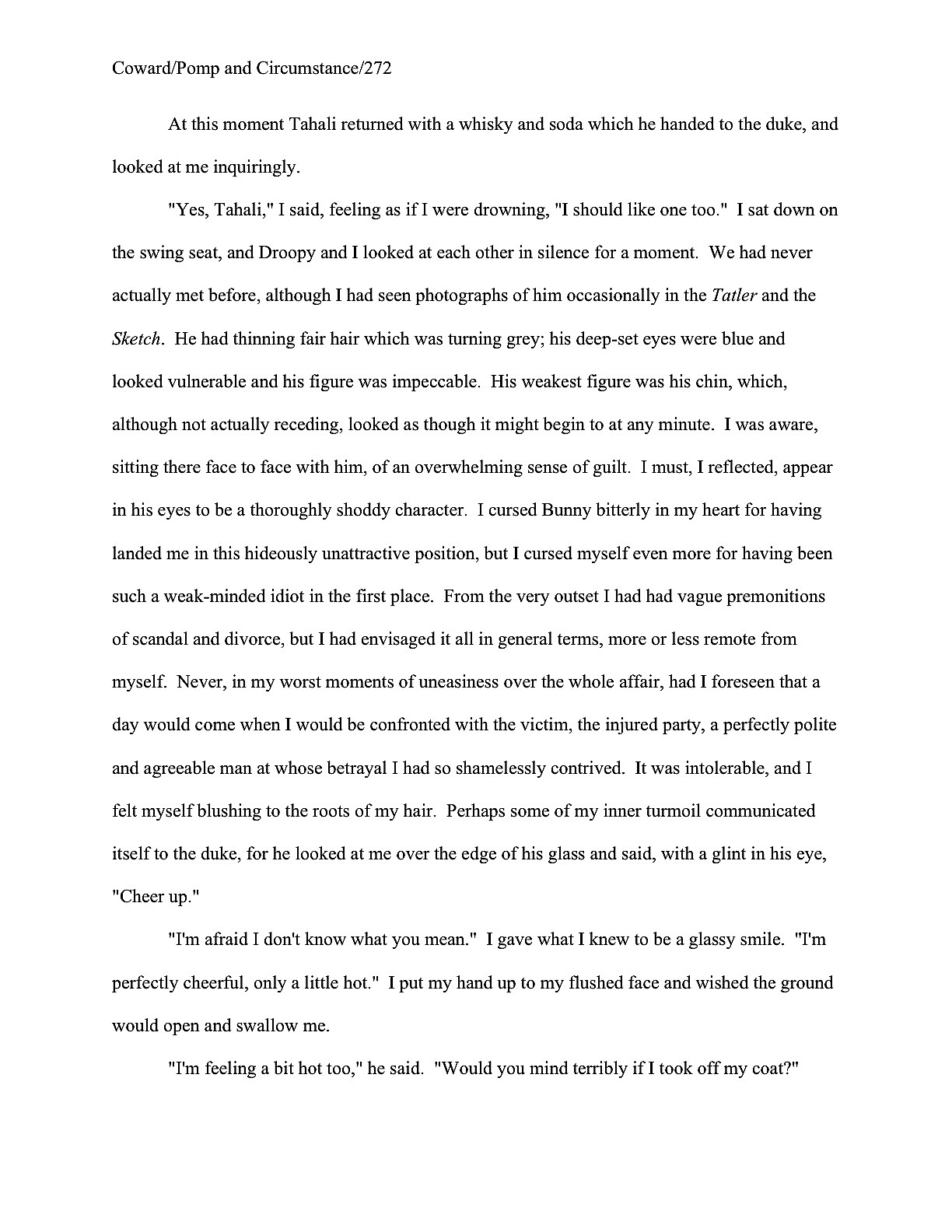
The chapter of forgotten moods, or, a few thoughts on submission and the passage of time

November 11th, 2009

I read in the paper this morning that only one American veteran of the War to End All Wars — World War I’s armistice is why there’s no mail delivery today, in case any of you stateside had been wondering; it’s also why the banks are closed and all of those mattresses are on big, big sale — was still alive and kicking. He’s 108 years old.

And I’ve been steeped in the life literary for so long that my very first thought was, “Gee, I wonder if anyone’s approached him about dictating a memoir. I could practically write the book proposal off the top of my head!” rather than, “How nice that he’s gotten to see so many Veterans’ Days go by; I wonder if he was annoyed when they changed it from Armistice Day,” or even “Gee, sir, thank you for helping show the world that trench warfare was a really, really stupid idea.”

Fair warning: this could happen to you, too. Just keep on writing those books.

My father was a child during WWI (no, I’m not that old; he was when he had me); he recalled the day when the local doughboys came home. He would tell vivid anecdotes about watching protest marches in the streets, rationing, how his mother’s views on military service varied markedly as her only son approached draft age.

It was from him, and not from my school’s history books, that I learned that here in the States, it had been quite an unpopular war; years later, it was his stories of the home front that I would contrast with H.G. Wells’ brilliant 1916 description of the British home front, MR. BRITLING SEES IT THROUGH. (In case you missed my oh-so-subtle plug for it above, here goes: if you’ve never read it and are even remotely interested in how human beings respond to their countries’ being at war, you might want to have the Furtive Non-Denominational Gift-Giver* add it to his list for you this year. I just mention.)

I love this book — and not just because it’s a genuinely thoughtful, well-written work by an author whose non-science fiction writings have since his death fallen into undeserved obscurity. Which is a bit surprising, since Wells’ social novels were so very popular around World War I.

How steep has his plummet from notice as a mainstream novelist been? Well, let me ask you: were you aware that he coined the phrase the war to end all wars?

MR. BRITLING SEES IT THROUGH is also one of the great examples of why write what you know is often such great advice. What writer living in wartime — and when aren’t we all? — would not resonate with a paragraph like this:

The battle of the Marne passed into the battle of the Aisne, and then the long lines of the struggle streamed north-westward until the British were back in Belgium failing to clutch Menin and then defending Ypres. The elation of September followed the bedazzlement and dismay of August into the chapter of forgotten moods; and Mr. Britling’s sense of the magnitude, the weight and duration of this war beyond all wars, increased steadily. The feel of it was less and less a feeling of crisis and more and more a feeling of new conditions. It wasn’t as it had seemed at first, the end of one human phase and the beginning of another; it was in itself a phase. It was a new way of living. And still he could find no real point of contact for himself with it at all except the point of his pen. Only at his writing-desk, and more particularly at night, were the great presences of the conflict his. Yet he was always desiring some more personal and physical participation.

Not that why write what you know is as self-explanatory and all-encompassing a piece of advice as many writing teachers seem to think. As those of you who have been hanging around Author! Author! for a good, long while are already aware, I’m no fan of one-size-fits-all writing advice — beyond the basic rules of grammar and formatting restrictions, of course. What works in one genre will not necessarily work in another, after all, nor are the stylistic tactics that made ‘em swoon in 1917 or 1870 particularly likely to wow an agent or editor now.

Doubt that, all of you Dickens-huggers out there? Okay, I dare you: try submitting the paragraph above to an agent or editor now. Even if it actually made it onto an agent’s desk — if, that is, Millicent the agency screener didn’t reject it out of hand for the repetitive word use, over-employment of the passive voice (pretty much universally regarded as bad writing in submissions now), and misuse of the semicolon (by definition, a semicolon followed by and is redundant, since a semicolon is implicitly an abbreviation for comma + and) — the sheer number of semicolons within this short paragraph would automatically raise both eyebrows and questions about the intended target audience. If the book in question were, say, a mainstream novel rather than literary fiction or an academic book, all of those semicolons would seem, well, a bit much.

But then, in Wells’ day, novelists had the luxury of being able to write about current events in the reasonable expectation that the book would be in readers’ hands before today’s headlines were distant memories. He was able to write about the home front while the war was still going on — and not merely as a journalist.

Now, journalists, politicians, and academics who have studied the field for twenty years are generally the only ones who can reliably pitch a book on what’s happening right now socio-politically with success — and even then, only as nonfiction. Partially, this is a matter of platform (if you write any kind of nonfiction whatsoever and don’t know what that is, run, don’t walk to the PLATFORM category on the archive list at the lower right-hand side of this page), but it’s also a symptom of how much longer it takes to get a book into print.

Not only after it’s written and found an agent, but thereafter.

How much longer, you ask with fear and trembling? Well, let’s assume that the manuscript is already absolutely clean (the professional term for completely free of typos and other errors; few submissions are completely clean, despite my perpetual nagging in this forum) and the agent is completely happy with it (also rare for a submission; agents often request extensive revisions before sending anything out). The agency will almost certainly have a backlog of manuscripts ready to go, so yours will have to wait its turn.

When its time does roll around, the agent may send out anywhere from one to a dozen copies to different editors, depending upon the agency’s preferred submission policy. If it’s a single submission, the agent will wait until she hears back from the editor before sending out the next; if she’s chosen to make multiple simultaneous submissions, she may send out a copy to another editor when a rejection arrives.

Or she may not; my agency, for instance, does submissions in waves, pausing sometimes six months before sending out the next set of manuscripts to the next set of editors. This is not at all an unusual practice.

Take a nice, deep breath. You’ll feel better.

So it’s fairly common for an agent to be circulating a manuscript, even a very good one, not to sell it for a year, year and a half, two. That’s an awfully long time, if any portion of the book’s market appeal relies upon relevance to current events; it’s not altogether surprising, then, that agents so often tell aspiring writers of up-to-the-minute stuff that the book will be dated too quickly to render marketing it worthwhile.

Why, you ask? Um, are you sitting down?

Comfy? Here goes: even if the manuscript in question was absolutely timely when it was written, and remains absolutely timely a year or two later, when the agent manages to sell it to an editor at a publishing house, to remain relevant, the same world conditions will have to prevail a year or more later, when the book actually becomes available for sale to readers.

This is one reason, in case any of you submitters have been wondering, that writers who go batty if an agent who requested a manuscript doesn’t respond right away strike the pros as potentially difficult to work with: the agented life is largely one of waiting for something to happen. So if a writer walks into it expecting that everyone who comes in contact with his manuscript will instantly drop everything else in order to read it, he’s going to expend HUGE amounts of energy feeling his work is being ignored.

It isn’t; the process just takes a while.

And that — phew! — brings me back to my overarching topic du jour, the passage of time in the submission process. I’ve been meaning to get back to it for a while, since I receive so many private questions about it. (Why private? Beats me. For some reason that defies understanding from my side of the agent-landing process, I very frequently receive e-mailed questions from submitters who are absolutely convinced that no other aspiring writer in North America has ever been in their particular situation — or so I surmise from the fact that so many of them are unwilling to post the questions here, lest an agent recognize the situation.) For the next few weeks, however, I’m going to be tackling that backlog of readers’ questions, so let’s launch right into it.

A periodic reader who, for reasons best known to himself, has requested anonymity, has brought up the perennial issue of turn-around times on submissions. Since I know that many aspiring writers share his concerns, I have changed the identifiable information to preserve the secret identities of both author and agent:

Agent Pablo Picasso (how’s that for an undetectable pseudonym?) requested the full manuscript and I sent it three weeks ago. How long should I wait for him to make contact? Is it all right for me to call? I don’t want to pressure him, but I am desperate to move forward with the project. Oh, the anxiousness. Ah, the sleepless nights. I have never wanted anything more than to be a published author…

I know there are no set timelines for responses and such, but roughly how long should I wait before moving on?

Here’s the short answer, Mystery Reader (another undetectable cover): don’t even think about following up for 6-8 weeks (or at least a week past the agency’s stated turn-around time, and when you do, DON’T CALL; e-mail or write.

In the meantime, Mysterious One, you should most definitely be moving on now: get back to your writing projects. You might even consider sending out a few more queries, just in case. And if any other agent has requested materials, you should already have sent them.

Well, that cleared everything up, didn’t it? Moving right along…

Just kidding. On to the long answer: three weeks is most definitely not a long time to wait for a response from an agent on a submission. I would be extremely surprised if you heard back in under a month. But if ol’ Pablo didn’t give you a timeframe in the request for materials (as many agents do), 6-8 weeks is average.

I can feel heart rates rising all over the English-speaking world. “But Anne,” those of you either on the cusp of sending out manuscripts or waiting breathlessly to hear back from agents protest, “Mystery Reader said that Pablo Picasso asked for the full manuscript — that must mean he was really, really interested, right? Surely not hearing back indicates that he’s lost interest, right?”

Actually, not necessarily, and not even probably. What not hearing back generally means is either (a) nobody at the agency has read it yet, (b) it hasn’t made it past Millicent, or (c) it did make it past Millicent, but the agent hasn’t had time to get to it.

Don’t pull that long face; it’s nothing personal. Long-time readers, pull out your hymnals and sing along with me: because a request for pages does not equal a promise to drop everything the second those materials turn up at the agency.

Like so many other aspects of the biz, an agent requesting materials will expect a serious aspiring writer to be familiar enough with the biz to be aware of that. Consequently, badgering an agent interested in your work will definitely NOT get him or her to read faster — in fact, it sometimes produces the opposite effect — it is not a good course to pursue. Most agents will regard follow-up calls or too-soon e-mails as a sign that the prospective client does not understand how the business works.

Which is not an impression you want to give an agent you would like to sign you. Why? Well, it tends to translate, in their minds, into a client who is going to require more attention at every step of the process. While such clients are often rewarding on many levels, they are undoubtedly more expensive for the agency to handle, at least at first.

Think about it: Pablo Picasso, like every other reputable agent in the country, makes his living by selling books to publishing houses. This means a whole lot of phone calls, meetings, and general blandishment, all of which takes a lot of time, in order to make sales.

So which is the more lucrative way to spend his time, hard-selling a current client’s terrific novel to a wavering editor or taking anxious phone calls from a writer he has not yet signed?

Uh-huh. Trust me, Pablo Picasso (too obvious a pseudonym?) already knows that you want to be published more than anything else in the world; unfortunately, telling him so will not impress him more.

How does he know Mystery Writer’s innermost feelings? Because he deals with writers all the time — and this is such a tough business to break into that the vast majority of those who make it to the full-manuscript request are writers who want to be published more than anything else in the world.

Mystery Reader, you will be a much, much happier human being if you bear this in mind. I can assure you that an agent who receives 800 or 1000 queries per week from glorious dreamers does not have the luxury of forgetting it.

You’re certainly not alone in thinking of your query or submission as if it emits a come-hither glow in the agency’s mail room, however. The average aspiring writer, bless his or her heart, tends to forget that the dream of publication is a fairly common one — thus that huge volume of queries through which Millicent sifts five days per week, each of which is presumably from someone who yearns for publication.

Let’s face it, querying and submission are FAR too hard on the heart (not to mention the wrists) to keep doing if you don’t want success that much, right?

The very intensity of the longing can sometimes blur an aspiring writer’s view of the agent-finding process — or indeed, the period when one’s agent is shopping one’s book around to editors. Even the most successful author’s career is stuffed to the gills with periods when s/he can do nothing but wait.

And as anyone who has ever been a teenager with a crush can tell you, every minute devoted to waiting for the phone to ring, for That Special Someone to declare his intentions, is eighteen times longer than a normal minute. Nothing extends a second like not having someone else determine what’s going to happen to you at the end of it.

This is precisely Mystery Reader’s dilemma, I’m afraid. All you can do is wait — at least for 6 weeks or so, or (to trot out my favorite rule of thumb) for twice the turn-around time the agency has listed in an agency guide blurb or on its website.

Which is yet another reason that a prudent submitter should always double-check the agency’s own guidelines before submitting materials. Why? Long-time readers, chant it with me now: there is no hard-and-fast rule that may be applied to every agent at every agency, every time.

This information is usually easily available either on the agency’s website or its listing in one of the standard agency guides. And if either of those sources say anything along the lines of Please do not contact us to make sure we received your materials or We do not respond to submissions that do not interest us, do not even consider waiting around until you hear back from them.

Because you may not.

Before anyone starts pouting about it: yes, it would be much, much simpler for aspiring writers everywhere if each and every agency on the face of the earth agreed to adhere to a single standard for turn-around times, but the fact is, there is no incentive for them to do so. Quite the opposite, in fact: a TREMENDOUS amount of paper passes through the average agency’s portals, and yours is almost certainly not the only full manuscript requested by Señor Picasso within the last couple of months. Yours goes into the reading pile after the others that are already there — and if that feels a little unfair now, think about it again in a month, when a dozen more have come in after yours.

And how long it will take our pal Pablo to make his way through that queue can vary not only from agency to agency, but month to month, or even week to week. One day’s workload for an agent may be quite different from another, and it’s not as though a really successful agent will have inviolable reading times built into his work schedule.

In fact, many agents read submissions not at work, but in their off hours. In all probability, yours will not be the only MS sitting next to his couch. Also, in a big agency like Picasso’s (he happens to be an agent I know), it’s entirely possible that before it gets to the couch stage, it will need to be read by one or even two preliminary readers.

Again, all that takes time.

In the meantime, though, you are under no obligation not to query or follow up with any other agent. (See earlier comment about the advisability of sending out a few queries now.) That, too, is SO easy for an excited writer to forget: until you sign an agency contract, you are free to date other people, literarily speaking. And you should.

Really. No matter how many magical sparks there were between the two of you at your pitch meeting, even if Picasso’s venerable eyes were sparkling with book lust, it honestly is in your best interest to keep querying other agents until he antes up a concrete offer. Until that ring is on your finger, keep playing the field.

And where does that leave Mystery Reader in the meantime? Waiting by the phone or mooning by the mailbox, of course. It’s hard to act cool when you want so much to make a connection. Yes, he SAID he would call after he’s read my manuscript, but will he? If it’s been a week, should I call him at the agency, or assume that he’s lost interest in my book? Has he met another book he likes better? Will I look like a publication-hungry slut if I send an e-mail after three weeks of terrifying silence?

Auntie Anne is here to tell you: honey, don’t just sit by the phone; you are not completely helpless here. Get out there and date other agents, so that when that slow-reading Picasso DOES call, you’ll have to check your dance card.

Of course, if another agent asks to see the manuscript, it is perfectly acceptable, even laudable, to drop Mr. Picasso an e-mail or letter, letting him know that there are now other agents checking out your work. For the average agent, this news is only going to make your work seem all the more attractive.

See? I told you it was just like dating in high school.

Even after 6-8 weeks has elapsed, e-mail, instead of calling. The last thing you want is to give the impression that you would be a client who would be calling three times per week. Calling is considered a bit pushy, and it almost certainly won’t get your work read any faster — unlike, say, an e-mail that mentions politely that there is now another agent reading it.

And yes, Agent #1 WILL want you to tell him that immediately. Over and above that, though, all you can do is (sing it out now) WAIT.

Another great reason to keep querying and submitting while Agent #1 is taking his own sweet time getting back to you is the increasingly common phenomenon I mentioned above, agents not responding to queries or even submissions at all. Within the last few years, literally dozens of very talented writers of my acquaintance have had manuscripts out to agents for four, five, or even six months without any response. Requested materials.

This places the writer in a quandary, of course, because from the other side of the country (or the world), how on earth is it possible to tell the difference between a delay caused by a submission’s sitting on an agent’s coffee table, holding up take-out cartons until she has time to read it, one that springs from an unannounced rejection, and one triggered by the manuscript’s having gotten lost in the mail?

For this reason, I used to advise my clients and students to include a self-addressed, stamped postcard with every submission, along with a request in the cover letter (you HAVE been including cover letters with your submissions, haven’t you?) that Millicent would write the date it arrived upon it and pop it in the mail upon opening the packet of requested materials. I historically, this works far, far better than asking for e-mail confirmation, since complying requires far less effort on the part of agency personnel.

Hey, they’re busy. Have you seen that stack of manuscripts Pablo has to read through?

The USPS now offers a much less obtrusive option for making sure your manuscript arrived where it should, and when: Track & Confirm. For a negligible fee, you can receive an e-mail confirming delivery of your package, without anyone at the agency’s having to lift a finger to inform you of it.

Unfortunately, there’s no similar service for e-mailed submissions — and since many agencies that accept e-mailed queries and submissions specifically request in their guidelines that writers not follow up to ask if materials were received. Yet another reason that given the choice, I would always opt for a hard copy submission over an electronic one.

What you SHOULDN’T do whilst waiting for a reply is waste your energy constructing a vivid justification for why the agent of your dreams has not yet gotten back to you — an exercise in creative fantasy in which I’ve seen aspiring writers starting mere hours after dropping the submission into the mail.

Trust me, it won’t help your chances; it will only enervate you.

Let me preemptively take the wind out of the sails of the most common of these middle-of-the-night musings: if you haven’t heard back, it’s not because the agent thinking about it or wants to talk with every other employee in the agency before talking it on; it’s because he hasn’t read it yet.

See why most agents get a bit defensive if a writer calls, demanding to know why it’s taking so long? Much like, if memory serves, teenage boys.

Oh, how I wish we had all outgrown that awkward stage.

Try to think of a slow response in positive terms. At many agencies, a submission has to make it past more than one level of Millicent before making it onto the agent’s desk at all — and yes, Mystery Reader, that’s usually still true even if one has met the agent at a conference. If Millie #1, Millie #2, or the agent had taken a dislike to your manuscript, it would have been stuffed into the SASE right away. (See why it’s fairly safe to assume that if you haven’t yet heard back, it hasn’t been read?) Rejections tend to be quicker than acceptances.

I know that this isn’t exactly the answer you wanted, Mystery Reader, but please, try to chill out for the next month or so. Get working on your next book, because if this goes through, you will want to have it well in motion. Keep approaching other agents, because it can only be good for you if several are clamoring to represent you.

And be very, very proud of yourself for getting to the point in your writing that an agent as prestigious as Pablo Picasso WANTS to read the whole manuscript. He doesn’t ask just anybody on a date, you know.

Believe it or not, if you’re successful in submission, the anxiety of waiting will become almost routine, just one of the many swiftly-alternating moods of the working writer’s career. Try to be patient, and keep up the good work!
* For the benefit of those of you who weren’t reading this blog regularly throughout holiday seasons past, the Furtive Non-Denominational Gift-Giver (FNDGG) is a jolly elf who regularly graces this page in the winter months, ho, ho, hoing his way toward the end of the year. Better not pout, better not cry — and better get used to hearing about him, because he’s bound to keep cropping up in the months to come.

How to write a really good author bio, part V: all of the things you are — and some great news about a good author!

October 16th, 2009

Deborah Heiligman cover

Before I launch into today’s course of our ongoing banquet on author bios, let’s give a great big Author! Author! cheer for Deborah Heiligman. Why is applause in order, you ask? Her excellent Charles and Emma: The Darwins’ Leap of Faith (Henry Holt) has just been nominated for the National Book Award in the notoriously competitive Young People’s Literature category.

Well done, Deborah!

I love it when an author who has been doing good work for a long time gets nominated for this type of award — and not only this one, either. CHARLES AND EMMA also made it onto a lot of 2008 best lists: it’s a New York Times Editors’ Choice, a Book Links Top Ten Biographies for Youth, a Booklist Top 10 Romances for Youth, and received starred reviews in Publishers Weekly, Horn Book, and Booklist, among others. Here’s the publisher’s blurb:

Charles Darwin published The Origin of Species, his revolutionary tract on evolution and the fundamental ideas involved, in 1859. Nearly 150 years later, the theory of evolution continues to create tension between the scientific and religious communities. Challenges about teaching the theory of evolution in schools occur annually all over the country. This same debate raged within Darwin himself, and played an important part in his marriage: his wife, Emma, was quite religious, and her faith gave Charles a lot to think about as he worked on a theory that continues to spark intense debates.

Deborah Heiligman’s new biography of Charles Darwin is a thought-provoking account of the man behind evolutionary theory: how his personal life affected his work and vice versa. The end result is an engaging exploration of history, science, and religion for young readers.

In addition, I now notice, she has a terrific, eye-catching author bio and one of the best author photos I’ve ever seen, or at any rate, one of the most content-appropriate. I don’t want to spoil the picture’s surprise, but here’s her bio:

Deborah Heiligman has published nearly thirty books to date on subjects ranging from bees to babies, chromosomes to Christmas, Darwin to Diwali, metamorphosis to mathematics, including From Caterpillar to Butterfly, the Celebrate Holidays Around the World series and Cool Dog, School Dog. In addition, she’s written for numerous publications including The Los Angeles Times, Philadelphia Inquirer, Ladies’ Home Journal, Sesame Street Parents Guide, Parents Magazine, and Los Angeles Times among many others. She is married to Jonathan Weiner, winner of a Pulitzer Prize for The Beak of the Finch, lives in New York City, and shares her thoughts on writing, the environment, and more on her blog.

Makes her sound quite interesting, doesn’t it? Packed with professional credentials, but not dry at all. What a remarkable coincidence — we were just talking about the difference between professional and stuffy yesterday, weren’t we?

So redoubled kudos to Deborah for providing us with a good example. Before I move on with today’s business, I would also like to add: her website has some really good research tips for kids writing term papers, as well as advice for aspiring YA writers. CHARLES AND EMMA is available on Amazon, or, for those of you who prefer to deal with an indie bookseller, Powell’s.

Back to the business at hand: making yourself sound fascinating. Over the course of this series, I have, I hope, impressed upon my readers the importance of making your author bio as entertaining as possible. In case I have by some chance been too subtle, allow me to reiterate:

Regardless of how many or few bona fide publishing credentials may grace your résumé, aim for constructing an author bio for yourself that is MEMORABLE, rather than simply following the pseudo-professional norm of turning it into a (YAWN!) list of cold, starkly-mentioned business and educational facts.

Yes, I said pseudo-professional; because droning lists are so very common, unless one’s life achievements happen to include very high-profile events (earning a Ph.D., winning an Academy Award, being elected President of the United States, that sort of thing) or previous book publications (don’t have a joke for that one; sorry), the professional reader’s eye tends to glaze over whilst perusing them.

So what should you do instead, you whimper?

Precisely what the admirable Ms. Heiligman did in the example above: have your bio reflect your personality, and the book’s personality as well. It needs to show two things: that you are an authority with a background that makes you the perfect person to write this book, and that you are an interesting, engaging person with whom publishers might like to work — and whom readers would like to know.

Piece o’ proverbial cake, right? Well, no, but certainly doable, if you realize that the goal here is not just to hand Millicent the agency screener your CV, but to cause her to rush into her boss’ office, exclaiming, “You’re not going to BELIEVE this writer’s background!”

Yes, yes, in answer to what all of you query-weary cynics out there just thought so loudly, it is indeed entirely likely that her boss’ response will be some rendition of, “Gee, Millie, is it anything out of which we could conceivably cobble a platform for a nonfiction book?” — not necessarily the ideal reaction if one happens to be, say, a novelist, admittedly. Before you get all huffy at the idea of being pigeonholed before your time, let me ask you this: isn’t any reason someone who works at the agency of your dreams becomes excited about you good for your book’s prospects?

(Just to shatter the cherished illusions of any of you who still harbor any about the way agencies work, a successful submitter IS going to get pigeonholed, whether s/he likes it or not. Absolutely no point in trying to avoid it. The publishing industry thinks in book categories, which inevitably means shuffling even the most complex and genre-busting writers’ work into a conceptual box. This is a sad reality with which all of us pros who like to category-surf have to contend eventually, so you might want to beat the Christmas rush and get started on it now.

And if anything I said in that last paragraph caused you to think indignantly, “Well, they’ve obviously never seen anything like my historical multicultural Western romantica fantasy classic before — but by gum, they’re not going to make me pick just one!”, I implore you from the bottom of my heart to scroll down the category list at the right of this page, find the BOOK CATEGORY section, and read every post in it at least twice before you even THINK of querying your masterwork. Trust me on this one.)

Fingers have been drumming next to keyboards for quite some time now, I fear. “I GET it, Anne,” those of you just busting to get on with writing your bios already mutter. “I don’t fear being interesting, and primal screaming has done wonders to reduce my inherent hostility to describing my book in just one or two words. And believe me, I’m not in a position to bore Millicent with lists of my publishing credentials. Where on earth should I begin?

Glad you asked, finger-drummers. Here are a few likely sources for author bio tidbits. Not all are necessary to include, of course, but they are likely candidates for ways that you might be interesting to Millicent.

1. Your work history, paid or unpaid
Nonfiction writers, long used to building their own platforms, tend already to be aware of this, but any consistent effort on an author’s part that enables him to say legitimately, “I have a background in the subject matter of my book,” is worth considering including in a bio. Whether you actually got PAID for that experience isn’t particularly relevant; the fact that your agent will be able to say, “Bill didn’t just guess at what la vie de lumberjack is like for his romance novel, LOOK OUT FOR THAT TREE! He spent his youth as a cook in a lumber camp.”

That is not, as they say, a credential at which Bill’s prospective publishers are likely to be sneezing.

If your job titles have not been particularly impressive or you have not remained in any one industry for very long, you’re in good literary company — Joseph Campbell used to say that one of the best predictors of who was going to turn out to be an artist was the number of different jobs he had had before he was 30.

Try not to get hung up on job titles; think about what you actually DID and the environment in which you did it. An administrative assistant at Boeing has every bit as much right as a vice president to say, “Eileen has spent the last fifteen years in the aviation industry,” if her book happens to touch on that topic, right?

Don’t forget to consider any volunteer experience you may have; for bio purposes, it is neither relevant nor necessary to mention that you were not paid for your position as volunteer coordinator of your local cat rescue. There are plenty of political books out there by people who got their starts stuffing envelopes for a city council candidate, after all.

2. Any performing you may have done, paid or unpaid.
If you have any teaching, public speaking, or just plain experience talking in front of large groups of people, consider including at least some passing reference to it. Even if you were famed county-wide for your tap-dancing prowess at the age of 10, trust me, Millicent will want to know.

Why? It demonstrates that you may be relied upon not to disintegrate into a trembling mess if asked to step onto a stage. Or onto a conference dais. Or into a bookstore to sign your latest release.

Authors who can speak well in public are astonishingly rare, as anyone who has ever heard some pour soul mumble his way through a page of his own recently-published prose at a book signing can attest. Comfort in front of crowds is a genuine selling point for a writer. So is the ability to read out loud well — which might render that college summer you spent getting stabbed onstage in as Julius Caesar interesting to Millicent.

Whatever you do, do not even consider omitting teaching experience from your bio — in terms of practical experience at keeping listeners’ attention, teachers get the gold star. There’s even an industry anecdote on the subject: when a reporter asked the late historian (and reputed plagiarist) Stephen Ambrose, author of best-selling presidential bios, how he learned to make history interesting, Ambrose allegedly replied, “I used to teach an 8 AM class.”

Speaking as someone whose lectures were unfortunately scheduled at 10 AM Fridays at an enormous football university whose fraternities hosted regular Thursday night parties, I can only concur. Think that experience hasn’t come in handy promoting books?

3. What you are doing now to pay the bills.
Regardless of whether you decide that any of your work experience is relevant, interesting, or public-speaking-related enough to include, you should mention in your bio what you are doing now for a living, for the exceedingly simple reason that it is going to be one of the things that an agent or editor will want to know about you up front.

The sole exception — and as soon as I tell you the standard euphemism used by authors who fall under its rubric, you’re going to start noticing just how common it is in bios and people in bookstores will stare at you as you chuckle — is if you feel that your current employment is not, shall we say, reflective of who you are. Stating that you are temping in order to be able to quit your job the second a publisher snaps up your book proposal, for instance, while perhaps not a bad long-term strategy, is not going to make you look particularly professional to Millicent.

Nor is I’m working in a job that has nothing to do with my interests because the unemployment rate is pushing 10%, alas. While either or both may well be true, neither is likely to be particularly memorable.

Do I hear a bit more whimpering out there? “But Anne,” some of you point out timidly, “I’m perplexed. My current job does reflect something about me as a human being — how many gas lamp lighters can there still be on the planet, after all — but it’s not by any stretch of the imagination literary. Shouldn’t I omit mention of it on that basis alone?”

In a word, no. In several words: Millicent doesn’t really expect queriers or submitters already to be making their living as writers.

The fact is, it is extremely difficult to make a living as a writer, particularly of books. (You were all aware of that, right?) It often takes years and years — and books and books — before even a great writer can afford to quit her day job. So you may safely assume that Millicent and her ilk are already aware that many excellent writers out there are supporting their art by delivering pizzas, driving cabs, and all of those desk jobs under fluorescent lights upon which bureaucracies the world over depend.

Heck, it’s not entirely beyond belief that Millicent took her desk job under fluorescent lights to feed her own writing habit. Sort of messes with your mental picture of her scowling over your query letter, doesn’t it?

So what’s the standard euphemism for under-employed literary geniuses? You’re going to laugh: it’s freelance writers.

You’ve seen that in many a dust jacket author bio, haven’t you? Perfectly legitimate: as long as you write and no one is employing you write full-time, you are indeed freelancing. You’re just a volunteer freelance writer.

4. ANY life experience that would tend to bolster your implicit claim to be an expert in the subject matter of your book.
Consider showcasing any background you have that makes you an expert in the area of your book. Again, you need not have been paid for the relevant experience in order to include it in your bio, or have a academic or journalistic background to render your 15 years of reading on a topic research.

Definitely mention any long-term interests connected to your book, even if they are merely hobbies. As in, for a book about symphonies, “George Clooney has been an avid student of the oboe since the age of three.” (Don’t quote me on that one, please; I have no idea what Mssr. Clooney’s feelings or experience with woodwinds may be.)

5. Writing credentials, no matter how minor.
List any contests you have won or placed in. If you like, you may also include any venues where you have published, paid or not. Even unpaid book reviews in your company’s newsletter are legitimate credentials, if you wrote them.

6. Recognition of your wonderfulness from the outside world, regardless of its relevance to your writing project.
I’m not just talking about the Nobel Prize here — do you have any idea how exotic winning a pie-baking contest at a county fair would seem to someone who has lived her entire life in New York City?

Don’t laugh; Millicent might genuinely be intrigued. If you were the hog-calling champion of your tri-county area, believe me, it’s going to strike her as memorable.

7. Educational background.
This is one of the few constituent parts of the standard, dull tombstone bio that might conceivably hurt you if you do not include. Because pretty much any North American agent or editor will be college-educated, Millicent will be looking for a writer’s educational credentials.

That’s putting it mildly, actually: Millicent probably has BA in English from a great school like Wellesley. (With honors. Not to intimidate you.) Her sister went to Brown; her brother went to Dartmouth. Higher education, even without degrees, will be meaningful to her.

Perhaps to the point of snobbery. You wouldn’t believe how much mileage I’ve gotten out of my doctorate when conversing with snobs.

So if you are older than standard college age and a high school graduate, go ahead and include any post-high school education in your bio, no matter how long ago it was or what you studied. Don’t mention your major, unless it is relevant to your book.

If you are currently in school, mention it. But don’t mention your high school by name — unless, of course, your story is about how you regularly fought your way through gunfire to make it to class or you went to a well-known elite school (see earlier reference to snobbery). If you’re still in college, though, you should definitely mention where you go.

Don’t look at me that way. Both young writers and returning students tend to be a bit shy, at least in their bios, about being pre-degree, but I think this attitude tends to underestimate just how wistfully most graduates recall their college careers. Especially if one happens to be huddled under fluorescent lights reading manuscripts until one’s Great American Novel is completed, if you catch my drift.

Anyway, if you’re REALLY young and have the stick-to-itiveness to write an entire BOOK, that’s going to be quite interesting to the adults who inhabit the publishing world. Especially if you worked on a school paper or magazine, as that will demonstrate that you have proven you understand and can meet deadlines. That’s a story you can tell excitingly in a couple of lines of text, isn’t it?

If you’re a non-traditional student, returning to the classroom after years of doing other no doubt very interesting things, you probably have an intriguing story to tell, too. When I was teaching at the university level, I was continually wowed by the trajectory many of my older students had taken to get there. YOU may not think of your sacrifices to go back to school at an untraditional age as extraordinary, but there’s a good chance that others will.

Consider mentioning any certificate programs, continuing education, or substantial training you may have, regardless of the subject matter. Prestigious and oddball programs tend to be the most memorable — in fact, a certificate from a hypnosis for horses class may well stick in our Millicent’s mind longer and more vividly than a BA in literature from Kenyon. So would an apprenticeship as a beekeeper.

I see some hands tentatively raised out there. “But Anne, I’ve never had the opportunity to go to college, the time to attend massage school, or the funds to receive training as a reiki practitioner. What do you do if you don’t have any educational credentials to wave at Millicent?”

No need to panic — you’ve got several excellent options at your disposal. You could simply not mention your educational background; fill up the page instead with your rich life experience (see above). Or, better still, turn your bio into an opportunity to show how you have schooled yourself through non-traditional means.

Millicent may be an educational snob, but she knows a good author interview story when she sees one.

Alternatively — and I’m continually surprised at how seldom this seems to occur to aspiring writers — you could sign up to take a night course in a subject that interests you. It needn’t be academic (although a few history courses related to your book’s subject matter wouldn’t kill you, would they?), or even long-term: I’ve seen a writer turn a weekend seminar on candle-dipping into some quite eye-catching author bio material.

Remember, great author bios don’t just happen by themselves, any more than interesting lives do. They are built.

8. Personal quirks.
You need not limit yourself to your professional achievements in your quest to sound interesting. Including a reference to a quirky hobby often works well, as long as it is true; actually, it’s a good idea to include one, because it tells agents and editors that you have broad enough interests to be a good interview subject down the line.

Don’t have a quirky hobby? Do what PR agents have historically told would-be celebrities to do just prior to launching interview tours: acquire an off-beat hobby or interest now, so you may talk about it.

Then write your bio a week later. A tad rule-lawyerish, perhaps, but essentially truthful — and certainly a recognized trick of the trade.

9. Past travel and residence.
If you’ve traveled extensively — or even not so extensively — or lived in the part of the world where your novel is set, that will actually add to your credibility as a storyteller. Yes, even if that part of the world happens to be rural Oregon, because — come closer, and I’ll let you in on a little secret — Millicent and her ilk are often not all that familiar with the geography outside the fabled isle of Manhattan. Even if she is from somewhere else originally — and she often isn’t; my agent likes to boast that he’s never lived more than ten miles from the NYC hospital where he was born, and apparently I was the first person he’d ever encountered whose response was, “Oh, you should get out more.” — she’s likely to be working some awfully long days for very little pay.

Travel can be quite expensive, you know. Give her a micro-vacation at her desk by mentioning your familiarity with exotic climes.

If you were a great traveler — say, after a career in the Navy — consider mentioning your sojourns in your bio even if they’re not relevant to the book you’re promoting. Give Millicent a vicarious thrill.

10. Family background.
This is always legitimate if it’s relevant to the subject matter of the book — if, say, our pal Bill spent his childhood watching his dear old white-headed mother cook for those lumberjacks, instead of doing it himself — but even if it’s not, if your family tree harbors an interesting wood owl or two, why not mention it?

For instance, my great-grandmother was an infamous Swiss-Italian opera diva. Was the fact that a relative who died three decades before I was born could wow ‘em with a spectacular rendition of Libiamo Ne’ Lieti Calici actually relevant to what I write? Seldom.

But incredibly memorable? Definitely. And have I been known to include it in a bio, along with the highly dubious distinction that I made my television debut singing Adeste Fideles on a 1978 Christmas special? Wearing a blaring yellow leotard and equally subtle peasant skirt my mother drew swearingly from our antiquated sewing machine the night before, no less? You bet.

Consider, too, mentioning your ethnic background, if it’s remotely relevant to the book. Many, many aspiring writers chafe at this suggestion, but think about it: didn’t your family’s history have SOME effect upon constructing your worldview? Might not your background in fact render your take on a story fresh? Has it affected your voice?

See where I’m going with this? Bringing up relevant background is not asking for your writing to be judged by a different standard; it’s just one of many means of explaining in the very few lines allowed in an author bio how precisely you are different from any other writer who might happen to have written this particular book.

I have to admit, I’m always surprised when a writer who has, say, just polished off a stunning first novel set in colonial India fails to mention that she was born in Darjeeling, but all too often, writers new to the biz will leave out pertinent life facts like this. “Why should I include it?” the writer will say defensively. “It’s not as though I was alive during the time period of my book, and anyway, I don’t want to get pigeonholed as an ethnic writer.”

In the first place, in the English-speaking publishing world as we currently know it, a non-Caucasian author is inevitably going to be regarded as an ethnic writer, rather than a mainstream (read: white and Christian) one, just as anyone who writes a book while possessing ovaries is going to be labeled a woman writer unless she’s had some pretty extensive plastic surgery and/or has written a memoir under the name of Jim.

Unfair to the vast majority of writers who would like to be judged by the quality of their writing, rather than the content of their DNA? You bet. Something your are going to be able to fight successfully at the query and submission stages of your career? Not a chance.

See my earlier comment about pigeonholing.

Take heart: we may not like it, but it can occasionally work for us rather than against us. The author bio is one of the few places where the tendency to regard any writer who isn’t a white, male, straight, college-educated, middle- or upper-middle class English-speaking North American as outside the norm can actually help those of us who, well, aren’t any or all of the above. Especially if your book would be the kind that Millicent might expect only a white, male…etc. to write.

I leave it to your fertile imaginations what she is likely to say when she carries the bio of what the industry might regard as a non-traditional author into her boss’ office.

Noticing a theme here? Anything about yourself that might make a good story is potential material for an author bio, really. It’s up to you to select and present it intriguingly. If only you already had some experience with an endeavor like that.

Oh, wait, you’re a WRITER. You have devoted your life to telling interesting stories.

Not used to thinking of an author bio that way, are you? Give it a good ponder, have a nice weekend, and keep up the good work!
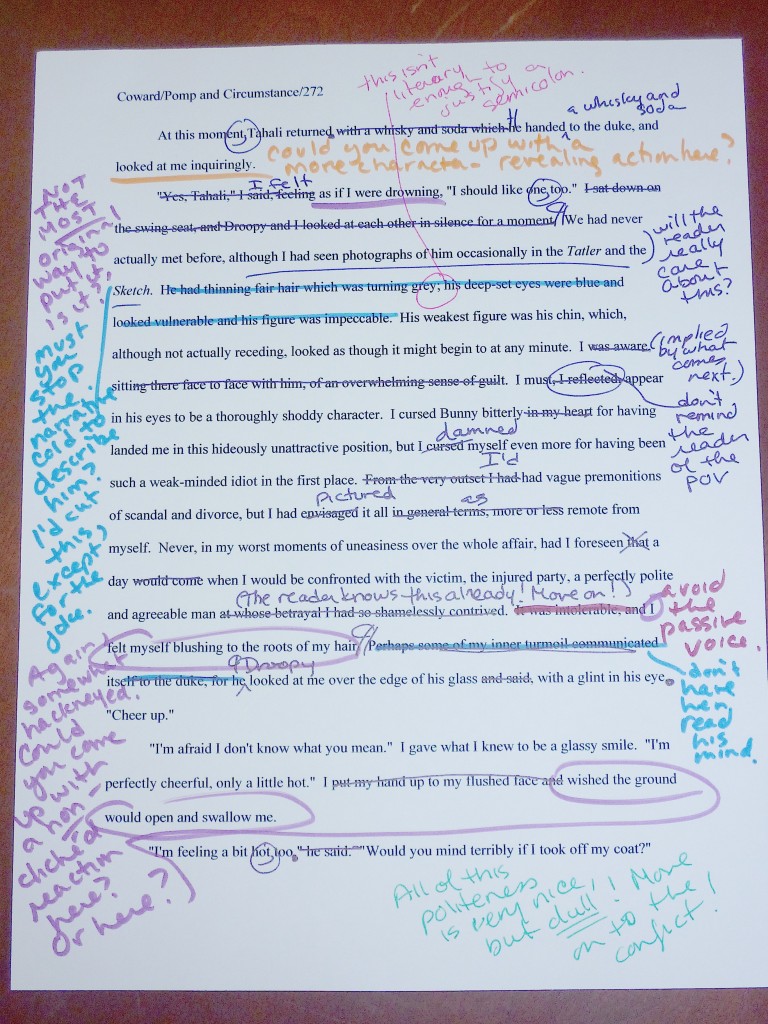
How to write a really good author bio, part III: a revisit to the land of the giant moles

October 14th, 2009

Hello, campers –

I seldom re-run a long-ago post wholesale, at any rate without significant modification, but today, I’m bringing you a post from last November virtually untouched. (The hardcore editorial mind is incapable of leaving any piece of text entirely untouched, of course.) While I can’t help but notice that I come across in it not as my usual sunshiny self, but as a curmudgeon upset by trifles, I think it works in this context: not only is the picture really, really pretty (if the photographer does say so herself), but even on a cold, blustery October day, the running analogy here made me smile.

Oh, and I think the advice is still pretty apt, too. Enjoy!

Yes, I’ll admit it: I’ve been a bad mood for the last couple of weeks. Nothing, and I do mean nothing, seems to be going as planned. Noses continue to sniffle, well-meaning distracters keep appearing on my doorstep during my writing time, people who I had thought I was paying to serve my interests have been falling down on the job in fairly remarkable ways, and my mother-in-law called yesterday to report that she’d accidentally invited five more people to Thanksgiving dinner. At my house.

Presumably, the new guests will be sitting on the piano. Or perhaps stuffed inside it, pressed against the harp. It might render the playing of Auld Lang Syne a trifle tricky.

My SO is scheduled to have a Little Talk with his mum on the subject tomorrow.

I seem to have spent the last few weeks traveling from one Little Talk to another. Case in point: remember that yard renovation that we started eons ago, the intended repair after the inadvertent destruction of my garden last March? Would it surprise those of you whose hair has gone grey in the course of similar projects to learn that it’s still not completed, three growing seasons later?

My SO is having a Little Talk with the landscaper as I write this.

Apparently, it’s a source of astonishment to the latter that anyone WOULDN’T want a gigantic hole in the middle of her patio, or that some unreasonable souls might conceivably expect the drip irrigation hoses to be hooked up to something, or that sun-loving plants moved to murky spots under drooping pine trees to get them out of the way of gigantic, soil-gouging machinery couldn’t walk by themselves back to their original plots. In our last Little Talk, he suggested with an absolutely straight face — and some asperity — that if we wanted him to do these things, we should have made sure that they were spelled out explicitly in our original agreement.

Oh, how I wish I was making that last part up. There’s a reason that I’m no longer present for these Little Talks.

Even in the midst of 8 months of my dashing outside continually, screaming, “DON’T DRIVE THE BACKHOE OVER THAT ROSE BED!” at people who, for some reason that I have not been able to fathom, can’t see an established plant without wanting to mash, mangle, yank, behead, or prune it to the point that my great-grandchildren will be wondering what army took a tank to that majestic Douglas fir and why, I can recognize that there’s quite a bit of beauty here, despite and often because of the ambient carnage. I took the picture above yesterday, in fact, standing on my dangerously unstable back porch.

(”You mean you DIDN’T want your back door to open onto a yawning chasm into which your kith and kin may tumble, never to be seen again? Lady, if you’d only TOLD me…”)

I have to admit, this photo stunned me after I took it. It wasn’t that I hadn’t noticed that there were pretty things in the yard — why, I spent an hour only last week trying to convince the landscaper that I did not now nor had I ever wanted him to cover those lovely leaves with beauty bark, an abomination upon the earth — but I had, I admit, become a bit myopic. I had been so focused upon what had been going wrong in the yard for so long that I had stopped looking at the big picture.

How myopic, you ask? Well, if I’m honest about it, when I looked at the area above, most of what I saw was this:

A potentially pretty space that had apparently been attacked by giant moles, in short, and ones who were rather careless in the placement of their irrigation lines at that. Had I known that the landscaper’s most consistent preference was for replicating the mole-infestation experience on a mammoth scale as often as possible, I might have placed a stipulation in the original contract that he, well, refrain from burrowing gratuitously.

I also, I suppose, could have had the foresight to mention that I also did not wish him to dive-bomb, set fire to, or spray-paint the Douglas fir in our front yard. The things one realizes in retrospect, eh?

Did I hear some of my long-time readers chuckle in the course of these ruminations on my conceptual near-sightedness? “Gee, Anne,” these sharp-witted aspiring writers observe, “it sounds as though you’ve been looking at your yard with your editorial eyes. What you’ve just described sounds virtually identical to how you’ve depicted Millicent the Agency Screener reading through queries and submissions, zeroing in on the flaws rather than searching for loveliness on the page.”

Well observed, oh chucklers. It’s also how good writers who have been revising and revising their manuscripts start to look at their own work after a while — and how virtually everyone approaching writing his own author bio for the first time views his own credentials.

Oh, you thought that I was just complaining about my yard renovation?

Au contraire, mon frère. (Actually, since there are quite a few of you reading this, that should have been mes frères, but don’t stop me; I’m on a roll.) Even aspiring writers with pretty darned good credentials — an MFA, for instance, or being a finalist in a well-respected contest — tend to shake their heads at the prospect of bio-construction, sighing, “But I’ve never been published!”

I’ve got good news for you: that’s not necessarily a barrier to pulling together a killer bio for yourself. No, seriously.

Yesterday, I advised all of you to run right out to the nearest well-stocked bookstore and take a gander at a bunch of author bios on the dust jackets of books recently released in your chosen category — not on jackets in general, but on those gracing books akin to the one that you have written or are writing.

The most helpful ones will probably be those produced by first-time authors in your book category, but ideally, I would like you to spend an hour or so looking at every bio in every book on the relevant shelf at Barnes & Noble or some similar immense bookstore. Not only will this help you get a sense of the tone and extent of successful author bios in the section of the publishing world in which you hope to publish, but it will give you a feel for what does and doesn’t work in a bio.

A sense of where the irrigation hoses tend to be left hanging in mid-air, so to speak. Reading each one, ask yourself, “Does this description of the author make me more or less likely to want to buy this book?”

If your local B&N is stocked like mine, you may be surprised at how often the answer is no.

Actually, I probably should have warned you about this yesterday: there are a LOT of lousy author bios out there, littering up the covers of otherwise perfectly fine books. Clearly, a boring or hastily-written bio is not a significant barrier to publication — which is interesting, because a really great bio can be such a valuable marketing tool for a manuscript.

Reading the duds may seem like a waste of your time, but actually, you can learn a lot from the bad ones, which typically share some common traits. You can learn what to avoid.

After you’ve read a couple of dozen, what makes the bad ones bad becomes apparent: they are too similar in their genericism, which renders them inherently dull. At their worst, they are merely lists of where the author went to school, if anywhere, what the author did (or does) for a living before (or besides) writing, where they live now, and their marital status.

For those of you who have not yet scoured your local bookstore, scores of them end up sounding something like this:

Turgid McGee was born in upstate New York. After attending the Albany Boys’ Reformatory, he served a term in the U.S. Air Force. After graduating from Princeton University, McGee attended law school at the University of Oklahoma. Now retired, McGee now lives in Bermuda with his wife, Appalled, and his three children, Sleepy, Dopey, and Sneezy. He is currently working on his second book.

Yes, it lists a bunch of fairly impressive facts about the author, but it doesn’t exactly make you want to run right out and pick up McGee’s book, doesn’t it? That’s precisely the reaction that Millicent, her boss the agent, and any editor to whom they might happen to mention this book will probably have: YAWN.

But inducing boredom is not ol’ Turgid’s worst offense here. The biggest problem with this blurb is that it’s poor marketing material.

Unsure of the difference? Okay, here’s an easy test that will make the marketing shortcomings rise to the top. Quick, based solely on that bio, answer these essential questions:

What is Turgid’s book about?

Why is he uniquely qualified to write it?

Does he have any background in writing at all?

Does he exhibit any sense of humor, derring-do, or other desirable human characteristic?

What the heck did he do to get sent to reform school?

If you picked up this book in a used bookstore years from now, would you have any interest in checking the shelves to see what his second book was?

Turgid’s bio fails as marketing because it does not even begin to address any of these crucial issues — all matters in which the denizens of any potential publisher’s marketing department would be vitally interested, I assure you.

And yes, in case you’re wondering, this set of questions can — and should, if you happen to be the author writing it — be applied to any author bio. if the answer to any of these questions is murky, it’s not put together very well.

Okay, so maybe the fourth question is not all that helpful on a marketing level. But wouldn’t this bio be both more interesting and more of a grabber if it did address that question, treating Turgid’s life as a story, rather than as an array of unrelated events?

Turgid also made a subtle mistake here, one that perhaps only those who have read a whole lot of author bios — such as, say, an agent, an editor, or a me — would catch. Any thoughts?

Give yourself three gold stars for the day if you said that Turgid mentions he attended the University of Oklahoma, not that he graduated from it. This means something very specific in bio-speak, something that Turgid probably did not intend.

Attended is the standard industry euphemism for not having finished a degree program — when a publishing professional reads Daffy Duck attended Yale University in an author bio, she is automatically going to assume that poor Daffy dropped out after a year.

And this is problematic in the current case, since (and knowing dear old Turgid so well, I can say this with authority) he actually did obtain his law degree. With honors, no less.

Moral: if you graduated from a school, say so.

And as a personal favor to me, never, ever make the astonishingly common grammatical error of saying that you graduated a school, a misstatement that would put virtually any language-loving Millicent’s teeth on edge; retain the necessary preposition and say that you graduated from it.

Trust me, that’s not a mole hole you want to leave exposed.

To his credit, Turgid pulled off this part correctly: he introduced his law school experience of indeterminate length and success with After graduating from Princeton University…. Had he utilized the unfortunately common structure After graduating Princeton… that would have meant, literally, that he handed the school the diploma, not the other way around.

I can’t tell you how many times I have been introduced as the speaker who “graduated Harvard.” It makes my molars grind together.

Speaking of my own credentials, looking at my own bio on this website, I’m not sure that I’ve avoided all of Turgid’s mistakes, but as I mentioned yesterday, as far as the industry is concerned, the 50-word bio (i.e., what’s likely to be on Amazon or most blogs, for instance) and the 250-word bio (for submission and a book jacket) are entirely different animals. What I’ve posted on this site is a specimen of the latter. The former does tend to be a list, but the latter is the author’s big chance to prove to the publishing industry that she is not only a talented writer, but a person who might actually be interesting to know.

But if you can possibly make that 50-word bio intriguing, rather than a rote recitation of biographical facts, I, for one, would love to see it. (And before any of you shrug off the possibility of ever needing one, let me ask you: how’s the bio paragraph of your query letter looking these days? Are you planning to query online? Many of the agency websites that ask potential clients to fill out forms ask point-blank for this short a bio. And so forth.)

If you are in doubt about whether a certain tidbit is appropriate to include in any length author bio, use this three-part test:

(1) Would you be comfortable having that fact displayed on the dust jacket of this particular book for all eternity?

(2) Even if your sainted mother were to pick up a copy? What about your sainted grandmother and her entire bridge club?

(3) More importantly, is it a detail that would help build the reader’s confidence that the author of this book is has credibly mastered its subject matter?

Note that I specified THIS book. It is perfectly legitimate to have different bios for different projects; in fact, it’s sometimes advisable, if your various projects have very different emphases or target markets, to highlight the relevant parts of your character in each.

I used to do quite a bit of food and wine writing (under an alter ego, now gratefully defunct). That bio emphasized the fact that I grew up on the second floor of a winery in the Napa Valley — which is true, incidentally. For the nonfiction book I sold a year ago, a serious examination of political and environmental subjects, however, the winery connection is less relevant, and my credibility more, so the bio I used for it gave greater prominence to the fact that I hold degrees from some pretty prominent and snotty schools.

I graduated from them, thank you very much.

It is perfectly acceptable to make your bio funny, especially if your book is funny. My comic novel, currently cooling its heels in my agent’s office for what seems like an awfully long time, relies heavily on my quirky sense of humor, so I was able to pull out all the stops and gear the accompanying author bio for maximum comic value. It mentions, among other things, that I learned to run a still when I was in elementary school and that when I was a delegate to a national political convention which shall remain nameless, an over-eager cameraman chasing a minor candidate knocked me over, spraining both my ankles. The next day of the convention, I covered my bandaged limbs with political stickers and propped them up on a rail; the AP spread photographs of this, billed as evidence of the dangers of political activism, all over the globe.

As impressive as some of my other credentials? No. But do you think the editors who read that bio are going to remember me?

As you may see, I think it is of paramount importance for an author’s bio not to be boring, provided that everything said there is true. (Yes, my father really did teach me to make brandy when I was in elementary school. Yours didn’t?)

If you honestly can’t think of anything memorable about yourself, try asking a couple of friends to describe you as they might to someone they wanted to impress. Chances are, they will mention the top few things that should be in your bio.

If that doesn’t work, try asking a couple of people who can’t stand you. The traits they dislike most may well enchant Millicent. (I’m only half-kidding about this; warm personal enemies can be very insightful.)

Remember, this is the document your agent will be using in order to describe you to editors, and editors to other editors at editorial meetings while arguing in favor of buying your book. If your full-fledged author bio doesn’t give the impression that if the reader were trapped in a snowstorm for three days with you, you would be capable of keeping the reader entertained with anecdotes the whole time, your bio isn’t interesting enough.

And, perhaps, if you’re lucky, something in your bio will stick in your agent’s mind enough down the road that it will occur to her to pitch your offhand reference to it to a sniffly editor in an elevator, or to poke you in the ribs at a party and urge you to pitch an on-hold project.

That’s the kind of thing that happens to interesting people.

Whatever you do, though, don’t beat yourself up if you don’t have the credentials that people typically think of as résumé-fodder for an author: prior publications, awards, the blessings of the Iowa Writers’ Workshop, a hug from a grateful president or prime minister after s/he has hung a medal around your neck and declared you a national treasure. The fact is, the vast majority of the authors who have sold first books within recent memory did not have those credentials when they first began querying.

Yes, really. Unless they happened to be blessed with a self-confidence that would make your average messiah blush for shame, you can bet your next-to-bottom dollar that at some point early in their writing careers, they all spent at least a few bad hours staring ruefully at their lifetime of achievements, seeing only the mole holes and missing the beauty of the landscape.

Don’t worry; I’m far from finished with my suggestions about where you might want to start looking in your yard. But don’t ask me to recommend a landscaper in Seattle; clearly, I’m not qualified.

Present-day Anne again here with an update. The comic novel remains unsold, for the simple reason that (as I did not know at the time) my agent had simply stopped sending it out some months before I wrote this post; somehow, it slipped his mind to tell me for nine or ten months. That’s actually not all that unusual in agent-client relations, unfortunately, especially when the agent is excited about the client’s next project. Let’s just say Millicent is not the only person at the average agency shouting “Next!”

Her boss agent is just barking it at different people.

I have a different novel circulating now. Had I mentioned lately that two of the most important personal characteristics a career writer can cultivate are flexibility and a sense of humor? And that it’s really, really important to keep moving forward on new projects after one lands an agent?

All three are also excellent goals for anyone trying to renovate anything with the assistance of professionals to pursue: my yard is still a work-in-progress. Little Talks continue. But that doesn’t mean that it isn’t looking pretty good these days, largely because I lost my temper. I just started planting things and erecting statuary myself:

yard renovated

The landscaper, of course, claims it all as his own work. There are even pictures of my yard in his latest brochure. And no, it isn’t your imagination — the lawn in the picture from eleven months ago has in fact vanished. If only we’d TOLD the landscaper that we’d expected it to live…

What was I saying about the advantages of having a sense of humor — and of not taking professional hype too seriously? Keep mulling over what makes you fascinating, everybody — and keep up the good work!
« Previous Entries