Author! Author! :: Anne Mini's Blog

Author! Author!

Speaking of dialogue revision…

August 20th, 2010

speechgraphic

“It is my custom to keep on talking until I get the audience cowed.”

— Mark Twain

What a week, campers! Again, I’ll spare you the grisly details. Suffice it to say that I shall probably soon be writing comic scenes about medical practitioners who can’t remember which leg is the injured one (hint: could it be the one encased from ankle to hipbone in a brace?), physical therapists incapable of describing any of the activities of the human body without resorting to impenetrable medical jargon, and the intricacies of sweeping out of a treatment room with dignity while on crutches. Adding to the hilarity: the physical therapy facility did not have ADA-compliant doors, so leaving (or coming in, for that matter) required yanking open two thirty-pound glass doors.

How fortunate that the facility never had any visitors with leg or arm problems, eh?

Speaking of characters who evidently have trouble expressing themselves, I’m going to spend the next few days re-running dialogue-related posts from my extremely popular 2009 series on agency screeners’ pet peeves, Seeing Submissions From the Other Side of the Desk. Actually, I’m going to run two today, albeit in a tricky manner: to save all of you brave and intrepid souls who worked through our recent Frankenstein manuscript series a bit of repetition, I’m smashing the relevant (and non-repetitive) bits together into great, big, Friday-worthy post.

That’s appropriate for Frankenstein manuscript-hardened readers, isn’t it? Enjoy!

I’m a great proponent of the doctrine of free will. I’m also a great fan of the art of conversation, which is why I’m going to spend the next couple of days going over the rejection reasons on the Idol first-page rejection list related to dialogue. (If you’re unfamiliar with this list, please see the first post in this series.)

One caveat before I begin: as I mentioned at the beginning of this series, this list is not intended to be exhaustive; the red flags we’ve been discussing are not the only ones that might conceivably raise Millicent’s hyper-sensitive hackles. They are merely some of the most common hackle-elevators, the ones that anyone who reads manuscripts for a living would see with great enough frequency that the sheer repetition across otherwise unrelated submissions might start to seem like some sort of immense writerly conspiracy.

Why am I repeating this caution? Because although it pains me to say it, there’s quite a bit of unpolished dialogue running amok out there. As any professional reader — agent, editor (freelance or otherwise), contest judge, agency screener, etc. — could wearily confirm, much of the dialogue that crosses her desk is genuinely trying to read. Here are a few of the many reasons this might conceivably annoy an agent on page 1, plucked from the Idol list:

17. The characters talk about something (a photo, a person, the kitchen table) for more than a line without describing it, creating false suspense.

25. The first lines were dialogue. (To be fair, only one of the agents on the panel seemed to have a problem with this.)

26. When the first lines are dialogue, the speaker is not identified.

30. Overuse of dialogue, ostensibly in the name of realism.

51. What I call Hollywood narration – when characters tell one another things they already know. (The agents on the panel did not call it by my term for it, but they don’t like it, either.)

52. The tag lines are more revealing than the dialogue. (The example cited: “She squawked.”)

Already, I hear some discouraging dialogue flying at me in response: “Wait just a minute, missy,” readers with retentive memories cry. “Didn’t we already cover that first one when we were talking a few days ago about creating false suspense? What are you trying to pull here, recycling of rejection reasons?”

Well caught, memory-retainers: I did indeed bring up #17 within the context of my discussion of why it’s a bad idea to withhold pertinent information from Millicent in the opening lines of a book. (Can you tell that I would really, really like it if any of you who happened to miss that earlier discussion chose to go back and read it?)

However, since opening pages often do feature characters exclaiming things like, “Oh, it’s horrible! Keep it away from me!” without specifying what it is, this is legitimate to discuss as a dialogue problem. While there’s nothing wrong with depicting such cries from time to time, its main stumbling-block as dialogue is that tends to be generic, rather than character-revealing.

And that is often a mistake in the first lines a major character speaks, which tend to be branded upon the reader’s memory as setting the character’s tone for the book. Just as a character who spouts nothing but bland, predictable courtesies often comes across on the page as dull, one whose primary function when the reader first meets him is to react to some unspecified stimulus can come across as a trifle annoying.

Don’t believe me? Okay, take, for instance, this sterling opening:

Ermintrude’s large gray eyes stretched to their maximum extent, a good three centimeters in height by five and a half centimeters in diameter. “But — George! How long have you been suffering from this terrible affliction?”

George smiled as extensively as his newly-acquired deformity would permit. “Not long.”

“Is this…condition…a common after-effect of trench warfare?”

“Come, come,” Norma said reprovingly. “It’s not polite to stare. Would you like some tea, George? I could slip a little brandy into it.”

Ermintrude was not so easily distracted. She inched closer, the better to gape at the awful sight. “Does it hurt? I mean, would it hurt you if I touched it?”

Quick: what are these three people talking about? More importantly, who are these people?

Beats me; based upon what is actually said, could be any group of three people responding to whatever has happened to George. Like so many such wails, this dialogue is purely reactive, a generic response to it rather than individualized, character-revealing statements.

On top of which, it’s just not very gripping, is it? Although TV and film have accustomed most of us to hearing people emit such ejaculations — and to judging how shocking/exciting/horrifying a stimulus is primarily by how the protagonist reacts to it — they often don’t make for very scintillating talk on the page.

Which is why, in case you were wondering, some professional readers will profess knee-jerk negative responses like 25. The first lines were dialogue. Sorry about that; a lot of Millicents like to have a sense of where the speakers are and what’s going on mixed in with their dialogue.

No accounting for taste, eh?

Or, glancing again at the example above, perhaps there is. Remember, the first questions that Millicent is going to need to answer in order to recommend this manuscript to her boss are “Who is this protagonist, and what’s her conflict?” If the first page of a submission doesn’t provide some solid indication of both how she is going to answer those questions and how those answers are going to be fascinating and surprising to the target market for the book, it’s not the best calling-card for the story to follow.

Admittedly, the opening above does convey the situation rather effectively — George is evidently a trifle difficult to gaze upon, due to something that may or may not have occurred during World War I — but other than that, what has this exchange actually told us about the speakers? Is Ermintrude an adult, a teenager, or a child, for instance? Does she have any genuine affection for George, or merely curiosity? Does Norma have a right to scold her due to her relationship with either Ermintrude or George? Is she Ermintrude’s mother, George’s wife, or the housekeeper? Does George resent this attention, or does he welcome it?

Yes, yes, you’re right: that’s quite a few questions to expect the first 14 sentences of a book to answer. Allow me to suggest, however, that this excerpt of dialogue would have been more interesting to the reader — and accordingly more likely to grab Millicent — had the dialogue been less focused upon verbalizing Ermintrude’s horror at the sight and more upon conveying character.

Oh, and while you’re at it, Reticent Author, you might want to give us a glimpse of what Ermintrude is actually seeing while she is seeing it. Millicent kind of likes to know.

The great frequency with which generic dialogue graces the first pages of submissions is often the basis for professional pet peeves like #26. When the first lines are dialogue, the speaker is not identified and #25. The first lines were dialogue. If the dialogue is surprising, character-revealing, and fascinating, even the most rule-bound Millicent actually isn’t all that likely to start waving these particular red flags.

And yes, I am aware of the startling twin implications of what I just said: first, although most of the agents’ pet peeves on the list are shared by a great many, if not most, professional readers, each individual Millicent will hold these irritants as noxious for her own set of reasons. Like a good protagonist, Millicent’s responses are not merely reactive to input in precisely the same way that anyone else holding her job would respond, but in her own personally neurotic manner.

See my comments earlier in this series about accepting what a submitting writer can and cannot control.

The second implication, and perhaps the more trenchant for today’s topic, is that — is the fainting couch handy? — what Millicent might regard as an instant-rejection offense in 99.99% of the submissions she scans might not strike her as irremediable in the one manuscript in 10,000 that is so beautifully written and gripping that the violation doesn’t seem all that glaring in context.

But before anyone gets too excited about that possibility, let me hasten to add: but that doesn’t mean it’s a good idea to provoke her.

I bring this up because in practically every context where aspiring writers discuss what agents do and don’t like — you can’t throw a piece of bread at most writers’ conferences without hitting at least one member of a group discussing it, for instance — someone who apparently doesn’t really understand the difference between a reliable trend and an absolute rule will pipe up, “Oh, manuscripts don’t get rejected for that; I know a writer who did that who landed an agent.”

Or, even more commonly uttered: “Oh, that’s not true: {book released 5+ years ago} began that way.” Since I’ve already discussed in this series both why what wowed agents in the past will not necessarily do so today, as well as why incorporating the stylistic tricks of bestsellers is not always the best way to win friends and influence people who happen to work in agencies, I shall leave you to ponder the logical fallacies of that last one.

Suffice it to say, however, that I have heard similar logic blithely applied to every potential agent-annoyer from incorrect formatting to a first-person narrative from 17 different perspectives (not counting the omniscient narrator who somehow managed to sneak in to comment from time to time) to outright plagiarism. Heck, I’ve even heard writers at conference claim that spelling doesn’t really count in a query letter, because they once met someone whose single typo didn’t result in instant rejection.

In the uncertain and often arbitrary world of querying and submission, you’d be amazed at how little evidence can prompt the announcement of an immutable rule — or the declaration that an old one doesn’t apply anymore.

Spell-check anyway. And while you’re at it, take a gander at the dialogue on your opening page to see if it is purely situation-based, rather than character-based. Because, really, why chance it?

Do I see some raised hands out there? “Um, Anne? May we backtrack to something you said earlier? What did you mean about the first line a character speaks setting his tone for the rest of the book?”

It’s a truism of screenwriting that the first line a character speaks is his most important — since film is limited to conveying story through only two senses, sight and sound, how a character introduces himself verbally tells the audience a great deal about who he is and his relationship to the world around him. On the printed page, character can be conveyed through all of the senses, as well as thought and the waving of psychic antennae, but still, the first lines the writer chooses to place in her characters’ mouths should be regarded as introductory.

In other words, why not use them to present something interesting about that character, rather than merely as a demonstration that the writer is aware of how real people actually speak? After all, you have an entire book’s worth of dialogue to prove the latter, right?

I suspect that most aspiring writers radically underestimate dialogue’s potential for character-revelation. In the vast majority of the dialogue on the first pages of submissions, one senses a great deal more writerly attention concentrated upon making sure the dialogue is realistic, something that a person in that situation might actually say, than upon producing statements that ONLY those particular speakers would say in THAT particular situation.

The first is generic; the second is individual. Which do you think is likely to strike Millicent as the utterance of a gripping protagonist?

Shall I pause for a moment to allow the implications of that disturbing question to sink in fully? If you’re feeling an overwhelming urge to stop reading this and hurriedly open the file containing your manuscript to reread its opening page, well, I can only applaud that. Go right ahead; I’ll wait.

Ready to move on from that startling piece of theory to the nitty-gritty practicalities of 26. When the first lines are dialogue, the speaker is not identified and our old friend #25. The first lines were dialogue? Excellent. Let’s take a look at an example where both occur — see if you can guess why this opening might irritate a Millicent in a hurry.

“Hey — who’s there? Hello? Hello?”

“Oh, sorry. I didn’t mean to startle you. Is this the way to Professor Blaitwistle’s class?”

The old man leaned on his broom, his faithful companion and coworker for the past thirty-seven years. “Yes,” he lied. “Just down that hall, then take a right immediately after the mad scientist’s laboratory, the doorway with the two growling three-headed dogs guarding it. You can’t miss it.”

“Thank you, sinister lurker. I would so hate to be late for my first day of class.”

He chuckled at her retreating back. “Last day of class, more like.”

If you immediately cried, “By jingo, this opening relies on false suspense to create a sense of mystery, withholding information such as who these speakers are and what the physical environment is like in order to rush the reader into a confused sense of imminent danger!” give yourself a gold star for the day. Award yourself two — hey, they’re small — if you also pointed out that the character heading smack into that imminent danger spoke in dialogue that didn’t reveal anything about his or her personality other than a tendency to be polite to frightening strangers.

However, none of those things are what I want you to concentrate upon at the moment. Go back and reread the passage again, then ask yourself, “What purpose does not identifying who is speaking actually serve here? And why am I talking out loud to myself, when that tends to annoy Millicent on page 1, too?”

I can’t help you with the second question, not being conversant with your personal quirks and motivations, but I can provide an answer to the first: none.

Not one iota. It is devoid of any scintilla of character development. All the writer has achieved here is to make the reader wait until paragraph 3 to find out whose voice opened the book, and not to identify the other speaker at all.

I appeal to your sense of probability: if you were a Millicent trying to screen ten more submissions before lunchtime, would you be intrigued by being kept in the dark on these salient points for so many lines? Or would you think huffily that the submitter had some nerve to expect you to invest energy in guessing based on such scant evidence?

The moral of today’s story: if you’re going to open with dialogue, make it count. There is no such thing as a throw-away line on page 1 of a submission.

So let your dialogue reveal more than it conceals about who your protagonist is and precisely why s/he is going to turn out to be a fascinating character in an intriguing situation. Because, after all, if a writer is going to go to all of the trouble of creating a fully-realized, completely unique character on the page, the reader is going to want to sit up and take notice when s/he speaks.

Opening dialogue that lives up to that hope is rarer than you might think. Don’t believe me? May I remind you that a full 8.1% — roughly an eighth — of the Idol first-page rejection reasons were dialogue-based, more than on any other single technical aspect?

Be very, very sure that any dialogue you use on page 1 is flawlessly executed, scintillating in content, and absolutely necessary. Because, as we may see, some agents seem to be a trifle touchy about it.

Actually, while I’m at it, I’m going to add a quibble of my own: too many tag lines. For those of you unfamiliar with the term, a tag line is the he said part of the dialogue, and a healthy percentage of the industry was trained to believe that in good writing, (a) in two-person dialogue, tag lines are usually disposable, thus (b) writing with fewer tag lines tends to be better than writing with more, and (c) the vast majority of the time, said is a perfectly adequate word to describe a human being speaking.

(c), obviously, underlies the critique of “she squawked.”

While, equally obviously, the degree to which a particular speaking verb is problematic varies from reader to reader, #52, the tag lines are more revealing than the dialogue, is a fairly standard objection to dialogue scenes. Most of us have had English teachers who subscribe to this school of thought, the type who rapped us on the knuckles if we dared to use an adverb in a tag line, because, well, Hemingway never would have done it, and if the dialogue itself were descriptive enough, no one would need to know that Charles said it laconically.

I’ve posted enough, I think, on the issue of dialogue-only scenes, where the reader isn’t given one iota of hint about how certain things are said or what is going on in the room, for my regular readers to know my opinion on bare-bones dialogue. But over-used tag lines are something different: trust me, if your job were reading hundreds of pages of prose every single day, unnecessary verbiage would be likely to start to annoy you FAST.

To try to show you why you might want to go a little light on the tag lines (and on the squawking, while we’re at it) on page 1, here’s a relatively average chunk of dialogue:

“It’s about time you got home,” Andrew said snappishly. “Your soup is ice-cold.”

Joanna sighed, “I told you that I was going to have to work late. It’s inventory time at Poultryco, honey, and as you know, I am the barnyard manager. Who is going to count the geese, if not me?”

“Like that’s hard work,” Andrew snorted. “The dumb clucks just sit there.”

“No, actually,” Joanna said priggishly. “Geese are quite aggressive. They’re territorial, in fact. Why, don’t you remember just last year, when young Jeremy Faulkner was pecked to death in the granary?”

“Yes, of course, I remember,” Andrew huffed, irritated and annoyed. “I sang the Ave Maria at his funeral, right? You know I’m the only tenor in the local Methodist church choir who can hit that top C. But that doesn’t explain why you need to stay out until eleven p.m.”

“We have to wait until after dark,” Joanna moaned, “until the birds are asleep.”

“We?” Andrew pounced. “Don’t tell me that good-looking ruffian Dario Blaine is working for you again. Why, every husband here in Karaoke City knows his reputation with the ladies. He’s the Don Juan of chicken pluckers.”

Now, this excerpt would be especially annoying to a tag line minimalist, as it is reflects a quite common writerly misconception that the mere fact of enclosing phrases within quotation marks is not signal enough to the reader that a character is speaking the words out loud, rather than just thinking them. To adherents of this theory, the mere idea of not both identifying every speaker and stating specifically that he is, in fact, saying these words out loud is a one-way ticket to anarchy.

However, to most professional readers this kind of tag line use just seems repetitive — or, to phrase it in the language of the biz, time-wasting. Remember, our over-worked and under-dated agency screener has to write a summary of the story of any submission she recommends her superior reads; she wants you to cut to the chase.

So what’s the writer to do, just cut out all but the absolutely essential tag lines, in order that her first page would read 42 seconds faster? Let’s take a gander at what would happen:

“It’s about time you got home,” Andrew snapped. “Your soup is ice-cold.”

Joanna sighed. “I told you that I was going to have to work late. It’s inventory time at Poultryco, honey, and as you know, I am the barnyard manager. Who is going to count the geese, if not me?”

“Like that’s hard work. The dumb clucks just sit there.”

“No, actually, geese are quite aggressive. They’re territorial, in fact. Why, don’t you remember just last year, when young Jeremy Faulkner was pecked to death in the granary?”

“Yes, of course I remember. I sang the Ave Maria at his funeral, right? You know I’m the only tenor in the local Methodist church choir who can hit that top C. But that doesn’t explain why you need to stay out until eleven p.m.”

“We have to wait until after dark, until the birds are asleep.”

“We? Don’t tell me that good-looking ruffian Dario Blaine is working for you again. Why, every husband here in Karaoke City knows his reputation with the ladies. He’s the Don Juan of chicken pluckers.”

A trifle sparse, admittedly, but there isn’t any serious question about who is speaking when, is there? Personally, I would opt for breaking up the dialogue a bit more by adding a few character-revealing descriptive elements that are not speech-related, such as the facts that Andrew is wearing a giant panda costume and the soup is cream of bamboo.

Those two telling details made you reconsider your view of Joanna’s tardiness, didn’t they? Would you rush home to that, particularly if you knew that every Thursday’s dessert was Pinecone Flambé?

Do I hear some of you whimpering impatiently out there, hands in the air, to tell me what else is wrong with this chunk of dialogue? The de-tag lined version made it even more apparent, didn’t it?

Sorry, the Idol agents beat you to it: #51. when characters tell one another things they already know, so that the reader will be filled in on necessary background. Those of you familiar with this blog already have a name for this phenomenon, Hollywood narration; in the science fiction/fantasy community, it goes by another name, “So as I was telling you, Bob…”

Either way, it is logically indefensible. It is absurd to the point of impossibility that Andrew does not know his wife’s job title or where she works, just as it is exceptionally improbable that he would have forgotten Jeremy Faulkner’s traumatic death, or that Joanna would have forgotten either the funeral or her husband’s participation in the church choir.

And don’t even get me started on ol’ Dario’s local reputation. Make every line of dialogue count, campers, and keep up the good work!

The envelope, please…

August 4th, 2010

WHISPER_cover

That’s right, gang: the long-anticipated day has arrived. Today, I’m going to announce the winners of the Author! Author!/WHISPER Great First Page Made Even Better Contest. Winners will receive an extensive critique of their first pages in this very forum, courtesy of yours truly and FAAB Phoebe Kitanidis, author of the HarperCollins’ new YA release, Whisper.

Hmm, why does that title sound so very familiar? You must have seen the cover someplace.

Why did it take such a long time to judge this contest, you ask? Well, several reasons, up to and including the fact that I’m typing this one-handed, due to my recent injuries. Also, the response to this contest was quite a bit more enthusiastic than either the judges or I had anticipated; as a contest without an entry fee, it wasn’t as though we could simply hire staff to deal with the additional entries.

Beginning to understand why the vast majority of literary contests charge fairly hefty entry fees? Contest administration is time-consuming.

Not that I’m complaining, of course — there were many great entries, and a tidy array that rose to the rank of fabulous. So many, in fact, that it was exceptionally difficult for the judges to agree on the final awards.

But of that, more below. First, I want to talk about a couple of the widespread entry problems.

To be blunt, it was not exceptionally difficult was to disqualify the full one-third of entries that disregarded the rules — and that’s not even counting the 90% of entries that did not adhere to standard format for manuscripts. Come on, people — there were only four rules!

What can we learn from disturbing statistic? Something that any veteran contest judge or agency screener could have told you: a significant proportion of aspiring writers evidently do not take the time to read contest rules and submission requirements.

That’s sad, because — again, as anyone mentioned above could tell you — if an entry or submission does not follow the rules, it will almost always be rejected, regardless of the quality of the writing.

Period. End of story. No appeal. Or, to put it another way: not taking the time to read the rules hurts only you.

Ditto with not following the rules of standard format for manuscripts — although so many entrants broke one or more rules that the judges had to downgrade the importance of formatting in the judging. This meant, in practice, that we ended up considering (and even giving a prize or two) to first pages that Millicent the agency screener probably would not have bothered to read at all.

Hey, we were being nice. But expecting Millicent to exercise that level of leniency would be foolish.

In case I am being too subtle here to catch the average rule-skimmer’s eye: READ THE RULES. LEARN THE RULES. FOLLOW THE RULES. REPEAT AS NEEDED UNTIL YOUR BOOK GETS PUBLISHED.

Seriously, submitting an improperly-formatted manuscript is precisely like sending a contest entry that ignores the stated rules: the writer is depending, foolishly, upon the kindness of the reader to overlook a lack of professionalism. Submitting an improperly or — even more common — inconsistently formatted manuscript is, to put it bluntly, usually a waste of the writer’s time.

Why? Chant it along with me, long-time readers of this blog: because agencies and contests typically receive so many perfectly-formatted, impeccably rule-following manuscripts that they don’t need to bother with those that are not professionally presented. Therefore, not taking the time to learn how to format a book manuscript properly because you are trying to get it out the door faster is self-defeating.

Again, it really is that simple. Fortunately, all any aspiring writer has to do to learn how to format a manuscript properly is take a swift peek at the aptly-named HOW TO FORMAT A MANUSCRIPT category on the archive list on the bottom right-hand side of this page.

Given how much blog space I routinely devote to proper formatting, I was genuinely surprised at how few entrants had evidently checked their formatting against the literally hundreds of practical examples I have posted on this very blog in recent years. Short of coming to your respective houses and formatting your work for you, I don’t see how I could possibly have made it easier for entrants to this contest — or submitters to agencies, for that matter — to get the formatting right.

I just mention. While I’m typing one-handed. Don’t make me pull out any more guilt-inducement than that.

Oh, and something else almost everybody who entered did: titled the entry document along the lines of Anne Mini contest, Author! Author! contest, first page contest…in short, in a manner that, while convenient for finding it again on THEIR hard drives, required my renaming virtually every entry before I could save it to mine. Because, honestly, when confronted with 43 (seriously) entries called ANNE MINI CONTEST, how else was I supposed to tell them apart?

Aspiring writers do this all the time in electronic submissions and contest entries. Strategically, it’s a bad idea to inconvenience Millicent, even a little.

How should a request for an attachment be titled, you ask? Either with the writer’s last name (Smithentry.doc would have worked beautifully on my end; SmithCatIIentry.doc would have been even better) or — and this was the most popular choice in the contest — with the title of the piece. (TheWayWeWere.doc would be hard to mix up with VenusVampires.doc, after all.)

So much for the multi-part lecture. On to the announcement of the winners. First, the grand prizes.

The 2010 Author! Author! Awards for Expressive Excellence and Grand Prizes in the Author! Author!/WHISPER Great First Page Made Even Better Contest go to:

Adult Fiction: Jennifer Sinclair Johnson, DIVIDED STATES

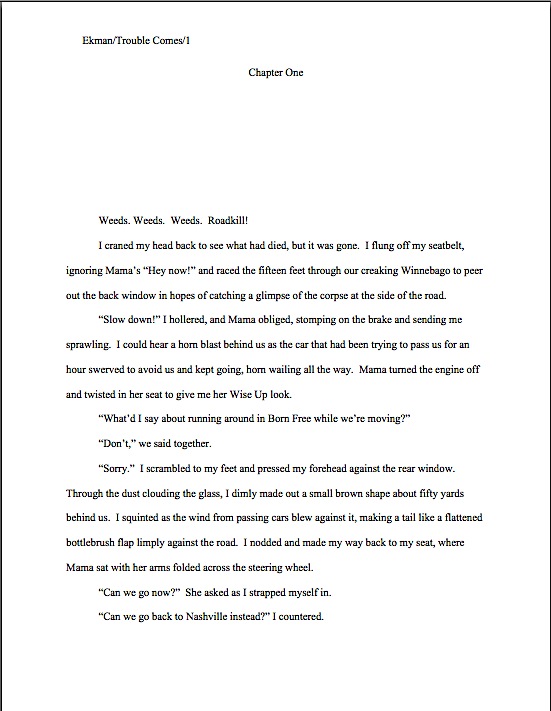
Young Adult Fiction: Juniper Ekman, TROUBLE COMES

Actually could fit in either adult fiction or YA, but the judges agreed they would have awarded it a grand prize in either: Cole Casperson, INDOMITVS

Memoir (not an official category, but we received a lot of great entries): Jennifer Lyng, NORMAL IS WHAT YOU KNOW

But wait — there’s more! Judging the finalist round was quite tough. Because we received such a lot of exciting, well-written entries, the judges and I talked it over, and we decided that it might be a lovely idea for me to post and discuss the first, second, and third-prize entries as well. (Not that I’ll be doing it immediately, mind you; prize fulfillment will take place when my hands are once again up to full blogging strength.)

So, bearing that prize upgrade in mind, let’s also hear it for the entries that placed:

The Author! Author!/WHISPER Great First Page Made Even Better, Category I: Young Adult

First Prize, YA: Natalie Hatch, BREEDER

Second Prize, YA: Suzi McGowen, A TROLL WIFE’S TALE, and Sherry Soule, DARK ANGEL

Third Prize, YA: Janine A. Southard, WHICH STAR MY DESTINATION

The Author! Author!/WHISPER Great First Page Made Even Better, Category II: Adult Fiction

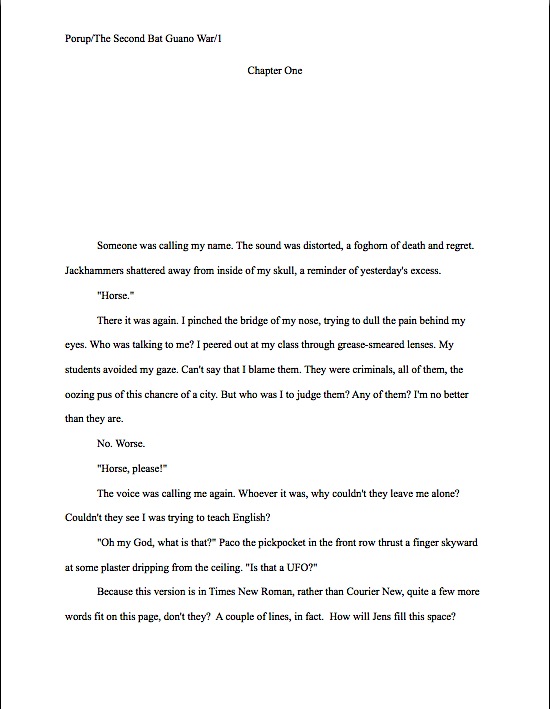
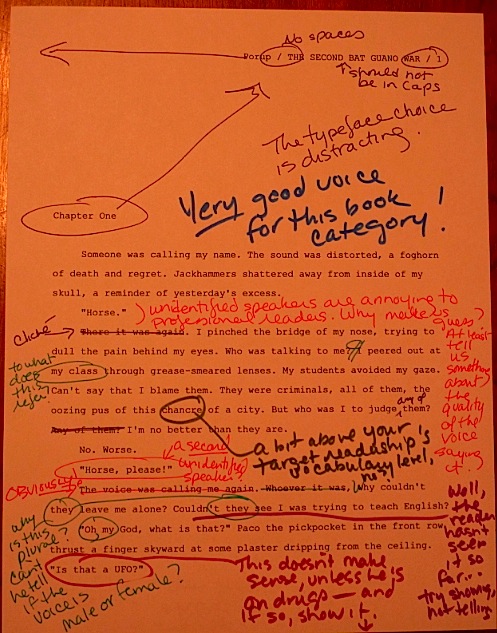
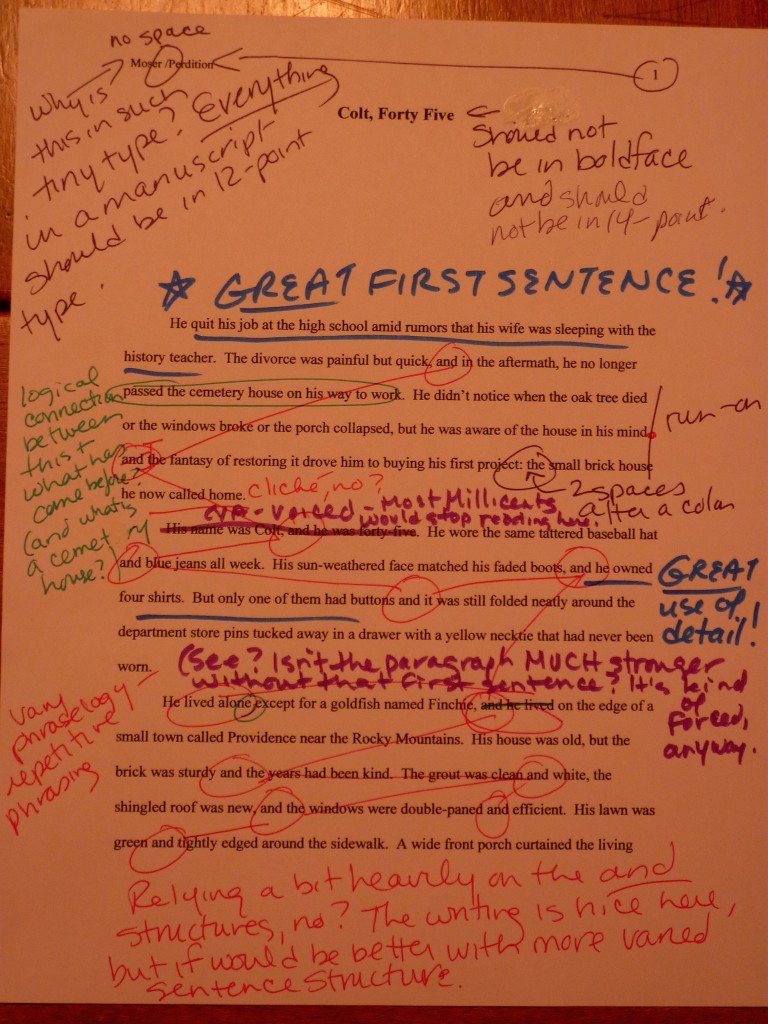
First Prize, Adult Fiction: Curtis Moser, PERDITION, and Jens Porup, THE SECOND BAT GUANO WAR

Second Prize, Adult Fiction: David A. McChesney, SAILING DANGEROUS WATERS, and Ellen Bradford, PITH AND VINEGAR

Third Prize, Adult Fiction: David Jón Fuller, BARK AT THE MOON; Linda C. McCabe, THE LEGEND OF THE WARRIOR MAID AND THE SARACEN KNIGHT, and Carolin Walz, GOTHIC WARS.

Hey, I wasn’t kidding about a plethora of great entries! Congratulations to all of the winners — watch this space to hear more from them.

And, as always, keep up the good work!

The dreaded Frankenstein manuscript, part XVIII: were you leading up to a point, Chatty Cathy? Or just killing some time with conversation?

July 11th, 2010

chatty cathy doll

When last we met, I was urging you, through the oh-so-subtle means of inundating you with example after example, into an appreciation of just how annoying redundant, non-character-revealing, or just plain dull dialogue can be to someone who reads manuscripts for hours on end. Like, say, Millicent the agency screener or Mehitabel the contest judge.

Why bring this up in the midst of an ongoing series on self-editing a Frankenstein manuscript? Well, several reasons. First — and it pains me to tell you this — more otherwise well-written submissions and contest entries drop precipitously in M & M’s respective esteems due to lackluster dialogue than is generally believed. Due to the pervasiveness of this phenomenon (and we’re gearing up for the second reason here), typically, one of the quickest, easiest ways to cut length off an over-long manuscript is to track down and excise the ordinary, everyday dialogue, the chatter that neither advances the plot, creates interesting conflict in the moment, or reveals character.

How can I state that so confidently? Because almost every writer who has taken an English composition course was told repeatedly that good dialogue should sound real, the average novel or memoir manuscript overflows with dialogue that’s apparently there simply because people say those types of things.

Which is not to say that striving to make your dialogue realistic is bad writing advice. It’s very good advice — but what the vast majority of composition teachers should have added immediately thereafter yet did not was an explanation that real-sounding dialogue and the things that people actually say in real life are not the same thing.

The former rings true on the page; while the latter can sometimes be very interesting, it can also lull the reader into a deep, deep slumber. Trust me, when people talk about an author with a good ear for dialogue, they’re referring to someone who consistently produces real-sounding dialogue, not someone who simply holds a microphone up to life and records the unedited results on the page.

Of course, we writers want to be true-to-life in our dialogue: as Virginia Woolf wrote, “fiction must stick to the facts, and the truer the facts, the better the fiction.” But let’s not forget that in order to maintain a reader’s interest, a book has to have entertainment value, too — and that however amusing a verbal tic might be in person, repetition is often annoying in on the page.

This is especially likely to occur when a character is tired, angry, or in pain, I notice: all of a sudden, the dialogue sounds as though all of the characters are trapped in one of those interminable Samuel Beckett plays where the people are doomed to move immense piles of sand from one end of the stage to the other with teaspoons. See if this dialogue sounds familiar, theatre-goers:

“Oh,” Babette said. “You’re home.”

Rufus nursed the thumb the dodo trod upon earlier. “Yeah.”

“Have a nice day?”

“Um-hm.”

“I was cleaning out the attic today, and I came across that picnic blanket we used when we went out to Rockaway Beach to scatter Grandfather’s ashes. How it rained that day, and then the sun broke out as if all of our ancestors and God had joined forces to drag the clouds aside to smile upon our picnic.”

“Yeah. We sure got wet that day.“

“Ham sound good for dinner?”

“Yeah.”

A good third of the dialogue Millicent sees runs approximately like this. Understand now why she might become just a tad touchy at the sight of dialogue that provides neither character development nor moves the plot along?

Ordinary dialogue makes her especially antsy — again, I hate to be the one to break this to you, but if I don’t, who will? — on page 1. And that’s unfortunate, since this kind of chat is quite popular in the opening pages of manuscripts.

Why would the dialogue above have annoyed Millicent? Well, cast your eyes over it and tell me: what’s going on here? What is this story about? Who are these people, and why are 7 of the 10 opening lines of this story wasted on dialogue that doesn’t even begin to answer any of these questions?

Already, I see some hands raised out there in the ether. “But Anne,” writers of the real everywhere protest, and who can blame them? “It’s unfair to assume that every reader, even professional ones, would be turned off by the example above, even if it did appear on page 1. I think that Millicent and Mehitabel would be intrigued by its very terseness; I believe it would render them more likely to keep reading, not less, if only to find out what’s going on. I, for one, want to hear more about that dodo bite.”

I’m glad you brought that up, mythical hand-raisers, because the strategy of withholding basic information from the reader in an opening scene in order to create curiosity about what is to come is a suspense-building technique popular only with aspiring writers. Established writers soon learn not to do it, for the exceedingly simple reason that professional readers like Millicent, Mehitabel, and even Maury, Millie’s cousin who works as an editorial assistant at a publishing house, tend not to find this kind of opening titillating.

How do they regard it? Negatively, almost always. There’s even a term for it: false suspense.

That’s also the term for when an interesting one- or two-paragraph teaser, the kind that aspiring writers so love placing within italics, gives way to an apparently or only tangentially unrelated second scene. “Hey!” Millicent cries, spitting out her mouthful of scalding latte, “what happened to that darn interesting plot I’d gotten absorbed in? What’s this writer trying to do, hook me with something exciting, then drop me into a comparatively mundane storyline?”

Let’s be honest, folks: that’s precisely what most writers who use this trick are trying to do. Professional readers are wise to it by now. Remember, part of being a good storyteller involves knowing when to relieve the suspense.

I’m not here to talk about plotting today, however — but don’t worry; I’ll be coming back to it later in this series. For now, suffice it to say that even if you are one of those writers who absolutely adores reproducing everyday speech down to the last grunt and hesitation, you might want to keep those mundanities off of page 1 of your submission. Or page 2. Or, really, out of the opening chapter.

You wouldn’t want Millicent, Mehitabel, or Maury to mistake your submission for the hundreds of thousands of others that don’t have as good an ear for dialogue as you do, right?

As a general revision guideline for any page of the manuscript, I like to flag any piece of dialogue that contains more than one use of yeah, really, yes, no, uh-huh, or, often, um. Almost invariably, these are an indication that the dialogue could either be tightened considerably or needs to be pepped up.

Similarly, anyway and however in dialogue are pretty reliable flares, indicating that the speaker has gotten off-topic and is trying to regain his point — thus warning the manuscript reviser that perhaps this dialogue could be tightened so that it stays on point.

I’ll admit it: my fictional characters tend to be chatty (dialogue is action, right?), and early in my career, I was once taken to task for it by a fairly well-known writer of short stories. She had just managed to crank out her first novella — 48 pages typeset, so possibly 70 in standard manuscript format — so perhaps unsurprisingly, she found my style a trifle generous with words.

“Only show the dialogue that is absolutely necessary,” she advised me, “and is character-revealing.”

Hard to argue with that, eh? Yet, like most writers receiving critical feedback, I fought it at first. Since the dialogue in my advisor’s published works has seldom, if ever, strayed beyond three lines, regardless of situation or character, I was not particularly inclined to heed this advice — have you noticed how often it’s true that established writers with little or no teaching background spout aphorisms that all boil down to write as I do? — but I have to say, it has been useful in editing, both for others’ work and my own.

But I apply a slightly different twist to it. For each line of dialogue, I ask myself: Is this here because it needs to be, or just because it’s something a character like this would say? In memoir and reality-based fiction, it can indeed be there simply because someone actually did say it — but is this particular line essential to the story being told here? And regardless of whether it’s a quote or not, if it isn’t either plot-advancing, character-revealing, or interesting in its own right, does it really need to be on the page at all?

Why, yes, you’re right, everyone who just grabbed the nearest sofa cushion and screamed into it: that is an awfully high standard to apply to every single line of dialogue in a manuscript. Your point?

To help the rest of you understand why your fellow readers felt faint at the mere thought of placing their manuscripts under that powerful a microscope, let’s take a gander at a species of dialogue gets under your garden-variety Millicent’s skin like wet sand under a swimsuit: the de facto monologue.

You know, the kind of ostensible dialogue that involves one character talking about something, while the other character doesn’t really add much to the conversation. It tends to run a little something like this:

“I can’t believe how arrogant that car dealer was!” Antoinette fumed. “You’d think he’d never met a woman who wanted to buy a car.”

“Yeah,” Steve replied.

“You can say that again. I should have told him that I was going home to e-mail the National Organization of Women, to get them to issue a general boycott of his lot.” Angrily, she wrestled to undo the bungee cords that held the driver’s side door onto her 1978 Saab, provided that she never attempted to accelerate above thirty miles per hour. “Did you see how surprised he was that we left?”

“Um-hm.”

“I’ll bet you did. You don’t suppose his telling me that women don’t know anything about cars is his standard sales technique, do you? Other women can’t actually have bought cars after a line like that.”

“No.” Steve was crawling into the passenger seat via the smashed back window. “I imagine not.”

Antoinette dug under the visor to retrieve the seatbelt. “Well, I wouldn’t be so sure. It’s like those construction workers who yell disgusting things at women walking by their worksites: if it didn’t provoke a positive response at least once every 10,000 times, would they keep doing it?”

“Could be.”

“What’s that supposed to mean? You think I’m blaming the victims?”

“I never said that.”

“Anyway,” she concluded after she had successfully hot-wired the car, so she would not have to force the mangled key into the half-melted ignition, “I guess he won’t be offering five dollars on a trade-in again!”

“Absolutely,” Steve murmured, clinging for dear life to what was left of the dashboard.

I ask you: what purpose is Steve serving in this conversation, other than providing validation, the opposite of conflict? And if he isn’t in the scene for any other reason, why doesn’t he just shut up and let Sandy blurt out her entire speech, instead of adding line after excisable line of mostly colorless dialogue?

Not to mention repetitious. We all know by this juncture, I hope, how Millicent and her ilk feel about that in a submission: “Next!”

Even if you find none of those excellent arguments for revision convincing, there’s another, quite practical one you might want to consider. Just look, self-editors concerned about the fact that your manuscript is 40 pages longer than the expected length for a first book in your category, at how much shorter this scene would be if it were presented as an actual monologue:

“I can’t believe how arrogant that car dealer was!” Antoinette fumed. “You’d think he’d never met a woman who wanted to buy a car. I should have told him that I was going home to e-mail the National Organization of Women, to get them to issue a general boycott of his lot.” Angrily, she wrestled to undo the bungee cords that held the driver’s side door onto her 1978 Saab, provided that she never attempted to accelerate above thirty miles per hour. “Saying that women don’t know anything about cars is sure a lousy sales technique. Other women can’t actually have bought cars after a line like that.”

While Steve crawled into the passenger seat via the smashed back window, she dug under the visor to retrieve the seatbelt. She set about hot-wiring the car, so she would not have to force the mangled key into the half-melted ignition.

“Or maybe it’s like those construction workers who yell disgusting things at women walking by their worksites: if it didn’t provoke a positive response at least once every 10,000 times, would they keep doing it?” The engine roared. “Bingo, baby! I guess he won’t be offering five dollars on a trade-in again!”

“Absolutely,” Steve murmured, clinging for dear life to what was left of the dashboard.

See? Steve’s silence makes his unwillingness to argue every bit as clear as his bland continual agreement did above. So what would have been the payoff for retaining his chatter?

Perhaps more to the point, if such lightly-disguised monologues provide neither character development, interesting inter-character conflict, nor, frankly, many sentences worth preserving for posterity, why are they so very popular with aspiring writers? Expediency, mostly: there’s no denying that having a protagonist, villain, or crucial minor character suddenly hold forth like Hamlet is a mighty efficient way to convey information to a reader.

But from the professional reader’s point of view, this use of page space is not efficient at all: it’s the narrative equivalent of having a play’s lead excuse himself to the other characters mid-scene, walk to the edge of the stage, and say, “Look, I really don’t have time to convey everything you need to know in dramatic form, so I’m simply going to tell you what would have happened in the next couple of scenes if we had bothered to stage them, okay?”

It’s not okay, at least according to Millicent. She’s reading your manuscript partially in order to find out how you tell a story — is it honestly in your interest to make her read through filler before reaching your best writing?

Ditto with dialogue that repeats what the reader already knows, as in that archetype of easily cut-able scenes, the one where the protagonist tells another character what happened in a previous scene. As in what the reader has just read. This might be defensible if the protagonist were adding a new twist on the information, but most of the time, s/he recaps the information exactly as the reader has already experienced it because — you can see this coming, can’t you? — it’s what a reasonable person might do in real life.

How easily cut-able are such scenes, you ask? Well, let me put it this way: it’s rare that an accurate retelling, even one that takes up pages of text, could not be summed up in a single sentence: Sheila ran back to the classroom and told everyone what had happened.

Here’s an axiom for the ages: by definition, redundant text adds nothing new to a narrative. It merely takes up space.

That answer didn’t mollify some of you reality-huggers, did it? “But Anne, isn’t realism valuable in and of itself? I know plenty of people who effectively have their own catchphrases.”

As do I, as it happens. In fact, I recently enjoyed a long, gossipy conversation with a very old friend of mine with a very distinctive speech pattern: she says, “Like I said…” every other minute or so. In a long anecdote — to which she is quite addicted, as a world traveler with unusual tastes in traveling companions — she often uses this phrase ten or fifteen times.

Since we grew up together, you would think I would know where she had picked up this rare trope, but I don’t; it’s an adult acquisition. We have both wandered far from home, evidently. But still, you’d think I would have some inkling as to its origin: she and I were so closely allied in high school that at her wedding, both her father AND her uncle spent 45 minutes grilling my boyfriend about his prospects and intentions toward me.

You might say that we come from a close-knit community.

Our hometown does in fact have a distinct speech pattern, a mixture of the lilt remaining when a small town in Switzerland (cow and wine country) picked up and became a small town in California (wine and cow country), certain Mexican-influenced words, a smattering of barrel-related French, and a linguistically inexplicable tendency to pronounce “mirror” as “meer.” Being a farming community (the aforementioned wine), of course, certain agricultural tropes abound in season, such as, “How about this rain? Sure do need it,” “The grapes would have been in by now, 20 years ago” (untrue, incidentally), “Did you hear that bears have been at Farmer X’s grapes?” (true, incidentally; brown bears like expensive fruit), and “Damned drunken tourists have been at my vines again. They think every grape in sight is a free sample.”

But “like I said,” no. So I ask you: would it or would it not be a good means of revealing the background of a character from my home town to incorporate it repeatedly in the text? What about using it as that character’s personal catchphrase?

Pardon my asking, but what precisely would it reveal about her character — other than the not-very-interesting fact that she uses this phrase often? If it does not add anything to the dialogue other than repetition, what possible incentive could I have to reproduce this verbal tick except so readers who already knew the person upon whom the fictional (or memoir) character was based would recognize her?

Is that honestly a good enough reason to bore all of those potential readers who have never had the pleasure of making her acquaintance? Would those excellent souls gain anything but chagrin out of my fidelity in reproducing a rather annoying true-life speech pattern on the page?

The answer to all of those seemingly rhetorical questions was no, by the way. The fact that a real-life person a writer has chosen to use as a character in a book really speaks repetitively does not justify forcing the reader to put up with it.

Now, being a sharp-eyed writer with a strong sense of verisimilitude in dialogue, you may have noticed something about all of the phrases that actually were typical of my home town, real-life tropes that actual people say bloody often in my native neck of the woods. Chant it with me now: they would be DEADLY dull in written dialogue.

As would a character who constantly punctuated her personal stories with “like I said…” Or indeed, almost any of the small talk which acquaintances exchange when they bump into one another at the grocery store. Take this sterling piece of Americana, overheard in Sunshine Foods in my hometown not so long ago:

Mrs. Price: “See you got some sun today, Rosemary.”

Mrs. Darter: “I was picking peaches. Sure is a great crop this year. How did your dentist appointment go?”

Mrs. Price: (Laughs.) “The dentist won’t be buying his new boat on my dime. Was that the Mini girl who just dashed by?”

Mrs. Darter: (Craning her head around the end of the aisle.) Could be. Haven’t seen her for a while. She’s not married yet, is she?”

Mrs. Price: (Shakes her head.) “Oh, hi, Annie.

Dr. Mini: Oh, hello, Mrs. Price. Hello, Mrs. Darter.

Mrs. Darter: I haven’t seen you in a long time, dear. Moving back to town, I hope?

Mrs. Price: Or just visiting friends who have been loyal enough to return to the town that nurtured them as babes?”

Dr. Mini: (Seeking escape route.) How’s your son, Mrs. Price? I haven’t seen him since high school. (Murmurs to significant other, covered by Mrs. A’s lengthy description of the relative heights, ages, and weights of her grandchildren.) Thank God.

Mrs. Darter: And how’s your mother?

Dr. Mini: Oh, fine, fine. I’d better be going. Nice to see you both.

Mrs. Price: Give my regards to your mother. Tell her that we hope to see her soon.

Dr. Mini: (Wheeling cart away.) I will. Remember me to (thinks hard) Bobby.

Mrs. Price: Well?

Mrs. Darter: (Sighing.) Still no wedding ring.

Mrs. Price: Just wait until I tell Bobby. At least he’ll be pleased.

Okay, what’s wrong with this scene as dialogue on the page, over and above its repetition? You can hardly fault this exchange for verisimilitude — it not only is a transcript of an actual conversation, but it sounds like one, literary traits that do not, as I mentioned, necessarily go hand-in-hand — but it’s missing something, right? Any guesses, wild or otherwise?

Give yourself three gold stars if you yelled, “Well, it’s hardly character-revealing, is it? Who are these people as individuals, as opposed to representatives of a collective small-town mentality? And why oh why do we learn so little about Bobby?”

See it now? This exchange might as well have been said by actors, rather than specific people with personal quirks. Granted, as is, it might tell you a little something about the spying capability of my home town’s feared and respected Little Old Lady Mafia, but it doesn’t tell you much about the speakers as human beings, or our relative positions within society.

And if there was a plot (other than to get me married off to someone with whom I might produce more little winemakers, a quest that is ongoing and perpetual), its intricacies are not particularly well revealed by this slice o’life. (But trust me, you don’t want to know more about Bobby. His character strikes me as inherently hostile to development.)

More to the point of this series, the boring bits of this ripped-from-reality dialogue would be significantly more difficult to edit out of a manuscript than a linguistic trope such as my old pal’s “like I said…” Cutting the latter would a particularly easy edit, not only because the writer could simply use the FIND function in word to excise it, but because it would be a pretty sure indicator that the speaker is repeating herself (although interestingly enough, my friend habitually uses this phrase when she ISN’T repeating herself, I notice).

But reworking the exchange above to render it snappy? That would take an almost complete rewrite. Nevertheless, one of the best places for a self-editor to start looking to trim manuscript fat — or even eliminate entire scenes — is generally in scenes taken directly from real life. Most writers cut-worthy include elements in such scenes simply because it happened that way, not because those elements or lines of dialogue add crucial elements to the scene.

To put it bluntly, blandness tends to linger in reality — and that’s potentially problematic at the submission stage. To paraphrase one of Millicent’s most frequent exclamations, via a quote from Nietzsche: “Against boredom, even the gods struggle in vain.”

While I think we can all agree Nietzsche would have made a lousy agency screener — and an even worse agent — his observation might be a good adage to bear in mind while preparing your manuscripts for submission. For one very simple reason: some screeners and contest judges’ maximum tolerance for boredom in a manuscript is well under a minute.

So if you’ve ever heard yourself saying, “Just wait until page 15; it really picks up there,” you might want to give some thought to how to make your submissions more user-friendly for a reader with the attention span of an unusually persistent mosquito. Not that every Millicent, Mehitabel, or Maury would stop reading that quickly — but enough of them would that it just doesn’t make strategic sense to take a chance.

Especially on page 1. Had I mentioned that?

Oh, seven or eight times? Funny, I hadn’t noticed. Keep up the good work!

The dreaded Frankenstein manuscript, part VIII: but, then, what’s your function?

June 10th, 2010

conjunction junction train

For the last couple of posts, I’ve been talking about how professional readers tend to respond to repetition in submissions. (To summarize their reaction for those of you joining us mid-series: not at all well.) While we’re on the subject, I’d like to digress from classic Frankenstein manuscript problems to tackle a related issue. I cannot in good conscience round off my lobbying for reduced repetition in your manuscripts without discussing those ever-popular transients passing through Conjunction Junction: and, but, and then.

(And if that very thought made you long to rush out and find a copy of the old Schoolhouse Rock videos for your kids, you may find them here. You can buy them on other sites as well, but this one also features those great old Bop-Em Bozo inflatable punching bags! What’s not to love?)

Undeterred by that rare (for me) parenthetical commercial plug, positive legions of hands shoot into the air, waving for my attention. Yes, grammar mavens? “But Anne,” you point out, and rightly so, “then isn’t a conjunction! Why, then, would you include it in your discussion of conjunctions, when there are so many legitimate conjunctions — yet, for instance — deserving of your august scrutiny?”

In the first place, you’re right: when used properly, then isn’t strictly speaking a conjunction. However, enough writers are using it these days as if it were a synonym for and in a list of actions (as in The Little Red Hen kneaded the bread, baked it, then fed it to her forty-seven children.) that I feel justified in — nay, compelled to — include it here.

Language does grow and change, of course. Back in the bad old days, when dinosaurs roamed the earth Roosevelts were presidents Dorothy Parker was still speaking to Ernest Hemingway editors like Maxwell Perkins called the shots in the publishing world, it was considered hugely improper to begin ANY sentence with and, but, or then; amongst the literate, these words were purely intra-sentence phenomena. As my Uncle Alex (a fairly well-known SF short story writer in the 1950s, an editor at the LA Free Press, and a stickler for grammar for his entire life) used to scrawl in the margins of letters I had written when he returned them to me, a conjunction, by definition, connects one part of a sentence to another.

“Therefore,” he would ink in large letters, “they may not BEGIN a sentence. How’s your mother?”

There are easier things than growing up in a family of writers and editors. Toward the end of his long, colorful, and largely scurrilous life, Uncle Alex was even known to shout grammatical advice at the TV screen when newscasters –sacre bleu! — began their sentences with conjunctions.

Despite Uncle Alex’s best efforts, time and the language have been marching on, and at this point in North American history, it’s considered quite acceptable to begin the occasional sentence with a conjunction. In fact, as you may have noticed, I do it here all the time. So do most bloggers and columnists: it’s a recognized technique for establishing an informal, chatty narrative voice.

That mournful crashing sound you just heard was Uncle Alex and his late cronies from the LA Free Press stomping their feet on the floor of heaven, trying to get all of us to cut it out, already. Back to your celestial poker game, boys — your heavenly cacophony isn’t going to work.

Arguably, there can be perfectly legitimate stylistic reasons to open a sentence with a conjunction. They can, for instance, be very valuable for maintaining an ongoing rhythm in a paragraph:

Emily spotted the train pulling into the station. But would Jason be on it? He would — he had to be. And if he wasn’t, well, she was just going to have to call him to find out why. Or not. Anyway, she wasn’t going to waste her energy speculating on what would be a moot point the second Jason stepped off that train and caught her in his arms.

As Uncle Alex would undoubtedly have been the first (and last, and middle) to tell you, classic English grammar has an elegant means of preventing those conjunctions from hanging out at the beginnings of those sentences: by eliminating the periods and replacing them with commas. The result would look like this:

Emily spotted the train pulling into the station, but would Jason be on it? He would — he had to be, and if he wasn’t, well, she was just going to have to call him to find out why — or not. Anyway, she wasn’t going to waste her energy speculating on what would be a moot point the second Jason stepped off that train and caught her in his arms.

To old-fashioned eyes — sorry, Uncle — this paragraph’s meaning is identical to the first; it is merely cleaner grammatically. However, I suspect that most current readers of English prose would recognize a difference in the rhythm. A period is, as the English like to call it, a full stop; a comma, on the other hand, indicates a pause. A dash indicates a slightly longer and more pointed pause. To this millennium’s sensibilities, the first example has a choppiness, a breathless quality that conveys the subtle impression that Emily’s breathing is shallow, her pulse racing.

The periods my uncle would have forbidden, then, could be regarded as indicators of protagonist stress. At least to those in the habit of breaking paragraphs down into their constituent parts to see what their functions are.

Which is, of course, why any of us pay a visit to Conjunction Junction, right?

Before the next train leaves the station, though, a pop quiz: did you happen to notice any other editorial pet peeves in that first example? No? Okay, let me whip out my editorial machete pen and remove a couple of Millicent’s pet peeves.

Emily spotted the train pulling into the station, but would Jason be on it? He would — he had to be, and if he wasn’t, well, she was just going to have to call him to find out why. Right now, she wasn’t going to waste her energy speculating on what would be a moot point the second he stepped off that train and caught her in his arms.

Any guesses why I made those three changes?

Award yourself a big, fat gold star for the day if you immediately said, “Why, word repetition is word repetition, Anne — which is why you removed the second Jason in the paragraph.” Stack another star on top of the first if you added, “Anyway is often how speakers inform hearers that they’ve digressed from their point. Is there a reason the narrative should go out of its way to inform readers that it has digressed?” And give yourself three more stars if you have gotten in touch with your inner Millicent sufficiently to have mused, “You know, to find out why — or not is logically rather redundant. Would the paragraph lose any actual meaning if I cut or not?”

I hear all of your muttering under your collective breath, and you’re quite right: this is nit-picky stuff. Both good writing and professional presentation are made up of lots and lots of nit-picky stuff. Your point?

While you’re trying to come up with a sufficiently scathing comeback for that one, let’s tie the anyway revelation (i.e., that what’s considered acceptable in everyday speech may not work so well in a narrative voice on paper, even if it happens to be in the first person), back to our ongoing discussion of and and but. Conjunction-opened sentences can sometimes mirror actual speech better than more strictly grammatical ones, so the former can be a positive boon to dialogue.

Not sure how that might work? Okay, contrast this sterling exchange:

“And I tell you, Maurice, it was eerie. I’m never going back into that deserted house again. And that’s final.”

“But Yvette, you’re ignoring the conventions of our genre! You’re a scantily-clad, unattached female who screams easily, often while tossing your dreamy long red (or blonde) hair. But you are fleet of foot in the face of danger. Therefore, you must return to face the danger that any sane person would take extreme measures to avoid!”

“Or what? Or you’re going to come after me with an axe?”

“Or else, that’s all.”

“Fine. Then give me the key to the tool shed.”

“If you insist. But don’t come crying to me when an axe comes crashing through your door at the closed-for-the-season hotel.”

with the same dialogue after the conjunctions have been tucked into the middle of the sentences:

“I tell you, Maurice, it was eerie. I’m never going back into that deserted house again. That’s final.”

“Yvette, you’re ignoring the conventions of our genre! You’re a scantily-clad, unattached female who screams easily, often while tossing your dreamy long red (or blonde) hair, but you are fleet of foot in the face of danger; therefore, you must return to face the danger that any sane person would take extreme measures to avoid!”

“Is there some penalty attached to my refusal? Are you going to come after me with an axe?”

“You must, that’s all.”

“Fine. Give me the key to the tool shed.”

“If you insist, but don’t come crying to me when an axe comes crashing through your door at the closed-for-the-season hotel.”

The difference is subtle, but to a professional reader, it would be quite evident: the second version sounds more formal. Partially, this is a function of the verbal gymnastics required to avoid the colloquial Or what? Or else.

But these are not the only ways aspiring writers utilize sentence-beginning conjunctions in narrative prose, are they? As anyone who has ever been trapped in a conversation with a non-stop talker can tell you, beginning sentences with conjunctions gives an impression of consecutiveness of logic or storyline. (As was the case with the first sentence of this paragraph, as it happens.) Even when no such link actually exists, the conjunctions give the hearer the impression that there is no polite place to interrupt, to turn the soliloquy-in-progress into a dialogue.

I’m not going to give you an example of this, because we all hear it so much in everyday speech. If you feel that your life lacks such monologues, try this experiment the next time you’re at a boring cocktail party (they’re coming back, I hear):

(1) Walk up to another guest, preferably a stranger or someone you do not like very much. (It will soon become apparent why.)

(2) Tell a lengthy anecdote, beginning every sentence with either and, but or then. Take as few breaths as possible throughout.

(3) Time how long it takes a reasonably courteous person to get a word in edgewise.

Personally, I’ve kept this game going for over 15 minutes. The imminent threat of fainting due to shortness of breath alone stopped me.

Which is, in case you happen to be writing a book about such things, why panhandlers and telemarketers so often speak for minutes at a time in what seems to the hearer to be one long sentence: it discourages interruption. Almost invariably, this phenomenon is brought to you by the heavy lifting skills of and, but and then.

For this reason, aspiring writers just LOVE to tuck conjunctions in all over the place: to create the impression of swift forward movement in the narrative. Or, even more often, to create that chatty-sounding first-person narrative voice I mentioned above.

Sometimes, this can work beautifully, but as with any repeated stylistic trick, there’s a fine line between effective and over-the-top. Because it is a device that professional readers see so very much, you might want to screen your submission for its frequency.

Particularly, if you’ll forgive my being a bit pushy and marketing-minded here, in the early pages of your manuscript. And absolutely on the first page.

Why especially the opening? Long-time readers, chant it with me now: agents, editors, and contest judges tend to assume that the writing on pages 1-5 is an accurate representation of the style throughout the entire manuscript. It’s in their interest: just think how much time Millicent can save in rejecting a submission if she assumes that what is found on the first page, or even the first paragraph, is an infallible indicator of subsequent writing quality.

Was that sudden blinding flash an indication that light bulbs just went off over some of your heads? That’s right: this often-unwarranted assumption, renders rejection on page 1 not only logically possible, but reasonable. It certainly underlies the average Millicent’s practice of not reading past any problems that might turn up on page 1 of a submission: once you’ve seen a modicum of this author’s writing, she reasons, you’ve seen enough.

No comment.

Let’s concentrate instead on what a writer can control in this situation. Narrative structure and voice are not just matters of style; to a market-savvy writer, they are also matters of strategy. If you over-use any single narrative tool in those early pages, Millicent and her ilk are not going to stick around to see whether you’ve mended your ways by page 25, alas. They’re going to stop reading, so they may move on to the next submission.

Do I hear some moaning out there that’s not attributable to my late relatives’ heavenly cohort? “But Anne,” these disembodied voices moan, bravely beginning their protest with a conjunction, thus risking a thunderbolt flung by Uncle Alex and whatever minor deities he may have managed to befriend in his time in the choir eternal; he always did throw great parties, “not every book’s best writing falls on its first page, or even within its first chapter. Many, many writers take a chapter or two to warm up to their topics. So doesn’t this practice give an unfair advantage to those writers who do front-load their work?”

In a word, yes. Next question?

In fact, I would highly recommend front-loading your submission with your best writing, because I want your work to succeed. So instead of complaining about the status quo (which I’m sure all of us could, at great length), I’m going to give you some hints about how to minimize the problem early on, so your work can get a comparatively fair reading.

Whip out your trusty highlighter pens, and let’s get to work.

(1) Print out the first 5 pages of your submission; if you want to be very thorough, print the entire first chapter, as well a random page from each subsequent chapter.

(2) Pick a color for and, one for but (go ahead and use it for the howevers and yets, too), and one for then.

Why these words and no others? Well, these particular ones tend to get a real workout in the average manuscript: when writers are trying to cover material rapidly, for instance, and, but, and then often appear many times per page. Or per paragraph.

Or even — yes, I see it all the time — per sentence.

(3) Mark where those words appear in your manuscript.

Not just where these words open a sentence, mind you, but EVERY time these words show up on those pages.

(4) After you have finished inking, go back and re-examine every use of then, asking yourself: could I revise that sentence to cut the word entirely? If it begins a sentence, is that the most effective opening?

At the risk of seeming draconian, you should seriously consider excising every single use of then in those opening pages — and at least toy with getting rid of most of the ones thereafter. Sound drastic? Believe me, I have an excellent reason for suggesting it: many professional readers have a visceral negative reaction to repetitive use of then that sometimes borders on the paranoiac.

Why? Well, it’s one of the first words any professional editor would cut from a text, because in written English, pretty much any event that is described after any other event is assumed to have happened later than the first described, unless the text specifies otherwise. For instance:

Jean-Jacques poached the eggs in a little butter, slid them onto the plate, then served them.

Ostensibly, there’s nothing wrong with this sentence, right? Perhaps not, but given the average reader’s belief that time is linear, it is logically identical to:

Jean-Jacques poached the eggs in a little butter, slid them onto the plate, and served them.

Technically, then is unnecessary here. In fact, thenis almost always omittable as a purely temporal marker.

Yet it is very widely used in submissions as a matter of style — or, if appears frequently enough, as a characteristic of authorial voice. To professional eyes, though, it’s logically redundant, at best. At worst, it’s a sign that the writer is getting a bit tired of writing interestingly about a series of events and so crammed them all into a list.

Which brings me back to my earlier suggestion: in your first five pages, you would be wise to avoid provoking this reaction by cutting all of the thens. Actually, it’s not a bad idea to omit temporal thens altogether in your writing UNLESS the event described after them is a genuine surprise or happened suddenly. Here’s an instance where the use is undoubtedly justified:

Jean-Jacques poached the eggs in a little butter, slid them onto the plate — then flung their steaming runniness into Anselmo’s astonished face.

Now THAT’s a then that signals a change in sentence direction, isn’t it? Reserving the device for this use will render your thens substantially more powerful.

(5) Turn now to the buts, howevers, and yets on your marked-up pages. Each time they appear, ask yourself: is the clause that immediately follows the word ACTUALLY a shift in meaning from what has come immediately before it? If not, consider excising the words altogether.

I hear more squawking from the non-celestial peanut gallery. “But Anne,” they cry, bravely persisting in their long-term habit of opening every protest hurled my way with a conjunction, “you can’t seriously mean that! Don’t you mean that I should carefully rewrite the sentence, substituting another word that means precisely the same as but, however, or yet? The whole point of my introducing however and yet was to give my but a periodic rest, after all.”

Good question, but-resters, but I did mean what I said. But, however, and yet all imply contradiction to what has already been stated, but many aspiring writers use these words simply as transitions, a way to make the sentence before seem to flow naturally — that is, in a way that sounds like conversation — into the next. What I’m suggesting here is not that you remove every legitimate negation, but rather that you should remove the negative conjunctions that are misused.

How may you tell the difference? Let’s take a look at some practical examples:

Bartholomew wanted to answer, but his tongue seemed to be swelling in his mouth. Was it an allergic reaction, stress, or had Musette poisoned him? He felt panic rising within him. However, his epi pen was in the pocket of his fetching dressing gown, so he need not panic. Yet now that he began to search for it, his personal first-aid kit seemed to have vanished from its usual resting-place.

“Cat got your tongue?” Musette asked sweetly, adding another lump of strangely-colored sugar to his tea.

I would vote for keeping all of buts, howevers, and yets in this paragraph, because each is serving its proper function: they are introducing new facts that are genuinely opposed to those that came just before the conjunction.

That is not always the case, however. Take a look at a version of the same scene where none of these words is ushering in a twist related to the last information before it:

Bartholomew settled his fetching dressing gown around him irritably, but his tongue seemed to be swelling in his mouth. Was it an allergic reaction, stress, or had Musette poisoned him? He felt panic rising within him. However, he could not breathe. Yet his asthma seemed to be kicking in full force.

“Cat got your tongue?” Musette asked sweetly, adding another lump of strangely-colored sugar to his tea.

See the difference? By including conjunctions that imply an opposition is to follow, but not delivering upon it, the transitional buts, howevers, and yets ring false.

Yes, this level of textual analysis IS a heck of a lot of work, now that you mention it. Strategically, though, it’s worth it, for this device is so popular amongst aspiring writers that the transitional but has become, you guessed it, a common screeners’ pet peeve.

Harrumphs all round from my interlocutors, earth-bound and otherwise. “No big surprise there,” they huff. “To hear you tell it, it doesn’t take much for a writerly preference to graduate to industry pet peeve.”

Actually, it does take much — much repetition. It just doesn’t take very long manning the screening desk to discover the first 100 submissions that all share the same narrative device.

And yes, Virginia, the transitional but IS that common. As is the unnecessary then. Trust me, agents and editors alike will bless you if your manuscript is relatively light on these overworked words.

Or if you don’t overuse favorite words in general. English is a marvelous language for prose because contains so very many different words; it enables great precision of description.

“So why on earth,” Millicent wonders, impatiently waiting for her latte to cool (for once), “do these submissions keep leaning so heavily on to be, to have, to think, to walk, to see, to say, and to take? If it happened in, say, one submission out of fifty, I could cope with it, but every other one?”

Good question, Millie.

Varying your word choice almost always makes a better impression upon professional readers than leaning too heavily on the basics. That’s a fact that I wish more first-time submitters knew, but usually, US writers have been taught just the opposite: all throughout their school years, teachers kept flinging THE OLD MAN AND THE SEA at us and quoting either Mark Twain or Somerset Maugham’s (depending upon how old the teachers were, and what examples their teachers had used) overworked axioms about never using a complex word when a simple word would do.

The reason that your teachers told you this is not that simple, straightforward words are inherently better than polysyllabic ones, but because they were trying to prevent you from making the opposite mistake: a narrative that sounds as if it has swallowed a thesaurus whole, dragging in pretentious or obsolete words inappropriate to the book category or target market. For most manuscripts, this is still pretty good advice.

Now, however, it’s considered less a matter of style than of marketing. Remember, the standard vocabulary expectation for adult fiction is a 10th-grade reading level; in many genres, it’s even lower. Doing a bit of reading in your chosen category can help you figure out where to pitch your word choices — and how broad a vocabulary Millicent is likely to expect in your manuscript.

Why is this a good idea? Not only is the gratuitous induction of polysyllabic terminology into a tome projected for a less erudite audience not liable to electrify a professional reader into spontaneous cries of “Huzzah!” (see how silly it looks on the page?) — it can also stick out like the proverbial sore thumb, knocking the reader out of the story.

The much-hyped 2007 movie JUNO contained such an excellent example of this that you might want to consider renting it just to see this phenomenon in action. After spending fully two-thirds of the film establishing the protagonist’s father as a Working Man with a Heart of Gold, living in a house that apparently contains no books, repeatedly telling better-heeled folk that he’s just a plain man, and who never once mentions to his pregnant 16-year-old daughter that her condition might conceivably (so to speak) affect any future college plans she might have (to be fair, the film never indicates that she has any, although her boyfriend does), he says to his daughter, “You look morose.”

At which, naturally, half of my fellow theatergoers laughed, believing this line to be a joke. Morose didn’t seem to be a word that this character would ever use. Yet from context, it wasn’t intended humorously: evidently, the screenwriter simply liked the word.

Nothing wrong with that, of course — but authorial affection is not always sufficient justification. If a word is not book-category appropriate, think seriously about finding a substitute. That’s not compromising your artistic vision; that’s gearing your voice to your audience.

Don’t toss out those marked-up Frankenstein pages, please: we shall be talking more about overused conjunctions in the days to come. Next time, it’s on to the ands!

Yes, yes, I know: today’s picture might well have led a reasonable person to believe that ands would occupy us today, but a girl can only do so much in a single sitting. Keep up the good work!

Improving those opening pages, part III: lights, camera — revisions?

May 21st, 2010

spotlights2

A quick reminder before we begin today: entries for the Author! Author!/WHISPER Great First Page Made Even Better Contest must be in by midnight in your time zone on May 24th — or, as we like to call around here, the point at which next Monday becomes next Tuesday. The exceptionally easy-to-follow rules may be found here.

I’m hoping that many of you will enter the first pages of your manuscripts, but I’d especially like to encourage those of you who write YA to seize this opportunity: the lucky winners of the YA category will win a first-page critique by no less a storytelling-for-youth authority than YA author Phoebe Kitanidis. I’m excited about judging in the adult category myself, of course, but I’m also really looking forward to hearing her insights on your work!

Okay, that’s enough contest promotion the nonce. Let’s get back to work.

All this week, I’ve been taking a fine-tooth comb, a magnifying glass, and a huge grain of salt to a real, live reader’s real, live first page, pointing out the nit-picks, large and small, that might cause our old pal, Millicent the agency screener, to become distracted from the inherent beauty of the writing, originality of the story, or any other selling point a writer might wish her to notice instead. As those of you who have been following this series may have noted with alarm, I’ve been talking for three days straight about potential sources of distraction in what is, frankly, a page 1 that would not have raised most readers’ eyebrows in the slightest.

Just in case you haven’t been keeping score, Millie’s cumulative remarks would have looked like this, had she been noting them on the manuscript page:

marked-up page 1

That’s not an unusually high level of feedback for professional critique, by the way: the pros read closely. While some writers might find facing that level of scrutiny a trifle intimidating, jumping on every last little manuscript error is considered perfectly normal amongst agents and editors. Why, they reason, would a good writer want not to know how to improve her manuscript?

In fact, extremely nit-picky feedback is considered indicative of respect in publishing circles: trust me, they don’t bother to jump all over manuscripts that they do not believe to be worthy of publication.

The moral, lest the combination of the image and that last insight not have driven it home with sufficient force: despite the fact that it’s Millicent’s job to screen submissions in order to find exciting stories and fresh literary talent, it’s also her job to read manuscripts critically. Many submissions (and contest entries, come to think of it) get knocked out of consideration not because of a single mistake, but due to an array of small, avoidable missteps.

What practical lesson might we derive from that? Perhaps that it behooves a writer (or literary contest entrant) to scan his manuscript as closely as Millicent would before submitting it, rather than assuming — as most aspiring writers do — that an agent seriously interested in literature would readily forgive technical mistakes, reading ten, twenty, a hundred pages before deciding whether this is a book she wants to represent.

But Millie is not paid to read with a charitable eye, nor should she; she’s well aware that if anything, her boss is more likely to reject a manuscript on technicalities than she is. (Yes, really — it’s significantly less time-consuming to represent a client whose self-editing skills are demonstrably immaculate.) Because the agent doesn’t have time to read every submission in its entirety, she employs Millicent to narrow the field down to a few manuscripts already of publishable quality AND likely to sell in the current market AND packages professionally.

Or, to put it another way: the little stuff matters. Quite a lot, as a matter of fact.

Contrary to popular opinion amongst aspiring writers, professional readers — screeners, agents, editors, and contest judges, to name but a few — do not read like other people. Instead of reading an entire scene or page before making judgments about the story and the writing, they judge each line as they encounter it. Typically, when Millicent encounters a line of which she does not approve, she does not read on in the hopes of finding one she will enjoy more — she generally will simply stop reading.

What does this mean for most submissions, in practical terms? Well, take our example from yesterday, the manuscript that opened with an unattributed piece of dialogue. The vast majority of submitters would assume that Millicent would see the page like this:

page 1 example wrong

Whereas what Millicent is likely to see for evaluation purposes is this:

first line page

What makes me think she might choose to stop reading at that point — and not, say, immediately after spotting the unusual slug line or odd pagination? As I mentioned earlier in this series, small formatting errors are seldom instant rejection triggers; presentation gaffes may affect how seriously Millicent reads the text (see my earlier comment about how much more time-consuming it is for an agent to represent a client who doesn’t know the self-editing ropes), but it’s rare that she would dismiss it entirely on cosmetic grounds alone.

She may reasonably be expected to read what follows with an a slightly jaundiced eye, though, if not an outright expectation that the writing will not be polished up to professional standards. Which is precisely what happens in our example: manuscripts that open with unidentified speakers are a notorious Millicent pet peeve.

Actually, cutting the narrative off here gives us a sterling insight into why. Take a gander at the first sentence (and first paragraph) of this manuscript, forgetting that you know anything about the story to follow:

“It’s your ex, hon.”

What does it tell us, stripped of context? We already established last time what this opening doesn’t tell us: who the speaker is. Or who the listener is, for that matter, beyond the fact that s/he has evidently participated in a relationship prior to the beginning of the story. It also doesn’t tell us whether the speaker or the hearer whether is male or female, anything about his/her tone, what the environment is like, the speaker’s motivation in bringing this information to the listener’s attention…

We don’t even know how crucial this statement is to the actors, whether it’s the key to the story to come or merely one line of dialogue amongst many. Standing alone, this speech could serve equally well in the mouth of a bored operator transferring the thirtieth perfectly mundane call from a civil ex and coming from the lips of a horrified onlooker who has just spotted an axe murderer standing behind her best friend.

Even more serious from Millicent’s perspective, it also doesn’t really give us any hit about who the protagonist is or what conflict s/he faces — which are, lest we forget, questions that she fully expects a well-written page 1 to answer, at least provisionally. While naturally, it would be a tad unreasonable to expect the first paragraph of a manuscript to answer both of those questions (which form, presumably, the basis for a 350-page book), is she so wrong to expect that first paragraph to whet her appetite about the story to come?

Bearing all that in mind, let me ask you: in Millicent’s shoes, would you keep reading?

A forest of hands just shot into the air. Yes — you in front? “I wouldn’t keep reading,” an inveterate conference-goer points out, but not because I was confused about who was saying the speech, or because I was not sufficiently intrigued by it as conflict introduction. No, if I were Millie, I would have stopped reading as soon as my gaze hit that first set of quotation marks: I’ve heard agents say at conferences/in interviews/on their blogs that they just don’t like to see manuscripts open with dialogue on the first line.”

I’ve heard this one from time to time, too. Usually, one agent sitting on a panel will begin a critique with, “Maybe it’s just me, but I don’t like to see dialogue in the first line.” Almost invariably, the agent sitting next to him will turn to him and say, “Really”

It’s not a universal pet peeve, in short. As simple observation of the literary world will tell us: a lot of very good books open with dialogue. That being said, I would certainly advise a writer who hears an agent express such an opinion immediately to make a mental note never to send that agent a manuscript that opens with dialogue. That’s just basic prudence.

I know I’ve been saying it a lot lately, but it bears repeating: no matter how much talk there is about how agents all want to represent the same kinds of books, it’s just not the case — they are individuals, with individual tastes. And thus, logically, if your submission is rejected by one, you have most emphatically NOT been rejected by the entire industry: you’ve been rejected by one individual within it.

Learn what you can from the experience, then move on.

Unfortunately, the writer of our ongoing example is quite unlikely ever to find out whether the Millicent who passed on her submission harbored a lingering resentment against opening dialogue, or didn’t like the unattributed dialogue, or indeed, any other actual cause of complaint against the manuscript itself. These days, it’s quite rare for a rejection to contain any concrete reason at all. Most of the time, queries and submissions alike are rejected with the same form letters filled with stock phrases: we’re sorry, but it did not meet our needs at this time; I just didn’t fall in love with this protagonist; I don’t feel I can sell this book in the current market.

Which makes it rather hard to learn much from the rejection experience, admittedly. All an aspiring writer can do is keep pushing ahead, polishing her craft in private, until she finds the right agent. Keeping an eye on what’s been published lately in her chosen book category can’t hurt, either.

Yes, persistent hand-raiser off in the corner? “Okay, Anne, I understand both that it’s a good idea to avoid opening a manuscript with an unattributed piece of dialogue, and that since there are a few agents out there who will reject submissions with dialogue in their first lines, attributed or not, I cannot please all of the people all of the time if I want to keep my initial dialogue. But let’s say that I just love my opening quote, and I’m willing to trust my luck that it will land on the desk of someone who doesn’t hate initial dialogue. How would you suggest I present it without running afoul of your second critique from last time, over-using tag lines? Or, to take advantage of our ongoing example, how would you suggest changing it to be more appealing to Millicent?”

Ooh, that’s a tough question, persistent hand-raiser. As you point out, the easiest way to correct the first problem would be simply to add a tag line, identifying the speaker:

“It’s your ex, hon,” Emma said.

It’s not a very creative solution, though; it neither adds much interest to the paragraph nor gives the reader much insight into who Emma is, what her primary conflict might be, etc. Also, this approach might be problematic if Casey turns out to be the protagonist — as, indeed, Millicent would have assumed from the original submission.

And why would she have leapt that conclusion, you ask wearily? The same answer as before: selective reading. Here’s the point in the text where she would have made up her mind on the subject:

second line

Generally speaking, Millicent will assume the first named character on page 1 of a novel to be the protagonist until proven otherwise — especially if that character is the most active one in the opening scene. Since she doesn’t always appreciate being informed later in the text (or even on the page) that she was wrong about that, you might want to construct your opening scene accordingly.

Let’s assume for the sake of example, though, that Emma, and not Casey, is the protagonist, since it’s entirely possible that this was the author’s intended implication by having her speak first. (At least I assume that it is Emma who speaks first in this scene, rather than someone in the background.) What our exemplar’s quickest revision options for steering a middle course between no speaker identification in the first paragraph and applying tag lines indiscriminately?

Why quickest, you ask? Oh, you’ve never caught a manuscript problem ten minutes before you were about to stuff it into an envelope — or two minutes before hitting the SEND button? Lucky you.

No, but seriously, folks, it’s been my experience that once an opening scene hits a page, many, if not most, aspiring writers are rather reluctant to change its structure or even its wording much. Writers can get extremely attached to their opening sentences and paragraphs; even those tinker endlessly with mid-book phraseology are often downright defensive about their initial scenes.

We all imagine future browsers lovingly pulling our books off shelves years hence, you see, sitting down to devour our first pages at a glance. Who wants some third party, even one as advantageously placed to help you get your book published as Millicent, to dictate the first impression we will make on our as-yet-unborn fans?

Back to the problem at hand. Identifying the speaker in a separate sentence within the first paragraph is the method most editors would suggest, as it provides ample opportunity for providing context for an opening comment, giving characterization hints, introducing the protagonist as active, and so forth.

It’s also, if you play with the running order a little, a dandy way to side-step the perils of running afoul of opening-dialogue-hating agents. You simply have the narrative sentences come first.

What might this look like in practice? Instead of simply using a tag line to identify the speaker, like so:

“It’s your ex, hon,” Emma said.

The reviser could add some action to the opening — ideally, action that sets the tone for the scene to follow. Since the line of dialogue follows immediately thereafter, the direct implication is that the primary actor in the first paragraph is also the speaker.

Emma dodged the knife-wielding maniac, escaped, panting, down the hallway, and collapsed at her best friend’s usual lunch table. “It’s your ex, hon.”

No doubt about who is speaking there, eh? Or that the protagonist is an interesting person in an interesting situation?

Beefing up a dialogue-bearing opening paragraph can also provide a great opportunity to introduce physical characteristics of both protagonist and place. Be careful in what you choose to put here, though — mundane descriptors tend to imply rather ordinary protagonists. Telling details, however, can be worked in beautifully. Borrowing from lower on our example page:

Emma’s collection of silver rings danced under restaurant track lights. “It’s your ex, hon.”

I see a few more raised hands waving frantically at me. “But Anne, the reason I’m starting my manuscript with a piece of dialogue is that I feel that the spoken words themselves are important — so much so that I genuinely like seeing them all alone at the top of the page, as in the example. What you’re suggesting seems to water down their impact a little. Couldn’t I just, you know, add a tag line with an adverb attached, providing enough information that Millicent won’t jump down my throat, but still preserving the opening sound that I like?”

Well, you could, oh frantic ones, if you minimized the tag lines throughout the rest of the scene AND you happen not to be writing in a book category where tag lines are positively to be avoided (literary fiction, for instance, eschews them to a remarkable extent). If the initial statement is crucial to the scene — as it should be, if you’re opening with it; as in a screenplay, the first thing the protagonist says in the book sets up the reader’s idea of what kind of a person she is — it might well make sense to highlight a particularly startling statement that reveals character or conflict in a surprising or original manner.

In other words, don’t try it with an everyday statement; it’s probably not worth the risk.

If you’re going to incorporate a tag line in the first sentence of your book, make sure it pays off. There’s just no getting around the fact that adding a tag line might not pass muster with a Millicent who believes that tag lines are always avoidable (as they almost invariably are, with some rhetorical gymnastics), but if you feel that it’s the best means of kicking off a conflict, go a head and give it a try. It helps if you choose an interesting speaking verb, instead of the prosaic and ubiquitous said:

“It’s your ex, hon,” Emma spat, slamming her tray down on the tiny, slick table.

Casey Winter blanched. Her stomach twisted into snake-knots…

You want to read on, don’t you? That’s because these initial lines jump straight into a conflict. (One that I have no reason to believe exists in the manuscript as it is currently written, but work with me here.)

Still, it wouldn’t be all that difficult to maintain a similar energy while trimming the tag line. Implication is the writer’s friend, after all.

Emma swerved her way through the crowd of tray-wielding lunchers, slamming her tray down loudly on Casey Winter’s table. Gossip boiled in her system, and she could hold its hot fire inside no longer. “It’s your ex, hon,”

Casey blanched. Her stomach twisted into snake-knots…

Up go those hands again. “But Anne, what if Casey, and not Emma, is the protagonist? How would you suggest revising the opening then?”

That’s a good question, talking hands — frankly, in that case, I would be reluctant to allow Emma to speak first. I would be easy enough to move the content of the initial piece of dialogue into her mouth, after all. I would, however, trim her reactions so that they all take place inside of her (as opposed to blanching, something Emma might see from the outside), to ramp up the intensity of the opening:

“My ex?” Casey Winter’s stomach twisted into snake-knots. She had a psychosomatic ache in her face and temple and a not-quite-so-matic one in her right knee. She wanted to tap on something, a glass, the tabletop, maybe Emma Parker’s skull, and bleed some of her tension out. “What does he want?”

Emma leaned forward…

My overarching point, should you care to know it: good revision — on the stylistic front, at least — is less about applying hard-and-fast rules than making choices. Nowhere is that more true than on page 1 of your manuscript, for once a reader gains an impression of your protagonist (even if it’s an incorrect one), that’s going to inform how he responds to the rest of the book.

Page 1, in essence, is your story’s introduction to the world. How do you want it to appear?

And, of course, Millicent’s decision whether to keep reading or reject is based entirely on page 1, necessarily. She will be deciding line by line, sentence by sentence, whether to push on or reach for the form-letter rejection pile.

At the submission stage, then, there’s no such thing as a throwaway line on page 1 — or page 2, or page 15, or in the first 50 pages. Grabbing and keeping the attention of as nit-picky a reader as Millicent requires not only telling a good story well, but also paying attention to the details.

Practically nothing escapes her notice, you know. But isn’t that ultimately a very gratifying reader to have for your work, one who notices and appreciates all of your fine work, all of your intelligent choices?

Sort of strange to think of ol’ Millie in that light, isn’t it? Give it a ponder — and, of course, keep up the good work!

Improving those opening pages, part II: preparing your manuscript for its first target reader

May 18th, 2010

public market sign

Last time, I posted an honest-to-goodness reader’s honest-to-goodness page one and began to examine it as any professional reader — an agent, say, or editor, or contest judge — might. As those of you who joined me in that endeavor no doubt recall with a shudder, what a pro would consider a fairly cursory examination of presentation issues would strike most aspiring writers as a no-holds-barred critique.

Why would I do such a thing to a perfectly nice manuscript, other than to drum up enthusiasm for the Author! Author!/WHISPER Great First Page Made Even Better Contest (entry deadline next Monday, in case anybody’s forgotten)? For starters, to encourage all of you self-editors out there to start to look at your work not like a writer, or even like your ideal reader, but like an agency screener.

You know, the person who culls the hundreds of queries and dozens of submissions the average agent receives in any given week down to the happy few that the agent actually has time to read. Here at Author! Author!, that dreaded first line of defense and most critical first reader is known as Millicent.

Learning to read through Millicent’s eyes is an exceedingly useful skill for an aspiring writer to develop; in fact, for a writer intent upon landing an agent in North America, it’s a necessary skill. No matter how delightfully apt a manuscript may be for its intended ultimate readership — you know, the fine folks who are going to buy your book in a brick-and-mortar bookstore, take it home, and cherish it for the rest of their reading lives — if a submission can’t please the Millicent screening for the agent of your dreams, you’re bound to be out of luck.

With that dire warning ringing in our collective ears, let’s take another gander at yesterday’s example, shall we?

page 1 example wrong

Last time, I mentioned in passing that the italicized part would raise most Millicents’ eyebrows, if not red flags over the manuscript. While indicating thought by either using italics or saying she thought is acceptable in many book categories (but not all; taking the time to learn the conventions of your chosen book type will serve you well at submission time), it’s never considered right to use both simultaneously.

In other words, while Millicent would never consider this correct:

Casey swallowed. “Do you know how bad off she is?” she said, all the while thinking I should have known. I should have known.

Of course this would happen today.

depending upon the book category, she would be perfectly happy with either:

Casey swallowed. “Do you know how bad off she is?” she said, all the while thinking: I should have known. I should have known. Of course this would happen today.

or:

Casey swallowed. “Do you know how bad off she is?” I should have known. I should have known. Of course this would happen today.

The trick is to pick one method of indicating thought and stick to it consistently throughout the manuscript — ideally, the method utilized in the current bestsellers in your chosen book category. If a conscientious flip through recent releases of your type of book does not reveal a category convention, don’t stress out about it; just use the method that appeals most to you.

Bearing in mind, of course, that there are quite a few professional readers out there — yes, including a hefty minority of Millicents — who simply don’t like italicized thought on general principle. “Humph!” they say, wrinkling their noses over type dancing across the page. “Is this honestly necessary? Shouldn’t a good writer be able to make it clear that a character is thinking something, or indicate inflection, without resorting to funny type?”

I have to admit, as a reader, I’m seldom inclined to argue with them on this point, particularly if the manuscript in question also uses italics (correctly) for emphasis (”I’m talking to you, Reginald!”), to indicate foreign words (”You left off the requisite accent grave, Marie.”), or includes a lot of song or book titles (”I know — let’s play Rubber Band Man while reading My Life as a Contortionist by I.M. Bendy!”). Used rarely, there’s nothing wrong with italics, but in a manuscript with a lot of italicized words, the skimming eye can easily become confused, even to the point of skipping lines.

There’s another reason an aspiring writer might want to be sparing in his use of italics, especially on page one. It’s very, very popular to use italics on an opening page to highlight a brief opening scene or image.

Everybody knows what I’m talking about, right? In theory, the italics are intended to alert the reader to the fact that the paragraphs in the funny type aren’t in the time, place, and/or mindset of the ACTUAL opening scene that follows immediately thereafter. On the manuscript page, it usually looks a little something like this:

Ima's italics

One often sees this done in published books, right? Unfortunately — feel free to chant along with me now, long-time Author! Author! readers — manuscripts are not supposed to look like published books; they differ in many significant respects. Still more unfortunately, many, if not most, aspiring writers are not aware of those differences when they submit.

The usual result? Well, we saw a bit of it yesterday, didn’t we? Instead of treating the deviation from expected formatting as an intriguing authorial choice, Millicent usually just regards it as (a) a mistake, (b) an indicator of the submitter’s lack of familiarity with the publication process, (c) carte blanche to take the submission less seriously, or (d) all of the above.

So when Millie spots an italicized opening paragraph or two, she tends not to exclaim, “Oh, here is a suggestion to the editor about what the formatting of the published book should look like,” as italics-loving submitters hope. Instead, she says, “Oh, here’s another one who doesn’t know that italicization choices are the province of a book’s editor, not the author.”

In other words, she tends to regard block italicization in much the same way as she would any other deviation from standard format — if she doesn’t happen to work for an agent who has a pet peeve against this type of opening. As many, many agents do, I’m afraid.

How would that affect how Millicent would read such an opening? 99% of the time, like so:

italicized opening

In response to that vast collective gasp: yes. The vast majority of Millicents will simply skip over italicized opening text, treating the first normal line after it as the opening sentence of the manuscript.

My, the group’s gasping a lot today. “Why on earth,” italics-lovers the world over croak in aghast unison, “would any literature-loving human do such a thing? Published books open all the time with italicized bits!”

A fair question — but actually, there’s a pretty fair answer. Most Millicents just assume, often not entirely without justification, that if it’s in italics, it doesn’t really have much to do with the story at hand, which, they conclude (and not always wrongly), begins with the first line of plain text. In their experience, that’s where the action usually begins.

In other words, they’re apt to skip the italicized bits to save themselves some time.

Which is, as some of you may have noticed, the justification for many, many of the instant rejection norms that plague the nightmares of submitters. Millicent’s workday moves along at quite a clip, after all.

To distract you from any well-justified artistic seething you might be tempted to do over that last observation, take another look at that italicized section. Can you spot any other problems our pal Millie might have with it?

page 1 example wrong

Any luck? Actually, to Millicent’s eye, the problem is pervasive throughout the entire page. Here it is again, with the words that would jump out at her highlighted.

Ima's first with reps

Easier to see the word and phrase repetition now, isn’t it? (Although the slug line seems to have vanished mysteriously in the transition, I notice.) Trust me, Millicent would swoop down on each and every one of ‘em like a bird of prey.

Why is she so much more likely than the average reader to notice word and phrase repetition and be bugged by it? Like most professional readers, Millicent’s eye for redundancy has been sharpened not only by years and years of reading manuscripts, but also by training: textual repetition is one of the first things fledgling editors are taught to spot.

Why might a savvy submitter want to avoid tripping her delicate redundancy sensors on page one? Because of an underlying assumption necessary to justify quick rejections: almost universally, professional readers will assume that the writing on page 1 is a representative sample of the writing throughout the entire book.

Which it usually isn’t, in practice. Most first-time writers improve as they work their way from Chapter One to The End, so it’s not all that unusual for the sentence style and word choice to be quite different in Chapter 2 than in Chapter 18. It’s also quite common for writers to revise sporadically, resulting in a highly polished Chapter 6 followed by a virtually first-draft Chapter 7. And don’t even get me started on the number of submissions in which the first ten pages are impeccable (possibly because their writers had heard someone like me point out that unless the opening pages are buffed to a high shine, Millicent is unlikely to read past them), while the rest of the text remains largely unrevised.

Be that as it may, Millicent has a LOT of submissions to get through in any given day — and it’s her job to narrow the field of applicants for the post of agency client, isn’t it? So while she may decide to keep reading past the bottom of page 1 to see if the writing becomes less repetitious, or more exciting, or more genre-appropriate, or more anything else she knows that her boss is looking for in a new client’s work, structurally, there isn’t a great deal of incentive for her to invest the extra minute or two.

In case I’m being too subtle here: it’s in your best interest to revise the opening pages so that they reflect your most polished writing style. If page 1 doesn’t wow Millicent, page 2 may not get a chance to impress her.

Fortunately, redundancy can usually be removed at little or no cost to the meaning of a paragraph, and without even much effort. Take a peek at our example after roughly 43 seconds of revision:

example no reps

Do I spot a few eagerly-raised hands out there in the ether? “But Anne,” a few sharp-eyed souls point out, “that’s not the same text as before — it’s a few lines longer.”

Well spotted, sharp-eyed ones. More space on page 1 to show off your good writing is a dandy fringe benefit that often results from minimizing repetition. Don’t say I never gave you a present.

I have quite a bit more to say about this first page as a submission, believe it or not, but let’s save it for next time. Then, if we’re very brave indeed, we may take the plunge into page 2!

Clearly, we like to live dangerously here at Author! Author! Keep up the good work!

The getting-a-book-published basics, part XVI: wait, but I heard…

February 4th, 2010

imshocked

Sorry about the several-day silence, campers. Apparently, there are two strains of flu going around this winter; both were kind enough to stop by my house. I’m going to keep it short today, so I can get right back to such intellectually stimulating endeavors as forcing liquids and lying helplessly under a cat.

I didn’t want to leave you hanging so close to the end of this long series on how books do — and don’t — currently get published in the US market. It’s been quite a journey, hasn’t it? We debunked a few common myths about getting published (most notably, the one about good writing always finding an agent or publisher relatively quickly), approaching major publishing houses (if the houses you have in mind are located within the United States, you need an agent to do it for you), how agents handle queries and submissions from aspiring writers, and finally, what happens to a manuscript after an agent picks it up.

Did you find all that empowering, or just depressing? The former, I hope: once a writer can recognize that the formal hurdles she’s expected to jump to land an agent and/or find a publisher for her manuscript are just that, formal hurdles designed to discourage writers who haven’t done their homework, rather than a series of referenda on how talented she is, she can plan accordingly.

How so? Well, if a query, submission, or book proposal does not follow the rules, it tends not to matter how good the writing in the manuscript is. Contrary to popular opinion amongst aspiring writers, professionalism is almost as important as talent, at least in the initial approach.

Or, to put it less delicately, not taking the time to learn the ropes only seems as if it would speed up the trip from completed manuscript to publication. In reality, just leaping into querying or submission unprepared usually lengthens that trip.

Yes, yes, I know: those of you who have been querying or submitting for a nice, long while are shocked, shocked, to hear that the learning curve for those new to the trying-to-get-published game can be pretty steep. But remember, this honestly was news to every currently-published writer at some point.

Hey, it’s complicated stuff.

Thus this series. I habitually devote a great deal of blog space to showing aspiring writers a few short cuts, but once a year, I like to place that advice within a larger context. And frankly, every year, I take a lot of flak from the pros for doing it. Seriously.

Why, you ask? Well, every pro has a slightly different reason, but the one I (and others devoted to helping aspiring writers over the technical hurdles) hear the most tends to run a little something like this: blogs like yours have made it harder to tell the good manuscripts from the rest. Back before it was so easy for writers to find out what to do, far more queries were instantly rejectable; before you started yammering about standard format, most submissions could be dismissed at a glance.

I take this as a compliment — because why, really, should a writer brand-new to the game know how these things are done? Given how complex, counter-intuitive, and let’s face it, contrary to the prevailing societal notions of how books get published the realities are, it’s just a bit puzzling that folks in the publishing industry just expect serious aspiring writers to pick up the basics on their own. It’s not as though rejections typically include admonitions to learn how to write a professional query letter, for instance, or come right out and say, “Look, we read only the first paragraph of your submission because it was not double-spaced, contained three typos and a cliché in the opening sentence, and was printed on off-white paper instead of bright white. That’s no reflection on your writing style — but if you want to have a better shot next time, learn a little something about what we expect to see.”

What do rejected writers see instead? We’re sorry, but this manuscript does not fit our needs at this time. Or I just didn’t fall in love with this story.

“But what does that mean?” aspiring writers constantly ask me in despair. “I know that this agent is telling me something about how I can improve my query/submission, but I can’t figure out what!”

Actually, the agent probably isn’t: most rejections are form-letter boilerplate, and thus not personalized at all. The whole point of a form rejection is to minimize the time Millicent the agency screener has to devote to a query or submission her agency isn’t going to pick up, right? So unless a rejecter gives a specific reason, it’s just a waste of an aspiring writer’s energy to try to read anything into prepackaged phrases that are equally likely to be applied to a poorly-written query that Millie never even considered and a professional-sounding one that just didn’t read as though her boss agent would be interested in the story.

Except to consider the possibility that Millicent is implicitly saying, look, I can’t take your work seriously until you learn the ropes.

Notice how often the word serious has cropped up in the last few paragraphs? There’s a reason for that: in the publishing world, a serious writer is by definition someone who not only has talent and good ideas for books, but has taken the time to learn how to present her work professionally.

That made some of you roll your eyes, didn’t it?

I’m not too surprised. Throughout this series, I’ve been sensing a strange combination of discomfort, disbelief, and outright outrage floating around in that part of the cosmic ether where I choose to imagine my far-flung readership resides. Oh, the discontented have been too nice to kick up much of a protest over my account of these rather grim realities, but since the commenter-to-non-commenting-reader ratio on any blog is quite top-heavy, I’ve gotten good at sensing unspoken confusion. If I had to guess the single sentiment that has been muttered most often by readers of this series, it would be this:

“Hey — that’s not what I heard!”

Hands up, everyone who has thought some permutation of this sentiment, either earlier in this series or when getting the skinny from some ostensibly authoritative source like me. In a way, I applaud this reaction — since there’s such a lot of advice out there for writers, you should be thinking critically about all of the marketing and writing advice you hear. If I haven’t mentioned recently, it’s not a good idea to take any self-described publishing expert as gospel, even if that expert happens to be yours truly.

That can be an awfully tall order; as most of you are probably already aware, there are a LOT of conflicting prescriptions for writing success floating around. Including, incidentally, the information writers pick up at literary conferences. On the conference dais and even during pitch sessions, aspiring writers sometimes hear radically mixed messages.

Don’t believe me? Okay, see if any of these scenarios sound at all familiar:

* A writer preparing to attend a conference diligently wades through both the standard agents’ guides and the websites of the agents scheduled to attend the conference. Once she hears those agents speak at the conference, she finds head spinning at how different her dream agent’s speech about what she wanted to represent right now was from her stated preferences in the guide or on her website.

* After waxing poetic behind a podium about how much he loves literature in general and his favorite genre in particular, an agent or editor brushes off those aspiring writers brave enough to take him at his word and approach him to pitch, giving cold responses ranging from “I don’t handle that sort of book” (spoken in a tone that implied that you should already have known that, whether or not he specified during his speech) to “Gee, that sounds interesting, but my client roster is totally full at the moment” (so why come to a conference to solicit more?)

* The agents at a particular conference say that they are eager to find new clients, yet none of them actually end up signing anyone who pitches to them there. (A more common occurrence than most of us who teach at conferences tend to admit.)

* An agent’s (or editor’s) warm face-to-face response to a writer’s conference pitch is very much at odds with her rather tepid and slow communications during the submission process. “But she loved my idea at the conference!” the writer will protest, tears in her eyes, wondering what she has done wrong. (The probable answer: nothing. The fact is, sometimes a nice conversation at a conference is just a nice conversation at a conference.)

Why am I bringing up these mixed messages here, toward the end of this series on the basic trajectory of publication, other than to validate some writers’ well-justified confusion?

Well, remember how I mentioned that the long, long road to publication tends to be quite a bit easier for a writer who has realistic expectations than one who does not? Expecting to hear at least partially conflicting advice from the pros will at least relieve a writer of the substantial stress of suspecting that there’s a secret handshake required to break into print, a trick that may be learned by following every single piece of advice one hears to the letter.

Trust me, that way lies madness. Do your homework, figure out what you’re going to do, and do it. Listen to new input, certainly, but use your acquired knowledge of how the industry does and doesn’t work to weigh how likely any fresh piece of advice is to help you.

I’m also bringing it up to encourage all of you to use caution in evaluating whether to pay to attend writers’ shindigs in the upcoming spring and summer conference seasons. Many conferences promote their conferences by implying, if not outright stating, that they’re flying in agents and editors who will sign attendees on the spot.

However, that’s seldom the case: many agents pick up only one or two clients a year out of ALL of the conferences they attend. And that’s in a year when the economy isn’t bottomed out and the publishing industry isn’t trying to figure out the whole e-book phenomenon.

I tremble to mention this, but there is even an ilk who goes to conferences simply to try to raise authorial awareness of market standards, with no intention of signing any authors. They attend simply to educate, as if their names on a conference brochure didn’t at least imply otherwise. Then there are the ones who attend conferences just so they can visit their girlfriends in cities far from New York, or who just want a tax-deductible vacation in the San Juans, and couldn’t be less interested in the writers’ conference whose dais they will be gracing.

Those last few are beyond the scope of my discussion here, but I’m sure the karmic record-keepers frown upon them from afar.

The good news is that doing your homework about any conference you are considering attending can help you avoid wasting your time pitching to people who aren’t interested in helping you get your work published. For some tips on figuring out how to maximize your chances of ending up at a conference where you will be able to pitch to — or at least hear useful, up-to-the-minute advice from — agents who are genuinely looking to represent books like yours, please see the posts under the CONFERENCE SELECTION category on the list at right.

Nor are mixed messages limited to conferences — there’s plenty of confusing information out there, posing as authoritative behind-the-scenes skinny. See if this one rings a bell:

An agency states categorically in one of the standard agency guides and/or on its website that it is looking for new authors in a wide array of genres, a list that apparently doesn’t change from year to year? Yet when a writer queries with a book in one of the listed categories, he is crushed by a form letter huffily announcing that the agency NEVER represents that kind of work.

I have personal experience with this one, I’m sorry to report. I once made the mistake of signing with an agent (who shall remain nameless, because I’m nicer than she) who listed herself as representing everything from literary fiction to how-to books, but who in fact concentrated almost exclusively on romance novels and self-help books, two huge markets. I did not learn until the end of our rather tumultuous association that she had signed me not because she admired the novel she was ostensibly pushing for me, but because I had a Ph.D.: she hoped, she told me belatedly, that I would become frustrated at the delays of the literary market and write a self-help book instead.

I know; I was pretty flabbergasted, too.

Why would an agent advertise that he is looking for book categories she does not intend to represent? Well, for the same reason that some agents and most editors go to conferences in the first place: just in case the next bestseller is lurking behind the next anxious authorial face or submission envelope.

No fooling: an agent may well represent cookbooks almost exclusively, but if the next DA VINCI CODE falls into his lap, he probably won’t turn it down. He may well reject 99.98% of the submissions in a particular genre (and actually state in his form rejections that he doesn’t represent the genre at all, as an easy out), but in his heart of hearts, he’s hoping lighting will strike.

A broad advertiser is always a gambler, at some level.

And yes, now that you mention it, that vagueness is very, very annoying for the writers who believed his blurb in a conference guide or website. (For some tips on how to decipher these, please see the HOW TO READ AN AGENCY LISTING category on the list at right.)

The fact is, not everything in this process is what it appears to be at first glance. Had I mentioned yet that those who do their homework tend to have an easier time?

The problem is, the very difficulty of the endeavor discourages many aspiring writers from approaching publishing as a business with ropes to learn. Fearful, they become downright superstitious: because the process can seem mean or even arbitrary to those who are new to it, it can be very tempting to cling to every new piece of information one hears.

I’m not going to lie to you: giving advice to would-be authors is big business these days. Just because a writer pays anywhere from fifty to several hundred dollars to attend a conference or intensive seminar doesn’t necessarily mean that what he will hear there is a single coherent explanation of what to do in order to get his book published.

Don’t expect it. Good seminars and conferences can be extremely informative — as long as you keep your critical faculties active at all times, because you are most assuredly going to be receiving some conflicting information.

Or at least information that might sound contradictory to a writer unfamiliar with the process. Allow me to explain.

The fine folks on the business side of publishing and those of us on the creative side of the business often speak rather different languages. If you’ve learned anything throughout this series, I hope that it was that necessarily, a writer thinks about her writing quite differently than an agent or editor does, and for the best possible reasons: for the writer, it’s self-expression; for the agent or editor, it’s a commodity to be sold.

The result: rampant communication problems between the two sides.

I wish I could refer you to a reliable, comprehensive translation guide between writer-speak and industry-speak, but frankly, I don’t know of one. Like other norms of publishing, a professional writer just sort of picks ‘em up by osmosis.

However, over the years I have gathered an accepted array of truisms that agents and editors tend to spout at eager authors they meet at conferences, in agents’ guides, and on their websites. Although aspiring writers often decide in retrospect that these statements were, at best, inaccurate and/or misleading, these are not lies so much as polite exit lines from conversations, statements of belief, and as often as not, sincere attempts to make struggling aspiring writers feel better about facing the genuinely daunting task of finding representation.

Yet from the writer’s point of view, they might as well be real whoppers.

So here’s my top ten list of confusing statements agents and editors tend to make at conferences — and, increasingly, in form-letter rejections. Because I love you people, I have also included a translation for each in writer-speak, as well as a prescription for reacting to it.

Do keep this guide by you the next time you receive a rejection letter or go to a conference, so you can keep score — and your sanity.

10. “There just isn’t a market for this kind of book right now.”
Translation: I don’t want to represent/buy it, for reasons that may well have something to do with what is selling at the moment, but may also relate to my not having the connections to sell this particular kind of book at this juncture.

Prescription: don’t waste both your time and his by approaching him with books in categories he hasn’t sold recently; move on.

9. “The market’s never been better for writers.”
Translation: I have a very strong preference for representing previously published authors. Since it is now possible for any aspiring writer to self-publish a blog or write for a website, I don’t think there’s any excuse for a really talented writer not to have a relatively full writing resume. (Note: this attitude is almost never seen in those who have ever written anything themselves.)

Prescription: approach someone who says this only after you have a few solid writing credentials gracing your query letter.

8. “I could have sold this 10/20/2 years ago, but now…”
Translation: You’re a good writer (or your pitch was good), but I’m looking for something that more closely resembles the most recent bestseller. I’m not even vaguely interested in anything else right now. Actually, I am pretty miffed at you authors for not paying closer attention to the bestseller lists, because, frankly, you’re wasting my time.

OR:

You’re a good writer, but I started being an agent/editor a long time ago, back when it was easier to sell books. Your work may have a political slant that has gone out of fashion, or it is too long, or it shares some other trait with a book I truly loved that I struggled to sell for a year to no avail. I don’t want to get my heart broken again, so I really wish you would write something else. Have you checked the bestseller list lately?

OR:

The literary market is changing rapidly right now, and so are my connections. So while I may have a respectable track record in selling books just like yours, I’m not certain that I can do it now.

Prescription: assume this one isn’t taking on new clients right now and move on.

7. “We gave your work careful consideration.”
Translation: like most submissions, we probably invested less than a minute in reading it — and by we, I really mean an underpaid intern who was looking for predetermined grabbers on the first page or in the query letter. Please do not revise and resubmit, because we’re really, really busy.

OR:

If I had actually taken the time to read it, I might have had some constructive comments to make, but I simply haven’t the time. In my heart of hearts, I do feel rather guilty for not having done so; that is why I am making this defensive statement in my form-letter reply.

OR:

Your manuscript made it past the screening eyes of three Millicents, and I stuck within it for the first 20 pages before I got distracted. But I just don’t think that I can sell this right now.

Prescription: no means no, no matter how it is phrased. Unless the rejection includes some feedback overtly applicable to your book, assume that this is a form letter and move on.

6. “The length of the manuscript doesn’t matter, if the writing quality is high.”
Translation: I don’t want to be the one to tell you this, but a first novel shouldn’t be more than 400 pages for literary or mainstream fiction, 250-350 for anything else. (Anne here, breaking in mid-translation: for the benefit of those of you who just turned pale, you’ll find an explanation under the BOOK LENGTH category at right. Also, these page counts assume standard manuscript format — and if you don’t know what that is, please see the HOW TO FORMAT A MANUSCRIPT category.)

OR:

Frankly, I think you should have taken the time to check how long works in your genre are. However, if you’re a spectacularly talented writer, I would like a peek at your work, because maybe I could work with you to bring it under accepted limits.

OR:

I think the current length standards are really stupid, and I don’t want to give them more credibility by stating them here.

Prescription: walk into a well-stocked bookstore and flip though ten or twelve recently-published books similar to yours. (Avoid those that have been out more than three years, or it won’t be a helpful sample.) How many pages are these books, on average?

Then consider your manuscript: is it longer, bearing in mind that page count shrinks by about 2/3rds between manuscript and printed page? Much longer? If so, is there anything you could do to bring it more in line with the standards of your book category?

If not, should you really be mentioning the word count in your query letter, when a too-high count may lead to instant rejection? Contrary to popular belief, the word count is not a required element in a query letter. (See? It really does pay to do your homework.)

5. “We are interested in all high-quality work, regardless of genre.”
Translation: We actually represent only specific genres, but we are afraid that we will miss out on the next bestseller.

OR:

We are an immense agency, and you really need to figure out who on our staff represents your genre. If I am feeling generous when you pitch to me, I will tell you who that is. I may also pass your query along to the right agent within my agency.

OR:

We are a brand-new agency. We don’t have strong contacts yet, so we’re not sure what we can sell. Please, please send us books.

Prescription: do a little checking, to find out what book categories this agency actually does represent. If they don’t have a track record of selling books like yours, you’ll probably have better luck approaching those that do.

4. “I am looking for work with strong characters/a strong plot.”
Translation: I am looking for books easy to make into movies.

(I wish I had an alternate translation to offer for that one, but frankly, I’ve never heard this statement used any other way at a conference. Sorry about that. Agents looking for literarily strong plots are usually more specific about what they’re seeking.)

Prescription: if your book is filmic, go for it!

3. “We are always eager to find new talent.”
Translation: we are looking for the next bestseller, not necessarily for someone who can write well. (Yes, I know; this one is genuinely counterintuitive.)

OR:

We honestly are looking for new writers, but that does not mean that we’re going to be willing to represent work that we don’t think we can sell in the current market. Please send us only genuinely marketable work.

Prescription: again, time spent in your local bookstore can only help you. Find out what kind of stories are selling in your book category these days. If your manuscript does not overtly resemble them, is there a way you could regear your query letter to make your book’s appeal to the readers currently buying books in your category more obvious?

2. “We are looking for fresh new approaches.”
Translation: This is a definitional issue. If the book concept is a spin on something already popular or on a well-worn topic, it is fresh; if it is completely original, or does not appeal to NYC or LA states of mind, it is weird.

Yes, really. For an intensive examination of the prevailing logic, please see the FRESHNESS IN MANUSCRIPTS category at right.

OR:

We are looking for young writers, and think older ones are out of touch.

Prescription: here, too, you’re going to need to do some homework to find out who the speaker represents/publishes. If he actually does habitually seek out exciting new voices, that will soon be apparent.

Remember, though: contrary to popular opinion, merely being a previously unpublished writer does not necessarily equal being a fresh new voice.

1. “True quality/talent will always find a home.”
Translation: But not necessarily with my agency.

OR:

Because I love good writing, I really want to believe that the market is not discouraging talented writers, but I fear it is. Maybe if I say this often enough, the great unknown writer in the audience will take heart and keep plowing through those rejections until she succeeds.

Prescription: this pro is telling you to do your homework. Do it; in the long run, you’ll be happier.

Confused by all of this double-speak? I don’t blame you, but don’t lose heart. There are two sentiments that always mean precisely the same thing in industry- and writer-speak:

“I love your work, and I want to represent it,” and

“I love this book, and I am offering X dollars as an advance for it.”

These, you can take at face value.

Again, I’m bringing all of this up not to depress you, but to prepare those of you new to the agent-seeking process for the earth-shattering notion that you honestly don’t want to work with an agent who isn’t excited about your type of book. And they often try to tell aspiring writers just that: if it’s a waste of your time to query someone who doesn’t have the connections to sell your book, it’s a waste of both of your time to approach someone who doesn’t even consider your book category.

In the hurly-burly of a conference or in the frustration of trying to come up with a list of agents to query next, it can be very, very easy to forget that. Contrary to the prevailing wisdom, agents are not identical; they specialize.

Please remember that there are plenty of good agents and editors out there, ones with integrity who genuinely want to help talented writers sell their work. I am passing all of this along in the hope that knowing the tactics of some of the ones who aren’t so wonderful will help you figure out whose opinions are worth taking seriously — and whose should be brushed aside without further ado, so you can continue on your merry way.

Next time, I shall wrap up this series, then it’s on to the mysteries of manuscript formatting. Keep up the good work!
The getting-a-book-published basics, part VII: unwritten rules, turn-around times, and other things that make writers want to run crying to their mothers

January 15th, 2010

giant kites in Oregon

Before I launch into today’s wit and wisdom, a bit of shameless promotion on behalf of a long-time FAAB (Friend of Author! Author!): the ever-fascinating Mary Hutchings Reed, author of COURTING KATHLEEN HANNIGAN is the featured interview on Women’s Radio’s Your Book is Your Hook. In this radio interview, Mary talks about an issue dear to all of our hearts, successfully marketing one’s own novel. She and other authors also write on the subject at the YBIYH blog.

Okay, back to the business at hand. We begin today’s foray into the realities of publishing with a parable.

I was in a jam-packed coffee shop mid-morning, chatting with a photographer friend of mine. It’s a local mommies’ haunt, so the air was shrill with childish exclamations of joy, outrage, and pay-attention-to-me-now. My much-belated Christmas present to the photographer, a fragile bobble, was wrapped, bubble-wrapped, and in my purse; since the shiny red bow was peeking out, I prudently tucked the purse under the hem of my long skirt whenever children were playing with the contents of the nearby toy box.

You can feel the crisis coming, can’t you? That’s what we in the biz call suspense.

Several three- to five-year-olds were marauding the box when I felt my skirt move beneath me. Before I could shield my purse, a wee pickpocket had nabbed the present and was running away with it, screaming, “Mommy! Christmas!”

Being longer of arm than he was of leg, I was able to snatch the box back before it went smashing to the floor. “No,” I told the miniscule would-be pirate in gentle-but-firm tones, “please don’t take that.”

Naturally, he darted off to tell his mother all about it — probably not flatteringly, as she began glaring at me from the coffee line, twenty feet away. Continuing my interrupted conversation, I gradually noticed a small, terrified figure frozen in my peripheral vision. Another toy box marauder covered his mouth guiltily, as if he expected me to scold him.

Taking in the situation at a glance, as the omniscient narrator of many a late 19th-century novel would say, I hastened to comfort him. “It’s okay — I wasn’t talking to you. You didn’t do anything wrong. Go ahead and play.”

After several soothing iterations, he seemed to calm down. Either that, or the Transformer teetering on the top of the toy pile was more attractive and interesting than I was. Rejection happens to the best of us.

A full two minutes of apparently absorbed play later, Moppet #2’s mother showed up with coffee, stroller, and baby sister. Promptly, the little boy burst into tears, clambered into her lap, and began wailing that he was too scared to play. Amidst the rising hysteria, I could discern only two repeated words: “mean lady!”

Now I had two mothers glaring at me. As the child sobbed, the mother murmured, “I won’t let her hurt you,” and the photographer laughed, I tried to explain what had happened. Without a word to me, Mommy scooped up the increasingly incoherent child and stomped off to a table on the other side of the coffee shop, presumably to distance herself and her brood from my negative aura. The first mother made a point of walking over and introducing herself. For the next hour, nasty glances and reiterations of “I won’t let her hurt you, honey.” passed from their table — yes, the moms joined forces — to ours.

Why am I bringing this up, other than as an explanation of why I don’t tote my laptop to nearby coffee shops as often as I otherwise might? Because even as this story played out, I said to myself, “Wow, this is how a good third of the aspiring writers I know initially reacted to learning how the publishing industry works.”

Yes, seriously. Bear with me here.

Kid #1 is the writer who leaps into approaching agents — or, sacre bleu, editors at publishing houses — without doing his homework: he sees something he wants, so he grabs for it. He doesn’t know better: he calls the agency to pitch directly; he e-mails 45 identical boilerplate queries; he sends an unsolicited manuscript.

And when any of those 45 agents or editors says no, he concludes not that there might be rules he doesn’t know about, but that she’s just mean and withholding.

Kid #2, by contrast, is the writer so terrified by everything he’s heard — on the Internet, at writers’ conferences, from fellow writers — about the perils of rejection that he simply worries himself to a standstill. He wants to play with the toys (which are, after all, there in the box for his enjoyment), but he’s scared of someone yelling at him if he makes the effort. He might do something wrong, and thus blow his chance. Just look at what happened to that other kid!

So he waits for someone in authority to tell him that what he wants to do is okay. And then, like so many aspiring writers who have worked up the courage to query or pitch and have received requests for pages, he loses his nerve.

Far, far less risky to complain vociferously about how genuinely scary the situation is than to stick out his neck solo. Some Millicent might scold him if he tried.

I can’t work the two moms into the metaphor; sorry.

My point is, for both kids, the mere fact that someone they didn’t know was enforcing a rule was intimidating, even if the adult laying down the law was someone as soft-spoken as yours truly. I’m not precisely the type whose approach makes dogs and small children whimper, if you catch my drift, but limits are startling, especially when you’re new to the game.

If you didn’t know that a fence was there until you ran right into it, the shock is substantial. It hurts almost as much as the bump the fence post gave your head.

That doesn’t mean, however, that the fence was out to get you, any more than the lady who doesn’t want you to steal from her purse is mean. Every type of human interaction has its own set of rules, and the sooner a person learns them, the sooner he can learn not to react to impersonal barriers as though they were personal attacks.

On a not entirely unrelated note, last time, I broached the burning question at the front of the mind of every writer who has ever submitted a manuscript to an agency: how soon will the agent make a decision about whether to represent my book?

The answer, pretty much invariably, runs a little something like this: not as quickly as the writer would like.

And that reality, like the excellent life axiom Do Not Lift Things From Other People’s Purses, is applicable to everyone, not just oneself. Try not to take slow turn-around times personally — or as any reflection whatsoever upon the quality or marketability of your writing.

It’s just the way the system works. And no, that present in my bag is not for you, kid.

Don’t believe me? Or, more likely: believe me rationally, but can’t accept it emotionally? Let’s analyze the situation.

Tell me again why the submission process seems to take so long?
As we discussed in the previous post, agents don’t draw out the submission process just to torture writers — the delays in turn-around are often due to logistical considerations, such as the number of screening levels though which a manuscript must pass prior to the agent, how backlogged the agent’s reading schedule is (remember, she doesn’t just need to peruse new clients’ books; her existing client list keeps producing manuscripts, too), and the sheer volume of submissions an agency receives.

Oh, and people who work in agencies have lives too; no one, however dedicated to literature, reads 24 hours per day, 7 days per week, 365 days per year plus one in leap year.

As much as impatient writers might like them to do so. Or to believe that any delay in hearing back, however minute, could only be explained by the agent’s reaction to the manuscript.

But that’s almost never true. Despite the fact that aspiring writers tend to be very, very gifted at manufacturing creative reasons that they haven’t yet received a response after submitting requested materials, the usual reason is quite prosaic: if you haven’t heard back about a submission, chances are that the people at the agency who need to read the manuscript just haven’t had time to get to it yet.

Or at least, as is often the case, haven’t read beyond the first few pages. But believe it or not, when an agent skims the opening of a manuscript and sets is aside to read more closely later, that’s actually good news, from the writer’s perspective. Even if the submission subsequently gathers dust and coffee stains on the corner of his desk, its author has reason to rejoice.

Why? Well, contrary to popular belief, agents and editors will seldom read an entire manuscript before deciding to reject it. Once they come to a page (or paragraph, or even sentence) that raises a red flag, they generally stop reading altogether.

In fact — and you might want to sit down for this, if you’re new to this blog — it’s very, very common for submissions to get rejected before the bottom of page 1. One frequent flag-raiser: wildly unprofessional presentation; in case you’re not aware of it, there is a standard format for book manuscripts (explained in great detail in the posts under the HOW TO FORMAT A MANUSCRIPT and STANDARD FORMAT ILLUSTRATED categories at right).

I can sense some resistance to the concept of quick rejection floating out there in the ether. “But Anne,” dewy-eyed idealists everywhere exclaim, “that can’t possibly be right. No one seriously interested in writing would dismiss a book without reading it. They’ve got to give it a fair chance. If an agent asks to see my manuscript, of course he’s going to take the time to read it!”

Oh, my dears. The explanation is going to be even harder for you to accept than what has already raised your hackles, I’m afraid.

The front-loaded submission screening process
Rejected manuscripts rarely read in their entirety, for the exceedingly simple reason that if a manuscript has problems throughout — anything from clichéd dialogue to grammatical errors to lack of excitement on the page — it tends to show up within the first few pages. Or at least within the first fifty.

Which is why, in case anyone was wondering, agents so often ask for fifty pages. Or the first chapter. Millicent the agency screener assumes — and so does her boss, and so will an editor — that if the writing has problems or the story is weak early on, it will remain so for the rest of the book.

Are you thinking that aspiring writers who take a while to warm up are out of luck? Good; you’re beginning to understand how the system works. And that, my friends, is a significant advantage.

How? Being aware of how front-loaded the submission process is enables a writer intending to submit to edit those opening pages so that at least some of the book’s best writing appears first, as well as prompting a special care to avoid rejection triggers there.

Again, not entirely coincidentally, here at Author! Author!, we tend to spend quite a bit of our energy on how to identify and excise these manuscript red flags. For an intensive analysis of dozens of the most common rejection reasons and tips on avoiding them in your submissions, please see the HOW NOT TO WRITE A FIRST PAGE category on the list at right.

Back to that good news I mentioned above: if an agent reads the first few pages of a submission and sets it aside to peruse later, that means he hasn’t rejected it; unlike the overwhelming majority of submissions, its opening passed muster. Hooray!

Insofar as a submission’s sitting on an agent’s bedside table for three months can be a hooray-inducing situation.

I’m sensing more disturbance in the ether. “Okay,” the idealists concede reluctantly, “I can see how rejection might be a speedier process than acceptance. But if the agent (and his Millicent who screens things for him) makes up his mind that quickly about most rejections, does his setting my manuscript aside to read later mean that he’s already basically decided to accept it?”

Oh, would that it were that simple. Once a manuscript has cleared the instant rejection hurdle, many other criteria come into play.

What makes an agent decide to take on one manuscript, rather than another, when both have been sitting on the edge of his desk for the past three months?
One reason, and one reason only: she believes that she can sell the first book in the current literary marketplace. Period.

In other words, in her professional opinion, not only is the book is well-written and might interest people who buy and read books, but she also has the connections to editors at major or mid-sized publishing houses who will be interested in bringing this particular manuscript to publication. Furthermore, she believes that the book concept and presentation are polished enough that she can begin sending it out to editors without having first to invest tremendous amounts of her time in re-editing the work. Also, based upon how the writer has presented the manuscript and handled the querying/pitching and submission process, she believes that the writer is sufficiently professional and well enough versed in how publishing works that she will not need to hold his hand throughout every step of the process.

Makes you want to run crying to your mother, doesn’t it?

Idealists’ hands just shot up all over the English-speaking world. “But Anne, this extremely complicated set of conclusions is, you must admit, hardly likely to be something an agent is likely to reach on a purely spontaneous basis three lines into the manuscript! So how can Millicent possibly reject any manuscript on page 1?”

Rather easily, as it happens — you wouldn’t believe how many submissions contain major grammatical or logic errors on page 1. But you do have a point, idealists: even for the minority (and it is a minority, alas) with impeccable opening pages, Millicent needs to see more than just a technically correct, clearly-written, genre-appropriate manuscript: she is looking for something that will grab her boss.

In other words, most agents require far, far more reasons to accept a manuscript than to reject it. Just good, or even good and marketable, is seldom good enough to land an agent.

Quash the impulse to throw a toy at the mean lady who is telling you the rules, please. She didn’t make them.

In order to come up with that array of pluses, the agent will need to spend some time getting to know the book. However, that doesn’t necessarily mean that she will be reading it with a charitable eye. Remember, reputable agents only make money if they can sell their clients’ books: she can only afford to take on what she’s confident she can sell.

So since even an extremely successful agent can take on only a few new clients per year — especially in this economy — in practice, agents considering a new client typically read with an eye peeled for reasons not to take on the book.

Yes, even for that tiny percentage of submissions that make it past Millicent. As an agent of my acquaintance likes to say, he scours the first 185 pages of a submission from a would-be client eager to find reasons to reject it. After he’s invested the time to read up through page 185, then he starts looking for reasons to accept it.

Those reasons will not necessarily be purely literary, or even aesthetic, mind you. Agenting is, after all, not a non-profit enterprise devoted to the cause of art for art’s sake, but a business.

The choice to sign a client, then, is very seldom purely the result of the agent’s just falling in love with the book at first sight — although rejection often does come that quickly. She may well fall in love with it eventually, but it’s a more mature, reasoned sort of love, the result of a considered decision, not a gut impulse.

I’m bringing this up because often, the underlying assumption behind the “But what’s taking so long?” cri de coeur is not just the mistaken belief that an agent who requested materials will drop everything in order to read them the moment they arrive, but also the misguided theory that if a book is compelling, the reader won’t be able to put it down until she finishes reading it.

Trust me, people who read manuscripts for a living manage it. All the time. If they couldn’t, they’d never be able to leave work at the end of the day or go to sleep at night.

And you know how Millicent needs her beauty sleep.

Another frequent submitter’s assumption is that good writing is inherently so arresting that any professional reader worth her salt should be able to identify an exciting new voice instantly, practically from the top of page 1. While it is often the case that good writing will make professional readers think, “Wow, I’m looking forward to reading on!” that does not mean the initial tingle of hope should be confused with the ultimate decision to represent the book.

The former merely means that the latter outcome is possible, not that it is guaranteed. That possibility is what keeps Millicent — and her boss, if a submitter is lucky — turning pages.

Thus, the secret writerly fantasy about a literary agent’s taking one look at a query letter or hearing a pitch and crying, “STOP! I don’t need to know anything else! I must sign this writer immediately!” just doesn’t happen in real life. (Well, okay, so it does happen to the occasional celebrity, but I’m guessing that if any of you were already famous and/or internationally disreputable, my blog wouldn’t be the first place you would look to find out how to seek representation.) A reputable agent is going to want to read the manuscript in its entirety before making up her mind — or, for nonfiction, the entire book proposal.

Yes, no matter how stellar the book’s premise may be or how good the writer’s credentials may be for writing it. Many a marvelous idea has been scuttled by poor presentation. As they like to say in the industry, it all depends on the writing.

Yet that truism is a trifle misleading, because — and this would be a good time to reach for your inhaler, if you’re prone to stress-induced asthma — writing quality alone is not necessarily enough going to be enough to charm an agent into agreeing to represent a book.

Yes, the agent generally has to like the writing, find the premise appealing, regard the characters as well-rounded and believable, and so forth, but since she will have to make a substantive argument to an editor about how this manuscript is different and better than both similar books already on the market and the other manuscripts the editor is likely to see anytime soon, she does need to pay close attention to the book’s selling points over and above the beauty of the writing.

Including, incidentally, whether the manuscript is the kind of book that’s selling right now. Not what is currently featured in bookstores at the moment, but what editors are buying now.

Trends: sometimes the writer’s enemy, sometimes friend
As we discussed earlier in this series, there’s generally at least a year between when a publisher acquires a book and when it’s released, so what consumers may buy today is actually a reflection of what editors were buying 12 or 15 months ago, possibly more.

This fact is crucial for aspiring writers to understand, as it has a huge effect on the marketability of their manuscripts, from an agent’s perspective. Since the book market is notoriously susceptible to trends — ask anyone who happened to be trying to sell a vampire romance immediately after the TWILIGHT series hit the bestseller lists, or anyone attempting to market a memoir just after the A MILLION LITTLE PIECES scandal broke — agents’ self-protective attention to what is selling now, as opposed to 5, 15, or 100 years ago, often means that a manuscript that would have experienced little difficulty finding representation in another year might seem like too big a risk to for an agent to take on now, and vice versa.

Yes, you are understanding me correctly: from an agent’s point of view, a good book is not necessarily a marketable book — and a book that is marketable today is not necessarily what will be considered especially marketable six months or two years from now.

Which is why, in case those of you who have attended writers’ conferences recently have been wondering, some agents are prone to telling rooms full of gaping aspiring writers, “Oh, no one is buying that kind of book anymore.” They don’t mean that the specified type is never going to sell again — they mean that there isn’t a particularly strong demand for it amongst editors at the major houses right now.

But as an honest agent will be the first to tell you, no one can possibly say for sure what will be selling well next year. Especially given current market conditions.

So when aspiring writers complain about how books like theirs are not finding agents these days, it’s unlikely to strike anyone affiliated with the publishing industry as a searing indictment of their collective aesthetic judgment, but rather as a simple statement of fact about the current literary market. That some types of writing will fall out of fashion from time to time is inevitable; that ones that were not hot in the past will become so is equally inevitable.

And if that fact makes you want to tattle on agencies, rather than sending out another flotilla of queries next month, or renders you immobile with horror at the prospect of mailing the book you’ve spent the last three years writing to an agent who routinely dismisses excellent manuscripts because he cannot expect to sell them, well, you’re like most aspiring writers.

Specifically, like the ones who become convinced that a handful of rejections can only mean that their manuscripts are no good. Or the ones that never work up the nerve to query or submit at all.

If, on the other hand, your first response was, “Wow, it sounds like Anne’s spouting that old truism about the weather, if you don’t like it, wait a minute,” then congratulations: you’re catching on to how publishing works.

See why it’s so vital to a writer’s continued happiness not to take the vagaries of the literary market personally? Don’t let the rules of the coffeehouse frighten you away from that toy box; it’s there for creative people like you.

Keep up the good work!
Exercising breath control, or, why Millicent wouldn’t spend more than a minute or two on that Ivanhoe manuscript

December 30th, 2009

Ivanhoe scenes

Have you noticed a running pattern in the last week or two of posts on self-editing, campers? Have you dimly sensed that no matter where my suggestion du jour may begin, my narratives always end up taking a scenic detour through the joys of keeping the pacing tight in your manuscript? Has your significant other been shaking you awake, demanding that you cease muttering, “But does it have conflict on every page? EVERY page?” over and over again in the night? Have you found yourself clapping your hands loudly in boring work meetings, exclaiming, “Where’s the tension? Let’s get things moving here, people!” At family gatherings? At church?

Glad to hear it. My subtle indoctrination technique is working!

In case I haven’t yet dumped enough cold water on those of you intending to submit your writing to professional scrutiny any time in the foreseeable future: manuscripts or book proposal that drag their feet even a little tend to get rejected. Especially, as we discussed yesterday, those that meander within the first few pages. And while we’ve all read dozens of published books that have rocked us gently to sleep by page 4, and it truly isn’t fair that your manuscript is being held to a higher standard than THOSE evidently were, sitting around resenting the differential isn’t going to help you get your work published so effectively as making sure that YOUR manuscript is as tight as a drum.

I’m aware that the very notion makes half of you want to curl up into a protective ball around your manuscript, whimpering, “NO! You can’t cut ANY of it!” I know perfectly well that many, if not most, aspiring writers beard the heavens with bootless cries against the strange reality dictating that a manuscript should be publication-ready before it has an agent, who will probably ask the writer to change it significantly before sending it out to editors, anyway. I am even fully cognizant of the fact that from a writerly perspective, we love your writing — give us less of it doesn’t make much sense at all.

Yet a sober recognition of the extreme competitiveness of the literary market and the ability to self-edit in order to render one’s work more marketable within its ever-changing landscape are species characteristics of the professional working writer; while it’s not completely unheard-of for a first draft to be what ends up on the published page, by and large, producing a book-length manuscript purely from inspiration, without revision or even close subsequent reads by the author prior to an editor’s involvement, is roughly as rare amongst the successful author population as qualifying for the Olympics is amongst the world population.

I know you have it in you to approach this like a pro. Let’s talk conflict.

As I may have mentioned once or twice throughout this series, it’s an industry truism that a novel should have conflict — or still better, tension — on every page. While anybody who has had a half-hour conversation with me about the current state of the industry knows that I feel this standard should not be applied arbitrarily to every book in every genre, you should be aware of this axiom — because, I assure you, every agency screener is. In my conversations on the subject, the word arbitrary tends to come up, as do the phrases knee-jerk reaction, radical oversimplification of a complex array of literary factors, and power run mad. I’ve been known to question whether, for instance, BREAKFAST AT TIFFANY’S, CATCH-22, or OF HUMAN BONDAGE could find a publisher today as new books, much less an agent.

Or, indeed, virtually any of the bestsellers of the 18th or 19th centuries. Don’t believe me? Okay, here is the opening page of the absolutely last word in exciting dramatic novels in 1819, IVANHOE:

Ivanhoe first page

“What is this?” a modern-day Millicent mutters under her breath, reading for the SASE that, naturally, Sir Walter Scott had included with his submission. “A book about furniture? A manual on room decor? Where is the conflict? And what’s the deal with the punctuation? Next!”

But that’s rich array of rejection reasons would not be what Sir Walter would hear, right? No, his only clue about why his submission was rejected would be this:

Dear Scott:

I read your submission with great interest, but I’m afraid your manuscript does not meet our needs at this time. I just didn’t fall in love with the story.

Another agent may well feel differently, and I wish you every success finding a home for this book.

Sincerely,

Millicent’s boss
Great Big Agency

I’m making light of it, but honestly, I have sat up many a midnight, worrying about all of the talented aspiring writers out there currently relying upon, say, Charles Dickens or Jane Austen as pacing role models, only to have their hearts broken by rejection by agents, editors, and contest judges who, rationally enough, base their assessments about whether a book is marketable upon what has been selling within the last five years, rather than upon the kind of abstract notion of Good Literature that most of us encountered in our English classes. To say nothing of writers who chose as their lodestar books released a decade ago, or even, in some especially fast-changing genres, just a few years back.

If you doubt that, I invite you to round up all of the agents who were trawling writers’ conferences for chick lit in, say, 2002, at the height of the post-BRIDGET JONES enthusiasm, and ask them whether they still rabidly seeking chick lit today. Those genuinely enamored of the genre have stuck with it, of course, but don’t be surprised to hear that a good two-thirds of them have spent the last couple of years pursing the next big YA vampire classic.

My point is, publishing is driven as much by fads as by an appreciation for the beauty of a well-crafted sentence; in the mid-1980s, for instance, a novel’s being over 100,000 words was considered completely acceptable. Yet interestingly, the truism about conflict on every page has endured for a couple of decades now. There are plenty of agents and editors out there, and good ones, who do apply this standard to submissions, so you’re better off if you think about the pacing issue before you send your baby out the door, rather than later puzzling over a form-letter rejection, wondering if the pacing could possibly have been the problem.

Much of the time, it is. So much so that I feel a checklist coming on:

(1) If you’re editing for length, seeking out comparatively slow bits to shorten — or, dare I say it, cut altogether — should be at the top of your to-do list.

Actually, a search-and-minimize technique isn’t a bad idea even if length isn’t your particular bugbear, either, but it’s absolutely essential when editing for length.

What should go in the place of the trimmed bits? Conflict, of course.

(2) If you want to keep a slow scene, ramp up the conflict within it.

“But Anne,” those of you who write introspective books cry, “what can I do if my plot is, in fact, rather sedate? I can hardly make the church down the block blow up in order to add spice to my domestic drama, can I? It would look so odd.”

This is a good question, and prompts me to ask another: what does tension on every page mean? Should every character be fighting with every other constantly? Do you have to show things exploding at least once every 33 lines? Should the librarian in Chapter 2 pull a switchblade on your protagonist when he tries to check out a book on gardening?

No, on all counts. But how about these tension-increasers?

Some character could want something and not get it on every page, right, without gunpowder being involved.

Characters could say one thing and do another.

Every conversation could contain some seed of disagreement.

That’s all realistic, isn’t it? After all, no two human beings are ever in absolute agreement on every point, right? At least no two I have ever known.

(3) Consider having allies disagree, harbor different motivations — or having the protagonist be less sure of her own.

Trust me, your protagonist’s relationship with her best buddy will come across to the reader as stronger, not weaker — not to mention more true-to-life — if they have the occasional tiff. A person has to care more about a friend to maintain a relationship through a conflict than through periods of sunny agreement; make your characters fight a little for their friendships from time to time. They’ll seem more valuable.

Where overt disagreement is not feasible, then how about a differential between what your protagonist is saying and what she is thinking? The protagonist could habitually bite her tongue, while her angry thoughts run rampant. Internal conflict is definitely interesting.

(4) Seek out dialogue-only scenes and inspect them for lack of tension.

Yes, I’m talking about ALL scenes where the dialogue is uninterrupted by narrative text for more than, say, half a page. Reach for your manuscript, scan it for dialogue-only scenes, and check to see whether those scenes are sufficiently conflictual to maintain Millicent’s interest. Most of the time, they don’t.

Did I just hear the battle cry of all of those writers out there who were taught since their infancies that dialogue should speak for itself, and that it is inherently bad writing EVER to include a character’s thoughts in the midst of dialogue? Am I about to be on the receiving end of a body blow from those stalwart souls who have doomed readers to two or three pages on end of pure dialogue, devoid of other activity, or even markers of who is speaking when?

Oh, dear. How shall I put this gently? If you are so gifted a dialogue-writer that you can convey every nuance of a relationship between two characters at a particular moment in time purely through dialogue, do so with my blessings. But honestly, if you have that particular talent, you might want to go into writing stage or screenplays. Novels, I believe, are places to show complex characters with interesting motivations, people who think and act as well as speak.

Personally, if I want to read transcripted conversations, a novel or memoir is not the first place I look. That’s what trial transcripts are for, after all.

I am aware, though, that there are plenty of writers — and writing teachers — out there who would disagree with me. (Look, Ma: conflict on this page!) If you prefer to follow their precepts, fine. But do be aware that it’s hard to maintain a sense of forward motion throughout pages of dialogue-only text, particularly if one of the speakers is a character the reader does not know particularly well.

(5) Consider the dramatic appeal of duplicity.

This is a great way to liven up those dialogue-only scenes. In my experience, the vast majority of people do not say everything that is on their minds at any given moment. Anyone who has ever been a teenager being lectured by a parent, for instance, or an employee shouted at by a boss, has direct personal knowledge of a situation where what is said out loud and what is thought is WILDLY different, where reproducing merely the dialogue would not give an accurate picture of what is really going on between these two people.

Almost everyone holds something back when talking to others — out of politeness sometimes, out of fear others, out of strategy, out of love. The struggle to express oneself without giving away the whole candy store is one of the great human problems, isn’t it? So why not let that struggle manifest on the page?

(6) Double-check all dialogue-based scenes for tension.

Is there enough conflict in them? If no emotion is being generated on either side of a discussion, there probably isn’t.

The conflict need not be large; an argument certainly isn’t appropriate to every scene. Are there a couple of small tweaks you could make to increase the tension between these characters, or the tension within the character’s own mind?

(7) Excise dialogue that doesn’t advance the storyline or provide memorable character development.

Is the conversation providing new information, or just rehashing what the reader already knows? If the latter, could the line be cut without the reader losing a sense of what is going on?

You’d be stunned by how often the answer is yes. Remember, repetition bogs down pace considerably. Trim as much of it as possible — yes, even if real-life characters would say precisely what you already have on the page.

(8) Scrutinize fill-in-the-friend scenes for conceptual redundancy.

Pay particular attention to scenes where the protagonist is telling another character what just happened; such dialogue is notoriously redundant. In fact, know a very prominent agent, one who gives classes and writes books to give advice to aspiring writers, who insists that any scene where characters are talking over ANYTHING that has already occurred in the book should be cut outright. However, since he also counsels removing any scene where the protagonist drinks tea, sips coffee, drives anywhere alone, or thinks about what is going on, I’m not sure I would advise taking his admonitions as revealed gospel.

But the next time you find your characters sitting in a coffee shop, chatting about what has happened in the previous scene, you might want to ask yourself: would the reader be able to follow what is going on in the book if this scene were cut?

(9) Generally speaking, a manuscript that has ups and downs will be perceived by the reader as more exciting than one that does not.

Consider changing the running order of the scenes. Alternating action scenes with processing scenes, or fast-paced scenes with slower ones, will give more movement to the plot.

(10) Experiment with varied sentence structure.

If you find yourself perplexed about the drooping energy of a scene whose action would seem to dictate tight pacing, try this trick o’ the trade: at exciting moments, make the sentences shorter than at more meditative times in your plot. That way, the rhythm of the punctuation echoes the increased heart rate of your protagonist. Your reader will automatically find himself reading faster — which, in turn, will make the suspense of the scene seem greater.

Good trick, eh? You can perform a similar feat with dialogue, to give the impression of greater underlying hostility between the speakers.

(11) Let the dialogue reflect the speakers’ breathing patterns.

People breathe less deeply when they are upset; breathing shallowly, they tend to speak in shorter bursts than when they are relaxed. Also, agitated people are more likely to throw the rules of etiquette to the four winds and interrupt others. It is not a time for long speeches.

Dialogue that reflects these two phenomena tends to come across to readers as more exciting than exchanges of hefty chunks of speech. If you are trying to make a dialogue-based scene read faster, try breaking up the individual speeches, providing interruptions; the resulting dialogue will seem more conflict-ridden, even if the actual conversation is not about something inherently conflict-inducing.

Seriously, it works. Consider this tame little piece of dialogue:

“We’re having apple pie for dessert?” Albert asked. “I thought we were having cherry cobbler, the kind I like. The kids would love it; it would mean so much to them. Don’t you remember how much time and energy they put into picking those cherries last summer?”

Janie chuckled ruefully. “I certainly do. I was the one who ended up pitting them all. Even from preserves, though, the cherry cobbler you like takes a terribly long time to make. I never deviate from Aunt Gloria’s pie recipe, the one she learned from that traveling pie pan salesman during the Great Depression. Infusing the cherries with cinnamon alone takes an entire afternoon. I can throw together an apple pie in an hour.”

“And the result is divine, honey, with both: your Aunt Gloria certainly learned her lesson from that salesman well. But I’m sure that the kids would like to see the fruits of their labor, so to speak, show up on the dinner table before they’ve forgotten all about summer picking season.”

“Well,” Janie said, sighing, “you have a point, but I simply don’t have time to make another dessert before the Graysons come over for dinner.”

Not exactly a conflict-fest, is it? Now take a gander at the same scene with Albert and Janie taking shorter breaths — and some editorial rearrangement with an eye toward maximizing conflict. To make it an even higher dive, let’s maintain it as a dialogue-only scene:

“We’re having apple pie for dessert?” Albert asked.

“I simply don’t have time,” Janie replied, “to make another dessert before the Graysons come over for dinner.”

“I thought we were having cherry cobbler, the kind I like.’

“Even from preserves, the cobbler you like takes a long time to make.”

“The kids would love it. Don’t you remember how much time and energy they put into picking those cherries last summer?”

“I certainly do. I was the one who ended up pitting them all.”

“I’m sure the kids would like to see the fruits of their labor show up on the dinner table before they’ve forgotten all about summer picking season.”

Janie sighed. “Look, I never deviate from Aunt Gloria’s Great Depression cherry pie recipe…”

“Yeah, your Aunt Gloria certainly learned something from that traveling pie pan salesman.”

“…And infusing the cherries with cinnamon alone takes an entire afternoon. I can throw together an apple pie in an hour.”

“And the result is divine, honey,” Albert sneered.

Quite a different scene, isn’t it, even though the dialogue is almost identical? Hardly divorce-court material, even now, but now the scene isn’t about pie v. cobbler at all: it’s about clashing expectations within a marriage — and what does Albert have against Aunt Gloria, anyway?

If you really get stumped about where to break the speeches, try running around the block, then coming back and seeing how much of each character’s speech you can say out loud before you have to gasp for breath — thus allowing another party opportunity to speak up.

I swear that this really works.

(12) Consider the possibility that you may be able to convey the necessary tension by showing only part of the scene — or winnowing down a conversation to a quick exchange.

Sometimes, less honestly is more. If the goal is to put tension into this particular scene, do you really need more than the beginning and end of the Janie-Albert exchange?

“We’re having apple pie for dessert?” Albert asked.

“I simply don’t have time,” Janie replied, ‘to make another dessert before the Graysons come over for dinner. Your favorite cobbler takes an entire afternoon of my time, but I can throw together a pie in an hour.”

“And the result is divine, honey,” Albert sneered.

Sufficient, isn’t it? That’s four lines of pure interpersonal conflict that could be dropped into any kitchen conversation between spouses of a certain age.

And that, my friends, is enough about editing for pace for one year; as of tomorrow, I’m on to other topics. Keep up the good work!
Are we there yet?

December 23rd, 2009

penguin light display

No, that’s not a computer-generated image of post-global warming penguin habitat; that’s what happens when your humble hostess’ hand slips while her mouse is on the brightness slider in iPhoto whilst playing with a picture she took of a neighbor’s holiday decorations. I rather like the result.

But let it be a reminder to us all: once an artist starts tinkering, the resulting revision may not end up looking very much like the original.

Sometimes, that’s all to the good. On a not entirely unrelated topic, last time, I waxed poetic on the subject of boredom.

Not your standard, garden-variety, oh-God-I-can’t-believe-there-are-still-forty-six-minutes-until-my-lunch-break ennui, but the more specific get ON with it! impatience that tends to infect agents, editors, and their screeners if a manuscript drags for more than, say, a quarter of a page at a stretch. Which is, as I’m sure has already occurred to you, an absurdly short amount of text upon which to base any judgment whatsoever. Yet as I pointed out in my last post, the standards by which the rest of the world, including that large segment of it that happens to read books, gauges boredom is not really applicable to your manuscript.

So an aspiring writer has a clear choice to make here: pace purely according to the needs of the story and one’s own personal internal metronome, or structure one’s book-length narratives, especially within their first few pages, with the expectation that they must pass muster even with a reader whose idea of a long wait for an elevator involves just enough time to remove her finger from the call button.

Not certain which route is for you? Here’s a small hint of the direction I would like to see you choose: your submissions will ultimately be more successful if you edit them with an eye to the industry-specific tolerance for slowness.

Did I just hear a groan of disbelief out there? “Wait just an agent-boring minute,” some of you who favor slower pacing exclaim indignantly, “I can’t open three books at my corner bookstore without finding pages upon pages of slow build-up. I’ve read award-winning novels where positively nothing happened until p. 42 — and even then, it was subtle. So there must be agents and editors out there who appreciate slower work. I just need to find them, right?”

Right, with caveats: such agents and editors do exist within the continental United States — but their numbers are hardly legion. Just how rare are they, you ask? You know that overworked metaphor about finding a needle in a haystack? Picture an entire barn, stuffed to the rafters with hay and a single needle.

Still enthused about hunting for it?

Don’t believe me? Fine. But if your pacing tends to be on the slow side, I cannot urge you strongly enough to run, not walk, back to the bookstore where you found those gently-paced domestically-produced books in your book category and take another gander at them. I’d bet an hour of hay-searching that they all exhibit at least one of the following characteristics:

(1)The book in question is not the author’s first published book.

(2) The book in question was not written by an author who is still living.

(3) The book in question was first published outside the United States.

(4) The book in question isn’t a novel.

“Ha!” a couple of book-perusers shout. “I’ve found a slow-paced book — singular — for which (1) – (4) are not true. Start combing that haystack, my friend!”

Not so fast; I wasn’t done with my list of conditions. Shall I venture a guess that the book in your hand is either

(5) not published within the last ten years,

(6) self-published, or

(7) represented by an agent who picked up the author more than ten years ago.

Scratching your heads, wondering how I knew? Let me take these factors one by one, reserving the most common for last.

Wildly different standards of pacing used to be applied to books (points 1, 2, 5, and 7), because the readers at whom new books were aimed had quite a bit more time on their hands than they do now, when their hands are full of Blackberries and iPhones.

Remember, until the 1990 census, the MAJORITY of Americans did not live in cities. How were you gonna keep ‘em down on the farm without a good book?

Now, the publishing industry aims very squarely for city- and suburb-dwellers. Commute readers, for instance, and the fine folks who listen to books-on-tape in their cars. These people have less time to read than, well, pretty much any other human beings in the whole of recorded history, as well as more stimuli to distract them, so agents and editors are now looking for books that will keep the interest of people who read in shorter bursts.

Millicent’s speed-reading habit is starting to seem less outrageous already, isn’t it?

At least, US publishers have swung in the direction of tighter pacing. In other countries (point 3), different standards prevail. Why, in the U.K., many pros consider it downright stylish for nothing to happen for the first 50 pages, a pace that would make anyone in a Manhattan-based agency reject it by page 4 at the latest.

Of course, self-publishing authors (6) need not concern themselves with prevailing pacing norms in the traditional published market. Yet since it’s SIGNIFICANTLY harder for author-financed books to gain shelf space at brick-and-mortar bookstores these days — most of the big chains, like most libraries, have traditionally-published books only policies — you might not encounter any at all in your bookstore crawl.

One also encounters slower pacing — and more uneven pacing in general — in nonfiction books (4), especially memoirs. This is often true even if the author is as American as apple pie, his agency as New York-oriented as Woody Allen, and his publisher as market-minded as, well, an NYC-based publisher. So why the tolerance for a slower NF pace?

Simple: nonfiction is not generally sold on the entire book; it’s sold on a single chapter and a book proposal. Thus, the agent and acquiring editor commit to the project before they have seen the final work. This allows slower-paced books to slip through the system.

Which brings me to the first on my list (and the last in most aspiring writers’ hearts), the comparatively lax pacing standards applied to new books by authors who already have a recognized fan base. Established writers have leeway of which the aspiring can only dream.

To be specific, the kind of dream where one rends one’s garments and goes on frustrated rampages of minor destruction through some symbolically-relevant dreamscape. The torrid penguin hell above, perhaps?

As I am surely not the first to point out, the more famous the writer, the less likely his editor is to stand up to him and insist upon edits. This is why successful authors’ books tend to get longer and longer over the course of their careers: they have too much clout to need to listen to the opinions of others anymore.

I’m looking at you, Stephen King. Although I am continually recommending your book on craft and keeping the faith to those new to the game.

A writer seeking an agent and publisher for a first book, particularly a novel, virtually never enjoys this level of power, unless she happens already to be a celebrity in another field. Indeed, at the submission stage, the aspiring writer typically does not have any clout at all, which is why I think it is so important for writers’ associations to keep an eye on how their members are treated. (At a good conference, for instance, the organizers will want to know IMMEDIATELY if any of the attending agents or editors is gratuitously mean during a pitch meeting. Seriously, tell them.)

Since the first-time writer needs to get her submission past the most impatient reader of all, the agency screener, she doesn’t have the luxury of all of those extra lines, pages, and chapters. The pacing needs to be tight.

How tight? Well, let’s just that only first-time authors ever hear that tedious speech about how expensive paper, ink, and binding have become.

Here’s some more bad news: the pacing bar has definitely risen in recent years, rendering most of the books currently taking up shelf space at the local megastore are not a particularly good guide to pacing for first-time novelists. Five years ago, the industry truism used to be that a good manuscript should have conflict on every single page — not a bad rule of thumb to bear in mind, incidentally, while you are self-editing. Now, the expectation is seldom verbalized, but agents, editors, and their screeners routinely stop reading if they are bored for even a few lines.

Particularly, as we saw in the HOW NOT TO WRITE A FIRST PAGE series earlier this year (conveniently preserved under the category of the same name on the archive list at right) if those few lines happen to lie the first page of the submission. Bearing that in mind, here are a couple of sensible questions for any self-editor to ask himself at the end of every paragraph — and to ask the trusted first readers to whom I sincerely hope each and every one of is are showing your work BEFORE submitting it to the pros to flag:

At any point in the preceding paragraph, has my attention wandered? Did I ever lose interest for more than, say, ten seconds?

Such questions are not a mark of authorial insecurity — the willingness to ask them is an indicator that an aspiring writer is being very practical about the demands of the publishing world now, rather than ten years ago. Or a century ago. Or in the U.K.

Hey, professional readers scan those pages closely; most Millicents are simply too overwhelmed with submissions say to themselves, “Well, I’m bored now, but maybe the pace will pick up in a page or two.” Don’t test her patience.

Now that I’ve thoroughly depressed you, I’m going to sign off for today; my last couple of posts have been, I’m told, a trifle long to wedge into the schedules of last-minute holiday shoppers. So I’m going to show that I can take my own advice and know when my writing should take up less space.

May the season be bright — and keep up the good work!
« Previous Entries