Author! Author! :: Anne Mini's Blog

Author! Author!

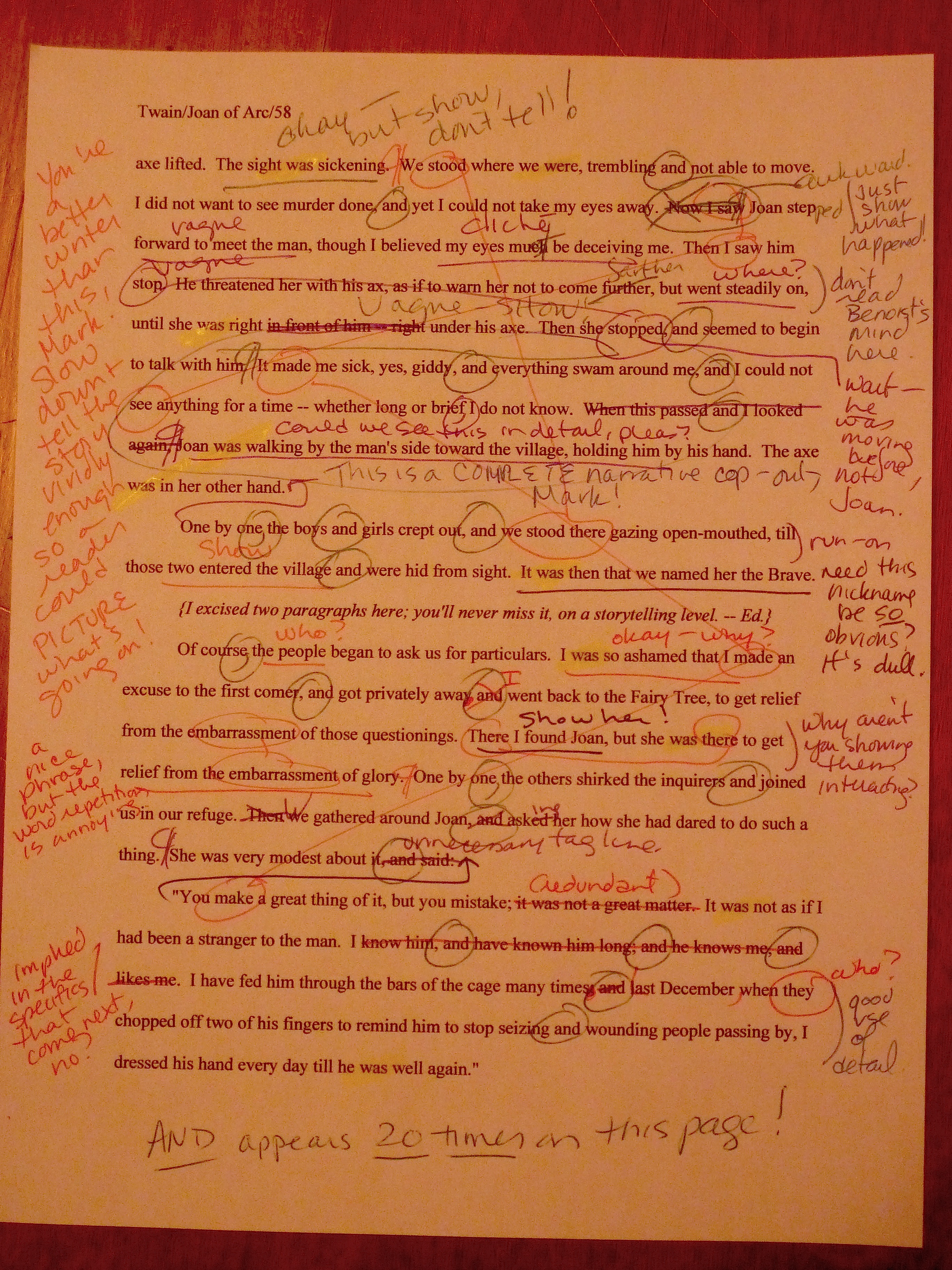
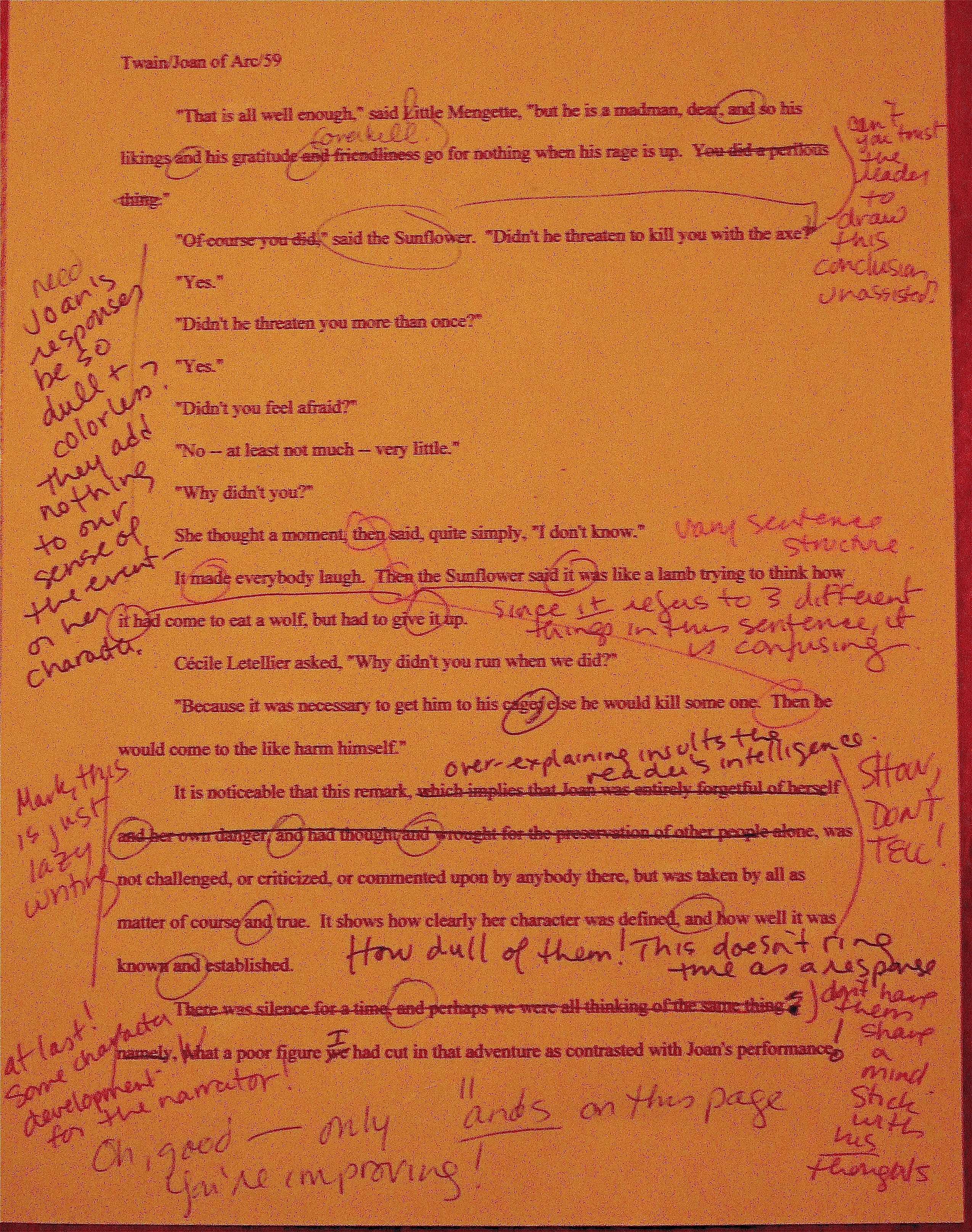
Speaking of dialogue revision, part VI: and then there’s the fine art of doing it right, or, love, agent-style

August 29th, 2010

pre-butchered fir tree

This, I am happy to say, used to be one of the views from my studio window, a sweet fir tree stuffed to the proverbial gills with cavorting crows, mischievous blue jays, and a small family of squirrels deeply devoted, for reasons best known to themselves, to digging up my crocus bulbs, saving them for a month or two, then replanting them in entirely different locations. I used to enjoy watching them before the strange men from the phone company showed up unannounced yesterday and slashed a ten-foot hole in the middle of the tree in order to make room for a half-inch cable scheduled to be installed three months from now. As one does.

Actually, it would have been a twenty-foot hole — quoth the foreman: “But those other branches were, like, in our way! We would have had to work around them!” — had I not managed to hobble out front to stop them in mid-slice. (Never underestimate the moral force of a crutch-wielding Valkyrie with a rudimentary knowledge of property law.) The damage has been done, though: this morning, there are no birds in the defiled tree.

Why does this seem like an apt time to wrap up this series on revising dialogue?

I can tell you why: all too often, in the first glow of enthusiasm following a newly-acquired self-editing tip — or, if you’ve been following our intensive discussions of craft this summer, a whole mess of ‘em — writers will, to put it succinctly, over-cut. Fired up by the time-honored advice to kill their darlings, they hack and slash with gusto, assuming, sometimes incorrectly, that if a line or two of dialogue runs afoul of the freshly-learned rule, the entire speech should go. Or the entire scene. Or the entire chapter.

But not all darlings are apt candidates for slaughter. Sometimes, too-vigorous cutting can do some serious harm to the tree. You don’t want to scare off the pretty birds, after all.

(I know — isn’t it amazing how often my day-to-day life provides PRECISELY the metaphor for what we’ve been discussing? Somebody up there must have a great fondness for blogs. Either that, or a monumental antipathy toward trees.)

Which is to say: not all of the results of revision are necessarily intentional. Over-enthusiastic cutting can, among other things, result in uneven tone, the loss of information the reader might need to know later in the plot, confusion of motivation, the omission of that foreshadowing sneer that alerts the attentive reader to the possibility that the protagonist’s mild-mannered coworker may turn out to be the super villain intent on destroying every ice cream stand in Gotham…

It can lead, in short, to a Frankenstein manuscript. There is no such thing, then, as a revision that would not benefit from a follow-up re-reading of the ENTIRE manuscript (preferably IN HARD COPY and, especially if it is dialogue-heavy, OUT LOUD) to make absolutely certain that the post-cut scenes not only read well on the page, but still pull their weight in the plot.

With that incentive for caution in mind, here is a final post in our revisit to 2009’s Seeing Submissions From the Other Side of the Desk series. Actually, it’s a mash-up of two posts in that series, presented in composite form for your perusing pleasure. When I originally posted the second, John Updike had just died — providing, yet again, a nudge toward a blog-friendly example.

Enjoy! But please, employ your pruning shears judiciously — and sparingly — after reading it.

Are you surprised to see another post on first-page rejection reasons coming after I’ve already gone over the agent-generated list of submission red flags? What can I possibly still have to say on the subject, after nearly three weeks of harping upon it?

Plenty, as it turns out. As excellent and extensive as the agent-generated list was in its day, as full of classic submission problems as any such list could possibly be, the agents in question generated it several years ago. As I’ve been shouting from the rooftops practically since I began writing this blog, the standards for what agents are seeking in a manuscript change all the time, along with the literary market itself.

Contrary to popular belief amongst aspiring writers, good writing, a solid premise, and catchy character names are not necessarily enough to catch an agent’s eye today. Yes, a novel or memoir submission typically needs all of those elements to be successful, but now as ever, it needs something else: to be a book that the agent can picture selling in within not an ideal market, but the one in which s/he is currently attempting to sell books.

Yes, I do realize what I just said: a manuscript could conceivably be perfectly marvelous and still not be what an agent would consider marketable in the literary market right now.

Why right now in particular? Well, agents have always made their living by selling their clients’ work to publishers — since reputable agents don’t charge fees over and above their contracted percentage of a book sale, they make money only when they hawk their clients’ books successfully — but even a cursory glance at PUBLISHERS WEEKLY or PUBLISHERS MARKETPLACE will tell you that these are exceptional times for the publishing industry.

What does this mean for aspiring writers? Probably, that agents will be a bit warier about picking up new clients until the publishing houses decide what their new strategies will be. That, and that vampire books like the TWILIGHT series will continue to get snapped up at a prodigious rate until the next surprise bestseller comes along. {Present-day Anne here: amazingly, although I originally posted this a year and a half ago, this statement remains true. That’s how cautious agents have become.}

So the best thing you could possibly do right now is rush right out and buy 50 books similar to yours — and convince 100,000 of your friends to do the same. Like it or not, that’s now new marketing trends are made.

Since my readership is made up almost exclusively of writers, I’m going to go out on a limb here and assume that none of you like it.

I don’t pretend to be able to predict the next big thing — other than the novel I’m about to finish writing, of course — but there are a few trends in what gets rejected and accepted that I’ve noticed cropping with increasing frequency over the last year or so. Since once a pet peeve is established, it tends to hang around for a while on Millicent the agency screener’s red flag list, it’s probably a good idea to avoid them for the foreseeable future.

I know — kind of ironic, given how opaque the future of publishing is right now. Let’s plow ahead anyway. Some stuff that hasn’t been playing well lately {and, again, this list remains astonishingly current}:

1. Unprofessionally formatted manuscripts.

I know that I harp on this one quite a bit — as evidence and for the benefit of readers new enough to this blog not to have lived through my extensive discussions of what publishing professionals expect manuscripts to look like, please see the HOW TO FORMAT A MANUSCRIPT and STANDARD FORMAT ILLUSTRATED categories on the archive list at right — but it honestly is true that if a submission does not look professional, Millicent is more likely to reject it, regardless of the quality of the writing. Since the volume of queries and submissions has been skyrocketing as the economy has worsened (writing a book is a LOT of people’s Plan B, apparently), she can afford to be even pickier than usual.

Take the time to make it look right.

2. “I’ve seen that before.”

This is a practically inevitable side effect of the aforementioned volume of queries and submissions rising, but standard storylines, stock characters, and literary clichés in general seem to be getting judged more harshly of late, probably because Millicent has been seeing the same things over and over again.

Does this mean that this is a great time for writers who embrace radical originality. Not exactly, because…

3. Fiction that challenges the status quo very strongly.

This is one of the truisms of the publishing industry for the last century — during uncertain economic times, comforting and escapist plot lines tend to sell better. Unfortunate, but true. It has to do with what’s known as the Peanut Butter and Jelly Index: when Americans are feeling insecure about the future, sales of inexpensive comfort foods tend to rise — as do books that make readers all warm and fuzzy.

Historically, agents and editors have followed these trends, shying away from more challenging plot lines, unusual worldviews, and even experimental use of prose. Since I’m personally a big fan of challenging plot lines, unusual worldviews, and experimental use of prose, I’m not all too happy about this, but it might be worth holding off on submitting any of the above for a few months, until the industry has had time to get used to new economic realities.

I know; it’s annoying. {Even more annoying: that this advice is still apt, to a very great extent.}

4. Vocabulary or tone inappropriate to book category.

I’ve been hearing a LOT of complaints in that bar that’s never more than a 100 yards from any literary conference in North America about submissions from writers who don’t seem aware of either the target audience or the conventions of the categories in which they have written books. From coast to coast, Millicents and their bosses have been railing about YA with too-adult word choices, literary fiction with a fourth-grade vocabulary, cynical romances, paranormals where vampires cavort in the sun…

I suspect that the increased pervasiveness of this one is actually an expression of the publishing industry’s smoldering resentment that book sales have dropped; if the writers of these books were actually buying the new releases in their genres, the logic goes, they would be more conversant with what’s selling right now. Having met scads of writers who say, “What do you mean, what do I read? I don’t have time; I’m too busy writing,” I have to say, I have some sympathy with this one.

Remember, from the pros’ point of view, a writer’s being up on the current releases for her type of book is considered a minimum standard of professionalism, not an optional extra. At least take the time to go to a well-stocked bookstore and thumb through the recent releases, to make sure that your submission doesn’t fly too far out of the acceptable range.

5. Narrative voices that read as though the author has swallowed a dictionary.

This is a perennial complaint that’s been getting more play recently, probably because of the convenience of the Thesaurus function in Word, but for Millicent, a submission crammed with what used to be called three-dollar words does not necessarily read as more literate than one that relies upon simpler ones. Especially if — and this problem turns up more often than anyone would like to admit — not all of those words are used correctly.

Or, to put it as some aspiring writers might: without embroiling us in superfluous polysemousness, it must be averred that the aesthetic propensities of a vainglorious tome toward prolixity or indeed even the pseudo-pragmatic co-optation — as by droit du seigneur — of an antiquitarian lexis, whilst purportedly an amendment to the erudition of said opuscule and arguably consanguinean (metaphorically speaking) and perhaps even existentially bound up with its literary apprizal, can all too facilely directionize in the azimuth of fustian grandiloquence or unmanacle unpurposed (or even dystelelogical) consequences on a pith and/or douceur de vivre level vis-à-vis even the most pansophic reader. As Pliny was wont to quip in his cups…

Come on, admit it: this is a BIT over-the-top for YA.

Yes, yes, I know that English is a beautiful language crammed to the gills with fabulous words, but use that thesaurus sparingly: from a professional reader’s point of view, the line between erudite and pretentious can sometimes be pretty thin. Few readers, they argue, will actually stop reading in order to go and look up a word in a novel written in their native tongue.

They speak from personal experience: it’s something Millicent would literally never do while scanning the first few pages of a submission.

Here again, your best guideline is the current market for your type of book: generally speaking, a writer will always be safe sticking to the vocabulary level of recent releases in his book category. If you want to sneak in more obscure words here and there, make sure that their meaning is evident from context. Trust me on this one.

6. Humor that Millicent doesn’t find funny.

Perhaps it’s due to the major presidential candidates’ having employed speechwriters last time around who wrote better jokes for them, but in the last few years, more aspiring writers seem to be trying to incorporate humor into their work. Since genuinely funny writing is a rare and wonderful thing, I can only applaud this trend.

Just make sure that it’s actually funny before you submit it on the page — not just to you and your kith and kin, but to someone who has never met you and is from a completely different background. And no, having one character laugh at a joke another character has just made will not cause Millicent to find it humorous.

Remember, too: nothing dates a manuscript faster than borrowing a joke from the zeitgeist. Particularly if the joke in question is lifted from a sitcom. (Have your parents explain why they ever thought “Whatchoo talkin’ about, Willis?” was funny, children.)

If you choose to open with humor, run your first scene (at least) by a few good, unbiased first readers before submitting it. Even those of us who write comedy professionally are heavily reliant on reader reaction to determine what is and is not legitimately funny.

7. Unlikable protagonists.

This is another golden oldie that’s been cropping up with increasing frequency of late: it’s long been an industry truism that if the reader doesn’t find the protagonist likable, she’s not going to want to follow him through an entire book. And I don’t just mean finding him kind of tolerable; Millicent’s going to want to find the guy actively engaging.

Why might this perennial objection be flying out of Millicent’s mouth more often recently, you ask? Did you read that one above about the Peanut Butter and Jelly Index?

And don’t tell me that your protagonist or narrator becomes more likable as the reader gets to know her. If the writing on page 1 doesn’t grab Millie, it doesn’t matter if the protagonist is marvelous on page 15.

It’s not as though agents or editors open books at random to check out the writing, after all. Millicent honestly does expect to see your best writing on page 1 of your submission — and that since she is going to assume that the writing on page 1 IS your best writing, it’s worth taking exceptional pains over it.

Begin at the beginning, as a reader would, when you revise. Your time investment will bear the greatest returns there. As agents have been known to tell one another when they’re in their Pliny-like cups (in that bar that’s never more than 100 yards from any writers’ conference, natch), they want to fall in love on page 1.

All that being said, a moment of silence, please: John Updike is dead.

When I heard the news — repeatedly; one of the mixed blessings of being widely known as a writer and descendent of a long line of writers is that people very considerately call to break the news to me whenever any well-established author kicks the bucket, as if everyone who has ever set pen to paper were a distant cousin of mine whose death I should not be forced to learn from the standard media sources — I naturally went straight to my bookshelf and glanced through some of his work. In light of our ongoing series on opening pages and the fact that his first novel, THE POORHOUSE FAIR, came out in 1959, I expected his initial pages would, to put it politely, have a tough time making in past today’s Millicents, thus underscoring Updike’s frequently-made point about how literary fiction has been all but brought to earth over the last 40 years.

I was pleased to find that quite the opposite was true: his first pages were grabbers. Take that, eulogists of literary fiction!

More to the point of the latter part of this series, his hooks largely operated not through garish action, but interesting character development. Take a gander, for instance, at the first two paragraphs of THE WITCHES OF EASTWICK (1984):

“And oh yes,” Jane Smart said in her hasty yet purposeful way; each s seemed the black tip of a just-extinguished match held in playful hurt, as children do, against the skin. “Sukie said a man has bought the Lenox mansion.”

“A man?” Alexandra Spofford asked, feeling off-center, her peaceful aura that morning splayed by the assertive word.

Now, we could speculate all day about the probable insecurities of a male author who felt compelled not only to have a female character repeat the word man here, as though the very concept of the Y chromosome were inherently unsettling to heterosexual women (at least the frail kind discombobulated by assertive words) but also to employ splayed, a term commonly associated with the things models do in the centerfolds of men’s magazines, to describe a mental state. It might not be too much of a stretch to assume based upon this opening that Mr. Updike wasn’t picturing much of a female readership for this book when he wrote it — intriguing, since in 1984 as now, women were far and away the most common purchasers of literary fiction.

But none of that concerns us at the moment. Look, I ask you, at how beautifully he has used visceral details to establish both a mood and character in the first lines of this book.

It’s a heck of an opening in general. Let’s take a moment to ponder why: instead of easing the reader into the story by an extensive description of the physical space in which we discover these characters, or the even more common physical description of the characters themselves, Updike introduces these women by providing specific insight into their mental processes and motivations. Instead of just telling us that Jane is mean and Alexandra shy, he shows us through an analogy and word choices that we might not expect.

Yes, what you just thought is absolutely right: this opening would grab Millicent because it’s not only well-written, but surprising.

Seeing all the elements in action helps to clarify what we’ve been talking about, doesn’t it? But while we’re at it, let’s be thorough about this. Quick, without rushing back and checking our initial list of red flags that often lead Millicent to reject a submission on page 1, what might strike her as problematic if she saw this opening in a submission by a brand-new writer today?

If you pointed out the typo in the very first sentence, give yourself a great big gold star for the day. (Technically, there should be a comma between oh and yes; as Mr. Updike was a graduate of my alma mater, I’m relatively certain that he should have been aware of this.) While some Millicents might be kind enough to read past a first sentence grammatical or spelling error, it’s not a foregone conclusion.

Proofread.

While we’re giving out prizes for observation, take a red ribbon out of petty cash if you flagged the repetitive dialogue. As we discussed earlier in this series, repetitive dialogue tends to annoy agents and editors, since they’ve been trained since they were pups to excise redundancy. Besides, characters who simply echo what has already been said tend to come across as less intelligent than those who actually add something new to the conversations in which they participate — always a tad risky in a protagonist.

Anything else? What about the unnecessary tag lines (Jane Smart said, Alexandra Spofford asked), now out of fashion? Since Mr. Updike had already been established in the first rank of North American authors by the time for decades by the time the use of tag lines fell out of fashion, this might seem like an unwarranted quibble, but remember, we’re judging this by the standards that would apply to a writer trying to break into the biz now.

Long-time readers, pull out your hymnals and sing along with me now: an established author can often get away with things that someone new could not.

Did any of you red-flag the semicolon? If Mr. Updike were submitting this to Millicent labeled as anything but literary fiction, you’d be right to consider cutting it. Generally speaking, in fiction that isn’t aimed at a college-educated audience — as literary fiction is, ostensibly, but most fiction is not — semicolons are considered a bit highbrow.

Admittedly, the fact that Millicent regularly sees manuscripts whose vocabulary barely scrapes the 10th grade positively peppered with semicolons might have something to do with this. No one but writers really like semicolons, and not even all of us use them correctly (as the late John Harvard would no doubt be delighted to note, Mr. Updike has done properly above), but my, don’t we like to shoehorn them into a manuscript!

Unless you’re submitting your work as literary fiction to an agent with a successful track record of representing a whole lot of it AND her client list fairly bristles with semicolon-wielding authors, you might want to minimize their use.

All of which, as fate would have it, is a perfect lead-in to my wrap-up of the rejection reasons because, really, it’s important to recognize that while, in the past, agents tended to be open to working with their clients in order to work out the technical kinks prior to submission to publishing houses, now most of them expect writers to submit manuscripts so clean and camera-ready that the agency screener could confidently walk them directly from the agency’s mail room to the desk of even the pickiest editor. Thus these last few weeks of weeding out the most common submission problems, at least on page 1: we’ve been going over these points exhaustively precisely so you can meet standards far higher than when the late, great Mr. Updike faced when he was first trying to break into the biz.

Today, however, we get to see the reward: the kind of manuscript that makes agents weak in the knees.

Surprisingly, agents and editors tend not to talk too much at conferences about what they love to see in manuscripts. They tend to stick to describing what is marketable, because that is, after all, their bread and butter. Remember, agents (most of them, anyway) don’t hold submissions to such high standards in order to be mean — they want to take on books that they know they can sell within today’s extremely tight market.

Which is to say: it’s not enough for an agent to love your work; she needs to be able to place it at a publishing house for you. Contrary to popular opinion amongst aspiring writers, that’s in the writer’s interest as much as the agent’s.

But as those of you who have been querying strong, marketable projects for a while already know, agencies often reject submissions for perfectly marketable books, a fact that is very confusing to those who believe that every agent is looking for the same thing, or that a single rejection from a single agent means that everyone in the industry will hate a book. Or that there exists writing so beautifully literary that every agent currently drawing breath will instantly exclaim, “Oh, of course — I’ll represent that!”

Especially for first fiction or memoir, it’s not enough for an agent to recognize that a writer has talent and a book has market potential: they like to fall in love. If you’re a good pitcher, you already know the reaction I’m talking about: the eyes becoming moist with desire, the mouth appearing to go dry with lust. When an agent wants a project, the symptoms strongly resemble infatuation, and as this series has taught us, it’s often a case of love at first sight.

As with any other type of love, every agent has his own particular type that is likely to make his heart beat harder, his own individual quirks and kinks. Just as an agent will train his screeners to rule out submissions containing his pet peeves, he will usually set some standards for the kind of project he would like to see forwarded to his desk.

So, in a way, our old pal the underpaid, latte-quaffing, late-for-her-lunch-date screener is her boss’ dating service. Literarily, of course.

With an eye toward getting your submission on the litero-romantic short list, here’s the list of what the Idol panelists said would light their fires sufficiently to ask for a second date. In other words, these are the traits they said would lead them to want to read beyond page 1 of a submission:

1. A non-average character in a situation you wouldn’t expect.

2. An action scene that felt like it was happening in real time.

3. The author made the point, then moved on.

4. The scene was emotionally engaging.

5. The narrative voice is strong and easy to relate to.

6. The suspense seemed inherent to the story, not just how it was told.

7. “Good opening line.”

8. ”There was something going on beyond just the surface action.”

Notice anything about this list? Like, say, that the opening of THE WITCHES OF EASTWICK knocks every single one of these criteria out of the proverbial ballpark?

Hey, I told you Updike’s work stood up well.

Notice anything else? How about that all of these criteria could be applied equally well to a memoir and a novel? That’s something that memoirists often forget: just because a story is true does not mean that it will be judged by less stringent requirements than a fictional one. A good memoirist, like a good novelist, is first and foremost a storyteller.

“Hey,” I hear some of you out there saying, “isn’t there something missing from this list? Shouldn’t ‘This is a marvelous writer,’ or ‘That’s the best metaphor I’ve ever seen for a love affair gone wrong,’ or ‘Wow, great hook’ have made the list? Shouldn’t, in fact, more of these have been about the craft of writing, rather than about the premise?”

Excellent questions, both. Would you like the cynical answer, or the one designed to be encouraging to submitters?

Let me get the cynicism out of the way first: they are looking for a book that can sell quickly, not necessarily a writer whose talent they want to develop over a lifetime, and that means paying closer attention to an exciting plot than pure beauty of voice. Yes, they are seeking good writing with a genre-appropriate voice, but at first glance, they are looking to fall in love with a premise.

The less cynical, and probably more often true, reason is that this is not the JV team you are auditioning to join: this is the big league, where it is simply assumed that a writer is going to be talented AND technically proficient AND able to draw the reader immediately into a pulse-elevating plot.

Unless an agent specifically represents literary fiction — not just good writing, mind you, which can be produced in any book category, but that specific 3-4% of the fiction market which is devoted to novels where the loveliness and/or experimental nature of the writing is the primary point of the book — the first question she is going to ask her screener is probably not going to be, “Is it well-written?”

Why not? Well, presumably, if any submission weren’t fairly well-written and free of technical errors, it would not make it past the screener. Thus, her question is much, much more likely to be, “What is this book about?”

Before you sniff at this, think about it for a minute: the last time you recommended a book to someone, did you just say, “Oh, this is a beautifully-written book,” or did you give some description of either the protagonist or the plot in your recommendation? Even the most literary of literary fiction is, after all, ABOUT SOMETHING.

Ideally, any good novel will be about an interesting character in an interesting situation. Why does the protagonist need to be interesting? So the reader will want to follow her throughout the story to come, feeling emotionally engaged in the outcome. Why does the situation need to be interesting? So the reader will not figure out the entire book’s plotline on page 1.

If you have included both of these elements in your premise, and you have presented them in a way that avoids the 74 rejection reasons I’ve been discussing throughout this series, most of the rest of the criteria on this love-it list will follow naturally. Not necessarily, but usually.

If the reader cares about the protagonist, the stakes are high enough, and the pacing is tight, the scene is much more likely to be emotionally engaging than if any of these things are not true. If you eschew heavy-handed description and move straight to (and through) the action, conflict is more likely to seem as though it is happening in real time, no one can complain that you are belaboring a point, and the suspense will develop naturally.

So really, this avalanche of critique has been leading directly to the characteristics of an infatuation-worthy book. (You’re welcome.)

Of course, all of this IS about the quality of the writing, inherently: in order to pull this off successfully, the writer has to use a well-rehearsed bag of tricks awfully well. Selecting the right narrative voice for a story, too, is indicative of writerly acumen, as is a stunning opening line. Each of these elements is only enhanced by a beautiful writing style.

However, most agents will tell you that lovely writing is not enough in the current market: the other elements need to be there as well. As well as a certain je ne sais quoi that the pros call an individual voice.

All of which is to say: submission is not the time to be bringing anything but your A game; there really is no such thing as just good enough for a first book in the current market. (Unless, of course, you’re already established, like John Updike, or a celebrity, or you happen to have written the story that the agent always wanted to write himself, or…) Playing in the big leagues requires more than merely telling a story well — that’s the absolute minimum for getting a serious read.

Which brings me to #8, ”There was something going on beyond just the surface action.” Submission mail bags positively burgeon with clear accounts of straightforward stories, as well as with manuscripts where every nuance of the plot is instantly accessible to the reader as soon as it is mentioned. Books that work on a number of different levels simultaneously, that give the reader occasion to think about the world to which the book is introducing her, are rare.

That the Idol agents would be looking actively for such a book might at first blush seem astonishing. How much subtlety could a screener possibly pick up in a 30-second read of the first page of a manuscript?

Well, let me ask you: the last time you fell in love, how much did you feel you learned in the first thirty seconds of realizing it?

On that note, I’m going to close this series. Pat yourselves on the back for making it all the way through this extremely sobering list, everybody: this was good, hard, professional work, the kind that adds tangible skills to your writer’s tool bag. Be pleased about that — and keep up the good work!

The envelope, please…

August 4th, 2010

WHISPER_cover

That’s right, gang: the long-anticipated day has arrived. Today, I’m going to announce the winners of the Author! Author!/WHISPER Great First Page Made Even Better Contest. Winners will receive an extensive critique of their first pages in this very forum, courtesy of yours truly and FAAB Phoebe Kitanidis, author of the HarperCollins’ new YA release, Whisper.

Hmm, why does that title sound so very familiar? You must have seen the cover someplace.

Why did it take such a long time to judge this contest, you ask? Well, several reasons, up to and including the fact that I’m typing this one-handed, due to my recent injuries. Also, the response to this contest was quite a bit more enthusiastic than either the judges or I had anticipated; as a contest without an entry fee, it wasn’t as though we could simply hire staff to deal with the additional entries.

Beginning to understand why the vast majority of literary contests charge fairly hefty entry fees? Contest administration is time-consuming.

Not that I’m complaining, of course — there were many great entries, and a tidy array that rose to the rank of fabulous. So many, in fact, that it was exceptionally difficult for the judges to agree on the final awards.

But of that, more below. First, I want to talk about a couple of the widespread entry problems.

To be blunt, it was not exceptionally difficult was to disqualify the full one-third of entries that disregarded the rules — and that’s not even counting the 90% of entries that did not adhere to standard format for manuscripts. Come on, people — there were only four rules!

What can we learn from disturbing statistic? Something that any veteran contest judge or agency screener could have told you: a significant proportion of aspiring writers evidently do not take the time to read contest rules and submission requirements.

That’s sad, because — again, as anyone mentioned above could tell you — if an entry or submission does not follow the rules, it will almost always be rejected, regardless of the quality of the writing.

Period. End of story. No appeal. Or, to put it another way: not taking the time to read the rules hurts only you.

Ditto with not following the rules of standard format for manuscripts — although so many entrants broke one or more rules that the judges had to downgrade the importance of formatting in the judging. This meant, in practice, that we ended up considering (and even giving a prize or two) to first pages that Millicent the agency screener probably would not have bothered to read at all.

Hey, we were being nice. But expecting Millicent to exercise that level of leniency would be foolish.

In case I am being too subtle here to catch the average rule-skimmer’s eye: READ THE RULES. LEARN THE RULES. FOLLOW THE RULES. REPEAT AS NEEDED UNTIL YOUR BOOK GETS PUBLISHED.

Seriously, submitting an improperly-formatted manuscript is precisely like sending a contest entry that ignores the stated rules: the writer is depending, foolishly, upon the kindness of the reader to overlook a lack of professionalism. Submitting an improperly or — even more common — inconsistently formatted manuscript is, to put it bluntly, usually a waste of the writer’s time.

Why? Chant it along with me, long-time readers of this blog: because agencies and contests typically receive so many perfectly-formatted, impeccably rule-following manuscripts that they don’t need to bother with those that are not professionally presented. Therefore, not taking the time to learn how to format a book manuscript properly because you are trying to get it out the door faster is self-defeating.

Again, it really is that simple. Fortunately, all any aspiring writer has to do to learn how to format a manuscript properly is take a swift peek at the aptly-named HOW TO FORMAT A MANUSCRIPT category on the archive list on the bottom right-hand side of this page.

Given how much blog space I routinely devote to proper formatting, I was genuinely surprised at how few entrants had evidently checked their formatting against the literally hundreds of practical examples I have posted on this very blog in recent years. Short of coming to your respective houses and formatting your work for you, I don’t see how I could possibly have made it easier for entrants to this contest — or submitters to agencies, for that matter — to get the formatting right.

I just mention. While I’m typing one-handed. Don’t make me pull out any more guilt-inducement than that.

Oh, and something else almost everybody who entered did: titled the entry document along the lines of Anne Mini contest, Author! Author! contest, first page contest…in short, in a manner that, while convenient for finding it again on THEIR hard drives, required my renaming virtually every entry before I could save it to mine. Because, honestly, when confronted with 43 (seriously) entries called ANNE MINI CONTEST, how else was I supposed to tell them apart?

Aspiring writers do this all the time in electronic submissions and contest entries. Strategically, it’s a bad idea to inconvenience Millicent, even a little.

How should a request for an attachment be titled, you ask? Either with the writer’s last name (Smithentry.doc would have worked beautifully on my end; SmithCatIIentry.doc would have been even better) or — and this was the most popular choice in the contest — with the title of the piece. (TheWayWeWere.doc would be hard to mix up with VenusVampires.doc, after all.)

So much for the multi-part lecture. On to the announcement of the winners. First, the grand prizes.

The 2010 Author! Author! Awards for Expressive Excellence and Grand Prizes in the Author! Author!/WHISPER Great First Page Made Even Better Contest go to:

Adult Fiction: Jennifer Sinclair Johnson, DIVIDED STATES

Young Adult Fiction: Juniper Ekman, TROUBLE COMES

Actually could fit in either adult fiction or YA, but the judges agreed they would have awarded it a grand prize in either: Cole Casperson, INDOMITVS

Memoir (not an official category, but we received a lot of great entries): Jennifer Lyng, NORMAL IS WHAT YOU KNOW

But wait — there’s more! Judging the finalist round was quite tough. Because we received such a lot of exciting, well-written entries, the judges and I talked it over, and we decided that it might be a lovely idea for me to post and discuss the first, second, and third-prize entries as well. (Not that I’ll be doing it immediately, mind you; prize fulfillment will take place when my hands are once again up to full blogging strength.)

So, bearing that prize upgrade in mind, let’s also hear it for the entries that placed:

The Author! Author!/WHISPER Great First Page Made Even Better, Category I: Young Adult

First Prize, YA: Natalie Hatch, BREEDER

Second Prize, YA: Suzi McGowen, A TROLL WIFE’S TALE, and Sherry Soule, DARK ANGEL

Third Prize, YA: Janine A. Southard, WHICH STAR MY DESTINATION

The Author! Author!/WHISPER Great First Page Made Even Better, Category II: Adult Fiction

First Prize, Adult Fiction: Curtis Moser, PERDITION, and Jens Porup, THE SECOND BAT GUANO WAR

Second Prize, Adult Fiction: David A. McChesney, SAILING DANGEROUS WATERS, and Ellen Bradford, PITH AND VINEGAR

Third Prize, Adult Fiction: David Jón Fuller, BARK AT THE MOON; Linda C. McCabe, THE LEGEND OF THE WARRIOR MAID AND THE SARACEN KNIGHT, and Carolin Walz, GOTHIC WARS.

Hey, I wasn’t kidding about a plethora of great entries! Congratulations to all of the winners — watch this space to hear more from them.

And, as always, keep up the good work!

The dreaded Frankenstein manuscript, part XXIII: how much detail is tutu much?

July 20th, 2010

degas dance class pink

The blogger’s life is all about constantly creating new content to foist upon an eager world, but I have to say, I was so pleased with the way yesterday’s post turned out that I was tempted, albeit briefly, just to pretend that I couldn’t get to my computer for the next week or so. That way, the post would have lingered at the top of the blog for a nice, long time, all of you would have had some time to ponder your individual authorial voices, and I would have gotten a bit of a vacation.

Wait, why did I decide not to do this? It sounds like a great idea.

Oh, yeah: we’re rapidly heading toward August, and I didn’t want to slow down anyone’s revision efforts. Specifically, I did not want any of you coming to me in mid-September, saying, “Wow, Anne, I wish I’d known some of the editing fixes you were talking about late in the summer before I sent off my submission to the agent of my dreams! But there we were, just a few short weeks before the annual August exodus, and you decided to take a week off. Unbeknownst to anyone concerned, the piece of advice that would have enabled me to turn my opus from pretty good to yowsa would be in the very next post!”

Oh, you may laugh — but would you care to hear just how often readers or students in my classes have said similar things to me?

A small forest of hands shot into the air in the middle of the quote from the fantasy creature I choose to regard as representative of future readers. Yes, hand-raisers? “But Anne, why would mid-to-late July be a particularly poor time for you to stop lecturing us on craft issues? And what did your imaginary friends mean about the annual August exodus?”

Ah, the answers to those two trenchant questions are interconnected, my friends. Traditionally, enough of the NYC-based publishing world goes on vacation between the end of the second week of August and Labor Day that it’s genuinely difficult to pull together an editorial committee in order to approve the acquisition of a manuscript or book proposal. That means, in practice, that agents are not all that likely to be able to sell books during this period, so they, too tend to go on vacation during that period. Oh, a Millicent or two might be left behind to watch the store while the rest of the agency seeks less humid climes, but generally speaking, it’s a dead zone.

What does that mean for aspiring writers, you ask? Why, that mid-August through mid-September isn’t usually the best time to query or submit. Unless, of course, one happens to harbor an active desire to have one’s query or manuscript sit on a desk for a month or two.

Did that vast collective gasp mean that at least some of you were expecting to hear back sooner — or at any rate, for Millicent and her boss to get cracking immediately after midnight on Labor Day? Think about it: if you didn’t go into work for a few weeks, how much mail would pile up on your desk?

Got that image firmly in mind? Good. Now imagine the state of that desk if you routinely received 800-1200 queries per week.

On a not entirely unrelated note, had I mentioned that the next few weeks would be a great time to get those queries out the door? Or to polish up and send off those requested materials?

To facilitate your pursuing one or both of those laudable goals, I’m going to be winding down the Frankenstein manuscript series with today’s post. Oh, we’re not going to be leaving the wonderful world of craft — beginning with my next post, we’re going to take a serious foray into pepping up your dialogue. But for the nonce, we’re going to be stepping away from manuscript-polishing issues, so that you may more easily take the time to…well, polish your manuscript.

And honestly, weren’t you getting just a little tired of all those Roman numerals?

To round out the series with a bang, I’m going to devote today to challenging you to assess yet another reader’s actual text. Rather than present you with her opening pages, however, I’m going to show you an action scene, of a sort, and encourage you to try to spot potential revision opportunities.

Why launch into a mid-book scene, you ask, rather than my usual target of choice, the opening pages? Partially, so we could talk about pacing — as the expressive industry term sagging in the middle may already have led you to suspect, narratives are more likely to slow there than at either the beginning or the end — but also, as is my wont, to answer a reader’s question. Quoth abbreviation devotee Kathy:

What if your world, so to speak, involves a skill that not everyone is familiar with? In my case, my MC is a dance student, and much of the WIP occurs during her classes at a studio.

I’ve gotten comments from critters saying both put in more details about the step or combinations and leave out the details. So how do I balance out the necessary details so non-dance readers can visualize my MC’s dance movements and not put in so many that it stalls the action?

As delighted as I am at the mental image of critters providing feedback on a manuscript (and as concerned as I am that not every reader will know that MC = protagonist and WIP = work in progress; while WIP is arguably writing-class jargon, MC is not), this question has been causing me some chagrin. As we have seen throughout this series, this is precisely the kind of question that is impossible to answer without taking a close look at the scene in question — as much as aspiring writers might like for there to be hard-and-fast formulae for figuring out this kind of proportion, what works honestly does vary from story to story.

Yet now that we have a nice, well-stocked revision tool kit, we need fear no writing fix-it challenge. So let’s take a peek at Kathy’s pages with an eye to improving them, shall we?

Before we do, though, I have a confession to make: when I use readers’ examples here, I have been known to clean up the formatting prior to posting them. That way, the reader kind enough to allow me to write about actual text gets the benefit of specific feedback, and you, dear readers, don’t become confused by seeing improperly formatted pages.

Since this is going to be the last concrete example in this series, however, I’m going to show at least the first page of this one initially as it arrived in my e-mail. Kathy’s made two extremely common mistakes for a submitter; Millicents whose boss agents accept e-mail queries and submissions see these all the time. I’m rather pleased to be able to show them to you in their natural habitat, as most professional readers will automatically reject requested materials with either.

See if you can catch them on her first page. Hint: either would be apparent to Millicent the agency screener from ten feet away.

Kathy as is

See the problem? This page is not formatted like a manuscript page: it lacks a slug line (and thus any way to identify this page, should it become separated from the rest of the submission), and there is a skipped line between each paragraph. Also, although it may be hard to tell in this version, the writer skipped only one space after each period and colon, rather than two, rendering it significantly harder to edit. (Which, admittedly, some agents would prefer; check their websites for specific instructions on the subject.)

It’s formatted, in short, as though it were intended for insertion into the body of an e-mail, not as samples from a manuscript page. Which would have been appropriate only had the professional reader in question (in this case, me) specifically asked for the materials to be sent — wait for it — in the body of an e-mail.

In case anyone’s wondering, that request is usually reserved for electronic queries where the agency likes to see a few pages of text or a bio. It’s virtually never the expectation when an agent or editor asks a successful querier or pitcher to send actual manuscript pages.

That’s why, in case you’d been wondering, I’m particularly pleased to be able to show you this phenomenon in action as I wrap up the Frankenstein manuscript: this level of formatting gaffe might easily be sufficient to prevent Millicent from reading any of the text at all, at least if her agency asked (as I did) for the pages to be sent as a Word attachment, the industry standard means of online submission.

In case I’m being too subtle here: formatting counts in submissions, even e-mailed ones.

That’s not, alas, as widely-known an axiom as it should be. Like so many aspiring writers, Kathy probably mistakenly believed that what this professional reader wanted to see was the content of the requested pages, but that’s not the only thing being judged in a submission. Any professional reader would also be looking to see if the submitter was aware of how manuscripts should be put together.

Why is it problematic if a submission consists of just writing, rather than writing presented in standard manuscript format? Even if Millicent read it and fell in love with the writing, the presentation just screams that this would be a time-consuming client to take on: clearly, she would need to be shown the ropes.

And that, from the other side of the submission desk, is a problem — or, depending upon how serious Millicent is about ever seeing her desktop again, a solution. Given that a good agent will routinely receive 800-1200 queries per week (yes, even during the August break), and that she gets enough properly-formatted submissions to fill her few new client spots hundreds of times over, why should she instruct her Millicent to read improperly formatted materials? By the same token, why should Mehitabel the contest judge consider those same materials for finalist status in a literary contest?

That last bit was not entirely rhetorical, by the way. In the Great First Pages contest I sponsored here in May, a good third of the entries were not properly formatted. Rather surprising, as the rules asked that entries be submitted in standard format as a Word attachment. Or it might have surprised me, had I not so often served as a contest judge; experience had taught me how often contest entrants simply do not read the rules with care. (But don’t worry, Great First Page entrants: finalists have been selected, and the winners shall be announced soon.)

The moral, should you care to hear it: unless an agency, small publishing house, or writing contest’s rules either ask you to submit your writing in the body of an e-mail or SPECIFICALLY ask for some other kind of presentation, you should assume that they’re expecting to see standard manuscript format. And if you don’t know what that should look like on the page, run, don’t walk, to the posts in the aptly-named HOW TO FORMAT A MANUSCRIPT category on the archive list at right.

Heck, for starters, you could just look at today’s example again, now that I’ve taken the time to format it as Millicent would expect to see it. (As usual, if you are having trouble reading the example, try holding down the COMMAND key simultaneously with +, to enlarge the image.) To protect the innocent, I’ve taken the liberty of changing the last name of the submitter, as well as the title of the book.

Kathy page 1
Kathy page 2

Ready to tackle Kathy’s question now? Well, probably not, if you’ve been following this series closely. I’m guessing that what jumped out at your first was all the word repetition, right?

In case it didn’t, let’s apply our usual test for word and phrase frequency, to see how this page would have looked to Millicent’s critical eye. Notice in particular the name repetition.

Kathy's marked 1
Kathy's marked 2

Colorful, isn’t it? Since we have already discussed word choice stagnation in general and name repetition in particular in some detail in this series, I don’t want to dwell too much on these problems as they manifest here. Except to point out one thing: notice how hard it is to evaluate the text on any other basis while all of that repetition is starting you in the face?

It’s every bit as hard for professional readers. So should anyone still be looking for a great first step toward an overall revision, I would highly recommend starting with word and phrase repetition.

But where, if a savvy reviser had to choose, would the next level of revision start? Would it, as Kathy suggests, be at the jargon level, reassessing the amount of actual dance steps in this scene?

That’s a legitimate concern, but I tend to doubt that would be the very next problem Millicent would notice. Assuming that word repetition is off the table, here are the kinds of issues that might concern her.

Kathy edit 1
Kathy's edit 2

Again, where to begin? My vote would be in the first paragraph, with a problem that dogs many a manuscript these days, especially in YA: having more than one character speak or think per paragraph.

Actually, paragraph #1 presents a couple of rather interesting thought dilemmas. Take a gander as it currently stands:

After class, several classmates huddled outside the large observation window while Miss Sylvia showed Melissa and Peter the first steps of the dance. Both did the same moves, which were simple enough, in Melissa’s mind. Miss Sylvia said, “Peter, offer your right hand to Melissa. Melissa, put your right hand in it and step into relevé arabesque.” Melissa’s heart fluttered for a moment. Finally, some actual partnering.

The perspective is a trifle puzzling here, even for an omniscient narrative. In the first sentence, the action is seen by third parties, from the other side of a window. In the next sentence, the narrative jumps into Melissa’s head, but in sentences #3 and #4, Miss Sylvia is speaking. Yet in sentences #5 and #6, we’re back in Melissa’s perspective, underscored by #6’s italicized thought.

A touch confusing to the spatial sense, is it not? No worries — a bit of judicious application of the pinkie to the RETURN key will instantly clarify matters:

After class, several classmates huddled outside the large observation window while Miss Sylvia showed Melissa and Peter the first steps of the dance. Both did the same moves, which were simple enough, in Melissa’s mind.

“Peter, offer your right hand to Melissa,” Miss Sylvia said. “Melissa, put your right hand in it and step into relevé arabesque.”

Melissa’s heart fluttered for a moment. Finally, some actual partnering.

See how the simple act of giving each perspective its own paragraph removes any possibility of perspective drift? Not to mention being allowing a far more conventional presentation of dialogue.

Do I see some raised hands out there? “But Anne,” italicized thought-lovers everywhere exclaim as one, “why did you remove the italics around Melissa’s thought? They were used correctly the first time around, weren’t they?”

Well, yes, they were — although that’s a qualified yes, since there are plenty of Millicents out there for whom italicized thought equals lazy writing. (Their rationale: “Shouldn’t a genuinely talented writer be able to alert the reader to the fact that the protagonist is thinking without resorting to fancy typefaces?”) Amongst those who do accept this convention, though, Kathy’s use here would definitely fly.

So why did I chose to eschew italics here? Simple: there are so many French terms in this scene. On the manuscript page, it’s rather confusing to the eye to have both the foreign terms and the thought italicized; as the French had to be italicized, the thought was the obvious one to change.

And I ask you: wasn’t it still clear that the last sentence was Melissa’s thought?

Of course, for an editorial change like this to work, it would have to be made consistently throughout the entire manuscript — altering it in this scene alone, or even only in the jargon-heavy ballet scenes, might well result in text that read like a mistake. Every fiction writer needs to decide for herself whether to italicize thought or not, and then cling to that resolve like a leech. (But if you would like some guidance on how to italicize thought correctly, you might want to check out the ITALICS AND WHEN THEY ARE CORRECT TO USE category on the archive list at right.)

There’s another structural problem, also related to RETURN key usage, that might also strike your garden-variety Millicent’s eye forcefully. Any guesses?

If you instantly sent your fingertips shooting skyward, shouting, “By gum, there are a couple of single-sentence paragraphs in this excerpt, but it takes at least two sentences to construct a narrative paragraph,” you have either been paying close attention throughout this revision series, or your eyes are sharp enough to have picked up the rather dim red marginalia above. While a dialogue paragraph can indeed be a single sentence long:

“But I like single-sentence paragraphs,” Kathy pointed out.

it’s technically incorrect to limit a narrative paragraph to a single sentence, like so:

He nodded.

As we’ve discussed, the prevalence of single-sentence paragraphs in newspaper and magazine writing (in AP style, they are perfectly acceptable) has led to an ever-growing acceptance of the things in published books, particularly nonfiction. That’s not going to help you, however, if your Millicent should happen to have graduated from a college with a particularly good English department.

If you just like the way single-line paragraphs look — many an aspiring writer seems to positively pine for them — use them as judiciously as you would profanity. To co-opt Mark Twain’s quip about taking the Lord’s name in vain, select a time when it will have effect. How about, for instance, limiting their use to when the statement that follows a full paragraph is actually surprising?

Again, we’ve already talked about this issue earlier in the series, so I shall not harp upon it. For the moment, it’s enough to realize that Millicent would notice and zero in such paragraphs — enough so that it really would behoove the writer to make sure that he’s deriving some significant benefit from breaking the rules. In this excerpt, at least, neither of the single-line paragraphs rises to that level of usefulness.

I hear a positive fusillade of fingertips drumming on desks. “But Anne,” cut-to-the-chase types protest, “while all of this is interesting, from a self-editing perspective, you haven’t yet addressed Kathy’s question. Is there a reason that we needed to discuss all of these technical matters before getting to the issue of whether she’s overusing detail here?”

Yes, actually, a very good reason: from a professional reader’s perspective, it’s difficult to assess questions of style before the more basic writing issues — spelling, grammar, clarity — and presentation requirements — our old pal, standard format; choices like word repetition and italic use that might produce eye distraction on the page — have been resolved. That’s partially why I’ve been talking about attacking a Frankenstein manuscript in waves of revision: as each level of text scrubbing takes place, the style and voice lying just beneath can emerge.

It follows, then, as dawn succeeds the night, that as a self-editing writer winnows away his manuscript’s technical problems, underlying stylistic difficulties may leap to the fore. In the case of today’s example, two related problems have cropped up — maintaining narrative tension and the use of necessary technical jargon.

Let’s tackle the latter first. Kathy had asked how best to tell how much detail to include in her dance studio scenes, but from the perspective of a reader unfamiliar with ballet terminology, there’s actually not a great deal of detail in this scene. There is, however, quite a bit of dance jargon, a series of phrases that leap off the page by virtue of being italicized.

Why, we were discussing the eye-distraction potential of those words and phrases just a few moments ago, were we not? What a coincidence.

The fact that so many of these terms are in French, and thus require italicization, is not the only reason that the ballet jargon is problematic in this excerpt, however. Much of the time, the jargon is taking the place of description, not adding to it.

What’s the difference, those of you who have done some time in ballet class ask? The answer to that one is easy: please tell us, readers who don’t know an arabesque from the proverbial hole in the ground, how are you picturing the action in this scene?

Not very clearly, I’m guessing — which is almost always the case when a narrative leans very heavily upon jargon for its descriptions. Naming an action or object is not the same thing as showing what it looks like, after all.

That’s genuinely a pity in this scene, as I suspect (having put in my time in ballet class) that the movements the characters are making would be quite pretty to see. So my first choice for stylistic revision would be to replace at least some of the jargon with some lyrical description of flowing arms and tremulous balances, enough so that a reader who did not know much about dancing could still enjoy the movement of the scene.

And you thought I wasn’t going to answer Kathy’s question!

The other problem — maintaining narrative tension — also speaks to her concern. If the level of detail is too high, the tension of the scene can suffer; as we discussed last time, one way to keep an action scene moving along is the thoughtful application of summary statements.

So I ask you: is the level of detail appropriate for the ideal pacing of the scene?

I’m turning it over to you in part because personally, I find that question a trifle difficult to answer; I suspect a reader who had not spent her wayward youth glissading and pas de bouréeing would have quite a different response than one who had. If the target audience is made up solely of girls who live in leotards, the level of detail may not need to be tweaked much. If, however, the intended readership includes — and I think it should — kids who always wanted to take dance classes but have not had the opportunity, the illustrative details should be ramped up a thousandfold.

You want them to feel as though they are in that dance studio, don’t you?

Not convinced that’s a pacing issue? You bet your boots it is. A reader already familiar with the terminology would be able to skim through this scene in 60 seconds flat. She might long for more connection to the plot and characters as they exist outside of the dance studio — all three characters in this scene seem to be living entirely in the moment, a relatively rare condition for both real-world residents and characters in books — but I doubt she would feel that the scene dragged. Its characters have a goal to achieve, and they attain it in under two pages.

But what of our other reader, the one who will either be puzzled by the undefined jargon or will simply skip over it? (Not an uncommon response to encountering technical talk on the page, by the way.) To her, the scene might well seem slow, or even confusing. What are these people doing, she wonders, that cannot be described adequately in English?

Hey, I wasn’t kidding about revision solutions seldom being one-size-fits-all; a savvy self-editor is constantly juggling any number of relevant issues. Because this is a not a simple process we’re talking about, my friends — like an onion, a Frankenstein manuscript with potential has many, many layers.

And can induce tears.

Keep those good craft questions rolling in, everybody, and many thanks to Kathy for letting us take an informative peek at her manuscript. Next time, we tackle dialogue — but may I suggest taking a glance at the calendar and perhaps resolving to send out a query or two on the side?

Keep up the good work!

The dreaded Frankenstein manuscript, part XV: the creature rises afresh, or, this is what nit-picking gets you

July 5th, 2010

son-of-frankenstein poster

Is everyone rested and refreshed after the long weekend our brief hiatus from discussing revision issues? I thought very seriously of posting on the 4th, for the benefit of those of you who had no intention of barbecuing anything or endangering your precious, manuscript-creating fingers with fireworks, but a page into critiquing the Declaration of Independence by modern editorial standards (will your audience consider those truths self-evident, Tom? It’s just lazy writing not to explain the underlying logic here), the whole enterprise began to feel a tad disrespectful.

So even though the darned thing is stuffed to the gills with ands, nouns capitalized for no apparent reason, and paragraphs made up of only a single, often run-on sentence, I left it alone. Perhaps I will get back to it fourscore and seven years hence.

Note to readers outside the United States: that running joke actually was kind of funny. Honest. You’d have to be here.

Before I leave the Founders to their own devices, however, I would like to give all of us a running start back into nit-picking mode by borrowing a couple of sentences from Jefferson’s immortal document to talk about a phenomenon that plagues many a modern-day manuscript: misused semicolons. Cast thy worthy eyes over these classic sentences, citizens, and see if you can spot the problem:

Prudence, indeed, will dictate that Governments long established should not be changed for light and transient causes; and accordingly all experience hath shown, that mankind are more disposed to suffer, while evils are sufferable, than to right themselves by abolishing the forms to which they are accustomed.

Did it leap out at you, as it probably would have at our old friend Millicent the agency screener (and almost certainly would have at her aunt Mehitabel, the veteran contest judge)? No? Here’s another specimen of semicolon abuse:

He has forbidden his Governors to pass Laws of immediate and pressing importance, unless suspended in their operation till his assent should be obtained; and when so suspended, he has utterly neglected to attend to them.

He, by the way, was King George III; I wouldn’t want the resemblance to current political events to confuse anybody. That last sentence, incidentally, was a correct use of a semicolon: it joined two complete sentences together. Functioning as an effective contraction of comma + and, a semicolon allows two complete sentences to occupy the same sentence without technically creating a run-on.

See the problem now? Like so many aspiring (and, unfortunately, established as well) writers of our own day, our third president evidently did not understand that ; and is inherently redundant. That’s why, in case anyone out there had been wondering, it’s technically improper to place a semicolon before the and in a list: this thing is red; that thing is blue; and the other thing is chartreuse. is, it pains me to tell you, incorrect. It should be: this thing is red; that thing is blue, and the other thing is chartreuse.

Fortunately, this species of semicolon abuse is extremely easy to rectify, either by the means I just used above, changing the improper semicolon to a comma, or by removing the and allowing the semicolon to function as God intended.

He has forbidden his Governors to pass Laws of immediate and pressing importance, unless suspended in their operation till his assent should be obtained; when so suspended, he has utterly neglected to attend to them.

A reviser could also, should s/he be of revolutionary propensities, simply turn the gargantuan sentence into two, removing the necessity for the semicolon altogether. While I’m at it, I can’t resist cleaning up the commas a little:

Prudence, indeed, will dictate that Governments long established should not be changed for light and transient causes. Accordingly, all experience hath shown that mankind are more disposed to suffer while evils are sufferable, than to right themselves by abolishing the forms to which they are accustomed.

Yes, yes, I know, semicolon-lovers: a semicolon indicates a pause longer than a comma, but not the full stop of a period. It is not beyond belief that in these specific sentences, Jefferson might have been making a point by cramming two sentences’ worth of information into single sentences.

I grant you that — but as an editor, I cannot in good conscience forbear pointing out that if that was his goal in these sentences, it would have worked better if he had not made it his goal quite so often. Long-time readers of this blog, chant it with me now: the more often a writer uses a literary device or sentence-level trick within a short run of text, the less effective each subsequent use will be.

The Declaration of Independence (or, more properly, The Unanimous Declaration of the Thirteen United States of America, a cumbersome mouthful) is almost five pages long in standard format. Tell me, do you believe that a modern-day Millicent would keep turning the pages after the second misused semicolon? What about Mehitabel?

Actually, depending upon the book category, they might take umbrage at the first semicolon, properly used or not. Although ubiquitous in nonfiction (due, no doubt, to their popularity in journalism), the semicolon is not particularly welcome in most fiction book categories. Other than literary fiction, science fiction/fantasy, mainstream and high-end women’s fiction — the fiction categories that also assume the largest vocabularies in their respective target audiences — semicolons tend to be rare in published novels, at least in the U.S.

Enough so that it’s usually in a reviser’s best interest to minimize their use, unless the manuscript he’s slaving over happens to fall in one of the categories mentioned above. It may not be necessary to omit them altogether — although, frankly, most freelance editors would tell you that it’s virtually always a good idea in a submission — but do your best not to use more of them per page than is common in first novels in your chosen book category.

Yes, scanning enough recent releases to see what kind of writing the popular kids are selling these days is going to be a lot of work, now that you mention it. Sorry about that, but using either what the bigwigs in the field can get published or what was considered the best writing in your category ten, fifteen, or fifty years ago won’t give you a very clear idea of what Millicent’s level of tolerance for semicolons — or, indeed, any other literary trick you might happen to favor — is now, will it?

Besides, we all know in the depths of our creative little hearts that most semicolons turn up in manuscripts not because they are essential to the paragraphs they grace, or even for rhythmic effect, but because so many writers really like them. Some really, really like them. They like them so much, in fact, that they often find ways to work ‘em in four times a paragraph.

Is Millicent’s objection to them starting to make a bit more sense? She sees so many dots over commas that her desk sometimes seems overrun with aphids. To see yet another reason why that might be annoying, let’s seek out more evidence of Jefferson’s apparently troubled relationship with punctuation:

He has endeavoured to prevent the population of these States; for that purpose obstructing the Laws of Naturalization of Foreigners; refusing to pass others to encourage their migration hither, and raising the conditions of new Appropriations of Lands.

Funny how pertinent some of his issues still seem, isn’t it? Not just politically, but grammatically: what on earth was he thinking, using more than one semicolon within a single sentence? Happily, this, too, is easy to fix.

He has endeavored to prevent the population of these States. For that purpose, he has obstructed the laws of naturalization for foreigners, refused to pass others to encourage their migration hither, and raised the conditions of new appropriations of lands.

Doesn’t really lose anything by being freed of semicolons, does it? Neither does the average sentence in your garden-variety semicolon-laden manuscript.

I’m bringing this up, not to sadden those of you who worship the semicolon, but to remind you just how closely professional readers scrutinize manuscript submissions and contest entries. Remember, they do not read like folks who read for pleasure; for the opening chapters of a manuscript, at least, they tend to be on the look-out for reasons to reject it.

So while it may seem tedious — heck, may be tedious — to search a 400-page haystack for needles, going over each page with the proverbial fine-toothed comb to make sure that every sentence is your best writing, Millicent and her boss would not consider such behavior above and beyond the call of duty for a serious writer.

Do you know what they would consider it? A good writer’s job.

That’s why, in case you’ve been scratching your collective head over it, I’ve been hammering so hard throughout this series on the importance of re-reading your work not only for story and characterization, but also for sentence-level stumbling blocks like word repetition. Or seemingly unimportant formatting issues.

Everything adds up to create an impression. Believe me, Millicent would be much, much happier about recommending a manuscript that just bellows, “Look! My writer is capable of taking infinite pains in order to present her story and voice in their best possible light!” than one that sighs, as so many do, “Well, my writer may be talented — if you look past the technical mistakes, you’ll find evidence of it.”

Remember, too, that even a Millicent or Mehitabel willing to invest the effort to ferret out the occasional beautiful sentence in a poorly-presented manuscript may be put off by formatting problems. They have been trained to zero in on them, after all — just as no entry is so easy to knock out of finalist consideration as one that has broken one of the contest’s rules, no submission is as easy to reject as one whose very margins declare that the writer hasn’t done his homework about what professional manuscripts are supposed to look like.

In fairness to Millicent and Mehitabel, once your eyes are accustomed to spot the small stuff, it’s pretty hard to overlook. That’s a pity, because the small stuff is often the most difficult for the reviser to catch.

If that last paragraph didn’t automatically make you murmur, “And that’s why it’s a good idea to read your submission or contest entry IN ITS ENTIRETY, IN HARD COPY, and OUT LOUD before sending it off,” well, I must not have repeated it enough in this series. Which I find rather hard to believe.

To illustrate just how difficult it can be to see the little problems that would jump up and down on the page as a screener or contest judge scanned it, clamoring distractingly for attention, I have called upon a brave reader to allow me to use his opening page as an example. Reader Nick has kindly provided us with the following:

krygier example

Did the little problems flag you down, distracting you from the narrative? Believe it or not, as few and small as the gaffes here, they would have made it difficult for Mehitabel or Millicent to be drawn into the unfolding story.

I see raised hands out there, trying to flag me down. Yes, hand-wavers? “But Anne,” many of you protest breathlessly, “I don’t see anything wrong with Nick’s page, technically. I suppose Millicent might quibble about the semicolon in the opening sentence, depending upon the book category, but it is properly used. What’s she reading with, those X-ray specs that used to be advertised in the back of comic books?”

No, merely the eyes of experience. Let’s take a look at this page as she would have preferred to see it presented.

krygier example2

See the difference? Admittedly, I tinkered with a few of the style choices here — while anyways may have been intended to show that the narrator is not well-educated, using it twice on the same page invites Millicent to recognize that it isn’t proper. Since the narrator here clearly means anyway, it was an easy change. Ditto with the redundant use of right now: excising it does not alter the meaning of the second sentence, so why antagonize Millicent with the word repetition? (Speaking of things that might annoy her: who is the friend mentioned in paragraph 2, the reader wonders? Is this a sarcastic reference to the doctor? The text does not offer an explanation.)

While either Millicent or Mehitabel would have caught all of these problems on a first read-through, drawing conclusions accordingly, those are probably not the gaffes that would have caught their attention first. The fact that the text began too high on the page would have struck any professional reader, as would the fact that each paragraph is indented five spaces, not .5 inch.

This is a mistake that I have suddenly begun seeing with great frequency within the last six months or so; it was relatively rare before, perhaps because it’s a gaffe that someone who had taken a typing class would be unlikely to make. Word sets an automatic tab at .5 inch, so all one has to do to indent the right amount is to hit the TAB key.

It’s less trouble, honest. Speaking of going to unnecessary trouble, did you spot the most serious formatting problem on the first page?

Instead of the lines of text falling evenly on the page, there is extra space between paragraphs. This would look quite wrong to a professional reader — and since it’s usually not the default in Word, it’s probably the result of some writerly tinkering in the FORMAT/PARAGRAPH/INDENTS AND SPACING box. Not only is this sort of fancy manuscript formatting annoying to set up — it’s improper. Just allow the lines to fall naturally, equidistant on the page.

And all that’s visible before Millicent or Mehitabel read so much as a single sentence of the submission. See why it might be a good idea to take a gander at your work IN HARD COPY, even if you are planning on submitting it electronically?

Of course, either dear lady would have caught some problems within the text itself. The dashes are not consistently doubled, with a space at either end, and there’s a comma missing from the quote — neither perhaps rejection reasons individually, but together, they would indicate to a pro that this page had not been proofread for consistency.

As we discussed earlier in this series, consistency in formatting, grammar, and voice is much, much more important to professional readers than most self-editors even begin to suspect. Inconsistencies are jarring — more so, sometimes, than consistent mistakes. To prove that, we need look no farther than the dashes in the first example: obviously, given the correct second usage, the writer here knows that dashes should be doubled; he evidently just forgot to do it the first time around.

And what would have been the best way to catch a nit-picky problem like that, campers, an oversight that a spell- and grammar-checker would not pick up? That’s right: reading this page IN ITS ENTIRETY, IN HARD COPY, and OUT LOUD.

Which, you must admit, is quite possible that the writer already did before letting me post this (thanks again for that, Nick); most of these are, after all, quite small cosmetic problems. The vast majority of aspiring writers would not even have looked for at least half of these.

But we aspire to high standards than that, don’t we?

Scarcely had this set of admittedly small revisions fallen off my weary fingertips when I sensed a certain amount of disgruntlement in the peanut gallery. “Oh, God,” a fairly hefty percentage of you murmured, “revising my Frankenstein manuscript is going to be an infinitely more complex matter than I had previously anticipated. Or so I nervously surmise from the fact that Anne is now talking about problems I could not solve, or at any rate locate, with a simple search-and-replace. Horrors!”

Actually, my finely-tuned silent, far-flung reader detector picked up three distinct flavors of chagrin floating around out there, each a fairly common response to being greeted with advice to perform any sort of microsurgery on a manuscript. (If there’s a fourth type of stressed-out writer who does not become at least momentarily distraught at the notion of spending days, weeks, or even moths months nit-picking his way through the submission he thought would be snapped up by an agent a year ago, let’s just say I haven’t bumped into him recently on the writers’ conference circuit.)

The first kind is someone I suspect all of you who have spent any time around aspiring writers have met in spades: the oh-it’s-too-much-bother. “But Anne,” representatives of this easily-discouraged type exclaim. “Going through my manuscript to check for something as minor as dash consistency is going to take WEEKS. I know that you like to set high standards for all of us here in the Author! Author! community, but aren’t you over-reaching a bit here? Surely, no reasonable agent or editor is going to back off from a good submission for something that minor. I’m just going to hold off and wait until my future agent/editor/reviewers of my bestseller tells me point-blank that I need to correct this type of problem. In fact, I think I’m going to put off dealing with any revision problem that requires a tool more sophisticated than a simple search-and-replace or spell-check.”

Whoa, revision-eschewers — for such you almost certainly are, or will end up being — who is over-reaching now? As we have discussed throughout this series on revising Frankenstein manuscripts, the firm belief that books by new writers get picked up before they are polished is, while rather charmingly old-fashioned, one that tends to make those of us who read manuscripts for a living smile sadly and murmur to ourselves, “Oh, this one’s going to have a hard time landing an agent.”

Why? Because a writer who does not habitually proofread implicitly expects that other people will do it for her. While many agents will provide a limited amount of editorial feedback to their clients, especially to new ones, few would be eager to send out manuscripts filled with eye-distracting errors. And in these sad days when even very large publishing houses are laying off editorial staff, is it really a good idea to assume that even the editor who falls in love with your book enough to push it through an editorial committee will have either the time or the inclination to go over the text with that fine-toothed comb I mentioned earlier?

Especially when, if you’ll pardon my bringing it up again, that’s your job?

Just in case any of you are still harboring illusions on the subject, at this point in literary history — and this was true even before the recent economic downturn sent the publishing industry into its current let’s-lay-off-a-third-of-our-editors spree, by the way — aspiring writers are held 100% responsible for the diagnosis and treatment of their manuscripts’ ills. It could hardly be otherwise: Millicent sees so many technically perfect, beautifully-written submissions that she seldom has qualms about rejecting ones that are merely in pretty good shape.

Translation: if your manuscript has a slight cough, it’s up to you to provide the cough drops before she sees it.

With a Frankenstein manuscript, it can be very hard to tell when enough revision is enough, though. Increasing warmth of rejection letters as a writer revised and submitted, then revised and submitted again until an agent snapped up the book, used to provide a pretty good barometer of how a manuscript was improving over time. (That’s why, in case you’d been fretting in the dead of night about it, you might have heard an agent or editor say at a conference that getting only form-letter rejections is always a sign that a manuscript needs intensive revision: in the good old days, that would have been true.)

Now, the MS with emitting the occasional ladylike “Ahem!” usually received precisely the same prefab rejection letter as the MS infected with an advanced case of whooping cough. Or, still worse, with no reply at all. As hard as rejected writers might try to read specific meaning into general statements like I just didn’t fall in love with this story or while the writing is strong, I just don’t think I can sell this in the current market, personalized rejection letters have mostly gone the way of the dodo.

We’ve all heard that such creatures once roved the earth, but few of us have ever seen one in person.

The second variety of revision suggestion-induced panic runs to the opposite extreme, plunging aspiring writers into orgies of incessant worry about whether they’ve cleaned up their manuscripts enough prior to submission. Faced with the kind of alarm I’ve been raising throughout this post, the victim immediately snatches up her editing pens and shouts, “Thanks for telling me, Anne! I’ll clear my schedule for the next three weeks to attend to the matter!”

She is, in a word that I suspect I’m making up on the spot, over-conscientious.

Most of us have probably encountered advanced cases of panic #2, right? Every time the sufferer runs into a new writerly axiom, he rushes to apply it to his work. Adherents of this philosophy would rather spend their time cleaning minute specks of dust off their writing with a toothbrush like an archeologist exhuming the ruins of Troy than run the risk of anything whatsoever being wrong with their work by the time some kind mailman pops it under Millicent’s nose.

In moderation, such devotion to detail is laudable. Over-indulgers, however, can fret themselves into an absolute standstill. Since there’s never any shortage of ostensibly never-fail writing advice out there, a writer who becomes addicted to dipping his cup into the stream of wisdom too frequently can feel as though he’s trying to drain Lake Titicaca with a teaspoon.

The third type, of course, is the one who exclaims, “Oh, my God — the publishing industry is so unreasonable! No wonder nothing of value ever gets published! I might as well give up now.” Which is no skin off Millicent’s freckled nose, of course: see my earlier comment about the number of technically perfect manuscripts she sees in any given year, far more than her boss agent could ever hope to sign to representation contracts.

Welcome to the joys of living in a great, big country filled with talented, creative people. Isn’t competition grand?

By now, I suspect that I’ve given all three types a common cause upon which they agree absolutely. “Heavens, Anne,” they cry in unison, “if your goal was to depress us into a stupor, you’ve certainly succeeded. Knock off for the day, will ya?”

Actually, that wasn’t my goal — although, admittedly, it’s an achievement into which I stumble with some frequency whenever I talk about being realistic about the grim odds that face even an excellent agent-seeking manuscript. (Although while you’re already antsy: if you don’t mind my asking, when’s the last time you made a back-up of your writing files? Or, to put it less gently, if — heaven forfend! — anything happened to your computer tomorrow, would you have to go back and re-make all of those changes you’ve already made on your manuscript? See my point?)

The intention behind bringing up the common stripes of over-reaction to revision suggestions is to encourage all of you to stop yourself from heading toward any of these extremes.

When faced with the prospect of ferreting out and fixing either a manuscript megaproblem or a whole string of little gaffes, what serves a writer best is to come up with a practical plan of attack. Nothing is better at staving off that feeling of being overwhelmed by complete strangers’ extremely high and sometimes rather arbitrary standards.

Trust me on this one. You’ll have a substantially happier life as a writer if you train yourself not to give in to any of the very natural emotional first reactions.

Like, say, to a post like this. Ponder manuscript matters small and great, everybody, and keep up the good work!

A brief digression on names, featuring some lighthearted admonitions on being careful how you label people

June 29th, 2010

Helen Burns' shame

Since I have been hammering so hard on the perils of word, phrase, and concept repetition in my recent Frankenstein manuscript series, I thought it might be nice to take a break for a couple of days, if only to stop the more conscientious revisers among you from waking up in the dead of night, screaming, “No! Please! I shall cut the number of eye-distracting conjunctions in my manuscript by half! Just take away the thumbscrews!” After those few days had passed without revision-related screaming abating much, I decided that I was going to take a few baby steps away from the much-stared-at manuscript page and talk about a related topic near and dear to most novelists’ hearts: character naming.

Then, after I have lulled you into a nice, complacent creative reverie, I shall leap right back into the burning issues of revision. Don’t say I didn’t warn you.

Before I launch into the meat of today’s post, however, I’d like to note the passing of someone I have never met personally, but has been gracing Author! Author! at least once per year as the wry star of one of my all-time favorite anecdotes. Those of you who have been hanging out here at A! A! for a while may remember the late gentleman (may he rest in perpetual peace) who taught us that it’s never, ever safe to assume that one’s audience will share one’s prejudices.

Once upon a time, a professor at Harvard Law School took a sabbatical and joined the faculty at a Washington, D.C.-area law school for a year. After he had been installed in his new office for a week, he realized that he was a bit lonely: he had been tenured for so long that he no longer remembered what it had been like to be the new guy in the faculty lounge.

So, one day, determined to make friends, he walked into that room full of strangers, sat down next to the least intimidating-looking law professor, and introduced himself. They chatted a bit, but the Harvard professor was pretty rusty at small talk. When conversation floundered, he cast his mind back to the last time he had been the new guy, way back in the early 1980s, and resuscitated a tried-and-true question: “So, what does your wife do?”

Much to his astonishment, his new friend broke into a fit of uncontrollable giggles, as if the professor had just said the funniest thing in the world. He laughed so hard that other faculty members turned around to stare.

The Harvard professor didn’t know whether to be piqued or amused at this response. “I’m sorry — doesn’t she work?”

This question abruptly ended the other man’s laughter. “Oh, she does,” he replied dryly, fixing our hero with a glance of singular disdain. “You might possibly have heard of her work, in fact. She’s on the Supreme Court.”

The Harvard professor had, of course, been talking for the last half an hour to Ruth Bader Ginsburg’s husband, Martin. The latter, a fellow of infinite jest, apparently dined out on that story for years.

May you spend eternity telling that one at the dinner parties of the afterlife, Martin. And may all of us down here remember that when speaking to strangers, it behooves you to watch what you say — and especially how you label people — because you do not necessarily know what their backgrounds or beliefs are.

Why is that lesson an important one for aspiring writers to embrace, you ask? Well, all too often, especially in nonfiction, aspiring writers assume that what is funny — or shocking, or ordinary — to them will automatically strike our old pal, Millicent the agency screener, in precisely the same way, resulting in more guffaws and huffs of displeasure over submissions and contest entries than anyone would care to admit. To avoid subjecting your writing to this dreadful fate, bear in mind: no matter how deeply our own kith and kin might share our personal, political, social, etc. views of the world, we can never be sure that the agency screener, editorial assistant, or contest judge to whom we submit our writing will share that worldview.

There endeth today’s parable. Let’s get back to work.

We writers, as I mentioned before the impulse to eulogize sidetracked me, tend to take great pride in our characters’ names. Even when we have simply borrowed our local postmaster’s name for a minor character, combined a freshman roommate’s first name with our least-favorite high school teacher for another, and lifted a period name for a protagonist from an old census list, we are not only pleased with ourselves — we will tell anyone who will listen just how we came up with a name as nifty as Thisbe Holt.

Don’t believe that impulse to be universal? Okay, try this little experiment: walk into any author reading, anywhere in the world, and ask the novelist signing books how he ever thought of those incredibly evocative character names in his novel.

I can tell you now that there is not an author on earth who will laugh and say, “Evocative? What’s evocative about Mary Smith?” Instead, you will be treated to a bright, toothy smile and an intensely detailed ten-minute description of just where and when the author dreamed up those names.

It’s true; it’s written on the sand in words of flame. Oh, and congratulations for having made that author’s day.

There are, of course, many, many excellent sources of apt character names — for an amazingly rich source of inspiration and guidance on the subject, run, don’t walk to Askhari Johnson Hodari’s guest post on naming — but I am not going to talk about any of them today. (Which is requiring some restraint on my part, as I went all the way from nursery school through high school graduation with a classmate named Glee Burrow, a name I have been longing for decades to immortalize.) Nor, as all of you weary-eyed revisionists will no doubt be delighted to hear, am I going to repeat my caution about over-using character names in a text.

No, today, I shall be talking about naming your characters in such a way that your readers are likely to remember them — and be able to tell them apart in a book with a whole lot of characters. That may not sound especially difficult (how likely is even a reader slow on the uptake to confuse a fisherman named Paul and a jeweler named Ermintrude, right?), but in a manuscript where fifteen characters are introduced within the first two pages, the task can be a lulu.

Especially, as I mentioned last week, if too many of the names begin with the same letter, encouraging the eye to skip wildly between capitals. Take a gander:

Too many names example

Quite a large cast to reveal in the first moments of the first scene, isn’t it? Let’s face it, no matter how beautifully-drawn and exquisitely differentiated any subsequent character development for Jeremy, Jason, Jennifer, and Jemima might be, a skimming reader — like, say, Millicent (whose name means, appropriately enough, strong in work) — is likely to get ‘em confused on page 1.

I’m sensing some resistance from those of you writing about irresistible triplets named John, Jeffrey, and Jacobim. “But those are my characters’ names,” you protest, and who could blame you? “The names are integral to the characters! I can’t change them now! Besides, the example above wouldn’t really confuse any reader who was paying attention.”

Oh, you can complain all you like that since the narrative explained quite clearly who Bertrand, Benjamin, and Bertha were, as well as the interrelationships between Armand, Aspasia, Antoinette, Annabelle, and Angelica, not to mention the monarchy’s likely effect on the character whom we are left to guess is probably the protagonist, but if you pepper your page 1 with so many names that a reasonably intelligent reader might legitimately become confused, those clear explanations might not matter enough to encourage her to keep reading.

Especially if the her in question is a Millicent who has fifty submissions to read before lunchtime. Remember, agency screeners read fast; if they aren’t sure what’s going on and who the book is about by the middle of page 1, they generally stop reading a submission. As in forever.

What can a humble writer do to avoid walking into that dreadful fate? Actually, you already know: as I mentioned earlier in the Frankenstein manuscript series, a skimming reader is extremely likely to confuse characters with names that look or sound alike, so it’s best to give them monikers that not even the fastest reader could mistake for one another. Now we can build upon that excellent rule of thumb with what we learned from the example above: readers are also prone to confuse identities if a narrative introduces too many characters too quickly — or without making it pellucidly clear which in an opening crowd scene are the ones he reader will be expected to remember.

That last bit is equally true for fiction or nonfiction, so don’t doze off, memoirists and historians: it’s as important for your manuscript as for a novel for Millicent to know who and what your book is about before she loses interest. If the Mormon Tabernacle Choir rushes into view on page 1, the reader is going to have no idea which of those 360 singers is the protagonist unless the narrative spotlights him, so to speak.

Make sure she doesn’t need a program to tell who is who in your opening pages. Yes, even if that means banishing the entire alto and tenor sections to a scene later in the book.

Ditto with a synopsis: if it’s not clear who the protagonist is, consider ousting some of the character names. And please, whatever you do, don’t blow off this advice if your opening page or synopsis introduces only a handful of characters; what may seem like a reasonably intimate crowd to you, who have read the page 475 times, may well seem like a mob to a skimmer who is reading page 1 for the first time.

Allow me to add hastily, before any rules-lawyer out there begins demanding a maximum number of names that can appear on page 1: no such standard exists. Clarity is the goal here, and good storytelling. A lot depends upon what else is going on in the scene.

You don’t want Millicent to be so busy concentrating on names that she misses the absolutely crucial yet subtly-phrased aside from your protagonist on line 16, do you?

The same holds true for a synopsis, by the way. If your plot is crammed with action, you might want to limit how many character and place names you toss at Millicent per paragraph, so she can zero in on the essential conflicts.

To show you just how hard it is to keep characters straight in an action-packed storyline, let me trot out another of my all-time favorite examples: the plot of the opera La liberazione di Ruggiero dall’isola d’Alcina by Francesca Caccini, first performed in 1625. On the remote chance that some of the details of the plot may have slipped your minds, here’s a quick synopsis of just a few of the twists and turns that might leave an audience member drop-jawed:

The brave knight Ruggiero, ensnared by the love spells of the evil sorceress Alcina (who had a nasty habit of turning her exes into trees; opera gives one a lot of room for imaginative touches), has deserted both his fighting obligations and his warrior girlfriend, Bradamante. So another sorceress, Melissa, turns herself into an image of Ruggiero’s father, Atlante, to try to free him. Dressed as Atlante (and turning from an alto into a baritone for the occasion, a nifty trick), Melissa berates Ruggiero for lying around in sensual bliss when there’s work to be done.

A single three-minute solo later, Ruggiero’s mind is changed, with no argument from the big guy himself: he is free from the spell, and goes on to bellow some extraordinarily nasty insults at Alcina while Punchinello dances around with a squid.

As is my wont, I’m going to pause at this point to vent a bit: this type of persuasion in an interview scene — where the protagonist’s mind is changed on an issue about which he is supposedly passionate simply because someone tells him he’s wrong — occurs in novel submissions more often than you might think. Many a protagonist who is downright tigerish in defense of his ideals elsewhere in the book is positively lamblike when confronted by a boss, a lover, a child, etc. who points out his flaws.

As protagonist, he has an entire book (or opera, as the case may be) to play with — couldn’t he argue back just a little? Usually, the result is a more interesting scene. Why? Long-time readers of this blog, take out your hymnals and sing out together now: because conflict is almost invariably more interesting in a scene than agreement.

Okay, I’ve cleared that out of my system for now. But if you are worried about the efficacy of your manuscript’s interview scenes, I would strongly advise taking a gander at the posts under the INTERVIEW SCENES THAT WORK category on the archive list located at the bottom right-hand side of this page.

I think I’ve distracted you enough. Time for a pop quiz: quick, without re-scanning the paragraphs where I glossed over the opera’s plot, try to name as many of its characters as you can.

How did you do? I originally mentioned six, but don’t be hard on yourself if you only came up with one or two. Most readers would have experienced some difficulty keeping all of those sketchily-defined characters straight.

Heck, seeing them introduced en masse like that, I would have trouble remembering who was who, and I’ve seen the opera!

Introducing too many characters too fast for any of them to make a strong impression upon the reader is extremely common in the opening few pages of novel submissions. No wonder, then, that in manuscripts where there are so many people lurching around that it reads like a zombie convention in downtown Manhattan, Millicent cannot tell for several paragraphs, or even several pages, which one is the protagonist.

As with so many of the manuscript traits that we’ve seen raise red flags, part of the reason Millicent tends to be touchy about openings with casts of thousands is that she sees so darned many of them. I think TV and movies are to blame for how common first-page crowd scenes have become in recent years: filmic storytelling techniques are primarily visual, so many writers want to provide a snapshot-like view of the opening of the book.

Many, many, many writers. More than enough to cast the necessary extras for a zombie scene in downtown Manhattan hundreds of thousands of times over.

In case I’m being too subtle here: it’s in your strategic interest to limit the number of characters introduced within the first couple of pages of your submission. And no, as much as any literal-minded reader out there might prefer that I provide a chart specifying how many is too many, broken down by genre, length of work, and mood of Millicent, every writer is going to have to use her own best judgment to figure out how many zombies should be lurching altos should be singing characters should appear on page 1.

But you didn’t think I would leave all of you to make that determination without any guidelines did you? Here are a couple of tests I like to apply when in doubt about just how big the opening scene’s cast should be.

1. Does the text make the relative importance of the protagonist plain?
If you are not sure — and the author is often not the best person to answer this particular question — try applying a modification of the quiz I asked you to take above:

(a) Hand the first page of your book to a non-writer. (NOT a relative, lover, or someone with whom you interact on a daily basis, please; these folks’ desire to see you happy may well skew the results of the test.)

(b) Ask her to read through it as quickly as possible.

(c) As soon as she’s finished, ask her to put down the paper. Talk about something else for a couple of minutes.

(d) Have her tell you who the main character is and what the book is about. If she starts talking about characters other than your protagonist, you have too many; if she can’t tell you anything about the plot, consider opening with a different scene, one that more accurately represents the crux of the book.

Why did I specify a non-writer, you ask? Writers tend to be unusually good at absorbing character names; the average reader is not. And your garden-variety agency screener scans far too rapidly, and reads far too many submissions in a given day, to retain the name of any character who has not either been the subject of extensive description — which can be problematic in itself — or a mover or shaker in the plot.

Perhaps not even then. Our buddy Millicent has a lot on her mind — like that too-hot latte that just burned her full pink lip. (You’d think, after how long I have been writing about her, that she would have learned by now to let it cool, wouldn’t you? But that’s an agency screener for you: speed is of the essence.)

2. Does the text portray each named character as memorable?
Again, you may want to seek outside assistance for this one. This test is also useful to see how well your storytelling skills are coming across,

(a) Hand the entire first scene to that non-writer and ask her to read it as quickly as possible, to reproduce Millicent’s likely rate of scanning.

(b) Take away the pages and talk with her about something else entirely for ten minutes.

(c) In minute eleven, ask her to tell you the story of that first scene with as much specificity as possible. Note which names she can and cannot remember. If she’s like 99% of skimmers, she will probably remember only the two primary ones.

(d) After thanking her profusely, sit down with your list of passed-over names and the manuscript: do all of these folks really HAVE to make an appearance in the opening scene?

If the answer is no, you have a few fairly attractive options for getting rid of them. Could some of them be consolidated into a single character, for instance, to reduce the barrage of names the reader will have to remember?

Or could any of them be in the scene, but not mentioned specifically until later in the book, where the protagonist encounters that character again? (A simple statement along the lines of, “Hey, Clarence, weren’t you one of the thugs who beat me to a pulp last month?” is usually sufficient for later identification, I find.)

Or are these characters mentioned here for purely photographic reasons? In other words, is their being there integral to the action of the scene, or are the extraneous many named or described simply because they are in the area, and an outside observer glancing at the center of action would have seen them lurking?

In a screenplay, you would have to mention their presence, of course — but in a crowd scene in a novel, describing the mob as monolithic can have a greater impact. For instance, which sounds scarier to you, Mr. Big threatening Our Hero while surrounded by his henchmen, Mannie, Moe, and Ambrose — or surrounded by an undifferentiated wall of well-armed baddies?

Personally, I would rather take my chances with Ambrose and Co. than with the faceless line of thugs, wouldn’t you? My imagination can conjure a much scarier array of henchmen than the named three. (Mannie has a knife; I just know it!)

I know, I know: when you create a novel, you create the world in which your characters live, and that world is peopled. But in the interest of grabbing Millicent’s often mercurial attention, would a smaller cast of characters, at least at the outset, render your book more compelling?

You could also opt to introduce your characters gradually, rather than dumping them all upon the reader in a group scene. More gradual revelation will allow the reader to tell the players apart, thus rendering the ones you reveal early on more memorable. It is worth giving some thought to how much those first few players in your story stick in the mind, anyway, particularly if your opening is — wait for it — an interview scene.

Why? Well, since the primary point of an interview scene is to convey necessary information to the reader, and the main thrust of an interview scene that opens a book is almost invariably to introduce background and premise, character development tends to fall by the wayside. Or, if it doesn’t in the text, it often does in the reader’s mind.

Think about it: if the reader is being given a great deal of background in a chunk, interspersed with relatively minor details about the tellers of that history, which is the reader more likely to remember?

Yes, yes, I know: in a perfect world, it would be enough to mention these things once in manuscript, and readers would remember them forever — or at any rate, for the next few chapters. But in practice, particularly with the rapid once-over a professional reader is likely to give a manuscript, names often start to blur together.

Don’t believe me? Okay, who was with Jeremy, and what were the names of the princesses he was trying to save?

The ubiquitous advice to screenwriters not to feature more than one character whose name begins with the same sound is basically very good, you know — if your story has a Cindy, you’re better off not also depicting a Sydney, for instance, or a Cilla. I once edited an otherwise excellent book where 8 of the 11 children of the family being depicted all had names that ended in –een: Colleen, Maureen, Doreen, Marleen, Laurene, Arleen, and Coreen, if memory serves. I eventually had to draw extensive diagrams on scratch paper, just to keep track of who was allied with whom on any given page.

Doubtless, there are families where such naming patterns are normal, but it made it darned hard to remember whose storyline was whose.

Again, I know: character names are vital to the writer’s relationship with them. However, trust me on this one — no agent is going to care that Sydney is your favorite name in the world, if she keeps confusing him with your protagonist Cindy; no editor is going to want to listen to your protestations that Chelsea and Charity are not in enough scenes together to confuse anyone of normal intelligence.

Argue about names AFTER a publishing house buys your book. Opt for clarity at the submission stage.

And never, under any circumstances, christen your characters with names beginning with the same first letters as other proper nouns prominent in your text. When the same letter is used repeatedly, swift reading can become a tad confusing. Slide your eyes over this morsel:

Tanya had rented her in-line skates from Tucker last time she came to Taormina, but Tammy was so insistent that they frequent Trevor’s establishment on Trent Road this time that Tanya could not resist her blandishments. If only Tommy had joined them on this vacation, instead of fly to Toronto with Tina and the Tiny Tot Orchestra; he would have known how to handle Tammy.

See how perplexing all of those Ts are to the eye? (Not to mention extraordinarily difficult to read out loud; you may not be giving public readings at this point in your career, but you should be thinking ahead.) If the facts here were important to the plot, the reader would have to go back and re-read this passage, something that agency screeners are notoriously reluctant to do.

Why? Long-time readers, chant it with me now: time, time, time.

As I MAY have mentioned above (and, not to put too fine a point on it, have been mentioning periodically in this forum for the past five years), the denizens of agencies and publishing houses read much, much faster than your friendly neighborhood bookstore browser. Not out of any hatred of the written word, but out of sheer self-defense.

In a way, it’s perfectly understandable: tell me, if you had a hundred 50-page submissions on your desk, were anticipating another hundred within the next couple of days, AND had other work to do (including opening those 800+ queries that came this week), how much time would YOU devote to each?

It’s just a fact: no matter how good your writing is, agencies are generally awash in queries and up to their ears in still-to-be-read submissions. As one of those submitters, you really do not have very long to wow ‘em. Rather than letting this prospect make you fear that your work is going to get lost in the crowd, let it be empowering: the vast majority of the time, it’s the small errors early on, not the big ones in the middle, that get submissions rejected.

That’s a hard pill to swallow, I know. I’ve said it before, and I’ll say it again: many, if not most, aspiring writers have an unrealistic idea of what happens to those packets of requested materials they send. Naturally, we would all like for our work to be read promptly, carefully, and in its entirety by a thoughtful, intelligent professional reader well versed in the conventions of our particular genres.

And that does happen — occasionally. But significantly more often, packets sit around in agents’ and editors’ offices for weeks on end, and/or are read hurriedly, and/or are discarded after only a few pages. Frequently after only one, or even after only a few paragraphs.

Why should you find that encouraging? Because you can fix the little problems in your opening pages with relative ease, and let your good ideas and fine writing shine through.

So if I’ve seem to be harping upon small matters here lately, believe me, it’s not just to make your life harder by suggesting new and different ways for you to revise your manuscript. I’m just trying to help you minimize the technical problems — and thus maximize the probability that your fine writing will have a chance to speak for itself.

More thoughts on character names follow — along, no doubt, with more tirades about those pesky interview scenes. Diversify your character names, everyone, and keep up the good work!

P.S.: Don’t borrow Glee’s name, please, at least not in its entirety; I have big plans for it.

The dreaded Frankenstein manuscript, part XII: John, please come here. I’ve got something to tell you, John. John, can you hear me? John? John?

June 21st, 2010

cardinal richelieu tripych

Three guesses: which particular species of word repetition am I going to tackle in today’s post?

No, but seriously, folks, you’d be astonished at just how often a given character’s name will pop up within a single page of text in the average manuscript submission — and even more astonished at how difficult it is for chronic name-repeaters to spot the problem in their own writing. Like the bugbear of our last few posts, the ubiquitous and, major characters’ names seem to become practically invisible to self-editing writers.

Which prompts me to ask: everyone did catch the plethora of Johns in today’s title, right?

I should hope so, now that you’ve been sharpening your eye throughout this series on revising Frankenstein manuscripts. But are you as good at spotting the problem in its native environment?

name repetition example

How did you do? Award yourself a gold star if you spotted all 9 iterations of John in the body of the text — and another if you caught it in the header. (No, that wouldn’t count as repetition in the text, now that you mention it, but to a repetition-weary Millicent at the end of a long day of screening manuscript submissions, it might contribute subconsciously to her sense of being bombarded by Johns. She’s only human, you know.)

But let me ask you: did the 5 Paulines bug you at all? Or did they simply fade into the woodwork, because your brain automatically accepted them as necessary to the text?

If you’re like 99.99% of the reading public, the repetition of Pauline’s name probably didn’t strike you as at all unusual, but to that other .01% — a demographic that includes practically everyone who has ever read for a living, including agents, editors, and contest judges — it might well have been distracting. Amongst Millicents, submissions (and first drafts in general) are notorious for this type of redundancy.

Also notorious in her circles: the overuse of the character name John in general. Writers just love our pal John, apparently. As a group, we also have a practically unbounded affection for Jon and Jack.

News flash: proper nouns are as susceptible to over-use in writing as any other kind of words. Although aspiring writers’ eyes often glide over character and place names during revision, thinking of them as special cases, is no such thing as a word exempt from being counted as repetitive if it pops up too often on the page.

In fact, proper noun repetition is actually more likely to annoy a garden-variety Millicent than repetition of other nouns. (Did you catch how frequently fog appeared in that last example, by the way?) Today, we’re going to talk about why too-frequent repetition of the character and place names makes the average editor rend her garments and the garden-variety agent moan.

If it’s any consolation, they’ve been rending and moaning for years; proper nouns have been asserting and re-asserting themselves on the manuscript page for a couple of decades now. Pros used to attribute this problem to the itsy-bitsy computer screens that writers were working upon — remember the early Macs, with those postcard-sized screens? They weren’t even tall enough to give a life-sized reflection of an adult face. If the user made the text large enough to read, the screen would only hold a dozen or so lines.

But as technology has progressed, the screens on even inexpensive computers have gotten rather large, haven’t they? Even on a laptop, you can usually have a view of half a page, at least. My extra-spiffy editor’s monitor can display two full-sized manuscript pages side by side. I could serve a Thanksgiving dinner for 8 upon it, if I so chose.

All of which begs the question: given how much easier it is to see words on a screen than in days of yore, why is it that writers so seldom have a clear idea of how distracting name repetition can be on a printed page? Is it merely that writers christen their major characters with their favorite names (including John, as likely as not), and want to see them in print again and again?

Not entirely. Partially, I think, it has to do with how differently the eye reads text on a backlit screen: it definitely encourages skimming, if not great big leaps down the page. But for the most part, I believe it has to do with how infrequently writers read their own work in hard copy.

Hear that Gregorian-like chanting floating through the ether? That’s every writer for whom I’ve ever edited so much as a paragraph automatically murmuring, “Before submission, I must read my manuscript IN ITS ENTIRETY, IN HARD COPY, and OUT LOUD.”

Yes, yes, I know: I MAY have mentioned this two or three thousand times before. I repeat this advice so often that writers who read this blog religiously have been heard to mutter this inspiring little rule of thumb unconsciously their sleep, under their breath during important meetings, on their deathbeds…

So yes, I admit it: I’m a broken record on this subject. But for some very, very good reasons, I assure you.

To name but the two most relevant for Frankenstein manuscript-revision purposes: first, reading in hard copy makes patterns in the text far more apparent to the reading eye than scanning text on a backlit screen. Hard copy is also how almost any editor, most agents, and practically every contest judge will be seeing your submissions.

Yes, even in this advanced electronic age. Many agencies still don’t accept e-mailed submissions; neither do most editors at publishing houses. The major literary contests for aspiring writers have been quite slow to switch over to purely electronic entries (probably because regular mail submissions are very handy for sending the admission fee).

Ready to invest some serious thought into how often character names appear on the pages of your manuscript, particularly the opening pages? Well, you’re partially out of luck: as much as I would like to perform a vivid compare-and-contrast demonstration, because you and I communicate electronically, I can’t show you the same page on screen and off.

Fortunately for illustrative purposes, however, proper nouns are unusually gifted at flagging down a reader’s attention. See if you can spot why.

a-sample-page

See how your eye tries to leap from one J to the next? Come a little closer, and I let you in on a closely-held professional readers’ secret: the skimming eye is automatically attracted to capital letters in a text.

That’s why, in case you were wondering, not-especially-literate people tend to Capitalize Words for Emphasis. (When they’re not placing words that no one has ever said aloud inside quotation marks — another widespread professional readers’ pet peeve.) It’s almost always grammatically incorrect, but it definitely does the job of soliciting attention.

Due to proper nouns’ completely legitimate use of capitals, they jump off the page at the reader — which can be a good thing, if a manuscript is crammed to the gills with action, unnamed characters, and other literary titivations that do not involve the major characters. The reader’s eye will be drawn to the major players when they show up. Problem solved, right?

Not in most manuscripts, no. Since most novels and pretty much all memoirs deal with their respective protagonists on virtually every page, it isn’t precisely necessary to keep calling attention to the protagonist by referring to him by name.

Or is it, John? John? Are you listening, John?

Frequent repetition of the protagonist’s name is seldom necessary, especially in scenes where only he appears — and it can become downright irritating over the course the dialogue of a two-character scene. Unless the one of the characters happens to have multiple personalities, it’s generally assumed that the names of the conversants will not alter substantially within the course of a few pages of dialogue. So why keep labeling the participants, in a scene where there’s little probability of confusing the reader?

That’s why professional editors so often excise tag lines (he said, she said), rather than having the narrative identify every speaker ever time s/he opens his or her pretty mouth: with only two possible speakers and alternating dialogue, any reasonably intelligent reader may be relied upon to follow which lines of dialogue are being spoken by which character. That reasonably intelligent reader is also more than capable of remembering what both of those people are called by their kith and kin, once the narrative has established proper names.

But you’d never know that by the number of times some manuscripts have their discussants call one another by name — and how often the narrative refers to them by name.

In many manuscripts, simply reducing the number of tag lines in a dialogue scene will cut out most of the name repetition. In dialogue where the use of tag lines has not been minimized, proper names can pop up so frequently that it’s like a drumbeat in the reader’s ear. Take a gander:

“I don’t think that’s fair of you, April,” Louisa snapped.

“Why ever not?” April asked.

“Oh, don’t be disingenuous with me, April. I’ve known you too long.”

April played with a nearby paperweight. Was she testing its weight for throwing? “Honestly, Lou, I haven’t the slightest idea what you’re talking about. Unless this is about John?”

“Of course it’s about John,” Louisa huffed. “How many husbands do you think I have?”

“Just one,” April said, smiling. “It’s been just John since the seventh grade.”

Louisa’s eyes stung for a moment. April always had known how to push her buttons. “Don’t change the subject, April. Next, you’ll be reminiscing about that time we hanged our classmate when we were in the fourth grade.”

April sighed. “Those were the days, eh, Lou?”

“I’ll say,” Louisa said, edging out of paperweight-tossing range. “She should have known better than to beat you at tetherball.”

Yes, speakers in the real world do call one another by name this much sometimes, but like so much of real-life dialogue, that level of repetition would be snore-inducing, if not downright hypnotic, on the page. Especially when name-bearing tag lines are featured in the text, even dialogue between just a couple of characters can convey the sense of a very crowded room.

And that’s more than a little puzzling to professional readers: why, we wonder, would a writer go to such lengths to label people the reader already knows?

Even when both characters share the same sex, and thus the same personal pronoun, constant name repetition is rarely necessary for maintaining clarity. Yet over-labeling is so common that after reading a few hundred — or a few thousand — manuscripts, Millicent would have to be pretty unobservant not to have begun to suspect that many writers simply harbor a prejudice against the innocent-but-effectual pronouns he and she.

Seriously, a lot of submitters seem to go out of their way to eschew pronouns, even in narrative paragraphs. To take not an unusually proper noun-ridden example:

Eve slapped her laptop shut with a bang and glanced around, annoyed, for her waitress. Naturally, Tanya was nowhere in sight. Eve ostentatiously drained her drink to its dregs, but when Tanya did not come running, Eve filched a straw from the table next to her. The guy tapping away on his laptop never even noticed. Eve made slurping sounds on the bottom of her glass with it.

Still no sign of Tanya. For good measure, Eve upended the glass, scattering swiftly melting ice cubes messily all over the starched white tablecloth, and began banging the now-empty vessel upon the now-sodden linen. “Service!” Eve bellowed. “Tanya!”

Quietly, Tanya retrieved Eve’s glass from Eve’s waving hand. “Don’t you think you’ve had enough?”

Eve looked up at Tanya with that my-daddy-is-someone-important air that always worked with bank tellers, hot dog vendors, and waitresses who lived primarily upon their tips. “I’ve been drinking Perrier all night. As you would know if you had been paying attention, Tanya. May I have another?”

Come on, admit it — that was kind of annoying to read, wasn’t it? Until you’ve seen this phenomenon in action, it seems a trifle counter-intuitive that reusing a single word within two consecutive lines might be irritating to a reader, but it can be, even if the word in question is not a proper noun. The capitalization of a name makes it stand out more, however.

Want to see a deceptively simple revision that would render that last example infinitely more annoying to read? Look what happens when I rechristen Eve and Tanya with names beginning with the same capital letter.

Eve slapped her laptop shut with a bang and glanced around, annoyed, for her waitress. Naturally, Edna was nowhere in sight. Eve ostentatiously drained her drink to its dregs, but when Edna did not come running, Eve filched a straw from the table next to her. The guy tapping away on his laptop never even noticed. Eve made slurping sounds on the bottom of her glass with it.

Still no sign of Edna. For good measure, Eve upended the glass, scattering swiftly melting ice cubes messily all over the starched white tablecloth, and began banging the now-empty vessel upon the now-sodden linen. “Service!” Eve bellowed. “Edna!”

Quietly, Edna retrieved Eve’s glass from Eve’s waving hand. “Don’t you think you’ve had enough?”

Eve looked up at Edna with that my-daddy-is-someone-important air that always worked with bank tellers, hot dog vendors, and waitresses who lived primarily upon their tips. “I’ve been drinking Perrier all night. As you would know if you had been paying attention, Edna. May I have another?”

Remarkable, isn’t it? To get an even better sense of how repetitious it would seem on a printed page, take a few steps back from your computer (if you can manage that logistically) and take a gander at the pattern all of those capital Es make in the text.

Distracting, no?

Now, admittedly, the writer of this exceptional excerpt may merely have been trying to clarify matters by repeating the names so often: there are in fact two women in this scene. If both were only called she every time, naturally, the narrative might conceivably become confusing. (If you have any doubts about how confusing a narrative can be when no proper names are used at all, get a 4-year-old to tell you the plot of a movie she’s just seen.)

However, like many proper name-heavy manuscripts, the writer here (who was me, obviously, so I guess it’s not all that productive to speculate about her motivation) has constructed the narrative to make opportunities for name repetition where it isn’t logically necessary. Here’s the same scene again, streamlined to minimize the necessity of naming the players:

She slapped her laptop shut with a bang and glanced around, annoyed, for her waitress. Naturally, Tanya nowhere in sight. Eve ostentatiously drained her drink to its dregs, but when no one came running, she filched a straw from the table next to her — the guy tapping away on his computer never even noticed — and made slurping sounds on the bottom of her glass with it.

Still no sign of life. For good measure, she upended the glass, scattering swiftly melting ice cubes messily all over the starched white tablecloth, and began banging the now-empty vessel upon the now-sodden linen. “Service!” she bellowed.

Quietly, Tanya retrieved the now-airborne glass before it could crash to the floor. “Don’t you think you’ve had enough?”

Eve looked up at her with that my-daddy-is-someone-important air that always worked with bank tellers, hot dog vendors, and waitresses. “I’ve been drinking Perrier all night, as you would have known had you been paying attention. May I have another?”

Anybody confused? I thought not. As you may see, proper nouns were not necessary very often in this excerpt.

Before any of you proper noun-huggers out there start grumbling about the care required to tell when a pronoun is appropriate and when a proper noun, that was not a very time-consuming revision; all it really required to alert the reader to which she was which was a clear narrative line, a well-presented situation — and a willingness to name names when necessary.

That, and an awareness that repeating names even as far apart as three or four lines just doesn’t look good on a printed page; it’s distracting to the eye, and therefore a detriment to the text. A proper noun repeated more than once per sentence, or within a single line of text, always seems just a little odd to a reader — and more than a little annoying to Millicent.

Ready to accept the general principle, but unsure how you might apply it to your Frankenstein manuscript? Never fear — next time, I shall run you through so many practical examples that you’ll be excising proper nouns in your sleep.

I thought you might enjoy some variation from the IN ITS ENTIRETY, IN HARD COPY, and OUT LOUD song. Night-night, John-John, and keep up the good work!

The dreaded Frankenstein manuscript, part VIII: but, then, what’s your function?

June 10th, 2010

conjunction junction train

For the last couple of posts, I’ve been talking about how professional readers tend to respond to repetition in submissions. (To summarize their reaction for those of you joining us mid-series: not at all well.) While we’re on the subject, I’d like to digress from classic Frankenstein manuscript problems to tackle a related issue. I cannot in good conscience round off my lobbying for reduced repetition in your manuscripts without discussing those ever-popular transients passing through Conjunction Junction: and, but, and then.

(And if that very thought made you long to rush out and find a copy of the old Schoolhouse Rock videos for your kids, you may find them here. You can buy them on other sites as well, but this one also features those great old Bop-Em Bozo inflatable punching bags! What’s not to love?)

Undeterred by that rare (for me) parenthetical commercial plug, positive legions of hands shoot into the air, waving for my attention. Yes, grammar mavens? “But Anne,” you point out, and rightly so, “then isn’t a conjunction! Why, then, would you include it in your discussion of conjunctions, when there are so many legitimate conjunctions — yet, for instance — deserving of your august scrutiny?”

In the first place, you’re right: when used properly, then isn’t strictly speaking a conjunction. However, enough writers are using it these days as if it were a synonym for and in a list of actions (as in The Little Red Hen kneaded the bread, baked it, then fed it to her forty-seven children.) that I feel justified in — nay, compelled to — include it here.

Language does grow and change, of course. Back in the bad old days, when dinosaurs roamed the earth Roosevelts were presidents Dorothy Parker was still speaking to Ernest Hemingway editors like Maxwell Perkins called the shots in the publishing world, it was considered hugely improper to begin ANY sentence with and, but, or then; amongst the literate, these words were purely intra-sentence phenomena. As my Uncle Alex (a fairly well-known SF short story writer in the 1950s, an editor at the LA Free Press, and a stickler for grammar for his entire life) used to scrawl in the margins of letters I had written when he returned them to me, a conjunction, by definition, connects one part of a sentence to another.

“Therefore,” he would ink in large letters, “they may not BEGIN a sentence. How’s your mother?”

There are easier things than growing up in a family of writers and editors. Toward the end of his long, colorful, and largely scurrilous life, Uncle Alex was even known to shout grammatical advice at the TV screen when newscasters –sacre bleu! — began their sentences with conjunctions.

Despite Uncle Alex’s best efforts, time and the language have been marching on, and at this point in North American history, it’s considered quite acceptable to begin the occasional sentence with a conjunction. In fact, as you may have noticed, I do it here all the time. So do most bloggers and columnists: it’s a recognized technique for establishing an informal, chatty narrative voice.

That mournful crashing sound you just heard was Uncle Alex and his late cronies from the LA Free Press stomping their feet on the floor of heaven, trying to get all of us to cut it out, already. Back to your celestial poker game, boys — your heavenly cacophony isn’t going to work.

Arguably, there can be perfectly legitimate stylistic reasons to open a sentence with a conjunction. They can, for instance, be very valuable for maintaining an ongoing rhythm in a paragraph:

Emily spotted the train pulling into the station. But would Jason be on it? He would — he had to be. And if he wasn’t, well, she was just going to have to call him to find out why. Or not. Anyway, she wasn’t going to waste her energy speculating on what would be a moot point the second Jason stepped off that train and caught her in his arms.

As Uncle Alex would undoubtedly have been the first (and last, and middle) to tell you, classic English grammar has an elegant means of preventing those conjunctions from hanging out at the beginnings of those sentences: by eliminating the periods and replacing them with commas. The result would look like this:

Emily spotted the train pulling into the station, but would Jason be on it? He would — he had to be, and if he wasn’t, well, she was just going to have to call him to find out why — or not. Anyway, she wasn’t going to waste her energy speculating on what would be a moot point the second Jason stepped off that train and caught her in his arms.

To old-fashioned eyes — sorry, Uncle — this paragraph’s meaning is identical to the first; it is merely cleaner grammatically. However, I suspect that most current readers of English prose would recognize a difference in the rhythm. A period is, as the English like to call it, a full stop; a comma, on the other hand, indicates a pause. A dash indicates a slightly longer and more pointed pause. To this millennium’s sensibilities, the first example has a choppiness, a breathless quality that conveys the subtle impression that Emily’s breathing is shallow, her pulse racing.

The periods my uncle would have forbidden, then, could be regarded as indicators of protagonist stress. At least to those in the habit of breaking paragraphs down into their constituent parts to see what their functions are.

Which is, of course, why any of us pay a visit to Conjunction Junction, right?

Before the next train leaves the station, though, a pop quiz: did you happen to notice any other editorial pet peeves in that first example? No? Okay, let me whip out my editorial machete pen and remove a couple of Millicent’s pet peeves.

Emily spotted the train pulling into the station, but would Jason be on it? He would — he had to be, and if he wasn’t, well, she was just going to have to call him to find out why. Right now, she wasn’t going to waste her energy speculating on what would be a moot point the second he stepped off that train and caught her in his arms.

Any guesses why I made those three changes?

Award yourself a big, fat gold star for the day if you immediately said, “Why, word repetition is word repetition, Anne — which is why you removed the second Jason in the paragraph.” Stack another star on top of the first if you added, “Anyway is often how speakers inform hearers that they’ve digressed from their point. Is there a reason the narrative should go out of its way to inform readers that it has digressed?” And give yourself three more stars if you have gotten in touch with your inner Millicent sufficiently to have mused, “You know, to find out why — or not is logically rather redundant. Would the paragraph lose any actual meaning if I cut or not?”

I hear all of your muttering under your collective breath, and you’re quite right: this is nit-picky stuff. Both good writing and professional presentation are made up of lots and lots of nit-picky stuff. Your point?

While you’re trying to come up with a sufficiently scathing comeback for that one, let’s tie the anyway revelation (i.e., that what’s considered acceptable in everyday speech may not work so well in a narrative voice on paper, even if it happens to be in the first person), back to our ongoing discussion of and and but. Conjunction-opened sentences can sometimes mirror actual speech better than more strictly grammatical ones, so the former can be a positive boon to dialogue.

Not sure how that might work? Okay, contrast this sterling exchange:

“And I tell you, Maurice, it was eerie. I’m never going back into that deserted house again. And that’s final.”

“But Yvette, you’re ignoring the conventions of our genre! You’re a scantily-clad, unattached female who screams easily, often while tossing your dreamy long red (or blonde) hair. But you are fleet of foot in the face of danger. Therefore, you must return to face the danger that any sane person would take extreme measures to avoid!”

“Or what? Or you’re going to come after me with an axe?”

“Or else, that’s all.”

“Fine. Then give me the key to the tool shed.”

“If you insist. But don’t come crying to me when an axe comes crashing through your door at the closed-for-the-season hotel.”

with the same dialogue after the conjunctions have been tucked into the middle of the sentences:

“I tell you, Maurice, it was eerie. I’m never going back into that deserted house again. That’s final.”

“Yvette, you’re ignoring the conventions of our genre! You’re a scantily-clad, unattached female who screams easily, often while tossing your dreamy long red (or blonde) hair, but you are fleet of foot in the face of danger; therefore, you must return to face the danger that any sane person would take extreme measures to avoid!”

“Is there some penalty attached to my refusal? Are you going to come after me with an axe?”

“You must, that’s all.”

“Fine. Give me the key to the tool shed.”

“If you insist, but don’t come crying to me when an axe comes crashing through your door at the closed-for-the-season hotel.”

The difference is subtle, but to a professional reader, it would be quite evident: the second version sounds more formal. Partially, this is a function of the verbal gymnastics required to avoid the colloquial Or what? Or else.

But these are not the only ways aspiring writers utilize sentence-beginning conjunctions in narrative prose, are they? As anyone who has ever been trapped in a conversation with a non-stop talker can tell you, beginning sentences with conjunctions gives an impression of consecutiveness of logic or storyline. (As was the case with the first sentence of this paragraph, as it happens.) Even when no such link actually exists, the conjunctions give the hearer the impression that there is no polite place to interrupt, to turn the soliloquy-in-progress into a dialogue.

I’m not going to give you an example of this, because we all hear it so much in everyday speech. If you feel that your life lacks such monologues, try this experiment the next time you’re at a boring cocktail party (they’re coming back, I hear):

(1) Walk up to another guest, preferably a stranger or someone you do not like very much. (It will soon become apparent why.)

(2) Tell a lengthy anecdote, beginning every sentence with either and, but or then. Take as few breaths as possible throughout.

(3) Time how long it takes a reasonably courteous person to get a word in edgewise.

Personally, I’ve kept this game going for over 15 minutes. The imminent threat of fainting due to shortness of breath alone stopped me.

Which is, in case you happen to be writing a book about such things, why panhandlers and telemarketers so often speak for minutes at a time in what seems to the hearer to be one long sentence: it discourages interruption. Almost invariably, this phenomenon is brought to you by the heavy lifting skills of and, but and then.

For this reason, aspiring writers just LOVE to tuck conjunctions in all over the place: to create the impression of swift forward movement in the narrative. Or, even more often, to create that chatty-sounding first-person narrative voice I mentioned above.

Sometimes, this can work beautifully, but as with any repeated stylistic trick, there’s a fine line between effective and over-the-top. Because it is a device that professional readers see so very much, you might want to screen your submission for its frequency.

Particularly, if you’ll forgive my being a bit pushy and marketing-minded here, in the early pages of your manuscript. And absolutely on the first page.

Why especially the opening? Long-time readers, chant it with me now: agents, editors, and contest judges tend to assume that the writing on pages 1-5 is an accurate representation of the style throughout the entire manuscript. It’s in their interest: just think how much time Millicent can save in rejecting a submission if she assumes that what is found on the first page, or even the first paragraph, is an infallible indicator of subsequent writing quality.

Was that sudden blinding flash an indication that light bulbs just went off over some of your heads? That’s right: this often-unwarranted assumption, renders rejection on page 1 not only logically possible, but reasonable. It certainly underlies the average Millicent’s practice of not reading past any problems that might turn up on page 1 of a submission: once you’ve seen a modicum of this author’s writing, she reasons, you’ve seen enough.

No comment.

Let’s concentrate instead on what a writer can control in this situation. Narrative structure and voice are not just matters of style; to a market-savvy writer, they are also matters of strategy. If you over-use any single narrative tool in those early pages, Millicent and her ilk are not going to stick around to see whether you’ve mended your ways by page 25, alas. They’re going to stop reading, so they may move on to the next submission.

Do I hear some moaning out there that’s not attributable to my late relatives’ heavenly cohort? “But Anne,” these disembodied voices moan, bravely beginning their protest with a conjunction, thus risking a thunderbolt flung by Uncle Alex and whatever minor deities he may have managed to befriend in his time in the choir eternal; he always did throw great parties, “not every book’s best writing falls on its first page, or even within its first chapter. Many, many writers take a chapter or two to warm up to their topics. So doesn’t this practice give an unfair advantage to those writers who do front-load their work?”

In a word, yes. Next question?

In fact, I would highly recommend front-loading your submission with your best writing, because I want your work to succeed. So instead of complaining about the status quo (which I’m sure all of us could, at great length), I’m going to give you some hints about how to minimize the problem early on, so your work can get a comparatively fair reading.

Whip out your trusty highlighter pens, and let’s get to work.

(1) Print out the first 5 pages of your submission; if you want to be very thorough, print the entire first chapter, as well a random page from each subsequent chapter.

(2) Pick a color for and, one for but (go ahead and use it for the howevers and yets, too), and one for then.

Why these words and no others? Well, these particular ones tend to get a real workout in the average manuscript: when writers are trying to cover material rapidly, for instance, and, but, and then often appear many times per page. Or per paragraph.

Or even — yes, I see it all the time — per sentence.

(3) Mark where those words appear in your manuscript.

Not just where these words open a sentence, mind you, but EVERY time these words show up on those pages.

(4) After you have finished inking, go back and re-examine every use of then, asking yourself: could I revise that sentence to cut the word entirely? If it begins a sentence, is that the most effective opening?

At the risk of seeming draconian, you should seriously consider excising every single use of then in those opening pages — and at least toy with getting rid of most of the ones thereafter. Sound drastic? Believe me, I have an excellent reason for suggesting it: many professional readers have a visceral negative reaction to repetitive use of then that sometimes borders on the paranoiac.

Why? Well, it’s one of the first words any professional editor would cut from a text, because in written English, pretty much any event that is described after any other event is assumed to have happened later than the first described, unless the text specifies otherwise. For instance:

Jean-Jacques poached the eggs in a little butter, slid them onto the plate, then served them.

Ostensibly, there’s nothing wrong with this sentence, right? Perhaps not, but given the average reader’s belief that time is linear, it is logically identical to:

Jean-Jacques poached the eggs in a little butter, slid them onto the plate, and served them.

Technically, then is unnecessary here. In fact, thenis almost always omittable as a purely temporal marker.

Yet it is very widely used in submissions as a matter of style — or, if appears frequently enough, as a characteristic of authorial voice. To professional eyes, though, it’s logically redundant, at best. At worst, it’s a sign that the writer is getting a bit tired of writing interestingly about a series of events and so crammed them all into a list.

Which brings me back to my earlier suggestion: in your first five pages, you would be wise to avoid provoking this reaction by cutting all of the thens. Actually, it’s not a bad idea to omit temporal thens altogether in your writing UNLESS the event described after them is a genuine surprise or happened suddenly. Here’s an instance where the use is undoubtedly justified:

Jean-Jacques poached the eggs in a little butter, slid them onto the plate — then flung their steaming runniness into Anselmo’s astonished face.

Now THAT’s a then that signals a change in sentence direction, isn’t it? Reserving the device for this use will render your thens substantially more powerful.

(5) Turn now to the buts, howevers, and yets on your marked-up pages. Each time they appear, ask yourself: is the clause that immediately follows the word ACTUALLY a shift in meaning from what has come immediately before it? If not, consider excising the words altogether.

I hear more squawking from the non-celestial peanut gallery. “But Anne,” they cry, bravely persisting in their long-term habit of opening every protest hurled my way with a conjunction, “you can’t seriously mean that! Don’t you mean that I should carefully rewrite the sentence, substituting another word that means precisely the same as but, however, or yet? The whole point of my introducing however and yet was to give my but a periodic rest, after all.”

Good question, but-resters, but I did mean what I said. But, however, and yet all imply contradiction to what has already been stated, but many aspiring writers use these words simply as transitions, a way to make the sentence before seem to flow naturally — that is, in a way that sounds like conversation — into the next. What I’m suggesting here is not that you remove every legitimate negation, but rather that you should remove the negative conjunctions that are misused.

How may you tell the difference? Let’s take a look at some practical examples:

Bartholomew wanted to answer, but his tongue seemed to be swelling in his mouth. Was it an allergic reaction, stress, or had Musette poisoned him? He felt panic rising within him. However, his epi pen was in the pocket of his fetching dressing gown, so he need not panic. Yet now that he began to search for it, his personal first-aid kit seemed to have vanished from its usual resting-place.

“Cat got your tongue?” Musette asked sweetly, adding another lump of strangely-colored sugar to his tea.

I would vote for keeping all of buts, howevers, and yets in this paragraph, because each is serving its proper function: they are introducing new facts that are genuinely opposed to those that came just before the conjunction.

That is not always the case, however. Take a look at a version of the same scene where none of these words is ushering in a twist related to the last information before it:

Bartholomew settled his fetching dressing gown around him irritably, but his tongue seemed to be swelling in his mouth. Was it an allergic reaction, stress, or had Musette poisoned him? He felt panic rising within him. However, he could not breathe. Yet his asthma seemed to be kicking in full force.

“Cat got your tongue?” Musette asked sweetly, adding another lump of strangely-colored sugar to his tea.

See the difference? By including conjunctions that imply an opposition is to follow, but not delivering upon it, the transitional buts, howevers, and yets ring false.

Yes, this level of textual analysis IS a heck of a lot of work, now that you mention it. Strategically, though, it’s worth it, for this device is so popular amongst aspiring writers that the transitional but has become, you guessed it, a common screeners’ pet peeve.

Harrumphs all round from my interlocutors, earth-bound and otherwise. “No big surprise there,” they huff. “To hear you tell it, it doesn’t take much for a writerly preference to graduate to industry pet peeve.”

Actually, it does take much — much repetition. It just doesn’t take very long manning the screening desk to discover the first 100 submissions that all share the same narrative device.

And yes, Virginia, the transitional but IS that common. As is the unnecessary then. Trust me, agents and editors alike will bless you if your manuscript is relatively light on these overworked words.

Or if you don’t overuse favorite words in general. English is a marvelous language for prose because contains so very many different words; it enables great precision of description.

“So why on earth,” Millicent wonders, impatiently waiting for her latte to cool (for once), “do these submissions keep leaning so heavily on to be, to have, to think, to walk, to see, to say, and to take? If it happened in, say, one submission out of fifty, I could cope with it, but every other one?”

Good question, Millie.

Varying your word choice almost always makes a better impression upon professional readers than leaning too heavily on the basics. That’s a fact that I wish more first-time submitters knew, but usually, US writers have been taught just the opposite: all throughout their school years, teachers kept flinging THE OLD MAN AND THE SEA at us and quoting either Mark Twain or Somerset Maugham’s (depending upon how old the teachers were, and what examples their teachers had used) overworked axioms about never using a complex word when a simple word would do.

The reason that your teachers told you this is not that simple, straightforward words are inherently better than polysyllabic ones, but because they were trying to prevent you from making the opposite mistake: a narrative that sounds as if it has swallowed a thesaurus whole, dragging in pretentious or obsolete words inappropriate to the book category or target market. For most manuscripts, this is still pretty good advice.

Now, however, it’s considered less a matter of style than of marketing. Remember, the standard vocabulary expectation for adult fiction is a 10th-grade reading level; in many genres, it’s even lower. Doing a bit of reading in your chosen category can help you figure out where to pitch your word choices — and how broad a vocabulary Millicent is likely to expect in your manuscript.

Why is this a good idea? Not only is the gratuitous induction of polysyllabic terminology into a tome projected for a less erudite audience not liable to electrify a professional reader into spontaneous cries of “Huzzah!” (see how silly it looks on the page?) — it can also stick out like the proverbial sore thumb, knocking the reader out of the story.

The much-hyped 2007 movie JUNO contained such an excellent example of this that you might want to consider renting it just to see this phenomenon in action. After spending fully two-thirds of the film establishing the protagonist’s father as a Working Man with a Heart of Gold, living in a house that apparently contains no books, repeatedly telling better-heeled folk that he’s just a plain man, and who never once mentions to his pregnant 16-year-old daughter that her condition might conceivably (so to speak) affect any future college plans she might have (to be fair, the film never indicates that she has any, although her boyfriend does), he says to his daughter, “You look morose.”

At which, naturally, half of my fellow theatergoers laughed, believing this line to be a joke. Morose didn’t seem to be a word that this character would ever use. Yet from context, it wasn’t intended humorously: evidently, the screenwriter simply liked the word.

Nothing wrong with that, of course — but authorial affection is not always sufficient justification. If a word is not book-category appropriate, think seriously about finding a substitute. That’s not compromising your artistic vision; that’s gearing your voice to your audience.

Don’t toss out those marked-up Frankenstein pages, please: we shall be talking more about overused conjunctions in the days to come. Next time, it’s on to the ands!

Yes, yes, I know: today’s picture might well have led a reasonable person to believe that ands would occupy us today, but a girl can only do so much in a single sitting. Keep up the good work!
The dreaded Frankenstein manuscript, part IV: the monster always returns, sometimes with a little help from his friends

June 2nd, 2010

frankenstein and friends

Before we delve back into the topic at hand, I’d like to point out to those of you who are not inveterate comment-readers that there has been some amazingly helpful discussion going on in the comments section of the last couple of posts, on writers’ conferences and revision, respectively. (That’s here and here, for those of you reading this on Publisher’s Marketplace.) Once commenters get chatting with one another, the discussion sometimes goes on for days, so it’s worth checking back in — and it’s definitely worth chiming in.

I just mention. And while I’m mentioning, allow me to bring up a revision-related matter inspired by one of those discussions.

All of you out there are already aware that a serious writer should never be without paper and a writing implement, right? You never know when a great idea — or turn of phrase — will hit you, after all, and every author in the world has a personal horror story about the perfect midnight inspiration that evaporated because s/he assumed, wrongly, that s/he would remember it in the morning, even if s/he didn’t write it down.

Trust me, you do not want to be like s/him. Keep a pad of paper and pen by the bed — no matter whose bed you happen to be occupying in the dead of night. (Hey, I’m here to give writing advice, not make moral judgments.)

In fact, a good writer should always assume that the only way to preserve a thought for posterity is to jot it down, NOW, before it disappears into the ether.

What does that time-honored axiom have to do with revision, you ask? It has an important corollary: don’t throw away or delete earlier versions of your manuscript; you may want to use some of that material later on. The same holds true for abandoned writing projects: that book that isn’t gelling today may well in five years.

Archiving is a writer’s friend, in short.

I’m not talking about saving a different version of your writing documents after you change each and every comma, of course. (Although while I’m tossing around helpful rules of thumb, a good writer should hit SAVE after every revised paragraph, and make back-ups frequently, unless s/he just loves trying to reconstitute a multitude of micro-changes from memory after a computer crash.) I’m talking about saving your entire manuscript before you begin revision, making a duplicate of it, and storing that duplicate — clearly labeled as DRAFT (date) — as a separate file.

That way, you can revise, comfortable in the knowledge that if you change your mind later on, you can reconstitute your earlier draft in the twinkling of an eye. Rather than, say, trying to reconstruct it from memory.

This is an especially useful strategy for writers who can’t command long stretches of revision time, instead sneaking in twenty minutes here, an hour there, as their schedule permits. It is far, far easier to recall whether you’ve completed revising Chapter 4 if your hard disk (or desk drawer, for the less technology-minded) contains documents entitled Ch 4 May 2010 and Ch 4 revision than if all you can turn up is Ch 4.

It’s also not a bad idea — and you might want to brace yourselves; this one’s quite a bit of work — to get in the habit of keeping a list of major revisions, the date you made them, and the page upon which they occurred. Not only is this an excellent way to make sure that you don’t inadvertently skip the last 10 pages of Ch 4 while you’re going through the manuscript, changing your protagonist’s boss from Edgar to Elvira; it will save you mountains of time if you subsequently decide to change it back.

“But Anne,” those of you who have been paying close attention point out, and rightly, “in that case, couldn’t I just revert to that file I clearly labeled Novel Edgar version? Wouldn’t that save me even more time?”

Well, it would, provided that in that particular revision, you had changed absolutely nothing but Edgar’s name. But come closer, and I’ll whisper a trade secret: it’s practically unheard-of for a reviser to make ONLY the intended major change. S/he’ll spot typos, for instance; the opening of the second paragraph on page 73 will suddenly seem awkward. If s/he subsequently reverts to the earlier draft, those other changes often get lost — changes that the writer in retrospect will swear that s/he made.

Because, of course, s/he did; they merely don’t show up in the older manuscript. Much head-scratching inevitably ensues.

Some of you still aren’t convinced maintaining a revision list is worth the trouble, though, are you? Okay, here’s an even better reason: if you get into the habit now, you will probably be more comfortable working with an agent or editor.

Why? Well, it’s not all that uncommon for either to request specific revisions on a manuscript, either before or after they have signed the author, or for a manuscript to go through several rounds of requested revisions. (Ideally, with the writer’s hanging on to each version in a separate computer file or hard copy, in case the agent or editor changes his/her mind.) If the revisions are minor, or — and this happens more than one might think — if the writer decides to take some revision suggestions and not others, a swiftly-skimming agent or editor might think, erroneously, that the writer simply ignored the suggestions.

Just think how much debate may be avoided if the writer can instantly whip out a list of the revisions s/he made. Or — and I personally would not dream of submitting requested submissions without this — if s/he simply tucked a cover letter listing the changes made in the box with the revised manuscript.

At minimum, such a list will render it simpler to go back and reverse specific changes, in the not-unheard-of event of the agent or editor suddenly saying, “You know, I like this version much better, but how would you feel about making Elvira male?”

Oh, you think I’m joking, do you? Tell you what: the next time you bump into me at a writers’ conference, remind me to introduce you to three or four authors to whom similar requests have been made. Or, increasingly common in recent years, authors whose editors got laid off from their publishing houses after a round of requested revisions, so the authors abruptly found themselves trying to please a new editor with completely different tastes. Trust me, these authors just LOVE to tell their revision horror stories.

Still not convinced that you should take the time to keep a revision diary? I can think of one other very solid reason to get into the habit: if you discover that you have a Frankenstein manuscript on your hands, your revision list will tell you where you should start looking for inconsistencies in the text.

Admittedly, so will reading your manuscript IN ITS ENTIRETY, IN HARD COPY, and OUT LOUD, but that takes significantly longer, at least to find a place to begin revising. Starting a revision journal and maintaining it conscientiously (hey, how much use can it be to you if you can’t trust it?) can not only help you figure out where to tackle the daunting task of revising a Frankenstein manuscript; it can prove invaluable in fending off revision-related panic (how on earth am I ever going to get through this?) and revision burnout.

For those of you just tuning in, a Frankenstein manuscript is a work that — usually inadvertently — is written (and usually revised) in so many different voices, styles, structures, and even quality of writing that it reads as though a committee had written it. Since I have literally never heard a single speaker at a writing conference address this very common problem — but have so often heard agents, editors, contest judges, writing teachers, and freelance editors complain about it in private — I wanted to alert my readers to it, lest the monster return again.

Because it will, you know. The first rule of horror is that the monster always returns. (Sort of like the mythical s/he in this post, come to think of it.)

In a way, a Frankenstein manuscript is a gift for a busy agent, editor, or judge, because it’s so very easy to reject. While I am generally very much in favor of writers doing everything they can, short of offers to do laundry or slip cash under certain doors in the dead of night, to make their agents’ and editors’ lives easier, trust me, you do not want to be on the donating end of such a gift.

Seriously, from a professional reader’s point of view, it’s no-brainer rejection if ever there was one: clearly, Millicent the agency screener thinks, if the author herself did not catch the Frankensteinish inconsistency of the text, the book needs to go through at least one more major revision.

And believe me, this needs another editing run-through is not something you want Millicent to think while considering whether to pass your submission on to her boss, the agent of your dreams. Remember, in order to reject the manuscript, all she needs to think is, “While it’s an interesting premise,” (or voice, or style, etc.) “the author needs to work on craft, structure, and consistency. We’ll catch this author next time around.”

In other words: “Next!”

Unfortunately, since Millicent usually compresses her expression of this into the standard phraseology of rejection (I’m sorry, but this manuscript does not meet our needs at this time, for instance, or I just don’t think I can place this book successfully in the current market, or the ever-popular I just didn’t fall in love with this story), the writer seldom finds out that she considers it a single revision away from being acceptable. Form-letter rejections are identical when sent to the author of a nearly-perfect manuscript and one where every third word is misspelled, after all.

In fact, agency denizens are often genuinely surprised to hear that aspiring writers with near-miss manuscripts aren’t necessarily aware of how close they are to getting accepted. Why, just last year, I asked my agent about a very talented writer I’d sent his way. He’d rejected her, and since the wording of the rejection had been rather ambiguous (along the lines of while I admire your voice, I just don’t think I can place this book successfully in the current literary market, I gather), I was curious to hear if he would be open to reading her next manuscript, a few months away from completion.

He looked at me blankly. “Next manuscript? She hasn’t dropped the first one, has she?” I assured him she had. “Oh, that’s a shame — it was really interesting. It just needed more work.”

Sound familiar? Or at any rate not surprising?

It shouldn’t be, but aspiring writers tend to overestimate, sometimes radically, the amount of time and energy an agent will be willing to invest in their first books. Think about it: every moment an agent devotes to nursing a new client’s manuscript into a publishable state is a moment that s/he is not spending selling books. Or reading the new works of clients who have already made him money. Or, perhaps closer to the hearts of agent-seekers everywhere, scanning submissions from aspiring writers.

Or having lunch with their current clients, in order to be grilled about what they thought of their friends’ submissions. Networking takes time, too, you know.

My point is, contrary to popular opinion, agencies are very seldom charitable institutions, devoted selflessly to the promotion of great literature. Even agencies that do in fact represent great literature are in the game to make money. In order to do that, they need to sell books.

Which means, in case I’ve been too subtle so far, that they’re looking for manuscripts that they not only could conceivably sell to publishing houses, but sell quickly in the current market. By definition, a manuscript that needs a whole lot of work is not going to be ready to market as soon as one that does not.

Besides, agencies receive too many letter-perfect submissions to devote much time to fixer-uppers. They figure that the fixer-uppers will come back to them eventually, anyway, all cleaned up.

Without their intervention. The average agent’s faith in the tenacity of the talented is unbounded. He honestly does believe that his dream client can figure out what to give him all by herself.

So trust me on this one: you want yours to be the submission that causes Millicent to exclaim, “Oh, this one’s ready to send out to editors right now!”

A Frankenstein manuscript is virtually never going to provoke that last exclamation, because inconsistency of voice, vocabulary, tone, etc. is a pretty sure sign that the writer has not finalized the narrative. Oh, s/he may have revised it until she’s blue in the face, but she hasn’t yet gone through the entire thing and smoothed it out so it reads like a unified story.

Here’s a word to the wise: if you are working on your first novel — or any other writing project — over the course of years, do yourself a favor and check it for stylistic consistency before you submit it to ANY agent, editor, or contest.

If you find that your voice wavers a bit throughout, don’t despair. As I mentioned last time, it’s actually quite rare that writers, even extremely gifted ones, find their specific voices right away; allow for the possibility that yours developed while you were writing the book.

Then embrace a two-part revision goal: find the voice, the style, the structure you like best, then make sure that every sentence in the book reflects it. Which, naturally, is going to be a heck of a lot easier to do if you had the forethought to keep a journal of what you changed where in the manuscript.

Without such a record, it’s quite a bit more difficult to pull off Part I of that tall order by reading your work in screen-sized chunks. In order to make absolutely sure that your book hangs together cohesively, YOU MUST READ IT IN HARD COPY.

In its entirety. Preferably in a few long sessions, and, if you change narrative voice very often, out loud, to ascertain that your various voices remain absolutely distinct throughout.

Although that last piece of advice is unlikely to come as much of a surprise to long-time readers of this blog (or even to those of you who have the attention span to remember as long ago as the opening of this post), I hear some of you grumbling out there. “But Anne,” the disgruntled protest, “I feel like I’ve been working on this book forever. I’ve revised it so often that I could recite huge chunks of it from memory. And yet you’re telling me to reread the whole thing — aloud, yet?”

Yes, I am. Actually, it may actually be more important for inveterate revisers to read their work IN HARD COPY, IN ITS ENTIRETY, and OUT LOUD.

Why, you gasp in horror? Because the more you revise a novel — or any book — the more likely it is to turn into a Frankenstein manuscript. It is an unintended downside of being conscientious about honing your craft.

Again, think about it: over time, you move passages around; you insert new scenes; you add or subtract subplots, characters, dialogue. All of these inevitably affect other parts of the book. Can you really be sure, for instance, that you remembered to remove your protagonist’s sociopathic sister from EVERY place she has ever appeared, even as a shadow on a wall?

And no, in response to what two-thirds of you just thought: merely doing a search-and-replace on the sister’s name is not sufficient, because if a novel is complex and rich, the spirit of individual characters lingers, even when they do not appear on the page. Necessarily, you would need to write the consciousness of the sociopathic sister out of the psyches of every other character in the family.

And that’s just the fall-out from a single change. The vast majority of revision is minor — which does not mean that any given change might not carry resonance throughout the book.

Starting to see why investing the time to list your revisions might conceivably be a time-saver in the long run? Or at least why I have been harping on the necessity of sitting down and reading your manuscript in its entirety, in hard copy, AND getting unbiased readers to look it over before you submit it to an agent, editor, or contest? Yes, it’s the best way to catch grammatical, spelling, and continuity errors — but it is also really the only way to notice where a deleted character or plot point still affects the rest of the book.

While you’re reading your manuscript, do be aware that It is far from uncommon for fledgling writers to incorporate the style, vocabulary, and/or worldview of whatever author they happen to be reading at the moment into their work. It’s sort of like catching an accent when you’re staying in another country: you may not realize that you’re doing it, but others hear and wonder why your accent keeps wandering back and forth between London and Brooklyn.

I’ll admit it: this used to be my personal Frankenstein bête noire. When I was writing the novel my agent is currently marketing, I was reading a whole lot of Noël Coward. An extremely witty writer; I enjoy his work very much. However, he wrote almost exclusively about (a) pre-WWII British people and (b) people who inhabited now-transformed British colonial possessions.

My novel is about the adult lives of children who grew up on an Oregon commune, so obviously, my characters should not talk like Coward’s. (Although it would have been amusing to try: “My dear, your hot tub attire is simply too killing!” “Reginald, I must implore you to desist from taunting the yoga instructor!” “May one inquire whether this tabbouleh is indeed vegan? The most frightful consequences may otherwise ensue.” “While your sincerity is charming on a multiplicity of levels, Felicia, I cannot fail to notice that you have once again neglected your duties in tending to the sauna’s controls.”)

I made a deliberate effort not to incorporate educated British cadences into my dialogue, and in self-editing, deleted any lines of thought that smacked even vaguely of 1920s urbanity. However, being a very experienced editor, I was aware that I would probably miss a few, so not only did I read the entirety of my novel out loud (much to the astonishment of my cats and neighbors), but I also passed it under the eyes of first readers I trust, with the explicit instruction that they should highlight any archaic Briticisms.

And you know what? I had missed three in my on-screen revisions, but caught in my hard-copy read-through — much to the relief, no doubt, of my highlighter-wielding friends.

My point here — other than providing some fascinating footnote material for some graduate student fifty years from now who wants to write her thesis on Noël Coward’s influence upon Gen X American novelists — is that no matter how good you get at self-editing on a page-by-page basis, in order to avoid sending out a Frankenstein manuscript, you simply must take additional steps in screening your work.

Get used to it now: you will never outgrow the need. No writer does.

Partially, it is a focus problem. In the throes of the revision process — especially on a computer screen, which encourages reading in a piecemeal, episodic fashion not conducive to catching overarching patterns — it is terribly easy to lose sight of your book AS A BOOK.

This is where a sharp-eyed writers’ group, a good writing teacher, a freelance editor, or even someone you’ve met at a writers’ conference with whom you can exchange work can be most helpful to you: assisting you in identifying what in the finished book jars with the integrity of the whole. These sources are also great for pointing out continuity errors, such as when the sociopath is named Janet for three chapters in the middle of the book, and Marie-Claire for the rest.

Not only will dependable outside eyes weed out Frankenstein tendencies, but the mere fact of having to defend your authorial choices to them will force you to make all of your deviations from standard narrative conscious, rather than accidental. Lest we forget, such discussions are also terrific practice for wrangling with your future agent and editors.

If you’re going at it alone, my advice comes in four parts.

(1) Once you have read through the whole manuscript, go back and read it again, projecting onto it the style and/or voice you like best. Does it work?

(2a) If the answer is yes, rejoice. Then skip to Step 3.

(2b) If the answer is no, pick another style or voice from the text, and project it through the entire manuscript.

(3) When you find one you like, save the original manuscript as a separate file, so you have the option of changing your mind later, and work through a separate copy, establishing the new style. In some parts, this may require extensive revision; others may need nothing but a few small tweaks.

(4) After you have finished, read the entire thing out loud again, for consistency. Does it work? More importantly, do you like it better than the original draft?

In answer to what half of you just mentally screamed: heck, yes, this is going to take you a lot of time — but few in the publishing industry would prefer to see a half-polished manuscript by a good writer, if the writer could deliver a beautifully consistent manuscript four months hence. (Unless, of course, a contract with a deadline is involved.)

Honestly, it will take you far, far less time, in both the diagnosis and repair stages, if you take your Frankenstein manuscript on a field trip to other readers before you submit it to an agent or editor. If a writing group or class seems too time-consuming, consider hiring a freelance editor; if a freelance editor seems too expensive, join a writing group.

When you are making these calculations, though, do not forget to weigh the value of your time into the equation. If attending a group once a week or paying an editor saves you a year’s worth of solo work, it might well be worth it.

Which brings me to the great question that loyal reader Pam submitted a while back: how does one FIND a freelance editor like me?

Well, Pam, as it happens, I have established a rather extensive set of posts addressing that very question. They may be found collected on the archive list at right, under the startlingly original category title HOW DO I FIND A FREELANCE EDITOR? Those posts will give you a sense of what services an editor provides (not all of us do the same thing), what to expect to pay (which varies depending upon the level of editing), and what questions you might want to ask before you sign anything that looks even remotely like a contract.

For writers in the Pacific Northwest, another great resource is the Northwest Independent Editors’ Guild’s website. For each member editor, there’s a small blurb and contact information. You can search by geographic region, the type of book you want edited, even preferred style manual, or you can post your job for editors to see.

You’re going to want either to go through an organization or get a referral to find a reputable editor, because emotionally, handing your book over to a total stranger for criticism is a difficult thing; you will want to make sure in advance that you can trust the recipient. NWIEG verifies that each member has significant editorial experience — and believe it or not, we actually do argue about punctuation on our members’ forum — so you can feel relatively secure that any editor listed will have the skills and background s/he claims s/he does.

Do take the time to have a conversation or e-mail exchange with any freelance editor before you make a commitment, however. A good personality fit is very important, and it is perfectly legitimate to ask a potential editor whether s/he has ever edited your type of book before. Just as no agent represents every variety of book under the sun, no freelance editor will have experience with every book category. While there are plenty of editors out there who are willing to take pretty much anything (for a price), working with someone who is intimately familiar with the particular demands of your book category in the current market is probably going to be more helpful to you than working with a generalist.

One final word on the subject: if you are thinking about asking a freelance editor to work on a tight deadline, do not wait until the deadline is imminent. Good freelance editors are often booked up months in advance, and if you want a careful, thoughtful, professional read, you need to allow time for the editor to do her job.

Thanks for the good question, Pam — and keep up the good work, everybody!

The dreaded Frankenstein manuscript, part III: the light at the end of the passage, or, but wait, I WANTED it to read that way!

June 1st, 2010

light along castle walls

Over the long holiday weekend (originally dedicated, in case those of you reading this from abroad had been wondering, to remembering the fallen on both sides of the Civil War), I introduced you to the Frankenstein manuscript. This alarming entity that is presented as a book written by a single author, but reads as though it had been written by several, so different are the voices, perspectives, and even word choices throughout. To professional readers — e.g., agents, editors, contest judges, and our old pal Millicent, the agency screener — this kind of patched-together manuscript is indicative of a not-yet-fully-developed authorial voice.

And why is that, boys and girls? Chant it with me now: because a fully-developed voice is consistent throughout the entire narrative.

Everyone with me so far? Except, perhaps, those of you who have had your hands in the air since I started this series?

“But Anne,” the patient many protest, and with good reason, “were we or were we not talking as recently as five weeks ago about multiple-perspective novels? I could see how a third-person novel could maintain an even tone and voice while dealing with different perspectives, but stylistically, I kind of like it when the writing is different when different perspectives are being portrayed. Also, wouldn’t it actually be a very bad idea indeed for a multiple first-person novel to have the same voice throughout?”

Excellent points both, multiple perspective-lovers. An argument, and an exceptionally strong one, could be made for structuring a multiple-perspective third-person narrative so the text ran slower when a more dim-witted character dominated, quicker when a more impatient one prevailed, and so on. An even better argument could be made for giving each first-person narrator a distinctively individual voice. Acting upon either argument well would require a lot of writerly pondering and meticulous craft.

Acting on either would also require an even greater editorial attention than to a manuscript with narrated by a single voice throughout, however. Why? Well, if a writer is going to wow readers by switching between compelling multiple voices, he must (a) develop equally compelling multiple voices, so the reader won’t tire of one or another, (b) render those voices different enough that the reader can easily tell the difference between a scene written in one voice and a scene in a second, and (c) make absolutely sure via rigorous re-reading and revision that there’s no blurring of those voices.

In short, every voice in the book would need to be separately consistent.

But craft wasn’t all that concerned you hand-raisers, was it? “That’s right, Anne,” they instantly reply. “I was thinking more of how Millicent would respond to my multiple-perspective novel’s switches in voice — particularly the one between the first scene (pp. 1-3 of my current manuscript) and the second (pp. 4-17). Isn’t she likely to, you know, assume that my book doesn’t have a consistent voice?”

The short answer: yes — if you do not make it clear in the text whose perspective is whose.

The long and infinitely more disturbing answer: unfortunately for those who like to experiment with multiple voices, voice-meandering Frankenstein manuscripts are common enough that tend to become profoundly suspicious of any manuscript that changes style or voice abruptly — at least, if those manuscripts were produced by first-time authors. With the super-quick readings that manuscripts generally receive in the pre-acquisition stage (and always get in the first round of contest judging), the Frankenstein manuscript and the manuscript genuinely setting out to do interesting things with perspective are easily confused.

Before anyone cries out upon the inherent unfairness of this, allow me to do it for you: there are many, many fine examples of good books where authors have adopted a Frankenstein format self-consciously, in order to make a point. It’s especially common in literary fiction.

For instance, if you are even vaguely interested in experiments in narrative voice, you should rush out and read Margaret Atwood’s ALIAS GRACE. In this novel-cum-historical account-cum narrative nonfiction book, Atwood tells the story of a murder, alternating between a tight first-person point of view (POV, for the rest of this post, to spare my back a bit of typing time), straightforward third-person narrative, contemporary poems about the case, letters from the parties involved, newspaper clippings and even direct quotes from the murderess’ confession.

It is an enjoyable read, but for writers, it is also a rich resource on how to mix battling narrative styles and structures well; as one might expect from a stylist as gifted as she, Atwood constructs her patchwork narrative so skillfully that the reader never has to wonder for more than an instant why (or how) the perspective has just changed.

Which is, in case you had been wondering, one of the primary reasons Millicents usually object to narrative shifts: in multiple POV manuscript submissions, it’s not always clear when the perspective switches from one character to another. It’s especially confusing if the different viewpoints — or worse, various narrators in a multiple first-person narrative — are written in too-similar voices.

Is everyone clear on the distinction I’m making here? A Frankenstein manuscript often displays unintentionally displays a multiplicity of voices, tones, vocabulary levels, etc. A well-written multiple POV novel, by contrast, presents each point of view and/or first-person narrative voice as distinctly different, so the reader doesn’t have any trouble following who is in the driver’s seat when, plot-wise.

Or, to put it another way, the Frankenstein manuscript is evidence of a lack of authorial control, consistency, and often, proofreading; a good multiple POV narrative is beautiful evidence of a sure authorial touch, a strong sense of character, and great attention to detail.

That does not, however, mean that the latter would necessarily find favor with Millicent, it is just a hard fact of submission that it’s a whole lot easier for an established author to impress professional readers with a multiple POV novel — or, indeed, any sort of experimental writing — than someone trying to break into the biz. I admire Margaret Atwood tremendously as novelist, poet, and essayist; I have spent years crossing my fingers as she hovered around the short list for the Nobel Prize. However, I suspect that even she would have had terribly difficult time marketing ALIAS GRACE if it were her first novel, at least in the current market, due to its arguably Frankenstein structure.

Ditto for the inimitable Mario Vargas Llosa’s AUNT JULIA AND THE SCRIPTWRITER, one of my favorite novels of all time, and also a must-read for any writer considering playing funny tricks with narrative voice. Vargas Llosa is something of a structural prankster, folding, spindling, and mutilating the ordinary rules of storytelling in order to keep the reader off-balance.

The result, I must admit, might confuse a reader who wasn’t already in love with his writing from other books. One might be tempted, upon encountering the third or fourth startlingly radical shift in tone, vocabulary, and apparently intended audience, to conclude that this is just a Frankenstein manuscript by a writer who couldn’t make up his mind what the book is about.

Personally, I admire Vargas Llosa’s dash; when he was running for president of Peru (yes, really), he published an erotic novel, IN PRAISE OF THE STEPMOTHER, about…well, you can probably guess.

He lost the election, incidentally — and he, too, has been rumored to be on the short list for the Nobel Prize for an awfully long time. But if he were trying to market AUNT JULIA AND THE SCRIPTWRITER right now as a first novel…

You know the tune by now, don’t you?

The rather sticky moral: once you’ve gained international acclaim as a prose stylist, you have a lot more leeway to mess with the conventional rules of writing. So please don’t kid yourself that just because your favorite author got away with an experiment, you can necessarily do so as well.

Heck, Alice Walker made up entirely new punctuation rules for THE COLOR PURPLE, and that won the Pulitzer Prize. And as I mentioned last time, in SEEING, José Saramago treated us to an entire narrative devoid of punctuation that I, for one, consider necessary to clear communication, and he won the Nobel Prize.

But that doesn’t mean you should try either of these things at home. It’s just too likely that Millicent will take one look at your fascinating experiment and exclaim, “Here’s another one who doesn’t know how to use a semicolon!” or “Criminy, what makes this guy think I’m going to read more than two sentences of a book without any periods?”

Sad, but true. In your first book, in the current market, you probably cannot get away with breaking more than one or two of the rules — and even those need to be immistakably marked, so agents, editors, and contest judges know that you broke them for a reason, rather than out of ignorance.

Trust me, no one on the Pulitzer committee seriously believed that Alice Walker did not know how to use a semicolon properly.

“Wait a gosh-darned minute,” I hear some of you exclaiming. “I take some liberties with narrative style, but it becomes pellucidly clear over the course of the book why I’m doing it. By the end, my tactics seem downright clever to the reader — or so my spouse/mother/best friend since the age of 2/beloved cocker spaniel tell me. Do you mean to say that if my narrative strategy is not clear in the first 50 pages, or whatever short excerpt the agent, editor, or contest has asked to see, my innovative experiment in English prose might just get thrown into the reject pile because it will be mistaken for bad writing?”

The short answer is yes. Next question?

Before you fret and fume too much about how the intense pre-screening of the current agency system prevents genuinely bold experiments in writing from reaching the desks of publishers at the major houses, take a moment to consider the Frankenstein manuscript from the point of view of the agent, editor, or judge who finds it on her desk one busy morning.

It’s not a pretty sight, I assure you; stitched-together corpses seldom are.

As a freelance editor, the first thing the sight of a Frankenstein manuscript says to me is that it’s going to be unusually time-consuming to edit — and thus probably quite a bit more expensive, in terms of both money and revision time, for the writer. At minimum, I’m going to need to sit down with the writer, have a major discussion about what she wants the book be, and help guide the work toward more internal stylistic consistency. Basically, the process will entail identifying and compiling a list of all of the battling styles, making the author come up with a justification for using each, and having the justifications duke it out until one (or, rarely, two) is declared the winner by the author.

It takes time, and it’s generally worth the effort. But had I mentioned that freelance editors are generally paid by the hour?

When a screener at an agency or an editor at a publishing house receives a Frankenstein manuscript, however — and yes, some manuscripts are so internally scattered that the problem becomes apparent in just the first chapter or first 50 pages — she is unlikely to have the time to figure out which voice and/or style is going to end up dominating the book. Even if Millicent absolutely loves one of the styles or voices, her hectic schedule does not allow time for equivocation.

She must that she select one of two options, and quickly: either she commits her boss agent (or, in the editor’s case, himself) to nursing the author through precisely the kind of boxing match I described above, or s/he can simply reject the work and move on to the next submission, in the hope of finding a writer whose book will not need as much tender loving care.

With literally hundreds of new submissions coming in each week, which option do you think Millicent will select more often?

When a contest judge receives a Frankenstein manuscript, the choice is even quicker and more draconian. Mehitabel the judge knows that there’s no question of being able to work with the author to smooth out the presentation; in the vast majority of literary contests, the judge won’t even know who the author is.

Plop! There it goes, into the no-prize-this-year file. Better luck — and first readers — next year.

The moral, I devoutly hope, is obvious: if you are attempting to play with unconventional notions of structure or style, make sure that it is magnificently clear in the manuscript exactly what you are doing. Don’t leave it to the reader to guess what you’re up to, because, as I’ve shown above, professional readers just don’t have the time to figure it out.

How might one pull this off, you ask? Consider making your deviations from standard structure and narrative rules bold, rather than slipping them in here and there — and, at the submission stage, at least toy with devoting the entirety of the first chapter to a single voice. Experimenting with several styles within a short number of pages is decidedly risky — and perversely, the less daringly experimental you are, the riskier it is, because tentative attempts look to professional eyes like unfinished work.

Or, as critics of modern art used to like to snipe early and often: what’s the difference between a canvas painted by a 5-year-old and a canvas by a serious artist in the style of a 5-year-old? Intention, my dears, and craft.

To borrow E.F. Benson’s wonderful example, let’s say you were planning to paint a picture of a house down the street. The house has a crooked chimney. The novice painter would paint it exactly as is, unskillfully, and viewers of the finished painting would wonder forever after if the chimney had really looked like that, or if the novice just couldn’t paint straight lines. An intermediate painter would paint the chimney as straight, to rule out that conclusion.

But an expert painter would add 10 degrees to the angle of the chimney, so there would be no doubt in the observer’s mind that he had painted it that way intentionally.

The more deliciously complex and groundbreaking your chosen style is, the more clearly you should announce it. Unless, of course, you want to wait until you’re on the short list for the Nobel Prize before you start getting wacky.

I haven’t dissuaded many of you intrepid literary experimenters from trying, though, have I? “But I don’t want to exaggerate my stylistic choices,” some of you argue, and who could blame you? “I’m a big fan of subtlety, as it happens. So how can I revise my work in order to avoid running afoul of Millicent?

Well, your first step should be to steel yourself for a certain amount of rejection. When the pieced-together nature of a book is intentional, and its similarity to the standard Frankenstein tome will render it very, very easy for agents and editors to dismiss. If you are given to experimenting with multiple points of view, for instance, or changes in voice, or structural alterations in mid-story, you need to be very, very aware that professional readers may well be mistaking your conscious choices for symptoms of Frankenstein array of incompletely-realized narrative ideas.

Many years ago, I met Stan, a promising writer, at a writers’ conference. Stan described his novel impeccably: a coming-of-age story about a boy so engrossed in the messages of the TV shows and movies he saw in the late 1950s that he incorporated these styles into how he viewed his life. The result, Stan told me, was intended to be a picaresque account growing up from the kid’s perspective, real-life stories told as cowboys and Indians, spy thriller, spaceman adventure, etc.

Well, to be frank, I wasn’t all that enthused by his description; it didn’t seem like a particularly fresh book concept. But being well aware that I am not the best audience for works about prepubescent boys, I gave him a patient hearing. (Why am I not ideally suited for such stories, you ask? As someone who spent her formative years sitting through sensitive European films where an earthy older woman’s charms gently coax some suspiciously attractive and precocious young boy toward manhood, I become leery every time a young protagonist goes anywhere within five miles of the town bad girl, his best friend’s older sister’s window, or anybody’s mother but his own. But that’s just a fluke of my upbringing.

From a marketing perspective, I think that at this point in literary history, such stories are a hard sell to experienced readers, unless they are AWFULLY well told. There are countless films about 8-to-12 year-old boys learning important life lessons the hard way; if the age is so darned important, why aren’t there as many films from the perspectives of girls in that age group? (An important exception to this: Kasi Lemmons’ excellent film EVE’S BAYOU tells such a story from a young girl’s perspective amazingly well.) I think that if you choose to tackle such a well-documented age group in a work intended for adult readers — particularly if you want to stick to the well-worn ground of white, middle- or upper-middle class boys in suburbia or in small towns with swimming holes — you really have to come up with something startling to rise above the sheer volume of competition.)

So as I say, I was leery, but we exchanged manuscripts, despite my trepidations. And lo and behold, long before 50 pages had past, his intrepid wee protagonist had grabbed his fishing pole and skipped his way toward the edge of town, where the local voodoo priestess/cajoler of young boys into manhood lived.

Imagine my surprise.

Yet the fact that I’d seen the plot, conservatively speaking, 2700 times before was not what put me off the book. No, the problem was the fact that each stylistic switch came as a complete and utter surprise — even to yours truly, who knew the premise of the book going in. Each episode was indeed presented in the style of some well-worn visual media style. Quite well, as a matter of fact.

However, since the writing style changed radically every ten pages or so, pretty much any reader was guaranteed to fall into one she disliked occasionally. And since there was no overarching framework to make this junior Walter Mitty’s account of himself hang together, it read like a collection of short stories, unrelated articles of clothing hanging side-by-side on a clothesline, rather than as a cohesive book.

It read, in short, like a Frankenstein manuscript.

Because I liked Stan and thought he was a pretty good writer on the sentence level, I wanted to help him out, so I worked up nerve to make a bold suggestion. “What if you set up very plainly in the first chapter that your protagonist sees life through a directorial lens?” (Sort of like Fellini’s 8 1/2, I added to myself, as a cinematic footnote from my childhood.) “That way, the reader would be in on the conceit right from the beginning, and could enjoy each switch as play, rather than leaving the reader to guess after the style has changed 6 or 7 times that you have a larger purpose here.”

To put it mildly, Stan did not cotton to this advice; it sounded, he said, just like the feedback he had gotten from the agents and editors at the conference, or indeed, every agent he had queried. (Again, imagine my surprise.) Obviously, he said huffily, we all just didn’t like the fact that he was experimenting with narrative structure, doing something new and exciting and fresh.

We were, in his considered opinion, sticks in the proverbial mud.

Well, we may have been, but we also evidently all knew a Frankenstein manuscript when we saw one, for the exceedingly simple reason that any professional reader sees so very, very many in any given year. So from that perspective, Stan’s trouble was not that he was trying to do something original; it was that his manuscript had an extremely common consistency problem.

Yet Stan was absolutely convinced that what was being critiqued was his artistic vision, rather than his presentation of it, so while he was perpetually revising to sharpen the differences between the segments, he never seemed to get around to sitting down with the entire manuscript to see if his critics might have had a point about the overall manuscript. Predictably, he continued to have trouble placing his book, because, to professional eyes, such a manuscript means only one thing: the investment of a tremendous amount of editorial time and energy to make the work publishable.

My friend with ambitions to rewrite HUCK FINN had constructed his creature self-consciously, but far more often, writers are not even aware that the style shifts are visible. Particularly in first novels, as I mentioned last time, the stylistic changes are often the inevitable result of the writer’s craft having improved over the years spent writing the book, or simple inexperience in carrying a late-added theme all the way through a story.

In the most extreme cases, the shifts are so pronounced that the Frankenstein book can actually read as a sort of unintentional anthology. I’m not talking about multiple-perspective pieces — although if I have not yet sufficiently hammered into your brainpan that it is very easy for a book relying upon several storytelling voices to end up as a Frankenstein work, without a cohesive narrative thread tying it all together, I can only advise scrolling back up to the beginning of this post and re-reading it from the beginning.

No, in a good multiple-perspective novel, each voice and/or POV is sharp, distinct, differentiated to the extent that a reader familiar with each could open the book at any page and know within a paragraph who is speaking. Our old pal, THE POISONWOOD BIBLE, for instance, juggles multiple perspectives and voices beautifully, so that although the reader is treated to the overarching story in bits and pieces, the whole blends into seemingly organic coherence.

In a Frankenstein manuscript, no such organic coherence exists, even if the overall plot makes linear sense. The reader is jerked from writing style to writing style, as if the same story were being told on all available networks, but an indecisive child held the remote control, so the style of telling leaps from soap opera to broad comedy to PBS documentary.

It’s tiring to read, and often, hard to follow — and almost invariably conducive to the reader’s getting pulled out of the story from time to time. It also says pretty clearly to anyone who reads manuscripts for a living that the author has not yet performed a thorough, beginning-to-end edit on the book. And this is a serious problem for the editor, as it is her job to strengthen the dominant style and muffle the rest, so the whole can stand as a unified piece of prose.

It is also a serious problem for the author, since it’s difficult to sell a piece that meanders stylistically. Just ask Stan.

Next time, I shall talk about practical measures to keep your manuscript from falling accidentally into the Frankenstein realm, but before I sign off for the day, I should mention one more confluence of writing events that may result in a Frankenstein manuscript: when the writer doesn’t realize until several revisions in how she wants the book’s voice to sound.

Stop laughing. This happens to talented new writers all the time.

A few years back, an editing client of mine called me in the dead of night (a practice I discourage, as a rule) burbling with excitement because she had just made a major breakthrough with her book. This surprised me a little, I must admit: she had, to put it mildly, not been particularly receptive to feedback; I have it on good authority that she once took a match to a marked-up page of text, just so she would not have to look at my suggestions about comma use again.

One day, after months upon months and chapters upon chapters of experimenting with different styles — writing which she had never before perceived to be experimentation, but finished draft — she suddenly stumbled upon precisely the tone and perspective that worked for the book, an engaging voice she could maintain consistently throughout the entire story. As happens sometimes, what had been a mess of words just suddenly congealed into something sharp and analytical and true.

It was beautiful. So beautiful, she was overjoyed to report, she was quite confident that I would have nothing whatsoever to write in the margins this time around.

She was wrong about that, of course; when one does not listen to one’s editor about proper comma usage, one attracts marginalia.

Which just goes to show you that even a beautifully-written manuscript can usually stand at least a bit more improvement — a fact that tends to fill first-draft enthusiasts with dismay. “But it’s done!” they cry, whipping out their cigarette lighters to singe feedback off the edges of their pages. “I’m the author — I get to be the one who decides when it’s finished!”

That’s not true, actually, at least if one wants to get a manuscript published. As far as folks in the industry are concerned, a manuscript is never finished until it is printed and sitting on a shelf at Barnes & Noble — and for nonfiction, sometimes not even then. As a direct result, writers under contract are frequently expected to revise their books long after the point that they consider the darned things complete. It’s not even uncommon for them to have to make requested revisions that they firmly believe will harm the book.

So put those lighters away, first-drafters: to the pros, unwillingness to revise is simply a mark of inexperience. And rightly so, because — who knows? — that next revision may abruptly reveal a book far more beautiful than you ever dreamed.

Hold that positive thought until next time, please, when I shall be delving back into practicalities. Keep up the good work!
The dreaded Frankenstein manuscript, part II: consistency, consistency, consistency. And did I mention consistency?

May 29th, 2010

partial trees

A quick reminder before we get begin today’s free-for-all: this coming Monday, May 31, is the deadline for the Author! Author!/WHISPER Great First Page Made Even Better Contest. To allow each and every one of you to squeeze every last second of productive time out of your Memorial Day weekend, entries do not need to be date-stamped until midnight in your time zone.

I would especially love to see entries from those of you who have spent the last couple of weeks reading my super-close analysis of a reader’s opening pages and slowly turning bright green with envy: here is your chance to subject YOUR first page to similar scrutiny, free, gratis, and without charge. And not only my scrutiny, either: the quite genuinely fabulous Phoebe Kitanidis, author of the newly-released YA novel WHISPER, has graciously agreed to join me in this critiquing venture.

The complete rules, should you care to take a peek at them, may be found here. We shall now rejoin the blog already in progress.

Yesterday, as sometimes happens, the universe obligingly stepped up and provided me with a simply delightful metaphor for what we were already in the depths of talking about here at Author! Author! Accompany me, if you will, to the wildlife-harboring, honeybee-attracting, neighbor-annoying thicket of blackberry bushes that spans the wee creek running outside my house.

Okay, so maybe the snapshot above doesn’t really give you much of an idea of it. If you squint at that mass of green behind the trees, though, you may see the yellow glint of raccoon eyes.

Due to a brisk little bout of rezoning a few years back, all of the land above us on our hill has been concreted or asphalted over, so we like to keep some of our yard wild for the sake of the critters. (Also, so the abundant local rainfall has someplace to go — hasn’t anyone else noticed that as more and more land is paved and built over, overflowing rivers have less and less ground to suck up excess? Why is anyone surprised that flooding ensues?)

Not all of our neighbors are crazy about our impromptu wildlife sanctuary. Why, only last autumn, one set of civic-minded folk expressed their aesthetic opinions by flinging a large wooden pallet formerly used for their building materials into the aforementioned blackberry bushes.

I was all for moving it immediately: it was partially on public land. What if, I asked my significant other, the city suddenly took it into its collective head to cut back the part of the thicket that impinges upon the road, as it occasionally does? Once the blackberries grew over the pallet, wasn’t a sleepy public employee only too likely to run his mower smack into it? And since I was neither physically strong nor raccoon-repellent enough to extricate the pallet from its green grave myself (wildlife interprets my cries of “Shoo!” as “Here’s your dinner!”), was my SO not the logical candidate to head off that municipal disaster by moving the silly thing before, say, any city-owned machinery were permanently incapacitated and we were fined?

In the time-honored tradition of inter-spouse communications all over this great land of ours, my SO chose to regard these questions as purely rhetorical. He must have found them interesting food for thought, however, if not action, as the pitter-patter of tiny raccoon feet on wood slats prompted me to repeat these questions roughly once per month. I can only attribute his not actually doing anything about the pallet to a great and abiding love of the sound of my voice — and to an oft-expressed opinion that the neighbors should clean up their trash themselves.

Yesterday, about a month after the neighbors in question had moved away (much to the relief of local wildlife), I was startled from my daily creative reverie by the immistakable racket of heavy machinery being driven up our hill by someone rather unused to the task. The clipper attachment dragged on the ground.

I went running into my SO’s study. (Actually, I limped slowly, due to my recent back injury, but allow me a bit of creative latitude here.) “They’ve come for our blackberry bushes! Did you ever manage to move that pallet?”

He admitted that he had not; the neighbors, he said, should have taken care of it. Upon further questioning and a spirited discussion on the nature of reality vs. wishful thinking and the annoying imperatives of linear time, he was heard to opine that it was now too late now to do anything about it.

Well, as long-time readers of this blog are, I hope, quite well aware, I’ve never been a big fan of letting fixable problems just lie there. Upon my repeated urgings, he begrudgingly invested the roughly 2 1/2 minutes required to shout at the operator to stop, free the pallet, and moving to our garbage bin. He explained glibly throughout about the nature of linear time and our deadbeat ex-neighbors’ ethical shortcomings.

The municipal handyman was effusively grateful. “I never would have seen that. It would have smashed up my machine.”

“Naturally,” my SO said, with a perfectly straight face. “Anyone could have predicted that.”

What does this little domestic homily have to do with our ongoing discussion of necessary manuscript revisions, you ask? Why, I should have thought that was obvious: if you wish to please a professional reader like Millicent the agency screener, there’s just no substitute for taking the time to learn the rules of grammar, spelling, structure, and formatting, incorporate them consistently into your text — and then, before you submit your manuscript, double-checking how you have implemented those rules by reading your submission IN ITS ENTIRETY, IN HARD COPY, and OUT LOUD.

Oh, that wasn’t your first thought after reading that anecdote? How puzzling. What about if I put it this way: if you know the rules but don’t implement them every time, you should expect Millicent to be annoyed when she stumbles over them in your submission.

But most of us writers don’t expect that, do we? In fact, even the submitters of the most egregiously error-prone manuscripts and contest entries are both astonished and hurt when agents, editors, and contest judges respond as though not unprofessionally-presented writing were bad writing, or as if an apparently unproofread first page were an infallible indicator of a manuscript rife with spelling, grammatical, and logic problems.

To spare anyone reading this any shocks in future: they will respond that way, predictably. In their minds, it’s the writer’s job to free a manuscript of distracting errors, rather than a professional reader’s job to try to see past those errors in order to discover new writing talent.

And it’s not enough to present your writing professionally in some parts of your manuscript and not others, either; a pallet hidden deep in the weeds is as likely to wreck the machinery as one left out in the open. But if the inflexible rules of spelling, grammar, and connective logic are the necessary foundation of a strong submission, consistency is the hallmark of a strong authorial voice.

Just in case I’m being too subtle about what this means for submissions: the Millicents of this world just abhor inconsistency in manuscripts, whether those gaffes lie in the realm of format, spelling, grammar, story details, style, or tone — and with good reason. People who read manuscripts for a living are trained to spot and deplore unevenness.

That’s the bad news. Here’s the good news: as a result of this necessary but rather pedantic focus, a manuscript whose voice is sure and consistent tends to strike Millicent’s tired eyes like the sight of a cool river on a blazing summer day.

Why is it such a rare sight? Well, think about it: very, very few of us, no matter how talented we might happen to be, find our authorial voices the first time we sit down to write a novel. Or memoir. Or any other type of book, for that matter. It’s not even all that uncommon for a good writer to finish the first draft of her first novel, only to discover that her voice is significantly stronger, or even quite different, at the end of the book than at the beginning.

That should not surprise us very much, should it? After all, no one is born a technically perfect writer. And even after a writer has honed her professional toolkit, consistent authorial voice requires work to produce — and usually quite a bit of revision and re-reading.

Those of you who write only when you feel inspired are squirming right now, aren’t you?

I’m not astonished by that reaction — all too often, we writers talk about voice as though it were more or less synonymous with talent, as if it were something a writer is either born with or not. I don’t think that’s true. Oh, it’s true enough that talent can’t be learned, but craft can be, and many a great sentence-builder has missed becoming a great writer because she relied too much on the former at the expense of developing the latter.

Here’s a novel thought: consistent voice is almost always the product not of original inspiration, but of conscientious revision.

Let that one sink in for a moment. I’ll wait. I’ve got this pretty view to ponder.

Voice is more than self-expression, a way of writing a sentence, or even inspiration: it’s tone, level of detail, analytical perception, sense of humor, rhythm, and all of the other hyper-personalized ways in which one writer tells a story differently than another. Learning to wield these weighty tools to produce a consistent and seemingly effortless result takes practice, patience, and much trial and error.

Or, to put it another way: it’s a whole lot harder to write a good book than a good individual sentence, paragraph, or scene. Why? Because the alchemy doesn’t need to come together only once, as it does in a well-written sentence; it has to come together every time, and in a similar way.

On an artistic level, I’m always thrilled when a client (or any other talented writer, for that matter) finds her voice, but as an editor, I know that in the short term, it means a lot more work to come. Because, you see, once a writer discovers the right voice and perspective for the story he’s telling, he will have to go back through the rest of the book with a fine-toothed comb, to make the voice that now has emerged sound consistent throughout the entire story.

Which brings me, rather neatly, back to the Frankenstein manuscript, doesn’t it? Funny how that worked out.

A Frankenstein manuscript, for those of you joining us late, is a book that meanders in voice, tone, perspective, structure, and/or style so much that it sounds as though it had been written by a committee, instead of an individual writer. All of these are cobbled together, like the body parts of Dr. Frankenstein’s creature, may create the illusion of a whole entity, but it lacks the spark, the true-to-life continuity of a story told from beginning to end by a sure authorial voice.

To forestall your getting blank looks at writers’ conferences, I should hastily add: this is my personal nickname for such a book, not an industry-wide moniker. (Although since this blog has readers in circles in circles that might surprise you, the term has been gaining currency over the last couple of years.) I assure you, however, every single agent and editor currently working in North America is aware of the phenomenon and dreads it — because they know, as I do, that its appearance heralds months and months of fine-combing to come.

The sad thing is, the Frankenstein tendency is almost always accidental, and generally goes entirely unnoticed by the writer. Especially, alas, a writer so excited by an agent’s request for materials that he simply prints out the latest version of his manuscript and sends it off right away. Regardless of where it might happen to be in the revision process, getting it out the door before the requesting agent changes her mind seems more important than taking the time to make sure that each and every revision has been implemented consistently all the way through the manuscript.

I won’t make those of you who have fallen into this trap, only to kick yourself later, raise your hands. You know who you are.

The fact that aspiring writers generally don’t realize that their manuscripts are uneven should not surprise us unduly, right? Writing a book takes a long time: authorial voices, preferences, and even underlying philosophy can change radically over the course of a writing project. As revision is layered on top of revision, many writers become too absorbed in the details of the book to sit down and read it straight through AS A BOOK — which, unfortunately, is the only way to recognize a Frankenstein manuscript.

Let me repeat that, as it’s awfully important: there is absolutely no way to diagnose and treat a manuscript’s Frankensteinish tendencies without sitting down and reading the whole darned thing. Preferably IN HARD COPY, IN ITS ENTIRETY, and OUT LOUD, in as few sittings as possible.

If the prospect of improving artistically is not enough to set you running for your comfy reading chair, pronto, here’s an excellent marketing incentive to send you scurrying in that direction, manuscript in hand: unfortunately for writers of Frankenstein pieces, reading a manuscript straight through, at least the first part of it, is how agents and editors determine whether they want to work with an author.

Translation: if you don’t catch the problem, they will. If you have a Frankenstein manuscript on your hands, you are far, far better off recognizing the fact yourself before you submit it, because from the diagnosis of professionals, there is no appeal.

Again, not precisely a surprise, is it?

But for most aspiring writers, tackling an entire manuscript, even if its their own, is a rather overwhelming prospect — so much so that many simply dismiss the idea of reading their own manuscripts in their entirety, much less fixing them, as impracticable. To assuage some of those fears, let’s embrace the old-time editors’ trick of attacking only one manuscript megaproblem at a time.

Seriously, revision is a process, not a one-time deal: breaking up that immense task into bite-sized pieces and eating them one at a time is far more sensible than trying to force your psyche to think about every conceivable problem in a 400-page manuscript simultaneously. Worry about the totality of the diagnosing and revising down the line — just for now, focus on only one easily fixable gaffe and repair that.

You can read through your work, searching for only a single problem, can’t you? Piece o’ proverbial cake.

Then, after you are positive that your manuscript is perfect in that respect, pick another megaproblem and work on that — for every page of the manuscript, so you may be absolutely positive that you haven’t missed anything. Repeat as often as necessary. When you are pretty sure that you’ve systematically rooted out all of the ongoing problems, sit down and read your manuscript — wait for it — IN HARD COPY, IN ITS ENTIRETY, and OUT LOUD, to catch any remaining Frankenstein tendencies.

Sound time-consuming? It is. But it’s far, far less likely either to drive you mad or lead you to throw up your hands in despair and abandon the book altogether than trying to tackle a universal revision in one fell swoop.

Don’t shrug off the latter danger as improbable, please: revision burnout is a very real phenomenon. I’ve seen many, many more promising manuscripts tossed into trash cans by their writers out of despair over how long revision might take than out of anger at rejection.

In the spirit of incremental progress, let’s begin with a single, extremely common manifestation of Frankensteinery with an eye to rooting it out of the manuscript: the text that hasn’t yet really decided which tense it is in, and so meanders back and forth between (usually) the present and the past.

In fiction, the explanation for this phenomenon is usually pretty straightforward: the writer thought at one point that it would be nifty to write the book in the present tense, realized part-way through that it’s darned difficult to tell a story that way (how does one writing in the present tense of events that have been in progress for some time, for instance?), and changed to the past. Only in the transition process, not all of the verbs got changed.

Oops. What an annoying-yet-easily-fixable problem.

Spotting this particular Frankenstein problem is great practice for sharpening your editorial eye, because once you’re on the look-out for improper tenses, they will just start leaping off the page at you. (Hint: don’t try to catch them on your computer screen; sit down with a hard copy of your latest draft and a highlighting pen.) Quite quickly, you’ll begin to regard those tense slips in the same light as Millicent does: like an indicator that the writer did not take the time to sit down and re-read his work after revision.

Hmm, where have I heard before that such a course of action really isn’t the best strategic move? I’m sure it will come to me…

Fair warning: sometimes tense slips are intentional. Sometimes — and this one is more common in nonfiction, notoriously so in memoir — the writer just thinks it’s cool to present past events in the present tense. It sounds more colloquial that way, she reasons, the way someone might tell an anecdote verbally.

The trouble is, flipping past actions into the present tense can rapidly become darned confusing for the reader. To illustrate how and why, let’s take a gander at a favorite (and kind of surprising, from so usually consistent a writer) example of mine, Sarah Vowell’s THE WORDY SHIPMATES:

Williams in Salem is such a myopic researcher of biblical truth he doesn’t care who gets hurt. His intellectual fervor, coupled with a disregard of practical consequences, reminds me of nuclear physicist J. Robert Oppenheimer, running his secret Manhattan Project lab in Los Alamos with a single-minded zeal, then quoting the Bhagavad Gita as the first test of his atomic bomb lights up the desert. “Now I am become Death, the destroyer of worlds,” he said.

Now, this paragraph makes perfect sense, on one level: an intelligent reader could figure out that the narrator is in the present, talking about Oppenheimer and Williams in the past. But quick, tell me based upon this passage alone: who was born first, Oppenheimer or Williams?

If you said Oppenheimer, you were following the hint given by the tense choices in this passage. Since Oppenheimer is clearly speaking in the past, and Williams is presented in the present tense, the implication is that Williams is the more recent trodder of the earth’s crust, right? Perhaps even a contemporary of Vowell’s?

So would it astonish you to learn that Williams was obsessing in 1635, not 2008, when the book came out?

For some reason best known to herself, Vowell chose to describe the actions of Williams and his fellow Puritans in both the present and the past tense, sometimes within the same paragraph. Since her background is in radio (by definition a speaker’s medium), I am forcing myself to conclude that this was a well-considered authorial choice, not merely the result of a reluctance to re-read her own work (which she does regularly on NPR) or an editorial oversight.

As a well-established nonfiction writer, she was, obviously, able to get away with this choice, but that does not necessarily mean that the writer of a first book could. As we have often discussed, the standards for breaking into the biz are quite a bit more stringent than those for the folks already in it. So it would behoove you to consider this authorial choice very carefully before submission: when most aspiring writers slip around in time, it’s because they’re trying to mirror the patterns of common speech or believe that actions described in the present tense are more immediate to the reader.

While you are weighing your revision options, you might want to bear in mind that Millicent (a) tends not to be all that big a fan of narrative text that reads just like the spoken word UNLESS the manuscript is written in the first person singular, and (b) very few professional readers believe that ordinary readers are sufficiently now-oriented to prefer the present tense to the past. (”Wait — this isn’t happening right now? Why should I pay attention to it, then?”)

And then there’s the very real possibility that Millicent will simply assume that any slips between tenses are not a narrative choice, but a mistake. A mistake made by — chant it with me now, readers — a writer who did not bother to read his submission IN HARD COPY, IN ITS ENTIRETY, and OUT LOUD, to make sure that the tense choices are consistent.

I like using THE WORDY SHIPMATES as an example of this dilemma, as it is one of the rare cases where reviewers were as uncharitable to a well-respected author’s efforts as Millicent would have been had THE WORDY SHIPMATES crossed her desk as a submission from a previously unpublished aspiring writer. “As a whole,” the New York Post’s reviewer commented dryly, “the book reads like an unedited manuscript.”

Like, in other words, a Frankenstein manuscript.

In Ms. Vowell’s defense, I can think of a number of strategic reasons the frequent tense changes might have seemed like a good idea at the composition stage. Casting so much of the Puritans’ story in the present tense might have been a deliberate attempt to draw a parallel with current political conditions at the time the book came out, for instance (which may be why the book already seems a trifle dated). Or perhaps it was an effort to make the lives of our long-dead forebears seem more immediately relevant to the reader.

But whatever the motivation, I don’t think it worked — which irritated me, as this is an author for whom I harbor a great deal of ongoing respect. As a reader, though, I have to say that I found the frequent temporal shifts jarring every single time they occurred in the book. I thought they made the historical tale she was telling significantly harder to follow on the page.

But some of you out there share the belief that writing in the present tense is inherently more grabbing than writing in the past, don’t you? Certainly, those of you who feel this way are not alone: there has been quite a bit of literary fiction over the last 20 years (particularly short stories) that has embraced that notion that placing a narrative in the now is more immediate.

Personally, I don’t think it’s true, largely because anyone who reads on a regular basis is already well versed in the not-very-difficult mental process of becoming absorbed in a past tense story as though it were happening in present time. A reader has to be awfully darned literal to perceive himself to be distanced from action simply because it is presented in the past tense. I also know from experience that writing an entire book in the present tense necessarily entails quite a few technical difficulties that may be avoided almost entirely by placing it in even the most recent of pasts. Even the most minimal tense slip-up runs the risk of yanking the reader out of the world of the book and back into mundane reality.

All that being said, tense choices are entirely up to the author — if you love the present tense and feel it’s the best means of telling your story, by all means write in it. I ask only one thing, for your own sake: if you’re going to write in the present tense, do it consistently.

Again, if you’re not willing to heed this advice for artistic reasons, embrace it because it’s good marketing. Manuscripts that tense-flip for no apparent reason tend to get dismissed as poorly proofed, at best, and poorly revised at worst. So unless a reader has a pretty darned good reason to assume that your authorial choices are deliberate — like, say, Sarah Vowell’s extensive track record of excellent published writing — assume that he’s going to interpret tense inconsistency not as a matter of style, but as a mistake, and an easily preventable one, at that.

Am I suggesting that you might want to save the major experimentation until after you’re already an established writer? Well, I hate to seem cynical, but it’s usually simpler to break into the book market that way. (The norms of the short story market remain quite different, I am grateful to report.) Many a well-respected literary luminary has cut his teeth on less radical ways to make English prose interesting, then moved on later to challenge the language.

Hey, Nobel laureate José Saramago wrote an entire book devoid of periods. Do you honestly believe that a first-time writer could have gotten away with the same trick?

Yes, yes, I know: it’s unfair that the already-published should be judged by less exacting standards than those just breaking into the biz, but I’m not going to lie to you: that’s how it works. I don’t think that THE WORDY SHIPMATES would have made it past Millicent had it been written by a previously unpublished writer.

Which would have been a shame, as it’s an interesting book with some wonderful insights and some very memorable sentences crammed into it. But plenty of interesting books with wonderful insights and memorable sentences don’t clear the first hurdle at agencies or in literary contests.

Why? Often, because those insights and sentences come across as flukes, occasional narrative bright spots not entirely integrated into the overall narrative. The voice is not consistent.

Cue the monster; he’s on again.

Don’t despair, however, if you fear your manuscript has Frankenstein tendencies. Next time, I shall go into what happens to a Frankenstein manuscript when it reaches an agency or a publishing house — as well as methods you can use to catch and mend the problem before it passes under professional eyes. In the meantime, keep up the good work!

« Previous Entries