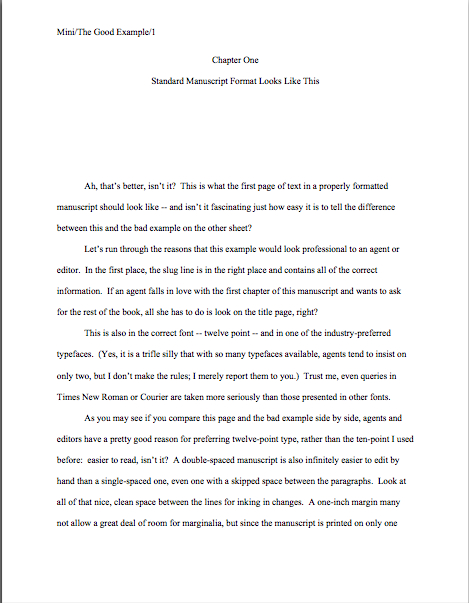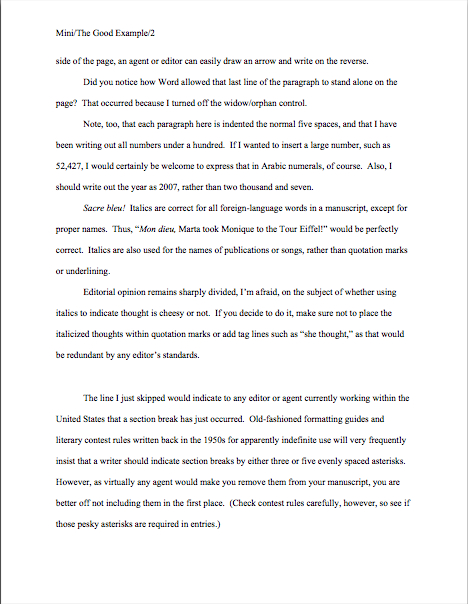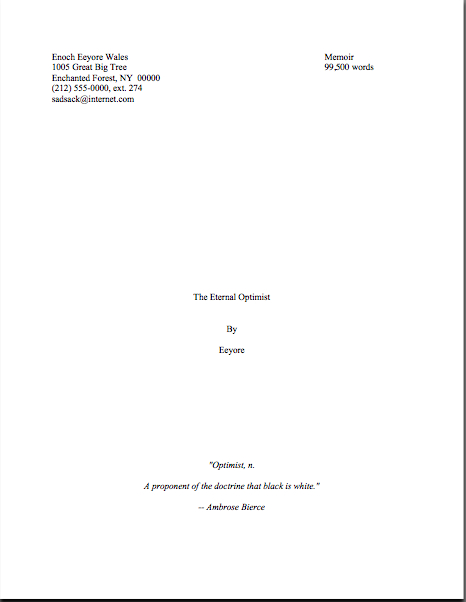
Improving those opening pages, part II: preparing your manuscript for its first target reader

public market sign

Last time, I posted an honest-to-goodness reader’s honest-to-goodness page one and began to examine it as any professional reader — an agent, say, or editor, or contest judge — might. As those of you who joined me in that endeavor no doubt recall with a shudder, what a pro would consider a fairly cursory examination of presentation issues would strike most aspiring writers as a no-holds-barred critique.

Why would I do such a thing to a perfectly nice manuscript, other than to drum up enthusiasm for the Author! Author!/WHISPER Great First Page Made Even Better Contest (entry deadline next Monday, in case anybody’s forgotten)? For starters, to encourage all of you self-editors out there to start to look at your work not like a writer, or even like your ideal reader, but like an agency screener.

You know, the person who culls the hundreds of queries and dozens of submissions the average agent receives in any given week down to the happy few that the agent actually has time to read. Here at Author! Author!, that dreaded first line of defense and most critical first reader is known as Millicent.

Learning to read through Millicent’s eyes is an exceedingly useful skill for an aspiring writer to develop; in fact, for a writer intent upon landing an agent in North America, it’s a necessary skill. No matter how delightfully apt a manuscript may be for its intended ultimate readership — you know, the fine folks who are going to buy your book in a brick-and-mortar bookstore, take it home, and cherish it for the rest of their reading lives — if a submission can’t please the Millicent screening for the agent of your dreams, you’re bound to be out of luck.

With that dire warning ringing in our collective ears, let’s take another gander at yesterday’s example, shall we?

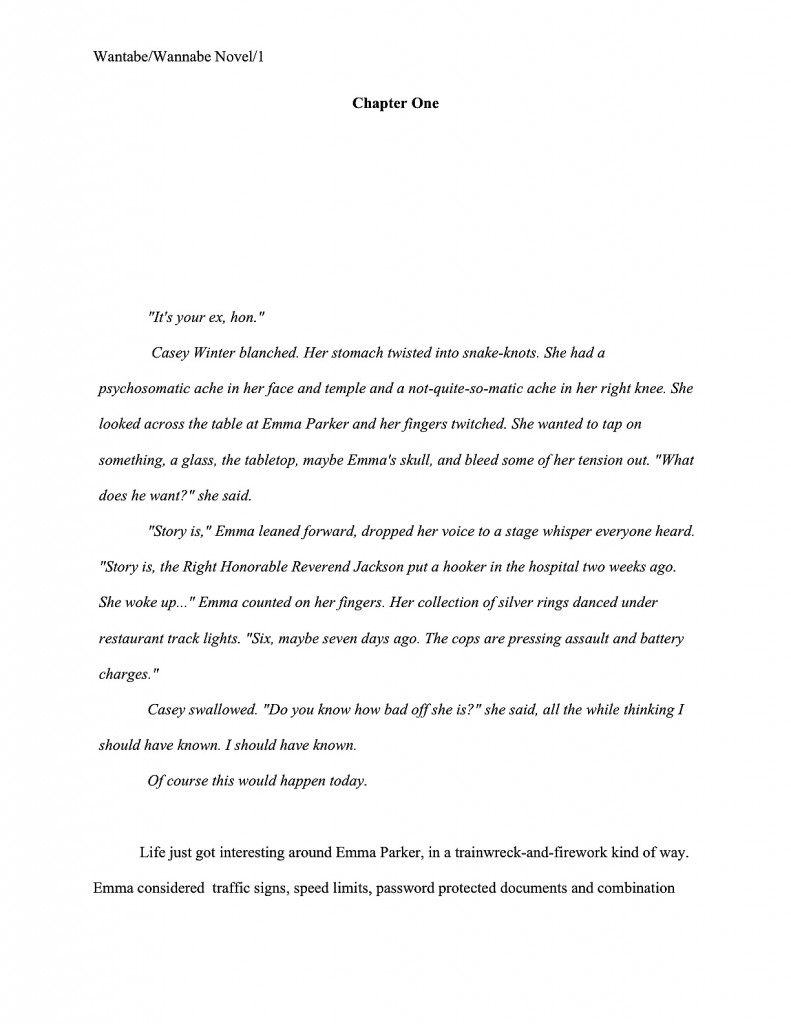
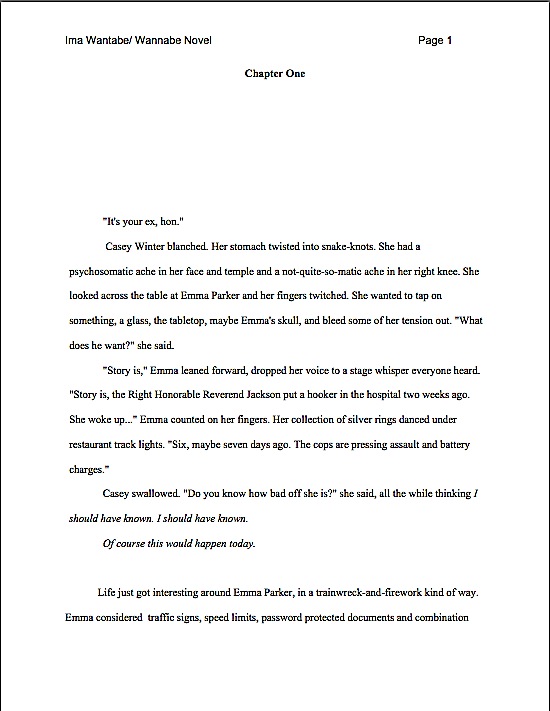
page 1 example wrong

Last time, I mentioned in passing that the italicized part would raise most Millicents’ eyebrows, if not red flags over the manuscript. While indicating thought by either using italics or saying she thought is acceptable in many book categories (but not all; taking the time to learn the conventions of your chosen book type will serve you well at submission time), it’s never considered right to use both simultaneously.

In other words, while Millicent would never consider this correct:

Casey swallowed. “Do you know how bad off she is?” she said, all the while thinking I should have known. I should have known.

Of course this would happen today.

depending upon the book category, she would be perfectly happy with either:

Casey swallowed. “Do you know how bad off she is?” she said, all the while thinking: I should have known. I should have known. Of course this would happen today.

or:

Casey swallowed. “Do you know how bad off she is?” I should have known. I should have known. Of course this would happen today.

The trick is to pick one method of indicating thought and stick to it consistently throughout the manuscript — ideally, the method utilized in the current bestsellers in your chosen book category. If a conscientious flip through recent releases of your type of book does not reveal a category convention, don’t stress out about it; just use the method that appeals most to you.

Bearing in mind, of course, that there are quite a few professional readers out there — yes, including a hefty minority of Millicents — who simply don’t like italicized thought on general principle. “Humph!” they say, wrinkling their noses over type dancing across the page. “Is this honestly necessary? Shouldn’t a good writer be able to make it clear that a character is thinking something, or indicate inflection, without resorting to funny type?”

I have to admit, as a reader, I’m seldom inclined to argue with them on this point, particularly if the manuscript in question also uses italics (correctly) for emphasis (“I’m talking to you, Reginald!”), to indicate foreign words (“You left off the requisite accent grave, Marie.”), or includes a lot of song or book titles (“I know — let’s play Rubber Band Man while reading My Life as a Contortionist by I.M. Bendy!”). Used rarely, there’s nothing wrong with italics, but in a manuscript with a lot of italicized words, the skimming eye can easily become confused, even to the point of skipping lines.

There’s another reason an aspiring writer might want to be sparing in his use of italics, especially on page one. It’s very, very popular to use italics on an opening page to highlight a brief opening scene or image.

Everybody knows what I’m talking about, right? In theory, the italics are intended to alert the reader to the fact that the paragraphs in the funny type aren’t in the time, place, and/or mindset of the ACTUAL opening scene that follows immediately thereafter. On the manuscript page, it usually looks a little something like this:

Ima's italics

One often sees this done in published books, right? Unfortunately — feel free to chant along with me now, long-time Author! Author! readers — manuscripts are not supposed to look like published books; they differ in many significant respects. Still more unfortunately, many, if not most, aspiring writers are not aware of those differences when they submit.

The usual result? Well, we saw a bit of it yesterday, didn’t we? Instead of treating the deviation from expected formatting as an intriguing authorial choice, Millicent usually just regards it as (a) a mistake, (b) an indicator of the submitter’s lack of familiarity with the publication process, (c) carte blanche to take the submission less seriously, or (d) all of the above.

So when Millie spots an italicized opening paragraph or two, she tends not to exclaim, “Oh, here is a suggestion to the editor about what the formatting of the published book should look like,” as italics-loving submitters hope. Instead, she says, “Oh, here’s another one who doesn’t know that italicization choices are the province of a book’s editor, not the author.”

In other words, she tends to regard block italicization in much the same way as she would any other deviation from standard format — if she doesn’t happen to work for an agent who has a pet peeve against this type of opening. As many, many agents do, I’m afraid.

How would that affect how Millicent would read such an opening? 99% of the time, like so:

italicized opening

In response to that vast collective gasp: yes. The vast majority of Millicents will simply skip over italicized opening text, treating the first normal line after it as the opening sentence of the manuscript.

My, the group’s gasping a lot today. “Why on earth,” italics-lovers the world over croak in aghast unison, “would any literature-loving human do such a thing? Published books open all the time with italicized bits!”

A fair question — but actually, there’s a pretty fair answer. Most Millicents just assume, often not entirely without justification, that if it’s in italics, it doesn’t really have much to do with the story at hand, which, they conclude (and not always wrongly), begins with the first line of plain text. In their experience, that’s where the action usually begins.

In other words, they’re apt to skip the italicized bits to save themselves some time.

Which is, as some of you may have noticed, the justification for many, many of the instant rejection norms that plague the nightmares of submitters. Millicent’s workday moves along at quite a clip, after all.

To distract you from any well-justified artistic seething you might be tempted to do over that last observation, take another look at that italicized section. Can you spot any other problems our pal Millie might have with it?

page 1 example wrong

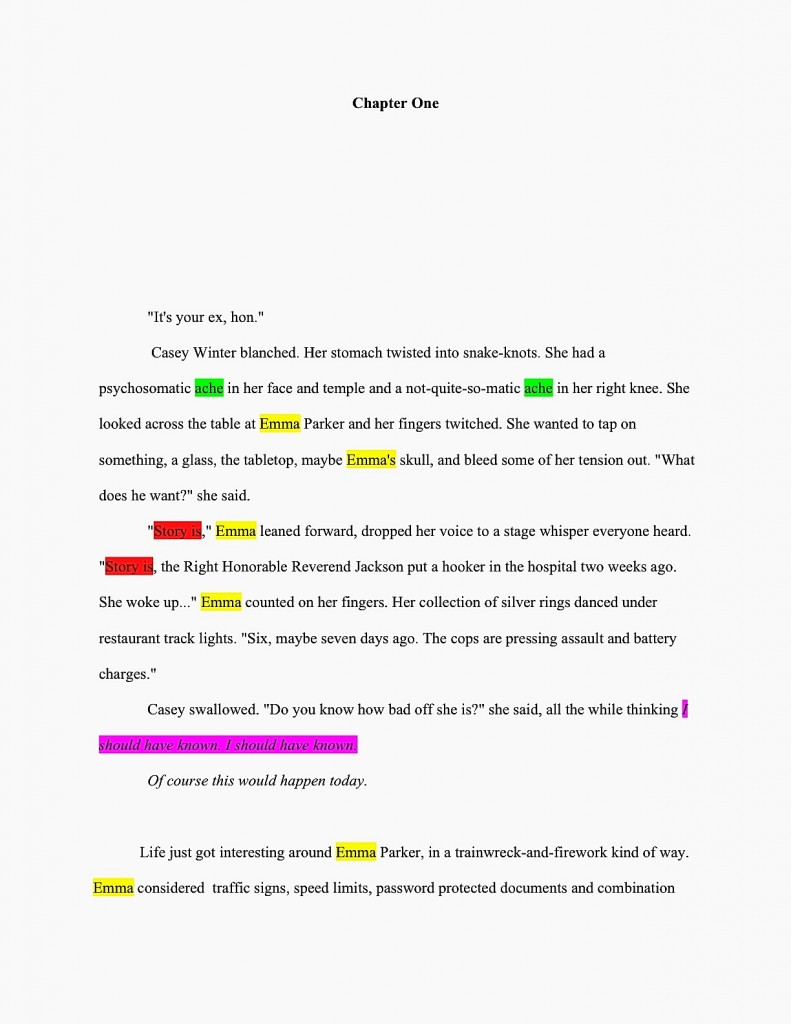
Any luck? Actually, to Millicent’s eye, the problem is pervasive throughout the entire page. Here it is again, with the words that would jump out at her highlighted.

Ima's first with reps

Easier to see the word and phrase repetition now, isn’t it? (Although the slug line seems to have vanished mysteriously in the transition, I notice.) Trust me, Millicent would swoop down on each and every one of ‘em like a bird of prey.

Why is she so much more likely than the average reader to notice word and phrase repetition and be bugged by it? Like most professional readers, Millicent’s eye for redundancy has been sharpened not only by years and years of reading manuscripts, but also by training: textual repetition is one of the first things fledgling editors are taught to spot.

Why might a savvy submitter want to avoid tripping her delicate redundancy sensors on page one? Because of an underlying assumption necessary to justify quick rejections: almost universally, professional readers will assume that the writing on page 1 is a representative sample of the writing throughout the entire book.

Which it usually isn’t, in practice. Most first-time writers improve as they work their way from Chapter One to The End, so it’s not all that unusual for the sentence style and word choice to be quite different in Chapter 2 than in Chapter 18. It’s also quite common for writers to revise sporadically, resulting in a highly polished Chapter 6 followed by a virtually first-draft Chapter 7. And don’t even get me started on the number of submissions in which the first ten pages are impeccable (possibly because their writers had heard someone like me point out that unless the opening pages are buffed to a high shine, Millicent is unlikely to read past them), while the rest of the text remains largely unrevised.

Be that as it may, Millicent has a LOT of submissions to get through in any given day — and it’s her job to narrow the field of applicants for the post of agency client, isn’t it? So while she may decide to keep reading past the bottom of page 1 to see if the writing becomes less repetitious, or more exciting, or more genre-appropriate, or more anything else she knows that her boss is looking for in a new client’s work, structurally, there isn’t a great deal of incentive for her to invest the extra minute or two.

In case I’m being too subtle here: it’s in your best interest to revise the opening pages so that they reflect your most polished writing style. If page 1 doesn’t wow Millicent, page 2 may not get a chance to impress her.

Fortunately, redundancy can usually be removed at little or no cost to the meaning of a paragraph, and without even much effort. Take a peek at our example after roughly 43 seconds of revision:

example no reps

Do I spot a few eagerly-raised hands out there in the ether? “But Anne,” a few sharp-eyed souls point out, “that’s not the same text as before — it’s a few lines longer.”

Well spotted, sharp-eyed ones. More space on page 1 to show off your good writing is a dandy fringe benefit that often results from minimizing repetition. Don’t say I never gave you a present.

I have quite a bit more to say about this first page as a submission, believe it or not, but let’s save it for next time. Then, if we’re very brave indeed, we may take the plunge into page 2!

Clearly, we like to live dangerously here at Author! Author! Keep up the good work!

Hey! Do I spy some faint signs of life?

Ste Cecile at Albi

No, that’s not a photo of me convalescing after my recent back injury — I seldom can be spotted sporting a turban. It’s a statue of Ste. Cecile, snapped from the middle of a mob of waist-high French schoolchildren at Albi. As a working writer, I harbor great fondness for Ste. Cecile: even after Roman jailors third attempt to chop her head off (thus the slashes on the statue’s neck), she kept right on talking. She has my vote for patron saint of queriers and submitters, therefore.

Speaking of submissions, I had a bright idea whilst I’ve been lolling about moaning in recent weeks. We had been just wrapping up a nice, meaty series on multiple-protagonist novels with discussion of how to write a synopsis for the tricky things. Just before my back decided to start playing tricks on me, I had promised you an in-depth look at how to write a standard-length synopsis for a super-complicated novel.

A most worthy endeavor, obviously, but equally obviously, one that is going to require some pretty hefty examples. Now, in my ordinary day-to-day life, tossing off a mock synopsis is quick work for me — as I mentioned earlier in the series, it’s a professional skill that becomes honed only with long practice. Trying to repeat the trick whilst on painkillers, however, is another matter altogether.

So rather than hold off on posting further until I have the oomph to pull off that high dive again, I’ve decided to put it on the proverbial back burner for the nonce and dedicate myself to a new series. Something a trifle more conducive to the kind of shorter posts one can write comfortably in bed, as well as one that’s been pressing on my mind lately.

I’m going to be spending the next few days, in short, presenting you with an actual reader’s actual first pages of text, helping you (and the reader kind enough to provide them) see how Millicent the agency screener is likely to respond to various aspects of them. I’ve been meaning to do this for a while now, but never has it seemed like a more valuable endeavor: while I’ve been bedridden, I’ve been re-reading John Steinbeck’s entire literary output, and I wish someone had sat him down for a stern talk about his opening pages. Your garden-variety Millicent of today would not make it past the first page of most of his books.

And it’s not because of the writing. Honestly, TEN PAGES on soil conditions in Salinas before the story starts in EAST OF EDEN, John?

Why use a real, live, feeling aspiring writer’s opening pages for this exercise, you ask, when I generally make up examples from scratch? Well, several reasons, not the least of which I touched upon above: coming up with examples in time-consuming, and in my current condition, much harder than usual. Also — and this is significant for an exercise like this — I’ve been a professional writer and editor for an awfully long time now, and my parents before me; the errors I might make, even for illustrative purposes, might not be the same as those new to the game’s.

Third, I’m hoping by having abruptly selected a reader from amongst those of you who have commented over the last few months, startling that sterling soul by requesting pages out of the blue, and lavishing this level of attention and blog space upon one writer’s efforts, not only to encourage more of you to comment from time to time, but also to enter the Author! Author!/WHISPER Great First Page Made Even Better Contest.

The deadline of which, incidentally, is a scant week away, in case anyone is wondering. I just mention, because the prize here is a very practical one, quite worth winning: Fab YA author Phoebe Kitanidis and I will critique the first pages of the lucky winners’ manuscripts in this very forum in June.

I know what you’re thinking, but this is not one of those annoyingly time-consuming literary contests that require entrants to twist their manuscripts into all sorts of gymnastic poses for submission. All the rules ask you to do here is something most of you have already been doing: present the actual first page of your manuscripts, in precisely the format you would send to an agent who requested pages.

Think of it as a pre-Millicent test drive.

Professional feedback comes in all shapes and sizes, ranging from pointing out ultra-basic presentation problems (“Um, is there a reason that you’re using 8-point Copperplate Gothic Bold when folks in publishing expect to see 12-point Times New Roman?”) to clarity issues (“Pardon my saying so, but is it really essential to the story not to describe the fellow standing behind your unsuspecting protagonist with an axe?”) to marketing considerations such as hooking the reader’s interest early (“TEN PAGES on soil conditions in Salinas before the story actually starts, John?”) Today, I am going to ease us into manuscript critique in its most simple form: the purely cosmetic.

That’s right, campers: it’s time for another round of Millicent’s Knee-Jerk Reaction Theatre. Ready, set — let’s look for superficial turn-offs!

Before anybody out there dismisses this level of critique as beneath the notice of a serious writer, allow me to point out that the since vast majority of submitted manuscripts get rejected on page 1, it’s poor strategy to ignore the superficialities, as all too many submitters do. Writers may prefer to think that their manuscripts should — and will — be judged purely on the quality of the writing, but since all professional manuscripts look the same way, it’s simply a hard fact of submission that an improperly-presented manuscript is generally dismissed faster than a properly-presented one, even if the writing is identical.

To put it less harshly, a savvy submitter recognizes that an agent or editor can only fall in love with the writing if s/he reads it — and reads it with an open mind. A misformatted manuscript, however, walks into the game with a strike against it.

That’s an important realization, because even aspiring writers familiar with the basics of standard format (and if you do not count yourself among them, I would strenuously urge you to consult the HOW TO FORMAT A MANUSCRIPT category on the archive list at right without delay) frequently submit manuscripts that would strike Millicent as, well, a tad unprofessional. The most common problems are subtle ones.

So subtle, in fact, that someone who did not read manuscripts for a living might not catch them at all. That’s the case even though we’re days away from even considering the kinds of red flags a writer would usually catch only by reading her submission IN ITS ENTIRETY, IN HARD COPY, and OUT LOUD.

How subtle are the formatting issues that might leap out at Millicent from page 1, shouting, “Strike one; no runners on base!” you ask? Well, see for yourself — in the example below, there are no fewer than ten of them, although some Millicents would spot only nine. Take a gander — and if you have trouble reading it at this size, try double-clicking on the image and opening it into its own window or saving it to your hard disk:

page 1 example wrong

How many of them did you catch? To sharpen your eye a little, here is the same page with all of the purely formatting problems corrected. (For your comparing-and-contrasting pleasure, I’ve touched nothing else.)

first page better

Seeing more of them now? If some of these differences jumped out at you, considering that Millicent stares at manuscript pages all day, every day, how many of them do you think she would spot within the first couple of seconds?

Just to make sure that we’re all on the same page with her, so to speak, let’s go over the purely cosmetic problems here. In the order they appear on the page:

1. The slug line is in different typeface than the text. (The slug line is in Arial, the body in Times New Roman.)

2. Incorrectly formatted slug line includes author’s first name, instead of just the last.

3. Incorrectly formatted slug line does not include the page number.

4. Incorrectly formatted slug line has a space between the forward slash and the title. The spacing in a slug line should be continuous: Name/Title/#

5. The page number is in wrong place on the page; it belongs in the slug line.

6. Pagination includes the word page. Although many aspiring writers think this looks nifty, a professionally-formatted manuscript would never include the word.

7. There’s an extra space before first word of paragraph 2. (Yes, most Millicents would catch that in either a hard or soft copy submission.)

8. There’s only a single space between each period and beginning of the next sentence. Admittedly, some agents would not consider this improper formatting; check each agency’s submission guidelines. If they do not mention preferring the single space, use two.

9. The narrative uses both the verb thinking and italics to indicate thought, a notorious screeners’ pet peeve.

10. In final line of the page, there are two spaces between considered and traffic. To a professional reader, this is a dead giveaway that the submitter did not proofread in hard copy.

Quite a lot of eyebrow-raisers for such an innocent-looking page of text, isn’t it? That’s how closely agency screeners read — and we haven’t even begun to talk about the writing itself, you will notice. Take heart, though: unless Millicent is having a spectacularly bad day, none of these problems by itself, or even all of them together, is likely to result in an on-the-spot cry of “Next!”

Why not? Well, believe it or not, the first version might be one of the more professional-looking first pages Millicent sees today. Most of the elements of standard format are in fact done correctly here, and it’s relatively free of misspellings and grammatical problems. (Although while we’re being nit-picky, there should be a comma after documents in the last line, and technically, it takes at least two sentences to make a proper narrative paragraph.)

So an optimistic aspiring writer often can — and does — get away with submitting a first page like the former. Most professional readers, including agents, contest judges, and Millicents, are willing to overlook a small cosmetic error or two, just as they tend to discount the occasional typo, provided that it is not repeated in the manuscript. (The first misspelling of a word might legitimately be a slip of a finger; the second indicates that the writer just doesn’t know how to spell the word in question, right?)

It doesn’t take too many tiny problems, however, to render a pro much less sympathetic than she might otherwise have been to a larger problem like an awkward sentence or the appearance of a cliché. And that’s on a good day — do you really want to take the chance that Millicent won’t just have burned her lip on a too-hot latte just before turning to your first page?

I see a forest of hands waving in my general direction. “But Anne,” some of you point out, and rightly, “I’m finding this rather depressing. Taken individually, the deviations from standard format we’re talking about are all quite small; I just don’t want to believe that good writing could ever fall prey to what, frankly, looks at first glance like a pretty respectable formatting job. I’m not discounting Millicent’s ability to reject the submission that happens to be in front of her when she scalds herself, but surely nobody concerned really wants aspiring writers to believe that their work could be rejected based on anything but the writing.”

It depends upon whom you ask, actually: I’ve met plenty of screeners — as well as agents, editors, and contest judges, come to think of it — who regard writers that, as they tend to put it, “haven’t taken the time to learn the business,” just aren’t as ready to be published as those who have. Part of working with an agent involves learning how to follow certain rules. It’s not as though any agent worth his salt would submit the first version above to an editor at a publishing house, after all; that would just be self-defeating.

Besides, these days, most good agents see so many cosmetically perfect submissions that they don’t lose too much sleep over rejecting those that are not. Or over Millicent’s having been more critical in the hour after she scalded her lip than on a normal day. They just figure that if a writer has real talent, s/he’ll go away, get better at presentation, and get picked up somewhere else.

That’s why, in case you’d been wondering, there’s no appeal for Millicent’s decisions: it’s not as though most agencies will run submissions past a second screener if the first did not like it, after all. Good writers are expected to be tenacious — and to take the time to learn how the publishing industry expects manuscripts to be presented.

So instead of regarding presentation as a secondary issue, try to think of paying attention to the cosmetic details as being polite to the person conducting the interview for a job you really, really want. Even if you have good reason to believe that some of the other interviewees are getting away with taking a few liberties, it honestly is in your best interest to be polite enough to show her your writing in the manner that Millicent is accustomed to seeing the best work in your chosen book category presented.

All that being said, did you spot the non-superficial reason this page might engender a knee-jerk rejection, even after just a superficial first glance? (Hint: it’s a marketing issue.)

Any guesses? No? Then let me ask you this deceptively simple question: based on this first page alone, in what book category does this manuscript belong?

It’s not readily apparent, is it? Depending upon the intended category, that could or could not be a problem. If this manuscript were, say, women’s fiction, this first page might not raise Millicent’s overactive eyebrows — but were it a mystery, the lack of species markings might well make her wonder when the mystery’s going to start. Ditto if this were Action/Adventure, Western, any stripe of romance…

Well, you get the picture. Millicent likes to be able to tell if a submission falls into a category that her boss represents — and she likes to be able to tell by the bottom of page 1.

Seem strange that she would want to make up her mind on the subject so quickly? Her reason is very practical, I assure you: since every book category has its own particular style — language choices, conventions, stock characters, etc. — and no agent represents every book category, it can save Millie’s boss a heck of a lot of time in the long run if she weeds out manuscripts that don’t fit comfortably into the category. While many writers legitimately find this professional desire to place their work in a box a trifle maddening, it must be admitted that it’s usually far, far easier for an agent to sell a book if he knows which shelf it might occupy at Barnes & Noble. If any.

Why not wait until, say, page 50 before making that determination? Do you have any idea how many submissions Millicent has to get through this week? It’s her job to narrow the field as quickly as possible. With that in mind, which Millicent do you think is most likely to reject the example above: one whose boss represents mainstream fiction, or one who represents primarily science fiction?

Or, to put it another way, would you or would you not be surprised to learn that the page above is the opening to a fantasy novel?

A word to the wise: if a reader who knows nothing about your book cannot tell by the bottom of page 1 what type of manuscript it is, it’s very much in your interest to revise with an eye toward making the category more obvious.

Don’t those of you who write exciting stories that begin in the everyday, mundane world, then leap into fast-paced action, wish you had heard that salient little piece of advice before you submitted for the first time? Yet I’m not sure how you would have known it — while it’s something that any agented writer could probably have told you, it’s one of those things that it’s just assumed every serious writer already knows.

Case in point: I flatter myself that I write about submission pretty exhaustively here at Author! Author! yet for the life of me, I can’t recall my ever having brought it up before. Strange, but true.

So please join me in a deep and heartfelt shout of gratitude to the reader who was kind enough to let me use this first page. Because frankly, had I not seen the title page, and thus known that this manuscript was intended to be fantasy before I read the first page, I doubt it would have occurred to me mention this extremely common rejection reason.

Already, my tricky strategy for the week is bearing fruit. Tune in next time to see if the trend continues. Keep up the good work!

Spicing up your plot, or, that’s the way the fortune cookie crumbles

fortune side onefortune side two

These, believe it or not, are the two sides of the single fortune I found tucked into my end-of-the-meal cookie last night: a tactfully-phrased prediction of my future happiness — by mail, no less! — accompanied by a terse statement about my general standing in the world. Had I been a less secure person, I might have taken umbrage at my dessert’s presuming to judge whether I counted or not, but since I had already sent back my census form, I found the symmetry very pleasing: clearly, Somebody Up There (or at any rate, Somebody Working in a Cookie Factory) was planning to reward the civic virtue of my outgoing mail with something fabulous in my incoming mail.

Imagine how dismayed I would have been, though, had I not yet popped my census form into the mail — or, even worse, if I had not yet received my census form. As I rearranged vegetables and yogurt containers in preparation for fitting my leftover asparagus in black bean sauce and Hunan pork into my overstuffed refrigerator, I would have kept wondering: is the census form the mail I’m supposed to find so darned pleasant? I mean, I understand the Constitutional obligation to be counted every ten years, but who is this fortune cookie to order me to enjoy filling it out?”

Admittedly, in a real-life fortune cookie-consumption situation, this might have been a bit of an overreaction. (Although what’s next, I wonder? Miranda warnings printed on Mars bars, for easy distribution at crime scenes? The First Amendment immortalized in marzipan, lest bakery patrons temporarily forget about their right to freedom of assembly whilst purchasing fresh macaroons?) Had the protagonist in a novel or memoir stumbled upon this chatty piece of paper, however — and let’s face it, less probable things turn up on the manuscript page all the time — it would have seemed pretty significant, wouldn’t it?

Any thoughts on why that might be the case? Could it be that this bizarre means of communication is one of those telling details I keep urging all of you to work into the opening pages of your manuscripts, as well as the descriptive paragraph in your queries, synopses, verbal pitches, and contest entries? Could the paragraphs above be crammed with the kind of fresh, unexpected little tidbits intended to make Millicent the agency screener or Mehitabel the contest judge suddenly sit bolt upright, exclaiming, “My word — I’ve never seen anything like that before.”

Hint: since I’m opening our foray into craft with it, chances are pretty good that I’m showing you some telling details. Or, to put it in terms the whole English class can understand, choosing to incorporate that wacky fortune cookie into the narrative shows, rather than tells, something about the situation and character.

How can a savvy self-editing writer tell whether a detail is, in fact, telling? Here’s a pretty reliable test: if the same anecdote were told without that particular detail, or with it described in (ugh) general terms, would the story would be inherently less interesting?

Don’t believe that so simple a change could have such a dramatic subjective effect? Okay, let me tell that story again with the telling details minimized. To make it a fair test, I’m going to keep the subject matter of the fortunes the same.

These, believe it or not, are the two sides of the single fortune I found inside a fortune cookie last night: a prediction of my happiness, accompanied by a statement about my standing in the world. Had I been a less secure person, I might have taken umbrage at my dessert’s presuming to judge whether I counted or not, but since I had already sent back my census form, I found the symmetry very pleasing: clearly, Somebody Up There was planning to reward the civic virtue of my outgoing mail with something fabulous in my incoming mail.

Imagine how dismayed I would have been, though, had I not yet popped my census form into the mail — or, even worse, if I had not yet received my census form. As I worked my Chinese food leftovers into my refrigerator, I would have kept wondering: is the census form the mail I’m supposed to find so darned pleasant? I mean, I understand the legal obligation to be counted every ten years, but who is this fortune cookie to order me to enjoy filling it out?”

Admittedly, this might have been a bit of an overreaction. (Although what’s next, I wonder? Police advising the arrested of their rights by given them candy? The First Amendment immortalized in baked goods, lest bakery patrons temporarily forget about their right to freedom of assembly?)

It’s not as funny, is it, or as interesting? I haven’t made very deep cuts here — mostly, I’ve trimmed the adjectives — and the voice is still essentially the same. But I ask you: is the story as memorable without those telling details? I think not.

Some of you are still not convinced, I can tell. Okay, let’s take a more radical approach to cutting text, something more like what most aspiring writers do to the descriptive paragraphs in their query letters, the story overviews in their verbal pitches, and/or the entirety of their synopses, to make them fit within the required quite short parameters. Take a gander at the same tale, told in the generic terms that writers adopt in the interests of brevity:

Last night, I cracked open a fortune cookie at the end of my meal and discovered something I had never encountered before: a two-sided fortune, one side predicting I’d receive something good in the mail, the other reminding me that it was important that everyone be counted for the census. Since I had already sent back my census form, I found the symmetry very pleasing: clearly, Somebody Up There (or at any rate, Somebody Working in a Cookie Factory) was happy that I’d already filled it out.

Imagine how dismayed I would have been, though, had I not yet done so — or, even worse, if I had not yet received my form. As I rearranged food containers in my refrigerator, so I could fit my leftovers inside, I would have kept wondering: is the census the mail I’m supposed to find so darned pleasant? I mean, I understand what the census is for, but who is this fortune cookie to order me to enjoy filling it out?” Admittedly, this might have been a bit of an overreaction. (Although what’s next, I wonder)

Not nearly as much of a grabber as the original version, is it? Or the second, for that matter. No one could dispute that it’s a shorter version of the same story, but notice how in this rendition, the narrator seems to assume that the reader will either picture the incident so clearly that no details are necessary — or, even more common in memoir manuscripts and comic scenes in novels, presume that it’s the reader’s job to fill in the details, not the writer’s.

If you ever plan to submit your writing to Millicent or Mehitabel, there’s something you need to know: as far as professional readers are concerned, it’s the writer’s responsibility to tell the story in a way that provokes the intended reaction in the reader, not the reader’s to guess what the writer meant.

In other words, a professional reading is seldom anywhere near as charitable as the average submitter or contest entrant hopes it will be. Blame it on the intensity of competition created by literally millions of aspiring writers seeking to get published: Millicent knows that if the well-written submission in front of her does not provide her with the reading experience her boss the agent believes will sell right now, chances are good that one of the next thousand submissions will.

According to her, then, it’s your job to draw her into your story so completely that she forgets about all of that. It’s your job to wow her with your storytelling, regardless of the category of your book.

As some of you may already have suspected, I am not bringing this up at the beginning of our discussion of craft by accident: being aware of the imperative to tell the story well, rather than merely present it in a series of well-written sentences, gives an aspiring writer a significant advantage in preparing a submission or a contest entry. Heck, I’ll go even further: one of the best rules of thumb an aspiring writer can adopt is construct and revise your manuscript assuming a critical reader who wishes to be entertained, rather than an indulgent reader who is looking for writing potential.

This is particularly good advice — and I suspect that this will come as a surprise to some of you — if you happen either to be writing memoir or a novel with scenes based upon your personal experience. All too often, reality-based narrators rely upon the fact that something really happened to render it interesting to a reader, regardless of how skillfully that story may be told. All that’s really necessary is a clear telling, right? Or that the kind of terse narrative that works so well in a verbal anecdote will inspire the same reaction if reproduced verbatim on the page.

How well do either of these extremely common theories work out in practice? Well, let me ask you: did you prefer the first version of the fortune cookie story, the second, or the third?

More importantly for submission purposes, which do you think would grab Millicent the most as the opening of a manuscript? Or Mehitabel as the first few paragraphs of a contest entry?

Uh-huh. As we’ve seen, the difference between those three renditions was not the voice (although a case could be made that part of the voice of the first was created through the selection of the details) or even the writing quality (although the last version did get a mite word-repetitive), but the narrative’s willingness to include telling details — and unusual ones at that.

Allow me to suggest a radical interpretation of these facts: what if the entertainment differential between the three lay not in an authorial failure of imagination in composing the last version, but in a failure to recognize that the point of including this anecdote is presumably to entertain and inform the reader? In telling the story as quickly as possible, can a writer sometimes defeat the purpose of including it at all?

Ponder those questions for a moment, novelists who make things up from whole cloth. I’m going to take a moment to address the billows of anxiety wafting from those who write the real.

“But Anne!” memoirists and reality-based novelists protest nervously. “The things I write about actually happened — I can’t just make up pithy little details, can I? I have to stick to what happened!”

True enough, anxious truth-tellers: if you are writing the real, you cannot control the facts. What you can control, what any writer must control, is how you present them to the reader. No matter what you write, the success of your narrative is going to depend largely upon your storytelling skills — they’re what separates your account of a particular incident from anybody else’s, right?

Frankly, this isn’t an easy task, even if dear self doesn’t happen to be the protagonist; it’s hard to represent the real world well on the page. And let’s face it, reality is sometimes a lousy storyteller.

Oh, your life has never been trite or obvious or just plain perplexing, even for a minute? Okay, all of you English and Literature majors, tell me, please, how the following 100% true anecdote rates on the symbolism front.

A couple of years ago, I was scheduled to give a eulogy for a dead friend of mine — a writer of great promise, as the pros used to say — at our college reunion. Because several of my classmates had, unfortunately, passed away since our last get-together, eight of us were to give our eulogies at the same event. Because I am, for better of worse, known to my long-time acquaintances as a teller of jokes, I was under substantial pressure to…how shall I put this?…clean up the narrative of my late friend’s life a little. Or at least tell a version that might not offend the folks who didn’t happen to know him.

No, that’s not the symbolic part; that’s all backstory. Here’s the symbolism: my throat was annoyingly, scratchily sore for the entire week that I was editing the eulogy.

Now, if I saw a parallel that obvious in a novel I was editing, I would probably advise cutting it. “No need to hit the reader over the head with it,” I’d scrawl in the margins. “Yes, it’s showing, not telling, but please. Couldn’t you come up with something a bit more original?”

(And yes, now that you mention it, I am known for the length of my marginalia. Brevity may be the soul of wit, but explanation is often the soul of clarity.)

Now, if my life were a short story written for a high school English class, the voice loss in that anecdote might pass for legitimate symbolism — or even irony, in a pinch. A bit heavy-handed, true, but certainly situationally appropriate: outsiders move to silence protagonist’s voice through censorship = protagonist’s sore throat. Both New Age the-body-is-telling-you-something types and postmodern the-body-is-a-text theorists would undoubtedly be pleased.

But the fact is, in a novel or memoir, this cause-and-effect dynamic would seem forced, or even trite. Certainly, it’s unlikely to make Millicent drop her latte and scream, “Wow, I never saw that coming!”

As I believe I may have mentioned, oh, four or five hundred times before in this very forum, just because something happens in real life doesn’t necessarily mean that it will make convincing fiction. My sore throat is precisely the type of symbolism that comes across as ham-handed in a novel. It’s too immediate, for one thing, too quid pro quo.

Dramatically, the situation should have taken time to build — over the years since my friend’s death, perhaps — so the reader could have felt clever for figuring out why the throat problem happened. Maybe even anticipated it.

How much better would it have been, in storytelling terms, if our protagonist had dealt with all the different input with aplomb, not coming down with strep throat until scant minutes before she was to speak? That way, in fine melodramatic style, she would have to croak her way through her speech, while her doctor stood by anxiously with antibiotics.

The possibilities make the writerly heart swoon, don’t they?

Just think how long it would extend a funeral scene if a eulogizer were unable to speak more than a few emotion-charged words before her voice disappeared with a mouse-like squeak. Imagine the deceased’s secret admirer creeping closer and closer, to catch the muttered words.

Heck, just think of the dramatic impact of any high-stakes interpersonal battle where one of the arguers cannot speak above a whisper. Or the comic value of the persecuted protagonist’s being able to infect her tormenters with strep, so they, too, are speechless by the end of the story.

Great stuff, eh? Much, much better than protagonist feels silenced, protagonist IS silenced. That’s just so…literal.

Besides, readers like to see a complex array of factors as causes for an event, and an equally complex array of effects. Perhaps if our protagonist had been not spoken about her friend since he passed away (which, in a sense, is quite true: I was unable to make it across the country for his memorial service — that could be transformed into an interesting flashback), then she would be fictionally justified in developing speech-inhibiting throat problems now. Or if he and she had shared deep, dark secrets she had sworn never to reveal (no comment), how telling a slight sore throat might be on the eve of spilling the proverbial beans, eh?

But a single event’s sparking a severe head cold? Dramatically unsatisfying. Taken too far, it might even make the protagonist seem like a wimp.

Readers, like moviegoers, like to see protagonists take a few hits and bounce up again. Even better is when the protagonist is beaten to a bloody pulp, but comes back to win anyway.

One of the great truisms of the American novel is don’t let your protagonist feel sorry for himself for too long — at least, not if his problems rise to the level of requiring action to fix. Simply put, most readers would rather see a protagonist at least make an attempt to solve his problems than spend 50 pages resenting them.

I can feel authors of novels and memoirs where characters sit around and think about their troubles for chapters on end blanching, can’t I?

Frankly, you should, at least if you intend to write for the U.S. market. Domestic agents and editors these days expect first-time author’s plot to move along at a pretty good clip — and few characteristics slow a plot down like a protagonist’s tendency to mull. Especially in a first-person narrative, where by definition, the reader must stay within the worldview of the narrator.

Some of you blanching souls have your hands raised, I see. “But Anne,” these pale folks exclaim, “I’ve always heard that the real key to keeping a reader’s interest is to introduce conflict on every page. Well, most of my protagonist’s conflict is internal — she can’t make up her mind where to turn. Surely,” the pallor deepens, “a professional reader like Millicent wouldn’t dismiss this kind of thinking as whining, right?”

That’s a good question, blanchers, and one that fully deserves an answer. The short one is that it all depends on how long the equivocation goes on, how repetitive the mulling ends up being — and whether the protagonist (or the plot, for that matter) is doing anything ELSE whilst the wheels in her brain churn.

The long answer, of course, is that in order to formulate a really good answer to that particular question, you would need to go out and read a hefty proportion of the tomes released in your book category within the last couple of years. Not EVERY book, mind you: those by first-time authors, because the already-established have to impress fewer people to get a new book into print.

In recent years, most fiction categories have moved pretty firmly toward the action end of the continuum. As opposed to, say, virtually any novel written in English prior to 1900, most of which hugged the other, pages-of-mulling end of the continuum.

This preference isn’t limited to the literary realm, either — we often see this philosophy in movies, too. Don’t believe me? Okay, think about any domestic film with where an accident confines the protagonist to a wheelchair.

No examples springing to mind? Okay, how about if the protagonist is the victim of gratuitous discrimination, or even just simple bad luck? I’m talking about serious drawbacks here, not just everyday annoyances, of course. ( For some reason, whining about trivial problems — “But I don’t have the right shoes to wear with a mauve bridesmaid’s dress!” — seems to be tolerated better by most readers and audience members, provided that the whine-producer doesn’t bring the plot to a screeching halt until she finds those shoes.)

Got a film firmly in mind? Now tell me: doesn’t the film include one or more of the following scenes:

(a) some hale and hearty soul urging the mangled/unemployed/otherwise unhappy protagonist to stop feeling sorry for himself,

(b) a vibrantly healthy physical therapist (job counselor/spouse/friend) telling the protagonist that the REAL reason he can’t move as well as he once did is not the casts on his legs/total paralysis/missing chunks of torso/total lack of resources/loss of the love of his life, but his lousy ATTITUDE, and/or

(c) the protagonist’s lecturing someone else on his/her need to stop feeling sorry for himself and move on with his/her life?

In fact, don’t filmmakers — yes, and writers of books, too — routinely expect their characters to become better, stronger people as the result of undergoing life-shattering trauma?

Now, we all know that this is seldom true in real life, right? Generally speaking, pain does not make people better human beings; it makes them small and scared and peevish. That sudden, crisis-evoked burst of adrenaline that enables 110-pound mothers to move Volkswagens off their trapped toddlers aside, few of us are valiantly heroic in the face of more than a minute or two of living with a heart attack or third-degree burns.

Heck, even the average head cold — with or without a concomitant voice loss — tends to make most of us pretty cranky. Yet dramatically, we as readers accept that the little irritations of life might seem like a big deal at the time, even in fiction, because these seemingly trivial incidents may be Fraught with Significance.

Which often yields the odd result, in books and movies, of protagonists who bear the loss of a limb, spouse, or job with admirable stoicism, but fly into uncontrollable spasms of self-pity at the first missed bus connection or hot dog that comes without onions WHEN I ORDERED ONIONS.

Why oh why does God let things like this happen to good people?

One of my favorite examples of this phenomenon comes in that silly American remake of the charming Japanese film, SHALL WE DANCE? After someone spills a sauce-laden foodstuff on the Jennifer Lopez character’s suede jacket, she not only sulks for two full scenes about it, but is later seen to be crying so hard over the stain that the protagonist feels constrained to offer her his handkerchief.

Meanwhile, the death of her dancing career, the loss of her life partner, and a depression so debilitating that she barely lifts her head for the first half of the movie receive only a few seconds’ worth of exposition. Why? Because dwelling on the ruin of her dreams would be wallowing; dwelling on minor annoyances is Symbolic of Deeper Feelings.

So where does that leave us on the telling detail front — or the storytelling front, for that matter? Should we all shy away from giving our protagonists big problems, in favor of more easily-presented small ones?

Well, I’m not going to lie to you: there are plenty of writing gurus out there who would advise you to do precisely that. Edith Wharton remarked in her excellent autobiography (which details, among other things, how terribly embarrassed everybody her social circle was when she and Theodore Roosevelt achieved national recognition for their achievements, rather than for their respective standings in the NYC social register. How trying.) that the American public wants tragedies with happy endings. It still seems to be true.

So why, you may be wondering, am I about to advise you not only to depict your protagonists (fictional and real both) with many and varied problems, as well as significant, realistic barriers to achieving their goals? Have I merely gone telling detail-mad?

Not by a long shot. I have heard many, many agents and editors complain in recent years about too-simple protagonists with too-easily-resolved problems. In conference presentation after conference presentation, they’ve been advising that writers should give their protagonists more quirks.

It’s an excellent way to make your characters memorable, after all — and it enables the inclusion of lots and lots of luscious telling details. Give ’em backstory. If you want to make them sympathetic, a hard childhood, dead parent, or unsympathetic boss is a great tool for encouraging empathy.

Provided, of course, that none of these hardships actually prevent the protagonist from achieving his or her ultimate goal. Interesting delay creates dramatic conflict; resignation in the face of an insuperable barrier, however, is hard to make entertaining for very long.

In other words, feel free to heap your protagonist (and love interest, and villain) with knotty, real-life problems. Just make sure that the protagonist fights the good fight with as much vim and resources as someone who did not have those problems — or show her coming up with clever ways to make those liabilities work for her.

Again, this is not the way we typically notice people with severe problems acting in real life, but we’re talking writing that people read for pleasure here. We’re talking drama.

We’re talking, to put it bluntly, about moving a protagonist through a story in a compelling way, and as such, as readers and viewers, we have been trained to regard the well-meaning soul who criticizes the recently-bereaved protagonist by saying, “Gee, Erica, I don’t think you’ve gotten over your father’s death yet,” as a caring, loving friend, rather than as a callous monster incapable of reading a calendar with sufficient accuracy to note that Erica buried her beloved father only a couple of weeks before.

While a sympathetic soul might reasonably ask, “Um, why should she have gotten over it already, if she’s not completely heartless?”, strategically, even the deepest mourning should not cause the plot to stop moving altogether.

Don’t get me wrong: I don’t think that professional readers who resent characters who linger in their grief are inherently unsympathetic human beings. They just see far, far too much wallowing in submissions and contest entries.

Why is that a problem, you ask? Well, in a short story or novel or screenplay, people who feel sorry for themselves (or who even possess the rational skills to think at length over the practical ramifications of obstacles in their paths) tend to be passive, from the reader’s point of view. They don’t do much, and while they’re not doing much, the plot grinds to a screaming halt. Yawn.

Or to express it in Millicent’s parlance: next!

The plague of the passive protagonist is a very, very common manuscript megaproblem, one about which agents and editors complain loudly and often. What’s a passive protagonist, you ask? One who habitually stops the plot in order to think things over, rather than taking swift action. Or who stops to talk the problem over with another character, rehashing the background information that the reader already knows.

Whenever you spot these pondering scenes in your own work, even if the project in question is the most character-driven literary fiction imaginable, pause and consider: could the piece work without the pondering scene?

Often, it can, and brilliantly.

A more subtle form of this megaproblem is the protagonist who waits patiently for all of the pieces of the mystery to fall into to place before taking action. Why, the reader is left to wonder, did the protagonist NEED to know the entire historical background of the problem before doing something about it?

Because the author thought the background was interesting, that’s why. Longtime readers of this blog, chant with me now: from a storytelling point of view, “because the plot requires it” should never be the only reason something happens in a story.

Wouldn’t it be more interesting, and substantially more active, if the protagonist acted on partial information, and then learned from the results of what she had done that she needed to learn more? In the midst of manuscripts where 2/3rds of the book is spent hunting down every last detail before the protagonist acts, I often find myself wondering: is it really such a good thing that HAMLET is so widely taught in high schools?

Yes, yes, many of the speeches are mind-bogglingly lovely, but here is a protagonist who more or less sits around feeling sorry for himself and not acting until the final act of a very, very long play — is this really the best exemplar of how to construct a plot, sometimes the sole example shoved under the eyeballs of high school students? Yes, it’s beautifully written, but honestly, by the middle of Act III, don’t you just want to leap onto the stage, shake Hamlet, and tell him to DO SOMETHING, already?

Oh, yeah, right, as if I’m the only one who’s had that impulse…

Don’t panic, please, if in the dead of night you suddenly find yourself thinking, “Hey, Anne raised a whole lot of troubling points today — but what about strategies for dealing with them?” You may sleep peacefully, knowing that next week of posts is going to be devoted to precisely that.

Today was just to whet your appetite — a fortune cookie at the beginning of the meal, as it were, rather than the end. Keep those protagonists active, my friends, and of course, keep up the good work!

The skinny on partials — at least the ones that are skinnier than entire manuscripts

skeleton1ani-mirrorballdancinghat
showtime-skeleton
skeltw2skeleton-gif

Okay, so I didn’t actually set out to bring a skeletons’ disco extravaganza to you today, even if it is St. Patrick’s Day. You’d be surprised at what comes up in a web search of skinny; it was either this or models, interestingly enough. (All of these fabulous animated bones appear courtesy of Feebleminds, by the way.)

No, I have a much nobler goal for today: answering a good question from a reader. Quoth the intrepid Kim a few posts back:

An agent recently requested a partial of ms. and not being able to find much on how to format that I just included the title page, and the requested pages of the ms. Is there a correct format or protocol for partials?

I’m very glad you brought this up, Kim. Although a partial always refers to a manuscript by definition — the term is shorthand for partial manuscript — this is yet another one of those situations where aspiring writers often get confused by publishing industry terminology.

Yes, I said yet another, because as so often seems to happen in the rumor echo chamber in which those trying to break into the biz must operate, many are the terms that mean more than one thing, or which would mean one thing to an agent and another to, say, a submitting writer. Here we have a prime example of the former: a partial can refer to two different kinds of manuscript, depending upon the context.

So let’s start this discussion by defining our terms before we really give the skeletons something to cavort about, shall we?

The two distinctly different flavors of partial: the first pages
The first kind of partial, the kind to which Kim refers here, is the a specified number of pages an agent may request from a successfully querying or pitching writer who is not yet a client. Emphasis on specified: no agent is simply going to tell an aspiring writer, “Send me a partial,” leaving the writer to guess how many pages and from what part of the book.

Instead, she will typically say, “Send me the first chapter/first 50 pages/first three chapters/first 100 pages.” In this context, then, a partial is precisely the number of pages an agent has requested to see.

Again, emphasis on precisely: if an agent asks to see the first 50 pages, don’t make the mistake of sending 52, even if page 50 ends in mid-sentence or the chapter ends on page 56. From an agent’s point of view, an ability to follow directions well is a very, very desirable trait in a potential client.

Basically, this type of partial is a writing sample, similar in function to the pages agents sometimes list in their submission requirements as addenda to the query packet or the 5-page writing sample agents sometimes ask pitchers to produce: the agent is asking for these pages primarily in order to see whether this aspiring writer can write; judging whether the book would be a good fit for the agency comes a close second, but if the agency’s screener (our old pal, Millicent, naturally) isn’t caught by the style, even a perfect plotline for that agent’s interests is likely to be rejected.

Oh, should I have warned you not to take that great big sip of coffee just before you read that rather disturbing paragraph? Go ahead and clean up; I don’t mind waiting.

I understand your shock at hearing it so bluntly put, oh spit-takers, but as we have discussed throughout our recent series on standard format, ruling out 90% of submissions as quickly as humanly possible is a big part of Millicent’s job. Her boss can only take on a handful of new clients in any given year, right? In order to save the agent time, she makes sure that the only requested materials to reach his desk are well-written, properly formatted, and the kind of story or argument the agent is actively looking to represent.

When an agency requests a partial rather than the entire manuscript, it’s essentially a means of streamlining this winnowing-down process even further. Not to mention saving her from having to shuffle, and thus lift, a ton of paper: instead of Millicent’s desk being piled up to her chin at any given moment with boxes of full manuscripts, the monthly influx of requested partials may reach only up to her sternum. Once she has screened those, her boss can decide which of the surviving partials have piqued their interest sufficiently to request the entire manuscript.

A process known, both colloquially and within the industry, as asking to see the entire manuscript.

So asking for a partial adds an intervening step between the initial query or pitch and the request for the full manuscript — but before those of you who would prefer your work to be judged in its entirety invest too much energy in glowering in Millicent and her boss’ general direction for sending writers jumping through this additional hoop, let me hasten to add that until fairly recently, most agencies almost always asked for a partial first; requesting the entire manuscript right off the bat used to be a sign that an agent was really, really excited about a book project and wanted to get the jump on any other agent who might have merely requested a partial.

Nowadays, the decision whether to request a partial or entire manuscript is less often an indicator of enthusiasm than a matter of agency policy. In fact, contrary to pervasive writerly opinion, being asked for a partial rather than a full can sometimes be an advantage: at some agencies, having the entire manuscript on hand earlier can enable even speedier rejection of a near-miss project. Think about it: instead of having to ask for pages 51-372 and wait for them to arrive in order to pass a final judgment on a book, Millicent can simply read to page 60.

If the verdict is yes, this can lop quite a bit of time off the agent-seeking process, from the writer’s perspective. Unfortunately, if the verdict is no, and the agency is one of the vast majority that utilize form-letter rejections, the submitter ends up with no idea whether the impetus to reject came on page 1 or page 371.

Renders it rather hard to improve the manuscript prior to the next submission, doesn’t it?

Before that rhetorical question depresses anybody too much, let’s return to defining our partials. 99% of the time, the kind of partial an aspiring writer will be asked to provide is this first kind: a requested number of pages, beginning on p. 1 of the manuscript, for submission to an agent. There is, however, another kind.

The two distinctly different flavors of partial: the taste of what is to come
After a novelist is already established, it is not unheard-of for her agent to be able to pull off a conjuring trick known as selling the next book on a partial. This is pretty much what it says on the box: the author produces the first X number of pages of a not-yet-completed novel, and the agent convinces an editor that it will be to the publishing house’s advantage to snap the book up before the author has polished it off.

This can be a good deal for the publisher: buying a book on a partial prevents other publishers from bidding on the finished work. Also, earlier involvement in the writing process often enables the editor to help shape the book more, in much the same way as an editor on a nonfiction book (typically sold on a book proposal, not the full manuscript, lest we forget) is able to dictate which of the proposed chapters will and will not be in the finished manuscript.

Not to mention the fact that if the book happens to be written by a famous author or celebrity in another field, the bidding could potentially get quite high. This is why, in case you’d been wondering, we all occasionally hear of a publisher’s acquiring a half-written novel at a cocktail party, because some celebrity simply handed ten pages to him along with his seventh martini: the publisher recognizes the potential marketing value of the name.

For your garden-variety serious novelist, however, such a situation is unlikely to arise. If her agent manages to sell her next book on a partial, it’s generally to the editor who acquired her last. Since so many first-book publishing contracts grant the publisher right of first refusal over the author’s next book, anyway — meaning that the publisher gets an exclusive peek at the book before anyone else can place a bid on it — selling on a partial is mostly a means to speed up the approval process.

Everyone clear on the difference between that kind of partial and the first kind? Excellent. Now let’s assume for a moment that, like Kim, you have just been asked to submit a partial to the agent of your dreams. What specifically are you being asked to do?

Let’s further assume that your manuscript (or whatever portion of it an agent or editor has requested that you send to be perused by Millicent, the Platonic agency screener) is already in tip-top formatting shape, all typos and logic problems removed, and thus what the industry calls clean — and if you’re not absolutely positive that your pages meet ALL of those conditions, stop right here and make a plan for tidying up your pages.

Trust me, this is a situation where spelling counts. As does grammar, punctuation, and everything else your 9th grade English teacher begged you to take seriously.

But once your work is in apple-pie order, as Louisa May Alcott used to say so frequently, what next?

What should a partial submission packet include, and in what order?
In part, this is a trick question, because — chant it with me now, readers — any submission packet should include precisely what the agent asked you to include, no more, no less. In the words of the immortal Fats Waller, find out what they like and how they like it, and let ‘em have it just that way.

Okay, so he wasn’t talking about literature when he sang that. Roll with me here.

As I mentioned above, agents are usually quite specific about what they want in a submission, up to and including how many pages they want to see. If you doubt this, check out an agency’s website or one of the standard agency guides, then attend a conference where agents are scheduled to speak. Raise your hand and ask whether it’s okay to send, say, the 55 pages it would take to round out a chapter when an agent has asked to see the first 50. You will be astonished at how people who say their preferences in clients are as vague as writers who produce “good writing in any genre” will suddenly transform into rule-hugging lovers of draconian efficiency, appalled at the very notion of extending the length of the partial.

To save you the trouble of asking, let me tell you what they will say: never, ever, EVER send what you THINK they want to see instead of what they have ASKED to see. Of course, you may offer in your cover letter to send more, but that is all.

So pull out your hymnals and sing along, campers: if you’ve been asked for the first 50, and the chapter ends in a blow-your-socks-off cliffhanger on p. 51, you should still only send the first 50, exclusive of the title page. (Since the title page is not numbered, it is not included in the page count, either.)

Of course, if you wanted to be Machiavellian about it, you could always perform a little strategic snipping prior to that, so said cliffhanger topples just on the bottom of p. 50. No one would fault you for that, for the very simple reason that it’s extremely unlikely that Millicent will ever sit down with your partial and full manuscript simultaneously. Partially, this is due to the fact that if an agency approves enough of a partial submission to want to see the rest of the novel, they’re going to ask for the entire manuscript, not, say, pages 51 through 373.

Oh, you thought Millicent was going to invest time in digging out your partial, unpacking your second submission, and fitting the two together like a jigsaw puzzle? Does that really sound like reasonable behavior to expect from the person too impatient to allow her latte to cool before taking her first sip?

Again, send precisely what you are asked to send. However — and this should sound familiar on the secret handshake front — any agent is going to assume that a writer of your caliber is already aware that certain requests imply certain inclusions. Here are the extra bits, in the order in which they are generally expected to appear in a packet containing a partial:

1. Cover letter
An astonishingly high percentage of submissions arrive without a cover letter, and often without a title page as well, begging the question: what makes these writers so positive that the requesting agent will still remember their queries or pitches well enough to render page one of chapter one instantly recognizable?

I hate to burst anyone’s bubble, but it’s not going to be — in fact, in many agencies, the person who heard the pitch or read the query won’t even be the first person to screen the submission. There may even be several Millicents who need to approve it before it gets anywhere near the agent of your dreams. So it doesn’t honestly make sense to assume that everyone who sets eyes on your manuscript will already be familiar with your work.

Besides, including a cover letter is polite. No need for a long-winded missive — a simple thank-you to the agent for having asked to see the materials enclosed will do. Something, perhaps, along the lines of this little gem:

cover letter for partial

A miracle of professional blandness, is it not? That’s all right — the cover letter isn’t where you’re going to wow Millicent with your sparkling prose and trenchant insight, anyway. All you have to be here is polite.

If you met the agent at a conference, mention that in the first paragraph of the letter, to help place your submission in context. (As crushing as it may be to the writerly ego to contemplate, an agent who spent days on end listening to hundreds of pitches probably is not going to remember each one. No need to re-pitch, but a gentle reminder never hurts.

If another agent is already reading all or part of the manuscript you’re sending — or has asked to see it — mention this in your cover letter. No need to say who it is or how long s/he has had it; just tell the recipient that s/he’s not the only one considering representing this book. Unless the agency has a policy forbidding simultaneous submissions, withholding this information will only generate resentment down the line if more than one agent wants to represent your book.

Yes, even if that agent to whom you submitted 9 months ago has just never responded. Actually, it’s in your strategic interest to contact that non-responder to let her know that another agent is interested; it often speeds up the evaluation process. (If you’re unclear on why, please see the WHAT IF MORE THAN ONE AGENT ASKS TO SEE MY MANUSCRIPT? category on the archive list at right.)

Most importantly, make sure all of your contact information is on the letter, either in the header (letterhead-style, as in the example above) or just under your signature, and do be absolutely certain that the letter includes the title of your book, just in case the letter and the manuscript end up on different desks.

Yes, it does happen. You want them to be able to get ahold of you to tell you how much they love your writing, don’t you?

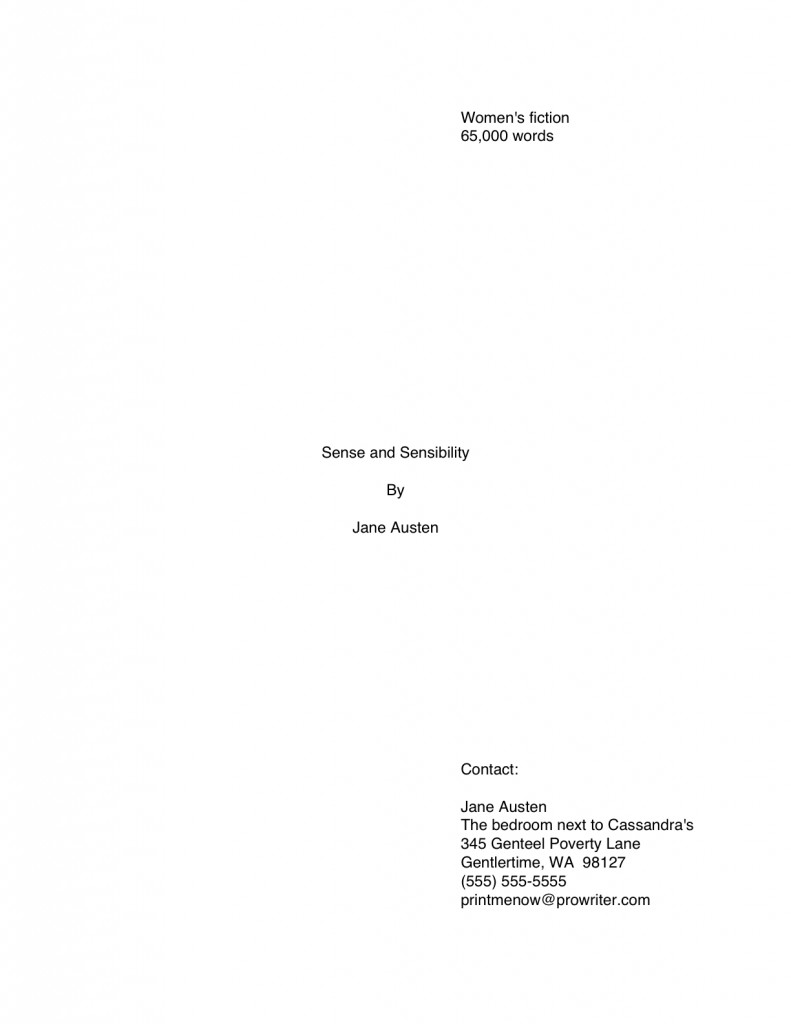
2. Title page
Always include this, if any manuscript pages have been requested — yes, even if you have already sent the first 50 pages, and are now sending the rest of the book.

No need to state on the title page that it’s a partial, either — Millicent will be able to figure that out from your cover letter and the thickness of the stack of paper. Just use the same title page that you would have used if the agent of your dreams had requested the entire manuscript, and you’ll be fine:

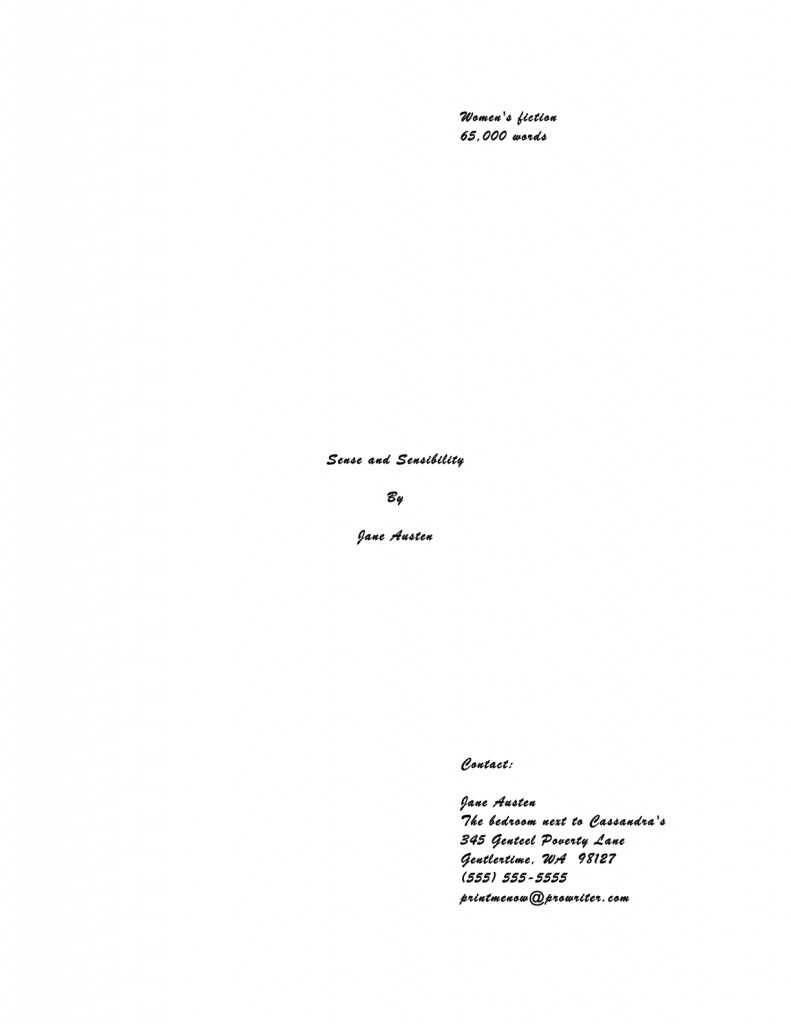
Austen title good

Again, not precisely a thrill-fest, but undoubtedly professional-looking. Just make sure that it’s in the same typeface as the rest of the attached manuscript. (If this all sounds completely cryptic to you, or if you have never formatted a professional manuscript before, don’t panic — you’ll find a step-by-step explanation of what to do under the HOW TO FORMAT A TITLE PAGE category at right.)

Why is it so very important to include the title page? Long-time readers, chant it with me now: because the submission looks more professional that way. Also, like the cover letter, the title page renders it easy for an agent to track you down. Believe me, if the agent of your dreams falls in love with your manuscript, you’re going to want to hear about it right away.

3. The requested pages in standard format.
Again: only the pages they’ve asked to see, beginning on page 1, professionally formatted. No substitutions, unless the agency website specifically asks for something else. (If you’re new to reading this blog, or have somehow avoided the last few weeks of repeated and vehement posts on standard format, please see the HOW TO FORMAT A MANUSCRIPT and STANDARD FORMAT ILLUSTRATED categories on the list at right._

For the benefit of those of you who are going to blow off that last piece of advice because you’re in a hurry — oh, I know that you’re out there — allow me to add something you would have learned from those posts on formatting, had you been paying attention: a manuscript intended for submission should not be bound in any way.

Oh, and do use at least 20-lb, bright white paper when you print it out. Cheaper paper can begin to wilt after the first screener has riffled through it. Yes, it does increase the already quite substantial cost of submission, but this is one situation where being penny-wise can cost you serious presentation points.

“So basically what you’re saying, in your patented lengthy and meticulously-explained manner,” those of you who have been paying close attention point out, and rightly, “is that Kim did everything right. Aren’t you?”

Why, yes, I am — kudos for your submitting savvy, Kim! You’re an example to aspiring writers everywhere, all the more so, in my opinion, because you were brave enough to ask the question. Now, everyone who has been wondering about it can benefit.

Sometimes, though, agents ask to see additional materials slipped into a submission packet with a partial. Next time, we’ll be taking a swift barefoot run through the usual suspects, as well as revisiting the difference between a partial and a writing sample — or a partial for a contest entry and a writing sample, for that matter.

Hard to contain the excitement, isn’t it? No wonder the skeletons are dancing up a storm. Happy St. Patrick’s Day, everyone, and keep up the good work!

The mysteriously mysterious strictures of standard format, part XIV: contested real estate, or, the battling schools of thought on chapter headings

Dempsey fight drawing

“In all matters of opinion,” Mark Twain tells us, “our adversaries are insane.”

Nowhere in modern life is this axiom more apt than in the vicious battleground that is airline seating. In recent years, most airlines have opted to make the space between rows of passengers smaller; in order to cram more seats per plane, many have also quietly made the window seats and even the seatbelts on window seats slightly smaller as well. (Try comparing sometime.)

The result for anyone who, like your humble correspondent, enjoys glancing out a window from time to time, is a seat tray rammed directly into one’s solar plexus if one happens to be trying to, say, use a laptop in flight. And that’s if the window-lover in the row ahead of me decides not to recline his seat.

On the particular flight upon which I am typing this, the last condition did not, alas, apply. A honeymoon couple — he awash in some pepper-based cologne, she beamingly bouncing her ring upon every row she passed, so all might see it glimmer in the light — evidently mistook their seats for two single beds. Not only were their activities in them not, as my grandmother would have said, appropriate for every audience, but they seemed disappointed — nay, convinced — that their seats would not recline into a completely flat position, presumably so they could (ahem) elevate their performance art piece to the next level.

After the first time the lady in question caused my laptop to emit a loud crack of protest, I politely explained through the crack in the seats (now about five inches from my face) that the nearness of the rows rendered their desired level of reclining impossible. Even if I had not needed to be working on my computer throughout the flight — an absolute necessity, I assured them, due to the standard formatting educational needs of all of you fine people waiting impatiently for me to land — the only way I could possibly accommodate the angle they desired would involve my balancing my paperback on the bride’s forehead as it hovered a few inches above my lap.

Apart from the book part, the honeymoon couple thought that would be just fine. How nice of me to suggest it.

The hard-argued subsequent compromise involved my turning sideways, twisting one of my legs underneath me while resting, if it could be called that, my back against the window-side armrest. If I gingerly balanced my laptop on the tray table of the seat to my left, I could barely manage to type. My left hip and elbow swiftly fell asleep, and the position required my staring fixedly at the profile of the guy in 23C (whose wife, you will be astonished to hear, apparently doesn’t understand him), but that was a small price to pay for the approximately 19 degree incline my gymnastics permitted the honeymooners.

At least for the first twenty minutes or so. After that, they kept trying to recline their seats farther. Apparently, I was being unreasonable to expect enough personal space to keep my laptop open the 90 degrees recommended by the manufacturer for optimal screen visibility. I can now tell you from personal experience that while it’s still possible to read the screen down to roughly 49 degrees, the lower the lid, the less accurate the typing.

Also, the lower the lid, the more one is tempted to draw conclusions about the fundamental difference between content producers and content consumers. To the recliners, the notion that I would so need to express myself on any subject that it could not wait until after we had landed was, I gathered, completely incomprehensible.

Oh, wasn’t I done yet? They’d like to lean back and enjoy themselves properly.

As much as I would like to blame the honeymooners’ frankly not-very-neighborly attitude upon either a poor set of upbringings (raised by airline-phobic wolves, perhaps?) or some bizarre wedding-induced solipsism that made them sincerely believe that no other human happiness was important compared to theirs, I suspect something very simple was happening here: all three of us were basing our expectations of personal space not upon the current lay-out of the airplane, but our sense memories of what air travel had been in the past.

My body remembers fondly being able to operate a laptop in comfort on an airplane, and not all that long ago. And I can only assume that somewhere deep in the honeymooners’ musculature, their forms remembered equally well being able to flop backward with impunity, without violating anyone else’s space bubble.

Or they were appallingly brought up. Either way, nobody was happy with the outcome.

A similar failure to communicate often characterizes the initial interactions between an aspiring writer and those he hopes will help his work get into print: agents, editors, contest judges, freelance editors, and of course, our old pal, Millicent the agency screener. From the new writer’s point of view, many of the hoops through which he’s expected to jump seem arbitrary, if not actively hostile to his progress; from the other side of the divide, it’s practically incomprehensible that any serious writer would not be aware of prevailing standards.

Each side, in short, typically expects something different from the other than what the other believes he is expected to provide. If the communication gap is severe enough, each may even begin to suspect the other of violating expectations on purpose, just to be annoying.

But that’s very seldom the case, on either end. The expectations are simply different, as often as not because each side has in mind some mythical period when perfect communication was the norm, rather than the exception. Millicent sighs for the days when the truly gifted tumbled out of the womb with a complete understanding of both standard format and changing market conditions; the aspiring writer longs for the era when every submission was read in its entirety, every time, and editors took the time to work with promising new authors.

Both sides are perfectly at liberty to sigh nostalgically, of course. But the fact is, none of these conditions ever prevailed on a large scale.

Oh, well-advertised submission standards used to render looking professional a trifle easier, admittedly; back when the slush pile still existed at major publishers, a new author could occasionally leap-frog over a few levels of testing. And undoubtedly, editors formerly had more time to work with writers. Things change. But contrary to what many an aspiring writer would like to think, there’s never been a point in publishing history when mainstream publishers were purely non-profit enterprises, devotes solely to bringing new voices to the admiring masses, nor have the bulk of submissions ever been completely professional and market-oriented.

Those seats never reclined as fully as you remember them doing, either. And those tray tables have never been particularly spacious.

All of which, I devoutly hope, will place you in the right frame of mind for confronting what seems to be a perennial controversy amongst aspiring writers: whether to place a chapter title (or just “Chapter One”) on the first line of a page or twelve lines below that, on the line just above where the text proper starts.

Don’t laugh, those of you who are new to this particular debate: this one has generated quite a body count over the years. Former comrades in arms, veterans of the writing trenches, have ceased speaking altogether over this issue; even judges within the same literary contest have been known to differ sharply on the subject.

Which is a trifle puzzling to those of us who deal with professional manuscripts for a living, frankly, because there actually isn’t a debate on our end. Nor do the Millicents gather over steaming lattes to debate the niceties of labeling a chapter. One way looks right to us for a book manuscript, period: the first page of a chapter should be formatted

What does that mean in practice? The chapter title belongs at the top of the page (centered) if the manuscript is a book; as with the first page of a manuscript, the title appears at the top, with the text beginning twelve lines below. In a short story or article, by contrast, the title belongs ten lines from the top of the page, on the double-spaced line above the text.

So yes, the spacing honestly does matter to the pros. As always, it’s to an aspiring writer’s advantage to use the format appropriate to the type of writing because it will look right to the Millicent screening it.

The answer really is as simple as that. Why, then, the rampant confusion? And why, given that the difference is a relatively small one not necessarily reflective of the quality of the writing involved, might a professional reader like Millicent or Mehitabel the contest judge particularly care if a talented aspiring writer chose the wrong version?

As is my wont, I shall let you see for yourselves. To place the two vitriol-stained possibilities before you in all of their lush magnificence, the question here is should the first page of a book chapter look like this:

Or like this:

Quite a visceral difference, no? The first version is in standard format for a book manuscript; the second is for a short story or article.

Oh, how tempting it is to leave it at that…but truth does compel me to tell you that Millicents, the agents who employ them, and contest judges see far, far more examples of version #2 than #1 in book submissions. Many, many times more. So much so that — prepare to rejoice, because I haven’t said this very often throughout this series — although an agent would almost certainly make you move a low chapter title aloft, at this point in publishing history, you could probably get away with either in a book submission.

I know — it sort of creeps me out to hear myself saying such a thing, too.

I hasten to add, though, that I would be reluctant to buy into the astonishingly pervasive theory that if masses and masses of people do something, it automatically becomes correct. No matter how many times all of us see apostrophe + s used to make a noun plural, it’s just not proper — unless, of course, we’re talking about the Oakland A’s, where the erroneous apostrophe is actually part of the proper name.

Ditto with manuscript submissions: as anyone who screens manuscripts for a living could tell you, a much higher percentage of them are incorrectly formatted than presented properly. But that doesn’t make improper formatting right, does it? Nor does it render it reasonable to expect that Millicent will be pleased to see a chapter title lolling about just above the text.

As everyone’s mother was wont to say (at least on the West Coast), if everybody else jumped off the Golden Gate Bridge, would you, too?

I was delighted to discover when I moved to the East Coast for college that the moms out there were prone to asking the same question with reference to the Empire State Building. There must be something about that particular period of architecture (the GGB was built in 1933-37, the ESB in 1930-31) that promotes suicidal ideas.

Speaking of body counts.

The weird thing about this particular formatting oddity — I’m back to talking about chapter titles now, not suicide attempts, in case you found that last segue a mite confusing — is how often the incorrect version appears in otherwise perfectly presented manuscripts. That fact sets Millicent’s little head in a spin. As, I must admit, it does mine, as well as the brainpan of virtually every other professional reader I know.

Why is it so very puzzling to us, you ask? Because at least in my case — and I don’t THINK I’m revealing a trade secret here — although I have literally never seen an agent submit a manuscript to a publishing house with format #2, I’m constantly meeting aspiring writers who have been told by writing teachers and even contest judges that #2 is the only acceptable version. And that’s just weird to me, as I have literally never even heard of an agent, editor, or anyone else in the publishing industry’s asking for a chapter heading to be moved from the top of the page to just above the text. Although as I said, I do know agents who routinely ask for the shift in the other direction.

And believe me, I’ve heard some pretty strange requests from agents and editors in my time; I’m not easily shocked anymore. But to hear a professional reader insist upon placing the chapter heading where you have to skip down a third of a page to read it…well, that would have me reaching for my smelling salts.

(Do they even make smelling salts anymore? And if everyone else jumped off the Golden Gate Bridge clutching them, would I?)

Clearly, somebody out there is preaching the place-it-just-above-the-text gospel, because agents, editors, and contest judges are simply inundated with examples of this formatting anomaly. We see bushels of ‘em. Hordes of aspiring writers are apparently absolutely convinced that the sky will fall in if that chapter heading is located anywhere but immediately above the text. Sometimes, when those die-hard advocates become contest judges, they even dock correctly-formatted first pages for having the title in the right place.

In fact, many aspiring writers are so convinced of the rightness of the drooping title heading that it’s not all that uncommon for an editor to find that after she has left a couple of subtle hints like this that the writer should change the formatting…

…the subsequent drafts remain unchanged. The writer will have simply ignored the advice.

(A word to the wise: editors universally HATE it when their advice is ignored. So do agents. Contest judges probably wouldn’t be all that fond of it, either, but blind submissions mean that in order to get dunned for brushing off a judge’s feedback, a writer would have to submit the same chapter two years running to the same contest, have the entry land in the same judge’s pile — in itself rather rare — and the judge would have to remember having given that feedback. Oh, and for the entrant to hear about it, the contest would have to be one of the few that gives editorial feedback.)

The up v. down debate may seem like a rather silly controversy — after all, in the cosmic scheme of things, why should it matter if the white space is above or below the title? — but sheer repetition and writerly tenacity in clinging to version #2 have turned it from a difference of opinion into a vitriol-stained professional reader pet peeve.

See earlier comment about how we tend to react to our advice being ignored; it’s seldom pretty.

Which, unfortunately, tends to mean that in discussions of the issue at conferences degenerate into writing-teacher-says-X, editor-at-Random-House-says-Y: lots of passion demonstrated, but very little rationale produced, beyond each side’s insisting that the other’s way just looks wrong.

However, there is a pretty good reason that moving the chapter heading information to just above the text looks wrong to someone who edits book manuscripts for a living: short stories’ first pages are supposedto look quite, quite different from those belonging to book manuscripts or proposals. Take a gander:

As you may see, for a short story like this one, there’s a mighty fine reason to list the title just above the text: a heck of a lot of information has to come first on the page, because short stories, unlike book manuscripts, are not submitted with a title page.

But that would not be proper in a book-length manuscript, would it? Let’s see what Noël’s editor might have said upon viewing this as the first page of a book:

Ouch. (That last bit would have been funnier if the entire page were readable, by the way, but my camera batteries were running low. Sorry about that.) Yet you must admit that at some level, the editor’s ire would have been justified: as Millicent and that angry mob of pitchfork-wielding ignored editors would be only too happy to tell you, short stories don’t HAVE chapters, so who on earth are they to be telling those of us in the book world how to format our manuscripts?

So I say it again: for a book manuscript, stick with version #1.

Which is not to say, of course, that this particular small deviation will automatically and invariably result in instantaneous rejection. It won’t, even in the latté-stained hands of the most format-sensitive Millicent. (See, she spilled coffee on her hands after she took a sip while it was still too hot — and if you didn’t get that joke, you probably haven’t been reading this blog for very long.) If a submission is beautifully written and technically correct in every other respect, she might only shake her head over the location of the chapter heading, making a mental note to tell you to change it between when her boss, the agent, signs the writer and when they will be submitting the manuscript to editors at publishing houses.

But if you don’t mind my saying so, that’s a mighty hefty set of ifs.

While I’ve got the camera all warmed up (and miles to go before I’m ready to let the honeymooners recline into my lap), this would probably be a good time to illustrate another ubiquitous agent and editor pet peeve, the bound manuscript — and you’re going to want to pay close attention to this one, as it is almost universally an automatic-rejection offense.

Manuscript submissions, and I don’t care who hears me say it, should not be bound in any way. Ditto with book proposals.

There’s an exceedingly simple reason for this: binding renders it impossible (or at least a major pain in the fingertips) to pull out a chapter, stuff it in one’s bag, and read it on the subway. Hey, paper is heavy. Would you want to lug home ten manuscripts every night on the off chance you’ll read them?

As with other ploys to make a manuscript appear identical to a published book, binding the loose pages of a manuscript for submission will not win you friends in the publishing world. Not only does this not look right (I spared you the chanting this time), but it seems so wrong that Millicent will be positively flabbergasted to see a submitter to do it.

She might, for instance, forget that her latte is still too hot to drink, take a sip, and scald her tongue. It’s been known to happen.

Seriously, the unbound manuscript is one of those rules so engrained in the professional reader’s mind that it seldom even occurs to authors, agents, or editors to mention it as a no-no at writers’ conferences. Heck, I’m not sure that I’ve mentioned it once within the first two years I was writing this blog — and by anyone’s standards, I’m unusually communicative about how manuscripts should be presented.

Talk about it all day, I will.

So I’m going to repeat myself, because you’re not going to hear this very often: by definition, book manuscripts should NEVER be bound in any way. Not staples, not spiral binding, not perfect binding. If you take nothing else away from this series, binding-lovers, I implore you to remember this.

Why am I making you swear to follow my advice this time around? Well, in practice, I’m sorry to report, a bound manuscript will seldom survive long enough in the screening process for the chapter-separation dilemma to arise, because — and it pains me to be the one to break this to those of you who’ve been submitting bound manuscripts, but if I don’t tell you, who will? — those pretty covers tend never to be opened at all.

Did you just exclaim, “Ye gods, WHY?” again? I can’t say as I blame you, but try for a moment to envision what a bound manuscript might look like from Millicent’s perspective.

To ramp up your stress levels to the proper level to understand her, envision a desk simply smothered with an immense pile of submissions to screen before going home for the day. Envision further that it’s already 6:30 PM, and eyeballs already dry as dust from a long, hard day of rejecting query letters.

Just lost your sympathy, didn’t she? Try, try again to place yourself in her proverbial moccasins.

Picturing that immense pile of envelopes clearly again? Okay, now slit open an envelope that reads REQUESTED MATERIALS on the outside. (You do know that you should ALWAYS scrawl that in two-inch letters in the lower left-hand corner of a submission envelope, don’t you, so your requested materials don’t get buried in the slush pile?)

If you’re Millicent — and right now, you are, singed tongue and all — you fully expect to see something like this lurking between the cover letter and the SASE tucked underneath:

But in the case of the bound manuscript, you would instead encounter something like this:

Kind of hard to miss the difference, isn’t it? Unfortunately, 999 times out of 1000, the next sound a bystander would hear would be all of that nice, expensive binding grating against the inside of the SASE, just before Millicent tucks a photocopied form rejection letter on top of it.

Honestly, it’s not that she is too lazy to flip open the cover; she just doesn’t see why she should.

Her logic may not seen particularly open-minded, from a writerly perspective, but it’s a fairly common argument throughout the industry: if this submitter does not know this very basic rule of manuscripts, how likely is he to know the rules of standard format? And if he does not know either, how likely is he to be producing polished prose? If he hasn’t taken the time to polish his prose, is this manuscript really finished?

And if it isn’t finished, why should I (you’re still Millicent, remember?) bother to invest my time in reading it before it is?

I know, I know — this logic may well not hold water when it comes down to an individual case. Despite my best efforts over the last few years, there are plenty of good writers out there who happen to be clueless about the rules of standard format.

But even if they all jump off the Golden Gate Bridge, you shouldn’t.

Here’s why: this is yet another expectation-differential problem. From Millicent’s perspective, the fact that good writers aren’t necessarily born aware of the norms of the industry matters less than we writers would like — because, as unpleasant as it is for aspiring writers to realize, her agency is going to see enough technically perfect submissions this week to afford to be able to leap to unwarranted conclusions about this one.

The moral: don’t waste your money on binding.

Seem arbitrary? From a professional reader’s point of view, it isn’t — the enforcement of standard formatting isn’t actually any more complicated than the simple axiom that any game has rules, and you will play better if you take the time to learn them.

Think about it: if you saw a batter smack a baseball, then dash for third base instead of first on his way around the diamond, would you expect his home run to count? Would an archer who hit the bulls-eye in her neighbor’s target instead of her own win the grand prize? If you refused to pay the rent on Park Place because you didn’t like the color on the board, would you win the Monopoly game?

I can go on like this for days, you know. Please, I beg you, say that you are getting the parallels, so I may move on. The flight attendant’s about to tell me to shut off my computer in preparation for landing.

Submitting art to the marketplace has rules, too, and while your fourth-grade P.E. teacher probably did not impart them to you (as, if I ran the universe, s/he would have), you’re still going to be a whole lot better at playing the game if you embrace those rules, rather than fight them.

You’ll also, in the long run, enjoy playing the game more. It may not seem that way the first time one is struggling to change an already-written manuscript into standard format, but trust me, it will be much more fun when you finish your next manuscript and realize that there’s nothing that needs to be changed.

Let all of those other folks jump off the Golden Gate Bridge without you, I say. Remember, you’re playing this game by choice: you could, after all, make your own rules and publish your book yourself. If you want to play with the big kids, you’re going to need to abide by their rules.

At least at the submission stage.

Until you know the expectations of the lovely folks seated in the row behind you, don’t assume you can recline all the way back into their laps. Everyone on the plane is trying to get to the same place, after all. By following the rules, you can make it a more enjoyable trip for all concerned.

Okay, okay, flight attendant; I’ll stop milking that metaphor and shut down my laptop. Just promise me that you’ll make the honeymooners straighten up their seats for the trip to the ground.

Keep up the good work!

The mysteriously mysterious strictures of standard format, part X: a place where the slugs run free

flower in France

Have we been talking so intensely about the first couple of pages of your manuscript — the title page, the first page of text — that standard format has invaded your dreams yet? Yes, yes, I know: this series on what professional manuscripts look like has been both example-ridden and extraordinarily nit-picky, even by my standards of detail-orientation. So you probably won’t be altogether astonished to learn that before we move on from the first page of the text (and of each chapter) to considering an ordinary page, I want to devote today to pagination.

Don’t groan; it’s an important issue. Not numbering your manuscript, book proposal, or contest entry’s pages an almost universal instant rejection offense; trust me, Millicent the agency screener is going to notice how and if you do it. In fact, as cosmetic issues go, how and where an aspiring writer chooses to place the page number on the page can tell Millicent a tremendous amount about him.

Specifically, whether he has done his homework about submission, because there is only one place on a manuscript page that it is permissible to place a page number: in the slug line.

(Admit it — you’re relieved that I didn’t festoon the top of this post with a picture of a slug. Although I suppose a slug-minded person might misinterpret that shadow in the lower right of the photo a something crawling. Actually, there was a slug in the immediate environment when I took the pretty photo above, but it was on a leaf below the primary flower, completely hidden from sight. So I feel entirely justified in presenting this as the Official Flower of the Slug Line. It’s certified slug-approved!)

Speaking of relative location, is everybody quite sure where the slug line should be positioned on the page? Just to be on the safe side, let’s take another gander at an example from yesterday’s post:

See it in the upper left-hand margin? Notice, please, that the page number belongs within the slug line, rather than anywhere else on the page. This is as proper on page 139 of a book manuscript as on page one. While you’re going around noticing things, also notice that in each of these examples, the page’s only reference to the author’s name or the title of the book appears in the slug line.

The slug line confuses a lot of aspiring writers; until you have seen piles and piles of professional manuscripts, it looks kind of funny. And when you’ve been told over and over again that a manuscript should have a 1-inch margin on all sides, it can seem counterintuitive to add a line of text, even such a short one, within that margin.

But I assure you, it’s always been done that way. And why? Followers of this series, chant it with me now: because it looks right to professional readers.

Yes, that logic is a trifle tautological, now that you mention it. If you have a problem with that, I would suggest taking it up with the powers that rule the universe. As I believe the fact that my memoir has been in the hands of a reputable publisher for years and still has yet to be released (due to lawsuit threats concerning who owns my memories, believe it or not) makes abundantly clear, I apparently do not rule the universe. If I did, Microsoft Word would be set up to create documents in standard format automatically, Word for Mac and Word for Windows would be set up so those using one could easily give formatting advice to those using the other, air pollution would be merely a thing of distant memory, and ice cream cones would be free on Fridays.

As none of these things seems to be true, let’s get back to business: how does one create that pesky slug line, anyway?

Back in the days when typewriters roamed the earth, it was perfectly easy to add a slug line to every page: all a writer had to do was insert it a half-inch down from the top of the page, left-justified, floating within the 1-inch-deep top margin. For word-processed documents, it’s a trifle more complicated.

The slug line still belongs in the same place, .5 inches from the top of the paper, suspended in the middle of the requisite 1-inch top margin. But instead of laboriously typing it on each page individually as writers did in the bad old days, one simply inserts it in the header. In most versions of Word (I can’t speak for all of them), the header may be found under the VIEW menu.

Before the Luddites out there trot out their usual grumble about tracking down the bells and whistles in Word, think about this: placing the slug line in the header also enables the writer to take advantage of one of the true boons of the advent of word processing, pages that number themselves.

As opposed to having to do it manually, laboriously retyping the slug line in its entirely on each and every page of the manuscript. Oh, you may laugh, but every so often, I will receive a manuscript constructed by a writer who was not aware that Word would do this for her. Instead of utilizing the header function, the poor writer will have elected to include the necessary information on the first line of text on the page.

Not only does this unfortunate misconception involve an absolutely monumental and ultimately unnecessary effort, but the result doesn’t pass the all-important does it look right? test. Take a peek for yourself:

See how pulling the slug line down into the text messes with the spacing of the page? Here, an entire line of text is sacrificed to it — and let me tell you, that line is not going to go quietly.

How so, you ask? Well, think about it: what’s inevitably going to happen if new writing is inserted on a page formatted this way? That’s right: the writer is going to have to go back and move each and every one of those slug lines to match the NEW pagination.

I’d show you a practical example of this, but it’s just too sad to contemplate. Trust me, it would be a heck of a lot of work, and writers who do it are likely to end up beating their heads against their studio walls.

Take a moment to peruse that last example again. See any other problems with the slug line? How about the fact that it includes the word page? Shouldn’t be there; just the numbers will suffice.

Did I just hear some huffs of indignation out there? “But Anne,” I hear the formatting-ambitious cry, “I think it looks kind of nifty to include page before the page number? It’s kinda stylish. If it’s just a matter of personal style, who could possibly be hurt by including it, if I like the way it looks?”

Well, you, for starters. And why? (Chanters, ready your lungs.) Because it just would not look right to someone who reads manuscripts, book proposals, or contest entries on a regular basis.

No kidding — I’ve seen screeners get quite indignant about this one. “Does this writer think I’m stupid?” Millicent is prone to huff. (Don’t bother to answer that question; it’s rhetorical.) “Does she think I don’t know that the numeral that appears on every page refers to the number of pages? Does she think I’m going to go nuts and suddenly decide that it is a statistic, or part of the title? Or maybe a wayward date that’s wandered off to the wrong part of the page?”

Don’t bait her; the lady has a hard life. Do it the approved way.

Okay, did you spot any other problems? What about the fact that the first character is in a different typeface from the rest of the text? Or the equally disturbing fact that the first paragraph of the chapter is not indented?

Again, the writer may consider this stylish, but I can assure you, Millicent won’t. Fortunately for her blood pressure, the odd typeface for the first letter, in imitation of the illuminated texts hand-written by monks in the Middle Ages, doesn’t turn up all that often in manuscripts other than fantasy and YA, for one simple reason: books in that category are more likely to feature this it’s-a-new-chapter signal than others. But once again, what an editor may decide, rightly or wrongly, is appropriate for a published book has no bearing upon what Millicent expects to see in a manuscript.

Save the manuscript illumination for someone who will appreciate it. Hop in your time machine and track down a medieval monk to admire your handiwork, if you like, but in this timeframe, keep the entire manuscript in the same typeface and size.

The non-indented first paragraph of a chapter is fairly common in mystery submissions, I have noticed, and starting to become more prevalent in other kinds of fiction as well of late. (For an interesting discussion about why, please see the comments on this post and this one.) In fact, I’ve been told by many mystery writers — and rather tersely, too — that eschewing indentation in this context is an homage to the great early writers in the genre, an echo of their style, so who is yours truly to try to talk them out of that gesture of respect?

Well, not to put too fine a point on it, I’m someone familiar with what Millicent expects to see on a page — as well as someone who is aware that almost without exception, in Edgar Allan Poe’s time all the way down to our own, the editor has determined the formatting that appeared on any given printed page, not the author. To professional eyes, especially peevish ones like Millicent’s, a manuscript that implicitly appropriates this sort of decision as authorial might as well be the first step to the writer’s marching into Random House, yanking off a well-worn riding glove, and striking the editor-in-chief with it. It’s just not a good idea for someone brand-new to the biz to do.

Yes, you read that correctly: it’s sometimes seen as a challenge to editorial authority. And while we could speculate for the next week about the level of insecurity that would prompt regarding a minor formatting choice as a harbinger of incipient insurrection, is the manuscript of your first book really the right place to engender that discussion amongst Millicent and her cronies?

Exactly. Save the formatting suggestions for a long, intimate discussion over coffee with your editor after she acquires the book. You’ll probably lose any disagreement on the subject, but at least you will have made your preferences known. Until that happy, caffeine-enhanced day, just accept that the industry prefers to see every paragraph in a manuscript indented the regulation five spaces.

It just looks right that way.

While we’re at it, how about the bolded chapter number and title in that last example? Nothing in a manuscript should be in boldface. Nothing, I tell you. Uh-uh. Not ever. (Except for that nonfiction exception we talked about yesterday. And I have seen authors get away with the title itself on the tile page, but frankly, I wouldn’t chance it on a first book.)

Nor should anything be underlined — not even names of books or song titles. Instead, they should be italicized, as should words in foreign tongues that are not proper nouns. Yes, Virginia, back in the day when typewriters roamed the earth, underlining was the norm, for the simple reason that most typewriters did not have italic keys. So if you consult an older list of formatting restrictions or one intended solely for short story formatting — both of which seem to be circulating at an unprecedented rate on the web of late, pretty much always billed as universally-applicable rules for any type of writing, anywhere, anyhow, a phenomenon which simply does not exist — you might conceivably be told that publications, song titles, and/or foreign words (sacre bleu!) should be underlined. But trust me on this one: any agent is going to tell you to get rid of the underlining, pronto.

And why? All together now: because it just doesn’t look right that way.

All right, campers, do you feel ready to fly solo into a critique of a first page? Here are two pages of text, studded with standard format violations for your ferreting-out pleasure:

How did you do? Are those problems just leaping off the page at you now? If not, ask yourself: does that first page contain information that ought to be on the title page instead? Are the margins even? Are the paragraphs formatted correctly? And so forth.

In fact, it’s a terrific idea for any aspiring writer to get into the habit of asking those types of questions immediately after clapping eyes upon any manuscript, his own or anybody else’s. Why? Because that’s Millicent’s first instinct. However literature-loving a she may be, she sees so many incorrectly-formatted submissions that a properly-formatted one automatically looks at first glance like more professional writing to her.

As, with practice, it will to you. I promise. To get that ball rolling, as well as to reward you for so much hard work — or to provide you with some helpful comparison, depending upon how you did on that last little test — here are a couple of correctly-formatted pages, to soothe your tired eyes:

Whenever you start finding yourself chafing at the rules of standard format, come back and take a side-by-side gander at these last sets of examples, to regain perspective on what standard format is and why it’s important in a submission, proposal, or contest entry. I assure you, after a professional reader like Millicent has been at it for even a couple of months, every time she sees the bad example, mentally, she’s picturing the good example right next to it.

Which is why, as we have discussed, manuscripts that look right get taken more seriously than those that don’t. And regardless of how you may feel about Millicent’s literary tastes, isn’t a serious read from her what you want for your book? Or your book proposal? Or your contest entry?

Did you notice that I snuck us from the first page of the text into the second in my last example? Next time, we’ll continue delving into the mysteries of the mid-manuscript page. Keep up the good work!

The mysteriously mysterious strictures of standard format, part VIII: but I see it done in published books all the time!

Seattle moss

Okay, I’ll admit it: I’m a big fan of artists’ looking at ordinary, everyday things and showing us the beauty of them. Take the photograph above, for instance: that’s perfectly ordinary moss on a perfectly ordinary concrete wall, photographed during a perfectly ordinary Seattle rainstorm. (And while I was clicking away, crunching my body sideways in order to get this particular shot, a perfectly ordinary mother told her perfectly ordinary wee daughter to veer away from the crazy lady. Yet another case of a misunderstood artist — and another a child being warned that if she tries to look at something from an unusual perspective, people are bound to think she’s strange.)

Perhaps not astonishingly, writers tend to find beauty in found words. An overhead scrap of conversation, perhaps, or a favorite phrase in a book. And often — far too often, from Millicent the agency screener’s perspective — aspiring writers celebrate these words lifted from other places by quoting them at the beginning of their manuscripts.

That’s right, campers: today, I’m going to be talking about proper formatting for that extremely common opening-of-text decoration, the epigraph.

You know, those nifty little quotes from other sources that we writers so adore — and it’s not as though the publishing industry doesn’t encourage us to think of them this way: in a published book, the epigraph, if any, is almost always presented in a place of honor, either at the top of each chapter or by itself on the page before the text proper starts. Take, for example, the placement of the well-known epigraph to Alice Walker’s THE COLOR PURPLE, an excerpt from Stevie Wonder’s DO LIKE YOU:

The color purple's epigraph

Okay, so that picture didn’t really do the words justice; not all of my photos can be winners, you know. (In case you don’t happen to have a copy of the book handy, the epigraph runs thus: Show me how to do like you/Show me how to do it.) It does, however, show the prominent placement the epigraph affords: even in my cheap, well-worn paperback edition, it scores a page all to itself.

In other words, not only is it allocated space; it’s allocated white space, to set it off from the other text. In an age when acknowledgments pages are routinely omitted, along with the second spaces after periods and colons, in order to save paper, that is quite an honor. Especially since nobody but writers like epigraphs much — of that, more later.

But we writers think they’re great, don’t we? Especially if they’re from obscure sources; they feel so literary, don’t they? Or deep-in-the-national-psyche, know-your-Everyman populist, if they’re from songs. By evoking the echo of another writer’s words, be it an author’s or a songwriter’s, we use them to set the tone for the story to come.

I don’t think conceptual aptness is all there is to the appeal, though. There is something powerfully ritualistic about typing the words of a favorite author at the beginning of our manuscripts; it’s a way that we can not only show that we are literate, but that by writing a book, we are joining some pretty exalted company.

Feeling that way about the little dears, I truly hate to mention this, but here goes: it’s a waste of ink to include them in a submission. 99.9998% of the time, they will not be read at all.

Stop glaring at me; it’s not my fault. I don’t stand over Millicent with a bullhorn, admonishing her to treat every syllable of every submission with respect. (Although admittedly, it’s an interesting idea.)

The sad fact is, most Millicents are specifically trained not to read epigraphs in manuscripts; it’s widely considered a waste of time. I’ve literally never met a professional reader who doesn’t simply skip epigraphs in a first read — or (brace yourselves, italics-lovers) any other italicized paragraph or two at the very beginning of a manuscript, even if it was .

Oh, dear — I told you to brace yourselves. “Why on earth,” italics-lovers the world over gasp in aghast unison, “would any literature-loving human do such a thing? Published books open all the time with italicized bits!”

A fair question — but actually, there’s a pretty fair answer. Most Millicents just assume, often not entirely without justification, that if it’s in italics, it doesn’t really have much to do with the story at hand, which (they conclude, not always wrongly) begins with the first line of plain text.

Of course, there’s another reason that they tend to skip ‘em, a lot less fair: at the submission stage of the game, no one cares who a writer’s favorite authors are. A writer’s reading habits, while undoubtedly influential in developing his personal voice, are properly the subject of post-publication interviews, not manuscript pre-screening time. After all, it’s not as though Millicent can walk into her boss’ office and say, “Look, I think you should read this submission, rather than that one, because Writer A has really terrific literary taste,” can she?

Whichever reason most appeals to the Millicent who happens to have your submission lingering on her desk (just under that too-hot latte she’s always sipping, no doubt), she’s just not going to be reading your carefully-chosen epigraph. She feels good about this choice, too.

Why? Well, the official justification for this practice — yes, there is one to which Millicents will admit in public — is not only reasonable, but even noble-sounding: even the busiest person at an agency or publishing house picks up a submission in order to read its author’s writing, not somebody else’s.

Kinda hard to fault them for feeling that way, isn’t it, since we all want them to notice the individual brilliance of our respective work?

Sentiment aside, let’s look at what including an epigraph achieves on a practical level, as well as its strategic liabilities. Assume for a moment that you have selected the perfect quotation to open your story. Even better than that, it’s gleaned from an author that readers in your chosen book category already know and respect. By picking that quote, you’re announcing from page 1 — or before page 1, if you allocate it its own page in your manuscript — you’re telling Millicent that not only are you well-read in your book category, but you’re ready and able to take your place amongst its best authors.

Sounds plausible from a writerly perspective, doesn’t it? That’s one hard-working little quote.

But what happens when Millicent first claps eyes on your epigraph? Instead of startling her with your erudition in picking such a great quote, the epigraph will to prompt her to start skimming before she gets to the first line of your text — AND you will have made her wonder if you realized that manuscript format and book format are not the same.

So you tell me: was including it a good idea? Or the worst marketing notion since New Coke?

If that all that hasn’t convinced you, try this on for size: while individual readers are free to transcribe extracts to their hearts’ contents, the issue of reproducing words published elsewhere is significantly more problematic for a publishing house. While imitation may be the sincerest form of flattery, reproduction of published text without the author’s permission is known in the biz by another, less flattering name: copyright infringement.

What does that mean in practice? Well, if the epigraph is from a book that is not in the public domain, the publisher will need to obtain explicit permission to use any quote longer than fifty words. Ditto for any quote from a song that isn’t in the public domain, even if it is just a line or two.

So effectively, most epigraphs in manuscripts might as well be signposts shouting to an editor: “Here is extra work for you, buddy, if you buy this book! You’re welcome!”

I’m sensing some disgruntlement out there, amn’t I? “But Anne,” I hear some epigraph-huggers cry,
“the material I’m quoting at the opening of the book is absolutely vital! The book simply isn’t comprehensible without it!”

Before I respond, let me ask a follow-up question: do you mean that it is crucial to the reader’s understanding the story, or that you have your heart set on that particular quote’s opening this book when it’s published?

If it’s the latter, including the epigraph in your manuscript is absolutely the wrong way to go about making that dream come true. Like any other book formatting issue, whether to include an epigraph — or acknowledgements, or a dedication — is up to the editor, not the author. And besides, a submission manuscript should not look like a published book.

Consequently, the right time to place your desired epigraph under professional eyes is after the publisher has acquired the book, not before. You may well be able to argue successfully for including that magically appropriate quote, if you broach the subject at the right time.

And just to set my trouble-borrowing mind at ease: you do know better than to include either acknowledgements or a dedication in your manuscript submissions, right? It’s for precisely the same reason: whether they’ll end up in the published book is the editor’s call. (I wouldn’t advise getting your hopes up, though: in these paper-conserving days, the answer is usually no on both counts, at least for a first book.)

Quite a few of you were beaming virtuously throughout those last three paragraphs, though, weren’t you? “I know better than to second-guess an editor,” you stalwart souls announce proudly. “I honestly meant what I said: my opening quote is 100% essential to any reader, including Millicent and her cohorts, understanding my work.”

Okay, if you insist, I’ll run through the right and wrong ways to slip an epigraph into a manuscript — but bear in mind that I can’t promise that even the snazziest presentation will cajole Millicent into doing anything but skipping that quote you love so much. Agreed?

For starters, do not, under any circumstances, include a quote on the title page as an epigraph — which is what submitters are most likely to do, alas. Let’s take a gander at what their title pages tend to look like:

Does that leave you wondering Millicent will notice the quote at all, much less find it obnoxious? I’m guessing she will, because this is was what she was expecting to see:

Actually, that was sort of a red herring — that wasn’t precisely what she expected. Pop quiz: did you catch the vital piece of information he left off his title page?

If you said that Eeyore neglected to include the book category on the second example, award yourself a pile of thistles. (Hey, that’s what he would have given you.) His title page should have looked like this:

Eeyore good title

And yes, I am going to keep showing you properly-formatted title pages until you start seeing them in your sleep; why do you ask? Take a moment to compare the third example with the first: the quote in the first example is going to stand out to Millicent like the nail in a certain critter’s tail, isn’t it?

Other submitters choose to eschew the title page route in order to place an epigraph on the first page of text. The result is immensely cluttered, by anyone’s standards — especially if the submitter has made the very common mistake I mentioned in my discussion of title pages last time, omitting the title page altogether and cramming all of its information onto page 1:

Where did all of our lovely white space go? Into quoting, partially.

The last popular but ill-advised way to include an introductory epigraph is to place it on a page all by itself in the manuscript, between the title page and the first page of text. In other words, as it might appear in a published book:

What’s wrong with this, other than the fact that Poe died before our boy D.H. wrote Sons and Lovers? Chant it with me now, everyone: a manuscript is not supposed to look just like a published book; it has its own proper format.

At best, Millicent is likely to huffily turn past this page unread. At worst, she’s going to think, “Oh, no, not another writer who doesn’t know how to format a manuscript properly. I’ll bet that when I turn to page one, it’s going to be rife with terrible errors.” Does either outcome sound especially desirable to you?

I thought not. So what should an epigraph-insistent submitter do?

Leave it out, of course — weren’t you listening before?

But if it is absolutely artistically necessary to include it, our pal Mssr. Poe actually wasn’t all that far off: all he really did wrong here was include a slug line. The best way to include an introductory epigraph is on an unnumbered page PRIOR to page 1. On that unnumbered page, it should begin 12 lines down and be centered. But I’m not going to show you an example of that.

Why? Because I really, truly would advise against including an epigraph at all at the submission stage. Just in case I hadn’t made that clear.

That doesn’t mean you should abandon the idea of epigraphs altogether, however. Squirrel all of those marvelous quotes away until after you’ve sold the book to a publisher — then wow your editor with your erudition and taste. “My,” the editor will say, “this writer has spent a whole lot of time scribbling down other authors’ words.”

Or, if you can’t wait that long, land an agent first and wow her with your erudition and taste. But don’t be surprised if she strongly advises you to keep those quotation marks to yourself for the time being. After all, she will want the editor of her dreams to be reading your writing, not anyone else’s, right?

If you are submitting directly to a small press, do be aware that most publishing houses now place the responsibility for obtaining the necessary rights squarely upon the author. If you include epigraphs, editors at these houses will simply assume that you have already obtained permission to use them. Ditto with self-publishing presses.

This expectation covers, incidentally, quotes from song lyrics, regardless of length.

I’m quite serious about this. If you want to use a lyric from a song that is not yet in the public domain, it is generally the author’s responsibility to get permission to use it — and while for other writing, a quote of less than 50 consecutive words is considered fair use, ANY excerpt from an owned song usually requires specific permission, at least in North America. Contact the American Society of Composers, Authors, and Publishers (ASCAP) for assistance in making such requests. (For a very funny first-hand view of just what a nightmare this process can be, please see FAAB Joel Derfner’s guest post on the subject.)

Have I talked you out of including an epigraph yet — particularly an excerpt from a copyrighted song, like Alice Walker’s? I hope so.

I know that it hurts to cut your favorite quote from your manuscript, but take comfort in the fact that at the submission stage, no cut is permanent. Just because you do not include your cherished quotes in your submission does not mean that they cannot be in the book as it is ultimately published.

Contrary to what 99% of aspiring writers believe, a manuscript is a draft, not a finished work. In actuality, nothing in a manuscript is unchangeable until the book is actually printed — and folks in the industry make editing requests accordingly.

In other words, you can always negotiate with your editor after the book is sold about including epigraphs. After you have worked out the permissions issue, of course.

There’s nothing like a good practical example to clarify things, is there? More follow next time. Keep noticing the beauty in the everyday, everybody, and keep up the good work!

The mysteriously mysterious strictures of standard format, part VII: where you stand depends on where you sit. Or read, as the case may be.

sagrada familia ceiling3

We begin today with a pop quiz, inspired by sharp-eyed reader Jinnayah’s comment on yesterday’s post. Quick, tell me: did I take the photo above while looking down into an abyss, sideways into an alcove, or up at an impossibly high ceiling?

Hard to tell which way is up, isn’t it? (But here’s a hint: the purple stuff is flying dust.) Without some orienting landmarks, it’s difficult even to know for sure what you’re looking at, or from what direction.

That’s more or less the same problem the average aspiring writer faces when looking at her own first manuscript or book proposal with an eye to figuring out whether it is formatted correctly, right? Let’s face it, very, very few as-yet-to-be-published writers have ever seen a professional manuscript up close and personal; still fewer have had the opportunity to glance through a professional book proposal. Oh, there’s plenty of advice out there on how it should be done, of course, but as many of you have no doubt noted with chagrin, sources differ.

So how on earth is someone new to the game supposed to figure out which end of the manuscript is up, figuratively speaking?

The trick lies in remembering that the principles governing manuscript formatting are practical and historical, not aesthetic. Thus, while two-inch margins and a cursive typeface may strike a writer as the perfect expressive extension of the spirit of his novel, to someone who reads manuscripts for a living, they’re just puzzling. And distracting.

Where you stand, in other words, depends on where you sit. From where Millicent is sitting, deviation from standard format demonstrates a lack of knowledge about how the industry works, not creativity. She has good reason to feel that way: because professional manuscripts and book proposals are formatted in a particular way, she knows that her boss, the agent of your dreams, would have a hard time convincing an editor at a major publishing house to read even the first page of an unprofessional formatted manuscript.

Which brings be back to where we left off last time, right? For the past couple of posts, we’ve been engaging in compare-and-contrast exercises, showing common examples of title pages and fine-tuning your binoculars so you might see how our old friend Millie — or her boss, or an editor, or a contest judge — might view them. As I sincerely hope those of you who read the post can attest, it was pretty obvious that the professionally-formatted title page won the beauty contest hands-down. Or, if the bulk of you aren’t yet willing to attest to that, may I at least hope that everyone is now aware that as far as presentation goes, where you stand depends upon where you sit?

Case in point: a choice as small as a typeface can make an astonishingly great difference to how professional your work looks to the pros. That comes as something of a surprise to most aspiring writers — who, not entirely surprisingly, tend to regard that particular decision as a purely aesthetic one. “Why,” they ask, and not unreasonably, “should it even matter to Millicent? Good writing’s good writing, isn’t it?”

Well, yes and no. Yes, good writing is a thing of beauty and a joy forever. No, insofar as good writing tends to have less impact on the average Millicent when it’s presented in an unusual typeface.

Yes, really. To see why, let’s once again start at the top of the submission packet, taking a gander at the same title page in three different typefaces. Here it is in 12-point Times New Roman, one of the two preferred typefaces:

Austen title good

That’s what anyone sitting in Millicent’s seat would expect to see. Now let’s look at exactly the same information, assuming that Aunt Jane favored 12-point Helvetica:

Austen title helvetica

The letters appear quite a bit bigger, don’t they? Not enough so to appear to be, say, 14-point font, but large enough to make Millicent wonder whether the word count is accurate. (Estimated word count does, after all, vary by typeface: Times New Roman is estimated at 250 words/page, Courier at 200. More on that below.) And do you really want her speculating about your credibility before the first page of your manuscript?

So if we seat ourselves in Millicent’s office chair, we can see that Aunt Jane’s choice of Helvetica, while not a deal-breaker, does not necessarily present her manuscript to its best advantage. And now you want to see a typeface that might be a deal-breaker, don’t you? Happy to oblige.

Austen title brushscript

Can’t really blame Millicent for not wanting to turn the page on that one, can we? Despite containing all of the information that a title page should include, in the right places and in the right order, it’s unprofessional-looking. Not to mention hard to read.

Got Millicent’s perspective firmly imbedded in your mind? Excellent. If you want to switch back to the writer’s point of view, all you have to do is remember that the manuscript that follows even this last title page is SENSE AND SENSIBILITY.

The moral: even the best writing may be placed at a competitive disadvantage by unprofessional presentation.

I assume that all of that clanking is a thousand writers’ hackles being raised. “But Anne,” outraged voices thunder “aren’t you assuming that Millicent’s pretty shallow? Whenever I’ve heard agents and editors asked at conferences or on their websites about whether cosmetic issues can get a manuscript rejected, they often disclaim the notion with scorn. I’ve even heard a few of them say that they don’t care about issues like typeface, spaces after periods and colons, or where the chapter title lies — and that strikes me as significant, as I’ve never, ever heard one say it was okay to let a query letter run longer than a single page. Isn’t it the writing that matters in a submission, ultimately?”

Again, yes and no, hackle-raisers. Yes, the writing matters — but it’s not all that matters.

Naturally, the writing matters most in a submission, with freshness, audience-appropriateness, marketability, and fit with the agent or editor reading it jostling for second place. Equally naturally, and something that I often point out here, individual agents, editors, and even contest judges harbor individual preferences as well and have been known to express them at conferences. Or on their blogs, Twitter feeds, and over drinks at that bar that’s never more than 100 yards from any literary conference in North America.

One person’s pet peeve, however, may not be another’s, and since few aspiring writers of my acquaintance either take the trouble or have the information required to find out the preferences of every agent to whom they are submitting, adhering to standard format minimizes the probability of running afoul of unknown annoyance-triggers. Because, honestly, trying to apply every single one of the expressed opinions floating around out there to your manuscript will drive you 100% nuts. The pet peeves are too often mutually contradictory, for one thing.

Which is to say: if an agent to whom you are submitting asks for something different, for heaven’s sake, give it to her; if, as is almost always the case, you just don’t know, keep the presentation unprovocative and professional so that your writing may shine.

In other words, adhere to the strictures of standard format, rather than assuming, as so many aspiring writers do to their cost, that the writing is the only thing that matters.

Remember, where you stand depends on where you sit. And from both Millicent and the aspiring writer’s perspective, taking the time to present writing professionally is honestly worth it.

Yes, admittedly, one does hear of cases where a kind, literature-loving agent has looked past bizarre formatting in order to see a potential client’s, well, potential, one also hears of isolated cases where a manuscript rife with spelling and grammatical errors gets picked up, or one that has relatively little chance of selling well in the current market. The age of miracles has not entirely passed, apparently.

But — and this is a BIG but — these cases get talked about because they are exceptions, and rare ones at that. 9,999 times out of 10,000, any of these problems will result in, if not instantaneous rejection, then rejection upon Millicent’s lighting upon the next problem in the manuscript.

Those hackles are clacking again, aren’t they? “Okay,” the hackled admit, “I can understand how Millicent would be tempted to skip reading a submission like #3 above, where she’s likely to strain her eyes. I can seen see why she might leap to some negative conclusions about #2, since, as you have mentioned before, she knows that it’s going to be more time-consuming, and thus more costly, to take on a client who needs to be trained how to present her work professionally. But if presentation is so darned important, why don’t aspiring writers hear about it more often at conferences, in articles about submission, or even just in discussions amongst ourselves?”

Excellent question, h-raisers. I can’t say for sure, but I suspect that’s not just because a sane, sensible individual with a reputation to protect is unlikely to stand up in front of 500 eager potential submitters and say, “Look, if you’re planning to submit a grimy photocopy of your book, or insist upon presenting it in 10-point type, or not indenting your paragraphs, just don’t bother to query me.”

Having actually seen a well-meaning agent tell an indignant crowd that he really only took seriously query letters from writers he met at conferences (yes, really; there were many, many witnesses), I can tell you precisely what would happen if some honest soul did take this astounding step: instantly, 500 pens would scrawl on 500 programs, DO NOT QUERY THIS ONE; HE’S MEAN.

Which would rather defeat the agent’s purpose in coming to the conference to recruit new clients, wouldn’t it?

As someone who frequently teaches writing and formatting classes, I can think of another reason that a speaker might want to be careful about such pronouncements: an agent or editor doesn’t have to speak at many conferences (or blog for very long) before recognizing that anything she says about submissions is likely to be repeated with the éclat of a proverb for years to come amongst the writing community.

Seriously, it’s true. I’ve heard offhand comments made from the dais, or even jokes, being debated for hours in conference hallways, particularly if those comments happen to relate to the cosmetic aspects of querying and submission. 5-4 Supreme Court decisions are routinely discussed with less vim and vitriol. Some of Miss Snark’s pronouncements have been more commented upon than St. Paul’s second letter to the Corinthians.

Okay, so that last is a slight exaggeration. My point is, the very notion of from-the-horse’s-mouth rightness carries such a luster that such speakers are constantly in extreme danger of having everything they say quoted back to them as an inflexible rule.

Which is why, I must admit, I occasionally experience qualms about presenting the rules of standard format as inflexible rules. On the pro-regulation side, we are talking, after all, about an industry that both values creativity and considers submitting a book proposal in anything but a black folder dangerously radical. (Yes, really.) On the con side, literally nothing else I talk about here consistently raises as much writerly ire.

The very topic of presentation seems to be emotionally trying for a lot of writers — disproportionately so, from where Millicent is sitting. Tell an aspiring writer that his dialogue is turgid, or his pacing drags, or that he’s left a necessary section out of his book proposal, and most of the time, he’ll be at least curious about why you think so. (If a bit defensive.) Yet suggest to the same writer that he might be better off reformatting his manuscript to include such niceties as paragraph indentation or moving his page number to the slug line, and a good quarter of the time, he’ll look at you as though you’d just kicked his grandmother. Thrice.

Go figure, eh?

Presentation issues definitely do matter — which is, again, not to say that the quality of the writing doesn’t. But — and again, this is a BIG but — as we’ve discussed, rejection decisions are often made on page 1 of a manuscript. Sometimes even within the course of the first paragraph. And if the manuscript is hard to read, due to a funky typeface or odd spacing or just plain poor print quality, it may not be read at all.

While these phenomena are, in fact, quite widely recognized as true, the person who announced them this baldly from the dais at a literary conference would be covered head to foot with flung tomatoes in twenty seconds flat. Metaphorically, at least.

Which is why I’m going to keep saying it until I’m blue in the face and you die of boredom: from the perspective of someone who reads manuscripts for a living, professional formatting is simply the least distracting way a book can possibly be presented. Perversely, adhering to the industry’s cosmetic expectations renders it MORE likely that an agent or editor will concentrate upon the beauty of the writing, not less.

Think about it: they can’t fall in love with your good writing until they read it, can they? So don’t you want to do everything within your power to convince them that your manuscript is the one that deserves more than a cursory glance?

Of course you do; if you didn’t, you would have given up on this series a paragraph into it, right? Instead of thinking of the rigors of standard format as a series of unimportant (or even silly) superficial choices, try regarding them as translating your calling card, a means of catching Millicent’s tired eye and informing her that this is a manuscript that should be taken seriously.

Have I got you sufficiently fired up about superficial manuscript prettiness yet? Grand; let’s get back to the incredibly nit-picky issue of typeface.

As I mentioned earlier in this series, I would highly recommend using either Times, Times New Roman, or Courier typefaces, both on the title page and in the manuscript as well. These are the standards of the industry, and thus the least likely to raise Millicent’s ever-knitted eyebrows. But like some of the other strictures of standard format, there’s a pretty good reason for this one: from where she is sitting, word count estimation is always predicated upon one of these typefaces.

Why is the question of estimating relevant on a title page? Again, we must look to Millicent’s perspective: word counts in book manuscripts are generally estimated, not the actual count; for short stories and articles, use the actual count.

Was that giant gust of wind that just knocked my desk over your collective gasp of astonishment? I’m not entirely surprised; a lot of aspiring writers are confused on this point. “But Anne,” they protest, and who can blame them? “My Word program will simply tell me how many words there are in the document. Since it’s so easy to be entirely accurate, why shouldn’t I be as specific as possible? Or, to put it another way, why would an agent or editor ask for the word count, then expect me to guess?”

Would you throw something at me if I said once again that this is a matter of perspective? From Millicent’s seat, the answer is pretty obvious: industry practices dictate how manuscripts are handled, not the whims of the fine folks at Microsoft. I mean, the Microsofties I know are sterling human beings to a man, but hardly experts on the publishing industry’s requirements. And really, why should they be?

Contrary to popular opinion amongst aspiring writers, just because Word is set up to allow certain things — giving you an exact word count, for instance, or access to 200 typefaces — doesn’t mean that the publishing industry wants writers to do things that way. (And if you doubt that, consider the doubled dash vs. the automatic emdash Word favors.) Word processing programs came into use long, long after standard format for manuscripts, after all; why should agents, editors, and Millicents allow computer programmers to dictate what strikes them as professional?

Perspective, people: which makes more sense, assuming that the word count on your title page will be read by Millicent, or Bill Gates?

I cannot, naturally, speak to Mssr. Gates’ point of view on the subject, but here is why Millicent would care on the estimation front. The Times family is estimated at 250 words/page; Courier at 200. So a 400-page manuscript in Times New Roman is estimated to be roughly 100,000 words if it’s in Times — something Millicent should be able to tell as soon as she claps eyes on the submission’s title page, right? — and 80,000 if it’s in Courier. (If the logic behind that is at all confusing, please see the WORD COUNT category on the archive list at right for further explanation.)

Now, in actual fact, a 400-page manuscript in TNR is probably closer to 115,000 words; as any writer who has compared the estimated word count for her book with the total her word processing program so kindly provides, they tend to differ wildly. But word count, like beauty, is in the eye of the beholder: a novelist whose title page reported, accurately, that her 400-page novel was 115,000 words might well see it rejected out of hand on the grounds that it was too long.

Why? Well, math may not have been Millicent’s best subject (as one might expect, the inmates of agencies tend overwhelmingly English majors), but she can do third-grade multiplication in her head: 115,000 words at 250 words/page would equal a 460-page manuscript. That’s quite a bit longer than editors tend to expect first novels in most genres to be these days; at around 450 pages, binding costs rise significantly.

In other words, next!

Boy, those hackles are getting a workout today, aren’t they? “But Anne, why is Millicent estimating at all? If she wants to know how long it is, why doesn’t she just flip to the last page and check the page number, for heaven’s sake?”

I could give you a long song and dance about how much her wrists hurt from opening all those query envelopes all day, or how her secret midnight e-mail orgies have rendered pinching a torture, but in practice, the answer is far less personal than practical: because the word count is right there on the title page.

Tell me, oh submitters: why on earth should she doubt its accuracy? Unless, say, the title page were in a non-standard typeface like Helvetica, she’s going to assume that an aspiring writer familiar enough with standard format to include the word count on the title page would also know how to estimate it accurately.

I know, I know: from a writerly perspective, that’s kind of a wacky assumption. But her chair boasts a different view than ours.

Besides, how exactly could she manage to turn to page 400 of a manuscript, when her boss requested that the writer send only the first 50, without resorting to some pretty impressive maneuvering through time and space?

I’m aware that I’m running quite long today, but in the interest of clarity, let’s invest another few minutes in turning to the first page of the submission, to see how much of a difference font and typeface make at first glance. Here’s a correctly-formatted page 1 in Times New Roman. Just for giggles, I’m going to use that notorious editor’s nightmare, the opening paragraphs of A TALE OF TWO CITIES:

Pretty spiffy, eh? And definitely not how this opening would appear in a published book, right?

Now let’s take a peek at the same page, also correctly formatted, in Courier. Note how many fewer words per page it allows:

Got both of those firmly imbedded in your brainpan? Good. Now format your first pages that way for the rest of your natural life.

Well, my work here is obviously done.

Just kidding — you want to see why it’s a good idea, don’t you? Okay, take a gander at the SAME first page, not in standard manuscript format. See how many differences you can spot:

Fascinating how just a few small formatting changes can alter the presentation, isn’t it? It’s exactly the same WRITING — but it just doesn’t look as professional. To Millicent, who reads hundreds of pages per day, the differences between the last three examples could not be clearer.

And yet, if we’re going to be honest about it, there were really very few deviations from standard format in the last example. For those of you playing at home, the typeface is Georgia; the chapter title is in the wrong place, and there isn’t a slug line. Also, the page is numbered in the wrong place — the default setting, incidentally, in many word processing programs.

Again, in all probability, none of these infractions against the rules of standard format are serious enough to cause Millicent to toss a submission aside as soon as she notices them. But when poor formatting is combined with literary experimentation — like, say, that paragraph-long first sentence ol’ Charles managed to cough up — which do you think she is going to conclude, that Dickens is a writer who took the time to polish his craft, or that he just doesn’t know what he’s doing?

Don’t tempt her to draw the wrong conclusion. Remember, where a manuscript stands depends upon where the reader sits.

Before any hackles start heading skyward again, I hasten to add: where the submitting writer sits often makes a difference to Millicent’s perception, too. Millicent’s reception of that last example is very likely to be different before Dickens became a household name or after, although once he was established. Unless you happen to be famous, I wouldn’t advise taking the risk.

And if you do happen to be famous, could I interest you in writing a back jacket blurb?

In fairness to Millicent, though, it’s highly unlikely that it would even occur to our Charles to deviate this markedly from standard format, if he already had experience working with an agent or editor. The longer you remain in the business, the more those little things will strike you as just, well, matters of right and wrong. As, fortunately or not, they do Millicent and her ilk.

Come to think of it, that sense of fitness may well be the reason that discussions of formatting tend to become so vitriol-stained: we all like to be right, and after all, propriety is in the eye of the beholder. After all, each of us is most familiar with the view from her own chair.

Pulling back from one’s own perspective can be most helpful. There’s a reason that it’s called the bigger picture, people. In that spirit, let’s take a longer view of the photo above, to situate ourselves:

sagrada familia ceiling

Easier to tell up from down, isn’t it? With a broader perspective, you can see that the green light on the left is coming from a stained-glass window; on the left, there’s a decorative support beam. From a myopic tight shot, we can now tell that this is a picture of a ceiling — as it happens, in the cathedral whose photo graced my last post. (Hey, Jinnayah said she liked the building.)

More show-and-tell follows next time, of course. Keep up the good work!

The mysteriously mysterious strictures of standard format, part VI: me and you and a boy (?) named Snafu

Johnny_Cash_-_A_Boy_Named_SueJohnny_Cash_-_A_Boy_Named_SueJohnny_Cash_-_A_Boy_Named_Sue

Before I launch into today’s installment in our ongoing series on manuscript formatting, I’m delighted to announce some good news about a long-time member of the Author! Author! community: the ever-fabulous Joel Derfner, author of the genuinely hilarious and moving memoir SWISH: My Quest to Become the Gayest Person Ever and What Happened Instead has a new musical opening off-Broadway tonight! Here’s the skinny:

Signs of Life JoelSigns of Life is about a girl coming of age in Theresienstadt, the Czech town the Nazis set up as a propaganda ghetto to show the rest of the world how well Hitler was treating the Jews. Theresienstadt was filled with artists, musicians, and intellectuals; there were nightly concerts, there were swing bands, there were operas, there were enough instrumentalists to fill two symphony orchestras. So a piece of musical theater seemed like a natural fit.”

Sounds fascinating, Joel, and congratulations! Tickets are available at Ovationtix; an unusually reliable little bird told me that throughout the month of February, if you use the promotion code HOUSE, you can get two tickets for the price of one.

I just mention. Back to business.

Last time, I showed how the first page of text does not, from a professional perspective, make an adequate substitute for a title page. Instead of being a replica of a hoped-for book cover, as many submitters produce, or a shouted-out declaration of the book’s title and who wrote it, the properly-formatted title page is a quiet, practical piece of paper, containing a specific set of marketing information.

That is not always the purpose a title page serves in a submission, alas — if, indeed, the submitter is professional enough to include a title page at all. As I pointed out last time, some writers attempt to consolidate the proper functions of the title page and first page of text into a single sheet of paper. This formatting choice is particularly common for contest entries, for some reason. To get a sense of why this might be problematic, let’s take another look at R.Q. Snafu and Faux Pas’ submissions from yesterday:

While such a top page does indeed include the requisite information Millicent or her boss would need to contact the author (although Faux Pas’ does it better, by including more means of contact), cramming it onto the first page of text doesn’t really achieve anything but saving a piece of paper. It doesn’t even shorten the manuscript or contest entry, technically speaking: the title page is never included in a page count; that’s why pagination begins on the first page of text.

So what should a proper title page for a book manuscript or proposal look like? Glad you asked:

Got all three of those images indelibly burned into your cranium? Good. Now weigh the probability that someone who reads as many manuscripts per day as Millicent the agency screener — or her boss, or the editor to whom her boss likes to sell books — would NOT notice a fairly substantial difference in the presentation. Assess the likelihood of that perception’s coloring any subsequent reading of the manuscript in question.

The answer’s kind of obvious once you know the difference, isn’t it? Isn’t it?

No? Okay, take a gander at another type of title page Millicent often sees — one that contains the right information, but is so unprofessionally formatted that the care with which the writer followed the content rules gets entirely lost:

title picture

Where should I even begin with this one? It’s pretty, undoubtedly, but would anyone care to start listing any of the five things wrong with it?

If you immediately zeroed in on the picture, give yourself a gold star for the day; since there is literally no chance that any image a writer chooses to place on a manuscript or proposal’s title page will end up on the published book’s cover (the usual rationale for including them at this stage), decorating your submission’s title page with photos or drawings will just seem bizarre to Millicent. (And that goes double for Mehitabel, the veteran literary contest judge.)

Award yourself two gold stars if you said Ms. White should nix the red lettering — or any lettering that isn’t black, for that matter — or that her contact information should not have been centered. Pin a great big blue ribbon on yourself, too, if you also pointed out that Ms. White used two different typefaces here, a classic standard format no-no. Not to mention the fact — although I do seem to be mentioning it, don’t I? — that the type size varies.

I feel a rule coming on: like everything else in the manuscript, the title page should be entirely in 12-point type. It should also be in the same font as the rest of the manuscript.

With the usual caveat: unless an agent specifically requests otherwise, of course. Or contest’s rules; double-check for title page restrictions, which are quite common.

Otherwise, you may place the title in boldface if you like, but that’s it on the funkiness scale. No matter how cool your title page looks with 24-point type or the picture you would like to see on the book jacket, resist the urge, because Millicent will be able to tell from across the room if you didn’t.

Don’t believe me that size matters? See for yourself:

Quite a difference, isn’t it? Apart from Mssr. Smith’s tragic font choice and his not having countermanded Word’s annoying propensity to reproduce e-mail addresses in blue ink, did you notice any potentially-distracting problems with this title page?

If you said that it included both a slug line (the author’s name and title in the upper right margin of the page) and a page number in the bottom right corner, snag yourself yet another gold star from petty cash. Add whipped cream and walnut clusters if you mentally added the reason that those additions are incorrect: because the title page is not the first page of text, and thus should not be formatted as if it were.

Nor should title pages be numbered. This means, incidentally, that the title page should not be counted as one of the 50 pages in those 50 pages the agent of your dreams asked you to submit, either. Nor would it count toward the total number of pages for a contest entry.

That loud whoop you just heard was contest-entering writers everywhere realizing that they could squeeze another page of text into their entries.

Before I sign off for today — and while you’ve got title pages on the brain — let me briefly address incisive reader Lucy’s observation on today’s first example. Specifically, here’s what she had to say when I originally introduced it yesterday:

You mention initials being a gender-less faux-pas… what if you have a weird name which is gender confusing? Say a boy named Sue? Should he put Mr. Sue Unfortunate on his title page? Or just Sue Unfortunate?

Lucy’s responding, of course, to the fine print on R.Q.’s first page. Here it is again, to save you some scrolling:

I was having a little fun in that last paragraph with the still surprisingly common writerly belief that the agents and editors will automatically take a submission by a woman more seriously if the author submits it under her initials, rather than under her given first name. J.K. Rowling aside, this just isn’t true, at least in fiction circles.

In fact, in North America, women buy the overwhelming majority of novels — and not just women’s fiction, either. Literary fiction readers (and agents, and editors) tend to have two X chromosomes — and some of them have been known to prefer reading books by Susans rather than Roberts.

Again, I just mention.

So unless you have always hated your parents for christening you Susan, you won’t really gain anything professionally by using initials in your nom de plume instead. Go ahead and state your name boldly:

unfortunate2

Even better, why not publish under a name you actually like instead? That’ll show your Susan-loving parents.

I just ruffled a few feathers out there, didn’t I? “But Anne,” I hear an initialed purist exclaim, “I don’t want to be judged as a female writer; I want to be judged as a writer. What’s wrong with removing gender markers altogether from my title page — or my query letter, for that matter?”

Well, there’s nothing wrong with it per se, Susan, except that these days, it almost invariably results in Millicent’s seeing such initials and murmuring, “Oh, this is a female writer who doesn’t want to be identified as one,” rather than “Gee, I wonder who this mystery person without a first name is. I’m just going to leap right into this manuscript with no gender-based expectations at all.”

Why will Millie have this reaction, you ask? Because female writers — and with a few notable exceptions, almost exclusively female writers — have been submitting this way for a couple of hundred years now. It’s not all that hard a code to crack.

Historically, the hide-my-sex-for-success strategy has been used far, far less by male authors — except, of course, that hugely prolific and apparently immortal author, Anonymous, and the reputedly male writers of such ostensibly female-penned classics of wantonness (avert your eyes, children) as THE HAPPY HOOKER and COFFEE, TEA, OR ME?. Even during periods when the most popular and respected novelists have been women (and there have been quite a few in the history of English prose, contrary to what your high school English textbook probably implied), when someone named Stanley Smith wrote a novel, the title page has generally said so.

Because, you see, even back then, readers would have assumed S. Smith the novelist was a nice lady named Susan. It’s probably where your parents got the idea to christen you that.

All that being said, the choice to initial or not is entirely up to you — or, more accurately, to you and your agent. Some sets of initials look cool in print, just as some names look better than others on book jackets.

Or so claimed my father, the intrepid fellow who demanded that the maternity ward nurse convey him to a typewriter to see how my name looked in print before committing to filling out my birth certificate. You know, to see how if it would look good on a book jacket. So for those of you who have wondered: however improbable it sounds, Anne Mini IS in fact my given name; it just happens to look great in print, thanks to a little paternal forethought.

All of that, of course, is preliminary to answering Lucy’s trenchant question, which is: how on earth does a writer with a gender-ambiguous name delicately convey whether s/he would prefer to be addressed as Ms. or Mr.? Actually, s/he doesn’t, at least on the title page, or indeed in the query letter; that’s a matter for subsequent conversation with the agent. At worst, the agent will call and ask for Ms. Unfortunate; you can live with that, can’t you, Susan?

Besides, unless a writer’s gender is crucial to the story being told, why should it come up before then?

See earlier commentary about being judged by one’s writing, not one’s gender. But if a writer is genuinely worried about it, s/he could always embrace Sue’s strategy above, and use a more gender-definite middle name in the contact information.

And keep your chins up, Susans everywhere — you may have little control over what literary critics will say about your work, but you do have control over what name they call you. That’s worth something, isn’t it?

Keep up the good work!

The mysteriously mysterious strictures of standard format, part V: let’s start from the top — of the submission stack, that is

sagrada familia construction

Has everyone recovered from the last few posts’ worth of inoculation with professional formatting know-how? Yes, that was indeed a whole lot of information to absorb at once, now that you mention it. It may have left a bit of a sore place, but much better a one-time quick sting than engendering years of rejection without knowing why, I always say. Once you’ve gotten exposed to the correct way to format a book manuscript, chances are that you’ll be immune to formatting problems in the future.

Why, yes, I have run that metaphor right into the ground. How kind of you to notice.

There’s a reason I’m hammering on it so hard, however: one of the great fringe benefits of inoculation is that, as unpleasant as it may have been at the sticking-point, so to speak, the stuck usually doesn’t have to think all that much about smallpox or whooping cough for quite a long time afterward.

So too with standard format for book manuscripts — once a writer gets used to how a professional submission is supposed to look, everything else is going to look wacky. As I have been threatening begging you to believe promising you repeatedly every few minutes while running through the standard format strictures, once you get used to how a professional manuscript is put together, any other formatting is going to feel downright uncomfortable.

And to prove it to you, I’m going to spend the rest of this series let you see precisely HOW different standard format and non-standard format appears to the pros. In the spirit of that old chestnut, SHOW, DON’T TELL, I shall be sliding in front of your astonished eyes pages that follows the rules right next to ones that don’t.

That way, you’ll learn to tell which is which when I don’t happen to be standing next to you, whispering in your ear. I find that writers tend to work better with minimal nearby murmurings.

But before I launch into it, the usual caveats: what I’m about to show you is for BOOKS and BOOK PROPOSALS only, folks. At the risk of repeating myself (and repeating myself and repeating myself), I’ve been talking for the last few posts only about how books and book proposals should be formatted, not about short stories, screenplays, poetry, magazine and newspaper articles, or anything else.

If you’re looking for formatting tips for any of the latter, run, don’t walk, to consult with those knowledgeable souls who deal with that kind of writing on a day-to-day basis. By the same token, it would be a trifle silly to look to those who deal exclusively with other types of formatting for guidance on constructing a book manuscript, wouldn’t it?

Yes, I’ve mentioned this before, and recently. I shall no doubt mention it again, because I’m constantly meeting aspiring writers who believe, mistakenly, that writing is writing, and thus all of it should be formatted identically. That’s just not the case. Book manuscripts should be formatted one way, short stories (to use the most commonly-encountered other set of rules) another.

Please recognize that not everything that falls under the general rubric writing should be formatted identically. So if your favorite source — other than yours truly, of course — tells you to do something diametrically opposed to what I’m showing you here, may I suggest double-checking that the other source is indeed talking about book manuscripts and not, say, submissions to a magazine that accepts short stories?

I hate to burst anyone’s bubble, but contrary to popular belief, submission standards differ by type of publication. Yet surprisingly often, those giving practical to aspiring writers will conflate the format for, say, short stories, one with that for book manuscripts, resulting in a first page that will look incorrect to either. (Although, generally speaking, such guidelines tend to stick closer to the short story format than to the book.)

So if you have encountered conflicting bit of advice on the internet — and if you’ve done even the most minimal search on the subject, I’m sure you have — consider the source. And if that source does not make a distinction between book and short story format, be wary.

Everyone clear on that? Good, because I wouldn’t want any of you to be submitting short stories to magazines using the format we’ve been talking about here.

Caveat #2: check submission guidelines before you submit. I’ve been presenting standard format here, but if the agent of your dreams (or the agent with whom you are currently signed, if they don’t happen to be the same person) has expressed a strong preference for his clients formatting in a manner opposed to what you see here, for heaven’s sake, run with that.

But only for submission to that particular agent. Long-time readers, chant it with me now: not every piece of formatting advice writers hear at conferences or online refers to a hard-and-fast rule. Sometimes, an expressed preference is merely personal.

Which is to say: major deviations from standard format are genuinely uncommon — among manuscripts that agents are currently submitting to editors at major US publishing houses, at least — but let’s face it, you’re not going to get anywhere telling an established agent that no one else’s clients are using 18-point Copperplate Gothic Bold if he happens to have an unnatural affection for it. Part of working with an agent entails trusting that he knows more about marketing books than you do. If he doesn’t, you wouldn’t want to be working with him, right?

I must have misheard all of the query-weary submitters out there. The answer you meant to give is a resounding yes.

And before my last statement sends anyone out there into that time-honored writerly I’ve just signed with an agency but what if I chose the wrong one? panic, remember this: if you’ve done your homework before you signed, and thus are certain that he has a solid recent track record selling books in your category, you have every reason to have faith in your representative.

Or so I keep telling myself when I can’t sleep at night. Hey, handing one’s hopes and dreams to someone else to market is hard.

Please study the examples to follow very, very carefully if you are planning to submit book-length work to a North American agent or editor anytime soon: writers often overlook odd formatting as a possible reason that an otherwise well-written manuscript might have been rejected.

Oh, not all by itself, generally speaking, unless the violation was truly egregious by industry standards, something along the lines of submitting unnumbered pages or not indenting paragraphs, for instance, the kind of faux pas that might actually cause Millicent to cast the entire submission aside unread. But in a garden-variety well-written manuscript that combines non-standard format with even just a couple of the common agents’ pet peeves — a cliché on page 1, for instance, or several misspellings in the first paragraph — the result is generally fatal.

Certainly, other rejection reasons get a lot more airplay, particularly at writers’ conferences. If you want to take a long, hard look at some of the better-discussed reasons, I would urge you to gird your loins and plunge into the REJECTION ON PAGE ONE category at right. (Not for the faint of heart: I went over list of instant-response rejection reasons given by a group of agents going over a stack of actual submissions at a conference, one by painful one.)

Yet surprisingly little conference time seems to be devoted to deviations from standard format for manuscripts. Why shouldn’t conference speakers take thirty seconds of their speaking gigs to pointing out, for instance, that the ways in which a professional manuscript does not resemble a published book — ways that are unfortunately quite obvious to an agent, editor, contest judge, etc., from practically the moment their eyes light upon a submission?

Why is it so very apparent, you ask? Because much of the time, submitting writers will work overtime to make it apparent.

Seriously, many aspiring writers clearly go out of their way to format their submissions to resemble published books, in the mistaken belief that this will make their work seem more professional. As we’ve already discussed in this series, the opposite is generally true — and often, it’s apparent in a professional reader’s first glance at the first page of a submission.

If the implications of that last assertion made you dizzy — if, for instance, you found yourself picturing our old pal Millicent the agency screener pulling a submitted manuscript out of its envelope, casting a critical eye over the first page, hooting, and stuffing the whole thing into the handy SASE along with a photocopied rejection letter — try placing your head between your knees and breathing slowly.

Go ahead. I’ll wait until you recover.

And then follow up with a hard truth that may get those of you new to the game hyperventilating again: the VAST majority of submissions are rejected not only on page 1, but within the first few lines of page 1. Heck, a harried Millicent will derive a negative impression of a manuscript even prior to page 1.

Keep taking those nice, deep breaths. That dizziness will pass shortly.

Ah, some of you have found your breaths again, haven’t you? “Oh, come on, Anne,” I hear some hard-boiled submission veterans scoff, “she makes up her mind that this isn’t a submission to take seriously before to page 1? How is that even possible?”

Well, the most common trigger is the absence of any title page whatsoever. Many submitters, for reasons best known to themselves, omit the title page altogether — often, I suspect, because they are unaware that a professional book-length manuscript always has a title page.

Why? Long-time readers (or even those who have been paying attention over the last several posts), pull out your hymnals and sing along with me now: a properly-formatted title page tells an agent precisely how to contact the brilliant author who wrote it — and tells an editor precisely how to contact the agent who represents her.

Was that gargantuan gasp a signal that those of you who have title page-free submissions circulating at the moment are just a teeny bit worried? If so, relax: forgetting to include a title page almost certainly won’t prevent Millicent from reading your submission at all. She tends to read even the most bizarrely-formatted submissions for at least a line or two (although often no more than that). But that initial impression of an author’s lack of professionalism — or, to call it by a kinder name, of having a lot to learn about how the publishing industry works — does often translate into a rather jaundiced reading eye for what comes next.

Why? Well, let’s take a peek through her reading glasses, shall we? The first thing Millicent sees when she opens the average requested materials package is something like this:

If you’re having trouble reading the fine print, try double-clicking on the image.

Have it in focus now? Good. Our Millie might also encounter a first page like this:

Or, heaven help us, like this:

So tell me: why might Millicent take one look at these and conclude that the respective submitters of these three first pages could use a good class on manuscript formatting — and thus would be time-consuming clients for her boss to sign?

I see all of you long-term blog readers out there with your hands in the air, jumping up and down, eager to tell everyone what’s wrong with this as a first page of text — and you’re absolutely right, of course. We’re going to be talking about precisely those points in the days to come.

For now, however, I want you to concentrate upon how this example has failed as both a title page and a first page of text: by not including the information that Millicent would expect to see on either.

What makes me so sure she would find this discovery disappointing, at best? Because what she (or her boss agent, or an editor, or a contest judge) would have expected to see on top of that pile of paper was this:

good title

This is a standard manuscript title page for the same book — rather different, isn’t it? Visibly different, in fact, from several paces away, even if Millicent isn’t wearing her reading glasses.

Again, submitting the earlier examples rather than that last would not necessarily be instantly and automatically fatal to a manuscript’s chances, of course. Most of the time, Millicent will go ahead and plunge into that first paragraph of text anyway.

However, human nature and her blistering reading schedule being what they are (for those of you new to this screener’s always-rushed ways, she has a stack of manuscripts up to her chin to screen — and that’s at the end of a long day of screening queries; manuscript submission is in addition to that), if she has already decided that a submission is flawed, just how charitable an eye do you think she is likely to cast upon that typo in line 13?

To use her favorite word: next!

To be fair to Millicent, while it may well be uncharitable of her to leap to the conclusion that Faux Pas’ or Ridiculous’ manuscripts are likely to be unpolished because they did not include a proper title page, agencies do have a vested interest in signing writers who present themselves professionally. For one thing, they’re cheaper to represent, in practical terms: the agent doesn’t have to spend as much time working with them, getting their manuscripts ready to submit to editors.

Let’s face it, no agent in his right mind would send out a manuscript that didn’t include a standard title page. It serves a number of important — nay, vital — marketing functions.

To understand why, let’s take another look at the professional version. So you don’t have to keep scrolling up and down the page, here it is again:

good title

Did you take a nice, long look? Good. While we’re at it, let’s also take a gander at a proper title page for a book with a subtitle):

Those formats firmly in your mind? Excellent. Now for a pop quiz: how precisely do Rightly and Collie’s first sheets of paper promote their respective books than Faux Pas or Ridiculous’ first pages?

Well, right off the bat, a good title page tells a prospective agent or editor what kind of book it is, as well as its approximate length. (If you do not know how to estimate the number of words in a manuscript, or why you should use an estimate rather than relying upon your word processor’s count, please see the WORD COUNT category at right.) Both of these are pieces of information that will tell Millicent instantly whether the submission in her hand would meet the requirements of the editors to whom her agency tends to sell.

Oh, yes, that’s important in a submission, whether to an agency or a publishing house. Really, really important.

Why? Well, think about it: if Millicent’s boss had decided not to represent Action/Adventure anymore, or if editors at the major houses had started saying that they were only interested in seeing Action/Adventure books longer than 90,000 words, Rightly Stepped would be out of luck.

But then, being a savvy submitter, ol’ Rightly would also want his work to be represented by an agent who just adores very long Action/Adventure novels — and regularly goes to lunch with scads and scads of editors who feel precisely the same way, right?

As I may have mentioned seven or eight hundred times before (in this post, it feels like), the standard title page also tells Millicent precisely how to contact the author to offer representation — and that’s a very, very good thing for everyone concerned. If I’ve said it once, I’ve said it a thousand times: it’s ALWAYS in an aspiring writer’s interest to make it easy for an agent to help her.

I might be wrong, of course, but I suspect that not forcing Millicent to forage through the mountain of paper on her desk to find a misplaced cover letter with your phone number on it might be a good start toward being easily helpable.

By contrast, Faux Pas’ first page doesn’t really do anything but announce the title of the book and leap right into the story. That’s one underachieving piece of paper, isn’t it?

Starting to get the hang of how a title page is supposed to look? Don’t worry, if not — I’ll give you a little more title-spotting practice next time, when, I assure you, I have a good deal more to say on the subject. Keep up the good work!

The getting-a-book-published basics, part XVII: the fine art of figuring out what you want, or, planning for life inside the chocolate factory

Willy-Wonka-in-Chocolate-Factory

We have so much time and so little to see. Wait a minute! Strike that…reverse it! Thank you.

Has this series on how manuscripts move from great idea to publishing contract left your collective heads spinning, campers? It wouldn’t be surprising — as we’ve seen over the past few weeks, the prevailing notion of how, and even why, books get published is frequently at odds with what first-time authors actually experience. I constantly meet aspiring writers who walk in expecting to land an agent with their first query, their agents to generate a bidding war for their books within days of having signed them, their unchanged manuscripts bound and available for sale at Barnes & Noble a month after that, and their smiling visages filling the screen next to Oprah a week later.

It’s the writer’s version of that magical moment in Charlie and the Chocolate Factory when our downtrodden little hero realizes that he — yes, HE — is one of the lucky few who will get to see first-hand how Willie Wonka makes his marvelous candy. Suddenly, all of Charlie’s troubles are over, and a magical world opens up to him.

As those of you who read the book may recall, it wasn’t that simple for Charlie. It isn’t for a writer who lands an agent, either.

Believing otherwise while trying to get published will just leave an aspiring writer feeling astonished, bruised, and undervalued. And hurt feelings aren’t the only danger here: if a writer insists upon clinging to the amazingly pervasive twin fantasies that (a) agents and editors are workers in a non-profit industry solely devoted to the discovery and revelation of literary talent, and (b) therefore the only possible reason a manuscript might meet resistance is low writing quality, he often ends up concluding, wrongly, that it’s not worth his while to keep trying.

Many a marvelous manuscript has been lost to the world as a result. That should sadden all of us who love good writing.

What should a talented newcomer expect instead? Well, for starters, a great deal of homework, to ferret out which agents have the best track records for selling her kind of book and learn how to present her work professionally; a fairly high percentage of rejections on the way to acceptance; an agent who demands changes to the manuscript or book proposal before submitting it to editors; months of submission to editors; further revisions after a publishing house acquires the book, and an expectation that she will have to do a good deal of the legwork to market her own book after it comes out.

In other words, a long, hard road. And when you get inside the chocolate factory, it isn’t all that magical; it’s just a business, albeit a glamorous one.

Accepting that, and learning not to stress too much over the vast majority of the process that’s completely outside a writer’s control, is crucial to writerly happiness. The stress-control method I recommend may not be as immediately appealing as some of the ostensibly sure-fire quick query fixes out there, but it has been road-tested: find out what the pros expect and learn how to present your writing in that way.

I know, I know: I may be fighting a losing battle here, urging creative people to be practical. For many, many writers — published and aspiring both — concentrating on the creation of beautiful prose to the exclusion of dealing with mundane practicalities is not only a way of life; it’s a point of pride.

Case in point: last April, I was sharing a delightfully steamy bowl of Thai coconut soup with an exceptionally talented author of literary fiction (who shall remain nameless for the nonce, but rest assured, I’ll let you know when his next novel comes out) when the waitress informed us that we had just spent many hours discussing things writerly, and the kitchen would like to close. At the end of a roughly ten-minute discussion of the locations of places that might conceivably be willing to serve us coffee at that hour, the author sighed and said, “Well, maybe I should just go home and start my taxes.”

Since it was by then 10:30 pm on the night before said taxes were due, I naturally assumed that he was joking. Judging from his reaction to my hearty guffaw, though, he hadn’t meant it as a joke: he honestly had not begun to think about his imminently-due return.

I would be tempted to think of this reluctance to plan for the hard realities of life as merely part of his substantial and complicated personal charm, but the fact that most of the working artists of my acquaintance seem to indulge in this particular form of procrastination leads me to suspect that it may be endemic to our breed of creative dreamers.

Let’s face it: as a group, we tend to defer serious thought on the business side of being an artist until we actually find ourselves in the situation, don’t we? As we’ve discussed throughout this series, many, if not most, aspiring writers long for publication with a major house, but don’t take the time to learn what that would actually mean in practical terms, let alone prepare for it.

For example, several years ago, I had the great pleasure of teaching a class on how to craft attention-grabbing queries to a room stuffed to the gills with intelligent, well-read writers. These folks had really done their homework, and most of them had novels, memoirs, and nonfiction proposals very close to being ready to be sent out the door.

As widely diverse as their writing projects were, I was struck, as I always am, by the great similarity of their descriptions of their dream agents. Everyone, without exception, wanted a well-established agent at a well-known agency to fall in love with the book in question, particularly with the writing, and represent it with intelligence and verve.

“That’s great,” I said, when the last student had expressed this hope. “What else do you want from your agent?”

The room fell silent, as if I’d just said something tremendously rude. And no wonder: like most aspiring writers, my students wanted desperately to believe that once Willie Wonka had cracked the gate for them, all of their dreams would come true.

I am used to this; it always happens at this point in my classes. “What about an agent with experience in selling your type of book?” I suggested. “An agent who has built up the connections to be able to get your book or book proposal under the right eyes right away?”

Well, yes, the students conceded, that would be nice. As we discussed why that might be a plus, however, I could tell that they were uncomfortable with the prospect of adding something this specific to their wish lists — an interesting reluctance, considering that as we saw earlier in this series, an agent who does not have those connections is going to have a significantly harder time selling a writer’s manuscript than one that does.

So I persisted: “What about an agent who is hungry? Would you be happy to be represented by someone with a hundred clients, so the success of your book will be only a small proportion of her year’s income, or would you prefer to be one of twenty, where each sale counts more to the agent?”

This one was difficult even to get the students to talk about in theory, let alone express a personal preference; again, these are bright, talented, well-read people, yet their body language made it obvious that the very idea of setting anything but the most minimal expectations for representation scared them a little. It was unfamiliar territory, and in a sense, by even asking them to think about it, I had broken one of the most sacred of the writers’ conference taboos: implying the possibility that not every agent who likes an author’s work is necessarily a good fit for it.

This truth is so important to a writer’s happiness in working with an agent that I’m just going to go ahead and restate it as a rule: a writer needs not just any agent to represent her work; she needs the right agent.

Given that most aspiring writers give up before they’ve given their manuscripts a sufficient chance to succeed, I’m going to round out this series by talking about how they can falter after they do succeed, at least at clearing the first major hurdle on the path to publication. Today, we’re going to discuss the often astonishingly disorienting moment when a writer receives an offer of representation.

Yes, yes, I know: we’ve already talked about this. I’m revisiting it because in this decision, above all others, it’s vital for a writer to be practical, rather than romantic.

Because, really, do you know much more about what goes on in that agency than what Charlie knew about how Willie Wonka made his chocolate? Most of the time, all a writer offered representation really knows is that the agent in question sells books to publishers for a living.

Pardon me for asking, but are there Oompah-Loompahs involved?

Seriously, process is important to consider. As we discussed earlier in this series, how an agent chooses to handle a manuscript can have almost as strong an impact upon its market prospects as whether he chooses to handle it in the first place. It’s not all that uncommon for good writers to end up feeling that their careers are being stymied by agents who, while not actually bad at their jobs, at least do not apparently share the same goals for the book in question. Anyone who has ever attended a writing conference has probably met at least one writer who gave her soul to an agent for a year or two, only to find herself dropped when the book did not sell right away.

For a writer who has yet to find representation — and if you are one of these, don’t be hard on yourself; there are plenty of brilliant writers out there who are unrepresented or between agents — it may be hard to feel sympathy for a writer in this situation. After a long, hard spell of querying and/or submission, ANY agent willing to represent a book can start to look pretty good. So when the aspiring hear such complaints, they may be tempted to conclude that if the complainer’s book did not sell, or if the agent stopped sending it out, or if the agent never sent it out at all, it was because the manuscript itself had some irredeemable fault.

Sound familiar? They should: if you’ve ever queried or submitted, you’ve probably heard one or more of them ringing in your head throughout countless hours of self-doubt. They’re the same set of justifications aspiring writers often level at themselves when their queries or submissions don’t immediately get picked up.

Whether the writer thinks these things of herself or others think it of her, these unwarranted critiques stem from the same source — those twin fantasies I mentioned above, the myths about how publishing is supposed to work. And why shouldn’t we think that of one another? Most of the writing manuals and pretty much all of the classes and conferences teach us to believe that the blame must lie with either the book or the writer.

There is a perfectly good reason that this is the case: what the manuals and experts are selling, generally speaking, are ways in which the writer can alter the book, the pitch, the query letter, even her own work habits, in order to make the book more marketable. Many, many self-styled experts make quite good livings in this manner.

And more power to the ones who are gifted at it, I say: when aspiring writers improve the aspects of the road to publication that actually lie within their control, while learning not to obsess about the myriad aspects of querying, submission, marketing, and publication that are utterly outside the author’s ability to affect them, the process becomes not only easier, but substantially less frightening. Like using language correctly and effectively, promoting one’s writing utilizes a set of learned skills.

I regularly teach this type of class myself (for both writers’ organizations and small writers’ groups, should any of you be interested), regarding it as a way to arm writers with the tools that will help them succeed in a genuinely difficult endeavor: getting their work noticed by people who can bring it to publication. After all, it would make little sense to teach Ten Tips on Being a Better Agent or Sharpen Your Eye for Talent: Make Yourself a Better Editor to groups of aspiring writers. The fact remains, though, that even the best-prepared author of the best-written book is hugely dependent upon the skills, tastes, and connections of her agent and ultimately, her editor.

The power that agents wield has gone up astronomically within our lifetimes, as we saw earlier in this series. The reason for this easy to explain — the consolidation of the major publishing houses, abetted by fears about the recent contraction of the economy and the perceived threat of electronic publication — but hard for a gifted writer trying to break into the biz to accept. Agents and editors at small publishing houses (who sometimes also prefer to work with agented writers, but often make exceptions) have become the arbiters of what does and doesn’t get published in the United States. The editors at the major houses see only a hand-picked minority of the writing actually being produced.

This should all sound familiar to you by now, right? Since you are already aware of the importance of having an agent, I shall not continue to harp upon this point, except to say: since the author now does not participate in the selling process, it is more vital than ever to find an agent who will represent your work well.

Whenever I point this out to my classes, however, my students do not like this conclusion at all. “If an agent loves my work,” one of them will inevitably ask, “won’t he automatically represent it well?”

The short answer is a resounding NO, but the long version requires a two-part answer. First, a certain percentage of the people working in any field will be still learning how to do it, and in the publishing industry, where success is so heavily based upon connections and luck, the agent who likes your book best (or, as usually happens, the one who likes your book FIRST) may not necessarily be the one with the right connections.

Thus, that story writers so often hear at conferences: the agent falls in love with a book, signs the author pronto, sends the book out to an editor or two — then sits helpless after the first few contacts reject it.

Since it is traditional for a book to be submitted to only one editor at each imprint, having your work sent out by an agent with the wrong contacts may actually endanger its chances of being seen by the right editor. Especially if the agent has a track record of giving up after just a handful of submissions.

What may an aspiring writer learn from this? As with querying, until a manuscript has been circulated for a while, no one can really say for sure how marketable it actually is.

The second answer to the question is less well-recognized amongst writers. Now, it is the norm for good agents to ask for significant revisions on a book or a book proposal before sending it out to editors. Effectively, this means that the agent you choose — and who chooses you — is your first editor.

Which means — chant it with me now, campers – it is absolutely vital to sign with an agent whose taste and integrity you trust.

I want to get the word out there about the edited-by-the-agent phenomenon, because I have found that most unagented writers are quite unaware of it (or were before we discussed it in this series). Not all agents require up-front revisions, but a significant minority amongst those who work with previously unpublished writers do. I spent the first two and a half months of my memoir’s representation contract revising and re-revising my book proposal, at her behest; one of the best novelists I know spent a YEAR AND A HALF in agent-required revisions before her agent so much as photocopied it.

Other agents prefer to suggest only minor tweaking before sending out the first round of submissions, then, once they have garnered significant editorial feedback, ask the author to revise the book in accordance with the changes editors said they would like to see. (Be warned in advance: if three editors saw it, in all probability two of them will ask for mutually contradictory changes. A good agent can help you figure out which advice is worth taking.) Here again, many first-time authors are astonished to find themselves, a year or two after signing with a terrific agent, still in the throes of revising an as-yet unsold book.

Naturally, I explain all of this to my classes. By this point, my students are usually sitting speechless, aghast and disappointed. As much as I would like to reassure each and every one of them that their work would sell well and immediately, the fact is, a quick sale of an unrevised work to a major publishing house has become quite rare.

As I MAY have intimated once or twice earlier in this series, I think it is quite unfair to aspiring writers everywhere that the prevailing wisdom so often says otherwise. Yes, from the agents’ and editors’ points of view, publishing is a fast-moving business, but from the authors’, it sometimes seems as if it barely runs on electricity.

I feel a trifle disingenuous saying this, because actually, my first book was one of the few exceptions: from winning a major nonfiction award at a conference to signing with my agent to book sale was only eight months, positively lightning speed. To put this in perspective, though, my book was only being circulated to editors for the last two of those months. The period between when I signed the agency contract through when the book was first sent out to editors was entirely devoted to tweaking my book proposal my agent’s behest.

Let that sink in for a moment: that revision time was unusually rapid, with my getting pages back to her significantly prior to the deadlines we had agreed upon.

This realization, as you may well imagine, made my students groan, as it would many writers. We all like to think that once the inspiration fairy has bonked us on the head often enough to get us to churn out a complete manuscript, that’s that. Since attracting an agent’s interest is so very arduous, the vast majority of unagented writers tend to idealize just how much of a relief it will be to sign that contract. (Again, I know I’m reviewing material we’ve covered already in this series, but since this is the last post, I’m entitled to a spot of review.)

“Phew!” these writers tend to think. “I’m working my fingers to the elbow now, but once I sign with an agent, my period of hard work will be over. I can just hand my finished book (or book proposal) to my agent, and wait for her to sell it. And because she will adore my writing, that will happen in a matter of weeks.”

With such expectations, it’s no wonder that so many writers give little thought to the personality of their dream agent: they are not expecting to have much interaction with this paragon. The agent, in this fantasy, is just a one-time broker.

Now that you know from having slogged faithfully through this series that working with an agent is quite a bit more complicated — and lengthier — than that, I ask you the question I put to my students: what do you want your agent to do for you other than to sell your book?

Ponder that for a moment, please. It honestly couldn’t be more important to your long-term happiness as a writer.

Remember a few posts ago, when I mentioned that too many aspiring writers take the time to learn a little about their soon-to-be agent before gasping a grateful “YES!” to that long-awaited offer of representation from someone who may or may not be the agent of their dreams? The best antidote to an uninformed decision, I suggested, is to ask the offerer a few questions: will you be working with the agent directly, for instance, or an assistant? (If the latter, it is definitely worth your while to have a conversation with the assistant before you decide, too.) Will the agent want revisions to what you submitted, and if so, would she be open to setting aside some serious time to discuss them? What exactly does the agent LIKE about your book, your ideas, your writing style? If you are not a person who likes hand-holding, is the agent willing to give you your space to work?

Again, this should all be sounding familiar, right? So why am I bringing up this discussion yet again?

For practical reasons, I assure you. While the answers are important to figuring out how the agent will expect you to work with her, the ensuing discussion actually serves an even more important secondary purpose: it gives you are foretaste of what it will be like in the weeks and months after you sign, when your new agent is ruling your writing life.

Strange to think of your future agent that way, isn’t it? It’s a pragmatic view of working with an agent, rather than a romantic one.

How might a savvy writer go about being pragmatic in this conversation? Well, by asking practical questions. It behooves you, for instance, to make very sure that this person is someone with whom you would be willing to be in frequent e-mail contact; is this a person you would be comfortable picking up the phone to call if you run into problems with your editor? If you’re the type of person who is driven crazy by uncertainty, for whom no news is definitely not good news, you will want to know whether the agent prefers to issue periodic updates on the status of books being circulated, or whether you should feel free to ask whenever the wait starts to seem long. Knowing in advance how frequent contact has to be before the agent starts to feel hounded can save a writer a heck of a lot of chagrin down the line.

Ask about her taste in literature, to get some indication if this is a person you can trust to give you writing feedback. (You should ask the same question, incidentally, of ANYONE you ask for feedback, from your best friend to a freelance editor. If you do not like the same kinds of writing, chances are lower that the feedback will be truly useful to you.) Find out whether the agent likes to give extensive, line-specific feedback, general feedback, or no feedback at all on a manuscript. If you are the kind of writer who hesitates to change so much as a comma without double-checking with someone else, you’ll probably be happier with a heavier commenter.

If, on the other hand, you tend to fly into an ungovernable rage at the slightest suggestion that your work is less than perfect…well, you’re probably going to want to see a doctor about your blood pressure before you sign either an agency or publication contract; the professional writer’s life tends to be stuffed to the gills with agents, editors, marketing specialists, etc., suggesting forcefully that changes really ought to be made to a manuscript. But if you already know that you would prefer to keep editorial input minimal, a more hands-off agent may be a better choice for you.

You should also ask for a current list of clients — listings on agency websites are not always up-to-date — and for a few days to rush to the bookstore and see what those writers’ books are like. (Don’t even CONSIDER skipping this step; skimming over the first chapter of several of an agent’s clients’ books can tell you a great deal about both her literary tastes and how heavy-handed an editor she is.) You would even be well within your rights to ask if the agent to pass your phone number along to another client who writes similar books, so you can chat about what it is like to work with this particular agent.

That’s not to say, of course, that what makes another author happy will necessary work for you. Just as all of our manuscripts are different, so are each of our needs and desires for this peculiarly intimate relationship. It is, however, more information for you to consider as you walk into representation with your eyes wide open.

So I ask you again: what do you want from your agent, other than to sell your books? How do you want to work together? Or, if you’re being honest about it, has your only criterion been that the agent in question would say yes to you?

Bears a bit of thought, I think.

Especially for those of you who are hoping to be career writers, rather than simply the authors of a single, well-respected book. While the common fantasy of being swept off one’s feet by someone spouting fabulous promises of fame, fortune, and a spot on Oprah’s book club list is all very nice, being aware of the realities of how books actually get published, what role your agent will play in that process, and how you would like your work to be handled will enable you to come up with realistic expectations that will help preserve you from the awful fate that often dogs aspiring writers who suddenly find themselves with agent: having gotten precisely what you thought you wanted, yet still feeling disappointed because what you got was not a fairy tale.

Down-to-earth expectations can, perversely, render it easier to achieve magnificent outcomes — and not just for you. If you choose well, aligning yourself with an agent who both has the connections to sell your work, expectations for it that similar to yours, and communication preferences compatible with your own, you’re probably going to end up being a better client. By approaching finding an agent deliberately, cautiously, and with an understanding of your own goals and working style, rather than blindly rushing into a contract with anyone who is interested in representing you, you are much, much likelier to feel supported throughout the publication process — and end up with the results you want.

So investing some thought in figuring out just what it is you do want is writerly time well spent.

If all of this sounds like dating, well, it is: writer-agent relationships often outlast the average marriage. You don’t want to wake up in a year and find yourself in a long-term relationship with an agent who no longer makes you feel your work is special, do you?

Why am I bringing this up at the very end of a dense series on publishing realities, you ask? So you may lift your eyes from the long, hard road to publication and ponder not only the ultimate goal of seeing your book in print, but the professional marketer — which is, after all, what an agent is, right? — you hope will help you get it there.

Congratulations on making it all the way through this long, serious series; I hope it will prove helpful to you. May each and every one of your books end up in the chocolate factory best suited to it.

Next week, I shall get even more practical, delving into the often-misunderstood nitty-gritty of how professional writers present their work. As always, keep up the good work!

The getting-a-book-published basics, part XVI: wait, but I heard…

imshocked

Sorry about the several-day silence, campers. Apparently, there are two strains of flu going around this winter; both were kind enough to stop by my house. I’m going to keep it short today, so I can get right back to such intellectually stimulating endeavors as forcing liquids and lying helplessly under a cat.

I didn’t want to leave you hanging so close to the end of this long series on how books do — and don’t — currently get published in the US market. It’s been quite a journey, hasn’t it? We debunked a few common myths about getting published (most notably, the one about good writing always finding an agent or publisher relatively quickly), approaching major publishing houses (if the houses you have in mind are located within the United States, you need an agent to do it for you), how agents handle queries and submissions from aspiring writers, and finally, what happens to a manuscript after an agent picks it up.

Did you find all that empowering, or just depressing? The former, I hope: once a writer can recognize that the formal hurdles she’s expected to jump to land an agent and/or find a publisher for her manuscript are just that, formal hurdles designed to discourage writers who haven’t done their homework, rather than a series of referenda on how talented she is, she can plan accordingly.

How so? Well, if a query, submission, or book proposal does not follow the rules, it tends not to matter how good the writing in the manuscript is. Contrary to popular opinion amongst aspiring writers, professionalism is almost as important as talent, at least in the initial approach.

Or, to put it less delicately, not taking the time to learn the ropes only seems as if it would speed up the trip from completed manuscript to publication. In reality, just leaping into querying or submission unprepared usually lengthens that trip.

Yes, yes, I know: those of you who have been querying or submitting for a nice, long while are shocked, shocked, to hear that the learning curve for those new to the trying-to-get-published game can be pretty steep. But remember, this honestly was news to every currently-published writer at some point.

Hey, it’s complicated stuff.

Thus this series. I habitually devote a great deal of blog space to showing aspiring writers a few short cuts, but once a year, I like to place that advice within a larger context. And frankly, every year, I take a lot of flak from the pros for doing it. Seriously.

Why, you ask? Well, every pro has a slightly different reason, but the one I (and others devoted to helping aspiring writers over the technical hurdles) hear the most tends to run a little something like this: blogs like yours have made it harder to tell the good manuscripts from the rest. Back before it was so easy for writers to find out what to do, far more queries were instantly rejectable; before you started yammering about standard format, most submissions could be dismissed at a glance.

I take this as a compliment — because why, really, should a writer brand-new to the game know how these things are done? Given how complex, counter-intuitive, and let’s face it, contrary to the prevailing societal notions of how books get published the realities are, it’s just a bit puzzling that folks in the publishing industry just expect serious aspiring writers to pick up the basics on their own. It’s not as though rejections typically include admonitions to learn how to write a professional query letter, for instance, or come right out and say, “Look, we read only the first paragraph of your submission because it was not double-spaced, contained three typos and a cliché in the opening sentence, and was printed on off-white paper instead of bright white. That’s no reflection on your writing style — but if you want to have a better shot next time, learn a little something about what we expect to see.”

What do rejected writers see instead? We’re sorry, but this manuscript does not fit our needs at this time. Or I just didn’t fall in love with this story.

“But what does that mean?” aspiring writers constantly ask me in despair. “I know that this agent is telling me something about how I can improve my query/submission, but I can’t figure out what!”

Actually, the agent probably isn’t: most rejections are form-letter boilerplate, and thus not personalized at all. The whole point of a form rejection is to minimize the time Millicent the agency screener has to devote to a query or submission her agency isn’t going to pick up, right? So unless a rejecter gives a specific reason, it’s just a waste of an aspiring writer’s energy to try to read anything into prepackaged phrases that are equally likely to be applied to a poorly-written query that Millie never even considered and a professional-sounding one that just didn’t read as though her boss agent would be interested in the story.

Except to consider the possibility that Millicent is implicitly saying, look, I can’t take your work seriously until you learn the ropes.

Notice how often the word serious has cropped up in the last few paragraphs? There’s a reason for that: in the publishing world, a serious writer is by definition someone who not only has talent and good ideas for books, but has taken the time to learn how to present her work professionally.

That made some of you roll your eyes, didn’t it?

I’m not too surprised. Throughout this series, I’ve been sensing a strange combination of discomfort, disbelief, and outright outrage floating around in that part of the cosmic ether where I choose to imagine my far-flung readership resides. Oh, the discontented have been too nice to kick up much of a protest over my account of these rather grim realities, but since the commenter-to-non-commenting-reader ratio on any blog is quite top-heavy, I’ve gotten good at sensing unspoken confusion. If I had to guess the single sentiment that has been muttered most often by readers of this series, it would be this:

“Hey — that’s not what I heard!”

Hands up, everyone who has thought some permutation of this sentiment, either earlier in this series or when getting the skinny from some ostensibly authoritative source like me. In a way, I applaud this reaction — since there’s such a lot of advice out there for writers, you should be thinking critically about all of the marketing and writing advice you hear. If I haven’t mentioned recently, it’s not a good idea to take any self-described publishing expert as gospel, even if that expert happens to be yours truly.

That can be an awfully tall order; as most of you are probably already aware, there are a LOT of conflicting prescriptions for writing success floating around. Including, incidentally, the information writers pick up at literary conferences. On the conference dais and even during pitch sessions, aspiring writers sometimes hear radically mixed messages.

Don’t believe me? Okay, see if any of these scenarios sound at all familiar:

* A writer preparing to attend a conference diligently wades through both the standard agents’ guides and the websites of the agents scheduled to attend the conference. Once she hears those agents speak at the conference, she finds head spinning at how different her dream agent’s speech about what she wanted to represent right now was from her stated preferences in the guide or on her website.

* After waxing poetic behind a podium about how much he loves literature in general and his favorite genre in particular, an agent or editor brushes off those aspiring writers brave enough to take him at his word and approach him to pitch, giving cold responses ranging from “I don’t handle that sort of book” (spoken in a tone that implied that you should already have known that, whether or not he specified during his speech) to “Gee, that sounds interesting, but my client roster is totally full at the moment” (so why come to a conference to solicit more?)

* The agents at a particular conference say that they are eager to find new clients, yet none of them actually end up signing anyone who pitches to them there. (A more common occurrence than most of us who teach at conferences tend to admit.)

* An agent’s (or editor’s) warm face-to-face response to a writer’s conference pitch is very much at odds with her rather tepid and slow communications during the submission process. “But she loved my idea at the conference!” the writer will protest, tears in her eyes, wondering what she has done wrong. (The probable answer: nothing. The fact is, sometimes a nice conversation at a conference is just a nice conversation at a conference.)

Why am I bringing up these mixed messages here, toward the end of this series on the basic trajectory of publication, other than to validate some writers’ well-justified confusion?

Well, remember how I mentioned that the long, long road to publication tends to be quite a bit easier for a writer who has realistic expectations than one who does not? Expecting to hear at least partially conflicting advice from the pros will at least relieve a writer of the substantial stress of suspecting that there’s a secret handshake required to break into print, a trick that may be learned by following every single piece of advice one hears to the letter.

Trust me, that way lies madness. Do your homework, figure out what you’re going to do, and do it. Listen to new input, certainly, but use your acquired knowledge of how the industry does and doesn’t work to weigh how likely any fresh piece of advice is to help you.

I’m also bringing it up to encourage all of you to use caution in evaluating whether to pay to attend writers’ shindigs in the upcoming spring and summer conference seasons. Many conferences promote their conferences by implying, if not outright stating, that they’re flying in agents and editors who will sign attendees on the spot.

However, that’s seldom the case: many agents pick up only one or two clients a year out of ALL of the conferences they attend. And that’s in a year when the economy isn’t bottomed out and the publishing industry isn’t trying to figure out the whole e-book phenomenon.

I tremble to mention this, but there is even an ilk who goes to conferences simply to try to raise authorial awareness of market standards, with no intention of signing any authors. They attend simply to educate, as if their names on a conference brochure didn’t at least imply otherwise. Then there are the ones who attend conferences just so they can visit their girlfriends in cities far from New York, or who just want a tax-deductible vacation in the San Juans, and couldn’t be less interested in the writers’ conference whose dais they will be gracing.

Those last few are beyond the scope of my discussion here, but I’m sure the karmic record-keepers frown upon them from afar.

The good news is that doing your homework about any conference you are considering attending can help you avoid wasting your time pitching to people who aren’t interested in helping you get your work published. For some tips on figuring out how to maximize your chances of ending up at a conference where you will be able to pitch to — or at least hear useful, up-to-the-minute advice from — agents who are genuinely looking to represent books like yours, please see the posts under the CONFERENCE SELECTION category on the list at right.

Nor are mixed messages limited to conferences — there’s plenty of confusing information out there, posing as authoritative behind-the-scenes skinny. See if this one rings a bell:

An agency states categorically in one of the standard agency guides and/or on its website that it is looking for new authors in a wide array of genres, a list that apparently doesn’t change from year to year? Yet when a writer queries with a book in one of the listed categories, he is crushed by a form letter huffily announcing that the agency NEVER represents that kind of work.

I have personal experience with this one, I’m sorry to report. I once made the mistake of signing with an agent (who shall remain nameless, because I’m nicer than she) who listed herself as representing everything from literary fiction to how-to books, but who in fact concentrated almost exclusively on romance novels and self-help books, two huge markets. I did not learn until the end of our rather tumultuous association that she had signed me not because she admired the novel she was ostensibly pushing for me, but because I had a Ph.D.: she hoped, she told me belatedly, that I would become frustrated at the delays of the literary market and write a self-help book instead.

I know; I was pretty flabbergasted, too.

Why would an agent advertise that he is looking for book categories she does not intend to represent? Well, for the same reason that some agents and most editors go to conferences in the first place: just in case the next bestseller is lurking behind the next anxious authorial face or submission envelope.

No fooling: an agent may well represent cookbooks almost exclusively, but if the next DA VINCI CODE falls into his lap, he probably won’t turn it down. He may well reject 99.98% of the submissions in a particular genre (and actually state in his form rejections that he doesn’t represent the genre at all, as an easy out), but in his heart of hearts, he’s hoping lighting will strike.

A broad advertiser is always a gambler, at some level.

And yes, now that you mention it, that vagueness is very, very annoying for the writers who believed his blurb in a conference guide or website. (For some tips on how to decipher these, please see the HOW TO READ AN AGENCY LISTING category on the list at right.)

The fact is, not everything in this process is what it appears to be at first glance. Had I mentioned yet that those who do their homework tend to have an easier time?

The problem is, the very difficulty of the endeavor discourages many aspiring writers from approaching publishing as a business with ropes to learn. Fearful, they become downright superstitious: because the process can seem mean or even arbitrary to those who are new to it, it can be very tempting to cling to every new piece of information one hears.

I’m not going to lie to you: giving advice to would-be authors is big business these days. Just because a writer pays anywhere from fifty to several hundred dollars to attend a conference or intensive seminar doesn’t necessarily mean that what he will hear there is a single coherent explanation of what to do in order to get his book published.

Don’t expect it. Good seminars and conferences can be extremely informative — as long as you keep your critical faculties active at all times, because you are most assuredly going to be receiving some conflicting information.

Or at least information that might sound contradictory to a writer unfamiliar with the process. Allow me to explain.

The fine folks on the business side of publishing and those of us on the creative side of the business often speak rather different languages. If you’ve learned anything throughout this series, I hope that it was that necessarily, a writer thinks about her writing quite differently than an agent or editor does, and for the best possible reasons: for the writer, it’s self-expression; for the agent or editor, it’s a commodity to be sold.

The result: rampant communication problems between the two sides.

I wish I could refer you to a reliable, comprehensive translation guide between writer-speak and industry-speak, but frankly, I don’t know of one. Like other norms of publishing, a professional writer just sort of picks ‘em up by osmosis.

However, over the years I have gathered an accepted array of truisms that agents and editors tend to spout at eager authors they meet at conferences, in agents’ guides, and on their websites. Although aspiring writers often decide in retrospect that these statements were, at best, inaccurate and/or misleading, these are not lies so much as polite exit lines from conversations, statements of belief, and as often as not, sincere attempts to make struggling aspiring writers feel better about facing the genuinely daunting task of finding representation.

Yet from the writer’s point of view, they might as well be real whoppers.

So here’s my top ten list of confusing statements agents and editors tend to make at conferences — and, increasingly, in form-letter rejections. Because I love you people, I have also included a translation for each in writer-speak, as well as a prescription for reacting to it.

Do keep this guide by you the next time you receive a rejection letter or go to a conference, so you can keep score — and your sanity.

10. “There just isn’t a market for this kind of book right now.”
Translation: I don’t want to represent/buy it, for reasons that may well have something to do with what is selling at the moment, but may also relate to my not having the connections to sell this particular kind of book at this juncture.

Prescription: don’t waste both your time and his by approaching him with books in categories he hasn’t sold recently; move on.

9. “The market’s never been better for writers.”
Translation: I have a very strong preference for representing previously published authors. Since it is now possible for any aspiring writer to self-publish a blog or write for a website, I don’t think there’s any excuse for a really talented writer not to have a relatively full writing resume. (Note: this attitude is almost never seen in those who have ever written anything themselves.)

Prescription: approach someone who says this only after you have a few solid writing credentials gracing your query letter.

8. “I could have sold this 10/20/2 years ago, but now…”
Translation: You’re a good writer (or your pitch was good), but I’m looking for something that more closely resembles the most recent bestseller. I’m not even vaguely interested in anything else right now. Actually, I am pretty miffed at you authors for not paying closer attention to the bestseller lists, because, frankly, you’re wasting my time.

OR:

You’re a good writer, but I started being an agent/editor a long time ago, back when it was easier to sell books. Your work may have a political slant that has gone out of fashion, or it is too long, or it shares some other trait with a book I truly loved that I struggled to sell for a year to no avail. I don’t want to get my heart broken again, so I really wish you would write something else. Have you checked the bestseller list lately?

OR:

The literary market is changing rapidly right now, and so are my connections. So while I may have a respectable track record in selling books just like yours, I’m not certain that I can do it now.

Prescription: assume this one isn’t taking on new clients right now and move on.

7. “We gave your work careful consideration.”
Translation: like most submissions, we probably invested less than a minute in reading it — and by we, I really mean an underpaid intern who was looking for predetermined grabbers on the first page or in the query letter. Please do not revise and resubmit, because we’re really, really busy.

OR:

If I had actually taken the time to read it, I might have had some constructive comments to make, but I simply haven’t the time. In my heart of hearts, I do feel rather guilty for not having done so; that is why I am making this defensive statement in my form-letter reply.

OR:

Your manuscript made it past the screening eyes of three Millicents, and I stuck within it for the first 20 pages before I got distracted. But I just don’t think that I can sell this right now.

Prescription: no means no, no matter how it is phrased. Unless the rejection includes some feedback overtly applicable to your book, assume that this is a form letter and move on.

6. “The length of the manuscript doesn’t matter, if the writing quality is high.”
Translation: I don’t want to be the one to tell you this, but a first novel shouldn’t be more than 400 pages for literary or mainstream fiction, 250-350 for anything else. (Anne here, breaking in mid-translation: for the benefit of those of you who just turned pale, you’ll find an explanation under the BOOK LENGTH category at right. Also, these page counts assume standard manuscript format — and if you don’t know what that is, please see the HOW TO FORMAT A MANUSCRIPT category.)

OR:

Frankly, I think you should have taken the time to check how long works in your genre are. However, if you’re a spectacularly talented writer, I would like a peek at your work, because maybe I could work with you to bring it under accepted limits.

OR:

I think the current length standards are really stupid, and I don’t want to give them more credibility by stating them here.

Prescription: walk into a well-stocked bookstore and flip though ten or twelve recently-published books similar to yours. (Avoid those that have been out more than three years, or it won’t be a helpful sample.) How many pages are these books, on average?

Then consider your manuscript: is it longer, bearing in mind that page count shrinks by about 2/3rds between manuscript and printed page? Much longer? If so, is there anything you could do to bring it more in line with the standards of your book category?

If not, should you really be mentioning the word count in your query letter, when a too-high count may lead to instant rejection? Contrary to popular belief, the word count is not a required element in a query letter. (See? It really does pay to do your homework.)

5. “We are interested in all high-quality work, regardless of genre.”
Translation: We actually represent only specific genres, but we are afraid that we will miss out on the next bestseller.

OR:

We are an immense agency, and you really need to figure out who on our staff represents your genre. If I am feeling generous when you pitch to me, I will tell you who that is. I may also pass your query along to the right agent within my agency.

OR:

We are a brand-new agency. We don’t have strong contacts yet, so we’re not sure what we can sell. Please, please send us books.

Prescription: do a little checking, to find out what book categories this agency actually does represent. If they don’t have a track record of selling books like yours, you’ll probably have better luck approaching those that do.

4. “I am looking for work with strong characters/a strong plot.”
Translation: I am looking for books easy to make into movies.

(I wish I had an alternate translation to offer for that one, but frankly, I’ve never heard this statement used any other way at a conference. Sorry about that. Agents looking for literarily strong plots are usually more specific about what they’re seeking.)

Prescription: if your book is filmic, go for it!

3. “We are always eager to find new talent.”
Translation: we are looking for the next bestseller, not necessarily for someone who can write well. (Yes, I know; this one is genuinely counterintuitive.)

OR:

We honestly are looking for new writers, but that does not mean that we’re going to be willing to represent work that we don’t think we can sell in the current market. Please send us only genuinely marketable work.

Prescription: again, time spent in your local bookstore can only help you. Find out what kind of stories are selling in your book category these days. If your manuscript does not overtly resemble them, is there a way you could regear your query letter to make your book’s appeal to the readers currently buying books in your category more obvious?

2. “We are looking for fresh new approaches.”
Translation: This is a definitional issue. If the book concept is a spin on something already popular or on a well-worn topic, it is fresh; if it is completely original, or does not appeal to NYC or LA states of mind, it is weird.

Yes, really. For an intensive examination of the prevailing logic, please see the FRESHNESS IN MANUSCRIPTS category at right.

OR:

We are looking for young writers, and think older ones are out of touch.

Prescription: here, too, you’re going to need to do some homework to find out who the speaker represents/publishes. If he actually does habitually seek out exciting new voices, that will soon be apparent.

Remember, though: contrary to popular opinion, merely being a previously unpublished writer does not necessarily equal being a fresh new voice.

1. “True quality/talent will always find a home.”
Translation: But not necessarily with my agency.

OR:

Because I love good writing, I really want to believe that the market is not discouraging talented writers, but I fear it is. Maybe if I say this often enough, the great unknown writer in the audience will take heart and keep plowing through those rejections until she succeeds.

Prescription: this pro is telling you to do your homework. Do it; in the long run, you’ll be happier.

Confused by all of this double-speak? I don’t blame you, but don’t lose heart. There are two sentiments that always mean precisely the same thing in industry- and writer-speak:

“I love your work, and I want to represent it,” and

“I love this book, and I am offering X dollars as an advance for it.”

These, you can take at face value.

Again, I’m bringing all of this up not to depress you, but to prepare those of you new to the agent-seeking process for the earth-shattering notion that you honestly don’t want to work with an agent who isn’t excited about your type of book. And they often try to tell aspiring writers just that: if it’s a waste of your time to query someone who doesn’t have the connections to sell your book, it’s a waste of both of your time to approach someone who doesn’t even consider your book category.

In the hurly-burly of a conference or in the frustration of trying to come up with a list of agents to query next, it can be very, very easy to forget that. Contrary to the prevailing wisdom, agents are not identical; they specialize.

Please remember that there are plenty of good agents and editors out there, ones with integrity who genuinely want to help talented writers sell their work. I am passing all of this along in the hope that knowing the tactics of some of the ones who aren’t so wonderful will help you figure out whose opinions are worth taking seriously — and whose should be brushed aside without further ado, so you can continue on your merry way.

Next time, I shall wrap up this series, then it’s on to the mysteries of manuscript formatting. Keep up the good work!

Halo Sobat Gamers! Pada kali ini kita akan mengulas tentang slot terbaru yang bikin kamu makin makin gaming! Slot ini lagi naik daun dan jadi omongan di kalangan pecinta slot. Slot terbaru ini menawarkan grafis yang kece abis dan fitur-fitur inovatif yang bikin main jadi lebih seru. Dari bonus melimpah hingga putaran gratis, lengkap banget deh pokoknya. Dengan RTP tinggi, kamu bisa merasa lebih borcuan tiap kali main. Jadi, jangan sampai ketinggalan untuk coba ya!

Biar nggak penasaran, langsung saja cek info lebih lanjut tentang cara main dan tips-tipsnya biar makin gg. Klik di sini untuk mengetahui semua yang kamu butuhkan tentang slot terbaru yang siap menggebrak dunia gaming. Dengan gameplay yang smooth dan user-friendly, dijamin semua kalangan bisa mudah main. So, siap-siap merasakan pengalaman epic ini dan tunjukkan skill terbaikmu. Yuk, gaskeun sekarang juga!

The getting-a-book-published basics, part XIII: submission strategies under a microscope, or, many roads diverged in a yellow wood, and sorry Cerise could not travel them all…

Viewpoint sign

Still hanging in there, campers? I know, I know: this series hasn’t exactly been a beach read. We’ve been covering a massive amount of information — how manuscripts move from a bright idea to the published page, with significant stopovers at the querying, submitting, agency, revision, and publishing house stages — very rapidly, with an eye to bringing those new to trying to get published up to speed as soon as possible.

Why? Chant it with me now, long-time readers: because an aspiring writer who understands how publishing does and doesn’t work tends to have a far, far easier time treading the road to successful authorship than one who doesn’t. Not to mention being infinitely less likely just to give up on a manuscript that really does deserve to see print.

Because it often is a long and complicated road, even for the most brilliant of writers, realistic expectations are, to my mind, one of the most important — and, unfortunately, least often taught — tools in the career writer’s tool bag. Think about it: even if an aspiring writer lands the best agent currently residing in North America for her type of book, won’t it be significantly harder for her to work with that agent if she doesn’t have a clear notion of what good agents do for their clients?

To that end, I waxed poetic last time about the many, many factors that play into an agent’s decision about when and to whom to submit a book. That’s right: I said the agent’s decision: it comes as a great, big, stunning surprise to most newly-agented writers just how little say they have in how the agent handles their work. Or when the agent starts (or finishes) submitting it to editors.

See why I spent the first couple of weeks of this series harping on the importance of finding not just any agent to represent you, but the right one? I can tell you from long, long experience: a writer who doesn’t feel he can trust his agent to know the market well enough to trust her sense of when to submit his manuscript to which editor is not going to sleep well at night.

But let’s say for the sake of argument that the stars have aligned: your agent decides that your book’s submission date has arrived. What happens next?

How agents submit their clients’ work to editors
Your agent (let’s dub her Cerise, just for the heck of it) has made up a list of editors likely to be interested in it, and either spoken with each editor or communicated by letter or e-mail.

Your book is thus expected, a necessary precondition to its getting read in any of the major US publishing houses. Cerise nods her wise head, the agency sends out the manuscript, and you sit down for a nice, soothing month or two (or twelve) of gnawing your fingernails down to the elbow.

But that’s not all there is to the story, not by a long shot. As I mentioned last time, submission strategies differ from agency to agency, and sometimes agent to agent. Some popular choices:

(a) Some agents like to give a manuscript to their top pick for the book and leave it there until the editor in question has said yea or nay. If the answer is no, the agent will send the book out to the next editor on his list, and the process is repeated elsewhere.

While this can be a great approach if the agent happens to have a true sense of what that particular agent might like, it has its downsides. Most notably, time consumption: one-at-a-time submissions can stretch the submission process out, slowing it to a pace that even your average snail would find maddening.

But there’s good reason for that, so kindly resist the temptation to mutter imprecations at the editor under your breath, and still less Cerise: since editors have every bit as much material to read as agents do, garnering a definitive answer on a particular manuscript can take months.

And that’s assuming that the manuscript landed on the best desk for it in the first place. It’s not at all uncommon for an editor to pass a submission along to another editor in-house for which the project might be better suited (or, in the last couple of years, for it to show up in the inbox of the editor taking up the slack for the one who has just been laid off or quit). since most publishing houses employ editorial assistants to screen submissions, it can take a long time for a manuscript to make it up the ladder, as it were.

If you’re thinking that it could conceivably take a couple of years for a book to make the rounds of the relevant editors at the Great Big New York City-Based Publishing House (or, as it’s known around here, GBNYCBPH), congratulations: you’re beginning to understand the wait-HURRY UP!-wait rhythm inherent to the submission process.

Again, try not to take turn-around times personally. A slow response is not necessarily a reflection on your book’s quality, its ultimate marketability, or even how much the editor likes your manuscript. It’s just the way the system currently works.

While you’re pondering that, let’s move on to another submission option Cerise might choose.

(b) Some agents like to generate competition over a manuscript by sending it out to a whole list of editors at once — informing each, naturally, that she is reading the work competitively.

Cerise’s logic on this one: if somebody else is interested in what you have in your hand, it’s more likely to seem desirable to you. Human nature. And to give due credit to Cerise and her Psych 101 professor, she’s often right about this. But that doesn’t always mean a speedy turn-around time: since the editors are aware that other editors are reading it at the same time, the process tends to run a bit faster, but still, the manuscript is going to need to make it past those editorial assistants. Not to mention working its way up that to-read stack on the editor’s desk.

See my earlier comment about turn-around times. It’s not about you.

If you’re now thinking that because there are so few major publishers — and the mid-sized presses keep getting gobbled up by larger concerns — an agent who chose strategy (b) could conceivably exhaust a fairly extensive submission list in quite a short time, and thus might give up on the book earlier than an agent who embraced strategy (a), congratulations are again in order.

Hey, Cerise’s options honestly aren’t unlimited here. Cut her some slack, please.

(c) Some agents will send out a client’s work to a short list of editors — say, 3 or 4 — who are especially hot for this kind of material, or with whom the agent already enjoys a close relationship.

Although this strategy tends to pay off best for well-established agents with excellent connections, as well as those who pride themselves on identifying and pouncing on the latest new writing trend, it is also much favored by agents relatively new to the game. For good reason: its primary advantage is speed; if none of those 3 or 4 is interested in acquiring it, the agent can simply relegate the book onto the inactive list and move on to the writer’s next project.

Those of you who missed yesterday’s post just did a spit-take with your coffee, I’m guessing. “Next project?” writers across the English-speaking world gasp, wiping liquid from their chins, their computer screens, and any of their pets that happened to be passing fifteen seconds ago. “I poured my heart, soul, and two-thirds of my free time into my present book project! I’m just supposed to be able to produce the next one on command? How? By slight-of-hand?”

No, by advance planning. Pull out your hymnals, readers of yesterday’s post, and sing along with me now: it’s always to a serious career writer’s advantage to have another manuscript or two waiting in the wings.

Or at least a well fleshed-out next book idea. And not just because Cerise might decide after just a few tries that your current project would be easier to sell if you already had another book out first. (Hands up, all of you agented writers who have heard this argument, especially within the last couple of years.) It’s also possible that one of the editors will fall in love with your writing style, but decide to pass on the current manuscript.

“I like the voice,” the editor will sometimes say thoughtfully, “but this book’s not right for our list. Has this writer written anything else?”

If Cerise already knows what’s in your writing pipeline, so to speak, she’s obviously going to be in a better position to leap on this opportunity for you. Perhaps less obviously, you are going to be a much, much happier camper if that next book you’ve gushed to her about is already written. Or at least mostly.

Five thousand writerly hands have been waving madly in the air throughout the last two paragraphs, haven’t they? “But Anne!” writers of marvelous prose everywhere shout as one. “Isn’t what we’re selling here our writing? How is it even possible for an editor to love the writing, but reject the book?”

Oh, quite easily; I’ve had this happen to me several times. Remember what I was telling you yesterday about how often and how radically the literary market changes? A novel that would have flown off Barnes & Noble’s shelves three years ago might well be hard to sell to an editorial committee today.

But that novel you finished eight years ago, then set aside after it had that near-miss with the agent of your dreams? You know, the one that your new agent said might be transformable into a good second novel of a two-book deal? The market may well have changed sufficiently that it’s absolutely right for a particular publishing house now.

Chant it with me now, campers: things change. A savvy writer plans for that when strategizing a writing career.

While a third of you are leaping up to scrabble frantically through desk drawers, cabinets, and the recesses of your basements, trying to find the last extant revision of a long-ago novel, why don’t the rest of us get back to the subject at hand?

As I mentioned, short-list submission strategies tend to appeal to gents who pride themselves on keeping up with the latest publishing trends, where speed of submission is of the essence. Unfortunately from a writer’s perspective, it’s also popular with agents who are looking to break into selling the latest hot book category, regardless of what they have had been selling before.

Which, surprisingly, isn’t usually the biggest objection that writers tend to have with this technique. Where conflict usually arises is over different expectations; unfortunately, agents who embrace this strategy are often not very communicative with prospective clients about the logic they have embraced.

Even more unfortunately, lack of communication between agent and writer is not solely the province of the speed-oriented. Even very patient agents often decide after a reasonable number of submissions to table a project until the market is better for it.

Or even — are you sitting down? — to give up on a manuscript permanently. Either way, chances are slim to none that the writer of the book in question will agree in her heart of hearts with the decision.

Predictably, conflict sometimes ensues. It’s even more predictable if the writer had already been of the opinion that his Cerise had held onto the manuscript too long prior to submitting it. Or was submitting it too slowly. Or just didn’t understand in advance what the agent’s submission strategy was.

Doubt that this is stressful for the writer? Ask a few writers whose agents have found their books hard to sell. Actually, If you’ve been to many writers’ conferences, you’ve probably met a writer or two who has been on the creative end of an agent-client relationship like this.

How can you pick them out of the crowd? Easily: they’ll be the ones rending their garments and wailing about how they didn’t know that the agent who fell in love with their chick lit manuscript had previously sold only how-to books.

Make a point of listening to these people — they have cautionary tales to tell. (Hey, one of the points of attending writers’ conferences is to glean wisdom from those who have trodden the hard path before you, right?) Don’t worry about rubbing salt in the wound by asking about their experiences with their agents; if it’s been remotely negative, believe me, they’ll be only too eager to talk.

One of the things they are likely to tell you: given the downsides of short attention spans, it’s a terrific idea to ask an agent offering to representing your work if you may have a chat with a couple of his clients before signing the contract. Even if the agent cherry-picks only his most satisfied clients — and he will, if he has the sense God gave a green tomato — if he tends to discard manuscripts too quickly, his clients will probably mention it.

If asking an agent making an offer whether you can speak with several of his clients seems audacious to you, remember: a savvy writer isn’t looking for just any agent to represent her work; she’s looking for the RIGHT agent.

Is it time yet to talk about the best-case scenario?
Yes, impatient writers who have had their hands raised for a nice, long time now? “But Anne,” authors of the surprise bestsellers of 2013 inquire, “what about all of those books we hear about that make editors drool? How does an agent generate a bidding war?”

Glad you asked, future blockbuster-mongers. There is yet another way an agent might choose to handle a book.

(d) If a manuscript generates a lot of editorial interest — known as buzz — an agent may choose to bypass the regular submission process altogether and sell the book at auction.

This means just what you think it does: a bunch of representatives from GBNYCBPH get together in a room and bid against each other to see who is willing to come up with the largest advance.

I can’t come up with any down side for the writer on this one. Sorry.

Yes, eager producers of future bestsellers? “Hey, Anne: I sometimes see, in Publisher’s Marketplace, that a book was sold in a preempt. Is that some fancy industry euphemism for an auction?”

Excellent question, writers-for-the masses, but no. Actually, a pre-empt (short for preemptive offer) is an attempt to prevent a book from going to auction — or to stop another publisher from acquiring it. Pre-empts also can occur when the publisher wants more rights — North American plus world, for instance — than the agent is trying to sell at the moment.

Basically, the publisher tries to make it worth the agent’s while not to offer the book up for competitive bidding. So it will offer a bid that it hopes is high enough to tempt the agent not to take the book to auction.

Usually, though, a pre-empt comes with a catch: it’s only good for a short time, generally 24-48 hours. That way, the agent doesn’t have the option of coming back after a disappointing auction and daying, “Okay, Pre-empt Offerer, I’m ready to deal now.

Okay, you can stop drooling now; you can always return to that alluring mental picture later. Let’s get back to less-green pastures.

I’m confused. Can you tell me more about what happens if my agent decides she can’t sell the book?
Regardless of the strategy an agent selects, if she has gone all the way through her planned submission list without any nibbles from editors, one of four things can happen next. Ideally, Cerise would talk through these options with you before proceeding, but again, an inclination to issue regular informational bulletins is not standard equipment for an agent.

Which points us to yet another great set of questions to ask in that first conversation: how often do you give your clients updates on your progress selling their manuscripts? Will you be contacting me only if something exciting happens, or will we be communicating regularly? Will you call me, or should I e-mail you?

And so forth. The earlier in your working relationship you can establish realistic mutual expectations, the less likely a communication breakdown is to occur down the line.

Back to those end-game submission options. First, the agent can choose to submit the work to small publishing houses; many agents are reluctant to do this, as small publishers can seldom afford to pay significant advances. Second, as we discussed above, the agent can choose to shelve the manuscript and move on to the client’s next project, assuming that the first book might sell better in a different market.

Say, in a year or two. Remember, things change. And that’s only natural.

Third, the agent may ask the writer to perform extensive further revision before sending it out again. (Speaking of common sources of agent-client conflict.) Fourth — and this is the option most favored by advocates of strategy (c) — the agent may drop the client from his representation list.

Wait — my agent might give up on me, and not just my manuscript?
Well may your shapely jaw drop. Again, see how it might be to a writer’s advantage to have a few book projects in the pipeline, rather than staking his entire sojourn at the agency with just one?

And that’s not the worst of it, I tremble to report. Remember how I mentioned that some (c) adherents are not, shall we say, the best communicators who ever logged into e-mail? Here is where that paucity tends to shine with its most baleful splendor: it’s not at all unusual for agents fond of this strategy not even to notify their clients that they’ve been dropped. The writer simply never hears from them again.

Yes, this last is lousy to live through, now that you mention it. But in the long run, a writer is going to be better off with an agent who believes enough in her work to stick with her than one who just thinks of a first book as a one-off that isn’t worth a long try at submission.

I’m mentioning this not to depress you, but so if your agent suddenly stops answering e-mails, you will not torture yourself with useless recriminations. Either pitch that next book project to Cerise, pronto, to try to rekindle her interest, or start querying other agents right away, preferably with your next book. (It can be more difficult to land an agent for a project that has already been shopped around for a while.)

In other words: you’ll be a much, much happier human being if you’ve already been working on your next book while your agent has been submitting your current one.

But enough dwelling on the worst-case scenario. I know that I’m running long today, but I hate to end on such a grim note. On to happier topics!

What happens if an editor decides that she wants to acquire my manuscript?
Within a GBNYCBPH, it’s seldom a unilateral decision: an editor would need to be pretty powerful and well-established not to have to check with higher-ups. The vast majority of the time, an editor who falls in love with a book will take it to editorial committee, where every editor will have a favorite book project to pitch. Since we discussed editorial committees earlier in this series, I shan’t take the time to recap now. Suffice it to say that approval by the committee is not the only prerequisite for acquiring a book.

Let’s assume for the sake of brevity that the editorial committee, marketing department, legal department, and those above the acquiring editor in the food chain have all decided to run with the book. How do they decide how much of an advance to offer?

If you have been paying close attention throughout this series, your hand should have shot into the air, and you should already be shouting the answer: by figuring out how much it would cost to produce the book in the desired format, the cover price, how many books in the initial print run, and what percentage of that first printing they are relatively certain they could sell. Then they calculate what the author’s royalty would be on that number of books — and offer some fraction of that amount as the advance.

All that remains then is for the editor to pick up the phone and convey the offer Cerise.

What happens next really depends on the submission strategy that’s been used so far. If the agent has been submitting one at a time, she may haggle a little with the editor over particulars, but generally speaking, the initial offer tends not to change much; after the terms are set, the editor puts the offer in writing.

Here’s the part you’ve been waiting for, campers: the agent will then contact the writer to discuss whether to take it or to keep submitting.

With a multiple-submission strategy, events get a little more exciting at this juncture. If there are other editors still considering the manuscript, the agent will contact them to say there’s an offer on the table and to give them a deadline for submitting offers of their own. It’s often quite a short deadline, as little as a week or two — you wouldn’t believe how much receiving the news that another publisher has made an offer can speed up reading rates. If there are competing offers, bidding will ensue.

If not — or once someone wins the bidding — Cerise and the acquiring editor will hammer out the terms of the publication contract and produce what is known as a deal memo that lays out the general terms. Among the information the deal memo will specify: the amount of the advance, the date the editor expects delivery of the manuscript (which, for a nonfiction book, can be a year or two after the contract is signed), an approximate word count, the month of intended release, and any other business-related details.

Basically, it’s a dry run for the publication contract. After all of the details are set in stone, the publisher’s legal department will handle that — or, more commonly, they’ll use a boilerplate from a similar book.

What neither the deal memo nor the contract will say is how (or if) the author needs to make changes to the book already seen or proposed. Typically, if the editor wants revisions, she will spell those out in an editorial memo either after the contract is signed (for fiction) or after the author delivers the manuscript (for nonfiction). Until the ink is dry on the contract, though, it’s unlikely that your agent will allow you to sit down and have an unmediated conversation with the editor — which is for your benefit: it’s your agent’s job to make sure that you get paid for your work and that the contract is fulfilled.

Which brings us full-circle, doesn’t it? The publisher has the book, the writer has the contract, the agent has her 15%, and all is right in the literary world.

I could tell get into the ins and outs of post-contract life — dealing with a publisher’s marketing department, the various stages a manuscript passes through on its way to the print queue, how publishers work with distributors, how authors are expected to promote their books — but those vary quire a bit more than the earlier steps to publication do. Frankly, I think those are topics for another day.

If not another series. This has been a lengthy one, hasn’t it?

And besides, things are changing so much in the publishing world right now that I’d hate to predict how the author’s experience will be different even a year from now. All any of us can say for certain is that writers will keep writing books, agents will keep representing them, and publishing houses will keep bringing them out. As the author’s responsibilities for the business side of promoting her own work continue to increase — it’s now not at all unusual for a first-time author to foot the bill both for freelance editing and for at least some of the promotion for the released book, for instance — how much publishing with a GBNYCBPH will differ from going with a smaller press five or ten years from now remains to be seen.

Conveniently enough, that brings me to our next topic. Next time, I shall talk about some of the other means of getting a book into print: small presses and the various stripes of self-publication. Keep up the good work!

The getting-a-book-published basics, part XII: things change — but not as fast as many writers would like

Yes, yes, I know: I usually open our discussion and gladden your hearts with a pretty picture, or at any rate one to get you thinking about our topic du jour. Today’s marginally pretty pictures, however, require a bit of initial explanation. Specifically, I want to give you a heads-up about how I would like you to use them.

So: please stare at the photos I am about to show you for a good, long minute before moving on to the rest of the post. I would like these images burned into your cranium before we return to our ongoing topic, how manuscripts move from the writer’s brainpan, through an agency, through a publishing house, to end up on your local bookstore’s shelves.

Never mind why; just stare. First, at this snapshot I took in my yard a year ago:

a-windchime-in-the-snow

Clear in your mind? Excellent. Now contemplate, if you will, the same view at a later date (and from slightly farther away, I now notice):

crabtree-blossoms-and-windchime

Four months separate those pictures — either a very short time for such a radical alteration of the environment or an interminable one, depending upon how you choose to look at it. But whatever your attitude, the fact remains that both the wind chime and its observer feel quite different sensations now than they did then, right?

Bear that gentle observation in mind for the rest of this post, please. This series has, after all, been all about gaining a broader perspective on a great, big, time-consuming process whose built-in delays aspiring writers all too often — mistakenly — regard as completely personal.

Yes, it’s all happening to you, but the upcoming change of seasons will happen to you, too. Does that mean that nobody else experiences it? Or that today’s frosty blast of winter air was aimed at you personally?

Realistic expectations and the management of resentment
For the last couple of weeks, I’ve been sticking to the basics: an overview of the trajectory a manuscript typically travels from the writer’s hands to ultimately sitting on a shelf at your local bookstore. Since what most aspiring writers have in mind when they say they want to get their books published is publication through great big New York City-based publishing houses — GBNYCBPH for short, although admittedly, not very short — I’ve been concentrating upon that rather difficult route.

As we have seen, in order to pursue that particular path — which is, as we shall see later in the week, not the only possible route to publication; people merely act as though it is — a writer needs an agent. Yet as we also saw earlier in this series, that was not always the case: aspiring writers used to be able to approach editors at GBNYCBPH directly; until not very long ago, nonfiction writers still could. Instead, writers seeking publication at GBNYCBPH invest months — or, more commonly, years — in attracting the agent who can perform the necessary introduction.

So a historically-minded observer could conclude that over time, the road to publication has become significantly longer for the average published author, or at any rate more time-consuming. Should we writers rend our garments over this, bearding the heavens with our bootless cries, complaining to an unhearing collection of muses that it’s just a whole lot more difficult to get good writing published than it used to be?

Well, we could — and a startlingly high percentage of the public discussion of the writing life is devoted to just that. One can hardly walk into any writers’ conference in North America without tripping over a knot of writers commiserating about it. Certainly, you can’t Google how to get a book published without pulling up an intriguingly intense list of how-to sites and fora where aspiring writers complain about their experiences, sometimes helpfully, sometimes not. And don’t even try to total up all of the blogs on the subject.

Two things are clear: there’s quite a bit of garment-rending going on, and this process is hard.

Although I am never averse to a little light self-inflicted clothing damage if the situation warrants it, I am inclined to think that most aspiring writers expend too much energy on resentment. Without question, most take it too personally, given that the GBNYCBPH didn’t suddenly rearrange their submission policies the day before yesterday in order to avoid having to deal with any individual submission they might otherwise have received within the next six months. Using agents as the North American literary world’s manuscript screeners, effectively, has been going on for quite some time.

Did I just hear a few dozen cries of “Aha!” out there? Yes, your revelation is quite correct: at one level, an agency is to a major NYC-based publishing house what Millicent the agency screener is to the agent, the gatekeeper who determines which manuscripts will and will not be seen by someone empowered to make a decision about publishing it.

But it’s laughably easy for an aspiring writer in the throes of agent-seeking to forget that, isn’t it? All too often, aspiring writers speak amongst themselves and even think about landing an agent as though that achievement were the Holy Grail of publishing: it’s a monumentally difficult feat to pull off, but once a writer’s made it, the hard work’s over; the sweets of the quest begin.

It’s a pretty image, but let me ask you something: have you ever heard a writer who already has an agent talk about it this way?

I’m guessing that you haven’t, because I’m hear to tell you: seldom are garments rent more drastically than amongst a group of agented writers whose books have not yet been picked up by GBNYCBPH.

Why, the agent-seekers out there gasp, aghast? Because typically, signing with an agent doesn’t mean just handing the manuscript over to another party who is going to do all the work; it means taking on a whole host of other obligations, frequently including biting one’s lip and not screaming while absolutely nothing happens with a manuscript for months at a time.

To put it lest histrionically, working with an agent is work. Just not the same work that a writer was doing before.

In other words: things change. And that’s only natural.

Okay, so what is it like to work with an agent?
Are you sitting down? You should, because the answer to that question generally comes as a gargantuan surprise to those in the throes of agent-seeking: the main change most newly-agented writers report is no longer feeling that they have control over what happens to their books.

That’s not paranoia talking, by the way, nor is it merely the inevitable emotional letdown inherent in reaching a goal one has pursued for an awfully long time. It’s a ruthlessly accurate perception, usually.

How so, you ask with horror? Well, for starters, the agent, not the writer will be the one making decisions about:

* when the manuscript is ready for submission to editors at GBNYCBPH;

* given that the agent’s initial answer to that first question will almost certainly be not yet, what revisions need to be made in order to render it ready;

* when the market is ripe for this particular submission (hint: not necessarily when the country’s flailing its way out of a serious recession);

* what additional materials should be included in the submission packet, and your timeline for producing them (because yes, Virginia, you will be the one producing most of marketing materials your agent will wield on your behalf);

* which editors should see it and in what order;

* how it should be submitted (one at a time, in a mass submission, or something in between);

* how soon to follow up with editors who have been sitting on the submission for a while (in general, quite a bit longer than strikes an impatient first-time author as appropriate);

* whether it’s even worth bothering to follow up with certain editors (especially if it’s rumored that they’re about to be laid off or are toying with an offer from another publishing house);

* whether to pass along to the writer the reasons that an editor gave for rejecting the manuscript (not all agents do — and not all agents who do pass along all of the feedback they receive from editors, especially if it contradicts their own views of the book);

* whether enough editors have given similar excuses that the writer really ought to go back and revise the manuscript before it gets submitted again;

* when a manuscript has been seen by enough to stop submitting it, and

*when to start nagging the writer to write something new, so s/he can market that.

I make no pretense of foretelling the future, but I don’t need to be the Amazing Kreskin to state with 100% certainty that those of you who land agents between the time I post this and two years from now will disagree with those agents on at least one of the points above. Probably more. And the vast majority of the time, you will not win that particular debate, because the agent is the one who is going to be doing the submitting.

Oh, you would rather not have known about this until after you signed a representation contract? And aren’t you glad that you already had those nice, peaceful windchime images rattling around in your head? (I thought you might like a brain-soother right about now.)

Now that you’ve calmed down — oh, like the list above didn’t make you even the teensiest bit angry — let’s take another gander at it. Notice how much work the writer is expected to do under this arrangement? You produce the manuscript or proposal, revise it according to the agent’s specifications, write any additional marketing material (trust me, you’ll be glad that you already have an author bio — and if you don’t, consider devoting next weekend to going through the HOW TO WRITE AN AUTHOR BIO category on the list at right to come up with one), make any subsequent revisions (editors have been known to ask for some BEFORE they’ll acquire a book)…

And all the while, you’re supposed to be working furiously on your next book project. Why? Because “So, what are you working on now?” is one of the first questions any editor interested in your current book will ask.

Nice, deep breaths. That dizzy feeling will pass before you know it.

In fact, don’t be surprised if your agent starts asking about your next book roughly 42 seconds after you deliver the full manuscript of the book that attracted his attention in the first place. A career writer — one who has more than one book in him, as they say — is inherently more valuable to an agent or a publishing house than one who can only think in terms of one book at a time; there’s more for the agent to sell, and once a editor knows she can work with a writer (not a self-evident proposition) whose voice sells well (even less self-evident), she’s going to want to see the next book as soon as humanly possible.

And no, at that point, no one will care that you still have a day job. It’s a reasonable objection, though.

A word to the wise: you might want to start working on your next during that seemingly endless period while your agent is shopping your book around — that’s agency-speak for showing it to editors — or getting ready to shop your book around. Yes, it’s a whole lot of work to wrest your fine creative mind out of the book currently in your agent’s beefy hands — but it’s a far, far more productive use of all of that nervous energy than sitting around and fretting about whether your agent is submitting your last book quickly enough.

Or rending your garments. Trust me on this one.

Wait — so what will my agent actually do with my manuscript once s/he deems it ready to go?
Let’s assume that you’ve already made the changes your agent requests, and both you and he have pulled it off in record time. Let’s also say that he’s taken only three months to give you a list of the changes he wanted, and you’ve been able to make them successfully in another three.

If that first bit sounds like a long time to you, remember how impatient you were after you submitted your manuscript to the agent? The agent has to read all of his current clients’ work AND all of those new submissions; it can take a long time to get around to any particular manuscript.

What happens next? Well, it depends upon how the agency operates. Some agencies (like mine, as it happens) will ask the writer to send them 8-15 clean copies of the entire manuscript for submission.

Other agencies will simply photocopy the manuscript they have to send it out and deduct the cost of copying from the advance. Sometimes the per-page fee can be rather steep with this second type of agency; if it is, ask if you can make the copies yourself and mail them. Many agents will also ask for an electronic copy of the manuscript, for submission in soft copy.

While some of you are cringing, furtively adding up how much it would cost to produce 15 impeccable copies of a 400-page manuscript, I can feel others of you starting to get excited out there. “Oh, boy, Anne!” a happy few squeal. “This is the part I’ve been waiting for — the agent takes my writing to the editors at the GBNYCBPH!”

Well, probably not right away: agencies tend to run on submission schedules, so as not to overtax the mailroom staff. It also makes keeping the submission lists straight easier — because you don’t want your manuscript to be sent to either the wrong editor or the same editor twice, do you?

In a large agency, it may take a while for a new client’s book to make its way up the queue. Also, not all times of the year are equally good for submission.

That just made half of you sit up ramrod-straight in your chairs, didn’t it? Remember how I told you that much of the publishing industry goes on vacation between the second week of August and Labor Day? And that it’s virtually impossible to get an editorial committee together between Thanksgiving and the end of the year? Not to mention intervening events that draw editors away from their desks, like the spring-summer writers’ conference season and the Frankfurt Book Fair in the autumn?

The inevitable result: your manuscript may be in for a wait. Depending upon your relationship with your new agent, you may or may not receive an explanation for any delays.

But the usual reason is — shout it with me now — things change. The manuscript that couldn’t interest an editor even if the agent did a striptease during the pitch (oh, there are stories) five years ago might get snapped up in a flash two years from now. And while the bookstores may be crammed with vampires and zombies now, they will be just as crammed with future fads next year.

See why it’s of critical importance to sign with not just any agent, but one whose judgment you trust, one who believes in your talent? A good agent is not just some guy who can take a brilliantly-written book and sell it — ideally, he’s the writer’s partner in long-term strategic planning of the literary variety.

And that kind of partnership, my friends, is well worth searching a while to find.

Because although this is a hard business, it’s also an ever-changing one. You want an agent who understands that ultimately, literary success is a long-term game. Myopically insisting that is true today is eternally true of the book market is just, well, historically ill-informed.

Things change — and that’s only natural. Keep up the good work!

The getting-a-book-published basics, part XI: a few more observations on offer-acceptance etiquette, and a cautionary tale

lily tomlin operator

There I was, peacefully enjoying some well-deserved rest this weekend, when a prime specimen of that species so justly dreaded by writers, the hobgoblins of self-doubt, abruptly pulled up a pillow and sat down on my bed. “Um, Anne?” the wily fellow asked, playfully poking at my cat with his tail. “You know those last couple of posts about what to say and do when an agent calls and offers representation. What if some gifted writer out there mistakenly believes that the questions you recommended are the only ones it’s polite, reasonable, and necessary to ask?”

I yanked the pillow out from under him. “Demon Joe,” — that’s the name of the hobgoblin who specializes in tormenting advice-giving bloggers in the dead of night, so you’ll know should you ever run into him — “Author! Author!’s readers are much, much smarter than that. They know that just as every manuscript requires different revision, and that every book category requires a slightly different kind of agent, every offer from an agent and every subsequent conversation will differ. Now unhand my cat and get out of here.”

Demon Joe slithered across the comforter until he was nose-to-nose with me. “Perhaps. But did you talk about what a writer’s supposed to say if she has manuscripts out with other agents at the time that she receives the offer?

“I talked about that indirectly,” I said defensively, extracting my cat’s tail from Joe’s grasp. “Last weekend, when I was discussing what to do if an agent asks for an exclusive while another agent is already reading the manuscript. You ought to remember — you yanked me out of bed to write it.”

“True enough.” Demon Joe stroked his small, pointed beard thoughtfully. “And I wouldn’t want to disturb your sleep. I Just can’t help worrying about whether an excited aspiring writer, burbling with glee over a phone call from a real, live agent, is going to be in any mood to, you know, extrapolate. But if you’re confident that you’ve covered all of your bases…”

I hate it when Demon Joe is right. If you’ve ever wondered why some of my posts bear timestamps at three or four in the morning, blame him.

I certainly do.

Here, then, is an extra-special bonus middle-of-the-night end-of-the-weekend post, devoted to that most burning of problems most aspiring writers pray someday to have: what you to say to an agent who wants to represent you, when one or more other agents are also considering your manuscript?”

Seem like an unlikely scenario? It isn’t, actually, for any aspiring writer sending out simultaneous submissions. Any time more than one agent is considering the same manuscript, one possible outcome — the best one, actually — is that the writer will need to say something along the lines of, “Gee, I’m flattered, but I’m afraid that I shall have to talk to the X number of other agents currently reading my book. May I get back to you in, say, two weeks?”

The very idea of saying that to an agent who wants to represent you made some of you faint, didn’t it? Believe me, I’ve been there.

Seriously, I have. I wish I had known from the very beginning that having more than one agent reading a manuscript at a time is actually a very good thing for a writer. At least, if all of the agents concerned are aware that they’re in competition over the book.

“What makes you do darn sure of that?” Demon Joe demands. “Stop eyeballing that head-shaped indentation in your pillow and share your experience.”

Okay, okay — I’ll tell the story, but then I’m going back to sleep. Everybody but me comfortable? Excellent. Let’s proceed.

Many years ago, I had just sent out a packet of requested materials — memoir book proposal plus the first three chapters of a novel — when another agent asked to see my book proposal as well. Naturally, when I sent off the second package, I mentioned in my cover letter that another agent was already considering the project.

Thanks, Demon Joe, but I’m way ahead of you on this one: all of you multiple submitters do know that you should always mention it in your submission cover letter if another agent is already reading any part of your manuscript or book proposal? And that you should always drop any agent already reading your work an e-mail if you submit your work to another agent thereafter?

Well, now you do.

Although I knew to be conscientious about that first part, back in those long-ago days of innocence, I was not aware of the second. Indeed, the hobgoblin of doubt dedicated to torturing aspiring writers waiting to hear back on their submissions — Demon Milton, if you must know his name — would have forbidden my acting upon it if I had known: unfortunately, the old conference-circuit advice about never calling an agent who hasn’t called you first was deeply engrained in my psyche.

In other words, I was too afraid to bug Agent #1 to let her know that Agent #2 was looking at my book proposal. Big, big mistake.

Okay, Demon Joe, stop battering my head with your tail: I’m going to show them how to avoid that particular pitfall before I reveal the hideous consequences of not playing by this particular not-very-well-known rule.

So what should I have done instead? If more than one agent asks to see my manuscript (or, in this particular case, book proposal), I should have informed all of them, pronto, so they could adjust their reading schedules accordingly.

No need to name names, of course, or even to go back and tell Agents #1 and #2 that Agents #4-6 also asked to see it a month later. All that any given agent in the chain needs to know is that she’s not the only one considering it.

But I didn’t know that; frankly, I was too tickled to have attracted so much interest. Having stumbled into this rather common error, I set myself up for another, more sophisticated one.

A month later, Agent #2 called me to offer to represent the book. Since Agent #1 had at that point held onto the proposal for over six weeks without so much as a word, I assumed — wrongly, as it turned out — that she just wasn’t interested. So I accepted the only offer on the table, and sent Agent #1 a polite little missive, thanking her for her time and saying that I had signed with someone else.

Demon Joe is prompting me to pause here to ask: did that sweeping, unjustified conclusion make you gasp aloud?

It should have, especially if you have been submitting within the last couple of years. Six weeks really isn’t a very long time for an agent to hold onto a manuscript, after all; now, six months isn’t an unusual turn-around time. But even back then, when about eight weeks was considered the outside limit of courtesy, I should not have leapt to the conclusion that Agent #1 had simply blown me off.

Two days later, the phone rang: you guessed it, an extremely irate Agent #1. Since she hadn’t realized that there was any competition over the project, she informed me loudly, she hadn’t known that she needed to read my submission quickly. But now that another agent wanted it, she had dug my materials out of the pile on her desk, zipped through them — and she wanted to represent it.

I was flattered, of course, but since I had already told her that I’d accepted another offer, I found her suggestion a trifle puzzling. I had, after all, already burbled an overjoyed acceptance to Agent #2. I couldn’t exactly un-burble my yes, could I?

Yet when I reminded her gently that I’d already committed to someone else, all Agent #1 wanted to know was whether I had actually signed the contract. When I admitted that it was in the mail, she immediately launched into a detailed explanation of what she wanted me to change in the proposal so she would be able to market it more easily.

Had I been too gentle in my refusal? What part of no didn’t she get? “I don’t think you quite understood me before,” I said as soon as she paused to draw breath; #1 must have been a tuba player in high school. “I’ve already agreed to let another agent represent this book.”

“Nonsense,” #1 huffed. “How could you possibly have made up your mind yet, when you haven’t heard what I can do for you?”

I’ll spare you the 15-minute argument that ensued; suffice it to say that she raked me over the coals for not having contacted her the nanosecond I received a request for materials. Agent #1 also — and I found this both fascinating and confusing — used every argument she would invent to induce me to break my word to Agent #2 and sign with her instead.

Unscrupulous? Not exactly. She was merely operating on a principle that those of you who have been following this series should have by now committed to heart: until an agent offers a representation contract and a writer actually signs it, nothing that has passed between them is binding.

As I so often tell first-time pitchers who have just been asked to send pages: until there’s a concrete offer on the table, that nice conversation you just had with that agent about your book is just that, a nice conversation.

Of course, #1 may have taken the axiom to heart a little too much — I had, after all, already said yes to another agent, somebody equally enthusiastic about my proposal — but as it turned out, I should have listened to her. I should also have done my homework better: Agent #2, a charming man relatively new to my book category, actually had very few connections for placing the book.

Yes, Demon Joe: that is something I might have learned had I asked him a few more questions before saying yes. Thank you for pointing that out. Now stop rolling around on my flannel sheets.

What happened here? Well, my initial mistake in not keeping both agents concerned equally well-informed allowed an agent who probably knew that acting quickly was his best chance of competing in a multiple submission situation to shut out a better-qualified agent by the simple expedient of asking first.

So what should I have done instead? Contacted Agent #1 as soon as I received the second request, of course — and called her before I gave Agent #2 an answer.

Admittedly, that second part would have required some guts and finesse to pull off; if #2 was deliberately rushing me to commit before I asked too many questions about his track record in selling my type of book, I doubt that he would have been particularly thrilled about my asking for some time to make up my mind. (His agency went out of business within the year, after all; he gave up on my proposal after showing it to only five editors. I received a letter from one of them, saying that he had not submitted it through the proper channels.)

In the long run, though, it would have clearly been far better for me and my book proposal had I taken the time to make sure that I knew what my options were before I took what I deemed to be an irrevocable step. (For a more tips on handling simultaneous submissions far, far better than I did that first time around, please see the WHAT IF MORE THAN ONE AGENTS ASKS TO SEE MY MANUSCRIPT? category on the archive list at right.)

The story does have a happy ending, however: fortunately, the next time I was lucky enough to be in this position, right after having won a major award for my memoir, I had the experience to know how to handle it. I was also fortunate enough to know several previous winners of that particular contest who were kind enough to give me excellent advice on what to do if I won. (It’s always worth tracking down past winners, if you happen to be a finalist: it’s amazing how nice most authors are one-on-one.)

Just so I can convince Demon Joe to remove his pitchfork from my foot region, let’s recap what a writer should do if more than one agent is considering a manuscript when a representation offer gladdens his heart:

(1) Thank the offering agent, but remind her that other agents are currently considering the manuscript.
That should not be news to her, right?

(2) Ask for 3 weeks to check in with the others and make up your mind.
Since this is precisely what she would expect you to do for her if another agent had made an offer first, she should be fine with this. If she isn’t, offer not to commit to anyone else until you have spoken to her again — and set up an appointment a couple of weeks hence to do just that.

Why as much as three weeks? Because it’s entirely possible that none of the other agents have yet so much as glanced at the manuscript. You don’t expect them to make a representation decision before they’ve read your book, do you?

Demon Joe likes that so much that he’s doing a little jig on my bedroom slippers. “Let me be the one to draw out the implication here: yes, some agents who are aware that a manuscript is being multiply-submitted will wait to hear that someone else has made an offer before they give the manuscript a serious once-over.”

The hobgoblin in charge of that particularly nasty (from the writer’s point of view, anyway) game of chicken is called Harold, in case you were wondering. You might want to mutter at him under your breath, should you ever be the writer caught in this situation.

Which is, lest we forget, a good outcome for a submitter. Back to our to-do list:

(3) Then ask all of the other questions you would have asked Agent #1 if she had been the only agent to whom you submitted.
You want to have a basis to decide between her and any of the other agents who say yes, don’t you?

(4) As soon as you get off the phone with #1, e-mail ALL the other agents currently reading any part of your manuscript. Let them know that you have had another offer — and that if they are interested, you will need to hear from them within the next ten days.
Seem fast? It is. It’s also a reasonable amount of time for a rush read, and it gives you a little leeway if any of the other agents needs more time.

After all, the fact that others are reading it isn’t going to come as a surprise to any of them, right? Besides, you don’t want to keep Agent #1 waiting too long, do you?

Stop poking me in the kidneys, Demon Joe. I was getting to the leeway issue.

It’s not uncommon for agents in this situation to ask for more time to read your work. That’s up to you, but do be aware that if you grant extensions, you’re going to have to tell Agent #1 about them.

Doesn’t sound like such an attractive prospect, does it? Wouldn’t you rather build a little extra time into your arrangement with #1, so #2-16 can miss the mark by a few days without sending you into a nail-gnawing panic?

(5) Try to obtain similar information from every agent who makes an offer.
That way, you will be comparing apples to apples, not apples to squid. So if you ask one for a client list — and you should — ask each one that makes an offer. If you talk to a client of #1, talk to #3′s client as well. Otherwise, it’s just too tempting to sign with the one who spontaneously offered you the most information — who may or may not be the best fit for your work.

(6) Make up your mind when you said you would — or inform everyone concerned that it’s going to take a little longer.
But don’t push it too long, and don’t try to use what one agent has said to hurry another. (Over and above simply informing them that another has made an offer, that is.) This is not a bargaining situation; it’s a straightforward collection of offers from businesspeople about whom you should already have done your homework.

And try not to move the deadline more than once. Why? Well, you’re going to want to have a pleasant working relationship with whomever you choose — and although writers often feel helpless when torn between competing agents, that is not how they will see it. The last impression you

(7) After you’ve chosen, inform the agent with whom you will be signing first.
This is basic self-protection, especially if you’ve had to push the decision deadline back more than once. It’s unusual for an agent to change her mind after making an offer, but if she does, you will be a substantially happier camper if you have other offers in reserve.

(8) After you have sealed the deal with your favorite, inform the others promptly and politely.
Do this even if some of the others didn’t bother to get back to you at all — some agents do use silence as a substitute for no, but it’s not courteous to bank on that. They honestly do need to know that they’re no longer in the running.

Resist the urge — and believe me, you will feel it — to explain in thanks, but no thanks e-mails why you selected the agent you did. The agenting world is not very big, after all, and the other agent(s) really don’t need to know anything but that you have indeed made a decision.

Above all, make sure to thank them profusely for their time. After all, they were excited enough about your writing to consider representing you; don’t you want them to buy your book when it comes out?

Hey, my cats are asleep, my various body parts seem to be free of pitchforks, and the hobgoblin all-clear has sounded. (It sounds a lot like a snore from my SO.)

That means it’s time for me to turn in, campers. Good night, sleep tight, and don’t let the hobgoblins of self-doubt bite. Oh, and keep up the good work!

The getting-a-book-published basics, part X: the agency contract revisited, or, excuse me, sirs, but could any of you tell me which one of you will be representing my book tomorrow?

police line-up

Last time, I broached the seldom-discussed issue of agency contracts — you know those handy documents that spell out explicitly what the agent offering to represent you will do for you in exchange for how much. While most aspiring writers simply squeal and shout, “Yes! Yes! Yes!” the nanosecond an offer emerges from an agent’s mouth, it’s very much in your interest to know what you’re agreeing to before you agree to it.

In other words: not all agencies are created equal. Nor do they all operate in the same manner.

There are, however, some norms. As those of you who pored over yesterday’s post may recall to your sorrow, in going over how (and how much) US-based agents typically get paid for representing their clients’ work, I mentioned that US agency contracts typically specify 15% for books sold to a North American English-language publisher, 20% or more for sales to non-North American publishers, whether the book is published in English or not.

“Um, Anne?” a small, confused chorus has been piping out there in the ether ever since I first brought it up. “Was the bit about English-language North American sales just a really complicated, drawn-out typo? Aren’t there other people in the world who read English — like, say, the people in England? Why aren’t all of the English-language sales lumped together, and the foreign ones together?”

Ah, because that would make sense, my friends. The industry likes to keep all of us guessing by throwing a cognitive curve ball every now and again, so this is going to require a fairly extensive and rather convoluted explanation.

Before I launch into it, you might want to pop into the kitchen and make yourself some tea, or fluff up the pillows on your ottoman. I’ll wait.

Okay, everybody comfortable? Here goes.

North American vs. world rights
From the point of view of your garden-variety US publisher, books published in the English language fall into three categories: those sold in North America (meaning in the US and Canada), those sold in Great Britain, and those sold in other countries. So when folks in the industry speak about a US-based agent selling a book to a US-based publisher, they’re generally talking about the first North American rights: the publisher has bought the ability to be the only source of the first addition of the book in the US and Canada.

Of the three categories, only North American rights are considered English-language sales, for contractual purposes. The last two are considered foreign-language sales, which is why — pay close attention here — if your agent manages to sell your book to a UK-based publisher, you will be selling the world rights. Believe it or not, the world excludes North America — which I imagine might come as something of a surprise to those of us who live here.

There — and you thought it wasn’t going to make sense.

What might all of this rigmarole mean for the writer? Perversely, if EXACTLY the same English-language book by a US author was sold in Canada and Great Britain, the author’s US agent would take 15% of the royalties on the first and 20% on the second. Sometimes, the Canadian rights are subsumed in the world rights (if, say, the publisher is UK-based), instead of under the North American rights.

Before you laugh out loud, I should warn you that this scenario is not particularly far-fetched: all of the books in the HARRY POTTER series were sold in a slightly different form in the former Commonwealth than in the U.S. Why? Well, chips mean one thing to a kid in London and another to a kid in LA, and while apparently the industry has faith that a kid in Saskatchewan could figure that out, it despairs of the cultural translation skills of a kid in Poughkeepsie or Omaha.

This is why, in case you were curious, you will see the notation NA in industry discussions of book sales — it refers to first North American rights, minus Mexico. Rights to sell books south of the border, in any language, fall under foreign language rights, which are typically sold on a by-country basis. However, occasionally an American publisher will try to score a sweet deal on a book expected to be a bestseller and try to get the world rights as part of the initial deal, but this generally does not work out well for the author.

Why? Well, do the math: if a book is reprinted in a second language and a North American publisher owns the foreign rights, the domestic house scrapes an automatic 20% off the top of any foreign-language royalties accrued by the author. (If this discussion seems a trifle technical, chalk it up to the rather extended struggle I had to retain my memoir’s foreign rights; back in the day, my now-gun-shy publisher wanted ’em, big time. But they’re mine, I tell you, all mine!)

I cannot stress enough, though: read your contract. Ask some questions. Norms are just norms; individual agencies’ policies do vary.

But what if I am represented by an agent based outside North America — or if I’m unsure if a North American one is asking me to agree to legitimate terms?
Obviously, what constitutes a domestic sale would vary depending upon the country in which the agent does his primary business. So if you are reading this somewhere outside North America, or translated into a language other than English, you should not blithely assume that what I am saying here applies to your home country; it’s always worth your while to check with your national literary agents’ association. For the English-speaking world, the top ones are:

In the United States, contact the Association of Authors’ Representatives.

In the United Kingdom, contact the Association of Authors’ Agents.

In Australia, contact the Australian Literary Agents Association.

I couldn’t find a specific association for Canada (if anyone knows of one, please let me know, and I’ll be delighted to update this), but the Association of Canadian Publishers’ website does include information about literary agencies north of the border.

Not all agents are members of these organizations, but if there have been complaints from writers in the past, these groups should be able to tell you. They are there to help writers make crucial decisions about who should represent their work. So are writer-protection sites like Preditors and Editors or the Absolute Write Water Cooler, excellent places to check who is doing what to folks like us these days. Writer Beware, a website sponsored by the Science Fiction and Fantasy Writers of America, provides a wealth of resources for those who want to learn about scams aimed at writers.

Please don’t dismiss the notion doing some minimal checking to assure the agents reading your work are on the up-and-up as writerly paranoia — who represents your work is too important to your writing career to leave to chance. Remember, not everyone who slaps up an official-looking website is actually an agent, and good writers too nice to want to seem confrontational get burned all the time.

In case it might influence the decision-making process of those of you quietly rolling your eyes at the prospect of investing even more of your scant writing time in researching folks whose ostensible purpose in life is to help writers, I should add: all but the last site I listed are also pretty good places to learn about agents’ specialties, on the off chance that you might be looking for someone to query now that the Great New Year’s Resolution Plague of 2010 is fast receding into memory.

I just mention.

Let’s assume for the moment, though, that the agency lucky enough to land you as a client — strange to think of it that way, isn’t it? — is as reputable as reputable can be. Most agencies are. Even under that happy circumstance, it’s very much in your best interest to understand how and to whom an agent might market your book before you read, much less sign, an agency contact. Not only because these distinctions are rather counter-intuitive, but because they’re the criteria used to determine what percentage your agent will take out of your advance and royalty checks.

Again: read your representation contract before you sign it. Ask some questions. The only way this relationship is going to work to both your benefit and the agent’s is if both parties understand precisely what each of them is supposed to do.

Tell me again how I’m supposed to cover all of this in my first conversation with a prospective agent without sounding like a paranoid jerk?
I sense that some of you have gone a bit pale over the course of the last dozen or so paragraphs. “Um, Anne?” a few queasy souls inquire. “You’re kidding about expecting me to have an intelligent discussion of all of this with my agent in the first 30 seconds after he’s offered to represent me, right? Couldn’t I just agree to let him represent me, and sort the details out later?”

Well, of course you could — as I said, most aspiring writers just blurt out “Oh, God, YES!” before finding out anything about the terms to which they’re agreeing at all. I can completely understand this impulse: mistrust is the last thing on your mind when you are thrilled to pieces that a real, live agent wants to represent you.

Yes, YOU. How thrilling!

Trust your Auntie Anne on this one, though: honeymoons do occasionally end, and not generally because anyone concerned has done anything especially nefarious. Remember, agents move from one agency to another all the time, especially in this economy. If this happens, you will need to know with whom you have a contract, the agency or the agent. (Either is possible.)

It’s also not unheard-of for an agent to stop representing a particular genre even though she has clients still writing and publishing in it. Writers occasionally develop a sudden urge to compose a book in a category for which their agents do not have current contacts. And so forth.

The agency contract is, in short, one contract to read with your glasses ON, and paper by your side to jot down questions. It’s perfectly legitimate to request time to pore over it. Then pick up your notes, hie yourself to a telephone, and start asking follow-up questions.

If you do not have an opportunity to see a copy of the agency contract before having your first serious conversation about your future with your new agent — as will probably be the case; many agents are notoriously slow in sending out representation agreements — do make a point of asking the agent in your first conversation for a brief overview of its major points.

That’s merely good sense whenever you are going to deal with a business with which you are unfamiliar, and it would never occur to a reputable agent to take your caution at all personally.

Because, you see, by being cautious, you’re not calling the agent’s integrity into question, but making sure you know precisely what she is proposing that you do together. After all, the agent almost certainly will not have been the person who wrote the contract; the agency will have an established boilerplate. Naturally, it is in an honest agent’s best interest for a prospective client to understand the contract-to-be well enough to abide by its provisions.

Allow me to repeat something I dropped into the middle of that last paragraph, because it comes as news to a lot of newly-agented writers: unless your future agent happens to own the agency, it is the agency — not the agent whom you are prepared to love, honor, and obey for as long as you shall write and she shall sell — who will set the terms of your relationship.

The agency, not the agent, produces that contract I keep yammering about, after all; the agent may not even sign it. So a savvy writer should be very, very interested in the policies and procedures of any agency to which she is about to commit herself and her writing.

Wait — what do you mean, I’m committing to the agency, not just the agent?
That’s right — agency policy will affect you, and that agent who is being so nice to you on the phone will not be the only agency employee who will be dealing with your work. Among other things, the agency, and not merely the agent, is going to be handling every dime you make as a writer — and furthermore, telling the fine folks at the IRS all about it.

Remember, your publisher will be sending your advance and royalty checks to your agency, not to you personally. (For a more in-depth examination, please see the ADVANCES and ROYALTIES AND HOW THEY WORK categories on the list at right.) If your work is going to be sold abroad, the agency will turn your book, your baby, over to a foreign rights agent of ITS selection, not yours — and will be taking a higher percentage of your royalties for those sales than for those in the English-speaking parts of North America, typically. And the agency is also going to be responsible not only for keeping the government informed about all of these transactions, but also preparing those messily-carboned royalty forms that you will be submitting with your taxes.

That’s a whole lot of trust to invest in people who you may never meet face-to-face, isn’t it? Or, in some cases, people that you may not even know exist?

Did I just hear a giant collective gasp out there? I hate to be the one to break it to you, but many authors never meet their agents in person; is it really all that surprising, then, that few are on friendly terms with the rest of the agency’s staff? It’s not as though the agency will fly a prospective client from California to New York just to get acquainted. Since almost everything in the biz is handled by phone, e-mail, or snail mail, face-to-face contact is seldom necessary.

The result? Well, it’s not a scientific sample, of course, but I know plenty of writers who couldn’t pick their agents, much less the principal of their agency, out of a police line-up. (Not that you really want to be in the position to hiss, “That’s she, officer. SHE’S THE ONE WHO DIDN’T MAIL MY ROYALTY CHECK,” but still.)

Ideally, you want relationships with both your agent and agency so comfortable that you have no qualms — and no need to have any — about simply handing the business side of your writing over to them and letting them get on with making you rich and famous. (Which you already know that no agent cannot legitimately promise up front, right?) So while asking a whole lot of pointed questions at the outset may seem mistrustful, doing so will actually substantially increase the probability that you’re going to trust and respect your agent a year or two down the road.

At minimum, find out whether you are signing with the agency as a whole or with the agent specifically: contracts come both ways. Remember, agencies vary quite a bit. Some are set up so the royalty money all goes into a common pool, funding the entire agency, and some are run like hairdressing establishments, where each chair, so to speak, houses an independent contractor, and no funds are mixed.

Why should your agent’s employment arrangements concern you? Well, if you are the client of an independent contractor-type agent, if she leaves the agency, you more or less automatically go with her, or will at least be given the option of doing so. If your contract is with the agency, you probably will not.

Again, asking about this is not being paranoid; it’s being prudent. Few human relationships are permanent, after all.

Let’s face it: some agencies have pretty short lifespans. It’s also not all that uncommon for agents simply to burn out on the biz; selling books is hard work, after all. And since many agents have a track record of agency-hopping every couple of years — as many junior agents do; it’s a smart way to build a professional lifetime’s worth of contact lists — may I suggest that how the agency is set up may affect your life pretty profoundly?

Don’t think that nice agent who called you to offer to represent you would drop out of sight? Okay, cover your representation contract — no peeking now — and answer these trenchant questions:

(1) If your agent retired, would you still be represented, or would you need to find a new agent?

(2) What about if she got laid off and the agency did not replace her, as is happening in agencies all over the country right now? Would you still be represented then?

(3) What if she got into a car crash, God forbid, and had to cut her client list in half?

(4) Does the agency have any hierarchy in place to mediate any disagreements that may If you had a fundamental disagreement with your agent, could you move to another agent within the agency, or would you need to find a new agent elsewhere?

(5) On the brighter side, what if your agent started an agency of her own?

Yes, I actually do know authors to whom each of these things has happened; thanks for asking. None of them had even considered any of these possibilities until the realities hit them in the face. And virtually all of them now say that it never occurred to them to question whether the agency would be there to support them if something happened to their again.

But perhaps that’s not too surprising: many an author could not pick any member of her agency’s staff but her agent out of a crowd at a writers’ conference. Or out of a police line-up, for that matter.

So I take it you’re saying that this isn’t a business that runs on handshakes
Sometimes it is, but you should be very wary of an agent who is not willing to offer you a written contract. Contrary to popular belief, verbal contracts may be binding (if some consideration has changed hands as a result of it, as I understand it; if you handed someone a $50 bill and the keys to your car after the two of you had discussed his painting a mural on the passenger-side door, I’m told that could be construed as a contract, even with nothing in writing, but you should definitely talk to a lawyer before you attempt anything so zany), but as I MAY have pointed out, oh, 1800 times in the last 5-plus years, this is an industry where the power differential tends not to fall in the writer’s favor until after she is pretty darned well established.

Protect yourself. A good place to start: reading your representation contract and asking some intelligent questions.

Assume, too, that at some point, you will want to revisit some of these issues. If you are offered a written contract, make yourself a photocopy so you may refer to it later.

Yes, even if the agent or agency’s head has not yet countersigned it. Many agented writers report that they have never seen another copy of the contract again after they signed it.

Dare I hope that those great, gusty sighs I hear wafting from my readership mean that this is all sinking in? “Okay, Anne,” sadder-but-hopefully-wiser writers everywhere concede. “I get it: it’s not in my interest to take the details of the agent-client relationship on faith. I need to ask questions when I don’t understand something. But right now, I don’t think I have the energy to do that, because you’ve depressed me into a stupor. The last couple of posts have occasionally read as if half the agents out there are evil trolls, waiting under every bridge into Manhattan in the hope of defrauding innocent authors.”

Of course, that’s not the case. The vast majority of agents honestly are good people who love good writing and want to help writers — but as in every profession, not all of them are scrupulous about fulfilling their obligations toward their clients. It behooves us all to be cautious.

So read that contract; act those questions; walk into that agency with your eyes wide open and your reading glasses firmly on.

And please, when the time comes: don’t be so flattered by an agent’s attention that you just agree to everything you are asked — or contractual provisions you don’t know exist. That’s how good writers get hurt, and I don’t want to see it happen to any of you. Put up your antennae before entrusting your precious manuscript to just anyone’s care.

Next time, I’ll talk about what agents do with manuscripts after the representation contract is signed. In the meantime, keep up the good work!
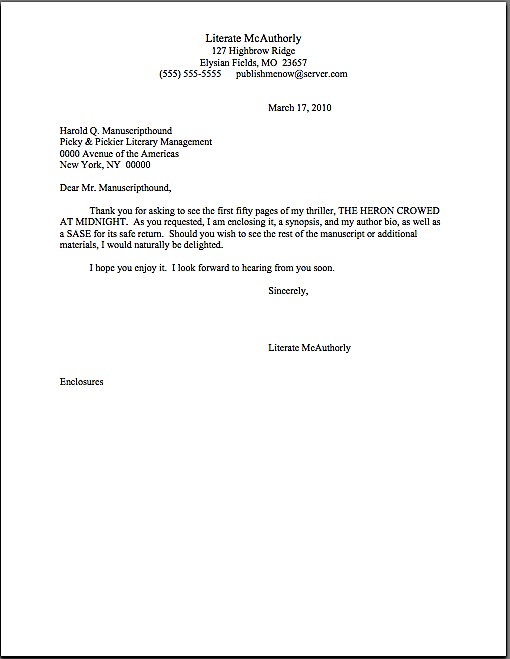
The getting-a-book-published basics, part IX: the agency contract, or, what to say to an agent who offers to represent you — other than, “Yes, please.”

fireworks

Today’s installment of our ongoing series is an exciting one, campers: I’m going to be talking about the happy day when an agent first tells a writer that he wants to represent her. Most aspiring writers have long fantasized about that auspicious event, but what actually happens?

Other than a monumental celebration, of course. I think it’s safe to assume that all of you can picture that part for yourselves.

Let’s back up a moment and savor the actual moment of acceptance in some detail: first, the phone rings. Although some agents do prefer to communicate by e-mail, typically, if a US-based agent is offering to represent a North America-based writer, the agent will telephone.

Why? Well, agents tend to be in a hurry pretty much all the time, and they’re used to using their powers of verbal persuasion. (Remember, most agents will assume that you will have continued to query and submit while they are considering your manuscript; for all the agent who wants you knows, you may already have other offers. Besides, the agent of your dreams will undoubtedly have a few questions for you.

This is also a great opportunity to ask a few of your own. In fact, you should.

To pull one at random out of thin air: “How are you planning to go about trying to sell this book, and to whom?” This is likely to elicit important information, such as whether the book category you selected for your manuscript or proposal was a good fit. (Hey, a writer likes to know these things.)

Another that you might consider blurting out right off the bat: “Are you going to want any changes to the manuscript/book proposal before you start sending it out to editors?” The answer will almost certainly be yes, incidentally, but at least you will have broached the issue politely yourself, rather than having it come as the intense surprise it generally is to those new to the agent-having experience.

If these sound like far more intelligent questions than are at all likely to occur to someone totally overcome with joy, well, you’re right: I know literally dozens of now-agented writers who were able to stammer out little more than a well-nigh-incoherent, “Yes! Yes! Oh, God, YES!”

So unless you are in the habit of receiving good news on this scale with aplomb, it might be prudent to prepare for this moment. While an agent is reviewing your manuscript or book proposal is a dandy time to work off some of your nervous how-long-must-I-wait-to-hear energy by coming up with a written list of what you want to know. You’ll find a few suggestions in the posts under the AFTER YOU LAND AN AGENT and WHAT TO ASK AN AGENT WHO WANTS TO REPRESENT YOU categories on the archive list located at the bottom right-hand side of this page; the US agents’ guild, the Association of Authors’ Representatives, also has a good list of preliminary questions on its website.

Even if you already have a fairly clear idea of what you would say during that much-anticipated phone call, please don’t put this off, thinking you can wing it when the time comes. Accepting an offer gracefully, like garnering the offer in the first place, usually requires some homework. I would strenuously recommend that anyone who might be in a position to be on the receiving end of one anytime soon — like, for instance, a writer who has just popped a submission packet into the mail — check out either these posts or another reputable source prior to having a conversation about one’s work with an agent, if only to clarify in one’s mind what an agent can and cannot do for a writer.

What’s that you say, readers? You’re not entirely sure what a good agent can do for you, other than sell your book? Let’s take a gander at the full range of possibilities.

Some things a reasonable writer can (and should) expect a reputable agent to do:

*Present a client’s manuscript and/or book proposal to editors at large and medium-sized publishing houses (even if a writer has more than one book ready to go, most agents will prefer to work on only one at a time),

*Advise a client on how to make the manuscript or book proposal more marketable,

*After selling the book, handle all of the financial arrangements between the publisher and the writer,

*Act as the client’s advocate in any subsequent disputes with the publishing house, and

*Serve as a sounding board about future book projects’ marketability.

*Help a client strategize the order and timing of working on particular projects, to maximize the agent’s ability to sell them.

All of that sound familiar and reasonable, or is the list disappointingly short for those of you who had been picturing the agent of your dreams wearing the cape and tights of a superhero? To help bring hopes into closer alignment with reality, let’s take a look at some common misconceptions about what an agent is actually capable of offering a writer.

Some things an agent cannot do for his clients:

*Guarantee in advance that he will be able to sell a particular book to a publisher,

*Guarantee that he will be able to sell a particular book to a particular publisher.

*Guarantee a certain advance if the book does sell.

*Dictate when the publisher who acquires the book will release it or speed up the publication process at will, and/or

*Make a writer rich and famous overnight.

If an agent offering to represent you claims to be able to do any of the things on that second list, you should be asking plenty of follow-up questions, as well as checking the agent’s credentials with Preditors and Editors or some other credible source. It’s perfectly legitimate to ask to see a list of clients before you decide, or to request a run-down of the sales tactics the agent used to sell the last book he sold in your book category. You may even ask to speak to a couple of current clients, to see how happy they are with his representation, although naturally, few agents will send a prospective client to a dissatisfied client for a reference.

I can sense some of you squirming in your chairs — you’re not completely comfortable with the notion of cross-examining someone offering to represent your work, are you? “What if I do my homework really, really well before the agent calls and offers to represent me, Anne?” I hear some of you wheedling. “If I quadruple-check in advance that the agent is legit, why will I need to ask questions at all?”

Excellent question, seated squirmers: because every agency operates slightly differently.

For instance, a very well-known agent or one at a very large agency might have a junior associate act as a first-time author’s primary contact, rather than the agent himself. (For a comparison of how large and small agencies can operate differently, please see this archived post, as well as this one.) Some novel-representing agents prefer to approach editors one at a time, giving each a nice, long look at a manuscript (and a chance to reject it) before moving on to the next, while others favor submitting simultaneously to eight or ten editors.

If asking about such things seems a bit confrontational for a first conversation with someone you really, really want to like you, don’t worry: your agent honestly does need you to understand how she works, so that she can do her job well. Most agents actually prefer clients who ask intelligent questions.

And if you say nothing, many agents will simply assume that you’re already familiar with every step in the often long and complicated process of getting a book published. An interesting assumption, given that the vast majority of first-time authors are completely astonished by what occurs. So are most writers new to working with an agent.

Don’t believe me? Ask any writer who signed with his first agent six months ago. Unless his book has already sold — and it’s highly unusual for an agent to be able to sell a new client’s work that quickly — he’s going to be full of wonder about why his agent is handling the book the way she is.

So come up with a set of reasonable questions in advance, and ask them before you sign anything. As long as you don’t take umbrage at any particular piece of news and try to argue about it (“What do you mean, a royalty of 20% for foreign sales is standard? I challenge you to a duel, sir!”), this is all simple factual information that you have a right to know.

I see a few more timid hands raised. “But Anne,” confrontation-haters continue to wheedle, “surely most of what I need to know will be spelled out on the agency’s website. No? Well, then won’t the agent give me some sort of hand-out, explaining how she works? No? Isn’t it even spelled out in the agency contract I’ll be signing?”

I’m sorry to report that the answer to all three questions is not necessarily. (See my earlier comment about the likelihood of agents’ assuming that writers are already aware of what will be required of both parties to the agency contract.) In fact, representation contracts are often downright vague.

Don’t let that make you tense. Trust me: the lack of specifics is generally for convenience’s sake, not to confuse prospective clients. Remember, to make this arrangement work, both parties have to hold up their end of the deal. It’s just not in a good agent’s interest that a writer not completely comprehend what he is being asked to do.

What might an agency contract require of my new agent — and of me?
Most agency contracts are easy-in-easy-out affairs for both parties, so it’s highly unlikely that you’ll get permanently stuck in an arrangement you don’t like.

In fact, representation clients tend to be rather short-term, specifying that the agent will either handle the entire selling process for a single book or all of the client’s work a year’s or two’s time — a choice made by the agency, incidentally, not the author. Sometimes, a single-book contract will grant the agency the right of first refusal over the client’s next book, entitling them to see your subsequent writing before you show it to anybody else, regardless of how happy you were with how the agent handled your first project.

Read every syllable of the contract carefully before you sign; if you don’t understand any part of the contract, ask the agent. If you don’t understand the answer or anything seems fishy, take it to an attorney familiar with representation contracts.

That may seem mistrustful, but a good agent is already quite aware that what you don’t fully grasp can hurt you, contractually speaking. Some contracts, for instance, will feature a rollover clause, which stipulates that if the author has not notified the agency by a particular date that she wants to seek representation elsewhere, the contract is automatically renewed for the following year.

Find out which up front, so you are aware of the terms of renewal. If you sign with an agency that favors the rollover clause, make sure you know precisely when the opt-out date is. Mark it on your calendar, just in case. And keep marking it every year.

If you are planning to write more than one book (or already have), do be sure before you sign a per-project contract that your agent is at least willing to consider representing everything you want to write. A time-based contract minimizes this concern, but do be aware that often means that the agent has right of first refusal over everything a client writes during the agreed-upon period — which means what, campers?

That’s right: you must allow her to decide whether she wants to represent an additional book before you may show it to another agent. (I was just checking to see whether your eyes had glazed over while I was going over technicalities.) Either way, writers with many projects going at once will want to make absolutely certain to ask about future projects.

The agency contract will also specify the percentage of your advances and royalties your agent will get. If this section is vague in any way, start asking questions, fast.

How writers get paid for their books — and how agents get their percentage
Any money you ever earn on books sold for you by the agency will pass through the agency before it comes to you; the agency will take its cut, then mail you a check for the remainder. Paying the agent’s percentage will not be left up to the goodness of your heart and the burnings of your conscience; once you are represented by an agent, he will see to it that your publication contract will specify that the publisher will send your checks to your agent, not directly to you.

This means that any money you see will already have the agent’s percentage deducted from it. See why it’s so important to be positive that you can trust this person?

Typically, in literary agencies, the agent’s percentage is 15% for English-language North American sales. Script agents generally get 10%.

These percentages are non-negotiable in virtually every agency on earth, so no need to worry that asking about them up front will make you look like you’re haggling: it’s to shield you against the unhappy day when a check arrives with fewer zeroes on it than your advance led you to expect. Or for more time passing than you expected between your publisher’s cutting your royalty check and the agency’s passing along your share to you.

And no, a lower percentage for the agent does not usually mean a better deal for the author — it’s usually an indication that the agency is new, and is trying to attract high-ticket clients.

Pretty much every agency in the country takes a significantly higher cut of foreign sales: 20% or more is the norm. (For reasons I have not been able to fathom, my agency takes 23% of sales in the Baltic republics, so they’ll really score if my memoir takes off in Lithuania.) The higher price tag abroad is for a very practical reason: unless an agency has a branch office in a foreign country (as some of the larger agencies do) it will subcontract their foreign rights sales to agencies in other countries, who will need to be paid as well.

So if you suspect that your book will have a high market appeal in Turkey or Outer Mongolia, you might want to check up front whether your prospective agency has a branch there, or is subcontracting. The differential in commission percentage can be substantial.

I see a lot of raised hands out there, and I’m delighted to see so many of you getting in some practice, speaking up when you’ve got a question. However, you might want to lower those flailing arms; I’m out of time for today.

Hold those good questions, everyone, and keep up the good work!

Entr’acte: when an agent asks for pages, but you’ve already granted an exclusive to somebody else, and other soap opera-worthy dilemmas

Proposal-woodcut

I’m taking a break from my ongoing series on how getting published does and doesn’t work — as those of you following the series may have noticed with alarm, an awful lot of the common wisdom on the subject just isn’t true, or at any rate, just isn’t true anymore — to address a question that I get about once per month from aspiring writers. The latest iteration, courtesy of a comment from intrepid reader Virginia a few days back:

Here’s my question: I submitted only two queries to two agents. One got back to me quickly and did ask for exclusive right to review. A few days after I agreed to this, the second agent replied and asked for pages. I don’t want to violate my agreement, but how do I tell the second agent I’m really happy she wants to see more but she has to wait?

Queriers end up in this kind of dilemma all the time, often without understanding how they got there. An exclusive is always a good thing, right, a sign that an agent was unusually eager to see a queried or pitched book, and thus decided to bypass her usual method of requesting manuscripts?

Not always, no. Sometimes, a request for an exclusive genuinely is the result of an agent’s being so excited by a query or pitch (especially if that book has just won a contest) that she’s afraid that another agent will snap it up first. But far more often, it is the natural and should-have-been-expected outcome when a writer queries an agency that has an exclusives-only policy that the querier simply didn’t do enough research on the agency to know about, and so is surprised by the request.

Especially gobsmacked by this (usually predictable) outcome: queriers who do what virtually every aspiring writer asked to submit materials does (and what I suspect occurred here), sending out requested pages immediately upon receipt of the request. Overjoyed at what they assume (in this case, wrongly) will be the only interest their queries will generate, many multiply-querying writers don’t pause to consider that multiple requests for manuscripts are always a possible outcome while sending out simultaneous queries. So is a situation where one of those agents requests an exclusive.

This is why, in case any of you inveterate conference-goers have been curious, agents, editors, and those of us who teach classes on marketing writing invariably sigh when an aspiring writer raises his hand to ask some form of this particular question — and it’s not for the reason that other aspiring writers will sigh. (The latter will sigh because they wish they had this problem.) They will sigh because they’re thinking, “Okay, did this writer just not do his homework on the agents he approached? Or is he asking me to tell him that he can blithely break the commitment he’s made to Agent #1?”

That’s why everyone else will sigh. I, however, sigh whenever I hear this question because I think, “Okay, I have to assume that the questioner is someone who hasn’t read any of my blog posts on querying or submission, as much as that possibility pains me to consider. But since I have no fewer than four explicitly-named categories on my archive list — conveniently located at the bottom right-hand side of my website’s main page: EXCLUSIVES AND MULTIPLE SUBMISSION, EXCLUSIVES TO AGENTS, SIMULTANEOUS SUBMISSIONS, and WHAT IF MORE THAN ONE AGENT ASKS TO SEE MY MANUSCRIPT? — directly aimed at answering this question, and eight more that deal with it within the larger context of submission (AFTER YOU RECEIVE A REQUEST FOR PAGES, AFTER YOU SUBMIT, HOW LONG BEFORE THE REQUEST FOR PAGES EXPIRES? HOW SOON MUST I SEND REQUESTED MATERIALS? INDUSTRY ETIQUETTE, IS IT OKAY TO SUBMIT TO SEVERAL AGENTS AT ONCE? and REQUESTED MATERIALS), as well as a dramatically-reenacted scenario in the Industry Etiquette series, I also have to assume that the questioner is in a situation that I have managed to overlook addressing in any of these posts. So I shall eschew the temptation just to send the questioner to any or all of those categories, try to understand how and why this situation is unique, and answer the darned question for the 475th time.”

Yes, I can think with that much specificity in mid-sigh, thank you very much. It’s just one of my many talents.

All that being said — or at any rate thought loudly — it actually isn’t fair to leap to the conclusion that if aspiring writers read agents’ websites and agency guide listings more thoroughly, they would never end up in this situation. Sometimes, this request does come out of a genuinely blue sky, whacking a conscientious multiple querier or submitter right in the noggin.

In fact, it seems to be happening to aspiring writers more and more these days, and for good reason: as a group, you’re querying more widely. That’s a good thing.

Now that many agencies routinely just don’t respond to queries at all if the answer is no, it would be equally silly for a savvy writer to query them one at time and to wait to hear back from all of those simultaneous query recipients before submitting to the first agent who asks to see pages.

Often, the writer simply will not know that exclusivity is a possibility until an agent asks for it, and the request is seldom formulated in a manner that informs a writer not already aware of the fact that she can say no. Or put a time restriction on the exclusive, if she grants it at all.

All of these things are true, incidentally. Unless an agency informs would-be queriers in advance that it has an exclusives-only submission policy, a submitting writer is under no obligation to grant a request for an exclusive to an individual agent. And, as with any other favor, the writer has the right to place conditions on it if she grants it.

But widespread misunderstanding of how exclusives work is not the primary reason it isn’t fair for the pros to be dismissive of writers in this situation. We should all have sympathy, because 99.999% of the time, what an aspiring writer asked for an exclusive hears is not, “Okay, this sounds interesting and marketable, but I don’t want to have to rush to beat competing agents in reading the manuscript. Please remove the necessity of my having to hurry by agreeing not to show it to anyone else until I’ve gotten back to you.”

Which is, by the way, what a request for exclusivity means, at base. Deflating to think of it that way, isn’t it?

What 99.999% of aspiring writers in this situation hear is “Oh, my God — this is the most exciting book premise/pitch/query I’ve ever heard. I’m almost positive that I want to represent it, even though I have not yet read a word of the manuscript or book proposal. If you grant my request, I’m going to clear my schedule so I may delve into this submission the nanosecond it arrives in my office.”

And then the giddy aspiring writer is astonished when weeks or months pass before the agent makes a decision, precisely as if there had been no exclusive involved. The only difference, from the writer’s point of view, is that she was honor-bound not to approach other agents until she heard back.

Pardon my asking, but what precisely did the writer gain by granting that exclusive? And does anybody out there have a good suggestion for a new category title that would more quickly catch the eye of (a) submitters who find themselves in this situation, (b) queriers or pitchers who MIGHT find themselves in this situation soon, and (c) readers not patient enough to scroll through a couple of hundred categories to find what they want?

Okay, so the last is a tall order for a 40-character max category title. Believe it or not, the main reason there are so many categories is because I keep hearing from panicked writers who did not instantly find what they were seeking.

I think that a couple of factors contribute the confusion so many agent-seeking writers seem to feel on this subject. First, many writers confuse initial interest with a commitment — why would an agent ask to see a manuscript exclusively, they reason, unless they already thought they might want to sign the author?

The short answer: typically, an agent won’t ask for an exclusive (or for pages, for that matter) unless he thinks representing it as a possibility; since, however, agents who ask for exclusives seldom make the request of only one writer, a writer should not assume that his is the only exclusive on the agent’s desk.

If that last bit made your stomach drop to somewhere around your knees, don’t feel blue, or even slightly mauve: the vast majority of writers who have ever been asked for an exclusive peek at their work were under the same misconception. The temptation to believe the request means more than it actually does is vast.

Compounding this misconception is the cold, hard fact that when aspiring writers agree to an exclusive, they don’t necessarily understand what it actually entails. So let’s invest some blog space into going over the basics.

Hey, maybe this post does belong in my Getting a Book Published Basics! Who’d have thought it?

An exclusive, for those of you new to the concept, is when a writer agrees to allow an agent a specific amount of time to consider representing a particular manuscript, during which no other agent will be reviewing it. In practice, both the agent and the writer agree to abide by certain rules during the specified period:

– ONLY that agent will have an opportunity to read the materials;

– no other agent is already looking at it;

– the writer will not submit it anywhere else;

– in return for this significant advantage (which, after all, pulls the manuscript out of competition with other agents), the agent will make a legitimate effort to read and decide whether or not to offer representation within the specified time period.


Is everyone clear on the rules? If not, please leave a comment with a question — just the second I come up with a brand-new category name covering this particular dilemma, today’s post is going to be popping into it. So if you ask now, future writers-in-a-bind will enjoy the full benefit of your having asked.

Okay, now that we know what Virginia agreed to do, let’s take a gander at her options. If she wants to play by the rules — and she should, always — her choices are three.

If she specified a time limit on the exclusive — which the agent will very seldom propose spontaneously; it’s not in her interest — the answer is very simple: if less than that amount of time has passed, don’t send the manuscript to anyone else until it has.

What is she to tell the other agent? Nothing, if the agreed-upon length of the exclusive is reasonable — say, between three and eight weeks. Agents are perfectly used to writers taking some time to revise before submitting requested materials. Virginia’s second agent probably wouldn’t blink twice if she didn’t get back to him before then; remember, it’s not as though an agent who requests materials sit there, twiddling his thumbs, until he receives it.

And what would she gain by telling him she’d already promised an exclusive to another agent, other than informing him that she had already decided that if the other Agent #1 offered representation, she would take it? How exactly would that win her Brownie points with #2 — or, indeed, help her at all?

In practice, all waiting on fulfilling the second request means is that Virginia will have an attractive alternative if Agent #1 decides to pass on the manuscript. That’s bad because…?

Oh, wait: it isn’t. Actually, it’s an ideal situation for a just-rejected submitter to find herself occupying. Way to go, Virginia!

Worrying about what might happen to Virginia if Agent #1 doesn’t get back to her within the specified time frame? Relax; she still has three pretty good options, one completely above-board, one right on the board, and the last slightly under it.

First, the high road: about a week after the agreed-upon exclusive expires, Virginia could send Agent #1 an e-mail (not a call), reminding her that the exclusive has elapsed. Would A1 like more time to consider the manuscript solo, or should Virginia send the manuscript out to the other agents who have requested it?

I can already tell you the answer will be the former. The writer doesn’t achieve much by taking the high road, usually, other than a bit of comfort from the fact that the agent hasn’t forgotten her altogether.

The level road is cosmetically similar, but frees the writer more. Virginia could write an e-mail to the agent, informing her politely that since the agreed-upon period of exclusivity has elapsed, she’s going to start sending out requested materials to other agents. Then she should actually do it, informing Agent #2 in her cover letter that another agent is also considering the work.

That way, she gets what she wants — the ability to continue to market her work — while not violating her agreement with Agent #1. All she is doing is being up front about abiding by the terms of the exclusive.

The slightly subterranean but nevertheless justifiable third option would be not to send an e-mail at all, but merely wait until the exclusive has lapsed to send out the manuscript to Agent #2, informing him that there’s also another agent reading it. I don’t favor this option, personally, because despite the fact that Virginia would be perfectly within her rights to pursue it — the agent is the one who breached the agreement here, not the writer — if Agent #1 does eventually decide to make an offer, Virginia will be left in a rather awkward position.

Enviable, of course, but still a bit uncomfortable.

When an exclusive does not carry an agreed-upon time limit — and most don’t — the ethics are more nebulous, the costs to the writer significantly higher. Sometimes enough so that being asked to grant an exclusive turns out to be a liability.

As exciting as a request for an exclusive may be, it does tie the writer’s hands, for precisely the reason Virginia feels conflicted: throughout the duration of the exclusive, the writer agrees not to show the manuscript to any other agent. If, as in Virginia’s case, other agents are also interested, this can mean a substantial delay in getting the manuscript onto their desks — not to mention the fact that if Agent A offers to represent it, B and C may not see it at all.

In an environment where it often takes 3-6 months to hear back on a submission, it’s not all that hard to envision a situation where a writer might actually want to say no to an exclusive, is it?

While you’re pondering the implications, I’ll be changing the subject slightly, to underscore a few points. But never fear: I’m going to talk about the perils and escape hatches of the unlimited exclusive tomorrow; it’s too complex to toss off in just a few paragraphs.

For now, let’s concentrate on the kind of exclusives a savvy writer should be delighted to grant. To that end, I want to make absolutely certain that each and every querier and submitter out there understands two things — no, make that three:

1) As flattering as a request for an exclusive is to an aspiring writer, granting it is optional; 

2) Since by definition, a writer cannot submit to other agents during the exclusive period — yes, even if the writer queried the others first — it’s ALWAYS a good idea to set a time limit;

3) Since granting it limits the writer’s options, it’s best reserved for situations where one’s top-choice agents are interested in the book.


Why limit it to your favorite picks? Try to think of granting an exclusive as if you were applying for early admission to an Ivy League school: if the school of your dreams lets you in, you’re not going to want to apply to other universities, right?

By applying early, you are saying that you will accept their offer of admission, and the school can add you to its roster of new students without having to worry that you’re going to go to another school instead. It’s a win/win, in other words.

So if the best agent in the known universe for your type of writing asks for an exclusive, you might genuinely want to say yes. But if you have any doubt in your mind about whether Harvard really is a better school for your intended studies than Yale, Columbia, or Berkeley — to mix my metaphors again — you might want to apply to all of them at the same time, so you may decide between those that do admit you.

To put it another way, if you are asked for an exclusive because your work is sought-after, it is up to you whether you would prefer to go steady right off the bat or date around a little. Got it?

If not, I can keep coming up with parallel cases all day, I assure you. Don’t make me start sending you to past posts.

That doesn’t mean you should necessarily say no to this type of exclusivity request, but if you say yes, set a reasonable time limit on it, so you don’t keep your book off the dating market too long. This prudent step will save you from the unfortunately common dilemma of the writer who granted an exclusive seven months ago and still hasn’t heard back.

Yes, in response to that gigantic collective gasp I just heard out there: one does hear rumors of agents who ask for exclusives, then hold onto the manuscript for months on end. Within the past couple of years, such rumors have escalated astronomically.

Set a time limit. Four to six weeks is ample.

No need to turn asking for the time limit into an experiment in negotiation, either: simply include a sentence in your submission’s cover letter along the lines of I am delighted to give you an exclusive look at my manuscript, as you requested, for the next month.

Simple, direct — and trust me, if the agent has a problem with the time you’ve specified, s/he’ll contact you to ask for more.

Of course, protecting your ability to market your work isn’t always that simple: negotiation is not possible with the other type of exclusive request, the kind that emerges from an agency that only reviews manuscripts that no one else is; the writer is not offered a choice in the matter. Consequently, a request for an exclusive from these folks is not so much a compliment to one’s work (over and above the sheer desire to read some of it, that is) as a way of doing business.

In essence, exclusive-only agencies are saying to writers, “Look, since you chose to query us, you must have already done your homework about what we represent — and believe us, we would not ask to see your manuscript if we didn’t represent that kind of writing. So we expect you to say yes right away if we make you an offer.”

Noticing a homework theme in all of these unspoken assumptions? Good. Let me pull out the bullhorn to reiterate: because agents tend to assume that any serious writer would take the time to learn how the publishing industry does and doesn’t work — oh, if only some reputable blogger would run a series on THAT, eh? — querying and submitting writers who don’t do their homework are much more likely to get rejected than those who do.

Okay, bullhorns down; back to the issue at hand. Why might an exclusive submissions policy be advantageous for an agency to embrace?

Well, for one thing, it prevents them from ever having to experience the fear associated with the first type of exclusive request. If you send them pages, they may safely assume that you won’t be e-mailing them in a week to say, “Um, Agent Q has just made me an offer, slowpoke. I still would like to consider your agency, so could you hurry up and finish reading my manuscript so you can give me an answer? As in by the end of the week?”

Okay, so you wouldn’t really be that rude. (PLEASE tell me you wouldn’t be that rude.) But let’s face it, agents who don’t require exclusive submissions do receive these types of e-mails fairly often. And nobody, but nobody, reads faster than an agent who has just heard that the author of the manuscript that’s been propping up his wobbly coffee table is fielding multiple offers.

Agencies who demand exclusivity are, by definition, unlikely to find themselves in a similar Oh, my God, I have to read this 400-page novel by tomorrow! situation. After even the third or fourth panicked all-nighter, exclusives might start to look like a pretty good policy.

What does the writer get in return for agreeing not to submit to others for the time being? Not a heck of a lot, usually, unless the agency in question is in fact the best place for his work. But if one wants to submit to such an agency, one needs to follow its rules.

Fortunately, agencies that maintain this requirement tend to be far from quiet about it. Their agents will trumpet the fact from the conference dais. Requires exclusive submissions or even will accept only exclusive queries will appear upon their websites, in their listings in standard agency guides, and on their form replies requesting your first 50 pages.

(Yes, in response to that shocked wail your psyche just sent flying in my general direction: positive responses are often form-letters, too, even when they arrive in e-mail form. I sympathize with your dismay.)

If exclusives-only agencies had company T-shirts, in short, there would probably be an asterisk after the company’s name and a footnote on the back about not accepting simultaneous submissions. If they’re serious about the policy, they’re serious about it, and trying to shimmy around such a policy will only get a writer into trouble.

Do I feel some of you tensing up again? Relax — agencies with this requirement are not very common.

Why? It limits their querying pool. Because they require their potential clients to bring their often protracted agent search to a screeching halt while the submission is under consideration, such agencies are, in the long run, more time-consuming for a writer to deal with than others. As a result, many ambitious aspiring writers, cautious about committing their time, will avoid querying agencies with this policy.

Which, again, is a matter of personal choice. Or it is if you happened to notice before you queried that the agency in question had this policy.

Hey, check their T-shirts. Because I assure you, no one concerned is going to have any sympathy for a writer complaining about feeling trapped in an exclusive. They’ll just assume that he didn’t do his homework.

So check submission policies before you query, everyone; it can save you a world of chagrin later.

Thanks for asking the question, Virginia; I’ll discuss other aspects of your dilemma next time. To you and all of your fellow conscientious writers, keep up the good work!
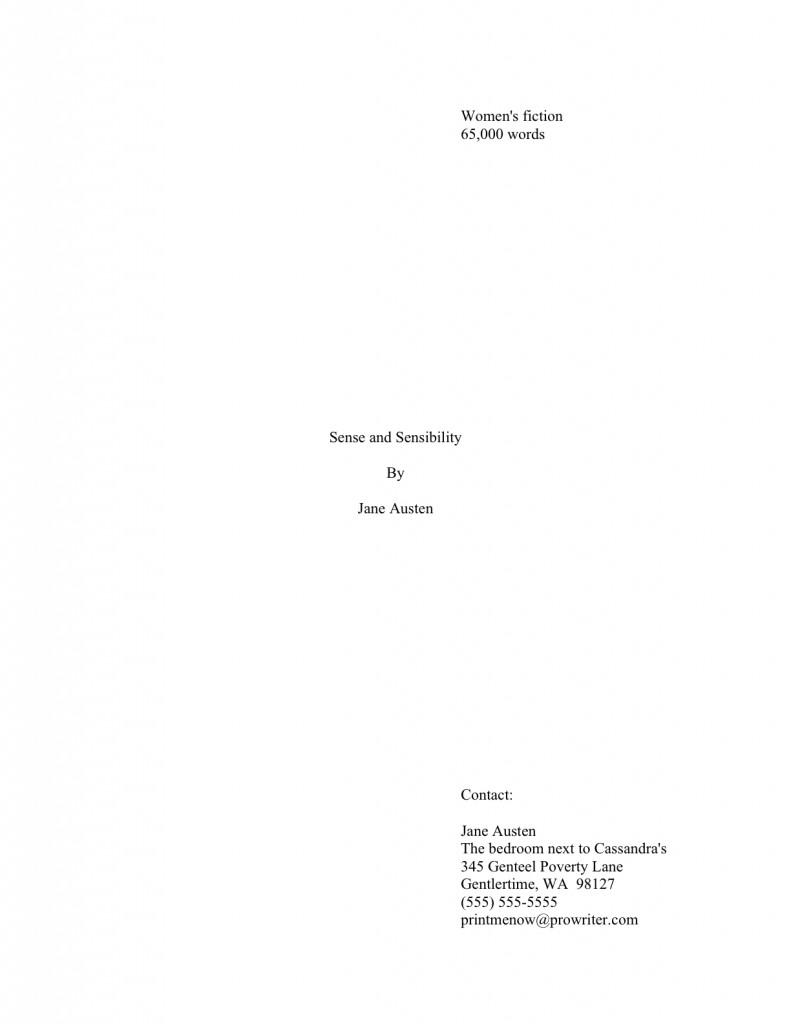
The romance — and limitations — of exclusivity, part II

1885-proposal-caricature

Last time, I took a break from our ongoing series to respond to a readers’ question about how to handle an exclusive request from an agent. Specifically, she wanted to know what she should do if she had already agreed to let one agent sneak an exclusive peek at her manuscript, but another agent had asked afterward to see it non-exclusively. What’s a writer to do?

The short answer: abide by her commitment to Agent #1 for the duration of the agreed-upon period of exclusivity, then move on to Agent #2. The only apparently shorter answer: what honoring that agreement means vis-à-vis approaching other agents really depends upon the terms of the exclusivity agreement.

Have I lost those of you who walked in halfway through this discussion? Okay, I’ll recap: an exclusive is an arrangement whereby a writer allows an agent to read a particular manuscript while no other agent will be reviewing it. The agent requests an exclusive because he would prefer not to compete with other agents over the manuscript; the writer agrees, presumably, because if this agent says yes, she will neither need nor want to approach other agents.

Let’s be clear about what that means in practice, campers: the writer guarantees that nobody else will be in the running while the requesting agent is pondering the pages. Anyone see a potential problem with that?

Give yourself a large, shiny gold star and a pat on the back if you instantly asked, “Wait a minute — what happens if the request for an exclusive comes in while another agent is already considering the manuscript?” That would indeed present a problem, because by definition, a writer cannot grant an exclusive if any agent is currently reading any part of the manuscript in question; in order to comply with a request for an exclusive, the writer must wait until all of the agents reading it at the time the exclusivity request arrived have informed him of their decisions.

Doesn’t seem like all that complicated a premise, does it? Yet hardly a month goes by when I some exclusive granter doesn’t tap me on the shoulder (physically or electronically) to ask, “Um, Anne, do you remember that request for an exclusive I was so excited about a week and a half ago?” (Or a month and a half, or six months.) “I’ve heard from another agent. What should I do?”

Which leads me to the other potential problem that I sincerely hope some of you came up with two paragraphs ago: what happens if an agent who asked for an exclusive doesn’t get back to the writer within a reasonable amount of time? Is the writer still bound by the exclusivity agreement? Or is there some point at which it’s safe to assume that silence = thanks, but we’re not interested?

The short answers to each of those last three questions, in order: it depends on the terms of the original agreement; it depends on the terms of the original agreement; it depends on the terms of the original agreement.

What does it depend upon? Those of you who read breathlessly through yesterday’s post, shout it along with me now: it depends upon whether the writer had the foresight to set an end date for the exclusive. If an exclusive is open-ended, the writer cannot ethically send out requested materials to other agents until one of two things happens: the exclusive-requester informs the writer that she has rejected the manuscript, or so many months have passed without word from the agent that it’s safe to assume that the answer is no.

Even then — say, six months — I’d still advise sending an e-mail, asking if the exclusive-seeking agent is finished with the manuscript. It’s only polite.

Or avoid this dilemma entirely by hedging your bets from the get-go: grant the exclusive, but send the manuscript along with a cover letter that mentions how delighted you are to agree to a six-week exclusive. The agent can always come back with a request for more time, but at least you won’t be left wondering six months hence whether you’ll offend her if you move on.

I’m sensing some severe writerly disgruntlement out there. “But Anne!” exclaim aspiring writers who want there to be more options. “Why should I borrow trouble? Surely, you don’t expect me to run the risk of offending an agent by implying that he’s not going to get back to me in a timely manner?”

Hey, I don’t expect anything; do as you think best. I’m just the person that aspiring writers keep asking how to get out of an exclusive that hasn’t panned out as they had hoped.

To help you weigh the relevant risks, let’s look at the phenomenon from the other side of the agreement. Generally speaking, agents will request exclusives for only one of three reasons: they fear that there will be significant competition over who will represent the project, they don’t like to be rushed while reading, or it is simply the agency’s policy not to compete with outside agencies, ever.

Do I feel some of you out there getting tense over that third possibility, doing the math on just how many years (if not decades) it could take to make it through your list of dream agents if you had to submit to them one at a time? Relax, campers: requests for exclusives are actually fairly rare.

Why rare? Well, the first kind of exclusive request I mentioned yesterday, the one Agent A might use to prevent Agents B-R from poaching your talents before A has had a chance to read your manuscript (hey, A’s desk is already chin-deep in paper), tends to be reserved for writers with more than just a good book to offer. Celebrity, for instance, or a major contest win fifteen minutes ago. Basically, the agent is hoping to snap up the hot new writer before anybody else does.

Or before the HNW realizes that s/he might prefer to be able to choose amongst several offers of representation. Since pretty much every respectable agency offers the same service, such choices are often made on the basis of connections, how well-established the agency is, or even how well the writer and the agent happen to hit it off. If an agent fears that the other contenders might be able to offer a rosier prospect, it might well be worth her while to buttonhole the HNW and get her to commit to an exclusive before anyone else can get near.

So if you suddenly find yourself the winner of a well-respected literary contest or on the cover of People, remember this: just because an agent asks for an exclusive does not mean you are under any obligation to grant it.

Oh, pick your chin up off the floor. If your work is in demand, it’s not necessarily in your best interest to sign with the first agent who makes an offer — you will want the one with the best track record of selling books like yours, right? Ideally, you would like to be in a position to compare and contrast offers from different agents.

Why not pick the one who asks first and be done with it? Chant it with me now, long-time readers: you do not want to land just any agent; you want the best agent for your work.

If you shouted, “Yes, by Jove: I want to query and submit in a manner that maximizes the probability to be fielding several offers at once!”, then I suggest you consider two questions very carefully before you decide which agents to approach first:

(1) If an agency has an exclusives-only policy, should it be near the top of my query list, potentially forcing me to stop my submission process cold until they get back to me? Or are there agents who permit simultaneous submissions that I could approach all at once before I queried the exclusive-only agency?

(2) Is there an agent on this list to whom I would be OVERJOYED to grant an exclusive, should he happen to request it after seeing my query or hearing my pitch, or would I be equally happy with any of these agents? If it’s the former, should I approach that agent right off the bat, before sending out queries to any exclusives-only agents on the list?

The disgruntled murmur afresh: “Okay, Anne, I get it; an ounce of prevention is worth a pound of cure. But where does this leave Virginia and the many other writers out there who have granted exclusives to the first agent who asked, only to find themselves chafing under the agreement down the line, when other agents asked to see the manuscript? Can’t you offer then just a few ounces of cure?”

Again, it depends: why did the agent asked for the exclusive in the first place, and how long it has been since the writer granted it?

If the agent asked for it because her agency has an advertised policy that it will only consider exclusive submissions, then the writer is indeed obligated to hold off on further submissions. If the agreed-upon period has elapsed, Virginia can always contact the agent and ask point-blank if s/he needs more time.

What the writer should most emphatically NOT do when dealing with an exclusives-only agency is contact the agent, explain that others want to read the work, and ask if it’s okay to submit simultaneously — which, incidentally, is very frequently the writer’s first impulse, if those who contact me on the sly to ask my advice are any indication. Bless their optimistic little hearts, they seem to believe that of only the agent in question understood how eagerly they want to find representation, the agent’s heart would melt.

“Of course, you may indulge in multiple submissions,” the agent would say, tossing candy to the world’s children from Santa’s sleigh, assisted by the Easter Bunny, Bigfoot, and a miraculously still-alive Amelia Earhart. “My agency was just kidding about that whole exclusives-only thing.”

Call me a pessimist, but I simply don’t believe that’s going to happen.

This desire to throw oneself upon the agent’s mercy appears even stronger, if that’s possible, in writers who already have submissions out with other agents, and THEN receive a request for an exclusive from an agent. For many such submitters (who, let’s face it, have a problem most aspiring writers would LOVE to have), the fact of previous submission seems to obviate the agent’s request, or even an exclusives-only agency’s policy.

They couldn’t really mean it in my case, these writers think.

I hate to burst your bubble, Glinda, but I can assure you that they could — and do. Trying to negotiate one’s way out of this situation only tends to change the representation question from whether the agent likes the writer to whether he really wants to deal with someone who has difficulty following directions.

Don’t believe me? Okay, let’s take a gander at an e-mail exchange between an agent and a writer who already has a submission out to another agent:

Dear Melissa:
Thank you for querying me with your novel, TERMINAL INDECISIVENESS. Please send the first fifty pages.

As you may already know, our agency will accept only exclusive submissions. Please enclose a SASE.

Regards,
Clinton McPicky

Dear Clint:
Thank you for your interest in my novel. I would be happy to give you an exclusive, but the fact is, two other agents already have partial manuscripts, and I don’t know when I shall be hearing back from them. I’m really impressed with your agency, though, and I certainly don’t want to knock it out of consideration.

Since it would obviously be impossible for me to give you an exclusive on material that’s already elsewhere, is it okay if I just go ahead and send you what I’ve sent the others?

Melissa

Dear Melissa:
As I mentioned, my agency only accepts submissions on an exclusive basis.

Clinton

What happened here? Melissa tried to shift responsibility for solving her dilemma onto Clinton’s shoulders, that’s what. (Also, she addressed him by a familiar nickname, rather than the name with which he signed his letter; a small thing, but rather rude.) From her point of view, this strategy made perfect sense: his request had caused a problem, so she asked him to modify his request.

From Clinton’s point of view, however, Melissa was asking him to change agency policy for the sake of a single writer who, for all he knows, simply did not bother to check what those policies were before querying. What possible incentive could he have for saying yes?

Got the impulse to quibble out of your system, Melissa? Good. Next time, abide by your agreement: allow Clinton an exclusive until the agreed-upon time has elapsed, then inform him that unless he would like an extension upon his exclusive (which you are under no obligation to grant, Mel), you will be submitting it to the other agents who have requested it.

What’s that you say, Melissa? Isn’t Clinton likely to say no at that point? Perhaps, but not necessarily — and you will have done your level best to conduct your submission process honorably.

“Okay,” the formerly disgruntled agree reluctantly, “I guess that makes some sense. But what about the writer — say, Melissa’s brother Melvin — who has an open-ended exclusive arrangement with Jade, an agent whose agency does not insist upon solo submissions? She’s had it for a while, and four other agents have asked to see his book! Given how many are interested, can’t he just move on without telling her, and hope that she will be the first to make an offer, so he doesn’t have to ‘fess up about sending his manuscript elsewhere?”

The short answer is no. The long answer is that it depends upon how much time has elapsed.

Melvin should check the agency’s website, its agency guide listing, and the letter Jade sent him, asking for an exclusive: has it been at least as long as any mentioned turn-around time — or, to be on the safe side, a couple of weeks longer? If not, he cannot in good conscience send out requested materials to any other agent regardless of whether others requested exclusives in the meantime.

Don’t even consider it, Melvin. Otherwise, your word to Jade would be meaningless, no?

For some reason, the vast majority of the Melvins who creep into my atelier in the dead of night to ask my advice on the subject — a practice I discourage, incidentally; the comment section is there for a reason — almost always seem surprised, or even hurt, by this response. But the situation honestly is pretty straightforward, ethically speaking: Melvin agreed to the exclusive, so everyone in the industry would expect him abide by it.

And as we saw above, contacting everyone concerned to explain the dilemma will not eliminate it; all that will do is tell all of the agents involved that Melvin is trying to change the rules. Either trying to renegotiate with Jade at this point or telling the others they will need to wait, will not win him points with anybody; it will merely look as though he didn’t understand what an exclusive was.

Here’s how I would advise Melvin to handle this dilemma with his integrity intact: wait it out for the stated turn-around time (plus two weeks), then send the polite note I mentioned above: remind her that she asked for an exclusive, but inform her that he has had other requests for materials. Do not leave that last bit out: it’s imperative that Jade is aware before she makes a timing decision that others are indeed interested.

If Jade writes back and says she wants to represent him, he has only two options — saying yes without sending out further submissions or saying no and sending out to the other four. If Jade does make an offer he wishes to accept, it would be courteous of Melvin to send a polite note to the other four, saying precisely what happened: another agent made an offer before he could send out the materials they requested. They’ll understand; this happens all the time.

If Jade asks for more time, Melvin should consider carefully whether he is willing to grant it. If he does, he should set a date — say, a month hence — beyond which he will start sending out manuscripts to the other four.

If, however, Jade doesn’t respond to his polite e-mail within six weeks, he should not, as many writers in this situation are tempted to do, overload her inbox with increasingly panicked e-mails. On day 43 (six weeks + 1 day), Melvin should send the requested materials to the four agents, along with cover letters explaining that others are looking at it simultaneously. No need to specify who is doing the looking, just that they are.

To deal courteously with Jade at this point, he should send a letter, saying that while she is still his first choice (the implication of an exclusive, always), since the exclusive has now expired, he is now sending out requested materials to other agents. As, indeed, he had already given her notice that he might do if she didn’t get back to him.

Again, this happens all the time. As long as a writer does what he said he was going to do, he’s unlikely to run into much trouble with an exclusive — but remember, this is an industry where reputations count; in the long run, it’s in your interest every bit as much as the agent’s that you honor the exclusivity agreement, if you grant it.

A tip for figuring out how long to suggest a requested exclusive should be: take the amount of time you feel you could wait calmly if you had a second request for materials burning a hole in your pocket. Now double it.

Take a gander at that number: is it in days, rather than weeks or months? If so, may I suggest gently that you may be too impatient to be happy with any length of exclusive?

You can always say no, right? Right? Can you hear me?

Frankly, I think most submitters in this situation overreact to the prospect of a comparatively short wait — or did not have a realistic sense of how long it can take these days for an agent to make up his mind about a manuscript. 3-6 month turn-around times are not uncommon, and let’s face it, holding off for a few days or weeks is not going to harm the writer’s chances with the other requesting agents.

Chances are that they’re reasonable people. After all, it’s not as though they requested the materials, then cleared their schedules for the foreseeable future in order to hold their respective breaths until the submission arrived.

And, please, I implore you, do not grant de facto exclusives. If an agent did not ask for an exclusive and the writer did not agree to it, the writer is perfectly at liberty to continue to submit, query, and pitch until a representation contract is signed. While not continuing to pursue other leads while an agent is perusing your work may seem like a well-deserved break, a reward for successful querying, it’s effectively like applying to only one college per year: you might get in eventually, but it’s a far more efficient use of your time to apply to many simultaneously.

So submit widely — and keep those queries and submissions circulating until you land an agent. Just make sure that when you have requested materials out to more than one agent, you tell each that others are looking at it.

Trust me, they’ll want to know, even if they aren’t exclusive-minded. Gives ‘em just a touch of incentive to read faster.

Next time, I shall resume the Back to Basics series. Keep those expectations reasonable, folks, and keep up the good work!

PS: I really was serious yesterday when I asked if any of you lovely readers had any bright ideas for a category title on this subject; people seem to have a hard time finding EXCLUSIVES AND MULTIPLE SUBMISSION. So if you can think of a pithy-yet-eye-catching description less than 40 characters long, please let me know — I shall be eternally grateful, and so will all of the many, many submitters who find themselves in this situation every year.

The getting-a-book-published basics, part VI: responding sensibly to that much-anticipated request for pages

seagull in Spain

No, I’m not devoting today’s post to the resting habits of seagulls. I just thought that after all of the horrifying imagery we’ve all been seeing over the last 24 hours, a nice, soothing image wouldn’t be amiss today. (But if you’re itching to help out: both the Red Cross and Doctors without Borders can put donations to work helping earthquake victims right away.)

For those of you joining us mid-series, I’ve been spending the last few posts on an overview of how books currently get published in the United States. Not the astonishing pervasive fantasy that all a good writer has to do to get published is to write a book, but the actual logistics of what happens. The view from the trenches, as it were. So far, we’ve gone over how US-based publishing has changed over time; how fiction and nonfiction are marketed differently; why a writer needs an agent; the various methods of seeking representation, along with their pros and cons, and last time, what kinds of reactions an aspiring writer may reasonably expect following an attempt to approach an agent.

Is everyone fairly clear on all of those? If not, please feel free to post questions in via the comments functions — or, better yet, to seek out more detailed answers amongst the many and varied categories on the archive list on the lower right-hand side of this page.

Yes, yes, I know: I have been harping on the archives quite a bit over the last few posts, but I assure you, I have my reasons. The current series is intended to give those new to trying to get their work published — and anyone else who feels like reading it — a general view of how the process works, as opposed to my usually favored approach, the let’s-concentrate-on-this-one-small-aspect-for-a-week method of analysis. Both have their benefits, of course, but if you are looking for elucidation on any of the individual points I’m discussing here, chances are that you will find far more discussion than you ever dreamed in the archived posts.

So if delving into the archive list starts to feel like trying to catalogue the contents of Pandora’s box, well, don’t say that I didn’t warn you. Back we go to the general overview.

What a writer should do if an agent requests materials: paper or ether?
If a query or pitch is successful, an agent will typically ask the writer to send either the entire manuscript (rare), a specified number of pages from the beginning of the book (substantially more common), or, for nonfiction, the book proposal. Most of the time, this means that the agent is expecting to receive it as hard copy, sent by regular mail, so if the requesting agent does not specify, start printing.

Yes, even if you queried electronically; reading submissions in soft copy is still far from universal. If an agent prefers e-mailed submissions, he will tell you so when he requests the pages; that information is often included on the agency’s website’s submissions requirements list as well.

If an agent does prefer electronic submissions (and tells you so), send the requested pages as an attachment to an e-mail. Under no circumstances should you ever send a computer disk or CD-R with your book on it — it will be returned without being opened.

If you are planning to submit electronically, please be aware that unless a US-based agent specifically states otherwise, the attachment he has in mind is a document in MS Word. If you work on a Mac, make sure to send it as a Windows-friendly document and as .doc file; many agencies do not run recent enough versions of Word to read .docx files.

Why Word, as opposed to any of the many software programs out there professing to create professional-looking book pages? Word is what the major publishing houses use, that’s why. If the agent of your dreams is going to submit electronically to an editor, that’s how the editor would expect to receive it.

Occasionally, an agent will ask for attachments as rtf (rich text format), a version without the formatting bells and whistles that render documents hard to translate across word processing systems; if you don’t habitually work in Word, but send your document in rtf, a Word user should be able to open it. Some agents accept submissions in PDF format — especially those who choose to read submissions on a Kindle, rather than on a computer screen, as is becoming increasingly common — but it’s seldom preferred, as it’s hard to edit.

Because the human eye reads much more quickly on a backlit screen than on a printed page, it’s usually to the writer’s advantage to submit in hard copy, rather than electronically. It’s also more work for an agent to reject a paper copy, as opposed to the single action of hitting the DELETE key required to remove an e-submission from his life forever; that’s also true of mailed vs. e-mailed queries, incidentally. (For more on the pros and cons of paper vs. electronic submissions, please see the E-MAILED SUBMISSIONS and E-MAILING QUERIES categories on the list at right.)

However an agent has asked you to submit, though, do as he asks. In fact, if there is one inviolable rule to bear in mind while preparing a submission packet, it is surely send the agent precisely what he has asked you to send.

What a writer should do if an agent requests materials: demonstrating you can follow directions
Being hyper-literal often doesn’t serve an aspiring very well along the frequently perilous road to publication, but this is one time where it’s positively a boon. All too often, aspiring writers get so excited over an agent’s request that they forget the quality of the writing is not necessarily the only factor an agent weighs in deciding whether to represent a client. She’s also going to being paying attention to whether the submitter is good at doing what he’s asked to do.

So I reiterate: submit precisely what the agent asks you to send — and only what she asks you to submit.

What might that mean in practice, you ask? Well, if the agent asked to see the first 50 pages, send the first 50 pages — not the first 49, if a chapter happens to end there, or 55 if there’s a really exciting scene after page 50. If page 50 ends mid-sentence, so be it.

Getting the picture?

Why is it so very important to follow submission instructions exactly? The ability to follow directions to the letter tends to be a quality that agents LOVE to see in potential clients, since it implies the writers in question possess two skills absolutely essential to working well with an editor — no, make that three: an ability to listen or read well, a capacity for setting goals and meeting them, and a professional attitude.

So getting the contents of the submission packet right is monumentally important. So if you receive the request in the course of a pitch meeting, take the time to write down a list of what the agent is asking you to send. Read it back to him to make sure you caught everything. (Trust me, if you’re face-to-face with an agent who has just said yes to you, you won’t be thinking with your usual clarity.)

If the agent makes the request in writing, read the missive through several times, then sit down and make a list of what he’s asked you to send. Wait at least 24 hours before re-reading the communication to double-check that every requested item made it onto the list. THEN assemble your submission packet, checking off each element as you place it into the envelope or box.

Clever reader Tad came up with a brilliant extra level of security: after you have assembled the submission packet, hand it, your list, and a copy of the letter from the agent to someone you trust — a parent, a significant other, a best friend, or any other friendly, detail-oriented person you’re relatively certain isn’t harboring a secret desire to see you miserable — and ask that person to check that (a) the letter and the list correspond exactly and (b) you’ve included every necessary element in the packet.

Yes, it’s THAT vital to get it right.

Throughout the last few paragraphs, I’ve been sensing some confusion out there. “But Anne,” a few timid souls pipe up, “am I missing something here? How difficult could it possibly be to print up the number of pages the agent requests, place them in an envelope, and pop it in the mail? Are you saying that he might ask to see something other than the manuscript?”

Often, yes. There are also a couple of elements that any US-based agent will expect to see, whether or not he asks you to include them.

What might an agent ask you to submit — and what should you always send whether she asks for it or not
Since there is no industry-wide standardization of what precisely belongs in a submission packet, any given agent may ask for a different array — and you already know to send precisely what each asks you to send, right? However, the most commonly-requested elements are:

The requested pages in standard manuscript format, unbound.
The most popular lengths to ask for are the first chapter, the first three chapters, the first 50 pages, the first 100 pages, and the entire manuscript. If you’re unfamiliar with the way a professional manuscript should look (hint: not like a published book, nor is it identical to a short story submission), please see the HOW TO FORMAT A BOOK MANUSCRIPT and STANDARD FORMAT ILLUSTRATED categories at right.

A few cautionary notes, just in case any of you are too eager to get that packet out the door to check the formatting posts: manuscripts absolutely must be double-spaced, in 12-point type (preferably Times, Times New Roman, or Courier), printed on only one side of the page with one-inch margins, and feature indented paragraphs. (No, business format is not proper here — for a full explanation why, please see the BUSINESS FORMAT VS INDENTED PARAGRAPHS category at right.)

A synopsis.
For fiction, this is a description of the major twists and turns of the plot, told as vividly as possible. Remember what I said last time about every syllable you submit to an agent being a writing sample? Holds true for the synopsis, too. (For tips on how to pull this off in what is often an intimidatingly small number of pages, please see the HOW TO WRITE A REALLY GOOD SYNOPSIS category at right.)

For nonfiction, it’s a summary of the central question the book will address, why the question is important to answer, and a brief indication of what evidence you will use to bolster your arguments. (For an in-depth look at how to pull one of these together, please see HOW TO WRITE A NONFICTION SYNOPSIS category at right.)

An author bio.
This is an extended version of the 1-paragraph description of your life, with emphasis upon your writing credentials, your education, and any experience that would lead an observer to regard you as an expert on the subject matter of your book. For a crash course on how to write one, please see the HOW TO WRITE AN AUTHOR BIO category. (Hey, I wasn’t kidding about there being a whole lot of elucidation on this site. If an agent asks you for something, chances are that I’ve written a two-week series on how to produce it.)

The book proposal.
As I mentioned earlier in this series, book proposals are marketing packets used to sell nonfiction. For an explanation of what should go into it and how to put it together, please see the HOW TO WRITE A BOOK PROPOSAL category. (This is starting to read like the back of a greatest hits album, isn’t it?

A marketing plan.
This request was unheard-of for novels until just a couple of years ago, but recently, the marketing plan has been enjoying a vogue. For fiction, it’s the same document as the similar section in the book proposal (and thus a description of how to write one may be found under the HOW TO WRITE A BOOK PROPOSAL category): a description the target audience for the book and how to reach them.

Bear in mind that what anyone who asks to see a marketing plan has in mind is what the AUTHOR will be doing to promote the book, not the publishing house’s efforts, so just saying, “I will make myself available to go on a book tour,” probably isn’t going to impress anybody. Think creatively: who is your target reader, and where do folks like that congregate?

Those are what an agent will probably ask to see. For tips on how to present these professionally, how to box them up, in what order they should be stacked, etc., please to see the HOW TO PUT TOGETHER A SUBMISSION PACKET category at right.

While I’m at it, here is a list of what she will almost certainly not mention in her request, but your submission will appear substantially more professional if you include:

A cover letter thanking the agent for asking to see the requested materials and repeating the writer’s contact information.
I’m always astonished at how many aspiring writers just throw a manuscript into an envelope without even attempting any polite preliminaries. It’s rude — and, given how many queries an agency processes in any given week, it’s not a grand idea to assume that the person who opens your submission envelope (almost certainly the screener, Millicent, whom we met yesterday, not the agent herself), will instantly recall who you are. (For guidelines on how to construct this important missive, please see, you guessed it, the COVER LETTERS FOR SUBMISSIONS category at right.)

A title page for your manuscript.
Again, most submitters omit this, but an already-established writer would never dream of submitting a manuscript anywhere without a title page, since a professional title page includes information absolutely vital to marketing the book: the book category, the word count, the title (of course), the author’s contact information. (For an explanation of all of these elements, how to put them together on a page, and illustrations of what a professionally-formatted title page looks like, please see the TITLE PAGES category on the list at right.)

A stamped, self-addressed envelope (SASE).
As with queries, not including a SASE with a submission is generally considered an instant-rejection offense. While it’s classy to include a letter-sized SASE in case the agent wants to respond in writing, the SASE in a submission is an envelope or box labeled with your address and enough postage (stamps, not metered) to mail it back to you. (If that sounds complicated, don’t fret: you’ll find a complete explanation of how to handle the many permutations of SASE use under the SASE GUIDELINES category at right.)

Why do you need to include a SASE for your manuscript’s return? Well, unless the agent decides to sign you to a representation contract, she’s not going to hang onto your manuscript — and since not all agencies have recycling programs (yes, I know; it’s discouraging), those rejected pages are just going to land in the trash.

Confused? It wouldn’t be altogether surprising if you were: the logistics of submission are much more complex than the vast majority of aspiring writers realize. For a much fuller explanation of how to juggle all of these elements into a professional-looking submission package, check out the HOW TO PUT TOGETHER A SUBMISSION PACKET category at right.

Packaging the submission so it ends up in the right place
Since agencies receive many, many submissions, both requested and not, with every single mail delivery, it’s an excellent idea to write REQUESTED MATERIALS in great, big letters on the top of the envelope or box containing your submission packet. This will help ensure that your package ends up in the right pile on the right desk. As unsolicited manuscripts are almost universally rejected unread, the last thing in the world you want is for your requested materials to be mistaken for them, right?

For the same reason, if an agent has asked you to submit pages via e-mail, it’s prudent to include the words REQUESTED MATERIALS in the subject line of the e-mail. It’s very, very easy to delete an e-mail accidentally, after all. Better safe than sorry, I always say.

Oh, and before I forget, let me reiterate that grand old piece of traditional writerly advice from the first post in this series: never, ever send an agent — or anybody else, for that matter — your only copy of anything. To that, let me add Anne’s Axiom of Submission: never spend the money to ship anything to an agent overnight unless they specifically ask you to do so.

Contrary to popular opinion amongst aspiring writers, overnight shipping will not get your packet read any quicker than sending it by regular mail, so it’s just a waste of money. Within the US, the significantly less expensive Priority Mail will get it there within 2-3 business days, which is quite fast enough.

Assuming that at least some of you are still with me, I shall now move on to the single most-asked question amongst submitters everywhere:

Okay, now I’ve sent my submission packet. How soon will I hear back?
Well, let me put it this way: I wouldn’t advise holding your breath. Even if you are asked to submit a partial and an agent decides that she’d like to see the rest of the book, you’re probably not going to hear about it right away.

And right away in this context means within the next six weeks. You’ll save yourself a lot of heartache if you understand this: no matter how enthusiastically an agent solicited a manuscript, trust me, she will neither have cleared her schedule in anticipation of receiving your materials nor will drop everything to read it the instant it arrives.

Yes, really. Unless she knows that there are other agents competing to represent you (should you find yourself in that enviable position anytime soon, congratulations, and please see the WHAT IF MORE THAN ONE AGENT ASKS TO SEE MY MANUSCRIPT? category at right), she — or, more likely, her assistant — will place it in a pile along with all of the other submissions awaiting review.

As with query letters, the length of time an agency takes to make a decision on a manuscript varies wildly, but most of the time — are you sitting down? — it’s measured in months, not days or even weeks. Most agencies list their average turn-around times on their websites or in their agency guide listings, to alert aspiring writers to what can be an extended wait, but those estimates tend to be quite optimistic.

Why does it take so long, you wail? Well, as I said, quite a few manuscripts will have arrived before yours. If waiting in a queue seems unfair now, think about it again after an agent has had a manuscript for a month: how would you feel if one that arrived today were read before yours?

Another reason that turn-around times tend to be slow is — again, you might want to brace yourself — the agent who requested the materials is not usually the only, or even the first, person to read a submission.

Remember our pal Millicent from yesterday? Guess what her job entails after she finishes screening all of those query letters? That’s right: she’s usually the one deciding whether a submission makes the first cut; at some agencies, two Millicents have to agree that a manuscript is of publishable quality AND a good fit for the agency before the agent sees it.

I told you to brace yourself. Unfortunately, as long-time readers of this blog are already glumly aware, Millicents are trained to find reasons to reject manuscripts first and foremost, rather than reasons to accept them.

And no, in answer to what half of you just thought, she doesn’t do it just to be mean or because she hates literature. Since her job is to thin the number of submissions her boss will have to read (often in the agent’s spare time, rather than at work, incidentally: yet another reason that turn-around times tend to be slow), a good Millicent may reject as many as 90% of submissions before they get anywhere near the agent. (For a truly frightening look at some of the most common criteria she uses to thin the herd, you might want to check out the FIRST PAGES AGENTS DISLIKE or AGENCY SCREENERS’ PET PEEVES OF THE NOTORIOUS VARIETY categories at right. I warn you, however, these posts are not for the faint of heart.)

Even more unfortunately, submitters are seldom given concrete reasons for rejection any more. (For a thoroughly depressing explanation why, please see the FORM-LETTER REJECTIONS category at right.) This means, in practice, that an aspiring writer may not gain any useable revision information from the submission process at all.

I know; it’s awful. If I ran the universe, or even just the publishing industry, it would not be this way. Queriers and submitters alike would receive kindly-worded explanations of why Millicent decided to reject them. Public libraries would also be open 24 hours per day, staffed by magnificently well-read and well-paid staff more than willing to stock good self-published and print-on-demand books (as most US libraries currently will not, as a matter of policy), and hand out ice cream to every child departing with a checked-out book, in order to instill in wee ones the idea that the library is the best place ever.

Under my benevolent régime, schoolteachers would also be paid exceptionally well, every citizen could afford to buy a few books by promising new authors every week, and municipal fountains would flow freely with chocolate milk for all to enjoy. Truman Capote, Dorothy Parker, and Madame de Staël’s birthdays would be international holidays. And earthquakes would be permanently banned.

In case you may not have noticed, none of these delightful things is yet true, so I think it’s safe to assume that I don’t yet run the universe. Sorry about that.

Despite deviating sharply from what I personally would like to see happen at agencies, the submission process is far from impossible to navigate: remember, every year, hundreds of first-time authors impress agents enough to land representation contracts. But there is a reason that acquiring an agent is so often described in fishing terms: she landed a great agent, his agent is a great catch.

Sometimes they’re biting; sometimes they aren’t. Being aware of that going into the process can help a writer keep pushing forward.

Which is precisely what you need to keep doing while an agency is pondering your manuscript: keep your chin up, keep querying and submitting to other agents — and keep writing on your next book.

That’s the sane and sensible way for a savvy writer to make her way through this often intimidating and mysterious process — don’t put all of your proverbial eggs into a single basket, especially not one being toted by someone as professionally touchy as Millicent.

That way lies despair. Trust me on this one.

But it’s been weeks. Can’t I, you know, speed up the process a little?
In a word, no. In more words: whatever you do during what can be an extended wait to hear back about your manuscript, DO NOT pick up the phone and call the agent to demand what on earth could possibly be taking so long.

It will not get your submission read faster, and since it’s considered quite rude in the industry for a writer to try to rush a decision (interesting, considering that writers often have only a week or two to decide whether to accept an agency or publishing offer), it’s unlikely to make you any friends at the agency.

If it’s been more than twice the length of time the agent told you to expect (or twice the average time listed on the agency’s website or guide listing), you may send a POLITE e-mail or letter, asking for confirmation that the agency has received your submission packet and offering to send another — they do occasionally go astray — but that’s it. (For a fuller analysis of this situation and other slow turn-arounds, please see the WHY HAVEN’T I HEARD BACK YET? category at right.)

Wow, that ended on a down note, didn’t it? Aren’t you glad that included that nice, cheery picture up top, to perk us all up?

Next time, I shall delve into an inherently happier topic: what happens after an agent decides to represent a book. Keep pressing forward, everybody, and as always, keep up the good work!