Courage, my friends!

Yesterday, I began talking about a series of questions that trouble aspiring writers the world over in the dead of night, at least those who have submitted (or are planning to submit) requested materials to agents. Since no one, but no one, is better at coming up with complicated scenarios with which to while away the insomniac hours than a truly talented writer (novelists are particularly gifted at it, I notice), I shall not even pretend to come up with a complete list of these burning midnight issues, but some of the more popular ones include:

(1) Is it ever okay to submit a manuscript without a direct request from an agent?

(2) Now that I have a direct request from an agent to submit the first 50 pages, may I send the first 52, since that’s the end of that chapter and it contains a really nifty cliffhanger?

(3) I got that request to submit materials an awfully long time ago. May I still send them, or has the agent forgotten all about me and my book?

(4) Now that I have gotten my act together and sent those requested materials, how soon will I hear back?

(5) It feels like months since I sent those requested materials, but consulting my handy calendar, I see that it’s only been a few weeks. Should I read something into the fact that I haven’t heard back yet from the agent of my dreams?

(6) Now that it’s been a couple of months since I sent those pages, is it time yet to start reading something into the delay in hearing back?

(7) Now that it’s been several months since I sent those pages, which of the fourteen scenarios I have constructed in my mind about why I haven’t yet heard back is the correct one?

(8) Now that it’s been half a year since I sent those pages, am I even positive that the agent of my dreams received them in the first place? Will I insult her if I ask at this juncture? Or have I already waited too long?

This list goes on and on, of course, but you’re seeing a general trend here, right? No matter what course the aspiring writer chooses, until it’s been validated by a “Hey, I would LOVE to represent you!” call from an agent, it can cause worry, if not outright self-flagellation, in the night: am I about to do the right thing? Have I done the right thing? How will I know if I’ve done the right thing?

Now, if I were a bossier sort of person, or one who regarded the literary world as simple, straightforward, and run according to a monolithic set of rules to which every agent in North America swore a blood oath to uphold through storm and tempest, I might be tempted to soothe writerly worries by short, dogmatic, one-size-fits-all answers on the order of:

(1) No.

(2) No.

(3) Yes.

(4) Whenever the agent gets around to it.

(5) No.

(6) No, not until twice the length of time the agency states as its average has passed. Then, and only then, may you follow up.

(7) In all probability, none of them.

(8) Wait — you haven’t checked by now?

Terse, isn’t it? Pronouncements based upon the prevailing wisdom often are — and are seldom, I have found, very comforting (or even all that enlightening, in many instances) to the living, breathing human being troubled by Questions 1-8.

Now, admittedly, brevity has never been the soul of my wit. As long-term readers of this blog are no doubt clock-watchingly aware, I often spend an entire post, or even an entire series, on even a single one of these types of questions. Since the literary market is in constant flux, especially lately, I like to give my readers as much of the logic behind the prevailing wisdom as possible.

And if you doubt that, feel free to check out the archived posts in any of the 194 categories ont he list at right. No one can say that I don’t like to cover bases THOROUGHLY.

As it happens, none of Questions 1-8 is the subject of today’s base-covering. However, since I’ve gotten you worrying about them, here are some less-terse answers:

(1) Not unless the agency has posted submissions on its website or in its listing in one of the standard agency guides asking for queriers to include certain materials with their query letters. Technically, though, this is not a requested submission; it just means that the agents at that particular agency like to have a bit more evidence in front of them before they decide to reject a query or ask to see a manuscript.

(2) I wouldn’t advise it, since sending more than the agent requested sends the message that the submitter can’t follow directions very well. The way an experienced submitter (or contest entrant) handles this dilemma is to revise the submission pages so that the nifty cliffhanger ends up on p. 50; after all, one can always revise it back to the original length after the agent asks to see the rest of the book. (Cynical, perhaps, but hardly an uncommon practice.)

(3) It depends what you mean by a really long time ago. Speaking of thoroughness, please see yesterday’s rather lengthy blog post for elaboration (and many, many reiterations of it depends.)

(4) It depends upon how many submissions the agent and her screeners happen to be processing at the moment, but 6-8 weeks is fairly average for a mailed submission; check the agency’s website and/or agency guide listing to see what they say their turn-around time usually is. E-mailed submissions often experience speedier turn-around times, but anecdotal evidence implies that they’re also more likely to be rejected than a physical submission.

(5) It probably isn’t in your interest to do so, because agencies do get backlogged. If you haven’t heard back, chances are that it’s because no one at the agency has read it yet. Relax, have a nice cup of tea — then send out ten more queries, to hedge your bets.

(6) After a couple of months, you should probably check with the agency to make sure that they actually received your submission; if they didn’t, or if they have lost it, they usually want to know. Phrase the follow-up as politely as possible (vindictive statements implying that they should have gotten back to you weeks ago tend not to play well), but do follow up.

(7) In all probability, none of them is a pretty good response, actually, but I don’t think that it addresses the underlying issue here, which concerns how long a writer should wait for a response. Once the months have started to add up, the most productive way to spend your energy is (a) double-checking that the agency has indeed received your submission, if you have not already done so, (b) triple-checking that the agency doesn’t have a policy that no news = rejection (some do; check their websites), and/or (c) querying and submitting to other agents.

(8) It really isn’t a good idea to wait as long as six months to follow up on your submission unless the agency states point-blank that its turn-around times are genuinely that long. You are perfectly free to ask for an update, but at this juncture, the people who handled the submission probably will not remember it. Ask politely for information, but don’t hold your breath, awaiting a response: move on.

Philosophically, I notice a common thread running through many of these questions, an anxiety that I’ve crop up with astonishing frequency amongst writers of my acquaintance over the years. Frankly, it keeps me up at night, worrying about writers who have fallen prey to it.

It’s a syndrome that, in its mild form, can drive writers to lose confidence in their work after only a few queries, and in its most virulent form, can alienate agents and editors before they’ve even read a word that the writer has penned. And, to make it harder to head off at the pass, or to diagnose before symptoms develop, this syndrome leads to behavior in which a professional writer, one who was actually making a living at it, would never even consider engaging.

So, naturally, until I started teaching marketing classes to writers and hanging out at conferences, it had never occurred to me that writers I know, good ones with probably quite bright futures, were engaging in it — and that this syndrome might conceivably be harming their publication prospects, as well as their nightly rest.

So today I’m going to flag it, so none of my dear readers get caught in this quite common trap.

I refer, of course, to the notion that ANY book by a first-time author — be it absolutely the latest word in literary fiction, the mystery that even Perry Mason couldn’t solve before page 355, or the proverbial next DA VINCI CODE — would be so exciting to agents and editors that they would drop everything else to pay attention to it the nanosecond its pages first breathe agency air.

Or, potentially even more damaging, that a submission SHOULD receive that level of attention, and that the writer has a right to expect instantaneous responses. Or even very quick ones.

Now, I have mentioned the most common corollary to this belief many times before: the insidious idea that if a book is really good (or, more usually, if its writer is truly talented), that the first query, the first pitch, the first submission will instantly traject it into a cozy lifetime relationship with the perfect agent or editor.

Oh, those of you with extensive querying and submission experience may laugh, but deep down, let’s face it — most of us would love to believe that our work is so redolent with talent that it will be the exception to the long turn-around time norm.

The fantasy is a compelling one: place a stamp on a query on Monday, receive a request for the full manuscript by the end of the week, sign before a fortnight has elapsed, sell to a prominent publisher by Arbor Day. For those who query via e-mail, the expected timeline runs even faster: query tonight, request tomorrow, sign by next Wednesday, sale by April Fool’s Day.

I wish I could tell you it could happen, but as long-time readers of this blog already know, the industry just doesn’t work that way. Occasionally, one querier out of a million may strike lucky, but a good writer should EXPECT to have to try many agents before being signed, and to have to wait weeks or even months to hear back from agents and editors.

Yes, you did indeed read that correctly: I’m saying, in the nicest and most supportive way I possibly can, that most queriers and submitters don’t have particularly realistic expectations about how the industry is going to treat their work. Since unrealistic expectations can give rise to a whole lot of grief, worry, and doubt about one’s talent, would anyone mind if I suggest, gently, that one of the best holiday presents an aspiring writer could possibly give herself is a rather depressing long, hard look at the actual norms of the biz?

Just a suggestion.

Before anyone out there gets defensive, let me hasten to add that there are a number of excellent reasons that writers might have unrealistic views of how new talent is received — the most pervasive and best being that, as we have discussed before, the general public tends to harbor a pretty rosy vision of how a first book typically comes to publication.

Often, this vision specifically includes the approval of the inimitable Ms. Oprah Winfrey, the New York Times Book Review, and the Today Show. Yes, a small proportion of the books released in English every year are indeed celebrated in all of these venues, just as a small proportion the high school seniors who graduate each year are accepted to Harvard.

But is either route the norm? Statistically speaking, not by a long shot — so wouldn’t it make more sense to examine the treatment of the rest of the books published every year (or the college-admission successes of the rest of any year’s crop of high school graduates, for that matter) in order to understand the system, rather than the exceptions?

The problem is, it can be pretty hard for a writer to find out what the average first-time author’s trajectory to publication actually is. The vast majority of queriers and submitters work in isolation, without the opportunity to see how other writers at their level of recognition are being treated.

Naturally, under those conditions, long turn-around times can start to feel awfully darned personal. (You were wondering when I was going to get back to the topic at hand, weren’t you?) But while the anxiety certainly affects one personally, the factors that cause it are very, very seldom directed at a particular individual.

While you ponder that little paradox, I’m going to move on to the practical implications of not learning what those norms are.

Giving in to the notion that good work gets picked up immediately may cause a writer to take years to cover the requisite array of agents to find the right one, or even to stop querying in frustration after only a few tries.

Strategically, either is a bad idea. In case any of you have missed the other 147 times I’ve said it over the last three years, it just doesn’t make sense to query or submit to agents one at a time, no matter how much a writer happens to like a particular agent. Competition over who is going to represent you, like competition over who is going to publish your book, can only help you.

Besides, as I MAY have mentioned here in the past (or past couple of days), unless an agent asks you point-blank for an exclusive peek at a manuscript or a writer chooses to approach an agency with an exclusives-only policy, these days, most agents ASSUME that a writer is sending out simultaneous submissions.

The larger assumption, the one that dictates an expectation that ANY book is a drop-my-other-hundred-projects occasion for an agent or editor, is even more dangerous, because — you might want to pour yourself a drink before reading the rest of this sentence; I’ll wait — as anyone in the industry can tell you, there is no manuscript for which every agent is holding his breath.

Oh, naturally, everyone would like to snap up the next bestseller, of course, but since no one really knows what that will be — particularly in this troubled and rapidly-changing book market — and they spend their lives surrounded by so much paper that the average agency could use it for insulation seventeen times over, it would simply be too exhausting to leap upon each new submission as though it contained the philosopher’s stone.

Yes, even if that book ultimately turns out to be HARRY POTTER AND THE PHILOSOPHER’S STONE.

What does this mean for the submitters we saw gnawing their fingernails to the quick at the beginning of this post? I hate to be the one to break it to them, but they need to be patient.

Agents need time to read, and no matter how much any given writer would like his to be the only submission on his dream agent’s desk at any given moment, his is probably going to be one of fifty. Or a hundred.

So there can be no legitimate reason, in their minds, for a writer to act as if his book is THE one. Even if it is. It’s just not good for a writer’s health, happiness — or even, in some instances, his long-term career prospects.

Don’t believe me? Here’s a parable.

Marcel has been working on his novel for a decade. Finally, after showing it timorously to his lover, his mother, and a couple of rouès claiming to be artistes he met at the corner cafè (not in that order), he decides it is ready to submit to agents. Being a careful sort of person, he researches agencies, and finally settles on the one that represents his favorite writer.

He submits his work, fully expecting to hear back within the week. By the end of a month, he is both flabbergasted and furious: why hasn’t that agent gotten back to him?

As the sixth week ticks by, he decides that there is no point in hoping anymore. When his SASE and manuscript finally arrive back on his doorstep at the beginning of week 9, he doesn’t even bother to open the packet. He pitches them straight into the recycling bin.

He never submits again. Instead, he hangs out in absinthe bars with his amis, bemoaning the fact that the publishing world has refused to see his genius.

Okay, where did Marcel misstep here? (Other than drinking absinthe, which I’m told is pretty lethal.)

Oh, let me count the ways. Give yourself an A if you said he assumed that a single agent’s reaction was identical to that of everyone’s in the publishing world, as if rejection once means rejection eternally. What does Marcel think, that every agent in the country gets together every night under the cover of dark to share the day’s submissions, so every agent can provide a uniform response?

(Actually, there is a pervasive rumor like this that surfaces on the conference circuit every year or two about a national database where agents log in the names and book titles of every rejection, so that once a manuscript has been seen by a couple of agents, the others will know to avoid it. Piffle.)

An unsympathetic observer might conclude that Marcel’s belief that one agent equaled the industry actually stemmed not from insecurity, but from an extreme case of egoism on Marcel’s part. Rather than considering himself one of the literal millions submitting manuscripts each year, or pondering the notion that he might need to learn a bit more about the industry before he can submit successfully, he prefers to conclude that his IDEAS are too out there for the cowardly market.

At least, he concludes that aloud: in his heart, he may actually believe that no one is interested in what he has to say. In this, he would be far from alone: there are plenty of Marcels out there who never send their books out even once.

Was that great collective “OH!” I just heard indicative of realizing that you know a writer like Marcel? Most of us do. The Marcels of the world are the ones who are all talk, and no query.

It takes real guts to pick yourself up after a rejection and send your work out again. It’s mighty tempting to give up, isn’t it? So give yourself an A+ if you pointed out by giving up so easily, Marcel never has to risk his ego’s being demolished by rejection again.

Extra credit with a cherry on top if you noticed that Marcel sought feedback only from his lover and friends, who could not possibly give him unbiased critique.

A sympathetic observer might have reached a different conclusion: Marcel believed so deeply in the notion that good writing is always picked up immediately that his faith in his talent was utterly, completely crushed by the very first rejection. He thought it meant something that it most emphatically did not: a message from every professional reader in the world that he should never have tried to sell his work in the first place. His subsequent bluster, then, is a bold attempt to pretend that he wasn’t hurt as deeply as he actually was.

Which is the more likely explanation for any of the individual Marcels each of us might happen to know? Beats me; only they know for sure. All I know is that when I meet someone like this, my first thought is, “Oh, I’m so sorry that you’ve given up on your dream.”

I didn’t bring Marcel to your attention to make you feel sorry for him, however, but to remind you that you’re too clever and brave to follow Marcel’s route in any of those respects, aren’t you?

For the sake of my much-needed good night’s sleep, please tell me that you are. You know that a single rejection cannot logically mean that the book is unmarketable, that your writing is no good, or that you should give up writing altogether. Even a dozen rejections do not necessarily mean that, nor do a hundred.

What an individual rejection means is that the agency in question didn’t like something about the submission. Period.

Try to improve your submissions, by all means, but keep trying. Having to send out your work again and again is not — I repeat, is NOT — necessarily a reflection upon the quality of your writing, although it often is a reflection of how it is presented on the page. (Thus my continual yammering on the joys of standard format.)

I mention all of this not to depress you, but to plant a seed that I hope will germinate when some of you are staring at the dark ceiling over your beds, worrying about just what’s happening with your submissions. An agent’s being slow to respond has nothing to do with you or your submission, in all probability, and everything to do with the fact that agencies are up to their gills in manuscripts. Not to mention the fact that the latest news from the big publishing houses is unavoidably pretty darned frightening to those who make a living selling other people’s books.

So please try not to take it personally. Please, please don’t mistake the normal operations of a busy workplace for a referendum on your talent. And please, please, PLEASE don’t give up on a good book because finding an agent for it takes a long time.

Admittedly, the waiting is hard to take; so is the inevitable rejection before one gets to yes. But in the end, isn’t taking that chance worth it?

Yes, being one of that happy (if frequently stressed-out) minority of human beings born with the gifts of acute observation and graceful self-expression, of the smaller subsection of that legion with the stick-to-itiveness to bring a book to completion, or of the even tinier sub-subgroup with the tenacity to, as much-rejected-before-she-hit-the-YA-bestseller list Louisa May Alcott wrote, “make a battering-ram of my head, and make my way through this rough-and-tumble world” of publishing frequently isn’t easy. A lot of us lose a lot of sleep over it. But that’s the price we pay for engaging in what I believe is the highest expression of the human spirit.

Keep your chins up, campers: humanity would be, if not actually lost, at least far less interesting without you. And keep up the good work.
How long is too long?

Before I begin today, time for a little self-promotion: if you are at all interested in guest blogging — anywhere, ever — virtual tours, or just plain not annoying people online whom you would like to promote your book for you someday, I’ve written a guest post on the subject for MJ Rose’s most excellent blog on book promotion, Buzz, Balls & Hype. For those of you not yet familiar with MJ’s good work there, suffice it to say that whenever I have a question about promotion, she is my very first stop.

As in I may not actually draw a second breath before checking to see what she has to say on the subject. She really, really knows her stuff.

Speaking of questions, long-time reader Mark approached me with an interesting one around Halloween (yes, I am clearing out my blog-about list these days, thank you for asking):

My question has to do with agent contacts. At {the Conference-That-Shall-Not-Be-Named} 2006, I met Maura M. McLiterate {note from Anne: not her real name},
pitched her, and she asked me to contact her when
I had a finished manuscript…So finally, after finishing
the manuscript this summer, I sent her a {cover letter reminding her of our conversation} with the stuff she asked for.

That was September 4 {2008}. Haven’t heard anything back. Given that she
requested the followup, does the 4-6 weeks “wait time” still make sense? I
have a handful of other agents and editors who asked to be contacted, trying
to figure out how to manage this. Advice welcome.

Mark raises several intriguing issues here, all relating to the burning question of how long is too long in the publishing biz:

*How long after a successful pitch may one take up an agent’s offer to submit materials and still continue them requested? (For an explanation of the vital difference between requested and unrequested materials, see yesterday’s post.)

*How long is a normal turn-around time at an agency for requested materials?

*Does a long gap between pitch or query and submission necessarily extend that turn-around time?

*Does a submission based upon a face-to-face pitch typically receive swifter attention from agents than one based upon an impersonal query letter?

The short answers to these questions are, in the order asked: it depends, it depends, it depends, and it depends.

I imagine, clever writers that you are, that you would like to know upon what it depends in each instance, but that’s not really a question that may be answered accurately on a theoretical basis — because (wait for it) it all depends.

I know that sounds like a flippant response to a serious question (or, more accurately, to four serious questions), but honestly, I don’t mean it to be. How long an agent is going to be willing to wait to see requested materials depends upon a lot of factors, potentially ranging from how the book market has changed in the interim to whether the agent is still representing that type of book to what authors an agent may have lost lately (agented writers move around more than one might think, sometimes from project to project) to whether the agent has just had a baby.

If that seems like too many unknown factors for a rational person to take into strategic consideration, you’re absolutely right: second-guessing is frequently impossible. Given that realization, would it frighten you too terribly to learn that the list of factors above represents just a tiny fraction of the possible influences over how long an agent may take to respond to a submission?

So my initial answer was quite accurate: in all of these cases, the answer depends on a lot of factors, virtually none of which a writer on the other side of the country (or other side of the world) may anticipate.

Each individual submission is thus to a certain extent the plaything of outside forces. Before that notion depresses anyone too much, let’s return to Mark’s specific case, to see if it sheds any light upon what an aspiring writer can and cannot control in a submission situation.

First, to place this in as empowering a light as possible, Mark did something very, very right in his submission to Maura. Actually, he did something else pretty smart, too. Anyone care to guess what these bright moves were?

If you said that he sent a cover letter along with his submission, reminding her where they had met, what he had pitched to her, and that she had asked him to send the enclosed materials, give yourself a gold star for the day. And make it three gold star and a firecracker if you immediately added that he was right to tell her when he pitched that he had not yet completed the manuscript, so she would not expect it to arrive right away.

Your mother was right, you know — honesty, contrary to popular opinion, often genuinely is the best policy.

Why was reminding Maura how much time had elapsed strategically smart? It prevented her from thinking, “Who?” when she saw the submission marked REQUESTED MATERIALS. More importantly, it minimized the possibility of her thinking, “I don’t remember telling this guy to send anything.”

All of which begs the question: was over two years too long for Mark to wait before submitting the materials Maura requested?

You all know the refrain by now, don’t you? Chant it with me: it all depends.

Normally, I would advise trying to get requested materials out the door within six months, if it is humanly possible. Longer than that, and an aspiring writer runs the risk not only of his query or pitch not being remembered (which is probably going to happen far sooner than that, but hey, agents keep records of this sort of thing) but also of the agent’s individual tastes and market trends changing. At minimum, a much longer delay will send a pretty unequivocal message to the agent in question to the effect that the submitter is slow at responding to requests, always a bit frustrating to someone in the business of mediating between authors and publishing houses.

Of course, you could always take your chances and send a much-delayed submission anyway; technically, requests for material don’t expire. But after a year has passed, the risk of any or all of the conditions above’s having changed becomes so high that I would advise sending a follow-up letter, confirming that the request is still operative.

Mark, however, was savvy enough to protect himself against the liabilities of a long delay between request and submission: he told Maura up front that he was not yet finished with the manuscript. This gave her the clear option of saying either, “Well, then you should wait and query me when it is finished,” (a popular choice, particularly for novels) or what she actually did say, “That sounds interesting — when you’re finished, send me this and this and this.”

For insight into why this worked, see my earlier comment about honesty.

Assuming that Mark need not worry about Maura’s having lost interest in his book while he was finishing writing it — again, a fairly hefty assumption, but certainly worth his testing practically — is he right to worry that he did not hear back from her right away?

I’m exceedingly glad that he brought this up, because in the weeks and months following the annual onslaught of writers’ conferences, a LOT of aspiring writers wonder about this. Naturally, everyone wants to hear back right away, but how likely is that desire to be fulfilled?

Or, to put in terms common to fantasy, is it possible to pitch to an agent on Saturday, overnight the requested materials on Monday, and be signed by Friday — and then for one’s new agent to sell one’s book by the following Thursday for publication three weeks from the next Tuesday, so the author may appear triumphantly beaming on Oprah by the end of the month?

The short answer is no. The long answer, as the Vicar of Dibley used to delight in saying, is NOOOOOOOOOOO.

Just doesn’t work that way, I’m afraid. These days, it’s not at all uncommon for submitting writer not to hear back from an agent for months or — you should make sure that you’re sitting down for this, because it’s a lulu — even not at all.

Don’t let that depress you into a stupor just yet — I’ll talk a bit more about the logic behind extensive turn-around times times next time. For the purposes of today’s discussion, my point is that no, a few weeks’ worth of silence after sending off requested materials isn’t at all unusual.

Let’s get back to the specifics of Mark’s situation, though, to see what else we can learn, because the long lapse between pitch and submission honestly do render his position unique — or do they? Let’s see: he pitched to Maura in 2006, then submitted (as per her request) in late September, 2008, either by e-mail or by regular mail. Since so much time had passed between the request and the submission, she couldn’t possibly have anticipated when he would send her the materials, and thus could not have budgeted time to read them.

Which begs the question: why did Mark expect her to respond with unusual quickness after she had received them?

Honestly, just a few weeks would have been positively lightning speed according to current norms. So what about this particular submission would have called for Maura to move it to the top of her reading pile — or, more probably, to the top of the Leaning Tower of Pisa that is the desk of Millicent, her agency’s in-house manuscript screener?

My guess is that from Maura’s perspective, there wasn’t any reason — but that from Mark’s point of view, there undoubtedly was.

This particular differential in urgency perception between agents and the writers who submit to them is such a common one that one might almost call it classic: what probably happened here is that Mark had been thinking of Maura’s request to submit whenever he happened to complete the manuscript he had pitched as inherently unusual — or at any rate as something different than the kind of request to submit materials that an agent might have made to an aspiring writer who had been pitching a completed manuscript.

As such, Mark did indeed, at least implicitly, expected it to be moved up in the submission pile when it arrived, as a special situation. In his version of events, Maura would not have been patient enough to wait until he completed the book before seeing it if she hadn’t been genuinely interested, so why wouldn’t she jump on it immediately?

But from Maura’s point of view, asking him to contact her with pages after he finished writing them was not a special request — it was precisely the same request as she would have made in response to other intriguing pitches she heard at that conference. The only difference is that she didn’t expect to receive it within a month or two of the request.

As such, it would have been reasonable to expect that when Mark did submit it, his submission would be treated precisely like every other packet of requested materials the agency received in early September. Translation: Maura’s not having gotten back to Mark within 4-6 weeks probably had far more to do with how many manuscripts were stacked up at her agency than with how long Mark took to pop those requested materials into the mail.

In a way, aspiring writers should find this encouraging, or at the very least democratic: queue-jumping is actually pretty hard to do during the pitching/querying and submission process. Even if writers everywhere aren’t particularly grateful for this, I suspect that those who had submitted requested materials to Maura in July or August might find it comforting to know that she — or her Millicent — didn’t just drop whatever manuscript they happened to be reading when a new envelope arrived in the office.

Pop quiz for those who followed my marketing series this last summer: can you think of any other reason that Maura’s office might have been slow to respond to a submission received during the first week of September? Say, just after Labor Day?

Rack up another gold star for yourself if your first response was to shout that just after Labor Day is always an especially busy time for agents, as the publishing houses tend to be shut down from the middle of August through Labor Day.

My guess would be that Mark’s materials are caught up in the residual summer backlog and post-conference season submission wave. As I told Mark at the time (you didn’t think that I waited two months to get back to him directly, did you?), a LOT of aspiring writers tend to be in his situation in any year’s autumn.

So how should Mark have handled it? Should he, as his question implied, assume that his previous face time with Maura meant that he should follow up with her earlier than any other submitter? And what about all of those other submitters whose work has been sliding around on Millicent’s desk for weeks and months on end — what should they do?

In the first place, take a nice, deep breath. Delays are a completely normal part of the submission process, so it doesn’t make sense to read too much into them. If Mark hasn’t heard back, it’s probably because no one at the agency has read his submission yet.

I know: disappointingly prosaic, compared to the much more common dead-of-night submitter’s fantasy that the agent is reading and re-reading the submission in frantic indecision about whether to represent it or not. But my version is much, much more likely to be true.

In the second place, Mark — and all of those other anxious submitters I mentioned a few paragraphs ago — should check Maura’s agency’s website, listing in the standard agency guides, and/or any written materials she might have sent (like, say, a letter requesting materials), to see if the agency had the foresight to post average turn-around times.

Try looking under the submission guidelines; they will often contain some mention of how long they typically take to get back to writers about requested materials. Not to toot my own team’s horn, but my agency has a simply dandy page on its website that explains not only what turn-around times submitters to expect, but the logic behind it and what a submitter who has been twiddling his thumbs for months on end should do.

Getting back to Mark’s situation: before I gave him any advice whatsoever, I spent a couple of minutes checking out Maura’s website. Turns out that her agency lists an 8-week response time; not unusually long. So at minimum, Mark should wait two months before sending Maura a follow-up e-mail, letter, or second copy of his materials.

I would advise holding off for a couple of weeks after that, just in case Maura and Millicent are totally swamped and touchy about it, but not for too much longer after that. If the agency has lost the manuscript — yes, it does happen occasionally, one of the many reasons that I disapprove of the increasingly pervasive practice of agents’ simply not responding at all to submitters if the answer is no — they’re going to want to know about it.

Or, to recast that from a writerly perspective, after 2 1/2 or three months, Mark has every right to give Maura a gentle nudge, to double-check that his book is languishing in a stack on the northeast corner of Millicent’s desk, rather than having vanished into that mysterious other dimension where lost socks, extinct animals, and the child stars of yesteryear dwell. But it’s probably not going to be in his interest to contact her before that.

Why? Long-time readers, open your hymnals and sing it with me now: it often doesn’t take much pushiness for a writer to get labeled as difficult.

So what should Mark be doing in the meantime? Submitting to everyone else who requested materials, of course — and continuing to query up a storm to generate new requests for materials.

Did I just hear yet another chorus of, “Why?” Well, unless you have actually promised an agent an exclusive look at your work, it’s poor submission strategy to submit one at a time. (For an extensive explanation of the logic behind this, you might want to check out the EXCLUSIVES TO AGENTS category on the list at right.) Your time is too valuable, and at this point in publishing history, agents simply don’t expect exclusivity unless they ask for it.

And if you doubt that, perhaps you should scroll back up to that earlier bit about how some agents now don’t bother to get back to writers whose submissions they have rejected.

I’m constantly meeting submitting writers who believe that the agent of their dreams will be hugely insulted if they don’t grant him an unrequested exclusive, but think about it in practical terms for a moment: if Maura’s agency habitually takes two months to get back to the Marks of this world and her agency is not unusually slow, Mark could find himself waiting two, three, or even six months (it happens, alas) to hear back from every agent to whom he submits. If he does not engage in multiple submissions, he is limiting himself to just a few submissions a year.

Does that seem fair or reasonable to you? Believe me, when agents genuinely want exclusives or if their agencies require them, they’ll let you know about it.

The other thing that Mark might want to do while he’s waiting is to do a bit of research on what to expect after a submission. We discuss it quite often here at Author! Author! (for those of you who are new to the blog, the WHY HAVEN’T I HEARD BACK YET? category might be a good place to start), but frankly, this is a perennial topic of discussion on almost every good writers’ discussion board.

Why invest valuable time in finding out what is happening to your fellow submitters? Well, on a purely selfish level, it would probably reduce your submission-period stress levels. Since writers are so isolated, it’s very easy to start to think that what is happening to oneself is exceptional, whereas usually, it’s just a matter of business as usual in an industry that receives literally millions of pages of submissions every year.

Comparing notes can be very empowering. Honest. So can starting to work on one’s next book.

What a submitter gnawing his nails, anticipating a response from the agent of his dreams, should most emphatically NOT do is allow the delays inherent to the submission process to bring his life to a screeching halt while he waits to hear back. Yes, it’s stressful to know that someone with the power to help you sell your work has her hands all over your work, but obsessing over what might be happening won’t help.

Trust me on this one. Like so many novelists, I’m a born obsesser, so I know whereat I speak.

Speaking of that novel, I’m going to sign off for today so I may get back to work on my next. Since this is a topic that affects so many aspiring writers, I suspect that I shall have more to say on the subject next time.

In the meantime, keep taking those nice, deep breaths, submitters, and everybody, keep up the good work!

PS: No Marks were harmed in the research and writing of this blog post. And to set the minds of those of you who have spoken with me privately about your fears and hopes at ease, he gave his permission for me to use his story as an example. Keep taking those deep breaths, I tell you.

Manuscript formatting 101, part X: if everyone else jumped off the Golden Gate Bridge…

The end of the road for this emotionally-trying series on formatting is within sight, I promise — one doesn’t like to tempt the easily-affronted gods by predicting TOO far into the future, but I believe I can state with assurance that I SHALL finish up tomorrow, or at any rate in the course of my next post (see earlier comment about god-tempting). Since we are so very close to the finish line, I’m going to take a bit of a risk and revisit what seems to be a perennial controversy amongst aspiring writers: whether to place a chapter title (or just “Chapter One”) on the first line of a page or on the line just above where the text starts.

Don’t laugh, those of you who are new to this particular debate: this one has generated a body count over the years.

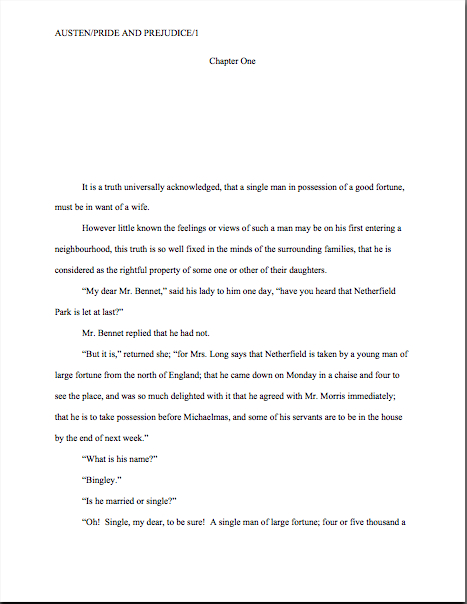
To place the possibilities before you in all of their lush magnificence, should the first page of a chapter look like this:

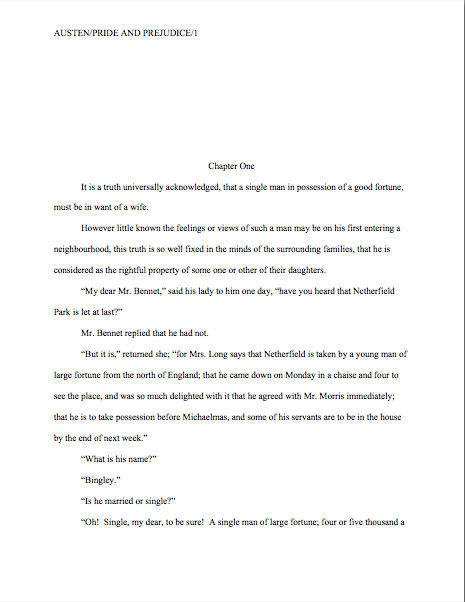
Or like this?

Now, I could just tell you what to do here, because, to be blunt about it, the first version is in standard format; the second is not. No way, no how.

So why might a professional reader prefer the first? Chant it with me now, children: BECAUSE IT LOOKS RIGHT TO THEM.

Oh, how tempting it is to leave it at that…but truth does compel me to tell you (and if not truth, those pesky mercurial gods I was talking about earlier), agents and contest judges see far, far more examples of version #2 than #1. Many, many times more. So much so that — brace yourselves, because I haven’t said this very often throughout this series — at this point, you could get away with either.

I know — it sort of creeps me out to hear myself saying such a thing, too.

That being said, I would be reluctant to buy into the astonishingly pervasive theory that if masses and masses of people do something, it automatically becomes correct. As anyone who screens manuscripts for a living could tell you, a much higher percentage of them are incorrectly formatted than presented properly. And really, as everyone’s mother was wont to say (at least on the West Coast), if everyone else jumped off the Golden Gate Bridge, would you, too?

I was delighted to discover when I moved to the East Coast for college that the moms out there were prone to asking the same question with reference to the Empire State Building. There must be something about that particular period of architecture (the GGB was built in 1933-37, the ESB in 1930-31) that promotes suicidal ideas.

Speaking of body counts.

The weird thing about this particular formatting oddity is how often it appears in otherwise perfectly presented manuscripts. That fact sets Millicent the agency screener’s little head in a spin. As, I must admit, it does mine, as well as the brainpan of virtually every other professional reader I know.

Why is it so very puzzling to us, you ask? Because at least in my case — and I don’t THINK I’m revealing a trade secret here — I have literally never seen an agent submit a manuscript to a publishing house with format #2. Heck, I have literally never even heard of an agent, editor, or anyone else in the publishing industry’s ASKING for a chapter heading to be moved from the top of the page to just above the text.

And that strikes me as odd, because as I’ve heard some pretty strange requests from agents and editors in my time, believe me; I’m not easily shocked anymore. But to hear a pro insist upon placing the chapter heading where you have to skip down a third of a page to read it…well, that would have me reaching for my smelling salts.

Do they even make those anymore? And if everyone else jumped off the Golden Gate Bridge clutching them, would I?

Clearly, however, somebody out there is preaching the place-it-just-above-the-text gospel, because agents, editors, and contest judges are simply inundated with examples of this formatting anomaly. We see bushels of ‘em. Hordes of aspiring writers are apparently absolutely convinced that the sky will fall in if that chapter heading is located anywhere but immediately above the text.

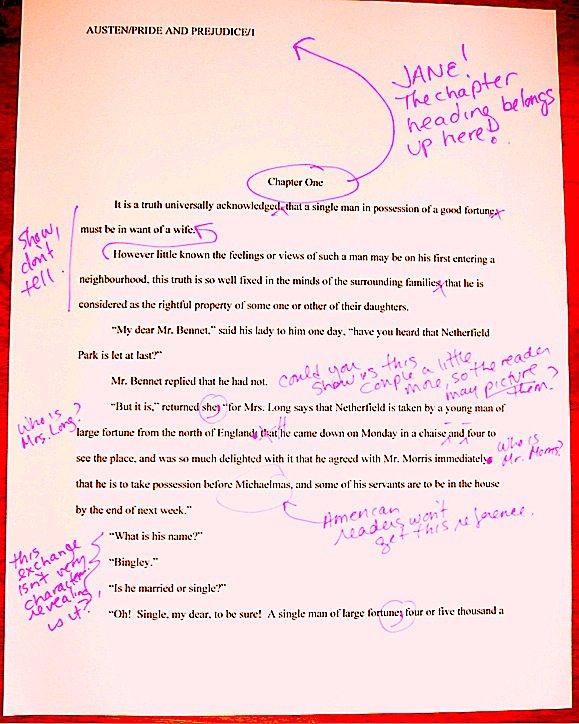
In fact, many aspiring writers are SO convinced of the rightness of the drooping title heading that it’s not all that uncommon for an editor to find that after she has left a couple of subtle hints like this that the writer should change the formatting…

…the subsequent drafts remain unchanged. The writer will have simply ignored the advice.

(Off the record: editors HATE it when their advice is ignored. So do agents. Contest judges probably wouldn’t be all that fond of it, either, but blind submissions mean that in order to get dunned for brushing off a judge’s feedback, a writer would have to submit the same chapter two years running to the same contest, have the entry land in the same judge’s pile — in itself rather rare — AND the judge would have to remember having given that feedback. Oh, and for the entrant to hear about it, the contest would have to be one of the few that gives editorial feedback.)

The up v. down debate may seem like a rather silly controversy — after all, in the cosmic scheme of things, why should it matter if the white space is above or below the title? — but sheer repetition and writerly tenacity in clinging to version #2 have turned it from a difference of opinion into a vitriol-stained professional reader pet peeve. (See earlier comment about how we tend to react to our advice being ignored; it isn’t pretty.)

Which, unfortunately, tends to mean that in discussions of the issue at conferences degenerate into writing-teacher-says-X, editor-at-Random-House-says-Y: lots of passion demonstrated, but very little rationale produced, beyond each side’s insisting that the other’s way just looks wrong.

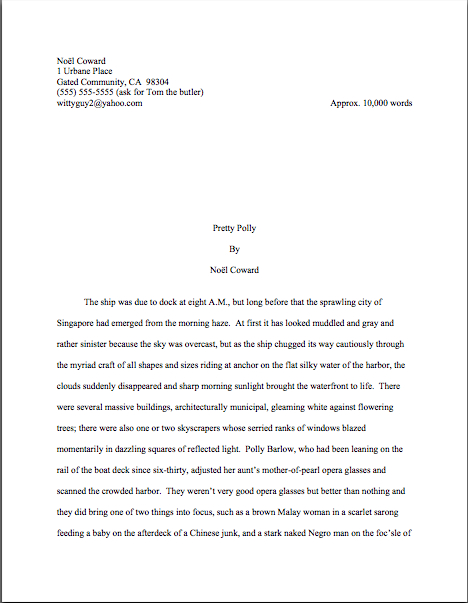
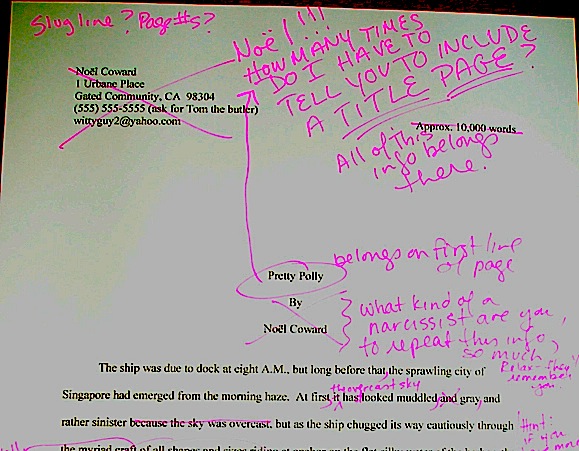
However, there is a pretty good reason that moving the chapter heading information to just above the text looks wrong to someone who edits book manuscripts for a living: it’s a formatting tidbit borrowed from short stories, whose first pages look quite, quite different. Lookee:

As you may see for yourself, for a short story like this one, there’s a mighty fine reason to list the title just above the text: a heck of a lot of information has to come first on the page, because short stories, unlike book manuscripts, are not submitted with a title page.

But that would not be proper in a book-length manuscript, would it? Let’s see what Noël’s editor might have said upon viewing this as as the first page of a book:

Ouch. (That last bit would have been funnier if the entire page were readable, by the way, but my camera batteries were running low. Sorry about that.) But as Millicent and that angry mob of pitchfork-wielding ignored editors would be only too happy to tell you, short stories don’t HAVE chapters, so who on earth are they to be telling those of us in the book world how to format our manuscripts?

Stick with version #1.

Which is not to say, of course, that this particular small deviation will automatically and invariably result in instantaneous rejection. It won’t, even in the latté-stained hands of the most format-sensitive Millicent. (See, she spilled coffee on her hands after she took a sip while it was still too hot — and if you didn’t get that joke, you probably haven’t been reading this blog for very long.) If a submission is beautifully written AND technically correct in every other respect, she might only shake her head over the location of the chapter heading, making a mental note to tell you to change it between when her boss, the agent, signs the writer and when they will be submitting the manuscript to editors at publishing houses.

But if you don’t mind my saying so, that’s a mighty hefty set of ifs.

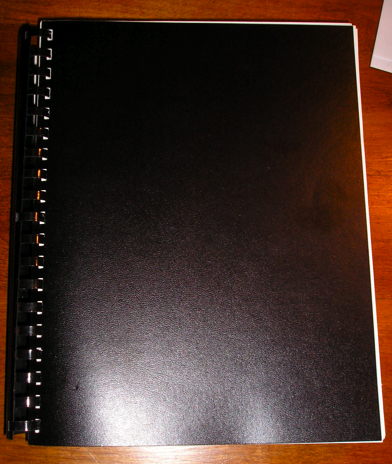
While I’ve got the camera all warmed up, this would probably be a good time to illustrate another ubiquitous agent and editor pet peeve, the bound manuscript – and this one IS generally an automatic-rejection offense.

Manuscripts, and I don’t care who hears me say it, should not be bound in any way. There’s an exceedingly simple reason for this: binding renders it impossible (or at least a major pain in the fingertips) to pull out a chapter, stuff it in one’s bag, and read it on the subway.

Hey, paper is heavy. Would YOU want to lug home ten manuscripts every night on the off chance you’ll read them?

As with other ploys to make a manuscript appear identical to a published book, binding the loose pages of a manuscript for submission will NOT win you friends in the publishing world. Not only does this not look right (I spared you the chanting this time), but it seems so wrong that Millicent will be positively flabbergasted to see a submitter to do it.

She might, for instance, forget that her latte is still too hot to drink, take a sip, and scald her tongue. It’s been known to happen.

Seriously, the unbound manuscript is one of those rules so engrained in the professional reader’s mind that it seldom even occurs to authors, agents, or editors to mention it as a no-no at writers’ conferences. Heck, I’m not sure that I’ve mentioned it once within the last six months — and by anyone’s standards, I’m unusually communicative about how manuscripts should be presented.

So I’m going to repeat myself, because you’re not going to hear this very often: by definition, manuscripts should NEVER be bound in any way. Not staples, not spiral binding, not perfect binding. If you take nothing else away from this series, binding-lovers, I implore you to remember this.

Why? Well, in practice, I’m sorry to report, a bound manuscript will seldom survive long enough in the screening process for the chapter-separation dilemma to arise, because — and it pains me to be the one to break this to those of you who’ve been submitting bound manuscripts, but if I don’t tell you, who will? — those pretty covers tend never to be opened at all.

Did you just exclaim, “Ye gods, WHY?” again? I can’t say as I blame you, but try for a moment to envision what a bound manuscript might look like from Millicent’s perspective.

To ramp up your stress levels to the proper level to understand her, envision a desk simply smothered with an immense pile of submissions to screen before going home for the day. Envision further that it’s already 6:30 PM, and eyeballs already dry as dust from a long, hard day of rejecting query letters.

Just lost your sympathy, didn’t she? Try, try again to place yourself in her proverbial moccasins.

Picturing the pile of envelopes clearly again? Okay, now slit open an envelope that reads REQUESTED MATERIALS on the outside. (You DO know that you should ALWAYS scrawl that in two-inch letters in the lower left-hand corner of a submission envelope, don’t you, so your requested materials don’t get buried in the slush pile?)

If you’re Millicent — and right now, you are, singed tongue and all — you fully expect to see something like this lurking between the cover letter and the SASE tucked underneath:

But in the case of the bound manuscript, you would instead encounter something like this:

Kind of hard to miss the difference, isn’t it? And unfortunately, nine times out of ten, the next sound a bystander would hear would be all of that nice, expensive binding grating against the inside of the SASE, just before Millicent tucks a photocopied form rejection letter on top of it.

Honestly, it’s not that she is too lazy to flip open the cover; she just doesn’t see why she should. Her logic may not be fair or open-minded, from a writerly perspective, but it’s a fairly common argument throughout the industry: if this submitter does not know this very basic rule of manuscripts, how likely is she to know the rules of standard format?

And if she does not know either, how likely is she to be producing polished prose?

I know, I know — this logic often does not hold water when it comes down to an individual case; despite my best efforts over the last few years, there are plenty of good writers out there who happen to be clueless about the rules of standard format.

But even if they all jumped off the Golden Gate Bridge, you shouldn’t.

Here’s why: from Millicent’s perspective, the fact that good writers aren’t necessarily born aware of the norms of the industry matters less than we writers would like — because, as unpleasant as it is for aspiring writers to realize, her agency is going to see enough technically perfect submissions this week to afford to be able to leap to unwarranted conclusions about this one.

Don’t waste your money on binding.

Seem arbitrary? From a professional reader’s point of view, it isn’t — the enforcement of standard formatting isn’t actually any more complicated than the simple axiom that any game has rules, and you will play better if you take the time to learn them.

Think about it: if you saw a batter smack a baseball, then dash for third base instead of first on his way around the diamond, would you expect his home run to count? Would an archer who hit the bulls-eye in her neighbor’s target instead of her own win the grand prize? If you refused to pay the rent on Park Place because you didn’t like the color on the board, would you win the Monopoly game?

I can go on like this for days, you know. Please say that you are getting the parallels, so I may move on.

Submitting art to the marketplace has rules, too, and while your fourth-grade P.E. teacher probably did not impart them to you (as, if I ran the universe, s/he would have), you’re still going to be a whole lot better at playing the game if you embrace those rules, rather than fight them.

You’ll also, in the long run, enjoy playing the game more. I know that it may not seem that way the first time one is struggling to change an already-written manuscript into standard format, but trust me, it will be much more fun when you finish your next manuscript and realize that there’s nothing that needs to be changed.

Let all of those other folks jump off the Golden Gate Bridge without you, I say. Remember, you’re playing this game by choice: you could, after all, make your own rules and publish your book yourself. If you want to play with the big kids, you’re going to need to abide by their rules.

I’ll wrap up this topic next time, I promise, and after we’re done, I’ve got a tremendous treat in store for you. Hang in there, and keep up the good work!

Manuscript formatting 101, part IX: introducing a brand new chapter!

We have only few rules of standard format left to cover in this series, and before you start dancing in the streets accordingly, I want to make sure that I’ve covered the basics clearly enough so that you can all spot correct and incorrect format in the wild, outside of this laboratory environment. Before I institute a pop quiz, I want to go over how to format the opening to a new chapter, whether or not it’s also the first page of your manuscript.

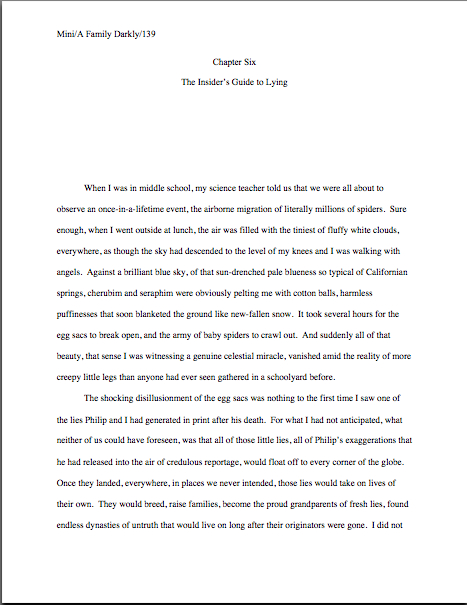
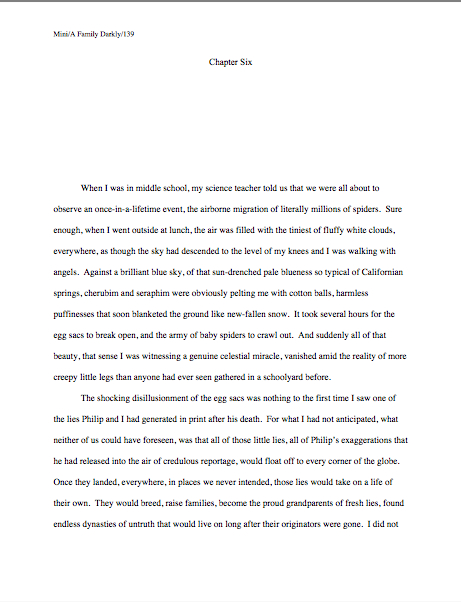
To get the discussion ball rolling, let’s take a gander at a properly-formatted chapter opening. Here is the first page of Chapter Six of my memoir:

Every chapter of a manuscript should begin like this: on a fresh page, 12 single lines (or 6 double-spaced) from the top. (For those of you who do not know how to insert a hard page break into a Word document, it’s located under the INSERT menu. Select BREAK, then PAGE BREAK.)

Notice how both the chapter number and the chapter title appear, centered, within these parameters. If there were no chapter title in this instance, the first page of Chapter 6 would look like this:

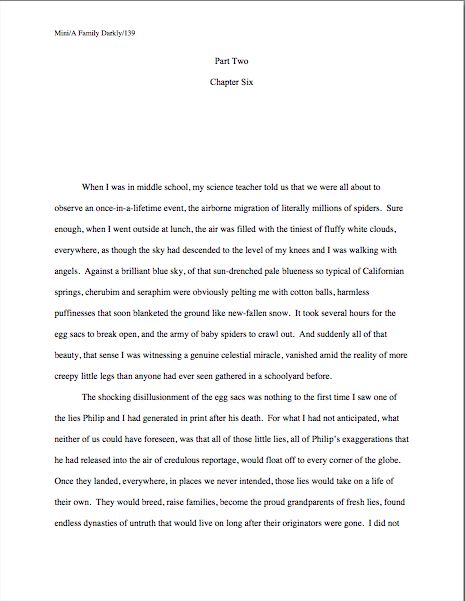
And since sharp-eyed reader Allison asked so very nicely, here’s what it would look like if Chapter 6 were the beginning of Part II of the book (it isn’t, but we aim to please here at Author! Author!):

Thinking that there must be an easier way to format the first page of a chapter than to memorize the way it should look and reproduce it from scratch each time? You’re not alone, if so; even seasoned authors worry that someday they will forget to hit return one of the necessary times, so that Chapter 5 will begin ten lines from the top, while Chapter 1-4 and 6 on will begin twelve lines down.

Why, curious reader David asked just the other day about how to get that formatting to stick, so to speak: “The chapter line will appear at the top of each page – so I leave five doublespaced blank lines so the first paragraph starts six lines down? Is there something I can do in Microsoft Word so it will stay that way?”

Standard format templates do exist, of course, but frankly, Word is already equipped with two perfectly dandy features for reproducing formatting exactly in more than one place in a document: COPY and PASTE.

Or, to put it another way, the easiest way I know to make sure each chapter opening is identical is to create your own template. Copy from “Chapter One” down through the first line of text, then paste it on the first page of chapter 2, 3, etc. Once the format is in place, it’s a snap to fill in the information appropriate to the new chapter.

Does that make sense to everyone? Excellent. Let’s take another gander at our first example:

This time, I would like you to notice that in each of these examples, the only reference to the author’s name or the title should appear in the slug line, located in the upper left-hand margin. This is as proper on page 139 of a book manuscript as on page one. While you’re going around noticing things, notice that the page number belongs within the slug line, rather than anywhere else on the page.

The slug line confuses a lot of aspiring writers; until you have seen piles and piles of professional manuscripts, it looks kind of funny, doesn’t it? And when you’ve been told over and over again that a manuscript should have a 1-inch margin on all sides, it can seem counterintuitive to add a line of text, even such a short one, IN that margin.

But I assure you, it’s always been done that way. And why? Followers of this series, chant it with me now: BECAUSE IT LOOKS RIGHT.

Yes, that logic IS tautological, now that you mention it. If you have a problem with that, I would suggest taking it up with the powers that rule the universe. As I believe the fact that my memoir has been in the hands of a reputable publisher for years and has yet to be release makes abundantly clear, I apparently do not rule the universe.

If I did, Microsoft Word would be set up to create documents in standard format automatically, Word for Mac and Word for Windows would be set up so those using one could easily give formatting advice to those using the other, and ice cream cones would be free on Fridays.

As none of these things seems to be true, let’s get back to business: how does one create that pesky slug line, anyway?

Back in the days when typewriters roamed the earth, it was perfectly easy to add a slug line to every page: all a writer had to do was insert it a half-inch down from the top of the page, left-justified, floating within the 1-inch-deep top margin. For word-processed documents, it’s a trifle more complicated.

The slug line still belongs in the same place, .5 inches from the top of the paper, but instead of laboriously typing it on each page individually as writers did in the bad old days, one simply inserts it in the header. In most versions of Word (I can’t speak for all of them), the header may be found under the VIEW menu.

Before the Luddites out there trot out their usual grumble about tracking down the bells and whistles in Word, think about this: placing the slug line in the header (located in Word under the VIEW menu) also enables the writer to take advantage of one of the true boons of the advent of word processing, pages that number themselves. Every so often, I will receive a manuscript where the author has, with obviously monumental effort, typed a slug line onto the first line of TEXT of each page, so it looks like this:

See how pulling the slug line down into the text messes with the spacing of the page? An entire line of text is sacrificed to it — and let me tell you, that line is not going to go quietly.

Why not? Well, what’s going to happen if new writing is inserted on a page formatted this way? That’s right: the author is going to have to go back and move each and every one of those slug lines to match the NEW pagination.

I’d show you a picture of this, but it’s just too ugly to contemplate. Trust me, it would be a heck of a lot of work.

Hey, I promised you a pop quiz, didn’t I? See any other problems with this last example?

How about the fact that the slug line includes the word PAGE? Shouldn’t be there; just the numbers will suffice.

Did I just hear some huffs of indignation out there? “But Anne,” I hear the formatting-ambitious cry, “it’s kind of stylish to include PAGE before the page number, isn’t it? It’s just a matter of personal style — who could be hurt by including it, if I like the way it looks?”

Well, you, for starters. And why? (Chanters, ready your lungs.) BECAUSE IT JUST WOULD NOT LOOK RIGHT TO A PROFESSIONAL READER.

I’m quite serious about this; I’ve seen screeners get quite indignant about this one. “Does this writer think I’m STUPID?” Millicent is prone to huff. (Don’t answer that question; it’s rhetorical.) “Does she think I DON’T know that the numeral that appears on every page refers to the number of pages? Does she think I’m going to go nuts and suddenly decide that it is a statistic, or part of the title?”

Don’t bait her; the lady has a hard life. Do it the standard way.

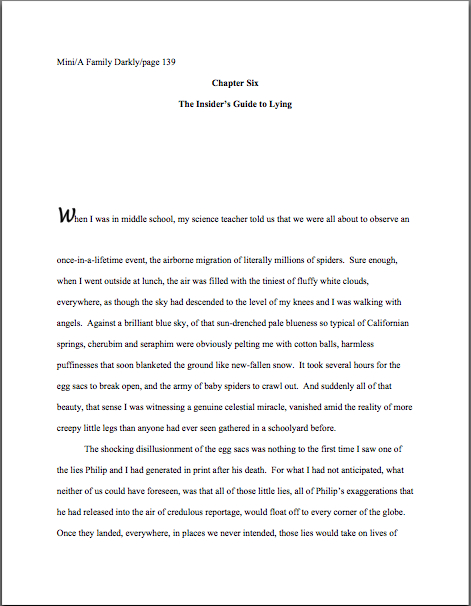
Okay, did you spot any other problems? What about the fact that the first paragraph of the chapter is not indented, and the first character is in a different typeface?

The odd typeface for the first letter, in imitation of the illuminated texts hand-written by monks in the Middle Ages, doesn’t turn up all that often in manuscripts other than fantasy and YA, for one simple reason: books in that category are more likely to feature this it’s-a-new-chapter signal than others. But once again, what an editor may decide, rightly or wrongly, is appropriate for a published book has no bearing upon what Millicent expects to see in a manuscript.

Save the manuscript illumination s for someone who will appreciate it. Hop in your time machine and track down a medieval monk to admire your handiwork, if you like, but in this timeframe, keep the entire manuscript in the same typeface and size.

The non-indented first paragraph of a chapter is fairly common in mystery submissions, I have noticed. I’ve been told by many mystery writers that this is an homage to the great early writers in the genre, an echo of their style.

But you know what? Almost without exception, in Edgar Allan Poe’s time all the way down to our own, the EDITOR has determined the formatting that appeared on any given printed page, not the author. To professional eyes, especially peevish ones like Millicent’s, a manuscript that implicitly appropriates this sort of decision as authorial might as well be the first step to the writer’s marching into Random House, yanking off a well-worn riding glove, and striking the editor-in-chief with it.

Yes, you read that correctly: it’s sometimes seen as a challenge to editorial authority. And while we could speculate for the next week about the level of insecurity that would prompt regarding a minor formatting choice as a harbinger of incipient insurrection, is the manuscript of your first book REALLY the right place to engender that discussion?

Exactly.

If you want to make Millicent and her bosses happy — or, at any rate, to keep them reading calmly — indent every paragraph of the text should the expected five spaces. It just looks right that way.

While we’re at it, how about the bolded chapter number and title? Nothing in a manuscript should be in boldface. Nothing, I tell you. Uh-uh. Not ever.

Well, you could get away with the title itself on the tile page, but frankly, I wouldn’t chance it.

Nor should anything be underlined — not even names of books or song titles. Instead, they should be italicized, as should words in foreign tongues that are not proper nouns.

I heard that gigantic intake of breath out there from those of you who remember constructing manuscripts on typewriters: yes, Virginia, back in the day, underlining WAS the norm, for the simple reason that most typewriters did not have italic keys.

If you consult an older list of formatting restrictions, you might conceivably be told that publications, song titles, and/or foreign words (sacre bleu!) should be underlined. But trust me on this one: any agent would tell you to get rid of the underlining, pronto.

And why? All together now: because IT JUST DOESN’T LOOK RIGHT THAT WAY.

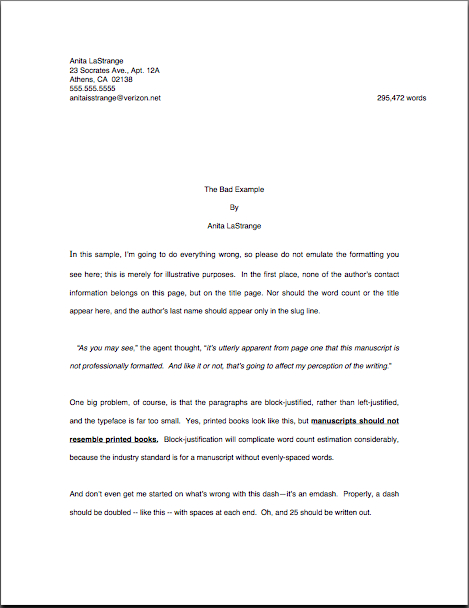
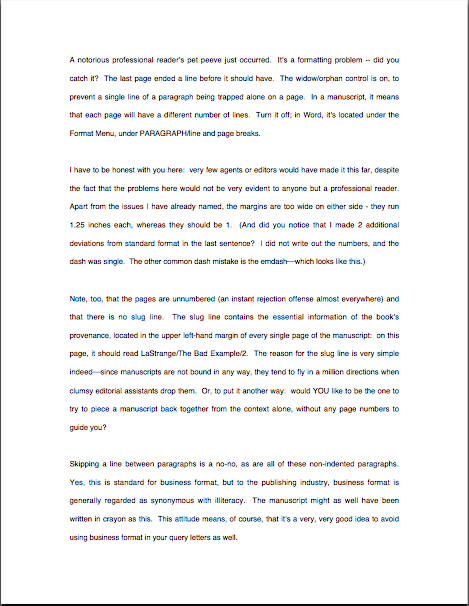
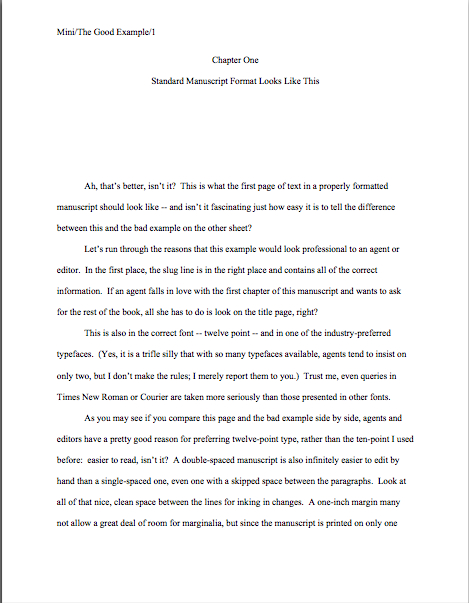
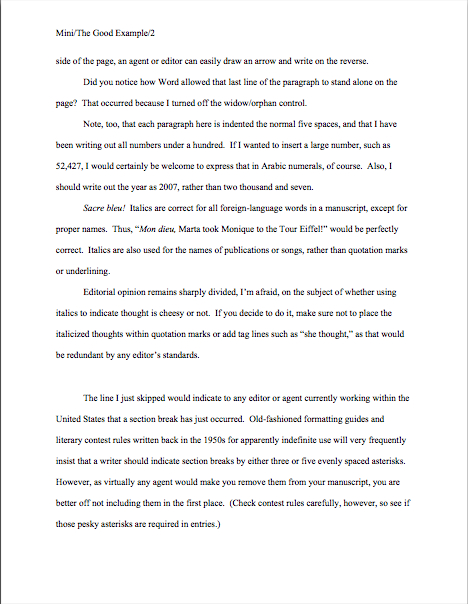
All right, campers, do you feel ready to fly solo? Here are two pages of text, studded with standard format violations for your ferreting-out pleasure. (I wrote these pages, too, in case anyone is worried about copyright violation or is thinking about suing me over it. Hey, stranger things have happened.)

How did you do? Are those problems just leaping off the page at you now? To reward you for so much hard work, here are a couple of correctly-formatted pages, to soothe your tired eyes:

Whenever you start finding yourself chafing at the rules of standard format, come back and take a side-by-side gander at these last sets of examples — because, I assure you, after a professional reader like Millicent has been at it even a fairly short time, every time she sees the bad example, mentally, she’s picturing the good example right next to it.

And you know what? Manuscripts that look right get taken more seriously than those that don’t. And regardless of how you may feel about Millicent’s literary tastes, isn’t a serious read from her what you want for your book?

We’re in the home stretch of going over the formatting rules, everyone. Keep up the good work!

Manuscript formatting 101, part IV: let’s see what this looks like in practice

Has everyone recovered from this weekend’s inoculation of professional formatting know-how? Yes, that was a whole lot of information to absorb at once, and it may have left a bit of a sore place, but much better a one-time quick sting than engendering years of rejection without knowing why, I always say. Once you’ve gotten exposed to the correct way to format a book manuscript, chances are that you’ll be immune to formatting problems in the future.

Why, yes, I have run that metaphor right into the ground. How kind of you to notice. But there’s a reason I’m hammering on it so hard: one of the great fringe benefits of inoculation is that, as unpleasant as it may have been at the sticking-point, so to speak, the stuck usually doesn’t have to think all that much about smallpox or whooping cough for quite a long time afterward.

So too with standard format for book manuscripts — once a writer gets used to how a professional submission is supposed to look, everything else is going to look wacky.

No, really. As I have been threatening promising you repeatedly every few minutes while running through the standard format strictures, once you get used to how a professional manuscript is put together, any other formatting is going to feel downright uncomfortable. And to prove it to you, I’m going to spend the rest of this series let you see precisely HOW different standard format and non-standard format appears to the pros.

The usual caveats: what I’m about to show you is for BOOKS and BOOK PROPOSALS, folks. At the risk of repeating myself (and repeating myself and repeating myself), I’ve been talking for the last few days ONLY about how books and book proposals should be formatted, not about short stories, screenplays, poetry, magazine and newspaper articles, or anything else; if you’re looking for formatting tips for any of the latter, run, don’t walk, to consult with those knowledgeable souls who deal with that kind of writing on a day-to-day basis.

Translation: first, if the agent or editor of your dreams (or the agent or editor with whom you are currently signed, if they don’t happen to be the same person) has expressed a strong preference for his clients formatting in a manner opposed to what you see here, run with that — but only for submission to that particular agent.

Yes, major deviations from this format are genuinely uncommon — among manuscripts that agents are currently submitting to editors at major US publishing houses, at least — but let’s face it, you’re not going to get anywhere telling an established agent that no one else’s clients are using 18-point Copperplate Gothic Bold if he happens to have an unnatural affection for it. Part of working with an agent entails trusting that he knows more about marketing books than you do. If he doesn’t, you wouldn’t WANT to be working with him, right?

I must have misheard all of the query-weary submitters out there. The proper answer is YES.

And before my last statement sends anyone out there into that time-honored writerly I’ve just signed with an agency but what if I chose the wrong one? panic, remember this: if you’ve done your homework before you signed, and thus are certain that he has a solid recent track record selling books in your category, you have every reason to have faith in your representative.

Or so I keep telling myself when I can’t sleep at night. Handing one’s hopes and dreams to someone else to market is hard.

Second, please recognize that not everything that falls under the general rubric writing should be formatted identically. So if your favorite source — other than yours truly, of course — tells you to do something diametrically opposed to what I’m showing you here, may I suggest double-checking that the other source is indeed talking about book manuscripts and not, say, submissions to a magazine that accepts short stories?

Contrary to popular belief, standards differ by type of publication. Yet surprisingly often, those giving practical to aspiring writers will conflate the format for, say, short stories, one with that for book manuscripts, resulting in a first page that will look incorrect to either. (Although, generally speaking, such guidelines tend to stick closer to the short story format than to the book.)

Don’t worry; I’ll be showing you the first pages of both very soon. In the spirit of that old chestnut, SHOW, DON’T TELL, I shall demonstrate just how different a manuscript that follows the rules looks from one that doesn’t.

But not before I give you just one more reason to study these examples very, very carefully if you are planning to submit book-length work to a North American agent or editor anytime soon: writers often overlook odd formatting as a reason that an otherwise well-written manuscript might have been rejected.

Certainly, other reasons get a lot more airplay, particularly at writers’ conferences. If you want to take a long, hard look at some of the better-discussed reasons, I would urge you to gird your loins and plunge into the FIRST PAGES AGENTS DISLIKE category at right. (For those of you who missed it, a couple of falls ago, I went over list of instant-response rejection reasons given by a group of agents going over a stack of actual submissions at a conference, one by painful one. Pretty horrifying.)

Yet surprisingly little conference time seems to be devoted to deviations from standard format for manuscripts. Why shouldn’t conference speakers take thirty seconds of their speaking gigs to pointing out, for instance, that the ways in which a professional manuscript does not resemble a published book — ways that are unfortunately quite obvious to an agent, editor, contest judge, etc., from practically the moment their eyes light upon a submission?

Why is it so very apparent, you ask? Because much of the time, submitting writers will work overtime to make it apparent.

Seriously, many aspiring writers clearly go out of their way to format their submissions to resemble published books, in the mistaken belief that this will make their work seem more professional. The opposite is generally true — and often, it’s apparent in a professional reader’s first glance at the first page of a submission.

If the implications of that last assertion made you dizzy — if, for instance, you found yourself picturing our old pal Millicent the agency screener pulling a submitted manuscript out of its envelope, casting a critical eye over the first page, hooting, and stuffing the whole thing into the handy SASE along with a photocopied rejection letter — try placing your head between your knees and breathing slowly. I’ll wait until you recover.

And then follow up with a hard truth: the VAST majority of submissions are rejected not only on page 1, but within the first few lines of page 1. And often, a harried Millicent will derive a negative impression of a manuscript even PRIOR to page 1.

Keep taking nice, deep breaths. That dizziness will pass shortly.

Ah, some of you have found your breaths again, haven’t you? “Oh, come on, Anne,” I hear some hard-boiled submission veterans scoff, “she makes up her mind prior to page 1? How is that even possible?”

Well, the most common trigger is the absence of any title page whatsoever. Many submitters, for reasons best known to themselves, omit the title page altogether — often, I suspect, because they are unaware that a professional book-length manuscript ALWAYS has a title page.

Why? Long-time readers (or even those who have been paying attention over the last several days), chant it with me now: a properly-formatted title page tells an agent PRECISELY how to contact the brilliant author who wrote it — and tells an editor PRECISELY how to contact the agent who represents her.

To set the minds of those of you who have title page-free submissions circulating at the moment, relax: forgetting to include a title page almost certainly won’t prevent Millicent from reading your submission at all; she tends to read even the most bizarrely-formatted submissions for at least a line or two (although often no more than that). But that initial impression of an author’s lack of professionalism — or, to call it by a kinder name, of having a lot to learn about how the publishing industry works — does often translate into a rather jaundiced reading eye for what comes next.

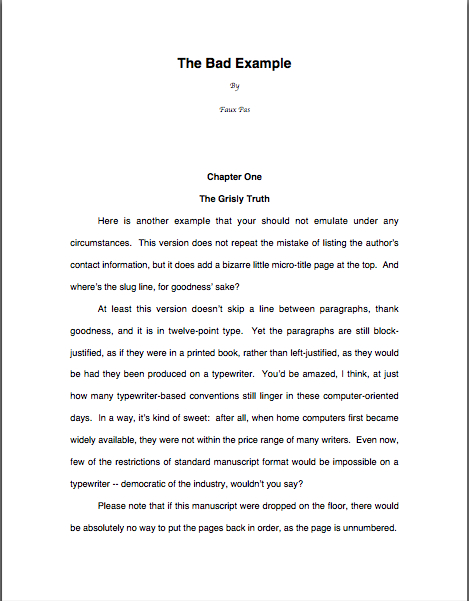
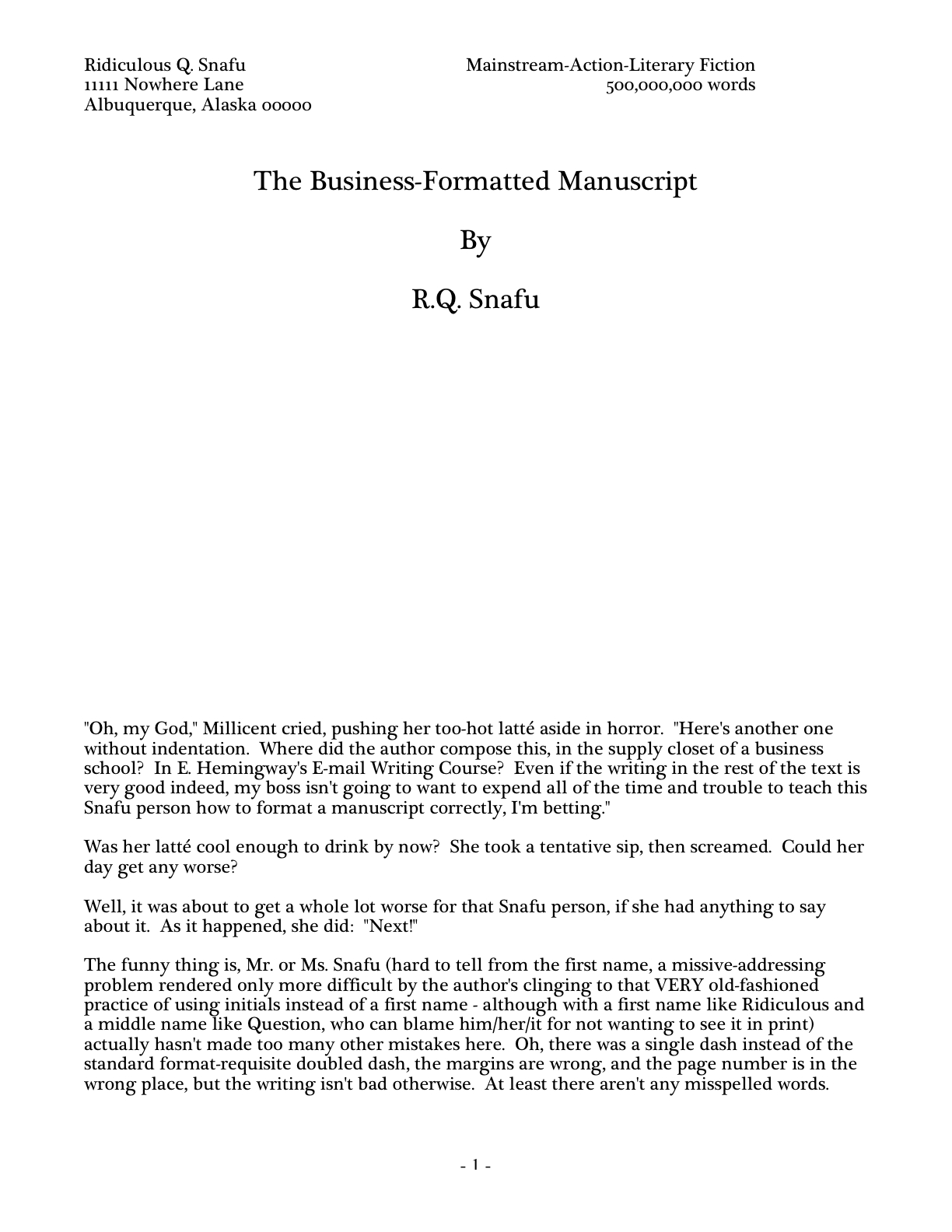
Why? Well, let’s take a peek through her reading glasses, shall we? The first thing Millicent sees when she opens the average requested materials package is something like this:

Or like this:

Or, heaven help us, like this:

So tell me: why might Millicent take one look at these and conclude that their respective submitters could use a good class on manuscript formatting — and thus would be time-consuming clients for her boss to sign?

I see all of you long-term blog readers out there with your hands in the air, jumping up and down, eager to tell everyone what’s wrong with this as a first page of text — and you’re absolutely right, of course. We’re going to be talking about precisely those points in the days to come.

For now, however, I want you to concentrate upon how this example has failed as both a title page and a first page of text: by not including the information that Millicent would expect to see on either.

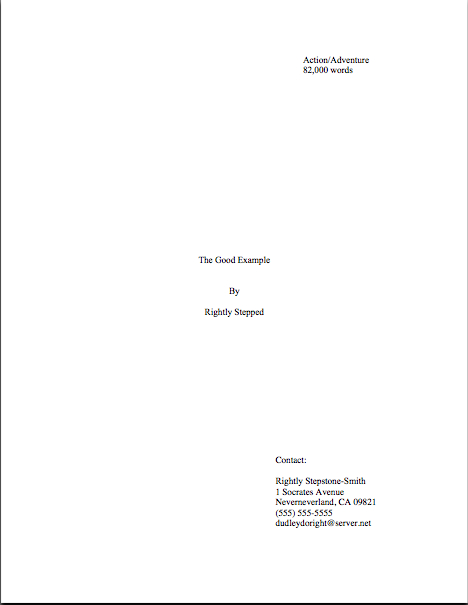
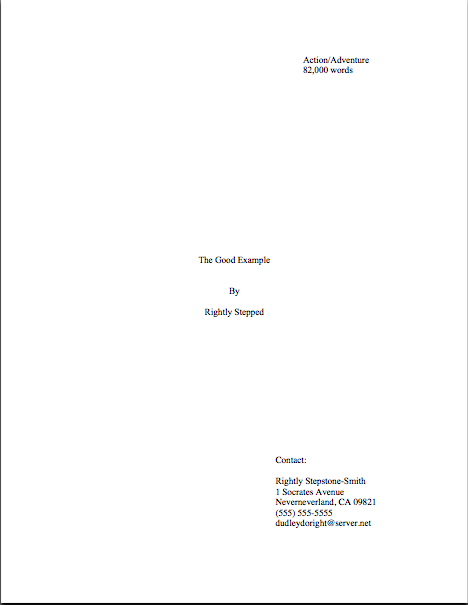
What makes me so sure she would find this discovery, at best, disappointing? Because what she (or her boss agent, or an editor, or a contest judge) would have expected to see on top of that pile of paper was this:

This is a standard manuscript title page for the same book — rather different, isn’t it? Visibly different, in fact, from several paces away, even if Millicent isn’t wearing her reading glasses.

Again, submitting the first example rather than the second would not necessarily be instantly and automatically fatal to a manuscript’s chances, of course. Most of the time, Millicent will go ahead and plunge into that first paragraph of text anyway.

However, human nature and her blistering reading schedule being what they are (for those of you new to this screener’s always-rushed ways, she has a stack of manuscripts up to her chin to screen — and that’s at the end of a long day of screening queries; manuscript submission is in addition to that), if she has already decided that a submission is flawed, just how charitable an eye do you think she is likely to cast upon the NEXT problem on the page?

Uh-huh. To use her favorite word: next!

To be fair to Millicent, while it may well be uncharitable of her to leap to the conclusion that Faux Pas’ or Ridiculous’ manuscript is likely to be unpolished because they did not include a proper title page, agencies do have a vested interest in signing writers who present themselves professionally. For one thing, they’re cheaper to represent, in practical terms: the agent doesn’t have to spend as much time working with them, getting their manuscripts ready to submit to editors.

And no agent in his right mind would send out a manuscript that didn’t include a standard title page. It serves a number of important — nay, vital — marketing functions.

Let’s take another look at the professional version, shall we? So you don’t have to keep scrolling up and down the page, here it is again:

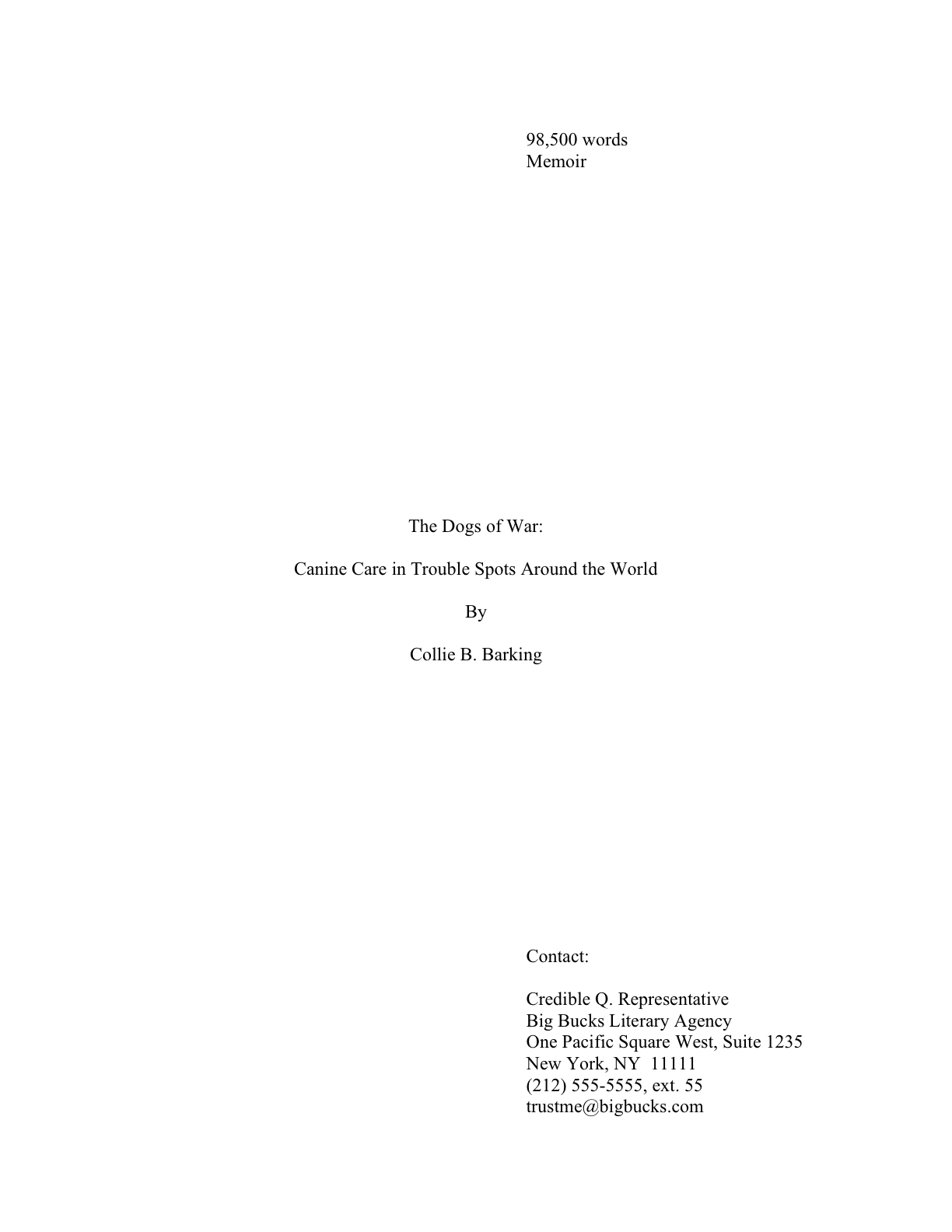
Did you take a nice, long look? Good. While we’re at it, let’s also take a gander at a proper title page for a book with a subtitle (I haven’t forgotten your question, Harvey!):

Those formats firmly in your mind? Excellent. Now for a pop quiz: how precisely do Rightly and Collie’s first sheets of paper promote their respective books than Faux Pas or Ridiculous’ first pages?

Well, right off the bat, the good examples tell a prospective agent or editor what kind of book it is, as well as its approximate length. (If you do not know how to estimate the number of words in a manuscript, or why you should use an estimate rather than relying upon your word processor’s count, please see the WORD COUNT category at right.) Both of these are pieces of information that will tell Millicent instantly whether the submission in her hand would meet the requirements of the editors to whom her agency tends to sell.

Oh, yes, that’s important in a submission, whether to an agency or a publishing house. Really, really important.

Why? Well, think about it: if Millicent’s boss had decided not to represent Action/Adventure anymore, or if editors at the major houses had started saying that they were only interested in seeing Action/Adventure books longer than 90,000 words, Rightly Stepped would be out of luck.

But then, being a savvy submitter, ol’ Rightly would also want his work to be represented by an agent who just ADORES very long Action/Adventure novels — and regularly goes to lunch with scads and scads of editors who feel precisely the same way, right?

As I MAY have mentioned seven or eight hundred times before (in this post, it feels like), the standard title page also tells Millicent precisely how to contact the author to offer representation — and that’s a very, very good thing for everyone concerned. If I’ve said it once, I’ve said it a thousand times: it’s ALWAYS in an aspiring writer’s interest to make it easy for an agent to help her.

I might be wrong, of course, but I suspect that NOT forcing Millicent to forage through the mountain of paper on her desk to find a misplaced cover letter with your phone number on it MIGHT be a good start toward being easily helpable.

By contrast, Faux Pas’ first page doesn’t really do anything but announce the title of the book and leap right into the story. That’s one underachieving piece of paper.

Some writers attempt to consolidate the proper functions of the title page and first page of text into a single sheet of paper. This format is particularly common for contest entries, for some reason. Let’s take another look at Ridiculous and Faux Pas’ submissions:

While such a top page does indeed include the requisite information Millicent or her boss would need to contact the author (although Faux Pas’ does it better, by including more means of contact), cramming it onto the first page of text doesn’t really achieve anything but saving a piece of paper. It doesn’t even shorten the manuscript or contest entry, technically speaking: the title page is never included in a page count; that’s why pagination begins on the first page of text.

I shall go into what DOES belong on the first page of text tomorrow, with accompanying visual aids. For today, let’s keep our focus simple: all I ask is that you would look at the proper title and the unprofessional examples side by side.

Go back and look again. I’ve got some time to kill.

Got all of those images burned into your cranium? Good. Now weigh the probability that someone who reads as many manuscripts per day as Millicent — or her boss, or the editor to whom her boss likes to sell books — would NOT notice a fairly substantial difference in the presentation. Assess the probability of that perception’s coloring any subsequent reading of the manuscript in question.

Kind of obvious, once you know the difference, isn’t it?

Before I sign off for today, and while you’ve got R.Q. Snafu’ sexample still in the front of your mind, let me briefly address the still surprisingly common writerly belief that the agents and editors will automatically take a submission by a woman more seriously if the author submits it under her initials, rather than under her given first name. J.K. Rowling aside, this just isn’t true, at least in fiction circles.

So unless you have always hated your parents for christening you Susan, you won’t really gain anything professionally by using initials in your nom de plume instead. And even if you did, why not publish under a name you actually like instead?

That’ll show your Susan-loving parents.

I just ruffled a few feathers out there, didn’t I? “But Anne,” I hear an initialed purist exclaim, “I don’t want to be judged as a FEMALE writer — I want to be judged as a WRITER. What’s wrong with removing gender markers altogether?”

Well, there’s nothing wrong with it per se, Susan, except that these days, it almost invariably results in Millicent’s seeing such initials and thinking, “Oh, this is a female writer who doesn’t want to be identified as one,” rather than “Gee, I wonder who this mystery person without a first name is. I’m just going to leap right into this manuscript with no gender-based expectations at all.”

Why will Millie have this reaction, you ask? Because female writers — and with a few notable exceptions, almost exclusively, female writers — have been submitting this way for a couple of hundred years now. It’s not all that hard a code to crack.

Historically, the hide-my-sex-for-success strategy has been used far, far less by male authors — except, of course, that hugely prolific and apparently immortal author, Anonymous, and the reputedly male writers of such ostensibly female-penned classics of wantonness (avert your eyes, children) as THE HAPPY HOOKER and COFFEE, TEA, OR ME?. Even during periods when the most popular and respected novelists have been women (and there have been quite a few in the history of English prose, contrary to what your high school English textbook probably implied), when someone named Stanley Smith wrote a novel, the title page has generally said so.

Because, you see, even back then, readers would have assumed S. Smith the novelist was a nice lady named Susan.

Something else for initial-favoring fiction writers to consider: in North America, women buy the overwhelming majority of novels — and not just women’s fiction, either. Literary fiction readers (and agents, and editors) tend to have two X chromosomes — and some of them have been known to prefer reading books by Susans rather than Roberts.

I just mention.

All that being said, the choice to initial or not is entirely up to you — or, more accurately, to you and your agent. Some sets of initials look cool in print, just as some names look better than others on book jackets. Or so claimed my father, the intrepid fellow who demanded that the maternity ward nurse convey him to a typewriter to see how my name looked in print before committing to filling out my birth certificate. (And yes, for those of you who have wondered Anne Mini IS in fact my given name; it just happens to look great in print, thanks to a little forethought.)

Keep up the good work!

The single best thing you can do to help your submission’s chances, or, the monster always returns

Those of you who gasped as soon as you saw the title, “Oh, heavens above, can it really be time to go over standard format for manuscripts AGAIN?” give yourselves a gold star for the day. Heck, go ahead and give yourself two or even three, because an aspiring writer who knows, accepts, and embraces the following unpleasant truths enjoys a considerable competitive advantage in submission:

(a) that there exists a standard format for manuscripts to which US-based agents and editors expect submissions to adhere, regardless of whether those manuscripts are produced by seasoned pros with many book sales under their belts or those brand-new to the biz, and thus

(b) using fancy typefaces, including cover artwork, printing manuscript pages on colored paper, and/or any other deviations from standard format in one’s submission will NOT be regarded as interesting expressions of the author’s individual point of view, but rather as evidence that the author doesn’t know about (a). As a result,

(c) manuscripts submitted in standard format tend to be treated with SUBSTANTIALLY more respect by agency screeners, editorial assistants, contest judges, and pretty much everyone who happens to read unpublished prose for a living. Despite this fact,

(d) one does occasionally hear agents and editors ask for deviations from standard format; one should definitely give them precisely what they ask to see. However, it’s never advisable to generalize what one individual says s/he wants into a brand-new trend sweeping the industry. Nor is it a good idea to ape the formatting choices one sees in a published book, because

(e) professionally-formatted manuscripts do not resemble published books in many important respects, and for many excellent, practical reasons. That being the case, those who screen manuscripts for a living tend to draw unfavorable conclusions about submissions that do aspire to book formatting, much as they do when aspiring writers are not aware that

(f) standard format for book-length manuscripts is NOT business format, either, and just using what you learned about short stories won’t do, either. Nor is it necessarily identical to what your word processor’s grammar checker will ask you to do, or even the AP style one sees in newspapers and magazines. None of these will look correct to an agent or editor who deals with book manuscripts, because the norms there are very specific. This may seem nit-picky and irrelevant to the quality of the writing in question, but think about it:

(g) if a host asks you to a formal dinner, it’s only polite to wear formal attire; a guest who shows up in flip-flops and a Hawaiian shirt is going to stand out like the proverbial sore thumb. (See point b.) Similarly, when placed side-by-side with professional manuscripts, as a successful submission inevitably will, a wackily put-together manuscript will stand out as unprofessional, a phenomenon that all too often leads to

(h) the average manuscript submission gets rejected on page 1. Not always because it deviates from standard format — although the vast majority of submissions do — but because an unprofessionally-formatted manuscript already has one strike against it, and who needs that? Ultimately,

(i) it’s just not worth your while to try to fudge your way out of these standards, since the price of a submission’s annoying a professional reader can be so hight. And as I mentioned in yesterday’s post, no matter how many times my readers, students, and editing clients ask me if agents, editors, and contest judges are REALLY serious about them, I’m not going to give you permission to ignore any single one of the standard format strictures. No way. Stop asking, already.

Why does knowing all this — and, more importantly, acting upon this knowledge — translate into higher acceptance rates, typically? Well, the aspiring writer who acts upon this information conscientiously is probably producing submissions within the top 5% of what crosses Millicent the agency screener’s desk on any given day.

Yes, really. So if any of the information on the list above came as a surprise to you in any way, it’s incredibly important that you should join me on a walk through the intricacies of standard format.

It’s the rest of you, the ones who have been hanging around Author! Author! long enough to have survived my previous jaunts through the rigors of standard format, who have the right to inquire why I am running through it again right now. “Hey, wait a minute,” these sterling souls protest. “Weren’t you writing about all this at the beginning of August? And haven’t you been promising months of discussion of craft for quite some time now?

“And is the photograph above a representation of snooty people scowling at me, or is that just a bunch of wet sand onto which I am projecting my paranoid fantasies?”

Legitimate questions, all. But listen: Thanksgiving (that’s next Thursday, for those of you reading this outside the United States) traditionally marks the beginning of the annual publishing world slow-down. With so many different religions and cultures cramming so many different holidays into the next month and a half, it’s genuinely hard to get an entire editorial committee into a room long enough to consider acquiring a book. Desks are piled high with the unread manuscripts from the previous year.

Besides, everyone has shopping to do.

The result: turn-around times for submissions and queries typically slow to a crawl between Thanksgiving and the New Year. And as I BELIEVE I have mentioned once or twice (or eighty or ninety) times before, half the writers of the English-speaking world seem to make a New Year’s resolution to get that raft of queries in the mail or get that long tinkered-with manuscript out the door to the agent who requested it last summer, turn-around times don’t really start to speed up again until after the Martin Luther King, Jr., long weekend.

That’s the third weekend of January, for those of you reading outside the US. We like to hold inaugurations around then.

Since my readers tend to be pretty industry-savvy — go ahead and pat yourselves on the back — then, I’m assuming that many of you are frantically running around now, trying to get those submissions ship-shape to beat the proverbial Christmas rush.

And lo! in the west, there appeared a serious discussion of standard format. What timing, eh?

I may be wrong about this, but you must admit that it would explain the downright avalanche of formatting questions posted as comments in the archives lately, not to mention those turning up in my e-mail. (Which I discourage, as a general rule: answering questions one by one is incredibly time-consuming, whereas answers to questions posted here may be read, enjoyed, and commented-upon by many, a much more efficient use of my volunteer question-answering time.)

And, frankly, the weekend before Thanksgiving just didn’t seem like the best time to start a brand-new topic from scratch — and not only because I’m expecting 28 people to crowd around my dinner table on Thursday. Since most of my audience (at least those who comment regularly) seem to be US-based themselves, and those of us in the States are going to be spending the next week juggling the demands of relatives, over-large birds, competing sporting events, and, often, post-election political discussions with those with whom one does not necessarily see eye-to-eye, I may not have everyone’s full attention right now, anyway.

Hey, agents and editors aren’t the only ones who are busy during the holidays. As I write this, my SO is in the kitchen, creating his famous gluten-free stuffing to take to the first of the pre-Thanksgiving Thanksgiving dinners of our holiday season, scheduled for TOMORROW.

And let’s not even mention the three books of my own — one already sold, one not yet sold but in my agent’s hands, and one that I’m trying to finish ASAP in response to at least alleged editorial interest — that seem to be requiring virtually daily attention from me at the moment. Each and every one of these projects would shout hallelujah in unison if I didn’t start a brand-new topic from scratch right now.

Oh, and you don’t serve leftovers occasionally when you’re working on a deadline?

One final word of preamble, then I shall launch into the meat of the matter (see? I already have turkey on the brain): I implore those of you who have been through this material with me before: don’t just skip these posts on standard format. I see manuscripts all the time by experienced writers that contain standard format violations. Until a writer has worked closely with an editor or agent long enough for these rules to become second nature, it’s just too easy to let an exception or two slip by.

Seriously, all of us could use a review from time to time. Because, you see, I am far from the only professional reader who takes umbrage, when manuscripts deviate from certain time-honored restrictions. Millicent started twitching at the very sight of them before she’d had her job three weeks.

Yes, even if the formatting in question would be perfectly legitimate in other writing environments. (See points b, c, e, and f, for instance.) And yes, yes, oh, yes, even if the deviation is precisely what some agent, editor, writing guru, or darned fool writing expert like me has suddenly announced to the world is the new norm.

Trust me, Millicent didn’t get that memo.

Think about it: why would she, unless she happens to work for the agent-who-blogs or editor-who-is-trying-to-be-helpful who promulgated the new advice? Indeed, why would anyone who works with manuscripts for a living go out looking to see what folks outside the industry — or, at minimum, outside her agency’s office — are demanding of writers these days, when the basics of standard format have actually changed very little for decades?

Actually, it would be very much against her self-interest to go trolling for such information, because — brace yourselves, those of you going through this logic for the first time — it’s so much easier just to regard submissions that don’t adhere to standard format as inherently unprofessional, and thus (by implication) less likely to contain writing destined to take the publishing world by storm.

To put it bluntly, it would slow her per-submission rejection time.

I hope no one out there fainted, because this is a vital fact for any submitting writer to understand: the folks who read submissions (and queries) in order to decide who gets a break and who doesn’t are in a HURRY. Reportedly, the average agency receives 800-1200 queries per week; that’s a whole lot of reading.

And those are the statistics from when the economy was good, before all of those hobbyist writers started dusting off the half-finished manuscripts in their bottom desk drawers and saying, “Hey, this is my Plan B.”

In the face of that many pieces of paper to plow through, even the reading of submissions tends to be awfully rushed: the goal becomes to weed out as many as possible as quickly as possible, rather than seeking out gems. Once a professional reader like Millicent has been at it for a while, s/he will usually develop a knack for coming to a conclusion about a piece of writing within the first paragraph or two.

Sometimes even within the first line or two.

What does this mean for aspiring writers who scoff at standard format, or just don’t know about it? Well, it’s not good: agency screeners, agents, editors, and contest judges tend to regard submissions formatted in any other way as either unpolished (if they’re feeling generous) or unprofessional (if they’re not).

And unfortunately for writers unaware of the rules, a non-standard manuscript is child’s play to spot from the moment a professional reader lays eyes upon it. That’s can be an extremely serious problem for a submission, because being identified as not professionally formatted renders it FAR more likely to be rejected than any writing-related problem.

Why? Shout it with me now: agencies and publishing houses get so many submissions that a screener’s PRIMARY goal is to weed out the one she is reading at the moment. The faster she can do that, the better, to move through that mountain of paper on her desk. So a first page that cries out the moment Millicent lays eyes on it, “This writer is brand-new to the game and will require quite a bit of your boss’ time to coach into being able to produce a manuscript that an agent would be comfortable submitting to an editor!” is a downright gift to her: she can feel completely comfortable rejecting it at the very first typo, cliché, or word choice she doesn’t happen to like..

Heck, she might not even wait to spot any of the above.

That’s not all bad news, however. By logical extension, the more professional your manuscript looks, the more likely it is to be read with interest by a screener in a hurry.

See now why aspiring writers cognizant of points (a) -(i) enjoy a considerable competitive advantage at submission time?

I don’t know about you, but I’m all for anything that helps a good writer’s work get taken more seriously, especially in the current super-tight submission environment, which is more rejection happy than I’ve ever seen it — and I’ve been listening to writers, agents, and editors complain about the state of the literary market since I was in my cradle. Right now, Harry Houdini himself would have extreme difficulty sneaking a non-standard manuscript past an agency screener, even though he undoubtedly has the world’s best platform to write a book on extricating oneself from tight situations.

If that last quip didn’t make you groan, if not chuckle, it’s time to brush up on your agent-speak.

So to help give you that competitive edge, here are the rules of standard format — and no, NONE of them are negotiable.

(1) All manuscripts should be printed or typed in black ink and double-spaced, with one-inch margins around all edges of the page, on 20-lb or better white paper.

No exceptions, unless someone in the industry (or a contest’s rules) SPECIFICALLY asks you to do otherwise. And I’m dead serious about using ONLY white paper: ecru paper, no off-white, no Dr. Seuss-type stripes.

Yes, yes, buff or parchment can look very nice, but there’s a strategic reason to use bright white paper: very sharp black-white contrast is strongly preferred by virtually every professional reader out there, probably as a legacy of having read so many dim photocopies over the course of their lifetimes.

The ONLY colored paper that should ever go anywhere near a manuscript is the single sheet that separates one copy of a submission or book proposal from the next, so it is easy for an agent to see where to break the stack. (But you don’t need to know about that until your agent asks you to send 15 copies of your book for submitting to editors. Put it out of your mind for now.)

And do spring for a new printer cartridge, and skip the trip to the copy center. Submissions with poor print quality are almost never read. You’d be amazed (at least, I hope you would) at how poor the printing quality is on some submissions; it’s as though the author dunked in a swiftly-flowing river several times before popping it in the mail.

Speaking of never, never, ever submit a dim photocopy; print out an original, every time, and make sure the ink is nice and dark on every page. Oh, you may chuckle at the notion of sending out a grainy photocopy, but believe me, any contest judge has seen many, many entries submitted that way.

(2) All manuscripts should be printed on ONE side of the page and unbound in any way (again, unless you are specifically asked to do otherwise).

Yes, this IS criminally wasteful of paper, especially when you consider the literally millions of pages of submissions that go flying into the agencies and publishing houses every month. Most agencies do not even recycle; the vast majority of agencies did not even consider accepting e-mailed queries at all until the anthrax-in-envelopes scare.

I swear I’m not making that up.

I assure you, if I ran the universe, paper conservation would be the norm, and recycling mandatory. Also, writers would all be granted an extra month a year in which to write, excellent and inexpensive child care while writing, a cedar-lined cabin on the shores of Lake Michigan in which to do it, and a pineapple upside-down cake on Kurt Vonnegut’s birthday. Perhaps some hard candies on Agatha Christie’s birthday as well, in affluent years, and dancing on Mme. de Staël’s.

But since the unhappy reality is that I do NOT run the universe (see disclaimer above), we shall all have to live with the status quo.

Which is to say: the publishing industry is one vast paper-wasting enterprise. Sorry.

Unbound means precisely what it says: no binding of any kind. You’d be surprised at how often writers violate the thou-shalt-not-bind rule, including paper clips, rubber bands, or even binders with their submissions. Since agents always circulate manuscripts without any sort of binding, these doohickies just scream, “I’m unfamiliar with the industry.”

SASE, here we come.

The ONLY exception to this rule is a nonfiction book proposal — not the manuscript, just the proposal — which is typically presented UNBOUND in a black folder, the kind with horizontal pockets. (For tips on how a book proposal should be presented, please see the aptly-titled BOOK PROPOSALS category on the list at right.)

To forestall the comment beloved reader Dave usually posts when I bring this up, if you wish to make double-sided, 3-hole-punched, be-bindered drafts for circulating to your first readers for ease of toting around, be my guest. But NEVER submit in that manner to a professional reader unless s/he has asked you to do so.

(3) The text should be left-justified, NOT block-justified, as published books, e-mails, business letters, and online writing tend to be.

Yes, books feature text that runs in straight vertical lines along both side margins, and yes, your word processing program can replicate that practically effortlessly, if you ask it nicely to do so.

But don’t: the straight margin should be the left one; the right should be ragged, as if you had produced the manuscript on a typewriter.

Many writers find this one nearly impossible to accept, because it is one of the most visually obvious ways in which a professional manuscript differs from a printed book. They believe, wrongly, that anything that makes their submission look more like what’s on the shelves at Barnes & Noble is inherently professional.

Quite the opposite is true. In a few days, I’m going to show you a practical demonstration of why, but for now, you’re just going to have to trust me when I tell you that block-justifying your submission is going to appeal to your garden-variety Millicent about as much as a punch the jaw.

Speaking of things I’m going to demonstrate in the days to come, NEVER format a query or cover letter to someone in the industry in business format: indent those paragraphs.

(4) The preferred typefaces are 12-point Times, Times New Roman, Courier, or Courier New; pick one and use it consistently throughout your entire submission packet. Even if you have a strong preference for the lettering in your book when it is published, use one of these typefaces for submission purposes.

Personally, I would never dream of allowing a client of mine to submit a manuscript in anything but Times New Roman, nor would I ever submit any of my work in anything else. It is the standard typeface of the industry.

It’s one of the bizarre facts of publishing life that manuscripts in these fonts tend to be taken far more seriously, and with good reason: these are the typefaces upon which the most commonly-used word count estimations are based. (Psst: if you don’t know why you should be estimating the length of your manuscript rather than using actual word count, please see the WORD COUNT category at right.)

There are advocates of Courier, too, so you may use it, but I implore you, do not get any wackier than that. If you write screenplays, you may ONLY use Courier. Most screenplay agents will not read even the first page of a script in another typeface — which means that most contest judges will follow suit.

There are a few agents out there who have their own font preferences, so do check their websites and/or listings in the standard agency guides. As ever, the golden rule of dealing with an agent you want to represent you is GIVE ‘EM PRECISELY WHAT THEY ASK TO SEE, not what you would like them to see.

If you are a writer who likes to have different voices presented in different typefaces, or who chooses boldface for emphasis, a submission is not a forum where you can express those preferences freely. Yes, one sees this in a published book occasionally, but I assure you, the choice to indulge in these formatting differences was the editor’s, not the author’s.

Sorry. (See my earlier disclaimer about proprietorship of the universe.)

To forestall the usual question someone brings up at this point: yes, most published books ARE in typefaces other than Times or Courier, but typeface decisions for published books are made by the publishing house, not the author. Submission time is not the appropriate period for making your preferences known.

Why? Chant it with me now, understanders of point (e) at the top of this post — MANUSCRIPTS AND PUBLISHED BOOKS AREN’T SUPPOSED TO LOOK THE SAME.

If you’re very nice down the line, after a publishing house has acquired your book, they may listen to your suggestions. They might giggle a little, but they might listen. Ditto with the cover and the title, which are — brace yourselves — almost never under the author’s control.

Why? Because these are considered matters of packaging and marketing, not content.

All of which begs the question, of course: why do word processing programs tempt us so many typefaces from which to choose, if we’re not supposed to use them?

Answer: because the people who make word processing programs are not the same people who decide what books get published in North America. Which is why, in case you’re wondering, what Microsoft Word means by word count and what the average agent or editor does are not typically the same thing.

So there.

I’m still sensing some skepticism out there on the font issue, but that may be a hangover from reader reactions to previous series on standard format. Almost invariably, around the time that I bring up Rule #4, someone posts a comment informing me huffily that website X advises something different, that this agent said at a conference she doesn’t care what typeface you use, that a certain manual said that standards have changed from the traditional guidelines I set out here, or some other observation presumably intended to make me rend my garments and cry, “Finally, I see the error of my ways! I guess I’ll disregard the fact that I’ve never seen the change you mention actually in use in a professional manuscript and declare it to be the new norm!”

To save you the trouble: it’s not gonna happen.

I have no doubt that all of these comments are indeed pointing out legitimate differences in advice, but it is not my purpose here to police the net for standardization of advice. If you like guidelines you find elsewhere better, by all means follow them.

All I claim for these rules — and it is not an insubstantial claim — is that nothing I advise here will EVER strike an agent or editor as unprofessional. Adhering to them will mean that your writing is going to be judged on your writing, not your formatting.

And that, my friends, is nothing at which to sneeze.

More rules follow next time, of course. In the meantime, keep up the good work!

What happens AFTER you grant an exclusive, and other problems that most aspiring writers would really, really like to have

All right, I’m resigned to it: there is evidently a vast cosmic conspiracy to delay, if not actually prevent, my tackling the thorny issue of how to write a synopsis to accompany a query or submission. This time, as often happens, I got sidetracked by a really good question from a reader. Quoth obviously great query-writer Susan:

My question today, though not directly related to referrals, does have to do with industry etiquette. I’ve read your posts about exclusives, but can’t quite ferret out the answer to my current situation.

Last week, I granted a 3-week exclusive for a partial to Agent A, and yesterday I got an e-mail from Agent B requesting a (nonexclusive) full and another one from Agent C requesting a (nonexclusive) partial.

What’s the polite thing to do? Sit tight until the three weeks is up before responding to Agents B and C? Tell Agents B and C I’ll be happy to send these when the period of exclusivity with Agent A has expired?

Although truth compels me to say that I actually have written one general and two specific posts this year on this very subject (here is one on juggling exclusive and non-exclusive requests simultaneously, and here is one on dealing with mutually exclusive requests), I am glad that Susan asked (I’m even happier to hear that she set a time limit on Agent A’s exclusive, but that’s something I’ll explain later in this post.)

Why am I so pleased to deal with the topic again? Well. since writer friends ask me this very question — what should a writer who already has submissions out to agents do if a newly-responding agent asks for an exclusive? — privately a dozen or so times per year, in addition to the many, many times I am asked in the comments here, I’m inclined to believe that when aspiring writers agree to an exclusive, they don’t necessarily understand what it actually entails.

An exclusive, for those of you new to the concept, is when a writer agrees to allow an agent a specific amount of time to consider representing a particular manuscript, during which no other agent will be reviewing it. In practice, both the agent and the writer agree to abide by certain rules during the specified period:

– ONLY that agent will have an opportunity to read the materials;
– no other agent is already looking at it;
– the writer will not submit it anywhere else;
– in return for this significant advantage (which, after all, pulls the manuscript out of competition with other agents), the agent will make a legitimate effort to read and decide whether or not to offer representation within the specified time period.

Doesn’t seem all that complicated an arrangement, does it? Yet hardly a month goes by when some well-meaning but confused exclusive granter doesn’t tap me on the shoulder (physically or electronically) to ask, “Um, Anne, do you remember that request for an exclusive I was so excited about a week and a half ago?” (Or a month and a half, or six months.) “I’ve heard from another agent. What should I do?”

If the writer specified a time limit on the exclusive, the answer is very simple: if less than that amount of time has passed, don’t send the manuscript to anyone else until it has; if more time has passed, what’s stopping you? When the writer HASN’T set such a limit, the ethics are more nebulous.

See why I was so pleased to hear that Susan had specified that Agent A had an exclusive for only three weeks?

To figure out where exclusive-granting writers run into ethical dilemmas, let’s look at the phenomenon from the other side of the agreement. Generally speaking, agents will request exclusives for one of three reasons: either they fear that there will be significant competition over who will represent the project, they don’t like to be rushed while reading, or it is simply the agency’s policy not to compete with outside agencies, ever.

Do I feel some of you out there getting tense, doing the math on just how many years (if not decades) it could take to make it through your list of dream agents if you had to submit to them one at a time? Relax, campers: requests for exclusives are actually fairly rare.

Why rare? Well, the first kind of exclusive request, the one Agent D (to continue through Susan’s alphabet of competitive agents) might use to prevent Agents E-R from poaching your talents before D has had a chance to read your manuscript (hey, D’s desk is already chin-deep in paper), tends to be reserved for writers with more than just a good book to offer. Celebrity, for instance, or a major contest win.

Basically, the agent is hoping to snap up the hot new writer before anybody else does. Or before the HNW realizes that s/he might prefer to be able to choose amongst several offers of representation. Since pretty much every respectable agency offers the same service, such choices are often made on the basis of connections, how well-established the agency is, or even how well the writer and the agent happen to hit it off.

If you suddenly find yourself the winner of a well-respected literary contest or on the cover of People, remember this: just because an agent asks for an exclusive does not mean you are under any obligation to grant it.

Oh, pick your chin up off the floor. If your work is in demand, it’s not necessarily in your best interest to sign with the first agent who makes an offer — you will want the one with the best track record of selling books like yours, right?

Chant it with me now, long-time readers: you do not want to land just any agent; you want the best agent for YOUR work.

As exciting as a request for an exclusive may be, it does tie the writer’s hands, for precisely the reason Susan mentions: throughout the duration of the exclusive, the writer agrees not to show the manuscript to any other agent. If, as in Susan’s case, other agents are also interested, this can mean a substantial delay in getting the manuscript onto their desks — and if Agent A offers to represent it, B and C may not see it at all.

But I’m getting ahead of myself, amn’t I? For the moment, what I would like for you to take from this situation as discussed so far are two things — no, make that three:

1) As flattering as a request for an exclusive is to an aspiring writer, granting it is optional;

2) Since by definition, a writer cannot submit to other agents during the exclusive period — yes, even if the writer queried the others first — it’s ALWAYS a good idea to set a time limit;

3) Since granting it limits the writer’s options, it’s best reserved for situations where one’s top-choice agents are interested in the book.

Why limit it to your favorite picks? Try to think of granting an exclusive as if you were applying for early admission to an Ivy League school: if the school of your dreams lets you in, you’re not going to want to apply to other universities, right? By applying early, you are saying that you will accept their offer of admission, and the school can add you to its roster of new students without having to worry that you’re going to go to another school instead.

It’s a win/win, in other words.

So if the best agent in the known universe for your type of writing asks for an exclusive, you might want to say yes. But if you have any doubt in your mind about whether Harvard really is a better school for your intended studies than Yale, Columbia, or Berkeley — to mix my metaphors again — you might want to apply to all of them at the same time, so you may decide between those that admit you.

My point is, if you are asked for an exclusive because your work is sought-after, it is up to you whether you would prefer to go steady right off the bat or date around a little. Got it? (If not, I can keep coming up with parallel cases all day, I assure you. Don’t make me start sending you to past posts.)

That doesn’t mean you should necessarily say no to this type of exclusivity request, but if you say yes, set a reasonable time limit on it, so you don’t keep your book off the dating market too long. This prudent step will save you from the unfortunately common dilemma of the writer who granted an exclusive six months ago and still hasn’t heard back.

Yes, in response to that gigantic collective gasp I just heard out there: one does hear rumors of agents who ask for exclusives, then hold onto the manuscript for months on end. Within the past couple of years, such rumors have escalated astronomically.

Set a time limit.

Susan’s choice of three weeks was a perfectly legitimate length. No need to turn the time limit into an experiment in negotiation: simply include a sentence in your submission’s cover letter along the lines of I am delighted to give you an exclusive look at my manuscript, as you requested, for the next three weeks. Simple, direct — and trust me, if the agent has a problem with the time you’ve specified, s/he’ll contact you to ask for more.

Negotiation is not possible with the other type of exclusive request, the kind that emerges from an agency that only reviews manuscripts that no one else is; the writer is not offered a choice in the matter. Consequently, a request for an exclusive from these folks is not so much a compliment to one’s work (over and above the sheer desire to read some of it, that is) as a way of doing business.

In essence, these agencies are saying to writers, “Look, since you chose to query us, you must have already done your homework about what we represent — and believe us, we would not ask to see your manuscript if we didn’t represent that kind of writing. So we expect you to say yes right away if we make you an offer.”

Why might such a stance be advantageous for an agency to embrace? Well, it prevents them from ever having to experience the fear associated with the first type of exclusive request: if you send them pages, they may safely assume that you won’t be calling them in a week to say, “Um, Agent Q has just made me an offer, slowpoke. I still would like to consider your agency, so could you hurry up and finish reading my manuscript so you can give me an answer? As in by the end of the week?”

Okay, so you wouldn’t really be that rude. (PLEASE tell me you wouldn’t be that rude.) But let’s face it, agents who don’t require exclusive submissions do receive these types of calls a fair amount. And nobody, but nobody, reads faster than an agent who has just heard that the author of the manuscript that’s been propping up his wobbly coffee table is fielding multiple offers.

Agencies who demand exclusivity are, by definition, unlikely to find themselves in a similar Oh, my God, I have to read this 400-page novel by tomorrow! situation. You have to admit, after even the third or fourth panicked all-nighter, exclusives might start to look like a pretty good policy.

What does the writer get in return for agreeing not to submit to others for the time being? Well, not a heck of a lot, unless the agency in question is in fact the best place for his work. But if one wants to submit to such an agency, one needs to follow its rules.

Fortunately, agencies that maintain this requirement tend to be far from quiet about it. Their agents will trumpet the fact from the conference dais. Requires exclusive submissions or even will accept only exclusive queries will appear upon their websites, in their listings in standard agency guides, and on their form replies requesting your first 50 pages.

(Yes, Virginia, positive responses are often form-letters, too, even when they arrive in e-mail form. I sympathize with your shock.)

If they had company T-shirts, in short, there would probably be an asterisk after the agency’s name and a footnote on the back about not accepting simultaneous submissions. If they’re serious about the policy, they’re serious about it, and trying to shimmy around such a policy will only get a writer into trouble.

Do I feel some of you tensing up again? Relax — agencies with this requirement are not very common.

Why? Well, because they require their potential clients to bring their often protracted agent search to a screeching halt while the submission is under consideration, such agencies are, in the long run, more time-consuming for a writer to deal with than others. As a result, many ambitious aspiring writers, cautious about committing their time, will avoid querying agencies with this policy.

Which, again, is a matter of personal choice. Or it is if you happened to notice before you queried that the agency in question had this policy.

Hey, check their T-shirts — and even with such agencies, be up front about how long you will be willing to wait.

So where does this leave Susan and the many other writers out there who have granted exclusives to the first agent who asks, only to find themselves chafing under the agreement down the line, when other agents asked to see the manuscript?

Well, it depends upon two factors: why the agent asked for the exclusive in the first place, and how long it has been since the writer granted it.

If the agent asked for it because her agency will only consider exclusive submissions, then the writer is indeed obligated to hold off on further submissions. If the agreed-upon period has elapsed, you can always contact the agent and ask point-blank if s/he needs more time.

What the writer should NOT do when dealing with an exclusives-only agency is contact the agent, explain that others want to read the work, and ask if it’s okay to submit simultaneously — which, incidentally, is very frequently the writer’s first impulse, if those who contact me on the sly to ask my advice are any indication. Bless their optimistic little hearts, they seem to believe that of only the agent in question understood how eagerly they want to find representation, the agent’s heart would melt.

“Of course, you may indulge in multiple submissions,” s/he would say, tossing candy to the world’s children from Santa’s sleigh. “We were just kidding about that whole exclusives-only thing.”

Not going to happen.

This desire to throw oneself upon the agent’s mercy seems even stronger, if that’s possible, in writers who already have submissions out with other agents, and THEN receive a request for an exclusive from an agent. For many such submitters (who, let’s face it, have a problem most aspiring writers would LOVE to have), the fact of previous submission seems to obviate the agent’s request, or even an exclusives-only agency’s policy.

They couldn’t really mean it in MY case, these writers think.

I hate to burst your bubble, Sparky, but I can assure you that they could — and do. Trying to negotiate one’s way out of this situation only tends to change the representation question from whether the agent likes the writer to whether he really wants to deal with someone who has difficulty following directions.

Don’t believe me? Okay, let’s take a gander at the probable e-mail exchange between agent Clinton and Mehitabel, a writer who already has a submission out to another agent:


Dear Mehitabel:
Thank you for querying me with your novel, TERMINAL INDECISIVENESS. Please send the first fifty pages.


As you may already know, our agency will accept only exclusive submissions. Please enclose a SASE.

Regards,
Clinton McPicky


Dear Clint:
Thank you for your interest in my novel. I would be happy to give you an exclusive, but the fact is, two other agents already have partial manuscripts, and I don’t know when I shall be hearing back from them. I’m really impressed with your agency, though, and I certainly don’t want to knock it out of consideration.

Since it would obviously be impossible for me to give you an exclusive on material that’s already elsewhere, is it okay if I just go ahead and send you what I’ve sent the others?
Mehitabel

Dear Mehitabel:
As I mentioned, my agency only accepts submissions on an exclusive basis.
Clinton

Notice what happened here? Mehitabel tried to shift responsibility for solving her dilemma onto Clinton’s shoulders. (Also, she addressed him by a familiar nickname, rather than the name with which he signed his letter; a small thing, but rather rude.) From her point of view, this made perfect sense: his request had caused a problem, so she asked him to modify his request.

From Clinton’s POV, however, she was asking him to change agency policy for the sake of a single writer who, for all he knows, simply did not bother to check what those policies were before querying. What possible incentive could he have for saying yes?

Got the impulse to quibble out of your system, Mehitabel? Good. Next time, abide by your agreement: allow Clinton an exclusive until the agreed-upon time has elapsed, then inform him that unless he would like an extension upon his exclusive (which you are under no obligation to grant, Hitty), you will be submitting it to the other agents who have requested it.

What’s that you say, Mehitabel? Isn’t Clinton likely to say no at that point? Perhaps, but not necessarily — and you will have done your level best to conduct your submission process honorably.

Everyone out there comfortable with all this? Okay, let’s return to Susan’s situation.

In a case like Susan’s (if I am reading her question correctly), where the writer has an agreed-upon time limit with an agent whose agency does NOT insist upon solo submissions, the resolution again depends upon how much time has elapsed. If the exclusive period is still ongoing, the writer cannot in good conscience send out requested materials to any other agent regardless of whether others requested exclusives in the meantime.

Don’t even consider it. Otherwise, the exclusive would be meaningless, no?

For some reason, the writers who creep into my atelier in the dead of night to ask my advice on the subject almost always seem surprised, or even hurt, by this response. But the situation honestly is pretty straightforward, ethically speaking: the writer agreed to the exclusive, so pretty much everyone in the industry would expect her abide by it.

And as we saw above, contacting everyone concerned to explain the dilemma will not eliminate it; all that will do is tell all of the agents involved that the writer is trying to change the rules. Either trying to renegotiate with A at this point or telling the others they will need to wait, will not win the writer points with anybody; it will merely look as though you didn’t understand what an exclusive was.

Here’s how I would advise handling Susan’s dilemma: if she hears back from Agent A within the three weeks and he wants to represent you, she has only two options — saying yes without sending out further submissions or saying no and sending out to the others.

If A does make an offer she wishes to accept, she should send a polite note to the other two, saying precisely what happened: another agent made an offer before she could send out the materials they requested. They’ll understand; this happens all the time.

If A doesn’t make an offer within those three weeks, on day 22 (three weeks + 1 day), she should send the requested materials to Agents B and C, along with cover letters explaining that others are looking at it simultaneously. No need to specify who is doing the looking, just that they are.

To deal courteously with A at this point, she should send a letter — paper or e-mail, depending upon how Susan previously had contact with him/her — saying that while A is still her first choice (the implication of an exclusive, always), since the exclusive has now expired, she is now sending out requested materials to other agents.

Again, this happens all the time. If Susan were really nervous about alienating A, she could contact him first, offering to extend the exclusive BEFORE sending out the others, but it’s imperative that A is aware before he makes a timing decision that others are indeed interested.

As long as a writer does what she said she was going to do, she’s unlikely to run into much trouble with an exclusive — but remember, this is an industry where reputations count; in the long run, it’s in your interest every bit as much as the agent’s that you honor the exclusivity agreement, if you grant it.

Frankly, I think most submitters in this situation overreact to the prospect of a comparatively short wait. Because, really, holding off for a few days or weeks is not going to harm the writer’s chances with the other requesting agents. Chances are that they’re reasonable people; after all, it’s not as though they requested the materials, then cleared their schedules for the foreseeable future in order to hold their respective breaths until the submission arrived.

Or, to couch it in today’s example: if Susan hadn’t had the good sense to ask for a time limit, an extended delay might have required explanation, but realistically, agents B and C almost wouldn’t have dropped everything to read the submission before A’s exclusive expired, anyway. She can afford to sit tight.

All this being said, a writer is under no obligation whatsoever to stop submitting or querying other agents while one is reading requested materials. Unless an agent ASKS for an exclusive — and believe me, if an agency requires exclusivity, the member agent interested in your work will tell you so directly — it is NOT expected. In fact, now that the agent-finding market is so fierce, the vast majority of agents simply assume that good writers are querying and submitting widely.

While not continuing to pursue other leads while an agent is perusing your work may seem like a well-deserved break, a reward for successful querying, it’s effectively like applying to only one college per year: you might get in eventually, but it’s a far more efficient use of your time to apply to many simultaneously.

Unless, of course, the school you’re absolutely sure that you want to attend offers you early admission.

So submit widely — and keep those queries and submissions circulating until you land an agent. Just make sure that when you have requested materials out to more than one agent, you tell each that others are looking at it.

Trust me, they’ll want to know, even if they aren’t exclusive-minded. Gives ‘em just a touch of incentive to read faster.

Glancing over the length of this, I am tempted to conclude that while it was an interesting experiment to try to tackle such a huge question in a single post — the easier for readers to find it in the archive, my dears — I probably shan’t do it again. The double-take I just did at the clock informs me not only that it is time to end for today, but that I should probably take tomorrow off to rest my wrists.

Next time, whenever that shall be and universal interference permitting, we’ll move on to synopses, but I make no promises. Blog life has just been too unpredictable of late. Keep up the good work!

The submission packet, part III: making yours the Easter egg that everyone wants to find, or, the race is not always to the swiftest

The age of miracles has not yet vanished, my friends. Remember that yard renovation we started way back in, oh, March? Or was it in April, or 2003, or the era of the Visigoths? Today, after what felt like an entire Bronze Age of delays, the landscapers showed up (in itself something of a miracle), cleared away the debris that they had left artistically dotting our neighborhood, waved their hands over the heaping piles of sod that have housed a mole-and-squirrel theme park for months now — and violà, we abruptly have a very lush lawn.

I’m not talking just healthy, mind you — this is downright bourgeois. I haven’t seen greenery this decadent since I was a student at Harvard, when the grand old school would banish the students from the trampled lawns a few weeks before graduation and roll out new ones, so the Yard would look nice for the soon-to-be-visiting alumni.

Oh, as if Harvard’s the only university that does it.

Our new, croquet-worthy lawn seems like an apt metaphor for today, when I shall be wrapping up this week’s micro-series on SASEs and other things an aspiring writer might conceivably ship to an agent or editor. You could always go the Rolls Royce route, overnighting every scrap of requested paper or even having a bike messenger deliver it, but why shell out the dosh?

In the end, whether the yard boasts a pelt-thick lawn or the most modest rock garden, you will want to impress the recipient with the house, if you catch my drift.

On the off chance that anyone out there didn’t, allow me to make it plainer: too many aspiring writers waste scads of money speeding up the delivery time between their houses and a requesting agency. Overnighting a submission is utterly unnecessary; it won’t win you any Brownie points whatsoever with Millicent the agency screener, and it most assuredly will not get her boss to read your manuscript any faster.

Save your money for something else — nice paper upon which to print the submission, for instance.

With an eye to helping submitting writers figure out what is and isn’t a necessary expense, I have spent the last couple of posts talking (in part) about ways to save money when shipping requested materials to an agent or editor. We writers don’t talk about this very much amongst ourselves, but the fact is, the process of finding an agent can be pretty expensive.

Did a few of you new to the process just choke on your cornflakes? “Wait just a minute, Anne,” a sputtering few still working up to the marketing stage cry. “Surely, you’re talking about the entire agent-finding process being expensive, right, not just the shipping-off part? I mean, really, I’ve just shelled out hundreds of dollars to attend a writers’ conference so I could meet agents to query — I hadn’t thought at all about the the next step, mailing off requested materials, taxing my piggie bank.”

I hate to be the one to break it to you, but it might.

At minimum, the costs of producing a professional-looking submission packet include shipping (both there and back), boxes, paper, ink cartridges, wear and tear on your computer, and a ton of your time that could be used for, well, anything else. While individually these may not seem as potentially scarifying to your checking account as the even greater optional costs of attending conferences, entering contests, and hiring freelance editors like me to help pull your submission into tip-top shape, it all adds up.

So much so that if you’re a US citizen and marketing a book, it’s worth looking into the possibility of filing a Schedule C for your writing as a business, so you can deduct these expenses. Talk to a tax professional about it (I am not a tax professional, so I cannot legally give you advice on the subject), but do try to find one who is familiar with artists’ returns: ones who are not will almost invariably say that a writer must sell work in a given year to claim associated expenses, but that’s not necessarily true.

Yesterday, as part of my ongoing quest to save you a few sous, I brought up the case of Antoinette, the writer who rushed out and overnighted her manuscript, then waited seemingly endlessly by the phone for the agent of her dreams to respond. I went into her possible reasons for doing this — rather than sending the book regular mail or the more affordable 2-3 day Priority Mail rate.

Today, I want to talk a bit about the other two primary motivators for jumping the proverbial gun: fear and eagerness.

To let one of the most poorly-hidden cats out of one of the most hole-ridden bags in the business, new souls walking the planet are in a greater hurry than a writer who has just received a request for materials. Especially if that request comes at the end of a long period of querying or after a particularly intense conference, it’s far from uncommon for the lucky writer to decide, wrongly, that the only possible response is to drop everything else in her life — calling in sick to work, if necessary — to throw together the requested materials and get them out the door as close to instantly as possible.

One of two rationales typically underlies this approach. In the first, the writer says, “Oh, my God, this request to see all or part of my manuscript must be a fluke. I’d better get these materials under the agent or editor’s nose within the next few hours, before either (a) s/he changes her/his mind, (b) the malignant forces that rule the universe cause the wall of indifference to art to rise again, this temporary fissure mended, or (c) both.

Whichever thunderbolt the hostile gods of publishing are planning to send his way, the fearful writer wants to make absolutely sure that his submission is out of his hands well before it strikes.

Who cares that he hasn’t had time to double-check his submission for easily-overlooked gaffes, or that overnighting that package will cost four times as much as sending it via regular mail? He’s trying to submit before the agent of his dreams comes to his/her senses.

In reality, of course, it just doesn’t work like that: a request to submit materials will be every bit as good two weeks from the day it was made as it was in the moment. Or two months.

Also, as I MAY have hinted gently above, the writer’s speed in getting the submission to the agent will not make one scintilla of difference in how quickly a manuscript is read — or even the probability of its moldering on an agent’s desk for months. Certainly, whether the agent’s receiving the manuscript the next day or in the 2-3 days offered by the more reasonably priced Priority Mail will make no appreciable difference to response time.

Especially during summer conference season, since most of the industry goes on vacation from early August through Labor Day. Or around Christmastime, when the biz more or less shuts down.

The other, more common rationale for too-swift submission is eagerness. “Whew!” the writer who has just received a request to submit says. “The hard part is over now: my premise has been recognized as a good one by an agent who handles this sort of material. From this point on, naturally, everything is going to happen in a minute: reading, acceptance, book sale, chatting on Oprah.”

You know, the average trajectory for any garden-variety blockbuster. Who wouldn’t want to cut a week, or even a few days, out of tackling that bright future?

I sincerely hope that yours is the one in eight million submissions that experiences this second trajectory — and that’s the probability in a good year for publishing — but writerly hopes to the contrary, a request for submission is the beginning of the game, not the end. The fact is, as small a percentage of queries receive a positive response (and it’s unusually under 5%), even fewer submissions pass the initial read test.

Or, to put it the terms we typically use on this blog, it takes even less provocation to cause Millicent shout “Next!” over the first page of a manuscript than over a query.

There’s a reason that I grill you on the details, you know: I want yours to be in that top few percentiles. Which is why I would rather see your resources and energy going toward perfecting the submission itself, rather than getting it there with a rapidity that would make Superman do a double-take.

This is true, incidentally, even when the agent has ASKED a writer to overnight a project. Consider the plight of poor Gilberto:

Submission scenario 2: Gilberto has just won a major category in a writing contest with his thriller, DON’T PAY ANY ATTENTION TO THE MAN BEHIND THE CURTAIN; HE’S NOT REALLY CARRYING AN AXE. During the very full pitching day that follows his win, five agents ask him to send submissions. Seeing that he was garnering a lot of interest, Maxine, the most enthusiastic of the agents, requests that he overnight the manuscript to her, so she can respond to it right away.

Gilberto says yes. He actually does overnight the packet.

However, being a savvy submitter, he submits simultaneously to the other five via regular mail right away. He does not tell Maxine — or any of the others — that he is letting many agents read his manuscript at the same time. He writes REQUESTED MATERIALS — FIRST PLACE, CONTEST NAME on the outside of every submission and mentions the request in the first line of his cover letter, to minimize the possibility of his work being lost in amongst the many submissions these agencies receive.

Within three weeks, he’s heard back from all but one of them; puzzlingly, Maxine is the last to respond. And when she finally does, six weeks after he overnighted her the manuscript, it’s with form letter. This most enthusiastic of agents has rejected him without even telling him why.

What did Gilberto do wrong? Not much, really, except for saying yes to an unreasonable request — and not telling the agents that they were competing over his work. That not made his submission process more expensive than it needed to be, but also more or less eliminated any benefit he might have derived from the contest-generated buzz about his book.

Let’s take his missteps one at a time. Why was Maxine’s request that he overnight the manuscript unreasonable?

In essence, the situation was no different than if Maxine had asked him to leave the conference, jump in his car, drive three hours home to print up a copy of his manuscript for her, drive three hours back, and hand it to her. In both cases, the agent would have been asking the writer to go to unnecessary effort and expense for no reason other than her convenience.

Yet as Maxine’s subsequent behavior showed, she had no more intention of reading Gilberto’s manuscript within the next couple of days than she did of reading it on the airplane home.

Okay, here is a pop quiz to see how much those of you who followed this summer’s series on conference pitching have learned: why did she ask him to overnight it at all?

Give yourself full marks if you said it was to get a jump on other interested agents. As I mentioned in the pitching series, agents tend to be competitive people — to many of them, a book project’s value will increase in direct proportion to how many other agents are interested in it.

The give-me-first-peek request is one way it manifests — yet another reason that it is ALWAYS in a writer’s best interest to make simultaneous submissions and queries, rather than approaching them one at a time.

Not clear why? For the same reason not telling all of the agents concerned that they were in potential competition over his work was a mistake: because they would probably have been a bit more interested had they known that.

What makes me suspect that not using his manuscript’s being in demand as a selling point harmed Gilberto’s chances of landing an agent. Okay, let’s think about it for a minute: why didn’t Maxine get back to him sooner?

In practice, of course, she could have had a lot of reasons — a death in the family, a problem with an existing client’s relationship with her editor, a particularly exciting negotiation, rehab…the list goes on and on. But any other possible factors aside, Maxine knew that if any of those other agents at the conference had made an offer, Gilberto would have contacted her — and when he didn’t, she could treat his might-have-been-hot property just like any other submitted manuscript.

In other words, jumping in and asking for a first peek cost Maxine nothing — it obviously affected her subsequent treatment of Gilberto’s work not at all — but guaranteed that she would be first to know about how his other submissions fared. And once she could safely assume that he had not been picked up by anyone else, the shiny gleam of being sought-after faded from his manuscript.

Now pause and consider the ramifications of Maxine’s attitude toward other agents’ interest levels for a moment. Picture them spread thickly across the industry. Let the possible effects ripple across your mind, like the concentric circles moving gently outward after you throw a stone into a limpid pool, rolling outward until…OH, MY GOD, WHAT DOES THIS MEAN FOR THE AVERAGE QUERY-GENERATED SUBMISSION?

Uh-huh. Not high on the average Maxine’s to-do list.

Explains quite a bit about why the agent who requested your first 50 pages doesn’t get back to you for two months, doesn’t it? While an agent expects that the writer querying her will be simultaneously querying elsewhere, the converse is also true: she will assume, unless you tell her otherwise, that the packet you send her is the only submission currently under any agent’s eyes.

This is why it is ALWAYS a good idea to mention in your submission cover letter that other agents are reading it, if they are. No need to name names: just say that other agents have requested it, and are reading it even as she holds your pages in her hot little hand.

I heard that thought go through some of your minds: I would have to scold you if you lied about this, just to speed up the agent’s sense of urgency. Ooh, that would be too strategic, clever, and unscrupulous. Sneaky writer; no cookie.

Okay, here’s the extra credit question: in the scenario above, Maxine already knows that other agents are interested in Gilberto’s work; she is hoping to snap him up first. So why didn’t she read it right away?

Give up? Well, Maxine’s goal was to get the manuscript before the other agents made offers to Gilberto, not necessarily to make an offer before they did.

Is that a vast cloud of confusion I feel wafting from my readers’ general direction? Was that loud, guttural sound a collective “Wha–?”

It honestly does make sense, when you consider the competition amongst agents. Maxine is aware that she has not sufficiently charmed Gilberto to induce him to submit to her exclusively; since he won the contest, she also has a pretty good reason to believe he can write up a storm. So she definitely wants to read his pages, but she will not know whether she wants to sign him until she reads his writing.

Because, as agents like to say, it all depends upon the writing.

Maxine’s met enough writers to be aware that it is distinctly possible that Gilberto’s response to his big win will be to spend the next eight months going over his manuscript with the proverbial fine-toothed comb, perfecting it before showing it to anyone at all. She would like to see it before he does that, if at all possible.

To beat the Christmas rush, as it were.

Even if she doesn’t get an advance peek, Maxine is setting up a situation where Gilberto will automatically tell her if any other agent makes an offer: he’s probably going to call or e-mail her to see if she’s still interested before he signs with anyone else. By asking him to go to the extraordinary effort and expense of overnighting the manuscript to her, she has, she hoped, conveyed her enthusiasm about the book sufficiently that he will regard her as a top prospect.

If she gets such a call, Maxine’s path will be clear: if she hasn’t yet read his pages, she will ask for a few days to do so before he commits to the other agent. If she doesn’t, she will assume that there hasn’t been another offer. She can take her time and read the pages when she gets around to it.

What’s the rush, from her perspective?

From the agent’s POV, asking a writer to overnight a manuscript is a compliment, not a directive: it’s the agent’s way of saying she’s really, really interested, not that she is going to clear her schedule tomorrow night in order to read it. And even if so, the tantalization will only be greater if she has to live through another couple of days before cloistering herself to read it.

So what should Gilberto have done instead? The polite way to handle such a request is to say, “Wow, I’m flattered, but I’m booked up for the next few days, and several other agents have already asked to see it. I can get a copy to you by the end of the week, though, when I send out the others.”

And then he should have sat down, read it IN HARD COPY and OUT LOUD to catch any glaring mistakes, and Priority Mailed it a few days later, accompanied by a cover letter reiterating that other agents are also reading it.

Tick, tick.

Sound daring? Well, let me let you in on a little secret: in the industry, the party who wants a manuscript overnighted is generally the one who pays for it. After a publisher acquires your book, the house will generally be paying for you to ship your pages overnight if they need them that quickly, not you. So by asking the writer to pay the costs, the agent is actually stepping outside the norms of the biz.

You need some time to wrap your brain around that last point, don’t you? Fine; I shall sign off for the day to go and run barefoot across that decadent lawn. Whee!

Keep up the good work!

Entr’acte: waiting by the telephone — or the mailbox, or the e-mail…

Hello, campers –

In keeping with my periodic semi-lazy Sunday break tradition (translation: I’m only working a 8-hour day today, and I’d like to keep it that way), I’ve decided to take advantage of a switch in topics to re-run a post from last year. Actually, now that I’ve finished running through it, it’s not so much a re-run as a rewrite, but the fact remains that it seemed like an apt time to dust off this example — US agents and editors are back from their long summer hiatuses (hiati?), and I know a lot of you are anxiously waiting to hear back from agents met at summer conferences.

So here it is, for the benefit of all of those writers out there who have had one eye on your e-mail in-box and the other on your telephone, not to mention checking the mailbox three times per day, waiting for a response to a submission. Enjoy!

A faithful reader who, for reasons best known to himself, has requested anonymity, wrote in recently with a couple of questions that I think would be of interest to everybody. So I have changed the identifiable information to preserve the secret identities of both author and agent, and am reproducing the essential questions here:

Agent Abraham Lincoln (note: not his real name, but a clever pseudonym) requested the full manuscript and I sent it three weeks ago. How long should I wait for him to make contact? Is it all right for me to call? I don’t want to pressure him, but I am desperate to move forward with the project. Oh, the anxiousness. Ah, the sleepless nights. I have never wanted anything more than to be a published author…

I know there are no set timelines for responses and such, but roughly how long should I wait before moving on?

Mystery Reader (another cunning substitution), there are short answers and long answers to these questions. The short: don’t even think about following up for 6-8 weeks, and when you do, DON’T CALL; e-mail or write.

In the meantime, Mysterious One, YOU should most definitely be moving on: get back to your writing projects. You might even consider sending out a few more queries, just in case.

On to the long answer. Since badgering an agent interested in your work will definitely NOT get him or her to read faster — in fact, it sometimes produces the opposite effect — so it is not a good course to pursue. In fact, most agents will regard follow-up calls or too-soon e-mails as a sign that the prospective client does not understand how the business works.

Which, as we have been discussing at length recently, is not an impression you want to give an agent you would like to sign you.

Why? Well, it tends to translate, in their minds, into a client who is going to require more attention at every step of the process. While such clients are often rewarding on many levels, they are undoubtedly more expensive for the agency to handle, at least at first.

Think about it: the agent makes his living by selling books to publishing houses. This means a whole lot of phone calls, meetings, and general blandishment, all of which takes a lot of time, in order to make sales.

So which is the more lucrative way to spend his time, hard-selling a current client’s terrific novel to a wavering editor or taking anxious phone calls from a writer he has not yet signed?

Uh-huh. Trust me, agent Abraham Lincoln already knows that you want to be published more than anything else in the world; unfortunately, telling him so will not impress him more.

How does he know? Because he deals with authors all the time — and this is such a tough business to break into that the vast majority of those who make it to the full-manuscript request are writers who want to be published more than anything else in the world.

Mystery Reader, you will be a much, much happier human being if you remember this. I can assure you that an agent who receives 800 or 1000 queries per week from glorious dreamers does not have the luxury of forgetting it.

You’re certainly not alone in thinking of your query or submission as if it emits a glow in the agency’s mail room, however. The average aspiring writer, bless his or her heart, tends to forget that the dream of publication is a fairly common one — thus that huge volume of queries through which Millicent sifts five days per week, each of which is presumably from someone who yearns for publication.

Because, really, querying is FAR too hard on the heart (not to mention the wrists) to keep doing if you don’t want success that much, isn’t it?

The very intensity of the longing can sometimes blur an aspiring writer’s view of the agent-finding process — or indeed, the period when one’s agent is shopping one’s book around to editors. Even the most successful author’s career is stuffed to the gills with periods when s/he can do nothing but wait.

This is precisely Mystery Reader’s dilemma, I’m afraid. All you can do is wait — at least for 6 weeks or so, or (to trot out my favorite rule of thumb) for twice the turn-around time the agency has listed in an agency guide blurb or on its website.

Which is another way of saying that there is no hard-and-fast rule that may be applied to every agent at every agency. Sorry.

The reason that there are no set timelines, except for ones that the agents may tell you themselves, is that a TREMENDOUS amount of paper passes through the average agency’s portals, and yours is almost certainly not the only full manuscript requested by Mr. Lincoln within the last couple of months. Yours goes into the reading pile after the others that are already there — and if that feels a little unfair now, think about it again in a month, when a dozen more have come in after yours.

Most agents read entire manuscripts not at work, but in their off hours. In all probability, yours will not be the only MS sitting next to his couch. Also, in a big agency like Lincoln’s, it’s entirely possible that before it gets to the couch stage, it will need to be read by one or even two preliminary readers. That takes time. Furthermore, the vast majority of the publishing industry goes on vacation from mid-August until after Labor Day, so there is always a big crunch around this time of year, while the agency is working through the summer’s backlog.

He may well read it on vacation, but actually, with an entire manuscript, I would be extremely surprised if you heard back in under a month. But if he didn’t give you a timeframe, 6-8 weeks is generally considered a professional length of time to wait.

In the meantime, though, you are under no obligation not to query or follow up with any other agent. (See earlier comment about the advisability of sending out a few queries now.)

That, too, is SO easy for an excited writer to forget: until you sign an agency contract, you are free to date other people, literarily speaking.

Really. No matter how many magical sparks there were between the two of you at your pitch meeting, even if Mr. Lincoln venerable eyes were sparkling with book lust, it honestly is in your best interest to keep querying other agents until Mr. Lincoln antes up a firm offer.

Until that ring is on your finger, keep playing the field.

And where does that leave you? Waiting by the phone or mooning by the mailbox, of course.

For those of you who have never been a heterosexual teenage girl, this may be a new problem, but for those who have, this probably feels very, very familiar. It’s hard to act cool when you want so much to make a connection. Yes, he SAID he would call after he’s read my manuscript, but will he? If it’s been a week, should I call him at the agency, or assume that he’s lost interest in my book? Has he met another book he likes better? Will I look like a publication-hungry slut if I send an e-mail after three weeks of terrifying silence?

Auntie Anne is here to tell you: honey, don’t just sit by the phone; you are not completely helpless here. Get out there and date other agents, so that when that slow-reading Mr. Lincoln DOES call, you’ll have to check your dance card.

Of course, if another agent asks to see the manuscript, it is perfectly acceptable, even laudable, to drop Mr. Lincoln an e-mail or letter, letting him know that there are now other agents checking out your work. For the average agent, this news is only going to make your work seem all the more attractive.

See? I told you it was just like dating in high school.

Even after 6 weeks, you might want to e-mail, instead of calling. The last thing you want is to give the impression that you would be a client who would be calling three times per week. Calling is considered a bit pushy, and it almost certainly won’t get your work read any faster — unlike, say, an e-mail that mentions politely that there is now another agent reading it.

And yes, Agent #1 WILL want you to tell him that immediately. Over and above that, though, all you can do is (chant it with me now) WAIT.

Another great reason to keep querying and submitting while Agent #1 is taking his own sweet time getting back to you is the increasingly common phenomenon of agents not responding to queries or even submissions at all. Within the last year or so, literally dozens of very talented writers of my acquaintance have had manuscripts out to agents for four, five, or even six months without any response.

Heck, it’s now far from uncommon for agencies that accept e-mailed submissions simply to state on their websites, Please consider not hearing back as an indicator that we’re not interested.

This places the writer in a quandary, of course, because from the other side of the country (or the world), how on earth is it possible to tell the difference between a delay caused by a submission’s sitting on an agent’s coffee table, holding up take-out cartons until she has time to read it, one that springs from an unannounced rejection, and one triggered by the manuscript’s having gotten lost in the mail?

For this reason, I always advise my clients and students to include a self-addressed, stamped postcard with every submission, along with a request in the cover letter (you HAVE been including cover letters with your submissions, haven’t you?) that Millicent would write the date it arrived upon it and pop it in the mail upon opening the packet of requested materials. I find that this works far, far better than asking for e-mail confirmation, since complying requires far less effort on the part of agency personnel.

Hey, they’re busy.

What you SHOULDN’T do whilst waiting for a reply is waste your energy constructing a vivid justification for why the agent of your dreams has not yet gotten back to you — an exercise in creative fantasy in which I’ve seen aspiring writers starting mere hours after dropping the submission into the mail. It won’t help your chances; it will only enervate you.

Let me preemptively take the wind out of the sails of the most common of these middle-of-the-night musings: if you haven’t heard back, it’s not because the agent thinking about it or wants to talk with every other employee in the agency before talking it on; it’s because he hasn’t read it yet.

See why most agents get a bit defensive if a writer calls, demanding to know why it’s taking so long? Much like, if memory serves, teenage boys.

Oh, how I wish we had all outgrown that awkward stage.

Try to think of a slow response in positive terms. At many agencies, a submission has to make it past more than one level of Millicent before making it onto the agent’s desk at all — and yes, Mystery Reader, that’s usually still true even if one has met the agent at a conference. If Millie #1, Millie#2, or the agent had taken a dislike to your manuscript, it would have been stuffed into the SASE right away. (See why it’s fairly safe to assume that if you haven’t yet heard back, it hasn’t been read?) Rejections tend to be quicker than acceptances.

I know that this isn’t exactly the answer you wanted, Mystery Reader, but please, try to chill out for the next few weeks. Get working on your next book, because if this goes through, you will want to have it well in motion. Keep approaching other agents, because it can only be good for you if several are clamoring to represent you.

And be very, very proud of yourself for getting to the point in your writing that an agent as prestigious as Mr. Lincoln WANTS to read the whole manuscript. He doesn’t ask just anybody on a date, you know.

Try to be patient, and keep up the good work!

Query letter troubleshooting, part II: more toiling in the literary vineyard

Happy Labor Day, all! I was tickled to find this image from the Book of Hours to gladden our hearts today, because it is such an accurate depiction of how so many aspiring writers view the work of querying these days: a long, toilsome effort aimed toward impressing the powerful folks in the white castle on the hill — who may or may not be paying attention — under a sky that (we hope) conceals at least a few minor deities rooting for the underdog’s eventual success.

Oh, right — I was the only writer who felt that way while I was trying to find the right agent. Thanks for clearing up that little misconception.

But on the off chance that I wasn’t the lone writer who ever shivered in the face of seemingly unalterable industry coldness, I feel an obligation to point out from the other side of the Rubicon that even those newest to querying are not as entirely helpless in the face of it as we writers tend to tell ourselves we are. Although much of a writer’s progress along the road to publication is dependent upon factors outside her control — fads in style, fashions in content, and what kind of memoir has garnered the most scandals recently, to name but three — how she presents her work to the industry is in fact entirely under her own control.

Which is a really, really nice way of saying that from a professional reader’s point of view, scads of query letters traject themselves like lemmings straight from the envelope into the rejection pile with scarcely a pause in between. Sadly, the vast majority are rejected for reasons that don’t necessarily have anything to do with the potential personality fit between the author and agent, the agent’s ability to sell the book in question, or even the quality of the writing.

Why, you cry? Because agents and their screeners read hundreds of the darned things per week: even if only 20 of them share the same basic mistake — and trust me, more of them will — the 21rst query that carries even a shade of similarity is likely to trigger a knee-jerk reaction so strong that even Dr. Pavlov would shake his head and say, “No kidding? Just because the letter was addressed to Dear Agent, instead of an individual?”

Oh, yes, Dr. Pavlov, there are few epistolary errors that engender a stronger — or quicker — negative response than a Dear Agent letter. But that’s merely the best-known of the notorious query-reader pet peeves…and I’m getting ahead of myself.

Call me zany, but if a query elicits a rejection for any reason other than that the storyline or argument in the proposed book didn’t grab Millicent or her boss, my first question is not, “Oh, how could the screener have made such a mistake?” but “May I have a look at that letter, so see how the writer may improve it?”

Why do I tend to leap straight to that conclusion, you ask? Experience, mostly. If there is a single rule of thumb that may be applied at every stage of any successful author’s career, it’s that it ALWAYS behooves us to look critically at our own writing before assuming that the only possible explanation for frowned-upon writing lies in the eye of the predisposition of the reader to frown.

My, that was a convoluted sentence, wasn’t it? Let me put it more simply: Millicent may indeed be a bit rejection-happy at times, but any writer can learn how to avoid provoking her. As with a manuscript, the writer of a query will virtually always be better off taking steps to improve what she can control than blaming the rejection upon other factors.

It is possible, in other words, to learn from one’s own mistakes, even in the current agency environment, where the vast majority of queriers are never told precisely what made Millicent slide their letters directly into their SASEs with a copy of the agency’s prefab one-size-fits-all rejection note.

In the spirit of trying to avoid that dismal fate, I began running through a checklist of some of the most common query letter mistakes yesterday. Let’s recap, shall we?

(1) Is my query letter longer than a single page in standard correspondence format?

(2) If my query letter just refuses to be shorter, am I trying to do too much here?

(3) If my query letter is too long, am I spending too many lines of text describing the plot?

(4) Is my query letter polite?

(5) Is it clear from the first paragraph on what precisely I am asking the agent to represent?

(6) Does my letter sound as though I am excited about this book, or as if I have little confidence in the work? Or does it read as though I’m apologizing for querying at all?

(7) Does my book come across as genuinely marketable, or does the letter read as though I’m boasting?

Please do take the time to re-read your query before you answer these questions or the ones to come. Yes, even if some of these points sound a trifle redundant to those of you who have been reading my blog for a while: you would be well within your rights to think, honestly, don’t all of us know by now to avoid sounding bitter in a query letter? Or to be polite while doing it?

Well, probably so — but humor me here, because queriers often do not change anything but the first paragraph, address, and salutation between each time they sent out their letters, more or less insuring that a mistake made once will be replicated a dozen times. It’s quite easy to fall into the habit of pumping out those queries without really pondering their content — or whether this particular letter is the best means of marketing to that particular agent.

In short, it’s worth reviewing what’s going out every once in a while. Which, coincidentally, brings me to the next question on the checklist:

(8) Have I addressed this letter to a specific person, rather than an entire agency or any agent currently walking the face of the earth? Does it read like a form letter?

Many aspiring writers approach quite a few agents simultaneously — and with good reason. At this point in publishing history, when many agencies don’t even respond to e-mailed queries if the answer is no, waiting to hear back from one agent before approaching the next is poor strategy. One-by-one queries can add years to the agent-finding process.

Do I hear some restless murmuring out there? “But Anne,” I hear some of you conference veterans protest, “I heard that some agents will become furious if they find out that a writer is sending out many queries simultaneously. I don’t want to scare them away from my book by breaking their rules right off the bat!”

I’m not sure why this rumor remains so pervasive, because exclusivity requests almost invariably refer to submissions, not queries — and without exception, agencies that prefer to have exclusive looks at either make that fact PERFECTLY OBVIOUS in their listings in the standard agency guides, on their websites, and at conferences. So if you have checked to ascertain that the agent of your dreams — or at least the next on your list — does not have an exclusivity policy, you should assume that s/he doesn’t.

Trust me, if an agent who does prefer an exclusive peek doesn’t want other agents seeing it, s/he will let you know. Until then, it’s a waste of your valuable time to grant a de facto exclusive to someone who hasn’t asked for it. (For some tips on dealing with an actual request for an exclusive, if and when it comes up, please see the EXCLUSIVES TO AGENTS category on the list at right.)

I suspect that the astonishing persistence of the rumor that most agents secretly crave exclusives (and thus penalize queriers who don’t read their minds and act accordingly) is a direct result of agents’ standing up at writers’ conferences and saying, “For heaven’s sake, don’t send out mass queries — if I see a query that’s clearly been sent to every agent in the book, I send straight it into the rejection pile.”

Since everyone in the room will nod sagely in response, the agent will not unnaturally assume that the entire audience knows that s/he is referring not to the practice of querying several agents simultaneously, but to the astonishing common feat of sending (often via e-mail) an IDENTICAL query letter to, say, a hundred agents all at once. (And if you don’t know why that’s a bad idea, you might want to check out this archived post before you launch a flotilla of your own.)

As we have discussed, a letter designed to please all is unlikely to be geared to the specific quirks and literary tastes of any particular agent — one of the many reasons that this shotgun approach seldom works. The other, believe it or not, is that mass submitters often render the fact that they don’t know one agent on their lists from another by sending out what is known in the biz as a Dear Agent letter. As in one that begins:

Dear Agent,

I haven’t the vaguest idea who you are or what you represent, but since the big publishing houses don’t accept submissions from unagented authors, I come to you, hat in hand, to beg you to represent my fiction novel…

Why, when there is so much to resent in this (probably quite honest) little missive, would the salutation alone be enough to get this query rejected without reading farther? Well, to folks who work in agencies, such an opening means only one thing: the writer who sent it is sending an identical letter to every agent listed on the Internet or in one of the standard agency guides.

Willy-nilly, with no regard to who represents what and consequently who is likely to be interested in the book at hand.

Which means, they reason, that it is unlikely to the point of laughability that the book being proposed is going to fit the specific requirements and tastes of any of the agents currently domiciled at the agency. And, most will additionally conclude, the writer hasn’t bothered to learn much about how the publishing industry works.

Since virtually any Millicent will simply pitch a Dear Agent letter into the reject pile, if not actually the trash (Dear Agent letter-writers seldom know to include SASEs), it’s in your best interest to make it quite, quite obvious to whom you are addressing your missive. In fact, the query most likely to succeed is one that is specialized not only in the salutation, but in the first paragraph as well.

How, you ask? Good question.

(9) Do I make it clear in the first paragraph of the letter SPECIFICALLY why I am writing to THIS particular agent — or does it read as though I could be addressing any agent in North America?

This is a corollary of the last, of course — to put it another way, writers aren’t the the only ones screaming at the heavens, “Why me? Why me?” Agents scream it, too, albeit with a slightly different meaning.

No, but seriously, agents (and their screeners) wonder about this. Given half a chance and a martini or two, many agents will complain vociferously about queries that read as though the writer simply used a mail merge to address letters to every agent listed on a particular website or in a given guide.

Those of you who have been following this blog for a while may find this question SLIGHTLY familiar, and for good reason: this is a NOTORIOUS agents’ pet peeve.

So it’s worth taking a look at your query letter and asking yourself if it answers the question: there are hundreds and hundreds of literary agents in the United States alone — why did you choose this one, out of all others, to query? What specifically about this agent’s track record, literary tastes, and/or bio led you to say, By gum, I would like this person to represent my work?

And no, in this context, because she is an agent and I desperately want to sell my book, is not a reason likely to impress Millicent. She hears it too often.

Remember, agents — like most other people — tend to be proud of their best work: if you want to get on their good side, showing a little appreciation for what they have done in the past is just good strategy. Especially if you can honestly compliment them on a project they really loved, or one that was unusually difficult to sell.

See why I kept urging you earlier this summer to ask those panels of agents at conferences some pointed questions about their favorite projects? I was just looking to help you glean some useful information.

I picked this little trick up not at writers’ conferences, but in academia. When a professor is applying for a job, she is subjected to a form of medieval torture known as a job talk. Not only is she expected to give a lecture in front of the entire faculty that is thinking of hiring here, all of whom are instructed in advance to jump on everything she says with abandon, but she is also expected to have brief private meetings with everyone on the faculty first.

It’s every bit as horrible as it sounds, like going through a series of 20 or 30 interviews with authors who think simply everyone in the universe has read their work. (Everyone smart, anyway.) If you’re the job candidate, you’d better have at least one pithy comment prepared about each and every faculty member’s most recent article, or you’re toast.

Gee, I can’t imagine why I didn’t want to remain in academia. But it did teach me something very valuable indeed: pretty much every human being affiliated with every book ever published likes to be recognized for the fact.

And it’s so very easy to work a compliment into a query letter without sounding cheesy or obsequious! If the agent you are querying has represented something similar to your work in the past, you have a natural beginning: “Since you so ably represented X’s book, I believe you may be interested in my novel…”

I had lunch a while back with a writer who used this method in a pitch with triumphant success. The agent was blown away that the writer had taken the time to find out whom she represented and do a little advance reading.

There are many ways to find out what an agent has represented. Check the acknowledgments of books you like (authors often thank their agents), or check the agency’s website to see whom the agent represents. If all else fails, call the book’s publisher, ask for the publicity department, and ask who the agent of record was; legally, it’s a matter of public record, so they have to tell you.

Actually, with small publishers, this isn’t a bad method for finding out what they are looking to publish. I once had a charming conversation with an editor at a small Midwestern press, who confided to me that when she had acquired the book about which I was inquiring, the author did not yet have an agent. Sensing an opportunity, I promptly pitched my book to her — and she asked me to send her the first fifty pages right away.

Moral: sometimes opportunities are hiding in some unexpected places. As, for instance…

(10) If I met this agent or editor at a conference, or am querying because I heard him/her speak at one, or picked him/her because s/he represents a particular author, do I make that obvious immediately?

I am surprised at how often writers seem reluctant to mention this, but since such a low percentage of the aspiring writers out there attend conferences (under 4%, according to the last estimate I saw), attending a good one that the agent you’re querying also attended is in fact a minor selling point for your book: the prevailing wisdom goes that writers who make the investment in learning how to market their work professionally tend to have more professional work to present.

A kind of old-fashioned notion, true, but if you’re a conference-goer, one you should be riding for all it is worth.

If you have heard the agent speak at a conference, read an article she has written in a writer’s magazine or online, or even just noticed that your favorite author thanked her in the acknowledgments of a book you liked, mention that in the first line of your query letter. If you have no such personal reason, be polite enough to invent a general one: “Since you represent literary fiction, I hope you will be interested in my novel…”

I would suggest being even more upfront than this, if the conference in question was a reputable one and you did in fact attend it. Why not write the name of the conference on the outside of the envelope, in approximately the same place where you would have written REQUESTED MATERIALS had you pitched to the agent successfully there? And if you are an e-querying type, why not mention it in the subject line of the e-mail?

Oh, and lest I forget to mention it later in this series:

(11) Am I sending this query in the form that the recipient prefers to receive it? If I intend to send it via e-mail, have I double-checked that the agency accepts e-mailed queries?

Stop laughing, hard-core web fiends. The publishing world runs on paper — it’s far from unusual for a prestigious agency not to accept e-submissions at all. Even agencies with websites (which not all of them maintain, even today) that accept submissions directly through the website often employ agents who prefer paper queries, even from writers residing in foreign countries for whom getting the right stamps for the SASE is problematic. (Don’t worry, those of you reading this abroad: I’m going to be talking next week about how to deal with the stamp problem.)

Double-check the agency’s policy before you e-query. This information will be in any of the standard agency guides, and usually on the website as well.

If you’re in any doubt, query via regular mail — strategically, it’s a better idea, anyway.

Yes, you read that correctly. Generally speaking, I’m not a fan of querying via e-mail, for the exceedingly simple reason that it’s far, far less work to reject someone by the press of a single button than by stuffing a response into a SASE. A truly swift-fingered Millicent can reject 50 writers online in the time that it would take her to reject 10 on paper.

Not to mention the fact that the average reader scans words on a screen 70% faster than the same words on paper. (Or at least she did the last time I checked the statistics.) I can’t conceive of any writer who has thought about it actively longing to have Millicent spend less time reading his letter than she already does, can you?

The relative speed of scanning e-queries is why, in case you’re wondering, quite a few of the agencies that actively solicit online queries tend to respond more quickly than those that don’t. Or not at all — which means that it’s also worth your while to check an agency’s policy on responding to e-queries before you approach them; many have policies that preclude responding to a querier if the answer is no.

I sense an unspoken question hanging in the air right now. Go ahead; ask.

“But Anne,” I hear many of you shout, “what happens if I accidentally send an e-query to an agent who doesn’t like them, or a paper query to one who prefers to be approached electronically? That won’t result in an automatic rejection, will it?”

Not necessarily, no. But let me ask you this: who would you prefer to read your letter, an agent calmly going through a stack (or list) of queries, or an agent whose first thought upon seeing your epistle is, “Oh, God, not another one! Can’t any of these writers READ? I’ve said in the last ten years’ worth of Herman’s Guides that I don’t want to be queried via e-mail!”

I don’t know about you, but given my druthers, I would select the former.

Call me old-fashioned, but I believe that just as it’s polite to address a person the way he prefers to be addressed, rather than by a hated nickname, a courteous writer should approach an agent in the manner she prefers to be approached. Those with strong preferences either way seldom make a secret of it; double-check before you send.

And before anyone out there asks: yes, most agents will assume that a writer worth having as a client will have gone to the trouble of learning something about their personal preferences. If they have expressed a pet peeve in one of the standard agency guides, they will assume that you are aware of it.

While we’re on the subject of double-checking, allow me to sneak in one more quick question before I sign off for the evening:

(12) Am I absolutely positive that I have spelled the agent’s name correctly, as well as the agency’s? Am I positive that the letter I have addressed to Dear Mr. Smith shouldn’t actually read Dear Ms. Smith? Heck, am I even sure that I’m placing the right letter in the right envelope?

I hear some titters out there, but you wouldn’t BELIEVE how common all of these gaffes are. The last is usually just the result of a writer’s being in a hurry to get the next set of queries in the mail, and tend to be treated accordingly, but the first two constitute major breaches of etiquette.

And yes, an agent with a first name that leaves gender a tad ambiguous is every bit as likely to resent an incorrect salutation as a Rebecca or Stephen would. Often more, because a Cricket, Chris, or Leslie would constantly be receiving queries apparently addressed to someone of the opposite sex.

If you’re in serious doubt, call the agency and ask point-blank whether the agent is a Mr. or Ms. (Quick note for those querying US agents from other parts of the world: currently, Mr. or Ms. are the only two options; unless a woman makes a point of identifying herself as a Miss or Mrs., Ms. is the proper salutation.)

I know, I know: you’ve heard 4500 times that a writer should NEVER call an agency until after he has a signed representation contract in hand or the agent has left a message asking him to call back, whichever comes first. While it is quite true that allowing the agent to set the level of familiarity in the early stages of exchange is good strategy, most offices are set up to allow a caller to ask a quick, anonymous question, if he’s polite about it. As long as you don’t ask to speak to the agent personally and/or use the occasion to pitch your book, you should be fine.

Have you noticed how many of these tips boil down to some flavor of be clear, do your homework, and be courteous? That’s not entirely accidental: as odd as it may seem in an industry that rejects so many so brusquely, manners honestly do count in this business.

As my grandmother was fond of saying, manners cost nothing. But as I am prone to tell my clients and students, not exhibiting courtesy can cost an aspiring writer quite a lot.

So sit up straight, brush your teeth, and help little old ladies across the street; it will be great practice for working with an agent or editor.

More of the checklist follows tomorrow, of course. In the meantime, keep up the good work!

What does standard format look like, anyway? Part V: God bless the Millicents, every one

Hello, campers –

I’m still under the weather (which, in a Seattle summer, could mean being oppressed by either sunny heat or chilly grayness, sometimes within the same day), but since my sniffles have been providing me with a dandy excuse to re-run some extremely practical posts on how to format a manuscript professionally. Even if you are a long-time Author! Author! reader, and thus have seen me run over these points before or do not anticipate being ready to submit anytime this year, PLEASE do not just skip these posts — everyone could use a refresher from time to time.

Trust me, your future agent will be really, really glad that you did, because literally every page s/he will be submitting to the editor of your dreams — be it manuscript, book proposal, or synopsis — will need to be in standard format.

Or, to put it another way: of the pieces of paper you might be conceivably be sending an agent or editor, only query letters and e-mails AREN’T expected to be in standard format. (Don’t worry; I’ll be showing you how to format a query letter next week.) So it really will save you time in the long run if you just write everything from first draft to final revision in standard format.

As you may gather from the Yuletide references throughout, I originally wrote this as Christmastime, but actually, the Cratchit family analogy works surprisingly well for this time of year, too: since most of the NYC-based publishing industry goes on vacation about this time of year (basically, from now through Labor Day), the Millicent who gets left behind to mind the store in muggy midtown might well feel Scrooge-oppressed just now.

Think she’s grumpy to be left alone with all of those piles of paper? Or, if she’s one of the lucky most scurrying out of the office right about now, imagine her state of mind upon returning September 2 to find her desk buried in enough submissions to wallpaper her entire floor — and enough piled-up query letters to build a cabin larger than her Brooklyn apartment.

Not a pretty picture, is it?

Even if you aren’t in the habit of empathizing with people who reject writers for a living, there’s a good self-interested reason you should care about her state of mind right about now: even with the best will in the world, grumpy and/or rushed readers tend to be harder to please than cheerful, well-rested ones.

Not a bad excuse to hold off on sending her anything, be it query letter or requested materials, until after Labor Day, is it?

For the last couple of days, I’ve been pursuing the dual goals of trying to show you just how obvious it is to a professional reader when a submission ISN’T in standard manuscript format (as opposed to being set up to ape the format of published books) and to drum up a little holiday sympathy for Millicent, everybody’s favorite agency screener.

She’s the Tiny Tim of the literary world, you know; at least the Bob Cratchits a little higher up on the office totem pole get paid, but our Millie often doesn’t. Even if she’s not an intern, she’s still unlikely to be paid very much. Her hours are typically long, and quite a lot of what she reads in the course of her day is, let’s face it, God-awful.

Yes, that thought that suddenly sprang into your mind is precisely right: rejecting queries and manuscripts by the score IS considered on-the-job training for a fledgling agent, in much the same way as an editorial assistant’s screening manuscripts at a publishing houses is the stepping-stone to becoming an editor.

You didn’t think determining a manuscript’s literary merits after just a few lines of text was a skill that came naturally, did you?

The aspiring writer’s learning curve is often not dissimilar to Millicent’s, actually: no one is born knowing the rules of manuscript formatting. (Okay, so I practically was, growing up around so many writers, but I’ma rare exception.) Like Millicent, most of us learn the ropes only through reading a great deal.

She has the advantage over us, though: she gets to read books in manuscript form, and most aspiring writers, especially at the beginning of their journeys to publication, read mostly books. The format is, as I believe that I have pointed out, oh, several hundred times before in this very forum, quite different.

So what writers tend to produce in their early submissions are essentially imitations of books. The problem is, there are many reasons that a manuscript in book format would be hard for an agent or editor to handle — and not merely because the individual pages would appear unprofessional to Millicent.

For starters, published books are printed on both sides of the page, manuscripts on one. Why the difference, in these days of declining tree populations and editors huffily informing writers at conferences that paper is expensive?

Simple: it’s easier to edit that way.

Believe it or not, even in these days of widely available word processors, most professional editing is still done by hand. Why? Well, it’s hard to give trenchant feedback while traveling in a crowded subway car if you have to maneuver a laptop, and many agencies remain far too virus-fearful to allow their employees solicit attachments from writers who aren’t already clients. (Those who do generally have a policy that forbids the opening of unsolicited attachments.) Even in agencies that have caved in to new technology sufficiently to send their member agents on long airplane flights to writers’ conferences armed with a Kindle with 17 manuscripts on it, hand-commenting is still the norm, even if it means scanning hand-proofed pages and e-mailing them back to the author.

Ultimately, most editors edit in hard copy because they prefer it. The human eye is, of course, to blame for this: reading comprehension drops by about 70% when the material is presented on a computer screen; the eye tends to skim.

Which is why — you can hear this coming, can’t you? — a wise writer always reads her ENTIRE manuscript IN HARD COPY before submitting it to anyone even vaguely affiliated with the publishing industry. It’s much, much easier to catch typos and logic problems that way.

In case anyone has missed the last two weeks’ worth of posts,manuscripts should also be typed (don’t laugh; it’s not unheard-of for diagrams to be hand-drawn in submissions, or for late-caught typos to be corrected in pen), double-spaced, and have 1-inch margins all the way around.

Time to see why, from an editing point of view. To call upon our old friend Dickens again, a page of a manuscript should look like this:

To give you some idea of just how difficult — or even impossible — it would be to hand-edit a manuscript that was NOT double-spaced or had smaller margins, take a gander at this little monstrosity:

Reader-hostile, isn’t it? Millicent would reject a submission like this immediately, without reading so much as a word.

Why? Well, even with nice, empty page backs upon which to scrawl copy edits, trying to cram spelling or grammatical changes between those lines would be well-nigh impossible. Knowing that, Millicent would never dream of passing such a manuscript along to the agent who employs her; to do so would be to invite a stern and probably lengthy lecture on the vicissitudes of the editorial life.

Don’t tempt her just to reject it unread — and don’t, I beg you, provide the same temptation to a contest judge. Given the sheer volume of submissions they read, they’re not all that likely to resist.

Even if the sum total of the provocation consists of a manuscript that’s shrunk to, say, 95% of the usual size.

You know what I’m talking about, don’t you, past contest entrants and submitters who wanted to squeeze in a particularly exciting scene before the end of those requested 50 pages? Faced with a hard-and-fast page limit for submission, some wily writers will shrink the font or the margins, to shoehorn a few more words onto each page. After all, who is going to notice a tenth of an inch sliced off a left or right margin, or notice that the typeface is a trifle smaller than usual?

Millicent will notice, that’s who, and practically instantly. As will any reasonably experienced contest judge; after hours on end of reading 12-point type within 1-inch margins, a reader develops a visceral sense of when something is off.

Don’t believe me? Go back and study today’s first example, the correctly formatted average page. Then take a look at this:

I shaved only one-tenth of an inch off each margin and shrunk the text by 5% — far less than most fudgers attempt. Yet admit it — you can tell it’s different, can’t you, even without whipping out a ruler?

So could a professional reader. And let me tell you, neither the Millicents of this world nor the contest judges tend to appreciate attempts to trick them into extraneous reading. Next!

The same principle applies, incidentally, to query letters: often, aspiring writers, despairing of fitting a coherent summary of their books within the standard single page, will shrink the margins or typeface.

Trust me, someone who reads queries all day, every day, will be able to tell.

The other commonly-fudged spacing technique involves skipping only one space after periods and colons, rather than the grammatically-requisite two spaces. Frequently, writers won’t even realize that this IS fudging: ever since published books began omitting these spaces in order to save paper, I’ve seen a theory propounded all over the Internet (and sometimes even in writing classes, where the teachers should know better) claiming that skipping the extra space is obsolete. Frequently, the proponents will insist that manuscripts that include the space look old-fashioned to agents and editors.

Well, guess what: standard manuscript format IS old-fashioned, by definition; that fact doesn’t seem to stop anyone in the industry for using it. In fact, in all of my years writing and editing, I have never — not once — seen a manuscript rejected or even criticized for including the two spaces that English prose requires after a period or colon.

I have, however, heard endless complaint from professional readers — myself included — about those second spaces being omitted. Care to guess why?

Reward yourself with a virtual candy cane if you said that cutting those spaces throws off word count estimation; the industry estimates assume those doubled spaces. And give yourself twelve reindeer if you also suggested that omitting them renders a manuscript harder to hand-edit.

We all know the lecture Millicent is likely to get if she forgets about that, right?

Again, a pro isn’t going to have to look very hard at a space-deprived page to catch on that there’s something fishy going on. Since Dickens was so fond of half-page sentences, the examples I’ve been using above won’t illustrate this point very well, so (reaching blindly into the depths of the bookshelf next to my computer), let’s take a random page out of Elizabeth Von Arnim’s VERA:

There are 310 words on this page; I wasn’t kidding the other day about how far off the standard word count estimations were, obviously. Now cast your eye over the same text improperly formatted:

Doesn’t look much different to the naked eye, does it? The word count is only slightly lower on this version of this page — 295 words — but enough to make quite a difference over the course of an entire manuscript.

So I see some hands shooting up out there? “But Anne,” I hear some sharp-eyed readers cry, “wasn’t the word count lower because there was an entire line missing from the second version?”

Well spotted, criers-out: the natural tendency of omitting the second spaces would be to include MORE words per page, not less. But not spacing properly between sentences was not the only deviation from standard format here; Millicent, I assure you, would have caught two others.

I tossed a curve ball in here, to make sure you were reading as closely as she was. Wild guesses? Anyone? Anyone?

The error that chopped the word count was a pretty innocent one, almost always done unconsciously: the writer did not turn off the widow/orphan control, found in Word under FORMAT/PARAGRAPH/LINE AND PAGE BREAKS. This insidious little function, the default unless one changes it, prevents single lines of multi-line paragraphs from getting stranded on either the bottom of one page of the top of the next.

As you may see, keeping this function operational results in an uneven number of lines per page. Which, over the course of an entire manuscript, is going to do some serious damage to the word count.

The other problem — and frankly, the one that would have irritated a contest judge far more, but probably Millicent slightly less — was on the last line of the page: using an emdash (“But—“) instead of a doubled dash. Here again, we see that the standards that apply to printed books are not proper for manuscripts.

Which brings me back to today’s moral: just because a particular piece of formatting looks right to those of us who have been reading books since we were three doesn’t mean that it is correct in a MANUSCRIPT.

Millicent reads manuscripts all day; contest judges read entries for hours at a time. After a while, a formatting issue that might well not even catch a lay reader’s attention can begin to seem gargantuan.

As I pointed out yesterday, if the writing is good, it deserves to be free of distracting formatting choices. You want agents, editors, and contest judges to be muttering, “Wow, this is good,” over your manuscript, not “Oh, God, he doesn’t know the rules about dashes,” don’t you?

Spare Millicent the chagrin, please; both you and she will be the happier for it. Keep up the good work!

So what does standard format look like, anyway?

Hello, campers –

Has everyone recovered from this weekend’s inoculation of professional formatting? It may have left a bit of a sore place, but much better a quick sting than engendering years of rejection without knowing why, I always say. Once you’ve gotten exposed to the correct way to format a book manuscript, chances are that you’ll be immune to formatting problems in the future.

In fact, once you get used to how a professional manuscript looks, any other formatting is going to look downright strange to you.

Stop laughing — I’m quite serious about this. And to prove it to you, I’m going to spend the next few days re-running a series of posts designed to let you see precisely HOW different standard format appears to the pros.

The usual caveats: if the agent of your dreams (or the agent with whom you are currently signed, if they don’t happen to be the same person) has expressed a strong preference for his clients formatting in a manner opposed to what you see here, run with that — but only for submission to that particular agent. Yes, deviations from this format are uncommon, but you’re not going to get anywhere telling an established agent that no one else’s clients are using 18-point Copperplate Gothic Bold, I assure you, and part of working with an agent entails trusting that he knows more about marketing books than you do.

If he doesn’t, you wouldn’t WANT to be working with him, right?

And before my last statement sends anyone out there into that time-honored I’ve-just-signed-but-what-if-I-chose-the-wrong-one? panic, remember this: if you’ve done your homework before you signed, and thus are certain that he has a solid recent track record selling books in your category, you have every reason to have faith in your representative.

The other caveat — and it’s a big one — is that the format I am showing here is for BOOK manuscripts, not articles or short stories. All too often, advice-givers to aspiring writers will conflate the format for one with the other, resulting in a first page that will look incorrect to either. (Although, generally speaking, such guidelines tend to stick closer to the short story format than to the book.)

Let’s hear it for visual aids! Enjoy!

As you may have noticed, I’ve been quiet for the last few days, having recently returned from giving a completely different talk: a species of my favorite class to teach to writers, a blow-by-blow on how VERY different a professional manuscript looks from, well, any other stack of paper an agent or editor might receive in the mail. I love teaching it.

Admittedly, it’s a trifle depressing to watch the inevitable cloud of gloom descend upon my students as they begin to realize just how many small mistakes there are that can result in a manuscript’s getting rejected — but it’s a pure joy to watch those brows unfurrow and those shoulders unclench as their owners learn that there is something they can DO about improving their books’ chances of success.

Over the next few days, I am going to attempt a similar trick at a distance and, like the Flying Wallendas, without a safety net. Drum roll, please: in the spirit of that old chestnut, SHOW, DON’T TELL, I shall demonstrate just how different a manuscript that follows the rules looks from one that doesn’t.

Hold on tight.

Writers often overlook odd formatting as a reason that a manuscript might have been rejected. Certainly, other reasons get a lot more airplay, particularly at writers’ conferences. If you want to take a long, hard look at some of the better-discussed reasons, I would urge you to gird your loins and plunge into the FIRST PAGES AGENTS DISLIKE category at right. For those of you who missed it, last autumn, I went over list of instant-response rejection reasons given by a group of agents going over a stack of actual submissions at a conference, one by painful one.

Yet surprisingly little conference time seems to be devoted to the most common mistakes of them all, deviations from standard format for manuscripts.

Not to be confused with what is correct for published books.

In answer to all of the cries of “Huh?” that elicited from readers new to this site, a professional manuscript SHOULD differ from the published version of the same book in a number of subtle but important ways. All too few aspiring writers realize this, a fact that is unfortunately quite obvious to an agent, editor, contest judge, etc., from practically the moment their eyes light upon a submission.

Why is it so very apparent? Because much of the time, writers new to the business clearly go out of their way to format their submissions to resemble published books, in the mistaken belief that this will make their work seem more professional.

The opposite is generally true — and often, it’s apparent in a professional reader’s first glance at the first page of a submission.

(If the implications of that last assertion made you dizzy — if, for instance, you found yourself picturing our old pal Millicent the agency screener pulling a submitted manuscript out of its envelope, casting a critical eye over the first page, hooting, and stuffing the whole thing into the handy SASE — try placing your head between your knees and breathing deeply. I’ll wait until you recover.)

And then follow up with a hard truth: the VAST majority of submissions are rejected not only on page 1, but within the first few lines of page 1. Clearly, Millicent arrives at her conclusions rather quickly.

How can she? Because, unfortunately, aspiring writers so often render rejection very, very easy by submitting manuscripts that simply scream out, “Here’s someone who would benefit from a better knowledge of how publishing works.”

The most common initial signal is the absence of any title page whatsoever. Many submitters, for reasons best known to themselves, omit the title page altogether — often, I suspect, because they are unaware that a professional book-length manuscript ALWAYS has a title page.

For one very, very simple reason: a properly-formatted title page tells an agent PRECISELY how to contact the brilliant author who wrote it — and tells an editor PRECISELY how to contact the agent who represents her. But of that, more below.

To set your minds at ease, forgetting to include a title page almost certainly won’t prevent Millicent from reading your submission at all; she tends to read even the most bizarrely-formatted submissions for at least a line or two. But that initial impression of an author’s lack of professionalism — or, to call it by a kinder name, of having a lot to learn about how the publishing industry works — does often translate into a rather jaundiced reading eye for what comes next.

Why? Well, let’s take a peek through her reading glasses, shall we? The first thing Millicent sees when she opens the average requested materials package is something like this:

Or like this:

Or, heaven help us, like this:

So tell me: why might Millicent take one look at these and conclude that their respective submitters could use a good class on manuscript formatting?

I see all of you long-term blog readers out there with your hands in the air, jumping up and down, eager to tell everyone what’s wrong with this as a first page of text — and you’re absolutely right, of course. We’re going to be talking about precisely those points in the days to come.

For now, however, I want you to concentrate upon how this example has failed as both a title page and a first page of text: by not including the information that Millicent would expect to see on either.

What makes me so sure she would find this discovery, at best, disappointing? Because what she (or her boss agent, or an editor, or a contest judge) would have expected to see on top of that pile of paper was this:

This is a standard manuscript title page for the same book — rather different, isn’t it? Visibly different, in fact, from several paces away, even if Millicent isn’t wearing her reading glasses.

Again, submitting the first example rather than the second would not necessarily be instantly and automatically fatal to a manuscript’s chances, of course. Most of the time, Millicent will go ahead and plunge into that first paragraph of text anyway.

However, human nature and her blistering reading schedule being what they are (for those of you new to this screener’s always-rushed ways, she has a stack of manuscripts up to her chin to screen — and that’s at the end of a long day of screening queries; manuscript submission is in addition to that), if she has already decided that a submission is flawed, just how charitable an eye do you think she is likely to cast upon the NEXT problem on the page?

Uh-huh. To use her favorite word: next!

To be fair to Millicent, while it may well be uncharitable of her to leap to the conclusion that Faux Pas’ or Ridiculous’ manuscript is likely to be unpolished because they did not include a proper title page, agencies do have a vested interest in signing writers who present themselves professionally. For one thing, they’re cheaper to represent, in practical terms: the agent doesn’t have to spend as much time working with them, getting their manuscripts ready to submit to editors.

And no agent in his right mind would send out a manuscript that didn’t include a standard title page. It serves a number of important — nay, vital — marketing functions.

Let’s take another look at the professional version, shall we? So you don’t have to keep scrolling up and down the page, here it is again:

How is this sheet of paper a better piece of marketing material than Faux Pas or Ridiculous’ first page?

Well, right off the bat, it tells a prospective agent or editor what kind of book it is, as well as its approximate length. (If you do not know how to estimate the number of words in a manuscript, or why you should use an estimate rather than relying upon your word processor’s count, please see the WORD COUNT category at right.) Both of these are pieces of information that will tell Millicent instantly whether the submission in her hand would meet the requirements of the editors to whom her agency tends to sell.

For instance, if her boss had decided not to represent Action/Adventure anymore, or if editors at the major houses had started saying that they were only interested in seeing Action/Adventure books longer than 90,000 words, Rightly Stepped would be out of luck.

But then, being a savvy submitter, ol’ Rightly would also want his work to be represented by an agent who just ADORES very long Action/Adventure novels — and regularly goes to lunch with scads and scads of editors who feel precisely the same way, right?

The standard title page also tells Millicent precisely how to contact the author to offer representation — and that’s a very, very good thing for everyone concerned. If I’ve said it once, I’ve said it a thousand times: it’s ALWAYS in an aspiring writer’s interest to make it easy for an agent to help her.

I might be wrong, of course, but I suspect that NOT forcing Millicent to forage through the mountain of paper on her desk to find a misplaced cover letter with your phone number on it MIGHT be a good start.

By contrast, Faux Pas’ first page doesn’t really do anything but announce the title of the book and leap right into the story. That’s one underachieving piece of paper.

Some writers attempt to consolidate the proper functions of the title page and first page of text into a single sheet of paper. This format is particularly common for contest entries, for some reason. Let’s take another look at Ridiculous and Faux Pas’ submissions:


While such a top page does indeed include the requisite information Millicent or her boss would need to contact the author (although Faux Pas’ does it better, by including more means of contact), cramming it onto the first page of text doesn’t really achieve anything but saving a piece of paper. It doesn’t even shorten the manuscript or contest entry, technically speaking: the title page is never included in a page count; that’s why pagination begins on the first page of text.

I shall go into what DOES belong on the first page of text tomorrow, with accompanying visual aids. For today, let’s keep it simple: all I ask is that you would look at the proper title and the unprofessional examples side by side.

Got all of those images firmly in your mind? Good. Now weigh the probability that someone who reads as many manuscripts per day as Millicent — or her boss, or the editor to whom her boss likes to sell books — would NOT notice a fairly substantial difference in the presentation. Assess the probability of that perception’s coloring any subsequent reading of the manuscript in question.

Kind of obvious, once you know the difference, isn’t it?

Before I sign off for today, and while you’ve got R.Q. Snafu’ sexample still in the front of your mind, let me briefly address the still surprisingly common writerly belief that the industry will automatically take a submission by a woman more seriously if the author submits it under her initials, rather than under her given first name. J.K. Rowling aside, this just isn’t true, at least in fiction circles.

So unless you have always hated your parents for christening you Susan, you won’t really gain anything professionally by using initials in your nom de plume instead. And even if you did, why not publish under a name you actually like instead?

That’ll show your Susan-loving parents.

I just ruffled a few feathers out there, didn’t I? “But Anne,” I hear an initialed purist exclaim, “I don’t want to be judged as a FEMALE writer — I want to be judged as a WRITER. What’s wrong with removing gender markers altogether?”

Well, there’s nothing wrong with it per se, Susan, except that these days, it almost invariably results in Millicent’s seeing such initials and thinking, “Oh, this is a female writer who doesn’t want to be identified as one,” rather than “Gee, I wonder who this mystery person without a first name is. I’m just going to leap right into this manuscript with no gender-based expectations at all.”

Why will Millie have this reaction, you ask? Because female writers — and only female writers — have been submitting this way for a couple of hundred years now. It’s not all that hard a code to crack.

Also, it’s logic that historically, male authors have virtually never used — except, of course, that hugely prolific and apparently immortal author, Anonymous. Even during periods when the most popular and respected novelists have been women (and there have been quite a few in the history of English prose, contrary to what your high school English textbook probably implied), when someone named Stanley Smith wrote a novel, the title page has generally said so.

Because, you see, even back then, readers would have assumed S. Smith the novelist was a nice lady named Susan.

Something else for initial-favoring fiction writers to consider: in North America, women buy the overwhelming majority of novels — and not just women’s fiction, either. Literary fiction readers (and agents, and editors) tend to have two X chromosomes — and some of them have been known to prefer reading books by Susans rather than Roberts. I just mention.

All that being said, the choice to initial or not is entirely up to you — or, more accurately, to you and your agent. Some sets of initials look cool in print, just as some names look better than others on book jackets. Or so claimed my father, the intrepid fellow who demanded that the maternity ward nurse convey him to a typewriter to see how my name looked in print before committing to filling out my birth certificate. (And yes, for those of you who have wondered Anne Mini IS in fact my given name; it just happens to look great in print, thanks to a little forethought.)

Keep up the good work!

The single most important thing you can do to get your manuscript taken seriously, part II, or, do I have your attention yet?

Hello again, campers –

Welcome back to my series on standard format for manuscripts. If you were previously unaware that there IS a professional standard for presenting a book, well. now you know. Kindly raise your right hand (if you have one) and repeat after me: from this day forth, as long as I shall live, I will submit my writing ONLY in standard format.

Yes, it really is that important — and that simple. If you want your submission treated professionally, it needs to look like the manuscripts already-published authors produce.

And yes, yes, I know: I harp on this quite a lot on Author! Author!, but honestly, it breaks my heart to see good writers, even great ones, making the same formatting mistakes year in and year out, getting rejected for reasons that are apparent to professional readers from halfway across the room. Obviously, competition to land an agent and get published is very intense, but I say, if you’re going to get rejected, let it be because an agent or editor legitimately disagreed with your writing choices, not because you didn’t follow the rules.

So there.

Frankly, it’s bad for writers everywhere that these rules are not more widely known. Okay, so it keeps freelance editors like me in business, but it has created a submission environment where poor formatting is generally considered a warning sign of poor WRITING to come.

By Millicent and her ilk, in any case.

And that drives conscientious aspiring writers, the ones who — like you, perhaps — have invested considerable time and sweat in learning something about the trade, completely batty. Because, like so much generalized criticism, the fine folks who take the advice most seriously tend to be the ones who need it least, I know that there are thousands of you out there who stay up nights, compulsively going over their manuscripts for the 147th time, trying to ferret out that one last bit of less-than-professional presentation.

Bless your heart, if you’re one of those. You’re helping raise aspiring writers’ collective reputation within the industry.

One quick caveat before we get started today: the standard format restrictions I’m listing here are for BOOK submissions, not for short stories, poetry, journalistic articles, academic articles, or indeed any other form of writing. For the guidelines for these, you may — and should — seek elsewhere.

Which is a gentle way of saying that the formatting and grammatical choices you see in newspapers will not necessarily work in manuscripts. AP style is different from standard format in several important respects, not the least being that in standard format (as in other formal presentations in the English language), the first letter of the first word after a colon should NOT be capitalized, since technically, it’s not the beginning of a new sentence.

I don’t know who introduced the convention of post-colon capitalization, but believe me, those of us who read the submissions of aspiring book writers for a living have mentally consigned that language subversive to a pit of hell that would make even Dante avert his eyes.

But enough about my fevered fantasies. Let’s get down to the proverbial brass tacks, shall we?

Yesterday, while scores of my long-time readers flung their hands over their eyes and screamed, “No! Not again!”, I started going over the rigors of standard formatting for manuscripts again. Please, even if you are morally certain that you know what you’re doing, take a few minutes for a refresher course.

Why? Because while submitting pages that deviate from standard format MIGHT not result in automatic rejection of otherwise fine writing, it does indeed happen – and often. And not just because our old friend Millicent the agency screener is having a bad day.

Professional-level critique is HARSH; it’s like having your unmade-up face examined under a very, very bright light by someone who isn’t afraid to hurt your feelings by pointing out flaws. In the industry, this level of scrutiny is not considered even remotely mean.

Actually, if your work generates tell-it-like-it-is feedback from a pro, you should be a bit flattered – it’s how they habitually treat professional authors.

Yet the vast majority of submitting writers seem to assume that agents and their staffs will be hugely sympathetic readers of their submissions, willing to overlook technical problems because of the quality of the writing or the strength of the story. Every so often, there is the odd exception that justifies this belief. If the writing is absolutely beautiful, or the story is drool-worthy, but the formatting is all akimbo and the spelling is lousy, there’s an outside chance that someone at an agency might be in a saintly enough mood to overlook the problems and take a chance on the writer.

You could also have a Horatio Alger moment where you find a billionaire’s wallet, return it to him still stuffed with thousand-dollar bills, and he adopts you as his new-found son or daughter.

Anything is possible, of course. But it’s probably prudent to assume, when your writing’s at stake, that yours is not going to be the one in 10,000,000 exception.

Virtually all of the time, an agent, editor, contest judge, or screener’s first reaction to an improperly-formatted manuscript is the same as to one that is dull but technically perfect: speedy rejection.

The trouble is, submitters rejected for this reason are almost never aware of it. With few exceptions, the rejecters will not even take the time to scrawl, “Take a formatting class!” or “Next time, spell-check!” on the returned manuscript. If a writer is truly talented, they figure, she’ll mend her ways and try again.

Call me zany, but I think that the way-mending might go a TRIFLE faster if the writer knew that the manuscript was broken.

I’d like to speed up that learning curve. It’s not as though the strictures of standard format are state secrets, after all. To recap from yesterday:

(1) All manuscripts should be printed or typed in black ink and double-spaced, with one-inch margins around all edges of the page, on 20-lb or better white paper.

(2) All manuscripts should be printed on ONE side of the page and unbound in any way.

(3) The text should be left-justified, NOT block-justified. By definition, manuscripts should NOT resemble published books in this respect.

(4) The preferred typefaces are 12-point Times, Times New Roman, Courier, or Courier New — unless you’re writing screenplays, in which case you may only use Courier.

One last word on point #4 before I move on: if you want a specific font for your finished book that ISN’T one of these, you should NOT use it in your manuscript. No, not even if you found a very cool way to make your Elvin characters’ dialogue show up in Runic.

Like choices about italicization, bolding, and whether to use a medieval-style fancy first letter at the beginning of each chapter, the typeface ultimately used in the published book is a matter of discussion between you and your future editor — or, even more frequently, a decision made by the publishing house without any authorial input at all.

Oops, I guess I didn’t need to leap on this point yesterday. Oh, well, it bears repeating, since so few aspiring writers seem to be aware of it.

If you try to illustrate the fabulousness of your desired typeface now, you run the risk of your manuscript being dismissed as unprofessional. Don’t. Save it for later discussion.

(5) No matter how cool your desired typeface looks, or how great the title page looks with 14-point type, keep the ENTIRE manuscript in the same font and size.

Industry standard is 12-point. Again, no exceptions, INCLUDING YOUR TITLE PAGE, where almost everyone gets a little wacky the first time out. No pictures or symbols here, either, please. Just the facts.

I hate to be the one to break it to you, but there’s a term in the industry for title pages with 24-point fonts, fancy typefaces, and illustrations.

It’s “high school book report.”

(6) Do NOT use boldface anywhere in the manuscript BUT on the title page — and not even there, necessarily.

Yes, you read that correctly: you may place your title in boldface on the title page, if you like, but that’s it. Nothing else in the manuscript should be in bold.

This is a throwback to the old typewriter days, where only very fancy machines indeed could darken selected type. Historically, using bold in-text is considered a bit tacky for the same reason that wearing white shoes before Memorial Day is in certain circles: it’s a subtle display of wealth.

(You didn’t think all of those white shoes the Victorians wore cleaned themselves, did you? Shiny white shoes equaled scads of busily-polishing staff.)

(7) EVERY page in the manuscript should be numbered EXCEPT the title page.

Violating of this rule will result in instantaneous rejection virtually everywhere. Number those pages if it’s the last thing you do.

Few non-felonious offenses irk the professional manuscript reader (including yours truly, if I’m honest about it) more than an unnumbered submission — it ranks right up there on their rudeness scale with assault, arson, and beginning a query letter with, “Dear Agent.”

Why? Gravity, my friends, gravity. What goes up tends to come down — and if the object in question happens to be an unbound stack of paper…

Picture, if you will, two manuscript-bearing interns colliding in an agency hallway. (You may giggle, but anyone who has ever worked with submissions has first-hand experience of this.) After the blizzard of flying papers dies down, and the two combatants rehash that old Reese’s Peanut Butter Cup commercial’s dialogue (“You got romance novel in my literary fiction!” “You got literary fiction in my romance novel!”), what needs to happen?

Yup. Some luckless soul has to put all of those pages back in the proper order. Just how much more irksome is that task going to be if the pages are not numbered?

Trust me, it is far, far, FAR easier to toss the entire thing into the reject pile than to spend the hours required to guess which bite-sized piece of storyline belongs before which. Number your pages.

The first page of the text proper, incidentally, is page 1 of the text, not the title page, and should be numbered as such. If your opus has an introduction or preface, the first page of THAT is page 1, not the first page of chapter 1.

Why, you ask? Long-time readers, chant it with me now, please: BECAUSE A MANUSCRIPT SHOULD NOT LOOK IDENTICAL TO A PUBLISHED BOOK.

To run over the other most popular choices for pages to mislabel as page 1: manuscripts do not contain tables of contents, so there should be no question of pagination for that. Also, epigraphs — those quotations from other authors’ books so dear to the hearts of writers everywhere — should not appear on their own page in a manuscript, as they sometimes do in published books; if you feel you must include one (considering that 99.9999% of the time, Millicent will just skip over it), include it between the chapter title and text on page 1.

If that last sentence left your head in a whirl, don’t worry — I’ll show you how to format epigraphs properly later in this series. Yes, including some discussion of that cryptic comment about Millicent.

(8) Each page of the manuscript (other than the title page) should have a standard slug line in the header. The page number should appear in the slug line, not anywhere else on the page.

Most writing handbooks and courses tend to be a trifle vague about this particular requirement, so allow me to clarify: a well-constructed slug line includes the author’s last name, book title, and page number, to deal with that intern-collision problem I mentioned earlier. And the header, for those of you who have not yet surrendered to Microsoft Word’s lexicon, is the 1-inch margin at the top of each page.

This means, in effect, that every page of the manuscript has the author’s name on it — a great idea, should you, say, want an agent or editor to be able to contact you after s/he’s fallen in love with it.

The slug line should appear in the upper left-hand margin (although no one will sue you if you put it in the upper right-hand margin, left is the time-honored location) of every page of the text EXCEPT the title page (which should have nothing in the header or footer at all).

Traditionally, the slug line appears all in capital letters, but it’s not strictly necessary. Being something of a traditionalist, the third page of my memoir has a slug line that looks like this:

MINI/A FAMILY DARKLY/3

Since the ONLY place a page number should appear on a page of text is in the slug line, if you are in the habit of placing numbers wacky places like the middle of the footer, do be aware that it does not look strictly professional to, well, professionals. Double-check that your word processing program is not automatically adding extraneous page markers.

Do not, I beg of you, yield like so many aspiring writers to the insidious temptation add little stylistic bells and whistles to the slug line, to tart it up. Page numbers should not have dashes on either side of them, be in italics or bold, or be preceded by the word “page.” The point here is not to make your slug line stand out for its innovative style, but for your manuscript’s pages to look exactly like every other professional writer’s.

If you have a very long title, feel free to abbreviate, to keep the slug line from running all the way across the top of the page. (Technically, a slug line should be 30 spaces or less, but there’s no need to stress about that in the computer age. A slug, you see, is the old-fashioned printer’s term for a pre-set chunk of, you guessed it, 30 spaces of type.) For example, my agent is currently circulating a novel of mine entitled THE BUDDHA IN THE HOT TUB — 26 characters, counting spaces. Since my last name is quite short, I could get away with putting it all in the slug line, to look like this:

MINI/THE BUDDHA IN THE HOT TUB/1

If, however, my last name were something more complicated, such as Montenegro-Copperfield — 22 characters all by itself, including dash — I might well feel compelled to abbreviate:

MONTENEGRO-COPPERFIELD/BUDDHA/1

(9) The first page of each chapter should begin a third of the way down the page, with the chapter title appearing on the FIRST line of the page, NOT on the line immediately above where the text begins.

That’s twelve single-spaced lines, incidentally. The chapter name (or merely “Chapter One”) may appear on the FIRST line of the first page — not on the last line before the text, as so many writers mistakenly do. The chapter title or number should be centered, and it should NOT be in boldface or underlined. Don’t panic if you’re having trouble visualizing this — I’ll be giving concrete examples of what the first page of a chapter should look like later in this series.

Why shouldn’t the title appear immediately above the text, as one so often sees? Because that’s where the title of a SHORT STORY lives. I’ve literally never seen a professional book manuscript formatted this way.

Very frequently, agents, editors and contest judges are presented with improperly-formatted first pages that include the title of the book, “by Author’s Name,” and/or the writer’s contact information in the space above the text. This is classic rookie mistake. To professional eyes, a manuscript that includes any of this information on the first page of the manuscript (other than in the slug line, of course) seems term paper-is.

So where does all of that necessary contact information go, you ask? Read on.

(10) Contact information for the author belongs on the title page, NOT on page 1.

This is one of the main differences between a short story submission (say, to a literary journal) and a novel submission. To submit a manuscript — or contest entry, for that matter — with this information on page 1 is roughly the equivalent of taking a great big red marker and scrawling, “I don’t know much about the business of publishing,” across it. Just don’t do it.

“But wait,” I hear some of you out there murmuring, “I need a title page? Since when?”

Funny you should mention that, because…

(11) Every submission should include a title page, even partial manuscripts.

This one seems to come as a surprise to a LOT of aspiring writers. You should ALWAYS include a title page with ANY submission of ANY length, including contest entries and the chapters you send after the agent has fallen in love with your first 50 pages.

It is genuinely unheard-of for a professional manuscript not to have a title page: literally every manuscript that any agent in North America sends to any editor will include one. Yet, astonishingly, 95% of writers submitting to agencies seem to be unaware that including it is industry standard.

On the bright side, this means that if you are industry-savvy enough to include a professionally-formatted title page with your work, your submission automatically looks like a top percentile ranker to professional eyes from the moment it’s pulled out of the envelope. It’s never too early to make a good first impression, right?

If you do not know how to format a proper title page (and yes, Virginia, there IS a special format for it, too), please see the Your Title Page category at right. Or wait a few days until I cover it later in this series. Up to you.

Before anyone says it: omitting a title page is too common a mistake to be an automatic deal-breaker — and yes, one does occasionally meet an agent at a conference or one blogging online who says she doesn’t care one way or the other about whether a submission has a title page resting on top. Bully for them for being so open-minded, but even these are not going to toss out a submission BECAUSE it has a properly-formatted title page.

As I point out roughly 127,342 times per year in this forum, how can you be sure that the person deciding whether to pass your submission upstairs or reject it ISN’T a stickler for professionalism?

I’m going to sign off for today, but I hope to finish up the rules of standard format next time, so we may move on to practical examples of what a professional manuscript looks like. Believe me, as tedious as it is to change these things in your manuscript now, by the time you’re on your third or fourth book, it will be second nature to you.

Why, I’ll bet that the next time you sit down to begin a new project, you will automatically format it correctly.

And, more importantly, any submissions you might happen to send out in the near future will look like the work of a pro. Again, call me zany, but I would rather see an agent or editor evaluate your book on the basis of your writing and your story, not your formatting knowledge.

I’m funny that way. Keep up the good work!

Surviving a conference with your sanity — and energy — in one piece, or, if a stone can smile, so can you

That’s an actual stone in my yard, by the way, one that apparently went out of its way to anthropomorphize for our viewing pleasure. If rocks can be that friendly, it gives me great hope for human beings.

Which is my subtle way of leading into asking: after these last few weeks of posts, are you starting to have dreams yet about pitching?

If they’re not nightmares, and you’re scheduled to pitch at a conference anytime soon, you’re either a paragon of mental health, a born salesperson — or I’ve underemphasized the potential pitfalls. For the purposes of the rest of this series, I’m going to assume that you either ARE waking up in the night screaming or that I haven’t yet explained this adequately.

Hey, it always helps to be prepared.

A technologically-savvy reader wrote in to ask if it was considered appropriate to take notes on a laptop or Blackberry during conference seminars. It’s still not very common — surprising, given how computer-bound most of us are these days — but yes, it is acceptable, under two conditions.

First, if you do not sit in a very prominent space in the audience — and not solely because of the tap-tap-tap sound you’ll be making. Believe it or not, it’s actually rather demoralizing for a lecturer to look out at a sea of heads that are all staring at their laps: are these people bored, the worried speaker wonders, or just taking notes very intensely?

Don’t believe me? The next time you attend a class of any sort, keep your eyes on the teacher’s face, rather than on your notes. I guarantee that within two minutes, the teacher will be addressing half of her comments directly to you; consistent, animated-faced attention is THAT unusual. The bigger the class, the more quickly s/he will focus upon you.

Back to the Blackberry issue. It’s also considered, well, considerate to ask the speaker before the class if it is all right to use any electronic device during the seminar, be it computer or recording device.

Why? Think about it: if your head happens to be apparently focused upon your screen, how is the speaker to know that you’re not just checking your e-mail?

Enough about the presenters’ problems; let’s move on to yours. Do be aware that attending a conference, particularly your first, can be a bit overwhelming. You’re going to want to pace yourself.

“But Anne!” I hear conference brochure-clutching writers out there crying, “The schedule is jam-packed with offerings! I don’t want to miss a thing!”

Yes, it’s tempting to take every single class and listen to every speaker, but frankly, you’re going to be a better pitcher if you allow yourself to take occasional breaks. Cut yourself some slack; don’t book yourself for the entire time.

And make a point of doing something other than lingering in the conference center. Go walk around the block. Sit in the sun. Grab a cup of coffee with that fabulous SF writer you just met. Hang out in the bar that’s never more than 100 yards from any writers’ conference; that tends to be where the already-agented and already-published hang out, anyway.

This is NOT being lax about pursuing professional opportunities: it is smart strategy, to make sure you’re fresh for your pitches. If you can’t tear yourself away, take a few moments to close your eyes and take a few deep breaths, to reset your internal pace from PANIC! to I’m-Doing-Fine.

I know that I sound like an over-eager Lamaze coach on this point, but I can’t overemphasize the importance of reminding yourself to take deep breaths throughout the conference. A particularly good time for one is immediately after you sit down in front of an agent or editor.

Trust me: your brain could use the oxygen right around then, and it will help you calm down so you can make your most effective pitch.

And at the risk of sounding like the proverbial broken record, please remember: writing almost never sells on pitches alone. You are not going to really know what an agent thinks about your work until she has read some of it.

Your goal here is NOT to be discovered on the spot, but to get the industry pro in front of you to ask to read your writing. Period.

Yes, I know: I’ve said this before. And I’m going to keep saying it as long as there are aspiring writers out there who walk into pitch meetings expecting to hear the agent cry, “My God, that’s the best premise since OLIVER TWIST. Here’s a representation contract — and look, here’s my favorite editor now. Let’s see if he’s interested.”

Then, of course, the editor falls equally in love with it, offers an advance large enough to cover New Hampshire in $20 bills, and the book is out by Christmas. As an Oprah’s Book Club selection, of course.

Long-time readers, sing along with me now: this is not how the publishing industry works.

The point of pitching is to skip the querying stage and pass directly to the submission stage. So being asked to send pages is a terrific outcome for this situation, not a distant second place to an imaginary reality.

Admittedly, though, is SO easy to forget in the throes of a pitch meeting. Almost as easy as forgetting that a request to submit is not a promise to represent or publish.

To reiterate: whatever an agent or editor says to you in a conference situation is just a conversation at a conference, not the Sermon on the Mount or testimony in front of a Congressional committee. Everything is provisional until some paper has changed hands.

This is equally true, incidentally, whether your conference experience includes an agent who actually starts drooling visibly with greed while you were pitching or an editor in a terrible mood who raves for 15 minutes about how the public isn’t buying books anymore. Until you sign a mutually-binding contract, no promises — or condemnation, for that matter — should be inferred or believed absolutely.

Try to maintain perspective.

Admittedly, perspective is genuinely hard to achieve when a real, live agent says, “Sure, send me the first chapter,” especially if you’ve been shopping the book around for eons. But it IS vital to keep in the back of your mind that eliciting this statement is not the end of your job as a marketer, because regardless of how much any given agent or editor says she loves your pitch, she’s not going to make an actual decision until she’s read at least part of it.

So even if you are over the moon about positive response from the agent of your dreams, please, I beg you, DON’T STOP PITCHING IN THE HALLWAYS. Try to generate as many requests to see your work as you can.

I’m serious about this. No matter who says yes to you first, you will be much, much happier two months from now if you have a longer requested submissions list. Ultimately, going to a conference to pitch only twice, when there are 20 agents in the building, is just not efficient.

Also, it is VERY much in your interest to send out submissions to several agents at once, rather than one at a time. And no, there is absolutely nothing unethical about this, unless (a) one of the agencies has a policy precluding multiple submissions (rare) or (b) you promised one agent an exclusive. (I would EMPHATICALLY discourage you from granting (b), by the way — and if you don’t know why, please see the EXCLUSIVES TO AGENTS category at right before you even CONSIDER pitching at a conference.)

And don’t worry — I’ll be talking next week about how to cover your proverbial donkey whilst sending out multiple submissions. For now, all you really need to know is that the old saw about agents’ getting insulted if you don’t submit one at a time is absolutely untrue; unless an agent ASKS for an exclusive look at your work, it’s neither expected nor in your interest to act as if s/he has.

So there.

Back to why you should keep on pitching in those hallways: it tends to be a trifle easier to get to yes than in a formal pitch.

Counter-intuitive, isn’t it? Yet in many ways, casual pitches are easier, for one simple reason: time. In a hallway pitch, agents will often automatically tell you to submit the first chapter, in order to be able to keep on walking down the hall, finish loading salad onto their plates, or be able to move on to the next person in line after the agents’ forum.

If the agent handles your type of work, the premise is interesting, and you are polite, they will usually hand you their business cards and say, “Send me the first 50 pages.”

Okay, pop quiz to see who has been paying attention to this series so far: after the agent says this, do you:

(a) regard this as an invitation to talk about your work at greater length?

(b) say, “Gee, you’re a lot nicer than Agent X. He turned me down flat,” and go on to give details?

(c) launch into a ten-minute diatribe about the two years you’ve spent querying this particular project?

(d) thank her profusely and vanish in a puff of smoke?

If you said anything but (d), go back and reread the whole series again — and the entirety of the INDUSTRY ETIQUETTE category at right as well. You need to learn what’s considered polite in the industry, pronto.

In a face-to-face pitch in a formal meeting, agents tend to be more selective than in a hallway pitch. (I know; counterintuitive, isn’t it?) Again, the reason is time. In a ten-minute meeting, there is actual leisure to consider what you are saying, to weigh the book’s merits — in short, enough time to save themselves time down the line by rejecting your book now.

Why might this seem desirable to them? Well, think about it: if you send it to them at their request, someone in their office is ethically required to spend time reading it, right? By rejecting it on the pitch alone, they’ve just saved Millicent the screener 5 or 10 minutes.

Also, sitting down in front of an agent or editor, looking her in the eye, and beginning to talk about your book can be quite a bit more intimidating than giving a hallway pitch — it helps to be aware of that in advance, I find. In a perverse way, a formal pitch can be significantly harder to give successfully than a hallway one.

So get out there and pitch, pitch, pitch! Think of it this way: every time you buttonhole an agent and say those magic first hundred words is one less query letter you’re going to need to send out.

Still hanging in there? Still breathing at least once an hour? Good; I’ll move on.

As a veteran of many, many writers’ conferences all over the country, I can tell you from experience that they can be very, very tiring. Especially if it’s your first conference. Just sitting under fluorescent lights in an air-conditioned room for that many hours would tend to leech the life force out of you all by itself, but here, you will be surrounded by a whole lot of very stressed people while you are trying to learn as much as you possibly can.

As you may have noticed, most of my advice on how to cope with all of this ambient stress gracefully is pretty much what your mother probably said to you when you went to your first party: be polite; be nice to yourself and others; watch your caffeine and alcohol intake, and make sure to drink enough water throughout the day. Eat occasionally.

And you’re not wearing THAT, are you?

Oops, slipped too far into Mom mode. Actually, on the only occasion when my mother actually made that comment upon something I was wearing, she had made the frock in question; she hastened to alter it. For my senior prom: a backless little number in midnight-blue Chinese silk that she liked to call my “Carole Lombard dress,” for an occasion where practically every other girl was going to be wearing something demure and flouncy by Laura Ashley; not what anyone expected the valedictorian to wear. Even with the alterations, most of the male teachers followed me around all night long.

Oh, what a great dress that was. Oh, how inappropriate it would have been for a writers’ conference — or really, for any occasion that did not involve going out for a big night on the town in 1939. But then, so would those prissy Laura Ashley frocks.

Which brings me back to my point (thank goodness).

I wrote on what you should and shouldn’t wear to a conference at some length in an earlier post, but if you find yourself in perplexity when you are standing in front of your closet, remember this solid rule that will help you wherever you go within the publishing industry: unless you will be attending a black-tie affair, you are almost always safe with what would be appropriate to wear to your first big public reading of your work.

And don’t those of you who have been hanging around the industry for a while wish someone had shared THAT little tidbit with you sooner?

To repeat a bit more motherly advice: do remember to eat something within an hour or two of your pitch meeting. I know that you may feel too nervous to eat. but believe me, if you were going to pick an hour of your life for feeling light-headed, this is not a wise choice. If you are giving a hallway pitch, or standing waiting to go into a meeting, make sure not to lock your knees, so you do not faint. (I’ve seen it happen, believe it or not.)

And practice, practice, practice before you go into your meetings; this is the single best thing you can do in advance to preserve yourself from being overwhelmed. As I pointed out yesterday, you will also be surrounded by hundreds of other writers. Introduce yourself, and practice pitching to them.

Better still, find people who share your interests and get to know them. Share a cookie; talk about your work with someone who will understand. Because, really, is your life, is any writer’s life, already filled with too many people who get what we do? You will be an infinitely happier camper in the long run if you have friends who can understand your successes and sympathize with your setbacks as only another writer can.

I know this from experience, naturally. The first thing I said to many of my dearest friends in the world was, “So, what do you write?”

To which the savvy conference-goer replies — chant it with me now, everyone — the magic first hundred words.

In fact, the first people I told about my first book deal — after my s.o. and my mother, of course — were people I had met in precisely this manner. Why call them first? Because ordinary people, the kind who don’t spend all of their spare time creating new realities out of whole cloth, honestly, truly, sincerely, often have difficulty understanding the pressures and timelines that rule writers’ lives.

Case in point: the FIRST words by mother-in-law uttered after hearing that my book had sold: “What do you mean, it’s not coming out until the autumn of 2009? Why the delay?”

This kind of response is, unfortunately, common. I don’t think any writer ever gets used to seeing her non-writer friends’ faces fall upon being told that the book won’t be coming out for a year, at least, after the sale that’s just happened, or that signing with an agent does not automatically equal a publication contract, or that not every book is headed for the bestseller list.

Thought I got off track from the question of how to keep from getting stressed out, didn’t you? Actually, I didn’t: finding buddies to go through the conference process with you can help you feel grounded throughout.

Not only are these new buddies great potential first readers for your manuscripts, future writing group members, and people to invite to book readings, they’re also folks to pass notes to during talks. (Minor disobedience, I find, is a terrific way to blow off steam.) You can hear about the high points of classes you don’t attend from them afterward.

And who wouldn’t rather walk into a room with 300 strangers and one keynote speaker with a new-found chum than alone?

Making friends within the hectic conference environment will help you retain a sense of being a valuable, interesting individual far better than keeping to yourself, and the long-term benefits are endless.

To paraphrase Goethe, it is not the formal structures that make the world fell warm and friendly; friends make the earth feel like an inhabited garden.

So please, for your own sake: make some friends at the conference, so you will have someone to pick up the phone and call when the agent of your dreams falls in love with your first chapter and asks to see the entire book! And get to enjoy the vicarious thrill when your writing friends leap their hurdles, too.

This can be a very lonely business; I can tell you from experience, nothing brightens your day like opening your e-mail when you’re really discouraged to find a message from a friend who’s just sold a book or landed an agent.

Well, okay, I’ll admit it: getting a call from your agent telling you that YOU’ve just sold a book is rather more of a day-brightener. As is the call saying, “I love your work, and I want to represent you.” But the other is still awfully darned good.

One more little thing that will help keep you from stressing out too much: while it’s always nice if you can be so comfortable with your pitch that you can give it from memory, it’s probably fair to assume that you’re going to be a LITTLE bit nervous during your meetings.

So do yourself a favor — write it all down; give yourself permission to read it when the time comes, if you feel that will help you. Really, it’s considered perfectly acceptable, and it will keep you from forgetting key points.

I would advise writing on the top of the paper, in great big letters: BREATHE!

Do remember to pat yourself on the back occasionally, too, for being brave enough to put yourself on the line for your work. As with querying and submitting, it requires genuine guts to submit your ideas to the pros; I don’t think writers get enough credit for that.

In that spirit, I’m going to confess: I have one other conference-going ritual, something I do just before I walk into any convention center, anywhere, anytime, either to teach or to pitch. It’s not as nice or as public-spirited as the other techniques I have described, but I find it is terrific for the mental health. I go away by myself somewhere and play at top volume Joe Jackson’s song Hit Single and Jill Sobule’s (I Don’t Want to Get) Bitter.

The former, a charming story about dumbing down a song so it will hit big on the pop charts, includes the PERFECT lyric to hum walking into a pitch meeting:

And when I think of all the years of finding out
What I already knew
Now I spead myself around
And you can have 3 minutes, too…

If that doesn’t summarize the difference between pitching your work verbally and being judged on the quality of the writing itself, I should like to know what does. (Sorry, Joe: I would have preferred to link above to your site, but your site mysteriously doesn’t include lyrics.)

The latter, a song about complaining, concludes with a pretty good mantra for any conference-goer:

So I’ll smile with the rest, wishing everyone the best
And know the one who made it made it because she was actually pretty good.
‘Cause I don’t want to get bitter
I don’t want to turn cruel

I hum that one a LOT during conferences, I’ll admit. Helpful, I find, when a bestselling author whose agent is her college roommate’s cousin tells a roomful of people who have been querying for the past five years that good writing always finds a home. Perhaps, but certainly not easily.

What you’re trying to do certainly is not easy, or fun, but you can do it. You’re your book’s best advocate. And remember, all you’re trying to do is to get these nice people to take a look at your writing. No more, no less.

It’s a perfectly reasonable request, and you’re going to be terrific at making it, because you’ve been sensible and brave enough to face your fears and prepare like a professional.

Take a deep breath on me, everyone, and keep up the good work!

In which I lose my struggle to stop myself from condemning Hollywood Narration yet again

Before I justify that rather Dickensian title, allow me to a little something to those of you reading this outside the confines of the United States, its territories, and wherever its military happen to be traipsing about these days: today is Memorial Day, the national holiday originally established to honor the dead of our Civil War, but expanded in an effort to conserve holiday time after World War I to include perished servicepeople of all of our wars and police actions.

In a similar conservation push, the birthdays of Presidents Washington and Lincoln were collapsed into a single day in February. And nowhere is the birthday of the late Millard Fillmore celebrated at all, except perhaps in his hometown.

So why, you may be wondering — and who could blame you? — have I seen fit to commemorate the day with a close-up shot of Montana ledge stone?

Because, it may shock you to learn, people who don’t happen to be addicted to writing frequently use three-day weekends for home improvement projects. And mattress sales, apparently.

Anyway, it’s pretty, isn’t it? What more do you people want from me?

Last time, I introduced you to the Short Road Home’s glamorous first cousin, Hollywood Narration, the all-too-common phenomenon of one character’s telling another things they already both know, purely for the sake of filling in the reader. Hollywood Narration is when information is conveyed by dialogue between persons who both already know the information perfectly well — and thus have absolutely no legitimate reason to be having this conversation at all.

As in this little gem of human interaction:

“So, Tim, how was your work at the steel mill today?” Sally asked, drying her rough hands on the fraying dishtowel that served her as a makeshift apron. “Having worked there for fifteen years — one before we married, two more before the twins were born, and five years since our youngest girl, Sammy, fell off the handlebars of Tim Junior’s bike and sustained brain damage, forcing me to quit my beloved teaching job and stay home to help her re-learn basic life skills — I imagine you sometimes get sick of the daily grind. But you are my husband, my former high school sweetheart, so I try to be supportive of all you do, just like that time I went down to the police station in the middle of the night in my pink flannel nightgown to bail you and your lifetime best friend, Owen Filch, out after you two drank too much near-beer and stole us the biggest Sequoia in the local national park — renowned for its geysers — for our Christmas tree.”

Tim shook his graying head ruefully. “Ah, I remember; I had gotten you that nightgown for Valentine’s Day the year that little Betty, then aged six, played Anne Frank in the school play. As you know, Sally, I am committed to working hard to support you and the kids. But since our eldest daughter, the lovely and talented Selma, won that baton-twirling scholarship to State, I have felt that something was lacking in my life.”

“Why don’t you go downstairs to the workshop you built in the basement with the money from that car-crash settlement? You know how much you enjoy handcrafting animals of the African veldt in balsa wood.”

“What would I do without you, honey?” Tim put his arms around her ample form. “I’ve loved you since the moment I first saw you, clutching a test tube over a Bunsen burner in Mr. Jones’ chemistry class in the tenth grade. That was when the high school was housed in the old building, you recall, before they had to move us all out for retrofitting.”

“Oh, Tim, I’d had a crush on you for six months by then, even though I was going out with my next-door-neighbor, Biff Grimley, at the time! Isn’t it funny how he so suddenly moved back to town, after all those years working as an archeologist in the Sudan?” Tim did not respond; he was kissing her reddish neck. “But you always were an unobservant boy, as your mother Gladys, all sixty-four years of her, always points out when she drops by for her weekly cup of Sanka and leftover cookies from my Tuesday night Episcopalian Women’s Empowerment Group social.”

Okay, so this is a pretty extreme example — but honestly, anyone who has read manuscripts professionally for more than a few weeks has seen Hollywood Narration almost this bald. Make no mistake: this is telling, not showing in its baldest form.

The term Hollywood Narration is mine, of course; due to its widespread unpopularity, it is cursed under many names throughout the publishing world. My personal favorite is the SF/fantasy moniker, as you know, Bob… dialogue. Whatever you like to call it, as far as I’m concerned, it’s one of the scourges of both the modern publishing industry AND the screenwriters’ guild.

For today, I had planned to leave my brief warning to this: when you are scanning your submission for this type of dialogue — and you most assuredly should; I’m not the only professional reader it drives completely nuts — try VERY hard, please, not to imagine those fine actors you’ve mentally cast in the movie version of your book (c’mon, every writer does that) reading these lines.

Why? Well, due to the unfortunate ubiquity of Hollywood Narration in movies, it might just sound logical to you.

I meant to leave it at that; truly, I did. But on Saturday night, I was dragged kicking and screaming to a midnight showing of a Korean horror film, Epitaph, in which a good 10 out of the first 20 minutes of the film consisted of characters telling one another things they already knew. Most of the other ten consisted of silent shots of sheets blowing symbolically in the wind — in a GHOST STORY; get it? — and characters standing frozen in front of doors and windows that they SHOULD NOT OPEN UNDER ANY CIRCUMSTANCES.

I pass along this hard-earned nugget of wisdom to those of you who may not have a chance to catch the flick: should you ever find yourself in a haunted hospital in Korea, don’t touch anything with a latch and/or a doorknob. Especially if you happen to be standing in front of the body storage wall in the morgue.

Trust me on this one.

Now, I would be the first to admit that horror is not really my mug of java — I spent fully a quarter of the film with my eyes closed and ears blocked, which I suppose is actually a rather high recommendation for those fond of the genre — so I did not see every syllable of the subtitles. But the fact is, my companions and I were not the only ones giggling audibly during the extensive backstory-by-dialogue marathons. An actual sample, as nearly as I can remember it:

Grown daughter: Dad, are you lonesome?

Doctor-who-interned-in-haunted-hospital: (chuckling ruefully) No, of course not.

Grown daughter: You’re too hard on yourself, Dad. Stepmother had a heart condition long before you married her.

Doctor-who-interned-in-haunted-hospital: But we were married for less than a year!

Grown daughter: You can’t blame yourself. Mother died in having me, and Stepmother had been sick for a long time. It’s not your fault. It’s nothing you did.

Doctor-who-interned-in-haunted-hospital: (weighed down by Ominous Guilt) Both marriages lasted less than a year.

I’m sure that you can see the narrative problem — can you imagine a more blatant telling, rather than showing, presentation? — but the laughter from the audience was a dead giveaway that this dialogue wasn’t realistic. Bad laughter is a sure sign that the audience has been pulled out of the story.

Too addled with a surfeit of Hollywood narration to sleep — and, frankly, not overly eager to dream about a maniacally-laughing, high C-singing dead mother standing by her small, terrified daughter’s hospital bed in a ward where there were NO OTHER PATIENTS — I ran home, buried myself under the covers, and reached for the nearest book to sooth my mind and distract my thoughts from the maniacally-laughing, high C-singing dead woman who was clearly lurking nearby.

As luck would have it, the volume in question was a set of Louisa May Alcott’s thrillers; I had used it as an example on this very blog not so long ago. Yet no sooner had I opened it when my eye fell upon this sterling opening to a story promisingly entitled, THE MYSTERIOUS KEY AND WHAT IT OPENED. Because I love you people, I have excised the scant narration and turgid poetry of the original, so you may see the dialogue shine forth in untrammeled splendor:

“This is the third time I’ve found you poring over that old rhyme. What is the charm, Richard? Not its poetry, I fancy.”

“My love, that book is a history of our family for centuries, and that old prophecy has never yet been fulfilled…I am the last Trevlyn, and as the time draws near when my child shall be born, I naturally think of the future, and hope he will enjoy his heritage in peace.”

“God grant it!” softly echoed Lady Trevlyn, adding, with a look askance at the old book, “I read that history once, and fancied it must be a romance, such dreadful things are recorded in it. Is it all true, Richard?”

“Yes, dead. I wish it was not. Ours has been a wild, unhappy race till the last generation or two. The stormy nature came in with the old Sir Ralph, the fierce Norman knight, who killed his only sun in a fit of wrath, by a glow with his steel gauntlet, because the boy’s strong will would not yield to his.”

“Yes, I remember, and his daughter Clotilde held the castle during a siege, and married her cousin, Count Hugo. ‘Tis a warlike race, and I like it in spite of the mad deeds.”

“Married her cousin! That has been the bane of our family in times past. Being too proud to mate elsewhere, we have kept to ourselves till idiots and lunatics began to appear. My father was the first who broke the law among us, and I followed his example: choosing the freshest, sturdiest flower I could find to transplant into our exhausted soil.

“I hope it will do you honor by blossoming bravely. I never forget that you took me from a very humble home, and have made me the happiest wife in England.”

“And I never forget that you, a girl of eighteen, consented to leave your hills and come to cheer the long-deserted house of an old man like me,” her husband returned fondly.

“Nay, don’t call yourself old, Richard; you are only forty-five, the boldest, handsomest man in Warwickshire. But lately you look worried; what is it? Tell me, and let me advise or comfort you.

“It is nothing, Alice, except my natural anxiety for you…”

By this point in the text, tangling with the maniacally-laughing, high C-singing dead harpy was beginning to look significantly better to me. Clearly, the universe was nudging me to set forth again like the Ghosts of Christmas Past, Present, and Future to warn writers to alter their sinful ways before it was too late.

Just in case anyone out there didn’t spot the logic problem here: generally speaking, in real life, people do not recite their basic background information to kith and kin that they see on a daily basis. Unless someone is having serious memory problems, it is culturally accepted that when a person repeats his own anecdotes, people around him will stop him before he finishes.

Because, among other things, it’s BORING.

Yet time and again in print, writers depict characters wandering around, spouting their own résumés without any social repercussions. Not to mention listing one another’s physical and mental attributes, informing each other of their respective ages and marital histories, listing the articles of furniture in the room, placing themselves on a map of the world, and all of the other delights we saw above.

As we may see from Aunt Louisa’s example, authors have been using characters as mouthpieces for background for an awfully long time. Dickens was one of the all-time worst violators of the show, don’t tell rule, after all. Since the rise of television and movies — and going back even farther, radio plays — certain types of Hollywood Narration have abounded still more in manuscripts.

See dialogue above, lifted from the Korean horror movie. Or any of the films of Stephen Spielberg.

Oh, don’t get me started — but since you have, let me suggest something radical: readers tend to be pretty smart people. They are often, bless their respective hearts, quite capable of looking at an opening like this and remarking, “Hey, wait a minute: real people would have no reason to say these things to each other. Isn’t it just possible that the author is placing this dialogue into their mouths merely so I will know what’s going on?”

And you know something? They would be right. But that’s not all that’s going on here.

Like so many transgressions of the show, don’t tell rule, Hollywood Narration does provide some definite benefits to the writer who incorporates it. placing backstory and description in dialogue instead of narrative text is a shorthand technique, a means of allowing the author to skip showing entire scenes — or, even more commonly, to avoid figuring out how to reveal necessary information in a slower, more natural manner.

It is, in short, a trick — which is precisely how a professional reader who has seen it used 500 times this month tends to regard it. Millicent might not see it as necessarily the result of narrative laziness (although it can be that, too), but at least as evidence of a writer’s not being conversant with the many ways a text can convey information to a reader without just coming out and telling him outright.

Next time, I’m going to talk a bit more about this form of sleight-of hand and why so many aspiring writers seem to be so very fond of it. In the meantime, if you find yourself standing in front of a wall of drawers in a Korean morgue, keep your hands to yourself, okay? Maniacally-laughing, high C-singing spirits tend to be a trifle hard to shake once wakened.

Keep up the good work!

Laying the foundations of plot so they don’t fly up and hit passersby in the nose

What did you expect me to be taking pictures of while workers are crawling all over my yard for months on end — rainbows and cattle?

Last time, I wrote about how frustrating many professional readers find it when a narrative forces them to follow a poor interviewer through an information-seeking process that seems one-sided or lacking in conflict. Or when — heaven forbid — the answers just seem to fall into the protagonist’s lap without significant effort on her part, exactly as if — wait for it — SOMEONE HAD PLANNED IT THAT WAY.

Strange to say, even though a reader would have to be pretty obtuse indeed (or very into the postmodern conceptual denial of individual authorship) not to realize that any protagonist’s adventures have in fact been orchestrated by a writer, a too-obvious Hand of the Creator can yank the reader out of the story faster than you can say, “Sistine Chapel ceiling.”

To work on the printed page, fate has to move in slightly more mysterious ways. Or at least in interesting ones.

Which is to say: interview scenes are legendary in the biz for drooping, even in an otherwise tight manuscript. And let’s face it — almost every plot involves some element of detective work, however minor. It’s worth triple-checking ALL of your manuscript’s interviews for flow and excitement.

Especially, if you’ll forgive my saying so, toward the middle and the end of a book, where protagonists — or is it their creators? — often become a tad tired of searching for the truth. At that point, crucial clues hidden for years like Ali Baba’s treasure frequently start leaping out of the woodwork, screaming, “Here I am — discover me, already!”

As we all know, though, an agent, editor, screener, and/or contest judge needs to get through the early pages of a submission before getting to its middle or end — so it would behoove you to pay very close attention to the pacing of any interview scene that occurs in the first chapter, particularly within the first few pages, as this is the point in your submission where a screener is most likely to stop reading in a huff.

Was that giant gust of wind I just heard the collective gasp of all of you out there whose novels open with an interview scene?

I’m guessing so; an AMAZINGLY high percentage of novel submissions open with interviews or discussions of the problem at hand. The protagonist gets a phone call on page 1, for instance, where he learns that he must face an unexpected challenge: violà , an interview is born, as the caller fills him in on the details.

Or the book opens with the protagonist rushing into the police station and demanding to know why her son’s killer has not yet been brought to justice: another interview scene, as the police sergeant responds.

Or the first lines of the book depict a husband and wife, two best friends, cop and partner, and/or villain and victim discussing the imminent crisis: bingo.

Or, to stick to the classics, this dame with gams that would make the 7th Fleet run aground slinks into the private dick’s office, see, and says she’s in trouble. Bad trouble — as opposed to the other kind — and could he possibly spare a cigarette?

“What kind of trouble?” he asks — and lo and behold, another interview begins.

There are good reasons that this scene is so popular as an opener, of course: for at least a decade now, agents and editors at conferences all over North America have been urging aspiring writers to open their books with over conflict. And conversation is a great way to convey a whole lot of background information very quickly, isn’t it?

Or, to put it in the language of writing teachers, dialogue is action.

My long-term readers are giggling right now, I suspect, anticipating my launching into yet another tirade on what I like to call Hollywood narration (a.k.a. Spielberg’s disease), movie-style dialogue where characters tell one another things they already know in order to provide the audience with needed data. As in:

My long-term readers are giggling right now, I suspect, anticipating my launching into yet another tirade on what I like to call Hollywood narration (a.k.a. Spielberg’s disease), movie-style dialogue where characters tell one another things they already know purely in order to provide the audience with background information.

Openings of novels are NOTORIOUS for this. As in:

“So, Molly, we have been shipwrecked on this desert island now for fifteen years and seven months, if my hash marks on that coconut tree just to the right of our rustic-yet-comfortable hut. For the first four years, by golly, I thought we were goners, but then you learned to catch passing sea gulls in your teeth. How happy I am that we met thirty-seven years ago in that café just outside Duluth, Minnesota.”

“Oh, Tad, you’ve been just as helpful, building that fish-catching dam clearly visible in mid-distance right now if I squint — because, as you may recall, I lost my glasses three months ago in that hurricane. If only I could read my all-time favorite book, Jerzy Kosinski’s BEING THERE, which so providentially happened to be in my unusually-capacious-for-women’s-clothing coat pocket when we were blown overboard, and you hadn’t been so depressed since our youngest boy, Humbert — named after the protagonist of another favorite novel of mine, as it happens — was carried off by that shark three months ago, we’d be so happy here on this uncharted four-mile-square island 200 miles southwest of Fiji.”

“Well, Molly, at least for the last week, I have not been brooding so much. Taking up whittling at the suggestion of Brian — who, as you know, lives on the next coral atoll over — has eased my mind quite a bit.”

Since I have lectured so often on this VERY common manuscript megaproblem, I shall let this example speak for itself. Suffice it to say that about the NICEST comment this type of dialogue is likely to elicit from a professional reader is, “Show, don’t tell!”

More commonly, it provokes the cry, “Next!”

Did you notice the other narrative sins in that last example, by the way? Guesses, anyone?

Award yourself high marks if you dunned ol’ Molly for making the mistake we discussed earlier this week, over-explaining the rather uninteresting fact that she managed to bring her favorite book with her whilst in the process of being swept overboard by what one can only assume were some pretty powerful forces of nature.

And as much as I love the work of Jerzy Kosinski, in-text plugs like this tend to raise the hackles of the pros — or, to be more precise, of those who did not happen to be involved with the publication of BEING THERE (a terrific book, by the way) or currently employed by those who did.

Besides, it’s not a very telling detail.

Hear me out. Writers who include such references usually do so in the rather charmingly myopic belief that a person’s favorite book is one of the most character-revealing bits of information a narrative could possibly include. However, this factoid is unlikely to be of even the vaguest interest to someone who hadn’t read the book in question — and might well provoke a negative reaction in a reader who had and hated it.

Out comes the broken record again: it’s never a good idea to assume that ANY conceivable reader of one’s book will share one’s tastes. Or worldview.

Give yourself an A+ for the day if you said immediately, “Hey, if the island is uncharted, how does Molly know so precisely where they are? Wouldn’t she need to have either (a) seen the island upon which she is currently removed upon a map, (b) seen it from space, or (c) possess the magical ability to read the mind of some future cartographer in order to pinpoint their locale with such precision?”

And you have my permission to award yourself a medal if you also cried to the heavens, “Wait — why is the DIALOGUE giving the physical description here, rather than, say, the narrative prose?”

Good call — this is Hollywood dialogue’s overly-chatty first cousin, the physical description hidden in dialogue form. It tends to lurk in the shadows of the first few pages of a manuscript:

Link glanced over at his wife. “What have you been doing, to get your long, red hair into such knots?”

“Not what you’re thinking,” Gloria snapped. “I know that look in your flashing black eyes, located so conveniently immediately below your full and bushy eyebrows and above those cheekbones so chiseled that it would, without undue effort, be possible to use them to cut a reasonably soft cheese. Perhaps not a Camembert — too runny — but at least a sage Derby.”

“I’m not jealous sexually.” Link reached over to pat her on the head. “As your hairdresser, I have a right to know where those luxurious tresses have been.”

Why might introducing physical descriptions of the characters through opening-scene dialogue seem a bit clumsy to someone who read hundreds of submissions a month?

Well, again, it’s common, but this time, at least, that’s not the primary reason. Any guesses?

If you said that Link and Gloria are telling each other things they obviously already know, throw yourself a party. In this era of easily-available mirrors, it’s highly unlikely that anyone would NOT know that he possessed, say, dark eyes, and even the most lax of personal groomers would undoubtedly be aware of her own hair’s color and length.

The only reason this information could POSSIBLY appear in dialogue between them, then, is to inform a third party. Like, for instance, the reader.

That’s a pretty good test for Hollywood narration, incidentally: if a statement doesn’t serve any purpose other than revealing a fact to the reader, as opposed to the character to whom it is said, then it’s Hollywood narration. And it should go.

If you also said that Link and Gloria are engaging in dialogue that does not ring true, give yourself extra credit with sprinkles and a cherry on top. With the exception of medical doctors, art teachers, and phone sex operators, real people seldom describe other people’s bodies to them.

It’s just not necessary. My SO has just walked into the room, but I cannot conceive of any impetus that might prompt me to say to him, “Rick, your eyes are green,” despite the fact that his eyes are indeed green, and I might conceivably want a reader to know it.

In the interest of scientific experimentation, though, I just tried saying it out loud. It did not produce scintillating conversation. Turns out he already knew.

There you have it — several more excellent reasons to read your manuscript OUT LOUD and IN ITS ENTIRETY before you submit it, my friends, and an even better reason to have a third party read it before you send it off to an agent or editor: to see if the dialogue sounds like something a real person might actually say (as Hollywood narration doesn’t), and to check that it is interesting enough to keep a reader moving from line to line in those interview scenes.

More on dialogue spiciness next time — that is, if I can resist the burning desire not to take another run at Hollywood Narration. Must…remain…strong…

Somehow, I suspect that I’m going to lose this particular battle. Keep up the good work!

The hows and whys of showing, not telling, or, when it pays to get just a trifle graphic

Before I launch into today’s disquisition on the ins and outs of showing, rather than telling, an announcement for those of you within driving distance of San Francisco: author, blogger, and FAAB (Friend of Author! Author! Blog) Mark Pritchard will be giving a reading in the City by the Bay this coming Saturday, May 17. For those of you not already familiar with Mark’s Too Beautiful blog might want to run, not walk to his fascinating What Are You Working On? series of author interviews.

Mark will be reading in the Progressive Reading Series at 7:00 pm on Saturday, May 17 at the Makeout Room, 3225 22nd Street at Mission, San Francisco.

And hoo boy, is he ever going to be joined by an impressive line-up of writers who could tell you a thing or two about showing, not telling! Lookee:

Josh Bearman and Starlee Kine (This American Life)
Pam Houston (“Sight Hound,” “Cowboys Are My Weakness”)
Adam Mansbach (“End of the Jews,” “Angry Black White Boy”)
Mark Pritchard
Mary Roach (“Stiff,” “Spook,” “Bonk”)
David West

This evening benefits the campaign against California’s Proposition 98, and advance tickets are highly recommended.

Okay, back to business.

Last time, I argued that in both fiction and nonfiction, readers regard summarized information as less important — to the story, to the argument — than material presented in a more fleshed-out form. This is a pretty darned good reason to follow the old show, don’t tell rule in and of itself: vividly-rendered scenes, striking character development, and detailed proof are simply more memorable than quickly-sketched outlines.

Yes, you did read that correctly: I said character development. For some reason that I have never been able to understand fully, the show, don’t tell axiom and character development are seldom mentioned with in the same breath in writerly circles, or even in the same weekend seminar or composition class.

As an editor, I find this a touch odd, as in the average manuscript — come closer, so I may whisper a trade secret to you — a tendency to draw conclusions for the reader almost invariably detracts from the efficacy of character development. Heck, some professional readers would even say that telling is the natural enemy of character development.

Why? Well, several reasons, most of which dance around the issue of how people tend to read.

To understand the first reason, we need go no farther than to the opening paragraph of this post: as anyone who has ever tried to slog through a poorly-written textbook can tell you, readers are less likely to remember (read: think that they will need to remember) information presented as generalities than the same collection of facts enlivened by specifics.

Which means, in practice, that conclusions about a character tend to slip out of a reader’s mind. As you may recall from yesterday, a passage like:

Eustace was an inveterate coward, a hider behind matronly hips that had for many years been too narrow to provide truly effective concealment for his ever-increasing girth. He didn’t particularly care whose hips they were — Mom’s, his sister Rose’s, his girlfriend or wife du jour’s – so long as they were balanced between him and the frightening world.

may be amusing in the moment, but it’s unlikely to stick in the reader’s mind as anything but a pretty passage of prose. If Eustace were an important character, even a single scene that SHOWED him acting cowardly would establish this trait far more effectively than even four or five repetitions of simple assertions about it scattered throughout the text.

Why do I bring up the possibility of this much repetition? Because, alas, many aspiring writers confuse tellin} the reader what a character is like with character development.

But when the pros talk about character development, they don’t usually have broad summary statements in mind. (Yes, even if they don’t say so explicitly.) They’re generally thinking of the many, many different tiny, revealing, and delightful details a writer could use to show what a particular character is like — and how s/he grows and changes throughout the book.

This ideal should not be confused, of course, with the kind of narrative that showers the reader with a million and twelve tiny facts, each presented as equally important. That tends not to go over so well.

Especially — brace yourselves; here comes Millicent — in those all-important first few pages that determine whether a submission gets rejected out of hand or given a fuller reading. Writers seem particularly fond of overloading the reader with physical and environmental descriptions in early chapters, as if everything that could possibly be seen needs to appear in the reader’s first glimpse of the protagonist or can never be mentioned at all.

Let’s take a gander at how the average submission might introduce poor Eustace:

Whey-faced Eustace went more than usually pale, his already-pasty cheeks draining of what little blood had managed to work its way up from its customary pooling place farther south, in the region of the stomach his mother kept so well supplied and the acid-washed jeans in which she still ironed a lovingly uncool razor-sharp crease every morning. Certainly, his blood did not seem to be in the habit of regularly visiting his brain, where it might conceivably have provided some much-needed R&R to the synapses and corpuscles that would have been in charge of critical analysis in a better-lubricated mind. His reddish-blond hair, never too good a scalp covering even in its heyday, now seemed to be fleeing his astonishingly full eyebrows with all possible dispatch. If his chest hair had any aspirations to assert itself, it was still working up the nerve under his carefully-starched button-down shirts — fourteen of them hung lankly in his cedar-stuffed closet, awaiting Mom’s magical touch with spray starch. His shoes, shined to within an inch of their lives — a good trick, with sneakers — all pointed their toes toward the closet door, the front hallway, and the world beyond, as if they felt that Eustace’s timidity were the only thing keeping them from the life of adventure they deserved.

All RIGHT, already: we get the picture. We also would have gotten the picture with half as many details.

Don’t buy it? Okay, here’s a pop quiz: cover the last example and try to list all of Eustace’s physical and sartorial traits in the order they appeared. Difficult, isn’t it?

That’s not the fault of any of the individual details, incidentally. The problem here is one of emphasis — and presentation.

Too many facts in a row simply become a list, in the reader’s mind. By a couple of lines in, all of that information starts to blur together, encouraging — dare I say it? — skimming.

Faced with this kind of reaction (as well as the dread prospect of agents’ turning pale at manuscripts much over 100,000 words), many writers rush to the opposite extreme, cutting details to the proverbial bone in an effort to streamline their work.

Which isn’t necessarily going to improve the manuscript, if emphasis is the problem. What will solve it is removing non-revealing details that only serve to distract from what the writer wants the reader to take from the scene.

That last set of observations raised some hackles out there, didn’t it? “But Anne,” I hear some of the behackled exclaim, “I hate to quibble, but first you tell us not to summarize essential character information, but instead to reveal character through a plethora of details — and then you turn around insist that too many details are the kiss of death. How will I know when my manuscript has reached the right balance between detail and summary?”

Great question, raised hacklers, and one that richly deserves an answer. Unfortunately (and contrary to some writing guides out there promoting the {show, don’t tell} path of righteousness}, there isn’t a magic formula that can be applied to every manuscript.

Time to call in the first readers, in other words.

That advice didn’t sooth all that many savage breasts, did it? “Okay, Anne,” my former questioners continue through gritted teeth, “I can try to accept that. But when I gave my manuscript to my mother/sister/best friend/husband/some total stranger I happened to meet at the café down the street, I noticed that s/he didn’t seem to have all that great a memory for the details you told me to use to reveal character. Why, it says very plainly in Ch. 2 that Dorothea is my protagonist’s lover’s cousin’s au pair, but without exception, all of my feedback-givers wrote, “Who’s this?” in the margin when Dorothea appeared again in Ch. 27.”

Oh, honeys, I hope you’re sitting down, because I have some potentially disturbing news for you: most people don’t actually read every single syllable of a book, much less absorb the impact of every single sentence.

Or, to put it another way, just because a writer mentions something on a page doesn’t mean that any given reader — even a very good one who takes notes as she reads, like yours truly — will necessarily remember it all the way through the reading process.

I hope that didn’t make anyone out there faint.

Seriously, few aspiring writers seem aware of this phenomenon — come to think of it, plenty of published authors are apparently unaware of it as well. The overwhelming writerly tendency is to assume that reader is absorbing every word — otherwise, observations like what do you mean, you don’t know who Dorothea is? She was mentioned in passing 117 pages ago! simply wouldn’t make any sense, right?

You know me — I’m pretty much always on the writer’s side, right? As much as I love creative souls, I must admit that I tend to attribute this attitude to writerly ego: I wrote it, therefore it’s important.

But this isn’t always the message a manuscript is sending to the reader. One of the reasons that summaries make for less effective character development because readers are (for the most part, anyway) quite good at picking up authorial signals about what is and isn’t significant in a text.

Take, for example, the following passage from John Irving’s THE CIDER HOUSE RULES — which should be required reading, I think, for anyone who has fallen in love with 19th-century narrative styles and is trying to implement them now. It’s as jam-packed a sample of character development as you’re ever likely to see in print. Read it over, please:

You had only to know her to know that she was not a Candy; she was lovely, but never falsely sweet; she was a great and natural beauty, but no crowd-pleaser. She had daily reliability written all over her, she was at once friendly and practical — she was courteous, energetic, and substantial in an argument without ever being shrill. She complained only about her name, and she was always good-humored about it (she would never hurt her father’s feelings — or any one else’s feelings, willingly. She appeared to combine her father’s enraptured embrace of the work ethic with the education and the refinements he had allowed her — she took to both labor and sophistication with ease.

Based upon the style here, just how important a role would you expect Candy to play in the rest of the book?

Usually, a character whose traits are introduced in summary is a minor one — but Candy’s actually the most important female character in the book. Leaving aside for the moment the fact that mentioning that a female character speaks without ever being shrill or without ever sounding strident is usually code for her not holding radical feminist views like expecting to be paid for her work or be allowed to vote — or at least not holding them strongly enough to make an issue of them — what message do you think Mssr. Irving is sending the reader here by summarizing so much character development that he could easily have shown through action?

Okay, so maybe that’s not really a fair question to ask folks who may not have read the entire book, but as I have, I’ll hazard a guess: to give the reader a heads-up that Candy is going to be a fairly passive (if complex) character, acted-upon rather than acting.

Of course, that could just be my bias. But I did notice that in the movie version — based upon a screenplay by Mssr. Irving himself — virtually all of Candy’s complexity had been stripped away, her motivation for a life-changing affair with the protagonist reduced to a single line of dialogue thrice repeated in the script: “I’m not good at being alone.”

In other words, the character prefers to be acted-upon than act.

I intend no disrespect to Mssr. Irving (whose work I have loved for years, including this book), but even in a screenplay, wouldn’t it have been pretty easy to show this particular personal preference rather than simply tell about it — say, by placing the character in situations where she chooses to let others act for her?

In a manuscript, the answer is an unequivocal YES — or at any rate, should be, because it’s significantly easier for the reader to envision — and thus remember — characteristics based upon telling details than upon flat assertions.

Allow me to illustrate.

When I was a teaching fellow at a major football school that shall remain nameless (go, Huskies!), the professor whose discussion sections I was leading saw fit to assign a simply dreadful (and dreadfully simple-minded) article about how the great strength of American capitalism was that everybody could find personal fulfillment, because the market was so complex that whatever each of us wanted to sell, there would be someone out there willing to buy.

Not altogether surprisingly, my students were rather confused by this argument; it was my job to come up with a practical example to illustrate the principle. So I told them about a certain distant cousin of mine who, thanks to quite a nice singing voice, an unusual personal preference to appear in public with very little on, and the career-extending blessings of silicone implants, managed to carve out a niche for herself for many years as arguably the world’s most famous topless singer.

Think my students had any trouble remembering THAT example? Heck, when I bump into one of them on the street now, years later, there’s a better than even chance that s/he will mention it.

More to the point, every single one of them used Cousin Carol as an argumentative example on the final exam — even, amusingly enough, the students who evidently misremembered the point of the article.

Now THAT’s a telling set of details.

But that doesn’t really address the question of balance, does it? Do you still have that hard copy of your manuscript handy?

Here’s a radical revision idea: flip through it until you find a scene where it’s imperative that the reader understand that the character(s) involved has certain personality traits. Better yet, identify several scenes. At the top of each page, write a single sentence — no cheating; just one — about what you would like the reader to take away from it.

Not EVERYTHING the reader COULD take away from it, mind you — just the most important single point. (Hint: if you favor summary statements, you may already have a sentence per page that serves this function.)

Whip out your trusty highlighter pen and mark all of the character-revealing sentences. Go back through the pages, underlining all of the summary statements and circling the details.

Now read the scene(s), skipping the summary statements. Is the vital information for each page still coming across? If not, could you add a few telling details that would help bolster your point better than reinstating the summaries?

Next, take a look at the details. Are all of them necessary to make the crucial point? Or would adding a few more clarify the conclusions the reader should be drawing at that point of the text?

Stop right there: part of your brain is still trying to figure out what a topless singer would actually DO in her act, isn’t it? (And to forestall your next question: no, I never caught the act — I was in diapers at the height of my cousin’s fame — so I can’t provide satisfactory answers about it. Believe me, my students asked ALL THE TIME.)

That’s the power of a really good illustration of character, my friends: it sticks in the reader’s mind long after s/he has read it, and thus is easy to recall even 25 chapters later. But if every detail were as vivid, or if there were too many of them, the reader might have difficulty remembering necessary information throughout an entire storyline.

Be selective. Provide killer details that paint an indelible picture. And, of course, keep up the good work!

The (book) doctor makes a house call

If you’ll recall, just before I elected to ski down the slippery slope of dissecting all of the problems Hollywood narration can bestow upon a manuscript, I was already perched upon a soapbox, pointing out the pacing, voice, and storytelling dangers inherent to sneaking too much background information or physical description into interview scenes early in a novel submission.

Today, I’m clambering back up on that soapbox. Because, honestly, I’m reading as fast as I can, but I’m just not going to be able to read every manuscript in the English language before it lands upon the always-crowded desk of our old pal, Millicent the agency screener.

No doubt spilling her too-hot latte.

For those of you who missed my earlier posts on the subject, an interview scene is one where a character — generally the protagonist — obtains information critical to the plot and/or character development from another character, extracted through dialogue.

And a questionable interview scene is one in which, as is all too often the case in submissions, the narrator is not a particularly good interviewer, causing the reader to become impatient and/or lose interest in following that person who NEVER ASKS THE LOGICAL FOLLOW-UP QUESTION or JUST SITS THERE WITHOUT ASKING ANYTHING, waiting for the interview subject to spill his guts spontaneously.

If the reader in question happens to be Millicent, her cousin Maury the editorial assistant, or her Aunt Mehitabel the noted contest judge (hey, they’re a literary-minded family), the consequences are usually even more serious: if she loses interest in the manuscript before her, she tends to stop reading.

In other words, “Next!”

How may a writer avoid this grisly fate? Here’s a good rule of thumb: while not everything that people say in real life makes good dialogue, it’s an excellent idea to make sure that all of your dialogue is in fact something a real person MIGHT say.

And here’s a secondary rule of thumb — a rule of forefinger, one might say: that goes double for any dialogue that sounds anything remotely like Hollywood narration.

Yes, even if you have heard with your own tiny, shell-like ears a real person speak that way. As I have been pointing out none too gently for the past couple of days, real human beings tend not to tell one another things they already know — except, of course, about the weather (“Some heavy rains we’ve been having, eh?”), the relative progress sports teams (“How about them Red Sox?”), and politics (I’m not even going to go there until the Democratic nomination is beyond dispute).

In print, such iterations of mundane issues are notably primarily for their soporific value. As storytelling, such homely gems just tend to slow down the action of the scene.

Interestingly enough, adhering to these two rules while revising almost always results in trimming interview scenes substantially. This is particularly true for interviews that open novels, where Hollywood narration and dialogue stuffed with visual clues about characters tend to congregate — and thus are likely to do the most damage.

I sense some shifting in seats out there. “Yeah, yeah,” the impatient are murmuring. “You already yammered at us about this, Anne. Cut to the chase, already.”

Funny, that last sentence is precisely what Millicent is often heard muttering over interview scenes.

But you have a legitimate point, impatient mutterers. However, in my discussions earlier in the week, I left out one of the primary reasons Millicent tends to have that particular knee-jerk reaction: if the first couple of pages of text are a bit heavy-handed, agency screeners, contest judges, and other professional readers usually leap to the conclusion that the ENTIRE text reads the same way.

An assumption, as you no doubt have already guessed, that conveniently enables Millie and her ilk to reject the descriptively front-loaded submission immediately and move swiftly on to the next.

I have seen a LOT of good manuscripts done in by this tendency. Because this is such a common problem, as an editor, one of the first places I look to trim is that first scene — which, as I mentioned a few days back, is very, very frequently an interview scene.

Particularly if the opening scene relies far more heavily upon dialogue than narration. Take, for instance, this piece of purple-tinted prose:

“Don’t you go rolling those large hazel eyes at me, Thelma,” Marcel warned. “It hasn’t worked on me since our days in the chorus twelve years ago, in that bizarre road company of Auntie Mame. And you can save the eyelash fluttering, too. You’re wearing too much mascara, anyway.”

Thelma laughed. “That’s a fine criticism, coming from a man wearing false eyelashes. Just because you’re a drag queen doesn’t mean you can’t dress with some taste. I mean, bright red lipstick with a pale lavender sweater? Please.”

“What about you?” Marcel shot back. “In your puce bathrobe with purple magnolias dotted all over it still, at this time of day!”

Thelma walked around him, to check that the seams on his stockings were straight. “Because you’re my best friend in the world, I’m going to be absolutely honest with you: you’re too heavy-set for a miniskirt now, darling. Certainly if you’re not going to shave your legs. What are you now, forty-five and a size twenty-four?”

Marcel smoothed down his Technicolor orange wig. “At least at six feet, I’m tall enough to wear Armani with style. Your cramped five foot three wouldn’t even be visible on a catwalk.”

Admittedly, the banter here is kind of fun, but a judicious mixture of dialogue and narration would convey the necessary information less clumsily, without rendering the dialogue implausible. Try this moderately snipped version on for size:

Thelma rolled her large hazel eyes. Even ensconced in a ratty puce bathrobe that barely covered her short, round form, she carried herself like the Queen of the Nile.

Unfortunately for her dignity, her icy hauteur act had grown old for Marcel twelve years ago, three weeks into their joint chorus gig in that chronically under-attended road tour of Auntie Mame. “You can save the eyelash fluttering, sweetheart. You’re wearing too much mascara, anyway.”

Thelma laughed. “You’re a fine one to talk taste. Bright red lipstick with a pale lavender sweater? Please.”

His thick, black false eyelashes hit where his pre-plucked eyebrow had originally been; his current fanciful impression of an eyebrow swooped a good four inches higher, threatening to merge with his Technicolor orange wig. Even for a career drag queen, his moue of surprise was a bit overdone. “Will you be getting dressed today, darling?” he asked brightly. “Or should I just get you another bottle of gin, to complete your Tallulah Bankhead impression?”

Thelma walked around him, to check that the seams on his stockings were straight. He was getting too heavy to wear fishnets every night; still, not bad gams, for a forty-five-year-old. “If you insist upon wearing a miniskirt, my sweet, you might want to consider shaving your legs.”

Same information, but more naturally presented, right? By having the narration take over the bulk of the descriptive burden, a rather amusing narrative voice has emerged, conveying a point of view distinct from either Marcel or Thelma’s.

I can hear my mutterers muttering again. “Okay, so the second version has a stronger narrative voice,” they concede. “But even so, all of that physical description makes the scene drag a bit, doesn’t it?”

Which brings me back to my closing question from yesterday: other than the fact that television and movies have accustomed us all to having an instantaneous picture in our heads of a story’s protagonist, is there a valid reason that a narrative must include a photographic-level description of a character the instant s/he appears in the book?

Anytime you sit down to ponder revising the first few pages of a novel, it’s worth investing a moment or two in pondering the possibility that there is no such reason.

Consider it, perhaps, while sitting with a hard copy of your first few pages in your hand. Is there backstory or physical description that could come more gradually, later in the chapter or even later in the book?

Or — and this is a possibility that often occurs to professional readers of interview scenes, let me tell you — is that Hollywood narration or description-laced dialogue the book’s way of telling us that perhaps the book opens at the wrong part of the story?

I hope that didn’t make anyone out there faint; I’m not the kind of doctor that can resuscitate the fallen with impunity.

But I am the kind that can suggest ways to improve your book. Might, for instance, we learn more about Thelma and Marcel in a more graceful manner if, instead of beginning the novel with the dialogue above, it opened with a short prologue showing them twelve years ago, bright-eyed, innocent, and slim — and then jumped ahead to this scene, to show how they and their relationship have changed?

Dramatic, eh? One might even say character-revealing.

Of course, front-loading an opening scene with physical description is not necessarily an indicator of a structural problem. I suspect that often, writers who use this technique as a means of introducing description are driven primarily by a panicked sense that the reader must be told what the characters look like the instant they appear in the text — combined with a recollection that their high school writing teachers said that too-extensive physical descriptions in the narrative are dull. So they’re sort of trying to, you know, sneak the physical description in when the reader isn’t looking.

Trust me, a professional reader is ALWAYS looking. It’s her job.

Looking specifically, in the case of an agency screener or editorial assistant plugging through a mountain of submissions, for a reason to reject the manuscript in front of her. By avoiding the common twin traps of overloading the first scene with crammed-in backstory and physical description, a manuscript stands a much greater chance of cajoling Millicent into reading on to scene #2.

And we all want that, don’t we?

I sense more impatient shifting in the peanut gallery. “Um, Anne?” these fed-up folks say. “Isn’t this the same point you made a few days ago? I get it, already: don’t use dialogue to have characters describe one another. Have you considered that there might not be a reason to keep telling us this?”

Ah, but you’re assuming that I’ve already made my primary point. Far from it; like other doctors, we book medicos bill for our advice by the hour.

So here comes some professional wisdom: after a screener has had the privilege of scanning a thousand manuscripts or so, it becomes pretty clear that many aspiring writers don’t really understand what the writing gurus mean when they urge us all to open with a hook.

A hook, for those of you new to the term, is a grabber located within the first paragraph of a story or book — preferably within the first sentence, according to some writing teachers — that so intrigues the reader that s/he is instantly sucked into the story. (This is not to be confused with a Hollywood hook, a one- or two-sentence pitch for a script or book. See the so-named category on the list at right, if you are curious about the latter.)

Often, aspiring writers will interpret the advice to open with a hook to mean that a storyline must open with violent or even bloody action, a mystery that the reader will want to solve, or a conflict-ridden scene. While admittedly Millicent sees a whole lot of manuscripts that open with a bang (with or without gushes of blood), all of these strategic choices can indeed work, if handled well.

Although let me tell you, they are such common choices that it’s a downright relief to most professional readers when a writer elects to open with a powerful visual or sensual image instead.

What’s even more common than the book that kicks off with conflict? An beginning that insists that the reader must be 100% up to speed on the plot and characters by the bottom of page 1 — or page 5 at the latest.

Again, that vexing question rears its ugly head: is this strictly necessary?

Brace yourselves, because I’m about to suggest a revision technique that may shock some of you: just as an experiment, try removing the first scene of your book. Not permanently, mind you — and certainly not without having made a backup copy of the original first, in case you decide after mature and careful consideration that this was a stupid idea.

Cut it just long enough to find out whether the story would make sense to the reader without it. If it can fly that way, consider cutting the scene entirely and starting fresh slightly later in the plot.

I’m quite serious about this — you wouldn’t believe how many good manuscripts don’t actually begin until a couple of scenes in, or that allow absolutely gorgeous opening sentences or images to languish on page 4. Or page 15.

Or the beginning of Chapter Three.

Yes, I know: what I’m suggesting is potentially pretty painful; as we discussed in the GETTING GOOD AT ACCEPTING FEEDBACK series (still conveniently accessible in the category list at right, in case you missed it), many, many aspiring writers regard the approach of the reviser’s pen with every bit of the fear and loathing that the published writer feels for governmental censorship. But it’s just a fact that when we’re first constructing a narrative, we writers are not always right about where the story should begin and end.

If you don’t believe this, I can only suggest that you take a gander at THE BROTHERS KARAMAZOV, an undoubted masterpiece that could have lost most of the first 200 pages without bugging the reader much at all.

(That’s a professional opinion, by the way. One of the great fringe benefits of having walls lined with diplomas from prestigious institutions and a Ph.D. that’s just gathering dust these days is the ability make sweeping judgments like that about classics without fear of sounding ignorant. While I’m at it, allow me to add: THE TAMING OF THE SHREW is a stupid play, and I found A TALE OF TWO CITIES far-fetched. So there.)

Try to keep an open mind while you’re revising. Be willing to consider the possibility that your story might be more effective — and hook the reader better — if you began it at a different point. Or at least do a little field testing to rule it out.

Believe me, you’ll sleep better at night if you do.

How do I know this, you ask? Because now, I’ve planted the doubt in your mind. As much as you might pooh-pooh the idea that all or part of your opening could be snipped away without fundamental harm to the storyline, can you be ABSOLUTELY sure that it’s a stupid suggestion without going back over it pretty rigorously.

You’re welcome — and I mean that very seriously, because an aspiring writer who is willing to examine and reexamine her writing before she submits it is going to have a much, much easier time coping with editorial feedback later on in the process.

Trust me; I’m a doctor. That diploma over there says so.

Keep up the good work!

Becoming a good acceptor of feedback: is that a dagger I see before me?

/vivien-leigh.jpg

Welcome back to Part II of my series of tips on how to accept feedback with a minimum of angst, mutually hurt feelings, and/or swordplay. Since we have a lot to cover today, let’s rush right into reviewing our tools so far for dealing with written manuscript critique:

1. Don’t argue about the feedback with the feedback-giver.

2. Read, reread — and get a second opinion.

3. Don’t decide right away how you’re going to handle the critique — or how you’re going to apply its suggestions to your work.

4. Remember that you and the critiquer are on the same side. Even when it doesn’t feel like it.

5. Don’t use an industry professional as the first — or only — reader of your manuscript.

Oh, look — here’s a corollary to #5:

6. Don’t expect your readers to drop everything to read your manuscript. Especially if they happen to work in or with the publishing industry.

To put it another way, just because an agent, editor, or friend expresses an interest in reading your book does NOT imply either that (a) s/he has nothing else to do but sit around until you cough up the manuscript OR (b) s/he is planning to drop everything else s/he currently has on her plate in order to read it from beginning to end the nanosecond it arrives in the mail.

But try explaining that to an aspiring writer who has just received such a request from a pro for the first time.

Because this is such a common set of misconceptions, those of us in the biz see them manifest in quite a variety of ways. Let’s see if we can’t unearth another examplar or two to show how:

Written feedback meltdown #4: Tatiana’s agent, Ulrich, pitched her novel, PAY ATTENTION TO ME NOW! to editor Vivienne in last November — and now, at the end of March, Vivienne still hasn’t yet vouchsafed an opinion on it.

Tatiana is going nuts with anticipation. She wants to be a good client, yet she can’t resist sending Ulrich e-mails every few days, asking if there’s been any word yet.

No? How about now? Or…now?

He answers every third tersely: “What makes you think that I would keep that kind of news from you?”

She knows that he has a point, of course. She tries to restrain her anxiety, but she’s a novelist, after all — she’s an inveterate situation-dissector. Her brain is hard-wired to make up motivations.

So on Monday, she attributes the delay to Vivienne’s difficulties in gathering an editorial committee so close to Easter; on Wednesday, she is depressed into a stupor because she’s convinced that Vivienne has passed on the book, and Ulrich just doesn’t know how to break the news to her; by Saturday, she’s frantically re-editing the manuscript, absolutely certain that Vivienne has spent the last three months unable to make it past the first page.

Long-time readers, would you care to guess where that’s manuscript actually been for most of the intervening period?

That’s right: under three other manuscripts-to-be-read on Vivienne’s coffee table, competing for her time and attention with the editor’s significant other, work, meetings, her sister’s impending wedding (not another puce bridesmaid’s dress!), desire to make it to the gym occasionally, desire to sleep occasionally, the ambient noise of New York, and any TV show she might happen to watch on a regular basis.

None of which have anything whatsoever to do with Tatiana or her book, of course.But in the throes of worried speculation, the author simply cannot see that. Maybe if she tweaks that dodgy section in Chapter 10 one more time, something good will happen.

This is what we literary types like to call magical thinking.

Those of us who know and love Tatiana send our best wishes her way, along with sincere hopes that Vivienne will get around to reading that manuscript before the author starts sleepwalking, muttering that all the perfumes of Arabia won’t sweeten that little hand of hers.

That’s right: Lady Macbeth went nuts because she was an aspiring writer waiting for professional feedback.

(Think about it — it’s not as though the play gives a really convincing alternate explanation for why she cracks at that particular moment. And if you think turn-around times are slow today, what must they have been in the 11th century, when rejection letters would have been traveling on horseback — or, for an editor really in a hurry, via the local witch’s broomstick? )

Not seeing the moral? (Other than DON’T MURDER YOUR DINNER GUESTS, that is.) Let’s try another.

Written feedback meltdown #5: after many months of querying, Xerxes is elated to receive a request from agent Yarrow to submit the first 50 pages of his memoir, AND THEY SAID I WAS WASHED UP IN 480 BC: RECOLLECTIONS OF A COMEBACK KID.

Like so many frustrated aspiring writers, he interprets this request as an implied command to throw work, sleep, relations with loved ones, flogging the slaves, and personal hygiene to the winds until those pages are safely in the hands of the fine folks at FedEx.

Hey, those slaves aren’t gonna flog themselves.

Do I see some of this blog’s long-time readers with their hands raised, jumping up and down to capture my attention? “Wait just a Babylon-invading minute!” I hear these sharp-eyed protesters roar. “Did Yarrow ASK him to overnight his submission? If not, didn’t Xerxes just waste a fair amount of money?”

Well caught, readers: take a hoplite or two out of petty cash.

(Okay, I’ll admit that the jokes in this post are starting to get just a tad esoteric. Trust me, readers of Thucydides would have found that last one a real thigh-slapper.)

You’re quite right, in any case: there is absolutely no reason to shell out the dosh for overnight shipping for a submission. But hey, this was the guy who had his troops beat up the Hellespont when his bridge across it collapsed during a storm.

A bridge made of flax and papyrus; our pal Xerxes isn’t exactly the king of reasonable.

Having sent off his pages with the greatest possible swiftness, Xerxes naturally takes a week off work to rotate nervously between checking his e-mail every ten minutes, pacing outside to examine the contents of his mailbox every half-hour, and picking up his telephone receiver to make sure there’s still a dial tone every time the second hand clicks.

Yet amazingly, Yarrow does not get back to him before he runs out of vacation days. (Being king of Persia carries fewer fringe benefits these days than in ancient times. Back then, he would have had time to take a vacation long enough to discover the New World twice, if he’d wanted.)

By the time she asks to see the rest of the manuscript a month later, Xerxes has become a mere shadow of his former self: listless with chronic lack of sleep, he’s even too tired to rends the papyrus of his next book into 50,000 pieces and feed it to the palace dogs himself; he has the army do it.

But when an agent asks to see pages, pages be sent, right? So he gulps down a few handfuls of vitamin capsules, puts his entire scribe brigade on round-the-clock inking duty, and is able to send out the entire work in record time.

Once again, the wait is long, at least as far as Xerxes is concerned. “Criminy,” he grumbles. “Conquering Babylon took less time. How is she reading it, three words per day and six on Sundays?”

His patience pays off, Baal be thanked: Yarrow asks to represent him!

After the agency contract is signed, Yarrow tells her new client that she has a few pages’ worth of small tweaks that she would like him to make in his manuscript. “Nothing major,” she assures him on the phone. “Shouldn’t take you long at all.”

Exhausted by his extended vigil, yet eager to get his book into print, Xerxes rushes to his e-mail, rapping his fingertips nervously on his desk until Yarrow’s list of revisions arrives. He opens it — and ye gods, it must have a hundred points!

Overwhelmed, he begins to bash his head rhythmically upon his gold-encrusted desk, bringing his retainers running. How can he possibly do it all?

Catching my drift here? No? Okay, let’s try again:

Written feedback meltdown #6: Zelda has written what she modestly believes and hopes is the best novel in human history, MY HEART ON A PLATE. While not at all autobiographical, she assures every agent she queries, it is the story of a woman who went to her alma mater, holds her current day job, and was apparently married to her first husband.

The schmuck.

After much querying, leads to a handful of requests for pages and no offers of representation, she realizes that she is no closer to her goal of publication than she was at the beginning of her queryfest, for the simple reason that no one she has approached has actually told her anything about her book.

Other than, “We’re sorry, but it doesn’t meet our needs at this time.”

Perplexed, she begins reading every how-to book she can find on the writing life, only to find that most of their advice is of the pep talk variety; it’s not telling her why HER book isn’t getting published. But she does the suggested breathing exercises, makes a voodoo doll of herself and places it strategically within a carefully-arranged diarama depicting a packed book reading, and sacrifices a goat or two to the Muses.

As she’s been told many successful authors do.

She begins haunting writers’ conferences and surfing the net, looking for better answers. One day, she stumbles across a blog where a freelance editor was threatening to chain herself to a rock and expose herself to sea serpents unless all of her readers agreed to get some feedback on their manuscripts before shipping them off to agents and editors.

“Eureka!” Zelda cries, digging around in that nifty tote bag she got in return for her $500 literary contest registration fee. Surely, she jotted down contact information for a few of the nicer writers she met there.

She e-mails the one she liked best, Zippy (I don’t have the energy to go through the alphabet again, people; sorry), asking if he would like to exchange manuscripts.

Zippy responds that he would indeed like that very much, but he is about a month away from polishing off the latest draft of his novel, NOT AN AUTOBIOGRAPHY EITHER, REALLY, the tender story of an accountant striving to be a novelist.

“But I’ll have quite a bit more time on my hands after tax season,” he assures her.

Delighted, Zelda immediately e-mails her entire book to her new friend — and is nonplused when Zippy writes back a few days later to suggest that they exchange physical manuscripts, for ease of reading, rather than each expecting the other to print up 700 pages or so.

Shaking her head at his unreasonableness — he sounds just like her ex, Xerxes — Zelda digs up her last rejected copy and hands it over.

A month passes with no more word than a quick note from Zippy saying that his revision is taking a bit longer than he’d anticipated. “Turns out taxes are due in April,” he informs her cheerfully. “Who knew?”

No matter, Zelda thinks: a slow read means more thoughtful feedback, right?

Another month goes by, however, and Zippy is still not ready to exchange: last week’s horoscope told him that he was too stressed out, so he took a much-needed break from revision to take up curling. “But I am reading yours,” he writes apologetically between slides across the ice. “I’m enjoying it very much.”

Zippy has an unexpected crisis at work — his client Tatiana is being audited — pushing back his projected completion date still further. By this time, Zelda has gnawedher fingernails down to the quick: she really needs this feedback.

Still, she knows that he’s doing her a favor, one that he hasn’t yet made it possible for her to return, and tries to be patient. Is it possible, she wonders, that he isn’t aware that she can’t query again until she’s weeded out any problems with her work?

Yes, long-time readers, I saw your hands shooting into the air: Zelda SHOULD have kept querying all throughout this process. She also should have found more than one first reader, made sure that he had time to give her feedback, and made specific requests about how she would like to receive it and when.

But then, she hasn’t had the advantage of having read the posts in my GETTING GOOD FEEDBACK series (conveniently available in the category list at right, Zelda), and you have.

At three and a half months, she writes and asks Zippy to lunch the following Saturday. “Maybe,” she suggests brightly, “we could talk about my novel?”

“Don’t have time,” he writes back. “Sea monsters have just carried off my favorite writing blogger.”

Losing her temper completely, Zelda sends him a lengthy, tear-stained explanation about why she had sought out feedback in the first place. “If you hate it,” she concludes, “or if you never intend to finish reading it, just tell me so. It’s kinder than toying with my feelings. My God, it’s been like Acts II-IV of Macbeth — all I’ve been able to do is wait!”

Contrary to what some of you cynics out there may have concluded, Zippy actually HAS read her novel; he genuinely is extremely busy. (Sea monsters can’t be relied upon to hack off their own heads, obviously.) So he tosses together a few supportive-sounding paragraphs saying how much he liked the book and sends them to her.

Delighted to have critique in hand at last, Zelda opens it — only to find that he has not given her ANY specific suggestions about how to improve her manuscript, only some vague statements about liking this character, not liking that plot point, and so forth. Her howls make all the cats of the neighborhood rush for cover.

Clearer now? Yes, each of today’s exemplars stumbled in several ways (heaven forefend that I should ever provide an illustration of only a single point) in facing genuinely frustrating situations over which they had virtually no control.

But Tatiana, Xerxes, and Zelda greatly exacerbated their own suffering by walking in with unrealistic expectations about when others would read their work. (And, in Zelda’s case, not setting up sensible ground rules for exchange before anyone so much as thought about budging a manuscript.)

As I MAY have mentioned seventy or eighty times before, agents and editors are REALLY busy people. If you imagined most of them buried up to their delicate necks in paper, you wouldn’t be far off about how much they have to read.

Yet most writers expect to hear back more or less instantaneously — and if they don’t, come up with all kinds of explanations except for the single most likely one: the agent or editor hasn’t had time to read it yet.

Why do unrealistic timing expectations make incorporating feedback harder when it actually does come? Because the writer has already expended so much vital energy in fretting over the differential between how quickly she wanted to hear back and when she did, energy that would have been much better spent, say, drafting the first chapter of her next book.

You can’t fool me about why Lady Macbeth went mad, Bill Shakespeare: you didn’t give her anything to do after Act I but wait around for her husband to slaughter half of Scotland. A long wait is an open invitation for an imaginative mind to prey upon itself. No wonder she started strolling the battlements at midnight, moaning.

Of course, she shouldn’t have told her husband to kill the king, either, but hey, no one’s perfect.

Since you’ve all been so very good, we’re going to take a break from this series tomorrow for a post on something completely different — and trust me, it will be a treat. In the meantime, keep up the good work!

The contest entry checklist concludes: ready, steady, GO!

liberty-leading-the-people-jpeg.jpg

Happy International Women’s Day, everybody! As Marianne (a.k.a. Liberty) shows us above, what’s a little wardrobe malfunction when there are goals to be achieved?

Speaking of malfunctions, for the past few days, I have talking about a series subtle (and not-so-subtle) contest entry snafus that a savvy entrant might want to avoid. To this end, I have asked the entry-happy among you to print out a hard copy of that soon-to-be-sent-out work, give it a thorough read — and subject it to a fairly thorough cross-examination.

Actually, those of you who are not planning to enter a contest anytime soon might want to subject the first chapters of your submissions to this friendly little grilling as well. As I have been mentioning throughout this series, judges often share reading preferences and pet peeves with agents, editors, and their screeners.

In other words, subjecting your opening pages to this set of questions might make Millicent like them more.

Everybody comfy? Okay, let’s resume.

coolclips_wb024789.gif(10) In the chapter itself, is it apparent where this story is going? Is it apparent that it IS going somewhere?

Were the groans I just heard echoing through the ether from those of you who have chosen the contest route over the submission route because agents are so darned well, market-oriented? If so, I sympathize: an aspiring writer does not have to attend many literary conferences to become well and truly sick of hearing that an entry should begin the action from the first line of page one.

Contest judges tend to be a bit more tolerant than the average agency screener, but then, they are substantially more likely to read pages and pages, rather than paragraphs and — well, no, Millicent often doesn’t make it all the way through even the first paragraph of a submission — before making up her mind about the quality of the writing.

However, even in literary fiction competitions, it’s rare to see a fiction entry that doesn’t establish an interesting character in an interesting situation on page one win or place, any more than a nonfiction entry that doesn’t start its argument until page four tends to walk off with top honors.

coolclips_wb024789.gif(11) Is the best opening line (or paragraph) for my work actually opening the text of my entry — or is it buried around page 4?

This question almost always surprises aspiring writers, but in many fiction and nonfiction contest entries (and submissions, if I’m going to tell the truth here), there is a perfectly wonderful opening line or image hidden somewhere in the middle of the first chapter. One way to catch it is by reading the text aloud.

If you find that this is the case with your entry, you might want to take a critical look at the paragraphs/pages/prologue/chapters that currently come before that stellar opening line, image, or scene. Does the early part absolutely need to be there?

That last question made half of you clutch your chests, anticipating an imminent heart attack didn’t it? In most cases, it’s not as radical a surgery as it sounds.

Often, the earlier bits are not strictly necessary to the narrative except as explanatory prologue. Very, very, VERY frequently, opening exposition can go. Particularly when it takes the form of backstory or characters telling one another what they already know in order to bring the reader up to speed — many, if not most, fiction entries overload the first few pages, rather than simply opening the story at an exciting point and filling in background later.

Gradually.

Also, as I mentioned yesterday, there is absolutely no good reason that the version of your chapter that you enter in a contest has to be identical to what you would submit to an agent or editor. Hey, here’s an interesting notion: why not enter a truncated version that begins at that great opening line in a contest and send a non-truncated version to an agent who has requested it, to see which flies better?

coolclips_wb024789.gif(12) Does my synopsis present actual scenes from the book in glowing detail, or does it merely summarize the plot?

Okay, out comes the broken record again: the synopsis, like everything else in your contest entry, is a writing sample, every bit as much. Make sure it demonstrates to the judges that you can WRITE — and that you are professional enough to approach the synopsis as a professional necessity, not a tiresome whim instituted by the contest organizers to satisfy some sick, sadistic whim of their own.

Yes, Virginia, even in those instances where length restrictions make it quite apparent that there is serious behind-the-scenes sadism at work.

Don’t worry about depicting every twist and turn of the plot — just strive to give a solid feel of the mood of the book and a basic plot summary. Show where the major conflicts lie, introduce the main characters, interspersed with a few scenes described with a wealth of sensual detail, to make it more readable.

Oh, and try not to replicate entire phrases, sentences, or — sacre bleu! — entire paragraphs from the entered chapter in the synopsis or vice versa. Entries exhibit this annoying trait all the time, and believe me, judges both notice it and find it kind of insulting that an entrant would think that they WOULDN’T notice it. (Millicent usually shares this response, incidentally.)

Listen: the average contest entry, even in a book-length category, is under 30 pages. You’re a talented enough writer not to repeat yourself in that short an excerpt, aren’t you?

coolclips_wb024789.gif(13) Does the chapter I’m submitting in the packet fulfill the promise of the synopsis? Does the synopsis seem to promise as interesting and well-written a book as the chapter implies?

As I’ve mentioned a couple of times throughout this series, it’s not at all uncommon for the synopsis and chapter tucked into an entry packet to read as though they were written by different people. Ideally, the voice should be similar in both — and not, as is so often the case, a genre-appropriate chapter nestling next to a peevish, why-on-earth-do-I-have-to-write-this-at-all summary.

It’s also not unusual for a synopsis not to make it clear where the submitted chapter(s) will fit into the finished book, especially an entry where the excerpt is not derived from the opening. It’s never, ever a good idea to confuse your reader, especially if that reader happens to have the ability to award your manuscript a prize.

Remember, it’s not the reader’s responsibility to figure out what’s going on in a manuscript, beyond following the plot and appreciating the twists and turns: it’s the writer’s responsibility to make things clear.

coolclips_wb024789.gif(14) Does this entry read like an excerpt from a great example of its book category?

Okay, I’ll admit it: as a professional reader, I’m perpetually astonished at how few aspiring writers seem to look at their work critically and ask this question. All too often, when I bring it up, the response is a muttered (or even shouted) diatribe about how demeaning it is to think of art in marketing terms.

Yet it’s a perfectly reasonable question to put to any writer who hopes one day to sell his work: like it or not, very few agencies or publishing houses are non-profit institutions. If they’re going to take a chance on a new writer, they will need to figure out how to package her work in order to make it appeal to booksellers and their customers.

Like the industry, contest judges tend to think in book categories, not merely in generalities as broad as fiction, nonfiction, good, bad, marketable, appealing to only a niche market, and unmarketable. So it’s a GOOD thing when a judge starts thinking a paragraph or two into your entry, “Wow, this is one of the best (fill in genre or book category here) I’ve ever seen.”

In fact, at least two judges will pretty much have to produce that particular sentiment for your entry to proceed to the finalist round of any literary contest. Sometimes more.

So if YOU can’t look at your entry and your favorite example of a book in your chosen category and say, “Okay, these two have similar species markings,” you might want to reconsider whether you’ve selected the right category for it. Which brings me to:

coolclips_wb024789.gif(15) Does this entry fit the category in which I am entering it?

This is a slightly different question from the last one, because as I mentioned earlier in this series, contests do not always categorize writing — particularly fiction — in the same way that the publishing industry does. Just as they will frequently lump apparently unrelated book categories into megacategories (as, for instance, the Contest-That-Shall-Not-Be-Named’s rather perplexing practice of combining mainstream and literary fiction into a single designation), they will often define types of books differently from the pros.

Such ambiguities are not, alas, always apparent from a casual reading of the contest’s promotional materials. Double-, triple-, and quadruple-check the rules, not forgetting to scan contest’s ENTIRE website and entry form for semi-hidden expectations.

If you have the most miniscule doubt about whether you are entering the correct category, have someone you trust (preferably another writer, or at least a good reader with a sharp eye for detail) read over both the contest categories and your entire entry.

Yes, even if you’re reading this a few days before the deadline. Categorization is a crucial decision.

coolclips_wb024789.gif(16) Reading over this again, does this sound like my writing? Does it read like my BEST writing?

I know, I know: this last set of questions sounds like an appeal to your writerly vanity, but honestly, it isn’t. As I believe I have mentioned 2300 times within the last few weeks, original voices and premises tend to win good literary contests far more often than even excellent exercises in what we’ve all seen before.

Which is, of course, as it should be.

However, it can be genuinely difficult for a writer to see the difference in her own work, particularly if she happens to be writing in the same book category as her favorite author. Unconscious voice imitation is almost inevitable while one is developing a voice of one’s own.

You should save your blushes here, because virtually every author in the world has done this at one time or another, consciously or unconsciously. It’s only natural to think of our favorite books as the world’s best exemplars of great writing, and for what resembles them in our own work therefore to be better than what doesn’t.

But let’s put writerly ego in proper perspective here: you want to win a literary contest because of what is unique about your work, don’t you, rather than for a dutiful resemblance to a successful author’s best work?

Of course you do — just as you want to be signed by an agent who loves your writing for what is like no one else’s, and sell your book to an editor who doesn’t want to cut and paste until your book reads like the latest bestseller. So it honestly is in your best interests to weed out verbiage that doesn’t sound like YOU.

Think about that a little before you send off your entry — it may seem a tad counter-intuitive, especially to those of you who have taken many classes or attended many writers’ conferences, where one is so often TOLD to ape the latest bestseller. The folks who spout that advice are almost invariably talking about writing a SIMILAR book — which, in their minds, means one that could easily be marketed to the same vast audience, not a carbon copy of the original.

This is a business where small semantic distinctions can make a tremendous difference, my friends. Ponder the paradoxes — and keep up the good work!