Just what am I getting myself into? Part VI: tomorrow is another day, or, did anyone happen to see which fairy slipped me that sleeping potion?

I’m back from my unplanned hiatus, campers — at least, I hope I am. Apparently, my doctor has been spending long evenings comparing notes with Snow White’s apple-pushing wicked stepmother and the outraged fairy who came up with Sleeping Beauty’s poisoned spindle. Or so I surmise, from how droopy I have been since my last doctor’s appointment.

Back to business. Last time, I broached the burning question at the front of the mind of every writer who has ever submitted a manuscript to an agency: how soon will the agent make a decision about whether to represent my book?

The answer, pretty much invariably: not as quickly as the writer would like.

Which is to say: try not to take slow turn-around times personally — or as any reflection whatsoever upon the quality or marketability of your writing. It’s just the way the system works.

Honestly, agents don’t draw out the submission process just to torture writers — the delays in turn-around are often due to logistical considerations, such as the number of screening levels though which a manuscript must pass prior to the agent, how backlogged the agent’s reading schedule is, and the sheer volume of submissions an agency receives. Remember, too, that the agent of your dreams doesn’t just need to peruse potential clients’ books; her existing client list keeps producing manuscripts, too.

Oh, and people who work in agencies have been known to have lives. As much as impatient writers might like them to bend the space-time continuum, they only have the same number of hours in a day as the rest of us. And no one, however dedicated to literature, reads 24 hours per day, 7 days per week, 365 days per year plus one in leap year.

But that’s doesn’t stop a writer waiting to hear back from an agent or editor from counting the nanoseconds, does it? Or — and feel free to engage in some free-form primal screaming if you happen to fall into this very common category of aspiring writers — from coming up with a plethora of very well-reasoned, vividly-imagined scenarios that explain fully and completely precisely why the agent in question has not yet responded.

You know the type of reasoning, don’t you? The agent fell in love with the manuscript at first glance, but has to run it by the other agents in the firm before offering representation; the agent liked it, but wants to read it again before making up her mind; everyone at the agency just adored it, but they want to hold off until market conditions are different before taking on such an innovative project. Despite the fact that aspiring writers tend to be very, very gifted at manufacturing creative reasons that they haven’t yet received a response after submitting requested materials, the usual reason is quite prosaic: the people at the agency who need to read the manuscript just haven’t had time to get to it yet.

Or at least, as is often the case, haven’t read beyond the first few pages, then set it aside to read late. Believe it or not, when an agent skims the opening of a manuscript and sets is aside to read more closely later, that’s actually good news, from the writer’s perspective. Even if the submission subsequently gathers dust and coffee stains on the corner of his desk, its author has reason to rejoice.

Why? Well, contrary to popular belief, agents and editors will seldom read an entire manuscript before deciding to reject it. They do not read like other people, you see; they do not typically read an entire book, or even an entire chapter, before drawing conclusions about the book before them. Because of the sheer volume of submissions and the comparatively tiny number they can accept, they learn to make up their minds very, very fast.

I can sense some resistance to the concept of quick rejection floating out there in the ether. “But Anne,” dewy-eyed idealists everywhere exclaim, “that can’t possibly be right; no one seriously interested in writing would dismiss a book without reading it. If an agent asks to see my manuscript, of course he’s going to take the time to read it!”

Oh, dear. Are you sitting down?

Not only are rejected manuscripts rarely read in their entirety; once a professional reader comes to a page (or paragraph, or even sentence) that raises a red flag, they generally stop reading altogether. All too often — in fact, in the majority of submissions — that page is page 1. This can occur for a variety of reasons, ranging from clichéd dialogue to grammatical errors to lack of excitement in the opening scene. Or simply an opening that they’ve seen before.

But back to that good news I mentioned above: if an agent reads the first few pages of a submission and sets it aside to peruse later, that means he hasn’t rejected it; unlike the overwhelming majority of submissions, its opening passed muster. Hooray!

I’m sensing more disturbances in the ether. “Okay,” the idealists concede reluctantly, “I can see how rejection might be a speedier process than acceptance. But if the agent (and the Millicent who screens things for him) makes up his mind that quickly about most rejections, does his setting my manuscript aside to read later mean that he’s already basically decided to accept it?”

Oh, would that it were that simple. Once a manuscript has cleared the instant rejection hurdle, many other criteria come into play — and contrary to quite a bit of the writing talk wafting around the ether, the net, and the writers’ conference circuit, those criteria have not now nor have they ever been susceptible to being boiled down to a brief set of one-size-fits-all tips.

Why? Because, my friends, the literary marketplace is not simple. Nor is it static. To understand a complex, ever-changing world, an aspiring writer needs to move beyond the notion that there’s a trick to achieving literary success. Or if there is a trick, that it may be summarized in a page and applied to every conceivable book concept.

Fortunately — or unfortunately, depending upon how one chooses to look at it — the people making the decisions about who does and does not get a shot at publication tend to be complex, too. At least enough so to realize that what bookstore browsers are buying today is not necessarily what they will be buying tomorrow.

So how do they make up their minds?

What makes an agent decide to take on one manuscript, rather than another?
One reason, and one reason only: she believes that she can sell the first book in the current literary marketplace.

In other words, in her professional opinion, not only is the book is well-written and might interest people who buy and read books, but she also has the connections to editors at major or mid-sized publishing houses who will be interested in bringing this particular manuscript to publication. Not at some dim future point, or because they were publishing similar books five years ago, but because she is deeply acquainted with the types of books they are looking to acquire now.

Furthermore, she believes that the book concept and presentation are polished enough that she can begin sending it out to editors without having first to invest tremendous amounts of her time in re-editing the work. Also, based upon how the writer has presented the manuscript and handled the querying/pitching and submission process, she believes that the writer is sufficiently professional and well enough versed in how publishing works that she will not need to hold his hand throughout every step of the process.

This extremely complicated set of conclusions is, you must admit, hardly likely to be something an agent is likely to reach on a purely spontaneous basis three lines into the manuscript. It requires far, far more reasons to accept a manuscript than to reject it, after all. In order to come up with that array of pluses, the agent will need to spend some time getting to know the book.

However, that doesn’t necessarily mean that she will be reading it with a charitable eye. Remember, reputable agents only make money if they can sell their clients’ books: she can only afford to take on what she’s confident she can sell. So since even an extremely successful agent can take on only a few new clients per year, in practice that intensive manuscript study entails reading, like Millicent the screener, with an eye peeled for reasons not to take it on.

As an agent of my acquaintance likes to say, he scours the first 185 pages of a submission from a would-be client eager to find reasons to reject it. After he’s invested the time to read up through page 185, he starts looking for reasons to accept it.

And those reasons will not necessarily be purely literary, or even aesthetic; agenting is, after all, not a non-profit enterprise devoted to the cause of art for art’s sake, but a business.

The choice to sign a client, then, is very seldom purely the result of the agent’s just falling in love with the book at first sight — although rejection often does come that quickly. She may well fall in love with it eventually, but it’s a more mature, reasoned sort of love, the result of a considered decision, not a gut impulse.

I’m bringing this up because often, the underlying assumption behind the common aspiring writer’s cri de coeur “But what’s taking so long?” is not just the mistaken assumption that an agent who requested materials will drop everything in order to read them the moment they arrive, but also the belief that if a book is compelling, the reader won’t be able to put it down until she finishes reading it.

Trust me, people who read manuscripts for a living manage it. If they didn’t, they’d never be able to leave work at the end of the day or go to sleep at night.

Another frequent submitter’s assumption is that good writing is inherently so compelling that any professional reader worth her salt should be able to identify an exciting new voice instantly, practically from the top of page 1. While it is often the case that good writing will make professional readers think, “Wow, I’m looking forward to reading on!” that does not mean that the initial tingle of hope should be confused with the ultimate decision to represent the book.

The former merely means that the latter outcome is possible, not that it is guaranteed.

Thus, the secret writerly fantasy about a literary agent’s taking one look at a query letter or hearing a pitch and crying, “STOP! I don’t need to know anything else! I must sign this writer immediately!” just doesn’t happen in real life. (Well, okay, so it does happen to the occasional celebrity, but I’m guessing that if any of you were already famous and/or internationally disreputable, my blog wouldn’t be the first place you would look to find out how to seek representation, so I’ll move on.) A reputable agent is going to want to read the manuscript in its entirety before making up her mind — or, for nonfiction, the entire book proposal.

Yes, no matter how stellar the book’s premise may be or how good the writer’s credentials may be for writing it. Many a marvelous idea has been scuttled by poor presentation. As they like to say in the industry, it all depends on the writing.

Yet that truism is a trifle misleading, because writing quality alone is not necessarily enough going to be enough to charm an agent into agreeing to represent a book. Yes, the agent has to like the writing, find the premise appealing, regard the characters as well-rounded and believable, and so forth, but since she will have to make a substantive argument to an editor about how this manuscript is different and better than both similar books already on the market and the other manuscripts the editor is likely to see anytime soon, she does need to pay close attention to the book’s selling points over and above the beauty of the writing.

Including, incidentally, whether the manuscript is the kind of book that’s selling right now. Not what is currently featured in bookstores at the moment, but what editors are buying now — as we discussed earlier in this series, there’s generally a year or two between when a publisher acquires a book and when it’s released, so what consumers may buy today is actually a reflection of what editors were buying 12 or 15 months ago, possibly more.

This fact is crucial for aspiring writers to understand, as it has a huge effect on the marketability of their manuscripts, from an agent’s perspective.

Since the book market is notoriously susceptible to trends — ask anyone who happened to be trying to sell a vampire romance immediately after the TWILIGHT series hit the bestseller lists, or anyone attempting to market a memoir just after the A MILLION LITTLE PIECES scandal broke — agents’ self-protective attention to what is selling now, as opposed to 5, 15, or 100 years ago, often means that a manuscript that would have experienced little difficulty finding representation in another year might seem like too big a risk to for an agent to take on now, and vice versa.

Yes, you are understanding me correctly: from an agent’s point of view, every good book is not necessarily a marketable book — and a book that is marketable today is not necessarily what will be considered especially marketable six months or two years from now.

Which is why, in case those of you who have attended writers’ conferences recently have been wondering, some agents are prone to telling rooms full of gaping aspiring writers, “Oh, no one is buying that kind of book anymore.” They don’t mean that the specified type is never going to sell again — they mean that there isn’t a particularly strong demand for it amongst editors at the major houses right now.

So when aspiring writers complain about how books like theirs are not finding agents these days, it’s unlikely to strike anyone affiliated with the publishing industry as a searing indictment of their collective aesthetic judgment, but rather as a simple statement of fact about the current literary market. That some types of writing will fall out of fashion from time to time is inevitable; that ones that were not hot in the past will become so is equally inevitable.

If it sounds like I’m spouting that old truism about the weather, if you don’t like it, wait a minute, then congratulations: you’re catching on to how publishing works. See why it’s so vital to a writer’s continued happiness not to take the vagaries of the literary market personally?

But what happens in the opposite case — when an agent is sufficiently charmed by the total package of the book that he decides he wants to represent a writer?

Glad you asked. We’re going to be talking about that next time. But while we are already considering why some well-written manuscripts get picked up by agents on any given day and some do not — yes, it’s true, no matter how many aspiring writers clap their hands, wishing for Tinkerbell to come back to life and tell them that there is no such thing as a brilliant manuscript that gets rejected — let’s pause a moment to look unblinkingly at what might happen to a writer who is trying to land an agent for a great book at the wrong time.

How might that come about? Well, it takes a while to write a novel, does it not? If, say, a talented new voice decided to jump on the vampire-and-werewolf bandwagon right about now, there might still be a burgeoning market for such a book a couple of years hence, when he finishes it. Or, as is the way of all trends, the market may have swung wildly in another direction by then.

Don’t believe me? Try having a heart-to-heart with a writer who murmured a couple of years back, “Hey, I can write a better book then PRIDE & PREJUDICE & ZOMBIES,” and then invested the time in actually doing it. Unfortunately, by the time that query hit Millicent’s desk, she had already read a few hundred submissions from bright souls fired by the same laudable ambition.

By the time our hero’s query turns up in her inbox, she’s bored with the very idea — and who can blame her? “Not a bad letter,” she muses over BRAIN LUST AT HOWARD’S END, “but my boss has told me that if I bring her another zombie story, she’ll begin screaming uncontrollably.”

Does that mean that Millicent’s boss’ sensibilities will continue to be that raw a year from now? Probably not. And her nerve endings are likely to go downright tingly at the prospect of a fresh, new zombie/classic hybrid if the proposed P&P&Z movie turns out to be a big hit.

Timing is, as they say, everything.

Does that mean that every rejection is a case of right book, wrong time? Of course not. As much as we writers hate to admit it, plenty of submissions — and queries — rush to disqualify themselves from serious consideration, through spelling gaffes, grammar problems, lack of clarity, or even plain old dullness. Others, as we discussed throughout the autumn, graphically display a lack of familiarity with the norms and expectations of the publishing industry. And some, let’s face it, are just not very well written.

But many — again, far more than we writers tend to enjoy contemplating — are a draft or two away from being Millicent-grabbers; they’re not bad, but they’re definitely not polished. And there’s a reason for that: as a group, aspiring writers have a nasty habit of rushing manuscripts and book proposals off to Millicent’s perpetually overloaded desk before they are ready.

Why? Because the writer feels ready. But that’s not the same thing as the manuscript’s being sufficiently polished to strike our Millie as the best story she’s read all month, is it?

I’ll answer that one for you: no, it isn’t. It’s rare that a first draft is market-ready. Throughout February, we’re going to be talking about some common ways that manuscripts signal Millicent — sometimes subtly, sometimes by tap-dancing and waving sparklers — that despite interesting writing and/or marketable premises, that they need another revision or two. And no, not all of those problems would require a full manuscript revision to fix.

That’s right, campers — Sleeping Beauty’s rousing herself from her long winter’s nap, and she wants to talk craft. Keep up the good work!
Just what am I getting myself into? Part V: they’re not going to be mean to me, are they?

Does that high-pitched twanging I hear out there in the ether mean that subtitle struck a chord with some of you? Yes, yes, I know: for those of you who are gearing up to query for the first time — or working up nerve to start querying again after having been rejected, steeling yourselves to submit requested materials, or girding your emotional loins to head on out and give a verbal pitch — the question of how a real, live agent might respond to your polite little request can assume nightmare proportions.

How did I know about those middle-of-the-night tremors, you ask? A lifelong association with that peculiar species, the domestic writer, that’s how; we excel ourselves in psyching ourselves out. Who is better than a writer for fleshing out the contours of a vague fear into a mind-numbing horror story, after all?

Especially if one tends, as so many aspiring writers do, to view any individual agent not as a human being, full of personal quirks and individual tastes, but as Everyagent, a powerful soul whose singular opinion might as well be taken for speaking for an entire industry’s opinion on any given query, submission, or pitch.

If your dreams have been haunted by Everyagent, I have some good news for you: s/he doesn’t actually exist. Agents are individuals — often charming ones — with unique tastes, each of whom specializes in certain limited areas of the publishing industry. Although not all of them are graced with equally polished manners (especially if approached rudely or unprofessionally), the overwhelming majority do not take umbrage when approached by an aspiring writer with a project that does not interest them. At worst, most of them will just say no, and that will be that.

Again, what makes me so sure? One very, very simple reason: being nasty about it would take up too much of their busy days. Due to the incredibly high volume of queries the average agent receives, investing the time in a personalized mean response to even 10% would suck up hours that could be spent selling their clients’ books. Or reading current and prospective clients’ submissions. Or even, you know, having a life.

Oh, you smile, but you’re feeling better already, are you not?

The same holds true for pitching, incidentally — and that cheering you hear is the masses pacing the floors of their studios until they wear paths in their carpets as they ponder the perfect pitch. Yes, it’s terrifying to walk into a meeting with a real, live agent, but honestly, most of them are quite nice to pitchers. They may not say yes — in fact, most will not — but it’s seldom worth their energy to be genuinely unpleasant. (Would any of you planning to attend conferences soon like for me to go over how to write a pitch, by the way? I used to address it every summer, but conference season is much longer than it used to be: this year’s is starting right about now, I believe.)

The one great exception, equally applicable to approaching agents by mail, e-mail, or face-to-face: the writer who is pushy to the point of rudeness. This brash soul either hasn’t bothered to learn the rules of polite approach or doesn’t think they apply to him. (Usually because but I want so much to get this book published, a sentiment which, naturally, differentiates this guy from EVERY OTHER ASPIRING WRITER OUT THERE.) What does he do that’s so terrible? He calls agents out a clear blue sky, instead of querying; his e-mails contain sweet expressions along the lines of you’ll be sorry forever if you let this one pass you by and other threats; he queries the same agent over and over, with a tenacity that the average pit bull would envy; he argues with agents who say, “No, thank you.”

But my readership wouldn’t dream of acting in that manner, I’m convinced. All of you are far too nice — and have done your homework far too well — ever to do any of those things, right?

You should worry about the rude aspiring writer, though, because he actually does affect you: many of the hoops through which respectful writers need to jump in order to convince an agent to read their work were erected in order to keep him at bay. Rules against calling agents unless they call you first, for instance, or stern admonitions from conference organizers not to bug agents in the hallways. These are not designed to keep polite people like you at a distance; they’re intended to ward off the few and the rude.

I can feel some of you trembling already. Not to worry; if you follow the norms of the industry, you’re not going to offend an agent accidentally. (Unless you inadvertently mention you didn’t like a book you hadn’t realized she represented; again, doing your homework pays off.) Those contact restrictions work both ways, you know.

Yes, you did read that correctly: the querying, pitching, and submission rules protect the conscientious writer, too. So kudos to you for taking your writing seriously enough to learn the ropes.

Earlier in this series, I went over the three accepted means of bringing your book politely to an agent’s attention: querying, either by sending a letter via regular mail (the classic method), approaching by sending an e-mail (the newfangled method) or through the agency’s website (the least controllable), and verbal pitching (far and away the most terrifying. Today, I’m going to talk about the various possibilities of response to your query or pitch — which, you may be happy to hear, are relatively limited and very seldom involve anyone being overtly mean.

I heard that chortling, experienced pitchers and queriers: we’re talking overtly mean, not merely dismissive. There’s a big difference. And call me zany, but I find it hard to believe that the possibility of an agent’s being genuinely rude in response hadn’t occurred at least once to all of us before the first time we queried. So let’s pitch in, so to speak, to help those new to the game overcome those butterflies that seem to enjoy inhabiting the writerly stomach.

To those of you who have never queried or pitched before, I reiterate: the probability that an agent will say something nasty to you about your book at the initial contact stage is quite low. S/he may not say what you want him or her to say — which is, of course, “Yes! I would absolutely love to read the book you’ve just queried/pitched!” — but s/he is not going to yell at you.

At least, not if you’re polite in your approach and s/he is professional. At worst, s/he is going to say “No, thank you.”

But just so you’re prepared, rookies: pretty much every writer who has landed an agent within the last decade heard “No, thank you,” many, many times before hearing, “Yes, of course.” Ditto with virtually every living author who has brought a first book out within the last ten years. (At least the ones who were not already celebrities in another field; celebrities have a much easier time attracting representation. Yes, life is not fair; this is news to you?)

That’s just the way the game works these days. Translation: you should not feel bad if your first query does not elicit a positive response. Honestly, it would be unusual if it did, in the current market.

“Okay, Anne,” those of you about to query or pitch for the first time quaver, clutching your butterfly-filled tummies, “I’ll bite. If an agent isn’t likely either to go into raptures or to fly into an insult-spewing rage after reading a query letter or hearing a pitch, what is likely to happen?”

Glad you asked, butterfly-catchers. Let’s run through the most common possibilities.

How can a writer tell whether a query or pitch has been successful?
Contrary to popular opinion amongst aspiring writers, the query letter and pitch share a common goal: not to make the agent stand up and shout, “I don’t need to read this manuscript, by gum! I already know that I want to represent it!” but rather to induce her to ask to see pages of the manuscript. As we saw in the last couple of posts, those pages, along with anything else the agent might ask the writer to send (an author bio, for instance, or a synopsis) are known in the trade as requested materials.

So figuring out whether a query or pitch did the trick is actually very simple: if the agent requested materials, it was. Congratulations!

Enjoying this particular brand of success does not mean that a writer has landed an agent, however, it merely means that he’s cleared the first hurdle on the road to representation. Be pleased, certainly, but remember, asking to see your manuscript does not constitute a promise, even if an agent was really, really nice to you during a pitch meeting; it merely means that she is intrigued by your project enough to think that there’s a possibility that she could sell it in the current publishing market.

Stop averting your eyes, please: I’m quite serious about this. Remember, pitchers, a nice conversation at a conference is just a nice conversation is at a conference, but a representation contract is a deal. Keep pitching and/or querying until the agent right for your work offers you the latter.

So send what he asks to see, of course, but keep querying other agents, just to hedge your bets. No matter how much you want (or, in the case of face-to-face pitching, like) a particular agent, it’s not in your best interest to grant an effective exclusive to any agent who hasn’t actually asked for it; unless you are dealing with an agency with an exclusives-only policy (which should be stated openly on the agency’s website and in its agency guide listing), most agents will simply assume they’re not the only one looking at a manuscript.

It’s up to you, of course. However, since turn-around times can be six months or more, even on an eagerly-solicited manuscript, waiting by the phone instead of dating around might not be the best strategy in the long term, if you catch my drift.

All that applies if the answer is yes. But how does one know if the answer is no?

If the agent decides not to request materials (also known as passing on the book), the query or pitch has been rejected. If so, the querier is usually informed of the fact by a form letter — or, in the case of e-mailed queries, by a boilerplate expression of regret. Because these sentiments are pre-fabricated and used for every rejection, don’t waste your energy trying to read some deeper interpretation into it; it just means no, thanks. (For more on the subject, please see the FORM-LETTER REJECTIONS category on the archive list on the lower right-hand side of this page.)

Because pitching is done in person, agents often do give a reason if the answer is no. Often, the stated reason isn’t all that different from the reasoning typically found on a boilerplate rejection letter — I just don’t think I can sell that book in the current tough market; it doesn’t sound like the kind of book I represent; I might have been able to sell that story 2/5/20 years ago, but now… — but since it is considered quite rude to argue with an agent who has just said no to you, does it really matter why? Just thank the agent for his time, and walk away with dignity.

Whether the response is positive or negative, it will definitely not be ambiguous: if your query has been successful, an agent will tell you so point-blank. It can be a trifle harder to tell with a verbal pitch, since many agents don’t like watching writers’ faces as they’re rejecting them — which is one reason that a writer is slightly more likely to receive a request for materials from a verbal pitch than a written query, by the way — and will try to let them down gently.

They’re trying to be nice, you see. But again, there’s only one true test of whether a pitch or query worked: the agent will ask to see manuscript pages or a book proposal..

If you do receive such a request, congratulations! Feel free to rejoice, but do not fall into either the trap I mentioned above, assuming that the agent has already decided to sign you (he hasn’t, at this stage) or the one of assuming that you must print off the requested pages right away and overnight them to New York. Both are extremely common, especially amongst pitchers meeting agents for the first time, and both tend to get those new to submission into trouble.

Before you do anything, take a nice, deep breath. You will be excited, but that’s precisely the reason that it’s a good idea to wait at least a week to before pulling your requested materials packet together — or at least before sending it.

Why, you demand? It will give you enough time to calm down enough to make sure that you include everything the agent asked to see. It will also give you the opportunity to avail yourself of the in-depth advice under the HOW TO PUT TOGETHER A SUBMISSION PACKET category on the list at right.

Until that happy day, let’s talk about some other possible agently reactions.

What if a writer receives a response other than yes or no?
If you receive a response that says (or implies) that the agency requires writers seeking to be clients to pay for editorial services or evaluation before signing them to contracts, DO NOT SAY YES; instead, check with the agents’ guild, the Association of Authors’ Representatives, or Preditors and Editors to see if the agency is legit. You may also post a question on Absolute Write. (The last has a lot of great resources for writers new to marketing themselves, by the way.)

Why should you worry about whether an agency is on the up-and-up? Well, every year, a lot of aspiring writers fall prey to scams. Again, call me zany, but I would prefer that my readers not be amongst the unlucky many.

The main thing to bear in mind in order to avoid getting taken: not everyone who says he’s an agent is one — and it can be awfully hard to tell the real from the fake based upon a website alone. Some of the most notorious frauds have some of the most polished and writer friendly websites.

Scams work because in any given year, there literally millions of English-speaking writers looking to land an agent and get published, many of whom don’t really understand how reputable agencies work. Scammers prey upon that ignorance — and they can often get away with it, because in the United States, there are no technical qualifications for becoming an agent. Nor is there any required license.

Yes, really: it’s possible just to hang up a shingle and start taking on clients. Or rather, start asking potential clients to pay them fees, either directly (as in the notorious We don’t work like other agencies, but we require a paid professional evaluation up front dodge) or by referring writers to a specific editing service (i.e., one that gives the agency kickbacks), implying that using this service is a prerequisite to representation.

Reputable agents decide whether to represent a manuscript based upon direct readings; they do not require or expect other businesses to do it for them. Nor do they charge their clients up front for services (although some do charge photocopying fees). A legitimate agency makes its money by taking an agreed-upon percentage of the sales of their clients’ work.

If any so-called agent tries to tell you otherwise, back away, quickly, and consult the Association of Authors’ Representatives or Preditors and Editors immediately. (For a step-by-step explanation of how others have successfully handled this situation, run, don’t walk to the FEE-CHARGING AGENCIES category at right.)

Heck, if you’re not sure if you should pay a requested fee, go ahead and post a question in the comments here. I would much, much rather you did that than got sucked into a scam.

Better yet, check out any agent or agency before you query. It’s not very hard at all: the standard agency guides (like the Writers Digest GUIDE TO LITERARY AGENTS and the Herman Guide, both excellent and updated yearly) and websites like Preditors and Editors make it their business to separate the reputable from the disreputable.

Fortunately, such scams are not very common. Still, it pays to be on your guard.

What if a writer does not receive a response at all?
More common these days is the agency that simply does not respond to queries at all. Agencies that prefer to receive queries online seem more prone to this rather rude practice, I’ve noticed, but over the last couple of years, I’ve been hearing more and more reports from writers whose queries (or even submissions, amazingly) were greeted with silence.

In many instances, it’s actually become a matter of policy: check the agency’s website or listing in one of the standard agency guides to see if they state it openly. (For tips on how to decipher these sources, please see the HOW TO READ AN AGENCY LISTING category on the list at right.)

A complete lack of response on a query letter does not necessarily equal rejection, incidentally, unless the agency’s website or listing in one of the standard agency guides says so explicitly. Queries do occasionally get lost, for instance; so do submissions.

The single most common reason a writer doesn’t hear back, though, is that the agency hasn’t gotten around to reading it yet. Be patient — and keep querying other agents while you wait.

Sensing a pattern here? There’s a good reason that I always urge writers to continue querying and pitching after an agent has expressed interest: it can take weeks or even months to hear back about a query, and an increasing number of agencies now reject queriers through silence. A writer who waits to hear from Agent #1 before querying Agent #2 may waste a great deal of time. Because agents are aware of this, the vast majority simply assume that the writers who approach them are also querying other agents; if they believe otherwise, they will say so on their websites or in their listings in agency guides.

What should a writer do if her query was rejected?
Again, the answer is pretty straightforward: try another agent. Right away, if possible.

What it most emphatically does not mean is that you should give up. Contrary to what virtually every rejected writer believes, rejection does not necessarily mean that the book concept is a poor one; it may just means that the agent doesn’t represent that kind of book, or that she just spent a year attempting to sell a similar book and failed (yes, it happens; landing an agent is no guarantee of publication), or that this book category isn’t selling very well at the moment.

The important thing to bear in mind is that at the query or pitching stage, the book could not possibly have been rejected because the manuscript was poorly written . The query might have been rejected for that reason, naturally, but it’s logically impossible for an agent to pass judgment on a manuscript’s writing quality without reading it.

One thing you should not do: once a writer received a formal rejection letter or e-mail, it’s considered rude to query or pitch that book project to the same agent again. (See why it’s so important to proofread your query?) At some agencies, that prohibition extends to all of the member agents; however, this is not always the case. Regardless, unless a rejecting agent actually tells a writer never to approach him again, a writer may always query again with a new book project.

Contrary to an apparently immortal rumor that’s been haunting the conference circuit for years, however, being rejected by one agency has absolutely no effect upon the query’s probability of being rejected by another. There is no national database, for instance, that agents check to see who else has seen or rejected a particular manuscript (a rumor I have heard as recently as two months ago), nor do agencies maintain databases to check whether they have heard from a specific querier before. If you’re going to get caught for re-querying the same agency, it will be because someone at the agency remembers your book project.

You really don’t want to tempt them by sending the same query three months after your last was rejected, though; people who work at agencies tend to have good memories, and an agent who notices that he’s received the same query twice will almost always reject it the second time around, on general principle. In this economy, however, it’s certainly not beyond belief that an agent who feels that he cannot sell a particular book right now may feel quite differently a year or two hence. And the individual Millicent who opened a query may well have moved on to pastures new by next year.

I leave the matter of whether to re-query to your conscience, along with the issue of whether it’s kosher to wait a year and send a query letter to an agent who didn’t bother to respond the last time around.

And there’s one thing that you should not do under any circumstances: try to talk the agent into changing his mind. If your query (or manuscript, for that matter) has been rejected, resist the temptation to contact the agent to argue about it, either in writing or by picking up the phone. It will only end in tears.

Why? I can tell you now that that no matter how good your argument is, you will not convince the agent that his rejection was a mistake. It will merely annoy him, and the last thing your book deserves is for the agent who rejected it to have a great story about an unusually obnoxious writer to tell at cocktail parties.

In answer to what you just thought: yes, they do swap Wow, That Writer Was Rude stories. Seldom with names attached, but still, you don’t want to be the subject of one.

The no-argument rule is doubly applicable for face-to-face pitching. It’s just not a fight a writer can win. Move on — because, honestly, the only thing that will genuinely represent a win here is your being signed by another agent.

It’s completely natural to feel anger at being rejected, of course, but bickering with or yelling at (yes, I’ve seen it happen) is not the most constructive way to deal with it. What is, you ask? Sending out another query letter right away. Or four.

Before you do, however, double-check that the next agent on your list — and the next, and the next — actually do represent your type of book. Typically, agents give their Millicents a list of criteria that a query must meet in order to be eligible for acceptance, including the single most common reason queries get rejected: pitching a type of book that the agent does not represent. There’s absolutely nothing personal about that rejection; it’s just a matter of fit.

Why, you ask? Read on.

Book categories and why they are your friends
No single agent represents every kind of book there is: like editors at publishing houses, they specialize. While this may seem frustrating or confusing to an aspiring writer new to the agent-seeking process, in the long run, it’s actually in the writer’s interest. As we saw a few days ago, agents sell their clients’ work by taking it to editors they know already to be interested in the subject matter or genre — and because they make money only if they can sell their clients’ work, it isn’t to their benefit to show a book to anyone who isn’t likely to publish it.

Rather than relying upon vague impressions about who likes what kind of book or time-consuming descriptions of every single book on offer, everyone in the publishing industry uses specific terms when discussing them. Each type of book has a one- or two-word description known in the publishing industry as a book category.

The people an agent knows at publishing houses who she is positive will be interested in the types of books she sells AND respect her opinion about writing enough to take her calls are known as her connections. The better an agent’s track record of selling a particular type of book, the better and more extensive her connections will be. Similarly, if an agency has a long history of selling a certain type of book, even junior agents there may reasonably be expected to have pretty good connections for it.

Thus the frequent appeal of a large and/or well-established agency over a small or newer one: when the agents enjoy good connections, it’s easier for them to slip a first-time author’s manuscript under the right pair of eyes. Everyone benefits.

However, good connections require agent specialization. The publishing industry is immense and complex; it would be impossible for even the best-established agent to have connections for every conceivable type of book. By concentrating upon just a few kinds of manuscript, then, an agent can concentrate upon his established areas of strength.

What does this mean for the average aspiring writer? Glad you asked.

Writers, too, are specialists, even ones like me who write several different types of book. However broad one’s interests and capacities might be, no one is going to write in every conceivable book category, right? Therefore, it’s in each writer’s interest to have his work represented not by just any old agent, but by one who shares his interests — and, more importantly, who already has the connections to sell his books.

In other words, specialists of a feather should flock together.

Agents are well aware of the substantial benefits of such an arrangement, which is why they are seldom reticent about the kinds of books they want. They will state the book categories they represent right on their websites, in their listings in the standard agency guides, and often in their biographical blurbs in writers’ conference brochures as well. So there’s no mystery to finding out who represents what: it’s usually as easy as a straightforward Google search or opening a book.

Benefiting from knowledge so obtained, however, requires that an aspiring writer be aware of the book category into which his book most comfortably fits. Select one that already exists, if you please, rather than just making one up. You should also pick just one, rather than stringing a few together into an unholy hyphenate like Mystery-Science Fiction-Romantica-Western.

Generally speaking, though, aspiring writers agonize far too much over making the right choice: just pick one. Remember, the goal here is not to cover every topic in the book, but rather to give your future agent and editor some indication of who is likely to buy your book and on which shelf at Barnes & Noble a reader might eventually find it.

It’s a technical designation, after all, not a synopsis. Think of it as the conceptual box that the agent of your dreams will want to unwrap.

Do be aware, too, that many categories overlap — fiction, women’s fiction, and literary fiction, for instance, share quite a bit of common ground — so you may not find a perfect fit. That’s fine; as long as you’re close, your future agent will be able to tell you how to categorize it.

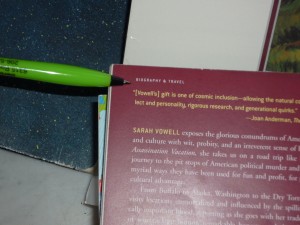
If you live in the U.S. or Canada, a good place to start is by tracking down a recently-released paperback or trade paper book similar to yours and examining the back cover. Many publishers will display the book category in one of two places, in the upper-left corner:

sarah-vowells-back-cover-ii

Actually, now that I’ve posted it, I notice that Sarah Vowell’s ASSASSINATION VACATION (a terrific book for anyone interested in political history, by the way; she’s a very funny writer) is listed in two categories: biography and travel. That makes perfect sense, because the book both talks about the lives of various murdered American presidents and follows Ms. Vowell’s journeys to their assassination sites. (Seriously, it’s funny.)

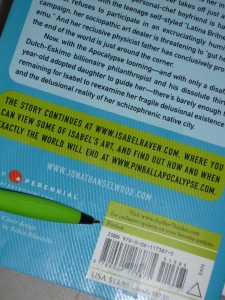
The other common locale for a book category is in the box with the barcode:

jonathan-selwood-back-cover

Okay, so that last photo was a trifle askew. However, since Jonathan Selwood’s THE PINBALL THEORY OF APOCALYPSE (six rows’ worth of passengers on an airplane thought I was having some sort of fit because I was laughing so hard at one point; once I had fended off medical assistance and read the passage in question out loud, the flight attendants came running to find out what was wrong with all of us) partially concerns the aftermath of a major earthquake, that seems rather appropriate.

I’m not sure if the photo will reproduce clearly enough for you to see it, but Mssr. Selwood’s book is designated merely as fiction. Counter-intuitively, this general-sounding moniker refers to something quite specific: novels for adults that do not fit into a genre designation. For all of you whose first thought upon my telling you that you would need to narrow down your complex 400-page book into a one- or at most two-word category choice, this might be a good selection.

It can be rather a pain to decide, admittedly, but once you have determined your book’s category, the hunt for an agent to represent it becomes substantially simpler: you don’t even need to consider approaching an agent who doesn’t represent your category. And why is that, veterans of last autumn’s Querypalooza?

If you shouted, “Because that would be a waste of my valuable querying or pitching time!” give yourself a gold star for the day. Since agents habitually represent only certain types of book, offering them another variety is only courting rejection.

Acceptance is what we want to court around here, right? Keep up the good work!

Just what am I getting myself into? Part IV/Formatpalooza, part XXIV: the e-mailed query

Last time, if you will recall, we bent our substantial collective cranial capacity to the fascinating question of what happens to a query or submission after it arrives at an agency, with particular emphasis upon a subject endlessly hypnotic to agent-seeking writers everywhere, submission gaffes that might prompt our old pal, Millicent the agency screener, to snap into instant rejection-on-sight mode. Within that context, we dwelt long and hard upon the ways in which an electronic submission — i.e., pages that the agent has actually asked a writer to send via e-mail — might be received differently than a paper submission.

In case any of you missed that discussion, allow me to summarize it for you: it’s significantly faster to reject an electronic submission or query. Not to mention immensely easier to lose one or the other accidentally.

Why, you ask? Have you tried to lift a 400-page manuscript lately? The darned things are heavy.

Which is, of course, one of the reasons that more and more agencies are permitting — nay, even insisting upon — electronic submissions: it keeps them from being buried in paper, and their Millicents are less likely to rupture a spleen while processing Monday morning’s influx of queries and submissions. Oh, and a Kindle is quite a bit lighter to tote onto an airplane than fifteen full-length manuscripts.

But lest any of us kid ourselves, electronic submissions were practically unheard-of prior to the 2001 anthrax scare; prior to that, the overwhelming majority of US-based agencies did not even have websites. Immediately after those poisoned envelopes hit the news, however, quite a few agencies abruptly began accepting e-queries for the first time.
Even in an industry where working one’s way up has long been the norm, expecting Millicent to risk her life by opening envelopes was considered a bit de trop. (Hey, she may be paid very much — heck, at some agencies, she is an intern — but our Millie is a much-valued member of the agency team.)

They’ve been on the rise ever since; indeed, some agencies (but not most, by any stretch of the imagination) now accept only e-mailed queries. Others (but again, a minority) ask queriers to fill out an electronic form instead. Most of these forms allow writers to paste a query letter into the form, but some only allow queriers to type in a limited amount of information, with perhaps a space to paste in the first few pages of the manuscript.

Have these developments been good or bad for aspiring writers? Like so many aspects of both the changing publishing industry and technological advance, the answer is both.

There are, of course, distinct advantages to e-querying, although not as many as there were five years ago: it’s a significantly less expensive option for writers querying US-based agents from other countries, for instance. When computer-savvy agents first began accepting e-queries, they did tend to respond faster than their counterparts who worked purely in paper. Then, too, junior agents frequently screened their own e-mail for queries, rather than relying upon a Millicent. And even today, if an agency does indeed accept e-mailed queries, the querier may hear back a trifle more quickly and/or be slightly more likely to reach the agent herself by sending an e-mail.

Did the Internet-lovers out there just do a double-take? Yes, it’s true: even at this late date, there are many agents who will not read e-mailed queries. Ever. Period.

So before you even consider this option, check one of the standard agency guides to make sure it’s acceptable. (If you are unfamiliar with how to use an agency guide — the shorthand can be tricky — please see the HOW TO READ AN AGENCY LISTING category at right.) Or the agency’s website. If it has one.

Yes, seriously. Contrary to widespread writerly assumption, not every agency has a site posted on the web. This means that simply doing a web search under literary agency will not necessarily provide you with an exhaustive list of all of your representation possibilities. (For tips on how to come up with a list of agents to query, check out the HOW TO FIND AGENTS TO QUERY category on the list at right. How do I come up with these obscure category titles, anyway?)

But let’s assume for the moment that the agent of your dreams does indeed accept both paper and e-queries. Which is more to your advantage to send?

Well, it depends on the agency — and your timeline. You might well hear back about an e-query within a matter of hours, a most unlikely outcome for a paper query; then again, you might not. As I mentioned last time, turn-around times in agencies have gotten significantly longer over the last few years: what used to take just a couple of weeks now often takes a couple of months. Or more.

However, if an agency’s submission guidelines state point-blank that they do not respond to e-mailed queries unless they are interested, but that they do send out actual replies to mailed queries that include SASEs (a fairly common policy, amongst agencies that accept both), then it might be very much worth your while to query that agency via regular mail. Especially if you happen to be one of the vast majority of queriers who prefers to send out only one or two queries and wait until the agent(s) respond(s) before sending out any others: if that’s your strategy, you should be avoiding non-responders like the proverbial plague.

I frown upon the one-by-one strategy, by the way, and not just for electronic queries. Your time is just too valuable. Think about it: if you have six hot prospects on your querying list, and it takes two months on average to hear back on each, it will take you a year to query them all. But since practically no agencies insist upon exclusive queries anymore, why would you do that, when you could send out all six queries in the first week — and move on to another 6 if those do not garner the response you want?

Stop groaning. I would be as delighted as you if your first query happened to hit precisely the right Millicent working for precisely the right agent on precisely the right day — and not thirty seconds after she just burned her lip on that latte she always seems to be too impatient to allow to cool. However, even for beautifully-written first books by immensely talented aspiring writers, that’s exceedingly rare; finding the right fit for a book can be very time-consuming. It’s only prudent to plan to query widely.

Is that one-at-a-time strategy starting to seem less appealing yet? Or the prospect of hearing back sooner on any given query like a positive boon?

The relatively quicker response time on e-queries is not always an advantage, however. The human eye reads, on average, 70% faster on a backlit screen than on paper — not an insignificant increase, when Millicent is already skimming queries at top speed. She’s unlikely to have time for second thoughts: once her always-itchy trigger finger taps that DELETE key, that query is gone.

Which suggests a troubling philosophical question: isn’t the outcome identical whether she hits that key deliberately or by mistake — say, as an unconscious response to burning her lip on a too-hot latte? And now that so many agencies simply don’t respond to queriers (or even submitters) if the answer is no, how can the hapless writer of that deleted query letter ever know whether he never heard back due to Millicent’s determination that the book being offered would not interest her boss, her conviction that the book is inherently unmarketable in the current literary climate (not necessarily the same logic as the first), her reaction to a query that’s poorly put together — or her purely instinctive response to having spilled scalding coffee all over herself and her keyboard?

But most of you are not scared away by the possibility of having your baby rejected by caffeine, are you? “That’s right, Anne,” those of you excited about saving all of that paper (or just plain sick of licking stamps) shout. “I get most of my querying information online, and mirabile dictu, most of the agents who give advice online favor electronic submissions. So do a lot of agencies that pop up when I Google literary agency, remarkably enough. And it just seems a whole lot less time-consuming to copy and paste my query letter template — with suitable personalization for each agent, of course — into an e-mail than to print it up each time. So let’s have at it!”

Okay, electronic enthusiasts. Let’s talk about how to do this thing right.

E-mailing your query
As the shouters above indicated, e-mailing a query is pretty straightforward: it involves — wait for it — sending precisely the same query letter by e-mail that a writer would have sent via regular mail, minus the SASE. (You also don’t need to include the date or the recipient’s complete mailing address, as you would with a mailed letter. Just start with Dear Ms. Agentofmydreams, and proceed as with a regular letter.) In fact, if one composes the letter in Word, one can just copy it and paste it into the body of the e-mail.

There’s another big difference between an e-query and one that’s printed, a differential that should make business format-lovers everywhere rejoice: because most e-mail programs are hostile to indentation, it is considered quite acceptable not to indent the paragraphs in an e-query. Millicent might shake her head over the rapid decline in literacy amongst constructors of e-mail programs, but she will not blame you for it.

If you prefer to preserve the indentation (as I do, personally), go ahead and write a normal query letter in Word, then copy and paste it into the e-mail. If you find that one of the tabs disappears in transit — the last being the most prone to disappear in transit — you’ve not copied the final paragraph marker. Try this nifty trick: when you write the letter in Word, add an extra paragraph to the end of the letter. Copy and paste it into an e-mail; the actual text of the letter should arrive with the tabs all intact. Then hand-delete the extra verbiage.

Whatever you do, don’t send your letter as an attachment, or send a missive with a link to a generic query on your website. Most agencies have strict policies against opening unsolicited attachments (out of fear of downloading viruses), and I can tell you now that Millicent is not going to follow that link.

Why, you ask? Feel free to pull out your hymnals and sing along, campers: it’s Millie’s job to cull queries as quickly as humanly possible, to narrow down a roaring river to a manageable trickle. If she’s spending only about 30 seconds per query — probably even less on each e-query, because of that skimming-eye tendency — why on earth would she invest a couple of minutes in following a link to the website of someone too unfamiliar with how queries work to present her with a proper one?

My, we’re delving into a lot of deep philosophy today, aren’t we? Let’s lurch our way back to practicalities.

Composing the query first in a word processing program carries a couple of advantages. First, it’s easier to spell- and grammar-check. Second, it renders keeping good records of whom you have queried a little bit simpler: you can simply save each query as its own document, so you can keep track of what you have said to whom and when. (You do keep meticulous querying records, don’t you, so you will not approach the same agency twice with the same book project within a year? Repeat queries are considered quite rude in Millicent’s circles.)

Adhering to a two-step process also encourages a writer to re-read each query before sending it out in a way that simply resending the same e-mail over and over again (copy-and-paste works in most e-mail programs, too) does not. It will help you avoid some of the more common querying mix-ups: if you’re sending out a whole flotilla of queries at once, it’s pretty easy to hit SEND without realizing that your Dear Mr. Readerson missive just went to Ms. Picky. Or not to include the synopsis Ms. Picky’s agency’s submission guidelines request.

Another astonishingly common mistake in e-queries: not including any contact information. “But Anne,” computer-huggers everywhere cry, “isn’t that unnecessary? After all, Millicent could just hit REPLY if she wanted to ask me to send the manuscript, right?”

Not necessarily, no. Remember that nightmare scenario above, where her scalded hand accidentally hit DELETE? It’s also not all that uncommon for successful e-queries and e-submissions to be forwarded around an office, so the agent’s just pressing REPLY would merely send her opinion back to Millicent’s inbox, not yours.

And seriously: why wouldn’t you want to make it as easy as possible for these people to say yes to you?

Copying and pasting a query from Word can cause formatting problems, however — and not merely the tab disappearing act I mentioned above. If recent comments are any indication, many e-queriers have been horrified to discover after they have sent their e-mails (and having taken the prudent step of also e-mailing the letter to themselves, so they can see it as Millicent would), that there is an extra-large space between paragraphs.

“Hey, why is the formatting different?” they wonder indignantly. “When I pasted the letter into the e-mail, there was only a single line between paragraphs. Why the expansion? And will Millicent conclude that I am an idiot who doesn’t know how to format a letter properly?”

Since self-deprecating terms like idiot, moron, and complete dolt are a regular feature of comments by readers who have experienced this problem, I’m inclined to believe that it’s causing disproportionate chagrin. To set all of those worried (and not idiotic at all) minds at ease: no, Millicent won’t think the less of you if your e-query sports extra-wide spacing; it’s too common a problem. She’s knows that it’s the result of a rocky transition between Word and a lot of e-mail programs.

So don’t worry your smart little heads about it, okay? You’ve got bigger fish to fry.

Oh, dear — that didn’t convince all of you, did it? All right: let’s talk about how to eliminate this problem. First, you could write your query IN your e-mail program the first time around, then copy that to subsequent missives. You’d lose the advantages of composing in Word, but you wouldn’t have to worry about the formatting.

Or you could recognize that most e-mail programs and Word don’t have completely compatible word-processing bells and whistles. What constitutes a hard line break in Word (i.e., that skipped line between paragraphs) may well be a prompt for a two-line skip in your e-mail.

So how does one get around that? Don’t skip a line between paragraphs in the Word version. Just hit RETURN once at the end of each paragraph, as you would when typing in standard format. The sent e-mail will have only a single skipped line between paragraphs.

Seriously, it works. Send yourself a test query and see.

Querying via form on a website
Those forms are self-explanatory (part of their popularity, I suppose): many of them simply tell aspiring writers to paste their query letters into a form, along with a writing sample. I trust that you can figure them out on your own.

And if you can’t, I probably won’t be able to help: they’re too individualized for me to create general rules of thumb for dealing with ‘em. Sorry about that. Have you considered checking one of the standard agency guides to see if the agency with the troublesome form would accept a mailed query letter instead?

E-mailed query packets
Here again, the rule of thumb is precisely the same as for mailed queries: send precisely what the agency’s submission guidelines ask to see — no more, no less.

To tell you the truth, I’ve resisted writing much on this topic, for the exceedingly simple reason that I didn’t want anyone to confuse a query packet (i.e., the stack of things an agency’s website or listing in one of the standard agency guides might ask a querier to send along with the query letter) with a submission packet (the array of papers an agent has SPECIFICALLY asked a writer to send after a query or a pitch).

The former known in the industry as unsolicited materials, the latter as requested materials.

“But Anne,” some of you new to the process protest, and who could blame you? “I’m confused. If the agency’s website, guide listing, or page on that always-useful resource for writers seeking agents, Publishers’ Marketplace tells aspiring writers that they should send a synopsis or the first 50 pages with a query, in what sense is that not a request? Especially when half of those listings refer to their standards as submission requirements?”

I see your logic, oh rules lawyers, but you’re confusing passive guidelines with an active request. Anyone able to track down an agency’s website or listing might discover its submission guidelines, the prerequisites to which an aspiring writer must adhere in order to get a query under one of their agents’ spectacles at all. But as any agent or editor in the biz could tell you, agencies draw a very firm distinction between preliminary materials sent out of the blue (from their perspective) and pages that they actually asked a writer to submit, based upon a successful query or pitch.

How seriously do they take that distinction? Well, let me put it this way: I’ve seldom heard anyone who has worked within five blocks of an agency refer to any pages sent with a cold query (i.e., a query letter from a writer who has had no previous contact with the agency and hasn’t been referred by someone they know) as a submission.

Judging by the knitted brows out there, that little explanation didn’t leave you unconfused, did it? “Okay, Anne,” the brow-knitters say, arms folded and all ready for an argument, “I believe that they make a distinction, but I still think I’m right to think of those 50 pages the agent of my dreams’ website told me to send as both requested materials and a submission. If not, why would they call them submission guidelines, huh? Got a glib answer for that one?”

Actually, I have several. You’d better get comfortable.

In the first place, if your dream agent’s website stated that queriers should go ahead and send sample pages, it didn’t ask you personally to do so; it asked everyone who might submit to them. Given that such a public request effectively narrows down the potential pool of querier to every writer on earth who currently doesn’t have an agent, you can hardly blame those who work at the agency for not considering those guidelines in the same light as a specific request to a specific writer.

In the second place, submission guidelines is an industry term; publishing houses use it as well, but like word count or literary fiction, the definition in use at the moment is in the mind of the speaker. It’s not as precise as those coming into the conversation from the outside might like.

For all its imprecision, the term’s use in this context performs a pretty specific function: it catches the eye of writers so new to the industry that they are unaware that they shouldn’t just mail off a full manuscript to any agent who happens to catch their innocent imaginations. (You do know that such manuscripts are simply rejected unread, right?) Understood that way, an agency’s guidelines are in fact submission guidelines — they tell aspiring writers not to submit at all, but to query instead.

In the third place, I hate to be the one to bring this up, have you by any chance compared the guidelines on the agency’s website with those in one of the standard agency guides and/or the individual agent’s listing on the aforementioned Publishers’ Marketplace?

It’s a bit time-consuming to check multiple sources, but often worthwhile: not only do guide listings tend to have different emphases than website blurbs (thus enabling you to fine-tune your query list), but it’s also surprisingly common for the various sources to ask queriers to send different things.

Yes, really. It’s not at all unheard-off for the most recent Guide to Literary Agents to suggest querying with a synopsis, the agency’s website to ask for a query plus the first ten pages, and the individual agent’s Publisher’s Marketplace page to specify a query plus the first chapter and an author bio. Heck, it isn’t even all that unusual for one source to say that an agency welcomes paper queries, while another insists that it will only accept queries via e-mail and the website has a form to fill out and submit electronically.

No wonder writers are confused. I’m not bringing this up, however, to criticize agencies — heaven forbid! — but as part of my ongoing quest to convince agent-seeking writers that being hyper-literal and rules-lawyerish is not necessarily helpful at the querying stage.

Why, you ask? Well, remember how I had mentioned earlier in the summer that conference-goers sometimes confuse an individual agent’s personal preferences with an industry-wide norm? Sometimes, what guidelines end up in an agency guide are a function of the preferences of whoever happened to fill out the form — or of no one at the agency’s thinking to go back and update its Publishers’ Marketplace listing when the guidelines on the agency’s website have changed.

It doesn’t really matter why it happens, does it? If a particular agency has two or three sets of guidelines floating around out there, it follows as night the day that its resident Millicent must be seeing two or three different kinds of query packet on any given morning.

What were you saying about taking a guide listing or website’s guidelines as a request?

In the fourth place (yes, I’m still working on that pesky question), just because if an agency’s site/listing/representative at a writers’ conference expresses a generic interest in seeing extra materials — a synopsis, for instance, or a bio, or even pages — that doesn’t mean its Millicent will necessarily read them. If the query doesn’t spark her interest, she’s extremely unlikely to give the book project a second chance just because additional materials happen to be in front of her.

Before you get all huffy about that, brow-knitters, allow me to add hastily: this is largely a function of time not being infinitely elastic. It’s Millie’s job to weed out queries, right?

“But wait,” my brow-knitting friends ask hesitantly, “is it possible that I’m misunderstanding you here? From what you’re saying, it sounds as though my being able to send pages along with my query isn’t necessarily an advantage — all it really does is save Millicent the trouble of asking to see them.”

Well, if that’s the conclusion you want to draw from all this, I would be the last to stop you. I can only advise: do your homework before you send out that query. And send precisely what the agent expects to see.

How might one figure out just what that means, in the face of conflicting guidelines? Generally speaking, although the Publishers’ Marketplace and the Herman Guide listings tend to offer the most information (again, useful for figuring out which agent at the agency to approach), agencies’ websites usually offer the most up-to-date guidelines. I’d advise following them — but checking another source or two is always a good idea.

Especially if you’re not especially fond of copying and pasting your first few pages into the body of an e-mail or into a miniscule box on an online form. It can wreak havoc with formatting.

Ah, we’re back to formatting, after that long digression. Can we actually talk about how to put together an e-mailed query packet now?
If (and only if) the agency’s submission guidelines (wherever you found them) ask for additional materials, check very carefully to see if the guidelines tell you how to send them. Most of the time, they will ask that you include them in the body of the e-mail, not as an attachment.

Which is to say, unless the submission guidelines SPECIFICALLY ask you to do so, do not, under any circumstances, include attachments in an e-mailed query, for precisely the reason we discussed above: virtually every agency in North America has an iron-clad policy against opening unrequested attachments. They’re just too likely to contain viruses.

Hey, I’m not casting aspersions upon your no doubt squeaky-clean computer. I’m just reporting what the process looks like from the other side of the desk.

If the agency’s website SPECIFICALLY asked for attachments, send them in Word (the industry standard), but as we discussed yesterday, send them as .doc files; do not send them as .docx. Many, many agencies are running older versions of Word (on PCs, usually) and will not be able to open .docx files.

Like any file-transferring snafu between an agency and a writer, this is considered the writer’s fault. And no, Millicent won’t necessarily e-mail you back, asking you to send a different version. Nor will the agency call upon its crack computer support staff, for the simple reason that, as astonishing as this may seem to those of us living in the Pacific Northwest, NYC-based agencies seldom have an in-house computer expert. (Possibly because s/he would be so like to tell them to upgrade what version of Word they’re using.)

I’m telling you: a little foresight will go a long way toward getting her a document someone at the agency can actually open.

If you happen to be running a recent version of Word, your document may be saved as a .docx automatically, so use the SAVE AS… function to save your document as a Word 97-2004 document (.doc). Mac users, do be aware that your system may allow you to give your documents longer names than an older PC’s system might recognize as valid.

How do you include additional materials without attachments? Copy and paste them into the body of your e-mail, a few skipped lines after the end of your query.

Fair warning, though: as I mentioned above, formatting often gets lost in the transition. Particularly vulnerable, for some reason: double-spacing. Even if you have to change the spacing in the e-mail by hitting the RETURN key at the end of every line, make sure any manuscript pages you send are double-spaced.

If formatting disappears in transit, you’re probably not copying all of the formatting codes. The trick I mentioned above usually solves this problem: add an extra paragraph above and below the text you want to transfer, copy and paste the whole shebang into your e-mail, then hand-delete the extra words. Usually works like a charm.

And don’t worry your aforementioned smart little head about reproducing the exact format of your manuscript page; Millicent isn’t expecting text within the body of the e-mail to reproduce the printed page. She’s been around e-submissions long enough to know the havoc most e-mail programs can play with Word’s formatting. Just start with the first line of text on page 1 of your manuscript — the chapter title isn’t particularly necessary, but you may include it if you wish — and include as much of the text as requested.

Oh, scrape your jaws off the floor. The point of asking for those pages is not to see if you can produce a manuscript in standard format, after all — if an agent wanted to see that, the submission guidelines would ask for a Word attachment. (As some of them do: make sure to check every time.) What Millicent will be casting her bloodshot eyes across that writing sample for is to see if you can write.

You don’t mind that, do you?

No matter what other materials are specified in the guidelines, always start an e-mailed query packet with the query letter itself, then move on to any requested materials in the order they were listed in the guidelines. As I mentioned above (but it always bears repeating), unlike a paper query, an e-mailed query need not include date and full address of the recipient, but do open with a salutation: Dear Ms. Smith…

Why? Well, think about it from Ms. Smith’s perspective: wouldn’t a mass e-mail be the most efficient way of broadcasting 2,000 generic Dear Agent queries? Do you really want your e-query mistaken of one of those?

Most of you probably knew most of this, though, right? Let’s move on to a little-known trick o’ the trade — located in the part of the e-mailed query to which writers tend to give the least thought.

The subject line of an e-mailed query
The subject line is key to an e-query’s ending up in the right place, so you are going to want to make that space count. Or at any rate, prevent your e-mail from getting relegated to the spam file.

Most agents prefer writers to include the word QUERY in it, presumably so they don’t mix up your e-mail with that invitation to their high school reunion. If you just heard the agent speak at a conference, include the name of the conference in both the subject line and the first line of your query; many agencies will give priority to post-conference queries.

Conversely, if you already have an in with the agent, make sure to include that in the subject line, too. If you met the agent at a conference and she told you to send her a query (as opposed to sending materials; it happens), write REQUESTED QUERY and the name of the conference in the subject line; if you were lucky enough to garner a referral from an existing client, type QUERY — (Client’s name) REFERRAL.

Getting the picture? Good.

Like so much else in writer-agent relations, the practices were much more streamlined back in the days before the rise of the personal computer, much less the Internet. In fact, a case could be made, and a cogent one, for the popularity of the Internet’s being the cause of each agency’s specifying that it wants different materials in query packets: back when the standard agency guides and word of mouth were the primary ways that writers found out what standards were, pretty much everyone just asked for a query, or query + synopsis.

In fact, the industry truism of yore dictated that a writer should NEVER send manuscript pages or a proposal unless and agent had specifically asked him to do so. Frankly, I think that expectation was a bit easier on writers: there was far less stressful guesswork involved.

So are agencies asking for more materials up front just because they can — or because there now isn’t so much paper involved? Maybe, or maybe some of them just wanted to streamline the rejection process by arranging to have a writing sample on hand as soon as Millicent read the query letter: that way, she can rule out promising book concepts whose writing doesn’t deliver in one contact with the writer, rather than the former two.

Or perhaps — and I’m not saying this is true; I’m merely speculating — providing guidelines that are unlike those of other agencies may be a clever means of discovering just how good a prospective client is at following directions; if every agency asks for something slightly different, the Dear Agent queriers who treat every agent on earth as identical are going to stand out like the proverbial sore thumbs, right?

Just in case I’m right on that last one, follow the individual agency’s directions. To the letter. And if that means choosing from amongst several sets of guidelines, pick one and cling to it like a leech.

Trust me, both you and Millicent will feel better if you do. In an often confusing and alienating process, concrete direction can be very reassuring. Keep up the good work!

Just what am I getting myself into? Part III: but what happens after my query arrives at the agency?

cat-on-the-wall

Before any of you sprain your brains by trying to figure out what a fluffy cat standing on a partially-finished stone wall (my yard still has quite a few of those, even years after our brief-but-scarifying encounter with the World’s Worst Landscaper™) has to do with the promised topic du jour, what happens to requested materials, let me stop you mid-ponder: the picture above isn’t particularly illustrative of anything I’m about to say today. I just thought that after so many days of such lengthy posts on such serious subjects, we all could stand a glimpse of something comparatively light-hearted.

How so, those of you joining us late in my latest obsession ask? I’ve been spending the last few posts on an overview of how books currently get published in the United States: not the astonishingly pervasive fantasy that all a good writer has to do to get published is to write a book — period — but the actual logistics of what happens. The view from the trenches, as it were.

Oh, dear: I suppose that does mean that the photograph is subject-appropriate. I honestly hadn’t intended it to be.

So far, we’ve gone over how US-based publishing has changed over time; how fiction and nonfiction are marketed differently; why a writer needs an agent if she wants to get published by a major house, and the various methods of seeking representation, along with their pros and cons. Is everyone fairly clear on all of those? If not, please feel free to post questions in via the comments functions — or, better yet, to seek out more detailed answers amongst the many and varied categories on the archive list on the lower right-hand side of this page, and then ask some of your patented trenchant follow-up questions.

Yes, yes, I know: I have been harping on the archives quite a bit over the last couple of posts, but with good reason, I assure you. This discussion intended to give those new to trying to get their work published — and anyone else who feels like reading it — a general overview of how the process works, as opposed to my favored approach, the let’s-concentrate-on-this-one-small-aspect-for-a-week method of analysis. Both have their benefits, of course, but if you are looking for elucidation on any of the individual points I’m discussing here, chances are that you will find far more discussion than you ever dreamed in the archived posts.

So if delving into the archive list starts to feel like trying to catalogue the contents of Pandora’s box, well, don’t say that I didn’t warn you.

For those of you who long for a return to specificity, well, wait a day. Today’s post is laying the groundwork for a very practical post tomorrow.

Back we go to the generalities. Since I know that many of you have are gearing up to send out your first round of queries for the year (having, wisely, not mailed or e-mailed them off precisely when every other aspiring writer in North America did, immediately after January 1, to fulfill a resolution), let’s pull the pin on a very common stress grenade: what happens if one of queries or pitches is successful?

What a writer should do if an agent requests pages
If a query or pitch operates as you hope it will, an agent will typically ask the writer to send either the entire manuscript (rare), a specified number of pages from the beginning of the book (substantially more common), or, for nonfiction, the book proposal. Unless the agent specifically tells you otherwise, this means that he is expecting to receive it as hard copy, sent by regular mail.

Yes, even if you originally contacted the agent via e-mail or through the agency’s website. Publishing is still largely a paper-based enterprise, after all.

If an agent prefers e-mailed submissions, she will tell you point-blank, asking you to send it as a Word attachment to an e-mail. (Under no circumstances should you ever send a computer disk or CD-R with your book on it — it will be returned without being opened.) Occasionally, an agent will request a PDF, but regardless, send any requested electronic materials in Microsoft Word — and as a .doc file, not .docx, so even an agent operating on a very old computer will be able to read it. (If you work on a Mac, make sure to send it as a Windows-friendly document — and do be aware that older versions of Windows prefer shorter document titles than any version of Word for the Mac.)

I cannot emphasize strongly enough how important it is to respect this norm, so allow me to repeat it: if you have been asked submit electronically, the attachment the agent has in mind is the industry standard, a .doc file in MS Word, unless she specifically tells you otherwise. Sending it in any other format will generally get the submission rejected unread.

Why Word? It’s what the major publishing houses use, so if the agent of your dreams is going to submit electronically to a publishing house, that’s how the editor would expect to receive it. It’s also the format a publishing contract will specify for the soft copy Author X must deliver to the publisher by Date Y.

I hear those of you Word groaning, but submitting in another format — or with a document the agent cannot open — is widely considered unprofessional. At minimum, it displays a belief that format doesn’t matter, and thus an ignorance of how publishing works in this country. And what conclusion is Millicent the agency screener likely to draw about a writer who seems unfamiliar with the norms of the biz, campers?

That’s right: such a writer is inherently more time-consuming to represent. The agent will have to invest quite a bit of time in teaching him the ropes.

Try to think about the necessary conversion in terms of all the time it will save you in the long run. If the agent of your dreams likes to submit to editors electronically, you would have to present her with a Word file for your work, anyway. You’re just jumping the gun a little.

Back to practicalities. Occasionally, an agent will ask for attachments as rtf (rich text format), a version without the formatting bells and whistles that render documents hard to translate across word processing systems; if you don’t habitually work in Word, but send your document in rtf, any Word user should be able to open it. As I mentioned above, some agents request submissions in PDF format — especially those who choose to read submissions on a Kindle, rather than on a computer screen, as is becoming increasingly common — but it’s seldom preferred, as it’s hard to edit.

Other than that, an electronically-submitted manuscript is identical to one to be submitted in hard copy: in standard format — with a title page, so the agent of your dreams may contact you to tell you how much she loved it. Include the title page as the first page of the manuscript document, not as a separate file. The title page should neither be numbered nor have a slug line; the first page of text is page 1.

If the prospect of figuring out how to make that happen induced a swoon, never fear: it’s actually quite easy in Word. Under the FORMAT menu, select DOCUMENT, then LAYOUT. You will find an option for DIFFERENT FIRST PAGE. Once you click that, you can go into the header and remove the slug line for the first page of your document, and thus the page number.

I see some raised hands waving frantically out there in the ether. “But Anne,” disembodied voices everywhere cry, “that would only get rid of the page number as it appears on the first page. If I copy-and-paste my title page into my text document, wouldn’t the first page of text end up being labeled page 2?”

Why yes, it would, disembodied questioners — unless you were clever enough to have set the pagination to begin at zero. To accomplish that, while you are tinkering with the header, choose the FORMATTING PALETTE from under the VIEW menu, then select HEADER AND FOOTER. The FORMAT PAGE NUMBER option will offer you the opportunity to select what number the pagination will START AT… Type in 0, and you’re home free.

If the agency accepts submissions in both hard or soft copy, which should I choose?
Given my druthers, I would always opt for hard copy. Why? Because the human eye reads much more quickly on a backlit screen than on a printed page. It’s more conducing to skimming than hard copy, even for professional readers. (Perhaps especially for professional readers, who have a lot of submissions to get through in a day.)

It’s also more work for an agent to reject a paper copy, as opposed to the single action of hitting the DELETE key required to remove an e-submission from her life forever. That’s also true of mailed vs. e-mailed queries, incidentally, if you’re approaching an agency that informs queriers about rejections at all. (Many don’t these days, so check submission guidelines carefully.)

Don’t believe me? Okay, think about it: to reject a hard-copy manuscript, Millicent has to pull the SASE out of the query packet, grab a form letter off the top of the stack on her desk, fold it, and stuff it into the SASE. Rejecting an electronic query, on the other hand, requires at most pasting form-letter rejection into a return e-mail — or, again, simply hitting the DELETE key. Much less work.

However an agent has asked you to submit, though, do as he asks. If there is one inviolable rule to bear in mind while preparing a submission packet, it is surely send the agent precisely what he has asked you to send.

Not following this basic precept can — and almost always does — result in instant rejection. That deserves its own heading, does it not?

How do I know what to put in the submission packet?
Shout it out with me, campers: send precisely what the agent asked to see — no more, no less. Plus a SASE, if you’re submitting by mail.

Being hyper-literal often doesn’t serve an aspiring very well along the frequently perilous road to publication, but submission is one instance where it’s positively a boon. If the agent asked to see the first 50 pages, send the first 50 pages — not the first 49, if a chapter happens to end there, or 55 if there’s a really exciting scene after page 50. If page 50 ends mid-sentence, so be it.

Why is it so very important to follow submission instructions exactly? Because the quality of the writing is not necessarily the only factor an agent weighs in deciding whether to represent a client. The ability to follow directions to the letter tends to be a quality that agents LOVE to see in potential clients, since it implies the writers in question possess two skills absolutely essential to working well with an editor — no, make that three: an ability to listen or read well, a capacity for setting goals and meeting them, and a professional attitude.

That’s right, those of you who did a double-take at that first one: those reading comprehension problems on the SAT actually did relate to something practical in adult life. A writer who has a hard time reading an e-mail from her agent and doing what she’s been asked to do is — wait for it — inherently more time-consuming to represent than a writer with good reading comprehension skills.

As your first opportunity for demonstrating your sterling reading comprehension skills, getting the contents of the submission packet right is monumentally important. Yes, even if you receive the request for materials verbally.

strong> If an agent asks you for pages in the course of a pitch meeting, take the time to write down a list of what the he is asking you to send. Read it back to him, to make sure you caught everything. (Trust me, if you’re face-to-face with an agent who has just said yes to you, you won’t be thinking with your usual clarity.)

If the agent makes the request in writing, read the missive through several times, then sit down and make a list of what he’s asked you to send. Wait at least 24 hours before re-reading the communication to double-check that every requested item made it onto the list. THEN assemble your submission packet, checking off each element as you place it into the envelope or box.

Clever longtime reader Tad came up with a brilliant extra level of fail-safe reading comprehension security: after you have assembled the submission packet, hand it, your list, and a copy of the letter from the agent to someone you trust — a parent, a significant other, a best friend, or any other friendly, detail-oriented person you’re relatively certain isn’t harboring a secret desire to see you miserable — and ask that person to check that (a) the letter and the list correspond exactly and (b) you’ve included every necessary element in the packet.

Yes, it’s that vital to get it right.

Throughout the last few paragraphs, I’ve been sensing some confusion out in the ether. “But Anne,” a few timid souls pipe up, “am I missing something here? How difficult could it possibly be to print up the number of pages the agent requests, place them in an envelope, and pop it in the mail? Are you saying that she might ask to see something other than the manuscript?”

Often, yes. There are also a couple of elements that any US-based agent will expect to see in a submission packet, whether or not she asks you to include them.

What might an agent ask to be sent — and what should you always send anyway?
Since there is no industry-wide standardization of what precisely belongs in a submission packet, any given agent may ask for a different array — and you already know to send precisely what each asks you to send, right? However, the most commonly-requested elements are:

* The requested pages in standard manuscript format, unbound. The most popular lengths to ask for are the first chapter, the first three chapters, the first 50 pages, the first 100 pages, and the entire manuscript. Every page should be in standard format for manuscripts (i.e., not like a published book, nor should it be identical to a short story submission).

A few cautionary notes, for the benefit of those of you who missed my recent Formatpalooza series: manuscripts absolutely must be double-spaced, in 12-point type (preferably Times, Times New Roman, or Courier), printed on only one side of the page with one-inch margins, and feature indented paragraphs. (No, business format is not proper here — for a full explanation, please see the BUSINESS FORMAT VS INDENTED PARAGRAPHS category at right.)

* A synopsis. For fiction, this is a description of the major twists and turns of the plot, told as vividly as possible. (Remember what I said earlier about every syllable you submit to an agent being a writing sample?) For nonfiction, it’s a summary of the central question the book will address, why the question is important to answer, and a brief indication of what evidence you will use to bolster your arguments. For tips on how to pull this off in what is often an intimidatingly small number of pages, please see the HOW TO WRITE A SYNOPSIS FROM SCRATCH and/or HOW TO WRITE A NONFICTION SYNOPSIS categories at right.)

* An author bio. This is an extended version of the 1-paragraph description of your life, with emphasis upon your writing credentials, your education, and any experience that would lead an observer to regard you as an expert on the subject matter of your book. For a crash course on how to write one, please see the HOW TO WRITE AN AUTHOR BIO category. (Hey, I wasn’t kidding about there being a whole lot of elucidation of details on this site.)

* The book proposal. As I mentioned a few days ago, book proposals are marketing packets used to sell nonfiction. For an explanation of what should go into it and how to put it together, please see the HOW TO WRITE A BOOK PROPOSAL category. (This is starting to read like the back of a greatest hits album, isn’t it?)

* A marketing plan. This request was unheard-of for novels until just a couple of years ago, but recently, the marketing plan has been enjoying a vogue. For fiction, it’s the same document as the similar section in the book proposal (and thus a description of how to write one may be found under the HOW TO WRITE A BOOK PROPOSAL category): a description the target audience for the book and how to reach them. Bear in mind that what anyone who asks to see a marketing plan has in mind is what the author will be doing to promote the book, not the publishing house’s efforts, so just saying, “I will make myself available to go on a book tour,” probably isn’t going to impress anybody.

Think creatively: who is your target reader, and where do folks like that congregate, physically or virtually?

Those are what an agent will probably ask to see. For tips on how to present these professionally, how to box them up, in what order they should be stacked, etc., please see the HOW TO PUT TOGETHER A SUBMISSION PACKET category at right. (Oh, you thought I would send you into that minefield without any guidance?)

Here is a list of what she will almost certainly not mention in her request, but your submission will appear substantially more professional if you also include:

* A cover letter thanking the agent for asking to see the requested materials and repeating the writer’s contact information. I’m always astonished at how many aspiring writers just throw a manuscript into an envelope without even attempting any polite preliminaries. It’s rude — and, given how many queries an agency processes in any given week, it’s not a grand idea to assume that the person who opens your submission envelope — almost certainly Millicent, not the agent herself — will instantly recall who you are. (For guidelines on how to construct this important missive, please see the COVER LETTERS FOR SUBMISSIONS category at right.)

* A title page for your manuscript or partial. Again, most submitters omit this, but an already-established writer would never dream of submitting a manuscript anywhere without a title page, since a professional title page includes information absolutely vital to marketing the book: the book category, the word count, the title (of course), the author’s contact information. (For an explanation of all of these elements, how to put them together on a page, and illustrations of what a professionally-formatted title page looks like, please see the HOW TO FORMAT A TITLE PAGE category at right.)

* A stamped, self-addressed envelope (SASE). As with queries, not including a SASE is generally considered an instant-rejection offense. While it’s classy to include a letter-sized SASE in case the agent wants to respond in writing, the SASE in a submission is an envelope or box labeled with your address and enough postage (stamps, not metered) to mail it back to you. (If that sounds complicated, don’t fret: you’ll find a complete explanation of how to handle the many permutations of SASE use under the SASE GUIDELINES category at right.)

Why do you need to include a SASE for your manuscript’s return? Well, unless the agent decides to sign you to a representation contract, she’s not going to hang onto your manuscript — and since not all agencies have recycling programs (yes, I know; it’s discouraging to tree-lovers everywhere), those rejected pages are just going to land in the trash.

Confused? It wouldn’t be altogether surprising if you were: the logistics of submission are much more complex than the vast majority of aspiring writers realize. For a much fuller explanation of how to juggle all of these elements into a professional-looking package, check out the HOW TO PUT TOGETHER A SUBMISSION PACKET category at right.

A word to the wise: since agencies receive many, many submissions, both requested and not, with every single mail delivery, it’s an excellent idea to write REQUESTED MATERIALS in great, big letters on the top of the envelope or box containing your submission packet. This will help ensure that your package ends up in the right pile on the right desk. As unsolicited manuscripts are almost universally rejected unread, the last thing in the world you want is for your requested materials to be mistaken for them, right?

For the same reason, if an agent has asked you to submit pages via e-mail, it’s prudent to include the words REQUESTED MATERIALS in the subject line of the e-mail. Better safe than sorry, I always say.

Oh, and before I forget, let me reiterate that grand old piece of traditional writerly advice from the first post in this series: never, ever send an agent — or anybody else, for that matter — your only copy of anything. To that, allow me to add Anne’s Axiom of Submission: never spend the money to ship anything to an agent overnight unless they specifically ask you to do so.

Contrary to popular opinion amongst aspiring writers, overnight shipping will not get your packet read any quicker, so it’s just a waste of money. Within the US, the significantly less expensive Priority Mail will get it there within 2-3 business days, which is quite fast enough.

Assuming that at least some of you are still with me, I shall now move on to the single most-asked question amongst submitters everywhere:

Okay, now I’ve sent my submission packet. How soon will I hear back?
Well, let me put it this way: I wouldn’t advise holding your breath. Even if you submit a partial and an agent decides that she’d like to see the rest of the book, you’re probably not going to hear about that exciting development right away.

Stop glaring at me like that. You’ll save yourself a lot of heartache if you understand this: no matter how enthusiastically an agent solicited a manuscript, trust me, she will neither have cleared her schedule in anticipation of receiving your materials nor will drop everything to read it the instant it arrives. Agents are extremely busy people, and even before the one currently occupying your daydreams can take a gander at your submission, it will have to be read and approved by a Millicent. Sometimes more than one.

So expecting to hear back within a few days or weeks is, well, not particularly realistic. As with query letters, the length of time an agency takes to make a decision on a manuscript varies wildly, but in these days of shrinking agency staffs — are you sitting down? — it’s typically measured in months.

And not necessarily one or two, either. It’s not at all unusual for a writer not to hear back for 3-6 months on a submission. Heck, I know writers who have been startled by representation offers after more than a year.

There is one grand exception to this general rule, however: if an agent knows that there are other agents competing to represent you (should you find yourself in that enviable position anytime soon, congratulations, and please see the WHAT IF MORE THAN ONE AGENT ASKS TO SEE MY MANUSCRIPT? category at right), he — or, more likely, his assistant — will sometimes bump your manuscript up in the reading queue. If you can legitimately tell him that another agent has already made an offer, you will be astonished at how quick a turn-around time can be.

Otherwise, expect your packet to have to do some serious time in a pile, along with all of the other submissions awaiting review. Most agencies list their average turn-around times on their websites or in their agency guide listings, to alert aspiring writers to what can be an extended wait.

Why does it take so long, you wail? Well, as I said, there will probably be quite a few manuscripts that arrived before yours. If waiting in a queue seems unfair now, think about it again after an agent has had a manuscript for a month: how would you feel if one that arrived today were read before yours?

Another reason that turn-around times tend to be slow is — again, you might want to brace yourself against a large, supportive piece of furniture– the agent who requested the materials is not usually the only, or even the first, person to read a submission. Remember our pal Millicent? Guess what her job entails after she finishes screening all of those query letters?

That’s right: she’s usually the one deciding whether a submission makes the first cut; at some agencies, two Millicents have to agree that a manuscript is of publishable quality AND a good fit for the agency before the agent sees it.

Hey, I told you to brace yourself.

Unfortunately, as long-time readers of this blog are already glumly aware, Millicents are trained to find reasons to reject manuscripts first and foremost, rather than reasons to accept them: since her job is to thin the number of submissions her boss will have to read (often in the agent’s spare time, rather than at work, incidentally: yet another reason that turn-around times tend to be slow), a good Millicent may reject as many as 90% of submissions before they get anywhere near the agent. (For a truly frightening look at some of the most common criteria she uses to thin the herd, you might want to check out the FIRST PAGES AGENTS DISLIKE or AGENCY SCREENERS’ PET PEEVES OF THE NOTORIOUS VARIETY categories at right. I warn you, however, these posts are not for the faint of heart.)

Even more unfortunately, submitters are seldom given concrete reasons for rejection any more. (For a thoroughly depressing explanation why, please see the FORM-LETTER REJECTIONS category at right.) This means, in practice, that an aspiring writer may not gain any useable revision information from the submission process at all.

I know; it’s awful. If I ran the universe, or even just the publishing industry, it would not be this way. Queriers and submitters alike would receive meticulous kindly-worded explanations of why Millicent or her boss had decided to reject them, so it would be easier to learn something from the process. Public libraries would also be open 24 hours per day, staffed by magnificently well-read and well-paid staff more than willing to stock good self-published and print-on-demand books (as most US libraries currently will not, as a matter of policy), and hand out ice cream to every child departing with a checked-out book, in order to instill in wee ones the idea that the library is the best place ever.

Under my benevolent régime, schoolteachers would also be paid exceptionally well, every citizen could afford to buy a few books by promising new authors every week, and municipal fountains would flow freely with chocolate milk for all to enjoy. Oh, and Truman Capote, Dorothy Parker, and Madame de Staël’s birthdays would be international holidays.

In case you may not have noticed, none of these delightful things is yet true — I share a birthday with ol’ Truman, and I have yet to observe any public rejoicing. So I think it’s safe to assume that I don’t yet run the universe. Sorry about that.

Despite deviating sharply from what I personally would like to see happen, the submission process is far from impossible to navigate: every year, hundreds of first-time authors impress agents enough to land representation contracts. But there is a reason that acquiring an agent is so often described in fishing terms: she landed a great agent, his agent is a great catch.

Sometimes they’re biting; sometimes they aren’t.

Being aware of that going into the process can help a writer keep pushing forward. Which is precisely what you need to keep doing while an agency is pondering your manuscript: keep your chin up, keep querying and submitting to other agents, and keep writing on your next book.

That’s the sane and sensible way for a savvy writer to make her way through this often intimidating and mysterious process — don’t put all of your proverbial eggs into a single basket, especially not one being toted by someone as professionally touchy as Millicent. That way lies despair.

Whatever you do during what can be an extended wait to hear back about your manuscript, DO NOT pick up the phone and call the agent to demand what on earth could possibly be taking so long.

Trust me, it will not get your submission read faster — in fact, it might get your manuscript rejected on the spot. Being pushy is not — how shall I put this? — likely to make you any friends at the agency. Why? Well, it’s considered quite rude in the industry for a writer to try to rush a decision. (Interesting, considering that writers often have only a week or two to decide whether to accept a publishing offer, and most agents will expect a yes or no on a representation offer right away.)

If it’s been more than twice the length of time the agent told you to expect (or twice the average time listed on the agency’s website or guide listing), you may send a polite e-mail or letter, asking for confirmation that the agency has received your submission packet and offering to send another — they do occasionally go astray — but that’s it. (For a fuller analysis of this situation and other slow turn-arounds, please see the WHY HAVEN’T I HEARD BACK YET? category at right.)

Wow, that ended on a down note, didn’t it? Aren’t you glad that included that nice, cheery picture of my cat, to perk us all up?

Now that you’re already thinking about the perils and joys of electronic submission, I shall be devoting my next post to a brief detour into the ins and outs of e-querying. (I have not forgotten you, question-askers!) After that, I shall work on dispelling some fears about querying, as well as what kinds of reactions an aspiring writer may reasonably expect following an attempt to approach an agent. Since the annual New Year’s Resolution Avalanche is drawing to a close, I want everyone to be psyched up, not psyched out, about sending out those queries and submissions at the beginning of February.

Hey, cheerleading is just one of the many services we offer here at Author! Author! As always, keep up the good work!

Just what am I getting myself into? Part II: the money matters

After our long, in-depth foray into the delights of standard format for manuscripts, and as a segue into what I hope will be an extended romp through craft, with particular emphasis upon problems that tend to generate knee-jerk rejection responses, I’m devoting a few days this week to explaining briefly how a manuscript moves from the writer’s fingertips to publication. (My, that was lengthy sentence, was it not? The late Henry James would have been so proud.) There are several ways that this can happen, of course, and but for now, I’m concentrating upon what most people mean by a book’s getting published: being brought to press and promoted by a large publisher. In the US, that publisher’s headquarters will probably be located in New York, Los Angeles, or San Francisco.

Everyone clear on the parameters — and that what I am about to say might not be applicable to a big publishing house in Paris, Johannesburg, or Vladivostok, or to a small publisher domestically? Good. Let’s recap a bit from last time. While we’re at it, let’s get conversant with some of the terms of the trade.

How a manuscript typically comes to publication at a major U.S. publishing house these days (as opposed to way back when)
As we discussed, fiction is typically sold as a completed manuscript; nonfiction is usually sold as a book proposal, a packet of marketing materials that includes a sample chapter and a competitive market analysis, showing how the proposed book will offer the target readership something different and better than similar books already on the market. While the proposal will also include a summary of each of the chapters in the book-to-be-written (in a section known as the annotated table of contents; for tips on how to construct this and the other constituent parts of a book proposal, please see the HOW TO WRITE A BOOK PROPOSAL category on the archive list at right), the editor will often ask the writer to add or subtract chapters or change the book’s running order.

Which underscores a point I made last time: a nonfiction book proposal is essentially a job application wherein the writer is trying to convince the publisher to pay him to write the book being proposed; a novel is a product that the author is trying to sell.

I can already feel some of your eyes glazing over from jargon fatigue, can’t I? Hang in there; I assure you that there are plot twists to come.

A hundred years ago, writers who wished to get their books published went about it in a fairly straightforward manner, by approaching editors at major publishing houses directly. If the editor the author approached liked the book, he would take it to what was (and still is) known as an editorial committee, a group of editors and higher-ups who collectively decided what books the house would bring out in the months and years to come. If the editorial committee decided to go ahead with the project, the publisher would typically pay the author an advance against projected royalties, edit the manuscript, and have it typeset (by hand, no less).

Today, a writer who intends to approach a large U.S. publisher must do so through an agent. The agent’s job is to ferret out which editors might be interested in her clients’ books and pitch to them. Unless an editor happens to be exceptionally well-established at his or her house, however, s/he is not the only one who needs to approve a book’s acquisition: typically, the book will still go before an editorial committee.

At that point, it’s the acquiring editor’s turn to be the advocate for the book s/he wants to publish — and that’s not always an easy task, because other editors will be fighting for their pet projects as well. Since a publishing house can only afford to bring out a very small number of books in any given marketing season, the battle for whose project will see print can become quite intense, and not necessarily only amongst the editors around the table. At a large publishing house, the marketing and legal departments might weigh in as well.

If a manuscript makes it through the hurly-burly of the editorial committee, the editor will offer the writer a publication contract. (Actually, s/he will offer it to the writer’s agent, who will in turn discuss it with the author, but it amounts to the same thing.) Contractual terms vary widely, but at base, they will stipulate that in return for pocketing the lion’s share of the profits, the publisher would bear all of the production and promotional costs, as well as responsibility for getting the book onto bookstore shelves.

In return, the author will agree to provide the manuscript for by a particular date (usually quite soon for a novel — which, please recall, is already completely written before the agent takes it to the editor) or as much as a year and a half later for a book proposal. If the editor wants changes, s/he will issue an editorial memo requesting them.

Some of you just had a strong visceral reaction to the idea of being asked to alter your manuscript, didn’t you? If your heart rate went up by more than a third at the very suggestion, you might want to sit down, put your feet up, and sip a soothing beverage whilst perusing the next section. (Camomile tea might be a good choice.)

Why? Because when an author signs a book contract, she’s agreeing to more than allowing the publisher to print the book. Such as…

Control over the text itself
While the author may negotiate over contested points, the editor will have final say over what will go into the finished book. The contract will say so. And no, in response to what you’re probably thinking: you’re almost certainly not going to be able to win an argument over whether something your editor wants changed will harm the artistic merit of the book.

Sorry to be the one to break the bad news, but it’s better that you know the score going into the situation. Pretty much every first-time author faced with editorial demands has attempted to declare something along the lines of, “Hey, buddy, I’m the author of this work, and what you see on the page represents my artistic vision. Therefore, I refuse to revise in accordance with your misguided boneheaded downright evil suggestion. Oh, well, that’s that.” Or at least thought it very loudly indeed.

That’s an argument that might conceivably work for a well-established, hugely marketable author, but as virtually all of those aforementioned first-time authors could tell you, no one, but no one, at a publishing house is going to find the “My art — my way!” argument particularly compelling. Or even original.

Why? Well, remember my earlier quip about how publishing houses can only bring out a few titles in any book category per year, far, far more than their editors would like to bring to press? It’s never wise to issue a take-it-or-leave-it ultimatum to people so well equipped with alternatives that they can easily afford to leave it. Especially if the issue in question is something as small as cutting your favorite paragraph.

I’m telling you all this not to depress you — although it’s not all that difficult to imagine those last couple of paragraph having that effect — but so that you will not waste your energy and reputation on battling with your editor over every single requested change. Editorial control is built into the publishing process, after all; if you bring a book to successful publication, I can virtually guarantee that you will have to compromise on something. Learning to pick your battles, figuring out when give in gracefully and when to go to the mat, will serve both your interests and your book’s best in the long run.

May I hear an amen? No? How about a few begrudging grunts of acknowledgment? Well, suit yourself, but if you found that last argument trying, you might want to find something to bite down upon before you read on.

Why, you ask with trembling voice? Well, final say over the actual text and the ability to determine the timing of publication are not generally the only authorial rights one signs over via a publishing contract.

A few matters that most first-time authors are stunned to learn that they cannot dictate for their own books: the typeface, the type of binding, the use of italics or special fonts, the number of illustrations, if any, when it will come out, and what the cover will look like. Also almost always beyond a first-time author’s ability to do anything about: the book’s title (that’s generally the marketing department’s call, believe it or not) and whether there is an acknowledgments page (the reason that they have become rarer in recent years is not that authors as a group have magically become less grateful, but that, like the dedication and epigraphs — those nifty quotes from other authors that often appear in published works — they take up extra page space, and thus render publishing a book more expensive).

Hey, I’m just the messenger here. As a memoirist whose title was summarily changed by her publisher from something she expected to be changed (Is That You, Pumpkin?) to one that was bizarrely ungrammatical (A Family Darkly, a coy reference to A Scanner Darkly, which is in itself a reference to 1 Corinthians 13), believe me, my sympathies are squarely on the writers’ side on this one. (And no, Virginia, no employee of my former publishing house was ever able to explain to me with any degree of precision what they thought their preferred title meant.)

The moral, should you care to know it: while landing a publication contract for a first book is certainly a coup, you’ll have a much, much happier life as a professional writer if you don’t expect it all to be one big literary luncheon where the glitterati congratulate you warmly on the beauty of your prose and the insight of your book’s worldview. It’s going to be hard work — for a crash course in just how hard many first-time authors find it, take a gander at the GETTING GOOD AT INCORPORATING FEEDBACK category on the archive list at right — and if you’re going to be successful at it, you’re going to need to come to terms with what you can and cannot control.

Speaking of which…

The hows and whens of book publishing
Another matter that the publication contract will specify is the format in which the publisher will release the book — and no, it won’t be up to you whether your book will be released in hardcover or not. Historically, the author’s percentage has been higher for a hardcover book than for a paperback; until fairly recently, newspapers and magazines habitually reviewed only hardcovers for most novel categories, since that was the standard for high-quality fiction releases.

In the last 15-20 years, however, fiction (and quite a bit of nonfiction, too) has increasingly been released in trade paper, those high-quality softcovers that so conveniently may be rolled and stuffed into a pocket or backpack, so the earlier review restriction has softened. That’s definitely good news for first-time novelists, as well as those of us who like to lug around several different books when we travel.

Hey, a Kindle’s an electronic device — it has to be turned off for takeoff and landing.

Once an editor has acquired a manuscript, it is assigned a place in the publisher’s print queue. In other words, they will tell the author when the book will actually be printed. Since much must happen between the time the editor receives a finished manuscript and when it goes to press, the contracted date by which the author must provide the book is typically months prior to the print date. This often comes as a great big surprise to a first-time author.

If you wish to see your books published, though, you will have to come to terms with the fact that an author’s life is a hurry up/wait/hurry up/wait existence. The main manifestation of this: how long it takes for a major publisher to bring out a book. Although they sometimes will do a rush job to meet the demands of a current fad or news story, the typical minimum time between an author’s signing a book contract and the volume’s appearance in bookstores is at least a year. More often two.

And that’s for fiction — which, as you will no doubt recall, is already written before the publisher has any contact with the book at all. For nonfiction, the time lapse is often substantially longer, in order to permit the author to write the book in question.

So although one does indeed see books on current news stories hitting the shelves within a matter of weeks (the OJ Simpson trial, anyone?), that is most emphatically not the norm. A savvy writer takes this into account when constructing a narrative, avoiding references that might seem absolutely up-to-the-minute when he first types them, but will be as stale as last year’s fashions a year or two hence, when the book is finally available for readers to buy.

I could go on and on about timing and control issues, but I’m seeing some raised hands out there. “Um, Anne?” the excellent folks attached to those hands ask timidly. “I don’t mean to seem shallow about my writing, but I notice that you haven’t said much about how and when an author actually gets paid for her work. Since I will have invested years of unpaid effort in writing a novel or perhaps months in constructing a marketable book proposal, is it unreasonable for me to wonder when I might start to see some tangible return on that investment?”

Of course it isn’t. Let’s take a closer look at how and when a writer might conceivably start cashing in for those manuscripts and/or book proposals she’s written on spec.

How authors get paid for their books
An author who publishes through a large publisher is paid a pre-agreed proportion of the book’s sale price, known as a royalty. An advance against royalties (known colloquially just as an advance) is an up-front payment of a proportion of what the publisher expects the author’s percentage of the jacket price for the initial print run (i.e., the total number of books in the first edition).

Thus, the more spectacularly the publisher expects the book to sell, the larger the advance. And because the advance is by definition an estimate of a number that no human being could predict with absolute accuracy, if the publisher’s estimate was too high, and thus the advance too large for the royalties to exceed, the author is seldom expected to pay back the advance if the book doesn’t sell well. However, once the book is released, the author does not receive further royalty payments until after her agreed-upon share of the books sold exceeds the amount of the advance.

Since approximately 2/3rds of you just gasped audibly, let me repeat that last bit: the advance is not in addition to royalties, but a prepaid portion of them. An advance is not a signing bonus, as most people think, but a down payment toward what a publisher believes it will eventually owe the author.

While your jaw is already dropped, let me hasten to add that royalties over and above the advance amount are usually not paid on an as-the-books-sell basis, which could entail the publisher’s cutting a check every other day, but at regularly-scheduled intervals. Once every six months is fairly standard.

Don’t feel bad if you were previously unaware of how writers get paid; half the published authors I know were completely in the dark about that last point until their first books had been out for five months or so.

Yet another moral: it behooves you to read your publication contract carefully. If you don’t understand what it says, ask your agent to explain it to you; it’s her job.

Those hands just shot up again, didn’t they? “I’m glad you brought that up, Anne. You’ve made it clear why I would need an agent to help me though this process, which sounds like a drawn-out and somewhat unpredictable one. So how do I go about finding the paragon who will protect me and my work?”

I’m glad you asked, hand-raisers. Many aspiring writers believe, mistakenly, that all that’s necessary for a book to get published is to write it. However, as any author whose first book came out within the last decade could tell you, bringing one’s writing to the publishing industry’s attention can be almost as much work as the composition process — and has been known to take just as long or longer.

Again, sorry to be the one to break it to you, but it’s vital to a good writer’s happiness to understand that extended, frustrating, and difficult roads to publication are the norm for first books these days, not the exception.

Clinging to the common writerly misconception that if writing is any good, it will always be picked up by the first or second agent who sees it, or that a manuscript that doesn’t find a publisher within the first few submissions must not be well-written, is a sure road to discouragement, if not outright depression. Certainly, it makes a writer more likely to give up after just a few rejections.

Since the competition in the book market is fierce by the standards of any industry, realistic expectations are immensely helpful in equipping even the most gifted writer for the long haul. It can also be hugely beneficial in tracking down and working well with the helpful friend who will be toting your manuscript to publishers for you, your agent.

So how does a writer go about acquiring this valuable assistant? Unless one happens to be intimate friends with a great many well-established authors, one has two options: verbally and in writing.

But first, let’s talk about what an aspiring writer should NEVER do
Querying and pitching are an aspiring writer’s only options for calling a US-based agent’s attention to his or her work. Picking up the phone and calling, stopping them on the street, or other informal means of approach are considered quite rude.

Translation: they’re not going to work. Don’t even try.

The same holds true for mailing or e-mailing a manuscript to an agent without asking first if s/he would like to see it, by the way. This is universally an instant-rejection offense. Unlike in the old days, simply sending to an agent who has never heard of you will only result in your work being rejected unread: uniformly, agencies reject pages they did not actually ask to see (known as unsolicited submissions).

Is everyone clear on how to avoid seeming rude? Good. Let’s move on to the accepted courteous means of introducing yourself and your book.

Approaching an agent in writing: the query letter
The classic means of introducing one’s book to an agent is by sending a formal letter, known in the trade as a query. Contrary to popular belief, the query’s goal is not to convince an agent to represent the book in question — no agent is going to offer to represent a book or proposal before she’s read it — but to prompt the agent to ask the writer to send either the opening pages of the manuscript or the whole thing. After that, your good writing can speak for itself, right?

Think of the query as your book’s personal ad, intended to pique an agent’s interest, not as the first date.

Always limited to a single page in length, the query letter briefly presents the agent with the bare-bones information s/he will need in order to determine whether s/he wants to read any or all of the manuscript the writer is offering. This will be familiar to those of you who worked through my Querypalooza series last fall, but for the benefit of all of you New Year’s resolvers new to the game, here’s a list of the information a good query should include:

(1) Whether the book is fiction or nonfiction. You’d be surprised at how often queriers forget to mention which.

(2) The book category. Basically, the part of the bookstore where the publishing book will occupy shelf space. Since no agent represents every kind of book, this information is essential: if an agent doesn’t have connections with editors who publish the type of book you’re querying, he’s not going to waste either your time or his by asking to see it. (For guidance on how to determine your book’s category, please see the aptly-named HOW TO FIGURE OUT YOUR BOOK’S CATEGORY listing on the archive list on the lower-right side of this page.)

It’s also a good idea, but not strictly required, to point out who might be interested in reading your book and why; an agent is going to want to know that at some point, anyway. Of course, I’m not talking about boasting predictions like, “Oh, Random House would love this!” or “This is a natural for Oprah!” (you wouldn’t believe how often agents hear that last one) or sweeping generalizations like, “Every woman in America needs to read this book!” Instead, try describing it the way a marketing professional might: “This book will appeal to girls aged 13-16, because it deals with issues they face in their everyday lives. (For tips on figuring out who your book’s audience might be with this much specificity, please see the IDENTIFYING YOUR TARGET MARKET category at right.)

(3) A one- or two-paragraph description of the book’s argument or plot. No need to summarize the entire plot here, merely the premise, but do make sure that the writing is vivid. For a novel or memoir, this paragraph should introduce the book’s protagonist, the main conflict or obstacles she faces, and what’s at stake if she does or does not overcome them. For a nonfiction book, this paragraph should present the central question the book addresses and suggest, briefly, how the book will address it.

(4) The writer’s previous publishing credentials or awards, if any, and/or expertise that renders her an expert on the book’s topic. Although not necessarily indicative of the quality of a book’s writing, to an agent, these are some of your book’s selling points. For tips on figuring out what to include here, please see the YOUR BOOK’S SELLING POINTS category on the list at right.

(5) Some indication of why the writer thinks the agent to whom the letter is addressed would be a good representative for the book. As I mentioned above, agents don’t represent books in general: they represent specific varieties. Since they so often receive queries from aspiring writers who are apparently sending exactly the same letter indiscriminately to every agent in the country, stating up front why you chose to pick THIS agent is an excellent idea. No need to indulge in gratuitous flattery: a simple since you so ably represented Book X or since you represent literary fiction (or whatever your book category is) will do.

Should any of you have been considering querying every agent in the country, be warned: it’s a sure route to rejection, especially if a writer makes the mistake of addressing the letter not to a specific person, but Dear Agent. Trust me on this one.

(6) The writer’s contact information. Another one that you might be astonished to learn is often omitted. Yet if the agent can’t get hold of you, she cannot possibly ask to you to send her your manuscript, can she?

(7) A stamped, self-addressed envelope (SASE) for the agent’s reply. This isn’t part of the letter, strictly speaking, but it absolutely must be included in the envelope in which you send your query. No exceptions, not even if you tell the agent in the query that you would prefer to be contacted via e-mail.

I’m serious about this: don’t forget to include it. Queries that arrive without SASEs are almost universally rejected unread. (For tips on the hows and whys of producing perfect SASEs, please see the SASE GUIDELINES category on the list at right.)

Is there more to constructing a successful query letter than this? Naturally — since I’ve written extensively about querying (posts you will find under the perplexingly-named HOW TO WRITE A QUERY LETTER category on the archive list, if you’re interested) and how it should look (QUERY LETTERS ILLUSTRATED), the list above is not intended to be an exhaustive guide to how to write one.

Speaking of realistic expectations, do not be disappointed if you do not receive an instantaneous response to your query. Because a well-established agent may receive 800 to 1500 queries per week (yes, you read that correctly), it’s not uncommon for a regularly mailed query not to hear back for a month or six weeks. Some agencies do not respond at all if the answer is no. So it’s just poor strategy to query agents one at a time. (For a fuller explanation, please see the QUERYING MULTIPLE AGENTS AT ONCE category at right.)

Approaching an agent in writing, part II: the electronic or website-based query
Because of the aforementioned slow turn-around times for queries sent via regular mail, increasing numbers of aspiring writers are choosing to send their query letters via e-mail. There are pros and cons to this — which I shall go over at length in a day or two, when I fulfill a reader request for a Formatpalooza take on the subject.

Some agencies ask queriers fill out an electronic form that includes some or all of the information that’s in a traditional query letter. While some aspiring writers have landed agents in this manner, I tend to discourage this route, since typically, the word count allowed is sharply limited. (Some agency sites permit as few as 50 words for plot summaries, for instance.) Also, most writers just copy and paste material from their query letters into the boxes of these forms, substantially increasing the likelihood of cut-off words, missed punctuation, and formatting errors.

If you just cringed, in recognition of how people who read manuscripts for a living tend to react to these types of tiny errors: congratulations. Your chances of querying successfully are substantially higher than someone who doesn’t know to conduct intense proofreading upon ANYTHING that’s s/he sends an agent.

Remember, literally every sentence you send a potential agent is a sample of how good your writing is. Regardless of whether you choose to query electronically or via regular mail, it’s in your best interests to make sure that every syllable is impeccably presented.

Which is why, in case you were wondering, written queries were the only means of approaching agents until just a few years ago, and still the means that most of them prefer. (Short of a personal introduction, of course. Writers whose college roommates or best friends from elementary school grew up to be agents enjoy an undeniable advantage in obtaining representation that the rest of us do not enjoy.) If a potential client has trouble expressing himself in writing, is ignorant of the basic rules of grammar, or is just plain inattentive to those itsy-bitsy details I mentioned above, a written query will tend to show it.

To be fair, aspiring writers often prefer to query in writing, because that, after all, is presumably their strength. Besides, there are a lot of very talented but shy writers out there who would infinitely prefer to present their work from a distance, rather than in person. However, direct interaction with an agent is sometimes a plus.

Approaching an agent verbally: the pitch
A face-to-face presentation of a book concept to an agent is called a pitch, and it’s actually not indigenous to publishing: it’s borrowed from the movie industry. Screenwriters pitch their work verbally all the time. The reason that the publishing industry has been rather reluctant to follow suit is a corollary of the proof-is-in-the-pudding reason I mentioned above: not everyone who can talk about a book well can write one successfully, just as not every writer capable of producing magnificent prose is equally adept at describing it in conversation.

However, since writers’ conferences often import agents to speak, many set up formal pitching sessions for attendees. Sometimes they charge extra for the privilege; sometimes it’s included in the conference fee. It’s also sometimes possible to buttonhole an agent after a seminar or in a hallway, but many conference organizers frown upon that. (Contrary to conference-circuit rumor, it’s typically the conference bigwigs who object to hallway pitching, not the attending agents. Virtually nobody objects to being approached politely immediately after a conference panel — and if they do, they simply say no and walk away. But no matter how much you want a particular agent to represent you, it’s NEVER considered acceptable to attempt to pitch in a conference or literary event’s bathroom. Don’t let me catch you doing it.)

Like the query letter, the purpose of the pitch is not to convince the agent to sign a writer to a long-term representation contract on the spot, but to get the agent to ask the writer to mail him or her chapters of the book. (To engage in another parenthetical just-between-us chat: contrary to what conference brochures often imply, agents virtually never ask a pitcher to produce anything longer than a five-page writing sample on the spot. Since manuscripts are heavy, they almost universally prefer to have writers either mail or e-mail requested pages. I don’t know why conference organizers so often tell potential attendees otherwise.)

In order to achieve that, you’re going to need to describe your book compellingly and in terms that will make sense to the business side of the industry. In essence, then, a pitch is a verbal query letter.

Thus, it should contain the same information: whether it is fiction or nonfiction, the book category, the target audience, any writing credentials or experience you might have that might provide selling points for the book, and a BRIEF plot summary. Most conference organizers are adamant about the brief part: their guidelines will commonly specify that the summary portion should take no more than 2 minutes.

Did I just hear all of you novelists out there gulp? You honestly do not have a lot of time here: scheduled pitch sessions may range in length anywhere from 2-15 minutes, but most are 5-10.

Usually, they are one-on-one meetings in a cramped space where many other writers are noisily engaged in pitching to many other agents, not exactly an environment conducive to intimate chat. At some conferences, though, a number of writers will sit around a table with an agent, pitching one after the other.

Yes, that’s right: as if this situation weren’t already stressful enough, you might have to be doing this in front of an audience.

While the opportunity to spend telling a real, live agent about your book I’m going to be honest with you: the vast majority of aspiring writers find pitching absolutely terrifying, at least the first time they do it. Like writing a good query letter, constructing and delivering a strong pitch is not something any talented writer is magically born knowing how to do: it’s a learned skill. For some help in learning how to do it, please see the HOW TO PREPARE A PITCH category on the list at right.

In case I’m being too subtle here: if you are looking for in-depth analysis on any of these subjects or step-by-step how-tos, try perusing the category list at right.

Since I usually tackle these issues on a much more detail-oriented basis — a hazard of my calling, I’m afraid — I’m finding it quite interesting to paint the picture in these broad strokes. Next time, I shall talk a bit about what happens after a query or submission arrives at an agency — and perhaps use that as a segue into that aforementioned additional Formatpalooza post, by special reader request.

The joint is going to be jumping here at Author! Author! Keep up the good work!

The all-you-can-eat hopefulness buffet, or, you’re already sending those queries out again, aren’t you?

I heard your jubilation in the wee hours, campers: at 12:01 this morning, those of you who had been holding your proverbial horses since November’s series on how to focus your querying list so you don’t waste your valuable time approaching agents who do not represent your type of writing gave a giant whoop of joy and reached for your already-stamped SASEs. The Rev. Dr. Martin Luther King, Jr., Day long weekend is now over, and starting this week, the annual tidal wave of New Year’s resolution queries and submissions will be starting to recede.

Translation: a savvy writer may begin thinking about sending off those long-delayed queries and requested materials. Millicent the agency screener will now have time to consider them more carefully.

For the benefit of those new to the perversities of Author! Author!, not so long ago — to be specific, on the first day of this very month — I gave some advice to eager New Year’s resolvers all over this great land of ours: hold off for a few weeks before you start querying and submitting again. Why? Well, for a couple of excellent reasons, up to and including the fact that every year, thousands upon thousands of aspiring writers resolve that this year, by gum, they’re going to get that novel published.

The results are clearly visible on the second mailing day after the New Year’s holiday: our old pal Millicent is up to her eyebrows in queries. It does not, to put it mildly, put her in the best of moods — and one does not need to be the Amazing Kreskin to guess whether a grumpy, overworked screener with 740 queries cluttering up her desk or in her e-mail inbox will be more or less inclined to reject at the sight of the first typo than a happy, well-rested one greeted by a mere 327 queries at the beginning of her workday.

The same principle holds true, of course, for requested materials. As we’ve been discussing throughout our recent series of standard format for manuscripts (and don’t worry, e-queriers and submitters: there’s another Formatpalooza post in the offing especially for you), it’s Millicent’s job to be nit-picky and rejection-happy. If she weren’t, her boss — the agent for whom she screens queries and submissions — would end up spending so much time reading potential clients’ work that she would have no time to sell her existing clients’ books.

You wouldn’t want that, would you?

If you harbor aspirations of making a living as a writer of books, you shouldn’t. After all, reputable agents don’t stay in business by tracking down exciting new talent, at least not directly: they make their livings, and their clients’ as well, via placing works by already-signed authors.

Believe me, once you are one of those authors, you will be grateful for this arrangement.

Seriously, reading time is a scarce commodity for many a successful agent. Since those authors are constantly producing new manuscripts, and since the literary market is constantly changing, agents do indeed need to be reading constantly — but not necessarily submissions from would-be clients. Even the most literature-loving agents may devote only a small fraction of their time to scanning new writers’ manuscripts.

Thus Millicent’s job security: the agent relies upon her to winnow out the overwhelming majority of queries and submissions, so that he may devote his scant reading time to only those most likely to catch his fancy.

But that’s not how most writers trying to break into print think agencies work, is it? “But Anne,” aspiring writers everywhere mutter, “that’s appallingly cynical. Isn’t it the agent’s job — not to say responsibility, obligation, and/or glory — to ferret out the best and brightest of new talent? Isn’t it, in fact, his role in the literary world to discover brilliant undiscovered talent like me?”

Actually, no, it isn’t. It’s his job to sell books by his existing client base, period. But don’t lose heart: you have the ever-malleable market to thank for his impulse to seek out new talent. What is selling today might well not be selling next week.

So yes, that agent does need you. Or someone like you. Fortunately, around this time of year, Millicent is still getting upwards of 800 queries a week from your adorable ilk.

I hear that undercurrent of grumbling out there: this deck seems a trifle stacked against those new to the game. Especially if, like the overwhelming majority of new queriers, you had previously believed that the guiding purpose of the literary agency as an institution was essentially charitable — to discover new writing talent and bring it, lovingly cradled, to an admiring public.

If that last paragraph made your stomach drop to your knees, you’re not alone. Most new queriers and submitters are stunned to learn that the agency system is not set up primarily to discover them.

It will save you a lot of heartache to learn how the process actually works, as well as what to expect. Not to mention to grasp how the publishing world has changed in the last twenty years: in 1990, there were roughly 48,000 different books published in the United States; last year, there were about 250,000.

Starting to make sense that the agent of your dreams needs Millicent to do his preliminary reading for him? There are a heck of a lot of manuscripts floating around out there.

So welcome, neophytes — and kudos to you for being smart enough to do your homework before you start boxing up your hopes and dreams and sending them off to strangers. Welcome, too, to those preparing to send out your next raft of queries or that long-delayed packet of requested materials, as well as all of you who are trying to work up nerve to start querying again after a painful rejection. And a big, hearty how-are-you-doing? to the many, many aspiring writers out there intent on finishing up a writing project while contemplating the challenge of landing an agent from out to the corners of their eyes.

I’ve got a treat for you, wrapped in a bitter coating. Today, we’re going to talk about the history of writers just like you — and while we’re at it, debunk a few widely-believed myths.

How books used to get published during the Taft administration, or, how a surprisingly high percentage of aspiring writers believe the industry still works
A hundred years ago, the publication process was pretty straightforward: an author wrote a book, contacted an editor at a publishing house, and if the editor liked it, he (it was almost invariably a he) chatted about it with senior staff; if he could convince them to take a chance on the manuscript, he would edit it for publication. Printing presses were set in motion, and in due course, the book was available for sale. The publisher sent out advance copies to newspapers, so they could produce reviews.

Of course, that was back when there were few enough books published in these United States that most releases from a good-sized publishing house could garner a review in a major newspaper or magazine. Think about it: in 1910, there were only 13,470 book published; assuming that a good newspaper ran its book review section once per week, and covered ten books each time, any given new release had about a 1 in 25 chance of getting reviewed. Even greater, if the subject matter had local interest.

Now, so many books are published in any year that only a tiny fraction of them enjoy the substantial publicity of a newspaper or magazine review. Not only are there exponentially more new releases, but fewer and fewer print sources publish book reviews at all.

Back to days of yore. Amazingly, considering that authors often possessed only one copy of their manuscripts — remember, the photocopier wasn’t invented until 1938, and it wasn’t commercially available until two decades later — it wasn’t uncommon for writers just to pack their books into boxes and send them to publishers without any preliminary correspondence. The result was what’s known in the biz as an unsolicited submission, but unlike today, when a manuscript that appears on an editor’s desk out of a clear blue sky is invariably rejected unread, publishers would set these books aside until some luckless employee of the publishing house had time to go through the stack.

This ever-burgeoning source of reading material was known as the slush pile. Although solicited submissions (i.e., those that the editor has actually asked to see) have probably always enjoyed a competitive advantage, slush pile manuscripts did occasionally get discovered and published.

They also, predictably, got lost on a fairly regular basis. Thus the old writerly truism: never send anyone the only copy of your manuscript.

It’s still not bad advice, by the way. Hard disks do crash from time to time.

Because there were fewer manuscripts (and publishing houses were more heavily staffed) before the advent of the personal computer, a writer did not need an agent: it was possible to deal directly with the acquiring editor, or at any rate with the luckless assistant whose job it was to go through the slush pile. But back when the hefty Taft was overseeing the nation’s business, it was also still completely permissible to submit a manuscript in longhand, too.

Times change, as they say. One of the ways that time changed the publishing industry was that publishing houses began expecting to see fiction and nonfiction presented to them differently.

The fiction/nonfiction split
Both historically and now, novels were sold to publishers in pretty much the form you would expect: as complete manuscripts, and only as complete manuscripts. At least, they buy first novels that way; until fairly recently, the major publishing houses quite routinely offered fiction writers who had written promising first novels could snag a multi-book contract.

It took until the 1990s for publishers to notice that a commercially successful first book is not necessarily an absolute predictor of whether the author’s second or third book will sell well. Or, to turn that around to the author’s perspective, that a book she had spent five or ten years perfecting might have been just a trifle more polished when it hit the shelves than one her publisher expected her to crank out in the year after her first book was released. While she was on a book tour, no less.

As a result, while multi-book contracts still exist — particularly in YA and genre fiction, markets conducive to series — they have become substantially less common for fiction. While previously-published authors can occasionally sell subsequent books based upon only a few chapters (known, unsurprisingly, as a partial), novelists should expect to write books before they can sell them.

Nonfiction, however, is typically sold not on the entire book, but via a marketing packet known as a book proposal. There are several hefty categories on the archive list at right on how to put one together, but for the purposes of this post, a generalization will suffice: a book proposal is a packet consisting of a description of the proposed book, a sample chapter, descriptions of subsequent chapters, and an array of marketing materials. Typically, these materials include everything from a detailed analysis of similar books already on the market to an explanation of who the target readership is and why this book will appeal to them to a marketing plan. Traditionally, previously published writers also include clippings of their earlier work.

Basically, a book proposal is a job application: in effect, the writer is asking the publishing house to pay her to write the book she’s proposing. (For some guidance on how to put one of these intimidating packets together, check out the mysteriously-named HOW TO WRITE A BOOK PROPOSAL on the archive list conveniently located at the lower right-hand side of this very page.)

That does not, however, mean that the writer will get paid up front, at least not entirely. Because buying something that does not exist obviously entails running the risk that the author may not deliver, the advance for a book sold in this manner is typically paid in three installments, one when the publication contract is signed, another after the editor has received and accepted the manuscript, and a third when the book actually comes out.

Call it an insurance policy for authorial good behavior. Apparently, novelists are regarded as shiftier sorts, because to this day, the only acceptable proof that they can write a book is to have already written one.

Everyone clear on the fiction/nonfiction distinction? Good. Let’s move on to one of the other great cosmic mysteries.

The lingering demise of the slush pile
Just to clear up any misconceptions floating around out there: if you want to sell a book to a major U.S. publisher in the current market, you will need an agent to do it for you. The slush pile is no more; currently, all of the major houses will accept only represented manuscripts.

Like any broad-based policy, however, it comes with a few caveats. We’re only talking about the great big publishers here; there are plenty of smaller publishers that do accept direct submission. One hears tell of some children’s book divisions at major houses that still accept direct submissions; if an editor meets a writer at a conference and positively falls in love with his work, it’s not unheard-of for the editor to help the writer land an agent (usually one with whom the editor has worked recently) in order to side-step the policy. Stuff like that.

But it’s not wise to assume that you’re going to be the exception. If you’re hoping for a contract with a big publisher, get an agent first.

This was not always a prerequisite, of course. Until fairly recently, one element of that fiction/nonfiction split I was regaling you with above was that while novels had to go through an agent, nonfiction writers could submit proposals directly to publishers. Not so much anymore.

You novelists out there are a bit restive, aren’t you? “But Anne,” I hear some of you complaining, and who could blame you? “This is starting to seem a trifle discriminatory against my ilk. NF writers are presenting substantially less writing than fiction writers; a proposal’s what, 40-60 pages, typically? As a novelist, I’m expected to produce an entire book. I would have thought that if publishing houses were going to distrust anybody enough to want an agent to vouch for ‘em, it would be the author whose book they were buying at the idea stage.”

Don’t upset yourselves, oh novelists; it’s not good for your stomach acids, and besides, since everyone needs an agent now, it’s a moot point. But I suspect that the answer to your question is that that publishers habitually receive far more fiction submissions than nonfiction ones — interesting, given the long-standing industry truism that fiction is easier to sell, both to editors and to readers. (It probably also has something to do with the fact that nonfiction books are often proposed by those with clip-worthy previous publishing credentials, such as magazine articles and newspaper columns, but believe me, the other reason would be more than sufficient.)

Before petty bickering begins to break out between fiction and nonfiction writers over a situation that has more or less vanished anyway, let’s turn our attention to a more absorbing topic: why would the big publishing houses feel so strongly about agents that they would all agree upon a represented-books-only policy?

The rise of the agent
Although many aspiring writers regard the necessity of procuring an agent as a necessary evil at best, agents perform an exceedingly important role in the current publishing market. Not only do they bring brilliant new writers and amazing new books to editors’ attention, but they are now also effectively the first-round submission screeners for the publishing houses.

How so? By passing along only what they consider marketable and of publishable quality, agents thin the volume of submissions the publishers see on a monthly basis to Niagara Falls, rather than the Atlantic Ocean. In other words, they reject so the publishers don’t have to do so.

It’s easy to resent agents for this, to think of them as the self-appointed gatekeepers of American literature, but that’s not really fair. Much of what they assure that the editors never see honestly isn’t publishable, after all; I hate to disillusion anyone (and yet here I am doing it), but as Millicent would be the first to tell you, a hefty majority of the writing currently being queried, proposed, and submitted is not very well written. Even very promisingly-written submissions are often misformatted, or would require major editing, or just plain are not quite up to professional standards.

Or so runs the prevailing wisdom; we could debate for weeks over the extent to which that’s really true, or how difficult it often is for genuinely innovative writing to land an agent. Suffice it to say that if the major publishers believed that agents were rejecting manuscripts that their editors should be seeing, they presumably would change their policies about accepting only agented manuscripts, right?

Think about it. You’re perfectly at liberty to continue to resent it, of course, but it will help you to understand the logic.

“Okay, Anne,” I hear some of you reluctantly conceding, “I get that if I hope to sell my book to a major U.S. publisher, I’m going to need to find myself an agent. But if you don’t mind my asking, what do I get out of the exchange, other than a possible entrée to an editorial desk?”

A good agent can do quite a bit for a writer. First, as you reluctant conceders already pointed out, an agent can make sure your manuscript or book proposal lands on the right desks: not just any old editor’s, but an editor with a successful track record in acquiring books like yours and shepherding them through the sometimes difficult publication process. Pulling that off requires both an intimate knowledge of who is looking to buy what right now – not always an easy task, considering how quickly publishing fads change and editorial staffs turn over — but also the connections to enable a successful pitch to the right audience.

Again, think about it: for an agent to be good at his job, he can’t just send out submissions willy-nilly. He must have the experience to target the editors who are most likely to be interested in any given book.

Agents also negotiate book contracts for their clients, act as a liaison between the author and the publishing house, and help mediate any disputes that might arise. Like, for instance, if the publishing house is being a mite slow in coughing up the contracted advance.

Yes, it happens, I’m sorry to report. And if it happens to you, you’re going to want an experienced agent on your side, fighting for your dosh.

Admittedly, it will be very much in your agent’s self-interest to make sure that you’re paid: in the U.S., reputable agents earn their livings solely from commissions (usually 15%) on their clients’ work. That means, of course, that if they don’t sell books, the agency doesn’t make any money.

As we discussed above, agencies are seldom non-profit enterprises. Doesn’t it make sense that agents would not take on manuscripts that they do not believe they can sell in the current market, even if the writing happens to be very good indeed?

Typically, the agent will handle all of the money an author makes on her book: the publisher pays advances and royalties to the agency, not directly to the author; the agency will then deduct the agent’s percentage, cut a check for the rest, and send it to the author. In the U.S., agencies are also responsible for providing their clients and the IRS with tax information and documentation.

Since self-employed people like writers have been known to get audited from time to time, you’re going to want this level of verifiability. Trust me on this one.

To recap: how things have changed since William Howard Taft roamed the earth
Way back when: aspiring writers used to be able to approach editors at major publishing houses directly to market their books.
The reality now: with few exceptions, a writer will require an agent to approach a publisher for her.

Way back when: fiction and nonfiction books were marketed in the same manner, as already-completed manuscripts.
The reality now: fiction is sold on the entire manuscript; with certain exceptions, nonfiction is sold as via a book proposal.

Way back when: nonfiction writers could approach major publishing houses directly with their book proposals.
The reality now: agents submit both fiction and nonfiction books on behalf of their authors.

Way back when: agents played a substantially smaller role in the overall dynamic of U.S. publishing.
The reality now: they largely determine which manuscripts editors will and will not see.

Way back when: an author often formed a personal relationship with his editor and other publishing house staff, sometimes lasting decades.
The reality now: the editor who acquires a book may not still be the editor handling it by the time it goes to press; a good agent can do a lot to help smooth over any resulting difficulties.

Um, Anne, I was not laboring under the misconception that Taft was still president. Why are you telling me all of this while I’m gearing up to send out my next round of queries and/or submissions?
An excellent question, campers, and one that fully deserves an answer: because all too often, even market-savvy queriers and submitters assume, wrongly, that the only conceivable reason their work might get rejected is the quality of the writing. If the manuscript were well-written, they reason, any agent in her right mind would snap it up right away, right? So if the first says no, they all will.

These days, more than ever, that’s just not true. Agents specialize, market conditions change, and as any writer who has landed an agent within the past five years can tell you, whether a hundred agents have said no has no effect whatsoever on whether Agent 101 will say yes. It’s a matter of personal literary taste — and a thousand other factors.

Translation: keep moving forward, in spite of rejection. The right agent for your work may well be out there, but if you don’t try to find her, she’s never going to find out that you’re the client of her dreams.

Remember, the only manuscript that has no chance of getting published is the one that just sits in a desk drawer, gathering dust, because the writer doesn’t have the nerve to send it out.

Again, that flies in the face of common writerly conceptions of how the next big talent gets discovered, doesn’t it? The fantasy runs a little something like this: if a writer is really talented, an agent would spontaneously appear on his doorstep the instant he finishes typing THE END and sign him to a long-term representation contract on the spot (and without reading the manuscript, apparently). By the end of the week, an editor at a major publishing house offers a million-dollar advance — and by the end of the month, the author is smiling at Oprah’s studio audience, saying, “Oh, it’s all been such a whirlwind.”

Except that’s not how 249,980 of those 250,000 books got published in the United States last year. Most of the ones who ended up on Oprah were nonfiction writers, anyway, and not talking about their first books.

That’s not going to make the starry-eyed writer of a genuinely good first novel feel less disappointed when only one of the fifteen agents she queried asks to see pages, though, is it? Or when the one who asks to see it doesn’t respond for three or four months, as is now quite common. Or even — brace yourself, dreamers — doesn’t respond at all if the answer is no.

Nothing I mentioned in the last paragraph is any reflection whatsoever on the quality of the writing in the manuscript in question, right? It’s just how the process works these days.

Realistic expectations might not be very sexy, but learning the basic contours of how real writers actually get their books into print will help you keep the faith through the long and often frustrating querying and submission process. And that, my friends, is the best way to get your manuscript published: not by waiting for lightning to strike you, but by bellying up to that buffet day after day, week after week, and, if necessary, year after year.

Why? Because Taft isn’t president any more, and it’s a heck of a lot harder to sell a book to a publisher now. You don’t want to land just any agent; hold out for the one who can help you do it beautifully.

Next time, I shall be talking a bit more about what happens to your query and submission after it lands on Millicent’s desk. Keep up the good work!

Formatpalooza, part XXIII: taking the guesswork out of the equation — or are we?

Once again, I had to laugh, campers: just as we were winding up this series on standard format for manuscripts — that’s book manuscripts and book proposals, mind you; if you are writing short stories, magazine articles, or for an academic journal, please seek out their specific requirements elsewhere — news sources all over North America suddenly began shouting that astronomers had determined that the astrological zodiac was off by about thirty degrees. That meant that instead of twelve signs, there were now thirteen, and most people were forcibly dragged into the sign before the one they had been used to reading in the newspaper.

I assume you heard all of the noise about it. The only problem: it wasn’t true.

Now, this outcome probably was not all that surprising to those whose first response to the breaking story was, “Gee, isn’t astronomers declaring that the basic principles of astrology have changed rather like orthodontists deciding that everything we have previously known about lipstick application is misguided?” but unfortunately, in the rumor-based news market, under-researched reporting is not particularly rare. Even more unfortunately, the time-honored and honorable newspaper practice of printing retractions is not especially common in television media — and virtually unheard-of in Internet declarations.

As those of you who have ever tried to look up information about submission format online are undoubtedly already aware, the result is a lingering mish-mash of the true, the partially true, and the blatantly false, mostly declared in identical tones of certainty, and all equally prone to generating a, “But I heard…” response. The underlying assumption is, and not entirely unreasonably, that each individual is now responsible for doing the necessary background research that reporters used routinely to provide.

Hands up, everybody whose last ten Google searches involved any research whatsoever beyond typing in a keyword or two, hitting RETURN, and scrolling through the top ten or twenty hits. Realistically, although most surfers know that not everything posted online is true, busy lives dictate that they act as though it were.

Case in point: the dizzying array of formatting, submission, and even grammatical advice floating around out there. I have nothing but sympathy for any poor aspiring writer whose first — or only — attempt to understand how new writing gets published in this fine country is gleaned from typing how to get published, literary agents, or even manuscript format into a search engine. Although I am fully aware that’s how some of you might have stumbled upon Author! Author!, the fact that I’m barraged on a daily basis by pleas from confused writers, begging me to reconcile what they read somewhere with what I’m suggesting, leads me to believe that while the Internet has in some ways made obtaining credible guidance for professional submission easier, in many respects, it’s harder than it was ten years ago.

And that is indeed unfortunate, because, let’s face it, it’s also significantly harder for a new writer to land an agent than ten years ago. Not only is the competition greater, but the economic downturn and resulting contraction of the publishing industry has meant that at most agencies, more aspiring writers are competing for far fewer client slots.

In a banner year, an agent might take on three or four new clients. In a lean year — or in what is expected to be a lean year — it might be even fewer.

Let’s pause a moment, to allow the implications of that last statement to sink in fully. Although the overwhelming majority of submitters to agencies simply assume that the average agent will simply pick up any good writing that arrives on her doorstep, that’s always been a logistical impossibility; there are far, far too many good writers out there. Even the more sophisticated submitters, the ones who have done their homework sufficiently to understand that there is no such thing as a generalist agent, often operate on the assumption that the only factors playing into whether the agent of their dreams decides to offer to represent them or not are the quality of the writing in the manuscripts and their respective fit into their authors’ chosen book categories.

In practice, that’s always been far from true. Ostensibly, it’s the agent’s job to be able to tell the difference between good writing in general, good writing in a selected book category, and good writing in a selected book category that could potentially interest an editor in the current book market. Any well-respected agent will receive literally thousands of queries and submission per year that fall into the first two groups — and hundreds that fall into the last.

And if that doesn’t strike you as potentially problematic for even the best new writers in your chosen book category, I can only suggest that you go back and re-read the last three paragraphs. You might have missed something.

As we discussed throughout the autumn of ‘Paloozas — don’t worry; we’ll be moving away from submission matters and back to craft next week — an agent has to consider many, many factors in deciding which dish out of the rich buffet of offerings to embrace as his next project. Quite a few of those factors are entirely outside the writer’s control: publishing trends, social movements, what’s being whispered around editorial water coolers these days, what any particular agent has just heard pitched recently at a literary conference. If your book category doesn’t happen to be hot right now, it is necessarily going to be harder to interest an agent in selling your book than if your category is rumored to be the next big thing.

Some factors, however, lie completely within the writer’s hands. Whether the manuscript is presented in standard format, for instance, and whether the formatting is consistent. The typeface and size the writer chooses. The percentage of backstory included on page 1. Whether the story opens with conflict or with ordinary interaction. Whether all the phrasing on page 1 is original, or whether it is peppered with catchphrases.

And so forth. Despite the consistent writers’ conference complaint, we writers honestly do make most of the decisions about our own manuscripts. That comes at a cost: agents, editors, and contest judges therefore have a right to assess our work not only on the writing, but also upon how well we adhere to the rules of standard format, grammar, punctuation, and the like.

Was that giant sucking sound that just rocked the universe the sharp collective intake of breath by aspiring writers everywhere who hadn’t realized before that any or all of those matters could be rejection triggers all by themselves? Or was it merely the audible dismay of those of you who did not proofread your last e-mailed submission IN ITS ENTIRETY, IN HARD COPY, and OUT LOUD before sending it off?

I mention e-mailed queries and submissions advisedly, because their steep rise in popularity has presented its own problem. Whereas in years passed, agents, editors, and contest judges were only able to judge submission only upon what appeared on the printed page, now, they can see not only the presentation polish of a submission, but also how the writer got it to look that way.

It is only reasonable, then, to expect Millicent the agency screener — who, after all, is employed specifically to reject the overwhelming majority of both queries and submissions before they get anywhere near the agent’s desk or computer screen — to take these matters seriously. While it has always been true that publishing types have associated incorrect grammar, punctuation, and even deviations from standard format with poor writing (an unfair correlation, perhaps, but a practically universal one), now that spell- and grammar-checkers are built into word processing programs and people like me yammer endlessly about proper manuscript format online, the tolerance for these gaffes has gone down, not up.

Anyone see the problem with that happening while we’re all constantly being exposed to the effects of the Internet’s unique combination of widespread disregard of the rules of grammar and punctuation, most e-mail and blogging programs’ outright hostility to proper indentation (oh, you thought I LIKED writing this in business format?), and the tendency of online advice-givers to contradict one another? Anyone?

Where these forces collide most harmfully for the aspiring writer is in the e-mailed or online submission. While a decade ago, an aspiring author who didn’t know to put the slug line in the header, but typed it at the top of each page of text, might have gotten past Millicent, in today’s online submission environment, his manuscript would be rejected by the top of page 2. Similarly, a writer could have gotten away with indenting each paragraph by hitting the space bar a certain number of times, as one would on a typewriter, whereas now, it’s immediately apparent to anyone looking at a soft copy submission that such a writer simply doesn’t know how to set tabs in Word.

Already, I’m sensing hands shooting into the air out there, but hold your proverbial horses, please: not everyone may have gotten why precisely Millicent might conclude that a writer who made these mistakes might be a harder client for her boss to represent, and thus one to reject right off the bat. Consider, please, these two submission openings — and, as always, if you are having trouble seeing the particulars, try holding down the COMMAND key and hitting + to enlarge the image:

Quick, tell me: what are the three major formatting differences between these two page 1s?

Oh, you didn’t spot them? That’s not too terribly surprising — in a paper submission, Millicent probably would not have caught them, either. They look more or less identical, right?

Had either you or Millicent been able to open the relevant Word file, however — as our Millie would have had to do in order to consider an e-mailed submission — you would instantly have noticed several serious problems. First, the slug line (Mini/The Good Example/1) is not located in the header, but typed laboriously at the top of each page. That would mean, in practice, that after virtually any revision, the slug lines would shift either lower on the page or backward onto the previous page, rendering the pagination useless.

Second, and as a direct result, the chapter designation is on the third line of page 1, not line 1, where it should be. Third, both the chapter designation and the chapter title were hand-centered by the simple expedient of hitting the space bar repeatedly until the text was in the right place, as one would on a typewriter. Third, all of the indentation was done not by setting a tab, but by hitting the space bar 9 times at the beginning of each paragraph.

“But Anne,” many of you cry out in protest, “why would it matter? Isn’t all that counts for standard format how the page looks?”

Yes and no, dismayed protesters. Yes, for a hard-copy manuscript, looking right is sufficient. No, for a soft-copy manuscript, the words being in the right positions on the page is not enough to look professional.

Why not? Well, ease of subsequent revision, mostly. Just as the page numbers would have to be changed by hand in the second version, using the typewriter-style centering would mean that if the title changed, the writer would have to refigure how many spaces to insert, rather than using the Center function (found on the FORMATTING PALETTE under the VIEW menu in Word) to recenter it automatically. And even on a typewriter, not setting a tab (easily done using the RULER function under the VIEW menu) for something that needs to be done at the beginning of each and every paragraph in the manuscript is, well, a trifle strange.

If you found that last paragraph mystifying, may I make a simple suggestion that will make your life as a submitting writer far, far easier in the long run? Invest a few hours in taking a basic class on the functions of Word, because any agent or editor currently working in the United States will expect a new writer to be familiar with how it works.

Unfortunately, this is not information you’re likely to be able to find in a 2-minute Google search. You’re going to want to take an actual class, so you can ask as many questions as you need in order to get comfortable with all the bells and whistles.

Call your local computer store and ask; if you use a Mac, most Apple stores offer these tutorials for free. If you can’t find a class near you, try calling the local community college, asking to be directed to the Computer Science or English departments, and inquiring whether there is an advanced student who might like to make a few bucks by spending an hour or two showing you how to set up a document according to the rules of standard format.

I would repeat the same advice, with different emphasis, to any aspiring writer unsure of the rules of punctuation and/or grammar. In the long run, one of the best things an aspiring writer can do to improve his chances of getting professional recognition is to invest the time in a good, basic grammar course. Heck, I’m a big fan of every writer taking a refresher course every five or ten years.

I realize that this flies in the face of the web-based expectation of instant answers, and yes, I am always delighted to answer such questions here, especially as they relate to page formatting (the Formatpalooza post on punctuation in dialogue was in response to a reader’s question, for instance). But at least for as long as my agent keeps insisting that now is not the right time to bring out Author! Author! in book form (a now that has extended for a good five years, only six months less than I’ve been blogging), I can’t be standing next to you while you are composing, can I?

Trust me, both the writing and submission processes are significantly easier for an aspiring writer with a firm grasp of the rules of the language. If for no other reason than that those who are already conversant with how to use a semicolon correctly don’t have to waste hours upon hours wading through the widely divergent advice on the subject currently to be found online.

This is, after all, a business in which both spelling and grammar count. Very much. I would even go so far as to say that being good at both are a job requirement for a professional writer.

Like the strictures of standard format, however, grammar is not something that anyone is born knowing. The rules need to be learned, and applying them is a learned skill. Just as no aspiring baseball player would expect to hit a home run the first time she steps up to bat, neither should an aspiring writer cling to a misguided belief that if her writing is good enough, Millicent will overlook spelling, grammar, or punctuation problems.

She won’t. Period. Less so now than ever, because these days, it’s widely believed in publishing circles that there is more than adequate training in such matters readily available on the web.

Tell me, those of you who have gone looking for it, is that true? And if it is, how easy is it to tell a credible source from one that’s just winging it?

The same perception dominates the publishing world about standard format for manuscripts, by the way. The last time I announced I was going to run through the rules of standard format again, an agent of my acquaintance, a tireless advocate for my giving up this blog in order to rechannel the considerable time and energy I devote to it into my other writing, even bet me a nickel that no one would even comment, much less ask questions, throughout my next foray into the subject. Despite my readers’ consistent devotion to improving both their writing skills and ability to present them professionally, he wagered that you would be so tired of formatting after my revisiting repeatedly it for five years that the posts that time around would pass relatively uncommented-upon.

Actually, he didn’t suggest betting on it until after I stopped laughing at his contention. “What’s so funny?” he demanded. “It’s not as though your past posts on the subject aren’t well-marked, or as if there aren’t a million other sites on the web devoted to the subject. Why can’t readers just go there to find out what to do?”

Because I like the guy and I’m not in the habit of lecturing agents, I restrained myself from suggesting that he just didn’t understand how a blog works. “Some will, but many of my readers don’t have the time to comb the archives.” (See? I honestly am aware of that.) “And the writers brand-new to the game may not yet know that there is a standard format at all. By going over it two or three times a year, I’m doing my part to make sure that everyone’s writing can look its best for you. You should be grateful.”

He was, in a word, not. “Did you spend your last three lifetimes blithely violating the rules of grammar and structure, condemning yourself to the Sisyphean task of explaining them over and over again this time around? You’re dreaming, my friend — your readership doesn’t need this. I’ll bet you twenty bucks that you get fewer comments this time than last.”

Well, great as my faith in my readers undoubtedly is, I seldom bet more than a nickel (although I did win a quarter off my mother during the last campaign season for accurately predicting the outcome of the Nevada senate race), so he had to settle for that. “You’ll see,” I told him. “Not only will readers comment more than usual, but they’ll come up with questions neither you nor I would have thought of addressing.”

He handed over the nickel after Part III. One of you lovely people asked a perfectly reasonable about indentation he’d never heard before. Better yet, one that had never occurred to him before.

Now he is yet another convert to what I have long held is the truth about aspiring writers: contrary to practically universal opinion amongst professional readers, deviations from standard format are not usually the result of writers’ being too lazy to find out how to present a manuscript. Most of the aspiring writers I encounter are downright starved for accurate information on the subject; the underlying problem is that there isn’t enough authoritative information out there to combat all of the inaccurate rumors.

I’ve always been a big proponent of agency websites simply posting a page with the formatting rules, if only so I could devote our shared time here to craft. Some do, but most don’t; virtually all that do simply assume that any aspiring writer serious about getting published will already be familiar with standard format.

And that, in case those of you who have been hanging around Author! Author! for years have been wondering, is why I revisit the strictures of standard format at least twice per year. Call it my charitable contribution to the writing community.

If you feel it has been helpful and you are reading this before 10 p.m. on Sunday, January 16, 2011, may I suggest that a delightful means of expressing that would be to take a couple of minutes to nominate Author! Author! for a Bloggie Award? The more nominations, the more likely the blog is to make it to the finalist round, and thus be read by judges.

Again, I just mention. No pressure, of course. But I’d really like to see the stars line up right this year.

Next time, we shall plunge head-first back into the rigors of craft. Keep up the good work!
The dawning of a new day, or, a word of advice to queriers and submitters who make New Year’s resolutions

change of day on the beach

Happy New Year, everybody! I’ve logged in bright and early on this very first day of 2011 neither to add another entry to our ongoing Formatpalooza series (although what could be a better way for an aspiring writer to start off a new year of querying and submitting than learning how to format a manuscript professionally?) nor to urge you to invest a bit of time in entering the Author! Author! Rings True Writing Competition (ditto, and the deadline is a mere week away). No, I set finger to keyboard today in a last-ditch effort to talk you out of kicking off the year with a querying and submission mistake that literally millions of aspiring writers make every January 1.

I’m referring, of course, to the formulation of New Year’s resolutions.

Oh, there’s nothing wrong with making yourself a promise or two about writing more — or writing more often — in 2011 than you did in 2010. Or in committing yourself to finishing that book or book proposal you have been meaning to complete for eons now. In fact, that would be laudable: forming a practical, incremental plan to work toward a much-desired goal is a reasonable way to move toward it.

But those are not the kind of New Year’s resolutions most aspiring writers make, are they?

Here’s a pop quiz for those of you who spent some or all of the recent holiday season hobnobbing with kith and/or kin who happened to be aspiring writers: hands up if you bumped into at least one who confided that that her new year’s resolution was to get those long-delayed queries out the door, preferably within the first two weeks of January. Raise a hand, too, if a friendly soul astonished you by swearing that come January 1, that postponed-for-months submission was finally going to be making its way to the agent who requested it. Or that this was the year that novel was going to make its way out of that drawer and onto bookshelves everywhere.

And don’t even dream of dropping those hands if you know — or are — a writer who is spending today, or this weekend, cranking out query letters so they can go out in Monday morning’s mail. Or sending e-mails to arrive even faster.

Okay, legions with your hands in the air: keep ‘em up if you had ever heard these same writers make similar assertions before. Like, say, December of 2009, 2008, 2007, or any year before that.

I’m guessing that very few of you dropped your hands. Why on earth do we writers do this to ourselves every year?

The scourge of the New Year’s resolution, that’s why. Despite the fact that we’ve all spent our entire lives watching people make and break these resolutions, social conditioning encourages us to believe that it’s easier to begin a new project on January 1 — or at any rate, in January — than at any other point of the year. We buy this, even though our bodies tell us the opposite: not only are people exhausted from the holidays, but in January, not even the sun appears to interested in doing its job with any particular vim.

Yet millions of aspiring writers all across North America are going to spend today, tomorrow, and the next few weeks rushing those queries into envelopes, hitting those SEND buttons, stuffing those requested materials into envelopes, and forcing themselves to sit in front of a keyboard at a particular time each day. Successful queriers and pitchers of months past will also be springing into action, feverishly printing out or e-mailing requested materials. And every single one of these fine people will feel downright virtuous while engaging in this flurry of feverish early January activity.

Again: nothing wrong with that. The problem is, a good third of the aspiring writers in North America will be embracing precisely the same temporally-limited version of virtue.

The predictable, inevitable, and strategically unfortunate result: for the first three weeks of January every year, agencies across the land are positively buried in paper. Which means, equally predictably, inevitably, and unfortunately, that a query or manuscript submitted right now stands a statistically higher chance of getting rejected than those submitted at other times of the year.

So again, I ask: why do writers impose New Year’s resolutions on themselves that dictate sending out queries or submissions on the first Monday of January — instead of, say, the far more practical February 1?

Oh, I completely understand the impulse to rush those queries out the door, especially for aspiring writers whose last spate of marketing was quite some time ago. Last January, for instance, immediately after their last set of New Year’s resolutions.

I don’t say that to be judgmental: it can be genuinely difficult to work up the momentum to try, try again. Plenty of queriers and submitters take some time to lick their wounds after their last set of rejections — or, as is getting more and more common, their last round of sending out a query or even requested materials, waiting patiently, and just never hearing back. If a writer has pinned all of his hopes on a particular agent’s falling in love with his writing (or, in the case of a query, with his book concept; contrary to popular opinion, it’s logically impossible for a manuscript‘s writing style to get rejected by an agent who has seen nothing but a query letter), selecting an arbitrary date to pick himself up, dust himself off, and move on to the next agent on his list is not the worst of ideas.

Although were I advising in any individual case, January 1 — or 3, since that’s the first business day of this year — would not be the day I would pick.

Then, too, the holidays are actually quite a sensible time for even queriers who send out those letters like clockwork to take a breather. The NYC-based publishing industry more or less shuts down between Thanksgiving and New Year’s Day; with so many of the fine people who work within it on vacation and/or celebrating various holidays, it just doesn’t make sense to query or submit then. Your missive might reach a Bob Cratchit working late on a holiday eve, but frankly, even ol’ Bob tends not to screen his e-mail very closely over the holidays.

So I have nothing but sympathy for those of you who are trying to get back into the swing of querying and submitting. Just like every other kind of writing, it’s easier to maintain momentum if one is doing it on a regular basis than to ramp up again after a break. Just ask anyone who has taken six months off from querying: keeping half a dozen permanently in circulation requires substantially less effort than starting from scratch — or starting again. Blame it on the principle of inertia. As Sir Isaac Newton pointed out so long ago, an object at rest tends to remain at rest and one in motion tends to remain in motion unless some other force acts upon it.

For an arrow flying through the air, the slowing force is gravity; for writers at holiday time, it’s often friends, relatives, and sundry other well-wishers. And throughout the rest of the year, it’s, well, life.

But you’re having trouble paying attention to my ruminations on physics, aren’t you? Your mind keeps wandering back to my earlier boldfaced pronouncement like some poor, bruised ghost compulsively revisiting the site of its last living moment. “Um, Anne?” those of you about to sneak off to the post office, stacks of queries in hand, ask with quavering voices. “About that whole statistically more likely to be rejected thing — mind if I ask why that might be the case? Or, to vent my feelings a trifle more adequately, mind if I scream in terror, ‘How could a caring universe do this to me?’”

An excellent question, oh nervous quaverers: why might the rejection rate tend to be higher at some times than others?

To answer that question in depth, I invite you yourself in the trodden-down heels of our old pal Millicent, the agency screener, the fortunate soul charged with opening all of those query letters and giving a first read to requested materials, to weed out the ones that her boss the agent will not be interested in seeing, based upon pre-set criteria. At some agencies, a submission may even need to make it past two or three Millicents before it lands on the actual agent’s desk.

Was that giant sucking sound I just heard an indication that some of you who are new to Author! Author! — perhaps reading it for the first time as the result of a New Year’s resolution to learn more about marketing your writing? — were unaware that typically, agents are not the ones screening queries — or even submissions? As nice as it might be for agents to cast their eyes over every query and submission personally, a successful agent simply doesn’t have the time. In order to get through the monumental volume of queries and make sure the agent has the time to read requested materials that have made it past the first cut, agencies employ professional readers like Millicent. That way, the agent can concentrate upon what actually supports the agency, selling already-signed clients’ work.

If that seems like a cop-out, let’s get practical for a moment: a reasonably well-respected agent might receive in the neighborhood of 1200 queries in any given week — and you can triple or quadruple that this time of year. If Millicent’s boss wants to see even 1% of the manuscripts or book proposals being queried, that’s 10 partial or full manuscripts requested per week. Of those, perhaps one or two will make it to the agent.

Why so few? Well, even very high-volume agencies don’t add all that many clients in any given year — particularly in times like these, when book sales are, to put it generously, slow. Since that reasonably well-respected agent will by definition already be representing clients — that’s how one garners respect in her biz, right? — she may be looking to pick up only 3 or 4 clients this year.

Take nice, deep breaths, campers. That dizzy feeling will pass before you know it.

Given the length of those odds, how likely is any given submission to make it? You do the math: 10 submissions per week x 52 weeks per year = 520 manuscripts. If the agent asks to see even the first 50 pages of each, that’s 26,000 pages of text. That’s a lot of reading — and that’s not even counting the tens of thousands of pages of queries they need to process as well, all long before the agent makes a penny off any of them, manuscripts from current clients, and everything an agent needs to read to keep up with what’s selling these days.

See where a Millicent might come in handy to screen some of those pages for you? Or all of your queries?

Millicent, then, has a rather different job than most submitters assume: she is charged with weeding out as many of those queries and submissions as possible, rather than (as the vast majority of aspiring writers assume) glancing over each and saying from time to time, “Oh, the writing here’s pretty good. Let’s represent this.” If she did that, her boss might end up with several hundred submissions to read in any given week. Clearly, that’s just not logistically possible. Fortunately for Millicent, most submissions, and definitely most queries, contain problems that render them fairly easy to reject — or have simply ended up in an agency that does not represent the kind of book in question.

A good writer should be happy about that, actually. Since her desk is perpetually covered with queries and submissions, the more quickly she can decide which may be excluded immediately, the more time she may devote to those that deserve a close reading.

Yes, I know that this is a lot for those of you brand-new to the process to absorb. Keep taking those nice, deep breaths.

Given the imperative to plow through all of those queries and submissions with dispatch, is it a wonder that over time, she might develop some knee-jerk responses to certain very common problems that plague many a page 1? Or that she would gain a sense (or even be handed a list) of her boss’ pet peeves, so she may reject manuscripts that contain them right off the bat? As in on page 1 — which is where, incidentally, the vast majority of submissions get rejected — or within the first paragraph of a query letter?

You don’t need to answer those questions, of course. They were rhetorical. (But if you’re new to this blog and are curious about common query, synopsis, and manuscript red flags, you might want to invest some time in going through the Querypalooza, Synopsispalooza, and Formatpalooza series.)

Now, the volume of queries and submissions conducive to this attitude arrive in a normal week. However, as long-term habitués of this blog are already no doubt already aware, certain times of the year see heavier volumes of both queries and submissions of long-requested materials than others.

Far and away the most popular of all: just after New Year’s Day.

Why, I was just talking about that, wasn’t I? That’s not entirely coincidental: this year, like every year, Millicent’s desk will be piled to the top of her cubicle walls with new mail for weeks, and her e-mail inbox will refill itself constantly like some mythical horn of plenty because — feel free to sing along at home — a hefty proportion of the aspiring writers of the English-speaking world have stared into mirrors on New Year’s eve and declared, “This year, I’m going to send out ten queries a week!” and/or “I’m going to get those materials that agent requested last July mailed on January 3!”

Again, I have nothing against these quite laudable goals — although ten queries per week would be hard to maintain for many weeks on end, if an aspiring writer were targeting only agents who represented his type of book. (And everybody is aware that querying agents who don’t have a proven, recent track record of selling similar books is a waste of an aspiring writer’s valuable time, energy, and emotion, right? If not, you might want to take a gander at my recent How to Find Agents to Query series.) My only concern is that you implement those goals in a manner that is likely to get the results you want, rather than merely leaving you discouraged before Martin Luther King, Jr., Day rolls around.

Which is, incidentally, the fate of most New Year’s resolutions: the average one lasts less than three weeks.

But let’s try to imagine what it would be like to be Millicent during those three weeks, before all of those poor revisers run out of steam. If you were a screener who walked into work, possibly a bit late and clutching a latte because it’s a cold morning, and found 700 queries instead of the usual 200, or 50 submissions rather than the usual 5, would you be more likely to implement those knee-jerk rejection criteria, or less?

Uh-huh. Our Millicent’s readings tend to be just a touch crankier than usual this time of year. Do you really want to be one of the mob testing her patience?

This is the primary reason, in case I had not made it clear enough over the last couple of months, that I annually and strenuously urge my readers NOT to query or submit during the first few weeks of any given year. Let Millie dig her way out from under that mountain of papers before she reads yours; she’ll be in a better mood.

She’s particularly likely to be in a take-no-prisoners mood on Monday mornings, by the way — and not just for the reason that most people who work a Monday-Friday week are grumpy then. All weekend long, busy queriers and submitters have been toiling away like unusually dedicated aunts, filling her e-mail inbox to bursting with messages; regular mail also arrived on Saturday. So the next few Mondays — particularly the coming one, if she has been on vacation — will see her frantically trying to clear out that inbox and read through what’s on her desk as quickly as humanly possible.

Again, do you think that will make her more likely to reject any individual query or submission in that pile, or less?

For this reason, if you feel you absolutely must query or submit via e-mail during the next month, avoid doing it on either a Monday, Friday, or a weekend. Actually, that’s not a bad rule of thumb for e-querying and e-submitting in general: January is not the only time when most aspiring writers have more time on the weekends than mid-week.

Some of you have had your hands in the air for the last three paragraphs, have you not? “But Anne,” those of you chomping at the bit ask eagerly, “if you’re advising me against taking action now, when can I reasonably begin querying or sending off that requested manuscript? Martin Luther King, Jr., Day? I have a long weekend then.”

Well, that wouldn’t be a bad choice to start stamping those SASEs — although, like after holiday weekend, Millicent’s inbox will be stuffed to the proverbial gills on the morning of Tuesday, January 18. The average New Year’s resolution lasts about three weeks, so it would be fair to expect queries and submissions tend to drop off around then. Yes, that would make quite a bit of sense.

So why am I urging every aspiring writer within the sound of my voice to hold off until February 1? Two reasons.

First, over the past few years, the statistics about how many electronic readers and e-books sold over the holidays, vs. the number of traditionally-published books, have tended to come out around mid-January. (Oh, a few estimates will be available before then — there are probably some figures out now — but it usually takes a few weeks to verify the actual totals.) This year, the news is likely to depress folks who work in traditional publishing.

Yes, even more than last year. As you may have heard, 2009 was the first year that e-books outsold hard copies at Amazon on Christmas. Those sales figures were just for Christmas Day itself, an occasion when, correct me if I’m wrong, folks who had just received a Kindle as a present might be slightly more likely to download books than, say, the day before.

But that’s not what the headlines screamed immediately afterward, was it? I assure you, every agency and publishing house employee in North America has spent the intervening days fending off kith and kin helpfully showing him articles mournfully declaring that the physical book is on the endangered species list. Or ought to be.

It was also the first year that there were roughly the same number of self-published and print-on-demand books published as those produced by traditional publishers. Admittedly, the average self-published book still sells less than a couple of hundred copies, but in terms of sheer volume, that was a hard blow to the publishing houses. My sources tell me that in 2010, three times as many books were self-published or produced via print-on-demand than by traditional U.S. publishing houses.

It’s probably safe to assume that the mid-January statistics will not leave the denizens of agencies and publishing houses very happy. Or receiving any fewer calls from kith and kin, once again predicting the demise of the publishing industry.

Now, naysayers have regularly predicted the imminent death of the publishing industry every year since the mid-19th century, but that doesn’t make it any easier to hear, does it? Tell me, if you were Millicent and kept hearing all of those harbingers of doom, how cheerful would you be when screening?

She’s been hearing such dismal prognostications as often as the rest of us — and she’ll probably be hearing even more once those statistics come out. When she steps across the agency threshold the next day, too-hot latte clutched in her bemittened hand, the Millicent in the cubicle next to hers will be complaining about how his (hey, Millicents come in both sexes) kith and kin has been cheerfully informing him that he will be out of a job soon. So will half the people who work in the agency — including, as likely as not, Millicent’s boss.

It’s only reasonable to expect, of course, that through the magic of group hypnosis, the more everyone repeats it, the more of a threat the news will seem; the scarier the threat, the more dire the predictions of the future of publishing will become. By lunchtime, half the office will be surreptitiously working on its resumes.

Given the ambient mood in the office, do you really want yours to be the first query she reads that day? Or the fiftieth? Or would you rather that your precious book concept or manuscript didn’t fall beneath her critical eye until after everyone’s had a chance to calm down?

There’s another yet reason that people who work in agencies tend to be a mite stressed in January: by law, US-based agencies must issue tax documentation on royalties by the end of the month. That won’t be Millicent’s department, but it might be her boss’ — it’s not at all unusual for one of the member agents at a good-sized agency to be entrusted with handling most or even all of the royalty paperwork.

So can I guarantee that everyone at the agency of your dreams will be working away happily like the dwarves in Snow White by early February? Obviously, every agency is different, and I regret to say that I don’t have a crystal ball: there’s really no way of foretelling. Perhaps a freak bestseller will catch everyone by surprise — hey, it happens — or there might be an abrupt flurry of economic bad news.

Publishing is very trend-dependent, you know. Aspiring writers who hang all of their hopes — and predicate their New Year’s resolutions — on the belief that the only factor determining whether an agent will pick up a book, or a publishing house will acquire it, is whether it is well-written are setting themselves up for disappointment. Plenty of other factors may well go into a rejection — up to and including Millicent’s simply having to plow through more queries than usual that week.

In other words: try not to take it personally. But don’t query only one agency at a time, do your homework about who represents what — and maximize the probability of your query’s hitting Millicent’s desk at the right time by holding off until the beginning of February.

By then, those of you who each year stubbornly reject my annual admonition to eschew writing-related New Year’s resolutions will have had a nice, long chunk of time to see if you could, say, up your writing time by an extra hour per week. Or per day. Or prepared a contest entry for that literary contest you’d always meant to enter.

Far be it from me to discourage keeping that kind of resolution, whether you choose to put it into action on New Year’s Day, the fourth of July, or St. Swithin’s day. Only please, for your own sake, don’t set the bar so high that you end up abandoning it within just a couple of weeks.

Doesn’t your writing deserve a more consistent effort? Or at least some recognition that pumping up the nerve to bundle up your baby and hand it to someone who has a professional obligation to judge it is one of the hardest, scariest endeavors a person can embrace?

Be proud of yourself for being ready and able to do it — believe me, only a very small percentage of aspiring writers ever work up that nerve. You’d be astonished by how many successful queriers and pitchers never submit the requested materials. This is hard stuff; the writing part is only the beginning.

But you can do it — if you go about it in a reasonable manner. Don’t be one of the millions of New Year’s resolvers who starts out in a glow of good intentions, only to be feeling weak-willed three weeks hence because the resolution was simply too big. Or too much of a commitment to maintain for longer than just a few weeks.

If you must make a New Year’s resolution, resolve to set an achievable goal, one that you can pull off without burning yourself out quickly. In the long term, asking yourself to write two extra hours per week is more likely to become a habit than eight or ten; committing to sending out one query per week is much easier to do consistently than twenty.

Remember, if Millicent resolved to get through those masses of queries and submissions currently completely concealing her desk from the human eye, she’d fling her latte in disgust within the first hour. Steady, consistent application is the way to plow through an overwhelming-seeming task.

Okay, if I’m sounding like Aesop, it’s definitely time to sign off.

Next time, I shall be talking about the ins and outs of formatting nonfiction proposals — but if you have more general manuscript formatting questions, please keep posting them in the comments. I’m far from done talking about how to get the best out of a manuscript.

Just let me get all of these New Year’s resolutions out of the way first. Keep up the good work!
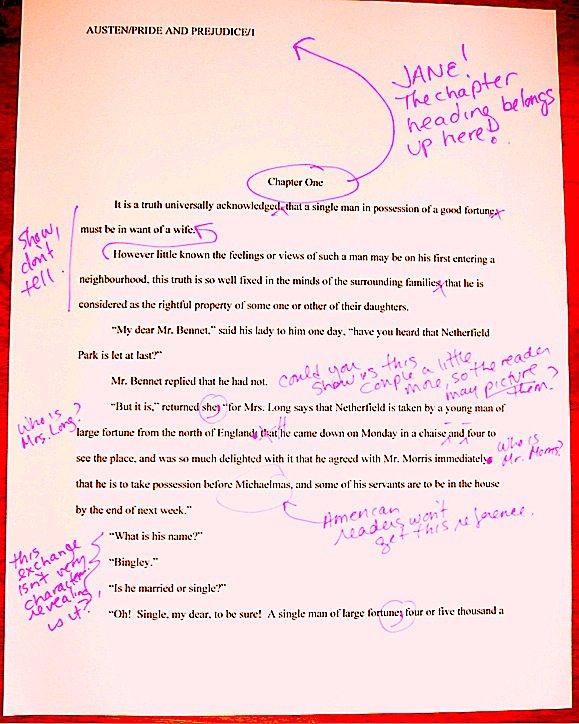
Formatpalooza, part XV: contested territory in this season of concord, or, the surprisingly contentious issue of chapter title placement

peace y'all and angels

I begin today’s post in this season of concord with a commentary on disunity: “In all matters of opinion,” Mark Twain told us many, many years ago, “our adversaries are insane.”

Nowhere in modern life is this axiom more apt than in the vicious battleground that is airline seating. In recent years, most airlines have opted to make the space between rows of passengers smaller; in order to cram more seats per plane, many have also quietly made the window seats and even the seatbelts on window seats slightly smaller as well. (Try comparing sometime with the belt in the middle seat.)

The result for anyone who, like your humble correspondent, enjoys glancing out a window from time to time, is a seat tray rammed directly into one’s solar plexus if one happens to be trying to, say, use a laptop in flight. And that’s if the window-lover in the row ahead of me decides not to recline his seat.

On the last airline flight during which I tried to compose a blog in mid-air, the last condition did not, alas, apply. A honeymoon couple — he awash in some pepper-based cologne, she beamingly bouncing her ring upon every row she passed, so all might see it glimmer in the light — evidently mistook their seats for two single beds. Not only were their activities in them not, as my grandmother would have said, appropriate for every audience, but they seemed disappointed — nay, convinced — that their seats would not recline into a completely flat position, presumably so they could (ahem) elevate their performance art piece to the next level.

After the first time the lady in question caused my laptop to emit a loud crack of protest, I politely explained through the crack in the seats (now about five inches from my face) that the nearness of the rows rendered their desired level of reclining impossible. Even if I had not needed to be working on my computer throughout the flight — an absolute necessity, I assured them, due to the standard formatting educational needs of all of you fine people waiting who were at that very moment waiting impatiently for me to land — the only way I could possibly accommodate the angle they desired would involve my balancing my in-flight meal on the bride’s forehead as it hovered a few inches above my lap.

Apart from the meal part, the honeymoon couple thought that would be just fine. How nice of me to suggest it.

The hard-argued subsequent compromise involved my turning sideways, twisting one of my legs underneath me while resting, if it could be called that, my back against the window-side armrest. If I gingerly balanced my laptop on the tray table of the seat to my left, I could barely manage to type. My left hip and elbow swiftly fell asleep, and the position required my staring fixedly at the profile of the guy in 23C (whose wife, you will be astonished to hear, apparently doesn’t understand him), but that was a small price to pay for the approximately 19 degree incline my gymnastics permitted the honeymooners.

At least for the first twenty minutes or so. After that, they kept trying to recline their seats farther. Apparently, I was being unreasonable to expect enough personal space to keep my laptop open the 90 degrees recommended by the manufacturer for optimal screen visibility. I can now tell you from personal experience that while it’s still possible to read the screen down to roughly 49 degrees, the lower the lid, the less accurate the typing.

Also, the lower the lid, the more one is tempted to draw conclusions about the fundamental difference between content producers and content consumers. To the recliners, the notion that I would so need to express myself on any subject that it could not wait until after we had landed was, I gathered, completely incomprehensible.

Oh, wasn’t I done yet? They’d like to lean back and enjoy themselves properly.

As much as I would like to blame the honeymooners’ frankly not-very-neighborly attitude upon either a poor set of upbringings (raised by airline-phobic wolves, perhaps?) or some bizarre wedding-induced solipsism that made them sincerely believe that no other human happiness was important compared to theirs, I suspect something very simple was happening here: all three of us were basing our expectations of personal space not upon the current lay-out of the airplane, but our sense memories of what air travel had been in the past.

My body remembers fondly being able to operate a laptop in comfort on an airplane, and not all that long ago. And I can only assume that somewhere deep in the honeymooners’ musculature, their forms remembered equally well being able to flop backward with impunity, without violating anyone else’s space bubble.

Either that, or they were appallingly brought up. Either way, nobody was happy with the outcome.

A similar failure to communicate often characterizes the initial interactions between an aspiring writer and those he hopes will help his work get into print: agents, editors, contest judges, freelance editors, and of course, our old pal, Millicent the agency screener. From the new writer’s point of view, many of the hoops through which she’s expected to jump seem arbitrary, if not actively hostile to his progress. Yet from the other side of the divide, it’s practically incomprehensible that any serious writer would not be aware of prevailing standards.

Each side, in short, typically expects something different from the other than what the other believes he is expected to provide. If the communication gap is severe enough, each may even begin to suspect the other of violating expectations on purpose, just to be annoying.

But that’s very seldom the case, on either end. The expectations are simply different, as often as not because each side has in mind some mythical period when perfect communication was the norm, rather than the exception. Millicent sighs for the mythical days when the truly gifted tumbled out of the womb with a complete understanding of both standard format and changing market conditions; the aspiring writer longs for the fantastic era when every submission was read in its entirety, every time, and editors took the time to work with promising new authors on every promising sentence.

Both sides are perfectly at liberty to sigh nostalgically, of course. But the fact is, none of these conditions ever prevailed on a large scale.

Oh, well-advertised submission standards used to render looking professional a trifle easier, admittedly; back when the slush pile still existed at major publishers, a new author could occasionally leap-frog over a few levels of testing. And undoubtedly, editors formerly had more time to work with writers. Things change. But contrary to what many an aspiring writer would like to think, there’s never been a point in publishing history when mainstream publishers were purely non-profit enterprises, devoted solely to bringing new voices to the admiring masses, nor have the bulk of submissions ever been completely professional and market-oriented.

Those seats never reclined as fully as you remember them doing, either. Those tray tables have never been particularly spacious. And those minuscule bags of nuts and/or pretzels? Always chintzy.

All of which, I devoutly hope, will place you in the right frame of mind for confronting what seems to be a perennial controversy amongst aspiring writers: whether to place a chapter title (or just “Chapter One”) on the first line of a page or twelve lines below that, on the line just above where the text proper starts.

Don’t laugh, those of you who are new to this particular debate: this one has generated quite a body count over the years. Former comrades in arms, veterans of the writing trenches, have ceased speaking altogether over this issue; even judges within the same literary contest have been known to differ sharply on the subject.

Which is a trifle puzzling to those of us who deal with professional manuscripts for a living, frankly, because there actually isn’t a debate on our end. Nor do the Millicents gather over steaming lattes to debate the niceties of labeling a chapter. One way looks right to us for a book manuscript, period: the first page of a chapter should be formatted precisely the same way as the first page of a manuscript.

What does that mean in practice? Glad you asked.

The chapter title belongs at the top of the page (centered) if the manuscript is a book; as with the first page of a manuscript, the title appears at the top, with the text beginning twelve lines below. In a short story or article, by contrast, the title belongs twelve lines from the top of the page, on the double-spaced line above the text.

So yes, the spacing honestly does matter to the pros. As always, it’s to an aspiring writer’s advantage to use the format appropriate to the type of writing, if only because it will look right to the Millicent screening it.

The answer really is as simple as that. Why, then, the rampant confusion? And why, given that the difference is a relatively small one not necessarily reflective of the quality of the writing involved, might a professional reader like Millicent or Mehitabel the contest judge particularly care if a talented aspiring writer chose the wrong version?

As is my wont, I shall let you see for yourselves. To place the two vitriol-stained possibilities before you in all of their lush magnificence, the question here is should the first page of a book chapter look like this:

P&P opener right

Or like this:

P&P opener wrong

Quite a visceral difference, no? The first version is in standard format for a book manuscript; the second is for a short story or article. Although, as we have discussed earlier in this series, the first page of a short story, it would also include contact information for the author. Which means, in essence, that aspiring book writers who place the chapter heading immediately above the text are formatting it incorrectly for either a manuscript or a short story.

But let’s set that aside for the moment. The fact is, every week, Millicent sees huge numbers of submissions with chapter headings like the second example — and that makes her sigh. “Do they do this on purpose?” she mutters. “Just to annoy me?”

Seem like an overreaction? Not really: Millicents, the agents who employ them, and contest judges see far, far more examples of version #2 than #1 in book submissions. Many, many times more. So much so that — prepare to rejoice, because I haven’t said this very often throughout this series — although an agent would almost certainly make you move a low chapter title aloft, at this point in publishing history, you could probably get away with either chapter heading in a book submission.

If, of course, you didn’t care about making Millicent sigh.

I hasten to add, though, that I would be reluctant to buy into the astonishingly pervasive theory that if masses and masses of people do something, it automatically becomes correct. No matter how many times all of us see apostrophe + s used to make a noun plural, it’s just not proper — unless, of course, we’re talking about the Oakland A’s, where the erroneous apostrophe is actually part of the proper name.

Ditto with manuscript submissions: as anyone who screens manuscripts for a living would tell you (probably accompanied by a gigantic sigh), a much higher percentage of them are incorrectly formatted than presented properly. But that doesn’t make improper formatting right, does it? Nor does it render it reasonable to expect that Millicent will be pleased to see a chapter title lolling about just above the text.

As everyone’s mother was wont to say (at least on the West Coast), if everybody else jumped off the Golden Gate Bridge, would you, too?

I was delighted to discover when I moved to the East Coast for college that the moms out there were prone to asking the same question with reference to the Empire State Building. There must be something about that particular period of architecture (the GGB was built in 1933-37, the ESB in 1930-31) that promotes suicidal ideation.

Speaking of body counts. Back to the matter at hand.

The weird thing about this particular formatting oddity — I’m back to talking about chapter titles now, not suicide attempts, in case you found that last segue a mite confusing — is how often the incorrect version appears in otherwise perfectly presented manuscripts. That fact sets Millicent’s little head in a spin. As, I must admit, it does mine, as well as the brainpan of virtually every other professional reader I know.

Why is it so very puzzling to us, you ask? Because at least in my case — and I don’t think I’m revealing a trade secret here — although I have literally never seen an agent submit a manuscript to a publishing house with format #2, I’m constantly meeting aspiring writers who insist that writing teachers and even contest judges have told them that #2 is the only acceptable version. That’s just weird to me, as I have never even heard of an agent, editor, or anyone else in the publishing industry’s asking for a chapter heading to be moved from the top of the page to just above the text. Although as I said, I do know agents who routinely ask for the shift in the other direction; mine, to name but one.

And believe me, I’ve heard some pretty strange requests from agents and editors in my time; I’m not easily shocked anymore. At this point in publishing history, to hear a professional reader insist upon placing the chapter heading where you have to skip down a third of a page to read it would have me reaching for my smelling salts.

(Do they even make smelling salts anymore? And if everyone else jumped off the Golden Gate Bridge clutching them, would I?)

Clearly, somebody out there is preaching the place-it-just-above-the-text gospel, because agents, editors, and contest judges are simply inundated with examples of this formatting anomaly. We see bushels of ‘em. Hordes of aspiring writers are absolutely convinced that the sky will fall in if that chapter heading is located anywhere but immediately above the text. Sometimes, when those die-hard advocates become contest judges, they even dock correctly-formatted first pages for having the title in the right place.

In fact, many aspiring writers are so convinced of the rightness of the drooping title heading that it’s not all that uncommon for an editor to find that after she has left a couple of subtle hints like this that the writer should change the formatting…

…the subsequent drafts remain unchanged. The writer will have simply ignored the advice.

(A word to the wise: editors universally hate it when their advice is ignored. So do agents. Contest judges probably wouldn’t be all that fond of it, either, but blind submissions mean that in order to get dunned for brushing off a judge’s feedback, a writer would have to submit the same chapter two years running to the same contest, have the entry land in the same judge’s pile — in itself rather rare — and the judge would have to remember having given that feedback. Oh, and for the entrant to hear about it, the contest would have to be one of the few that gives editorial feedback.)

The up v. down debate may seem like a rather silly controversy — after all, in the cosmic scheme of things, why should it matter if the white space is above or below the title? — but sheer repetition and writerly tenacity in clinging to version #2 have turned it from a difference of opinion into a vitriol-stained professional reader pet peeve.

See earlier comment about how we tend to react to our advice being ignored; it’s seldom pretty.

Which, unfortunately, tends to mean that in discussions of the issue at conferences degenerate into writing-teacher-says-X, editor-at-Random-House-says-Y: lots of passion demonstrated, but very little rationale produced, beyond each side’s insisting that the other’s way just looks wrong.

However, there is a pretty good reason that moving the chapter heading information to just above the text looks wrong to someone who edits book manuscripts for a living: short stories’ first pages are supposedto look quite, quite different from those belonging to book manuscripts or proposals. Take a gander:

As you may see, for a short story like this one, there’s a mighty fine reason to list the title just above the text: a heck of a lot of information has to come first on the page, because short stories, unlike book manuscripts, are not submitted with a title page.

But that would not be proper in a book-length manuscript, would it? Let’s see what Noël’s editor might have said upon viewing this as the first page of a book:

Ouch. (That last bit would have been funnier if the entire page were readable, by the way, but my camera batteries were running low. Sorry about that.) Yet you must admit that at some level, the editor’s ire would have been justified: as Millicent and that angry mob of pitchfork-wielding ignored editors would be only too happy to tell you, short stories don’t HAVE chapters, so who on earth are they to be telling those of us in the book world how to format our manuscripts?

So I say it again: for a book manuscript, stick with version #1.

Which is not to say, of course, that this particular small deviation will automatically and invariably result in instantaneous rejection. It won’t, even in the latté-stained hands of the most format-sensitive Millicent. (See, she spilled coffee on her hands after she took a sip while it was still too hot — and if you didn’t get that joke, you probably haven’t been reading this blog for very long.) If a submission is beautifully written and technically correct in every other respect, she might only shake her head over the location of the chapter heading, making a mental note to tell you to change it between when her boss, the agent, signs the writer and when they will be submitting the manuscript to editors at publishing houses.

But if you don’t mind my saying so, that’s a mighty hefty set of ifs.

While I’m on the topic of common submitters’ misconceptions, this would probably be a good time to illustrate another ubiquitous agent and editor pet peeve, the bound manuscript — and you’re going to want to pay very close attention to this one, as it is almost universally an automatic-rejection offense.

Manuscript submissions, and I don’t care who hears me say it, should not be bound in any way. Ditto with book proposals. There’s an exceedingly simple reason for this: binding renders it impossible (or at least a major pain in the fingertips) to pull out a chapter, stuff it in one’s bag, and read it on the subway.

Hey, paper is heavy. Would you want to lug home ten manuscripts every night on the off chance you’ll read them? (And now that you’re pondering that one, are you still surprised at how many agents now routinely screen submissions on their Kindles?)

As with other ploys to make a manuscript appear identical to a published book, binding the loose pages of a manuscript for submission will not win you friends in the publishing world. Not only does this not look right (I spared you the chanting this time), but it seems so wrong that Millicent will be positively flabbergasted to see a submitter to do it.

She might, for instance, forget that her latte is still too hot to drink, take a sip, and scald her tongue. It’s been known to happen.

Seriously, the unbound manuscript is one of those rules so engrained in the professional reader’s mind that it seldom even occurs to authors, agents, or editors to mention it as a no-no at writers’ conferences. Heck, I’m not sure that I’ve mentioned it once within the first two years I was writing this blog — and by anyone’s standards, I’m unusually communicative about how manuscripts should be presented.

Talk about it all day, I will.

So I’m going to repeat myself, because you’re not going to hear this very often: by definition, book manuscripts should NEVER be bound in any way. Not staples, not spiral binding, not perfect binding. If you take nothing else away from this series, binding-lovers, I implore you to remember this.

Why am I making you swear to follow my advice this time around? Well, in practice, I’m sorry to report, a bound manuscript will seldom survive long enough in the screening process for the chapter-separation dilemma to arise, because — and it pains me to be the one to break this to those of you who’ve been submitting bound manuscripts, but if I don’t tell you, who will? — those pretty covers tend never to be opened at all.

Did you just exclaim, “Ye gods, WHY?” again? I can’t say as I blame you, but try for a moment to envision what a bound manuscript might look like from Millicent’s perspective.

To ramp up your stress levels to the proper level to understand her, envision a desk simply smothered with an immense pile of submissions to screen before going home for the day. Envision further that it’s already 6:30 PM, and eyeballs already dry as dust from a long, hard day of rejecting query letters.

Just lost your sympathy, didn’t she? Try, try again to place yourself in her desk chair.

Picturing that immense pile of envelopes clearly again? Okay, now slit open an envelope that reads REQUESTED MATERIALS on the outside. (You do know that you should always scrawl that in two-inch letters in the lower left-hand corner of a submission envelope, don’t you, so your requested materials don’t get buried in the slush pile?)

If you’re Millicent — and right now, you are, singed tongue and all — you fully expect to see something like this lurking between the cover letter and the SASE tucked underneath:

P&P title right

But in the case of the bound manuscript, you would instead encounter something like this:

Kind of hard to miss the difference, isn’t it? Unfortunately, 999 times out of 1000, the next sound a bystander would hear would be all of that nice, expensive binding grating against the inside of the SASE, just before Millicent tucks a photocopied form rejection letter on top of it.

Honestly, it’s not that she is too lazy to flip open the cover; she just doesn’t see why she should. Clearly, this submitter has not done his homework.

That last phrase should sound familiar to those of you who have been following this autumn’s run of ‘Paloozas: it’s a standard euphemism for this writer would be difficult to work with, because he hasn’t bothered to learn what professional expectations for manuscripts/query letters/synopses/author bios are. Sigh…

This logic may not seen particularly open-minded, from a writerly perspective, but it’s a fairly common argument throughout the industry: if this binding-happy submitter does not know this very basic rule of manuscripts, how likely is he to know the rules of standard format? And if he does not know either, how likely is he to be producing polished prose? If he hasn’t taken the time to polish his prose, is this manuscript really finished?

And if it isn’t finished, why should I (you’re still Millicent, remember?) bother to invest my time in reading it before it is? (Again: sigh.)

I know, I know — this might not be a fair assessment in any individual case. Despite my best efforts over the last few years, there are plenty of good writers out there who happen to be clueless about the rules of standard format.

But even if they all jump off the Golden Gate Bridge, you shouldn’t.

This is yet another expectation-differential problem. From Millicent’s perspective, the fact that good writers aren’t necessarily born aware of the norms of the industry matters less than we writers would like — because, as unpleasant as it is for aspiring writers to realize, her agency is going to see enough technically perfect submissions this week to afford to be able to leap to unwarranted conclusions about this one.

The moral: don’t waste your money on binding.

Seem arbitrary? From a professional reader’s point of view, it isn’t — the enforcement of standard formatting isn’t actually any more complicated than the simple axiom that any game has rules, and you will play better if you take the time to learn them.

Think about it: if you saw a batter smack a baseball, then dash for third base instead of first on his way around the diamond, would you expect his home run to count? Would an archer who hit the bulls-eye in her neighbor’s target instead of her own win the grand prize? If you refused to pay the rent on Park Place because you didn’t like the color on the board, would you win the Monopoly game?

I can go on like this for days, you know. Please, I beg you, say that you are getting the parallels, so I may move on.

Submitting art to the marketplace has rules, too, and while your fourth-grade teacher probably did not impart them to you (as, if I ran the universe, s/he would have), you’re still going to be a whole lot better at playing the game if you embrace those rules, rather than fight them.

You’ll also, in the long run, enjoy playing the game more. It may not seem that way the first time one is struggling to change an already-written manuscript into standard format, but trust me, it will be much more fun when you finish your next manuscript and realize that there’s nothing that needs to be changed.

Let all of those other folks jump off the Golden Gate Bridge without you, I say. Remember, you’re playing this game by choice: you could, after all, make your own rules and publish your book yourself. If you want to play with the big kids, you’re going to need to abide by their rules.

At least at the submission stage.

Until you know the expectations of the lovely folks seated in the row behind you, don’t assume you can recline all the way back into their laps. Everyone on the plane is trying to get to the same place, after all. By following the rules, you can make it a more enjoyable trip for all concerned.

Next time, I shall tackle a less-common but still virulent misconception. Keep up the good work!
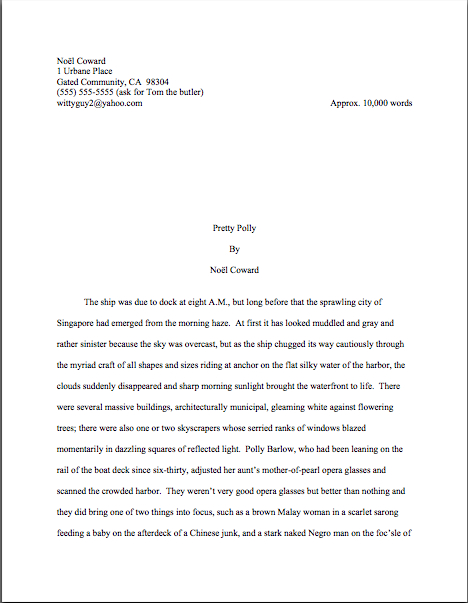
Formatpalooza, part XI: setting some boundaries, or, wait, Millicent — why have you stopped reading?

Carcassone outer wall

Have you been enjoying our in-depth guided tour of the manuscript from the top down? Not gone tumbling down any parapets, have we>

No, that’s not just some clumsy publishing-world metaphor. So far, we’ve talked about the piece of paper on top of the submission stack, the title page; we’ve talked about the next sheet of paper, the first page of text and how it differs from both the title page and the pages that come after it; we’ve extrapolated from that first page to standards for the first page of each chapter and any titled section breaks.

Now, it’s time to talk about all of those pages in the middle Perhaps, while we’re at it, we could engage in some more of those nifty compare-and-contrast exercises we engaged in so fruitfully last time.

Hard to contain your enthusiasm within reasonable boundaries, isn’t it?

Okay, so it’s not a particularly sexy topic, but it’s a really, really good idea for an aspiring writer to devote some serious time to comparing properly and improperly formatted manuscripts. Writing time is precious for all of us — and scarce for most of us — and school compare-and-contrast exercises left most graduates with but think of it as an investment in your writing career: once you’re learned to spot formatting problems easily, you’ll be a much, much more effective proofreader. Not to mention being able to format your manuscripts correctly from the get-go.

Oh, that doesn’t sound like much of a door prize to you? Just wait until you’re trying madly to pull a submission packet together overnight in response to a request for materials, or frantically constructing a contest entry four hours before it needs to be postmarked. Or, even more stressfully marvelous, responding to a last-minute revision request from the editor who had originally told you that manuscript had been accepted as complete.

Believe me, when any of those stressful-but-happy days come, you’ll be very grateful then for every nanosecond that you don’t have to squander on wondering if your margins are consistent.

Because they had better be: believe me, our old pal, Millicent the agency screener, is very quick to discern the difference between a professionally-formatted manuscript and, well, everything else. At the end of a long day’s reading, they definitely jump out at her, and with good reason: once a professional reader gets used to seeing the similarities that pretty much all professional manuscripts share, submissions formatted in other ways might as well have UNPROFESSIONAL stamped on them in bright red ink.

And while Millicent, bless her literature-loving soul. may strive valiantly not to allow that impression to color her reading of the submission itself, it’s just not a good idea to assume that it won’t. She’s only human, after all.

It’s an even worse idea to assume a charitable reading for a contest entry, by the way. If anything, contest judges tend to be even more sensitive to the beauty of standard format than Millicent, for the simple reason that they’ve usually been reading a whole lot longer. The agency gig may well be Millie’s first job out of college, but the judge handed your entry may well have just retired from a long and fruitful career teaching English composition.

I don’t want to frighten any of you out of entering literary contests, but her fingers positively ache for the red pen of correction.

This is not entirely accidental — most well-respected contests require some professional credentials from their judges, either as writers, editors, or teachers. Which means, in practice, that judges have often been writing in standard format themselves for years or bludgeoning other writers into compliance with its requirements.

Translation: non-standard formatting won’t look right to them, either. By now, you’re having a similar reaction, aren’t you?

Don’t think you’ve been developing professional eyes throughout this autumn of ‘Paloozas? Or don’t want to believe you could conceivably share any traits with Millicent? Let’s test the proposition by trying a little Aphra Behn on for size.

If you don’t know her work, you should, at least historically: as far as we know, she was the first woman paid for writing in English — which, as Virginia Woolf pointed out, means that every female writer who earns so much as a sou from it now should be laying wreaths on her grave in gratitude.

Our girl Aphra’s also hilarious — and if you think it’s easy for a joke written in 1688 to remain funny today, well, I look forward to reading your comedic stylings in the year 2332.

Don’t believe me? Slip your tootsies into Millicent’s moccasins and consider the following page from THE FAIR JILT. (As always, if you’re having trouble reading the small writing, enlarge the image by holding down the COMMAND key and pressing +.) I defy you not to be too distracted by the story to notice how the page is put together.

Seriously, try not to think at all about the fact that Millicent probably would not even start to read this version. Don’t worry your pretty little head over why.

the fair jilt wrong

You clever souls could tell instantly that there was something wrong here, couldn’t you, and not just because Miranda’s trying to seduce her priest? (For convent, read monastery.) Set aside Aphra’s practically Dickensian affection for semicolons for the moment — which would tend to turn off a modern Millicent pretty quickly — and let’s ponder why this page almost certainly would not get a fair reading in a present-day agency.

Before you commit yourself irrevocably, here’s what it should have looked like in standard format:

Aphra Behn right

Quick, tell me: what’s the reason our Millie would not bother to start reading the first page 10, but would read the second?

If you flung your hand into the air and shouted, “The 10-point type, Anne! It will strain her already overworked eyes,” pat yourself on the back 47 times. If you also added, “And the Ariel typeface probably didn’t help here, either,” make that 48.

Why is the first in particular almost always a deal-breaker? She’s used to seeing every manuscript heading out of the agency to publishing houses in 12-point Times New Roman, so that first example — feel free to chant it with me here, ‘Palooza followers — it just doesn’t look right.

And why should she waste her time with that tiny type? She absolutely could not forward it to her boss that way; agents are susceptible to eye strain, too.

But those unfortunate cosmetic choices are not the only problems with the first version, are they? Let’s turn our magnifying glasses to the top of the page: the incorrect version does not have a proper slug line. Seeing this lone page out of context, it’s quite obvious why a slug line is a dandy idea, isn’t it? Without it, how would it be even remotely possible to return this wandering page back into the manuscript from whence it came.

“Who wrote this?” Millicent cries in ire, glaring around her cubicle at the 47 manuscripts lying there. “This stray piece of paper could be from any of these!”

At least Ms. Behn thought to number the pages of Example #1 — but did you catch the problem with how she did it? The page number is in the bottom right-hand margin, rather than in the slug line, where it belongs. And it’s so far down in the footer that the number got caught off halfway during printing.

Did you catch any other problems that might register on Millicent’s umbrage meter? What about that right margin? Mighty straight, isn’t it? That look proper to you?

What’s going on here is called block-justification, another problem that can be laid squarely at the feet of those who insist that a manuscript and a published book should be identical. The text in many published books, and certainly in many magazines and newspapers, is spaced so that each line begins at exactly the same distance from the left-hand edge of the page and ends (unless it’s the last line of a paragraph) at exactly the same distance from the right-hand edge of the page.

Why would this species of neatness bug the heck out of professional readers? A very practical reason indeed: it renders skimming quite a bit more difficult.

Why? Well, block formatting provides fewer landmarks, as it were, to the glancing eye, As you may see for yourself, Practically every line of narrative text resembles every other. To those of us used to the ragged right margins and even letter spacing of standard format, it’s actually kind of hard to read.

So there’s quite a bit in Example #1 that’s distracting from the actual writing, isn’t there? Doesn’t help sell the text, does it?

Okay, all of these rhetorical questions in a row are beginning to make me dizzy, so let’s move on to Example #2, the one Millicent and a contest judge would like. To save your weary fingertips a modicum of scrolling (hey, I do what I can), here it is again:

Aphra Behn right

Now, let’s take a gander at the same page in — ugh — business format; if you don’t know why it’s ugh-worthy, you might want to revisit my earlier post on the immense value of indentation.

Startlingly different, isn’t it, considering that I made a grand total of two formatting changes?

You did catch both of them on your skim through, right? All I did was I eliminate the indentations at the beginning of each paragraph and skipped a line between paragraphs to produce the norm for business correspondence, as well as for most of the text currently posted on the Internet. (Including this blog, unfortunately. As a professional writer and reader of manuscripts, it drives me nuts that my blogging program won’t allow me to indent paragraphs like a literate human being.)

Again, why is Millicent unlikely even to start reading that last rendition of page 10? Because — wait for it — it just doesn’t look right.

In fact, in both submissions and contest entries, business format is often grounds all by itself for knocking a manuscript out of finalist consideration. Finding yourself asking why again? Well, technically, indented paragraphs are grammatically requisite, so to a judge, non-indented paragraphs may well seem as great a violation of everything we hold dear as frequent misspellings or use of the wrong form of there, their, and they’re.

(Since not all of you laughed, allow me to beg you nervously: please tell me that some English teacher took the time to teach you the rules governing there, their, and they’re. We all see them used incorrectly so often nowadays that I shall not rest easy until I am positive that each and every one of you is aware that there refers to a place, their means belonging to them, and they’re is a contraction for they are. While I’m at it, I’d also like to point out that that it’s is a contraction for it is, whereas its means belonging to it. Thank you for humoring me; time to get back to the post already in progress.)

Fortunately for judges and Millicents who care deeply about the health of the language, errors seldom come singly in entries and submissions. Like spelling errors, formatting mistakes are apparently social: they like to travel in packs, roving all over a manuscript like Visigoths sacking Rome.

As a result of this convenient submission phenomenon, a manuscript that contains errors within the first few lines (or on the first page) is easy for a professional reader to dismiss; statistically speaking, it’s a pretty good bet that if Millicent kept reading the pages following a technically flawed opening, she would find more causes for umbrage.

Given how many submissions she has to screen between now and lunch, do you think she is going to (a) press on in the hope that the first error was a fluke, or (b) leap to the (perhaps unwarranted) assumption that there is more of the same to come and reject it right away?

I leave that one to your fine critical faculties to answer. Let’s just say that her umbrage-taking threshold tends to be on the low side, especially immediately after she has taken a sip from that too-hot latte that always seems to be by her side when we are watching her in action. (Let it cool next time, okay, Millie?)

Why am I bringing this up in the middle of a discussion of the perils of business format? Well, for starters, an ever-increasing number of agents are not only accepting e-mailed queries (a genuine rarity until quite recently), including some who ask queriers to include the opening pages, a synopsis, and/or other writing samples with their queries. Since few agents open attachments from writers with whom they’ve had no previous contact, many request that those opening pages be included in the body of the e-mail, pasted just below the letter.

Sense a potential problem barreling in our general direction? That’s right: most e-mail programs are not set up for easy tabbing; consequently, business format is the norm for e-mail communications. But that doesn’t mean that the Millicent assigned to screen those queries won’t turn up her nose at non-indented paragraphs in those pages.

Again, why? Are you sitting down, dislikers of indentation?

I hate to be the one to break this to you, but there are Millicents out there — and agents, editors, contest judges, and literate people everywhere — who will leap directly from noting a lack of indentation and unwarranted spaces between paragraphs to our old friend, option (b): if the submitter is not aware of how to format a paragraph of English prose properly, she reasons, aren’t there inevitably more snafus to come?

Now, not every Millicent — or agent, judge, etc. — will have this knee-jerk reaction, of course. But do you really want to take the chance that she’s not going to seize the opportunity to save herself a little time?

The specter of illiteracy is not the only reason using business format is likely to cost you, either. To a professional reader, the differences between the last two examples would be more than visually jarring — they’d be downright confusing. In standard format, the only reason for a skipped line between paragraphs would be a section break, so Millicent would be expecting the second paragraph to be about something new.

Okay, so a misconception like that might distract her attention for only few consecutive seconds, but let’s not kid ourselves: your garden-variety Millicent is spending less than a minute on most of the submissions she rejects — it’s actually not all that uncommon for her not to make into the second or third paragraph before reaching for the SASE and a copy of that annoying form rejection letter.

Take a moment for the implications to sink fully into your overtaxed brainpan. Don’t worry; I’ll wait.

While those of you new to the speed with which rejection typically occurs are already in shock, let me add for the sake of anyone who doesn’t already know: those who regard business format as a symptom of creeping illiteracy — hey, I just report the news; I don’t dictate it — are every bit as likely to frown upon it just as much in a query letter or synopsis as in a manuscript submission.

Time loss is not the only reason she might take umbrage at momentary confusion. Let me let you in on a little secret: professional readers, especially those who inhabit agencies and publishing houses, tend not to be overly fond of having their mental image of the story they are reading at the moment jarred.

How do I know this? Well, for one thing, they commonly refer to it as being tricked. As in, “I hate being tricked by a first paragraph that is about someone other than the protagonist.”

There’s a practical basis to this dislike, but it’s kind of complicated. I wrote a couple of fairly extensive posts on the subject a while back (here’s a link to the first, and here’s a link to the second, in case you’re interested), but I’ll run over the thumbnail version now.

Is everybody comfortably seated? My thumbnails are a tad long. (Just try to get THAT image out of your head anytime soon.)

To get through all of the submissions she’s assigned to screen each week, Millicent has to read quite quickly, right? If she doesn’t, she’ll get buried in paper, as basically, she’s got to make it through WAR AND PEACE several times over before she toddles wearily homeward on Friday afternoon.

That’s a whole lot of material to remember, by anyone’s standards — and remembering actually is important here. If she decides to allow a manuscript to make it to the next level of consideration, she is going to need to be able to tell her boss what the book is about: who the protagonist is, what the conflict is, why that conflict is important enough to the protagonist for the reader to be drawn into it, and so forth.

In essence, she’s going to need to be able to pitch it to the higher-ups at the agency, just as the agent is going to have to do in order to sell the book to an editor, and an editor is going to have to do in order to convince his higher-ups that the publishing house should acquire the book.

And, often, as first-round contest judges will need to do on an evaluation form in order to pass an entry onto the next round.

Okay, brace yourself, because explaining what comes next involves delving into one of the great cosmic mysteries that has long perplexed aspiring writers the world over. It’s not for the faint of heart.

Remember earlier in thus series, when I mentioned that agents and editors don’t read like other people? Well, one of the primary differences is that from line one of page one, they’re already imagining how they’re going to pitch this book. So if paragraph 2 or 3 (or page 2 or 3) suddenly informs them that their mental patter has been about the wrong character, they feel as if they’ve been backing the wrong horse.

And while there may have been any number of perfectly reasonable narrative reasons for the text to concentrate upon an alternate character for the opening, unless the writing and the story have already really wowed Millicent, her resentment about being tricked actively misled mistaken about the identity of the protagonist is often sufficient to make her reach for that SASE and form letter.

Feel free to go scream into the nearest pillow over that last piece of convoluted logic; you don’t want to keep that kind of existential cri de coeur pent up inside. I’ll wait until it’s out of your system.

Feel better? Good.

Before you go rushing off to see if your opening paragraphs might possibly be laying you open to a charge of trickery — because, for instance, you might have taken the bold authorial step of noticing that there is more than one human being in the world, and written about an interpersonal relationship accordingly — let’s return to the formatting issue that prompted my little segue into the psychology of resentment. Can we extrapolate any practical lesson about business format from it?

You bet your boots we can: it’s not a good idea to give the impression of a section break where there isn’t one. And when producing pages for people who read all day, you might want to stick to the rules governing written English and indent your paragraphs.

Starting to feel more at home with standard format? Excellent; my evil plan plot for world domination teaching strategy is working. Keep up the good work!
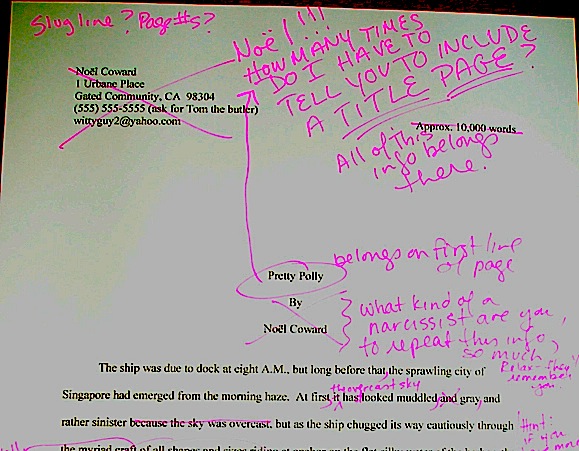
Formatpalooza, part VIII: but I see it done constantly in published books!

Seattle mossgin and tonic
oxidized polebeach rock2

As those of you who have been perusing the sage advice underneath the pictures here at Author! Author! for some time may have noticed, I’m a big fan of artists’ looking at ordinary, everyday things and showing us the beauty inherent in them. The coy models in the shots above could not have been more prosaic if they had tried: clockwise from top left, that’s perfectly ordinary moss on a perfectly ordinary concrete wall, photographed during a perfectly ordinary Seattle rainstorm, a genuinely mundane gin-and-tonic (commonplace Bombay Sapphire, instead of my preferred Hendrick’s), a salt-of-the-earth beach rock nice enough to hold still and pose for me, and a regular old municipal light pole attacked by regular old municipal rust.

And while I was clicking away to capture that first shot, a perfectly run-of-the-mill artist-meets-dubious-public moment: while crunching my body sideways in order to get that first shot, a Central Casting mother told her standard-issue wee daughter to veer away from the you-meet-‘em-every-day crazy lady. Yet another case of a misunderstood artist — and another a child being warned that if she tries to look at something from an unusual perspective, people are bound to think she’s strange.

And that, my friends, is how budding artists are discouraged from potentially glorious careers: being told that normalcy requires seeing things just like everybody else does.

Perhaps not astonishingly, writers tend to find beauty in found words. An overhead scrap of conversation, perhaps, or a favorite phrase in a book. And often — far too often, from Millicent the agency screener’s perspective — aspiring writers celebrate these words lifted from other places by quoting them at the beginning of their manuscripts.

That’s right, campers: today, I’m going to be talking about proper formatting for that extremely popular opening-of-text decoration, the epigraph. You know, those nifty little quotes from other sources that we writers adore enough to want to reproduce in our own books.

And who can blame us? It’s not as though the publishing industry doesn’t encourage us to think of them this way: in a published book, the epigraph, if any, is almost always presented in a place of honor, either at the top of each chapter or by itself on the page before the text proper starts.

Take, for example, the placement of the well-known epigraph to Alice Walker’s THE COLOR PURPLE, an excerpt from Stevie Wonder’s DO LIKE YOU. Even in my cheap, well-worn paperback edition, it scores a page all to itself, right between the copyright information on the flip side of the title page and the opening of Chapter One.

The color purple's epigraph

Okay, so that picture didn’t really do the words justice; not all of my photos can be winners, you know. Let’s try a tighter shot:

epigraph2

Not only is it allocated space; it’s allocated white space, to set it off from the other text. That is quite an honor, in an age when acknowledgments pages are routinely omitted, along with the second spaces after periods and colons, in order to save paper.

Especially since nobody but writers like epigraphs much — but I’m getting ahead of myself, amn’t I?

We writers-who-read think they’re great, don’t we? Particularly if those pithy little quotes come from obscure sources; they feel so literary. Or deep-in-the-national-psyche, know-your-Everyman populist, if they’re culled from songs. By evoking the echo of another writer’s words, be it an author’s or a songwriter’s, we use them to set the tone for the story to come.

I don’t think conceptual aptness is all there is to the appeal, though. There is something powerfully ritualistic about typing the words of a favorite author at the beginning of our manuscripts; it’s a way that we can not only show that we are literate folk — as opposed to the (ugh!) other kind — but that by writing a book, we are joining some pretty exalted company.

Feeling that way about the little dears, I truly hate to mention this, but here goes: it’s a waste of ink to include them in a manuscript intended for submission to an agency. 99.9998% of the time, they will not be read at all.

Stop glaring at me; it’s not my fault. I don’t stand over Millicent with a bullhorn, admonishing her to treat every syllable of every submission with respect. (Although admittedly, that’s an interesting idea.)

The sad fact is, most Millicents are specifically trained not to read epigraphs in manuscripts; it’s widely considered a waste of time. I’ve literally never met a professional reader who doesn’t simply skip epigraphs in a first read — or (brace yourselves, italics-lovers) any other italicized paragraph or two at the very beginning of a manuscript, even if it was actually part of the text.

Oh, dear — I told you to brace yourselves. “Why on earth,” italics-lovers the world over gasp in aghast unison, “would any literature-loving human do such a thing? Published books open all the time with italicized bits!”

A fair question, but actually, there’s a pretty fair answer. Most Millicents just assume, often not entirely without justification, that if opening is in italics, it doesn’t really have much to do with the story at hand, which (they conclude, not always wrongly) begins with the first line of plain text.

In other words, our Millie treats any slanted text at the beginning of a manuscript as if it were an epigraph. It’s kind of hard to blame her, really: she’s there to read your writing, not somebody else’s.

Of course, there’s another, less ego-flattering reason that Millicents tend to skip ‘em: at the submission stage of the game, no one cares who a writer’s favorite authors are. A writer’s reading habits, while undoubtedly influential in developing her personal voice, are properly the subject of post-publication interviews, not manuscript pre-screening considerations.

After all, it’s not as though Millicent can walk into her boss’ office and say, “Look, I think you should read this submission, rather than that one, because the first’s writer has really terrific literary taste — it opens with a quote from William Godwin’s CALEB WILLIAMS, OR THINGS AS THEY ARE,” can she?

For those of you who didn’t howl with laughter at that little history-of-publishing joke, novelist William Godwin was political theorist and novelist Mary Wollstonecraft’s editor around the time of the French Revolution. They also produced another literary marvel together: Mary Wollstonecraft Shelley, the author of Frankenstein, was their daughter. Isn’t it fun being hyper-literate?

Still not rolling in the aisles, are you? That’s how Millicent feels when confronted with a genuinely esoteric quote at the top of a manuscript.

Whichever reason to skip the darned thing most appeals to the Millicent who happens to have your submission lingering on her desk (right next to that too-hot latte she’s always sipping, no doubt), it’s a safe bet that she’s not going to be reading your carefully-chosen epigraph. She feels pretty good about this choice, too.

Why? Well, the official justification for this practice — yes, there is one to which Millicents will admit in public — is not only reasonable, but even noble-sounding. See if it sounds at all familiar: even the busiest person at an agency or publishing house picks up a submission in order to read its author’s writing, not somebody else’s.

Kind of hard to fault them for feeling that way, isn’t it? Given our druthers, I suspect it would be hard to find an aspiring writer who wouldn’t prefer that the pros notice the individual brilliance of her respective styles than marvel over her esoteric reading habits.

Some of you are still clutching your quote books to your heaving chests, aren’t you? Okay, sentiment aside, let’s look at what including an epigraph in a book achieves on a practical level, as well as its strategic liabilities.

Let’s assume for a moment that you have selected the perfect quotation to open your story. Even better than that, it’s gleaned from an author that readers in your chosen book category already know and respect. By picking that quote, you’re announcing from page 1 — or before page 1, if you allocate it its own page in your manuscript — you’re telling Millicent that not only are you well-read in your book category, but you’re ready and able to take your place amongst its best authors.

Sounds plausible from a writerly perspective, doesn’t it? That’s one hard-working little quote.

But what happens when Millicent first claps eyes on your startlingly apt epigraph? Instead of impressing her with your erudition, the epigraph will to prompt her to start skimming before she gets to the first line of your text — and you will have made her wonder if you realized that manuscript format and book format are not the same.

So you tell me: was including it a good idea? Or the worst marketing notion since New Coke?

If that all that hasn’t convinced you, try this on for size: while individual readers are free to transcribe extracts to their hearts’ contents, the issue of reproducing words published elsewhere is significantly more problematic for a publishing house. While imitation may be the sincerest form of flattery, reproduction of published text without the author’s permission is known in the biz by another, less flattering name: copyright infringement.

What does that mean in practice? Well, if the epigraph is from a book that is not in the public domain, the publisher will need to obtain explicit permission to use any quote longer than fifty words. Ditto for any quote from a song that isn’t in the public domain, even if it is just a line or two.

So effectively, most epigraphs in manuscripts might as well be signposts shouting to an editor: “Here is extra work for you, buddy, if you buy this book! You’re welcome!”

I’m sensing some disgruntlement out there, amn’t I? “But Anne,” I hear some epigraph-huggers cry,
“the material I’m quoting at the opening of the book is absolutely vital! The book simply isn’t comprehensible without it!”

Before I respond, let me ask a follow-up question: do you mean that it is crucial to the reader’s understanding the story, or that you have your heart set on that particular quote’s opening this book when it’s published?

If it’s the latter, including the epigraph in your manuscript is absolutely the wrong way to go about making that dream come true. Like any other book formatting issue, whether to include an epigraph — or acknowledgements, or a dedication — is up to the editor, not the author.

And besides — chant it with me now, ‘Palooza faithful — a manuscript should not look like a published book.

Consequently, the right time to place your desired epigraph under professional eyes is after the publisher has acquired the book, not before. You may well be able to argue successfully for including that magically appropriate quote, if you broach the subject at the right time. Politely.

Just to set my trouble-borrowing mind at ease: you do know better than to include either acknowledgements or a dedication in your manuscripts at submission time, right? It’s for precisely the same reason: whether they’ll end up in the published book is the editor’s call. (I wouldn’t advise getting your hopes up, though: in these paper-conserving days, the answer is usually no on both counts, at least for a first book.)

Quite a few of you were beaming virtuously throughout those last three paragraphs, though, weren’t you? “I know better than to second-guess an editor,” stalwart souls everywhere announce proudly. “I honestly meant what I said: my opening quote is 100% essential to any reader, including Millicent and her cohorts, understanding my work.”

Okay, if you insist, I’ll run through the right and wrong ways to slip an epigraph into a manuscript — but bear in mind that I can’t promise that even the snazziest presentation will cajole Millicent into doing anything but skipping that quote you love so much.

For starters, do not, under any circumstances, include a quote on the title page as an epigraph. Which is, alas, what submitters are most likely to do. Let’s take a gander at what their title pages tend to look like:

Does that leave you wondering whether Millicent will notice the quote at all, much less find it obnoxious? She will, because this is was what she was expecting to see:

Actually, that was sort of a red herring — that page wasn’t precisely what she expected. Did you catch the vital piece of information Eeyore left off his title page?

If you said that he neglected to include the book category on the second example, award yourself a pile of thistles. (Hey, that’s what he would have given you.) His title page should have looked like this:

Eeyore good title

And yes, I am going to keep showing you properly-formatted title pages until you start seeing them in your sleep; why do you ask? Take a moment to compare the third example with the first: the quote in the first example is going to stand out to Millicent like the nail in a certain critter’s tail, isn’t it?

Other submitters choose to eschew the title page route in order to place an epigraph on the first page of text. The result is immensely cluttered, by anyone’s standards — especially if the submitter has made the very common mistake I mentioned in my discussion of title pages last time, omitting the title page altogether and cramming all of its information onto page 1:

Where did all of our lovely white space go? Into quoting Ambrose Bierce, partially.

Not that I’m against anyone doing that, ever. Except — wait for it — on the top of a manuscript submission.

The third popular but ill-advised way to include an introductory epigraph is to place it on a page all by itself in the manuscript, between the title page and the first page of text. In other words, as it might appear in a published book:

What’s wrong with this, other than the fact that Poe died before our boy D.H. wrote Sons and Lovers? At the risk of repeating myself, a manuscript is not supposed to look just like a published book; it has its own proper format.

At best, Millicent is likely to huffily turn past this page unread. At worst, she’s going to think, “Oh, no, not another writer who doesn’t know how to format a manuscript properly. I’ll bet that when I turn to page one, it’s going to be rife with terrible errors.”

Does either outcome sound especially desirable to you? I thought not.

So what should an epigraph-insistent submitter do? Leave it out of the submission, of course — weren’t you listening before?

But if it is absolutely artistically necessary to include it, Mssr. Poe actually wasn’t all that far off: all he really did wrong here was include a slug line. The best way to include an introductory epigraph is on an unnumbered page PRIOR to page 1. On that unnumbered page, it should begin 12 lines down and be centered. But I’m not going to show you an example of that.

Why? Because I really, truly would advise against including an epigraph at all at the submission stage.

Just in case I hadn’t made that clear. And had I mentioned that manuscripts specifically should not resemble published books?

That doesn’t mean you should abandon your cherished epigraph altogether, however. Squirrel all of those marvelous quotes away until after you’ve sold the book — then wow your editor with your erudition and taste.

“My,” the editor will say, “this writer has spent a whole lot of time scribbling down other authors’ words. He must read quite a bit.”

Or, if you can’t wait that long, land an agent first and wow her with your erudition and taste. But don’t be surprised if she strongly advises you to keep those quotation marks to yourself for the time being. After all, she will want the editor of her dreams to be reading your writing, not anyone else’s, right?

Wait — where have I heard that before?

If you are submitting directly to a small press, do be aware that most publishing houses now place the responsibility for obtaining the necessary rights squarely upon the author. If you include epigraphs, editors at these houses will simply assume that you have already obtained permission to use them. Ditto with self-publishing presses.

This expectation covers, incidentally, quotes from song lyrics, regardless of length.

Yes, really. If you want to use a lyric from a song that is not yet in the public domain, it is generally the author’s responsibility to get permission to use it — and while for other writing, a quote of less than 50 consecutive words is considered fair use, ANY excerpt from an owned song usually requires specific permission, at least in North America. Contact the American Society of Composers, Authors, and Publishers (ASCAP) for assistance in making such requests. (For a very funny first-hand view of just what a nightmare this process can be, please see FAAB Joel Derfner’s guest post on the subject.)

Have I talked you out of including an epigraph yet — particularly an excerpt from a copyrighted song, like Alice Walker’s? How about holding off for the creative reason: Millicent sees the same quotes over and over again?

Oh, you were positive that nobody else was a William Godwin fan?

I know that it hurts to cut your favorite quote from your manuscript, but take comfort in the fact that at the submission stage, no cut is permanent. Just because you do not include your beloved quote in your submission does not mean that it cannot be in the published book.

Contrary to what 99% of aspiring writers believe, at the submission stage, even the most polished manuscript is a draft, not a finished work. In actuality, nothing in a manuscript is exempt from alteration until the book is actually printed — and folks in the industry make editing requests accordingly.

That’s going to help all of you sleep better tonight, isn’t it? Actually, it should: just as tight copyright restrictions prevent your favorite authors from having long chunks of their texts excerpted without their permission — or, sacre bleu! entire paragraphs from CALEB WILLIAMS being passed off as somebody else’s work — so will it protect your writing from predatory borrowers.

Just a bit of proverbial food for thought. Keep noticing the beauty in the everyday, everybody, and as always, keep up the good work!

Formatpalooza, part VII: it’s all a matter of perspective, or, let’s move the piano over here. Wait — how would it look over there? And other tales of title page formatting

sagrada familia ceiling3

Ever since I launched on this last ‘Palooza of autumn, I’ve been hearing some discontented murmuring amongst aesthetes out there in the ether. “But Anne,” visually-oriented aspiring writers murmur under their breath, so as not to attract the wrath of their nemesis, Millicent the agency screener, “I feel that the rules of standard format for book manuscripts and proposals — not to be confused with the formatting norms for short stories, magazine articles, screenplays, or any other kind of writing intended for professional submission — are stepping all over my right to creative expression. If I believe my writing looks best in a special font like Abadi MT Condensed Extra Bold, why shouldn’t I run with it? It’s how I want my words to look in the published book, so why shouldn’t I present my manuscript that way?”

Do you want the short answers or the long ones, murmuring aesthetes? The short are actually the same for both questions: because Millicent will take your writing more seriously if you format it as she expects to see it.

And why might that be, devoted ‘Palooza followers? Pull out your hymnals and sing along: a manuscript should not resemble a published book in many important respects. Therefore, formatting a submission to reflect one’s publication preferences on matters like font (which is the publishing house’s decision, anyway, not the author’s) will not appear to be a creative choice, but a reflection of a misunderstanding of how publishing works — and an indication that the writer has not taken the time to learn the rules of submission.

A trifle broad-ranging a conclusion to draw from something as simple as font choice or a title page graced with a photograph? Perhaps, but to someone who deals with manuscripts and/or book proposals all day, every day, it’s not all that far-fetched.

Let me try to put all of this into perspective for you. Quick, tell me: did I take the photograph above while looking down into an abyss, sideways into an alcove, or up at an impossibly high ceiling?

Hard to tell which way is up, isn’t it? (But here’s a hint: the purple stuff is flying dust.) Without some orienting landmarks, it’s difficult even to know for sure what you’re looking at, or from what direction.

That’s more or less the same problem the average aspiring writer faces when looking at her own first manuscript or book proposal with an eye to figuring out whether it is formatted correctly. (Oh, you thought that analogy wasn’t going to pay off right away? Au contraire, mon fr?re.)

Let’s face it, very, very few as-yet-to-be-published writers have ever seen a professional manuscript up close and personal; still fewer have had the opportunity to glance through a professional book proposal. Oh, there’s plenty of advice out there on how it should be done, of course, but as many of you have no doubt noted with chagrin, sources differ.

So how on earth is someone new to the game supposed to figure out which end of the manuscript is up, figuratively speaking? The trick lies in remembering that the principles governing manuscript formatting are practical and historical, not purely aesthetic.

Thus, while two-inch margins and a cursive typeface may strike a writer as the perfect expressive extension of the spirit of his novel, to someone who reads manuscripts for a living, they’re just puzzling. And, frankly, distracting from the writing.

Where you stand, in other words, depends on where you sit. From where Millicent is sitting, deviation from standard format demonstrates a lack of knowledge about how the industry works, not creativity. She has good reason to feel that way: because professional manuscripts and book proposals are formatted in a particular way, she knows that her boss, the agent of your dreams, would have a hard time convincing an editor at a major publishing house to read even the first page of an unprofessional formatted manuscript.

Which brings be back to where we left off last time, right? For the past couple of posts, we’ve been engaging in compare-and-contrast exercises, showing common examples of title pages and fine-tuning your binoculars so you might see how our old friend Millie — or her boss, or an editor, or a contest judge — might view them. As I sincerely hope those of you who read yesterday’s post can attest, it was pretty obvious that the professionally-formatted title page won the beauty contest hands-down — and took top honors in the practicality category, too.

Yes, Virginia, a choice as small as a typeface can make an astonishingly great difference to how professional your work looks to the pros. That comes as something of a surprise to most aspiring writers — who, not entirely surprisingly, tend to regard that particular decision as a purely aesthetic one. “Why,” they ask, and not unreasonably, “should it matter? Good writing’s good writing, isn’t it?”

Well, yes and no. Yes, good writing is a thing of beauty and a joy forever. No, insofar as good writing tends to have less impact on the average Millicent when it’s presented in an unusual typeface.

Yes, really. To see why, let’s once again start at the top of the submission packet, taking a gander at the same title page in three different typefaces. Here it is in 12-point Times New Roman, one of the two preferred typefaces:

Austen title good

That’s what anyone sitting in Millicent’s seat would expect to see. Now let’s look at exactly the same information, assuming that Aunt Jane had favored 12-point Helvetica so strongly that she just couldn’t resist submitting in it:

Austen title helvetica

The letters are quite a bit bigger, don’t they? Not enough so to appear to be, say, 14-point font, but large enough to make Millicent wonder whether the word count is accurate. (Estimated word count does, after all, vary by typeface: Times New Roman is estimated at 250 words/page, Courier at 200. More on that below.)

And do you really want her speculating about your credibility before the first page of your manuscript? Now that we have seated ourselves firmly in Millicent’s office chair, we can see that Aunt Jane’s choice of Helvetica, while not a deal-breaker, does not necessarily present her manuscript to its best advantage.

Does the increased volume of disgruntled ethereal muttering mean some of you want to see a typeface that might be a deal-breaker? Happy to oblige.

Austen title brushscript

Can’t really blame Millicent for not wanting to turn the page on that one, can we? Despite containing all of the information that a title page should include, in the right places and in the right order, it’s unprofessional-looking. Not to mention hard to read.

Got Millicent’s perspective firmly imbedded in your mind? Excellent. If you want to switch back to the writer’s point of view, all you have to do is remember that the manuscript that follows even this last title page is SENSE AND SENSIBILITY.

The moral: even the best writing may be placed at a competitive disadvantage by unprofessional presentation. Standard format is the good writer’s friend, not her enemy.

Shall I assume that all of that clanking is a thousand writers’ hackles being raised? “But Anne,” outraged voices thunder, “aren’t you making Millicent out to be pretty shallow? Whenever I’ve heard agents and editors asked at conferences or on their websites about whether cosmetic issues can get a manuscript rejected, they often disclaim the notion with scorn. I’ve even heard a few of them say that they don’t care about issues like typeface, spaces after periods and colons, or where the chapter title lies — and that strikes me as significant, as I’ve never, ever heard one say it was okay to let a query letter run longer than a single page. Isn’t it the writing that matters in a submission, ultimately?”

Again, yes and no, hackle-raisers. Yes, the writing matters — but it’s not all that matters.

Naturally, the writing matters most in a submission, with freshness, audience-appropriateness, marketability, and fit with the agent or editor reading it jostling for second place. Equally naturally, and something that I often point out here, individual agents, editors, and even contest judges harbor individual preferences as well and have been known to express them at conferences. Or on their blogs, Twitter feeds, and over drinks at that bar that’s never more than 100 yards from any literary conference in North America.

One person’s pet peeve, however, may not be another’s. Since few aspiring writers have access to the industry-specific information required to find out the preferences of every agent to whom they are submitting, adhering to standard format minimizes the probability of running afoul of unknown annoyance-triggers.

Adopting the norms of standard format and clinging to them like an unusually tenacious leech will also help you preserve your sanity throughout the often-protracted submission process. — because, honestly, trying to apply every single one of the expressed opinions floating around out there to your manuscript will drive you 100% nuts. The pet peeves one hears about are too often mutually contradictory, for one thing.

Chant it with me now, ‘Palooza followers: if an agent to whom you are submitting asks for something different, for heaven’s sake, give it to her. If, as is almost always the case, you just don’t know, keep the presentation unprovocative and professional so that your writing may shine.

In other words, adhere to the strictures of standard format, rather than assuming, as so many aspiring writers do to their cost, that the writing is the only thing that matters.

Remember, where you stand depends on where you sit. It’s a matter of perspective. And from both Millicent and the aspiring writer’s perspective, taking the time to present writing professionally is honestly worth it.

Admittedly, one does hear of cases where a kind, literature-loving agent has looked past bizarre formatting in order to see a potential client’s, well, potential, one also hears of isolated cases where a manuscript rife with spelling and grammatical errors gets picked up, or one that has relatively little chance of selling well in the current market. The age of miracles has not entirely passed, apparently.

But — and this is a BIG but — these cases get talked about because they are exceptions, and rare ones at that. 9,999 times out of 10,000, any of these problems will result in, if not instantaneous rejection, then rejection upon Millicent’s lighting upon the next problem in the manuscript.

Those pesky hackles are clacking again, aren’t they? “Okay,” the hackled concede, “I can understand how Millicent would be tempted to skip reading a submission like #3 above, where she’s likely to strain her eyes. I can seen see why she might leap to some negative conclusions about #2, since, as you have mentioned before, she knows that it’s going to be more time-consuming, and thus more costly, to take on a client who needs to be trained how to present her work professionally. But if presentation is so darned important, why don’t aspiring writers hear about it more often at conferences, in articles about submission, or even just in discussions amongst ourselves?”

Excellent question, h-raisers. I can’t say for sure, but I suspect that’s not just because a sane, sensible individual with a reputation to protect is unlikely to stand up in front of 500 eager potential submitters and say, “Look, if you’re planning to submit a grimy photocopy of your book, or insist upon presenting it in 10-point type, or not indenting your paragraphs, just don’t bother to query me.”

Having actually seen a well-meaning agent tell an indignant crowd that he really only took seriously query letters from writers he met at conferences (yes, really; there were many, many witnesses), I can tell you precisely what would happen if some honest soul did take this astounding step: instantly, 500 pens would scrawl on 500 programs, DO NOT QUERY THIS ONE; HE’S MEAN.

Which would rather defeat the agent’s purpose in coming to the conference to recruit new clients, wouldn’t it?

As someone who frequently teaches writing and formatting classes, I can think of another reason that a speaker might want to be careful about such pronouncements: an agent or editor doesn’t have to speak at many conferences (or blog for very long) before recognizing that anything she says about submissions is likely to be repeated with the ?clat of a proverb, to borrow a phrase from Aunt Jane, for years to come amongst the writing community.

Seriously, it’s true. I’ve heard offhand comments made from the dais, or even jokes, being debated for hours in conference hallways, particularly if those comments happen to relate to the cosmetic aspects of querying and submission. 5-4 Supreme Court decisions are routinely discussed with less vim and vitriol. Some of Miss Snark’s pronouncements have been more commented upon than St. Paul’s second letter to the Corinthians.

Okay, so that last is a slight exaggeration. My point is, the very notion of from-the-horse’s-mouth rightness carries such a luster that such speakers are constantly in extreme danger of having everything they say quoted back to them as an inflexible rule.

Which is why, I must admit, I occasionally experience qualms about presenting the rules of standard format as inflexible rules. On the pro-regulation side, we are talking, after all, about an industry that both values creativity and considers submitting a book proposal in anything but a black folder dangerously radical. (Yes, really.) On the con side, literally nothing else I talk about here consistently raises as much writerly ire.

The very topic of presentation seems to be emotionally trying for a lot of writers — disproportionately so, from where Millicent is sitting. Tell an aspiring writer that his dialogue is turgid, or his pacing drags, or that he’s left a necessary section out of his book proposal, and most of the time, he’ll be at least curious about why you think so. (If a bit defensive.) Yet suggest to the same writer that he might be better off reformatting his manuscript to include such niceties as paragraph indentation or moving his page number to the slug line, and a good quarter of the time, he’ll look at you as though you’d just kicked his grandmother. Thrice.

Go figure, eh?

Presentation issues definitely do matter — which is, again, not to say that the quality of the writing doesn’t. But — and again, this is a BIG but — as we’ve discussed, rejection decisions are more often than not made on page 1 of a manuscript. Sometimes even within the course of the first paragraph. If a manuscript is hard to read due to a funky typeface or odd spacing or just plain poor print quality, Millicent may just pass on reading it at all.

While these phenomena are, in fact, quite widely recognized as true, the person who announced them this baldly from the dais at a literary conference would be covered head to foot with flung tomatoes in twenty seconds flat. Metaphorically, at least.

Which is why I’m going to keep saying it until I’m blue in the face and you die of boredom: from the perspective of someone who reads manuscripts for a living, professional formatting is simply the least distracting way a book can possibly be presented. Adhering to the industry’s cosmetic expectations renders it more likely that an agent or editor will concentrate upon the beauty of the writing, not less.

Think about it: they can’t fall in love with your good writing until they read it, can they? So don’t you want to do everything within your power to convince them that your manuscript is the one that deserves more than a cursory glance?

Of course you do; if you didn’t, you would have given up on ‘Paloozaing a paragraph into the fall’s first series, right? Instead of thinking of the rigors of standard format as a series of unimportant (or even silly) superficial choices, try regarding them as translating your calling card, a means of catching Millicent’s tired eye and informing her that this is a manuscript that should be taken seriously.

Have I got you sufficiently fired up about superficial manuscript prettiness yet? Grand; let’s get back to the incredibly nit-picky issue of typeface.

As I mentioned earlier in this series, I would highly recommend using either Times, Times New Roman, or Courier typefaces, both on the title page and in the manuscript as well. These are the standards of the industry, and thus the least likely to raise Millicent’s ever-knitted eyebrows. But like some of the other strictures of standard format, there’s a pretty good reason for this one: from where she is sitting, word count estimation is always predicated upon one of these typefaces.

Why is the question of estimating relevant on a title page? Again, we must look to Millicent’s perspective: word counts in book manuscripts are generally estimated, not the actual count; for short stories and articles, use the actual count.

Was that giant gust of wind that just knocked my desk over your collective gasp of astonishment? I’m not entirely surprised; a lot of aspiring writers are confused on this point. “But Anne,” they protest, and who can blame them? “My Word program will simply tell me how many words there are in the document. Since it’s so easy to be entirely accurate, why shouldn’t I be as specific as possible? Or, to put it another way, why would an agent or editor ask for the word count, then expect me to guess?”

Would you fling something at me if I said once again that this is a matter of perspective? From Millicent’s seat, the answer is pretty obvious: industry practices dictate how manuscripts are handled, not the whims of the fine folks at Microsoft.

That makes perfect sense, does it not? The Microsofties I know are sterling human beings to a man, but they’re hardly experts on the publishing industry’s requirements. And really, why should they be?

Contrary to popular opinion amongst aspiring writers, just because Word is set up to allow certain things — giving you an exact word count, for instance, or access to 200 typefaces — doesn’t mean that the publishing industry wants writers to do things that way. (And if you doubt that, consider the doubled dash vs. the automatic emdash Word favors.) Word processing programs came into use long, long after standard format for manuscripts, after all; why should agents, editors, and Millicents allow computer programmers to dictate what strikes them as professional?

Perspective, people: which makes more sense, assuming that the word count on your title page will be read by Millicent, or Bill Gates?

I cannot, naturally, speak to Mssr. Gates’ point of view on the subject, but here is why Millicent would care on the estimation front. The Times family is estimated at 250 words/page; Courier at 200. So a 400-page manuscript in Times New Roman is estimated to be roughly 100,000 words if it’s in Times — something Millicent should be able to tell as soon as she claps eyes on the submission’s title page, right? — and 80,000 if it’s in Courier.

Finding the logic behind that is at all confusing? Book manuscripts are typically discussed in estimated word count, not actual; since word length vary, and because manuscripts shrink around 2/3rds in the transition to published book, the number of pages is actually a better measure of how much it will cost to print and bound the thing. So if your title page says that your baby is 86,250 words and it’s in Times New Roman, a pro will just assume that it’s 345 pages (345 x 250= 86,250) rather than flipping to the bottom of the stack of papers to check. If it’s in Courier, she would conclude that it is 431 pages — and that your math skills are not particularly good.

Now, in actual fact, a 400-page manuscript in TNR is usually closer to 115,000 words than 100,000; as any writer who has compared the estimated word count for her book with the total her word processing program so kindly provides, they tend to differ wildly. But word count, like beauty, is in the eye of the beholder: a novelist whose title page reported, accurately, that her 400-page novel was 115,000 words might well see it rejected out of hand on the grounds that it was too long.

Why? Well, math may not have been Millicent’s best subject, either (as one might expect, the inmates of agencies tend overwhelmingly English majors), but she can do third-grade multiplication in her head: 115,000 words at 250 words/page would equal a 460-page manuscript. That’s quite a bit longer than editors tend to expect first novels in most genres to be these days; at around 450 pages, binding costs rise significantly.

In other words, next!

Boy, those hackles are getting a workout today, aren’t they? “But Anne, why is Millicent estimating at all? If she wants to know how long it is, why doesn’t she just flip to the last page and check the page number, for heaven’s sake?”

I could give you a long song and dance about how much her wrists hurt from opening all those query envelopes all day, or how her secret midnight e-mail orgies have rendered pinching a torture, but in practice, the answer is far less personal than practical: because the word count is right there on the title page.

Tell me, oh submitters: why on earth should she doubt its accuracy? Unless, say, the title page were in a non-standard typeface like Helvetica, she’s going to assume that an aspiring writer familiar enough with standard format to include the word count on the title page would also know how to estimate it accurately.

I know, I know: from a writerly perspective, that’s kind of a wacky assumption. But her chair boasts a different view than ours.

Besides, how exactly could she manage to turn to page 400 of a manuscript, when her boss requested that the writer send only the first 50, without resorting to some pretty impressive maneuvering through time and space?

I’m aware that I’m running quite long today, but in the interest of clarity, let’s invest another few minutes in turning to the first page of the submission, to see how much of a difference font and typeface make at first glance. Here’s a correctly-formatted page 1 in Times New Roman. Just for giggles, I’m going to use that notorious editor’s nightmare, the opening paragraphs of A TALE OF TWO CITIES:

2 cities page 1 proper

Pretty spiffy, eh? And definitely not how this opening would appear in a published book, right?

Now let’s take a peek at the same page, also correctly formatted, in Courier. Note how many fewer words per page it allows:

2 cities proper Courier

Got both of those firmly imbedded in your brainpan? Good. Now format your first pages that way for the rest of your natural life.

Well, my work here is obviously done. I’m off to do a spot of Christmas shopping.

Just kidding — you want to see why it’s a good idea, don’t you? Okay, take a gander at the same first page, not in standard manuscript format. See how many differences you can spot:

Fascinating how just a few small formatting changes can alter the presentation, isn’t it? It’s exactly the same writing, but it just doesn’t look as professional. To Millicent, who reads hundreds of pages per day, the differences between the last three examples could not be clearer.

And yet, if we’re going to be honest about it, there were really very few deviations from standard format in the last example. For those of you playing at home, the typeface is Georgia; the chapter title is in the wrong place, and there isn’t a slug line. Also, the page is numbered in the wrong place — the default setting, incidentally, in many word processing programs.

In all probability, none of these infractions against the rules of standard format are serious enough to cause Millicent to toss a submission aside as soon as she notices them. But when poor formatting is combined with literary experimentation — like, say, that paragraph-long opening sentence ol’ Charles managed to cough up — which do you think she is going to conclude, that Dickens is a writer who took the time to polish his craft, or that he just doesn’t know what he’s doing?

Don’t tempt a professional reader to draw the wrong conclusion about your devotion to your craft. Remember, where a manuscript stands depends upon where the reader sits.

Before any hackles start rocketing skyward again, I hasten to add: where the submitting writer sits often makes a difference to Millicent’s perception, too. Her reception of that last example is very likely to be different before Dickens became a household name or after, although once he was established.

Unless you happen to be famous, I wouldn’t advise taking the risk. And if you do happen to be famous, could I interest you in writing a back jacket blurb?

In fairness to Millicent, though, it’s highly unlikely that it would even occur to our Charles to deviate this markedly from standard format, if he already had experience working with an agent or editor. The longer you remain in the business, the more those little things will strike you as just, well, matters of right and wrong. As, fortunately or not, they do Millicent and her ilk.

Come to think of it, that sense of fitness may well be the reason that discussions of formatting tend to become so vitriol-stained: we all like to be right, and after all, propriety is in the eye of the beholder. After all, each of us is most familiar with the view from her own chair.

Pulling back from one’s own perspective can be most helpful. There’s a reason that it’s called the bigger picture, people.

In that spirit, let’s take a longer view of the photo above, to situate ourselves:

sagrada familia ceiling

Easier to tell up from down now, isn’t it? Taking a broader perspective, you can see that the green light on the left is coming from a stained-glass window; on the left, there’s a decorative support beam. From the myopic tight shot, it was far less obvious that this was a cathedral.

Making sure your writing is framed properly can have a similar effect. More show-and-tell follows next time, of course. Keep up the good work!
Formatpalooza, part VI: me and you and a boy? girl? dog? named Snafu

Johnny_Cash_-_A_Boy_Named_SueJohnny_Cash_-_A_Boy_Named_SueJohnny_Cash_-_A_Boy_Named_Sue

Still hanging in there, ‘Palooza followers? Excellent. Last time, I showed how the first page of text does not, from a professional perspective, make an adequate substitute for a title page. Instead of being a replica of a hoped-for book cover, as many submitters produce, or a shouted-out declaration of the book’s title and who wrote it, the properly-formatted title page is a quiet, practical piece of paper, containing a specific set of marketing information.

That is not always the purpose a title page serves in a submission, alas — if, indeed, the submitter is professional enough to include a title page at all. As I pointed out yesterday, some aspiring writers attempt to consolidate the proper functions of the title page and page 1 of the text onto a single piece of paper, as would be appropriate for a short story submission. To someone who reads book manuscripts for a living — like our good friend Millicent the agency screener, first line of literary defense — this is simply going to look, well, wrong. It’s so presumed to be part of a properly-formatted manuscript that her agency’s submission guidelines might not bother to mention title pages at all.

Which may be why, in practice, submitting without a title page is far more common than including one, especially for electronic submissions. This presentation choice is particularly common for contest entries, perhaps because contest rules do not always say, “Hey, buddy, include a title page, why doncha?” — and they virtually never say, “Hey, buddy, don’t bother with a title page, because we don’t need it.” Instead, they usually just ask entrants to include certain information with their entries: the category the writer is entering, perhaps, with contact information on a separate sheet of paper.

And already, I see a forest of hands in the air. “But Anne,” murmur those of you who currently have submissions floating around out there without your contact information attached, “I’d like to go back to that part about the expectation that a manuscript should include a title page being so widespread that a pro putting together submission guidelines might not even think to bring it up. Assuming that pretty much everyone else whose submission will land on Millicent’s desk on the same day as mine was in the dark about this as I was until yesterday (thanks to your fine-yet-sleep-disturbing post), should I even worry about not having included a title page? I mean, if Millie were going to reject manuscripts on this basis alone, she’d be a non-stop rejection machine.”

Of course, she isn’t a non-stop rejection machine. She’s a virtually non-stop rejection machine; she approves some submissions.

But let’s delve into the crux of your question, worried submitters: you’re quite right that this omission is too common to be an instant-rejection offense at most agencies, despite the fact that including it renders it far, far easier for the agent of your dreams to contact you after he has fallen in love with your writing.

However, as we discussed yesterday, any deviation from standard format on page 1 — or, in the case of the title page, before page 1 — will make a manuscript look less professional to someone who reads submissions day in, day out. It lowers expectations about what is to follow.

To gain a better a sense of why, let’s take another look at R.Q. Snafu and Faux Pas’ submissions from last time:

While such a top page does indeed include the requisite information Millicent or her boss would need to contact the author (although Faux Pas’ does it better, by including more means of contact), cramming it onto the first page of text doesn’t really achieve anything but saving a piece of paper. It doesn’t even shorten the manuscript or contest entry, technically speaking: the title page is never included in a page count; that’s why pagination begins on the first page of text.

So what should a proper title page for a book manuscript or proposal look like? Glad you asked:

Got all three of those images indelibly burned into your cranium? Good. Now weigh the probability that someone who reads as many manuscripts per day as Millicent — or her boss, or the editor to whom her boss likes to sell books — would not notice a fairly substantial difference in the presentation. Assess the likelihood of that perception’s coloring any subsequent reading of the manuscript in question.

The answer’s kind of obvious once you know the difference, isn’t it?

No? Okay, take a gander at another type of title page Millicent sees with great frequency — one that contains all of the right information, but is so unprofessionally formatted that the care with which the writer followed the content rules gets entirely lost:

title picture

Where should I even begin with this one? It’s pretty, undoubtedly, but would anyone care to start listing any of the five things wrong with it?

If you immediately zeroed in on the picture, give yourself a gold star for the day; there is literally no chance that any image a writer chooses to place on a manuscript or proposal’s title page will end up on the published book’s cover — the usual rationale for including them at this stage, by the way. So decorating your submission’s title page with photos or drawings will just seem bizarre to Millicent. (And that goes double for Mehitabel, the veteran literary contest judge. She is likely to emit a well-bred little scream when she opens the envelope.)

Award yourself two gold stars if you said Ms. White should nix the red lettering — or any lettering that isn’t black, for that matter — or that her contact information should not have been centered. Pin a great big blue ribbon on yourself, too, if you also pointed out that Ms. White used two different typefaces here, a classic standard format no-no. Not to mention the fact — although I do seem to be mentioning it, don’t I? — that the type size varies.

I feel an axiom coming on: like everything else in the manuscript, the title page should be entirely in 12-point type. It should also be in the same font as the rest of the manuscript.

With the usual caveat: unless an agent specifically requests otherwise, of course. Or contest’s rules; double-check for title page restrictions, which are quite common.

You may place the title in boldface if you like, but that’s it on the funkiness scale. No matter how cool your title page looks with 24-point type or the picture you would like to see on the book jacket, resist the urge, because Millicent will be able to tell from across the room if you didn’t.

Don’t believe that size matters? See for yourself:

Quite a difference, isn’t it? Apart from Mssr. Smith’s tragic font choice and his not having countermanded Word’s annoying propensity to reproduce e-mail addresses in blue ink, did you notice any potentially-distracting problems with this title page?

If you said that it included both a slug line (the author’s name and title in the upper right margin of the page) and a page number in the bottom right corner, snag yourself yet another gold star from petty cash. Add whipped cream and walnut clusters if you mentally added the reason that those additions are incorrect: because the title page is not the first page of text, and thus should not be formatted as if it were.

While I’m on a boldface kick, nor should title pages be numbered. This means, incidentally, that the title page should not be counted as one of the 50 pages in those 50 pages the agent of your dreams asked you to submit. Nor would it count toward the total number of pages for a contest entry.

That loud whoop you just heard was contest-entering writers everywhere realizing that they could squeeze another page of text into their entries.

While you’ve got those title pages firmly imprinted upon your brainpan — let me briefly address incisive reader Lucy’s observation on today’s first example. Specifically, here’s what she had to say when I originally introduced it:

You mention initials being a gender-less faux-pas… what if you have a weird name which is gender confusing? Say a boy named Sue? Should he put Mr. Sue Unfortunate on his title page? Or just Sue Unfortunate?

Lucy’s responding, of course, to the fine print on R.Q.’s first page. Here it is again, to save you some scrolling:

I was having a little fun in that last paragraph with the still surprisingly common writerly belief that the agents and editors will automatically take a submission by a woman more seriously if the author submits it under her initials, rather than under her given first name. J.K. Rowling aside, this just isn’t true, at least in fiction circles.

In fact, in North America, women buy the overwhelming majority of novels — and not just women’s fiction, either. A good 90% of literary fiction readers (and agents, and editors) have two X chromosomes — and some of them have been known to prefer reading books by Susans rather than Roberts.

So unless you have always hated your parents for christening you Susan, you won’t really gain anything professionally by using initials in your nom de plume instead. Go ahead and state your name boldly.

unfortunate2

Even better, why not publish under a name you actually like instead? That’ll show your Susan-loving parents.

I just ruffled a few feathers out there, didn’t I? “But Anne,” I hear many an initialed purist exclaim, “I don’t want to be judged as a female writer; I want to be judged as a writer. What’s wrong with removing gender markers altogether from my title page — or my query letter, for that matter?”

Well, there’s nothing wrong with it per se, Susan, except that people are probably going to leap to a conclusion about your sex regardless. These days, Millicent’s first response upon seeing initials on a title page — especially if neither the By part and the contact information contain a first name, is usually, “Oh, this is a female writer who doesn’t want to be identified as one,” rather than “Gee, I wonder who this mystery person without a first name is. I’m just going to leap right into this manuscript with no gender-based expectations at all.”

Why might young Millie have this reaction — and her older boss be even more likely to respond this way? Because female writers — and with a few notable exceptions, almost exclusively female writers — have been submitting this way for a couple of hundred years now. It’s not all that hard a code to crack.

Historically, the hide-my-sex-for-success strategy has been used far, far less by male authors — except, of course, that hugely prolific and apparently immortal author, Anonymous, and the reputedly male writers of such ostensibly female-penned first-person classics of estrogen-fueled wantonness (avert your eyes, children) as THE HAPPY HOOKER, COFFEE, TEA, OR ME? and MEMOIRS OF A GEISHA. Even during periods when the most popular and respected novelists have been women (and there have been quite a few in the history of English and American prose, contrary to what your high school English textbook probably implied), when someone named Stanley Smith wrote a novel, the title page has generally said so.

Because, you see, even back in the 19th century, many readers would have assumed S. Smith the novelist was a nice lady named Susan. It’s probably where your parents got the idea to christen you that. (Or those readers would have assumed that you were an Oxford don writing fiction on the side, but that avocation has historically resulted in fewer book readers naming their children Susan.)

That being said, the choice to identify yourself with initials or not is entirely up to you — or, more accurately, to you and your agent, you and your editor, and you and your future publisher’s marketing department. Some sets of initials look cool in print, just as some names look better than others on book jackets.

Or so claimed my father, the intrepid fellow who demanded that the maternity ward nurse convey him to a typewriter to see how my name looked in print before committing to filling out my birth certificate. You know, to see how if it would look good on a book jacket. So for those of you who have wondered: however improbable it sounds, Anne Mini is in fact my given name; it just happens to look great in print, thanks to a little paternal forethought.

All of that, of course, is preliminary to answering Lucy’s trenchant question, which is: how on earth does a writer with a gender-ambiguous name delicately convey whether s/he would prefer to be addressed as Ms. or Mr.? Actually, s/he doesn’t, at least on the title page, or indeed in the query letter; that’s a matter for subsequent conversation with the agent. At worst, the agent will call and ask for Ms. Unfortunate; you can live with that, can’t you, Susan?

Besides, unless a writer’s gender (or sex, for that matter) is crucial to the story being told, why should it come up before then?

See earlier commentary about being judged by one’s writing, not one’s sex. But if a writer is genuinely worried about it, s/he could always embrace Sue’s strategy above, and use a more gender-definite middle name in the contact information.

Keep your chins up, Susans everywhere — you may have little control over what literary critics will say about your work, but you do have control over what name they call you. That’s worth something, isn’t it?

More concrete examples of properly and improperly formatted manuscripts follow next time, of course. Keep up the good work!
Formatpalooza, part IV: drawing some much-needed lines in the sand

lines in the sand

Before we begin today, a heads-up about a long-time member of the Author! Author! community’s exciting new project: tonight at 7 and 10 EST is the premiere of memoirist, blogger, and all-around fab guyJoel Derfner‘s new reality show, Girls Who Like Boys Who Like Boys on the Sundance Channel. Best of luck, Joel, and may the film editors be kind to you!

Those of you who have been hanging out here for a while may know Joel better under his commenting/blogging moniker, Faustus, M.D.. Or for his informative and funny guest blogs on getting permission to use song lyrics in one’s books (oh, yes, Virginia, explicit permission is required, unless the song is in the public domain) and how much input an author does and doesn’t get on his book covers. Or perhaps the name rings a bell because I have regularly been heard to say over the last couple of years that his memoir, SWISH: My Quest to Become the Gayest Person Ever and What Happened Instead, represents some of the best memoir writing of the last decade.

Who can say? Memory is a funny thing.

Speaking of which, you might want to bookmark this post, campers: since I’m going to be wrapping up my theoretical discussion of standard format today, I’m going to list all of the rules we have discussed so far.

That’s right: the whole shebang, listed in a single post. Can’t you feel the excitement in the air? Let’s get cracking.

(1) All manuscripts should be printed or typed in black ink and double-spaced, with one-inch margins around all edges of the page, on 20-lb or better white paper.

(2) All manuscripts should be printed on ONE side of the page and unbound in any way.

(3) The text should be left-justified, NOT block-justified. By definition, manuscripts should NOT resemble published books in this respect.

(4) The preferred typefaces are 12-point Times, Times New Roman, Courier, or Courier New — unless you’re writing screenplays, in which case you may only use Courier. For book manuscripts, pick one (and ONLY one) and use it consistently throughout your entire submission packet.

(5) The ENTIRE manuscript should be in the same font and size — no switching typefaces for any reason. Industry standard is 12-point.

(6) Do NOT use boldface anywhere in the manuscript BUT on the title page — and not even there, necessarily.

(7) EVERY page in the manuscript should be numbered EXCEPT the title page.

(8) Each page of the manuscript (other than the title page) should have a standard slug line in the header. The page number should appear in the slug line, not anywhere else on the page.

(9) The first page of each chapter should begin a third of the way down the page, with the chapter title appearing on the FIRST line of the page, NOT on the line immediately above where the text begins.

(10) Contact information for the author belongs on the title page, NOT on page 1.

(11) Every submission should include a title page, even partial manuscripts.

(12) The beginning of EVERY paragraph of text should be indented .5 inch. No exceptions, ever.

(13) Don’t skip an extra line between paragraphs, except to indicate a section break.

(14) NOTHING in a manuscript should be underlined. Titles of songs and publications, as well as words in foreign languages and those you wish to emphasize, should be italicized.

All of those make sense, I hope, at least provisionally? Excellent. Moving on…

(15) All numbers under 100 should be written out in full: twenty-five, not 25. But numbers over 100 should be written as numbers: 1,243, not one thousand, two hundred and forty-three.

Violations of this one routinely make people who read manuscripts for a living twitch uncontrollably. Yet an unfortunately high percentage of otherwise industry-savvy aspiring writers are apparently unaware of this particular rule — or apply it incorrectly.

The instinct to correct it in a submission is universal in professional readers. From that impulse to rejection is often a fairly short journey, because once the notion gee, this writer hasn’t taken the time to learn the ropes has occurred to a professional reader, it’s hard to unthink. After that, anything from a major cliché to a minor typo would just seem like corroboration of this uncharitable — and in some cases unfair — conclusion.

Translation: NOT presenting your numbers correctly will not help you win friends and influence people at agencies and publishing houses. Don’t say I didn’t warn you.

Like pointing out foreign-language words with special formatting, this formatting rule was originally for the benefit of the manual typesetters. When numbers are entered as numbers, a single slip of a finger can result in an error, whereas when numbers are written out, the error has to be in the inputer’s mind.

There are only three exceptions to this rule: dates, currency, and, of course, page numbers. Thus, a properly-formatted manuscript dealing with events on November 11 would look like this on the page:

Abbott/The Great Voyage/82

The sandwich cost $3.76.

On November 11, 1492, fifty-three scholars divided into eighteen parties in preparation for sailing to Antarctica. It took 157 rowboats ten trips apiece to load all of their books, papers, and personal effects onboard.

And not like this:

Abbott/The Great Voyage/Eighty-two

The sandwich cost three dollars and seventy-six cents, cash American.

On November eleventh, fourteen hundred and ninety-two, fifty-three scholars divided into eighteen parties in preparation for sailing to Antarctica. It took a hundred and fifty-seven rowboats ten trips apiece to load all of their books, papers, and personal effects onboard.

Do I see some hands waving in the air? “But Anne,” inveterate readers of newspapers protest, “I’m accustomed to seeing numbers like 11, 53, 18, and 10 written as numerals in print. Does that mean that when I read, say, a magazine article with numbers under 100 depicted this way, that some industrious editor manually changed all of those numbers after the manuscript was submitted?”

No, it doesn’t — although I must say, the mental picture of that poor, unfortunate soul assigned to spot and make such a nit-picky change is an intriguing one. What you have here is yet another difference between book manuscript format and, well, every other kind of formatting out there: in journalism, they write out only numbers under 10.

Unfortunately, many a writing teacher out there believes that the over-10 rule should be applied to all forms of writing, anywhere, anytime. Yes, this is true for newspaper articles, where space is at a premium, but in a book manuscript, it is WRONG, WRONG, WRONG.

Did I mention it was wrong? And that my aged eyes have actually seen contest entries knocked out of finalist consideration over this particular issue? More than once? And within the last year?

AP style differs from standard format in several important respects, not the least being that in standard format (as in other formal presentations in the English language), the first letter of the first word after a colon should not be capitalized, since technically, it’s not the beginning of a new sentence. I don’t know who introduced the convention of post-colon capitalization, but believe me, I’m not the only one who read the submissions of aspiring book writers for a living that’s mentally consigned that language subversive to a pit of hell that would make even Dante avert his eyes in horror.

That’s the way we nit-pickers roll. We like our formatting and grammatical boundaries firm.

Heck, amongst professional readers, my feelings on the subject are downright non-confrontational. I’ve been in more than one contest judging conference where tables were actually banged and modern societies deplored. Trust me, you don’t want your entry to be the one that engenders this reaction.

So let’s all chant it together, shall we? The formatting and grammatical choices you see in newspapers will not necessarily work in manuscripts or literary contest entries.

Everyone clear on that? Good, because — are you sitting down, lovers of newspapers? — embracing journalistic conventions like the post-colon capital and writing out only numbers under ten will just look like mistakes to Millicent and her ilk on the submission page.

And no, there is no court of appeal for such decisions; proper format, like beauty, is very much in the eye of the beholder. So if you were planning to cry out, “But that’s the way USA TODAY does it!” save your breath.

Unfortunately, although my aforementioned heart aches for those of you who intended to protest, “But how on earth is an aspiring writer to know that the standards are different?” this is a cry that is going to fall on deaf ears as well. Which annoys me, frankly.

The sad fact is, submitters rejected for purely technical reasons are almost never aware of it. With few exceptions, the rejecters will not even take the time to scrawl, “Take a formatting class!” or “Next time, spell-check!” on the returned manuscript. If a writer is truly talented, they figure, she’ll mend her ways and try again.

And that, in case any of you lovely people had been wondering, is why I revisit the topic of standard format so darned often. How can the talented mend their ways if they don’t know how — or even if — their ways are broken?

(16) Dashes should be doubled — rather than using an emdash — with a space at either end. Hyphens are single and are not given extra spaces at either end, as in self-congratulatory.

Yes, yes, I know: you’ve probably heard that this rule is obsolete, too, gone the way of underlining. The usual argument for its demise: books no longer preserve these spaces, for reasons of printing economy, so many writing teachers tell their students just to go ahead and eliminate them. An AP-trained teacher will tell you to use the longer emdash, as will the Chicago Manual of Style.

In this, however, they are wrong, at least as far as manuscripts are concerned. (You’re starting to get used to that, right?)

Standard format is invariable upon this point: a doubled dash with a space on either end is correct; anything else is not.

And yes, it is indeed a common enough pet peeve that the pros will complain to one another about how often submitters get it wrong. They also bemoan how often they see manuscripts where this rule is applied inconsistently: two-thirds of the dashes doubled, perhaps, sometimes with a space at either end and sometimes not, with the odd emdash and single dash dotting the text as well.

It may seem like a minor, easily-fixable phenomenon from the writer’s side of the submission envelope, but believe me, inconsistency drives people trained to spot minor errors nuts.

Your word-processing program probably changes a double dash to an emdash automatically, but CHANGE IT BACK. If only as a time-saver: any agent would make you do this before agreeing to submit your manuscript to an editor, so you might as well get into this salutary habit as soon as possible.

(17) Adhere to the standard rules of punctuation and grammar, not what it being done on the moment in newspapers, magazines, books, or on the Internet — including the rule calling for TWO spaces after every period and colon.

In other words, do as Strunk & White say, not what others do. Assume that Millicent graduated with honors from the best undergraduate English department in the country (or at least the fifteenth-best), taught by the grumpiest, meanest, least tolerant stickler for grammar that ever snarled at a student unfortunate enough to have made a typo, and you’ll be fine.

Or, if that mental image isn’t frightening enough, try envisioning the many, many professional writers who delighted in leaping upon the slightest hint of grammatical impropriety even in spoken English throughout my formative years. I know that works for me.

The primary deviation I’ve been seeing in recent years is leaving only one space, rather than the standard two, after a period. The rationale runs thus: printed books usually do this now, to save paper; the fewer the spaces on a page, the more words can be crammed onto it. Since we’ve all seen it done in recently-released books, some argue — and vehemently — it would be ludicrous to format a manuscript any other way.

Indeed, you may have seen that one touted as the proper way to format a manuscript. A number of writing-advice websites, I notice, and even some writing teachers have been telling people that this is the wave of the future — and that adhering to the two-space norm makes a manuscript look obsolete. Some even tout this as a universal instant-rejection offense.

At the risk of sounding like the harsh grammar-mongers of my youth, poppycock. Agents, very good ones, routinely submit manuscripts with doubled spaces to editors, also very good ones, all the time. Successfully. But truth compels me to point out that there are also many agents, also good ones, who have embraced the single-space convention, and quite adamantly. Although some agents and editors do now request eliminating the second space at the submission stage, the doubled space is still the norm — except amongst the minority who feel very strongly that it is not.

Clear as pea soup, right?

So which convention should you embrace? The answer, as it so often is, involves doing your homework about the specific agent or publisher you are planning to approach. As always, it’s ultimately up to you; it’s really a question of choosing whom to please — or producing two different manuscripts for submission.

Once you get in the habit of doing that research, I suspect those of you who have heard horror stories about how everybody now positively hates the second space convention will be astonished to see how few agencies even mention it in their submission guidelines. If they don’t, it’s usually safe to assume that they adhere to the older convention — or at the very least, don’t care. If, however, you happen to be submitting to one of those people who specifically asks for single spaces, in which case, you’d be silly not to bow to their expressed preferences. (Sensing a pattern here?)

Fortunately, for aspiring writers everywhere, those agents who do harbor a strong preference for the single space tend not to keep mum about it. If they actually do tell their Millicents to regard a second space as a sign of creeping obsolescence, chances are very, very good that they’ll mention that fact on their websites.

Again, double-check before you submit. If the agent of your dreams has not specified, double-space.

Why should that be the default option, since proponents of eliminating the second space tend to be so very vocal? Those who cling to the older tradition tend to be, if anything, a shade more vehement.

Why, you ask? Editing experience, usually. Preserving that extra space after each sentence in a manuscript makes for greater ease of reading, and thus editing. As anyone who has ever edited a long piece of writing can tell you, the white space on the page is where the comments — grammatical changes, pointing out flow problems, asking, “Does the brother really need to die here?” — go.

Less white space, less room to comment. It honestly is that simple.

Oh, and it drives the grammar-hounds nuts to hear that time-honored standards are being jettisoned in the name of progress. “What sane human being,” they ask through gritted teeth, “seriously believes that replacing tonight with tonite, or all right with alright constitutes progress? Dropping the necessary letters and spaces doesn’t even save significant page space!”

Those are some pretty vitriol-stained lines in the sand, aren’t they?

Let’s just say that until everyone in the industry makes the transition editing in soft copy — which is, as I have pointed out many times in this forum, both harder and less efficient than scanning a printed page — the two-space rule is highly unlikely to change universally. Just ask a new agent immediately after the first time he’s submitted to an old-school senior editor: if he lets his clients deviate from the norms, he’s likely to be lectured for fifteen minutes on the great beauty of the English language and the imperative to protect its graceful strictures from the invading Goths, Visigoths, and journalists.

I sense that some of you are starting to wring your hands and rend your garments in frustration. “I just can’t win here! Most want it one way, a few another. I’m so confused about what’s required that I keep switching back and forth between two spaces and one while I’m typing.”

I hate to be the one to break it to you, but inconsistent formatting is likely to annoy both sides of the aisle. Whichever choice you embrace, be consistent about it throughout your manuscript; don’t kid yourself that an experienced professional reader isn’t going to notice if you sometimes use one format, sometimes the other.

He will. So will a veteran contest judge. Pick a convention and stick with it.

But don’t fret over it too much. This honestly isn’t as burning a debate amongst agents and editors as many aspiring writers seem to think. But as always: check before you submit. If the agent’s website, contest listing, and/or Twitter page doesn’t mention individual preferences, assume s/he’s going to be submitting to old-school editors and retain the second space.

And be open to the possibility — brace yourselves; you’re not going to like this — that you may need to submit your manuscript formatted one way for a single agent on your list, and another for the other nineteen.

Hey, I warned you that you weren’t going to like it.

(18) Turn off the widow/orphan control; it gives pages an uneven number of lines.

The widow/orphan control, for those of you new to the term. is the setting on a word processing program that controls how many lines appear on any given page. The default setting prevents the first line of a new paragraph from being left alone on a page if the rest of the paragraph is on the next (a line so left behind is called an orphan) or the last line of a paragraph begun on a previous page from appearing at the top of the next page all by itself (and that’s called a widow).

Thus, if the widow/orphan control is left on, lines will be stolen from one page and added to the ones before and after. Result: some of your pages will have more lines of text on them than others. Why might that be problematic? Well, unless your pages are standardized, you can’t justify estimating your word count (at # of pages x 250 in Times New Roman). Since word counts for book-length projects are expected to be estimated (you’ll need to use the actual count for short stories or articles), and actual count can be as much as 20% higher than estimated, it’s certainly in the best interest of anyone who tends to run a little long to estimate.

And even if your manuscript isn’t over 400 pages (100,000 words, estimated), the usual dividing line for Millicent to cry, “Oh, too bad; it’s too long for a first novel in this book category. Next!” she’s going to dislike seeing an extra inch of white space on the bottom of some of your pages. Not necessarily enough to shout, “Next!” anyway, but do you really want something that superficial to be your submission’s last straw?

Here’s how to turn it off in Word: under the FORMAT menu, select PARAGRAPH…, then LINE AND PAGE BREAKS. Un-check the Widow/Orphan control box, and you’re home free!

There you have it: the rules. Practice them until they are imbedded into your very bones, my friends: literally every page of text you submit to an agent, editor, or literary contest for the rest of your professional life (yes, including the synopsis) should be in standard format.

Confused? Now would be a delightful time to ask some questions. Tomorrow, it’s on to concrete examples. Keep up the good work!

Formatpalooza, part II: not all truths are self-evident

gumballs

Hard to believe anyone would actually need to be told that those are gumballs, isn’t it? They are the epitome of the breed: large, spherical, colorful, and — dare I say it? — potentially jawbreaking. Yet clearly, at some point in the probably not-too-distant past, some passing myopic soul must have asked the proprietor, “So are those gumballs?”

I suspect that s/he just got tired of answering the same question 4200 times per week. Those of us who work with manuscripts for a living can sympathize.

Just to breathe the word editor (or my preferred title, book doctor) anywhere near the pronoun I and the verb am is to invite an avalanche of questions about manuscripts: how to get them published, how to get them under the eyes of an agent, how to keep them from getting rejected, and, surprisingly often, what they should look like.

Frankly, there seems to be a lot of confusion out there on that last subject — and that puzzles the pros, because standard format for manuscripts actually hasn’t changed all that much over the last 50 years. Oh, underlining is out and italics are in to designate words in foreign languages (currently, one should never underline anything in a book manuscript; I’ll be getting to that), and how one does indentation has altered a bit with the adoption of Microsoft Word as the industry standard for electronic submission (Word measures its tabs in fractions of an inch, not character spaces), but overall, the professionally-formatted manuscripts of today quite closely resemble the professionally-formatted manuscripts of, say, 1958.

That’s not to say, of course — or is it really that self-evident? — that all writing should be, or ever was, formatted in this manner. Short story format is different from standard format for books and book proposals, and has been for quite some time. So are essay format, academic format, journalistic format, and even how a published book will look on a page.

Which is, I suspect, the source of most of the confusion amongst aspiring writers of books. A tremendous amount of the formatting advice out there doesn’t seem to make the distinction between submitting writing to an agent or editor at a publishing house and submitting it to a magazine that prints short stories — or, indeed, presenting it in any context. That small omission leads many, many aspiring writers down the proverbial primrose path, because the fact is, the rules are different for different types of writing.

Do all of those eyebrows currently slapping into hairlines mean that this comes as a surprise to some of you? Were you under the impression that all writing should be formatted identically for submission anywhere, anytime?

If so, you are most emphatically not alone, especially since the rise of Google. Now, it’s far from uncommon for aspiring writers to plug manuscript page, submission format, or some similarly descriptive term into a search engine and come up with 25,000 pages, 65% of which will claim (or at least imply by omission) that they are stating the presentation rules for all professional writing.

Except they’re not. How do I know? Because it’s empirically impossible.

“But Anne,” some of you ask, cradling your sore brows, “why should that be the case? There are plenty of authors who write both short stories and novels, or essays and nonfiction books. Wouldn’t it just make sense that everybody would use the same format for writing?”

That would make sense, if (a) the overall system had been set up by writers, not publishers, (b) there had ever been an overall system governing all kinds of writing, and/or (c) the various species of writing were not published by completely distinct sets of people, each of whom have established norms for their own particular branches. Obviously — or is it so obvious? — the people outside an industry do not have the right to set submission standards for the people within it.

Or, to put it another way: just as all writing is not identical, neither is all publishing.

That very notion is making some of you squirm, isn’t it? I’m not entirely surprised: every time I have broached the subject formally, those who have heard rumors elsewhere that something has changed leap upon my well-intentioned little gazelles of advice with the ferocity of hungry lions, demanding that I either recant my not at all heretical beliefs or, as I mentioned last time, to compel literally every other writing advice-giver in North America to agree to abide by precisely the same rules.

To dispel any illusions up front: neither of those things is going to happen during Formatpalooza. In my professional experience, the formatting I’m discussing here is indeed important, and not just in theory. I have sold books adhering to these rules; my editing clients have sold books using them; agents, editors, and contest judges regularly complain about writers who don’t adhere to them — or even know such rules exist. So I feel entirely comfortable in saying early and often that manuscripts presented in standard format look professional to people who handle manuscripts for a living.

Does that mean every professional reader, everywhere, every time, will want to see your work formatted this way? No, of course not: as I also say early and often, should you happen to be submitting to an agent, editor, or contest that specifically asks you to do something other than I advise here, obviously, you should give him, her, or it what he or his stated guidelines request.

That’s just common sense, right? Not to mention basic courtesy. Yet judging by the plethora of questions I’m constantly getting on the subject, it’s not self-evident.

To make this last point pellucidly clear for those of you who have not been hanging around Author! Author! throughout our long autumn of ‘Paloozas: I would actively encourage you not only to check the standard agency guides for expressions of alternate preferences, but also to run an Internet search on any individual agent to whom you were planning to submit, to double-check that s/he hasn’t stated in some public forum that, for instance, s/he prefers only a single space after a period or a colon or can’t stand the sight of Times New Roman instead of Courier. Admittedly, it requires a bit more effort on the submitter’s part, but hey, it’s worth it.

Why? Chant it with me now, ‘Palooza devotees: if an agent or editor has been kind enough to take the time to tell aspiring writers precisely what s/he wants to see, be it in a query letter, storyline, or manuscript submission, a savvy writer should pay attention.

Again, that’s just being both smart and polite, isn’t it? If an agency has been considerate enough of its future clients to post submission guidelines, it’s only courteous to acknowledge their efforts.

I spot some timid hands raised out there. “But Anne,” point out some confused by conflicting advice — and who could blame them, given the multiplicity of it? “I’ve been doing my homework, and the overwhelming majority of the guide listings and agency websites I’ve found don’t talk about manuscript format at all. Does that mean that these fine folks just don’t care about how I present my writing?”

The short answer is no. The long answer is that standard format is just that: standard. So much so that to many folks who read and sell manuscripts for a living, it’s patently self-evident that they expect to see submissions in standard format.

So here is the mid-length answer: in the absence of specific alternate directions, the best course is always to adhere to the rules of standard format.

That’s why I revisit this topic regularly. To repeat the disclaimer I’ve run every single time I’ve run a series on formatting: these are the rules that I use myself, the ones that my lengthy experience tells me work. There are, however, other rules out there, presented by some very credible sources. If you find other guidelines that make sense to you, use them with my good wishes.

Seriously: as far as I’m concerned, what you do with your manuscript up to you. I’m only trying to be helpful here. Personally, I would strenuously advise against implementing any piece of formatting advice that deviates from the strictures of standard format unless you are positive that the specific agent or contest to whom you are planning to submit it wants to see your work that way — all too often, individual agents’ preferences fly around the rumor mill billed as the new universal expectation — but hey, I’m a realist: I’m aware that many, if not most, aspiring writers find it magnificently annoying to learn that they might have to produce more than one version of their manuscripts to submit to agents (or, even more common, writing contests) with different guidelines. They want to format their work once and be done with it, and who can blame them?

While I’m strenuously advising things, I would also urge you never to implement a rule you do not understand. That’s why I provide such extensive explanations for each of my suggested guidelines — so my readers may consider the various recommendations out there and form their own opinions.

You’re smart people; I know you’re up to the challenge.

I’m also confident that my readers are savvy enough to understand that paying attention to how a manuscript looks does not imply that how it is written doesn’t make a difference. Of course, writing talent, style, and originality count. Yet in order to notice any of those, a reader has to approach the page with a willingness to be wowed.

That willingness can wilt rapidly in the face of incorrect formatting — which isn’t, in response to what half of you just thought, necessarily the result of mere market-mindedness on the part of the reader. After you’ve read a few thousand manuscripts, deviations from standard format leap out at you. As will spelling and grammatical errors, phrase repetition, clichés, telling rather than showing, and all of the writing problems we’ve all heard so much.

They’re distractions from your good writing. My goal here is to help you minimize the distractions that would catch Millicent the agency screener’s eye first.

I hear those of you who have spent years slaving over your craft groaning out — believe me, I sympathize. For those of you who have not already started composing your first drafts in standard format (which will save you a lot of time in the long run, incidentally), many of the tiny-but-pervasive changes I am about to suggest that you make to your manuscript are going to be irksome to implement. Reformatting a manuscript is time-consuming and tedious, and I would be the first to admit that at first, some of these rules can seem arbitrary.

At least on their faces. Quite a few of these restrictions remain beloved even in the age of electronic submissions because they render a manuscript a heck of a lot easier to edit — and to read, in either hard or soft copy. As I will demonstrate with abundant examples later in this series, a lot of these rules exist for completely practical purposes — designed, for instance, to maximize white space in which the editor may scrawl trenchant comments like, “Wait, wasn’t the protagonist’s brother named James in the last chapter? Why is he Aloysius here?”

Perhaps this is self-evident from what I have already said, but here’s one last, quick caveat before I launch back into the list: the standard format restrictions I’m listing here are not intended to be applied to short stories, poetry, journalistic articles, academic articles, or indeed any other form of writing. The guidelines in this series are for BOOK manuscripts and proposals, and thus should not be applied to other kinds of writing. Similarly, the standards applicable to magazine articles, short stories, dissertations, etc. should not be applied to book proposals or manuscripts.

For the guidelines for these, you may — and should — seek elsewhere. (See my earlier rejection of universality.)

Everyone clear on that and ready to dive back into the matter at hand? Excellent; help yourself to a gumball. Let’s recap the rules we covered last time:

(1) All manuscripts should be printed or typed in black ink and double-spaced, with one-inch margins around all edges of the page, on 20-lb or better white paper.

(2) All manuscripts should be printed on ONE side of the page and unbound in any way.

(3) The text should be left-justified, NOT block-justified. By definition, manuscripts should NOT resemble published books in this respect.

(4) The preferred typefaces are 12-point Times, Times New Roman, Courier, or Courier New — unless you’re writing screenplays, in which case you may only use Courier. For book manuscripts, pick one (and ONLY one) and use it consistently throughout your entire submission packet.

Is everyone happy with those? PLEASE pipe up with questions, if not. In the meantime, let’s move on.

(5) The ENTIRE manuscript should be in the same font and size. Industry standard is 12-point.

No exceptions, please. No matter how cool your desired typeface looks, or how great the title page looks with 14-point type.

Yes, even on the title page, where almost everyone gets a little wacky the first time out. No pictures or symbols here, either, please. Just the facts. (If you don’t know how to format a title page professionally — and yes, Virginia, there is a professional format for it — please see the TITLE PAGE category on the list at right.)

I hate to be the one to break it to you, but there’s a term for title pages with 24-point fonts, fancy typefaces, and illustrations.

It’s high school book report. Need I say more?

(6) Do not use boldface anywhere in the manuscript BUT on the title page — and not even there, it’s not mandatory.

This seems like an odd one, right? Actually, the no-bolding rule is a throwback to the old typewriter days, where only very fancy machines indeed could darken selected type. So historically, using bold in-text is considered a bit tacky for the same reason that wearing white shoes before Memorial Day is in certain circles: it’s a subtle display of wealth.

You didn’t think all of those white shoes the Victorians wore cleaned themselves, did you? Shiny white shoes equaled scads of busily-polishing servants.

You may place your title in boldface on the title page, if you like, but that’s it. Nothing else in the manuscript should be bolded. (Unless it’s a section heading in a nonfiction proposal or manuscript — but don’t worry about that for now; I’ll be showing you how to format both a book proposal and a section break later on in this series, I promise.)

(7) Every page in the manuscript should be numbered — except the title page.

I’m quite serious about this: even if you take no other advice from Formatpalooza, please remember to number your pages.

This may seem like a little thing, but you’d be surprised how often violating this rule results in instantaneous rejection. Few non-felonious offenses irk the professional manuscript reader (including yours truly, if I’m honest about it) more than an unnumbered submission or contest entry. It ranks right up there on their rudeness scale with assault, arson, and beginning a query letter with, Dear Agent.

Why? Gravity, my friends, gravity. What goes up tends to come down — and if the object in question happens to be an unbound stack of paper…

Did that seem like an abstract metaphor? Not at all. Picture, if you will, two manuscript-bearing interns walking toward each other in an agency hallway. Between them, a banana peel. What is going to happen when the first slips, and the second tumbles on top of him, screaming?

You may giggle, but anyone who has ever worked with submissions has first-hand experience of this (okay, perhaps not the part about the banana peel, as well as what comes next: after the blizzard of flying papers dies down, and the two combatants rehash that old Reese’s Peanut Butter Cup commercial’s dialogue (“You got romance novel in my literary fiction!” “You got literary fiction in my romance novel!”), what needs to happen?

Yup. Some luckless soul has to put all of those pages back in the proper order. Put yourself in Millicent’s moccasins for a moment: just how much more irksome is that task going to be if the pages are not numbered?

Number your pages. Trust me, it is far, far, FAR easier for Millicent to toss the entire thing into the reject pile than to spend the hours required to guess which bite-sized piece of storyline belongs before which in an unnumbered manuscript.

FYI, the first page of the text proper is page 1 of the text, not the title page, and should be numbered as such. If your opus has an introduction or preface, the first page of that is page 1, not the first page of chapter 1.

Why, you ask? Long-time readers, pull out your hymnals and sing along: BECAUSE A MANUSCRIPT SHOULD NOT LOOK IDENTICAL TO A PUBLISHED BOOK.

The title page is not the only one commonly mislabeled as page one, by the way: epigraphs — those quotations from other authors’ books so dear to the hearts of writers everywhere — should not appear on their own page in a manuscript, as they sometimes do in published books. If you feel you must include one (considering that 99.9999% of the time, Millicent will just skip over it), include it between the chapter title and text on page 1.

If that last paragraph left your head in a whirl, don’t worry — I’ll show you how to format epigraphs properly later in this series. (Yes, including some discussion of that cryptic comment about Millicent. All in the fullness of time, my friends.)

(8) Each page of the manuscript (other than the title page) should have a standard slug line in the header. The page number should appear in the slug line, not anywhere else on the page.

Including the slug line means that every page of the manuscript has the author’s name on it — a great idea, should you, say, want an agent or editor to be able to contact you after s/he’s fallen in love with it. The slug line should appear in the upper left-hand margin (although no one will sue you if you put it in the upper right-hand margin, left is the time-honored location) of every page of the text except the title page (which should have nothing in the header or footer at all).

A trifle confused by all that terminology? I’m not entirely surprised. Most writing handbooks and courses tend to be a trifle vague about this particular requirement, so allow me to define the relevant terms: a well-constructed slug line includes the author’s last name, book title, and page number, to deal with that intern-collision problem I mentioned earlier. (The slug line allows the aforementioned luckless individual to tell the romance novel from the literary fiction.) And the header, for those of you who have not yet surrendered to Microsoft Word’s lexicon, is the 1-inch margin at the top of each page.

Traditionally, the slug line appears all in capital letters, but it’s not strictly necessary; if the agent of your dreams has a preference on the matter, trust me, you’ll be the first to hear about it after she signs you. Personally, I find the all-caps format visually distracting, so the third page of my memoir has a slug line that looks like this:

Mini/A Family Darkly/3

Since the only place a page number should appear on a page of text is in the slug line, if you are in the habit of placing numbers wacky places like the middle of the footer, do be aware that it does not look strictly professional to, well, professionals. Double-check that your word processing program is not automatically adding extraneous page markers.

Do not, I beg of you, yield like so many aspiring writers to the insidious temptation add little stylistic bells and whistles to the slug line, to tart it up. Page numbers should not have dashes on either side of them, be in italics or bold, or be preceded by the word page.

If that admonition strikes you as a disappointing barrier to your self-expression, remember, professional readers do not regard formatting choices as conveyers of personal style. The point here is not to make your slug line stand out for its innovative style, but your writing. In order for that to be possible, your manuscript’s pages to look exactly like every other professional writer’s.

And yes, Virginia, I am going to keep making that point over and over until you are murmuring it in your sleep. Why do you ask?

If you have a subtitle, don’t include it in the slug line — and if you have a very long title, feel free to abbreviate, to keep the slug line from running all the way across the top of the page. The goal here is to identify the manuscript at a glance, not to reproduce the entire book jacket.

Why not? Well, technically, a slug line should be 30 spaces or less, but there’s no need to stress about that in the computer age. (A slug, you see, is the old-fashioned printer’s term for a pre-set chunk of, you guessed it, 30 spaces of type. Aren’t you glad you asked?)

Keep it brief. For instance. my agent is currently circulating a novel of mine entitled THE BUDDHA IN THE HOT TUB — 26 characters, counting spaces. Since my last name is quite short, I could get away with putting it all in the slug line, to look like this:

Mini/The Buddha in the Hot Tub/1

If, however, my last name were something more complicated, such as Montenegro-Copperfield — 22 characters all by itself, including dash — I might well feel compelled to abbreviate. Just for the sake of variety, let’s see it in all caps:

MONTENEGRO-COPPERFIELD/BUDDHA/1

Incidentally, should anyone out there come up with a bright idea for a category heading on the archive list for this issue other than SLUG LINE — a category that already exists, but is unlikely to be found by anyone not already familiar with the term — I’d be delighted to hear suggestions. I’ve called it a slug line ever since I first clapped eyes on a professional manuscript (an event that took place so long ago my response to the sight was not, “What’s that at the top of the page, Daddy?” but “Goo!”), so I’m probably not going to be coming up with a good alternative anytime soon. Thanks.

(9) The first page of each chapter should begin a third of the way down the page, with the chapter title appearing on the first line of the page, not on the line immediately above where the text begins.

That’s fourteen single-spaced lines, incidentally. Don’t panic if you’re having trouble visualizing this — I’ll be giving concrete examples of what the first page of a chapter should look like later in this series.

The chapter title (or merely “Chapter One”) may appear on the first line of the first page — not on the last line before the text, as so many writers mistakenly do. The chapter title or number should be centered, and it should neither be in boldface nor underlined.

Why shouldn’t the title appear immediately above the text, as one so often sees — and, frankly, as some other writing sites advise? Because that’s where the title of a short story lives, not a book’s.

Self-evident now that you’ve heard it, isn’t it?

Because confusing the two formats is so common, very frequently, agents, editors and contest judges are presented with improperly-formatted first pages that include the title of the book, by Author’s Name, and/or the writer’s contact information in the space above the text. This is classic rookie mistake.

To professional eyes, a manuscript that includes any of this information on the first page of the manuscript (other than in the slug line, of course) seems like it just ended up in the wrong office. Clearly, the writer wanted not the agency to which she sent it, but the magazine down the street.

So where does all of that necessary contact information go, you ask? Read on.

(10) Contact information for the author belongs on the title page, not on page 1.

This is one of the most obvious visual differences between a short story submission (say, to a literary journal) and a novel submission. To submit a manuscript — or contest entry, for that matter — with this information on page 1 is roughly the equivalent of taking a great big red marker and scrawling, “I don’t know much about the business of publishing,” across it.

Just don’t do it.

“But wait,” I hear some of you out there murmuring, “I need a title page? Since when?”

Funny you should mention that, because…

(11) Every submission for a book-length work should include a title page, even partial manuscripts.

This one seems to come as a surprise to a lot of aspiring writers. You should always include a title page with ANY submission of ANY length, including contest entries and the chapters you send after the agent has fallen in love with your first 50 pages.

Why, you ask? Because it is genuinely unheard-of for a professional manuscript not to have a title page: literally every manuscript that any agent in North America sends to any editor in hard copy will include one, for the exceedingly simple reason that it’s the page that includes the agent’s contact information.

Yet, astonishingly, a good 95% of writers submitting to agencies seem to be unaware that including it is industry standard. To them, the cover letter, address on the SASE, or the e-mail to which the requested materials were attached are identification enough. But in practice, it’s actually none of those things will necessarily still be attached to your pages at the point when the agent of your dreams says, “By jingo, I’ve read enough. This is a writer I must sign, and pronto!”

Oh, you think that the SASE won’t go flying when those interns collide in the hallway? Or that e-mails never get deleted accidentally?

On the bright side, the widespread ignorance that a title page is expected means that if you are industry-savvy enough to include a professionally-formatted title page with your work, your submission automatically looks like a top percentile ranker to professional eyes from the moment it’s pulled out of the envelope. It’s never too early to make a good first impression, right?

If you do not know how to format a proper title page — and yes, Virginia, there is a special format for it, too — please see the TITLE PAGE category at right. Or wait a few days until I cover it later in this series.

Again, it’s entirely up to you. No pressure here. Have a gumball while you wait.

Before anyone who currently has a submission languishing at an agency begins to panic: you’re almost certainly not going to get rejected solely for forgetting to include a title page. Omitting a title page is too common a gaffe to be an automatic deal-breaker for most Millicents. Ditto with improperly-formatted ones. And yes, one does occasionally run into an agent at a conference or one blogging online who says she doesn’t care one way or the other about whether a submission has a title page resting on top at all.

Bully for them for being so open-minded, but as I point out roughly 127,348 times per year in this forum, how can you be sure that the person deciding whether to pass your submission upstairs or reject it isn’t a stickler for professionalism?

I sense some shoulders sagging at the very notion of all the work it’s going to be to alter your pages before you send them out. Please believe me when I tell you that, as tedious as it is to change these things in your manuscript now, by the time you’re on your third or fourth book, it will be second nature to you.

Why, I’ll bet that the next time you sit down to begin a new writing project, you will automatically format it correctly. Think of all of the time that will save you down the line.

Hey, in this business, you learn to take joy in the small victories.

More guidelines follow in the next couple of posts — yes, those of you whose hearts just sank audibly, standard format does indeed have that many rules — and then we shall move on swiftly to concrete examples of what all of this formatting looks like in practice. Why go over this in such detail? Because, again, I’m not asking you to embrace these guidelines just because I say so.

You should never do that, no matter how credible the source urging you to implement a rule that is new to you. I want you to have enough information on the subject to be able to understand why following them might be a good idea.

I’m funny that way. Keep up the good work!
How to find agents to query-palooza, part XII: pushing boldly forward…and let’s talk about this

buster_keaton_train

Before I wrap up this series on how to figure out which agents do and do not belong on your querying list, I have two quick questions to ask of you, campers: what clever means do you use to find agents who represent books like yours — and what’s the one thing you most wish someone had told you just before you sent out your first query?

If that second one sounds familiar, it’s because I’ve asked it of members of the Author! Author! community before — and received some very enlightening answers. I’m a big fan of mutual aid: let’s allow our individual experiences to help one another.

So please be generous with your reminiscences, folks. The Comments function below is hungry for ‘em.

Why end this series with questions, you ask? Because, really, the publishing world is changing so fast that rather than providing prescriptions for agent-finding, I feel as though I’ve been mostly writing about preliminary questions aspiring writers can ask themselves in order to prepare to examine an agent’s listing in one of the standard guides, page on an agent search site, conference brochure blurb, and/or agency’s website.

Why is know thyself (and thy book) an absolutely indispensable prerequisite to generating a recherché querying list? Because — feel free to pull out your hymnals and sing along, campers — the surest path to rejection is to query agents who do not (or do not still) represent books in your chosen category. No matter how beautifully-written your manuscript or proposal is, or how exquisitely crafted your query letter may be, it is a waste of your valuable time to approach agents who do not have both a current interest in and a solid track record selling books like yours.

Obviously — at least I hope it’s more obvious to you now than at the end of the summer — it’s going to be a whole lot easier to avoid wasting your time with non-starters if you know what it is you are trying to market: your book’s category, target audience, and why your book will appeal to those readers in a manner that no other book currently on the market will.

Yes, yes, it’s sounds like a tall order, but I sincerely hope you find it empowering, rather than depressing. Of all the many, many things about the path from finished manuscript to publication that are completely outside a writer’s control, you have absolute authority over this one aspect: you, and only you, can decide whom to query and how.

Besides, now you have the tools in your writer’s marketing kit to pull it off with aplomb. As may not have entirely escaped your notice in recent months, I’ve been devoting quite a lot of blog space to helping you do just that. In Querypalooza, we spoke at length about how to customize a query letter for each individual agent on that carefully-selected list you are now contemplating; late in that series, and in the Synopsispalooza and Authorbiopalooza series that followed, we discussed query and submission packets and the things you might be asked to tuck inside them.

So if you have made it all the way through this fall of ‘Paloozas, either reading them as I posted or in retrospect, please give yourself a big ol’ pat on the back. By committing to learning how querying and submission works, you can avoid the most common mistakes that lead to rejection — and approach the process of finding an agent for your work not as a massive, ugly mystery, but as a professional endeavor that’s going to take some time.

You know how I’d like you to celebrate? Devote some time this weekend to researching a few new agents to query. Five is a nice number. (Ten is better, but I know how busy you are this time of year.)

Did I hear a few exasperated gasps out there? “But Anne,” those of you who have been paying close attention point out, and not unreasonably, “wouldn’t now be a rather un-sensible time to be sending out a flotilla of queries? Doesn’t the publishing industry slow to a crawl between Thanksgiving and the end of the year — and then get overwhelmed with new queries just after New Year’s Day?? If I haven’t gotten a raft of queries out by now, shouldn’t I wait until after Martin Luther King, Jr. Day? (That’s the third week of January, for those of you reading outside the US, and are we not clever to be able to convey parentheses in speech?)”

I have to admit, that’s quite the reasonable, well-argued objection. I’m not going to tell you it’s okay to put beefing up your query list on hold, mind you, but I give you full points for a good argument. Happy now?

Even this late in the season, the autumn is an excellent time to be combing book reviews for agent leads, much better than the dead of winter. There are always a lot of great new books hitting the shelves in the fall, including most of the year’s crop of literary fiction and culture books. Traditionally, the fall is when publishers release books they expect to be in the running for big awards, although that calendar, like the century-old practice of releasing first novels in the spring, when they will not have to compete as directly with all of those established potential award-winners, has been becoming more flexible recently.

But some parts of the calendar have not changed: you’re quite right that if you actually send out queries now, you’re likely not to hear back for a couple of months. Not just because of the many, many holiday functions between the beginning of Hanukah and New Year’s Eve, but due to the tens of thousands of aspiring authors who will suddenly decide at the end of December that their New Year’s resolution is going to be to query fifteen agents per month.

They’d better get cracking on those query lists, hadn’t they?

Actually, most of needn’t: since the average New Year’s resolution lasts less than three weeks, January is when all of those well-meaning resolvers’ missives hit agents’ desks — right after a long holiday break and in the middle of tax-preparation time for agencies. (Legally, agencies must provide clients with the previous year’s tax information on royalties by the end of January.) With the monumentally increased volume, agents and their assistants tend to get a mite testy around then.

Since the vast majority of those rejected during that period will not query again until, oh, about twelve months later — if they try again at all — Millicent the agency screener’s life calms down considerably after the long Martin Luther King, Jr., weekend. And wouldn’t you rather have your query under her nose while her joie de vivre is on the upswing?

The moral of the story: if you didn’t get your queries and submissions out before Thanksgiving, you’re better off sitting out the Christmas vacation and New Year’s rush. Wait until Millicent will be happier to see you headed her way.

All that being said, even with predictably slower turn-around times over the next month and a half, making a big push to generate a really solid query list now — or update your old one, if you haven’t done so within the last six months –rather than after the New Year, will make it easier to keep up the momentum an aspiring writer needs to keep a query cycle going as long as necessary to land an agent.

Stop groaning. If your manuscript deserves to get published — and I’m betting that it does — it deserves to make the rounds of the fifty or hundred agents that even the best books sometimes make these days. Yes, that’s a long haul, but nothing extends the querying process like running out of steam. Or not picking oneself up after a rejection, dusting off that query list, and moving on to the next name on it.

Believe me, that’s a whole lot easier to do if you have a lengthy, well-researched, and up-to-date query list. It’s especially helpful if you are going to be trying to keep 5-10 queries out at any given time, beginning the end of January.

Yes, I do mean sending that many out at once at once — hey, your time is too valuable to query them singly. The moment one rejection comes in, send out another query, so there are always a constant number in motion. Keep that momentum going.

Why send out a new query on the same day as the last comes back? Because it’s the best way to fight off rejection-generated depression, that’s why: it’s something you can do in response to that soul-sapping form letter. Recognize that rejection by an agent, any agent, is only one person’s opinion (or, more commonly, one person’s screener’s opinion), and move on.

At the risk of repeating myself: it can take a lot of asking before a writer hears yes, even a very good writer with a great book. Remember, you don’t want to sign with just any agent, any more than you would want to marry just anyone the law says you can. A relationship with an agent is, ideally, a very long-term commitment.

You want to find the best one for you. Finding that special someone may well take some serious dating around.

And that is not, contrary to popular opinion, necessarily any reflection at all upon your level of writing talent. Oh, you’ll want to write a good query letter, as well as avoiding the most common writing problems that lead submissions to be rejected. That, like other matters of format and craft, can be learned.

Talent, however, can’t — but you can’t know for certain how talented you are until you get the technical matters right, so you can get a fair reading from the pros.

But if you’ve been following the fall of ‘Paloozas, you already have the skills to write a professional-quality query letter, don’t you? At this point, you’re probably not going to hear back for a month or more, anyway. That’s plenty of time to work on polishing your manuscript.

Oh, and to generate a truly top-notch query list, specialized for your particular book. Perhaps it’s not the best time to query, but you certainly can keep moving forward toward your goals in the interim.

I feel in my bones that some of you out there are resisting my pep talk — I’ve been hearing it bouncing off your psyches like bullets off Superman’s chest. “But Anne,” those of you who are suffering from query fatigue wail, “I’m just so tired of querying. I hate being rejected, either via e-mail, that SASE I’m supposed to stuff in my mailed queries so I may pay the postage on my own rejection, or, most soul-sucking of all, by simply not hearing back at all on a query or submission. Can’t I just take a breather until, say, next March? Or June? Maybe by then, I will have gotten my second, third, or fifteenth wind.”

I feel for your plight, fatigued ones, but in my experience, it requires considerably more energy for an aspiring writer to re-start a stalled querying push than to keep putting energy in it consistently over a long period. So ’m going to pull out all the stops, and end this series with one last blast of kryptonite-laden truth, to try to dissolve that most common of query-process stallers: the tendency to take the vagaries of this often attenuated process personally.

It doesn’t make sense to do so, you know.

And you should know, if you’ve been a regular part of our ongoing ‘Palooza party this autumn. I have been trying, in my own small way, to educate aspiring writers to the hard facts of the current literary market: it is, in fact, as difficult as it has ever been to land an agent and/or sign a publication contract. In my experience, understanding the basics of how the acceptance (and rejection) process works can save good writers time, chagrin, and wasteful expenses of despair.

Falling prey to despair is a genuine danger here: we’ve all, I’m sure, been hearing gloom-and-doom predictions of the death of the printed word over the last few years. Oh, I certainly haven’t been exaggerating, say, how small, inadvertent mistakes can and do lead to instant rejection or the level of competition one must beat in order to sign with a good agency; by comparison with the conversation you’d be likely to hear behind the scenes at a top-flight writers’ conference, my rendition has been positively sunshiny.

Of course, the printed word has been declared dead by naysayers with clockwork regularity since the mid-19th century. And, frankly, if the most recent batch of predictions had been correct, the last book in existence would have been bound a couple of years ago. Yet the sale of books seems to be marching on — weakened, perhaps, but still moving forward.

Don’t believe me? Here’s a news item from 2007.

Hachette moves to firm sale on backlist
Hachette Livre UK is taking the radical step of moving its backlist publishing to a firm sale basis for environmental reasons. The UK’s largest publishing group, which includes Orion, Hodder, Headline, Octopus and Little, Brown, told staff and authors this morning…that it intends for all of its trade publishing to be put on a backlist firm sale footing by the end of 2008, following consultation with retailers. (For the rest of this article, follow this link.)

If this piece of news did not make you gasp spontaneously, I would guess that you are only dimly aware of just how many books are already pulped each year — that is, sent back to the publisher unsold for paper recycling — or how backlist sales typically work. Most bookstores buy new books from publishers on a provisional basis, with the understanding that they can send clean, unread copies back if they do not sell within a specified period of time. Often, the returns, especially paperbacks and trade paper, will be ground down into pulp to provide the raw material to print other books (thus the term pulping: they are reduced to paper pulp).

From a marketing point of view, this arrangement makes quite a bit of sense: with certain rare exceptions (think Harry Potter), it’s pretty hard for a bookseller to know in advance how well a book will sell. Stocking extra copies encourages browsing, potentially good for brick-and-mortar bookstores, publisher, and reader alike. In recent years, however, books have been remaining on shelves for shorter stints than in the past. The length of time a bookseller will choose to keep a particular book on a shelf varies considerably by book and retailer; the same book may be allowed shelf space for a year at a small bookstore, yet last only a few weeks at a megastore like Barnes & Noble.

Now that online and electronic book sales make up such a hefty proportion of the book market, fewer and fewer books are ever occupying retail shelves at all. That, too, encourages smaller print runs, in order to reduce the number of books ultimately pulped. This, in theory, is the primary benefit of print-on-demand (POD) publishing: only the actual number of books needed are produced, thus reducing pulping.

It also, of course, reduces browsing. All of which means, in practice, that these days, a new book typically does not have very long to establish a track record as a seller before being subject to return. This, in turn, renders it more expensive for publishers to promote books, as the window of opportunity can be pretty small.

See why publishers might be willing to pay a premium to have their books displayed face-up on tables for the first few weeks, rather than spine-out on a shelf? (Knowing that space is often rented can really change how one walks through a big chain bookstore, let me tell you.) Or why authors sometimes see fit to hire their own publicists for the first month after a book’s release?

Backlist titles, by contrast, have been out for a while; they’re the releases from past seasons that the publisher elects to keep in print. Although they do not receive the press attention of new releases, backlist books have historically been the financial heart of most publishers’ business. This, too, has tended to work to all of our benefits.

How often, for instance, have you discovered a genre author three books into a series? Or fell in love with a writer’s latest book and went back to read everything she ever published? (As I sincerely hope you do; after all, if we writers won’t purchase the more obscure works of living writers, who will?)

If you’ve been able to find these books at your local bookstore or online, you’ve been buying backlist titles, gladdening publishers’ hearts and keeping the heartbeat of the industry alive. Because of readers like you, stocking backlist titles has been good bet for retailers: you might not move many copies of Clarissa in a given month, but when a reader wants it, it’s great if you have it to hand.

But if a bookseller has to buy those backlist titles outright, with no opportunity to return them, it becomes substantially more expensive to keep, say, the complete opus of Sherman Alexie in stock in the years before he won the National Book Award. (His latest, an excellent and intriguing collection of shorts entitled War Dances, is now out in paperback, should your Secret Santa be casting about for gift ideas.)

Let’s get back to that old news clipping about Hachette. Speaking as a hardcore reader of English prose, I was darned worried when I first read this: having heard on the literary grapevine that other UK publishers were considering implementing similar policies, I fretted myself sick about all of those British writers whose work might have gone out of print before those of us on this side of the pond have had a chance to hear how wonderful they are.

Hasn’t happened yet, however. Why, I just sent away for some backlist volumes last week. Only now, I order directly online from a U.K. distributor.

See? Change does not always equal demise.

But, of course, the overall trend toward shorter shelf times is genuinely worrisome, especially if one ponders the financial prospects of authors already in print. Just as increasingly quick shelf turn-around for a current season’s books have rendered retailers less likely to take a chance on new authors (how much word-of-mouth can a small book garner in under a month, after all?), it’s probably safe to assume that a policy shift like this will make it harder for backlist authors to remain in print.

“But Anne,” I hear some of you saying, “you’re always telling us that publishing trends change all the time — and that even if I get an agent tomorrow, it might be a couple of years before my book hits the shelves. Do I really need to worry about return policies now, while I’m plugging away at building my query list, as you have successfully guilted me into moving up on my to-do list?”

Well, perhaps worry is too strong a word, but it is something to keep in mind when thinking about your writing career in the long term. Working authors often rely upon sales of their backlist works to pay the bills. If backlist sales decline — as they well might, if such a policy is embraced industry-wide — it may be significantly more difficult to make a consistent living as a writer of books in the years to come.

In other words, this change may affect your ability to quit your day job after you’re published. Indeed, many of the quite solid debut novelists of the last few years have not — which, naturally, affects their ability to promote their current books (now largely the author’s responsibility, especially online) and write their next ones.

In the short term, however, I think it’s always helpful for an aspiring writer to be aware that there is almost always more to an editor’s decision to acquire a book — and by extension, to an agent’s decision to offer it representation — than simply whether the writing is good. During periods when booksellers are taking fewer risks, publishers have historically relied more upon their tried-and-true authors than upon exciting new talent.

Thus tightening the already tight market for what used to be called writers of promise, excellent authors who don’t catch on with the public until the fourth or fifth book. (Mssr. Alexie’s first book, The Lone Ranger and Tonto Fistfight in Heaven, was originally published in 1993. Fortunately, it’s still available as a backlist title.)

Do I think this change is cause for rending your garments and casting your hard-collected query lists into the nearest fire? No, certainly not. But I do think that aspiring writers who approach the querying and submission processes as though the book market has not become significantly tighter in recent years are more likely to give up when faced with rejection than those with a more up-to-date view of how the business works.

Why are the former more likely to succumb to querying and submission fatigue? Unfortunately, no matter how much publishing does or doesn’t change, one constant is apparently immortal: that perniciously pervasive myth out there that the only reason a manuscript, or even a query, ever has trouble finding a professional home is because of a lack of writerly talent.

That is simply not true. Like the common fantasy of walking into a writers’ conference, pitching to the first agent in sight, getting signed on the spot, and selling the book within the month, that misapprehension makes too many good writers stop trying after only a handful of efforts.

What is true is that the competition is fierce, and the more a writer learns about how the business works, the more she can hone her queries and submissions to increase their likelihood of success. There is an immense gulf between the difficult and the impossible — and, as I have stressed time and again, the only impossible hurdle for a book to overcome is the one that confines it in a desk drawer, unqueried and unread.

No matter how tight the book market becomes, it’s not the industry that controls the lock on that drawer; it’s the writer. Never, ever allow the prospect of rejection to seal that drawer shut permanently.

This is your dream — give it a fighting chance. Keep that querying momentum going.

One more ‘Palooza is lurking in the wings between now and the solstice, the official end of autumn. Tune in tomorrow for its unveiling — and, now and always, keep up the good work!
Building a query list-palooza, part XI: what to do when your list starts to thin out

kite competition

Why, no, the photograph above doesn’t have a whole lot to do with our topic du jour, now that you mention it. But come on, admit it: it cheered you up just a little bit, didn’t it?

Good; we’ve got a heavy topic for today. I’m taking a small breather from polishing off the winning entries in the Author! Author! Great First Pages Made Even Better Contest to return to the topic we were discussing with such vim before Thanksgiving: nifty ways to figure out which agents would be most productive for you to add to your first-choice query list, which you might want to place farther down on the list, and which might, to put it indelicately, a waste of an investment in stamps to query with your particular book.

As I argued the last time we broached the subject, it behooves a savvy querier to recognize that agents specialize; it honestly is in your — and your book’s — best interest to employ more specific criteria than, “Oh, I’d settle for anyone who represents authors for a living.” Correct me if I’m wrong, but isn’t that the definition of an agent, period?

Seriously, being an agent and having a delightful propensity for saying yes constitutes the beginning and end of most aspiring writers’ representation wish lists. Allow me to suggest a few other criteria: being eager, equipped, and able to get your manuscript under the right set of bloodshot editorial eyeballs, as demonstrated by a successful track record selling books similar to yours. Oh, and it really, really helps if this sterling soul not only thinks your book is marketable, but truly well written as well.

So it’s an excellent idea for a querier to find out, if at all possible, what the candidates for this enviable position like to read — or at any rate, what they like to read professionally. As I may have mentioned several dozen times earlier in this series, the single best indicator of an agent’s taste in representation at the moment is to find out what she’s been selling lately.

Some weary brainpans beginning to gyrate out there, aren’t they? “But Anne,” some of you who have been treading the querying road for a while whimper, “I’ve already done a boatload of research, combing the agency guides, searching the web, and tracking down the fine folks who represent my favorite authors. But frankly, I’m starting to run out of faves who write anything remotely like my work, and I don’t have unlimited reading time. Help!”

I feel your pain, weary query veterans, and it’s an excellent question: how does one go about generating future querying prospects after one has already gone through one’s ten or twelve favorite living authors and tracked down their agents?

Here’s a radical notion: how about taking a gander at agents who habitually represent books aimed at you as a reader? Who is representing the books that are being marketed to people like you these days?

Stop chortling; successful authors in a particular book category very frequently spring from its devoted readership. Who knows the norms, conventions and expectations of the category better, after all? It’s also far from uncommon for authors and readers in a particular adult subcategory to share certain demographic characteristics: gender, for instance, or general age group.

Oh, you weren’t aware that literary fiction is written primarily by college-educated writers for college-educated readers?

Don’t be afraid to get specific here. While the people who write in a particular subgenre and the people who read it wouldn’t necessarily have gone to high school together, they often do share substantial life experiences — or, in the case of YA, have in the past. A funky Gen Xer with relationship woes, a Baby Boomer who took care of ailing parents, a survivor of life-threatening illness or someone who just lost a loved one to same: all of these have subcategories of fiction aimed at them.

So I ask you again: who is writing for readers like you these days — and who is selling those books?

As those of you who happened to have been female, under the age of 45, and trying to market an adult novel with a female protagonist to a US or UK agent or publisher during the brief-but-pervasive reign of chick lit have probably experienced this phenomenon in reverse, right? A few years back, a female writer born during or after the Johnson administration pitching even high literary fiction about a mute woman who lived alone for 25 years in a damp cave in Antarctica could practically count upon being cross-examined about how she expected to market such a book to the readers of BRIDGET JONES’ DIARY, as if it were actually impossible for the pre-menopausal set to pen fiction for any other audience.

This phenomenon has subsided to a very great extent, thank goodness, since the passage of chick lit’s heyday, but actually, it still could be turned in your favor: if you fall into that demographic, you might be able to interest a chick lit-heavy (I know; that seems like a contradiction in terms) agency in your non-chick lit novel. After all, they’re already set up to deal well with authors and readers in your demographic, right?

How might you go about finding agents who represent people like you? Here’s an inexpensive and highly effective way to identify agents with a solid recent track record of selling books in your area: reading book reviews, particularly those published in periodicals that cater to the same demographic as your intended readership.

Don’t tell me magazines are a dying art form; they still exist now, and you should be checking the mastheads and editorial pages of your favorites. (Preferably after purchasing them, if you are able. They rely on their readerships, too.) If any of their staff writers or columnists has written a book, take a serious look at her agent, on the grounds of similar worldview and target audience.

For example, if you are a Gen X or Gen Y woman who writes books aimed at college-educated women — which is pretty much synonymous with the aforementioned literary fiction market, lest we forget — you might want to take a good, hard look at the last year’s worth of issues of BUST, which is aimed squarely at your demographic.

Naturally, it’s not the only publication intended for those eyes, but BUST has something very definite to offer a young female writer: in every issue, their book review pages tout work by writers affiliated with the magazine. By definition, those books are being marketed to the same demographic as the magazine.

I may be going out on a limb here, but I would imagine that every single one of the authors of those reviewed books is represented by a literary agent. And that can add up to a hefty handful of queries beginning Since you so ably represented Book X…

The same technique could easily be applied to any book-reviewing periodical — which are, alas, getting rarer all the time — designed to appeal to any group of target readers, right? If you’re not certain which publications to choose (or which review books), trot on over to your local library and strike up a conversation with the lovely person in charge of the periodicals section. Chances are, s/he will be able to tell you precisely who reads which magazine.

A word to the wise, from someone’s who’s spent a lot of hours blandishing assistance from a lot of librarians: you’ll get a better response to this question if

(a) you are polite,

(b) you have already identified your book’s target market (for tips, please see the IDENTIFYING YOUR TARGET MARKET category at right), and

(c) you don’t approach the librarian either five minutes before closing or when the joint is jumping. And don’t forget to jot down this helpful person’s name for later thanks in acknowledgments.

Obviously, you could work similar wizardry with magazines that publish your kind of writing — it’s often worth searching to see if article-writers are agented. An author does not necessarily need to have a book out to prove a good lead for you, either: a lot of magazine writers are aspiring book writers, and many of them already have agents.

(Before you literary fiction writers out there get too excited, I should probably add: THE NEW YORKER very seldom publishes fiction by any writer who isn’t already pretty well-established, so these authors tend not to be represented by agents over-eager for new blood, if you catch my drift. Starting with a less prestigious short story-publishing magazine might be a more efficient use of your research time.)

The other big advantage to checking out periodicals with book review section is that — brace yourselves — that they will give you insight into what is coming out now in your book category. Since so many books come out in any given year (yes, even in this economy), it can be very helpful to have somebody else — the editorial staff of the publication in question — essentially do your market research for you, pointing you toward the agents who are good at selling books aimed at your target demographic.

Think about it: the average magazine receives review copies of hundreds of books every month; they obviously cannot review all of them, right? Someone is making a choice about what does and does not get reviewed in any given issue. Ostensibly, a magazine will pick a book for review for one of only three reasons: either the book is being marketed to the same target reader as the magazine (who will, we hope, be your reader, too, in time), the book was written by someone who writes for the magazine (who by definition is writing for your target market), or because the author is a crony of someone on staff.

Oh, you thought those college-educated editors did not have roommates who aspired to write books?

So essentially, in the process of selection, a review editor at a well-respected magazine geared toward your book’s target market is telling you what current books are being marketed best in your book’s area. Why turn up your nose at such well-informed advice — even if it does mean you occasionally end up querying the agent who represents the editor’s college roommate?

I hear faint plaintive cries from those of you who have been paying especially close attention. “Excuse me, Anne?” I heard you saying. “Wouldn’t books coming out right now necessarily be a reflection of what agents were selling at least a year or more ago, rather than now? What about your passionate diatribe earlier in this series about how agents live in the now, so we should strive to be as up-to-the-minute in our research as possible?”

If you thought this, or some reasonable facsimile of it, give yourself a gold star for the day. Because, you see, you are — as you so often are, you clever person — quite right.

For those of you new to the publishing game: with very few exceptions, the time lapse between when a book is purchased by a publisher and the date it appears in bookstores is at least a year. Often longer, depending on how far out a publisher establishes a print queue and what season the marketing department believes would be most advantageous for a particular book to appear.

Yes, yes, we’ve all seen books hit the shelves at Barnes & Noble more quickly than this, but those tend to be nonfiction, books about current events or celebrity meltdowns. Your garden-variety novel, however brilliantly written, is unlikely to do much leap-frogging within the print queue. Besides, it is far from uncommon for editors to request that authors make changes to book between acceptance and publication.

That’s one reason, in case you’d been curious, that advances are generally paid in installments, rather than in one lump sum — typically, a third on signing, a third on manuscript acceptance (i.e., after the author has made all those aforementioned requested changes), and a third upon publication. That way, the publisher has a stick as well as a carrot to induce authorial compliance with editorial demands.

Not a bad motivational strategy, admittedly, but often a bit inconvenient for writers who have been dodging student loan payments and living on Top Ramen while they were writing their books.

This lag time renders keeping up with publishing trends significantly more difficult than simple perusal of the bestseller lists, which necessarily reflect what an agent was able to sell to an editor quite some time ago. And that’s potentially problematic for writers trying to find agents to query, because professional opinions about what will and won’t appeal to readers a year or two from now can fluctuate wildly, sometimes with remarkable speed.

Those of you who attend writers’ conferences regularly know what happens when trends begin or end overnight, right? The about-faces can be pretty darned abrupt. Some of the same agents who were roundly declaring historical fiction dead as the proverbial doornail before COLD MOUNTAIN hit the big time were actively soliciting it from the conference podium after. On the flip side, some of the same agents who once clamored for memoirs like A MILLION LITTLE PIECES were telling writers a year later that memoir was impossible to sell.

And, of course, six months from now, some other book category will be pronounced permanently dead, too. The only thing that is constant is change.

Oh, except for the facts that gravity generally makes things fall down instead of up, generic queries don’t work, and women readers purchase roughly 80% of the fiction sold in the U.S., and pretty much all of the literary fiction. All of that’s been true for an awfully long time.

Other than that, bet your bottom dollar on the malleability of the market. Since it takes substantially longer to write a book than for a bunch of people in Manhattan to decide what the next hot thing will be, all we writers can do is monitor the squalls from afar and hope we’re ready when our time comes.

As I have been pointing out in various ways all autumn, keeping up-to-the-minute on who is selling what now requires vigilance. You could, if you had the time and the resources, subscribing to one of the standard industry publications, such as Publishers Weekly (which runs book reviews, people) or Publishers Marketplace.

As a dispenser of free advice myself, though, and someone who began blogging in the first place because there was at the time a dearth of inexpensive means for aspiring writers to learn how the biz works, I am very much in favor of highlighting any free resources that are available. (Like, say, Publishers Lunch.)
Most aspiring writers are already struggling to make time to write, and for those with the spare cash to spend, there is a whole industry devoted to producing seminars, conferences, books, and magazines devoted to helping them become better and more publishable writers — often for a rather stiff fee. Not to mention freelance editors like me, whose services typically do not come cheap.

So if I can save my readers a few shekels from time to time, I like to do it. Unfortunately, this is one of those cases where if you do a cost/benefit analysis, weighing the value of your time against the difficulty of obtaining free yet up-to-the-minute information, you might want to shell out the dosh.

Although the book review method only tracks current publications, rather than sales to editors, it is undoubtedly cheap: if you go to a public library, you don’t even have to buy newspapers or magazines to read book reviews. Reading book reviews will also tell you, by implication, how good the agent is at placing work with publishers who promote their authors’ books well.

How so, you ask? Well, as you have undoubtedly noticed, the vast majority of books published in North America are not reviewed in the popular press; it is no longer sufficient simply to send a bound galley with a polite cover letter to a publication to get it reviewed. (For those of you unfamiliar with the term, a bound galley is a low-cost print of a book cheaply packaged, without a hard cover, for circulation to reviewers. They look a little bit like thick scripts for plays.)

Talk to anyone who works at a large-circulation magazine, and they will tell you: they receive hundreds of bound galleys every month, but unlike an industry publication like Library Journal, they simply do not have room to review them all. Out of all those submissions, a publication might review perhaps a dozen per issue.

To narrow the probability of any given book’s being reviewed even more, some print media outlets have a policy to review only books released in hardcover — although since it has gotten so common to release fiction in trade paper, other reviewers have dropped this policy — and only books released through traditional publishing. Self-published and electronic books are almost impossible to get reviewed, alas, unless you’re Stephen King. In fact, most newspapers and magazines have a standing policy against it.

Thus, if you see a book reviewed in a major publication, it is because it is either expected to be a big seller, is by an author already well recognized, or someone (usually the publicity department at the publishing house, but with increasing frequency, the author or the author’s press people) has been a shameless nagger. Since even a poor review in a major publication will equal more book sales than no review at all (remember when John Irving’s last book got savaged by THE WASHINGTON POST?), it is very much in your interest to find an agent who is good at bullying publishers into nagging reviewers on behalf of her authors’ books.

If reading through weeks and months of reviews seems like a lot of work, well, it is. But bear in mind the alternative: not targeting agents specifically, or, heaven help us, adopting a mass strategy where you simply blanket the agenting world with generic pleas for representation.

Yes, I know: I’ve been reiterating that particular sentiment quite a bit this autumn, but it honestly is the single best piece of advice an agented writer has to pass along to the aspiring. Just as trial attorneys learn not to ask questions whose answers they cannot anticipate, literally every agented writer I know learned not to query agents who are not demonstrably interested in their kind of writing — or their kind of writer — at that very moment.

Trust me on this one, please. Invest the time. But do it strategically.

Finding well-reviewed first-time authors in your genre should be your first goal in review-scanning, as their agents will probably be most open to taking a chance on another first book. Once you start reading the major book reviewers on a regular basis, however, you will probably notice that first-time authors receive only a very small share of their august notice.

Odd, isn’t it, considering that ostensibly, a book reviewer’s primary job is to alert his readers to the existence of good books they might not otherwise read? But no: the vast majority of reviews are of well-hyped books by already-established writers.

Personally, I would find it a bit redundant to keep on informing the world yet again that Toni Morrison can write up a storm or that J.K. Rowling has a future in children’s literature, when I could be telling the world about an exciting new author’s first novel. But as I have mentioned before, I do not make the rules governing the miasma of publishing; I merely tell you about them.

For this reason, you might want to move beyond the major book review sources in your search for representation pastures new, If you have read several issues of a publication without finding a single author whose work sounds similar to yours, move on to another publication.

The easiest way to do this is to check back issues: here again, the public library is your friend. (But when isn’t that the case?) Librarians, dear souls that they are, often shelve current magazines so one does not even have to move three steps in either direction to find a year’s worth of back issues.

To save yourself some time, don’t bother with issues more than a year and a half old; longer ago than that, and the agents’ book preferences may well have changed.

Why? Chant it with me now: because the book market is malleable.

It’s also sensible to start with the smaller publications aimed most directly at your target audience or demographic, not the broader-based publications. After all, if you write anything at all esoteric, you could easily spend a month leafing through the last two years’ worth of The New York Times Review of Books and only come up with a handful of books in your genre.

Don’t forget to search the web for sites that habitually review your type of book. Yes, the Internet is wide and vast and deep, but if you narrow your search focus enough — how many habitual reviewers of werewolf books could there possibly be, after all? — the task should not be terribly overwhelming. Remember, part of the point of this exercise is to find the smaller books by first-timers, and no one is faster than your garden-variety blogging reviewer at discovering those.

If you find it difficult to tell from the reviews whose work is like yours, take the reviews to a well-stocked bookstore and start pulling books off the shelves. I’m sure that you are a good enough reader to tell in a paragraph or two if the agent who fell in love with any given writer’s style is at all likely to admire your prose flair.

Or –- and this is particularly important if you are writing about anything especially controversial –- if the agent is brave enough to take a chance on a topic that might not, as they say, play in Peoria.

Often, though, this is not necessary, as many book reviewers have the endearing habit of rushing to compare new authors to immensely well-established ones, often within the first few lines. Let’s say you found a review of Stephanie Kallos’ work that mentioned her John Irvingesque plotting. A statement like this in line 1 can render reading the rest of the review superfluous. If your work resembles Irving’s, but you despair of hooking his agent (who, if memory serves, is also his wife), you would be well advised to try Kallos’.

Get it?

Sometimes, the ostensible connections between the writers cited may be rather tenuous, admittedly, rendering them less than helpful for our purposes. Again, taking a gander at the actual books in question will help separate the true analogies from the bizarre.

For example, Layne Maheu’s amazing literary fiction debut SONG OF THE CROW is told from the point of view of a bird along for the ride on Noah’s ark, several reviewers automatically compared the book to Richard Bach’s 1970s megaseller JONATHAN LIVINGSTON SEAGULL. Actually, apart from the sheer flesh-to-feathers ratio in these two books, they don’t have a lot in common. But sure enough, the merest flutter of feathers, and the reviewer had a conceptual match.

Some things are beyond mortal comprehension.

I’m not going to lie to you, my friends: pulling together a solid, appropriate, well-researched querying list is not just a lot of work; it involves quite a bit of creativity. And no, I have absolutely no idea why writers are not given credit for that more often.

Next time, I’ll be wrapping up this series — then, I devoutly hope, the Great First Pages contest. As the year fades, I like to tie up loose ends.

We wouldn’t want those kites to go flying off into the ether, would we? Keep up the good work!
First Pages That Grab: Janine Southard’s Which Star My Destination

Janine Southard author photo

Have you been enjoying these last few winning entries in the Author! Author! Great First Pages Made Even Better Contest, campers? I have — they’ve been providing us with a great deal of material for discussion, especially about the joys and challenges of writing YA. I’m toying with running a similar contest in January specifically for literary fiction and memoir, so we could have a nice, jolly time delving into the peculiarities of those highly specialized book categories.

Hands up, readers who would be interested in that.

While you’re giving that some thought, let’s turn to another winner in the YA category, Janine Southard’s WHICH STAR MY DESTINATION. I’ve got to say, by the time I finished reading Janine’s book description, I had already thought of four YA readers for whom I would buy this book for Christmas were it already out. It’s a real grabber of a premise. Take a gander:

When high school is over, Zheng still doesn’t know what to do with his life. Worse, his friends are all moving on, following their dreams, and getting off the planet Hartwell. As one last adventure together, Zheng packs up his interstellar automobile — which he modified in his parents’ garage — for a road trip, taking his university-bound friend to college.

When he and his best friends reach Luna City, Zheng stumbles across what looks like a scholarship scam, but his investigative mind uncovers the truth…revealing an alien organization quietly preparing the human race for galactic culture. Now Zheng knows what he wants to do: he intends to culturally prepare the aliens for humanity.

Yet from the first page of text, it is not entirely clear whether this is a YA book. Why not? See for yourself — and, as always, if you are having trouble reading it, try holding down the COMMAND key and pressing the + key to enlarge the image.

Southard page 1

Actually, let’s pause a moment before we consider the content in order to examine this page cosmetically. While this page is very close, it isn’t entirely in standard format for manuscripts: there’s a double-spaced line of empty space missing between the chapter heading and the first line of text, and while the dashes are properly doubled, there should be spaces between each end and the words immediately preceding and following them.

Let’s look it again without those distractions, shall we?

Southard revision1

And already, hands have sprouted up all across the galaxy. “But Anne,” the sharper-eyed residents of the universe point out, “you added more space at the top. How on earth did you manage to cram all of the sentences in the original onto the revised page?”

Oh, that was easy, galactic nitpickers: I merely eliminated one of the two single-sentence paragraphs. As we have discussed before, in English prose — at least of the non-journalistic variety — it takes at least two sentences to make up a narrative paragraph. So while single-sentence paragraphs are fine in dialogue, Millicent tends to frown at them anywhere else, at least in fiction submissions. (Due to the phenomenon’s ever-increasing prevalence in journalism, she’s less likely to react negatively to them in nonfiction submissions.) The higher the education level of the intended audience, the more negative her reaction will be.

So if you like how a single-sentence narrative paragraphs look on the page, and you happen to be writing mainstream, literary, or high-end women’s fiction, you might want to reserve the convention for only those moments when what is revealed in that single sentence is genuinely startling enough to be able to carry its own paragraph. That way, the very rarity of its occurrence will add to its impact.

Behind you — aliens!

See? Standing all by itself, that statement is much more startling than if it were merely tacked onto the end of the preceding paragraph — or, sacre bleu! buried in the middle of it. A skimming eye (like, say, a weary Millicent’s when screening her 57th page 1 of the day) may well skip lines mid-paragraph, so if an action is important, a piece of characterization essential, or a sentence particularly lovely, you might want to make sure it appears in either the first or the last line of the paragraph.

Or, if the information is once-in-a-manuscript important, in its own one-line paragraph. There’s a reason that journalists tend to present the most important planks of their arguments in single-sentence paragraphs: the eye jumps right to ‘em.

Speaking of things to which the reader’s eye jumps, did you find all of the capitalization distracting? Most Millicents would have. Obviously, some of it is unavoidable — place and people names do need to sport capital first letters, after all — but some is by choice. Compounding the problem: many of these choices appear quite close to each other in the text.

Not sure why that might be distracting for our Millie? Okay, let’s look at the page again, a capitalization-sensitive reader might see it. While I’m at it, I’m going to highlight the word and phrase repetition as well. See if anything in particular jumps out at you:

Janine repetition sheet

There’s a fair amount of word and phrase repetition here — more acceptable in YA than in adult fiction, of course, but still a pet peeve for many Millicents — but I’d like you to focus on the underlined bits in particular. Do you notice anything about them?

If you squinted at those little lines and immediately cried, “Wow, that’s quite a few instances of the verb to be,” you get a gold star for the day. That particular verb appears in various forms no fewer than 14 times on this page. 4 of those times are in the first paragraph — and in a type of sentence structure that is an even more common submission red flag. Any guesses?

If you pointed to the first few sentences of the story and said, “Hey, those are in the passive voice,” pat yourself on the back sixty-seven times. All of those it was constructions are indeed in the passive voice: instead of actors doing things, the sentences presents things as occurring all by themselves.

Again, this is rather more accepted in YA than in adult fiction, and the younger the target reader, the more acceptable the passive voice is deemed to be. (And yes, both of those last two sentences were in the passive voice. Take another gold star out of petty cash.) Unfortunately for lovers of to be and it was, most Millicents — indeed, most professional fiction readers — are explicitly taught that the passive voice is the least creative way of saying, well, almost anything. So opening a book with several instances of it in a row might well raise some professional eyebrows.

It is worth noting, however, that the only judges who were not bothered by this were the YA authors. But then, they didn’t mind the single-sentence paragraphs, either.

Again: norms vary by book category. If you want to find out what is and is not considered good writing in yours at the moment, there’s just no substitute for going to a well-stocked bookstore on a regular basis, seeking out the shelves devoted to the type of book you write, and plopping yourself down to read the opening pages of some recent releases.

Even better, you could buy new releases in your chosen category. Or ask Santa to do it for you, because what’s a better gift than professional development in the career you want most in your heart of hearts to pursue?

Did you spot any other potential distractions from the story here? Let’s take a gander at what Millicent might have scrawled in the margins.

Janine's edit1

Ah, at last we are starting to talk about plot and characterization. The story definitely drops the reader into an exciting conflict right away — good move, Janine! — but by YA standards, the description of the environment is rather scanty. YA is known for its vivid, sensual descriptions, but other than that very vivid purple imagery in the first paragraph — again, nice choice, Janine — the reader doesn’t gain a very strong sense of what it feels like to be on Luna.

Including just a few more physical details would make all the difference here — and for YA, a great way to do that is through the protagonist’s bodily sensations. Is the gravity heavier on Luna than on Hartwell, for instance, or lighter? Is Does the sunshade affect how plants grow? Are there any plants — and if so, could Zheng be allergic to one of them, because he’s not used to it?

Another prime target for descriptive expansion is the crowd. Are the people in the room all humanoid? Are any of them humanoid? Who is the group, and how can Zheng tell that they are the ones in authority — over and above the death threats, that is? Are the con artists restrained in any way? Is he? Are they close enough together to create a distinctive smell, or to increase the heat in the room?

And so forth. The possibilities here are practically endless; just remember that unless the narrative gives the reader hints of what the environment and characters looks, sound, smell, taste, etc., the author cannot be certain that every reader will envision the same thing. For some details, it’s fine to let the reader’s imagination run free; for others, it can throw off understanding of the plot.

Not sure what the latter might look like in practice? Well, if Zheng’s captors had three arms, when would you want to learn about it, when they first appear in the book, or just after one of them grabs our hero and two other captives as they try to escape?

I want to talk about two more pieces of marginalia, then I shall move to the punch line. In the next-to-last paragraph, the narrative between the dialogue indulges in a few devices quite common for a submission, but rare in published books. Here’s the relevant piece of dialogue, ripped out of context for your tag line-considering pleasure:

“You know far more than you should, and we must keep you from speaking,” the group’s Speaker proclaimed stiltedly to fidgeting from other swindlers around the room. “We should simply kill you, but we’re peaceful people. I’m not going to start killing now.” She paused, then qualified, “Unless you give me no choice.”

Did you spot all three? No? Okay, let’s take them in the order they appear. First, the adverb in the initial tag line, stiltedly, is a trifle awkward — and all the more likely to be noticed as such, because there was an entire generation of English students taught to avoid using adverbs in tag lines at all. Some of you must remember that old writing truism, right? The dialogue itself should demonstrate to the reader just how things were said; lose the -ly words, already.

This writing advice is far less common now, and its adherents certainly less vitriolic, than way back in the day, but it was so influential that millions of Baby Boomers ran terrified out of their English classes, absolutely convinced that they should never use adverbs, ever.

Why should a writer of today worry about that misconception? Millicent may be the child of one of those students. Or the grandchild. Or — brace yourself — the employee.

Just use adverbs with discrimination, okay?

Let’s move on to the second issue: what’s going on just after that adverb isn’t completely clear, is it? The causative to construction is fairly common in submissions, used to indicate that what happens after the to was in response to what came before it.

Unfortunately, a skimming eye often misses the implication. In a manuscript, then, it’s usually safer to spell out causation. Heck, we can even toss in one of those much-maligned adjectives:

“You know far more than you should, and we must keep you from speaking,” the group’s Speaker proclaimed. The swindlers around the room fidgeted uncomfortably.

The third issue is a subtle one, but a surprisingly pervasive professional readers’ pet peeve. “Why, in heaven’s name,” Millicent mutters under her breath, “do aspiring writers insist upon telling me every time a speaker hesitates for so much as an instant? In and of itself, it’s seldom either character- or situation-revealing.”

It’s pretty clear why Janine chose to insert a pause here — to increase the menace of the threat — but you must admit, Millie has a point. The mere fact of pausing doesn’t add all that much to the speech. If the speaker did something more specifically threatening, the menace in could be heightened considerably. Perhaps even by employing an adverb!

“We should simply kill you, but we’re peaceful people. I’m not going to start killing now.” Her ice-gray eyes swept the room contemptuously. “Unless you give me no choice.”

Now that your eyes are sharpened to the particulars, I’m going to ask you to step back, consider the overall picture again — and revisit that burning issue from the beginning of the post. Re-read that first page: does this voice and worldview strike you as inherently and necessarily YA?

If you’re unsure, ask yourself this question: based upon this page alone, just how old do you think the protagonist is?

To the judges’ collective eye, there was no indication here that Zheng was not a full-fledged adult — not the usual choice for the protagonist of a YA book. (Adults drop students off at college all the time, right?) Admittedly, there’s also nothing here that indicates he couldn’t be a teenager, but that might not be enough to stop an impatient Millicent looking to screen out the overwhelming majority of the submissions on her desk that day from huffing, “Oh, this isn’t YA. Next!”

Since we liked the voice, the premise, and the leap right into conflict — well done, Janine! — we wanted to flag this problem. It’s one that dogs many a YA submission, particularly now that so many writers of adult fiction have been tempted by the category’s popularity into switching teams, as it were. Out comes the broken record player again:

broken-record8YA has its own distinctive conventions, particularly with respect to voice and subject matter. If it is not apparent from the first paragraph of page 1 that a manuscript is YA, even the best-written YA manuscript runs the risk of rejection on that ground alone.

Not sure in this case? Take another peek at that first page, then ask yourself: is the central conflict of this scene one to which a teenager could relate?

The judges felt — and I concur heartily — that being lectured by an authority figure because one has found out a truth one shouldn’t have might strike teen readers as somewhat familiar. Particularly the part about not speaking up about it. The black-and-white nature of the authority figures’ logic (I’m not going to start killing now… Unless you give me no choice.) would also be more likely to appeal to teenage sensibilities than those of adult readers; in adult fiction, superlatives and extremes tend not to play as well.

A different definitional ambiguity troubled the judges in the book category description. In answer to the question how will this manuscript add something new and exciting to its book category? Janine provided the judges with a rather interesting response:

Which Star My Destination takes the themes of exploration and road trips to grand scale by involving the entire universe. It also reminds us that, different personalities aside, teenagers are faced with the same situations and feelings, even in the far-flung future. Plus, spaceships!

Plus, spaceships! saved this description at judging time, frankly; blanket assertions often raise more questions than they answer in book descriptions. While the notion of a universe-wide road trip was amusing (if rather reminiscent of Douglas Adams’ The Hitchhiker’s Guide to the Galaxy), the fantasy writer on the panel was nonplused by the assertion that an exploration story was unusual simply because its extent was intergalactic — that has been a staple of science fiction since its inception, has it not? Other, more historically-minded judges wondered how we could be certain that teenagers in the far future would face the same situations as those today, as it would be difficult to argue that the teenagers of two hundred years ago did, or even the teens of thirty years ago, when feelings-based YA really hit its stride as a book category.

Unsure if that’s true? Try reading Paul Zindel’s classic, Pardon Me, You’re Stepping on My Eyeball; the protagonist’s frequent emotional and even physical abuse of his love interest barely raised eyebrows in 1978, but it would have to be handled as the central problem of the story today. Or E.L. Konigburg’s 1967 Newberry Award-winning From the Mixed-up Files of Mrs. Basil E. Frankweiler, where two children run away from an apparently perfect home to live in the Metropolitan Museum of Art; if it were written now, there would be some serious problems in that household, and at least one responsible adult would experience some qualms about sending those kids back.

Fortunately, the first page was enough of a grabber to cause even the skeptical judges to want to read more — and the book description’s nod to Jerome Beatty, Jr.’s much-loved Matthew Looney series brought a smile to many a child of the 1970s’ face. All agreed that the combination was a potentially powerful one.

There’s a moral to all of this library-oriented reminiscence, should you care to know it. Any given manuscript will not be the first book in an agent’s chosen book category that she or her staff will have read; if they like those kinds of books enough to devote their lives to representing them, it’s a good bet that everyone concerned has read a wide array of them.

Why is that important for a submitter to know? Because in order to wow Millicent the agency screener, a manuscript is not merely competing with the other submissions of recent months; it’s also competing with all the similar books she has ever read. It had better compare favorably.

While competing with the classics in one’s genre is a tall order, the writers of today enjoy a considerable advantage: you are aware of today’s cultural expectations (“Wait — the female protagonist is supposed to DO something, not just wait around to be rescued? “YA writers of the 60s and 70s marvel), demographic trends (“Hey, when did living with one’s still-married birth parents stop being the norm?”), and, yes, recent bestsellers. (“Tell me why precisely we’re supposed to find vampirism sexy?”)

Current YA writers also reap the benefits of writing during an exciting burgeoning of the category. Boundaries are being pushed; experiments are being wrought, and a diverse array of individual voices of unprecedented complexity is being welcomed. (And yes, all of that was in the passive voice; good eye.)

Janine is poised to take advantage of this expansion with a story that seems interesting, exciting — and a whole lot of fun. Just what a road trip should be.

Keep pressing those boundaries, everyone — and, as always, keep up the good work!

First Pages that Grab: Carolin Walz’ Gothic Wars, or, reading on a jet plane

Carolin Walz author photo

Yes, yes, I know: I have not been in the habit of giving subtitles to the prize posts in the Author! Author! Great First Pages Made Even Better Contest, but frankly, I felt that my feedback on today’s winning entry, GOTHIC WARS by Carolin Walz, warranted it. Turbulence fought penmanship, and I fear that for the most part, turbulence won. Since this has historically been the fate of many a manuscript whose marginalia was penned on the way to or from a writers’ conference — oh, you can think of a better use of flying time than reading submissions? — I felt that it was only fair to present all of you with the results, so you may recognize travel-skewed comments when the agent of your dreams presents them to you.

With the advent of electronic submissions — still not universally accepted, but climbing steadily in popularity — you’d be astonished at how many agents reading submissions on airplanes around this time of year. Specifically, on their electronic readers.

Surprised? Or even alarmed at the prospect of your meticulously-formatted pages being read on that small a screen? Well, think about it in practical terms: if you were an agent traveling over the river and through the woods to Grandmother’s house, which would be more efficient to tote as reading material, a couple of heavy manuscripts — or 30 electronic submissions on your Kindle?

Of course, this is only likely to be the case at agencies that accept electronic submissions. And even then, typically, those Grandmother’s house-bound submissions (or, at this point in the weekend, those returning from Grandmother’s) will have had to make it past Millicent the agency screener’s strict scrutiny before making it onto the boss’ Kindle.

Which just goes to show you: electronic submissions can be pretty well traveled. Yet all too often, aspiring writers assume, wrongly, that the simple fact that they’ve sent their manuscripts as Word attachments to an e-mail automatically means that everyone who might conceivably read their submission will have access to their contact information.

“After all,” these submitters reason, “all Millicent or her boss has to do to say yes to me is to hit the REPLY key. What could be easier than that?”

What, indeed? Unless, of course, your electronic submission has been downloaded to an electronic reader. Then, it actually isn’t inconceivable that an agent could fall in love with a manuscript — and yet have no idea how to get in touch with the person who wrote it. Or even be sure who did write it.

Scary prospect, is it not? Breathing into a paper bag should reverse that hyperventilation within a couple of minutes.

“But Anne,” some of you wheeze, “couldn’t the agent just ask his Millicent to comb through the agency’s e-mail inbox? Surely, my original e-mail would be in there, right?”

Possibly, but do you have any idea how many e-mails an agency that accepts electronic submissions receives in any given week? Or even on any given day? Forget about finding a needle in a haystack — Millicent would be looking for a needle in a hay field.

Fortunately, this dire extremity is easy to avoid with a little advance preparation on the submitter’s end. First, it’s always a good idea to include one’s full contact information with any submission, electronic or otherwise; don’t you want the agent of your dreams to be able to call you with any follow-up questions she might have? Second, it’s an even better idea to include precisely the same title page a savvy submitter sends along with a paper submission in an electronic submission.

How is that possible? It’s not particularly difficult in a Word file: just copy and paste your title page at the top of your manuscript document as its first page. To avoid the title ending up with the slug line that every other page in the manuscript should feature in its top margin, select DOCUMENT from the FORMAT menu in Word, then choose LAYOUT. Click “Different first page.” Then you can just clear the header for the title page, while leaving the rest of the document as is.

Ah, I hear some of you murmuring, but doesn’t that mean that the first page of Chapter 1 would be numbered as page 2 in the slug line? (For those of you who are not in fact murmuring that, but instead are wondering what the heck a slug line is, it’s the AUTHOR’S LAST NAME/TITLE/PAGE # that appears in the upper-left corner of a professionally-formatted manuscript. For some visual examples and explanation of how to include this important information correctly on your pages, take a gander at the SLUG LINES ILLUSTRATED category on the archive list at right.)

There’s a way around that, too: under the INSERT menu, choose PAGE NUMBERS…, then FORMAT. Under PAGE NUMBERING, simply set the “Start at…” number to 0. Voilà! The second page of the document is now page 1!

“Aha!” those of you still breathing crossly into your paper bags gasp. “I’ve got you now, Anne. Why wouldn’t the agent of my dreams simply look at the top of any page of my manuscript to see what my name was? If Millicent misplaced my original e-mail, she could just do a search of her inbox under my last name. Problem solved!”

Quite true, oh gaspers — provided that you included a slug line. You would be positively amazed at how many electronic submitters (or, heck, paper submitters) do not.

How much difference could the omission possibly make to a submission that did not go astray, you ask? Well, since the fine folks who read manuscripts for a living expect every page of every manuscript to include a slug line, quite a bit.

See for yourself. Here is today’s winning entry in the format that the judges first encountered it:

Carolin Walz page 1

A bit bare on the top end, isn’t it? Here it is again, properly formatted:

Carolin revised

Makes more of a difference than you would have expected, doesn’t it? As does another small formatting change: two spaces after the colon in the Part I designation, rather than the original one. Again, it’s a seemingly small thing, but to eyes sharpened to the norms of professional manuscripts, it would jump out.

Some of you former wheezers have your hands in the air now, I see. “But Anne, didn’t you do something else to the formatting? There are more words in the second version, are there not? The last sentence on each page is different.”

Well spotted, ex-hyperventilators. The difference between the first page and the second is that the first is in TextEdit, the second Word.

About 10% of the entries in this contest arrived in TextEdit, although the rules had specified sending the first page as a Word attachment to an e-mail. The judges decided not to disqualify entrants for this, primarily because it would afford me such an excellent opportunity to talk about why this would not be a good way to submit electronically to an agency or publishing house.

Word is, quite simply, the U.S. industry standard — when an agency asks submitters to send pages as attachments to e-mails, they mean a Word attachment. Specifically, a .doc document, not a .docx document, since many agencies are running older versions of Word. (If they are running a really old version of Word, you may have to send your pages as a .rtf document, so they will be able to open it.)

You should honor this expectation; send any requested materials in Word, not TextEdit or any other word processing program you happen to favor. The fact that it is possible for a Word user to do as I did, convert a TextEdit document into Word, does not mean that Millicent will necessarily be willing to do it; after all, her boss would not be able to submit your book electronically to an editor at a publishing house that way. A U.S.-based agent would certainly expect any writer it signed to convert all manuscript documents to Word, anyway, so in the long run, it will actually save time to just write your documents in Word in the first place. (If you are unsure how to format a manuscript page in Word, please see the obscurely-titled HOW TO FORMAT A MANUSCRIPT category on the archive list at right. Or just stick around here at Author! Author! for December, when I shall be going over the rigors of standard format again. So dig out your long-harbored formatting questions, people!)

Besides, as we saw above, the formatting is not always identical. In a submission where length is an issue — if, say, the manuscript goes over 400 pages, Millicent’s usual oh, dear, that’s a bit on the long side limit in most fiction categories — even those few extra words per page may make an overall difference. Sometimes, standard format is the writer’s best friend.

Don’t believe me? Okay, let me ask you: how much time have we spent so far talking about technical and presentation issues in Carolin’s fine first page, and how much about either the writing or the content? THAT’s how distracting these issues are to professional readers.

It’s genuinely a pity here, because Carolin has a terrific book concept. Here’s the way she described it to the judges:

The historical novel Gothic Wars tells the story of Emperor Justinian’s reconquest of Gothic Italy in the sixth century CE from the point of view of the last Goth king, Teja. It provides a fresh look at a war that is usually seen through the victors’ eyes (like Robert Graves’ Count Belisarius).

Interesting, eh? Here’s her 1-page book description.

Gothic Wars description

Again, fascinating — but once again, we’re distracted by formatting, aren’t we? The slug line contains a first name, sixteen-year-old is not hyphenated (a mistake that I have been seeing more and more over the last couple of years; is this rule not being taught anymore?), and there is odd, additional spacing between the lines. Here’s that page again, with just simple double-spacing:

Walz description revised

Once again, we see what a big difference seemingly small formatting issues can make. Actually, tinkered-with spacing between paragraphs is fairly common in submissions. It puzzles the pros: since just selecting double-spacing under the FORMAT menu (it’s one of the choices under PARAGRAPH) is actually far easier for the writer than manually changing the spacing between the lines, why does anyone go to the extra trouble? It’s not necessary; Word will do it for you.

And once again, we’ve been distracted from the engaging story and the writing by technical issues. Let’s see what Millicent would have to say about something other than presentation, shall we?

Carolin's edit1

Hey, I wasn’t kidding about that turbulence. (Don’t worry; the copy I shall send Carolin will be legible.) But as you may see, Millicent’s first instinct was to point out the formatting issues. She also raises an interesting point that affects the marketability of many realistic novels.

Carolin has done a beautiful job here of giving the gritty feel of Teja and Gertruda’s quotidian life, hasn’t she? And she does it primarily through showing, not telling: the level of practical detail here is excellent. It’s also quite clear — and this is rarer in historical fiction submissions than any of us might like to hear — that she’s done her homework: as a reader, I believe that these specifics are historically accurate.

That’s all going to be great for readers after GOTHIC WARS is published, of course, but it could present a problem at the submission stage. Teja comes across here as an ordinary person, not an extraordinary one. From the synopsis, of course, we know that’s not the case in his life overall. However, as we have seen throughout our discussions of all of our Great First Page Made Even Better winning entries, Millicent tends to make up her mind about whether she wants to follow a protagonist onto page 2 based exclusively on page 1, not the synopsis or brief description in the query letter, a too-ordinary-seeming protagonist may not provide the temptation to read on she wants.

Fortunately, this is a very easy fix: Teja merely has to exhibit some extraordinary quality on page 1. If Carolin likes the dramatic arc of having a young boy develop extraordinary qualities over time — as most historical novelists tend to prefer — she can always resort to the tactic I suggested for yesterday’s winning post: open with a prologue set later in the book, then revert to this scene after.

In historical novels, this strategy often works beautifully. I would be especially pleased to see Carolin try it here, because it’s fairly likely that Millicent will not know much about the wars in question. A well-crafted, informative prologue could go a long way toward convincing her that readers will consider this historical event inherently interesting and important.

Hey, it’s not always a foregone conclusion. And Millicent is far more likely to have been an English major than an ancient history concentrator, if you catch my drift.

Did you catch the nit-pick in the first line, or did turbulence prevent your being able to read the handwriting? Any guesses why Millicent might ask is it actually necessary to have these two things happen at precisely the same moment?

If you immediately shouted, “By Jove, it’s in response to the use of as in that sentence,” take a gold star out of petty cash. X happened as Y happened is an immensely popular sentence structure in novel submissions; one sees it less in published fiction. And that’s a bit surprising to many aspiring writers, because, let’s face it, quite a few things do happen simultaneously in the real world.

Why the differential? Because editors have been scrawling in the margins for decades is it actually necessary to have these two things happen at precisely the same moment?

Most of the time, it isn’t. Nor is it here: it doesn’t actually add either plot or character development to Carolin’s page 1 that Teja’s rubbing his eyes as Aunt Gertruda gives him the water. If the actions came one after the other, or even if they were reversed, it would not affect the reader’s understanding of what’s going on here, right?

The simultaneity implied by as is often not necessary to the reader’s understanding of what is going on; it’s simply the writer’s attempt to be factually accurate about a series of events. But by using this structure when the simultaneous nature of two different happenings is not relevant to the scene, a narrative can both (a) mislead the reader about what actually is important for the reader to notice in the scene and (b) over time, cause the reader to tune out as as an indicator of timing.

That last one is problematic, potentially, in a story with a lot of action in it. At some point in the story, it’s going to be vital that the reader understand that X happened as Y happened. So it’s an excellent idea to reserve as, like profanity, for only those moments when it will have the most effect.

Let’s see, what else did our Millie flag? How about the Hollywood narration in the second paragraph?

We’re all familiar with Hollywood narration, right? It’s a staple of television and movies: one character tells another something they already both know, simply so that the audience may learn it, too. As in:

Joyce: Oh, Kent, my husband of twelve years, how glad I am to see you safely home! You know how your job as a test pilot of experimental aircraft frightens me.

Kent (chuckling ruefully): Honey, you have been worrying about me since that long-ago day in college when you first saw me slip on the ice-covered library steps and slide head-first onto the quad. You should know by now that my head’s as hard as a rock!

Joyce: Well, you’re not the one who is going to have to explain your sudden, fiery demise to our three children — Lara, eight; Timothy, twelve, and little Ghislaine, six — are you?

Kent: I suppose not. Nor would I have to face your father, the senator from our fair state, should you become widowed. As you yourself heard me tell not only him, but a crowd of two hundred of our nearest and dearest at our fifth anniversary party — which, as you may in fact recall, was held at Chez Georges, the fanciest French restaurant in town — your well-being and happiness is my highest priority.

Joyce: Except, of course, for our children’s. Why, just six months ago, when Lara rode her bike into the side of that truck and you had to rush her to see old Doc Courtland — he who delivered both all of our children and myself — you were magnificent.

Kent: So, too, were you that time that our youngest, not yet out of diapers, went wandering off into that cornfield and got kidnapped by aliens. I was so impressed when you…

Well, I won’t bore you with what happened after Joyce followed Ghislaine into that field; suffice it to say that the next ten minutes of dialogue concern her many lacerations and burn scars. But why should Joyce and Kent be reminding each other of these major life events at all, when it’s completely beyond the realm of possibility that either party should have forgotten about any of them?

Evidently, just so you, dear readers, will know about them, too. Trust me, Millicent will not find this presentation subtle.

Which is a shame in this case, where the Hollywood narration is rather subtle: Gertruda might actually have asked this question. However, since this information would also have been perfectly easy to introduce in a couple of narrative sentences — unlike TV and movies, novels do not rely exclusively upon dialogue and visual cues to convey information to their audiences — it’s probably best to err on the side of giving even the implication of Hollywood narration a wide berth.

Especially if, as here, it comes with a signpost. Generally speaking, any time a character says, “You know…” there’s an excellent chance that what she is about to say next is Hollywood narration, and thus could be cut.

We wouldn’t want to distract Millicent from that nice description in the first paragraph, would we? Or from those evocative details in the last one?

So nicely done, Carolin — you’re a set of quite minor revisions away from a genuinely stellar first page. Which is, I hope, precisely why members of the Author! Author! community will find this and our other winning entries both helpful and inspiring: the difference between a manuscript that wows Millicent and one she rejects is often based upon not her overall perception of a manuscript’s writing quality or marketability, but the cumulative effect of a series of small, rather subtle problems that could, with patient revision, be polished away.

Keep plugging ahead, Carolin — and everybody, keep up the good work!

First Pages That Grab: Linda McCabe’s The Legend of the Warrior Maid and the Saracen Knight

Linda McCabe author photo

Before I launch into what I anticipate will be a juicy discussion of today’s winning entry in the Author! Author! Great First Pages Made Even Better Contest, I have some good news about a long-time member of the Author! Author! community. Remember memoirist and blogger Shaun Attwood, whose guest blog on the difficulties of bringing horrific jail conditions to light moved in last year’s censorship series? If you don’t recall his first guest post here, perhaps you will recall his second post last summer, which I introduced by both celebrating the U.K. release of his memoir, HARD TIME: A Brit in America’s Toughest Jail (Mainstream Press), and bemoaning the fact that although he was writing about his experience in a U.S. jail, his memoir was not available in this country.

I am delighted to announce that is about to change: an American edition of HARD TIME will be coming out from Skyhorse Publishing this coming spring. In fact, it is already available for preorder on Amazon, but so you may recognize it later in brick-and-mortar bookstores, it will look a little something like this:

Attwood Hard Time US cover

And that’s not all: somewhat to my surprise, I am writing the introduction for it. Perhaps it is not entirely surprising to all of you, for I have been a tireless booster of Shaun’s writing since I first clapped eyes upon it, shortly after he left his first comment here.

Quite apart from the extraordinary subject matter, Shaun’s is a writing success story. As those of you who have been hanging out here at Author! Author! for the last couple of years may recall, Shaun first joined us as a memoirist struggling to write his first book proposal — and as one of the most fascinating bloggers out there on the web. Shortly after he shared his extraordinary story with us here he landed an agent and a U.K. book deal. And soon, his story will be available in the land that gave rise to it.

Which just goes to show you, campers: it can be done. Congratulations, Shaun!

While we’re in a celebratory mood, let’s turn to another long-time member of the Author! Author! community, Linda McCabe. With genre-appropriate fanfare, even.

knight-shieldknight-shieldknight-shieldknight-shield

The co-third place winner in the Author! Author! Great First Pages Made Even Better Contest, the first page of THE LEGEND OF THE WARRIOR MAID AND THE SARACEN KNIGHT struck the judges as a delightfully traditional addition to the epic fantasy market. At a time when so many fantasy submissions are stuffed to their proverbial gills with trendy paranormal elements — fine in themselves, naturally, but in the fifteenth similar work Millicent the agency screener sees on any given day, bound to seem a trifle on the common side — Linda has made the very interesting choice of grounding her tale’s opening in solid realism.

What renders it even more interesting is that the book itself contains a fairly untraditional twist. As Linda’s entry explained to the judges:

The Legend of the Warrior Maid and the Saracen Knight is an epic historical fantasy in the time of Charlemagne with a tale of impossible love between sworn enemies. It deviates from traditional quest stories by having the heroine, and not the hero, receive the call to adventure.

Piques your interest, doesn’t it? Given that laudable ambition, one would expect the heroine to appear on page 1, right?

That actually doesn’t happen here — leading the judges to wonder whether a rushed Millicent would read far enough to realize just how untraditional this traditionally-voiced tale actually is at its core. While the opening page was interesting, evocative, and promised excitement to come, it is very solidly in the tradition (there’s that word again) of male-centered battle epics.

Take a gander and judge for yourself. As always, if you are having trouble making out the individual words, try holding down the COMMAND key and pressing + repeatedly to enlarge the image.

McCabe page 1

Engaging, certainly, but it doesn’t exactly display its most exotic wares up front, does it? Equally important, if you were the Millicent who requested this manuscript based upon the descriptive paragraph above, would you feel that the page fulfilled the description’s promise? Or even that this book was about the expected protagonist?

Pick your jaws off the floor, multiple character-jugglers. Sad but true, 99% of Millicents will simply assume that the first-named character in the manuscript — or at any rate, the primary actor in the opening scene — is the protagonist.

So what about this page 1 would alert her that this is a story that stretches the well-established boundaries of battle epics? Unfortunately, nothing. And that’s genuinely a problem, since Linda’s telling quite a story here.

Don’t believe me? Okay, take a peek at her synopsis, then glance again at that first page.

A love foretold between sworn enemies will determine the fate of Christendom.

Bradamante, the niece of Charlemagne, and Ruggiero, a Saracen knight descended from Hector of Troy, are renowned warriors who meet and fall in love on a battlefield before being separated.

Bradamante is later sent on a mission to rescue Ruggiero who is being held captive by the wizard Atallah. She learns of dueling magical forces trying to influence which of two prophecies regarding Ruggiero will come to pass. He is either destined to convert to Christianity, marry her, and sire a line of heroes before dying tragically or he will remain a Saracen and bring about the destruction of the Frankish Empire devastating Christendom. Atallah is aware of these divergent prophecies and is determined to protect Ruggiero from harm; he views Bradamante’s love as a threat to Ruggiero’s life.

The tale of impossible love between Bradamante and Ruggiero is set against the backdrop of a holy war between Islamic and Christian armies shown in bloody sieges in Marseille and Paris. Other legendary heroes such as Orlando and Renaud de Montauban are featured in this retelling of a classic tale of chivalry, betrayal, revenge and magic.

Sounds exciting, eh? But try to wiggle yourself into Millicent’s snow boots for a moment: does it seem as though there’s a slight disconnect between the story as told in the synopsis and the one that appears to be starting on page 1? To put it in another, more positive way, is this page 1 an effective salesperson for the unusual twist on a chivalric romance promised by the synopsis?

The judges reluctantly answered these questions no and yes — despite the fact that the writing here is clear (less common in submissions than one might think), the voice category-appropriate, and the opening a good hook into what is to come. Yet with the quirky logic that often dictates which entries end up as finalists and which place in literary contests, the judges decided to include this first page in the winners’ circle precisely because of this inherent marketing tension.

The fact is, well-written manuscripts fall into this trap all the time, and it places their work at a significant competitive disadvantage at submission time. By assuming that Millicent will not base her decision on whether to read, say, the truly genre-busting material in Chapter 5 upon her impression of page 1, a submitter runs the risk of having his fascinating premises, characters, and plot elements simply overlooked.

Well might you gnash your teeth. “But it’s clear by page 15 how different my story is from what’s currently available in my book category! Heck, by page 31, it’s completely apparent how it is better!”

I can well believe it, teeth-gnashers. You wouldn’t believe how many otherwise excellent submissions don’t really get going — or have a terrific opening line — until page 4. Or 14, or 44. But by then, alas, Millicent has probably already made up her mind about what kind of book it is and whether it adds something new to the market.

I can feel the laser-like heat of your glares through my computer screen, but it’s far, far better that you hear this from me than have your manuscript rejected on page 1, is it not?

So let’s go ahead and coin an axiom on the subject: unless it is pellucidly clear on page 1 what kind of book this is and who will want to read it, even a well-written, book category-appropriate story may get rejected. It’s savvier submission strategy, then, to open the book with the element that you feel is the most marketable, rather than hiding it later in the manuscript.

Yes, this may well run afoul of the way you originally envisioned telling the story, but pull it off, and trust me, you’ll bless Linda to your dying day for bringing this subtle submission problem to your attention.

Oh, and unless you happen to be writing in a book category where it is not the norm to open the book with a scene centered on the protagonist — which is to say, if you are not writing science fiction, fantasy, thriller, or literary fiction — you might want to structure your book so the first name Millicent sees is your hero/ine’s. Even in those categories, you might consider at least a prologue featuring your protagonist front and center.

Hey, Millicent reads a lot of submissions in your chosen book category in any given week. In that vast sea of characters, can you really blame her for wanting to latch onto a protagonist as soon as she possibly can.

I heard that. But the proper answer is: no, I can’t. She has a hard job, and honestly, it’s not her fault that she doesn’t have time to read all the way to page 15, let alone 30, to find out how genuinely innovative your premise is. Or how beautifully written that line that would have made a great opening is if it’s hidden on page 6.

She’s essentially a treasure-hunter, you know. Make her discovering you a trifle less challenging.

The classic means of correcting this problem — and I’m sure you’ve seen this in published novels — is to lift an exciting scene featuring the protagonist from later in the story and open the book with it. Such scenes are often presented as a very brief prologue, sometimes just a couple of pages long. The idea here is to toss the reader directly into the center of a conflict, bring it to the boiling point — then end it abruptly. Appetite whetted, the reader then will proceed to Chapter 1 more or less in its original form.

Another means of making your pot of gold shine better: impeccable formatting. There’s actually only a single formatting problem here — did you catch it?

No? Okay, let’s see how Millicent would have responded to this page:

Linda's edit

What can we learn from this, other than that our Millie’s handwriting can get a trifle wobbly when she’s editing on a plane that’s just hit turbulence? (Don’t worry; I’ll mail Linda a more legible copy.) First, that single-spacing is not appropriate for a subtitle: if Linda simply double-spaced the first line on the page, it would be perfect.

Not certain what that would look like on the page? Here you go.

Linda revised

Millie’s turbulence-influenced scrawls also point up a couple fairly standard professional readers’ pet peeves. She’s noted the single-sentence paragraphs at the top and near the bottom of the page, for instance: a narrative paragraph in English prose is made up of at least two sentences, so many a Millicent would have flagged this one. (A single-sentence paragraph is perfectly acceptable in dialogue, of course.)

Yes, I know Joan Didion uses single-sentence paragraphs all the time. So do journalists. That doesn’t mean a novelist trying to land an agent for a first book should take the risk.

Let’s see, what else? In line 3, she’s crossed out and realized, which actually could have stayed. Any guesses why she recommended cutting this little bit of verbiage?

This is a subtle one: in a tight third-person narrative, what is described is generally assumed to be from the protagonist’s perspective — and thus conclusions drawn in the text are assumed to be his. But that’s not the only reason this cut might be a good idea: using short, choppy sentences at moments of stress echoes the breathlessness of surprise.

Hey, I wasn’t kidding about it being subtle.

There’s another element that might annoy some Millicents, although it clearly did not trouble ours: showing Ruggiero’s thoughts in italics. Some professional readers positively hate this; they feel, and with some justification, that a talented writer should be able to differentiate between thought, speech, and narrative without resorting to funky type.

“What’s wrong with he thought?” such Millicents fume — and their boss agents may even have instructed them to fume so. “Or just showing someone calling the guy’s name?”

As our Millicent’s leniency on this point demonstrates, however, such fuming is not universal amongst professional readers. There is no one-size-fits-all solution here; tolerance of italicized thought varies from book category to book category, and even agency to agency. Generally speaking, though, the more educated the intended readership, the lower the tolerance for this device.

What’s a good test for whether thought italicization acceptable in your chosen book category? Hie yourself to a brick-and-mortar bookstore well stocked in that category and start pulling volumes off the shelves. Not just any books in your category, mind you: stick to ones published within the last three years. If none of the first ten you select feature italicized thought within the first ten pages, I would avoid it.

Does this seem like a lot of possible pet peeves for just a first page of text? Actually, in practice, it’s remarkably few: the average submission tends to be rife with potential for Millicent-annoyance.

Admittedly, this particularly page 1 promises enough adventurous delights to come that Millie might turn down her annoyance meter a little — and turn to page 2. You know, just to see what happens.

And that, my friends, is how you know when a first page is a grabber: when a professional reader can’t wait to get to page 2. The writer won’t be there to see it, of course, but given how many submissions get rejected on page 1, it’s definitely a triumph.

Well done, Linda! Best of luck to your warrior princess and her knight.

Be sure to tune in tomorrow, when we shall be examining another grabber of a first page. In the meantime, keep up the good work!

P.S.: the nifty animation appears courtesy of the fine folks at Feebleminds. Let’s take another look at it before I sign off for the evening, shall we?

knight-shieldknight-shieldknight-shieldknight-shield