Synopsis-writing, part XIII: where you stand depends upon where you sit

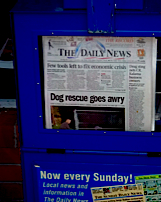
This is, in my humble opinion as a novelist, quite possibly the greatest newspaper headline in the history of the printed word; I came across it outside a small-town diner this morning. It’s so delightfully human, isn’t it? The stock market is in distress, the polar icecaps are melting, and a sign in the restaurant window testified to the number of local young people currently serving in active combat (and, tragically, the two who no longer are), yet what concerns the citizens of this hamlet? Budget cut-related turmoil at the dog shelter.

I was charmed.

If that headline appeared in a novel about small-town America, it simply wouldn’t be believable — proving yet again something that I have often maintained on this blog, that reality tends to be a lousy writer. Just because something happens doesn’t necessarily mean that it will seem plausible on the page.

It’s the writer’s job to make it so.

That’s enough free-association for one day, I think. Let’s meander back to our ongoing list of questions designed to ferret out the most pervasive of synopsis problems. To recap:

(1) Does my synopsis present actual scenes from the book in glowing detail, or does it merely summarize the plot?

(2) If the reader had no information about my book other than the synopsis, would the story or argument make sense? Or is more specific information necessary to render the synopsis able to stand alone?

(3) Does the synopsis make the book sound compelling? Does it make me eager to read it?

(4) Does the synopsis tell the plot of the book AS a story, building suspense and then relieving it? Is it clear where the climax is and what is at stake for the protagonist? Or does it merely list all of the events in the book in the order they appear?

(5) Have I mentioned too many characters in the synopsis? Does each that I mention come across as individually memorable?

(6) In a novel synopsis, is it clear who the protagonist is?

(7) Does my protagonist/do my protagonists come across as an interesting, unusual person(s) involved in an interesting, unusual situation?

(8) In a memoir synopsis, is it clear who the protagonist is? Does s/he come across as an interesting, unusual person involved in an interesting, unusual situation?

(9) In either a novel or a memoir synopsis, is it clear what the protagonist wants and what obstacles are standing in the way of her getting it? Is it apparent what is at stake for the protagonist if she attains this goal — and if she doesn’t?

(10) In a NF synopsis that isn’t for a memoir, is it clear what the book is about? Does the subject matter come across as interesting, and does the synopsis convey why this topic might be important enough to the reader to make him/her long to read an entire book about it?

(11) Does my synopsis make the book sound just like other books currently on the market, or does it come across as original?

Everyone clear on those? Superb. Let’s proceed to something fresh — actually, while it’s in the front of my mind, let’s go ahead and address the plausibility issue.

(12) If I’m marketing fiction or memoir, does my synopsis make the story I’m telling seem plausible? If my book is nonfiction, does it come across as both plausible and as though I’m a credible source?

I could sense some of the novelists out there rolling their eyes before I even finished typing #12. “Um, Anne?” a few of you scoffed. “What part of FICTION don’t you understand? By definition, fiction writers make things up.”

Quite true, oh scoffers, but for even the most outrageously fantastic storyline to hang together, it must be plausible — at least in the sense that the characters would actually do and say the things they do and say on the page.

Yes, even in a novel where obeying the law of gravity is merely optional. Otherwise, it’s hard for the reader to remain involved in the story.

Why? Well, when a reader is swept up in a drama (or a comedy, for that matter), she engages in behavior that Aristotle liked to call the willing suspension of disbelief. Basically, she enters into a tacit understanding with the author: the rules that govern the world of the book, no matter how wacky or impractical they may be for the reader’s world, are precisely what the narrative says they are. Most of the time, as long as the narrative abides by them, the reader will be willing to go along for the ride.

Note that as long as clause. If a narrative violates its own rules, the agreement is violated: in thinking, “Wait, that doesn’t make sense,” the reader is knocked out of the story. (Ditto, incidentally, when a first-person or tight third-person narrative suddenly switches, however momentarily, from the protagonist’s perspective to something that the protagonist could not possibly perceive. But perspective-surfing is a subject for another blog post.)

Millicents are notoriously sensitive to being pulled out of a story by a plausibility problem. So are their bosses, the agents who employ them to reject as high a percentage of submissions as possible, and the editors to whom those bosses sell books.

I just felt some of you go pale. “How sensitive?” those of you who have submitted recently enough that you haven’t yet heard back squeak in unison.

Are you sitting down? Got the smelling salts handy? I hate to be the one to break it to you, but in a manuscript, a single instance is often an automatic rejection offense.

Yes, even in a synopsis.

Why? Well, any gaffe that breaks the reader’s suspension of disbelief is, ultimately, a storytelling problem. Thus, Millicent may be excused for thinking as soon as she casts her hyper-critical eye over one, “Oh, this writer isn’t a very consistent storyteller.”

Okay, so this may be an unfairly broad conclusion to draw from a line or two in a synopsis — especially when, as we’ve discussed earlier in this series, many, many talented aspiring writers simply throw together their synopses at the last possible minute prior to sealing the submission or contest entry envelope. But lest we forget, Millicents are in the BUSINESS of making snap judgments; they couldn’t get through the hundreds of queries and submissions they see every week otherwise.

Aren’t you glad you had those smelling salts handy?

If you’re not absolutely certain that your synopsis is internally consistent enough to pass the plausibility test, have someone else (NOT someone who has read the manuscript, ideally) read it and tell the story back to you. Better yet, have someone else read it, tell the story to a third party, and have the third party try to reproduce it for you AND a fourth person.

You may not catch the “Hey, wait a minute!” moments, but chances are that #4, at least, will. Listen carefully to any follow-up questions your experimental victims may have; address them in the synopsis, so that Millicent will not be moved to ask them of the ambient air at the screening stage.

Pay particular attention to any spot in the text the provokes an unexpected giggle. Few narrative gaffes provoke bad laughter — the giggles that spring from readers or audience at a spot where the writer did not intend for them to laugh — as readily as deviations from the internal logic of a story.

This isn’t a bad fix-it strategy for nonfiction, either, especially for memoir. Too often, NF writers in general and memoirists in particular assume that just because they are recounting true events, their narratives will be inherently plausible.

It’s just not true.

Just as a novel’s plausibility depends upon the narrative’s consistently following its story’s internal logic, a NF account or argument needs to hang together, with no missing steps. In a manuscript, plausibility problems tend to arise from incomplete set-ups and telling stories out of chronological order.

(If any of you would like me to elaborate upon these in the weeks to come, I would be delighted; leave a comment below. For today’s purposes, I’m going to move on.)

Where NF synopses usually fall down on the job is by providing insufficient background — prompting questions like, “Why did this happen?” Again, you will be much, much better off if you can solicit such questions from someone other than Millicent, so you may address them before she reads your synopsis.

I really went to town on that last point, didn’t I? I’m going to gloss over the rest of the synopsis questions quickly, so I can polish them off today and send you on your merry way for the weekend.

Don’t worry; the rest are pretty self-explanatory.

(13) Does the first couple of paragraphs of my synopsis Is there an indelible image that the reader can take away?

To put it another way, does the opening of the synopsis contain something both unique and memorable? A vivid sensual image, for instance? A surprising juxtaposition of words? A fresh emotional dilemma?

And so forth. As with a contest entry, screeners tend to pass judgment upon synopses pretty fast — and, in order to approve them for continuing on to the next step of the screening process, often need to be able to describe the book in just a sentence or two. Giving Millicent (or a contest judge) a fantastic detail will make her job easier.

Trust me, you want to make her job easier.

What you DON’T want to do — oh, you may think you do, but it’s not in your best interest — is to make your job as a synopsizer easier by reusing text from the first chapter of the book. Especially, as synopsis-writers for contests so often do, by recycling the opening paragraph of the book.

Which leads me to…

(14) Does the opening of the synopsis read too like the opening of the book?

This may make some of you giggle, but you wouldn’t believe how often the first paragraph or two of manuscript are actually identical to the first paragraph or two of its synopsis. Yes, even in contest entries, where the synopsis and chapter are almost always read within the same sitting.

Millicent and her ilk tend to regard this as a symptom of authorial laziness, but I suspect that there is usually more to it than that: I think that aspiring writers, having slaved to create a memorable opening for their books, often regard those opening paragraphs as some of their best writing. If it really is so, they reason, why not feature it in a document where it’s likely to do them some good?

If you believe nothing else I tell you today, please believe this: it won’t do you any good. People in the publishing industry remember what they’ve read; make sure every sentence you submit within a packet is different.

(15) Is my synopsis in the present tense and the third person, regardless of the tense and voice of the book itself? For a memoir, is it in the first person and past tense?

This is one of those secret-handshake things that render a rookie’s submission so apparently different from an experienced writer’s, from Millicent’s perspective: a professional synopsis is ALWAYS in the present tense and third person, unless the book in question is a memoir.

Yes, even if the book being synopsized is written in the first person. Don’t fight it; it’s just a convention of the trade.

(16) Are its pages numbered?

Even after years of reading synopses intended for submission, I remain perennially shocked at how few of them identify either themselves or the author, due no doubt to a faith in the filing systems of literary agencies that borders on the childlike.

Why do I attribute this to faith? Well, like everything else in a manuscript or book proposal, the synopsis should not be bound in any way; like pretty much everything else on earth, paper responds to gravity.

Translation: things fall; pages get separated, and some luckless soul (generally, the person under Millicent the screener on the agency’s totem pole, if you can picture that) is charged with the task of reordering the tumbled pages.

Place yourself in that unhappy intern’s Doc Martens for a moment: given the choice between laboriously guessing which page follows which by perusing content, and pitching the whole thing (into what we devoutly hope is the recycling bin, but is probably merely the overloaded wastepaper basket) and moving on to the next task, which would YOU choose?

Okay, so maybe you’re ultra-virtuous. Allow me to rephrase: what if you were Millicent, had 20 other submissions to screen before lunch, and had just scalded your tender tongue on a too-hot latte?

Don’t rely upon the kindness of strangers. Especially busy ones who have been trained to believe that unnumbered pages are unprofessional in a submission. Make it easy to put the pages back in the proper order.

(17) Does the first page of the synopsis SAY that it’s a synopsis? Does it also list the title of the book, or does it just begin abruptly? And does every page of the synopsis contain the slug line AUTHOR’S LAST NAME/TITLE/SYNOPSIS/#?

Standard format for a synopsis dictates that the title (either all in caps or bolded) is centered at the top of the first page of the synopsis, with “Synopsis” on the line below it. Then skip one double-spaced line, and begin the text of the synopsis.

And if it seems a bit silly to tell the nice people who asked you to send a synopsis that what they’ve got in their trembling hands is in fact a synopsis, remember that in a largish agency, the person who requests a submission is often not the person who subsequently reads it. Not the first person, anyway.

Even if it were, from the envelope-opener’s perspective, being expected to recall one request for further materials from — how long? Perhaps a month? — before is tantamount to being asked to guess how many fingers the author is holding up.

In Nebraska, when the guesser is standing in midtown Manhattan. Don’t make ‘em guess.

(18) Is the synopsis absolutely free of errors of any kind? Not just what your word processing software tells you is an error, but an actual error?

Naturally, you should both spell-check and read the ENTIRETY of your synopsis IN HARD COPY, ALOUD, before you send it anywhere. Period. No excuses.

95% of writers — and 99.98% of non-writers — fall into the trap of thinking that if a document passes muster with their computers’ spelling and grammar checkers, it must therefore be spelled correctly and grammatically sound. That is, alas, generally not true.

Word processing programs’ dictionaries are NOTORIOUSLY inaccurate — and often surprisingly outdated. I am fascinated by the fact that mine evidently does not contain any words that relate to the Internet or computer operations.

Don’t believe me? Should I really have had to introduce “blogger” into its vocabulary?

And don’t even get a professional editor started on the chronic inadequacies of most word processing programs’ grammar checkers. Mine disapproves of gerunds and semicolons, apparently on general principle, strips necessary accent marks off French words, leaving them obscenely naked, and regularly advises me to use the wrong form of THERE. (If anybody working at Microsoft does not know the ABSOLUTELY IMMUTABLE rules governing when to use THERE, THEIR, AND THEY’RE, I beg you, drop me a comment, and I shall make everything clear.) Once, when I was not looking, it incorrectly changed a word in this very blog from “here” to “hear.”

Editors like to fantasize about the special circle of hell reserved for those amoral souls who teach our children that the differences between these don’t matter. I’ll spare you the details, but they include the constant din of fingernails on chalkboards, a cozy relationship with angry skunks, and the liberal application of boiling oil to tender parts.

Grammar checkers also typically butcher dialogue, especially if it contains necessary slang. Suffice it to say, most standard word processing spelling and grammar checkers would condemn the entirety of Mark Twain’s opus outright.

My point is, like a therapist who doesn’t listen well enough to give good advice, a poor grammar checker cannot be sufficiently disregarded. Even in the unlikely event that your grammar checker was put together by someone remotely familiar with the English language as she is spoke, you should NEVER rely solely upon what it tells you to do.

Read the manuscript for yourself.

And if you’re in doubt on a particular point, look it up. In a well-regarded dictionary, not on the Internet: contrary to popular opinion, most search engines will list both the proper spelling of a word and the most common misspellings. There is no gigantic cosmic English teacher monitoring proper spelling and grammar on the web.

So get up, walk across the room, and pick up a physical dictionary, for heaven’s sake. After so much time spent sitting in front of a monitor, the walk will do you good.

(19) Are all of the proper nouns spelled correctly?

This is a perennial agents’ pet peeve, and with good reason: believe it or not, misplaced cities, states, and even character names are rife in synopses.

Why? Because these are words that are generally omitted from standard spell-checkers — or are entered with a number of possible variations. So unless you have inserted all of the proper nouns in your work into your spell-checker’s memory, it will often overlook the difference between your elegant heroine, Sandy, and that trollop who wandered into your synopsis unbidden, Sandie.

Triple-check all character and place names.

(20) Does the synopsis read as though I am genuinely excited about this book and eager to market it, or does it read as though I am deeply and justifiably angry that I had to write it at all?

Yes, I’ve talked about this one before, and recently, but this is a subtlety, a matter of tone rather than of content, so it bears repeating. It’s often not as visible to the author as it is to a third party.

As I MAY have mentioned earlier in this series, writerly resentment shows up BEAUTIFULLY against the backdrop of a synopsis, even ones that do not breathe an overt word about marketing. The VAST majority of synopses (particularly for novels) simply scream that their authors regarded the writing of them as tiresome busywork instituted by the industry to satisfy some sick, sadistic whim prevalent amongst agents, a hoop through which they enjoy seeing all of the doggies jump.

If you have even the vaguest suspicion that your synopsis — or, indeed, any of your marketing materials — may give off a even a whiff of that attitude, hand it to someone you trust for a second opinion.

Made it through all of the questions above? After you have tinkered with the synopsis until you are happy with all of your answers, set your synopsis aside. Stop fooling with it. Seriously — there is such a thing as too much editing.

Then, just before you send it out, read it again (IN HARD COPY and OUT LOUD, naturally), and ask yourself a final question:

(21) Finally, does my synopsis support the image of the book I want the requesting agent or editor to see? Would it be worth my while to modify it slightly in order to match more closely to what I told this sterling individual my book was about?

”Wait!” I hear some sharp readers out there cry. “Is Anne saying that it’s sometimes a good idea to tailor the synopsis to the particular agent or editor? Catch me — I’m about to faint with surprise!”

Well caught, those of you who thought that. Yes, I am the queen of specialized submission packets. Down with genericism, I say!

It’s just common sense, really. If you heard an agent or editor expresses a strong personal preference for a particular theme or style in her speech at an agents’ and editors’ forum or during a pitch meeting, isn’t it just common sense to tweak your already-existing synopsis so it will appeal to those specific likes? If your dream agent let slip in your meeting that she was really intrigued by a particular aspect of your story, doesn’t it make sense to play that part up a little in the synopsis?

Doesn’t it? Huh?

A word of warning about pursuing this route: do NOT attempt it unless you have already written a general synopsis with which you are pleased AND have saved it as a separate document. Save your modified synopsis as its own document, and think very carefully before you send it out to anyone BUT the agent or editor who expressed the opinions in question.

Why? Well, contrary to popular belief amongst aspiring writers and as I have been pointing out for several years now in this very forum, agents and editors are not a monolithic entity with a single collective opinion on what is good and what is bad writing. They are individuals, with individual tastes that vary wildly, sometimes even moment to moment — and certainly over the course of a career.

Think about it: was your favorite book when you were 13 also your favorite book when you were 30? Neither was any given agent’s.

And isn’t your literary opinion rather different on the day you learned that you were being promoted at work and the day that your cat died? Or even the moment after someone complimented your shirt (it brings out your eyes, you know, and have you lost a little weight?), as opposed to the moment after you spilled half a cup of scalding coffee on it?

Again, what’s true for you is true for any given agent, editor, or screener: a LOT of factors can play into whether they like the pages sitting in front of them — or the pitch they are hearing — right now. As the old international relations truism goes, where you stand depends upon where you sit.

Bear this in mind when you are incorporating feedback into your synopsis — or, indeed, any of your work. Just because one agent (or an editor, or a contest feedback form, or every last member of your writers’ group, or the Wizard of Oz) has advised you to tweak your story this way or that, it doesn’t necessarily mean everyone in the industry will greet that tweak rapturously.

Use your judgment: it’s your book, after all. But by all means, if you can modify your synopsis for the SPECIFIC eyes of the individual who expressed the particular opinion in question, do it with my blessings.

Whew, that was a long one, wasn’t it! Make those synopses shine, everybody, and keep up the good work!
Synopsis-writing 101, part XII: that pesky synopsis checklist revisited, or, when Millicent checks the freshness seal

Welcome to day two of my list of questions to put to your synopsis before you send it on its merry way, a sort of hit parade of the most commonly-made mistakes. Rather than regarding the synopsis as a tedious bit of marketing trivia, yet another annoying hoop for the aspiring writer to jump through on the way to landing an agent, I would encourage you to regard it as an opportunity to encapsulate your writerly brilliance in capsule form.

Okay, so it’s still probably going to be tedious and annoying to produce. But addressing these questions will help it show off your talent more effectively.

Got your highlighting pens all ready? Excellent.

Before I suggest anything new, however, let’s take a gander at the points we’ve hit so far — and FYI, those of you who slogged through my Book Marketing 101 series in the summer of 2007 or indeed any of my earlier posts on the fascinating subject of synopsis-improvement, some of these questions are new, freshly minted to torment you and improve your submissions. You’re welcome.

(1) Does my synopsis present actual scenes from the book in glowing detail, or does it merely summarize the plot?

(2) If the reader had no information about my book other than the synopsis, would the story or argument make sense? Or is more specific information necessary to render the synopsis able to stand alone?

(3) Does the synopsis make the book sound compelling? Does it make me eager to read it?

(4) Does the synopsis tell the the plot of the book AS a story, building suspense and then relieving it? Is it clear where the climax is and what is at stake for the protagonist? Or does it merely list all of the events in the book in the order they appear?

(5) Have I mentioned too many characters in the synopsis? Does each that I mention come across as individually memorable?

Is everyone happy with those? Or, if not precisely happy, because revising a synopsis can be a heck of a lot of work, at least conversant with why I might have suggested such darned fool things?

I’m electing to take all of that silence out there in the ether as a resounding, “By Jove, yes!” from each and every one of you. (If by some strange fluke that’s not your personal reaction, by all means, chime in with a question.) Let’s move on, shall we?

(6) In a novel synopsis, is it clear who the protagonist is?

I can hear some of you laughing at the first part of that question, but actually, fiction synopses that imply the book is about every character, rather than following the growth of a single one. For a multiple-protagonist or multiple point of view novel, this kind of ambiguity might make some sense — but for the vast majority of novels that focus on a particular individual, or at most two, it’s unnecessarily confusing to Millicent the agency screener if the synopsis doesn’t specify who the protagonist is.

And no, in answer to what some of my more literal-minded readers just thought very loudly indeed, you should NOT clarify this point by the inclusion of such English class-type sentences as The protagonist is Martha, and the antagonist is George, any more than you should come right out and say, the theme of this book is… Industry types tend to react to this type of academic-speak as unprofessional in a query, synopsis, or book proposal.

Why? Veteran synopsis-writers, take out your hymnals and sing along: because a good novel synopsis doesn’t talk ABOUT the book in the manner of an English department essay, but rather tells the story directly. Ideally, through the use of vivid imagery, interesting details, and presentation of a selected few important scenes.

I sense the writers who love to work with multiple protagonists squirming in their chairs. “But Anne,” these experimental souls cry, “my novel has five different protagonists! I certainly don’t want to puzzle Millicent, but it would be flatly misleading to pretend that my plot followed only one character. What should I do, just pick a couple randomly and let the rest be a surprise?”

Excellent question, lovers of many protagonists. Essentially, my suggestion for handling this particular dilemma in a synopsis would be the same as my advice for handling it in a pitch: tell the story of the book, not of a particular character.

And before anybody point it out: yes, I’m aware that this approach might cause a conscientious writer to run afoul of Point #6, but honestly, the multiple-protagonist format doesn’t leave the humble synopsizer a whole lot of strategic wiggle room. Concentrate on making it sound like a terrific story.

And, above all, be certain that your synopsis doesn’t violate Point #7.

(7) Does my protagonist/do my protagonists come across as an interesting, unusual person(s) involved in an interesting, unusual situation?

Again, this question may make some of you giggle, but you’d be surprised at how often novel synopses stress the averageness of their protagonists, the everydayness of their dilemmas, and seem to taunt Millicent with a lack of clear motivation or major plot twists. “How on earth,” she is wont to exclaim, “is this super-ordinary character/this very common situation going to maintain my interest for 350 pages, when s/he/it is already starting to bore me a little in this 5-page…zzzz.”

Clearly, Millicent could use a sip or two from one of her favorite too-hot lattes, eh?

Seriously, super-ordinariness has been the death knell for many a novel synopsis — which I suspect may come as something of a surprise to many of you.

What makes me think that, you ask? Many aspiring writers deliberately go out of their respective ways in order to present their protagonists as completely ordinary, normal people leading lives so aggressively mainstream that George Gallop is inclined to sit up in his grave at the very mention of them and shout, “At last! People so average that we don’t need to perform broad-based polling anymore! We’ll just ask these folks!”

Or, to put it in a less melodramatic manner, these writers are fond of slice-of-life writing.

The problem is, book-length slice-of-life writing can be pretty hard to sell — and nearly impossible to synopsize excitingly. Even the most character-driven of literary fiction needs to have a plot of some sort and a protagonist engaging enough (or appalling enough) to render the reader willing to follow him/her through the relevant high jinks, right?

Stop wailing, please, literary fiction writers; yours is a highly specialized market, and you shouldn’t be sending out synopses to agents who don’t represent your kind of writing, anyway.

“Okay, Anne,” some of you literary fiction writers say, bravely wiping your eyes, “I realize that I’ve chosen to write in a book category that represents only about 3-4% of the fiction market; I know that I’m going to have to target my queries very carefully. But I have a wonderful slice-of-life novel here about Everyman and Everywoman’s universal struggles to deal with the everyday. How should I go about synopsizing it?”

In a way that may well strike you as running counter to your goal in writing such a book: by emphasizing what is different, fresh, and unusual about your protagonist and his/her dilemmas.

Before any of you get huffy at the prospect of soft-selling your aim of holding, as ’twere, the mirror up to nature, listen: no agent, no matter how talented, is going to be able to sell a novel by saying, “Oh, this book could be about anybody”; no matter how beautiful the writing may be, the agent of your dreams is eventually going to have to tell an editor what your book is about.

In industry-speak, ordinary is more or less synonymous with dull. Sorry to have to be the one to break that to you, but it’s true.

I’m guessing, though, that your protagonist actually isn’t dull — so why isn’t s/he, precisely? How is s/he different from every other potential protagonist out there? What quirks render her or him fascinating on the page? What about her/his situation is unique?

Getting the picture? The synopsis needs to demonstrate not only that you can write, but that your book concept is fresh.

Actually, the questions above are dandy ones to ask about any fictional protagonist, not just those who grace the pages of literary fiction. What makes this character interesting and different from the protagonist of any other novel currently on the market — and how can you make those traits apparent on the synopsis page?

(8) In a memoir synopsis, is it clear who the protagonist is? Does s/he come across as an interesting, unusual person involved in an interesting, unusual situation?

Sounds eerily familiar, doesn’t it? And you would have thought that the identity of a memoir’s protagonist would be awfully hard to hide for long, wouldn’t you?

If you walked a mile in Millicent’s shoes (sipping her latte, no doubt), or cozied up to Mehitabel the contest judge, you would know otherwise. To your sorrow, probably.

Just make it clear who the narrator is, okay?

Actually, memoir synopses scuttle themselves even more frequently by running afoul of that second criterion — the one about being an interesting character embroiled in an interesting situation — for the very simple reason that memoirists are prone to regard their stories as self-evidently interesting just because they are true.

As any memoir-representing agent could tell you, that’s not always the case. In fact, s/he is very likely to tell you that s/he sees very dull-sounding memoir synopses all the time.

So the synopsis-writing memoirist has an additional goal: not only to present her life story as important and intriguing, but also to render it pellucidly clear precisely how her life has differed from other people’s. A memoir synopsis that doesn’t convey this information within the first paragraph or so — ideally, by showing, rather than telling — tends not to maintain Millicent’s interest thereafter.

If you find it hard to figure out what to emphasize, try thinking of yourself as a fictional character. Why would a novel-reader want to follow you throughout a 500-page plotline?

While we’re on the subject, another good way to determine what might make dear self interesting to others…

(9) In either a novel or a memoir synopsis, is it clear what the protagonist wants and what obstacles are standing in the way of her getting it? Is it apparent what is at stake for the protagonist if she attains this goal — and if she doesn’t?

To twist these questions in a slightly different direction, does the synopsis present the book’s central conflict well?

If ordinariness tends to raise Millicent’s am-I-about-to-be-bored? sensors, the prospect of conflict usually makes her ooh-this-is-interesting antennae twirl around in circles — but nothing flattens a reader’s perception of conflict like the impression that the outcome doesn’t matter very much to the characters.

Admittedly, not every good novel features life-or-death stakes. Nevertheless, your story is going to be more memorable to someone who reads synopses for a living if the conflict appears to be vitally important to the protagonist.

Trust me on this one.

(10) In a NF synopsis that isn’t for a memoir, is it clear what the book is about? Does the subject matter come across as interesting, and does the synopsis convey why this topic might be important enough to the reader to make him/her long to read an entire book about it?

Again, this is a stakes issue: remember, however passionately you may feel about your chosen topic, Millicent, her cousin Maury the editorial assistant, and her Aunt Mehitabel will probably not already be conversant with it. It’s your job as the writer to get them jazzed about learning more.

Yes, even at the synopsis stage.

One of the more reliable methods of achieving this laudable goal is not only to present your subject matter as fascinating, but also to demonstrate precisely why your readers will find it so.

In other words, why does your subject matter, well, matter? Which leads me to…

(11) Does my synopsis make the book sound just like other books currently on the market, or does it come across as original?

When agents specialize in a particular kind of book (and virtually all of them do limit themselves to just a few types), you would obviously expect that they would receive submissions within their areas of specialty, right? So it’s reasonable to expect that an agency screener at an agency that represents a lot of mysteries would not be reading synopses of SF books, NF books, romances, and westerns, mixed in with only a few mysteries. Instead, that screener is probably reading 800 mystery synopses per week.

Translation: Millicent sees a whole lot of plot repetition in any given pay period..

This may seem self-evident, but it has practical ramifications that many aspiring writers do not pause to consider. That screener is inundated with plots in the genre…and your synopsis is the 658th she’s read that week…so what is likely to happen if your synopsis makes your book sound too much like the others?

Most likely, the application of Millicent’s favorite word: next!

”Wait just a cotton-picking second!” I hear those of who have attended conferences before protesting. “I’ve heard agents and editors jabbering endlessly about how much they want to find books that are like this or that bestseller. They say they WANT books that are like others! So wouldn’t an original book stand LESS of a chance with these people?”

Yes, you are quite right, anonymous questioners: any number of agents and editors will tell you that they want writers to replicate what is selling well now. Actually, though, this isn’t typically what they mean in practical terms.

Since it would be completely impossible for a book acquired today to hit the shelves tomorrow, and extremely rare for it to come out in under a year — and that’s a year after an editor buys it, not a year from when an agent picks is up — what is selling right now is not what agents are seeking, precisely. They are looking for what will be selling well, say, a couple of years hence.

Which. common sense tells us, no one can possibly predict with absolute accuracy.

So when agents and editors tell writers at a conference that they are looking for books that resemble the current bestseller list, they really mean that they want you to have anticipated two years ago what would be selling well now, have tracked them down then, and convinced them (somehow) that your book was representative of a trend to come, and thus had your book on the market right now, making them money hand over fist.

I’ll leave you to figure out by yourselves the statistical probability of that scenario’s ever happening in our collective lifetimes.

Or, to put it in terms of the good joke that was making the rounds of agents a couple of years back: a writer of literary fiction reads THE DA VINCI CODE, doesn’t like it, and calls his agent in a huff. “It’s not very well written,” he complains. “Why, I could write a book that bad in a week.”

”Could you really?” The agent starts to pant with enthusiasm. “How soon could you get the manuscript to me?”

Given how fast publishing fads fade, I will make a prediction: the same agent who was yammering at conference crowds last month about producing book X will be equally insistent next months that writers should write nothing but book Y. You simply cannot keep up with people who are purely reactive. Frankly, I don’t think it’s worth your time or energy to get mixed up in someone else’s success fantasy.

The fact is, carbon copies of successful books tend not to have legs; the reading public has a great eye for originality. What DOES sell quite well, and is a kind of description quite meaningful to agents, is the premise or elements of a popular work with original twists added. So you’re better off trying to pitch LITTLE WOMEN MEETS GODZILLA than LITTLE WOMEN itself, really.

Which is why, I suspect, that much-vaunted recent experiment where someone cold-submitted (i.e., without querying first, and without going through an agency) a slightly modified version of PRIDE AND PREJUDICE to an array of major publishers, only to have it summarily rejected by all.

At the time of the experiment, there was much tut-tutting discussion of how this outcome was evidence that editors wouldn’t know great literature if it bit them, but my first thought was, how little would you have to know about the publishing industry to think that an unsolicited, unagented novel would NOT be rejected unread by the big publishers? Mightn’t this have actually been a test not of how literature fares, but what happens to submitters who do not follow the rules?

My second thought, though, was this: at this point in publishing history, wouldn’t even an excellent rehashing of PRIDE AND PREJUDICE seem old hat? How could the submitter possibly have presented it in a manner that seemed fresh?

After all, it’s been done, and done brilliantly — and re-done in many forms, up to and including BRIDGET JONES’ DIARY. I can easily imagine pretty much any English-speaking editor’s taking one look, roll her eyes, and say, “Oh, God, here’s somebody ripping off Jane Austen again.”

My point, in case you were starting to wonder, is that agents and editors tend to be pretty well-read people: a plot or argument needs to be pretty original in order to strike them as fresh. The synopsis is the ideal place to demonstrate how your book differs from the rest.

And what’s the easiest, most direct way of doing that, for either fiction or nonfiction? By including surprising and unique details, told in creative language.

Even if your tale is a twist on a well-known classic (which can certainly work: THE COLOR PURPLE is a great retelling of the Ugly Duckling, right?), you are usually better off emphasizing in the synopsis how your book deviates from the classic than showing the similarities. Here again, vivid details are your friends.

Okay, that’s enough mental chewing gum for one day. The rest of the checklist follows tomorrow. Keep up the good work!

Synopsis-writing 101, part VI: the truth, the whole truth, and nothing but the…oh, you only want a couple of pages?

oz-the-great-and-terrible.tiff

Okay, so I did end up taking a day off for my birthday — but, perversely, it was the day after. Suffice it to say that there’s been quite a bit going on in my part of the world.

Back to the topic at hand, my ongoing series on how to craft an attention-grabbing synopsis BEFORE you need it, so you will not be thrown into forty-seven kinds of panic the instant an agent or editor asks you to send one. As those of you who write nonfiction may have noticed, I’ve been concentrating for the last few posts upon the specialized problems of novel synopses.

Specifically, if you will recall, I went on (and on and on) about the importance of a novel synopsis’ demonstrating beyond a shadow of a doubt that its writer is a gifted storyteller. For nonfiction, the task is a trifle more complicated.

Don’t worry — I have a LOT of experience writing both types, as it happens: I’ve sold two memoirs to publishers, and my second novel is just starting to make the rounds. Not to mention all of the synopses I see as a frequent contest judge and even more frequent freelance editor. So yours truly has spent quite a bit of time in the last few years hunkered over the odd synopsis, let me tell you. I know whereat I speak.

In fact, just go ahead and imagine the following words of wisdom booming from the mouth of Oz, the Great and Terrible. It will save time and energy in the long run.

In a NF synopsis of any length, your goal is fourfold:

(1) to give the argument of the book in some detail;

(2) to give some indication of how you intend to prove your case;

(3) to demonstrate why the book will appeal to a large enough market niche to make publishing it worthwhile, and

(4) to show beyond any reasonable question that you are the best-qualified person in the universe to write the book.

In anywhere from 1-5 pages, depending upon what the agent, publishing house, or contest rules request. I’m not entirely sure that I proved half that much in my master’s thesis.

And let me tell you, it was a pretty good master’s thesis.

The argument is the most important element here — it’s imperative that the synopsis-reader be able to follow it. Show it in logical order.

Why is this so important? Well, in the synopsis, you should not only show the content of the argument, but also that you can argue coherently.

I’m already sensing some disgruntlement out there, amn’t I? “But Anne,” I hear some NF writers grumble, “this seems counterintuitive. Wouldn’t the best way for an agent or editor to check out my argumentative style be to, you know, read my book?”

I could shoot that one down right away, but first, let’s all take a mental holiday and picture how much easier all of our lives would be people in the publishing industry actually thought that way.

Ah, that’s nice: a world where writers’ talent was judged solely by thoughtful, well-paid, prose-loving agents and editors, lounging on comfy sofas in sun-drenched lofts, languidly turning over page after page of entire manuscripts sent to them by aspiring authors.

And look, outside that massive loft window — do I see a pig flying by, with Jean Harlow on his back, waving sparklers and smooching Clark Gable?

Okay, back to the real world: realistically, a nonfiction synopsis does indeed need to encapsulate the argument that it takes an entire book to make in just a couple of pages — or at least to establish the central question and indicate how you’re going to go about answering it.

Think of it as a tap-dancing audition, your two-minute chance to show your fancy footwork: if you argue well enough here, the agent will ask to see the argument in the book.

Did I just hear some gasps out there? “Two minutes?” a few of you squeak. “How closely can they possibly read my synopsis in that short amount of time?”

I didn’t mean to startle you — but yes, that’s roughly how long your synopsis will have under an agent’s (or, more likely, an agency screener’s) bloodshot, overworked eyes. These days, contrary to popular opinion, NF queries and submissions tend not to be treated to much closer or more respectful readings than novels. Popular opinion may have a point here, at least at the agency level, because nonfiction has historically been quite a bit easier to sell to the major publishing houses than fiction.

Go figure.

At this point in publishing history, though, the market is so tight that it just doesn’t make strategic sense for NF writers to assume that they — or, more accurately, we — don’t need to present book projects as professionally and eye-catchingly as novelists do.

So: two minutes, maximum, possibly less. Let’s face it, this isn’t a lot of time to establish an argument much more complicated than the recipe for your sainted mother’s cream of tomato soup.

Even if your mother’s methodology consisted primarily of opening a can of Campbell’s.

It is more than enough page space, though, to demonstrate that you have the writing skills to make an argument where each sentence leads logically to the next. It’s also enough time to show that you have a coherent plan for proving your propositions, and for indicating what evidence you intend to use.

If I seem to be harping on the necessity of making a COMPLETE, if skeletal, argument here, it is because the single most common mistake NF synopsizers make is to give only PART of the argument, or still worse, only the premise, with no indication of how they intend to make their case. Instead, they use the space to go on a rant about how necessary the book is, essentially squandering precious argumentative space with marketing jargon and premise.

But a solid underlying argument is the sine qua non of the NF synopsis. Period.

To make it appear as solid in the synopsis as I’m sure it is in the manuscript, don’t forget to mention what kind of evidence you will be using to support your claims. Have you done extensive research? Exhaustive interviews? Hung out with the right people?

If you have a professional background in the subject matter of your book that unquestionably renders you an expert, or personal experience that gives you a unique insight into the subject, try to mention that in your opening paragraph, or at least in the second. Otherwise, stick to the subject matter, and explain what the book is going to teach people about it.

I use the term teach advisedly, because it is often quite helpful for synopsis writers to think of the task as producing a course overview for the lesson that is the book’s content: how will this book help readers, and what kind of readers will it help?

And once you have made that clear, how about demonstrating precisely what about your approach will captivate those readers as no other book will?

Of course — I’m not talking about TELLING a potential agent or editor how terrific the book is — that’s the book proposal’s job, right? — but SHOWING that you can write the heck out of this topic. Your first task, then, is to make your subject matter sound absolutely fascinating.

To achieve this successfully, you will need to show how your take on it is original. To do that, you are going to have to spell out your argument. Not merely in generalities, but in sufficient detail that — everyone chant it with me now — an agent, editor, or contest judge could understand it sufficiently to describe it to someone else without having read the book. Because, let’s face it, that’s precisely what Millicent the agency screener is going to have to do in order to get her boss to ask to see your book proposal or manuscript — and what her cousin Maury the editorial assistant will have to do to get his boss even to consider publishing it.

Have I convinced you yet that you really do need to present a cohesive theory here? And did I happen to mention the importance of its being cohesive?

Easier said than done, of course. In the author’s mind, the argument often lies the details, not in the larger, more theoretical points. How can you narrow it down? It’s helpful to have an outline of your proposed chapters in front of you, so you can use the synopsis to demonstrate how each chapter will build upon the next to make your overall case.

Oh, don’t groan. If you’re writing a NF book, you are going to need to pull together a chapter-by-chapter overview anyway, of course, to include in your book proposal: it’s called the annotated table of contents. This moniker is a tad misleading, because it brings to mind the simple chapter title + page number tables of contents we’ve all seen in published books. An annotated table of contents consists of the titles in order, yes, but it also contains a paragraph or two about the argument or material to be presented in that chapter.

For tips on how to pull this off successfully, please see the BOOK PROPOSALS category on the list at right. I’ll still be here when you get back. The rest of you may feel free to move on.

Don’t get so caught up in reproducing the argument in the synopsis, though, that you do not include a BRIEF explanation of why the world needs your book, and why you are the best person imaginable to write it. This is typically the greatest difference between a fiction and a nonfiction synopsis.

If you are writing on a subject that has already been well-trodden by past authors, it’s even more important to make these points clear. The synopsis needs to render it apparent to Millicent and Maury at a glance why your book is different and better than what’s already on the market.

In answer to the small, instinctive moans of protest that just escaped from some of your gullets, yes, this is repetitive with material you will cover in your book proposal. In most of the contexts in which your synopsis will travel, however — tucked into an envelope with a query letter; accompanying a sample chapter or contest entry; floating around a publishing house after an editor has already fallen in love with your proposal — the reader will not also be clutching your proposal.

In other words, your goal here is to produce a synopsis that shows off your writing skills, the strength of your argument, and the inherent marketability of your book in a fraction of the space allotted to a proposal.

Piece o’ cake, right?

There is no need to be heavy-handed in your own praise to achieve this, either. To prove it to you, I’m going to give you a sample opening, modest enough that it would strike no one as overbearing. Read carefully, as there will be a pop quiz afterward to see if you can spot the ways that this brief paragraph achieves Goals #3 and #4:

Have you ever wondered what goes on underneath the snow while you are skiing on top of it? Although there are many books currently on the market for the US’s 1.3 million snowboarding enthusiasts, MOUNTAINS MY WAY is the first to be written by a geologist. Seen through the eyes of a professional rock hound with thirty years of experience in the field, the reader is introduced to mountains as more than an array of cold, hard rocks: mountains emerge as a historical document, teeming with life and redolent of all of the stages of human history.

How did you do?

Give yourself points if you noticed that the opening question grabbed the reader, showing immediately how this book might relate to the reader’s practical life; a rhetorical question for which the book itself provides an answer is a great way to establish a book’s appeal at the very beginning of the synopsis.

Also, pat yourself on the back fifty times if you zeroed in on the subtle way in which this paragraph dissed the competition — the implication here is that the authors all previous books on the subject were such boneheads that THEY thought mountains were just collections of rocks. No one is naming names here, but those authors know who they are.

Still more points if you noted the clever (if I do say so myself) use of demographic information. (Which I made up wholesale for example’s sake, so please don’t quote them elsewhere.) If you have statistics on your prospective market, this is the place to mention them — here, and in your query letter, and in your pitch. As in:

There are currently two million Americans diagnosed with agoraphobia, yet there are few self-help books out there for them — and only one that is actually written by an agoraphobic, someone who truly understands what it feels like to be shut in by fear.

Why is it so important to hammer home the statistics in every conceivable forum, you ask? Well, no matter how large the prospective market for your book is (unless it is an already such a well-covered market that anyone in the industry could reasonably be expected know about it, such as golf fans), you can’t ever, ever assume that an agent or editor will be aware of its size.

ALWAYS assume that they will underestimate it — and thus the market appeal of your book.

On that stirring statement, I think I shall end for the day. More on NF synopses follows tomorrow. In the meantime, keep up the good work!

Synopsis-writing 101, part VI: la la la la TO ME

All right, I’ll admit it: this isn’t actually a picture of me at a former birthday. Unlike so many dark-eyed adult brunettes, I never was a blonde-haired, blue-eyed mite with pigtails. Also, like other children with autumn birthdays growing up in wine country, my family was usually harvesting a few tons of something on or about my birthday, so my cake tended to be consumed at school, as cupcakes. Oh, and I have always looked terrible in pastels; even as a very small child, I wouldn’t be caught dead in ‘em.

Otherwise, I assure you, this picture is an uncannily accurate reproduction of an annual event in my past.

Yesterday (known to literature-lovers everywhere as Pre-Anne Eve, natch), I gave a few genteel indications of how a 5-page synopsis — still, whatever some writing-advice websites claim, the most common requested length for a novel synopsis — might conceivably differ from a 1-page synopsis.

To be specific, I alleged that the extended synopsis should give a solid feel of the mood of the book and a basic plot summary. Rather than attempting to cram an in-depth summary of every twist and turn of the book into just a few pages, I suggested that a savvy writer might content herself with showing who the major characters are, what the major conflicts between them are, and illustrating how they played out by describing a few scenes with a wealth of sensual detail.

Or, to cast it in step-by-step terms:

(1) introduce the major characters and premise,

(2) demonstrate the primary conflict(s),

(3) show what’s at stake for the protagonist, and

(4) ideally, give some indication of the tone and voice of the book.

(5) show the primary story arc through BRIEF descriptions of the most important scenes. (For NF that isn’t story-based, present the planks of the overarching argument in logical order, along with some indication of how you intend to prove each point), and

(6) show how the plot’s primary conflict is resolved or what the result of adopting the book’s argument would be.

Let’s talk for a moment about #4, writing the synopsis in roughly the same voice and in the same tone as the novel it summarizes. As I’ve mentioned, a comic novel’s synopsis should contain a few chuckles; an ultra-serious one shouldn’t. A steamy romance’s synopsis should be at least a little bit sexy, a thriller’s a trifle scary, and so forth.

No need to get obsessed with making sure the tone is identical, of course — in the same ballpark will do. You just want to show that you are familiar with the type of writing expected in the type of novel you’ve written and can produce it consistently, even in a relatively dry document.

Why might an agent or editor want you to demonstrate the latter skill? Well, increasingly, authors are expected to promote their own books; it’s not at all uncommon these days for a publishing house to ask the author of a soon-to-be-released book to write a magazine or online article in the book’s voice, for promotional purposes, for instance.

Yes, I know; you want to concentrate on your writing, not its promotion. The muses love you for that impulse. But would you rather that I lied to you about the realities of being a working author?

I thought not.

What you should also not do — but, alas, all too many aspiring writers do — is attempt to replicate the voice of the book by lifting actual sentences from the novel itself. I know that you want to show off your best writing, but trust me, you’re going to want to make up some new verbiage here.

Why, you ask? Hint: people who go into the manuscript-reading business tend to have pretty good memories.

They recall what they’ve read.

See the problem, especially if — as not infrequently happens, especially with contest entries — the chapters containing the lifted verbiage and the synopsis are read back-to-back? A good 30% of contest synopses make this mistake, reproducing entire sentences or even entire paragraphs from the chapters included in the entry, invariably costing the entry originality points.

Do I see some raised hands from those of you who habitually recall what you’ve read? “But Anne,” I hear some of you pointing out, and who could blame you? “Didn’t you tell us just a couple of days ago that it was a grave error to assume that Millicent (the agency screener), Maury (her cousin who works as an editorial assistant), and/or Mehitabel (their aunt, the contest judge) will necessarily read both our synopses and the rest of our submissions?”

Excellent point, sharp-eyed readers. While it’s never safe to assume that EVERYONE who reads your synopsis will also read your opening chapter, it’s also not a very good idea to assume that NO ONE will. Shooting for a happy medium — including enough overlap that someone who read only one of them could follow the plot without indulging in phrase redundancy — tends to work best here.

Should you be tempted to repeat yourself, I implore you to ask this question with all possible speed: “Is there a vibrantly interesting detail that I could insert here instead?”

To over-writers (like, I must admit, myself), it may seem a trifle odd to suggest adding detail to a piece of writing as short as 5 pages, but actually, most synopses suffer from overgrowths of generalization and an insufficiency of specifics.

So once you have a solid draft, read it over and ask yourself: is what I have here honestly a reader-friendly telling of my story or a convincing presentation of my argument (don’t worry, NF writers: I’ll deal with your concerns at length next time), or is it merely a presentation of the premise of the book and a cursory overview of its major themes?

For most synopses, it is the latter.

Do I hear some questions over and above the wailing and gnashing of teeth out there? “But Anne,” a couple of voices crying from the wilderness, “How can I tell the difference between a necessary summary statement and a generalization?”

Again, excellent question. The short answer: it’s hard.

Here’s a useful trick: print up a hard copy of the synopsis, find yourself a highlighting pen, and mark every summary statement about character, every time you have wrapped up a scene or plot twist description with a sentence along the lines of and in the process, Sheila learns an important lesson about herself.

Go back through and take a careful look at these highlighted lines. Then ask yourself for each: would a briefly-described scene SHOW the conclusion stated there better than just TELLING the reader about it? Is there a telling character detail or an interesting plot nuance that might supplement these general statements, making them more interesting to read?

I heard that gasp of recognition out there — yes, campers, the all-pervasive directive to SHOW, DON’T TELL should be applied to synopses as well. Generally speaking, the fewer generalities you can use in a fiction synopsis, the better.

I’ll let those of you into brevity for brevity’s sake in on a little secret: given a choice, specifics are almost always more interesting to a reader than vague generalities. Think about it from an agency screener’s POV, someone who reads 800 synopses per week: wouldn’t general statements about lessons learned and hearts broken start to sound rather similar after awhile?

But a genuinely quirky detail in a particular synopsis — wouldn’t that stand out in your mind? And if that unique grabber appeared on page 1 of the synopsis, or even in the first couple of paragraphs, wouldn’t you pay more attention to the rest of the summary?

Uh-huh.

It’s very easy to forget in the heat of pulling together a synopsis that agency screeners are readers, too, not just decision-makers. They like to be entertained, so the more entertaining you can make your synopsis, the more likely Millicent is to be wowed by it. So are Maury and Mehitabel.

Isn’t it fortunate that you’re a writer with the skills to pull that off?

If your synopsis has the opposite problem and runs long, you should also sit down and read it over with a highlighter gripped tightly in your warm little hand. On your first pass through, mark any sentence that does not deal with the primary plot or argument of the book.

Then go back through and read the UNMARKED sentences in sequence, ignoring the highlighted ones. Ask yourself honestly: does the shorter version give an accurate impression of the book?

If so — take a deep breath here, please; some writers will find the rest of this paragraph upsetting — do the marked sentences really need to be there at all?

If your synopsis still runs too long, try this trick of the pros: minimize the amount of space you devote to the book’s premise and the actions that occur in Chapter 1; the vast majority of synopses spend to long on it. Here’s a startling statistic: in the average novel synopsis, over a quarter of the text deals with premise and character introduction.

Try trimming this down to just a few sentences and moving on to the rest of the plot.

If this seems to you like a dangerous strategy to embrace in what is, after all, a marketing document, think about it: if the agent or editor asked to see Chapter 1 or the first 50 pages, and if you place the chapter BEFORE the synopsis in your submission packet, the reader will already be familiar with both the initial premise AND the basic characters AND what occurs at the beginning in the book.

So why be repetitious?

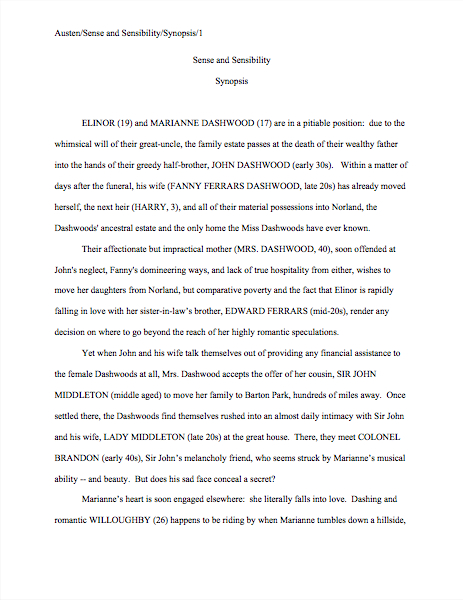
Let me show you how this might play out in practice. Let’s continue this series’ tradition of pretending that you are Jane Austen, pitching SENSE AND SENSIBILITY to an agent at a conference. (Which I suspect would be a pretty tough sell in the current market, actually.)

Let’s further assume that you gave a solid, professional pitch, and the agent is charmed by the story. (Because, no doubt, you were very clever indeed, and did enough solid research before you signed up for your agent appointment to have a pretty fair certainty that this particular agent is habitually charmed by this sort of story.) The agent asks to see a synopsis and the first 50 pages.

See? Advance research really does pay off.

Naturally, you dance home in a terrible rush to get those pages in the mail. As luck would have it, you already have a partially-written synopsis on your computer. In it, the first 50 pages’ worth of action look something like this:

Now, all of this does in fact occur in the first 50 pages of SENSE AND SENSIBILITY, at least in my well-worn little paperback addition. However, all of the plot shown above would be in the materials the agent requested, right? Do you really need to spend 2 of your allotted 5 pages on this small a section of the plot, even if it is the set-up for what happens later on?

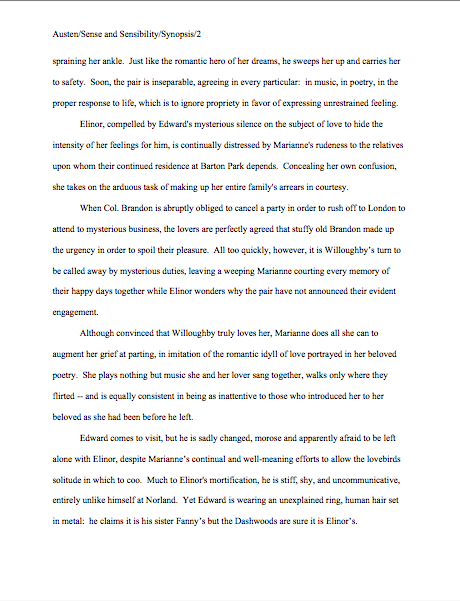
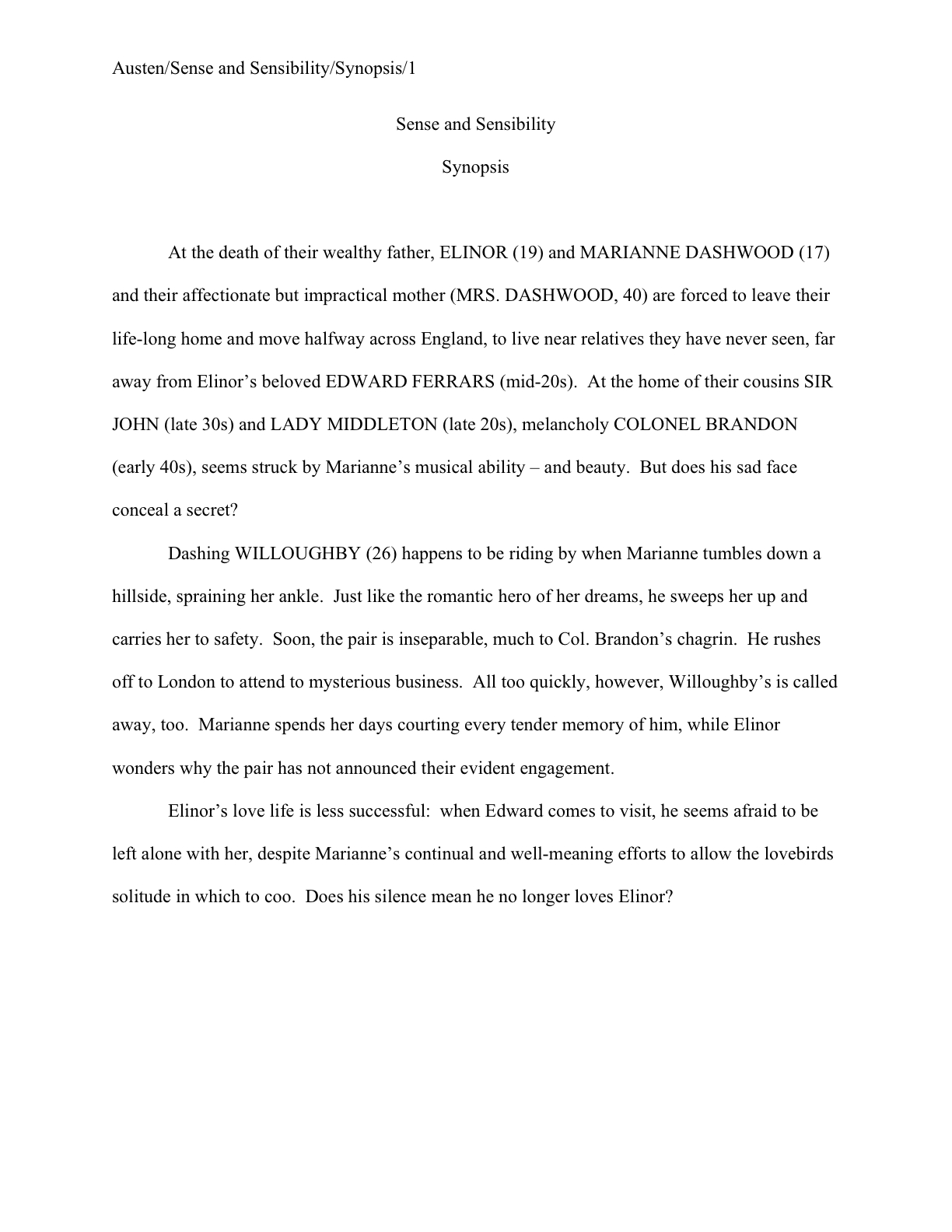
Of course not. Being a wise Aunt Jane, you would streamline this portion of your submission synopsis so it looked a bit more like this:

And then go on with the rest of the story, of course.

See what space-saving wonders may be wrought by cutting down on the premise-establishing facts? The second synopsis is less than half the length of the first, yet still shows enough detail to show the agent how the submitted 50 pp. feeds into the rest of the book. Well done, Jane!

While all of you novelists are hard at work, trying to perform a similar miracle upon your synopses, next time, I shall be tackling the specialized problems of the nonfiction synopsis. Yes, that’s right: we’re going to have our cake and eat it, too.

Oh, you didn’t honestly believe you’d make it through my birthday without being subjected to another bad cake pun, did you? Keep up the good work!

Synopsis-writing 101, part V: stretching your limbs…well, a little

So far in this series, I’ve been going over prepping a synopsis for tucking inside a query envelope, adding to the partial an agent has requested that you send, plopping into a contest entry, or having at the ready in anticipation for such a request at a pitch meeting. For the last few posts, I’ve been concentrating upon that bane of writers everywhere, the 1-page synopsis, which is essentially a written-down verbal pitch.

The summary part of a pitch, anyway. A 1-page synopsis needs to be a quick, pithy introduction to the premise, the protagonist, and the central conflict of the book.

Piece o’ proverbial cake to do all that within a single page in standard format, right?

By contrast, the 5-page novel synopsis — which, until fairly recently, was far and away the most common requested length, as it still is for those already signed with agents and/or working with editors at publishing houses — should tell the STORY of your book (or state its argument) in as much vivid, eye-catching detail as you may reasonably cram into so few pages.

Why? To make the agent, editor, or contest judge reading it exclaim spontaneously, “Wow — this sounds like one terrific book; this writer is a magnificent storyteller.”

Again, piece of cake, right?

Don’t shrug, please, if you are not yet at the querying stage — as with the author bio, I strongly recommend getting your synopsis ready WELL before you anticipate needing it. Especially if you are intending to query or pitch at a conference anytime soon. As I MAY have mentioned before, you will be SUBSTANTIALLY happier if you walk into any marketing situation with your synopsis already polished, all ready to send out to the first agent or editor who asks for it, rather than running around in a fearful dither after the request, trying to pull your submission packet together.

(Wait — I have nagged you some time in the recent past about prepping an author bio, haven’t I? Off to check the archives…oh, dear; it’s been quite some time. Perhaps, after I polish off this series and take that long-anticipated plunge back into craft for at least a few weeks, I shall take another run at it.)

Even if you think that both of the reasons I have just given are, to put it politely, intended to help lesser mortals not anywhere near as talented than your good self, whatever you do, try not to save writing your synopsis for the very last moments before you stuff a submission or entry into an envelope. That route virtually guarantees uncaught mistakes, even for the most gifted of writers and savviest of self-promoters.

If you take nothing else away from this series, please remember this: writing a synopsis well is hard, even for the most seasoned of pros; be sure to budget adequate time for it.

If the task feels overwhelming — which would certainly be understandable, faced with the daunting task of summarizing a 400-page book in just a few well-written pages — remind yourself that even though it may feel as though you effectively need to reproduce the entire book in condensed format, you actually don’t.

Yes, you read that correctly: even a comparatively long synopsis shouldn’t depict every twist and turn of the plot — just strive to give a solid feel of the mood of the book and a basic plot summary. Show where the major conflicts lie, introduce the main characters, interspersed with a few scenes described with a wealth of sensual detail, to make it more readable.

Or, to return to our list of goals from a few days back:

(1) introduce the major characters and premise,

(2) demonstrate the primary conflict(s),

(3) show what’s at stake for the protagonist, and

(4) ideally, give some indication of the tone and voice of the book.

(5) show the primary story arc through BRIEF descriptions of the most important scenes. (For NF that isn’t story-based, present the planks of the overarching argument in logical order, along with some indication of how you intend to prove each point), and

(6) show how the plot’s primary conflict is resolved or what the result of adopting the book’s argument would be.

I sense some squirming from the summary-resistant out there. “But Anne,” I hear some of you protest, “what you’re suggesting sounds a heck of a lot like sitting down and summarizing the book!”

Not really — not if you winnow the story down to its most essential elements, rather than trying to list everything that happens. If you’re having trouble doing that — and at the risk of sounding like your last English literature teacher — set the actual happenings of the novel aside for a moment and think about its themes.

Oh, stop rolling your eyes; most authors are delighted to analyze their own books. Pretend that your book has just been assigned in a college English class — what would you expect the students to be able to say about it on the final?

I’m quite serious about this. Asking yourself the scant handful of questions that would turn up on an exam will help you identify the essentials. A few quiz questions, to get you started:

(a) Who is the protagonist, and why is s/he interesting? (You’d be astonished at how few novel synopses give any clear indication of the latter.) To put it another way, what about this character in this situation is fresh?

(b) What does s/he want more than anything else? What or who is standing in the way of getting it?

(c) Why is getting it so important to her/him? What will happen if s/he doesn’t get it?

(d) How does the protagonist grow and change throughout pursuing this goal? What are the most important turning points in her/his development?

(e) How does the protagonist achieve this goal?

See? Piece of proverbial…wait just a minute! Why, those questions sound a mite familiar, don’t they?

They should: they’re the underlying issues of goals 1-3 and 5-6, above. If you answer them in roughly the same voice as the book, you will have met goal #4, as well — and, almost without noticing it, you will have the basic material for a dandy synopsis.

Piece o’ cake, right?

Don’t, I implore you, make the extremely common mistake of leaving out point #6 — the one that specifies that you should include the ending. Too many aspiring writers do this in a misguided endeavor to goad Millicent the agency screener and her ilk into a frenzy of wonder about what is going to happen next.

“But I want to make them want to read the book!” such strategists invariably claim. “I don’t want to give away the ending. Leaving the synopsis on a cliffhanger will make them ask to see it right away.”

To professional eyes, this is a rookie mistake, at least in a synopsis longer than a page or two.

Why? Well, from their point of view, part of the goal of an extended synopsis, after all, is to demonstrate to someone who presumably hasn’t sat down and read your entire book that you can in fact plot out an entire novel plausibly. Agents and editors regard it as the writer’s job to demonstrate this in an extended synopsis, not theirs to guess how the plot might conceivably come to a halt.

I hate to be the one to break it to you (at least before I’ve helped you all to a slice of cake), but a talented sentence-writer’s possessing the skills, finesse, and tenacity to follow a story to its logical conclusions is not a foregone conclusion. In fact, in practice, the assumption tends to run in the opposite direction: if the synopsis leaves out the how the plot resolves, Millicent and her cousin Maury (the editorial assistant at a major publishing house) will tend to leap to one of four conclusions, none of which are good for a submitter. Either, they surmise:

a) the synopsis’ author isn’t aware of the purpose of an extended synopsis, and thus is a fish that should be thrown back into the sea until it grows up a little. In other words, next!

b) the synopsis’ author is a tireless self-promoter and/or inveterate tease, determined not to cough up the goods until there is actual money on the table. Since this is not how the publishing industry works, the fish analogy above may reasonably be applied. Next!

c) the synopsis’ author is probably one of the many, many writers exceptionally talented at coming up with stupendous premises, but less adept at fleshing them out. S/he evidently hopes to conceal this weakness from Millicent and Maury until after they have already fallen in love with the beauty of her/his prose and plotting in the early part of the book, in an attempt to cajole their respective bosses into editing the heck out of the novel before it could possibly be ready to market. The wily fiend!

d) or, less charitably, the synopsis’ author hasn’t yet written the ending, and thus is wasting their respective boss’ time by submitting an incomplete novel. Again, next!

Include some indication of how the plot resolves. Millicent, Maury, and their Aunt Mehitabel (the veteran contest judge) will thank you for it.

They might even give you a piece of that delicious cake I keep mentioning.

And yes, I do seem to have cake on my mind today, but for very good reason: tomorrow is my birthday. (And Truman Capote’s, as it happens.) I’m going to sign off for now, so I have time to pen a little treat for you all to have tomorrow while I am blowing out my candles.

How many? That’s for my memoir’s publishers to know, and you to find out if the legal issues around it are ever resolved. Keep up the good work!

Synopsis-writing 101, part III, or, when brevity isn’t the soul of wit

The universe is full of unanswered questions lately, I notice. What is the origin of evil, for instance? Why didn’t I follow up on Tuesday’s rather exciting (I thought) post on 1-page synopsis-writing with an equally thrilling one yesterday — or indeed, post yesterday at all? And why oh why do I seem to associate synopses with mushrooms?

Some doors man was not meant to open.

Last time, I let the cat out of the bag, all right: I divulged the secret that just because many different people — agents, editors, contest rule-writers, fellowship committees, etc. — use the term synopsis, it does not mean that they are necessarily all talking about an identical document. Different individuals, agencies, and institutions want different lengths, so it always behooves an aspiring writer to double-check the requirements.

Being an intrepid soul, I jumped right in and tackled the most feared of such requests, the single-page synopsis. Unlike a longer synopsis, where the writer actually is expected to provide an overview of the book in question’s plot or argument, a 1-page synopsis is essentially a teaser for the book, intended only to perform a limited number of functions.

What functions, you ask? Well may you ask, because now that I cast my eye back over Tuesday’s post, I notice that I might have presented them in a slightly clearer fashion. As in, for example, list format:

(1) introduce the major characters and premise,

(2) demonstrate the primary conflict(s),

(3) show what’s at stake for the protagonist, and

(4) ideally, give some indication of the tone and voice of the book.

This goal should sound very, very familiar to those of you who made the hard trek through my recent series on verbal pitches. In both cases, the purpose is not to tell everything there is to tell about the book — these formats are simply too short to permit that — but to give the reader/hearer enough of a taste to whet his or her appetite.

In case I’m being too subtle here, you’re trying to get the agent reading it to ask to see the manuscript, not provide so much information that reading it would be redundant. Everybody clear on that?

Actually, this isn’t a bad list of goals for any length synopsis — certainly, it’s more than most that cross our pal Millicent’s desk actually achieve. However, for a longer synopsis — say, the 5-page version most frequently requested by agents, or a slightly shorter one intended for contest submission — I would add to the list:

(5) show the primary story arc through BRIEF descriptions of the most important scenes. (For NF that isn’t story-based, present the planks of the overarching argument in logical order, along with some indication of how you intend to prove each point), and

(6) show how the plot’s primary conflict is resolved or what the result of adopting the book’s argument would be.

Does that sound like an overwhelming set of tasks to pull off in a few short pages? I can see how it might feel that way, but to continue my newfound tradition of bluntness, the vast majority of synopsis-writers attempt to do far, far more.

How so? Well, the first time you tried to write a synopsis, didn’t you try to tell the entire story of the book?

I shall take that giant-sized sigh of disgusted recognition as a yes — and if I had to guess (do I? Do I? Apparently, I do), I would wager that those of you who DIDN’T answer that question in the affirmative have not yet tried to write a synopsis.

At least, not since you learned what they were for; I’m not talking about those oh-so-common soi-disant synopses that don’t summarize the book so much as promote it. (This is the best novel since MIDDLEMARCH, only less depressing!) But of that pitfall, more follows anon.

If you find the necessity for brevity intimidating, you are hardly alone; I am perpetually meeting aspiring writers agonizing over it. Case in point: about five years ago, I met a marvelous writer at a conference; naturally, as conference etiquette demands, I asked her over crawfish etouffée what her first novel was about.

Forty-three minutes and two excellently-becreamed courses later, she came to the last scene.

“That sounds like a great novel,” I said, waving away a waiter bent upon stuffing me until I burst. “And I really like that it’s an easy one to pitch: two women, misfits by personality and disability within their own families and communities, use their unlikely friendship to forge new bonds of identity in a lonely world.”

The author stared at me, as round-eyed as if I had just sprouted a second head. “How did you do that? I’ve been trying to come up with a one-sentence summary for two years!”

Of course, it was easier for me than for her: I have years of experience crafting pitches; it’s a learned skill. Still more importantly, because I had not yet read the book, I did not know the subtle character nuances that filled her pages. I could have no knowledge of how she had woven perspective with perspective in order to tease the reader into coming to know the situation fully. I was not yet aware of the complex ways in which she made language dance. All I knew was the premise and the plot – which put me in an ideal position to come up with a pithy, ready-for-the-conference-floor pitch.

Or — and I can feel that some of you have already jumped ahead to the next logical step here — a synopsis.

This is why, I explained to her, I always write the pitch before I write the piece. Less distracting that way. You can always tweak it down the road, but why not get the basic constituent parts on paper first, while the plot elements are still painted in broad strokes in your head?

Ditto for synopses. Naturally, they will evolve as the book develops and the plot thickens in writing, but I’ve never known a writer who could not easily give a one-page synopsis of her book when she was two weeks into writing it — and have seldom known the same author to be able to do so without agony a year later.

Those of you locked in mid-novel can feel what I’m about to suggest coming, can’t you?

That lump in the pit of your stomach is not lying to you: I am seriously suggesting that you sit down and write at least a concise summary of the major themes of the book — if not actually a provisional 1-page synopsis (and, to be on the safe side, a 5-page one as well) — BEFORE you finish writing it.

At least a rough draft: you’ll have more time to tweak later on, and in the long run, if you multi-task throughout the creation process, your work will hit the agent market faster.

How so? Well, think how much happier you will be on the blessed day that an agent asks you for one. Wouldn’t you rather be able to say, “Sure; I’ll get that out to you right away,” instead of piping through mounting terror, “Wow, um, I guess I could pull one together and send it with the chapter you requested…”

Synopses, like pitches, are often easier to write for a book that has not yet come to life. At the beginning of the writing process, it is easy to be succinct: there are not yet myriad plot details and marvelous twists to get in the way of talking about the premise.

Everyone who has ever sighed in response to the ubiquitous question, “Gee, what is your book about?” knows this to be true, right?

As I mentioned earlier in this series, too many aspiring writers seem to forget that the synopsis is a writing sample, too — and will be judged accordingly. A panicked state is not, I have noticed, the most conducive to smooth summarization.

One common mistake is to overload the synopsis with detail, instead of sticking to the major plot points. The result, in case you were wondering, tends to look a little something like this:

Contrast that, if you please, with the solid 1-page synopsis for the same book we discussed yesterday:

The difference is pretty stark, isn’t it? At the rate that the first example is crawling, it would almost be quicker to read the manuscript itself.

I heard you think that: no, Millicent will NOT immediately turn to a manuscript if she finds a synopsis unsatisfying. In the rather unlikely circumstance that she reads the synopsis first (screeners tend to pounce upon the first page of text right away, to see if they like the writing, then move on to a requested synopsis later), all a poorly-constructed synopsis is likely to impel her to do is reach for her already-prepared stack of form-letter rejections.

Sorry.

The other common panic response to the demand for brevity, particularly in a 1-page synopsis, is to turn it into a projected back jacket blurb for the book. Contest judges see this all the time: the requested synopsis is, after all, not all that much longer than a standard back jacket blurb, many contest entrants apparently think, so why not use it as an opportunity for promotional copy?

The result, alas, tends to be a series of vague generalities and unsupported boasts, looking a little something like this:

Yes, I know that there’s a typo in the last paragraph, smarty pants — and I sincerely hope that you caught some of the many standard format violations as well. For the moment, though, let’s set cosmetic matters on the back burner and look at the content. Setting aside the most important writing distinction between these three examples — the third TELLS that the book is good, whereas the the second and third SHOW that why it might be appealing through specifics — let’s stick to basics here.

So let me ask you: how well does each fulfill the criteria for 1-page synopsis success that we established above? To recap:

(1) introduce the major characters and premise,

(2) demonstrate the primary conflict(s),

(3) show what’s at stake for the protagonist, and

(4) ideally, give some indication of the tone and voice of the book.

Obviously, the last example fails in almost every respect. It does (1) introduce a few of the main characters and part of the premise, but dumbs it down: Lizzy seems to be the passive pawn of Mr. Wickham, and not too bright to boot. It mentions (2) one of the conflicts, but neither the most important nor the first of the book, but it entirely misses the book’s assessment of (3) what’s at stake for Lizzy (other than the implied possibility of falling in love with the wrong man).

Most seriously, (4) this blurb pretty actively misrepresents the tone and voice of the book, presenting it as a torrid romance rather than a comedy of manners. Why is this a mistake? Well, think about it: would an agent who represents steamy romances be a good fit for PRIDE AND PREJUDICE? Would s/he be likely to have the editorial connections to place it under the right eyes quickly?

And when you come right down to it, isn’t an agent who gets excited about the book described here likely to be disappointed by the opening pages of PRIDE AND PREJUDICE?

Example #1 — what I like to call the run-on synopsis — performs better, doesn’t it? It presents both (1) the characters and premise fairly well, but in getting sidetracked by a minor conflict, its writer rapidly runs out of room to present the (2) primary conflict of the book. By focusing so exclusively on what happens, rather than upon establishing, say, the protagonist’s motivations and desires, it underplays (3) what’s at stake for her.

Isn’t it interesting, though, how little actual quotation from the book (as I’ve done several times throughout) helps demonstrate the tone and voice of the book? It’s one of the great comedies of the English language — shouldn’t this synopsis be FUNNY?

The middle example — the one that, if you will recall, is little more than a reformatted and slightly expanded version of the summary portion of a 2-minute pitch — succeeds in fulfilling each of our goals. Or perhaps it would be more productive if I asked that as a question: DOES it? Can you think of ways to improve upon it without extending it beyond a single page?

Quick, now: Aunt Jane needs to know immediately, because the agent of her dreams asked her today to send the first 50 pages and a synopsis, and she’s just about to finish printing up the former. Can you pick up the pace of revision, please?

See how much harder it is when you’re trying to do it in a hurry? Wouldn’t it be nice if Aunt Jane already had a synopsis on hand to send?

I know, I know: it’s exceedingly tempting to procrastinate for as long as you possibly can about embarking upon a task as difficult and as potentially annoying as this, but working on the synopsis well before anyone in the industry might reasonably ask to see it guarantees that yours will have a significant advantage over the vast majority that cross Millicent’s desk: it won’t have been tossed together at the last possible nanosecond before sealing the submission packet.

The results, as Millie herself would be the first to tell you, are not always pretty. Your manuscript deserves better treatment than that, doesn’t it?

I’ll leave you chewing on all of these big issues for the nonce. Next time, we’re going to be returning to these same examples with a more technical eye, to see how the smaller structural and presentation issues play into a synopsis’ success.

Keep up the good work!

At long last, the synopsis!

Our yard seems to have broken out in mushrooms over the weekend — the result of both the Pacific Northwest’s abrupt conversion from summer to winter weather and the landscape fairies (great big men, really, but as those of you who have been following my renovation saga have probably gathered over the last six months, a tad unpredictable in the timing of their visits) having spread around a great deal of mulch of forest origin. The beauty above is about twice the width of my foot.

Back to business. Does it seem as though I’ve been procrastinating about going over how to construct a synopsis this time around? I’m perfectly willing to admit it: I have; I dislike writing them, too. As those of you who have been hanging around Author! Author! for a while MAY have noticed, brevity isn’t really my strong point.

People become novelists for a lot of reasons — now you know mine.

The fact is, though, synopsis-writing is a task that dogs a professional writer at pretty much every step of her career. An aspiring writer almost always has to produce one in order to land an agent; a NF writer penning a proposal needs to synopsize the book she’s trying to sell; an agented writer will be asked to produce a synopsis for her agent to hand to an editor. Even in the happy event that an author has a successful book or two under her belt, she’s still going to need to summarize her next project for her agent and editor.

I know: it’s depressing, from a writerly point of view.

How do I know that? Because you can’t throw a piece of bread at any good-sized writers’ conference in the English-speaking world without hitting at least one writer complaining vociferously about it. I don’t think I’ve ever met a writer at any stage of the game who actually LIKES to write them, but those of us farther along tend to regard them as a necessary evil, a professional obligation to be met quickly and with a minimum of fuss, to get it out of the way.

Judging by conference talk (and, if I’m honest, by the reaction of some of my students when I teach synopsis-writing classes), aspiring writers are more likely to respond with frustration, often to the point of feeling downright insulted by the necessity of synopses for their books at all.

Most often, the complaints center on the synopsis’ torturous brevity. Why, your garden-variety querier wonders, need it be so cruelly short? What on earth could be the practical difference between reading a 5-page synopsis and a 6-page one, if not to make a higher hurdle for those trying to break into a notoriously hard-to-break-into business?

As we’ve seen with so many aspects of the querying and submission process, confusion about what is required and why often adds considerably to synopsis-writers’ stress. While the tiny teasers required for pitches and query letters are short for practical, easily-understood reasons — time and the necessity for the letter’s being a single page, which also boils down to a time issue, since the single-page restriction exists to speed up Millicent the agency screener’s progress — it’s less clear why, say, an agent would ask to see a synopsis of a manuscript he is ostensibly planning to read.

I sympathize with the confusion, but I must say, I always cringe a little when I hear writers express such resentments, because I want to take them aside and say, “Honey, you really need to be careful that attitude doesn’t show up on the page — because, honestly, that happens more than you’d think, and it’s never helpful to the writer.”

Not to say that these feelings is are not completely legitimate in and of themselves, or even a healthy, natural response to a task perceived to be enormous. Let’s face it, the first time most of us sit down to do it, it feels as though we’ve been asked to rewrite our entire books from scratch, but in miniature. From a writerly point of view, if a story takes an entire book-length manuscript to tell well, boiling it down to 5 or 3 or even — sacre bleu!1 page seems completely unreasonable, if not actually impossible.

Which it would be, if that were what a synopsis was universally expected to achieve. However, as I’m going to illustrate over the next week or so, an aspiring writer’s impression of what a synopsis is supposed to be is often quite different from what the pros have become resigned to producing, just as producing a master’s thesis seems like a much, much larger task to those who haven’t written one than those of us who have.

And don’t even get me started on dissertations.

My point is, once a writer comes to understand the actual purpose and uses of the synopsis — some of which are far from self-evident — s/he usually finds it considerably easier to write. So, explanation maven that I am, I’m going to devote this series to clarifying just what it is you are and aren’t being asked to do in a synopsis, why, and how to avoid the most common pitfalls.

Relax; you can do this. Since I haven’t talked about synopses in depth for a good, long while, let’s start with the absolute basics.

For those of you new to the term, a synopsis is a brief overview IN THE PRESENT TENSE of the entire plot of a novel or the whole argument of a book. Unlike an outline, which presents a story arc in a series of bullet points (essentially), a synopsis is fully fleshed-out prose. Ideally, it should be written in a similar voice and tone to the book it summarizes, but even for a first-person novel, it should be written in the third person.

The lone exception: a memoir’s synopsis can be written in both the past tense and should be written in the first person. Go figure. (Don’t worry — I’ll be showing you concrete examples of both in the days to come.)

Typically, professional synopses are 5 pages in standard manuscript format (and thus double-spaced, with 1-inch margins, in Times, Times New Roman, or Courier typefaces; see my parenthetical comment about the examples to come), depending upon the requirements of the requesting agent, editor, or contest. Increasingly, however, agents are beginning to request shorter synopses, which can be as little as a single page. (Don’t worry; we will be discussing how to write both types.) Sometimes, an agent will ask for 3, or a contest for 2. It varies.

Yes, Virginia, you read that correctly: not everyone wants the same length synopsis; there isn’t an absolute industry standard length for a querying, submission, or contest synopsis. The requested variations multiply like, well, mushrooms.

That resentment I mentioned earlier is starting to rise like steam, isn’t it? Yes, in response to that great unspoken shout that just rose from my readership, it would indeed be INFINITELY easier on aspiring writers everywhere if we could simply produce a single submission packet that would fly at any agency in the land.

Feel free to find that maddening — it’s far, far healthier not to deny the emotion. While you’re grumbling, however, let’s take a look at why an agency or contest might want a shorter synopsis.

Like so much else in the industry, time is the decisive factor: synopses are shorthand reference guides that enable overworked agency staffs (yes, Millicent really is overworked — and often not paid very much, to boot) to sort through submissions quickly. And obviously, a 1-page synopsis takes less time to read than a 5-page one.

Ah, Virginia has her hand raised. “I understand that, Anne,” she says, clearly piqued to be everyone’s constant exemplar of naïveté for so many years. “I also understand the time-saving imperative; you’ve certainly hammered on it often enough. What I don’t understand is, if the goal is to save time in screening submissions, why would anyone ever ask for a synopsis that was longer than a page? Why not just go off the descriptive paragraph in the query letter or pitch?”

Fabulous question, Virginia. You’ve come a long way since that question about the existence of Santa Claus.

It’s not as though the average agency or small publishing house reads the query letter and submission side-by-side: they’re often read by different people, under different circumstances. Synopses are often read by people (the marketing department in a publishing house, for instance) who have direct access to neither the initial query nor the manuscript. Frequently, if an agent has asked to see the first 50 pages of a manuscript and likes it, she’ll scan the synopsis to see what happens in the rest of the book. Ditto with contest judges, who have only the synopsis and a few pages of a book in front of them.

And, of course, some agents will use a synopsis promotionally, to cajole an agent into reading a manuscript — but 5-page synopses are usual for this purpose. As nearly as I can tell, the shorter synopses that have recently become so popular typically aren’t used for marketing outside the agency at all.

Why not? Well, realistically, a 1-page synopsis is just a written pitch, not a genuine plot summary, and thus not all that useful for an agent to have on hand if an editor starts asking pesky follow-up questions like, “Okay, so what happens next?” (If you’ve never pitched your work verbally to an agent, and want to learn how to do it, please check out the PITCHING category at right. No matter how good a book is, learning to describe it in terms the entire industry will understand is a learned skill. Trust me on this one.)

Do I hear some confused murmuring out there? “Wait,” I hear some of you saying, “this makes it sound as though my novel synopsis is never going to see the light of day outside the agency. If I have to spend all of this time and effort perfecting a synopsis, why don’t all agents just forward it to editors who might be interested, rather than the entire manuscript of my novel?”

Ah, that would be logical, wouldn’t it? But as with so many other flawed human institutions, logic does not necessarily dictate why things are done the way they are within the industry; much of the time, tradition does.

Thus, the argument against trying to sell a first novel on synopsis alone: fiction is just not sold that way, my dear. Publishing houses buy on the manuscript itself, not the summary. Nonfiction, by contrast, is seldom sold on a finished manuscript.

So for a novel, the synopsis is primarily a marketing tool for landing an agent, rather than something that sticks with the book throughout the marketing process. (This is not true of nonfiction, where the synopsis is part of the book proposal.)

I’m not quite sure why agents aren’t more upfront at conferences about the synopsis being primarily an in-house document when they request it. Ditto with pretty much any other non-manuscript materials they request from a novelist — indications of target market, author bio, etc. (For nonfiction, of course, all of these would be included within the book proposal.)

Requiring this kind of information used to be purely the province of the non-fiction agent, who needed it to put together a book proposal. Increasingly over the last decade or so, however, fiction writers are being asked to provide this kind of information to save agents — you guessed it — time. Since the tendency in recent years has been to transfer as much of the agents’ work to potential clients as possible, it wouldn’t surprise me in the slightest if agents started asking for the full NF packet from novelists within the next few years.

But let’s not worry about that dread day until it happens, shall we? For now, let’s stick to the current requirements.

Why is the 5-page synopsis more popular than, say, 3 pages? Well, 5 pages in standard format is roughly 1250 words, enough space to give some fairly intense detail. By contrast, a jacket blurb is usually between 100 and 250 words, only enough to give a general impression or set up a premise.

I point this out, because far too many writers new to the biz submit jacket blurbs to agents, editors, and contests, rather than synopses: marketing puff pieces, rather than plot descriptions or argument outlines. This is a mistake. Publishing houses have marketing departments for producing advertising copy. In a synopsis from a heretofore-unpublished writer, what industry professionals want to see is not self-praise, or a claim that every left-handed teenage boy in North America will be drawn to this book (even it it’s true), but a summary of what the book is ABOUT.

In other words, like the query, the synopsis is a poor place to boast. Since the jacket blurb synopsis is so common, many agencies use it as — wait for it — an easy excuse to reject a submission unread.

Yes, it’s unfair to those new to the biz, but the industry logic runs thus: a writer who doesn’t know the difference between a blurb and a synopsis is probably also unfamiliar with other industry norms, such as standard format and turn-around times. Thus (they reason), it’s more efficient to throw that fish back, to wait until it grows, before they invest serious amounts of time in frying it.

With such good bait, they really don’t stay up nights worrying about the fish that got away.

“In heaven’s name,” Virginia cries, “WHY? They must let a huge number of really talented writers who don’t happen to know the ropes slip through their nets!”

To answer that trenchant little question, let us turn once again to the wit and wisdom of the late, great Fats Waller. If you happen to have access to some old 78s (or the soundtrack for Ain’t Misbehavin’), it’s worth giving the entire lyrics of Find Out What They Like a close listen: I wouldn’t recommend it to anyone as straightforward romantic advice, of course, but it’s not a bad explanation of the underlying logic of easy dismissal.

On the off chance that one or two of you don’t have Mssr. Waller’s opus at your fingertips at the moment, here is a representative excerpt from the song. To clarify its applicability, substitute agent’s interest for man, agent for daddy, and aspiring writer for gal:


I used to wonder right along why I couldn’t hold a man.
Every love affair went wrong, until I changed my plan.
I’m having no more trouble now, my daddy’s nice as he can be
Ladies, I will tell you how — that’s if you’ll take a tip from me.


Find out what they like and how they like it, and let ‘em have it just that way.
Give ‘em what they want and when they want it, without a single word to say.

You’ve got to cater to a man and if you don’t,
He’ll find some other gal to do the things you won’t.


Crude, undeniably, and admittedly, awfully darned sexist as love advice (if you’re too young to see why at first glance, ask your mother. On second thought, don’t), but it does get right to the heart of the usual writerly objections to having to write a synopsis at all.

For instance: why reject a blurb-like synopsis on sight? Quoth the late Mssr. Waller:

Just use more sugar if he says your jam ain’t sweet
Or he will sneak for his dessert across the street.

To put it slightly less colorfully, there are a whole lot of fish in the submission sea; as I MAY have pointed out once or twice before in this forum, agencies (and contests) typically receive so many well-written submissions that their screeners are actively looking for reasons to reject them, not to accept them. An unprofessional synopsis is an easy excuse to thin the ranks of the contenders.

As always, I’m pointing out the intensity of the competition not to depress or intimidate you, but to help you understand just how often good writers get rejected for, well, reasons other than the one we all tend to assume. That fact alone strikes me as excellent incentive to learn what an agency, contest, or small publisher wants to see in a synopsis — and let them have it just that way.

Thank you, Fats.

To take another of the common questions, why does it need to be so brief? Every agent will probably give you a slightly different answer to that one, but the hard fact is, they receive so many queries in any given week that they can afford to be as selective as they like about synopses — and ask for any length they want.

You CAN say no, of course, and send them the same 1-, 3-, or 5-page you have constructed to send But, to refer again to our text du jour:

Now you will lose him if you give him lollipops
When you know he’s crazy just to have some chops.

Every agent, just like every editor and contest judge, is an individual, not an identical cog in a mammoth machine. An aspiring writer CAN choose ignore their personal preferences and give them all the same thing — submitting a 5-page synopsis to one but do you really want to begin the relationship by demonstrating an inability to follow directions?

I know: it’s awful to think of one’s own work being treated that way, or indeed, that of any dedicated writer. If I ran the universe, synopses would not be treated this way. Instead, each agency would present soon-to-query writers with a clear, concise how-to for its preferred synopsis style — and if a writer submitted a back jacket blurb, Millicent the agency screener would chuckle indulgently, hand-write a nice little note advising the writer to revise and resubmit, then tuck it into an envelope along with that clear, concise list.

Or, better yet, every agency in the biz would send a representative to a vast agenting conference, a sort of UN of author representation, where delegates would hammer out a set of universal standards for judging synopses, to take the guesswork out of it once and for all. Once codified, bands of laughing nymphs would distribute these helpful standards to every writer currently producing English prose, and bands of freelance editors would set up stalls in the foyers of libraries across the world, to assist aspiring writers in conforming to the new standards.

Unfortunately, as you may perhaps have noticed, I do not run the universe, so we writers have to deal with the prevailing lack of clear norms. However much speakers at conferences, writing gurus, and agents themselves speak of the publishing industry as monolithic, it isn’t: individual agents, and thus individual agencies, like different things.

The result is — and I do hate to be the one to break this to you, Virginia — no single synopsis you write is going to please everybody in the industry.

Sounds a bit familiar?

It should — the same principle applies to query letters. As convenient as it would be for aspiring writers everywhere if you could just write the darned things once and make copies as needed, it’s seldom in your interest to do so. Literally the only pressure for standardization comes from writers, who pretty uniformly wish that there were a single formula for the darned thing, so they could write it once and never think about it again.

You could make the argument that there should be an industry standard until you’re blue in the face, but the fact remains that, in the long run, you will be far, far better off if you give each what s/he asks to see. Just that way.

Well, so much for synopses. Tomorrow…

Just kidding; the synopsis is a tall order, and I’m going to walk you through both its construction and past its most common pitfalls. In a couple of weeks, you’ll be teaching other writers how to do it — and you’ll have yet another formidable tool in your marketing kit.

In the meantime, keep up the good work!

The romance of querying and submission — and a few more words of wisdom about the SASE

A psychologist friend of mine told me recently that recent research demonstrates that the brain can respond as dramatically to recalled memories as to present life; sometimes, she says, the mind will experience flashbacks AS current events. I’m fascinated by this, not only as a memoirist (and yes, the memoir that was supposed to come out a couple of years ago is still tied up in legal knots; thanks for asking), but as a novelist. To be specific: I’ve been working very hard on my next novel lately, and if my cats didn’t remind me occasionally that they do not possess opposable thumbs or the ability to open cabinets (well, okay, MOST cabinets), they would probably be forced to start nibbling on my toes under my desk to stave off imminent starvation.

I’m inclined to blame this on the way that the creative process colonizes the writer’s brain. The cats seem inclined to blame it on me, which I suppose amounts to more or less the same thing: if it can’t wait until I polish off the end of the chapter, it’s probably not going to happen.

If any of you writers out there don’t know what I’m talking about, ask your kith and kin what you’re like during periods of intensive writing. You may be unusually good at jumping back and forth between the creative and observational parts of your brain, but if you’re writing on a regular basis, I’m betting that those who have the good fortune to live and work with you have built up a stockpile of anecdotes about how you space out on the minutiae of quotidian life when you’re writing hard.

Oh, you thought you were the only one? Far from it. Little things like laundry, taking vitamins, watering plants, and checking e-mail seem to slip unnoticed out of the working writers’ consciousness in the middle of a writing jag — and don’t even get me started on how the amnesia about practicalities can intensify in the face of an imminent deadline.

I suspect that this is a necessary side effect of the alchemy of creation. Because, really, in order to render our characters’ lifeworlds gripping on the page, we writers have to create them in our minds every bit as vividly and in all of the detail of a vitally important memory. That’s a pretty absorbing task, isn’t it? With a pretty gratifying payoff, potentially: if we do our job very well indeed, we might create a story, a situation, a character that seems to the reader to have stepped straight out of real life.

Only better.

Is it that same is-it-real-or-is-it-Memorex trick of the brain, I wonder, that would allow a reader to fall in love with a character in a novel? As Mario Vargas Llosa wrote in THE PERPETUAL ORGY:

A handful of fictional characters have marked my life more profoundly than a great number of the flesh-and-blood beings I have known.

He’s talking about a literary orgy, incidentally, not a physical one: quite a lot of the book is about his passionate decades-long love affair with the entirely fictional Emma Bovary. And who can blame for falling in love with her, really? She’s a pretty absorbing character.

Do I sense those of you who are trying to get queries and/or submissions out the door becoming a bit restless in the face of these musings? “I’m as fond of the creative haze as anyone else,” I hear some of you stalwart souls say, “but right now, most of my writing time is getting eaten up by the process of trying to sell my work. So if you don’t mind my asking, what does any of this have to do with the very practical concerns we’ve been discussing for the last few weeks?”

A couple of things, actually. First, in the throes of agent-seeking, it can be pretty easy to forget that Millicent and others like her who screen queries and submissions actually are looking to fall in love with some writer’s work.

Yes, you read that correctly: even the most virulent rejection-generator is usually eager to discover a novel that pulls him immediately into its lifeworld, or a memoir that wrings his heart, or the next Emma Bovary. I don’t think it’s at all accidental that agents and editors so often describe their first responses to submissions in the language of attraction: you’re going to love this book, it’s a sexy topic, it didn’t grab me, I can’t get this book off my mind, I just didn’t fall in love with the protagonist.

Set those to music, and you’ve got a pop song. As hard as it may be to believe, Millicent is waiting to be swept off her feet.

Which is why, in case you’ve been wondering, I tend to discuss querying and submission in romantic terms: the query letter is a personal ad for your book; you want attract not just any agent, but the one that’s the best match for you and your work; the first page needs to seduce Millicent into wanting to read on; the chemistry between an editor and a book matters deeply. In addition to everything else we writers are trying to create, we also need to inspire love.

Querying sounds a bit more noble put that way, doesn’t it? Feel free to use this argument the next time some non-writer gapes at the amount of time you’ve invested in trying to land an agent; generating love can take some time.

My second reason for bringing up this high-falutin’ topic is, I’m afraid, disappointingly prosaic. Yesterday, I started to answer a very practical question about SASEs, and I seem to have gotten sidetracked. I can only plead that I was absorbed in a manuscript.

Hey, now that I come to notice it, my laundry seems to have piled up, too. And what on earth could the cats want?

To remedy at least the first of these situations, let’s recap: why, in these days of growing environmental awareness, is the writer expected to send a SASE (that’s stamped, self-addressed envelope to the rest of the population) in anticipation of a rejected manuscript’s return?

As a writer, freelance editor, and writing teacher, I hear permutations of this question all the time. “I understand why I need to include a SASE for a query,” aspiring authors tell me, “but do I really need it for the submission? It’s not as though I’m going to be able to reuse the manuscript after it’s passed through the mail twice, anyway. Can’t I just ask them to recycle it instead?”

In a word, no. In several words, no, no, no, no, no, no, NO!

To explain why, I explained the history behind the SASE yesterday: part of its original purpose was not just to save agencies the cost of postage, but also to render submissions cheaper for the writer. It was also intended to preserve copyright by allowing the author ostensible control about whose grimy paws were on the manuscript when.

Writers tend to forget this in the cyber age, when huge chunks of writing can be transferred from one end of the planet to the other with the simple push of a button (yes, of course I know that the world is not as flat as that image implies. Don’t stop me now; I’m on a roll), but technically, in order to retain copyright over your own writing, you need to control where and when it is read by others. Writing I post on this blog, for instance, is under my control, since I dictate where people can view it; I could disable RSS feeds, if I wanted. (Oh, the power! The power!) If I sent the same posts out via e-mail, they could end up anywhere, forwarded far beyond my knowledge.

When you send uncopyrighted material off to an agency or publishing house — to a credible one, anyway — you and your readers there are both operating on the tacit assumption that they will not reproduce your work without your permission. You are not, in effect, authorizing them to show it to anyone else until you sign a contract that explicitly grants them the right to do so.

When you send a SASE, you are implicitly asserting your right to control where your work is sent next. It conveys an expectation that if they reject it, they will mail it back to you, rather than forwarding it to the kind of pirate press that is currently cranking out the 8th, 9th, and 10th installments in the Harry Potter series.

I hear the one in which Harry fights a dragon actually isn’t bad.

As I believe I have mentioned before, this is a tradition-bound industry; it has historically been slow to change. No matter how good the logic against some of its long-held norms, this one did not change at all until there were some very tangible benefits on the agents’ end to altering it.

For example, the anthrax scare convinced some agencies to accept e-mailed queries and submissions. And the post 9/11 requirement to tote heavy packages to the post office prompted some agencies to start recycling rejected manuscripts, rather than having the lowest intern on the totem pole — the one who aspires to Millicent’s job someday — wheel a paper-loaded dolly up out of the building.

But practice, most agencies still adhere to the old norms. Don’t believe me? Thumb through any of the standard agency guides, and count how many agencies mention that they recycle.

Spoiler alert: your thumb is going to get pretty tired before you find one.

Like so many other aspects of the querying and submission process, at one time, the use of the SASE carried greater benefits to the writer than it does now, but time has hardened courtesies into demands, and habits into traditions. Today, if you do not include a SASE with your submission, you are perceived to be thumbing your nose at the traditions of people you are trying to impress.

As satisfying as that may be, allow me to suggest that it might not be the best way to convince an agent of your Socratic intellect and lamb-like willingness to take direction.

So while my long-standing affection for writers, trees, and the printed pages both work to produce would LOVE to be able to say dispense with the SASE for the manuscript’s return in favor of a simple #10 envelope, it would not be in your best interest to fling away the old norms.

The only alternative that I have seen work in practice — and that only rarely — is to include a line in the cover letter, POLITELY asking the agency to recycle the manuscript if they decide not to offer representation and mentioning the business-sized SASE enclosed for their reply. Do be aware, however, that this strategy sometimes backfires with screeners trained to check first for a manuscript-sized SASE: as I mentioned yesterday, it’s not unheard-of for the Millicents of the world to toss aside such a manuscript to be tossed aside without reading the cover letter.

As I believe I may have mentioned before, I don’t make the rules of submission; I only try to render them comprehensible. Let’s all pray that when Millicent does engage in the summary rejection of the SASEless, she flings that precious ream of paper into a recycling bin.

Knowing the likelihood of that happening, I feel as though I should go off and plant a tree now. Or perhaps reread MADAME BOVARY.

Instead, I’m going to be intensely practical for a moment and tell you PRECISELY how to play the SASE game correctly. The basic rule of thumb is to include a container and enough postage for the recipient to be able to ship any materials you may have submitted back to you. Thus:

When you send a paper query (as opposed to the e-mail variety), include a stamped envelope addressed to yourself; if you want to get fancy (and remove some of the suspense down the line), go ahead and use the agency’s address as the return address. If you are sending more than 4 pages of text along with your query — if the agent asked for an author bio, for instance, or a synopsis, make sure that the postage on your query’s SASE is sufficient to get all of those pages back to you.

Do this EVERY time, regardless of whether the agency you’re querying actually asks for a SASE on its website or in its blurb in the standard agency guides.

A #10 (business-size) envelope is the norm to accompany queries, and stamps are universally preferred over metered postage. Since the agency will be popping the returned materials into the nearest mailbox, the stamps you use should be those currently in use in the AGENCY’s country of residence, not yours.

This means that if you are submitting to a US-based agency or publishing house from outside the country, you will need to dig up some US stamps. Since foreign post offices often sell these at a considerable mark-up, you can save a lot of money if you buy the stamps directly from the US Postal Service online.

When you send requested materials via mail (again, as opposed to e-mail submissions), include in your submission packet an envelope or box addressed to yourself, along with sufficient postage for the safe return of EVERYTHING you have submitted. If you want to be really considerate, you may also include a #10 SASE, so the agent may contact you to ask for more pages, but in the age of e-mail and relatively inexpensive long-distance calling, that request is unlikely to come via regular mail.

Again, do this EVERY time, regardless of whether the agency (or publishing house) to whom you are submitting has actually asked for a SASE.

If the requested pages fit in a Manila envelope, it’s perfectly acceptable to fold a second one in half, stamp and address it, and tuck it in the submission package. If you have been asked to send so many pages that you need to pack ‘em in a box, paper-clip a return mailing label and stamps to your cover letter, along with a polite request that the agent would affix both to the shipping box in the event of rejection.

You HAVE been sending cover letters with your submissions, right? If not, please see the aptly-named COVER LETTERS FOR SUBMISSIONS category on the list at right — just sending a manuscript all by itself is considered a bit rude.

And you do know that every time you send requested materials, you should write REQUESTED MATERIALS in great big letters in the lower right-hand corner of the submission envelope, don’t you? If you have been asked to submit electronically, include the words REQUESTED MATERIALS in the subject line of the e-mail.

This will help your submission to land on the right desk, instead of in the slush pile. (Or the non-existent recycling bin.)

Okay, I feel that I’ve been both philosophical and practical enough for one day’s post; time to get back to that novel. Keep up the good work!

What should a query letter look like, anyway? Part II: the inevitable effects of competition at the feeding bowl

As you may see, this summer’s litter of wee raccoonlets (I’d call them cubs, but the term fails to convey the relevant cuteness) have found our outdoor cat’s food bowl. In broad daylight, no less, with the kitty in question regarding them with singular disfavor from a few scant feet away. Since we fed the babies’ mother when she was a cub, and her parents when they were, I suppose I would be unreasonable to expect them to be shy. They scratch on my door when they’re hungry.

I don’t have a whole lot of leisure to watch them, unfortunately, because I’m still on relative hiatus (read: I’m writing this propped up on a couch, nearly buried in blankets, cats, and Kleenex, not the healthy person’s choice for stylish summer apparel), but by gum, I’m on the job. The task at hand: helping those of you new to constructing query letters learn to build a good one — and giving those of you who have been at it for a while some tips on making yours better.

To that end, my last couple of posts have been re-runs (yes, a bit lazy of me, but you try moving the cat who likes sleeping on top of my mousing arm) on what a query letter is and isn’t. For the rest of this week, I’m going to continue this trend — mostly, like today, combining some material from different past posts into fresh ones, then folding in some visuals. After we’re all good and clear on the basic concepts, I’ll move on to how to spot trouble spots in existing query letters. Sounds like fun, eh?

Well, okay, maybe not fun, but doesn’t it at least sound bearable?

At minimum, it should be exceedingly useful. Honest. Think of it as taking your query letter to the gym.

Now would be a great time to work on its muscle tone: for those of you who don’t know, most of the NYC-based publishing world goes on vacation from mid-August until after Labor Day. Throughout that sleepy, humid period, mail rooms back up and desks disappear under as-yet-to-be-read query letters and manuscripts, threatening to bury the lone, pale intern left behind to answer e-mails and phones (or, alternatively, the agent who likes to work uninterrupted, and thus took his vacation at some other time of year).

It’s not the best time to query or submit. Nor is immediately after Labor Day, when Millicent and her cronies return, groaning, to sort through that pile — if you picture the look on her face when she reappears in the office after the winter holidays, wincing at the sight of the thousands of envelopes sent by well-meaning keepers of New Year’s resolutions, you’re feeling the mood correctly.

Take a couple of weeks to polish your query or submission. Trust me, Millie will be in a better mood after the 10th or so.

Why — what a remarkable coincidence! I have a couple of weeks of query-burnishing posts planned. Why so many? Well, plenty of aspiring writers find the querying process quite intimidating.

And who can blame them, considering how short a query letter is supposed to be? “My God,” the little voice in the back of my head which I choose to attribute to you is saying, “how is all of that possible within the context of a single-page missive? How can I cram all I need to say to grab their attention in that little space?”

Um, are you sitting down? You don’t actually have the entire page to catch their attention; on average, you have about five lines.

Yes, you read that correctly.

While you already have the heart medication and/or asthma inhaler at the ready, it seems like a good time to add: most query letters are not even read to their ends by screeners.

Why? Because the vast majority of query letters disqualify themselves from serious consideration before the end of the opening paragraph.

Hey, I told you to sit down first.

Unfortunately, Americans are so heavily exposed to hard-sell techniques that many aspiring writers make the mistake of using their query letters to batter the agent with predictions of future greatness so over-inflated (and, from the agent’s point of view, so apparently groundless, coming from a previously unpublished writer) that they may be dismissed out of hand. Some popular favorites:

“This is the next (fill in name of bestseller here)!”
“You’ll be sorry if you let this one pass by!”
“Everyone in the country will want to read this book!”
“It’s a natural for Oprah!”
“This book is like nothing else on the market!”

I hate to burst anyone’s bubble, but to professional eyes, these are all absurd statements to find in a query letter. Yes, even if the book in question IS the next DA VINCI CODE.

Why? Because these aren’t descriptions of the book; they’re back-jacket blurbs, marketing copy, equally applicable to (and equally likely to be true about) any manuscript that crosses their desks. Even in the extremely rare instances that these statements aren’t just empty boasts based upon wishful thinking, consider: whose literary opinion would YOU be more likely to believe in Millicent’s shoes, the author’s vague claim of excellence about his own book or another reader’s recommendation?

Hitting too close to home? Okay, let me put it this way: if someone you’d never met before came up to you on the street and said, “Hey, I bake the world’s best mincemeat pies, the kind that can change your life in a single bite,” would you believe him? Would you trustingly place that total stranger’s good-looking (or not) slice of God-knows-what into your mouth? Or would you want some assurances that, say, this hard-selling Yahoo knows something about cooking, had produced the pie in a vermin-free kitchen, and/or hadn’t constructed the mincemeat out of ground-up domestic pets?

Oh, you may laugh, thinking that this isn’t really an apt parallel, but what is agents and editors’ desire to hear about a new writer’s past publication history — or educational background, or even platform — about, if NOT to try to figure out if that pie is made of reasonable materials and in a manner up to professional standards of production?

That’s why, in case you’ve been wondering, a good query letter includes what I like to call ECQLC, Eye-Catching Query Letter Candy. Not because agencies are determined to seem exclusionary toward previously unpublished writers (okay, not merely to seem exclusionary), but because specific references to specific past literary achievements are signals to a quick-scanning screener that this is a query letter to take seriously.

As will an opening paragraph that states clearly and concisely why the writer decided to query this agent, as opposed to any other; a well-crafted single-paragraph elevator speech for the book; some indication of the target market, and a polite, respectful tone — the same basic elements, in short, as an effective verbal pitch.

Did some light bulbs just flicker on over some heads out there? That’s right, campers — the difference between a vague boast and solid information about your book and why THIS agent is the best fit for it is actually a show, don’t tell problem, at base. Your goal in the query letter is to demonstrate through your professional presentation of your project that this is a great book by an exciting new author, not just to say it.

As in, “My friends say this is the greatest novel since THE GRAPES OF WRATH. It’s also a natural for Oprah.”

“But Anne,” I hear some of you protest, “my book really is a natural for Oprah! I’m going on her show next week!”

Well, congratulations — go ahead and open your query letter with the date of your appearance on the show, and the best of luck to you. For the vast majority of you who have not already heard from her production staff, I wouldn’t suggest mentioning your book’s Oprah potential at all, either in the query letter or, if you write nonfiction, in the book proposal.

Why? Because, conservatively speaking, at least 40% of book proposals will mention the possibility of appearing on Oprah. As will most marketing plans, a hefty percentage of verbal pitches, and a higher percentage of query letters than I even like to say.

What’s the result of all of that repetition? Usually, Millicent will simply stop reading if a query letter opens with an empty boast, because to her, including such statements is like a writer’s scrawling on the query in great big red letters, “I have absolutely no idea how the industry works.”

Which, while an interesting tactic, is unlikely to get an agent or her screener to invest an additional ten seconds in reading on to your next paragraph.

That’s right, I said ten seconds: as much as writers like to picture agents and their screeners agonizing over their missives, trying to decide if such a book is marketable or not, the average query remains under a decision-maker’s eyes for less than 30 seconds.

That’s not a lot of time to make up one’s mind, is it?

Even the best-meaning Millicent might conceivably, after as short a time as a few weeks of screening queries, might start relying pretty heavily upon her first impressions. Consider, for instance, the English major’s assumption that business format is in fact not proper formatting for either query letters or manuscripts.

Again, think about it: it’s true, for one thing, and let’s face it, improper formatting is the single quickest flaw to spot. Let’s take another gander at what Millicent expects to see, a letter formatted observing standard English rules of paragraph-formation:

Now let’s take a look at exactly the same letter in business format:

Interesting how different it is, isn’t it, considering that the words are identical? In an e-mailed query, of course, the latter format would be acceptable, but on paper, it’s not the best strategic choice.

Which may, I gather, come as a surprise to some of you out there. Unfortunately, a lot of aspiring writers seem not to be aware that business format tends to be regarded in the industry as less-than-literate, regardless of whether it appears in a query letter, a marketing plan, or — heaven forfend! — a submitted manuscript. (If you don’t know why I felt the need to invoke various deities to prevent you from using business format your manuscripts, please run, don’t walk to the STANDARD FORMAT ILLUSTRATED category at right.)

In fact, I am always meeting writers at conferences and in classes who insist, sometimes angrily, that a query letter is a business letter, and thus should be formatted as such. They tell me that standards have changed, that e-mail has eliminated the need for observing traditional paragraph standards, that it’s the writing that counts, not the formatting.

I understand the logic, of course, but it just doesn’t apply here: not all businesses work in the same way. As anyone who works in an agency or publishing house would no doubt be delighted to tell you, there are many, many ways in which publishing doesn’t work like any other kind of business. One does not, for instance, require an agent in order to become a success at selling shoes.

If you’re looking for evidence of the biz’ exceptionalism, all you have to do is walk into a bookstore with a good literary fiction section. Find a book by a great up-and-coming author that’s sold only 500 copies since it came out last year, and ask yourself, “Would another kind of business have taken a chance like this, or would it concentrate on producing only what sells well? Would it continue to produce products like this year after year, decade after decade, out of a sense of devotion to the betterment of the human race?”

Okay, so some businesses would, but it’s certainly not the norm.

Yet almost invariably, when I try to tell them that publishing is an old-fashioned industry fond of its traditions, and that agents and their screeners tend to be people with great affection for the English language and its rules, I receive the same huffy reply from writers who dislike indenting: some version of, “Well, I heard/read/was told that a query/marketing plan had to be businesslike.”

I’m always glad when they bring this up — because I strongly suspect that this particular notion is at the root of the surprisingly pervasive rumor that agents actually prefer business format. I can easily envision agents stating point-blank at conferences that they want to receive businesslike query letters.

But businesslike and business format are not the same thing. Businesslike means professional, market-savvy, not overly-familiar — in short, the kind of query letter we have been talking about for the last couple of posts.

Business format, on the other hand, doesn’t dictate any kind of content at all; it’s purely about how the page is put together. There’s absolutely nothing about this style, after all, that precludes opening a query with the threat, “You’ll regret it for the rest of your natural life if you let this book pass you by!”

All of these negative examples are lifted from real query letters, by the way.

All that being said, there’s another reason that I would strenuously advise against using business format in your query letters — and a comparative glance at the two letters above will show you why.

Take another look, then put yourself in Millicent’s shoes for a moment and ask yourself: based upon this particular writing sample, would you assume that Aspiring Q. Author was familiar with standard format? Would you expect Aspiring’s paragraphs to be indented, or for him/her (I have no idea which, I now realize) NOT to skip lines between paragraphs?

Okay, would your answer to those questions change if you had a hundred query letters to read before you could get out of the office for the day, and you’d just burned your lip on a too-hot latte? (Millicent never seems to learn, does she?)

No? Well, what if it also contained a typo within the first line or two, had odd margins, or began with, “This is the best book you’ll read this year!” or some similar piece of boasting? Wouldn’t you be at least a LITTLE tempted to draw some negative conclusions from the format?

Even if you wouldn’t, Millicent would — and perhaps even should. Why? Because although most aspiring writers seem not to be aware of it, every sentence a writer submits to an agency is a writing sample. Even if the writer doesn’t treat it as such, a screener will.

After all, when that stranger comes up to sell you a meat pie, you’re going to be looking for whatever clues you can to figure out if he’s on the up-and-up.

Quick rejections are not about being mean or hating writers — they’re about plowing through the mountains of submissions that arrive constantly. The average agency receives 800-1000 queries per week (that’s not counting the New Year’s Resolution Rush, folks), so agents and screeners have a very strong incentive to weed out as many of them as possible as rapidly as possible.

That’s why, in case you were wondering, that agents will happily tell you that any query that begins “Dear Agent” (rather than addressing a specific agent by name) automatically goes into the rejection pile. So does any query that addresses the agent by the wrong gender in the salutation. (If you’re unsure about a Chris or an Alex, call the agency and ask; no need to identify yourself as anything but a potential querier.)

So does any query that is pitching a book in a category the agent is not looking to represent. (Yes, even if the very latest agents’ guide AND the agency’s website says otherwise.)

And you know what? These automatic rejections will, in all probability, generate exactly the same form rejection letter as queries that were carefully considered, but ultimately passed upon. Again: how precisely is an aspiring writer to learn what does and doesn’t work in a query?

By finding out what agency screeners like Millicent are trained to spot — and learning what appeals to her. So go to conferences and ask questions of agents about what kind of queries they like to see. Attend book readings and ask authors about how they landed their agents. Take writers who have successfully landed agents out to lunch and ask them how they did it.

But do not, whatever you do, just assume that what works in other kinds of marketing will necessarily fly in approaching an agent. After all, almost universally, they specifically ask aspiring writers not to use the hard-sell techniques used in other types of business: writers seeking representation are expected not to telephone to pitch, send unrequested materials, or engage in extracurricular lobbying like sending cookies along with a query letter.

Instead, be businesslike, as befits a career writer: approach them in a manner that indicates that you are aware of the traditions of their industry. And, of course, keep up the good work!

What does standard format look like, anyway? Part VIII: taking your fate into your own hands, or, you go, princess!

Hello, campers —

Well, I am feeling a bit better after my weekend off, due in part to taking a break to go see Seattle Opera’s surprisingly powerful production of AIDA. I may have an odd sense of humor, but few things cheer me up like observing a character bellowing her deepest secrets at the top of her (well-developed) lungs for minutes at a time, only to have her antagonist, who is standing all of three feet away, observe to the audience, “Aha! Her reaction has betrayed her!” as if all the the soprano had done was frown fleetingly.

Why was I surprised by the production, you ask? From an editor’s point of view, the story of Aida is kind of a nightmare — predictable, repetitious, and quite, quite downbeat. The protagonist is almost completely passive (unless you count the aforementioned secret-bellowing); her love interest is quite possibly the least ethically flexible human being ever to have trod the planet, and the moment that the latter changes his mind even a little, Aida’s father pops out from behind a 30-foot statue of Anubis or somebody and tells Dumbo that he’s just betrayed his country.

ANY editor would have told Verdi to have the father use the information to set up the ambush of the Pharaoh’s army FIRST and gloat about it later. That’s just a basic application of the old Show, don’t tellrule.

This production violated this precept even more than most by moving the big trial scene in Act II offstage entirely, so the audience only hears it. Actually, this turned out to be quite a clever way of staging it, since all the audience had to watch throughout was the reaction of Stephanie Blythe, the perfectly marvelous mezzo playing Aida’s rival, Amneris, instead of the usual 50+ supernumeraries wearing King Tut headdresses. In fact, switching the perspective here and in a number of small ways throughout might have made an audience member new to the storyline wonder why the opera was called AIDA, not AMNERIS.

I’m bringing this up not only because I enjoyed the production, of course: this isn’t a bad strategy for perking up a story centered around a passive protagonist.

A I’ve mentioned before, readers tend to lose interest in passive protagonists’ dilemmas rather quickly, and with good reason: characters who sit around and think about their problems, or let events happen all around them without at least trying to change the status quo, become predictable after the third or fourth scene. A character who surprises the reader by taking the occasional risk is inherently suspense-generating — what, the reader wonders, will that feisty protagonist do next?

Now, to be fair, Aida has some pretty great excuses for being passive: she’s Amneris’ slave; she’s in love with Amneris’ fiancé, who also happens to be the commander of the army fighting with her own father’s troops; pretty much everyone she loves has been or is about to be slaughtered, and Amneris is a savvy enough expression-watcher that she’s understood those shouted asides about how deeply Aida and the general are in love. About all she can manage to do is determine the method of her own death — which is, you guessed it, slow and passive.

Hey, it’s an opera: you expected it NOT to be tragic?

Emphasizing Amneris’ perspective was a great choice — not only is she far, far more active in the story than Aida (whose best aria is about not the storyline per se, but how much she misses her homeland), but she experiences genuine moral dilemmas, a broad range of easily shouted-about emotions, AND has both the courage and the resources to act upon her decisions. While Aida stands around and suffers tunefully, Amneris gets to do cool things like have her boyfriend dragged off by guards, offer him his life in exchange for renouncing his love, and curse the priests who bury him alive.

As we editors like to say, she experiences a growth curve throughout the narrative. Since Aida is primarily an observer of her own tragedy, her mindset doesn’t change a whole lot.

Not that I blame her. I wouldn’t like to be walled up in a tomb, either.

Which is not to say that a narrative always benefits by concentrating on the more powerful players — anyone with a decently-stocked fiction collection could point out many novels that prove quite the opposite.

However, concentrating on a character who fights against fate, growing and changing in the process, rather than one who merely suffers the slings and arrows of outrageous fortune, usually produces a more sympathetic protagonist. Counter-intuitive, isn’t it, that the pure victim might excite less empathy than her feistier foe?

None of which, I notice, has a great deal to do with the post I am re-running today. Except this: presentation choices do affect the emotional impact of art. Even, as in today’s examples, when those choices are purely cosmetic.

Enjoy!

I was all set to clamber onto my moral high horse again and dispense more of yesterday’s philosophy, honest — but then sharp-eyed long-time reader Janet caught, as is her wont, the missing puzzle piece in my illustrated romp through standard format. So I’m sliding elevated ethical questions onto the back burner for the nonce and diving right back into practicalities.

As Janet so rightly pointed out, I had completely skipped over one of the more common first-page-of-chapter controversies (and yes, in my world, there are indeed many from which to choose), whether to place the title and/or chapter designation at the top of the page, or just above the text.

To place the options before you, should the first page of a chapter look like this:

Or like this?

Now, I had been under the impression that I had waxed long and eloquent about the side I took in this burning debate, and that quite recently, but apparently, my eloquence has been confined to posts more than a year old, exchanges in the comments (which are not, alas, searchable, but still very worth reading), and my own fevered brain.

So let me clear up my position on the matter: the first version is in standard format; the second is not. No way, no how. And why might a professional reader prefer the first?

Chant it with me now: BECAUSE IT LOOKS RIGHT TO THEM.

Yet, if anything, agents and contest judges see more examples of version #2 than #1. Many, many more.

Admittedly, anyone who screens manuscripts is likely to notice that a much higher percentage of them are incorrectly formatted than presented properly, this particular formatting oddity often appears in otherwise perfectly presented manuscripts.

And that fact sets Millicent the agency screener’s little head in a spin. As, I must admit, it does mine and virtually every other professional reader’s. Because at least in my case — and I don’t THINK I’m revealing a trade secret here — I have literally never seen an agent submit a manuscript to a publishing house with format #2. And I have literally never even heard of an agent, editor, or anyone else in the publishing industry’s ASKING for a chapter heading to be moved from the top of the page to just above the text.

Oh, I’ve heard some pretty strange requests from agents and editors in my time, believe me; I’m not easily shocked anymore. But to hear a pro insist upon placing the chapter heading where you have to skip down a third of a page to read it…well, that would have me reaching for my smelling salts. (Do they even make those anymore?)

But clearly, somebody out there is preaching otherwise, because agents, editors, and contest judges are simply inundated with examples of this formatting anomaly. We see bushels of ‘em. Hordes of aspiring writers are apparently absolutely convinced that the sky will fall in if that chapter heading is located anywhere but immediately above the text.

In fact, it’s not all that uncommon for an editor to find that after she has left a couple of subtle hints that the writer should change the formatting…

…the subsequent drafts remain unchanged. The writer will have simply ignored the advice.

(Off the record: editors HATE it when their advice is ignored. So do agents. Contest judges probably wouldn’t be all that fond of it, either, but blind submissions mean that a writer must submit the same chapter two years running to the same contest, have the entry land in the same judge’s pile — in itself rather rare — AND the judge would have to remember having given that feedback.)

This may seem like a rather silly controversy — after all, why should it matter if the white space is above or below the title? — but sheer repetition and writerly tenacity in clinging to version #2 have turned it from a difference of opinion into a vitriol-stained professional reader pet peeve. (See earlier comment about how we tend to react to our advice being ignored; it isn’t pretty.)

Which, unfortunately, tends to mean that in discussions of the issue at conferences degenerate into writing-teacher-says-X, editor-at-Random-House-says-Y: lots of passion demonstrated, but very little rationale beyond each side’s insisting that the other’s way just looks wrong.

However, there is a pretty good reason that moving the chapter heading information to just above the text looks wrong to someone who edits book manuscripts for a living: it’s a formatting tidbit borrowed from short stories, whose first pages look quite different:

There, as you may see for yourself, is a mighty fine reason to list the title just above the text: a heck of a lot of information has to come first. But that would not be proper in a book-length manuscript, would it?

Let’s see what Noël’s editor has to say, viewing his submission as the first page of a book:

Ouch. (That last bit would have been funnier if the entire page were readable, by the way, but my camera batteries were running low.) But as Millicent and that angry mob of pitchfork-wielding ignored editors would be only too happy to tell you, short stories don’t HAVE chapters, so who on earth are they to be telling those of us in the book world how to format our manuscripts?

Stick with version #1.

Which is not to say, of course, that this particular small deviation will automatically and invariably result in instantaneous rejection. Chances are it won’t, even in the latté-stained hands of the most format-sensitive Millicent. (See, she spilled coffee on her hands after she took a sip while it was still too hot — and if you didn’t get that joke, you probably haven’t been reading this blog for very long.) If a submission is beautifully written AND technically correct in every other respect, she might only shake her head over the location of the chapter heading, making a mental note to tell you to change it between when her boss, the agent, signs the writer and when they will be submitting the manuscript to editors at publishing houses.

But if you don’t mind my saying so, that’s a mighty hefty set of ifs.

While I’ve got the camera all warmed up, this would probably be a good time to show another ubiquitous agent and editor pet peeve, the bound manuscript – and this one IS generally an automatic-rejection offense. As with other ploys to make a manuscript appear identical to a published book, binding the loose pages of a manuscript for submission will NOT win you friends in the publishing world.

Why? Not only does this not look right (I spared you the chanting this time), but it seems so wrong that Millicent will be positively flabbergasted to see a submitter to do it.

Seriously, this is one of those things that is so engrained in the professional reader’s mind that it seldom even occurs to authors, agents, or editors to mention it as a no-no at writers’ conferences. Heck, I’m not sure that I’ve mentioned it once within the last six months — and by anyone’s standards, I’m unusually communicative about how manuscripts should be presented.

So pay attention, because you’re not going to hear this very often: by definition, manuscripts should NEVER be bound in any way.

Not staples, not spiral binding, not perfect binding. There’s an exceedingly simple reason for this: binding renders it impossible (or at least a major pain in the fingertips) to pull out a chapter, stuff it in one’s bag, and read it on the subway.

Hey, paper is heavy. Would YOU want to lug home ten manuscripts every night on the off chance you’ll read them?

In practice, I’m sorry to report, a bound manuscript will seldom survive long enough in the screening process for the chapter-separation dilemma to arise, because — and it pains me to be the one to break this to those of you who’ve been submitting bound manuscripts, but if I don’t tell you, who will? — those pretty covers tend never to be opened.

Remember that immense pile of submissions Millicent has to screen before going home for the day — and it’s already 6:30? Well, when she slits open an envelope that reads REQUESTED MATERIALS on the outside, she fully expects to see something like this lurking between the cover letter and the SASE tucked underneath:

But in the case of the bound manuscript, she instead sees something like this:

Kind of hard to miss the difference, isn’t it? And unfortunately, nine times out of ten, the next sound a bystander would hear would be all of that nice, expensive binding grating against the inside of the SASE.

Honestly, it’s not that she is too lazy to flip open the cover; she just doesn’t see why she should. Her logic may not be fair or open-minded, but it’s a fairly common argument throughout the industry: if this submitter does not know this very basic rule of manuscripts, how likely is she to know the rules of standard format?

And if she does not know either, how likely is she to be producing polished prose?

Yes, this logic often does not hold water when it comes down to an individual case. But from her perspective, that matters less than we writers would like — because, as unpleasant as it is for aspiring writers to realize, her agency is going to see enough technically perfect submissions this week to afford to be able to leap to unwarranted conclusions about this one.

Don’t waste your money on binding.

Now that I have depressed you all into a stupor, let me add a final note about learning to conform to these seemingly arbitrary preconditions for getting your book read: any game has rules.

If you saw a batter smack a baseball, then dash for third base instead of first on his way around the diamond, would you expect his home run to count? Would an archer who hit the bulls-eye in her neighbor’s target instead of her own win the grand prize? If you refused to pay the rent on Park Place because you didn’t like the color on the board, would you win the Monopoly game?

I can go on like this for days, you know.

My point is, submitting art to the marketplace has rules, too, and while your fourth-grade P.E. teacher probably did not impart them to you (as, if I ran the universe, s/he would have), you’re still going to be a whole lot better at playing the game if you embrace those rules, rather than fight them.

You’ll also, in the long run, enjoy playing the game more.

And remember, you’re playing this game by choice: you could, after all, make your own rules and publish your book yourself. Weigh the possibilities, and keep up the good work!

What does standard format look like, anyway? Part VII: my memoir is WHAT?

Hello, campers –

Okay, I am officially annoyed: someone has had the temerity to write a bad Amazon review of my memoir, A FAMILY DARKLY: LOVE, LOSS, AND THE FINAL PASSIONS OF PHILIP K. DICK. Which would be a little less odd if the book had ever been released, but as far as I know, not even review copies were ever available.

And I certainly never sent this person a copy of any draft of my manuscript. So what can she possibly be reviewing? The blurb on the Amazon page — which, like pretty much every marketing blurb, was written not by the book’s author, but by the publisher’s marketing department?

Yes, yes, I know: Amazon lists my book as being out of print — limited ability, not as still to be released, which implies that there are a few copies running around out there. Their assertion is technically true, because it was never IN print, but factually inaccurate.

So how did it end up with a listing on Amazon at all? Well, as long-time readers of this blog already know, Carroll & Graf was supposed to publish it in February, 2006 — then May, 2006, then September, 2006 — before the project was permanently put on ice, due to a series of nebulous threats from the Dick estate. Although to the best of my knowledge, they never asked my publisher to make any changes in the book whatsoever, the figure two million dollars was bandied about menacingly.

A right about the same time as the A MILLION LITTLE PIECES scandal broke. That the publisher would balk was inevitable.

I’ve come to peace with all that, mostly: I have faith that the book will eventually come out, even if I have to outlive the naysayers to do it; it’s not as though the audience for it is going to disappear. I know that my memoir is honest; someday, a larger audience will see the story.

In the meantime, I have a life to live and books to write.

Still, it rankles me that someone who apparently hasn’t read the book should review it — and that the review should have come (evidently) from one of Philip’s ex-wives — to be precise, the one three wives after my mother. I don’t even understand why Amazon would ALLOW her to review it, when for over two years now, it apparently hasn’t permitted others who HAVE read drafts of the book to post reviews.

You HAVE already lined up fellow writers to tap out Amazon reviews for you when your first book comes out, right?

What makes me think that this review didn’t filch a stray draft copy to pass judgment upon, you ask? Because her sole stated objection to the book is that I couldn’t possibly have spoken with Philip on the telephone, because, she claims — brace yourselves, because I think this is going to come as a shocker to those hoping to make a career writing science fiction — she and Philip were too poor to afford a phone during their very brief marriage.

Interesting claim. She is presumably referring to the early 70s, when Philip had been publishing his writing successfully for over 15 years, including a little number called THE MAN IN THE HIGH CASTLE. It won a Hugo Award in 1963, not an achievement typically associated with a writer’s book sales declining to the point of penury, especially one as prolific as Philip was throughout the 1960s.

But even he had been reduced to living in a treehouse in a public park, my memoir isn’t ABOUT the early 70s, as those happy few who have read the manuscript could tell you. It takes place mostly in the late 70s and early 80s, when Philip and I were indeed talking on the phone a great deal (as were others, some of whom seem to recall having picked up the phone a few years earlier and calling…well, never mind), and the 1950s, when Philip and my mother were married. (The same period when, not entirely coincidentally, he was working with my father, my science fiction-writer uncle was giving him marketing advice, and my godfather was dropping by to play chess…well, you get the picture.)

In other words, I’ve been writing what I know.

In fact, for this critique to be remotely apt, my entire memoir would have to have been devoted to ages 5 to 8 — years which, if memory serves, take up only a small handful of pages in the manuscript at all. Why? Well, I was a precocious child, certainly, but if I was slandering anyone mid-elementary school, it’s news to me.

Even if there were an honest difference of recollection here (which I don’t think is the case), why this review should wait to bring this up until more than two years after the book in question was supposed to be released mystifies me. Unless she’s planning to write a book of her own?

And don’t even get me started on the irony of someone who has ever been married to an SF/fantasy writer using the term fantasy as an insult about a piece of writing.

Okay — deep breath. I don’t need to get upset over this. But I have to tell you, it did give me a turn to be accused of slander on an Amazon discussion board. (In an apparent effort to leave no stone unturned in discrediting me, the reviewer evidently started a discussion thread. Thorough of her, no?)

Now, to set all of you memoirists’ minds at ease, this is a pretty empty accusation — the dead have no reputations, my lawyer tells me, and thus cannot be libeled. Also, rumor has it that truth is an absolute defense against both libel and slander, and so far, no one who has objected to the book’s publication has shown me — or, to the best of my knowledge, my publisher — any evidence whatseverthat my memories are not grounded in fact. It’s all just been assertions of different points of view.

Which, strange to say, has been hard to get the relevant parties to understand. Contrary to criticisms leveled at some popular memoirists lately, few people’s lives are documented down to the last second. How would you, for instance, prove that everything that happened on your first date actually occurred, in the absence of the other party?

You couldn’t, of course. Welcome to the dilemma of the present-day memoirist.

I can’t even begin to tell you how tired I am of all this — I’ve been defending this book for over three years now, without anyone ever having produced a single tangible reason it shouldn’t be published. Yet until today, as far as I knew, no one had ever even implied that anything about my memoir had broken the law.

Prior to this review, the issues of alternate points of view and who owns personal memories, if not the person herself — both subjects upon which Philip Dick wrote frequently, as it happens — dominated the discussion of my memoir. Now, it seems as though my very memories are being called libelous.

I can’t explain it.

In fact, I wouldn’t be bringing it up at all, except the only reason I found out about this puzzling review at all was that I was double-checking a link in the post below, a little gem on standard format from last December. To be precise, I originally posted it on Philip’s birthday.

Don’t ever say I didn’t do anything for you people; I may never double-check a link again. Enjoy the post.

Many thanks to all of you sweet souls who forwarded me links to the many literary and SF sites out there that commemorated what would have been my good old friend Philip K. Dick’s 79th birthday. This was the first year that I received a whole boatload of these messages, so it was great fun — rather like receiving a flotilla of birthday cards in the mail.

I needed the cheering up, I’m afraid, as usually, I throw a little dinner party on this particular day. Not only out of respect for my first serious writing teacher, but also as a birthday shindig for some of the other great artists born today: Beethoven, Sir Noël Coward, Sir Arthur C. Clarke (of 2001 and CHILDHOOD’S END fame), and of course, Author! Author!’s own beloved, wise auntie, Jane Austen.

You could do worse than to raise a glass to that crowd. But this year, I’ve just been too wiped out to allow anyone but the postman to drop by — and some days, I’m not even up to seeing him.

Thus, no dinner party this year, more’s the pity. I did a little too much last week, so this weekend, all I did was sleep and make groggy suggestions about how to maneuver the Christmas tree in order to make it stand up straight. (Which actually is necessary in our household: due to a truly spectacular bracken-and-cat interaction a few years back, we now tie the top of the tree to a ring firmly attached to the ceiling, so the tree does not need to be completely vertical in order to keep from toppling over.)

But enough about me; let’s talk about you.

While I was incapacitated, a group of my wonderful readers was holding down the fort here, trading tips on how to deal with that pesky problem, how to add a second space between sentences if a writer had mistakenly typed the whole thing thinking there should only be one. If you have even a passing interest in this topic, I implore you, check out the comments on the last two days’ posts; it’s well worth it. (Here’s a link to the first and here’s one to the second.)

We have only few rules of standard format left to cover in this series, so my first instinct was to use the text of one of Philip’s short stories for the examples. (Seemed appropriate, given that he used to mark deviations from standard format on stories I wrote for school and send them back to me for correction. What 11-year-old girl wouldn’t have loved THAT?) But since fair use permits only 50 consecutive words in a quote without explicit permission from the copyright holder, and the copyright holders in his case have a nasty habit of waving $2 million lawsuits in my general direction (and my quondam publisher’s) every time I so much as breathe his name, that didn’t seem entirely wise.

So I thought, in honor of the day, I would use a little something that I am undoubtedly entitled to reproduce here. Here is the first page of Chapter Six of my memoir:

Every chapter should begin like this: on a fresh page, 12 single lines (or 6 double-spaced) from the top.

As with the first page of text, the only reference to the author’s name or the title should appear in the slug line, located in the upper left-hand margin. (And in answer to reader Janet’s intelligent question: the slug line should appear .5 inches from the top of the paper, floating within the 1-inch-deep top margin. I can’t believe I never mentioned that before.) The page number belongs within it, rather than anywhere else on the page.

The slug line confuses a lot of aspiring writers; until you have seen piles and piles of professional manuscripts, it looks kind of funny, doesn’t it? And when you’ve been told over and over again that a manuscript should have a 1-inch margin on all sides, it can seem counterintuitive to add a line of text, even such a short one, IN that margin.

But I assure you, it’s always been done that way. And why? Followers of this series, chant it with me now: BECAUSE IT LOOKS RIGHT.

Yes, that logic IS tautological, now that you mention it. If you have a problem with that, I would suggest taking it up with the powers that rule the universe. I, as I believe the reference above to my memoir’s troubled path makes abundantly clear, apparently do not rule the universe.

If I did, today would be a holiday for every writer on the planet. Especially the ones who are having trouble getting their work published, like, oh, Philip K. Dick, Arthur C. Clarke, and Jane Austen all did at the beginning of their fiction careers.

I just mention.

Back to business. Placing the slug line in the header (located in Word under the VIEW menu) also enables the writer to take advantage of one of the true boons of the advent of word processing, pages that number themselves. Every so often, I will receive a manuscript where the author has, with obviously monumental effort, typed a slug line onto the first line of TEXT of each page, so it looks like this:

See how pulling the slug line down into the text messes with the spacing of the page? An entire line of text is sacrificed to it — and let me tell you, that line is not going to go quietly.

Why not? Well, what’s going to happen if new writing is inserted on a page formatted this way? That’s right: the author is going to have to go back and move each and every one of those slug lines to match the NEW pagination.

I’d show you a picture of this, but it’s just too ugly to contemplate. Trust me, it would be a heck of a lot of work.

See any other problems with this page? How about the fact that the slug line includes the word PAGE? Shouldn’t be there; just the numbers will suffice.

Did I just hear some huffs of indignation out there? “But Anne,” I hear the formatting-ambitious cry, “it’s kind of stylish to include PAGE before the page number, isn’t it? It’s just a matter of personal style — who could be hurt by including it, if I like the way it looks?”

Well, you, for starters. And why? (Chanters, ready your lungs.) BECAUSE IT JUST WOULD NOT LOOK RIGHT TO A PROFESSIONAL READER.

I’m quite serious about this; I’ve seen screeners get quite huffy about this one. “Does this writer think I’m STUPID?” Millicent is prone to huff. (Don’t answer that question; it’s rhetorical.) “Does she think I DON’T know that the numeral that appears on every page refers to the number of pages? Does she think I’m going to go nuts and suddenly decide that it is a statistic, or part of the title?”

Don’t bait her. Do it the standard way.

Okay, did you spot any other problems? What about the fact that the first paragraph of the chapter is not indented, and the first character is in a different typeface?

The odd typeface for the first letter, in imitation of the illuminated texts hand-written by monks in the Middle Ages, doesn’t turn up all that often in manuscripts other than fantasy and YA, for one simple reason: books in that category are more likely to feature this it’s-a-new-chapter signal than others. But once again, what an editor may decide, rightly or wrongly, is appropriate for a published book has no bearing upon what Millicent expects to see in a manuscript.

Save the bells and whistles for someone who will appreciate them. Hop in your time machine and track down a medieval monk to admire your handiwork, if you like, but in this timeframe, keep the entire manuscript in the same typeface and size.

The non-indented first paragraph of a chapter is fairly common in mystery submissions, I have noticed. I’ve been told by many mystery writers that this is an homage to the great early writers in the genre, an echo of their style.

But you know what? Almost without exception, in Edgar Allan Poe’s time all the way down to our own, the EDITOR has determined the formatting that appeared on any given printed page, not the author. To professional eyes, especially peevish ones like Millicent’s, a manuscript that implicitly appropriates this sort of decision as authorial might as well be the first step to the writer’s marching into Random House, yanking off a well-worn riding glove, and striking the editor-in-chief with it.

Yes, you read that correctly: it’s sometimes seen as a challenge to editorial authority. And while we could speculate for the next week about the level of insecurity that would prompt regarding a minor formatting choice as a harbinger of incipient insurrection, is the manuscript of your first book REALLY the right place to engender that discussion?

Exactly.

If you want to make Millicent and her bosses happy — or, at any rate, to keep them reading calmly — indent every paragraph of the text should the expected five spaces. It just looks right that way.

While we’re at it, how about the bolded chapter number and title? Nothing in a manuscript should be in boldface. Nothing, I tell you. Uh-uh. Not ever.

Well, you could get away with the title itself on the tile page, but frankly, I wouldn’t chance it.

Nor should anything be underlined — not even names of books or song titles. Instead, they should be italicized, as should words in foreign tongues that are not proper nouns.

I heard that gigantic intake of breath out there from those of you who remember constructing manuscripts on typewriters: yes, Virginia, back in the day, underlining WAS the norm, for the simple reason that most typewriters did not have italic keys.

If you consult an older list of formatting restrictions, you might conceivably be told that publications, song titles, and/or foreign words (sacre bleu!) should be underlined. But trust me on this one: any agent would tell you to get rid of the underlining, pronto.

And why? All together now: because IT JUST DOESN’T LOOK RIGHT THAT WAY.

All right, campers, do you feel ready to fly solo? Here are two pages of text, studded with standard format violations for your ferreting-out pleasure. (I wrote these pages, too, in case anyone is worried about copyright violation or is thinking about suing me over it. Hey, stranger things have happened.)

How did you do? Are those problems just leaping off the page at you now? To reward you for so much hard work, here are a couple of correctly-formatted pages, to soothe your tired eyes:

good example

Whenever you start finding yourself chafing at the rules of standard format, come back and take a side-by-side gander at these last sets of examples — because, I assure you, after a professional reader like Millicent has been at it even a fairly short time, every time she sees the bad example, mentally, she’s picturing the good example right next to it.

And you know what? Manuscripts that look right get taken more seriously than those that don’t. And regardless of how you may feel about Millicent’s literary tastes, isn’t a serious read from her what you want for your book?

Keep up the good work!

What does standard format look like, anyway? Part VI: yet another great cosmic mystery explained, sort of

Hello, campers –

Well, I’m feeling a little better today, you’ll be happy to hear (or at least I hope you will be), enough so to spend half an hour reading my local newspaper. And what should I see but that Arleen Williams, memoirist and long-time reader of this blog, is going to be reading at Third Place Books in Lake Forest Park, WA tonight at 7 pm!

What a treat. I think I’m going to try to make this my first evening out in weeks. I know that it’s short notice, but if you happen to be in the area, why not join me there?

For those of you who missed my gushing about The Thirty-Ninth Vicitim when it came out last spring, I can do no better than to quote my Amazon review (not a place I post reviews very often):

Oh, my, what a disturbing memoir this is. Not solely because of the murder of the author’s sister by the infamous Green River Killer — which would be plenty creepy enough for any true crime book, or even murder mystery — but because Arleen Williams presents us with an achingly honest look at absence, longing, and denial within a family waiting years for what the media dismissively calls closure.

What struck me most about this story is that, unlike so many books about particularly horrific crimes, the victim here comes alive on the page. Not as yet another in an almost unimaginably long list of murdered women (so long, in fact, that it sparked the nationwide Take Back the Night rallies) or as merely an object to be acted upon with violence, but as a vibrant light abruptly, inconceivably snuffed. And as part of a family so deeply attached to its own self-image as normal that not even a daughter’s disappearance is allowed to disrupt it.

Powerful stuff. Chilling. (And yes, for you fans of close-up crime recreations, there was one scene that I’m quite positive is going to give me nightmares for years to come.)

In light of my upcoming unwonted (lately, at least) energy expenditure, I’m going to conserve my resources and post today’s re-run as much as is as I can. Enjoy!

No, the statue is not a Christmas angel, but rather Nike, the winged goddess of victory, bringing a laurel wreath for reader ACD, who will be famed in song and story forevermore for the comment she posted on yesterday’s blog. Why? Because she, clever soul, wrote in with a method for using Word’s Find and Replace feature to change single spaces between sentences into double spaces within sentences. And if that’s not an achievement worthy of a laurel leaf or two, I should like to know what is.

Okay, so maybe that wasn’t the artist’s original intent with this particular statue (which comes to us courtesy of FreeFoto.com), but some celebration seemed appropriate, no?

And if THAT isn’t enough to meet whatever standard you may be cherishing for what constitutes a reason to initiate dancing in the streets, long-time reader, prolific commenter, and computer whiz Chris has once again gone far above and beyond the call of duty and written an entire blog post on the subject.

Thanks, Chris and ACD. Laurel leaves all around!

All week, I have been running through the strictures of standard manuscript format and some common deviations from it, to demonstrate just how clearly our old pal, Millicent the agency screener, discerns the differences. And let me tell you, at the end of a long day’s reading, they definitely jump out at her, and with good reason: once a professional reader gets used to seeing the similarities that pretty much all professional manuscripts share, submissions formatted in other ways might as well have UNPROFESSIONAL stamped on them in bright red ink.

And while Millicent may strive valiantly NOT to allow that impression to color her reading of the submission itself, it’s just not a good idea to assume that it won’t. She’s only human, after all.

It’s an even worse idea to assume a charitable reading for a contest entry, by the way. If anything, contest judges tend to be even more sensitive to the beauty of standard format than Millicent, for the simple reason that they’ve usually been reading a whole lot longer. The agency gig may well be Millie’s first job out of college, but the judge handed your entry may well have just retired from a long and fruitful career teaching English composition. Her fingers ache for the red pen of correction.

Then, too, most well-respected contests require some professional credentials from their judges, either as writers, editors, or teachers. Which means, in practice, that judges have often been writing in standard format themselves for years or bludgeoning other writers into compliance with its requirements.

To put it another way, other kinds of formatting won’t look right to them, either. By now, you’re probably having a similar reaction, aren’t you?

Don’t think so? Or don’t want to believe you could conceivably share any traits with Millicent? Let’s test the proposition by trying a little Aphra Behn on for size.

If you don’t know her work, you should, at least historically: as far as we know, she was the first woman paid for writing in English. (She’s also hilarious.) Here is a page from THE FAIR JILT (1688):

You could tell instantly that there was something wrong here, couldn’t you, and not just because Miranda’s trying to seduce her priest? (For convent, read monastery.) Set aside her practically Dickensian affection for semicolons for the moment — which would tend to turn off a modern Millicent pretty quickly — and try to tote up in your mind all of the deviations from standard format.

To refresh your memory and gladden your now-sharpened eyes, here’s what it should have looked like:

Got your list of problems in hand? Let’s take the problems on the first version from the top of the page: the incorrect version does not have a proper slug line. (For those of you joining us late, a slug line is AUTHOR’S LAST NAME/TITLE/PAGE #, repeated on every page of the text.)

Seeing this lone page out of context, it’s quite obvious why a slug line is a dandy idea, isn’t it? Without a slug line, it would be virtually impossible to return this wandering page back into the manuscript from whence it came. “Who wrote this?” Millicent cries in ire, glaring around her cubicle at the 47 manuscripts lying there. “It could be from any of these!”

At least Ms. Behn thought to number the pages of Example #1 — but did you catch the problem with how she did it? The page number is in the bottom right-hand margin, not in the slug line, where it belongs.

Did you catch any other difficulties? What about the 10-point type, which will strain Millicent’s already overworked eyes? Or the Ariel typeface? There is nothing inherently wrong with either, but when she’s used to see practically every manuscript that heads out of the agency to publishing houses in 12-point Times New Roman, it (chant it with me here) just doesn’t look right.

Anything else? What about that right margins? Mighty straight, isn’t it? That look proper to you?

It’s called block-justification, and it’s another problem that can be laid squarely at the feet of those who insist that a manuscript and a published book should be identical. The text in many published books, and certainly in many magazines and newspapers, is spaced so that each line begins at exactly the same distance from the left-hand edge of the page and ends (unless it’s the last line of a paragraph) at exactly the same distance from the right-hand edge of the page.

Which, to let you in on why this type of neatness bugs professional readers, renders skimming quite a bit more difficult. Fewer landmarks, as it were; to the glancing eye, practically every line of narrative text resembles every other. To those of us used to the ragged right margins and even letter spacing of standard format, it’s actually kind of hard to read.

So there’s quite a bit in Example #1 that’s distracting, isn’t there? Doesn’t help sell the text, does it?

Okay, all of these rhetorical questions are beginning to make me dizzy, so I’m going to wind down for the day. But before I do, let’s take one more look at Example #2, the one Millicent and a contest judge would like:

Now, let’s take a gander at the same page in — ugh — business format:

Startlingly different, isn’t it, considering that I made only two formatting changes? (In case you missed one or the other, all I did was I eliminate the indentations at the beginning of each paragraph and skipped a line between paragraphs.) This, of course, is the norm for business correspondence, as well as for most of the text currently posted on the Internet.

Including this blog. As a professional writer and reader of manuscripts, it drives me NUTS that my blogging program won’t allow me to indent paragraphs.

Why? Because it just doesn’t look right. So much so that in a contest entry, business formatting is often grounds all by itself for knocking a manuscript out of finalist consideration.

Finding yourself asking why again? Well, to a professional reader, the differences between the last two examples would be more than visually jarring — they’d be downright confusing. In standard format, the only reason for a skipped line between paragraphs would be a section break, so Millicent would be expecting the second paragraph to be about something new.

Okay, so a misconception like that might distract her attention for only few consecutive seconds, but let’s not kid ourselves: Millicent is spending less than a minute on most of the submissions she rejects — it’s actually not all that uncommon for her not to make into the second or third paragraph before reaching for the SASE and a copy of that annoying form rejection letter.

Take a moment for the implications of that to sink in fully. Don’t worry; I’ll wait.

Time loss is not the only reason she might take umbrage at momentary confusion. Let me let you in on a little secret: professional readers, especially those who inhabit agencies and publishing houses, are not overly fond of having their mental image of the story they are reading at the moment jarred.

How do I know this? Well, for one thing, they commonly refer to it as being tricked. As in, “I hate being tricked by a first paragraph that is about someone other than the protagonist.”

There’s a practical basis to this dislike, of course, but it’s kind of complicated. I wrote a couple of fairly extensive posts on the subject last year (here’s a link to the first, and here’s a link to the second, in case you’re interested), but I’ll run over the thumbnail version now.

Comfortably seated?

To get through all of those manuscripts she’s assigned to screen each week, Millicent has to read quite quickly. If she decides to pass a manuscript on to the next level, she is going to need to be able to tell her boss what the book is about: who the protagonist is, what the conflict is, and why that conflict is important enough to the protagonist for the reader to be drawn into it.

Basically, she’s going to need to be able to pitch it to the higher-ups at the agency, just as the agent is going to have to do in order to sell the book to an editor, and an editor is going to have to do in order to convince HIS higher-ups that the publishing house should acquire the book. And, often, as first-round contest judges will need to do on an evaluation form in order to pass an entry onto the next round.

Okay, brace yourself, because explaining what comes next involves delving into one of the great cosmic mysteries. It’s not for the faint of heart.

Remember earlier in the week, when I mentioned that agents and editors don’t read like other people? Well, one of the primary differences is that from line one of page one, they’re already imagining how they’re going to pitch this book.

So if paragraph 2 or 3 (or page 2 or 3) suddenly informs them that their mental patter has been about the wrong character, they feel as if they’ve been backing the wrong horse.

And while there may have been any number of perfectly reasonable narrative reasons for the text to concentrate upon an alternate character for the opening, unless the writing AND the story have already really wowed Millicent, her resentment about being trickedwrong about the identity of the protagonist is often sufficient to make her reach for that SASE and form letter.

Feel free to go scream into a pillow over that last piece of logic; you don’t want to keep that kind of existential cri de coeur pent up inside. I’ll wait until it’s out of your system.

Feel better? Good.

Before you go rushing off to see if your opening paragraphs might possibly be open to an interpretation of trickery — because, for instance, you might have taken the bold authorial step of noticing that there is more than one human being in the world, and reported a piece of action accordingly — let’s return to the formatting issue that prompted my little segue into the psychology of resentment. Can we extrapolate any practical lesson about business format from it?

You bet your boots we can: it’s not a good idea to give the impression of a section break where there isn’t one.

There’s a lot more psychodrama than one might think involved with these formatting choices, isn’t there? I’ll wrap up this series next time, to spare us further emotional toll. Keep up the good work!

A double-take to reexamine title pages — and a brief detour into why WRITE WHAT YOU KNOW still isn’t a bad idea

Before I launch into the intro to today’s topic — and yes, I’m aware that a preamble to a prologue intended to introduce a re-run post is a tad confusing on the temporal front, especially in a medium as couched in the now as a blog — I can’t resist doing something that I very rarely do here: reviewing a movie. Since presumably you, dear readers, presumably visit this blog (and, I hope, revisit often) to peruse my observations on writing, submission, and the author’s life, I tend to assume, perhaps wrongly, that you’re not necessarily interested in my opinions of, say, every movie I see or play I attend. And even if you did, it’s seldom that I feel compelled to comment on a first-release movie, even if, as in this case, I saw in a film festival a couple of months prior to its release.

Bottle Shock, however, happens to be set in the Napa Valley, where I grew up — to be precise, it’s set about ten miles from the Zinfandel vineyard that surrounded my house. It’s about winemaking, my father’s profession. Heck, it’s largely set in a winery where he used to work, and ostensibly, at least, about people who used to cheer at my 4th-grade softball games.

So I don’t feel entirely unqualified to point out that this may well be the least-accurate story ever made about winemaking, from a technical perspective — including, believe it or not, the episode of Falcon Crest featured winery owners rushing out into the vineyards in $200 designer jeans to pick grapes (which leave permanent stains). Or the howls of laughter at A Walk in the Clouds, where winery owners rushed out into the vineyards to waft warm air onto grapes that were almost ready to pick, exclaiming that the crop would be ruined. (As it might have, if the frost in the film had occurred two seasons before, when the vines were in bud.)

So why, in the face of such robust competition, does Bottle Shock win my vote for worst of all time? Well, let me put it this way: the gaffes in the other stories were merely improbable; characters did things in Bottle Shock that would not only have ruined the wine that (spoiler alert) was destined to make the winery in question famous — they broke laws that would have brought the Bureau of Alcohol, Tobacco, and Firearms running into the cellar, warrants a-blazing.

Seriously, the filmmakers seemed to be unaware that wine is ever aged in bottles, or that grapes need to ripen before being harvested. Neither, to the best of my knowledge, are state secrets, even in California.

As it that weren’t enough, someone had apparently told most of the actors that the purpose of tasting wine was to have it in one’s mouth for as short a time as humanly possible and never smell it at all — which made the always-excellent Alan Rickman and genuinely talented Freddie Rodriguez, who evidently took the time to learn how the experts they’re playing actually DO taste wine, just look ridiculous. Poor Mssr. Rodriguez (whose casting is, as nearly as I can tell, the film’s sole acknowledgment that most of the actual physical labor involved in winemaking is not done by blonds) is even at one point forced to syphon a bottle’s worth of red wine from a barrel STORED IN DIRECT SUNLIGHT (as opposed to the deep, dark, cool cellars those in the trade favor) directly into an ALREADY-LABELED BOTTLE that already has a capsule on it, carry it about 20 paces away, and pour it into a pair of glasses, as if he had no idea what a cork is for.

And he’s supposed to be the film’s GOOD winemaker. I sincerely hope your next role treats you better, sir.

Actually, I think that novelists who set their books in glamorous-but-unfamiliar settings can learn quite a lot from this movie — and not merely that the old saw write what you know is darned good advice.

Technical gaffes like this are NOTORIOUSLY common in submissions: accountants don’t seem to know much about tax law; policemen parrot the Miranda warnings then proceed to violate them by interrogating suspects who have invoked their rights to remain silent and/or speak to an attorney; senators and presidents don’t even have an eighth-grader’s understanding of how the Constitution defines their offices.

I’m not saying that only working surgeons or nurses should write books set in hospitals, of course. But if you’re writing about a profession with which you are unfamiliar, your manuscript is much, much less likely to provoke bad laughter if you do a spot of research before you write.

People who work in wineries tend to be friendly, you know; they’d probably answer a question or two, if a screenwriter or director asked politely.

Another good rule of thumb, as often violated on the page as on the screen, is to make sure that your characters honor the rules of the profession and environment in which you’ve placed them — especially if you’re going to have a character or the narrative tell the reader what those rules are.

Seriously, storytellers violate this precept all the time. In Bottle Shock — to pick an example out of thin air — the viewer is told frequently (and correctly) that it will harm fine wine to shake it, but that doesn’t seem to stop several of the characters from doing it. In fact, in a scene during which the reliably talented Mssr. Rickman gives an impassioned speech to a crowd of onlookers about the vital importance of handling bottles gently, another character who AGREES with him makes his point while, you guessed it, waving a bottle of wine destined for competitive tasting wildly in the air while he pleads.

I swear that I’m not making that up.

Inconsistencies like this can cost a storyline more than the occasional guffaw from an expert — they can knock the reader out of the story. “Wait just a second,” Millicent is likely to say, hastily flipping back fifteen pages, “didn’t Horatio mention in the last chapter that the building would explode if he did what I’ve just seen him do without consequence on page 45?”

Sounds like another great reason to READ YOUR ENTIRE MANUSCRIPT IN HARD COPY and OUT LOUD, doesn’t it?

Okay, I think I’ve hammered on the consistency anvil enough for one day. Let’s move on to the topic at hand.

For the last couple of days, I have been showing examples of title pages, as part of my ongoing series on standard format for manuscripts. After I posted yesterdays exemplars, I realized that it had been quite a few months since I had explained the logic behind the professional title page. It seemed, then, like a good time to run through it again.

Don’t worry — this doesn’t mean that I’ve abandoned the What Does Standard Format Look Like, Anyway? series; it will be back a few days hence, I assure you.

In the meantime, enjoy!

I want to spend today talking about the very first thing an agent or editor will see IN your submission: the title page.

Yes, Virginia, EVERY submission needs one, as does every contest entry. Even if you are sending chapters 2-38 after an agent has pronounced herself delighted with chapter 1, you should send a title page with every hunk of writing you submit.

I know, I know: pretty much nobody ASKS you to include one (although contests sometimes include it explicitly in the rules), but a manuscript, even a partial one, that is not topped by one looks undressed to folks in the publishing industry. So much so that it would be completely out of the question for an agent to submit a book to a publishing house without one.

Why? Because, contrary to popular belief amongst writers, it is not just a billboard for your book’s title and your chosen pen name. It’s the only page of the manuscript that contains your contact information, book category, and word count.

In words, it is both the proper place to announce how you may best be reached and a fairly sure indicator of how much experience you have dealing with the publishing industry.

Why the latter? Because aspiring writers so often either omit it entirely or include the wrong information on it. You, however, are going to do it right — and that is going to make your submission look very good by comparison.

You’re welcome.

There is information that should be on the title page, and information that shouldn’t; speaking with my professional editing hat on for a moment, virtually every manuscript I see has a non-standard title page, so it is literally the first thing I, or any editor, will correct in a manuscript.

I find this trend sad, because for every ms. I can correct before they are sent to agents and editors, there must be hundreds of thousands that make similar mistakes. Even sadder, the writers who make mistakes are their title pages are very seldom TOLD what those mistakes are. Their manuscripts are merely rejected on the grounds of unprofessionalism, usually without any comment at all.

I do not consider this fair to aspiring writers — but once again, I do not, alas, run the universe, nor do I make the rules that I report to you. If I set up the industry’s norms, I would decree that every improperly-formatted title page would be greeted with a very kind letter, explaining precisely what was done wrong, saying that it just doesn’t count this time, and inviting the writer to revise and resubmit.

Perhaps, in the worst cases, the letter could be sent along with a coupon for free ice cream. Chances are, the poor writer is going to be shocked to learn that the title page of which he is so proud is incorrectly formatted.

But I digress.

The single most common mistake: a title page that is not in the same font and point size as the rest of the manuscript.

Since the rise of the personal computer and decent, inexpensive home printers, it has become VERY common for writers to use immense type and fancy typefaces for title pages, or even photographs, designs, or other visually appealing whatsits.

From a creative point of view, the tendency is completely understandable: if you have 50 or 100 fonts at your disposal, why not use the prettiest? And while you’re at it, why not use a typeface that’s visible from five feet away?

For one extremely simple reason: professional title pages are noteworthy for only two things, their visual spareness and the consequent ease of finding information upon them.

It’s rare, in fact, that any major US agency would allow its clients to send out a title page in anything BUT 12-point Times, Times New Roman, or Courier for a submission, since these are the standards for the industry.

Why these fonts? The logic is complicated here, but in essence, it boils down to an affection for the bygone days of the typewriter: Times is the equivalent of the old elite typeface; Courier is pica. (I know, I know: there are other explanations floating around the Internet, but as this is what people in the industry have actually said when asked about it for the last 25 years, I’m going to continue to report it here.)

More to the point, agents and editors are used to estimating word counts as 250 words/page for the Times family and 200/page for the Courier family. When a submitting writer uses other fonts, it throws off calculations considerably.

Mind you, in almost every instance, an actual word count will reveal that these estimates are woefully inaccurate, sometimes resulting in discrepancies of tens of thousands of words over the course of a manuscript. But if you check the stated word counts of published books from the major houses, you’ll almost always find that the publisher has relied upon the estimated word count, not the actual.

Unless an agency or publishing house SPECIFICALLY states a preference for actual word count, then, you’re usually better off sticking to estimation. Trust me, everyone concerned is already aware that the estimates are a reflection of length on the page, rather than the total you would have reached had you been making a hash mark every time you typed a word.

I wish that this were more often made clear at literary conferences; it would save masses of writerly chagrin. When an agent or editor at conference makes everyone in the room groan by announcing that she would have a hard time selling a novel longer than 100,000 words, she is generally referring not to a book precisely 100,012 words long, but a 400-page manuscript.

Is that hoopla I hear out there the rejoicing of those of you who tend to run a mite long? Or perhaps those who just realized that unless an edit cuts or adds an entire page to the manuscript, it isn’t going to affect the estimated word count? These are not insignificant benefits for following industry norms, are they?

So let’s take it as given that your title page should be in 12-point Times, Times New Roman, or Courier. All of it, even the title. No exceptions — and no pictures, designs, or other bits of whimsy. You may place the title in boldface, if you like, or in all capitals, but that’s as elaborate as it is safe to get.

DEFINITELY do not make the title larger than the rest of the text. It may look cool to you, but to professional eyes — I hate to tell you this, but better you find out from me — it looks rather like a child’s picture book.

Do I hear disgruntled voices out there? “Oh, come on,” I hear some of you saying, “the FONT matters that much? What about the content of the book? What about my platform? What about my brilliant writing? Surely, the typeface choice pales in comparison to these crucial elements?”

You’re right, of course — it does, PROVIDED you can get an agent or editor to sit down and read your entire submission.

Which happens far less often than aspiring writers tend to think. Ask any agent — it’s not at all uncommon for a submission to be rejected on page 1. So isn’t it better if the submission hasn’t already struck the screener as unprofessional prior to page 1?

Unfortunately, this is a business of snap decisions, especially in the early stages of the road to publication, where impressions are often formed, well, within seconds. If the cosmetic elements of your manuscript imply a lack of knowledge of industry norms, your manuscript is entering its first professional once-over with one strike against it.

It seem be silly — in fact, I would go so far as to say that it IS silly — but it’s true, nevertheless.

Even queries in the proper typefaces tend to be better received. If you are feeling adventurous, go ahead and experiment, sending out one set of queries in Times New Roman and one in Helvetica, and see which gets a better response.

As any agency screener will tell you after you have bought him a few drinks (hey, I try to leave no stone left unturned in my quest to find out what these people want to see in submissions, so I may pass it along to you), the Times New Roman queries are more likely to strike agents (and agents’ assistants, once they sober up again) as coming from a well-prepared writer, one who will not need to be walked through every nuance of the publication process to come.

Yes, I know — it seems shallow. But think of conforming to title page requirements in the same light as following a restaurant’s dress code. No one, not even the snottiest maitre d’, seriously believes that forcing a leather-clad punk to don a dinner jacket or a tie will fundamentally alter the disposition of the wearer for the duration of the meal. But it does guarantee a certain visual predictability to the dining room, at least insofar as one overlooks facial piercings, tattoos, and other non-sartorial statements of individuality.

And, frankly, setting such standards gives the maitre d’ an easy excuse to refuse entry on an impartial basis, rather than by such mushy standards as his gut instinct that the lady in the polyester pantsuit may be consorting with demons in her off time. Much less confrontational to ask her to put on a skirt or leave.

Sending your submission into an agency or publishing house properly dressed minimizes the chances of a similar knee-jerk negative reaction. It’s not common that a submission is rejected on its title page alone (although I have heard of its happening), but an unprofessional title page — or none at all — does automatically lower expectations.

Or, to put it another way, Millicent the screener is going to be watching the guy with the tie a whole lot less critically than the guy with the studded leather dog collar and 27 visible piercings, and is far less likely to dun the former for using the wrong fork for his salad.

Tomorrow, I am going to go over the two most common formats for a professional title page — and, if my newly-learned computer trick works, give you some concrete examples. In the meantime, keep up the good work!

Building block of the pitch #8 revisited, or, “Interesting. I’ve never heard that before.”


Last time, I went over the basic format of a 2-minute pitch, the kind a writer is expected to give within the context of a scheduled pitch meeting. Unlike the shorter elevator speech or hallway pitch (and if you remain unclear on those, please see the appropriate categories at right), the formal pitch is intended not just to pique the hearer’s interest in the book, but to convey that the writer is one heck of a storyteller, whether the book is fiction or nonfiction.

In case that’s too subtle for anyone, I shall throw a brick through the nearest window and shout: no matter what kind of prose you write, your storytelling skills are part of what you are selling here.

Which is why, in case you were wondering, we’re going to jump backwards in the series to Building Block of the Pitch #8, the part where I asked you to cram your souped-up elevator speech with simply fascinating details and fresh twists that will hold your hearer in thrall.

At least for two minutes.

Because this is a genuinely tall order, it is absolutely vital that you prepare for those two minutes in advance, either timing yourself at home or by buttonholing like-minded writers at the conference for mutual practice. Otherwise, as I mentioned in passing last time, it is very, very easy to start rambling once you are actually in your pitch meeting, and frankly, 10 minutes — a fairly standard length for such an appointment — doesn’t allow any time for rambling or free-association.

This can dangerous, and not just because you may run out of time before you finish your story.

Rambling, unfortunately, tends to lead the pitcher away from issues of marketing and into the kind of artistic-critical (“What do you think of multiple protagonists in general?”), literary-philosophical (“I wanted to experiment with a double identity in my romance novel, because I feel that Descartian dualism forms the underpinnings of the modern Western love relationship.”), and autobiographical points (“I spent 17 years writing this novel. Please love it, or I shall fling myself out the nearest window.”) that he might bring up talking with another writer.

Remember, you are marketing a product here: talk of art and theory can come later, after you’ve signed a contract with these people.

A great rule of thumb, incidentally, even if you happen to feel an instant personal rapport with the person across the pitching table. However simpatico this person may be, a pitching situation is not primarily about making friends.

Don’t forget that that the formal pitch is, in fact, is an extended, spoken query letter, and it should contain, at minimum, the same information. And, like any good promotional speech, it needs to present the book as both unique and memorable.

One great way to increase the probability of its seeming both is to include beautifully-phrased telling details from the book, something that the agent or editor is unlikely to hear from anybody else. What specifics can you use to describe your protagonist’s personality, the challenges he faces, the environment in which he functions, that render each different from any other book currently on the market?

See why I suggested earlier in this series that you might want to gain some familiarity with what is being published NOW in your book category? Unless you know what’s out there, how can you draw a vibrant comparison?

I sense a touch of annoyance out there, don’t I? “But Anne,” a disgruntled soul or two protests, “I understand that part of the point here is to present my book concept as FRESH, but I’m going to be talking about my book for two minutes, at best. Do I really want to waste my time on a compare-and-contrast when I could be showing (not telling) that my book is in fact unique?”

Well, I wasn’t precisely envisioning that you embark upon a master’s thesis on the literary merits of the current thriller market; what I had in mind was your becoming aware enough of the current offerings to know what about your project is going to seem MOST unique to someone who has been marinading in the present offerings for the last couple of years.

Regardless of HOW your book is fresh, however, you’re going to want to be as specific as possible about it.

Think back to the elevator speech I developed a few days back for PRIDE AND PREJUDICE: how likely is it that anybody else at the conference will be pitching a story that includes a sister who lectures while pounding on the piano, or a mother who insists her daughter marry a cousin she has just met?

Not very — which means that including these details in the pitch is going to surprise the hearer a little. And that, in turn, will render the pitch more memorable.

In a hallway pitch, of course, you don’t have the luxury of including more than a couple of rich details, but the 2-minute pitch is another kettle of proverbial fish. You can afford the time to flesh out the skeleton of your premise and story arc. You can, in fact, include a small scene.

So here’s a wacky suggestion: take fifteen or twenty seconds of those two minutes to tell the story of ONE scene in vivid, Technicolor-level detail.

I’m quite serious about this. It’s an unorthodox thing to do in a pitch, but it works all the better for that reason, if you can keep it brief AND fresh.

Yes, even if the book in question is a memoir — or a NF book about an incident that took place in 512 BC, for that matter. To make any subject interesting to a reader, you’re going to need to introduce an anecdote or two, right? This is a fabulous opportunity to flex your show-don’t-tell strategic muscles.

Which is, if you think about it, why a gripping story draws us in: good storytelling creates the illusion of BEING THERE. By placing the pitch-hearer in the middle of a vividly-realized scene, you make him more than a listener to a summary — you let him feel a PART of the story.

Do be specific, and don’t be afraid to introduce a cliffhanger — scenarios that leave the hearer wondering “how the heck is this author going to get her protagonist out of THAT situation?” work very, very well here.

Another technique that helps elevate memorability is to include as many sensual words as you can.

Not sexual ones, necessarily, but referring to the operation of the senses. As anyone who has spent even a couple of weeks reading submissions or contest entries can tell you, the vast majority of writing out there sticks to the most obvious senses — sight and sound — probably because these are the two to which TV and movie scripts are limited.

So a uniquely-described scent, taste, skin sensation, or pricking of the sixth sense does tend to be memorable. I just mention.

The best way to find examples of this in your story is to comb the text itself. Is there an indelible visual image in your book? Work it in. Are birds twittering throughout your tropical romance? Let the agent hear them. Is your axe murderer murdering pastry chefs? We’d better taste some fois gras.

And so forth. The goal here is to include a single original scene in sufficient detail that the agent or editor will think, “Wow, I’ve never heard that before,” and ask to read the book.

There is a terrific example of a pitch with this kind of detail in the Robert Altman film THE PLAYER, should you have time to check it out before the next time you enter a pitching situation. The protagonist is an executive at a motion picture studio, and throughout the film, he hears many pitches. One unusually persistent director, played by Richard E. Grant, chases the executive all over the greater LA metro area, trying to get him to listen to his pitch. (You’re in exactly the right mental state to appreciate that now, right?) Eventually, the executive gives in, and tells the director to sell him the film in 25 words or less.

Rather than launching into the plot of the film, however, the director does something interesting: he spends a good 30 seconds setting up the initial visual image of the film: a group of protestors holding a vigil outside a prison during a rainstorm, their candles causing the umbrellas under which they huddle to glow like Chinese lanterns.

“That’s nice,” the executive says, surprised. “I’ve never seen that before.”

Pitching success!

If a strong, memorable detail of yours can elicit this kind of reaction from an agent or editor, you’re home free! Give some thought to where your book might offer up the scene, sensual detail, or magnificently evocative sentence that will make ’em do a double-take.

Or a spit-take, if your book is a comedy.

Again, I’m serious about this. A good pitch for a funny book makes it seem entertaining; a great pitch contains at least one line that provokes a spontaneous burst of laughter from the hearer.

Which leads me to ask those of you whose works are still in the writing phase: are there places in your manuscript where you could beef up the comic elements, sensual details, elegant environmental descriptions, etc., to strengthen the narrative and to render the book easier to pitch when its day comes?

Just something to ponder. More on the pitch follows over the weekend, so keep tuning in, prospective pitchers — and everybody, keep up the good work!

Building block of the pitch #8: revving up your storytelling mojo, or, winding up for that pitch

Gather around, ladies and gentlemen, and a rum droll, please: here comes the attraction for which you have all been waiting so patiently. Today, I shall begin to talk about the pitch itself, the full 2-minute marketing statement a writer is expected to give in a formal pitch meeting with an agent or editor.

Exciting, isn’t it?

True to form in this series, I’m going to begin today not by telling you immediately how to do a pitch right, but by pointing out what the vast majority of 2-minute pitchers do wrong: as with the keynote and the elevator speech, most pitchers make the mistake of trying to turn the pitch proper into a summary of the book’s plot.

A tough job, for a book whose plot’s complexity is much beyond the Dr. Seuss level, as any experienced pitcher can tell you.

Rightly understood, though, the 2-minute pitch is substantially more intriguing than a mere summary: an opportunity to introduce the premise, the protagonist, and the central conflicts in language and imagery that convinces the hearer that not only is this a compelling and unusual story, but that you are a gifted storyteller.

Doesn’t that sound like a lot more fun than trying to cram 400 pages of plot into seven or eight breaths’ worth of babbling?

I’m going to assume that giant gasp I just heard was the prelude to a yes. Let’s get to work.

While your elevator speech is the verbal equivalent of the introduce-the-premise paragraph in your query letter (a good secondary use for an elevator speech, as I mentioned a few days back), the pitch itself is — or can be — a snapshot of the feel, the language, and the texture of the book.

Rather than talking about the book, the 2-minute pitch is your opportunity to give the agent or editor a sense of what it would be like to READ it. To borrow from that most useful piece of nearly universal writing advice, this is the time to show, not tell.

Yes, your time is short, but you’re going to want to include a few memorable details to make your pitch stand out from the crowd.

Do I hear some incredulous snorts out there? “Details in a 2-minute speech?” the scoffers say. “Yeah, right. Why not tell me to tap-dance, wave sparklers, and paint an oil painting at the same time? In two minutes, I’ll barely have time to brush the edges of my plot with generalities!”

That’s an understandable response, but actually, cramming a pitch with generalities is a rather poor strategy.

Why, you ask? Because the straightforward “This happens, then that happens, then that occurs…” method tends not to be very memorable, especially within the context of a day or two’s worth of pitches that are pretty much all going to be told chronologically.

Strong imagery, on the other hand, sensual details, unusual plot twists — these jump out at the pitch-hearer, screaming, “Hey, you — pay attention to me!”

To understand why vivid, story-like pitches tend to be effective, come with me now into a garden-variety conference pitch appointment room. For the benefit of those of you who have never experienced one first-hand, let this serve as a warning: if you were expecting a quiet, intimate, church-like atmosphere, you’re bound to be surprised.

If not actually stunned.

In the first place, pitch appointments are notorious for being both tightly booked and running long, more and more so as the day goes on. But while it’s not at all uncommon for an appointment booked for 4 PM not to commence until 5:23, obviously, a pitcher cannot afford to show up late, lest jos agent be the one who zips through appointments like Speedy Gonzales.

The result: the writer usually ends up waiting, gnawing her nails like a rabbit on speed, in a crowded hallway filled with similarly stressed people. Not typically an environment particularly conducive to either relaxation or concentration, both of which are desirable to attain just before entering a pitching situation.

Eventually, the writer will be led to a tiny cubicle, or perhaps a table in the middle of a room, where s/he is expected to sit across a perhaps foot-and-a-half table’s width away from a real, live agent who in all probability has drunk FAR more coffee that day than the human system should be able to stand. At a big conference, other pitchers may be close enough for our hero/ine to reach out and touch; one may need to speak in a near-shout to be audible; indeed, at some conferences, the pitchers simply move one seat to the right (or left, depending upon how the room is set up) to pitch to the next agent or editor.

Rather like the Mad Hatter’s tea party.

In this relaxing environment, the writer introduces him or herself to the agent(if s/he remembers to, that is), and then spends approximately two minutes talking about the book. Then — brace yourself for this — the agent responds to what the writer has said.

Possibly even while the writer was saying it. Often, this entails asking a few follow-up questions; at this point, a writer may feel free to ask questions about the agency or the market for your type of book as well. But sometimes — I’m not going to lie to you — the first response is to say that she doesn’t handle that type of book, or that kind of story isn’t selling well right now, or any of a million other reasons that she isn’t going to ask to see pages.

Either way, at some point in the meeting, the agent is going to tell the writer whether the book sounds like it would interest her as a business proposition.

She’s NOT saying whether she liked it, mind you — whether she thinks she can SELL it. You will be a much, much happier pitcher if you cling to that particular distinction like an unusually thirsty leech.

When an agent or editor says, “Well, that’s not for me,” it is NOT always because the story is a bad one, or the pitch was incoherent (although pitch-hearers routinely hear both): it is very frequently because they don’t handle that type of book, or a similar book just bombed, or someone who can’t stand family sagas has just been promoted to publisher, or…

Getting the picture? Rejection is very, very seldom personal — at least from the point of view of the rejection-bestower.

Two things that will NOT happen under any circumstances during your pitch meeting, no matter how good your pitch is (or even your platform): the agent’s signing you on the spot, without reading your work, or an editor’s saying, “I will buy this book,” just on the strength of the pitch. If you walk into your pitch meeting expecting either of these outcomes — and scores of writers do — even a positive response is going to feel like a disappointment.

Let me repeat that, because it’s vital to your happiness: contrary to common writerly fantasy, no reputable agent will offer representation on a pitch alone. Nothing can be settled until she’s had a chance to see your writing, period. And no viable promise exists between a pitcher and an agent or editor until a contract is actually signed documenting it.

Don’t feel bad, even for a nanosecond, if you have ever thought otherwise: the implied promise of instant success is the underlying logical fallacy of the verbal pitch. There are plenty of good writers who don’t describe their work well aloud, and even more who can speak well but do not write well.

The practice of verbal pitching is undermined by these twin facts — and yet conference after conference, year after year, aspiring writers are lead to believe that they will be discovered, signed by an agent, and lead off to publication fame and fortune after a simple spoken description of their books.

It just doesn’t work that way. The purpose of the pitch is NOT to induce a decision on the spot on the strength of the premise alone, but to get the agent to ask you to send pages so she can see what a good writer you are.

Again, period.

Anything more, from an interesting conversation to praise for your premise, is icing on the cake: nice to be offered, of course, but not essential to provide a satisfying dessert to the pitching meal.

So once again, I beg you, don’t set yourself up to be shattered: keep your expectations realistic. Professionally, what you really want to get out of this meeting is the cake, not the frosting.

Here is a realistic best-case scenario: if the agent is interested by your pitch, she will hand you her business card and ask you to send some portion of the manuscript — usually, the first chapter, the first 50 pages, or for NF, the book proposal. If she’s very, very enthused, she may ask you to mail the whole thing.

MAIL is the operative term here. A request to see pages should NEVER be construed as an invitation to HAND her the whole thing on the spot.

Seriously. Not even if you happen to have a complete copy in the backpack at your feet.

Why? Well, manuscripts are heavy; agents almost universally prefer to have them mailed or e-mailed) rather than to carry them onto a plane. (If you think that your tome will not make a significant difference to the weight of a carry-on bag, try carrying a ream of paper in your shoulder bag for a few hours.)

Yes, I know: you have probably heard other pitching teachers — ones who got their agents a long time ago, for the most part, or who have not tried to land an agent recently — urge you to lug around a couple of complete copies of your book. This is WILDLY outdated advice, sort of like advising a 16-year-old nervous about taking her driver’s license test to bring along a buggy whip, in case the horse gets restless.

Just say neigh.

At most, the agent may ask on the spot if you have a writing sample with you, but trust me, she will have a few pages in mind, not 300. (If you’d like to be prepared for this eventuality, the first five pages of a book is a fairly standard writing sample. You could also use the first few pages of a favorite scene.)

In the extremely unlikely event that the agent asks for more right away, murmur a few well-chosen words about how flattered you are by her interest, and offer to pop anything she wants into the mail as soon as it’s feasible.

Regardless of the outcome, remember to thank the agent or editor for his or her time. Politeness always counts in this industry, so do be nice, even if it turns out that the agent simply doesn’t represent your kind of book. (Trust me — if this is the case, the agent will tell you so right away.)

If this happens, express regret BRIEFLY — and ask for recommendations for other agents to approach with your work. (For more tips on handling a mismatched meeting, please see my post on the subject earlier in this series.)

Is your mind reeling, trying to picture this situation in full and vivid detail? Good; that means you’re grasping its complexity.

Those two minutes at the beginning of this process, the part when you are describing your book, of course, are when you give the pitch proper. See why it’s so important to make your pitch a good yarn?

No? Was there so much going on my account above that you forgot to look for a moral hidden in the midst of that long description?

Excellent, if so — because that IS the moral: there’s going to be so much going on during your pitch appointment that it’s going to be darned difficult to make even the most elegant story sound fresh and pithy.

Especially if you find yourself, as so many pitchers do, having a meeting under ear-splitting conditions. Remember, a high probability that you — and the agent sitting across the table from you — will be able to hear the other pitches and conversations. It’s easy for a hearer to get distracted, especially after pitch fatigue — the inevitable numbing effect on the mind of hearing many pitches over a short period of time — has started to set in.

Heck, you may find it hard to concentrate on your storyline — and you won’t even be the one who has already heard fifty pitches that day. Counterintuitive as it may seem, buttonholing an agent at a crowded luncheon or after a well-attended seminar for a hallway pitch is often a QUIETER option than giving a 2-minute pitch during a scheduled appointment.

No, conference organizers are not typically trying to weed out the shy, the agoraphobic, and the noise-sensitive — although that is often the effect of a well-stocked pitching room. It’s just that space is often at a premium at a literary conference — and many conference centers have really lousy acoustics.

Or really good acoustics, depending upon how badly you want to hear the pitcher 20 feet away from you describe his thriller.

So your goal is not merely to make the case that your book is a good one — it is to tell a story so original, in such interesting language, and with such great imagery that it will seem fresh in a pitching environment. (Equally true for fiction and nonfiction, by the way.)

In a frequently chaotic-feeling pitching situation, including vivid, surprising details is the best way I know for a good storyteller to make an exhausted agent sit up and say, “Wait a minute — I’ve never heard a tale like THAT before!”

Does this advice seem just a TOUCH familiar? It should — it’s that old saw show, don’t tell, transplanted off the page and into the pitching environment. The essence of good storytelling, after all, is evocative specifics, not one-size-fits-all generalities.

Over the next few days, I am going to give you a template for presenting your story — fictional or not — in a vivid, exciting, memorable manner. I know that this prospect is daunting, but believe me, you’re gaining the skills to pull this off beautifully.

Trust me on this one. Keep up the good work!

Building block of the pitch #6, part III: in an elevator speech, pretty is as pretty does

For the past couple of days, I’ve been writing about the elevator speech, the ubiquitous 3-line pitch’s much prettier fraternal twin. Prettier how, you ask? Well, in the most important way a verbal pitch can be: it’s more likely to impress a hearer.

As I MAY have mentioned before in this series, the 3-line pitch is not native to the publishing world — it’s an import from the wilds of moviedom, where screenwriters, poor souls, are expected to be able to establish the premise of a movie within three beats: an out-of-work actor/cross-dresses in order to find work/and becomes a star as a woman.

My, that plot sounds familiar, doesn’t it?

Although the PRACTICE of verbal pitching has now entered the world of the writers’ conference, only the most literal of term-huggers could possibly believe that what agents and editors are expecting to hear in a 10-minute meeting (roughly average for an assigned face-to-face pitch time) is only three short sentences. Or, still more ridiculous, a mere three beats.

Unfortunately, many people who organize conferences apparently are that literal. Apparently, every word in the English language has only a single meaning, regardless of context.

For the past couple of years, I’ve been toying with the idea of posting excerpts of pitching advice gleaned from conference brochures, just so my readers may see that I’m not exaggerating, but honestly, bad advice on this point is so ubiquitous that I could not even begin to choose amongst it all. These folks routinely tell would-be pitchers that they are allowed to say only three sentences to an agent, that those three sentences should summarize the entire plot — and when they don’t state outright (as many do) that the purpose of the pitch is to sell the book, not to tempt an agent or editor into reading it, they almost always imply it.

Which is (out comes the broken record again) a pretty infalliable way to make pitchers feel lousy about themselves, because it’s setting the performance bar almost impossibly high. Those of you who have worked your way through this series, chant it with me now: the SOLE purpose of a verbal pitch is to convince the hearer to ask to read the book in question.

Or at least a part of it. If you’re defining pitching success in any other way, you’re setting yourself up for disappointment. Seriously.

Everyone got that, or should we chant it a few hundred more times? Good.

To extend my meal metaphor from a few days back, if the keynote is the amuse-bouche, designed to whet the appetite of the agent or editor, the elevator speech is the first course, designed to show that the chef has talent prior to the entrèe, the full-blown 2-minute pitch. If the elevator speech is not finely prepared and delectable, the hearer is not going to stick around for the main course.

But if you wow him with the fish in round one, he’s going to clamor for the steak in round two.

That’s the theory, anyway. More commonly in a hallway pitch, an agent in a hurry is going to gobble up the fish and pass on the steak, opting to skip the 2-minute pitch altogether in favor of, well, continuing to walk down the hall.

As long as he hands you a business card and asks you to send pages before he does, do you really mind not serving the second course?

Since good elevator speeches vary as much as good books do, it’s a trifle hard to show what makes one work without showing a few examples, so here is an elevator speech for a book you may already know:

Nineteenth-century 19-year-old Elizabeth Bennet has a whole host of problems: a socially inattentive father, an endlessly chattering mother, a sister who spouts aphorisms as she pounds deafeningly on the piano, two other sisters who swoon whenever an Army officer walks into the room, and her own quick tongue, any one of which might deprive Elizabeth or her lovely older sister Jane of the rich husband necessary to save them from being thrown out of their house when their father dies. When wealthy humanity-lover Mr. Bingley and disdainful Mr. Darcy rent a nearby manor house, Elizabeth’s mother goes crazy with matchmaking fever, jeopardizing Jane’s romance with Bingley and insisting that Elizabeth marry the first man who proposes to her, her unctuous cousin Mr. Collins, a clergyman who has known her for less than a week. After the family’s reputation is ruined by her youngest sister’s seduction by a dashing army officer, can Elizabeth make her way in the adult world, holding true to her principles and marrying the man she passionately loves, or will her family’s prejudices doom her and Jane to an impecunious and regretful spinsterhood?

Okay, okay, I know that was far, far longer than three beats, but it IS three sentences, albeit lengthy ones — which, by the way, renders it very much the kind of pitch that those scared by conference brochures tend to give. (90% of three-line pitch constructors seem to operate under the assumption that the hearer will be counting the number of PERIODS in the pitch, not the amount of time it takes to say. I’ve seen pitches with two semicolons and a colon per sentence blithely presented as adhering to the length restriction.)

Assuming that the length is fine (which it is, for an elevator speech; it would take about 20 seconds to say), tell me: is it a successful elevator speech?

If your first impulse was to reply, “Well, I don’t know — did the agent or editor hearing it ask to see pages?”, give yourself seven gold stars; you’ve been paying attention. Pitches do NOT sell books; writing does. Your goal is to get the hearer to want to READ your writing.

So, do you think this is LIKELY to be successful? To answer, don’t tell me whether you think this is a good elevator speech, or whether you believe it really could be said in three breaths.

Instead, tell me: would you read this book?

The fact that you may already have — it’s PRIDE AND PREJUDICE, and anyone who intends to write novels in English should read it to learn a thing or two about timing from its unparalleled mistress — is beside the point here. Even a story that we all know very well indeed can be presented as fresh by focusing on the details that make the story unique.

Would you read this book?, my friends, is the question you should be asking when you practice your elevator speech upon your kith, kin, and the guy sitting next to you on the subway in the time between now and when you are planning to attend a conference. Because if the elevator speech doesn’t make the book sound compelling enough to sit down with the first 50 pages or so, it needs work.

Let’s take this elevator speech apart, and see why it grabs the attention. First, it’s clear about both who the protagonist is and what she wants.

Do I hear some impatient huffing out there? “Oh, come on, Anne,” some of you snort, “give us some credit. Who else would the elevator speech be about?”

Laugh if you like, but as a long-time pitching teacher, I can tell you from experience that elevator speeches for novels and memoirs alike frequently focus on what’s going on AROUND the protagonist. In fact, you’d be surprised (at least I hope you would) at how often elevator speeches focus on everyone BUT the protagonist — it’s far from uncommon for the hearer to be astonished to learn, upon further inquiry, that the daughter mentioned in passing at the end of the second sentence of a paragraph about a troubled father is actually the book’s lead.

“Wait just an agent-tempting minute, Anne,” I hear some of you protesting, “the elevator speech you gave for PRIDE & PREJUDICE is mostly about people other than Elizabeth, isn’t it? So shouldn’t you have talked ONLY about her?

Actually, the speech above IS about her, even though it mentions other people; it depicts her as the central actor in a complicated situation that other quirky characters also inhabit.

How does this show she’s the protagonist? Take another gander at the elevator speech, and notice that establishes right away a few important things about our Elizabeth: she is facing internal conflicts (should she embrace her family’s prejudices, or reject them?); she is pursuing a definite goal (making a good marriage without latching herself for life to the first man who finds her attractive), and she faces an array of substantial barriers to achieving that goal (her family members and their many issues).

And it does so with specifics that are delightfully memorable. (No credit to me for that; the specifics are all Aunt Jane’s.)

Still more importantly for identifying her as the protagonist, this description also hints that instead of riding the billows of the plot, letting things happen to her, Elizabeth is actively struggling to determine her own destiny. To North American readers, this is going to make her a more attractive protagonist than, say, her sister Jane, whose virtues lie in being nice to everybody and thinking good thoughts while waiting for the man she loves to come to his not very complicated senses.

The other reason that this is a good elevator speech is that it alerts the reader to the fact that, despite some pretty serious subject matter, this is a book with strong comic elements — and it does so by SHOWING, not TELLING, that it’s funny. The big give-aways: the absurdity of Mr. Collins’ proposing after only a week, her family members’ odd predilections.

“Okay, okay,” I hear my interlocutors sighing, “I can see where Aunt Jane might be able to pitch that successfully. But PRIDE & PREJUDICE is a masterpiece, and I’m just trying to find an agent for an ordinary book, albeit one that I think is well-written. Any tips on how those of us who don’t happen to be comic geniuses might want to go about it?”

I’m hesitant to give a precise formula for deriving an elevator speech, lest agents and editors suddenly become inundated with it. Like everything else, there are fashions in pitching and querying styles, after all, and I’m not out to set a new one. (Although I have had agents say to me at conferences, “I met three of your pitching students today. They were the only ones who introduced themselves before telling me about their books.”)

If you really find yourself stumped, however, there is a standard (if old-fashioned) three-step formula that tends to work well. Borrowing a trick from the Hollywood Hook, you can compare your book to a VERY well-known book or movie, and build from there:

(1) Name the comparison, and say how your book is similar: “For readers who loved SCHINDLER’S LIST, here is a story about gutsy individuals triumphing against the Nazis.”

(2) Next, add sentence here about who the protagonist is, and what is oppressing her: “Concert pianist Claire’s promising career is cut short when armies invade her beloved Amsterdam, smashing the hall where she played.”

(3) Show the central challenge she faces in escaping that oppression: “But how can she pursue her passion to bring the joys of music to her sightless fiancé Roderick, when every aspect of the world she navigates for him is being swept away before her eyes?”

This format works for an elevator speech (better than in a pitch proper, of which more follows in a few days’ time), because citing another well-known story automatically conjures a backdrop for yours. Basically, you don’t need to fill in as many details.

I just sensed 5,000 hands shooting up in my virtual audience. “But Anne!” these bright souls cry, “didn’t you tell us only yesterday that comparing our books to bestsellers makes ours sound less original and, you know, FRESH?”

Well caught, sharp-witted 5,000: I did in fact say that, and I stand by it as pitch-construction advice. A writer usually IS better off weaving his own tale, rather than relying upon the artistic output of others.

Note, however, that I suggested this method for would-be pitchers who are genuinely stuck — or those who are covering already well-worn literary territory. Sometimes, a great book DOES consist of a fresh twist on much-traveled material. As with a Hollywood Hook, this formula enables a writer to capitalize on the very popularity of the subject matter by co-opting it as shorthand.

Or, to put it another way, if your novel is set in Oz, you could use your entire elevator speech explaining what that famous land is like — or you could simply say that it takes place in Oz and use the extra two sentences to show what’s new and fresh about your take on the legendary land.

It’s entirely up to you.

Do bear the freshness problem in mind, however, because the real risk of this sort of elevator speech is that from the hearer’s point of view, it’s very easy for the protagonist to get lost in front of that very memorable backdrop. To prevent this horrible fate, you need to provide enough personal detail to establish your protagonist firmly as an individual.

To pull that off with aplomb, you will need to pepper the elevator speech with specific ways in which YOUR protagonist is different from the one in the old warhorse. As in:

In the tradition of GONE WITH THE WIND, DEVOURED BY THE BREEZE is a stirring epic of one woman’s struggle to keep her family together in a time of war. Woman-Who-Is-Not-Scarlett loves Man X, and he loves her, but when half of her family is killed in the battle of Nearby Field, and the other half falls down a well, she can no longer be the air-headed girl he’s known since childhood. But will starting her own business to save her family home alienate the only man she has ever loved?

Getting the picture? In an elevator speech, a writer needs first and foremost not to count periods, but to present an interesting, fresh protagonist embroiled in a fascinating situation — ideally, with a twist that the hearer is not expecting.

Because predictability is not pretty, my friends, no matter how you dress it up. At least not in a pitch.

Tomorrow, I shall delve into how to construct an elevator speech for a NF book, as well as explaining when to give your elevator speech and when your pitch, before moving on to (gulp!) the pitch proper. Keep up the good work!

Building block of the pitch #6, part II: o’er the ramparts we watched…a great big rock candy mountain?

Happy Independence Day, everybody!

For those of you not currently domiciled within the borders of the United States, and thus not intimately acquainted with those kids down the block who evidently blandished some weak-willed adult into driving them either to the nearest Native American reservation to purchase fireworks illegal in this jurisdiction or to Chinatown to purchase firecrackers ostensibly for the next lunar new year, today is the day that we here in the Fifty like to celebrate the power of the written word by watching things blow up.

Seriously, this holiday is about writing, at base: it’s the anniversary of the signing of the Declaration of Independence, not the beginning of the Revolutionary War. A handful of brave people got together and put their John Hancocks (literally) on a seriously seditious (and quite stirringly-written) document, one that threatened the overthrow of their current government.

It might have been just a piece of paper, but signing that document generated some pretty serious fallout, by the way, on a personal as well as a national level. Thomas Jefferson, the author, and John Hancock, the guy who signed first and largest to encourage others to believe that they would not be killed, imprisoned, or have their property confiscated were among the few signers who were not — you guessed it — killed, imprisoned, or deprived of property as a result.

Let no one say the written word is not powerful. But the fact that this national day of remembrance for the consequences of a few words scribbled on paper invariably results in a few dozen kids’ pen-using fingers being blown off by bottle rockets is, at best, ironic.

Enough national history. Back to the care and feeding of the elevator pitch.

What a lot we’ve learned in the past couple of weeks, eh? We’ve talked about how to identify your book’s category (June 26-27) and target market (June 27-28), coming up with several selling points (June 29-30), up to and including what’s fresh about your approach (June 19, July 1), inventing a snappy keynote statement (July 1-2), and pulling all of these elements together into the magic first 100 words (July 2).

All of that, my friends, will enable you to move gracefully and professionally into conversation with anyone even vaguely affiliated with the publishing industry. Now you’re ready to start practicing what to say after that.

To put it another way, from here on out we’re going to be talking about what you should say after the agent of your dreams responds to your magic first hundred words with, “Why, yes, Stalwart Writer, I would like to hear more about this marvelous book of which you speak. Enlighten me further, and awe me.”

Okay, so maybe the average Manhattanite agent doesn’t speak like an extra in a production of Robin Hood. The fact remains, if you’ve been following this series and doing your homework, you already have something prepared for that precious moment when someone in the industry turns to you and says, “So, what do you write?”

Now, we’re preparing for that even more fruitful moment when an agent sighs, glances longingly at the pasta bar just a few feet ahead of her, and says, “Yeah, sure, intrepid writer who has just accosted me, you may have 30 seconds of my time.”

Moments like this were just made for the elevator speech.

For those of you joining us late in the series, an elevator speech is a 3 — 4 sentence description of the protagonist and central conflict of your book, couched in the present tense. As we discussed yesterday, it is not a plot summary, but an introduction to the main character(s) by name and an invitation to the listener to ask for more details.

Believe it or not, most of you probably already have a fair amount of experience constructing an elevator speech for your book: such a description is typically the second paragraph of a classically-constructed query letter. This is hardly accidental — a pitch is, after all, more or less a verbal query letter. (If anything I’ve said in this paragraph is a major surprise to you, I would strongly advise checking out the mysteriously-titled HOW TO WRITE A QUERY LETTER category on the list at right.)

Not entirely surprisingly, then, query letters and elevator speeches often share focus problems. All too often, for instance, the constructors of both will go off on tangents, detailing how difficult it is to find an agent or boasting about how this is the best book ever written. And like the descriptive paragraph of a query letter, elevator speeches all too often get bogged down in plot details.

But summarization is not what’s required, in either instance — and if more aspiring writers realized that, people on both ends of the querying and pitching processes would be significantly happier, I suspect.

Do I hear some of you out there moaning, or are you merely thinking very loudly? I could have sworn I just heard someone cry, “But Anne, I spent MONTHS over my query letter, and I never got the descriptive part under two-thirds of a page! How do you expect me to be able to make my book sound fascinating in half that many words, and out loud?”

In a word: strategy. (To be followed shortly by a second word, as well as a third and a fourth: practice, practice, and practice.)

Here are a few tips:

1) Be specific about who your protagonist(s) is (are) and what’s happening to him/her/it/them.
Nothing makes a hearer’s eyes glaze over faster than a spate of generalities that might apply to the nearest 100,000 people. In a novel or memoir, events do not happen to people in general: they happen to a specific person or group of people with individual quirks. Give a taste of that.

I know it’s hard in such a short speech, but believe me, a single memorable character trait or situational twist is worth paragraphs and paragraphs of generalities.

2) Emphasize what is fresh about your story, not its similarities to other books.
If I had a penny for every time I’ve heard a pitcher say, “It’s just like BESTSELLER X, but with Twist Y,” I would build a rock-candy mountain just south of Winnipeg and invite all Canadian children to feast for a week. It’s just not very efficient use of brief elevator speech time; the keynote is a better place to draw such parallels, if you feel you must.

Why isn’t it efficient? Because the elevator speech is NOT about indicating genre or book category — which, to someone in the industry, is precisely what citing an earlier successful book in your chosen book category achieves — but once you’ve told an agent or editor what your book category is, getting specific about a similar book is actually a trifle redundant.

It also makes your book seem less original, at least at the elevator speech stage — here is where you need to wow your hearers with the uniqueness of your premise, your protagonist, and your approach. Making your book sound like a rehash of a well-worn concept is not usually the best way to accomplish that.

3) Try not to bottom-line the plot — and definitely avoid clichés.
Steer clear of sweeping statements on the order of, “…and in the process, he learned to be a better axe murderer — and a better human being.” Or “Their struggles brought them closer together as a couple AND won her the election.” Or, heaven forbid, “Can they learn to live happily ever after?”

Writers often incorporate the sort of terminology used to promote TV shows and movies — but in an elevator speech (or a query letter — or a pitch, for that matter), the last reaction a writer wants to evoke is, “Gee, this sounds like the movie-of-the-week I saw last night.”

Translation: this technique doesn’t show off your creativity as a plot-deviser, any more than the use of clichés would display your talent for unique phraseology. You want to make your story sound original and fresh, right?

4) Enliven your account with concrete, juicy details that only you could invent.

Yes, in 3-4 sentences. You’re a writer: making prose interesting is what you DO, right?

5) Include at least one strong MEMORABLE image.
This should be a mental picture that your hearer will remember after you walk away, business card and request for the first fifty pages clutched firmly to your heaving bosom.

Ideally, this image should be something that the hearer (or our old pal Millicent, the agency screener) has never heard before. And it needn’t be a visual detail, either: the other senses tend to be seriously under-utilized in elevator speeches.

Just makes sure it sticks in the mind.

6) Present your protagonist as the primary actor in the plot, not as the object of the action.
You wouldn’t believe how many pitches portray characters who only have things happen TO them, rather than characters who DO things to deal with challenging situations. If I had a penny for each of THOSE I’ve heard, I’d build THREE of those rock-candy mountains, one in each of the NAFTA nations, for the delight of local children.

Don’t underestimate the importance of establishing your protagonist as active: believe me, every agent and editor in the biz has heard thousands of pitches about protagonists who are buffeted about by fate, who are pushed almost unconsciously from event to event not by some interior drive or conflict, but because the plot demands it.

Long-time readers of this blog, chant with me now: “Because the plot requires it” is NEVER a sufficient answer to “Why did that character do that?”

The books being pitched may not actually have passive protagonists — but honestly, it’s very easy to get so involved in setting up the premise of the book in an elevator speech that the protagonist can come across as passive, merely caught in the jaws of the plot.

There are a few code words that will let an industry-savvy listener know that your protagonist is fully engaged and passionately pursing the goals assigned to her in the book. They are, in no particular order: love, passion, desire, dream, fate (kismet will do, in a pinch), struggle, loss, and happiness. Any form of these words will do; a gerund or two is fine.

I’m serious about this. This is recognized code.

7) Make sure that the tone of your elevator speech matches the tone of your book.
You’d be surprised at how often this basic, common-sense principle is overlooked by your garden-variety pitcher. Most elevator speeches and pitches come across as deadly serious — usually more a reflection of the tension of the pitching situation than the voice of the book.

This undersells the book, frankly. If the book is a steamy romance, let the telling details you include be delightfully sensual; if it is a comic fantasy, show your elves doing something funny. Just make sure that what you give is an accurate taste of what a reader can expect the book as a whole to provide.

Next time, I shall give a few concrete examples, so you may see these rules in practice. In the meantime, happy Independence Day, everybody, and keep up the good work!

Building block of the pitch #4: hitting the keynote, Hollywood-style, or, Godzilla meets Anne Frank on election day in Paris

+ +

Welcome back to my ongoing series on the basic building blocks of marketing a book. While my primary focus here is on helping you create a pitch, going through each of the steps I outline here will undoubtedly make you a better querier, too, if not a better human being.

Okay, so that last claim may have been a trifle over the top, but I’m in a festive mood today: shout hallelujah, citizens, for we are finally ready to tackle reducing your book to a single quip of bon mot-iness that would make Oscar Wilde blush furiously, if discreetly, with envy. Today, I am going to talk about coming up with your book’s KEYNOTE, also known colloquially as a BOOK CONCEPT.

(Did you know that when Wilde gave public readings, he NEVER read the published versions of his own work? Ditto with Mark Twain, another writer known to wow ‘em with great readings, and I’m quite sure I’ve never heard David Sedaris read the same story the same way twice. Sedaris seems — wisely — to use audience feedback to judge what jokes do and do not work, but Wilde and Twain apparently deliberately added extra laugh lines, so that even audience members very familiar with their published writing would be surprised and delighted. Interesting, no?)

What is a keynote, you ask? It is the initial, wow-me-now concept statement that introduces your book to someone with the attention span of an unusually preoccupied three-year-old.

Why assume you’ve got that little time? Because if you can impress someone that distrait, my friends, you can certainly catch the ear of a perpetually rushed agent — or the eye of Millicent the exhausted screener.

Before you pooh-pooh the idea of WANTING to discuss your marvelously complex book with someone whose attention span precludes sitting through even an average-length TV commercial, let me remind you: sometimes, you have only a minute or so to make a pitch. After a very popular class, for instance, or when your dream agent happens to be trying to attract the bartender’s attention at the same time as you are.

I ask you: since any reasonably polite hello will take up at least half a minute, wouldn’t you like to be READY to take advantage of the remaining 30 seconds, if the opportunity presents itself?

I know: it’s not very glamorous to approach the agent of your dreams in the parking lot below the conference center, but the market-savvy writer takes advantage of chance meetings to pitch, where politeness doesn’t preclude it. (Remember, it’s considered extremely gauche to pitch in the bathroom line, but at most conferences, pretty much any other line is fair game.) You’re not going to want to shout your keynote at her the instant you spot an agent, of course, but a keynote is a great third sentence after, “I enjoyed your talk earlier. Do you have a moment for me to run my book concept by you?”

Here’s a thought that might make you feel a whole lot better about doing this: if you have a keynote prepared, you honestly ARE going to take up only a few seconds of her time. (Hey, you didn’t think I was just going to urge you to buttonhole agents in conference hallways without showing you how to do it politely, did you?)

Brevity is the soul of the keynote. Its goal is to pique your listener’s interest as quickly as possible, so s/he will ask to hear more — not to sell the book.

How do you accomplish this? By providing a MEMORABLY INTRIGUING PREMISE in a swift single sentence.

Think of it as the amuse-bouche of the publishing world: just a bite, designed to intrigue the hearer into begging to hear the pitch. In your keynote, your job is to fascinate, not to explain — and certainly not to summarize.

Let me repeat part of that, because it’s crucial: the goal of the keynote is NOT to summarize the plot of the book; merely to make its PREMISE sound exciting enough to make a hearer want to know more. Again, to make it absolutely clear: I am not suggesting that you routinely utilize only a single sentence to promote your book in person or in print — the keynote is designed to help open doors, not to serve as a substitute for the pitch.

Why am I hammering on this point so hard? Because at literally every conference I attend, I see aspiring writers knocking themselves out, trying to come up with a single sentence that summarizes everything good about a book, but that’s really not the point here.

The keynote is NOT a substitute for a full-blown pitch; it is a conversational appetizer to whet the appetite of the hearer so he ASKS to hear the pitch. In that moment, you’re there to tease, not to satisfy.

And did I mention that it should be both memorable and brief?

There are two schools of thought on how best to construct a keynote statement. The better-known is the Hollywood Hook, a single sentence utilizing pop culture symbolism to introduce the basic premise of the book, as in: “It’s SPIDERMAN meets DRIVING MISS DAISY!”

(Note: the Hollywood Hook should not be confused with a hook, the opening paragraph or line of a book or short story that grabs the reader and sucks him into the premise. Unfortunately, conference-going writers get these two terms confused all the time, leading to sometimes-tragic communication lapses.)

It’s no accident that the example above ends in an exclamation point: you WANT your HH to be just a bit jarring; a spark of the unexpected will make your book concept sound fresh. Logical contradiction provides the shock of a Hollywood Hook, the combination of two icons that one would not generally expect to be found together.

For instance, a Hollywood Hook for:

…a book that teaches children the essentials of the Electoral College system might be, “Bill Clinton teaches Kermit the Frog how to vote!”

…a book on alternative medicine for seniors might be expressed as, “Deepak Chopra takes on the Golden Girls as patients!”

…a novel about sexual harassment in a tap-dancing school could conceivably be pitched as “Anita Hill meets Fred Astaire!”

See all those exclamation points? There’s a certain breathlessness about the Hollywood Hook, a blithe disregard for propriety of example. There’s a reason for this: in order to be effective as an enticement to hear more, the icons cited should not go together automatically in the mind.

Otherwise, where’s the surprise? The whole point of the exercise is to intrigue the listener, to make him ask to hear more. If someone pitched a book to you as “A private investigator chases a murderer!” wouldn’t you yawn? If, on the other hand, if someone told you her book was “Mickey Mouse goes on a killing spree!” wouldn’t you ask at least one follow-up question?

Again, the point here is not to produce a super-accurate description, but a memorable sound bite.

All that being said, I should mention that I’m not a big fan of the Hollywood Hook method of keynoting. Yes, it can be attention-grabbing, but personally, I would rather use those few seconds talking about MY book, not pop culture.

And that’s not just about ego, honest. Not every storyline is compressible into iconic shorthand, whatever those screenwriting teachers who go around telling everyone who will listen that the only good plotline is a heroic journey.

Use the Force, Luke!

The other school of thought on constructing a keynote statement — and my preferred method — is the rhetorical teaser. The rhetorical teaser presents a thought-provoking question (ideally, posed in the second person, to engage the listener in the premise) that the book will presumably answer.

For example, a friend of mine was prepping to pitch a narrative cookbook aimed at celiacs, people who cannot digest gluten. Now, there are a whole lot of celiacs out there, but (as we should all know after our recent discussion on the helpfulness of statistics) she could not legitimately assume that any agent or editor to whom she pitched the book would either be unable to eat wheat or know someone who couldn’t. (Remember that great rule of thumb from last week: you can’t assume that an agent or editor has ANY knowledge about your topic.)

So she employed a rhetorical tease to grab interest: “What would you do if you suddenly found out you could NEVER eat pizza again?”

Thought-provoking, isn’t it? It may not have been a strictly honest way to present a book proposal that, if memory serves, included a recipe for gluten-free pizza dough, but it does present the problem the book solves vividly to the hearer.

Rhetorical teasers are more versatile than Hollywood Hooks, as they can convey a broader array of moods. They can range from the ultra-serious (“What if you were two weeks away from finishing your master’s degree — and your university said it would throw you out if you wouldn’t testify against your innocent best friend?”) to the super-frivolous (“Have you ever looked into your closet before a big date and wanted to shred everything in there because nothing matched your great new shoes?”).

Remember, you don’t want to give an overview of the plot here — you want to intrigue.

Again, the keynote is NOT a summary of your book; it’s a teaser intended to attract an agent or editor into ASKING to hear your pitch. So you will want to make it — say it with me now — both BRIEF and MEMORABLE.

By now, the mere sight of those two words within the same line is making you squirm a bit, isn’t it? “I understand WHY that might be a good idea,” I hear some of you grumble, “but I’m a writer of BOOKS, not one-liners. How does a novelist accustomed to page-long descriptions pull off being simultaneously brief and memorable?

That’s a great question, disgruntled murmurers, and it deserves a direct answer: don’t be afraid to use strong imagery, particularly strong sensual imagery that will stick in the hearer’s mind for hours to come.

If you’re ever going to use adjectives, this is the time. “What would you do if you suddenly found yourself knee-deep in moss everywhere you went?” is not as strong a keynote as “The earth will be covered thirty feet deep in musty grey lichen in three days — and no one believes the only scientist who can stop it.”

Notice how effective it was to bring in the element of conflict? Your keynote should make your book sound dramatically exciting — even if it isn’t. You shouldn’t lie, obviously, but this is the time to emphasize lack of harmony.

I’m quite serious about this. If I were pitching a book set in a convent where nuns spent their days in silent contemplation of the perfections of the universe, I would make the keynote sound conflict-ridden.

How? Well, off the top of my head: “What would you do if you’d taken a vow of silence — but the person you worked with every day had a habit that drove you mad?”

Okay, perhaps habit was a bit much. But you get my drift: in a keynote, as in a pitch, being boring is the original sin.

Thou shalt not do that on my watch.

I would advise emphasizing conflict, incidentally, even if the intent of the book were to soothe. A how-to book on relaxation techniques could accurately be keynoted as, “Wrap your troubles in lavender; this book will teach you how to sleep better,” but that’s hardly a grabber, is it? Isn’t “What would you do if you hadn’t slept in four nights?” is actually a better keynote.

Why? Experienced book-promoters, chant it with me now: because the latter encourages the hearer to want to hear more. And that, by definition, is a more successful come-on.

You WERE aware that both pitching and querying were species of seduction, right?

Or, if you prefer, species of storytelling. As Madame de Staël so memorably wrote a couple of centuries ago, “One of the miracles of talent is the ability to tear your listeners or readers out of their own egoism.”

That’s about as poetic a definition of marketing artistic work that you’re going to find. Use the keynote to alert ‘em to the possibility that you’re going to tell them a story they’ve never heard before.

Another effective method for a keynote is to cite a problem — and immediately suggest that your book may offer a plausible solution. This works especially well for NF books on depressing subjects.

A keynote that just emphasizes the negative, as in, “Human activity is poisoning the oceans,” is, unfortunately, more likely to elicit a shudder from an agent or editor than, “Jacques Cousteau said the oceans will die in our lifetimes — and here’s what you can do about it.”

Fact of living in these post-Enlightenment days, I’m afraid: we like problems to have solutions.

I can tell you from recent personal experience that the problem/solution keynote can be very effective with dark subject matter: there were two — count ‘em, TWO — dead babies in the sample chapter of the book proposal I sold last year, and scores of preventably dying adults. It’s a fascinating story (I can say that, because I’m writing about someone else), but let me tell you, I really had to sell that to my agents, even though they already had a high opinion of my writing.

If I’d just told them, “There are scores of people dying because of a plant that produces something that’s in every American household,” we all would have collapsed into a festival of sobs, but by casting it as, “There are scores of people dying because of a plant that produces something that’s in every American household — and this is the story of a woman who has been fighting to change that,” the book sounds like a beacon of hope.

Or it would have been, if I hadn’t caught mono and pneumonia simultaneously, forcing me to cancel the book contract.

My point is, if I had stubbornly insisted upon trying to pique everyone’s interest with only the sad part of the story, I doubt the proposal would have gotten out of the starting gate. My agents, you see, harbor an absurd prejudice for my writing books that they believe they can sell.

They were right to be concerned, you know. Heads up for those of you who deal with weighty realities in your work: even if a book is politically or socially important, heavy subject matter tends to be harder to sell, regardless of whether you are pitching it verbally or querying it.

Particularly if the downer subject matter hasn’t gotten much press attention. This is true whether the book is fiction or nonfiction, interestingly enough.

Why? Well, think about it: an agent or editor who picks up a book is committing to live with it on a fairly intensive basis for at least a year, often more. Even with the best intentions and working with the best writing, that can get pretty depressing.

So it’s a very good idea to accentuate the positive, even in the first few words you say to the pros about your book. And avoid clichés like the proverbial plague, unless you put a clever and ABSOLUTELY original spin on them.

Actually, steering clear of the hackneyed is a good rule of thumb for every stage of book marketing: you’re trying to convince an agent or editor that your book is UNIQUE, after all. Reproducing clichés without adding to them artistically just shows that you’re a good listener, not a good creator.

If you can provoke a laugh or a gasp with your keynote, all the better.

Remember, though, even if you pull off the best one-liner since Socrates was wowing ‘em at the Athenian agora, if your quip doesn’t make your BOOK memorable, rather than you being remembered as a funny or thought-provoking person, the keynote has not succeeded.

Let me repeat that, because it’s a subtle distinction: the goal of the keynote is not to make you sound like a great person, or even a great writer — it’s to make them interested in your BOOK.

I’m continually meeting would-be pitchers who don’t seem to realize that. Instead, they act as though an agent or editor who did not ask to see pages following a pitch must have based his decision on either (a) whether he liked the pitcher personally or (b) some magically intuition that the manuscript in question is poorly written. Logically, neither could be true.

Okay, so that’s a bit of an exaggeration: if a pitcher is extremely rude to the pitchee, the latter usually won’t ask to see pages. But logically, no assessment of a VERBAL pitch could possibly be construed as a MANUSCRIPT critique.

In other words, they can’t possibly learn that you’re a fabulous writer until they read some of your prose, and while I’m morally certain that to know, know, know my readers is to love, love, love them, that too is something the industry is going to have to learn over time.

And remember, good delivery is not the same thing as book memorability. I once went to a poetry reading at conference that STILL haunts my nightmares. A fairly well-known poet, who may or may not come from a former Soviet bloc country closely associated in the public mind with vampire activity, stalked in and read, to everyone’s surprise, a prose piece. I don’t remember what it was about, except that part of the premise was that he and his girlfriend exchanged genitals for the weekend.

And then, as I recall, didn’t do anything interesting with them. (Speaking of the downsides of not adding artistically to a well-worn concept.)

Now, this guy is a wonderful public reader, a long-time NPR favorite and inveterate showman. To make his (rather tame) sexual tale appear more salacious, every time he used an Anglo-Saxon word relating to a body part or physical act, he would lift his eyes from the page and stare hard at the nearest woman under 40. I’ll spare you the list of words aimed at me, lest my webmaster wash my keyboard out with soap; suffice it to say, some of them would have made a pirate blush.

By the end of his piece, everyone was distinctly uncomfortable — and to this day, almost eight years later, everyone there remembers his performance. But when I get together with writer friends who were there to laugh about it now, can any of us recall the basic storyline of his piece? No.

Notice what happened here — he made his PERFORMANCE memorable by good delivery, rather than his writing. Sure, I remember who he is — I’m hardly likely to forget a man who read an ode to his own genitalia, am I? (I suspect all of us women under 40 would have been substantially more impressed if someone ELSE had written an ode to his genitalia, but that’s neither here nor there.)

Did his flashy showmanship make me rush out and buy his books of poetry? No. Did it make me avoid him at future conferences like the aforementioned proverbial plague? Yes.

This is a problem shared by a LOT of pitches, and even more Hollywood Hooks: they tend to be merely about delivery, rather than promoting the book in question. Please don’t make this mistake; unlike other sales situations, it’s pretty difficult to sell a book concept on charm alone.

Even if you’re the next Oscar Wilde, Mark Twain, or strange Eastern European sex fiend/poet.

Drama, conflict, vivid imagery, shock, cause for hope — these are the elements that will render your keynote memorable. And that’s extremely important, when you will be talking to someone who will have had 150 pitches thrown at him already that day.

That’s another building block of the pitch down — whew! I know that I’m covering this material awfully quickly this year; if you’d like a slower, more example-ridden approach, please see the PITCHING: THE MASTER CLASS category on the list at right.

Tomorrow, I shall show you how to transform what you’ve already learned into a great opening gambit for striking up a conversation with anyone — and I do mean ANYONE — you might meet at a writers’ conference.

Think of it as my present to the shy. In the meantime, keep up the good work!
Building block of the pitch #3, part II: you’ve gotta have heart, miles and miles and miles of heart — oh, and make a professional pitch for your work as well.

Yesterday, I suggested that a dandy way to prepare for a conversation with a real, live agent or editor was to sit down and come up with a list of selling points for your book. Or, if you’re pitching nonfiction, how to figure out the highlights of your platform.

Not just vague assertions about why an editor at a publishing house would find it an excellent example of its species of book — that much is assumed, right? — but reasons that an actual real-world book customer might want to pull that book from a shelf at Barnes & Noble and carry it up to the cash register.

It may seem like a pain to generate such a list before you pitch or query, but believe me, it is hundreds of times easier to land an agent for a book if YOU know why readers will want to buy it. Trust me, “I spent three years writing it!” is not a reason that is going to fly very well with agents and editors.

Why? Well, pretty much everyone who approaches them has expended scads of time, energy, and heart’s blood on his book; contrary to what practically every movie involving a sports competition has implicitly told you, a writer’s WANTING to win more than one’s competitors is not going to impress the people making decisions about who does and doesn’t get published.

I’m not bringing this up randomly — many, many pitchers (and quite a few queriers as well) make the serious marketing mistake of giving into the impulse to tell the pitchee about how HARD it was to write this particular book, how many agents have rejected it, at how many conferences they’ve pitched it, etc. (For some extended examples, please see my earlier post on the subject.)

They believe, apparently, that pitching (or querying) is all about demonstrating just how much their hearts are in their work. As charming as that may be (or pathetic, depending upon the number of tears shed during the description), this approach typically does not work. In fact, what it generally produces is profound embarrassment in both listener and pitcher.

Which is why, counterintuitively, figuring out who will want to read your book and why IS partially about heart: preventing yours from getting broken while trying to find a home for your work.

I’m quite serious about this. Apart from the very real benefits having such a list by your side when pitching, I like to ask writers about their books’ selling points before they pitch or query in order to pull the pin gently on a grenade that can be pretty devastating to the self-esteem. A lot of writers mistake professional questions about marketability for critique, hearing the fairly straightforward question, “So, why would someone want to read this book?” as “Why on earth would ANYONE want to read YOUR book? It hasn’t a prayer!”

Deriving these impressions, some writers shrink away from agents and editors who ask it — a reluctance to hear professional feedback which, in turn, can very easily lead to an unwillingness to pitch or query.

“They’re all so mean,” such writers say, firmly keeping their work out of the public eye.

This response makes me sad, because the only book that hasn’t a prayer of being published is the one that is never submitted at all. There are niche markets for practically every taste, after all. Your job in generating selling points is to SHOW (not tell) that there is indeed a market for your book.

Ooh, that hit some nerves, didn’t it? I can practically hear some of you, particularly novelists, tapping your feet impatiently. “Um, Anne?” some of you seem to be saying, with a nervous glance at your calendars, “I can understand why this might be a useful document for querying by letter, or for sending along with my submission, but have you forgotten that I will be giving VERBAL pitches at a conference just a couple of short weeks away? Is this really the best time to be spending hours coming up with my book’s selling points?”

My readers are so smart; you always ask the right questions at precisely the right time.

Before you pitch is EXACTLY when you should devote some serious thought to your book’s selling points. Because, you see, if your book has market appeal over and above its writing style (and the vast majority of books do), YOU SHOULD MENTION IT IN YOUR PITCH. Not in a general, “Well, I think a lot of readers will like it,” sort of way, but by citing specific, fact-based REASONS that they will clamor to read it.

Preferably backed by verifiable statistics.

Why? Because it will make you look professional in the eyes of the agent or editor sitting in front of you. And because, really, no agent is going to ask to see a manuscript purely because its author says it is well-written, any more than our old pal Millicent the screener would respond to a query that mentioned the author’s mother thought the book was the best thing she had ever read with a phone call demanding that the author overnight the whole thing to her.

“Good enough for your mom? Then it’s good enough for me!” is not, alas, a common sentiment in the industry. (But don’t tell Mom; she’ll be so disappointed.)

Enough pep talk for today; let’s get back to work.

Last time, I concentrated on the standard writing résumé bullet points yesterday, but try not to get too bogged down in listing the standard prestige points. Naturally, you should include any previous publications and/or writing degrees on your list of selling points, but if you have few or no previous publications, awards, and writing degrees to your credit, do not despair. I am going through a long list of potential categories in order that everyone will be able to recognize at least a couple of possibilities to add to her personal list.

(5) Relevant life experience. This is well worth including, if it helped fill in some important background for the book. Is your novel about coal miners based upon your twenty years of experience in the coalmining industry? Is your protagonist’s kid sister’s horrifying trauma at a teen beauty pageant based loosely upon your years as Miss Junior Succotash? Mention it.

And if you are writing about firefighting, and you happen to be a firefighter, you need to be explicit about it. It may seem self-evident to YOU, but remember, the agents and editors to whom you will be pitching will probably not be able to guess whether you have a platform from just looking at you.

There’s a reason that they habitually ask NF writers, “So, what’s your platform?” after all.

What you should NOT do, however, is stammer out in a pitch meeting (or say in a query letter) that your novel is “sort of autobiographical.” To an agent or editor, this can translate as, “This book is a memoir with the names changed. Since it is based upon true events, I will be totally unwilling to revise it to your specifications.”

The distinction I am drawing here is a subtle one, admittedly. Having the background experience to write credibly about a particular situation is a legitimate selling point: in interviews, you will be able to speak at length about the real-life situation.

However, industry professionals simply assume that fiction writers draw upon their own backgrounds for material. But to them, a book that recounts true events in its author’s life is a memoir, not a novel. Contrary to the pervasive movie-of-the-week philosophy, the mere fact that a story is true does not make it more appealing; it merely means potential legal problems.

Translation: until folks in the industry have forgotten about the A MILLION LITTLE PIECES fiasco, it’s not going to be a good idea to include the fact that a novel is semi-autobiographical in your pitch.

(6) Associations and affiliations. If you are writing on a topic that is of interest to some national organization, bring it up here. Also, if you are a member of a group willing to promote (or review) your work, mention it.

Some possible examples: the Harpo Marx Fan Club has 120, 000 members in the U.S. alone, as well as a monthly newsletter, guaranteeing substantial speaking engagement interest; Angelina Jolie is a well-known graduate of Yale University, which guarantees a mention of her book on tulip cultivation in the alumni newsletter. Currently, the Yale News reaches over 28 million readers bimonthly.

(Perhaps it goes without mentioning, but I pulled all of the examples I am using here out of thin air. Probably not the best idea to quote me on any of ‘em, therefore.)

(7) Trends and recent bestsellers. If there is a marketing, popular, or research trend that touches on the subject matter of your book, state it here. If there has been a recent upsurge in sales of books on your topic, or a television show devoted to it, mention it. (Recent, in industry terms, means within the last five years.)

Even if these trends support a secondary subject in your book, they are still worth including. If you can back your assertion with legitimate numbers (see last weekend’s earlier posts on the joys of statistics), all the better.

Some possible examples: novels featuring divorced mothers of small children have enjoyed a considerable upswing in popularity in recent years. A July, 2008 search on Amazon.com revealed over 1,200 titles; ferret ownership has risen 28% in the last five years, according to the National Rodent-Handlers Association; last year’s major bestseller, THAT HORRIBLE GUMBY by Pokey, sold over 97 million copies. It is reasonable to expect that its readers will be anxious to read Gumby’s reply.

(8) Statistics. At risk of repeating myself, if you are writing about a condition affecting human beings, there are almost certainly statistics available about how many people in the country are affected by it. By listing the real statistics here, you minimize the probability of the agent or editor’s guess being far too low. Get your information from the most credible sources possible, and cite them.

Some possible examples: 400,000 Americans are diagnosed annually with Inappropriate Giggling Syndrome, creating a large audience potentially eager for this book; according to a recent study in the TORONTO STAR, 90% of Canadians have receding hairlines — pointing to an immense potential Canadian market for this book.

(9) Recent press coverage. I say this lovingly, of course, but people in the publishing industry have a respect for the printed word that borders on the irrational. Thus, if you can find recent articles related to your topic, list them as evidence that the public is eager to learn more about it.

Possible example: so far in 2008, the CHICAGO TRIBUNE has run 347 articles on mining accidents, pointing to a clear media interest in the safety of mine shafts.

(10) Your book’s relation to current events and future trends. I hesitate to mention this one, because it’s actually not the current trends that dictate whether a book pitched or queried now will fly off the shelves after it is published: it’s the events that will be happening THEN.

Current events are inherently tricky, since it takes a long time for a book to move from proposal to bookstand. Ideally, your pitch to an agent should speak to the trends of at least two years from now, when the book will actually be published.

(In response to that loud unspoken “Whaaa?” I just heard out there: after you land an agent, figure one year for you to revise it to your agent’s specifications and for the agent to market it — a conservative estimate, incidentally — and another year between signing the contract and the book’s actually hitting the shelves. If my memoir had been printed according to its original publication timeline, it would have been the fastest agent-signing to bookshelf progression of which anyone I know had ever heard: 16 months, a positively blistering pace.)

If you can make a plausible case for the future importance of your book, do it here. You can also project a current trend forward. Some examples: at its current rate of progress through the courts, Christopher Robin’s habeas corpus case will be heard by the Supreme Court in late 2009 – guaranteeing substantial press coverage for Pooh’s exposé, OUT OF THE TOY CLOSET; if tooth decay continues at its current rate, by 2012, no Americans will have any teeth at all. Thus, it follows that a book on denture care should be in ever-increasing demand.

(11) Particular strengths of the book. You’d be surprised at how well a statement like, “BREATHING THROUGH YOUR KNEES is the first novel in publishing history to take on the heartbreak of kneecap displasia,” can work in a pitch or a query letter. If it’s true, that is.

So what is your book’s distinguishing characteristic? How is it different and better from other offerings currently available within its book category? How is it different and better than the most recent bestseller on the subject?

One caveat: avoid cutting down other books on the market; try to point out how your book is GOOD, not how another book is bad.

Why Publishing is a small world: you can never be absolutely sure that the person to whom you are pitching DIDN’T go to college with the editor of the book on the negative end of the comparison. Or date the author. Or represented the book himself.

I would STRONGLY urge those of you who write literary fiction to spend a few hours brainstorming on this point. How does your book deal with language differently from anything else currently on the market? How does its dialogue reveal character in a new and startling way? Why might a professor choose to teach it in an English literature class?

Again, remember to stick to the FACTS here, not subjective assessment. It’s perfectly legitimate to say that the writing is very literary, but don’t say that the writing is gorgeous.

Even if it undeniably is.

Why not? Well, that’s the kind of assessment that publishing types tend to trust only if it comes from one of three sources: a well-respected contest (in the form of an award), the reviews of previous publications — and the evidence of their own eyes.

Seriously, this is a notorious industry pet peeve: almost universally, agents and editors tend to respond badly when a writer actually SAYS that his book is well-written; they want to make up their minds on that point themselves. It tends to provoke a “Show, don’t tell!” response.

In fact, it’s not at all unusual for agents to tell their screeners to assume that anyone who announces in a query letter that this is the best book in the Western literary canon is a bad writer. Next!

So be careful not to sound as if you are boasting. If you can legitimately say, for instance, that your book features the most sensitive characterization of a dyslexic 2-year-old ever seen in a novel, that will be heard as a statement of fact, not a value judgment.

Stick to what is genuinely one-of-a-kind about your book — and don’t be afraid to draw direct factual comparisons with other books in the category that have sold well recently. For example: while Jennifer Anniston’s current bestseller, EYESHADOW YOUR WAY TO SUCCESS, deals obliquely with the problem of eyelash loss, my book, EYELASH: THE KEY TO A HAPPY, HEALTHY FUTURE, provides much more detailed guidelines on eyelash care.

(12) Research. If you have done significant research or extensive interviews for the book, list it here. This is especially important if you are writing a NF book, as any background that makes you an expert on your topic is a legitimate part of your platform.

Some possible examples: Leonardo DiCaprio has spent the past eighteen years studying the problem of hair mousse failure, rendering him one of the world’s foremost authorities; Bruce Willis interviewed over 600 married women for his book, HOW TO KEEP THE PERFECT MARRIAGE.

(13) Promotion already in place. Yes, the kind of resources commonly associated with having a strong platform — name recognition, your own television show, owning a newspaper chain, and the like — but more modest promotional efforts are worth listing as well.

Having a website already established that lists an author’s bio, a synopsis of the upcoming book, and future speaking engagements carries a disproportionate weight in the publishing industry — because, frankly, the publishing industry as a whole has been a TRIFLE slow to come alive to the promotional possibilities of the Internet, beyond simply throwing up static websites.

So almost any web-based marketing plan you may have is going to come across as impressive. Consider having your nephew (or some similarly computer-savvy person who is fond enough of you to work for pizza) put together a site for you, if you don’t already have one.

(14) What makes your take on the subject matter of your book fresh. Remember a few weeks back, when I was talking about the distinction between a fresh book concept and a weird one? Well, this is the time to bring up what makes your work new, exciting, original. (And if you missed that discussion, you might want to check out the FRESHNESS IN MANUSCRIPTS category at right.)

I like to see EVERY list of selling points include at least one bullet’s worth of material addressing this point, because it’s awfully important. If YOU don’t know what makes your book different and better than what’s already on the shelves, how can you expect an agent or editor to guess?

Again, what we’re looking for here are not merely qualitative assessments (“This is the best book on sailboarding since MOBY DICK!”), but content-filled comparisons (“It’s would be the only book on the market that instructs the reader in the fine art of harpooning from a sailboard.”)

Finished brainstorming your way through all of these points? Terrific. Now go through your list and cull the less impressive points. Ideally, you will want to end up with somewhere between 3 and 10, enough to fit comfortably as bullet points on a double-spaced page.

Then reduce each point to a single sentence. Yes, this is a pain for those of us who spend our lives meticulously crafting beautiful paragraphs, but trust me, when you are consulting a list in a hurry, simpler is better.

When your list is finished, label it MARKETING POINTS, and keep it by your side until your first book signing. Or when you are practicing answering the question, “So, what’s your platform?”

Heck, you might even want to have it handy when you’re giving interviews about your book, because once you’ve come up with a great list of reasons that your book should sell, you’re going to want to bring those reasons up every time you talk about the book, right?

Oh, and keep a copy handy to your writing space. It’s a great pick-me-up for when you start to ask yourself, “Now, why I am I putting in all of this work?”

Yes, generating selling points IS a lot of trouble, but believe me, in retrospect, you will be glad to have a few of these reasons written down before you meet with — or query — the agent of your dreams.

Trust me on this one. And remember me kindly when, down the line, your agent or editor raves about how prepared you were to market your work.

Exhausted? I hope not, because for the next couple of weeks, we’re going to be continuing this series at a pretty blistering pace. Tomorrow, I shall move on to constructing those magic few words that will summarize your book in half a breath’s worth of speech.

Be prepared to get pithy, everybody. In the meantime, keep up the good work!
Preserving that freshness seal, or, you’re not going out wearing that, are you?

I’m winding down this series on craft for the nonce, because I do want to take a quick barefoot run through pitching (and what to do if an agent or editor says yes after you’ve pitched, other than jump up and down like a six-year-old jumping rope) before conference season gets too much older. Too few aspiring writers prepare adequately for face-to-face pitches — and since pitching a learned skill that really doesn’t have a tremendous amount to do with learning to write well, that lack of preparation results every year in a whole lot of good writers’ disappointment.

We’re going to be doing something about that over the next few weeks.

Not to worry, though, craft-mongers: I’m going to be hurrying back to craft as soon as possible thereafter. I have not yet begun to explain all the ways that interesting books scuttle themselves with unfortunate openings, for instance. Not to mention the fact that it’s been almost six months since I last went through the hows and whys of standard format for manuscripts.

Stop groaning, long-time readers. You should know almost as well as I do by now that a professionally-formatted submission tends to be treated with a great deal more respect in agencies and publishing houses.

And if you DON’T know that almost as well as I do, run, don’t walk to the STANDARD FORMAT BASICS and STANDARD FORMAT ILLUSTRATED categories on the list at right. Seriously, these can be life-or-death issues for your submission, and too few writers know the rules.

In case anyone out there is reading this blog for the first time: yes, Virginia, tiny problems CAN and WILL knock a manuscript out of consideration at most agencies, publishing houses, and contests. Remember, the first reader in each of these venues is usually given explicit criteria for weeding out submissions, so the screener is often not looking to like the book in front of her.

Today, I want to talk about not the nit-picking little concerns that agents and editors so love to jump upon as evidence of a manuscript’s not being ready for print, but a larger issue that traditionally causes editorial eyes to roll and Millicent the screener to mutter, “Oh, God, not another one.”

The time has come, my friends, to speak about freshness, the industry term for projects that are exciting because no one has written something like it before — or hasn’t made a success with something like it recently — yet isn’t so out there that those whose ideas of normalcy are predicated upon the current literary market will reject it as weird.

Confused yet? Don’t worry; you will be.

Freshness is one of those concepts that people in the publishing industry talk about a lot without ever defining with any precision. It is not synonymous with cutting-edge — although cutting-edge concepts are indeed often marketed as fresh.

And it doesn’t, contrary to popular opinion amongst late middle-aged writers complaining to one another at conferences, mean something aimed at the youth market. Nor does it mean original, because originality, in the eyes of the industry, often translates into the kind of strange topics that don’t make sense within either a Manhattan or LA context: cow tipping, for instance, or rural tractor-racing.

Although, of course, in some cases, all of these things are true of fresh manuscripts.

Okay, are you confused now? You’re not alone. But that’s not much of a consolation, is it?

As a basic rule of thumb, a fresh story is either one that has never been told before, never been told from that particular point of view before, or contains elements that make the reader say, “Wow — I didn’t expect THAT.”

Assuming, of course, that the reader in question scans as many manuscripts in a given week as Millicent.

Yet, as I pointed out above, original stories are not automatically fresh ones. In the eyes of the industry, a fresh story that makes it is generally not an absolutely unique one, but a new twist on an old theme.

BROKEBACK MOUNTAIN, for instance, was certainly not the first tragedy ever written about socially frowned-upon love, or even the first one involving either cowboys or two men. It was the combination of all of these elements — and, I suspect, the fact that it was written by a woman, not a man, which rendered it a bit less socially threatening at the time it came out — that made for a fresh story.

Had it been more explicitly sexual, or overtly political, or had a happy ending, or even been written by an author less well-established than Annie Proulx, I suspect that publishing types would have dismissed it as weird.

Weird, incidentally, is defined even more nebulously than fresh in the industry lexicon: it is anything too original, off-the-wall, or seldom written-about to appeal to the agent or editor’s conception of who buys books in the already-established publishing categories.

Graphic novels, for instance, were considered until about 15 years ago not to have broad enough market appeal to be comfortably sold in mainstream bookstores, and thus were weird. Practically overnight, though, a few successful graphic novels (Art Spiegelman’s Pulitzer prize-winning MAUS or THE DARK KNIGHT, anyone?) sold really well, and BOOM! Editors started searching eagerly for fresh concepts in the graphic format.

THE DARK KNIGHT is a useful example, I think, of how a creative author can turn a well-worn story into a fresh concept, and since we’re about to be inundated with so much promotion for the movie version that soon it will no longer seem fresh, I should probably talk about it now. For those of you not familiar with it, THE DARK KNIGHT was a retelling of the story of Batman — who, before the graphic novel was published, had a sort of friendly, light-hearted reputation from both decades of comic books and a tongue-in-cheek TV show. Batty was, by the 1980s, considered pretty old hat (or old mask-with-pointed-ears, if you prefer.)

But in THE DARK KNIGHT, the focus switched from Batty’s do-gooding to his many, many deep-seated psychological problems — after all, the guy gets his jollies by hanging out in a damp cave encased in latex, right? That can’t be healthy. He is not saving Gotham time and time again because he happens to like prancing around in tights; it serves to ease his pain, and he very frequently resents it.

And that, my friends, was a fresh take on a well-traveled old bat.

It is endlessly fascinating to me that when people in the industry talk about literary freshness, they almost invariably resort to other art forms for examples. WEST SIDE STORY was a fresh take on ROMEO AND JULIET; RENT was a fresh retelling of LA BOHÈME, which was in itself a retelling of an earlier book, Henri Murger’s Scènes del la Vie de Bohème; almost any episode of any sitcom originally aired in December is a fresh take on A CHRISTMAS CAROL. (Or maybe not so fresh.) And can we even count how many Horatio Alger-type stories are made into movies — like, say, ERIN BROCKOVICH?

Hey, just because a story is true doesn’t mean its contours do not conform to standing rules of drama.

Like it or not, folks in the publishing industry just love the incorporation of contemporary elements into classic stories. There is just no other way to explain the industry now-embarrassing enthusiasm for BRIDGET JONES’ DIARY (well, okay, the sales might have had something to do with it), which reproduced the plot of PRIDE AND PREJUDICE so completely that many of the characters’ names remained the same. (Trust me, Darcy has never been all that common a first name for Englishmen.)

In the mid-1980s, publishing professionals regularly described THE COLOR PURPLE as “THE UGLY DUCKLING with racial issues” — a description dismissive of the great artistry of the writing, I have always thought, and the fact that THE UGLY DUCKLING in its original Hans Christian Anderson form is absolutely about race.

That sad little signet was on the receiving end of a whole lot of nasty ethnic stereotyping, if you ask me.

Do I hear the unmistakable sounds of disgruntlement out there? “Gee, Anne,” some of you seem to be muttering, “this would be very helpful indeed if I were starting a book from scratch. But at the moment, I am packaging an already-existing manuscript for submission to an agent or editor — in fact, I’m about to pitch it at a conference. How does the freshness issue affect ME?”

A fine question, and one that richly deserves an answer. Actually, it is almost more important to consider your story’s freshness at the point that you are about to send it out the door than when you first start the process — because once the manuscript is complete, it is far easier to see where the storyline (or argument; the freshness test applies to NF, too) falls into too-familiar grooves.

Because absolutely the last thing you want an agent to think when reading your submission is, “Oh, I’ve seen this before,” right?

Since a big selling point of a fresh manuscript is its surprise, you will want to play up — both in your marketing materials and your editing — how your manuscript is unique. And quickly, as in within the first few pages of the book.

Think about it: if you begin it like just another Batman story, the reader is going to have a hard time catching on where your work is fresh and different from what is already on the market.

Yes, Virginia (who seems to be asking an unusually high volume of questions today), you DO need to make the freshness apparent from page 1.

I hate to be the one to tell you this — and yet I seem to be the one who breaks the news very frequently, don’t I? — but people who work in the publishing industry tend to have knee-jerk reactions, deciding whether they like a writer’s voice or story within a very few pages. It’s not a good idea, generally speaking, to make them wait 50 pages, or even 5, to find out why your submission is special — and so very, very marketable.

Oh, dear, I’m afraid I’ve made the average agency screener sound a bit shallow, a trifle ill-tempered, a smidge impatient. Oh, I WOULD hate it if you got that impression.

Read over your manuscript, and ask yourself a few questions — or, better yet, have a reader you trust peruse it, and then start grilling:

How is this book unlike anything else currently in print within its genre?

Is that difference readily apparent within the first chapter? Within the first couple of pages? In the first paragraph?

Are the unusual elements carried consistently throughout the book, or does it relapse into conventional devices for this kind of story?

Would, in short, a well-read reader be tempted to say, “Oh, I’ve seen this a dozen times this month,” or “Wow, I’ve never seen this before!” upon glancing over your submission?

If the story is a familiar one, is it being told in a new voice?

If the story is surprising and new, are there enough familiar stylistic elements that the reader feels grounded and trusts that the plot will unfold in a dramatically satisfying manner? (And yes, you should be able to answer this last question in the affirmative, even if your book takes place on Planet Targ.)

It’s better to ask these questions BEFORE you send out your work, of course, than after, because as that tired old aphorism goes, you don’t get a second chance to make a good first impression. Make sure those early pages cry out, “I’m so fresh you could eat me!”

Yes, I know: I sound like your mother before you went out on your first date. You’re not going to wear THAT, are you?

I also know that getting hooked up with an agent with whom you plan to have a lifetime relationship via a level of scrutiny that seems suspiciously like speed-dating (oh, come on: that analogy has never occurred to you when you were pitching at a conference?) may strike you as a bad idea…well, I have to say I agree. All of our work deserves more careful reading than the average agency gives it. We are all, after all, human beings, timorous souls who are putting the fruits of our stolen hours on the line for scrutiny. Our work should be treated with respect.

And oh, how I wish I could assure you that it always will be. But don’t you think it is prudent to prepare it for the dates where it won’t be? Button up that top button, and axe the nail polish.

Above all, keep up the good work!