Author! Author! :: Anne Mini's Blog

Author! Author!

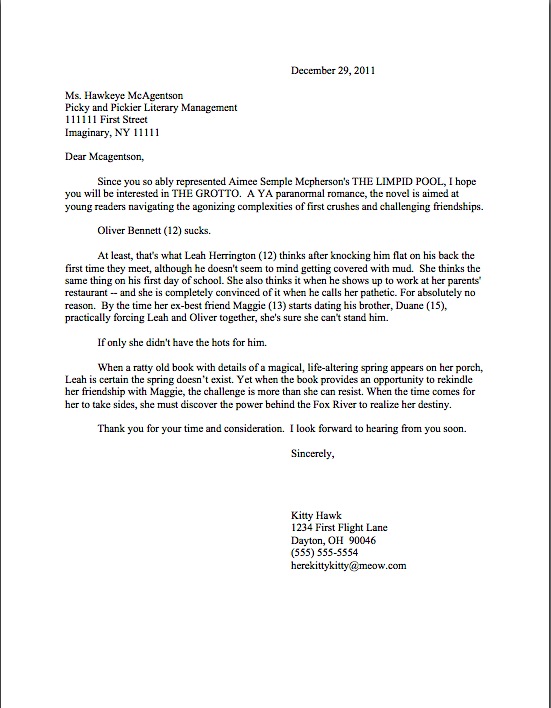
Querypalooza XI: making your book sound like a real page-turner

September 7th, 2010

How was the first workday after the long weekend, campers? Dragging a bit today?

If it’s any consolation, Millicent the agency screener probably is, too. Imagine walking into your office after a lovely Labor Day holiday (or, in many agency offices, an even more lovely multi-week break) to discover your desk has totally disappeared under the backlog of incoming queries and submissions? Or that your e-mail inbox is crammed so full that if you are going to do anything else over the next few days, you’ll have to be doing nothing but hitting the DELETE key constantly for hours on end?

(Confidential to the three readers who started as Millicents today: congratulations on the new gig! But I wasn’t kidding about the volume of work, was I?)

I hope you’ve been whipping those manuscripts into shape for submission, because this week, I’m going to be wrapping up my ongoing series on writing a compelling query letter. In fact, I anticipate polishing off the infamous troubleshooting checklist today. I’m going to be tackling a few readers’ questions on the subject later in the week, so now would be a great time to leave a comment with any lingering concerns on the subject that might be troubling your mind in the dead of night.

Hey, it happens. Writers have magnificently creative minds, gifted at creating angst. Speaking of which, after Querypalooza, it’s right back to close textual analysis, self-editing, and more of those fascinating winners of the Author! Author!/WHISPER Great First Page Made Even Better Contest.

Speaking of fascinating prose presented well (a clumsy segue, but hey, it was an awfully long weekend chez Mini), the last batch of questions focus upon conveying that your book is INTERESTING, in addition to being marketable in the current literary market. Contrary to what most aspiring writers seem to think, it’s not necessarily self-evident in a plot description for an interesting book how or why it is interesting. Or exciting. Or even vaguely original.

Blessed are the Millicents, for they shall be plowing through it all.

Of course, some of those queries must be for books that are neither interesting, exciting, or original in any way, but you’d be astonished at how many query letters for genuinely interesting books fail to make them sound even remotely so. (At least, I hope you would.) It’s as though half the aspiring writers out there believe that the mere fact of having completed the manuscript is in itself a merit badge of fascination.

Just not true, I’m afraid; the ability to produce complete manuscripts is the beginning of the professional writer’s job description, not the end. Truth be known, an astonishingly high percentage of the query letters that fall onto agents’ desks make the books sound dull as the proverbial dishwater.

Which, I hasten to add, isn’t necessarily a reflection upon the book being queried at all. It is, however, a damning indictment of the effectiveness of the query letter.

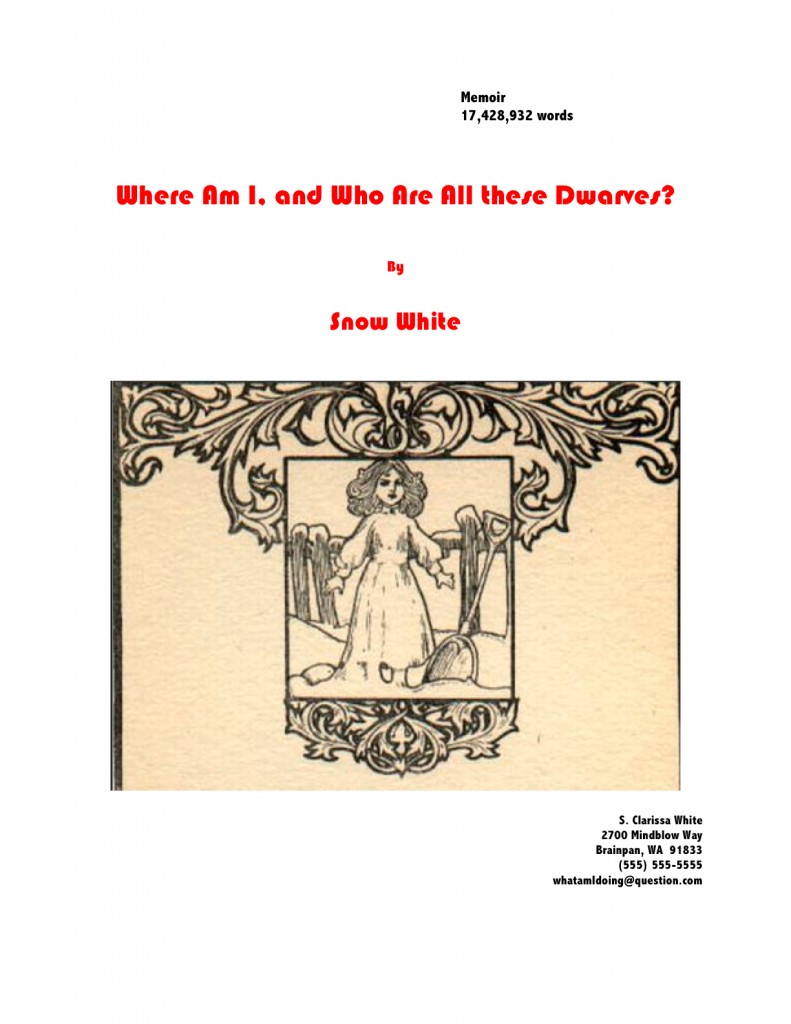
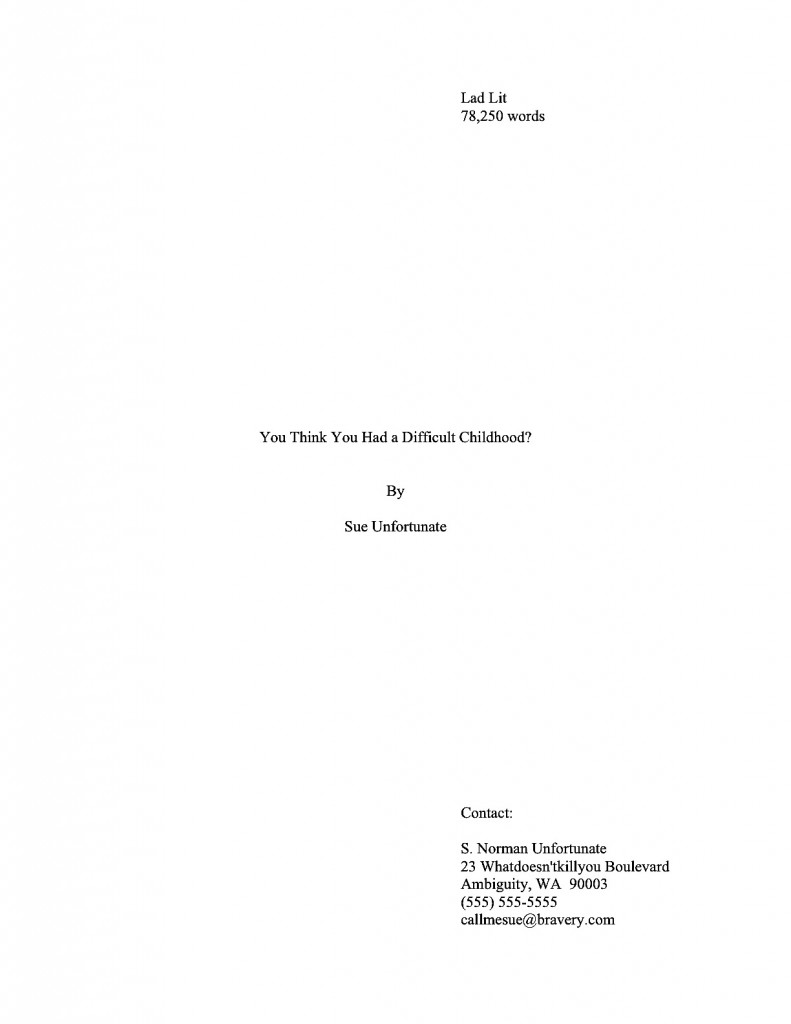
Some of you are already annoyed, aren’t you? “But Anne,” a few purists protest, “I’m a NOVELIST/MEMOIRIST/NARRATIVE NONFICTION WRITER, not an ad copywriter. If everything I had to say could be summarized in a single-page letter, I wouldn’t have much material for a 400-page book, now would I? Surely Millicent the agency screener must be aware of that — and if she isn’t, why doesn’t she have the intellectual curiosity/open-mindedness/common decency to take a gander at my manuscript before deciding that it and I are dull, rather than leaping instantly at that conclusion?”

The short answer: time.

The long answer: our Millie has a heck of a lot of queries to plow through on any given day. (See earlier expression of sympathy for the newbies’ eyestrain.) Since her boss agent could not possibly read every manuscript queried, it’s her job to weed out the ones that don’t seem like good fits, are not well written, are not likely to do well in the current market — and yes, the dull ones.

Darned right, that requires a snap judgment, and certainly a subjective one. A Millicent who bores easily tends to be very, very good at her job — which, lest we forget, primarily involves rejecting aspiring writers.

Still seem unfair? Think about that massive pile of queries on her desk for a moment: the authors of every single one of those find their own books fascinating, too, but that’s not enough to intrigue our favorite agency screener. To be the one query out of a hundred for which she will request pages (a more generous proportion of acceptance to rejection than most, incidentally), the letter is going to have to make HER believe that the book is fascinating.

Which is a pretty tall order — and virtually impossible when a writer forgets that <>the query is a writing sample, just as much as the manuscript is. Long-time readers of this blog, please open your hymnals and sing along:

broken-record Realistically, every English sentence a writer looking to sell a book places under an agent or editor’s nose is a writing sample: the query, the synopsis, the bio, the book proposal. Every paragraph is yet another opportunity to show these people that you can write.

Not to mention demonstrating that your book — and you — are interesting enough for them to want to be embroiled with for the next couple of years.

Again, this is where adhering to a pre-set formula for query letter perfection can really harm a manuscript’s chances. By definition, cooking-mix prototypes are generic; you really don’t want to add your title to one of the many templates out there and stir.

It’s conducive to boredom, amongst other drawbacks. Instead, you will want to use every ounce of writing skill to make that agency screener forget that you are hitting the basic points that a solid, professional query letter hits.

Yes, cramming all of that info into a page is an annoying exercise — your job is to make it look easy. Not entirely coincidentally, the next couple of items on the query checklist speak to these very issues.

(30) Is my query letter 100% free of clichés?
In a manuscript, the desirability of steering clear of the hackneyed and well-worn is self-evident — or should be — the goal here, after all, is to convince an agent or editor that the manuscript is original; by definition, clichés have been done before.

Yet clichés turn up with surprising frequency in query letters, synopses, and even author bios.

There are some pretty good reasons for that, actually: generalities are the next-door neighbors of clichés, and anybody who has ever had any contact with marketing copy, particularly for movies, might easily fall into the mistaken belief that using the usual shorthand (boy meets girl, doctor who can’t heal himself, protagonist in high-risk job who cannot commit, etc.) is just the way that creative people talk about their projects amongst themselves.

It isn’t. So don’t. Use the space instead to make her exclaim, “Wow, I’ve never seen that before.”

How? Remember what I was saying earlier in this series about wowing Millicent with amazing details? That’s the best cure for the common cliché.

The other way that clichés often creep into queries and synopses is when writers invoke stereotypes, either as shorthand (that descriptive paragraph can’t be very long, after all) or in an attempt to put a spin on a hackneyed concept.

News flash: the first almost never works, especially for fiction.

If you’re wondering why, please see my earlier comment about how the industry wants to see YOUR ideas, not the common wisdom.

The second is just hard to pull off in a short piece of writing, for much the same reason that experimental spellings, innovative sentence structures, and imaginative punctuation tend not to lend magic to a writing sample. (Unfortunately for writers of cutting-edge literary fiction.) To a professional eye seeing any given writer’s work for the first time, it’s pretty hard to tell what is a deliberate play upon language and what is simply evidence that the submitter did not pay very close attention in English class.

Similarly, on a quick read of a short sample, it can be pretty hard to tell the difference between a reference to a tired old concept like:

She’s a ditsy cheerleader who dominates her school, but learns the true meaning of caring through participation in competitive sport

and a subtle subversive twist on a well-worn concept:

She’s a ditsy cheerleader, apparently, but in reality, she’s young-looking nuclear physicist acting a role so she can infiltrate the local high school to ferret out the science teacher bent upon world domination.

I don’t mean to shock anyone, but it’s just a fact that skimmers will often read only the beginnings of sentences. And since both descriptions begin with she’s a ditsy cheerleader

Getting the picture?

Save the subtle social criticism for the manuscript; in your query letter and synopsis, stick to specifics, and avoid stereotypes like the proverbial plague. Cut anything that has even the remotest chance of being mistaken for a cliché.

(31) Is my query letter free of catchphrases?
Sometimes, writers will include hackneyed phrases in an effort to be hip — notoriously common in older writers’ queries for books aimed at the YA or twentysomething market, incidentally. However, there can be a fine line between a hip riff on the zeitgeist and a cliché, and few human creations age faster than last year’s catchphrase.

And nothing signals an older writer faster to Millicent than a teenage character who rolls her eyes, pouts, habitually slams doors, and/or quotes the latest catchphrase every 42 seconds at the dinner table. Certainly if he does it in the summary paragraph of a query letter.

Yes, some teenagers have been known to do all of these things in real life; Millicent’s seen it, too. Telling her again is just going to bore her.

When in doubt, leave it out, as my alcoholic high school expository writing teacher used to hiccup into my cringing adolescent ear.

Why? Well, many people in the publishing industry have a hatred of clichés that sometimes borders on the pathological. “I want to see THIS writer’s words,” some have been known to pout, “not somebody else’s.”

Don’t tempt these people — they already have itchy rejection-trigger fingers.

(32) Is my query letter free of jargon?
Not all boredom springs from predictability,: sometimes, it’s born of confusion. A common source of the latter: the over-use of technical terms in a query letter.

Predictably, jargon pops up all the time in nonfiction queries and proposals, especially for manuscripts on technical subjects: how better to impress Millicent with one’s expertise, the expert thinks, than by rattling off a bunch of terms a layperson couldn’t possibly understand?

I can think of a better way: by presenting one’s credentials professionally — and by explaining complex concepts in terms that even someone totally unfamiliar with the subject matter will understand.

Remember, even if Millicent works for an agent who happens to specialize in your type of nonfiction book, she’s almost certainly not a specialist in your area. Nor is her boss — or, in all probability, the editor. For marketing purposes, it’s safest to assume that they were all English majors, and choose your words accordingly.

Novelists also tend to use jargon quite a bit in their queries, especially if their protagonists are doctors, lawyers, physicists like our cheerleader friend, or members of another legitimately jargon-ridden profession. These writers believe, not entirely without cause, that incorporating jargon will not only make these characters sound credible (”But they really sound that way!”), but will make the writers themselves sound as though they know what they’re talking about.

Laudable goals, both — but if Millicent can’t understand what either is saying, this strategy is not going to work. (The same holds true with contest judges, by the way.)

Remember, one of the things any successful query needs to demonstrate is that the sender can write; since jargon is by definition shorthand, it tends to be a substitute for evocative descriptions.

Wow Millicent with your vivid descriptions — in layman’s terms. Speaking of writing talent…

(33) Does the sentence structure vary enough to show off my writing talent?
Writers tend not to think about sentence structure much in this context, but remember, Millicent is reading a whole lot of these missives in a row. The fact that your garden-variety query letter is stuffed to the brim with simple declarative sentences — or with four-line beauties with two semicolons in each — is bound to make those queries start to blur together after a while. Take a peek at this fairly typical gem:

I have written a book called Straightforward Metaphors. I hope it will interest you. It is about two sailors who go to sea. They get wet.

Sorry, writer-who-loves-simplicity, but THE OLD MAN AND THE SEA has already been done. There’s a reason that book is taught to 15-year-olds: the sentence structure is definitely YA, and thus probably not reflective of the narrative voice in this particular narrative. Despite the current popularity and burgeoning innovation of the YA market, using YA language is not the best way to pitch adult fiction.

Too-simple sentence structures are not the only reason Millicent might draw unflattering conclusions about a writer’s skill level from a query letter — far more common reason is poor grammar and spelling. However, even subtle structural repetition can set off some red flags, as in this example.

I have written a novel, Straightforward Metaphors, and I hope you will be interested in representing it. Two sailors put to sea, and they find their clothing all wet in record time. They toss their uniforms into the ocean, and their captain sees them dancing about the deck in their very non-regulation underwear. Hilarity ensues, and a court-martial has never been funnier.

Did you catch the problem? As I have argued about narrative writing, it’s tiring for a reader to scan the same sentence structures back-to-back, line after line.

Mixing it up a little is a relatively painless way to make your writing seem more sophisticated and lively without altering meaning. After all, that single-page letter is your big chance to wow Millicent with your writing acumen.

(34) Have I avoided the passive voice altogether in my query letter?
Eschewing the passive voice in every piece of writing you submit to an agency or a publishing house is an excellent idea because — not to put too fine a point on it…

broken-record Pretty much every professional reader is specifically trained to regard the passive voice as inherently poor writing, by definition. At minimum, it’s less vibrant than more direct and active sentences. If you want to impress a pro with the quality of your writing, you should avoid the passive voice as much as possible.

Have you been left in doubt by me as to why? (Yes, well might that sentence make you cringe, campers. It is incumbent upon me as your writing teacher to be brutal in my application of the passive voice in this example.) It is designed to avoid mention of who is actually doing what in a sentence. It makes it look as though things are making themselves happen, rather than things being done by protagonists. Characters seem to be acted-upon, rather than acting. The plethora of subordinate clauses to which writers fond of this indirect style appear constitutionally drawn to as if they were being pulled by a giant magnet is bound to result in sentences to which there appears to be no end. There are even instances where so many passive-voiced sentences appear in a row that it becomes quite confusing for the reader of the page in front of him to be impressed with a clear view of what is happening in the story.

Had enough of that reader-abusing structure? Millicent has — and frankly, so have I. After years of yanking such sentences out of query letters, synopses, and manuscripts, I actually found it mentally painful to construct that last paragraph.

Because the literary disdain for the passive voice is so close to universal, most of you probably already take active steps to avoid using it in your manuscripts, but surprisingly few queriers seem to realize that the norms of good writing apply to query letters as well. In a way, that’s understandable: when a writer is in the throes of trying to sum up the appeal of a 400-page book in the space of a single paragraph (or a 3-5 page synopsis, even), it can be awfully tempting to trim some space by letting the sentence structure imply that actions happened entirely of their own accord.

So instead of Harold’s teacher went around the room, rapping the students who had received grades of B- or lower over their quivering knuckles with a ruler, many queries will opt for The students who had received grades of B- or lower got their knuckles rapped, or even after receiving a C, Harold found himself with rapped knuckles, as if ruler-wielding cherubim descended from the heavens and did the rapping without human intervention of any kind.

And the Millicents of this world roll their eyes, just like the teenage characters in so many novel submissions.

There’s another, subtler reason to avoid the passive voice in queries and synopses. On an almost subliminal level, the passive voice tends to imply that your protagonist is being acted-upon, rather than being the primary actor in an exciting drama. Which conveniently brings us to…

(35) Does my descriptive paragraph make my protagonist come across as the primary actor in an exciting drama? Or simply a character acted-upon by forces swirling around her?
As I have pointed out before, agents and editors see a LOT of novel submissions featuring passive protagonists, stories about characters who stand around, observing up a storm, being buffeted about by the plot.

We’ve all read stories like this, right? The lead watches the nasty clique rule the school, silently resenting their behavior until the magic day that the newly-transferred halfback notices her; the amateur detective goes to the prime suspect’s house and instead of asking probing questions, just waits to see what will happen. The shy couple is madly in love, but neither will make a move for 78 pages — until that hurricane forces them to share the same cramped basement.

I’ve ranted at length in the past (for evidence of same, see the PURGING PROTAGONIST PASSIVITY category, right) about why first novels with passive protagonists tend to be harder to sell than ones with strong actors. My point at the moment is that in the course of trying to summarize a complex premise, many queriers present their protagonists as mere pawns buffeted about by forces beyond their control, rather than interesting people in interesting situations. Particularly, I’ve noticed, if those protagonists happen to be female.

So can you really blame Millicent for drawing the conclusion that the protagonists in these books are passive, when these queries present her as so?

Yes, it’s unfair to leap to conclusions about an entire book’s writing choices based upon only a paragraph’s worth of summary. But lest we forget, that exercising that particular bit of unfairness forms a crucial part of Millicent’s job description.

Don’t risk it. It’s not enough for your protagonist to be the heroine of her own story; your query has to make her sound like the heroine.

(36) For fiction and memoir, does my query (particularly the descriptive paragraph) make the stakes seem high enough for my protagonist that readers will care about the outcome? Does the conflict come across as both plausible and compelling? For other nonfiction, have I made the problem or issue I’m addressing appear important?
There’s a truism in editing: if a dialogue scene is dragging, raise the stakes for one of the speakers. The more the characters care about the outcome of a conflict, the easier it will be for the reader to care, too. By the same token, a fine revision tactic for keeping the reader turning nonfiction pages is to make a strong and continual case for why the subject matter of the book is vital — to the individual reader, to the society, to the world.

The same principle holds true for queries: if Millicent understands what a protagonist stands to gain or lose from confronting a clearly-defined problem, she’s more likely to find the story compelling. Similarly, if the query makes it pellucidly clear why she should care about its central question — and, more importantly, why readers in the target audience should care — the argument is more likely to grab her.

Or, to cast it in #35 terms: it’s not enough to impress upon reader over the course of for your manuscript or book proposal that your subject matter, characters, and/or situation is gripping enough to justify reading an entire book about it; your query has to make it sound gripping, too.

Memoir queries are especially prone to underselling the importance of what’s at stake for the protagonist. After all, from the memoirist’s perspective (and frequently for writers of autobiographical fiction as well), the primary significance of the story may well be that (a) it’s a true story, and (b) it happened to the writer. Shouldn’t the very truth of the story, combined with the single person most able to give an inside perspective, be enough to captivate readers?

That’s certainly an understandable point of view, from a writerly perspective, but from a professional viewpoint, the answer is usually no. No one buys a non-celebrity memoir simply because the events described in it happened to the author; there are far, far too many truthful memoirs out there for that to be the sole criterion for book buyers. Readers always weigh other factors into their choice of book.

So does Millicent in evaluating a query to decide whether she should request pages. Just as it’s the writer’s job to construct a manuscript or book proposal’s narrative to render the story compelling not just for herself, it’s incumbent upon the querying memoirist to give a screener plenty of reason to say, “Wow, this sounds not only like the narrator is an interesting person in an interesting situation — the conflict he faces comes across as one that will fascinate many readers in the already well-saturated memoir market.”

Yes, her thoughts really are that prolix. Our Millie is a complex reasoner.

Obviously, you don’t want to go overboard in making your case for your story or argument’s importance: implying that resolving leaf droppage on neighbors’ yards is the single most important factor in attaining world peace is only going to provoke peals of laughter from Millicent. The line between conveying importance and self-importance can be distressingly thin.

That’s the beauty of raising the stakes: ideally, you won’t have to make positive statements about the importance of your subject matter at all, at least for fiction. (For nonfiction, go ahead and explain why the world should care.) Your sterling description of the dynamic tension in the narrative will allow the reader to draw his own conclusion. Your just leading him toward the conclusion you wish him to draw.

(37) Is my query letter in correspondence format, with indented paragraphs?
Yes, yes, I know: I brought this up in question #1, but enough queries get rejected every year on this basis alone that I couldn’t resist an end-of-list reminder. Ahem:

broken-record For a paper query, it’s absolutely imperative that the paragraphs are indented. No exceptions. Business format is simply inappropriate for a query letter.

(38) Does my query letter read as though I have a personality?
I like to save this question for last, since it so frequently seems to come as a surprise to writers who have done their homework, the ones who have studied guides and attended workshops on how to craft the perfect query letter.

Personality?” they cry, incredulous and sometimes even offended at the very thought. “A query letter isn’t about personality; it’s about saying exactly what the agent wants to hear about my book, isn’t it?”

I beg to differ. A cookie-cutter query is like the man without a face we were discussing last night: he may dress well, but you’re not going to be able to describe him five minutes after he walks out of the room.

The fact is, the various flavors of perfect query are pervasive enough that a relatively diligent agency screener will be familiar with them all inside of a week. In the midst of all of that repetition, a textbook-perfect letter can come across as, well, unimaginative.

In a situation where you are pitching your imagination and perceptiveness, is this the best impression you could possibly make?

Your query letter should sound like you at your very best: literate, polished, and unique. You need to sound professional, of course, but if you’re a funny person, the query should reflect that. If you are a writer whose prose tends to be quirky, the query should reflect that, too.

Of course, if you spent your twenties and early thirties as an international spy and man of intrigue, that had better come across in your query. Because, you see, a query letter is not just a solicitation for an agent to pick up your book; it is an invitation to an individual to enter into a long-term relationship with you.

As I mentioned at the very beginning of Querypalooza, I firmly believe that there is no 100% foolproof formula, my friends, whatever the guides tell you. But if you avoid the classic mistakes, your chances of coming across as an interesting, complex person who has written a book worth reading goes up a thousand fold.

Next time — that’s 10 am PST tomorrow, campers; although we’re still in Querypalooza mode, it would be madness to try to maintain the three-shift schedule of the weekend — I shall be tackling that perennial bugbear of query-constructors: figuring out is and is not a credential worth including in the platform paragraph of your query. Or, as we like to call it here at Author! Author!, Eye-Catching Query Letter Candy.

Yum, yum. Keep up the good work!

First pages that grab: Divided States, by 2010 Author! Author! Award for Expressive Excellence winner Jennifer Sinclair Johnson

September 1st, 2010

Jsjohnsonphoto1

Yes, it’s been a lengthy process, campers, unexpectedly attenuated by my car crash earlier this summer, but today, at long last, I shall begin presenting you with the winning entries in the Author! Author!/WHISPER Great First Page Made Even Better Contest. For the rest of this week, I am delighted to be sharing with you the winning entries in Category II: Adult Fiction and Memoir.

And if you’re not careful, as the pundit Fat Albert used to say, you might learn something before it’s done.

Why start with Category II, you ask, instead of the more numerically logical Category I? Well, Phoebe Kitanidis, author of the HarperCollins’ new YA release, Whisper will be joining me after Labor Day to give feedback on the Category I: YA entries. We have some surprises in store that I hope will be worth another few days’ wait.

Speaking of treats lurking in your future: in celebration of the end of the long annual NYC- based publishing world’s vacation, slated to lurch to a close after the upcoming Labor Day weekend, I shall be devoting this weekend to Querypalooza, a crash course in everything an aspiring writer needs to know in order to write a solid, compelling, professional-looking query letter..

Do I sense the rise of both extreme excitement and grave trepidation out there in the ether? “Um, Anne?” a few of you murmur, “Just how crash a course is Querypalooza going to be? Will I require a protective helmet of some sort?”

That depends upon your capacity for swift absorption of in-depth analysis over a three-day period. Beginning at 10 am this coming Saturday, September 4, I shall be posting sterling how-to advice on querying once every 8 hours.

Why so quickly? So in theory, a conscientious reader who knew little or nothing about the querying process at the onset of Labor Day weekend could potentially wake up on Tuesday, September 7th with a really good query letter, just in time to send it off to all of those fresh-from-vacation Millicents.

Hey, they don’t call it Labor Day for nothing. Tune in to join the fun.

But enough projection into the future. Let’s concentrate on the now, and Jennifer Sinclair Johnson’s winning first page, the opening to a manuscript she described for the judges thus:

What if Dorothy landed in Hollywood instead of Oz? DIVIDED STATES spins a new twist on Cozy Mysteries as a Midwestern insurance adjuster arrives, finding her coworker in earthquake rubble. Navigating natural disaster and local rules with more cracks than sun-baked Nebraska clay, she brings fresh perspective to light.

First off, kudos to Jennifer for winning not only the Grand Prize for Adult Fiction in the Author! Author!/WHISPER Great First Page Made Even Better Contest, but also this year’s Author! Author! Award for Expressive Excellence. For those of you who missed the initial contest announcement, I had decreed that the contest would have two levels: a straightforward competition for the most intriguing opening page for a manuscript, and an optional award level, if the judges felt that Grand Prize in the former was not sufficient to record their reactions to an entry.

I’m delighted to report that the judges required this extra outlet for their feelings not once, but four times in this contest. You shall see why in the days to come.

Jennifer’s was the Adult Fiction entry that elicited the more enthusiastic plaudits from the judges. Before I tell you why, let’s take a gander at what made them cheer until the rafters resounded. (If you are having trouble reading it, try holding down the COMMAND key while hitting +.)

Divided States page 1

The writing here is good, of course, crammed to the gills with telling details, but as we know from our summer of craft, there’s more to creating a great first page than collecting a series of strong, well-constructed sentences. In order to grab the reader — particularly a professional one like a contest judge or our old pal, Millicent the agency screener — a fiction first page needs to present the protagonist as an interesting person in an interesting situation.

Check. What else renders this first page so compelling?

If that question leaves you a trifle stumped, you’re not alone. Most aspiring writers know what they like, but have only a vague notion of what makes a first page compelling, marketable, accessible, and/or grabbing. There’s an excellent reason for that, of course: unlike professional readers, who read thousands upon thousands of page 1s in any given year, the overwhelming majority of aspiring writers have never read any manuscript’s first page but their own.

Or, at best, a writer friend’s. It’s not likely, in short, to be an impartial reading. While active members in a regularly-meeting critique group gain more exposure to the possible range of openings, participation in such groups is rarer than one might think.

But how is the isolated aspiring writer to learn what works on page 1? Typically, the average writer’s conception of what a good opening is comes from precisely the same source as any other readers’: what he’s seen in published books. As we have discussed, though, what an established writer can get away with on page 1 and what someone trying to break into the biz could slip past Millicent are often quite different things. Ditto with what might have caught an agent’s eye 5 or 10 years ago vs. now.

That’s why, in case you had been wondering, we have been spending so much time this summer concentrating on first page revision. I’ve been trying to move your conception of what makes a strong opening beyond a simple combination of what you like and what you have seen authors you respect do; all of these posts have been attempting to help you read more like a professional.

So let’s go ahead and turn to the pros for advice on how to assess today’s page 1. Specifically, let’s recall from last time the agent-generated list of qualities they like to see in a first page. How well do you think the example above meets these criteria?

1. A non-average character in a situation you wouldn’t expect.
Oh, do you see many stories about insurance adjusters newly transplanted to earthquake zones? Admittedly, it is not immediately apparent here whether our narrator is a man or a woman, but there isn’t much doubt that s/he is interesting, is there?

As we have discussed, as well as slice-of-life writing can work in short stories, plays, and novellas, it’s difficult to grab a novel reader — particularly a professional one like Millicent — on page 1 with a protagonist who is aggressively ordinary. A savvy writer is usually better off emphasizing what is unusual about his characters in an opening scene.

2. An action scene that felt like it was happening in real time.
This isn’t an action scene, so this one is not applicable. Remember, not all of these criteria will work for every opening.

3. The author made the point, then moved on.
In many first-person narratives, the self-analysis in page 1 would have extended for the rest of the page, if not beyond. Here, Jennifer has been quite restrained, moving the reader swiftly out of the protagonist’s head and into observation of the environment. That well-handled pacing will prevent Millicent from feeling that the story isn’t beginning fast enough.

4. The scene was emotionally engaging.
This lies largely in the eye of the beholder, of course. Perhaps a better way to approach this issue: based on this first page alone, do you want to read the rest of this book?

The judges did, unanimously. And if a quick scan of page 1 does not seem like an entirely fair basis for making a determination on an entire manuscript, bear in mind that Millicent often reads less than that before making up her mind.

5. The narrative voice is strong and easy to relate to.
Again, this is quite subjective, but the judges found this narrative voice quite likable. With a protagonist engaged in a work project on page 1, it would have been very easy to load the narrative voice down with industry-specific jargon. Jennifer has steered clear of that danger, offering us instead a narrator who seems swept up in the details of the beauty of her new environment.

The only sentence that gave any of the judges pause on a voice level was The earthquake that hit Hollywood with the bang of a summer blockbuster’s opening had cast me into new territory. Opinions were divided over whether using Hollywood and cast so close together was intended as a pun based on the double meaning of cast (to throw/to be given a part in a play or movie). Since the pun, if intentional, was not very funny, the judges expressed the hope that the word choice would be reexamined.

6. The suspense seemed inherent to the story, not just how it was told.
This is a subtle one. It’s clear that something is about to happen here, isn’t it? The reader isn’t sure what, but the suspense is palpable.

Again, some of the judges had a quibble with one of the sentences: After the way my new boss had sent me to the property before my flight finished taxiing along the tarmac, I wouldn’t have been surprised to find destruction akin to the aftermath of Armageddon. The ending image is strong, but the reader has to interpolate some action in order to make the first part make sense: since airline passengers are currently not allowed to use cell phones while the plane is in the air, and there’s no indication that the story is not taking place in the present, the narrator must have turned on her phone as soon as allowed, after the plane touched down.

So did her boss call her the second she powered up the phone? That would be the only way that the timing of his having issued the order could have conveyed urgency all by itself, but the narrative is in such a hurry (understandable, on a first page) that it leaves the reader to fill in the blanks.

Amid those blanks lies a logical question: how did he know that she had just turned it on? Is he psychic? Or — and this seems substantially more likely — had he been calling every five minutes since he thought her plane could possibly have landed? That in turn begs another question: did he call her, or did she turn on the phone, hear his 47 messages, and call him right away?

Yes, that is a whole lot of questions to have about a single event, now that you mention it. But that’s not an uncommon reaction to a page 1 where the narrative has left out logical steps in the interests of streamlining. Frankly, from a professional reader’s perspective, both that paragraph and that joke would have worked better if it hadn’t all been crammed into a single sentence.

That’s a small quibble, however, one likely too tiny to put off most Millicents. Even the judges who made it recognized that.

7. “Good opening line.”
Professional readers are notoriously fond of first sentences that contain some element of paradox. This opener does not disappoint.

8. ”There was something going on beyond just the surface action.”
Well? Did you think there was?

What is the benefit of presenting a layered reality over a completely straightforward one, when clarity is also so highly valuable on page 1? Simply put, a narrative that implies that there’s more going on that immediately meets the eye is a better reflector of reality. The protagonist appears to be inhabiting an actual world, rather than just a tale.

As fine as all of those criteria are for evaluating a first page, the judges in our contest were looking for a bit more. For instance, in a submission, as we have discussed, it’s vital to give some indication from the very top of page 1 what the book is about. Based on Jennifer’s opening, would you or would you not expect some intrigue to arise from the earthquake site her narrator’s boss is so eager to get her to see?

How did we judges know whether this was representative of the rest of the book? Advance thought, my dears: as some of you may perhaps recall, one of the contest requirements was a brief teaser, indicating the subject matter, book category, and what the manuscript to follow would add to the current offerings in that category. Here’s what Jennifer told us:

What if Dorothy landed in Hollywood instead of Oz? DIVIDED STATES spins a new twist on Cozy Mysteries as a Midwestern insurance adjuster arrives in Los Angeles to find her coworker lying unconscious in earthquake rubble. Navigating natural disaster and local rules with more cracks than sun-baked Nebraska clay, she brings fresh perspective to light.

Quite a close match with the opening, isn’t it? Millicent would appreciate that. So did the judges: all of them commented on how beautifully this page 1 fulfilled the promise Jennifer had made in the book’s description.

I can already sense literal-minded readers thinking about raising their hands. “But Anne,” these detail-oriented souls point out, “the protagonist doesn’t discover her coworker in the rubble on page 1, nor do we hear much about the differences between Nebraska and Los Angeles. So in what sense does her page 1 fulfill the promise of the description?”

Glad you asked, literal-minded ones; aspiring writers often confuse the imperative to let Millicent know right away what the book with an expectation that page 1 would be crammed with backstory. Usually, though, backstory-heavy openings are slow — your garden variety NYC-based Millie tends to prefer manuscripts that open with conflict (or at least the potential for it), with the backstory filled in later.

Jennifer’s page 1 contains several different species of conflict — we learn right away that her protagonist is a fish out of water, coming into an inherently dangerous situation with an already-tense boss breathing down her neck. Furthermore, it appears that the last person sent to do her job ran into some serious difficulties. That’s a pretty rich set of possibilities for a single page of text, no? But rather than stop the action short to explain what precisely happened to her predecessor that necessitated flying our heroine out from Nebraska, the reader gets to figure out the situation along with the narrator.

Thus, how this page fulfills the promise of the premise is not by resolving all of the questions it raises on page 1, but by (a) giving the protagonist hints about what the conflicts in store for her are and (b) doing so in a manner that allows the readers to speculate — yes, even by the bottom of page 1 — how she is going to be drawn into those conflicts-to-come.

Of course, as the organizer of this contest, I enjoy a considerable advantage in anticipating those conflicts. I had the power to ask for a longer description of the book:

Divided States description

The judges were also looking for page 1 to present a narrative voice appropriate to the intended target audience. Here, Jennifer is showing us a very literate, likable, thoughtful voice, appropriate for a high-end cozy mystery or women’s fiction.

Wisely, she has not designated this voice as literary fiction, as many aspiring writers would have done: it’s an excellent example of well-written genre fiction. Rather than trying to pitch the book on the writing alone, though, she has made the market-savvy choice of categorizing her manuscript by its subject matter.

The hyper-literal have raised their hands again, have they not? “But Anne, are you saying that the judges — or, even worse, Millicent — would have liked this page less had it been categorized as literary fiction? To my admittedly less experienced eye, the writing has literary sensibilities.”

In a word, yes. In several words, that’s to be expected, isn’t it?

Miscategorized submissions are, after all, among the easiest for Millicent to reject. As we have discussed many times before, no agent (or editor, or publishing house, or even most contests) handles every conceivable kind of writing. They specialize.

So when Millicent is confronted with even a very well-written submission that does not seem to fit comfortably into a book category that her boss represents, it just doesn’t make sense for her to keep reading once she’s determined it’s not something her agency is going to pick up. Even if she positively loves it, she is not in a position to help that book come to successful publication.

She has only one option, unfortunately: “Next!”

Starting to gain a better sense of what kind of first pages don’t provoke that response? If not, don’t despair — you’re going to get quite a bit of practice over the next week or two, as we continue to go over contest winner’s first pages. Except for the days during which we shall be taking a brief-but-content-heavy detour for Querypalooza, of course.

Lots of action in store at Author! Author! Tune in tomorrow for more first page high jinks.

Well done, Jennifer — and as always, everybody, keep up the good work!

Speaking of dialogue revision, part VI: and then there’s the fine art of doing it right, or, love, agent-style

August 29th, 2010

pre-butchered fir tree

This, I am happy to say, used to be one of the views from my studio window, a sweet fir tree stuffed to the proverbial gills with cavorting crows, mischievous blue jays, and a small family of squirrels deeply devoted, for reasons best known to themselves, to digging up my crocus bulbs, saving them for a month or two, then replanting them in entirely different locations. I used to enjoy watching them before the strange men from the phone company showed up unannounced yesterday and slashed a ten-foot hole in the middle of the tree in order to make room for a half-inch cable scheduled to be installed three months from now. As one does.

Actually, it would have been a twenty-foot hole — quoth the foreman: “But those other branches were, like, in our way! We would have had to work around them!” — had I not managed to hobble out front to stop them in mid-slice. (Never underestimate the moral force of a crutch-wielding Valkyrie with a rudimentary knowledge of property law.) The damage has been done, though: this morning, there are no birds in the defiled tree.

Why does this seem like an apt time to wrap up this series on revising dialogue?

I can tell you why: all too often, in the first glow of enthusiasm following a newly-acquired self-editing tip — or, if you’ve been following our intensive discussions of craft this summer, a whole mess of ‘em — writers will, to put it succinctly, over-cut. Fired up by the time-honored advice to kill their darlings, they hack and slash with gusto, assuming, sometimes incorrectly, that if a line or two of dialogue runs afoul of the freshly-learned rule, the entire speech should go. Or the entire scene. Or the entire chapter.

But not all darlings are apt candidates for slaughter. Sometimes, too-vigorous cutting can do some serious harm to the tree. You don’t want to scare off the pretty birds, after all.

(I know — isn’t it amazing how often my day-to-day life provides PRECISELY the metaphor for what we’ve been discussing? Somebody up there must have a great fondness for blogs. Either that, or a monumental antipathy toward trees.)

Which is to say: not all of the results of revision are necessarily intentional. Over-enthusiastic cutting can, among other things, result in uneven tone, the loss of information the reader might need to know later in the plot, confusion of motivation, the omission of that foreshadowing sneer that alerts the attentive reader to the possibility that the protagonist’s mild-mannered coworker may turn out to be the super villain intent on destroying every ice cream stand in Gotham…

It can lead, in short, to a Frankenstein manuscript. There is no such thing, then, as a revision that would not benefit from a follow-up re-reading of the ENTIRE manuscript (preferably IN HARD COPY and, especially if it is dialogue-heavy, OUT LOUD) to make absolutely certain that the post-cut scenes not only read well on the page, but still pull their weight in the plot.

With that incentive for caution in mind, here is a final post in our revisit to 2009’s Seeing Submissions From the Other Side of the Desk series. Actually, it’s a mash-up of two posts in that series, presented in composite form for your perusing pleasure. When I originally posted the second, John Updike had just died — providing, yet again, a nudge toward a blog-friendly example.

Enjoy! But please, employ your pruning shears judiciously — and sparingly — after reading it.

Are you surprised to see another post on first-page rejection reasons coming after I’ve already gone over the agent-generated list of submission red flags? What can I possibly still have to say on the subject, after nearly three weeks of harping upon it?

Plenty, as it turns out. As excellent and extensive as the agent-generated list was in its day, as full of classic submission problems as any such list could possibly be, the agents in question generated it several years ago. As I’ve been shouting from the rooftops practically since I began writing this blog, the standards for what agents are seeking in a manuscript change all the time, along with the literary market itself.

Contrary to popular belief amongst aspiring writers, good writing, a solid premise, and catchy character names are not necessarily enough to catch an agent’s eye today. Yes, a novel or memoir submission typically needs all of those elements to be successful, but now as ever, it needs something else: to be a book that the agent can picture selling in within not an ideal market, but the one in which s/he is currently attempting to sell books.

Yes, I do realize what I just said: a manuscript could conceivably be perfectly marvelous and still not be what an agent would consider marketable in the literary market right now.

Why right now in particular? Well, agents have always made their living by selling their clients’ work to publishers — since reputable agents don’t charge fees over and above their contracted percentage of a book sale, they make money only when they hawk their clients’ books successfully — but even a cursory glance at PUBLISHERS WEEKLY or PUBLISHERS MARKETPLACE will tell you that these are exceptional times for the publishing industry.

What does this mean for aspiring writers? Probably, that agents will be a bit warier about picking up new clients until the publishing houses decide what their new strategies will be. That, and that vampire books like the TWILIGHT series will continue to get snapped up at a prodigious rate until the next surprise bestseller comes along. {Present-day Anne here: amazingly, although I originally posted this a year and a half ago, this statement remains true. That’s how cautious agents have become.}

So the best thing you could possibly do right now is rush right out and buy 50 books similar to yours — and convince 100,000 of your friends to do the same. Like it or not, that’s now new marketing trends are made.

Since my readership is made up almost exclusively of writers, I’m going to go out on a limb here and assume that none of you like it.

I don’t pretend to be able to predict the next big thing — other than the novel I’m about to finish writing, of course — but there are a few trends in what gets rejected and accepted that I’ve noticed cropping with increasing frequency over the last year or so. Since once a pet peeve is established, it tends to hang around for a while on Millicent the agency screener’s red flag list, it’s probably a good idea to avoid them for the foreseeable future.

I know — kind of ironic, given how opaque the future of publishing is right now. Let’s plow ahead anyway. Some stuff that hasn’t been playing well lately {and, again, this list remains astonishingly current}:

1. Unprofessionally formatted manuscripts.

I know that I harp on this one quite a bit — as evidence and for the benefit of readers new enough to this blog not to have lived through my extensive discussions of what publishing professionals expect manuscripts to look like, please see the HOW TO FORMAT A MANUSCRIPT and STANDARD FORMAT ILLUSTRATED categories on the archive list at right — but it honestly is true that if a submission does not look professional, Millicent is more likely to reject it, regardless of the quality of the writing. Since the volume of queries and submissions has been skyrocketing as the economy has worsened (writing a book is a LOT of people’s Plan B, apparently), she can afford to be even pickier than usual.

Take the time to make it look right.

2. “I’ve seen that before.”

This is a practically inevitable side effect of the aforementioned volume of queries and submissions rising, but standard storylines, stock characters, and literary clichés in general seem to be getting judged more harshly of late, probably because Millicent has been seeing the same things over and over again.

Does this mean that this is a great time for writers who embrace radical originality. Not exactly, because…

3. Fiction that challenges the status quo very strongly.

This is one of the truisms of the publishing industry for the last century — during uncertain economic times, comforting and escapist plot lines tend to sell better. Unfortunate, but true. It has to do with what’s known as the Peanut Butter and Jelly Index: when Americans are feeling insecure about the future, sales of inexpensive comfort foods tend to rise — as do books that make readers all warm and fuzzy.

Historically, agents and editors have followed these trends, shying away from more challenging plot lines, unusual worldviews, and even experimental use of prose. Since I’m personally a big fan of challenging plot lines, unusual worldviews, and experimental use of prose, I’m not all too happy about this, but it might be worth holding off on submitting any of the above for a few months, until the industry has had time to get used to new economic realities.

I know; it’s annoying. {Even more annoying: that this advice is still apt, to a very great extent.}

4. Vocabulary or tone inappropriate to book category.

I’ve been hearing a LOT of complaints in that bar that’s never more than a 100 yards from any literary conference in North America about submissions from writers who don’t seem aware of either the target audience or the conventions of the categories in which they have written books. From coast to coast, Millicents and their bosses have been railing about YA with too-adult word choices, literary fiction with a fourth-grade vocabulary, cynical romances, paranormals where vampires cavort in the sun…

I suspect that the increased pervasiveness of this one is actually an expression of the publishing industry’s smoldering resentment that book sales have dropped; if the writers of these books were actually buying the new releases in their genres, the logic goes, they would be more conversant with what’s selling right now. Having met scads of writers who say, “What do you mean, what do I read? I don’t have time; I’m too busy writing,” I have to say, I have some sympathy with this one.

Remember, from the pros’ point of view, a writer’s being up on the current releases for her type of book is considered a minimum standard of professionalism, not an optional extra. At least take the time to go to a well-stocked bookstore and thumb through the recent releases, to make sure that your submission doesn’t fly too far out of the acceptable range.

5. Narrative voices that read as though the author has swallowed a dictionary.

This is a perennial complaint that’s been getting more play recently, probably because of the convenience of the Thesaurus function in Word, but for Millicent, a submission crammed with what used to be called three-dollar words does not necessarily read as more literate than one that relies upon simpler ones. Especially if — and this problem turns up more often than anyone would like to admit — not all of those words are used correctly.

Or, to put it as some aspiring writers might: without embroiling us in superfluous polysemousness, it must be averred that the aesthetic propensities of a vainglorious tome toward prolixity or indeed even the pseudo-pragmatic co-optation — as by droit du seigneur — of an antiquitarian lexis, whilst purportedly an amendment to the erudition of said opuscule and arguably consanguinean (metaphorically speaking) and perhaps even existentially bound up with its literary apprizal, can all too facilely directionize in the azimuth of fustian grandiloquence or unmanacle unpurposed (or even dystelelogical) consequences on a pith and/or douceur de vivre level vis-à-vis even the most pansophic reader. As Pliny was wont to quip in his cups…

Come on, admit it: this is a BIT over-the-top for YA.

Yes, yes, I know that English is a beautiful language crammed to the gills with fabulous words, but use that thesaurus sparingly: from a professional reader’s point of view, the line between erudite and pretentious can sometimes be pretty thin. Few readers, they argue, will actually stop reading in order to go and look up a word in a novel written in their native tongue.

They speak from personal experience: it’s something Millicent would literally never do while scanning the first few pages of a submission.

Here again, your best guideline is the current market for your type of book: generally speaking, a writer will always be safe sticking to the vocabulary level of recent releases in his book category. If you want to sneak in more obscure words here and there, make sure that their meaning is evident from context. Trust me on this one.

6. Humor that Millicent doesn’t find funny.

Perhaps it’s due to the major presidential candidates’ having employed speechwriters last time around who wrote better jokes for them, but in the last few years, more aspiring writers seem to be trying to incorporate humor into their work. Since genuinely funny writing is a rare and wonderful thing, I can only applaud this trend.

Just make sure that it’s actually funny before you submit it on the page — not just to you and your kith and kin, but to someone who has never met you and is from a completely different background. And no, having one character laugh at a joke another character has just made will not cause Millicent to find it humorous.

Remember, too: nothing dates a manuscript faster than borrowing a joke from the zeitgeist. Particularly if the joke in question is lifted from a sitcom. (Have your parents explain why they ever thought “Whatchoo talkin’ about, Willis?” was funny, children.)

If you choose to open with humor, run your first scene (at least) by a few good, unbiased first readers before submitting it. Even those of us who write comedy professionally are heavily reliant on reader reaction to determine what is and is not legitimately funny.

7. Unlikable protagonists.

This is another golden oldie that’s been cropping up with increasing frequency of late: it’s long been an industry truism that if the reader doesn’t find the protagonist likable, she’s not going to want to follow him through an entire book. And I don’t just mean finding him kind of tolerable; Millicent’s going to want to find the guy actively engaging.

Why might this perennial objection be flying out of Millicent’s mouth more often recently, you ask? Did you read that one above about the Peanut Butter and Jelly Index?

And don’t tell me that your protagonist or narrator becomes more likable as the reader gets to know her. If the writing on page 1 doesn’t grab Millie, it doesn’t matter if the protagonist is marvelous on page 15.

It’s not as though agents or editors open books at random to check out the writing, after all. Millicent honestly does expect to see your best writing on page 1 of your submission — and that since she is going to assume that the writing on page 1 IS your best writing, it’s worth taking exceptional pains over it.

Begin at the beginning, as a reader would, when you revise. Your time investment will bear the greatest returns there. As agents have been known to tell one another when they’re in their Pliny-like cups (in that bar that’s never more than 100 yards from any writers’ conference, natch), they want to fall in love on page 1.

All that being said, a moment of silence, please: John Updike is dead.

When I heard the news — repeatedly; one of the mixed blessings of being widely known as a writer and descendent of a long line of writers is that people very considerately call to break the news to me whenever any well-established author kicks the bucket, as if everyone who has ever set pen to paper were a distant cousin of mine whose death I should not be forced to learn from the standard media sources — I naturally went straight to my bookshelf and glanced through some of his work. In light of our ongoing series on opening pages and the fact that his first novel, THE POORHOUSE FAIR, came out in 1959, I expected his initial pages would, to put it politely, have a tough time making in past today’s Millicents, thus underscoring Updike’s frequently-made point about how literary fiction has been all but brought to earth over the last 40 years.

I was pleased to find that quite the opposite was true: his first pages were grabbers. Take that, eulogists of literary fiction!

More to the point of the latter part of this series, his hooks largely operated not through garish action, but interesting character development. Take a gander, for instance, at the first two paragraphs of THE WITCHES OF EASTWICK (1984):

“And oh yes,” Jane Smart said in her hasty yet purposeful way; each s seemed the black tip of a just-extinguished match held in playful hurt, as children do, against the skin. “Sukie said a man has bought the Lenox mansion.”

“A man?” Alexandra Spofford asked, feeling off-center, her peaceful aura that morning splayed by the assertive word.

Now, we could speculate all day about the probable insecurities of a male author who felt compelled not only to have a female character repeat the word man here, as though the very concept of the Y chromosome were inherently unsettling to heterosexual women (at least the frail kind discombobulated by assertive words) but also to employ splayed, a term commonly associated with the things models do in the centerfolds of men’s magazines, to describe a mental state. It might not be too much of a stretch to assume based upon this opening that Mr. Updike wasn’t picturing much of a female readership for this book when he wrote it — intriguing, since in 1984 as now, women were far and away the most common purchasers of literary fiction.

But none of that concerns us at the moment. Look, I ask you, at how beautifully he has used visceral details to establish both a mood and character in the first lines of this book.

It’s a heck of an opening in general. Let’s take a moment to ponder why: instead of easing the reader into the story by an extensive description of the physical space in which we discover these characters, or the even more common physical description of the characters themselves, Updike introduces these women by providing specific insight into their mental processes and motivations. Instead of just telling us that Jane is mean and Alexandra shy, he shows us through an analogy and word choices that we might not expect.

Yes, what you just thought is absolutely right: this opening would grab Millicent because it’s not only well-written, but surprising.

Seeing all the elements in action helps to clarify what we’ve been talking about, doesn’t it? But while we’re at it, let’s be thorough about this. Quick, without rushing back and checking our initial list of red flags that often lead Millicent to reject a submission on page 1, what might strike her as problematic if she saw this opening in a submission by a brand-new writer today?

If you pointed out the typo in the very first sentence, give yourself a great big gold star for the day. (Technically, there should be a comma between oh and yes; as Mr. Updike was a graduate of my alma mater, I’m relatively certain that he should have been aware of this.) While some Millicents might be kind enough to read past a first sentence grammatical or spelling error, it’s not a foregone conclusion.

Proofread.

While we’re giving out prizes for observation, take a red ribbon out of petty cash if you flagged the repetitive dialogue. As we discussed earlier in this series, repetitive dialogue tends to annoy agents and editors, since they’ve been trained since they were pups to excise redundancy. Besides, characters who simply echo what has already been said tend to come across as less intelligent than those who actually add something new to the conversations in which they participate — always a tad risky in a protagonist.

Anything else? What about the unnecessary tag lines (Jane Smart said, Alexandra Spofford asked), now out of fashion? Since Mr. Updike had already been established in the first rank of North American authors by the time for decades by the time the use of tag lines fell out of fashion, this might seem like an unwarranted quibble, but remember, we’re judging this by the standards that would apply to a writer trying to break into the biz now.

Long-time readers, pull out your hymnals and sing along with me now: an established author can often get away with things that someone new could not.

Did any of you red-flag the semicolon? If Mr. Updike were submitting this to Millicent labeled as anything but literary fiction, you’d be right to consider cutting it. Generally speaking, in fiction that isn’t aimed at a college-educated audience — as literary fiction is, ostensibly, but most fiction is not — semicolons are considered a bit highbrow.

Admittedly, the fact that Millicent regularly sees manuscripts whose vocabulary barely scrapes the 10th grade positively peppered with semicolons might have something to do with this. No one but writers really like semicolons, and not even all of us use them correctly (as the late John Harvard would no doubt be delighted to note, Mr. Updike has done properly above), but my, don’t we like to shoehorn them into a manuscript!

Unless you’re submitting your work as literary fiction to an agent with a successful track record of representing a whole lot of it AND her client list fairly bristles with semicolon-wielding authors, you might want to minimize their use.

All of which, as fate would have it, is a perfect lead-in to my wrap-up of the rejection reasons because, really, it’s important to recognize that while, in the past, agents tended to be open to working with their clients in order to work out the technical kinks prior to submission to publishing houses, now most of them expect writers to submit manuscripts so clean and camera-ready that the agency screener could confidently walk them directly from the agency’s mail room to the desk of even the pickiest editor. Thus these last few weeks of weeding out the most common submission problems, at least on page 1: we’ve been going over these points exhaustively precisely so you can meet standards far higher than when the late, great Mr. Updike faced when he was first trying to break into the biz.

Today, however, we get to see the reward: the kind of manuscript that makes agents weak in the knees.

Surprisingly, agents and editors tend not to talk too much at conferences about what they love to see in manuscripts. They tend to stick to describing what is marketable, because that is, after all, their bread and butter. Remember, agents (most of them, anyway) don’t hold submissions to such high standards in order to be mean — they want to take on books that they know they can sell within today’s extremely tight market.

Which is to say: it’s not enough for an agent to love your work; she needs to be able to place it at a publishing house for you. Contrary to popular opinion amongst aspiring writers, that’s in the writer’s interest as much as the agent’s.

But as those of you who have been querying strong, marketable projects for a while already know, agencies often reject submissions for perfectly marketable books, a fact that is very confusing to those who believe that every agent is looking for the same thing, or that a single rejection from a single agent means that everyone in the industry will hate a book. Or that there exists writing so beautifully literary that every agent currently drawing breath will instantly exclaim, “Oh, of course — I’ll represent that!”

Especially for first fiction or memoir, it’s not enough for an agent to recognize that a writer has talent and a book has market potential: they like to fall in love. If you’re a good pitcher, you already know the reaction I’m talking about: the eyes becoming moist with desire, the mouth appearing to go dry with lust. When an agent wants a project, the symptoms strongly resemble infatuation, and as this series has taught us, it’s often a case of love at first sight.

As with any other type of love, every agent has his own particular type that is likely to make his heart beat harder, his own individual quirks and kinks. Just as an agent will train his screeners to rule out submissions containing his pet peeves, he will usually set some standards for the kind of project he would like to see forwarded to his desk.

So, in a way, our old pal the underpaid, latte-quaffing, late-for-her-lunch-date screener is her boss’ dating service. Literarily, of course.

With an eye toward getting your submission on the litero-romantic short list, here’s the list of what the Idol panelists said would light their fires sufficiently to ask for a second date. In other words, these are the traits they said would lead them to want to read beyond page 1 of a submission:

1. A non-average character in a situation you wouldn’t expect.

2. An action scene that felt like it was happening in real time.

3. The author made the point, then moved on.

4. The scene was emotionally engaging.

5. The narrative voice is strong and easy to relate to.

6. The suspense seemed inherent to the story, not just how it was told.

7. “Good opening line.”

8. ”There was something going on beyond just the surface action.”

Notice anything about this list? Like, say, that the opening of THE WITCHES OF EASTWICK knocks every single one of these criteria out of the proverbial ballpark?

Hey, I told you Updike’s work stood up well.

Notice anything else? How about that all of these criteria could be applied equally well to a memoir and a novel? That’s something that memoirists often forget: just because a story is true does not mean that it will be judged by less stringent requirements than a fictional one. A good memoirist, like a good novelist, is first and foremost a storyteller.

“Hey,” I hear some of you out there saying, “isn’t there something missing from this list? Shouldn’t ‘This is a marvelous writer,’ or ‘That’s the best metaphor I’ve ever seen for a love affair gone wrong,’ or ‘Wow, great hook’ have made the list? Shouldn’t, in fact, more of these have been about the craft of writing, rather than about the premise?”

Excellent questions, both. Would you like the cynical answer, or the one designed to be encouraging to submitters?

Let me get the cynicism out of the way first: they are looking for a book that can sell quickly, not necessarily a writer whose talent they want to develop over a lifetime, and that means paying closer attention to an exciting plot than pure beauty of voice. Yes, they are seeking good writing with a genre-appropriate voice, but at first glance, they are looking to fall in love with a premise.

The less cynical, and probably more often true, reason is that this is not the JV team you are auditioning to join: this is the big league, where it is simply assumed that a writer is going to be talented AND technically proficient AND able to draw the reader immediately into a pulse-elevating plot.

Unless an agent specifically represents literary fiction — not just good writing, mind you, which can be produced in any book category, but that specific 3-4% of the fiction market which is devoted to novels where the loveliness and/or experimental nature of the writing is the primary point of the book — the first question she is going to ask her screener is probably not going to be, “Is it well-written?”

Why not? Well, presumably, if any submission weren’t fairly well-written and free of technical errors, it would not make it past the screener. Thus, her question is much, much more likely to be, “What is this book about?”

Before you sniff at this, think about it for a minute: the last time you recommended a book to someone, did you just say, “Oh, this is a beautifully-written book,” or did you give some description of either the protagonist or the plot in your recommendation? Even the most literary of literary fiction is, after all, ABOUT SOMETHING.

Ideally, any good novel will be about an interesting character in an interesting situation. Why does the protagonist need to be interesting? So the reader will want to follow her throughout the story to come, feeling emotionally engaged in the outcome. Why does the situation need to be interesting? So the reader will not figure out the entire book’s plotline on page 1.

If you have included both of these elements in your premise, and you have presented them in a way that avoids the 74 rejection reasons I’ve been discussing throughout this series, most of the rest of the criteria on this love-it list will follow naturally. Not necessarily, but usually.

If the reader cares about the protagonist, the stakes are high enough, and the pacing is tight, the scene is much more likely to be emotionally engaging than if any of these things are not true. If you eschew heavy-handed description and move straight to (and through) the action, conflict is more likely to seem as though it is happening in real time, no one can complain that you are belaboring a point, and the suspense will develop naturally.

So really, this avalanche of critique has been leading directly to the characteristics of an infatuation-worthy book. (You’re welcome.)

Of course, all of this IS about the quality of the writing, inherently: in order to pull this off successfully, the writer has to use a well-rehearsed bag of tricks awfully well. Selecting the right narrative voice for a story, too, is indicative of writerly acumen, as is a stunning opening line. Each of these elements is only enhanced by a beautiful writing style.

However, most agents will tell you that lovely writing is not enough in the current market: the other elements need to be there as well. As well as a certain je ne sais quoi that the pros call an individual voice.

All of which is to say: submission is not the time to be bringing anything but your A game; there really is no such thing as just good enough for a first book in the current market. (Unless, of course, you’re already established, like John Updike, or a celebrity, or you happen to have written the story that the agent always wanted to write himself, or…) Playing in the big leagues requires more than merely telling a story well — that’s the absolute minimum for getting a serious read.

Which brings me to #8, ”There was something going on beyond just the surface action.” Submission mail bags positively burgeon with clear accounts of straightforward stories, as well as with manuscripts where every nuance of the plot is instantly accessible to the reader as soon as it is mentioned. Books that work on a number of different levels simultaneously, that give the reader occasion to think about the world to which the book is introducing her, are rare.

That the Idol agents would be looking actively for such a book might at first blush seem astonishing. How much subtlety could a screener possibly pick up in a 30-second read of the first page of a manuscript?

Well, let me ask you: the last time you fell in love, how much did you feel you learned in the first thirty seconds of realizing it?

On that note, I’m going to close this series. Pat yourselves on the back for making it all the way through this extremely sobering list, everybody: this was good, hard, professional work, the kind that adds tangible skills to your writer’s tool bag. Be pleased about that — and keep up the good work!

Speaking of dialogue revision, part V: genius is no excuse for lack of polish, or, quoth the raven, “Next!”

August 27th, 2010

tenniel-theraven

What a week it has been, campers! On top of the annoying crutches, the difficult physical therapy, and the seemingly endless series of doctors’ appointments, I seem somehow to have contracted a cold. Can’t imagine how that happened, spending all of that time next to sneezers in medical waiting rooms…

Fortunately, my will to communicate is apparently stronger than my scratchy throat’s ability to inhibit it. Onward and upward!

Before we launch into today’s installment from our long-ago and much-beloved fearedcommented-upon series, Seeing Submissions From the Other Side of the Desk, I must mention: something happened that exactly mirrored one of the attitudes I discuss in this post. I won’t tell you about it up front, though — you’ll appreciate the story much more, I suspect, if I introduce it afterward. Enjoy the anticipation!

We’re almost at the end of our very, very long examination of reasons agents tend to reject a submission on page 1, Can’t you feel the air buzzing with excitement? Haven’t you noticed the bees murmuring in their hives, the birds stopping in mid-air to gape, and every little breeze seeming to whisper, “Louise!” like Maurice Chevalier?

No? Are your dreams still haunted by Millicent the agency screener hovering over your workspace, intoning “Next!” in the same sepulchral tone in which Edgar Allen Poe’s raven purportedly squawked, “Nevermore!” while you try to crank out query letters?

Quite understandable, if so. Facing the truth about just how harsh agents and their screeners can be in their readings — and need to be, in order to thin out the steady barrage of applicants for very, very few client positions available in any given year — requires great bravery.

“True genius,” Winston Churchill told us, “resides in the capacity for evaluation of uncertain, hazardous, and conflicting information.” You can say that again, Win.

At first, it’s can be easier to keep cranking out those queries and submissions if a writer isn’t aware of the withering gaze to which the average submission is subjected. The pervasive twin beliefs that all that matters in a submission is the quality of the writing and that if an agent asks for a full manuscript, s/he is actually going to read the entire thing before making up his or her mind has buoyed many a submitter through months of waiting for a response.

Be proud of yourself for sticking around to learn why the vast majority of manuscripts get rejected, however — and not just because, as Goethe informs us, “The first and last thing required of genius is the love of truth.” (So true, Johann Wolfgang, so true.)

In the long run, a solid understanding of the rigor with which the industry eyeballs manuscripts is going to serve you well at every stage of your writing career. While the truth might not set you free of worry, it will at least enable you to take a long, hard look at the opening pages of your manuscript to scout for the most common red flags, the ones that have caused Millicent to grind her teeth so much that she has TMJ syndrome.

She has to do something with her mouth between cries of, “Next!” you know.

Speaking of jaws, you may find yours dropping over today’s selection of submission red flags. Even in this extensive list of fairly subjective criteria, I have saved the most subjective for last. In fact, this set is so couched in individual response that I have reported them all within quotation marks.

Why, you ask? Because these, my friends, are the rejection reasons defined not by the text per se, but by the reader’s response to it:

64. “Overkill to make a point.”

65. “Over the top.”

66. “Makes the reader laugh at it, not with it.”

67. “It’s not visceral.”

68. “It’s not atmospheric.”

69. “It’s melodramatic.”

70. “This is tell-y, not showy.”

From an agent, editor, or contest judge’s point of view, each item on this subset of the list shares an essential characteristic: these exclamations are responses to Millicent’s perception that the submission in front of her is unlike what she and her cohort expect a marketable manuscript to resemble. Not because it’s formatted incorrectly or uses language poorly (although submissions that provoke these cries often exhibit these problems, too), but because the writing doesn’t strike them as professional.

Since most aspiring writers operate in isolation, often without even having met anyone who actually makes a living by writing books, this distinction can seem rather elusive, but to the pros, the difference between professional’s writing and that of a talented amateur not yet ready for the big time is often quite palpable. How so? Because a professional writer is always, always thinking about not only self-expression and telling the story she wants to tell the way she wants to tell it, but about the effect of the writing upon the reader.

What makes that thought so obvious to Millicent on the printed page? A combination of talent and meticulous polish. As Thomas Carlyle liked to put it at the end of a long day, “Genius is the capacity for taking infinite pains.”

I’m not merely bringing up the concept of genius for comic effect here, but as a conscious antidote to the all-too-pervasive belief amongst aspiring writers that if only a writer is talented enough, it’s not necessary for him to follow the rules — literarily, in terms of formatting, or by paying any attention to his work’s marketability. Trust me on this one: every agent and editor in the biz has fifteen stories about writers who have tackled them, shoving manuscripts into their startled hands, claiming that their books are works of unusual genius.

Maybe they are and maybe they aren’t — who could possibly tell, without reading each and every one? — but this kind of approach is a very poor way to win friends and influence people in the industry. Why? Because so many writers who don’t happen to be geniuses so frequently make precisely the same claim. Or, if they do not state it outright, they at least imply by how they present their work that they are so talented that it should not matter whether they follow the rules of standard format (or even grammar) at all. It’s Millicent’s job, their attitude proclaims, to see past all of the presentation problems, not the writer’s to clean them up.

Quoth Millicent: au contraire.

A much, much better way for honest-to-goodness genius to get itself noticed (not to mention a more polite one) is by polishing that manuscript to a high sheen, then submitting it through the proper channels. Yes, it’s a great deal of work, but as Thomas Alva Edison urged us to bear in mind, “Genius is one percent inspiration and ninety-nine percent perspiration.”

Or, to put it rather more bluntly, Millicent can generally tell the difference between a submission that the writer just tossed off and one that has been taken through careful revision. Ditto with a half-revised Frankenstein manuscript. Many a potentially marketable book has blown its chance with an agent by being stuffed into an envelope before it was truly ready for professional scrutiny.

I just mention, in case any of you were on the cusp of sending out requested materials before having read them IN THEIR ENTIRETY, IN HARD COPY, and OUT LOUD, to catch any lingering unpolished bits.

Yes, now that you mention it, I have suggested this a few thousand times before. I’m perfectly capable of repeating that advice until the proverbial cows come home, and shall probably continue doing so as long as talented aspiring writers keep submitting manuscripts containing mistakes that even a cursory proofreading would catch.

Enough banging on that particular tom-tom for now. Let’s get back to today’s list of red flags, shall we?

Present-day Anne here again, all ready to share today’s beautifully illustrative example. I had mentioned, I think, that since I have been posting a little less often post-accident, more readers have evidently been combing my archives — or so I surmise from the wildly increased volume of questions on years-old posts. Sometimes, the questions are simple to answer; sometimes, I have written on the topic since, and can quickly refer the questioner to the relevant subsequent post (or series — it’s always worth checking the archive list at the bottom right-hand side of this page); sometimes, I give a brief answer to a complex question, then file the matter away on my ever-burgeoning to-blog-about-soon list.

The vast majority of questions on past posts fall into one of these three categories. From time to time, however, a well-meaning writer will simply unload a barrage of hopes, fears, and inquiries.

Lest that sound like a fever-induced exaggeration, today’s correspondent left four pages’ worth of questions — not a record for an Author! Author! comment, by the way, or even a posted list of questions here. Most of his concerns were relatively straightforward, easily addressed in a paragraph or two, or, failing that, a referral to some subsequent posts. The last question, however, made my heart bleed for the asker: he claimed, in all seriousness, to be unable to follow either the rules of standard format or the usual formatting for dialogue. Instead, he wanted to know if he could submit the dialogue in play format, while the rest of the manuscript was formatted like, well, a manuscript.

The short answer is no, by the way, but that was not why his question made me sad. What made me sigh far more over his short last question than the long, long list that preceded it was that he argued that he should be able to ignore the prevailing structures and hard-and-fast rules because he was creating a new form of writing, a mash-up of screenplay and novel, something he seemed unaware had ever been done before. (It has.) He thought that switching between formats lent something to the dialogue that fleshed-out scenes would not convey as well. He genuinely seemed to believe, in short, that violating the formatting rules would strike the literary world as exciting and different, rather than — and I hated to be the one to break it to him — ill-informed about the norms of the biz.

In short, interesting, innovative, and/or experimental are not the words most likely to spring to Millicent’s mind upon seeing a mixed-format manuscript. The only word we can be almost positive she would use is, “Next!”

I’m not bringing this up to make fun of the obviously earnest writer who asked about it — believe me, I don’t particularly enjoy bursting people’s creative bubbles — or even solely to discourage other readers from embarking upon ambitious formatting experiments in a first novel. (Save those for later in your career, when your work won’t have to make it past a Millicent.)

No, my reasoning was more basic: while the specifics of this writer’s approach were unusual, his reasoning is unfortunately all too common amongst aspiring writers. Any professional reader has heard a hundred versions of my writing/book concept/gift for {fill in the blank} is so obviously good that I don’t need to follow the rules; it’s the standard excuse used by aspiring writers exasperated by the necessity of following submission requirements. Or even those requirements’ existence.

Oh, they may not express that attitude openly, but what other conclusion could Millicent be expected to draw from a single-spaced submission in 10-point type? While most deviations from standard format are the result of simple ignorance — hey, I don’t discuss the rules several times a year here because they’re widely-known — some are so extreme that they come across as deliberate.

Indeed, some aspiring writers evidently believe flouting the rules is a legitimate means of making their queries and submissions stand out from the crowd. But as any pro could tell you, while submitting your book proposal in a hot pink folder, or your manuscript bound in leather, would indeed make Millicent notice your work, it would not be for the right reason. No aspiring writer should want the first impression she makes on an agency to be, “Wow, this one’s not very professional.”

That’s why, should any of you conference-attendees have been wondering, so many agents say from the conference podium, “Please, don’t send me cookies/balloons/DVDs of interpretive dance versions of your story along with your query or submission.” The sad fact is, they have been sent all of these things in the past — and that strategy has never once worked in attracting positive attention to the book projects to which those goodies were attached.

Don’t believe me? Okay, the next time you hear an agent bring up the no gifts, please policy at a conference, ask about the last time she or anyone at her agency has received such an extra in a query or submission packet. If so, ask her to name the title of the book, its author, or what it was about.

I guarantee you that in even the most egregious case, she will not be able to remember the first two. And if she can recall the third, it will be because the gift in question was directly related to the book’s subject matter.

As in, “Oh, God, remember the time that the live iguana crawled out of the box holding that jungle survival memoir?”

Trust me, that’s not how you want Millicent — or anyone else at an agency, on a contest-judging panel, or at a publishing house — to remember you or your work. Nor, really, do you want to be memorable primarily as the person who sent the wacky formatting. Ultimately, wouldn’t you rather be remembered for the beauty of your writing, the poignancy of your plot, the trenchancy of your analysis, the depth of your character development…

Well, you get the picture. If you happen to be a genius — and, again, who am I to say, without first examining the evidence? — removing the distractions of unusual formatting, non-standard spelling or grammar, and so forth can only help Millicent notice it. Positively, that is.

Let your writing speak for itself. The same holds true, of course, for magnificent dialogue. Read on!

Obviously, whether a particular opening page constitutes overkill, over the top, laughable, or is melodramatic (rejection reasons nos. 64, 65, 66, and 69, respectively) lies largely in the eye of the reader — specifically, in the reader’s sense of the possible. The agents on the panel cried, “Unbelievable!” and “Implausible!” a lot in response to the submitted first pages that they rejected for these reasons.

That’s not all that surprising: whether a situation is believable or not is largely dependent upon the reader’s life experience, isn’t it? Since my childhood strongly smacked at times of having been directed by Federico Fellini, I tend to find a broader array of written situations plausible than, say, someone who grew up on a cul-de-sac in an middle-class suburb, attended a minor Ivy, and was working at a first job in Manhattan while her parents paid a significant portion of her living expenses because that glamorous entry-level job in the publishing industry didn’t pay enough to live.

Does that mean I would probably be a more sympathetic reader for most manuscripts than the average agency screener or editorial assistant? Probably — but remember, these people are individuals with individual tastes, not manuscript-scanning robots sharing a single computerized brain. Naturally, not every Millicent or Maury (Millie’s cousin who screens submissions at a publishing house, if you’ll recall) is from the background I mentioned above; some have conceptions of the probable that would undoubtedly make mine seem downright prosaic.

So what kind of level of credulity should an aspiring writer expect in a professional reader? Good question — but not one with an easy answer.

The safest strategy is to bear in mind that even if you hit the submission jackpot and your work slides under the eyes of a Millicent very open to the worldview and style of your particular book, it’s the writer’s job to depict that world believably — and to do so not merely for her ideal reader. No matter how sophisticated you expect your target audience to be, the first person who reads your submission at an agency or publishing house is probably going to be new to the milieu you are painting in your book.

Sometimes, this shows up in surprising ways. Recently, I found myself dealing with a well-respected publishing professional who was surprised to learn that couples often pay for their own weddings now, rather than relying upon their parents’ wallets. Apparently, she was not yet old enough to have many friends well-heeled enough to run their own shows.

Yeah, I know: where has she been for the past 30 years? (Partially, not yet being born, I would guess.)

While there’s no way to disaster-proof a manuscript so no conceivable reader could ever find it implausible, not all of the rejection reasons above invariably spring from personal-experiential approaches to judgment. Most of the time, these criticisms can be averted by judicious presentation of the story.

And that, my friends, the writer can control.

For instance, #64, overkill to make a point, and #65, “over the top,” usually refer to good writing that is over-intense in the opening paragraphs. It’s not necessarily that the concept or characterization is bad, or even poorly-drawn: there’s just too much of it crammed into too short a piece of prose.

Since most of us were taught that the opening of any piece of writing needs to hook the reader, the critique of over-intensity can seem a bit contradictory, if not downright alien. As we’ve discussed many times before, good writers are people of extraordinary sensitivity; “Genius,” Ezra Pound taught us, “is the capacity to see ten things where the ordinary man sees one.”

Setting aside the fact that as much could be said for the delusional — is it genius that produces dancing pink elephants in one’s peripheral vision? — Mssr. Pound’s observation may be applied productively to talent. Good writers do notice more than other people, typically.

So is it really all that astonishing when an aspiring writer attempting to catch an agent’s attention (especially one who has attended enough writers’ conferences to learn that Millicent LIKES books that open with action) begins with slightly too big a bang? Not really, but this is a classic instance of where additional polishing can make the difference between an exciting opening scene and one that strikes Millicent as over-the-top.

The trick to opening with intensity is to get the balance right. You don’t want to so overload the reader with gore, violence, or despair that she tosses it aside immediately. Nor do you want to be boring. Usually, it is enough to provide a single strong, visceral opening image, rather than barraging the reader with a lengthy series of graphic details.

Before half of you start reading the opening page of THE LOVELY BONES to me, allow me to say: I know, I know. I don’t make the rules; I just comment upon them.

Allow me to remind you: there is no such thing as a single book that will please every agent and editor in the industry. If you are worried that your work might be too over the top for a particular agency, learn the names of four or five of their clients, walk into your nearest well-stocked bookstore, and start pulling books from the shelves. Usually, if your opening is within the intensity range of an agency’s client list, your submission will be fine.

The same tactic works well, incidentally, for dialogue. If you want to gain a sense of what kind of — or how much — dialogue the agent of your dreams thinks is just right for an opening page, take a judicious gander at page 1 of that agent’s clients’ most recent books. Ideally, the clients who have published their first or second books recently. (Don’t bother with releases more than five years old; they won’t necessarily be reflective of what the agent is selling now.) If that particular agent isn’t a fan of opening with dialogue, or prefers a higher character-development to action ratio, that should become apparent pretty quickly, once you have an array of books you know he likes in front of you.

No need to be slavish about it — “His clients average 6.7 lines of dialogue on page 1, so I must revise until I have no fewer than 6 and no more than 7!” would, in fact, be an insanely literal response. There’s no magic formula here. Just aim for the same ballpark.

You could also, I suppose, apply this standard to the question of plausibility. (Ah, you’d thought I’d forgotten about that, hadn’t you?) For that test to be useful, though, you should limit your book selections to titles within your chosen book category.

Oh, does somebody out there think what would be believable in a paranormal urban mystery would also fly in a Highland romance?

#69, “It’s melodramatic,” and #66, “Makes the reader laugh at it, not with it,” are the extreme ends of the plausibility continuum. Both tend to provoke what folks in the movie biz call bad laughter, chuckles that the author did not intend to elicit; because the writing seems mismatched to the action (the most common culprit: over-the-top or clichéd dialogue), the reader’s willing suspension of disbelief is broken.

Thus, both #69 and #66 refer to ways in which the narrative pulls the reader out of the story — the exact opposite of the goal of the hook, to draw the reader into it.

What’s the difference between melodrama and just plain old drama, you ask? The pitch at which the characters are reacting to stimuli. Although most of us tend to think of melodrama as being constantly concerned with operatic, life-and-death issues (”I can’t pay the rent!” “You must pay the rent!” etc.), usually on the page, melodrama is the result of the stakes of the conflict shown not being high enough for the characters.

Lowering the intensity level to drama then is making the stakes and the reaction seem proportionate. For example, if your protagonist bursts into tears because her mother has died on page 1, that will generally come across as dramatic. If, however, she sings a self-pitying aria because there is no milk for her cornflakes on page 1, chances are good that you’ve strayed into melodrama. (Or comedy.)

Need I even say that the rise of reality TV, which is deliberately edited to emphasize interpersonal conflict, has increased the amount of melodrama the average agency screener encounters in submissions on any given day? Or any given hour?

A good rule of thumb for revision purposes: it’s dramatic when a character believes that his life, welfare, or happiness is integrally involved with the outcome of a situation; it’s melodramatic when he ACTS as though his life, welfare, or happiness is threatened by something minor. (Before anyone rolls his eyes at me: as I’ve mentioned earlier in this series, “But the protagonist’s a teenager!” is not an justification that generally gains much traction with Millicent.)

If you open with a genuine conflict, rather than a specious one, you should be fine, but do bear in mind that to qualify, the conflict has to matter to the reader, not just to you. As I pointed out above, one mark of professional writing is a clear cognizance of the reader’s point of view; many a manuscript has been scuttled by bad laughter at a submission’s overblown insistence that a minor inconvenience is one of the major slings and arrows to which flesh is prey.

As Carl Sagan so trenchantly informed us, “the fact that some geniuses were laughed at does not imply that all who are laughed at are geniuses. They laughed at Columbus, they laughed at Fulton, they laughed at the Wright Brothers. But they also laughed at Bozo the Clown.” Hard to argue with that, Carl.

And this goes double if you are writing comedy, because the line between cajoling the reader into laughing along with the narrative and at it is a fine one. Overreaction to trifles is a staple of film and television comedy, but it’s hard to pull off on the printed page. Especially on the FIRST printed page, when the reader is not yet fond of the protagonist or familiar with the protagonist’s quirks — much sitcom comedy relies upon the audience’s recognizing a situation as likely to trigger character responses before the character realizes it, right?

Generally speaking, comedy grounded in a believable situation works better in a book opening than a scene that is entirely wacky, or where we are introduced to a character via his over-reactions. The more superficial a situation is, the harder it is for the reader to identify with the protagonist who is reacting to it.

#71, “It’s not visceral,” and #72, “It’s not atmospheric,” also share a continuum. The latter deals with a sense of place, or even a sense of genre: if a reader can make it through the first page and not be sure of the general feeling of the book, you might want to rework it before you submit. Ditto if the reader still doesn’t have a strong impression of what it would be like to stand in the room/in the wilderness/on the burning deck where your opening scene takes place.

Not that you should load down your opening with physical description — that was a bugbear described earlier on the rejection list, right? Just provide enough telling details to make the reader feel as if he is there.

Because, after all, “The essence of genius is to know what to overlook,” as William James teaches us.

And, if you can, do it through action and character development, rather than straightforward narrative. That way, you will avoid pitfall #70,“This is tell-y, not showy.” Because of all the common writerly missteps that a pro would polish away from both fiction and memoir, nothing prompts Millicent to cry, “Next!” faster than prose that tells, rather than shows.

Hey, there’s a reason that show, don’t tell is the single most frequently-given piece of manuscript critique. The overwhelming majority of writing out there — yes, including the first pages of submissions — is generality-ridden. Just ask Millicent.

Visceral details don’t just show — they give the reader the impression of physically occupying the protagonist’s body, vicariously feeling the rude slap of air-conditioning upon sun-warmed skin, the acrid smudge of smoke on the tongue while fleeing the scene of the fire, the sweet tang of the slightly under-ripe peach that girl with long, red hair has just slipped into the protagonist’s mouth.

“The patent system,” Abraham Lincoln noted, “added the fuel of interest to the fire of genius, in the discovery and production of new and useful things.” (Oh, you thought it was easy to come up with an apt quote every time? Besides, I had to get that redhead’s oral incursions out of your head somehow.)

Okay, okay, if you insist, here’s a better one: “What is genius,” Elizabeth Barrett Browning asked us, “but the power of expressing a new individuality?”

That’s lovely, Liz, and couldn’t be more appropriate to the struggle to create genuinely memorable writing and a unique authorial voice. Try to view the imperative to keep the reader in mind not as a limit upon your personal creativity, but as an extension of it, an opportunity to share the world you have created in your book more fully with your audience.

Yes, to pull that off, you’re probably going to have to invest quite a bit of time in revision and polishing, but as F. Scott Fitzgerald observed, “Genius is the ability to put into effect what is on your mind.”

I couldn’t have said it better myself, Scotty. More on ramping up those visceral details follows next time — keep up the good work!

The scourge of the passive interviewer, part VIII: more less-than-stellar argumentative techniques, or, when are the violins going to kick in? I’m fox-trotting with a giant squid here!

August 19th, 2010

postcardsquiddancer

Wow, have I ever had a lousy couple of days, campers. Rather than burden you with a vivid account that would depress you into a stupor, though, I’m just going to mention that this is a re-run of an older post and slink off to lick my wounds.

Cheer me up by having some fun with this one in the comments, why don’t you? You may have seen one or two of these examples before — they’re favorites of mine, admittedly — but there’s quite a lot of thought-provoking material analysis here, even if I do say so myself.

As, apparently, I do. Enjoy!

We’ve already talked about quite a number of ways that a protagonist can (and so often does) annoy Millicent by being a bad interviewer — that is, by thwarting the reader’s desire to know what’s going on by failing to ask good questions, omitting to ask logical follow-up questions, and generally not stepping fully into his role as the audience’s surrogate detective. Since these flaws are so very pervasive in manuscripts, professional readers tend to feel that scenes that contain them drag.

“Pick up the pace, already,” Millicent mutters darkly into her latte. “Don’t just sit there, waiting for something to happen.”

Millicent doesn’t have much patience for passive protagonists in general, as all of us here at Author! Author! are only too sorrowfully aware. (And if you’re not, you might want to check out the PURGING PROTAGONIST PASSIVITY category on the archive list located at the lower right-hand side of this page, to learn precisely why a slow-moving hero irritates her so.) Even in a submission stuffed to the gills with conflict, a protagonist who doesn’t invest much energy into an interview, even for a half a page, is likely to raise her hackles.

{Present-day Anne here: especially on a bad day. Every Millicent is entitled to a few of those.}

The professional reader’s distaste for low-conflict dialogue often comes as a great big shock to novelists (and memoirists, for that matter), especially those who write literary fiction. In trying to avoid spending the entire narrative inside the protagonist’s head, they tend to regard dialogue as action — there’s exchange between the characters, right? But if the stakes aren’t very high in the discussion, or if the protagonist doesn’t take a definite side, dialogue is not necessarily conflictual, in the literary sense.

Or, to put it another way: after reading literally thousands of manuscript submissions, Millicent no longer believes that a protagonist is active just because her lips happen to be moving. Talk is as cheap on the page as it is in real life.

In fact, a protagonist can become more passive by talking. Let’s revisit one of my all-time favorite examples of a classic bad interview scene, a rather lengthy excerpt from the 1625 opera La liberazione di Ruggiero dall’isola d’Alcina by Francesca Caccini. (Hey, I told you it was a classic.)

Anne here again: to head off the critique that invariably appears every time I use this example, none of this is intended as criticism of the opera. As those who stumble upon this simply because they did a word search on the opera’s name often don’t seem to take the time to notice, this is a blog devoted to the improvement of writing, not musical criticism.

That said, on with the example:

The brave knight Ruggiero, ensnared by the love spells of the evil sorceress Alcina (who had a nasty habit of turning her exes into trees; opera gives one a lot of room for imaginative touches), has deserted both his fighting obligations and his warrior girlfriend, Bradamante. So another sorceress, Melissa, turns herself into an image of Ruggiero’s father, Atlante, to try to free him. Dressed as Atlante (and turning from an alto into a baritone for the occasion, a nifty trick), Melissa berates Ruggiero for lying around in sensual bliss when there’s work to be done.

A single three-minute solo later, Ruggiero’s mind is changed, with no argument from the big guy himself: he is free from the spell, and goes on to bellow some extraordinarily nasty insults at Alcina while Punchinello dances around with a squid.

Try not to be distracted by the squid for the moment. (Although would you believe that I wrote the line about squid-jiggery first, then found the antique postcard image above? The Internet is a weird and wonderful place.) Concentrate on how too-easy agreement scuttles what could be some interesting argument.

Or, as Millicent might put it, a scene that might keep her reading.

This type of persuasion in an interview scene — where the protagonist’s mind is changed on an issue about which he is supposedly passionate simply because someone TELLS him he’s wrong, without engaging in convincing argument — occurs in novel submissions more often than you might think. Many a protagonist who is downright tigerish in defense of his ideals elsewhere in the book becomes positively lamblike when confronted by a boss, a lover, a child, etc. who points out his flaws.

And that, unfortunately, makes the conflict seem much less important than if the characters argue the pros and cons at least a little. Usually, the result is a more compelling scene — and better character development for the arguers.

Oh, heck, I’ll go out on a limb here: it’s almost always better storytelling.

Why? Everybody haul out your hymnals and sing along with me now: because conflict is more interesting in a scene than agreement. As we discovered last time, unending harmony, as delightful (and rare) as it may be in real life, can be a real snooze-fest on the page.

Even the injection of just a little good, old-fashioned passive-aggression can ginger up a scene no end. (Stop speculating about that squid, I tell you. We’ve moved on.)

Nor does being easily persuaded, non-confrontational, or generally — brace yourself — nice necessarily render a protagonist (or any other character) more likeable to the reader. No, not even if the reader happens to enjoy the company of such sterling souls in real life.

Why, you cry? Because endlessly making nice tends to kill dramatic tension dead, dead, dead.

That seems to come as a surprise to many aspiring writers, judging by the number of first novels and memoirs where the protagonist bends over backwards never to offend anyone — especially common in manuscripts where the protagonist happens to be female, I notice. Butter wouldn’t melt in some of these ladies’ mouths, as the saying goes. Which pretty much inevitably results in either a relatively conflict-free plot or a passive protagonist who stands on the sidelines while the less scrupulous (and more interesting) characters act.

Make something happen: let your characters disagree, equivocate, be downright obstructionist. Interpersonal conflict will usually bring a smile to Millicent’s over-caffeinated face faster than agreement. (Conflict on the page, at least; don’t argue with the nice people in agencies and publishing houses at the submission stage. It will not end well for you.)

And while you’re at it, here’s a radical thought: why not have more going on in a dialogue scene than just the dialogue?

Ooh, that one raised as many hackles as confused eyebrows, didn’t it? I’m not entirely surprised — many, many novelists (and, again, memoirists are not exempt from the practice) cling tenaciously to that old warhorse of writerly advice, the notion the dialogue should show absolutely everything necessary for the reader to know about a situation, without the added distraction of commentary, insight into thought processes, or physical reactions.

Oh, dear, how to break the realities of professional writing gently to those of you fond of this classic piece of 11th-grade writing guidance? Here’s the best I can do: Millicent would be far, far happier if far, far fewer 11th-grade English teachers had given this advice.

Why? Because approximately 95% of novel submissions contain extensive sections that might as well be written as plays. And while dialogue-only scenes can convey all the reader needs to know, they have a nasty tendency to minimize nuance.

Or, as Millicent has been known to put it, to produce scenes where all that’s going on is what’s going on.

To be fair, chucking all the narrative out of an interview scene is a strategy we’ve all seen work brilliantly, particularly for comedy. Sticking solely to dialogue enables the reader to move quickly through banter, without having her attention drawn away by side comments from the narrator. To haul out yet another of my favorite examples (hey, I had to do something to get your mind off that squid), take a gander at this bit of self-sufficient dialogue from Joseph Heller’s CATCH-22:

“What’s your name, son?” asked Major — de Coverley.

“My name is Milo Minderbinder, sir. I am twenty-seven years old.”

“You’re a good mess officer, Milo.”

“I’m not the mess officer, sir.”

“You’re a good mess officer, Milo.”

“Thank you, sir. I’ll do everything in my power to be a good mess officer.”

“Bless you, my boy. Have a horseshoe.”

“Thank you, sir. What should I do with it?”

“Throw it.”

“Away?”

“At that peg there. Then pick it up and throw it at this peg. It’s a game, see? You get the horseshoe back.”

“Yes, sir, I see. How much are horseshoes selling for?”

This is a pretty admirable use of pure dialogue, isn’t it? It tells us everything we need to know about characters that the book is not going to explore in much depth: Major — de Coverley is a whimsical commander who regards his own word as law, and Milo is obsessed with the art of the deal.

Not bad character development, for only thirteen lines of dialogue. As a technique, no-frills dialogue can undoubtedly be extremely useful, and I applaud its use in moderation. However — and this is one of my patented BIG howevers — like the rule about perspective in third-person narration, a lot of writers and writing teachers get carried away with it.

In fact, you can’t throw a piece of bread at a writers’ conference without hitting someone who will tell you, with an absolutely straight face, that dialogue should NEVER be encumbered by non-spoken information.

Those of you who have been reading the blog for a while should be able to predict my reaction to this: I’m no fan of the hard-and-fast stylistic rule, generally speaking. The rules of grammar I can respect as immutable (as I wish more writers, particularly those who crank out copy for magazines and newspapers, did), but I am always mistrustful of any rule that tells me that I must dismiss a particular piece of writing automatically, without really reading it, on the basis of a stern stylistic preference.

Perversely, so does Millicent, usually, at least in this particular case.

Yes, I know that’s a bit odd in someone whose job is to dismiss many pieces of writing automatically, often based on rather cursory readings, on the basis of stern preconceived notions of, say, how a professional manuscript should be formatted (if you’re not absolutely positive, please see the HOW TO FORMAT A MANUSCRIPT category at right before you even dream of passing your pages under her bloodshot eyes) or current conceptions of style within her boss agent’s chosen genre.

But believe me, if you read manuscripts for a living, you might start resenting dialogue-only scenes as well. I must admit it: like Millicent, I often find long stretches of pure dialogue rather boring.

Yet despite the pervasiveness of this attitude amongst professional readers — yes, including contest judges — aspiring writers keep submitting manuscripts crammed with lengthy dialogue-only scenes, probably for much the same reason that the other dialogue weaknesses we’ve discussed in this series are so incredibly common. Movies and television have accustomed us to stories told entirely by dialogue, visuals, and background music, after all.

Is this the right time to remind everybody that novels and memoirs are not limited to those storytelling techniques? Would it be too cruel to suggest that utilizing only those means in a manuscript is rather like an orchestra conductor’s telling the woodwind, brass, and percussion sections that they might as well go home, since the tune’s going to be carried entirely by the strings?

There’s nothing wrong with violin music, of course — but if you’re going to the symphony, is that all you want to hear?

I’m sensing some disgruntlement amongst those of you who have been hanging out at writers’ conferences lately — particularly conferences that feature those ever-popular speakers, screenwriters eager to share the tricks of their trade with book writers. If you took that same piece of bread you were trying to fling above and cast it at the speakers’ table at the same average conference, you might well hit some expert who had come to tell novelists that their work would be best served by embracing screenwriting techniques with vigor, and keeping thought and physical sensation reportage to a minimum.

I can tell you the source of this advice: a very common fledgling writer tendency to get so bogged down in reporting every thought the protagonist has that the text slows down to the rate of molasses flowing uphill. It is definitely possible to stay too much in a character’s head.

Yes, yes, we all know about Proust and Dostoyevsky’s characters who languish in bed for scores of pages at a stretch, contemplating their lives. It was fresh when they did it, but it’s been done so many times now that it’s bound to seem derivative to any seasoned reader.

For my sins, I once sat through a five-hour version of HAMLET that so catered to the title character that the actor (who, since he is now a rather famous political blogger, shall remain nameless) was allowed to take FIFTEEN MINUTES to get from “To be or not to be” to “Soft you now, the fair Ophelia” — a mere 33 lines of text, according to the Riverside Shakespeare that every college student of my generation owns.

And this for a speech that, as any Shakespearian actor can tell you, half the audience knows well enough by heart to chant softly along with the actor. It was a bit de trop. (Truth compels me to own that since it was the late 1980s, the audience of this particular production of HAMLET was also plagued by repeated playings of Frankie Goes to Hollywood’s dubious hit, RELAX, DON’T DO IT. I’ve witnessed more subtle directorial symbolism.)

From the reader’s perspective, a too-long sojourn into any character’s thoughts, feelings, and doubts (a particular favorite for writers of literary fiction, perhaps due to too many viewings of HAMLET in their early youths) can feel interminable. I am not necessarily an advocate of the hard-and-fast rule that some conflict should occur on every single page (although it’s not a bad rule for a first-time self-editor to follow), but most readers do tend to get a bit restive after the fourth or fifth page of a character’s sitting around and thinking.

And we already know how Millicent tends to react to it, right? “Next!”

If you are not of the sit-and-ponder school, but are still wondering if you are staying too much in a character’s head in a third-person narrative, here’s a self-editing tip: go through the text and note every time the reader is given information outside dialogue by the protagonist’s specifically NOTICING something. Pay attention to whether the text lets the narration mention that the truck stop waitress has red hair, or whether Joe Protagonist SEES her have red hair.

If you find that more than about a tenth of the information is conveyed as protagonist sensation, you should think about moving the perspective outside him more. Or consider switching to first-person narration, where thought may be intermingled seamlessly with narration.

All that being said, I am still a fan of exposition alternated with dialogue, particularly in emotionally-charged scenes. We writers live so much in our heads that we tend to create characters who do so, too.

However, in real life, people have physical reactions to things: discomfort in their guts when meeting someone smarmy, tightness in the chest when yelled at by the boss, slumping of the shoulders when receiving the news of the death of a friend. These are legitimate pieces of information to include in characterization; they often add depth to dialogue-based scenes.

Or, as the classic piece of advanced writing advice has it: get out of your protagonist’s head and into her body!

Interspersing narrative sentences with dialogue is a great way to introduce more to the scene than is apparent in the words spoken. Because, let’s face it, there are plenty of human interactions that cannot be adequately conveyed in all of their nuanced glory by dialogue alone.

Frankly, I’m skeptical about the idea that dialogue can ALWAYS convey everything that is going on in a scene, either emotionally or factually. People very frequently do not say what they are thinking, and Freudian slips, though common in post-war literature, actually do not occur with great frequency in real life. Frequently, what a character is NOT saying can be as telling as what she is. Even in comedy, where speed of exchange is most desirable, adding exposition amid the verbal exchanges of wit can considerably heighten the tension of a scene.

Since I’m trotting out so many of my pet exemplars today, let’s take a look at this excerpt from E.F. Benson’s LUCIA IN LONDON, the second installment in Benson’s brilliantly funny Mapp and Lucia series. Here, social climber Lucia is sitting in the boudoir of duchess Marcia, chatting with her newly-acquired friends about lovers; she has been pretending to be having an affair with fey Stephen, to make herself appear more interesting, and Marcia et alia are trying to grill her about it. Lucia has just finished saying:

“… If you all had fifty lovers apiece, I should merely think it a privilege to know about them all.”

Marcia longed, with almost the imperativeness of a longing to sneeze, to allude directly to Stephen. She raised her eyes for a half second to Adele, the priestess of this cult in which she knew she was rapidly becoming a worshipper, but if ever an emphatic negative was wordlessly bawled at a tentative enquirer, it was bawled now. If Lucia chose to say anything about Stephen, it would be manna, but to ask — never! Aggie, seated sideways to them, had not seen this telegraphy, and unwisely spoke with her lips.

“If an ordinary good-looking woman,” she said, “tells me that she hasn’t got a lover or a man who wants to be her lover, I always say, ‘You lie!’ So she does. You shall begin, Lucia, about your lovers.”

Nothing could have been more unfortunate. Adele could have hurled the entire six rows of Whitby pearls at Aggie’s face…The effect of her carelessness was that Lucia became visibly embarrassed, looked at the clock, and got up in a violent hurry.

“Good gracious me!” she said. “What a time of night! Who could have thought our little chat had lasted so long?”

There is a LOT of information conveyed in this excerpt, and all of it contributes to Benson’s comic effect. Now look at the same passage after the dialogue-only rule has been applied to it:

“… If you all had fifty lovers apiece, I should merely think it a privilege to know about them all.”

“If an ordinary good-looking woman,” Aggie said, “tells me that she hasn’t got a lover or a man who wants to be her lover, I always say, ‘You lie!’ So she does. You shall begin, Lucia, about your lovers.”

“Good gracious me!” Lucia said. “What a time of night! Who could have thought our little chat had lasted so long?”

Quite a bit flatter, isn’t it? Aggie’s fluke and Lucia’s reaction are still there, but the other two women might as well not have been in the room. We have entirely lost the delicious sense of conspiracy between Marcia and Adele, and Aggie’s blunder has been reduced to simple gaucherie. As a direct result, it’s substantially less funny — and less nuanced.

Again, the enriched dialogue method should be used in moderation, just as the dialogue-only method should be. Like profanity, stylistic restrictions are far more effective when used sparingly than constantly; who pays attention to the profanity of a constant swearer? Select the time when your dialogue choice will have the greatest effect.

And that, thank heavens, is my last word on dialogue, at least for the moment. As always, keep up the good work!

PS: when’s the last time you made a back-up of your computerized writing files? If you haven’t done it within the last week, humor me, please, and do it as soon as possible; I’d hate to think of any of you losing pages or chapters in the event of a hard disk crash. If you’re unclear on what your backing-up options are, please rush post-haste to the BACK-UP COPIES category on the list at right.

The scourge of the passive interviewer, part VII: wait, did I doze off in the midst of all that loving harmony?

August 17th, 2010

"If you call me muffin ONE more time, I will turn you into lover tartare!"

“If you call me Snuggums ONE more time, I will turn you into husband tartare!”

I had to laugh earlier today, campers: less than twenty-four hours after going on at great length in this very forum about how professors seldom sit around lecturing one another in real life, I found myself embroiled in a conversation with a professor wherein we were blithely lecturing each other. Actually, she had taken issue with my minor-league gloating over a Wikipedia spokesman’s coming out against using Wikipedia as the sole source for attribution in a footnote or article reference; even though many, many people use it as their primary research source, it’s intended to give an overview of a topic, rather than be the authority.

Quoth the spokesman: “Wikipedia should not be used as a primary source. We completely support that. We would not encourage people to cite Wikipedia in their [academic] papers. That’s not what it’s for.”

Editors have been telling indignant nonfiction writers this for years. So have professors nonplused by term papers whose references have all apparently been gleaned from open-media sources. But that didn’t stop my professor friend from gleefully implying all of us who would prefer bibliographies and footnotes to refer to books and articles, rather than to a source that is designed to change between the time an author uses it for reference and a reader could possibly try to follow up on that reference, are Luddites, fuddy-duddies, and destined to go the way of the dodo. Naturally, I responded by asking her whether she actually believed that the Knowledge Fairy was watching over all open-source media, assuring that in the long run, the only corrections anyone would ever post would be factually accurate, rather than simply adjustments to render the post closer to what the latest contributor had heard someplace might be true.

It was a rather interesting debate, actually. But can you guess why I’m not going to reproduce it as dialogue here? That’s right: because, like the vast majority of real-life exchanges, it would be deadly dull to read.

My friend’s willingness — nay, eagerness — to debate with me on a social networking site, despite the fact that she’s aware I have a hand injury did get me thinking about the Author! Author! community, I confess. And about the self-professed regular reader who selected this particular week to pick a fight with me over — and even I find this hard to believe — something I posted in 2006. I should not, he told me flatly, have written about this topic at all; he hoped, he said, that I had evolved since I’d written it.

Although I’m quite positive that reader’s sainted mother would cringe at his manners, being told to shut up was not the part of his comment that most annoyed me; as those of you who participate in the discussions in the comments are already aware, I like a lively debate about the topic du jour. Nor was it entirely that I felt compelled to waste my scant daily typing time responding to his fit of pique.

No, it was the fact that there was an entire CATEGORY on the archive list that would have shown him, at the low, low cost of a couple of minutes’ worth of scrolling, that I had already addressed his objections at length in the intervening years — that, in fact, we were not fundamentally in disagreement on his primary point. He merely hadn’t bothered to check.

Normally, I wouldn’t trouble my regular readership with the story of a single ill-mannered reader, but as I have been posting less since the car crash (and, as today, rerunning some older posts), more readers than usual have been combing the archives. Or so I surmise, because for the last few weeks, I have been positively inundated with questions posted in the comment section of posts I first ran years ago.

While I applaud those of you who have made the effort to leave your questions on posts related to the topic about which you are inquiring — that way, there’s a significantly greater probability of the next reader with a similar question discovering my reply — in practice, this has meant quite a bit of extra writing during my ostensible rest time. Although I have not been writing new posts every day, I have been one-handedly writing pages and pages of responses to these questions.

Buried in the bowels of the archives, where those of you who tune in regularly to read the top posts may never see them. Sometimes on topics for which there are three or four directly-related categories on the archive list.

Like the guy who hushed me, quite a few commenters evidently have not noticed how specific some of the category headings are — or that there is a keyword search engine located in the upper-right corner of this page. I’m certainly not averse to repeating myself from time to time (do I hear a few cheeky souls murmuring my mantra, read your submission IN ITS ENTIRETY, IN HARD COPY, and OUT LOUD before you send it out?), but this does not seem like the most efficient use of my scant blogging time, does it?

So may I ask an indulgence of all of you archive-divers? If the post in question is more than a year old, would you mind checking the category list (conveniently located at the lower right-hand side of this page for your perusal) to see if (a) I’ve written a more recent post on the topic that may address your concerns and/or (b) since I wrote that post, I’ve added an entire category or done an entire series on that particular topic.

It honestly won’t take all that long to check, and it really will save me quite a bit of typing time. Not to mention freeing up my sore hands for adding more new material to the blog.

But enough about research methodologies; today, we are going to be talking about love. Or, more specifically, writing and revising love scenes. Enjoy!

In my last post, I clued you in to the dangers of including too much physical description of your characters and/or backstory in your interview scenes, particularly in ones near the opening of the book. (If you have not given a physical description of your protagonist or some insight into her primary relationships by page 182, the manuscript has a different problem.) Within this context, I asserted — perhaps rashly — that conversation where Person A describes Person B’s physical attributes TO Person B are relatively rare.

It hit me in the wee hours, however, that I had neglected to mention the primary real-life situation where speakers routinely engage in this sort of banter: in the first throes of being in love. Especially if one or both are in love for the first time, their vocal cords are likely to emit some otherwise pretty unlikely dialogue. As in:

Wow, your eyes are so blue, Yummikins!” (Giggle.)

“Your nose is adorable, Muffin. I love that little freckle right there especially.” (Smack.)

“Who’s a little snuggle bunny? Is it you? Is it?”

Or the ever-popular mutual protestation of affection:

“Do you love me?”

“Of course I love you. Do YOU love ME?”

“How can you even doubt it? I love you twice as much every time I blink. You can’t possibly love me even half as much as I love you.”

“That can’t be true, because I already love you five times more than anyone has ever loved anyone else.”

“Oh, darling, what a wonderful thing to say. I love you so much.”

“And you know what? I love you.”

Zzzz…oh, pardon me; I must have been indulging in a well-deserved nap while waiting for something interesting to happen during this love scene.

Do I sound cynical? I have nothing against love, in principle — truly, I don’t. It has produced some fairly spectacular poetry, as well as much of the human race. But allow me to suggest that this particular species of conversation, even when spoken live, is properly only interesting to Yummikins and Muffin themselves.

Why? Well, it’s just a TAD conceptually repetitious, is it not? Not to mention the fact that entirely self-referential dialogue becomes intensely boring to any third-party listener with a rapidity that makes the average roller coaster ride seem languid by comparison.

Don’t believe me? Tag along on a date with two people (or heck, three or four) deep in the grip of the early stages of infatuation with each other. Count the seconds until the quotidian problems of which way to hang the toilet paper roll and not being able to sleep for more than five consecutive minutes before being awakened by a snore that would put Godzilla to shame have reared their ugly heads. They may be charmed by it, but are you?

News flash: such banter can be equally deadly to continued consciousness on the page — but naturally, as writers, when we write about the enamored, we want to capture that breathless feeling of discovery inherent in infatuation.

Nothing wrong with that, if it’s done well. Yet in print, rhapsodies on eyes of blue all too often produce prose of purple:

”Tiffany, your eyes are the most astonishing color, blue like Lake Tahoe on a cloudless day. Not a cloudless day in midwinter, mind you, when you might drive by the lake on your way to a ski slope, but the blue of midsummer, of long, dreamy days on Grandfather’s boat. Or still later, when you and I were in junior high school, and our parents shipped us off to that Episcopalian summer camp — the one that used the 1929 prayer book, not the modern edition – when we swam beneath skies of azure…”

True, someone might conceivably say something like this in real life, but let’s not kid ourselves here: you’d have to be Charles Boyer to pull off a speech like this without prompting gales of laughter in Tiffany and bystander alike. And snores from Millicent the agency screener.

Generally speaking, extensive physical descriptions like this work far, far better in narration than as dialogue. Most people already have some fair idea what they look like: while it’s always nice to be told that one is pretty (anyone? anyone?), one seldom needs to be told that one is 5’6” (”Ooh, darling, I love all 66 inches of your length, as well as your half-meter of bouncy brown hair!”), even if that is indeed the case.

In fact, mentioning the latter fact in real life might actually engender some resentment. Height and weight are the two self-descriptors the average person is most likely to fudge. Lopping 20 pounds off your weight in casual conversation isn’t usually considered lying, precisely — after all, you’re not standing on a scale at that very moment, are you?

It’s not completely inconceivable that you’ve shrunk radically since breakfast, but it’s not precisely court testimony, either.

I find this kind of misrepresentation fascinating, as it so seldom fools anyone. Most people would never dream of perjuring themselves about their eye color on a driver’s license application — but don’t most people subtract a few pounds, or perhaps 30 or 40, on general principle, on the same form?

While we’re on the subject of doubting self-serving statements, aren’t personal ads living proof that many people are, at best, rather optimistic about their height? Don’t we all get at least a vague sense that the average movie star’s date of birth is somewhat variable, when she admitted to being five years older than we are when her first movie came out, two years older at the time of her first real hit, and yet asserts that she has now, a long, full career behind her, aged at about half the normal human rate?

Can’t we all live with that? I mean, River Phoenix’s four years at nineteen were good years for all of us, weren’t they?

Ethically, I don’t have much of a problem with these harmless little pieces of self-aggrandizement; for the most part, they’re victimless crimes. (“That’s he, officer – he says he’s six feet tall, but he’s 5’9″ in his stocking feet!”) In fact, being aware of this tendency can add a certain piquancy to an interview scene.

Love scenes in particular. Again, I hate to seem cynical, but is it entirely beyond the bounds of probability the Boyer-wannabe above might have slightly exaggerated the blueness of Tiffany’s eyes for romantic effect?

In other words, what if instead of depicting your infatuated lovers commenting upon the REAL physical attributes of one another, the dialogue made it plain that a certain amount of hyperbole was going on? Or if one professed blindness to a physical defect in the other?

Such a scene might not provide just-the-facts-ma’am physical descriptions of the characters, but it might conceivably be more character-revealing — and more interesting to the reader — than the usual transcripts of either sweet nothings or undiluted praise.

If a writer really wanted to get tricky, the narrative might not even make it clear in the moment precisely how and why Lover A is choosing to lie to Lover B. Conveying a subtle sense that there’s something more going on in this scene than meets the enamored eye is a great to increase tension.

Provided, of course, that the narrative doesn’t immediately stab the rising conflict in the heart by explaining in minute detail precisely what’s going on. This has been the death blow to many a promising love scene.

What might that look like in print, you ask? Let’s take a look at a scene where mixed motives have been handled with restraint.

Angelica backed off slightly, instinctively when Desmond kissed her, but lips pressed to hers, he failed to notice. Or if he did, her enthusiastic embraces soon quelled any qualms he may have had.

After a few minutes’ slurping passion, she loosed her lips enough to ask, “When do you need to be back at the White House, darling?”

He toyed with the come-hither straps of her meter maid uniform. “Not until half-past one. And even if I’m late, the republic won’t fall if the President gets his security briefing is a few minutes behind schedule.”

Angelica sighed, pulling him closer. “Promise me that I’ll always be more important to you than national security.” She glanced over his shoulder at the alarm clock. “Right now, I feel as though we’re the only two human beings left on earth.”

“Oh, sweetheart,” he murmured into her shapely neck.

Gives a pretty strong impression that Angelica’s motives in pursuing the tryst might not be completely identical to his, doesn’t it? The slight tension between her actions and her words convey that easily, without a lot of heavy-handed justification or acres of internal monologue.

Which, alas, is how many manuscript submissions would have approached it. Here’s a sample — note all of the named emotions, explanations through thought, and just how quickly the reader’s ability to speculate about what might be going on evaporates:

Oh, God, Angelica thought, stunned by the onslaught of Desmond’s cologne, not again. Didn’t this lummox ever think of anything but sex, sex, sex? Still, she had been ordered to keep him here until after the President had been assassinated, and if a little nookie was the most pleasant way to achieve that goal, well, so be it.

She hoped that it would not take very long; her husband, Ivan, would be expecting her home soon. “When do you need to be back at the White House, darling?”

“Not until half-past one,” Desmond panted. “And even if I’m late, the republic won’t fall if the President gets his security briefing is a few minutes behind schedule. It’s not as though anyone out there is planning to perch atop the Washington Monument during his speech on the Mall and shoot him with a crossbow in front of 210,000 people, right?”

Angelica stiffened with fear. How on earth had he ferreted out the details of their plan? Had she been betrayed by a careless or treacherous fellow spy? Was Desmond merely toying with her, in order to extract further information?

She pulled him close. “Promise me that I’ll always be more important to you than national security,” she whispered, shuddering inwardly at the irony of her own words. She glanced over his shoulder at the alarm clock; if only she could keep him here until after Reginald had charged the herd of maddened elephants into the assembled throng, all might still be well. “Right now, I feel as though we’re the only two human beings left on earth.” Little did he know how soon they might be.

“Oh, sweetheart,” he murmured into her shapely neck.

Kind of stops the tension dead in its tracks, doesn’t it? The suspense builds naturally when the narrative merely hints at the underlying plot, rather than screams it from the rooftops.

The same technique also works beautifully in anti-love scenes, by the way. If you want to ramp up the tension, try both muddying the players’ motivations a little and conveying those mixed emotions through action, rather than having them say precisely what they mean at all times.

Yes, yes, I know: your tenth-grade composition teacher told you that good dialogue should be able to convey all of the emotional nuances of a scene without additional narration. Let me guess — s/he came up with that pearl of wisdom while either trying get you to read Hemingway or to stop relying so heavily upon adverbs to express a character’s feelings, right?

Adults don’t let ten-year-olds drive Mac trucks, either; one needs to be trained to use dangerous tools safely before running amok with them.

Which is to say: I tend to doubt that s/he intended it as a lifetime embargo upon certain parts of speech. The kind of writing s/he was probably trying to train you to avoid with her prohibition runs a little something like this:

“I can’t pay the rent!” Polly exclaimed distressedly.

“But you must pay the rent,” dastardly Donald declaimed determinedly.

“But I can’t pay the rent!” she wailed helplessly.

“But you must pay the rent,” Donald insisted violently.

“But I can’t pay the rent!” she sobbed unhappily.

“I’ll pay the rent!” nattily-dressed Nathan called helpfully.

“My hero!” Polly cried relievedly.

“Curses,” Donald said morosely, “foiled again.”

I seriously doubt that s/he was hoping you would never use another adverb as long as you lived. The dear thing was merely hoping that you would learn to use them with discretion.

But as with so many of the old writing saws, the creaky old chestnut has mutated over time in the conversation of the literal-minded from

don’t use adverbs to describe how every speech was said; how about letting the dialogue itself show tone?

to

it’s bad writing to use an adverb ever, under any circumstances. Purge your manuscript NOW of all -ly verbs, or you’ll tumble into a pit of burning pitch.

Just a SLIGHT difference between those two iterations of that rule of thumb, eh? I know I’m going out on an editorial limb here, but I suspect you’ve progressed enough as a writer to be trusted not to over-use adverbs, haven’t you?

There, I absolve you: from now on, you’re allowed to use all available parts of speech, if you do it with discretion. Fly on your merry way, allowing your shackles to fall to the ground.

Just don’t start using adverbs to describe how every character says every speech, okay? Oh, and while you’re at it, you don’t need to add a tag line (he said, she averred, they bellowed) to every line with quotation marks. Use them sparingly, just enough to keep the reader abreast of who is speaking when.

Which means, in case your tenth-grade composition teacher forgot to mention it to you, that in a two-person exchange where the opinions expressed are not identical, simply alternating speeches after the text identifies who is saying what initially is usually sufficient.

It’s perfectly acceptable to tuck narrative sentences between the bursts of dialogue, but surely you can come up with something more character-revealing than he said morosely, can’t you? There’s more to conflictual dialogue than just tone, after all.

If you feel ready to implement a more advanced writing technique, try varying the tone a little throughout confrontation scenes. Watching two characters spit vitriol at each other unceasingly can get a rather old rather fast. For instance:

“I hate you, Ted Fairfax, more than any human being I’ve ever known in my life.”

“Yeah? Well, I’ve got a message for you, Tammy: I haven’t been able to stand you since high school.”

“But you and I dated in high school!”

“Precisely.”

“Ooh, you’re a jerk, Ted.”

Perhaps I’m an overly-critical reader (actually, I’d better be, or I wouldn’t be good at my job), but a little bit of barb-trading goes a long way for me. Call me zany, but I would rather be shown Tammy and Ted’s mutual loathing through action, rather than merely hearing it in their words.

Or, to put it as your crusty old writing teacher might have, by showing, rather than telling.

Ted could, for instance, be lying about what his feelings for her were in high school. That would automatically render their relationship more complex — and thus more interesting — than simple mutual hatred. Mixed emotions are almost always more intriguing on the page than simple, straightforward feelings.

Especially if, as we’ve seen in pretty much all of today’s examples, the characters are going around bellowing about their feelings at the top of their lungs, as if they were traipsing about in the last act of La Bohème — and expressing those emotions with a pinpoint accuracy that would make living and dead poets alike turn bright green with envy.

Allow me to make a subversive suggestion: people aren’t always telling the truth when they say that they’re in love. Or in hate, for that matter.

Occasionally, they have been known to change their minds on the subject. Some are reluctant to name their emotions at all, and still others are prone to aping the emotion that they believe the person sitting across from them expects them to be feeling.

Here’s a shocker of a revelation: human beings are complex critters, far more so than they appear in the average interview scene in a manuscript submission. Individuals have even been known — sacre bleu! — to mislead total strangers who show up, demanding information about that set of sextuplets who fell down the well thirty years ago.

Or did they?

Actually, in any interview scene, it’s worth giving some serious thought to having the information-imparter lie, distort, or soften the facts he’s conveying. If the protagonist has to guess what is and is not true, the scene automatically becomes more dynamic than if she’s just passively nodding and saying, “Oh, that must be so hard for you,” or spouting Hollywood narration like “What do you mean, Uncle George has left me his once-lucrative sheep ranch in Bolivia?”

After all, logically speaking, in scenes where the protagonist is extracting information from a stranger, why SHOULD the imparter tell the absolute and complete truth? Would you tell your deepest, darkest secret to a complete stranger who showed up on YOUR doorstep demanding answers?

I ask this rhetorically, coming from a family where total strangers routinely show up on our respective doorsteps and demand answers about what certain well-known deceased authors were REALLY like.

But even among those not used to being trapped into impromptu interviews by would-be biographers who evidently just tumbled out of the sky, I would suspect that compulsive truth-telling to strangers is not the norm. People have been known to equivocate a bit when someone they’ve never seen before abruptly appears and demands to be told intimate life details. Even very nice people.

I know; shocking.

But such a possibility amazingly seldom seems to trouble the daydreams of your garden-variety protagonist. A good 90%, interviewers in novel submissions apparently just assume that they are being told the truth, the whole truth, and nothing but the truth.

And most of the time, that assumption turns out…to be…zzzz…correct. (Oh, did I doze off again?)

Yet in an interview scene — especially one that opens a book — certainty is almost always less interesting than doubt, just as reading about complete amity is less gripping than interpersonal friction. And in the real world, complete understanding, let alone agreement, between any two people is rare enough that I think it should be regarded as remarkable.

There’s a reason that most professional readers will advise against writing much in the first person plural, after all, despite the success of the Greek chorus first person plural narration in Jeffrey Eugenides’ THE VIRGIN SUICIDES: interpersonal conflict is, generally speaking, far more interesting than pages at a time of harmonious agreement.

Let your characters disagree; allow them to quibble, providing that they do so in character-revealing ways. And let them lie to one another occasionally. Both your plot and your characters will thank you for allowing them to be more complex.

More thoughts on dialogue revision follow next time. In the meantime, keep up the good work!
The scourge of the passive interviewer, part II: do we really want the creator’s fine Italian hand to be quite this visible?

July 23rd, 2010

sistine-chapel-god-and-adam

No time for my usual weighty tome today, I’m afraid: the houseguests, they are a-coming. As in any minute.

So let’s cut right to the chase and continue yesterday’s discussion of, well, when it is and isn’t a good idea to cut to the chase in a dialogue scene. Specifically, in that ubiquitous species of dialogue where one character is trying to elicit information from another.

In my last post, I brought up how frustrating many professional readers find it when a narrative forces them to follow a poor interviewer through an information-seeking process that seems one-sided or lacking in conflict. Or when — heaven forbid — the answers just seem to fall into the protagonist’s lap without significant effort on her part, exactly as if — wait for it — SOMEONE HAD PLANNED for her to happen onto precisely the clues she needed to solve the book’s central puzzle.

What a happy coincidence, eh? And just in time to wrap up the mystery by the end of the book, too.

This marvelous atmosphere for coincidence does not always occur at the end of a plot, either. Ineffectual interview scenes are often employed, as we saw yesterday, to slow down a plot, creating false suspense. If the protagonist is too lazy, too clueless, or just too dimwitted to ferret out the truth early in the book, it’s substantially easier to keep the reader in the dark about salient details of the variety that might cause a reasonably intelligent reader to figure out whodunit by the end of Chapter 2.

But that’s not the only pacing problem an ineffectual interview scene can cause. A protagonist who is bad at asking questions — and his creative Siamese twin, the antagonist or supporting character who is suspiciously eager to cough up information — are also frequently used as means to speed up a narrative by shoehorning necessary information into the plot.

It’s a classic tell, not show strategy, high on both backstory and ability to move the plot along, low on conflict, believability, and character development. See, for instance, how in the following sterling example, the lethal combination of a passive interviewer and a too-active interviewee compresses what could have been a relatively lengthy but conflict-filled interrogation scene into a few short exchanges:

interview bad

“Wait a second,” Millicent the agency screener mutters upon encountering a scene like this. “Who is interviewing whom here?”

Oh, you may laugh, but this kind of inverse interview, as well as plot giveaways every bit this broad, turn up in manuscript submissions and contest entries all the time. These techniques may well be the quickest way to tell a story, but as you may see, they make it pretty easy to see the wheels turning in the authorial mind. Not to mention being almost laughably unrealistic.

Neither of these quite legitimate complaints would necessarily be Millicent’s primary objection to the scene above, however. Any guesses?

Hint: it’s one of her perennial pet peeves. Oh, wait, that doesn’t narrow it down very much, does it?

Give yourself a gold star and a pat on the back if you instantly cried, “This kind of implausible exchange pulls the reader out of the story!” Even though a reader would have to be pretty obtuse indeed (or very into the postmodern conceptual denial of individual authorship) not to realize that any protagonist’s adventures have in fact been orchestrated by a writer, a too-obvious Hand of the Creator can yank the reader out of the story faster than you can say, “Sistine Chapel ceiling.”

To work on the printed page, fate has to move in slightly more mysterious ways. Or at least in more interesting ones.

Was that wind that just blew my cat from one side of my studio to the other the collective irritated sigh of those of you who have been laboring to revise Frankenstein manuscripts? “Oh, fabulous, Anne,” the bleary-eyed many whimper, wearily reaching for their trusty highlighter pens. “Now I not only have to scrub my manuscript until it gleams at the sentence level, but I also have to make sure all of my interview scenes are both plausible AND contain surprising plot twists? When do you expect me to be ready to submit this baby, 2018?”

Well, yes and no. No, I don’t expect you to spend years polishing your manuscript — unless, of course, it needs it — and yes, I do expect your work to abound in gleaming sentences, believable, conflict-ridden interview scenes, and twists I couldn’t see coming. So, incidentally, does Millicent.

That’s enough homework to keep you busy for quite a while, I think. So I’ll just sign off now…

Just kidding. There’s actually a magnificently helpful revision tip buried in the example above: interview scenes are legendary in the biz for drooping, even in an otherwise tight manuscript. Especially, if you’ll forgive my saying so, toward the middle and the end of a book, where protagonists — or is it their creators? — often become a tad tired of searching for the truth.

At that point, crucial clues hidden for years like Ali Baba’s treasure frequently start leaping out of the woodwork, screaming, “Here I am — discover me, already!”

What does that mean for your revision, you ask? Since almost every book-length plot involves some element of detective work, however minor, it’s worth triple-checking ALL of your manuscript’s interviews for flow, excitement, and plausibility. In fact, I would recommend making those interview scenes your first stops for tightening (or, less commonly, slackening) the pace of your narrative.

(Yes, yes, I know: I’m being unusually generous with the boldface today. I want to make sure to hammer home these points before folks come banging on my door, expecting to be charmingly received.)

Do I sense that some of you are resisting the notion of taking on such a wide-ranging revision project? Okay, time for me to haul out the even bigger guns: besides presenting a pacing problem, clues that seem too anxious to fling themselves in a protagonist’s way, feigning casualness when they are discovered littering the path, can actually render said protagonist less likable to readers.

Why? I refer you back to our question-light reporter above. Just as it doesn’t make a character seem like a stellar interviewer if he just strolls into a room at the precise psychological moment that the taciturn miner who’s kept his peace for 57 years abruptly feels the need to unburden himself to the nearest total stranger, it doesn’t make a protagonist seem smart if he happens upon a necessary puzzle piece without working to find it.

And the protagonist is not the only one who runs the risk of coming across as a trifle dim-witted: a mystery or conflict that’s too easy to solve or resolve doesn’t offer the reader much food for conjecture. Readers like to feel smart, after all; piecing the puzzle together along with (or even a little ahead of) the protagonist is half the fun, isn’t it?

It’s considerably less amusing when the protagonist just stumbles onto necessary information, is slow to act, or isn’t on the ball enough to ask the right questions of the right people. While a poor interviewer is almost always an obstruction to the reader finding out crucial information, too-garrulous antagonists and the interview scenes that enable their yen to spout monologue tend to make the stakes seem lower.

Why, you gasp in horror? As convenient as a suddenly chatty secret-hider can be to moving the plot along, information discovered too easily runs the risk of seeming…well, ordinary.

Think about it from a whole-plot level for a moment. If the reader gets to watch the protagonist run down a false lead or two, struggle to remove that rock from in front of the cave to rescue the Brownie troop, a brace of nuns, and three golden retriever puppies gasping for breath within, genuinely have to put two and two together in order to make four, etc., it’s not only usually more exciting, but your protagonist will come across as smarter, more active, and more determined than if she just stands around while these things happen around her — she’ll also be more likable, someone a reader might be eager to follow throughout an entire book.

(And no, Virginia, that last bit’s not a foregone conclusion. If the reader, particularly a professional one, does not either like or love to hate a manuscript’s protagonist(s), he’s unlikely to keep reading for long. Just a fact of the life literary.)

Now let’s apply that plot-level logic to an interview scene, shall we? If the information the protagonist is seeking just drops into her lap, as it does in the example above, the reader has no reason to become invested in the search: after the first couple of times, tremendous, long-held secrets being blurted out will simply become expected.

But what if our scheming reporter above had been forced to try really, really hard to pry Mrs. Quinine’s whereabouts out of Ernest Borgnine? What if he was not only recalcitrant, but had an agenda of his own? What if he told her half-truths that would require still more backstory to render useful? Wouldn’t the information she elicited — even if it consisted of precisely the same set of facts Ernest blurted out spontaneously in the version above — seem more valuable? Or at least more fun for the reader to watch her ferret out?

The answer to both of those last two questions was yes, by the way.

Contrary to popular belief amongst that apparently sizable portion of the aspiring writing community that wants to kill conflict on the page practically the moment it draws its first breath, readers like to see protagonists struggle to achieve their goals. It’s interesting, as well as character-revealing.

Yes, yes, I know, Virginia — you’re worried about your manuscript’s getting too long, or the pace dragging, should you include a few digressions in your hero’s pursuit of whatever MacGuffin he’s desperately seeking throughout the story. (Although, frankly, I would prefer that you didn’t just keep spontaneously shouting out these questions.)

While it is quite reasonable to draw a line on the length of a manuscript you’re planning to submit to an agent, whether a particular scene seems overly lengthy to a reader is largely a matter of presentation, not actual number of lines on a page. There are plenty of short books, and even short scenes, that, to borrow a phrase from industry parlance, read long. (And speaking of eliciting, if you’re not aware of how thick a sheaf of papers tends to elicit a knee-jerk rejection from Millicent, please see the BOOK LENGTH category on the archive list located on the lower right-hand side of this page.)

How might a savvy self-editor put this advice into practice? Glad you asked. Try divesting your interview scenes of any and all plot shortcuts or too-easy revelations, up to and including:

(a) any line where anyone’s pointing out something obvious (”Hey, aren’t you the guy who’s been walking around town, asking all of those pesky questions?”), or

(b) any line that consists entirely of one character agreeing with or simply prompting another to speak (while “Yes, dear,” may be charming to hear in real life, it seldom adds much to a scene), or

(c) simple yes or no answers to simple yes or no questions (almost never the most interesting way to frame a question or response), or,

(d) any new development that’s not actually surprising (”Wait — you mean that your long-lost brother first described as a miner on pg. 4 might possess a map to the very mine we need to explore? Astonishing!”), or

(e) any scene where the interviewer doesn’t have to work to elicit information from the interviewee.

These may not seem like big cuts, but believe me, they can add up. In many manuscripts, making those omissions alone would free up pages and pages of space for new plot twists, if not actual chapters of ‘em.

And yes, I did jump from the line level to the scene level in that last one; thanks for noticing, Virginia. It’s worth your while to consider whether a low-conflict interview scene is even necessary to the storyline; could your protagonist glean this information in another, more conflict-producing manner?

That question is not a bad one to write on a Post-It note and stick to your computer monitor, incidentally. If a scene — or even a page — does not contain recognizable conflict, it’s a prime candidate for trimming.

A grand chapter to start excising the unsurprising: the first, since that is the part of any submission that any Millicent, agent, editor, or contest judge is most likely to read. Especially the first 5 pages or so — if you’re going to have your plot surprise or your protagonist impress the reader with her interview acumen anyplace in the book, make sure that she does it here.

Chant it together now, long-term readers: unless the opening pages grab Millicent, she’s not going to keep reading. (No, not even if her boss asked you personally to send the entire manuscript.)

That’s just common sense, really. An agent, editor, screener, and/or contest judge needs to get through the early pages of a submission before getting to its middle or end. Therefore, it would behoove you to pay very close attention to the pacing of any interview scene that occurs in the first chapter, particularly within the first few pages, as this is the point in your submission where a screener is most likely to stop reading in a huff.

Was that giant gust of wind the collective gasp of all of you out there whose novels open with an interview scene? I’m sympathetic to your frustration, but next time, could you aim away from my cat?

How did I know half of you would be frustrated right about now? Easy: an AMAZINGLY high percentage of novel submissions open with interviews or discussions of the problem at hand. The protagonist gets a telephone call on page 1, for instance, where he learns that he must face an unexpected challenge: violà, an interview is born, as the caller fills him in on the details.

And he says, and I quote, “Uh-huh,” four times.

Or the book opens with the protagonist rushing into the police station and demanding to know why her son’s killer has not yet been brought to justice: another interview scene, as the police sergeant responds.

“Uh-huh,” she says. “Go on, Mrs. Smith.”

Or the first lines of the book depict a husband and wife, two best friends, cop and partner, and/or villain and victim discussing the imminent crisis: bingo.

“Uh-huh, that’s the problem,” one of them says ruefully. “But what are we going to do about it?”

Or, to stick to the classics, this dame with gams that would make the 7th Fleet run aground slinks into the private dick’s office, see, and says she’s in trouble. Bad trouble — as opposed to the other kind — and could he possibly spare a cigarette?

“What kind of bad trouble?” he asks — and lo and behold, another interview begins. Probably with a lot of agreement in it.

There are good reasons that this scene is so popular as an opener, of course: for at least the last decade and a half, agents and editors at conferences all over North America have been urging aspiring writers to open their books with overt conflict, to let the reader jump right into the action, without a lot of explanatory preamble. And conversation is a great way to convey a whole lot of background information or character development very quickly, isn’t it?

Or, to put it in the language of writing teachers, dialogue is action.

Those of you who have been hanging out here at Author! Author! for a good long time are giggling right now, I suspect, anticipating my launching into yet another tirade on what I like to call Hollywood narration (a.k.a. Spielberg’s disease), movie-style dialogue where characters tell one another things they already know, apparently for no other reason than to provide the audience with background information as easily and non-conflictually as humanly possible.

As it happens, you were right, oh gigglers. Openings of novels are NOTORIOUS for being jam-packed with Hollywood narration. As in:

“So, Selene, we have been shipwrecked on this desert island now for fifteen years and seven months, if my hash marks on that coconut tree just to the right of our rustic-yet-comfortable hut. For the first four years, by golly, I thought we were goners, but then you learned to catch passing sea gulls in your teeth. How happy I am that we met thirty-seven years ago in that café just outside Duluth, Minnesota.”

“Oh, Theodore, you’ve been just as helpful, building that fish-catching dam clearly visible in mid-distance right now if I squint — because, as you may recall, I lost my glasses three months ago in that hurricane. If only I could read my all-time favorite book, Jerzy Kosinski’s BEING THERE, which so providentially happened to be in my unusually-capacious-for-women’s-clothing coat pocket when we were blown overboard, and you hadn’t been so depressed since our youngest boy, Humbert — named after the protagonist of another favorite novel of mine, as it happens — was carried off by that shark three months ago, we’d be so happy here on this uncharted four-mile-square island 200 miles southwest of Fiji.”

“Well, Selene, at least for the last week, I have not been brooding so much. Taking up whittling at the suggestion of Jason — who, as you know, lives on the next coral atoll over — has eased my mind quite a bit.”

“Yes, I know, Theodore. How right you were to follow Jason’s advice, given that in his former, pre-atoll life, he was a famous psychologist, renowned for testifying in the infamous Pulaski case, where forty-seven armed robbers overran a culinary snail farm…

Well, you get the picture. That’s not just information being handed to the protagonist without any sort of struggle whatsoever; it’s backstory being spoon-fed to the reader in massive chunks too large to digest in a single sitting.

Since I have lectured so often on this extremely common manuscript megaproblem, I shall let this example speak for itself. (And if it doesn’t, I refer you to the many, many posts under the HOLLYWOOD NARRATION category on the list at right.) Suffice it to say that about the nicest comment this type of dialogue is likely to elicit from a professional reader is a well-justified shout of, “Show, don’t tell!”

More commonly, it provokes the habitual cry of the Millicent, “Next!”

Did you notice the other narrative sins in that last example, by the way? Guesses, anyone?

Award yourself high marks if you dunned ol’ Selene for over-explaining the rather uninteresting fact that she managed to bring her favorite book with her whilst in the process of being swept overboard by what one can only assume were some pretty powerful forces of nature. As character development goes, this is the equivalent of knocking Gilligan on the head with a coconut to induce amnesia when the Skipper needs him to remember something crucial: a pretty obvious shortcut.

Besides, as much as I love the work of Jerzy Kosinski, in-text plugs like this tend to raise the hackles of the pros — or, to be more precise, of those who did not happen to be involved with the publication of BEING THERE (a terrific book, by the way) or currently employed by those who did. Besides, revealing a character’s favorite book is not a very telling detail.

I hear writerly hackles rising out there all over the reading world, but hear me out on this one. Writers who include such references usually do so in the rather charmingly myopic belief that a person’s favorite book is one of the most character-revealing bits of information a narrative could possibly include. However, this factoid is unlikely to be of even the vaguest interest to someone who hadn’t read the book in question — and might well provoke a negative reaction in a reader who had and hated it.

Out come the Author! Author! hymnals again: it’s never a good idea to assume that any conceivable reader of one’s book will share one’s tastes, literary or otherwise. Or worldview.

But let’s get back to analyzing that Hollywood narration opening. Give yourself an A+ for the day if you immediately said, “Hey, if the island is uncharted, how does Selene know so precisely where they are? Wouldn’t she need to have either (a) seen the island upon which she is currently removed upon a map, (b) seen it from space, or (c) possess the magical ability to read the mind of some future cartographer in order to pinpoint their locale with such precision?”

And you have my permission to award yourself a medal if you also cried to the heavens, “Wait — why is the DIALOGUE giving the physical description here, rather than, say, the narrative prose?”

Good call. This is Hollywood dialogue’s overly-chatty first cousin, the physical description hidden in dialogue form. It tends to lurk in the shadows of the first few pages of a manuscript:

Jefferson glanced over at his girlfriend. “What have you been doing, to get your long, red hair into such knots?”

“Not what you’re thinking,” Mimette snapped. “I know that look in your flashing black eyes, located so conveniently immediately below your full and bushy eyebrows and above those cheekbones so chiseled that it would, without undue effort, be possible to use them to cut a reasonably soft cheese. Perhaps not a Camembert — too runny — but at least a sage Derby.”

“I’m not jealous sexually.” Jeff reached over to pat her on the head. “Having been your hairdresser for the past three years, I have a right to know where those luxurious tresses have been.”

She jerked away. “Get your broad-wedding-ring-bearing fingers away from my delicate brow. What would your tall, blonde wife think if you came home with a long, red hair hanging from that charm bracelet you always wear on your left wrist, the one that sports dangling trinkets from all of the various religious pilgrimage sights you have visited with your three short brunette daughters, Faith, Hope, and Gertrude?”

Granted, few submissions are quite as clumsy as this purple-prosed exemplar, but you’d be surprised at how obvious aspiring writers can be about it. Remember: just because television and movie scripts can utilize only the senses of sight and sound to tell a story doesn’t mean that a novelist or memoirist must resort to Hollywood narration to provide either backstory or physical details. We writers of books enjoy the considerable advantage of being able to use narrative text to show, not tell, what we want our readers to know.

Pop quiz, campers: why might introducing physical descriptions of the characters through opening-scene dialogue seem a bit clumsy to someone who read hundreds of submissions a month?

Well, again, it’s common, but this time, at least, that’s not the primary reason. Any guesses?

If you said that Jeff and Mimette are telling each other things they obviously already know, throw yourself a party. In this era of easily-available mirrors, it’s highly unlikely that anyone would not know that he possessed, say, dark eyes, and even the most lax of personal groomers would undoubtedly be aware of her own hair’s color and length. Thus, the only reason this information could possibly appear in dialogue between them, then, is to inform a third party.

Like, for instance, the reader. Who might conceivably prefer to be shown such details, rather than hear them in implausible dialogue.

Once again, though, poor text has given us the gift of a revision tool. A pretty good test for Hollywood narration: if a statement doesn’t serve any purpose other than revealing a fact to the reader, as opposed to the character to whom it is said, then it’s Hollywood narration. And it should go — to free up page space for more intriguing material and good writing.

If you also said that Jeff and Mimette are engaging in dialogue that does not ring true, give yourself extra credit with sprinkles and a cherry on top. With the exception of medical doctors, art teachers, and phone sex operators, real people seldom describe other people’s bodies to them.

It’s just not necessary. My SO has just walked into the room to tell me that our guest have arrived, but I cannot conceive of any impetus that might prompt me to say to him, “Rick, I don’t mean to startle you, but your eyes are green!”

His eyes are indeed green, and I might conceivably want you to know it. But honestly, was just blurting it out — and to him, no less — the most interesting way to introduce this information?

In the interest of scientific experimentation, though, I just tried saying it out loud. It did not produce scintillating conversation. Turns out that being possessed of a mirror — nay, several — he already knew.

Who could have seen that plot twist coming, eh? And aren’t we all stunned by the depth of that character and relationship development in the last few paragraphs?

Oh, here come my guests: blue eyes, brown hair; brown eyes, red hair. I must go and remind them of the exact circumstances of how we all met. You know, just in case the neighbors happen to be listening.

Hey, that’s not the kind of information we’d want bystanders to pick up on the street, is it? Keep up the good work!

The scourge of the passive interviewer, or, maybe if I hold my bill open, a worm will just drop into my mouth…

July 22nd, 2010

bizarre crow

Sorry that I missed our daily confab yesterday, campers. I got a new pair of eyeglasses the other day, with spiffy cutting-edge lenses that optometrist and optician alike assure me will be the optical standard ten years hence, and my eyes have been rather baffled by them. Headaches, blurriness, the works. I’m told that these minor side effects (such as NOT BEING ABLE TO SEE WELL) will pass off in a few days, as my eyes become used to the space-age materials currently before them, but on the whole, I thought it would be better if I did not share my thoughts with you fine people while I could not confirm that what I thought I was typing was actually what was appearing on the screen.

Hey, no one is that good a touch-typist.

Speaking of one’s eyes playing tricks on one, no, yours are not: the photo above does indeed depict a crow bending over backwards, for reasons best known to itself. When I first spotted him outside my studio window, I feared he had a broken neck. Ten minutes later, however, he startled me horribly by switching to this dignified pose:

bizarre crow 4

Followed closely by this equally majestic stance:

bizarre crow 2

He seemed to find this last position quite comfortable: he remained like that for the better part of an hour, squawking irritably at passing birds, presumably because they did not spontaneously drop food into his waiting gullet. Had he been a small bird, of a size and shape one might expect from a fledgling recently tumbled from a nearby nest, this behavior might have made more sense, but our hero was immense, a titan among crows.

He should, in short, have known better. And so should protagonists who go around asking other characters questions.

That’s right, campers. It’s time once again for my annual foray into concentrate upon one of my all-time favorite species of expendable text: the kind of dialogue that results from a protagonist’s being a really, really poor interviewer.

Oh, don’t roll your eyes; this is a serious manuscript megaproblem. A protagonist who doesn’t ask good questions — or necessary follow-up questions — can slow a novel, memoir, or creative nonfiction book to a limping crawl.

Why does it matter how skilled a questioner the protagonist is, you ask, unless s/he is a journalist of some sort? Simple: many, many, MANY novel plots require their protagonists to learn something that they do not already know — and, more importantly, that the reader does not already know. Who killed the Earl of Cheswick, for instance, or why so many people are interested in that darned ugly Maltese Falcon.

Don’t heave a sigh of relief, writers of anything but mystery or suspense. Most fiction plots feature at least one interview scene, regardless of book category. Let’s face it, few human beings currently treading the earth’s crust are omniscient; as a result, an extremely high percentage of plots involve the protagonist(s) trying to find something out. Why does everyone in town refuse to talk about the day the old mill burned down? Why does Uncle Mortimer limp? Why is the boss suddenly acting so standoffish? What’s in that casserole, anyway? Why don’t you love me like you used to do, when my hair’s still curly and my eyes are still blue?

Getting the picture?

In the pursuit of answers to these and other burning questions, the protagonist is, necessarily, frequently forced into the role of interviewer, trying to extract information from other characters. What a pity, then, that protagonists have a nasty habit of slowing down the collective search for truth by neglecting to promising lines of questioning, failing to follow up on something just said, or just plain being too polite to ask the questions the reader is dying to ask herself, but can’t.

The result? A protagonist standing there with his beak open, waiting for some passerby to drop something yummy into it.

The last time I wrote about this particular manuscript megaproblem, as so often happens when I have planned to attack a particular issue, craft or promotional, in this venue, the Fates trundled up with a wheelbarrow and dumped an excellent example right at my feet, the kind of real-life incident that novelists and memoirists alike love to incorporate into their narratives. It would have been ungrateful of me not to use it as an example, right?

Heaven forfend that we should disregard the gift of the Fates. See if you can catch the interviewing problem in the following story. To render it a trifle more instructive, I shall present it in standard manuscript format — and as usual, if you should have difficulty making out the words, try enlarging the image by holding down the COMMAND key and pressing +.

Pansy story 1
Pansy story 2

Okay, what did you identify as the problem here? If you pointed out the extremely common one of an actual event’s being substantially funnier to live through than to read, give yourself a gold star for the day. If, on the other hand, it occurred to you that I told the story, as so many recorders of real life do, as if any reader’s reactions would have been identical to mine in the moment, award yourself another.

Memoirs and fictionalized reality frequently suffer from both of these defects. And why? Haul out your hymnals and sing along with me, campers: just because something actually happened does not mean that it will be interesting, amusing, or even worth recording on the page.

But these were not the only weaknesses you spotted in this narrative, were they? If you blurted out something about my having told what happened, instead of showing it — an interpretive dance could cover a lot of different types of action, right? — be mighty pleased with yourself. If you said that I was attributing thoughts to Pansy that the first-person narrator of this piece could not possibly have heard without being as clairaudient as Joan of Arc, pat yourself on the back yet again.

Good job. Now — what would be the single easiest way to revise this scene to render it more engaging to the reader? That’s right: by making the narrator a better interviewer.

Had I asked more insightful questions of either myself (why did the song disturb me so much? Did it have something to do with the time I heard an entire van full of 11-year-olds sing Madonna’s “Like a Virgin” at the top of their lungs on my first day as an after school program volunteer all those years ago?) or of Pansy (did she realize that adults associate that particular kind of music with something she’s not supposed to know about for years to come, or had she simply heard in on a commercial? Was she trying to provoke a specific reaction in me, her uncle, the gerbil?), I could have rendered the situation more dramatic while simultaneously doing more character development. Had I written the dialogue with an eye to increasing conflict, I might even have avoided that hackneyed scene ender that we’ve all seen so often in TV shows and movies, the protagonist’s running out of the situation in order to avoid conflict that would have been interesting on the page.

Some of you are just dying to register an objection, aren’t you? “But wait — you were reproducing real-life dialogue,” all of you would-be objectors point out. “Wouldn’t it be less realistic if you changed it?”

In a word, no. In several words, not if I write the scene well.

As I’ve observed many times before and shall no doubt again, just because something actually happened doesn’t mean it will automatically read realistically on the page. It’s the writer’s job to craft dialogue — or any scene, for that matter — so it’s plausible, not the reader’s to make allowances because the writer observed someone saying or doing what ended up on the page. Besides, real-life dialogue is often dull.

That’s especially true in interview scenes, incidentally: few standard narrative devices annoy professional readers (like agents, editors, contest judges, and our old pal, Millicent the agency screener) who’ve been at it for a while than a narrator — or protagonist — who is a lousy interviewer.

Why? Well, for starters, lousy interviewers are so very common in submissions. On a manuscript’s page, a poor interview scene tends to run a little something like this:

“I swear,” Romeo claimed, one hand over his heart and the other hovering over the graying head of his sainted mother, “that’s all I know. Please don’t ask me any more questions.”

Juliet drummed her long piano-player’s fingers on the rich mahogany tabletop. Her every instinct told her that he was not telling the truth — or at least not the whole truth. The very fate of Western civilization rested upon her solving this puzzle before midnight tomorrow, and this one well-protected, diamond-encrusted lady obviously held the key.

She stood and offered her hand to the old woman. “Charming to meet you, Mrs. Montague. You must come to my house for brunch sometime. I hate to boast, but I make extraordinary deviled eggs.”

Romeo detached their clasped hands so quickly that Juliet’s hand burned. “Must you go so soon? Here’s your coat — I’ll walk you down to the cab stand on the corner before I release the vicious dogs that prowl our estate at night to discourage post-midnight visitors.”

Juliet fumed, but what could she do? “Goodbye,” she called back from the hallway.

“Don’t forget to sprinkle your eggs with paprika,” she could hear Mrs. Montague bellowing after her. “I love paprika.”

Why might an exchange like this prove annoying to a professional reader? For the same reasons that my anecdote about Pansy might strike ‘em as underdeveloped: because a poor interview scene represents a lost opportunity for intriguing conflict — rich potential for drama presented then abandoned by the narrative for no apparent reason.

Okay, so that’s not quite fair: writers often have what they consider pretty strong reasons for rushing their protagonists away from conflict. Trying to make them more likeable to the reader by demonstrating common courtesy, for instance, or forcing them to work harder to learn the Awful Truth.

Or wanting to stretch the novel from 100 pages to 200. My point is, regardless of the motive, this practice tends to render those of us who read manuscripts for a living a tad impatient.

Why? Well, think about it: in a first-person or tight third-person narrative, the protagonist is the reader’s surrogate in ferreting out information; as a reader, it’s not as though I can jump into the storyline, grab a microphone and tape recorder, and start grilling the usual suspects. After a while, an inept interviewer can start to annoy the reader simply by being a poor tour guide to the plot.

I sense some uncomfortable squirming out there, don’t I? “But Anne,” I hear some of you suspense-lovers cry, “a too-good interview could give the entire plot away! What about building tension?”

You have a fine point, suspense-mongers: revealing the truth in slow increments is one way to create suspense. It’s such a fine point that I’m going to spend most of the rest of the post talking about how to do just that.

Before I do, however, allow me to observe that making information unavailable through the simple expedient of not having the protagonist ask anyone about it for 200 pages tends to fall very, very flat with readers. And not only professional ones like Millicent, who tend to harbor a well-founded objection to narratives that toy with them too much.

Why might a lay reader object, you ask? Well, while readers do like to second-guess what’s going to happen next, trust me, it’s going to make your protagonist substantially less likeable if the reader keeps thinking, “Ask about the elephant in the room, you fool! Don’t just walk away!”

A professional reader — such as an agent, editor, contest judge, Millicent, or yours truly — is likely to react with even less sympathy, because a disproportionate percentage of submitted manuscripts create suspense by deliberately withholding information from the reader.

Especially if that information happens to be something that the protagonist already knows. We pros like to call this creating false suspense.

The most famous example, of course, is the sleuth from whose perspective the reader has viewed the entire case suddenly stops communicating his thoughts on the page — then gathers all of the still-living characters in the nearest drawing room (there always seems to be one handy, doesn’t there?) and announces, “You may be wondering why I asked you all here…”

Darned right we’re wondering — the reader wants to know why you suddenly withdrew your confidence from him, Mssr. Poirot.

Again, don’t start feeling too smug, those of you who write something other than mysteries — protagonists’ playing interviewer role is hardly limited to that genre. If you have ever constructed a narrative that involved dialogue, you’ve almost certainly written at least one interview scene.

What makes me so darned sure of that? It’s rare that any novel — or, indeed, any book with a plotline — does not contain a one scene where somebody is trying to extract unknown facts from someone else. Queries ranging from “Does that cute boy in my homeroom REALLY like me, Peggy?” to “Where did the cattle go, Tex?” aren’t just dialogue filler — typically, they call for character-developing and/or plot-satisfying responses.

In fact, it’s a fair bet that any scene that contains one character exclaiming, “What happened?” is the precursor to an in-text interview.

Are those of you who have survived previous craft series with me already warming up your highlighting pens, in anticipation of my ordering you to aim them at the interview scenes in your work? Good idea. Such scenes often beg to be flagged for revision, because they are so very hard to pace well.

Yes, even when the information being revealed is inherently exciting (“If you do not cross the bridge before sunset, giant bats will eat you, Evelyn.”), emotionally revealing (“The reason I turned to piracy is — YOU, Father!”), or just plain necessary to make the plot work (“Yes, Herbert, although I haven’t seen fit to mention it once in the course of our sixty-two-year marriage, I have always dreamed of going spelunking!”).

Why might presenting any of these plot points present pacing problems? (Try saying that seven times fast!) Well, when the point of a scene is for information to be revealed to the protagonist (and thus the reader), many writers become so focused upon that data’s being revealed entertainingly that they run to the opposite end of the reticence spectrum and have characters (secondary ones, usually) blurt out the necessary information practically BEFORE the protagonist asks for it.

This, too, is an interviewing problem — and one of the greatest sappers of narrative tension the world has ever known.

Many, many submissions where secrets that have been kept successfully for 25 years burst out of the mouths of the secretive practically the moment that the protagonist walks into the room. So why, the reader is left to wonder, if these secret-keepers are so willing to spill their guts to the first person to ask a direct question, has this information not been revealed before?

The apparent answer: because the plot required that it not be revealed before. And that, my friends, is never a sufficient motivation from the reader’s point of view. Or Millicent’s.

To be blunt about it, too-easy detective work makes the mystery seem less important. It’s hard to care much about a secret if the narrative makes it evident that the hidden information would have been laughably easy to get all along, if only someone had thought to knock on the door of the only person who actually observed that the setting of that fire a decade before that shaped the entire town’s subsequent history.

You can just imagine all of the townsfolk slapping their heads in unison behind closed doors after that perky newcomer digs up the arsonist’s name in a single afternoon: “Why oh why didn’t it occur to any of us to ask Aunt Bessie why her nephew kept the garage stuffed to the rafters with matches? How could we have missed so self-evident a clue?”

I can answer that, perplexed villagers: because the author didn’t want you to solve the mystery before her protagonist arrived on the scene.

Astonishingly often, the protagonist doesn’t even need to ask a question to elicit the revelations of tremendous secrets from minor-but-essential characters. Often, all she has to do is show up, and the legendary recalcitrant loner begins singing like a Rhine maiden: “So, Mr. Bond, now that I have you tied to that chainsaw, it’s time for me to reveal my evil plan…”

Or, as our friend the crow might put it: where’s my breakfast?

In many instances, the protagonist is reduced to helpful nods and murmured promptings on the order of, “Oh, really?” while the imparter engages in a soliloquy so long that Hamlet himself would start looking at his watch four paragraphs into it.

Yet a novel, the last time I checked, was not an opera: in real life, most people do not go around shouting out their deepest, darkest secrets at the top of their lungs to relative strangers. Yet when was the last time you heard an advocate of realism on the page object to the formerly mild-mannered librarian suddenly bursting into florid epic storytelling mode the instant a protagonist asks for a particular book?

What makes secrets interesting, generally speaking, is the fact that not everyone knows them. Good mysteries are hard to solve; intriguing truths are hard to dig up. In real life, it is actually rather difficult to convince folks to cough up the truth — partially because after one has lived with a lie long enough, one often starts to believe it oneself.

How’s that for an intriguing narrative possibility?

When you are trying to increase the overall level of tension throughout a novel, recognizing that truth is often difficult to elicit is a powerful tool, one that can revolutionize how you handle interview scenes. They do not need to be essentially one-sided information dumps they so often are. Instead of regarding them as just necessary exposition-through-dialogue, to be rushed through quickly, why not use the opportunity to introduce some conflict?

Or heck, if you really want to get adventurous, some character development?

How does one pull that off? Actually, there’s a pretty simple revision trick: try making the information-imparter more reluctant to cough up the goods.

This both forces the protagonist to become a better interviewer and renders the information-seeking process more difficult. Automatically, this small switch will render the scene more interesting, by introducing viable (if brief) conflict between Character A (who wants to learn something) and Character B (who has very good reasons not to pass on the information).

Yes, this will probably make the scene longer, but remember, the role of a hidden truth in any narrative is not to be solved as quickly as possibly, but as enjoyably for the reader as possible. Not to mention — and this isn’t an insignificant consideration when trying to get a submission past Millicent to her boss, the agent of your dreams — being less like the kind of clichéd interview scenes we’ve all so often seen in TV cop dramas, where the most common interview techniques consists of:

(a) asking the suspected criminal/accomplice/victim-who-turns-out-to-be-in-on-it direct questions,

(b) instead of asking follow-up questions, threatening him/her/the accomplice if the interviewee doesn’t instantly blurt out what the interviewer wants to know (what used to be known in old pulp mysteries as “singing like a canary”),

(c) if no blurting occurs, the interviewer’s stomping off in a huff to pursue other clues, thus prematurely ending a potentially interesting conflict.

Yes, there are probably real-life police officers who interview this way, but I can’t believe that they’re very good at their jobs. And even if they are, would reproducing this kind of dialogue in every interview situation be compelling in a book? Probably not.

Again, perish the thought that this basic principle applies only to mysteries. Let’s take a look at the interviewing strategy my narrator took vis-à-vis young Pansy:

(a) Auntie asks Pansy where she learned that, um, charming little ditty.

(b) Upon not receiving an adequate explanation, Auntie does not ask follow-up questions, but instead

(c) scurries off, embarrassed, to score some cupcakes, thus prematurely ending a potentially interesting conflict.

In real life, of course, it’s not all that surprising that someone might side-step the particular conflict in this anecdote. I’m not, after all, one of the girl’s parents; I have no idea how they might or might not have explained the musical scoring choices of adult filmmakers to their offspring. (Or at any rate I didn’t know at the time; I’ve since mentioned the incident to Pansy’s mom, to minimize the possibility that the child’s next bravura performance of that musical number will take place in school, where she might get into some real trouble. Or in church.) As a protagonist in a novel or memoir, however, slinking away from conflict just because it might prove uncomfortable is about the most boring choice I could have made.

Come on: you wouldn’t have liked that story to end with my telling you how and where Pansy learned the song? Or that you wouldn’t have liked me — in the story, at least — to have asked some follow-up questions? Or that as a reader, it doesn’t annoy you just a little bit to know that I did in fact learn the answer, but I’m just not telling you what it was?

Starting to empathize more with Millicent’s impatience when she sees this sort of interview scene in fourteen consecutive submissions in any given week? And she’s not the only one who is notoriously touchy about it: ineffectual interviewing and false suspense are both legitimately annoying narrative practices.

Take a page from the time-honored pirate’s manual: make your treasures hard to dig up, and don’t have your protagonist walk away from potentially interesting interview subjects at the first sign of resistance. The more difficult it is for your protagonist to ferret out the truth, the more engaged the reader will be in the search process.

Or, to put it another way: go forage for yourself, Mr. Crow.

How might a savvy reviser take this principle to heart? Consider eschewing the magic wand that turns the timid secretary who saw her boss murdered 15 years ago and ran off to live in a cave to avoid talking to the police into the operatic diva belting out precisely the information she has devoted to her life to hiding, simply because someone finally asked her a direct question about it. Banish the clue that only required someone opening the right cupboard drawer to find. Give your protagonist some killer interview skills — and give your interview subjects stronger backbones.

Your manuscripts will be more interesting for it, I promise. Keep up the good work!

The dreaded Frankenstein manuscript, part XIX: the quirkiness of real life, or, so long, Harvey

July 12th, 2010

American Splendor poster

I am genuinely sad to record the passing of graphic novel pioneer Harvey Pekar. His intensely-observed presentations of both the most mundane and most trying aspects of everyday life not only stretched his genre, but demonstrated time and time again that accounts of ordinary life need not be ordinary.

I’m morally sure that Mssr. Pekar would have enjoyed the irony of his having joined the choir invisible right in the middle of our discussion of real-life vs. real-sounding dialogue. As any fan of OUR CANCER YEAR (co-written with his wife, Joyce Brabner) could tell you, he relied very heavily upon actual speech — something substantially easier to pull off when animation appears side-by-side with words on the printed page. Yet just when the dialogue seemed most mundane, one of his quirky characters would come out with a zinger:

“15 amps…15 amps! That’s all we’ve got, and I bet my computer uses half that. This place is a fire trap. You know what’s behind this wall? All our wiring is still in its original paper insulation. Melting copper, wrapped with newspaper. With headlines that read, ‘Jack the Ripper Still at Large!’”

That may sound like the extempore chat of any exasperated person, but as we discussed last time, simply transcribing actual speech is not usually the best — and certainly not the only — means of producing realistic dialogue on the page. There’s nothing wrong per se with lifting quotes from real life, but a savvy writer lifts selectively, judiciously.

And always, always with a definite point in mind. Dialogue that apparently serves no other purpose than to demonstrate that the writer is aware of normal, everyday speech tends to provoke an undesirable speech pattern in our old pal, Millicent the agency screener: “Next!”

Especially if, as often occurs in the opening pages of novel submissions, that meticulously-reproduced everyday speech either delays the action from beginning, slows down action already in progress, or — and Millicent sees this more than any of us might like to think — it takes the place of action happening offstage, so to speak. Many a potentially exciting opening scene has been smothered by the protagonist stopping to be polite — or just chatty.

Not sure what I mean? Okay, here are a couple of openings for the same story, each cut off at the point at which Millicent probably would have stopped reading. (Hey, you think it’s easy to come up with fresh examples night after night?)

“Why, Kathy!” Evan exclaimed. “I thought you weren’t going to make it?”

Well might he have asked. Kathy was not the sort of girl who typically turned up in dank attics, covered with cobwebs, soaking wet, and shaking with fear.

Still, her mother had brought her up right. “Hello, Evan. I thought you were going to Sharon’s party tonight.”

“My date came down with the flu.”

“That’s a shame. And after you got all dressed up, too.”

Evan glanced down at his normally spotless khakis. Climbing up that trellis might not have been such a good idea. He’d have to sneak his pants into the wash before Mom saw them, or he’d be in for it. “I hadn’t expected company.”

Kathy looked away. “Can you tell me what the Algebra homework
was?”

A trifle annoying, isn’t it? It’s fairly obvious that something has happened to Kathy just before the scene we’re seeing, but all of the narrative’s energies seem aimed toward delaying showing us what that something was. (And what is that called, campers? That’s right: false suspense.) Other than slowing the action, keeping the reader from knowing what’s going on, and probably pushing off the first scary happening of the book for a few pages, what purpose is this dialogue serving?

Before you answer, let me caution you that from Millicent’s perspective, but people really talk like that! is not a sufficient answer. Yes, two teenagers running into each other in a haunted house late at night might conceivably say things like this, but why does the reader need to see them say it?

Actually, why does the reader need to see this character say that? is a pretty good question for the reviser of a Frankenstein manuscript to ask early and often, especially when going over a scene that doesn’t go much of anywhere for a third of a page or more. (Hey, Millicent often doesn’t read more than that before deciding to reject a manuscript. Screeners read fast.) In a good submission or contest entry, there’s no such thing as a throw-away line, after all.

As we discussed yesterday, any line of dialogue unequivocally worth keeping exhibits one or more of the following characteristics: it either advances/complicates/resolves a plot point, reveals some interesting and relevant aspect of a character previously unseen in the book, or is interesting, amusing, and/or entertaining in its own right. As the closer readers among you may have noticed, practically none of the dialogue in the example above rises to any of these challenges.

So what’s a savvy reviser to do? Well, we have a number of options. We could back the timeline up a bit, to begin with an interesting character in an interesting situation.

Kathy felt fingers running gently through the sweaty tendrils on the back of her neck. So Evan did like her enough to meet her in the haunted house at midnight. “I don’t scare that easily.”

He didn’t answer. She tilted her head, resting it on his caressing hand. It was ice-cold. And bonier than she remembered.

“Okay, enough with the Halloween jokes.” She wiggled in his grasp. He was surprisingly strong for a chess club captain. “Your girlfriend may like this kid stuff, but…”

The side of her head hit the claw-footed bathtub so hard that she saw stars. She’d always thought seeing stars was a myth, just like the Holton Hall ghost. Water flowed over her face, smothering any further thought but escape.

Gets right to the point, doesn’t it? Thinking objectively, which opening would be more likely to spur you to keep reading, this or the first version?

And THAT is why, in case you were curious, writing gurus urge students to begin their works with a hook, to establish interest right away. But capturing a reader’s interest — particularly a professional reader’s interest — is not like tag: once you’ve hooked ‘em, they don’t necessarily remain hooked. Think of maintaining interest as being akin to love: no matter how hard someone falls for you at first, if you do not keep wooing, that interest is going to flag sooner or later.

Too many aspiring writers take their readers’ interest for granted, an often-costly assumption. So let’s talk wooing strategy.

In the industry, the standard term for what keeps a reader turning pages is tension. All too frequently, writers new to the game confuse it with suspense, but suspense is plot-specific: a skillful writer sets up an array of events in such a way as to keep the reader guessing what will happen next. In a suspenseful plot, that writing-fueled curiosity keeps the reader glued to the page between plot points.

Suspense, in other words, is why one doesn’t get up in the middle of a Hitchcock film to grab a bag of baby carrots from the fridge, unless there’s a commercial break. You want to see what is going to happen next.

Tension, on the other hand, can stem from a lot of sources, mostly character-generated, rather than plot-generated: the reader wants to know how the protagonist is going to respond next, a different kettle of fish entirely. Sometimes tension-rich dilemmas are plot points, but not always – and this gives the writer a great deal of freedom, since it’s a rare plot that can maintain a major twist on every page.

Or even every other page. (THE DA VINCI CODE, anyone?)

Some of the greatest contemporary examples of consistent tension in novels are the HARRY POTTER books. Actually, not a lot happens in most of the books in this series, particularly in the early chapters: kids go to school; they learn things; they have difficulty discerning the difference between epoch-destroying evil and a teacher who just doesn’t like them very much; Harry saves the world again.

Of course, the lessons they learn in the classroom ultimately help them triumph over evil, but that’s not what makes the HARRY POTTER books so absorbing. It’s the incredibly consistent tension. If J.K. Rowling’s publisher infused each page with heroin, rather than with ink, her writing could hardly be more addictive; there’s a reason that kids sit up for a day and a half to read them straight through. With the exception of the first 50 pages of the last book (hey, I’m an editor: it’s my job to call authors on their writing lapses), the tension scarcely flags for a line at a time.

Technically, that’s a writing marvel, a achieved not by magic, but by doing precisely the opposite of what the movie and TV scripts with which we’re all inundated tend to do: she gives her characters genuine quirks substantial enough to affect their relationships and problems that could not be solved within half an hour by any reasonably intelligent person.

Rather than making the reader guess WHAT is going to happen next, well-crafted tension lands the reader in the midst of an unresolved moment — and then doesn’t resolve it immediately. This encourages the reader to identify with a character (usually the protagonist, but not always) to try to figure out how that character could get out of that particular dilemma. The more long-term and complicated the dilemma, the greater its capacity for keeping the tension consistently high.

A popular few: interpersonal conflict manifesting between the characters; interpersonal conflict ABOUT to manifest between the characters; the huge strain required from the characters to keep interpersonal conflict from manifesting. Also on the hit parade: sexual energy flying between two characters (or more), but not acted upon; love, hatred, or any other strong emotion flying from one character to another, spoken or unspoken. Or even the protagonist alone, sitting in his room, wondering if the walls are going to collapse upon him.

Come to think of it, that’s not a bad rule of thumb for judging whether a scene exhibits sufficient tension: if you would be comfortable living through the moment described on the page, the scene may not provide enough tension to keep the reader riveted to the page. Polite conversation, for instance, when incorporated into dialogue, is almost always a tension-breaker.

“But wait!” I hear some of you slice-of-life aficionados out there cry. “I hate to be redundant with the questions, but shouldn’t dialogue EVER reflect how people speak in real life?”

Well, yes and no. Yes, it should, insofar as good dialogue reflects plausible regional differences, personal quirks, and educational levels. I’ve heard many an agent and editor complain about novels where every character speaks identically, or where a third-person narrative reads in exactly the same cadence and tone as the protagonist’s dialogue. Having a Texan character use terms indigenous to Maine (unless that character happens to be a relative of our last president’s, of course) is very likely to annoy a screener conversant with the dialect choices of either area.

Yes, Virginia, the pros honestly do notice these little things. That’s one of the many, many reasons that it is an excellent idea for you to read your ENTIRE submission IN HARD COPY and OUT LOUD before you mail or e-mail it off; it really is the best way to catch this flavor of writing problem.

But it’s just a fact of the art form that the vast majority of real-life dialogue is deadly dull when committed to print. While the pleasantries of manners undoubtedly make interpersonal relationships move more smoothly, they are rote forms, and the problem with rote forms is that utilizing them absolutely precludes saying anything spontaneous. Or original.

Or — and this is of primary importance in a scene — surprising. Think about it: when’s the last time someone with impeccable manners made you gasp with astonishment?

Even rude real-life conversation can be very dull on the page. If you don’t believe this, try this experiment:

1. Walk into a crowded café alone, sit down at a table near a couple engaged in an argument (not all that difficult to find, alas) and start taking notes.

2. Go home and write up their actual words — no cheating — as a scene.

3. Read it over afterward. Does it work dramatically? Is it character-revealing? Or do these people sound generic and their bickering dull?

99% of the time, even if the couple upon whom you eavesdropped were fighting or contemplating robbing a bank or discussing where to stash Uncle Harry’s long-dead body, a good editor would cut over half of what the speakers said. And if the two were in perfect agreement, the entire scene would probably go.

Why? Because real-life conversation is both repetitious and vague, as a general rule. It also tends to be chock-full of clichés, irrelevancies, non sequiturs, jokes that do not translate at all to print, and pop culture references that will surely be outdated in a year or two.

In a word: boring to everyone but the participants. It’s an insult to the art of eavesdropping.

So is, incidentally, dialogue that insists upon showing the reader every pause or hesitation, however miniscule. Contrary to popular belief amongst aspiring writers, the mere fact that a speaker stops saying anything for a moment is not invariably important enough to record for posterity. Nor is it, in itself, interesting.

You’re not believing me again, aren’t you? Okay, smarty pants, take a gander at this relatively commonplace example of this type of dialogue.

Sheila stopped in mid-step. “Edmond, what’s wrong? Are you…”

He hesitated before answering. “I’m fine. Just a minor arrhythmia.”

“But are you…I mean, is it something we need to worry about?”

“You worry too much, Sheila.” He paused. “But I should probably get to…a doctor. Or even…a hospital?”

“A hospital!” She couldn’t say anything else for a second. Then she grew brisk: “Edmond, you’re not…thinking clearly. I’m taking you to the emergency room, now.”

“But…”

“But me no buts. Do you need to lean on me to get to the car?”

Quite heavy ellipsis for just a few lines of text, isn’t it? Apart from being repetitive on the page, all of those dots aren’t really adding much to the scene. As those of you who are editing for length will be delighted to see, most of them could be cut entirely without changing the conflict or decreasing the tension of the scene at all.

Look at how painlessly those pauses may be minimized — and while we’re at it, let’s excise some of that redundancy as well:

Sheila stopped in mid-step. “Edmond, what’s wrong?”

“I’m fine. Just a minor arrhythmia.”

“Is it something we need to worry about?”

“You worry too much, Sheila.” He took in a shuddering breath. “But I should probably get to a doctor. Or even a hospital.”

She grew brisk: “I’m taking you to the emergency room, now.”

“But…”

“But me no buts. Do you need to lean on me to get to the car?”

See? All I retained was one reference to stopping and one ellipsis — but the scene is, if anything, more full of tension than when Sheila and Edmond were wasting all of our time by speaking so slowly.

That’s right, those of you who just gasped — I did say that wasting our time. Professional readers aren’t the only ones who tend to bore quickly when faced with dialogue whose primary recommendation is realism.

“But Anne,” the gaspers protest, “I thought the point of good writing was to show the reader the world as it actually is! If their eyes are going to glaze over just because I show a pause or two — which actual people do all the time in the real world, by the way — or include a few pleasantries, how is it going to be remotely possible for me to tell the realistic tale I want to tell?”

It’s more than remotely possible, reality-lovers — it’s probable, provided that you concentrate on what is surprising and interesting about that tale. Usually, the best way to achieve this is to focus upon what is unique about your self-described ordinary characters, rather than how they are just like everybody else.

That’s a taller order than it might at first appear, from an editing perspective. Far too often, slice-of-lifers and Everyman-producers will not differentiate between the expected ordinary details and the specific quirks of individual characters; their Frankenstein manuscripts tend to include everything, up to and including the kitchen sink. The trick to revising such text is to winnow out what the reader might expect to be there, so the genuinely unusual personalities of your real-life characters can shine forth.

Strong character development is as much about what the writer chooses to leave out as what s/he elects to leave in, after all. Mundane, predictable statements, however likely characters like yours may be to utter them in real life, seldom reveal much about the speaker’s personality, do they?

And that’s doubly true if more than one character says the same types of things. Yes, real people do frequently echo their kith and kin in real life, but unless you prefer to define true-to-life as synonymous with dull, I have too much faith in your creativity to believe that you can’t come up with something different for each character to say.

The same holds true for individual quirks. The more seemingly ordinary your protagonist, the more you ought to consider giving him a unique trait or two. Remember, one reader’s Everyman is another’s Ho-Hum Harry.

Ah, the gaspers seem to have caught their breath again. Yes? “But Anne, what you’re saying is problematic, frankly, to most of us who have lived through Creative Writing 101. Weren’t we all told to strive for universality in our prose? Weren’t we all ordered to write what you know? Weren’t we implored to be acute observers of life, so we could document the everyday in slice-of-life pieces of practically museum-level detail? I can’t be the only one who had this writing teacher, can I?”

Unfortunately, no — judging by contest entries and submissions, quite a few writers did. But let’s pause for a moment — you’ll like that, won’t you, slice-of-lifers? — to consider just how reflective of real life those Writing 101 standards actually were. Universality, until fairly recently, was code for appealing to straight, white men; exhortations to write what you know led to forty years’ worth of literary journals crammed to the gills with stories about upper middle-class white teenagers, mostly male. And the popularity of the slice-of-life short story (it’s awfully hard to maintain for an entire novel) left many of us sitting in writing class, listening to aspiring writers read thinly-fictionalized excerpts from their diaries.

Unfortunately, from Millicent’s point of view, all of the good students obediently following this advice has resulted in a positive waterfall of submissions in which, well, not a whole lot happens. Every day, she reads of universal protagonists (read: ordinary people) in situations that their authors know intimately (read: ordinary life) acutely observed (read: the ordinary seen through a magnifying glass).

It’s not that some of these many, many stories aren’t well-written; many of them are. And there’s nothing wrong with portraying all of that ordinariness, per se. It’s just that Millicent sees so darned much of it that it’s hard for an average Joe or Jane protagonist in an ordinary situation not to strike her as…

Well, you get the picture.

Whether that slice-of-life story is presented as fiction or memoir (a book category where it tends to work better on the page), ordinary characters may never be excused for being dull or predictable. Not in a manuscript submission, not in a contest entry, and not in a published book. Millicent is screening to find the extraordinary manuscript, the one with the fresh worldview, spin, or writing style applied to a story about a character (or characters) who are different enough from character(s) she’s seen before to remain interesting for the length of an entire book.

Aspiring writers, particularly memoirists, often seem to fail to take that last part into account when preparing their submissions: if the story presented does not appear from the very first line on page 1 to be about a fascinating person in an intriguing situation, the manuscript is going to be a tough sell to everyone from Millicent to her boss to an editor at a publishing house to a contest judge.

So if a book is about an Everyman living a life with which an ordinary reader might identify, it’s IMPERATIVE that he demonstrate some way in which either he or his story is not ordinary right away. Why? Because otherwise, the manuscript is far too likely to get dismissed as just not very interesting or surprising.

It’s not for nothing, you know, that agents complain about how many submissions they see that took too long for anything to happen, along with its corollary, the story took too much time to warm up, as well as the ever-popular not enough action on page 1. These complaints are reflective of the hard reality they see on a daily basis: many, if not most, first pages have no conflict on them at all, but are purely set-up.

Such an opening scene may be beautifully-written, lyrical, human life observed to a T. But from the business side of the industry’s perspective — and, despite the fact that agents are essentially the first-level arbiters of literary taste these days, they need to be marketers first and foremost, or they are of little use to those they represent — a slow opening translates into hard to sell.

The ordinariness of characters, that is, is something that comes up again and again in agents’ discussions of what they are seeking in a manuscript. An interesting character in an interesting situation is featured in practically all of their personal ads advice on the subject, particularly if the protagonist is not the character one typically sees in such a situation. A female cadet at a prestigious military academy, for instance. A middle-aged stockbroker arrested for protesting the WTO. A veteran cop who is NOT paired in his last month of duty with a raw rookie.

That sort of thing. In Millicent’s world, interesting and surprising are synonymous more often than fans of the ordinary might think.

So while a very average character may spell Everyman to a writing teacher, an average Joe or Joanna is typically a very hard sell to an agent. As are characters that conform too much to stereotype. (How about a cheerleader who isn’t a bimbo, for a change? Or a coach who isn’t a father figure to his team? A mother who doesn’t sacrifice her happiness for her kids’?)

So I ask you: isn’t it possible for you to work an element of surprise onto page 1 of your submission, the best place to catch an agent’s eye?

Before you chafe at that request, remember that lack of surprise can render a protagonist less likable, even for readers who do not, like Millicent, drop a book like a hot coal if the first few paragraphs don’t grab them. For some reason I have never been able to fathom, given how often writing teachers lecture about the importance of opening with a hook, this justification for keeping the opening lively is seldom mentioned, but it is in fact true: ordinary characters tend not to be all that engaging, precisely because they are average, and thus predictable.

For most readers, an unpredictable jerk is more interesting to follow than a beautifully-mannered bore, after all. It’s hard to blame Millicent and her cronies for that.

Or if it won’t work in your story to open with something surprising, how about vitally important? I don’t necessarily mean important on the global scale, but within the world of the story you’re telling.

Seriously, one of the best ways of preventing your protagonist from coming across as too average is to elevate the importance of what is going on in the opening to that character. A protagonist or narrator’s caring passionately about the outcome of a conflict practically always renders a scene more interesting, because it prompts the reader to care about the outcome, too. (Of course, this is a whole lot easier to pull off in an opening scene that features a conflict, right?)

Whatever you revisers of Frankenstein manuscripts do, however, do not under any circumstances allow the reader to become bored for even so much as a sentence of page 1. Or to be able to predict what the next line of dialogue will be. If your current opening scene cannot be edited to avoid both of these dreadful fates, consider beginning your submission with a different scene.

I ask you again: were you drawn into Kathy’s story faster when you saw her attacked by a water-loving ghost, or when she was chatting with a classmate after she’d fought off the spook?

Believe me, “boring” is absolutely the last adjective you want to spring to Millicent’s mind while she’s perusing your work. Even “annoying” is better, because at least then the manuscript is eliciting a reaction of some sort. But once the screener has a chance to think, “I’m bored with this,” if the next line does not re-introduce tension, chances are that the submission is going to end up in the reject pile.

That’s the VERY next line; you can’t count upon your manuscript’s ending up on the desk of someone who is going to willing to be bored for a few paragraphs. Or hadn’t I mentioned that as a group, professional readers bore fast.

Try not to hold it against them. I’ve read enough manuscripts in my time to understand why: the vast majority of manuscripts suffer from a chronic lack of tension.

Dull dialogue that does not reveal interesting things about the characters saying it is a primary culprit. I know, I know, being courteous seems as though it should make your protagonist more likable to the reader, but frankly, “Yes, thank you, George,” could be spoken by anyone. It doesn’t add much to any scene. And reading too many pages of real-life dialogue is like being trapped in a cocktail party with people you don’t know very well for all eternity.

“Deliver us from chit-chat!” the Millicents moan, rattling the chains that shackle them to their grim little desks clustered together under those flickering, eye-destroying fluorescent lights. “Oh, God, not another attractive stranger who asks, ‘So, have you been staying here long?’”

You’re just the writer to answer their prayers, aren’t you? Keep up the good work!

The dreaded Frankenstein manuscript, part XVII: minimizing dialogue predictability, or, hot enough for you?

July 8th, 2010

beach day

Okay, I’ll admit it: I’m rather proud of this photograph, one of the best I’ve taken in an awfully long time. Over and above the fact that I like how it turned out (especially the wave details), I shot it while flat on my back (my injured back, to be specific) at an extremely crowded beach, yet it looks as though these two fine fellows were the only beachcombers for miles around.

It just goes to show you: whether you are taking a snapshot of friends or constructing a narrative, perspective choice is key. So is knowing what to cut out — in this case, the three surfers, arguing couple, and half a dozen assorted tanners lying around just outside this shot.

Ah, once the urge to edit creeps into the soul, it’s hard not to let it creep into every aspect of one’s life. Wouldn’t those of you caught in the heat wave currently sweeping the U.S., for instance, just love to have the ability to cut from reality iterations #2 – 742 of “Hot enough for ya?” you’ve heard within the last week?

Oh, you laugh now. But just see if you aren’t reaching mentally for the Liquid Erase the next time you hear someone say it.

On the page, of course, such conversational redundancy tends to make one reach for something else — a scissors, to cut the repetitive (and thus predictable) dialogue right out of the book. Of course, Millicent the agency screener and Mehitabel the veteran contest judge don’t need to slice and dice dull dialogue literally; all they have to do is reject or disqualify it.

Not sure why characters echoing one another — which, after all, people do all the time in real life; there’s a reason most sitcoms lean so heavily on catchphrases for laughs — gets old fast on the page? Okay, let’s listen in on a representative sample:

Absent-mindedly, Barb wheeled her loaded grocery cart into the next aisle. “Oh, hi, Ellen.”

“Hello, Barb,” Ellen replied. “Hot enough for you?”

“Sure is. How are the kids?”

“Oh, fine. They grow up so fast, don’t they? How are yours?”

“Oh, I can’t complain. We sure could use some rain.”

“We sure could. Oh, here’s Ed. Hello, Ed.”

Ed was indeed slouching his way toward the canned goods. “Hi, Ellen. Hi, Barb. Hot enough for ya?”

“Hi, Ed,” said Barb. “It sure is. How’s the wife?”

“Oh, fine, fine. How’s yours?”

“Just fine,” Barb said.

“Mine, too,” Ellen added. “How are your twins doing, Ed?”

He shook his head ruefully. “They grow up so fast. Hey, here comes Jeremy. Hi, Jeremy! Hot enough for ya?”

Everyone laughed merrily. “It sure is,” Jeremy said, clutching a swiftly-melting carton of ice cream to his chest.

Had enough? They haven’t — but Millicent, I assure you, abandoned this page long ago. Why? Well, it’s just not very interesting, is it?

That made some of you drop your ice cream cones, didn’t it? “But Anne,” lovers of realism exclaim, mopping your dripping brows, “that’s how people talk in real life! You don’t seriously expect us to believe that Millicent finds realistic dialogue annoying, are you?”

Actually, yes, I do. At least the parts of real-life speech that are redundant. Or not germane to what’s going on in a scene. Or not character- or situation-revealing. Or, as we’ve seen above, just not all that exciting.

To put it as Millicent might: is it the writer’s job to be a transcriptionist, furiously scribbling down everything a real person does or might say in a particular situation — or is the goal of writing well to improve upon reality, offering the reader not merely what s/he might hear on any street corner, but dialogue that exposes emotion, creates conflict,

That immense mouthful was a rhetorical question, by the way. From Millicent’s perspective, if any given line of dialogue doesn’t either advance the plot, reveal character, increase conflict, or add some new dimension to the scene, it should go.

Yes, even if people say it all the time in real life. That’s the way the cookie crumbles, and excu-u-u-se me!

(Note to readers under 30: that last bit would amuse readers who happened to be watching American TV in the late 1970s, just as “You look mahvaleous,” might still bring a grin to viewers who recall the mid-1980s. As you will note, the phrase that had ‘em rolling in the aisles then are not particularly amusing now, but people did in fact repeat them with astonishing frequency back then. You had to be there, I guess.)

Nothing dates a manuscript so fast as TV or movie catchphrases. (”I don’t know karate, but I do know car-azy.” Anyone? Anyone? Bueller?) That may not sound like much of a problem for those of you planning to see your work in print imminently, but frankly, it’s likely to worry Millicent or Mehitabel.

Why, you ask? Because — long-time readers, feel free to sing along with me now — manuscripts take a while to make it into print. A catchphrase that’s sweeping the nation today may well be passé or even forgotten by the time a book containing it hits the shelves.

Let’s be practical for a moment, shall we? Even if a manuscript wins an agent’s heart tomorrow, the agent will probably request revisions before submitting it to agents at publishing houses. Editors’ desks are almost invariably piled high with a backlog of submissions, so again, even if it wows the first editor who reads it, she may not have time to read it for a few months. Few novel manuscripts sell on their first round of editorial submissions, so multiply the number of editors your agent wants to see it by even a couple of months, and the book may be circulating for a year or two. Then, once some lucky editor acquires it, even if he does not want revisions (which he probably will), it’s usually at least a year between contract signing and book release. Sometimes more.

For nonfiction, the timing’s even less predictable. Yes, it’s substantially less time-consuming to write a book proposal than an entire book, but once you have it in hand, all of the same time restrictions on agents and editors’ reading time still apply. And don’t forget to add in the time you will need to write the book itself after a publisher picks it up — publication contracts vary, but anywhere from six months to a year and a half is fairly standard. After that, the publisher will have to approve the manuscript (which may entail, you guessed it, more revision) before it can be placed in the print queue…and that’s not even taking into account the fact that certain types of books tend to be released at certain times of year…

Oh, and some of you are working on revising Frankenstein manuscripts, aren’t you? How long do you anticipate that will take?

Getting the picture? More importantly, are you still absolutely certain that the catchphrase that seemed so hip and trendy when you originally typed it last spring will still read as fresh when the first edition of your book first falls into grateful readers’ hands?

To compress all of this into a revision tip: unless your story is set in a specific period in the past, consider cutting current cultural references and colloquialisms. Believe it or not, the day will come — and it’s probably not all that far in the future — when teenagers will roll their eyes when adults-trying-to-be-cool say, “Whatever!”

That’s SO 2005, Grandpa.

Even if your chosen catchphrase is historically appropriate for the setting of your book (dig it, man!), keep an eye on how often it crops up in the text. Repetition is repetition, after all, and a character who repeats herself too often is, among other things, predictable.

It’s also very, very easy to go overboard with the cultural references; one too many, and your character may come across as a stereotype. It’s perfectly fine to differentiate between a pair of sisters by having one’s junior high crush be on David Cassidy, while her young sister later swooned over Shaun, for instance, but must the elder also continually hum John Denver tunes, creating macramé plant holders, and talking about Watergate while wearing her Laurie Partridge pantsuit over a burned bra as she sports a yin-yang ring to P.E. classes still unaffected by Title 9? And is it really necessary for the younger to toss her Farrah over her Leif Garrett albums while simultaneously watching the Muppets and mourning the demise of Sid Vicious?

Hands up, any of you who caught all of those cultural references. If you did, please turn to the blank-eyed person next to you and explain them. Don’t be deterred by their persistent yawns; I’m sure the young will be amused to learn what albums were.

And if your first instinct was to point out huffily that there was never actually an event where bras were burned (the cliché actually comes from the public burnings of Vietnam-era draft cards, transposed into a different social movement), or that a Leif Garrett fan would NEVER have been listening to the Sex Pistols, well, you’re right. But having a firm grip on historical realism does not give you carte blanche to start carting in cultural references by the wheelbarrow load.

I assure you, they are not indispensable. Whenever you find one in your text, ask yourself: is this detail meaningful enough to keep? Or could I convey an accurate feeling of the time and place through more unusual — and therefore less expected — means?

While you are scanning your text for redundant dialogue, catchphrases, and soon-to-be-dated cultural references, bear in mind that television and movies often shape day-to-day speech in other ways, too. Take, for instance, the standard first response upon hearing that someone has experienced bereavement: I’m so sorry for your loss.

Now, there’s nothing wrong with expressing sympathy that way, inherently, but think back a decade or two: did real people say this much before police officers on TV shows and in movies began spouting it every time they encountered a victim’s family?

Even if you want your characters to sound as though they’re playing bit parts on a Law & Order spin-off (because that’s not a cultural reference that will puzzle stumblers upon this post ten years hence), is parroting a standard impersonal phrase really the most character- or situation-revealing way those characters could respond to something as inherently dramatic as the news of a death? Isn’t saying precisely what anyone might say something of a waste of dialogue space?

I’ve said it before, and I’ll say it again: predictability is the enemy of snappy dialogue, and while the polite phrases that everybody uses are nice to encounter in real life, they can be deadly dull on the page. Compare, please, this series of events, ripped from real-life dialogue:

Shane wiped his eyes with the back of his hand. “Thank you for telling me, Sergeant Jones.”

“I’m sorry for your loss.” The officer gave a sympathetic smile. “But I’m afraid you will need to fill out some paperwork.”

“Oh, of course, of course.”

Becoming overwhelmed the midst of a seemingly endless series of questions, Shane excused himself on the pretext of wanting a cigarette. He called his boss to explain that he wouldn’t be coming to work in the afternoon, either.

“Oh, I’m sorry for your loss,” Ted said. “Is there anything I can do?”

“No, nothing.”

Two cigarette breaks, five cups of watery coffee, and a bad case of writer’s cramp later, Sgt. Jones said he could go. “The rest can wait until tomorrow.” He stood up to shake Shane’s hand. “Again, I’m sorry for your loss.”

“That’s okay,” Shane said vaguely, wondering if thank you were actually the proper response.

Just when he thought he had taken care of everything, he remembered the newspaper. Actually, his wife did. At Jennie’s prompting, he made a detour to the Tribune Dispatch Examiner Times.

“Oh, I’m so sorry for your loss,” the desk clerk said. “You’ll find the forms you need over there.”

Eloquence did not come easily. Shane crumpled the half-filled-out obituary form in his hand. “I don’t think I can fill this out right now.”

“Well, you can take it home and bring it in later.” The clerk smiled at him. “Don’t worry.”

“We’re sorry for your loss,” the receptionist called after him as he stalked out of the building.

As you may see, these characters are simply say what is socially acceptable these days. Again, people do this all the time in real life, but does it make for either exciting or character-revealing dialogue? Are at least some of these stock responses substitutes for some potentially interesting dialogue.

You be the judge — but before you decide, let me stack the deck with some evidence that this scene could have been handled to better effect.

Shane wiped his eyes with the back of his hand. “I suppose I should be grateful, Sergeant Jones.”

“Nobody likes hearing bad news.” The officer gave a sympathetic shrug. “Or what I have to say next: I’m afraid you will need to fill out some paperwork.”

“Of course,” Shane muttered. “It’s not as though I have to break the news to my great-grandmother or anything.”

Becoming overwhelmed the midst of a seemingly endless series of questions, her excused himself on the pretext of wanting a cigarette. He called his boss to explain that he wouldn’t be coming to work in the afternoon, either.

“Well, I suppose we could have somebody else rearrange the cat food display.” Ted’s tone implied that the lack of Shane’s unique stacking savvy might well send Cats R Us into immediate bankruptcy. “But get here as soon as you can.”

No, thanks: there’s nothing you can do. I’m fine, really. “I appreciate it.”

Two cigarette breaks, five cups of watery coffee, and a bad case of writer’s cramp later, Sgt. Jones said he could go. “The rest can wait until tomorrow.” He stood up to shake Shane’s hand. “I know it’s hard, but you’re doing a great job.”

“Thank you?,” Shane said vaguely.

Just when he thought he had taken care of everything, he remembered the newspaper. Actually, his wife did. At Jennie’s prompting, he made a detour to the Tribune Dispatch Examiner Times.

“Oh, God, you’re the third walk-in today.” The desk clerk pointed to a cluttered table on the far side of the room. “You’ll find the forms you need over there. The deadline for tomorrow’s edition is in ten minutes, so chop-chop.”

Eloquence did not come easily to him under normal circumstances, but with the clerk helpfully counting down the minutes like some misplaced staffer from the NASA launch command center, he found it difficult even to spell Terry’s middle name correctly. Feeling like a failure, Shane crumpled the half-filled-out obituary form in his hand and went sheepishly back to the front desk. “I don’t think I can fill this out right now.”

The clerk sighed gustily. “Well, I didn’t know the guy.”

The obituary editor caught him just as he was in the act of slamming the office door. “You can take the form home and fill it out there, you know.” He produced a fresh copy. To Shane, its very blankness was a threat. “You can bring it back whenever you want. Or,” he lowered his voice, presumably so the clerk would not hear him, “mail it in.”

Just one of a multiplicity of possibilities, of course. Frequently, too-polite interactions stifle genuine human interaction. While manners ease social tensions, drama demands conflict.

So here’s a suggestion for revising polite chatter: make at least one of the parties less polite, and see what happens. Maybe it will be interesting.

Speaking of interesting reactions, I have been hearing faint howls of protest for paragraphs on end. “But Anne,” I hear some of you protest, “that first version felt more real to me. Surely Millicent will be willing to put up with the occasional polite platitude in the interests of realism?”

Think of what you’re saying. Remember, in addition to being predictable, canned polite responses tend to be clichés. Why precisely would Millicent be inclined to skim over hackneyed phrases, except in the hope that something more original may ensue?

More importantly, why would a reader — especially if those predictable courtesies make up any or all of the dialogue on page 1? (Oh, it happens.)

Lest any of you be tempted to dismiss those questions as yet more evidence that marketing concerns are antithetical to art, let me provide you with a solid creative reason to excise the stock responses: real-life dialogue is seldom character-revealing — and thus reproducing it in a manuscript will often not convey as much about a character as writers sometimes expect.

Or, as Millicent likes to put it, “Move ON with it!”

Take, for instance, the oh-so-common writerly habit of placing the speeches of an annoying co-worker, relative, ex-lover, nasty dental receptionist, etc. into fictional mouth of a minor novel character as a passive-aggressive form of revenge. (Come on, every writer’s at least thought about it.) To a professional reader, the very plausibility of this type dialogue often labels it as lifted from real life:

“Oh, wait a minute, Gary.” Monique picked up the crumpled wad of paper before anyone else could step on it, placing it neatly on the administrative assistant’s desk.

Celeste glared at it as if it was covered in baboon’s spit. “Don’t you dare leave your trash on my desk. Do you think I have nothing to do but clean up your messes?”

“It was on the floor,” Monique stammered awkwardly. “I thought you had dropped it.”

“Don’t you give me your excuses.” Celeste grew large in her seat, a bullfrog about to emit a great big ribbet. “You walk that right over to the trash can. Now, missie.”

“But the recycling bin’s right under your desk!”

“March!”

“I’ll save you a seat in the meeting,” Gary offered, embarrassed.

Celeste turned to him with exaggerated courtesy. “How kind of you, Mr. Coleman, and what a nice tie. It sure is hot out today, isn’t it?”

Inwardly seething and repenting of her Good Samaritanism, Monique obediently took the walk of shame to the garbage receptacles on the far end of the hall. Her boss hated it when anyone missed his opening remarks.

Tell me: what about this scene would tip off Millicent that this really happened, and that Celeste is a character from the author’s past? And why would her being able to tell this be a liability? Why, in fact, would Millicent be surprised if Celeste ever showed later in the book any side other than the touchy one displayed here — or, indeed, if she ever appeared again?

Actually, that was a trick set of questions, because the answer to each part is the same: because the narrative doesn’t provide enough motivation for the intensity of Celeste’s response; fairly clearly, the writer doesn’t think that any such explanation is necessary. That’s usually an indication that the writer has a fully-formed mental image (negative, in this case) of the villain in question.

Nor does the scene achieve much than make Monique seem like the better person. But if Celeste is not important enough to the storyline to be fleshed out as a character, why should the reader care?

This, in short, is a rather subtle manifestation of the telling, rather than showing phenomenon: because the writer experienced this exchange as nasty, because Celeste was nasty, she has assumed that the reader will perceive it that way as well. But without more character development for Celeste — or indeed, some indication of whether this kind of insistence was typical for her — the reader isn’t really getting enough information to draw that conclusion…or any other. It’s just an anecdote.

Most self-editing writers wouldn’t notice this narrative lack — any guesses why?

If you attributed it to the fact that his memory of Celeste the real person is so strong, run out and get yourself a great big popsicle. (Because it’s hot where you are, isn’t it?) In his mind, the character is so well established that he can just write about her, rather than helping the reader get to know her.

The other tip-off that this was a real exchange, in case you were wondering, is that Monique is presented as a completely innocent victim of an unprovoked attack. The pure villain vs. completely blameless protagonist is a dead giveaway that dear self is concerned.

And yes, I was darned annoyed, now that you mention it. Yet because I am a good writer and most excellent human being (better than some I could name, at least), I have changed the names, the context, and several significant details to protect the guilty.

But if I crave well-deserved vindication from the total strangers who might conceivably read this tale of woe and uproar, I’m going to have to do quite a bit more character development. Not to mention integrating the incident into the storyline well enough that it’s actually interesting to read AND it advances the plot.

I also might want to keep in mind, while I’m at it, that it’s both unnecessary and annoying to keep reminding the person visibly baking in front of you that it is in fact a hot day. Or humid night, as it is right now. Excuse me while I go drink 17 glasses of ice water, and keep up the good work!
« Previous Entries