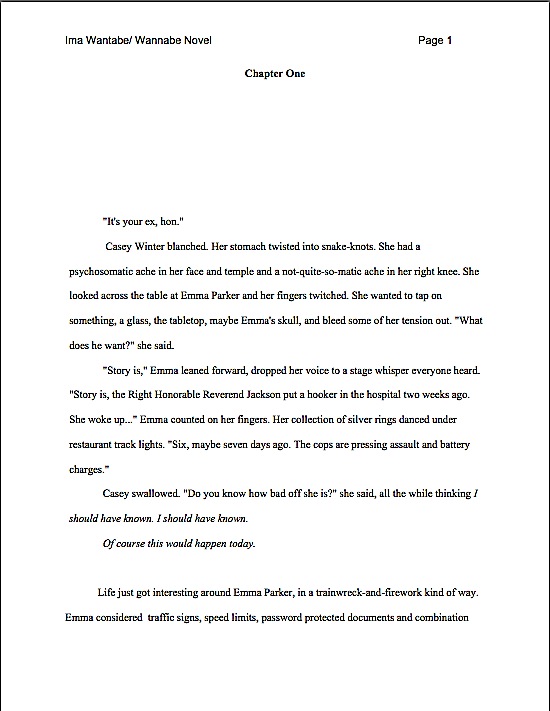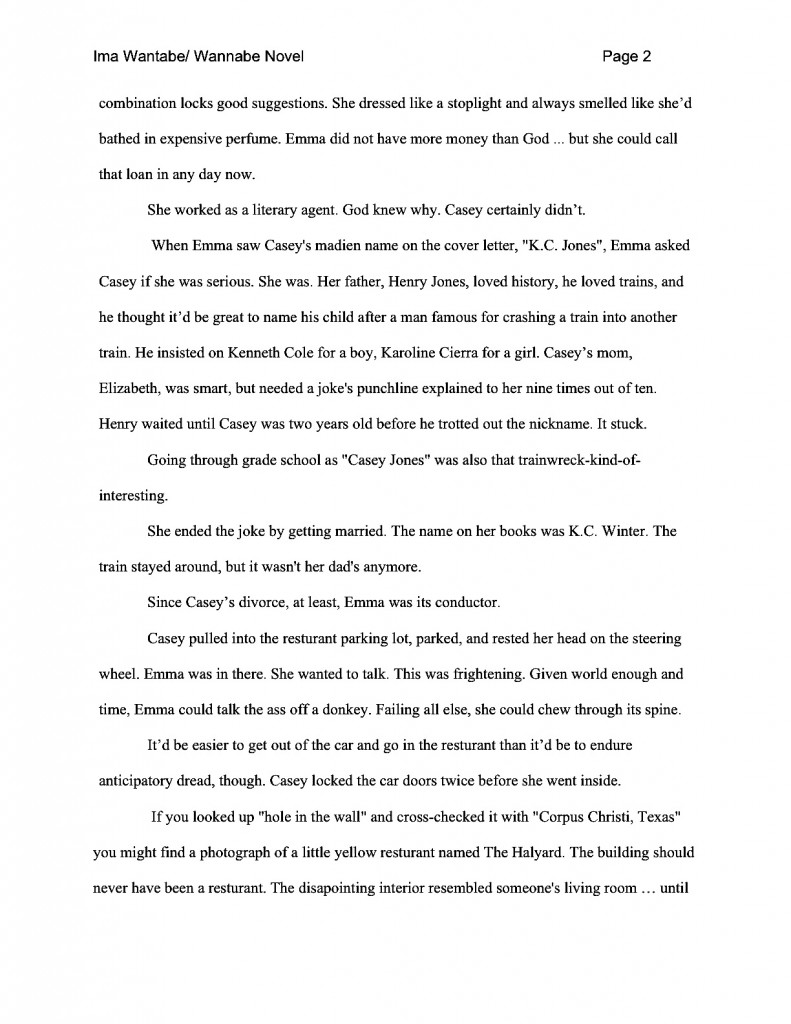
Speaking of dialogue revision, part III: avert your eyes, children

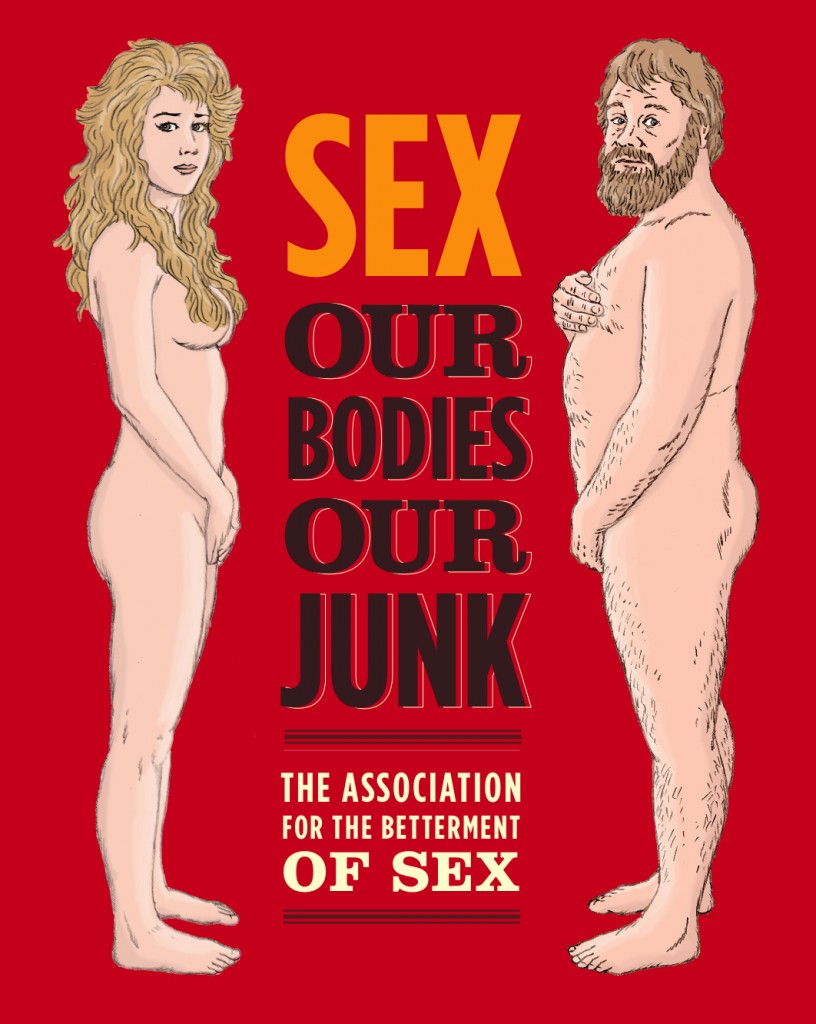
ourbodiesourjunkcover

I find myself in a quandary today, campers: I want to announce — nay, trumpet — the release of FAAB (Friend of Author! Author! Blog) Mike Sacks’ new book, SEX: OUR BODIES, OUR JUNK from Random House today. Don’t get me wrong — I don’t have any reservations at all about recommending this hilarious take-off on the Boston Women’s Health Collective’s venerable reference classic, OUR BODIES, OURSELVES. (What took that so long to happen, eh?) It’s funny, it’s comprehensive, and it’s written by a group of well-respected comedy writers under the collective pseudonym the Association for the Betterment of Sex.

What’s not to like?

So what’s the crux of my quandary, you ask impatiently? If I posted the publisher’s blurb for this book verbatim, as is my wont with new releases, most Internet filters of the type employed by parents and public libraries would block this post.

Oh, you may laugh at a screening program’s not being bright enough to tell the difference between comedy and {WORD EXPUNGED}, but it’s actually true — and I find that annoying, as I suspect a lot of smart teenage readers (and public library-users, for that matter) would enjoy Mike’s writing quite a bit. Pardon me while I rack my brains, searching for a way around this knotty problem.

That’s knotty, not naughty, screening program.

Those of you who have been hanging out here at Author! Author! for a while may remember Mike’s guest post last year, a fabulous discussion of the art of being funny with legendary comedy writer Merrill Markoe. I’ve been busily blandishing Mike behind the scenes into gracing us again with his insights on comedy writing; since I’m a champion author-blandisher, I suspect that I shall succeed. (Watch this space, comedy writers.)

Those of you interested in getting tips from the best might also remember him as the interviewer and compiler of AND HERE’S THE KICKER: CONVERSATIONS WITH 21 TOP HUMOR WRITERS ON THEIR CRAFT, a fascinating and very useful volume, containing sections billed as Quick and Painless Advice for the Aspiring Humor Writer, on topics that should make aspiring writers’ hearts sing. To name but three:

Getting Your Humor Piece Published in The New Yorker

Finding a Literary Agent for Your Humor Book Idea

Acquiring an Agent or Manager for Your Script

Ah, how well I recall plugging AND HERE’S THE KICKER last year. It was a simpler time, a happier time, when good new releases had family-friendly language in their blurbs…

All right, already: I’m going to throw caution to the winds and post the publisher’s blurb for OUR BODIES, OUR JUNK. Darn the torpedoes, so to speak; I would like to see my teenage readers have access to both this book and OUR BODIES, OURSELVES. To ascertain that this post will be visible to as many of my regular readers as possible, though, I shall simply place a few discreet visual barriers in front of the words and concepts that might prove problematic.

GOOD GOD—YOU’RE DOING IT ALL WRONG . . .

The Association for the Betterment of Sex (A.B.S.) presents Sex: Our Bodies, Our Junk, a radical and invaluable resource for improving your sexual communication—whether you have been in a committed relationship for years, or have just moments ago removed the shrinkwrap from your new {EXPUNGED}.

Here are just a few sensual revelations you’ll find within these pages:

– The precise location of the female {EXPUNGED} (latitude and longitude)

– “Going on tour with Midnight Oil” and more outmoded {EXPUNGED} slang

– Forced perspective and other techniques for visually enhancing the size of {EXPUNGED}

– The Top Five pastry-related euphemisms for {EXPUNGED}

– How to score big at your next {EXPUNGED} party, with our crowd-pleasing ambrosia-salad recipe

– Listings of “Don’t ask, Don’t tell” dry-cleaning services, for freshening up your vinyl {EXPUNGED} or adult-sized {EXPUNGED} costume

– Your first {EXPUNGED}, and how the ancient Mayans predicted it wouldn’t go over so hot

Exhaustively researched and fully illustrated, Sex: Our Bodies, Our Junk is a must-read for you, your sexual partner(s), and anyone who wishes there was more to sex than {EXPUNGED} for a few seconds and begging for forgiveness.

Now that we’ve celebrated Mike’s new release, let’s get back to the topic at hand: dialogue revision. (If you can manage to drag your mind away from speculating about all of those expunged words and phrases, that is. I’ve said it before, and I’ll say it again: a little artistic draping of the essentials can actually be quite a bit sexier on the page than {EXPUNGED}.)

At the risk of setting the filtering programs’ red lights flashing, enjoy!

pearlfishers

I went to see THE PEARLFISHERS at the Seattle Opera again last night; since the tenor had been practically inaudible with the cast we saw the first time, we went back and saw the other, in which the baritone was practically inaudible. Oh, well, you can’t have everything — where would you put it? (As comic Stephen Wright has been asking plaintively for years. One should never borrow a good joke without attributing it.)

During opera mach II, I was thinking about you fine people and the list of common reasons submissions get rejected on page 1 we’ve been discussing, admittedly a bit one-sidedly, for the last couple of weeks. During the protracted opening scene with the acres of milling supernumeraries and ten minutes of heavily Balanchine-influenced prancing around (don’t even get me started on the five minutes of dance in Act III that was apparently lifted directly from THE PRODIGAL SON), I kept murmuring to myself, “Um, haven’t we heard this dialogue already? And is it really necessary to tell the audience fifteen times that you’re dancing when the choreographer has placed ocular evidence at the front of the stage?”

I suppose that my response could be regarded as a sort of SCARED STRAIGHT for would-be editors — this is where hardcore manuscript screening leads, kids — but seriously, the opera’s first ten minutes ran afoul of a hefty percentage of our cringe list for manuscript openings. For instance:

3. The opening was about setting, not about story.

6. Took too long for anything to happen.

7. Not enough happens in the opening.

24. The opening spent too much time describing the environment, and not enough on character.

32. Where’s the conflict?

38. Repetition (all of that explanation that they’re dancing in Sri Lanka)

39. Too many generalities.

51. Hollywood narration

It just goes to show you: judging one art form by the standards of another isn’t all that productive — so any of you who are planning to defend repetitious or Hollywood narration-based dialogue to your future agents and editors as something done in movies, plays, or on opera stages all the time might want to think twice.

I just mention. Back to not entirely unrelated business.

I’m writing today’s post between appointments, balanced on the rather unstable table of a coffee-purveying chain that shall remain nameless. While I’ve been sitting here, I’ve been doing the dialogue experiment I suggested to you last time, and I freely admit it: I was mistaken in telling you that 99.9% of overheard conversations would not work in print.

Based on today’s sample, I radically overestimated how much would be bearable as written dialogue.

It may be that the patrons’ caffeine purchases haven’t hit their bloodstreams yet, but if what they said had turned up on the submission page, our old pal Millicent the agency screener would have been reaching for the Xeroxed rejection letters within seconds. You wouldn’t believe how similar the things one customer says to a barista are to the things the next customer says, and the next.

Which brings me to #31 on our list of common reasons submissions get rejected before the list, real-life incidents are not always believable on paper. If I may be so bold as to elaborate upon this excellent observation, permit me to add: and neither is real-life dialogue, necessarily.

This is a point I harp upon this particular point with fair regularity (and if you doubt that, please see the posts under the aptly-named BUT IT REALLY HAPPENED THAT WAY! category on the archive list at right), I’m not going to dwell too long upon why any writer who includes a true incident within a fictional story needs to make absolutely certain that the importation is integrated seamlessly into the novel. Suffice it to say that real-life events are so frequently shoved into otherwise fictional accounts wholesale so often that any Millicent worth her weight in lattes soon learns to spot ‘em a mile away.

Already, I sense some readerly disgruntlement out there. “But Anne,” some writers of the real point out querulously, “one of the virtues of fiction is the insight it gives the reader into life as it is actually lived. So how precisely is it a remotely negative thing if Millicent mutters over my manuscript, ‘Oh, that bit seems real’?”

Counterintuitive from the writer’s perspective, isn’t it? It’s a storytelling problem, at base: while there’s nothing inherently wrong with incorporating real events into a fictional narrative, it’s undoubtedly jarring for the reader trundling along merrily within a fictional reality to suddenly be confronted with a scene or incident that is, as the LAW AND ORDER folks like to say, ripped from the headlines.

Why? Because anything that pulls the reader out of the story by breaking the smoothness of the narrative’s worldview is bound to be distracting.

Which is a nice way of hinting obliquely that aspiring writers very frequently just drop in real elements — and real dialogue — into a story as if their very veracity were sufficient excuse to include them. From the reader’s point of view, that’s just not true; to get and remain involved, the story in from of him must appear to be one unbroken piece.

“But Anne,” the disgruntled pipe up again, “I can understand where that might be problematic in mid-book, after the story has gotten up and running, but on page 1, there isn’t an already-established narrative line to break, is there? It seems to me that if I should be dropping real elements into my writing wholesale — which I fully understand that you’re advising me not to do — page 1 would be absolutely the safest place to do it.”

Interesting argument, but no: strategically, you’re going to want page 1 to exhibit not only your best writing — the better to entrance Millicent, my dears — but to be representative of the writing throughout the rest of the book. If, as is often the case in dialogue, the real is not as compelling as the fictional, it’s not going to be as effective an introduction to the rest of the book as a writer might like.

One of the things we’ve learned in this series is that in order to be grabbed by a manuscript, Millicent needs to be sufficiently charmed by the narrative voice and storyline from the very first sentence, so it is imperative for the writing to establish the author’s unique voice and worldview right away. If that first sentence — or anything on the first page, really — is at odds with the rest of the narrative, the transition is going to feel rocky whenever it comes.

And if that displacement rocks the reader’s willing suspension of disbelief on page one, it’s going to be pretty difficult for the reader to sink into the story. Particularly if that reader is as jaded to the practice as Millicent.

But I said I wasn’t going to lecture you on the inherent perils of dropping the unpolished real into your manuscripts, didn’t I? Honestly, all I intend to do is nudge you gently about making sure that the narrative in including such incidents is not biased to the point that it will tip the reader off that this IS a real-life event. I’m not even going to remind you that, generally speaking, for such importations to work, the author needs to do quite a bit of character development for the real characters — which most real-character importers neglect to do, because they, after all, know precisely who they mean.

No, today, I’m going to concentrate on the other side of including the real, the way in which the panelists used it: the phenomenon of including references to current events, pop culture references, etc. in a novel.

The editorial advice against utilizing such elements dates your work is older than the typewriter: Louisa May Alcott was warned to be wary about having characters go off to the Civil War, in fact, on the theory that it would be hard for readers born after it to relate to her characters. (And if you doubt that, try explaining to a 14-year-old why any bystander was shocked when Rosa Parks declined to proceed to the rear of a certain bus.)

Many, many aspiring writers forget just how long it takes a book to move from its author’s hands to a shelf in a bookstore: longer than a Congressional term of office, typically, not counting the time it takes to find an agent. Most of the time, an agent will ask a just-signed author to make revisions upon the book before sending it out, a process that, depending upon the author’s other commitments — like work, sleep, giving birth to quintuplets, what have you — might take a year or more.

Then the agent sends out the book to editors, either singly or in a mass submission, and again, months may pass before they say yea or nay.

This part of the process can be lengthy, even for a book that ultimately sells very well indeed. Even after an editor falls in love with a book, pushes it through the requisite editorial meetings, and makes an offer, it is extraordinarily rare for a book to hit the shelves less than a year after the contract is signed.

Often, it is longer — so a reference that seemed fresh as paint (where that cliché come from, do you suppose?) when it fell off the writer’s fingertips onto the keyboard will almost certainly be at least two and a half years old before it reaches readers of the published book.

Think how dated a pop culture reference might become in that time. It might even generate — heaven forfend! — a bad laugh, a chuckle unforeseen by the author that jars the reader out of the world of the story.

Believe me, agents and editors are VERY aware of just how quickly zeitgeist elements can fade — so seeing them in a manuscript automatically sends up a barrage of warning flares. (Yes, even references to September 11th.)

About seven years ago, I was asked to edit a tarot-for-beginners book. I have to say, I was a trifle reluctant to do it, even before I read it, because frankly, there are a LOT of books out there on the tarot, so the author was seeking to add to an already glutted market niche. (If memory serves, tarot books were at the time on the Idiot’s Guide to Getting Published list of books not to write.) So, as I tried to explain gently to the writer, this manuscript was heading for agents and editors with one strike already against it.

The second strike was a superabundance of references to the TV shows of the year 2001. In an effort to be hip, its author had chosen to use characters on the then-popular HBO show SEX & THE CITY to illustrate certain points. “In five years,” I pointed out, “this will make your book obsolete. You want readers to keep finding your book relevant, don’t you? Could you possibly come up with less time-bound examples?”

The author’s response can only be adequately characterized as pouting. “But the show’s so popular! Everyone knows who these characters are!”

She stuck to her guns so thoroughly that I eventually declined to edit the book; I referred her elsewhere. About a year and a half later, she contacted me to gloat: she had managed to land an agent, who did manage, within the course of another year, to sell the book to a small publisher.

The book came out at almost exactly the time as SEX & THE CITY went off the air. It did not see a second printing.

My point, shout you care to know it: be careful about incorporating current events, especially political ones, into fiction manuscripts — and seriously consider excising them entirely from your first few pages, unless the book is set more than 20 years ago. The chances that Millicent will immediately exclaim, “Well, that’s an interesting example/analogy/temporal marker, but it’s going to read as dated by next week,” are just too high.

Yes, yes, I know: you can’t walk into a bookstore without seeing scads and scads of nonfiction books on current events, even ones recent enough that they could not possibly have gone through the lengthy pre-publication process I’ve just described. The next time you are in that bookstore, take a gander at the author bios of these books: overwhelmingly, current events books are written by journalists and the professors whom they interview. It is extraordinarily difficult to find a publisher for such a book unless the writer has a significant platform.

Being President of Pakistan, for instance, or reporting on Hurricane Katrina for CNN — and at this point, even the latter might well strike an agent or editor as a dated credential. Mainstream culture marches on FAST.

Present-day Anne here: as is abundantly illustrated by just how outdated that Hurricane Katrina reference seems now. It was just-out-of-the-oven fresh when I first drafted a version this post — and still pretty strongly in the public consciousness when I ran an updated version a year and a half ago. Sic transit gloria.

One last point about pop or political culture references: if you do decide to disregard my advice entirely — oh, I have no illusions left about writers’ reactions to even the best editorial advice, at this point — and include present-day references, double-check to make sure that you’ve spelled all of the names you cite correctly. Not only people’s names, but brand names as well.

Stop laughing; this is a mistake I see constantly as a contest judge, and it’s usually enough to knock an entry out of finalist consideration, believe it or not. Seriously. I once saw a quite-good memoir knocked out of finalist consideration solely for referring to a rap band as Run-DMV.

Half of you didn’t laugh at that, right? That joke would have slayed ‘em in 1995. See what I mean about how fast pop culture references get dated?

Make sure, too, that the sources you consult for verification are reliable; remember, it’s not as though everything currently posted on the Internet is spelled correctly. If you’re in serious perplexity about where to turn to double-check, call your local public library and ask where to start looking.

But whatever you do, don’t just run them through a spell-checker — because the more up-to-the-minute those names are, the less likely your spell-checking program is to be aware of them — or check with kith and kin, who may also have been laboring under your misconception that it’s FDR that delivers flowers, rather than FTD.

Not that I wouldn’t pay good money to see President Roosevelt show up on my doorstep bearing a bouquet, mind you. I’m just saying that Millicent up on her presidential history might be a trifle startled to see him navigating a wheelchair festooned with stargazer lilies into her cubicle today.

There’s an important lesson to take from this, over and above the perennial proofreading imperative to get technical matters right before submitting pages containing them: ultimately, the written word is for the ages, not the moment.

That can be easy to forget in catering to agents focused on what’s selling to publishing houses right now, but it’s true, nevertheless. Nothing ages as quickly (or as badly) as last year’s pop culture reference.

Or, to get back to my initial nag, as last year’s cool catchphrase. If you’re devoted to reproducing actual conversation, you might want to bear that in mind, because, as anyone sentenced to listen to ambient chatter in a café could tell you, everyday conversation is loaded with catchphrases and references that would make the reader of ten years from now mutter, “Huh?” under her breath.

And the well-trained Millicent to shake her head over them right now. Choose your references carefully, everybody, and keep up the good work!
Speaking of dialogue revision, part II: let’s revisit dialogue repetition…repetition…repetition…

broken-record

For those of you who haven’t joined us for a week or two, I’ve been busy spending my doctor-ordered take-it-easy-on-the-hands time by re-running a few older posts. Specifically, posts at least marginally related to the topic we were discussing when a car crash so rudely interrupted us: writing and revising dialogue so it rings true, adds to the story, and entertains the reader.

Or, to translate all that into the negative terms in which professional readers tend to critique work, so it doesn’t seem contrived, isn’t gratuitous, and prevents the reader from falling into the deep, refreshing slumber so often induced by dialogue ripped from real life.

To that end, I shall be repeating today the two tactics that worked so well (if I do say so myself) last time. First, I’m going to import material from that still most visited of my archival series, Seeing Submissions From the Other Side of the Desk, a lighthearted romp through dozens and dozens of reasons that our old pal, Millicent the agency screener, might feel compelled to reject a submission on page 1. Second, rather than re-run the dialogue-related posts in that series individually, I shall mash a couple together and add a bit more material, just to keep things interesting for those of you who were hanging around Author! Author! a year and a half ago.

So is it a re-run, if it is no precisely as it was the first time around? You tell me.

Enjoy!

As I may have mentioned before in this forum, Hollywood narration (dialogue wherein characters telling one another things they already know purely for the purpose of letting the reader know them, too) tends to annoy the dickens out of your garden-variety agency screener. Not merely because it is so common — and believe me, it is: TV and movie scripts abound with this sort of dialogue, which in turn influences both how people speak and what writers hear — but because it’s kind of an underhanded way of introducing backstory.

In a script, it’s understandable, as film has only sound and sight to tell a story. But a book has all kinds of narrative possibilities, right?

There was a sterling example of a VERY common subgenus of Hollywood narration read at the agents’ forum from which I derived the list of pet peeves we’ve been discussing. It was apparently a mystery that opened with the mother of a recently-recovered kidnap victim badgering the detective who was handling the case to find the kidnapper, pronto. My, but Mom was informative: within the course of roughly ten lines of back-and-forth dialogue, she filled in the detective on the entire background of the case.

Because, naturally, as the primary investigator, he would have no recollection of anything associated with it. (Maybe he was suffering from amnesia; having heard only the first page, I couldn’t tell you.) And, equally naturally, she insisted upon being brought in to collaborate on the investigation.

The agents on the panel tore it to pieces. Actually, the panelists’ reaction to this piece was fascinating, because every time one of them started to wind down his or her critique of it, another found yet more reason to object to it. Among the objections:

*The characters are telling one another things they already know.

*The opening scene was almost entirely dialogue, without giving the reader a sense of place or character.

*This scene has been in a LOT of books and movies. (Hey, blame Dashiell Hammett.)

*”I’ve never understood why third parties in mysteries always want to investigate the crimes themselves.” (I’m guessing that the agent who said this doesn’t represent a whole lot of cozy mysteries.)

*(After a slight lull in the bloodbath.) “If the kid is back safely after the kidnapping, why should we care?”

Brutal, eh, for less than a single page of dialogue? If you learn nothing else from this series, please take away this one thing: agency screeners virtually never cut any submission any slack. That opening page needs to SCREAM excellence.

So it would really behoove you to check your dialogue-based opening scenes very, very carefully to make sure that they are saying PRECISELY what you want them to say about you as a writer.

What can happen if an aspiring writer just assumes that what he’s got in mind is what Millicent will take away from the page? Well, let me put it this way: the writer who penned the opening I’ve just described– a gentle lady who had waited a year to be able to submit her opening page to this forum, I later learned — did not laugh along with the judges. She sat there, open-mouthed and blushing furiously, obviously stunned that anyone could read her innocent page 1 in such a manner.

Why did she feel so blindsided? Well, if I had to guess — and I do! I do! — it was probably because her opening gambit was one she had seen so often in the openings of TV shows, movies, and yes, even books.

Wait, where have I heard that before?

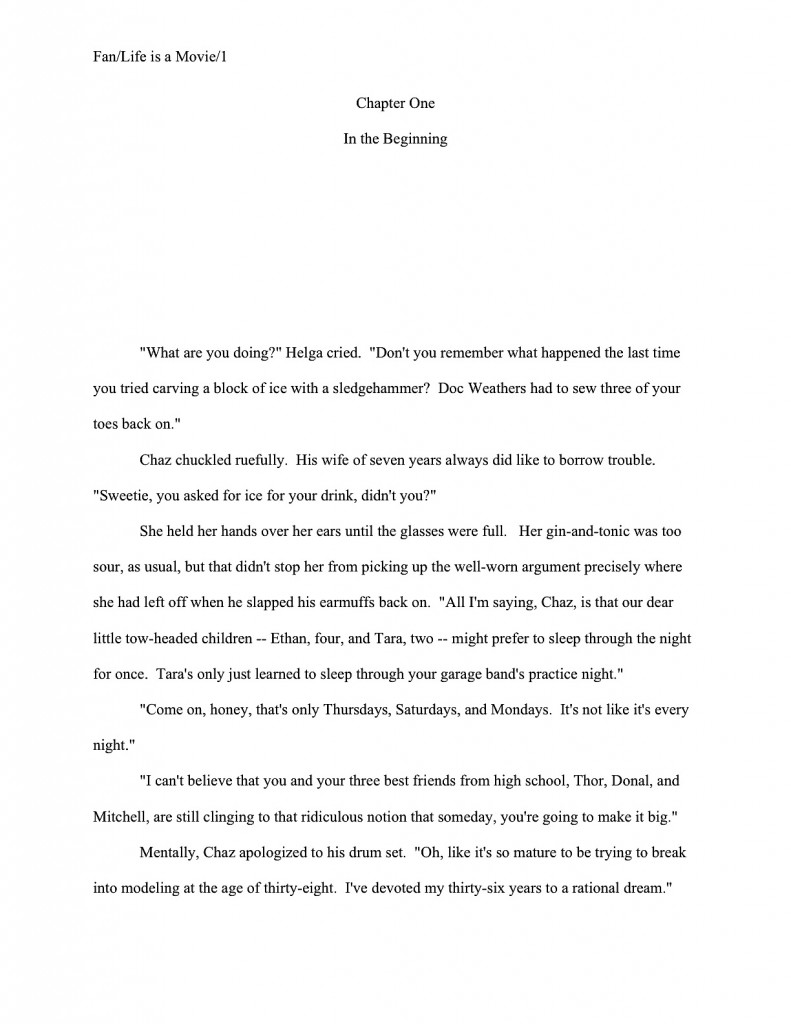
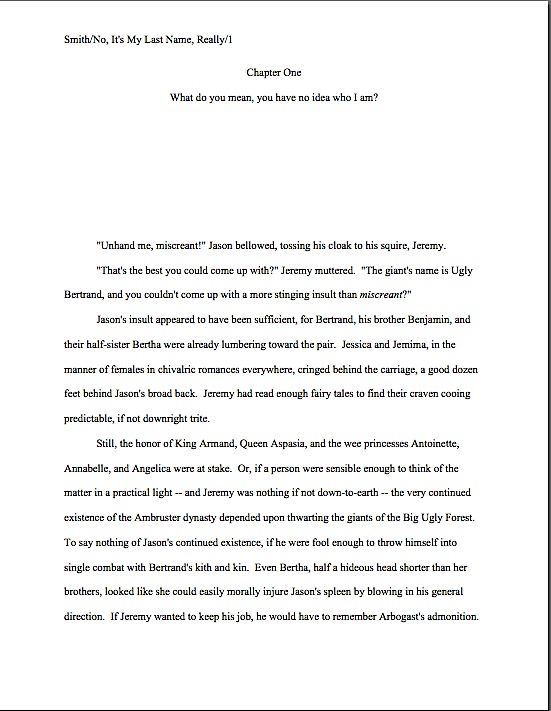
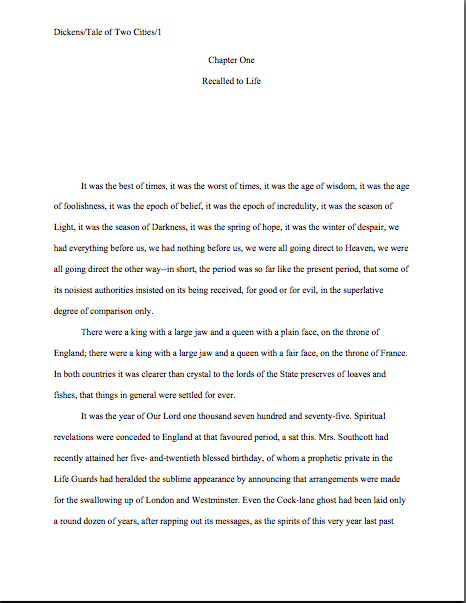
Seriously, this sub-species of Hollywood narration can be very hard for self-editors to catch. Take, for instance, the following example. (And if you can’t take it because the image is so small, try increasing the size by holding down the COMMAND key while pressing +.)

Hollywood narration2

While you were reading that little gem, did you think at least twice, Gee, is there a particular reason that the reader needs to be told all of this backstory on page 1? If so, congratulations: Millicent would have had the same thought. By the middle of paragraph 3.

But be honest now, campers: if you had encountered that page in a critique group yesterday, would you instantly have tapped its author on the shoulder and whispered, “Dear friend, what you have there is a classic example of Hollywood narration, and I implore you to reconsider opening your book in this manner?” Or would you simply have admired how quickly and economically the writer worked in all of that backstory?

The vast majority of aspiring writers would have opted for the latter. Just so you know, however, Millicent would appreciate it if the next time any of you should find yourself in this situation, you would start tapping some shoulders.

Why? Because she sees this sort of opening so very, very often. Which brings me to rejection reason #30: over-use of dialogue in the name of realism.

At the risk of dropping the needle on a broken record (have your grandparents explain that metaphor to you, children), real-life dialogue tends to be very repetitious, self-referential, and, frankly, not something that would tend to move a plot along. But in defense of realism, real-life dialogue seldom resembles Hollywood narration, either. If you’re in conversation with someone with whom you speak quite frequently, you will use shared metaphors that might not make sense to an outside observer, but you’re not very likely to be discussing anything crucial to the plot of your life over coffee with a coworker.

And even if you ARE, unlike a conversation in a book, where much matter can be compressed into a single exchange, there’s just not a whole lot of incentive in real life for the stakes to be high enough to settle major life decisions within just a couple of minutes’ worth of highly relevant dialogue. Nor are you likely to import lovely language or trenchant symbolism that enlightens the reader about the human condition. It’s not even all that likely to be entertaining to a third party.

It’s just talk, usually, something people do to lubricate relationships and fill time. I’m all for relationship-lubrication on the page, but time-filling can be deadly, especially on page 1 of a book. Move it along.

When talkers do fill one another in on personal backstory, it’s usually in the form of specific anecdotes (“When I was seventeen, I had just put on my favorite record when a condor flew into my bedroom…”) or personalized summaries of larger events (“I got married in the year the condors carried off my little brother…”), rather than in Hollywood narration-type generalities (“When I was young, condors were the number one municipal problem here in Ridgedale, the pleasant small town where you and I both grew up, Tony. Remember how often the black wings used to blot out the sun? Why, I was just reminding my wife, Martha, about how dark it was on our wedding day. Remember, dear? How you screamed as the black, black birds carried our ring bearer — my brother and your fishing buddy, Tony — off into the wild blue yonder…”

See the difference? If not, I’m sure Tony would be happy to go over your collective past with you a few more times.

Typically, at this juncture, I blithely suggest that writers enamored of the idea of reproducing dialogue precisely as it is heard in real life try a little experiment: sit in a crowded café for two hours, jotting down overheard conversations verbatim. Don’t fill in any logical gaps; reproduce it as is. Afterward, go home and type up those conversations as scenes, using ONLY the dialogue actually heard.

If you can complete the second part of that exercise without falling into a profound slumber, you either have an unusually high threshold for boredom or a great affection for the mundane. Either way, have you considered a career as an agency screener, where these traits would be positive boons?

It’s highly unlikely that you would be able to get the result of this exercise past Millicent, either as dialogue or as narrative. In professional writing, merely sounding REAL is not enough; a manuscript must also be entertaining.

So here’s a radical notion for all of you revisers out there: why don’t you edit your opening pages with an eye toward entertaining Millicent, as well as future readers, rather than using them merely as a medium for backstory?

I heard half of you groaning. Yes, oh groaners, your surmise is correct: I am indeed about to tell you that a savvy reviser should pay as much attention to word, phrase, and concept repetition in dialogue as in narrative paragraphs.

Yes, Virginia, even if your work happens to be literary fiction, if it’s book-length. Slice-of-life pieces can be quite effective IF they are short — but frankly, in my opinion, most of what goes on in the real world doesn’t rise to the standards of literature.

Far, far better to apply your unique worldview and scintillating ability with words to create something BETTER than reality, I say. The same goes for dialogue.

And yes, now that you mention it, that will mean a good deal more revision for most writers. Feel free to groan again.

Some of you are already reaching for your BUT PEOPLE REALLY TALK LIKE THAT! picket signs, aren’t you? That’s not too surprising. Many aspiring writers consciously strive for prose that echoes the kind of conversational rhythms and structures one hears every day, particularly when they are penning first-person or present-tense narratives. “I want it to sound real,” they say with engaging earnestness. “My goal is to hold, as ’twere, the mirror up to nature.”

Unfortunately, from Millicent’s perspective, most of these writers don’t realize just how widespread this particular goal is — or that much real-life conversation would be either deadly dull, logically incoherent, or at minimum not literarily interesting transferred directly to the printed page.

Why? Chant it with me now, long-time readers of this blog: because real-life speakers repeat both words and sentence structures to an extent that would make even the most patient reader rip her hair out at the roots in frustration.

If this sounds vaguely familiar, it’s probably because I spoke earlier in this series about how little Millicent appreciates repetition of any kind; I also rattled on a bit last time about how conceptually repetitious most real-life dialogue tends to be. But today, I want to talk about repetition on a smaller scale, within the actual writing.

As I have pointed out before, the single most common word appearing in submissions in every book category is and. Leaning on this multi-purpose word can lead to run-on sentences, dull action sequences, and contracting the bubonic plague.

Well, okay, perhaps not the last. But the results still aren’t pretty, from Millicent’s point of view.

You would not believe, for instance, just how often the sentence structure, X happened and Y happened turns up in dialogue. From a hold-the-mirror-up-to-nature point of view, that’s completely understandable, because it’s structure that speakers use all the time. Even when writers are constructing narrative rather than dialogue, they tend to find this structure appealing: like stringing together sentences beginning with conjunctions, it artificially creates the impression conversation-like flow, as in:

I woke up the next morning and poisoned my husband’s cornflakes.

See? Chatty, casual: the way your local poisoner is very likely to say it to her next-door neighbor, right? In a single sentence, it makes for a rather likable voice.

If this structure is used sparingly, it can work very well indeed — but as any professional reader who has been at it a while would be delighted to tell you, its advocates seldom seem to be able to restrain themselves. Let’s take a peek at several sentences of this type in a row, to see why it might annoy your garden-variety Millicent at the end of a long, hard day of rejection:

Esmeralda blanched and placed her lily-white hand upon her swiftly-beating heart. Rolando nodded with satisfaction and strode toward her, grinning. She grabbed a poker from next to the fire and glanced around for an escape. He chortled villainously and continued to move closer.

See what I mean? Although each of these sentences is in fact grammatically correct, and this structure reads as though it is merely echoing common spoken English, it’s also pretty much the least interesting way to present the two acts in each sentence: the and is, after all, simply replacing the period that could logically separate each of these actions.

By contrast, take a look at how varying the sentence structure and adding the odd gerund livens things up:

Esmeralda blanched, her lily-white hand clutching her swiftly-beating heart. Rolando strode toward her, grinning. She grabbed a poker from next to the fire and glanced around for an escape. He chortled villainously, moving closer every second.

Easier to read, isn’t it? Admittedly, the prose is still pretty purple — or at least flushing lilac — but at least the paragraph is no longer jumping up and down, screaming, “My author knows only one way to structure a sentence!”

Lest any of you just thought, “Well, all Millicent would have to do is read on to the next paragraph” (or next page, or next chapter) “to discover that I know a whole lot of ways to structure a sentence; I’m not going to worry about that,” may I remind you of one of the most startling truths divulged in this series, that most manuscripts get rejected on page 1? If the opening paragraphs of a submission are structurally repetitious, how likely is it that she’s going to keep reading to find out if the writer shakes things up a little later on?

The sad fact is, most agents, editors, and contest judges would not, alas, at least while perusing a manuscript by an author with whom they do not already enjoy a professional relationship. They tend to have a very low tolerance for over-use of this particular sentence structure.

Seriously. I’ve seen pens poked through manuscripts at the third instance of an X happened and Y happenedsentence within half a page. (See why I felt this issue was important enough to interrupt our review of the Idol list to cover?) At minimum, it would be very much in your submission’s best interest to ferret out over-use of the word and.

So while you are going over your first page with a fine-toothed comb in the wake of this series anyway, why not identify and considering reworking ANY sentence in which and appears more than once? Chances are high that such a sentence will be a run-on, in any case:

In evading the police, Zelda ran down the Metro stairs and out onto the platform and into the nearest train.

This is a classic run-on: too much information crammed into a single sentence, facilitated by those pesky conjunctions. Yes, people actually do say things like this in real life, but how much do you think the realism of this sentence is going to help its author get a manuscript past Millicent?

Uh-huh. Good writing matters in dialogue every bit as much as in narration. It’s merely harder to make sound realistic.

Some writers, of course, elect to include run-on sentences deliberately in their work, for specific effect: to make the narrator sound less literate, for instance, or more childlike, or to emphasize the length of a list of actions the protagonist has to take to achieve a goal. Or sometimes, the point is to increase the comic value of a scene by the speed with which it is described, as in this excerpt from Stella Gibbons’ classic comedy, COLD COMFORT FARM:

He had told Flora all about his slim, expensive mistress, Lily, who made boring scenes and took up the time and energy which he would much sooner have spent with his wife, but he had to have Lily, because in Beverly Hills, if you did not have a mistress, people thought you were rather queer, and if, on the other hand, you spend all your time with your wife, and were quite firm about it, and said that you liked your wife, and, anyway, why the hell shouldn’t you, the papers came out with repulsive articles headed “Hollywood Czar’s Domestic Bliss,” and you had to supply them with pictures of your wife pouring your morning chocolate and watering the ferns.

So there was no way out of it, Mr. Neck said.

Quite the sentence, eh? (Not the second, silly — the first.)

I’m going to part company with pretty much every other editor in the world for a moment and say that I think that a writer can get away with this sort of run-on every once in a while, under three very strict conditions — and no, none of them is optional to observe:

(1) IF it serves a very specific narrative purpose that could not be achieved in any other manner (in this example, to convey the impression that Mr. Neck is in the habit of launching into such diatribes on intimate topics with relative strangers at the drop of the proverbial hat),

(2) IF it achieves that purpose entirely successfully (not a foregone conclusion, by any means), AND

(3) IF the writer chooses to do this at a crucial point in the manuscript, s/he doesn’t use it elsewhere — or at least reserves the repetition of this choice for those few instances where it will have the greatest effect.

Why minimize it elsewhere? Well, as we have seen above, this device tends to create run-on sentences with and…and…and constructions, technically grammatical no-nos. YOU may be doing it deliberately, but as with any grammatical rule, many writers who do not share your acumen with language include them accidentally.

Let me ask you this: how is a speed-reading agency screener to tell the difference between a literate submitter pushing a grammatical boundary on purpose and some under-read yahoo who simply doesn’t know that run-ons are incorrect?

Usually, by noticing whether the device appears only infrequently, which implies deliberate use, or every few lines, which implies an ingrained writing habit.

I’ve sensed disgruntled rumblings out there since I mentioned point #3. “But Anne,” I hear some of you protest, “I read a great deal, and I see published literary fiction authors break this rule all the time. Doesn’t that mean that the language has changed, and people like you who go on and on about the rules of grammar are just fuddy-duddies who will be first up against the wall come the literary revolution?”

Whoa there, disgruntled rumblers — as I believe I have pointed out before, I invented neither the rules of grammar nor the norms of submission evaluation. If I had, every agency and publishing house would post a clear, well-explained list of standard format restrictions on its website, along with explanations of any personal reading preferences and pet peeves its staff might happen to be harboring. Millicent would be a well-paid, under-worked reader who could spend all the time she wanted with any given submission in order to give it a full and thoughtful reading, and the government would issue delightful little checks to compensate writers for all of the time they must now spend marketing their own work.

Clearly, then, these matters are not under my personal control, so kindly take me off your literary hit lists.

Even in literary fiction, it’s rather dangerous to include grammatically incorrect sentences in a submission. To someone who hasn’t read more of your work than the first few pages of your manuscript, it’s impossible to tell whether you are breaking the normal rules of grammar in order to create a specific effect, or because you just don’t know the rule. If an agency screener concludes that it’s the latter, she’s going to reject the manuscript, almost invariably.

Thus, unless you are getting a valuable effect out of a foray into the ungrammatical, it’s best to save your few opportunities to do so intentionally for when it serves you best. At the very least, make sure that two such sentences NEVER appear back-to-back, to avoid your submission’s coming across as the work of — gasp! — a habitual runner-on.

Sometimes repeated ands work rhythmically, but to an agent or editor, a manuscript that employs X happened and Y happened as its default sentence structure it just starts to read like uncomplicated writing — which makes it less appealing to the pros.

The other common conclusion trained eyes often draw from over-use of this technique smacks of the narrative’s trying to rush through an otherwise not very interesting series of events — which, if you’ve been paying attention throughout this series, should automatically make you cringe at the idea of boring Millicent.

And honestly, is a statement like Georgette ran down the stairs and out the station door, then she made a sharp left at the corner, proceeded a hundred yards past the fruit and flower stands, now at four o’clock sadly depleted, and dashed to the waiting taxi worth the risk?

This kind of dismissive reading is not always a fair assessment of an and-ridden text, of course. But when you do find patches of ands in your text, step back and ask yourself honestly: “Do I really NEED to tell the reader this so tersely — or all within a single sentence? Or, indeed, at all?”

“Perhaps,” (you’re still speaking to yourself here, in case you were wondering, despite the fact that most Millicents find soliloquizing protagonists a touch annoying) “I could find a way that I could make the telling more interesting by adding more detail? I notice by reading back over the relevant paragraphs that my X happened and Y happened sentences tend to be light on telling specifics.”

My, you’re starting to think like Millicent. Do keep it up.

Since your revision eye is getting so sophisticated, let’s consider the opposite possibility: in paragraphs where ands abound (or, sacre bleu, sentences!), are you rushing through the action of the scene too quickly for the reader to enjoy it? Are some of those overloaded sentences cramming four or five genuinely exciting actions together — and don’t some of these actions deserve their own sentences?

Or, to put it a bit more bluntly, is the repeated use of and in fact your manuscript’s way of saying COME BACK AND FLESH THIS OUT LATER?

C’mon, admit it — almost every writer has resorted to this device at the end of a long writing day, haven’t we? Or when we have a necessary-but-dull piece of business that we want to gloss over in a hurry? Or did you think you were the only writer in the history of the world who did this?

Don’t be so hard on yourself — writers do this all the time. When the point is just to get lines down on a page — or to get a storyline down before the inspiration fades — X happened and Y happened and Z happened is arguably the quickest way to do it.

It’s a perfectly acceptable time-saving strategy for a first draft — as long as you remember to go back later and vary the sentence structure. Oh, and to make sure that you’re showing in that passage, not telling.

When we forget to rework these flash-written paragraphs, the results may be a bit grim. Relying heavily on the and construction tends to flatten the highs and lows of a story: within them, actions come across as parts of a list, rather than as a sequence in which all the parts are important.

Which — you guessed it — encourages the reader to gloss over them quickly, under the mistaken impression that these events are being presented in list form because they are necessary to the plot, but none is interesting enough to sustain an entire sentence.

Which is not exactly the response you want your sentences to evoke from Millicent, right?

When in doubt, revise to minimize the ands. I hate to come down unfairly on any grammatically correct sentence, but the fact is, the X happened and Y happened structure is just not considered very literary in the business. So the automatic assumption if it shows up too much is that the material covered by it is to be read for content, rather than beauty of prose.

To quote Millicent’s real-life dialogue: “Next!”

I would prefer to see your submissions getting long, luxurious readings, on the whole, not getting knocked out of consideration over technicalities. I’m funny that way. Keep up the good work!

Speaking of dialogue revision…

speechgraphic

“It is my custom to keep on talking until I get the audience cowed.”

— Mark Twain

What a week, campers! Again, I’ll spare you the grisly details. Suffice it to say that I shall probably soon be writing comic scenes about medical practitioners who can’t remember which leg is the injured one (hint: could it be the one encased from ankle to hipbone in a brace?), physical therapists incapable of describing any of the activities of the human body without resorting to impenetrable medical jargon, and the intricacies of sweeping out of a treatment room with dignity while on crutches. Adding to the hilarity: the physical therapy facility did not have ADA-compliant doors, so leaving (or coming in, for that matter) required yanking open two thirty-pound glass doors.

How fortunate that the facility never had any visitors with leg or arm problems, eh?

Speaking of characters who evidently have trouble expressing themselves, I’m going to spend the next few days re-running dialogue-related posts from my extremely popular 2009 series on agency screeners’ pet peeves, Seeing Submissions From the Other Side of the Desk. Actually, I’m going to run two today, albeit in a tricky manner: to save all of you brave and intrepid souls who worked through our recent Frankenstein manuscript series a bit of repetition, I’m smashing the relevant (and non-repetitive) bits together into great, big, Friday-worthy post.

That’s appropriate for Frankenstein manuscript-hardened readers, isn’t it? Enjoy!

I’m a great proponent of the doctrine of free will. I’m also a great fan of the art of conversation, which is why I’m going to spend the next couple of days going over the rejection reasons on the Idol first-page rejection list related to dialogue. (If you’re unfamiliar with this list, please see the first post in this series.)

One caveat before I begin: as I mentioned at the beginning of this series, this list is not intended to be exhaustive; the red flags we’ve been discussing are not the only ones that might conceivably raise Millicent’s hyper-sensitive hackles. They are merely some of the most common hackle-elevators, the ones that anyone who reads manuscripts for a living would see with great enough frequency that the sheer repetition across otherwise unrelated submissions might start to seem like some sort of immense writerly conspiracy.

Why am I repeating this caution? Because although it pains me to say it, there’s quite a bit of unpolished dialogue running amok out there. As any professional reader — agent, editor (freelance or otherwise), contest judge, agency screener, etc. — could wearily confirm, much of the dialogue that crosses her desk is genuinely trying to read. Here are a few of the many reasons this might conceivably annoy an agent on page 1, plucked from the Idol list:

17. The characters talk about something (a photo, a person, the kitchen table) for more than a line without describing it, creating false suspense.

25. The first lines were dialogue. (To be fair, only one of the agents on the panel seemed to have a problem with this.)

26. When the first lines are dialogue, the speaker is not identified.

30. Overuse of dialogue, ostensibly in the name of realism.

51. What I call Hollywood narration – when characters tell one another things they already know. (The agents on the panel did not call it by my term for it, but they don’t like it, either.)

52. The tag lines are more revealing than the dialogue. (The example cited: “She squawked.”)

Already, I hear some discouraging dialogue flying at me in response: “Wait just a minute, missy,” readers with retentive memories cry. “Didn’t we already cover that first one when we were talking a few days ago about creating false suspense? What are you trying to pull here, recycling of rejection reasons?”

Well caught, memory-retainers: I did indeed bring up #17 within the context of my discussion of why it’s a bad idea to withhold pertinent information from Millicent in the opening lines of a book. (Can you tell that I would really, really like it if any of you who happened to miss that earlier discussion chose to go back and read it?)

However, since opening pages often do feature characters exclaiming things like, “Oh, it’s horrible! Keep it away from me!” without specifying what it is, this is legitimate to discuss as a dialogue problem. While there’s nothing wrong with depicting such cries from time to time, its main stumbling-block as dialogue is that tends to be generic, rather than character-revealing.

And that is often a mistake in the first lines a major character speaks, which tend to be branded upon the reader’s memory as setting the character’s tone for the book. Just as a character who spouts nothing but bland, predictable courtesies often comes across on the page as dull, one whose primary function when the reader first meets him is to react to some unspecified stimulus can come across as a trifle annoying.

Don’t believe me? Okay, take, for instance, this sterling opening:

Ermintrude’s large gray eyes stretched to their maximum extent, a good three centimeters in height by five and a half centimeters in diameter. “But — George! How long have you been suffering from this terrible affliction?”

George smiled as extensively as his newly-acquired deformity would permit. “Not long.”

“Is this…condition…a common after-effect of trench warfare?”

“Come, come,” Norma said reprovingly. “It’s not polite to stare. Would you like some tea, George? I could slip a little brandy into it.”

Ermintrude was not so easily distracted. She inched closer, the better to gape at the awful sight. “Does it hurt? I mean, would it hurt you if I touched it?”

Quick: what are these three people talking about? More importantly, who are these people?

Beats me; based upon what is actually said, could be any group of three people responding to whatever has happened to George. Like so many such wails, this dialogue is purely reactive, a generic response to it rather than individualized, character-revealing statements.

On top of which, it’s just not very gripping, is it? Although TV and film have accustomed most of us to hearing people emit such ejaculations — and to judging how shocking/exciting/horrifying a stimulus is primarily by how the protagonist reacts to it — they often don’t make for very scintillating talk on the page.

Which is why, in case you were wondering, some professional readers will profess knee-jerk negative responses like 25. The first lines were dialogue. Sorry about that; a lot of Millicents like to have a sense of where the speakers are and what’s going on mixed in with their dialogue.

No accounting for taste, eh?

Or, glancing again at the example above, perhaps there is. Remember, the first questions that Millicent is going to need to answer in order to recommend this manuscript to her boss are “Who is this protagonist, and what’s her conflict?” If the first page of a submission doesn’t provide some solid indication of both how she is going to answer those questions and how those answers are going to be fascinating and surprising to the target market for the book, it’s not the best calling-card for the story to follow.

Admittedly, the opening above does convey the situation rather effectively — George is evidently a trifle difficult to gaze upon, due to something that may or may not have occurred during World War I — but other than that, what has this exchange actually told us about the speakers? Is Ermintrude an adult, a teenager, or a child, for instance? Does she have any genuine affection for George, or merely curiosity? Does Norma have a right to scold her due to her relationship with either Ermintrude or George? Is she Ermintrude’s mother, George’s wife, or the housekeeper? Does George resent this attention, or does he welcome it?

Yes, yes, you’re right: that’s quite a few questions to expect the first 14 sentences of a book to answer. Allow me to suggest, however, that this excerpt of dialogue would have been more interesting to the reader — and accordingly more likely to grab Millicent — had the dialogue been less focused upon verbalizing Ermintrude’s horror at the sight and more upon conveying character.

Oh, and while you’re at it, Reticent Author, you might want to give us a glimpse of what Ermintrude is actually seeing while she is seeing it. Millicent kind of likes to know.

The great frequency with which generic dialogue graces the first pages of submissions is often the basis for professional pet peeves like #26. When the first lines are dialogue, the speaker is not identified and #25. The first lines were dialogue. If the dialogue is surprising, character-revealing, and fascinating, even the most rule-bound Millicent actually isn’t all that likely to start waving these particular red flags.

And yes, I am aware of the startling twin implications of what I just said: first, although most of the agents’ pet peeves on the list are shared by a great many, if not most, professional readers, each individual Millicent will hold these irritants as noxious for her own set of reasons. Like a good protagonist, Millicent’s responses are not merely reactive to input in precisely the same way that anyone else holding her job would respond, but in her own personally neurotic manner.

See my comments earlier in this series about accepting what a submitting writer can and cannot control.

The second implication, and perhaps the more trenchant for today’s topic, is that — is the fainting couch handy? — what Millicent might regard as an instant-rejection offense in 99.99% of the submissions she scans might not strike her as irremediable in the one manuscript in 10,000 that is so beautifully written and gripping that the violation doesn’t seem all that glaring in context.

But before anyone gets too excited about that possibility, let me hasten to add: but that doesn’t mean it’s a good idea to provoke her.

I bring this up because in practically every context where aspiring writers discuss what agents do and don’t like — you can’t throw a piece of bread at most writers’ conferences without hitting at least one member of a group discussing it, for instance — someone who apparently doesn’t really understand the difference between a reliable trend and an absolute rule will pipe up, “Oh, manuscripts don’t get rejected for that; I know a writer who did that who landed an agent.”

Or, even more commonly uttered: “Oh, that’s not true: {book released 5+ years ago} began that way.” Since I’ve already discussed in this series both why what wowed agents in the past will not necessarily do so today, as well as why incorporating the stylistic tricks of bestsellers is not always the best way to win friends and influence people who happen to work in agencies, I shall leave you to ponder the logical fallacies of that last one.

Suffice it to say, however, that I have heard similar logic blithely applied to every potential agent-annoyer from incorrect formatting to a first-person narrative from 17 different perspectives (not counting the omniscient narrator who somehow managed to sneak in to comment from time to time) to outright plagiarism. Heck, I’ve even heard writers at conference claim that spelling doesn’t really count in a query letter, because they once met someone whose single typo didn’t result in instant rejection.

In the uncertain and often arbitrary world of querying and submission, you’d be amazed at how little evidence can prompt the announcement of an immutable rule — or the declaration that an old one doesn’t apply anymore.

Spell-check anyway. And while you’re at it, take a gander at the dialogue on your opening page to see if it is purely situation-based, rather than character-based. Because, really, why chance it?

Do I see some raised hands out there? “Um, Anne? May we backtrack to something you said earlier? What did you mean about the first line a character speaks setting his tone for the rest of the book?”

It’s a truism of screenwriting that the first line a character speaks is his most important — since film is limited to conveying story through only two senses, sight and sound, how a character introduces himself verbally tells the audience a great deal about who he is and his relationship to the world around him. On the printed page, character can be conveyed through all of the senses, as well as thought and the waving of psychic antennae, but still, the first lines the writer chooses to place in her characters’ mouths should be regarded as introductory.

In other words, why not use them to present something interesting about that character, rather than merely as a demonstration that the writer is aware of how real people actually speak? After all, you have an entire book’s worth of dialogue to prove the latter, right?

I suspect that most aspiring writers radically underestimate dialogue’s potential for character-revelation. In the vast majority of the dialogue on the first pages of submissions, one senses a great deal more writerly attention concentrated upon making sure the dialogue is realistic, something that a person in that situation might actually say, than upon producing statements that ONLY those particular speakers would say in THAT particular situation.

The first is generic; the second is individual. Which do you think is likely to strike Millicent as the utterance of a gripping protagonist?

Shall I pause for a moment to allow the implications of that disturbing question to sink in fully? If you’re feeling an overwhelming urge to stop reading this and hurriedly open the file containing your manuscript to reread its opening page, well, I can only applaud that. Go right ahead; I’ll wait.

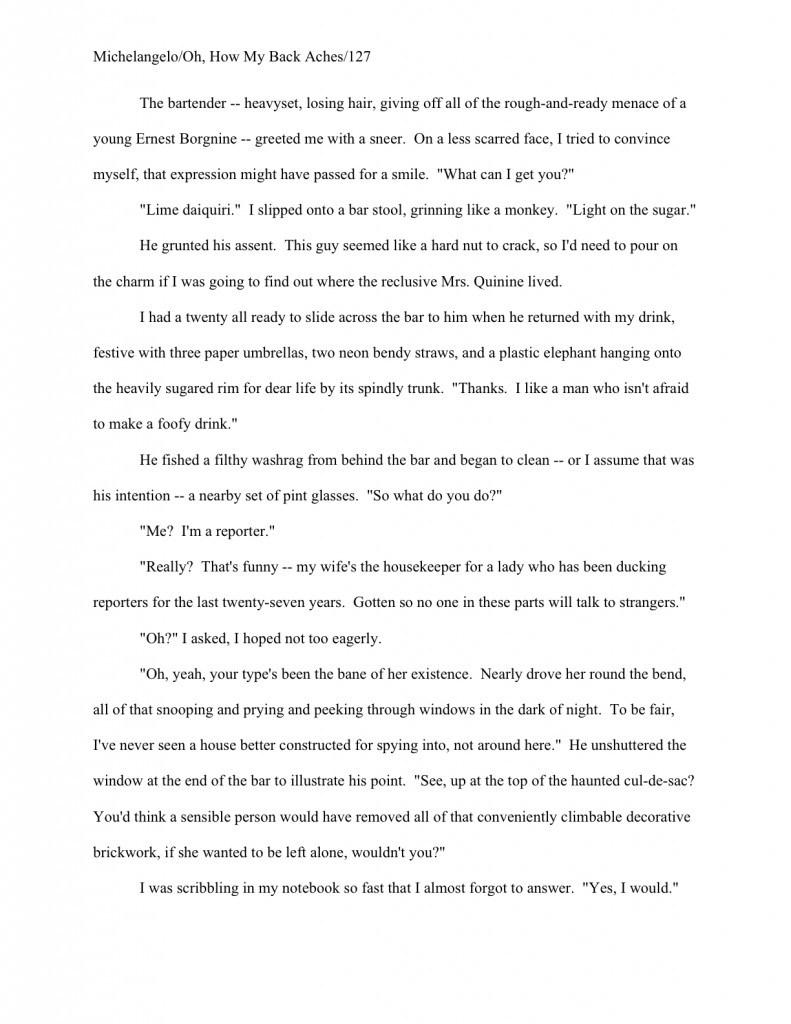
Ready to move on from that startling piece of theory to the nitty-gritty practicalities of 26. When the first lines are dialogue, the speaker is not identified and our old friend #25. The first lines were dialogue? Excellent. Let’s take a look at an example where both occur — see if you can guess why this opening might irritate a Millicent in a hurry.

“Hey — who’s there? Hello? Hello?”

“Oh, sorry. I didn’t mean to startle you. Is this the way to Professor Blaitwistle’s class?”

The old man leaned on his broom, his faithful companion and coworker for the past thirty-seven years. “Yes,” he lied. “Just down that hall, then take a right immediately after the mad scientist’s laboratory, the doorway with the two growling three-headed dogs guarding it. You can’t miss it.”

“Thank you, sinister lurker. I would so hate to be late for my first day of class.”

He chuckled at her retreating back. “Last day of class, more like.”

If you immediately cried, “By jingo, this opening relies on false suspense to create a sense of mystery, withholding information such as who these speakers are and what the physical environment is like in order to rush the reader into a confused sense of imminent danger!” give yourself a gold star for the day. Award yourself two — hey, they’re small — if you also pointed out that the character heading smack into that imminent danger spoke in dialogue that didn’t reveal anything about his or her personality other than a tendency to be polite to frightening strangers.

However, none of those things are what I want you to concentrate upon at the moment. Go back and reread the passage again, then ask yourself, “What purpose does not identifying who is speaking actually serve here? And why am I talking out loud to myself, when that tends to annoy Millicent on page 1, too?”

I can’t help you with the second question, not being conversant with your personal quirks and motivations, but I can provide an answer to the first: none.

Not one iota. It is devoid of any scintilla of character development. All the writer has achieved here is to make the reader wait until paragraph 3 to find out whose voice opened the book, and not to identify the other speaker at all.

I appeal to your sense of probability: if you were a Millicent trying to screen ten more submissions before lunchtime, would you be intrigued by being kept in the dark on these salient points for so many lines? Or would you think huffily that the submitter had some nerve to expect you to invest energy in guessing based on such scant evidence?

The moral of today’s story: if you’re going to open with dialogue, make it count. There is no such thing as a throw-away line on page 1 of a submission.

So let your dialogue reveal more than it conceals about who your protagonist is and precisely why s/he is going to turn out to be a fascinating character in an intriguing situation. Because, after all, if a writer is going to go to all of the trouble of creating a fully-realized, completely unique character on the page, the reader is going to want to sit up and take notice when s/he speaks.

Opening dialogue that lives up to that hope is rarer than you might think. Don’t believe me? May I remind you that a full 8.1% — roughly an eighth — of the Idol first-page rejection reasons were dialogue-based, more than on any other single technical aspect?

Be very, very sure that any dialogue you use on page 1 is flawlessly executed, scintillating in content, and absolutely necessary. Because, as we may see, some agents seem to be a trifle touchy about it.

Actually, while I’m at it, I’m going to add a quibble of my own: too many tag lines. For those of you unfamiliar with the term, a tag line is the he said part of the dialogue, and a healthy percentage of the industry was trained to believe that in good writing, (a) in two-person dialogue, tag lines are usually disposable, thus (b) writing with fewer tag lines tends to be better than writing with more, and (c) the vast majority of the time, said is a perfectly adequate word to describe a human being speaking.

(c), obviously, underlies the critique of “she squawked.”

While, equally obviously, the degree to which a particular speaking verb is problematic varies from reader to reader, #52, the tag lines are more revealing than the dialogue, is a fairly standard objection to dialogue scenes. Most of us have had English teachers who subscribe to this school of thought, the type who rapped us on the knuckles if we dared to use an adverb in a tag line, because, well, Hemingway never would have done it, and if the dialogue itself were descriptive enough, no one would need to know that Charles said it laconically.

I’ve posted enough, I think, on the issue of dialogue-only scenes, where the reader isn’t given one iota of hint about how certain things are said or what is going on in the room, for my regular readers to know my opinion on bare-bones dialogue. But over-used tag lines are something different: trust me, if your job were reading hundreds of pages of prose every single day, unnecessary verbiage would be likely to start to annoy you FAST.

To try to show you why you might want to go a little light on the tag lines (and on the squawking, while we’re at it) on page 1, here’s a relatively average chunk of dialogue:

“It’s about time you got home,” Andrew said snappishly. “Your soup is ice-cold.”

Joanna sighed, “I told you that I was going to have to work late. It’s inventory time at Poultryco, honey, and as you know, I am the barnyard manager. Who is going to count the geese, if not me?”

“Like that’s hard work,” Andrew snorted. “The dumb clucks just sit there.”

“No, actually,” Joanna said priggishly. “Geese are quite aggressive. They’re territorial, in fact. Why, don’t you remember just last year, when young Jeremy Faulkner was pecked to death in the granary?”

“Yes, of course, I remember,” Andrew huffed, irritated and annoyed. “I sang the Ave Maria at his funeral, right? You know I’m the only tenor in the local Methodist church choir who can hit that top C. But that doesn’t explain why you need to stay out until eleven p.m.”

“We have to wait until after dark,” Joanna moaned, “until the birds are asleep.”

“We?” Andrew pounced. “Don’t tell me that good-looking ruffian Dario Blaine is working for you again. Why, every husband here in Karaoke City knows his reputation with the ladies. He’s the Don Juan of chicken pluckers.”

Now, this excerpt would be especially annoying to a tag line minimalist, as it is reflects a quite common writerly misconception that the mere fact of enclosing phrases within quotation marks is not signal enough to the reader that a character is speaking the words out loud, rather than just thinking them. To adherents of this theory, the mere idea of not both identifying every speaker and stating specifically that he is, in fact, saying these words out loud is a one-way ticket to anarchy.

However, to most professional readers this kind of tag line use just seems repetitive — or, to phrase it in the language of the biz, time-wasting. Remember, our over-worked and under-dated agency screener has to write a summary of the story of any submission she recommends her superior reads; she wants you to cut to the chase.

So what’s the writer to do, just cut out all but the absolutely essential tag lines, in order that her first page would read 42 seconds faster? Let’s take a gander at what would happen:

“It’s about time you got home,” Andrew snapped. “Your soup is ice-cold.”

Joanna sighed. “I told you that I was going to have to work late. It’s inventory time at Poultryco, honey, and as you know, I am the barnyard manager. Who is going to count the geese, if not me?”

“Like that’s hard work. The dumb clucks just sit there.”

“No, actually, geese are quite aggressive. They’re territorial, in fact. Why, don’t you remember just last year, when young Jeremy Faulkner was pecked to death in the granary?”

“Yes, of course I remember. I sang the Ave Maria at his funeral, right? You know I’m the only tenor in the local Methodist church choir who can hit that top C. But that doesn’t explain why you need to stay out until eleven p.m.”

“We have to wait until after dark, until the birds are asleep.”

“We? Don’t tell me that good-looking ruffian Dario Blaine is working for you again. Why, every husband here in Karaoke City knows his reputation with the ladies. He’s the Don Juan of chicken pluckers.”

A trifle sparse, admittedly, but there isn’t any serious question about who is speaking when, is there? Personally, I would opt for breaking up the dialogue a bit more by adding a few character-revealing descriptive elements that are not speech-related, such as the facts that Andrew is wearing a giant panda costume and the soup is cream of bamboo.

Those two telling details made you reconsider your view of Joanna’s tardiness, didn’t they? Would you rush home to that, particularly if you knew that every Thursday’s dessert was Pinecone Flambé?

Do I hear some of you whimpering impatiently out there, hands in the air, to tell me what else is wrong with this chunk of dialogue? The de-tag lined version made it even more apparent, didn’t it?

Sorry, the Idol agents beat you to it: #51. when characters tell one another things they already know, so that the reader will be filled in on necessary background. Those of you familiar with this blog already have a name for this phenomenon, Hollywood narration; in the science fiction/fantasy community, it goes by another name, “So as I was telling you, Bob…”

Either way, it is logically indefensible. It is absurd to the point of impossibility that Andrew does not know his wife’s job title or where she works, just as it is exceptionally improbable that he would have forgotten Jeremy Faulkner’s traumatic death, or that Joanna would have forgotten either the funeral or her husband’s participation in the church choir.

And don’t even get me started on ol’ Dario’s local reputation. Make every line of dialogue count, campers, and keep up the good work!

The envelope, please…

WHISPER_cover

Update as of September 13, 2010: I am sorry to report that Phoebe Kitanidis decided not to follow through on the award portion of this contest, so the feedback winners in Category II: YA will be receiving will be from me alone. While I regret the necessity, this was a mutual decision: she did participate in the judging, but her feedback on the winning entries was not up to Author! Author! standards, and her next book deadlines was, she said, too tight for her to participate in the video feedback we had planned instead.

My profound apologies to those of you who entered Category II: YA, as her feedback was slated to be its primary prize, as well as to all of the winners in both categories, whose prize entries’ posts were substantially delayed by these negotiations.

Other than removing the parts below that were obviously rendered untrue by subsequent events, I have left this post as I ran it originally back in August, 2010.

That’s right, gang: the long-anticipated day has arrived. Today, I’m going to announce the winners of the Author! Author!/WHISPER Great First Page Made Even Better Contest. Winners will receive an extensive critique of their first pages in this very forum, courtesy of yours truly and FAAB Phoebe Kitanidis, author of the HarperCollins’ new YA release, Whisper.

Hmm, why does that title sound so very familiar? You must have seen the cover someplace.

Why did it take such a long time to judge this contest, you ask? Well, several reasons, up to and including the fact that I’m typing this one-handed, due to my recent injuries. In addition, I experienced great difficulty organizing the prizes; see above. Also, the response to this contest was quite a bit more enthusiastic than either the judges or I had anticipated; as a contest without an entry fee, it wasn’t as though we could simply hire staff to deal with the additional entries.

Beginning to understand why the vast majority of literary contests charge fairly hefty entry fees? Contest administration is time-consuming.

Not that I’m complaining, of course — there were many great entries, and a tidy array that rose to the rank of fabulous. So many, in fact, that it was exceptionally difficult for the judges to agree on the final awards.

But of that, more below. First, I want to talk about a couple of the widespread entry problems.

To be blunt, it was not exceptionally difficult was to disqualify the full one-third of entries that disregarded the rules — and that’s not even counting the 90% of entries that did not adhere to standard format for manuscripts. Come on, people — there were only four rules!

What can we learn from disturbing statistic? Something that any veteran contest judge or agency screener could have told you: a significant proportion of aspiring writers evidently do not take the time to read contest rules and submission requirements.

That’s sad, because — again, as anyone mentioned above could tell you — if an entry or submission does not follow the rules, it will almost always be rejected, regardless of the quality of the writing.

Period. End of story. No appeal. Or, to put it another way: not taking the time to read the rules hurts only you.

Ditto with not following the rules of standard format for manuscripts — although so many entrants broke one or more rules that the judges had to downgrade the importance of formatting in the judging. This meant, in practice, that we ended up considering (and even giving a prize or two) to first pages that Millicent the agency screener probably would not have bothered to read at all.

Hey, we were being nice. But expecting Millicent to exercise that level of leniency would be foolish.

In case I am being too subtle here to catch the average rule-skimmer’s eye: READ THE RULES. LEARN THE RULES. FOLLOW THE RULES. REPEAT AS NEEDED UNTIL YOUR BOOK GETS PUBLISHED.

Seriously, submitting an improperly-formatted manuscript is precisely like sending a contest entry that ignores the stated rules: the writer is depending, foolishly, upon the kindness of the reader to overlook a lack of professionalism. Submitting an improperly or — even more common — inconsistently formatted manuscript is, to put it bluntly, usually a waste of the writer’s time.

Why? Chant it along with me, long-time readers of this blog: because agencies and contests typically receive so many perfectly-formatted, impeccably rule-following manuscripts that they don’t need to bother with those that are not professionally presented. Therefore, not taking the time to learn how to format a book manuscript properly because you are trying to get it out the door faster is self-defeating.

Again, it really is that simple. Fortunately, all any aspiring writer has to do to learn how to format a manuscript properly is take a swift peek at the aptly-named HOW TO FORMAT A MANUSCRIPT category on the archive list on the bottom right-hand side of this page.

Given how much blog space I routinely devote to proper formatting, I was genuinely surprised at how few entrants had evidently checked their formatting against the literally hundreds of practical examples I have posted on this very blog in recent years. Short of coming to your respective houses and formatting your work for you, I don’t see how I could possibly have made it easier for entrants to this contest — or submitters to agencies, for that matter — to get the formatting right.

I just mention. While I’m typing one-handed. Don’t make me pull out any more guilt-inducement than that.

Oh, and something else almost everybody who entered did: titled the entry document along the lines of Anne Mini contest, Author! Author! contest, first page contest…in short, in a manner that, while convenient for finding it again on THEIR hard drives, required my renaming virtually every entry before I could save it to mine. Because, honestly, when confronted with 43 (seriously) entries called ANNE MINI CONTEST, how else was I supposed to tell them apart?

Aspiring writers do this all the time in electronic submissions and contest entries. Strategically, it’s a bad idea to inconvenience Millicent, even a little.

How should a request for an attachment be titled, you ask? Either with the writer’s last name (Smithentry.doc would have worked beautifully on my end; SmithCatIIentry.doc would have been even better) or — and this was the most popular choice in the contest — with the title of the piece. (TheWayWeWere.doc would be hard to mix up with VenusVampires.doc, after all.)

So much for the multi-part lecture. On to the announcement of the winners. First, the grand prizes.

The 2010 Author! Author! Awards for Expressive Excellence and Grand Prizes in the Author! Author!/WHISPER Great First Page Made Even Better Contest go to:

Adult Fiction: Jennifer Sinclair Johnson, DIVIDED STATES

Young Adult Fiction: Juniper Ekman, TROUBLE COMES

Actually could fit in either adult fiction or YA, but the judges agreed they would have awarded it a grand prize in either: Cole Casperson, INDOMITVS

Memoir (not an official category, but we received a lot of great entries): Jennifer Lyng, NORMAL IS WHAT YOU KNOW

But wait — there’s more! Judging the finalist round was quite tough. Because we received such a lot of exciting, well-written entries, the judges and I talked it over, and we decided that it might be a lovely idea for me to post and discuss the first, second, and third-prize entries as well. (Not that I’ll be doing it immediately, mind you; prize fulfillment will take place when my hands are once again up to full blogging strength.)

So, bearing that prize upgrade in mind, let’s also hear it for the entries that placed:

The Author! Author!/WHISPER Great First Page Made Even Better, Category I: Young Adult

First Prize, YA: Natalie Hatch, BREEDER

Second Prize, YA: Suzi McGowen, A TROLL WIFE’S TALE, and Sherry Soule, DARK ANGEL

Third Prize, YA: Janine A. Southard, WHICH STAR MY DESTINATION, and Gayton P. Gomez, BOOK WORMS

The Author! Author!/WHISPER Great First Page Made Even Better, Category II: Adult Fiction

First Prize, Adult Fiction: Curtis Moser, PERDITION, and Jens Porup, THE SECOND BAT GUANO WAR

Second Prize, Adult Fiction: David A. McChesney, SAILING DANGEROUS WATERS, and Ellen Bradford, PITH AND VINEGAR

Third Prize, Adult Fiction: David Jón Fuller, BARK AT THE MOON; Linda C. McCabe, THE LEGEND OF THE WARRIOR MAID AND THE SARACEN KNIGHT, and Carolin Walz, GOTHIC WARS.

Hey, I wasn’t kidding about a plethora of great entries! Congratulations to all of the winners — watch this space to hear more from them.

And, as always, keep up the good work!

The scourge of the passive interviewer, part III: as you know, robot, I have a nefarious plan…

Dr. Smith and the robot

Shh! The houseguests are sleeping, so I have tiptoed into my studio to have a few words with you. Perhaps it is inhospitable of me, but all weekend, I’ve been yearning to log in to warn you further of the horrifying perils of Hollywood narration.

That’s not the kind of yen that makes sense to non-writers, in case you’d been wondering. I believe the term most often being applied to it in my household over the last few days is pathological.

But then, most conscientious revisions would strike outside observers as pretty odd, I suspect. “What do you mean, you’re going to go over every syllable in the book several times?” they demand, wide-eyed. “Isn’t that, you know, the editor’s job, not the writer’s? Why don’t you just send off the manuscript and let the publisher take care of any typos — or whatever it is you think you’ll find on your seventeenth read-through?”

Hoo boy — it’s hard to know even where to start countering that pervasive set of misconceptions, isn’t it? Rather than engaging in a lengthy explanation that will only depress all and sundry, let’s get back to the matter at hand.

Last time, I introduced you to Hollywood narration, the perplexing practice wherein backstory is conveyed by dialogue between persons who both already know the information perfectly well — and thus have absolutely no legitimate reason to be having that particular conversation at all. Interestingly, writers who pride themselves on the pursuit of realistic dialogue are every bit as likely to incorporate Hollywood narration as those who do not.

It’s just so darned convenient. Particularly if a reviser is editing for length: a paragraph or two of Hollywood narration can, after all, replace pages and pages of backstory.

But page-slashing self-editors are not the only writers fond of Hollywood narration, unfortunately. Many a first-time novelist or memoirist has panicked at the notion that the reader will walk into a story without knowing basic facts about the participants. As a result, our old pal Millicent the agency screener is constantly confronted with opening pages that read something like this.

Hollywood narration

Did any of that seem a trifle unnecessary to you? It would to Millicent, or indeed to most readers. For this scene to work, we don’t actually have to know how old these people are, how long they’ve been married, or even how long little Tara has been sleeping through the night. We certainly don’t need to hear about all of that on page 1; these tidbits could pop up naturally as the story progressed.

Or, to put it in editing terms, most of those statements of fact slow down the story, rather than adding to it, at least at this juncture. To grab the reader, this opening scene needs to present Helga and Chaz as interesting people in an interesting situation — so why take up page space with matters that, while important in and of themselves, are not integral to the conflict at hand?

Heavy-handed application of backstory isn’t solely the province of dialogue, of course (as that whopper of a sentence in the second paragraph proves abundantly). Most first novel manuscripts (and quite a few first memoirs as well) produced within the last thirty years or so have leaned pretty heavily upon dialogue to introduce facts that both parties already know, for the exceedingly simple reason that we’ve all heard it done so much in movies and on TV.

Thus the term Hollywood narration: all too often, writers forget that having a character essentially narrate backstory or fundamental facts crops up in movies because film is limited in how it may convey the past. On the printed page, however, we have more — and more interesting — options than having a character start waxing poetic about the past to people who shared that past, don’t we?

Before we go any further, and to save confusion in critique groups and editorial conversations in the dim, uncertain future, I should point out that the term Hollywood narration is mine; the agent of your dreams may well look at you blankly if you mention it. She will undoubtedly be familiar with the phenomenon, however: due to its continual widespread unpopularity amongst aspiring writers, it is cursed under many names throughout the publishing world. My personal favorite is the SF/fantasy moniker, as you know, Bob… dialogue.

Whatever you like to call it, as far as I’m concerned, it’s one of the scourges of both the modern publishing industry and the screenwriters’ guild.

What’s so wrong with it on the manuscript page? From a reader’s perspective, Hollywood narration in dialogue is effectively an interview scene with no interviewer but the author.

The reader is left to wonder: why the heck is that chattering character responding to questions that no one has actually asked him — and furthermore, whose answers must come as a mind-numbing bore to the character to whom he’s saying it? Why, in fact, is this monologue (or dialogue; both Helga and Chaz engaged in Hollywood dialoguing above) appearing on the page at all?

As we discussed last time, the answer to all of those questions usually disarmingly straightforward: because the writer wants the reader to learn the answers to those questions, that’s why. So much so that the characters’ motivations and listening preferences are ruthlessly disregarded in favor of audience enlightenment.

Anyone see a teensy problem with this narrative strategy? Anyone?

No? Well, I could just tell you that Hollywood narration has the characters tell what the narrative doesn’t show — but it would be far, far more effective to show you, wouldn’t it? Especially since it isn’t always easy to catch in revision.

Oh, you may laugh, recalling the throw-a-brick-through-the-nearest-window subtlety of the example above, but sometimes, Hollywood narration can be very low-key. You’d actually have to be looking for it. As you should be, ideally, in the following:

Lois did a double-take at the stranger — or was he? It was so hard to tell behind those thick, black-rimmed glasses. “You remind me of someone. Funny that I didn’t notice it before.”

Clark grinned shyly. “It is funny, considering that we’ve been working together for the last five years.”

Did you catch it?

Or rather, I should say did you catch them, since the Hollywood narration cuts both ways here. Surely, both parties have been aware for quite some time — say, five years — of what Clark’s glasses look like. So why is Lois describing them? On the flip side, Clark is also telling Lois something that she must have known for, at minimum, five years. So why is he saying it, other than to let the reader know that they’ve been working together for — wait for it — five years?

And is that honestly sufficient reason to keep this sterling exchange in the text? As a reviser, you should constantly be asking yourself, “Is this really the most effective way to convey this information? Brilliant writer that I am, could I not find a more graceful way to let the reader in on the backstory — or is it possible that the backstory actually is not integral to this scene, and thus could be introduced later?”

Yes, that is quite a mouthful to keep muttering to yourself. It gets easier with practice.

More often, though, Hollywood narration is laid on with a heavier hand, if not a shovel or a backhoe. Sometimes, the helpings are so lavish that they practically constitute a flashback:

“We could always spend the weekend at our rather derelict lake house,” Desmond pointed out. “We’ve owned it for fifteen years now, and I don’t think we’ve stayed in it five times.”

Elaine shrugged, a good trick, considering that her hands were deeply imbedded in the clay turning on the wheel. She was going to need major chiropractic work on her neck some day soon. “That’s not true. We spent a month there when little Betty came down with the measles during the family reunion, don’t you remember? All 117 of us, the whole extended family as far as it could be traced — or at least as far as Aunt Rose managed to trace it in her three volunteer afternoons per week at the Genealogical Society, bless her heart and reading glasses — locked inside after Dr. Stephens nailed the quarantine sign on the door.”

“I remember. It was the worst three weeks of my life.”

“Worse than the time that we and our three kids fell through that hole in the space-time continuum and ended up chasing the guy we mistakenly thought was Galileo for twelve days? Don’t be ridiculous.”

“Which just proves my point,” Desmond said triumphantly. “We need to spend some serious time doing repairs at the lake house. Anyone could tumble through one of those holes and end up in the fourteenth century.”

Reads like an interview scene, doesn’t it? But Desmond didn’t ask Elaine for a recap of their previous adventures — escapades, one hopes, detailed earlier in the book in the reader’s hand, or in a prequel; they sound as though they would be interesting to see fleshed-out, rather than glossed over anecdotally in dialogue. Nor did Sandra represent herself as not knowing how long they had owned the lake house. They were talking about their vacation plans — so why the sudden plunge into backstory?

Even a reader not much given to questioning the printed word might have been brought up short by this passage, as the narrative itself gave a major clue that something’s wrong with this dialogue. But to Millicent and her ilk, the mere fact that Desmond said, “I remember,” is like a neon sign, flashing HE ALREADY KNOWS THIS! fourteen times per minute.

It’s a touch distracting.

Like pretty much every other over-used narrative devices, Hollywood narration can work effectively, if used in miniscule doses and rarely. Unfortunately for Millicent, manuscripts seldom display the trick sparingly, especially in the openings of novels.

Why do those first few pages tend to be prime display space for Hollywood narration, you ask in all innocence? Because, dear friends, few aspiring writers have the patience to allow backstory to reveal itself over the course of chapters; most want to get it out of the way at once.

This is why, in case those of you who have been haunting literary conferences lately had been wondering, so many agents are prone to advising roomfuls writers not to try to cram the entire premise onto the first page — or, when they choose to express it a trifle more politely, to consider waiting until later in the book to reveal background information. “Don’t tell me everything at once,” they beg. “Let me be surprised.”

Good advice: the first page of a novel doesn’t need to include all of the information in the book’s premise. Confident novelists reveal character and situation over the course of an entire book, rather than within the first few paragraphs.

Was that deafening muttering indicative of some discomfort with that last statement? “But Anne,” masses of reveal-it-up-fronters protest, “in your last post, you told me not to have the characters comment to one another on the first few pages; today, you’re trying to dissuade me from having them talk about what happened before the book began. So how on earth am I to introduce these characters to the reader? Telepathy?”

Good question, up-fronters. (Although you might want to watch the sarcasm when you’re asking me to explain something to you as a favor. Your mother cannot possibly know that you’re that flippant with your teachers.) How about opening the book by placing your characters in the middle of a conflict so engaging — and so central to the plot — that the reader quite longs to stick around to find out more about them?

Just a suggestion. It’s always worked for me.

There are a million other ways to introduce characters, of course. Although Hollywood narration might feel satisfyingly efficient — one way to describe cramming a whole bunch of information into just a few lines of text, I guess — it’s actually one of the weakest kind of opening. So much so that anxious conference-goers are sometimes stunned to hear an agent or editor say that he does not like to see a manuscript to open with dialogue at all.

Before the 2/3rds of you whose manuscripts open with dialogue faint, reach for your heart medication, or frantically revise your first pages, let me hasten to add: what this assertion generally means is that the speaker objects to books that open with precisely the type of dialogue that we’ve been discussing, poor interview scenes and Hollywood narration, not to any dialogue, ever.

“How do you know that?” those of you currently clutching your chests demand.

Experience, mostly — and not just editing experience. One of the things that a savvy writer learns by attending many conferences over the years is that sweeping generalizations tend to be common features of conference-given advice; something about sitting on a dais seems to bring out a desire to lay down all-inclusive axioms.

Another way I know is that I read manuscripts for a living, so I have a pretty darned good idea of just how high a percentage of the submissions agents who express this preference see open with Hollywood narration. Trying to stuff backstory into the first few exchanges is awfully common.

The result is, all too often, unrealistic dialogue — and an opening that feels contrived, as in this glorious example of a first scene. I shan’t put this one in standard format; who would blame you if you gave up after the end of page 1?

“So, Ambrose, how was your work at the paper mill today?” Penelope asked, drying her rough hands on the fraying dishtowel that served her as a makeshift apron.

The burly man shook his head. “Having worked there for fifteen years — one before we married, two more before the twins were born, and five years since our youngest girl, Vivienne, fell off the handlebars of Ambrose Junior’s bike and sustained brain damage, forcing me to quit my beloved teaching job and stay home to help her re-learn basic life skills like walking and chewing gum — I sometimes get sick of the daily grind.”

“Did your boss, the redoubtable Mr. Facinelli, terrify you for the fourth consecutive week by sticking his hand into a working chipper to demonstrate how reliable the shut-off mechanism? Doesn’t he recall the hideous accident that deprived your former foreman, Eldon Wheelford, of the use of his left arm, leaving him embittered and lopsided after that unsuccessful lawsuit against his negligent employer?”

“Which he would have won, had Mr. Facinelli’s rich uncle, the mill owner, not bribed his second cousin, the judge. It probably also didn’t help that the entire jury was made up of mill workers threatened with the loss of their jobs.”

“I wish you would stand up to management more.” Penelope sunk her hands into the bread dough that always seemed to be sitting in a moist ball, ready to knead, on the kitchen table. “But you are my husband, my former high school sweetheart, so I try to be supportive of all you do, just like that time I went down to the police station in the middle of the night in my pink flannel nightgown to bail you and your lifetime best friend, Owen Filch, out after you two drank too much near-beer and stole us the biggest Sequoia in the local national park — renowned for its geysers and the annual migration of the canary finch — for our Christmas tree.”

Ambrose stroked his graying head ruefully. “How could I forget? I had gotten you that nightgown for Valentine’s Day the year that little Fatima, then aged six, played Anne Frank in the school play. I never miss one of her performances — nor, indeed, anything that is important to you or the kids. But since our eldest daughter, the lovely and talented Lulu, won that baton-twirling scholarship to State, I have felt that something was lacking in my life.”

“Why don’t you go downstairs to the workshop you built in the basement with the money from that car-crash settlement? You know how much you enjoy handcrafting animals of the African veldt in balsa wood.”

“What would I do without you, honey?” Ambrose put his arms around her ample form. “I’ve loved you since the moment I first saw you, clutching a test tube over a Bunsen burner in Mr. Jones’ chemistry class in the tenth grade. That was when the high school was housed in the old building, you recall, before they had to move us all out for retrofitting.”

“Oh, Ambrose, I’d had a crush on you for six months by then, even though I was going out with my next-door-neighbor, Biff Grimley, at the time! Isn’t it funny how he so suddenly moved back to town, after all those years working as an archeologist in the Sudan?” Ambrose did not respond; he was busy kissing her reddish neck. “But you always were an unobservant boy, as your mother Joanna, all sixty-four years of her, invariably points out when she drops by for her weekly cup of Sanka and leftover cookies from my Tuesday night Episcopalian Women’s Empowerment Group social.”

Okay, so this is a pretty extreme example — but honestly, anyone who has read manuscripts professionally for more than a few weeks has seen narratives almost this bald. Make no mistake: Hollywood narration is telling, not showing in its most easily-identifiable form.

As in Millicent can spot it from a mile away. Or at least within the first line or two.

Like so many transgressions of the show, don’t tell rule, Hollywood narration does provide some definite benefits to the writer who incorporates it. Placing backstory and description in dialogue instead of narrative text is a shorthand technique, a means of allowing the author to skip showing entire scenes — or, even more commonly, to avoid figuring out how to reveal necessary information in a slower, more natural manner.

It is, in short, a trick — which is precisely how a professional reader who has seen it used 500 times this month tends to regard it. Millicent might not see it as necessarily the result of narrative laziness (although it can be that, too), but at least as evidence of a writer’s not being conversant with the many ways a text can convey information to a reader without just coming out and telling him outright.

Is that a thicket of raised hands I see before me, or did half of my readership spontaneously decide to stretch in unison? “But Anne,” some of you point out, and who could blame you? “I don’t quite understand. I see Hollywood narration in published novels fairly often, especially in genre works. Hasn’t it become common enough that it’s simply an accepted storytelling convention by now?”

Good question, hand-raisers or stretchers, whatever you’re calling yourselves these days: you are in fact correct that Hollywood narration has become pretty ubiquitous amongst established authors. But that doesn’t mean that an aspiring writer hoping to break into the book-writing biz is going to win friends and influence people in the publishing industry by embracing it. Submission is definitely one time when you shouldn’t be following the crowd in this respect.

That strikes some of you as unfair, doesn’t it? “But Anne,” I hear large numbers of you sputtering, “can you seriously be arguing that dialogue in movies, on TV shows, and in books first published in English aren’t indicative of what an agent might be looking to find in my novel? How is that possible, when I can find such dialogue on the shelves at my local Barnes & Noble right now?”

I’m betting that the examples you so long to wave at me, oh objectors, are not first novels by North American writers who landed their North American agents within the last five years — and for the sake of this particular discussion, the dialogue in no other books can possibly be relevant. In order to be successful, an aspiring writer’s manuscript usually has to be quite a bit better than what’s currently on the shelves, at least on average.

Why? Long-time readers of this blog, please open your hymnals and sing along with me now: the standards governing established authors — i.e., those who already have published books — is considerably less stringent than those agents tend to apply to the manuscripts submitted by writers seeking representation. Established authors have, after all, already demonstrated that their work can charm at least a few people at publishing houses, if not droves of book-buying readers. A new writer, by contrast, is effectively asking an agent to take a chance on her talent without that kind of a track record.

Speaking of relevant backstory.

Setting aside this marketing reality, however, it’s still a good idea to minimize Hollywood narration in your manuscripts — and not just because relying on it in your opening pages is usually a pretty good way to alienate Millicent’s affection for your storyline darned quick. Readers tend to have a pretty good ear for dialogue; exchanges that might pass muster when spoken by a gifted actor — whose job, after all, is to make lines read plausibly — don’t always ring true to readers. And dialogue that doesn’t ring true, unavoidably, makes it harder for the reader to suspend her disbelief and sink into the world of the story.

Give it a bit of thought, please. Your readers will thank you for it.

Keep up the good work!

The scourge of the passive interviewer, part II: do we really want the creator’s fine Italian hand to be quite this visible?

sistine-chapel-god-and-adam

No time for my usual weighty tome today, I’m afraid: the houseguests, they are a-coming. As in any minute.

So let’s cut right to the chase and continue yesterday’s discussion of, well, when it is and isn’t a good idea to cut to the chase in a dialogue scene. Specifically, in that ubiquitous species of dialogue where one character is trying to elicit information from another.

In my last post, I brought up how frustrating many professional readers find it when a narrative forces them to follow a poor interviewer through an information-seeking process that seems one-sided or lacking in conflict. Or when — heaven forbid — the answers just seem to fall into the protagonist’s lap without significant effort on her part, exactly as if — wait for it — SOMEONE HAD PLANNED for her to happen onto precisely the clues she needed to solve the book’s central puzzle.

What a happy coincidence, eh? And just in time to wrap up the mystery by the end of the book, too.

This marvelous atmosphere for coincidence does not always occur at the end of a plot, either. Ineffectual interview scenes are often employed, as we saw yesterday, to slow down a plot, creating false suspense. If the protagonist is too lazy, too clueless, or just too dimwitted to ferret out the truth early in the book, it’s substantially easier to keep the reader in the dark about salient details of the variety that might cause a reasonably intelligent reader to figure out whodunit by the end of Chapter 2.

But that’s not the only pacing problem an ineffectual interview scene can cause. A protagonist who is bad at asking questions — and his creative Siamese twin, the antagonist or supporting character who is suspiciously eager to cough up information — are also frequently used as means to speed up a narrative by shoehorning necessary information into the plot.

It’s a classic tell, not show strategy, high on both backstory and ability to move the plot along, low on conflict, believability, and character development. See, for instance, how in the following sterling example, the lethal combination of a passive interviewer and a too-active interviewee compresses what could have been a relatively lengthy but conflict-filled interrogation scene into a few short exchanges:

interview bad

“Wait a second,” Millicent the agency screener mutters upon encountering a scene like this. “Who is interviewing whom here?”

Oh, you may laugh, but this kind of inverse interview, as well as plot giveaways every bit this broad, turn up in manuscript submissions and contest entries all the time. These techniques may well be the quickest way to tell a story, but as you may see, they make it pretty easy to see the wheels turning in the authorial mind. Not to mention being almost laughably unrealistic.

Neither of these quite legitimate complaints would necessarily be Millicent’s primary objection to the scene above, however. Any guesses?

Hint: it’s one of her perennial pet peeves. Oh, wait, that doesn’t narrow it down very much, does it?

Give yourself a gold star and a pat on the back if you instantly cried, “This kind of implausible exchange pulls the reader out of the story!” Even though a reader would have to be pretty obtuse indeed (or very into the postmodern conceptual denial of individual authorship) not to realize that any protagonist’s adventures have in fact been orchestrated by a writer, a too-obvious Hand of the Creator can yank the reader out of the story faster than you can say, “Sistine Chapel ceiling.”

To work on the printed page, fate has to move in slightly more mysterious ways. Or at least in more interesting ones.

Was that wind that just blew my cat from one side of my studio to the other the collective irritated sigh of those of you who have been laboring to revise Frankenstein manuscripts? “Oh, fabulous, Anne,” the bleary-eyed many whimper, wearily reaching for their trusty highlighter pens. “Now I not only have to scrub my manuscript until it gleams at the sentence level, but I also have to make sure all of my interview scenes are both plausible AND contain surprising plot twists? When do you expect me to be ready to submit this baby, 2018?”

Well, yes and no. No, I don’t expect you to spend years polishing your manuscript — unless, of course, it needs it — and yes, I do expect your work to abound in gleaming sentences, believable, conflict-ridden interview scenes, and twists I couldn’t see coming. So, incidentally, does Millicent.

That’s enough homework to keep you busy for quite a while, I think. So I’ll just sign off now…

Just kidding. There’s actually a magnificently helpful revision tip buried in the example above: interview scenes are legendary in the biz for drooping, even in an otherwise tight manuscript. Especially, if you’ll forgive my saying so, toward the middle and the end of a book, where protagonists — or is it their creators? — often become a tad tired of searching for the truth.

At that point, crucial clues hidden for years like Ali Baba’s treasure frequently start leaping out of the woodwork, screaming, “Here I am — discover me, already!”

What does that mean for your revision, you ask? Since almost every book-length plot involves some element of detective work, however minor, it’s worth triple-checking ALL of your manuscript’s interviews for flow, excitement, and plausibility. In fact, I would recommend making those interview scenes your first stops for tightening (or, less commonly, slackening) the pace of your narrative.

(Yes, yes, I know: I’m being unusually generous with the boldface today. I want to make sure to hammer home these points before folks come banging on my door, expecting to be charmingly received.)

Do I sense that some of you are resisting the notion of taking on such a wide-ranging revision project? Okay, time for me to haul out the even bigger guns: besides presenting a pacing problem, clues that seem too anxious to fling themselves in a protagonist’s way, feigning casualness when they are discovered littering the path, can actually render said protagonist less likable to readers.

Why? I refer you back to our question-light reporter above. Just as it doesn’t make a character seem like a stellar interviewer if he just strolls into a room at the precise psychological moment that the taciturn miner who’s kept his peace for 57 years abruptly feels the need to unburden himself to the nearest total stranger, it doesn’t make a protagonist seem smart if he happens upon a necessary puzzle piece without working to find it.

And the protagonist is not the only one who runs the risk of coming across as a trifle dim-witted: a mystery or conflict that’s too easy to solve or resolve doesn’t offer the reader much food for conjecture. Readers like to feel smart, after all; piecing the puzzle together along with (or even a little ahead of) the protagonist is half the fun, isn’t it?

It’s considerably less amusing when the protagonist just stumbles onto necessary information, is slow to act, or isn’t on the ball enough to ask the right questions of the right people. While a poor interviewer is almost always an obstruction to the reader finding out crucial information, too-garrulous antagonists and the interview scenes that enable their yen to spout monologue tend to make the stakes seem lower.

Why, you gasp in horror? As convenient as a suddenly chatty secret-hider can be to moving the plot along, information discovered too easily runs the risk of seeming…well, ordinary.

Think about it from a whole-plot level for a moment. If the reader gets to watch the protagonist run down a false lead or two, struggle to remove that rock from in front of the cave to rescue the Brownie troop, a brace of nuns, and three golden retriever puppies gasping for breath within, genuinely have to put two and two together in order to make four, etc., it’s not only usually more exciting, but your protagonist will come across as smarter, more active, and more determined than if she just stands around while these things happen around her — she’ll also be more likable, someone a reader might be eager to follow throughout an entire book.

(And no, Virginia, that last bit’s not a foregone conclusion. If the reader, particularly a professional one, does not either like or love to hate a manuscript’s protagonist(s), he’s unlikely to keep reading for long. Just a fact of the life literary.)

Now let’s apply that plot-level logic to an interview scene, shall we? If the information the protagonist is seeking just drops into her lap, as it does in the example above, the reader has no reason to become invested in the search: after the first couple of times, tremendous, long-held secrets being blurted out will simply become expected.

But what if our scheming reporter above had been forced to try really, really hard to pry Mrs. Quinine’s whereabouts out of Ernest Borgnine? What if he was not only recalcitrant, but had an agenda of his own? What if he told her half-truths that would require still more backstory to render useful? Wouldn’t the information she elicited — even if it consisted of precisely the same set of facts Ernest blurted out spontaneously in the version above — seem more valuable? Or at least more fun for the reader to watch her ferret out?

The answer to both of those last two questions was yes, by the way.

Contrary to popular belief amongst that apparently sizable portion of the aspiring writing community that wants to kill conflict on the page practically the moment it draws its first breath, readers like to see protagonists struggle to achieve their goals. It’s interesting, as well as character-revealing.

Yes, yes, I know, Virginia — you’re worried about your manuscript’s getting too long, or the pace dragging, should you include a few digressions in your hero’s pursuit of whatever MacGuffin he’s desperately seeking throughout the story. (Although, frankly, I would prefer that you didn’t just keep spontaneously shouting out these questions.)

While it is quite reasonable to draw a line on the length of a manuscript you’re planning to submit to an agent, whether a particular scene seems overly lengthy to a reader is largely a matter of presentation, not actual number of lines on a page. There are plenty of short books, and even short scenes, that, to borrow a phrase from industry parlance, read long. (And speaking of eliciting, if you’re not aware of how thick a sheaf of papers tends to elicit a knee-jerk rejection from Millicent, please see the BOOK LENGTH category on the archive list located on the lower right-hand side of this page.)

How might a savvy self-editor put this advice into practice? Glad you asked. Try divesting your interview scenes of any and all plot shortcuts or too-easy revelations, up to and including:

(a) any line where anyone’s pointing out something obvious (“Hey, aren’t you the guy who’s been walking around town, asking all of those pesky questions?”), or

(b) any line that consists entirely of one character agreeing with or simply prompting another to speak (while “Yes, dear,” may be charming to hear in real life, it seldom adds much to a scene), or

(c) simple yes or no answers to simple yes or no questions (almost never the most interesting way to frame a question or response), or,

(d) any new development that’s not actually surprising (“Wait — you mean that your long-lost brother first described as a miner on pg. 4 might possess a map to the very mine we need to explore? Astonishing!”), or

(e) any scene where the interviewer doesn’t have to work to elicit information from the interviewee.

These may not seem like big cuts, but believe me, they can add up. In many manuscripts, making those omissions alone would free up pages and pages of space for new plot twists, if not actual chapters of ‘em.

And yes, I did jump from the line level to the scene level in that last one; thanks for noticing, Virginia. It’s worth your while to consider whether a low-conflict interview scene is even necessary to the storyline; could your protagonist glean this information in another, more conflict-producing manner?

That question is not a bad one to write on a Post-It note and stick to your computer monitor, incidentally. If a scene — or even a page — does not contain recognizable conflict, it’s a prime candidate for trimming.

A grand chapter to start excising the unsurprising: the first, since that is the part of any submission that any Millicent, agent, editor, or contest judge is most likely to read. Especially the first 5 pages or so — if you’re going to have your plot surprise or your protagonist impress the reader with her interview acumen anyplace in the book, make sure that she does it here.

Chant it together now, long-term readers: unless the opening pages grab Millicent, she’s not going to keep reading. (No, not even if her boss asked you personally to send the entire manuscript.)

That’s just common sense, really. An agent, editor, screener, and/or contest judge needs to get through the early pages of a submission before getting to its middle or end. Therefore, it would behoove you to pay very close attention to the pacing of any interview scene that occurs in the first chapter, particularly within the first few pages, as this is the point in your submission where a screener is most likely to stop reading in a huff.

Was that giant gust of wind the collective gasp of all of you out there whose novels open with an interview scene? I’m sympathetic to your frustration, but next time, could you aim away from my cat?

How did I know half of you would be frustrated right about now? Easy: an AMAZINGLY high percentage of novel submissions open with interviews or discussions of the problem at hand. The protagonist gets a telephone call on page 1, for instance, where he learns that he must face an unexpected challenge: violà, an interview is born, as the caller fills him in on the details.

And he says, and I quote, “Uh-huh,” four times.

Or the book opens with the protagonist rushing into the police station and demanding to know why her son’s killer has not yet been brought to justice: another interview scene, as the police sergeant responds.

“Uh-huh,” she says. “Go on, Mrs. Smith.”

Or the first lines of the book depict a husband and wife, two best friends, cop and partner, and/or villain and victim discussing the imminent crisis: bingo.

“Uh-huh, that’s the problem,” one of them says ruefully. “But what are we going to do about it?”

Or, to stick to the classics, this dame with gams that would make the 7th Fleet run aground slinks into the private dick’s office, see, and says she’s in trouble. Bad trouble — as opposed to the other kind — and could he possibly spare a cigarette?

“What kind of bad trouble?” he asks — and lo and behold, another interview begins. Probably with a lot of agreement in it.

There are good reasons that this scene is so popular as an opener, of course: for at least the last decade and a half, agents and editors at conferences all over North America have been urging aspiring writers to open their books with overt conflict, to let the reader jump right into the action, without a lot of explanatory preamble. And conversation is a great way to convey a whole lot of background information or character development very quickly, isn’t it?

Or, to put it in the language of writing teachers, dialogue is action.

Those of you who have been hanging out here at Author! Author! for a good long time are giggling right now, I suspect, anticipating my launching into yet another tirade on what I like to call Hollywood narration (a.k.a. Spielberg’s disease), movie-style dialogue where characters tell one another things they already know, apparently for no other reason than to provide the audience with background information as easily and non-conflictually as humanly possible.

As it happens, you were right, oh gigglers. Openings of novels are NOTORIOUS for being jam-packed with Hollywood narration. As in:

“So, Selene, we have been shipwrecked on this desert island now for fifteen years and seven months, if my hash marks on that coconut tree just to the right of our rustic-yet-comfortable hut. For the first four years, by golly, I thought we were goners, but then you learned to catch passing sea gulls in your teeth. How happy I am that we met thirty-seven years ago in that café just outside Duluth, Minnesota.”

“Oh, Theodore, you’ve been just as helpful, building that fish-catching dam clearly visible in mid-distance right now if I squint — because, as you may recall, I lost my glasses three months ago in that hurricane. If only I could read my all-time favorite book, Jerzy Kosinski’s BEING THERE, which so providentially happened to be in my unusually-capacious-for-women’s-clothing coat pocket when we were blown overboard, and you hadn’t been so depressed since our youngest boy, Humbert — named after the protagonist of another favorite novel of mine, as it happens — was carried off by that shark three months ago, we’d be so happy here on this uncharted four-mile-square island 200 miles southwest of Fiji.”

“Well, Selene, at least for the last week, I have not been brooding so much. Taking up whittling at the suggestion of Jason — who, as you know, lives on the next coral atoll over — has eased my mind quite a bit.”

“Yes, I know, Theodore. How right you were to follow Jason’s advice, given that in his former, pre-atoll life, he was a famous psychologist, renowned for testifying in the infamous Pulaski case, where forty-seven armed robbers overran a culinary snail farm…

Well, you get the picture. That’s not just information being handed to the protagonist without any sort of struggle whatsoever; it’s backstory being spoon-fed to the reader in massive chunks too large to digest in a single sitting.

Since I have lectured so often on this extremely common manuscript megaproblem, I shall let this example speak for itself. (And if it doesn’t, I refer you to the many, many posts under the HOLLYWOOD NARRATION category on the list at right.) Suffice it to say that about the nicest comment this type of dialogue is likely to elicit from a professional reader is a well-justified shout of, “Show, don’t tell!”

More commonly, it provokes the habitual cry of the Millicent, “Next!”

Did you notice the other narrative sins in that last example, by the way? Guesses, anyone?

Award yourself high marks if you dunned ol’ Selene for over-explaining the rather uninteresting fact that she managed to bring her favorite book with her whilst in the process of being swept overboard by what one can only assume were some pretty powerful forces of nature. As character development goes, this is the equivalent of knocking Gilligan on the head with a coconut to induce amnesia when the Skipper needs him to remember something crucial: a pretty obvious shortcut.

Besides, as much as I love the work of Jerzy Kosinski, in-text plugs like this tend to raise the hackles of the pros — or, to be more precise, of those who did not happen to be involved with the publication of BEING THERE (a terrific book, by the way) or currently employed by those who did. Besides, revealing a character’s favorite book is not a very telling detail.

I hear writerly hackles rising out there all over the reading world, but hear me out on this one. Writers who include such references usually do so in the rather charmingly myopic belief that a person’s favorite book is one of the most character-revealing bits of information a narrative could possibly include. However, this factoid is unlikely to be of even the vaguest interest to someone who hadn’t read the book in question — and might well provoke a negative reaction in a reader who had and hated it.

Out come the Author! Author! hymnals again: it’s never a good idea to assume that any conceivable reader of one’s book will share one’s tastes, literary or otherwise. Or worldview.

But let’s get back to analyzing that Hollywood narration opening. Give yourself an A+ for the day if you immediately said, “Hey, if the island is uncharted, how does Selene know so precisely where they are? Wouldn’t she need to have either (a) seen the island upon which she is currently removed upon a map, (b) seen it from space, or (c) possess the magical ability to read the mind of some future cartographer in order to pinpoint their locale with such precision?”

And you have my permission to award yourself a medal if you also cried to the heavens, “Wait — why is the DIALOGUE giving the physical description here, rather than, say, the narrative prose?”

Good call. This is Hollywood dialogue’s overly-chatty first cousin, the physical description hidden in dialogue form. It tends to lurk in the shadows of the first few pages of a manuscript:

Jefferson glanced over at his girlfriend. “What have you been doing, to get your long, red hair into such knots?”

“Not what you’re thinking,” Mimette snapped. “I know that look in your flashing black eyes, located so conveniently immediately below your full and bushy eyebrows and above those cheekbones so chiseled that it would, without undue effort, be possible to use them to cut a reasonably soft cheese. Perhaps not a Camembert — too runny — but at least a sage Derby.”

“I’m not jealous sexually.” Jeff reached over to pat her on the head. “Having been your hairdresser for the past three years, I have a right to know where those luxurious tresses have been.”

She jerked away. “Get your broad-wedding-ring-bearing fingers away from my delicate brow. What would your tall, blonde wife think if you came home with a long, red hair hanging from that charm bracelet you always wear on your left wrist, the one that sports dangling trinkets from all of the various religious pilgrimage sights you have visited with your three short brunette daughters, Faith, Hope, and Gertrude?”

Granted, few submissions are quite as clumsy as this purple-prosed exemplar, but you’d be surprised at how obvious aspiring writers can be about it. Remember: just because television and movie scripts can utilize only the senses of sight and sound to tell a story doesn’t mean that a novelist or memoirist must resort to Hollywood narration to provide either backstory or physical details. We writers of books enjoy the considerable advantage of being able to use narrative text to show, not tell, what we want our readers to know.

Pop quiz, campers: why might introducing physical descriptions of the characters through opening-scene dialogue seem a bit clumsy to someone who read hundreds of submissions a month?

Well, again, it’s common, but this time, at least, that’s not the primary reason. Any guesses?

If you said that Jeff and Mimette are telling each other things they obviously already know, throw yourself a party. In this era of easily-available mirrors, it’s highly unlikely that anyone would not know that he possessed, say, dark eyes, and even the most lax of personal groomers would undoubtedly be aware of her own hair’s color and length. Thus, the only reason this information could possibly appear in dialogue between them, then, is to inform a third party.

Like, for instance, the reader. Who might conceivably prefer to be shown such details, rather than hear them in implausible dialogue.

Once again, though, poor text has given us the gift of a revision tool. A pretty good test for Hollywood narration: if a statement doesn’t serve any purpose other than revealing a fact to the reader, as opposed to the character to whom it is said, then it’s Hollywood narration. And it should go — to free up page space for more intriguing material and good writing.

If you also said that Jeff and Mimette are engaging in dialogue that does not ring true, give yourself extra credit with sprinkles and a cherry on top. With the exception of medical doctors, art teachers, and phone sex operators, real people seldom describe other people’s bodies to them.

It’s just not necessary. My SO has just walked into the room to tell me that our guest have arrived, but I cannot conceive of any impetus that might prompt me to say to him, “Rick, I don’t mean to startle you, but your eyes are green!”

His eyes are indeed green, and I might conceivably want you to know it. But honestly, was just blurting it out — and to him, no less — the most interesting way to introduce this information?

In the interest of scientific experimentation, though, I just tried saying it out loud. It did not produce scintillating conversation. Turns out that being possessed of a mirror — nay, several — he already knew.

Who could have seen that plot twist coming, eh? And aren’t we all stunned by the depth of that character and relationship development in the last few paragraphs?

Oh, here come my guests: blue eyes, brown hair; brown eyes, red hair. I must go and remind them of the exact circumstances of how we all met. You know, just in case the neighbors happen to be listening.

Hey, that’s not the kind of information we’d want bystanders to pick up on the street, is it? Keep up the good work!

The dreaded Frankenstein manuscript, part XIX: the quirkiness of real life, or, so long, Harvey

American Splendor poster

I am genuinely sad to record the passing of graphic novel pioneer Harvey Pekar. His intensely-observed presentations of both the most mundane and most trying aspects of everyday life not only stretched his genre, but demonstrated time and time again that accounts of ordinary life need not be ordinary.

I’m morally sure that Mssr. Pekar would have enjoyed the irony of his having joined the choir invisible right in the middle of our discussion of real-life vs. real-sounding dialogue. As any fan of OUR CANCER YEAR (co-written with his wife, Joyce Brabner) could tell you, he relied very heavily upon actual speech — something substantially easier to pull off when animation appears side-by-side with words on the printed page. Yet just when the dialogue seemed most mundane, one of his quirky characters would come out with a zinger:

“15 amps…15 amps! That’s all we’ve got, and I bet my computer uses half that. This place is a fire trap. You know what’s behind this wall? All our wiring is still in its original paper insulation. Melting copper, wrapped with newspaper. With headlines that read, ‘Jack the Ripper Still at Large!’”

That may sound like the extempore chat of any exasperated person, but as we discussed last time, simply transcribing actual speech is not usually the best — and certainly not the only — means of producing realistic dialogue on the page. There’s nothing wrong per se with lifting quotes from real life, but a savvy writer lifts selectively, judiciously.

And always, always with a definite point in mind. Dialogue that apparently serves no other purpose than to demonstrate that the writer is aware of normal, everyday speech tends to provoke an undesirable speech pattern in our old pal, Millicent the agency screener: “Next!”

Especially if, as often occurs in the opening pages of novel submissions, that meticulously-reproduced everyday speech either delays the action from beginning, slows down action already in progress, or — and Millicent sees this more than any of us might like to think — it takes the place of action happening offstage, so to speak. Many a potentially exciting opening scene has been smothered by the protagonist stopping to be polite — or just chatty.

Not sure what I mean? Okay, here are a couple of openings for the same story, each cut off at the point at which Millicent probably would have stopped reading. (Hey, you think it’s easy to come up with fresh examples night after night?)

“Why, Kathy!” Evan exclaimed. “I thought you weren’t going to make it?”

Well might he have asked. Kathy was not the sort of girl who typically turned up in dank attics, covered with cobwebs, soaking wet, and shaking with fear.

Still, her mother had brought her up right. “Hello, Evan. I thought you were going to Sharon’s party tonight.”

“My date came down with the flu.”

“That’s a shame. And after you got all dressed up, too.”

Evan glanced down at his normally spotless khakis. Climbing up that trellis might not have been such a good idea. He’d have to sneak his pants into the wash before Mom saw them, or he’d be in for it. “I hadn’t expected company.”

Kathy looked away. “Can you tell me what the Algebra homework
was?”

A trifle annoying, isn’t it? It’s fairly obvious that something has happened to Kathy just before the scene we’re seeing, but all of the narrative’s energies seem aimed toward delaying showing us what that something was. (And what is that called, campers? That’s right: false suspense.) Other than slowing the action, keeping the reader from knowing what’s going on, and probably pushing off the first scary happening of the book for a few pages, what purpose is this dialogue serving?

Before you answer, let me caution you that from Millicent’s perspective, but people really talk like that! is not a sufficient answer. Yes, two teenagers running into each other in a haunted house late at night might conceivably say things like this, but why does the reader need to see them say it?

Actually, why does the reader need to see this character say that? is a pretty good question for the reviser of a Frankenstein manuscript to ask early and often, especially when going over a scene that doesn’t go much of anywhere for a third of a page or more. (Hey, Millicent often doesn’t read more than that before deciding to reject a manuscript. Screeners read fast.) In a good submission or contest entry, there’s no such thing as a throw-away line, after all.

As we discussed yesterday, any line of dialogue unequivocally worth keeping exhibits one or more of the following characteristics: it either advances/complicates/resolves a plot point, reveals some interesting and relevant aspect of a character previously unseen in the book, or is interesting, amusing, and/or entertaining in its own right. As the closer readers among you may have noticed, practically none of the dialogue in the example above rises to any of these challenges.

So what’s a savvy reviser to do? Well, we have a number of options. We could back the timeline up a bit, to begin with an interesting character in an interesting situation.

Kathy felt fingers running gently through the sweaty tendrils on the back of her neck. So Evan did like her enough to meet her in the haunted house at midnight. “I don’t scare that easily.”

He didn’t answer. She tilted her head, resting it on his caressing hand. It was ice-cold. And bonier than she remembered.

“Okay, enough with the Halloween jokes.” She wiggled in his grasp. He was surprisingly strong for a chess club captain. “Your girlfriend may like this kid stuff, but…”

The side of her head hit the claw-footed bathtub so hard that she saw stars. She’d always thought seeing stars was a myth, just like the Holton Hall ghost. Water flowed over her face, smothering any further thought but escape.

Gets right to the point, doesn’t it? Thinking objectively, which opening would be more likely to spur you to keep reading, this or the first version?

And THAT is why, in case you were curious, writing gurus urge students to begin their works with a hook, to establish interest right away. But capturing a reader’s interest — particularly a professional reader’s interest — is not like tag: once you’ve hooked ‘em, they don’t necessarily remain hooked. Think of maintaining interest as being akin to love: no matter how hard someone falls for you at first, if you do not keep wooing, that interest is going to flag sooner or later.

Too many aspiring writers take their readers’ interest for granted, an often-costly assumption. So let’s talk wooing strategy.

In the industry, the standard term for what keeps a reader turning pages is tension. All too frequently, writers new to the game confuse it with suspense, but suspense is plot-specific: a skillful writer sets up an array of events in such a way as to keep the reader guessing what will happen next. In a suspenseful plot, that writing-fueled curiosity keeps the reader glued to the page between plot points.

Suspense, in other words, is why one doesn’t get up in the middle of a Hitchcock film to grab a bag of baby carrots from the fridge, unless there’s a commercial break. You want to see what is going to happen next.

Tension, on the other hand, can stem from a lot of sources, mostly character-generated, rather than plot-generated: the reader wants to know how the protagonist is going to respond next, a different kettle of fish entirely. Sometimes tension-rich dilemmas are plot points, but not always – and this gives the writer a great deal of freedom, since it’s a rare plot that can maintain a major twist on every page.

Or even every other page. (THE DA VINCI CODE, anyone?)

Some of the greatest contemporary examples of consistent tension in novels are the HARRY POTTER books. Actually, not a lot happens in most of the books in this series, particularly in the early chapters: kids go to school; they learn things; they have difficulty discerning the difference between epoch-destroying evil and a teacher who just doesn’t like them very much; Harry saves the world again.

Of course, the lessons they learn in the classroom ultimately help them triumph over evil, but that’s not what makes the HARRY POTTER books so absorbing. It’s the incredibly consistent tension. If J.K. Rowling’s publisher infused each page with heroin, rather than with ink, her writing could hardly be more addictive; there’s a reason that kids sit up for a day and a half to read them straight through. With the exception of the first 50 pages of the last book (hey, I’m an editor: it’s my job to call authors on their writing lapses), the tension scarcely flags for a line at a time.

Technically, that’s a writing marvel, a achieved not by magic, but by doing precisely the opposite of what the movie and TV scripts with which we’re all inundated tend to do: she gives her characters genuine quirks substantial enough to affect their relationships and problems that could not be solved within half an hour by any reasonably intelligent person.

Rather than making the reader guess WHAT is going to happen next, well-crafted tension lands the reader in the midst of an unresolved moment — and then doesn’t resolve it immediately. This encourages the reader to identify with a character (usually the protagonist, but not always) to try to figure out how that character could get out of that particular dilemma. The more long-term and complicated the dilemma, the greater its capacity for keeping the tension consistently high.

A popular few: interpersonal conflict manifesting between the characters; interpersonal conflict ABOUT to manifest between the characters; the huge strain required from the characters to keep interpersonal conflict from manifesting. Also on the hit parade: sexual energy flying between two characters (or more), but not acted upon; love, hatred, or any other strong emotion flying from one character to another, spoken or unspoken. Or even the protagonist alone, sitting in his room, wondering if the walls are going to collapse upon him.

Come to think of it, that’s not a bad rule of thumb for judging whether a scene exhibits sufficient tension: if you would be comfortable living through the moment described on the page, the scene may not provide enough tension to keep the reader riveted to the page. Polite conversation, for instance, when incorporated into dialogue, is almost always a tension-breaker.

“But wait!” I hear some of you slice-of-life aficionados out there cry. “I hate to be redundant with the questions, but shouldn’t dialogue EVER reflect how people speak in real life?”

Well, yes and no. Yes, it should, insofar as good dialogue reflects plausible regional differences, personal quirks, and educational levels. I’ve heard many an agent and editor complain about novels where every character speaks identically, or where a third-person narrative reads in exactly the same cadence and tone as the protagonist’s dialogue. Having a Texan character use terms indigenous to Maine (unless that character happens to be a relative of our last president’s, of course) is very likely to annoy a screener conversant with the dialect choices of either area.

Yes, Virginia, the pros honestly do notice these little things. That’s one of the many, many reasons that it is an excellent idea for you to read your ENTIRE submission IN HARD COPY and OUT LOUD before you mail or e-mail it off; it really is the best way to catch this flavor of writing problem.

But it’s just a fact of the art form that the vast majority of real-life dialogue is deadly dull when committed to print. While the pleasantries of manners undoubtedly make interpersonal relationships move more smoothly, they are rote forms, and the problem with rote forms is that utilizing them absolutely precludes saying anything spontaneous. Or original.

Or — and this is of primary importance in a scene — surprising. Think about it: when’s the last time someone with impeccable manners made you gasp with astonishment?

Even rude real-life conversation can be very dull on the page. If you don’t believe this, try this experiment:

1. Walk into a crowded café alone, sit down at a table near a couple engaged in an argument (not all that difficult to find, alas) and start taking notes.

2. Go home and write up their actual words — no cheating — as a scene.

3. Read it over afterward. Does it work dramatically? Is it character-revealing? Or do these people sound generic and their bickering dull?

99% of the time, even if the couple upon whom you eavesdropped were fighting or contemplating robbing a bank or discussing where to stash Uncle Harry’s long-dead body, a good editor would cut over half of what the speakers said. And if the two were in perfect agreement, the entire scene would probably go.

Why? Because real-life conversation is both repetitious and vague, as a general rule. It also tends to be chock-full of clichés, irrelevancies, non sequiturs, jokes that do not translate at all to print, and pop culture references that will surely be outdated in a year or two.

In a word: boring to everyone but the participants. It’s an insult to the art of eavesdropping.

So is, incidentally, dialogue that insists upon showing the reader every pause or hesitation, however miniscule. Contrary to popular belief amongst aspiring writers, the mere fact that a speaker stops saying anything for a moment is not invariably important enough to record for posterity. Nor is it, in itself, interesting.

You’re not believing me again, aren’t you? Okay, smarty pants, take a gander at this relatively commonplace example of this type of dialogue.

Sheila stopped in mid-step. “Edmond, what’s wrong? Are you…”

He hesitated before answering. “I’m fine. Just a minor arrhythmia.”

“But are you…I mean, is it something we need to worry about?”

“You worry too much, Sheila.” He paused. “But I should probably get to…a doctor. Or even…a hospital?”

“A hospital!” She couldn’t say anything else for a second. Then she grew brisk: “Edmond, you’re not…thinking clearly. I’m taking you to the emergency room, now.”

“But…”

“But me no buts. Do you need to lean on me to get to the car?”

Quite heavy ellipsis for just a few lines of text, isn’t it? Apart from being repetitive on the page, all of those dots aren’t really adding much to the scene. As those of you who are editing for length will be delighted to see, most of them could be cut entirely without changing the conflict or decreasing the tension of the scene at all.

Look at how painlessly those pauses may be minimized — and while we’re at it, let’s excise some of that redundancy as well:

Sheila stopped in mid-step. “Edmond, what’s wrong?”

“I’m fine. Just a minor arrhythmia.”

“Is it something we need to worry about?”

“You worry too much, Sheila.” He took in a shuddering breath. “But I should probably get to a doctor. Or even a hospital.”

She grew brisk: “I’m taking you to the emergency room, now.”

“But…”

“But me no buts. Do you need to lean on me to get to the car?”

See? All I retained was one reference to stopping and one ellipsis — but the scene is, if anything, more full of tension than when Sheila and Edmond were wasting all of our time by speaking so slowly.

That’s right, those of you who just gasped — I did say that wasting our time. Professional readers aren’t the only ones who tend to bore quickly when faced with dialogue whose primary recommendation is realism.

“But Anne,” the gaspers protest, “I thought the point of good writing was to show the reader the world as it actually is! If their eyes are going to glaze over just because I show a pause or two — which actual people do all the time in the real world, by the way — or include a few pleasantries, how is it going to be remotely possible for me to tell the realistic tale I want to tell?”

It’s more than remotely possible, reality-lovers — it’s probable, provided that you concentrate on what is surprising and interesting about that tale. Usually, the best way to achieve this is to focus upon what is unique about your self-described ordinary characters, rather than how they are just like everybody else.

That’s a taller order than it might at first appear, from an editing perspective. Far too often, slice-of-lifers and Everyman-producers will not differentiate between the expected ordinary details and the specific quirks of individual characters; their Frankenstein manuscripts tend to include everything, up to and including the kitchen sink. The trick to revising such text is to winnow out what the reader might expect to be there, so the genuinely unusual personalities of your real-life characters can shine forth.

Strong character development is as much about what the writer chooses to leave out as what s/he elects to leave in, after all. Mundane, predictable statements, however likely characters like yours may be to utter them in real life, seldom reveal much about the speaker’s personality, do they?

And that’s doubly true if more than one character says the same types of things. Yes, real people do frequently echo their kith and kin in real life, but unless you prefer to define true-to-life as synonymous with dull, I have too much faith in your creativity to believe that you can’t come up with something different for each character to say.

The same holds true for individual quirks. The more seemingly ordinary your protagonist, the more you ought to consider giving him a unique trait or two. Remember, one reader’s Everyman is another’s Ho-Hum Harry.

Ah, the gaspers seem to have caught their breath again. Yes? “But Anne, what you’re saying is problematic, frankly, to most of us who have lived through Creative Writing 101. Weren’t we all told to strive for universality in our prose? Weren’t we all ordered to write what you know? Weren’t we implored to be acute observers of life, so we could document the everyday in slice-of-life pieces of practically museum-level detail? I can’t be the only one who had this writing teacher, can I?”

Unfortunately, no — judging by contest entries and submissions, quite a few writers did. But let’s pause for a moment — you’ll like that, won’t you, slice-of-lifers? — to consider just how reflective of real life those Writing 101 standards actually were. Universality, until fairly recently, was code for appealing to straight, white men; exhortations to write what you know led to forty years’ worth of literary journals crammed to the gills with stories about upper middle-class white teenagers, mostly male. And the popularity of the slice-of-life short story (it’s awfully hard to maintain for an entire novel) left many of us sitting in writing class, listening to aspiring writers read thinly-fictionalized excerpts from their diaries.

Unfortunately, from Millicent’s point of view, all of the good students obediently following this advice has resulted in a positive waterfall of submissions in which, well, not a whole lot happens. Every day, she reads of universal protagonists (read: ordinary people) in situations that their authors know intimately (read: ordinary life) acutely observed (read: the ordinary seen through a magnifying glass).

It’s not that some of these many, many stories aren’t well-written; many of them are. And there’s nothing wrong with portraying all of that ordinariness, per se. It’s just that Millicent sees so darned much of it that it’s hard for an average Joe or Jane protagonist in an ordinary situation not to strike her as…

Well, you get the picture.

Whether that slice-of-life story is presented as fiction or memoir (a book category where it tends to work better on the page), ordinary characters may never be excused for being dull or predictable. Not in a manuscript submission, not in a contest entry, and not in a published book. Millicent is screening to find the extraordinary manuscript, the one with the fresh worldview, spin, or writing style applied to a story about a character (or characters) who are different enough from character(s) she’s seen before to remain interesting for the length of an entire book.

Aspiring writers, particularly memoirists, often seem to fail to take that last part into account when preparing their submissions: if the story presented does not appear from the very first line on page 1 to be about a fascinating person in an intriguing situation, the manuscript is going to be a tough sell to everyone from Millicent to her boss to an editor at a publishing house to a contest judge.

So if a book is about an Everyman living a life with which an ordinary reader might identify, it’s IMPERATIVE that he demonstrate some way in which either he or his story is not ordinary right away. Why? Because otherwise, the manuscript is far too likely to get dismissed as just not very interesting or surprising.

It’s not for nothing, you know, that agents complain about how many submissions they see that took too long for anything to happen, along with its corollary, the story took too much time to warm up, as well as the ever-popular not enough action on page 1. These complaints are reflective of the hard reality they see on a daily basis: many, if not most, first pages have no conflict on them at all, but are purely set-up.

Such an opening scene may be beautifully-written, lyrical, human life observed to a T. But from the business side of the industry’s perspective — and, despite the fact that agents are essentially the first-level arbiters of literary taste these days, they need to be marketers first and foremost, or they are of little use to those they represent — a slow opening translates into hard to sell.

The ordinariness of characters, that is, is something that comes up again and again in agents’ discussions of what they are seeking in a manuscript. An interesting character in an interesting situation is featured in practically all of their personal ads advice on the subject, particularly if the protagonist is not the character one typically sees in such a situation. A female cadet at a prestigious military academy, for instance. A middle-aged stockbroker arrested for protesting the WTO. A veteran cop who is NOT paired in his last month of duty with a raw rookie.

That sort of thing. In Millicent’s world, interesting and surprising are synonymous more often than fans of the ordinary might think.

So while a very average character may spell Everyman to a writing teacher, an average Joe or Joanna is typically a very hard sell to an agent. As are characters that conform too much to stereotype. (How about a cheerleader who isn’t a bimbo, for a change? Or a coach who isn’t a father figure to his team? A mother who doesn’t sacrifice her happiness for her kids’?)

So I ask you: isn’t it possible for you to work an element of surprise onto page 1 of your submission, the best place to catch an agent’s eye?

Before you chafe at that request, remember that lack of surprise can render a protagonist less likable, even for readers who do not, like Millicent, drop a book like a hot coal if the first few paragraphs don’t grab them. For some reason I have never been able to fathom, given how often writing teachers lecture about the importance of opening with a hook, this justification for keeping the opening lively is seldom mentioned, but it is in fact true: ordinary characters tend not to be all that engaging, precisely because they are average, and thus predictable.

For most readers, an unpredictable jerk is more interesting to follow than a beautifully-mannered bore, after all. It’s hard to blame Millicent and her cronies for that.

Or if it won’t work in your story to open with something surprising, how about vitally important? I don’t necessarily mean important on the global scale, but within the world of the story you’re telling.

Seriously, one of the best ways of preventing your protagonist from coming across as too average is to elevate the importance of what is going on in the opening to that character. A protagonist or narrator’s caring passionately about the outcome of a conflict practically always renders a scene more interesting, because it prompts the reader to care about the outcome, too. (Of course, this is a whole lot easier to pull off in an opening scene that features a conflict, right?)

Whatever you revisers of Frankenstein manuscripts do, however, do not under any circumstances allow the reader to become bored for even so much as a sentence of page 1. Or to be able to predict what the next line of dialogue will be. If your current opening scene cannot be edited to avoid both of these dreadful fates, consider beginning your submission with a different scene.

I ask you again: were you drawn into Kathy’s story faster when you saw her attacked by a water-loving ghost, or when she was chatting with a classmate after she’d fought off the spook?

Believe me, “boring” is absolutely the last adjective you want to spring to Millicent’s mind while she’s perusing your work. Even “annoying” is better, because at least then the manuscript is eliciting a reaction of some sort. But once the screener has a chance to think, “I’m bored with this,” if the next line does not re-introduce tension, chances are that the submission is going to end up in the reject pile.

That’s the VERY next line; you can’t count upon your manuscript’s ending up on the desk of someone who is going to willing to be bored for a few paragraphs. Or hadn’t I mentioned that as a group, professional readers bore fast.

Try not to hold it against them. I’ve read enough manuscripts in my time to understand why: the vast majority of manuscripts suffer from a chronic lack of tension.

Dull dialogue that does not reveal interesting things about the characters saying it is a primary culprit. I know, I know, being courteous seems as though it should make your protagonist more likable to the reader, but frankly, “Yes, thank you, George,” could be spoken by anyone. It doesn’t add much to any scene. And reading too many pages of real-life dialogue is like being trapped in a cocktail party with people you don’t know very well for all eternity.

“Deliver us from chit-chat!” the Millicents moan, rattling the chains that shackle them to their grim little desks clustered together under those flickering, eye-destroying fluorescent lights. “Oh, God, not another attractive stranger who asks, ‘So, have you been staying here long?’”

You’re just the writer to answer their prayers, aren’t you? Keep up the good work!

The dreaded Frankenstein manuscript, part XVIII: were you leading up to a point, Chatty Cathy? Or just killing some time with conversation?

chatty cathy doll

When last we met, I was urging you, through the oh-so-subtle means of inundating you with example after example, into an appreciation of just how annoying redundant, non-character-revealing, or just plain dull dialogue can be to someone who reads manuscripts for hours on end. Like, say, Millicent the agency screener or Mehitabel the contest judge.

Why bring this up in the midst of an ongoing series on self-editing a Frankenstein manuscript? Well, several reasons. First — and it pains me to tell you this — more otherwise well-written submissions and contest entries drop precipitously in M & M’s respective esteems due to lackluster dialogue than is generally believed. Due to the pervasiveness of this phenomenon (and we’re gearing up for the second reason here), typically, one of the quickest, easiest ways to cut length off an over-long manuscript is to track down and excise the ordinary, everyday dialogue, the chatter that neither advances the plot, creates interesting conflict in the moment, or reveals character.

How can I state that so confidently? Because almost every writer who has taken an English composition course was told repeatedly that good dialogue should sound real, the average novel or memoir manuscript overflows with dialogue that’s apparently there simply because people say those types of things.

Which is not to say that striving to make your dialogue realistic is bad writing advice. It’s very good advice — but what the vast majority of composition teachers should have added immediately thereafter yet did not was an explanation that real-sounding dialogue and the things that people actually say in real life are not the same thing.

The former rings true on the page; while the latter can sometimes be very interesting, it can also lull the reader into a deep, deep slumber. Trust me, when people talk about an author with a good ear for dialogue, they’re referring to someone who consistently produces real-sounding dialogue, not someone who simply holds a microphone up to life and records the unedited results on the page.

Of course, we writers want to be true-to-life in our dialogue: as Virginia Woolf wrote, “fiction must stick to the facts, and the truer the facts, the better the fiction.” But let’s not forget that in order to maintain a reader’s interest, a book has to have entertainment value, too — and that however amusing a verbal tic might be in person, repetition is often annoying in on the page.

This is especially likely to occur when a character is tired, angry, or in pain, I notice: all of a sudden, the dialogue sounds as though all of the characters are trapped in one of those interminable Samuel Beckett plays where the people are doomed to move immense piles of sand from one end of the stage to the other with teaspoons. See if this dialogue sounds familiar, theatre-goers:

“Oh,” Babette said. “You’re home.”

Rufus nursed the thumb the dodo trod upon earlier. “Yeah.”

“Have a nice day?”

“Um-hm.”

“I was cleaning out the attic today, and I came across that picnic blanket we used when we went out to Rockaway Beach to scatter Grandfather’s ashes. How it rained that day, and then the sun broke out as if all of our ancestors and God had joined forces to drag the clouds aside to smile upon our picnic.”

“Yeah. We sure got wet that day.“

“Ham sound good for dinner?”

“Yeah.”

A good third of the dialogue Millicent sees runs approximately like this. Understand now why she might become just a tad touchy at the sight of dialogue that provides neither character development nor moves the plot along?

Ordinary dialogue makes her especially antsy — again, I hate to be the one to break this to you, but if I don’t, who will? — on page 1. And that’s unfortunate, since this kind of chat is quite popular in the opening pages of manuscripts.

Why would the dialogue above have annoyed Millicent? Well, cast your eyes over it and tell me: what’s going on here? What is this story about? Who are these people, and why are 7 of the 10 opening lines of this story wasted on dialogue that doesn’t even begin to answer any of these questions?

Already, I see some hands raised out there in the ether. “But Anne,” writers of the real everywhere protest, and who can blame them? “It’s unfair to assume that every reader, even professional ones, would be turned off by the example above, even if it did appear on page 1. I think that Millicent and Mehitabel would be intrigued by its very terseness; I believe it would render them more likely to keep reading, not less, if only to find out what’s going on. I, for one, want to hear more about that dodo bite.”

I’m glad you brought that up, mythical hand-raisers, because the strategy of withholding basic information from the reader in an opening scene in order to create curiosity about what is to come is a suspense-building technique popular only with aspiring writers. Established writers soon learn not to do it, for the exceedingly simple reason that professional readers like Millicent, Mehitabel, and even Maury, Millie’s cousin who works as an editorial assistant at a publishing house, tend not to find this kind of opening titillating.

How do they regard it? Negatively, almost always. There’s even a term for it: false suspense.

That’s also the term for when an interesting one- or two-paragraph teaser, the kind that aspiring writers so love placing within italics, gives way to an apparently or only tangentially unrelated second scene. “Hey!” Millicent cries, spitting out her mouthful of scalding latte, “what happened to that darn interesting plot I’d gotten absorbed in? What’s this writer trying to do, hook me with something exciting, then drop me into a comparatively mundane storyline?”

Let’s be honest, folks: that’s precisely what most writers who use this trick are trying to do. Professional readers are wise to it by now. Remember, part of being a good storyteller involves knowing when to relieve the suspense.

I’m not here to talk about plotting today, however — but don’t worry; I’ll be coming back to it later in this series. For now, suffice it to say that even if you are one of those writers who absolutely adores reproducing everyday speech down to the last grunt and hesitation, you might want to keep those mundanities off of page 1 of your submission. Or page 2. Or, really, out of the opening chapter.

You wouldn’t want Millicent, Mehitabel, or Maury to mistake your submission for the hundreds of thousands of others that don’t have as good an ear for dialogue as you do, right?

As a general revision guideline for any page of the manuscript, I like to flag any piece of dialogue that contains more than one use of yeah, really, yes, no, uh-huh, or, often, um. Almost invariably, these are an indication that the dialogue could either be tightened considerably or needs to be pepped up.

Similarly, anyway and however in dialogue are pretty reliable flares, indicating that the speaker has gotten off-topic and is trying to regain his point — thus warning the manuscript reviser that perhaps this dialogue could be tightened so that it stays on point.

I’ll admit it: my fictional characters tend to be chatty (dialogue is action, right?), and early in my career, I was once taken to task for it by a fairly well-known writer of short stories. She had just managed to crank out her first novella — 48 pages typeset, so possibly 70 in standard manuscript format — so perhaps unsurprisingly, she found my style a trifle generous with words.

“Only show the dialogue that is absolutely necessary,” she advised me, “and is character-revealing.”

Hard to argue with that, eh? Yet, like most writers receiving critical feedback, I fought it at first. Since the dialogue in my advisor’s published works has seldom, if ever, strayed beyond three lines, regardless of situation or character, I was not particularly inclined to heed this advice — have you noticed how often it’s true that established writers with little or no teaching background spout aphorisms that all boil down to write as I do? — but I have to say, it has been useful in editing, both for others’ work and my own.

But I apply a slightly different twist to it. For each line of dialogue, I ask myself: Is this here because it needs to be, or just because it’s something a character like this would say? In memoir and reality-based fiction, it can indeed be there simply because someone actually did say it — but is this particular line essential to the story being told here? And regardless of whether it’s a quote or not, if it isn’t either plot-advancing, character-revealing, or interesting in its own right, does it really need to be on the page at all?

Why, yes, you’re right, everyone who just grabbed the nearest sofa cushion and screamed into it: that is an awfully high standard to apply to every single line of dialogue in a manuscript. Your point?

To help the rest of you understand why your fellow readers felt faint at the mere thought of placing their manuscripts under that powerful a microscope, let’s take a gander at a species of dialogue gets under your garden-variety Millicent’s skin like wet sand under a swimsuit: the de facto monologue.

You know, the kind of ostensible dialogue that involves one character talking about something, while the other character doesn’t really add much to the conversation. It tends to run a little something like this:

“I can’t believe how arrogant that car dealer was!” Antoinette fumed. “You’d think he’d never met a woman who wanted to buy a car.”

“Yeah,” Steve replied.

“You can say that again. I should have told him that I was going home to e-mail the National Organization of Women, to get them to issue a general boycott of his lot.” Angrily, she wrestled to undo the bungee cords that held the driver’s side door onto her 1978 Saab, provided that she never attempted to accelerate above thirty miles per hour. “Did you see how surprised he was that we left?”

“Um-hm.”

“I’ll bet you did. You don’t suppose his telling me that women don’t know anything about cars is his standard sales technique, do you? Other women can’t actually have bought cars after a line like that.”

“No.” Steve was crawling into the passenger seat via the smashed back window. “I imagine not.”

Antoinette dug under the visor to retrieve the seatbelt. “Well, I wouldn’t be so sure. It’s like those construction workers who yell disgusting things at women walking by their worksites: if it didn’t provoke a positive response at least once every 10,000 times, would they keep doing it?”

“Could be.”

“What’s that supposed to mean? You think I’m blaming the victims?”

“I never said that.”

“Anyway,” she concluded after she had successfully hot-wired the car, so she would not have to force the mangled key into the half-melted ignition, “I guess he won’t be offering five dollars on a trade-in again!”

“Absolutely,” Steve murmured, clinging for dear life to what was left of the dashboard.

I ask you: what purpose is Steve serving in this conversation, other than providing validation, the opposite of conflict? And if he isn’t in the scene for any other reason, why doesn’t he just shut up and let Sandy blurt out her entire speech, instead of adding line after excisable line of mostly colorless dialogue?

Not to mention repetitious. We all know by this juncture, I hope, how Millicent and her ilk feel about that in a submission: “Next!”

Even if you find none of those excellent arguments for revision convincing, there’s another, quite practical one you might want to consider. Just look, self-editors concerned about the fact that your manuscript is 40 pages longer than the expected length for a first book in your category, at how much shorter this scene would be if it were presented as an actual monologue:

“I can’t believe how arrogant that car dealer was!” Antoinette fumed. “You’d think he’d never met a woman who wanted to buy a car. I should have told him that I was going home to e-mail the National Organization of Women, to get them to issue a general boycott of his lot.” Angrily, she wrestled to undo the bungee cords that held the driver’s side door onto her 1978 Saab, provided that she never attempted to accelerate above thirty miles per hour. “Saying that women don’t know anything about cars is sure a lousy sales technique. Other women can’t actually have bought cars after a line like that.”

While Steve crawled into the passenger seat via the smashed back window, she dug under the visor to retrieve the seatbelt. She set about hot-wiring the car, so she would not have to force the mangled key into the half-melted ignition.

“Or maybe it’s like those construction workers who yell disgusting things at women walking by their worksites: if it didn’t provoke a positive response at least once every 10,000 times, would they keep doing it?” The engine roared. “Bingo, baby! I guess he won’t be offering five dollars on a trade-in again!”

“Absolutely,” Steve murmured, clinging for dear life to what was left of the dashboard.

See? Steve’s silence makes his unwillingness to argue every bit as clear as his bland continual agreement did above. So what would have been the payoff for retaining his chatter?

Perhaps more to the point, if such lightly-disguised monologues provide neither character development, interesting inter-character conflict, nor, frankly, many sentences worth preserving for posterity, why are they so very popular with aspiring writers? Expediency, mostly: there’s no denying that having a protagonist, villain, or crucial minor character suddenly hold forth like Hamlet is a mighty efficient way to convey information to a reader.

But from the professional reader’s point of view, this use of page space is not efficient at all: it’s the narrative equivalent of having a play’s lead excuse himself to the other characters mid-scene, walk to the edge of the stage, and say, “Look, I really don’t have time to convey everything you need to know in dramatic form, so I’m simply going to tell you what would have happened in the next couple of scenes if we had bothered to stage them, okay?”

It’s not okay, at least according to Millicent. She’s reading your manuscript partially in order to find out how you tell a story — is it honestly in your interest to make her read through filler before reaching your best writing?

Ditto with dialogue that repeats what the reader already knows, as in that archetype of easily cut-able scenes, the one where the protagonist tells another character what happened in a previous scene. As in what the reader has just read. This might be defensible if the protagonist were adding a new twist on the information, but most of the time, s/he recaps the information exactly as the reader has already experienced it because — you can see this coming, can’t you? — it’s what a reasonable person might do in real life.

How easily cut-able are such scenes, you ask? Well, let me put it this way: it’s rare that an accurate retelling, even one that takes up pages of text, could not be summed up in a single sentence: Sheila ran back to the classroom and told everyone what had happened.

Here’s an axiom for the ages: by definition, redundant text adds nothing new to a narrative. It merely takes up space.

That answer didn’t mollify some of you reality-huggers, did it? “But Anne, isn’t realism valuable in and of itself? I know plenty of people who effectively have their own catchphrases.”

As do I, as it happens. In fact, I recently enjoyed a long, gossipy conversation with a very old friend of mine with a very distinctive speech pattern: she says, “Like I said…” every other minute or so. In a long anecdote — to which she is quite addicted, as a world traveler with unusual tastes in traveling companions — she often uses this phrase ten or fifteen times.

Since we grew up together, you would think I would know where she had picked up this rare trope, but I don’t; it’s an adult acquisition. We have both wandered far from home, evidently. But still, you’d think I would have some inkling as to its origin: she and I were so closely allied in high school that at her wedding, both her father AND her uncle spent 45 minutes grilling my boyfriend about his prospects and intentions toward me.

You might say that we come from a close-knit community.

Our hometown does in fact have a distinct speech pattern, a mixture of the lilt remaining when a small town in Switzerland (cow and wine country) picked up and became a small town in California (wine and cow country), certain Mexican-influenced words, a smattering of barrel-related French, and a linguistically inexplicable tendency to pronounce “mirror” as “meer.” Being a farming community (the aforementioned wine), of course, certain agricultural tropes abound in season, such as, “How about this rain? Sure do need it,” “The grapes would have been in by now, 20 years ago” (untrue, incidentally), “Did you hear that bears have been at Farmer X’s grapes?” (true, incidentally; brown bears like expensive fruit), and “Damned drunken tourists have been at my vines again. They think every grape in sight is a free sample.”

But “like I said,” no. So I ask you: would it or would it not be a good means of revealing the background of a character from my home town to incorporate it repeatedly in the text? What about using it as that character’s personal catchphrase?

Pardon my asking, but what precisely would it reveal about her character — other than the not-very-interesting fact that she uses this phrase often? If it does not add anything to the dialogue other than repetition, what possible incentive could I have to reproduce this verbal tick except so readers who already knew the person upon whom the fictional (or memoir) character was based would recognize her?

Is that honestly a good enough reason to bore all of those potential readers who have never had the pleasure of making her acquaintance? Would those excellent souls gain anything but chagrin out of my fidelity in reproducing a rather annoying true-life speech pattern on the page?

The answer to all of those seemingly rhetorical questions was no, by the way. The fact that a real-life person a writer has chosen to use as a character in a book really speaks repetitively does not justify forcing the reader to put up with it.

Now, being a sharp-eyed writer with a strong sense of verisimilitude in dialogue, you may have noticed something about all of the phrases that actually were typical of my home town, real-life tropes that actual people say bloody often in my native neck of the woods. Chant it with me now: they would be DEADLY dull in written dialogue.

As would a character who constantly punctuated her personal stories with “like I said…” Or indeed, almost any of the small talk which acquaintances exchange when they bump into one another at the grocery store. Take this sterling piece of Americana, overheard in Sunshine Foods in my hometown not so long ago:

Mrs. Price: “See you got some sun today, Rosemary.”

Mrs. Darter: “I was picking peaches. Sure is a great crop this year. How did your dentist appointment go?”

Mrs. Price: (Laughs.) “The dentist won’t be buying his new boat on my dime. Was that the Mini girl who just dashed by?”

Mrs. Darter: (Craning her head around the end of the aisle.) Could be. Haven’t seen her for a while. She’s not married yet, is she?”

Mrs. Price: (Shakes her head.) “Oh, hi, Annie.

Dr. Mini: Oh, hello, Mrs. Price. Hello, Mrs. Darter.

Mrs. Darter: I haven’t seen you in a long time, dear. Moving back to town, I hope?

Mrs. Price: Or just visiting friends who have been loyal enough to return to the town that nurtured them as babes?”

Dr. Mini: (Seeking escape route.) How’s your son, Mrs. Price? I haven’t seen him since high school. (Murmurs to significant other, covered by Mrs. A’s lengthy description of the relative heights, ages, and weights of her grandchildren.) Thank God.

Mrs. Darter: And how’s your mother?

Dr. Mini: Oh, fine, fine. I’d better be going. Nice to see you both.

Mrs. Price: Give my regards to your mother. Tell her that we hope to see her soon.

Dr. Mini: (Wheeling cart away.) I will. Remember me to (thinks hard) Bobby.

Mrs. Price: Well?

Mrs. Darter: (Sighing.) Still no wedding ring.

Mrs. Price: Just wait until I tell Bobby. At least he’ll be pleased.

Okay, what’s wrong with this scene as dialogue on the page, over and above its repetition? You can hardly fault this exchange for verisimilitude — it not only is a transcript of an actual conversation, but it sounds like one, literary traits that do not, as I mentioned, necessarily go hand-in-hand — but it’s missing something, right? Any guesses, wild or otherwise?

Give yourself three gold stars if you yelled, “Well, it’s hardly character-revealing, is it? Who are these people as individuals, as opposed to representatives of a collective small-town mentality? And why oh why do we learn so little about Bobby?”

See it now? This exchange might as well have been said by actors, rather than specific people with personal quirks. Granted, as is, it might tell you a little something about the spying capability of my home town’s feared and respected Little Old Lady Mafia, but it doesn’t tell you much about the speakers as human beings, or our relative positions within society.

And if there was a plot (other than to get me married off to someone with whom I might produce more little winemakers, a quest that is ongoing and perpetual), its intricacies are not particularly well revealed by this slice o’life. (But trust me, you don’t want to know more about Bobby. His character strikes me as inherently hostile to development.)

More to the point of this series, the boring bits of this ripped-from-reality dialogue would be significantly more difficult to edit out of a manuscript than a linguistic trope such as my old pal’s “like I said…” Cutting the latter would a particularly easy edit, not only because the writer could simply use the FIND function in word to excise it, but because it would be a pretty sure indicator that the speaker is repeating herself (although interestingly enough, my friend habitually uses this phrase when she ISN’T repeating herself, I notice).

But reworking the exchange above to render it snappy? That would take an almost complete rewrite. Nevertheless, one of the best places for a self-editor to start looking to trim manuscript fat — or even eliminate entire scenes — is generally in scenes taken directly from real life. Most writers cut-worthy include elements in such scenes simply because it happened that way, not because those elements or lines of dialogue add crucial elements to the scene.

To put it bluntly, blandness tends to linger in reality — and that’s potentially problematic at the submission stage. To paraphrase one of Millicent’s most frequent exclamations, via a quote from Nietzsche: “Against boredom, even the gods struggle in vain.”

While I think we can all agree Nietzsche would have made a lousy agency screener — and an even worse agent — his observation might be a good adage to bear in mind while preparing your manuscripts for submission. For one very simple reason: some screeners and contest judges’ maximum tolerance for boredom in a manuscript is well under a minute.

So if you’ve ever heard yourself saying, “Just wait until page 15; it really picks up there,” you might want to give some thought to how to make your submissions more user-friendly for a reader with the attention span of an unusually persistent mosquito. Not that every Millicent, Mehitabel, or Maury would stop reading that quickly — but enough of them would that it just doesn’t make strategic sense to take a chance.

Especially on page 1. Had I mentioned that?

Oh, seven or eight times? Funny, I hadn’t noticed. Keep up the good work!

The dreaded Frankenstein manuscript, part XVII: minimizing dialogue predictability, or, hot enough for you?

beach day

Okay, I’ll admit it: I’m rather proud of this photograph, one of the best I’ve taken in an awfully long time. Over and above the fact that I like how it turned out (especially the wave details), I shot it while flat on my back (my injured back, to be specific) at an extremely crowded beach, yet it looks as though these two fine fellows were the only beachcombers for miles around.

It just goes to show you: whether you are taking a snapshot of friends or constructing a narrative, perspective choice is key. So is knowing what to cut out — in this case, the three surfers, arguing couple, and half a dozen assorted tanners lying around just outside this shot.

Ah, once the urge to edit creeps into the soul, it’s hard not to let it creep into every aspect of one’s life. Wouldn’t those of you caught in the heat wave currently sweeping the U.S., for instance, just love to have the ability to cut from reality iterations #2 – 742 of “Hot enough for ya?” you’ve heard within the last week?

Oh, you laugh now. But just see if you aren’t reaching mentally for the Liquid Erase the next time you hear someone say it.

On the page, of course, such conversational redundancy tends to make one reach for something else — a scissors, to cut the repetitive (and thus predictable) dialogue right out of the book. Of course, Millicent the agency screener and Mehitabel the veteran contest judge don’t need to slice and dice dull dialogue literally; all they have to do is reject or disqualify it.

Not sure why characters echoing one another — which, after all, people do all the time in real life; there’s a reason most sitcoms lean so heavily on catchphrases for laughs — gets old fast on the page? Okay, let’s listen in on a representative sample:

Absent-mindedly, Barb wheeled her loaded grocery cart into the next aisle. “Oh, hi, Ellen.”

“Hello, Barb,” Ellen replied. “Hot enough for you?”

“Sure is. How are the kids?”

“Oh, fine. They grow up so fast, don’t they? How are yours?”

“Oh, I can’t complain. We sure could use some rain.”

“We sure could. Oh, here’s Ed. Hello, Ed.”

Ed was indeed slouching his way toward the canned goods. “Hi, Ellen. Hi, Barb. Hot enough for ya?”

“Hi, Ed,” said Barb. “It sure is. How’s the wife?”

“Oh, fine, fine. How’s yours?”

“Just fine,” Barb said.

“Mine, too,” Ellen added. “How are your twins doing, Ed?”

He shook his head ruefully. “They grow up so fast. Hey, here comes Jeremy. Hi, Jeremy! Hot enough for ya?”

Everyone laughed merrily. “It sure is,” Jeremy said, clutching a swiftly-melting carton of ice cream to his chest.

Had enough? They haven’t — but Millicent, I assure you, abandoned this page long ago. Why? Well, it’s just not very interesting, is it?

That made some of you drop your ice cream cones, didn’t it? “But Anne,” lovers of realism exclaim, mopping your dripping brows, “that’s how people talk in real life! You don’t seriously expect us to believe that Millicent finds realistic dialogue annoying, are you?”

Actually, yes, I do. At least the parts of real-life speech that are redundant. Or not germane to what’s going on in a scene. Or not character- or situation-revealing. Or, as we’ve seen above, just not all that exciting.

To put it as Millicent might: is it the writer’s job to be a transcriptionist, furiously scribbling down everything a real person does or might say in a particular situation — or is the goal of writing well to improve upon reality, offering the reader not merely what s/he might hear on any street corner, but dialogue that exposes emotion, creates conflict,

That immense mouthful was a rhetorical question, by the way. From Millicent’s perspective, if any given line of dialogue doesn’t either advance the plot, reveal character, increase conflict, or add some new dimension to the scene, it should go.

Yes, even if people say it all the time in real life. That’s the way the cookie crumbles, and excu-u-u-se me!

(Note to readers under 30: that last bit would amuse readers who happened to be watching American TV in the late 1970s, just as “You look mahvaleous,” might still bring a grin to viewers who recall the mid-1980s. As you will note, the phrase that had ‘em rolling in the aisles then are not particularly amusing now, but people did in fact repeat them with astonishing frequency back then. You had to be there, I guess.)

Nothing dates a manuscript so fast as TV or movie catchphrases. (”I don’t know karate, but I do know car-azy.” Anyone? Anyone? Bueller?) That may not sound like much of a problem for those of you planning to see your work in print imminently, but frankly, it’s likely to worry Millicent or Mehitabel.

Why, you ask? Because — long-time readers, feel free to sing along with me now — manuscripts take a while to make it into print. A catchphrase that’s sweeping the nation today may well be passé or even forgotten by the time a book containing it hits the shelves.

Let’s be practical for a moment, shall we? Even if a manuscript wins an agent’s heart tomorrow, the agent will probably request revisions before submitting it to agents at publishing houses. Editors’ desks are almost invariably piled high with a backlog of submissions, so again, even if it wows the first editor who reads it, she may not have time to read it for a few months. Few novel manuscripts sell on their first round of editorial submissions, so multiply the number of editors your agent wants to see it by even a couple of months, and the book may be circulating for a year or two. Then, once some lucky editor acquires it, even if he does not want revisions (which he probably will), it’s usually at least a year between contract signing and book release. Sometimes more.

For nonfiction, the timing’s even less predictable. Yes, it’s substantially less time-consuming to write a book proposal than an entire book, but once you have it in hand, all of the same time restrictions on agents and editors’ reading time still apply. And don’t forget to add in the time you will need to write the book itself after a publisher picks it up — publication contracts vary, but anywhere from six months to a year and a half is fairly standard. After that, the publisher will have to approve the manuscript (which may entail, you guessed it, more revision) before it can be placed in the print queue…and that’s not even taking into account the fact that certain types of books tend to be released at certain times of year…

Oh, and some of you are working on revising Frankenstein manuscripts, aren’t you? How long do you anticipate that will take?

Getting the picture? More importantly, are you still absolutely certain that the catchphrase that seemed so hip and trendy when you originally typed it last spring will still read as fresh when the first edition of your book first falls into grateful readers’ hands?

To compress all of this into a revision tip: unless your story is set in a specific period in the past, consider cutting current cultural references and colloquialisms. Believe it or not, the day will come — and it’s probably not all that far in the future — when teenagers will roll their eyes when adults-trying-to-be-cool say, “Whatever!”

That’s SO 2005, Grandpa.

Even if your chosen catchphrase is historically appropriate for the setting of your book (dig it, man!), keep an eye on how often it crops up in the text. Repetition is repetition, after all, and a character who repeats herself too often is, among other things, predictable.

It’s also very, very easy to go overboard with the cultural references; one too many, and your character may come across as a stereotype. It’s perfectly fine to differentiate between a pair of sisters by having one’s junior high crush be on David Cassidy, while her young sister later swooned over Shaun, for instance, but must the elder also continually hum John Denver tunes, creating macramé plant holders, and talking about Watergate while wearing her Laurie Partridge pantsuit over a burned bra as she sports a yin-yang ring to P.E. classes still unaffected by Title 9? And is it really necessary for the younger to toss her Farrah over her Leif Garrett albums while simultaneously watching the Muppets and mourning the demise of Sid Vicious?

Hands up, any of you who caught all of those cultural references. If you did, please turn to the blank-eyed person next to you and explain them. Don’t be deterred by their persistent yawns; I’m sure the young will be amused to learn what albums were.

And if your first instinct was to point out huffily that there was never actually an event where bras were burned (the cliché actually comes from the public burnings of Vietnam-era draft cards, transposed into a different social movement), or that a Leif Garrett fan would NEVER have been listening to the Sex Pistols, well, you’re right. But having a firm grip on historical realism does not give you carte blanche to start carting in cultural references by the wheelbarrow load.

I assure you, they are not indispensable. Whenever you find one in your text, ask yourself: is this detail meaningful enough to keep? Or could I convey an accurate feeling of the time and place through more unusual — and therefore less expected — means?

While you are scanning your text for redundant dialogue, catchphrases, and soon-to-be-dated cultural references, bear in mind that television and movies often shape day-to-day speech in other ways, too. Take, for instance, the standard first response upon hearing that someone has experienced bereavement: I’m so sorry for your loss.

Now, there’s nothing wrong with expressing sympathy that way, inherently, but think back a decade or two: did real people say this much before police officers on TV shows and in movies began spouting it every time they encountered a victim’s family?

Even if you want your characters to sound as though they’re playing bit parts on a Law & Order spin-off (because that’s not a cultural reference that will puzzle stumblers upon this post ten years hence), is parroting a standard impersonal phrase really the most character- or situation-revealing way those characters could respond to something as inherently dramatic as the news of a death? Isn’t saying precisely what anyone might say something of a waste of dialogue space?

I’ve said it before, and I’ll say it again: predictability is the enemy of snappy dialogue, and while the polite phrases that everybody uses are nice to encounter in real life, they can be deadly dull on the page. Compare, please, this series of events, ripped from real-life dialogue:

Shane wiped his eyes with the back of his hand. “Thank you for telling me, Sergeant Jones.”

“I’m sorry for your loss.” The officer gave a sympathetic smile. “But I’m afraid you will need to fill out some paperwork.”

“Oh, of course, of course.”

Becoming overwhelmed the midst of a seemingly endless series of questions, Shane excused himself on the pretext of wanting a cigarette. He called his boss to explain that he wouldn’t be coming to work in the afternoon, either.

“Oh, I’m sorry for your loss,” Ted said. “Is there anything I can do?”

“No, nothing.”

Two cigarette breaks, five cups of watery coffee, and a bad case of writer’s cramp later, Sgt. Jones said he could go. “The rest can wait until tomorrow.” He stood up to shake Shane’s hand. “Again, I’m sorry for your loss.”

“That’s okay,” Shane said vaguely, wondering if thank you were actually the proper response.

Just when he thought he had taken care of everything, he remembered the newspaper. Actually, his wife did. At Jennie’s prompting, he made a detour to the Tribune Dispatch Examiner Times.

“Oh, I’m so sorry for your loss,” the desk clerk said. “You’ll find the forms you need over there.”

Eloquence did not come easily. Shane crumpled the half-filled-out obituary form in his hand. “I don’t think I can fill this out right now.”

“Well, you can take it home and bring it in later.” The clerk smiled at him. “Don’t worry.”

“We’re sorry for your loss,” the receptionist called after him as he stalked out of the building.

As you may see, these characters are simply say what is socially acceptable these days. Again, people do this all the time in real life, but does it make for either exciting or character-revealing dialogue? Are at least some of these stock responses substitutes for some potentially interesting dialogue.

You be the judge — but before you decide, let me stack the deck with some evidence that this scene could have been handled to better effect.

Shane wiped his eyes with the back of his hand. “I suppose I should be grateful, Sergeant Jones.”

“Nobody likes hearing bad news.” The officer gave a sympathetic shrug. “Or what I have to say next: I’m afraid you will need to fill out some paperwork.”

“Of course,” Shane muttered. “It’s not as though I have to break the news to my great-grandmother or anything.”

Becoming overwhelmed the midst of a seemingly endless series of questions, her excused himself on the pretext of wanting a cigarette. He called his boss to explain that he wouldn’t be coming to work in the afternoon, either.

“Well, I suppose we could have somebody else rearrange the cat food display.” Ted’s tone implied that the lack of Shane’s unique stacking savvy might well send Cats R Us into immediate bankruptcy. “But get here as soon as you can.”

No, thanks: there’s nothing you can do. I’m fine, really. “I appreciate it.”

Two cigarette breaks, five cups of watery coffee, and a bad case of writer’s cramp later, Sgt. Jones said he could go. “The rest can wait until tomorrow.” He stood up to shake Shane’s hand. “I know it’s hard, but you’re doing a great job.”

“Thank you?,” Shane said vaguely.

Just when he thought he had taken care of everything, he remembered the newspaper. Actually, his wife did. At Jennie’s prompting, he made a detour to the Tribune Dispatch Examiner Times.

“Oh, God, you’re the third walk-in today.” The desk clerk pointed to a cluttered table on the far side of the room. “You’ll find the forms you need over there. The deadline for tomorrow’s edition is in ten minutes, so chop-chop.”

Eloquence did not come easily to him under normal circumstances, but with the clerk helpfully counting down the minutes like some misplaced staffer from the NASA launch command center, he found it difficult even to spell Terry’s middle name correctly. Feeling like a failure, Shane crumpled the half-filled-out obituary form in his hand and went sheepishly back to the front desk. “I don’t think I can fill this out right now.”

The clerk sighed gustily. “Well, I didn’t know the guy.”

The obituary editor caught him just as he was in the act of slamming the office door. “You can take the form home and fill it out there, you know.” He produced a fresh copy. To Shane, its very blankness was a threat. “You can bring it back whenever you want. Or,” he lowered his voice, presumably so the clerk would not hear him, “mail it in.”

Just one of a multiplicity of possibilities, of course. Frequently, too-polite interactions stifle genuine human interaction. While manners ease social tensions, drama demands conflict.

So here’s a suggestion for revising polite chatter: make at least one of the parties less polite, and see what happens. Maybe it will be interesting.

Speaking of interesting reactions, I have been hearing faint howls of protest for paragraphs on end. “But Anne,” I hear some of you protest, “that first version felt more real to me. Surely Millicent will be willing to put up with the occasional polite platitude in the interests of realism?”

Think of what you’re saying. Remember, in addition to being predictable, canned polite responses tend to be clichés. Why precisely would Millicent be inclined to skim over hackneyed phrases, except in the hope that something more original may ensue?

More importantly, why would a reader — especially if those predictable courtesies make up any or all of the dialogue on page 1? (Oh, it happens.)

Lest any of you be tempted to dismiss those questions as yet more evidence that marketing concerns are antithetical to art, let me provide you with a solid creative reason to excise the stock responses: real-life dialogue is seldom character-revealing — and thus reproducing it in a manuscript will often not convey as much about a character as writers sometimes expect.

Or, as Millicent likes to put it, “Move ON with it!”

Take, for instance, the oh-so-common writerly habit of placing the speeches of an annoying co-worker, relative, ex-lover, nasty dental receptionist, etc. into fictional mouth of a minor novel character as a passive-aggressive form of revenge. (Come on, every writer’s at least thought about it.) To a professional reader, the very plausibility of this type dialogue often labels it as lifted from real life:

“Oh, wait a minute, Gary.” Monique picked up the crumpled wad of paper before anyone else could step on it, placing it neatly on the administrative assistant’s desk.

Celeste glared at it as if it was covered in baboon’s spit. “Don’t you dare leave your trash on my desk. Do you think I have nothing to do but clean up your messes?”

“It was on the floor,” Monique stammered awkwardly. “I thought you had dropped it.”

“Don’t you give me your excuses.” Celeste grew large in her seat, a bullfrog about to emit a great big ribbet. “You walk that right over to the trash can. Now, missie.”

“But the recycling bin’s right under your desk!”

“March!”

“I’ll save you a seat in the meeting,” Gary offered, embarrassed.

Celeste turned to him with exaggerated courtesy. “How kind of you, Mr. Coleman, and what a nice tie. It sure is hot out today, isn’t it?”

Inwardly seething and repenting of her Good Samaritanism, Monique obediently took the walk of shame to the garbage receptacles on the far end of the hall. Her boss hated it when anyone missed his opening remarks.

Tell me: what about this scene would tip off Millicent that this really happened, and that Celeste is a character from the author’s past? And why would her being able to tell this be a liability? Why, in fact, would Millicent be surprised if Celeste ever showed later in the book any side other than the touchy one displayed here — or, indeed, if she ever appeared again?

Actually, that was a trick set of questions, because the answer to each part is the same: because the narrative doesn’t provide enough motivation for the intensity of Celeste’s response; fairly clearly, the writer doesn’t think that any such explanation is necessary. That’s usually an indication that the writer has a fully-formed mental image (negative, in this case) of the villain in question.

Nor does the scene achieve much than make Monique seem like the better person. But if Celeste is not important enough to the storyline to be fleshed out as a character, why should the reader care?

This, in short, is a rather subtle manifestation of the telling, rather than showing phenomenon: because the writer experienced this exchange as nasty, because Celeste was nasty, she has assumed that the reader will perceive it that way as well. But without more character development for Celeste — or indeed, some indication of whether this kind of insistence was typical for her — the reader isn’t really getting enough information to draw that conclusion…or any other. It’s just an anecdote.

Most self-editing writers wouldn’t notice this narrative lack — any guesses why?

If you attributed it to the fact that his memory of Celeste the real person is so strong, run out and get yourself a great big popsicle. (Because it’s hot where you are, isn’t it?) In his mind, the character is so well established that he can just write about her, rather than helping the reader get to know her.

The other tip-off that this was a real exchange, in case you were wondering, is that Monique is presented as a completely innocent victim of an unprovoked attack. The pure villain vs. completely blameless protagonist is a dead giveaway that dear self is concerned.

And yes, I was darned annoyed, now that you mention it. Yet because I am a good writer and most excellent human being (better than some I could name, at least), I have changed the names, the context, and several significant details to protect the guilty.

But if I crave well-deserved vindication from the total strangers who might conceivably read this tale of woe and uproar, I’m going to have to do quite a bit more character development. Not to mention integrating the incident into the storyline well enough that it’s actually interesting to read AND it advances the plot.

I also might want to keep in mind, while I’m at it, that it’s both unnecessary and annoying to keep reminding the person visibly baking in front of you that it is in fact a hot day. Or humid night, as it is right now. Excuse me while I go drink 17 glasses of ice water, and keep up the good work!

The dreaded Frankenstein manuscript, part XV: the creature rises afresh, or, this is what nit-picking gets you

son-of-frankenstein poster

Is everyone rested and refreshed after the long weekend our brief hiatus from discussing revision issues? I thought very seriously of posting on the 4th, for the benefit of those of you who had no intention of barbecuing anything or endangering your precious, manuscript-creating fingers with fireworks, but a page into critiquing the Declaration of Independence by modern editorial standards (will your audience consider those truths self-evident, Tom? It’s just lazy writing not to explain the underlying logic here), the whole enterprise began to feel a tad disrespectful.

So even though the darned thing is stuffed to the gills with ands, nouns capitalized for no apparent reason, and paragraphs made up of only a single, often run-on sentence, I left it alone. Perhaps I will get back to it fourscore and seven years hence.

Note to readers outside the United States: that running joke actually was kind of funny. Honest. You’d have to be here.

Before I leave the Founders to their own devices, however, I would like to give all of us a running start back into nit-picking mode by borrowing a couple of sentences from Jefferson’s immortal document to talk about a phenomenon that plagues many a modern-day manuscript: misused semicolons. Cast thy worthy eyes over these classic sentences, citizens, and see if you can spot the problem:

Prudence, indeed, will dictate that Governments long established should not be changed for light and transient causes; and accordingly all experience hath shown, that mankind are more disposed to suffer, while evils are sufferable, than to right themselves by abolishing the forms to which they are accustomed.

Did it leap out at you, as it probably would have at our old friend Millicent the agency screener (and almost certainly would have at her aunt Mehitabel, the veteran contest judge)? No? Here’s another specimen of semicolon abuse:

He has forbidden his Governors to pass Laws of immediate and pressing importance, unless suspended in their operation till his assent should be obtained; and when so suspended, he has utterly neglected to attend to them.

He, by the way, was King George III; I wouldn’t want the resemblance to current political events to confuse anybody. That last sentence, incidentally, was a correct use of a semicolon: it joined two complete sentences together. Functioning as an effective contraction of comma + and, a semicolon allows two complete sentences to occupy the same sentence without technically creating a run-on.

See the problem now? Like so many aspiring (and, unfortunately, established as well) writers of our own day, our third president evidently did not understand that ; and is inherently redundant. That’s why, in case anyone out there had been wondering, it’s technically improper to place a semicolon before the and in a list: this thing is red; that thing is blue; and the other thing is chartreuse. is, it pains me to tell you, incorrect. It should be: this thing is red; that thing is blue, and the other thing is chartreuse.

Fortunately, this species of semicolon abuse is extremely easy to rectify, either by the means I just used above, changing the improper semicolon to a comma, or by removing the and allowing the semicolon to function as God intended.

He has forbidden his Governors to pass Laws of immediate and pressing importance, unless suspended in their operation till his assent should be obtained; when so suspended, he has utterly neglected to attend to them.

A reviser could also, should s/he be of revolutionary propensities, simply turn the gargantuan sentence into two, removing the necessity for the semicolon altogether. While I’m at it, I can’t resist cleaning up the commas a little:

Prudence, indeed, will dictate that Governments long established should not be changed for light and transient causes. Accordingly, all experience hath shown that mankind are more disposed to suffer while evils are sufferable, than to right themselves by abolishing the forms to which they are accustomed.

Yes, yes, I know, semicolon-lovers: a semicolon indicates a pause longer than a comma, but not the full stop of a period. It is not beyond belief that in these specific sentences, Jefferson might have been making a point by cramming two sentences’ worth of information into single sentences.

I grant you that — but as an editor, I cannot in good conscience forbear pointing out that if that was his goal in these sentences, it would have worked better if he had not made it his goal quite so often. Long-time readers of this blog, chant it with me now: the more often a writer uses a literary device or sentence-level trick within a short run of text, the less effective each subsequent use will be.

The Declaration of Independence (or, more properly, The Unanimous Declaration of the Thirteen United States of America, a cumbersome mouthful) is almost five pages long in standard format. Tell me, do you believe that a modern-day Millicent would keep turning the pages after the second misused semicolon? What about Mehitabel?

Actually, depending upon the book category, they might take umbrage at the first semicolon, properly used or not. Although ubiquitous in nonfiction (due, no doubt, to their popularity in journalism), the semicolon is not particularly welcome in most fiction book categories. Other than literary fiction, science fiction/fantasy, mainstream and high-end women’s fiction — the fiction categories that also assume the largest vocabularies in their respective target audiences — semicolons tend to be rare in published novels, at least in the U.S.

Enough so that it’s usually in a reviser’s best interest to minimize their use, unless the manuscript he’s slaving over happens to fall in one of the categories mentioned above. It may not be necessary to omit them altogether — although, frankly, most freelance editors would tell you that it’s virtually always a good idea in a submission — but do your best not to use more of them per page than is common in first novels in your chosen book category.

Yes, scanning enough recent releases to see what kind of writing the popular kids are selling these days is going to be a lot of work, now that you mention it. Sorry about that, but using either what the bigwigs in the field can get published or what was considered the best writing in your category ten, fifteen, or fifty years ago won’t give you a very clear idea of what Millicent’s level of tolerance for semicolons — or, indeed, any other literary trick you might happen to favor — is now, will it?

Besides, we all know in the depths of our creative little hearts that most semicolons turn up in manuscripts not because they are essential to the paragraphs they grace, or even for rhythmic effect, but because so many writers really like them. Some really, really like them. They like them so much, in fact, that they often find ways to work ‘em in four times a paragraph.

Is Millicent’s objection to them starting to make a bit more sense? She sees so many dots over commas that her desk sometimes seems overrun with aphids. To see yet another reason why that might be annoying, let’s seek out more evidence of Jefferson’s apparently troubled relationship with punctuation:

He has endeavoured to prevent the population of these States; for that purpose obstructing the Laws of Naturalization of Foreigners; refusing to pass others to encourage their migration hither, and raising the conditions of new Appropriations of Lands.

Funny how pertinent some of his issues still seem, isn’t it? Not just politically, but grammatically: what on earth was he thinking, using more than one semicolon within a single sentence? Happily, this, too, is easy to fix.

He has endeavored to prevent the population of these States. For that purpose, he has obstructed the laws of naturalization for foreigners, refused to pass others to encourage their migration hither, and raised the conditions of new appropriations of lands.

Doesn’t really lose anything by being freed of semicolons, does it? Neither does the average sentence in your garden-variety semicolon-laden manuscript.

I’m bringing this up, not to sadden those of you who worship the semicolon, but to remind you just how closely professional readers scrutinize manuscript submissions and contest entries. Remember, they do not read like folks who read for pleasure; for the opening chapters of a manuscript, at least, they tend to be on the look-out for reasons to reject it.

So while it may seem tedious — heck, may be tedious — to search a 400-page haystack for needles, going over each page with the proverbial fine-toothed comb to make sure that every sentence is your best writing, Millicent and her boss would not consider such behavior above and beyond the call of duty for a serious writer.

Do you know what they would consider it? A good writer’s job.

That’s why, in case you’ve been scratching your collective head over it, I’ve been hammering so hard throughout this series on the importance of re-reading your work not only for story and characterization, but also for sentence-level stumbling blocks like word repetition. Or seemingly unimportant formatting issues.

Everything adds up to create an impression. Believe me, Millicent would be much, much happier about recommending a manuscript that just bellows, “Look! My writer is capable of taking infinite pains in order to present her story and voice in their best possible light!” than one that sighs, as so many do, “Well, my writer may be talented — if you look past the technical mistakes, you’ll find evidence of it.”

Remember, too, that even a Millicent or Mehitabel willing to invest the effort to ferret out the occasional beautiful sentence in a poorly-presented manuscript may be put off by formatting problems. They have been trained to zero in on them, after all — just as no entry is so easy to knock out of finalist consideration as one that has broken one of the contest’s rules, no submission is as easy to reject as one whose very margins declare that the writer hasn’t done his homework about what professional manuscripts are supposed to look like.

In fairness to Millicent and Mehitabel, once your eyes are accustomed to spot the small stuff, it’s pretty hard to overlook. That’s a pity, because the small stuff is often the most difficult for the reviser to catch.

If that last paragraph didn’t automatically make you murmur, “And that’s why it’s a good idea to read your submission or contest entry IN ITS ENTIRETY, IN HARD COPY, and OUT LOUD before sending it off,” well, I must not have repeated it enough in this series. Which I find rather hard to believe.

To illustrate just how difficult it can be to see the little problems that would jump up and down on the page as a screener or contest judge scanned it, clamoring distractingly for attention, I have called upon a brave reader to allow me to use his opening page as an example. Reader Nick has kindly provided us with the following:

krygier example

Did the little problems flag you down, distracting you from the narrative? Believe it or not, as few and small as the gaffes here, they would have made it difficult for Mehitabel or Millicent to be drawn into the unfolding story.

I see raised hands out there, trying to flag me down. Yes, hand-wavers? “But Anne,” many of you protest breathlessly, “I don’t see anything wrong with Nick’s page, technically. I suppose Millicent might quibble about the semicolon in the opening sentence, depending upon the book category, but it is properly used. What’s she reading with, those X-ray specs that used to be advertised in the back of comic books?”

No, merely the eyes of experience. Let’s take a look at this page as she would have preferred to see it presented.

krygier example2

See the difference? Admittedly, I tinkered with a few of the style choices here — while anyways may have been intended to show that the narrator is not well-educated, using it twice on the same page invites Millicent to recognize that it isn’t proper. Since the narrator here clearly means anyway, it was an easy change. Ditto with the redundant use of right now: excising it does not alter the meaning of the second sentence, so why antagonize Millicent with the word repetition? (Speaking of things that might annoy her: who is the friend mentioned in paragraph 2, the reader wonders? Is this a sarcastic reference to the doctor? The text does not offer an explanation.)

While either Millicent or Mehitabel would have caught all of these problems on a first read-through, drawing conclusions accordingly, those are probably not the gaffes that would have caught their attention first. The fact that the text began too high on the page would have struck any professional reader, as would the fact that each paragraph is indented five spaces, not .5 inch.

This is a mistake that I have suddenly begun seeing with great frequency within the last six months or so; it was relatively rare before, perhaps because it’s a gaffe that someone who had taken a typing class would be unlikely to make. Word sets an automatic tab at .5 inch, so all one has to do to indent the right amount is to hit the TAB key.

It’s less trouble, honest. Speaking of going to unnecessary trouble, did you spot the most serious formatting problem on the first page?

Instead of the lines of text falling evenly on the page, there is extra space between paragraphs. This would look quite wrong to a professional reader — and since it’s usually not the default in Word, it’s probably the result of some writerly tinkering in the FORMAT/PARAGRAPH/INDENTS AND SPACING box. Not only is this sort of fancy manuscript formatting annoying to set up — it’s improper. Just allow the lines to fall naturally, equidistant on the page.

And all that’s visible before Millicent or Mehitabel read so much as a single sentence of the submission. See why it might be a good idea to take a gander at your work IN HARD COPY, even if you are planning on submitting it electronically?

Of course, either dear lady would have caught some problems within the text itself. The dashes are not consistently doubled, with a space at either end, and there’s a comma missing from the quote — neither perhaps rejection reasons individually, but together, they would indicate to a pro that this page had not been proofread for consistency.

As we discussed earlier in this series, consistency in formatting, grammar, and voice is much, much more important to professional readers than most self-editors even begin to suspect. Inconsistencies are jarring — more so, sometimes, than consistent mistakes. To prove that, we need look no farther than the dashes in the first example: obviously, given the correct second usage, the writer here knows that dashes should be doubled; he evidently just forgot to do it the first time around.

And what would have been the best way to catch a nit-picky problem like that, campers, an oversight that a spell- and grammar-checker would not pick up? That’s right: reading this page IN ITS ENTIRETY, IN HARD COPY, and OUT LOUD.

Which, you must admit, is quite possible that the writer already did before letting me post this (thanks again for that, Nick); most of these are, after all, quite small cosmetic problems. The vast majority of aspiring writers would not even have looked for at least half of these.

But we aspire to high standards than that, don’t we?

Scarcely had this set of admittedly small revisions fallen off my weary fingertips when I sensed a certain amount of disgruntlement in the peanut gallery. “Oh, God,” a fairly hefty percentage of you murmured, “revising my Frankenstein manuscript is going to be an infinitely more complex matter than I had previously anticipated. Or so I nervously surmise from the fact that Anne is now talking about problems I could not solve, or at any rate locate, with a simple search-and-replace. Horrors!”

Actually, my finely-tuned silent, far-flung reader detector picked up three distinct flavors of chagrin floating around out there, each a fairly common response to being greeted with advice to perform any sort of microsurgery on a manuscript. (If there’s a fourth type of stressed-out writer who does not become at least momentarily distraught at the notion of spending days, weeks, or even moths months nit-picking his way through the submission he thought would be snapped up by an agent a year ago, let’s just say I haven’t bumped into him recently on the writers’ conference circuit.)

The first kind is someone I suspect all of you who have spent any time around aspiring writers have met in spades: the oh-it’s-too-much-bother. “But Anne,” representatives of this easily-discouraged type exclaim. “Going through my manuscript to check for something as minor as dash consistency is going to take WEEKS. I know that you like to set high standards for all of us here in the Author! Author! community, but aren’t you over-reaching a bit here? Surely, no reasonable agent or editor is going to back off from a good submission for something that minor. I’m just going to hold off and wait until my future agent/editor/reviewers of my bestseller tells me point-blank that I need to correct this type of problem. In fact, I think I’m going to put off dealing with any revision problem that requires a tool more sophisticated than a simple search-and-replace or spell-check.”

Whoa, revision-eschewers — for such you almost certainly are, or will end up being — who is over-reaching now? As we have discussed throughout this series on revising Frankenstein manuscripts, the firm belief that books by new writers get picked up before they are polished is, while rather charmingly old-fashioned, one that tends to make those of us who read manuscripts for a living smile sadly and murmur to ourselves, “Oh, this one’s going to have a hard time landing an agent.”

Why? Because a writer who does not habitually proofread implicitly expects that other people will do it for her. While many agents will provide a limited amount of editorial feedback to their clients, especially to new ones, few would be eager to send out manuscripts filled with eye-distracting errors. And in these sad days when even very large publishing houses are laying off editorial staff, is it really a good idea to assume that even the editor who falls in love with your book enough to push it through an editorial committee will have either the time or the inclination to go over the text with that fine-toothed comb I mentioned earlier?

Especially when, if you’ll pardon my bringing it up again, that’s your job?

Just in case any of you are still harboring illusions on the subject, at this point in literary history — and this was true even before the recent economic downturn sent the publishing industry into its current let’s-lay-off-a-third-of-our-editors spree, by the way — aspiring writers are held 100% responsible for the diagnosis and treatment of their manuscripts’ ills. It could hardly be otherwise: Millicent sees so many technically perfect, beautifully-written submissions that she seldom has qualms about rejecting ones that are merely in pretty good shape.

Translation: if your manuscript has a slight cough, it’s up to you to provide the cough drops before she sees it.

With a Frankenstein manuscript, it can be very hard to tell when enough revision is enough, though. Increasing warmth of rejection letters as a writer revised and submitted, then revised and submitted again until an agent snapped up the book, used to provide a pretty good barometer of how a manuscript was improving over time. (That’s why, in case you’d been fretting in the dead of night about it, you might have heard an agent or editor say at a conference that getting only form-letter rejections is always a sign that a manuscript needs intensive revision: in the good old days, that would have been true.)

Now, the MS with emitting the occasional ladylike “Ahem!” usually received precisely the same prefab rejection letter as the MS infected with an advanced case of whooping cough. Or, still worse, with no reply at all. As hard as rejected writers might try to read specific meaning into general statements like I just didn’t fall in love with this story or while the writing is strong, I just don’t think I can sell this in the current market, personalized rejection letters have mostly gone the way of the dodo.

We’ve all heard that such creatures once roved the earth, but few of us have ever seen one in person.

The second variety of revision suggestion-induced panic runs to the opposite extreme, plunging aspiring writers into orgies of incessant worry about whether they’ve cleaned up their manuscripts enough prior to submission. Faced with the kind of alarm I’ve been raising throughout this post, the victim immediately snatches up her editing pens and shouts, “Thanks for telling me, Anne! I’ll clear my schedule for the next three weeks to attend to the matter!”

She is, in a word that I suspect I’m making up on the spot, over-conscientious.

Most of us have probably encountered advanced cases of panic #2, right? Every time the sufferer runs into a new writerly axiom, he rushes to apply it to his work. Adherents of this philosophy would rather spend their time cleaning minute specks of dust off their writing with a toothbrush like an archeologist exhuming the ruins of Troy than run the risk of anything whatsoever being wrong with their work by the time some kind mailman pops it under Millicent’s nose.

In moderation, such devotion to detail is laudable. Over-indulgers, however, can fret themselves into an absolute standstill. Since there’s never any shortage of ostensibly never-fail writing advice out there, a writer who becomes addicted to dipping his cup into the stream of wisdom too frequently can feel as though he’s trying to drain Lake Titicaca with a teaspoon.

The third type, of course, is the one who exclaims, “Oh, my God — the publishing industry is so unreasonable! No wonder nothing of value ever gets published! I might as well give up now.” Which is no skin off Millicent’s freckled nose, of course: see my earlier comment about the number of technically perfect manuscripts she sees in any given year, far more than her boss agent could ever hope to sign to representation contracts.

Welcome to the joys of living in a great, big country filled with talented, creative people. Isn’t competition grand?

By now, I suspect that I’ve given all three types a common cause upon which they agree absolutely. “Heavens, Anne,” they cry in unison, “if your goal was to depress us into a stupor, you’ve certainly succeeded. Knock off for the day, will ya?”

Actually, that wasn’t my goal — although, admittedly, it’s an achievement into which I stumble with some frequency whenever I talk about being realistic about the grim odds that face even an excellent agent-seeking manuscript. (Although while you’re already antsy: if you don’t mind my asking, when’s the last time you made a back-up of your writing files? Or, to put it less gently, if — heaven forfend! — anything happened to your computer tomorrow, would you have to go back and re-make all of those changes you’ve already made on your manuscript? See my point?)

The intention behind bringing up the common stripes of over-reaction to revision suggestions is to encourage all of you to stop yourself from heading toward any of these extremes.

When faced with the prospect of ferreting out and fixing either a manuscript megaproblem or a whole string of little gaffes, what serves a writer best is to come up with a practical plan of attack. Nothing is better at staving off that feeling of being overwhelmed by complete strangers’ extremely high and sometimes rather arbitrary standards.

Trust me on this one. You’ll have a substantially happier life as a writer if you train yourself not to give in to any of the very natural emotional first reactions.

Like, say, to a post like this. Ponder manuscript matters small and great, everybody, and keep up the good work!
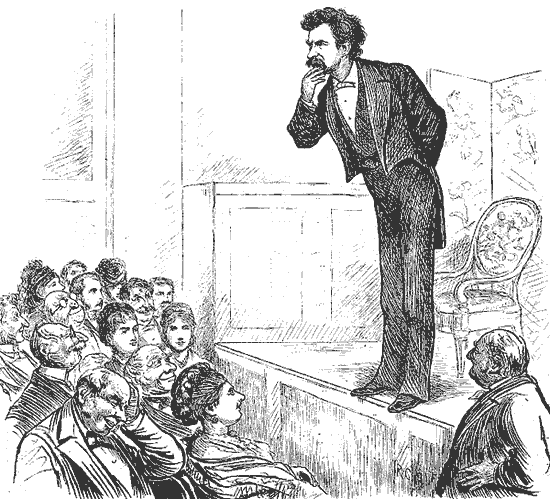
Naming names, part III: hey, I don’t make the rules

tvmountietvmountietvmountietvmountietvmountietvmountie

Happy Canada Day, neighbors to the north! Way to combine those provinces and keep them together!

At the risk of sounding trite, my most memorable Canadian experience actually was Mountie-related. I was leaving an exhibit of ancient Egyptian artifacts in a museum in Victoria, I thought the sudden transition to bright sunlight had done something terrible to my eyes: everywhere I looked, I saw blaring red. Every square foot of public space was filled with Mounties in uniform — scarlet jacket, shiny black boots, the works — chatting with friends and relatives. Hundreds, at least, a veritable red sea.

The sight was, I need hardly say, staggering. I felt as though I had accidentally stumbled into a recruitment poster.

Back to business. In the roughly 24 hours since I wrote my last post on name selection, I have sensed a certain amount of reader bewilderment. (Never mind how I know that. Blogging imbues one with super-sharp sensory perceptions.) At least a few hands, I suspect, are still raised from Wednesday. Not too surprising, I suppose, since I have been writing all week about how to avoid confusing readers.

For the last couple of posts, I have waxed long on the Cast of Thousands phenomenon, manuscripts that name every character, no matter how minor, down to the dogs and the goat tethered in the back yard in Chapter 3. “Who,” the befuddled reader cries helpfully, “are Ernest, James, and Algernon, and what are their respective relationships to Delilah, the character I have been caring about for the last hundred pages? Have they been mentioned earlier in the book, and I have simply forgotten them, or is this their first appearance?

Don’t dismiss this cri de coeur as the just punishment of an inattentive reader, my friends — from a reader’s perspective, manuscripts afflicted with COT can get overwhelming pretty fast. Especially, as we have discussed, if the COT members have similar names, either beginning with the same capital letter (to which the skimming eye is automatically drawn, right?), ones that replicate letter patterns and sounds, or — and we have not yet talked about this much — are too like the other proper names in the book.

Still in doubt about the eye-distracting effect of all of those capitals? I wouldn’t want you to have to take my word for something like that — cast your gaze over this sterling piece of prose.

Names first letters

See the problem? No? Okay, get up from your desk chair, take two giant steps backward, and look at it again. Notice where your eye is drawn first?

Even when the names don’t look anything alike, introducing too many of them in one fell swoop can prove equally frustrating to the reader. Again, take a gander:

Names in abundance

An avalanche of characters on page 1, in particular, before the narrative has established a context in which they might be understood, tends to have a character-blurring effect.

“Who are all these people?” the reader muses. “And why are they all dressed in the quite striking uniform of the Royal Canadian Mounted Police?”

Either variety of confusion, it pains me to say, causes readers to cast otherwise well-written books aside, it pains me to report. If that’s not a strong enough reason for a writer self-editing a Frankenstein manuscript to say, “Hmm, perhaps I should devote a few hours of my precious revision time to weeding out some of the extras lurking in the corners of my story,” here’s another: our old pal Millicent, the agency screener, tends to become impatient when characters pile up.

As, indeed, do editorial assistants, contest judges, and other professional readers; just because it’s their job does not mean that they possess a magical ability to absorb 23 names in a single page without mixing them up. “How,” the hapless peruser of a COT-riddled manuscript wonders, “am I supposed to keep all of these characters straight? Is this writer planning to market this book with a program, or perhaps dress the background characters in numbered jerseys, so the reader can possibly tell the individual members of this mob apart?”

Or, as Millicent likes to put it, “Next!”

Ooh, the notion of the pros not putting in the necessary effort to keep track of all of your characters ruffles a few writerly feathers, doesn’t it? “Wait just a minute” I hear some of you murmuring indignantly. “An ordinary reader may not have options if s/he forgets who is who, but Millicent does. If she finds she’s forgotten who a character is, she has a perfectly easy way to find out — her boss asked that I send a synopsis along with my submission. All she has to do is flip to the back of the packet. Or are you saying that if I have a lot of characters in my opening scenes, I should place my synopsis first in the packet?”

To take the last question first, no — at least, not unless an agency specifies in its submission guidelines that it prefers to see submissions packaged that order. Why is it in your interest to pay attention to such minor niceties? Long-time readers, chant it with me now: a submitter should always send a requesting agent PRECISELY what s/he asked to see.

No more, no less. Yes, even if she asked for the first 50 pages and your chapter ends a paragraph into page 51. No fudging.

And please trust a frequent literary contest judge (hey, I don’t spend all of my scant leisure time wandering around Canadian museums) when she tells you that rule applies to stated length restrictions in contest rules, too. Part of what you are demonstrating by your submission or entry is that you can follow directions, after all. Professional readers tend to harbor great affection for writers who pay attention to the details of requests; it’s so rare. Writers who start printing out pages after reading only the first line of a request for materials seem to be the norm, unfortunately, not the exception.

That giant tsunami-like rush of air you just heard was every agent, editor, and denizen of every publisher’s marketing department sighing in unison. They honestly do have a reason to be cranky on this point.

But enough of their pain — I’m sensing more conceptually-based disturbances of the ether out there, especially from those of you just on the cusp of stuffing synopses into submission envelopes. “But Anne,” the more literal-minded ether-rockers cry en masse, “I just read a blog by an anonymous agent/heard an agent say at a conference/happened to be eavesdropping in that bar that’s never more than 100 yards from the dais at any writers’ conference, and this guy said he didn’t care about exact page count in requested materials; he just wanted the first three chapters. So aren’t you, you know, wrong about the importance of sticking to 50 pages?”

Actually, literal rockers, you’ve provided evidence in support of my point, not against it. Remember, no matter how much aspiring writers would like for there to be an absolutely uniform set of expectations for submissions — and a well-publicized one, at that — individual differences do exist. So once again, long-time readers, please take out your hymnals and sing along: if your submission-requester says he wants to see something specific in your submission packet, for heaven’s sake, give it to him.

Ditto with contest rules, incidentally. General submission or entry guidelines only kick in when the requester doesn’t ask for something different — which is to say, the vast majority of the time. (As always, if you’re unfamiliar with how professional manuscripts differ from printed books or other commonly-scene formats, I implore you to check out the STANDARD FORMAT BASICS and/or STANDARD FORMAT ILLUSTRATED categories on the list at right. Actually, I would strongly recommend any reader new to this blog to take a gander at those categories first.)

Which is to say: if the agent you overheard wants four chapters, you should send four chapters. If she asks you to give your pitch in mime while juggling seventeen oranges, you should consider doing that, too, because she’s the one who is going to be deciding whether she wants to represent you or not.

That being the case, is your first professional contact with her truly the best time to say (at least implicitly), “Look, I know what you said you wanted to see, and that request was based upon your far greater knowledge of both how the publishing industry works and how you like to read, but I’m just going to assume that I’m right and you’re wrong. Got a problem with that?”

I can tell you now: she will. So will her Millicent and any contest judge you might see fit to treat in a similar fashion.

That being said, don’t revere such requests so highly that you fall into the extremely common trap of generalizing any such quirky individual preferences into industry-wide expectations. Writers brand-new to the biz make this mistake all the time, learning only through hard experience that such extrapolations seldom pay off. Just because one agent, small publisher, and/or contest has a wacky preference doesn’t mean that any other agent, small publisher, and/or contest will share it.

Or, to express it in mathematical terms, 1 agent’s preference ? every agents’ preference.

Bear that in mind, please, the next time you find yourself confronted with the latest panicky iterations of “Oh, my God, I heard an agent speak last week, and submission standards have completely changed!” that trouble the literary world in the wake of every conference season.

Whenever you encounter any hyper-specific submission guidelines that deviate sharply from the rules of standard manuscript format that an agency might post on its website or an agent might specify at a conference — like, say, specifying that submissions may only be in Helvetica or that they should be bound, both usually no-nos — should be treated as applicable to THAT REQUESTER ALONE, rather than to every authors’ representative currently walking the earth.

Everyone clear on that? Good.

Back to the original question, and thence to my argument already in progress: why wouldn’t a professional reader who got a large character list mixed up simply fish out the synopsis for reference? And if helping a busy Millicent keep the characters straight is a legitimate purpose for a synopsis, shouldn’t it come first in the packet?

In a word, no. If you put the synopsis at the front of your packet, Millicent is just going to toss it aside and go straight to the first page of your manuscript. If dear Millie reads all the way through your submission and likes what she sees, THEN she will read the synopsis.

Maybe.

You’re hoping that I’m kidding, aren’t you? Bizarre but true, that synopsis you slaved to make short enough is not always considered at the submission stage. Reading the synopsis is often not necessary to determining whether to ask to see the rest of the book — and why would Millicent bother to read the synopsis of a manuscript she has just finished reading in its entirety?

Seriously — ask at the next writers’ conference you attend. There’s a certain logic to this, at least for fiction. After all, if a book made it to the submission stage, presumably, the novel’s premise was deemed acceptable by the query screener or the agent to whom the writer pitched it. The only reason to read the synopsis at the submission stage, then, would be to find out what happens after the last page of the submission.

Try not to waste any energy being annoyed about this. If Ernest, James, and Algernon appearance in Ch. 2 was brief enough, chances are that they wouldn’t have shown up in the synopsis, anyway.

While I’m apparently free-associating about any and all topics related to character names, and since this contest entry season, this seems like a dandy time to talk about character name choice that could get a writer into a whole lot of trouble. Yes, Virginia, I’m talking about that pesky but oh-so-common literary contest rule that forbids entrants from mentioning their own names anywhere in a submission.

Kind of inconvenient for memoirists and other writers of the real, isn’t it? In practice, this ubiquitous rule means that entrants in memoir and personal essay categories, not to mention those many fiction writers who like to blur the line between fiction and nonfiction by making themselves characters in their own narratives, have to select new monikers for themselves.

Stop laughing, oh writers of thinly-veiled autobiographies passing as fiction. For a writer who has embraced the unique difficulties of thinking of herself as a character in a book, renaming himself can be a genuine chore. Novelists attached to their characters’ names should be sympathetic to that: if it’s trying to track down and change every mention of Monique to Madge when she’s your creation, imagine the emotional difficulties involved when Monique has to rechristen herself.

That’s not to say that the no-name rule itself is objectionable. However annoying renaming may be to contest-entering writers of the real, it exists for a very good reason: for a contest to be worth its salt, it must be able to claim that its judging procedures are not biased; the first step to assuring lack of personal bias is to institute blind judging, where no judge knows the name of any given author. Admittedly, some competitions are only apparently unbiased, but for the most part, contest organizers take authorial anonymity very seriously indeed.

So no, finding a clever way to get around the rules is not going to endear you to them. Not at all.

Which is why I am about to turn very hard-line: if you are submitting a memoir entry, FOLLOW THE RULE ABOUT NOT HAVING YOUR OWN NAME APPEAR ANYWHERE IN THE MANUSCRIPT. And do bear in mind that this rule applies to not only your entire name, but either your first or your last appearing alone as well.

That may seem like rather redundant advice — every contest entrant everywhere should follow all the rules in the contests he enters, right? — but this is the single most common way memoir entries get themselves disqualified. For a memoir entry, you should never just print up the opening chapter of your book and send it in; check the rules very carefully and apply them to your pages first.

You could, of course, sidestep the issue entirely by not entering a piece of writing in which dear self is a character — which is, again, a trifle difficult for memoirists and other habitual writers of the real. The second-best way that I’ve found is to christen oneself anew with the name that you wish your parents had had the wit and wisdom to give you in the first place.

Come on — none of us had the name we wanted in junior high school. Pick the one you believe would have made your life lovely and do a search-and-replace.

Obviously, you’re going to want to make a duplicate document of the chapter or essay you’re planning on entering in the contest before you perform this bit of minor surgery — as I said, it’s never a good idea just to print up the requisite number of pages from your already-existing manuscript and send off to a contest. (Your slug line in your submitting-to-agents version will have your name in it, for one thing.) Perhaps less obviously, you’re going to need to perform the search-and-replace function for both your first and last name, as well as any nicknames you might have incorporated into the manuscript.

Even when you’ve gone to all the trouble of using a pseudonym, it is a good idea to add a note on the title page, saying that since the contest forbids the author to mention his own name, you will be using “Bobby” (not your real name) throughout.

Why take that extra precaution, you ask? Because it’s practically impossible not refer to yourself by name in the story of your own life. Since judges are aware of that, and become accordingly eagle-eyed.

And don’t think being coy about it will help you evade their scrutiny, either. Make yourself comfortable; I’m going to tell you a little story.

I went to college with Danny, a very clever, very ambitious writer who eagerly contributed pieces to the on-campus humor magazine. (As those who happened to be hanging around Harvard at the time would no doubt be quick to point out, I use the term humor loosely here: the magazine was seldom actually funny to those who were not in the writers’ clique, but bear with me.) Danny had every reason to try to get his articles published: the magazine had long ago spawned an extremely profitable off-campus humor magazine, so a successful Lampoon piece could be a stepping-stone to a career as a comedy writer.

Despite or perhaps because of these articles’ worth as resume-candy, it was the practice of the magazine to publish all of its pieces without bylines, to encourage collaboration amongst members of the writing club. But as I said, Danny was ambitious: he, like many of the other writers in the club, was anxious to graduate with clippings he could use to promote his work later on. So Danny did something exceptionally crafty: he inserted his own name into every ostensibly anonymous piece he wrote, much as Jerry Lee Lewis used to refer to himself in his own lyrics, so radio listeners would know who sang the song.

His favorite way of doing this was to insert an imaginary conversation with himself into the text, so an alter ego could address him by name, as in, “Danny boy, you’re really in trouble now!” Occasionally, he would vary it by having an authority figure yell at his narrator: “Wilson, you’re out of line!” (Because Danny is now a fairly prominent magazine writer, I should say straight away: to protect his identity, Wilson is not Danny’s actual last name. See me practicing what I’ve been preaching?)

Now, as my parenthetical aside just told you indirectly, Danny’s little stratagem actually did help him generate the clippings he coveted, but he was relying upon his club’s editorial indulgence to let him get away with breaking the rules. In a contest, however, this practice would have gotten him disqualified immediately.

I bring this up not because I suspect that there are legions of Machiavellian-minded rule-breakers out there, but because I have seen so many contest entrants apparently doing inadvertently what Danny did on purpose. Within the first-person narrative common to memoirs, narrators tend to talk to themselves all the time, à la Hamlet: “Danny, you get ahold of yourself, now.” And that single reference, to a judge who was looking to pounce upon contest rule violations, could get a memoir entry disqualified.

Yes, Virginia (if that’s even your real name), even though it would be highly unlikely, without the judge’s having the list of memoir entrants by his side for first-name cross-referencing purposes, for the judge to guess the author’s identity. Simply the implication that the author might have referred to himself can appear to be a rule violation.

So a word to the wise: innocent naming mistakes can knock your entry out of competition. It would behoove you, then, to prepare your entry, like your queries, under the assumption that the judge who is going to read it is the nastiest, most curmudgeonly nit-picker since, well, me.

“But Anne,” I hear you cry, quite rightly pale at the prospect of encountering yours truly as a contest judge, “if this mistake is usually made inadvertently, how can I hope to avoid it?”

Well asked, oh fearful trembler. Experience sharpens the editing eye. Rest yourself upon the judge’s reading couch for a moment, and take a look at where these slips most commonly occur.

Let’s say the memoir’s author is named Biddy MacAlister-Thames, not a name anyone’s eye is likely to encounter on a page without noticing. Even if Biddy has had the foresight to rename herself Libby McPherson-Seine and do a search-and-replace accordingly, she should double-check her entry especially carefully in the following places:

(1) When another character directly addresses the narrator: “Biddy, have you seen the our pet tiger, Max?”

(2) When another character is talking about the narrator behind her back: “Ward, I’m worried about the Beaver. He’s paying too much attention to that Biddy next door.”

(3) When another character refers to the narrator by an abbreviation that a search-and-replace might not catch. “I’m talking to you, Bid,” is substantially less likely to get changed automatically than, “I’m talking to you, Biddy.”

(4) And, in the VAST MAJORITY of childhood memoirs, when the narrator gets in trouble, some adult shouts some version of: “Elizabeth Deirdre MacAlister-Thames, you come in this house this instant!”

Remember, in order to violate the rule, even if a character other than the author appears with the author’s last name, it can cost you. So keep our Biddy should keep her eye out for these kinds of situations, too:

(5) When a third party addresses a family member: “Mrs. MacAlister-Thames, your daughter is under arrest.”

(6) When the narrator refers to her family collectively, or to a possession as theirs: The Easter Bunny had been unusually generous to the MacAlister-Thames family that year.

Remember, as I pointed out above, self-references to either your first or last name, not just to both together, count as rule violations. So Biddy would be wise to do a search-and-replace for BOTH her first AND last names in her entry before she printed it up, would she not?

Yes, it’s a tedious thing to have to do, Biddy (or whatever you’re calling yourself these days), and yes, you have my sympathies for having to do it. But frankly, I would rather see you annoyed and on the finalist list than not proofread and disqualified.

I’m funny that way, at least since I was partially blinded by a Mountie convention. Keep up the good work!

Naming names, part II: wait, wait, don’t tell me — the protagonist is the guy with the torch, right?

Spartacus crowd scene

Last time, as some of you may recall, I broached the tender subject of character names. I did so with some trepidation, naturally: writers, especially those in the throes of completing their first novels, are often very protective of their Muse-given right to name characters precisely as they see fit. Never mind that a skimming reader is extremely likely to confuse characters with names that look alike — or sound alike; Oliver, Olivia, and their cat Vetiver are going to their literary graves with those monikers, thank you very much, as are Justin, Jason, and Augustine.

Don’t tense up, similar name-lovers: I shan’t be trying to convince you that Clarence and Terence might not be the best conceivable names for the protagonist and antagonist of an adult novel. (Although I would love to see their adventures in a picture book.) I’ve given you enough concrete examples, both in my last post and in the depths of the Frankenstein manuscript series, for you to make up your own mind about whether Becky and Betsy are in fact the most reader-friendly names you could give your protagonist’s identical twin love interests. You’re intelligent people; it’s your choice.

Whatever you decide, however, and perhaps even before you decide, may I proffer a minor suggestion? Prior to making any changes to the names in your manuscript, read through it (preferably IN ITS ENTIRETY, IN HARD COPY, and OUT LOUD, of course) and create a list of characters, along with notations of where they appear throughout the text.

Why did I duck under the nearest table immediately after having brought up that possibility, you ask? Well, the last time I suggested that if one’s novel is thick with named characters, it might be a good idea to make a list of who appears when, so the savvy reviser can see where to cull and who may be combined with whom, cries of “Madness! Madness!” filled the land.

“Are you crazed, Anne?” angry mobs of revisers cried, waving their pitchforks menacingly. “I barely have time to write as it is — are you seriously suggesting that I devote hours and hours to noting on which pages every character in the book might be found?”

Yes, as a matter of fact, I am. Stop dipping those torches in pitch long enough to hear why.

In the first place, should you decide down the line that you do indeed want to change one or more characters’ names, that list will be positively invaluable. From past experience, I can tell you that if a writer does not have such a list in hand when she decides to change her protagonist’s name from Georgine to Georgette, she’s almost certainly going to miss a Georgine or two.

Leading, of course, to the classic irate editor’s comment: “Who is Georgine? And is it really a good idea to have two characters with names as close Georgine and Georgette? The scan too similarly; readers are likely to mix them up.”

Hey, the hypothetical editor said it; I didn’t. Go wave your torches angrily elsewhere.

The second reason a savvy reviser might want to produce a character list is that, frankly, most aspiring writers harbor rather fuzzy notions of how many named characters populate their books. If you have been adding scenes — and, let’s face it, most self-editors do; thus the Frankenstein nature of much-revised manuscripts — you might easily have ended up with 25 more characters than you intended in Chapter 1.

See where I’m going with this?

Character multiplication is usually inadvertent, after all. I’ve read manuscripts where the minor characters not only could easily have staged their own production of WAR & PEACE without double-casting any extras; occasionally, I see texts whose citizenry could have formed its own representative government.

Yet without exception, the authors of such heavily-populated tomes say the same thing: “Oh, there aren’t that many. A reader who was paying attention would have no problem keeping them straight.”

If you’ll pardon my saying so, that’s not the kind of statement a writer should be making if she doesn’t know for sure how many characters are strolling across the pages of the most current draft of her manuscript. If you actually list each and every character, you may be astonished at just how many of them there are.

Don’t shrug — seriously, since most writers do not keep running tallies of the characters in their books, it’s not all that hard to end up with 50 or 100 named characters without realizing it Especially if they are introduced many at a time, without much character development for any given one, it isn’t precisely reasonable to expect the reader to keep track of them all, is it?

The third reason — oh, I have not yet begun to run out of arguments yet — is that such a list will help you see not only where you might want to begin culling the herd of bodies in the background, but also enable you to see who could potentially be consolidated with whom — and who absolutely could not. If you keep track of how often and where a particular character appears, you will be able to tell when a character who appeared once on page 15 carrying a load of firewood turns up again on page 310 entering the diner…and thus could not possibly be across town on page 312, assisting a gang of thugs in smothering the mayor.

Think of it as trying to cast a production of Spartacus with a very small troupe of actors: you probably won’t be able to foist many more duties upon the leads, but the bit players could certainly play multiple roles, right?

Fourth, knowing who the players are and in what scenes they appear can also alert you to patterns in where characters tend to pile up in your work in general. If you’re the kind of writer who, for instance, leans toward naming every single soul attending any given party, from the canapé-servers right down to the couple necking in the corner, you will want to be aware of that predilection before you write your next party scene, won’t you?

Won’t you? (Please lie to me, if not. My back is still hurting enough that I am composing this in bed; I could use some cheerful thoughts wafted my way.)

If, on the other hand, you tend to emphasize your protagonist’s loneliness by having other characters engage in banter around him, seeing that pattern manifest on a list may lead you to question whether it needs to happen quite so often in the book to make your point — or with quite so many different characters providing contrast. Or cause you to question whether a reader might conclude that your protagonist is either an unemployed mime or not an actor in his own story.

Constructing a character list can, in short, alert you to both point overkill and the dreaded Passive Protagonist Syndrome. Just between us, our old pal, Millicent the agency screener, would be overjoyed if you were to ferret out both of those tendencies before she saw you submission, rather than after.

Wait — does all of that shifting in chairs, rolling of eyes, and martyred sighing indicate that that not all of you are completely convinced that taking the time to tote up your characters is worth your while? Do you think that it might be a grand idea for some benighted aspiring writers, but you have too clear a conception of your manuscript to render it useful to you?

Okay, those of you with complete command of your manuscripts, let me ask you: how many characters are there on page 37? More to the point for submission purposes, how many appear on page 1?

Did those questions catch some of you by surprise? No wonder: so far, in discussing how to keep your characters from blurring together in the minds of swiftly-scanning agents and editors, I’ve concentrated on the scene and paragraph levels. Now, I’m raising the discussion to the book level.

Let’s assume for the moment that you’ve refined your opening scene (and chapter) so that characters are introduced in discrete, memorable groupings, as I advised in the my last post. Let’s also say for the sake of argument that you’ve minimized the possibility of name confusion by christening your characters as differently as possible — Selma and Thelma are now Selma and Marie. All that being done, you may now sleep soundly at night, secure in the knowledge that each of your characters is distinctly memorable, right?

Not necessarily. You might still have too many named characters in the book.

And yes, in answer to what some of you just screamed, you should care about that. If you have a cast of thousands, it’s going to be much, much harder for any reader — let alone a professional one like our friend Millicent, the agency screener — to care about individual characters. When attention is spread thin, affection starts to waver. Still worse, when a reader has to keep track of 77 different names, it can become a trifle difficult for him to tell which characters he’s supposed to be following.

It would, I suppose, be handy if the Great Gods of Literature (or even someone like yours truly) laid down the law about how many is too many, decreeing that four is the maximum for this kind of scene and eight for that. As I mentioned last time, though as far as I am aware, there is no strict standard for recognizing character overpopulation.

What works best varies from book to book. The only widely-used criterion I know is whether the reader starts to have trouble telling them apart — which, lest anyone forget, if bound to happen faster if the names are too similar. Characters whose names sound similar or begin with the same letter are prime candidates for blurrage. (Yes, I know – it isn’t a word. But it should be.)

A good test of whether your novel is overstaffed: hand a hard copy of it to a reader who does not know you very well (and thus has no incentive to lie to keep you happy), and ask him to stop reading when the number of characters becomes bewildering. Have him mark where he threw in the towel by folding that page in half.

Ideally, you will get the manuscript back with every page pristine, naturally, but if that folded page falls within your first fifty pages — i.e., in the part of the book that an agent would be likely to ask to see first — you should consider making some major cast cuts. If the folded page falls within the first chapter, I would suggest going back and reading my last few posts, because in all likelihood, there are too many characters up front.

If you are too shy to recruit help, you can do a version of this test on your own, by sitting down with your manuscript and a highlighting pen and marking every proper name. Even better, you could go for broke and make an actual list of characters.

Wait — where have I heard that excellent advice before? There must be an echo in here.

The easiest way to generate such a list is by using the FIND function in your word processing program and noting each page number. I like to keep the results in a spreadsheet, so I can sort it by character name, chapter, page number, and what the character is doing at the time. (Yes, that US an insanely meticulous thing to do, but then, I’m an editor by trade. My clients pay me good money to read their work with a magnifying glass.)

Why keep track of the extra data? To make it clearer which groups of minor characters could be consolidated into just one or two. If, for instance, my spreadsheet tells me that five different characters shoe horses throughout the book, and if the story does not involve a trip on horseback of several thousand miles between smithies, I would be tempted to make all five the same character.

Noting where each character appears — in addition to making it SUBSTANTIALLY simpler to go back and find those four extraneous blacksmiths and put them to death, literarily speaking — also makes it apparent which named characters appear in only a single scene. In my experience, character-heavy books tend to feature a LOT of one-off cameos; generating a list will help you go through all of the one-timers to check who is actually necessary to keep.

And if the idea of doing away with these folks makes you sad, remember: Characters are notoriously recyclable. If you become a career writer, this is not the only book you will ever write. You may well find that Blacksmith Bob of today can be very happily recast as Soda Jerk Bob tomorrow.

I sense some of you shifting uncomfortably in your chairs again. “But Anne,” some of you protest, glancing at your watches, “I realize that what you’re suggesting is something I could conceivably be doing while I am sitting down and reading my manuscript IN HARD COPY, IN ITS ENTIRETY, and OUT LOUD before I even consider submitting it — and in an ideal world, I would follow your advice to the letter. But frankly, I can barely find time to write, query, and/or submit as it is. You wouldn’t happen to know any short cuts for ferreting out extraneous characters, would you?”

As a matter of fact, I do, but I’m hesitant to roll ‘em out, lest that discourage any of you from going over your manuscripts with the proverbial fine-toothed comb. I can’t even begin to tote up how many writers, aspiring and established both, I’ve heard wail, “Oh, if only I’d caught that simple, easily-corrected error before I sent out my manuscript! Now that terrific agent/dreamy editor/stern contest judge will think I’m a bonehead!”

Bu if you will all promise not to use the tricks as a substitute for reading your IN HARD COPY, IN ITS ENTIRETY, and OUT LOUD before sealing that submission envelope, I’ll go ahead and talk about them now.

My favorite technique is one that occurs more or less automatically to professional readers at about the 10,000th scene mark: becoming aware what kinds of scenes tend to invite minor character lurkage en masse. Including, but not limited to…

1. Any scene featuring a congregation.
If hell is other people, as Sartre suggests, then wedding and funeral scenes in novels almost invariably reek of brimstone. These events are notorious amongst professional readers for introducing entire churchfuls of extraneous characters.

Even when all of the masses are not named individually (although you’d be astonished how often a dozen or so are), it doesn’t take many lines of physical description or multi-party banter to convey the impression that a small, intimate wedding has a guest list to rival that of Prince Charles and Lady Diana’s nuptials.

Allow me to suggest: if behinds are in pews, it might be a good place to start trimming.

2. Any scene that takes place where strangers tend to gather.
Pay close attention to scenes set in coffee shops, bars, class reunions, Ellis Island, airplanes/-ports, trains, buses, workplaces, and party scenes in general. All of these venues seem to attract single-appearance characters as surely as a red carpet attracts celebrity gawkers.

Was that massive sucking noise I just heard a collective gasp of indignation? “But Anne,” cast-of-thousands-mongers cry, “you’re asking me to disembowel the collective identity of modern urban life! How can I describe the complexity of the human environment without enumerating the individuals who are part of it?”

Describe away — and if you’re into enumerating, I’m not going to stop you, although your agent and/or editor may well. All I’m suggesting here is that you not insist on introducing each of the bystanders to the hapless reader as if she were the mother of the bride in a receiving line.

Not every minor character deserves to be identified, does he? Not only does pointing everyone out tend to get a mite tedious and slow the pace of the narrative to the proverbial crawl, to a professional reader, a group scene where everyone is named down to the last poodle and great-grandfather reads as though it were simply an account of something that actually happened to the author. When the guest lists are long and specific, the jaded reader will think, “Great — when do we get back to the fiction?”

Or the memoir, or the historical account, as the case may be. Which brings me to:

3. Any group scene depicting an actual event — or based upon one.
Of course, suspecting scenes ripped from real life is not always fair, but when writers lift scenes from real life into their novels, they do tend to include direct one-to-one correlations between the actual people and the fictional ones. Often, but not always, they do this just in case the people in question should ever pick up the book.

“Oh,” they say, pointing at the page. “That’s me — I’m the one brandishing the flaming torch.”

The names may change, but if Aunt Bessie, Aunt Cassie, and odd Cousin George appear in the text so fleetingly that they don’t make an impression upon the reader, that’s a pretty good tip-off to someone who reads a lot of manuscripts that the author is blessed with two aunts and a cousin who might reasonably be expected to buy the book when it is published. While this practice tends to delight the kith and kin mentioned (and create grudges in those not mentioned — another good reason to eschew the temptation), it’s not harmless. Both professional and casual readers alike are likely to find it problematic.

Why? Well, such references can be very amusing for readers familiar with the fine folks mentioned in the book, as well as their kith and kin. Generally speaking, though, unless a minor character plays an actual role in the plot — as in contributing some action or information that moves the story along — he will not be memorable to readers who do not already know the correlates in question.

You indignant gaspers are getting restive again, aren’t you? “Yes, yes,” you mutter impatiently, and who could blame you? “It’s not the most efficient means of storytelling; I already know that. But I fully intend to rectify that by making Aunt Bessie the gas station attendant in Chapter 47, Aunt Cassie the librarian in Chapter 12, and Cousin George Massey the second corpse who rises from the dead on the honeymoon. Happy now?”

Not necessarily. Even if the characters in a crowd scene do appear elsewhere in the book, it can still be pretty tedious for the reader if the narrative engages in a full roll-call. Or even a partial one.

Come closer, and I shall divulge a cherished secret of the editing trade to you: lists tend not to make for very interesting reading. (And yes, you do have my permission to quote me — with attribution, of course — the next time your boss insists that you sit through yet another PowerPoint presentation.)

Mentioning characters just for the sake of mentioning them is seldom very interesting to the reader, at least when the characters in question are not integral to the action. Bystanders are not, by and large, memorable to the average reader. Especially in the opening of a book — where, all too frequently, it’s not clear which of the cast of thousands in a scene is the one (or dozen) that the reader is supposed to remember.

If, indeed, it’s important to the plot to remember any individuals among them at all. Even in a memoir, it often isn’t, from a pure storytelling perspective.

I know, I know: you’re not going to be able to convince anyone who participated in the real-life events that s/he was not integral to the action. But just as not every detail within a physical space is either necessary to mention in order for a reader to be able to picture a place or interesting if you do, not every character in a real-world situation belongs in the written account of it.

Aspiring writers tend to forget that, as Millicent would be only too happy to tell you — not just that everyone who appears in our mental image of a crowd scene (or in our recollections or photographs of it, if we’re writing memoir) is going to be integral to the action, in storytelling terms, but that every new character name is something else for the reader to remember. That saps energy that would be better utilized getting involved in the story itself.

Or, to put it another way, every time a reader, professional or otherwise, mutters, “Wait, who’s Gerald?” s/he has been pulled out of the story. A top-flight storyteller — which all of us want to be, right? — tries to eliminate such jarring moments entirely from her readers’ experience.

One way to minimize such exclamations is to bear in mind that just-mentioned-in-passing characters are rarely memorable from a reader’s perspective. Every editor in the biz has at one time or another been confronted by an author angrily waving a manuscript in her face and shouting, “What do you mean, where did this character come from? Alice was the third bridesmaid at Ben’s wedding in Chapter Two, for heaven’s sake!”

Invariably, the irate author is factually correct on points like these. The character will indeed have been mentioned by name in passing, as in:

The bridesmaids, Greta, Elaine, and Alice, were dressed in an eye-searing chartreuse that left Ben wondering just what these old friends had done to his bride back in junior high school to make her hate them so much.

200 pages later, out of those three never-again-mentioned bridesmaids, the author expects the reader to remember Alice — and apparently only Alice. At the risk of seeming impertinent, why should he?

Unless he happens to be blessed with an unusually retentive memory, he won’t — and even Millicents, who often do have such excellent memories, tend to resent being expected to use them to keep 157 characters straight. At the submission stage, unless a character is central enough to what’s going on in a scene to warrant development, you might want to consider whisking her out of Millicent’s sight, at least for the time being.

“For the time being?” I hear some ambitious character-generators out there piping hopefully. “Does that mean I can bring Aunt Cassie back after I’ve landed an agent and/or editor for this book?”

Sure — just because you take a few (or a few hundred) characters out of your submission draft of a novel doesn’t mean that you can’t reinsert them later in the publication process. There is no law that says that an author can’t offer a stripped-down, swiftly-moving version of her novel to agents and editors — and then, after the ink is dry on the relevant contracts, say to your editor, “You know, I’ve always thought that there should be more bridesmaids in Chapter 2. Like, say, fifteen. How would you feel about Alice’s being one of them?”

Remember, no manuscript is set in stone until it’s actually in print between covers; no matter how often or how well you polish yours before submission, expect to be asked for revisions. Especially these days, when it’s not at all uncommon at the large U.S. publishing houses for the editor who acquires a book not still to be on the job — or at any rate, in the same job — by the time that book comes up in the print queue. I don’t want to horrify anyone, but within the last couple of months, I’ve talked to authors who are on their fourth and fifth editors.

Think each of those editors has shared exactly the same vision of the book, or wants the same changes? And what’s the probability that at least one of them will hate the name Georgette, and want you to change it to, say, Georgine?

Now more than ever, it behooves writers to keep their creative options open. The better-organized you are, the happier you will be at last-minute revision time. Go ahead and keep copies of every major revision of your manuscript, so you can revisit the Alice and Georgine/ette issues again down the road. Hang on to that character list, too; someday, possibly between revisions 6 and 7 after you’ve signed with the agent of your dreams, it may come in awfully handy.

Now that I’ve frightened all of you into wide-eyed insomnia, I’m talking my aching back off to bed. Cast your stories carefully, my friends, and keep up the good work!

A brief digression on names, featuring some lighthearted admonitions on being careful how you label people

Helen Burns' shame

Since I have been hammering so hard on the perils of word, phrase, and concept repetition in my recent Frankenstein manuscript series, I thought it might be nice to take a break for a couple of days, if only to stop the more conscientious revisers among you from waking up in the dead of night, screaming, “No! Please! I shall cut the number of eye-distracting conjunctions in my manuscript by half! Just take away the thumbscrews!” After those few days had passed without revision-related screaming abating much, I decided that I was going to take a few baby steps away from the much-stared-at manuscript page and talk about a related topic near and dear to most novelists’ hearts: character naming.

Then, after I have lulled you into a nice, complacent creative reverie, I shall leap right back into the burning issues of revision. Don’t say I didn’t warn you.

Before I launch into the meat of today’s post, however, I’d like to note the passing of someone I have never met personally, but has been gracing Author! Author! at least once per year as the wry star of one of my all-time favorite anecdotes. Those of you who have been hanging out here at A! A! for a while may remember the late gentleman (may he rest in perpetual peace) who taught us that it’s never, ever safe to assume that one’s audience will share one’s prejudices.

Once upon a time, a professor at Harvard Law School took a sabbatical and joined the faculty at a Washington, D.C.-area law school for a year. After he had been installed in his new office for a week, he realized that he was a bit lonely: he had been tenured for so long that he no longer remembered what it had been like to be the new guy in the faculty lounge.

So, one day, determined to make friends, he walked into that room full of strangers, sat down next to the least intimidating-looking law professor, and introduced himself. They chatted a bit, but the Harvard professor was pretty rusty at small talk. When conversation floundered, he cast his mind back to the last time he had been the new guy, way back in the early 1980s, and resuscitated a tried-and-true question: “So, what does your wife do?”

Much to his astonishment, his new friend broke into a fit of uncontrollable giggles, as if the professor had just said the funniest thing in the world. He laughed so hard that other faculty members turned around to stare.

The Harvard professor didn’t know whether to be piqued or amused at this response. “I’m sorry — doesn’t she work?”

This question abruptly ended the other man’s laughter. “Oh, she does,” he replied dryly, fixing our hero with a glance of singular disdain. “You might possibly have heard of her work, in fact. She’s on the Supreme Court.”

The Harvard professor had, of course, been talking for the last half an hour to Ruth Bader Ginsburg’s husband, Martin. The latter, a fellow of infinite jest, apparently dined out on that story for years.

May you spend eternity telling that one at the dinner parties of the afterlife, Martin. And may all of us down here remember that when speaking to strangers, it behooves you to watch what you say — and especially how you label people — because you do not necessarily know what their backgrounds or beliefs are.

Why is that lesson an important one for aspiring writers to embrace, you ask? Well, all too often, especially in nonfiction, aspiring writers assume that what is funny — or shocking, or ordinary — to them will automatically strike our old pal, Millicent the agency screener, in precisely the same way, resulting in more guffaws and huffs of displeasure over submissions and contest entries than anyone would care to admit. To avoid subjecting your writing to this dreadful fate, bear in mind: no matter how deeply our own kith and kin might share our personal, political, social, etc. views of the world, we can never be sure that the agency screener, editorial assistant, or contest judge to whom we submit our writing will share that worldview.

There endeth today’s parable. Let’s get back to work.

We writers, as I mentioned before the impulse to eulogize sidetracked me, tend to take great pride in our characters’ names. Even when we have simply borrowed our local postmaster’s name for a minor character, combined a freshman roommate’s first name with our least-favorite high school teacher for another, and lifted a period name for a protagonist from an old census list, we are not only pleased with ourselves — we will tell anyone who will listen just how we came up with a name as nifty as Thisbe Holt.

Don’t believe that impulse to be universal? Okay, try this little experiment: walk into any author reading, anywhere in the world, and ask the novelist signing books how he ever thought of those incredibly evocative character names in his novel.

I can tell you now that there is not an author on earth who will laugh and say, “Evocative? What’s evocative about Mary Smith?” Instead, you will be treated to a bright, toothy smile and an intensely detailed ten-minute description of just where and when the author dreamed up those names.

It’s true; it’s written on the sand in words of flame. Oh, and congratulations for having made that author’s day.

There are, of course, many, many excellent sources of apt character names — for an amazingly rich source of inspiration and guidance on the subject, run, don’t walk to Askhari Johnson Hodari’s guest post on naming — but I am not going to talk about any of them today. (Which is requiring some restraint on my part, as I went all the way from nursery school through high school graduation with a classmate named Glee Burrow, a name I have been longing for decades to immortalize.) Nor, as all of you weary-eyed revisionists will no doubt be delighted to hear, am I going to repeat my caution about over-using character names in a text.

No, today, I shall be talking about naming your characters in such a way that your readers are likely to remember them — and be able to tell them apart in a book with a whole lot of characters. That may not sound especially difficult (how likely is even a reader slow on the uptake to confuse a fisherman named Paul and a jeweler named Ermintrude, right?), but in a manuscript where fifteen characters are introduced within the first two pages, the task can be a lulu.

Especially, as I mentioned last week, if too many of the names begin with the same letter, encouraging the eye to skip wildly between capitals. Take a gander:

Too many names example

Quite a large cast to reveal in the first moments of the first scene, isn’t it? Let’s face it, no matter how beautifully-drawn and exquisitely differentiated any subsequent character development for Jeremy, Jason, Jennifer, and Jemima might be, a skimming reader — like, say, Millicent (whose name means, appropriately enough, strong in work) — is likely to get ‘em confused on page 1.

I’m sensing some resistance from those of you writing about irresistible triplets named John, Jeffrey, and Jacobim. “But those are my characters’ names,” you protest, and who could blame you? “The names are integral to the characters! I can’t change them now! Besides, the example above wouldn’t really confuse any reader who was paying attention.”

Oh, you can complain all you like that since the narrative explained quite clearly who Bertrand, Benjamin, and Bertha were, as well as the interrelationships between Armand, Aspasia, Antoinette, Annabelle, and Angelica, not to mention the monarchy’s likely effect on the character whom we are left to guess is probably the protagonist, but if you pepper your page 1 with so many names that a reasonably intelligent reader might legitimately become confused, those clear explanations might not matter enough to encourage her to keep reading.

Especially if the her in question is a Millicent who has fifty submissions to read before lunchtime. Remember, agency screeners read fast; if they aren’t sure what’s going on and who the book is about by the middle of page 1, they generally stop reading a submission. As in forever.

What can a humble writer do to avoid walking into that dreadful fate? Actually, you already know: as I mentioned earlier in the Frankenstein manuscript series, a skimming reader is extremely likely to confuse characters with names that look or sound alike, so it’s best to give them monikers that not even the fastest reader could mistake for one another. Now we can build upon that excellent rule of thumb with what we learned from the example above: readers are also prone to confuse identities if a narrative introduces too many characters too quickly — or without making it pellucidly clear which in an opening crowd scene are the ones he reader will be expected to remember.

That last bit is equally true for fiction or nonfiction, so don’t doze off, memoirists and historians: it’s as important for your manuscript as for a novel for Millicent to know who and what your book is about before she loses interest. If the Mormon Tabernacle Choir rushes into view on page 1, the reader is going to have no idea which of those 360 singers is the protagonist unless the narrative spotlights him, so to speak.

Make sure she doesn’t need a program to tell who is who in your opening pages. Yes, even if that means banishing the entire alto and tenor sections to a scene later in the book.

Ditto with a synopsis: if it’s not clear who the protagonist is, consider ousting some of the character names. And please, whatever you do, don’t blow off this advice if your opening page or synopsis introduces only a handful of characters; what may seem like a reasonably intimate crowd to you, who have read the page 475 times, may well seem like a mob to a skimmer who is reading page 1 for the first time.

Allow me to add hastily, before any rules-lawyer out there begins demanding a maximum number of names that can appear on page 1: no such standard exists. Clarity is the goal here, and good storytelling. A lot depends upon what else is going on in the scene.

You don’t want Millicent to be so busy concentrating on names that she misses the absolutely crucial yet subtly-phrased aside from your protagonist on line 16, do you?

The same holds true for a synopsis, by the way. If your plot is crammed with action, you might want to limit how many character and place names you toss at Millicent per paragraph, so she can zero in on the essential conflicts.

To show you just how hard it is to keep characters straight in an action-packed storyline, let me trot out another of my all-time favorite examples: the plot of the opera La liberazione di Ruggiero dall’isola d’Alcina by Francesca Caccini, first performed in 1625. On the remote chance that some of the details of the plot may have slipped your minds, here’s a quick synopsis of just a few of the twists and turns that might leave an audience member drop-jawed:

The brave knight Ruggiero, ensnared by the love spells of the evil sorceress Alcina (who had a nasty habit of turning her exes into trees; opera gives one a lot of room for imaginative touches), has deserted both his fighting obligations and his warrior girlfriend, Bradamante. So another sorceress, Melissa, turns herself into an image of Ruggiero’s father, Atlante, to try to free him. Dressed as Atlante (and turning from an alto into a baritone for the occasion, a nifty trick), Melissa berates Ruggiero for lying around in sensual bliss when there’s work to be done.

A single three-minute solo later, Ruggiero’s mind is changed, with no argument from the big guy himself: he is free from the spell, and goes on to bellow some extraordinarily nasty insults at Alcina while Punchinello dances around with a squid.

As is my wont, I’m going to pause at this point to vent a bit: this type of persuasion in an interview scene — where the protagonist’s mind is changed on an issue about which he is supposedly passionate simply because someone tells him he’s wrong — occurs in novel submissions more often than you might think. Many a protagonist who is downright tigerish in defense of his ideals elsewhere in the book is positively lamblike when confronted by a boss, a lover, a child, etc. who points out his flaws.

As protagonist, he has an entire book (or opera, as the case may be) to play with — couldn’t he argue back just a little? Usually, the result is a more interesting scene. Why? Long-time readers of this blog, take out your hymnals and sing out together now: because conflict is almost invariably more interesting in a scene than agreement.

Okay, I’ve cleared that out of my system for now. But if you are worried about the efficacy of your manuscript’s interview scenes, I would strongly advise taking a gander at the posts under the INTERVIEW SCENES THAT WORK category on the archive list located at the bottom right-hand side of this page.

I think I’ve distracted you enough. Time for a pop quiz: quick, without re-scanning the paragraphs where I glossed over the opera’s plot, try to name as many of its characters as you can.

How did you do? I originally mentioned six, but don’t be hard on yourself if you only came up with one or two. Most readers would have experienced some difficulty keeping all of those sketchily-defined characters straight.

Heck, seeing them introduced en masse like that, I would have trouble remembering who was who, and I’ve seen the opera!

Introducing too many characters too fast for any of them to make a strong impression upon the reader is extremely common in the opening few pages of novel submissions. No wonder, then, that in manuscripts where there are so many people lurching around that it reads like a zombie convention in downtown Manhattan, Millicent cannot tell for several paragraphs, or even several pages, which one is the protagonist.

As with so many of the manuscript traits that we’ve seen raise red flags, part of the reason Millicent tends to be touchy about openings with casts of thousands is that she sees so darned many of them. I think TV and movies are to blame for how common first-page crowd scenes have become in recent years: filmic storytelling techniques are primarily visual, so many writers want to provide a snapshot-like view of the opening of the book.

Many, many, many writers. More than enough to cast the necessary extras for a zombie scene in downtown Manhattan hundreds of thousands of times over.

In case I’m being too subtle here: it’s in your strategic interest to limit the number of characters introduced within the first couple of pages of your submission. And no, as much as any literal-minded reader out there might prefer that I provide a chart specifying how many is too many, broken down by genre, length of work, and mood of Millicent, every writer is going to have to use her own best judgment to figure out how many zombies should be lurching altos should be singing characters should appear on page 1.

But you didn’t think I would leave all of you to make that determination without any guidelines did you? Here are a couple of tests I like to apply when in doubt about just how big the opening scene’s cast should be.

1. Does the text make the relative importance of the protagonist plain?
If you are not sure — and the author is often not the best person to answer this particular question — try applying a modification of the quiz I asked you to take above:

(a) Hand the first page of your book to a non-writer. (NOT a relative, lover, or someone with whom you interact on a daily basis, please; these folks’ desire to see you happy may well skew the results of the test.)

(b) Ask her to read through it as quickly as possible.

(c) As soon as she’s finished, ask her to put down the paper. Talk about something else for a couple of minutes.

(d) Have her tell you who the main character is and what the book is about. If she starts talking about characters other than your protagonist, you have too many; if she can’t tell you anything about the plot, consider opening with a different scene, one that more accurately represents the crux of the book.

Why did I specify a non-writer, you ask? Writers tend to be unusually good at absorbing character names; the average reader is not. And your garden-variety agency screener scans far too rapidly, and reads far too many submissions in a given day, to retain the name of any character who has not either been the subject of extensive description — which can be problematic in itself — or a mover or shaker in the plot.

Perhaps not even then. Our buddy Millicent has a lot on her mind — like that too-hot latte that just burned her full pink lip. (You’d think, after how long I have been writing about her, that she would have learned by now to let it cool, wouldn’t you? But that’s an agency screener for you: speed is of the essence.)

2. Does the text portray each named character as memorable?
Again, you may want to seek outside assistance for this one. This test is also useful to see how well your storytelling skills are coming across,

(a) Hand the entire first scene to that non-writer and ask her to read it as quickly as possible, to reproduce Millicent’s likely rate of scanning.

(b) Take away the pages and talk with her about something else entirely for ten minutes.

(c) In minute eleven, ask her to tell you the story of that first scene with as much specificity as possible. Note which names she can and cannot remember. If she’s like 99% of skimmers, she will probably remember only the two primary ones.

(d) After thanking her profusely, sit down with your list of passed-over names and the manuscript: do all of these folks really HAVE to make an appearance in the opening scene?

If the answer is no, you have a few fairly attractive options for getting rid of them. Could some of them be consolidated into a single character, for instance, to reduce the barrage of names the reader will have to remember?

Or could any of them be in the scene, but not mentioned specifically until later in the book, where the protagonist encounters that character again? (A simple statement along the lines of, “Hey, Clarence, weren’t you one of the thugs who beat me to a pulp last month?” is usually sufficient for later identification, I find.)

Or are these characters mentioned here for purely photographic reasons? In other words, is their being there integral to the action of the scene, or are the extraneous many named or described simply because they are in the area, and an outside observer glancing at the center of action would have seen them lurking?

In a screenplay, you would have to mention their presence, of course — but in a crowd scene in a novel, describing the mob as monolithic can have a greater impact. For instance, which sounds scarier to you, Mr. Big threatening Our Hero while surrounded by his henchmen, Mannie, Moe, and Ambrose — or surrounded by an undifferentiated wall of well-armed baddies?

Personally, I would rather take my chances with Ambrose and Co. than with the faceless line of thugs, wouldn’t you? My imagination can conjure a much scarier array of henchmen than the named three. (Mannie has a knife; I just know it!)

I know, I know: when you create a novel, you create the world in which your characters live, and that world is peopled. But in the interest of grabbing Millicent’s often mercurial attention, would a smaller cast of characters, at least at the outset, render your book more compelling?

You could also opt to introduce your characters gradually, rather than dumping them all upon the reader in a group scene. More gradual revelation will allow the reader to tell the players apart, thus rendering the ones you reveal early on more memorable. It is worth giving some thought to how much those first few players in your story stick in the mind, anyway, particularly if your opening is — wait for it — an interview scene.

Why? Well, since the primary point of an interview scene is to convey necessary information to the reader, and the main thrust of an interview scene that opens a book is almost invariably to introduce background and premise, character development tends to fall by the wayside. Or, if it doesn’t in the text, it often does in the reader’s mind.

Think about it: if the reader is being given a great deal of background in a chunk, interspersed with relatively minor details about the tellers of that history, which is the reader more likely to remember?

Yes, yes, I know: in a perfect world, it would be enough to mention these things once in manuscript, and readers would remember them forever — or at any rate, for the next few chapters. But in practice, particularly with the rapid once-over a professional reader is likely to give a manuscript, names often start to blur together.

Don’t believe me? Okay, who was with Jeremy, and what were the names of the princesses he was trying to save?

The ubiquitous advice to screenwriters not to feature more than one character whose name begins with the same sound is basically very good, you know — if your story has a Cindy, you’re better off not also depicting a Sydney, for instance, or a Cilla. I once edited an otherwise excellent book where 8 of the 11 children of the family being depicted all had names that ended in –een: Colleen, Maureen, Doreen, Marleen, Laurene, Arleen, and Coreen, if memory serves. I eventually had to draw extensive diagrams on scratch paper, just to keep track of who was allied with whom on any given page.

Doubtless, there are families where such naming patterns are normal, but it made it darned hard to remember whose storyline was whose.

Again, I know: character names are vital to the writer’s relationship with them. However, trust me on this one — no agent is going to care that Sydney is your favorite name in the world, if she keeps confusing him with your protagonist Cindy; no editor is going to want to listen to your protestations that Chelsea and Charity are not in enough scenes together to confuse anyone of normal intelligence.

Argue about names AFTER a publishing house buys your book. Opt for clarity at the submission stage.

And never, under any circumstances, christen your characters with names beginning with the same first letters as other proper nouns prominent in your text. When the same letter is used repeatedly, swift reading can become a tad confusing. Slide your eyes over this morsel:

Tanya had rented her in-line skates from Tucker last time she came to Taormina, but Tammy was so insistent that they frequent Trevor’s establishment on Trent Road this time that Tanya could not resist her blandishments. If only Tommy had joined them on this vacation, instead of fly to Toronto with Tina and the Tiny Tot Orchestra; he would have known how to handle Tammy.

See how perplexing all of those Ts are to the eye? (Not to mention extraordinarily difficult to read out loud; you may not be giving public readings at this point in your career, but you should be thinking ahead.) If the facts here were important to the plot, the reader would have to go back and re-read this passage, something that agency screeners are notoriously reluctant to do.

Why? Long-time readers, chant it with me now: time, time, time.

As I MAY have mentioned above (and, not to put too fine a point on it, have been mentioning periodically in this forum for the past five years), the denizens of agencies and publishing houses read much, much faster than your friendly neighborhood bookstore browser. Not out of any hatred of the written word, but out of sheer self-defense.

In a way, it’s perfectly understandable: tell me, if you had a hundred 50-page submissions on your desk, were anticipating another hundred within the next couple of days, AND had other work to do (including opening those 800+ queries that came this week), how much time would YOU devote to each?

It’s just a fact: no matter how good your writing is, agencies are generally awash in queries and up to their ears in still-to-be-read submissions. As one of those submitters, you really do not have very long to wow ‘em. Rather than letting this prospect make you fear that your work is going to get lost in the crowd, let it be empowering: the vast majority of the time, it’s the small errors early on, not the big ones in the middle, that get submissions rejected.

That’s a hard pill to swallow, I know. I’ve said it before, and I’ll say it again: many, if not most, aspiring writers have an unrealistic idea of what happens to those packets of requested materials they send. Naturally, we would all like for our work to be read promptly, carefully, and in its entirety by a thoughtful, intelligent professional reader well versed in the conventions of our particular genres.

And that does happen — occasionally. But significantly more often, packets sit around in agents’ and editors’ offices for weeks on end, and/or are read hurriedly, and/or are discarded after only a few pages. Frequently after only one, or even after only a few paragraphs.

Why should you find that encouraging? Because you can fix the little problems in your opening pages with relative ease, and let your good ideas and fine writing shine through.

So if I’ve seem to be harping upon small matters here lately, believe me, it’s not just to make your life harder by suggesting new and different ways for you to revise your manuscript. I’m just trying to help you minimize the technical problems — and thus maximize the probability that your fine writing will have a chance to speak for itself.

More thoughts on character names follow — along, no doubt, with more tirades about those pesky interview scenes. Diversify your character names, everyone, and keep up the good work!

P.S.: Don’t borrow Glee’s name, please, at least not in its entirety; I have big plans for it.

The dreaded Frankenstein manuscript, part XIII: as different as grains of sand on a…wow, quite a few of those grains are awfully similar, aren’t they?

sand on a beach

Last time, I went on at some length about the yawn-inducing effect of over-use of major characters’ names in a narrative. As I tried to show, the repetitive force of all those capitals can be somewhat hypnotic, or at any rate distracting from the story itself. It’s worth a novelist’s while, then, to work with the text a little to try to reduce their frequency.

It’s also worth the memoirist’s while, and the creative nonfictionist’s — or, if we going to be honest about it, any writer who has already performed one (three, five, a hundred and seventeen) revisions on a manuscript. Think about it: the more worked-over a Frankenstein manuscript is, the more likely names are to have changed, right?

Even in a never-before-revised manuscript, though, it’s likely to behoove pretty much any writer who presents characters in a format other than a list to keep an eye on the percussive repetition of those proper nouns, particularly if the names in question begin with the same first letters or sound similar. As we saw last time, the reading eye can leap to unwarranted assumptions, or even — brace yourself, similar name-lovers — cause the reader to mix up the relevant characters.

While you’re already well-braced, I might as well continue with the bad news: character blurring is particularly likely to occur in the opening pages of a manuscript, where many characters are often introduced quite close together.

Resist the temptation, please, to blame the skimming eye, rather than the narrative, for this species of confusion. It’s hard to blame Millicent the agency screener for getting confused when eight characters are tossed at her within half a page — especially when that half a page happens to be on page 1, when she cannot reasonably be expected to know which of this cast of thousands is the protagonist.

Oh, you think it should be easy to keep track? Okay, skim over this sterling piece of literature as rapidly as you can:

similar name page 1

Quick, sit down and draw a family tree for Cheryl from memory. No fair referring back to page 1. Not as easy for a skimmer to keep track of everyone as one might have at first supposed, is it?

The good news (yes, today there is some) is that this problem is at least partially avoidable with a little advance planning on the writer’s part — or, as is more often the case, a lot of between-draft revision of a Frankenstein manuscript. As we saw yesterday, since skimming eyes zero in on capital letters, readers are likely to confuse Beryl, Bunnie, and Benny. Adopting the old screenwriters’ axiom of avoiding christening characters with names that begin with the same letter will help alleviate reader confusion.

Repetitive capital letters are not the only avoidable bugbears in naming, however. Swift readers will also frequently mix up names with similar sequences of letters, such as Cheryl, Meryl, and Beryl. Or Jenny and Benny. Or even Bunnie and Billie.

Starting to get the picture, or rather the pattern? I assure you, Millicent is.

Believe it or not, even names that merely sound similar can produce a similar effect. Why? Well, many readers (not usually the speediest text-absorbers, admittedly, but still, potential enjoyers of your prose) will pronounce names in their minds, at least the first time those monikers appear on the page. So while it may seem unnecessary to worry about anyone’s confusing Cheryl and Sherrill in the same manner that they might mix up Cheryl and Meryl, or Meryl and Beryl, it’s actually not beyond belief.

Try saying that last sentence out loud three times fast, and you’ll see why.

Again, advance planning (or after-the-fact tedious alteration) is your friend here: change ‘em so they don’t sound so much alike. Millicent will thank you — and, speaking as someone who survived editing a manuscript whose characters were Maureen, Marlene, Doreen, Arleen, and Darlene, I will thank you, too.

There’s another kind of naming choice that commonly leads to character-blurring, one that seldom involves any capital letters at all: avoiding proper nouns altogether. Such narratives have a nickname amongst editors: he said/she said.

Or, as I like to call them, he said/he said/he said.

Don’t laugh: name-eschewing is a more common practice than you might think, and not only in mid-book chapters, where the relevant characters are already well-established. In fact, it’s a fairly popular type of book opening, intended (one assumes) to hook the reader by making him guess who the mysterious she of the opening paragraphs could possibly be. A specimen of the breed:

pronoun-only text

Well, are you hooked? Or, to put it in the terms that a professional reader would, are you eager to turn to page 2? If so, how much of the appeal lay in the inherent excitement of the situation and how it was presented — and how much in the fact that the narrative didn’t bother to tell you who any of these people were or much of anything about them?

Again, you may laugh, but actually, for the false suspense device to work, the reader has to find being kept in the dark titillating. Overwhelmingly, Millicents do not. When presented with an opening like this, they are all too prone to start asking practical questions along the lines of, “Who is this broad?” or “What on earth is going on here?”

Trust me on this one: in a submission (or contest entry, for that matter), it’s the writer’s job to show what’s going on, not the reader’s job to guess. Letting the reader know who is who and what is going on is more than good Millicent-pleasing; it’s generally considered better writing than false suspense.

Or any other tactic that’s like to result in reader confusion, really. Millicent’s usual response to being confused is generally quite dramatic: a cry of “Next!”

Unless there is a very, very good reason for withholding information as basic as a character’s name from the reader — particularly if, as in that last example, it’s the protagonist in a tight third-person narrative where the narrative voice evidently knows everything there is to know about that character — go ahead and call your characters by name on the page, rather than referring to them constantly by only a generic he or she. Yes, there was a time when the latter strategy was considered pretty nifty, particularly in fantasy circles, but really, hasn’t it been done to death by now?

Actually, even if the reader should in theory already know who is who, even a relatively mild policy of principled name avoidance can often lead to confusion, especially in action scenes. Take, for example, the following little number — and to make it a fair test of clarity, I will resist the temptation to give all of the combatants similar names.

Paul poked Herman in the chest, shoving him into Benjamin. Outraged, he pushed back, sending him tumbling backward into Ed.

“Hey!” he cried, unable to save himself from toppling over onto Josh.

Now, I’m guessing that most of you were able to follow what was happening, even without drawing a diagram of the domino effect. All a reader would really have to do is read slowly and carefully, perhaps going back and re-reading as necessary to answer any lingering questions.

It is indeed possible, then, for the reader to emerge at the end of this passage unconfused. But is it a good idea for a writer to expect the reader to put in the work?

I can answer that one for you: not if that reader is Millicent — or, indeed, any professional reader. Because clarity is, after all, the absolute minimum requirement of publishable writing, Millie and her ilk will typically regard an unclear passage as a poorly-written one. Or if not precisely poorly-written, then at least lazily revised.

At best, it’s a Frankenstein manuscript: the gap between what the writer meant the reader to take away from the text and what’s actually on the page needs to be bridged by someone. The writer who submits the text at this stage is tacitly conveying the belief that it’s the reader’s job to bridge that gap; Millicent, by contrast, will be quite sure that it’s the writer’s job — and that the writer called in sick that day.

She is also quite sure — and this comes as a nasty surprise to a lot of first-time submitters — that it’s not her job to go back and re-read a sentence because she found it confusing the first time around. So positive is she on this point that if such a sentence (or paragraph, or page) appears in the opening of a submission, as we saw in the example above, she will often simply stop reading altogether.

Chant it with me now, campers: “Next!”

Does that low, despairing moan I hear mean that some of you remain confused about when to name and when not to name? Afraid that once you start adding all of the proper nouns necessary for clarity to your Frankenstein manuscript, you’ll almost instantly run afoul of our bugbear from last time, too-frequent name repetition?

Fear not, low moaners: you are not alone. Fortunately for all, perplexed reader Elizabeth was brave enough to speak up for all of you in a comment on a recent post:

Reading about repetition in manuscripts has me quaking in my boots. I understand that poor Millicent doesn’t want to read the same 15 words strung in a different order for 300 pages, but I was also under the impression that it was better to use a character’s name over a pronoun nine times out of ten, for clarity.

Obviously, it depends on how many times I replace the pronoun with the character name, as well as if Jason is the only “he” in the room, then there is less of a chance for confusion (unless there is also a transsexual in the room as well). One shouldn’t change every “he” to “Jason” just to be clear, or vice versa.

Now that I fully recognize the evils of repetition, I want to do my part and squelch it in my manuscript. I am just in agony over what to do about character names versus pronouns now that you mention that repeating the character’s name over and over is tiresome.

I’m glad you brought this up, Elizabeth: I frequently meet aspiring writers who tell me that their early writing teachers insisted (wrongly, as it happens) that the only conceivable way to avoid confusing a reader by in a scene with more than one he or she is to avoid using pronouns altogether. The result, as you point out, can be name repetition of the most annoying variety. To revisit our earlier pronoun-problem example:

Paul poked Herman in the chest, shoving him into Benjamin. Outraged, Herman pushed Paul back, sending Paul tumbling backward into Ed.

“Hey!” Ed cried, unable to save himself from toppling over onto Josh.

Oh, dear: that won’t do at all, will it?

It does serve, however, to illustrate an important reason to approach writing advice with caution: all too often, writing guidelines that aren’t applicable to every situation are presented as inviolable rules. Matters of style are, unfortunately, often discussed as if they were matters of fact. As a result, accepting sweeping generalizations like the one Elizabeth cites above may actually be harmful to your writing.

Yes, you read that correctly. Never — and I do mean NEVER — accept a writing rule as universal unless you are absolutely satisfied that it will work in every single applicable instance.

Why? Well, plenty of stylistic preferences have been foisted upon fledgling writers over the years as laws inviolable, and it actually not all that uncommon for writing teachers not to make — how shall I put this? — as strong a distinction between what is indispensably necessary for good writing and what is simply one possible fix for a common problem.

Take the 9/10th advice Elizabeth mentioned, for instance: it’s not uncommon generic writing advice. I suspect that the real intention behind it is for multiplayer scenes — and, as is true of many pieces of specific writing advice that get passed on as if they were hard-and-fast rules, probably was first scrawled in the margins of a scene with a large cast, most of whom were merely described as he or she. Somehow, through the dim mists of time, what may well have started out as a relatively minor revision suggestion (You might want to think about giving that lady in the forest a name, Gerald), transmogrified into an imperative (thou shalt not use pronouns!).

But that imperative does not exist: there’s plenty of good writing that uses pronouns in abundance, I assure you. Great writing, even, as even the most cursory flip through the volumes at any well-stocked bookstore or library will rapidly demonstrate.

That’s why, in case you’d been wondering for the past nine paragraphs, I specified that I often hear the proper-name-at-all-costs rule from aspiring writers; professional writers know better. They know that there are many, many means of achieving clarity in writing about people without treating pronouns as if they were infected with some dreadful communicable disease.

You’re laughing again, aren’t you? Seriously, professional readers see practically pronoun-free first pages more than you might think — although nowhere near as often as the type of proper name-withholding opening we saw above.

The trick, as is so often the case for good revision, is to approach each potential name vs. pronoun conundrum on an individual basis, rather than seeking to force every imaginable use of either into a one-size-fits-all rule. Don’t be afraid to apply your common sense.

Moderation is key. Obviously, where there are several characters of the same gender, referring to each by name, at least occasionally, could reduce confusion quite a bit. (The rule of thumb for transgendered characters is pretty straightforward in American literature, though: use the pronoun the character would use to refer to him- or herself at the time, regardless of the stage of physical transition. While Marci is introducing herself as Marci, rather than Marc, use she; when he would introduce himself as Marc, use he. It’s only polite to call people what they wish to be called, after all, and it will save the narrative pointlessly confusing back-and-forth shifts.)

Once the reader knows who the players in a scene are, though, a clever writer can easily structure the narrative so pronoun use isn’t confusing at all. Remember, moderation is your friend, and clarity is your goal.

Let me guess: you want to see those principles in action, don’t you? Okay, let’s revisit a proper name-heavy example from last time, one that might easily have been composed by a writer who believed pronouns were to be eschewed. Behold the predictable result.

“I don’t think that’s fair of you, April,” Louisa snapped.

“Why ever not?” April asked.

“Oh, don’t be disingenuous with me, April. I’ve known you too long.”

April played with a nearby paperweight. Was she testing its weight for throwing? “Honestly, Lou, I haven’t the slightest idea what you’re talking about. Unless this is about John?”

“Of course it’s about John,” Louisa huffed. “How many husbands do you think I have?”

“Just one,” April said, smiling. “It’s been just John since the seventh grade.”

Louisa’s eyes stung for a moment. April always had known how to push her buttons. “Don’t change the subject, April. Next, you’ll be reminiscing about that time we hanged our classmate when we were in the fourth grade.”

April sighed. “Those were the days, eh, Lou?”

“I’ll say,” Louisa said, edging out of paperweight-tossing range. “She should have known better than to beat you at tetherball.”

As I believe I observed last time, that’s quite a lot of proper names for a short scene, isn’t it? Far more than Millicent would deem necessary, certainly — which is to say, far, far more than are necessary for clarity, yet more than enough to feel repetitious on the page. Yet simply replacing all of the names with she (or, in John’s case, he) would be confusing.

Fortunately, those aren’t all of the tools we have up our writerly sleeves, are they? Let’s try a combination of minimizing the proper nouns by incorporating a little light pronoun use and reworking the dialogue a little:

“I don’t think that’s fair of you, April,” Louisa snapped.

“Why ever not?”

“Oh, don’t be disingenuous with me. I’ve known you too long.”

April played with a nearby paperweight. Was she testing its weight for throwing? “Honestly, I haven’t the slightest idea what you’re talking about. Unless this is about John?”

“Of course it’s about him. How many husbands do you think I have?”

“Just one. It’s been just him since the seventh grade, hasn’t it?”

Louisa’s eyes stung for a moment. April always had known how to push her buttons. “Don’t change the subject. Next, you’ll be reminiscing about that time we hanged our classmate when we were in the fourth grade.”

“Those were the days, eh, Lou?”

“I’ll say.” She edged out of paperweight-tossing range. “Darlene should have known better than to beat you at tetherball.”

Experience even momentary confusion about who was who, or who was saying what when? I thought not. All it took was a touch of creativity, a spot of flexibility, and a willingness to read the scene from the reader’s perspective, rather than the writer’s.

After all, clarity, like beauty, is in the eye of the beholder. As the writer, it’s your job to keep that pupil happy by making your narrative a pleasure to read. Keep up the good work!

The dreaded Frankenstein manuscript, part VIII: but, then, what’s your function?

conjunction junction train

For the last couple of posts, I’ve been talking about how professional readers tend to respond to repetition in submissions. (To summarize their reaction for those of you joining us mid-series: not at all well.) While we’re on the subject, I’d like to digress from classic Frankenstein manuscript problems to tackle a related issue. I cannot in good conscience round off my lobbying for reduced repetition in your manuscripts without discussing those ever-popular transients passing through Conjunction Junction: and, but, and then.

(And if that very thought made you long to rush out and find a copy of the old Schoolhouse Rock videos for your kids, you may find them here. You can buy them on other sites as well, but this one also features those great old Bop-Em Bozo inflatable punching bags! What’s not to love?)

Undeterred by that rare (for me) parenthetical commercial plug, positive legions of hands shoot into the air, waving for my attention. Yes, grammar mavens? “But Anne,” you point out, and rightly so, “then isn’t a conjunction! Why, then, would you include it in your discussion of conjunctions, when there are so many legitimate conjunctions — yet, for instance — deserving of your august scrutiny?”

In the first place, you’re right: when used properly, then isn’t strictly speaking a conjunction. However, enough writers are using it these days as if it were a synonym for and in a list of actions (as in The Little Red Hen kneaded the bread, baked it, then fed it to her forty-seven children.) that I feel justified in — nay, compelled to — include it here.

Language does grow and change, of course. Back in the bad old days, when dinosaurs roamed the earth Roosevelts were presidents Dorothy Parker was still speaking to Ernest Hemingway editors like Maxwell Perkins called the shots in the publishing world, it was considered hugely improper to begin ANY sentence with and, but, or then; amongst the literate, these words were purely intra-sentence phenomena. As my Uncle Alex (a fairly well-known SF short story writer in the 1950s, an editor at the LA Free Press, and a stickler for grammar for his entire life) used to scrawl in the margins of letters I had written when he returned them to me, a conjunction, by definition, connects one part of a sentence to another.

“Therefore,” he would ink in large letters, “they may not BEGIN a sentence. How’s your mother?”

There are easier things than growing up in a family of writers and editors. Toward the end of his long, colorful, and largely scurrilous life, Uncle Alex was even known to shout grammatical advice at the TV screen when newscasters –sacre bleu! — began their sentences with conjunctions.

Despite Uncle Alex’s best efforts, time and the language have been marching on, and at this point in North American history, it’s considered quite acceptable to begin the occasional sentence with a conjunction. In fact, as you may have noticed, I do it here all the time. So do most bloggers and columnists: it’s a recognized technique for establishing an informal, chatty narrative voice.

That mournful crashing sound you just heard was Uncle Alex and his late cronies from the LA Free Press stomping their feet on the floor of heaven, trying to get all of us to cut it out, already. Back to your celestial poker game, boys — your heavenly cacophony isn’t going to work.

Arguably, there can be perfectly legitimate stylistic reasons to open a sentence with a conjunction. They can, for instance, be very valuable for maintaining an ongoing rhythm in a paragraph:

Emily spotted the train pulling into the station. But would Jason be on it? He would — he had to be. And if he wasn’t, well, she was just going to have to call him to find out why. Or not. Anyway, she wasn’t going to waste her energy speculating on what would be a moot point the second Jason stepped off that train and caught her in his arms.

As Uncle Alex would undoubtedly have been the first (and last, and middle) to tell you, classic English grammar has an elegant means of preventing those conjunctions from hanging out at the beginnings of those sentences: by eliminating the periods and replacing them with commas. The result would look like this:

Emily spotted the train pulling into the station, but would Jason be on it? He would — he had to be, and if he wasn’t, well, she was just going to have to call him to find out why — or not. Anyway, she wasn’t going to waste her energy speculating on what would be a moot point the second Jason stepped off that train and caught her in his arms.

To old-fashioned eyes — sorry, Uncle — this paragraph’s meaning is identical to the first; it is merely cleaner grammatically. However, I suspect that most current readers of English prose would recognize a difference in the rhythm. A period is, as the English like to call it, a full stop; a comma, on the other hand, indicates a pause. A dash indicates a slightly longer and more pointed pause. To this millennium’s sensibilities, the first example has a choppiness, a breathless quality that conveys the subtle impression that Emily’s breathing is shallow, her pulse racing.

The periods my uncle would have forbidden, then, could be regarded as indicators of protagonist stress. At least to those in the habit of breaking paragraphs down into their constituent parts to see what their functions are.

Which is, of course, why any of us pay a visit to Conjunction Junction, right?

Before the next train leaves the station, though, a pop quiz: did you happen to notice any other editorial pet peeves in that first example? No? Okay, let me whip out my editorial machete pen and remove a couple of Millicent’s pet peeves.

Emily spotted the train pulling into the station, but would Jason be on it? He would — he had to be, and if he wasn’t, well, she was just going to have to call him to find out why. Right now, she wasn’t going to waste her energy speculating on what would be a moot point the second he stepped off that train and caught her in his arms.

Any guesses why I made those three changes?

Award yourself a big, fat gold star for the day if you immediately said, “Why, word repetition is word repetition, Anne — which is why you removed the second Jason in the paragraph.” Stack another star on top of the first if you added, “Anyway is often how speakers inform hearers that they’ve digressed from their point. Is there a reason the narrative should go out of its way to inform readers that it has digressed?” And give yourself three more stars if you have gotten in touch with your inner Millicent sufficiently to have mused, “You know, to find out why — or not is logically rather redundant. Would the paragraph lose any actual meaning if I cut or not?”

I hear all of your muttering under your collective breath, and you’re quite right: this is nit-picky stuff. Both good writing and professional presentation are made up of lots and lots of nit-picky stuff. Your point?

While you’re trying to come up with a sufficiently scathing comeback for that one, let’s tie the anyway revelation (i.e., that what’s considered acceptable in everyday speech may not work so well in a narrative voice on paper, even if it happens to be in the first person), back to our ongoing discussion of and and but. Conjunction-opened sentences can sometimes mirror actual speech better than more strictly grammatical ones, so the former can be a positive boon to dialogue.

Not sure how that might work? Okay, contrast this sterling exchange:

“And I tell you, Maurice, it was eerie. I’m never going back into that deserted house again. And that’s final.”

“But Yvette, you’re ignoring the conventions of our genre! You’re a scantily-clad, unattached female who screams easily, often while tossing your dreamy long red (or blonde) hair. But you are fleet of foot in the face of danger. Therefore, you must return to face the danger that any sane person would take extreme measures to avoid!”

“Or what? Or you’re going to come after me with an axe?”

“Or else, that’s all.”

“Fine. Then give me the key to the tool shed.”

“If you insist. But don’t come crying to me when an axe comes crashing through your door at the closed-for-the-season hotel.”

with the same dialogue after the conjunctions have been tucked into the middle of the sentences:

“I tell you, Maurice, it was eerie. I’m never going back into that deserted house again. That’s final.”

“Yvette, you’re ignoring the conventions of our genre! You’re a scantily-clad, unattached female who screams easily, often while tossing your dreamy long red (or blonde) hair, but you are fleet of foot in the face of danger; therefore, you must return to face the danger that any sane person would take extreme measures to avoid!”

“Is there some penalty attached to my refusal? Are you going to come after me with an axe?”

“You must, that’s all.”

“Fine. Give me the key to the tool shed.”

“If you insist, but don’t come crying to me when an axe comes crashing through your door at the closed-for-the-season hotel.”

The difference is subtle, but to a professional reader, it would be quite evident: the second version sounds more formal. Partially, this is a function of the verbal gymnastics required to avoid the colloquial Or what? Or else.

But these are not the only ways aspiring writers utilize sentence-beginning conjunctions in narrative prose, are they? As anyone who has ever been trapped in a conversation with a non-stop talker can tell you, beginning sentences with conjunctions gives an impression of consecutiveness of logic or storyline. (As was the case with the first sentence of this paragraph, as it happens.) Even when no such link actually exists, the conjunctions give the hearer the impression that there is no polite place to interrupt, to turn the soliloquy-in-progress into a dialogue.

I’m not going to give you an example of this, because we all hear it so much in everyday speech. If you feel that your life lacks such monologues, try this experiment the next time you’re at a boring cocktail party (they’re coming back, I hear):

(1) Walk up to another guest, preferably a stranger or someone you do not like very much. (It will soon become apparent why.)

(2) Tell a lengthy anecdote, beginning every sentence with either and, but or then. Take as few breaths as possible throughout.

(3) Time how long it takes a reasonably courteous person to get a word in edgewise.

Personally, I’ve kept this game going for over 15 minutes. The imminent threat of fainting due to shortness of breath alone stopped me.

Which is, in case you happen to be writing a book about such things, why panhandlers and telemarketers so often speak for minutes at a time in what seems to the hearer to be one long sentence: it discourages interruption. Almost invariably, this phenomenon is brought to you by the heavy lifting skills of and, but and then.

For this reason, aspiring writers just LOVE to tuck conjunctions in all over the place: to create the impression of swift forward movement in the narrative. Or, even more often, to create that chatty-sounding first-person narrative voice I mentioned above.

Sometimes, this can work beautifully, but as with any repeated stylistic trick, there’s a fine line between effective and over-the-top. Because it is a device that professional readers see so very much, you might want to screen your submission for its frequency.

Particularly, if you’ll forgive my being a bit pushy and marketing-minded here, in the early pages of your manuscript. And absolutely on the first page.

Why especially the opening? Long-time readers, chant it with me now: agents, editors, and contest judges tend to assume that the writing on pages 1-5 is an accurate representation of the style throughout the entire manuscript. It’s in their interest: just think how much time Millicent can save in rejecting a submission if she assumes that what is found on the first page, or even the first paragraph, is an infallible indicator of subsequent writing quality.

Was that sudden blinding flash an indication that light bulbs just went off over some of your heads? That’s right: this often-unwarranted assumption, renders rejection on page 1 not only logically possible, but reasonable. It certainly underlies the average Millicent’s practice of not reading past any problems that might turn up on page 1 of a submission: once you’ve seen a modicum of this author’s writing, she reasons, you’ve seen enough.

No comment.

Let’s concentrate instead on what a writer can control in this situation. Narrative structure and voice are not just matters of style; to a market-savvy writer, they are also matters of strategy. If you over-use any single narrative tool in those early pages, Millicent and her ilk are not going to stick around to see whether you’ve mended your ways by page 25, alas. They’re going to stop reading, so they may move on to the next submission.

Do I hear some moaning out there that’s not attributable to my late relatives’ heavenly cohort? “But Anne,” these disembodied voices moan, bravely beginning their protest with a conjunction, thus risking a thunderbolt flung by Uncle Alex and whatever minor deities he may have managed to befriend in his time in the choir eternal; he always did throw great parties, “not every book’s best writing falls on its first page, or even within its first chapter. Many, many writers take a chapter or two to warm up to their topics. So doesn’t this practice give an unfair advantage to those writers who do front-load their work?”

In a word, yes. Next question?

In fact, I would highly recommend front-loading your submission with your best writing, because I want your work to succeed. So instead of complaining about the status quo (which I’m sure all of us could, at great length), I’m going to give you some hints about how to minimize the problem early on, so your work can get a comparatively fair reading.

Whip out your trusty highlighter pens, and let’s get to work.

(1) Print out the first 5 pages of your submission; if you want to be very thorough, print the entire first chapter, as well a random page from each subsequent chapter.

(2) Pick a color for and, one for but (go ahead and use it for the howevers and yets, too), and one for then.

Why these words and no others? Well, these particular ones tend to get a real workout in the average manuscript: when writers are trying to cover material rapidly, for instance, and, but, and then often appear many times per page. Or per paragraph.

Or even — yes, I see it all the time — per sentence.

(3) Mark where those words appear in your manuscript.

Not just where these words open a sentence, mind you, but EVERY time these words show up on those pages.

(4) After you have finished inking, go back and re-examine every use of then, asking yourself: could I revise that sentence to cut the word entirely? If it begins a sentence, is that the most effective opening?

At the risk of seeming draconian, you should seriously consider excising every single use of then in those opening pages — and at least toy with getting rid of most of the ones thereafter. Sound drastic? Believe me, I have an excellent reason for suggesting it: many professional readers have a visceral negative reaction to repetitive use of then that sometimes borders on the paranoiac.

Why? Well, it’s one of the first words any professional editor would cut from a text, because in written English, pretty much any event that is described after any other event is assumed to have happened later than the first described, unless the text specifies otherwise. For instance:

Jean-Jacques poached the eggs in a little butter, slid them onto the plate, then served them.

Ostensibly, there’s nothing wrong with this sentence, right? Perhaps not, but given the average reader’s belief that time is linear, it is logically identical to:

Jean-Jacques poached the eggs in a little butter, slid them onto the plate, and served them.

Technically, then is unnecessary here. In fact, thenis almost always omittable as a purely temporal marker.

Yet it is very widely used in submissions as a matter of style — or, if appears frequently enough, as a characteristic of authorial voice. To professional eyes, though, it’s logically redundant, at best. At worst, it’s a sign that the writer is getting a bit tired of writing interestingly about a series of events and so crammed them all into a list.

Which brings me back to my earlier suggestion: in your first five pages, you would be wise to avoid provoking this reaction by cutting all of the thens. Actually, it’s not a bad idea to omit temporal thens altogether in your writing UNLESS the event described after them is a genuine surprise or happened suddenly. Here’s an instance where the use is undoubtedly justified:

Jean-Jacques poached the eggs in a little butter, slid them onto the plate — then flung their steaming runniness into Anselmo’s astonished face.

Now THAT’s a then that signals a change in sentence direction, isn’t it? Reserving the device for this use will render your thens substantially more powerful.

(5) Turn now to the buts, howevers, and yets on your marked-up pages. Each time they appear, ask yourself: is the clause that immediately follows the word ACTUALLY a shift in meaning from what has come immediately before it? If not, consider excising the words altogether.

I hear more squawking from the non-celestial peanut gallery. “But Anne,” they cry, bravely persisting in their long-term habit of opening every protest hurled my way with a conjunction, “you can’t seriously mean that! Don’t you mean that I should carefully rewrite the sentence, substituting another word that means precisely the same as but, however, or yet? The whole point of my introducing however and yet was to give my but a periodic rest, after all.”

Good question, but-resters, but I did mean what I said. But, however, and yet all imply contradiction to what has already been stated, but many aspiring writers use these words simply as transitions, a way to make the sentence before seem to flow naturally — that is, in a way that sounds like conversation — into the next. What I’m suggesting here is not that you remove every legitimate negation, but rather that you should remove the negative conjunctions that are misused.

How may you tell the difference? Let’s take a look at some practical examples:

Bartholomew wanted to answer, but his tongue seemed to be swelling in his mouth. Was it an allergic reaction, stress, or had Musette poisoned him? He felt panic rising within him. However, his epi pen was in the pocket of his fetching dressing gown, so he need not panic. Yet now that he began to search for it, his personal first-aid kit seemed to have vanished from its usual resting-place.

“Cat got your tongue?” Musette asked sweetly, adding another lump of strangely-colored sugar to his tea.

I would vote for keeping all of buts, howevers, and yets in this paragraph, because each is serving its proper function: they are introducing new facts that are genuinely opposed to those that came just before the conjunction.

That is not always the case, however. Take a look at a version of the same scene where none of these words is ushering in a twist related to the last information before it:

Bartholomew settled his fetching dressing gown around him irritably, but his tongue seemed to be swelling in his mouth. Was it an allergic reaction, stress, or had Musette poisoned him? He felt panic rising within him. However, he could not breathe. Yet his asthma seemed to be kicking in full force.

“Cat got your tongue?” Musette asked sweetly, adding another lump of strangely-colored sugar to his tea.

See the difference? By including conjunctions that imply an opposition is to follow, but not delivering upon it, the transitional buts, howevers, and yets ring false.

Yes, this level of textual analysis IS a heck of a lot of work, now that you mention it. Strategically, though, it’s worth it, for this device is so popular amongst aspiring writers that the transitional but has become, you guessed it, a common screeners’ pet peeve.

Harrumphs all round from my interlocutors, earth-bound and otherwise. “No big surprise there,” they huff. “To hear you tell it, it doesn’t take much for a writerly preference to graduate to industry pet peeve.”

Actually, it does take much — much repetition. It just doesn’t take very long manning the screening desk to discover the first 100 submissions that all share the same narrative device.

And yes, Virginia, the transitional but IS that common. As is the unnecessary then. Trust me, agents and editors alike will bless you if your manuscript is relatively light on these overworked words.

Or if you don’t overuse favorite words in general. English is a marvelous language for prose because contains so very many different words; it enables great precision of description.

“So why on earth,” Millicent wonders, impatiently waiting for her latte to cool (for once), “do these submissions keep leaning so heavily on to be, to have, to think, to walk, to see, to say, and to take? If it happened in, say, one submission out of fifty, I could cope with it, but every other one?”

Good question, Millie.

Varying your word choice almost always makes a better impression upon professional readers than leaning too heavily on the basics. That’s a fact that I wish more first-time submitters knew, but usually, US writers have been taught just the opposite: all throughout their school years, teachers kept flinging THE OLD MAN AND THE SEA at us and quoting either Mark Twain or Somerset Maugham’s (depending upon how old the teachers were, and what examples their teachers had used) overworked axioms about never using a complex word when a simple word would do.

The reason that your teachers told you this is not that simple, straightforward words are inherently better than polysyllabic ones, but because they were trying to prevent you from making the opposite mistake: a narrative that sounds as if it has swallowed a thesaurus whole, dragging in pretentious or obsolete words inappropriate to the book category or target market. For most manuscripts, this is still pretty good advice.

Now, however, it’s considered less a matter of style than of marketing. Remember, the standard vocabulary expectation for adult fiction is a 10th-grade reading level; in many genres, it’s even lower. Doing a bit of reading in your chosen category can help you figure out where to pitch your word choices — and how broad a vocabulary Millicent is likely to expect in your manuscript.

Why is this a good idea? Not only is the gratuitous induction of polysyllabic terminology into a tome projected for a less erudite audience not liable to electrify a professional reader into spontaneous cries of “Huzzah!” (see how silly it looks on the page?) — it can also stick out like the proverbial sore thumb, knocking the reader out of the story.

The much-hyped 2007 movie JUNO contained such an excellent example of this that you might want to consider renting it just to see this phenomenon in action. After spending fully two-thirds of the film establishing the protagonist’s father as a Working Man with a Heart of Gold, living in a house that apparently contains no books, repeatedly telling better-heeled folk that he’s just a plain man, and who never once mentions to his pregnant 16-year-old daughter that her condition might conceivably (so to speak) affect any future college plans she might have (to be fair, the film never indicates that she has any, although her boyfriend does), he says to his daughter, “You look morose.”

At which, naturally, half of my fellow theatergoers laughed, believing this line to be a joke. Morose didn’t seem to be a word that this character would ever use. Yet from context, it wasn’t intended humorously: evidently, the screenwriter simply liked the word.

Nothing wrong with that, of course — but authorial affection is not always sufficient justification. If a word is not book-category appropriate, think seriously about finding a substitute. That’s not compromising your artistic vision; that’s gearing your voice to your audience.

Don’t toss out those marked-up Frankenstein pages, please: we shall be talking more about overused conjunctions in the days to come. Next time, it’s on to the ands!

Yes, yes, I know: today’s picture might well have led a reasonable person to believe that ands would occupy us today, but a girl can only do so much in a single sitting. Keep up the good work!

The dreaded Frankenstein manuscript, part VI: I’ve got rhythm…rhythm…rhythm…

broken-record8broken-recordbroken-record3
broken-record4broken-record5broken-record2

I got so carried away last time — urging all of you (a) to regard the revision process as an opportunity to discover the strengths in your manuscript, rather than the far more common method of concentrating exclusively upon the weaknesses, (b) being delighted to discover that you’re really, really talented at some very specific type of writing (who knew that you were the go-to writer for descriptions of buggy wheels in motion, for instance?), and (c) conceivably acting upon that discovery by reworking the manuscript to emphasize your strengths — that I fear one of my more important subsidiary points might have gotten a bit lost in the public rejoicing. Therefore, let me begin today by un-burying that lead.

Even if you chose to blow off 99.2% of my advice in general, please, I implore you, follow it in this one respect: make absolutely, positively certain that your first five pages do not read like a Frankenstein manuscript — or definitely will not before you even consider slipping them into an envelope with a SASE and mailing them off to an agent, editor, or contest.

Don’t just make a vague, affirmative-sounding noise in response to that. I’m waiting to hear an actual promise.

Why, you ask, when I’m writing this on a blog stuffed to the proverbial gills with literally thousands of pages of advice for writers, am I being so adamant about this little gem — and why only the first five? I’m requesting it for your long-term happiness, especially if you happen not to be the lucky beneficiary of limitless time on your hands to devote to revision.

I’m just being practical here, you see. Naturally, you will want your entire narrative to be in a consistent, well-crafted voice; indeed, that should be the long-term goal for any book-length piece. Were it entirely up to me, every writer would have the time to polish his work until it was positively reflective before submitting it.

But that’s not a luxury an aspiring writer has in this rough-and-tumble world, is it?

The fact is, if you’re in a rush to get your submission out the door — and who isn’t, right after pitching at a conference or receiving that long-awaited query response — you may not have either the time or the patience for a complete revision. And while I would NEVER suggest that ANY writer should send even a single page of requested materials WITHOUT having read that submission IN ITS ENTIRETY, IN HARD COPY, and OUT LOUD, and every conference season, I type my fingers to the elbow pointing out to any writer who will listen that it’s actually a really, really poor idea to send out those materials immediately after receiving the request, precisely because doing so by definition doesn’t leave time for a last-minute read-through, I do recognize that deadlines, self-imposed and otherwise, do exist.

I do not concede, however, that anyone who has the time to write a manuscript does not have time to quadruple-check that her first five pages are written in a consistent, flowing, entertaining narrative voice. Nor can I easily envision a real-world submission situation where even the agent of that writer’s wildest dreams would not be willing to wait a week or two — nay, prefer to wait a week or two — to receive requested materials if they would be better-written after the lull.

Hey, it’s not as though that requesting agent is just going to drop everything, waiting for your submission to show up, or is even likely to blink if it takes them a month or two to arrive. Agents are busy people, after all, and they ask to see quite a few manuscripts.

Besides, isn’t submitting incompletely-revised writing a trifle self-defeating? It’s up to you how to invest your time and energy, of course; it’s not as though the Submission Police are going to break down your door to prevent you from hitting the SEND button with the first 50 pages of a Frankenstein manuscript attached. But given the rate at which Frankensteinery tends to get rejected, isn’t it worth taking the time to improve your odds of acceptance a little?

Which brings me to the question of why the first five pages are so important. As we’ve been discussing throughout this series, Millicent is not merely on the look-out for a well-written manuscript, or one that is simply free of technical errors: she is searching for a narrative voice that she believes her boss will (a) like and (b) be able to sell.

If the first five pages of a submission do not establish that voice, few professional readers will continue reading beyond them. While an agent will occasionally pick up an uneven manuscript if she enjoys the overall voice, the Millicent who screens her submissions will, in all likelihood, have made up her mind about the marketability of that voice by the bottom page 5, at the latest.

And that’s assuming that page 1 was close enough to flawless, technically speaking, to tempt her to keep going. Not to mention well-written, presenting an interesting story, and sounding like the kind of book Millicent’s boss habitually represents.

So again: please promise me that you’ll tinker with at least those first five pages until they’re lovely. It’s in your book’s best interest.

After you’ve roll up your metaphorical sleeves to launch into that worthy endeavor, you might want to start by keep an eye out for a very, very common type of textual repetition, especially in book openings end endings: invocatory rhythms that don’t quite work.

Invocatory rhythms are one of the most popular tools aspiring writers use to beautify their narratives, a kind of sing-song rhythm that alerts the reader that Something Literary is Going on Here. Often couched in generalities about the human condition, a well-written invocatory opening can provide a philosophical starting-point, preparing the reader’s mind, as it were, for the specific story to come — or that has just concluded.

More importantly, though, an invocatory rhythm is a species of seduction: conveys a sort of music that draws the reader irresistibly. I’ve read openings that one could practically sing. Take, for instance, the opening paragraph of Truman Capote’s Breakfast at Tiffany’s:

I have always been drawn back to places where I have lived, the houses and their neighborhoods. For instance, there is a brownstone in the East Seventies where, during the early years of the war, I had my first New York apartment. It was one room crowded with attic furniture, a sofa and fat chairs upholstered in that itchy, particular red velvet that one associates with hot days of a train. The walls were stucco, and a color rather like tobacco-spit. Everywhere, in the bathroom too, there were prints of Roman ruins freckled brown with age. The single window looked out on a fire escape. Even so, my spirits heightened whenever I felt in my pocket the key to this apartment; with all its gloom, it still was a place of my own, the first, and my books were there, and jars of pencils to sharpen, everything I needed, so I felt, to become the writer I wanted to be.

Feel that gently galloping rhythm? Compelling, no? we could quibble about some of dear Truman’s editorial choices — I, for one, probably would have taken him to task for those two ands in the final sentence, and many a modern-day Millicent might reject this opening on sight as leaning too heavily on the passive voice — but you can’t deny that it sets a mood.

Partially, the narrative achieves that through invocatory rhythm — and to many a writer, and to many a professional reader, too, that “Ready or not, Muses, here I come!” rhythm is what differentiates the opening of a good book from the writing in the rest of the text. That, and because those golden words happen to fall on page 1, so they’re the first taste the reader gets of the author’s voice.

I’m sensing that some of you out there are shaking your heads, perplexed. “Rhythm?” you call out between well-timed shakes 34 and…35. “I’m not really getting what you mean. I can see that it’s well-written, crammed with the telling details you’re always…” (36) “…going on about, but rhythm is something heard with the ears, right, not seen with the eyes?” (37)

Well, no — although it’s a moot point if you’re reading the page IN ITS ENTIRETY and OUT LOUD. An experienced reader can feel rhythm on the page; it’s part of what keeps Millicent turning pages. To a professional reader, it’s a manuscript’s heartbeat.

Which is why, in case you’d been wondering, I’m bringing it up in this series on Frankenstein manuscripts. All too often, a manuscript will open with a nice, musical rhythm, only to drop it somewhere around page 5. (Hey, I didn’t pick that barrier arbitrarily — that’s around the end of most manuscript’s first scenes.) Or to begin another halfway down page 2. Sometimes, the switch is jarring enough that the text just before and just after the switch read like two different authorial voices.

Sound familiar? It should: it’s one of the defining characteristics of the Frankenstein manuscript. Need I say more?

I should, actually — or so the head-shakers from a few paragraphs ago tell me. Try reading the opening of Jerzy Kosinski’s marvelous political satire, Being There, first silently, then, if you haven’t taken a vow of silence (or are not perusing this blog at work), read it again out loud.

It was Sunday. Chance was in the garden. He moved slowly, dragging the green hose from one path to the next, carefully watching the flow of water. Very gently he let the stream touch every plan, every flower, every branch in the garden. Plants were like people; they needed care to live, to survive their diseases, and to die peacefully.

Did you catch it that time? This is a particularly nice example: the rhythm begins slowly, then gradually builds up speed, as if the garden were awakening in the first light of morning; by the third sentence, the narrative moving forward at a strong beat. That’s far from accidental: the third sentence repeats the same word thrice, a rhythm continued by the list of three essential needs of people in the final sentence. Well done, Jerzy!

Still not hearing it? Okay, you’ve left me no choice; I’m going to get completely ruthless. Take a gander at what is arguably the most famous example of invocatory rhythm in American literature, the ending of The Great Gatsby, by F. Scott Fitzgerald. (Yes, he of “Oh, I’m so beautiful — why can’t I be happy?” fame.)

And as I sat there brooding on the old, unknown world, I thought of Gatsby’s wonder when he first picked out the green light at the end of Daisy’s dock. He had come a long way to this blue lawn, and his dream must have seemed so close that he could hardly fail to grasp it. He did not know that it was already behind him, somewhere back in that vast obscurity beyond the city, where the dark fields of the republic rolled on under the night.

Gatsby believed in the green light, the orgiastic future that year by year recedes before us. It eluded us then, but that’s no matter — tomorrow we will run faster, stretch our arms out farther…and one fine morning–

So we beat on, boats against the current, borne back ceaselessly into the past.

If you can’t sense the rhythm in that passage, I can only suggest that drum lessons might be a waste of your time.

Perhaps because so many of us in this great nation spent our formative years being fed THE GREAT GATSBY, THE OLD MAN AND THE SEA, ROMEO AND JULIET, and other rhythm-heavy broken-off bits of literary nourishment intravenously through our English classes, capital-L Literature tends to be heavily associated with these types of very rhythmic narrative. The Great American Novel construction kit might as well come with a drum machine, if the submissions Millicent sees are any indication.

Which is to say: literary fiction manuscripts tend to be stuffed to the margins with invocatory rhythms, as do, for some reason, high-end science fiction and sophisticated women’s fiction. Forget about grabbing the reader with a good, old-fashioned hook: these openings are evidently intended to stun Millicent into cries of delight over the magnificence of this new literary voice.

Which is grand — when the device works. The problem is, it often doesn’t.

But that doesn’t stop a driving rhythm from being a hugely popular way to open Chapter 1, is it? As so many writers have been delighted to discover, one of the easiest ways to add this music to a text is through word and phrase repetition:

Geraldine ran through the corridor, ran like the wind, ran as though lions were behind her and the open arms of a knight in shining armor in front. Didn’t she deserve her freedom, after all this time? Didn’t she deserve a life free of the incessant demands of boss, husband, co-worker, photocopy machine, cat? Of best friend, illicit lover, that grim-faced police sergeant on the night shift? Didn’t she, in fact, deserve to breathe the fresh air of autonomy?

That’s a relatively moderate use of the kind of invocatory rhythm that tends to turn up in manuscript submissions and contest entries. Here’s a galloping case of it:

Bewildered, Paul hung his head in shame. Not in shame, precisely: he hung his head partially in pride, a fierce pride that he had done the right thing, made the brave choice, under extremely trying circumstances. No, it was not in shame that he hung his head — that much was clear to him, even while trying to find his way of the wilds of bewilderment without so much as a map and his trusty Boy Scout compass. He was proud, pleased-proud, surprised-proud, PROUD. He wouldn’t have canceled out his supposed shame even if he could have turned back time with a wave of his hand.

Yes, the rhythm here is indeed driving, but what a heck of a lot of word repetition! That’s what a professional reader is likely to take away from this paragraph, by the way, not the emotional intensity. In fact, here’s how it’s likely to burn itself into Millicent’s overworked retinas:

Bewildered, Paul hung his head in shame. Not in shame, precisely: he hung his head partially in pride, a fierce pride that he had done the right thing, made the brave choice, under extremely trying circumstances. No, it was not in shame that he hung his head that much was clear to him, even while trying to find his way out of the wilds of bewilderment without so much as a map and his trusty Boy Scout compass. He was proud, pleased-proud, surprised-proud, PROUD. He wouldn’t have canceled out his supposed shame even if he could have turned back time with a wave of his hand.

To put it less graphically, it’s the repetition that Millicent is likely to notice, rather than the poetic rhythm. Notice, too, that it’s not only the verbatim word and phrase repetition that would make her grind her teeth: words that scan similarly, like wild and bewildered are likely to stick in her craw as well. As will different forms of the same verb appearing within too few lines of text.

Just in case any of you were thinking of featuring have, having, and had within the course of a single paragraph anytime soon.

I’ve been sensing more head-shaking throughout my discussion of these examples. “I see that there are repeated words here, Anne, but surely that is a stylistic choice on the author’s part, a matter of bending the ordinary rules of writing in order to produce a particular type of voice — in this case, one that sounds like chanting the same words over and over again. Unless you have just inadvertently proven your oft-made point about not every reader’s liking every voice, and you are demonstrating yourself to be the kind of knuckle-dragging troglodyte who eschews the joys of literary fiction in favor of novels that — ugh — have a plot?”

Actually, I’ve been known to read and enjoy both, oh ye quick to judge — and what’s more, I’ve read plenty of literary fiction with strong plots and genre fiction that features beautiful language. I cut my editing teeth on high-end fantasy with a literary voice. So there.

But you are right that the example above is far more likely to have dropped from the fingertips of a writer with specifically literary aspirations than one who was aiming for a more mainstream market. Since invocatory rhythms are quite common in poetry, this style turns up very frequently in prose by writers who also write poetry. Unfortunately for Millicent’s aching eyes, it’s also a frequent guest device in novel and memoir submissions, particularly in those that are either literary fiction or are other types of manuscript written with an overtly literary voice.

It just sounds pretty, somehow. Blame our high school English teachers.

Oh, some of you head-shakers are at it again. Aren’t your necks getting tired? “Wait — if the writing’s pretty, how could THAT be problematic in a submission?”

In many ways, believe it or not. Rather than telling you why, let’s look at the single most famous piece of invocatory prose in English literature, the opening to Charles Dickens’ A Tale of Two Cities. (Yes, yes, I know: I’m fond of this particular example, but honestly, it’s one of the best how-tos for writing redundant prose ever produced. Bear with me here.) Just for kicks, pretend that your tenth-grade teacher didn’t force you to write a critical essay about it. Instead, try to read like an agency screener:

It was the best of times, it was the worst of times, it was the age of wisdom, it was the age of foolishness, it was the epoch of belief, it was the epoch of incredulity, it was the season of Light, it was the season of Darkness, it was the spring of hope, it was the winter of despair, we had everything before us, we had nothing before us, we were all going direct to Heaven, we were all going direct the other way – in short, the period was so far like the present period, that some of its noisiest authorities insisted on its being received, for good or for evil, in the superlative degree of comparison only.

There were a king with a large jaw and a queen with a plain face, on the throne of England; there were a king with a large jaw and a queen with a fair face, on the throne of France. In both countries it was clearer than crystal to the lords of the State preserves of loaves and fishes, that things in general were settled for ever.

Or, if you want to don Millicent’s eyeglasses even more thoroughly, take a gander at it in standard manuscript format:

2-cities-good

Now, this voice is certainly distinctive, isn’t it? Hard to conceive of a more memorable opening, rhythmically speaking. But it’s also true that if these were the first two paragraphs of a submission, pretty much any professional reader today would have rejected it by line three.

Close your eyes, channel Millicent, and tell me why.

If you said that it was because the first paragraph is one interminable run-on sentence — 119 words, connected incorrectly by commas, rather than semicolons, sacre bleu! — give yourself lollipop, a pat on the head, and an A for the day.

Ditto if you zeroed in upon the apparently random capitalization of nouns, the criminal punctuation choices, the ubiquitous logical contradictions. (Yes, I know Dickens meant it to be ironic; stop parroting your high school English teacher, or I’ll be forced to pull out my tattered copy of OF MICE AND MEN.) Or the fact that two paragraphs into the piece, the reader still has absolutely no idea who the protagonist is or what’s going on.

And can’t you just picture an editor furiously scribbling in the margins: “Which was it — the best of times or the worst of times? Commit to one or the other! Remember, the reader only knows what you tell him!”

However, there is a simpler, less obvious reason this first page just cries out for rejection — which will be abundantly apparent if you stand up right now, take two steps backward from your computer monitor, and take another look at Dickens’ opening.

See the visual pattern of word and phrase repetition? Millicent would have spotted it as soon as she pulled the first page out of the envelope.

I’ve seen wallpaper with more pattern variation. If you’ve been revising for a while (or if you paid close attention to the title of this post), you might have caught that the problem was repetition without backing away from your computer: the first ten verbs in the piece are identical, after all.

Yet it’s not just the repeated words and phrases that would raise professional readers’ weary eyebrows here: it’s the structural repetition, the phenomenon of consecutive sentences being set up in the same way. Or, in the disease’s more advanced form, when every second or third sentence boasts practically the same structure. Narratives where most sentences contain two verb phrases joined by the word and, for instance, or the ever-popular As X was happening, I did Y.

Dickens, bless his now-still heart, has provided us with a lulu of an example of why structural repetition is problematic in print. No matter how great your high school English teacher told you this particular opening was, it’s an undeniable fact that it’s dull for the reader to read the same It was X, it was Y sentence structure over and over again.

To be fair, though, any given sentence structure can become tiresome to a reader, if it is repeated often enough within too few lines of text. Even had Dickens wielded all of those semicolons correctly (which he didn’t, by current grammatical standards), Millicent would have known at a glance that an opening this repetitious was unlikely to be an easy sell, either to readers or to her boss, the agent.

And for precisely the same reason in both cases: it’s conceptually boring and hard on the eyes to read that many similarly-structured sentences in a row.

As we saw in all of today’s examples, a certain amount of structural repetition can provide a genuine forward momentum to a narrative. Many aspiring writers see that rhythm in the work of authors they admire and say, “Wow, that’s cool. By jingo, I’m going to make my paragraphs read like that!”

That’s a perfectly legitimate voice choice — provided that it is used sparingly. Like any magic trick, however, repetitive structure loses its ability to charm when the reader sees it too often; after a while, it can start to come across less as an interesting stylistic choice than as a sort of narrative tic.

How often is too often? Well, let me ask you: how many iterations of It was… did Dickens put you through before you first murmured, Oh, come on, Chuck; get on with it?

For Millicent, that number is likely to be as low as two, even if the repetition isn’t in consecutive sentences. Why so few? Well, editors are trained to zero in on redundancy and excise it, so it shouldn’t come as too much of a surprise to anybody that the contest judges, agents, and Millicents who cull the herd of submissions should develop a sensitivity to something likely to offend an editor’s sensibilities. If a particular stylistic choice is unlikely to sell to a publishing house, those whose job it is to find the bestsellers of tomorrow have to pay attention that editorial preference.

So yes, in answer to what practically all of you were thinking at the beginning of the last paragraph, a professional reader who has been at it a while — honestly may notice structural repetition the first time it occurs, not the seventh. But that’s a matter of speculation, as she is very, very unlikely to still be reading long enough to stumble upon #7.

Heck, it’s not all that uncommon for a professional reader to sit bolt upright in the middle of page 172, exclaiming indignantly, “Hey, this writer is reusing sentences!” if the first iteration occurred on page 3. Millicents tend to have good memories for text. So do agents, editors, contest judges, writing coaches, and pretty much everyone else who reads work-in-progress for a living.

Which is why, in case you’ve spent years speculating on the subject, recipients of professional feedback are so often stunned by assertions that their manuscripts use particular words or phrases constantly. To someone with a memory trained for editing, four times in a 300-page submission may feel pretty constant.

Don’t repeat yourself more than is absolutely necessary.

“Okay, okay,” I hear some of you rules lawyers out there murmuring, “I understand that Millicent is hyper-sensitive to reused sentences and repeated sentence structures. But as you pointed out yourself, Anne, many writers like to open and close their books with poetic rhythms; that doesn’t necessarily mean that the entire book will be written that way. A TALE OF TWO CITIES doesn’t continue repetitively, after all. So why doesn’t Millicent just assume that the device will end in a page or two and read on?”

Long-time readers, feel free to sing along: because Millicent seldom makes it all the way to the end of page one. She’s not in the habit of reading on until she gets to a patch of text she likes. (Too bad our pal Chuckles blew his chance by repeating himself so much, eh?)

I could sidestep the crux of the question by leaving it at that, but the real issue is why a professional reader would assume that the way a manuscript opens is necessarily indicative of what is to come. It’s an excellent question, because this assumption does underlie any rejection on page one. The fact is, though, that this presumption is not always inaccurate, at least with regard to redundancy. More often than not, when a manuscript opens with repetitive structure, it will continue with repetitive structure.

Hey, the writer thinks it sounds pretty. He’s been re-reading THE GREAT GATSBY lately.

Obviously, this renders invocatory repetition dangerous for a writer to use in the first pages of a submission. Or book proposal. Agents and editors are just so used to seeing structural repetition dotting submissions end to end that they’re all too likely — fairly or not — to conclude that to read on would be to be treated to the same type of sentence over and over, ad infinitum.

And that, my friends, would be less poetic than soporific.

Next time, I shall talk about ways to tell which is which in your writing, to figure out when and how invocatory rhythms will help your work. Keep up the good work!

Millicent, may I introduce the Frankenstein manuscript, scourge of revisers everywhere?

bride meets frankenstein

For the last week and a half, I’ve been going over a real, live manuscript with the same variety of fine-toothed comb that Millicent the agency screener, Maury the editorial assistant, and Mehitabel the veteran contest judge so frequently pass around amongst themselves. While the experience of seeing just how closely professional readers scan manuscripts can be quite scarifying for a writer new to the game, just being aware that no gaffe, however small, is likely to pass unnoticed under Millicent’s watchful gaze can render that poor, trembling, crestfallen writer a significantly better reviser for the rest of his writing life: never again will he assume, as the vast majority of aspiring writers seem to do, that pretty good is close enough where submissions are concerned.

Or, to put it another way: perfect formatting, impeccable spelling and grammar, and a flowing, likable narrative voice are the minimum requirements for Millicent, Maury, and Mehitabel to admire a manuscript, and a legitimately gripping hook, an interesting protagonist(s), and an intriguingly conflict-ridden plot are generally necessary to keep them reading beyond page 1.

This is hardly a well-kept secret, right, accessible only to those brave enough to climb to the top of Manhattan’s tallest building, turn around three times, and sacrifice 17 first editions of PEYTON PLACE on a bonfire to the literary powers that be? In these days of easy Internet access and free dissemination of information, an aspiring writer could hardly make it through the first 20 entries of a web search under getting published without learning that the competition is so fierce for agents these days that the average Millicent sees hundreds of technically perfect submissions in any given year.

Yet most aspiring writers submit manuscripts that fall short in one or more of these areas — and then are astonished when their work is rejected. Whether they admit it openly or not, they had been operating on the presumption that if the writing were stylish enough and/or the story intriguing enough, professional readers everywhere would be perfectly willing to overlook every other manuscript problem.

In fact, most aspiring writers are downright indignant when they first learn that this is not the case. I hate to be the one to break it to you (although that’s never stopped me before, has it?), but to Millicent and her ilk, technically flawless presentation of writing is simply a quality of professionalism, not the ultimate goal of a collaborative editorial process that happens mostly after a writer lands an agent.

Have I convinced you yet that proofreading before submission might be a prudent notion? Think about it: how are you ever going to know for sure how stylistically strong your writing is until it is free of distracting gaffes?

How distracting are those so-called little things, from a professional reader’s perspective? Let’s take a peek at what might happen if the first page of one of the great classics English literature if it happened to land on Millicent’s desk before she’s had her second cup of coffee?

edited-oliver-twist

See? Even a great story well told could use a little presentation help. Or at least a touch of updating: norms of literary style vary over time, like any other aesthetic trend.

I wanted to bring that up, on the off chance that any of you should be trying to land an agent for an aggressively 19th-century style novel. Or in case anyone had been casting about for a comeback for the next time that guy standing next to you at that bar that’s never more than 100 yards from any writers’ conference in North America starts griping about how the publishing world isn’t really interested in literature anymore. Why else, he reasons, could anyone possibly have rejected his manuscript?

Even without reading it, I would be willing to hazard a guess: the little things. And probably not just one or two of ‘em, either.

What makes me so sure of that? Well, experience: although submissions get rejected all the time for what most writers would consider nit-picky reasons, it’s virtually unheard-of for any manuscript to have only one problem. As we like to say here at Author! Author! — like ants, writing problems seldom travel alone.

That’s vital for a submitting writer to understand, particularly in these decadent days, when even entire manuscripts are frequently rejected with no explanation at all — or, still worse but increasingly common, rejected without even so much as a form letter notifying the writer. Because it’s so easy to guess wrong when casting about for a rationale, I would STRONGLY caution any aspiring writer against leaping to the conclusion that any single problem, formatting or otherwise, was the only reason a manuscript was getting rejected. As we have seen in recent posts, Millicent’s decision to reject is often based upon quite a few reasons working in tandem.

Which is why, unfortunately, it’s not all that uncommon for your garden-variety Millicent, Maury, or even Mehitabel to come to believe that an improperly-formatted manuscript, or one containing a few misspellings, will inevitably turn out to be poorly-written overall. In their experience, it’s unlikely to the point of laughability that changing only one thing, even a major one, in the average manuscript would render it rejection-proof.

There is no such thing as a rejection-proof manuscript, you know. While it would indeed be delightful if there were a magical formula that could be applied to any manuscript to render it pleasing to every Millicent currently screening manuscripts, that formula simply doesn’t exist; individual tastes and market trends vary too much. Not to mention the fact that the slow economy is making most agents and editors really, really cautious about picking up any first manuscript at all right now.

Even, alas, very clean ones, free of formatting problems and grammatical mistakes. At the moment, no first-time author is getting a free ride. But you can bet your boots that the ones that are getting picked up are being selected from amongst the cleaner manuscripts.

But clean doesn’t mean devoid of individual style, right? Right? Do stop erasing adverbs from your tag lines long enough to answer me.

It’s most helpful, I’ve found, to think of revising your manuscript as clarifying your style, rather than forcing your story and voice into some mythical conception of perfect writing, the color of which Millicent happens to be thinking while she’s screening manuscripts. Like standard format, manuscript cleanliness is not a magic wand that can be waved over a submission to make every agent, editor, and contest judge on the face of the earth squeal with delight at the very sight of it.

It’s merely is a means of presenting your writing professionally, so Millicent, Maury, and Mehitabel will be able to weigh it on its non-technical merits.

Or, to put it another way: taking the time to clean up your manuscript will make it less likely that your submission will be rejected on a knee-jerk basis. But it’s just a fact of publishing even a perfectly clean manuscript is going to garner its share of rejections, if it’s sent out enough.

So what should a savvy submitter be editing toward, over and above minimizing the more notorious of Millicent’s pet peeves? Come closer, and I’ll let you in on a secret of good writing: it flows smoothly. A compelling narrative voice is a consistent one.

Pulling that off is a lot harder than it sounds, you know; a seamless narrative is virtually always the result of many, many careful attempts at revision. The more successful those attempts, the less labored the result will seem — and the more writers brand-new to the writing game will derive the quite mistaken impression that their favorite books were their respective authors’ first drafts, and thus (they assume) that their own first drafts should be marketable without further revision.

That’s an unfortunate misconception, because the author of a well-crafted narrative works hard to create the illusion of spontaneous consistency. Awfully hard. Seamlessness doesn’t happen by accident, you know.

I blame the stubbornly pervasive real talent = first draft so good it needs no tweaking myth for the fact that many aspiring writers become quite testy when even manuscript faults easily discovered in a quick proofreading are pointed out to them. “Oh, the little stuff doesn’t matter,” they insist when some kind soul takes it upon herself to explain that the period belongs within the quotation marks, not after them, or that while a .75 inch bottom margin may well shrink the length of an overlong manuscript, Millicent is quite likely to see through the ruse. “The technical problems can be cleaned up later. All a good agent (editor, contest judge) will really care about is a good story well told.”

Had that ever actually been the case in publishing history — and offhand, I can’t think of a period when these were the only criteria for getting published — a good ten percent of the manuscripts Millicent sees every year would get snapped up immediately. The author would provide the story and the overall voice, and some luckless soul confined to the bowels of the publishing house would be assigned to excise all of the misspellings, grammatical problems, logic problems, continuity problems, storytelling problems, and all other text-based snafus prior to publication.

All the author would have to do is cash the royalty checks and show up to the occasional book-signing. Unfortunately, the publishing world doesn’t work like that.

In the first place, the average agent is not in a position to pick up the 10% of submissions that are well-written — or even her 10 favorite manuscripts of the year, usually. In the current literary market, most agents are picking up just a few clients per year. Given the choice between signing a client who produces impeccably-edited manuscripts and one whose work needs extensive revision, which would you choose?

Or, to put it another way: had you considered applying to medical school instead of trying to land an agent? Your chances of getting accepted are quite a bit higher.

In the second place, as publishing profits have dropped lower and lower — and it was not all that profitable a business to begin with — fewer and fewer people are charged with shepherding a manuscript from acquisition to publication. It’s a rare editor who has the time to proofread, much less the inclination. Consequently, the value of a writer who can (and does) produce beautifully-edited pages all on her own grows greater with each passing day.

Or, to put it another way: expect to be 100% responsible for copyediting your own work — and for book promotion as well, most likely. Your editor will probably make general revision suggestions, but bringing the finished manuscript up to professional standards is ultimately going to be up to you.

I’m not bringing all of this up merely to depress you, contrary to what 2/3rds of you had been thinking very loudly indeed throughout the last few paragraphs — although frankly, given how radically speakers at most writers’ conferences soft-pedal these realities, I suspect a little well-timed depression-inducement might keep a lot of aspiring writers from assuming that the only possible reason that their work hasn’t landed them an agent is the writing quality. I’m bringing it up so writers may begin to come to terms with the reality that revising your writing is not extraneous to the writing life; it’s an integral requirement of it.

And when I say revising, I mean reworking your pages under the assumption that your target reader’s eye is as critical as this:

page 2 comments

Or, to put it another way (and if the repetition of that phrase automatically made your teeth grind this time, congratulations; you’re starting to read like a professional): it’s in your competitive interest to assume an uncharitable first reader. This places the onus for presenting your writing in its best light squarely where it should be: on you, the writer.

Yet even as I typed that last paragraph, I could feel all of this excellent (if I do say so myself) advice bouncing off the heedless many who simply submit whatever opening pages they happen to have saved on their hard disks at the moment an agent requests materials, even if those pages haven’t even been proofread or spell-checked yet. Yes, well-meant guidance ricochets straight off those people, landing instead upon the already beleaguered heads of compulsive revisers everywhere.

You know who you are: you’re the ones who gasp every time I start a new series of revision tips, scurry toward your manuscripts, and stay up half the night revising. You not only spell-check and proofread — you’ve stared at individual scraps of dialogue so long that you are no longer sure anymore whether the dialogue makes sense. You grind your teeth over battle scenes, wondering if there’s enough conflict on each page. And three days after you have submitted requested materials to an agent, you find yourself compulsively reading over your submission, searching for flaws that could scuttle your chances of making it past Millicent.

In short, you’re just like most working authors, bless your perfection-seeking hearts. We’re a worry-prone breed.

While that worry can be an outright blessing over the course of a book-long revision — what, stop halfway through Chapter 17, when there are 8 more chapters to go? — it can be something of a curse when trying to get requested materials out the door in a hurry. All too often, what chronic revisers end up sending is an uneven draft, hovering somewhere between Revision #12 and Revision #23.

How does that happen? Well, page 1 made it all the way through Revision #23, but at the time the agent of your dreams requested those first 50 pages, page 2 was still in the throes of an incomplete #17. Pages 3-10 are mostly the same as they were way back in #4, while Chapter Two is entirely new as of a week ago.

Getting the picture? The urge toward conscientious, ongoing revision — that drive for constant textual improvement that any agent in her right mind would be overjoyed to find in a new client — can often result in a submission that looks at first glance, ironically, as though it hasn’t been revised at all.

I know: bummer. I like to call it the Frankenstein manuscript phenomenon. Like Frankenstein’s monster, it’s made up of a part from here, a part from there…

Why is that a submission problem, you ask? Again, to put it another way: what do you think Millicent, Maury, or Mehitabel thinks when they encounter, say, one sentence that’s in the past tense, followed by three that are in the present, because the phone happened to ring while the writer was in mid-revision? Or a character is named George on page 8 and Jorge on page 127, because the writer just didn’t have time to implement a late-breaking name change all the way through the manuscript?

Or even a problem as subtle as the unintentional perspective shift that follows, because Junior accidentally caught Sissy’s braids in the blender an hour and ten minutes after Mom realized with a shock that the story she had almost finished drafting with an omniscient narrator would work much better as a tight third-person piece focused solely upon the protagonist?

Great heavens, Edna thought irritably, isn’t anything going to go right today? First, the apple pies burned because she stayed too long on the phone with Mom, listening to her complain about her lumbago (what is that, anyway?), then it was so hot in the American Legion lodge’s kitchen that all of her carefully-applied make-up had melted right off her face and down onto her seersucker collar. Jeremy White had been so startled by her appearance when he bumped into her in the corridor that he had to bite the inside of his cheek to keep from screaming aloud. She couldn’t possibly serve the veterans while sporting runny eyeliner, could she?

You wouldn’t have caught it if you hadn’t been looking for it, would you? (And in case you didn’t catch it: in three of the four sentences, the perspective remains squarely with Edna; in sentence #3, the reader is treated to what’s going on inside Jeremy’s head. Perfectly proper in an omniscient narrative, of course, but out of bounds in the tight third person with a single protagonist.)

Sometimes, the monster’s ways are subtle, as you may see, and sometimes blatant. However he may choose to manifest in the submission at hand, I must repeat my earlier question: what, I ask you, would a professional reader’s response be to any of these perfectly explicable clashes of incomplete revision passes?

“Inconsistency,” Millicent, Maury, or Mehitabel breathe in unison. “This manuscript needs more work.”

Or at least (if I may be permitted to chime in here) a good authorial read-through IN ITS ENTIRETY, IN HARD COPY, and OUT LOUD.

So here, my dear chronic revisers, is a revision series aimed squarely at you. For the next week or so, we’re going to be talking about how to transform that Frankenstein manuscript into a submission that positively glows with professionalism.

And you thought I wasn’t going to give you a Memorial Day present! Keep up the good work!

PS: speaking of Memorial Day, why not spend a few minutes this weekend sending in an entry to the Author! Author!/WHISPER Great First Page Made Even Better Contest? The deadline is this coming Monday at midnight in your time zone. Fortunate entrants will win hard-nosed professional critique of their opening pages BEFORE submitting them to Millicent, Maury, or Mehitabel!

Improving those opening pages, part IV: there’s life beyond page one. Honest, Millicent, there is.

willie wonka screaming

Willy Wonka: Don’t you know what this is?
Violet Beauregarde: By gum, it’s gum.
Willy Wonka: [happily, but sarcastically] Wrong! It’s the most amazing, fabulous, sensational gum in the whole world.
Violet Beauregarde: What’s so fab about it?
Willy Wonka: This little piece of gum is a three-course dinner.
Mr. Salt: Bull.
Willy Wonka: No, roast beef. But I haven’t got it quite right yet.

After my last post in this series, I pondered starting on a new topic altogether. After all, I reasoned, most submissions get rejected on page 1; why pursue our practical example beyond that? Surely, there’s value in realism.

Then, after a couple of days, the writerly part of my brain began to rebel against the limitation. Realism, shmealism, my creative psyche cried: let’s go ahead and turn the page, already.

Besides, there’s a line on page 2 of our real-life example that would not only cause Millicent the agency screener to burn her lip on her too-hot latte; she would choke, gag, and have to be pounded on the back by the screener in the next cubicle. Here are the first two pages of our sample submission; see if you can spot the choke line. (If the type is too small for you to read, try holding down the command key while hitting the + key to increase the magnification.)

page 1 example wrong
page 2 example

Remember, we’re talking a real coffee-down-the-windpipe-inducer here, not just merely the normal Millicent pet peeves. But now that you’ve brought up the more common pet peeves — you just couldn’t resist, could you? — let’s quickly run over the Millicent-distracters on page 2, just to get them out of our field of vision, so to speak. In the order they appear on the page:

1. The incorrectly-formatted slug line, with the page number on the wrong location on the page

Yes, I wrote this up as several infractions last time — but as you already know about them now, I thought I’d skim over them quickly.

Except to say: I’ve been seeing quite a few manuscripts lately with inappropriate spaces between the elements in the slug line. Just to make absolutely certain that everyone’s aware of the proper format, a slug line should not contain any spaces between the slashes and the words. So in our example above, the slug line should read: Wantabe/Wannabe Novel/2, not Wantabe/ Wannabe Novel/ 2.

Everybody clear on that? Good. Let’s press on.

2. An incorrectly-formatted ellipsis on line 2…and again on the last line of the page.

I’m kind of glad to see this one crop up here (twice!), because it’s quite a common punctuation gaffe. When an ellipsis appears in the middle of a sentence, there should not be spaces at either end. Thus, the rather funny line

Emma did not have more money than God … but she could call that loan in any day now.

should instead read:

Emma did not have more money than God…but she could call that loan in any day now.

Naturally, this is not the only context in which a writer might choose to use an ellipsis. For a run-down on how to employ them properly, please see this recent post on the subject.

3. A misspelled word in line 5, and another in line 11.

Oh, you may shrug, but most Millicents will stop reading at the first misspelling; the rest will stop reading at the second. The same basic rule applies to graduate school applications, by the way. College application essays tend to be read a bit more leniently: their screeners often will not stop reading until the fourth or fifth misspelling.

Yes, seriously.

The moral: NEVER submit ANY writing to a professional reader without proofreading it — preferably IN HARD COPY, IN ITS ENTIRETY, and OUT LOUD. While you’re at it, it never hurts to run a computer spell-check.

It especially never hurts to re-run a spell-check after you’ve made revisions in a scene. As we shall be discussing later in the week, even writers with sterling spelling and grammatical skills often end up with errors in their submissions simply because they forgot to proofread between Revision A and Revision B.

“Oh, I’ve already submitted an earlier draft of this scene to another agent,” revisers murmur blithely to themselves. “I’m quite positive that I spell-checked before I submitted. Since all I’ve made is a minor tweak or two to the scene, I don’t really need to proof it again…”

Bite your tongue, revisers: you most certainly do need to proof it again before you submit. Half-finished revisions are very, very common in submissions, as are misspelled words. Diligent re-checking is the only means of preventing this type of completely preventable error.

4. Single-sentence paragraphs in paragraphs 4 and 6.

This one has been on the rise, too, so I’m quite pleased to have the excuse to talk about it: in English, at least two sentences are technically required to form a narrative paragraph. In a paragraph of dialogue, only one is required. So while

“You don’t say!” Edgar exclaimed.

is a perfectly acceptable paragraph, one that would not give Millicent a microsecond’s worth of pause,

Going through grade school as “Casey Jones” was also that trainwreck-kind-of-interesting.

usually would. While this rule is not as closely observed as some others, when coupled with quotation marks around words that are not actually attributable to anyone (more on that later) and two words stuck together as one (trainwreck instead of train wreck), even a fairly tolerant Millicent might start to frown.

Some of you have been jumping up and down, hollering, trying to get my attention for this entire section, haven’t you? “But Anne,” single-line paragraph lovers everywhere pant breathlessly, “I see single-line paragraphs in published books all the time, and you can’t open a newspaper or magazine without being positively overwhelmed with them. So isn’t it safe to assume that this rule is, you know, obsolete?”

In a word, no — at least, not if you happen to write literary fiction, high-end women’s fiction, or aspire to the more literary end of most fiction categories, where the better-educated agents and editors dwell. Lest we forget, even people on the business side of publishing tend to go into it because they love good writing; scratch a Millicent at a prominent agency, and you’re very likely to find a former honors English major from a minor Ivy League school.

So you might want to ask yourself: is the impact of any given a single-sentence paragraph worth the risk of Millicent’s disapproving of my having broken the rule? Or, still worse, of her concluding that I simply am not aware of the rule, and thus every subsequent syllable in my manuscript should be scrutinized with unusual intensity, lest I run grammatically amok again?

While you’re pondering that one, I should concede: in AP format (you know, the standard for newspapers and magazines), single-sentence paragraphs are considered quite acceptable these days — which is why, in case you had been wondering, you will see even highly literate nonfiction authors dropping the occasional single-line paragraph into their books. Since journalists write so many books, journalism’s standards have (unfortunately, according to some) bled very heavily into the nonfiction literary market.

We could all sit around and blame Joan Didion, but I, for one, have better things to do with my time.

Some of you single-line lovers are flailing about again, are you not? “But Anne, I’ve seen it in fiction, too. What do you have to say about that, huh? Huh?”

Well, for starters, I sincerely hope that those authors’ old English teachers don’t know what liberties they’ve been taking with the language. It might kill anyone who got her teacher training prior to 1950. Second, and more seriously for our purposes, it has become (begrudgingly) increasingly acceptable for fiction writers to use the OCCASIONAL single-sentence paragraph for emphasis.

You know, when the information revealed in it is genuinely going to surprise the reader. As in:

The town certainly knew how to throw a good funeral; nobody, not even the grim Sisters Katzenberg, denied that. For even the poorest departed citizens, the locals would throw a potluck of the Stone Soup variety: everyone brought what she happened to have in her pantry, and somehow, out of that chaos was born a meal for several hundred grieving souls.

Or it had, until the time the grizzly bear family decided to drop by and pay its respects.

Admit it — you didn’t see that last bit coming, did you? Breaking off that sentence into its own paragraph emphasizes the twist. Not only does that format imply a pause both before and after the sentence, setting it off from the rest of the narrative, but it is also significantly more likely to be caught by a skimming eye.

That’s the most reasonable use of the single-sentence paragraph: rarely, and only when introducing a legitimate surprise.

Unfortunately, the vast majority of writers radically over-use it, incorporating it for rhythm’s sake when the actual content of the sentence doesn’t justify it. All too often, it’s simply used automatically for a punch line, as in today’s example:

She ended the joke by getting married. The name on her books was K.C. Winter. The train stayed around, but it wasn’t her dad’s anymore.

Since Casey’s divorce, at least, Emma was its conductor.

Allow me to let you in on a little secret: a joke needs to be pretty uproarious in order not to be deflated by having its punch line offset like this. Especially to Millicent, who sees hundreds of offset punch lines in any given screening day, there’s no apparent reason that the narrative should not run like this:

She ended the joke by getting married. The name on her books was K.C. Winter. The train stayed around, but it wasn’t her dad’s anymore. Since Casey’s divorce, at least, Emma was its conductor.

Hasn’t really lost anything by being made grammatically correct, has it? Save the dramatic paragraph breaks for moments that are actually dramatic; the device will have a greater impact that way.

5. Use of the passive voice in paragraph 7, line 2.

Before anyone starts to panic at the invocation of the passive voice, let me hasten to point out that generally speaking, a narrative usually needs to have many sentences in the passive voice on a single page in order to ruffle Millicent’s nerves. Admittedly, if more than a couple should appear on page 1, some Millicents might become antsy.

And then there are the Miliicents who will automatically stop reading upon encountering a single such a sentence. Suffice it to say that no type of sentence annoys a broader array of Millicents in a broader variety of ways than one in which things apparently happen all by themselves — or at any rate, by actors relegated to subordinate clauses:

The coat was brown.
Traffic prevented Trevor from keeping his appointment with Maurice.
The candle floated around the room, carried by unseen hands.
Karen was stunned into silence.

You may have stopped jumping out of sheer shocked depression, oh hand-wavers, but I can tell that you still have a question to ask. “Seriously? There’s a type of sentence so toxic that Millicent won’t read it at all? In heaven’s name, why is she so afraid of the passive voice?”

For one exceedingly simple reason: she has been taught to regard it as style-free writing, at least in fiction. Nor are screeners the only ones who harbor such opinions: ask any ten agents, editors, contest judges, or even writing teachers for the shortest possible definition of lazy writing, and five of them will instantly spout, “The passive voice.”

You must admit, they have a point: writing a sentence in the passive voice is seldom the most interesting way to convey information. Most of the time, it’s relatively easy to work the information into a more complex sentence, particularly if those details previously appeared in the dreaded X was Y) structure.

Unseen hands carried the candle from tabletop to mantelpiece, pausing in the dead center of the room. Stunned into silence, Karen hugged her brown coat around her shoulders. Dimly, she could hear the normal sounds of ordinary life passing by the window: birds chirping, pedestrians chatting, traffic whizzing toward a collective destination. Fleetingly, she wondered if Trevor had been able to fight his way through the rush-hour crowds to keep his appointment with Maurice.

Okay, so I took a few creative liberties in that revision, but isn’t it more interesting now? With that qualitative shift in mind, let’s revisit the use of the passive voice in page 2 of today’s example. Actually, let’s take a gander at this whole section. If you were Millicent, would it give you pause?

Emma was in there. She wanted to talk. This was frightening.

I’m not going to second-guess our generous example-provider by reworking this, but I’m quite confident that there’s a more interesting way to express Casey’s thoughts and fears in this moment. The emotion here feels real, but it’s not fleshed out: the reader is told how Casey feels and what she fears, rather than showing those thoughts and fears in action.

Actually, that’s a pretty good revision rule of thumb: if an emotionally important moment summarizes the protagonist’s feelings (This was frightening.), ask yourself: is the narrative telling, not showing here? Is there a way I could convey that my protagonist is frightened, instead of just stating it in the passive voice?

6. Use of a cliché in paragraph 7.

Remember the ten professional readers we asked to define lazy writing? The five who didn’t immediately mention the passive voice instantly thought of clichés.

Agents, editors, and contest judges will not pick up your manuscript expecting to read other people’s voice — they are hoping to be wowed by yours. By definition, clichéd phraseology is not going to achieve that goal: phrases that everyone uses are, after all, not original.

Which is precisely why they roll so easily off the narrative tongue, right? They seem so natural — which is why a writer can occasionally (VERY occasionally) get away with incorporating them into dialogue. But think about it: in a narrative paragraph, what are the chances that Millicent is going to read a stock phrase like world enough and time and think, “Wow, I’ve never heard it put that way before.”

Roughly nil, I’m afraid. Avoid clichés like the plague; keep an eagle eye out for them while revising, and always let your conscience be your guide. Remember, a stitch in time saves nine.

Annoying, isn’t it? Multiply that by a few hundred per day, and you’ll see why even the hint of a cliché will set an experienced Millicent’s teeth on edge.

7. Placing words within quotation marks that are not in fact quotes.

This one is such a common professional readers’ pet peeve that I remain perpetually astonished that agents and editors don’t run screaming into writers’ conferences, bellowing, “Don’t stick quotation marks around those words unless someone is actually speaking them!” at the top of their lungs. In a submission, the mere sight of misused quotations (particularly the odious advertising practice of placing words within quotes simply to emphasize them) is usually enough to make even the most hardened Millicent turn green.

Reserve quotation marks for when people are actually speaking. In a pinch, you can sometimes get away with the common use of quotation marks to indicate so-called (“What do you think of this “Louis XIV” table, Gerald?”), but as with any other tone in dialogue, it’s unwise to rely upon punctuation to convey every possible conversational nuance.

Generally speaking, italics are the safest way either to indicate verbal emphasis or to set off words from the rest of the sentence. To illustrate the difference using in the last paragraph of today’s example, this is likely to annoy virtually any Millicent:

If you looked up “hole in the wall” and cross-checked it with “Corpus Christi, Texas” you might find a photograph of a little yellow resturant named The Halyard.

But what about this version?

If you looked up hole in the wall and cross-checked it with Corpus Christi, Texas you might find a photograph of a little yellow resturant named The Halyard.

Actually, that was a trick question: one spelling mistake and two punctuation errors still remain. Did you catch them, or could you use a bit more proofreading practice?

To help sharpen your eye, here is a version that Millicents everywhere would approve:

If you looked up hole in the wall and cross-checked it with Corpus Christi, Texas, you might find a photograph of a little yellow restaurant named the Halyard.

8. And then there’s the conceptual stuff.

All of those little points aside, the second page of this example exhibits one very common structural reason that submissions get rejected — and one very specific content problem that writers occasionally include innocently. They don’t mean to fluster anyone, but pop goes the envelope, and before you know it, Millicent’s latte is all over her nice ivory-colored blouse.

Let’s take the structural reason first. Go back to the section break on page 1, then read on. Notice anything about the pacing?

If you instantly shot your hand into the air and shouted, “By gum, the plot seemed to stop cold while the narrative gave us backstory!” give yourself a gold star for the day. First novels — and memoirs, too — are notorious amongst Millicents for establishing conflict in an opening scene (or part of a scene), then setting the conflict on the proverbial back burner while the narrative tells about what has gone on before, what the participants are like, how they got their names…

That’s a whole lot of telling, rather than showing, isn’t it? Little does Millicent know that the original version of many of these stop-and-go novels featured seven pages of backstory before the plot even began; that opening half-scene prior to the three-page digression was just a teaser, added because somebody told the writer that Millicent likes to see conflict on page 1.

News flash: she likes to see conflict on EVERY page. So does her boss — and so do editors and contest judges. Keeping that opening momentum going is a great way to win friends and influence people at agencies.

Unfortunately, even very promising manuscripts often start with a bang, then peter out almost immediately. Partially, this problem may be traced to how introductory writing teachers push hooks. Most fledgling writers learn about opening with a hook — a grabber that draws the reader into the story at the top of page 1 — without learning that in order to sell a book, a writer has to keep the reader hooked for a long time. Digressing from the story for paragraphs or even pages at a time in Chapter 1 is seldom the most effective means of keeping the tension high.

The good news: if the opening scene is compelling and character-revealing enough, including backstory usually isn’t necessary at all. Instead, save it, then reveal it in increments, later in the book.

Stop shaking your head — or at least try writing an opening scene unencumbered by backstory before you insist that it’s not possible. Concentrate on the conflict; keep your characters focused on what they want in the scene and how they are going to overcome the obstacles to getting it.

I could go on for days and day about the ubiquitous early tension-sagging phenomenon (and probably shall, in the weeks to come), but I’m already running long for today. Before I sign off, though, I should ask: did anybody catch the line of text that would have sent Millicent’s coffee flying?

No? Try this on for size:

She worked as a literary agent. God knew why. Casey certainly didn’t.

Didn’t jump off the page at you, did it? It would to Millicent, for the same reason that an orchestra conductor’s eyes light up when someone she meets at a party suddenly starts talking about piccolos: this story is apparently set in the world she knows. And because it does include types of characters she knows intimately in real life — in this case, an author and an agent — she’s going to increase her scrutiny a thousandfold, eager to catch lapses in realism.

Were this submission a meticulously-researched exposé of conditions in the publishing industry, that hyper-intense gaze might prove helpful to the writer: if he got everything right, no reader is going to appreciate that more that Millicent. But had I mentioned yet that this book is a fantasy?

Let’s assume for the sake of argument, though, that the writer in this instance has done all of the necessary research to present an agent and her client believably to those who know them best. Take another look at the paragraph where Emma’s vocation is revealed — can you spot any reason Millicent might take umbrage at it?

Here’s a very good reason: not only is the Emma character presented as unreasonable (and, to some readers, unlikable) in these opening pages, but this paragraph implies either that (a) Emma is entirely unsuited to being an agent, for reasons not divulged to the readers, or — and this is the one most likely to occur to Millicent — (b) the narrative is implying that no one in her right mind would want to pursue that line of work.

See the problem, when submitting to people who have chosen to devote their lives to that line of work? Who are, in fact, sensitive human beings, longing to be treated with respect, like everyone else? Whose feelings might conceivably get a trifle bruised by an insensitive portrayal of someone like themselves?

You hadn’t thought of Millicent as someone whose feelings could be hurt by a submission, had you? Sort of changes how you think of the submission process, doesn’t it?

Don’t be disappointed, if you didn’t catch the negative implication. Many, if not most, writers who have not yet had the pleasure of working with an agent probably would not have caught it — or did not think that it might have ruffled Millicent’s feathers. It may even have struck some of you at first glance as humorous.

To someone working within the publishing industry, though, that paragraph of text would have come as something of a shock. Over-sensitive? Perhaps, but in a way that it’s certainly possible to predict and plan a way around, no?

Next time, I shall begin talking about a completely different set of submission perils, pitfalls into which even the most conscientious of self-editors often tumble. Keep plowing forward with those revisions, everybody, and keep up the good work!
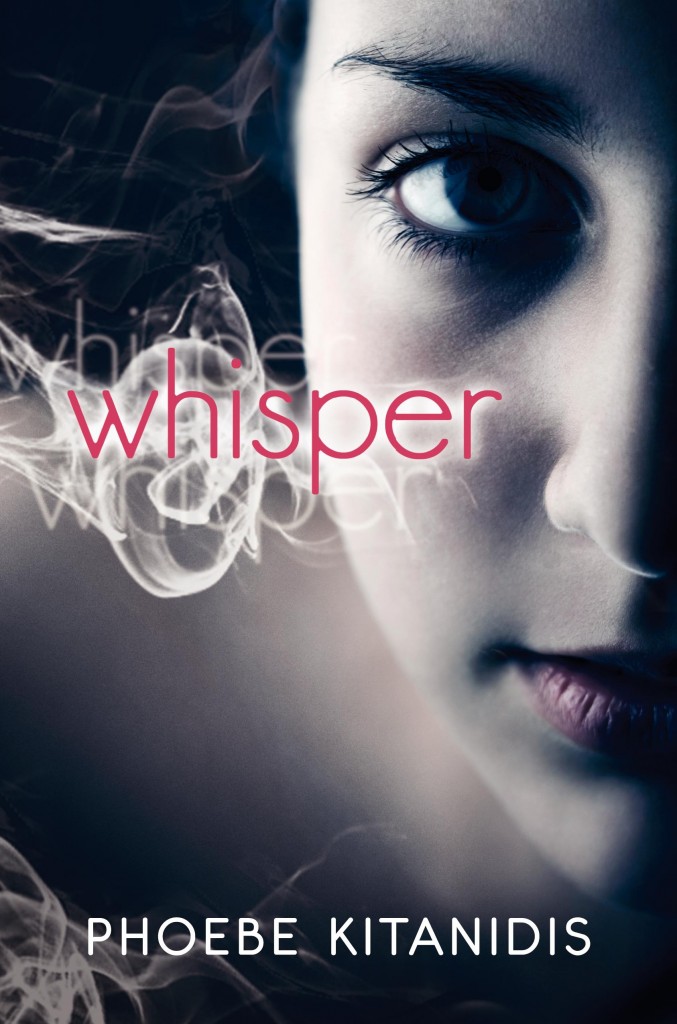
Improving those opening pages, part III: lights, camera — revisions?

spotlights2

A quick reminder before we begin today: entries for the Author! Author!/WHISPER Great First Page Made Even Better Contest must be in by midnight in your time zone on May 24th — or, as we like to call around here, the point at which next Monday becomes next Tuesday. The exceptionally easy-to-follow rules may be found here.

I’m hoping that many of you will enter the first pages of your manuscripts, but I’d especially like to encourage those of you who write YA to seize this opportunity: the lucky winners of the YA category will win a first-page critique by no less a storytelling-for-youth authority than YA author Phoebe Kitanidis. I’m excited about judging in the adult category myself, of course, but I’m also really looking forward to hearing her insights on your work!

Okay, that’s enough contest promotion the nonce. Let’s get back to work.

All this week, I’ve been taking a fine-tooth comb, a magnifying glass, and a huge grain of salt to a real, live reader’s real, live first page, pointing out the nit-picks, large and small, that might cause our old pal, Millicent the agency screener, to become distracted from the inherent beauty of the writing, originality of the story, or any other selling point a writer might wish her to notice instead. As those of you who have been following this series may have noted with alarm, I’ve been talking for three days straight about potential sources of distraction in what is, frankly, a page 1 that would not have raised most readers’ eyebrows in the slightest.

Just in case you haven’t been keeping score, Millie’s cumulative remarks would have looked like this, had she been noting them on the manuscript page:

marked-up page 1

That’s not an unusually high level of feedback for professional critique, by the way: the pros read closely. While some writers might find facing that level of scrutiny a trifle intimidating, jumping on every last little manuscript error is considered perfectly normal amongst agents and editors. Why, they reason, would a good writer want not to know how to improve her manuscript?

In fact, extremely nit-picky feedback is considered indicative of respect in publishing circles: trust me, they don’t bother to jump all over manuscripts that they do not believe to be worthy of publication.

The moral, lest the combination of the image and that last insight not have driven it home with sufficient force: despite the fact that it’s Millicent’s job to screen submissions in order to find exciting stories and fresh literary talent, it’s also her job to read manuscripts critically. Many submissions (and contest entries, come to think of it) get knocked out of consideration not because of a single mistake, but due to an array of small, avoidable missteps.

What practical lesson might we derive from that? Perhaps that it behooves a writer (or literary contest entrant) to scan his manuscript as closely as Millicent would before submitting it, rather than assuming — as most aspiring writers do — that an agent seriously interested in literature would readily forgive technical mistakes, reading ten, twenty, a hundred pages before deciding whether this is a book she wants to represent.

But Millie is not paid to read with a charitable eye, nor should she; she’s well aware that if anything, her boss is more likely to reject a manuscript on technicalities than she is. (Yes, really — it’s significantly less time-consuming to represent a client whose self-editing skills are demonstrably immaculate.) Because the agent doesn’t have time to read every submission in its entirety, she employs Millicent to narrow the field down to a few manuscripts already of publishable quality AND likely to sell in the current market AND packages professionally.

Or, to put it another way: the little stuff matters. Quite a lot, as a matter of fact.

Contrary to popular opinion amongst aspiring writers, professional readers — screeners, agents, editors, and contest judges, to name but a few — do not read like other people. Instead of reading an entire scene or page before making judgments about the story and the writing, they judge each line as they encounter it. Typically, when Millicent encounters a line of which she does not approve, she does not read on in the hopes of finding one she will enjoy more — she generally will simply stop reading.

What does this mean for most submissions, in practical terms? Well, take our example from yesterday, the manuscript that opened with an unattributed piece of dialogue. The vast majority of submitters would assume that Millicent would see the page like this:

page 1 example wrong

Whereas what Millicent is likely to see for evaluation purposes is this:

first line page

What makes me think she might choose to stop reading at that point — and not, say, immediately after spotting the unusual slug line or odd pagination? As I mentioned earlier in this series, small formatting errors are seldom instant rejection triggers; presentation gaffes may affect how seriously Millicent reads the text (see my earlier comment about how much more time-consuming it is for an agent to represent a client who doesn’t know the self-editing ropes), but it’s rare that she would dismiss it entirely on cosmetic grounds alone.

She may reasonably be expected to read what follows with an a slightly jaundiced eye, though, if not an outright expectation that the writing will not be polished up to professional standards. Which is precisely what happens in our example: manuscripts that open with unidentified speakers are a notorious Millicent pet peeve.

Actually, cutting the narrative off here gives us a sterling insight into why. Take a gander at the first sentence (and first paragraph) of this manuscript, forgetting that you know anything about the story to follow:

“It’s your ex, hon.”

What does it tell us, stripped of context? We already established last time what this opening doesn’t tell us: who the speaker is. Or who the listener is, for that matter, beyond the fact that s/he has evidently participated in a relationship prior to the beginning of the story. It also doesn’t tell us whether the speaker or the hearer whether is male or female, anything about his/her tone, what the environment is like, the speaker’s motivation in bringing this information to the listener’s attention…

We don’t even know how crucial this statement is to the actors, whether it’s the key to the story to come or merely one line of dialogue amongst many. Standing alone, this speech could serve equally well in the mouth of a bored operator transferring the thirtieth perfectly mundane call from a civil ex and coming from the lips of a horrified onlooker who has just spotted an axe murderer standing behind her best friend.

Even more serious from Millicent’s perspective, it also doesn’t really give us any hit about who the protagonist is or what conflict s/he faces — which are, lest we forget, questions that she fully expects a well-written page 1 to answer, at least provisionally. While naturally, it would be a tad unreasonable to expect the first paragraph of a manuscript to answer both of those questions (which form, presumably, the basis for a 350-page book), is she so wrong to expect that first paragraph to whet her appetite about the story to come?

Bearing all that in mind, let me ask you: in Millicent’s shoes, would you keep reading?

A forest of hands just shot into the air. Yes — you in front? “I wouldn’t keep reading,” an inveterate conference-goer points out, but not because I was confused about who was saying the speech, or because I was not sufficiently intrigued by it as conflict introduction. No, if I were Millie, I would have stopped reading as soon as my gaze hit that first set of quotation marks: I’ve heard agents say at conferences/in interviews/on their blogs that they just don’t like to see manuscripts open with dialogue on the first line.”

I’ve heard this one from time to time, too. Usually, one agent sitting on a panel will begin a critique with, “Maybe it’s just me, but I don’t like to see dialogue in the first line.” Almost invariably, the agent sitting next to him will turn to him and say, “Really”

It’s not a universal pet peeve, in short. As simple observation of the literary world will tell us: a lot of very good books open with dialogue. That being said, I would certainly advise a writer who hears an agent express such an opinion immediately to make a mental note never to send that agent a manuscript that opens with dialogue. That’s just basic prudence.

I know I’ve been saying it a lot lately, but it bears repeating: no matter how much talk there is about how agents all want to represent the same kinds of books, it’s just not the case — they are individuals, with individual tastes. And thus, logically, if your submission is rejected by one, you have most emphatically NOT been rejected by the entire industry: you’ve been rejected by one individual within it.

Learn what you can from the experience, then move on.

Unfortunately, the writer of our ongoing example is quite unlikely ever to find out whether the Millicent who passed on her submission harbored a lingering resentment against opening dialogue, or didn’t like the unattributed dialogue, or indeed, any other actual cause of complaint against the manuscript itself. These days, it’s quite rare for a rejection to contain any concrete reason at all. Most of the time, queries and submissions alike are rejected with the same form letters filled with stock phrases: we’re sorry, but it did not meet our needs at this time; I just didn’t fall in love with this protagonist; I don’t feel I can sell this book in the current market.

Which makes it rather hard to learn much from the rejection experience, admittedly. All an aspiring writer can do is keep pushing ahead, polishing her craft in private, until she finds the right agent. Keeping an eye on what’s been published lately in her chosen book category can’t hurt, either.

Yes, persistent hand-raiser off in the corner? “Okay, Anne, I understand both that it’s a good idea to avoid opening a manuscript with an unattributed piece of dialogue, and that since there are a few agents out there who will reject submissions with dialogue in their first lines, attributed or not, I cannot please all of the people all of the time if I want to keep my initial dialogue. But let’s say that I just love my opening quote, and I’m willing to trust my luck that it will land on the desk of someone who doesn’t hate initial dialogue. How would you suggest I present it without running afoul of your second critique from last time, over-using tag lines? Or, to take advantage of our ongoing example, how would you suggest changing it to be more appealing to Millicent?”

Ooh, that’s a tough question, persistent hand-raiser. As you point out, the easiest way to correct the first problem would be simply to add a tag line, identifying the speaker:

“It’s your ex, hon,” Emma said.

It’s not a very creative solution, though; it neither adds much interest to the paragraph nor gives the reader much insight into who Emma is, what her primary conflict might be, etc. Also, this approach might be problematic if Casey turns out to be the protagonist — as, indeed, Millicent would have assumed from the original submission.

And why would she have leapt that conclusion, you ask wearily? The same answer as before: selective reading. Here’s the point in the text where she would have made up her mind on the subject:

second line

Generally speaking, Millicent will assume the first named character on page 1 of a novel to be the protagonist until proven otherwise — especially if that character is the most active one in the opening scene. Since she doesn’t always appreciate being informed later in the text (or even on the page) that she was wrong about that, you might want to construct your opening scene accordingly.

Let’s assume for the sake of example, though, that Emma, and not Casey, is the protagonist, since it’s entirely possible that this was the author’s intended implication by having her speak first. (At least I assume that it is Emma who speaks first in this scene, rather than someone in the background.) What our exemplar’s quickest revision options for steering a middle course between no speaker identification in the first paragraph and applying tag lines indiscriminately?

Why quickest, you ask? Oh, you’ve never caught a manuscript problem ten minutes before you were about to stuff it into an envelope — or two minutes before hitting the SEND button? Lucky you.

No, but seriously, folks, it’s been my experience that once an opening scene hits a page, many, if not most, aspiring writers are rather reluctant to change its structure or even its wording much. Writers can get extremely attached to their opening sentences and paragraphs; even those tinker endlessly with mid-book phraseology are often downright defensive about their initial scenes.

We all imagine future browsers lovingly pulling our books off shelves years hence, you see, sitting down to devour our first pages at a glance. Who wants some third party, even one as advantageously placed to help you get your book published as Millicent, to dictate the first impression we will make on our as-yet-unborn fans?

Back to the problem at hand. Identifying the speaker in a separate sentence within the first paragraph is the method most editors would suggest, as it provides ample opportunity for providing context for an opening comment, giving characterization hints, introducing the protagonist as active, and so forth.

It’s also, if you play with the running order a little, a dandy way to side-step the perils of running afoul of opening-dialogue-hating agents. You simply have the narrative sentences come first.

What might this look like in practice? Instead of simply using a tag line to identify the speaker, like so:

“It’s your ex, hon,” Emma said.

The reviser could add some action to the opening — ideally, action that sets the tone for the scene to follow. Since the line of dialogue follows immediately thereafter, the direct implication is that the primary actor in the first paragraph is also the speaker.

Emma dodged the knife-wielding maniac, escaped, panting, down the hallway, and collapsed at her best friend’s usual lunch table. “It’s your ex, hon.”

No doubt about who is speaking there, eh? Or that the protagonist is an interesting person in an interesting situation?

Beefing up a dialogue-bearing opening paragraph can also provide a great opportunity to introduce physical characteristics of both protagonist and place. Be careful in what you choose to put here, though — mundane descriptors tend to imply rather ordinary protagonists. Telling details, however, can be worked in beautifully. Borrowing from lower on our example page:

Emma’s collection of silver rings danced under restaurant track lights. “It’s your ex, hon.”

I see a few more raised hands waving frantically at me. “But Anne, the reason I’m starting my manuscript with a piece of dialogue is that I feel that the spoken words themselves are important — so much so that I genuinely like seeing them all alone at the top of the page, as in the example. What you’re suggesting seems to water down their impact a little. Couldn’t I just, you know, add a tag line with an adverb attached, providing enough information that Millicent won’t jump down my throat, but still preserving the opening sound that I like?”

Well, you could, oh frantic ones, if you minimized the tag lines throughout the rest of the scene AND you happen not to be writing in a book category where tag lines are positively to be avoided (literary fiction, for instance, eschews them to a remarkable extent). If the initial statement is crucial to the scene — as it should be, if you’re opening with it; as in a screenplay, the first thing the protagonist says in the book sets up the reader’s idea of what kind of a person she is — it might well make sense to highlight a particularly startling statement that reveals character or conflict in a surprising or original manner.

In other words, don’t try it with an everyday statement; it’s probably not worth the risk.

If you’re going to incorporate a tag line in the first sentence of your book, make sure it pays off. There’s just no getting around the fact that adding a tag line might not pass muster with a Millicent who believes that tag lines are always avoidable (as they almost invariably are, with some rhetorical gymnastics), but if you feel that it’s the best means of kicking off a conflict, go a head and give it a try. It helps if you choose an interesting speaking verb, instead of the prosaic and ubiquitous said:

“It’s your ex, hon,” Emma spat, slamming her tray down on the tiny, slick table.

Casey Winter blanched. Her stomach twisted into snake-knots…

You want to read on, don’t you? That’s because these initial lines jump straight into a conflict. (One that I have no reason to believe exists in the manuscript as it is currently written, but work with me here.)

Still, it wouldn’t be all that difficult to maintain a similar energy while trimming the tag line. Implication is the writer’s friend, after all.

Emma swerved her way through the crowd of tray-wielding lunchers, slamming her tray down loudly on Casey Winter’s table. Gossip boiled in her system, and she could hold its hot fire inside no longer. “It’s your ex, hon,”

Casey blanched. Her stomach twisted into snake-knots…

Up go those hands again. “But Anne, what if Casey, and not Emma, is the protagonist? How would you suggest revising the opening then?”

That’s a good question, talking hands — frankly, in that case, I would be reluctant to allow Emma to speak first. I would be easy enough to move the content of the initial piece of dialogue into her mouth, after all. I would, however, trim her reactions so that they all take place inside of her (as opposed to blanching, something Emma might see from the outside), to ramp up the intensity of the opening:

“My ex?” Casey Winter’s stomach twisted into snake-knots. She had a psychosomatic ache in her face and temple and a not-quite-so-matic one in her right knee. She wanted to tap on something, a glass, the tabletop, maybe Emma Parker’s skull, and bleed some of her tension out. “What does he want?”

Emma leaned forward…

My overarching point, should you care to know it: good revision — on the stylistic front, at least — is less about applying hard-and-fast rules than making choices. Nowhere is that more true than on page 1 of your manuscript, for once a reader gains an impression of your protagonist (even if it’s an incorrect one), that’s going to inform how he responds to the rest of the book.

Page 1, in essence, is your story’s introduction to the world. How do you want it to appear?

And, of course, Millicent’s decision whether to keep reading or reject is based entirely on page 1, necessarily. She will be deciding line by line, sentence by sentence, whether to push on or reach for the form-letter rejection pile.

At the submission stage, then, there’s no such thing as a throwaway line on page 1 — or page 2, or page 15, or in the first 50 pages. Grabbing and keeping the attention of as nit-picky a reader as Millicent requires not only telling a good story well, but also paying attention to the details.

Practically nothing escapes her notice, you know. But isn’t that ultimately a very gratifying reader to have for your work, one who notices and appreciates all of your fine work, all of your intelligent choices?

Sort of strange to think of ol’ Millie in that light, isn’t it? Give it a ponder — and, of course, keep up the good work!
Improving those opening pages, part III: and then there are Millicent’s page 1 pet peeves

woman tied to a train tracklion and tamertommygun1

How have you been enjoying this week’s series on editing page 1 of your manuscript, campers…or is enjoying too strong a word? I’ve been getting such a varied response (ranging, understandably, from thrilled to horrified) from such a wide spectrum of writers (straight nonfiction, memoir, every stripe of fiction) that I’m already toying with making this a regular feature — the first page of the month, perhaps — to give us time and a great excuse to dig deep into the peculiarities and joys of various book categories.

All too often, those of us who teach writing to writers speak as though good writing were good writing, independent of genre, but that’s not always the case. Every book category has its own conventions, after all; what is expected in one may seem downright poky in another. A passive female protagonist might well be a drawback in a mainstream fiction manuscript, for instance, but for a rather wide segment of the WIP (Women in Peril) romance market, a certain amount of passivity is a positive boon.

Doubt that? Okay, to a peril-seeking reader, which would be the more exciting rescue object: the lady tied to a train track while menaced by a lion wielding a Tommy gun, or the bulletproof lady too quick to be lashed down who always carries large steaks in her capacious pockets in case of lion attack?

I’ll leave you to ponder that cosmic mystery on your own. Let’s get back to analyzing our sample first page.

So far, we’ve talked about how Millicent the agency screener might respond to the way this page appears on the page (formatting issues, punctuation, grammar), what clues about the rest of the manuscript she might derive from certain authorial choices (italics usage, word choice, repetition), and book category appropriateness. Today, I want to concentrate on matters of style — which, on the first page of a submission, requires some consideration of the more notorious of Millicent’s pet peeves.

Already, I see some hands raised in the air, clamoring for my attention. “But Anne,” rules lawyers everywhere cry with one voice, “since Millicent is a composite character, the fanciful Author! Author! personification of professional readers’ attitudes toward submissions, how meaningful could it possibly be to talk about her pet peeves? Are they not by definition personal, and thus variable from reader to reader?”
Yes and no, rules lawyers. Yes, pretty much everyone who reads manuscripts for a living harbors at least a couple of individual dislikes — it drives me nuts, for instance, to see She graduated college on the page, as opposed to the more grammatically correct She graduated from college. Have you noticed how common it’s become to ignore the distinction between transitive and intransitive verbs? Not to mention the vicious, civilization-dissolving practice of transmuting perfectly innocent nouns into verbs, presumably to save a couple of characters per sentence — why, just the other day, my weary eyes were insulted by The institute tributed director X in a fairly respectable local newspaper. Would it have killed the article’s writer or his editor to adhere to the longstanding norms of the English language by coughing up the extra character for the less nonsensical The institute paid tribute to director X? And whose bright idea was substituting tonite for tonight, anyway? What great contribution to Western literature do abbreviators believe they are going to be able to achieve with those two saved characters?

Those of us who read for a living tend to cherish our personal pet peeves, as you may see, but there’s not very much an aspiring writer can do to protect herself from running afoul of any given Millicent’s. Or, indeed, from annoying her with your subject matter.

“Oh, God,” Millie mutters, “another romance set in Paris? That’s the third one I’ve seen this week!”

You’re scowling, aren’t you? I’m not at all surprised. Of all of the many aspects of the submission process over which the writer has no control whatsoever, the role of who happens to be screening on the day a particular manuscript arrives in an agency is one of the least understood and most resented by writers. Perhaps with good reason: we’d all like to believe that our manuscripts will receive a fair, impartial reading, regardless of the pet peeves or mood of the screener.

However, there’s just no denying that if you have written a semicolon-heavy literary fiction piece about the many loves of an airline pilot, and the agent of your dreams has just hired a Millicent who simply loathes semicolons, is a dedicated monogamist, and was jilted yesterday by a pilot, the best writing in the world probably is not going to prevent her from rejecting your submission.

Sorry to be the one to break that to you — but an aspiring writer who is aware of the role that personal preference and chance inevitably play in whether a manuscript gets rejected or accepted is, in the long run, going to be significantly happier than one who believes that all Millicents read identically. Ditto with contest entrants; every contest judge brings a few personal preferences to the table. Assuming, as virtually every aspiring writer does when first submitting, querying, and/or entering, that any individual professional reader’s reaction to his work is representative of what EVERY professional reader’s opinion would be is just, well, wrong.

It’s also a strategy notoriously likely to depress aspiring writers into not querying, submitting, or entering widely enough to get their work into publication. If every professional reader’s opinion is identical, fledgling writers are all too apt to reason, why shouldn’t a single rejection — or two, three, or forty-seven — be taken as if it were the entire publishing industry’s reaction to the book in question?

There’s a very good reason, as it happens: screeners are individuals, with personal opinions. So are agents, editors, and contest judges. Keep sending out your work until you find the one predisposed to love it.

But that didn’t answer the rule-mongers’ question, did it? “That’s all very pretty and inspiring,” they concede. “Does that mean I don’t need to worry at all about Millicent’s pet peeves?”

Well, no — certain pet peeves are shared by most professional readers, simply because they turn up so often in manuscript submissions and contest entries. Spotting even one non-doubled dash on a manuscript page leaves many a Millicent gasping with indignation, for instance; a submission without indented paragraphs renders many positively apoplectic. And if you really want to ruin a pro’s day, try submitting something with unnumbered pages.

Hey, standard format is standard for a reason.

Most of the ire-inducing gaffes above are relatively well-known (but if any of them came as a surprise, run, don’t walk, to the HOW TO FORMAT A MANUSCRIPT category on the archive list at right, if only for the sake of Millicent’s blood pressure). I was delighted to see, however, that our sample page 1 included several of the lesser-known ones. Discussion gold!

Okay, so perhaps delighted isn’t a particularly normal response. Had I mentioned that reading manuscripts for a living radically alters how one reads?

Here is our example again; don your Millicent mask and try to ferret out three common screeners’ pet peeves we have not yet discussed. If you want a hint: two of them are dialogue-related.

page 1 example wrong

How did you do? The third in particular might be a tad hard to spot if you didn’t happen to have spent the last six hours reading first pages; certainly, it would be significantly harder to get excited about it. To give you a sense of how exorcized Millicent might have gotten about all three, allow me to stick a Sharpie in her hand and let her have at it:

page 1 edit 4

Thanks, Millie; why don’t you go score yourself a latte and try to calm down a little? I can take it from here.

Now that we’re alone again, be honest: in your quick scan of the page, had you noticed all of the issues that so annoyed Millicent? Any of them?

If it’s the latter, don’t be embarrassed — very few readers would have, at least consciously, and self-editors. If you’re caught up in the characters’ lifeworld (as Millicent hopes you will convince her to be by the bottom of page 1), none of these questions is likely to occur to you. Let’s take her concerns one at a time, so we may understand why each bugged her.

1. Opening with an unidentified speaker.
I’m really glad that our generous example-provider chose to open the manuscript this way, because it’s a very, very popular choice: depending upon the fiction categories Millicent’s boss represents, she might see anywhere from a handful to dozens of submissions with dialogue as their first lines on any given day. A good third of those will probably not identify the speaker right off the bat.

Why would the vast majority of Millicents frown upon that choice, other than the sheer fact that they see it so very often? A very practical reason: before they can possibly make the case to their respective boss agents that this manuscript is about an interesting protagonist faced with an interesting conflict, they will have to (a) identify the protagonist, (b) identify the primary conflict s/he faces, and (c) determine whether (a) and (b) are interesting enough to captivate a reader for three or four hundred pages. So when they pick up page 1, they’re looking for some pretty specific information.

Given that mission, it’s bound to miff them if they can’t tell if the first line of the book is spoken by the protagonist — or, indeed, anyone else. In this case, the reader isn’t let in on the secret of the speaker’s identity for another 6 lines. That’s an eternity, in screeners’ terms — especially when, as here, the first character named turns out not to be the speaker. And even on line 7, the reader is left to assume that Emma was the initial speaker, even though logically, any one of the everyone mentioned in line 7 could have said it.

So let me ask the question that Millicent would almost certainly be asking herself by the middle of the third question: since presumably both of the characters introduced here knew who spoke that first line, what precisely did the narrative gain by NOT identifying the speaker for the reader’s benefit on line 1?

99% of the time, the honest answer will be, “Not much.” So why force Millicent to play a guessing game, if it’s not necessary to the scene?

Trust me on this one: a Millicent in a hurry tends to dislike guessing games, especially on page 1. Go ahead and tell her who is speaking, what’s going on, who the players are, and what that unnamed thing that jumps out of the closet and terrifies the protagonist looks like. If you want to create suspense, withholding information from the reader is not Millicent’s favorite means of generating it.

That’s not to say, however, that your garden-variety Millicent has a fetish for identifying every speaker every time. In fact, she regards the old-fashioned practice of including some version of he said with every speech as, well, old-fashioned. Not to mention unnecessary. Which leads me to…

2. Including unnecessary tag lines.
Unless there is some genuine doubt about who is saying what when (as in the first line of text here), most tag lines — he said, she asked, they averred — aren’t actually necessary for clarity. Let’s face it, quotation marks around sentences are pretty effective at alerting readers to the fact that those sentences were spoken aloud. And frankly, unless tag lines carry an adverb or indicates tone, they usually don’t add much to a scene other than clarity about who is saying what when.

So why include them, in instances where any reasonably intelligent reader would already be able to figure out who the speaker is?

That’s a serious question, you know. Most editors will axe them on sight — although again, the pervasiveness of tag lines in published books does vary from category to category. Since most adult fiction minimizes their use, novelists who have worked with an editor on a past book project will usually omit them in subsequent manuscripts.

So common is this self-editing trick amongst the previously published that to a well-trained Millicent or experienced contest judge, limiting tag line use is usually taken as a sign of professionalism. Which means, in practice, that the opposite is true as well: a manuscript peppered with unnecessary tag lines tends to strike the pros as under-edited.

Paragraph 2 of our example illustrates why beautifully. Take another gander at it then ask yourself: at the end of a five-line paragraph largely concerned with how Casey is feeling, wouldn’t it have been pretty astonishing if the speaker in the last line had been anybody but Casey?

The same principle applies to paragraph 4. Since the paragraph opens with Casey swallowing, it’s obvious that she is both the speaker and the thinker later in the paragraph — and the next one. (Although since a rather hefty percentage of Millicents frown upon the too-frequent use of single-line non-dialogue paragraphs — as I mentioned earlier in this series, it takes at least two sentences to form a legitimate narrative paragraph in English, technically — I would advise reserving them for instances when the single sentence is startling enough to warrant breaking the rule for dramatic impact. In this instance, I don’t think the thought line is astonishing enough to rise to that standard.)

Starting to see how Millicent considers a broad array of little things in coming up with her very quick assessment of page 1 and the submission? Although she may not spend very much time on a submission before she rejects it, what she does read, she reads very closely.

Sort of changes your mental picture of how and why the average submission gets rejected on page 1, doesn’t it? Professional reading doesn’t miss much. Remember, agents, editors, and their screeners tend not to read like other people: instead of reading a page or even a paragraph before making up their minds, they consider each sentence individually; if they like it, they move on to the next.

All of this is imperative to keep in mind when revising your opening pages. Page 1 not only needs to hook Millicent’s interest and be free of technical errors; every line, every sentence needs to encourage her to keep reading.

In fact, it’s not a bad idea to think of page 1′s primary purpose (at the submission stage, anyway) as convincing a professional reader to turn the first page and read on. In pursuit of that laudable goal, let’s consider Millicent’s scrawl at the bottom of the page.

3. Having enough happen on page 1 that a reader can tell what the book is about.
This is a really, really common problem for first pages — and first chapters of both novels and memoirs, if I’m being honest about it. A lot of writers like to take some time to warm up…so much so that it’s not all that rare to discover a perfectly marvelous first line for the book in the middle of page 4.

Then, too, opening pages often get bogged down in backstory or character development, rather than jumping right into some relevant conflict. US-based agents and editors tend to get a trifle impatient with stories that are slow to start. (UK and Canadian agents and editors seem quite a bit friendlier to the gradual lead-in.) Their preference for a page 1 that hooks the reader into conflict right off the bat has clashed, as one might have predicted, with the rise of the Jungian Heroic Journey as a narrative structure.

You know what I’m talking about, right? Since the release of the first Star Wars movie, it’s been one of the standard screenplay structures: the story starts in the everyday world; the protagonist is issued a challenge that calls him into an unusual conflict that tests his character and forces him to confront his deepest fears; he meets allies and enemies along the way; he must grow and change in order to attain his goal — and in doing so, he changes the world. At least the small part of it to which he returns at the end of the story.

It’s a lovely structure for a storyline, actually, flexible enough to fit an incredibly broad swathe of tales. But can anyone spot a SLIGHT drawback for applying this structure to a novel or memoir?

Hint: you might want to take another peek at today’s example before answering that question.

Very frequently, this structure encourages writers to present the ordinary world at the beginning of the story as, well, ordinary. The extraordinary circumstances to come, they figure, will seem more extraordinary by contrast. Over the course of an entire novel, that’s pretty sound reasoning (although one of the great tests of a writer is to write about the mundane in a fascinating way, I think), but it can inadvertently create an opening scene that is less of a grabber than it could be.

Or, as I suspect is happening in this case, a page 1 that might not be sufficiently reflective of the pacing or excitement level of the rest of the book. And that’s a real shame, since I happen to know that something happens on page 2 that would make Millicent’s eyebrows shoot skyward so hard that they would knock her bangs out of place.

But I’m getting ahead of myself, amn’t I? We’re not going to get into the next scene until next time.

So let’s stick to our moral for the day: since submissions and contest entries are evaluated one line at a time, holding back on page 1 might not make the best strategic sense. Remember, Millicent is looking for an interesting protagonist facing an interesting conflict — appearing as soon as possible in the manuscript. You might want to invest some revision time in making sure your first page gives all that to her.

Just a suggestion. Or three. Keep up the good work!