Some thoughts on character names, part VI: John, I’ve got something to tell you, John. John, can you hear me? John? John?

faceseve

Gee, I bet you can’t tell which naming bugbear I’m going to tacking today. Normally, I try to make my titles a trifle more subtle, but as I’m still feeling a bit punk, as my dear old white-headed mother says, I’m going to cut myself a little slack and get right in your face about it: today, we’re going to be talking about proper name repetition.

As in the particularly sterling example above. Amongst Millicents, submissions (and first drafts in general) are notorious for this type of redundancy. Also notorious in her circles: the overuse of the character name John. And Jon. And Jack.

I just mention. Oh, and by notorious, I mean annoying for the reader.

It’s interesting how much of our discussion of character names has centered on ways improper use can annoy readers, isn’t it? For the last couple of posts, I’ve been harping on how too many named characters can make your submissions slightly harder to read — and thus annoying to Millicents all across New York — but too-frequent repetition of the main characters’ names makes the average editor rend her garments and the garden-variety agent moan.

If it’s any consolation, they’ve been rending and moaning for years. Pros used to attribute this problem to the itsy-bitsy computer screens that writers were working upon – remember the early Macintoshes, with those postcard-sized screens? They weren’t even tall enough to give a life-sized reflection of an adult face. If you made the text large enough to read, the screen would only hold a dozen or so lines.

But as technology has progressed, the screens on even inexpensive computers have gotten rather large, haven’t they? Even on a laptop, you can usually have a view of half a page, at least. My extra-spiffy editor’s monitor can display two life-sized manuscript pages side by side.

So why is it that writers so seldom have a clear idea of how distracting name repetition can be on a printed page? Is it merely that writers christen their major characters with their favorite names (including John, as likely as not), and want to see them in print again and again?

Not entirely. Partially, I think, it has to do with how differently the eye reads text on a backlit screen: it definitely encourages skimming, if not great big leaps down the page. But for the most part, I believe it has to do with how infrequently writers read their own work in hard copy.

Hear that Gregorian-like chanting floating through the ether? That’s every writer for whom I’ve ever edited so much as a paragraph automatically murmuring, “Before submission, I must read my manuscript IN ITS ENTIRETY, IN HARD COPY, and OUT LOUD.” Writers who read this blog religiously have been known to mutter this inspiring little rule of thumb in their sleep.

So yes, I admit it: I’m a broken record on this subject. But for some very, very good reasons.

For our purposes today, the reason really couldn’t be better: reading in hard copy — which is how virtually any editor, most agents, and 100% of contest judges will be seeing your submissions, right? — makes patterns in the text far more apparent to the reading eye.

Like, say, character name repetition. Lookee:
a-sample-page

See how your eye tries to leap from one J to the next? As I mentioned a few days ago, the skimming eye is automatically attracted to capital letters in a text.

That’s why, in case you were wondering, not-especially-literate people tend to Capitalize Words for Emphasis. (When they’re not placing words that no one has ever said aloud inside quotation marks — another widespread editorial pet peeve.) It’s technically ungrammatical, but it definitely does the job of soliciting attention.

Proper names do jump off the page — which can be a good thing, if a manuscript is crammed to the gills with action, unnamed characters, and other literary titivations that do not involve the protagonist. Yet since most novels and pretty much all memoirs deal with their respective protagonists on virtually every page, it isn’t precisely necessary to keep calling attention to the protagonist by referring to him by name.

Especially within the dialogue of a two-person conversation. Unless the one of the characters happens to have multiple personalities, it’s generally assumed that the names of the conversants will not alter substantially within the course of a few pages of dialogue — but you’d never know that by the number of times some manuscripts have their discussants call one another by name.

In dialogue where the use of tag lines (he said, she said) has not been minimized, the repetition can become so frequent that it’s like a drumbeat. As in:

“I don’t think that’s fair of you, Eve,” Abigail snapped.

“Why ever not?” Eve asked.

“Oh, don’t be disingenuous with me Eve. I’ve known you too long.”

Eve played with a nearby paperweight. Was she testing its weight for throwing. “Honestly, Abby, I haven’t the slightest idea what you’re talking about. Unless this is about John?”

“Of course it’s about John,” Abigail huffed. “How many husbands do you think I have?”

“Just one,” Eve said, smiling. “It’s been just John since the seventh grade.”

Abigail’s eyes stung for a moment. Eve always had known how to push her buttons. “Don’t change the subject, Evie. Next, you’ll be reminiscing about that time we hanged our classmate when we were in the fourth grade.”

Eve sighed. “Those were the days, eh, Abby?”

“I’ll say,” Abigail said, edging out of paperweight-tossing range. “She should have known better than to beat you at tetherball.”

Yes, speakers in the real world do call one another by name this much sometimes, but like so much of real-life dialogue, that level of repetition would be snore-inducing, if not downright hypnotic, on the page. When tag lines are added in, even dialogue between just a couple of characters can convey the sense of a very crowded room.

The fact that names can appear too often within a short number of lines seems to be news to most aspiring writers submitting their work to agencies, publishing houses, and contests. Submissions tend to be rife with repetition of their protagonist’s names. After one has read a few hundred — or a few thousand — manuscripts, one begins to suspect writers of harboring a prejudice against the innocent-but-effectual pronouns he and she.

Seriously, a lot of submitters seem to go out of their way to eschew pronouns, even in narrative paragraphs. This is not an unusually proper noun-ridden example:

Laura slapped her laptop shut with a bang and glanced around, annoyed, for her waitress. Naturally, Sonia was nowhere in sight. Laura ostentatiously drained her drink to its dregs, but when Sonia did not come running, Laura filched a straw from the table next to her. The guy tapping away on his laptop never even noticed. Laura made slurping sounds on the bottom of her glass with it.

Still no sign of Sonia. For good measure, Laura upended the glass, scattering swiftly melting ice cubes messily all over the starched white tablecloth, and began banging the now-empty vessel upon the now-sodden linen. “Service!” Laura bellowed. “Sonia!”

Quietly, Sonia retrieved Laura’s glass from Laura’s waving hand. “Don’t you think you’ve had enough?”

Laura looked up at Sonia with that my-daddy-is-someone-important air that always worked with bank tellers, hot dog vendors, and waitresses who lived primarily upon their tips. “I’ve been drinking Perrier all night. May I have another?”

Come on, admit it — that was kind of annoying to read, wasn’t it? Until you’ve seen this phenomenon in action, it seems a trifle counter-intuitive that reusing a single word within two consecutive lines might be irritating to a reader, but it can be, even if the word in question is not a proper noun. The capitalization of a name makes it stand out more, however.

To get an even better sense of how repetitious it would seem on a printed page, take a few steps back from your computer (if you can manage that logistically) and take a gander at the pattern all of those capital Ls make in the text. Distracting, isn’t it?

Now, admittedly, the writer of this exceptional excerpt may merely have been trying to clarify matters by repeating the names so often: there are in fact two women in this scene. If both were only called she, naturally it would become confusing. (If you have any doubts about how confusing a narrative can be when no proper names are used at all, get a 4-year-old to tell you the plot of a movie she’s just seen.)

However, like many proper name-heavy manuscripts, the writer here (who was me, obviously, so I guess it’s not all that productive to speculate about her motivation) has constructed the narrative to make opportunities for name repetition where it isn’t logically necessary. Here’s the same scene again, streamlined to minimize the necessity of naming the players:

She slapped her laptop shut with a bang and glanced around, annoyed, for her waitress. Naturally, Sonia nowhere in sight. Laura ostentatiously drained her drink to its dregs, but when no one came running, she filched a straw from the table next to her – the guy tapping away on his computer never even noticed – and made slurping sounds on the bottom of her glass with it.

Still no sign of life. Then, for good measure, she upended the glass, scattering swiftly melting ice cubes messily all over the starched white tablecloth, and began banging the now-empty vessel upon the now-sodden linen. “Service!” she bellowed.

Quietly, Sonia retrieved the now-airborne glass before it could crash to the floor. “Don’t you think you’ve had enough?”

Laura looked up at her with that my-daddy-is-someone-important air that always worked with bank tellers, hot dog vendors, and waitresses. “I’ve been drinking Perrier all night. May I have another?”

Before any of you proper noun-huggers out there start grumbling, this was not a very time-consuming revision; all it really required was an awareness that repeating names even as far apart as three or four lines just doesn’t look good on a printed page. And that a proper noun repeated more than once per sentence, or within a single line of text, always seems just a little odd.

More on why next time. Keep up the good work!

P.S.: since I’m letting you out of class a little bit earlier than usual today, l can’t resist adding a homework assignment: wouldn’t today would be a dandy time to make back-ups of your writing files? Especially if you haven’t made another electronic copy since, well, ever?

Yes, I know: I’ve nagged you about this fairly recently, but it bears repeating. Every year, I talk with about a hundred writers whose only copy of their Great American Novel has just been eaten by factors unforeseen. Computer repair facilities see countless writers rending their garments and exclaiming, “But I NEED you to get into my fried hard drive! What do you expect me to do, retype my novel from scratch – and from memory?”

Trust me, you do not want to be one of these people. I hope you never experience the trauma that is a computer meltdown, but I would urge you to make back-ups frequently, just in case.

If you’re a PC user unfamiliar with your backup options, intelligent and insightful long-time reader Chris Park has generously wrote an EXCELLENT post on his blog on data loss, back-up solutions, and other nifty save-my-manuscript-from-oblivion ideas — all written in blessedly clear, direct layman’s terms. I would highly recommend its perusal.
Some thoughts on character names, part V, in which I ramble amiably from subtopic to subtopic — speaking of which, I’ve got some good news about a member of the Author! Author! community

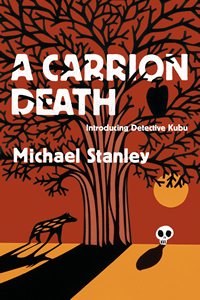
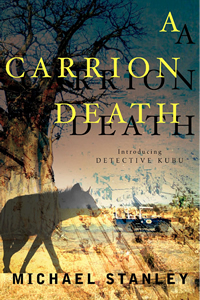
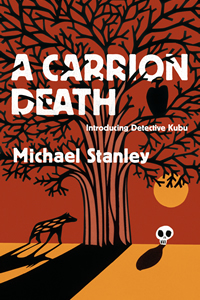
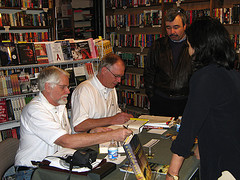
A Carrion Death cover UKauthor signing A Carrion Death

As those of you who have been hanging around this blog for a while already know, I always like announcing the triumphs of our own — in a business as tough as ours, getting into the habit of celebrating other authors’ successes means getting to enjoy many, many more good days in any given year — but I’m especially pleased to gloat over the success of a good book by good writers in the current publishing hard times.

We could all use some good news right about now, eh?

So I am absolutely delighted to open today with not only a single piece of good news about a member of our little community, but a whole raft of it: FAAB (Friend of Author! Author! Blog) Stan Trollip dropped me a line to say that his first novel with co-author Michael Sears, a little gem entitled A CARRION DEATH, has been recognized by the Los Angeles Times as one of the top 10 crime novels of 2008.

As if that and a boatload of glowing reviews weren’t enough, has just been named one of 4 finalists in genre fiction by the 2008 Minnesota Book Awards.

In addition to the juried awards, the good folks at the Minnesota Book Awards have also nominated A CARRION DEATH for a Readers’ Award, given to the book that garners the most votes online. So should any of you feel inclined to pitch in and help a debut author by voting, the deadline is April 10.

Congratulations, Stan and Michael!

Or, more properly, congratulations are due to Michael Stanley, their collective nom de plume. For those of you who missed Stan’s informative guest post on the delicate art of collaboration last spring, here’s the blurb:


Smashed skull, snapped ribs, and a cloying smell of carrion. Leave the body for the hyenas to devour—no body, no case. But when Kalahari game rangers stumble on a human corpse mid-meal, it turns out the murder wasn’t perfect after all. Enough evidence is left to suggest foul play. Detective David “Kubu” Bengu of the Botswana Criminal Investigation Department is assigned to the case. From the sun-baked riverbeds of the Kalahari to the highest offices of an international conglomerate, he follows a blood-soaked trail in search of answers. Beneath a mountain of lies and superstitions, he uncovers a chain of crimes leading to the most powerful figures in the country—influential enemies who will kill anyone in their way.


Incidentally, should any of you be planning to write query letters in the foreseeable future, THAT’s what a terrific summary paragraph looks like. Crammed to the gills with vivid, attention-grabbing details, isn’t it? Makes you want to read the book, doesn’t it?

Those of you who succumbed to the temptation of doings so will no doubt be pleased to hear that Michael Stanley’s second book, THE SECOND DEATH OF GOODLUCK TINUBU, will be released on June 2 in North America. (I’m told that it will be released in the rest of the world in April as A DEADLY TRADE.) For US-based pre-order buffs, Amazon is already offering it for sale.

carrion-death-uk-small.jpgcarrion-death-us-small.jpgcarrion-death-uk-small.jpgcarrion-death-us-small.jpgcarrion-death-uk-small.jpg

Back to our ongoing series on the successful selection and wielding of character names. In Part III (Part I was Askhari Hodari’s expert turn as a guest poster, in case any of you were confused by my rather spotty enumeration, and Part IV was the interesting group discussion this weekend, in which I encourage everyone to continue to participate), I waxed long on the Cast of Thousands phenomenon: manuscripts that name every character, no matter how minor, down to the dogs and the goat tethered in the back yard in Chapter 3.

Manuscripts afflicted with COT can get overwhelming, not to say confusing, pretty fast. Professional readers like our old pal Millicent, the agency screener, tend to become impatient when characters pile up — as, indeed, do other readers.

“How,” the hapless peruser of a COT-riddled book wonders, “am I supposed to keep all of these characters straight? Who is Alexei? Have I seen him before?”

I sense that there were some hands still raised after my last discussion of the phenomenon. (Never mind how I know that. Blogging imbues one with super-sharp sensory perceptions.) “Wait just a minute,” I heard some of you murmuring in the ether. “An ordinary reader may not have options if s/he forgets who is who, but our old pal Millicent the agency screener does. If she finds she’s forgotten who a character is, she has a perfectly easy way to find out — her boss asked that I send a synopsis along with my submission. All she has to do is flip to the back of the packet. Or are you saying that if I have a lot of characters in my opening scenes, I should place my synopsis FIRST in the packet?”

To take the last question first, no — at least, not unless an agency specifies in its submission guidelines that it prefers that order. Why? Long-time readers, chant it with me now: a submitter should always send a requesting agent PRECISELY what s/he asked to see.

No more, no less. Yes, even if she asked for the first 50 pages and your chapter ends a paragraph into page 51. No fudging. And trust a frequent literary contest judge when she tells you that rule applies to stated length restrictions in contest rules, too.

Part of what you are demonstrating by your submission or entry is that you can follow directions, after all. Agents and editors tend to have affection for writers who pay attention to the details of requests; it’s so rare. Writers who start printing out pages after reading only the first line of a request for materials seem to be the norm, unfortunately, not the exception.

That giant tsunami-like rush of air you just heard was every agent, editor, and denizen of a publisher’s marketing department sighing in unison. They honestly do have a reason to be cranky on this point.

But enough of their pain — I’m sensing more conceptually-based disturbances of the ether out there, especially from those of you just on the cusp of stuffing synopses into submission envelopes. “But Anne,” the more literal-minded ether-rockers cry en masse, “I just read a blog by an anonymous agent/heard an agent say at a conference/happened to be eavesdropping in that bar that’s never more than 100 yards from the dais at any writers’ conference, and this guy said he didn’t care about exact page count; he just wanted the first three chapters. So aren’t you, you know, wrong about the importance of sticking to 50 pages?”

Actually, literal rockers, you’ve provided evidence in support of my point, not against it. Remember, no matter how much aspiring writers would like for there to be an absolutely uniform set of expectations for submissions — and a well-publicized one, at that — individual differences do exist. So once again, long-time readers, please take out your hymnals and sing along: if your submission-requester says he wants to see something specific in your submission packet, for heaven’s sake, give it to him. Ditto with contest rules.

General submission guidelines only kick in when the requester doesn’t ask for something different — which is to say, the vast majority of the time. (As always, if you’re unfamiliar with how professional manuscripts differ from printed books or other commonly-scene formats, I implore you to check out the STANDARD FORMAT BASICS and/or STANDARD FORMAT ILLUSTRATED categories on the list at right. Actually, I would strongly recommend any reader new to this blog to take a gander at those categories first.) But if the agent you overheard wants four chapters, you should send four chapters; if he asks you to give your pitch in mime while juggling seventeen oranges, you should consider doing that, too, because he’s the one who is going to be deciding whether he wants to represent you or not.

That being the case, is your first professional contact with him truly the best time to say (at least implicitly), “Look, I know what you asked to see, and that request was based upon your far greater knowledge of both how the publishing industry works and how you like to read, but I’m just going to assume that I’m right and you’re wrong. Got a problem with that?”

I can tell you now: he will.

That being said, don’t revere such requests so highly that you fall into the extremely common trap of generalizing any such quirky individual preferences into industry-wide expectations. Just because one agent, small publisher, and/or contest has a wacky preference doesn’t mean that any other agent, small publisher, and/or contest will share it.

Or, to express it in mathematical terms, agent’s preference ? every agents’ preference.

Aspiring writers often forget that, especially when confronted with the latest panicky iterations of “Oh, my God, I heard an agent speak last week, and submission standards have completely changed!” that trouble the literary world in the wake of every conference season.

Whenever you encounter any hyper-specific submission guidelines that deviate sharply from the rules of standard manuscript format that an agency might post on its website or an agent might specify at a conference — like, say, specifying that submissions may only be in Helvetica or that they should be bound, both usually no-nos — should be treated as applicable to THAT REQUESTER ALONE, rather than to every authors’ representative currently walking the earth.

Everyone clear on that? Good.

Back to the original question, and thence to my argument already in progress. To recap for those of you who have forgotten what the question was during the course of my rather extended digression: why wouldn’t a professional reader who got a large character list mixed up simply fish out the synopsis for reference? And if helping a busy Millicent keep the characters straight is a legitimate purpose for a synopsis, shouldn’t it come first in the packet?

In a word, no. If you put the synopsis at the front of your packet, Millicent is just going to toss it aside and go straight to the first page of your manuscript. If dear Millie reads all the way through your submission and likes what she sees, THEN she will read the synopsis.

Maybe.

You’re hoping that I’m kidding, aren’t you? Bizarre but true, typically, not every employee at an agency will take the time to read the synopsis they asked a writer to send prior to sitting down with those first few pages to see whether s/he can write.

Seriously — ask at the next writers’ conference you attend.

There’s a certain logic to this, at least for fiction. After all, if a book made it to the submission stage; presumably, the novel’s premise was deemed acceptable by the query screener or the agent to whom the writer pitched it; the only reason to read the synopsis at the submission stage, then, would be to find out what happens AFTER the last submission page.

And anyway, if Alexei’s appearance in Ch. 2 was brief enough, chances are that he won’t have made an appearance in the synopsis, anyway.

While I’m apparently free-associating about any and all topics related to character names, and since this contest entry season, this seems like a dandy time to talk about character name choice that could get a writer into a whole lot of trouble. Yes, Virginia, I’m talking about that pesky but oh-so-common literary contest rule that forbids entrants from mentioning their own names anywhere in a submission.

Kind of inconvenient for memoirists and other writers of the real, isn’t it? In practice, it means that entrants in memoir and personal essay categories, not to mention those many fiction writers who like to blur the line between fiction and nonfiction by making themselves characters in their own narratives, have to select new monikers for themselves.

Stop laughing, oh writers of thinly-veiled autobiographies passing as fiction. For a writer who has embraced the unique difficulties of thinking of herself as a character in a book, renaming oneself can be a genuine problem.

Which is not to say that the no-name rule itself is objectionable. However annoying rechristening may be to contest-entering writers of the real, it exists for a very good reason: for a contest to be worth its salt, it must be able to claim that its judging procedures are not biased; the first step to assuring lack of personal bias is to institute blind judging, where no judge knows the name of any given author. Admittedly, some competitions are only apparently unbiased, but for the most part, contest organizers take authorial anonymity very seriously indeed.

So no, finding a clever way to get around the rules is not going to endear you to them. Not at all.

Which is why I am about to turn very hard-line: if you are submitting a memoir entry, FOLLOW THE RULE ABOUT NOT HAVING YOUR OWN NAME APPEAR ANYWHERE IN THE MANUSCRIPT. And do bear in mind that this rule applies to not only your entire name, but EITHER your first or your last appearing alone.

Actually, every contest entrant everywhere should follow all the rules in the contests they enter, but this is the single most common way for memoir entries to get themselves disqualified — and the reason that for a memoir entry, you should NEVER just print up the opening chapter of your book and send it in.

You could, of course, sidestep the issue entirely by not entering a piece of writing in which dear self is a character — which is, again, a trifle difficult for memoirists and other habitual writers of the real. The second-best way that I’ve found is to christen oneself anew with the name that you wish your parents had had the wit and wisdom to give you in the first place.

Come on — none of us had the name we wanted in junior high school. Pick the one that would have made your life lovely and do a search-and-replace.

Obviously, you’re going to want to make a duplicate document of the chapter or essay you’re planning on entering in the contest before you perform this bit of minor surgery — as I said, it’s never a good idea just to print up the requisite number of pages from your already-existing manuscript and send off to a contest. (Your slug line in your submitting-to-agents version will have your name in it, for one thing.) Perhaps less obviously, you’re going to need to perform the search-and-replace function for both the first and last name, as well as any nicknames you might have incorporated into the manuscript.

Even when you’ve gone to all the trouble of using a pseudonym. Even then, it is a good idea to add a note on the title page, saying that since the contest forbids the author to mention his own name, you will be using “Bobby” (not your real name) throughout.

Why, you ask? Because it’s practically impossible NOT refer to yourself by name in the story of your own life. Since judges are aware of that, and become accordingly eagle-eyed.

And don’t think being coy about it will help you evade their scrutiny, either. Make yourself comfortable; I’m going to tell you a little story.

I went to college with Danny, a very clever, very ambitious writer who eagerly contributed pieces to the on-campus humor magazine. (As those who happened to be hanging around Harvard at the time would no doubt be quick to point out, I use the term humor loosely in this instance: the magazine was seldom actually funny to those who were not in the writers’ clique, but bear with me here.) Danny had every reason to try to get his articles published: the magazine had long ago spawned an extremely profitable off-campus humor magazine, so a successful Lampoon piece could be a stepping-stone to a career as a comedy writer.

Despite or perhaps because of these articles’ worth as resume-candy, it was the practice of the magazine to publish all of its pieces without bylines, to encourage collaboration amongst members of the writing club. But as I said, Danny was ambitious: he, like many of the other writers in the club, was anxious to graduate with clippings he could use to promote his work later on. So Danny did something exceptionally crafty: he inserted his own name into every ostensibly anonymous piece he wrote, much as Jerry Lee Lewis used to refer to himself in his own lyrics, so radio listeners would know who sang the song.

His favorite way of doing this was to insert an imaginary conversation with himself into the text, so an alter ego could address him by name, as in, “Danny boy, you’re really in trouble now!” Occasionally, he would vary it by having an authority figure yell at his narrator: “Wilson, you’re out of line!” (Because Danny is now a fairly prominent magazine writer, I should say straight away: to protect his identity, Wilson is not Danny’s actual last name.)

Now, as my parenthetical aside just told you indirectly, Danny’s little stratagem actually did help him generate the clippings he coveted, but he was relying upon his club’s editorial indulgence to let him get away with breaking the rules. In a contest, this practice would have gotten him disqualified immediately.

I bring this up not because there are legions of Machiavellian-minded rule-breakers out there, but because I have seen so many contest entries that have apparently done inadvertently what Danny did on purpose. Within the first-person narrative common to memoirs, narrators tend to talk to themselves all the time, à la Hamlet: “Danny, you get ahold of yourself, now.” And that single reference, to a judge who was looking to pounce upon contest rule violations, could get a memoir entry disqualified.

Yes, Virginia (if that’s your real name), even though it would be highly unlikely, without the judge’s having the list of memoir entrants by his side for first-name cross-referencing purposes, for the judge to guess the author’s identity. Simply the implication that the author might have referred to himself can appear to be a rule violation.

So a word to the wise: innocent naming mistakes can knock your entry out of competition. So it would behoove to prepare your entry, like your queries, under the assumption that the judge who is going to read it is the nastiest, most curmudgeonly nit-picker since, well, me.

“But Anne,” I hear you cry, pale at the prospect of encountering yours truly as a contest judge, “if this mistake is usually made inadvertently, how can I hope to avoid it?”

Well asked, oh fearful trembler. Experience sharpens the editing eye. Rest yourself upon the judge’s reading couch for a moment, and take a look at where these slips most commonly occur.

Let’s say the memoir’s author is named Biddy MacAlister-Thames, not a name anyone’s eye is likely to encounter on a page without noticing. Even if Biddy has had the foresight to rename herself Libby McPherson-Seine and do a search-and-replace accordingly, she should double-check her entry especially carefully in the following places:

(1) When another character directly addresses the narrator: “Biddy, have you seen the our pet tiger, Max?”

(2) When another character is talking about the narrator behind her back: “Ward, I’m worried about the Beaver. He’s paying too much attention to that Biddy next door.”

(3) When another character refers to the narrator by an abbreviation that a search-and-replace might not catch: “I’m talking to you, Bid,” is substantially less likely to get changed automatically than, “I’m talking to you, Biddy.”

(4) And, in the VAST MAJORITY of childhood memoirs, when the narrator gets in trouble, some adult shouts some version of: “Elizabeth Deirdre MacAlister-Thames, you come in this house this instant!”

Remember, in order to violate the rule, even if a character OTHER than the author appears with the author’s last name, it can cost you. So keep our Biddy should keep her eye out for these kinds of situations, too:

(5) When a third party addresses a family member: “Mrs. MacAlister-Thames, your daughter is under arrest.”

(6) When the narrator refers to her family collectively, or to a possession as theirs: The Easter Bunny had been unusually generous to the MacAlister-Thames family that year.

And, as I mentioned above, self-references to EITHER your first or last name, not just to both together, count as rule violations. So Biddy would be wise to do a search-and-replace for BOTH your first AND last names in your entry before you print it up.

Yes, it’s a tedious thing to have to do, Biddy (or whatever you’re calling yourself now), and yes, you have my sympathies for having to do it. But frankly, I would rather see you annoyed and on the finalist list than not proofread and disqualified.

I’m funny that way.

Now that I’ve cleaned up some of the name-related loose ends, I’m going to launch into another big topic next time: that special scourge of humanity that is too-frequent name repetition. Keep up the good work!

Some thoughts on naming characters, part III: wait, haven’t we met somewhere? You were the one in the hat, right?

crowd-scene

Sorry I missed posting yesterday, everyone — I have a whale of a head cold. If there’s one principle I have tried to cling to like the proverbial leech, it’s stay offline when you have a fever. (I’m positive that we all know people we wish had clung to that appealing little axiom.)

Last time, I suggested that if your novel is thick with named characters, it might be a good idea to make a list of who appears when, so you can see where to cull and who may be combined with whom. And cries of “Madness! Madness!” filled the land.

Now, now — it’s actually a very practical suggestion. Think of it as trying to cast a production of Spartacus with a very small troupe of actors: you probably won’t be able to foist many more duties upon the leads, but the bit players could certainly play multiple roles, right?

Knowing who the players are and in what scenes they appear can also alert you to patterns in where characters tend to pile up in your work in general. If you’re the kind of writer who, for instance, leans toward naming everyone at any given party, you will want to be aware of that predilection before you write your next party scene, won’t you?

Won’t you? (Lie to me, if not. I’m still feeling under the weather.)

If, on the other hand, you tend to emphasize your protagonist’s loneliness by having other characters engage in banter around him, seeing that pattern manifest on a list may lead you to question whether it needs to happen quite so often in the book to make your point — or with quite so many different people. Or cause you to question whether a reader might conclude that your protagonist is either an unemployed mime or not an actor in his own story.

It can, in short, alert you to both point overkill and the dreaded Passive Protagonist Syndrome. (Of which more follows in the weeks to come, rest assured.)

But I’m getting ahead of myself, amn’t I? So far, in discussing how to keep your characters from blurring together in the minds of swiftly-scanning agents and editors, I’ve concentrated on the scene and paragraph levels. Today, I would like to raise the discussion to the book level.

Let’s assume for the moment that you’ve refined your opening scene (and chapter) so that characters are introduced in discrete, memorable groupings, as I have advised in the my last post. Let’s also say for the sake of argument that you’ve minimized the possibility of name confusion by christening your characters as differently as possible — no Selma and Thelma for you. All that being done, you may now sleep soundly at night, secure in the knowledge that each of your characters is distinctly memorable, right?

Not necessarily. You might still have too many named characters in the book.

Why might this be problematic? Well, if you have a cast of thousands, it’s going to be much, much harder for any reader – let alone a professional one like our friend Millicent, the agency screener – to care about individual characters. When attention is spread thin, affection starts to waver. Still worse, when a reader has to keep track of 77 different names, it can become a trifle difficult for him to tell which characters he’s supposed to be following.

And to reiterate from last time: no, as far as I am aware, there is no strict standard for how many is too many. What works best varies from book to book.

The only widely-used criterion I know is whether the reader starts to have trouble telling them apart — but, as I pointed out last time, characters whose names sound similar or begin with the same letter are prime candidates for blurrage. (Yes, I know – it isn’t a word. But it should be.) So, on a practical level, if your novel features more than 26 named characters, you MIGHT be risking their merging.

No, but seriously, since most writers do not keep running tallies of the characters in their books, it’s not all that hard to end up with 50 or 100 named characters without realizing it. Especially if they are introduced many at a time, without much character development for any given one, it isn’t precisely reasonable to expect the reader to keep track of them all, is it?

A great test of whether your novel is overstaffed is to hand a hard copy of it to a reader who does not know you very well (and thus has no incentive to lie to keep you happy), and ask him to stop reading when the number of characters becomes bewildering. Have him mark where he threw in the towel by folding that page in half.

Ideally, you will get the manuscript back with every page pristine, naturally, but if that folded page falls within your first fifty pages — i.e., in the part of the book that an agent would be likely to ask to see first — you should consider making some major cast cuts. (If the folded page falls within the first chapter, I would suggest going back and reading my last few posts, because in all likelihood, there are too many characters up front.)

You can do a version of this test on your own, by sitting down with your manuscript and a highlighting pen and marking every proper name, but if you are worried enough by the feedback you’ve been getting, you might want to go for broke and make an actual list of characters.

Yes, I know PRECISELY how time-consuming this would be; thanks for asking.

Lest you think I don’t practice what I preach, let me say up front: I do this quite a bit for my clients. When I’m editing a novel that seems to have quite a few characters wandering around, I routinely keeping track of how often and where a particular character appears. By name, so I can tell when a character who appeared once on page 15 carrying a load of firewood turns up again on page 310 entering the diner.

So far, the all-time record amongst my clients is 284 individual characters in a 400-page manuscript, but let me tell you, that tally has faced some stiff competition over the years. I tend to work with writers who envision rather fully-staffed worlds.

The easiest way to generate such a list is by using the FIND function in your word processing program and noting each page number. I like to keep the results in a spreadsheet, so I can sort it by character name, chapter, page number, and what the character is doing at the time.

Yes, that US an insanely meticulous thing to do, but then, I’m an editor by trade: my clients pay me good money to read their work with a magnifying glass. So there.

Why keep track of the extra data? To make it clearer which groups of minor characters could be consolidated into just one or two. If, for instance, my spreadsheet tells me that five different characters shoe horses throughout the book, and if the story does not involve a trip on horseback of several thousand miles between smithies, I would be tempted to make all five the same character.

Noting where each character appears — in addition to making it SUBSTANTIALLY simpler to go back and find those four extraneous blacksmiths and put them to death, literarily speaking — also makes it apparent which named characters appear in only a single scene. In my experience, character-heavy books tend to feature a LOT of one-off cameos; generating a list will help you go through all of the one-timers to check who is actually necessary to keep.

And if the idea of doing away with these folks makes you sad, remember: if you become a career novelist, this is not the only book you will ever write. Characters are notoriously recyclable. You may well find that Blacksmith Bob of today can be very happily recast as Soda Jerk Bob tomorrow.

I sense some of you shifting uncomfortably in your chairs out there. “But Anne,” some of you protest, glancing at your watches, “I realize that what you’re suggesting is something I could be doing while I am sitting down and reading my manuscript IN HARD COPY, IN ITS ENTIRETY, and OUT LOUD before I even consider submitting it, and in an ideal world, I would follow your advice to the letter. But frankly, I can barely find time to write, query, and/or submit as it is. You wouldn’t happen to know any short cuts for ferreting out extraneous characters, would you?”

As a matter of fact, I do, but I’m hesitant to roll ‘em out. I can’t even begin to tote up how many writers, aspiring and established both, I’ve heard wail, “Oh, if only I’d caught that simple, easily-corrected error before I sent out my manuscript! Now that terrific agent/dreamy editor/stern contest judge will think I’m a bonehead!” But hey, my head cold has apparently made me a softer touch than usual: if you will all PROMISE not to use the tricks as a substitute for reading your IN HARD COPY, IN ITS ENTIRETY, and OUT LOUD before sealing that submission envelope, I’ll go ahead and talk about them now.

The best technique is one that comes more or less automatically to professional readers at about the 10,000th scene mark: becoming aware what kinds of scenes tend to invite minor character lurkage en masse.

1. Any scene featuring a congregation.
If hell is other people, as Sartre suggests, then wedding and funeral scenes in novels almost invariably reek of brimstone. These events are NOTORIOUS amongst professional readers for introducing entire churchfuls of extraneous characters.

Even when all of the masses are not named individually (although you’d be astonished how often 10 or 20 are), it doesn’t take many lines of physical description or multi-party banter to convey the impression that a small, intimate wedding has a guest list to rival that of Prince Charles and Lady Diana’s nuptials.

Allow me to suggest: if behinds are in pews, it might be a good place to start trimming.

2. Any scene that takes place where strangers tend to gather.
Ditto with coffee shops, bars, class reunions, Ellis Island, airplanes/-ports, and party scenes in general. All of these venues seem to attract single-appearance characters as surely as a red carpet attracts celebrity gawkers.

Was that massive sucking noise I just heard a collective gasp of indignation? “But Anne,” the cast of thousands-mongers cry, “you’re asking me to disembowel the collective identity of modern urban life! How can I describe the complexity of the human environment without enumerating the individuals who are part of it?”

Describe away — and if you’re into enumerating, I’m not going to stop you, although your agent and/or editor may well. All I’m suggesting here is that you not insist on introducing each of the bystanders to the hapless reader as if she were the mother of the bride in a receiving line.

Not only does it tend to get a mite tedious and slow the pace of the narrative to the proverbial crawl, to a professional reader, a group scene where everyone is named down to the last poodle and great-grandfather reads as though it were simply an account of something that actually happened to the author. When the guest lists are long and specific, the jaded reader will think, “Great — when do we get back to the fiction?”

Or the memoir, or the historical account, as the case may be. Which brings me to:

3. Any group scene depicting an actual event — or based upon one.
Of course, this is not always a fair conclusion, but there is some basis for it: when writers lift scenes from real life into their novels, they do tend to include direct one-to-one correlations between the actual people and the fictional ones.

The names may change, but if Aunt Bessie, Aunt Cassie, and odd Cousin George appear in the text so fleetingly that they don’t make an impression upon the reader, that’s a pretty good tip-off to someone who reads a lot of manuscripts that the author is blessed with two aunts and a cousin who might reasonably be expected to buy the book when it is published.

And while this practice tends to delight the kith and kin mentioned (and create grudges in those not mentioned — another good reason to eschew the temptation), it’s not harmless. Both professional and casual readers alike are likely to find it problematic.

Why? Well, such references, in code or not, can be very amusing for readers familiar with the fine folks mentioned in the book, as well as their kith and kin, but generally speaking, unless a minor character plays an actual role in the plot — as in contributing some action or information that moves the story along — he will not be memorable to readers who do not already know the correlates in question.

You indignant gaspers are getting restive again, aren’t you? “Yes, yes,” you mutter impatiently, and who could blame you? “It’s not the most efficient means of storytelling; I already know that. But I fully intend to rectify that by making Aunt Bessie the gas station attendant in Chapter 47, Aunt Cassie the librarian in Chapter 12, and Cousin George the second corpse who rises from the dead on the honeymoon. Happy now?”

Not necessarily, no — and not just because my nose is so stuffed that I now find it hard to believe that air has ever passed through it.

Even if the characters in a crowd scene do appear elsewhere in the book, it can still be pretty tedious for the reader if the narrative engages in a full roll-call. Or even a partial one. Come closer, and I shall divulge a cherished secret of the trade to you: lists tend not to make for very interesting reading.

And yes, you do have my permission to attribute that line to me the next time your boss insists that you sit through yet another PowerPoint presentation.

Mentioning characters just to mention them is seldom very interesting to the reader, at least when the characters in question are not integral to the action of a crowd scene. Bystanders are not, by and large, memorable to the average reader, but as I mentioned last time, all too frequently, it’s not clear which of the cast of thousands in a scene is the one (or dozen) that the reader is supposed to remember.

If, indeed, it’s important to the plot to remember any individuals among them at all. Even in a memoir, it often isn’t, from a pure storytelling perspective.

I know, I know: you’re not going to be able to convince anyone who participated in the real-life events that s/he was not integral to the action. But just as not every detail within a physical space is either necessary to mention in order for a reader to be able to picture a place or interesting if you do, not every character in a real-world situation belongs in the written account of it.

And writers, as any editor can tell you, tend to forget that — not just that everyone who appears in our mental image of a crowd scene (or in our recollections or photographs of it, if we’re writing memoir) is going to be integral to the action, in storytelling terms, but that every new character name is something else for the reader to remember. That saps energy that would be better utilized getting involved in the story itself.

Or, to put it another way, every time a reader, professional or otherwise, mutters, “Wait — who’s Gerald?” s/he has been pulled out of the story. A top-flight storyteller — which all of us want to be, right? — tries to eliminate such jarring moments entirely from her readers’ experience.

One way to minimize such exclamations is to bear in mind that just-mentioned-in-passing characters are rarely memorable from a reader’s perspective. Every editor in the biz has at one time or another been confronted by an author angrily waving a manuscript in her face and shouting, “What do you mean, where did this character come from? Alice was a guest at Ben’s wedding in Chapter Two, for heaven’s sake!”

Invariably, the irate author is factually correct on points like these: the character will indeed have been mentioned by name in passing, as in:

The bridesmaids, Greta, Elaine, and Alice, were dressed in an eye-searing chartreuse that left Ben wondering just what these old friends had done to his bride back in junior high school to make her hate them so much.

200 pages later, out of those three never-again-mentioned bridesmaids, the author expects the reader to remember Alice. At the risk of seeming impertinent, why should he?

Unless he happens to be blessed with an unusually retentive memory, he won’t — and even Millicents who do have such memories tend to resent being expected to use them to keep 157 characters straight. At the submission stage, then, unless a character is central enough to what’s going on in a scene to warrant development, you might want to consider whisking her out of Millicent’s sight, at least for the time being.

“For the time being?” I hear some ambitious character-generators out there piping hopefully. “Does that mean I can bring Aunt Cassie back elsewhere?”

Sure — just because you take a few (or a few hundred) characters out of your submission draft of a novel doesn’t mean that you can’t reinsert them later in the publication process. There is no law that says that an author can’t offer a stripped-down, swiftly-moving version of her novel to agents and editors — and then, after the ink is dry on the relevant contracts, say to your editor, “You know, I’ve always thought that there should be more bridesmaids in Chapter 2. Like, say, 47. How would you feel about Alice’s being one of them?”

Remember, no manuscript is set in stone until it’s actually in print between covers; expect to be asked for revisions. Especially these days, when it’s not at all uncommon at the large U.S. publishing houses for the editor who acquires a book not still to be on the job — or at any rate, in the same job — by the time that book comes up in the print queue. I don’t want to horrify anyone, but within the last couple of months, I’ve talked to authors who are on their fourth and fifth editors.

Think each of those editors has shared exactly the same vision of the book, or wants the same changes?

My point is, now more than ever, it behooves writers to keep their options open. The better-organized you are, the happier you will be at last-minute revision time. Go ahead and keep copies of EVERY major revision of your manuscript, so you can revisit the Alice issue again down the road. Hang on to that character list, too; someday, possibly between revisions 6 and 7 after you’ve signed with the agent of your dreams, it may come in awfully handy.

Now that I’ve frightened all of you into hysterics, I’m off to drink some hot tea, if there’s still any left in North America after my copious indulgence of the last couple of days. More name-related tips follow anon.

Keep up the good work!

A few more thoughts on character names, or, need your opening scene contain a cast of thousands?

choir

Did you have a nice weekend, everybody? After last Friday’s thought-provoking post on the intricacies of choosing powerful character names, I naturally spent the last couple of days reading through my latest manuscript (yes, IN HARD COPY, as I am perpetually urging all of you to do), seeking minor characters to rechristen. (Oh, as if I’m the only writer in the universe who pursues such quixotic amusements in her spare time.)

Like any sensible revisionist, I took the precaution of creating a list of characters as I read, along with notations of where they appeared throughout the text. From past experience, I know perfectly well that if a writer does not have such a list in hand when she decides to change her protagonist’s name from Georgine to Georgette, she’s almost certainly going to miss a Georgine or two.

Leading, of course, to the classic irate editor’s comment: “Who is Georgine? And is it really a good idea to have two characters with names as close Georgine and Georgette? The scan too similarly; readers are likely to mix them up.”

Okay, so that comment is a tad specific to qualify as a free-floating axiom. But it’s nevertheless true: as guest blogger Askhari pointed out last time, since a skimming reader is extremely likely to confuse characters with names that look alike — or sound alike — it’s best to give them monikers that not even the fastest reader could mistake for one another.

Readers are also likely to confuse identities if a narrative introduces too many characters too quickly — or without making it pellucidly clear which in an opening crowd scene are the ones he reader will be expected to remember. (This is equally true for fiction or nonfiction, so don’t doze off, memoirists and historians.) If the Mormon Tabernacle Choir rushes into view on page 1, the reader is going to have no idea which of those 360 singers is the protagonist unless the narrative spotlights him, so to speak.

Why is a bit of momentary confusion on the subject unadvisable? Would anyone familiar with our recent REJECTION ON PAGE 1 series care to tell the rest of the class just how much text our old pal Millicent the agency screener tends to be willing to read before knowing who and what a story is about?

That’s right: agency screeners read fast; if they aren’t sure what’s going on and who the book is about by the middle of page 1, they generally stop reading a submission. As in forever.

My playing the Millicent card hasn’t convinced all of you, has it? Very well, let me use an example with which all of you will no doubt be familiar: the plot of the opera La liberazione di Ruggiero dall’isola d’Alcina by Francesca Caccini, first performed in 1625.

Oh, you’ve forgotten some of the details of the plot? Well, I can’t say as I blame you; it contains one of my all-time editorial pet peeves, the bad interview scene, that oh-so-common literary interchange where the protagonist is trying to obtain information from another character but fails to do anything so straightforward as simply asking for it. (A craft topic that I anticipate tackling within the next few weeks, never fear.) Take a gander:

The brave knight Ruggiero, ensnared by the love spells of the evil sorceress Alcina (who had a nasty habit of turning her exes into trees; opera gives one a lot of room for imaginative touches), has deserted both his fighting obligations and his warrior girlfriend, Bradamante. So another sorceress, Melissa, turns herself into an image of Ruggiero’s father, Atlante, to try to free him. Dressed as Atlante (and turning from an alto into a baritone for the occasion, a nifty trick), Melissa berates Ruggiero for lying around in sensual bliss when there’s work to be done.

A single three-minute solo later, Ruggiero’s mind is changed, with no argument from the big guy himself: he is free from the spell, and goes on to bellow some extraordinarily nasty insults at Alcina while Punchinello dances around with a squid. (You had to be there.)

I’m going to pause at this point to vent a bit: this type of persuasion in an interview scene – where the protagonist’s mind is changed on an issue about which he is supposedly passionate simply because someone tells him he’s wrong — occurs in novel submissions more often than you might think. Many a protagonist who is downright tigerish in defense of his ideals elsewhere in the book is positively lamblike when confronted by a boss, a lover, a child, etc. who points out his flaws.

As protagonist, he has an entire book (or opera, as the case may be) to play with — couldn’t he argue back just a LITTLE? Usually, the result is a more interesting scene.

Why? Long-time readers of this blog, take out your hymnals and sing out together now: because conflict is more interesting in a scene than agreement.

Okay, I’ve cleared that out of my system for now. Time for your pop quiz: quick, without re-scanning the paragraphs where I glossed over the opera’s plot, try to name as many of its characters as you can.

How did you do?

I originally mentioned six, but don’t be hard on yourself if you only came up with one or two. Most readers would have experienced some difficulty keeping all of those sketchily-defined characters straight. Heck, seeing them introduced en masse like that, I would have trouble remembering who was who, and I’ve seen the opera!

Introducing too many characters too fast for any of them to make a strong impression upon the reader is EXTREMELY common in the opening few pages of novel submissions. Indeed, sometimes there are so many people lurching around that the reader does not know for several paragraphs, or even several pages, which one is the protagonist.

If an image of Millicent’s sliding a manuscript into the rejection pile did not just flash before your mind’s eye, you might want to go back to the top of this post and read it again.

As with so many of the manuscript traits that we’ve seen raise red flags, part of the reason Millicent tends to be touchy about openings with casts of thousands is that she sees so darned many of them. I think TV and movies are to blame for how common first-page crowd scenes have become in recent years: filmic storytelling techniques are primarily visual, so many writers want to provide a snapshot-like view of the opening of the book.

Many, many, many writers.

Strategically, then, you might want to limit the number of characters introduced within the first couple of pages of your submission. Before any literal-minded reader out there demands that I provide a chart specifying how many is many, broken down by genre, length of work, and mood of Millicent, let me hasten to add: there is no hard-and-fast rule.

There are, however, a couple of tests I like to apply when in doubt about how many is too many.

1. Does the text make the relative importance of the protagonist plain?
This first test, the simplest, is a modification of the quiz I asked you to take above: hand the first scene of your book to a non-writer, ask her to read through it as quickly as possible — and then, as soon as she’s finished, ask her to tell you who the main character is and what the book is about.

If she starts talking about characters other than your protagonist, you may have too many.

Why did I specify a non-writer, you ask? Because writers tend to be unusually good at absorbing character names; the average reader is not. And your garden-variety agency screener scans far too rapidly, and reads far too many submissions in a given day, to retain the name of any character who has not either been the subject of extensive description – which can be problematic in itself – or a mover or shaker in the plot.

Perhaps not even then. Our buddy Millicent has a lot on her mind — like that too-hot latte that just burned her full pink lip. (You’d think, after how long I have been writing about her, that she would have learned by now to let it cool, wouldn’t you? But that’s an agency screener for you: time is of the essence.)

2. Does the text portray each named character as memorable?
The other test, which is also useful to see how well your storytelling skills are coming across, is to hand the entire first scene to that non-writer (NOT a relative, lover, or someone with whom you interact on a daily basis, please; these folks’ desire to see you happy may well skew the results of the test) and ask her to read it as quickly as possible, to reproduce Millicent’s likely rate of scanning. Then take away the pages and talk with her about something else entirely for ten minutes.

In minute eleven, ask her to tell you the story of that first scene with as much specificity as possible. Note which names she can and cannot remember. If she’s like 99% of skimmers, she will probably remember only the two primary ones.

After thanking her profusely, sit down with your list of passed-over names and the manuscript: do all of these folks really HAVE to make an appearance in the opening scene?

If the answer is no, you have a few fairly attractive options for getting rid of them. Could some of them be consolidated into a single character, for instance, to reduce the barrage of names the reader will have to remember?

Or could any of them be in the scene, but not mentioned specifically until later in the book, where the protagonist encounters that character again? (A simple statement along the lines of, “Hey, Clarence, weren’t you one of the thugs who beat me to a pulp last month?” is usually sufficient for later identification, I find.)

Or are these characters mentioned here for purely photographic reasons? In other words, is their being there integral to the action of the scene, or are the extraneous many named or described simply because they are in the area, and an outside observer glancing at the center of action would have seen them lurking?

In a screenplay, you would have to mention their presence, of course — but in a crowd scene in a novel, describing the mob as monolithic can have a greater impact. For instance, which sounds scarier to you, Mr. Big threatening Our Hero while surrounded by his henchmen, Mannie, Moe, and Ambrose — or surrounded by an undifferentiated wall of well-armed baddies?

Personally, I would rather take my chances with Ambrose and Co. than with the faceless line of thugs, wouldn’t you? My imagination can conjure a much scarier array of henchmen than the named three. (Mannie has a knife; I just know it!)

I know, I know: when you create a novel, you create the world in which your characters live. And that world is peopled. But in the interest of grabbing an agency screener’s often mercurial attention, would a smaller cast of characters, at least at the outset, render your book more compelling?

Worth considering, at least, isn’t it?

You could also opt to introduce your characters gradually, rather than dumping them all upon the reader in a group scene. More gradual revelation will allow the reader to tell the players apart without a program, and thus render the ones you do introduce early on more memorable. It is worth giving some thought to how much those first few players in your story stick in the mind, anyway, particularly if your opening is — wait for it — an interview scene.

Why? Well, since the primary point of an interview scene is to convey necessary information to the reader, and the main thrust of an interview scene that opens a book is almost invariably to introduce background and premise, character development tends to fall by the wayside. Or, if it doesn’t in the text, it often does in the reader’s mind.

Think about it: if the reader is being given a great deal of history in a chunk, interspersed with relatively minor details about the tellers of that history, which is the reader more likely to remember?

Yes, yes, I know: in a perfect world, it would be enough to mention these things once in manuscript, and readers would remember them forever — or at any rate, for the next few chapters. But in practice, particularly with the rapid once-over a professional reader is likely to give a manuscript, names often start to blur together.

This is particularly the case in books where characters have similar names. I once edited an otherwise excellent book where 8 of the 11 children of the family being depicted all had names that ended in –een: Colleen, Maureen, Doreen, Marleen, Laurene, Arleen, and Coreen, if memory serves…I eventually had to draw extensive diagrams on scratch paper, just to keep track of who was allied with whom on any given page. Doubtless, there are families where such , but it made it darned hard to remember whose storyline was whose.

The ubiquitous advice to screenwriters not to feature more than one character whose name begins with the same sound is basically very good, you know — if your story has a Cindy, you’re better off not also depicting a Sydney, for instance, or a Cilla.

Again, I know: character names are vital to the writer’s relationship with them. However, trust me on this one — no agent is going to care that Sydney is your favorite name in the world, if she keeps confusing him with your protagonist Cindy; no editor is going to want to listen to your protestations that Chelsea and Charity are not in enough scenes together to confuse anyone of normal intelligence.

Argue about names AFTER a publishing house buys the book. Opt for clarity now.

Actually, it’s not a bad idea to go to the length of avoiding names that begin with the same first letter — not just similar sounds — at least for major characters. Why? Well, to the skimming eye, one of the easiest clues that it can skip a word is a capitalized first letter: if your protagonist is named Samuel, then it’s natural for the speed-reader to assume that every capital S refers to him, and move on.

Want proof? Okay, try reading this passage as rapidly as you can:

Samuel cursed his luck: thanks to Maggie, he would have to explain yet again that he had been raised by wolves. Not the kind of upbringing that made for lighthearted cocktail party conversation; people tended to back away from him at the first mention of a howl. (How Samuel missed howling! But investment bankers did not do such things in polite society.) Important people like Edgar, his boss-to-be, would definitely not be amused.

See how easily your eye slid from the first Samuel reference to the next? When the same letter is used repeatedly, however swift reading can become a tad confusing. Slide your eyes over this morsel:

Tanya had rented her in-line skates from Tucker last time she came to Taormina, but Tammy was so insistent that they frequent Trevor’s establishment this time that Tanya could not resist her blandishments. If only Tommy had joined them on this vacation, instead of fly to Toronto with Tina and the Tiny Tot Orchestra; he would have known how to handle Tammy.

See how perplexing all of those Ts are to the eye? (Not to mention extraordinarily difficult to read out loud; you may not be giving public readings at this point in your career, but…) If the facts here were important to the plot, the reader would have to go back and re-read this passage, something that agency screeners are notoriously reluctant to do.

Why? Long-time readers, chant it with me now: time, time, time. As I MAY have mentioned above (and, not to put too fine a point on it, have been mentioning periodically in this forum for the past three and a half years), the denizens of agencies and publishing houses read much, much faster than your friendly neighborhood book buyer.

Not out of any hatred of the written word, necessarily, but out of sheer self-defense. In a way, it’s perfectly understandable: tell me, if you had a hundred 50-page submissions on your desk, were anticipating another hundred within the next couple of days, AND had other work to do (including opening those 800+ queries that came this week), how much time would YOU devote to each?

It’s just a fact: no matter how good your writing is, agencies are generally awash in queries and up to their ears in still-to-be-read submissions. As one of those submitters, you really do not have very long to wow ‘em. Rather than letting this prospect make you fear that your work is going to get lost in the crowd, let it be empowering: the vast majority of the time, it’s the small errors, not the big ones, that get submissions rejected.

Why should you find that encouraging? Because you can fix the little problems with relative ease, and let your good ideas and fine writing shine through.

I’m bringing this up again, because frankly, I know it’s nit-picky of me to ask you to cull the characters in your opening scenes. I could easily understand if you felt from time to time that the standards I urge here are higher than they may actually need to be in order to get your work a fair reading.

But the fact is, it is rather rare for a submission that isn’t technically first-rate to receive a fair and complete reading at an agency, unless it happens to fall upon precisely the right desk at precisely the right time. Emphasis upon complete: as any agency screener would tell you — any honest one, at any rate — they are trained to look for reasons to reject manuscripts, not to accept them.

And that means, necessarily, that good writing often gets bypassed because of rather nit-picky reasons.

That’s a hard pill to swallow, I know. I’ve said it before, and I’ll say it again: many, if not most, aspiring writers have an unrealistic idea of what happens to those packets of requested materials they send. Naturally, we would all like for our work to be read promptly, carefully, and in its entirety by a thoughtful, intelligent professional reader well versed in the conventions of our particular genres.

And that does happen — occasionally. But significantly more often, packets sit around in agents’ and editors’ offices for weeks on end, and/or are read hurriedly, and/or are discarded after only a few pages. Frequently after only one, or even after only a few paragraphs.

As we saw in January, right?

So if I’ve seem to be harping upon small matters here lately, believe me, it’s not just to make your life harder by suggesting new and different ways for you to revise your manuscript. I’m just trying to help you minimize the technical problems — and thus maximize the probability that your fine writing will have a chance to speak for itself.

Wow, that was a dense post, wasn’t it? More thoughts on character names follow in the days to come — along, no doubt, with more tirades about those pesky interview scenes. Happy Monday, everyone, and keep up the good work!

10, 9, 8, 7, 6, 5, 4, 3, 2, 1: Character Names, by guest blogger Askhari Hodari

askharis-book-cover
Hello, readers –
Well, I’m delighted to report that authorial blandishment has once again borne fruit: Askhari Johnson Hodari, Ph.D., author of the newly-released book to name-seeking writers, The African Book of Names (published by HCI Books), has very kindly agreed to share her terrific insights with us today. Specifically, she will be giving us some tips on how to go about naming a character.

I couldn’t be more thrilled: Askhari is absolutely tops at this, as anyone familiar with her latest book could tell you.

I just can’t put it down, actually. In addition to offering an absolutely fascinating list of more than 5000 names, indexed by character attribute (don’t you wish that every name book had the foresight to do THAT?) and region of origin, The African Book of Names offers in-depth advice on how to go about picking a name. Here’s the publisher’s blurb:

The African Book of Names: 5,000+ Common and Uncommon Names from the African Continent offers readers names organized by theme from 37 countries and at least 70 different ethnolinguistic groups. Destined to become a classic keepsake, The African Book of Names shares in depth insight about the spiritual, social, and political importance of names from Angola to Zimbabwe. The most far-reaching book on the subject, this timely, informative resource guide vibrates with the culture of Africa and encourages Blacks across the world to affirm their African origins by selecting African names. In addition to thousands of names from north, south, east, central and west Africa, the book shares:

• A checklist of dos and don’ts to consider when choosing a name

• A guide to conducting your own African-centered naming ceremony

• A 200-year naming calendar

As someone who tried desperately to convince her best friend from college to name her second child Harpo — how great a childhood would that have been, eh? — instead of Joe, the name lists fascinate me. My favorites at the moment are the Azanian name Chireshe (pronounced chee-REH-sheh, the book informs me), which means He mixes speech with little bursts of laughter — how charming is that? — the Nigerian Iyora (ee-YOH-rah), I am not a stranger to this community, and the Camaroonian Gukaa (goo-kah), the mouth talks a lot. If I had to christen this blog right now, I would choose these.

I’m going to stop my mouth from talking a lot and let you move on to a guest blog that I think everyone will find extremely helpful. Before I step aside, however, I should mention that THE AFRICAN BOOK OF NAMES is available in bookstores, at Powell’s (for those of you who prefer to support indie booksellers), as well as on Amazon. On the latter, you may also pre-order Askhari’s next book, Lifelines: The Black Book of Proverbs, due out in November from Random House’s Broadway. (With a forward by Archbishop Desmond Tutu!)

One more word before I go: I sincerely hope that all of you will give some serious thought over the weekend to how you go about naming your characters, what challenges you have encountered, etc. We’re going to be talking about naming for the next few posts, culminating in one of our valuable Let’s Talk About This segments, so please think about what you would like to share with the Author! Author! community.

Take it away, Askhari, and thank you for sharing some of your strategies with us!

detail-from-askharis-cover1detail-from-askharis-cover1detail-from-askharis-cover1

People always call me for names. And not just for baby names, either. I help people come up with memorable, meaningful business and organization names, titles of stories, books, events and programs. And, characters. Characters. I love naming characters. So, I am no expert or anything, but I do know at least…

10 Things to Do When You Are Naming a Character

1. Give your characters names that tell readers something about the character.
For example, a feminist character may keep her maiden name, or hyphenate her name. She may give her daughters androgynous names like Drew, Alex, or Jesse. A formal character would prefer to be called by the formal form of his or her name- William versus Willie, or Constance versus Connie.

Whenever you choose a name, I recommended that you look up the name’s meaning to ensure the name either compliments, or does not conflict with the message you are trying to send.

2. Select names that are both age and time period appropriate.
A character’s name should give the audience clues to the age of the character. Do the names Beatrice, Victoria or Katherine sound like appropriate names for teenagers?

Albert, Alfred, Clara, Doris, Elton, Gladys, Rudolph, Helen, Lillian, Ralph, Sarah and Sadie are examples of old-fashioned names. Yet, some old fashioned names like Anna, Emma, Grace, and Hannah are now trendy. Christopher, Elizabeth, Matthew, and Michael are examples of names that never seem to age.

When selecting a name, I suggest you review old census records, looking for names that were popular in your character’s time. The Social Security site is also a good resource for this type of research.

3. Choose culturally appropriate names to help make the character and story realistic.
Character names should reflect the cultural world of the character. Names like Yang, Ito, Gupta, Lopez, Smirnov, Johansson, and Rossi provide immediate clues as to ethnic identity. However, America’s political reality is such that Blacks frequently carry the surnames of their former slave-owners; and Asians and Jewish persons have historically changed or altered their names so the names were more socially acceptable.

Some characters will have first and last names that reflect different or blended cultures. Christina Yang, and the real world names, Spike Lee and Shaquille O’Neal are examples. Culture can also refer to a non-race specific location- would you expect to have a “Billy Bob” in the middle of Boston? Or, would you expect to find someone named Sergei in Tuskegee, Alabama? No. Not really.

4. Make sure the name is pronounceable.
Say the name aloud several times to make sure it is something you and readers can pronounce readily. For example, I never really knew how Sethe was pronounced until I heard Toni Morrison read from her book. Was it like Seth, or Sethay, or Seththe. And, how would you pronounce Rande—is it Randy, or Randeh, or Rand?

Don’t make your audience walk around for four years pronouncing a character name incorrectly. Why spend time choosing a name readers don’t know how to pronounce? Don’t do it. Just don’t. But, if you do decide to use a name with an ambiguous pronunciation, write something to let the audience know how to pronounce the name. For example, “Rande hated her teacher for pronouncing her name wrong, like Randy, instead of like Randay.”

5. Choose names that are “character” appropriate.
You wouldn’t expect the plumber to be named Joseph, Frederick, or Edward. But Joe the plumber, and Fred the plumber and Ed the plumber sound realistic. Can you imagine a bus driver, or gravedigger with a “rich-sounding” name like Danforth, Witherspoon, Sinclair, Fairchild, or Maximillian? Could be interesting though…

6. Employ syllabic variety.
The length of the first and last name should vary. Tom Sawyer, Erica Kane, Huckleberry Finn, Molly Bloom, or Lennie Small, for example. For some reason, which I cannot explain, variety makes names more pleasing to the ear and easier to remember.

There are many resources for first names, but for last names/surnames, you can visit Nuts and Bolts Filmmaking or download a list here.

7. Choose names that are gender appropriate.
I really, really, really like androgynous names (and repetition). Wasn’t Scout Finch a great name for a girl? However, I would not be a good guide if I didn’t tell you things like short, one-syllable names with hard consonants are usually seen as masculine. Take Jake, Kurt, Max, and Dirk, for example. Likewise, folk seem to feel that names with soft multiple syllables suggest femininity- names like Heather, Gina, Sharon, Jennifer, and Suzy.

Sometimes names imply gender. There is a reason fictional male detectives have names like: Alex Cross, and Sam Spade; and fictional heroines have names such as Scarlett O’Hara, Anna Karenina, or Annabelle Lee. (For a list of male character names, please visit here.)

8. When writing for a novel or television show that is populated with numerous characters, make sure the character names are distinct.
There are a few ways to make sure your audience does not get confused: 1) make sure character names start (and end) with different letters; and 2) avoid names that sound alike (i.e.Paul and Saul; Tim, and Tom).

The Color Purple is a good example of a well-named cast of characters: Celie, Mister/Albert, Shug, Harpo, Sophia, Nettie, Kate, Bub, Squeak and so on. With the possible exception of Celie and Nettie, none of the names sound too similar.

9. Save good names for the major characters.
Don’t waste a great name on a minor character, a walk on character; or an extra. What would have been the point of having an extra, walk-on, or one line character named Tony Soprano, Rhett Butler, Stringer Bell, Jay Gatsby, Holden Caulfield, Vic Mackey, or Teacake?

10. Keep a handwritten or electronic list of potential character names.
Keep a running list. Whenever you hear a name you like, write it down. Save it. For instance, I had a student once named Harch Decar. Great name- right? You know I am going to change the spelling to something like Harsh DeKar and use that name one day.
So, see? I actually do have a list of some names I plan to use one day. Wanna hear some? Here they go: Ash, Blackbelt, Cade, Cairo, Chata, Cyri, Khaler, Kori, Queenie, Rizi, Ryder, Spell, Tansy, Tantrum, York and Zella. Now, I trust you not to use them before I do- okay?

9 Great Character Names (FROM LITERATURE, TELEVISION AND MOVIES)

1. Sula Peace
2. Yuri Zhivago
3. James Bond
4. Hannibal Lecter
5. Bigger Thomas
6. Easy Rawlins
7. Sherlock Holmes
8. Ishmael (Moby Dick)
9. Celie

8 Things To Avoid When Naming A Character

1. The obvious.
You know the names: a gardener named Herb Green; a nun named Virginia, a lawyer named Justice Scales; an accountant named Matthew…

2. Similar sounds.
Please, please, please, don’t end the first name with the same sound as the last name, and try not to name the characters with names that start with the same syllable. Even though spellings may differ, names can still sound the same. Take, for examples, the names Jack and Zachary; Mary and Terry; and Sam and Tammy.

3. Overly exotic names.
Okay, I am talking about names that are usually reserved for strippers, I mean exotic dancers, professional sex workers and soap opera stars: Remington Steele, Shy Love, Johnny Wad, Trixie Rain, Jack Hammer, Bunny Bleu, Cookie Anderson, Angel Long, Summer Haze, etc.

4. Alliteration and rhyme.
Sometimes, it is difficult to take names beginning with the same sounds seriously: Candy Cane, Mandy Matthews, Ted Thomas, Shay Sweet, and Vicky Vet. Again, these types of names bring exotic dancers (strippers) to mind. Or cartoon characters- Lois Lane, Clark Kent, Peter Parker, Lana Lang, Lex Luthor, and Vicky Vale.

Rhyming names are also sometimes difficult to take seriously- Ned Ted, Sally Rally, and Chet Wet. These types of names are appropriate for children’s fiction (think Dr. Seuss), but adult work — not so much…

5. Names with negative or precarious connotations.
Did you hear about that three-year-old kid named Adolf Hitler? His sister was named Aryan Nation. And, even though Barack Obama’s middle name, Hussein, means handsome, folk will forever tie the name Hussein to Saddam Hussein.
Other examples of names that have negative connotations include Butch, Pansy, Fanny, Gaylord, Dick, etc.

6. Initials that spell something undesirable or negative.
Avoid this especially when the spellings of the initials don’t relate to the character or to the story, and aren’t going to be used. Take Sarah Tanya Dennison, for example.

Other combinations you may wish to avoid: ASS, BAD, BUM, DIE, DUD, DUM, FAG, KKK, PIG, RAT, RIP, STD.

7. Unnecessary A’postroph’e’s.
Don’t even get me started on unnecessary a’pos’trophes. You know the names: Ta`Qwan, Ga’Nay, D’Angela, Che’nille… What does the a’postrophe actually add to a first name? And, why do this to the audience? Apostrophes are just messy. Messy, I say…

8. Names that end in “s.”
This tip seems trivial until you find yourself having an awkward time writing the possessive form of the name that ends in “s.”

7 of the Worst CHARACTER NAMES (FROM LITERATURE, TELEVISION AND MOVIES)

1. Bucky Wunderlick
2. Ralph Malph
3. Renée Rienne
4. Bob Loblaw
5. Steve Urkel
6. Tess of the D’Urbervilles
7. Captain Marvell

6 Resources to Help You Choose a Name for a Character

1. Name books
2. Soap operas
3. Phone book
4. Bible
5. Television and movie credits
6. Comic Books

5 Electronic Resources to Help You Choose a Name for a Character

1. Muse Names.
40,000 names classified by country or cultural origin. What turns a long list into a powerful tool for writers is the way it selects a name to match a keyword.

2. Name Maker LE
Millions of possible combinations of first and last names.

3. Baby Name Genie
“Granting wishes for the ‘perfect’ baby names.”

4. Parenthood.com
A random name generator that allows you to search by first letter.

5. Sandra Petit’s site
Another random name generator.

4 Things to Consider When Naming a Character
1. Theme, motif.
Themes can add extra layers to the story and enhance the overarching themes of the book, movie, or novel. Often, character names can help clarify theme.

Take, for example, the novel To Kill a Mockingbird. Several of the characters had names relating to birds: Atticus Finch, Tom Robinson.

In the movie Rocky, the characters have names that represent strength: Rocky, Apollo Creed. A god versus an indestructible force.

In Song of Solomon, several character names (and the title) are taken from the Bible: Reba, Pilate, Hagar, Magdalene, First Corinthians, and Ester. Morrison also had characters named Sweet, Circe, and Sing Byrd. What was the significance of these names? Figuring out the significance of character names also gives the audience something (fun) to do.

2. The Character’s Family.
If the parents of your character are very traditional, the characters should probably have more olde English or Victorian names like James, Mary, Elizabeth or Michael. Or, if the parents are religious, their children would likely have names from the Torah, the Quar’an, or the Bible. If you find character siblings named Diana, Smokey, and Marvin, isn’t it likely the parents are Motown fans?

3. Nicknames.
If your character is a main character, consider a nickname, or term of endearment to show the relationship of the character to other characters, parents and intimates, in particular.

4. Name Fame.
There are times when certain names have positive connotations because of a celebrity or famous person or character. For example, the name Kent now connotes strength, Elizabeth now sounds queenly; John Paul connotes purity, and Abraham or Lincoln suggest honesty.

3 Things People do too much of

1. Add “y”s to a name, unnecessarily.
Nychole, Mykenzie, Karsyn, Miakyel (for a male), etc.

2. Ruin a perfectly good name by adding “sha”, “ra”, “kwa” or “la”, etc.
For example, Kwatina, LaRenee, LaQuincy, DeShane…

3. Try to be too clever.
For instance, naming a writer Auther Book; naming a vegetarian Lett Us; naming an alcoholic, Hein A. Ken.

2 Things people don’t do enough of when naming characters

1. Use places and or things as people names.
There are an abundance of lakes, cities, mountains, numbers, and other constructs that would make great names. Think Africa, Britain, Chad, China, Cuba, Egypt, Everest, Freedom, Georgia, India, Kenya, London, Mali, Nile, Paris, Seven, and Sahara.

2. Use androgynous names for complex characters.
I just love androgynous names: Adrian, Bailey, Casey, Jordon, Justice, Parker, Phoenix, Riley, Sage, Shay, and Sidney. And, so on…

1 THING NO ONE ELSE IS GOING TO TELL YOU

1. Everything I have shared here can be meaningless in a matter of minutes.
For example, who expects a “brother” to be named Bentley Fonzworth? I love the idea of creating a working class man with a wealthy, elegant sounding name. And, even though I said to avoid alliteration, Sam Spade and Marilyn Monroe are effective examples of times when alliteration works. And, my own name rhymes, but I love it—don’t you?

I could go on and on and on about names, but I am going to stop here, so if you want to know more about names, you could check out my recently released book, The African Book of Names. Naturally, the book is filled with African names, but you there is also information you might find useful like a guide to naming ceremonies and a checklist of what to consider when choosing a name.

detail-from-askharis-cover1detail-from-askharis-cover1detail-from-askharis-cover1

black-facts-calendarAskhari Hodari, Ph.D., is a Birmingham-based freelance writer; former Black Studies professor, and the author of The African Book of Names (Health Communications, Inc., 2009); and Lifelines: The Black Book of Proverbs (Broadway Books, October 2009). She also developed the Black Facts Calendars.

Getting good feedback, part XII: making it easy to tell you the truth, the whole truth, and nothing but the truth — and congratulations, Governor Gary!

gary-locke-and-us

In the interests of broad inclusiveness, I try not to delve into politics much here at Author! Author! — no easy feat for someone who has spent as much time as I have writing platforms, let me tell you — but today, I can’t resist cheering a bit: hooray for former Washington Governor Gary Locke, just nominated to be Secretary of Commerce!

I’d been hearing the rumors for some time — in caucus states, the politically-involved tend to talk to one another, even outside campaign season — but I wanted to wait until it was official before I added my congratulations. How pleased am I, you ask? Well, let me put it this way: if I weren’t genuinely happy about this appointment, would I have posted a photograph featuring my now-happily-vanished second chin?

Seriously, Governor Gary, as he is known chez Mini, is precisely the kind of person who ought to be in politics: smart, well-meaning, and actually sincere, a policy wonk whose face lights up when discussing soft timber trade issues. (Don’t laugh; it’s perennially at the top of US-Canadian trade talks.) During his tenure in the governor’s mansion, he positively littered Asia with Washington apples, yet was environmentally-conscious enough to establish himself as “Governor Salmon” — wild ones, that is, the kind that need stewardship to keep from going extinct.

I ask you, writers: is that a nickname that would be even vaguely plausible in a novel? Of course not. So imagine Washingtonians’ surprise when Governor Gary started referring to himself that way, as if he were planning to swim upstream to spawn any minute.

But did we all pay attention to the plight of the endangered salmon? You bet.

I wasn’t kidding about his being a superlative policy wonk. Marvelous choice, President Obama — and a brave one, considering the issues that are likely to come up during his confirmation hearing. Best of luck to all concerned.

Okay, let’s return to our series already in progress. Stop picturing a besuited salmon taking the oath of office from a grizzly bear with a timber wolf nodding meaningfully in the background; it’s time to get back to work.

This will be the penultimate installment of my ongoing series on steps you can take to improve the feedback you get from non-professional first readers. For those of you just tuning in, that’s any pre-publication reader for your book who is not paid (by you or anyone else) to give you feedback. In other words, most of the people to whom you might be thinking of handing your manuscript — and, for the vast majority of aspiring writers, whose query letters have not yet borne fruit, the source of most actual requests to read it.

After I signed off yesterday, I had the strange sensation that some of you still had your hands raised with questions about how to set up a productive feedback situation with an inexperienced first reader. “Whoa, there, baby,” some of you must have been wondering, “haven’t you overlooked something here? I won’t get to set reading guidelines for anyone who buys my book after it is published. What’s wrong with just letting my first readers pretend to be those book-buyers, so I can work with their completely spontaneous reactions?”

Pretty smart question, oh hand-raisers, and one that richly deserves an answer — in fact, an answer with many parts.

In the first place, buyers in bookstores will not know you personally, unless you are one of that intrepid breed of author who stops every soul who passes within a ten-foot radius to pitch her newly-released book. (Yes, they do exist, and it’s a wonder to behold. For a crash course in writerly self-promotion, check out the Bette Midler/Nathan Lane film about Jacqueline Susann, Isn’t She Great? It’s not the best-constructed movie ever made, but it is stuffed to the gills — sorry, Governor Salmon — with great ideas for book promotion.) Therefore, your target audience members’ reactions, unless they happen to meet you at a book signing or write reader reviews on Amazon or someplace similar, will forever remain a mystery to you.

Your first readers, on the other hand, do know you, and presumably are counting upon interacting with you in future social situations. Sheer self-interest, basic politeness, and the off chance that they actually LIKE you will probably make them want to be considerate of your feelings.

Which, as we’ve been discussing, automatically renders giving honest critique even of excellent writing much harder for them. The perceived necessity to be tactful is going to kill pretty much all of the spontaneity of their reactions right off the bat.

Second, a non-professional first reader is, as I have been pointing out throughout this series, doing the writer a great big favor, particularly if she is also a non-writer. Other than the pleasure she may derive from reading your doubtless charming prose and the I-got-there-first gloating rights several years hence when your tome hits the bestseller lists, he’s unlikely to get much out of the unquestionably difficult task of figuring out how a manuscript could be improved and conveying those suggestions gently to a possibly extremely sensitive author. (As opposed to professional readers, who tend to be paid to give feedback on manuscripts, or members of writers’ groups, who are receiving critique in return.)

Good first readers are charming, generous people who deserve every piece of assistance a writer can give them. So it is only fair to let them know in advance what kind of critique you are hoping to see, isn’t it?

Third, and perhaps most importantly, the response of readers who buy your book will, by definition, come after it is too late for you to revise it prior to publication.

By contrast, your first readers are giving you feedback early enough in the process to influence the book before it goes to press and, if you’re being strategic, before agents or editors see it at all. The better their feedback is, the easier it is for you to incorporate — and the more specific your questions can be at the outset of the reading process, the more likely you are to receive substantive, useable feedback.

To that end, I advised you yesterday to give your first readers a list of questions, preferably in writing, before you entrust them with your manuscript. That way, the readers will know what to be reading for; you will get your most important questions answered, and less experienced first readers will have the guidance they need to keep from floundering about in the text, desperately searching for something helpful to say.

That’s a whole lot of birds with one relatively small stone, isn’t it?

So far, I have presented following this advice as requiring merely effort, honesty, and advance planning to pull off, but to be completely honest, that’s only the beginning. In practice, successful first-reader wrangling also requires a fair amount of chutzpah. Far more, in fact, than simply shoving a manuscript at a willing friend and murmuring some gentle platitudes about hoping he enjoys reading it.

Why so much more? Because it requires not only taking one’s own writing seriously enough to demand constructive feedback — as opposed to the more frequently-heard vague murmurs of, “Oh, it’s great.” — but putting one’s wee foot down and insisting that other people take it seriously as well.

Personally, I find doing this empowering, but over the years, quite a few of my loyal, intelligent, talented advisees have informed me that they find this last tip far and away the most distasteful of the lot. They consider it pushy, if not downright presumptuous: empathetic souls that they are, they feel that creating and handing over such a list implies doubt about their first readers’ reading ability, if not actual intelligence.

To put it more bluntly than they usually do, they believe that only a moron would not understand without being told the fundamental difference between valuable input that might help a writer revise a manuscript and a dismissive, “I liked it,” or between a close read by a smart person who expects to be questioned about her opinion and a casual skim by someone merely curious about what his cousin has been working on in his spare time, or even between substantive feedback and “Oh, I hated that part.”

In other words, they believe that everyone who might conceivably read their books will think like a writer, not like a reader — and like a writer intent on revision to boot. That’s a mistake, because the demands of revision are far from intuitive. There are plenty of brilliant readers who have absolutely no idea what kind of information a reviser might find helpful.

Unless, of course, the feedback-seeking writer tells them.

If any admonition beyond Just tell me what you think still feels overly dictatorial to you, consider this: there is not a literary contest in the world that does not provide written instructions to its judges on how to evaluate contest entries. Screeners at agencies are almost invariably handed lists of desirable traits to seek as they read through submissions, as well as lists of criteria for instantaneous rejection, as are editorial assistants at publishing houses.

Which begs the question: if experienced professional readers work along pre-set guidelines, how can amateur readers possibly be expected to perform the same task without similar assistance?

Think about that one for a while. I’ll ponder the future of wild salmon while I wait.

For the reader who is not also a writer, the obligation not only to point out problems but to suggest viable solutions can be completely overwhelming. Giving a list of thoughtful, specific questions for a first reader to keep in mind will decrease everyone’s stress levels.

Besides, you do have some questions about the text you would like answered, don’t you, some fears you would like allayed? Chances are that you do. Unless a writer is a dyed-in-the-wool narcissist incapable of considering the possibility that anything he created is less than perfect in every way, he usually has some idea of where his book’s strengths and weaknesses lie. Pointing the reader toward them in advance will make it okay for her to comment upon these parts, rather than politely avoiding any discussion of them.

Yes, it happens. Often.

Even just one or two questions will help get the feedback flowing — but don’t feel compelled to use the same set of questions for every first reader. Specialize. What problems will THIS reader be most likely to catch, and where will it best serve you for THIS reader’s knowledge and/or creativity to be concentrated?

Such requests tend to be especially well received if you are clever enough (and I know you are) to couple very pointed suggestions with compliments on the reader’s personal strengths:

“You’re always so good at foreseeing plot twists in movies — what do you think I could do to make my book’s plot more astonishing?”

“You’re the best cook I know. I would really appreciate it if you would keep an eye out for sensual details that did or did not work. Did I bring in the senses of smell and taste enough?”

“My protagonist is an accountant, just as you are. Would you mind making a note on anything she does that seems unprofessional to you, or if the way her year unfolds, particularly during tax season, seems implausible? If you could keep track of the relevant page numbers, that would be great.”

“The last agent who saw this said it was about fifty pages too long, and I know from going to movies with you what a good sense you have for when a scene has gone on too long. t would be really helpful to me if you could tip me off about where the plot seems to drag a little.”

“Look, I’ve never done time, and you have, so I would love your feedback on what is and isn’t realistic in my portrayal of prison life.”

That third one made the hair on the back of your neck wiggle, didn’t it? Yes, what you thought as soon as you read it is in fact accurate: few first readers will make notes of the pages where they have spotted problems unless the feedback-seeking writer asks them in advance to maintain such a list.

Remember what I said earlier about the practicalities of giving good feedback not being intuitive? I’ve seen first readers mention proofreading problems without citing page numbers.

Oh, you may laugh, but think about it: why would a reader be aware that saying, “There are misused semicolons on pages 8, 22, 68, 104, and 203,” will be a suggestion far less time-consuming for a writer to implement than, “You don’t always use semicolons correctly or consistently,” if she’s never seen a manuscript before? Since manuscript format differs in so many ways from book format (and if that’s news to you, I urge you to proceed with all possible speed to the MANUSCRIPT FORMATTING 101 category on the archive list at right), how is she to know whether what looks strange to her is important enough to risk offending the writer by mentioning?

As the feedback-requester, it is the writer’s job to make her role clear to her. Not only will being clear and specific about your expectations result in better critique, but it will render your first reader’s task more pleasant.

Your first reader is entitled to courtesy, after all: here is a wonderful person who has — for reasons of friendship, bribery, or idle curiosity — agreed to devote many, many hours of her time to giving your manuscript a good, hard reading. She has let you blandish her into that most difficult and dangerous of tasks, telling the truth to a friend.

And if that’s not an occasion for sending some flowers, I should like to know what is. Not only to be polite, but to be instrumental: if this first reader turns out to be a great feedback-giver, won’t you want to use her for your next book, too?

I honestly will wrap up this series tomorrow; turns out I had more to say on the subject of stressed-out feedback-givers than I had thought. Best of luck throughout the confirmation process, Governor Gary, and everyone, keep up the good work!

Getting good feedback, part VI: sometimes, help comes from unlikely sources

cat-pushing-pramcat-pushing-pram

Throughout this series, I have been examining various possibilities for finding non-professional (read: unpaid) feedback for your book before you send it out to agents and editors. The timing is not entirely accidental, of course: I don’t know if you’ve been following any of the publishing industry’s trade papers — and right now, I would hardly blame any writer who chooses to avert her eyes from them — but to summarize clumsily, both US and world book sales have been scaring folks for a few months now. Necessarily, this fear has affected how willing editorial committees are to take chances on first-time authors, which in turn constrains how much freedom editors have to do so (in case it’s news to anyone, acquiring a book is seldom a unilateral decision), and thus limits what agents can hope to sell to editors.

In other words, if you REALLY want to depress yourself, do a bit of research on how many debut novels the top agencies have sold within the past 6 months. Agents who have sold more than one are generally considered to be doing pretty well.

I’m bringing this up not to depress those of you with first novels in hand into a stupor — although I could easily see where the news might produce that effect — but to point out a potentially sanity-saving insight for those of you currently in the throes of agent-seeking. While it’s tempting for queriers to blame agents for being overly picky, any given agent you might be considering querying did not create the current economic crisis. (I do know one in particular whom I would love to blame for the recession, global warming, and the heartbreak of athlete’s foot, but logic forbids it, unfortunately.) While it might feel good in the short run to rage at them, it’s not fair, strictly speaking.

And I’m not just saying that because I occasionally hear from agents and editors who read this blog. I’m saying it because investing energy in resenting them for being highly selective is rather like blaming the baseball that suddenly whacked you in the head while you were walking by the Little League field, rather than the pitcher whose arm went awry.

You get hit in the head either way, of course, but at least your perception of where the ball came from can be accurate.

Let’s face it, even in good times for booksellers, aspiring writers do have a nasty habit of holding the agenting world responsible for how difficult it is to sell a first book. Mostly, this is because the agent is the first line of defense to be breached whilst storming the castle of publication, the guard dog to bribe with a nice bit of steak in order to slip inside, where the treasure is. Since agents do tend to be alarmist in how they speak to writers about market trends (with many, the only two adjectives available to describe a manuscript are marketable and unmarketable, sometimes used for precisely the same book), that guard dog’s barking has gotten pretty loud lately. Due to the rise of form-letter rejections –and e-mail responses made up solely of generic industry-speak that are effectively the same thing — the bark of rejection has come to be identical for both good submissions and bad, so it’s extremely difficult for the knight attempting to storm that castle to get a sense of the progress he’s making, or even to be sure that he is making progress.

Small wonder, then, that so many aspiring writers come over time to regard agents not so much as guard dogs as dragons, breathing fire across the moat to discourage all comers. The important thing to remember is that the barking is aimed at all comers, not just at you.

I know, I know — it doesn’t feel that way when you receive a rejection letter, but right now, I don’t think even the most viciously snarling gate-guarder would argue that there aren’t perfectly wonderful books getting rejected at the moment because of the economy. Or that — and you might want to brace yourself, because the next revelation is a lulu — Millicent the agency screener hasn’t been told to crank up her already sky-high standards lately.

I told you to brace yourself. Maybe next time, you’ll listen.

What does all this mean for those of you who are querying and submitting? Well, in the first place, an agent who rejects a book concept today (“It’s unmarketable!”) may well feel quite differently six months or a year from now (“It’s marketable!”). While it runs counter to industry etiquette to resubmit a manuscript that an agent has already rejected — unless the agent actually asked you to revise and resubmit — waiting a year and querying again actually isn’t a terrible idea. Market demands change all the time.

Oh, if the same Millicent is on duty and she happens to have a very retentive memory, she might tell you it’s a bad idea, but frankly, there’s a lot of turnover in her line of work. I wouldn’t advise sending repeat queries every couple of months, of course, but neither would I say that the common wisdom that a writer should query a particular agent only once ever is practicable in the current environment. Wait a year and try again.

In response to those of you who just groaned audibly: in the current agent-seeking market, a year isn’t all that long anymore. Excellent books now routinely take years to find the right fit.

What all of this most emphatically DOESN’T mean is that talented aspiring writers should write off trying entirely, or that agents aren’t still trolling for that next surprise bestseller. (They’re as tired of reading books about teenage girls’ crushes on vampires as anyone, you know.) You shouldn’t, and they are. But for the sake of your own health and happiness in these grim economic times, please, I beg you, try not to take rejection as a referendum on the quality of your writing.

Unless, of course, it is. But if you’ve just spent the last three months revising your little heart out, yet are still receiving rejections, how on earth are you going to tell?

In order to find out if the writing is the problem the age of the form rejection, an aspiring writer is almost certainly going to have to elicit feedback from readers other than the agents to whom he’s submitting. Furthermore, since Millicent has indeed ratcheted up her standards so as not to overwhelm her boss with far more well-written books than they could possibly sell right now, there has never been a better time in writerly history to run your submission past other eyes first.

Consider investing some serious energy in finding a good first reader for your manuscript. Better still, try pulling together a team of first readers capable of catching a lot of different kinds of problems AND identifying your book’s strengths.

As I mentioned last time, I’m not just talking about crackerjack fellow writers here. I’m also referring to readers in your target demographic.

Phew — it was a long road, but I finally managed to drive the buggy back to where I deposited you at the end of yesterday’s ride.

Not to knock writers’ groups, of course: if the mix is right, they can be marvelous sources of trenchant feedback. But every group is different, and often, groups are organized on the basis of friendship or general affinity, rather than shared genre or level of writing experience — or, as many hard-working group veterans know to their cost, familiarity with standard manuscript format and/or the rules governing the use of the English language.

Heck, many’s the group whose members actually have no more in common than living in the same geographical area and a history of their work getting rejected from time to time.

All of these factors are worth considering because — will you heed me this time if I once again ask you to brace yourself? — not every talented writer is the best choice to offer critique on a particular book, any more than any given agent or editor would be the right fit for it.

Does that strike some of you as counter-intuitive? Believe me, it isn’t: what your manuscript needs is not just a good reader or someone who knows how a manuscript should be put together — although both are excellent traits in first reader — nor merely someone who can place the work fairly accurately on the publishable-to-heavens-NO! continuum. Ideally, what you should seek is a specialist who can diagnose your book’s problems and prescribe workable solutions.

Which means, alas, that even a critique group made up of the most brilliant, cutting-edge, eagle-eyed writers won’t necessarily yield the best feedback for your work. After all, just because a writer is intelligent and knows a lot about craft doesn’t necessarily mean that he’s familiar with the specific likes and dislikes of a target demographic other than his own, or that a great nonfiction writer would necessarily be able to pinpoint the problems in a novel.

And trust me on this one: the lone memoirist in even the best group of novelists is going to end up unhappy — and, if she’s a conscientious advice-taker, probably spending far more time revising commented-upon work than moving on to chapters new. As I believe I’ve mentioned 723 times before in this forum, the desirata of what constitutes a good book can vary quite widely from category to category.

You’re also going to get better feedback from any group — don’t just brace yourself this time; sit down and take a few deep breaths before reading on — if you invest at least the first couple of sessions setting firm ground rules for how to exchange feedback.

Admittedly, whenever any two writers are exchanging manuscripts for critique, lack of agreement upon what is and isn’t fair game for examination can lead to trouble, but in a group, advance discussion of goals is absolutely imperative. If the mix of philosophies is not right — if, for instance, various members are writing in genres with wildly disparate conventions, such as literary fiction and mystery — or if members have different ideas about how much feedback is appropriate, being a member can be more frustrating than empowering.

I could give you literally hundreds of specific examples, but I don’t want to tell tales out of school. Suffice it to say that as an editor, I constantly get queries from potential clients whose creative NF is being ripped apart by the novelists in their critique groups, whose mysteries are being dismissed as characterization-light by literary fiction writers, whose romances aimed at the under-20 set are garnering frowns from the over-60s.

Considering how widely book categories and reading tastes can vary — gee, where have I heard that before? — this outcome should perhaps not surprise us much, even when the literary market is not particularly tight. But in times like these, where fear of the future is reflected in practically every eye, basic disagreements are more likely to flare into outright argument.

In the early stages of the writing process, when you are concentrating on story and structure, intra-group differences may have a minimal impact upon you, but if I had a dime for every memoirist who was told by advocates of tight first-person fiction to scrap any effort at objectivity, or women’s fiction writers told by thriller writers to add more sex and violence to the book, I would own my own publishing house.

Where I would publish all of your work, naturally. Perhaps I should start soliciting those dimes.

Writers’ groups can also become a bit stale over time, as members become inured to one another’s literary foibles and quirks. Resentment over past advice not taken can certainly add up as the months go by (for a really good example of this, please see the comments on an earlier post on this topic), and it’s not uncommon for heavy commenters and light commenters to mutter under their breath at one another’s habits.

Not to mention how easy it is to find oneself starting self-edit at the conception stage to cater to the tastes of one’s writer’s group. Many a good writer’s voice has become indelibly imprinted with the personal preferences of her critique group — sometimes a positive thing, of course, but there’s a reason that industry insiders use MFA story and workshopped to death as criticisms; writing by committee tends to produce bland manuscripts.

No wonder some pros advise changing critique groups often, or joining more than one. Or at least not spending months or even years workshopping the same chapter or short story until absolutely no one in the critique group can produce a single objection to it before moving on to Chapter 2 or the next short story.

Am I suggesting any of those things? Well, I might, if I thought you had more time on your hands. But frankly, most of the aspiring writers I know would have considered themselves lucky to be able to grab two consecutive hours for revision during the recent holiday season. Adding yet another time commitment (and if you hold up your end, a writers’ group can be a very serious one) may not be possible for everyone.

So I’m going to streamline my advice a bit. If you are a member of a writers’ group, and you feel that you have not been getting overly useful feedback on your work, you might want to consider whether its members actually are in your target demographic — and if they are not, either switching groups or adding a few outside readers to your feedback team.

As when you are considering any potential first reader, set aside for the moment whether you like the people in your group, or whether you respect them, or whether they have already published books outside your field. Look very carefully at their respective backgrounds and ask yourself: are these the kind of people I expect to buy my book? If they did not know me, would they buy it at all?

If the answer to either is no, go out and find some people who are and will, pronto.

Where should you start looking, you ask? Well, last time, I brought up the notion of approaching readers in your book’s target demographic who might NOT currently be die-hard book-buyers: a third-grade classroom’s worth of potential readers for a children’s book, for instance, or followers of a sport featured prominently in your novel.

This advice may have seemed a tad counter-intuitive: in an earlier post, I had advised getting feedback from inveterate readers of your chosen genre or field, who would already be familiar with the conventions, limitations, and joys possible in books like yours. All of which, of course, can be highly useful background for a critiquer.

Yet it’s also worth considering adding at least one first reader who isn’t a hard-core reader to your team as well. Getting feedback from those who do not read voraciously, yet are familiar with the book’s subject matter, can sometimes give a writer great insight unavailable from any other source.

Why? Well, let me ask you: given the choice between a reader predisposed toward a subject and one who isn’t, which is more likely to get into a book about it deeply enough to give good feedback? Perhaps more to the point, which is more likely to take time out of her busy schedule to do you the favor of giving your book a close read, gratis?

If that didn’t convince you, there’s always the sordid materialist argument: in time, if all goes well, some lucky book peddler is going to be trying to convince people to buy your book — and not every potential buyer is going to be someone who reads 27 books per year. So it’s worth asking yourself: other than my book’s obvious literary value, why might someone who habitually buys only one book a year spring for mine?

And, perhaps even more revealing: what about my book’s premise might lead someone who does haunt bookstores to buy it as a present for someone else?

The more detailed your answers to these questions can be, the more your future agent and editor will like you. Trust me on this one; first-time authors who are really up on their books’ selling points are unfortunately quite rare. Even, surprisingly, first-time nonfiction book proposers — a bit troubling, since a book proposal invariably includes a competitive market analysis, the primary point of which is to show potential agents and editors how the proposer’s book is different and better than what’s already out there. (Is it getting to be time for me to run over the basics of writing a NF proposal again, by the way? If you think so, please leave a comment and let me know.)

In the shorter term, figuring out your book’s selling points can strengthen your querying and pitching attempts considerably. If you can make a case that your book is ideally suited to address the under-served needs of your target demographic — in essence, that it provides those readers with something no recently-released book aimed at them delivers — that’s a marvelous selling point.

Feedback from folks actually in the demographic will, obviously, provide you with tips on how to achieve that admirable goal.

Stop rolling your eyes, fiction writers: these days, nonfiction writers are not the only ones expected to be able to say who is likely to read their books and why. Gone are the days when a writer could get away with a shrug and a dismissive, “Anyone interested in serious literature, I suppose.”

How might this search play out in practice, you ask? Let’s say you’ve written a lifestyle book for former high school athletes who no longer exercise — a rather large slice of the population, or so I would surmise from the fact that at my last high school reunion, a good two-thirds of my former female classmates seemed to be married to men who answered this description. Three of your five chapters are filled with recipes for fiber-filled bran muffins, salads, and trail mix.

Where would you turn for first readers?

Naturally, because you paid attention to an earlier post in this series, you would want to include among your first readers someone familiar with cookbooks, as well as someone who reads a lot of exercise books, right? They would represent the parts of your target market that already buy books like yours.

It would also be well worth your while to seek out jocks from your old high school who have never opened either a cookbook or exercise book before, because they are the underserved part of your target market. In theory, if you can tailor your book’s advice so it makes abundant sense for your old volleyball buddy, you’ll know you have a good shot at writing for people like her.

Hey, you might as well get SOME use from all of those nagging messages Classmates.com keeps sending you about getting back in touch with old playmates, right?

Which leads me to my next tip: seek out an array of different readers to meet your book’s individual needs, rather than trying to track down a single first reader who can address all of them.

Admittedly, assembling such a team is going to require more effort on your part; few writers have the luxury of having an array of first readers easily at our disposal — although, again, if you join a well-constructed writers’ group, you will in fact have gained precisely that. In the absence of such a preassembled group, though, you can still cobble together the equivalent, if you think long and hard about what individual aspects of your book could use examination.

Once you’ve identified these needs, you can ask each of your chosen readers to read very explicitly with an eye to her own area of expertise, so to speak.

In the lifestyle book example above, it was easy to see how readers from different backgrounds could each serve the book: the cookbook reader could evaluate the recipes, the former athlete could comment on the ease of the exercises, and so forth. With fiction, however, the book’s various needs may be harder to define. In a pinch, you can always fall back on finding a reader in the same demographic as your protagonist, or even a particular character.

Don’t laugh — specialized readers can be a positive boon to a writer seeking verisimilitude. If a major character is an accountant, try asking an accountant to read the book for professional accuracy. I know many teenagers who get a HUGE kick out of critiquing adult writers’ impressions of what teenage characters are like. And so forth.

Even if you are writing about vampires or fantasy creatures, chances are that some regular Joes turn up in your stories from time to time. If only as soon-to-be-sucked-dry victims.

Naturally, another writer will probably give you more feedback on craft than the sculptor you asked to give his opinion on the use of clay in the book, but what’s wrong with that? You’re assembling a team of specialists, not looking for an all-wise, all-knowing single critiquer.

Is that all I have to say on the subject? Do cats like to help out with the housework?

Until next time, keep up the good work!

Getting good feedback, part V: what is truth?

blossom
I’m a bit blue today: Blossom Dearie, one of my favorite jazz musicians, passed away last weekend. As remarkable for her arrangements and unusual touch on the piano as for her inimitable little-girl voice, US kids of my generation knew her best as sweet voice in the Schoolhouse Rock song about the 8x multiplication tables, Figure Eight. She also sang Unpack Your Adjectives and Mother Necessity.

So thank the lady, children: you may well know your eightsies because of her. Not to mention what to call those words you use to describe things.

Practically everybody in my elementary school did: my frequently-hysterical fourth-grade teacher used to slap Multiplication Rock onto the record player (remember those?) just prior to rushing into a corner to breathe into a bag until her most recent panic attack had passed. She had, Mama said, Problems At Home.

“Once Upon a Summertime,” “Rhode Island is Famous for You,” and “Peel Me a Grape” are perhaps my favorite songs in Blossom Dearie’s repertoire, but in general, her jazz is marvelous background accompaniment for writing, if you happen to like to write to literate and crisply-articulated lyrics. For the same reason, I often write to Joe Jackson, Jill Sobule, and Elvis Costello. Sometimes I want music that matches the mood of the scene I’m writing, but if I’m on a long writing jag, I prefer lyrics that will occasionally catch me off-guard. Sometimes outright opposition is best. Jerzy Kosinski claimed that he wrote the entirety of his underrated novel PINBALL, a story that deals with both rock-and-roll and the difficulties of playing Chopin, while listening to the punk band the Dead Kennedys — but given his ever-varying accounts of his life, how can we ever be sure?

It’s interesting to look back on the Kosinski scandal from the midst of the current crop of literary scandals, mostly memoirs that turn out not to be entirely based upon fact. Accused at one point of plagiarism (most often for allegedly having borrowed the premise of a Polish novel written before the advent of television as the basis for BEING THERE, a comedy about a man who cannot tell the difference between what he sees on television and reality), the most enduring critique of his writing is that he didn’t actually live through the events he depicted in THE PAINTED BIRD. Instead of being an abandoned feral child during the Second World War, he may have in fact merely been cowering somewhere with his family.

That’s right: he stands accused of having written fiction. In a novel, no less, the cad.

But I digress: I started out eulogizing Blossom Dearie — her real name, we’re told. If we can believe anything we see in print anymore, that is — and lo and behold, I seem to have fallen back into the cynicism about artistic veracity that’s so fashionable these days.

There’s a good reason for this subject to keep popping to mind in the midst of this series on finding useful feedback. Believe it or not — the latter, most likely, in the current environment — the ever-roiling tension between objective truth, subjective perception, and just plain making things up is important to consider with respect to our topic at hand.

Why? Well, if you’re going to take the major emotional risk of handing your manuscript to another human being (and one who can’t help you get it published at that) for commentary, don’t you want that feedback to be honest?

Honest feedback is not the only kind out there, you know. As I’ve kept harping upon throughout this series, a writer’s nearest and dearest often cares too much about the author to tell the absolute truth about her reactions as a reader — or even to form genuinely trenchant criticisms in the first place — because she doesn’t want to hurt his feelings. (I know: the cad!) Or because, having birth to the writer, she is predisposed to find everything he does semi-miraculous.

My point is, it’s not wise to use it as one’s only source of unbiased feedback because, well, it isn’t. No disrespect to your mother intended.

A reluctance to be entirely straightforward is not necessarily the sole province of the people who love one, either. Little white lies are, after all, a rather pervasive social lubricant, a most effective one. Most of the time, they do little harm; no real social good would be served, for instance, by telling the apparently color-blind guy across the street that God did not intend for some colors of shirt and sweater to be worn together, or by informing the jolly celebrant of every holiday, no how minor, that her special Arbor Day commemorative sweatshirt is in fact quite hideous. A non-committal “Mmmm” has saved many a social situation from degenerating into a quarrel.

When a writer is trying to elicit feedback on her manuscript, however, a non-committal “Mmmm” is not only totally useless; it’s maddening. So is the vague, “Oh, I liked it,” that everyday etiquette would dictate is a nicer response than, “I lost interest in the middle of Chapter Two.”

The problem is, if slowness in Chapter Two is actually the manuscript’s main stumbling-block, the writer absolutely needs to know that.

I’m sensing some puzzlement out there, amn’t I? “So what are you suggesting, Anne?” the confused many inquire. “That I should march up to the rudest person I know and beg him to read my manuscript? That pleasing social skills should disqualify someone from being my first reader?”

Not at all. Although I could see where an inborn lack of concern for other people’s feelings might render Millicent the agency screener’s job a bit easier.

What I am suggesting is that it’s in every writer’s best interest to track down first readers who can be counted upon to read carefully — and to tell the truth about their reactions to what they have read.

So how do you figure out whether a potential first reader is likely to do that? By asking some probing questions BEFORE you ask someone to read your manuscript. For starters, how about ascertaining a potential first reader’s reading habits, to see if she is familiar with your genre? Or finding out if s/he even LIKES your type of book?

Which is, I can tell you from long experience, information that many people who ask to see a friend’s manuscript will almost certainly not offer spontaneously if you DON’T ask. And even fewer will cough up the news that they seldom read anything longer than a magazine article, even if asked.

No need to be rude in pressing your inquiries: “So, what do you like to read?” is usually sufficient. If not, “Can you tell me about the last book you absolutely loved, as well as the last you absolutely hated, and why?” often produces a perfect flood of insight into a reader’s personal literary taste.

You may feel as though you are conducting a job interview, but honestly, you will be trusting your first readers to hold a significant part of your ego in their hands. You wouldn’t trust your teeth to a dentist without credentials or previous mouth-related experience, would you? Are the nerve endings in your mouth really more sensitive than your feelings about your writing?

You need not give potential readers the third degree, of course; just take ’em out for coffee and spend half an hour chatting about books.

This is also a pretty good strategy to adopt with members of any writing group you are thinking about joining, incidentally. How a person speaks about her literary likes and dislikes will tell you a lot about whether you’re going to benefit from spending the next few years swapping chapters — it can be far more informative than reading a writing sample. Writers tend to harbor pretty strong literary preferences, after all, and the ability to convey useful critique (as opposed to mere sniping) is not…how shall I say this?…distributed equally across the population.

Besides, do you really want to entrust your manuscript to someone who positively hates your favorite book?

Having this little chat will make it significantly easier for you to implement my next suggestion: seek out feedback from people in your book’s target audience, rather than readers in general. Someone with a deep and abiding love of your kind of book is not only far more likely to be able to identify certain types of problems in your manuscript — defying the conventions of the genre, for instance — than someone who has read only a couple of similar books, but is also significantly more likely to tell you the truth about it.

Why? Because an inveterate reader’s devotion to her favorite kind of book usually overrides her impulse to sugar-coat her response. She wants your book to be as shining an example of the genre as you do.

Be as specific as you can in identifying your target readership. I know an excellent children’s book illustrator who, every time she finishes a rough draft, routinely hangs out with her sketchpad in the picture book sections of bookstores, stopping every kid she sees to ask if the pictures she has just completed match the captions well enough.

The result: she gets TERRIFIC feedback, from precisely the right people, not one of whom has any formal affiliation with the publishing industry — and she gets it for free.

I’m hearing a bit of grumbling out there. “But Anne,” some of you point out indignantly, “isn’t it my agent and publisher’s job to figure out who is going to buy my book? I’m the creative side of the equation, remember?”

Yes, yes, I know: you’re a writer, not a marketer; it’s the publishing house’s job to figure out how to reach your target audience. And technically, it was Jerzy Kosinski’s publisher’s job to do a little fact-checking before they started marketing THE PAINTED BIRD as thinly-veiled memoir. But guess who gets hurt if that research stage is omitted?

If you are writing for ultimate publication, rather than for your own pleasure, it can only help your chances of success to learn to look critically at your own work, see it as a reader would, and implement that view.

In other words, if you’re writing for fish, you should take into account the view from inside the fishbowl.

On a practical level, too, your chances of pitching and querying your work well will rise astronomically if you give some thought to who your ideal reader might be BEFORE you start submitting your work. Especially with nonfiction, it will definitely win Brownie points with anyone in the industry to be able to say, “I’ve solicited extensive feedback from women aged 35 to 50″ (or whatever demographic fits your ideal reader) “and they find my protagonist’s dilemma both unique and true-to-life.”

A word to the wise, though: when speaking to industry insiders, be as specific as humanly possible in describing your demographic. “Women everywhere,” “every American citizen,” and “everybody,” while popular choices, do not come across to agents and editors as reasonable target audiences. Hyperbole will not serve you well here.

Why? Well, they know from personal experience that no single book appeals to everybody.

Do I hear some murmurs of discontent now? “Wait just a demographic-describing minute,” I hear some observant souls calling. “You’re shifting the focus of the question. So far in this series, you’ve been talking about who does and doesn’t make a good first reader. Throughout this post, though, we’ve moved from a question of who might be willing to do it into a question of how to find what the BOOK needs.”

I cannot tell a lie: that shift was not entirely coincidental. The single biggest mistake I see good aspiring writers make in seeking feedback is to forget that the feedback process is not about helping the writer per se, but about helping the manuscript.

To be blunt about it, if you intend to become a professional in this field, your primary goal in soliciting feedback should not be bolstering your ego. That’s what your support system is for, and there is absolutely no shame in saying to those who love you best, or even your best writing friends, “Look, I can get critique from other people, but you are uniquely qualified to give me support. May I give you the job of cheerleader, rather than drill sergeant?”

Your book, however, probably could use a workout with a good drill sergeant. Perhaps the one who lives in that nice fishbowl.

More tips on finding truthful feedback-givers follow next time. For now, I’m going to put my feet up and sing along with my Blossom Dearie records.

Keep up the good work!

Getting good feedback, part IV: more importantly, what do YOU think happened?

Ellery Queen cover

I must admit, whenever I revisit one of the big issues such as feedback (or querying, or submission, or pitching, or…), I experience a qualm or two. Intellectually, I know that it’s vital to keep coming back to the essential problems writers face, because let’s face it, readers who habitually go archive-diving are the exception, not the rule. For the folks who read only the new posts, it actually doesn’t matter if I wrote the definitive piece on, say, how to write an author bio six months ago: to help readers new and old keep improving their writerly skill sets, I’ve come to accept that I need to keep the major issues in constant rotation.

Still, whenever I unearth a topic from a year ago, I always think for at least a fleeting moment: oh, I don’t need to go over this again. Surely my readers know by now not to do X.

As in, for instance, not simply assuming that any acquaintance who asks to see some of one’s writing is volunteering to provide feedback. Realistically, I know perfectly well that even very experienced writers often fall into this trap, but yesterday, I couldn’t help but feel that my bringing it up again was, if not actually nagging, at least its next-door neighbor.

And then I realized this morning that I had fallen into that very logical fallacy within the last few weeks. Clearly, even I had forgotten my advice for a few minutes.

It all started innocently enough, as over-stepping situations often do. I’m currently polishing off (and up) my next novel, a comic romp set at Harvard in the mid-1980s. Considering how well-known the big H is, surprisingly little has been written about undergraduate life there — and virtually none of what’s out there was written by anyone who actually went there for more than a tour of the Yard, if you catch my drift. Since writers are notoriously shameless at trolling for material, I’ve been ruthlessly bugging a broad array of my former classmates to troll their memories for the book’s benefit.

Telling details help make a manuscript come alive, after all.

I was having a friendly e-mail exchange with someone who had been unusually patient about my desire to sit through her memory reels again and again, one of my dearest friends from college, when she mentioned that she was really looking forward to reading the book. Instantly, I snapped into writer-seeking-feedback mode, considerately (I thought) explaining to her that while I would be overjoyed to hear her critique of the manuscript, agreeing to give a writer feedback is a heavy responsibility. Since she is not a writer, I explained to her about nervous those of us who are get when our manuscripts are in the hands of others; if her feedback was going to be useful in revising the manuscript, I pointed out, I would need it within a certain specified period of time. I then went on to rejoice over precisely how and why her feedback would fill a necessary niche not yet occupied by any of my other first readers, thanking her sincerely for making her excellent counsel available to me and my book.

I terrified her, in short — and in such a typically writerly manner that it took me a while to realize what I had done.

Any guesses? After all, I had followed most of the suggestions I have made so far in this series. Given that I was both polite and clear about my expectations, what went awry in this exchange? Was it:

(a) that I told her what level of feedback I expected and how quickly I would want it, rather than asking her what kind of critique and turn-around time would be comfortable for her?

(b) that I explained my expectations in generalities first, rather than narrowing it down to a very specific area upon which I wanted her to concentrate?

(c) that I didn’t make her repeat her offer after I explained what giving feedback to a professional writer actually meant?

(d) that I didn’t decline with thanks, since she might have only said it in order to be polite (or to get me to stop asking to plumb her recollections of long ago), or

(e) that I told her that I expected feedback at all, rather than just letting her read the manuscript and hoping that she would intuit what I wanted?

I wish I could set a giant stopwatch in motion, as they did on the old Ellery Queen series, to give all of you time to ponder which is the real culprit. The problem of eliciting useful feedback is a serious one; eventually, every professional writer will need to face it, so I would love to play some thinking-time music whilst you muse. But short of just signing off for today and picking this quiz up again tomorrow — which would be pointless and confusing for those happy few who will be reading this in days and years to come in the archives — my hands are tied. As, indeed, the victims in Ellery Queen’s mysteries often were.

Okay, that’s enough distraction. Which did you pick?

If you selected (a), you’re a kind and considerate soul: you’re quite right that a solicitation for feedback should be a request, not a demand. However, I’m not ready to hand out pages to first readers yet, so this one is moot. (Like the excellent Ellery Queen, I sometimes hide information from my reader in order to produce the outcome I wish.)

If you chose (b), you’re a close reader, or at any rate a retentive one: this is the option that conforms to the advice I’ve given so far in this series. Again, though, this was my initial response to an offer to read, not the moments before I gave her the manuscript, so this critique is also a bit premature. (See my earlier comment about adopting the E. Queen strategy for creating false suspense by withholding necessary information.)

If you picked (c), well, you might be a just a trifle passive-aggressive. Or insecure, the type of writer who sends a follow-up query letter to an agent to whom he’s already pitched to see if the agent REALLY was serious about that request to send materials. Generally speaking, it’s not a very good idea to make people who want to do favors for you beg for the privilege of doing them.

If you opted for (d), well, at least you have no illusions for me to dispel.

If you jumped at (e), you might want to go back to the very beginning of this series and start again.

Are those impatient sighs I’m hearing an indicator that I’ve carried this quiz show a bit too far? “Oh, come on, Anne,” I hear some of you muttering. “Even Dashiell Hammett would have relieved the suspense by now.”

Okay, okay; you’ve worked hard enough. My mistake was that like virtually every writer who seeks feedback from non-writers, I leapt to the assumption that a request to read my manuscript was identical to an offer to give feedback.

It probably wasn’t. How do I know that? Because, from the point of view of someone who hasn’t spent a lot of time around working writers, a request to act as literary critic might actually seem rather presumptuous, not to say judgmental.

Hard as it may be for those of us who live to share our thoughts in writing to believe, people who don’t read for a living tend to do it for pleasure or to learn something, not to be of service to writers. Since the average reader may never have seen a manuscript before, s/he is unlikely to understand it as a work-in-progress; s/he generally expects something more or less identical to what s/he might find in any bookstore. So in asking to take a gander at a writer friend’s opus, s/he is expecting to receive, rather than to give.

And that’s a perfectly reasonable expectation, of course. However, it is an attitude substantially more likely to produce a vague, “Oh, I liked it,” than the reams of useful feedback for which a sensible writer longs.

What we have here, in other words, is a failure to communicate. And to ask the right questions going in about who is assuming what.

So far in this series, I have concentrated on finding the right people to read your manuscript, and for good reason: selecting the wrong first readers can bring tremendous chagrin into a writer’s life, in the form of everything from hyper-harping on insignificant punctuation issues to keeping it for a year without reading it to handing it back to you with no feedback at all to causing strain in a marriage. I suggested that most of these standard first reader problems could usually be avoided by simply not asking people who are not qualified to critique your book to read your manuscript.

Perhaps qualified is putting it a trifle strongly, but let’s face it, what we’re talking about here is tracking down the best non-professional feedback available for your work.

If you’re looking for professional feedback — as in from people who read for a living, such as agents, editors, freelance editors, and/or teachers — you usually either have to pay for it (I’ve gone over how to find a good pro under the HOW DO I FIND A FREELANCE EDITOR? category at right) or wait until a pro has signed you. Agents and editors at publishing houses seldom have time to give significant feedback to people to whose books they haven’t already committed, and both classes and freelance editing can cost serious money. So most aspiring writers, at least the ones professional-minded enough to be open to feedback, turn to the far less costly and more easily available readers at hand.

Which is to say: ones who are free.

Which means, inevitably, that the etiquette is a bit delicate. When one is asking a favor — as soliciting concrete critique from a first reader gratis definitely is; don’t kid yourself about that — one may not feel justified in saying, “Um, do you mind if I grill you a bit about your background before I hand this manuscript to you?”

Yet you should. There is, after all, a good deal more to providing useful feedback on a manuscript than simply saying what one did and did not like.

That comes as a surprise to many people — including many writers, many of whom automatically assume that being able to write well means being able to edit well. Far from it. The best feedback is both practical, suggesting how and why to make necessary changes, and market-savvy, taking into account both the reader’s personal opinion and the tastes of the target audience.

Do I hear some of you out there harrumphing? “Yeah, right,” go the almost-audible grumbles, “she’s a professional writer and editor with a Ph.D. and masses of writer friends. She probably doesn’t think ANYONE is qualified to read a book.”

Actually, depending on your genre or field, a highly-educated person can be the WORST first reader imaginable: most attorneys, for instance, are trained specifically to regard anything but brevity as undesirable, and academics to insist that every assertion be backed up with footnotes full of evidence. Neither predisposition would be particularly desirable for, say, a mystery.

Nor would a scientist necessarily be the best first reader for a science fiction piece; she might raise all kinds of practical objections to how things work on your imaginary world. (You know, the one where both time and gravity run backwards occasionally.)

And the last person able to give objective feedback on a memoir is someone who lived through the events described in it. That person might, like my college buddy, have an uncanny ability to point out factual errors and forgotten details, but by definition, every participant in a real-life event will have her own interpretation of it.

Just ask the relatives of any successful memoirist.

Ultimately, the best qualification for knowing whether a book will appeal to an audience is being either a member of that particular audience or very familiar with what that audience likes to read. If you were writing for fifth graders, your ideal first readers would be a classroom full of kids, not a symposium of philosophy professors. Or even, necessarily, a conference room full of child psychologists.

If you’re looking to sell a book to a fish, in short, you might want to learn a bit about what life looks like from inside a fishbowl — and solicit feedback accordingly. As Marshall McLuhan was fond of saying, the answers are always inside the problem, not outside.

However, astoundingly few aspiring writers actively seek members of their target audiences as first readers for their manuscripts. Heck, I’m constantly meeting disgruntled members of writing groups to whom even the question, “Well, if you’re not getting useful feedback from your critique group, have you given any thought to whether you would expect those readers to BUY your book, if they didn’t know you?” comes as a surprise.

Which I’m guessing it did for some of you. So allow me to ask the next question I invariably pose to unhappy feedback-seekers: if you’re not looking for first readers amongst your target audience, why not?

In my informal polling on the subject, the most common answer is that it’s just easier to ask people the writer already knows — and it turns out that writers aren’t always any more aware of what their friends do or do not read than anyone else. Not that there’s usually outright deception involved; sometimes, it’s just a matter of a friend’s trying to seem more literate to a literate-minded buddy.

Hey, people don’t always give pollsters straight answers, either: they often say what they think will make them sound better. Back in the early Neolithic period, when the Nielsen ratings statistics were compiled by families’ keeping a written record of which television shows they watched, PBS got suspiciously high ratings compared to, say, Network Battle of the Ts and As. (If you don’t know what T and A stand for, thank your lucky stars that you weren’t watching American television in the 1970s.)

When the honor system was replaced by electronic monitoring, Masterpiece Theatre turned out to be significantly less popular than previously reported.

I assure you, that shift wasn’t because the level of intellectual debate on Network Battle of the Ts and As became any more scintillating. But I digress.

When I ask writers how they pick their first readers, the second most common answer — brace yourselves — is the sheepish (and often astonished, because the responder hadn’t previously realized it himself) admission that the writer has simply been handing the book to anyone who said, “Gee, I’d love to read it.”

In other words, most of the writers I ask seem not to be using any selection criteria at all.

No wonder so many writers have negative experiences with feedback: they’re essentially leaving selection of those vital first readers as much up to chance as if they cut up their local telephone directories, tossed the shards into a hat (a big one, like Abraham Lincoln wore), pulled out a slip of paper randomly, and shouted: “You! You’re my first reader!”

You’ll pardon me if I collapse briefly on the nearest chaise longue: as a professional reader, the very idea makes me feel a bit woozy.

Why? Well, let me put it this way: if you wanted to find the best escargot in town as an anniversary surprise for your spouse, you wouldn’t simply open the Yellow Pages randomly at the restaurants section and allow the fickle finger of fate to decide, hoping that the restaurant blindly chosen won’t turn out to serve Icelandic or Korean food instead of French, would you?

Sacre bleu, non! You would ask someone you are sure knows a thing or two about garlicky snails before investing in a potentially expensive evening at an unknown restaurant. I can’t think of a single reason to treat your manuscript with less respect, can you?

Intriguing question, isn’t it? Your time to consider it starts…NOW!

Next time, I shall go through a few more tips on selecting productive first readers, and begin to discuss how to frame your request for feedback in ways that will encourage useful commentary. In the meantime, I’m going to go and apologize to my friend for overwhelming her with my unwarranted assumptions.

Keep up the good work!

Getting good feedback, part II: why “Guess what, Grandma — I’ve written a book!” might not be the best strategy for eliciting usable feedback

little-women-illustrationlittle-women-illustration

Last time, I waxed long, if not precisely poetic, on the desirability of getting some trustworthy soul to read your work IN ITS ENTIRETY before you send it out to an agent, editor, or contest. Trustworthy, in this case, means objective as well as truthful, well-read in your book’s genre yet not inflexibly wedded to its conventions. Kind is a plus, but not actually necessary to the task.

In other words, not the kind of reader that you’re likely to find through the simple expedient of asking everyone at work who happens to think your impression of Groucho Marx is funny. It can be tough to find a good first reader, but from a professional perspective, it’s imperative, even for the most gifted self-editor.

Why, you ask? Because even the most coldly rational of us cannot read our own manuscripts the way another human being would, especially after repeated readings. There’s no way that a writer can truly assess beyond a shadow of a doubt whether her protagonist is genuinely likable, for instance, or if that plot twist is actually surprising. It’s just too easy for the writer’s mind to fill in the logical gaps that might confuse an independent reader, as well as to gloss over grammatical or spelling problems because it looks right to me!

And don’t even get me started on how difficult it is for a writer to judge plausibility in her own work. While even a prescient independent reader will seldom greet an unlikely plot twist with, “Oh, I’ll buy that, because if this doesn’t happen now, the denouement the author wants will be impossible,” authors are all too prone to tell themselves, “Why does that happen? Because the plot requires it!”

Memoirs present especially difficult self-editing problems. Having written both my own memoir and somebody else’s (long story), as well as having edited many, I can say with absolute authority that there’s nothing stranger than having someone else edit your life story — even when it’s done with sensitivity and tact, it feels as though the editor is critiquing one’s life — but for a memoir to work on the page, it needs to be dramatically satisfying, as well as true and interesting. Even when a writer pulls off the difficult tightrope act of being simultaneously intimately in touch with her own memories and objective enough to write about them well, standing outside oneself completely enough to perceive one’s own memoir’s protagonist purely as a character is well-nigh impossible.

Ditto with true stories told as fiction, or real-life characters imported into novels. At the writing stage, having a life experience upon which to base an account can be a considerable advantage, permitting richness of observation and detail. Throughout the revision process, however, the very intensity of that recollection tends to lead the self-editing writer to assume that everything he recalls mentally actually ended up on the page.

But the problem of objective distance not the only reason that feedback’s so useful to a writer who genuinely wishes to improve his work. As counter-intuitive as it may seem, it’s essential from an emotional perspective as well.

Is that widespread guffawing I hear out there a response to something I said? “Yeah, right, Anne,” guffawers everywhere chortle. “It took me years to work up the nerve to start querying, much less to submit my manuscript. While I have queries out or materials circulating, I have minor panic attacks every time the phone rings, lest it be an agent offering to represent my work; when I’m gearing up to pitch, I have nightmares about agents and editors bursting into mocking laughter at the second line. So how precisely will handing around my manuscript render me less anxious?”

Well, think about it: what are you doing when you send out virgin material to a total stranger who, after all, has the institutional ability to change your life by bringing your book to publication? It raises the stakes of that first reader’s reaction to stroke-inducing levels. Basically, it’s the equivalent of bypassing everyone you know in getting an opinion on your fancy new hairdo and going straight to the head of a modeling agency.

Maybe not the best FIRST choice, in terms of bolstering your self-esteem.

As I have pointed out several times this fall, amongst professional writers, agents, and editors, feedback tends to be honest to the point of brutality; professionals have no reason to pull their punches. If a publishing professional does take the time to critique your work — a compliment that has become rarer and rarer for submissions, as we discussed earlier this week — the criticism comes absolutely unvarnished.

Even when rejection is tactful, naturally, with the stakes so high for the author, any negative criticism feels like being whacked on the head with a great big rock.

I’m trying to save you some headaches here. Far too few aspiring writers get honestly objective feedback on their work before they send it out — which is why, as my long-term readers already know, I like to run a series on feedback-acquisition once a year or so.

Oh, they may be getting some feedback — although I think we have all met the aspiring writer who scribbles away in private, not telling even her nearest and dearest about her project in anticipation of the great day when she can bounce into her living room with a published copy like Jo March and reveal herself to her astonished kith and kin as a published author — but it’s probably not feedback that actually helps them revise the book.

How do I know this? First, from taking the novel approach of asking many, many aspiring writers how they solicit feedback, and second, from long experience listening to writers at every stage of their writing careers, from just having started a novel to the short list for the National Book Award, complain about how little actual information they have gotten from the first folks to whom they handed their manuscripts.

Most of the time, there’s a pretty clear reason for this: as I deplored at length last time, the overwhelming majority of aspiring writers show their pages only to relatives or friends, whether or not these otherwise worthy souls have any experience whatsoever giving the kind of feedback good writers need. Even when these would-be helpful folks do have relevant reading or writing experience, the prospect of having to walk the thin line between being truthful enough to provide useful critique and crushing a loved one’s fragile ego can be awfully darned intimidating.

Save your supporters for support. What you need from a first reader is well-informed, practical advice based upon a thorough understanding of your target market.

Translation: it shouldn’t come from people who already love you.

Or hate you, for that matter. One of the miracles of both love and hate is the emotion’s ability to jaundice the eye of the beholder.

No matter how supportive, kind, literate, critical, eagle-eyed, or brutally honest your parents may be — and I’m sure that they’re sterling souls — their history with you renders them not the best sources of feedback. The same principle applies to your siblings, your children, your best friend since you were three, your best work buddy, the person upon whose shoulder you last wept, and anyone who has ever occupied your bed while you were in it for any length of time for any purpose other than engaging in profound, contact-free slumber since you hit puberty.

ESPECIALLY anyone who has ever occupied your bed . Even on a very casual basis.

And yes, in answer to the question hanging on the tips of so many tongues out there, that includes other writers. Being horizontal with a first reader can have the same effect on truthfulness as tears on mascara: things get murky, and lines previously well-drawn begin to blur.

Which is not to say that pursuing rich, full emotional relationships with fellow writers is a bad idea. It can be immensely fulfilling — as long as everyone concerned has a clear understanding of when support is called for, and when no-holds-barred critique. You might want to reserve at least a small handful here’s no rule that dictates that when two or more writers get together, they must perforce exchange manuscripts.

(Psst: it’s also not a bad idea to talk about who has first dibs on milking shared experiences for material. As I can tell you from personal experience, there are easier things than waking up one morning to find a baby picture of oneself on the cover of a friend’s book: ask first.)

You don’t actually need to hide your writing from your nearest and dearest, of course — just don’t use them as your only first readers, or at any rate the ones you rely upon for determining what, if anything, you need to revise. It’s perfectly acceptable, for instance, to hand the first two chapters of your magnum opus to your boyfriend, kiss him on the cheek (or any other body part you two might happen to favor; it’s none of my business), and say, “Honey, I want you to come up with three things you LOVE about this. Feel free to come up with more, but don’t worry about telling me what’s wrong with it — I have other first readers for that.”

This strategy works with pretty much anyone emotionally attached to you who expresses a desire to read your as-yet-unpublished book, by the way — but it works best when that last part is actually true.

Lining up a couple of reliable first readers does require more effort than simply using whomever’s around, but it truly is worth your while. If you haven’t shown your writing to another trustworthy soul — be it through sharing it with a writers’ group, workshopping it, having it edited professionally, or asking a great reader whom you know will tell you the absolute truth — you haven’t gotten an adequate level of objective feedback.

I know, I know: it seems as though I’m harping on this point. However, I can’t even begin to calculate how often I meet aspiring writers who have sent out what they thought was beautifully-polished work to an agent without having run it by anyone else — only to be devastated to realize that the manuscript contained some very basic mistake that objective eyes would have caught easily.

Trust me, wailing, “But my husband/wife/second cousin just loved it!” will not help you at that juncture.

If you belong to a writers’ group, you already have a built-in problem-catching system in place — or you do if you belong to a GOOD writers’ group. If you have been hanging with other writers too polite to tell you about logical holes in your text, grammatical problems, or the fact that your protagonist’s sister was names Myrna for the first hundred pages and Myra thereafter, it really would behoove you to have a few more critical eyes look over your work before you send it out.

But even as I write this, I know there are some ultra-shy or ultra-independent Jo March types out there who prefer to write in absolute solitude — then cast their work upon the world, to make its way as best it can on its own merits. No matter what I say, I know you hardy individualists would rather be drawn and quartered than to join a writers’ group, wouldn’t you? You are going to persist in deciding that you, and only you, are the best judge of when your work is finished.

And maybe you are right; not having read your manuscript, I can’t say for sure. It’s certainly not completely out of the question for a writer to be a good judge of her own work — he can, if he has a well-trained eye, is not prone to coddling himself, and sufficient time to gain perspective on it.

That last condition is the rub, isn’t it? In our eagerness to land an agent and get into print, who has time to let a text marinade for a month or six?

Ray Bradbury, I’m told, used to lock each of his manuscripts up in a desk drawer for one full year before taking them out for revision. After that long, and after working on so many projects in between (our Mr. B. has always been rather prolific), he could come back to it with a relatively unbiased eye.

Relatively unbiased is the operative term here, as complete objectivity about one’s own work is not possible — or even, I would argue, a desirable thing were it practically achievable. Someone, after all, needs to be able to make the final determination about whether a paragraph that every first reader said should go should remain in the text.

Ooh, that hit a sore spot for some of you, didn’t it? I’m not too surprised; since writers love words so much more than other people, we probably shouldn’t be astonished — as agents and editors sometimes seem to be — when we exhibit deep infatuation with some particular sentence, paragraph, chapter, etc. that evidently holds few charms for anyone else. Or, frankly, that might not entrance even the person who wrote it five months hence.

Love’s like that: when we fall, we fall hard. Then we wake up one day and think, “Hey, what was I thinking?” One of the great gifts of seeing one’s exes from time to time is to remind ourselves how much our tastes change over time.

No offense to my college boyfriends. I assume the feeling’s mutual.

I would be the last person to trot out that tired old axiom about killing your darlings — hands up, everyone who has attended a writers’ workshop and seen a promising piece that needed work darling-chopped into a piece of consistent mediocrity. CONSIDERING killing your pet phrases is often good advice, but for a writer with talent, the writer’s pet phrases are often genuinely the best part of the work.

Take that, Dorothy Parker!

However — and this is a lulu of a however, I warn you – until you get an objective opinion, you cannot know for sure whether those darlings deserve to live…or, indeed, how good your own eye is.

That being the case, isn’t it just a trifle masochistic to use your big shot at catching an agent’s attention as your litmus test for whether you are right about your own editing skills? Even if you find only one person whom you can trust to tell you the absolute truth, your writing will benefit from your bravery if you ask for honestly locally first.

“But Anne,” I hear some of you wailing, “where would I FIND such estimable souls to ask? And how can I figure out who is too fond of me to be objective?”

Excellent questions, oh heartfelt wailers — fine enough that they deserve a post of their very own. Tune in next time.

As always, keep up the good work!

If you had only one week to live, would you spend it — querying?

one-week-vff1

I’m just back from the opening weekend of the Victoria Film Festival — yes, even living a mere three hours from the border, I still had to take a ferry boat to see any significant amount of Canadian film, and I’m delighted to report that this particular festival’s offerings were well worth a few hours of traveling over wind-jostled water. Normally, it’s only the hand-held camera work that leaves one a bit seasick at an indie film festival, but in this instance, the voyager to and from the festival could enjoy the educational experience of comparing literal seasickness with the merely visually-induced variety.

A good time was had by all, in short.

I was thinking of you, readers, during the gala first screening of a potential crowd-pleaser entitled ONE WEEK, an often genuinely delightful romp about an unfortunate soul who learns that he has that rarest of diseases, asymptomatic Stage 4 cancer metastasized through all of his major organs. So what does he do? Naturally, he goes on a solo motorcycling spree across most of Canada, in order to learn Important Life Lessons (ILL), of course.

Because, you know, no filmgoer has ever seen a protagonist do that before. At least the Canadian Rockies part.

Some of you are already anticipating the point I’m about to make, aren’t you? “I’m onto you, Anne,” the second-sighted predict. “You’re going to draw a parallel between this basic film plot, which we’ve all seen many times before, and the premise repetition Millicent the agency screener sees constantly. I’m also sensing that you’re going to spout that old publishing biz truism, it all depends on the writing.”

Gotcha, oh anticipators: I was not going to say that at all. (But well caught, anyway.) No, I was going to say that I thought of you fine people all throughout this film because the protagonist is an aspiring writer.

Because, you know, there has never been a movie about one of those. Aspiring writers make marvelous progress-markers in films, apparently, because as soon as they learn whatever ILL the script dictates, all the plot has to do in order to create a happy ending is to show his (almost never her, I notice) book for sale in a store window.

You know, the way that the road to publication always works in real life. Authorial success or failure has nothing to do with the writer’s talent, storytelling ability, and/or whether s/he has anything interesting to say, evidently, but by true movie logic, is composed of equal parts wanting it more than anybody else and resolving one’s personal crises through ILL.

Add luck and stir. Presto: publication!

Seldom in a film does a writer do anything as pedestrian as, say, sit in front of a computer screen, typing away, or staring off into space, thinking, or sending out 150 query letters. Admittedly, the way writers actually spend their work time isn’t all that interesting to observe — “Look, honey, he just finished entering changes from the hard copy, crumpled up a piece of paper, and recycled it!” — which is why, in case you’ve been wondering, that biopics about writers tend either to ignore their writing entirely (in HENRY AND JUNE, for instance, the sole appearance any piece of Mssr. Miller’s writing makes is when his justifiably fed-up wife tosses a manuscript in the air like confetti) or to pretend that their lives were exactly like their books.

Because, naturally, no one ever writes anything that isn’t autobiographical. Unless, of course, it’s a memoir, in which case we should all assume that it’s a collection of monumental lies.

In ONE WEEK, for example, the protagonist has written the expected lightly fictionalized autobiographical novel. Thus, those of us cowering in the dark of the movie theatre know implicitly that he is a devotee of truth.

That’s lucky, because the audience has to take the protagonist’s writer cred on faith: in a moment that if it appeared on the page would cause any Millicent in the business to shout, “Show, don’t tell!” we are simply told that he was an aspiring writer — by a voice-over, no less. As in an inexplicably high percentage of films with characters-who-write, the audience was never actually treated to the sight of him DOING any of it.

Because, presumably, those of us who court the muse are invisible to film, in much the way that a vampire is invisible to a mirror.

And now, you will be delighted to hear, we are approaching the reason that I brought this film up at all: our hero was not only a writer-behind-the-scenes, but a discouraged, rejected one.

How do we know this? Well, the voice-over told us so, accompanied by a shot of the protagonist standing in front of what appeared to be a grand total of fifteen rejection letters thumb-tacked to a bulletin board. This small handful of rejections, the narrator tells us, so depressed our hero that he never tried to write anything again.

Well, that’s realistic enough, isn’t it? I don’t have anything clever or sarcastic to say about that. That’s just reality. I’m sure all of us know faint-hearted writers who, having made a breathless stab at catching the industry’s attention, curled up in a ball at the first rejection (or the 15th) and just gave up.

Sad? Of course. In real life, we all have sympathy for such tender souls who allow their dreams to be smothered by the jarring realization that the literary world was not, in fact, holding its breath, prepared to drop everything when this particular book came along

But would any talented novelist out there care to venture a guess as to why a reader might not find a fictional character suffering from the same slings and arrows of literary fortune all that sympathetic on the printed page? Or, if not all readers, at least professional ones like Millicent?

If you immediately shouted out, “Because Millicent the agency screener knows that it’s a heck of a lot easier to sell a novel or memoir with an active protagonist to an editor than one who simply observes his life going on around him!” give yourself a gold star for the day. If you elaborated to explain why — murmuring, for instance, “Generally speaking, readers prefer following protagonists whose actions and choices move the plot along, rather than being helpless, unresisting victims of a smothering fate — although that particular preference is stronger in U.S. readers, and thus in NYC-based Millicents, than in the other literary capitols of the world” — award yourself two gold stars and a big kiss on the cheek.

In response to the great gasp I just heard from the large majority of novelists and memoirists out there to whom that is news, never fear. In a couple of weeks, I’m going to delve into the ubiquitous problem of the passive protagonist, one of the most common reasons that novels and memoirs alike get rejected mid-manuscript.

For now, I just want to point out the additional reason that an agent, editor, contest judge, or other professional reader tend not to find writer-who-gives-up-at-first-rejection story at all sympathetic: not only is it an exceedingly common phenomenon, but they also know from first-hand experience those who are prepared to give up so easily seldom make it as authors, even if they do manage to get picked up with unusual speed. If the first rejection doesn’t wither these shy souls, the first bad review will.

Not very empathetic with what can be honest-to-goodness heart-rending pain? Definitely. But at a time in literary history when even the best manuscripts generally get rejected dozens and dozens of times before being picked up, such an attitude is at least understandable, isn’t it?

I’m sensing some uncomfortable shifting in chairs out there. “But Anne,” I hear those of you disturbed by that last paragraph demur, “isn’t knowing that likely to depress at least some of us into not sending out our work at all? So why even bring it up, since you just spent much of January urging us to take control of our submissions, polish them up, and send them on their merry way?”

Well observed, uncomfortable shifters. My goal here is twofold: to remind all of you who are in the throes of querying and submission that it’s only sensible to gird your proverbial loins for potential rejection, since pretty much every eventually successful author encounters quite a bit of it on the way to publication, and to reassure those of you who have been brave and virtuous enough to be sending out queries and submissions that no single rejection can possibly mean that it’s not worth sending out your work again.

And frankly, even the Millicent who rejected it would probably tell its author that. These days, the pros expect a good manuscript to have been rejected quite a bit before it finds a home. All a single rejection NECESSARILY means is that a particular person said no on a particular day.

You may have noticed that this particular reality runs contrary to popular belief amongst aspiring writers, but the fact is, no individual agent represents the entirety of the industry’s opinion. In other words, please don’t give up as quickly as the writer in ONE WEEK — in this market, it just doesn’t make sense.

Trust me on this one: virtually any book that you liked that came out within the last five years was rejected more than 15 times. And yes, now that you mention it, the fact that the protagonist gave up after what was quite a cursory submission history did make this particular audience member wonder if he had it in him to be a successful novelist at all.

So there I was, all set to suspend my disbelief and follow this ex-writer throughout his often-amusing story, when WHAMMO! that ubiquitous narrator spoiled the whole thing for me by informing the audience that if ONLY our hero had made one more submission, he would have discovered that HarperCollins had just hired an editor hungry for precisely the type of book he had written.

Wait a minute — those fifteen rejections were supposed to be from publishing houses, not agencies? Major ones like HarperCollins, the kind that as a matter of policy do not accept ANY submissions from unagented writers? And our hero is despondent because his novel has gotten rejected by them?

I was flabbergasted. All I wanted to do was grab the protagonist by his button-down shirt and shout into his face, “Honey, no one ever read that book. Those rejections that depressed you so much are form letters.”

Strange to say, no one else in the theatre seemed moved to similarly histrionic disbelief.

Yet from a writer’s point of view, this revelation could mean only one of two things: either the audience is supposed to think the protagonist is completely ignorant, too unprofessional to bother to learn how the publishing industry actually works before blithely sending off a manuscript, or that no one affiliated with the film bothered to do said homework — because, really, if all of those rejections had been from agents, rather than publishing houses, they would have been precisely as depressing, wouldn’t they?

I’ll leave it to future filmgoers to decide which is the more probable interpretation. Suffice it to say that at no point in the film does either the protagonist, anyone around him, or that self-satisfied narrator ever suggest that the proper thing to do would be to find an agent, since that is how fiction is sold.

I’m sensing more disgruntlement out there, amn’t I? “I’m confused, Anne. Why are you so positive that no one at a major publishing house ever read our hero’s book?”

Other than the fact that all of the major US publishing houses accept only agented submissions, you mean? If you don’t believe me, check out their websites — and you should, because any editor who works for them will expect a writer of promise to be aware of this fact. While some smaller and independent publishers still do accept submissions directly from writers, the big boys don’t.

Which means, in practical terms, that the inevitable result of our hero’s sending a manuscript to an editor at a great big publishing house would be the manuscript’s immediate return, if he included a SASE, along with a prefab rejection letter devoid of any content specific to that particular book. Or, if it were an electronic submission, either a form-letter e-mailed response or no reply at all.

So, as anyone with any experience with those publishers could have told him: never, ever submit an unsolicited manuscript to a publisher. It’s just a waste of your time and resources. Wait until you are asked to send that manuscript.

Actually, a wise aspiring writer extends this stern little axiom to small publishing houses and agencies, too, since both routinely reject unsolicited manuscripts unread. The rejection letter tucked into the SASE might not specifically say that — the whole point of a form-letter rejection, after all, is that it is not tailored to every contingency — but this is such a ubiquitous policy that it’s safe to assume that the sheer fact of the submitter’s having jumped the gun lead to summary rejection.

So how does one go about getting a manuscript solicited? As we have often discussed here, usually by the writer’s either querying or giving a verbal pitch to an agent or editor from a small press. If they like the query or pitch, they will ask to see pages — thus the term solicited.

Yes, yes, I know: most of you are already aware of this, but since either ONE WEEK’s protagonist or its screenwriter was evidently unaware of this important set of realities, I felt compelled to spell it out. I would hate for any good aspiring writer out there to give up after fifteen rejections that essentially meant nothing more than You don’t know how the publishing industry works, do you?

I’m hearing more huffing. “That seems like a pretty draconian way to treat a person’s dreams,” some of you sniff. “Not to mention self-defeating. How do they know that one of those unsolicited manuscripts ISN’T the next classic or the next major bestseller?”

A perfectly valid question, but the fact is, rejecters of unsolicited manuscripts receive so many properly-submitted manuscripts that they don’t really have to worry about the one that might have gotten away. That’s merely a practical response to the huge volume of manuscripts that are written every year.

Also, you know how I often mention that one of the reason agencies expect potential clients to jump through so many hoops is to weed out the writers who can’t or won’t follow directions? As hard as it may be to face, if the fine folks who run publishing houses have a choice — and I assure you that they do — between a good manuscript by an aspiring writer who has taken the time to learn the rules of submission and an equally good one by someone who has not, they’re not going to hesitate an instant before selecting the first.

And rejecting the second unread. Please don’t make the mistake of sending out unsolicited materials; it will only end in heartache.

Which is why, contrary to the impression I might have given above, I would advise aspiring writers to see ONE WEEK: perhaps unintentionally, it’s a cautionary tale about the perils of not doing your homework before submitting. For a manuscript, it honestly is a life-or-death issue.

And that brings me back to the question in the title, or at least a variation on it: if you found that you had only a limited time to live, much of it would you invest in trying to get the work you had already written published? Or would you instead write something new that you had already intended to write but never had the time? Polish off something already in progress?

Yes, these questions are a trifle morbid, but for those of us who have devoted ourselves to the life of the pen — and thus to a bid for immortality — they’re not insignificant. As we discussed in December, an awful lot of good writers put off until tomorrow what they could be writing today. Even more frequently, aspiring writers often delay the moment of composition until that oft-delayed ideal moment when they will ostensibly have scads of time with nothing else to do.

I’ll spare you the obvious conclusion to this thought. But isn’t it a pretty good argument for getting on the ball right away?

And you thought I was kidding about having thought about all of you throughout the screening of this film! More thoughts on form letter rejections follow tomorrow — keep up the good work!

Seeing submissions from the other side of the desk, epilogue: an excellent example of how to do it right

mj-rose-cover

Yes, yes, I know: we’ve been talking about the dos and don’ts of opening pages for a good three weeks now, and we’re all chomping at the bit to move on to the basketful of other marketing and craft issues we so love to discuss here at Author! Author! However, after so many posts on what not to do, I found it enlightening (not to say refreshing) to sink our teeth into the first couple of John Updike’s THE WITCHES OF EASTWICK on Tuesday, didn’t you? In the midst of so many cautions about red flags, it was lovely to see a good author doing it right, even if he did so way back in 1984. I’ve been itching ever since to cite a more recent example, a real grabber of an opening that we know for a fact would wow the Millicents of the world today.

In that spirit, I have a real treat for you today: one of the best suspense opening’s I’ve seen in an awfully long time, excerpted from a novel that came out within the last two years, MJ Rose’s fascinating THE REINCARNATIONIST.

I’m not the only one who regards THE REINCARNATIONIST as one of the top recent suspense releases; BookSense chose it as one of 2007′s best suspense novels. It’s now out in paperback, just in time to be a companion volume to the sequel, THE MEMOIRIST.

Since MJ has long established herself as a friend to writers — those of you seeking guidance on promoting your books should run, not walk, to her marketing blog, Buzz, Balls and Hype — I made bold to beg grovel ask nicely if I might use the opening of THE REINCARNATIONIST as a positive example here. I am delighted to report that she graciously agreed.

THE REINCARNATIONIST makes for a particularly interesting example, because Chapter 1 introduces the reader to two different protagonists in two different timeframes, effectively necessitating two equally arresting hooks, one after the other. That’s a structural challenge that should intrigue those of you out there currently juggling multiple protagonists — and a presentation challenge that would make even the most inveterate Millicent-wower blanch.

Let’s take them one at a time. Here’s the very opening of the book:

Josh Ryder looked through the camera’s viewfinder, focusing on the security guard arguing with a young mother whose hair was dyed so red it looked like she was on fire. The search of the woman’s baby carriage was quickly becoming anything but routine, and Josh moved in closer for his next shot.

He’d just been keeping himself busy while awaiting the arrival of a delegation of peacekeepers from several superpowers who would be meeting with the pope that morning, but like several other members of the press and tourists who’d been ignoring the altercation or losing patience with it, he was becoming concerned. Although searches went on every hour, every day, around the world, the potential for danger hung over everyone’s lives, lingering like the smell of fire.

In the distance the sonorous sound of a bell ringing called the religious to prayer, its echo out of sync with the woman’s shrill voice as she continued to protest. Then, with a huge shove, she pushed the carriage against the guard’s legs, and just as Josh brought the image into that clarity he called “perfect vision,” the kind of image that the newspaper would want, the kind of conflict they loved captured on film, he heard the blast.

Then a flash of bluish white light.

The next moment, the world exploded.

There are a lot of reasons that this is a great opening, but let me first ask the single most important question about the success of a hook: based purely upon these few paragraphs, would you keep reading?

If you were a professional reader who dealt in this type of novel, you almost certainly would, barring intervention by outside circumstances. (Millicent the agency screener’s burning her lip on a too-hot latte, for instance, or her having just broken up with a photojournalist who covered papal security the evening before, or civil rioting. That sort of thing can be very distracting from even a manuscript with as fine a hook as this.)

Why? Well, you may be tired of hearing it by now, but this opening meets the classic agent-pleasing criterion: it presents an interesting character in an interesting situation. What’s more, that’s evident from not only the first paragraph, but the first line of the book.

Impressive, eh? Let’s take a gander at that first sentence to see how MJ managed to pull that off:

Josh Ryder looked through the camera’s viewfinder, focusing on the security guard arguing with a young mother whose hair was dyed so red it looked like she was on fire.


Okay, what’s this sentence got going for it? It introduces an active protagonist — a big plus for Millicent, as we have discussed earlier in this series — into a scene where conflict is already going on. The altercation has not yet grown large enough to include him, but the potential for it is ripe. Yes, Josh is observing the conflict, but he’s not just standing there: he’s doing something, something that reveals who he is; he’s the kind of guy who is attracted to danger.

Translation, from a professional reader’s point of view: this is a protagonist who is likely to run into a burning building, not away from it. He’s probably going to be exciting to follow throughout the story.

This sentence also contains a bang-up visual image, hair…dyed so red it looked like she was on fire. Easy to picture, isn’t it? Think it’s an image that Millicent is going to remember five minutes from now?

That’s quite a laundry list of praiseworthy achievements for a single sentence, isn’t it? Before you shrug it off as the virtuoso trick of an established writer — which it admittedly is — consider taking it as a role model.

Why, you ask me with startled looks? Far too few submissions reflect this, but a good first sentence is inherently a multi-tasker: its goal is not only to begin the story, but to hook the reader into wanting to read it, establish that this is an interesting story, AND convince Millicent that it was constructed by a writer who can, well, write.

An opening sentence that pulls off only one or even two of these laudable aims may not be enough to pique a professional reader’s interest, particularly (as is often the case) if the premise is one that Millicent has seen before. As in several times that week. The more heavy lifting your first sentence can do, the better you will be able to make her sit up and say, “Hey, here is something I haven’t seen before.”

Now that I’ve gotten you good and intimidated, let’s look at the entire first paragraph to see how it lived up to the high promise inherent in that initial sentence:

Josh Ryder looked through the camera’s viewfinder, focusing on the security guard arguing with a young mother whose hair was dyed so red it looked like she was on fire. The search of the woman’s baby carriage was quickly becoming anything but routine, and Josh moved in closer for his next shot.


Before we move on to particulars, I again ask you the vital question to determine the success of a hook: based upon this paragraph alone, would you keep reading? More importantly for our purposes, do you think Millicent would?

My guess is yes — again, absent burnt lips, recent heartbreak, or civil unrest. This paragraph launches the reader directly into what appears to be a disaster waiting to happen, just at the point when it seems to be ready to escalate into something larger. We’re not told what in particular is not routine about the search of her bag, but we are shown what is actually more important than what is going on in the environment around the protagonist: it shows the protagonist getting more involved in the conflict.

I told you that he was the kind of guy who would rush toward danger, not away from it. That first sentence didn’t lie to us.

The next couple of paragraphs build upon both that sense of ambient menace and our hero’s comparatively active response to it. Paragraph 2 lets the reader in on the content of what he fears might happen, both in the world in general and to this young woman in particular. It also, in an almost offhand manner, raises the stakes: this isn’t just any altercation at a security checkpoint, but the entrée to a high-level papal assignation of global significance.

And then the tense situation explodes, first figuratively and later, literally. Our already-engaged protagonist has just been engulfed in the story.

One could quibble about particulars here — I, for instance, would have combined the last two sentences to make a regulation-length paragraph; I don’t think any of the scenes urgency would have been lost by it, and the result wouldn’t have raised the eyebrows of inveterate grammatical nit-pickers like me — but it would be hard to deny the effectiveness of this hook. The reader is sucked right into that blast along with Josh.

But you don’t need to take my word for how Millicent and her boss are likely to react to this opening. Let’s consult the Idol agents’ list of what they like to see in an opening page for reasons that she’d approve of this:

1. A non-average character in a situation you wouldn’t expect.

Oh, you saw the papal audience coming? A reader in this security-conscious age might have anticipated the blast a little, but the conflict between the searcher and the searched is not an image we see much in the press these days. Josh is thus pushing the envelope of our expectations by the end of the first paragraph.

2. An action scene that felt like it was happening in real time.

Well, didn’t it?

3. The author made the point, then moved on.

I particularly wanted to use this opening because it handles suspense so well, in a way that — it pains me to say it, but it’s true — few submissions do. Many would-be suspenseful first pages either spend paragraph after paragraph establishing the physical environment, the players, and/or the situation, often through Hollywood narration-type dialogue between the protagonist and another character, before getting to the action, effectively watering down the reader’s sense that something is about to happen. Either that, or they just have the explosion occur in paragraph 1, without any build-up at all.

I’ve said it before, and I shall no doubt say it again: effective suspense gives the reader enough information to enable her to anticipate what might be about to happen — and then delivering the big bang in a manner DIFFERENT than what she’s pictured. As, indeed, this opening illustrates beautifully.

4. The scene was emotionally engaging.

I also like this example because it invites the reader to be emotional engaged not necessarily with the protagonist, but with the woman with whom he is empathizing. That’s clever strategy for an opening.

5. The narrative voice is strong and easy to relate to.

Check. It’s also genre-appropriate, with vocabulary that will neither intimidate the reader because it is too sophisticated nor insult the reader by being too basic.

6. The suspense seemed inherent to the story, not just how it was told.

Again, check. Even more impressive, this opening provided several layers of suspense: what will happen to the woman? Is she actually hiding something dangerous? Will Josh run afoul of the authorities for moving in, or is he placing himself in danger by getting too close to her? What’s going on in the world that the pope and representatives from various governments would need to confer?

7. “Good opening line.”

We’ve already discussed this one.

8. “There was something going on beyond just the surface action.”

This ties back to both #3 and #6: the opening paragraphs do not overload the reader with background information, but convey that there is actually quite a bit going on here that has yet to be revealed — both to the reader and the protagonist. As Josh moves in closer to get a better shot, the reader comes along with him, hoping for a better look.

Are you getting the hang of this? A good page-one hook is a complex thing, made up of many elements, not all of them exactly what they appear to be.

I’m not going to spoil the story by going too far into what happens next; suffice it to say that there’s a temporal shift, and the reader is thrust into a completely new situation with brand-new characters. Effectively, pulling off such a radical alteration without convincing Millicent that the earlier scene wasn’t just a trick to make her think the book is about something different than she initially concluded (we all know how much she likes that, right?), the opening of the next section has to be as gripping as the first paragraphs of the book, to cajole the reader into coming along for this ride, too.

Let’s peruse the transition, shall we?

Then a flash of bluish white light.

The next moment, the world exploded.

(There should be a skipped line here to indicate a section break, but as my blogging program won’t permit that, I’m leaving this little note for you here. If my program did allow me to show this, you would see clearly that the section break does not require the centered # or ### used to mark section breaks in short stories. If you’re unclear on why and how book manuscripts are formatted differently than short stories or articles, please see the HOW TO FORMAT A MANUSCRIPT category on the list at right. Now back to our example already in progress.)

In the protective shadows of the altar, Julius and his brother whispered, reviewing their plans for the last part of the rescue and recovery. Each of them kept a hand on his dagger, prepared in case one of the emperor’s soldiers sprang out of the darkness. In Rome, in the Year of their Lord 391, temples were no longer sanctuaries for pagan priests. Converting to Christianity was not a choice, but an official mandate. Resisting was a crime punishable by death. Blood spilled in the name of the Church was not a sin, but the price of victory.

The two brothers strategized — Drago would stay in the temple for an hour longer and then rendezvous with Julius at the tomb by the city gates. As a diversion, that morning’s elaborate funeral had been a success, but they were still worried. Everything depended upon this last part of their strategy going smoothly.

What do you think — is this as effective an opening as the first?

I think so, but this time around, I’m going to leave it to you to determine. (Better yet, read a little farther into the book and then determine it.) Place yourself in Millicent’s moccasins and try reading like an agency screener. Keep asking yourself: based upon this alone, would I continue reading?

How might one go about making that call? Well, take it through the criteria we established above: how does it do? To get you started, I could point out that the first sentence is rife with suspense and the first two paragraphs are full of ambient menace. If this were the opening of the book, however, I might suggest a change or two to help facilitate its flight into Millicent’s good graces: the addition of a character-revealing detail or two, perhaps through showing the interaction between the brothers more directly.

More importantly, what do YOU think? You are, after all, the reader, the ultimate consumer of the book. Does it grab you?

Let me add quickly: please don’t write in with your answers; my goal here is not to provide a forum for book reviews or literary criticism, but to provide a good example of the type of call Millicent has to make with every single submission she sees. Not so easy to judge an entire manuscript on so little evidence, is it?

I heard that grumbling. Yes, she could read 10 or 15 pages before she made up her mind, now that you mention it. But would you honestly rather that she got through only 3 or 4 submissions per day, so you wouldn’t hear back on your submission for six months?

That’s a rhetorical question, of course, as agencies are highly unlikely to revolutionize the way they handle submissions because writers would prefer another method. But that doesn’t mean the ramifications are not worth our pondering.

Before I polish off this long, long series by sending you off to think about MJ’s opening pages and your own, there’s something I want to add: while you’re revising, try not to be too hard on yourself. Or too easy, for that matter. This is a tough path you’ve chosen to tread, and for practically everyone who ends up in print, an exceptionally lengthy one. Returning to one’s work with a critical eye to render it more marketable is a necessary part of the process.

Which is to say: don’t despair if you discover that your opening could use some work, or even if you discover that the opening you wrote six months ago isn’t at the same level of polish as the end of Chapter 8 that you wrote yesterday. That’s perfectly natural; every successful author has experienced that particular learning curve.

Since a lot of people like to take stock of their lives this time of year (often, unfortunately, in the course of beating themselves up about lapsed New Year’s resolutions), allow me to suggest a strategy conducive to sanity: when you are assessing how far you have progressed toward achieving your writing goals and what you would like to achieve by this time next year, don’t use the yardstick of an author who is already on the bestseller list, or even one who has a couple of books out.

Why not? Because you don’t know what’s gone on behind the scenes of that particular success story. Chances are, it took that writer years of patient, frustrating effort to get to that point, and really, the ultimate goal of successful publication, or the interim goal of landing an agent, are not the only desirable achievements for a writer.

Here is the standard I like to use: am I a better writer than I was two years ago?

Ask yourself: have I added skills to my writer’s bag of tricks in the last two years? Have I found friends, connections, resources that can help me on my way in that time? If my work is being rejected, am I getting better rejections? And what can I decide to do in the year to come to improve my work still more?

I’m a fairly prolific writer with a comfortable berth at an excellent agency, but that’s not why I’m pleased with my own answers to these tough questions this January. I am very, very lucky, my friends: I started this blog in mid-2005, and 915 posts later, it has undoubtedly made me a better writer, both because it has forced me to take a long, hard look at the premises under which our industry operates and because I have had the opportunity to answer questions from writers at all levels. I have met many wonderful writers, agents, and editors over the past three and a half years, and I have taken continuing education classes to hone my skills. I have exchanged work with very good writers from backgrounds different from mine, and have benefited from their advice. I have finished manuscripts, revised them, and have become a better writer in the process.

And all of this, believe it or not, is actually a better indicator of my progress as a writer than the fact that I’ve sold a couple of books to publishing houses, or the marketing success of the novel my agent is circulating for me right now. Why? Because these activities sharpened my writing and marketing skills. For all of this, I am grateful.

Why do I bring this up at the end of a series on just how difficult it is to get a first page past Millicent? Because it’s not just the end result of landing an agent that’s desirable; the process can be valuable as well. My guess is that those of you who read this blog regularly have probably been doing some fairly hefty writer’s toolbag refurbishment, too.

Don’t forget to pat yourselves on the back for that from time to time, even while you’re taking a scalpel to your opening pages. Through your own persistent efforts, you’re becoming a better writer. Over the next couple of weeks, I’m going to be talking at some length about how to find yourself some help along that difficult path.

Please join me in thanking MJ Rose profusely for providing such a marvelous example of what we’re trying to achieve here. Kudos, MJ, for pulling it off so well — like all of the writers here in the Author! Author! community, keep up the good work!

cover_reincarnationist_sm cover_memorist_sm cover_reincarnationist_sm
cover_memorist_sm cover_reincarnationist_sm cover_memorist_sm

Seeing submissions from the other side of the desk, part XXI: but wait, there’s more!

ron-popeil

Are you surprised to see another post on first-page rejection reasons coming after I’ve already gone over the Idol list of red flags? What can I possibly still have to say on the subject, after nearly three weeks of harping upon it?

Plenty, as it turns out. As excellent and extensive as the agent-generated list was in its day, as full of classic submission problems as any such list could possibly be, the agents in question generated it a couple of years ago. As I’ve been shouting from the rooftops practically since I began writing this blog, the standards for what agents are seeking in a manuscript change all the time, along with the literary market itself.

Contrary to popular belief amongst aspiring writers, good writing, a solid premise, and catchy character names are not necessarily enough to catch an agent’s eye today. Yes, a novel or memoir submission typically needs all of those elements to be successful, but now as ever, it needs something else: to be a book that the agent can picture selling in within not an ideal market, but the one in which s/he is currently attempting to sell books.

Yes, I do realize what I just said: a manuscript could conceivably be perfectly marvelous and still not be what an agent would consider marketable in the literary market right now.

Why right now in particular? Well, agents have always made their living by selling their clients’ work to publishers — since reputable agents don’t charge fees over and above their contracted percentage of a book sale, they make money only when they hawk their clients’ books successfully — but even a cursory glance at PUBLISHERS WEEKLY or PUBLISHERS MARKETPLACE will tell you that these are exceptional times for the publishing industry.

How exceptional, you ask? Well, I don’t mean to alarm you, but PUBLISHERS WEEKLY laid off its editor-in-chief earlier this week. (You will be greatly missed, Sara Nelson.)

What does this mean for aspiring writers? Probably, that agents will be a bit warier about picking up new clients until the publishing houses decide what their new strategies will be. That, and that vampire books like the TWILIGHT series will continue to get snapped up at a prodigious rate until the next surprise bestseller comes along.

So the best thing you could possibly do right now is rush right out and buy 50 books similar to yours — and convince 100,000 of your friends to do the same. Like it or not, that’s now new marketing trends are made.

Since my readership is made up almost exclusively of writers, I’m going to go out on a limb here and assume that none of you like it.

I don’t pretend to be able to predict the next big thing — other than the novel I’m about to finish writing, of course — but there are a few trends in what gets rejected and accepted that I’ve noticed cropping with increasing frequency over the last year or so. Since once a pet peeve is established, it tends to hang around for a while on Millicent the agency screener’s red flag list, it’s probably a good idea to avoid them for the foreseeable future.

I know — kind of ironic, given how opaque the future of publishing is right now. Let’s plow ahead anyway. Some stuff that hasn’t been playing well lately:

1. Unprofessionally formatted manuscripts.

I know that I harp on this one quite a bit — as evidence and for the benefit of readers new enough to this blog not to have lived through my extensive discussions of what publishing professionals expect manuscripts to look like, please see the HOW TO FORMAT A MANUSCRIPT and STANDARD FORMAT ILLUSTRATED categories on the category list at right — but it honestly is true that if a submission does not look professional, Millicent is more likely to reject it, regardless of the quality of the writing. Since the volume of queries and submissions has been skyrocketing as the economy has worsened (writing a book is a LOT of people’s Plan B, apparently), she can afford to be even pickier than usual.

Take the time to make it look right.

2. “I’ve seen that before.”

This is a practically inevitable side effect of the aforementioned volume of queries and submissions rising, but standard storylines, stock characters, and literary clichés in general seem to be getting judged more harshly of late, probably because Millicent has been seeing the same things over and over again.

Does this mean that this is a great time for writers who embrace radical originality. Not exactly, because…

3. Fiction that challenges the status quo very strongly.

This is one of the truisms of the publishing industry for the last century — during uncertain economic times, comforting and escapist plot lines tend to sell better. Unfortunate, but true. It has to do with what’s known as the Peanut Butter and Jelly Index: when Americans are feeling insecure about the future, sales of inexpensive comfort foods tend to rise — as do books that make readers all warm and fuzzy.

In light of the recent revelations about certain peanut butter manufacturers, it might be more accurate to call this the Oreo or Top Ramen index right now, but you catch my drift.

Historically, agents and editors have followed these trends, shying away from more challenging plot lines, unusual worldviews, and even experimental use of prose. Since I’m personally a big fan of challenging plot lines, unusual worldviews, and experimental use of prose, I’m not all too happy about this, but it might be worth holding off on submitting any of the above for a few months, until the industry has had time to get used to new economic realities.

I know; it’s annoying.

4. Vocabulary or tone inappropriate to book category.

I’ve been hearing a LOT of complaints in that bar that’s never more than a 100 yards from any literary conference in North America about submissions from writers who don’t seem aware of either the target audience or the conventions of the categories in which they have written books. From coast to coast, Millicents and their bosses have been railing about YA with too-adult word choices, literary fiction with a fourth-grade vocabulary, and cynical romances.

I suspect that the increased pervasiveness of this one is actually an expression of the publishing industry’s smoldering resentment that book sales have dropped; if the writers of these books were actually buying the new releases in their genres, the logic goes, they would be more conversant with what’s selling right now. Having met scads of writers who say, “What do you mean, what do I read? I don’t have time; I’m too busy writing,” I have to say, I have some sympathy with this one.

Remember, from the industry’s point of view, a writer’s being up on the current releases for her type of book is considered a minimum standard of professionalism, not an optional extra. At least take the time to go to a well-stocked bookstore and thumb through the recent releases, to make sure that your submission doesn’t fly too far out of the acceptable range.

5. Narrative voices that read as though the author has swallowed a dictionary.

This is a perennial complaint that’s been getting more play recently, probably because of the convenience of the Thesaurus function in Word, but for Millicent, a submission crammed with what used to be called three-dollar words does not necessarily read as more literate than one that relies upon simpler ones. Yes, I know that English is a beautiful language crammed to the gills with fabulous words, but use that thesaurus sparingly: from a professional reader’s point of view, the line between erudite and pretentious can sometimes be pretty thin.

Few readers, they argue, will actually stop reading in order to go and look up a word in a novel written in their native tongue. They speak from personal experience: it’s something Millicent would literally never do while scanning the first few pages of a submission.

Here again, your best guideline is the current market for your type of book: generally speaking, a writer will always be safe sticking to the vocabulary level of recent releases in his book category. If you want to sneak in more obscure words here and there, make sure that their meaning is evident from context.

Trust me on this one.

5. Humor that Millicent doesn’t find funny.

Perhaps it’s due to the major presidential candidates’ having employed speechwriters this time around who wrote better jokes for them, but in the last couple of years, more aspiring writers seem to be trying to incorporate humor into their work. Since genuinely funny writing is a rare and wonderful thing, I can only applaud this trend.

Just make sure that it’s actually funny before you submit it on the page — not just to you and your kith and kin, but to someone who has never met you and is from a completely different background. And no, having one character laugh at a joke another character has just made will not cause Millicent to find it humorous.

And remember, nothing dates a manuscript faster than borrowing a joke from the zeitgeist. Particularly if the joke in question is lifted from a sitcom.

If you choose to open with humor, run it by a few good, unbiased first readers before submitting it. Since even those of us who write comedy professionally are heavily reliant on reader reaction to determine what is and is not legitimately funny, I’m going to spend some time next week talking about how to scare up some genuinely useful feedback.

6. Unlikable protagonists.

This is another golden oldie that’s been cropping up with increasing frequency of late: it’s long been an industry truism that if the reader doesn’t find the protagonist likable, she’s not going to want to follow him through an entire book. And I don’t just mean finding him kind of tolerable; Millicent’s going to want to find the guy actively engaging.

Why might this perennial objection be flying out of Millicent’s mouth more often recently, you ask? Did you read that one above about the Peanut Butter and Jelly Index?

I can think of a few more long-standing writing red flags that didn’t make it onto the Idol list — over-use of the passive voice, for instance, or dialogue that doesn’t either flesh out character or advance the plot — but I shall save those for the craft discussion of another day. (Which is, I suppose, another way of saying that I’ve had a long day and I’m pretty exhausted.)

For now, suffice it to say that Millicent honestly does expect to see your best writing on page 1 of your submission — and that since she is going to assume that the writing on page 1 IS your best writing, it’s worth taking exceptional pains over it. As agents have been known to tell one another when they’re in their cups (in that bar that’s never more than 100 yards from any writers’ conference, natch), if the writing on page 1 isn’t remarkable, it doesn’t matter if the writing on page 15 is brilliant, because it’s not as though agents or editors open books at random to check out the writing.

Begin at the beginning, as a reader would, when you revise. Your time investment will bear the greatest returns there.

I’m going to sign off for today and go to sleep, but rest assured, I have a treat in store for you tomorrow, as a reward for having worked hard throughout this lengthy and often downright depressing series. Until tomorrow, then, keep up the good work!

Seeing submissions from the other side of the desk, part XX: and now for the good part — oh, and RIP, Mr. Updike

john-updike-2

A moment of silence, please: John Updike is dead.

Since nothing elevates the short-term literary stature of an established author as much as his death, I’m sure that there will be no shortage of superlatives being bruited about out there for Mr. Updike, so I shall not attempt to add to them here, nor shall I reproduce his oft-quoted comments about the decline of literary fiction as a mainstream art form. Suffice it to say that he was a writer who alternately impressed and infuriated me — not a bad goal in and of itself for a literary novelist — and leave it at that.

When I heard the news — one of the mixed blessings of being widely known as a writer and descendent of a long line of writers is that people very considerately call to break the news to me whenever any well-established author kicks the bucket, as if everyone who has ever set pen to paper were a distant cousin of mine whose death I should not be forced to learn from the standard media sources — I naturally went straight to my bookshelf and glanced through some of his work. In light of our ongoing series on opening pages and the fact that his first novel, THE POORHOUSE FAIR, came out in 1959, I expected his initial pages would, to put it politely, have a tough time making in past Millicent the agency screener today, thus proving his frequently-made point about how literary fiction has been all but brought to earth over the last 40 years.

I was pleased to find that quite the opposite was true: his first pages were grabbers. Take that, eulogists of literary fiction, including Mr. Updike!

More to the point of the latter part of this series, his hooks largely operated not through garish action, but interesting character development. Take a gander, for instance, at the first two paragraphs of THE WITCHES OF EASTWICK (1984):

“And oh yes,” Jane Smart said in her hasty yet purposeful way; each s seemed the black tip of a just-extinguished match held in playful hurt, as children do, against the skin. “Sukie said a man has bought the Lenox mansion.”
“A man?” Alexandra Spofford asked, feeling off-center, her peaceful aura that morning splayed by the assertive word.

Now, we could speculate all day about the probable insecurities of a male author who felt compelled not only to have a female character repeat the word man here, as though the very concept of the Y chromosome were inherently troubling to heterosexual women, but also to inform the reader that the word is assertive AND use splayed, a word commonly associated with the things models do in the centerfolds of men’s magazines, to describe a mental state. It might also not be too much of a stretch to assume based upon this opening that Mr. Updike wasn’t picturing much of a female readership for this book when he wrote it — intriguing, since in 1984 as now, women were far and away the most common purchasers of literary fiction.

But none of that concerns us at the moment. Look, I ask you, at how beautifully he has used visceral details to establish both a mood and character.

Some ears just perked up out there, didn’t they? “Visceral details?” those who had dozed off a bit, anticipating a eulogy, now exclaim. “Why, we were talking about those only yesterday. Weren’t those the kind of tidbits Millicent and her ilk liked to see, the tangible specifics that make vague generalities fade to gray by comparison?”

Those are they, indeed. Arresting, aren’t they, in this museum piece?

In fact, it’s a heck of an opening in general. Let’s take a moment to ponder why: instead of easing the reader into the story by an extensive description of the physical space in which we discover these characters, or the even more common physical description of the characters themselves, Updike introduces these women by providing specific insight into their mental processes and motivations. Instead of just telling us that Jane is mean and Alexandra shy, he shows us through an analogy and word choices that we might not expect.

Yes, what you just thought is absolutely right: this opening would grab Millicent because it’s not only well-written, but surprising.

Seeing all the elements in action helps to clarify what we’ve been talking about, doesn’t it? But while we’re at it, let’s be thorough about this. Quick, without rushing back and checking our initial list of red flags that often lead Millicent to reject a submission on page 1, what might strike her as problematic if she saw this opening in a submission by a brand-new writer today?

If you pointed out the typo in the very first sentence, give yourself a great big gold star for the day. (Technically, there should be a comma between oh and yes; as Mr. Updike was a graduate of my alma mater, I’m relatively certain that he should have been aware of this.) While some Millicents might be kind enough to read past a first sentence grammatical or spelling error, it’s not a foregone conclusion.

Proofread.

While we’re giving out prizes for observation, take a red ribbon out of petty cash if you flagged the repetitive dialogue. As we’ve discussed earlier in this series, repetitive dialogue tends to annoy agents and editors, since they’ve been trained since they were pups to excise redundancy. Besides, characters who simply echo what has already been said tend to come across as less intelligent than those who actually add something new to the conversations in which they participate — always a tad risky in a protagonist.

Anything else? What about the unnecessary tag lines (Jane Smart said, Alexandra Spofford asked), now out of fashion? Since Mr. Updike had already been established in the first rank of North American authors by the time the use of tag lines fell out of fashion, this might seem like an unwarranted quibble, but remember, we’re judging this by the standards that would apply to a writer trying to break into the biz now.

Long-time readers, pull out your hymnals and sing along with me now: an established author can often get away with things that someone new could not.

Did any of you red-flag the semicolon? If Mr. Updike were submitting this to Millicent labeled as anything but literary fiction, you’d be right to consider cutting it. Generally speaking, in fiction that isn’t aimed at a college-educated audience — as literary fiction is, ostensibly — semicolons are considered a bit highbrow.

The fact that Millicent regularly sees manuscripts whose vocabulary barely scrapes the 10th grade positively peppered with semicolons might have something to do with this, admittedly. No one but writers really like semicolons, and not even all of us use them correctly (which, John Harvard would no doubt be delighted to note, Mr. Updike has done properly above), but my, don’t we like to shoehorn them into a manuscript!

Unless you’re submitting your work as literary fiction to an agent with a successful track record of representing a whole lot of it AND her client list fairly bristles with semicolon-wielding authors, you might want to minimize their use.

All of which, as fate would have it, is a perfect lead-in to my wrap-up of the Idol rejection reasons because, really, it’s important to recognize that while, in the past, agents tended to be open to working with their clients in order to work out the technical kinks prior to submission to publishing houses, now most of them expect writers to submit manuscripts so clean and camera-ready that the agency screener could confidently walk them directly from the agency’s mail room to the desk of even the pickiest editor. Thus these last few weeks of weeding out the most common submission problems, at least on page 1: we’ve been going over these points exhaustively so that you can meet standards far higher than when the late, great Mr. Updike faced when he was first trying to break into the biz.

Today, however, we get to see the reward: the kind of manuscript that makes agents weak in the knees.

Surprisingly, agents and editors tend not to talk too much about what they love about books at conferences — they tend to stick to describing what is marketable, because that is, after all, their bread and butter. Remember, agents (most of them, anyway) don’t hold submissions to such high standards in order to be mean — they want to take on books that they know they can sell within today’s extremely tight market. It’s not enough for an agent to love your work; she needs to be able to place it at a publishing house for you.

But as those of you who have been querying strong, marketable projects for a while already know, agents often reject submissions for perfectly marketable books, a fact that is very confusing to those who have been taught (sometimes by agents at conferences) to believe that every agent is looking for the same thing, or to those who believe that a single rejection from a single agent means that everyone in the industry will hate a book.

Or that there exists writing so beautifully literary that every agent currently drawing breath will instantly exclaim, “Oh, of course — I’ll represent that!”

Especially for first fiction, it’s not enough for an agent to recognize that a writer has talent and a book has market potential: they like to fall in love. If you’re a good pitcher, you already know the reaction I’m talking about: the eyes becoming moist with desire, the mouth appearing to go dry with lust. When an agent wants a project, the symptoms strongly resemble infatuation, and as the Idol series has taught us, it’s often a case of love at first sight.

As with any other type of love, every agent has his own particular type that is likely to make his heart beat harder, his own individual quirks and kinks. Just as an agent will train his screeners to rule out submissions containing his pet peeves, he will usually set some standards for the kind of project he would like to see forwarded to his desk.

So, in a way, our old pal the underpaid, latte-quaffing, late-for-her-lunch-date screener is her boss’ dating service.

Here’s the list of what the Idol panelists said would light their fires sufficiently to ask for a second date — in other words, what would lead them to want to read beyond page 1 of a submission:

1. A non-average character in a situation you wouldn’t expect.

2. An action scene that felt like it was happening in real time.

3. The author made the point, then moved on.

4. The scene was emotionally engaging.

5. The narrative voice is strong and easy to relate to.

6. The suspense seemed inherent to the story, not just how it was told.

7. “Good opening line.”

8. ”There was something going on beyond just the surface action.”

Notice anything about this list? Like, say, that the opening of THE WITCHES OF EASTWICK knocks every single one of these criteria out of the proverbial ballpark?

“Hey,” I hear some of you out there saying, “isn’t there something missing from this list? Shouldn’t ‘This is a marvelous writer,’ or ‘That’s the best metaphor I’ve ever seen for a love affair gone wrong,’ or “Wow, great hook” have made the list? Shouldn’t, in fact, more of these have been about the craft of writing, rather than about the premise?”

Excellent questions, both. Would you like the cynical answer, or the one designed to be encouraging to submitters?

Let me get the cynicism out of the way first: they are looking for a book that can sell quickly, not a writer whose talent they want to develop over a lifetime, and that means paying closer attention to an exciting plot than to writerly skill. In essence, they are looking to fall in love with a premise, rather than a book.

The less cynical, and probably more often true, reason is that this is not the JV team you are auditioning to join: this is the big league, where it is simply assumed that a writer is going to be talented AND technically proficient.

Unless an agent specifically represents literary fiction — not just good writing, mind you, which can be produced in any book category, but that specific 3-4% of the fiction market which is devoted to novels where the beauty of the writing is the primary point of the book — the first question she is going to ask her screener is probably not going to be, “Is it well-written?”

Why not? Well, presumably, if any submission weren’t fairly well-written and free of technical errors, it would not make it past the screener. As we have seen before, the question is much more likely to be, “What is this book about?”

Before you sniff at this, think about it for a minute: the last time you recommended a book to someone, did you just say, “Oh, this is a beautifully-written book,” or did you give some description of either the protagonist or the plot in your recommendation? Even the most literary of literary fiction is, after all, about SOMETHING.

Ideally, any good novel will be about an interesting character in an interesting situation.

Why does the protagonist need to be interesting? So the reader will want to follow her throughout the story to come, feeling emotionally engaged in the outcome. Why does the situation need to be interesting? So the reader will not figure out the entire book’s plotline on page 1.

If you have both of these elements in your premise, and you present them in a way that avoids the 74 rejection reasons I’ve been discussing throughout this series, most of the rest of the criteria on this love-it list will follow naturally. Not necessarily, but usually. If the reader cares about the protagonist, the stakes are high enough, and the pacing is tight, the scene is much more likely to be emotionally engaging than if any of these things are not true. If you eschew heavy-handed description and move straight to (and through) the action, conflict is more likely to seem as though it is happening in real time, no one can complain that you are belaboring a point, and the suspense will develop naturally.

So really, all of this critique has been leading directly to the characteristics of an infatuation-worthy book.

Of course, all of this IS about the quality of the writing, inherently: in order to pull this off successfully, the writer has to use a well-rehearsed bag of tricks awfully well. Selecting the right narrative voice for a story, too, is indicative of writerly acumen, as is a stunning opening line. Each of these elements are only enhanced by a beautiful writing style.

However, most agents will tell you that lovely writing is not enough in the current market: the other elements need to be there as well. As well as a certain je ne sais quoi that the pros call an individual voice.

All of which is to say: submission is not the time to be bringing anything but your A game; there really is no such thing as just good enough in the current market. (Unless you’re already established like John Updike, of course, or a celebrity, or you happen to have written the story that the agent always wanted to write himself, or…) Playing in the big leagues requires more than merely telling a story well — that’s the absolute minimum for getting a serious read within the industry.

Which brings me to #8, ”There was something going on beyond just the surface action.” Submission mail bags positively burgeon with clear accounts of straightforward stories, as well as with manuscripts where every nuance of the plot is instantly accessible to the reader as soon as it is mentioned. Books that work on a number of different levels simultaneously, that give the reader occasion to think about the world to which the book is introducing her, are rare.

That the Idol agents would be looking actively for such a book might at first blush seem astonishing. How much subtlety could a screener possibly pick up in a 30-second read of the first page of a manuscript?

Well, let me ask you: the last time you fell in love, how much did you feel you learned in the first thirty seconds of realizing it?

Pat yourselves on the back for making it all the way through this extremely sobering list, everybody: this was good, hard, professional work, the kind that adds serious skills to your writer’s tool bag. Be pleased about that — and keep up the good work!

Seeing submissions from the other side of the desk, part XIX: genius is no excuse for lack of polish, or, quoth the raven, “Next!”

tenniel-theraven

Happy Year of the Ox, everyone!

We’re almost at the end of our very, very long examination of reasons agents tend to reject a submission on page 1, Can’t you feel the air buzzing with excitement? Haven’t you noticed the bees murmuring in their hives, the birds stopping in mid-air to gape, and every little breeze seeming to whisper, “Louise!” like Maurice Chevalier?

No? Are your dreams still haunted by Millicent hovering over your workspace, intoning “Next!” in the same sepulchral tone in which Edgar Allen Poe’s raven purportedly squawked, “Nevermore!” while you try to crank out query letters?

Quite understandable, if so. Facing the truth about just how harsh agents and their screeners can be — and need to be, in order to thin out the steady barrage of applicants for very, very few client positions available in any given year — requires great bravery. “True genius,” Winston Churchill told us, “resides in the capacity for evaluation of uncertain, hazardous, and conflicting information.”

At first, it’s actually easier to keep cranking out those queries and submissions if a writer isn’t aware of the withering gaze to which the average submission is subjected. The pervasive twin beliefs that all that matters is the quality of the writing and that if an agent asks for a full manuscript, s/he is actually going to read the entire thing before making up his or her mind has buoyed many a submitter through months of waiting for a response.

Be proud of yourself for sticking around to learn why the vast majority of manuscripts get rejected, however — and not just because, as Goethe informs us, “The first and last thing required of genius is the love of truth.” In the long run, a solid understanding of the rigor with which the industry eyeballs manuscripts is going to serve you well at every stage of your writing career. While the truth might not set you free of worry, it will at least enable you to take a long, hard look at the opening pages of your manuscript to scout for the most common red flags, the ones that have caused Millicent to grind her teeth so much that she has TMJ syndrome.

She has to do something with her mouth between cries of, “Next!” you know.

Speaking of jaws, you may find yours dropping over today’s selection of red flags. Even in this extensive list of fairly subjective criteria, I have saved the most subjective for last. In fact, this set is so couched in individual response that I have reported them all within quotation marks.

Why, you ask? Because these, my friends, are the rejection reasons defined not by the text per se, but by the reader’s response to your work:

64. “Overkill to make a point.”

65. “Over the top.”

66. “Makes the reader laugh at it, not with it.”

67. “It’s not visceral.”

68. “It’s not atmospheric.”

69. “It’s melodramatic.”

70. “This is tell-y, not showy.”

From an agent, editor, or contest judge’s point of view, each item on this subset of the list shares an essential characteristic: these exclamations are responses to Millicent’s perception that the submission in front of her is unlike what she and her cohort expect a marketable manuscript to resemble. Not because it’s formatted incorrectly or uses language poorly (although submissions that provoke these cries often exhibit these problems, too), but because the writing doesn’t strike them as professional.

Since most aspiring writers operate in isolation, often without even having met anyone who actually makes a living by writing books, this distinction can seem rather elusive, but to the pros, the difference between professional’s writing and that of a talented amateur not yet ready for the big time is often quite palpable. How so? Because the pro is always, always thinking about not only self-expression and telling the story she wants to tell the way she wants to tell it, but about the effect of the writing upon the reader.

What makes that thought so obvious to Millicent on the printed page? A combination of talent and meticulous polish. As Thomas Carlyle liked to put it, “Genius is the capacity for taking infinite pains.”

I’m not merely bringing up the concept of genius for comic effect here, but as a conscious antidote to the all-too-pervasive belief amongst aspiring writers that if only a writer is talented enough, it’s not necessary for him to follow the rules — literarily, in terms of formatting, or by paying any attention to his work’s marketability. But I’ve got to tell you, every agent and editor in the biz has fifteen stories about writers who have tackled them, shoving manuscripts into their startled hands, claiming that their books are works of unusual genius.

Maybe they are and maybe they aren’t, but this kind of approach is a very poor way to win friends and influence people in the industry.

A much, much better way for honest-to-goodness genius to get itself noticed is by polishing that manuscript to a high sheen, then submitting it through the proper channels. Yes, it’s a great deal of work, but as Thomas Alva Edison urged us to bear in mind, “Genius is one percent inspiration and ninety-nine percent perspiration.”

Or, to put it rather more bluntly, Millicent can generally tell the difference between a submission that the writer just tossed off and one that has been taken through careful revision. Many a potentially marketable book has blown its chance with an agent by being stuffed into an envelope before it was truly ready for professional scrutiny.

I just mention, in case any of you were on the cusp of sending out requested materials before having read them IN THEIR ENTIRETY, IN HARD COPY, and OUT LOUD, to catch any lingering unpolished bits.

Yes, I’ve suggested this a few hundred times before. I’m perfectly capable of repeating that advice until the proverbial cows come home, and shall probably continue doing so as long as talented aspiring writers keep submitting manuscripts containing mistakes that even a cursory proofreading would catch.

Enough banging on that particular tom-tom for now. Let’s get back to today’s list, shall we?

The agents on the panel also cried, “Unbelievable!” and “Implausible!” a lot in response to the submitted first pages, but usually in conjunction with other reasons. This is telling: whether a situation is believable or not is largely dependent upon the reader’s life experience, isn’t it? Since my childhood strongly smacked at times of having been directed by Federico Fellini, I would expect that I would tend to find a broader array of written situations plausible than, say, someone who grew up on a conservative cul-de-sac in an upper middle-class suburb, attended to a minor Ivy, and was working at a first job in Manhattan while her parents paid a significant portion of her living expenses because that glamorous entry-level job in the publishing industry didn’t pay enough to live.

Which is to say, of course, that I would probably be a more sympathetic reader for most manuscripts than the average agency screener or editorial assistant.

Even if you hit the submission jackpot and your work slides under the eyes of a Millicent very open to the worldview and style of your book, do bear in mind that it’s the writer’s job to depict that world believably. No matter how sophisticated you expect your target audience to be, remember, the first person who reads your submission at an agency or publishing house is probably going to be new to the milieu you are painting in your book.

Sometimes, this shows up in surprising ways. Recently, I found myself dealing with a well-respected publishing professional who was surprised to learn that couples often pay for their own weddings now, rather than relying upon their parents. Apparently, she was not yet old enough to have many friends well-heeled enough to run their own shows.

Yeah, I know: where had she been?

The numbered reasons above don’t necessarily spring from personal-experiential approaches to judgment, however, so much as how the story is presented. #64, overkill to make a point, and #65, “over the top,” usually refer to good writing that is over-intense in the opening paragraphs. It’s not necessarily that the concept or characterization is bad, or even poorly-drawn: there’s just too much of it crammed into too short a piece of prose.

Since most of us were taught that the opening of any piece of writing needs to hook the reader, the critique of over-intensity can seem a bit contradictory, if not downright alien. As we’ve discussed many times before, good writers are people of extraordinary sensitivity; “Genius,” Ezra Pound taught us, “is the capacity to see ten things where the ordinary man sees one.” So is it really all that astonishing when an aspiring writer attempting to catch an agent’s attention (especially one who has attended enough writers’ conferences to learn that Millicent LIKES books that open with action) begins with slightly too big a bang?

Not really, but this is a classic instance of where additional polishing can make the difference between an exciting opening scene and one that strikes Millicent as over-the-top. The trick to opening with intensity is to get the balance right.

You don’t want to so overload the reader with gore, violence, or despair that she tosses it aside immediately, nor do you want to be boring. Usually, though, it is enough to provide a single strong, visceral opening image, rather than barraging the reader with a lengthy series of graphic details.

Before half of you start reading the opening page of THE LOVELY BONES to me, allow me to say: I know, I know. I don’t make the rules; I just comment upon them.

Allow me to remind you: there is no such thing as a single book that will please every agent and editor in the industry. If you are worried that your work might be too over the top for a particular agency, learn the names of four or five of their clients, walk into your nearest well-stocked bookstore, and start pulling books from the shelves. Usually, if your opening is within the intensity range of an agency’s client list, your submission will be fine.

#69, “It’s melodramatic,” and #66, “Makes the reader laugh at it, not with it,” are the extreme ends of the believability continuum. Both tend to provoke what folks in the movie biz call bad laughter, chuckles that the author did not intend to elicit; because the writing seems mismatched to the action (the most common culprit: over-the-top or clichéd dialogue), the reader’s willing suspension of disbelief is broken.

Thus, both #69 and #66 refer to ways in which the narrative pulls the reader out of the story — the exact opposite of the goal of the hook, to draw the reader into it.

What’s the difference between melodrama and drama, you ask? The pitch at which the characters are reacting to stimuli — if your protagonist bursts into tears because her mother has died on page 1, that will generally feel real, but if she sings a self-pitying aria because there is no milk for her cornflakes on page 1, chances are good that you’ve strayed into melodrama.

Need I even say that the rise of reality TV, which is deliberately edited to emphasize interpersonal conflict, has increased the amount of melodrama the average agency screener encounters in submissions on any given day? Or even any given hour?

Usually, melodrama is the result of the stakes of the conflict shown not being high enough for the characters. As a general rule of thumb, it’s dramatic when a character believes that his life, welfare, or happiness is integrally involved with the outcome of a situation; it’s melodramatic when he ACTS as though his life, welfare, or happiness is threatened by something minor. (As I’ve mentioned earlier in this series, “But the protagonist’s a teenager!” is not an excuse that generally gains much traction with Millicent.)

If you open with a genuine conflict, rather than a specious one, you should be fine, but do bear in mind that to qualify, the conflict has to matter to the reader, not just to you. As I pointed out above, one mark of professional writing is a clear cognizance of the reader’s point of view; many a manuscript has been scuttled by bad laughter at a submission’s overblown insistence that a minor inconvenience is one of the major slings and arrows to which flesh is prey.

As Carl Sagan so trenchantly informed us, “the fact that some geniuses were laughed at does not imply that all who are laughed at are geniuses. They laughed at Columbus, they laughed at Fulton, they laughed at the Wright Brothers. But they also laughed at Bozo the Clown.”

And this goes double if you are writing comedy, because the line between cajoling the reader into laughing along with the narrative and at it is a fine one. Overreaction to trifles is a staple of film and television comedy, but it’s hard to pull off on the printed page. Especially on the FIRST printed page, when the reader is not yet fond of the protagonist or familiar with his quirks — much sitcom comedy relies upon the audience’s recognizing a situation as likely to trigger character responses before the character realizes it, right?

Generally speaking, comedy grounded in a believable situation works better in a book opening than a scene that is entirely wacky, or where we are introduced to a character via his over-reactions. The more superficial a situation is, the harder it is for the reader to identify with the protagonist who is reacting to it.

#71, “It’s not visceral,” and #72, “It’s not atmospheric,” also share a continuum. The latter deals with a sense of place, or even a sense of genre: if a reader can make it through the first page and not be sure of the general feeling of the book, you might want to rework it before you submit. Ditto if the reader still doesn’t have a strong impression of what it would be like to stand in the room/in the wilderness/on the burning deck where your opening scene takes place.

Not that you should load down your opening with physical description — that was a bugbear described earlier on the Idol list, right? Just provide enough telling details to make the reader feel as if he is there. (Because, after all, “The essence of genius is to know what to overlook,” as William James teaches us.)

And, if you can, do it through action and character development, rather than straightforward narrative. That way, you will avoid pitfall #70,”This is tell-y, not showy.” Because of all the common writerly missteps that a pro would polish away from both fiction and memoir, nothing prompts Millicent to cry, “Next!” faster than prose that tells, rather than shows.

Hey, there’s a reason that show, don’t tell is the single most frequently-given piece of critique.

Visceral details don’t just show — they give the reader the impression of physically occupying the protagonist’s body, vicariously feeling the rude slap of air-conditioning upon sun-warmed skin, the acrid smudge of smoke on the tongue while fleeing the scene of the fire, the sweet tang of the slightly under-ripe peach that girl with long, red hair has just slipped into the protagonist’s mouth.

“The patent system,” Abraham Lincoln noted, “added the fuel of interest to the fire of genius, in the discovery and production of new and useful things.” (Oh, you think it’s easy to come up with an an apt quote every time? Besides, I had to get that redhead’s oral incursions out of your head somehow.)

Let me let you in on a little secret gleaned from years of hanging out with agents and editors at conferences: after they’ve had a few drinks, most of them will start describing the manuscripts they long to pick up in much the same way as a hungry person describes meat. They want something they can sink their teeth into; they want a satisfying sensual experience; they want to savor flavors they’ve never tasted before. They want to be seduced, essentially, by the pleasurable shock of stepping into a ready-made world that is not their own.

Piece o’cake to pull that off on a first page, right?

The visceral details are often crucial to pulling off this magic trick. As I have bemoaned repeatedly in this very forum, the prominence of film and TV as entertainment has led to a positive plethora of submissions that rely exclusively upon visual and auditory details to set their scenes. (During the reign of radio, I am told, sound played a more important role in the average manuscript.) As a result, the vast majority of the first pages Millicent sees do not include any other sense-based detail at all.

Just how large a majority eschew it? Out of every hundred manuscripts a screener reads, perhaps two will include solid, well-described sensual details that are not based upon either sight or sound.

Movies and television limit themselves to these two senses for a very good reason: it’s all they have at their disposal. But a book can work with all the senses — even that sixth one, the one that senses danger and picks up unspoken vibes. If you can work at least one of these other senses into the first few paragraphs of your submission, you will be sending a signal to that screener that perhaps yours is the book that will seduce her boss this week.

And that, my friends, is something to celebrate. Perhaps with that redhead pushing the peaches.

If you doubt your ability to do this, try this exercise: sit down late tonight and write a description of your primary festive meal of the recent holiday season, referring to ONLY the senses of vision and hearing. Then set it aside and write another one that uses only smell, taste, touch, and interpersonal vibration. Tomorrow, read them both: which tells the story better?

I’m betting that it’s going to be the one that makes the reader feel more as though she had been sitting at the table with you. Call it the intuition of a long-time professional reader.

There’s another reason to include a lot of visceral detail in your writing: sensations observed through the body tend to feel more personal to the reader. And that’s an important tool for developing voice, especially in memoir and other first-person narratives — after all, your physical experience of the world is different from everybody else’s, every bit as much as your intellectual and emotional interaction with it is. Situating the reader firmly in the midst of the total experience of being the protagonist — or, in a memoir, being you — is a perfectly lovely means of expressing your unique worldview.

“What is genius,” Elizabeth Barrett Browning asked us, “but the power of expressing a new individuality?”

Try to view the imperative to keep the reader in mind not as a limit upon your personal creativity, but as an extension of it, an opportunity to share the world you have created in your book more fully with your audience. Yes, to pull that off, you’re probably going to have to invest quite a bit of time in revision and polishing, but as F. Scott Fitzgerald observed, “Genius is the ability to put into effect what is on your mind.”

Isn’t it better if you fine-tune that effect, rather than leaving the details to Millicent’s imagination? If the nature of genius has been the subject of so much disagreement amongst great minds who have boasted at least a nodding acquaintance with it (well, maybe not Sagan, but I liked the quote), is it either reasonable or desirable to assume that Millicent’s view of either the world of your book or the world at large is necessarily going to coincide with what you had in mind when you wrote it unless you take the infinite pains to make her feel as if she’s there?

A few last thoughts on this list follow next time, possibly along with a few additional first-page rejection reasons I’ve spotted since the Idol agents were kind enough to lambast submitters in order to come up with this list. In the meantime, enjoy the lunar new year, and keep up the good work!

Seeing submissions from the other side of the desk, part XVIII: sins of excess, purplish prose, and the effect of all of that caffeine on Millicent’s reading sensibilities

cups-of-coffee

Does that large-scale collective whimpering I’ve been hearing over the last week, a sort of humanoid version of a slightly rusted machine cranking gears in stasis back into unaccustomed action, mean that many of you have leapt back into action and are laboring feverishly to send out queries and pop those long-requested materials into the mail? Hurrah, if so, because the infamous New Year’s resolution should just about have petered out by now. (If you’re joining us late, half the aspiring writers in North America send out queries and manuscripts within the first three weeks of any given calendar year — and, like other New Year’s resolutions, the impetus to virtue tends to fade before February rolls around.) This is a grand time to be getting those marketing materials out the door.

Since some of you are probably laboring toward that laudable goal this very weekend, this seems like an apt time to remind everyone of something I haven’t mentioned in a while: if you’re planning to query or submit electronically, either via e-mail or through an agency or small publisher’s website, don’t do it between Friday afternoon and Monday at noon.

Stop laughing; I’m quite serious about this. Anecdotal evidence strongly suggests that rejection rates are higher for queries and submissions sent over the weekend.

I’m not talking merely about this particular weekend, mind you, but any weekend, especially those that contain a national holiday on either end. Trust me, you don’t want your e-query or e-submission lost in the weekend’s backlog.

Why avoid weekend submissions, when it’s usually the most convenient time for the writer? For precisely that reason: because weekends are far and away the most popular time for contacting agents, their inboxes are almost invariably stuffed to the gills on Monday morning. If you wait to send off your missive until after lunchtime in New York, you will probably be dealing with a less surly and thus easier to please agent.

Or, more likely, a less overwhelmed screener, a Millicent who has had time to let her scalding-hot latte cool — or possibly be on her second or third — before reading what you sent. That increase in caffeine and concomitant decrease in grumpiness gives your query or submission a slight competitive edge over those that she finds stacked up in her inbox first thing Monday morning, when all she wants to do is weed through them as quickly as humanly possible.

Admittedly, this is often her goal, especially with queries, which routinely arrive at any well-established agency by the truckload. But as the Carpenters so often whined back in the 1970s, rainy days and Mondays always get her down.

That being said, shall we get on with the many, many reasons she is likely to reject a submission on page 1, so you can start prepping to send out that electronic submission come Tuesday? I’m going to keep this short today, so those of you using checking here at Author! Author! as a break in your marketing-prep endeavors may get right back to work.

As the saying goes (or should, at any rate), no rest for the weary, the wicked, and the agent-seeker.

As you may have noticed over the course of this series, most of the professional readers’ pet peeves we’ve been discussing are at the larger level — paragraph, conception, pacing, choosing to include a protagonist with long, flowing red hair, etc. — but today’s subsection of the list falls squarely at the sentence level:

55. Took too many words to tell us what happened.

56. The writing lacks pizzazz.

57. The writing is dull.

58. The writing is awkward.

59. The writing uses too many exclamation points.

60. The writing falls back on common shorthand descriptions.

61. Too many analogies per paragraph.

Most of these are fairly self-explanatory, but I want to zero in on a couple of them before I talk about sentence-level red flags in general. Objection #55, took too many words to say what happened, is to a great extent the offspring of our old friend, the thirty-second read, but to professional eyes, text that takes a while to get to the point is not problematic merely because Millicent has to wait too long to see the action in action. To an agent or editor, it is a warning signal: this is probably a book that will need to be edited sharply for length.

Translation: this manuscript will need work.

As we have learned over the course of this series, your garden-variety NYC-based agent would much, much rather that any necessary manuscript reconstruction occur prior to their seeing the book at all, so spotting even a quite beautifully-written submission that takes a while to warm up is a major red flag for them. In fact, it is likely to send them screaming in another direction.

Which is a pity, especially for the large contingent of writers enamored of either most books written before 1920 or quite a lot of the literary fiction still being published in the British Isles, which often take pages and pages to jump into the story proper. Many’s the time that I’ve picked up a volume that’s the talk of London, only to think, “This is lovely, but Millicent would have ben tapping her fingers, toes, and anything else that was handy four pages ago, muttering under her breath, ‘Will you please get on with it?’”

This should sound at least a trifle familiar from last time, yes? US-based agents tend to prefer books that start with action, not character development for its own sake, even in literary fiction. And I’m not necessarily talking about CGI-worthy fireworks, either: for the purposes of literature, conflict is action.

Which means, in practice, that even an unquestionably gorgeous 4-page introduction that deftly situates the protagonist with respect time, space, social status, costume, dialect, educational level, marital status, voting record, and judgment about whether ice dancing is too harshly judged in the Olympics is less likely to be read in its entirety than a substantially less stylistically sound scene that opens mid-argument.

I know; it’s limiting. But being aware of this fact prior to submission enables the talented writer with the 4-page opening to move it later in the book, at least in the draft she’s marketing, and open with an equally beautiful conflict, right? As I’ve said many, many times before: a manuscript is not set in stone until it’s set in print, and not always even then.

Translation: you can always change it back after the agent of your dreams signs you, but that can’t happen unless you get your book past Millicent first.

To be fair, her get on with it, already! attitude doesn’t emerge from nowhere, or even the huge amounts of coffee, tea, and Red Bull our Millicent consumes to keep up with her hectic schedule. Just as most amateur theatrical auditions tend to be on the slow side compared to professional performances, so do most submissions drag a bit compared to their published counterparts.

Sorry to be the one to break that to you, but the tendency to move slowly is considerably more common in manuscript submissions than an impulse too move too fast. As in about 200 to 1. Millicent often genuinely needs that coffee.

Also, because so few submissions to agencies come equipped with a professional title page, most screeners will also automatically take the next logical (?) step and assume that a prose-heavy first page equals an overly long book. (Interestingly, they seldom draw the opposite conclusion from a very terse first page.) See why it’s a good idea to include a standard title page — if you are not already aware of the other good reasons to do this, please see the TITLE PAGE category at right — that contains an estimated word count?

In short, it is hard to over-estimate the size of the red flag that pops out of an especially wordy first page.

And in answer to the question that half of you mentally howled at me in the middle of the last paragraph about how long is too long, it obviously varies by book category and genre, but for years, the standard agents’ advice to aspiring writers has been to keep a first novel under 100,000 words, if at all possible.

That’s 400 pages in standard format, Times New Roman.

Before any of you start rushing toward the COMMENTS function below to tell me that you asked an agent at a recent conference about your slightly longer work, and she said rather evasively that it was fine, 60,000 – 110,000 words is fairly universally considered a fine range for a novel. (This is estimated word count, of course, not actual; if you do not know why the pros figure it this way, or how to estimate the way they do, please see WORD COUNT at right.)

Shorter than 60,000, and it’s really a novella, which would usually be packaged with another work (unless the author is already very well-established); longer than 110,000, and it starts becoming substantially more expensive to print and bind (and yes, they really do think about that as soon as they lay eyes on a novel). Do check, though, about the standards in your particular genre and sub-genre: chick lit, for instance, tends to be under 90,000 words, and a quick romp through any well-stocked bookstore will demonstrate that many romances, mysteries, and humor books weigh in at a scant 40,000 – 60,000.

If your manuscript falls much outside that range, don’t despair. Or at least don’t despair until you’ve worked your way step by step through this checklist:

(1) Double-check that it is indeed in standard format (if you’re not positive, please see the MANUSCRIPT FORMATING 101 and STANDARD FORMAT ILLUSTRATED categories on the archive list at right). If the margins are too wide or the font too big (Times New Roman is one of the most space-efficient), those choices can apparently add specious length to a manuscript.

(2) Make sure that you are estimating correctly — actual word count is typically quite a bit higher than estimated. (Again, if you’re unsure, please see the WORD COUNT category at right.) If actual and estimated are wildly different, use the one that’s closest to the target range.

(3) If your word count is well out of range, don’t include the word count in your query letter.

I heard that great big gasp out there; I know that I’m one of the rare online writing advice-givers that recommends this. But frankly, since agents routinely have their clients leave the word count off too-length manuscripts, I don’t see an ethical problem with an omission that will help your work get past the querying stage so it can be judged on the merits of the writing.)

(4) Consider editing for length. If it’s too long to render that feasible, consider chopping the storyline into a pair of books or a trilogy, for marketing purposes. (What was that I said earlier about the possibility of changing it back later?)

(5) If 1-4 fail to solve the problem, you have my permission to panic.

Well, that took us rather far afield from sentence-level red flags, didn’t it? Let’s get back to those proverbial brass tacks.

#59, too many exclamation points and #61, too many analogies are also sins of excess, but the conclusions screeners tend to draw from them are more about their perpetrators than about the books in question.

To a professional reader, a manuscript sprinkled too liberally with exclamation points just looks amateurish: it’s seen as an artificial attempt to make prose exciting through punctuation, rather than through skillful sentences. Since this particular prejudice is shared by most of the writing teachers in North America, agents and editors will automatically assume that such a manuscript was produced by someone who has never taken a writing class.

Not a good one, anyway. And while that is not necessarily a bad thing (they often complain that they see too much over-workshopped writing), they tend, as a group, to eschew writers whom they perceive to still be learning their craft.

Yes, yes: of course, we’re all still learning our craft as long as we live, but to be on the safe side, save the exclamation points for dialogue.

#61, too many analogies, on the other hand, is often the result of having been exposed to too much writing advice. Most of us, I think, had similes and metaphors held up to us as examples of good writing at some point in our formative years, and I, for one, would be the last to decry the value of a really good analogy.

But too many in a row can make for some pretty tiresome reading.

Why, you ask? Well, descriptive flights of fancy are by definition deviations from what’s going on in the moment, right? As such, they can slow down a nice, dramatic opening considerably. Take a gander at this lightly lavender-tinted passage, for instance:

Like a rat in a maze, Jacqueline swerved her panther of a sports car through the Habitrail™ of streets that is South London as if she were being pursued by pack of wolves howling for her blood. Her eyes were flint as she stared through the rain-flecked windshield, as reflective as a cat’s eye at night. She had left her heart behind at Roger’s flat, bloodied and torn; she felt as though she had put her internal organs through a particularly rusty meat grinder, but still, she drove like a woman possessed.”

Now, that’s not a bad piece of writing, even if I do say so myself. The prose isn’t precisely purple, but still, the analogies are laid on with a trowel, not a tweezers.

Taken individually, of course, there is nothing inherently wrong with any of the clauses above, but all in a row, such writing starts to sound a bit evasive. It reads as though the author is actively avoiding describing the car, the streets, or Jacqueline’s feelings per se. To a screener who is, after all, in a hurry to find out what is going on in the book, all of those things that are like other things could provide distraction from what the story is ABOUT.

#60, writing that falls back on common shorthand, could be interpreted as a subsection of the discussion of clichés earlier in this series, but actually, you would have to read an awful lot of manuscripts before you started identifying these as tropes.

Still, tropes they are, radically overused in submissions as a whole. The Idol agents specifically singled out the use of phrases such as, She did not trust herself to speak, She didn’t want to look, and a character thinking, This can’t be happening — all of which are, from a writer’s POV, are simple descriptions of what is going on.

But then, so is the opening, It was a dark and stormy night, right? Many a night has been devoid of significant light, and a significant proportion of them see storms. That doesn’t mean It was a dark and stormy night isn’t the champagne of clichéd first lines.

Or that Millicent doesn’t see pointlessly resentful teenagers, sighing as the sole indicator of protagonist disgruntlement, children growing up too fast, women pressuring men to get married, and men wanting more physical contact than their partners (possibly with those half their partners’ ages) dropped into every third manuscript she sees. To a professional reader, such overused phrases and hackneyed concepts represent wasted writing opportunities.

Yes, they convey what is going on concisely and clearly, but not in a way that hasn’t been done before. Remember, you want an agent to fall in love with YOUR unique voice and worldview, so using the phrases of others, even when apt, is not the best way to brand your work as your own.

Ultimately, though, you should tread lightly around all of today’s objections for strategic reasons, because they imply something to a professional reader that you might not want to convey: because virtually any good first reader would have called the writer’s attention to these problems (well, okay, perhaps not #60), they make it appear as though the screener is the first human being to read the submission. (Other than the author’s mother, spouse, lover, best friend, or anyone else who has substantial incentive not to give impartial feedback, that is, but of that, more next week) To the pros, these mistakes make a submission read like a work-in-progress, not like one that is ready to market.

Uh-oh. Did that red flag just mean that this submission needs further work?

Remember, virtually every agent and editor in the industry perceives him/herself to be the busiest human being on the planet. (Try not to dwell on the extremely low probability of this being true; it will only confuse the issue.) Your chances of impressing them favorably rise dramatically if your work cries out, “I will not make unwarranted inroads onto your time! You can sell me as is!”

Please, I implore you, do not make an agency screener the first impartial reader for your work. Frankly, they just are not going to give you the feedback you need in order to learn how to bring your book to publication. They don’t have — or believe they don’t have– the time.

Acknowledging that you need feedback to bring your work to a high polish does not make you a bad writer; it makes you a professional one who recognizes that there is more going on in a submission that your expressing yourself. It makes you a savvy one who knows that a book is a product to be sold, in addition to being a piece of art.

It also makes you, if I may be blunt about it, a better self-marketer than 98% of the aspiring writers who enthusiastically fulfill their New Year’s resolutions by licking stamps for SASEs on January first, or who will be blithely hitting the SEND button on their electronic queries and e-mails this weekend.

Don’t worry, weary first page-revisers: we’re very close to being done with the rejection reason list. Hang in there, and keep up the good work!

Seeing submissions from the other side of the desk, part XVII: portraying a life less ordinary, or, would it kill you to give your protagonist a quirkier life?

curse-of-the-cat-people

I think going over our list of reasons agents give for rejecting submissions on page 1 one by one is being very fruitful, but heavens, there are a LOT of them, aren’t there? I’m moving through them as swiftly as I can, but still, it feels a bit like wading through mud. Not to nag, but I suspect it feels that way in part because folks haven’t been chiming in too much lately. That could mean one of three things: you don’t have anything to say, you’re all off madly pulling together queries and submissions now that Martin Luther King, Jr. Day has passed, or this series has stunned and shocked you into a coma.

Of course, there have been one or two things going on in the outside world, too. But regardless of the reason, I would like to reiterate: if you have questions about any of this, PLEASE ask them. My goal in going over all of this so thoroughly is to be helpful, after all.

Today, I want to deal with the rejection reasons that did not fit comfortably into the kinds of general categories we’ve been discussing so far. The odd ducks, as it were:

39. Too many generalities.

40. The character shown is too average.

41. The stakes are not high enough for the characters.

60. The details included were not telling.

Shaking your head over the practically infinite subjectivity of this set? That’s not entirely coincidental, you know: just as one agent’s notion of fresh is another’s idea of weird, one agent’s Everyman is another’s Ho-Hum Harry.

And this is problematic, frankly, to most of us who have lived through Creative Writing 101. Weren’t we all told to strive for universality in our prose? (Which, until fairly recently, was code for appealing to straight, white men.) Weren’t we all ordered to write what we knew? (Which led to forty years’ worth of literary journals crammed to the gills with stories about upper middle class white teenagers, mostly male.) Weren’t we implored to be acute observers of life, so we could document the everyday in slice-of-life pieces of practically museum-level detail? (Which left us all sitting in writing class, listening to aspiring writers read thinly-fictionalized excerpts from their diaries.)

I can’t be the only one who had this writing teacher, can I?

Unfortunately, from an agent’s point of view, all of the good students obediently following this advice has resulted in a positive waterfall of submissions in which, well, not a whole lot happens. Every day, Millicent the agency screener reads of universal protagonists (read: ordinary people) in situations that their authors know intimately (read: ordinary life) acutely observed (read: the ordinary seen through a magnifying glass).

There’s nothing wrong with portraying all of that ordinariness, per se. It’s just that Millicent sees so darned much of it that it’s hard for an average Joe or Jane protagonist in an ordinary situation not to strike her as…

Well, you get the picture.

Millicent is screening to find the extraordinary manuscript, the one with the fresh worldview, spin, or writing style applied to a story about a character (or characters) who are different enough from character(s) she’s seen before to remain interesting for the length of an entire book.

Aspiring writers, particularly memoirists, often seem to fail to take that last part into account when preparing their submissions: if the story presented does not appear from the very first line on page 1 to be about a fascinating person in an intriguing situation, the manuscript is going to be a tough sell to everyone from Millicent to her boss to an editor at a publishing house to a contest judge. So if a book is about an Everyman living a life with which an ordinary reader might identify, it’s IMPERATIVE that he demonstrate some way in which either he or his story is not ordinary right away.

Why? Because otherwise, the manuscript is far too likely to get dismissed as just not very interesting or surprising.

It’s not for nothing, you know, that agents complain about how many submissions they see that #6, took too long for anything to happen, along with its corollary, the story’s taking time to warm up, as well as #7, not enough action on page 1. Many, if not most, first pages have no conflict on them at all, but are purely set-up.

Such an opening scene may be beautifully-written, lyrical, human life observed to a T. But from the business side of the industry’s perspective — and, despite the fact that agents are essentially the first-level arbiters of literary taste these days, they need to be marketers first and foremost, or they are of little use to those they represent — a slow opening translates into hard to sell.

And, to be perfectly frank, professional readers simply do not have the time or the patience to read on to see what this story IS about. Millicent might well risk being a few minutes late for her lunch date for the sake of a page of gorgeous prose, but if she doesn’t have an inkling of a plot by the end of it, she’s probably not going to ignore her stomach’s rumblings long enough to turn to page 2.

Sorry. As I believe I have mentioned before, this is not how submissions would work if I ran the universe. If I did, all good writers would be eligible for large, strings-free grants, photocopying would be free, and all of you would be able to share the particularly delicious pain au chocolat I am enjoying at this very moment. It’s so gooey that the bereted gentleman (yes, really) at the wee round table next to me offered a couple of minutes ago to lick the chocolate off my fingers so I could readdress my keyboard in a sanitary manner.

The habitués of this coffee shop are exceedingly friendly, apparently. And very hygiene-minded. Or perhaps I have stumbled into — gasp! — the lair of the cat people.

This (the ordinariness of characters, that is, rather than licking chocolate off fingertips; stop thinking about that and get back to work) is something that comes up again and again in agents’ discussions of what they are seeking in a manuscript. An interesting character in an interesting situation is featured in practically all of their personal ads advice on the subject, particularly if the protagonist is not the character one typically sees in such a situation. A female cadet at a prestigious military academy, for instance. A middle-aged stockbroker arrested for protesting the WTO. A veteran cop who is NOTA paired in his last month of duty with a raw rookie.

That sort of thing. Interesting and surprising are synonymous more often than fans of the ordinary might think.

So while a very average character may spell Everyman to a writing teacher, an average Joe or Joanna is typically a very hard sell to an agent. As are characters that conform too much to stereotype. (How about a cheerleader who isn’t a bimbo, for a change? Or a coach who isn’t a father figure to his team? A mother who doesn’t sacrifice her happiness for her kids’?)

So I ask you: could you work an element of surprise onto page 1 of your submission, the best place to catch an agent’s eye?

Before you chafe at that, remember that lack of surprise can render a protagonist less likable, even for readers who do not, like Millicent, drop a book like a hot coal if the first few paragraphs don’t grab them. For some reason I have never been able to fathom, given how often writing teachers lecture about the importance of opening with a hook, this justification for keeping the opening lively is seldom mentioned, but it is in fact true: ordinary characters tend not to be all that engaging, precisely because they are average, and thus predictable.

For most readers, an unpredictable jerk is more interesting to follow than a beautifully-mannered bore, after all. It’s hard to blame Millicent and her cronies for that.

Or if it won’t work in your story to open with something surprising, how about vitally important? I don’t necessarily mean important on the global scale, but within the world of the story you’re telling.

One of the best ways of preventing your protagonist from coming across as too average is to elevate the importance of what is going on in the opening to that character. A protagonist or narrator’s caring passionately about the outcome of a conflict practically always renders a scene more interesting, because it prompts the reader to care about the outcome, too.

Of course, this is a whole lot easier to pull off in an opening scene that features a conflict, right? Which, as #32. Where’s the conflict? suggests, is not as common to those first few pages as agents and their Millicents might like.

That’s why too-typical teenage characters often fall flat for screeners, incidentally: a character who is trying to be cool and detached from a conflict can often convey the impression that what is going on in the moment is not particularly important. But what’s more engaging than a protagonist who feels, rightly or wrongly, that what is going on before the reader’s eyes is the most important thing on earth right now? When the protagonist wants something desperately, that passion tends to captivate the reader.

All of which leads us nicely to critique #41, the stakes not being high enough. “Why should I care?” is a question screeners ask with distressing frequency. If a book opens with the protagonist in an emotionally-fraught or otherwise dangerous situation, Millicent may answer that question may be answered immediately.

Which is, in case you’d been wondering, one of the reasons lecturers as writers’ conferences so often spout the advice to start a book with a conflict already in progress. It’s not from a rabid desire to excise quiet scenes from literature in favor of action movie-type antics; it’s a means to draw the reader into caring about what is happening to the protagonist.

Okay, so it’s also a way to avoid boring Millicent, but good writing has been known to multi-task.

It doesn’t always work to open with an honestly life-or-death situation, of course, but far too many novels actually don’t start until a few pages in. As I’ve mentioned before (and shall no doubt mention again), it’s not at all uncommon to find a terrific opening line for a book on page 4 or page 10, or for scene #2 to be practically vibrating with passionate feeling, while scene #1 just sits there. (Again, I think this is a legacy of the heroic journey style of screenwriting, which dictates that the story open in the protagonist’s everyday reality, before the challenge comes.) Choosing to open with a high-stakes scene gives a jolt of energy to the reader, urging her to keep turning the pages.

I sense some disgruntled shifting in chairs out there, don’t I? “But Anne,” some suspense-loving rules lawyers protest, “if I begin on a high note, the story has nowhere to go but down. Isn’t it more surprising if I start small, then startle the reader with a bang?”

Many, many writers want to keep something back, to play their best cards last, to surprise and delight the reader later on. But for very practical reasons, this is not the best strategy in a submission: if this series has made anything clear, it is that you really do need to grab a professional reader’s attention on page 1. Preferably within the first paragraph.

#39, too many generalities, is a trap that tends to ensnare writers who are exceptionally gifted at constructing synopses. How so? Well, In a synopsis, it is very helpful to be able to compress a whole lot of action into just a few well-chosen words; it’s a format that lends itself to a certain amount of generalization. To folks who excel at this, it’s tempting to introduce a story in general terms in the book itself.

As any professional reader could tell you, those who do not excel at summary also fall prey to this temptation pretty often. Generalizations abound on page 1.

So why do agents frown upon this practice? Well, it feels to them like the writer is warming up, rather than diving right into the story.

Sound familiar? It should by this point in the series: your garden-variety fiction or memoir agent is looking for good, in-the-moment sensations on the first page, visceral details that will transport her quickly to the time and place your characters inhabit. The writer is the travel agent for that trip, and it’s your job to make the traveler feel she is actually THERE, rather than just looking at a movie or a photograph of the events described.

Long-time readers of this blog, chant with me now: too many writers rely too heavily on visuals.

Sensual details sell. Or, to put it another way: doesn’t your protagonist have a NOSE? What about fingertips?

Conveniently enough, this segues very nicely into #60, the details included were not telling. This is editor-speak for a manuscript that mentions specifics, but not ones that are very evocative. They don’t help set the mood of the piece, nor do they give the reader a sense of place. They just say what’s there, period.

These details are, to harken back to my first point, ordinary.

For instance, I could tell you that the café I currently inhabit is brightly-lit, with windows stretching from the height or my knee nearly up to the ceiling, small, round tables with red-varnished wooden chairs, and a pastry case full of goodies. A young and attractive barista is making the espresso machine emit a high-pitched squeal. I just held the door for a woman on crutches who was wearing a yellow rain slicker and a green scarf, and four of us here are working on laptops.

That description is accurate, certainly, but what did it tell you as a reader? I could be in virtually any café anywhere in the world; it is probably raining outside, but my reader does not know for sure; you don’t even know the sex of the barista.

But what if I added the telling detail that, in order to work, I have had to turn my back to the glass doors keep sending fog-chilled blasts past my skirt as patrons shed their coats in the doorway? That gives you both seasonal detail and information about me: I am concentrating; I am wearing a skirt despite the cold weather; I am not expecting to meet anyone I know here.

Or what if I mention that the barista’s three-day stubble reminds me of a Miami Vice-loving guy I dated in college? That both describes the guy in my peripheral vision and tells the reader my age, in rough terms.

Or that I am bouncing my leg up and down at roughly the same rate as the fresh-faced girl in sweats across the room, scowling into a sociology text book? That conveys both caffeine consumption and the fact that I’m near a university.

Get the picture?

Now how much more do you feel you are here with me if I add that the air is redolent with the smell of baking cheese bread, the oxtail soup of the flat-shoed retiree at the table next to me, and the acrid bite of vinegar wafting from her companion’s I’m-on-a-diet salad? What if I work in that I have been moving my cell phone closer and closer to me for the past 15 minutes, lest the clanking of cups, nearby discussions of Nancy Pelosi and the war in Iraq, and vintage Velvet Underground drown out my call to flee this place? What about if I tell you that the pony-tailed busboy currently unburdening the overflowing wall of meticulously-labeled recycling bins — a receptacle for glass, one for plastic, one for newspaper, one for cardboard, one for compostable products — is a dead ringer for Bud Cort, of HAROLD & MAUDE fame, put down his volume of Hegel to attend to his duties, and ran his beringed hand across the Don Johnson clone’s back as he passed?

All of these details help convey a sense of place, and of me as a character (a rather nervous one, I notice from the last paragraph; must be all of the coffee I’ve been drinking) within it. Thus, these details may properly be regarded as telling.

The wonderful short-short story writer Amy Hempel once told me that she believes that the external world her characters inhabit is only relevant insofar as it illuminates the character’s mood or moves the plot along. I’m not sure I would put it quite so baldly, but I think this theory can be applied very productively to lackluster ambient detail. If a protagonist is sad, I want to hear about the eucalyptus trees’ drooping leaves; if she is frenetic, my sense of her heartbeat will only be enhanced by the sound of cars rushing by her as she jogs.

And, of course, if I’m going to be told about her shoes — which, I must confess, don’t interest me much as objects, since I’m not the heroine of a chick lit novel — they had better reveal something about her character.

Few good short story writers would think to take up space with unrevealing details, but even very good novelists frequently get bogged down in description for its own sake — and if you doubt that, revisit our initial list of reasons agents give for rejecting submissions on page 1 for abundant evidence of just how often submitters tumble into this particular pitfall. But I’ve noticed in my travels that if the details are interesting, revealing, and yes, surprising, professional readers like Millicent tend not to squawk about them much, even if there are a few too many. If the description is peppered with revealing details, it is hard for it to feel extraneous to what is going on.

All right, I’ve outstayed the beret-wearing finger-lover, so I am going to venture out onto the street now. Since my feet are practically rattling on the floor, I probably should not drink any more coffee.

Keep up the good work!

Seeing submissions from the other side of the desk, part XV: but it really happened that way!

pearlfishers

I went to see THE PEARLFISHERS at the Seattle Opera again last night; since the tenor had been practically inaudible with the cast we saw the first time, we went back and saw the other, in which the baritone was practically inaudible. Oh, well, you can’t have everything — where would you put it? (As comic Stephen Wright has been asking plaintively for years. One should never borrow a good joke without attributing it.)

During opera mach II, I was thinking about you fine people and the list of common reasons submissions get rejected on page 1 we’ve been discussing, admittedly a bit one-sidedly, for the last couple of weeks. During the protracted opening scene with the acres of milling supernumeraries and ten minutes of heavily Balanchine-influenced prancing around (don’t even get me started on the five minutes of dance in Act III that’s apparently lifted directly from THE PRODIGAL SON), I kept murmuring to myself, “Um, haven’t we heard this dialogue already? And is it really necessary to tell the audience fifteen times that you’re dancing when the choreographer has placed ocular evidence at the front of the stage?”

I suppose that my response could be regarded as a sort of SCARED STRAIGHT for would-be editors — this is where hardcore manuscript screening leads, kids — but seriously, the opera’s first ten minutes ran afoul of a hefty percentage of our cringe list for openings:

3. The opening is about setting, not about story.
6. Took too long for anything to happen.
7. Not enough happens in the opening.
24. Opening spent too much time on environment, and not enough on character.
32. Where’s the conflict?
38. Repetition (all of that explanation that they’re dancing in Sri Lanka)
39. Too many generalities.
51. Hollywood narration

It just goes to show you: judging one art form by the standards of another isn’t all that productive — so any of you who are planning to defend repetitious or Hollywood narration-based dialogue to your future agents and editors as something done in movies, plays, or on opera stages all the time might want to think twice.

I just mention. Back to not entirely unrelated business.

I’m writing today’s post between appointments, balanced on the rather unstable table of a coffee-purveying chain that shall remain nameless. While I’ve been sitting here, I’ve been doing the dialogue experiment I suggested to you a couple of days ago, and I freely admit it: was mistaken in telling you that 99.9% of overheard conversations would not work in print.

Based on today’s sample, I radically overestimated how much would be bearable as written dialogue.

It may be that the patrons’ caffeine purchases haven’t hit their bloodstreams yet, but if they were on the page, our old pal Millicent the agency screener would be reaching for the Xeroxed rejection letters within seconds. You wouldn’t believe how similar the things one customer says to a barista are to the things the next customer says, and the next.

Which brings me to #31 on our list of common reasons submissions get rejected before the list, real-life incidents are not always believable on paper. If I may be so bold as to elaborate upon this excellent observation, permit me to add: and neither is real-life dialogue, necessarily.

This is a point I harp upon this particular point with fair regularity (and if you doubt that, please see the BUT IT REALLY HAPPENED THAT WAY! category on the archive list at right), I’m not going to dwell too long upon why any writer who includes a true incident within a fictional story needs to make ABSOLUTELY certain that the importation is integrated seamlessly into the novel. Suffice it to say that real-life events are so frequently shoved into otherwise fictional accounts wholesale so often that any Millicent worth her weight in lattes soon learns to spot ‘em a mile away.

Already, I sense some readerly disgruntlement out there. “But Anne,” some writers of the real point out querulously, “one of the virtues of fiction is the insight it gives the reader into life as it is actually lived. So how precisely is it a remotely negative thing if Millicent the agency screener thinks, ‘Oh, that bit seems real’?”

Counterintuitive from the writer’s perspective, isn’t it? It’s a storytelling problem, at base: while there’s nothing inherently wrong with incorporating real events into a fictional narrative, it’s undoubtedly jarring for the reader trundling along merrily within a fictional reality to suddenly be confronted with a scene or incident that is, as the LAW AND ORDER folks like to say, ripped from the headlines. Anything that pulls the reader out of the story by breaking the smoothness of the narrative’s worldview is bound to be distracting.

Which is a nice way of hinting obliquely that aspiring writers very frequently just drop in real elements — and real dialogue — into a story as if their very veracity were sufficient excuse to include them. From the reader’s point of view, that’s just not true; to get and remain involved, the story in from of him must appear to be one unbroken piece.

“But Anne,” the disgruntled pipe up again, “I can understand where that might be problematic in mid-book, after the story has gotten up and running, but on page 1, there isn’t an already-established narrative line to break, is there? It seems to me that if I should be dropping real elements into my writing wholesale — which I fully understand that you’re advising me not to do — page 1 would be absolutely the safest place to do it.”

Actually, no: strategically, you’re going to want page 1 to exhibit not only your best writing — the better to entrance Millicent, my dears — but to be representative of the writing throughout the rest of the book. If, as is often the case in dialogue, the real is not as compelling as the fictional, it’s not going to be as effective an introduction to the rest of the book as a writer might like.

One of the things we’ve learned in this series is that in order to be grabbed by a manuscript, Millicent needs to be sufficiently charmed by the narrative voice and storyline from the very first sentence, so it is imperative for the writing to establish the author’s unique voice and worldview right away. If that first sentence — or anything on the first page, really — is at odds with the rest of the narrative, the transition is going to feel rocky whenever it comes. And if that displacement rocks the reader’s willing suspension of disbelief on page one, it’s going to be pretty difficult for the reader to sink into the story.

Particularly if that reader is as jaded to the practice as Millicent.

But I said I wasn’t going to lecture you on the inherent perils of dropping the unpolished real into your manuscripts, didn’t I? Honestly, all I intend to do is nudge you gently about making sure that the narrative in including such incidents is not biased to the point that it will tip the reader off that this IS a real-life event. I’m not even going to remind you that, generally speaking, for such importations to work, the author needs to do quite a bit of character development for the real characters — which most real-character importers neglect to do, because they, after all, know precisely who they mean.

No, today, I’m going to concentrate on the other side of including the real, the way in which the Idol panelists used it: the phenomenon of including references to current events, pop culture references, etc. in a novel.

The editorial advice against utilizing such elements dates your work is older than the typewriter: Louisa May Alcott was warned to be wary about having characters go off to the Civil War, in fact, on the theory that it would be hard for readers born after it to relate to her characters. (And if you doubt that, try explaining to a 14-year-old why anyone was shocked when Rosa Parks declined to proceed to the rear of a certain bus.)

Many, many writers forget just how long it takes a book to move from its author’s hands to a shelf in a bookstore: longer than a Congressional term of office, typically, not counting the time it takes to find an agent. Most of the time, an agent will ask a just-signed author to make revisions upon the book before sending it out, a process that, depending upon the author’s other commitments — like work, sleep, giving birth to quintuplets, what have you — might take a year or more. Then the agent sends out the book to editors, either singly or in a mass submission, and again, months may pass before they say yea or nay.

This part of the process can be lengthy, even for a book that ultimately sells very well inded. Even after an editor falls in love with a book, pushes it through the requisite editorial meetings, and makes an offer, it is extraordinarily rare for a book to hit the shelves less than a year after the contract is signed.

Often, it is longer — so a reference that seemed fresh as paint (where that cliché come from, do you suppose?) when it fell off the writer’s fingertips onto the keyboard will almost certainly be AT LEAST two and a half years old before it reaches readers of the published book.

Think how dated a pop culture reference might become in that time. Believe me, agents and editors are VERY aware of just how quickly zeitgeist elements can fade — so seeing them in a manuscript automatically sends up a barrage of warning flares. (Yes, even references to September 11th.)

About seven years ago, I was asked to edit a tarot-for-beginners book. I have to say, I was a trifle reluctant to do it, even before I read it, because frankly, there are a LOT of books out there on the tarot, so the author was seeking to add to an already glutted market niche. (If memory serves, tarot books were at the time on the Idiot’s Guide to Getting Published list of books NOT to write.) So, as I tried to explain gently to the writer, this manuscript was heading for agents and editors with one strike already against it.

The second strike was a superabundance of references to the TV shows of the year 2001. In an effort to be hip, its author had chosen to use characters on the then-popular HBO show SEX & THE CITY to illustrate certain points. “In five years,” I pointed out, “this will make your book obsolete. You want readers to keep finding your book relevant, don’t you? Could you possibly come up with less time-bound examples?”

The author’s response can only be adequately characterized as pouting. “But the show’s so popular! Everyone knows who these characters are!”

She stuck to her guns so thoroughly that I eventually declined to edit the book; I referred her elsewhere. About a year and a half later, she contacted me to gloat: she had managed to land an agent, who did manage, within the course of another year, to sell the book to a small publisher.

The book came out at almost exactly the time as SEX & THE CITY went off the air. It did not see a second printing.

My point is, be careful about incorporating current events, especially political ones into your manuscripts — and seriously consider excising them entirely from your first few pages. The chances that Millicent will immediately exclaim, “Well, that’s an interesting example/analogy/temporal marker, but it’s going to read as dated by next week,” are just too hight.

Yes, I know: you can’t walk into a bookstore without seeing scads and scads of NF books on current events, even ones recent enough that they could not have possibly gone through the lengthy pre-publication process I’ve just described. The next time you’re in that bookstore, take a gander at the author bios of these books: overwhelmingly, current events books are written by journalists and the professors whom they interview. It is extraordinarily difficult to find a publisher for such a book unless the writer has a significant platform.

Being President of Pakistan, for instance, or reporting on Hurricane Katrina for CNN — and at this point, even the latter might well strike an agent or editor as a dated credential. Mainstream culture marches on FAST.

One last point about pop or political culture references: if you do decide to disregard my advice entirely and include them, double-check to make sure that you’ve spelled all of the names you cite correctly. Not only people’s names, but brand names as well.

Stop laughing; this is a mistake I see constantly as a contest judge, and it’s usually enough to knock an entry out of finalist consideration, believe it or not. Seriously. I once saw a quite-good memoir dunned for referring to a rap band as Run-DMV.

Half of you didn’t laugh at that, right? That joke would have slayed ‘em in 1995. See what I mean about how fast pop culture references get dated?

Make sure, too, that the sources you consult for verification are reliable; remember, it’s not as though everything currently posted on the Internet is spelled correctly. If you’re in serious perplexity about where to turn to double-check, call your local public library and ask where to start looking. But whatever you do, don’t just run them through a spell-checker — because the more up-to-the-minute those names are, the less likely your spell-checking program is to be aware of them — or check with kith and kin, who may also have been laboring under your misconception that it’s FDR that delivers flowers, rather than FTD.

Not that I wouldn’t pay good money to see President Roosevelt show up on my doorstep bearing a bouquet, mind you. I’m just saying that Millicent up on her presidential history might be a trifle startled to see him bounding out of his wheelchair today.

There’s an important lesson to take from this, over and above the perennial proofreading imperative to get technical matters right before submitting pages containing them: the written word is for the ages, not the moment. That can be easy to forget in catering to agents focused on what’s selling to publishing houses right now, but it’s nevertheless true. Nothing ages as quickly (or as badly) as last year’s pop culture reference.

Or, to get back to my initial nag, as last year’s cool catchphrase. If you’re devoted to reproducing actual conversation, you might want to bear that in mind, because, as anyone sentenced to listen to ambient chatter in a café could tell you, everyday conversation is loaded with catchphrases and references that would make the reader of ten years from now mutter, “Huh?” under her breath.

And the well-trained Millicent to shake her head over them right now. Choose your references carefully, everybody, and keep up the good work!

Seeing submissions from the other side of the desk, part XV: a few more words about repetition…repetition… repetition…

broken-record

If you’ll permit me, I’m going to take a brief hiatus from running though our agent-generated list of reasons that submissions tend to get rejected on page 1 to discourse learnedly upon a related subject.

Actually, I’m going to go ahead and so it even if you won’t grant me permission, because this is important; I was merely being polite. Over the last couple of weeks, I’ve been trying to stick as closely as possible to the list of rejection red flags, as I know that many of you are once again querying like mad and trying to get requested materials out the door, but as my focus throughout this series is on how to revise your manuscript to minimize its chances of running afoul of screener Millicent’s hyper-critical eyes, I feel justified in taking today to elaborate on a previously-made point.

So there.

Last time, in the course of discussing reason #30, over-use of dialogue in the name of realism, I blithely suggested that writers enamored of the idea of reproducing dialogue precisely as it is heard in real life try a little experiment: sit in a crowded café for two hours, jotting down the conversations around you verbatim. Afterward, go home and type up those conversations as scenes, using ONLY the dialogue that you actually overheard.

If you can complete the second part of that exercise without falling into a profound slumber, you either have an unusually high threshold for boredom or a great affection for the mundane. Either way, have you considered a career as an agency screener, where these traits would be positive boons?

It’s highly unlikely that you would be able to get the result of this exercise past Millicent, either as dialogue or as narrative. In professional writing, merely sounding REAL is not enough; a manuscript must also be entertaining.

Yes, Virginia, even if it happens to be literary fiction, if it’s book-length. Slice-of-life pieces can be quite effective IF they are short — but frankly, in my opinion, most of what goes on in the real world doesn’t rise to the standards of literature.

Far, far better to apply your unique worldview and scintillating ability with words to create something BETTER than reality, I say.

Many aspiring writers consciously strive for prose that echoes the kind of conversational rhythms and structures one hears every day, particularly when they are penning first-person or present-tense narratives. “I want it to sound real,” they say with engaging earnestness. “My goal is to hold, as ’twere, the mirror up to nature.”

Unfortunately, from Millicent’s perspective, most of these writers don’t realize just how widespread this particular goal is — or that much real-life conversation would be either deadly dull, logically incoherent, or at minimum not literarily interesting transferred directly to the printed page.

Why? Well, to take the reason most relevant to us today, because real-life speakers repeat both words and sentence structures to an extent that would make even the most patient reader rip her hair out at the roots in frustration.

If this sounds vaguely familiar, it’s probably because I spoke earlier in this series about how little Millicent appreciates repetition of any kind; I also rattled on a bit last time about how conceptually repetitious most real-life dialogue tends to be. But today, I want to talk about repetition on a smaller scale, within the actual writing.

As I have pointed out before, the single most common word appearing in submissions in every book category is and. Leaning on this multi-purpose word can lead to run-on sentences, dull action sequences, and contracting the bubonic plague.

Well, okay, perhaps not the last.

But the results still aren’t pretty, from Millicent’s point of view. You would not believe, for instance, just how often the sentence structure, X happened and Y happened turns up in both submissions and contest entries.

From a hold-the-mirror-up-to-nature point of view, that’s completely understandable, because it’s structure that speakers use all the time. Even when writers are constructing narrative rather than dialogue, they tend to find this structure appealing: like stringing together sentences beginning with conjunctions, it artificially creates the impression conversation-like flow, as in:

I woke up the next morning and poisoned my husband’s cornflakes.

See? Chatty, casual: the way your local poisoner is very likely to say it to her next-door neighbor, right? In a single sentence, it makes for a rather likable voice.

If this structure is used sparingly, it can work very well indeed — but as any professional reader who has been at it a while would be delighted to tell you, its advocates seldom seem to be able to restrain themselves. Let’s take a peek at several sentences of this type in a row, to see why it might annoy your garden-variety Millicent at the end of a long, hard day of rejection:

Esmeralda blanched and placed her lily-white hand upon her swiftly-beating heart. Rolando nodded with satisfaction and strode toward her, grinning. She grabbed a poker from next to the fire and glanced around for an escape. He chortled villainously and continued to move closer.

See what I mean? Although each of these sentences is in fact grammatically correct, and this structure reads as though it is merely echoing common spoken English, it’s also pretty much the least interesting way to present the two acts in each sentence: the and is, after all, simply replacing the period that could logically separate each of these actions.

By contrast, take a look at how varying the sentence structure and adding the odd gerund livens things up:

Esmeralda blanched, her lily-white hand clutching her swiftly-beating heart. Rolando strode toward her, grinning. She grabbed a poker from next to the fire and glanced around for an escape. He chortled villainously, moving closer every second.

Easier to read, isn’t it? Admittedly, the prose is still pretty purple — or at least flushing lilac — but at least the paragraph is no longer jumping up and down, screaming, “My author knows only one way to structure a sentence!”

Lest any of you just thought, “Well, all Millicent would have to do is read on to the next paragraph” (or next page, or next chapter) “to discover that I know a whole lot of ways to structure a sentence; I’m not going to worry about that,” may I remind you of one of the most startling truths divulged in this series, that most manuscripts get rejected on page 1? If the opening paragraphs of a submission are structurally repetitious, how likely is it that she’s going to keep reading to find out if the writer shakes things up a little later on?

The sad fact is, most agents, editors, and contest judges would not, alas, at least while perusing a manuscript by an author with whom they do not already enjoy a professional relationship. They tend to have a very low tolerance for over-use of this particular sentence structure.

Seriously. I’ve seen pens poked through manuscripts at the third instance of an X happened and Y happened sentence within half a page. (See why I felt this issue was important enough to interrupt our review of the Idol list to cover?) At minimum, it would be very much in your submission’s best interest to ferret out over-use of the word and.

So while you are going over your first page with a fine-toothed comb in the wake of this series anyway, why not identify and considering reworking ANY sentence in which and appears more than once? Chances are high that such a sentence will be a run-on, in any case:

In avoiding the police, Zelda ran down the Metro stairs and out onto the platform and into the nearest train.

This is a classic run-on: too much information crammed into a single sentence, facilitated by those pesky conjunctions.

Some writers, of course, elect to include run-on sentences deliberately in their work, for specific effect: to make the narrator sound less literate, for instance, or more childlike, or to emphasize the length of a list of actions the protagonist has to take to achieve a goal. Or sometimes, the point is to increase the comic value of a scene by the speed with which it is described, as in this excerpt from Stella Gibbons’ classic comedy, COLD COMFORT FARM:

He had told Flora all about his slim, expensive mistress, Lily, who made boring scenes and took up the time and energy which he would much sooner have spent with his wife, but he had to have Lily, because in Beverly Hills, if you did not have a mistress, people thought you were rather queer, and if, on the other hand, you spend all your time with your wife, and were quite firm about it, and said that you liked your wife, and, anyway, why the hell shouldn’t you, the papers came out with repulsive articles headed “Hollywood Czar’s Domestic Bliss,” and you had to supply them with pictures of your wife pouring your morning chocolate and watering the ferns.

So there was no way out of it, Mr. Neck said.

Quite the sentence, eh? (Not the second, silly — the first.)

I’m going to part company with pretty much every other editor in the world for a moment and say that I think that a writer can get away with this sort of run-on every once in a while, under three very strict conditions:

(1) IF it serves a very specific narrative purpose that could not be achieved in any other manner (in this example, to convey the impression that Mr. Neck is in the habit of launching into such diatribes on intimate topics with relative strangers at the drop of the proverbial hat),

(2) IF it achieves that purpose entirely successfully (not a foregone conclusion, by any means), and

(3) If the writer chooses to do this at a crucial point in the manuscript, s/he doesn’t use it elsewhere — or at least reserves the repetition of this choice for those few instances where it will have the greatest effect.

Why minimize it elsewhere? Well, as we have seen above, this device tends to create run-on sentences with and…and…and constructions, technically grammatical no-nos. YOU may be doing it deliberately, but as with any grammatical rule, many writers who do not share your acumen with language include them accidentally.

Let me ask you this: how is a speed-reading agency screener to tell the difference between a literate submitter pushing a grammatical boundary on purpose and some under-read yahoo who simply doesn’t know that run-ons are incorrect?

Usually, by noticing whether the device appears only infrequently, which implies deliberate use, or every few lines, which implies an ingrained writing habit.

I’ve sensed disgruntled rumblings out there since I mentioned point #3. “But Anne,” I hear some of you protest, “I read a great deal, and I see published literary fiction authors break this rule all the time. Doesn’t that mean that the language has changed, and people like you who go on and on about the rules of grammar are just fuddy-duddies who will be first up against the wall come the literary revolution?”

Whoa there, disgruntled rumblers — as I believe I have pointed out before, I invented neither the rules of grammar nor the norms of submission evaluation. If I had, every agency and publishing house would post a clear, well-explained list of standard format restrictions on its website, along with explanations of any personal reading preferences and pet peeves its staff might happen to have. Millicent would be a well-paid, under-worked reader who could spend all the time she wanted with any given submission in order to give it a full and thoughtful reading, and the government would issue delightful little checks to compensate writers for all of the time they must now spend marketing their own work.

Clearly, then, these matters are not under my personal control, so kindly take me off your literary hit lists.

Even in literary fiction, it’s rather dangerous to include grammatically incorrect sentences in a submission — to someone who hasn’t read more of your work than the first few pages of your manuscript, it’s impossible to tell whether you are breaking the normal rules of grammar in order to create a specific effect, or because you just don’t know the rule. If an agency screener concludes that it’s the latter, she’s going to reject the manuscript, almost invariably.

Thus, unless you are getting a valuable effect out of a foray into the ungrammatical, it’s best to save your few opportunities to do so intentionally for when it serves you best. At the very least, make sure that two such sentences NEVER appear back-to-back, to avoid your submission’s coming across as the work of — gasp! — a habitual runner-on.

Sometimes repeated ands work rhythmically, but to an agent or editor, a manuscript that employs X happened and Y happened as its default sentence structure it just starts to read like uncomplicated writing — which makes it less appealing to the pros.

The other common conclusion trained eyes often draw from over-use of this technique smacks of either the narrative’s trying to rush through an otherwise not very interesting series of events — which, if you’ve been paying attention throughout this series, should automatically make you cringe at the idea of boring Millicent.

It’s not always a fair assessment of an and-ridden text, of course. But when you do find patches of ands in your text, step back and ask yourself honestly: “Do I really NEED to tell the reader this so tersely — or all within a single sentence? Or, indeed, at all?”

“Perhaps,” (you’re still speaking to yourself here, in case you were wondering) “I could find a way that I could make the telling more interesting by adding more detail? I notice by reading back over the relevant paragraphs that my X happened and Y happened sentences tend to be light on telling specifics.”

My, you’re starting to think like an editor, reader. Do keep it up.

Since your revision eye is getting so sophisticated, let’s consider the opposite possibility: in paragraphs where ands abound (or, sacre bleu, sentences!), are you rushing through the action of the scene too quickly for the reader to enjoy it? Are some of those overloaded sentences cramming four or five genuinely exciting actions together — and don’t some of these actions deserve their own sentences?

Or, to put it a bit more bluntly, is the repeated use of and in fact your manuscript’s way of saying COME BACK AND FLESH THIS OUT LATER?

C’mon, admit it — almost every writer has resorted to this device at the end of a long writing day, haven’t we? Or when we have a necessary-but-dull piece of business that we want to gloss over in a hurry? Or did you think you were the only writer in the history of the world who did this?

Don’t be so hard on yourself — writers do this all the time. When the point is just to get lines down on a page — or to get a storyline down before the inspiration fades — X happened and Y happened and Z happened is arguably the quickest way to do it.

It’s a perfectly acceptable time-saving strategy for a first draft — as long as you remember to go back later and vary the sentence structure. Oh, and to make sure that you’re showing in that passage, not telling.

When we forget to rework these flash-written paragraphs, the results may be a bit grim. Relying heavily on the and construction tends to flatten the highs and lows of a story: within them, actions come across as parts of a list, rather than as a sequence in which all the parts are important.

Which — you guessed it — encourages the reader to gloss over them quickly, under the mistaken impression that these events are being presented in list form because they are necessary to the plot, but none is interesting enough to sustain an entire sentence.

Which is not exactly the response you want your sentences to evoke from Millicent, right?

When in doubt, revise to minimize the ands. I hate to come down unfairly on any grammatically correct sentence, but the fact is, the X happened and Y happened structure is just not considered very literary in the business. So the automatic assumption if it shows up too much is that the material covered by it is to be read for content, rather than beauty of prose.

To quote Millicent’s real-life dialogue: “Next!”

I would prefer to see your submissions getting long, luxurious readings, on the whole, not getting knocked out of consideration over technicalities. I’m funny that way.

Next time, onward and upward with the rejection red flag list. Keep those editing spectacles handy — and, as always, keep up the good work!

Seeing submissions from the other side of the desk, part XIV: Dear John, you might want to think about streamlining your dialogue — and checking to see if the fine folks to whom you’re submitting have posted guidelines for your benefit

speechgraphic

“It is my custom to keep on talking until I get the audience cowed.”

— Mark Twain

I seldom post calls for submissions to publications, particularly online ones — there are so very many of them, after all, and as one of the primary joys of agent in life is that somebody else markets one’s writing, I don’t have much personal incentive to do the requisite background research — but I have to say, the relatively new Ink-Filled Page’s call for submissions from 6 – 12th graders completely won my heart with the meticulous specificity of one of its guidelines:

We are specifically looking for fresh, untold stories and unique voices that draw us into the world of the story. While we know and love many Jo(h)ns, we are inundated by character Jo(h)ns. We ask that you only submit characters by that name if it is necessary for the story.

Stumbling across this filled me with rapture; this is one of the best expressions of a professional reader’s pet peeve that I’ve seen for a long time. Not only it tell you clearly what particular super-common manuscript condition will make their screeners’ hair stand on end with annoyance, but it explains why seeing just one more Jon or John will make their screeners’ hair stand on end with annoyance. Yet mindful of the remote-but-not-inconceivable possibility that stories exist where the inclusion of a John is absolutely unavoidable — the mind positively reels, doesn’t it, with images of battalions of Jons and Johns battering mercilessly upon writerly doors worldwide, demanding entrance to the printed page? — the guideline begrudgingly informs the prospective submitter that Johnning it up is not necessarily an instant-rejection offense.

Don’t you wish that everyone who solicits submissions were that up front about what irritates them — and what fate is likely to meet the hapless writer to commits those faux pas? And yet as a longtime professional reader and frequent contest judge, I can tell you right now that despite the pellucid clarity of this restriction, the callers-for-submissions in this instance will STILL be up to their navels in characters named Jon or John.

Or possibly even Jo(h)n, just for the comic relief. My point is, it’s extraordinarily likely that most submitters will either not notice or choose to ignore this request.

Do I hear the abundant Johns out there rising to second that? “Darned right, Anne!” they and their h-less brethren shout as one. “How dare anyone attempt to restrict an artist’s freedom to name his characters anything he darned well pleases? And who are agents, editors, contest judges, and professional readers to tell us what to do, anyway?”

Well, to be literal for a moment, they’re the people who can make sure that your manuscript is seen by the right eyes, are empowered to make the decision to publish it, have the capacity to award it a great big blue ribbon and abiding fame, and see what everyone else is submitting these days. Theirs may not be opinions an artist wants to take into account while making creative choices, and it’s certainly every writer’s prerogative not to, but by and large, they tend to be pretty well-informed pronouncement-makers.

As glorious as it would be if every rule-breaker did it consciously, as a magnificent gesture toward artistic liberty, that’s apparently not the usual reason that submitters dismiss this kind of admonition. Most of the time, adhering to such formal requests would make little or no artistic difference to a submission, at least from a reader’s perspective; even more of the time, failure to honor expressed preferences is not the only problem the submission has, especially if it is an entry to contests with unusual formatting restrictions.

Which is why most professional readers, particularly experienced contest judges, would tell you that most submitters don’t read submission requirements very carefully, even when, as is the case with most literary contests, the sponsor’s printed literature and website make it quite, quite clear that deviation from the rules is a disqualification-level offense. Apparently, there are a whole lot of would-be entrants and submitters out there who just assume that whatever format and content they have happened to have selected for their own pieces will automatically be acceptable to the professional readers to whom they decide to submit it.

And when these well-meaning-but-myopic folks hear otherwise, they often feel betrayed, as did the Johns above, demanding, “How dare anyone attempt to restrict an artist’s freedom to write anything he darned well pleases?”

Well, off the top of my head, I can come up with three reasons. First, as I’ve discussed extensively in earlier posts, the sheer volume of submissions leads screeners and contest judges to use formal criteria (like adherence to posted preferences, standard format restrictions, and the kind of unpromulgated pet peeves this series has been examining) to narrow the field to those submissions that are, in their opinions, closer to being ready to publication-ready. Liberty-loving writers may have a problem with that, but the second reason, the fact that in order to work successfully with an agent or editor, a writer needs to be able to follow directions fairly well, is difficult to dispute.

Which renders the third reason a trifle less easy to swallow: informally, one does hear quite a few professional readers cite the high percentage of manuscripts that don’t honor posted guidelines as a primary reason that so few agencies and publishing houses actually provide such formal guidelines anymore. “Why bother?” such off-the-record informants will inquire rhetorically. “The writers will ignore them, anyway.”

Before any of you rend your garments, exclaiming, “How on earth can I conform to your standards if you won’t tell me what they are?” let me hasten to add: yes, this logic is indeed circular. If not promulgating pet peeves meant that submissions didn’t get rejected for exhibiting them, that would make more sense, from a writerly point of view.

All of which is to say: if you’re planning to enter a contest or submit to an agency or small publishing house that does go the extra mile to render its screening criteria public, read its rules carefully. Several times. Then follow them to the letter, because the rule-mongers have actually done you a great big favor by telling you up front what they do and do not want to see.

If you’re not willing to do that — because you’re too busy, too committed to presenting your work precisely as you would like to see it in print, or just haven’t fallen into the laudable habit of checking whether those to whom you’ve decided to commit have such guidelines posted on their websites — I would suggest considering not submitting to those who do post their preferences. Save the contest entry fee.

I can tell you from experience, hell hath no fury like a screener who knows for fact that the often-repeated manuscript problem in front of her is specifically barred by her agency, contest, or publishing house’s published submission standards.

But enough about the guidelines that are easily accessible to aspiring writers. Let’s get back to the ones that we’re expected to guess.

Dialogue came in for quite a lot of lambasting on the Idol first-page rejection reasons list, didn’t it? (If you’re unfamiliar with this list, please see the first post in this series.) To refresh your memory, here are all of the dialogue-related quibbles:

17. The characters talk about something (a photo, a person, the kitchen table) for more than a line without describing it, creating false suspense.

25. The first lines were dialogue. (To be fair, only one of the agents on the panel seemed to have a problem with this.)

26. When the first lines are dialogue, the speaker is not identified.

30. Overuse of dialogue, ostensibly in the name of realism.

51. What I call Hollywood narration – when characters tell one another things they already know. (The agents on the panel did not call it by my term for it, but they don’t like it, either.)

52. The tag lines are more revealing than the dialogue. (The example cited: “She squawked.”)

I dealt with the first three on this list last time, of course, but It’s worth noting that a full 8.1% — roughly an eighth — of the Idol objections were dialogue-based, more than on any other single technical aspect. The moral, I think: be very, very sure that any dialogue you use on page 1 is flawlessly executed, scintillating in content, and absolutely necessary.

Because, as we may see, agents seem to be a trifle touchy about it.

Actually, while I’m at it, I’m going to add a quibble of my own: too many tag lines. For those of you who don’t know, a tag line is the he said part of the dialogue, and a healthy percentage of the industry was trained to believe that in good writing, (a) in two-person dialogue, tag lines are usually disposable, thus (b) writing with fewer tag lines tends to be better than writing with more, and (c) the vast majority of the time, said is a perfectly adequate word to describe a human being speaking.

(c), obviously, underlies the critique of “she squawked.”

While, equally obviously, the degree to which a particular speaking verb is problematic varies from reader to reader, #52, the tag lines are more revealing than the dialogue, is a fairly industry-wide objection. Most of us have had English teachers who subscribe to this school of thought, the type who rapped us on the knuckles if we dared to use an adverb in a tag line, because, well, Hemingway never would have done it, and if the dialogue itself were descriptive enough, no one would need to know that Charles said it laconically.

I’ve posted enough, I think, on the issue of dialogue-only scenes, where the reader isn’t given one iota of hint about how certain things are said or what is going on in the room, for my regular readers to know my opinion on bare-bones dialogue. But over-used tag lines are something different: trust me, if your job were reading hundreds of pages of prose every single day, unnecessary verbiage would be likely to start to annoy you FAST.

To try to show you why you might want to go a little light on the tag lines (and on the squawking, while we’re at it) on page 1, here’s a fairly average chunk of dialogue:

“It’s about time you got home,” Andrew said snappishly. “Your soup is ice-cold.”

Joanna sighed, “I told you that I was going to have to work late. It’s inventory time at Poultryco, honey, and as you know, I am the barnyard manager. Who is going to count the geese, if not me?”

“Like that’s hard work,” Andrew snorted. “The dumb clucks just sit there.”

“No, actually,” Joanna said priggishly. “Geese are quite aggressive. They’re territorial, in fact. Why, don’t you remember just last year, when young Jeremy Faulkner was pecked to death in the granary?”

“Yes, of course, I remember,” Andrew huffed. “I sang the Ave Maria at his funeral, right? You know I’m the only tenor in the local Methodist church choir who can hit that top C. But that doesn’t explain why you need to stay out until eleven p.m.”

“We have to wait until after dark,” Joanna moaned, “until the birds are asleep.”

“We?” Andrew pounced. “Don’t tell me that good-looking ruffian Dario Blaine is working for you again. Why, every husband here in Karaoke City knows his reputation with the ladies. He’s the Don Juan of chicken pluckers.”

Now, this excerpt would be especially annoying to a tag line minimalist, as it is reflects a quite common writerly misconception, that the mere fact of enclosing phrases within quotation marks is not signal enough to the reader that a character is speaking the words out loud, rather than just thinking them. To adherents of this theory, the mere idea of not both identifying every speaker and stating specifically that he is, in fact, saying these words out loud is a one-way ticket to anarchy.

However, to most folks in the industry, it just seems repetitive – or, to put it in the language of the biz, time-wasting. Remember, our over-worked and under-dated agency screener has to write a summary of the story of any submission she recommends her superior reads; she wants you to cut to the chase.

So what’s the writer to do, just cut out all but the absolutely essential tag lines, in order that her first page would read 42 seconds faster? Let’s take a gander at what would happen:

“It’s about time you got home,” Andrew snapped. “Your soup is ice-cold.”

Joanna sighed. “I told you that I was going to have to work late. It’s inventory time at Poultryco, honey, and as you know, I am the barnyard manager. Who is going to count the geese, if not me?”

“Like that’s hard work. The dumb clucks just sit there.”

“No, actually, geese are quite aggressive. They’re territorial, in fact. Why, don’t you remember just last year, when young Jeremy Faulkner was pecked to death in the granary?”

“Yes, of course I remember. I sang the Ave Maria at his funeral, right? You know I’m the only tenor in the local Methodist church choir who can hit that top C. But that doesn’t explain why you need to stay out until eleven p.m.”

“We have to wait until after dark, until the birds are asleep.”

“We? Don’t tell me that good-looking ruffian Dario Blaine is working for you again. Why, every husband here in Karaoke City knows his reputation with the ladies. He’s the Don Juan of chicken pluckers.”

A trifle sparse, admittedly, but there isn’t any serious question about who is speaking when, is there? Personally, I would opt for breaking up the dialogue a bit by adding a few character-revealing descriptive elements that are not speech-related, such as the facts that Andrew is wearing a giant panda costume and the soup is cream of bamboo. (Rather changes your view of Joanna’s tardiness, doesn’t it? Would you rush home to that, particularly if you knew that every Thursday’s dessert was Pinecone Flambé?)

Do I hear some of you whimpering impatiently out there, hands in the air, to tell me what else is wrong with this chunk of dialogue? The de-tag lined version made it even more apparent, didn’t it?

Sorry, the Idol agents beat you to it: #51. when characters tell one another things they already know, so that the reader will be filled in on necessary background. Those of you familiar with this blog already have a name for this phenomenon, Hollywood narration; in the science fiction/fantasy community, it goes by another name, “So as I was telling you, Bob…”

Either way, it is logically indefensible. It is absurd to the point of impossibility that Andrew does not know his wife’s job title or where she works, just as it is exceptionally improbable that he would have forgotten Jeremy Faulkner’s traumatic death, or that Joanna would have forgotten either the funeral or her husband’s participation in the church choir.

And don’t even get me started on ol’ Dario’s local reputation.

More importantly for our purposes here, Hollywood narration tends to annoy the dickens out of your garden-variety agency screener. Not merely because it is so common — and believe me, it is: TV and movie scripts abound with this sort of dialogue, which in turn influences both how people speak and what writers hear — but because it’s kind of an underhanded way of introducing backstory. In a script, it’s understandable, as film has only sound and sight to tell a story. But a book has all kinds of narrative possibilities, right?

There was a sterling example of a VERY common subgenus of Hollywood narration read at the Idol session from which I derived the list of pet peeves we’ve been discussing. It was apparently a mystery that opened with the mother of a recently-recovered kidnap victim badgering the detective who was handling the case to find the kidnapper, pronto. My, but Mom was informative: within the course of roughly ten lines of back-and-forth dialogue, she filled in the detective on the entire background of the case.

Because, naturally, as the primary investigator, he would have no recollection of anything associated with it. (Maybe he was suffering from amnesia; having heard only the first page, I couldn’t tell you.) And, equally naturally, she insisted upon being brought in to collaborate on the investigation.

The Idol panelists’ reaction to this piece was fascinating, because every time one of them started to wind down his or her critique of it, another found yet more reason to object to it. Among the objections:

*The characters are telling one another things they already know.

*The opening scene was almost entirely dialogue, without giving the reader a sense of place or character.

*This scene has been in a LOT of books and movies. (Hey, blame Dashiell Hammett.)

*”I’ve never understood why third parties in mysteries always want to investigate the crimes themselves.” (I’m guessing that the agent who said this doesn’t represent a whole lot of cozy mysteries.)

*(After a slight lull in the bloodbath.) “If the kid is back safely after the kidnapping, why should we care?”

Brutal, eh, for less than a single page of dialogue? If you learn nothing else from this series, please take away this one thing: agency screeners virtually never cut any writer any slack. That opening page needs to SCREAM excellence. So it would really behoove you to check your dialogue-based opening scenes very, very carefully to make sure that they are saying PRECISELY what you want them to say about you as a writer.

Where this becomes most problematic, of course, is in very realistic dialogue – which brings me to #30, over-use of dialogue, in the name of realism. We writers pride ourselves on our ears for dialogue, don’t we? A gift for reproducing on the page what people really sound like is highly revered, in our circles. It’s an important part of characterization, right?

So why do some of our best, most true-to-life dialogue scenes make agency screeners yawn? Well, most real-life dialogue is pretty boring when reproduced on a page. Think about it: when was the last time you read a trial transcript for FUN?

If you doubt this, try a little experiment. Take a pad and paper to a public venue — a crowded bus, a busy restaurant, that tedious holiday potluck your boss always insists will boost company morale, but only makes it apparent that the company is too cheap to spring for caterers — pick a couple of conversers, and jot down everything they say for a couple of minutes. No fair eavesdropping on a couple having an illicit affair or a duo plotting the overthrow of the city council, now — pick an ordinary conversation.

Then go home and type it up — dialogue only, mind you, not your embellishment upon it. Just as you would in a novel, take out any references to current TV shows, movies, or political events, because that would date the manuscript. (In many cases, this will eliminate the entire conversation.) With a straight a face as you can, hand the result to one of your trusted first readers. Say that you are trying out a new style of dialogue, and ask if the scene works.

99.9% of the time, it won’t.

Why? Well, real-life dialogue tends to be very repetitious, self-referential, and, frankly, not something that would tend to move a plot along. If you’re in conversation with someone with whom you speak quite frequently, you will use shared metaphors that might not make sense to an outside observer, but you’re not very likely to be discussing anything crucial to the plot of your life over coffee with a coworker.

And even if you ARE, unlike a conversation in a book, where much matter can be compressed into a single exchange, there’s just not a whole lot of incentive in real life for the stakes to be high enough to settle major life decisions within just a couple of minutes’ worth of highly relevant dialogue. Nor are you likely to import lovely language or trenchant symbolism that enlightens the reader about the human condition. It’s not even all that likely to be entertaining to a third party.

It’s just talk, usually, something people do to lubricate relationships and fill time.

I’m all for relationship-lubrication on the page, but time-filling can be deadly, especially on page 1 of a book. Move it along. In a submission, it’s always good to bear in mind that even the readers of the most serious books in the world are generally interested in being entertained. So entertain them.

Besides, it’s just a fact that no writer in the world gets to stand next to a screener, agent, or editor during a first read, saying, “But it really happened that way!” or even “How dare anyone attempt to restrict an artist’s freedom to name his characters anything he darned well pleases?”

More common first-page rejection reasons follow anon. Keep up the good work!