The contest entry checklist concludes: ready, steady, GO!

liberty-leading-the-people-jpeg.jpg

Happy International Women’s Day, everybody! As Marianne (a.k.a. Liberty) shows us above, what’s a little wardrobe malfunction when there are goals to be achieved?

Speaking of malfunctions, for the past few days, I have talking about a series subtle (and not-so-subtle) contest entry snafus that a savvy entrant might want to avoid. To this end, I have asked the entry-happy among you to print out a hard copy of that soon-to-be-sent-out work, give it a thorough read — and subject it to a fairly thorough cross-examination.

Actually, those of you who are not planning to enter a contest anytime soon might want to subject the first chapters of your submissions to this friendly little grilling as well. As I have been mentioning throughout this series, judges often share reading preferences and pet peeves with agents, editors, and their screeners.

In other words, subjecting your opening pages to this set of questions might make Millicent like them more.

Everybody comfy? Okay, let’s resume.

coolclips_wb024789.gif(10) In the chapter itself, is it apparent where this story is going? Is it apparent that it IS going somewhere?

Were the groans I just heard echoing through the ether from those of you who have chosen the contest route over the submission route because agents are so darned well, market-oriented? If so, I sympathize: an aspiring writer does not have to attend many literary conferences to become well and truly sick of hearing that an entry should begin the action from the first line of page one.

Contest judges tend to be a bit more tolerant than the average agency screener, but then, they are substantially more likely to read pages and pages, rather than paragraphs and — well, no, Millicent often doesn’t make it all the way through even the first paragraph of a submission — before making up her mind about the quality of the writing.

However, even in literary fiction competitions, it’s rare to see a fiction entry that doesn’t establish an interesting character in an interesting situation on page one win or place, any more than a nonfiction entry that doesn’t start its argument until page four tends to walk off with top honors.

coolclips_wb024789.gif(11) Is the best opening line (or paragraph) for my work actually opening the text of my entry — or is it buried around page 4?

This question almost always surprises aspiring writers, but in many fiction and nonfiction contest entries (and submissions, if I’m going to tell the truth here), there is a perfectly wonderful opening line or image hidden somewhere in the middle of the first chapter. One way to catch it is by reading the text aloud.

If you find that this is the case with your entry, you might want to take a critical look at the paragraphs/pages/prologue/chapters that currently come before that stellar opening line, image, or scene. Does the early part absolutely need to be there?

That last question made half of you clutch your chests, anticipating an imminent heart attack didn’t it? In most cases, it’s not as radical a surgery as it sounds.

Often, the earlier bits are not strictly necessary to the narrative except as explanatory prologue. Very, very, VERY frequently, opening exposition can go. Particularly when it takes the form of backstory or characters telling one another what they already know in order to bring the reader up to speed — many, if not most, fiction entries overload the first few pages, rather than simply opening the story at an exciting point and filling in background later.

Gradually.

Also, as I mentioned yesterday, there is absolutely no good reason that the version of your chapter that you enter in a contest has to be identical to what you would submit to an agent or editor. Hey, here’s an interesting notion: why not enter a truncated version that begins at that great opening line in a contest and send a non-truncated version to an agent who has requested it, to see which flies better?

coolclips_wb024789.gif(12) Does my synopsis present actual scenes from the book in glowing detail, or does it merely summarize the plot?

Okay, out comes the broken record again: the synopsis, like everything else in your contest entry, is a writing sample, every bit as much. Make sure it demonstrates to the judges that you can WRITE — and that you are professional enough to approach the synopsis as a professional necessity, not a tiresome whim instituted by the contest organizers to satisfy some sick, sadistic whim of their own.

Yes, Virginia, even in those instances where length restrictions make it quite apparent that there is serious behind-the-scenes sadism at work.

Don’t worry about depicting every twist and turn of the plot — just strive to give a solid feel of the mood of the book and a basic plot summary. Show where the major conflicts lie, introduce the main characters, interspersed with a few scenes described with a wealth of sensual detail, to make it more readable.

Oh, and try not to replicate entire phrases, sentences, or — sacre bleu! — entire paragraphs from the entered chapter in the synopsis or vice versa. Entries exhibit this annoying trait all the time, and believe me, judges both notice it and find it kind of insulting that an entrant would think that they WOULDN’T notice it. (Millicent usually shares this response, incidentally.)

Listen: the average contest entry, even in a book-length category, is under 30 pages. You’re a talented enough writer not to repeat yourself in that short an excerpt, aren’t you?

coolclips_wb024789.gif(13) Does the chapter I’m submitting in the packet fulfill the promise of the synopsis? Does the synopsis seem to promise as interesting and well-written a book as the chapter implies?

As I’ve mentioned a couple of times throughout this series, it’s not at all uncommon for the synopsis and chapter tucked into an entry packet to read as though they were written by different people. Ideally, the voice should be similar in both — and not, as is so often the case, a genre-appropriate chapter nestling next to a peevish, why-on-earth-do-I-have-to-write-this-at-all summary.

It’s also not unusual for a synopsis not to make it clear where the submitted chapter(s) will fit into the finished book, especially an entry where the excerpt is not derived from the opening. It’s never, ever a good idea to confuse your reader, especially if that reader happens to have the ability to award your manuscript a prize.

Remember, it’s not the reader’s responsibility to figure out what’s going on in a manuscript, beyond following the plot and appreciating the twists and turns: it’s the writer’s responsibility to make things clear.

coolclips_wb024789.gif(14) Does this entry read like an excerpt from a great example of its book category?

Okay, I’ll admit it: as a professional reader, I’m perpetually astonished at how few aspiring writers seem to look at their work critically and ask this question. All too often, when I bring it up, the response is a muttered (or even shouted) diatribe about how demeaning it is to think of art in marketing terms.

Yet it’s a perfectly reasonable question to put to any writer who hopes one day to sell his work: like it or not, very few agencies or publishing houses are non-profit institutions. If they’re going to take a chance on a new writer, they will need to figure out how to package her work in order to make it appeal to booksellers and their customers.

Like the industry, contest judges tend to think in book categories, not merely in generalities as broad as fiction, nonfiction, good, bad, marketable, appealing to only a niche market, and unmarketable. So it’s a GOOD thing when a judge starts thinking a paragraph or two into your entry, “Wow, this is one of the best (fill in genre or book category here) I’ve ever seen.”

In fact, at least two judges will pretty much have to produce that particular sentiment for your entry to proceed to the finalist round of any literary contest. Sometimes more.

So if YOU can’t look at your entry and your favorite example of a book in your chosen category and say, “Okay, these two have similar species markings,” you might want to reconsider whether you’ve selected the right category for it. Which brings me to:

coolclips_wb024789.gif(15) Does this entry fit the category in which I am entering it?

This is a slightly different question from the last one, because as I mentioned earlier in this series, contests do not always categorize writing — particularly fiction — in the same way that the publishing industry does. Just as they will frequently lump apparently unrelated book categories into megacategories (as, for instance, the Contest-That-Shall-Not-Be-Named’s rather perplexing practice of combining mainstream and literary fiction into a single designation), they will often define types of books differently from the pros.

Such ambiguities are not, alas, always apparent from a casual reading of the contest’s promotional materials. Double-, triple-, and quadruple-check the rules, not forgetting to scan contest’s ENTIRE website and entry form for semi-hidden expectations.

If you have the most miniscule doubt about whether you are entering the correct category, have someone you trust (preferably another writer, or at least a good reader with a sharp eye for detail) read over both the contest categories and your entire entry.

Yes, even if you’re reading this a few days before the deadline. Categorization is a crucial decision.

coolclips_wb024789.gif(16) Reading over this again, does this sound like my writing? Does it read like my BEST writing?

I know, I know: this last set of questions sounds like an appeal to your writerly vanity, but honestly, it isn’t. As I believe I have mentioned 2300 times within the last few weeks, original voices and premises tend to win good literary contests far more often than even excellent exercises in what we’ve all seen before.

Which is, of course, as it should be.

However, it can be genuinely difficult for a writer to see the difference in her own work, particularly if she happens to be writing in the same book category as her favorite author. Unconscious voice imitation is almost inevitable while one is developing a voice of one’s own.

You should save your blushes here, because virtually every author in the world has done this at one time or another, consciously or unconsciously. It’s only natural to think of our favorite books as the world’s best exemplars of great writing, and for what resembles them in our own work therefore to be better than what doesn’t.

But let’s put writerly ego in proper perspective here: you want to win a literary contest because of what is unique about your work, don’t you, rather than for a dutiful resemblance to a successful author’s best work?

Of course you do — just as you want to be signed by an agent who loves your writing for what is like no one else’s, and sell your book to an editor who doesn’t want to cut and paste until your book reads like the latest bestseller. So it honestly is in your best interests to weed out verbiage that doesn’t sound like YOU.

Think about that a little before you send off your entry — it may seem a tad counter-intuitive, especially to those of you who have taken many classes or attended many writers’ conferences, where one is so often TOLD to ape the latest bestseller. The folks who spout that advice are almost invariably talking about writing a SIMILAR book — which, in their minds, means one that could easily be marketed to the same vast audience, not a carbon copy of the original.

This is a business where small semantic distinctions can make a tremendous difference, my friends. Ponder the paradoxes — and keep up the good work!
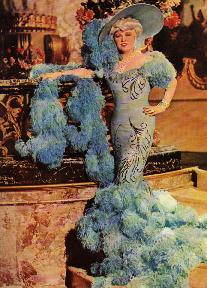
Contest entry bugbears: “When caught between two evils, I generally pick the one I’ve never tried before.”

/mae_blue.jpg

Today’s quote and picture have the same source, of course: Mae West, playwright of note, your hostess for today — and, harkening back to yesterday, an actress who certainly did her best work when she was writing her own material.

Why Mae, you ask? Well, while the sentiment above may not be the best guide to ethical living (and it would be darned hard to walk in that dress, so I wouldn’t emulate it, either), it’s not a bad motto for any artist aspiring to originality.

And true originality, contrary to what you might have heard on the writers’ conference grapevine, is one of the best selling points a manuscript — or a contest entry — can have.

Admittedly, this may seem like rather strange advice to those of you who have spent conference season after conference season being told endlessly by agents and editors that they are looking for books like this or that bestseller, but honestly, copycat books usually don’t sell all that well.

Witness how quickly all of those chick lit take-offs on BRIDGET JONES’ DIARY fell off agents’ hot lists, for instance. And just how many reworkings of THE DA VINCI CODE do you think the average agent saw immediately after it hit the bestseller list?

As Mae West liked to say, there are a lot of copies out there, but if you’re an original, no one can mistake you for someone else. No one remembers the copies.

Don’t believe me? Okay, name three books patterned after COLD MOUNTAIN. Or SEX IN THE CITY. Or, if you want to go farther back in time, CATCH-22.

I thought not. And there’s a pretty good reason for that: agents, editors, and yes, contest judges tend to get most excited by fresh concepts, not tired ones.

You’re all familiar with what the publishing world means by the term fresh, right? To borrow a page from my writer’s glossary:

FRESH, adj.: Industry term for an unusual look at a well-worn topic; marketable. The industry truism is that they’re always looking for an author who is fresh, but not weird. (Weird can mean anything from a topic never written about before to an unpopular political spin to a book proposal in a non-standard folder.)

Fresh is not a synonym for original, precisely, but a marriage of originality and proven marketability, a new spin on something they already know that they can sell. This is why, in case you were wondering, agents and editors so often say things at conferences like, “I wish aspiring writers would pay attention to what’s on the bestseller list.”

They don’t mean that they’re looking for replicas of what’s to be found there — or rather, they don’t mean that if they’re savvy. What they want is a book for which they know there is an already-existing audience (thus the reference to the bestseller list) that is DIFFERENT from anything else that’s out there.

Sound tautological? Not necessarily. But given how small a window of opportunity a book has to grab an agent or editor’s attention during a query letter or pitch, broad freshness (“It’s JAWS set in a kindergarten class!”) tends to have an easier time catching the industry’s eye than more complex storylines.

In a contest entry, however, you do have a bit more leeway: if the writing is good, a judge is more likely to give an entry the benefit of the doubt. You also have more wiggle room with both judges and Millicents alike if your book happens to be funny — and not just because actually humorous writing is genuinely rare.

With comedy, a writer can get away being downright original, because of the nature of the exercise: spontaneous laughs are, after all, often produced by surprising the reader.

Which is precisely why, as I have mentioned before, a successful comic entry should do everything it can to avoid being predictable. Trust me, there is absolutely nothing more predictable in a contest entry — or a contemporary novel, or a memoir — than humorous references to the current zeitgeist.

And isn’t that a coincidence? Last time, I suggested that one of the best ways to endear your contest entry to a judge may be to go through it carefully, excising as much of the humor based upon current pop culture references as humanly possible. Don’t worry that it will make your work seem less hip: since it takes so long for the average manuscript to hit the shelves, even if a reference is brand-new, chances are that it will no longer be current by the time the book comes out.

There’s a term for this in the industry: dated. And another: not fresh.

I hear some dissention out there, don’t I? “But Anne,” I hear some of you pointing out, “there are plenty of books published every year that are up-to-the-minute topical and/or hip. I can understand where they might not age very well, but isn’t the point of a contest entry or submission to wow the judge or Millicent NOW? After all, I could always change the pop culture references just before the book went to press, couldn’t I?”

That’s kind of a clever way to look at it, faceless theorizers, but that’s not really the way a contest judge tends to think. They want to reward books that are going to be on the shelves for a while.

And frankly, they’re perfectly aware that books-of-the-moment don’t tend to be perennial sellers. Which, in case you were not aware of it, is the way that most authors who make a living at it earn their bread and butter: not by selling millions of copies of one book in a given year, but by selling thousands of copies of several different books.

Bestsellers are the exception — thus the comparison inherent in the name — and have always been. And, if you’ll forgive my saying so, there are factors other than quality of writing that can lead to a book’s being a runaway hit.

Scandal, for instance. The writer’s already being a celebrity. Being endorsed by a celebrity. Being written by a very well-known author. A great publicity campaign. A publishing house that really believes in the book and is willing to put a great deal of time and money into promoting it.

Yes, it would be nice to think that any well-written book would receive the benefit of the latter, but realistically, the vast majority released in any given year by U.S. publishing houses are allocated less than $2,000 in promotion. (Yes, you read that correctly. I’ve been to small launch parties where the wine cost more than that.)

So while your garden-variety contest judge would most likely be thrilled if an entry she sent on to the finals ended up on the bestseller list, she’s not really expecting it. No, she wants to recognize a good book that stands a decent chance of getting published, even of winning further awards.

My, you’re antsy today, readers; could it be that you’re trying to get a contest entry out the door? “But Anne,” some of you cry, “while this is undoubtedly interesting, I’m up against a deadline. Today is not the day I’m worried about originality; I’m concentrated on making my work funny. You had mentioned something a couple of posts ago about a few tests I can apply to my writing?”

Ah, but there’s been a method to my madness: most of the tests I’m going to pass along touch on BOTH the originality and the humor level of the manuscript. These tests will highlight mistakes that should set off warning bells while you are revising — because, believe me, they will be setting off hazard flares in the minds of agents, editors, and contest judges.

But going through all of the tests (not to mention what to do if any part of your entry runs afoul of them) is going to take up quite a bit of blog space, so I shall be delving into that tomorrow. In the meantime, give some thought to whether anything in your entry could have been written by any sentient being in the universe other than you.

I’m quite serious about that, you know. Most aspiring writers take a number of years — or even a couple of books — to discover their own individual literary voices. The voices of the authors we admire tend to creep into our work without our realizing it.

And that’s just not good, either for comedy in general or comic contest entries in particular. Contrary to the oft-repeated truism, only conscious imitation could possibly be construed as anything remotely approaching flattery — and even then, I’m inclined to think the debt should be attributed openly.

I’m not going to give you an exercise for this — it’s up to every writer’s conscience to draw the line between being inspired by another artist’s work and lifting from it. The line is almost always pretty fuzzy.

But if you find instances in your entries or manuscripts where it isn’t, you might want to take those parts back to the revision board. Any given contest judge may have read and admired the same author you have, after all. Chances are, if it’s a living writer of any repute, a fairly hefty proportion of your target audience will have, too.

You want to win fame and fortune for YOUR literary voice and YOUR trenchant observations upon the human condition, don’t you?

The moral of the day: people still remember Mae West, my friends, not her hundreds of imitators. Here’s to all of us being originals on the page — and keeping up the good work!

PS: did anyone but me catch that big ol’ typo on the titles of the main network pre-Oscars red carpet show? It was a prime example of the kind of editing mistake one is likely to make when editing on a computer screen — and a problem that no spell-checker in the world would ever catch: it referred to the Oscar’s, not the Oscars.

Telling your life story to the judge, part II

tiger5.gif tiger5.gif tiger5.gif

Before I launch into today’s topic, campers, I have a bit of a modification to yesterday’s post. My interview on Dickien.fr is indeed located in the links I listed — here for English and here for French — but in order to leave a comment, readers will need to go to the site’s homepage and click on Commentaires. I know from delightful experience that many of you are inveterate web commenters.

Far be it from me to curtail your freedom of expression. That’s not my style. And frankly, it would be nice for the interviewer to hear that English-speaking readers are interested in my book.

Let’s get back to work.

After yesterday’s post on the advisability of quadruple-checking your memoir entries to make super-sure that they contain NO usages of your first or last name, I believe I heard some murmurs of dissent out there. “Wait just a second,” the voice in the ether I choose to attribute to my readers kept saying, “isn’t this tactic bordering on paranoid overkill? How is the judge ever going to know if I use my name? In a blind-judged contest, the judges never see the author’s name attached to the manuscript, and thus could not know that the name mentioned IS the author’s.”

Well, that’s a good point, disembodied voice. But you still shouldn’t do it for several reasons, all of which boil down to this: are you sure enough about that to risk your entry’s getting disqualified?

First, as I mentioned yesterday, such is the seriousness with which blind judging is taken that if a judge even SUSPECTS that an entry contains the author’s name, that entry may be toast. It doesn’t matter if the judge can GUESS who the author is — since the rules don’t call for complete negation of the memoirist’s identity, all they can catch you on is the use of your name. They watch for it like the proverbial hawks.

But, to be fair, it does not require much of a cognitive leap to conclude that the Sheila Mae who is narrating a memoir excerpt is, in fact, the same Sheila Mae who wrote it.

Second, it is not unheard-of for contests to employ (or, more commonly, impress volunteers into servitude as) initial screeners, whose SOLE function is to check the entries for rule violations before the entries are distributed to the judges who will rate them on more sophisticated bases.

These screeners sometimes do have your entire entry packet – and thus your name, and will be able to tell immediately if you have violated the don’t-use-your-name rule. So there.

Third — and while this one is the simplest, it is also the way self-namers are most often caught == even in a contest that does not pass entries under the watchful eyes of screeners, someone is going to have to slit open that envelope, if only to extract the check. Someone is going to have to note your name in the contest log, assign your entry the identification number that will allow it to be judged blindly, and pass your entry along to the proper section’s judges.

It’s a boring job. So tell me: how likely do you think it is that such a mail-sorter would glance at the first page of the entry, to render the process a trifle less tedious?

And how many memoir first pages have you ever seen that DIDN’T include SOME mention of the memoir subject’s name? I rest my case.

Except to say: I know that my harping on this is going to throw the more conscientious memoirists out there into a frenzy of proofreading. Actually, though, the entry where the writer has obviously made a determined effort to rid the document of his own name but missed a single instasnce is not usually the one that ends up getting disqualified. Oh, it will certainly get marked down, but probably not thrown into the trash.

So what kinds of violations of this rule DO tend to get the entry disqualified on sight? The one where the entrant clearly didn’t bother to read the rules, but simply printed up the already-existing first chapter and submitted it.

You’d be astonished at how common that is — and how obvious it is to the judges. At least, I hope you would be.

There is, as I mentioned yesterday, one absolutely foolproof, not very time-consuming means of avoiding the problem altogether, of course: use a pseudonym within the context of the entry, adding a note on your title page, STATING that you have changed the names in order to adhere to the rules of the contest.

“For the purposes of this entry,” you could write, “I have changed my family name to Parrothead.”

Yes, it’s kind of silly, but that way, you make it pellucidly clear that you’re not referring to yourself. And, after all, how is the judge to know whether you have substituted the names or not, if you do not say so?

Other good tip for memoirists entering their work in contests is to do a bit of market research prior to entry. (Actually, this is a good idea for anyone writing a book, and certainly for everyone who has to write a synopsis for a contest.) Are there memoirs currently on the market — and in case you were not aware of it, for the industry to consider a published book part of the market, a book either has to have been released within the last five years or have been a bestseller within the last ten — similar to yours?

To put it another way, is your memoir in fact absolutely unique, or does it fit into a well-defined market niche? If it’s the latter, is there a way that you can make its individual appeal to that particular segment of the market clearer in the pages you are submitting?

It is a question well worth asking before entering a memoir into a contest – or indeed, before trying to market it at all.

All of us tend to think of our own experiences as unique, which of course they are; every point of view is to a very great extent original. However, every memoir is about something in addition to the personality of the person writing it, right?

The frequency with which books on those other subjects turn up on the shelves of Barnes & Noble is definitely a matter of fashion; there are fads in memoir-writing, just as in any other kind of publishing, and you can bet your boots that if a particular subject matter is hot this year, the nonfiction rolls of every contest in the country will receive quantities of that type of memoir.

Remember, for instance, after Lance Armstrong’s book came out, and suddenly there were a zillion upbeat I-survived-a-lethal-illness memoirs?

Well, so do contest judges: they read thousands of them. Which meant, in practical terms, that it was quite a bit harder to wow a judge with an illness memoir in that period than at any other time in human history.

Also, certain life experiences tend to recur across a population with predictable regularity, and if you are writing about a well-trodden topic, it is IMPERATIVE that you make it clear in your contest entry PRECISELY how your book is different from the others currently on the market.

Because – and I tremble to tell you this, but it’s true – if you are writing on certain over-mined topics, even the most heart-felt prose can start those cliché warning bells pealing in the average judge’s brainpan.

This is not to say that your personal take is not worth telling – if you’re a good writer with a truly individual take on the world around you, it undoubtedly is. Remember, though, that judges tend to be reading for marketability, and if they perceive that you are writing in an already glutted submarket, your entry may not do as well as an entry on a less well-trodden topic.

Before you bemoan this, recall that not only do agents, editors, and contest judges get tired of seeing the same types of books over and over again; so do readers. Think about how many people suddenly started writing accounts of growing up poor immediately after ANGELA’S ASHES hit the big time, or about over-medicated, over-sexed teenagerhoods in the wake of PROZAC NATION, and plan accordingly.

Sheer repetition can wear down even the most conscientious judge after a while; remember, most contest judges do not judge a single contest only, but return year after year. Certain topics are perennial contest entry favorites.

The result? “Oh, God,” the judge whimpers, instinctively backing away from the papers in front of her, “not another well-written, emotionally rich story about a Baby Boomer daughter nursing her mother through her final illness, and in the process learning to heal the long-standing rift between them!”

Not that any of these judges have anything against women who care for their aging parents; nor is anyone is rooting for those life-long disagreements NOT to be mended. But honestly, after fifteen or twenty of these in a single year’s crop of entries — that’s not an exaggeration, incidentally — a judge does start to long for a nice entry about, say, someone who was mauled by a tiger. Or hit by lightning.

Or at least not following in the wheeltracks of Lance Armstrong.

Conditioned reflex, I’m afraid. Pavlov’s dogs salivated at the sound of a bell, and contest judges wince at the sight of the third similar entry of the day. That’s just the way they’re built.

So if you happen to be any of the following, you might want to give some serious thought to how your book ISN’T like the others: a former drug addict/alcoholic/workaholic rediscovering the beauty of day-to-day life; a former hippie/swinger/disco queen recounting his or her glory days; your magnificent weight loss or gain and how that journey made you a better person; a teacher from a white, upper-middle-class background who went to teach in the inner city; a new father confessing that he was not prepared for the practicalities of caring for children; a new mother discovering that motherhood is significantly harder than it is cracked up to be; anyone who worked at a dot com that went bust.

And any reworking of the concepts of THE DA VINCI CODE or the bestsellers of last year.

This is not to say that you shouldn’t bother to enter memoirs that encroach upon these well-trodden areas. You should, if that is the story you burn to tell.

But alert the judge to the ways your book is different and better as soon as possible: on page one of the entry, if you can, and within the first few paragraphs of the synopsis. And don’t just SAY that your book is unique: SHOW it.

For instance, if your memoir details your spiritual awakening, your discovery that the giant corporation for which you worked is corrupt — because, you know, that’s always a surprise — you might want to invest some time in market research to figure out how to make your book come across as fresh and exciting to jaded professional readers.

How? Well, if you check a well-stocked bookstore, or even run your subject matter through an Amazon search, you will get a pretty firm idea of how many other accounts there are that resemble your own, at least superficially.

Some of you are feeling a trifle grumpy at this prospect, aren’t you? I can’t say as I blame you, really. Try to
think of this research as practice for writing that inevitable book proposal.

(All of you memoirists are aware that memoirs are seldom sold on the entire book, right? I keep running into memoir-writers to whom this is news, so I will go ahead and say it: it is not necessary to have a completed memoir before selling it to a publishing house. As with other NF books, the average memoir book proposal contains only a chapter or two — and a WHOLE lot of marketing material.)

One of the best ways to make your work stand out from the crowd is to use the synopsis to show how YOUR memoir is QUITE different than the other memoirs on the subject — and knowing the existing memoir market will be most helpful in figuring out what aspects to stress. What made your experience special, unique, unforgettable from the point of view of a third party? Why couldn’t anyone else on earth have written it, and why will readers want to buy it?

If a reasonably intelligent judge could make it through your memoir entry without being able to answer these questions, you should probably consider a spot of revision before you mail off the entry.

“But wait!” I hear some of you cry. “My book may be on a common topic, but my literary voice is unique! But I can hardly say in my synopsis, this book is different from others on the market because it is better-written, without sounding like a jerk, can I?”

Well, no, but unfortunately, if you are writing about a common experience, you also probably cannot get away with assuming that the writing alone will differentiate it from the other submissions. Again, if there’s recently been a bestseller along similar lines as yours, yours will almost certainly not be the only entry that resembles it.

To put it another way, you can’t be certain that the finding a sense of wholeness after the death of a loved one memoir that the judge read immediately before yours was not written by Emily Brontë and Gustave Flaubert’s oddly gifted spiritual love child, can you?

Sad but true, if you are writing on a common topic, the bar automatically goes higher, alas, for making YOUR story stand out amongst the rest. You really have to knock their socks off, to an extent that you might not if your topic were not popular that year.

Sorry.

No need to turn your synopsis into a back jacket blurb, but do show how your work is UNLIKE anything else the judge is going to read. Yes, each judge will have your chapter, or few pages, or however much the contest allows you to show him, but sometimes, the difference between a “Thank you for entering” letter and one that says, “Congratulations – you’re a finalist!” is a synopsis that makes the case that THIS entry, out of the half-dozen entries on the same general topic, is the one that is going to hit the big time.

Yes, yes, I know: I’m asking a lot of you here, but I’m positive that you can do this.

You want to know how I know? Because a writer with the staggering courage and honestly to write a truly self-revealing memoir, rather than one that simply makes the self look good, is a writer who has had to master many subtle writing skills. Call me zany, but compared to laying your soul bare on paper, doing a little market research and a bit of book promotion is a walk in the park.

Not a very pleasant park, true, but still, not a minefield. Keep up the good work!

That pesky contest synopsis, part III: an entry synopsis that stands out from the crowd, or, baa humbug

sheep-iv-jpeg.jpg

Yes, the pun is a terrible one, but I’m in a giddy, hopeful mood today; specifically, I’m hoping that those rumors I’ve been hearing about an any-second-now settlement to the screenwriters’ strike are true. I’ve been hearing them from increasingly credible sources all week; if you picture an Oscar statuette whispering in my ear today, you wouldn’t be far off. Fingers crossed for all of those talented people getting back to work on reasonable terms.

For the past couple of days, I’ve been talking about how and why a successful contest synopsis and a killer submission synopsis can and should be different. I have to say, I had expected to hear a little more groaning from the peanut gallery about this — I am, after all, suggesting that you write a 3 – 5 page summary of your book for contest submission that you will pretty much never be able to use for any other purpose on God’s decreasingly green earth.

See? Nothing. You people must be getting desensitized to the idea that reading this blog may lead to more work for you.

Frankly, I think that nonfiction entrants typically have a harder time producing a winning synopsis — or perhaps I merely think that because I have more often been a judge in nonfiction than fiction categories. For fiction, the task at hand is a bit closer to writing a submission synopsis: tell a good story in a reasonable amount of juicy detail.

If this sounds vaguely familiar to those of you who suffered through last summer’s Book Marketing 101 series, you have an excellent memory: this is more or less the goal of the 2-minute pitch as well.

You would be AMAZED how few contest synopses-writers seem to realize that the point is to tell a terrific story, though. Seriously, in my experience, usually under 10% of the entries include synopses that indicate storytelling ability, rather than going through a rote exercise in summarization.

Where do the other 90% go wrong, you ask?

As I explained yesterday, all too often, writers just state the premise of the novel, rather than taking the reader through the plot, blow by blow. If the plot has twists and surprises, so should the synopsis. Show the story arc, and make it compelling enough that the judge will scrawl on the evaluation sheet, “Wow, I want to read this book when it comes out.”

Trust me, pretty much every contest winner and placer’s evaluation sheet has this sentiment, or something very similar to it, scrawled upon it in a judge’s hand. So make it your mission in the synopsis to evoke that wonderful response.

Yes, I know: it’s a tall order. But don’t forget that the synopsis is every bit as much an indication of your writing skill as the actual chapters that you are submitting. Both need to be compelling reads that draw the reader into the story you’re telling.

The easiest way to get the judges involved is not merely to summarize the plot as quickly as possible but to give the feel of a number of specific scenes. Don’t be afraid to use forceful imagery and strong sensual detail, and try to have the tone of the synopsis echo the tone of the book.

Yes, you read that correctly, too: a good synopsis should be written in the same voice as the book, for both contest and for submission. Changes the way you think of the synopsis, doesn’t it?

Again, this should sound familiar to some of you: a good pitch conveys the same tone as its book, too.

So if you’re writing a comedy, you had better make sure that the judge at least chuckles a couple of times while reading your synopsis — and, word to the wise, as nothing is more stale than a joke told twice with a ten-minute period, repeating the same funny line in both chapter and synopsis is not the best means of invoking hilarity.

A sexy book deserves a sexy contest synopsis, too, and a thriller’s synopsis had better be, well, thrilling. If your horror synopsis doesn’t make the reader blanch (try it out on strangers in a coffeeshop), add gory details until it does.

And so forth. You’re a writer; you’re good at this sort of thing.

For nonfiction, the assignment is slightly less straightforward: yes, you need to make it plain that you’re a good arguer making an intriguing argument, but it would also behoove you to include certain elements of the book proposal that you would never include in a submission synopsis.

Some indication of the target market, for instance. A passing reference to why your book is better at conveying this set of information than anything currently on the market. A miniscule tease about how the publication of THIS book, as opposed to any other entered into the contest, will make the world just a little bit better for those who read it.

Why shouldn’t you include these in a synopsis sent along with requested materials? For starters, it’s redundant with the both the book proposal and, most likely, with the query letter as well.

Think about it. You might, if an agent’s listing or website asked for it, include a synopsis with your query letter, but really, if you’re going to make the case that the agent should drop everything and read your book proposal, the argument belongs in your query letter. (For tips on how to construct this type of case, please see the HOW TO WRITE A QUERY LETTER category on the list at right.)

You MIGHT be asked to send a synopsis along with requested materials, but for nonfiction, an agent or editor is far more likely to ask to see the entire book proposal — which, naturally, would include entire sections on who the target audience is, why they would benefit from your book, and how your book is different and better than anything remotely similar currently on the market. (For some insights on the various necessary components of a NF book proposal, please see — you guessed it — the BOOK PROPOSAL category at right.)

For a memoir, admittedly, an agent is slightly more likely to ask to see the first couple of chapters plus a synopsis, but still, most memoirs, like other nonfiction, are sold on proposals, not the entire manuscript. (And no, I’m not sure why there are so many sources out there that say otherwise. I’ve sold two memoirs to publishers without having written more than the first chapter and a proposal for either.)

But as I mentioned yesterday, the trick to a memoir synopsis, for a contest or submission, is much closer to the goal for fiction: it needs to sound like a great yarn well told. What it does NOT need to be and should not be is an extended discussion of why you decided to write a memoir in the first place.

For some reason, it is hugely common in contest synopses for memoirists (and sometimes other NF writers as well) to treat the synopsis as though it were a response to an impassioned crowd storming their writing spaces, demanding to know who the heck the author is, to think he has the right to think his pet topic might interest even a single other human being, let alone thousands or millions. Defensive does not even begin to describe it.

A LOT of contest synopses go off on these tangents, to the detriment of the entry, and it costs them a plethora of presentation and professionalism points. Which means, unfortunately, that an experienced judge’s knee-jerk response to a synopsis that engages in this practice even a little tends to be exaggerated.

Yes, I am saying what you think I’m saying: “Next!”

“Wait just a minute!” I hear some of you out there saying. “Why is personal revelation regarded as a sign of a lack of professionalism? In a memoir, I would think that it would be downright desirable. Why aren’t my reasons for writing my own life story worth mentioning in the contest synopsis?”

It’s counterintuitive, isn’t it? In the eyes of the industry, though, there are only a few contexts where a lengthy discussion of why you chose to write a book is considered appropriate professional behavior:

(1) Within a nonfiction book proposal, where it is a necessary component to making the argument that you are uniquely qualified to write the book you are proposing. There, you may state your case in market terms in the section dedicated to that purpose.

(2) In a query letter or pitch, to show that you are uniquely qualified to write the book you are pitching. There, you may indulge in this impulse for as long as a couple of sentences.

(3) After you have signed with your agent, when she asks, “So, are there hidden selling points in this book that I should mention while I’m marketing it?” At that point, you may discourse for as long as it takes for the agent to drink a cup of coffee — or until her other line rings, whichever comes first.

(4) To your publisher’s marketing department just before your book is released, so they can include any relevant points in the press packet. They will be far more interested in your listing the addresses, phone numbers, and websites of every bookstore where any local might recognize your mug, but they’re going to want you to come up with a nice sound bite about why you wrote the book as well.

(5) Within the context of an interview AFTER the book is released. Interviewers LOVE hearing about writers’ motivations — which, I suspect is why aspiring writers so often want to tell everyone they see what is and is not autobiographical in their novels. So you can go to town after the book comes out.

(6) When you are chatting with other writers about why they wrote THEIR books. You can basically do this for the rest of your life.

Other than those few occasions, it’s considered over-sharing — yes, even for memoirists. In a contest entry, it is NEVER considered anything but self-indulgent.

Just don’t do it. In your contest synopsis, stick to the what of the book, and save the whys for later.

The only exception to this in a contest entry is if you have some very specific expertise or background that renders your take on a subject particularly valid. If so, make sure that information is stated within the first paragraph of your NF synopsis.

If you are writing a novel, and you feel that you have an inside perspective that simply MUST be mentioned to the judges, go back and reread that list above three more times. If you are still wedded to the idea after that, imagine me sighing gustily — then stick the information at the end of the synopsis, where it won’t be too intrusive.

For nonfiction, keep reminding yourself that your goal in a contest synopsis is threefold:

A) to show the argument of the book in some detail, along with some indication of how you intend to prove your case,

B) to show that the book will appeal to a large enough market niche to make publishing it worthwhile, and

C) to demonstrate that you are the best-qualified person in the universe to write the book.

In 3-5 pages, no less. Piece o’ proverbial cake, right?

In pursuit of Goal A, it is helpful to have an outline of your proposed chapters in front of you, so you can use the synopsis to demonstrate how each chapter will build upon the next to make your overall case. Even if you are writing a self-help book, history book, or memoir, you are always making a case when you write nonfiction, if only to argue that your take on the world around you is interesting, unique, and valid.

Make absolutely certain that by the time a judge finishes reading your synopsis, s/he will understand very clearly what this argument is – and what evidence you will be bringing in to demonstrate it. (Statistics? Extensive background research? Field experience? Interviews? A wealth of personal anecdotes? Etc.)

In doubt about whether you’ve pulled this off successfully? Hand your synopsis to an intelligent non-specialist in your area (intelligent adolescents are great for this), have him or her read it — then ask the reader to summarize the argument for you without looking at the paper. Take notes on what parts come back to you fuzzily: those are the parts of the synopsis that need work.

If you are pinched for space in your entry, you need only devote the first paragraph to marketing information. State outright why the world needs your book. If you are writing on a subject that is already quite full of authorial opinion, make it plain why your book is different and better. As in:

Have you ever wondered what goes on underneath the snow while you are skiing on top of it? Although there are many books currently on the market for snowboarding enthusiasts, MOUNTAINS MY WAY is the first to be written by a geologist.

If you have statistics on your prospective market, this is the place to mention them, as you would in a query letter or book proposal. Remember, one of the things that the judges are evaluating is the book’s marketability — how likely is a judge who thinks your target market is a quarter of its actual size to give you high marks? Go ahead and minimize this possibility:

There are currently 2 million Americans diagnosed with agoraphobia, yet there are few self-help books out there for them — and only one that is actually written by an agoraphobic, someone who truly understands what it feels like to be shut in.

The third desiratum is what is known in the industry as your platform. Admittedly, it is a trifle hard to explain why you are THE expert best qualified to write this book without saying a little something about yourself, so you may feel as though you are slipping into the realm of author bio, a potentially dangerous strategy in a contest where you might get disqualified for inadvertently mentioning your first name.

But rest assured, no one is going to disqualify you for mentioning that you have a Ph.D. or went to a specific culinary school. Go ahead and state your qualifications – just don’t slip up and mention yourself by name. As in:

A well-respected Seattle area caterer for twenty years, the author has extensive experience in crafting meals for the pickiest of eaters.

SHELLFISH AND YOU is the fruit of many years of postdoctoral research. The author, a graduate of the prestigious Scripps School of Oceanography, is recognized worldwide as an up-and-coming authority on mollusk behavior.

If your head is whirling from all of this – and whose wouldn’t be? — don’t worry. I’ll go into some tips on how to simplify the contest-writing synopsis process tomorrow. In the meantime, keep up the good work!

(PS: today’s photo appears courtesy of FreeFoto.com.)

That pesky contest synopsis, where once again we see the value of that old literary bugbear, show, don’t tell

spiral-jpeg.jpg

I’ve spent the last week plus talking about the various types of literary contest that an agent-seeking writer might conceivably want to enter. As a freelance editor and not infrequent contest judge myself, I’m eager to move on to the nitty-gritty, how to make the small tweaks that often make the difference between reaching the finalist round and not — and avoiding the big mistakes that scuttle most entries before the end of page 2.

Not that I’m ambitious or anything.

Since I’m not gearing this series to a particular contest’s deadline, as I did last year (for the reasons behind that decision, please see my January 22 post), I’m going to put off discussion of the small points to concentrate for a few days on an aspect of contest entry that seems to frustrate nearly every entrant: the synopsis.

Why? Well, if you are entering a category that covers book-length material, you will pretty much always be asked to submit a synopsis — and since contest rules often specify an overarching page limit intended to cover both the submitted chapter and a synopsis for the whole book, many entrants yield to the temptation to skimp on this important part of the contest puzzle.

To summarize what promises to be several days’ worth of advice in a word: DON’T.

Contrary to widely-held writerly belief, a synopsis typically weighs MORE heavily in a contest entry’s success than in a submission to an agency’s, not less. Not to give away trade secrets or anything, but synopses tucked inside submission packets are not even always read — generally speaking, our pal Millicent the agency screener reserves that honor for those manuscripts she reads in their entirety.

Which is to say: not very many.

But the synopsis that accompanies a contest entry virtually always receives some critical attention.

Last September, just before I slid into the wonderland of glee that is mononucleosis, I spent a couple of weeks on how to write a stellar synopsis for querying agents. (Now well hidden under the startlingly opaque category title HOW TO WRITE A SYNOPSIS. Why oh why do I not make these things easier to track down?)

Unless any of you kick up a hue and cry, demanding that I revisit the issue now (anyone? Anyone?), I’m going to proceed on the assumption that most of you have already mastered the basics of writing an (ugh) synopsis. Now, I would like to focus on the differences between a synopsis that might wow an agent and one that might impress a contest judge.

In answer to that vast unspoken question my readership just flung in my general direction: yes, I am indeed suggesting that you write a separate synopsis to accompany contest entries.

Before you rend your garments and trouble heaven with your bootless cries on the subject of all of the extra work I tend to suggest above the bare minimum, hear me out. I’ve seen a LOT of otherwise excellent contest entries scuttled by bad synopses.

Bad how? Well, most entries read as though their authors regarded them as — get this — an annoying nuisance to be tossed off as quickly as humanly possible, generally in as few pages as feasible. Exactly as if the writing there were not being judged, too, in addition to the writing in the submitted chapter.

Did I just hear about 5,000 of you suck in your breath sharply in surprise? A surprisingly high percentage of entrants seem to be unaware that the synopsis is part of the writing being evaluated in a contest, just as in a submission.

I’ve said it before, and I shall no doubt say it again: every word of your writing that passes under the eyes of a professional reader is a writing sample.

Treat it accordingly.

Another common mistake is to submit a too-terse synopsis, presented in what is essentially outline form. (Sometimes, writers present it literally in outline format, believe or not.) Short on the sensual details and plot twists that enliven a story, they give no indication that the author is a talented storyteller. Just that s/he is darned good at making lists.

See my note above about every word of an entry being a writing sample.

Bearing that in mind might help a hopeful entrant from avoiding the frequent fault of repeating entire phrases, sentences, and even paragraphs from the entry itself. Trust me, judges are born nit-pickers: they’re going to notice.

(As will Millicent the agency screener, incidentally; it’s one of her predictable pet peeves.)

It’s also becoming increasingly common to conflate a screenplay synopsis — which typically has separate categories for action and major characters — with a literary synopsis, which is a linear, one-piece narrative concerned with plot for fiction and argument for nonfiction.

Remember how I mentioned yesterday that there are certain problems that prompt judges to slide an entry prematurely into the non-finalist pile as soon as they appear? This is one of ‘em.

Why? Well, such a synopsis makes it so very apparent that the entrant has not learned the norms of the literary world — and as I mentioned last time, one of the things being evaluated in a literary contest is a book’s marketability. To put the prevailing logic bluntly, the vast majority of judges will prefer an entry that is professionally presented — that is, one that adheres to standard format and resembles what a top-notch agent would expect to see in a successful submission — over even a brilliantly-written submission that does not conform with these standards.

Or, to put it another way, with many, many good entries, few judges are going to be willing to waste finalist space on an entry that flouts the expectations of submission. They want to promote writing that has a fighting chance in the marketplace.

Seriously, I’ve seen this criterion included on judges’ rating sheets.

Another type of synopsis that tends to elicit this knee-jerk reaction is the one that does not summarize the plot or argument of the book at all. Instead, it reads like promotional copy: This is the best book about the undead since Interview with the Vampire! This cookbook will change cuisine as we know it!

Or, even more common: This is the moving, insightful, beautifully written story of two kids in love.

Clearly, the entrant has confused a synopsis with a back-jacket promotional blurb. Judges are seldom amused by this, for precisely the same reason that Millicent tends not to be: they want to make up their own minds about how good/important/marketable a piece of writing is, not have it announced to them.

Once again, an old nag from the writing advice stable may be trotted out to admonish us all: show, don’t tell, the high quality of your writing.

The final frequent strategic error is also often seen in submissions to agencies: devoting virtually the entire synopsis to the premise of the book, often to the exclusion of the major conflicts of the book or the ending.

The usual authorial justification for this, of course, is I don’t want to give the ending away. Understandable, of course — were these writers not asking the judges to recognize the high quality of a book that they’re not going to read in its entirety.

Surely, it isn’t SO unreasonable for the judges to want to be provided with proof that the author has at least thought through the ending of the book, as well as the beginning?

Of course, any entrant is free to interpret the synopsis requirement as s/he pleases, but it’s only fair to tell you that in every contest I’ve judges, none of these synopses would have made it to the semifinalist round, much less been seriously considered for the top prize.

As if all that weren’t enough to make even the bravest first-time contest entrant tremble like a leaf at composition time, contest synopses often need to be shorter than submission synopses — which means that writing them is often harder.

Why harder? Well, most contest entries set absolute maximum page limits, which means page space will be at a premium. For instance, if the chapter you want to submit is currently 23 pages long, and the page limit (exclusive of title page, which is never counted in a contest’s maximum page count) is 25, you’re either going to need to shorten your already-existing synopsis to 2 pages or make some serious cuts to your chapter to permit something longer.

Guess which option most contest entrants pick?

Yep, you guessed it: contest judges see many, many single-page synopses. Unless the contest rules actually call for it to be that short, however, those synopses tend to lose style points for the entry — because, after all, it’s pretty hard to tell the story of a reasonably complex book within a couple of dozen lines of text.

Even if the contest rules specify an absurdly short synopsis (or make it sound shorter by calling it a plot outline), PLEASE do not give into the quite substantial temptation to fudge a little to stay within the specified parameters. Even if you have been asked to produce a 3-paragraph synopsis of a 500-page book, DO NOT single-space it, shrink the print size, or fudge the margins to make it fit within the specified limits, unless the contest rules say you may.

Why am I being so adamant about this? Simple: if you do it, you will get caught and penalized.

It’s kind of a no-brainer for the judge, actually. Trust me, if the rest of your entry is in 12-point Times New Roman with 1-inch margins, double-spaced, almost any judge is going to be able to tell right away if your synopsis is presented differently.

Because judges are expected to rate entries for professional presentation, unless contest rules specify otherwise, NEVER allow a contest synopsis to run over 5 pages or under 2.

Why those limits? A synopsis that is much shorter will make you look as if you are unable to sustain a longer exposition; if it is much longer, you will look as though you aren’t aware that a 3- to 5-page synopsis is fairly standard in the industry.

If this is starting to sound a bit repetitious, congratulations — you’ve grasped a fundamental truth about literary contests. An entry’s synopsis, just like its chapter(s), is subject to judging for clarity, coherence, marketability…and professionalism.

Which is why a synopsis that reads like a SYNOPSIS is almost always going to receive higher points than one that sounds like a back-jacket blurb (My writing teacher says this is the best novel since THE SUN ALSO RISES!) or an exposition on why the author chose to write the book (It isn’t autobiographical, but…).

Instead, if you are entering fiction, make sure that the novel sounds engaging, marketable — and like the best yarn since TREASURE ISLAND. For a memoir, ditto. And for other nonfiction, present the argument as fascinating and rigorously supported.

But use the synopsis to SHOW that your book is all of these things, not to tell about it.

Admittedly, that’s a fairly tall order. Don’t worry, I shall be giving some tips o’ the trade in the days to come, to give your synopsis some platform heels. Perhaps even a ladder, to enable it to stand head and shoulders above the other entries.

Before that metaphor falls of its own weight, I’m going to sign off for the day. Keep up the good work!

A few words on feedback, part XI, in which I finally stop yammering on the subject and move on

snapshot-2008-01-11-20-28-46.jpg

Welcome to what I devoutly hope will be my last post for a while on strategies writers can use to wrest good feedback from their first readers. Last time — and probably a few times before, knowing me — I brought up the deer-in-the-headlights look that first readers often exhibit when asked post-read for commentary both more complex and more potentially usable than Oh, yeah, I liked it.

One would think that they might have at least suspected that some follow-up questions would be forthcoming, but I have it on good authority, through the excellent medium of listening to writers complain lustily about it for many years straight, that it isn’t always the case. Why, only a few days ago, intrepid reader Nadine posted an interesting observation about this phenomenon, in case you missed it.)

For the past few days, I’ve been talking about steps a writer can take to minimize the possibility of finding herself post-read without reader feedback that can be incorporated in the next draft. Today, I want to turn the question around, to discuss why intelligent, articulate first readers so often have this reaction.

Even when they loved the book. Strange but true.

In practice, first readers new to feedback-giving almost always experience some difficulty giving specific feedback. Oh, they may not say so point-blank, but you may notice them freaking out a little if they are asked pointed questions, as if the author had abruptly transformed into an IRS agent conducting a five-year audit.

If you doubt the pervasiveness of this reaction, you might want to spend a little more time at author readings. Audience members frequently freeze up if the author of a published book responds to their praise (or, heaven forefend, to a simple request to autograph the book) with, “Thanks — what was your favorite part?”

Note to self: don’t do this at future readings.

I don’t think that this reaction is due to a pervasive public perception that authors are godlike beings before whom the average reader should quail. (As much as some of us might like that to be the case.) No, ask for a detailed analysis of pretty much any written material, and most readers will suddenly find it difficult to breathe.

Even — and I find this fascinating — people who habitually recommend books to their friends will often balk if put on the spot.

As a former professor, I can tell you exactly what that panicked flash in their eyes means: it’s the fight-or-flight response of a student suddenly tested on material he thought would not be on the test.

Poor souls, when an author asks their opinion of his book, they think they’re being asked IF they liked it, not why. If they didn’t know that they would be expected to cough up a more detailed response — usually why a writer seeking feedback asks first readers to start turning pages in the first place, right? — they tend to feel as defensive as if the author told them their opinion was wrong.

As if the author above had said to them, “You actually LIKED that trash? In heaven’s name, why?” rather than, “Please tell me what I did right in this book, so I may cater to that taste in my next, the one that my agent is breathing down my neck to produce while I’m on this book tour,” or even, “I am a seething mass of insecurities; please reassure me.”

What we have here, in short, is a failure to communicate.

Now do you understand why I’ve been so insistent about giving your first readers a study guide, so they’ll {know} what’s going to be on the test and can prepare accordingly? It’s the best way I know to bridge the communication gap and nip this common anxiety in the bud.

I’m not just saying this because I was the prof who habitually stopped mid-lecture to announce, “Gee, wouldn’t THAT make a fabulous final exam question? Let me repeat it a couple of times, so you can write it down.” (And yes, my department did hate that I did it; thanks for asking.) From the unprepared reader’s POV, being grilled by an anxious author is like a pop quiz on material read for fun.

They tense up because it’s not fair, strictly speaking.

Writers are far less likely to have this response, of course, for obvious reasons: usually, we were the folks who ruined the grade curve in English class. Hand us an essay question about a book we like (or hate), and we’ll go on for hours, won’t we?

But just for a moment, let’s try to identify with the vast majority of the population that does not instinctively respond with joy to being asked to produce a book report on the spot.

Do you remember that professor in college or that teacher in high school who used to madden you at exam time with vague questions, ones so broad that they essentially invited you to spill out every minor fact you had managed to memorize? Compare and contrast the Renaissance with the Middle Ages, for instance, or Was the League of Nations a good idea? or The Emancipation Proclamation: what were the arguments on both sides?

How about the ever-popular ploy of giving you a quote, and asking you to relate it to the reading? Perhaps something along the lines of this little gem:

“There is no ‘objective’ or universal tone in literature, for however long we have been told here is. There is only the white, middle-class male tone.” — Carolyn Heilbrun, WRITING A WOMAN’S LIFE

Relate this quote to the works of Jane Austen, James Baldwin, Dave Barry, Truman Capote, Charles Dickens, Jeffrey Eugenides, Norman Mailer, Yukio Mishima, Anaïs Nin, Philip Roth, Edith Wharton, and Marvel Comics. Make your answer text-based, and use specific examples.

Students look at this sort of question and wish that they would be struck by bolts of lightning on the spot. Which, in essence, they have.

“What the heck does ‘relate’ mean in this context?” they wonder, surreptitiously sharpening their pencils into weapons of mayhem. “What if I accidentally cite a DC Comic instead? Will I lose points?”

I like to call this the what color am I thinking? school of test-construction, because it requires the students to guess, with virtually no guidance, what the teacher wants to see in the essay. Short of sophisticated telepathy, how on earth is the student supposed to know what criteria will be used to judge her response?

We’ve all had teachers who put us in this uncomfortable position, right? My dissertation advisor used to favor rambling quarter-page ruminations on the nature of life, without out ever articulating a question she desired students to answer. Because I value your time and my page space, I shall not reproduce one of her opus here, but trust me, those questions were epic.

My high school biology teacher, even more vague than most, simply walked into class on the day of our big plant life exam, handed each of us a three-foot-long stretch of butcher paper, and told us, “Show me everything you know about plants.”

Half of my classmates instinctively clutched their chests, anticipating a heart attack. Did Mr. Young intend this as an invitation to draw lilies for an hour, an instruction to reproduce the entirety of The Origin of Species, or an entreaty to write haiku? No one knew until after the exams were graded.

Are these examples dredging up your long-buried responses to the kinds of exams that drove you nuts in school? Got that I-can’t-believe-this-is-really-happening feeling firmly in mind?

Well, first readers given no guidance by the authors who have handed them manuscripts often feel as annoyed and helpless as you felt when faced with those kind of vague exam questions.

Especially if they’ve never read a manuscript (as opposed to a book) before. The format is substantially different, for one thing (if that’s news to you, I would implore you to visit the FORMATTING MANUSCRIPTS and/or STANDARD FORMAT ILLUSTRATED categories at right with all possible speed), and let’s face it, it’s an intimidating thing to be faced with the task of evaluating the creative output of someone’s soul.

Unless, of course, you have an ego the size of New Zealand, are being paid to do it, or both. Even then, it’s intimidating at first, but there are compensations.

If it’s any consolation for those of you who were told that your English degrees had no use in the real world, editors at publishing houses took those essay tests, too, and aced ‘em. And now, bless their hearts, they have transformed those bsing compare-and-contrast skills into a life’s work.

If you are using folks without either of those advantages as first readers, providing written parameters for criticism at the same time that you hand over your manuscript is an easy way to minimize the potential for future misunderstandings.

There’s no need to turn it into a major research project, or to inundate your readers with ten-page lists of questions. Stick to a simple 1-2 pp. questionnaire about the book, highlighting the areas you feel could use some work.

For the sake of your ego, it’s also a dandy idea to include questions about parts that you know you have pulled off well. Even if you are not prey to nagging doubts about the quality of your writing in the dead of night — if you are, trust me, you are far from alone — I can virtually guarantee that at some point along even the most bump-free road to publication, you will appreciate having some concrete reasons to feel good about your book.

In case any of you had heard otherwise, very little about the publication process is designed to {reduce} a writer’s insecurities. Yet another reason that a good fit with one’s agent is a positive boon to an author: who better to reassure you about your inherent talent, worth as a human being, and general fabulousness while your book is making the rounds of editors?

But I digress, don’t I?

In your list of feedback criteria, be as specific as you can — questions along the lines of What did you think of my protagonist? tend to elicit less helpful responses than Was there any point in the book where you felt the tension lapsed? If you would appreciate references to specific page numbers (trust me: you do), either ask your reader to keep a list of ‘em or provide some sort of easily-attached tape flags.

I always like to add some offbeat questions, to make the process more amusing for the reader. Did anything in the book make you laugh out loud? and What in the plot surprised you most? can provoke some revealing responses.

If those of you who haunt critique groups have started to wonder if coming up with such a list for fellow members wouldn’t be such a terrible idea prior to exchanging manuscripts, give yourself a gold star for the day.

It’s a good idea to tell your reader up front HOW you would like to receive feedback, too. It honestly isn’t self-evident. In the margins? On a separate piece of paper? As a bullet list to accompany verbal communication? Remember, the more writing you ask to receive, the more of a time commitment you are requesting, but unless you take shorthand or have a tape recorder always handy (which not all first readers will appreciate; ask), it’s hard to keep in mind everything said within a context of a conversation.

Think VERY carefully whether you really do prefer verbal feedback, though. Receiving critique can be a pretty intense emotional experience; if you don’t think you can keep saying, “Rework the running order completely? Thank you for suggesting that,” for half an hour straight, asking for written feedback may well be a better choice. (As a fringe benefit, it’s also more likely to be detailed.)

Oh, and do remember to mention up front whether you would like the manuscript back after the reader finishes with it; unless you ask for marginalia specifically, most readers will assume that it is theirs to keep — or recycle, as they see fit. If you expect its return and your first reader lives far away, it’s courteous to send along a SASE.

This is especially true if your manuscript is longer than the reader may have expected — just as agents and editors grow a trifle pale when a 600-page manuscript shows up in the mail, amateur readers tend to balk a little when handed a tome heavier than a lhasa apso. More pages equals more of a time commitment. If yours tops the infamous 400-page mark — where most pros would start to get nervous about marketability, incidentally — do tell your first reader that up front.

And finally, at every step throughout the process, observe my final tip: be HUGELY grateful for your first readers’ help — and express that gratitude early and often.

Yes, even if the feedback turns out not to be very helpful. As I keep mentioning, reading a manuscript with an eye to feedback is a far, far different thing than dipping into a book for sheer pleasure, no matter how polished the writing is. It’s hard; it’s merely polite to treat it as the favor it is.

The same holds true when you are the feedback-giver, to a certain extent: the more polite, specific, and clear you can be, the better the experience for everyone concerned.

Which means, of course, that if you find yourself on the receiving end of a manuscript, or in a critique group that does not already have guidelines for feedback established (fie!), it’s perfectly legitimate to ask for guidance BEFORE you begin reading. I’m quite serious about this: both you and the writer will be happier in the long run if you do.

And really, do you want to guess how someone you just met on an online forum or at a writers’ conference prefers to receive feedback? That’s the kind of challenge that can make even the best of readers freeze up.

You don’t want to trigger bad exam flashbacks, do you? Of course not.

As always, keep up the good work!

(PS: the nifty photo of the statue appears courtesy of the fine folks at FreeFoto.com, kindly filling in the gap until my digital camera is fixed.)

A few words on feedback, part VI: combing out the snarls

mae-jpeg-iii.jpg

This past autumn, when I was couch-bound with mono, my SO decided that it would be a good time to adopt a new cat, as reclining while slowly petting a nervous animal was about as much exercise as I could muster. Because we like pets with a past, he trolled the local animal shelter for a kitty down on his luck, bringing home the largest, filthiest feline I had ever seen: matted fur, crusted eyes, snaggle-toothed. (I believe he was orange, but it was a month before we were sure.) In time, the kitty calmed down and began cleaning himself again, an activity he’d apparently abandoned while incarcerated. Gradually, as he wore away more and more of his layers of grime with his tongue and I with my brush, he became shiny, even fluffy.

A few weeks ago, he looked up at me while I was brushing him, and I realized that he had very pretty eyes. It had merely taken months of care and security before he could show them off.

Being me, I instantly thought of what a good parallel that was for editing a manuscript.

Trust me, freelance editors see some pretty mangy manuscripts: the trick is often to see potential under the matted fur, because much of the time, the problem isn’t a lack of talent or inventiveness, but of structure. Or of a writer’s not having completely found his voice yet — it’s exceedingly rare to discover it in the first draft of one’s first book. Or even simply not knowing how a manuscript should be formatted.

In days gone by, agents and even editors at major publishing houses had the time to take a comb to a manuscript that showed promise, to groom it for the big show. Now, unfortunately, writers are expected to make their work camera-ready unassisted by the pros.

And that’s where a good feedback-giver is can be a real boon. Slowly, gradually, and often much to the writer’s chagrin, it’s possible to comb out the snarls, to reshape the beast into something closer to the carefully-groomed animal an agent or publishing house would expect to see. And every so often, editor and writer alike are stunned when something of startling beauty emerges.

I’m bringing this up today because just as it’s hard to see (without special mirrors, at least) the back of one’s own head to check for wayward tangles, a writer can’t always see the snarls remaining in a manuscript she has been polishing for a while. A kind outsider with a good comb can help reveal the beauty underneath the problem, but to do so takes courage: one runs the risk of being scratched.

A careless outside observer with a heavy touch and a lousy comb, however, is just going to send the writer scurrying under the nearest couch, yowling.

Funny how this analogy sprang to mind again as soon as I began writing about first readers who hang onto manuscripts forever, isn’t it? From the poor writer’s perspective, these sorts offer the prospect of a good, thoughtful book combing, but leave the manuscript out in the rain to tangle still more.

Some of you know what I’m talking about, right? Yesterday, when I was discussing the desirability of setting time limits for your first readers, I’m quite sure I heard some chuckles of recognition out there.

But I also have been sensing some puzzled silence from those of you who have never solicited non-professional feedback outside a writing group. “Why is she setting up so many restrictions on who would make a first reader?” I’ve heard some of you muttering over well-bitten fingernails. “Why is she advising building as many fail-safes into the exchange as one might expect in your garden-variety nuclear test facility?”

In a word: experience.

As I keep pointing out throughout this series, for a non-writer — or for a not-very experienced-writer, even — being handed a manuscript and asked for feedback can be awfully intimidating. Yet in a publishing environment where agents and editors simply do not have the time to give in-depth (or often even single-line) responses to queries, writers hit up their friends.

Friends who all too often are too polite to say no or, heaven help us, think that giving feedback on a manuscript-in-progress is a jaunty, light-hearted, casual affair, as simple and easy as reading a book on a beach. To be fair, writers proud of their own work and expecting people to plop down good money in bookstores for it frequently share this assumption.

A sharp learning curve awaits both parties. At least the writer is aware that some commentary over and above, “Gee, I liked it,” is expected.

Imagine the reader’s surprise when she starts reading, though, spots problems — and realizes that the writer might genuinely have expected her not to be a passive consumer of prose, but an active participant in the creative process. Imagine her surprise when she asked not just to identify what she dislikes about the book, but also to come up with suggestions about what she’d like better.

Imagine her surprise, in short, when she learns that it’s actual work. (Hey, there’s a reason I get paid for doing it.)

Writers tend to complain about the feedback they get from kind souls decent enough to donate their time to feedback, but let’s pause for a moment and think about the position of a friend impressed into first reader duty. Chances are, this friend (I’ll call her Gladys because it looks good in print) committed herself to reading the manuscript without quite realizing the gravity of the offer — or perhaps not even that she’d made a promise at all.

Okay, I hate to be the one to break it to you, but to spare you some chagrin: from a non-writer’s POV, “Oh, I’d love to read your work sometime” is generally NOT an actual invitation to share a manuscript.

Honest — for most people, it’s just a polite thing to say in response to the news that an acquaintance is a writer. Among ordinary mortals, a conversational “I can’t wait to read it!” may most safely be translated as “I’m trying to be supportive of you,” “I’m looking forward to your being famous, so I can say I knew you when,” and/or “I have no idea what I should say to an aspiring writer,” rather than as, “I am willing to donate hours and hours of my time to helping you succeed.”

Not everyone who likes to pet a passing kitty is willing to get busy working out the tangles in his coat, if you catch my drift.

This is why, in case you were wondering, the Gladyses of the world (Gladioli?) are so often nonplused when a writer to whom they have expressed such overtly welcoming sentiments actually shows up on their doorsteps, manuscript in hand.

Poor Gladys was just trying to be nice. For the sake of Gladys and every kind soul like her, please consider adhering to my next tip:

Make sure IN ADVANCE that your first readers fully understand what you expect them to do — and that no matter how gifted a writer you may be, reading to give feedback necessarily involves significantly more effort than merely reading a book.

Do I hear members of good critique groups shouting, “Amen!” out there in the ether?

As those of us who have been in the position of feedback-giver can attest, it’s not enough just to be able to spot the problems in the text — the additional challenge is to be able to phrase the requisite critique gently enough that it will not hurt to comb out those snarls, yet forcefully enough for the writer to understand why it’s a good idea.

In other words, it’s a hard enough challenge for those who already know our way around a manuscript. Imagine how scary the prospect would be for someone who didn’t. In my experience, 99% of casual offerers have absolutely no idea what to do with a manuscript when it is handed to them.

In fact, Gladys is generally dismayed when someone takes her up on her request. Like most people, dear Gladys did not have a very good time in school, and you have just handed her a major reading comprehension assignment; in a flash, you have become her hated 8th-grade English teacher, the one who used to throw his keys at kids who walked in late.

Don’t worry; the school district forced him into early retirement.

It’s not that Gladys doesn’t WANT to help, though. But in her sinking heart, she is afraid of the book report she is going to have to give at the end of the process.

So what does Gladys do? Typically, she doesn’t read the book at all. Or she launches eagerly into it, reading perhaps ten or fifteen pages, then gets sidetracked by the phone ringing or piled-up laundry or the need to go to work.

And that, my friends, is where the problems begin, from the writer’s perspective. Remember, our Gladys isn’t a writer, so she does not have much experience in wresting precious minutes of concentration time out of a busy day. So she sets it aside, in anticipation of the day when she can devote unbroken time to it.

Unfortunately for writers everywhere, very few people lead lives so calm that a week of nothing to do suddenly opens up for their lowest-priority projects.

However good her intentions may have been at first, somehow the book does fall to her lowest priority — and, like the writer who keeps telling himself that he can only work if he has an entire day (or week or month) free, our well-meaning Gladys wakes up in six months astonished to find that she hasn’t made significant inroads on her task.

Hands up, everyone who has ever been the writer in this situation.

I hate to leave you with a cliffhanger in the midst of our little tragedy, but like Gladys, time is running short in my day. But being a writer, and thus used to wringing time to write from a jam-packed schedule, I shall renew the tale tomorrow.

Trust me, appearances to the contrary, it can have a happy ending. Keep up the good work!

So you’re considering self-publishing, part IV: fiction

marys-cover-jpeg.jpgmarys-cover-jpeg.jpgmarys-cover-jpeg.jpgmarys-cover-jpeg.jpgmarys-cover-jpeg.jpg

For the past few days, I’ve been chatting with recently self-published authors Mary Hutchings Reed and Beren deMotier about what prompted their decisions to bring their books out themselves, rather than pursing the traditional agent + publishing house path, and what a writer who was considering such a step might want to know going into the process. Yesterday, I veered off from the roundtable format in order to ask Beren about the challenges particular to private publication of nonfiction.

Today, I shall be speaking one-on-one with Mary about what the publishing industry would regard an even more daring move on an author’s part: self-publishing fiction.

Why more daring? By any standard and at every stage, fiction is significantly harder to sell than nonfiction, whether you’re talking about landing an agent, approaching a major publishing house, or attracting a buyer’s attention in a bookstore. (That’s the reason that the major publishing houses kept looking at unagented nonfiction book proposals for many years after they stopped even considering unagented novels, in case you’re curious. Now, of course, the big five have policies that preclude reading either unless an agent hands it to them.) The prevailing wisdom has always been pretty adamant that novelists who self-published would have, to put it politely, a significantly harder time selling their books.

So from a traditional publishing point of view, Mary’s not just attempting a dive from the highest board; she’s doing a quadruple backflip during the Olympic trials while simultaneously holding lit sparklers in her teeth and playing The Star-Spangled Banner on the Sousaphone.

Which is why I was so eager to hear what she had to say on the subject. Self-publishing today is a very different thing than it was ten or even five years ago: author-financed books sell side-by-side with those produced by major publishers on Amazon and on bookstore shelves alike. Since it’s now possible to do short runs at very high quality for relatively low cost, the purchaser of a privately published book may not even be able to tell the difference between it and any other well put-together trade paper book.

And that, my friends, may mean a whole new ballgame for those of us who write.

But enough of my ruminations on the subject — let’s welcome back the pro.Mary Hutchings Reed, if you’ll recall, is the author of the fascinating COURTING KATHLEEN HANNIGAN:

marys-photo-jpeg.jpg marys-cover-jpeg.jpg

Courting Kathleen Hannigan tells the story of an ambitious woman lawyer, one of the first to join a male-dominated national law firm in the late seventies, whose rise to the top is threatened by a sex discrimination suit brought against the firm by a junior woman lawyer who is passed over for partnership because she doesn’t wear make-up or jewelry. When Kathleen Hannigan is called to testify, she is faced with a choice between her feminist principles and her own career success. Courting Kathleen Hannigan is a story for women and minorities everywhere who are curious about the social history of women in law, business and the professions, institutional firm cultures, and the sexual politics of businesses and law firms.

Again, in the interest of full disclosure: I should make it clear that Mary is a very good friend of mine– in case my ill-concealed enthusiasm for all things Mary had not already tipped you off — and, as I did with Beren, I offered her a blurb for the back jacket of her book. (I’m not entirely sure that she could have stopped me.)

Anne: Welcome back, Mary! You’re an incredibly prolific writer — musicals, short stories, legal texts, fiction — but Courting Kathleen Hannigan was your first novel, right?

Mary: Yes, it followed on my memoir, CAPTAIN AUNT, about blue water sailing and childlessness.

Anne: You have a tremendous eye for the story that has not been written before. When you first told me about COURTING KATHLEEN HANNIGAN, I couldn’t believe that an insider’s view of sexual discrimination at a major law firm hadn’t already been written. It seems like such a natural.

But when I went looking, there just wasn’t much out there written by anyone who wasn’t just guessing — as your book jacket puts it — what goes on behind those beautifully-veneered doors. What did you say when agents asked you to compare it to the current fiction market?

Mary: I tried, and still try, sometimes, to compare it to ONE L, Scott Turow’s novel about being a first year law student at Harvard.

Anne: But that’s pretty dated, isn’t it? It’s based upon Turow’s own experiences at Harvard Law — and given that he was already quite well established as an attorney before he wrote PRESUMED INNOCENT (1987), I tend to think that he didn’t graduate yesterday. It’s more up-to-date than THE PAPER CHASE (1970), I suppose, but in both novels, the subject is law school, not legal practice at a high-powered firm, and the protagonists are men.

Which is why COURTING KATHLEEN HANNIGAN isn’t like what was already on the market about the best of the best young lawyers.

Mary: And yes, to our minds, it’s a good thing, but to “them,” it’s proof no one is interested. What a strange business!

Anne: And yet it’s hard to imagine that there’s another writer out there who would be better qualified to tell this particular story with authority. As one of the first women to make partner in precisely the kind of fims Scott Turow likes to write about, you have a platform for this book that should have made agents and editors fall to their knees and weep.

Mary: I really detest the whole platform discussion. Makes it sound like all fiction is really just sugarcoating a lesson in something-or-other.

Anne: That’s very true. Fiction writers are asked — no, make that told — all the time that their work MUST be autobiographical, as though none of us had any imaginations at all, or as if every novel were automatically a roman à clef. Last year, an editor at a publishing house who was considering buying a novel of mine asked, in a tone of great trepidation, “Will your mother be angry when the book comes out?” Apparently, it hadn’t even occurred to her that my female protagonist might not be a thinly-disguised me, any mother in the book my mother, and so forth. It made me laugh at the time (and my mother laughed even harder), and of course, it’s a compliment to the realism of the novel, but it did bug me.

Have people been assuming that KATHLEEN is just a fictionalized account of your own life?

Mary: Oh, yes. Of course the book draws on my life experience, but there is no one to one correspondence between me and Kathleen Hannigan or any other character and any of my present or former partners or associates.

Anne : Do you think the autobiographical assumption discourages insiders in your profession from writing about it?

Mary: Because everyone who reads it looks to see if they are in it or if someone they know is in it (they think it’s a “tell-all”), there probably is a disincentive to want to publish a work like this.

I’ve stolen a line from a cartoon I saw, “Be nice to me or I’ll put you in my next novel!”

Anne : I always think: be nice to me or I’ll use you as a negative example in the blog.

But seriously, the autobiographical assumption is something I’ve been dealing with for my entire life: my mother and I regularly meet would-be Philip K. Dick biographers who positively refuse to believe that anything Philip wrote wasn’t completely autobiographical at base. He HATED that question.

Authors get it all the time, though. I read somewhere that long after Mary Wollstonecraft Shelley had established as a major novelist, journalists kept showing up and asking of her first book, “So, who was the REAL Victor Frankenstein?” as if she had just been sitting in a corner while a friend of hers raised people from the dead while she took notes.

Mary: It only so happens that this particular novel derives from my personal experience, which speaks for itself: I’ve been a partner at two of Chicago’s largest firms, and I get some instant credibility because of their names (Sidley Austin LLP and Winston & Strawn LLP) , and I’ve been named a leading lawyer in my field by several publications, and I’ve won some awards like a lifetime achievement award from Lawyers for the Creative Arts. I also have a fairly high profile in the pro bono legal community, including service on the Legal Assistance Foundation Board, the largest provider of civil legal services to the disadvantaged in Cook County.

Anne : (laughing) That’s not just a platform; that’s an entire building. With all you do, I’m continually astonished that you find TIME to write.

Mary: I’ve written one memoir, six novels, two musicals. and one play plus some short stories and essays since I started trying to learn how to do this in 1993. People think I’m terribly prolific.

Anne : (laughing again) I can’t imagine why they’d think that.

Mary: Here’s what I tell them:

1) I write every day, at the same time, first thing because this is my first priority.

2) If you write a page a day, at the end of the year, an agent will say you have 65 pages too many.

3) I like to write a few pages a day if I can and revise something every day. I’m constantly going back as much as I’m going forward in the process of writing any given novel.

Anne : With that schedule, how long did it take you to write COURTING KATHLEEN HANNIGAN?

Mary: It probably took a year and a half to write the first draft — 450 pages, and another year plus to reduce it to 300 and revise, revise, revise it. I’m a fast writer of first drafts and a constant reviser.

Anne : Me, too — and I have to say, it’s been my experience that a willingness to accept that one’s baby SHOULD be examined with an eye to revision tends to be one of the differences between writers who make it and those who end up giving up. Almost nothing we see on bookstore shelves is a first draft, after all, and agents and editors think of a book as a work-in-progress until it’s actually in the hands of the distributors.

With a writing schedule like yours, how do you handle writer’s block? Or are you one of the lucky ones who doesn’t get it?

Mary: Not really. I have times when I get my priorities screwed up and don’t put my butt in the chair first thing in the morning.

But I’m a firm believer that if I show up, so will the muse, even if I have to type
“I don’t know what to write” a hundred times. Something comes. But it doesn’t come if I’m not ready at the computer to receive it.

Anne : I wish more aspiring writers realized that; I know so many really talented people who keep saying, “When I have a month free, I’m going to tackle this.” But in most of our lives, those months don’t happen that often. If you keep putting off starting — or continuing, or finishing, or revising — books tend not to get done all.

At what point did you start to think of yourself as a writer who happened to be a lawyer, rather than a lawyer who also wrote?

Mary: Writing is something I’ve always wanted to do. When we were in my early forties, my husband said one day that we would hate to die without having sailed across the ocean.

That got me thinking — what was it that I could say that about? And the answer to me was real clear: I wanted to write a novel.

Anne : AND you and Bill sailed across an ocean, or at least across quite a bit of one.

Mary: Bill took a year off from working (he’s a doctor) and Winston gave me an unpaid sabbatical — I took 3 months–and in 1992 we sailed from Norfolk, Virginia to St. Thomas in our 32-foot sailboat, just the two of us. We covered 1600 miles and spent 22 days and nights off shore.

We had 3 very bad storms, and it kind of put things in perspective for me. I understood priorities. I was never going to be able to write a novel and do all the other things I wanted to do if I continued to practice full time as a partner at Winston. I left the partnership and became Of counsel.

Writing my first novel was the hardest thing I’ve ever done. There’s so much to learn, craft-wise, even simple things like getting your characters up and showered and fed every day, moving them across the page!

Anne : That’s another trait that authors who are in it for the long haul tend to have: a willingness to keep adding to that writer’s tool bag. You participate in a couple of critique groups, don’t you?

Mary: It’s where I’ve learned the most. Weekly with Enid Powell, an Emmy award-winning writer, and a monthly novel-writing workshop with Fred Shafer of Northwestern University. It is extremely useful to get feedback from other writers, and to have readers tell you what they take away from what you’ve written.

Anne : So you got a great deal of feedback on COURTING KATHLEEN HANNIGAN.

Mary: I had several professional editors and writers comment on it, and I rewrote and rewrote. Finally, Chicago literary agent Jane Jordan Brown accepted me as a client, and she had a year’s worth of revisions, including getting it down to 300 manuscript pages. She died in 2003, about a month after she declared it ready for the marketplace. I then put it aside for a while and began working on other novels.

Anne : That’s so hard, figuring out when to stop revising your first book and move on to the next. Most writers don’t really plan for that possibility, but you and I both know many, many writers who didn’t land agents until the third or fourth book. Which must seem insanely masochistic to non-writers.

Mary: I think people think you write a novel and then it gets published and then you go on Oprah. Truth is, it’s a very long process, and while agents and publishers and publicists consider your work, novelists write. If you do it every day, and if you write a page or half a page a day, every day, at the end of the year, you have a couple hundred pages, at least.

Anne : And in five years, when you have hit the big time, you have a few projects already drafted for future revision. Successful authors seldom have much breathing space between promoting one book and being expected to produce the next.

As someone who did successfully land a very good agent indeed, what would you say was the best advice you ever got on approaching them?

Mary: Probably from you, Anne. (What did you say?)

Anne : Now, now, my readers are constantly inundated with my advice — and in any case, you had already signed with Jane Jordan Brown before we met.

(Readers: obviously, I did not say this to Mary, as that would have been Hollywood narration — if you don’t know what that is or why not to use it your novels, please see the MANUSCRIPT MEGAPROBLEMS category at right — but she and I met at a writers’ conference years ago. It was the very first panel of the very first day, a discussion of great first lines for books, and as often happens with poorly-organized panels, the moderator had asked the panelists each to come up with an example — and then apparently failed to check before the panel began that they didn’t all pick the SAME example. So we in the audience were presented with a half-hour discussion of the first line of A HUNDRED YEARS OF SOLITUDE. After 20 minutes, I couldn’t resist raising my hand and asking, “Do you have any examples that were originally written in English?” Mary was the only person in the room who laughed, so I knew that there was at least one kindred spirit there. The moderator, on the other hand, looked blank and asked me what I meant, so I actually had to explain that the copy of A HUNDRED YEARS OF SOLITUDE she held in her hand was a translation from Spanish. Naturally, during the next break, I tracked Mary down at the coffee table and introduced myself. Here endeth the digression.)

So what do YOU say?

Mary: I’d have to say the best advice I ever got was to send a lot of ‘em and keep trying. Don’t get discouraged.

Anne : At the risk of annoying you by bringing up platform again, what was the best thing you’ve ever done to build up your writing resume?

Mary: The actual production (12 sell-outs) of my musical, Fairways, at the Steel Beam Theatre, St. Charles, Illinois, on February 24, 2006.

Anne : I love the idea of a musical about golf — again, once you told me about it, it seemed like a natural. You’re reworking it for television, right?

Mary: Yes, as a series, which will require some rewriting of the plot. The pilot will be filmed in April/May of 2008.

Anne : You’re a very gratifying friend to have, you know: you give me so many opportunities to boast about you.

Speaking of which, have your writer friends been supportive of your decision to self-publish? What about your non-writer friends and relatives?

Mary: Absolutely. Both groups are truly excited for me. Non-writers really don’t know the difference between Ampersand and Simon & Schuster. They just see the product, love the cover, and are so happy for me. People do seem to be in awe of someone who can actually write a whole book!

Anne : So you haven’t been encountering the stigma one hears about with self-publishing?

Mary: I think non-writers don’t know the difference, especially since they can buy it online.

Anne : If you could give only one piece of advice to a fiction writer considering self-publication, what would it be?

Mary: Okay, here are two:

1) Invest in a manuscript editor so that you will have the confidence that your work is ready and deserving of being in print.

2) Do an honest assessment of all your contacts who can possibly help you and their willingness: prepare your mailing list, all the groups with whom you have a real relationship, all the groups with whom having a relationship would be useful and how you might connect with them. Decide that you can afford to lose your entire investment but that you’ll work like hell to break even and will be thrilled if you do. Don’t do it if you have to do it on the cheap.

Anne : I have a few more practical questions about the self-publishing process, but I’m going to save them until next time. Thanks, Mary, for sharing your insights!

Happy holidays, everyone, and keep up the good work!

marys-cover-jpeg.jpgmarys-cover-jpeg.jpgmarys-cover-jpeg.jpgmarys-cover-jpeg.jpgmarys-cover-jpeg.jpg

Ever since turning 40 a few years ago, Mary Hutchings Reed Mary has been trying to become harder to introduce, and, at 56, she finds she’s been succeeding. Her conventional resume includes both a bachelor’s and master’s degree from Brown University (both completed within the same four years, and she still graduated Phi Beta Kappa), a law degree from Yale, and thirty-one years of practicing law, first with Sidley & Austin and then with Winston & Strawn, two of the largest firms in Chicago. She was a partner at both in the advertising, trademark, copyright, entertainment and sports law areas, and now is Of counsel to Winston, which gives her time to write, do community service and pursue hobbies such as golf, sailing, tennis, and bridge.

For many years, she has served on the boards of various nonprofit organizations, including American Civil Liberties
Union of Illinois, YWCA of Metropolitan Chicago, Off the Street Club and the Chicago Bar Foundation. She currently serves on the board of the Legal Assistance Foundation of Metropolitan Chicago (and chair of its fundraising committee); Steel Beam Theatre, and her longest-standing service involvement, Lawyers for the Creative Arts.

Her current book, COURTING KATHLEEN HANNIGAN, is available on Amazon or directly from the author herself on her website.

So you’re considering self-publishing, part II: how does one go about it, anyway?

smaller-bom-jpeg.jpg marys-cover-jpeg.jpg smaller-bom-jpeg.jpg marys-cover-jpeg.jpg smaller-bom-jpeg.jpg

Yesterday, I began a discussion about self-publishing with two authors who have taken the plunge this year, fellow blogger and memoirist Beren deMotier and novelist Mary Hutchings Reed. Both are prolific, award-winning writers who have been fighting the good fight along with the rest of us for many years, so who better to ask the question that has been on so many writers’ minds over the last couple of years: what precisely is it like to self-publish?

Today, we’re going to discuss the practicalities of self-publishing, particularly how one goes about finding a reputable press. But before we get started, please help me welcome back our panelists. And because they are, after all, doing us a great big favor here, let’s recap what they have published and where one might conceivably go to buy it.

Beren deMotier is the author of THE BRIDES OF MARCH. It’s available on Amazon, of course, but because I always like to plug a good independent bookstore, here’s a link to the book’s page at Powell’s, too.

image001.jpg

smaller-bom-jpeg.jpg

The Brides of March: Memoir of a Same-Sex Marriage is a lesbian bride’s eye view of marriage at a moment’s notice, with a bevy of brides, their coterie of children, donuts, newspaper reporters, screaming protesters, mothers of the brides who never thought they’d see the day, white wedding cake, and a houseful of happy heterosexuals toasting the marriage. But that was only the beginning as these private declarations of love became public fodder, fueling social commentary, letters to the editor, and the fires of political debate, when all the brides wanted was the opportunity to say “I do” in this candid, poignant, and frequently funny tale of lesbian moms getting to the church on time in Multnomah County.

In addition to her fine memoir, Beren also has written humor/social commentary for Curve, And Baby, Pride Parenting, Greenlight.com, www.ehow.com, as well as for GLBT newspapers across the nation. She’s written about same-sex marriage for over a decade, and couldn’t resist writing the bride’s eye view after marrying in Multnomah County. She lives in Portland, Oregon, with her spouse of twenty-one years, their three children, and a Labrador the size of a small horse.

Mary Hutchings Reed, if you’ll recall, is the author of COURTING KATHLEEN HANNIGAN, which is being described as ONE L for women lawyers:

marys-photo-jpeg.jpg marys-cover-jpeg.jpg

Courting Kathleen Hannigan tells the story of an ambitious woman lawyer, one of the first to join a male-dominated national law firm in the late seventies, whose rise to the top is threatened by a sex discrimination suit brought against the firm by a junior woman lawyer who is passed over for partnership because she doesn’t wear make-up or jewelry. When Kathleen Hannigan is called to testify, she is faced with a choice between her feminist principles and her own career success. Courting Kathleen Hannigan is a story for women and minorities everywhere who are curious about the social history of women in law, business and the professions, institutional firm cultures, and the sexual politics of businesses and law firms.

In addition to a writing schedule that would make most of our heads spin, Mary has spent the last thirty-one years of practicing law, first with Sidley & Austin and then with Winston & Strawn, two of the largest firms in Chicago. She was a partner at both in the advertising, trademark, copyright, entertainment and sports law areas, and now is Of counsel to Winston, which gives her time to write, do community service (BUCKETS of it) and pursue hobbies such as golf, sailing, tennis, and bridge.

In short, in addition to being good writers brave enough to publish their own work, these are two incredibly busy people, so many thanks to both for taking the time to let me pepper them with questions. Let’s leap right into the nitty-gritty:

Anne: Last time, we talked a little bit about why each of you chose to pursue the self-publishing route, and what kinds of specialized obstacles your unusual subject matter placed in your books’ paths. Since so many of our community here at Author! Author! can identify with the experience of sending out query after query, let’s take a moment to talk about how you went about marketing the book to agents before you made the choice to self-publish.

You’re both very experienced, professional-minded writers — is it fair to assume that you went about it in the traditional way? I always like to ask this, just in case some brilliant soul has found a clever way to bypass this often drawn-out process. You’re shaking your heads and laughing — no such luck?

Beren: I used the Guide or Writers Market

Anne: Ah, the sacred texts.

Beren: …after checking online to see if the information was still accurate. If they wanted a one-page query letter, I sent that; if they wanted a book proposal, I sent that. Often, a query would lead to chapters and chapters to the whole manuscript, but not to a book contract.

Mary: I went to workshops and learned how to meet agents; I sent a lot of queries.

Anne: So you both went about it the right way. Given the original nature of your story and how evident it was that your book was going to stir up some pretty strong emotions in readers, were you were you surprised at the responses you received from agents and editors?

Mary: I was surprised more agents didn’t see right away that career women in book clubs would love Courting Kathleen Hannigan. But I didn’t get much advice from them, and not useful. The comment “in the end I failed to connect to the material” isn’t very helpful.

And don’t forget I did have an agent for Courting Kathleen Hannigan (here in Chicago), who worked with me all of 2002 to get it where she wanted it for publication, and then she died in early 2003.

Anne: I remember when it happened: one day, you had a great agent, and the next day, you didn’t have one at all, and had to start the whole process over again. You bounced back really well, though, as I recall.

Mary: It was a shock, and I put the whole selling thing on hold for a while. I got involved with other projects and only gradually got back into trying to interest an agent in this work, and then moved on to trying to sell my next works.

Anne: That’s one reason I really wanted to interview you here; we writers are so conditioned to believe that once we land an agent, we don’t need a Plan B. But that’s not necessarily the case, no matter how talented a writer you are — so much of this process is out of our control.

Before we talk about Plan B, though, I want to ask a follow-up about submitting to agents. How much feedback did you actually get, and was any of it helpful?

Beren: There was a wonderful agent who gave my book three chances—she looked at and read three incarnations, which is a lot of time to give a project, but ultimately her comment was, ”You’d have a better time selling this project if you were an alcoholic single mother.”

Anne: Oh, that’s very helpful. I know perfectly well that agents usually say things like this not intending them to be taken seriously as revision suggestions, but to excuse their passing on a well-written book, but don’t statements like this just set your mind whirring with the possibilities? Surely, she wasn’t actually suggesting that you add false memories to your memoir to make it easier to sell, any more than she was suggesting that you should look into alcoholism as a career-enhancing move, but I have to say, those comebacks certainly would have occurred to me.

Beren: She felt that there wasn’t a big enough “problem” in the story—no one died, no one went to jail—and so she couldn’t sell it. I had some similar reactions from others, and it was shocking to me that being denied one’s civil rights and getting constitutionally designated as unworthy of marriage (and all the bitter pain that involved) wasn’t a big enough “problem.” I wonder if they had read the whole book, because the ups and downs aren’t apparent in the beginning—perhaps that was a mistake—but I wanted to tell it as it was experienced.

Anne: In other words, as a memoir; as a memoirist myself, I completely get wanting to tell the story from the inside-out, to place the reader inside a world s/he has never experienced before.

What about you, Mary? Any useful feedback?

Mary: The most helpful advice from any agent, of course, was from Jane Jordan Brown before she died. That was to get it down to 300 pages.

I got a ton of feedback from Enid Powell, from my workshop fellows, from a couple different paid services (as I recall) and then from my non-writing, women-lawyer friends. All feedback is helpful, either to confirm your confidence in your own work or to give you insight into what can be done better or more clearly.

Anne: I’m about to ask a totally insensitive question, but one that I’m sure many of my readers are going to be too polite to write in and ask. Did you ever consider just giving up on this project, when it did not receive the response from agents and editors that it deserved?

Beren: Oh yes, I did consider just giving up. Especially since writing about same-sex marriage for a couple of years kept the pain of having the marriage annulled alive, and kept me conscious of every mean letter to the editor or hopeful legislation. Partially what kept me going was a stubborn streak and pride, to give up would have been to admit that I thought the project was unworthy of publication or readership.

There were times I closed up my files and left my desk to collect dust between query waves, but even one positive thing kept me going—a compliment from a friend on the book, a nice note at the end of a rejection letter, the publication of one of my editorials on the subject. Keeping a lot of balls in the air about the book kept it a live project, even when I thought I was done with the actual writing.

Anne: It’s SO important to keep moving forward. If I hadn’t had a novel to revise and a blog to write after my memoir was hit with the lawsuit threats, I can’t imagine how I would have coped. Work can be a positive blessing in the midst of book turmoil. That, and reminding oneself that a setback on the road to publication doesn’t necessarily mean that the book doesn’t have an audience waiting out there to be moved or helped by it.

Mary: What keeps me going is the pure enjoyment and satisfaction I get from writing. It is, for me, soul-making.

Anne: What a nice way to put it. That scratching sound you hear is me writing that down, very possibly to steal it for my next class.

Mary:In a sense, I did give up on finding a commercial publisher. I published it privately because I finally got my own ego out of the way and the time felt right. Some part of me also wanted to be able to give it to my librarian-mother, who was losing her memory. Even though we published it in about a 75-day turnaround, she unfortunately didn’t quite get it, even with my picture on the back. But the nurses in her Alzheimer’s unit loved it!!

Which was a gift—convincing me that there was an audience way beyond just “lady lawyers.”

Anne: Which to my eye, it very clearly does. I don’t understand why it wasn’t obvious to agents in both your cases that people like me — who read a great deal by living writers, but who are neither likely to be practicing law in a high-powered firm or marrying people of the same sex — would be the audience for these books. I already know about people whose experiences are just like mine — I want books that will introduce me to points of view other than my own.

Somehow, I doubt I’m the only habitual book-buyer in North America who fosters that preference.

Let’s talk about your segue into Plan B. What were your feelings about self-publication prior to this project? Had you ever considered it before, and do you think your advance impression of it was accurate?

Beren: I did think of self-publishing as vanity publishing until recently. And to vanity publish would have been a shameful thing to me, an admission that I couldn’t cut it. So yeah, I had baggage.

Mary: My impression was that–as they say in the books—it’s all about the writing, and if the writing is good, you’ll get published—so I thought of self-publishing as a failure. That good writing will always get published commercially just isn’t true. I got lots of compliments on my writing, from lots of highly-regarded agents and publishers—but they didn’t know how they would “sell” my work. They apparently don’t find it all that easy to sell plain old “good writing.“

Anne: There have been plenty of periods in publishing history when it has been pretty darned hard to sell plain old good writing. Just ask anyone who tried to sell a memoir just after the A MILLION LITTLE PIECES scandal. It’s just one of the facts of the business.

Beren: I’ve wanted to be published since I was ten; my grandfather was a successful novelist and screenwriter, so I’ve been aware of the business side of writing from an early age. This wasn’t the first book I queried, and with those others I considered self-publication, but wisely knew it wasn’t the right time or the right project. They weren’t good enough.

Mary: Several friends of mine self-published and had fun with it. One sold 4000 copies by hand in less than two years.

Anne: Wow — that’s practically unheard-of. I’ve always heard that most self-published books sell under 500 copies ever. You’re talking about Erin Goseer Mitchell, right?

Mary: Yes. Her book, Born Colored. is about growing up in Selma before Bloody Sunday—she knew her audience, and wanted to tell the story of the strength and dignity of the black community which made the civil rights movement possible.

In the same way, I thought I knew my audience, and that I should be able to sell a couple thousand copies. If I don’t believe I can, why would a publisher believe they could?

Anne: That’s an interesting way to think of self-publishing.

Mary: I don’t exactly use the words “self-publishing.” While I financed the publication and am primarily responsible for marketing, my publisher, Ampersand, Inc., doesn’t publish everything they are asked to publish. She picks and chooses the products to which she will lend the Ampersand name. We’ve coined the term “privately published.”

Anne: I like that; it sounds very Edwardian.

Let’s talk about how one goes about getting a book privately published, then. How did you go about finding a press to use, and why did you pick your press? What did it offer you that others didn’t?

Beren: I did quite a lot of research on self-publishing before committing. Looking at writing books and online reviews of publishing companies, it was clear there were some that rose to the top of the list, including iUniverse and Infinity Publishing. Amazon.com had just started publishing books, too, through Booksurge, and it had a lot to offer—it was a hard decision between iUniverse and them.

Ultimately, iUniverse offered the chance to have a book distributed on standard wholesale terms basis if you sold 500 copies, and I was pretty sure I could do that, plus the initial cost was much lower. Booksurge is astoundingly expensive compared to some POD publishers, but they have a lot to offer.

Mary: My friend founded Ampersand. She’d been in publishing all her life (as president of an educational publishing company), and had turned out highly professional projects for a couple other people I know. It’s more expensive than publishing on demand, but the product itself and the marketing materials have very high production values. I may have been able to figure out how to put together a book, and go to a printer and get my own ISBN and all that, but the physical product would not have been nearly as professional and classy as the one Ampersand produced. Plus, it’s a better use of my time to do what I do—practice law—and pay her to do what she does.

Anne: It’s great that you had someone you already knew you could trust.

Mary: I’m suggesting it’s not a matter of printing or finding a good press or the right print-on-demand. I think it’s finding a publishing professional, like Susie Isaacs at Ampersand here in Chicago to make the product indistinguishable from a commercially-published book.

Anne: Not having that advantage going in, Beren, what criteria did you use to decide which press to select?

Beren: I looked at how the books were distributed (wholesalers and online stores), author discounts (very important if you plan on selling books at conferences, library events and directly to local bookstores), the “look” of the books that press had produced—did they look professional, could you pick them out as a self-published book?—and the timeline from submission to publication. I needed the book out sooner, and not at an outrageous price.

Anne: It’s SO interesting that you both mention the importance of the end product being indistinguishable from a traditionally published book — it hadn’t occurred to me to think about in those terms, but now that you mention it and I look at the volumes in front of me, I wouldn’t have been able to tell the difference without looking at the press’ name.

Which makes me doubly eager to ask my next question, because you’re both so well-versed in this: What questions should someone thinking about going this route ask a potential press up front?

Beren: I think it is worth finding out how many of their books actually sell more than five hundred copies. I use that number because that is the number by which iUniverse decides it is worth investing its own money in a book, by redesigning the cover, any additional editing services free and by selling it at standard wholesale terms.

Anne: I wasn’t aware that they did that. I’m so glad that I asked.

Beren: Of the thousands of books iUniverse publishes every year, only about twenty sell over five hundred copies. I think that Infinity has returnability, and for a fee, the Amazon company, Booksurge, has returnability, but it doesn’t advertise that fee. Booksurge has the highest royalties for online sales, which might work brilliantly for some kinds of books. Their turnaround is quick, too.

Anne: Are there pitfalls writers looking into it should avoid?

Beren: Beware of editing costs—iUniverse has a reputation for suggesting huge edits before awarding a book Editor’s Choice designation, which it must have to eventually become available at standard wholesale terms.

The recommended services for my book would have cost about $1400, far more than the $695 original price for a publishing package. The edits weren’t that extensive, either (and the recommendations were done very well by a professional who really liked the book) so I did them in a twelve-hour editing spree and was able to get the Editor’s Choice designation after receiving two positive reviews post-publication.

Mary: I know some of the self-publishing or print-on-demand companies have packages that offer listings in ads they place in media like the New York Times. I can’t imagine that most fiction benefits from that. So, I’d say, don’t pay for mass marketing. Do invest in good cover design and bookmarks, but don’t pay for advertising that’s not highly, highly targeted. (I bought ads in my Brown alumni magazine and in the Chicago Bar Record.)

Don’t think that the publisher will do your marketing for you, though. They won’t.

Beren: One thing you must do as a self-published author (if you don’t want to pay big bucks to someone else) is to write your own promotional materials. It is hard enough for most of us to write a query letter or a proposal, writing book jacket copy, getting blurbs, and providing advertising copy is a different type of writing for most of us. I worked really hard on mine, and it was a good education.

Anne: I’m glad you both brought that up. What do you think are the biggest differences in authorial responsibility between a self-published book and one handled by a traditional publisher?

Mary: My responsibility is to turn out the best book I can.

Anne: But isn’t that always the case, no matter who publishes our work?

Mary: I fantasize that I would have more confidence that I’d done that if a traditional publisher gave the book its imprimatur.

Anne: I suppose I have an unusual view on that, having sold a book to a traditional publisher that didn’t come out. I can’t say that experience exactly bathed me in self-confidence.

Let me turn the question around for you, Beren. What did you have responsibility for that you wouldn’t have if you’d gone with a traditional publisher?

Beren: I did a lot in creating the look of the book. My spouse took the photo on the cover, and I was able to influence the design, font, and colors used in the final product. It became a group project when we shared the photo and necessary copy with friends who all had an opinion on how it should look.

Anne: That was a great day, opening my e-mail and finding the photo of the cover there.

Beren: I’m happy with the outcome. The questions iUniverse asked me about the book provided their designers with enough to make it look right. I did pay extra for this option; self-publishing with all your own design work is much less money if you have the expertise, which I do not.

Anne: One hears that a significant advantage of self-publishing lies in not having to revise a book to match — how shall I put this? — the sometimes arbitrary or misguided editorial standards authors sometimes encounter at traditional publishing houses, where the writer doesn’t have much say, if any, over title and book cover design, not to mention issues of content and style. Did you enjoy that freedom? How much control did you have over the final product?

Beren: I had a lot of control over the final product. If it had gone to a traditional house, I would have had to write it as fiction and have an alcoholic single mother as the main character! Or gotten divorced and developed a drinking problem!

I did have a lot of control, and iUniverse provided a lot of information on the book publication process. They send all prospective authors their book, Getting Published, which is a comprehensive guide to traditional publication and getting published through them. I used it a lot.

Mary: I’d be happy to revise if Simon & Schuster or Random House wanted me to. With an advance in hand, I could probably see my way clear to making changes…

Anne: Okay, okay, you have a point — and I don’t think I could hope for a better exit line than that, so let’s stop for today. Thank you both again for being generous enough to share your experiences with us.

Happy holidays, everyone, and keep up the good work!

marys-cover-jpeg.jpg smaller-bom-jpeg.jpg marys-cover-jpeg.jpg smaller-bom-jpeg.jpg marys-cover-jpeg.jpg

So you’re considering self-publishing: some words of wisdom from those who have been there

marys-cover-jpeg.jpg smaller-bom-jpeg.jpg marys-cover-jpeg.jpg smaller-bom-jpeg.jpg marys-cover-jpeg.jpg

Last time, after I took one more romp through the well-ordered fields of standard format, I concluded with a sentiment very familiar to long-term readers of this blog, and certainly to those who regularly peruse the comments: one of the perennial frustrations of the aspiring writer’s life is the paradoxical necessity of bringing one’s submissions into conformity with what an unknown agent (or agency screener, editor, editorial assistant, contest judge, etc.) expects to see on the page without unduly compromising one’s authorial voice and artistic vision. The vast majority of my blog posts are, in fact, either direct or indirect discussions of various nuances of this balancing act.

Last time, I brought up an increasingly attractive way out of this dilemma: self-publishing. Everywhere I go, I meet aspiring writers who, exasperated by the ever-increasing difficulty of breaking into the world of traditional publishing, are at least toying with this increasingly attractive option.

And with good reason: self-publishing has come a long way in the last few years. The rise of print-on-demand (POD) and Internet-based booksellers’ increasing openness to featuring POD books has rendered the self-publishing route a viable option for those who balk at the — let’s face facts here — often glacial pace of bringing a book to publication via the usual means.

Yet if you ask representatives of the traditional publishing houses about self-publishing at writers’ conferences, you’re likely to receive a dismissive answer, as though nothing much had changed — unless, of course, the book about which you are inquiring happened to sell exceptionally well and ultimately got picked up by a major publisher as a result.

Despite some notable recent successes, agents and editors still remain, at least overtly relatively indifferent to the achievements of self-published books, to the extent that not all of them even make the decades-old distinction between so-called vanity presses (who print short runs of books, often at inflated prices, solely at the author’s expense, so the author may distribute them), subsidy presses (who ask authors to contribute some portion of the printing expenses; the press often handles distribution and promotion), and desktop publishing (where the author handles the whole shebang herself).

Rather than just tell you what I think about the benefits and challenges of self-publishing, I thought it would be a good idea to ask authors who have first-hand knowledge — and recent first-hand knowledge at that. Intrepid on your behalf, I tracked down our guests for the next few days, both of whom have successfully self-published their books this year and have graciously agreed to share their insights with all of us here at Author! Author!

First, on the fiction side, please welcome Mary Hutchings Reed, author of COURTING KATHLEEN HANNIGAN, a kind of ONE L for women lawyers:

marys-photo-jpeg.jpg marys-cover-jpeg.jpg

Courting Kathleen Hannigan tells the story of an ambitious woman lawyer, one of the first to join a male-dominated national law firm in the late seventies, whose rise to the top is threatened by a sex discrimination suit brought against the firm by a junior woman lawyer who is passed over for partnership because she doesn’t wear make-up or jewelry. When Kathleen Hannigan is called to testify, she is faced with a choice between her feminist principles and her own career success. Courting Kathleen Hannigan is a story for women and minorities everywhere who are curious about the social history of women in law, business and the professions, institutional firm cultures, and the sexual politics of businesses and law firms.

Oh, and it’s a great read, too.

On the nonfiction side, please welcome memoirist Beren deMotier, author of THE BRIDES OF MARCH, who has quite a true-life tale to tell:

image001.jpg

smaller-bom-jpeg.jpg

The Brides of March: Memoir of a Same-Sex Marriage is a lesbian bride’s eye view of marriage at a moment’s notice, with a bevy of brides, their coterie of children, donuts, newspaper reporters, screaming protesters, mothers of the brides who never thought they’d see the day, white wedding cake, and a houseful of happy heterosexuals toasting the marriage. But that was only the beginning as these private declarations of love became public fodder, fueling social commentary, letters to the editor, and the fires of political debate, when all the brides wanted was the opportunity to say “I do” in this candid, poignant, and frequently funny tale of lesbian moms getting to the church on time in Multnomah County.

Couldn’t put it down, either.

As my long-term readers know, I am definitely not one to convey praise lightly; I don’t recommend books here unless I feel quite passionate about them, and believe that they should be widely read. For my money, these are two of the best self-published books to have come out this year — and what’s more, books that I was genuinely surprised were not embraced by the traditional publishing market, in light of the exceptionally quality of the writing and the obvious timeliness of the stories (of which more below).

These books, in short, are best-case examples of the fiction and nonfiction (respectively) being self-published today. Let’s hear what their authors have to say about the process.

Anne: Many thanks to both of you for being here today. Let’s start with the question every writer faces about her own work: what made you burn to tell THIS story? Did it jump up and down in your head, demanding, “Write me now!”

Mary: They say “write what you know.” I didn’t know much of much interest to very many, but I knew law firms and I knew the experience of trailblazing women in that field, and that gave me authentic background for the story while I figured out how to write a novel. In many ways, writing this novel was a way of organizing for myself how I felt about my own experience. At the time, the “glass ceiling” was a big topic, and feeling the bump was depressing for many of us who realized that all the changes we’d worked for couldn’t be accomplished in a single generation of women entering the legal profession.

Beren: It kind of bit me on the leg and didn’t let go. After getting married at a moment’s notice, I wrote a column about it called “They Can’t Take This Away From Me”, which ran in about a dozen GLBT newspapers across the country. As the story continued, and I wanted to document it for our families (our own and the friends who also married that day alongside us), I wrote a longer story about it, which was also published and reprinted on the Internet. Around that time I heard that a local activist (and fellow Bride of March) was planning on writing a book about the Multnomah County marriages, and I said to myself, “Wait a minute, I should be writing a book!” I’d been wavering on the edge of a longer project for some time, unsure if it was the right time to leap into one with a one-year-old at home, and articles to write, and then this happened and I couldn’t stop myself.

Anne: So in both cases, it was a story that deeply needed telling — and yet, if you don’t mind my putting it this way, there aren’t all that many good books out there on either of these topics. While one does hear theoretical discussions about hostile work environments and same-sex marriage, the average reader is unlikely to stumble accidentally upon a book on the subject upon walking into the bookstore down the block. With such meaty material, that seems odd to me from a writer’s point of view. Why do you think there are so few books on your respective topics?

Mary: One, there aren’t that many of us who know that world — my class of lawyers at Yale was a whopping 20% (24 women, as I recall) and not even half of us went to large firms; fewer yet stayed there. Two, not everyone is crazy enough to want to write a novel!

Anne: So it’s more a case of writers not writing what they didn’t know, eh? What about you, Beren?

Beren: I think partially it is exactly why editors and agents kept telling me why my book wasn’t “right” for them: money. There was an article in Writer’s Digest recently on the state of gay & lesbian publishing, and places to publish books by GLBT authors, and while the writer of the piece considered the current state positive, I have to disagree. As small publishers of gay & lesbian material folded in the eighties, there was a feeling that the mainstream publishers were picking up the ball, and there have been many successful and not-so-successful gay oriented books put out by mainstream publishers — but the formula became more rigid. There is a large market for gay and lesbian romance and mystery, novels, porn, and a small flourishing academic market, but there is little room for non-fiction unless it is by a famous sports star or a highly public figure.

AnneOne hears that about memoirs in general right now.

Beren: Lesbian non-fiction in particular is hard to place. Most lesbian publishers want fiction, and mainstream publishers will say openly that there is not enough money to be made publishing a book that will likely appeal to lesbian readers — though I hope that my book will be read by a wide audience.

Anne: Which brings me to a question vital to both of you: timing. Since you took the vital step of self-publication, you clearly felt that the world needed this story NOW. Having read both books, I have to say that I think you were both right about that, but for the benefit of those who haven’t yet had the pleasure, can you tell us why this story just couldn’t wait to come out?

Beren: Yes, I felt it couldn’t wait. Same-sex marriage is an extremely current issue, and it seemed like I could miss the moment if publication took too long, and the public had either had enough of hearing about the fight for civil rights, or society had changed enough that the issues in the book had become moot (that would have been a happy ending!). There were at least four books published about same-sex marriage while I was writing The Brides of March, but none of them were from a really personal point of view — the human factor — and I felt that was an important missing element in the debate that I could offer, as well as making people laugh.

Anne: Which is largely what had been missing from the public debate on the subject: a human face. I think there’s an immense difference between an abstract discussion of principle and a down-to-earth, practical understanding about how the issues of the day affect real people’s quotidian lives. I remember reading the passage where you talk about what it means to a person — any person — to be married in her own home town, and feeling very shaken, because it had never occurred to me to think of the issue in those terms.

That sense of taking a political issue down to the concrete, personal level so the reader can feel it from the inside comes across very clearly in your book, too, Mary: Kathleen’s dilemma feels very real and complex. But you had an even more specific reason for wanting the book to be out this year, didn’t you?

Mary: The time was right in part because this is the story of women like Hillary Clinton and Michelle Obama. Kathleen Hannigan’s world is the world Hillary would’ve entered had she come home to Chicago to practice law straight out of Yale. (She was class of ’73, I was ’76.) Michelle Obama worked for me in her first legal job, when I was a young partner. Courting Kathleen Hannigan covers that time period as well, when Ann Rose is trying to make partner and is denied based on her “unfeminine” style. Women of my generation are beginning to think about retiring or taking early retirement. They’ve worked exceedingly hard. Courting Kathleen Hannigan is, in part, an homage to them.

And — I just thought of this — there are so many women lawyers on TV these days, and some of the images are just so unreal! Their lives are unreal! Their behavior is unreal. It bugs me to see cleavage in the office. I hate to see young women throwing away the progress we “elders” think we’ve made!

Anne: I feel that way when I see super-sultry grad students and professors in movies and on television. I can’t imagine having strutted into class in 4-inch heels and a miniskirt as a student, much less as the professor. Yet the pop conception of a woman working in a traditionally male profession is so simple: either put up with discrimination without seeming to notice it (which is miraculously supposed to exempt oneself from it), fall in love with a co-worker, or (as always seems to be the magic solution in the movies) slug the offending party. None of these strategies ever seem to have any repercussions in the fantasy versions, but that’s certainly not how it plays out in real life.

Okay, off my soapbox and back to practicalities. Since traditionally-published books hit the shelves at least a year after the author signs the book contract, and agents often spend years marketing their clients’ books (that roar you just heard was my readership’s collective sigh of recognition), did having a book with such current events appeal render it harder or easier to pitch to agents? Did they seem to understand the window of opportunity for your book?

Mary: Agents didn’t seem to think that people cared much about women lawyers (unless they were in thrillers, à la Scott Turow or John Grisham).

Anne: Funny, I know a lot of women lawyers who are people. And almost without exception, they have a lot of friends who might conceivably feel the same. It’s strange how many relatively large segments of the reading population are commonly dismissed as niche markets.

Did you encounter a similar reaction, Beren?

Beren: I think both agents and editors appreciated the timeliness of the topic; it was an easy pitch, not only because I believed in it totally, but because there was clearly a need. I had agents and editors take the manuscript, and received lovely personal letters about the manuscript and a lot of encouragement — but it wasn’t “right” for their house or agency.

Anne: Ah, that never-failing industry conviction that a really great book will always find a home SOMEWHERE — just not in my house. And yet it is almost invariably meant as a compliment to the book in question.

Okay, we’re running a little long, and I still have a million and twelve questions in front of me. Since I’m going to be milking your wisdom for my readers over the next few days, I suppose I don’t need to toss them all at you right off the bat. But to whet everyone’s appetite for tomorrow’s post, I’m going to leap straight to the jackpot question: why did you decide to self-publish, rather than go the traditional agent + publisher route?

Beren: Two reasons: while I believed that I could get the book traditionally published eventually, I wanted it to take part in the public debate NOW, and then my spouse told me she was going to write a technological manual and self-publish it. I thought, “The hell you’re going to have a book out before me,” and immediately started researching presses. Incidentally, her book never came to fruition and she has admitted this was a clever ploy to get me moving.

Mary: The combination of factors — lack of success finding an agent for this particular work, feeling the timing was right, having a personally compelling reason to want to have a book for my mother, believing that the book had an audience and something important to say.

Anne: I’m going to want to come back to all of those issues next time, when we will start to get into the nitty-gritty of how one goes about self-publishing intelligently. For today, let’s thank our guests and sign off.

Keep up the good work, everyone, and happy holidays!

Book marketing 101: synopses, part II, or, surprise me, please. Please?

Yesterday, I launched into a discussion one of the more frustration-generating tasks a writer faces on a routine basis, compressing a deliciously complex, breathtakingly nuanced 400-book into a 5- or 3-page summary in standard format. Unlike the — let’s see, how shall I describe them? — fulfilling parts of writing a book, a synopsis is unlikely to spring into your head fully-formed, like Athene; most writers have to flog the muses quite a bit to produce a synopsis they like.

To quote the late, great Billie Holiday: the difficult/I’ll do right now./ The impossible/will take a little while.

Yes, your synopsis does need to be ultra-polished, but then, so does everything you place under a prospective agent’s nose. Synopses are marketing materials, and should be taken as seriously as anything else you write.

No matter how good your book is, your best strategic move is to take some time to make your synopsis gorgeous; Miss America may be beautiful au naturale, for all any of us know, but you can bet your last pair of socks that at even the earliest stage of going for the title, she takes the time to put on her makeup with care.

On the bright side, since almost everyone just throws a synopsis together, impressing an agent with one actually isn’t as hard as it seems at first blush. Being able to include a couple of stunning visceral details, for instance, is going to make you look like a better writer — almost everyone just summarizes vaguely.

My readers, of course, are far too savvy to make that mistake, right?

Even if you are not planning to send out queries or submissions anytime soon (much to those sore-backed muses’ relief), I STRONGLY recommend investing the time in generating and polishing a synopsis BEFORE you are at all likely to need to use it. That way, you will never you find yourself in a position of saying in a pitch meeting, “A 5-page synopsis? Tomorrow? Um, absolutely.”

There was a reason that I introduced you to that Billie Holiday song; it’s the mantra of the working writer.

Actually, if you can bear it, it’s a great idea to pull together a couple of different lengths of synopsis to have on hand, so you are prepared when you reach the querying and submission stages to provide whatever the agent in question likes to see.

What lengths might you want to have in stock? Well, a 5-page, certainly, as that is the most common request, and perhaps a 3 as well. As clever readers Cindy and Dave pointed out in the comments on yesterday’s post, it’s getting more common for agents to request — you might want to make sure your heart medication is handy before you finish this sentence — a 1-page synopsis.

Tale a deep breath: if you’ve been working your way through the Book Marketing 101 series, you probably already have a 1-page synopsis floating around in your mind. You may know it by its other name: the 2-minute pitch. (For tips on how to construct one of these babies, please see the aptly-named 2-MINUTE PITCH category at right.)

Unfortunately, the 5- and 3-page versions are not sitting in my hat next to the 2-minute pitch and that rabbit, so I can’t pull them out as if by magic. So let’s hunker down and talk about constructing them from scratch.

It’s not absolutely necessary, technically speaking, but most professional fiction synopses CAPITALIZE THE ENTIRE NAME of each major character the first time it appears. Not every time, mind you; just the first. Why? To alert a skimming agent or editor to the fact that — wait for it — a new character has just walked into the story.

Because Millicent might, you know, miss ’em otherwise.

It is also considered pretty darned nifty (and word-count thrifty) to include the character’s age in parentheses immediately after the first time the name appears, resulting in synopses that look something like this:

ST. THERESA OF AVILA (26) has a problem. Ever since she started dating multi-millionaire GEORGE ARMSTRONG CUSTER (82), all of her friends have unaccountably decided that she is mercenary and hates Native Americans. Apart from JEANNE D’ARC (30), her wacky landlady-cum-bowling-partner, who uses every opportunity to pump Theresa for man-landing tips, none of the residents of Theresa’s swanky Upper East Side co-op are even speaking to her — at least until they start desperately vying for invitations to her exclusive wedding extravaganza, a lavish event to be held onstage at the Oscars, with THE REVEREND DOCTOR OWEN WILSON (44 if he’s a day, I would guess; Author! Author! hopes he feels better soon) officiating. How will Theresa find a maid of honor — and if she does, what will her jealous old boyfriend GOD (∞) do?

Should any of you out there think you’re up to rounding out the plot above into some measure of coherence and submitting it, please, be my guest. Really. I’d like to read it.

For the rest of you, please note what I have done here: in preparing a synopsis for a comedy, I have produced a — wait for it! — humorous treatment of the material.

And if I were creating a synopsis for a steamy romance novel with the same premise (although I tremble to think what a sex romp with that particular cast of characters would entail), you can bet your last wooden nickel [that] I would take some writerly steps to make my reader’s mouth go dry and his breath become short while perusing it.

Would I do this because I’m wacky? No, because — and brace yourself, because I’m about to divulge some serious words of wisdom here — the synopsis, like the first 50 pages, is a writing sample.

Oh, had I mentioned that before? Well, it cannot be said too often, in my opinion. The sensible writer’s primary goal in producing it is to demonstrate not only that it is a good (or at least marketable) story, an attention-grabbing yarn peopled with fascinating characters, but that the writer is a great storyteller.

Yes, yes, I hear you grumbling: from the POV of a novelist, 3 — 5 pages (or 1, heaven help us) hardly enough space to tell the story of a stoplight going from green to red with much panache.

But you know something? Agents and editors think so highly of writers’ talent that they expect you to do it anyway.

Bless them for their optimism, eh? You’d think, after reading hundreds of these things per week, that their faith would waver a bit, but no. Even the most hardened publishing type retains a belief in the possibility of the perfectly entertaining synopsis so intense that it makes the average 6-year-old’s belief in Santa Claus seem like positively Voltaire-ish levels of skepticism.

And that is pretty darned impressive, considering that all too often, writers just state the premise of the novel in a synopsis, rather than taking the reader through the plot, blow by blow. The results, alas, can be mind-bogglingly boring, even if the book itself is exciting.

“But Anne!” I hear you cry, and who could blame you? “My book is about a love affair between a bomb-defusing stockbroker who moonlights as a cat burglar and a former Olympic ice skater who now sits on the UN Security Council when she’s not designing speedboats or skeet shooting. How boring could a straightforward summary of THAT premise possibly be?”

Oh, my dear, you would be surprised. I read a LOT of synopses each year, and let me tell you, through sheer repetition, the plots of even the raciest potboilers can start sounding awfully similar after awhile.

And the average agent reads as many of them in a day as I do in six months. Under such an assault of plotting, even if the reader is armed with the best possible intentions and the greatest conceivable love of literature to begin with, the eyes begin to glaze, passing indifferently over massacres and heretofore-unknown sex acts alike.

So how, given that your synopsis is inevitably going to be read in the midst of an avalanche of others with similar claims to a reader’s attention, can you make yours stand out?

As any great storyteller can tell you (and will, at the slightest provocation), keeping the audience’s attention is largely dependent upon the storyteller’s skill in juggling a number of factors: pacing, character development, and detail, to name but a few. A storyteller who cannot surprise her audience from time to time is probably going to end up boring them, at least a little.

Work on cultivating the element of surprise. If the plot has twists and turns, so should the synopsis. Show the story arc, but do not merely summarize the plot as quickly as possible (as — sacre bleu! — most of the synopses any agent receives will). Try to give the feel of a number of specific scenes. Don’t be afraid to use forceful imagery and strong sensual detail, and try to make the tone of the synopsis echo the tone of the book.

Yes, yes, I know: it’s a tall order. But don’t forget that the synopsis is every bit as much an indication of your writing skill as the actual chapters that you are submitting. (Where have I heard [that] before?) And don’t you want YOURS to be the one that justified the agent’s heavily-tried faith that SOMEBODY out there can tell a good story in 3 — 5 pages?

Or — gulp! — 1?

Don’t worry; you can do this. There are more rabbits in that hat, and the muses are used to working overtime. Keep up the good work.

Guest blogger Jonathan Selwood: Offbeat or Offensive?

Hello, campers —
Anne here, bringing you your promised treat for hanging on through Book Marketing 101: a guest post from the subversively hilarious author Jonathan Selwood. Since Jonathan’s first novel, The Pinball Theory of Apocalypse, is coming out from Harper Perennial next week, I’ve asked him to share his insights on how to market offbeat fiction.

He generously agreed — and the results surpassed even my high expectations. This is one seriously creative marketer.

If anyone is qualified to enlighten us on the subject of selling controversial writing, it’s Jonathan. Check out the blurb for his book:

For years, painter Isabel Raven has made an almost-living forging Impressionist masterpieces to decorate the McMansions of the not-quite-Sotheby’s-auction rich. But when she serendipitously hits on an idea that turns her into the It Girl of the L.A. art scene, her career takes off just as the rest of her life heads south. Her personal-chef boyfriend is having a wild sexual dalliance with the teenage self-styled Latina Britney Spears. If Isabel refuses to participate in an excruciatingly humiliating ad campaign, her sociopathic art dealer is threatening to gut her like an emu. And her reclusive physicist father has conclusively proven that the end of the world is just around the corner.

Now, with the Apocalypse looming — and with only a disaffected Dutch-Eskimo billionaire philanthropist and his dissolute thirteen-year-old adopted daughter to guide her — there’s barely enough time remaining for Isabel to reexamine her fragile delusional existence…and the delusional reality of her schizophrenic native city.

Now that, my friends, is a PITCH. Take it away, Jonathan!

/j-selwoods-cover.tiff

I don’t think I’m going to shock anyone if I say that it’s difficult to market an “offbeat” novel. The truth is it’s difficult to market any novel, and the less an author’s work fits into one of the currently hot genres, the more complicated the task becomes. So how does one best go about it? I have no #%$#&@% clue. What I do know is how I’ve tried to go about it.

As a first-time novelist with a dark comedy that at least one blogger described as “stumbling drunk through a fun house,” I began my marketing endeavors by looking online to see what some of the other less mainstream authors (read: mentally ill) like myself were doing.

I soon found that the answer was not much. Since the first thing I do when I hear about a new writer is start Googling, I was baffled to find that many of my favorite writers didn’t have websites or even MySpace pages. This seemed… insane.

I knew that if my little dark comedy was going to stand out in a tabloid world glutted with photos of pantyless starlets snorting cocaine, I’d have to do more than just send out a few reviewer copies and hope for the best. I also knew that the only way to get myself to put actual effort into marketing was to break out a fifth of Old Crow and try to have fun with it.

My first step was to design a webpage. Since I wanted the same kind of control over it that I have over my writing (I’m one of those sub-clinical OCD rewriters), I decided to learn HTML and design it myself.

Was this an efficient use of my time? No. In fact, it was a ridiculously stupid use of my time. I highly don’t recommend designing your own website unless you already know how to do it. In any case, at least I ended up with something that does not remotely resemble anybody else’s website.

When it came to writing my bio, I decided to forgo the usual banal listing of my MFA degree and utterly obscure publications, and instead compete directly with all those pantyless tabloid starlets by highlighting the nude cocaine parties of my own Hollywood youth. (Note: I’ve since discovered that if you Google “nude cocaine parties,” my bio comes up number one!)

I also had yet to garner any reviews (the novel was still in the editing phase), so I posted a bunch of embarrassing photos of my friends and just made up some reviews for a Readers Like You section. Why my friends allowed me to do this is beyond me…

Once I’d wasted so much time learning HTML, I decided I might as well design some more sites. Since the title of my novel is The Pinball Theory of Apocalypse, I quickly snapped up the domain and put up a bogus site purporting to scientifically explain said “Pinball Theory of Apocalypse.”

I think my favorite part is the description of what will happen when Pluto loses its stable orbit and collides with Uranus: “Once impacted, Uranus will quickly stretch out and expand into a superheated cloud of molten rock and toxic gas large enough to engulf the entire inner solar system.”

Since the protagonist of my novel becomes LA’s “It Girl Artist” by painting replicas of classic artwork with the faces changed to celebrities, I thought I’d also use the magic of Photoshop to put up some of her artwork in a gallery site. Macaulay Culkin as Blue Boy is my favorite, but I also like Tom and Katie as American Gothic.

It was at this point that too much coffee and perhaps too little lithium salt combined to send my marketing approach off into… well, a rather bizarre direction. In the novel, my protagonist is at one point pressured by her sociopathic art dealer to do an ad campaign for the hottest new craze in plastic surgery—vaginal rejuvenation. A deranged friend of mine here in Portland suggested that I actually create a joke brochure for vaginal rejuvenation.

The idea sounded so completely wrong, that I sat down and wrote the copy for it immediately. Another friend of mine in New York was kind enough to do the design work, and within a week, I had a lovely tri-fold brochure advertising everything from “Labial Microdermabrasion” to complete “Hymenoplasties.”

I then emailed a PDF of the brochure to my editor and asked if there was any way we could send out some of the brochures with the reviewer copies.

“Wait…You want me to send out a brochure for vaginal rejuvenation along with the reviewer copies of your novel?” she asked.

“Yes.”

There was a short pause.

“I love it.” She laughed.

(Did I mention that my editor rocks?)

In any case, Harper Perennial printed up the brochures and (still trying to justify all the time I spent learning HTML) I put up the Selwood Institute website.

Now you may be wondering whether sending out a vaginal rejuvenation brochure might perhaps backfire with some of the more humor-impaired reviewers. Well, the answer is, yes, it did—in fact, I’m still getting hate email.

However, The Pinball Theory of Apocalypse is a dark comedy, and anybody without a dark sense of humor is obviously going to hate it anyway. When you write something offbeat, you shouldn’t hope to please everyone—that’s what the mild-mannered mainstream is for.

Take a writer like Charles Bukowski (not that I’m making any direct comparison between my own work and his). The fact that so many people truly hate him only makes his fans that much more fanatical. When people came to protest his readings, he would blow them kisses.

The final move in my unconventional campaign was to set up a MySpace page —which is actually pretty damn conventional these days. Not only does it give me another place to try to hook readers with my bio, but it’s given me invaluable insight into just how disturbed my potential readership is.

In other words, I’m thinking about investing in some new deadbolts and a stun gun.

I should conclude by saying that my book has yet to be released, and I have no idea whether any of these techniques will work to boost sales. What I do know is that the next time I try to get a “straight” job, I’m totally #$#%$@. Seriously, who the hell is gonna hire the “nude cocaine party” guy?

Anne again: thank you, Jonathan! If that doesn’t get all of our marketing synapses firing, nothing will. In the midst of marketing season, it’s a timely reminder that knowing who your target audience is — and isn’t — is crucial to promoting a novel at every stage.

If Jonathan’s book piqued your interest, but you live in a part of the world that might frown upon your marching into the nearest bookstore and announcing, “Give me the book by that nude cocaine party guy!” here’s a good independent bookstore that just loves to ship things discreetly in plain wrappers.

Writing compelling memoir: enough about you; what about me?

Yes, I promise: I WILL begin my long-anticipated series on pitching your work very soon. Tomorrow, in fact, if all goes according to plan. But before I wrapped up perspective for the nonce, I wanted to address a couple of questions reader Susan asked a couple of weeks back:

I know the current series re passivity pertains to fiction, but I wonder if you might offer some observations about memoir… I understand the reflective narrator is an important part of memoir, but I’m worried she may be too prominent in my MS. Any thoughts about how to reign her in? Must every scene be an action scene? Obviously, the reality of what happened shapes what is possible.

Another memoir question — with apologies for going off-topic: how critical is a well-defined narrative arc? Do all memoirs require this?

Actually, glancing back over my masses of posts, I’m rather surprised at just how few of them deal with memoir directly. So while these questions really would take a week to answer properly, instead of pushing them back until after the pitching series, I’m going to take a day to deal with them at least in passing now.

Why is it surprising that I haven’t written more on memoir, you ask? Almost all writers write about their lives at one time or another, and I’m no exception: I won a major award for IS THAT YOU, PUMPKIN?, the first draft of my memoir-still-in-publishing-limbo, A FAMILY DARKLY: LOVE, LOSS, AND THE FINAL PASSIONS OF PHILIP K. DICK. (The limbo part is a long story, with its own category at right, if you’re interested. If not, the short-short version: publishers fear the unsubstantiated opinions of people with gobs and gobs of money.) And my agent is currently circulating the proposal for a memoir I’m co-writing with an environmental and civil rights whistleblower.

Oh, and I edit memoirs all the time. I am, in short, up to my eyeballs in memoir.

So why do I so seldom write about it here? Well, at first, to be quite frank, I was trying valiantly not to whine about what was going on with A FAMILY DARKLY; I started blogging within a week of the first lawsuit threat, and my publisher told me to keep quiet about the details.

(Of the juicy and vitriol-stained variety. But I’m not supposed to talk about that.)

But beyond that, I think it’s more dangerous to generalize about memoir than about most types of writing. Writers tend to be touchier about their autobiographical efforts, for one thing, even at the sentence level. But beyond that, so much of what one might say about memoir seems at first blush self-evident: it’s a first-person narrative, and most definitely an application of the time-honored axiom to Write What You Know.

Which leads to the single biggest problem memoir manuscripts typically have: anecdotalism.

All too often, the author will have apparently told the story on the page so often that the print version carries the vagueness of a verbal telling, as if the reader were a friend who has heard the story ten or twelve times before and might interrupt this particular rendition. Or assumes, incorrectly, that the reader will already be familiar enough with the circumstances of the author’s life for only a brief sketch to be necessary.

But for a memoir to be a success, it’s not enough that the events on the page really happened, or even that the writing is beautiful, right? It must above all things be a good STORY well told, and its actors great CHARACTERS well developed.

Which means — to take Susan’s second question first — that the story arc is quite important. And, as she so rightly points out, that can be genuinely difficult to pull off, at least if you happen to believe that time runs in a linear direction: in real life, stories seldom have a clear beginning, middle, and end. Often, too, actual events crawl precisely where a reader would most like them to speed.

From a reader’s perspective, both phenomena are problematic: even if the writing is gorgeous, most readers want to be able to try to second-guess where a plot is going to go. The reader wants to be entertained, and frankly, given a choice between hearing the precise truth and a more entertaining spin, he’ll usually punk down the dosh for the more exciting version. Human nature, I’m afraid.

That doesn’t mean that the memoirist should lie to create excitement on the page — but it does mean that it pays to be selective about what should and should not be included. There’s a big difference, after all, between a diary, a journal, and a memoir: a diary chronicles quotidian happenings, a journal analyzes them — and a memoir transforms them into a great yarn.

In this very tight memoir market, you really do want to be telling a great yarn — and it’s awfully hard to construct a gripping tale without ongoing incident. Put another way, if a narrative rambles on for too long without dramatically-satisfying crises and resolutions throughout, how is the reader supposed to cheer for the protagonist? “Go, Betty! Keep on surviving!”

Frankly, unless Betty’s life was pretty vivid — as in Anne Frank-level trauma or Augustin Burroughs-level weirdness — it’s unlikely that a mere selection of episodes is automatically going to elicit the “I’m rooting for you!” response in the reader. But if Betty is an interesting character in an interesting situation, learning and growing throughout the course of the book, it’s easier to identify with her story. Particularly if she’s constantly struggling in small ways; rather than being passive.

And that, my friends, is a workable story arc, one that does not involve lying about actual events. The protagonist does not need to revolutionize the world around her in order to keep surprising the reader by how she interacts with it. Resistance can come in some pretty microscopic forms; the only completely passive person in real life is one who never questions the status quo at all.

For a brilliant example of this difficult challenge pulled off with grace, run, don’t walk to your nearest bookstore and pick up a copy of Barbara Robinette Moss’ CHANGE ME INTO ZEUS’ DAUGHTER. This is the book that made me want to write memoir in the first place: the writing is breathtaking, and she welds a soaring dramatic arc out of a collection of recollections that could very easily been simply depressing. She draws her own personality against genuinely overwhelming situations so well that it left me gasping.

Bear in mind, though, that the most compelling way to tell your own story may well not be the way you are accustomed to telling it. In constructing a memoir’s narrative, I find it very helpful to think about the memoir from our pal Millicent the agency screener’s perspective: how would I market this story to someone wandering through a bookstore? What is unique about it? What makes this story fascinating?

A surprisingly high percentage of memoir-writers don’t seem to regard themselves as very interesting; even more seem to be afraid of presenting themselves as fully-rounded characters, proverbial warts and all. Often, this seems to stem from a fear of reader reaction: am I coming across as likeable?

This can be a pretty loaded question, particularly for that large majority of memoirists who imagine their nearest and dearest as their target audiences. Or, if not their kith and kin, then the good people who will take their side AGAINST their kith and kin, which is another way of concentrating upon the reactions of the people already in one’s life.

This is perfectly understandable — after all, writing memoir means exposing one’s innermost thoughts and feelings. Most of us long for the day that our beloveds read our beautiful prose, strike tears from their eyes, and say, “Wow, babe, touché. I had no idea you felt like that. You are much deeper/more wonderful/in desperate need of help than I had ever dreamt.”

However, if you’re going to make a living as a writer, your buddies/lovers/relatives are not your sole audience, or even your primary one. Total strangers are going to need to find your story fascinating — and for it to sell to an agent or editor, that story had better start being interesting on page 1. Actually, it needs to be interesting before page one, as memoirs are generally sold in proposal form, not as entire books. This means that, generally speaking, the memoirist has only a chapter, or at most two, to grab the professional reader.

So what would make the story fascinating from Millicent’s point of view? A great story well-told, of course, with well-drawn characters — and a compelling protagonist who engages with the world around her, rather than just observing it.

Which brings me back to Susan’s first question, how to get the narrative out of the protagonist’s head: when a section gets too think-y, experiment with telling the story as though it were a novel. Concentrating on the story in which the memoirist is a character, rather than primarily upon the narrator’s reactions, can often make a real-life scene spring to life.

Step back and envision the scene as though you were not an actor in it. Who are these characters? What are the ambient conflicts? Where is this story going, and how does what is happening in the moment help get the protagonist/narrator there?

If none of these questions yield interesting answers on any given page, chances are good that the narrative is telling the story, rather than showing it, an extremely common pitfall for memoirs. Remember, the reader doesn’t know ANYTHING about the life you’re describing unless you illustrate it, and it’s the writer’s job in any kind of book to make the characters live and breathe.

So paint as full a picture as possible. Is there a way that you could flesh out a particular incident, or a character within that incident, to make it better-rounded? Are you streamlining the story to make the protagonist look better — or worse — and if so, is it flattening out the drama?

If you can honestly look at a page of text and say that it is neither telling part of the ongoing story nor developing character, I would ask you to be very brave. Gird your loins, take up the manuscript, and bracket the text that does not advance the story. Then go back a page or two and read, skipping the bracketed part.

Did the narrative make sense without it? If so, could the bracketed section be cut?

Another useful means of getting the narrative out of the narrator’s head is to sharpen the focus upon important elements of the story OUTSIDE of the protagonist. What is your story about, other than you, and how can you make it fascinating to the reader?

Yes, yes, I know — memoirs are inherently about their authors, by definition. Yet realistically, only celebrities’ memoirs sell PURELY because they’re about a particular person’s life. Think like a marketer for a moment: other than the truth of the story, what is unique about this book?

Writers don’t ask this question very often before they start jotting down the stories of their lives, but almost without exception, memoirs are about something else as well. The dying mill town where the author grew up; the traveling circus that captured his imagination; the kind aunt who went into the hospital for a hip replacement and came out with a lobotomy. All of these are rich material for grabbing the reader.

Chances are, this secondary focus is already in the book; are there ways that you could bring it out? Specifically, are there parts of the narrative where playing up this other element would take the reader out of the narrator’s head and into the larger world of the book?

Just as every life is unique, so is every memoir. But a life story needs more than truth and bravery to make a good memoir; if that were all it took, there would be no artistry involved. A great memoirist picks through her memories, selecting the juiciest moments, most telling incidents, and most compelling characters. She spins a web of enchantment, as surely as any fictional storyteller does.

It’s your story: make it shine. And, as always, keep up the good work!

So you’ve decided to adopt multiple protagonists — or, I am NOT a camera

I’ve been delighted by all the discussion both the passive protagonist and Point-of-View Nazi posts have generated. I had already planned to address the perils of juggling multiple protagonists in response to a question from reader a few weeks back (I hadn’t forgotten you, Cerredwyn!) and as a segue out of the passive/active protagonist tug-of-war, but it’s come up so much over the last week that I feel that we are already in it. Turns out that more of you are apparently working with multiple protagonists than I had anticipated.

For those of you new to the term, multiple protagonists is more or less what it says on the box: instead of following one character, the narrative follows several, through either several distinctive first person voices, each giving her own perspective (à la THE POISONWOOD BIBLE), or through tight third person narration that sticks to the perspective of a chosen character for a particular period of the book, then switches.

What separates the third-person version from an omniscient narrator is the focus of perspective upon a single character, rather than the masses. When the reader is seeing through Character A’s lenses, he is privy to only the sensations, thoughts, insights, etc. of Character A. This is true even if the following chapter is going to be entirely from the point of view of Character B — and Character B is in the Character A scene.

In other words, taken individually, a POVN would theoretically be happy with each of these chapters, because they stick to a single perspective.

I say theoretically, because all too often, POVNs end up dissatisfied with how rigorously the perspective rules are maintained. In many manuscripts, Character B’s perspective will bleed into Character A’s scene, or Character A into Character B’s, as though the author has temporarily lost track of whose turn it is supposed to be.

Unfortunately, professional readers tend to have a very good eye for such perspective slips, rendering multiple protagonists a brave narrative choice: it’s genuinely difficult to pull off, especially in a present-tense narrative. Once the narrative rules are set in a manuscript, even non-POVN readers will expect the author to honor them.

We’ll talk a bit later about strategies for pulling off this delicate trick well, but for now, let’s stick to the conceptual lever: why attempt a dive from such a high board?

Well, as people have been pointing out in comments for the past few days, contrary to what the POVNs will tell you, there are plenty of stories that cannot be told plausibly from a single perspective. This is particularly true in first-person narratives, where a lone protagonist may not be physically present for (or emotionally open to) all of the important scenes. Following two or more characters can allow the reader to see all of the important action from a point of view that allows for close observation of the chosen character’s emotional and physical response.

For clarification of the difference it can make, please see yesterday’s excerpt from Aunt Jane.

For the purposes of avoiding protagonist passivity, too, the multiple-protagonist strategy has some definite advantages. Switching worldview automatically gives a narrative more texture, if done well, and ideally, the ability to switch allows the reader to follow the most active character during any given scene.

Interestingly, many, if not most, aspiring writers of multiple-protagonists texts apparently do not use activity of character as the criterion for perspective choice on the scene level. Indeed, I have seen many manuscripts where the author has taken quite the opposite path, following the character who is just sitting around and watching the others emote.

The effect is rather like watching a wedding video where the camera was passed around from guest to guest: the cameraman of the moment may in fact be a fascinating person, but while he is holding that camera, what we see are the other guests’ antics; the cameraman’s perspective is evident primarily through where he chooses to focus the lens at any given moment.

What other criteria might be used, you ask? Often, simple rotation: once a Chapter 1, Character A/Chapter 2, Character B rhythm is established, many writers seem to be reluctant to mess with the rotation. But from a storytelling perspective, sometimes it makes more sense to mix the order up more.

So if you are a multiple protagonist buff, and favor the chapter- (or scene-) alternation method, do me a favor: go back to that list where you noted the scenes in which your protagonist is currently passive. Read through each of those scenes and consider: would this scene be more active if it stuck to another character’s point of view?

The more common criterion, though, appears to be a belief that scenes are better observed by those who are NOT the primary actor in them. I’ve met plenty of writers who argue that such scenes are inherently more objective.

Again, I think this is a side effect of movies and television, where the camera itself is a passive observer of the action at hand, undistracted by its own agenda. But one of the charms of the novel as an art form, I think, is its unparalleled ability to get inside characters’ heads: I can think of plotting or characterization reasons to forego that opportunity every once in a while, but as a general rule?

Are you trotting back to that scene list yet, multiple protagonist-generators? (See, I told you it would come in handy as an editing tool later on.) As you look through the scenes where the protagonist is passive, ask yourself: is he acting like a camera here, an observing machine? If so, what is the narrative gaining by his remaining somewhat aloof? What could be gained in terms of plot complexity, insight, and/or character development if the perspective moved closer to the action?

Another great benefit to telling a story from multiple perspectives is a bit subtler — and often under-exploited by writers. Having access to different characters’ minds allows individual variation in rhythm, thought pattern, and observation to mark the text distinctively, permitting more latitude of worldview and sensation than is possible with a single focus. On the page, this means that the different sections can read differently, in almost as extreme a way as if Character A and Character B were telling their stories in the first person.

My, that was a very technical description, wasn’t it? Mind if I translate that into practical terms?

Everyone has an individual way of observing the world, responding to it, and moving within it, right? A great actor playing identical twins would not play them identically, after all; that would be boring. (If you’ve never seen Jeremy Irons’ brilliant double turn in DEAD RINGERS, you’re missing out. You’re also missing out on quite a bit of gore, admittedly, but I think it’s one of the great performances on film.) So naturally, a chapter (or scene, or paragraph) told from Character A’s perspective would differ from one told from Character B’s, right?

(Yes, that’s a tall order. Tomorrow, I’ll talk about ways to make the perspectives that distinct. Humor me for the moment; here comes the cool part.)

Once a truly gifted writer has established the various mindsets, tastes, areas of overreaction, etc. for each particular protagonist firmly in the reader’s mind, the perspective switches become obvious. Viewing the world through the various character’s eyes (and minds, and bodies) starts to feel very familiar, natural, the way that you can predict that your mother’s probable reaction to receiving a big bunch of roses would be different than your sister’s.

Admittedly, it’s hard to do. But when it works — oh, baby, it’s magical.

From that peak of enthusiasm, let me leap to another: broadening the sensual range of the piece. Or, to put it another way, you wouldn’t expect a Brownie to perceive a particular scene in exactly the same way as a professional fire-eater would, would you? (Assuming, of course, that the Brownie in question ISN’T a professional fire-eater.)

This advantage is a corollary of the last, really — since different people experience the world so differently, broadening the focus of a novel onto the sensations of several people automatically allows for the introduction of distinct sets of sensations. If Character A is a prude, there would be a great deal of room to contrast his perceptions of sex with polyamorous Character B’s. Or even ordinary high school sophomore Character C’s.

The mind positively reels with the possibilities, doesn’t it?

Again, I think that writers of multiple-perspective books could exploit this more — and not merely in sex scenes. (Although that does just leap to mind as one of the human events inherently experienced differently by the various participants in the same act.) Some people have more acute hearing than others; some noses’ perceptual abilities put others to shame.

And so forth. Have some fun with it.

I have a fun exercise for playing with perceptual variations: pick scenes from each of your protagonist’s perspectives and read through them, so they are firmly in your mind.

All done? Now pick up the first and re-imagine it with the protagonist’s sense of smell gone. Changes the scene, doesn’t it?

Move on to the next protagonist, but this time, make the protagonist color-blind. Or unable to distinguish sweet from sour. Or chronically cold, or seeing through filthy eyeglasses, or…

Well, you get my point. Multiple protagonists mean multiplied opportunities for wowing the reader with your ability to convey action, environment, and characterization.

See now why a multiple protagonist narrative is hard to do well? But well worth it. Tomorrow, I shall go into some more specific advice about how to do it beautifully.

In the meantime, keep up the good work!

The return of the Point-of-View Nazis, Part II: ve haf veys of making your POV singular

Yesterday, I re-introduced the Point-of-View Nazi, that fine ilk of professional reader who positively insists that the ONLY way to conduct a third-person narrative is to focus upon a single protagonist for the entire duration of the book. Since — as insightful new reader Betsy commented on yesterday’s post — tight third-person is so very in at the moment, the POVN is always eager to tell aspiring writers that their work is going down in flames if they take the smallest step toward omniscience or multiple protagonists.

To sum up my feeling on the subject as expressed in my last post: piffle.

I’m eager to move through a few more craft topics before we move on to the Month of Marketing that will be June, but I can’t resist spending another day on the POVNs: they are such a beautiful example of writing advice-givers who apparently do not make the smallest distinction between Thou Shalt Do This dicta and style tips that I want to spend today giving you a concrete look at what a difference taking such advice as absolute can do. So if my long-time readers will forgive me, I’m going to take another look at what a difference taking their advice can make.

This may seem like an odd thing for a professional writing advice-giver to say, but I don’t think that it’s ever a good idea to take ANYONE else’s opinion on your book as gospel. Even mine; one of the reasons I go on at such length about the rationale behind industry norms and stylistic tips is so you have enough information to make up your own minds about your writing choices.

I was notorious for this attitude back when I was teaching at the university, incidentally. Professors would come fuming (or laughing) into the faculty lounge, exclaiming, “I’ve got another of your old students, Anne! She’s questioning EVERYTHING I say.”

“Good,” I would say. “You wouldn’t want it otherwise, would you?”

I gather that some would, the POVNs among them.

Philosophically, I find POVNs’ idea that there are only two ways to tell a story — the first person singular and a tight third person singular, where the narration remains rigidly from the point of view of a single actor in the drama, usually the protagonist — troubling, and not especially conducive to the production of good art. In my experience, there are few real-life dramatic situations where everyone in the room absolutely agrees upon what occurred, and even fewer conversations where all parties would report identically upon every nuance.

Watch a few randomly-chosen days’ worth of Court TV, if you doubt this. I think that interpretive disagreement is the norm amongst human beings, not the exception.

And the disagreement amongst writing experts on this point tends to support my argument, doesn’t it?

I also believe that there are very, very few people who appear to be exactly the same from the POV of everyone who knows them. Most people act, speak, and even think rather differently around their children than around their adult friends, just as they often have slightly (or even wildly) different personalities at home and at work.

If anyone can find me a real, live person who acts exactly the same in front of his three-year-old daughter, his boss’ boss, the President of the United States, and a stripper at a bachelor party, I shall happily eat my hat. Either the person in question has serious social adjustment problems (on the order of Forrest Gump’s), or that perhaps the person who THINKS this guy is always the same in every context is lacking in imagination. Or simply doesn’t know the guy very well. Almost nobody can be completely portrayed from only a single point of view — which is why sometimes narratives that permit the protagonist to be seen from the POV of other characters can be most illuminating.

But that’s just my opinion. Read a bunch of good novels and make up your own mind.

Regardless of your own POV preferences, it’s important that you know that there are people out there who will want to impose their stylistic preferences upon yours, because they turn up with some fair frequency in agencies, as contest judges, as editors, and as critics. They are statistically more likely to be Baby Boomers than Gen Xers or Gen Yers, however, so they are less likely to be agency screeners than in years past. (Being a manuscript screener is typically someone’s first job in the business, not one kept for decades.)

Nevertheless, they do turn up, sometimes in agents’ chairs and behind editorial desks, so it’s best to be prepared for them.

When your work is attacked with phrases like, “well, it’s more or less impossible to pull off an omniscient narrator in contemporary fiction,” resist the temptation to throw the entire Great Books fiction shelf at the speaker. Recognize that you are dealing with a POVN, and take everything he says with a gargantuan grain of salt. You can’t convince a true believer; you’ll only wear yourself out with trying. Cut your losses and move on.

But before you do, consider the possibility that the critique may be useful to apply to your manuscript of the moment.

You’re surprised I said that, aren’t you? But really, POVNs do occasionally have a point: too-frequent POV switches can be perplexing for the reader to follow. One of the more common first-novel megaproblems is POV switching in mid-paragraph, or even mid-sentence — and therein lies the POVN’s primary justification for dismissing all multiple POV narratives as poor writing.

But heck, that’s what the RETURN key is for, to clear up that sort of confusion, isn’t it? When in doubt, give each perspective its own paragraph. It won’t protect you from a POVN’s rage, of course, but it will make your scene easier for your reader to follow.

Let’s take a look at how the POVN works in practice, so you may recognize him in the wild, to decide whether you want to join forces with him or not. Suppose that Jane Austen took the following paragraph from PRIDE AND PREJUDICE to her writing group, which contained a cabal of POVNs:

Elizabeth, having rather expected to affront him, was amazed at his gallantry; but there was a mixture of sweetness and archness in her manner which made it difficult for her to affront anybody; and Darcy had never been so bewitched by a woman as he was by her. He really believed, were it not for the inferiority of her connections, he should be in some danger.

As an editor, I might quibble about Austen’s use of semicolons here, but it’s not too difficult to follow whose perspective is whose, right? Yet, as the POVNs in her group would be the first to point out, there are actually THREE perspectives rolling around promiscuously together in this single brief paragraph, although there are only two people involved:

Elizabeth, having rather expected to affront him, was amazed at his gallantry… (Elizabeth’s POV)

…but there was a mixture of sweetness and archness in her manner which made it difficult for her to affront anybody. (the POV of an external observer)

Darcy had never been so bewitched by a woman as he was by her… (Darcy’s POV)

Now, a POVN in our Jane’s writing group would undoubtedly urge her to pick a single perspective (Elizabeth’s would be the logical choice) and stick to it consistently throughout the book; a POVN agent would probably reject PRIDE AND PREJUDICE outright, and a POVN editor would pick a perspective and edit accordingly — or, more commonly, send out an editorial memo saying that he MIGHT consider buying the book, but only if Jane revised it so all of the action is seen from Elizabeth’s perspective only).

Let’s say that Jane was cowed by the vehemence of the POVNs and scuttled home to take their advice. The resultant passage would necessarily be significantly different from her original intention. It would probably ending up reading rather like this:

Elizabeth, having rather expected to affront him, was amazed at his gallantry; but there was a mixture of sweetness and archness in her manner which made it difficult for her to affront anybody. Darcy remained silent.

Legitimately, that is all that she could keep, if she were going to please the POVNs completely. Comparatively terse, isn’t it?

My gut feeling is that Jane would not be particularly satisfied with this revision, both because some characterization has been lost, as well as some long-term plot clues. At this rate, the reader is not going to know how Darcy feels until Elizabeth learns it herself, many chapters later. This would, of course, mean that his proposal would be a greater plot twist, coming out of the blue, but the reader would also end up with absolutely no idea how, beginning from initial indifference, Elizabeth charms began to steal over Darcy, over his own objections.

Which would mean, really, that the title of the book should be changed to just PREJUDICE. And since PRIDE AND PREJUDICE is a quote from another novel (Fanny Burney’s excellent-but-dark 1782 novel CECILIA), I’m inclined to think that Aunt Jane would have disliked that result.

Yet if I may pull up a chair in Jane’s writing group for a moment (oh, like this whole exercise wouldn’t require time travel), allow me to point out how easily a single stroke of a space bar clears up even the most remote possibility of confusion about who is thinking what:

Elizabeth, having rather expected to affront him, was amazed at his gallantry; but there was a mixture of sweetness and archness in her manner which made it difficult for her to affront anybody.

Darcy had never been so bewitched by a woman as he was by her. He really believed, were it not for the inferiority of her connections, he should be in some danger.

The moral here, my friends, is once again that you should examine writerly truisms very carefully before you accept them as invariably true in every case. Grab that gift horse and stare into its mouth for a good, long while.

You may well find, after serious consideration, that you want to embrace being a POVN, at least for the duration of a particular project; there are many scenes and books where the rigidity of this treatment works beautifully. But for the sake of your own growth as a writer, make sure that the choice is your own, and not imposed upon you by the beliefs of others.

Now that our collective loins are girded for possible knee-jerk objections to multiple perspective narratives, I feel I can move on to the topic of juggling them with a clear conscience. Tune in tomorrow, and keep up the good work!

The Point-of-View Nazis return, bigger and badder than ever

I was thinking about all of you at a film festival earlier today, during a short film showcase. (Yes, it was kind of arty film fest where one sees experimental shorts. I like to keep up with a wide variety of artistic expression.) In a documentary called Absolute Zero, a man freezes to death in what he believes to be a refrigerated (it isn’t) railway car. Trapped, with no prospect of escape, he documented his sensations while yielding to apparently psychosomatic hypothermia by writing on the car’s walls at periodic intervals. After it finished, I leaned over to my date and whispered, “Now THAT’s an active protagonist!”

See? It can be done.

Actually, I’m posting significantly later tonight than usual, because I found I was too disturbed in the wake of one of the evening’s full-length films to be either funny or objective before the dead of night arrived. The culprit: quite the creepiest film about stalking EVER, a little flick called For Love and Stacie. Not my usual fare (or even my preferred narrative style), but cleverly done and very thought-provoking.

Let’s just say that the protagonist was very active indeed, and leave it at that.

I had planned to launch into the burning issue of juggling multiple protagonists today, but all of the control issues of that film must have seeped into my consciousness: I had written only a few paragraphs before I noticed that I had already used the term “Point-of-View Nazi” in passing twice. Rather than making those of you new to this site guess what this means, I thought I might go the wacky route of spending today’s post defining it, and THEN use it in later discussion.

Hey, if you’d seen these films, you would need a little distraction, too.

So who is the Point-of-View Nazi, and how can he harm those of you who favor, say, the use of multiple protagonists?

A Point-of-View Nazi (POVN) is a reader — most often a teacher, critic, agent, editor, or other person with authority over writers — who believes firmly that the ONLY way to write third-person-narrated fiction is to pick a single character in the book or scene (generally the protagonist) and report ONLY his or her (usually his) thoughts and sensations throughout the piece. Like first-person narration, this conveys only the internal experience of a single character, rather than several or all of the characters in the scene or book.

In other words, the POVN is the Millicent who automatically throws up her hands over multiple protagonist narration REGARDLESS OF HOW WELL IT IS DONE. And while this ilk of screener has been less prominent in recent years than formerly, those of you who play interesting experiments with narrative voice definitely need to know of her existence.

Now, of course, there is absolutely nothing wrong with tight third person narration focused upon a single character, inherently: it combines the advantages of a dispassionate narrator with the plotting and pacing plusses of a single perspective. It permits the author to sink deeply (or not) into the consciousness of a chosen character without losing the emotional distance of an omniscient narrator. Since no one else’s POV is depicted, it can render the later actions of other characters more surprising to the reader, which can in turn help build suspense and conflict on the page.

It is not, however, the only third-person narrative possibility — a fact that drives your garden-variety POVN positively mad with rage.

Okay, not I’m-gonna-cause-some-mayhem mad, but certainly I’m-gonna-reject-this-manuscript mad.

All of us have our own particular favorite narrative styles, naturally, and many of us have been known to lobby for their use. What distinguishes a POVN from a mere POV enthusiast is his active campaign to dissuade all other writers from EVER considering the inclusion of more than one POV in a third-person narrative.

Just ask one — trust me, he would be more than glad to tell you how to write your book. He would like multiple-consciousness narratives to be wiped from the face of the earth with all possible speed, please. He has been known to tell his students — or members of his writing group, or his clients, or the writers whom he edits or represents — that multiple POV narration in the third person is, to put it politely, terrible writing.

It should be stamped out, he feels — by statute, if necessary. And definitely by rejection letter.

So much for most of the fiction currently being published in the English-speaking world, I guess. And so much for Jane Austen and most of the illustrious third-person narrative-writers of the 18th and 19th centuries, who used multiple perspectives to great effect.

I bring up our forebears advisedly, because one of the reasons that POVNs are so common is that in the post-World War II era, the prose stylings of the 18th and 19th centuries tended to be rejected as old-fashioned (and therefore bad) by writing teachers. “Downright Dickensian,” many a POVN has cried, covering her students’ first forays into fiction with gallons of red ink. “How can we possibly follow the story, with so many characters’ perspectives?”

I should stop here and make a distinction between the POVN and a good professional reader who objects when a narrative that HAS been sticking to a single POV suddenly wanders into another character’s head. That can be genuinely confusing to any reader, regardless of preexisting belief systems.

Think about it: if a book has been looking out of the protagonist’s eyes for 147 pages, it is a little jarring for the reader to be abruptly introduced to another character’s thoughts. The implication is that the protagonist has magically become psychic, and should be benefiting, along with the reader, from hearing the thoughts of others.

No matter what perspective you have chosen for your book, it would behoove you to give it a once-over, checking for this species of slip; it drives those of us who read manuscripts for a living batty.

A POVN, however, is not merely the kind of well-meaning soul who will point out this type of slip to aspiring writers. No, a POVN will jump upon ANY instance of multiple perspective, castigating it as inherently unacceptable, even unpublishable writing — and will rather smugly inform the author that she has broken an ironclad writing rule by doing it.

They believe it, too. Many of today’s more adamant POVNs are merely transmitting the lessons they were taught in their first good writing classes: for years, many English professors set it down as a general rule that multiple POVs were inherently distracting in a third-person narrative.

Take that, CATCH-22!

Personally, I think the focus of the narrative voice is a legitimate stylistic choice, up to the writer, rather than something that can be imposed like the Code of Hammurabi on every novel wavering on human fingertips, waiting to be written. My primary criteria for judging voice is whether a writer’s individual writing choices serve her story well, rather than rejecting a manuscript outright because of a preconceived notion of what is and isn’t possible.

Again, call me zany.

To be fair, though, as an inveterate reader of literary fiction, I have a special affection for authors whose talent is so vast that they can pull off breaking a major writing commandment from time to time. Alice Walker’s use of punctuation alone in THE COLOR PURPLE would have caused many rigid rule-huggers to dismiss her writing on page 1, but the result is, I think, brilliant.

(Fortunately, and probably not entirely coincidentally, she already had an agent when she wrote it, so she did not have to subject that stylistic choice to the vagaries of Millicent and her ilk.)

I love to discover a writer so skilled at her craft that she can afford to bend a rule or two. Heaven forefend that every writer’s voice should start to sound alike — or that writing should all start to sound as though it dropped from a single pen. Which is precisely what hard-and-fast rules of narrative style tend to produce, across a writing population.

One effect of the reign of the POVNs — whose views go through periods of being very popular indeed, then fall into disuse, only to rise anew — has been the production of vast quantities of stories and novels where the protagonist’s POV and the narrator’s are astonishingly similar. (And, wouldn’t you know it, those POVs are overwhelmingly upper-middle class, college-educated thinkers rather than doers. The kind of people who might, say, have the time and resources to go through a low-residency MFA program. Astonishing coincidence, eh? Couldn’t possibly have anything to do with the fact that the POVN’s teachers were also the ones who kept barking, “Write what you know!” could it?)

The POVNs have also given us a whole slew of books where the other characters are EXACTLY as they appear to the protagonist: no more, no less. The rise of television and movies, where the camera is usually an impersonal narrator of the visibly obvious, has also contributed to this kind of “What you see is what you get” characterization (if you’ll forgive my quoting the late great Flip Wilson in this context).

The result is a whole lot of submissions that just beg the question, “Why wasn’t this book just written in the first person, if we’re not going to gain any significant insight into the other characters?”

I suspect that I am not the only reader who addresses such questions to an unhearing universe in the dead of night, but for a POVN, the answer is abundantly obvious. The piece in question focused upon a single POV because there is no other way to write a third-person scene.

Tomorrow, I shall, I suspect, take issue with this, after the effects of that disturbing film (which was, I now realize, very much a single-perspective view) have won off a little. Be safe, everybody, and keep up the good work!

The plague of passivity IV: HELP! I’m tied to a train track!

I’ve been thrilled to see the response to this series on protagonist passivity, my friends: even if you are not a habitual reader of comments, you might want to check out the subsequent discussions on the passivity posts; they’ve been very interesting, prompting me to get more and more specific in my advice. For example, charming new reader Ashleigh wrote in over the weekend with some great follow-up questions, ones that really got me thinking. Quoth Ashleigh:

You encouraged us to go through our manuscripts and mark places where the protagonist is not the primary actor and where she is merely observing. What about those instances when a character is reacting to an external stimulus? Does that make her the secondary actor rather than the primary actor? Can a protagonist be passive because they are too reactive and not proactive enough?

Doesn’t that get right to the core of the matter? Before I realized it, I had written four pages (standard format) in response. Then I thought: hey, shouldn’t I be sharing this with the rest of the class? Shouldn’t I, in fact, extend it into an entire post?

So the topic for today is how active is active enough, when the perspective is focused upon a particular character?

In any story, the protagonist is going to be acted upon by external sources. Certain matters are beyond the control of even the most active protagonist. A tree falling upon her house, for instance, or a boss’ annoying whims. Her boyfriend’s being gay. Civil rioting. Not winning the quilting prize at the county fair. Death. That sort of thing.

In each of these cases, it would be unreasonable to expect the protagonist to be the generator (or generatrix, in this case) of the action of the scene. Gravity made that tree fall, after all, coupled perhaps with a little root rot.

Obviously, the protagonist is going to respond to these external stimuli. A passive protagonist will respond primarily, from the reader’s point of view, with descriptive information about the effects of the catastrophe du jour. (“My God! Why did that tree have to fall on Aunt Eugenia’s tea service!”) Often, this takes the form of self-recrimination (“Why oh why did I not listen to that handsome arborist?”) or resentment against the cause of the problem (“Daddy never got around to retrofitting the house. Mama always told him the roof would cave in someday!”)

As informative and entertaining as such responses frequently are, they don’t actually change the situation at hand, do they? And that should be your rule of thumb when deciding whether a protagonist’s response to external stimulus is too passive: is anything within the situation DIFFERENT as a result of the protagonist’s response?

For instance, if protagonist Angela is living through an earthquake, she is not what is making the ground shake: unless she possesses some godlike powers, she is being acted upon by the ground. But the writer can choose to have her just crouch under a table, riding it out (a good plan in real life) or show her doing something in response (saving a puppy from falling glass, perhaps.)

In neither instance is Angela the cause of the primary event of the scene, but the first case, she is passive; in the second, she is not.

That was an easy instance; it becomes more complicated when other, more action-generating people are involved. This time, let’s have Angela be acted-upon by another human being: she’s waiting in line at the bank when a robber walks in and threatens everybody.

Again, in real life, Angela would probably be best served by being passive — she might well choose to down on the floor as requested, waiting all a-tremble for the robber to get the money and go. On the other hand, she would be most active if she jumped up, wrestled the gunman to the floor, and once again snatched a puppy from the jaws of imminent harm.

But realistically, Angela could still be active in her response, even without heroics. She could, for instance, surreptitiously work her coat over that puppy while she is lying on the floor, ostensibly following the robber’s directions, or whisper encouragement to the hysterical old man lying next to her who might be shot if he keeps whimpering.

In both these cases, although an outside observer might consider Angela passive, the reader knows better: she is struggling against her fate in small, believable manners. And that makes her the primary actor in the scene, if the narrative perspective remains focused upon her.

Which is, I suppose, a long-winded way of saying that Ashleigh’s last question went right to the heart of the matter. The protagonist does not need to cause the action in a given scene to be an actor in it, for our passivity-analysis purposes — she merely has to ACT. Necessarily, she’s not always going to be the primary actor, but she can always do or say something, however tiny, in response to what is going on, to keep herself in the game.

I’m not saying it’s always going to be easy to discover how to demonstrate this on the page, particularly for shy characters. The greater the external stimulus, the more difficult it is to find that spark of autonomy: when people feel helpless, “How can I alter this situation in an indirect manner?” is not usually the first question that leaps to their minds.

But the attempt to change the situation — not necessarily the success of that attempt — honestly does make a great difference from the reader’s perspective. On the page, whether a murder victim scratches her attacker or freezes in fear — both completely understandable reactions, right? — can be the line between an active protagonist and a passive one.

Although I applaud any author brave enough to write from the perspective of someone on the bottom end of that extreme a power differential, victims in fiction are all too commonly, well, victims. Personally, I think it is far sadder when a vibrant, complex individual character’s life is destroyed than a passive one’s; I like to see characters living fully until they go phut.

Even if this means going away somewhere else in thought, because there is no other course of action available. Let’s say that Angela is now tied up on a railroad track, poor girl, à la The Perils of Pauline. Clearly, there’s not a lot of physical action she can take in this instance, or even verbal action: trains make a lot of noise, after all.

So whatever can she do? She could just lie there and scream, waiting for someone to rescue her, of course, while the villain twirls his moustache in glee: passive. Or she could, in the face of imminent death, project herself into a fantasy of ascending the peak of Mt. Everest, seeking cool while the locomotive’s hot breath is bearing down upon her: active.

Tell me, which would you rather read?

When your protagonist is acted-upon, concentrate upon finding that instant of autonomy, rather than trying to force the protagonist to take control of a scene that would realistically be beyond her control. Figure out where a miniscule change is possible, or where an attempt to fight back would be plausible.

Do I hear some snickering out there? “Right,” I hear some of you gigglers say. “Tell me, Anne, how is that protagonist going to find autonomy against the reality of that falling tree?”

A whole bunch of ways, O snickerers. She could get out of its way, for instance, or snatch that ubiquitous puppy away from its far-reaching branches just in the nick of time. She could drag everyone within dragging distance into the wine cellar, anticipating the end of the world. Or she could try to run into the house to save Aunt Eugenia’s tea service — even if she’s stopped by that handsome arborist or a concerned neighbor, her attempt to do SOMETHING to save the situation is going to give her power in the scene.

So there.

If you can find the time, a great exercise for developing a sense of active response is to write a scene where a protagonist is listening to a non-stop talker, a situation where it would require actual rudeness to get in a word edgewise. How can the protagonist control or alter the interaction, if only for a second at a time?

Okay, how can she do it without picturing herself on the peak of Mt. Everest?

There are no easy answers here, my friends, only meaty challenges to your creativity. I know you’re up to it. Keep up the good work!

The plague of passivity IV: HELP! I’m tied to a train track!

I’ve been thrilled to see the response to this series on protagonist passivity, my friends: even if you are not a habitual reader of comments, you might want to check out the subsequent discussions on the passivity posts; they’ve been very interesting, prompting me to get more and more specific in my advice. For example, charming new reader Ashleigh wrote in over the weekend with some great follow-up questions, ones that really got me thinking. Quoth Ashleigh:

You encouraged us to go through our manuscripts and mark places where the protagonist is not the primary actor and where she is merely observing. What about those instances when a character is reacting to an external stimulus? Does that make her the secondary actor rather than the primary actor? Can a protagonist be passive because they are too reactive and not proactive enough?

Doesn’t that get right to the core of the matter? Before I realized it, I had written four pages (standard format) in response. Then I thought: hey, shouldn’t I be sharing this with the rest of the class? Shouldn’t I, in fact, extend it into an entire post?

So the topic for today is how active is active enough, when the perspective is focused upon a particular character?

In any story, the protagonist is going to be acted upon by external sources. Certain matters are beyond the control of even the most active protagonist. A tree falling upon her house, for instance, or a boss’ annoying whims. Her boyfriend’s being gay. Civil rioting. Not winning the quilting prize at the county fair. Death. That sort of thing.

In each of these cases, it would be unreasonable to expect the protagonist to be the generator (or generatrix, in this case) of the action of the scene. Gravity made that tree fall, after all, coupled perhaps with a little root rot.

Obviously, the protagonist is going to respond to these external stimuli. A passive protagonist will respond primarily, from the reader’s point of view, with descriptive information about the effects of the catastrophe du jour. (“My God! Why did that tree have to fall on Aunt Eugenia’s tea service!”) Often, this takes the form of self-recrimination (“Why oh why did I not listen to that handsome arborist?”) or resentment against the cause of the problem (“Daddy never got around to retrofitting the house. Mama always told him the roof would cave in someday!”)

As informative and entertaining as such responses frequently are, they don’t actually change the situation at hand, do they? And that should be your rule of thumb when deciding whether a protagonist’s response to external stimulus is too passive: is anything within the situation DIFFERENT as a result of the protagonist’s response?

For instance, if protagonist Angela is living through an earthquake, she is not what is making the ground shake: unless she possesses some godlike powers, she is being acted upon by the ground. But the writer can choose to have her just crouch under a table, riding it out (a good plan in real life) or show her doing something in response (saving a puppy from falling glass, perhaps.)

In neither instance is Angela the cause of the primary event of the scene, but the first case, she is passive; in the second, she is not.

That was an easy instance; it becomes more complicated when other, more action-generating people are involved. This time, let’s have Angela be acted-upon by another human being: she’s waiting in line at the bank when a robber walks in and threatens everybody.

Again, in real life, Angela would probably be best served by being passive — she might well choose to down on the floor as requested, waiting all a-tremble for the robber to get the money and go. On the other hand, she would be most active if she jumped up, wrestled the gunman to the floor, and once again snatched a puppy from the jaws of imminent harm.

But realistically, Angela could still be active in her response, even without heroics. She could, for instance, surreptitiously work her coat over that puppy while she is lying on the floor, ostensibly following the robber’s directions, or whisper encouragement to the hysterical old man lying next to her who might be shot if he keeps whimpering.

In both these cases, although an outside observer might consider Angela passive, the reader knows better: she is struggling against her fate in small, believable manners. And that makes her the primary actor in the scene, if the narrative perspective remains focused upon her.

Which is, I suppose, a long-winded way of saying that Ashleigh’s last question went right to the heart of the matter. The protagonist does not need to cause the action in a given scene to be an actor in it, for our passivity-analysis purposes — she merely has to ACT. Necessarily, she’s not always going to be the primary actor, but she can always do or say something, however tiny, in response to what is going on, to keep herself in the game.

I’m not saying it’s always going to be easy to discover how to demonstrate this on the page, particularly for shy characters. The greater the external stimulus, the more difficult it is to find that spark of autonomy: when people feel helpless, “How can I alter this situation in an indirect manner?” is not usually the first question that leaps to their minds.

But the attempt to change the situation — not necessarily the success of that attempt — honestly does make a great difference from the reader’s perspective. On the page, whether a murder victim scratches her attacker or freezes in fear — both completely understandable reactions, right? — can be the line between an active protagonist and a passive one.

Although I applaud any author brave enough to write from the perspective of someone on the bottom end of that extreme a power differential, victims in fiction are all too commonly, well, victims. Personally, I think it is far sadder when a vibrant, complex individual character’s life is destroyed than a passive one’s; I like to see characters living fully until they go phut.

Even if this means going away somewhere else in thought, because there is no other course of action available. Let’s say that Angela is now tied up on a railroad track, poor girl, à la The Perils of Pauline. Clearly, there’s not a lot of physical action she can take in this instance, or even verbal action: trains make a lot of noise, after all.

So whatever can she do? She could just lie there and scream, waiting for someone to rescue her, of course, while the villain twirls his moustache in glee: passive. Or she could, in the face of imminent death, project herself into a fantasy of ascending the peak of Mt. Everest, seeking cool while the locomotive’s hot breath is bearing down upon her: active.

Tell me, which would you rather read?

When your protagonist is acted-upon, concentrate upon finding that instant of autonomy, rather than trying to force the protagonist to take control of a scene that would realistically be beyond her control. Figure out where a miniscule change is possible, or where an attempt to fight back would be plausible.

Do I hear some snickering out there? “Right,” I hear some of you gigglers say. “Tell me, Anne, how is that protagonist going to find autonomy against the reality of that falling tree?”

A whole bunch of ways, O snickerers. She could get out of its way, for instance, or snatch that ubiquitous puppy away from its far-reaching branches just in the nick of time. She could drag everyone within dragging distance into the wine cellar, anticipating the end of the world. Or she could try to run into the house to save Aunt Eugenia’s tea service — even if she’s stopped by that handsome arborist or a concerned neighbor, her attempt to do SOMETHING to save the situation is going to give her power in the scene.

So there.

If you can find the time, a great exercise for developing a sense of active response is to write a scene where a protagonist is listening to a non-stop talker, a situation where it would require actual rudeness to get in a word edgewise. How can the protagonist control or alter the interaction, if only for a second at a time?

Okay, how can she do it without picturing herself on the peak of Mt. Everest?

There are no easy answers here, my friends, only meaty challenges to your creativity. I know you’re up to it. Keep up the good work!

The plague of passivity III: oh, what am I to DO?

Toward the end of my last post, I snuck in an aside about how writers often use passivity as a means of increasing their protagonists’ perceived likeability. Likeability tends to be a sore point amongst fiction writers, especially for those of us who write about female protagonists: when we include characters in our work whose political views are a bit challenging, for instance, or have sexual kinks beyond what the mainstream media currently considers normal, or even pursue their goals too straightforwardly, we are often told that our characters are not likeable enough.

Translation: according to New Yorkers, this chick might not play in Peoria.

Frankly, I think the industry tends to underestimate Peorians, but the fact remains, it actually isn’t all that unusual for an agent or editor to ask a writer to tone down a particular character’s quirks. Usually, these requests refer to secondary characters (as in, “Does Tony’s sister really have to be a lesbian?” or “Could the Nazi brother be just a little bit right-wing instead?”) or to specific scenes (“Need she tie Bob down?”).

Occasionally, though, the request is not quite so helpfully phrased: “I didn’t like the protagonist,” an editor will say. “If you fix her, maybe I’ll pick up the book.”

(Did I just hear some jaws hitting the floor? Yes, Virginia, it has become quite common for editors to ask for major revisions PRIOR to making an offer on a novel. Sometimes several rounds of revisions, even, so the writer is essentially performing rewrites on command for free. THAT’s how tight the fiction market is right now; ten years ago, most good agents would have laughed at such a request before a contract was signed.)

Much of the time, the author responds to such requests by making the character MORE passive — a bad move. As I mentioned yesterday, it’s a common writerly mistake to believe that a passive protagonist is automatically a likeable one.

It’s understandable, of course: Passive Paul’s a courteous fellow, typically, always eager to step aside and let somebody else take the lead. Almost all of his turmoil is in his head; he tends to be rather polite verbally, reserving his most pointed barbs for internal monologue.

Why, his boss/friend/wife/arch enemy can taunt him for half the book before he makes a peep — and then, it’s often indirect: he’ll vent at somebody else. His dog, maybe, or a passing motorist.

Romantically, Paul’s a very slow mover, too; he’s the grown-up version of that boy in your fifth-grade class who had a crush upon you that he had no language to express, so he yanked on your pigtails. He’s been known to yearn at the love of his life for two-thirds of a book without saying word one to her. Perhaps, his subconscious figures, she will spontaneously decide she likes me with no effort on my part — and astonishingly, half the time, his subconscious ends up being right about this!

Our Paul most emphatically did not cause the central problems of the plot — far from it. He’s usually the guy who tries to get everyone to calm down. Passive Paul has taken to heart Ben Franklin’s much-beloved maxim, “He in quarrels interpose/must often wipe a bloody nose.” He just doesn’t want to get INVOLVED, you know?

Oh, he SAYS he does, and certainly THINKS he does, but deep down, he’s a voyeur. All he really wants is for the bad things happening to him to be happening to somebody else four feet away. As a result, he watches conflict between other characters without intervening, as if they were on TV.

Yes, plenty of people feel that way in real life, especially Ordinary Joes who are unwittingly drawn into Conspiracies Beyond their Ken. We all have our moments of adolescent yearning when we long to have the entire universe rearrange itself around us, in order to get us what we want.

But as appealing and universal as that fantasy may be, it is very hard to turn into an exciting plot. What tends to end up on the page is a great deal of what we here on the West Coast call processing: lengthy examination of self, loved ones, and/or the situation in order to wring every last drop of psychological import from one’s life.

What does this look like on the page, you ask? Paul encounters a thorny problem. (Writers LOVE working through logical possibilities in their heads, so their protagonists seldom lack for mulling material.) So he dons his proverbial thinking cap…

…and two pages later, he’s still running through the possibilities, which are often very interesting. Interesting enough, in fact, that they would have made perfectly dandy scenes, had the author chosen to present them as live-action scenes that actually occurred. Instead, they are summarized in a few lines, told, rather than shown.

Did that set off warning bells for anyone but me?

Yes, there are plenty of good books where the protagonists sit around and think about things for chapters at a time. But before you start quoting 19th-century novelists who habitually had their leads agonize for a hundred pages or so before doing anything whatsoever, ask yourself this: how many novels of this ilk can you name that were published within the last five years? Written by first-time novelists?

Okay, how about ones NOT first published in the British Isles?

Come up with many? If you did, could you pass their agents’ names along to the rest of us with all possible speed?

Because, honestly, in the current very tight fiction market, there aren’t many North American agents who express this preference — and still fewer who act upon it in establishing their client lists. They see beautiful writing about inert characters more than you might think.

(Especially if they represent literary fiction; unfortunately, there seems to be a sizable and actively writing portion of the literary community who proceeds on the assumption that literary fiction SHOULDN’T be about anything in particular. But literary fiction refers to the writing style, not the plotline: Cormac McCarthy’s hyper-literary current hit THE ROAD is a reworking of a premise long familiar to any SF/Fantasy reader, after all.)

Protagonists who feel sorry for themselves are particularly prone to thought-ridden passivity: life happens to them, and they react to it. Oh, how lucidly they resent the forces that act upon them, while they wait around for those forces to strike back at them again! How redolent of feeling do the juices in which they are stewing become!

This is fine for a scene or two, but remember, professional readers measure their waiting time in lines of text, not pages.

To say that they bore easily is like saying that you might get a touch chilly if you visited the North Pole without a coat: true, yes, but something of an understatement, and one that might get you hurt if you relied upon it too literally.

“But wait!” I hear some of you shouting. “Now I’m so paranoid about Passive Paul and his lethargic brethren and sistern that I’m terrified that my book will be rejected every time my protagonist pauses for breath! I’m no longer sure what’s being nice and what’s being passive!”

Never fear, my friends. When you are in doubt about a scene, ask yourself the following series of questions about it, to reveal whether your protagonist is taking an active enough role in, well, his own life. If you can honestly answer yes to all of them, chances are good that you don’t have a passivity problem on your hands.

(1) Is it clear why these events are happening to my protagonist, rather than to someone else? (Hint: “Because the book’s ABOUT Paul!” is not an insufficient answer, professionally speaking.)

(2) Does the scene reveal significant aspects of my protagonist’s character that have not yet been seen in the book?

(3) Is there conflict on every page of this scene? If yes, is my protagonist causing some of the conflict?

(4) Does the conflict arise organically? In other words, does it seem to be a natural outcropping of a person with my protagonist’s passions, skills, and background walking into this particular situation?

(5) Does this scene change the protagonist’s situation with respect to the plot? Is either the plot or an important interrelationship between the characters somehow different after the scene than before it? If not, is this scene absolutely necessary?

(6) Is my protagonist doing or saying something to try to affect the outcome or change the relationships here? Is the protagonist integrally involved in that change, or merely an observer of it?

(7) If the scene contains dialogue, is my protagonist an active conversational partner? (Hint: if Paul’s linguistic contributions consist of “What?” “What do you mean?” “How is that possible?” and/or “Really?” you should consider tossing out his lines and writing him some new ones.)

(8) If my protagonist is not saying much (or anything), does he care about what’s going on? If he doesn’t feel that the situation warrants intervention yet, are the stakes high enough for the reader to worry about the outcome of this conflict? If not, is this scene necessary to keep?

#8 may seem like a harsh assessment, but make no mistake about it, to the eye of someone who reads hundreds of submissions, a protagonist who observes conflict, rather than getting actively involved in it, seems as though he doesn’t care very much about what’s going on.

Or, to translate this into the language of the industry: if the protagonist isn’t passionate about what’s going on here, why should the reader be?

To be fair, this assumption may not have as much to do with your manuscript as with the last fifty manuscripts the screener read, half of which opened with slice-of-life vignettes that demonstrated conclusively that the protagonist was a really nice person who did everything she could to avoid conflict. After a couple of dozen of these, a rude and pushy Paul can start to seem rather refreshing.

Yes, these are a lot of questions to ask yourself about every questionable scene in the book — but kindly notice that I have considerately dumped this truckload of queries upon you immediately prior to a long holiday weekend, at least in the U.S. And if you don’t plan to implement them right away, there are always those sleepless summer nights ahead.

It’s a great alternative to counting sheep, after all: Passive Paul would never consider using his pondering time to such useful effect.

Keep up the good work!

The plague of passivity II: thinking…thinking…

Last time, I begin talking about the passive protagonist problem: when the action of a book occurs around the main character, rather than her participating actively in it. As I intimated yesterday, passive protagonists tend to annoy professional readers.

While naturally not every single agent, editor, contest judge, or screener in the biz will instantly stop reading the moment the leading character in a novel stops to contemplate the world around him, there are at any given moment thousands and thousands of submissions sitting on professional readers’ desks that feature protagonists who do just that. Often for pages and chapters at a time.

So perhaps it’s understandable that screeners’ reactions to encountering inert characters tends to be a trifle reflexive. One doesn’t need to pull all that many pans out of hot ovens without using mitts to start snatching one’s hands away from hot surfaces, after all.

“But if the pros dislike character passivity so much,” I hear some of you asking, “why don’t they just tell writers so? How hard would it be to post on their websites or include in their agency guide listings, ‘No passive protagonists, please?”

As is the case with so many basic facts of publishing, they DO talk about it — but usually in terms that you’d have to read 50 manuscripts a week to translate accurately. “I didn’t identify with the character” is a fairly common euphemism for Passive Protagonist Syndrome, as well as, “I didn’t like the main character enough to follow him through an entire book” and “There isn’t enough conflict here.”

That, and the ever-popular, “I just didn’t fall in love with the protagonist enough to pick up the book,” of course. However, since this last euphemism has about as many meanings as aloha, it’s often difficult to translate it exactly: I have seen it mean everything from, “The first paragraph bored me” to “I hate books about brunettes.”

You’d be amazed what a broad range of issues folks on the business side of the biz will lump under the general rubric of “writing problem,” too.

I wish they would be direct about their feelings about lackadaisical characters, because frankly, it is not a reaction that every reader would have. In fact, I suspect that writers tend to identify with passive protagonists.

There’s good reason for it, of course: we writers spend a lot of time and energy watching the world around us, capturing trenchant observations and seeing relationships in ways nobody ever has before. So we tend to think of people who do this as likeable, charming, interesting people.

The average agent, to put it mildly, does not share this opinion.

From a writer’ point of view, too, one of the great fringe benefits of the craft is the delightful ability to make one’s after-the-fact observations on a situation appear to be the protagonist’s first reactions — and one of the simplest ways to incorporate our shrewd observations on the human condition seamlessly into a text is to attribute them to a character. In the two of the three most common fictional voices — omniscient narrator, first person, and tight third person, where the reader hears the thoughts of the protagonist — the observing character is generally the protagonist.

And that’s fine, until the protagonist becomes so busy observing — or feeling, or thinking — that it essentially becomes his full-time job in the book.

Do be aware that from a reader’s point of view, a protagonist’s being upset, resentful, or even wrestling within himself trying to figure out the best course of action is NOT automatically dramatic — and even thought about interesting matters does not necessarily make interesting reading. In the throes of eliciting solid human emotion or trenchant insight, writers can often lose sight of these salient facts.

Why aren’t internal dynamics inherently dramatic? Because during it, all of the protagonist’s glorious energy expenditure typically is not changing the world around her one iota.

Here’s how it generally plays out in otherwise solid, well-written manuscripts:

1. The protagonist is confronted with a dilemma, so she worries about for pages at a time before doing anything about it (if, indeed, she does do anything about it at all).

2. If it’s a serious problem, she may mull it over for entire chapters.

3. When the villain is mean to her, instead of speaking up, she will think appropriate responses.

4. At some point, she will probably talk it all over with her best friend(s)/lover(s)/people who can give her information about the situation before selecting a course of action (see parenthetical disclaimer in #1).

5. Even in the wake of discovering ostensibly life-changing (or -threatening) revelations, she takes the time to pay attention to the niceties of life; she is not the type to leave her date in the lurch just because she’s doomed to die in 24 hours.

6. When she has assembled all the facts and/or figured out what she should do (often prompted by an outside event that makes her THINK), she takes action, and the conflict is resolved.

Is it me, or is this progression of events just a tad passive-aggressive? Especially in plotlines that turn on misunderstandings, wouldn’t it make more sense if the protagonist spoke DIRECTLY to the person with whom she’s in conflict at some point?

Often, writers will have their protagonists keep their more trenchant barbs to themselves in order to make them more likable, especially if the protagonist happens to be female. But an inert character who is nice to all and sundry is generally LESS likable from the reader’s point of view than the occasionally viper-tongued character who pushes situations out of the realm of the ordinary and into the conflictual.

Because conflict is entertaining. On the page, if not in real life.

Again, real-life situations do not necessarily translate well to the page. While pitting virtuous and forbearing protagonists against aggressive bad folks (who often bear suspicious resemblances to the writer’s “ex-friends, ex-lovers, and enemies,” as the bard Joe Jackson likes to call them) is probably a pretty healthy real-world response, emotionally speaking, it can be deadly on a page. Sitting around and resenting, no matter how well-justified that resentment may be, is awfully darned hard to convey well in print.

But that doesn’t stop us from trying, does it?

One of our collectively favorite means of showing resentment, angst, or just plain helplessness is to have the protagonist THINK pithy comebacks, uncomfortable reactions, pointed rhetorical questions, and/or outraged cris de coeur against intractable forces. Instead of, say, uttering these sentiments out loud, which might conceivably provoke a confrontation (and thus the conflict so dear to agents’ hearts), or doing something small and indirect to undermine the larger conditions the protagonist is unable to alter.

Yes, people mutter to themselves constantly in real life; few of us actually tell of the boss in the way s/he deserves. However, at the risk of sounding like the proverbial broken record, just because something actually occurs does not necessarily mean that it will make good fiction.

What does make good fiction is conflict. This is not to say, of course, that every protagonist should be a sword-wielding hero, smiting his enemies right and left — far from it. But even the mousiest character is capable of acting out from time to time.

It’s well worth running through your manuscript, seeking out silent blowings-off of emotional steam. Whenever you find them, check to see if there is conflict on the rest of the page — and if your protagonist is taking part in it actively, or only in thought.

If it’s the latter, go over the moments when she is silently emoting. Is there some small tweak you could give to her response that would make it change the situation at hand?

Also, keep your eye out for situations that might allow your protagonist to take a stand, even on matters not related to the central problems of the piece. Resistance is a form of control, after all, and even the most penned-in person can alter tiny things in her environment.

Why not add conflict over something very small and not related to the bigger causes of resentment, for instance? A roomful of menopausal co-workers responding to their autocratic boss’ systematic harassment by violently quarreling amongst themselves over where the thermostat should be set during their various hot flashes is inherently quite a bit more dramatic than our heroine and her cronies typing away in resentful silence while their boss leers at one of them, isn’t it?

If you find yourself worrying that these textual tweaks may cumulatively transform your protagonist a charming, well-rounded lump of inactivity into a seething mass of interpersonal problem generation, consider this: agents and editors like to see themselves as people of action, dashing swashbucklers who wade through oceans of the ordinary to snatch up the golden treasure of the next bestseller, preferably mere seconds before the other pirates spot it. Protagonists who go for what they want tend to appeal to them.

More, at any rate, then they seem to appeal to most writers. Please bear in mind that before your work can speak to your target market of readers, it has to please another target market: agents and editors. Even if you have good reason to keep your protagonist from confronting his challenges directly — and you may well have dandy ones; look at Hamlet — he will still have to keep in motion enough to please this necessary first audience.

So while you’re editing, ask yourself: how can I coax my protagonist out of his head, and into his story? How can his actions or words alter this particular moment in the plotline, if only a little?

As individuals, we can’t always more mountains, my friends, but we can usually kick around a few pebbles. Give it some thought, and keep up the good work.