Constructing effective interview scenes, part II: should the fine Italian hand of the creator be THAT apparent?

sistine-chapel-god-and-adam

Since I went on such a tear last time, producing a post of epic length, I’m going to make a valiant effort to control myself today. Must…resist urge…to…embellish…

So let’s cut right to the chase. In my last post, I brought up how frustrating many professional readers find it when a narrative forces them to follow a poor interviewer through an information-seeking process that seems one-sided or lacking in conflict. Or when — heaven forbid — the answers just seem to fall into the protagonist’s lap without significant effort on her part, exactly as if — wait for it — SOMEONE HAD PLANNED for her to happen onto precisely the clues she needed to solve the book’s central puzzle.

What a happy coincidence, eh? And just in time to wrap up the mystery by the end of the book, too.

Strange to say, even though a reader would have to be pretty obtuse indeed (or very into the postmodern conceptual denial of individual authorship) not to realize that any protagonist’s adventures have in fact been orchestrated by a writer, a too-obvious Hand of the Creator can yank the reader out of the story faster than you can say, “Sistine Chapel ceiling.”

To work on the printed page, fate has to move in slightly more mysterious ways. Or at least in interesting ones.

Which is to say: interview scenes are legendary in the biz for drooping, even in an otherwise tight manuscript. And let’s face it — almost every plot involves some element of detective work, however minor. As a result, it’s worth triple-checking ALL of your manuscript’s interviews for flow and excitement.

Especially, if you’ll forgive my saying so, toward the middle and the end of a book, where protagonists — or is it their creators? — often become a tad tired of searching for the truth. At that point, crucial clues hidden for years like Ali Baba’s treasure frequently start leaping out of the woodwork, screaming, “Here I am — discover me, already!”

Oh, like none of you have ever read a book where that happens.

Besides presenting a pacing problem, clues that seem too anxious to fling themselves in a protagonist’s way, feigning casualness when they are discovered littering the path, can actually render said protagonist less likable to readers. Why? Well, just as it doesn’t make a character seem like a stellar interviewer if he just strolls into a room at the precise psychological moment that the taciturn miner who’s kept his peace for 57 years abruptly feels the need to unburden himself to the nearest total stranger, it doesn’t make a protagonist seem smart if he happens upon a necessary puzzle piece without working to find it.

As convenient as a suddenly-garrulous secret-hider is to the plot, too-easily discovered information runs the risk of seeming…well, ordinary. If, on the other hand, the reader gets to watch the protagonist run down a false lead or two, struggle to remove that rock from in front of the cave to rescue the Brownie troop gasping for breath within, genuinely have to put two and two together in order to make four, etc., it’s not only usually more exciting, but your protagonist will come across as smarter, more active, and more determined — and the information elicited will seem more valuable.

Besides, contrary to popular belief amongst that apparent sizable portion of the aspiring writing community that wants to kill conflict on the page practically the moment it draws its first breath, readers like to see protagonists struggle to achieve their goals. It’s interesting, as well as character-revealing.

Yes, yes, I know: you’re worried about your manuscript’s getting too long, or the pace dragging, should you include a few digressions in your hero’s pursuit of whatever MacGuffin he’s desperately seeking throughout the story. While it is quite reasonable to draw a line on the length of a manuscript you’re planning to submit to an agent — if you’re not aware of how long tends to elicit a knee-jerk rejection from Millicent the agency screener, please see the BOOK LENGTH category on the archive list at right — whether a particular scene SEEMS long to a reader is largely a matter of presentation, not actual number of lines on a page.

So here’s a modest proposal: try divesting your manuscript of any and all extraneous lines and scenes — like, say, any line where anyone’s pointing out something obvious (“Hey, aren’t you the guy who’s been walking around town, asking all of those pesky questions?”), or any new development that’s not actually surprising (“Wait — you mean that your long-lost brother first described as a miner on pg. 4 might possess a map to the very mine we need to explore?”), or any scene where the interviewer doesn’t have to work to elicit information from the interviewee. In many manuscripts, making those two types of cuts alone would free up pages and pages of space for new plot twists, if not actual chapters of ‘em.

A grand chapter to start excising the unsurprising: the first, since that is the part that any Millicent, agent, or editor is most likely to read. Especially the first 5 pages or so — if you’re going to have your plot surprise or your protagonist impress the reader with her interview acumen anyplace in the book, make sure that she does it here.

Why? Chant it together now, long-term readers of this blog: because unless the opening pages grab Millicent, she’s not going to keep reading. (No, not even if her boss asked you personally to send the entire manuscript.)

It’s just common sense, really. An agent, editor, screener, and/or contest judge needs to get through the early pages of a submission before getting to its middle or end — so it would behoove you to pay very close attention to the pacing of any interview scene that occurs in the first chapter, particularly within the first few pages, as this is the point in your submission where a screener is most likely to stop reading in a huff.

Was that giant gust of wind I just heard the collective gasp of all of you out there whose novels open with an interview scene?

I’m guessing so; an AMAZINGLY high percentage of novel submissions open with interviews or discussions of the problem at hand. The protagonist gets a phone call on page 1, for instance, where he learns that he must face an unexpected challenge: violà , an interview is born, as the caller fills him in on the details.

Or the book opens with the protagonist rushing into the police station and demanding to know why her son’s killer has not yet been brought to justice: another interview scene, as the police sergeant responds.

Or the first lines of the book depict a husband and wife, two best friends, cop and partner, and/or villain and victim discussing the imminent crisis: bingo.

Or, to stick to the classics, this dame with gams that would make the 7th Fleet run aground slinks into the private dick’s office, see, and says she’s in trouble. Bad trouble — as opposed to the other kind — and could he possibly spare a cigarette?

“What kind of bad trouble?” he asks — and lo and behold, another interview begins.

There are good reasons that this scene is so popular as an opener, of course: for at least a decade now, agents and editors at conferences all over North America have been urging aspiring writers to open their books with overt conflict, to let the reader jump right into the action, without a lot of explanatory preamble. And conversation is a great way to convey a whole lot of background information very quickly, isn’t it?

Or, to put it in the language of writing teachers, dialogue is action.

My long-term readers are giggling right now, I suspect, anticipating my launching into yet another tirade on what I like to call Hollywood narration (a.k.a. Spielberg’s disease), movie-style dialogue where characters tell one another things they already know in order to provide the audience with needed data. As in:

My long-term readers are giggling right now, I suspect, anticipating my launching into yet another tirade on what I like to call Hollywood narration (a.k.a. Spielberg’s disease), movie-style dialogue where characters tell one another things they already know, apparently for no other reason than to provide the audience with background information.

Openings of novels are NOTORIOUS for being jam-packed with Hollywood narration. As in:

“So, Molly, we have been shipwrecked on this desert island now for fifteen years and seven months, if my hash marks on that coconut tree just to the right of our rustic-yet-comfortable hut. For the first four years, by golly, I thought we were goners, but then you learned to catch passing sea gulls in your teeth. How happy I am that we met thirty-seven years ago in that café just outside Duluth, Minnesota.”

“Oh, Tad, you’ve been just as helpful, building that fish-catching dam clearly visible in mid-distance right now if I squint — because, as you may recall, I lost my glasses three months ago in that hurricane. If only I could read my all-time favorite book, Jerzy Kosinski’s BEING THERE, which so providentially happened to be in my unusually-capacious-for-women’s-clothing coat pocket when we were blown overboard, and you hadn’t been so depressed since our youngest boy, Humbert — named after the protagonist of another favorite novel of mine, as it happens — was carried off by that shark three months ago, we’d be so happy here on this uncharted four-mile-square island 200 miles southwest of Fiji.”

“Well, Molly, at least for the last week, I have not been brooding so much. Taking up whittling at the suggestion of Brian — who, as you know, lives on the next coral atoll over — has eased my mind quite a bit.”

Since I have lectured so often on this VERY common manuscript megaproblem, I shall let this example speak for itself. (And if it doesn’t, I refer you to the many, many posts under the HOLLYWOOD NARRATION category on the list at right.) Suffice it to say that about the NICEST comment this type of dialogue is likely to elicit from a professional reader is, “Show, don’t tell!”

More commonly, it provokes the habitual cry of the Millicent, “Next!”

Did you notice the other narrative sins in that last example, by the way? Guesses, anyone?

Award yourself high marks if you dunned ol’ Molly for over-explaining the rather uninteresting fact that she managed to bring her favorite book with her whilst in the process of being swept overboard by what one can only assume were some pretty powerful forces of nature.

And as much as I love the work of Jerzy Kosinski, in-text plugs like this tend to raise the hackles of the pros — or, to be more precise, of those who did not happen to be involved with the publication of BEING THERE (a terrific book, by the way) or currently employed by those who did.

Besides, revealing a character’s favorite book is not a very telling detail.

I hear writerly hackles rising out there all over the reading world, but hear me out on this one. Writers who include such references usually do so in the rather charmingly myopic belief that a person’s favorite book is one of the most character-revealing bits of information a narrative could possibly include. However, this factoid is unlikely to be of even the vaguest interest to someone who hadn’t read the book in question — and might well provoke a negative reaction in a reader who had and hated it.

Out comes the broken record again: it’s never a good idea to assume that ANY conceivable reader of one’s book will share one’s tastes. Or worldview.

Okay, let’s get back to analyzing that opening. Give yourself an A+ for the day if you said immediately, “Hey, if the island is uncharted, how does Molly know so precisely where they are? Wouldn’t she need to have either (a) seen the island upon which she is currently removed upon a map, (b) seen it from space, or (c) possess the magical ability to read the mind of some future cartographer in order to pinpoint their locale with such precision?”

And you have my permission to award yourself a medal if you also cried to the heavens, “Wait — why is the DIALOGUE giving the physical description here, rather than, say, the narrative prose?”

Good call — this is Hollywood dialogue’s overly-chatty first cousin, the physical description hidden in dialogue form. It tends to lurk in the shadows of the first few pages of a manuscript:

Link glanced over at his girlfriend. “What have you been doing, to get your long, red hair into such knots?”

“Not what you’re thinking,” Gloria snapped. “I know that look in your flashing black eyes, located so conveniently immediately below your full and bushy eyebrows and above those cheekbones so chiseled that it would, without undue effort, be possible to use them to cut a reasonably soft cheese. Perhaps not a Camembert — too runny — but at least a sage Derby.”

“I’m not jealous sexually.” Link reached over to pat her on the head. “As your hairdresser, I have a right to know where those luxurious tresses have been.”

Gloria jerked away. “Get your broad-wedding-ring-bearing fingers away from my delicate brow. What would your tall, blonde wife think if you came home with a long, red hair hanging from that charm bracelet you always wear on your left wrist, the one that sports dangling trinkets from all of the various religious pilgrimage sights you have visited with your three short brunette daughters, Faith, Hope, and Gertrude?”

Granted, few submissions are quite as clumsy as this sterling exemplar, but you’d be surprised at how obvious aspiring writers can be about it. Pop quiz, children: why might introducing physical descriptions of the characters through opening-scene dialogue seem a bit clumsy to someone who read hundreds of submissions a month?

Well, again, it’s common, but this time, at least, that’s not the primary reason. Any guesses?

If you said that Link and Gloria are telling each other things they obviously already know, throw yourself a party. In this era of easily-available mirrors, it’s highly unlikely that anyone would NOT know that he possessed, say, dark eyes, and even the most lax of personal groomers would undoubtedly be aware of her own hair’s color and length.

The only reason this information could POSSIBLY appear in dialogue between them, then, is to inform a third party. Like, for instance, the reader.

That’s a pretty good test for Hollywood narration, incidentally: if a statement doesn’t serve any purpose other than revealing a fact to the reader, as opposed to the character to whom it is said, then it’s Hollywood narration. And it should go — to free up page space for more intriguing material and good writing.

If you also said that Link and Gloria are engaging in dialogue that does not ring true, give yourself extra credit with sprinkles and a cherry on top. With the exception of medical doctors, art teachers, and phone sex operators, real people seldom describe other people’s bodies to them.

It’s just not necessary. My SO has just walked into the room, but I cannot conceive of any impetus that might prompt me to say to him, “Rick, your eyes are green,” despite the fact that his eyes are indeed green, and I might conceivably want a reader to know it.

In the interest of scientific experimentation, though, I just tried saying it out loud. It did not produce scintillating conversation. Turns out that being possessed of a mirror — nay, several — he already knew.

Who could have seen that plot twist coming, eh?

There you have it — several more excellent reasons to read your manuscript OUT LOUD and IN ITS ENTIRETY before you submit it, my friends, and an even better reason to have a third party read it before you send it off to an agent or editor: to see if the dialogue sounds like something a real person might actually say (as Hollywood narration doesn’t), and to check that it is interesting enough to keep a reader moving from line to line in those interview scenes.

More on dialogue spiciness next time — that is, if I can resist the burning desire not to take another run at Hollywood Narration. Must…remain…strong…

Somehow, I suspect that I’m going to lose this particular battle. Keep up the good work!
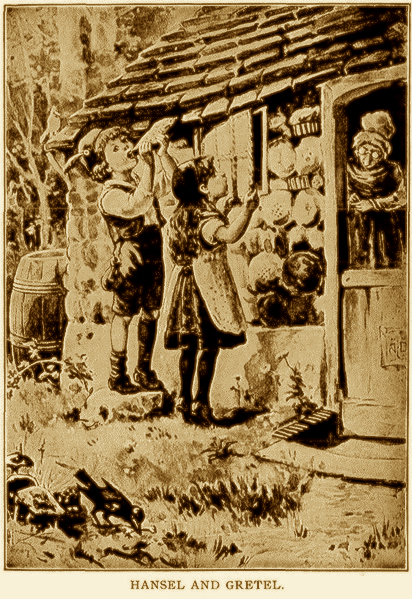
Hansel and Gretel go on an artists’ retreat, or, that’s me in the corner

hansel-and-gretel

Jet lag does in fact go away sometime, doesn’t it? I’ve been home for several days now, and I’m still a bit out of it. Of course, that may be the result of a small part of my brain’s continuing to operate in French — specifically, the part that governs what I say to people who bump into me in grocery stores — while the rest is merrily going about its business in English.

Which is why, in case you’ve been wondering, I’ve been holding off on launching into my long-promised series on the ins and outs of formal writing retreats. The spirit is willing, but the connective logic is weak.

So brace yourself for a couple of segue posts, please, to move us from craft to artists’ colonies. In the great tradition of Reese’s Peanut Butter Cups, I’ll try to work in writing retreat examples into my discussions of craft, and craft tips into my treatment of retreats, to ease the transition.

In yesterday’s post, I covered a broad array of topics, ranging from voice to submission strategies to the desirability of learning something about one’s subject matter before writing about it. In the midst of a blizzard of advice on that last point, I mentioned in passing that when writers just guess at the probable life details and reactions of characters unlike themselves, they tend to end up with characters whose beauty and brains are inversely proportional, whose behavior and/or speech can be predicted as soon as the narrative drops a hint about their race/gender/sexual orientation/national origin/job/whatever, and/or who act exactly as though some great celestial casting director called up the nearest muse and said, “Hello, Euterpe? Got anything in a bimbo cheerleader?”

In other words, the result on the page is often a stereotype. And because, let’s face it, since television and movies are the happy hunting ground of stereotypes, writers may not necessarily even notice that they’ve imbibed the odd cliché.

A pop quiz for long-time readers of this blog: why might that present a problem in a manuscript submission? For precisely the same reason that a savvy submitter should avoid every other form of predictability in those first few pages: because Millicent the agency screener tends not to like it.

Even amongst agents, editors, and judges who are not easily affronted, stereotypes tend not to engender positive reactions. What tends to get caught by the broom of a sweeping generalization is not Millicent’s imagination, but the submission. If it seems too stereotypical, it’s often swept all the way into the rejection pile.

Why, you ask? Because by definition, a characterization that we’ve all seen a hundred times before, if not a thousand, is not fresh. Nor do stereotypes tend to be all that subtle. And that’s a problem in Millicent’s eyes, because in a new writer, what she’s really looking to see is originality of worldview and strength of voice, in addition to serious writing talent.

When a writer speaks in stereotypes, it’s extremely difficult to see where her authorial voice differs markedly from, say, the average episodic TV writer’s. It’s just not all that impressive — or, frankly, all that memorable.

I’m bringing this up today in part because yesterday’s post talked so much about the perils of writing the real, either in memoir form or in the ever-popular reality-thinly-disguised-as-fiction tome. Many, many people, including writers, genuinely believe various stereotypes to be true; therein lies the power of a cliché. The very pervasiveness of certain hackneyed icons in the cultural lexicon — the dumb jock, the intellectually brilliant woman with no social skills, the morals-deficient lawyer, the corrupt politician, to name but four — render them very tempting to incorporate in a manuscript as shortcuts, especially when trying to tell a story in an expeditious manner.

Don’t believe me? Okay, which would require more narrative description and character development, the high school cheerleader without a brain in her head, or the one who burns to become a nuclear physicist? At this point in dramatic history, all a pressed-for-time writer really has to do is use the word cheerleader to evoke the former for a reader, right?

Unless, of course, a submission that uses this shortcut happens to fall upon the desk of a Millicent who not only was a high school cheerleader, but also was the captain of the chess team. At Dartmouth. To her, a manuscript that relies upon the usual stereotype isn’t going to look as though it’s appealing to universal understandings of human interaction; it’s going to come across as a sweeping generalization.

Can you really blame her fingers for itching to reach for the broom?

Interestingly, when Millicents, their boss agents, and the editors to whom they cater gather to share mutual complaints in that bar that’s never more than 100 yards from any writers’ conference in North America, it’s not just the common stereotypes that tend to rank high on their pet peeve lists. The annoying co-worker, however defined, crops up just as often.

Why, you ask? Well, for several reasons, chief among which is that every writer currently crawling the crust of the earth has in fact had to work with someone less than pleasant at one time or another. That such unsavory souls would end up populating the pages of submissions follows as night the day.

If these charming souls appeared in novel and memoir submissions in vividly-drawn glory, that actually might not be a problem. 99% of the time, however, the annoying co-worker is presented in exactly the same way as a stereotype: without detail, under the apparent writerly assumption that what rankles the author will necessarily irk the reader.

Unfortunately, that’s seldom the case — it can take a lot of page space for a character to start to irritate a reader. So instead of allowing the character to demonstrate annoying traits and allowing the reader to draw her own conclusions, many a narrative will convey that a particular character is grating by telling the reader directly (“Georgette was grating”), providing the conclusion indirectly (through the subtle use of such phrases as, “Georgette had a grating voice that cut through my concentration like nails on a chalkboard”), or through the protagonist’s thoughts (“God, Georgette is grating!”)

Pardon my asking, but as a reader, I need to know: what about Georgette was so darned irritating? For that matter, what about her voice made it grating? It’s the writer’s job to show me, not tell me, right?

I cannot even begin to count the number of novels I have edited that contained scenes where the reader is clearly supposed to be incensed at one of the characters, yet it is not at all apparent from the action of the scene why. Invariably, when I have asked the authors about these scenes, they turn out to be lifted directly from real life. (No surprise there: these scenes are pretty easy for professionals to spot, because the protagonist is ALWAYS presented as in the right for every instant of the scene, a state of grace quite unusual in real life. It doesn’t ring true.)

The author is always quite astonished that his own take on the real-life scene did not translate into instantaneous sympathy in every conceivable reader. Ultimately, this is a point-of-view problem — the author is just too close to the material to be able to tell that the scene doesn’t read the way he anticipated.

Did I just see some antennae springing up out there? “Hey, wait a minute,” alert readers of yesterday’s post are muttering just about now, “isn’t this sort of what Edith Wharton was talking about yesterday? Mightn’t an author’s maintaining objective distance from the material — in this case, the annoying co-worker — have helped nip this particular problem in the bud long before the manuscript landed on Millicent’s desk?”

Why, yes, now that you mention it, it would. What a remarkable coincidence that she and I should have been discussing this on consecutive days.

Let’s look at the benefits of some objective distance in action. Many writers assume (wrongly) that if someone is irritating in real life, and they reproduce the guy down to the last whisker follicle, he will be annoying on the page as well, but that is not necessarily true. Often, the author’s anger so spills into the account that the villain starts to appear maligned, from the reader’s perspective. If his presentation is too obviously biased, the reader may start to identify with him, and in the worst cases, actually take the villain’s side against the hero. I have read scenes where the case against the villain is so marked that most readers would decide that the hero is the impossible one, not the villain.

This character assassination has clearly not gone as planned. A little more objective distance might have made it go better. Who was it that said, revenge is a dish best served cold?

Yes, I called it revenge, because revenge it usually is. Most writers are very aware of the retributive powers of their work. As my beloved old mentor, the science fiction writer Philip K. Dick, was fond of saying, “Never screw over a living writer. They can always get back at you on the page.”

Oh, stop blushing. You didn’t honestly think that when you included that horrible co-worker in three scenes of your novel that you were doing her a FAVOR, did you?

My most vivid personal experience of this species of writerly vitriol was not as the author, thank goodness, but as the intended victim. And at the risk of having this story backfire on me, I’m going to tell you about it as nonfiction.

Call it a memoir excerpt.

More years ago than I care to recall, I was in residence at an artists’ colony. (See? I told you I was going to work in an example from a writers’ retreat!) Now, retreats vary a great deal; mine have ranged from a fragrant month-long stay in a cedar cabin in far-northern Minnesota, where all of the writers were asked to remain silent until 4 p.m. each day (ah, dear departed Norcroft! I shall always think of you fondly, my dear – which is saying something, as I had a close personal encounter with an absolutely mammoth wolf there, and a poet-in-residence rode her bicycle straight into a sleepy brown bear. And both of us would still return in an instant) to my recent sojourn in a medieval village in southwestern France to a let’s-revisit-the-early-1970s meat market, complete with hot tub, in the Sierra foothills.

Had I mentioned that it pays to do your homework before you apply?

This particular colony had more or less taken over a small, rural New England town, so almost everyone I saw for a month was a painter, a sculptor, or a writer. The writers were a tiny minority; you could see the resentment flash in their eyes when they visited the painters’ massive, light-drenched studios, and compared them to the dark caves to which they had been assigned.

I elected to write in my room, in order to catch some occasional sunlight, and for the first couple of weeks, was most happy and productive there. Okay, so sharing meals in a dining hall was a bit high school-like, conducive to tensions about who would get to sit at the Living Legend in Residence’s table, squabbles between the writers and the painters about whether one should wait until after lunch to start drinking, or break out the bottles at breakfast (most of the writers were on the first-mentioned team, most of the painters on the latter), and the usual bickerings and flirtations, serious and otherwise, endemic to any group of people forced to spend time together whether or not they have a great deal in common.

An environment ripe, in other words, for people to start to find their co-residents annoying.

Now, one classic way to deal with the inevitable annoying co-resident problem is to bring a buddy or three along on a retreat; that way, if the writer in the next cubicle becomes too irritating, one has some back-up when one goes to demand that she stop snapping her gum every 27 seconds, for Pete’s sake. Personally, when I go on a writing retreat, I like to leave the trappings of my quotidian life behind, but there’s no denying that at a retreat of any size, there can be real value in having someone to whom to vent about that darned gum-popper. (Who taught her to blow bubbles? A horse?)

Doubtless for this reason, several artists had brought their significant others to the New England village retreat — or, to be more accurate, these pairs had applied together: writer and photographer, painter and writer, etc. (Generally speaking, one of the tell-tale differences between a serious artists’ retreat and a casual one is whether you have to write, paint, sculpt, or photograph your way in; at a retreat that takes just anyone, the application will not require you to submit any of your work.)

One of these pairs was a very talented young couple, she a writer brimming with potential, he a sculptor of great promise. Although every fiber of my being longs to use their real names, I shall not. Let’s call them Hansel and Gretel, to remove all temptation.

Hansel was an extremely friendly guy, always eager to have a spirited conversation on topics artistic or social. Actually, he was sort of the dining hall’s Lothario, flirting with…hmm, let’s see how best to represent how he directed his attentions…everything with skin. In fairness to him, none of the residents was all that surprised that he often brought the conversation around to sex; honestly, once you’d seen his sculpture studio packed with representations of breasts, legs, pudenda, buttocks, and breasts, you’d have to be kind of dense not to notice where his mind liked to wander.

Being possessed of skin myself, I was naturally not exempt from his attentions, but generally speaking, I tend to reserve serious romantic intentions for…again, how to put this…people capable of talking about something other than themselves. Oh, and perhaps I’m shallow, but I harbor an absurd prejudice in favor of the attractive.

An artists’ retreat tends to be a small community, however; one usually ends up faking friendliness with an annoying co-resident or two. Since there was no getting away from the guy — believe me, I tried — I listened to him with some amusement whenever we happened to sit at the same table. I loaned him a book or two. We had coffee a couple of times when there was nobody else in the town’s only coffee shop. And then I went back to my room and wrote for 50 hours a week.

Imagine my surprise, then, when Gretel started fuming at me like a dragon over the salad bar. Apparently, she thought I was after her man.

Now, I don’t know anything about the internal workings of their marriage; perhaps they derived pleasure from manufacturing jealousy scenes. I don’t, but there’s just no polite way of saying, “HIM? Please; I DO have standards” to an angry wife, is there? So I started sitting at a different table in the dining hall.

A little junior high schoolish? Yes, but better that than Gretel’s being miserable — and frankly, who needed the drama? I was there to write.

Another phenomenon that often characterizes a mixed residency — i.e., one where different types of artists cohabitate — is a requirement to share one’s work-in-progress. At this particular retreat, the fellowship that each writer received included a rule that each of us had to do a public reading while we were in residence.

Being a “Hey – I’ve got a barn, and you’ve got costumes!” sort of person, I organized other, informal readings as well, so we writers could benefit from feedback and hearing one another’s work. I invited Gretel to each of these shindigs; she never came. Eventually, my only contact with her was being on the receiving end of homicidal stares in the dining hall, as if I’d poisoned her cat or something.

It was almost enough to make me wish that I HAD flirted with her mostly unattractive husband.

But I was writing twelve hours a day (yes, Virginia, there IS a good reason to go on a retreat!), so I didn’t think about it much. I had made friends at the retreat, my work was going well, and if Gretel didn’t like me, well, we wouldn’t do our laundry at the same time. (You have to do your own laundry at every artists’ retreat on earth; don’t harbor any fantasies about that.) My friends teased me a little about being such a femme fatale that I didn’t even need to do anything but eat a sandwich near the couple to spark a fit of jealous pique, but that was it.

At the end of the third week of our residency, it was Gretel’s turn to give her formal reading to the entire population of the colony, a few local residents who wandered in because there was nothing else to do in town, and the very important, repeated National Book Award nominee who had dropped by (in exchange for a hefty honorarium) to shed the effulgence of her decades of success upon the resident writers. Since it was such a critical audience, most of the writers elected to read highly polished work, short stories they had already published, excerpts from novels long on the shelves. Unlike my more congenial, small reading groups, it wasn’t an atmosphere conducive to experimentation.

Four writers were scheduled to read that night. The first two shared beautifully varnished work, safe stuff, clearly written long before they’d arrived at the retreat. Then Gretel stood up and announced that she was going to read two short pieces she had written here at the colony. She glanced over at me venomously, and my guts told me there was going to be trouble.

How much trouble, you ask with bated breath? Well, her first piece was a lengthy interior monologue, a first-person extravaganza describing Hansel and Gretel — both mentioned by name on page 1, incidentally — having sex in vivid detail. Just sex, without any emotional content to the scene, a straightforward account of a mechanical act which included – I kid you not – a literal countdown to the final climax: “Ten…nine…eight…”

It was so like a late-1960’s journalistic account of a rocket launching that I kept expecting her to say, “Houston, we’ve got a problem.”

I cringed for her — honestly, I did. I have no objection to writers who turn their diaries into works for public consumption, but this was graphic without being either arousing or instructive. I’d read some of Gretel’s other work: she was a better writer than this. So what point was she trying to make by reading this…how shall I put it?…literarily uninteresting junk?

Maybe I just wasn’t the right audience for her piece: the painters in the back row, the ones who had been drinking since breakfast, waved their bottles, hooting and hollering. Still, looking around the auditorium, I didn’t seem to be the only auditor relieved when it ended. (“Three…two…one.”) Call me judgmental, but I tend to think that when half the participants are pleased the act is over, it’s not the best romantic coupling imaginable.

Gretel’s second piece took place at a wedding reception. Again, it was written in the first person, again with herself and her husband identified by name, again an interior monologue. However, this had some legitimately comic moments in the course of the first few paragraphs. As I said, Gretel could write.

Somewhere in the middle of page 2, a new character entered the scene, sat down at a table, picked up a sandwich – and suddenly, the interior monologue shifted from a gently amused description of a social event to a jealously-inflamed tirade that included the immortal lines, “Keep away from my husband, bitch!” and “Are those real?”

Need I even mention that her physical description of the object of these jabs would have enabled any police department in North America to pick me up right away?

She read it extremely well; her voice, her entire demeanor altered, like a hissing cat, arching her back in preparation for a fight. Fury looked great on her. From a literary standpoint, though, the piece fell flat: the character that everyone in the room knew perfectly well was me never actually said or did anything seductive at all; her mere presence was enough to spark almost incoherent rage in the narrator. While that might have been interesting as a dramatic device, Gretel hadn’t done enough character development for either “Gretel” or “Jan”– cleverly disguised name, eh?– for the reader either to sympathize with the former or find the latter threatening in any way.

There was no ending to the story. She just stopped, worn out from passion. And Hansel sat there, purple-faced, avoiding the eyes of his sculptor friends, until she finished.

The first comment from the audience was, “Why did the narrator hate Jan so much? What had she done to the narrator?”

I was very nice to Gretel afterward; what else could I do? I laughed at her in-text jokes whenever it was remotely possible, congratulated her warmly on her vibrant dialogue in front of the National Book Award nominee, and made a point of passing along a book of Dorothy Parker short stories to her the next day.

Others were not so kind, either to her or to Hansel. The more considerate ones merely laughed at them behind their backs. (“Three…two…one.”) Others depicted her in cartoon form, or acted out her performance; someone even wrote a parody of her piece and passed it around.

True, I did have to live for the next week with the nickname Mata Hari, but compared to being known as the writer whose act of fictional revenge had so badly belly flopped, I wouldn’t have cared if everyone had called me Lizzie Borden. And, of course, it became quite apparent that every time I went out of my way to be courteous to Gretel after that, every time I smiled at her in a hallway when others wouldn’t, I was only pouring salt on her wounded ego.

Is there anything more stinging than someone you hate feeling sorry for you?

If your answer was any flavor of yes, you might want to consider waiting until you’ve developed some objective distance from your annoying co-worker before committing her to print. Think at least twice about what you’re putting on the page, particularly for work you are submitting to contests, agencies, or small presses – or, heaven forbid, reading to a group of people you want to like you, or at any rate your narrator.

Believe me, revenge fantasies tend to announce themselves screamingly from the page, at least to a professional reader. If you’re still angry, maybe it’s not the right time to write about it for publication. Your journal, fine. But until you have gained some perspective — at least enough to perform some legitimate character development for that person you hate — consider giving it a rest. Otherwise, your readers’ sympathies may ricochet, and move in directions that you may not like.

It’s always a good idea to get objective feedback on anything you write before you loose it on the world, but if you incorporate painful real-life scenes into your fiction, sharing before promotion becomes ABSOLUTELY IMPERATIVE. If you work out your aggressions at your computer — and, let’s face it, a lot of us do — please, please join a writing group.

To be blunt about it, finding good first readers you can trust can save you from looking like an irate junior high schooler on a rampage.

And Gretel, honey, in the unlikely event that you ever read this, you might want to remember: revenge is a dish best served cold. Or, as Philip used to say, never screw over a living writer. You never know who might end up writing a blog.

Hey, I’m only human. Which is precisely why I wasn’t writing blog posts on my most recent retreat while I was in residence. It can take some time — and in this case, distance, judging by my lingering jet lag — to gain perspective.

Keep up the good work!

Musings on an airplane: the return of Edith Wharton, or, the heavy, heavy responsibility of original selectivity

pyranees
Sorry about the lapse in posting; I honestly meant to start blogging again a few days ago. I’ve been just exhausted.

To restate that more positively: I’m back from my fabulous writing retreat in the beautiful mountains of southwestern France — or to be precise, I wrote most of this post while I was on a plane from Zurich to Chicago. (Props to Swiss Air: the flight attendants had no problem with my co-opting three middle seats for a mid-air office. Much easier to use a laptop with your legs stretched out, I find, than folded underneath an unstable tray table. Oh, and they let you know that you’re about to land by offering you wee bars of chocolate.) Truth compels me to say, though, that I took this photo on the way to the retreat, not from it: those dark blobs are the Pyrenees.

If any of you map-huggers out there are thinking that I was neither retreating anywhere near Zurich nor do I generally reside in the vicinity of Chicago, you’re right: it took a van ride, two train trips, and three airplanes to get me from La Muse to Seattle.

Now that’s what I call retreated.

So if I still seem a bit jet-lagged, well, I’m entitled. Which is perhaps why I’ve elected to devote today’s post to yet another extensive discussion with a dead person.

Hey, it’s not as crazy as it sounds. A while back, I started a conversation with Edith Wharton — or, if you want to be pedantic about it, with a few choice excerpts from her THE WRITING OF FICTION, as good a discussion of the craft as you’re likely to find anytime soon.

Should anyone happen to be in the market for one, that is. Stephen King’s ON WRITING is pretty good, too, as is Annie Lamott’s BIRD BY BIRD. I don’t think any female writer should even consider skipping Joanna Russ’ HOW TO SUPPRESS WOMEN’S WRITING. And I’ve never made a secret of my admiration for Carolyn See’s MAKING A LITERARY LIFE.

I could go on all day, but does anyone else have suggestions to share?

My point is, THE WRITING OF FICTION is a fascinating book for anyone interested in, well, the writing of fiction. Particularly, I suspect, for those acclimated to the episodic ramblings endemic to blogs. (Who, me? Episodic? Rambling? Perish the thought.) Although our Edith wrote the book back in the 1920s, her highly opinionated, self-referential argumentative style would be right at home in the blogosphere.

So I’m dragging her into it.

When last I crossed literary swords with Edith, we were talking about whether it’s possible for a writer to imagine a character from a different background sufficiently to render actual research into the conditions under which that character might have lived superfluous.

She seemed to think it was possible, if not necessarily desirable, for imagination to hold the reins of probability, provided that the author maintained an objective distance from the subject matter. Quoth she:

The chief difference between the merely sympathetic and the creative imagination is that the latter is two-sided, and combines with the power of penetrating into other minds that of standing far enough aloof from them to see beyond, and relate them to the whole stuff of life out of which they but partially emerge. Such an all-around view can be obtained only by mounting to a height; and that height, in art, is proportioned to the artists’ power of detaching one part of his imagination from the particular problem in which the rest is steeped.

Myself, I think objectivity is overrated in fiction. Perhaps because the intervening 80 years since she wrote this book have offered so many spectacular examples of authors who decided to ignore the old writing saw write what you know with disastrous results — and if you doubt that, check out some of the female characters that turned up in the works of male authors in the 1950s — I am of the opinion that just guessing how a character unlike oneself might respond to certain stimuli can lead to both unrealistic and stereotyped characters.

How off the mark, you ask? To haul out my favorite example again, the collected short stories of F. Scott Fitzgerald contain SEVEN instances of a female character’s saying to another human being, “I’m so beautiful; why can’t I be happy?”

Need I say more? Except perhaps that what an author regards as his own objectivity might well strike a reader who has something in common with the character on the page as ignorance?

However, for about a century, objectivity was all the rage, so much so that if you bump into an author or editor trained in the 1940s or 1950s, you may well be treated to a lecture on how first-person narratives are inherently flawed. They’re so subjective.

Or good first-person narratives are, anyway.

I didn’t revive the debate on objectivity in order to blame Edith for the pseudo-objective failings of some of the writers who followed in her quite broad wake. (Okay, not merely for that purpose.) I wanted to draw your attention to this little gem of writerly wisdom:

One of the causes of the confusion of judgment on this point[i.e., the difference between mere human sympathy and writerly empathy] is no doubt the perilous affinity between the art of fiction and the material it works in. It has been so often said that all art is re-presentation — the giving back in conscious form of the shapeless raw material of experience — that one would willingly avoid insisting on such a truism. But while there is no art of which the saying is truer than fiction, there is none in respect of which there is more danger of the axiom’s being misinterpreted.

Or, to put it another way, just providing a transcript of what happens in real life isn’t art; it’s court reporting. Good realistic writing is by definition a selective recreation of reality.

Which tends to come as a surprise to advocates of slice-of-life fiction, who believe that the primary goal of writing is to reproduce quotidian reality as closely as possible. That can work very well in a short story or scene in a novel or memoir, but just listing everything that happened in even the most fascinating human interaction tends to overwhelm the reader with detail — and annoy Millicent the agency screener, incidentally.

So how can a writer decide what parts of reality are and are not essential to conveying the story at hand? Ah, there’s the rub. As, indeed, Edith herself points out:

The attempt to give back any fragment of life in painting or sculpture or music presupposes transposition, “stylization.” To re-present in words is far more difficult, because the relation is so close between model and artist. The novelist works in the very material out of which the object he is trying to render is made. He must use, to express soul, the signs which soul uses to express itself. It is relatively easy to separate the artistic vision of an object from its complex and tangled actuality if one has to re-see it in paint or marble or bronze; it is infinitely difficult to render a human mind when one is employing the very word-dust with which thought is formulated.

In case she’s being too polite here, let me make it a bit blunter: one of the difficulties of this art form as opposed to others is that your average Joe on the street doesn’t suddenly whip out a block of marble or embark upon an interpretive dance to react to, say, someone cutting in front of him in a long line — although you must admit that either would be an interesting tactic. No, he uses words, so it’s darned tempting for a fledgling writer to believe that just quoting what he says on that particular occasion will in fact convey the entire situation to the reader.

The usual result? Pages upon pages of dialogue uninterrupted by narrative text, like a radio play, as though the writer believes that no further elucidation could possibly be necessary — one of Millicent’s better-known pet peeves, by the way. Or writers who are flabbergasted to hear professional readers (agents, editors, contest judges, writing teachers, Millicents) castigate their stories as unbelievable or unrealistic.

“Unbelievable?” they gasp. “Unrealistic? But that’s impossible: the scene you’ve targeted really happened!”

I hate to be the one to break it to those of you who love to write the real, but this cri de coeur almost never carries any weight with professional readers. In fact, if I’m going to be honest about it, this incredibly common protest is much, much more likely to elicit a chuckle, or even an eye-roll, than a cry of, “Wow, touché, dear writer. Let’s leave that scene entirely untouched.”

Why can I predict that with such certainty? Well, I’ve said it before, and I’ll no doubt say it again: just because something happened in real life doesn’t mean that it will strike the reader as realistic when it appears on the page.

As the pros like to say, it all depends on the writing. (For a far more detailed analysis of this quandary, check out John Irving’s TRYING TO SAVE PIGGY SNEED, speaking of established authors’ books about the writing life.)

So if Edith hadn’t brought this up, I would have: this is a classic point upon which aspiring writers who have yet to see their words in print and those authors who have (and give advice to the former) so often don’t see eye-to-eye. It’s rare that an established author will argue that all a good writer needs to do to offer fresh insights to the reader is simply to reproduce exactly what she observes in real life. If all a good writer had to do was hold, as ’twere, the mirror up to nature, there would be little difference between the documentary filmmaker and the novelist except medium.

Good art is a lot more complicated than that.

However, you can’t throw a piece of bread at your garden-variety writers’ conference without hitting a writer who will insist that his manuscript — or, in classes, his scene — must have the resonance of truth because IT REALLY HAPPENED THAT WAY. And then these aspiring writers wonder why the pros just stop listening.

Edith, would you mind telling the class why, please?

Still the transposition does take place as surely, if not as obviously, in a novel as in a statue. If it did not, the writing of fiction could never be classed among works of art, products of conscious ordering and selecting, and there would consequently be nothing to say about it, since there seems to be no way of estimating aesthetically anything to which no standard of choice can be applied.

Did some of you get lost in the verbiage there? Basically, Edith is saying that just throwing your diary onto the printed page isn’t art, any more than simply setting up a camera to film every second of everyday life would be, because that would remove the artist from the process as anything but transcriptionist. A good writer, however, picks and chooses what parts of reality are important to the story and leaves out the rest.

Or, to use a glaring modern example, do you honestly think that reality TV would be bearable for even fifteen consecutive minutes’ viewing if no one were editing the footage?

Think about that the next time you hear someone say that the point of written dialogue is just to reproduce the speech of everyday life. (And yes, school-age readers, you have my permission to print out what I just said and wave it in your English composition teacher’s face.)

Before the young and the daring think Edith and I are taking their side too completely, let’s see what she has to say about the perennial bugbear of the young writer, the desire to do something that’s never been done before in print:

Another unsettling element in modern art is that common symptom of immaturity, the dread of doing what has been done before; for though one of the instincts of youth is imitation, another, equally imperious, is that of fiercely guarding against it. In this respect, the novelist of the present day is in danger of being caught in a vicious circle, for the insatiable demand for quick production tends to keep him in a state of perpetual immaturity, and the ready acceptance of his wares encourages him to think that no time need be wasted in studying the past history of his art, or in speculating on its principles.

“Ha!” I just heard half of you exclaim. “Ready acceptance of his wares! You try landing an agent in the current literary market, Edith.”

Before you dismiss this portion of her argument accordingly, consider a moment: I think a case could be made, and a pretty good one, that the extreme difficulty of selling first fiction, combined with how much busier our lives are than writers who lived a hundred years ago, tends to have the same effect that she’s describing here.

Don’t believe me? Okay, line up ten unpublished novelists and ask them to name not only the bestsellers in their categories in which they write, but the back-list perennials. Don’t accept any answer that names a book that’s been out for more than two years. Ask them to give you thumbnail reviews of each, and explain how their own books are similar or different.

8 of them will not be able to it; at least 5 will not have read anything in their chosen category that has come out within the last two years, which means that they are unfamiliar with the market. And 2-3 will laugh and tell you that they don’t have time to read at all.

But if you ask them if their novels are original, all ten will promptly say yes. But if they’re not familiar with the market in their book categories, how on earth do they know?

This, I’m afraid, is one of the things that render professional writers fairly easy to spot at a conference. Ask ten recently published novelists the same question, and you’ll probably get some pretty detailed analysis of the current book market. (Not to mention a plethora of complaints about their agents and editors.)

“Ah,” some of those non-readers will say, “but I don’t want my vision sullied by contact with others’. Nothing tamps down originality more than listening to what other people say.”

Really? Interesting. Let’s hear Edith’s opinion on the subject.

True originality consists not in a new manner but in a new vision. That new, that personal, vision is attained only by looking long enough at the object represented to make it the writer’s own; and the mind which would bring this secret germ to fruition must be able to nourish it with an accumulated wealth of knowledge and experience.

This, my friends, is one of the best definitions I’ve ever seen of what the publishing industry means by fresh, an elusive quality that tends to catch Millicent’s eye and warm the cockles of her boss agent’s cold, cold heart. Many, many writers could write the same story, but the difference between a fresh take and something that Millicent has seen fifteen times in the last week lies largely in how the writer chooses to tell the story, right?

Think the various writers’ respective decisions about how to narrow down what parts of reality do and do not add to the story might have anything to do with that?

Uh-huh; Edith’s not just whistling Dixie here: this is serious writing advice.

Not to mention a killer self-editing philosophy: when in doubt, ask yourself: could anyone but me have written this particular sentence/scene/character? If so, how can I revise it to render my voice and worldview more apparent? Repeat with every sentence/scene/character in your manuscript.

A lot of work? You bet. But as Edith says:

At any rate {the myth of originality without study} is fostering in its young writers the conviction that art is neither long nor arduous, and perhaps blinding them to the fact that notoriety and mediocrity are often interchangeable terms. But though the trade-wind in fiction undoubtedly drives many beginners along the line of least resistance, and holds them there, it is far from being the sole cause of the present quest for short-cuts in art.

That’s her really, really nice way of saying that if a writer’s only goal is to get published, the art is likely to suffer. Ditto if the writer is too lazy to learn what being a writer in her chosen category entails before taking a crack at it herself.

But she’s not about to let off the hook those who assume that if

(a) their own writing is having a hard time getting published, then

(b) all good writing must be having a hard time getting published, therefore

(c) everything currently being published is rubbish.

You will literally never hear a published author arguing this, incidentally, for obvious reasons, which is why, in case those of you who hang around writers’ conferences have been wondering, agents and editors simply stop listening to anyone who makes this particular argument. Which may be why Edith is so unsympathetic to it:

There are writers indifferent to popular success, and even contemptuous of it, who sincerely believe that this line marks the path of the true vocation. Many people assume that the artist receives, at the outset of his career, the mysterious sealed orders known as “Inspiration,” and has only to let that sovereign impulse carry him where it will.

We all know writers who say that, right?

Inspiration does indeed come at the outset to every creator, but it comes most often as an infant, helpless, stumbling, inarticulate, to be taught and guided; and the beginner, during this time of training his gift, is as likely to misuse it as a young parent to make mistakes in teaching his first child.

Wow. I think every writer who has ever even been tempted to say, “Oh, I don’t need to learn about the marketing side of the business; that will be my agent’s job. I handle the creative part,” should think long and hard about what Edith just said. Especially those who subscribe to the astonishingly pervasive writerly belief that all good writing will inevitably get published, regardless of how poorly its author happens to market it.

So does that mean that an aspiring writer should invest all of her writing time in boning up on what’s already on the market? Or that only after a writer has read everything published in the last hundred years should he attempt to write his own book?

Of course not; total immersion in other people’s books and absolute ignorance of the market are not the only two possible courses here. A savvy aspiring writer is going to want to forge a middle path.

And that can be difficult, especially now that finding a mountain of writerly advice is as simple as typing a question into a search engine. As Edith admits,

Study and meditation contain their own perils. Counsellors intervene with contradictory advice and instances.

See? I told you she seems surprisingly up on the current state of blogging about writing.

In such cases these counselors are most often other people’s novels: the great novels of the past, which haunt the beginner like a passions, and the works of his contemporaries, which pull him this way and that with too-persuasive hands. His impulse, at first, will be either to shun them, to his own impoverishment, or to let his dawning individuality be lost in theirs.

Or, to put this as Millicent the agency screener might, the vast majority of the submissions she sees are either completely out of step with the current literary market or quite derivative of a recent bestseller.

…but gradually he will come to see that he must learn to listen to them, take all they can give, absorb it into himself, and then to turn his own task with the fixed resolve to see life only through his own eyes.

In other words, to develop his own voice — and to demonstrate his own unique worldview through the details he chooses from real life to incorporate into his writing.

You had thought I was just rambling on without an ultimate point in mind, hadn’t you? Jet-lagged as I am, I still try to be selective.

I’m looking forward to a less befogged brain on the morrow, however. Keep up the good work!
Vrai et faux amis, or, the debate I would have had with Edith Wharton had she blogged

view-from-la-muse-library

For those of you who are tuning in late, I’m currently in residence at an almost mind-bogglingly beautiful artists’ retreat in Southwestern France — thus all of the photos of castles and cathedrals, in case any of you have been wondering if I’d suddenly gone mad for stonemasonry. Another major result of my being here, in case you missed my announcement earlier in the week: the new deadline for the First Periodic Author! Author! Awards for Expressive Excellence has been extended to midnight on Monday, June 1.

You’re welcome.

Let me tell you, I’ve gotten some great entries, in both the Expressive Excellence and Junior Expressive Excellence categories. I’m really looking forward to running the winners here — and to hearing from more of you!

Okay, back to work. If I seem to be talking an unusual amount about cause and effect these days, blame it on the fact that this is my first retreat in a foreign land — at least in one that is not primarily English-speaking; I have retreated in Canada. I must say, I’ve been fascinated by the enlivening effect on the brain caused by switching languages between my writing time (somewhere between 8 and 12 hours per day, in case you’re curious) and out-and-about time (usually about an hour per day, with the occasional day of shopping and/or sightseeing).

While I must confess that one of the effects has been to unearth from the depths of my psyche the perfect word or phrase for the moment in Italian or Greek, another has been a much heightened awareness of how much people think while they’re speaking, even in their native tongue. It’s definitely affecting the way I write dialogue.

I’ve also become very conscious of what the French call faux amis (false friends), words and phrases that sound the same in another language, but mean something quite different in the one you happen to be speaking at the time. Take, for instance, actuellement — it seems as though it should translate as actually, doesn’t it? En fait (in fact, the phrase one uses when one means actually here), it means currently.

And don’t even get me started on the confusion if one refers to an ad as l’avertissement (warning sign) rather than as la publicité. Or if you speak of the book you’re working on as la nouvelle, which means short story, rather than as le roman, a novel.

Because so many English words are lifted from other languages, it is stuffed to the gills with les faux amis, of course, which is why it’s so difficult a language in which to become fluent. Something else a writer in English might want to take into account whilst constructing dialogue, perhaps?

Enough about false friends for the moment. Let’s move on to talking about true ones.

One of the great things about attending a formal writing retreat (that is, an ongoing one for which you apply) is seeing what other writers are reading. Not just the people who are in residence when you are — at La Muse, as at many retreats, that number is pretty small; actuellement, there are four writers, including myself, and two painters — but what those who have been there in the past were toting around in their bookbags.

The happy result: Boccaccio nestles next to Mary Renault and Somerset Maugham; Stan Nicholls abuts Günter Grass and Arundhati Roy. Gabriel García Márquez’ LOVE IN THE TIME OF CHOLERA stands tall next to many volumes of Isaac Bashevis Singer and an apparently misshelved copy of Adam Smith’s THE WEALTH OF NATIONS. Biographies of J.R.R. Tolkien and Charles Bukowski jostle memoirs by Billie Holiday, Roald Dahl, and INCIDENTS IN THE LIFE OF A SLAVE GIRL, WRITTEN BY HERSELF.

Combine that with what the retreat’s organizers consider essential — here, both the complete works of both Charles Dickens and William Shakespeare, as well as many bound volumes of Paris Match, as well as masses of dictionaries in four languages, an extensive array of psychological theory, and mysteriously, a guitar — and you usually find yourself presented with a pretty eclectic collection.

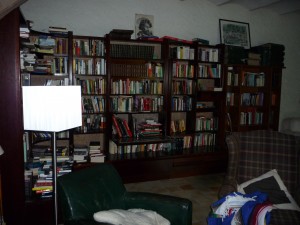
Trust me on this one: you’re going to find something interesting that you have never encountered before. Take a gander at just part of what’s here for the reading:

library-at-la-muse

Yummy, eh?

As a direct and happy result of this kind of ongoing book accumulation, it’s generally well worth your while at an organized writers’ retreat to budget some fairly hefty time for reading. And not just for manuscripts in the library, either — you’re probably going to meet at least one writer with whom you would like to exchange work.

Lovely and rewarding, often, but still, time-consuming. Make sure to allot some time for it.

Truth compels me to mention, however, that actuellement, my opinion on the subject may well be colored by a fellow resident’s just having walked into the library with her thumb drive so I could download her just-this-second completed novel. (And no, this is not the first time I’ve seen someone do this at an artists’ retreat; people like to share. It’s wise to keep your writing schedule flexible enough to make field trips to admire freshly-completed sculptures and canvases upon which the paint is still wet, if you catch my drift.)

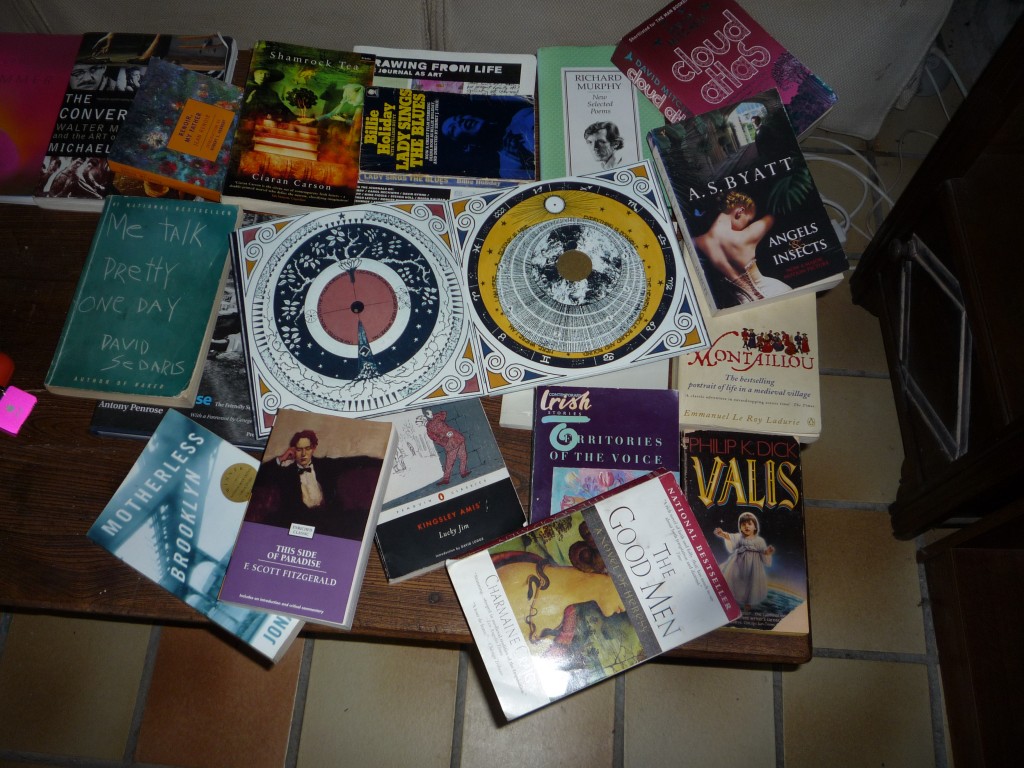
At this retreat, all attendees are asked to donate at least two volumes to the library, one that represented the kind of art we would be producing while in residence and one that reflected the part of the world that had produced us. Since I happened to know that a Seattle-based novelist had attended La Muse within the year, bringing with her the works of Garth Stein and Layne Maheu, I opted to dig deeper into my past and tote along VALIS, a largely autobiographical Philip K. Dick novel that happens to contain a scene set at my childhood home, right next to the hutch where my pet rabbits resided.

So if the moppet on the cover at the bottom right looks a trifle familiar, well, there’s a reason for that:

noras-book

Yes, I’m perfectly well aware that this photo is gigantic; I wanted you to notice that glorious volume in the middle. As you may see, my contributions paled in comparison to the absolutely gorgeous hand-made book one of the painters brought, but that’s to be expected, right? (If the book-lovers out there want to see more of Nora Lee McGillivray’s astonishingly beautiful individually crafted volumes, check out her website. It will tell you which museums to visit to see them in person.)

Since I’m currently working on a novel set at my alma mater, Harvard, I also imported (literally; I had to hand-carry it through Customs) F. Scott Fitzgerald’s THIS SIDE OF PARADISE, his paean to Princeton. A fascinating novel, if you’ve never read it, the one that catapulted him to early fame. It’s far less polished than his later work, as first novels so often are; the value of repeated revision is not always apparent to the first-time author.

Which brings me to back to my subject du jour, the writer’s true and false friends, via the small miracle of having discovered in this very library a thin volume of rare nonfiction by Edith Wharton that I had never read before.

The front cover bills THE WRITING OF FICTION as “The Classic Guide to the Art of the Short Story and the Novel,” a contention which, if true, renders it even more surprising that I’d never even heard of it before. However, since the back cover’s incorrectly contends that THE AGE OF INNOCENCE, the novel for which our Edith won the Pulitzer Prize — the first woman to do so, incidentally — was her first, whereas if memory serves, THE CUSTOM OF THE COUNTRY came out a good 7 years before, and the lovely THE HOUSE OF MIRTH 15, perhaps the claim of classicism is exaggeration for marketing purposes, rather than a statement of historical fact.

THE WRITING OF FICTION is very thought-provoking, however; it’s sort of what you would have expected a grande dame of letters to have blogged about the current state of literature in 1924, had blogs existed back then.

Yet quite a lot of what she has to say remains astonishingly applicable to today’s writers. Take, for instance:

The distrust of technique and the fear of being original — both symptoms of a certain lack of creative abundance — are in truth leading to pure anarchy in fiction, and one is almost tempted to say that in certain schools formlessness is now regarded as the first condition of form.

Now, the verbiage might be a bit old-fashioned, but this is a true friend. Not entirely coincidentally, it is also sentiment that agents and editors still express at writers’ conferences all the time. They’re perpetually receiving manuscripts that lack structure, either due either to deliberate authorial choice or a writer’s lack of literary experience.

Apparently structure-less scenes containing dialogue are particularly common. Proponents of slice-of-life fiction — an approach that tends to win great applause in short stories, and thus in writing classes that focus upon short works — will frequently make the mistake of trying to make dialogue in a novel absolutely reflective of how people speak in real life.

Why might that be problematic, you ask? Well, ride a bus or sit in a café sometime and eavesdrop on everyday conversation; it’s generally very dull from a non-participant’s perspective.

More to the point, it’s often deadly on the printed page. Real-life conversation is usually repetitive, cliché-ridden, and frankly, not all that character-revealing. It requires genuine artistry, then, to reproduce it well in manuscript form.

Or, as Aunt Edith might have put it, it takes technique. For some pointers on how to put that technique in action, you might want to check out the DIALOGUE THAT RINGS TRUE and DIALOGUE THE MOVES QUICKLY categories on the archive list at right.

For the moment, I want to return to what Aunt Edith was saying. Because I know that you’re all busy people, I’ll skip her comparison of Dostoyevsky and Tolstoy (whose WAR AND PEACE, you may be amused to hear, Henry James once called, “a loose baggy monster,” speaking of structure) and move on to the next part that deals with technique:

…the novelist who would create a given group of people or portray special social conditions must be able to identify himself with them; which is a rather long way of saying that an artist must have imagination.

Not so fast there, Edith: this analogy is a false friend. I think you’re conflating empathy with one’s characters with the ability to imagine what it would like to be them, usually related but not identical phenomena. The first involves feeling for one’s characters enough to present them, if not sympathetically, then at least with fairness; the second can be purely a matter of conjecture, without necessarily involving any actual empathy with the characters at all — or, indeed, any information about how such characters in real life might actually feel or think.

Hey, if it’s purely a matter of imagination, why not just project your own feelings and thoughts onto them? Or, to fall back on my earlier example, to a reader who is already steeped in the culture you’re describing, it’s going to make a big difference whether a character within that culture says actuellement when he actually means en fait, right?

Here, imagination could lead a writer into a fairly major mistake. Another common mistake springing from relying too heavily on imagination alone — no, make that two: characters made up out of whole cloth tend to be prone to falling into stereotypes, and if the author doesn’t care about a character enough to empathize with him, why should the reader?

Ponder that last one a moment. I’ll wait.

The stereotyping problem is particularly rampant, and not just in terms of clichés. Think about how villains, or even just plain unlikable characters, tend to be portrayed in fiction — or in memoir and creative nonfiction, for that matter. One sees quite imaginative but essentially unsympathetic approaches to bad guys all the time.

And even to not-so-bad guys. Few writerly attitudes lead so surely to two-dimensional characters as the dismissive assumption that the reader isn’t going to like ‘em, anyway.

As it happens, I have a GREAT example right at my fingertips. Not long ago, a friend from my home town alerted me to the fact that a recent bestselling account of the rise and fall of a Napa Valley wine dynasty contained a rather odd reference to my late father, Norman Mini. Not all that surprising; he was, among other things, quite a well-respected winemaker descended from centuries of winemakers; it would have been rather difficult to write about enology in Northern California without at least passing reference to someone in my family.

Yet when I looked up the actual reference, it was quite apparent that his winemaking acumen had nothing to do with why the author had mentioned him: on the page, he comes across as that paragon of writerly false friends, the straw man who is mentioned only to be knocked down.

Speaking of phrases that wouldn’t translate all that well into other languages.

The funny thing is, enough of the facts in the story she tells are correct that you might actually have had to meet the man (or interview someone who had, as her website claimed she had done in some 500 instances) in order to realize just how far from the truth the book’s account is. How is that possible, you cry? Well, although the bulk of the anecdote about him is more or less as it happened, barring some easily-corrected factual errors (which is why I am not mentioning the book or the author’s name here, in order to allow her time to correct them in the next edition), the purport of the anecdote as folks in my former neck of the woods have habitually told it for the last 30 years showed him in quite a positive light, even a charming one.

As the anecdote is re-told in this book, however, he comes across as a quite sinister character.

I’m sensing some disbelief out there. “Just a moment, Anne,” come the incredulous murmurs. “Again, how is that possible, since the book in question is nonfiction? Isn’t the whole point of objective reporting to avoid this sort of contretemps? Just the facts, ma’am.”

Well, not having written the pages in question myself, I naturally cannot be absolutely sure how an ostensibly true story ended up untrue on the printed page, but my guess would be that the author relied on a false friend or two. A lack of authorial empathy, perhaps, combined with an incomplete set of facts, with the holes filled in by imagination.

What did that look like in practice? Actually, the misrepresentation was quite skillfully done: the author simply opened the anecdote by describing my father as a Napoleonic 5’4″ of bowl haircut aspiring to be taller, thereby establishing him as self-deluded. From there, all it took was some generalities about how his outspokenness rubbed a few people the wrong way to convey the impression of an abrasive, in-your-face lecturer. (Quoth my learned and soft-spoken father: “Never trust someone whom everybody likes. He’s got to be lying to someone.”) The author then went on to bolster the impression of thwarted power selective quotes from another source, something Henry Miller wrote about my father in BIG SUR AND THE ORANGES OF HIERONYMUS BOSCH.

Et violà! After such a set-up, what reader wouldn’t look upon the anecdote that followed with a jaundiced eye?

While I can think of any number of problems with this approach — up to and including the fact that I know from long extended-family experience that once a biographical untruth appears in print, it will be repeated elsewhere; lies are far more durable than truths, evidently — here are the three least contestable:

(1) my father was fully 6 feet tall;

(2) his hair was so curly that he could not possibly have achieved the haircut she described as integral to his character, and

(3) a full reading of even the page from which she had cherry-picked Miller quotes would have demonstrated clearly that the man I knew as Uncle Henry intended the passage she cited to create exactly the opposite impression in his book from what she was trying to convey in hers.

Since Edith Wharton was notoriously careful about checking factual details, I can’t believe that she would have approved, despite her quip above. Since neither my father nor our Edith are, alas, still around to defend their points of view, I naturally tracked down the author’s website and e-mailed her to point out — politely, I thought, given the provocation — that her book contained a few inaccuracies.

Her response was, at best, huffy. Her research for the book had been extensive, she explained to me so it was unlikely that she had made a mistake. In making her case that perhaps I was at fault, she cited by name three people known to me in my early childhood as The Nice Man Who Gave Me a Puppy, Mr. Bob, and That Woman Who Broke Up Mr. Bob’s Marriage as the most likely sources of, say, a misidentified photo, if indeed any misidentification had occurred. Although she was willing to believe that I hadn’t contacted her just to insult her, I really should have checked her book’s 800 notes before even considering contacting her, because any photo would probably (her word) have been cited there.

Yeah, I know — I seriously considered posting her answer in its entirety as the centerpiece about how NOT to respond to a question from a reader, ever. Simply thanking me for my note and telling me that she would look into it would have served precisely the same purpose — getting me off her back, me with my annoying propensity to regard things like height and incidents that occurred within my memory as matters upon which I have a right to express myself — without leaving me with an anecdote that any professional author would have expected me to pass along to at least a couple of other people.

The general rule of thumb for avoiding insulting one’s readers, in case you’re wondering, is that an author should ALWAYS be polite to anyone who approaches her about her book, even if she feels that the yahoo currently in front of her is being rude. Even if the author is in the right, bad word of mouth tends to spread much, much faster than “Gee, I met this author, and she was so nice.”

Human nature, I’m afraid. Just as an untruth in one biography tends to spawn repetitions in the next ten, a rebuffed reader can tell fifty potential book-buyers to stay away from that jerk — or 5,000, if he chooses to share the anecdote online. The rise of the Internet has made bad reputations much, much easier to establish.

In fairness to my rebuffer, I probably should have contacted her publisher directly about the quite easily verifiable factual errors, The extent of her research was something she also boasted about on her website, which should have placed me on guard that she might conceivably be touchy about it: as experienced nonfiction writers tend to assume that thoroughness is the minimum requirement for the job, not an additional selling point, it’s rare for the author of a nonfiction book on a not particularly contentious topic actually to list the number of interviews she conducted. In the bio on her website, no less.

All that being said, it would be easy just to write this situation off as poor research — I suspect what actually happened here is that she mistook someone else for my father in a photograph, and just didn’t bother to double-check. (There I go again, fact-hugging.) But let’s think about the writing strategy involved in producing the questionable impression on the page:

a) An author had a real-life character she wanted to use for a specific purpose in her book. In order to make that character come to life, she uses her imagination. I suspect all of us can identify with that, right?

b) Because that specific purpose was negative, she chose her descriptions (and, in this case, quotes) in order to bolster that effect — again, something most writers do.

c) In a search for telling details that would convey the desired impression — which, lest we forget, was necessarily a product of the writerly imagination, since the author never actually met the man she was describing — and because she was not approaching the character with empathy, she selected bits that conformed to her preconceived notion of the character. Again, this is a fairly standard writing practice.

d) Unfortunately, the research that provided those bits was insufficient, and she ran into trouble.

Obviously, this was an instance that annoyed me, as did her reaction to my pointing out the factual errors in this part of her book. (If I understood her correctly — and her response contained enough spelling and grammatical errors that I’m not sure that I did — she was trying to argue that my recollections of my father’s height were more likely to be mistaken than her research.)

But did you notice the narrative trick I employed in telling you this real-life story — one that I used to comic effect even in the last paragraph?

No? Let me be brutally honest about my writerly motivations: I was writing an anecdote about a person I have some legitimate reason to dislike, so I don’t have a lot of incentive to present her with empathy, do I? So while the facts in the anecdote are all true, my telling of them clearly reflected that dislike — and in order to make you, dear readers, dislike her, too, I used my imagination in order to create motivations for her.

Oh, all of the actions I described did in fact occur. But there is no such thing as a story that creates its own tone or word choices, is there?

Starting to get the picture?

If those of you who write memoir are shaking in your booties, you probably are. The fact is, for all of the blather about the desirability of objective distance from one’s subject, if a writer is trying to create an emotional response in the reader, objectivity is often not possible. Nor, especially in memoir, is it always desirable.

However, an ostensible just-the-facts presentation is sometimes a false friend to the reader — and to the writer as well. Yes, even in fiction: if a writer tries to scare up some empathy for even the characters the reader isn’t supposed to like, the result is usually more complex characters and better character development.

In other words, it’s a better means of creating three-dimensional characters.

Case in point: in the anecdote I told above, the characters were pretty black-and-white — the maligned late father, the unsympathetic writer. Yet had I exercised a bit more empathy toward the latter, I could have told factually the same story, yet conveyed the impression of a more well-rounded — and consequently more interesting, from the reader’s perspective — villain. Lookee:

An old friend pointed out to me that a bestselling book contained some rather odd assertions about my father. I checked, and it was true: the anecdote about him was told unsympathetically, and the physical description was so off-base that she could only have been describing someone else. She specifically said that he was eight inches shorter than he actually had been, for instance, with straight hair fashioned into a haircut that had not been fashionable since ancient Rome.

Puzzled, I contacted her and asked: was it possible that someone had misidentified a photo for her? Would she be open to correcting the factual errors in a future edition?

She responded so quickly that she must have received the message on her Blackberry. She was on a research trip for her next book, she said, and thus could not possibly check her notes to see if I was correct until she got back to her office; if my story did turn out to have merit, she would of course take steps to correct the minor errors in future editions. However, if I had troubled to check through the book’s 800 notes about her 500 interviews — a number that would have represented approximately 20% of my home town’s population at the time, incidentally — the photograph in question was doubtless referenced, so she doubted that she had any errors. She was quite sure, she concluded, that I hadn’t intended to impugn her journalistic credibility by implying that she hadn’t done her homework properly.

I was entirely mistaken about my father’s height, in other words; presumably, she had a source that had said so. Clearly, I owed her an apology for having brought any of it up at all, especially when, as the author of a single book that sold well, she is so important to the literary world that her research trips are times of well-advertised mourning in bookstores everywhere. At the very least, I should have waited until she got back.

Quite a different story, isn’t it? Yet in some ways, she’s a more effective villain in the second version than the first: by allowing some of her good points some page space, she comes across as having more complex motivations. (I also think this version is funnier, because it presents more of her response from her perspective, rather than mine.)

“Philosophy is not insensitivity,” as brilliant novelist, nonfiction writer, and inveterate fact-checker Mme. de Staël tells us. An authorial inability — or outright unwillingness — to empathize with her characters’ points of view does not always equal an admirable objectivity. Sometimes, it’s the result of a failure of imagination, rather than a surfeit of it.

But in order to create well-rounded, plausible characters, whether from scratch out of one’s imagination or lifted from real life, a good writer needs both empathy and imagination.

Okay, so maybe I wanted to tell this particular story — which, as you may be able to tell by how miffed I am about it, just transpired about a week ago — more than I wanted to engage in banter with Edith Wharton. As a writer, that’s certainly my prerogative: I have the power to focus my narrative in the direction that I find the most satisfying. And as a blogger, I also have the power to return to the debate with Edith in a future post. There honestly is a lot to talk about there.

Hey, the lady had some great insights into true and false friends.

Which brings me back to some semblance of my original point — believe it or not, I did have one throughout this long, wide-ranging post. First, it always behooves a writer to read widely, whether in doing manuscript research (cough, cough) or just to see how others have done what you’re trying so hard to do well. If you don’t have access to a thoughtfully-constructed, inspirational library like La Muse’s, start asking writers you respect for recommendations.

Most writers are book-lovers, after all. It’s a question that seldom fails to elicit a smile at a book signing, even from the most retiring author.

Second — and you’ve heard this one from me before — just because someone’s won a Nobel prize in literature (or has 800 notes in her bestseller) doesn’t automatically mean that everything she says in print is true. Use your own judgment, especially about writing advice.

Don’t be afraid to examine a gift horse’s dental hygiene before accepting it as your own, if you catch my drift.

Third, if you’re writing about real people, the false friend of ostensible objectivity is no excuse not to treat them with the empathy with which a good writer habitually approaches her fictional characters. Quadruple-check your facts before committing them to the printed page, and try to present even the characters you don’t like as well-rounded, plausible characters. You may even find that they work better as villains that way.

You also never know whose daughter is likely to blog about you, right?

Keep up the good work!
Who said that? Wait, I did. Or was it Oscar Wilde?

hall-at-la-cite

All this week, I have been discussing the Frankenstein manuscript, the text whose author either kept changing his mind about the style he wished to embrace — or tone, or target audience, or book category — or just kept revising it so often that the narrative reads like a patchwork of different prose styles. Today, I would like to talk about the Frankenstein manuscript’s prettier and more socially-acceptable cousin, self-plagiarized repetition.

Where the Frankenstein manuscript varies substantially as pages pass, the self-plagiarized text merely becomes redundant: scenery described the same way, for instance, or a clever line of dialogue repeated in Chapters 2, 5, and 16.

Nonfiction writing in general, and academic writing in particular, is notoriously prone to redundancy. Once you’ve gotten into the habit of footnoting everything in the least questionable, it’s pretty easy to reuse a footnote, for instance, or to come to rely upon stock definitions instead of writing fresh ones every time.

Or, in a memoir, to tell the same anecdote more than once.

My point is, most of the time, self-plagiarization is inadvertent; a writer simply finds a certain turn of phrase appealing and forgets that she’s used it before. A great way to catch this sort of redundancy is — wait for it — to read your manuscript IN HARD COPY, IN ITS ENTIRETY, and OUT LOUD.

Oh, had I suggested that before?

Sometimes, though, self-plagiarization is deliberate. If a line was clever once, the writer thinks, the reader will find it so the second time — and the fifth, and the forty-seventh. Deliberate redundancy is particularly common with humor: since situation comedies tend to rely upon repetition of catch phrases, many aspiring writers believe — mistakenly, often — that the mere fact of repetition will render a line funny.

On the page, it seldom works. (Sorry to be the one to break it to you sitcom lovers.)

Nowhere is the practice of self-plagiarization more prevalent than in the garden-variety political speech. And if you doubt that, tell me: do you think people would remember that the Rev. Dr. Martin Luther King, Jr. had a dream if he had said it only ONCE in his famous March on Washington speech?

There’s a good narrative reason for that, of course: the repetition of an idea makes it memorable. The ideas — and usually even the actual phrases — of the beginning of a political speech invariably recur throughout, to drive the point home.

And, as anyone who has listened to two consecutive State of the Union addresses can tell you, political speeches often sound the same from year to year. No matter how fiercely THE WEST WING tried to promote the notion of presidential speechwriters as ultra-creative writers, if you look at speeches given by the same politician over time, self-plagiarization is of epidemic proportions.

On paper, phrase repetition is problematic, but in and of itself, it is not necessarily self-plagiarization. On paper, phrase repetition can be used for emphasis (as I have just done here). A lot of good writers choose to repeat phrases within a single paragraph for rhythmic reasons, which can bring a passage a feel of invocation. Take the ending of the St. Crispin’s Day speech from HENRY V, for instance:

If we are mark’d to die, we are enow
To do our country loss; and if to live,
The fewer men, the greater share of honour.
God’s will! I pray thee, wish not one man more.
By Jove, I am not covetous for gold,
Nor care I who doth feed upon my cost;
It yearns me not if men my garments wear;
Such outward things dwell not in my desires.
But if it be a sin to covet honour,
I am the most offending soul alive.
No, faith, my coz, wish not a man from England.
God’s peace! I would not lose so great an honour
As one man more methinks would share from me
For the best hope I have. O, do not wish one more!
Rather proclaim it, Westmoreland, through my host,
That he which hath no stomach to this fight,
Let him depart; his passport shall be made,
And crowns for convoy put into his purse;
We would not die in that man’s company
That fears his fellowship to die with us.
This day is call’d the feast of Crispian.
He that outlives this day, and comes safe home,
Will stand a tip-toe when this day is nam’d,
And rouse him at the name of Crispian.
He that shall live this day, and see old age,
Will yearly on the vigil feast his neighbours,
And say ‘To-morrow is Saint Crispian.’
Then will he strip his sleeve and show his scars,
And say ‘These wounds I had on Crispian’s day.’
Old men forget; yet all shall be forgot,
But he’ll remember, with advantages,
What feats he did that day. Then shall our names,
Familiar in his mouth as household words-
Harry the King, Bedford and Exeter,
Warwick and Talbot, Salisbury and Gloucester-
Be in their flowing cups freshly rememb’red.
This story shall the good man teach his son;
And Crispin Crispian shall ne’er go by,
From this day to the ending of the world,
But we in it shall be remembered-
We few, we happy few, we band of brothers;
For he to-day that sheds his blood with me
Shall be my brother; be he ne’er so vile,
This day shall gentle his condition;
And gentlemen in England now-a-bed
Shall think themselves accurs’d they were not here,
And hold their manhoods cheap whiles any speaks
That fought with us upon Saint Crispin’s day.

Now THAT’s a political speech.

Unfortunately, a lot of poor writers favor this device, too, so it tends to be a rather risky trick to try to pull off in a short piece, such as a synopsis, or even in the first few pages of a manuscript submitted for a contest or as part of a query packet. To professional eyes, trained to search for the repetition of a single verb within a paragraph as evidence of boring writing, “we few, we happy few” will not necessarily jump off the page for its rhythm. In an ultra-quick reading (as virtually all professional readings are), it may be mistaken for an incomplete edit: you meant to change “we few” to “we happy few,” but you forgot to delete the words you did not want.

Let’s see if you’ve been paying attention for the last few days: why would a savvy submitter not want to convey the impression of an incomplete editing job?

That’s right: because that’s the birthmark of the dreaded Frankenstein manuscript, the fish that Millicent the agency screener is only too happy to throw back into the sea.

Self-plagiarization tends to raise red flags with professional readers for other reasons, however. The writer may not realize that she has reused a particularly spectacular image from Ch. 1 in Ch. 3, but believe me, if there is repetition, professional readers will catch it. Remember, the pros are trained to catch redundancy; editors are notorious for remembering entire pages verbatim.

I am no exception: when I was teaching at the University of Washington, I was known for noticing when term papers resubmitted in subsequent quarters, even though I read literally hundreds of papers per term. I would even remember who wrote the original.

As you may well imagine, I quickly acquired a reputation amongst the fraternities and sororities who kept files of A term papers for their members to, ahem, borrow.

Which reminds me to tell you that paraphrasing what you’ve said earlier in the manuscript tends to be significantly less frowned-upon than outright literal repetition. That’s why, in case you were wondering, while very similar passages may earn you an ill-humored rebuke from a professional reader, generalized repetition usually will not knock you out of consideration if the self-plagiarized bits occur far apart, such as at the beginning and end of a book.

However, in a shorter piece, or in those first 50 pages of your novel that nice agent asked you to send for consideration, it certainly can cost you. Repetition sticks in the professional reader’s craw, nagging at her psyche like a pebble in a shoe, so it is best to do it as little as possible.

“Now wait a minute,” I hear some of you out there grumbling. “Oscar Wilde repeated the same quips in one play after another. It became his trademark, in fact. So why should I be punished for using a single particularly sterling line 150 pages apart in my novel?”

You have a point, of course, oh grumblers. You might also have bolstered your argument by mentioning that Aaron Sorkin reused not only lines and speeches from SPORTS NIGHTin THE WEST WING, but entire plot lines and basic characters.

Tell you what — after you make it big, I give you permission to establish a trademark phrase and use it as often as you like. Until you do — as I sincerely hope you will — all I can do is tell you what tends to annoy agents, editors, and contest judges.

All writers of book-length works have repeated themselves at one time or another; if a simile struck us as the height of cleverness last week, chances are good that we will like it next week as well. Each time we use it, it may seem fresh to us.

These little forays into self-indulgence are so common, in fact, that literary critics have a name for them: tropes.

F. Scott Fitzgerald was a notorious troper in his short stories. A thwarted heroine’s sobbing out (usually with her face hidden by her hair), “I’m so beautiful – why can’t I be happy?” immediately before she does something self-immolatingly stupid to remove herself from the possibility of marrying the story’s protagonist occurs at least four times throughout his collected works.

Why our Scott found that particular line so very attractive in a pretty woman’s mouth remains a mystery eternal — it’s hard to believe he ever actually heard a sane female utter it, even in jest. But he did, and now it’s stuck to his name for all eternity.

Learn from his unhappy fate, I beg of you.

Usually, though, self-plagiarization is less obvious to the untrained eye than ol’ Scott’s outright line reuse. Spread out over an entire text — or as it often appears in the case of successful writers of series, once per book — self-plagiarization may be fairly innocuous, the kind of thing that might only bug someone who read manuscripts for a living.

For example, E.F. Benson, author of two delightful series, the Lucia books and the Dodo books, was evidently extraordinarily fond of using Arctic analogies for one person suddenly grown cold to another. To mention but three examples:

“It was as if an iceberg had spoken,”

“It was as if the North Pole had spoken,” and

“icebergs passing in the North Sea” must speak to one another so.

Admittedly, it’s not a bad analogy, if not a startlingly original one. The problem is, as a Benson enthusiast, I was able to come up with three of them without even pulling any of his books off the shelf. These repetitions, deliberate or not, stick with the reader, just as surely as repeated phrases stick with the audience of a political speech.

Here, yet again, is an awfully good reason to read your entire book (or requested chapters, or contest submission) out loud before you submit it. Believe it or not, just as dialogue that seemed fine on the page can suddenly seem stilted when spoken aloud, phrases, sentences, and images that your eye might not catch as repetitious are often quite obvious to the ear.

Another good reason to read aloud: to make sure that each of your major characters speaks in a different cadence. It’s substantially easier for the reader to follow who is speaking when that way.

Don’t tell me that all of Aaron Sorkin’s and David Mamet’s characters speak in identical cadences, as though they all shared one vast collective mind; to my sorrow, I am already well aware of that fact. Remember what I said earlier this week about the dangers of those new to the biz assuming that what the already-established have done, they may get away with as well?

Uh-huh. In a first-time author, it would be considered poor craft to have every character in the book sound the same. Not to mention poor character development.

While I’m on the subject, keep an ear out in your reading of your manuscript for lines of dialogue that cannot be said aloud in a single breath without passing out — they tend to pull professional readers out of the story.

Why, you shout breathlessly? Well, in real life, listeners tend to interrupt speakers when the latter pause for breath, so cramming too many syllables into an uninterrupted speech usually doesn’t ring true on the page. Remember to allow your characters to breathe occasionally, and your dialogue will seem more realistic.

Oh, bother; I’ve written past the time I allotted myself for blogging today; on retreat, one needs to adhere to a schedule. Oh, I’m so beautiful — why can’t I be happy?

Keep up the good work!
PS: to repeat a footnote from yesterday, the deadline for submitting entries to the First Periodic Author! Author! Awards for Expressive Excellence is now Monday, June 1, at midnight wherever you are. Follow this link to the rules and descriptions of the fabulous prizes, and may the best writer win the ECQLC! (Eye-Catching Query Letter Candy, that is.)

The Frankenstein manuscript, part III: the monster always returns

la-cite-at-night
Yes, I really did take this photo myself — and yes, I really did take it within the last few weeks. Cathar country is positively rife with castles of various descriptions.

Not that one positively requires castles nearby in order to enjoy a productive writing retreat, of course. But I have to say, it doesn’t seem to hurt.

Well, I got sidetracked in my last post, didn’t I? I got you all excited about the Frankenstein manuscript phenomenon, promised to tell you how to work through it — and then wrote about other things for a couple of days.

Sorry about that; I’m back in the saddle today.

For those of you just tuning in, a Frankenstein manuscript is a work that — usually inadvertently — is written in so many different voices, styles, structures, and even quality of writing that it reads as though it had been written by a committee. Since I have literally never heard a single speaker at a writing conference address this very common problem — but have so often heard agents, editors, contest judges, writing teachers, and freelance editors complain about it in private — I wanted to alert my readers to it, lest the monster return again.

Because it will, you know. The first rule of horror is that the monster always returns.

In a way, a Frankenstein manuscript is a gift for a busy agent, editor, or judge, because it’s so very easy to reject. While I am generally very much in favor of writers doing everything they can, short of laundry or house-painting, to make their agents’ and editors’ lives easier, trust me, you do not want to be on the donating end of such a gift.

Seriously, from a professional reader’s point of view, it’s no-brainer rejection if ever there was one: clearly, Millicent the agency screener thinks, if the author herself did not catch the Frankensteinish inconsistency of the text, the book needs to go through at least one more major edit.

And believe me, this needs another editing run-through is not something you want Millicent to think while considering whether to pass your submission on to her boss, the agent of your dreams. Remember, in order to reject the manuscript, all she needs to think is, “While it’s an interesting premise,” (or voice, or style, etc.) “the author needs to work on craft, structure, and consistency.”

In other words: “Next!”

I know I say this a lot, but it bears repeating: aspiring writers tend to overestimate, sometimes radically, the amount of time and energy an agent will be willing to invest in their first books. Think about it: every moment an agent devotes to nursing a new client’s manuscript into a publishable state is a moment that he is not spending selling books. Or reading the new works of clients who have already made him money. Or, perhaps closer to the hearts of agent-seekers everywhere, scanning submissions from aspiring writers.

Contrary to popular opinion, agencies are very seldom charitable institutions, devoted selflessly to the promotion of great literature. Even agencies that do in fact represent great literature are in the game to make money. In order to do that, they need to sell books.

Which means, in case I’ve been too subtle so far, that they’re looking for manuscripts that they not only could conceivably sell to publishing houses, but sell quickly in the current market. By definition, a manuscript that needs a whole lot of work is not going to be ready to market as soon as one that does not.

Besides, agencies receive too many letter-perfect submissions to devote much time to fixer-uppers. They figure that the fixer-uppers will come back to them eventually, anyway, all cleaned up.

Without their intervention. The average agent’s faith in the tenacity of the talented is unbounded. He honestly does believe that his dream client can figure out what to give him all by herself.

So trust me on this one: you want yours to be the submission that causes Millicent to exclaim, “Oh, this one’s ready to go out to editors right now!”

A Frankenstein manuscript is virtually never going to provoke that last exclamation, because inconsistency of voice, vocabulary, tone, etc. is a pretty sure sign that the writer has not finalized the narrative. Oh, she may have revised it until she’s blue in the face, but she hasn’t yet gone through the entire thing and smoothed it out so it reads like a unified story.

Here’s a word to the wise: if you are working on your first novel — or any other writing project — over the course of years, do yourself a favor and check it for stylistic consistency before you submit it to ANY agent, editor, or contest.

If you find that your voice wavers a bit throughout, don’t despair. It’s actually quite rare that writers, even extremely gifted ones, find their specific voices right away; allow for the possibility that yours developed while you were writing the book.

Then embrace a two-part revision goal: find the voice, the style, the structure you like best, then make sure that every sentence in the book reflects it.

Incidentally, you simply cannot pull off Part I of that tall order by reading your work in screen-sized chunks. In order to make absolutely sure that your book hangs together cohesively, YOU MUST READ IT IN HARD COPY.

In its entirety. Preferably in a few long sessions, and, if you change narrative voice very often, out loud, to ascertain that your various voices remain absolutely distinct throughout.

Although that last piece of advice is unlikely to come as much of a surprise to long-time readers of this blog, I hear some of you grumbling out there. “But Anne,” the disgruntled protest, “I feel like I’ve been working on this book forever. I’ve revised it so often that I could recite huge chunks of it from memory. And yet you’re telling me to reread the whole thing — aloud, yet?”

Yes, I am. Actually, it may actually be more important for inveterate revisers to read their work IN HARD COPY, IN ITS ENTIRETY, and OUT LOUD.

Why, you gasp in horror? Because the more you revise a novel — or any book — the more likely it is to turn into a Frankenstein manuscript. It is an unintended downside of being conscientious about honing your craft.

Allow me to repeat that: the MORE you work on a novel, the MORE likely you are to end up with a Frankenstein manuscript.

Think about it: over time, you move passages around; you insert new scenes; you add or subtract subplots, characters, dialogue. All of these inevitably affect other parts of the book. Can you really be sure, for instance, that you remembered to remove your protagonist’s sociopathic sister from EVERY place she has ever appeared, even as a shadow on a wall?

And no, in response to what two-thirds of you just thought: merely doing a search-and-replace on the sister’s name is not sufficient, because if a novel is complex and rich, the spirit of individual characters lingers, even when they do not appear on the page. Necessarily, you would need to write the consciousness of the sociopathic sister out of the psyches of every other character in the family.

And that’s just the fall-out from a single change. The vast majority of revision is minor — which does not mean that any given change might not carry resonance throughout the book.

See now why I have been harping on the necessity of sitting down and reading your manuscript in its entirety, in hard copy, AND getting unbiased readers to look it over before you submit it to an agent, editor, or contest? Yes, it’s the best way to catch grammatical, spelling, and continuity errors — but it is also really the only way to notice where a deleted character or plot point still affects the rest of the book.

While you’re reading, do be aware that It is far from uncommon for fledgling writers to incorporate the style, vocabulary, and/or worldview of whatever author they happen to be reading at the moment into their work. It’s sort of like catching an accent when you’re staying in another country: you may not realize that you’re doing it, but others hear and wonder why your accent keeps wandering back and forth between London and Brooklyn.

I’ll admit it: this is my personal Frankenstein bête noire. When I was writing the novel my agent is currently marketing, I was reading a whole lot of Noël Coward. An extremely witty writer; I enjoy his work very much. However, he wrote almost exclusively about (a) pre-WWII British people and (b) people who inhabited now-transformed British colonial possessions. My novel is about the adult lives of children who grew up on an Oregon commune, so obviously, my characters should not talk like Coward’s.

(Although it would have been amusing to try: “My dear, your hot tub attire is simply too killing!” “Reginald, I must implore you to desist from taunting the yoga instructor!” “May one inquire whether this tabbouleh is indeed vegan? The most frightful consequences may ensue otherwise.” “While your sincerity is charming on a multiplicity of levels, Felicia, I cannot fail to notice that you have once again evaded your duties in tending to the sauna’s controls.”)

I made a deliberate effort not to incorporate educated British cadences into my dialogue, and in self-editing, deleted any lines of thought that smacked even vaguely of 1920s urbanity. However, being a very experienced editor, I was aware that I would probably miss a few, so not only did I read the entirety of my novel out loud (much to the astonishment of my cats and neighbors), but I also passed it under the eyes of first readers I trust, with the instruction to keep an eye out for Britishisms.

And you know what? I had missed three in my on-screen revisions.

My point here — other than providing some fascinating footnote material for some graduate student fifty years from now who wants to write her thesis on Noël Coward’s influence upon American novelists — is that no matter how good you get at self-editing on a page-by-page basis, in order to avoid sending out a Frankenstein manuscript, you simply must take additional steps in screening your work.

Get used to it now: you will never outgrow the need. No writer does.

Partially, it is a focus problem. In the throes of the revision process – especially on a computer screen, which encourages reading in a piecemeal, episodic fashion not conducive to catching overarching patterns — it is terribly easy to lose sight of your book AS A BOOK.

This is where a writers’ group, a good writing teacher, a freelance editor, or even someone you’ve met at a writers’ conference with whom you can exchange work can be most helpful to you: helping you identify what in the finished book jars with the integrity of the whole. These sources are also great for pointing out continuity errors, such as when the sociopath is named Janet for three chapters in the middle of the book, and Marie-Claire for the rest.

Not only will dependable outside eyes weed out Frankenstein tendencies, but the mere fact of having to defend your authorial choices to them will force you to make all of your deviations from standard narrative conscious, rather than accidental.

Such discussions are also terrific practice for wrangling with your future agent and editors, by the way.

If you’re going at it alone, my advice is this. Once you have read through the whole manuscript, go back and read it again, projecting onto it the style and/or voice you like best.

Does it work? If not, pick another style or voice from the text, and project it through the entire manuscript.

When you find one you like, save the original manuscript as a separate file (so you have the option of changing your mind later; it’s been known to happen), and work through a separate copy, establishing the new style. Then, after you have finished, read the entire thing out loud again, for consistency.

Heck, yes, this is going to take you a lot of time. Honestly, it will take you far, far less time, in both the diagnosis and repair stages, if you take your Frankenstein manuscript on a field trip to other readers before you submit it to an agent or editor. If a writing group or class seems too time-consuming, consider hiring a freelance editor; if a freelance editor seems too expensive, join a writing group.

When you are making these calculations, do not forget to weigh the value of your time into the equation. If joining a group or paying an editor saves you a year’s worth of solo work, it might well be worth it.

Which brings me to the great question that loyal reader Pam submitted sometime back: how does one FIND a freelance editor like me?

Well, Pam, as it happens, I have established a rather extensive set of posts addressing that very question. They may be found collected on the archive list at right, under the startlingly original category title HOW DO I FIND A FREELANCE EDITOR? Those posts will give you a sense of what services an editor provides (not all of us do the same thing), what to expect to pay (which varies depending upon the level of editing), and what questions you might want to ask before you sign anything that looks even remotely like a contract.

For writers in the Pacific Northwest, another great resource is the Northwest Independent Editors’ Guild’s website. For each member editor, there’s a small blurb and contact information. You can search by geographic region, the type of book you want edited, even preferred style manual, or you can post your job for editors to see.

You’re going to want either to go through an organization or get a referral to find a reputable editor, because emotionally, handing your book over to a total stranger for criticism is a difficult thing; you will want to make sure in advance that you can trust the recipient. NWIEG verifies that each member has significant editorial experience — and believe it or not, we actually do argue about punctuation on our members’ forum — so you can feel relatively secure that any editor listed will have the skills and background s/he claims s/he does.

Do take the time to have a conversation or e-mail exchange with any freelance editor before you make a commitment, however. A good personality fit is very important, and it is perfectly legitimate to ask a potential editor whether s/he has ever edited your type of book before.

Just as no agent represents every variety of book under the sun, no freelance editor will have experience with every book category. While there are plenty of editors out there who are willing to take pretty much anything (for a price), working with someone who is intimately familiar with the particular demands of your book category in the current market is probably going to be more helpful to you than working with a generalist.

One more word on the subject: if you are thinking about asking a freelance editor to work on a tight deadline, do not wait until the deadline is imminent. Good freelance editors are often booked up months in advance, and if you want a careful, thoughtful, professional read, you need to allow time for the editor to do her job.

Thanks for the good question, Pam — and keep up the good work, everybody!

PS: in case anyone missed Monday’s announcement, the deadline for submitting entries to the First Periodic Author! Author! Awards for Expressive Excellence is now Monday, June 1, at midnight wherever you are. Follow this link to the rules and descriptions of the fabulous prizes, and may the best writer win the ECQLC! (Eye-Catching Query Letter Candy, that is.)

The Frankenstein manuscript, part II: when you should be wary about following in the footsteps of the greats

moat-at-la-cite
Isn’t this a great horror movie castle? It’s the (dry) moat around La Cité in Carcassonne, a 19th-century reconstruction of a medieval walled city. Not just any medieval walled city, mind you — the one that used to be on that very spot.

It’s also, and probably more to the point at the moment, a half-hour drive from La Muse, where I am currently enjoying a particularly productive writing retreat.

Speaking of which: I begin today by repeating yesterday’s announcement about the new deadline for the First Periodic Author! Author! Awards for Expressive Excellence: entries are no longer due yesterday. Although as those of you who are already working with agents and editors can probably attest, I need it yesterday actually isn’t all that unusual a request in the publishing industry (which seems to run on two speeds: delay and panic; alternate and repeat as necessary), as you may have heard someplace, I’m on a writing retreat.

In fact, I’ve decided to extend the retreat another couple of weeks. I’m writing up a storm, and where there’s such great support for writing AND magnificent cheese…

So l’m also extending the contest deadline. Entries are due via e-mailed by midnight on Monday, June 1.

Yesterday, I introduced you to the Frankenstein manuscript, the frightening entity that is presented as a book written by a single author, but reads as though it had been written by several, so different are the voices, perspectives, and even word choices throughout. To professional readers — e.g., agents, editors, contest judges, and our old pal Millicent, the agency screener — this kind of patched-together manuscript is a sign of a not-yet-fully-developed authorial voice.

And why is that, boys and girls? Chant it with me now: because a fully-developed voice is consistent throughout the entire narrative.

Unfortunately for those who like to experiment with multiple voices, such meandering manuscripts are common enough that tend to become profoundly suspicious of any manuscript that changes style or voice abruptly — at least, if those manuscripts were produced by first-time authors. With the super-quick readings that manuscripts generally receive in the pre-acquisition stage (and always get in the first round of contest judging), the Frankenstein manuscript and the manuscript genuinely setting out to do interesting things with perspective are easily confused.

There are many fine examples of good books where writers have adopted a Frankenstein format self-consciously, in order to make a point. If you are even vaguely interested in experiments in narrative voice, you should rush out and read Margaret Atwood’s ALIAS GRACE. In this novel-cum-historical account-cum narrative nonfiction book, Atwood tells the story of a murder, alternating between a tight first-person point of view (POV, for the rest of this post), straightforward third-person narrative, contemporary poems about the case, letters from the parties involved, newspaper clippings and even direct quotes from the murderess’ confession.

It is an enjoyable read, but for writers, it is also a rich resource on how to mix battling narrative styles and structures well; as one might expect from a stylist as gifted as she, Atwood constructs her patchwork narrative so skillfully that the reader never has to wonder for more than an instant why (or how) the perspective has just changed.

Which is, in case you were wondering, one of the primary reasons Millicents usually object to narrative shifts: in multiple POV manuscript submissions, it’s not always clear when the perspective switches from one character to another. It’s especially confusing if the different viewpoints — or worse, various narrators in a multiple first-person narrative — are written in too-similar voices.

Is everyone clear on the distinction I’m making here? A Frankenstein manuscript often displays unintentionally displays a multiplicity of voices, tones, vocabulary levels, etc. A well-written multiple POV novel, by contrast, presents each point of view and/or first-person narrative voice as distinctly different, so the reader doesn’t have any trouble following who is in the driver’s seat when, plot-wise.

Or, to put it another way, the Frankenstein manuscript is evidence of a lack of authorial control, consistency, and often, proofreading; a good multiple POV narrative is beautiful evidence of a sure authorial touch, a strong sense of character, and great attention to detail.

That being said, it is just a hard fact of submission that it’s a whole lot easier for an established author to impress professional readers with a multiple POV novel — or, indeed, any sort of experimental writing — than someone trying to break into the biz. I admire Margaret Atwood tremendously as novelist, poet, and essayist; I have spent years crossing my fingers as she hovered around the short list for the Nobel Prize. However, I suspect that even she would have had terribly difficult time marketing ALIAS GRACE if it were her first novel, at least in the current market, due to its arguably Frankenstein structure.

Ditto for the inimitable Mario Vargas Llosa’s AUNT JULIA AND THE SCRIPTWRITER, one of my favorite novels of all time, and also a must-read for any writer considering playing funny tricks with narrative voice. Vargas Llosa is something of a structural prankster, folding, spindling, and mutilating the ordinary rules of storytelling in order to keep the reader off-balance.

The result, I must admit, might confuse a reader who wasn’t already in love with his writing from other books. One might be tempted, upon encountering the third or fourth startlingly radical shift in tone, vocabulary, and apparently intended audience, to conclude that this is just a Frankenstein manuscript by a writer who couldn’t make up his mind what the book is about.

Personally, I admire Vargas Llosa’s dash; when he was running for president of Peru (yes, really), he published an erotic novel, IN PRAISE OF THE STEPMOTHER, about…well, you can probably guess. (He lost the election, incidentally.) He, too, has been rumored to be on the short list for the Nobel Prize for an awfully long time.

But if he were trying to market AUNT JULIA AND THE SCRIPTWRITER right now as a first novel…well, you know the tune by now, don’t you?

The moral here is this: once you’ve gained international acclaim as a prose stylist, you have a lot more leeway to mess with the conventional rules of writing. So please don’t kid yourself that just because your favorite author got away with an experiment, you can necessarily do so as well.

Heck, Alice Walker made up entirely new punctuation rules for THE COLOR PURPLE, and that won the Pulitzer Prize. In SEEING, José Saramago treated us to an entire narrative devoid of punctuation that I, for one, consider necessary to clear communication, and he won the Nobel Prize.

But that doesn’t mean you should try either of these things at home. It’s just too likely that Millicent will take one look at your fascinating experiment and exclaim, “Here’s another one who doesn’t know how to use a semicolon!” or “Criminy, what makes this guy think I’m going to read more than two sentences of a book without any periods?”

Sad, but true. In your first book, in the current market, you probably cannot get away with breaking more than one or two of the rules — and even those need to be immistakably marked, so agents, editors, and contest judges know that you broke them for a reason, rather than out of ignorance.

Trust me, no one on the Pulitzer committee seriously believed that Alice Walker did not know how to use a semicolon properly.

“Wait a gosh-darned minute,” I hear some of you exclaiming. “I take some liberties with narrative style, but it becomes clear over the course of the book why I’m doing it. By the end, it will seem downright clever to the reader. Do you mean to say that if it is not clear in the first 50 pages, or whatever short excerpt the agent, editor, or contest has asked to see, my innovative experiment in English prose might just get thrown into the reject pile because it will be mistaken for bad writing?”

In a word, yes. Next question?

Before you fret and fume too much about how the intense pre-screening of the current agency system prevents genuinely bold experiments in writing from reaching the desks of publishers at the major houses, take a moment to consider the Frankenstein manuscript from the point of view of the agent, editor, or judge who finds it on her desk one busy morning.

It’s not a pretty sight, I assure you; stitched-together corpses seldom are.

As a freelance editor, when I receive a Frankenstein manuscript, I have the option of sitting down with the author, having a major discussion about what she wants the book be, and helping guide the work toward more internal stylistic consistency. Basically, the process entails identifying and compiling a list of all of the battling styles, making the author come up with a justification for using each, and having the justifications duke it out until one (or, rarely, two) is declared the winner by the author.

It takes time, and it’s generally worth the effort. But had I mentioned that freelance editors are generally paid by the hour?

However, when a screener at an agency or an editor at a publishing house receives a Frankenstein manuscript — and yes, some manuscripts are so internally scattered that the problem becomes apparent in just the first chapter or first 50 pages — she is unlikely to have the time to figure out which voice and/or style is going to end up dominating the book. Even if she absolutely loves one of the styles or voices, her hectic schedule does not allow time for equivocation.

She must that she select one of two options, and quickly: either she commits to nursing the author through precisely the kind of boxing match I described above, or she can simply reject the work and move on to the next submission, in the hope of finding a writer whose book will not need as much tender loving care.

With literally hundreds of new submissions coming in each week, which option do you think she’ll select more often?

When a contest judge receives a Frankenstein manuscript, the choice is even quicker and more draconian. The judge knows that there’s no question of being able to work with the author to smooth out the presentation; in the vast majority of literary contests, the judge won’t even know who the author is.

Plop! There it goes, into the no-prize-this-year file. Better luck – and first readers – next year.

The moral, I devoutly hope, is obvious. If you are attempting to play with unconventional notions of structure or style, make sure that it is pellucidly clear in the manuscript exactly what you are doing. Don’t leave it to the reader to guess what you’re up to, because, as I’ve shown above, professional readers just don’t have the time to figure it out.

Also, consider making your deviations from standard structure and narrative rules bold, rather than slipping them in here and there. Experimenting with several styles within a short number of pages is decidedly risky – and perversely, the less daringly experimental you are, the riskier it is, because tentative attempts look to professional eyes like unfinished work.

To borrow E.F. Benson’s wonderful example, let’s say you were planning to paint a picture of a house down the street. The house has a crooked chimney. The novice painter would paint it exactly as is, unskillfully, and viewers of the finished painting would wonder forever after if the chimney had really looked like that, or if the novice just couldn’t paint straight lines. An intermediate painter would paint the chimney as straight, to rule out that conclusion.

But an expert painter would add 10 degrees to the angle of the chimney, so there would be no doubt in the observer’s mind that he had painted it that way intentionally.

The more deliciously complex and groundbreaking your chosen style is, the more clearly you should announce it. Unless, of course, you want to wait until you’re on the short list for the Nobel Prize before you start getting wacky.

Tomorrow, I shall talk about practical measures to keep your manuscript from falling accidentally into the Frankenstein realm.

In the meantime, keep up the good work!
The Frankenstein manuscript, part I, or, Puritans in the present?

puritan-family-painting

Yes, yes, I know: you were expecting a nice, scenic photograph of France, perhaps something in a medieval castle or a vineyard. But I’m on a writing retreat, people: I’m indoors, tapping away at my keyboard, not traipsing around the countryside with my camera.

Which is as it should be, of course. My work on my novel is going far more quickly than I had expected — hooray! — so much so that I’ve decided to extend my retreat by another couple of weeks.

All the more reason, then, to keep sitting here instead of wandering around outside.

And yet it’s a pity, because the weather is very nice, as nearly as I can tell from this side of my French (in every sense) windows. I’m getting quite a lot of revision done, the point of my being here, but every so often, that cartoon devil sitting on my shoulder does whisper that I could actually work on the novel anywhere, but how often am I in France?

By that same token, I do plenty of blogging back home, so I’m going to be posting some short ones this week, revising some craft issues rather than launching the promised new series on retreating. Because, really, how often am I in France?

Spending hours and hours revising my work, tinkering with voice and story, reminded me of a semi-magical moment a few years back, when an editing client of mine has just made a major breakthrough with her book. One day, after months upon months and chapters upon chapters of experimenting with different styles — writing which she did not perceive to be experimentation, incidentally, but finished draft — she suddenly stumbled upon precisely the tone and perspective that worked for the book, an engaging voice she could maintain consistently throughout the entire story. As happens sometimes, what had been a mess of words just suddenly congealed into something sharp and analytical and true.

Remember what I was saying last week about how the Millicents of this world just abhor inconsistency in submissions, whether those gaffes lie in the realm of format, spelling, grammar, story details, or tone? People who read manuscripts for a living are trained to spot and deplore unevenness. As a result of this necessary but rather pedantic focus, a manuscript whose voice is sure and consistent tends to strike Millicent’s tired eyes like the sight of a cool river on a blazing summer day.

(The view from the aforementioned French windows is really pretty spectacular. A river is involved.)

We writers don’t talk about voice nearly enough, I think, especially the fact that very, very few of us, no matter how talented we might happen to be, find our authorial voices the first time we sit down to write a novel. Voice is more than self-expression: it’s tone, level of detail, analytical perception, sense of humor, rhythm, and all of the other hyper-personalized ways in which one writer tells a story differently than another. Learning to wield these weighty tools to produce a consistent and seemingly effortless result takes practice, patience, and much trial and error.

Or, to put it another way: it’s a whole lot harder to write a good book than a good individual sentence, paragraph, or scene. Why? Because the alchemy doesn’t need to come together only once, as it does in a well-written sentence; it has to come together every time, and in a similar way.

Yet all too often, we talk about voice as though it were more or less synonymous with talent, as if it were something a writer is either born with or not. I don’t think that’s true. Oh, it’s true enough that talent can’t be learned, but craft can be, and many a great sentence-builder has missed becoming a great writer because she relied too much on the former at the expense of developing the latter.

Here’s a novel thought: consistent voice is almost always the product not of original inspiration, but of conscientious revision.

Let that one sink in for a moment. I’ll wait. I’ve got this pretty view to ponder.

On an artistic level, I’m always thrilled when a client (or any other talented writer, for that matter) finds her voice, but as an editor, I know that in the short term, it means a lot more work to come. Because, you see, once a writer discovers the right voice and perspective for the story he’s telling, he will have to go back through the rest of the book with a fine-toothed comb, to make the voice that now has emerged sound consistent throughout the entire story.

Which brings me, rather neatly, back to a topic that reared its ugly head last week: the Frankenstein manuscript, a book that meanders in voice, tone, perspective, structure, and/or style so much that it sounds as though it had been written by a committee, instead of an individual writer. All of these are cobbled together, like the body parts of Dr. Frankenstein’s creature, to create the illusion of a whole entity, but it lacks the spark, the true-to-life continuity of a story told from beginning to end by a sure authorial voice.

This is my personal nickname for such a book, but I assure you, every single agent and editor knows what it is, and dreads it – because they know, as I do, that its appearance heralds months and months of fine-combing to come.

The sad thing is, the Frankenstein tendency is almost always accidental, and generally goes entirely unnoticed by the writer. Writing a book takes a long time: as was the case for my editing client, authorial voices, preferences, and even underlying philosophy can change radically over the course of a writing project. As revision is layered on top of revision, many writers become too absorbed in the details of the book to sit down and read it straight through AS A BOOK – which, unfortunately, is the only way to recognize a Frankenstein manuscript.

Let me repeat that: there is no way to diagnose and treat a manuscript’s Frankensteinish tendencies without sitting down and reading the whole darned thing. Preferably IN HARD COPY, IN ITS ENTIRETY, and OUT LOUD, in as few sittings as possible.

If the prospect of improving artistically is not enough to set you running for your comfy reading chair, here’s an excellent marketing incentive to send you scurrying in that direction, manuscript in hand: unfortunately for writers of Frankenstein pieces, reading a manuscript straight through, at least the first part of it, is how agents and editors determine whether they want to work with an author.

Translation: if you don’t catch the problem, they will. If you have a Frankenstein manuscript, you are far, far better off recognizing the fact yourself before you submit it, because from the diagnosis of professionals, there is no appeal.

Sometimes, the pieced-together nature of a book is intentional, and its similarity to the standard Frankenstein tome will render it very, very easy for agents and editors to dismiss. If you are given to experimenting with multiple points of view, for instance, or changes in voice, or structural alterations in mid-story, you need to be very, very aware that professional readers may well be mistaking your conscious choices for symptoms of Frankenstein array of incompletely-realized narrative ideas.

Many years ago, I met Stan, a promising writer, at a writers’ conference. Stan described his novel beautifully: a coming-of-age story about a boy so engrossed in the messages of the TV shows and movies he saw in the late 1950s that he incorporated these styles into how he viewed his life. The result, Stan told me, was intended to be a picaresque account growing up from the kid’s perspective, real-life stories told as cowboys and Indians, spy thriller, spaceman adventure, etc.

Well, to be frank, I wasn’t all that enthused; it didn’t seem like a particularly fresh book concept. But being well aware that I am not the best audience for works about prepubescent boys, I gave him a patient hearing. Why am I not ideally suited for such stories, you ask? As someone who spent her formative years sitting through sensitive European films where an earthy older woman’s charms gently coax some suspiciously attractive and precocious young boy toward manhood, I become leery every time a young protagonist goes anywhere within five miles of the town bad girl, his best friend’s older sister’s window, or anybody’s mother but his own. But that’s just a fluke of my upbringing.

From a marketing perspective, I think that at this point in literary history, such stories are a hard sell to experienced readers, unless they are AWFULLY well told. There are countless films about 8-to-12 year-old boys learning important life lessons the hard way; if the age is so darned important, why aren’t there as many films from the perspectives of girls in that age group? (An important exception to this: Kasi Lemmons’ excellent film EVE’S BAYOU tells such a story from a young girl’s perspective amazingly well.) I think that if you choose to tackle such a well-documented age group in a work intended for adult readers — particularly if you want to stick to the well-worn ground of white, middle- or upper-middle class boys in suburbia or in small towns with swimming holes — you really have to come up with something startling to rise above the sheer volume of competition.

So as I say, I was leery, but we exchanged manuscripts, despite my trepidations. And lo and behold, long before 50 pages had past, his intrepid wee protagonist had grabbed his fishing pole and skipped his way toward the edge of town, where the local voodoo priestess/cajoler of young boys into manhood lived.

Imagine my surprise.

Yet the fact that I’d seen the plot, conservatively speaking, 2700 times before was not what put me off the book. No, the problem was the fact that each stylistic switch came as a complete and utter surprise — even to yours truly, who knew the premise of the book going in. Each episode was indeed presented in the style of some well-worn visual media style. Quite well, as a matter of fact.

However, since the writing style changed radically every ten pages or so, pretty much any reader was guaranteed to fall into one she disliked occasionally. And since there was no overarching framework to make this junior Walter Mitty’s account of himself hang together, it read like a collection of short stories, unrelated articles of clothing hanging side-by-side on a clothesline, rather than as a cohesive book.

It read, in short, like a Frankenstein manuscript.

Because I liked Stan and thought he was a pretty good writer on the sentence level, I wanted to help him out, so I worked up nerve to make a bold suggestion. “What if you set up very plainly in the first chapter that your protagonist sees life through a directorial lens?” (Sort of like Fellini’s 8 1/2, I added to myself, as a cinematic footnote from my childhood.) “That way, the reader would be in on the conceit right from the beginning, and could enjoy each switch as play, rather than leaving the reader to guess after the style has changed 6 or 7 times that you have a larger purpose here.”

To put it mildly, Stan did not cotton to this advice; it sounded, he said, just like the feedback he had gotten from the agents and editors at the conference, or indeed, every agent he had queried. (Again, imagine my surprise.) We all obviously, he said huffily, just didn’t like the fact that he was experimenting with narrative structure, doing something new and exciting and fresh.

We were, in his considered opinion, sticks in the proverbial mud. Well, we may have been, but we also evidently all knew a Frankenstein manuscript when we saw one, for the exceedingly simple reason that any professional reader sees so very, very many in any given year. So from that perspective, Stan’s trouble was not that he was trying to do something original; it was that his manuscript had an extremely common consistency problem.

But Stan was absolutely convinced that what was being critiqued was his artistic vision, rather than his presentation of it, so while he was perpetually revising to sharpen the differences between the segments, he never seemed to get around to sitting down with the entire manuscript to see if his critics might have had a point about the overall manuscript. Predictably, he continued to have trouble placing his book, because, to professional eyes, such a manuscript means only one thing: the investment of a tremendous amount of editorial time and energy to make the work publishable.

My friend with ambitions to rewrite HUCK FINN had constructed his creature self-consciously, but far more often, writers are not even aware that the style shifts are visible. Particularly in first novels, the stylistic changes are often the inevitable result of the writer’s craft having improved over the years spent writing the book, or simple inexperience in carrying a late-added theme all the way through a story.

In the most extreme cases, the shifts are so pronounced that the Frankenstein book can actually read as a sort of unintentional anthology.

I’m not talking about multiple-perspective pieces — although it is very easy for a book relying upon several storytelling voices to end up as a Frankenstein work, without a cohesive narrative thread tying it all together. No, in a good multiple-perspective novel, each voice and/or POV is sharp, distinct, differentiated to the extent that a reader familiar with each could open the book at any page and know within a paragraph who is speaking. THE POISONWOOD BIBLE, for instance, juggles multiple perspectives and voices beautifully, so that although the reader is treated to the overarching story in bits and pieces, the whole blends into seemingly organic coherence.

In a Frankenstein manuscript, no such organic coherence exists, even if the overall plot makes linear sense. The reader is jerked from writing style to writing style, as if the same story were being told on all available networks, but an indecisive child held the remote control, so the style of telling leaps from soap opera to broad comedy to PBS documentary.

It’s tiring to read, and often, hard to follow. It also says pretty clearly to anyone who reads manuscripts for a living that the author has not yet performed a thorough, beginning-to-end edit on the book. And this is a serious problem for the editor, as it is her job to strengthen the dominant style and muffle the rest, so the whole can stand as a unified piece of prose.

It is also a serious problem for the author, since it’s difficult to sell a piece that meanders stylistically. (Just ask Stan.)

Another extremely common manifestation of Frankensteinery is the text that hasn’t yet really decided which tense it is in, and so meanders back and forth between (usually) the present and the past. In fiction, the explanation for this is generally pretty simple: the writer thought at one point that it would be nifty to write the book in the present tense, realized part-way through that it’s darned difficult to tell a story that way (how does one handle events that have been in progress for some time, for instance?), and changed to the past. Only in the transition process, not all of the verbs got changed.

Oops.

And what does the end result look like to a professional reader like Millicent, everybody? That’s right: like an indicator that the writer did not take the time to sit down and re-read his work after revision.

Hmm, where have I heard before that such a course of action really isn’t the best strategic move? I’m sure it will come to me…

Sometimes, though — and this one is more common in nonfiction, notoriously so in memoir — the writer just thinks it’s cool to present past events in the present tense. It sounds more colloquial that way, she reasons, the way someone might tell an anecdote verbally.

The trouble is, flipping past actions into the present tense can quickly become darned confusing for the reader. To take a recent random (and kind of surprising, from so usually consistent a writer) example from Sarah Vowell’s THE WORDY SHIPMATES:

Williams in Salem is such a myopic researcher of biblical truth he doesn’t care who gets hurt. His intellectual fervor, coupled with a disregard of practical consequences, reminds me of nuclear physicist J. Robert Oppenheimer, running his secret Manhattan Project lab in Los Alamos with a single-minded zeal, then quoting the Bhagavad Gita as the first test of his atomic bomb lights up the desert. “Now I am become Death, the destroyer of worlds,” he said.

Now, this paragraph makes perfect sense, on one level: an intelligent reader could figure out that the narrator is in the present, talking about Oppenheimer and Williams in the past. But quick, tell me based upon this passage alone: who was born first, Oppenheimer or Williams?

If you said Oppenheimer, you were probably following the hint given by the tense choices in this passage: since Oppenheimer is clearly speaking in the past, and Williams is presented in the present tense, the implication is that Williams is the more recent trodder of the earth’s crust, right? Perhaps even a contemporary of Vowell’s?

So would it astonish you to learn that Williams was obsessing in 1635, not 2008, when the book came out?

For some reason best known to herself, Vowell chose to describe the actions of Williams and his fellow Puritans in both the present and the past tense, sometimes within the same paragraph. Since her background is in radio (by definition a speaker’s medium), I am forcing myself to conclude that this was a well-considered authorial choice, not merely the result of a reluctance to re-read her own work (which she does regularly on NPR) or an editorial oversight.

The New York Post’s reviewer’s response was less charitable — and more, I suspect, like Millicent’s would have been had THE WORDY SHIPMATES crossed her desk as a submission from a previously unpublished aspiring writer. “As a whole,” the review comments dryly, “the book reads like an unedited manuscript.”

Like, in other words, a Frankenstein manuscript. Which is sad, because I really, really wanted to love this book. (I don’t take just any author’s work with me to read on retreat, you know.)

In Ms. Vowell’s defense, I can think of a number of strategic reasons the frequent tense changes might have seemed like a good idea. Casting so much of the Puritans’ story in the present tense might have been a deliberate attempt to draw a parallel with current political conditions at the time the book came out, for instance (which may be why the book already seems a trifle dated). Or perhaps it was an effort to make the lives of our long-dead forebears seem more immediately relevant.

But whatever the motivation, I don’t think it worked. As a reader, I have to say that I found the frequent temporal shifts jarring every single time they occurred in the book. I thought they made the historical tale she was telling significantly harder to follow on the page.

Now, I suspect that some of you out there may share the belief that writing in the present tense is inherently more grabbing than writing in the past. Certainly, those of you who feel this way are not alone: there has been quite a bit of literary fiction over the last 20 years that has embraced that notion that placing a narrative in the now is more immediate.

Personally, I don’t think it’s true, largely because anyone who reads on a regular basis is already well versed in the not-very-difficult mental process of becoming absorbed in a past tense story as though it were happening in present time. I think that a reader has to be awfully darned literal to perceive himself to be distanced from action simply because it is presented in the past tense. I also know from experience that writing an entire book in the present tense necessarily entails quite a few technical difficulties that may be avoided almost entirely by placing it in even the most recent of pasts.

However, tense choices are entirely up to the author –but if you’re going to write in the present tense, please do it consistently.

Again, if you’re not willing to heed this advice for artistic reasons, embrace it because it’s good marketing. Manuscripts that tense-flip for no apparent reason tend to get dismissed as poorly proofed, at best. Unless a reader has a pretty darned good reason to assume that your authorial choices are deliberate — like, say, Sarah Vowell’s extensive track record of excellent published writing — he’s likely to interpret tense inconsistency not as a matter of style, but as a mistake.

So you might want to save the major experimentation until after you’re already an established writer; first, cut your teeth on less radical ways to make English prose interesting. Or, to put it another way: José Saramago wrote an entire book devoid of periods; that doesn’t mean that a first-time writer could get away with it.

Yes, yes, I know: it’s unfair that the already-published should be judged by less stringent standards than those just breaking into the biz, but I’m not going to lie to you: that’s how it works. I honestly don’t think that THE WORDY SHIPMATES would have made it past Millicent had it been written by a previously unpublished writer.

Which would have been a shame, as it’s an interesting book with some wonderful insights and some very memorable sentences crammed into it. But plenty of interesting books with wonderful insights and memorable sentences don’t clear the first hurdle at agencies or in literary contests.

Why? Often, because those insights and sentences come across as flukes, occasional narrative bright spots not entirely integrated into the overall narrative. The voice is not consistent.

Cue the monster; he’s on again.

Don’t despair, however, if you fear your manuscript has Frankenstein tendencies. Tomorrow, I shall go into what happens to a Frankenstein manuscript when it reaches an agency or a publishing house — as well as methods you can use to catch and mend the problem before it passes under professional eyes.

In the meantime, keep up the good work!

PS to those of you who intended to enter the First Periodic Author! Author! Awards for Expressive Excellence, but don’t think you can get your entry in by midnight (your time) tonight: go ahead, take another couple of weeks.

After all, I am.

Yes, you read that correctly: if you can get your entry e-mailed by midnight on Monday, June 1, it will still be eligible to win fabulous prizes. (Hey, I happen to have it on good authority that the primary judge is on a writing retreat.)

How to format a book manuscript properly, part XII: not all truths are self-evident, or, why a sensible writer should hang onto that massive grain of salt

signing-the-constitution

I’ve been making a Herculean effort not to gloat too much here at Author! Author! about being on a writing retreat in France — or at least to hold off on it until we’ve made it through this series on standard format so I can settle into a nice, luxurious series on how to apply for and what to expect from formal artists’ retreats. But I shall burst if I don’t chortle about just two things today — no, make it three.

First, this is my writing space:
la-muse-writing-room
I’m ALONE in that, incidentally. You can’t see the other fireplace or the wood stove, but I assure you that they’re there.

Second, this is the view from one of the four six-foot-high French windows in my writing space:
window-view
Third, when I asked the very kind proprietors if I might have another lamp in my writing space, they promptly installed what appears from here to be a early 20th century chandelier:
other-end-of-la-muse-writing-space
I’d been thinking something more along the lines of a $20 lamp from IKEA, but hey, I’ll live with it. I could throw an intimate dinner party in the armoire.

I’m just saying: La Muse is a very, very nice place to write. And yes, there are fellowships available — but you’ll be hearing more about all of this in the weeks to come.

Okay, the chortling is out of my system now, more or less. Back to business.

The last few times I have come to the end of an extended series on manuscript formatting — book manuscripts, that is; please be aware that short stories, magazine articles, theses, dissertations, and other types of writing are subject to other restrictions — I’ve ended with a rather peevish little discussion about why, in the face of so much conflicting information about submission requirements floating around these days, professional advice-givers like me don’t either:

(a) check out every other source out there to make sure that we’re all saying precisely the same thing (which would be so time-consuming that none of us would have time to give any further advice),

(b) take it upon ourselves to force every single individual who is empowered to pass judgment upon a manuscript within the confines of North America to agree upon a single (and preferably single-page) set of rules to which everyone without exception would adhere (which would require a convention so large that the framers of the U.S. Constitution would turn pale at the very thought), or

(c) shut up entirely and let those new to the biz try to figure out some genuinely counter-intuitive rules all by themselves.

I can’t speak for everyone currently giving advice on the subject, of course, but in my own case, the answer is really pretty straightforward: the norms I’ve been explaining throughout this series are in fact the ones I have used successfully myself for many, many years. Since neither I, any of my editing clients, or (as far as I know) any reader of this blog who has followed this advice to the letter has ever been asked by an agent or editor to make a single purely formatting change to his/her manuscript, I feel quite confident in continuing to give this particular set of advice.

But I will say something that one seldom hears advice-givers say: whether you choose to adhere to the rules of standard format I’ve set out here is ultimately up to you. But once you choose to follow a particular rule, you must obey it 100% of the time in your manuscript.

Let me repeat that, because it’s monumentally important: it’s not enough to adhere to a formatting rule most of the time; you must cleave to it in every single applicable instance in the text.

Why? You should know the words to the song by now: because inconsistency isn’t going to look professional to people who read manuscripts for a living.

I used to think that I didn’t actually need to state this requirement — after all, isn’t the part of the point of a rule that it should be followed on a regular basis, rather than just periodically? However, within the last year, I’ve seen enough manuscripts and contest entries (yes, I still judge from time to time) by good writers who sometimes use a single dash and sometimes a doubled one (if you’re not absolutely certain which is correct, I can only suggest that you return to the first post of this series and read through it again), or whose Chapters 1-3, 6, and 17 have a (ugh) single space after periods and colons, whereas Chs. 4, 5, and 10-12 have two, and the rest feature both…

Well, you get the picture. Apparently, the need for consistency is not as self-evident as I had previously believed.

I would point the finger at a few culprits for this astonishingly pervasive manuscript problem. First — and I’m quite positive that those of you who have been hanging around Author! Author! for a while have felt this one coming practically since the top of this post — the vast majority of aspiring writers simply do not reread their own work enough. I’m not talking about revision here (although most submissions could use more liberal helpings of that, frankly), but rather actually sitting down and scanning a manuscript IN ITS ENTIRETY, IN HARD COPY, and OUT LOUD.

What tips me off that very few writers actually do this before submitting their pages to an agent or a contest? Well, for starters, inconsistent formatting. And spelling errors. And repeated words. And scenes where characters do or say things that they’ve done or said half a page before.

You know, the kind of stuff that any reader would catch if s/he sat down with the actual pages and read them closely.

Often, such errors are not the result of compositional carelessness, but of repeated revision –the second culprit I’m dragging before the court in irons today. Zeroing in on the same page, paragraph, or even sentence over and over again without re-reading the entire section can easily result in what I like to call a Frankenstein manuscript, one that reads in hard copy as though it were cobbled together from the corpses of several drafts, sometimes ones written in different voices.

Come closer, and I’ll let you in on a secret of good writing: it flows smoothly. A sure narrative voice is a consistent one. That’s why writers brand-new to the writing game so often labor under the quite mistaken impression that their favorite books were their respective authors’ first drafts, and thus (one assumes) that their own first drafts should be marketable without further revision: because a the author of a well-crafted narrative works hard to create the illusion of spontaneous consistency.

Awfully hard. Seamlessness is no accident, you know.

So what do you think a professional reader like Millicent the agency screener, her cousin Maury the editorial assistant, or their aunt Mehitabel the veteran contest judge thinks when they encounter, say, one sentence that’s in the past tense, followed by three that are in the present? Or a character named George on page 8 and Jorge on page 127?

“Inconsistency,” they breathe in unison. “This manuscript needs more work.”

Or at least a good authorial read-through IN ITS ENTIRETY, IN HARD COPY, and OUT LOUD.

I’m going to be talking at greater length about the Frankenstein manuscript phenomenon soon, you’ll no doubt be happy to hear. Since it’s such a natural follow-up to the standard format series, I may defer my discussion of writing retreats to attend to it first. I’ll have to give it some thought. (Don’t worry: either way, you’ll be seeing some nice pictures of France.)

The third culprit — and I have yet another excellent question from a reader to thank for reminding me to bring it to your attention — is the fact that sometimes presenting a manuscript professionally means breaking one of the standing rules.

Yes, you read that correctly. Among the many, many things that those new to submitting to agencies and publishing houses are magically expected to know is the one instance where using boldface is not only acceptable, but generally expected. No one will hurt you if you don’t use it, mind you, but your future agent may ask you to change your book proposal if you don’t.

I’m talking, in case you’re wondering, about section headings in book proposals. And sometimes in nonfiction manuscripts, but it really depends upon the agent or editor’s personal preference. Brace yourselves, because this logic is going to be a bit convoluted: boldface shouldn’t be used for emphasis, but it’s okay to use in a section heading in nonfiction; some agents actively prefer it, as did my memoir’s publisher.

But seriously, don’t use boldface anywhere else.

Confused? You’re not alone. Quoth curious reader Odin:

I’m having trouble finding a credible source which discusses how to format when there are location headings at the start of sections within a chapter. In a published book, they’d be left-justified with a blank line between it and the start of the text. After a section, there would be two or three blank lines, then the next left justified heading.

How do I do this in a manuscript? Left-justified chapter heading, then a # for the blank line, then start the section. At the end of the section, one # for the blank line, then the heading, etc? I don’t like the # between the heading and the text it heads because when the manuscript is double spaced, it tends to float all alone. I put the headings directly above the text and just used one blank line with a # between the end of one block and the next. It gets the idea across and I’m consistent with it throughout the manuscript, but I’d love to know how to do it right.

I freely admit it: I’m always a bit nonplused when I get a question like this, one that cites as law a rule that just isn’t used in professional manuscripts. But since I do hear from readers who have stumbled across advice like this quite often, I shall pass along a tip for assessing its helpfulness: if the sources you’ve been consulting are telling you to mark skipped lines with # or *, you probably haven’t been consulting sources conversant with the current book market. (The # is used for short stories and articles, not book manuscripts, and I’ve never seen a professional manuscript (as opposed to a contest entry) use * to mark a skipped line.)

It’s also — again, brace yourself, if you’ve been hobnobbing with old rule lists — not at all necessary in a current book manuscript to add any marker at all to indicate a skipped line in the text. Just hit the return key and call it good.

Before those of you who have fallen under the spell of short story and article rules start shouting, “But…but…” allow me to remind you that as we discussed earlier in this series, NOT EVERYTHING THAT FALLS UNDER THE RUBRIC OF WRITING SHOULD BE FORMATTED IDENTICALLY.

Have you happened to notice that amazingly few sources out there bother to tell aspiring writers that?

I suspect that it’s not entirely a coincidence, therefore, that so many aspiring writers assume that all writing should be formatted precisely the same way, regardless of where it will be submitted. That’s just not true — but without some fairly hefty cross-source research, how is someone new to the professional writing to know that?

Case in point: Odin’s dilemma. Pretty much any US-based agent would make her take the #s out of her manuscript, because short story formatting would imply to an editor that both the author and the agent are inexperienced in dealing with book manuscripts. In a submission process where tiny details often make an immense difference, that’s a chance that few agents are going to be willing to take.

So as you make your way through the bewildering forest of advice out there, toting your massive grain of salt, be aware of the fact that many seemingly authoritative sources out there disagree on certain points for the very simple reason that they’re talking about different things, although they often do not say so explicitly. Bear in mind that because such a high percentage of the aspiring writers’ market wants easy answers, preferably in the form of a single-page list of rules universally applicable to every writing venue, the temptation to produce a short, one-size-fits-all list of rules is considerable.

That doesn’t mean you should disregard such lists entirely, of course. Just keep in mind that any list that purports to cover every type is necessarily going to run afoul of some established standard somewhere.

Just to make it perfectly clear: if anyone is looking for terse, bullet-pointed to-do lists for writers, I think any of my long-term readers can tell you that this blog is NOT the place to start. As the thousands of pages of archived posts here can attest, I am the queen of elaboration.

Lots and lots of elaboration.

Which is why Odin’s question so delighted me, I must say: in compiling my own quite specific list, I had overlooked the section heading exception. Yet another opportunity to elaborate and clarify!

So I am pleased to present the two options for what a section heading in a nonfiction book (or proposal) should look like — first, utilizing boldface:

wharton-section-break-example11

Quite straightforward, isn’t it? This format also — and this is important in a book proposal, as they are often read very quickly — renders skimming easy.

That being said, there are anti-boldface hard-liners who might object to this; they’re rare, but they exist. So here is an alternate, bold-free version:

wharton-section-break-example2

Again: simple, elegant, non-confrontational. And — again, important — it would be clear what is happening where, even to a rapidly-skimming eye.

I must confess, however, that I don’t like it as much as the first. Why? Pull out your hymnals, everyone: because it just doesn’t look right.

While I’m on the subject of unnecessary doohickeys writers are sometimes told to shoehorn into their book manuscripts and proposals, let’s talk about what should happen on the last page. For a BOOK manuscript, the proper way to end it is simply to end it.

No bells, no whistles, no # # #, no -86-. Just stop writing.

Even the ever-popular THE END is not needed. In fact, I know plenty of Millicents (and their bosses, and editors, and contest judges) who routinely giggle at the use of THE END to indicate that a manuscript is not, in fact, going to continue. “What is this writer thinking?” they ask one another, amused. “That I’m going to keep reading all of that blank space after the last paragraph, wondering where all of the ink went? That I’m incapable of understanding why there aren’t any more pages in the submission? Please!”

Remember what I was saying earlier in this series about professional critique being harsh? Don’t even get me started on professional ridicule.

Personally, I have sympathy for how confusing all of the various advice out there must be for those who have never seen a professional manuscript up close and personal — that is, as I have said many times, why I revisit this decidedly unsexy topic so often. But honestly, some of the rules that commenters have asked about over the last three years must be from sources that predate World War II, or perhaps the Boer War. I’ve been editing book manuscripts for most of my adult life (and proofing galleys since early junior high school), and I have to say, I’ve literally never seen a single one that ended with “-86-”

So truth compels me to admit that I can sort of see where Millicent might find it amusing to see in a submission.

But you can sort of see her point of view here, can’t you? To people who read book manuscripts for a living in the US, the very notion of there NOT being a consensus is downright odd: why, the evidence that there is a consensus is sitting right in front of them. The mailman brings stacks of it, every single day.

“Oh, come on — everyone doesn’t already know these rules?” Millicent asks, incredulous. “This information is widely available, isn’t it?”

That’s a QUOTE, people — but as someone who regularly works with folks on both sides of the submission aisle, I have come to believe that the wide availability of the information is actually part of the problem here. The rules governing book manuscripts haven’t changed all that much over the years, from an insider’s perspective, but from the POV of someone new to the game, the fact that they have changed at all, ever — coupled with these rules not being applicable to every conceivable type of professional writing — can look an awful lot like inconsistency.

And we all know how Millie, Maury, and Mehitabel feel about that, don’t we?

Which is why, in case you have been wondering, I always spend so much time and space here explaining the logic behind each rule I advise using. I’m just not a fan of the do-it-because-I-say-so school of teaching, and besides, I want the right way to sink into your bones, so it may save you time for the rest of your writing career.

If the flurry of rules starts to seem overwhelming, remind yourself that although submissions do indeed get rejected for very small reasons all the time, it’s virtually unheard-of for any manuscript to have only ONE problem. They seldom travel alone.

So I would caution any aspiring writer against assuming that any single problem, formatting or otherwise, was the ONLY reason a manuscript was getting rejected. Most of the time, it’s quite a few reasons working in tandem — which is why, unfortunately, it’s not all that uncommon for Millicent and her cohorts to come to believe that an obviously improperly-formatted manuscript is unlikely to be well-written. The notion that changing only ONE thing, even a major one, in the average manuscript would render it rejection-proof is not particularly easy for a professional reader to swallow.

There is no such thing as a rejection-proof manuscript, you know. While it would indeed be dandy if there were a magical formula that could be applied to any manuscript to render it pleasing to every Millicent out there, that formula simply doesn’t exist; individual tastes and market trends vary too much.

This is vital to understand about standard format: it’s not a magic wand that can be waved over a submission to make every agent, editor, and contest judge on the face of the earth squeal with delight at the very sight of it.

But it is a basic means of presenting your writing professionally, so your garden-variety Millicent will be able to weigh it on its non-technical merits. All I can claim for standard format — and this isn’t insignificant — is that adhering to it will make it less likely that your submission will be rejected on a knee-jerk basis.

However, I’m not going to lie to you: even a perfectly-formatted manuscript is going to garner its share of rejections, if it’s sent out enough. Why? Because every agent out there, just like every editor, harbors quirky, individuated ideas about how the perfect book should be written.

Sorry. If I ran the universe…well, you know the rest.

Whatever set of rules you decide to embrace, though, make it YOUR decision — and stick to it. Don’t leap to make every change you hear rumored to be an agent’s pet peeve unless you are relatively certain in your heart of hearts that implementing it will make your manuscript a better book.

Yes, even if the suggestion in question came from yours truly. It’s your manuscript, not mine.

Keep up the good work!

Author! Author! How to format a book manuscript properly, part XII: not all truths are self-evident, or, why a sensible writer should hang onto that massive grain of salt

signing-the-constitution

I’ve been making a Herculean effort not to gloat too much here at Author! Author! about being on a writing retreat in France — or at least to hold off on it until we’ve made it through this series on standard format so I can settle into a nice, luxurious series on how to apply for and what to expect from formal artists’ retreats. But I shall burst if I don’t chortle about just two things today — no, make it three.

First, this is my writing space:
la-muse-writing-room
I’m ALONE in that, incidentally. You can’t see the other fireplace or the wood stove, but I assure you that they’re there.

Second, this is the view from one of the four six-foot-high French windows in my writing space:
window-view
Third, when I asked the very kind proprietors if I might have another lamp in my writing space, they promptly installed what appears from here to be a early 20th century chandelier:
other-end-of-la-muse-writing-space
I’d been thinking something more along the lines of a $20 lamp from IKEA, but hey, I’ll live with it. I could throw an intimate dinner party in the armoire.

I’m just saying: La Muse is a very, very nice place to write. And yes, there are fellowships available — but you’ll be hearing more about all of this in the weeks to come.

Okay, the chortling is out of my system now, more or less. Back to business.

The last few times I have come to the end of an extended series on manuscript formatting — book manuscripts, that is; please be aware that short stories, magazine articles, theses, dissertations, and other types of writing are subject to other restrictions — I’ve ended with a rather peevish little discussion about why, in the face of so much conflicting information about submission requirements floating around these days, professional advice-givers like me don’t either:

(a) check out every other source out there to make sure that we’re all saying precisely the same thing (which would be so time-consuming that none of us would have time to give any further advice),

(b) take it upon ourselves to force every single individual who is empowered to pass judgment upon a manuscript within the confines of North America to agree upon a single (and preferably single-page) set of rules to which everyone without exception would adhere (which would require a convention so large that the framers of the U.S. Constitution would turn pale at the very thought), or

(c) shut up entirely and let those new to the biz try to figure out some genuinely counter-intuitive rules all by themselves.

I can’t speak for everyone currently giving advice on the subject, of course, but in my own case, the answer is really pretty straightforward: the norms I’ve been explaining throughout this series are in fact the ones I have used successfully myself for many, many years. Since neither I, any of my editing clients, or (as far as I know) any reader of this blog who has followed this advice to the letter has ever been asked by an agent or editor to make a single purely formatting change to his/her manuscript, I feel quite confident in continuing to give this particular set of advice.

But I will say something that one seldom hears advice-givers say: whether you choose to adhere to the rules of standard format I’ve set out here is ultimately up to you. But once you choose to follow a particular rule, you must obey it 100% of the time in your manuscript.

Let me repeat that, because it’s monumentally important: it’s not enough to adhere to a formatting rule most of the time; you must cleave to it in every single applicable instance in the text.

Why? You should know the words to the song by now: because inconsistency isn’t going to look professional to people who read manuscripts for a living.

I used to think that I didn’t actually need to state this requirement — after all, isn’t the part of the point of a rule that it should be followed on a regular basis, rather than just periodically? However, within the last year, I’ve seen enough manuscripts and contest entries (yes, I still judge from time to time) by good writers who sometimes use a single dash and sometimes a doubled one (if you’re not absolutely certain which is correct, I can only suggest that you return to the first post of this series and read through it again), or whose Chapters 1-3, 6, and 17 have a (ugh) single space after periods and colons, whereas Chs. 4, 5, and 10-12 have two, and the rest feature both…

Well, you get the picture. Apparently, the need for consistency is not as self-evident as I had previously believed.

I would point the finger at a few culprits for this astonishingly pervasive manuscript problem. First — and I’m quite positive that those of you who have been hanging around Author! Author! for a while have felt this one coming practically since the top of this post — the vast majority of aspiring writers simply do not reread their own work enough. I’m not talking about revision here (although most submissions could use more liberal helpings of that, frankly), but rather actually sitting down and scanning a manuscript IN ITS ENTIRETY, IN HARD COPY, and OUT LOUD.

What tips me off that very few writers actually do this before submitting their pages to an agent or a contest? Well, for starters, inconsistent formatting. And spelling errors. And repeated words. And scenes where characters do or say things that they’ve done or said half a page before.

You know, the kind of stuff that any reader would catch if s/he sat down with the actual pages and read them closely.

Often, such errors are not the result of compositional carelessness, but of repeated revision –the second culprit I’m dragging before the court in irons today. Zeroing in on the same page, paragraph, or even sentence over and over again without re-reading the entire section can easily result in what I like to call a Frankenstein manuscript, one that reads in hard copy as though it were cobbled together from the corpses of several drafts, sometimes ones written in different voices.

Come closer, and I’ll let you in on a secret of good writing: it flows smoothly. A sure narrative voice is a consistent one. That’s why writers brand-new to the writing game so often labor under the quite mistaken impression that their favorite books were their respective authors’ first drafts, and thus (one assumes) that their own first drafts should be marketable without further revision: because a the author of a well-crafted narrative works hard to create the illusion of spontaneous consistency.

Awfully hard. Seamlessness is no accident, you know.

So what do you think a professional reader like Millicent the agency screener, her cousin Maury the editorial assistant, or their aunt Mehitabel the veteran contest judge thinks when they encounter, say, one sentence that’s in the past tense, followed by three that are in the present? Or a character named George on page 8 and Jorge on page 127?

“Inconsistency,” they breathe in unison. “This manuscript needs more work.”

Or at least a good authorial read-through IN ITS ENTIRETY, IN HARD COPY, and OUT LOUD.

I’m going to be talking at greater length about the Frankenstein manuscript phenomenon soon, you’ll no doubt be happy to hear. Since it’s such a natural follow-up to the standard format series, I may defer my discussion of writing retreats to attend to it first. I’ll have to give it some thought. (Don’t worry: either way, you’ll be seeing some nice pictures of France.)

The third culprit — and I have yet another excellent question from a reader to thank for reminding me to bring it to your attention — is the fact that sometimes presenting a manuscript professionally means breaking one of the standing rules.

Yes, you read that correctly. Among the many, many things that those new to submitting to agencies and publishing houses are magically expected to know is the one instance where using boldface is not only acceptable, but generally expected. No one will hurt you if you don’t use it, mind you, but your future agent may ask you to change your book proposal if you don’t.

I’m talking, in case you’re wondering, about section headings in book proposals. And sometimes in nonfiction manuscripts, but it really depends upon the agent or editor’s personal preference. Brace yourselves, because this logic is going to be a bit convoluted: boldface shouldn’t be used for emphasis, but it’s okay to use in a section heading in nonfiction; some agents actively prefer it, as did my memoir’s publisher.

But seriously, don’t use boldface anywhere else.

Confused? You’re not alone. Quoth curious reader Odin:

I’m having trouble finding a credible source which discusses how to format when there are location headings at the start of sections within a chapter. In a published book, they’d be left-justified with a blank line between it and the start of the text. After a section, there would be two or three blank lines, then the next left justified heading.

How do I do this in a manuscript? Left-justified chapter heading, then a # for the blank line, then start the section. At the end of the section, one # for the blank line, then the heading, etc? I don’t like the # between the heading and the text it heads because when the manuscript is double spaced, it tends to float all alone. I put the headings directly above the text and just used one blank line with a # between the end of one block and the next. It gets the idea across and I’m consistent with it throughout the manuscript, but I’d love to know how to do it right.

I freely admit it: I’m always a bit nonplused when I get a question like this, one that cites as law a rule that just isn’t used in professional manuscripts. But since I do hear from readers who have stumbled across advice like this quite often, I shall pass along a tip for assessing its helpfulness: if the sources you’ve been consulting are telling you to mark skipped lines with # or *, you probably haven’t been consulting sources conversant with the current book market. (The # is used for short stories and articles, not book manuscripts, and I’ve never seen a professional manuscript (as opposed to a contest entry) use * to mark a skipped line.)

It’s also — again, brace yourself, if you’ve been hobnobbing with old rule lists — not at all necessary in a current book manuscript to add any marker at all to indicate a skipped line in the text. Just hit the return key and call it good.

Before those of you who have fallen under the spell of short story and article rules start shouting, “But…but…” allow me to remind you that as we discussed earlier in this series, NOT EVERYTHING THAT FALLS UNDER THE RUBRIC OF WRITING SHOULD BE FORMATTED IDENTICALLY.

Have you happened to notice that amazingly few sources out there bother to tell aspiring writers that?

I suspect that it’s not entirely a coincidence, therefore, that so many aspiring writers assume that all writing should be formatted precisely the same way, regardless of where it will be submitted. That’s just not true — but without some fairly hefty cross-source research, how is someone new to the professional writing to know that?

Case in point: Odin’s dilemma. Pretty much any US-based agent would make her take the #s out of her manuscript, because short story formatting would imply to an editor that both the author and the agent are inexperienced in dealing with book manuscripts. In a submission process where tiny details often make an immense difference, that’s a chance that few agents are going to be willing to take.

So as you make your way through the bewildering forest of advice out there, toting your massive grain of salt, be aware of the fact that many seemingly authoritative sources out there disagree on certain points for the very simple reason that they’re talking about different things, although they often do not say so explicitly. Bear in mind that because such a high percentage of the aspiring writers’ market wants easy answers, preferably in the form of a single-page list of rules universally applicable to every writing venue, the temptation to produce a short, one-size-fits-all list of rules is considerable.

That doesn’t mean you should disregard such lists entirely, of course. Just keep in mind that any list that purports to cover every type is necessarily going to run afoul of some established standard somewhere.

Just to make it perfectly clear: if anyone is looking for terse, bullet-pointed to-do lists for writers, I think any of my long-term readers can tell you that this blog is NOT the place to start. As the thousands of pages of archived posts here can attest, I am the queen of elaboration.

Lots and lots of elaboration.

Which is why Odin’s question so delighted me, I must say: in compiling my own quite specific list, I had overlooked the section heading exception. Yet another opportunity to elaborate and clarify!

So I am pleased to present the two options for what a section heading in a nonfiction book (or proposal) should look like — first, utilizing boldface:

wharton-section-break-example11

Quite straightforward, isn’t it? This format also — and this is important in a book proposal, as they are often read very quickly — renders skimming easy.

That being said, there are anti-boldface hard-liners who might object to this; they’re rare, but they exist. So here is an alternate, bold-free version:

wharton-section-break-example2

Again: simple, elegant, non-confrontational. And — again, important — it would be clear what is happening where, even to a rapidly-skimming eye.

I must confess, however, that I don’t like it as much as the first. Why? Pull out your hymnals, everyone: because it just doesn’t look right.

While I’m on the subject of unnecessary doohickeys writers are sometimes told to shoehorn into their book manuscripts and proposals, let’s talk about what should happen on the last page. For a BOOK manuscript, the proper way to end it is simply to end it.

No bells, no whistles, no # # #, no -86-. Just stop writing.

Even the ever-popular THE END is not needed. In fact, I know plenty of Millicents (and their bosses, and editors, and contest judges) who routinely giggle at the use of THE END to indicate that a manuscript is not, in fact, going to continue. “What is this writer thinking?” they ask one another, amused. “That I’m going to keep reading all of that blank space after the last paragraph, wondering where all of the ink went? That I’m incapable of understanding why there aren’t any more pages in the submission? Please!”

Remember what I was saying earlier in this series about professional critique being harsh? Don’t even get me started on professional ridicule.

Personally, I have sympathy for how confusing all of the various advice out there must be for those who have never seen a professional manuscript up close and personal — that is, as I have said many times, why I revisit this decidedly unsexy topic so often. But honestly, some of the rules that commenters have asked about over the last three years must be from sources that predate World War II, or perhaps the Boer War. I’ve been editing book manuscripts for most of my adult life (and proofing galleys since early junior high school), and I have to say, I’ve literally never seen a single one that ended with “-86-”

So truth compels me to admit that I can sort of see where Millicent might find it amusing to see in a submission.

But you can sort of see her point of view here, can’t you? To people who read book manuscripts for a living in the US, the very notion of there NOT being a consensus is downright odd: why, the evidence that there is a consensus is sitting right in front of them. The mailman brings stacks of it, every single day.

“Oh, come on — everyone doesn’t already know these rules?” Millicent asks, incredulous. “This information is widely available, isn’t it?”

That’s a QUOTE, people — but as someone who regularly works with folks on both sides of the submission aisle, I have come to believe that the wide availability of the information is actually part of the problem here. The rules governing book manuscripts haven’t changed all that much over the years, from an insider’s perspective, but from the POV of someone new to the game, the fact that they have changed at all, ever — coupled with these rules not being applicable to every conceivable type of professional writing — can look an awful lot like inconsistency.

And we all know how Millie, Maury, and Mehitabel feel about that, don’t we?

Which is why, in case you have been wondering, I always spend so much time and space here explaining the logic behind each rule I advise using. I’m just not a fan of the do-it-because-I-say-so school of teaching, and besides, I want the right way to sink into your bones, so it may save you time for the rest of your writing career.

If the flurry of rules starts to seem overwhelming, remind yourself that although submissions do indeed get rejected for very small reasons all the time, it’s virtually unheard-of for any manuscript to have only ONE problem. They seldom travel alone.

So I would caution any aspiring writer against assuming that any single problem, formatting or otherwise, was the ONLY reason a manuscript was getting rejected. Most of the time, it’s quite a few reasons working in tandem — which is why, unfortunately, it’s not all that uncommon for Millicent and her cohorts to come to believe that an obviously improperly-formatted manuscript is unlikely to be well-written. The notion that changing only ONE thing, even a major one, in the average manuscript would render it rejection-proof is not particularly easy for a professional reader to swallow.

There is no such thing as a rejection-proof manuscript, you know. While it would indeed be dandy if there were a magical formula that could be applied to any manuscript to render it pleasing to every Millicent out there, that formula simply doesn’t exist; individual tastes and market trends vary too much.

This is vital to understand about standard format: it’s not a magic wand that can be waved over a submission to make every agent, editor, and contest judge on the face of the earth squeal with delight at the very sight of it.

But it is a basic means of presenting your writing professionally, so your garden-variety Millicent will be able to weigh it on its non-technical merits. All I can claim for standard format — and this isn’t insignificant — is that adhering to it will make it less likely that your submission will be rejected on a knee-jerk basis.

However, I’m not going to lie to you: even a perfectly-formatted manuscript is going to garner its share of rejections, if it’s sent out enough. Why? Because every agent out there, just like every editor, harbors quirky, individuated ideas about how the perfect book should be written.

Sorry. If I ran the universe…well, you know the rest.

Whatever set of rules you decide to embrace, though, make it YOUR decision — and stick to it. Don’t leap to make every change you hear rumored to be an agent’s pet peeve unless you are relatively certain in your heart of hearts that implementing it will make your manuscript a better book.

Yes, even if the suggestion in question came from yours truly. It’s your manuscript, not mine.

Keep up the good work!
Yes, I KNOW that lots and lots of people use run-ons in everyday speech, but Millicent isn’t judging every word that falls out of the guy sitting next to you in the café’s mouth, is she? Anyway, what’s your hurry?

janiece-coverjaniece-hopper-and-dwarfy

Before I launch into our topic du jour, I’ve some delightful news to announce about a member of the Author! Author! community: Janiece Hopper’s CRACKED BAT has won first prize in both the best book from the Pacific West region and the Religion/Spirituality category in the 2008 Reader Views Literary Awards, (receiving an honorable mention) and BEST in the Pacific West Region. It also received an honorable mention in the General Fiction Category. While she was at it, CRACKED BAT also won the Author’s Marketing Experts Award for the Best Regional Book of the Year!

It just goes to show you: clearly, the Muses smile upon those authors generous enough to share their wisdom here with us at Author! Author!, at least at award-granting time.

For those of you who missed Janiece’s two guest posts (one on dealing with that perennial writers’ bugbear, repetitive strain injuries, the other on the ins and outs of self-publishing, here’s a brief synopsis of CRACKED BAT:

Linnea Perrault is the editor of The Edge, a successful community newspaper. Happily married to Dan, Spinning Wheel Bay’s premier coffee roaster and owner of The Mill, she is the mother of an adorable four-year-old daughter who insists upon lugging a fifteen-pound garden dwarf everywhere they go. When Linnea’s wealthy father returns to their hometown to make amends for abandoning her to a cruel stepfather twenty-eight years earlier, she painfully resurrects his old place in her heart. He buys the local baseball team. Before long, fairy tales, Islamic mystics, and a host of cross-cultural avatars come into play as the team is propelled to the top of the league. After a foul pass and an accident at the stadium, Linnea finds herself locked in the stone tower of pain as she realizes how much the man she married is like the father she never knew. Doctors can’t diagnose her debilitating condition, but kind, magical strangers give her a chance to save her soul. Cracked Bat is dedicated to the approximately five million people who have experienced the mystifying and frustrating ailments of myofascial pain syndrome, fibromyalgia, and chronic fatigue.

Congratulations, Janiece, and may there be many more awards in your future!

Okay, let’s get back to the subject at hand. How are you enjoying our recent foray into craft issues and revision tips? Inspiring? Annoying? A little of both? A trifle too theoretical?

Never fear — here at Author! Author!, we never stray very far from marketing issues. As much as I love to talk about writing qua writing, my focus throughout this series is going to remain practical: how to revise your manuscript to minimize its chances of running afoul of screener Millicent’s hyper-critical eyes.

Last time, I began discussing that most overused of words in manuscripts, and. Leaning on this multi-purpose word can lead, I argued, to run-on sentences, dull action sequences, and contracting the bubonic plague.

Well, okay, perhaps not the last. But the results still aren’t pretty, as far as Millicent is concerned.

One result of writerly over-reliance on and is the pervasiveness of that immensely popular sentence structure, X happened and Y happened. A perennial favorite in both submissions and contest entries, it’s appealing because, like stringing together sentences beginning with conjunctions, it artificially creates the impression conversation-like flow. For instance:

I woke up the next morning and poisoned my husband’s cornflakes.

See? It’s chatty, casual, echoing the way your local spouse-poisoner is likely to say it to her next-door neighbor. True, it doesn’t quite match the arid eloquence of Ambrose Bierce’s

Early one June morning in 1872, I murdered my father — an act which made a deep impression on me at the time.

But then, what does?

My point is, in moderation, there’s nothing wrong with X happened and Y happenedsentence structure. In fact, as I mentioned yesterday, it can be very helpful — and downright indispensable in constructing dialogue or a first-person narrative. Why? Because actual English-speaking people incorporate this structure into their speech with great regularity.

In many cases, with monotonous regularity.

Few real-world patterns are as consistently reproduced with fidelity. Sociological movements come and go unsung, slang enters and leaves the language literarily unnoted, but redundant or pause-riddled speech is frequently reproduced mercilessly down to the last spouted cliché. (How ’bout them Red Sox?) And don’t even get me started on the practically court-reporter levels of realism writers tend to lavish on characters who stutter or — how to put this gracefully? — do not cling tenaciously to the rules of grammar when they speak.

In some manuscripts, it seems that if there’s an ain’t uttered within a five-mile radius, the writer is going to risk life and limb to track it down, stun it, and affix it to the page within quotation marks.

There are some pretty good reasons that authors might feel so inclined, of course. Many aspiring writers consciously strive for prose that echoes the kind of conversational rhythms and structures one hears every day, particularly when they are penning first-person or present-tense narratives. “I want it to sound real,” they say with engaging earnestness. “My goal is to hold, as ’twere, the mirror up to nature.”

Unfortunately, from Millicent’s perspective, most of these writers don’t realize just how widespread this particular goal is — or that much real-life conversation would be either deadly dull, logically incoherent, or at minimum not literarily interesting transferred directly to the printed page.

Why? Well, to take the reason most relevant to us today, because real-life speakers repeat both words and sentence structures to an extent that would make even the most patient reader rip her hair out at the roots in frustration.

If you doubt this, here’s a little experiment: sit in a crowded café for two hours, jotting down the conversations around you verbatim. Afterward, go home and type up those conversations as scenes, using ONLY the dialogue that you actually overheard. No cheating: reproduce ALL of it.

If you can complete the second part of that exercise without falling into a profound slumber, you have an unusually high threshold for boredom; perhaps you have a future as an agency screener. Or perhaps you have a great affection for the mundane.

In any case, it’s highly unlikely that you would be able to get the result past Millicent, either as dialogue or as narrative. As I pointed out a few days ago, in professional writing, merely sounding REAL is not enough; a manuscript must also be entertaining.

Yes, Virginia, even if it happens to be literary fiction, if it’s book-length. Slice-of-life pieces can be quite effective IF they are short — but frankly, in my opinion, most of what goes on in the real world doesn’t rise to the standards of literature.

Not of good literature, anyway. Far, far better to apply your unique worldview and scintillating ability with words to create something BETTER than reality, I say.

In that spirit, let’s look at that sentence structure beloved of the real-life speaker, X happened and Y happened and see if we can’t improve upon it, eh?

If this structure is used sparingly, it can work very well indeed — but its advocates seldom seem to be able to restrain themselves. Let’s take a peek at several sentences of this type in a row, to see why it might annoy your garden-variety Millicent at the end of a long, hard day of rejection:

Esmeralda blanched and placed her lily-white hand upon her swiftly-beating heart. Rolando nodded with satisfaction and strode toward her, grinning. She grabbed a poker from next to the fire and glanced around for an escape. He chortled villainously and continued to move closer.

See what I mean? Each of these sentences is in fact grammatically correct, and this structure reads as though it is merely echoing common spoken English. It’s also pretty much the least interesting way to present the two acts in each sentence: the and is, after all, simply replacing the period that could logically separate each of these actions.

By contrast, take a look at how varying the sentence structure and adding the odd gerund livens things up:

Esmeralda blanched, her lily-white hand clutching her swiftly-beating heart. Rolando strode toward her, grinning. She grabbed a poker from next to the fire and glanced around for an escape. He chortled villainously, moving closer every second.

Easier to read, isn’t it? Admittedly, the prose is still pretty purple — or at least flushing lilac — but at least the paragraph is no longer jumping up and down, screaming, “My author knows only one way to structure a sentence!”

Most agents, editors, and contest judges would agree with the paragraph’s assessment of its creator, alas. They tend to have a very low tolerance for over-use of this particular sentence structure.

Seriously. I’ve seen pens poked through manuscripts at the third instance of this kind of sentence within half a page. Screaming has been known to ensue after the sixteenth use within the same space.

If that seems like an over-reaction, consider this: most professional readers go into the job because they like to read. Adore it. Millicent screens manuscripts all day at work, pulls a battered paperback out of her bag on the subway home, and reads herself to sleep at night; her boss totes submissions back and forth on that same subway because he’s so devoted to his job that he does half of his new client consideration at home.

I know that I spend a lot of time on this blog explaining that these are individual people with personal preferences, but I can guarantee that they all share one characteristic: they love the language and the many ways in which it can be used. Consider, for instance, the exceptionally beautiful and oft-cited ending of F. Scott Fitzgerald’s THE GREAT GATSBY:

And as I sat there brooding on the old, unknown world, I thought of Gatsby’s wonder when he first picked out the green light at the end of Daisy’s dock. He had come a long way to this blue lawn, and his dream must have seemed so close that he could hardly fail to grasp it. He did not know that it was already behind him, somewhere back in that vast obscurity beyond the city, where the dark fields of the republic rolled on under the night.

Gatsby believed in the green light, the orgiastic future that year by year recedes before us. It eluded us then, but that’s no matter — tomorrow we will run faster, stretch out our arms farther… And one fine morning–

So we beat on, boats against the current, borne back ceaselessly into the past.

Even before I finished typing this, I could sense hands shooting up all over the ether. “Aha, Anne!” the more literal rule-followers out there point out triumphantly. “He began two sentences with and! And he used the very X happened and Y happened structure you’ve been complaining about for the last two days. So you must be wrong about them both, right?”

No, actually — I selected this passage precisely because he does incorporate them; he also uses the passive voice in one sentence. He does it sparingly, selectively. Look at the horror that might have resulted had he been less variable in his structural choices (I apologize in advance for this, Scott, but it must be done):

And I sat there brooding on the old, unknown world, and I thought of Gatsby’s wonder when he first picked out the green light at the end of Daisy’s dock. He had come a long way to this blue lawn, and his dream must have seemed so close that he could hardly fail to grasp it. He did not know that it was already behind him, and that it was somewhere back in that vast obscurity beyond the city, and it was where the dark fields of the republic rolled on under the night.

Gatsby believed in the green light, and in the orgiastic future that year by year recedes before us. And It eluded us then, but that’s no matter — tomorrow we will run faster and we will stretch out our arms farther… And one fine morning–

So we beat on, boats against the current, borne back ceaselessly into the past.

The moral: even when the writing is very good indeed, structural repetition can be distracting. Take that, writers who believe that they’re too talented for their work ever to require revision.

Where might one start to weed out the ands, you ask? Glance over your pages for sentences in which and appears more than once. Chances are high that such a sentence will be a run-on, in any case:

In avoiding the police, Irene ran down the Metro stairs and out onto the platform and into the nearest train.

This is a classic run-on: too much information crammed into a single sentence, facilitated by those pesky conjunctions.

Some writers, of course, elect to include run-on sentences deliberately in their work, for specific effect: to make the narrator sound less literate, for instance, or more childlike, or to emphasize the length of a list of actions the protagonist has to take to achieve a goal. Or sometimes, the point is to increase the comic value of a scene by the speed with which it is described, as in this excerpt from Stella Gibbons’ classic comedy, COLD COMFORT FARM:

He had told Flora all about his slim, expensive mistress, Lily, who made boring scenes and took up the time and energy which he would much sooner have spent with his wife, but he had to have Lily, because in Beverly Hills, if you did not have a mistress, people thought you were rather queer, and if, on the other hand, you spent all your time with your wife, and were quite firm about it, and said that you liked your wife, and, anyway, why the hell shouldn’t you, the papers came out with repulsive articles headed “Hollywood Czar’s Domestic Bliss,” and you had to supply them with pictures of your wife pouring your morning chocolate and watering the ferns.

So there was no way out of it, Mr. Neck said.

Quite the sentence, eh? (Not the second, silly — the first.)

I’m going to part company with pretty much every other editor in the world for a moment and say that I think that a writer can get away with this sort of run-on every once in a while, under three very strict conditions:

(1) IF it serves a very specific narrative purpose that could not be achieved in any other manner (in this example, to convey the impression that Mr. Neck is in the habit of launching into such diatribes on intimate topics with relative strangers at the drop of the proverbial hat),

(2) IF it achieves that purpose entirely successfully (not a foregone conclusion, by any means), and

(3) If the writer chooses to do this at a crucial point in the manuscript, s/he doesn’t use it elsewhere — or at least reserves the repetition of this choice for those few instances where it will have the greatest effect.

Why minimize it elsewhere? Well, as we have seen above, this device tends to create run-on sentences with and…and…and constructions, technically grammatical no-nos. YOU may be doing it deliberately, but as with any grammatical rule, many writers who do not share your acumen with language include them accidentally.

Let me ask you this: how is a speed-reading agency screener to tell the difference between a literate submitter pushing a grammatical boundary on purpose and some under-read yahoo who simply doesn’t know that run-ons are incorrect?

Usually, by noticing whether the device appears only infrequently, which implies deliberate use, or every few lines, which implies an ingrained writing habit.

I’ve been sensing disgruntled rumblings out there since point #3. “But Anne,” I hear some of you protest, “I read a great deal, and I see published literary fiction authors break this rule all the time. Doesn’t that mean that the language has changed, and people like you who go on and on about the rules of grammar are just fuddy-duddies who will be first up against the wall come the literary revolution?”

Whoa there, disgruntled rumblers — as I believe I may have pointed out before, I invented neither the rules of grammar nor the norms of submission evaluation. If I had, every agency and publishing house would post a clear, well-explained list of standard format restrictions on its website, along with explanations of any personal reading preferences and pet peeves its staff might happen to have. Millicent would be a well-paid, under-worked reader who could spend all the time she wanted with any given submission in order to give it a full and thoughtful reading, and the government would issue delightful little checks to compensate writers for all of the time they must now spend marketing their own work.

Clearly, then, these matters are not under my personal control, so kindly take me off your literary hit lists.

Even in literary fiction, it’s rather dangerous to include grammatically incorrect sentences in a submission — to someone who hasn’t read more of your work than the first few pages of your manuscript, it’s impossible to tell whether you are breaking the normal rules of grammar in order to create a specific effect, or because you just don’t know the rule. If an agency screener concludes that it’s the latter, she’s going to reject the manuscript, almost invariably.

Thus, unless you are getting a valuable effect out of a foray into the ungrammatical, it’s best to save your few opportunities to do so intentionally for when it serves you best. At the very least, make sure that two such sentences NEVER appear back-to-back, to avoid your submission’s coming across as the work of — gasp! — a habitual runner-on.

Sometimes repeated ands work rhythmically, but to an agent or editor, a manuscript that employs X happened and Y happened as its default sentence structure it just starts to read like uncomplicated writing — which makes it less appealing to the pros.

The other common conclusion trained eyes often draw from over-use of this technique smacks of either the narrative’s trying to rush through an otherwise not very interesting series of events. This is not always a fair assessment, of course. But when you do find patches of ands in your text, step back and ask yourself honestly: “Do I really NEED to tell the reader this so tersely — or all within a single sentence? Or, indeed, at all?”

“Perhaps,” (you’re still speaking to yourself here, in case you were wondering) “I could find a way that I could make the telling more interesting by adding more detail? I notice by reading back over the relevant paragraphs that my X happened and Y happened sentences tend to be light on telling specifics.”

My, you’re starting to think like an editor, reader.

Since your revision eye is getting so sophisticated, let’s consider the opposite possibility: in paragraphs where ands abound (or, sacre bleu, sentences!), are you rushing through the action of the scene too quickly for the reader to enjoy it? Are some of those overloaded sentences cramming four or five genuinely exciting actions together — and don’t some of these actions deserve their own sentences?

Or, to put it a bit more bluntly, is the repeated use of and in fact your manuscript’s way of saying COME BACK AND FLESH THIS OUT LATER?

C’mon, admit it — almost every writer has resorted to this device at the end of a long writing day, haven’t we? Or when we have a necessary-but-dull piece of business that we want to gloss over in a hurry?

You thought you were the only one who did this, didn’t you?

Don’t be so hard on yourself — writers do this all the time. When the point is just to get lines down on a page — or to get a storyline down before the inspiration fades — X happened and Y happened and Z happened is arguably the quickest way to do it.

It’s a perfectly acceptable time-saving strategy for a first draft — as long as you remember to go back later and vary the sentence structure. Oh, and to make sure that you’re showing in that passage, not telling.

When we forget to rework these flash-written paragraphs, the results may be a bit grim.

Relying heavily on the and construction tends to flatten the highs and lows of a story: within them, actions come across as parts of a list, rather than as a sequence in which all the parts are important. Which — you guessed it — encourages the reader to gloss over them quickly, under the mistaken impression that these events are being presented in list form because they are necessary to the plot, but none is interesting enough to sustain an entire sentence.

Which is not precisely the response you want your sentences to evoke from an agency screener, right?

When in doubt, revise to minimize the ands. I hate to come down unfairly on any grammatically correct sentence, but the fact is, the X happened and Y happened structure is just not considered very literary in the business. So the automatic assumption if it shows up too much is that the material covered by it is to be read for content, rather than beauty of prose.

To quote Millicent’s real-life dialogue: “Next!”

I would prefer to see your submissions garnering long, luxurious readings, on the whole, not getting knocked out of consideration over technicalities. I’m funny that way.

Wow, this is a lengthy post, even for me, isn’t it? That does it: I’m taking the weekend off, so I can curl up with a good book. Keep up the good work!
Structural redundancy, part IV: the percussive use of and — and a favor

Roland's film We Pedal Uphill

We begin today with a shameless plug for a writer/director friend of mine’s film, out today in New York: Roland Tec’s WE PEDAL UPHILL. For those of you who live within driving distance of Cinema Village (where the film opens TODAY, incidentally) yet weren’t sufficiently blows away by the glowing New York Times Review, here’s the blurb:

One man drives an entire day to thank another for rescuing his family from the floodwaters of Katrina. A secretary to an election official must decide whether to bend the truth or lose her job. A PR handler scours the Redwood forest for the perfect spot for a presidential photo op. A mother watches silently from the window as her gay teenage son runs away from home in the middle of the night. These are just some of the characters brought to life with humor and empathy in Roland Tec’s tapestry of post-9/11 America. The thirteen stories that fill the landscape of We Pedal Uphill offer an intimate portrait of those who either stood bravely against the tide of fear or found themselves helplessly swept up in it..

If you happen to be anywhere near Greenwich Village within the next week, would you do me a favor and drop by to see it? I was supposed to be in NYC for the opening, but my doctors vetoed it, due to my latest hacking cough. Never mind that I’ve known Roland since he was a pup, or that I broke all land-speed records to make it to the San Francisco premiere of his first film, ALL THE RAGE: all that matters, apparently, is my not getting pneumonia again.

I suspect that doctor characters in my next three novels are going to be rather unpleasant characters. I really would have liked to see it hot off the presses, so to speak. I believe that the film is going to be coming out to my neck of the woods on its way around the art-house circuit, but it’s not quite the same, is it?

Okay, that’s enough about me for one day. Let’s talk about you: are your fingers still stained with highlighter ink, readers?

If they are, I’m proud of you: last time, I urged you to scan your submission pages (in particular, the first five, or all of a contest submission) for over-use of the words and, but, and then. Because the average manuscript submission is positively peppered with ‘em, I suggested that you print out these pages and highlight these words throughout, so that you might get a sense of just how often you tend to utilize them.

Well marked-up hands are thus today’s infallible indicator of Revisionist Virtue. Well done, messy-handed ones.

Of course, I assume that not all of you leapt right in and did it, or that still others of you started the task and gave up three buts into the task. “What was Anne thinking,” I heard some of you muttering, “to advise such a time-consuming (and potentially ink-consuming) exercise? Doesn’t she realize that a writer’s time is valuable?”

Yes, as a matter of fact, I do — which is precisely why I’m advising your investing a little time now in exchange for not having masses of your time wasted later by submissions that push Millicent the agency screener’s rejection buttons.

Why focus on conjunctions in particular, you ask? Well, quick-reading agency screeners, editorial assistants (who screen submissions for editors) and contest judges are routinely ordered to subtract points (Brownie in the case of the former two, literal in the case of the contest submission) for grammatical errors — and word repetition is always high on their penalty list.

As is that habitual roommate of conjunctions, the run-on sentence. Not sure what one looks like? Here’s a lulu:

Unsatisfied with Antoinette’s response, Guillermo withdrew his sword then wiped it disdainfully back and forth across his pantaloons to remove the blood and the gristle without bothering either to sheath it or thrust again afterward, because he would only need to draw it again if Claude turned out to be alive still and Antoinette wasn’t worth it in any case, but still, something about her facial expression, awed no doubt at his virile violence on her behalf but still feminine in its modesty, caused him to reconsider her earlier response, because mightn’t her apparent shock indicate mere innocent-bystanderish surprise and maidenly horror at what now seemed likely to have been his all-too-precipitate assumption that simply because Claude was in Antoinette’s drawing-room at half-past four in the afternoon and unaccompanied by a duenna or chaperone of any sort, he must perforce have been on the cusp of forcing himself upon her, although in retrospect, that seemed unlikely, since Claude had been cradling a cup of delicately-scented tea, eighteen smallish chocolate cakes, and a lap dog on the chintz couch — now covered in the sanguinary evidence of what now seemed a slight error of judgment, as well as quite a bit of chocolate frosting and Lhasa apso fur — whilst Antoinette was playing the spinet, the gift of her redoubtable grandfather who first founded the steel mill and thus founded the family fortune, all the way across the room against the far wall, the one which gave pride of place to that copy of the Mona Lisa Antoinette’s great-uncle had commissioned some starving artist to make for him in Paris that he always claimed in later years was the original.

Laugh if you like, but would it astonish you to learn that this is SHORTER than some of the sentences my aged eyes have beheld in manuscripts? I’ve seen sentences that have dragged on for more than a page, and although I have apparently lived to tell about it, there’s really no legitimate justification for dragging the reader through such an epic.

Run-on sentences, much like the repetition of a favorite word or phrase, are seldom the result of well-thought-out and purposeful writerly strategy. (Or, if so, it’s poor strategy: “I know! I’ll bore my reader AND annoy Millicent by making her read the sentence twice in order to understand it!”) The vast majority of the time, writers stumble into the habit without really noticing.

Believe me, professional readers WILL notice — and reject accordingly.

Yet another great reason to read your manuscripts OUT LOUD, IN HARD COPY, and IN THEIR ENTIRETY before you submit them.

Hint: if you can’t say any given sentence within a single breath, it might be a run-on. Another tip-off: where run-ons gather, there will be ands aplenty also, typically.

So take up your marked pages, please, and let’s observe the reproduction habits of and.

If you’re like most writers, your marking project probably revealed two major patterns of usage: in lists and in the HUGELY popular X happened and then Y happened structure. See if you can spot instances of both here:

Abe took a deep breath and ran his palms over his face. He pulled his handkerchief from his pocket and mopped the red and black tattoo over his left eyebrow, folded it twice, and stuffed it back into his coat. Outwardly composed, he smiled and extended his hand to Emile.

How did you do? Admittedly, we’re looking for something a bit subtle here. Although the types of repetition used in this example may sound merely chatty when read out loud, they come across as structurally redundant on the page. Even minor word repetition can set editorial teeth on edge, because they — like other professional readers — are trained to zero in on redundancy.

To see how this orientation might affect how one reads, let’s look at this same paragraph with a screener’s heightened antennae:

Abe took a deep breath and ran his palms over his face. He pulled his handkerchief from his pocket and mopped the red and black tattoo over his left eyebrow, folded it twice, and stuffed it back into his coat. Outwardly composed, he smiled and extended his hand to Emile.

See? The repetition of all those ands can be downright hypnotic — the percussive repetition lulls the reader, even if the action being described on either end of the and is very exciting indeed.

There’s a technical reason for that, you know, and if you’ve been paying attention throughout this series, it has probably already occurred to you: the swiftly-scanning eye’s automatic tendency is to jump between repeated words on a page, in very much the manner that a CLUE player might move his piece from the study to the kitchen via the secret passage about which everyone in the game is evidently quite well-informed. (Hey, it’s an editor’s job to demand precise word usage.)

The result: Miss Scarlet did it in the kitchen with the revolver.

Oops, wrong chain of events: the result relevant to us is a submission page read far, far more quickly than any of us might wish. Not only by Millicent and her ilk, but by the average reader as well.

The best way to avoid triggering this skimming reaction is to vary your sentence structure. A great place to start: keep an eye out for any sentence in which the word and appears more than once. As in:

Ezekiel put on his cocked hat, his coat of many colors, and his pink and black checked pantaloons. And he dusted himself out before heading toward the big top, clown shoes a-flopping.

Did your eye catch the subtle problem here? No? Take a gander at it as Millicent would see it:

Ezekiel put on his cocked hat, his coat of many colors, and his pink and black checked pantaloons. And he dusted himself out before heading toward the big top, clown shoes a-flopping.

All of the ands are serving slightly different functions here, two of which would be perfectly valid if they stood alone: the first is connecting the second and third items in a list; the second is connecting two characteristics in a shorter list. And the third — as in this sentence — is the kind of usage I discussed yesterday, where a conjunction gives a false sense of chatty consecutiveness between the first sentence and the second.

When I first began writing that last paragraph, I didn’t intend it to be an illustration of just how visually confusing word repetition may be on the page — but as I seemed to be succeeding brilliantly at doing just that, I figured I’d just run with it.

You’re welcome. Let’s highlight the repetition here, to determine precisely why a skimming reader might find it confusing:

All of the ands are serving slightly different functions here, two of which would be perfectly legitimate if they stood alone: the first is connecting the second and third items in a list; the second is connecting two characteristics in a shorter list. And the third — as in this sentence — is the kind of usage I discussed yesterday, where a conjunction gives a false sense of chatty consecutiveness between the first sentence and the second.

The twin revising morals:

(1) EVERY writer, no matter how experienced, will occasionally write a poorly-constructed sentence or paragraph, so there will NEVER be a point where any of us can legitimately assume that our first drafts require no revision whatsoever, and

(2) Just because a given word may carry more than one meaning — or, as here, refer to distinct categories of things — that fact doesn’t nullify the effects of repetition.

Because we writers tend to think of words according to their respective functions within any given sentence, rather than as images on a page, this kind of repetition often flies under our self-editing radars. Unless one is looking for it specifically, it’s easy to overlook.

Thus the highlighting pens, in case you were wondering. I’m just trying to make that repetition jump out at you.

Incidentally, words that sound alike but are spelled differently — there, they’re, and their, for instance — often strike readers as repetitious if they are used in too close proximity to one another. As in:

“They’re going to look for their zithers in there,” Thierry pointed out.

Why might this sentence give a reader pause? Because many pronounce silently in their heads while they scan.

Particularly with names, I’ve noticed. As we discussed last week, the screenwriters’ axiom of avoiding christening characters with names that begin with the same letter — since skimming eyes zero in on capital letters, readers are likely to confuse Darren, Dirk, and Denise — makes perfect sense. However, names that sound similar can produce a similar effect.

Change ‘em so they don’t sound so much alike. Millicent will thank you — and, having survived editing a manuscript whose characters were Maureen, Marlene, Doreen, Arleen, and Darlene, I will thank you, too.

Next time, I shall delve into some other problems that commonly arise from an over-reliance upon ands. In the meantime, in between time, try to minimize word and sentence structure repetition, and keep up the good work!

Still more thoughts about redundancy: but…but…but…

schoolhouserock-best-of

Yes, dear readers, it’s time once again to revisit Conjunction Junction. (And if that very thought made you long to rush out and find a copy of the old Schoolhouse Rock videos for your kids, you may find them here. You can buy them on other sites as well, but this one also features those great old Bop-Em Bozo inflatable punching bags! What’s not to love?) Since I’ve spent the last couple of posts taking about how professional readers tend to respond to repetition in submissions — summary for those of you who missed it: not well — I cannot in good conscience round off my lobbying for reduced repetition in your manuscripts without discussing those ever-popular inhabitants of Conjunction Junction: and, but, and then.

Ooh, that last sentence caused the grammar mavens out there to sit up and pay attention, didn’t it? Okay, you caught me: then isn’t strictly speaking a conjunction. However, enough writers are now using it as if it were a synonym for and in a list of actions (as in, Sophia kneaded the bread, baked it, then fed it to her forty-seven children.) that I feel justified in — nay, compelled to — include it here.

Language does grow and change, of course. Back in the bad old days, when dinosaurs roamed the earth and Roosevelts were presidents, it was considered improper to begin ANY sentence with and, but, or then; amongst the literate, these words were purely intra-sentence phenomena. As my Uncle Alex (a fairly well-known SF short story writer in the 1950s, an editor at the LA Free Press, and a stickler for grammar for his entire life) used to scrawl in the margins of letters I had written when he returned them to me, by definition, a conjunction connects one part of a sentence to another.

“Therefore,” he would ink in large letters, “they may not BEGIN a sentence. How’s your mother?”

There are easier things than growing up in a family of writers and editors. Toward the end of his long, colorful, and largely scurrilous life, Uncle Alex was even known to shout grammatical advice at the TV screen when newscasters began their sentences with conjunctions.

But despite Uncle Alex’s best efforts, time and the language have been marching on, and at this point in North American history, it’s considered quite acceptable to begin the occasional sentence with a conjunction. In fact, as you may have noticed, I do it here all the time, as do most bloggers and columnists.

That mournful crashing sound you just heard was Uncle Alec and his late cronies from the LA Free Press stomping their feet on the floor of heaven, trying to get me to cut it out, already.

Back to your celestial poker game, boys — your heavenly cacophony isn’t going to work. There are legitimate stylistic reasons to open a sentence with a conjunction. They can, for instance, be very valuable for maintaining an ongoing rhythm in a paragraph:

Evelina spotted the train pulling into the station. But would Jeremy be on it? He would — he had to be. And if he wasn’t, well, she was just going to have to call him to find out why. Or not. Anyway, she wasn’t going to waste her energy speculating on what would be a moot point the second Jeremy stepped off that train and caught her in his arms.

As Uncle Alex would undoubtedly have been the first (and last, and middle) to tell you, classic English grammar has an elegant means of preventing those conjunctions from hanging out at the beginnings of those sentences: by eliminating the periods and replacing them with commas. The result would look like this:

Evelina spotted the train pulling into the station, but would Jeremy be on it? He would — he had to be, and if he wasn’t, well, she was just going to have to call him to find out why — or not. Anyway, she wasn’t going to waste her energy speculating on what would be a moot point the second Jeremy stepped off that train and caught her in his arms.

To old-fashioned eyes — sorry, Uncle — this paragraph’s meaning is identical to the first; it is merely cleaner grammatically. However, I suspect that most current readers of English prose would recognize a difference in the rhythm. A period is, as the English like to call it, a full stop; a comma, on the other hand, indicates a pause. A dash indicates a slightly longer and more pointed pause. To this millennium’s sensibilities, the first example has a choppiness, a breathless quality that conveys the subtle impression that Evelina’s breathing is shallow, her pulse racing.

The periods my uncle would consider forbidden, then, could be regarded as indicators of protagonist stress. At least to those in the habit of breaking paragraphs down into their constituent parts to see what their functions are.

Which is, of course, why any of us pay a visit to Conjunction Junction, right?

Conjunction-opened sentences can also mirror actual speech better than more strictly grammatical ones, so the former can be a positive boon to dialogue. Contrast this sterling exchange:

“And I tell you, Maurice, it was eerie. I’m never going back into that deserted house again. And that’s final.”

“But Yvette, you’re ignoring the conventions of our genre! You’re a scantily-clad, unattached female who screams easily. But you are fleet of foot in the face of danger. Therefore, you must return!”

“Or what? Or you’re going to come after me with an axe?”

“Or else, that’s all.”

“Fine. Then give me the key to the tool shed.”

“If you insist. But don’t come crying to me when an axe comes crashing through your door at the closed-for-the-season hotel.”

with the same dialogue after the conjunctions have been tucked into the middle of the sentences:

“I tell you, Maurice, it was eerie. I’m never going back into that deserted house again. That’s final.”

“Yvette, you’re ignoring the conventions of our genre! You’re a scantily-clad, unattached female who screams easily, but you are fleet of foot in the face of danger; therefore, you must return!”

“Is there some penalty attached to my refusal? Are you going to come after me with an axe?”

“You must, that’s all.”

“Fine. Give me the key to the tool shed.”

“If you insist, but don’t come crying to me when an axe comes crashing through your door at the closed-for-the-season hotel.”

The difference is subtle, but it’s there: the second version is sounds more formal. Partially, this is a function of the verbal gymnastics required to avoid the colloquial Or what? Or else.

But these are not the only ways aspiring writers utilize sentence-beginning conjunctions in narrative prose, are they? As anyone who has ever been trapped in a conversation with a non-stop talker can tell you, beginning sentences in this way gives an impression of consecutiveness of logic or storyline. (As was the case with the previous sentence, as it happens.) Even when no such link actually exists, the conjunctions give the hearer the impression that there is no polite place to interrupt, to turn the soliloquy-in-progress into a dialogue.

I’m not going to give you an example of this, because we all hear it so much in everyday speech. If you feel that your life lacks such monologues, try this experiment: the next time you’re at a boring cocktail party (they’re coming back, I hear), try this experiment, preferably on a stranger or someone you do not like very much: tell a lengthy anecdote, beginning every sentence with either and, but or then. Take as few breaths as possible throughout — and time how long it takes a reasonably courteous person to get a word in edgewise.

Personally, I’ve kept this game going for over 15 minutes. The imminent threat of fainting due to shortness of breath alone stopped me.

Which is, in case you happen to be writing about such things, why panhandlers and telemarketers so often speak for minutes at a time in what seems to the hearer to be one long sentence: it discourages interruption. Almost invariably, this phenomenon is brought to you by the heavy lifting skills of and, but and then.

For this very reason, aspiring writers just LOVE to tuck conjunctions in all over the place: to create the impression of swift forward movement in the narrative. Or, even more often, to create a chatty-sounding first-person narrative voice.

Sometimes, this can work beautifully, but as with any repeated stylistic trick, there’s a fine line between effective and over-the-top. Because it is a device that professional readers see so very much, you might want to screen your submission for its frequency.

Particularly, if you’ll forgive my being a bit pushy and marketing-minded here, in the early pages of your manuscript. And absolutely on the first page.

Why especially the opening? Long-time readers, chant it with me now: agents and editors tend to assume that the writing on pages 1-5 is an accurate representation of the style throughout the entire manuscript. Heck, many of them proceed on the assumption that what is found on the first page, or even the first paragraph, is an infallible indicator of subsequent writing quality.

This often-unwarranted assumption, in case you’re interested, underlies Millicent’s practices of not reading past any problems that might turn up on page 1 of a submission: once you’ve seen a modicum of this author’s writing, she reasons, you’ve seen enough.

No comment.

As I’ve been hinting at over the last few posts, narrative structure and voice are not just matters of style; to a market-savvy writer, they are also matters of strategy. If you over-use ANY single narrative tool in those early pages, Millicent and her ilk are not going to stick around to see whether you’ve mended your ways by page 25, alas. They’re going to stop reading, so they may move on to the next submission.

Do I hear some moaning out there that’s not attributable to my late relatives heavenly cohort? “But Anne,” these disembodied voices moan, bravely beginning their protest with a conjunction, thus risking a thunderbolt flung by Uncle Alex and whatever minor deities he may have managed to befriend in his time in the choir eternal; he always did throw great parties, “not every book’s best writing falls on its first page, or even within its first chapter. Many, many writers take a chapter or two to warm up to their topics. So doesn’t this practice give an unfair advantage to those writers who do front-load their work?”

In a word, yes.

I would highly recommend it, in fact, because I want your work to succeed. So instead of complaining about the status quo (which I could, at great length), I’m going to give you some hints about how to minimize the problem early on, so your work can get a comparatively fair reading.

So whip out your trusty highlighter pens, and let’s get to work.

Print out the first 5 pages of your submission; if you want to be very thorough, print the entire first chapter, as well a random page from each subsequent chapter. Pick a color for and, one for but (go ahead and use it for the howevers and yets, too), and one for then.

Why these words and no others? Well, these particular ones tend to get a real workout in the average manuscript: when writers are trying to cover material rapidly, for instance, and, but, and then often appear many times per page. Or per paragraph.

Or even — yes, I see it all the time — per sentence.

So ready, set, start marking. Not just where these words open a sentence, mind you, but EVERY time these words appear on those pages.

All finished marking? Good. Now go back and re-examine every use of then, asking yourself: could I revise that sentence to cut the word entirely? If it begins a sentence, is that the most effective opening?

At the risk of seeming draconian, you should seriously consider excising every single use of then in those opening pages — and seriously considering getting rid of most of the ones thereafter. Sound drastic? Believe me, I have an excellent reason for suggesting it: many professional readers have a visceral negative reaction to repetitive use of then that sometimes borders on the paranoiac.

Why? Well, it’s one of the first words any professional editor would cut from a text, because in written English, pretty much any event that is described after any other event is assumed to have happened later than the first described, unless the text specifies otherwise. For instance:

Herve poached the eggs in a little butter, slid them onto the plate, then served them.

Ostensibly, there’s nothing wrong with this sentence, right? Perhaps not, but given the average reader’s belief that time is linear, it is logically identical to:

Herve poached the eggs in a little butter, slid them onto the plate, and served them.

Technically, then is unnecessary here. In fact, thenis almost always omittable as a purely temporal marker.

Yet it is very widely used in submissions as a matter of style — or, if appears frequently enough, as a characteristic of authorial voice. To professional eyes, it’s merely redundant, if not a sign that the writer is getting a bit tired of writing interestingly about a series of events and so crammed them all into a list.

Which brings me back to my earlier suggestion: in your first five pages, you would be wise to avoid provoking this reaction by cutting all of the thens. Actually, it’s not a bad idea to omit temporal thens altogether in your writing UNLESS the event described after them is a genuine surprise or happened suddenly. Here’s an instance where the use is undoubtedly justified:

Herve poached the eggs in a little butter, slid them onto the plate — then flung their steaming runniness into Anselmo’s astonished face.

Now THAT’s a then that signals a change in sentence direction, isn’t it? Reserving the device for this use will render your thens substantially more powerful.

Let’s turn now to the buts, howevers, and yets on your marked-up pages. Each time they appear, ask yourself: is the clause that immediately follows the word ACTUALLY a shift in meaning from what has come immediately before it? If not, consider excising the words altogether.

I hear more squawking from the non-celestial peanut gallery. “But Anne,” they cry, bravely persisting in their long-term habit of opening every protest hurled my way with a conjunction, “you can’t seriously mean that! Don’t you mean that I should carefully rewrite the sentence, substituting another word that means precisely the same as but, however, or yet? The whole point of my introducing however and yet was to give my but a periodic rest, after all.”

Good question, but-resters, but I did mean what I said. But, however, and yet all imply contradiction to what has already been stated, but many aspiring writers use these words simply as transitions, a way to make the sentence before seem to flow naturally — that is, in a way that sounds like conversation — into the next. What I’m suggesting here is not that you remove every legitimate negation, but rather that you should remove the negative conjunctions that are misused.

How may you tell the difference? Let’s take a look at some practical examples:

Bartholomew wanted to answer, but his tongue seemed to be swelling in his mouth. Was it an allergic reaction, stress, or had Musette poisoned him? He felt panic rising within him. However, his epi pen was in the pocket of his fetching dressing gown, so he need not panic. Yet now that he began to search for it, his personal first-aid kit seemed to have vanished from its usual resting-place.

“Cat got your tongue?” Musette asked sweetly, adding another lump of strangely-colored sugar to his tea.

I would vote for keeping all of buts, howevers, and yets in this paragraph, because each is serving its proper function: they are introducing new facts that are genuinely opposed to those that came just before the conjunction. That is not always the case, however. Take a look at a version of the same scene where none of these words is ushering in a twist related to the last information before it:

Bartholomew settled his fetching dressing gown around him irritably, but his tongue seemed to be swelling in his mouth. Was it an allergic reaction, stress, or had Musette poisoned him? He felt panic rising within him. However, he could not breathe. Yet his asthma seemed to be kicking in full force.

“Cat got your tongue?” Musette asked sweetly, adding another lump of strangely-colored sugar to his tea.

See the difference? By including conjunctions that imply an opposition is to follow, but not delivering upon it, the transitional buts, howevers, and yets ring false.

Yes, this level of textual analysis IS a heck of a lot of work, now that you mention it. Strategically, though, it’s worth it, for this device is so popular amongst aspiring writers that the transitional but has become, you guessed it, a common screeners’ pet peeve.

Harrumphs all round from my interlocutors, earth-bound and otherwise. “No big surprise there,” they huff. “To hear you tell it, it doesn’t take much for a writerly preference to graduate to industry pet peeve.”

Actually, it does take much — much repetition. It just doesn’t take very long manning the screening desk to discover the first 100 submissions that all share the same narrative device.

And yes, Virginia, the transitional but IS that common. As is the unnecessary then. Trust me, agents and editors alike will bless you if your manuscript is relatively light on these overworked words.

Or if you don’t overuse favorite words in general. English is a marvelous language for prose because contains so very many different words; it enables great precision of description.

“So why on earth,” Millicent wonders, wrathfully waiting for her latte to cool (for once), “do these submissions keep leaning so heavily on to be, to have, to think, to walk, to see, to say, and to take? If it happened in, say, one submission out of fifty, I could cope with it, but every other one?”

Fact: varying your word choice almost always makes a better impression upon professional readers than leaning too heavily on the basics.

That’s a fact that I wish more first-time submitters knew, but usually, US writers been taught just the opposite: all throughout their school years, teachers kept flinging THE OLD MAN AND THE SEA at us and quoting either Mark Twain or Somerset Maugham’s (depending upon how old the teachers were, and what examples THEIR teachers had used) overworked axioms about never using a complex word when a simple word would do.

The reason that your teachers told you this is not that simple, straightforward words are inherently better than polysyllabic ones, but because they were trying to prevent you from making the opposite mistake: a narrative that sounds as if it has swallowed a thesaurus whole, dragging in pretentious or obsolete words inappropriate to the book category or target market. For most manuscripts, this is still pretty good advice.

Now, however, it’s considered less a mater of style than of marketing. Remember, the standard vocabulary expectation for adult fiction is a 10th-grade reading level; in many genres, it’s even lower. Doing a bit of reading in your chosen category can help you figure out where to pitch your word choices.

Not only is the gratuitous induction of polysyllabic terminology into a tome projected for a less erudite audience not liable to electrify a professional reader into spontaneous cries of “Huzzah!” (see how silly it looks on the page?) — it can also stick out like the proverbial sore thumb, knocking the reader out of the story.

The much-hyped 2007 movie JUNO contained such a sterling example of this that you might want to consider renting it just to see this phenomenon in action. After spending fully two-thirds of the film establishing the protagonist’s father as a Working Man with a Heart of Gold, living in a house that apparently contains no books, repeatedly telling better-heeled folk that he’s just a plain man, and who never once mentions to his pregnant 16-year-old daughter that her condition might conceivably (so to speak) affect any future college plans she might have (to be fair, the film never indicates that she has any, although her boyfriend does), he says to his daughter, “You look morose.”

At which, naturally, half of my fellow theatregoers laughed, believing this line to be a joke, because it didn’t seem to be a word that this character would ever use. Yet from context, it wasn’t intended humorously: evidently, the screenwriter simply liked the word.

More on overused conjunctions follow in the days to come, so don’t toss out those marked-up pages, please: next time, it’s on to the ands. In the meantime, keep up the good work!
More thoughts about redundancy — what is this, part II? Part III?

okeeffe-headache-drawing
Did you miss me during my multi-day hiatus? As those of you who have been hanging around Author! Author! for a while are no doubt already aware, I seldom skip posting for that many days in a row, but I had a lulu of a migraine. An occupational hazard, I’m afraid, amongst those of us who spend 12-hour days staring at backlit screens and poring over manuscripts, pouncing on redundancies.

Seriously, most of the editors of my acquaintance are plagued by some form of chronic headache. We squint a lot. (As did painter Georgia O’Keeffe, apparently: the picture above is her drawing of a headache.)

And for good reason. Over the course of hours and hours of scanning manuscripts — as opposed to published books, which typically have already been subjected to at least one editorial eye — all of that repetitive word and phrase use starts to seem downright percussive. If not actually deliberate. So if you picture our pal Millicent the agency screener and me at our desks on the opposite sides of the country, fretfully rubbing our respective weary foreheads, you won’t be far off.

Admittedly, since many of you will be reading this the morning after St. Patrick’s day, all you may need to do to spot someone nursing an aching head is to glance into the next cubicle at work, but I’m making a point here. You will make all of the professional readers lurking in your future much, much less likely to associate your writing with aspirin if you put some effort into minimizing repetition in your submissions.

Why, look: we’ve returned to where we left off last time. This blog is a marvelous atmosphere for coincidence.

Last time, I brought up the issue of repetitive structure, the phenomenon of a writer’s falling in love with a certain kind of sentence and consequently over-using it throughout a manuscript. Like any other kind word and phrase repetition, professional readers find this distracting, and tend to dock manuscripts points for it. If you’re planning to slide your pages under the nose of Millicent, who tends to reject submissions after deducting the second (or even the first) point, or beneath the spectacles of a contest judge, who knows that two or three points often make the difference between an entry that reaches the finals and one that doesn’t, you might want to bear this in mind.

In case you forgot throughout the course of that long last sentence what you were supposed to be bearing in mind, here it is again: like any other kind of repetition, you might want to think twice about incorporating too much structural repetition into your preferred authorial voice.

After I made a similar suggestion last week, I could have sworn I sensed eyes rolling heavenward in writers’ garrets all across the globe. “Okay,” I heard repetition-huggers worldwide admitting reluctantly, “I can see why, for strategic reasons, I might want to minimize the use of repetitive structures in the first few pages of my manuscript, to get past Millicent or to improve my contest entry’s chances. As you said in your last post, though, an invocatory rhythm can be really cool at the end of a book, as well as to mark moments of emotional climax. If I minimize its use at the beginning of my manuscript, may I keep it elsewhere, or will Millicent fly into a tizzy if she spots it on page 102?”

The answer is, as it is so often in this business: it depends. If Millicent has already fallen in love with your voice, platform, and/or story, probably not. (Isn’t it fascinating just how many of the industry’s euphemisms for dealing with a book are amorous? I didn’t fall in love with this character; I adore this writer’s voice; the editor’s flirting with the idea of acquiring it, the critics are having a love affair with this author: it all sounds so torrid.)

Speaking as an editor, however, I have to say, an abrupt descent into the not-so-wonderful world of redundancy would make me wonder if the manuscript had been incompletely revised — and if the rest of the book was going to be first draft, instead of the second draft version that I had been enjoying so far. I would speculate about which was the real voice.

Would that suspicion just be the cynicism of an editor who has felt let down by too many promising beginnings in too many submissions? Not really — patchily-revised manuscripts are the norm for submissions, not the exception. A text that carefully varied its rhythms for 101 pages, but was redundant for the next 50, tells a professional reader that the writer either gave up mid-edit or changed his mind about what he wanted his voice to sound like in the middle of writing the book.

“Does that mean that Millicent would give that writer the benefit of the doubt?” I hear some of you piping up hopefully. “After all, the first 101 pages demonstrated that he could polish up his work. Wouldn’t it be worth taking a chance on a writer like that?”

Well, it depends, hopeful pipers-up. Does she have a repetition-induced migraine coming on?

That’s not an entirely flippant answer: the pros have a point about redundancy, you know. Even when the word choices vary enough to keep things interesting, it’s simply more tiring to read the same kind of sentence over and over than to read text where the form varies more. To see why this is true, we need look no farther than the early reader books of our youth.

You know the type, right? See Spot run. See Spot bite Dick. See Dick shiv Jane. Stab, Dick, stab.

Dull, from an adult perspective, weren’t they? But dull with a purpose: part of their point was to encourage new readers to recognize letter patterns as particular words. Varying the sentence structure enough to render the insipid story interesting to more advanced readers would merely have distracted from the task at hand.

So we were treated to the same sentence structure for what seemed like the entire book. I have a distinct memory of taking my kindergarten copy of FROG FUN home from school (Hop, frog, hop. Hop, hop, hop: hardly Thackeray), derisively reading a two pages of it to my father, and both of us deciding simultaneously that no reasonable human being would keep slogging through that much narrative repetition. He wrote a very amusing little note to my teacher about it.

I’ll spare you his choice comments about this particular authorial choice. Suffice it to say that my teacher quickly learned to send me to the library for alternate reading material. See Anne pick a better book. Pick, Anne, pick.

Millicent’s teachers, unfortunately, probably kept her nose to the simple sentence grindstone for quite a bit longer — and that’s bad for submitters. Why? Well, when a professional reader sees a manuscript that uses the same sentence structure or the same few verbs use over and over, the specters of Dick, Jane, and Spot seem to rise from the page, moaning, “This is not very sophisticated writing!”

Reject, Millie, reject.

Word and phrase repetition tends to engender this knee-jerk reaction, surprisingly, even if the chosen structure is quite complex. When one’s eye is trained to zero in on detail, it doesn’t take much redundancy to trigger a negative response. In fact, a good professional reader will often catch a repetition the FIRST time it recurs — as in the second time something is mentioned in the text. It’s not unheard-of for an editorial memo to contain a angry paragraph about “your inordinate fondness for phrase X” when phrase X shows up only three or four times in the entire manuscript.

As in over the course of 400 pages. We pros are trained to be extremely sensitive to redundancy.

Imagine, then, how much more annoying they find it when every third sentence begins with, It was cold when… or Breathlessly, George was… or the ever-popular, As she was doing X… .

Not a vivid enough horror picture for you? Okay, picture Millicent’s reaction to It was the best of times; it was the worst of times…

Reject, Millie, reject.

To repetition-sensitive eyes, the effect is like badly-done CGI in movies, where battle scenes between thousands of characters are created by filming 50 extras flailing at one another, copying that image, and plastering it seventeen times across the scene, perhaps alternated with two or three other images of the same actors in different positions.

Honestly, to those of us who count patterns for a living, repetition can be downright migraine-inducing. And I hate to be the one to break it to you, but repetitive phraseology can render even the most exciting, conflict-ridden scene quite a bit less nail-biting than its activity level should dictate.

“Wait just a nit-picking minute, Anne!” I hear you self-editors out there exclaiming. “English grammar only permits so many ways of arranging sentences properly. Isn’t ANY manuscript going to exhibit a certain amount of pattern repetition?”

Yes, of course — but that does not give writers carte blanche to use the same structures back-to-back, or to utilize a favorite complex sentence form twice per paragraph. And that’s unfortunate, because it’s not as though your garden-variety writer is repeating herself on purpose: the writer simply likes a kind of sentence or a particular verb enough to use it often.

I see that you’re not going to believe me until I give you a concrete example — nor should you, really. Since yesterday’s example from A TALE OF TWO CITIES was so obvious, here’s a subtle one. See if you can catch the problem:

Rubbing his sides for warmth, Stephen glanced unhappily at his fellow cheerleaders. Waving his pom-poms in a wan impression of good sportsmanship, he reminded himself never to be stupid enough to accept one of his sister’s bets again. Pulling up his flesh-colored tights — oh, why hadn’t he listened to Brian, who had told him to wear nylons under them on this near-freezing night? — he wondered if Tammy would be vicious enough to demand the performance of the promised splits before the game ended. Sighing, he figured she would. Realizing that running away now would only delay the inevitable ripping of his hamstrings, he furtively flexed his feet, trying to warm up his thigh muscles.

Quite the gerund-fest, isn’t it? Individually, there is nothing wrong with any given sentence in this paragraph. Yet taken communally — as sentences in submissions invariably are — the repetition of the same kind of opening each time starts to ring like a drumbeat in Millicent’s head, distracting her from the actual subject matter, the quality of the writing — and, alas, even the blistering pace the writer worked so hard to achieve on the page.

That’s not just a voice problem — it’s a marketing problem, because agents and editors generally cannot afford to work with specialists in a single type of sentence. (The career of Ernest Hemingway to the contrary.)

The sad thing is, most of the time, writers don’t even realize that they’re repeating patterns, because unless the repetition bug has really bitten them, the redundancy isn’t in EVERY sentence. Or if it is, the repetition often lies in words or phrases that are similar, but not identical:

Arnold began sweating, sweating as though his sweat glands were going on strike tomorrow. Should he go to the window and throw it open, beginning the cooling-down process? Or should he go downstairs, into the basement, to the cool of the pickle cellar?

Or the structures a writer favors may be common enough in themselves that he would actually need to read his pages IN HARD COPY and OUT LOUD (hint, hint) to catch the problem. As in:

“But I didn’t steal the payroll,” Claire insisted, “because I had no reason.” 

“But you did take it,” Edward shot back, “because you needed the money for your sainted mother’s operation.”

Claire’s eyes filled with tears. “You leave my sainted mother out of it, since you don’t know her.”


These three lines of dialogue feature different words, of course, but they sport identical structures. That may not seem like a serious problem on any given page, but once a professional reader notices a manuscript exhibiting this kind of repetition a couple of times, she will simply assume (almost always rightly, as it happens) that the pattern will recur throughout the manuscript.

How does s/he know, you ask? Experience, my dears, experience. Let me put it this way: how many horror films did you have to see before you realized that the monster/killer/Creature from the Black Lagoon wasn’t REALLY dead the first time it appeared to be?

There’s another problem here. Go back and re-read that last example out loud: did you notice how similar those three paragraphs sound in the mouth — almost as though they were not actually the words of two different speakers?

The repetitive structure here makes Claire and Edward speak in essentially the same rhythm, as though they were echoes of the same voice. (Which, from an authorial point of view, they are.) When two characters speak in the same rhythm, it mutes the conflict between them a little. Check out how varying the sentence structure ramps up the tension between them, even in an excerpt this short:

“But I didn’t steal the payroll,” Claire insisted, “because I had no reason.”

“You lie,” Edward shot back. “You needed the money for your sainted mother’s operation.”

Claire’s eyes filled with tears. “You leave my sainted mother out of it. You don’t know her.”

Nifty trick, eh? That, in case you were wondering, is the kind of benefit a writer is likely to derive from reading her work OUT LOUD. (Had I mentioned that was a good idea?)

But a writer need not only pay attention to how many times he’s using the same words or similar sentence structures in back-to-back sentences, but also on any given page, or even over the course of a scene. Let’s take a look at how non-consecutive repetition might play out on the page:

As the car door opened, Bernice swallowed a horrified gasp. It was Harold’s severed hand, dragging itself around the latch mechanism, one grisly fingertip at a time. As she reached for the gun, her intestines palpitated, but she forced her arm to remain steady. While she loaded the bullets into the chamber, she thought about how much she had loved Harold, back when his constituent parts were all still interconnected as a human’s should be. It was a shame, really, to have to keep blowing him to bits. But blow him to bits she would continue to do, as often as necessary, until this nightmare of a prom night was over.

To most self-editors, this paragraph would not seem especially problematic. However, to a professional reader, it contains two of the most commonly-repeated structures, the While X was Happening, Y was Occurring and the It Was Z…, both big favorites with the aspiring writing set.

You kids today are into some crazy things.

Standing alone as sentences, either form is perfectly valid, of course; the problem arises when either appears too frequently on the page. Let’s take a look at how the paragraph above would scan to Millicent:

As the car door opened, Bernice swallowed a horrified gasp. It was Harold’s severed hand, dragging itself around the latch mechanism, one grisly fingertip at a time. As she reached for the gun, her intestines palpitated, but she forced her arm to remain steady. While she loaded the bullets into the chamber, she thought about how much she had loved Harold back when his constituent parts were all still interconnected as a human’s should be. It was a shame, really, to have to keep blowing him to bits. But blow him to bits she would continue to do, as often as necessary, until this nightmare of a prom night was over.

See how even spread-out repetition jumps off the page, once you’re attuned to it? Millicent –like her boss, and the editors at the publishing house across the street, and even the average contest judge after reading the first handful of entries — is SO sensitive to it that she might not even have made it as far as the end of the paragraph.

Reject, Millie, reject.

Of course, you may strike lucky: your submission may be read by a screener who hasn’t been at it very long, a contest judge brand-new to the game, or an agent whose tolerance for pattern repetition is unusually high. Heck, your work may even land on the desk of that rara avis, the saint who is willing to overlook some minor problems in a manuscript if the writer seems to have promising flair. In any of these cases, you may be able to put off winnowing out pattern repetition until after the book is sold to an editor — who is VERY unlikely to be so forgiving.

But do you honestly want to risk it at the submission stage?

Because editorial response to this kind of repetition tends to be so strong — I wasn’t kidding about those migraines — you would be well advised to check your first chapter, ESPECIALLY your opening page, for inadvertent pattern repetitions. Actually, since quick-skimming pros tend to concentrate upon the openings of sentences, you can get away with just checking the first few words after every period, in a pinch.

How might a time-pressed aspiring writer go about doing this, you ask? Sit down with five or ten pages of your manuscript and a number of different colored pens (highlighters are dandy for this). Mark each kind of sentence in its own color; reserve a special color for nouns and verbs that turn up more than once per page.

You probably already know what your favorite kinds of sentence are, but it would be an excellent idea to pre-designate colors for not only the ever-popular While X was Happening, Y was Occurring and the It Was… sentences, but also for the X happened and then Y happened and Gerund Adverb Comma (as in Sitting silently, Hortense felt like a spy.) forms as well, just on general principle.

After you have finished coloring your pages, arrange all of the marked-up pages along some bare surface — against the back of a couch, along a kitchen counter, diagonally across your bed — and take three steps backward. (Sorry, kitty; I didn’t mean to step on your tail.)

Does one color predominate? If you notice one color turning up many times per page — or two or three times per paragraph — you might want to think about reworking your structures a little. Or perhaps learning a few more.

If this all seems terribly nit-picky to you, well, it is. But the more you can vary the structure and rhythm of your writing, the more interesting it will be for the reader — and, from a professional perspective, the more it will appeal to educated readers. Think about it: good literary fiction very seldom relies heavily upon a single sentence structure throughout an entire text, does it?

You know what kinds of books use the same types of sentences over and over? The ones marketed to consumers with less-developed reading skills. If that is your target readership, great — run with the repetitive structure. (Run, Jane, run! Don’t let Dick stab, stab, stab you.) But for most adult markets, the industry assumes at least a 10th-grade reading level.

Then, too, agency screeners and editorial assistants typically hold liberal arts degrees from pretty good colleges. That’s a long, long way from the reading level that was contented to watch Dick and Jane running all over the place with Spot, isn’t it?

Let your structural choices be as exciting as the writing contained within them — and let your voice emerge as more than a repetitive collection of your favorite words and sentences. Let your beloved monsters appear rarely enough that their every groan and roar feels like a revelation.

I sense that I have at least one more post on redundancy in me, so I shall be revisiting the subject next time. Keep up the good work!
Some thoughts on character names, part VII: there’s no need to panic

lake-titicaca

Honestly, there isn’t. Should you feel tension rising within your delicate system over the course of reading this blog post, I invite you to ponder the limpid pool above and calm your frazzled nerves.

The points I’ve been raising throughout this series on character names (and naming) may well have struck some of you as a mite nerve-frazzling. Last time, I went on at some length about the yawn-inducing effect of over-use of major characters’ names in a narrative. As I tried to show, the repetitive force of all those capitals can be somewhat hypnotic, or at any rate distracting from the story itself. It’s worth the novelist’s while, then, to work with the text a little to try to reduce their frequency.

It’s also worth the memoirist’s while, and the creative nonfictionist’s. In fact, it’s likely to behoove pretty much any writer who presents characters in a format other than a list to keep an eye on the percussive repetition of those proper nouns, particularly if the names in question begin with the same first letters or sound similar.

As our friends from last time, Biddy and Libby, may well attest, the reading eye can leap to unwarranted assumptions.

Scarcely had this set of suggestions fallen off my weary fingertips when I sensed a certain amount of disgruntlement in the peanut gallery. Actually, my finely-tuned silent, far-flung reader detector picked up three distinct flavors of chagrin floating around the Author! Author! community, each a fairly common response to being greeted with advice to perform any sort of large-scale surgery on a manuscript. (If there’s a fourth type of stressed-out writer who does not become at least momentarily distraught at the notion of spending the next two months nit-picking his way through the submission he thought would be snapped up by an agent nine months ago, let’s just say I haven’t bumped into him recently on the writers’ conference circuit.)

The first kind is someone I suspect all of you who have spent any time around aspiring writers have met in spades: the oh-it’s-too-much-bother. “But Anne,” I’m quite confident that representatives of this easily-discouraged type exclaimed at yesterday’s suggestion. “Going through my manuscript to check for something as minor as name overuse is going to take WEEKS. I know that you like to set high standards for all of us here in the Author! Author! community, so I suspect you of over-reaching here. Surely, no reasonable agent or editor is going to back off from a good submission for something that minor — I’m just going to hold off and wait until my future agent/editor/reviewers of my bestseller tells me point-blank that over-naming is a problem. In fact, I think I’m going to put off dealing with any revision problem that requires a tool more sophisticated than a simple search-and-replace or spell-check.”

The firm belief that books by new writers get picked up BEFORE they are polished is, while rather charmingly old-fashioned, is one that tends to make those of us who read manuscripts for a living smile sadly and murmur to ourselves, “Oh, this one’s going to have a hard time landing an agent.” Just in case any of you are still harboring illusions on the subject, at this point in literary history — and this was true even before the publishing industry launched into its current let’s-lay-off-a-third-of-our-editors spree — aspiring writers are held 100% responsible for the diagnosis and treatment of their manuscripts’ ills. Millicent the agency screener sees so many technically perfect, beautifully-written submissions that she seldom has qualms about rejecting ones that are close to being so.

Translation: if your manuscript has a slight cough, it’s up to you to provide the cough drops before she sees it.

The trouble is, of course, that the MS with emitting the occasional ladylike “Ahem!” usually received precisely the same prefab rejection letter as the MS infected with an advanced case of whooping cough. As we spent much of January discussing, personalized rejection letters have mostly gone the way of the dodo: we’ve all heard that such creatures once roved the earth, but few of us have ever seen one in person.

The second variety of revision suggestion-induced panic runs to the opposite extreme, plunging aspiring writers into orgies of incessant worry about whether they’ve cleaned up their manuscripts enough prior to submission. Faced with the kind of alarm I raised yesterday, the victim of this type of panic immediately snatches up her editing pens and shouts, “Thanks for telling me, Anne! I’ll clear my schedule for the next three weeks to attend to the matter!”

She is, in a word that I suspect I’m making up on the spot, over-conscientious.

Most of us have probably encountered advanced cases of panic #2: every time a sufferer runs into a new writerly axiom, he rushes to apply it to his work. Adherents of this philosophy would rather spend their time cleaning minute specks of dust off their writing with a toothbrush like an archeologist exhuming the ruins of Troy than run the risk of anything whatsoever being wrong with their work by the time some kind mailman pops it under Millicent’s nose.

In moderation, such devotion to detail is laudable. Over-indulgers, however, can fret themselves into an absolute standstill.

Why? Well, since there’s never any shortage of never-fail writing advice out there, a writer who becomes addicted to dipping his cup into the stream of wisdom too frequently can feel as though he’s trying to drain Lake Titicaca with a teaspoon.

(And yes, in response to what you just thought: the calm water scene above does indeed depict Lake Titicaca — and yes, that was rather a reach to work a mention of it into this post. You think it’s easy to find appropriate images to decorate the blog each day?)

The third type, of course, is the one who exclaims, “Oh, my God — the publishing industry is SO unreasonable! No wonder nothing of value ever gets published! I might as well give up now.” Which is no skin off Millicent’s freckled nose, of course: see my earlier comment about the number of technically perfect manuscripts she sees in any given year, far more than her boss agent could ever hope to sign to representation contracts.

Welcome to the joys of living in a great, big country filled with talented people.

By now, I suspect that I’ve given all three types a common cause upon which they agree absolutely: “Heavens, Anne,” they cry in unison, “if your goal was to depress us into a stupor, you’ve succeeded. Knock off early for the day, will ya?”

Actually, that wasn’t my goal — although, admittedly, it’s one into which I stumble with some frequency whenever I talk here about being realistic about the grim odds that face even an excellent agent-seeking manuscript. My point in bringing up the common stripes of over-reaction to revision suggestions is to encourage all of you to stop yourself from heading toward any of these extremes.

When faced with the prospect of ferreting out and fixing a manuscript megaproblem — something we’re going to be talking about quite a bit in the weeks to come, so brace yourselves — what serves a writer best is to come up with a practical plan of attack. Nothing is better at staving off that feeling of being overwhelmed by complete strangers’ extremely high and sometimes rather arbitrary standards.

Trust me on this one. You’ll have a substantially happier life as a writer if you train yourself not to give in to any of the very natural emotional first reactions.

To give you some practice, let’s talk about a reasonable, effective strategy for diagnosing and treating the problem of over-use of character names.

If you’re in doubt whether you are over-naming, here is a reliable diagnostic test: print up a hard copy of your manuscript, pull out your trusty highlighter pens and mark every time a character’s name appears, one color per character. Highlight up a storm for a chapter or two, then go back and flip through the pages. If a single color appears more than a couple of times on a page, you might want to see where you could trim.

This test will reveal the most about Millicent’s probable reaction if you begin marking on page 1, of course, rather than at some random point within the manuscript. If you can only find time to do a few pages, though, you might not want to start marking there. A good, quick check on your name-usage habits is to highlight a two-person dialogue between major characters.

Why a two-character scene? See if this pattern seems at all familiar:

“I’ve never seen that giant centipede before,” Tyrone lied. “It just crawled into the house, Mom.” 

Angela placed her fists upon her ample hips. “I suppose it opened the back door by itself?”

“It certainly has enough legs to do it,” Tyrone said, examining it. “Or it could have crawled through the keyhole.”

“Next you’ll be telling me that the cat is the one who has been opening the kitchen cabinets,” Angela retorted.

“I’ve seen her do it!” Tyrone insisted.

Angela placed her hand upon his head. “Tyrone, I hate to break it to you, but cats don’t have opposable thumbs. Neither do centipedes. So unless you’re harboring a chimpanzee I don’t know about, I’m going to assume that human hands did all these things.”

The boy cast a nervous glance at his closet door; did Mom know about Archie? “If you say so.”


Did you catch the problems here? If you immediately said, “By gum, a skimming reader’s eye might mix up Angela and Archie, since they both start with the letter A, give yourself a gold star for the day. Award yourself three if you also murmured, “This writer is identifying speakers far, far more often than necessary. I wonder if the same pattern persists throughout the manuscript?”

How do we know that this scene doesn’t really require so many tag lines? After the first set of exchanges, there really isn’t any doubt about who is speaking when, is there? So why does the reader need to be reminded so frequently who is who, when the speeches are alternating in a predictable rhythm?

The over-use of tag lines is quite pervasive in submissions, and for good reason: writers often believe that they reduce confusion. But to professional eyes, the author of the example above has apparently invented unnecessary opportunities for repeating her characters’ names. And that’s rather poor marketing strategy at the submission stage because, as I’ve mentioned before, many professional readers consider frequent use of tag lines (he said, she said) as a sign of unpolished writing, so you are going to want to minimize them, anyway.

Be on the lookout, too, for frequent use of relational terms as substitutes for names: her mother, my brother, her boss. Often, writers who lean heavily upon name usage will overuse these, too — and again, physically marking them in the text is generally the best way to bring the perils of frequency home.

To be perfectly frank, until repetitions of these phrases are highlighted in a text, I suspect it’s well-nigh impossible for a non-professional reader to understand fully why this particular type of repetition drives the pros mad. Relationship repetition may seem merely descriptive or innocuous to a casual reader, but it leaves professional readers apoplectic; they read it as the writer’s insecurity about the reader’s caring enough — or not being smart enough — to remember how these people are related.

Speaking of over-reactions: “Criminy,” Millicent has been known to mutter. “Is there a REASON you feel the need to tell me three times per page that Roger is Yvette’s son?”

This may sound funny — “C’mon,” I hear some of you saying, “who is really so insecure about his own intelligence that he worries if a manuscript is calling him dim-witted?” — but I assure you, I’m dead serious about this. As I can tell you from long, hard personal experience, there is nothing like reading a thousand manuscripts in a row for developing literary pet peeves.

Yet in the case of this particular pet peeve, I think Millicent has some justification for feeling that the author is talking down to the reader. Unless you are writing a story that will be published in serial form, as so many of Dickens’ works were, it’s not necessary, and can be downright annoying, to keep referring to a character by her relationship to the protagonist.

Especially when, as often happens, the reader is presented with the relationship from a number of different perspectives. As in:

Brenda looked up at her mother. “Are you sure he’s dead? Couldn’t it be another false alarm?”

Mona cradled her husband’s blue-tinted face in her wrinkled but bejeweled hands. “You’re thinking of my last husband, Martin, the swimmer. Bert’s not capable of holding his breath this long.”

“I didn’t say he was faking it.” Brenda lifted her stepfather’s lifeless arm, dropped it. “I’m just saying that there’s a big difference between comatose and dead.”

“Fine.” Mona kicked her purse at her daughter. “Root through there until you find my compact, and hold the mirror under his nose. If he’s alive, it’ll fog up.”

“For heavens sake!” Millicent will be crying by this point in the manuscript, startling fellow screeners in adjacent cubicles. “If Mona is the mother, OF COURSE Brenda is the daughter! What do you think, I’m an idiot?”

No heckling from the peanut gallery on that last point, please. Millie honestly does have a point here.

Generally speaking, the formal relationship between two characters, particularly if one of those characters is the protagonist, needs to be mentioned to the reader only once in a chapter. If it’s a significant relationship, it may well need to be brought up only once in the book, unless there honestly are issues of mistaken identity involved.

Otherwise, try giving the reminders a bit of a rest.

While you have your marking pens out, it’s not a bad idea to check your submission pages for other instances of phrase repetition as well. I’m not talking about pet phrases here — come on, admit it: every writer has a few phrases and words he likes enough to reuse with some frequency — but overworked nouns and descriptive phrases. Those have a nasty habit of offending the professional eye, too.

You’d be surprised at how much the repetition of even a single verb in two consecutive sentences, for instance, can make a manuscript seem less interesting. Especially — and this is almost impossible to catch when editing on screen, but genuinely irksome to see on a printed page — if the same word or phrase begins or ends two or more sentences in a row.

If you are clever and professional-minded enough to read your manuscript in hard copy and out loud (gee, where have I heard THAT advice before?), it will immediately become clear why: it reads as though the point of the paragraph is to get through the information within it as quickly as possible, rather than to write about it as beautifully as possible.

And in a race run amongst the stylish, my friends, even a couple of lines that fall down on the job can cost you a head start. You’re in this to express yourself marvelously: try to be consistent about it.

And, of course, keep up the good work!
While we’re on the subject of repetition, let’s keep talking about redundancy. Again and again and again.

heracles-vase-painting

Did you find my recent series on character names enlightening? Mildly entertaining? Did I at least talk you out of naming your protagonist and his five brothers Harold, Harry (as a nickname for Henry, natch), Herbert, Norbert, Bertrand, and Humbert?

No? Well, did I manage to convince you not to refer to each of them by name fifteen times per page?

Even if you chose to blow off 99.2% of my advice in the series, please tell me that you checked the first five pages of your manuscript for these problems. Or that you will definitely do so before even thinking about slipping them into an envelope with a SASE and mailing them off to an agent, editor, or contest.

Don’t just make a vague, affirmative-sounding noise: I’m waiting for an actual promise here. Aspiring writers who are lax about checking for this type of repetition keep book doctors like me up at night.

Part of being a good developmental editor — as opposed to a good copyeditor, who concentrates on making sure that the writing is clear and the sentences grammatically correct, bringing the work to the minimum standard for professional writing — involves not only checking for possible red lights that might lead to rejection, but also figuring out what a manuscript’s strengths are, as well as why it will appeal to its target audience.

(And no, Virginia, those are not necessarily the same thing — but that’s a topic for another day.)

Most aspiring writers DO need to be reminded, I’ve noticed, what is good about their work, other than the fact that they themselves sat down and wrote it. Heck, many apparently need to be told what the selling points for their books are, if the typical responses to the perfectly straightforward questions, “Who is your target audience, and why will your book appeal to those folks?” are any indication.

There’s a pretty good reason for this, actually. Throughout the writing process, it’s awfully easy to start to think of the effort you’ve put into a book as its most important characteristic, isn’t it? But realistically, books literally never get acquired and published simply because someone went to the trouble to write them.

Okay, so books by celebrities and politicians occasionally do. I’m talking about works of literary merit here.

The vast majority of the time, though, manuscripts sell because of their strengths. In fact, should you ever happen to find yourself chatting about your work with an agent or editor, the length of time it took you to write a book is precisely the WRONG thing to mention in a pitch — or in a query letter, for that matter.

Why? Well, from a professional point of view, what matters is what’s on the page, not what Herculean efforts it took to get there. Or, to put it another way, everyone concerned is perfectly aware that every book requires Herculean efforts to bring from conception to completion, much less to publication.

So what agents and editors tend to conclude when writers rattle on about those efforts is not, “Gee, this book must be worthwhile,” but “Heavens – if a single draft took five years, how long will any revisions I want take?”

I know: it’s unfair; in actual practice, how long it takes to write a book is not a particularly good indicator of how long it would take to revise.

But as submitting writers are all too prone to forget, publishing is a business, not an art form — agents and editors acquire books they believe are marketable, not just ones they believe are well-written. And, as I believe I have mentioned several hundred times before, they do not — contrary to the hope of most submitting writers — read the entire submission before making up their minds on either point.

Anyone care to tell the class at what point in the average submission Millicent stops reading? For those of you who started reading this blog in February or later: it doesn’t necessarily correlate to the number of pages her agent boss asked you to send. Not at all.

How does this relate to the revision process, you ask, or to yesterday’s insights about the perils of name repetition on the manuscript page? Well, the swift judgments endemic to agencies, publishing houses, and yes, even contest judging mean that if you have limited revision time at your disposal, it’s smart strategy to concentrate on the first 50 pages of your manuscript — the usual first request from an agent — or, in a pinch, the first 5.

If, say, you were intending to comb your work for any of the many knee-jerk rejection reasons in the FIRST PAGES AGENTS DISLIKE category at right. Or even just to minimize the name repetition.

And yes, in response to what you just thought: that’s going to be a heck of a lot of work. One might even call it a Herculean task. Sorry about that.

While you’re rolling up your proverbial sleeves to launch into it, you might want to keep an eye out for a very, very common type of textual repetition, especially in book openings end endings: invocatory rhythms that don’t quite work.

Invocatory rhythms are one of the most popular tools aspiring writers use to beautify their narratives, a kind of sing-song rhythm that alerts the reader that Something Literary is Going on Here. As so many writers have been delighted to discover, one of the easiest ways to add this music to a text is through word and phrase repetition:

Geraldine ran through the corridor, ran like the wind, ran as though lions were behind her and the open arms of a knight in shining armor in front. Didn’t she deserve her freedom, after all this time? Didn’t she deserve a life free of the incessant demands of boss, husband, co-worker, photocopy machine, cat? Didn’t she, in fact, deserve to breathe the fresh air of autonomy?

That’s a relatively moderate use of invocatory rhythm. Here’s a galloping case of it:

Bewildered, Paul hung his head in shame. Not in shame, precisely: he hung his head partially in pride, a fierce pride that he had done the right thing, made the brave choice, under extremely trying circumstances. No, it was not in shame that he hung his head — that much was clear to him, even in the midst of the wilds of bewilderment. He was proud, pleased-proud, surprised-proud, PROUD in capital letters. He wouldn’t have canceled out his supposed shame even if he could have turned back time with a wave of his hand.

Yes, the rhythm here is indeed driving, but what a heck of a lot of word repetition! That’s what a professional reader is likely to take away from this paragraph, incidentally, not the emotional intensity. In fact, here’s how it’s likely to burn itself into Millicent the agency screener’s overworked retinas:

Bewildered, Paul hung his head in shame. Not in shame, precisely: he hung his head partially in pride, a fierce pride that he had done the right thing, made the brave choice, under extremely trying circumstances. No, it was not in shame that he hung his head — that much was clear to him, even in the midst of the wilds of bewilderment. He was proud, pleased-proud, surprised-proud, PROUD in capital letters. He wouldn’t have canceled out his supposed shame even if he could have turned back time with a wave of his hand.

To put it less graphically, it’s the repetition that Millicent is likely to notice, rather than the poetic rhythm. Notice, too, that it’s not only the verbatim word and phrase repetition that will make her grind her teeth: words that scan similarly, like wild and Bewildered are likely to stick in her craw as well. As will different forms of the same verb.

Just in case any of you were thinking of using have, having, and had within the course of a single paragraph.

I’ve been sensing some head-shaking out there throughout my discussion of these examples. “I see that there are repeated words here, Anne,” these disapprovers say, “but surely that is a stylistic choice on the author’s part, a matter of bending the ordinary rules of writing in order to produce a particular type of voice — in this case, one that sounds like chanting. Unless you have just inadvertently proven your oft-made point about not every reader’s liking every voice, and you are demonstrating yourself to be the kind of knuckle-dragging troglodyte who eschews the joys of literary fiction in favor of novels that — ugh — have a plot?”

Actually, I’ve been known to read and enjoy both, oh ye quick to judge — and what’s more, I’ve read plenty of literary fiction with strong plots AND genre fiction that features beautiful language. So there.

But you are right that the example above is far more likely to have dropped from the fingertips of a writer with specifically literary aspirations than one who was aiming for a more mainstream market. Since invocatory rhythms are quite common in poetry, this style turns up very frequently in the work of writers who write it. Unfortunately for Millicent’s aching eyes, it’s also a frequent guest device in novel and memoir submissions, particularly in those that are either literary fiction or are other types of manuscript written with an overtly literary voice.

It just SOUNDS pretty, somehow.

“If the writing’s pretty,” the head-shakers argue, “how could THAT be problematic in a submission?”

In many ways, believe it or not. Rather than telling you why, let’s look at the single most famous piece of invocatory prose in English literature, the opening to Charles Dickens’ A TALE OF TWO CITIES. (Yes, yes, I know: I’m fond of this particular example, but honestly, it’s one of the best examples of how not to write a first page ever written. Bear with me here.) Just for kicks, pretend that you have never seen it before, and try to read like an agency screener:

It was the best of times, it was the worst of times, it was the age of wisdom, it was the age of foolishness, it was the epoch of belief, it was the epoch of incredulity, it was the season of Light, it was the season of Darkness, it was the spring of hope, it was the winter of despair, we had everything before us, we had nothing before us, we were all going direct to Heaven, we were all going direct the other way – in short, the period was so far like the present period, that some of its noisiest authorities insisted on its being received, for good or for evil, in the superlative degree of comparison only.

There were a king with a large jaw and a queen with a plain face, on the throne of England; there were a king with a large jaw and a queen with a fair face, on the throne of France. In both countries it was clearer than crystal to the lords of the State preserves of loaves and fishes, that things in general were settled for ever.

Or if you want to don Millicent’s eyeglasses even more thoroughly, take a gander at it in standard manuscript format:

2-cities-good

Now, this voice is certainly distinctive, isn’t it? Hard to conceive of a more memorable opening, rhythmically speaking. (Clearly, I haven’t been able to get it out of my head, since I used it as an example of something else entirely not too long ago.) But it’s also true that if these were the first two paragraphs of a submission, pretty much any professional reader today would have rejected it by line three.

Close your eyes, channel Millicent, and tell me why.

If you said that it was because the first paragraph is one interminable run-on sentence — 119 words, connected incorrectly by commas, rather than semicolons, sacre bleu! — give yourself lollipop, a pat on the head, and an A for the day.

Ditto if you zeroed in upon the apparently random capitalization of nouns, the criminal punctuation choices, the ubiquitous logical contradictions (yes, I know Dickens meant it to be ironic; stop parroting your high school English teacher and think like a screener for a moment), and the fact that two paragraphs into the piece, the reader still has absolutely no idea who the protagonist is or what’s going on.

And can’t you just picture an editor furiously scribbling in the margins: “Which was it — the best of times or the worst of times? Commit to one or the other! The reader only knows what you tell him!”

However, there is a subtler reason — which will be abundantly apparent if you stand up right now, take two steps backward from your computer monitor, and take another look at Dickens’ opening.

See the visual pattern? Millicent would have spotted it as soon as she pulled the first page out of the envelope.

If you’ve been revising for a while (or if you paid close attention to the title of this post), you might have caught that the problem was repetition without backing away: the first ten verbs are identical, after all. But it’s not just the repeated words and phrases that would raise professional readers’ weary eyebrows here: it’s the structural repetition, the phenomenon of consecutive sentences being set up in the same way.

Dickens, bless his now-still heart, has provided us with a lulu of an example of why structural repetition is problematic in print. No matter how great your high school English teacher told you this particular opening was, it’s an undeniable fact that it’s dull for the reader to read the same It was X, it was Y sentence structure over and over again.

Or, indeed, any given sentence structure, if it is repeated often enough within too few lines of text. Even had Dickens wielded all of those semicolons correctly (he didn’t, by current grammatical standards), Millicent would have known at a glance that an opening this repetitious was unlikely to be an easy sell, either to readers or to her boss, the agent.

And for precisely the same reason: it’s both conceptually boring and hard on the eyes to read that many similarly-structured sentences in a row.

Unfortunately, a lot of writers really LIKE structural repetition: it reads a bit like a prayer — or if your tastes are more secular, like a poem. As we saw in all of today’s examples, it can provide a driving, almost galloping rhythm to a page. Many aspiring writers see that rhythm in the work of authors they admire and say, “Wow, that’s cool. By jingo, I’m going to make my paragraphs read like that!”

That’s a perfectly legitimate voice choice — provided that it is used sparingly. Like any magic trick, however, repetitive structure loses its ability to charm when the reader sees it too often; after a while, it can start to come across less as an interesting stylistic choice than as a sort of narrative tic.

How often is too often? Well, let me ask you: how many iterations of It was… did Dickens put you through before you first murmured, Oh, come on, Chuck; get on with it?

For Millicent, that number is likely to be as low as two, even if the repetition isn’t in consecutive sentences. Why so few? Well, editors are trained to zero in on redundancy and excise it, so it shouldn’t come as too much of a surprise to anybody that the contest judges, agents, and Millicents who cull the herd of submissions should develop a sensitivity to something likely to offend an editor’s sensibilities. If a particular stylistic choice is unlikely to sell to a publishing house, those whose job it is to find the bestsellers of tomorrow have to pay attention that editorial preference.

So yes, in answer to what practically all of you were thinking at the beginning of the last paragraph, Millicent — or any other professional reader who has been at it a while — honestly may notice structural repetition the first time it occurs, not the seventh. But that’s a matter of speculation, as she is very, very unlikely to still be reading long enough to stumble upon #7.

Heck, it’s not all that uncommon for a professional reader to sit bolt upright in the middle of page 172, exclaiming indignantly, “Hey, this writer is reusing sentences!” if the first iteration occurred on page 3. Millicents tend to have good memories for text.

So do agents, editors, contest judges, writing coaches, and pretty much everyone else who reads work-in-progress for a living. Which is why, in case you’ve spent years wondering, recipients of professional feedback are so often stunned by assertions that their manuscripts use particular words or phrases constantly. To someone with a memory trained for editing, four times in a 300-page submission may feel pretty constant.

Don’t repeat yourself more than is absolutely necessary.

“Okay, okay,” I hear some of you rules lawyers out there murmuring, “I understand that Millicent is hyper-sensitive to reused sentences and repeated sentence structures. But as you pointed out yourself, Anne, many writers like to open and close their books with poetic rhythms; that doesn’t necessarily mean that the entire book will be written that way. A TALE OF TWO CITIES doesn’t continue repetitively, after all. So why doesn’t Millicent just assume that the device will end in a page or two and read on?”

Well, the easy answer is something that we spent most of last January discussing: Millicent seldom makes it all the way to the end of page one. She’s not in the habit of reading on until she gets to a patch of text she likes. (Too bad our pal Chuckles blew his chance by repeating himself so much, eh?)

I could sidestep the crux of the question by leaving it at that, but the real issue is why a professional reader would assume that the way a manuscript opens is necessarily indicative of what is to come. It’s an excellent question, because this assumption does underlie any rejection on page one. The fact is, though, that this presumption is not always inaccurate, at least with regard to redundancy. More often than not, when a manuscript opens with repetitive structure, it will continue with repetitive structure.

Obviously, this renders invocatory repetition dangerous for a writer to use in the first pages of a submission. Or book proposal. Agents and editors are just so used to this tendency that they’re all too likely — fairly or not — to conclude that to read on would be to be treated to the same type of sentence over and over, ad infinitum.

And that, my friends, would be less poetic than soporific.

Next time, I shall talk about ways to tell which is which in your writing, to figure out when and how invocatory rhythms will help your work. Keep up the good work!

Some thoughts on character names, part VI: John, I’ve got something to tell you, John. John, can you hear me? John? John?

faceseve

Gee, I bet you can’t tell which naming bugbear I’m going to tacking today. Normally, I try to make my titles a trifle more subtle, but as I’m still feeling a bit punk, as my dear old white-headed mother says, I’m going to cut myself a little slack and get right in your face about it: today, we’re going to be talking about proper name repetition.

As in the particularly sterling example above. Amongst Millicents, submissions (and first drafts in general) are notorious for this type of redundancy. Also notorious in her circles: the overuse of the character name John. And Jon. And Jack.

I just mention. Oh, and by notorious, I mean annoying for the reader.

It’s interesting how much of our discussion of character names has centered on ways improper use can annoy readers, isn’t it? For the last couple of posts, I’ve been harping on how too many named characters can make your submissions slightly harder to read — and thus annoying to Millicents all across New York — but too-frequent repetition of the main characters’ names makes the average editor rend her garments and the garden-variety agent moan.

If it’s any consolation, they’ve been rending and moaning for years. Pros used to attribute this problem to the itsy-bitsy computer screens that writers were working upon – remember the early Macintoshes, with those postcard-sized screens? They weren’t even tall enough to give a life-sized reflection of an adult face. If you made the text large enough to read, the screen would only hold a dozen or so lines.

But as technology has progressed, the screens on even inexpensive computers have gotten rather large, haven’t they? Even on a laptop, you can usually have a view of half a page, at least. My extra-spiffy editor’s monitor can display two life-sized manuscript pages side by side.

So why is it that writers so seldom have a clear idea of how distracting name repetition can be on a printed page? Is it merely that writers christen their major characters with their favorite names (including John, as likely as not), and want to see them in print again and again?

Not entirely. Partially, I think, it has to do with how differently the eye reads text on a backlit screen: it definitely encourages skimming, if not great big leaps down the page. But for the most part, I believe it has to do with how infrequently writers read their own work in hard copy.

Hear that Gregorian-like chanting floating through the ether? That’s every writer for whom I’ve ever edited so much as a paragraph automatically murmuring, “Before submission, I must read my manuscript IN ITS ENTIRETY, IN HARD COPY, and OUT LOUD.” Writers who read this blog religiously have been known to mutter this inspiring little rule of thumb in their sleep.

So yes, I admit it: I’m a broken record on this subject. But for some very, very good reasons.

For our purposes today, the reason really couldn’t be better: reading in hard copy — which is how virtually any editor, most agents, and 100% of contest judges will be seeing your submissions, right? — makes patterns in the text far more apparent to the reading eye.

Like, say, character name repetition. Lookee:

a-sample-page

See how your eye tries to leap from one J to the next? As I mentioned a few days ago, the skimming eye is automatically attracted to capital letters in a text.

That’s why, in case you were wondering, not-especially-literate people tend to Capitalize Words for Emphasis. (When they’re not placing words that no one has ever said aloud inside quotation marks — another widespread editorial pet peeve.) It’s technically ungrammatical, but it definitely does the job of soliciting attention.

Proper names do jump off the page — which can be a good thing, if a manuscript is crammed to the gills with action, unnamed characters, and other literary titivations that do not involve the protagonist. Yet since most novels and pretty much all memoirs deal with their respective protagonists on virtually every page, it isn’t precisely necessary to keep calling attention to the protagonist by referring to him by name.

Especially within the dialogue of a two-person conversation. Unless the one of the characters happens to have multiple personalities, it’s generally assumed that the names of the conversants will not alter substantially within the course of a few pages of dialogue — but you’d never know that by the number of times some manuscripts have their discussants call one another by name.

In dialogue where the use of tag lines (he said, she said) has not been minimized, the repetition can become so frequent that it’s like a drumbeat. As in:

“I don’t think that’s fair of you, Eve,” Abigail snapped.

“Why ever not?” Eve asked.

“Oh, don’t be disingenuous with me Eve. I’ve known you too long.”

Eve played with a nearby paperweight. Was she testing its weight for throwing. “Honestly, Abby, I haven’t the slightest idea what you’re talking about. Unless this is about John?”

“Of course it’s about John,” Abigail huffed. “How many husbands do you think I have?”

“Just one,” Eve said, smiling. “It’s been just John since the seventh grade.”

Abigail’s eyes stung for a moment. Eve always had known how to push her buttons. “Don’t change the subject, Evie. Next, you’ll be reminiscing about that time we hanged our classmate when we were in the fourth grade.”

Eve sighed. “Those were the days, eh, Abby?”

“I’ll say,” Abigail said, edging out of paperweight-tossing range. “She should have known better than to beat you at tetherball.”

Yes, speakers in the real world do call one another by name this much sometimes, but like so much of real-life dialogue, that level of repetition would be snore-inducing, if not downright hypnotic, on the page. When tag lines are added in, even dialogue between just a couple of characters can convey the sense of a very crowded room.

The fact that names can appear too often within a short number of lines seems to be news to most aspiring writers submitting their work to agencies, publishing houses, and contests. Submissions tend to be rife with repetition of their protagonist’s names. After one has read a few hundred — or a few thousand — manuscripts, one begins to suspect writers of harboring a prejudice against the innocent-but-effectual pronouns he and she.

Seriously, a lot of submitters seem to go out of their way to eschew pronouns, even in narrative paragraphs. This is not an unusually proper noun-ridden example:

Laura slapped her laptop shut with a bang and glanced around, annoyed, for her waitress. Naturally, Sonia was nowhere in sight. Laura ostentatiously drained her drink to its dregs, but when Sonia did not come running, Laura filched a straw from the table next to her. The guy tapping away on his laptop never even noticed. Laura made slurping sounds on the bottom of her glass with it.

Still no sign of Sonia. For good measure, Laura upended the glass, scattering swiftly melting ice cubes messily all over the starched white tablecloth, and began banging the now-empty vessel upon the now-sodden linen. “Service!” Laura bellowed. “Sonia!”

Quietly, Sonia retrieved Laura’s glass from Laura’s waving hand. “Don’t you think you’ve had enough?”

Laura looked up at Sonia with that my-daddy-is-someone-important air that always worked with bank tellers, hot dog vendors, and waitresses who lived primarily upon their tips. “I’ve been drinking Perrier all night. May I have another?”

Come on, admit it — that was kind of annoying to read, wasn’t it? Until you’ve seen this phenomenon in action, it seems a trifle counter-intuitive that reusing a single word within two consecutive lines might be irritating to a reader, but it can be, even if the word in question is not a proper noun. The capitalization of a name makes it stand out more, however.

To get an even better sense of how repetitious it would seem on a printed page, take a few steps back from your computer (if you can manage that logistically) and take a gander at the pattern all of those capital Ls make in the text. Distracting, isn’t it?

Now, admittedly, the writer of this exceptional excerpt may merely have been trying to clarify matters by repeating the names so often: there are in fact two women in this scene. If both were only called she, naturally it would become confusing. (If you have any doubts about how confusing a narrative can be when no proper names are used at all, get a 4-year-old to tell you the plot of a movie she’s just seen.)

However, like many proper name-heavy manuscripts, the writer here (who was me, obviously, so I guess it’s not all that productive to speculate about her motivation) has constructed the narrative to make opportunities for name repetition where it isn’t logically necessary. Here’s the same scene again, streamlined to minimize the necessity of naming the players:

She slapped her laptop shut with a bang and glanced around, annoyed, for her waitress. Naturally, Sonia nowhere in sight. Laura ostentatiously drained her drink to its dregs, but when no one came running, she filched a straw from the table next to her – the guy tapping away on his computer never even noticed – and made slurping sounds on the bottom of her glass with it.

Still no sign of life. Then, for good measure, she upended the glass, scattering swiftly melting ice cubes messily all over the starched white tablecloth, and began banging the now-empty vessel upon the now-sodden linen. “Service!” she bellowed.

Quietly, Sonia retrieved the now-airborne glass before it could crash to the floor. “Don’t you think you’ve had enough?”

Laura looked up at her with that my-daddy-is-someone-important air that always worked with bank tellers, hot dog vendors, and waitresses. “I’ve been drinking Perrier all night. May I have another?”

Before any of you proper noun-huggers out there start grumbling, this was not a very time-consuming revision; all it really required was an awareness that repeating names even as far apart as three or four lines just doesn’t look good on a printed page. And that a proper noun repeated more than once per sentence, or within a single line of text, always seems just a little odd.

More on why next time. Keep up the good work!

P.S.: since I’m letting you out of class a little bit earlier than usual today, l can’t resist adding a homework assignment: wouldn’t today would be a dandy time to make back-ups of your writing files? Especially if you haven’t made another electronic copy since, well, ever?

Yes, I know: I’ve nagged you about this fairly recently, but it bears repeating. Every year, I talk with about a hundred writers whose only copy of their Great American Novel has just been eaten by factors unforeseen. Computer repair facilities see countless writers rending their garments and exclaiming, “But I NEED you to get into my fried hard drive! What do you expect me to do, retype my novel from scratch – and from memory?”

Trust me, you do not want to be one of these people. I hope you never experience the trauma that is a computer meltdown, but I would urge you to make back-ups frequently, just in case.

If you’re a PC user unfamiliar with your backup options, intelligent and insightful long-time reader Chris Park has generously wrote an EXCELLENT post on his blog on data loss, back-up solutions, and other nifty save-my-manuscript-from-oblivion ideas — all written in blessedly clear, direct layman’s terms. I would highly recommend its perusal.

Some thoughts on naming characters, part III: wait, haven’t we met somewhere? You were the one in the hat, right?

crowd-scene

Sorry I missed posting yesterday, everyone — I have a whale of a head cold. If there’s one principle I have tried to cling to like the proverbial leech, it’s stay offline when you have a fever. (I’m positive that we all know people we wish had clung to that appealing little axiom.)

Last time, I suggested that if your novel is thick with named characters, it might be a good idea to make a list of who appears when, so you can see where to cull and who may be combined with whom. And cries of “Madness! Madness!” filled the land.

Now, now — it’s actually a very practical suggestion. Think of it as trying to cast a production of Spartacus with a very small troupe of actors: you probably won’t be able to foist many more duties upon the leads, but the bit players could certainly play multiple roles, right?

Knowing who the players are and in what scenes they appear can also alert you to patterns in where characters tend to pile up in your work in general. If you’re the kind of writer who, for instance, leans toward naming everyone at any given party, you will want to be aware of that predilection before you write your next party scene, won’t you?

Won’t you? (Lie to me, if not. I’m still feeling under the weather.)

If, on the other hand, you tend to emphasize your protagonist’s loneliness by having other characters engage in banter around him, seeing that pattern manifest on a list may lead you to question whether it needs to happen quite so often in the book to make your point — or with quite so many different people. Or cause you to question whether a reader might conclude that your protagonist is either an unemployed mime or not an actor in his own story.

It can, in short, alert you to both point overkill and the dreaded Passive Protagonist Syndrome. (Of which more follows in the weeks to come, rest assured.)

But I’m getting ahead of myself, amn’t I? So far, in discussing how to keep your characters from blurring together in the minds of swiftly-scanning agents and editors, I’ve concentrated on the scene and paragraph levels. Today, I would like to raise the discussion to the book level.

Let’s assume for the moment that you’ve refined your opening scene (and chapter) so that characters are introduced in discrete, memorable groupings, as I have advised in the my last post. Let’s also say for the sake of argument that you’ve minimized the possibility of name confusion by christening your characters as differently as possible — no Selma and Thelma for you. All that being done, you may now sleep soundly at night, secure in the knowledge that each of your characters is distinctly memorable, right?

Not necessarily. You might still have too many named characters in the book.

Why might this be problematic? Well, if you have a cast of thousands, it’s going to be much, much harder for any reader – let alone a professional one like our friend Millicent, the agency screener – to care about individual characters. When attention is spread thin, affection starts to waver. Still worse, when a reader has to keep track of 77 different names, it can become a trifle difficult for him to tell which characters he’s supposed to be following.

And to reiterate from last time: no, as far as I am aware, there is no strict standard for how many is too many. What works best varies from book to book.

The only widely-used criterion I know is whether the reader starts to have trouble telling them apart — but, as I pointed out last time, characters whose names sound similar or begin with the same letter are prime candidates for blurrage. (Yes, I know – it isn’t a word. But it should be.) So, on a practical level, if your novel features more than 26 named characters, you MIGHT be risking their merging.

No, but seriously, since most writers do not keep running tallies of the characters in their books, it’s not all that hard to end up with 50 or 100 named characters without realizing it. Especially if they are introduced many at a time, without much character development for any given one, it isn’t precisely reasonable to expect the reader to keep track of them all, is it?

A great test of whether your novel is overstaffed is to hand a hard copy of it to a reader who does not know you very well (and thus has no incentive to lie to keep you happy), and ask him to stop reading when the number of characters becomes bewildering. Have him mark where he threw in the towel by folding that page in half.

Ideally, you will get the manuscript back with every page pristine, naturally, but if that folded page falls within your first fifty pages — i.e., in the part of the book that an agent would be likely to ask to see first — you should consider making some major cast cuts. (If the folded page falls within the first chapter, I would suggest going back and reading my last few posts, because in all likelihood, there are too many characters up front.)

You can do a version of this test on your own, by sitting down with your manuscript and a highlighting pen and marking every proper name, but if you are worried enough by the feedback you’ve been getting, you might want to go for broke and make an actual list of characters.

Yes, I know PRECISELY how time-consuming this would be; thanks for asking.

Lest you think I don’t practice what I preach, let me say up front: I do this quite a bit for my clients. When I’m editing a novel that seems to have quite a few characters wandering around, I routinely keeping track of how often and where a particular character appears. By name, so I can tell when a character who appeared once on page 15 carrying a load of firewood turns up again on page 310 entering the diner.

So far, the all-time record amongst my clients is 284 individual characters in a 400-page manuscript, but let me tell you, that tally has faced some stiff competition over the years. I tend to work with writers who envision rather fully-staffed worlds.

The easiest way to generate such a list is by using the FIND function in your word processing program and noting each page number. I like to keep the results in a spreadsheet, so I can sort it by character name, chapter, page number, and what the character is doing at the time.

Yes, that US an insanely meticulous thing to do, but then, I’m an editor by trade: my clients pay me good money to read their work with a magnifying glass. So there.

Why keep track of the extra data? To make it clearer which groups of minor characters could be consolidated into just one or two. If, for instance, my spreadsheet tells me that five different characters shoe horses throughout the book, and if the story does not involve a trip on horseback of several thousand miles between smithies, I would be tempted to make all five the same character.

Noting where each character appears — in addition to making it SUBSTANTIALLY simpler to go back and find those four extraneous blacksmiths and put them to death, literarily speaking — also makes it apparent which named characters appear in only a single scene. In my experience, character-heavy books tend to feature a LOT of one-off cameos; generating a list will help you go through all of the one-timers to check who is actually necessary to keep.

And if the idea of doing away with these folks makes you sad, remember: if you become a career novelist, this is not the only book you will ever write. Characters are notoriously recyclable. You may well find that Blacksmith Bob of today can be very happily recast as Soda Jerk Bob tomorrow.

I sense some of you shifting uncomfortably in your chairs out there. “But Anne,” some of you protest, glancing at your watches, “I realize that what you’re suggesting is something I could be doing while I am sitting down and reading my manuscript IN HARD COPY, IN ITS ENTIRETY, and OUT LOUD before I even consider submitting it, and in an ideal world, I would follow your advice to the letter. But frankly, I can barely find time to write, query, and/or submit as it is. You wouldn’t happen to know any short cuts for ferreting out extraneous characters, would you?”

As a matter of fact, I do, but I’m hesitant to roll ‘em out. I can’t even begin to tote up how many writers, aspiring and established both, I’ve heard wail, “Oh, if only I’d caught that simple, easily-corrected error before I sent out my manuscript! Now that terrific agent/dreamy editor/stern contest judge will think I’m a bonehead!” But hey, my head cold has apparently made me a softer touch than usual: if you will all PROMISE not to use the tricks as a substitute for reading your IN HARD COPY, IN ITS ENTIRETY, and OUT LOUD before sealing that submission envelope, I’ll go ahead and talk about them now.

The best technique is one that comes more or less automatically to professional readers at about the 10,000th scene mark: becoming aware what kinds of scenes tend to invite minor character lurkage en masse.

1. Any scene featuring a congregation.
If hell is other people, as Sartre suggests, then wedding and funeral scenes in novels almost invariably reek of brimstone. These events are NOTORIOUS amongst professional readers for introducing entire churchfuls of extraneous characters.

Even when all of the masses are not named individually (although you’d be astonished how often 10 or 20 are), it doesn’t take many lines of physical description or multi-party banter to convey the impression that a small, intimate wedding has a guest list to rival that of Prince Charles and Lady Diana’s nuptials.

Allow me to suggest: if behinds are in pews, it might be a good place to start trimming.

2. Any scene that takes place where strangers tend to gather.
Ditto with coffee shops, bars, class reunions, Ellis Island, airplanes/-ports, and party scenes in general. All of these venues seem to attract single-appearance characters as surely as a red carpet attracts celebrity gawkers.

Was that massive sucking noise I just heard a collective gasp of indignation? “But Anne,” the cast of thousands-mongers cry, “you’re asking me to disembowel the collective identity of modern urban life! How can I describe the complexity of the human environment without enumerating the individuals who are part of it?”

Describe away — and if you’re into enumerating, I’m not going to stop you, although your agent and/or editor may well. All I’m suggesting here is that you not insist on introducing each of the bystanders to the hapless reader as if she were the mother of the bride in a receiving line.

Not only does it tend to get a mite tedious and slow the pace of the narrative to the proverbial crawl, to a professional reader, a group scene where everyone is named down to the last poodle and great-grandfather reads as though it were simply an account of something that actually happened to the author. When the guest lists are long and specific, the jaded reader will think, “Great — when do we get back to the fiction?”

Or the memoir, or the historical account, as the case may be. Which brings me to:

3. Any group scene depicting an actual event — or based upon one.
Of course, this is not always a fair conclusion, but there is some basis for it: when writers lift scenes from real life into their novels, they do tend to include direct one-to-one correlations between the actual people and the fictional ones.

The names may change, but if Aunt Bessie, Aunt Cassie, and odd Cousin George appear in the text so fleetingly that they don’t make an impression upon the reader, that’s a pretty good tip-off to someone who reads a lot of manuscripts that the author is blessed with two aunts and a cousin who might reasonably be expected to buy the book when it is published.

And while this practice tends to delight the kith and kin mentioned (and create grudges in those not mentioned — another good reason to eschew the temptation), it’s not harmless. Both professional and casual readers alike are likely to find it problematic.

Why? Well, such references, in code or not, can be very amusing for readers familiar with the fine folks mentioned in the book, as well as their kith and kin, but generally speaking, unless a minor character plays an actual role in the plot — as in contributing some action or information that moves the story along — he will not be memorable to readers who do not already know the correlates in question.

You indignant gaspers are getting restive again, aren’t you? “Yes, yes,” you mutter impatiently, and who could blame you? “It’s not the most efficient means of storytelling; I already know that. But I fully intend to rectify that by making Aunt Bessie the gas station attendant in Chapter 47, Aunt Cassie the librarian in Chapter 12, and Cousin George the second corpse who rises from the dead on the honeymoon. Happy now?”

Not necessarily, no — and not just because my nose is so stuffed that I now find it hard to believe that air has ever passed through it.

Even if the characters in a crowd scene do appear elsewhere in the book, it can still be pretty tedious for the reader if the narrative engages in a full roll-call. Or even a partial one. Come closer, and I shall divulge a cherished secret of the trade to you: lists tend not to make for very interesting reading.

And yes, you do have my permission to attribute that line to me the next time your boss insists that you sit through yet another PowerPoint presentation.

Mentioning characters just to mention them is seldom very interesting to the reader, at least when the characters in question are not integral to the action of a crowd scene. Bystanders are not, by and large, memorable to the average reader, but as I mentioned last time, all too frequently, it’s not clear which of the cast of thousands in a scene is the one (or dozen) that the reader is supposed to remember.

If, indeed, it’s important to the plot to remember any individuals among them at all. Even in a memoir, it often isn’t, from a pure storytelling perspective.

I know, I know: you’re not going to be able to convince anyone who participated in the real-life events that s/he was not integral to the action. But just as not every detail within a physical space is either necessary to mention in order for a reader to be able to picture a place or interesting if you do, not every character in a real-world situation belongs in the written account of it.

And writers, as any editor can tell you, tend to forget that — not just that everyone who appears in our mental image of a crowd scene (or in our recollections or photographs of it, if we’re writing memoir) is going to be integral to the action, in storytelling terms, but that every new character name is something else for the reader to remember. That saps energy that would be better utilized getting involved in the story itself.

Or, to put it another way, every time a reader, professional or otherwise, mutters, “Wait — who’s Gerald?” s/he has been pulled out of the story. A top-flight storyteller — which all of us want to be, right? — tries to eliminate such jarring moments entirely from her readers’ experience.

One way to minimize such exclamations is to bear in mind that just-mentioned-in-passing characters are rarely memorable from a reader’s perspective. Every editor in the biz has at one time or another been confronted by an author angrily waving a manuscript in her face and shouting, “What do you mean, where did this character come from? Alice was a guest at Ben’s wedding in Chapter Two, for heaven’s sake!”

Invariably, the irate author is factually correct on points like these: the character will indeed have been mentioned by name in passing, as in:

The bridesmaids, Greta, Elaine, and Alice, were dressed in an eye-searing chartreuse that left Ben wondering just what these old friends had done to his bride back in junior high school to make her hate them so much.

200 pages later, out of those three never-again-mentioned bridesmaids, the author expects the reader to remember Alice. At the risk of seeming impertinent, why should he?

Unless he happens to be blessed with an unusually retentive memory, he won’t — and even Millicents who do have such memories tend to resent being expected to use them to keep 157 characters straight. At the submission stage, then, unless a character is central enough to what’s going on in a scene to warrant development, you might want to consider whisking her out of Millicent’s sight, at least for the time being.

“For the time being?” I hear some ambitious character-generators out there piping hopefully. “Does that mean I can bring Aunt Cassie back elsewhere?”

Sure — just because you take a few (or a few hundred) characters out of your submission draft of a novel doesn’t mean that you can’t reinsert them later in the publication process. There is no law that says that an author can’t offer a stripped-down, swiftly-moving version of her novel to agents and editors — and then, after the ink is dry on the relevant contracts, say to your editor, “You know, I’ve always thought that there should be more bridesmaids in Chapter 2. Like, say, 47. How would you feel about Alice’s being one of them?”

Remember, no manuscript is set in stone until it’s actually in print between covers; expect to be asked for revisions. Especially these days, when it’s not at all uncommon at the large U.S. publishing houses for the editor who acquires a book not still to be on the job — or at any rate, in the same job — by the time that book comes up in the print queue. I don’t want to horrify anyone, but within the last couple of months, I’ve talked to authors who are on their fourth and fifth editors.

Think each of those editors has shared exactly the same vision of the book, or wants the same changes?

My point is, now more than ever, it behooves writers to keep their options open. The better-organized you are, the happier you will be at last-minute revision time. Go ahead and keep copies of EVERY major revision of your manuscript, so you can revisit the Alice issue again down the road. Hang on to that character list, too; someday, possibly between revisions 6 and 7 after you’ve signed with the agent of your dreams, it may come in awfully handy.

Now that I’ve frightened all of you into hysterics, I’m off to drink some hot tea, if there’s still any left in North America after my copious indulgence of the last couple of days. More name-related tips follow anon.

Keep up the good work!

A few more thoughts on character names, or, need your opening scene contain a cast of thousands?

choir

Did you have a nice weekend, everybody? After last Friday’s thought-provoking post on the intricacies of choosing powerful character names, I naturally spent the last couple of days reading through my latest manuscript (yes, IN HARD COPY, as I am perpetually urging all of you to do), seeking minor characters to rechristen. (Oh, as if I’m the only writer in the universe who pursues such quixotic amusements in her spare time.)

Like any sensible revisionist, I took the precaution of creating a list of characters as I read, along with notations of where they appeared throughout the text. From past experience, I know perfectly well that if a writer does not have such a list in hand when she decides to change her protagonist’s name from Georgine to Georgette, she’s almost certainly going to miss a Georgine or two.

Leading, of course, to the classic irate editor’s comment: “Who is Georgine? And is it really a good idea to have two characters with names as close Georgine and Georgette? The scan too similarly; readers are likely to mix them up.”

Okay, so that comment is a tad specific to qualify as a free-floating axiom. But it’s nevertheless true: as guest blogger Askhari pointed out last time, since a skimming reader is extremely likely to confuse characters with names that look alike — or sound alike — it’s best to give them monikers that not even the fastest reader could mistake for one another.

Readers are also likely to confuse identities if a narrative introduces too many characters too quickly — or without making it pellucidly clear which in an opening crowd scene are the ones he reader will be expected to remember. (This is equally true for fiction or nonfiction, so don’t doze off, memoirists and historians.) If the Mormon Tabernacle Choir rushes into view on page 1, the reader is going to have no idea which of those 360 singers is the protagonist unless the narrative spotlights him, so to speak.

Why is a bit of momentary confusion on the subject unadvisable? Would anyone familiar with our recent REJECTION ON PAGE 1 series care to tell the rest of the class just how much text our old pal Millicent the agency screener tends to be willing to read before knowing who and what a story is about?

That’s right: agency screeners read fast; if they aren’t sure what’s going on and who the book is about by the middle of page 1, they generally stop reading a submission. As in forever.

My playing the Millicent card hasn’t convinced all of you, has it? Very well, let me use an example with which all of you will no doubt be familiar: the plot of the opera La liberazione di Ruggiero dall’isola d’Alcina by Francesca Caccini, first performed in 1625.

Oh, you’ve forgotten some of the details of the plot? Well, I can’t say as I blame you; it contains one of my all-time editorial pet peeves, the bad interview scene, that oh-so-common literary interchange where the protagonist is trying to obtain information from another character but fails to do anything so straightforward as simply asking for it. (A craft topic that I anticipate tackling within the next few weeks, never fear.) Take a gander:

The brave knight Ruggiero, ensnared by the love spells of the evil sorceress Alcina (who had a nasty habit of turning her exes into trees; opera gives one a lot of room for imaginative touches), has deserted both his fighting obligations and his warrior girlfriend, Bradamante. So another sorceress, Melissa, turns herself into an image of Ruggiero’s father, Atlante, to try to free him. Dressed as Atlante (and turning from an alto into a baritone for the occasion, a nifty trick), Melissa berates Ruggiero for lying around in sensual bliss when there’s work to be done.

A single three-minute solo later, Ruggiero’s mind is changed, with no argument from the big guy himself: he is free from the spell, and goes on to bellow some extraordinarily nasty insults at Alcina while Punchinello dances around with a squid. (You had to be there.)

I’m going to pause at this point to vent a bit: this type of persuasion in an interview scene – where the protagonist’s mind is changed on an issue about which he is supposedly passionate simply because someone tells him he’s wrong — occurs in novel submissions more often than you might think. Many a protagonist who is downright tigerish in defense of his ideals elsewhere in the book is positively lamblike when confronted by a boss, a lover, a child, etc. who points out his flaws.

As protagonist, he has an entire book (or opera, as the case may be) to play with — couldn’t he argue back just a LITTLE? Usually, the result is a more interesting scene.

Why? Long-time readers of this blog, take out your hymnals and sing out together now: because conflict is more interesting in a scene than agreement.

Okay, I’ve cleared that out of my system for now. Time for your pop quiz: quick, without re-scanning the paragraphs where I glossed over the opera’s plot, try to name as many of its characters as you can.

How did you do?

I originally mentioned six, but don’t be hard on yourself if you only came up with one or two. Most readers would have experienced some difficulty keeping all of those sketchily-defined characters straight. Heck, seeing them introduced en masse like that, I would have trouble remembering who was who, and I’ve seen the opera!

Introducing too many characters too fast for any of them to make a strong impression upon the reader is EXTREMELY common in the opening few pages of novel submissions. Indeed, sometimes there are so many people lurching around that the reader does not know for several paragraphs, or even several pages, which one is the protagonist.

If an image of Millicent’s sliding a manuscript into the rejection pile did not just flash before your mind’s eye, you might want to go back to the top of this post and read it again.

As with so many of the manuscript traits that we’ve seen raise red flags, part of the reason Millicent tends to be touchy about openings with casts of thousands is that she sees so darned many of them. I think TV and movies are to blame for how common first-page crowd scenes have become in recent years: filmic storytelling techniques are primarily visual, so many writers want to provide a snapshot-like view of the opening of the book.

Many, many, many writers.

Strategically, then, you might want to limit the number of characters introduced within the first couple of pages of your submission. Before any literal-minded reader out there demands that I provide a chart specifying how many is many, broken down by genre, length of work, and mood of Millicent, let me hasten to add: there is no hard-and-fast rule.

There are, however, a couple of tests I like to apply when in doubt about how many is too many.

1. Does the text make the relative importance of the protagonist plain?
This first test, the simplest, is a modification of the quiz I asked you to take above: hand the first scene of your book to a non-writer, ask her to read through it as quickly as possible — and then, as soon as she’s finished, ask her to tell you who the main character is and what the book is about.

If she starts talking about characters other than your protagonist, you may have too many.

Why did I specify a non-writer, you ask? Because writers tend to be unusually good at absorbing character names; the average reader is not. And your garden-variety agency screener scans far too rapidly, and reads far too many submissions in a given day, to retain the name of any character who has not either been the subject of extensive description – which can be problematic in itself – or a mover or shaker in the plot.

Perhaps not even then. Our buddy Millicent has a lot on her mind — like that too-hot latte that just burned her full pink lip. (You’d think, after how long I have been writing about her, that she would have learned by now to let it cool, wouldn’t you? But that’s an agency screener for you: time is of the essence.)

2. Does the text portray each named character as memorable?
The other test, which is also useful to see how well your storytelling skills are coming across, is to hand the entire first scene to that non-writer (NOT a relative, lover, or someone with whom you interact on a daily basis, please; these folks’ desire to see you happy may well skew the results of the test) and ask her to read it as quickly as possible, to reproduce Millicent’s likely rate of scanning. Then take away the pages and talk with her about something else entirely for ten minutes.

In minute eleven, ask her to tell you the story of that first scene with as much specificity as possible. Note which names she can and cannot remember. If she’s like 99% of skimmers, she will probably remember only the two primary ones.

After thanking her profusely, sit down with your list of passed-over names and the manuscript: do all of these folks really HAVE to make an appearance in the opening scene?

If the answer is no, you have a few fairly attractive options for getting rid of them. Could some of them be consolidated into a single character, for instance, to reduce the barrage of names the reader will have to remember?

Or could any of them be in the scene, but not mentioned specifically until later in the book, where the protagonist encounters that character again? (A simple statement along the lines of, “Hey, Clarence, weren’t you one of the thugs who beat me to a pulp last month?” is usually sufficient for later identification, I find.)

Or are these characters mentioned here for purely photographic reasons? In other words, is their being there integral to the action of the scene, or are the extraneous many named or described simply because they are in the area, and an outside observer glancing at the center of action would have seen them lurking?

In a screenplay, you would have to mention their presence, of course — but in a crowd scene in a novel, describing the mob as monolithic can have a greater impact. For instance, which sounds scarier to you, Mr. Big threatening Our Hero while surrounded by his henchmen, Mannie, Moe, and Ambrose — or surrounded by an undifferentiated wall of well-armed baddies?

Personally, I would rather take my chances with Ambrose and Co. than with the faceless line of thugs, wouldn’t you? My imagination can conjure a much scarier array of henchmen than the named three. (Mannie has a knife; I just know it!)

I know, I know: when you create a novel, you create the world in which your characters live. And that world is peopled. But in the interest of grabbing an agency screener’s often mercurial attention, would a smaller cast of characters, at least at the outset, render your book more compelling?

Worth considering, at least, isn’t it?

You could also opt to introduce your characters gradually, rather than dumping them all upon the reader in a group scene. More gradual revelation will allow the reader to tell the players apart without a program, and thus render the ones you do introduce early on more memorable. It is worth giving some thought to how much those first few players in your story stick in the mind, anyway, particularly if your opening is — wait for it — an interview scene.

Why? Well, since the primary point of an interview scene is to convey necessary information to the reader, and the main thrust of an interview scene that opens a book is almost invariably to introduce background and premise, character development tends to fall by the wayside. Or, if it doesn’t in the text, it often does in the reader’s mind.

Think about it: if the reader is being given a great deal of history in a chunk, interspersed with relatively minor details about the tellers of that history, which is the reader more likely to remember?

Yes, yes, I know: in a perfect world, it would be enough to mention these things once in manuscript, and readers would remember them forever — or at any rate, for the next few chapters. But in practice, particularly with the rapid once-over a professional reader is likely to give a manuscript, names often start to blur together.

This is particularly the case in books where characters have similar names. I once edited an otherwise excellent book where 8 of the 11 children of the family being depicted all had names that ended in –een: Colleen, Maureen, Doreen, Marleen, Laurene, Arleen, and Coreen, if memory serves…I eventually had to draw extensive diagrams on scratch paper, just to keep track of who was allied with whom on any given page. Doubtless, there are families where such , but it made it darned hard to remember whose storyline was whose.

The ubiquitous advice to screenwriters not to feature more than one character whose name begins with the same sound is basically very good, you know — if your story has a Cindy, you’re better off not also depicting a Sydney, for instance, or a Cilla.

Again, I know: character names are vital to the writer’s relationship with them. However, trust me on this one — no agent is going to care that Sydney is your favorite name in the world, if she keeps confusing him with your protagonist Cindy; no editor is going to want to listen to your protestations that Chelsea and Charity are not in enough scenes together to confuse anyone of normal intelligence.

Argue about names AFTER a publishing house buys the book. Opt for clarity now.

Actually, it’s not a bad idea to go to the length of avoiding names that begin with the same first letter — not just similar sounds — at least for major characters. Why? Well, to the skimming eye, one of the easiest clues that it can skip a word is a capitalized first letter: if your protagonist is named Samuel, then it’s natural for the speed-reader to assume that every capital S refers to him, and move on.

Want proof? Okay, try reading this passage as rapidly as you can:

Samuel cursed his luck: thanks to Maggie, he would have to explain yet again that he had been raised by wolves. Not the kind of upbringing that made for lighthearted cocktail party conversation; people tended to back away from him at the first mention of a howl. (How Samuel missed howling! But investment bankers did not do such things in polite society.) Important people like Edgar, his boss-to-be, would definitely not be amused.

See how easily your eye slid from the first Samuel reference to the next? When the same letter is used repeatedly, however swift reading can become a tad confusing. Slide your eyes over this morsel:

Tanya had rented her in-line skates from Tucker last time she came to Taormina, but Tammy was so insistent that they frequent Trevor’s establishment this time that Tanya could not resist her blandishments. If only Tommy had joined them on this vacation, instead of fly to Toronto with Tina and the Tiny Tot Orchestra; he would have known how to handle Tammy.

See how perplexing all of those Ts are to the eye? (Not to mention extraordinarily difficult to read out loud; you may not be giving public readings at this point in your career, but…) If the facts here were important to the plot, the reader would have to go back and re-read this passage, something that agency screeners are notoriously reluctant to do.

Why? Long-time readers, chant it with me now: time, time, time. As I MAY have mentioned above (and, not to put too fine a point on it, have been mentioning periodically in this forum for the past three and a half years), the denizens of agencies and publishing houses read much, much faster than your friendly neighborhood book buyer.

Not out of any hatred of the written word, necessarily, but out of sheer self-defense. In a way, it’s perfectly understandable: tell me, if you had a hundred 50-page submissions on your desk, were anticipating another hundred within the next couple of days, AND had other work to do (including opening those 800+ queries that came this week), how much time would YOU devote to each?

It’s just a fact: no matter how good your writing is, agencies are generally awash in queries and up to their ears in still-to-be-read submissions. As one of those submitters, you really do not have very long to wow ‘em. Rather than letting this prospect make you fear that your work is going to get lost in the crowd, let it be empowering: the vast majority of the time, it’s the small errors, not the big ones, that get submissions rejected.

Why should you find that encouraging? Because you can fix the little problems with relative ease, and let your good ideas and fine writing shine through.

I’m bringing this up again, because frankly, I know it’s nit-picky of me to ask you to cull the characters in your opening scenes. I could easily understand if you felt from time to time that the standards I urge here are higher than they may actually need to be in order to get your work a fair reading.

But the fact is, it is rather rare for a submission that isn’t technically first-rate to receive a fair and complete reading at an agency, unless it happens to fall upon precisely the right desk at precisely the right time. Emphasis upon complete: as any agency screener would tell you — any honest one, at any rate — they are trained to look for reasons to reject manuscripts, not to accept them.

And that means, necessarily, that good writing often gets bypassed because of rather nit-picky reasons.

That’s a hard pill to swallow, I know. I’ve said it before, and I’ll say it again: many, if not most, aspiring writers have an unrealistic idea of what happens to those packets of requested materials they send. Naturally, we would all like for our work to be read promptly, carefully, and in its entirety by a thoughtful, intelligent professional reader well versed in the conventions of our particular genres.

And that does happen — occasionally. But significantly more often, packets sit around in agents’ and editors’ offices for weeks on end, and/or are read hurriedly, and/or are discarded after only a few pages. Frequently after only one, or even after only a few paragraphs.

As we saw in January, right?

So if I’ve seem to be harping upon small matters here lately, believe me, it’s not just to make your life harder by suggesting new and different ways for you to revise your manuscript. I’m just trying to help you minimize the technical problems — and thus maximize the probability that your fine writing will have a chance to speak for itself.

Wow, that was a dense post, wasn’t it? More thoughts on character names follow in the days to come — along, no doubt, with more tirades about those pesky interview scenes. Happy Monday, everyone, and keep up the good work!

Getting good feedback, part X: the coffee date you absolutely must keep — and a great resource for tracking down the perfect locale for a solo writing retreat

travel-expo-portlandtravel-expo-seattle

Before I launch back into our ongoing series on how to track down good feedback on your manuscripts: here’s an announcement for Pacific Northwest-based writers, particularly those who happen to reside in Portland or Seattle: this week, the HX Gay and Lesbian Travel Expo will be happening here, Tuesday the 24th for Portland, Thursday the 26th for Seattle. In general, I’m not much of an expo person, but always encourage my writing friends to check out these fun events for one simple reason — and it doesn’t have to do with the mountains of free pens, notepads, rubber duckies, and other dosh that the travel-mongers hand out on these occasions.

It’s because they’re an absolutely marvelous place to find really, really good deals on writing retreat space. Hear me out on this one.

Writing retreat space tends to be both hard to find and expensive. As we’ve discussed in the past, there are quite a few organized retreats for writers (although not nearly so many as for other kinds of artist, I notice; Poets & Writers maintains an excellent database of deadlines for application), places that will shelter and feed a humble scribbler for anywhere from a week to a year. While many of these retreats are indeed marvelously supportive places to work in peace, one generally has to write one’s way in, often via an extensive and time-consuming application; as spots are competitively awarded, it can be extremely difficult for as-yet-unpublished writers to land spots.

Even if they do, they often end up paying the retreat for the privilege, in addition to the expense of getting oneself and one’s computer to and fro. And that’s not even counting the often quite hefty application fee, or the long wait (often months) to find out if one got in, or the fact that most retreats require a writer to commit to longer stays than someone living on a budget (and who isn’t, these days?) might be able to take off from work, family, and/or other obligations.

The moral: read those application forms carefully before you sign the check for the fee.

For those with less time or resources to invest, but who would give their eyeteeth for a three-day unbroken stretch of writing away from the aforementioned distractions, a solo writing retreat can be a far less costly option. But it takes some research to find good deals, especially to track down hotels where, say, a woman traveling alone — or anyone else who might not find a well-deserved welcome mat out everywhere — might feel safe.

Beginning to catch my drift here?

If the ’09 edition of the HX expo is anything like previous years, it will be stuffed to the gills with representatives of hotels — and resorts, airlines, etc. — who have given a lot of thought to the needs of the traveler who needs to feel safe. I’ve had many productive discussions with hotel managers, assistant managers, and other eager spokespeople about precisely what I want and need in order to be able to lock myself in a room for a week in order to write. In fact, I found the sites of my last two solo retreats at these expos, thanks to information that let me figure out who had the amenities I wanted in a hideaway spot at a reasonable price. On a beach, no less.

How reasonable, you ask? Well, it varied, but both sites gave me a night for free and meal vouchers.

Oh, hadn’t I mentioned the discounts? I have walked out of these expos with literally bags full of coupons for everything from 20% off at a restaurant to 10% a round-trip airline ticket to, yes, the third night free if I stayed more than two. On a week-long retreat, those little things can add up.

So even if you Seattleites and Portlanders think you can’t afford to get away anytime soon, you might want to check out the expo, just to have those coupons handy. For locations and to download a free pass to the expo (hey, I have connections), follow this link.

Okay, time to snap out of that fantasy you’re having about locking yourself in a posh hotel room with your laptop and tossing the key off the balcony. Last time, I stirred up some lovely discussion by taking an in-depth gander at one of the most perplexing of social situations in which a writer may find herself, the friend who asks to read a manuscript — then keeps it forever and a day.

For those of you joining this series late, I have dubbed the remiss friend who turns your manuscript into a doorstop Gladys, but feel free to give her any face you like. (I tremble to think how my readers picture Millicent the agency screener by this point: the Wicked Witch of the West probably does not even come close. Go ahead and embellish; it’s a healthy way to work out pent-up hostility.)

Admittedly, I may be harping on this theme a little, but I have my reasons: although one occasionally encounters advice in writing manuals about whom to avoid as a feedback giver (it varies, but the universal no-nos: spouses, significant others, POSSLQs, and anyone else who has ever spent any time in the writer’s bedroom other than to make the bed), I’ve never seen this problem discussed elsewhere, at least in terms of strategy, or heard a brilliant solution posited by a writing guru at a conference.

And this is a shame, I think, because it’s a genuinely difficult situation for the writer, the kind of experience that can make good writers swear off seeking reader feedback forever.

But a writer needs feedback, and not all of us have the luxury of a well-read, genre-appropriate, tact-spewing writers’ group meeting within a couple of miles of our domiciles, or the time to join it if one does exist. So I like to think of this series as a survival manual for trekking through the feedback wilderness.

Advance planning can go a long way toward avoiding a negative Gladys outcome. Observing some of the earlier tips in this series — especially making sure up front that the reader has time available soon to read your work, ascertaining that your first readers fully understand what you expect them to do, and that it involves significantly more effort than merely reading a book — may cost you a few potential readers, but being scrupulous on these points will both reduce the probability of your being left without usable feedback.

Being clear about your expectations will also help you hold the moral high ground if your Gladys starts to dither as the weeks pass. And frankly, you’re going to want to cling to the high ground, because some Gladioli have been known, as I mentioned last time, to get a mite defensive when confronted with the fact that they evidently read at the speed of a third grader.

And no, I’m not talking about the precocious third grader who stayed up all night when the latest Harry Potter book came out.

To refine the taunt for those more in the know, the Gladioli of this world read with the speed of a busy editor at a major publishing house, who frequently take months to get around to a manuscript, simply because they have so many of them on their desks. Or propping up their coffee tables, gracing their couches, providing a papery pedestal that Tom Wolfe book they’ve been meaning to read forever…well, you get the point.

In fact, I suppose that an unusually broad-minded writer could construe the Gladioli of this world as prepping writers for the moment when their agents will say, “I know it’s been five months, but they haven’t gotten to it,” but unless Gladys IS an editor at a major publishing house, an agent, or another stripe of professional editor, she probably isn’t overwhelmed with manuscripts clamoring for her attention.

Enough obsessing about the problem: let’s talk solution. How does one set ground rules for first readers without sounding like a taskmaster to someone who is about to do you a great big favor?

First off, remember that giving feedback on a manuscript is indeed a favor, no matter how well-written it is. Unless Gladys happens to work in an agency or publishing house, is a member of your writing group, or you’re paying her to read your work, Gladys is under no obligation to help you and your book. Treating it like a favor from the get-go can go a long way toward minimizing problems down the line.

So why not take Gladys out to coffee or lunch to discuss it?

I would strongly advise you to sit down with your potential first reader to discuss expectations on a DIFFERENT occasion than the one upon which you intend to hand her your manuscript, to give her the opportunity to back out gracefully if she discovers that she’s bitten off, as they say, more than she can chew. Trust me, if the task IS bigger than she can comfortably take on within the next month or so, you will be MUCH happier if you learn this in advance, even if it means having to track down another first reader.

Schedule your coffee date as soon as possible after Gladys has agreed to read your work — but not so soon that you haven’t had a chance to come up with a short, preferably written, description of what you would like your first reader to do to your manuscript. Include in this list some indication of:

(a) How you would like to receive feedback.
Verbally? Writing in the margins? On a separate sheet of paper? A Post-It™ note on every page where the story flags?

(b) What level of read you are seeking.
Should Gladys go over the manuscript with a fine-toothed comb (a real bore, for most readers, FYI), or just ignore spelling errors? Do you want her to keep an eye out for inconsistencies (rife in most manuscripts), or just to tell you if the story ever seems improbable? Would you be happiest if she made it clear how much she did (or didn’t) like the protagonist, or would it float your boat if she pointed out any reason that she wouldn’t tend to assign it to college sophomores?

(c) Any specific questions about the text you might like her to answer.
Don’t assume that Gladys is automatically going to zero on the parts of the text that have been troubling you: speak up. If you’ve been staying up nights, worrying about whether that improbable love scene set on a bridge in a howling gale (“I love you.” “WHAT?”) actually works, this would be the place to bring it up. Ditto if you’ve been fretting about whether the story takes too long to get started, if your hook is genuinely a grabber, or can’t decide your extensive analysis of the hog market in 1832 is thrilling or soporific.

This level of specificity may seem a tad schoolmarmish — possibly because it is — but having the list on hand will make the subsequent discussion substantially easier on both you and Gladys, I promise. (As long-term readers of this blog MAY have noticed, I’m not a big fan of leaving expectations unspoken.)

The catch: once a writer has presented a first reader with this list, s/he has an ethical obligation to stand by it; no fair calling Gladys up in the middle of the night after you get the manuscript back, howling, “How could you not have caught that the pages were out of order, you ninny?”

While you are explaining what it is you would like your first reader to do, mention that in order for the feedback to be useful to you, you will need it within a month. Or six weeks. Or, at the outside, eight. But do set a date for the manuscript’s return.

How speedy a turn-around time is up to you, of course, but try not to make it less than three weeks — hey, a professional editor would charge you up to 25% more for a rush job — or much more than a couple of months. That’s long enough for a spare-time reader to get through pretty much any manuscript under 500 pages without pulling any all-nighters, so you need not feel as though you are proposing a pop quiz, but not so long that Gladys will simply set it aside and forget it.

The point here is to negotiate a mutually comfortable date that is NOT on top of one of your own deadlines for getting work out the door.

Yes, I’m aware that I made a similar point yesterday, but I cannot emphasize this one enough: do NOT hand your manuscript to Gladys within a few weeks of a submission deadline, even a self-imposed one. Even if she does everything perfectly, it’s not fair to ask her to share your time pressure — and if she doesn’t respond as you like, it’s just too easy to blame her disproportionately if — heaven forfend! — you miss your deadline.

Before you roll your eyes at that last part, hands up, everyone who has ever had to revise on a tight deadline. I appeal to those of you with your hands aloft: were YOU completely reasonable, or even marginally sane, two days before your deadline?

I rest my case.

If you are working on a tight deadline — say, having to revise an entire novel within the next three weeks, as I had to do a couple of years ago; that’s not an unheard-of turn-around time for an agented writer, by the way — it’s just not fair to expect a non-professional to speed-read your manuscript quickly enough for you to be able to incorporate the feedback. If you can cajole your writing friends into doing it within such a short timeframe, regard it as a great favor, of the let-me-send-you-flowers-and-clean-out-your-gutters variety.

But if you thrust Gladys, a non-writer, into that position, don’t be surprised if you never hear from her again. Or if you are still waiting to hear back months after that pesky deadline.

If you like ol’ Gladys well enough to respect her opinion, don’t put that kind of strain upon your friendship. Agree upon a reasonable deadline, one far enough from any imminent deadlines of your own that you will not freak out if she needs to go a week or two over.

Establishing a time limit will go over much better if you explain precisely why you need your manuscript back in a timely manner. If Gladys gives you feedback after the agreed-upon date (you will explain kindly in the course of this conversation), while you will naturally still value her opinion, you will not have time to incorporate it into the book before your next submission. Being able to turn the book around that quickly (you will tell her) is the difference between being the kind of helpful friend who gets thanked in acknowledgments and the kind of friend who is appreciated in private.

Very private. In fact, you may never mention it again.

After you state the deadline, ASK if it will be a problem for your first reader to meet it. Don’t assume that she will volunteer objections or tell you about that long weekend she has planned with that gaggle of friends who went to the travel expo with her: a Gladys who is too nice to say no to reading a friend’s book is frequently too sweet to mention that the next three weeks are the worst POSSIBLE time to expect her to comment intelligently upon anything at all, since her unreasonable boss is due for his annual inventory tantrum.

If Gladys hesitates at all, remind your first reader that it’s perfectly okay to say no. In fact, you would appreciate it, because you are at a point in your career where you need prompt feedback, and while she was your first choice (even if she wasn’t), you do have others lined up (even if you don’t).

Say this whether it is true or not; it will make it easier for her to decline if she feels overwhelmed. By allowing her the chance to bow out BEFORE you’ve gone to all the trouble of printing up a complete manuscript, you are underscoring that you realize that she is promising something significant, and you appreciate it.

Discuss, too, what your first reader should do if something comes up that will prevent her from turning it around as quickly as you and she would like. At minimum, ask her to call or to e-mail RIGHT AWAY, so you can find another first reader, rather than waiting until a few days before you expect to see it. Promise not to yell at her if she actually does need to make this call; tell her you’re already brainstorming about back-up readers.

As you should be, incidentally. The probability of getting genuinely useful feedback from non-professional readers goes up exponentially if the seeker tracks down more than one Gladys. Multiple first readers may lead to some conflicting recommendations, true, but many eyes are more likely to spot that embarrassing half-finished sentence in the middle of Chapter 8, the one that you never managed to get back to after your mother-in-law called during your writing time even though you’ve TOLD her a million times that creative time is sacred to you. It’s as though she sits there with a stopwatch, waiting until she’s positive that you’re going to be hard at work, then whammo! Ring goes the phone. Before she had any writers in her life, she probably specialized in predicting the moment when her nearest and dearest were just sinking into a nice, hot bubble bath — and calling then.

Oh, was I projecting again? Sorry about that.

While Gladys has your manuscript is a delightful time to re-read your own manuscript IN ITS ENTIRETY, IN HARD COPY, and OUT LOUD, if at all possible. You’re going to want to do this before you send it out to an agent, editor, or contest, anyway — you do want that, right? Right? Speak to me! — but even if that wasn’t on your to-do-before-submission list, it’s a good idea to refamiliarize yourself with your text before sitting down and discussing it in any depth with a first reader. Not only will you have a clearer notion of what aspects of the manuscript you would particularly like to talk over, but you will be a more receptive hearer of specific feedback on Chapter 2 than if you haven’t taken a gander at it for six months.

Not to mention the minor benefit that it’s the single best way for a self-editing writer to catch typos, logic problems, missing words, and other manuscript booby traps that are hard to spot on a screen.

Yes, I have urged all of you to do this before, but there’s a reason that I’m so adamant about it: despite my perennial admonitions, too few aspiring writers reread their own work — even if they’ve just spent the last two years revising it. That’s a serious mistake, since each pass at revising one chapter is likely to change some details in another. Throughout the course of many revisions, these inconsistencies tend to build up, resulting in what I have dubbed the Frankenstein Manuscript, a text cobbled together from many different revisions. If a writer doesn’t read the whole shebang again, s/he’s unlikely to notice these inconsistencies, but believe me, Millicent will, and she won’t like it.

Don’t make Millie angry. You wouldn’t like her when she’s angry.

Reviewing the manuscript isn’t the feedback-seeking writer’s only task during the anxious period when Gladys has the manuscript, however. As I suggested yesterday, a week before the agreed-upon deadline, call or e-mail Gladys, to ask how the reading is going. This will give Gladys yet another opportunity to back out, if she is feeling swamped.

No, this isn’t nagging. If she asked to read your manuscript out of simple curiosity — a very common motivation — she will have realized it by now. If this is the case, try not to make a scene; just set up a specific date and time to get the manuscript back.

And don’t forget to thank her for any feedback she has had time to give you.

If Gladys can’t make the deadline but still wants to go forward, set another deadline. It may seem draconian to insist upon specific dates, but inevitably, the writer is the person who loses if the feedback relationship is treated casually. If you are open at every step to Gladys’ backing out, you will significantly reduce the probability that she will let you down after two months.

Or four. Or a year. I’m fairly certain that at least one of the first readers of my first novel has had it since we were both in our mid-20s; perhaps she will get around to it just after we start collecting Social Security.

If you present these requests politely and in a spirit of gratitude, it will be hard for even the most unreasonable Gladys to take umbrage. If you respect her opinion enough to want her to read your book, you should respect her ability to make an informed opinion about whether she can commit to doing so. By taking the time to learn her literary tastes, ascertain that she has time to give you feedback, and not allowing your manuscript to become a source of guilt for months to come, you will be treating her with respect.

Your writing deserves to be taken seriously, my friends — by others and by yourself. The more seriously you take it, by seeking feedback in a professional manner, the better it will become.

In my next post, I shall discuss how to elicit specific information from your first readers, to gain insight upon problems you already know exist in the book. In the meantime, keep up the good work!