Pitching 101, part V: talking about your book’s market appeal in terms the entire industry can understand, or, there’s still no fool like a fool playing hooky

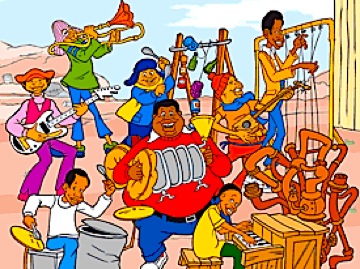
fat-albert-and-the-junkyard-gang

Welcome back to my annual series on the conception, construction, and delivery of a good verbal pitch for a book manuscript or nonfiction proposal. I’ve been worrying all weekend, campers, that I overwhelmed some of you last time by cramming everything you have ever wanted to know about book categories but were afraid to ask into a single post. Believe it or not, I’ve written far, far more extensively on the subject in the past: you’ll find an entire series about it under the BOOK CATEGORIES section in the archive list at the bottom right-hand side of this page.

Before we move on to the next building block of a successful pitch, I suppose I should say a few words to those of you who spent the weekend not just figuring out your respective book categories, but wondering why in the heck I went to such great lengths in my last post to defend the necessity of having to pick one at all. One of the great advantages — and great liabilities — of having taught so many aspiring writers to pitch (in every context from one-on-one tutoring to conducting classes for a couple of hundred people to running mass pitching practice sessions to working with small writers’ groups via Skype or conference call) is that over the years, I have heard legions of writers complain bitterly about the process.

Leaving aside for the moment the undeniable fact that a successful conference pitch allows the pitcher to skip the querying step of landing an agent entirely — not a benefit at which anyone looking for an agent should be turning up his perky little nose — the source of the bitterness is not all that mysterious. Many, if not most, agent-seeking writers (and plenty of already-agented ones) resent, hate, or at minimum fear paying a lot (or even a little) money to conference organizers in exchange for the opportunity to sit across a table from an agent or editor and try to convince her that your premise is fresh enough and a good enough fit with the current market in your book’s category to render it worth her while to take a gander at the first few pages of the manuscript or proposal.

(Which, in case any of you have been wondering, is the goal of a pitch — or a query, for that matter: enticing the agent or editor to ask to read your work. Not, as too many pitchers and queriers assume, to induce a spontaneous cry of, “I love this book! I don’t need to read a syllable of it — I’m going to get this writers name on a contract this very day!”)

Given the level of pressure inherent to pitching, the resentment, etc. are certainly understandable — and not just because we all know that judging the quality of writing by how the writer talks about it is a little like judging a singer’s voice by looking at the sheet music he’s planning to sing.

Ever since the first caveperson chiseled the first sentence on cave wall and called the rest of the clan to admire it, writers have been pretty sensitive to critique. No matter how many times a writer tells herself, rightly, that a rejection based solely upon how she talks about her writing could not possibly mean that the rejecter hates the writing he hasn’t read, it sure can feel like it in the moment.

So I really can’t blame first-time pitchers — or even experienced ones — for fearing the prospect of pitching. What puzzles me is the extreme distaste so many first-time pitchers display toward even the concept of talking about their books as products that they are trying to market.

Which is, incidentally, precisely what anyone who pitches or queries an agent is doing.

A surprisingly hefty percentage of aspiring writers seem to find that hard to accept. I hate to stick a pin in anyone’s illusions, but unless a writer of books plans to post his writing for free on the internet or print up copies at his own expense and hand them out gratis on street corners, he’s thinking in terms of getting paid.

So in what sense is his manuscript or NF book proposal not a product he’s trying to sell to a publishing house? And by what stretch of the imagination is the relationship he’s attempting to establish with an agent not primarily a business one?

For that reason, we’ve already learned the first building block of a successful pitch: the book category, the terminology that enables everyone in the industry to know instantly which presses, editors, and agents might be interested in a particular book. Learning to describe your work in the same terms that the publishing industry would is a far, far more effective strategy for meeting those goals than folding your arms and pouting about how unfair it is that art has to be shoved into a marketing category.

Not only is the latter a waste of energy for most writers (some honestly do find resentment motivating, but most merely find it enervating), but refusing to speak the language of the industry in a pitch or query is self-defeating; all insisting upon eschewing any discussion of marketability does, typically, is make the agent or editor on the receiving end think, “Oh, dear, here’s another one who doesn’t know how publishing works.”

Being able to describe one’s book in market terms is as essential for a killer pitch as for an effective query letter. So today, we’re going to be focusing closely on marketing your art.

As Fat Albert used to say, if you’re not careful, you might learn something before it’s done.

Last time, I broached the subject of the most straightforward way to talk about your writing in professional terms, the book category. The more terse and specific you can be about your book’s category, the more professional you will sound.

The sad thing is, the widespread tendency among pitchers is in the opposite direction. As much as writers seem to adore describing their work as, “Well, it’s sort of a romance, with a thriller plot, a horror villain, and a resolution like a cozy mystery,” agents and editors tend to hear ambiguous descriptions as either waffling, a book’s not being ready to market, or the author’s just not being very familiar with how the industry actually works.

Which means, incidentally, that within the pitch setting, you might want to avoid those ever-popular terms of waffle, my writing defies categorization, my book is too complex to categorize, my book isn’t like anything else out there, no one has ever written a book like this before, and it’s sort of autobiographical.

Which, translated into industry-speak, come across respectively as I’m not familiar with how books are sold in North America, I don’t know one book category from another, I’m not familiar with the current market in my area of interest — which means, Mr. Agent, that I haven’t been buying your clients’ work lately, I’m not familiar with the history of the book market in my area, and I was afraid people would hurt me if I wrote this story as a memoir.

Don’t blame the translator, please: the writers and the agents are just not speaking the same language.

While it may feel like writing your own tombstone, it’s just better marketing strategy to commit to a category and state it at the BEGINNING of your pitch, rather than making your hearer try to glean a category after hearing five minutes of exposition on the plot. Why? Well, among other things, being up front about it will permit your pitch-hearer to listen to the CONTENT of your pitch, rather than thinking the whole time, “Well, that sounds sort of like a romance, with a thriller plot, a horror villain, and a resolution like a cosy mystery. How on earth am I going to categorize that?”

‘Nuff said, I think.

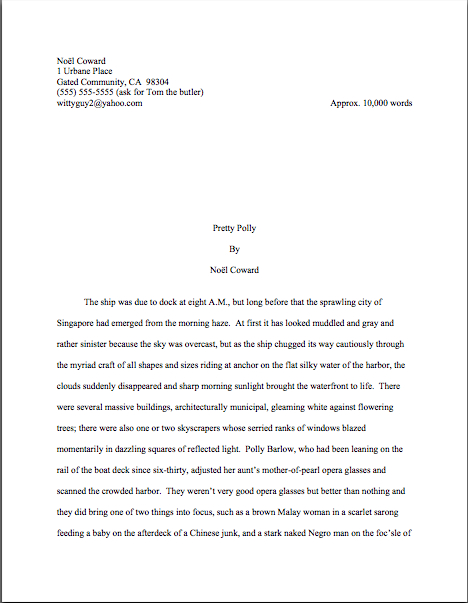
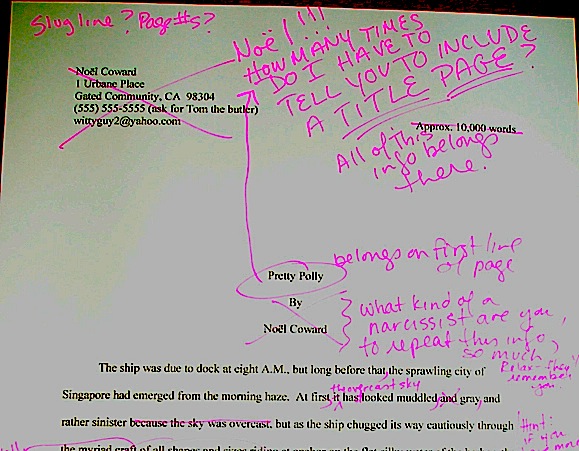
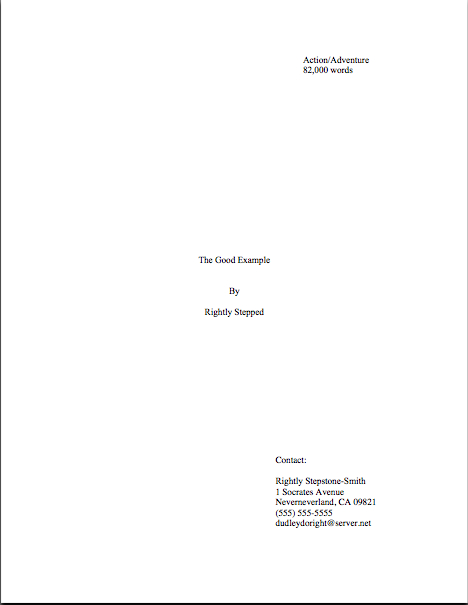
By contrast, a manuscript or proposal with a category already assigned to it requires less energy to market. This handy tool will not only feature prominently in your pitch, but also on the title page of your manuscript and in the first few lines of your query letter. (If it’s news to you that your title page should include these elements — or if it’s news to you that your manuscript should include a title page at all — please see the TITLE PAGES category at right before you even CONSIDER submitting any material to an agent or editor.)

Okay, now that we have one tool in our writerly toolkit, let’s work on adding a more sophisticated marketing instrument, one that is not technically required, but will instantly stamp your pitch/query as more professional.

I refer, of course, to identifying your target market. Or, to be more precise, to preparing a concise, well-considered statement of your book’s target market, including an estimate of how many potential buyers are in that demographic group.

And yes, Virginia, that can mean adding a few — dare I say it? — statistics to your pitch or query letter.

Intimidating news to those of us who vastly preferred the verbal section of the SAT to the math, isn’t it? (Actually, I was always good at math, but I suppose my high school calculus teacher didn’t nickname me Liberal Arts Annie for nothing. Still, there’s no fool like a fool playing hooky, so let’s press on.)

I’m not talking about publishing statistics here; I’m talking about easy-to-track-down population statistics — and that comes as a big surprise to practically every aspiring writer who has ever taken my pitching class. “Why,” they almost invariably cry, “shouldn’t I go to the trouble to find out how many books sold in my chosen category last year? Wouldn’t that prove that my book is important enough to deserve to be published?”

Well, for starters, any agent or editor would already be aware of how well books in the categories they handle sell, right? Mentioning the Amazon numbers for the latest bestseller is hardly going to impress them. (And you’d be astonished by how many agents don’t really understand how those numbers work, anyway.) Instead, it makes far more sense to discover how many people there are who have already demonstrated interest in your book’s specific subject matter.

But before I talk about how one goes about doing that, let’s discuss what a target market is. Simply put, the target market for a book is the group of people most likely to buy it. It is the demographic (or the demographics) toward which your publisher will be gearing advertising.

Or, to put it another way, who out there needs to read your book and why?

I know these are not the first questions we writers like to ask ourselves, but if you pictured your ideal reader, who would it be? What books does this reader already buy? Who are her favorite living authors, and what traits do your books share with those that would draw your ideal reader to both?

While we’re at it, who represents her favorite authors, and would those agents be interested in your book?

Do I hear some disgruntled muttering out there? “I’m not a marketer; I’m a writer,” I hear some of you say. “How the heck should I know who is going to buy my book? And anyway, shouldn’t a well-written book be its own justification to anyone but a money-grubbing philistine?”

Well, yes, in a perfect world — or one without a competitive market. But neither is, alas, the world in which we currently live.

As nice as it would be if readers flocked to buy our books simply because we had invested a whole lot of time in writing them, no potential book buyer is interested in EVERY book on the market, right? There are enough beautifully-written books out there that most readers expect to be offered something else as well: an exciting plot, for instance, or information about an interesting phenomenon.

To pitch or query your book successfully, you’re going to need to be able to make it look to the philistines like a good investment.

And before anybody out there gets huffy about how the industry really ought to publish gorgeously-written books for art’s sake alone, rather than books that are likely to appeal to a particular demographic, think about what the pure art route would mean from the editor’s perspective: if she can realistically bring only 4 books to press in the next year (not an unusually low per-editor number, by the way), how many of them can be serious marketing risks, without placing herself in danger of losing her job? Especially in this economy, when the major publishers have been trimming their editorial staffs.

Do Fat Albert and the Cosby kids really need to break down these issues into a song for the likely outcome to be clear?

It’s very much worth your while to give some thought to your target readership BEFORE you pitch or query, so you may point it out to that nervous editor or market-anxious agent. Try to think about it not as criticism of your book, but as a legitimate marketing question: who is going to read your book, and why?

As with choosing a book category, it pays to be specific. For one thing, it will make you stand out from the crowd of pitchers.

Why? Well, to put it charitably, the vast majority of fiction writers do not think very much about the demographics of their potential readers — which is to say, most don’t seem to consider the question at all. (A luxury, I might point out, that nonfiction writers do not have: NF book proposals invariably have an entire SECTION on target audience. No one ever seems to think that is incompatible with the production of art.) Or when fiction writers are forced to answer the question, they identify their readership in the broadest possible terms.

PLEASE, for your own sake, avoid the oh-so-common trap of the dismissive too-broad answer, especially the ever-popular women everywhere will be interested in this book; every American will want to buy this; it’s a natural for Oprah. Even in the extremely unlikely event that any of these statements is literally true in your book’s case, agents and editors hear such statements so often that by this point in human history, they simply tune them out.

Especially the one about Oprah — even if your book is in fact a natural for her show. Agents in North America hear that all the time, applied to a jaw-droppingly broad array of books.

Seriously, if I had a dime for every time I have heard that particular cliché, I would own my own publishing house — and the island upon which it stood, the fleet of sailboats to transport books from there to market, and a small navy’s worth of shark-wranglers to keep my employees’ limbs safe while they paddled between editing projects. (For an interesting discussion amongst Author! Author! readers about the effects of the Oprah Book Club on book sales in this country, please see the comments on this post from last year.

Why do sweeping generalizations tend to be ineffectual, you ask? Well, agents and editors do have quite a bit of practical experience with book marketing: they know for a fact that no single book will appeal to EVERY woman in America, for instance. Since they hear such claims so often, after awhile, they just block out all hyperbole.

Coming from authors, that is. Anyone who has ever read a marketing blurb knows that folks in the publishing industry are not all that shy about using hyperbole themselves.

Make sure your target market is defined believably — but don’t be afraid to use your imagination. Is your ideal reader a college-educated woman in her thirties or forties? Is it a girl aged 10-13 who doesn’t quite fit in with her classmates? Is it an office worker who likes easy-to-follow plots to peruse while he’s running on the treadmill? Is it a working grandmother who fears she will never be able to afford to retire? Is it a commuter who reads on the bus for a couple of hours a day, seeking an escape from a dull, dead-end job?

While these may sound like narrow definitions, each actually represents an immense group of people, and a group that buys a heck of a lot of books. Give some thought to who they are, and what they will get out of your book.

Or, to put a smilier face upon it, how will this reader’s life be improved by reading this particular book, as opposed to any other? Why will the book speak to her?

Again, be as specific as you can. As with book category, if you explain in nebulous terms who you expect to read your book, you will simply not be speaking the language of agents and editors.

Once you’ve identified your target audience, it’s greatly to your advantage to do a bit of research on just how big it is. Throwing some concrete numbers into your pitch, demonstrating just how big your target market actually is will make it MUCH simpler for them to talk about your book to higher-ups.

Why? Well, sales and marketing departments expect agents and editors to be able to speak in hard numbers — and no matter how much the editors at a publishing house love any given book, they’re unlikely to make an actual offer for it unless the sales and marketing folks are pretty enthused about it, too. So doesn’t it make sense to make sure the agent and editor fighting for your book have that demographic information at their fingertips, when it’s relatively easy for you to put it there?

Some of you are still not convinced that it would behoove you to go to the additional effort, aren’t you? “But Anne,” I hear those of you writing for some of the bigger markets protest. “Surely, everyone with a pulse is aware of how big my particular target audience is and why they would find my book appealing. Wouldn’t it be, you know, a little insulting if my pitch or query assumed that the agent wasn’t sufficiently aware of the world around him to know these things.”

Well, yes, if you happen to be pitching a YA book about a teenage girl’s relationship with a vampire or another book whose appeal to a recent bestseller’s already-established readership is so self-evident that any agent with a brain would pitch it as, “It’s basically TWILIGHT, but with twist X…”

But the fact is, few books that aren’t really, really derivative of current bestsellers have that obvious a target audience. Let me tell you a parable about what can happen if a writer is vague about her target market’s demographics.

Aspiring writer Suzette has written a charming novel about an American woman in her late thirties who finds herself reliving the trauma of her parents’ divorce when she was 12. Since the book is set in the present day, that makes her protagonist a Gen Xer, as Suzette herself is. Let’s further assume that like the vast majority of pitchers, she has not thought about her target market before walking into her appointment with agent Briana.

So she’s stunned when Briana, the agent to whom she is pitching, says that there’s no market for such a book. But being a bright person, quick on her feet, Suzette comes up with a plausible response: “I’m the target market for this book,” she says. “People like me.”

Now, that’s actually a pretty good answer — readers are often drawn to the work of writers like themselves — but it is vague. What Suzette really meant was:

“My target readership is women born between 1964 and 1975, half of whom have divorced parents. Just under 12 million Americans, in other words — and that’s just for starters.”

But Briana heard what Suzette SAID, not what she MEANT. Since they’ve just met, how reasonable was it for Suzette to expect Briana to read her mind?

The result was that Briana thought: “Oh, God, another book for aspiring writers.” (People like the author, right?) “What does this writer think my agency is, a charitable organization? I’d like to be able to retire someday.”

And what would an editor at a major publishing house (let’s call him Ted) conclude from Suzette’s statement? Something, no doubt, along the lines of, “This writer is writing for her friends. All four of them. Next!”

Clearly, being vague about her target audience has not served Suzette’s interests. Let’s take a peek at what would have happened if she had been a trifle more specific, shall we?

Suzette says: “Yes, there is a target market for my book: Gen Xers, half of whom are women, many of whom have divorced parents.”

Agent Briana thinks: “Hmm, that’s a substantial niche market. 5 million, maybe?”

Sounding more marketable already, isn’t it?

But when Briana pitches it to editor Ted this way, he thinks: “Great, a book for people who aren’t Baby Boomers. Most of the US population is made up of Baby Boomers and their children. Do I really want to publish a book for a niche market of vegans with little disposable income?”

So a little better, but no cigar. Let’s take a look at what happens if Suzette has thought through her readership in advance, and walks into her pitch meetings with Briana and Ted with her statistics all ready to leap off her tongue.

Suzette says (immediately after describing the book): “I’m excited about this project, because I think my protagonist’s divorce trauma will really resonate with the 47 million Gen Xers currently living in the United States. Half of these potential readers have parents who have divorced at least once in their lifetimes. Literally everybody in that age group either had divorces within their own families as kids or had close friends that did. I think this book will strike a chord with these people.”

Agent Briana responds: “There are 47 million Gen Xers? I had no idea there were that many. Let’s talk about your book further over coffee.”

And editor Ted thinks: “47 million! Even if the book actually appealed to only a tiny fraction of them, it’s still a market well worth pursuing.”

So what’s the moral here? That as scary as it may be to think about, if you are going to make a living as a writer, you will be writing for a public. In order to convince people in the publishing industry that yours is the voice that public wants and needs to hear, you will need to figure out who those people are, and why they will be drawn toward your book.

If you don’t want to make a living at it, of course, you needn’t worry about marketing realities; writing for your own pleasure, and that of your kith and kin, is a laudable pursuit. But if you want total strangers to buy your work, you are going to have to think about marketing it to them.

As I have said before, and shall no doubt say many times again: art for art’s sake is marvelous, but an author’s being cognizant of the realities of the market renders it far more likely that her book is going to be successful.

And, to paraphrase Fat Albert, those who don’t do their homework are not as likely to succeed as often as those who do.

Tomorrow, I shall talk about how to dig up specifics about your target demographic relatively painlessly. As always, if any of you out there find what I’m suggesting confusing, I would MUCH rather that you ask me about it BEFORE you follow my advice than after.

I’m funny that way. In the meantime, don’t play hooky, try not to assume, and keep up the good work!

Pitching 101, part IV, in which I finally stop giving preliminary cautions and start talking about the building blocks of a terrific pitch. Oh, and you’re going to have to pick a book category.

a-pile-of-boxes

Yes, it’s true: in the fourth installment in this series, I’m moving beyond telling you how to prepare for a conference where you might be able to pitch your book to an agent or editor, either formally or informally, and proceeding toward how to decide what to say when you get there. While some might shake their heads, muttering, “Why on earth is she going over every nuance, when we’re already deep in literary conference season?”, well, I have two answers.

First, for the many, many aspiring writers who (unwisely, I think) put off constructing (or often even thinking about) their pitches until the eve of the conference, I’ve established a super-quick crash course in how to do it: you’ll find it under the aptly-named HOW TO WRITE A PITCH AT THE LAST MINUTE category on the archive list on the lower right-hand side of this page.

Second, years of experience teaching good writers to pitch lead me to believe that just telling you what to do without helping you understand why each part of the pitch is necessary in order to market your work persuasively to agents and editors — including parts that are usually left out of the three-line pitch entirely — usually results not only in less effective pitches, but writers not particularly comfortable with giving them. Call me zany — and believe me, there are plenty of local conference organizers who do — but I just don’t believe that pitching advice that tells writers to blurt out a summary of their books as fast as humanly possible and leaves it at that is actually all that helpful come pitching time.

Hey, I warned you that my approach to pitching was a bit unorthodox.

Contrary to the prevailing wisdom, I believe that the definition of pitching successfully is not merely being able to cram an entire 400-page book into three sentences and spit it out coherently. Instead, I define pitching success as the ability to speak fluently and persuasively about a book in terms that make an agent or editor likely to say, “Gee, I’d like to read that. Please send me the first 50 pages right away.”

I define a pitch’s success by its results, not its conformity to a pre-set model to be used in all instances. I know: radical.

Thinking of it this way makes it far, far easier to make it through the pitch preparation process: instead of grumblingly adhering to an evidently arbitrary and difficult standard of presentation, you’re gearing up to have all of the marvelously fulfilling conversations that will define the rest of your life as a professional writer.

Much nicer to wrap your brain around than croaking out the bare bones of your premise in 10 seconds, isn’t it?

Now that you are prepared for my advice to be a bit offbeat, I am not afraid to shock you with my first unorthodox suggestion:

DON’T start the pitch-prepping process by sitting down and trying to summarize your book’s plot or argument in just a few lines. Instead, let your first step be figuring out where your book would be placed on the bookshelves of Barnes & Noble, Borders, or a similar chain bookstore.

Why? Because this is the single most important piece of information you can tell an agent or editor about what you write. And because everyone in the US publishing industry talks about the demarcations in the same terms, you’re going to communicate a whole lot better with them if you use the book categories they already know. Which are:

For fiction: Fiction (a.k.a. Mainstream Fiction), Literary Fiction, Historical Fiction, Futuristic Fiction (that is not SF. The usual example is THE HANDMAID’S TALE.), Adventure Fiction, Sports Fiction, Contemporary Fiction, Adult Fiction; Women’s Fiction, Contemporary Women’s Fiction, Chick Lit, Lady Lit, Lad Lit; Romance, Category Romance, Contemporary Romance, Historical Romance (designate period), Paranormal Romance, Romantica, Erotica, Inspirational Romance, Multicultural Romance, Time Travel Romance; Science Fiction, SF Action/Adventure, Speculative SF, Futuristic SF, Alternate History, Cyberpunk; Fantasy, Dark Fantasy, Comic Fantasy, Epic Fantasy; Horror, Paranormal, Vampire Fiction; Thriller, Spy Thriller, Suspense, Romantic Suspense; Mystery, Police Procedural Mystery, Legal Mystery, Professional Mystery, P.I. Mystery, Psychological Mystery, Forensic Mystery, Historical Mystery, Hardboiled Mystery, Cozy Mystery, Cops & Killers Mystery, Serial Killer Mystery, British Mystery, Noir, Caper; Western; Action/Adventure; Comics; Graphic Novel; Short Stories; Poetry; Young Adult, Picture Book, Children’s, Middle Readers.

For nonfiction: Entertaining, Holidays, House & Home, Parenting & Families, How-To, Self-Help, Pop Psychology, Pop Culture, Cookbook, Narrative Cookbook, Food & Wine, Lifestyle, Medical, Alternative Medicine, Health, Fitness, Sports, Psychology, Professional, Engineering, Technical, Computers, Internet, Automotive, Finance, Investing, Business, Careers, Memoir, Autobiography, Biography, Narrative Nonfiction, Historical Nonfiction, True Crime, Law, Philosophy, Religion, Spirituality, Travel, Travel Memoir, Outdoors & Nature, Essays, Writing, Criticism, Arts, Photography, Coffee Table, Gift, Education, Academic, Textbook, Reference, Current Events, Politics/Government, Women’s Studies, Gay & Lesbian (a.k.a. GLBT).

Actually, there are a few more, but these are the main ones. For more detailed analysis, again, please see the BOOK CATEGORIES heading on the list at right. Also, the major genre’s writers’ associations tend to provide precise definitions of each subgenre on their websites. But these are enough to get you started.

Pick one.

Before anybody out there starts to freak out about the prospect of having to select the perfect pre-fab label, let me hasten to add: aspiring writers are not singled out for punishment in having to do this; literally every professional author does as well. It’s a technical designation, after all, not a summary of the book’s contents.

And contrary to popular belief, choosing does not define a writer for life: the book category is merely the conceptual box into which all books aimed at a particular already-established market are placed. Literally every book published by a North American publisher has been assigned to such a category.

So calm down and ask yourself: in a marketing display, what kind of books would be grouped around it? How would it be placed so as to suggest that if the potential buyer liked book X, he would probably be interested in your book as well?

Lest any of you fiction writers are tempted to say, “Oh, my book would just be in the literature section, filed under my last name,” that’s not a good enough answer. Nor is, “Oh, I’m a genre-buster — I don’t want to limit myself with a label.”

That kind of answer just isn’t useful to an agent — on order to sell your book to an editor, your agent is going to need to be able to tell him right off the bat what kind of a book it is, not merely that she thinks it’s well written. Similarly, in order to argue that your book belongs in next year’s catalog, an editor is going to have to tell the rest of the folks at the publishing house the book category, just as the marketing department is going to have to tell the distributor, and the distributor the bookstore buyer.

Thus, the book category is in fact the industry shorthand for where a book should be directed in order to sell, at every level. So it follows as night the day that aspiring writers who equivocate between categories because they believe (not entirely without reason) that their books are too complicated to be shoved into a single conceptual box, or even refuse define their work automatically render it harder for all of these people to do their jobs.

And that’s not the world’s best idea, because if you want them to assist you in getting your writing into print, it’s really much more in your interests than theirs to make it as easy as possible to help you.

Let me repeat that, because it’s vital and I’ve never heard any other pitching advisor mention it: aspiring writers who go out of their way to make it easy for folks in the publishing industry to help them succeed tend to garner a heck of a lot more help than those who make it difficult.

Partially, that’s just human nature: a person for whom it’s a pain to do favors tends not to have others leaping forward to do him any. But partially, it’s also because most writers inadvertently make it difficult by not learning how to talk about or present their work professionally.

Which leads me to the other, utterly selfish reason that you should figure out the proper category for your book, and pronto: once you know where the pros would envision your book selling best, you will have both an infinitely easier time pitching AND finding agents to query. Suddenly, those cryptic lists of book types in agents’ guides and opaque conference bio blurbs will spring to life for you.

Unfortunately, the vast majority of aspiring writers do not do their homework in this respect — and believe me, from the pros’ perspective, it shows in their pitches. The industry defines types of books far more specifically than writers tend to do — and, as I’ve been pointing out over the last few days, no agent represents every kind of book. Since they define their work by book category, writers’ reluctance to commit just seems like ignorance of how books are sold.

Does that conclusion seem harsh? Actually, it isn’t, particularly: the sad fact is, the vast majority of aspiring writers out there have only a vague idea of how their books would be marketed to booksellers. So I’m here to tell you: the FIRST question any editor would ask an agent about a book, or a committee would ask an editor, or a book buyer would ask a publishing house’s marketing department is, “What’s the book category?”

But I even as I typed that last bit, I could sense that some of you out there were still feeling abused for having to adhere to the established categories, feeling (and not without some justification) that there’s more to art than marketing labels. If you feel that way, you’re certainly not alone: you can’t throw a piece of bread at a writers’ conference anywhere in North America without hitting a writer who believes that his artistic freedoms are endangered by the very request. Or a writer who has fretted for a year about picking the right category. And anyone who has ever listened to pitches for a living can tell you horror stories about writers who wasted half (or even all) of their pitch appointments complaining about it.

To save any of you from ending up as the subject of such a tale. let’s take a look at how the average pitcher deals with this fundamental question, and why the standard oh, my God, don’t make me pick! responses tend not to impress agents and editors very much.

In the first place, writers often mishear the question as, “So, what is your book about?” rather than what it is, a straightforward request for marketing information. Thus, they all too often give exactly the same response they would give anybody who asked the more general latter question at a cocktail party:

“Well (gusty sigh), it’s a novel…mostly, it’s women’s fiction, but it’s not really a romance novel. I guess it’s also suspense, with thriller elements. And the writing is definitely literary.”

I hate to be the one to break it to you, but to an agent or editor, this kind of response sounds EXACTLY like that noise that Charlie Brown’s teachers used to make: Wah wah wah wah waagh…

Remember, agents and editors think about books as products, rather than merely as works of art or expressions of the inner workings of the writers’ souls. And as products, agents need to sell books to editors, and editors to editorial committees, and marketing departments to distributors, and distributors to bookstores, and bookstores to readers.

I assure you, a vaguely-defined book is much harder to drag through that process. And much, much, MUCH harder for a writer to pitch successfully.

So it’s an excellent idea to tell them up front — as in both your pitch and the first few lines of your query letter — what kind of book it is. But in order to make sense to people in the industry, you need to speak their language: pick one of their recognized categories. In other words, don’t just guess, don’t lump a couple of categories together into a Frankenstein’s monster of a hyphenate, and don’t just make up a category.

How do you know where to start? Glad you asked — you know how I love step-by-step instructions.

1. Learn where book categories lurk.
In this age of rampant standardization of book packaging, this isn’t all that hard to do. Take a gander at the back jacket of most recently-released hardcover books: you will find, usually in either the upper left corner or just above the barcode, a one- or two-word description. That is the book category.

Not sure how to find it? Okay, here’s the back cover of Sarah Vowell’s ASSASSINATION VACATION (a terrific book for anyone interested in political history, by the way; she’s a very funny writer). Follow the lead of my pen:

sarah-vowells-back-cover-ii

You may notice that her publisher has listed the book in two categories: biography and travel. That makes perfect sense, because the book both talks about the lives of various murdered American presidents and follows Ms. Vowell’s journeys to their assassination sites. (I’m not kidding: it honestly is very funny.)

The other common locale for a book category, especially on trade paperbacks and softcover books, is in the box with the barcode. Here’s the back of Jonathan Selwood’s hilarious THE PINBALL THEORY OF APOCALYPSE:

jonathan-selwood-back-cover

Okay, so that last photo was a trifle askew. However, since the novel partially concerns the aftermath of a major earthquake, that seems rather appropriate.

2. Find some recently-released books similar to yours and check how they’ve been categorized.
Think about your book. Can you come up with, say, 3-5 titles that are similar to it in subject matter, tone, approach, voice, etc., that have come out in North America within the last five years? Not similar in ALL respects, necessarily — just one or two may be enough to steer you in the right direction

If you can’t come up with any that are remotely similar, I suspect that you’re not overly familiar with the current book market — a serious liability for anyone hoping to pitch or query a book to someone who makes a living following such trends.

If all else fails, start feeding relevant search terms into Amazon and see what comes up.

3. See how the books on your list have been categorized by their publishers.
Once you have your list, go to a bookstore (either physically or online) and see where those books are housed. That is, most likely, where your book would be categorized, too.

4. From among those categories, select the one that intuitively seems to fit your book best.
Book categorization is not a perfect science — pick the one that comes NEAREST to where you envision the book being shelved in a big bookstore. (Since I’ve written about this topic quite frequently and I’m trying to get us through the pitching basics fairly quickly, for more specific tips on how to do this, please see the BOOK CATEGORIES heading on the list at right.)

Fair warning: many categories overlap — fiction, women’s fiction, and literary fiction, for instance, share quite a bit of common ground. Choose the one that you like best; as long as you’re close, your future agent will be able to tell you how to categorize it.

Whoa, I didn’t even have time to move my hand to the return key before I felt a mighty gust of cries of WAIT! coming from out there. “But Anne,” breathless voices cry, “I honestly don’t know how to categorize my novel. Is it literary, mainstream, or just plain fiction — and will agents hurt me if I guess wrong?”

This is an excellent question — one that I covered at some length in several posts; I would encourage you to go back over this postthis one, and this. You might also try asking yourself few questions about your book:

(a) Does your book assume a college-educated readership? Does it try experiments with structure and language? Is character development more important to the reading experience than plot? If you answered yes to at least two of these, literary fiction would probably be the safest choice.

(b) Is your book aimed at a general adult audience, or is more heavily weighted toward a female readership? (Okay, so this is kind of a trick question, since women buy over 80% of the fiction sold in the US and almost all of the literary fiction, but bear with me here.) If it is genuinely aimed at a general market, fiction would be a good choice.

If it does assume a female readership, or if the protagonist is female, consider women’s fiction. And just in case any of you are harboring the surprisingly pervasive prejudice that women’s fiction label is automatically pejorative: women’s fiction is far and away the best-selling fiction category.

(c) Does your book have a filmic, easily-summarized plot? Are the style and storytelling technique similar to a bestselling author’s? If so, it might be mainstream fiction (also known as commercial fiction).

(d) Is your protagonist relatively young — and have sex with more than one partner/do drugs/have a drinking problem? Does the plot deal with adult-themed issues that probably wouldn’t make it onto network television in the dinner hour? If so, it might be adult fiction or contemporary fiction.

(e) Are all of the criteria in #4 true, but the protagonist is female, under 40, have a sense of humor, doesn’t pursue significant interests in the book OTHER than having sex with more than one partner/doing drugs/having a drinking problem — and yet is not a memoir by Elizabeth Wurtzel? If so, you might want to consider the chick lit category, especially if your protagonist’s interest in shoes and handbags borders on the pathological.

Before any chick lit writer gets all defensive on me, allow me to add that there is some chick lit out there does deal with serious subject matter (see the comments on this post); like many, many other book category distinctions, the difference between women’s fiction and chick lit is often a matter of tone. If you write in either category and are unsure what that means, it would be a grand idea to walk into a bookstore, ask a savvy clerk to point out the three best recent releases in women’s fiction and chick lit, and read the first few pages of each.

All that being said, it’s not completely unheard-of for women’s fiction with a young protagonist to be assigned to chick lit simply due to the sex and age of the writer, or for an agent to decide to submit a book to chick lit editors as chick lit and women’s fiction editors as women’s fiction. Ultimately, categorization is a call the agent to make; all you’re trying to do in a pitch or query is to find a label in the general ballpark.

Which leads me to…

(f) Are you planning on pitching or querying an agent who likes to make this call himself? In that case, you might be best off simply labeling it fiction — but you’re unlikely to know that unless you’ve spoken to the agent personally. If this is the case, you should pick the closest label, then nod smilingly when the agent to whom you are pitching says you are mistaken.

Hey, it’s how those of us already signed with agents do it. I even know a quite prominent author who claims that she doesn’t know for sure whether any particular piece is women’s fiction or memoir until her agent has sold it as one or the other.

All that being said, try not to get too discouraged if your book’s category does not immediately pop to mind. Often, it is genuinely a hard call. Just do your best.

5. Use the book category you’ve chosen to describe your manuscript whenever you are communicating with anyone in the publishing industry.

Feel free to use it ubiquitously. Its uses are myriad: in your pitch, in your query letter, on your title page (if you don’t know where this info should go, please see the TITLE PAGES category on the list at right), in checking an agent’s conference blurb or listing in an agency guide to see whether she represents your kind of book, whenever anyone at a literary event asks, “So, what do you write?”

But whatever you do, NEVER tell anyone in the industry that you have a “fiction novel” — this is a very, very common pet peeve amongst agents and editors. By definition, a novel IS fiction, always, just as a memoir is always nonfiction. (Technically, anyway. Don’t even get me started on how many memoirists have found their books under just-the-facts scrutiny over the last couple of years.)

Some of you are still squirming under the necessity of choosing, aren’t you? “But Anne,” I hear some confused would-be pitchers and queriers cry, “I occasionally see categories other than the ones you’ve listed on book jackets and when authors speak about their work. Therefore, you must be wrong about agents and editors expecting to us to label our books, and I can refer to my manuscript any way I like — or not categorize it at all.”

Oh, that old saw. Naturally, there are new categories popping up all the time, a side effect of the expansive creative impulse of the human mind. And there’s no international police force compelling every published author out there to speak of their books in the same terms.

That doesn’t mean, however, that it behooves an aspiring writer to make up a book category. All one has to do is check out any of the standard agency guides to see why: when asked what kinds of books they represent, agents don’t use descriptions that are only meaningful to themselves and their closest friends; the vast majority of the time, they use the standard category designations.

That being said, generally speaking, it’s safer to pick one of the standards rather than to insist upon a category that has only been introduced recently: if it’s too new, the agent or editor to whom you are pitching may not yet be aware of it yet. (Hey, it happens.)

When in doubt, pick a more general category over a hyper-specific one. Or at any rate, select the more marketable one. It increases your chances of your work sounding to an agent like something that will sell.

But again, try not to stress about it too much. Believe me, if you are off just a little, an agent who is intrigued by your work will nudge you in the right direction, rather than writing you off because you picked the wrong sub-category. In fact, it’s not at all uncommon for an agent to sign a writer and then say, “You know, Ghislaine, I think your book would sell better as women’s fiction than mainstream fiction. Let’s market it as that.”

And if Ghislaine is a savvy writer, she won’t immediately snap back, “Why is it women’s fiction rather than mainstream — because the author possesses ovaries?” (Not all that an uncommon an underlying reason for the choice, actually; some of my work has been categorized that way on apparently no other pretext.) Instead, market-ready writer that she is, she will respond, “If you think it’s a better idea, William. But do you mind explaining the logic to me, so I may consider how you’ve planning to market my work when I’m writing my next novel?”

THAT, my friends, is language the entire industry understands. This is a business where finesse definitely counts.

Hey, I don’t make up the lingua franca; I just speak it. (For more on the ins and outs of defining women’s fiction (particularly when a book occupies the rather broad territory where women’s, literary, and mainstream overlap), please see the three posts beginning here.)

6. What to do if you just cannot bring yourself to apply step 5 to the category that makes the most sense
If you truly get stuck in mid-decision, here is a sneaky trick: go to a well-stocked bookstore and track down a friendly-looking clerk. Describe your book to her in very general terms, and ask her to direct you to the part of the store where you might find something similar.

Then start pulling books off the shelf and examining their back covers for categories.

Hint: don’t be too specific in your description to the clerk — and whatever you do, don’t mention that you wrote the book you are describing. “My favorite book is a suspenseful romantic comedy about murderous contraltos set in the Middle Ages — would you have anything close to that?” tends to yield better results than, “I’m looking for a book about an opera diva who lives in 9th-century Milan, has scores of amorous misadventures, and strangles her conductor/lover. Where would I find that in your store?” The latter is more likely to turn up a puzzled shrug than useful directions.

Repeat in as many bookstores as necessary to start seeing a pattern in where you’re being advised to look. That location is where your book is most likely to be shelved.

Yes, this process can be a pain, but stating your category up front will simply make you come across as more professional, because it’s the way that agents and editors talk about books. Agencies do not impose this requirement in order to torment writers, you know; the category you pick will determine to a very great extent whether any given agent or editor will be even remotely interested in your work.

Because yes, Virginia, there are professionals who will simply not read a query or listen to a pitch unless it is for a book in one of their pre-chosen categories. Agents and editors LIKE making snap judgments, you see. It saves them time.

Sorry to be the one to break it to you.

To put a more positive spin on the phenomenon, think of it this way: if you tell an agent immediately what kind of book you are pitching, the busy little squirrels in her brain can start those wheels spinning toute suite, so she can instantly start thinking of editors to whom to sell your book.

Since that is precisely what you want her to be doing, what are you complaining about?

If you’re still a bit confused and want more help fine-tuning your selection, again, I would recommend taking a gander at the posts under the BOOK CATEGORIES heading at right. In the past, I have spent more time on this particular point; I could easily spend a week on this point alone. (And have, as it happens.)

And if you’ve narrowed it down to a single category, congratulations! You’re ready to move on to Step 2 of writing your pitch.

Which, not entirely coincidentally, will be the subject of my next post. (Hey, I told you I liked step-by-step directions.) Keep up the good work!

Pitching 101, part II: okay, before anyone starts to panic…

thescream

Within mere seconds of posting the first in my annual series on pitching — the much-feared practice of approaching an agent face-to-face to try to interest her in your manuscript, rather than via the far less intimidating query letter or e-mail — I felt the ether fill with two discordant emotions rising in a cloud from my readers: extreme panic and terrible annoyance. (Actually, there was a third, gratitude from those of you who aren’t scheduled to pitch anytime soon, but the other two smogs were so virulent that it took me a while to notice #3.)

I can easily understand both the panicked and annoyed reactions, of course: the prospect of sitting down with an agent who may very well reject you on the spot, much less stopping her in a conference hallway, is monumentally frightening. Rejection’s bad enough when it comes in the mail, right? And believe me, I can certainly identify with the annoyance of learning that connecting successfully with an agent or editor in a pitch appointment often requires substantial advance homework; conference brochures and websites tend to imply that all a writer has to do in order to impress the agent of his dreams is to show up ready to talk about his book. Albeit briefly.

Honestly, I’ve been blogging and teaching about pitching long enough to expect both of these reactions — and to know that there is only one thing I can say that will help the panicked and annoyed see why I’m so committed to making absolutely certain that all of my readers learn the basic skills of pitching, rather than just the ones who have appointments with agents at conferences in the weeks to come. It’s this:

A good 90% of pitch rejections have nothing to do with the quality of the book being pitched.

Yes, really: the vast majority of the time, pitch recipients say, “I’m sorry,” because of other factors, such as bad fit, a book category that the agent does not represent, an insufficient platform (that’s for nonfiction; don’t worry, we’re getting to that), an incoherent pitch (a common side effect of panic), lack of freshness in the story, the agent’s having had no success selling a manuscript, the writer’s looking just like someone who was really, really mean to the agent in high school (hey, they’re human), and so on, ad infinitum. Some of these factors, like the coherence of the pitch, lie within the writer’s control; some, like the resemblance to the high school bully, do not.

Throughout this series, we’re going to talk about how to tell the difference — and to prepare to handle the parts of the process you can control beautifully.

There, that made those of you who’ve pitched before feel a whole lot better, didn’t it? And for the rest of you, does it make more sense that I want to talk you through how to avoid the pitfalls that scuttle the average pitch?

Excellent. Let’s get back to business and talk about the single most common reason agents give for rejecting both pitches and queries: they just don’t represent that book category.

Yesterday, I was waxing poetic on an must-follow piece of advice — if you are looking for an agent (as the vast majority of writers willing to shell out the dosh to attend major conferences are), it makes sense only to invest in attending conferences where agents with a proven track record of selling with your type of book will be available for your pitching pleasure. Feel free to derive an important corollary from this excellent axiom: from this moment on, ONLY pitch or query your book to agents who represent that kind of book.

Seems so simple, put that way, doesn’t it? Yet every year, literally millions of aspiring writers either take a scattershot approach, querying fairly randomly (thus all of those “Dear Agent” letters that folks in the industry hate so much) or let the conferences do the selection for them, pitching to whoever is there with a winsome disregard for matching their books with the right agent.

Please don’t do that to yourself; as I pointed out last time, it can only end in tears.

I cannot say this often enough: you do not want to be signed by just ANY agent — although, in the throes of agent-seeking, it’s certainly very easy to start believing that any agent at all would be better than none. You want the agent who is going to be able to sell your work quickly and well.

Believe it or not, even the surliest agent who ever strode contemptuously into a literary conference and brushed off a pitcher wants this as well. Good agents don’t like hurting aspiring writers’ feelings, after all; they merely want to sign authors of books they know they can sell — and believe me, they walk into pitch meetings quite aware of what the editors to whom they have already successfully sold books are looking to buy at the moment.

Being intimately familiar with the publishing market is, after all, part of their job.

I’m sensing some disgruntlement amongst those of you who have pitched before (an improvement on panic and annoyance, certainly, but still). “But Anne,” these veterans of the conference wars protest, “that doesn’t always seem to be true. There are plenty of books like mine on bookstore shelves right now, but I’ve had agents tell me that there’s no market for a book like mine. What gives?”

I’m very glad you brought this up, disgruntled protestors: many, many aspiring writers aren’t aware of the distinction between the current publishing market (what editors are looking to buy right now) and the current literary market (what’s occupying the shelves at Barnes & Noble). Books for sale to consumers right now were on the publishing market at least a year ago — in most cases, more like two years — and since agents are seldom able to sell new clients’ books within a few days of signing them to an agency contract, any of those books by first-time authors were probably making the rounds of conferences and/or being queried three or more years ago.

Thus, what’s on the shelves right now isn’t necessarily the best indicator of the needs of the current publishing market. An agent who is good at her job has to aware of both.

Which is, in case you were wondering, why they tend to be so quick to reject what doesn’t fall within their sphere of influence. Since they are inundated with queries and pitches, it is in their best interests to weed out the absolutely-nots as swiftly as humanly possible — and although it may not feel like it at the time, in yours as well.

Don’t believe me? Ask any author who has found herself spending a year or two in the purgatory of a representation contract with an agent who didn’t have the contacts to sell her book, but still snapped up the book because it was in an at-the-time-hot book category. (Yes, it happens. Far more often than either the agented or agents themselves like to admit.)

So if an agent who doesn’t represent your kind of work rejects you — and this is equally true if it happens at a conference or via query — be open to the possibility that it may not have anything to do with the quality of your writing or the idea you are pitching. It might just be a bad fit with that agent, or the agent’s current connections may not be looking for your kind of book.

Yes, no matter how beautifully it’s written. This part of the process is as much about practicality as about art.

I know it’s hard to accept this philosophically when your baby is rejected out of hand, but it is vital for your professional mental health that you bear the issue of fit constantly in mind while you are pitching and querying. Not only isn’t anything personal about a bad-fit rejection — it does not even begin to be a fair test of how the book will fly with an agent who does represent that kind of work.

Allow me to repeat that, because it’s awfully important: a book’s being rejected by an agent or editor who doesn’t represent that type of work is NOT a viable test of its marketability amongst those who do.

Thus it follows with an elegant inevitability that if you want to know whether your book is marketable, you should pitch or query it only to those with whom such a test WOULD be a good indicator of how the publishing industry might view it. Or, to put it another way, the best way to avoid this kind of rejection is not to pitch or query your book to any agent that isn’t predisposed to be interested in it.

The same logic applies to pitch meetings with editors, by the way. No editor in the business acquires across every conceivable genre; in fact, most editors’ ability to acquire is sharply limited by their publishing houses to just one or two types of book.

So it would be a waste of your pitching energies to, say, try to interest an editor who does exclusively mysteries in your fantasy novel, right? Right?

Check before you pitch. Fortunately, at most conferences, gleaning this information is almost absurdly simple: virtually every conference that hosts pitching sessions will schedule an agents’ forum before the pitch meetings start, so attendees can hear from the agents’ very lips what they are there looking to acquire. If you intend to pitch at the conference, do not, under any circumstances, skip this forum.

Yes, even if you were my rare prize student who went to the trouble of finding out prior to registering for the conference what the attending agents have been selling lately. Even for you, gold-star winner, attending the forum may have tangible benefits: since the publishing market mutates so often and so rapidly, the agent of your dreams may well be looking for a different kind of book today than last week. If so, he’s going to announce it at the forum.

Another solid reason to go hear the agents speak is — brace yourselves; this one is a trifle disillusioning — just because an agent is scheduled to attend a conference doesn’t necessarily mean that he will show up, particularly if the conference is a large one. Crises come up at agencies all the time, so last-minute changes to the roster of pitchable agents attending a conference are common enough that veteran conference attendees regard it as the norm, rather than the exception.

Try not to think of this as rude; regard it as an opportunity. Chances are, someone on that panel is going to represent your kind of book.

Speaking of pitching to editors, here’s another thing that any writer pitching at a North American conference ABSOLUTELY MUST KNOW: all of the major NYC publishing houses currently have policies forbidding their editors to acquire work by unagented writers.

Don’t believe me? Check their websites. For the adult book market, the policy is uniform. (Some YA imprints have different policies; again, it’s in your interests to check.)

This means, in essence, that the BEST that could happen if you pitched your book to an editor from one of these houses is that he might help you hook up with an agent. Although it’s somewhat counterintuitive, an editor at a smaller or regional house might have more leeway to pick up your book.

Sort of changes how you view those much-vaunted conference appointments with bigwig editors, doesn’t it?

I’m bringing this up because in most of the flavors of common being-discovered-at-a-conference fantasy, an editor from Random House or somewhere similar hears a pitch, falls over backwards in his chair, and offers a publication contract on the spot, neatly bypassing the often extended agent-seeking period entirely.

We all know the tune by now, right? Conference today, contract tomorrow, Oprah on Thursday.

In reality, even if an editor was blown over (figuratively, at least) by a pitch, he might buttonhole one of the attending agents at a conference cocktail party on your behalf, and they might together plot a future for the book, but you’re still going to have to impress that agent before you can sign with the editor.

In other words, pitching to an editor at a major house might help your book in the long run, but it will not enable you to skip the finding-the-agent step, as so many aspiring writers believe. Sorry.

Frankly, I think it’s really, really unfair to the editors from these houses that more writers’ conference promotional materials are not up front about this policy, considering that it’s hardly a secret — it’s common knowledge, at least amongst those already intimately familiar with the publishing market. Which means, incidentally, that most editors will assume that a writer attending the conference is already aware of it. It’s not as though the individual editor could change the status quo, after all, or as if he’s following the policy merely because he likes to taunt the hopeful.

Before any of you protest that at the last conference you attended, editors from the Big Five asked for your work as though they intended to pick you up regardless of your representation status, let me hasten to add that you are not alone: the we-accept-only-the-agented is most assuredly NOT the impression that most conference pitchers to editors receive.

There’s a reason for this: unless they are asked point-blank during an editors’ forum how many of them have come to the conference empowered to pick up a new author on the spot — a question well worth asking at an editors’ forum, hint, hint — most editors who attend conferences will speak glowingly about their authors, glossing over the fact that they met these authors not in settings like this, but through well-connected agents.

See earlier comment about common knowledge. They honestly do think you know. It doesn’t mean that they can’t give you some valuable advice.

But how are we to explain the fact that few conference brochures or websites are honest enough to feature the major houses’ policies next to the appropriate attending editors’ listings? Quite the opposite, in fact: most conference rhetoric surrounding pitch appointments with editors directly states the opposite, encouraging pitchers to believe that this meeting could be their big break.

I don’t think that conference organizers do this in order to be mean or misleading — I just think many of them are not hip to the current conditions of the industry. Trust me, no editor is going to jeopardize his job at Broadway by handing a contract to a writer his boss would throw a fit if he signed.

So why, you may be wondering, do editors from the majors attend literary conferences — and, once there, why do they request submissions?

This is an important question, because editors from the major houses request manuscripts from pitchers all the time — but not because they are looking to sign the author instantly on the strength of the book. They just want to get in on the ground floor if the book is going to be the next major bestseller.

That’s right: no editor wants to be the one who passed on the next DA VINCI CODE or TWILIGHT. It’s a gamble, pure and simple.

So even though they would almost certainly not in fact pick up the next DA VINCI CODE if its author DID pitch to them at a conference, having a personal connection with the author is a great means of queue-jumping. If one of them is nice enough to you, you might tell your agent (once you hook up with one) that you want your potential bestseller sent to that editor first.

Heck, if she’s nice enough to you, you might be gullible enough to insist that she gets an exclusive peek at it, so there cannot possibly be competitive bidding over the book.

Don’t laugh: it’s not a bad gamble, from their perspective. Aspiring writers, as I believe I have pointed out a couple of hundred times before, can get some strange ideas about loyalty owed to industry types who met them for a grand total of fifteen minutes once.

But deep in their steamy little hearts, those editors from major houses who ask you to send chapters will be hoping that you will land an agent before they get around to reading the manuscript they requested you send. If you are looking to pitch to an editor who might conceivably pick up your book right away, you are generally better off pitching to an editor from a smaller or regional house.

The overall moral: learning what individual agents and editors are looking for AND what their bosses will allow them to pick up (aside from the next DA VINCI CODE, of course) will help you target both your conference pitches and your queries more effectively. Everyone — agents, editors, and writers alike — are happier when you do.

Honest. Nobody concerned wants to break your heart gratuitously; it’s would be a waste of their scant bestseller-seeking time.

Getting a trifle depressed? Don’t worry — I’m almost through with the don’t list. In the meantime, keep repeating to yourself: they don’t reject to be mean; they don’t reject to be mean; they don’t reject to be mean. They’re doing it to fight their way to the book they can support wholeheartedly.

Trust me: after you do hook up with the right agent for your book, you’re going to be happy that they’re so selective. Honest.

More balm to the troubled pre-pitching soul follows next time, of course. Keep up the good work!

Publishing – the good news, by guest blogger Stan Trollip, better known as half of the amazing writing team Michael Stanley

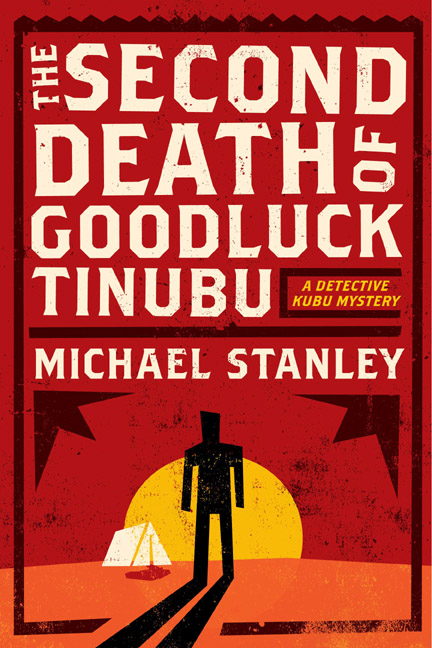
seconddeath cover michael stanley

Hello, campers —

Still on retreat in France, of course (and yes, the weather is precisely as gorgeous as you’re imagining, thank you very much), but I’m checking in quickly to introduce a long-anticipated treat: today, police procedural author and fab guy Stanley Trollip. Stan is best known as Michael Stanley, nom de plume of Stan Trollip and Michael Sears.

/stanley-trollip-small.jpgThose of you who were hanging around the Author! Author! virtual lounge may remember Stan from last year, when he was kind enough to visit with a very interesting guest post on collaboration, because who would know more about it than an author who has won some pretty hefty awards for doing just that?
What kind of awards, you ask? Well, the Los Angeles Times named their last novel, A CARRION DEATH, as one of the top ten crime novels of 2008 — a year that certainly wasn’t lacking in terrific crime novels, by the way. Some of the awards are yet to be decided, of course, but it’s currently a finalist for the Minnesota Book Award, Strand Magazine’s Critics Award for Best First Novel, and Mystery Readers International Macavity Award for Best First Novel.

Yeah, I know: impressive, to say the least. I don’t wheedle just anybody to come and share his insights with you, you know.

Their new book, THE SECOND DEATH OF GOODLUCK TINUBU, will be coming out June 2, but it’s already available for presale on Amazon Canada. It’s already in bookstores everywhere else in the world as A DEADLY TRADE.

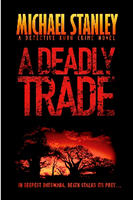
Here’s the publisher’s blurb for THE SECOND DEATH OF GOODLUCK TINUBU. While we’re at it, let’s take a gander at the cover (and title) you’d see if you happened to be browsing in a Canadian or UK bookstore:

deadlytrade cover Michael StanleyHow can a man die twice?

That is the question facing Detective David “Kubu” Bengu when a mutilated body is found at a tourist camp in Northern Botswana. The corpse of Goodluck Tinubu displays the classic signs of a revenge killing. But when his fingerprints are analyzed, Kubu makes a shocking discovery: Tinubu is already dead. He was slain in the Rhodesian war thirty years earlier.

Kubu quickly realizes that nothing at the camp is as it seems. As the guests are picked off one by one, time to stop the murderer is running out. With rumors of horrifying war crimes, the scent of a drug-smuggling trail, and mounting pressure from his superiors to contend with, Kubu doesn’t notice there is one door still left unguarded – his own. And as he sets a trap to find the criminals, the hunters are closing on him…

And that, boys and girls, is how to grab a reader in just a couple of paragraphs. Those of you embroiled in constructing summaries for your query letters and/or pitches might want to take note: see how the clever use of both telling details and a strong forward momentum makes you want to read this book? An agent is likely to react that way, too.

I’ve said it before, and I’ll no doubt say it again: never, ever forget that even the most tedious chore in book description is an opportunity to show what a good storyteller you are.

The Michael Stanley duo is extraordinarily talented at storytelling — but wait, you don’t have to take my word for that, do you? Here are some advance reviews from the most respected of industry sources:

Booklist, May 1, 2009
*Starred* Review! 
“ . . .. a brilliant sequel to last year’s Carrion Death… Stanley (the pseudonym for the writing team of Michael Sears and Stanley Trollip) is not content with a single plot line, effectively juggling the murders with cross-border drug smuggling and the circumstances surrounding an upcoming African Union meeting. Kubu, a dedicated gourmand, is just one of many fully fleshed and charmingly realistic characters. From slightly annoying sister-in-law Peasant to Kubu’s intense and acerbic boss Mabuku to Scottish pathologist MacGregor, each character is memorable and adds depth to this tense and involving police procedural. Suggest to fans of The No. 1 Ladies’ Detective Agency series, who will appreciate Kubu’s laid-back style and happy home life, and to Henning Mankell fans, who will respond to the complex plots and palpable sense of place.”

Library Journal Reviews, April 1, 2009
“Following his spectacular debut, A Carrion Death, Stanley comes roaring back with an even better tale. Bringing a love of Africa similar to Alexander McCall Smith’s popular “No. 1 Ladies’ Detective Agency” series, the author has created an excellent new venue for those who love to read about other cultures while enjoying a good mystery. Highly recommended.”

And that makes you curious about their multiple prize-winning first collaboration, doesn’t it, the one that the LA Times named as one of the top crime books of 2008? If so, then you’ll be pleased to hear that A CARRION DEATH is available Amazon, Amazon Canada, and Amazon UK.

I’m always delighted when I’m able to blandish an established working writer into sharing his views on the practicalities of the biz with you, dear readers, because the common writerly fantasies about what getting published and making a living as a writer entails tend to be, well, a bit fantastic. The write book/have agent show up on doorstep the next day/sell book to publisher in a week/quit day job immediately/appear on Oprah within a month scenario, while fun to think about, isn’t really the industry works.

All of which is a long-winded way of saying: if you’re even vaguely considering trying to make money by writing books, do pay careful attention to what Stan says here about advances, publication contracts, and book promotion. (And for more insight on both, please feel free to consult the aptly-named ADVANCES, PUBLICATION CONTRACTS, and BOOK PROMOTION categories on the archive list on the lower right-hand side of this page.)

Without further ado, then, please join me in a big Author! Author! welcome for Stan Trollip! Take it away, Stan!

Michael Stanley smiling with cat

The publishing world is full of bad news. Editors being let go; contracts not being honored; staff being laid off; fewer manuscripts being bought; less money for publicity. The list goes on. Everyone in the industry is depressed.

Or nearly everyone. I’m not depressed. Nor is my writing partner, Michael Sears.
We are actually having a ball and are in the midst of a worldwide tour promoting our second Detective Kubu novel, which is titled THE SECOND DEATH OF GOODLUCK TINUBU in the States and A DEADLY TRADE in the rest of the world.

Despite the great distance to be traveled and living out of a suitcase, it is inspiring to meet people who sell books and people who read books. It is remarkable to see how passionate these people are about reading in general and about books specifically. And of course it is a thrill when we find a stack of our books in a bookstore or see people with one of our books in hand.

We are Stanley Trollip (that’s me) and Michael Sears. Collectively we write under the name of Michael Stanley. Six years ago, neither of us had any aspirations of being published authors. Today, our first novel, A CARRION DEATH, is published in the U.S.A., the U.K., Italy, and France (to be released in September). Our second novel is already out in the British Commonwealth and will be released in the States on June 2.

So what’s there to be depressed about?

Seriously, ours is a writer’s dream come true. We started writing for fun in mid-2003, fifteen years after we had an idea for a novel. In the mid-80s, I would load a small plane with friends and wine and head off to Botswana to watch game and birds. One day we watched a pack of hyenas demolish a wildebeest – bones and all.

Aha, we thought. If one wanted to get rid of a body, leaving it for the hyenas would be a great way of doing so. Fifteen years later we started writing our first novel, A CARRION DEATH, using the hyena idea as the opening. In the book, the hyena is interrupted in its meal, leaving the remnants of a corpse. The perfect murder wasn’t perfect anymore.

To our surprise, we found an outstanding agent in New York, who was able to get HarperCollins to make us a two-book offer for worldwide English rights. Not long after, they sold rest of the world English rights to Headline in the UK. Our agent,Marly Rusoff, then sold the manuscript to JC Lattes in France and Sonzogno in Italy. To us, the unbelievable had come true.

A CARRION DEATH has been critically well received, being shortlisted for three awards – two still to be decided – and being named as one of the Los Angeles Times top ten crime books of 2008.

Is A CARRION DEATH a best seller? No! Are we making money hand over fist? No! In fact, we still have a long way to go in paying back our initial advance. But we have had a great start, selling about 25,000 copies in various languages worldwide. More importantly, Michael and I have had an enormous amount of fun writing together even though we are often on different continents – Michael in Africa, and I in the States.

So how does it work having multi-book contracts and books being published in different languages? It is useful to understand some of the simple dynamics – something we knew nothing about when we started – in fact we knew so little that we didn’t realize that two people weren’t supposed to write fiction together.

Contractual stuff
I seldom read in blogs like Author! Author! how the contractual aspects of publishing work – let alone how an author deals with multiple publishers and multiple contracts. So I’m going to take a few paragraphs to describe, in simple, terms how this all works.

First, when you write something, you own all the rights (unless you have been commissioned to write the piece, and the person commissioning you retains the rights). So when we finished A CARRION DEATH, we owned all the associated rights.

We sold some of these (worldwide English rights) to HarperCollins in New York. They decided to retain only the English rights for North America, and sold the subsidiary English rights for the rest of the world to Headline in the UK. We then sold worldwide French rights to JC Lattes in France (due out in September 2009) and worldwide Italian rights to Sonzogno in Italy (published in October 2008).

We still hold all the other rights, including all other language rights, radio rights, and movie rights. (If you know anyone who wants to buy these, …!)

When we sold the worldwide English rights to HarperCollins, they bought them by offering us an advance against royalties – an amount of money, to be delivered in three parts (a third on signing, a third on acceptance of the manuscript, and a third on publication). An advance against royalties means that the publisher has advanced us the money, which we have to pay off through royalties on sales, etc.

From our point of view, the good news is that if our royalties don’t ever pay off the advance, we don’t have to fork out the difference. So the advance against royalties is the way a publisher acknowledges that writing is a slow process, and that writers need to live. They take a risk by paying these advances because they may never recover them.

So how do we pay off the advance? For each book sold we receive a royalty that ranges from 10% to 15% of the cover price. All these royalties start paying off the advance. Also, when HarperCollins sold the subsidiary rights to Headline, the amount they sold them for, less a commission, also went to pay off the advance.

Today the royalties earned by A CARRION DEATH sold anywhere in the world go to paying off our advance. And only when the advance is paid off will we see any more money.

In the same way, we received advances from our French and Italian publishers and are in process of paying them back through royalties from books sold.

In our case, it could be some time before we pay off the advances and see any further royalties. Indeed it is often the case that authors never see additional royalties. That may happen to us too.

Now we are about to release our second mystery, called THE SECOND DEATH OF GOODLUCK TINUBU in North America and A DEADLY TRADE in the rest of the English-speaking world. For this book, the whole financial process starts again. We receive an advance in three installments and pay it off through royalties and the sale of subsidiary rights.

If very successful, we may see additional royalties in the future. If not, we can keep the advance.

You may ask why the book has two titles. Good question. Our original title was THE SECOND DEATH OF GOODLUCK TINUBU, but Headline in the UK thought it sounded a bit too much like an Alexander McCall Smith novel and wanted something a bit snappier. After several weeks of brainstorming we came up with A DEADLY TRADE, which we like also.

Multiple editors
Another interesting issue that we didn’t anticipate was having multiple editors. We have a wonderful editor at HarperCollins – Claire Wachtel – who takes our manuscript and provides feedback such as “the pace falls off here,” or “move this chapter later to maintain tension,” or “take this character out – he doesn’t add anything.”

Despite the pain that we often feel when reading such comments, Claire is usually right, and we do what she says. It always improves the book. When she approves the changes, the manuscript goes to a copy editor who helps to improve language and often catches annoying discrepancies.

But what about the UK edition? Is it the same book?

For A CARRION DEATH, after the manuscript had been approved by HarperCollins, we translated it from American into English, then submitted it to our UK editor, Sherise Hobbs. Like Claire Wachtel, she read the manuscript and made suggestions, not as fundamental as Claire’s, but still extremely insightful and useful. After we finished addressing her concerns, the English manuscript was copy edited again, and only then went to printing.

So the US and UK editions are different, but only in minor ways, such as spelling, grammar, and some colloquialisms and culture-dependent references. For example a car has a bonnet and boot in English, and a hood and trunk in American. In English the past participles of lean and burn are leant and burnt. In American they are leaned and burned. American readers are more comfortable is dealing with distances in miles, yards, feet, and inches, while readers elsewhere typically use the metric equivalents of kilometers (spelled (spelt) kilometres outside north America), meters, centimeters and millimeters. The measurement of weight has similar differences.

From our point of view, we think we have two superb editors who improve our books immeasurably. Fortunately, they pull in the same direction, and we haven’t had to deal with any conflicts.

So far we have had little or no interaction with the editors of the French and Italian editions, mainly because neither Michael nor I have the language skills to make any meaningful input. However, we have been asked to comment on covers and titles. The Italian edition of A CARRION DEATH, for example, is titled IL DETECTIVE KUBU rather than a direct translation of the English title. The French title is still undecided.

To close
We have just started promoting A DEADLY TRADE and THE SECOND DEATH OF GOODLUCK TINUBU and will come back to Author! Author! in a few weeks with a report on what it is like to launch a book in multiple countries.

THE SECOND DEATH OF GOODLUCK TINUBU will have its worldwide launch on June 2, 2009 at the wonderful Once Upon A Crime bookstore in Minneapolis. Please visit our website for up-to-date news and information about upcoming events. There you can also sign up for our newsletter which comes out four or five times a year.

Thanks, Stan — that was hugely informative! Best of luck with the new book, and we’re all looking forward to seeing you back here again soon!

Michael Stanley smiling with catMichael Stanley is the writing team of Michael Sears and Stanley Trollip.
Both are retired professors who have worked in academia and business. They were both born in South Africa. Michael is a mathematician, specializing in geological remote sensing. He lives in Johannesburg, South Africa, and is a tournament bridge player. Stanley is an educational psychologist, specializing in the application of computers to teaching and learning, and a pilot. He splits his time between Knysna, South Africa, and Minneapolis in the United States. He is an avid golfer.

Their first novel, A CARRION DEATH, featuring Detective David “Kubu” Bengu, was published in 2008 and received critical acclaim. The Los Angeles Times listed it as one of its top ten crime novels of 2008. It is a nominee for the Minnesota Book Award, Strand Magazine’s Critics Award for Best First Novel, and Mystery Readers International Macavity Award for Best First Novel.

Who said that? Wait, I did. Or was it Oscar Wilde?

hall-at-la-cite

All this week, I have been discussing the Frankenstein manuscript, the text whose author either kept changing his mind about the style he wished to embrace — or tone, or target audience, or book category — or just kept revising it so often that the narrative reads like a patchwork of different prose styles. Today, I would like to talk about the Frankenstein manuscript’s prettier and more socially-acceptable cousin, self-plagiarized repetition.

Where the Frankenstein manuscript varies substantially as pages pass, the self-plagiarized text merely becomes redundant: scenery described the same way, for instance, or a clever line of dialogue repeated in Chapters 2, 5, and 16.

Nonfiction writing in general, and academic writing in particular, is notoriously prone to redundancy. Once you’ve gotten into the habit of footnoting everything in the least questionable, it’s pretty easy to reuse a footnote, for instance, or to come to rely upon stock definitions instead of writing fresh ones every time.

Or, in a memoir, to tell the same anecdote more than once.

My point is, most of the time, self-plagiarization is inadvertent; a writer simply finds a certain turn of phrase appealing and forgets that she’s used it before. A great way to catch this sort of redundancy is — wait for it — to read your manuscript IN HARD COPY, IN ITS ENTIRETY, and OUT LOUD.

Oh, had I suggested that before?

Sometimes, though, self-plagiarization is deliberate. If a line was clever once, the writer thinks, the reader will find it so the second time — and the fifth, and the forty-seventh. Deliberate redundancy is particularly common with humor: since situation comedies tend to rely upon repetition of catch phrases, many aspiring writers believe — mistakenly, often — that the mere fact of repetition will render a line funny.

On the page, it seldom works. (Sorry to be the one to break it to you sitcom lovers.)

Nowhere is the practice of self-plagiarization more prevalent than in the garden-variety political speech. And if you doubt that, tell me: do you think people would remember that the Rev. Dr. Martin Luther King, Jr. had a dream if he had said it only ONCE in his famous March on Washington speech?

There’s a good narrative reason for that, of course: the repetition of an idea makes it memorable. The ideas — and usually even the actual phrases — of the beginning of a political speech invariably recur throughout, to drive the point home.

And, as anyone who has listened to two consecutive State of the Union addresses can tell you, political speeches often sound the same from year to year. No matter how fiercely THE WEST WING tried to promote the notion of presidential speechwriters as ultra-creative writers, if you look at speeches given by the same politician over time, self-plagiarization is of epidemic proportions.

On paper, phrase repetition is problematic, but in and of itself, it is not necessarily self-plagiarization. On paper, phrase repetition can be used for emphasis (as I have just done here). A lot of good writers choose to repeat phrases within a single paragraph for rhythmic reasons, which can bring a passage a feel of invocation. Take the ending of the St. Crispin’s Day speech from HENRY V, for instance:

If we are mark’d to die, we are enow
To do our country loss; and if to live,
The fewer men, the greater share of honour.
God’s will! I pray thee, wish not one man more.
By Jove, I am not covetous for gold,
Nor care I who doth feed upon my cost;
It yearns me not if men my garments wear;
Such outward things dwell not in my desires.
But if it be a sin to covet honour,
I am the most offending soul alive.
No, faith, my coz, wish not a man from England.
God’s peace! I would not lose so great an honour
As one man more methinks would share from me
For the best hope I have. O, do not wish one more!
Rather proclaim it, Westmoreland, through my host,
That he which hath no stomach to this fight,
Let him depart; his passport shall be made,
And crowns for convoy put into his purse;
We would not die in that man’s company
That fears his fellowship to die with us.
This day is call’d the feast of Crispian.
He that outlives this day, and comes safe home,
Will stand a tip-toe when this day is nam’d,
And rouse him at the name of Crispian.
He that shall live this day, and see old age,
Will yearly on the vigil feast his neighbours,
And say ‘To-morrow is Saint Crispian.’
Then will he strip his sleeve and show his scars,
And say ‘These wounds I had on Crispian’s day.’
Old men forget; yet all shall be forgot,
But he’ll remember, with advantages,
What feats he did that day. Then shall our names,
Familiar in his mouth as household words-
Harry the King, Bedford and Exeter,
Warwick and Talbot, Salisbury and Gloucester-
Be in their flowing cups freshly rememb’red.
This story shall the good man teach his son;
And Crispin Crispian shall ne’er go by,
From this day to the ending of the world,
But we in it shall be remembered-
We few, we happy few, we band of brothers;
For he to-day that sheds his blood with me
Shall be my brother; be he ne’er so vile,
This day shall gentle his condition;
And gentlemen in England now-a-bed
Shall think themselves accurs’d they were not here,
And hold their manhoods cheap whiles any speaks
That fought with us upon Saint Crispin’s day.

Now THAT’s a political speech.

Unfortunately, a lot of poor writers favor this device, too, so it tends to be a rather risky trick to try to pull off in a short piece, such as a synopsis, or even in the first few pages of a manuscript submitted for a contest or as part of a query packet. To professional eyes, trained to search for the repetition of a single verb within a paragraph as evidence of boring writing, “we few, we happy few” will not necessarily jump off the page for its rhythm. In an ultra-quick reading (as virtually all professional readings are), it may be mistaken for an incomplete edit: you meant to change “we few” to “we happy few,” but you forgot to delete the words you did not want.

Let’s see if you’ve been paying attention for the last few days: why would a savvy submitter not want to convey the impression of an incomplete editing job?

That’s right: because that’s the birthmark of the dreaded Frankenstein manuscript, the fish that Millicent the agency screener is only too happy to throw back into the sea.

Self-plagiarization tends to raise red flags with professional readers for other reasons, however. The writer may not realize that she has reused a particularly spectacular image from Ch. 1 in Ch. 3, but believe me, if there is repetition, professional readers will catch it. Remember, the pros are trained to catch redundancy; editors are notorious for remembering entire pages verbatim.

I am no exception: when I was teaching at the University of Washington, I was known for noticing when term papers resubmitted in subsequent quarters, even though I read literally hundreds of papers per term. I would even remember who wrote the original.

As you may well imagine, I quickly acquired a reputation amongst the fraternities and sororities who kept files of A term papers for their members to, ahem, borrow.

Which reminds me to tell you that paraphrasing what you’ve said earlier in the manuscript tends to be significantly less frowned-upon than outright literal repetition. That’s why, in case you were wondering, while very similar passages may earn you an ill-humored rebuke from a professional reader, generalized repetition usually will not knock you out of consideration if the self-plagiarized bits occur far apart, such as at the beginning and end of a book.

However, in a shorter piece, or in those first 50 pages of your novel that nice agent asked you to send for consideration, it certainly can cost you. Repetition sticks in the professional reader’s craw, nagging at her psyche like a pebble in a shoe, so it is best to do it as little as possible.

“Now wait a minute,” I hear some of you out there grumbling. “Oscar Wilde repeated the same quips in one play after another. It became his trademark, in fact. So why should I be punished for using a single particularly sterling line 150 pages apart in my novel?”

You have a point, of course, oh grumblers. You might also have bolstered your argument by mentioning that Aaron Sorkin reused not only lines and speeches from SPORTS NIGHTin THE WEST WING, but entire plot lines and basic characters.

Tell you what — after you make it big, I give you permission to establish a trademark phrase and use it as often as you like. Until you do — as I sincerely hope you will — all I can do is tell you what tends to annoy agents, editors, and contest judges.

All writers of book-length works have repeated themselves at one time or another; if a simile struck us as the height of cleverness last week, chances are good that we will like it next week as well. Each time we use it, it may seem fresh to us.

These little forays into self-indulgence are so common, in fact, that literary critics have a name for them: tropes.

F. Scott Fitzgerald was a notorious troper in his short stories. A thwarted heroine’s sobbing out (usually with her face hidden by her hair), “I’m so beautiful – why can’t I be happy?” immediately before she does something self-immolatingly stupid to remove herself from the possibility of marrying the story’s protagonist occurs at least four times throughout his collected works.

Why our Scott found that particular line so very attractive in a pretty woman’s mouth remains a mystery eternal — it’s hard to believe he ever actually heard a sane female utter it, even in jest. But he did, and now it’s stuck to his name for all eternity.

Learn from his unhappy fate, I beg of you.

Usually, though, self-plagiarization is less obvious to the untrained eye than ol’ Scott’s outright line reuse. Spread out over an entire text — or as it often appears in the case of successful writers of series, once per book — self-plagiarization may be fairly innocuous, the kind of thing that might only bug someone who read manuscripts for a living.

For example, E.F. Benson, author of two delightful series, the Lucia books and the Dodo books, was evidently extraordinarily fond of using Arctic analogies for one person suddenly grown cold to another. To mention but three examples:

“It was as if an iceberg had spoken,”

“It was as if the North Pole had spoken,” and

“icebergs passing in the North Sea” must speak to one another so.

Admittedly, it’s not a bad analogy, if not a startlingly original one. The problem is, as a Benson enthusiast, I was able to come up with three of them without even pulling any of his books off the shelf. These repetitions, deliberate or not, stick with the reader, just as surely as repeated phrases stick with the audience of a political speech.

Here, yet again, is an awfully good reason to read your entire book (or requested chapters, or contest submission) out loud before you submit it. Believe it or not, just as dialogue that seemed fine on the page can suddenly seem stilted when spoken aloud, phrases, sentences, and images that your eye might not catch as repetitious are often quite obvious to the ear.

Another good reason to read aloud: to make sure that each of your major characters speaks in a different cadence. It’s substantially easier for the reader to follow who is speaking when that way.

Don’t tell me that all of Aaron Sorkin’s and David Mamet’s characters speak in identical cadences, as though they all shared one vast collective mind; to my sorrow, I am already well aware of that fact. Remember what I said earlier this week about the dangers of those new to the biz assuming that what the already-established have done, they may get away with as well?

Uh-huh. In a first-time author, it would be considered poor craft to have every character in the book sound the same. Not to mention poor character development.

While I’m on the subject, keep an ear out in your reading of your manuscript for lines of dialogue that cannot be said aloud in a single breath without passing out — they tend to pull professional readers out of the story.

Why, you shout breathlessly? Well, in real life, listeners tend to interrupt speakers when the latter pause for breath, so cramming too many syllables into an uninterrupted speech usually doesn’t ring true on the page. Remember to allow your characters to breathe occasionally, and your dialogue will seem more realistic.

Oh, bother; I’ve written past the time I allotted myself for blogging today; on retreat, one needs to adhere to a schedule. Oh, I’m so beautiful — why can’t I be happy?

Keep up the good work!

PS: to repeat a footnote from yesterday, the deadline for submitting entries to the First Periodic Author! Author! Awards for Expressive Excellence is now Monday, June 1, at midnight wherever you are. Follow this link to the rules and descriptions of the fabulous prizes, and may the best writer win the ECQLC! (Eye-Catching Query Letter Candy, that is.)

How to format a book manuscript properly, part XI: if everyone else jumped off the Golden Gate Bridge…or a brick cathedral…

gargoyle-at-albi

Perhaps I am cathedral-ignorant, but I hadn’t previously been aware that anyone had ever saw fit to build cathedrals out of red brick; even the gargoyle seems a bit dubious about it, doesn’t it? Speaking as someone who grew up in earthquake country, where bricks tend to become either projectiles or integral components of piles of rubble when one least expects it, my first instinct when I see a brick structure this large is to cover the back of my neck with my clasped hands and crawl under the nearest desk, as I was taught in elementary school earthquake drills.

This particular structure is indeed large: in fact, according to the copious signage at this particular cathedral at Albi, it’s the largest brick church in the world. Which actually isn’t all that surprising when you consider that the rest of the town looks like this:

pont-vieux-at-albi

Oh, you thought I had been traipsing around Cathar country and you weren’t going to be seeing some pictures of very old architecture? Don’t you remember how many sea-and-sand photos graced the blog after my retreat last fall to the Oregon coast? You might want to brace yourself for a few months of flying buttresses, stained glass, and Gothic shadows, my friends.

Speaking of hedging one’s bets (which is, as I understand it, largely the point of a flying buttress), one doesn’t like to tempt the easily-affronted gods by predicting TOO far into the future, but I believe I can state with assurance that I SHALL polish off this series on standard format early next week, or at any rate quite soon (see earlier comment about god-tempting).

Since we are so very close to the finish line (and since we have a protective gargoyle watching over this post), I’m going to take a bit of a risk and revisit what seems to be a perennial controversy amongst aspiring writers: whether to place a chapter title (or just “Chapter One”) on the first line of a page or on the line just above where the text starts.

Don’t laugh, those of you who are new to this particular debate: this one has generated quite a body count over the years. Former comrades in arms, veterans of the writing trenches, have ceased speaking altogether over this particular debate; even judges within the same literary contest have been known to differ sharply on the subject.

Which is a trifle puzzling to those of us who deal with professional manuscripts for a living, because there actually isn’t a debate on our end. The answer here is really as simple as the title belongs in one place if the manuscript is a book, and another if it’s a short story or article.

Why, then, the rampant confusion? I shall let you see for yourselves. To place the possibilities before you in all of their lush magnificence, should the first page of a book chapter look like this:

Or like this?

Now, I could just tell you what to do here, because, to be blunt about it, the first version is in standard format; the second is not. Which renders it a perfect case study to test whether you’ve been paying attention throughout this series: given that the difference is a relatively small one that’s not particularly reflective of the quality of the writing involved, why might a professional reader like Millicent the agency screener prefer the first?

Chant it with me now, dutiful followers of this series: BECAUSE IT LOOKS RIGHT TO THEM.

Oh, how tempting it is to leave it at that…but truth does compel me to tell you (and if not truth, those pesky mercurial gods I was talking about earlier), Millicents, the agents who employ them, and contest judges see far, far more examples of version #2 than #1. Many, many times more. So much so that — brace yourselves, because I haven’t said this very often throughout this series — at this point in publishing history, you could get away with either.

I know — it sort of creeps me out to hear myself saying such a thing, too.

That being said, I would be reluctant to buy into the astonishingly pervasive theory that if masses and masses of people do something, it automatically becomes correct. As anyone who screens manuscripts for a living could tell you, a much higher percentage of them are incorrectly formatted than presented properly.

And really, as everyone’s mother was wont to say (at least on the West Coast, the land of earthquakes), if everyone else jumped off the Golden Gate Bridge, would you, too?

I was delighted to discover when I moved to the East Coast for college that the moms out there were prone to asking the same question with reference to the Empire State Building. There must be something about that particular period of architecture (the GGB was built in 1933-37, the ESB in 1930-31) that promotes suicidal ideas.

Speaking of body counts.

The weird thing about this particular formatting oddity is how often the incorrect version appears in otherwise perfectly presented manuscripts. That fact sets Millicent’s little head in a spin. As, I must admit, it does mine, as well as the brainpan of virtually every other professional reader I know.

Why is it so very puzzling to us, you ask? Because at least in my case — and I don’t THINK I’m revealing a trade secret here — I have literally never seen an agent submit a manuscript to a publishing house with format #2. Heck, I have literally never even heard of an agent, editor, or anyone else in the publishing industry’s ASKING for a chapter heading to be moved from the top of the page to just above the text.

And that strikes me as odd, because as I’ve heard some pretty strange requests from agents and editors in my time, believe me; I’m not easily shocked anymore. But to hear a pro insist upon placing the chapter heading where you have to skip down a third of a page to read it…well, that would have me reaching for my smelling salts.

(Do they even make smelling salts anymore? And if everyone else jumped off the Golden Gate Bridge clutching them, would I?)

Clearly, somebody out there is preaching the place-it-just-above-the-text gospel, because agents, editors, and contest judges are simply inundated with examples of this formatting anomaly. We see bushels of ‘em. Hordes of aspiring writers are apparently absolutely convinced that the sky will fall in if that chapter heading is located anywhere but immediately above the text. And sometimes, when those die-hard advocates become contest judges, they even dock correctly-formatted first pages for having the title in the right place.

In fact, many aspiring writers are SO convinced of the rightness of the drooping title heading that it’s not all that uncommon for an editor to find that after she has left a couple of subtle hints like this that the writer should change the formatting…

…the subsequent drafts remain unchanged. The writer will have simply ignored the advice.

(Off the record: editors HATE it when their advice is ignored. So do agents. Contest judges probably wouldn’t be all that fond of it, either, but blind submissions mean that in order to get dunned for brushing off a judge’s feedback, a writer would have to submit the same chapter two years running to the same contest, have the entry land in the same judge’s pile — in itself rather rare — AND the judge would have to remember having given that feedback. Oh, and for the entrant to hear about it, the contest would have to be one of the few that gives editorial feedback.)

The up v. down debate may seem like a rather silly controversy — after all, in the cosmic scheme of things, why should it matter if the white space is above or below the title? — but sheer repetition and writerly tenacity in clinging to version #2 have turned it from a difference of opinion into a vitriol-stained professional reader pet peeve. (See earlier comment about how we tend to react to our advice being ignored; it isn’t pretty.)

Which, unfortunately, tends to mean that in discussions of the issue at conferences degenerate into writing-teacher-says-X, editor-at-Random-House-says-Y: lots of passion demonstrated, but very little rationale produced, beyond each side’s insisting that the other’s way just looks wrong.

However, there is a pretty good reason that moving the chapter heading information to just above the text looks wrong to someone who edits book manuscripts for a living: it’s a formatting tidbit borrowed from short stories, whose first pages are supposedto look quite, quite different from those belonging to book manuscripts or proposals. Take a gander:

As you may see for yourself, for a short story like this one, there’s a mighty fine reason to list the title just above the text: a heck of a lot of information has to come first on the page, because short stories, unlike book manuscripts, are not submitted with a title page.

But that would not be proper in a book-length manuscript, would it? Let’s see what Noël’s editor might have said upon viewing this as the first page of a book:

Ouch. (That last bit would have been funnier if the entire page were readable, by the way, but my camera batteries were running low. Sorry about that.) But as Millicent and that angry mob of pitchfork-wielding ignored editors would be only too happy to tell you, short stories don’t HAVE chapters, so who on earth are they to be telling those of us in the book world how to format our manuscripts?

Stick with version #1.

Which is not to say, of course, that this particular small deviation will automatically and invariably result in instantaneous rejection. It won’t, even in the latté-stained hands of the most format-sensitive Millicent. (See, she spilled coffee on her hands after she took a sip while it was still too hot — and if you didn’t get that joke, you probably haven’t been reading this blog for very long.) If a submission is beautifully written AND technically correct in every other respect, she might only shake her head over the location of the chapter heading, making a mental note to tell you to change it between when her boss, the agent, signs the writer and when they will be submitting the manuscript to editors at publishing houses.

But if you don’t mind my saying so, that’s a mighty hefty set of ifs.

While I’ve got the camera all warmed up, this would probably be a good time to illustrate another ubiquitous agent and editor pet peeve, the bound manuscript — and you’re going to want to pay close attention here, as this one IS almost universally an automatic-rejection offense.

Manuscripts, and I don’t care who hears me say it, should not be bound in any way. There’s an exceedingly simple reason for this: binding renders it impossible (or at least a major pain in the fingertips) to pull out a chapter, stuff it in one’s bag, and read it on the subway.

Hey, paper is heavy. Would YOU want to lug home ten manuscripts every night on the off chance you’ll read them?

As with other ploys to make a manuscript appear identical to a published book, binding the loose pages of a manuscript for submission will NOT win you friends in the publishing world. Not only does this not look right (I spared you the chanting this time), but it seems so wrong that Millicent will be positively flabbergasted to see a submitter to do it.

She might, for instance, forget that her latte is still too hot to drink, take a sip, and scald her tongue. It’s been known to happen.

Seriously, the unbound manuscript is one of those rules so engrained in the professional reader’s mind that it seldom even occurs to authors, agents, or editors to mention it as a no-no at writers’ conferences. Heck, I’m not sure that I’ve mentioned it once within the first two years I was writing this blog — and by anyone’s standards, I’m unusually communicative about how manuscripts should be presented.

Talk about it all day, I will.

So I’m going to repeat myself, because you’re not going to hear this very often: by definition, book manuscripts should NEVER be bound in any way. Not staples, not spiral binding, not perfect binding. If you take nothing else away from this series, binding-lovers, I implore you to remember this.

Why? Well, in practice, I’m sorry to report, a bound manuscript will seldom survive long enough in the screening process for the chapter-separation dilemma to arise, because — and it pains me to be the one to break this to those of you who’ve been submitting bound manuscripts, but if I don’t tell you, who will? — those pretty covers tend never to be opened at all.

Did you just exclaim, “Ye gods, WHY?” again? I can’t say as I blame you, but try for a moment to envision what a bound manuscript might look like from Millicent’s perspective.

To ramp up your stress levels to the proper level to understand her, envision a desk simply smothered with an immense pile of submissions to screen before going home for the day. Envision further that it’s already 6:30 PM, and eyeballs already dry as dust from a long, hard day of rejecting query letters.

Just lost your sympathy, didn’t she? Try, try again to place yourself in her proverbial moccasins.

Picturing the pile of envelopes clearly again? Okay, now slit open an envelope that reads REQUESTED MATERIALS on the outside. (You DO know that you should ALWAYS scrawl that in two-inch letters in the lower left-hand corner of a submission envelope, don’t you, so your requested materials don’t get buried in the slush pile?)

If you’re Millicent — and right now, you are, singed tongue and all — you fully expect to see something like this lurking between the cover letter and the SASE tucked underneath:

But in the case of the bound manuscript, you would instead encounter something like this:

Kind of hard to miss the difference, isn’t it? Unfortunately, 999 times out of 1000, the next sound a bystander would hear would be all of that nice, expensive binding grating against the inside of the SASE, just before Millicent tucks a photocopied form rejection letter on top of it.

Honestly, it’s not that she is too lazy to flip open the cover; she just doesn’t see why she should. Her logic may not seen particularly open-minded, from a writerly perspective, but it’s a fairly common argument throughout the industry: if this submitter does not know this very basic rule of manuscripts, how likely is he to know the rules of standard format?

And if he does not know either, how likely is he to be producing polished prose? If he hasn’t taken the time to polish his prose, is this manuscript really finished? And if it isn’t finished, why should I (you’re still Millicent, remember?) bother to invest my time in reading it before it is?

I know, I know — this logic often does not hold water when it comes down to an individual case; despite my best efforts over the last few years, there are plenty of good writers out there who happen to be clueless about the rules of standard format.

But even if they all jumped off the Golden Gate Bridge, you shouldn’t.

Here’s why: from Millicent’s perspective, the fact that good writers aren’t necessarily born aware of the norms of the industry matters less than we writers would like — because, as unpleasant as it is for aspiring writers to realize, her agency is going to see enough technically perfect submissions this week to afford to be able to leap to unwarranted conclusions about this one.

The moral: don’t waste your money on binding.

Seem arbitrary? From a professional reader’s point of view, it isn’t — the enforcement of standard formatting isn’t actually any more complicated than the simple axiom that any game has rules, and you will play better if you take the time to learn them.

Think about it: if you saw a batter smack a baseball, then dash for third base instead of first on his way around the diamond, would you expect his home run to count? Would an archer who hit the bulls-eye in her neighbor’s target instead of her own win the grand prize? If you refused to pay the rent on Park Place because you didn’t like the color on the board, would you win the Monopoly game?

I can go on like this for days, you know. Please say that you are getting the parallels, so I may move on.

Submitting art to the marketplace has rules, too, and while your fourth-grade P.E. teacher probably did not impart them to you (as, if I ran the universe, s/he would have), you’re still going to be a whole lot better at playing the game if you embrace those rules, rather than fight them.

You’ll also, in the long run, enjoy playing the game more. I know that it may not seem that way the first time one is struggling to change an already-written manuscript into standard format, but trust me, it will be much more fun when you finish your next manuscript and realize that there’s nothing that needs to be changed.

Let all of those other folks jump off the Golden Gate Bridge without you, I say. Remember, you’re playing this game by choice: you could, after all, make your own rules and publish your book yourself. If you want to play with the big kids, you’re going to need to abide by their rules.

And if you’re not absolutely positive that you have been abiding by them, why not submit an entry to the First Periodic Author! Author! Awards for Expressive Excellence, deadline May 18? Since only entries in standard format will be considered for awards, I have it on pretty good authority that entrants whose formatting is problematic will be informed of the fact by the judges.

Yes, really.

I’ll wrap up this series on Monday, I promise –although there’s another terrific reader question that I want to make sure to address before I do — but first, I’ve got a tremendous treat in store for you in Friday’s post, a guest blog by a memoirist I think you’re going to enjoy being able to say in future years that you read him way back when. Fair warning, however: his subject matter is most emphatically not for the faint of heart.

No, I’m not going to give you any more hints. You’ll just have to tune in tomorrow and see for yourself.

Keep up the good work!

How to format a book manuscript properly, part IX: ladies and gentlemen, I am delighted to present a brand-new chapter, brought to you in part by readers’ excellent questions

purple-tulipspurple-tulips

One of the bizarre side effects of this year’s unusually cold winter in Seattle is that the bulbs that usually come up in mid-March suddenly popped up a couple of weeks ago, along with all of the ones that were supposed to be blooming now. I’m hoping that it’s a good omen for the economy, especially the part of it that affects how many books publishers decide it’s prudent to acquire in the near future and thus how many new clients agents see fit to take on.

See why I was so adamant in the recent HOW DO MANUSCRIPTS GET PUBLISHED, ANYWAY? series (conveniently gathered under that very name on the category list on the lower right-hand side of this page) that aspiring writers be aware of how the publishing industry actually works? It’s cyclical; it’s harder to break into the biz at some points than others. If a writer believes — as so many seem to do — that the only issue determining whether an agent chooses to represent a particular manuscript, or whether a publishing house elects to publish it is the quality of the writing, frustration is practically inevitable. The response is different for every writer, of course, but let’s just say that it’s pretty easy for someone querying and submitting like crazy during a period like this that his writing just isn’t very good.

Which is sad if the actual culprit is the economy, right?

All of which is to say: this is a tremendous time to hunker down and revise. Or to write something new — when your first book lands an agent, I can guarantee that you will be astonished at just how short a time passes before she’s bugging you for your next work. Or even to add some ECQLC to your writing résumé — that’s eye-catching query letter candy, for those of you new to this blog — by entering the running for First Periodic Author! Author! Awards for Expressive Excellence.

Oh, you thought I was going to allow a day to pass without plugging it? When the deadline is as close as midnight on May 18?

Since the rules specify that only entries submitted in standard format can win some pretty fabulous prizes, let’s move swiftly to cover the last few rules of standard format left in this series. Before you start dancing in the streets accordingly, I want to make sure that I’ve covered the basics clearly enough so that you can all spot correct and incorrect format in the wild, outside of this laboratory environment. Before I institute a pop quiz, I want to go over how to format the opening to a new chapter, whether or not it’s also the first page of your manuscript.

To get the discussion ball rolling, let’s take a gander at a properly-formatted chapter opening. Here is the first page of Chapter Six of my memoir:

Every chapter of a manuscript should begin like this: on a fresh page, 12 single lines (or 6 double-spaced) from the top. (For those of you who do not know how to insert a hard page break into a Word document, it’s located under the INSERT menu. Select BREAK, then PAGE BREAK.)

Notice how both the chapter number and the chapter title appear, centered, within these parameters. If there were no chapter title in this instance, the first page of Chapter 6 would look like this:

Since sharp-eyed reader Allison asked so very nicely, here’s what it would look like if Chapter 6 were the beginning of Part II of the book (it isn’t, but we aim to please here at Author! Author!):

And since inveterate question-asker Ken inquired about how one might identify a narrator-du-chapter in a multiple POV novel, let’s pretend this is fiction (which it isn’t) and place the narrator’s name in the traditional spot:

a-memoir-title-with-narrator-name

That’s the way one might do it in a manuscript like Barbara Kingsolver’s THE POISONWOOD BIBLE, where the narrator changes with the chapter. If there were also a chapter title (perhaps not advisable in this case, as there’s already significant information at the top of that page for the reader to absorb), it would go between the chapter heading and the narrator identifier. (I would show you an example of that, but it’s late, I’m tired, and I’m positive that you can extrapolate.)

Thinking that there must be an easier way to format the first page of a chapter than to memorize the way it should look and reproduce it from scratch each time? You’re not alone, if so; even seasoned authors worry that someday they will forget to hit return one of the necessary times, so that Chapter 5 will begin ten lines from the top, while Chapter 1-4 and 6 on will begin twelve lines down.

Why, curious reader David asked not all that long ago about how to get that formatting to stick, so to speak: “The chapter line will appear at the top of each page,” quoth he, “so I leave five doublespaced blank lines so the first paragraph starts six lines down? Is there something I can do in Microsoft Word so it will stay that way?”

Standard format templates do exist, of course, but frankly, Word is already equipped with two perfectly dandy features for reproducing formatting exactly in more than one place in a document: COPY and PASTE.

Or, to put it another way, the easiest way I know to make sure each chapter opening is identical is to create your own template. Copy from “Chapter One” down through the first line of text, then paste it on the first page of chapter 2, 3, etc. Once the format is in place, it’s a snap to fill in the information appropriate to the new chapter.

Does that make sense to everyone? Excellent.

Now I want to talk a bit about pagination — don’t groan; it’s an important issue. Let’s take another gander at our first example:

This time, I would like you to notice that in each of these examples, the only reference to the author’s name or the title should appear in the slug line, located in the upper left-hand margin. This is as proper on page 139 of a book manuscript as on page one. While you’re going around noticing things, notice that the page number belongs within the slug line, rather than anywhere else on the page.

The slug line confuses a lot of aspiring writers; until you have seen piles and piles of professional manuscripts, it looks kind of funny. And when you’ve been told over and over again that a manuscript should have a 1-inch margin on all sides, it can seem counterintuitive to add a line of text, even such a short one, IN that margin.

But I assure you, it’s always been done that way. And why? Followers of this series, chant it with me now: BECAUSE IT LOOKS RIGHT.

Yes, that logic IS tautological, now that you mention it. If you have a problem with that, I would suggest taking it up with the powers that rule the universe. As I believe the fact that my memoir has been in the hands of a reputable publisher for years and still has yet to be released (due to lawsuit threats concerning who owns my memories, believe it or not) makes abundantly clear, I apparently do not rule the universe.

If I did, Microsoft Word would be set up to create documents in standard format automatically, Word for Mac and Word for Windows would be set up so those using one could easily give formatting advice to those using the other, air pollution would be merely a thing of distant memory, and ice cream cones would be free on Fridays.

As none of these things seems to be true, let’s get back to business: how does one create that pesky slug line, anyway?

Back in the days when typewriters roamed the earth, it was perfectly easy to add a slug line to every page: all a writer had to do was insert it a half-inch down from the top of the page, left-justified, floating within the 1-inch-deep top margin. For word-processed documents, it’s a trifle more complicated.

The slug line still belongs in the same place, .5 inches from the top of the paper, but instead of laboriously typing it on each page individually as writers did in the bad old days, one simply inserts it in the header. In most versions of Word (I can’t speak for all of them), the header may be found under the VIEW menu.

Before the Luddites out there trot out their usual grumble about tracking down the bells and whistles in Word, think about this: placing the slug line in the header (located in Word under the VIEW menu) also enables the writer to take advantage of one of the true boons of the advent of word processing, pages that number themselves. Every so often, I will receive a manuscript where the author has, with obviously monumental effort, typed a slug line onto the first line of TEXT of each page, so it looks like this:

See how pulling the slug line down into the text messes with the spacing of the page? An entire line of text is sacrificed to it — and let me tell you, that line is not going to go quietly.

Why not? Well, what’s going to happen if new writing is inserted on a page formatted this way? That’s right: the author is going to have to go back and move each and every one of those slug lines to match the NEW pagination.

I’d show you a picture of this, but it’s just too ugly to contemplate. Trust me, it would be a heck of a lot of work, and writers who do it are likely to end up beating their heads against their studio walls.

But wait a minute — I promised you a pop quiz, didn’t I? Okay, try this on for size: see any other problems with this last example?

How about the fact that the slug line includes the word PAGE? Shouldn’t be there; just the numbers will suffice.

Did I just hear some huffs of indignation out there? “But Anne,” I hear the formatting-ambitious cry, “it looks kind of nifty to include PAGE before the page number, isn’t it? If it’s just a matter of personal style, who could possibly be hurt by including it, if I like the way it looks?”

Well, you, for starters. And why? (Chanters, ready your lungs.) BECAUSE IT JUST WOULD NOT LOOK RIGHT TO A PROFESSIONAL READER.

I’m quite serious about this; I’ve seen screeners get quite indignant about this one. “Does this writer think I’m STUPID?” Millicent is prone to huff. (Don’t bother to answer that question; it’s rhetorical.) “Does she think I DON’T know that the numeral that appears on every page refers to the number of pages? Does she think I’m going to go nuts and suddenly decide that it is a statistic, or part of the title?”

Don’t bait her; the lady has a hard life. Do it the approved way.

Okay, did you spot any other problems? What about the fact that the first paragraph of the chapter is not indented, and the first character is in a different typeface?

The odd typeface for the first letter, in imitation of the illuminated texts hand-written by monks in the Middle Ages, doesn’t turn up all that often in manuscripts other than fantasy and YA, for one simple reason: books in that category are more likely to feature this it’s-a-new-chapter signal than others. But once again, what an editor may decide, rightly or wrongly, is appropriate for a published book has no bearing upon what Millicent expects to see in a manuscript.

Save the manuscript illumination s for someone who will appreciate it. Hop in your time machine and track down a medieval monk to admire your handiwork, if you like, but in this timeframe, keep the entire manuscript in the same typeface and size.

The non-indented first paragraph of a chapter is fairly common in mystery submissions, I have noticed, and starting to become more prevalent in other kinds of fiction as well of late. (For an interesting discussion about why, please see the comments on this post and this one..) In fact, I’ve been told by many mystery writers — and rather tersely, too — that this is an homage to the great early writers in the genre, an echo of their style, so who is yours truly to try to talk them out of that gesture of respect?

Well, someone familiar with what Millicent expects to see on a page — as well as someone who is aware that almost without exception, in Edgar Allan Poe’s time all the way down to our own, the EDITOR has determined the formatting that appeared on any given printed page, not the author.

To professional eyes, especially peevish ones like Millicent’s, a manuscript that implicitly appropriates this sort of decision as authorial might as well be the first step to the writer’s marching into Random House, yanking off a well-worn riding glove, and striking the editor-in-chief with it. It’s just not a good idea for someone brand-new to the biz to do.

Yes, you read that correctly: it’s sometimes seen as a challenge to editorial authority. And while we could speculate for the next week about the level of insecurity that would prompt regarding a minor formatting choice as a harbinger of incipient insurrection, is the manuscript of your first book REALLY the right place to engender that discussion?

Exactly. Save the formatting suggestions for a long, intimate discussion over coffee with your editor AFTER he acquires the book. You’ll probably lose any disagreement on the subject, but at least you will have made your preferences known.

Until that happy, caffeine-enhanced day, just accept that the industry prefers to see every paragraph in a manuscript indented the regulation five spaces. It just looks right that way.

While we’re at it, how about the bolded chapter number and title? Nothing in a manuscript should be in boldface. Nothing, I tell you. Uh-uh. Not ever.

Well, there is an exception, a single one, but I’ll be getting to that tomorrow. And I have seen authors get away with the title itself on the tile page, but frankly, I wouldn’t chance it on a first book.

Nor should anything be underlined — not even names of books or song titles. Instead, they should be italicized, as should words in foreign tongues that are not proper nouns.

I heard that gigantic intake of breath out there from those of you who remember constructing manuscripts on typewriters: yes, Virginia, back in the day, underlining WAS the norm, for the simple reason that most typewriters did not have italic keys.

If you consult an older list of formatting restrictions or one intended solely for short story formatting — both of which seem to be circulating at an unprecedented rate on the web of late, pretty much always billed as universally-applicable rules for any type of writing, anywhere, anyhow, a phenomenon which simply does not exist — you might conceivably be told that publications, song titles, and/or foreign words (sacre bleu!) should be underlined. But trust me on this one: any agent is going to tell you to get rid of the underlining, pronto.

And why? All together now: because IT JUST DOESN’T LOOK RIGHT THAT WAY.

All right, campers, do you feel ready to fly solo? Here are two pages of text, studded with standard format violations for your ferreting-out pleasure. (I wrote these pages, too, in case anyone is thinking about suing me over it. Hey, stranger things have happened. To my memoir, even.)

How did you do? Are those problems just leaping off the page at you now? To reward you for so much hard work, here are a couple of correctly-formatted pages, to soothe your tired eyes:

Whenever you start finding yourself chafing at the rules of standard format, come back and take a side-by-side gander at these last sets of examples — because, I assure you, after a professional reader like Millicent has been at it even a fairly short time, every time she sees the bad example, mentally, she’s picturing the good example right next to it.

And you know what? Manuscripts that look right get taken more seriously than those that don’t. And regardless of how you may feel about Millicent’s literary tastes, isn’t a serious read from her what you want for your book?

We’re in the home stretch of going over the formatting rules, everyone. Hang in there, and as always, keep up the good work!

How to format a book manuscript properly, part VII: what would we do without Millicent? Or, why spilled liquids are sometimes worth crying over

spilledmilk
How have you been enjoying our latest imaginative foray into the wonderful world of formatting book manuscripts? If you’re at a loss for words to describe the experience, how about gee, this is complicated, but it’s thrilling to know at last that I’m doing it right? Or I’d been doing it right, I see, but how fascinating to know the logic behind it?

Heck, I’d even settle for well, it’s kind of a slog, but at least now I know that my entry won’t be disqualified from the First Periodic Author! Author! Awards for Expressive Excellence when I enter on or before May 18, 2009. Phew!

Okay, so standard may not be the most scintillating subject in the world, but since it actually is sometimes the difference between a well-written manuscript that strikes Millicent, everybody’s favorite agency screener, as well-written enough to keep reading beyond the first page or two and one that makes her exclaim, “Oh, too bad — this writer isn’t ready yet. Next!” I do feel better if we run over the basics two or three times per year.

As those of you who have been reading this blog for a while have undoubtedly noticed. Hey, at least you were already prepared to enter the contest; nothing at which you should be sneezing.

Another non-sneeze-worthy achievement: after you’ve been through the rules a couple of times, the difference between a professionally formatted manuscript and one whose writer just thought it looked nice that way should be almost instantaneously apparent. As, indeed, it is to anyone who reads manuscripts for a living.

Like, say, Millicent. Pity her; she has the unenviable task of trying to see past all of those weird formatting (and spelling, and grammar) choices in order to try to discover fabulous new talent.

Wipe that smirk off your face. Even if you aren’t in the habit of empathizing with people who reject writers for a living, there’s a good self-interested reason you should care about her state of mind: even with the best will in the world, grumpy, over-burdened, and/or rushed readers tend to be harder to please than cheerful, well-treated, well-rested ones.

Millicent is the Tiny Tim of the literary world, you know; at least the Bob Cratchits a little higher up on the office totem pole uniformly get paid, but our Millie sometimes doesn’t, or gets a paycheck that’s more an honorarium than a living wage. A phenomenon that one might expect to become increasingly common, by the way: the worse a bad economy gets, the better an unpaid intern is going to look to a cash-conscious agency.

Or, heaven help us, a worried publishing house that’s been laying off editors.

Even if Millie’s not an intern, she’s still unlikely to be paid very much, at least relative to the costs of living in the cities where the major publishers dwell. Her hours are typically long, and quite a lot of what she reads in the course of her day is, let’s face it, God-awful.

Not to mention poorly formatted. But that should be obvious to you by now, right?

Millicent’s job, in short, is not the glamorous, power-wielding potentate position that those who have not yet passed the Rubicon of signing with an agency often assume it to be. Nor, ideally, will she be occupying the position of first screener long: rejecting queries and manuscripts by the score on-the-job training for a fledgling agent, in much the same way as an editorial assistant’s screening manuscripts at a publishing houses is the stepping-stone to becoming an editor.

You didn’t think determining a manuscript’s literary merits after just a few lines of text was a skill that came naturally to those who lead their lives right and got As in English, did you? Agents and editors have to learn to spot professional writing in the wild — which means, in part (out comes the broken record again) having to recognize what a properly-formatted manuscript should look like.

Actually, the aspiring writer’s learning curve is often not dissimilar to Millicent’s: no one tumbles out of the womb already familiar with the rules of manuscript formatting. (Okay, so I practically was, growing up around so many authors, but I’m a rare exception.) Like Millicent, most of us learn the ropes only through reading a great deal.

She has the advantage over us, though: she gets to read books in manuscript form, and most aspiring writers, especially at the beginning of their journeys to publication, read only books. So what writers tend to produce in their early submissions are essentially imitations of books.

The problem is, the format of the two is, as I believe that I have pointed out, oh, several hundred times before in this very forum, quite different — and not, as some of you may have been muttering in the darkness of your solitary studios throughout this series, merely because esoteric rules render it more difficult for new writers to break into the biz.

As a matter of fact, there are many reasons that a manuscript in book format would be hard for an agent or editor to handle. For starters, published books are printed on both sides of the page, manuscripts on one.

Why the difference, in these days of declining tree populations and editors huffily informing writers at conferences that paper is expensive? Simple: it’s easier to edit that way.

Which is why, even in these days of widely available word processors, scads of professional editing is still done by hand.

Again, why? Well, it’s a mite hard to give trenchant feedback while traveling in a crowded subway car if you have to maneuver a laptop (or, as I can tell you from personal experience this very minute, while squished between burly, restless fellow passengers on a plane).

Also, many agencies remain far too virus-fearful to allow their employees solicit attachments from writers who aren’t already clients. (Those who do generally have a policy that forbids the opening of unsolicited attachments, FYI.) Even in agencies that have caved in to new technology sufficiently to send their member agents on long airplane flights to writers’ conferences armed with a Kindle with 17 manuscripts on it, hand-written marginalia is still the norm, even if it means scanning hand-proofed pages and e-mailing them back to the author.

Ultimately, most editors edit in hard copy because they prefer it. The human eye is, of course, to blame for this: reading comprehension drops by about 70% when the material is presented on a computer screen; the eye tends to skim.

Which is why — you can hear this coming, can’t you? — a wise writer always reads her ENTIRE manuscript IN HARD COPY before submitting it to anyone even vaguely affiliated with the publishing industry. It’s much, much easier to catch typos and logic problems that way.

While you’ve got your hymnals out, long-time readers, let’s continue with the liturgy: manuscripts should also be typed (don’t laugh; it’s not unheard-of for diagrams to be hand-drawn, hand-number, or for late-caught typos to be corrected in pen), double-spaced, and have 1-inch margins all the way around.

Time to see why, from an editing point of view.

You had hoped that I’d gone too far afield to get back to the topic at hand, didn’t you? Not a chance. Let’s call upon our old friend Charles Dickens again to see what a page of a manuscript should look like:

Nice and easy to read, isn’t it? (If it’s too small to read easily on your browser, try double-clicking on the image.)

To give you some idea of just how difficult — or even impossible — it would be to hand-edit a manuscript that was NOT double-spaced or had smaller margins, take a gander at this little monstrosity:

I believe the proper term for this is reader-hostile. Even an unusually patient and literature-loving Millicent would reject a submission like this immediately, without reading so much as a word.

Were there a few spit-takes out there during that last sentence? “My goodness, Anne,” those of you who are wiping coffee, tea, or the beverage of your choice off your incredulous faces sputter, “why would any sane person consider it THAT serious an offense? It is, after all, precisely the same writing.”

Well, think about it: even with nice, empty page backs upon which to scrawl copy edits, trying to cram spelling or grammatical changes between those lines would be well-nigh impossible. Knowing that, Millicent would never dream of passing such a manuscript along to the agent who employs her; to do so would be to invite a stern and probably lengthy lecture on the vicissitudes of the editorial life.

She wasn’t born yesterday, you know. She’s SMART.

Don’t tempt her just to reject it unread — and don’t even consider, I beg of you, providing the same temptation to a contest judge. Given the sheer volume of submissions the average Millicent reads, she’s not all that likely to resist — and the contest judge will be specifically instructed not to resist at all.

Yes, really. Even if the sum total of the provocation consists of a manuscript that’s shrunk to, say, 95% of the usual size, it’s likely to get knocked out of the running on sight.

Some of you are blushing, aren’t you? Perhaps some past contest entrants and submitters who wanted to squeeze in a particularly exciting scene before the end of those requested 50 pages?

No? Let me fill you in on a much-deplored practice, then: faced with a hard-and-fast page limit for submission, some wily writers will shrink the font or the margins, to shoehorn a few more words onto each page. After all, the logic runs, who is going to notice a tenth of an inch sliced off a left or right margin, or notice that the typeface is a trifle smaller than usual?

Millicent will notice, that’s who, and practically instantly. As will any reasonably experienced contest judge; after hours on end of reading 12-point type within 1-inch margins, a reader develops a visceral sense of when something is off.

Don’t believe me? Go back and study today’s first example, the correctly formatted average page. Then take a gander at this:

I shaved only one-tenth of an inch off each margin and shrunk the text by 5% — far, far less than most fudgers attempt. Admit it: you can tell it’s different, can’t you, even without whipping out a ruler?

So could a professional reader. And let me tell you, neither the Millicents of this world nor the contest judges tend to appreciate attempts to trick them into extraneous reading. Next!

The same principle applies, incidentally, to query letters: often, aspiring writers, despairing of fitting a coherent summary of their books within the standard single page, will shrink the margins or typeface.

Trust me, someone who reads queries all day, every day, will be able to tell. (And if you would like to see precisely why, please check out the posts under the QUERY LETTERS ILLUSTRATED category on the list at right.)

The other commonly-fudged spacing technique involves skipping only one space after periods and colons, rather than the grammatically-requisite two spaces. Frequently, writers won’t even realize that this IS fudging: as readers have pointed out VEHEMENTLY in the comments whenever I have talked about this in the past, ever since published books began omitting these spaces in order to save paper, there are plenty of folks out there who insist that skipping the extra space in manuscripts is obsolete. Frequently, the proponents will insist that manuscripts that include the space look old-fashioned to agents and editors.

And I’m not going to lie to you here: to the agents who prefer this format, it is going to look old-fashioned. Sorry. Fortunately, however, the relatively few (and usually younger) agents who prefer the single-space option are usually exceedingly vocal about it, so aspiring writers seeking to submit to them usually don’t have a particularly hard time finding out about their preference.

How can you spot such an agent in the wild? She’s usually the one on the conference dais insisting that absolutely NOBODY accepts manuscripts with two spaces after periods and colons anymore.

Which just isn’t true; the language hasn’t actually changed, and the old-fashioned agents and editors who are aware of that tend to feel rather strongly about their preference, too. And those are the ones who will actually make the writers who work with them go through their manuscripts and add back that second space.

Yes, really — and yes, recently. One doesn’t hear of it happening the other way around.If the agent you have set your heart upon has not gone on the record about it, then, it is generally safer to go with the 2-space option.

I sense a bit of dissention out there, do I not? Perhaps a few faint whispers about how this view is old-fashioned, and is likely to be looked down upon as such?

Well, guess what, cookie — standard manuscript format IS old-fashioned, by definition; that fact doesn’t seem to stop most of the currently-published authors of the English-speaking world from using it. In fact, in all of my years writing and editing, I have never — not once — seen an already agented manuscript rejected or even criticized for including the two spaces that English prose requires after a period or colon.

I have, however, heard endless complaint from professional readers — myself included — about those second spaces being omitted. Care to guess why?

Reward yourself with a virtual candy cane if you said that cutting those spaces throws off word count estimation; the industry estimates assume those doubled spaces. (If you don’t know how and why word count is tallied, please see the WORD COUNT category on the archive list at right.)

And give yourself twelve reindeer if you also suggested that omitting them renders a manuscript harder to hand-edit. We all know the lecture Millicent is likely to get if she forgets about that, right?

Again, a pro isn’t going to have to look very hard at a space-deprived page to catch on that there’s something fishy going on. Since Dickens was so fond of half-page sentences, the examples I’ve been using above won’t illustrate this point very well, so (reaching blindly into the depths of the bookshelf next to my computer), let’s take a random page out of Elizabeth Von Arnim’s VERA:

There are 310 words on this page; I wasn’t kidding the other day about how far off the standard word count estimations were, obviously. Now cast your eye over the same text improperly formatted:

Doesn’t look much different to the naked eye, does it? The word count is only slightly lower on this version of this page — 295 words — but enough to make quite a difference over the course of an entire manuscript.

So I see some hands shooting up out there? “But Anne,” I hear some sharp-eyed readers exclaim, “wasn’t the word count lower because there was an ENTIRE LINE missing from the second version?”

Well spotted, criers-out: the natural tendency of omitting the second spaces would be to include MORE words per page, not less. But not spacing properly between sentences was not the only deviation from standard format here; Millicent, I assure you, would have caught two others.

I tossed a curve ball in here, to make sure you were reading as closely as she was. Wild guesses? Anyone? Anyone?

The error that chopped the word count was a pretty innocent one, almost always done unconsciously: the writer did not turn off the widow/orphan control, found in Word under FORMAT/PARAGRAPH/LINE AND PAGE BREAKS. This insidious little function, the default unless one changes it, prevents single lines of multi-line paragraphs from getting stranded on either the bottom of one page of the top of the next.

As you may see, keeping this function operational results in an uneven number of lines per page. Which, over the course of an entire manuscript, is going to do some serious damage to the word count.

The other problem — and frankly, the one that would have irritated a contest judge far more than Millicent — was on the last line of the page: using an emdash (“But—”) instead of a doubled dash. Here again, we see that the standards that apply to printed books are not proper for manuscripts.

Which brings me back to today’s moral: just because a particular piece of formatting looks right to those of us who have been reading books since we were three doesn’t mean that it is correct in a MANUSCRIPT.

Millicent reads manuscripts all day; contest judges read entries for hours at a time. After a while, a formatting issue that might well not even catch a lay reader’s attention can begin to seem gargantuan.

As I have perhaps pointed out once or twice throughout this series, if the writing is good, it deserves to be free of distracting formatting choices. You want agents, editors, and contest judges to be muttering, “Wow, this is good,” over your manuscript, not “Oh, God, he doesn’t know the rules about dashes,” don’t you?

Spare Millicent the chagrin, please; both you and she will be the happier for it. Believe me, she could use a brilliantly-written, impeccably-formatted submission to brighten her Dickensian day.

I shall have to sign off now, because the fellow sitting next to yours truly spilled his glass of water onto the keyboard, and I now do not appear to be able to use either the letter that follows L in the alphabet or the se()icolon. If I can get ()y co()puter fixed on the road, ()ore show-and-tell follows next time. If not, well, it was ti()e for another guest post on subtle censorship, anyway, right?

Think good thoughts for ()y ()issing letters() swift return — oh, God, the U now needs to be hit three ti()es in order to show up on the screen –and, of course, keep up the good work!

How to format a book manuscript properly, part III: yes, the details matter. Really, really matter.

a-bunch-of-narcissus-buds

Fair warning, campers: today’s is going to be a long, long post, even by my standards. Yes, I could have chopped it in half, but for the sake of readers in the months to come who will be tracking down the rules-only part of this series on standard format for manuscripts in the archives, I wanted to cram the list of rules into as few posts as possible.

While the applying these rules to a manuscript already in progress may seem like a pain, remember, practice makes habitual. After a while, the impulse to conform to the rules of standard format becomes second nature. Trust me, it’s a learned instinct that can save a writer oodles of time and misery come deadline time.

How, you ask? Well, to a writer for whom proper formatting has become automatic, there is no last-minute scramble to change the text. It came into the world correct — which, in turn, saves a writer revision time.

And sometimes, those conserved minutes and hours can save the writer’s proverbial backside as well. Scoff not: even a psychic with a very, very poor track record for predictions could tell you that there will be times in your career when you don’t have the time to proofread as closely as you would like. At some point, that half an hour it would take to reformat will make the difference between making and missing your deadline.

Perversely, this is a kind of stress that will probably make you happy — perhaps not in the moment you are experiencing it, but in general. The more successful you are as a writer — ANY kind of writer — the more often you will be in a hurry, predictably. No one has more last-minute deadlines than a writer with a book contract…just ask any author whose agent is breathing down her neck after a deadline has passed. Or about which neither the editor nor agent remembered to tell her in the first place.

Oh, how I wish I were kidding about that. And don’t even get me started on the phenomenon of one’s agent calling the day after Thanksgiving to announce, “I told the editor that you could have the last third of the book completely reworked by Christmas — that’s not going to be a problem, is it?”

Think you’re going to want to be worrying about your formatting at that juncture? (And no, I wasn’t making up that last example, either; I had a lousy holiday season that year, as long-term readers of this blog may recall.) Believe me, you’re going to be kissing yourself in retrospect for learning how to handle the rote matters right the first time, so you can concentrate on the hard stuff.

That’s the good news about how easily standard format sinks into one’s very bones. The down side, is that once people — like, say, the average agent, editor, or Millicent — have spent enough time staring at professionally-formatted manuscripts, anything else starts to look, well, unprofessional.

The implications of this mindset are vast. First, it means that IF AN AGENT OR EDITOR REQUESTED YOU TO SEND PAGES, S/HE IS EXPECTING THEM TO BE IN STANDARD FORMAT, unless s/he SPECIFICALLY tells you otherwise.

Translation: it’s so much assumed that s/he probably won’t even mention it, because most agents and editors believe that these rules are already part of every serious book-writer’s MO.

So much so, in fact, that agents who’ve read my blog sometimes ask me why I go over these rules so often. Doesn’t everyone already know them? Isn’t this information already widely available? Aren’t there, you know, books on how to put a manuscript together?

I’ll leave those of you reading this post to answer those for yourselves. Suffice it to say that our old pal Millicent the agency screener believes the answers to be: because I like it, yes, yes, and yes.

Second, this mindset means that seemingly little choices like font and whether to use a doubled dash or an emdash — of which more below — can make a HUGE difference to how Millicent perceives a manuscript. (Yes, I know: I point this out with some frequency. However, as it still seems to come as a great surprise to the vast majority aspiring writers; I can only assume that my voice hasn’t been carrying very far when I’ve said it the last 700 times.)

I hate to be the one to break it to you, but professional-level critique is HARSH; it’s like having your unmade-up face examined under a very, very bright light by someone who isn’t afraid to hurt your feelings by pointing out flaws. In the industry, this level of scrutiny is not considered even remotely mean. Actually, if your work generates tell-it-like-it-is feedback from a pro, you should be a bit flattered — it’s how they habitually treat professional authors.

Yet the aforementioned vast majority of submitting writers seem to assume, at least implicitly, that agents and their staffs will be hugely sympathetic readers of their submissions, willing to overlook technical problems because of the quality of the writing or the strength of the story.

I’m not going to lie to you — every once in a very, very long while, the odd exception that justifies this belief does in fact occur. If the writing is absolutely beautiful, or the story is drool-worthy, but the formatting is all akimbo and the spelling is lousy, there’s an outside chance that someone at an agency might be in a saintly enough mood to overlook the problems and take a chance on the writer.

You could also have a Horatio Alger moment where you find a billionaire’s wallet, return it to him still stuffed with thousand-dollar bills, and he adopts you as his new-found son or daughter.

Anything is possible, of course. But it’s probably prudent to assume, when your writing’s at stake, that yours is not going to be the one in 10,000,000 exception.

Virtually all of the time, an agent, editor, contest judge, or screener’s first reaction to an improperly-formatted manuscript is the same as to one that is dull but technically perfect: speedy rejection.

Yes, from a writerly point of view, this is indeed trying. Yet as I believe I may have mentioned once or twice before, I do not run the universe, and thus do not make the rules.

Sorry. No matter how much I would like to absolve you from some of them, it is outside my power. Take it up with the fairy godmother who neglected to endow me with that gift at birth, okay?

Until you have successfully made your case with her, I’m going to stick to using the skills that she DID grant me, a childhood filled with professional writers who made me learn to do it the right way the first time. Let’s recap some of the habits they inculcated, shall we?

(1) All manuscripts should be printed or typed in black ink and double-spaced, with one-inch margins around all edges of the page, on 20-lb or better white paper.

(2) All manuscripts should be printed on ONE side of the page and unbound in any way.

(3) The text should be left-justified, NOT block-justified. By definition, manuscripts should NOT resemble published books in this respect.

(4) The preferred typefaces are 12-point Times, Times New Roman, Courier, or Courier New — unless you’re writing screenplays, in which case you may only use Courier. For book manuscripts, pick one (and ONLY one) and use it consistently throughout your entire submission packet.

(5) The ENTIRE manuscript should be in the same font and size. Industry standard is 12-point.

(6) Do NOT use boldface anywhere in the manuscript BUT on the title page — and not even there, necessarily.

(7) EVERY page in the manuscript should be numbered EXCEPT the title page.

(8) Each page of the manuscript (other than the title page) should have a standard slug line in the header. The page number should appear in the slug line, not anywhere else on the page.

(9) The first page of each chapter should begin a third of the way down the page, with the chapter title appearing on the FIRST line of the page, NOT on the line immediately above where the text begins.

(10) Contact information for the author belongs on the title page, NOT on page 1.

(11) Every submission should include a title page, even partial manuscripts.

Everyone clear on all that? Good. Let’s move on.

(12) The beginning of EVERY paragraph of text should be indented five spaces. No exceptions, EVER.

To put it another way: NOTHING you send to anyone in the industry should EVER be in block-style business format. And for a pretty good reason: despite the fact that everyone from CEOs to the proverbial little old lady from Pasadena has been known to use block format from time to time(and blogs are set up to use nothing else), technically, non-indented paragraphs are not proper for English prose.

Period. Don’t bother quibbling about it — and don’t skip lines between paragraphs, either. (The logic for that last bit follows in a moment, never fear.)

That loud clicking sound that some of you may have found distracting was the sound of light bulbs going on over the heads of all of those readers who have been submitting their manuscripts (and probably their queries as well) in block paragraphs. Yes, what all of you newly well-lit souls are thinking right now is quite true: those queries and submissions may well have been rejected at first glance by a Millicent in a bad mood. (And when, really, is she not?)

Yes, even if you submitted those manuscripts via e-mail. (See why I’m always harping on how submitting in hard copy, or at the very worst as a Word attachment, is inherently better for a submitter?)

Why the knee-jerk response? Well, although literacy has become decreasingly valued in the world at large, the people who have devoted themselves to bringing good writing to publications still tend to take it awfully darned seriously. To publishing types, any document with no indentations, skipping a line between paragraphs, and the whole shebang left-justified carries the stigma of (ugh) business correspondence — and that’s definitely not good.

Why, you ask? Well, do you really want the person you’re trying to impress with your literary genius to wonder about your literacy?

I thought not. And which do you think is going to strike format-minded industry professionals as more literate, a query letter in business format or one in correspondence format (indented paragraphs, date and signature halfway across the page, no skipped line between paragraphs)?

Uh-huh. And don’t you wish that someone had told you THAT before you sent out your first query letter?

Trust me on this one: indent your paragraphs in any document that’s ever going to pass under the nose of anyone even remotely affiliated with the publishing industry.

Including the first paragraph of every chapter, incidentally. Yes, published books — particularly mysteries, I notice — often begin chapters and sections without indentation. But again, that lack of indentation was the editor’s choice, not the author’s, and copying it in a submission, no matter to whom it is intended as an homage, might get your work knocked out of consideration.

(13) Don’t skip an extra line between paragraphs, except to indicate a section break.

I’m serious about that being the ONLY exception: skip an extra line to indicate a section break in the text, and for no other reason.

Really, this guideline is just common sense — so it’s a continual surprise to professional readers how often we see manuscripts that are single-spaced with a line skipped between paragraphs (much like blog format, seen here in all of its glory).

Why surprising? Well, since the entire manuscript should be double-spaced with indented paragraphs, there is no need to skip a line to indicate a paragraph break. (Which is, in case you were not aware of it, what a skipped line between paragraph means in a single-spaced or non-indented document.) In a double-spaced document, a skipped line means a section break, period.

Also — and this is far from insignificant, from a professional reader’s point of view — it’s COMPLETELY impossible to edit a single-spaced document, either in hard copy or on screen. The eye skips between lines too easily, and in hard copy, there’s nowhere to scrawl comments like Mr. Dickens, was it the best of times or was it the worst of times? It could hardly have been both!

So why do aspiring writers so often blithely send off manuscripts with skipped lines, single-spaced or otherwise? My guess would be for one of two reasons: either they think business format is proper English formatting (which it isn’t) or they’re used to seeing skipped lines in print. Magazine articles, mostly.

But — feel free to shout it along with me now; you know the words — A MANUSCRIPT SHOULD NOT RESEMBLE A PUBLISHED PIECE OF WRITING.

The * * * section break is obsolete, as is the #; no one will fault you for using either — although most Millicents will roll their eyes upon seeing one of these old-fashioned formats, the latter is in fact proper for short story format. However, every agent I know makes old-fashioned writers take them out of book manuscripts prior to submission — but still, these throwbacks to the age of typewriters are no longer necessary in a submission to an agency or publishing house.

Why were they ever used at all? To alert the typesetter that the missing line of text was intentional.

One caveat to contest-entrants: do check contest rules carefully, because some competitions still require * or #. You’d be amazed at how seldom long-running contests update their rules.

(14) NOTHING in a manuscript should be underlined. Titles of songs and publications, as well as words in foreign languages and those you wish to emphasize, should be italicized.

Fair warning: if you consult an old style manual (or a website that is relying upon an old style manual), you may be urged to underline the words and phrases mentioned above. And just so you know, anyone who follows AP style will tell you to underline these. As will anyone who learned how to format a manuscript before the home computer became common, for the exceedingly simple reason that the average typewriter doesn’t feature italic keys as well as regular type; underlining used to be the only option.

DO NOT LISTEN TO THESE TEMPTERS: AP style is for journalism, not book publishing. They are different fields, and have different standards. And although I remain fond of typewriters — growing up in a house filled with writers, the sound used to lull me to sleep as a child — the fact is, the publishing industry now assumes that all manuscripts are produced on computers. In Word, even.

So DO NOT BE TEMPTED. In a submission for the book industry, NOTHING should be underlined. Ever.

Professional readers are AMAZED at how often otherwise perfectly-formatted manuscripts get this backwards — seriously, many’s the time that a bunch of us has sat around and talked about it at the bar that’s never more than 100 yards from any writers’ conference in North America. According to this informal and often not entirely sober polling data, an aspiring writer would have to be consulting a very, very outdated list of formatting restrictions to believe that underlining is ever acceptable.

Or, to put it another way: since your future agent is going to make you change all of that underlining to italics anyway, you might as well get out of the habit of underlining now. Like, say, before submitting your manuscript — because if Millicent happens to be having a bad day (again, what’s the probability?) when she happens upon underlining in a submission, she is very, very likely to roll her eyes and think, “Oh, God, not another one.”

Italics are one of the few concessions manuscript format has made to the computer age — again, for practical reasons: underlining uses more ink than italics in the book production process. Thus, italics are cheaper. So when should you use them and why?

(a) The logic behind italicizing foreign words is very straightforward: you don’t want the agent of your dreams to think you’ve made a typo, do you?

(b) The logic behind using italics for emphasis, as we’ve all seen a million times in print, is even more straightforward: writers used to use underlining for this. So did hand-writers.

(c) Some authors like to use italics to indicate thought, but there is no hard-and-fast rule on this. Before you make the choice, do be aware that many agents and editors actively dislike this practice. Their logic, as I understand it: a good writer should be able to make it clear that a character is thinking something, or indicate inflection, without resorting to funny type.

I have to confess, as a reader, I’m with them on that last one, but that’s just my personal preference.

However, there are many other agents and editors who think it is perfectly fine — but you are unlikely to learn which is which until after you have sent in your manuscript, alas. You submit your work, you take your chances.

There is no fail-safe for this choice. Sorry.

(15) All numbers (except for dates) under 100 should be written out in full: twenty-five, not 25. But numbers over 100 should be written as numbers: 1,243, not one thousand, two hundred and forty-three.

I’m surprised how often otherwise industry-savvy writers are unaware of this one, but the instinct to correct it in a submission is universal in professional readers. Translation: NOT doing it will not help you win friends and influence people at agencies and publishing houses.

Like pointing out foreign-language words with special formatting, this formatting rule was originally for the benefit of the manual typesetters. When numbers are entered as numbers, a single slip of a finger can result in an error, whereas when numbers are written out, the error has to be in the inputer’s mind.

Again, be warned, those of you who have been taught by teachers who adhere to the AP style: they will tell you to write out only numbers under 10.

Yes, this is true for newspaper articles, where space is at a premium, but in a book manuscript, it is WRONG, WRONG, WRONG.

Did I mention it was wrong? And that my aged eyes have actually seen contest entries knocked out of finalist consideration over this particular issue? More than once? And within the year?

(16) Dashes should be doubled — rather than using an emdash — with a space at either end. Hyphens are single and are not given extra spaces at either end, as in self-congratulatory.

Yes, yes, I know: you’ve probably heard that this rule is obsolete, too, gone the way of underlining. The usual argument for its demise: books no longer preserve these spaces, for reasons of printing economy, so many writing teachers tell their students just to go ahead and eliminate them. An AP-trained teacher will tell you to use the longer emdash, as will the Chicago Manual of Style.

In this, however, they are wrong, at least as far as manuscripts are concerned. Standard format is invariable upon this point: a doubled dash with a space on either end is correct; anything else is not. And yes, it is indeed a common enough pet peeve that the pros will complain to one another about how often submitters do it.

They also whine about how often they see manuscripts where this rule is applied inconsistently: two-thirds of the dashes doubled, perhaps, sometimes with a space at either end and sometimes not, with the odd emdash and single dash dotting the text as well. It may seem like a minor, easily-fixable phenomenon from the writer’s side of the submission envelope, but believe me, inconsistency drives people trained to spot minor errors nuts.

Your word-processing program probably changes a double dash to an emdash automatically, but CHANGE IT BACK. Any agent would make you do this before agreeing to submit your manuscript to an editor, so you might as well get into this salutary habit as soon as possible.

(17) Adhere to the standard rules of punctuation and grammar, not what it being done on the moment in newspapers, magazines, books, or on the Internet — including the rule calling for TWO spaces after every period and colon.

In other words, do as Strunk & White say, not what others do. Assume that Millicent graduated with honors from the best undergraduate English department in the country, taught by the grumpiest, meanest, least tolerant stickler for grammar that ever snarled at a student unfortunate enough to have made a typo, and you’ll be fine.

Imagining half the adults around me in my formative years who on the slightest hint of grammatical impropriety even in spoken English will work, too.

The primary deviation from proper grammar I’ve been seeing in recent years is leaving only one space, rather than the standard two, after a period. Yes, printed books often do this, to save paper (the fewer the spaces on a page, the more words can be crammed onto it, right?). A number of writing-advice websites, I notice, and even some writing teachers have been telling people that this is the wave of the future — and that adhering to the two-space norm makes a manuscript look obsolete.

At the risk of sounding like the harsh grammar-mongers of my youth, poppycock.

There is a very, very practical reason to preserve that extra space after each sentence in a manuscript: ease of reading and thus editing. As anyone who has ever edited a long piece of writing can tell you, the white space on the page is where the comments — grammatical changes, pointing out flow problems, asking, “Does the brother really need to die here?” — go.

Less white space, less room to comment. It really is that simple.

Translation: until everyone in the industry makes the transition editing in soft copy — which is, as I have pointed out many times in this forum, both harder and less efficient than scanning a printed page — the two-space rule is highly unlikely to change.

However, as some of you are probably already gearing up to tell me in the comments, one does hear differing opinions on this subject; it’s not all that uncommon, for instance, for an agent relatively new to the game to announce at conferences that NOBODY still expects that single space. If you’re planning to submit to her, by all means, listen to her — but I would advise against assuming that she is speaking for everybody in the industry.

Why? Well, the agents and editors who still edit in hard copy feel pretty strongly about the two-space rule — which is, incidentally, still the norm for typing in the English language; I’ve literally never heard an editor at a conference insist that the norm is a single space, for instance, although that will probably change over time as the industry becomes more computer-savvy. So whenever I hear a young agent telling a roomful of eager aspiring writers that absolutely nobody in publishing wants to see the second space after the period anymore, I always think, “I wonder if he’ll still be giving that advice after the first time submits to an old-school senior editor who lectures him for fifteen minutes on the rules of the English language.”

Because the old-schoolers are, if anything, more vehement than the advocates for change, I would not allow any of my editing clients submit with a single space. Nor have any of them (or I) ever been asked to change their two spaces after periods and colons to a single space. I just mention.

All of which is to say: make your own choice and be consistent about it throughout your manuscript; don’t kid yourself that an experienced professional reader isn’t going to notice if you sometimes use one format, sometimes the other. (Later in this series, I will show you the same page of text both ways, so you may see why it’s pretty obvious which is being used.)

There you have it: the rules. Practice them until they are imbedded into your very bones, my friends: literally every page of text you submit to an agent, editor, or literary contest (yes, including the synopsis) for the rest of your professional life should be in standard format.

Oh, and it’s a good idea to make sure everything is spelled correctly, too, and to turn off the widow/orphan control; it makes pages into an uneven number of lines.

If you’re having a hard time absorbing all of these rules in one fell swoop, don’t despair: for the next couple of weeks, we’re going to be observing them in their natural habitat, the manuscript.

Tomorrow, though, I’m going to take a break in this rather breathless series to bring you a treat: another post in our episodic series on various aspects of censorship. Make sure to tune in; this one’s going to be especially fascinating for any of you who ever gave even passing thought to whether your work could possibly fit comfortably within a single book category.

In the meantime, keep pondering your entries for the First Periodic Author! Author! Awards for Expressive Excellence — and, as always, keep up the good work!

Nicely stamping your SASE and other agent-pleasing habits of the sanitary author

sanitary-author

I’m not much given to double-takes, but I must admit, I did a lulu when I spotted this sign standing by the side of a two-lane highway in unincorporated Neskowin, Oregon. To the casual observer, Neskowin is a blink-and-you-miss-it collection of buildings, but to the observant tourist, it is fraught with enigma: its population is 170, according to its ostensibly unofficially municipal website — a human density which renders the two golf courses located there, well, surprising. Who is playing golf in such high numbers that a lone course wasn’t deemed sufficient for local needs? Bears? Sea lions? Migratory Scots with an affection for Pacific Rim cuisine?

All of these legitimate wonders pale, however, next to the enigma of the Sanitary Author.

What makes him or her so darned clean, the passing motorist is left pondering, and why is the population of Neskowin so proud of that particular resident’s hygiene habits that the non-city fathers saw fit to erect a sign to commemorate the SA’s immaculate practices? Did s/he win some sort of international award for cleanliness akin to the Nobel prize?

Does the SA reside in remote forest because such cleanly writing practices would not have been feasible within the confines of a large city like New York, Los Angeles, or even charming and nearby Portland? More importantly from the point of view of fellow authors, how does being so sanitary affect the quality of the SA’s writing — and if it has a net positive effect, should we all be beating a path to Oregon, demanding to follow in the SA’s spotless footsteps?

And should we be worried about all of the unsanitary authors running around out there?

Oh, I know what prosaic types out there are likely to tell me: since the period after AUTHOR would tend to indicate an abbreviation, this sign probably only refers to the local sanitary authority, the fine municipal employees who look after water quality and maintaining the local sewer system. So much for impenetrable ambiguity, the literal would doubtless conclude. Just ignore that sasquatch strolling by; there’s nothing to see here.

But look closely at that sign: there’s a period after SANITARY, too. Complete words are seldom abbreviations, I find.

So the mystery continues. On to the business of the day.

(Stop thinking about the great unwashed mass of unsanitary authors currently roaming the face of the earth. No good could come of pondering their filthy ways.)

Hey, remember how I was saying just the other week that quite a number of my ideas for blog posts have resulted from readers’ good questions? Or rather from my inability to answer them briefly enough to prevent the fact that the comments section of this blog is not searchable (from your side, anyway) from annoying the heck out of me?

Case in point: earlier this month, busily submitting reader Rachel asked a question about stamps on the required self-addressed stamped envelope (SASE). Now, I’ve written on this topic quite a bit over the years — so much so that there’s an entire SASE GUIDELINES category on the archive list at the lower right-hand side of this page — so my first instinct was to send her there, or to advise her to do a site search under stamp, and continue on my merry way, confident that yet another writerly problem had been successfully solved.

Then I did a site search under stamp.

Suffice it to say that quite a few posts came up — more, I suspect, than any writer in the first throes of excitement about receiving a request to send materials to an agent would be likely to scan for an answer to this specific question. Also, the absolutely dead-on-target explanation I had in mind turned out to be located in the comments of a post from a couple of years ago…and thus not searchable from a reader’s perspective.

Not precisely user-friendly, in other words.

So while my second instinct was to mutter, “Yes, but all of the basics a submitter would absolutely need to know could be found under the aptly-named HOW TO PUT TOGETHER A SUBMISSION PACKET” (which is in fact true, I realized that this wasn’t the world’s most satisfactory answer. Part of my goal in setting up the category list is to render it as easy as possible for my readers to find precisely the information they are seeking. (Another part, admittedly, is so I can say, “Look, I’ve already written about that — there’s a category on the list at right that addresses your concerns precisely,” and proceed on my aforementioned merry way.)

My solution was — and is — threefold. ( Well, fourfold, if you could my having answered Rachel’s question on the spot.) First, I’ve created a new MAILING REQUESTED MATERIALS category on the list at right, so the next time a question like this comes up, I can smugly point the question-asker there. (Hey, I’ve got to make up for lost time on the merry way.)

Second, I’m going to address Rachel’s (quite good) question right now as its own post, rather than merely in the comments, so anybody else who happens to wonder about it in the months and years to come will have an easier time tracking down the answer. It just goes to show you: asking thoughtful questions not only helps the individual who brings them up, but the entire Author! Author! community.

And third, I’m NOT going to waste any brain space wondering if the Sanitary Author used to refuse to lick his own stamps. Or envelopes. (But how did s/he survive before self-adhesion became the norm?)

Let’s take a gander at what Rachel wanted to know:

I have a question about the SASE that you put in with your materials. I understand it was always better to use stamps so that the agent can just toss it in the outgoing mail bin at the agency. But I was talking to the postal clerks yesterday and they said that post-911 rules are now in effect: any stamped package over 13 ounces has to be brought to the post. I asked to get metered mail instead, and they said it wouldn’t work because it would have that date (yesterday) on it. A dilemma!

I explained my situation to them and the clerks suggested just using a priority stamp, because if a SASE were expected, then stamps are really the only way to go.

Is that how they’re doing it now?

Rachel asks excellent questions, as you may see. Before I launch into lengthy explanation, however, let’s define our terms.

As those of you who successfully made it through either my just-finished HOW DO MANUSCRIPTS GET PUBLISHED? series (posts conveniently gathered under the category of the same name on the archive list on the lower right-hand side of this page, for the reading pleasure of those of you who missed it) or any of my previous series on the ins and outs of submission (HOW TO PUT TOGETHER A SUBMISSION PACKET, for instance) are already aware, all queries and requested materials sent to US-based agents via mail should be accompanied by a SASE.

No exceptions, I’m afraid. Forgetting to include a SASE is an instant-rejection offense at most agencies, and with good reason: if the agent decides to pick up the manuscript, the writer’s having included the expected SASE demonstrates a pleasing ability to follow directions, and if the agent decides to pass, s/he may return rejected pages at the writer’s expense.

Yes, I know: it’s annoying to be underwriting one’s own rejection, but there actually are some benefits for the writer in this arrangement. To name but one: finding out that your submission has in fact been rejected, rather than gnawing your fingernails in perpetual worry for a year or two. (For some other benefits, as well as a brief exposition of the logic behind the SASE, please see my earlier post on how writers have historically ended up footing the bill for two-way postage.)

Contrary to popular opinion, a SASE shouldn’t always take the form of a business-size envelope; it varies according to what was sent in the first place. Because the point of the SASE is to ensure the safe return of whatever a writer sends to an agency, you should always include enough postage (in the form of stamps, not metered) on your SASE that everything you submitted may be popped into it and mailed.

What might that look like in practice, you ask? Well, when sending a query, including a SASE is pretty straightforward: the writer takes a second envelope, writes his own address on it, adds appropriate postage, folds it, and stuffs it — neatly, please, as becomes a Sanitary Author — into the query envelope.

With requested materials, the process is similar, but the packaging is different. If the agent only asks to see 50 pages or a chapter or two, few enough that they could be comfortably placed in a Manila envelope without wrinkling them (the Sanitary Author deplores crumpled pages; so do many agents), all you need to do is take a second Manila envelope, self-address it, affix the same amount of postage you’re going to use to send the whole packet to the agency, fold it, and place it neatly within the submission envelope.

SASE-wrangling becomes a bit trickier if you’ve been asked to send the entire manuscript, because that generally entails using a box. (For a detailed explanation of what types of box should and shouldn’t be used, complete with glamorous photographs of cardboard in its various manifestations, please see this post on the subject.) Obviously, it’s going to be unwieldy to stuff a second box inside the first, so it’s completely acceptable just to include a self-addressed mailing label and postage. (Be sure to mention both in your cover letter, so they won’t get lost on the agency end — and if you’re not sure why you need to include a cover letter at all, please see the COVER LETTERS FOR SUBMISSIONS category at right before you submit.)

Equally obviously (but I’m going to mention it anyway, just in case), the stamps on the SASE need to be US stamps, if the agency is US-based. That requirement means that SASEing is invariably a great deal more challenging — and expensive — for writers in foreign climes querying or submitting to US agencies; the far-flung are not exempt from the SASE expectation, I’m afraid, which can make e-mailed querying a more attractive option.

The good news is that the US Postal Service’s website sells stamps at face value, rather than at the exorbitant mark-up one frequently finds for them abroad . The USPS more than happy to ship ‘em to your doorstep in exotic climes so you may stick ‘em onto your SASE before popping your submission into the mail.

Is everyone clear on the care and feeding of the SASE? Good.

Okay, now that we’re all on the same page, so to speak, let’s get back to the crux of Rachel’s question: has the post-9/11 alteration in post office policy altered what agencies expect to see on a SASE?

The last few years have indeed seen some changes in how agencies handle packages, but actually, most of them date from before 9/11, back to the anthrax scare. Before that, virtually no agency accepted electronic submissions, for instance; they may not pay their Millicents much, but the average agency certainly didn’t want theirs to get sick from opening a poisoned query envelope.

E-mailed queries and submissions don’t carry the risk of that sort of infection (and I think we can all guess how the Sanitary Author would feel about that). They do, however, occasionally contain computer viruses, so few agents will open an attachment unless they have already specifically requested an electronic submission from a writer.

Rachel’s clerk was quite right about heavier packages having to be physically carried into the post office by human being, rather than blithely dropped into a mailbox or dumped in a mailroom — a policy shift that would affect virtually any submitted full manuscript. However, that most emphatically does not mean is that the agent is going to be taking a rejected manuscript to the post office herself. Some luckless agency intern will be toting a whole mess of them there every few days.

Or not; since the USPS changed its regulations in this respect, many agencies have side-stepped the return mail problem by just ceasing to return submitted manuscripts to their writers at all. (Problematic on many levels, including the copyright one; I’ve written about this fairly extensively under the SASE GUIDELINES category.) Interestingly, agencies that operate this way usually still expect submitters to include SASEs.

The moral: unless you are querying or submitting electronically OR an agency specifically says it doesn’t use SASEs, you should always include one.

And always use actually stamps on it, rather than metered postage. Despite the changes I mentioned above, the imperative to use stamps on a SASE has never wavered: the goal here is not convenience in mailing, but the submitter’s paying for the manuscript’s return. Regardless of whether that means tossing it into the nearest mailbox (which would still be possible for most partial manuscripts) or assigning Millicent to do it, stamps have always served the purpose best.

That being said, I must confess that I don’t quite understand the clerk’s recommendation to Rachel to affix Priority Mail postage to the SASE, unless he was either trying to get her to use a Priority Mail envelope as a SASE (not a bad idea, especially if the submission is just a few chapters; they fold nicely into a submission envelope) or simply trying to hawk a more expensive stamp. The distinction between Priority Mail and regular mail is the speed with which it arrives; the ease of mailing is identical.

Which means that buying a more expensive stamp or a cheaper one to affix to the SASE is entirely up to the writer. Like overnighting requested materials vs. sending them regular mail, whether a submitter elects to pay a shipper extra money to convey a manuscript from point A to point B is generally a matter of complete indifference to the agent receiving it, as long as it gets there in one piece.

(“And looking pretty,” adds the Sanitary Author. “None of those pesky wrinkles. And print your manuscript on nice paper while you’re at it.”)

To be blunt about it, the agent has absolutely no reason to care how quickly a rejected manuscript reaches its submitter. All she’s going to care about is whether you’ve included the means to mail it back to you at your expense, not hers.

And that, my friends, is the information that most agencies’ listings in the standard agency guides and websites compress into the terse advice Include SASE. Apparently, somewhere on earth, there lurks a tribe of natural-born queriers who realize from infancy precisely what that means, so it requires no further explanation.

I’ll bet the Sanitary Author is one of that happy breed. For the rest of us, learning how agencies work requires a bit of homework — and the asking of good questions.

So thank you, Rachel, for flagging the issue — and everybody, keep up the good work!

wormdivePS: lovers of fluffy bunnies and winsome chicks should make sure to visit Author! Author this weekend, when we will be visited by a guest blogger I’ve been hoping for a long time would join us here. As some of you may have begun to suspect over the past few days, I’m pretty excited about the prospect.


So how does a book go from manuscript to published volume, anyway? Part XII: the changing face of self-publishing, or, not everything is up close as it appears to be from afar

sunshine-moving-in-trees

Believe it or not, this is a photo of something exceedingly straightforward: a wind-blown stand of trees alongside a rural road in Oregon, shot as I was driving by at sunset. Unfortunately — or fortunately, depending upon how one chooses to look at it — my camera has an annoyingly stubborn propensity to assume, contrary to all empirical input, not only that any object I might choose to photograph is going to be stationary, but that I am as well.

News flash, camera: I move occasionally. So do objects in the material world.

As you may see, sometimes the clash of logically-exclusive presuppositions can lead to unexpectedly interesting results. Since both the trees and I were moving, the camera elected to move from the realm of realism, its usual forte, to impressionism.

Keep this in mind as you read merrily through today’s post, please: clinging too rigidly to preconceived notions of how things are supposed to work may lead to a distorted view of what’s actually going on.

That observation should feel at least a trifle familiar by now: throughout this series, we have seen a number of ways in which the prevailing wisdom about how books get published is, to put it charitably, a tad outdated, if not outright wrong. If it was ever true that the instant a brilliant writer wrote THE END, agents and editors magically appeared on her doorstep, clamoring to represent and publish, respectively, the just-finished book, it hasn’t happened recently.

To be precise, since the days when Cinderella’s fairy godmother was still making regular house calls, if you catch my drift.

At least, it doesn’t work that way for writers who weren’t already celebrities in another medium. (If you happen to have won the Nobel Prize in economics or spent your formative years starring in movies, I’m afraid that different rules apply; you’re going to need to find somewhere else.)

For the rest of us, getting our writing recognized as marketable by those in a position to do something practical about it — like, say, an agent with connections to editors who handle your book category — is darned hard work.

And as I pointed out earlier in this series, contrary to popular belief amongst aspiring writers, all of that nerve-wracking labor and waiting doesn’t stop once one lands an agent to represent one’s manuscript. What the work entails may change, but the imperative to produce one’s best writing, presented in the best possible manner, never goes away.

(Sorry to be the one to break that to you. But if I don’t, who will?)

Last time, I touched upon several reasons that an aspiring writer might decide to bypass the traditional agent-to-major-publisher route to publication in favor of other options such as approaching a small publisher directly or self-publishing. A writer might conclude that his life was too short to spend querying every agent in the last three years’ editions of the Guide to Literary Agents, for instance; rather than shooting for the big publishing contract, he might be thrilled to see his book in print mostly sans advance through an indie press.

Or, to borrow the rather more poetic rendering of the late, great Hilaire Belloc: When I am dead, I hope it may be said, ‘His sins were scarlet, but his books were read.’

Strategic reasons might weigh into the decision as well. A writer might feel, for example, that a regional press would be a better bet for her book on migratory waterfowl of the Mississippi delta. (There must be some, right?)

Or the writer might just find the prospect of an agent’s having the right — nay, the obligation — to dictate changes in his manuscript, changes that may well be countermanded by the editor who acquires the book. Even that’s not necessarily the end of the revision road: since editors come and go with dizzying frequency at the major houses these days, the editor who acquires the book may not be the editor in charge of the project when it’s time for the writer to deliver the manuscript, or when she’s finished making the changes requested in the initial editorial memo. Or even — sacre bleu! — in the minutes before the book goes to print.

To put it even more bluntly: what a writer regards as a finished book — which is how most aspiring writers think of their books prior to submission, right? — often isn’t. In the traditional publishing world, a whole lot of people have the right to request changes.

If I haven’t already hammered this particular point home in this series, let me do it now — and since it’s a truth that long-time readers of this blog should find familiar, feel free to open up your hymnals and sing along: in the eyes of the publishing industry, no manuscript is beyond revision until it is actually sitting on a shelf in Barnes & Noble.

As you may imagine, some writers find this rather trying. Being a writer, Lawrence Kasden wrote, is like having homework every night for the rest of your life.

I am hardly the first to point out that art and the business of promoting it have not invariably been on the friendliest of terms, historically speaking. One of the perennial frustrations of the aspiring writer’s life is the paradoxical necessity of bringing one’s submissions into conformity with what an unknown agent (or agency screener, editor, editorial assistant, contest judge, etc.) expects to see on the page without unduly compromising one’s authorial voice and artistic vision.

In fact, as those of you who have gone wading through my archives lately are no doubt already aware, the majority of my blog posts have been either direct or indirect discussions of various nuances of this balancing act.

Last time, I brought up an increasingly attractive way out of this dilemma: self-publishing. These days, you can hardly throw a piece of bread at a respectable-sized writing conference without hitting an aspiring writer who, exasperated by the ever-increasing difficulty of breaking into the world of traditional publishing, are at least toying with striking out on his own.

And with good reason: self-publishing has come a long way in the last few years. The rise of print-on-demand (POD) and Internet-based booksellers’ increasing openness to featuring POD books has rendered the self-publishing route a viable option for those who balk at the — let’s face facts here — often glacial pace of bringing a book to publication via the usual means.

Yet if you ask representatives of the traditional publishing houses about self-publishing at writers’ conferences, you’re likely to receive a dismissive answer, as though nothing much had changed — unless, of course, the book about which you are inquiring happened to sell exceptionally well and ultimately got picked up by a major publisher as a result.

In case you were wondering, exceptionally well in this context usually translates into something over 10,000 books, give or take a hundred or two depending upon book category. The last time I checked, the average self-published book sells less than 500 copies.

Yes, even the ones posted on Amazon. Just as the mere fact of throwing up a website doesn’t automatically result in the world’s beating a path to one’s virtual door, having a book available for sale online doesn’t necessarily translate into sales. The web is, after all, search-oriented: If a potential reader doesn’t know that a particular book exists, s/he’s unlikely to be Googling it, right?

Someone needs to give that reader a heads-up. Increasingly, that someone is the author.

The many challenges facing the self-published book
There’s a reason for the comparatively low sales statistics, of course: self-publishing generally means that the author is solely responsible for promoting his own book — and placing it in bookstores. At a traditional publishing house, large or small, while authors are increasingly expected to invest their own time and resources in hawking their writing (it’s fairly common now for an author to be responsible for setting up her own website, for instance, and to handle virtually all web promotion), but the publisher will handle getting the book to distributors and book buyers.

A self-published book, on the other hand, almost always has a promotional staff of one: the author.

In practice, this can make self-publishing a pretty hard row to hoe, unless the author happens already to have her pretty mitts on some hefty promotional credentials, a mailing list of thousands, or connections at bookstores nationwide that would make Jacqueline Susann weep with envy. (Any writer seriously considering self-publishing, or even promoting her own book, should run, not walk, to rent the uneven but often very funny Susann biopic, Isn’t She Great?. It has some problems on a storytelling level, as real people’s lives often do, but there’s no denying that it’s a great primer on how to promote a book.)

Also, as I mentioned yesterday, self-published works (as well as POD books) currently face some pretty formidable structural obstacles in a literary world that is still very much oriented toward traditional publishing. Most US newspapers and magazines won’t even consider reviewing a self-published or POD book, for instance; even the standard advance sources (i.e., the one that review books before distributors get them, such as Kirkus, Library Journal, and Publishers Weekly) won’t do it.

In practice, this means it’s harder to convince a library or bookstore to carry a non-traditionally published book. And since fiction is traditionally more review-dependent than nonfiction — it all depends on the writing, right? — almost anyone in the traditional book selling or buying biz will tell you that self-publishing a novel is just a poor idea. (Which isn’t necessarily true anymore — as two guest bloggers, Mary Hutchings Reed and Janiece Hopper, have been kind enough to explain to members of the Author! Author! community.)

Then, too, since bookstores must purchase self-published and POD books up front, they don’t have the option to return them to the publisher if they don’t sell. As a result, it can be substantially more expensive for a bookstore to carry them than books from a traditional publisher.

As if all that didn’t present an intimidating enough obstacle course for the self-published writer, there’s also quite a bit of lingering prejudice against self-published work — an attitude still strong enough in literary circles that an author’s already having brought out even a comparatively successful self-published book will not necessarily impress an old-school agent or an editor.

Yes, really. Despite some notable recent successes, reviewers, librarians, agents, and editors still remain, at least overtly, relatively indifferent to the achievements of self-published books, to the extent that not all of them even make the decades-old distinction between so-called vanity presses (who print short runs of books, often at inflated prices, solely at the author’s expense, so the author may distribute them), subsidy presses (who ask authors to contribute some portion of the printing expenses; the press often handles distribution and promotion), desktop publishing (where the author handles the whole shebang herself), and print-on-demand (which refers to how the books are actually produced, rather than who is footing the bill to produce them).

Why would any reasonable human being lump all of those disparate categories together, you ask? Well, practical reasons, mostly: as I mentioned above, the average self-published book does not sell awfully well, so the whole species tends to be dismissed by those who sell books for a living as irrelevant to the book market as a whole.

Interestingly, the prevailing opinion on this point hasn’t changed all that much over the last decade or so, despite the fact that many POD and self-published works have proved quite profitable. (Remember what I said above about rigid assumptions sometimes leading those who cling to them to misapprehend reality?)

And then there’s the conceptual barrier
The other reason is philosophical: they just don’t think self-published books are inherently as good as those produced by traditional publishers. If the book in question were genuinely of publishable quality, they reason, why didn’t an agent pick it up? Why didn’t a mainstream publisher bring it out?

Yes, what you just thought is absolutely correct: this logic is indeed circular. However, that doesn’t mean the argument doesn’t have any merit, or that the publishing industry and those who feed it for a living are simply hostile to any book they didn’t handle themselves. It’s substantially more complicated than that.

In essence, the underlying objection here is that for a book to be self-published, only its writer has to consider it of publishable quality.

Breaking into print via single person’s say-so is, as we have seen throughout this series, a far, far cry from how mainstream publishing works. Traditionally published books must jump through a rigorous series of hoops before hitting print, hurdles intended (at least ostensibly) to sift out the manuscripts that are not yet up to professional standard by passing them through an increasingly fine set of mesh screens, as it were.

A trifle startling to think of it that way, isn’t it? But ponder the process from the publishing industry’s point of view for a moment with an eye toward figuring out why they might consider it a selection process akin to panning for gold:

The querying stage: agencies evaluate hundreds of thousands of queries and verbal pitches in order to weed out book projects that don’t fit easily into an established book category (if you don’t know what that is, I implore you to peruse the BOOK CATEGORIES posts on the list at right), concepts that have been done too many times (every bestseller spawns thousands of copycats), premises that are unlikely to sell well in the current literary market (which changes all the time), and works by writers that cannot write clearly (I’m sure that all of my readers are sending off gems, but you’d be amazed at how many query letters border on the incoherent).

Based upon these assessments — and other criteria, of course, but we’re thinking in generalities here — the agent (and her Millicents) select a small fraction of the queried or pitched projects to read in manuscript form. In theory, then, any book project that makes it past this stage is considered to be conceptually acceptable and in accordance with professional querying standards.

The agency submission stage: Millicent and her boss agent remove from the pool of possible manuscripts that exhibit grammatical errors, spelling mistakes, formatting problems, storytelling difficulties, pacing angst, a not-very-compelling voice, and a whole host of composition problems. (Not to mention those that just don’t grab the agent’s interest or he doesn’t think he can sell in the current market.)

By this point, the initially immense applicant pool has been narrowed down to just a few thousand of any year’s queriers — or, depending upon book category, possibly a few hundred. Ostensibly, the manuscripts that make it past this stage are all professionally formatted, grammatically impeccable, are written in a voice and style appropriate to the chosen book category, and are stories well told and/or arguments well made. (Yes, yes, there are other criteria at play, too. Keep picturing those sieves and prospectors panning for gold.)

The editorial submission stage: agents take manuscripts and book proposals to editors (and their assistants, known here at Author! Author! as Maury, Millicent’s cousin; their aunt Mehitabel is a veteran contest judge) who assess the submissions for voice, content, and pacing appropriateness for the audience the imprint or press is already targeting (like agents and editors, imprints within major publishing houses specialize, right?), potential marketing pluses and minuses, cost of publishing (one of the primary reasons too-long manuscripts have a hard time making the cut), and what the publishing house’s powers that be believe readers will want to buy a year or two hence.

The miniscule fraction of the original querying pool that clear the hurdles of this stage enough to impress an editor more than books by already-established authors (whose books always make up the overwhelming majority of releases in any given year) will then move on to the editorial committee. Every book that makes it to this stage should be of publishable quality by professional standards; in theory, the selections from here on are amongst the best the current aspiring writers’ market has to offer right now.

The decision-making stage: editors pitch the books they have selected of an editorial committee and/or higher-ups at the publishing house who will make the ultimate decision about which books to publish, possibly after consultation with the good folks in the production, marketing, and legal departments. By now, the original querying pool has usually been narrowed so much that the group of accepted first-time authors in a given year could fit quite comfortably into a good-sized movie theatre.

I could feel many of your going pale as I mentioned actual numbers. I’m sorry to shock anybody, but if we’re going to understand the odds that render self-publishing attractive to many aspiring writer, it’s vital to bear in mind that it’s rare that the annual percentage of releases by first-time authors exceeds 4% of the books sold in the United States. Take a deep breath and remember what we learned earlier in the series: draconian winnowing-down techniques are not the result of agencies and publishing houses being inherently hostile to promoting new voices, but the flat necessity of narrowing down the avalanche of book projects to the relatively few that publishers, even behemoth ones, can actually publish in a given year.

When you’ve recovered sufficiently from the shock, I would invite you to consider two possibilities that fly in the face of some of the prevailing wisdom floating around out there. First, the hurdles a first book (particularly a first novel) must clear are high and numerous enough that at least considering self-publishing is a fairly rational response to a difficult situation, if one happens to have the resources to pull it off.

Second — and this one is going to challenge some of the prevailing notions floating around the writers’ conference circuit — those who work in traditional publishing honestly do have legitimate reason to regard their acquisition process as literarily rigorous. Contrast the process of self-publishing a book as an agent or editor might conceive it:

Step 1: write book.

Step 2: pay publisher.

Step 3: receive a stack of books with one’s name on the cover.

Of course, there’s far, far more to it than that, but you can see their point, right? Unless a self-published book really wows the market, the streamlined road to publication itself more or less guarantees that the mere fact that it is in print is not going to impress those who work in traditional publishing.

Again, sorry to be the one to report that, aspiring self-publishers. But wouldn’t you rather know the pros and cons up front, rather than finding out about them after you have already invested in bringing out your book yourself?

The good news — and how to go about it
All that being said, many self-published authors report that they’re quite happy that they grabbed the proverbial bull by the horns and released their books themselves. Nowhere in the publishing world can a writer enjoy such complete control over what will and will not appear on the page; as most first-time authors working with traditional publishers can tell you to their cost, marketing departments change book titles all the time, and while authors sometimes have consultation rights over their book’s covers, it’s rare that they enjoy much actual input into the finished image.

By contrast, such decisions lie entirely in the hands of the self-publishing author. While many presses that cater to self-publishers do offer design services (at a price, of course), the final call is the author’s. If a writer was absolutely married to a particular typeface — something that would be utterly beyond his control at a traditional publisher — it’s his for the asking. Heck, if he wanted to have each character’s dialogue appear in a different font, while a press might try to talk him out of it, it would be up to him.

As with any other aspect of publishing, however, it really does behoove a writer to think very seriously about what she wants out of the publishing process, which type of publication is most likely to meet those expectations, and to do her homework very thoroughly before committing to any route to publication. Never having self-published anything myself, I don’t pretend to be an expert, but I have collected advice from a number of happily self-published authors under the SELF-PUBLISHING category on the archive list at right. These posts do not constitute an exhaustive how-to by any means, but they will give you some tips on what to expect, how to get started, and ways to avoid getting burned.

As always, tread with care in pursuit of your dreams. Remember, not all presses are equally reputable, and the range of charges can vary wildly. While there are many presses that work very well with writers for a reasonable per-copy price, there are also many that operate on the assumption that self-published books should be glossy, high-cost personal calling cards. So if you don’t have your heart set on leather binding, you’re going to want to inspect very carefully what you’ll be getting for your money.

Only one more post in this series, you’ll probably be delighted to hear! Keep up the good work!

chickenbPS: don’t forget to tune in on Friday for our end-of-the-week treat!


So how does a book go from manuscript to published volume, anyway? Part XI: routes to publication other than through a major house

a-winding-road

For the last couple of weeks, I’ve been going over what I consider the absolutely most important information for any aspiring writer to know prior to beginning to market her work. As so often happens when I really get my teeth into a topic, I began by thinking, “Oh, I can polish this off in a couple of days. And now, ten awfully long (even by my rather prolix standards) posts later, I keep coming up with more to say.

Several lessons to be learned from this, I suspect. First, the simplest questions –in this case, How do books get published? often have really, really complicated answers, and having the space and audience to give them their due is an invitation not to minimize their complexity. Hey, boiling down multifaceted reality into bite-sized aphorisms is hard. Glancing back through what I’ve written so far, I was reminded of the old joke about the reporter interviewing the famous college professor about how long it typically takes him to write a half-hour lecture.

“Oh, all day,” the professor says, “if it’s a topic I’ve never lectured on before. Sometimes several days.”

The reporter is awfully impressed at that level of dedication. “Wow, that’s a lot of work. How long to write an hour-long lecture on the same topic?”

The professor shrugs. “About three hours.”

The reporter wonders if he has misheard the response. To be safe, he asks, “Well, how long would it take you to prepare a three-hour lecture, then?”

The professor smiles. “Would you like me to start right now?”

I suspect that I was reminded of this joke because I couldn’t help noticing that each post in this series was approximately the length of my usual notes for an hour-long lecture, factoring in time for digression and questions — you can take the professor away from the rostrum, but not the rostrum out of the professor’s mind, apparently — but I also believe that there’s a vital lesson here for those who are used to receiving their information about getting published in the kind of sound bites one hears the pros spouting at conferences.

It’s this: while brief, snappy advice may seem simpler, it’s actually significantly harder to produce, at least if it’s done thoughtfully. Unless, of course, the advice-giver is merely parroting the conventional wisdom on the subject, which tends to be expressed in dismissive one- or two- sentence bursts.

See my earlier post on translating these truisms.

The problem is, trying to follow sound-bite advice is rather like gnawing on cubes of bouillon instead of drinking broth: the two substances may well contain the same ingredients, but it’s certainly easier to digest in the watered-down form. Particularly when, as in this case, the prevailing aphorisms are deceptively simple — which brings me to the second lesson to be derived from this series (other than the masses and masses of information contained within it, of course).

Lesson #2: it’s profoundly important that an aspiring writer learns that the prevailing wisdom is the bouillon version, not the broth itself.

In other words, there’s a whole lot more to know about getting published than the brevity of the usual saws imply. I firmly believe that the combination of those over-concentrated pieces of advice that every writer has heard — the full range from basic writing tips like write what you know and show, don’t tell to the types of things agents and editors like to say at writers’ conferences like good writing will always find a home and it all depends on the writing — with the flat-out wrong popular conception that any genuinely good book will automatically find a publisher instantly very often leads good writers to waste time along the road to publication.

Or, even worse, to assume that if their manuscripts don’t get picked up right away, the problem must be in the quality of the writing.

These conclusions are completely understandable, of course: it’s what the truisms have taught us all to believe. But they are not the whole story, any more than a packet of bouillon is a vat of delicious soup.

Am I being profound, you’re probably wondering, or am I merely hungry? A little of both, I expect. Yet because I have dropped so much potentially quite intimidating information about how books typically get published upon all of you so quickly, I would imagine that the comparatively simple standard aphorisms might be sounding pretty good right about now.

I could bore you all at this juncture with some ennobling platitudes of my own about knowledge being power and valuable for its own sake — see my earlier comment about taking the professor out of the girl — but I’m not going to do that. Anyone with the dedication to have plowed through this, let’s face it, often-depressing series doesn’t need that pep talk. And you’re all bright enough, I’m sure, to have picked up from my SUBTLE HINTS throughout this series that the archive list at right is so extensively categorized precisely so my readers may find answers to specific practical questions as they come up.

Instead, I’m going to posit Lesson #3: the primary reason that it often takes even excellent manuscripts quite a long time to find agents and a home with a major publisher is that this process is hard. Anyone who tells you otherwise is probably either trying to promote a book or classes on how to get published — or is attempting to encourage all of the discouraged good writers out there to keep on going in the face of some pretty steep odds.

Here’s an aphorism that you’re unlikely to hear at a writers’ conference that is nevertheless true: most aspiring writers give up on finding a home for their manuscripts too quickly. Given how deeply affected by mercurial market fads agents’ and editors’ choices necessarily are, that’s truly a shame. Especially right now, when the economy is forcing the major publishing houses to be even more cautious in what they acquire than usual.

In other words: hang in there. To produce some bouillon of my own, the manuscript that gets rejected today may well not be the one that will get rejected a year or two from now.

But some of you may not be willing to wait that long to see your books in print. This, too, would be completely understandable: contrary to what agents often seem to believe, most aspiring writers care more about having their writing available for others to read than about making scads of money on the deal.

Which is why, in case those of you with agents have been wondering, it makes perfect sense to an agent to set aside a manuscript that he professes to love if it doesn’t elicit a fairly lucrative offer in its first circulation, in favor of marketing a client’s next book. In the agent’s mind, the first book hasn’t been discarded; it’s merely waiting to be part of a future multi-book deal. If an agent thinks a writer has a voice that might hit it big someday, continuing to market that first manuscript to smaller or regional presses might seem like a bad career move, even though going with a smaller press might bring the book into print years earlier. (If this paragraph sounds like gibberish to you, you might want to go back and re-read the earlier posts in this series.)

Obviously, this is not necessarily logic that would make sense to a frustrated writer, particularly one who may have spent years landing that agent. Heck, even the expectation that there would be a second book ready to go by the time a handful of editors at big publishing houses have had a chance to take a gander at the first would make a lot of aspiring writers turn pale.

If not actually lose their respective lunches. Especially a writer who might have only intended to write one book in the first place.

Which might not even occur to an agent excited by a new author’s voice, by the way; there’s a reason that “So, what’s your next book?” is such a common question even before the ink is dry on the representation contract. Since even authors whose books are released by major publishers seldom make enough to quit their day jobs — remember, few books are bestsellers — planning to write several marketable books makes very good career sense for a writer who wants to make a living at it.

The fact is, though, that’s not every aspiring writer’s goal. If getting that first — and possibly only — book into print is a writer’s highest priority, investing a great deal of time and energy in landing an agent might not seem like a reasonable trade-off. Others may feel that the large or mid-sized publisher route isn’t for them, or not be too thrilled about the prospect of an agent’s insisting upon changes to the manuscript in order to render it more marketable to the majors.

The good news is that there are other options — and I imagine those of you who have been sufficiently virtuous to keep working through this series’ concentrated account will be overjoyed to hear that a great deal of what I’ve said so far will not apply to the last two sub-topics on our publishing hit parade: publishing through a small house and self-publishing.

No need to conceal your joy; I know, I know.

For the rest of today’s post, I’m going to be talking about the various stripes of small publisher. So for the vast majority of you who have your heart set on a contract with a major publisher, take the rest of the day off.

The small publishing house
Also known as an independent publisher because they are not affiliated with any of the major publishing houses (as imprints are), small presses are often willing to work with authors directly, rather than insisting upon receiving submissions only through agents. Going this route can sometimes pay off big time for an author: in recent years, some of the most exciting new fiction has started its printed life at a small press and gotten picked up later by a major publisher.

And because some of you will be able to think of nothing else until I answer the question you just mentally screamed two sentences ago, one approaches them precisely as one does an agent: after having done some research on who publishes what, find out how they prefer to be approached, and send a query. (Both the Herman Guide and Writer’s Market have good listings of reputable small publishers.)

In other words: as with an agency, it’s never a good idea to send unsolicited manuscripts. Ask first.

I cannot stress sufficiently how important doing your homework is — many an aspiring writer has wasted time and resources approaching a major house’s imprint in the mistaken impression that it’s an independent press, ending up summarily rejected. Check the copyright page of a published book to see if the press that produced it is an indie or an imprint of a larger house.

Also, it’s important to select a small press that has a track record of publishing books like yours before you approach. Rather than publishing across a wide variety of book categories, the smaller publishing house tends to specialize. This often turns out to be a plus for authors, as targeting a narrow market often means that a small press can afford to take more chances in what it acquires.

Why can they afford to take more chances, you ask with bated breath? Generally speaking, because their print runs are smaller and they spend less on promotion.

Translation: the advance is often small or non-existent. (For an explanation of how the size of the initial print run affects the size of the author’s advance, please see the ADVANCES category on the archive list at right.) Also, the author usually ends up arranging the book tour himself. (While I’m referring you elsewhere, tor some useful tips on posts about how one might go about doing that, check out the posts by guest blogger Michael Schein beginning here.)

In fact, over the last couple of years, it’s gotten downright common for small publishers, especially those who market primarily online, to employ the print-on-demand (POD) method, rather than producing a large initial print run, as the major houses do, and placing it in bookstores. (For an explanation of how print-on-demand works, please see the aptly-named PRINT ON DEMAND category on the archive list at right. Hey, I told you that it was broken down into very specific topics!)

Check about this in advance, because POD carries some definite marketing drawbacks: POD books have an infinitely more difficult time getting reviewed (check out the GETTING A BOOK REVIEWED category for more details), and most US libraries have strict policies against buying POD books. So do some bookstore chains that shall remain nameless. (They know who they are!) Even some online retailers won’t carry POD books.

Why, you exclaim in horror? Well, for a lot of reasons, but mostly for because POD still carries a certain stigma; many, many bookbuyers who should know better by now still regard POD as the inevitable marker of a self-published book. More on why that might be problematic follows next time — for now, what you need to know is that a small publisher that does not go the POD route is going to have an easier time placing your book on shelves and into the hands of your future readers.

On the bright side, an author often has much more input into the publication process at a small press than a large one. Because it is a less departmentalized operation than a major publishing house, editors at indie presses often have the time to work more intensively with their authors. For a first-time author who gets picked up by a really good editor, this can be a very positive experience.

It can also, perversely, render an author more attractive to agents and editors at the majors when he’s trying to market his next book. (Since indie presses seldom have much money to toss around, multi-book contracts are rare; see that earlier comment about miniscule advances.) A recommendation from an editor will give you a definite advantage in the querying stage: a query beginning, Editor Y of Small Publisher X recommended that I contact you about representing my book… is probably going to get a pretty close reading from any agent’s Millicent.

Why? Well, having a successful track record of pleasing an editor at an indie press is a selling point; as those of you who recall my GETTING GOOD AT ACCEPTING FEEDBACK series may recall, not all authors are equally receptive to editorial commentary. Also, from an agent’s point of view, the fact that there is already an editor at a press out there who is predisposed to read and admire your work automatically means her job will be easier — if the majors pass on book #2, the editor who worked on book #1 probably will not.

Which is to say: if your first book with a small press does well, they will probably want you to stick around — and might become a trifle defensive if you start looking for an agent for book #2, especially if it is a press that ONLY works with unagented authors, or who prefers to do so. Such presses are rare, but they do exist; it is undoubtedly cheaper to work with unagented writers (again, see that earlier comment about advances). If this is their policy, however, they have set up a situation where their authors HAVE to leave them in order to pursue their careers. Consequently, they expect it.

However, people who work for small presses also understand that it’s far from uncommon for a writer to start out at a small press and move up to a big one with the help of an agent. Actually, the more successful they are at promoting your first book, the more they could logically expect you to move onward and upward. Authors move from press to press all the time, without any hard feelings, and when well-meaning industry professionals genuinely respect an author, the last thing they want to do is to harm their future books’ chances of commercial success. In fact, if your subsequent books do well, the small press will benefit, because new readers will come looking for copies of your first book.

Everybody wins, in short.

That being said, a right of first refusal clause over your next book is a fairly standard contractual provision. In essence, it means that when you sold the first book, you agreed to let them look at it before any other publisher does. They already know that they like your writing (which means that it is not at all presumptuous for you to assume that they might want your next, incidentally), and they would rather not have to compete in order to retain you.

Translation: you might not see an advance for your next book, either. But if getting your work out there is your primary priority, is that really going to annoy you all that much?

The regional publishing house
This is industry-speak for small publishers located outside the publishing capitals of the world — unless you happen to be talking to someone who works at a major NYC agency or publishing house, in which case pretty much any West Coast publisher would fall into the regional category. Sometimes, these presses are affiliated with universities, but many are not.

I bring up conversational use of the term advisedly: if you’ve attended any reasonably large writers’ conference within the last two decades, you’ve probably heard at least one agent or editor talking about regional publishing houses as an alternative to the major publishers. Specifically, you may have heard them answer an attendee’s question with something along the lines of, “Well, I wouldn’t be interested in a romantic thriller about wild salmon conservation, but you might try a Pacific Northwest regional press.”

If you’re like most conference attendees, this probably felt like a brush-off — which, in fairness, it almost certainly was. Most NYC-based agents who deal with major publisher houses prefer to concentrate on books (particularly novels) that have what they call national interest, rather than mere regional appeal.

Basically, national interest means that a book might reasonably be expected to attract readers from all across the country; books with regional appeal, by contrast, might have a fairly substantial market, but it would be concentrated in one part of the country. Or, to put it another way, books of national interest will strike agents and editors in New York City (or, to a lesser extent, Los Angeles, San Francisco, Toronto, and/or Chicago) as universally appealing.

Interestingly, books set in any of the boroughs of New York are almost never deemed of merely regional interest, even though novels set in Brooklyn do not, as a group, enjoy a demonstrably higher demand than those set in, say, Minneapolis. As far as I know, readers in Phoenix have not been storming bookstores, clamoring for greater insight into daily life in Queens, Chelsea, or Ozone Park. Yet it’s undeniable that many a Manhattan-based agent or editor would find such insights more accessible than those of the fine citizenry of eastern Nevada or the wilds of British Columbia. (Remember, it’s not all that uncommon for an NYC based agent or editor (as well as their respective Millicents) never to lived anywhere but the upper eastern seaboard of the United States.)

Here’s another bit of bouillon for you: regional marketability, like beauty, most definitely resides in the eye of the beholder.

Which is precisely why a writer of a book with strong regional appeal should consider approaching a local small publisher — which, in most cases, means the local publisher — or at any rate one based in your time zone. A book on homelessness in San Francisco may well strike a Bay Area editor as being of broad interest in a way that it simply wouldn’t to an agent in Manhattan.

That recognition doesn’t necessarily mean that a regional press will be able to get such a book national exposure (although it’s been known to happen.) Like other small publishers, presses that concentrate on a particular part of the country usually don’t have much money for book promotion; what they have tends to be concentrated within a small geographical area. For some books, this works beautifully, but it’s unlikely to land an author on the New York Times’ bestseller list.

Fair warning: contrary to the agent’s comment I reported above, few regional presses actually publish fiction these days, at least in novel form. (Some presses who specialize in regional nonfiction do publish short story collections; others will publish regional children’s books.) Again, you’re going to want to do your homework before you query or submit.

At least more homework than the agent who dismissed the Pacific Northwest novelist above. Given that regional presses have mostly been concentrating on nonfiction for a couple of decades now, I’m not sure why pros at conferences so frequently glibly refer aspiring novelists in their direction.

Speaking of shifts in publishing, there’s something else you might want to know about approaching a small publisher.

Remember how I had said that things change? Well…
As pretty much any writer whose agent has been circulating a book for her recently could tell you (but might not, for fear of jinxing the submission process), selling a book to a major publisher has gotten a heck of a lot harder in recent months. So much so that agents who might not otherwise have considered taking their clients’ work to an indie publisher a year or two ago have been thinking about it very seriously indeed.

More importantly for those of you who might be considering approaching a small publisher on your own behalf, some of them are actually doing it.

What does that mean for the unagented writer? Well, more competition, among other things, and often more polished competition. Also, as you may recall from earlier in this series, reputable agents only make money when they sell their clients’ books, so it’s very much in their interest to try to haggle up the advances on books sold to small publishers.

In a company where there isn’t, as I mentioned above, much money to throw toward authors, guess what that tends to mean for the advances available for unagented books? Uh-huh. But again, if your primary goal is to see your work in print, is that necessarily a deal-breaker?

Speaking of money, do make sure before you submit to a small publisher that it isn’t a subsidy press, one that requires authors to put up some percentage of the costs of publication. Unfortunately, not all subsidy publishers are up front about this; the latter’s websites can look awfully similar to the former’s. Before you cough up even one red cent — or, ideally, before you approach them at all — check with Preditors and Editors to see whether the publisher charges fees.

And if chipping in to get your book published sounds like a reasonable idea to you, just you wait until next time, when I’ll be talking about self-publishing.

In any case, you’re going to want to proceed with care — and do your homework. Naturally, this swift overview isn’t the last word on small publishers: as I said, an aspiring writer thinking about going that route should do extensive research on the subject. One of the best places to start: hie yourself to a well-stocked bookstore, start pulling books in your category off the shelves, and see who published them. Then find out whether any of those presses are open to queries from unagented authors.

Keep up the good work!

bunny-eggPS: yes, I know that this series has been long and dense, but I have a fabulous reward in store for you at the end of it: a guest post from an author I’ve been eager to get here to talk to you for a very long time. Hint: he’s funny, and appropriately for the season, there will be small, fluffy animals involved.


So how does a book go from manuscript to published volume, anyway? Part IX: things change

As illustration: before:
a-windchime-in-the-snow

And after:
crabtree-blossoms-and-windchime

Four months separate those pictures — either a very short time for such a radical alteration of the environment or an interminable one, depending upon how one looks at it. But whatever your attitude, the fact remains that both the wind chime and its observer feel quite different sensations now than they did then, right?

Bear that in mind for the rest of this post, will you, please? This series has, after all, been all about perspective.

Realistic expectations and the management of resentment
For the last couple of weeks, I’ve been sticking to the basics: an overview of the trajectory a manuscript typically travels from the writer’s hands to ultimately sitting on a shelf at your local bookstore. Since what most aspiring writers have in mind when they say they want to get their books published is publication through great big New York City-based publishing houses — GBNYCBPH for short, although admittedly, not very short — I’ve been concentrating upon that rather difficult route. (Next time, I shall consider some alternate roads.) As we have seen, in order to pursue that path, a writer needs an agent.

Yet as we also saw earlier in this series, that was not always the case: writers used to be able to approach editors at GBNYCBPH directly; until not very long ago, nonfiction writers still could. Instead, writers seeking publication at GBNYCBPH invest months — or, more commonly, years — in attracting the agent who can perform the necessary introduction. So a historically-minded observer could conclude that over time, the road to publication has become significantly longer for the average published author, or at any rate more time-consuming.

Should we writers rend our garments over this? Well, we could, and one can hardly walk into any writers’ conference in North America without tripping over a knot of writers commiserating about it. Certainly, you can’t Google how to get a book published without pulling up an intriguingly intense list of how-to sites and fora where aspiring writers complain about their experiences, sometimes helpfully, sometimes not.

Two things are clear: there’s quite a bit of garment-rending going on, and this process is hard.

Personally, although I am never averse to a little light self-inflicted clothing damage if the situation warranted it, I am inclined to think that most aspiring writers expend too much energy on resentment. Certainly, most take it too personally, given that the GBNYCBPH didn’t suddenly rearrange their submission policies the day before yesterday in order to avoid having to deal with any individual submission they might otherwise have received within the next six months. Using agents as their manuscript screeners, effectively, has been going on for quite some time.

Did I just hear a few dozen cries of “Aha!” out there? Yes, your revelation is quite correct: at one level, an agency is to a major NYC-based publishing house what Millicent the agency screener is to the agent, the gatekeeper who determines which manuscripts will and will not be seen by someone empowered to make a decision about publishing it.

But it’s easy for an aspiring writer in the throes of agent-seeking to forget that, isn’t it? All too often, aspiring writers speak amongst themselves and even think about landing an agent as though that achievement were the Holy Grail of publishing: it’s a monumentally difficult feat to pull off, but once a writer’s made it, the hard work’s over; the sweets of the quest begin.

It’s a pretty thought, but let me ask you something: have you ever heard a writer who already has an agent talk about it this way?

I’m guessing that you haven’t, because seldom are garments rent more drastically than amongst a group of agented writers whose books have not yet been picked up by GBNYCBPH. Why, the agent-seekers out there gasp, aghast? Because typically, signing with an agent doesn’t mean just handing the manuscript over to another party who is going to do all the work; it means taking on a whole host of other obligations, frequently including biting one’s lip and not screaming while absolutely nothing happens with a manuscript for months at a time.

Working with an agent is work. Just not the same work that a writer was doing before.

In other words: things change.

Okay, so what is it like to work with an agent?
The main change most newly-agented writers report is no longer feeling that they have control over what happens to their books. It’s an accurate perception, usually: the agent, not the writer will be the one making decisions about:

*when the manuscript is ready for submission to editors at GBNYCBPH, and, given that the initial answer will almost certainly be no, what revisions need to be made in order to render it so;

*when the market is ripe for this particular submission (hint: not necessarily when the country’s in a serious recession);

*what additional materials should be included in the submission packet, and your timeline for producing them (because yes, Virginia, you will be the one producing marketing materials);

*which editors should see it and in what order;

*how it should be submitted (one at a time, in a mass submission, or something in between);

*how soon to follow up with editors who have been sitting on the submission for a while;

*whether it’s even worth bothering to follow up with certain editors (especially if it’s rumored that they’re about to be laid off);

*whether to pass along the reasons that an editor gave for rejecting the manuscript (not all agents do);

*whether enough editors have given similar excuses that the writer really ought to go back and revise the manuscript before it gets submitted again;

*when a manuscript has been seen by enough to stop submitting it, and

*when to start nagging the writer to write something new, so s/he can market that.

I make no pretense to foretelling the future, but I don’t need to be the Amazing Kreskin to state with 100% certainty that those of you who land agents between the time I post this and two years from now will disagree with those agents on at least one of these points. Probably more. And the vast majority of the time, you will not win that particular debate, because the agent is the one who is going to be doing the submitting.

Oh, you would rather not have known about this until after you signed the contract?

Take another gander at the list above, taking note of just how much the writer actually does under this arrangement: produces the manuscript or proposal, revises it according to the agent’s specifications, writes any additional marketing material (trust me, you’ll be glad that you already have an author bio — and if you don’t, consider taking a weekend now to go through the HOW TO WRITE AN AUTHOR BIO category on the list at right to come up with one), makes any subsequent revisions (editors have been known to ask for some BEFORE they’ll acquire a book)…and all the while, you’re supposed to be working on your next book project.

Why? Because “So, what are you working on now?” is one of the first questions an editor interested in your book will ask — and don’t be surprised if your agent starts asking it about 42 seconds after you deliver the full manuscript of the book that attracted his attention in the first place. A career writer — one who has more than one book in him, as they say — is inherently more valuable to an agent or a publishing house than one who can only think in terms of one book at a time; there’s more for the agent to sell, and once a editor knows she can work with a writer (not a self-evident proposition) whose voice sells well (even less self-evident), she’s going to want to see the next book as soon as humanly possible.

So you might want to start working on it during that seemingly endless period while your agent is shopping your book around — or getting ready to shop your book around. It’s a far, far more productive use of all of that nervous energy than rending your garments. Trust me on this one.

Wait — so what does the agent actually do with my manuscript once s/he deems it ready to go?
Okay, let’s assume that you’ve already made the changes your agent requests, and both you and he have pulled it off in record time: let’s say that he’s taken only three months to give you a list of the changes he wanted, and you’ve been able to make them successfully in another three. (And if that first bit sounds like a long time to you, remember how impatient you were after you submitted your manuscript to the agent? The agent has to read all of his current clients’ work AND all of those new submissions; it can take a long time to get around to any particular manuscript.) What happens next?

Well, it depends upon how the agency operates. Some agencies, like mine, will ask the writer to send them 8-15 clean copies of the entire manuscript for submission; other agencies will simply photocopy the manuscript they have to send it out and deduct the cost of copying from the advance. (Sometimes the per-page fee can be rather steep with this second type of agency; if it is, ask if you can make the copies yourself and mail them.) Some agents will also ask for an electronic copy of the manuscript, for submission in soft copy.

I can feel some of you starting to get excited out there. “Oh, boy, Anne!” a happy few squeal. “This is the part I’ve been waiting for — the agent takes my writing to the editors at the GBNYCBPH!”

Well, probably not right away: agencies tend to run on submission schedules, so as not to overtax the mailroom staff, and in a large agency, it may take a while for a new client’s book to make its way up the queue. Also, not all times of the year are equally good for submission: remember how I mentioned a few days ago that much of the publishing industry goes on vacation between the second week of August and Labor Day? And that it’s virtually impossible to get an editorial committee together between Thanksgiving and the end of the year? Not to mention intervening events that draw editors away from their desks, like the spring-summer writers’ conference season and the Frankfurt Book Fair in the autumn.

In short, you may be in for a wait. Depending upon your relationship with your new agent, you may or may not receive an explanation for any delays.

But let’s say for the sake of argument that your book’s submission date has arrived: your agent has made up a list of editors likely to be interested in it, and either spoken with each editor or communicated by letter or e-mail; the manuscript is thus expected. The agency then sends it out. As I mentioned above, submission strategies differ:

(a) Some agents like to give a manuscript to their top pick for the book and leave it there until the editor in question (or the person in-house to whom the editor passes it; that happens quite a lot) has said yea or nay. Since editors have every bit as much material to read as agents do, this can take months; since most publishing houses employ editorial assistants to screen submissions, it can take a long time for a manuscript to make it up the ladder, as it were. If the answer is no, the agent will send the book out to the next, and the process is repeated elsewhere.

If you’re thinking that it could conceivably take a couple of years for a book to make the rounds of the relevant editors at the GBNYCBPH, congratulations: you’re beginning to understand the inherent slowness of the submission process.

(b) Some agents like to generate competition over a manuscript by sending it out to a whole list of editors at once. Since the editors are aware that other editors are reading it at the same time, the process tends to run a bit faster, but still, the manuscript is going to need to make it past those editorial assistants.

If you’re now thinking that because there are so few major publishers — and the mid-sized presses keep getting gobbled up by larger concerns — an agent who chose strategy (b) could conceivably exhaust a fairly extensive submission list in quite a short time, and thus might give up on the book earlier than an agent who embraced strategy (a), congratulations are again in order. The options honestly aren’t unlimited here.

(c) Some especially impatient agents will send out a client’s work to a short list of editors — say, 3 or 4 — who are especially hot for this kind of material, or with whom the agent already enjoys a close relationship. If none of those 3 or 4 is interested in acquiring it, the agent will lose interest and want to move on to the writer’s next project.

Agents who pride themselves on keeping up with the latest publishing trends, where speed of submission is of the essence, tend to embrace this strategy; unfortunately for some writers, it’s also popular with agents who are looking to break into selling the latest hot book category, regardless of what they have had been selling before. And if the book happens to sell quickly, this strategy can work out well for the client, but otherwise, the writer who signs on for this had better have quite a few other projects up her sleeve.

The problem is, agents who embrace this strategy are seldom very communicative about it with prospective clients. If you’ve been to many writers’ conferences, you’ve probably met a writer or two who has been on the creative end of an agent-client relationship like this; they’ll be the ones rending their garments and wailing about how they didn’t know that the agent who fell in love with their chick lit manuscript had previously sold only how-to books.

Make a point of listening to these people — they have cautionary tales to tell. Part of the reason to attend a writers’ conference is to benefit from other writers’ experience, right?

One of the things they are likely to tell you: short attention spans are a very good reason to ask an agent interested in representing your work if you may have a chat with a couple of his clients before signing the contract. If that seems audacious to you, remember: a savvy writer isn’t looking for just any agent to represent her work; she’s looking for the RIGHT agent.

(d) If a manuscript generates a lot of editorial interest — known as buzz — an agent may choose to bypass the regular submission process altogether and sell the book at auction. This means just what you think it does: a bunch of representatives from GBNYCBPH get together in a room and bid against each other to see who is willing to come up with the largest advance.

I can’t come up with any down side for the writer on this one. Sorry.

Regardless of the strategy an agent selects, if he has gone all the way through his planned submission list without any nibbles from editors, one of four things can happen next. First, the agent can choose to submit the work to small publishing houses; many agents are reluctant to do this, as small publishers can seldom afford to pay significant advances. Second, the agent can choose to shelve the manuscript and move on to the client’s next project, assuming that the first book might sell better in a different market.

Say, in a year or two. Remember, things change.

Third, the agent may ask the writer to perform extensive further revision before sending it out again. Fourth — and this is the one most favored by advocates of strategy (c) — the agent may drop the client from his representation list. It’s not at all unusual for agents fond of this fourth strategy not to notify their clients that they’ve been dropped. The writer simply never hears from them again.

Yes, this last is lousy to live through — but in the long run, a writer is going to be better off with an agent who believes enough in her work to stick with her than one who just thinks of a first book as a one-off that isn’t worth a long try at submission.

I’m mentioning this not to depress you, but so if your agent suddenly stops answering e-mails, you will not torture yourself with useless recriminations. Start querying other agents right away, preferably with your next book. (It can be more difficult to land an agent for a project that has already been shopped around for a while.)

Enough concentration on the worst-case scenario. On to happier topics!

What happens if an editor decides that she wants to acquire my manuscript?
Within a GBNYCBPH, it’s seldom a unilateral decision: an editor would need to be pretty powerful and well-established not to have to check with higher-ups. The vast majority of the time, an editor who falls in love with a book will take it to editorial committee, where every editor will have a favorite book project to pitch. Since we discussed editorial committees earlier in this series, I shan’t recap now; suffice it to say that approval by the committee is not the only prerequisite for acquiring a book.

But let’s assume for the sake of brevity that the editorial committee, marketing department, legal department, and those above the acquiring editor in the food chain have all decided to run with the book. How do they decide how much of an advance to offer?

If you have been paying close attention throughout this series, you should already know: by figuring out how much it would cost to produce the book in the desired format, the cover price, how many books in the initial print run, and what percentage of that first printing they are relatively certain they could sell. Then they calculate what the author’s royalty would be on that number of books — and offer some fraction of that amount as the advance.

All that remains then is for the editor to pick up the phone and convey the offer to the agent representing the book.

What happens next really depends on the submission strategy that’s been used so far. If the agent has been submitting one at a time, she may haggle a little with the editor over particulars, but generally speaking, the offer tends not to change much; the agent will then contact the writer to discuss whether to take it or to keep submitting.

With a multiple-submission strategy, events get a little more exciting at this juncture. If there are other editors still considering the manuscript, the agent will contact them to say there’s an offer on the table and to give them a deadline for submitting offers of their own. It’s often quite a short deadline, as little as a week or two — you wouldn’t believe how much receiving the news that another publisher has made an offer can speed up reading rates. If there are competing offers, bidding will ensue.

If not — or once someone wins the bidding — the agent and the editor will hammer out the terms of the publication contract and produce what is known as a deal memo that lays out the general terms. Among the information the deal memo will specify: the amount of the advance, the date the editor expects delivery of the manuscript (which, for a nonfiction book, can be a year or two after the contract is signed), an approximate word count, the month of intended release, and any other business-related details.

Basically, it’s a dry run for the publication contract. After all of the details are set in stone, the publisher’s legal department will handle that — or, more commonly, they’ll use a boilerplate from a similar book.

What neither the deal memo nor the contract will say is how (or if) the author needs to make changes to the book already seen or proposed. Typically, if the editor wants revisions, she will spell those out in an editorial memo either after the contract is signed (for fiction) or after the author delivers the manuscript (for nonfiction). Until the ink is dry on the contract, though, it’s unlikely that your agent will allow you to sit down and have an unmediated conversation with the editor — which is for your benefit: it’s your agent’s job to make sure that you get paid for your work and that the contract is fulfilled.

Which brings us full-circle, doesn’t it? The publisher has the book, the writer has the contract, the agent has her 15%, and all is right in the literary world. I could tell get into the ins and outs of post-contract life — dealing with a publisher’s marketing department, the various stages a manuscript passes through on its way to the print queue, how publishers work with distributors, how authors are expected to promote their books — but those vary quire a bit more than the earlier steps to publication do. Frankly, I think those are topics for another day, if not another series.

And besides, things are changing so much in the publishing world right now that I’d hate to predict how the author’s experience will be different even a year from now. All any of us can say for certain is that writers will keep writing books, agents will keep representing them, and publishing houses will keep bringing them out. As the author’s responsibilities for the business side of promoting her own work continue to increase — it’s now not at all unusual for a first-time author to foot the bill both for freelance editing and for at least some of the promotion for the released book — how much publishing with a GBNYCBPH will differ from going with a smaller press five or ten years from now remains to be seen.

Conveniently enough, that brings me to our next topic. Next time, I shall talk about some of the other means of getting a book into print: small presses and the various stripes of self-publication.

As always, keep up the good work!

So how does a book go from manuscript to published volume, anyway? Part V: the agency submission

cat-on-the-wall

Before any of you sprain your brains by trying to figure out what a fluffy cat standing on a partially-finished stone wall (my yard has quite a few of those, as you may know) has to do with the promised topic du jour, what happens to requested materials, let me stop you mid-ponder: the picture above isn’t particularly illustrative of anything I’m about to say today. I just thought that after so many days of such lengthy posts on such serious subjects, we all could stand a glimpse of something comparatively light-hearted.

Which is to say: please don’t ask about the wall. Thank you.

For those of you joining us mid-series, I’ve been spending the last few posts on an overview of how books currently get published in the United States: not the astonishing pervasive fantasy that all a good writer has to do to get published is to write a book, but the actual logistics of what happens. The view from the trenches, as it were.

Oh, dear: I suppose that does mean that the photograph is subject-appropriate. I honestly hadn’t intended it to be.

So far, we’ve gone over how US-based publishing has changed over time; how fiction and nonfiction are marketed differently; why a writer needs an agent; the various methods of seeking representation, along with their pros and cons, and last time, what kinds of reactions an aspiring writer may reasonably expect following an attempt to approach an agent. Is everyone fairly clear on all of those? If not, please feel free to post questions in via the comments functions — or, better yet, to seek out more detailed answers amongst the many and varied categories on the archive list on the lower right-hand side of this page.

Yes, yes, I know: I have been harping on the archives quite a bit over the last few posts, but with good reason. The current series is intended to give those new to trying to get their work published — and anyone else who feels like reading it — a general view of how the process works, as opposed to my usually favored approach, the let’s-concentrate-on-this-one-small-aspect-for-a-week method of analysis. Both have their benefits, of course, but if you are looking for elucidation on any of the individual points I’m discussing here, chances are that you will find far more discussion than you ever dreamed in the archived posts.

So if delving into the archive list starts to feel like trying to catalogue the contents of Pandora’s box, well, don’t say that I didn’t warn you. Back we go to the generalities.

What a writer should do if an agent requests materials
As I mentioned last time, if a query or pitch is successful, an agent will typically ask the writer to send either the entire manuscript (rare), a specified number of pages from the beginning of the book (substantially more common), or, for nonfiction, the book proposal. Most of the time, this means that the agent is expecting to receive it as hard copy, sent by mail. If an agent prefers e-mailed submissions, he will ask you to send it as an attachment to an e-mail. (Under no circumstances should you ever send a computer disk or CD-R with your book on it — it will be returned without being opened.)

If you are planning to submit electronically, please be aware that unless he specifically states otherwise, the attachment he has in mind is almost certainly the industry standard, a document in MS Word. (If you work on a Mac, make sure to send it as a Windows-friendly document.) Why Word? It’s what the major publishing houses use, so if the agent of your dreams is going to submit electronically to an editor, that’s how the editor would expect to receive it.

Occasionally, an agent will ask for attachments as rtf (rich text format), a version without the formatting bells and whistles that render documents hard to translate across word processing systems; if you don’t habitually work in Word, but send your document in rtf, a Word user should be able to open it. Some agents accept submissions in PDF format — especially those who choose to read submissions on a Kindle, rather than on a computer screen, as is becoming increasingly common — but it’s seldom preferred, as it’s hard to edit.

Because the human eye reads much more quickly on a backlit screen than on a printed page, it’s usually to the writer’s advantage to submit in hard copy, rather than electronically. It’s also more work for an agent to reject a paper copy, as opposed to the single action of hitting the DELETE key required to remove an e-submission from his life forever; that’s also true of mailed vs. e-mailed queries, incidentally. (For more on the pros and cons of paper vs. electronic submissions, please see the E-MAILED SUBMISSIONS and E-MAILING QUERIES categories on the list at right.)

However an agent has asked you to submit, though, do as he asks. In fact, if there is one inviolable rule to bear in mind while preparing a submission packet, it is surely send the agent precisely what he has asked you to send.

Being hyper-literal often doesn’t serve an aspiring very well along the frequently perilous road to publication, but this is one time where it’s positively a boon. If the agent asked to see the first 50 pages, send the first 50 pages — not the first 49, if a chapter happens to end there, or 55 if there’s a really exciting scene after page 50. If page 50 ends mid-sentence, so be it.

Why is it so very important to follow submission instructions exactly? Because the quality of the writing is not necessarily the only factor an agent weighs in deciding whether to represent a client. The ability to follow directions to the letter tends to be a quality that agents LOVE to see in potential clients, since it implies the writers in question possess two skills absolutely essential to working well with an editor — no, make that three: an ability to listen or read well, a capacity for setting goals and meeting them, and a professional attitude.

So getting the contents of the submission packet right is monumentally important. So if you receive the request in the course of a pitch meeting, take the time to write down a list of what the agent is asking you to send. Read it back to him to make sure you caught everything. (Trust me, if you’re face-to-face with an agent who has just said yes to you, you won’t be thinking with your usual clarity.)

If the agent makes the request in writing, read the missive through several times, then sit down and make a list of what he’s asked you to send. Wait at least 24 hours before re-reading the communication to double-check that every requested item made it onto the list. THEN assemble your submission packet, checking off each element as you place it into the envelope or box.

Clever reader Tad came up with a brilliant extra level of security: after you have assembled the submission packet, hand it, your list, and a copy of the letter from the agent to someone you trust — a parent, a significant other, a best friend, or any other friendly, detail-oriented person you’re relatively certain isn’t harboring a secret desire to see you miserable — and ask that person to check that (a) the letter and the list correspond exactly and (b) you’ve included every necessary element in the packet.

Yes, it’s THAT vital to get it right.

Throughout the last few paragraphs, I’ve been sensing some confusion out there. “But Anne,” a few timid souls pipe up, “am I missing something here? How difficult could it possibly be to print up the number of pages the agent requests, place them in an envelope, and pop it in the mail? Are you saying that he might ask to see something other than the manuscript?”

Often, yes. There are also a couple of elements that any US-based agent will expect to see, whether or not he asks you to include them.

What might an agent ask to be sent — and what should you always send anyway?
Since there is no industry-wide standardization of what precisely belongs in a submission packet, any given agent may ask for a different array — and you already know to send precisely what each asks you to send, right? However, the most commonly-requested elements are:

* The requested pages in standard manuscript format, unbound. The most popular lengths to ask for are the first chapter, the first three chapters, the first 50 pages, the first 100 pages, and the entire manuscript. If you’re unfamiliar with the way a professional manuscript should look (hint: not like a published book, nor is it identical to a short story submission), please see the HOW TO FORMAT A BOOK MANUSCRIPT and STANDARD FORMAT ILLUSTRATED categories at right.

A few cautionary notes, just in case any of you forget to check the formatting posts: manuscripts absolutely must be double-spaced, in 12-point type (preferably Times, Times New Roman, or Courier), printed on only one side of the page with one-inch margins, and feature indented paragraphs. (No, business format is not proper here — for a full explanation why, please see the BUSINESS FORMAT VS INDENTED PARAGRAPHS category at right.)

* A synopsis. For fiction, this is a description of the major twists and turns of the plot, told as vividly as possible. (Remember what I said last time about every syllable you submit to an agent being a writing sample?) For nonfiction, it’s a summary of the central question the book will address, why the question is important to answer, and a brief indication of what evidence you will use to bolster your arguments. For tips on how to pull this off in what is often an intimidatingly small number of pages, please see the HOW TO WRITE A SYNOPSIS and/or NONFICTION SYNOPSES categories at right.)

* An author bio. This is an extended version of the 1-paragraph description of your life, with emphasis upon your writing credentials, your education, and any experience that would lead an observer to regard you as an expert on the subject matter of your book. For a crash course on how to write one, please see the HOW TO WRITE AN AUTHOR BIO category. (Hey, I wasn’t kidding about there being a whole lot of elucidation of details on this site.)

* The book proposal. As I mentioned earlier in this series, book proposals are marketing packets used to sell nonfiction. For an explanation of what should go into it and how to put it together, please see the HOW TO WRITE A BOOK PROPOSAL category. (This is starting to read like the back of a greatest hits album, isn’t it?

* A marketing plan. This request was unheard-of for novels until just a couple of years ago, but recently, the marketing plan has been enjoying a vogue. For fiction, it’s the same document as the similar section in the book proposal (and thus a description of how to write one may be found under the HOW TO WRITE A BOOK PROPOSAL category): a description the target audience for the book and how to reach them. Bear in mind that what anyone who asks to see a marketing plan has in mind is what the AUTHOR will be doing to promote the book, not the publishing house’s efforts, so just saying, “I will make myself available to go on a book tour,” probably isn’t going to impress anybody. Think creatively: who is your target reader, and where do folks like that congregate?

Those are what an agent will probably ask to see. For tips on how to present these professionally, how to box them up, in what order they should be stacked, etc., please to see the HOW TO PUT TOGETHER A SUBMISSION PACKET category at right.

Here is a list of what she will almost certainly not mention in her request, but your submission will appear substantially more professional if you include:

* A cover letter thanking the agent for asking to see the requested materials and repeating the writer’s contact information. I’m always astonished at how many aspiring writers just throw a manuscript into an envelope without even attempting any polite preliminaries. It’s rude — and, given how many queries an agency processes in any given week, it’s not a grand idea to assume that the person who opens your submission envelope (almost certainly the screener, Millicent, whom we met yesterday, not the agent herself), will instantly recall who you are. (For guidelines on how to construct this important missive, please see the COVER LETTERS FOR SUBMISSIONS category at right.

* A title page for your work. Again, most submitters omit this, but an already-established writer would never dream of submitting a manuscript anywhere without a title page, since a professional title page includes information absolutely vital to marketing the book: the book category, the word count, the title (of course), the author’s contact information. (For an explanation of all of these elements, how to put them together on a page, and illustrations of what a professionally-formatted title page looks like, please see the TITLE PAGES category on the list at right.)

* A stamped, self-addressed envelope (SASE). As with queries, not including a SASE is generally considered an instant-rejection offense. While it’s classy to include a letter-sized SASE in case the agent wants to respond in writing, the SASE in a submission is an envelope or box labeled with your address and enough postage (stamps, not metered) to mail it back to you. (If that sounds complicated, don’t fret: you’ll find a complete explanation of how to handle the many permutations of SASE use under the SASE GUIDELINES category at right.)

Why do you need to include a SASE for your manuscript’s return? Well, unless the agent decides to sign you to a representation contract, she’s not going to hang onto your manuscript — and since not all agencies have recycling programs (yes, I know; it’s discouraging), those rejected pages are just going to land in the trash.

Confused? It wouldn’t be altogether surprising if you were: the logistics of submission are much more complex than the vast majority of aspiring writers realize. For a much fuller explanation of how to juggle all of these elements into a professional-looking submission package, check out the HOW TO PUT TOGETHER A SUBMISSION PACKET category at right.

Oh, and a word to the wise: since agencies receive many, many submissions, both requested and not, with every single mail delivery, it’s an excellent idea to write REQUESTED MATERIALS in great, big letters on the top of the envelope or box containing your submission packet. This will help ensure that your package ends up in the right pile on the right desk. As unsolicited manuscripts are almost universally rejected unread, the last thing in the world you want is for your requested materials to be mistaken for them, right?

For the same reason, if an agent has asked you to submit pages via e-mail, it’s prudent to include the words REQUESTED MATERIALS in the subject line of the e-mail. Better safe than sorry, I always say.

Oh, and before I forget, let me reiterate that grand old piece of traditional writerly advice from the first post in this series: never, ever send an agent — or anybody else, for that matter — your only copy of anything. To that, let me add Anne’s Axiom of Submission: never spend the money to ship anything to an agent overnight unless they specifically ask you to do so.

Contrary to popular opinion amongst aspiring writers, overnight shipping will not get your packet read any quicker (of which more below), so it’s just a waste of money. WIthin the US, the significantly less expensive Priority Mail will get it there within 2-3 business days, which is quite fast enough.

Assuming that at least some of you are still with me, I shall now move on to the single most-asked question amongst submitters everywhere:

Okay, now I’ve sent my submission packet. How soon will I hear back?
Well, let me put it this way: I wouldn’t advise holding your breath. Even if you submit a partial and an agent decides that she’d like to see the rest of the book, you’re probably not going to hear about it right away.

That sounds mean, but you’ll save yourself a lot of heartache if you understand this: no matter how enthusiastically an agent solicited a manuscript, trust me, she will neither have cleared her schedule in anticipation of receiving your materials nor will drop everything to read it the instant it arrives. Unless she knows that there are other agents competing to represent you (should you find yourself in that enviable position anytime soon, congratulations, and please see the WHAT IF MORE THAN ONE AGENT ASKS TO SEE MY MANUSCRIPT? category at right), she — or, more likely, her assistant — will place it in a pile along with all of the other submissions awaiting review.

As with query letters, the length of time an agency takes to make a decision on a manuscript varies wildly, but most of the time — are you sitting down? — it’s measured in months, not days or even weeks. Most agencies list their average turn-around times on their websites or in their agency guide listings, to alert aspiring writers to what can be an extended wait.

Why does it take so long, you wail? Well, as I said, there will probably be quite a few manuscripts that arrived before yours. If waiting in a queue seems unfair now, think about it again after an agent has had a manuscript for a month: how would you feel if one that arrived today were read before yours?

Another reason that turn-around times tend to be slow is — again, you might want to brace yourself — the agent who requested the materials is not usually the only, or even the first, person to read a submission. Remember our pal Millicent from yesterday? Guess what her job entails after she finishes screening all of those query letters?

That’s right: she’s usually the one deciding whether a submission makes the first cut; at some agencies, two Millicents have to agree that a manuscript is of publishable quality AND a good fit for the agency before the agent sees it.

I told you to brace yourself.

Unfortunately, as long-time readers of this blog are already glumly aware, Millicents are trained to find reasons to reject manuscripts first and foremost, rather than reasons to accept them: since her job is to thin the number of submissions her boss will have to read (often in the agent’s spare time, rather than at work, incidentally: yet another reason that turn-around times tend to be slow), a good Millicent may reject as many as 90% of submissions before they get anywhere near the agent. (For a truly frightening look at some of the most common criteria she uses to thin the herd, you might want to check out the FIRST PAGES AGENTS DISLIKE or AGENCY SCREENERS’ PET PEEVES OF THE NOTORIOUS VARIETY categories at right. I warn you, however, these posts are not for the faint of heart.)

Even more unfortunately, submitters are seldom given concrete reasons for rejection any more. (For a thoroughly depressing explanation why, please see the FORM-LETTER REJECTIONS category at right.) This means, in practice, that an aspiring writer may not gain any useable revision information from the submission process at all.

I know; it’s awful. If I ran the universe, or even just the publishing industry, it would not be this way: queriers and submitters alike would receive kindly-worded explanations of why Millicent decided to reject them. Public libraries would also be open 24 hours per day, staffed by magnificently well-read and well-paid staff more than willing to stock good self-published and print-on-demand books (as most US libraries currently will not, as a matter of policy), and hand out ice cream to every child departing with a checked-out book, in order to instill in wee ones the idea that the library is the best place ever. Under my benevolent régime, schoolteachers would also be paid exceptionally well, every citizen could afford to buy a few books by promising new authors every week, and municipal fountains would flow freely with chocolate milk for all to enjoy. Oh, and Truman Capote, Dorothy Parker, and Madame de Staël’s birthdays would be international holidays.

In case you may not have noticed, none of these delightful things is yet true, so I think it’s safe to assume that I don’t yet run the universe. Sorry about that.

Despite deviating sharply from what I personally would like to see happen at agencies, the submission process is far from impossible to navigate: every year, hundreds of first-time authors impress agents enough to land representation contracts. But there is a reason that acquiring an agent is so often described in fishing terms: she landed a great agent, his agent is a great catch. Sometimes they’re biting; sometimes they aren’t.

Being aware of that going into the process can help a writer keep pushing forward. Which is precisely what you need to keep doing while an agency is pondering your manuscript: keep your chin up, keep querying and submitting to other agents, and keep writing on your next book.

That’s the sane and sensible way for a savvy writer to make her way through this often intimidating and mysterious process — don’t put all of your proverbial eggs into a single basket, especially not one being toted by someone as professionally touchy as Millicent. That way lies despair.

Whatever you do during what can be an extended wait to hear back about your manuscript, DO NOT pick up the phone and call the agent to demand what on earth could possibly be taking so long. It will not get your submission read faster, and since it’s considered quite rude in the industry for a writer to try to rush a decision (interesting, considering that writers often have only a week or two to decide whether to accept a publishing offer), it’s unlikely to make you any friends at the agency.

If it’s been more than twice the length of time the agent told you to expect (or twice the average time listed on the agency’s website or guide listing), you may send a POLITE e-mail or letter, asking for confirmation that the agency has received your submission packet and offering to send another — they do occasionally go astray — but that’s it. (For a fuller analysis of this situation and other slow turn-arounds, please see the WHY HAVEN’T I HEARD BACK YET? category at right.)

Wow, that ended on a down note, didn’t it? Aren’t you glad that included that nice, cheery picture of my cat, to perk us all up?

Next time, I shall delve into an inherently happier topic: what happens after an agent decides to represent a book. Keep pressing forward, everybody, and as always, keep up the good work!

So how does a book go from manuscript to published volume, anyway? Part III: we get by with a little help from our friends

crooked-wall

The World’s Worst Landscaper™ struck again yesterday, those of you who have been following the saga of our yard renovation for the last year will no doubt be delighted to hear, and with more than his usual vim. Even in a career marked by a totally illogical determination to regard both clients’ requests and local building codes as Philistinic and inexplicable barriers to the free expression of his Artistic Vision™.

What did he do this time? Well, let me ask you: notice anything slightly odd about the wall above? Say, a minor balance problem?

No? How about here?

terrible-stonework

Still no? Would it help if you knew that the dirt is currently holding the stones up, rather than the other way around? Or that the purpose of constructing this wall was to prevent the hillside from sliding down onto the patio?

I had meant to use that last picture to illustrate the problems with the wall, but now that I come to look at it, it’s not a bad representation of some of the issues with the patio as well. (Those dark bits on the ground are gaps in the paving, cleverly designed to entrap a lady’s heels and fling her onto those pretty daffodils.) Here’s a closer look at the wall itself; see if you can spot why such a construction might present certain hazards in earthquake country:

wall-after-earthquake

If God is in the details, as architect Mies van der Rohe was fond of saying, the WWL seems to be worshipping at some strange altars. I suspect that even Pan, that great ancient celestial advocate of chaos, would take one look at that wall, set down his pipes, and ask, “Um, did he actually mean it to turn out like that?”

Good question, Pan. If the WWL hadn’t vanished immediately after completing the structure above — or, indeed, if we had been aware that he would be showing up at all yesterday — we might have asked him.

The amazing thing is, the WWL’s lack of attention to detail wasn’t even the most startling “Wow, and you do this professionally?” moment I had yesterday. A cell phone provider asked me to fill out a rebate form that did not include any spaces to note my name, address, or any other information that might conceivably allow them to, say, send me a rebate. A bank teller spent a full two minutes informing me that if a wire transfer involved Euros, the bank would use the exchange rate applicable at the instant the transfer was made on Monday — and then, without missing a beat, asked me how much the transaction would be in American dollars. A billboard on my way home urged commuters, “Go humans go,” evidently on the assumption that including the grammatically necessary commas in that statement would slow all of us down. My mother called her phone company to report a line problem, and after her line had gone dead twice during the conversation, a representative tried to tell her that the line was fine.

And just a few moments ago, I noticed that a columnist for one of my local papers had used funnest in a sentence. In print. Apparently unironically.

The Visigoths are at the gate, in short, and I don’t think they’re here to deliver pizza.

Since I toil in an industry where every detail is expected to be correct before anyone else claps eyes on one’s work — and so do you, incidentally, if you intend your writing for publication — I am perpetually astonished by this kind of “Oh, well, close enough!” attitude. But then, I still find it hard to wrap my head around the notion that any aspiring writer even considering submitting a manuscript to an agent, editor, or contest without having proofread it, yet I am constantly confronted with evidence that this behavior is the norm.

Just in case any of you were pondering conformity to this particular trend, missing words, typos, and formatting inconsistencies drive people who read manuscripts for a living completely nuts. The ones who are good at their jobs, anyway. To a detail-oriented professional reader, a misspelled word or grammatical error seems just as out of place as the bizarrely-set stones in the photographs above. To them, those types of easily-preventable errors just seem unprofessional, the sign of a writer who thinks, “Oh, well, close enough!”

That may not be an entirely fair assessment of a submission or contest entry, since writers who care a great deal about their work are often in a terrible hurry to get them out the door and into the mail, but nevertheless, I can guarantee you that on any given minute of any given New York City workday, some Millicent screening submissions (or even queries, sacre bleu!) will be muttering, “Doesn’t this writer ever read his own work?”

Astonishingly, many don’t. Aspiring writers savvy enough to sit down with a hard copy of their manuscripts, a sharp pencil, and a warm, possibly caffeinated beverage represent a tiny minority of the submitting public, I’m sorry to report.

Oh, most will take a gander at a scene or chapter immediately after they compose it, of course, but not necessarily after revising it. Let’s face it, writers are prone to tinkering with already-composed pages, moving text around, sharpening dialogue, tightening pacing, and so forth. There’s nothing inherently wrong with tendency, of course, but the cumulative result of even a handful of miniscule changes in a scene can often be a paragraph, scene, or chapter that does not read with the consistency of a smooth, continuous narrative.

And don’t even get me started on how infrequently revising writers make larger changes with absolute accuracy throughout a manuscript. Every editor — and Millicent, and contest judge — has a few amusing stories about the protagonist’s brother named Joe in Chs. 1, 4, and 6, Jim in Chs. 2, 3, and 17, and Jack everywhere else.

I’m going to be talking at length about this species of revision problem over the next week or two, after I polish off the current series on how manuscripts come to publication. I’m just bringing it up now because the WWL reminded me so forcibly of the virtues of consistency — and so you may start giving some thought to the benefits of setting aside some serious time to read your own work in its current state, rather than assuming, as too many submitters and contest entrants apparently do, that what you think is on the page is precisely what is there, despite all of that tinkering.

Clutching a warm beverage while you peruse is optional, naturally.

Let’s get back to our series already in progress, shall we? For the last couple of posts, I’ve been attempting to give writers brand-new to the daunting challenge of trying to get their books published — and writers at every other stage of experience as well — an overview of how a book’s interaction with a major publisher actually works. Too many aspiring writers believe, mistakenly, that all that’s necessary for a book to get published is to write it. However, as any author whose first book came out within the last decade could tell you, bringing one’s writing to the publishing industry’s attention can be almost as much work as the composition process — and has been known to take just as long or longer.

Sorry to be the one to break it to you, but it’s vital to understand that extended, frustrating, and difficult roads to publication are the norm for first books these days, not the exception.

As a result, clinging to the common writerly misconception that if writing is any good, it will always be picked up by the first or second agent who sees it, or that a manuscript that doesn’t find a publisher within the first few submissions must not be well-written, is a sure road to discouragement. Since the competition in the book market is fierce by the standards of any industry, realistic expectations are immensely helpful in equipping even the most gifted writer for the long haul.

It can also be hugely beneficial in tracking down and working well with the helpful friend who will be toting your manuscript to publishers for you, your agent. As we saw in my last couple of posts, a writer honestly does need an agent these days in order to have any realistic hope of getting published by a major U.S. publishing house.

That much we already know. So how does a writer go about acquiring this valuable assistant? Unless one happens to be intimate friends with a great many well-established authors, one has two options: verbally and in writing. Since most aspiring writers take the written route, let’s talk about it first.

Before we begin, I should stress that the following are an aspiring writer’s only options for calling a US-based agent’s attention to his or her work. Picking up the phone and calling, stopping them on the street, or other informal means of approach are considered quite rude in the industry.

As is mailing or e-mailing a manuscript to an agent without asking first if s/he would like to see it, by the way; this is generally considered an instant-rejection offense. Unlike in the old days we’ve been discussing over the last couple of posts, simply sending to an agent who has never heard of you will only result in your work being rejected unread: uniformly, agencies reject submissions they did not actually ask to see (known as unsolicited submissions).

Is everyone clear on how to avoid seeming rude? Good. Let’s move on to the accepted courteous means of introducing yourself and your book.

Approaching an agent in writing: the query letter
The classic means of introducing one’s book to an agent is by sending a formal letter, known in the trade as a query. Contrary to popular belief, the query’s goal is not to convince an agent to represent the book in question — no agent is going to offer to represent a book or proposal before she’s read it — but to prompt the agent to ask the writer to send either the opening pages of the manuscript or the whole thing. After that, your good writing can speak for itself, right?

Think of the query as your book’s personal ad, intended to pique an agent’s interest, not as the first date.

Always limited to a single page in length, the query letter briefly presents the agent with the bare-bones information s/he will need in order to determine whether s/he wants to read any or all of the manuscript the writer is offering. A good query should include, but is not limited to, the following — and no, none of these are optional:

*Whether the book is fiction or nonfiction. You’d be surprised at how often queriers forget to mention which.

*The book category. Basically, the part of the bookstore where the publishing book will occupy shelf space. Since no agent represents every kind of book, this information is essential: if an agent doesn’t have connections with editors who publish the type of book you’re querying, he’s not going to waste either your time or his by asking to see it. (For guidance on how to determine your book’s category, please see the BOOK CATEGORIES listing on the archive list on the lower-right side of this page.)

It’s also a good idea, but not strictly required, to point out who might be interested in reading your book and why; an agent is going to want to know that at some point, anyway. Of course, I’m not talking about boasting predictions like, “Oh, Random House would love this!” or “This is a natural for Oprah!” (you wouldn’t believe how often agents hear that last one) or sweeping generalizations like, “Every woman in America needs to read this book!” Instead, try describing it the way a marketing professional might: “This book will appeal to girls aged 13-16, because it deals with issues they face in their everyday lives. (For tips on figuring out who your book’s audience might be with this much specificity, please see the IDENTIFYING YOUR TARGET MARKET category at right.)

*A one- or two-paragraph description of the book’s argument or plot. No need to summarize the entire plot here, merely the premise, but do make sure that the writing is vivid. For a novel or memoir, this paragraph should introduce the book’s protagonist, the main conflict or obstacles she faces, and what’s at stake if she does or does not overcome them. For a nonfiction book, this paragraph should present the central question the book addresses and suggest, briefly, how the book will address it.

*The writer’s previous publishing credentials or awards, if any, and/or expertise that renders her an expert on the book’s topic. Although not necessarily indicative of the quality of a book’s writing, to an agent, these are some of your book’s selling points. For tips on figuring out what to include here, please see the YOUR BOOK’S SELLING POINTS category on the list at right.

*Some indication of why the writer thinks the agent to whom the letter is addressed would be a good representative for the book. As I mentioned above, agents don’t represent books in general: they represent specific varieties. Since they so often receive queries from aspiring writers who are apparently sending exactly the same letter indiscriminately to every agent in the country, stating up front why you chose to pick THIS agent is an excellent idea. No need to indulge in gratuitous flattery: a simple since you so ably represented Book X or since you represent literary fiction (or whatever your book category is) will do.

Should any of you have been considering querying every agent in the country, be warned: it’s a sure route to rejection, especially if a writer makes the mistake of addressing the letter not to a specific person, but Dear Agent. Trust me on this one.

*The writer’s contact information. Another one that you might be astonished to learn is often omitted. Yet if the agent can’t get ahold of you, she cannot possibly ask to you to send her your manuscript, can she?

*A stamped, self-addressed envelope (SASE) for the agent’s reply. This isn’t part of the letter, strictly speaking, but it absolutely must be included in the envelope in which you send your query. No exceptions, not even if you tell the agent in the query that you would prefer to be contacted via e-mail.

I’m serious about this: don’t forget to include it. Queries that arrive without SASEs are almost universally rejected unread. (For tips on the hows and whys of producing perfect SASEs, please see the SASE GUIDELINES category on the list at right.)

Is there more to constructing a successful query letter than this? Naturally — since I’ve written extensively about querying (posts you will find under the perplexingly-named HOW TO WRITE A QUERY LETTER category on the archive list, if you’re interested) and how it should look (QUERY LETTERS ILLUSTRATED), the list above is not intended to be an exhaustive guide to how to write one.

Speaking of realistic expectations, do not be disappointed if you do not receive an instantaneous response to your query. Because a well-established agent may receive 800 to 1500 queries per week (yes, you read that correctly), it’s not uncommon for a regularly mailed query not to hear back for a month or six weeks. Some agencies do not respond at all if the answer is no. For these reasons, it’s poor strategy to query agents one at a time. (For a fuller explanation, please see the QUERYING MULTIPLE AGENTS AT ONCE category at right.)

Approaching an agent in writing, part II: the electronic or website-based query
Because of the aforementioned slow turn-around times for queries sent via regular mail, increasing numbers of aspiring writers are choosing to send their query letters via e-mail. It’s also a significantly less expensive option for writers querying US-based agents from other countries. (For an explanation of some ways e-querying differs from paper querying, please see E-MAILING QUERIES category at right._

Most of the time, e-querying involves sending pretty much exactly the letter I mentioned above in the body of an e-mail, rather than as an attachment. the There are advantages to doing it this way: if an agency does indeed accept e-mailed queries, the querier tends to hear back a trifle more quickly.

Did the Internet-lovers out there just do a double-take? Yes, it’s true: there are agents who will not read e-mailed queries.

Actually, until quite recently, the VAST majority of US-based agents refused to accept e-mailed queries or submissions; this is, after all, a paper-based business. However, after the anthrax scare of a few years back, many agencies reconsidered this policy, so they would not need to open as many potentially-hazardous envelopes; still others jumped on the bandwagon after e-mail became more popular. However, even today, not all agencies will allow electronic querying: check one of the standard agency guides (if you are unfamiliar with what these are and how to use them, please see the HOW TO READ AN AGENCY LISTING category at right) or the agency’s website.

If it has one.

Yes, seriously. Contrary to widespread assumption, not every agency has a site posted on the web. This means that simply doing a web search under literary agency will not necessarily provide you with an exhaustive list of all of your representation possibilities. (For tips on how to come up with a list of agents to query, check out the FINDING AGENTS TO QUERY category on the list at right. How do I come up with these obscure category titles, anyway?)

If an agency does have a website, it may be set up for queriers to fill out an electronic form that includes some or all of the information that’s in a traditional query letter. While some aspiring writers have landed agents in this manner, I tend to discourage this route, since typically, the word count allowed is sharply limited. (Some agency sites permit as few as 50 words for plot summaries, for instance.) Also, most writers just copy and paste material from their query letters into the boxes of these forms, substantially increasing the likelihood of cut-off words, missed punctuation, and formatting errors.

If you just cringed, remembering what I said above about how people who read manuscripts for a living tend to react to these types of tiny errors: congratulations. Your chances of querying successfully are substantially higher than someone who doesn’t know to conduct intense proofreading upon ANYTHING that’s s/he sends an agent.

Remember, literally every sentence you send a potential agent is a sample of how good your writing is. Regardless of whether you choose to query electronically or via regular mail, it’s in your best interests to make sure that every syllable is impeccably presented.

Which is why, in case you were wondering, written queries were the only means of approaching agents until just a few years ago, and still the means that most of them prefer. (Short of a personal introduction, of course. Writers whose college roommates or best friends from elementary school grew up to be agents enjoy an undeniable advantage in obtaining representation that the rest of us do not enjoy.) If a potential client has trouble expressing himself in writing, is ignorant of the basic rules of grammar, or is just plain inattentive to those itsy-bitsy details I mentioned above, a written query will tend to show it.

To be fair, aspiring writers often prefer to query in writing, because that, after all, is presumably their strength. Besides, there are a lot of very talented but shy writers out there who would infinitely prefer to present their work from a distance, rather than in person. However, direct interaction with an agent is sometimes an option.

Approaching an agent verbally: the pitch
A face-to-face presentation of a book concept to an agent is called a pitch, and it’s actually not indigenous to publishing; it’s borrowed from the movie industry, where screenwriters pitch their work verbally all the time. The reason that the publishing industry has been rather reluctant to follow suit is a corollary of the proof-is-in-the-pudding reason I mentioned above: not everyone who can talk about a book well can write one successfully, just as not every writer capable of producing magnificent prose is equally adept at describing it in conversation.

However, since writers’ conferences often import agents to speak, many set up formal pitching sessions for attendees. Sometimes they charge extra for the privilege; sometimes it’s included in the conference fee. (It’s also occasionally possible to buttonhole an agent after a seminar or in a hallway, but many conference organizers frown upon that. And no matter how much you want a particular agent to represent you, it’s NEVER considered acceptable to attempt to pitch in a conference or literary event’s bathroom. Don’t let me catch you doing it.)

Like the query letter, the purpose of the pitch is not to convince the agent to sign a writer to a long-term representation contract on the spot, but to get the agent to ask the writer to mail him or her chapters of the book. (Contrary to what conference brochures often imply, agents virtually never ask a pitcher to produce anything longer than a five-page writing sample on the spot. Since manuscripts are heavy, they almost universally prefer to have writers either mail or e-mail requested pages. I don’t know why conference organizers so seldom tell potential attendees otherwise.) In order to achieve that, you’re going to need to describe your book compellingly and in terms that will make sense to the business side of the industry.

In essence, then, a pitch is a verbal query letter.

Thus, it should contain the same information: whether it is fiction or nonfiction, the book category, the target audience, any writing credentials or experience you might have that might provide selling points for the book, and a BRIEF plot summary. Most conference organizers are adamant about the brief part: their guidelines will commonly specify that the summary portion should take no more than 2 minutes.

Did I just hear all of you novelists out there gulp? You honestly do not have a lot of time here: pitch sessions may range in length anywhere from 2-15 minutes, but most are 5-10.

Usually, they are one-on-one meetings in a cramped space where many other writers are noisily engaged in pitching to many other agents, not exactly an environment conducive to intimate chat. At some conferences, though, a number of writers will sit around a table with an agent, pitching one after the other.

Yes, that’s right: as if this situation weren’t already stressful enough, you might have to be doing this in front of an audience.

While the opportunity to spend telling a real, live agent about your book I’m going to be honest with you: the vast majority of aspiring writers find pitching absolutely terrifying, at least the first time they do it. Like writing a good query letter, constructing and delivering a strong pitch is not something any talented writer is magically born knowing how to do: it’s a learned skill. For some help in learning how to do it, please see the HOW TO PREPARE A PITCH category on the list at right.

Those are the basic three ways for writers to approach agents; next time, I’ll talk a bit about what happens to a query after it arrives at an agency, how agents decide whether to ask to see a manuscript, and the submission process. After that, we’ll loop the agent segment of this series back into the earlier discussion of how the big publishing houses acquire books, before moving on to brief overviews of how smaller and independent publishing houses work differently (and how they work similarly) and self-publishing.

As always, if you are looking for in-depth analysis on any of these subjects or step-by-step how-tos, try perusing the category list at right. Since I usually tackle these issues on a much more detail-oriented basis — a hazard of my calling, I’m afraid — I’m finding it quite interesting to paint the picture in these broad strokes.

Thank you for joining me in my ongoing quest to keep the Visigoths at bay. Keep up the good work!

So how does a book go from manuscript to published volume, anyway? Part II: show me the money!

pile-of-money

My last post was so excessively long that I wore myself out, apparently: thus the skipped day between posts. I honestly hadn’t planned it that way. Let’s see if I learned my lesson sufficiently to keep today’s within a more reasonable range.

Stop your chortling, long-time readers. Perhaps it’s unlikely that I’ll be terse, given my track record, but I’ll give it the proverbial old college try.

For those of you who happened to miss Tuesday’s epic, I’m devoting a few days this week to explaining briefly how a manuscript moves from the writer’s fingertips to publication. There are several ways that this can happen, of course, and but for now, I’m concentrating upon what most people mean by a book’s getting published: being brought to press and promoted by a large publisher. In the US, that publisher’s headquarters will probably be located in New York.

Everyone clear on the parameters — and that what I am about to say might not be applicable to a big publishing house in Paris, Johannesburg, or Vladivostok? Good. Let’s recap a bit from last time — and while we’re at it, let’s get conversant with some of the terms of the trade.

How a manuscript typically comes to publication at a major U.S. publishing house these days (as opposed to way back when)
As we discussed yesterday, fiction is typically sold as a completed manuscript; nonfiction is usually sold as a book proposal, a packet of marketing materials that includes a sample chapter and a competitive market analysis, showing how the proposed book will offer the target readership something different and better than similar books already on the market. While the proposal will also include a summary of each of the chapters in the book-to-be-written (in a section known as the annotated table of contents; for tips on how to construct this and the other constituent parts of a book proposal, please see the HOW TO WRITE A BOOK PROPOSAL category on the archive list at right), the editor will often ask the writer to add or subtract chapters or change the book’s running order.

Which underscores a point I made last time: a nonfiction book proposal is essentially a job application wherein the writer is trying to convince the publisher to pay him to write the book being proposed; a novel is a product that the author is trying to sell.

I can already feel some of your eyes glazing over from jargon fatigue, can’t I? Hang in there; I assure you that there are plot twists to come.

A hundred years ago, writers who wished to get their books published went about it in a fairly straightforward manner, by approaching editors at major publishing houses directly. If the editor the author approached liked the book, he would take it to what was (and still is) known as an editorial committee, a group of editors and higher-ups who collectively decided what books the house would bring out in the months and years to come. If the editorial committee decided to go ahead with the project, the publisher would typically pay the author an advance against projected royalties, edit the manuscript, and have it typeset (by hand, no less).

Today, a writer who intends to approach a large U.S. publisher must do so through an agent. The agent’s job is to ferret out which editors might be interested in her clients’ books and pitch to them. Unless an editor happens to be exceptionally well-established at his or her house, however, s/he is not the only one who needs to approve a book’s acquisition: typically, the book will still go before an editorial committee.

At that point, back in the day as well as now, it’s the editor’s turn to be the advocate for the book s/he wants to publish — and that’s not always an easy task, because other editors will be fighting for their pet projects at the meeting as well. Since a publishing house can only afford to bring out a very small number of books in any given marketing season, the battle for whose project will see print can become quite intense, and not only amongst the editors around the table. At a large publishing house, the marketing and legal departments might weigh in as well.

If a manuscript makes it through the hurly-burly of the editorial committee, the editor will offer the writer a publication contract. (Actually, s/he will offer it to the writer’s agent, but it amounts to the same thing.) Contractual terms vary widely, but at base, they will stipulate that in return for pocketing the lion’s share of the profits, the publisher would bear all of the production and promotional costs, as well as responsibility for getting the book onto bookstore shelves.

In return, the author will agree to provide the manuscript for by a particular date (usually quite soon for a novel — which, as you will recall, is already written before the agent takes it to the editor) or as much as a year and a half later for a book proposal. If the editor wants changes, s/he will issue an editorial memo requesting them.

Some of you just had a strong visceral reaction to the idea of being asked to alter your manuscript, didn’t you? If your heart rate went up by more than a third at the very suggestion, you might want to sit down, put your feet up, and sip a soothing beverage whilst perusing the next section. (Camomile tea might be a good choice.)

Why? Because when an author signs a book contract, she’s agreeing to more than allowing the publisher to print the book.

Control over the text itself
While the author may negotiate over contested points, the editor will have final say over what will go into the finished book. The contract will say so. And no, in response to what you’re probably thinking: you’re almost certainly not going to be able to win an argument over whether something your editor wants changed will harm the artistic merit of the book. (Sorry about that, but it’s better that you’re aware of this fact going in.)

How do I know? Experience, mostly. After all, pretty much every first-time author faced with editorial demands has attempted to declare something along the lines of, “Hey, buddy, I’m the author of this work, and what you see on the page represents my artistic vision. Therefore, I refuse to revise in accordance with your (boneheaded) suggestion. Oh, well, that’s that.” Or at least thought it very loudly indeed.

That’s an argument that might conceivably work for a well-established, hugely marketable author, but as virtually all of those aforementioned first-time authors could tell you, no one, but no one, at a publishing house is going to find the “My art — my way!” argument particularly compelling.

Or even original.

Why? Well, remember my earlier quip about how publishing houses can only bring out a few titles in any book category per year, far, far more than their editors would like to bring to press?

Uh-huh. It’s never wise to issue a take-it-or-leave-it ultimatum to people so well equipped with alternatives that they can easily afford to leave it. Especially if the issue in question is something as small as cutting your favorite paragraph.

I’m telling you all this not to depress you — although it’s not all that difficult to imagine its having that effect, admittedly — but so that you will not waste your energy and reputation on battling over every single requested change with your editor. If you bring a book to successful publication, I can virtually guarantee that you will have to compromise on something; editorial control is built into the publishing process. Learning to pick your battles, figuring out when give in gracefully and when to go to the mat, will serve both your interests and your book’s best in the long run.

May I hear an amen? No? How about a few begrudging grunts of acknowledgment? Well, suit yourself, but if you found that last argument trying, you might want to find something to bite down upon before you read on.

Why, you ask with trembling voice? Well, final say over the actual text and the ability to determine the timing of publication are not generally the only authorial rights one signs over via a publishing contract.

A few little matters that most first-time authors are stunned to learn that they cannot dictate for their own books: the typeface, the type of binding, the use of italics or special fonts, the number of illustrations, if any, when it will come out, and what the cover will look like. Also almost always beyond a first-time author’s ability to do anything about: the book’s title (that’s generally the marketing department’s call, believe it or not) and whether there is an acknowledgments page (the reason that they have become rarer in recent years is not that authors as a group have magically become less grateful, but that, like the dedication and epigraphs — those nifty quotes from other authors that often appear in published works — they take up extra page space, and thus render publishing a book more expensive).

Hey, don’t blame me — I’m just the messenger here. As a memoirist whose title was summarily changed by her publisher from something she expected to be changed (Is That You, Pumpkin?) to one that was bizarrely ungrammatical (A Family Darkly), believe me, my sympathies are mostly on the writers’ side here. (And no, no employee of my former publishing house was ever able to explain to me with any degree of precision what they thought their preferred title meant.)

My point is, while landing a publication contract for a first book is certainly a coup, you’ll have a much, much happier life as a professional writer if you don’t expect it all to be one big literary luncheon where the glitterati congratulate you warmly on the beauty of your prose and the insight of your book’s worldview. It’s going to be hard work — for a crash course in just how hard many first-time authors find it, please see the GETTING GOOD AT INCORPORATING FEEDBACK category on the list at right — and if you’re going to be successful at it, you’re going to need to come to terms with what you can and cannot control.

Speaking of which…

The hows and whens of book publishing
Another matter that the publication contract will specify is the format in which the publisher will release the book — and no, it won’t be up to you whether your book will be released in hardcover or not. Historically, the author’s percentage has been higher for a hardcover book than for a paperback; until fairly recently, newspapers and magazines habitually reviewed only hardcovers for most novel categories, since that was the standard for high-quality fiction releases.

In the last 15-20 years, however, fiction (and quite a bit of nonfiction, too) has increasingly been released in trade paper, those high-quality softcovers that so conveniently may be rolled and stuffed into a pocket or backpack, so the earlier review restriction has softened. That’s definitely good news for first-time novelists, as well as those of us who like to lug around several different books when we travel.

Once an editor has acquired a manuscript, it is assigned a place in the publisher’s print queue. In other words, they will tell the author when the book will actually be printed. Since much must happen between the time the editor receives a finished manuscript and when it goes to press, the contracted date by which the author must provide the book is typically months prior to the print date. This often comes as a surprise to a first-time author.

If you wish to see your books published, though, you will have to come to terms with the fact that an author’s life is a hurry up/wait/hurry up/wait existence. The main manifestation of this: how long it takes for a major publisher to bring out a book. Although they sometimes will do a rush job to meet the demands of a current fad, the typical minimum time between an author’s signing a book contract and the volume’s appearance in bookstores is at least a year.

And that’s for fiction — which, as you will no doubt recall, is already written before the publisher has any contact with the book at all. For nonfiction, the time lapse is often substantially longer, in order to permit the author to write the book in question.

The moral: although one does indeed see books on current news stories hitting the shelves within a matter of weeks (the OJ Simpson trial, anyone?), that is most emphatically not the norm. A savvy writer takes this into account when constructing a narrative, avoiding references that might seem absolutely up-to-the-minute when he first types them, but will be as stale as last year’s fashions a year or two hence, when the book is finally available for readers to buy.

I could go on and on about timing and control issues, but I’m seeing some raised hands out there. “Um, Anne?” the folks attached to those hands ask timidly. “I don’t mean to seem shallow about my writing, but I notice that you haven’t said much about how and when an author actually gets paid for her work. Since I will have invested years of unpaid effort in writing a novel or perhaps months in constructing a marketable book proposal, is it unreasonable for me to wonder when I might start to see some tangible return on that investment?”

Of course it isn’t. Let’s take a closer look at how and when a writer might conceivably start cashing in for those manuscripts and/or book proposals she’s written on spec.

How authors get paid for their books
An author who publishes through a large publisher is paid a pre-agreed proportion of the book’s sale price, known as a royalty. An advance against royalties (known colloquially just as an advance) is an up-front payment of a proportion of what the publisher expects the author’s percentage of the jacket price for the initial print run (i.e., the total number of books in the first edition).

Thus, the more spectacularly the publisher expects the book to sell, the larger the advance. And because the advance is by definition an estimate of a number that no human being could predict with absolute accuracy, if the publisher’s estimate was too high, and thus the advance too large for the royalties to exceed, the author is seldom expected to pay back the advance if the book doesn’t sell well. However, once the book is released, the author does not receive further royalty payments until after her agreed-upon share of the books sold exceeds the amount of the advance.

Since approximately 2/3rds of you just gasped audibly, let me repeat that last bit: the advance is not in addition to royalties, but a prepaid portion of them. An advance is not a signing bonus, as most people think, but a down payment toward what a publisher believes it will eventually owe the author.

While your jaw is already dropped, let me hasten to add that royalties over and above the advance amount are usually not paid on an as-the-books-sell basis, which could entail the publisher’s cutting a check every other day, but at regularly-scheduled intervals. Once every six months is fairly standard.

Don’t feel bad if you were previously unaware of how writers get paid; half the published authors I know were completely in the dark about that last point until their first books had been out for five months or so.

The moral: read your publication contract carefully. If you don’t understand what it says, ask your agent to explain it to you; it’s her job.

Those hands just shot up again, didn’t they? “I’m glad you brought that up, Anne. You’ve made it clear why I would need an agent to help me though this process, which sounds like a drawn-out and somewhat unpredictable one. So how do I go about finding the paragon who will protect me and my work?”

I’m glad you asked, hand-raisers — but I’m afraid agent-seeking is a topic for another day. In the meantime, keep up the good work!

So how does a book go from manuscript to published volume, anyway?

printing-press-woodcut

As those of you who have been reading this blog for a nice, long time are no doubt already aware, many of my best ideas for blog posts come from readers’ comments and questions. Frequently, readers will frame questions that, if I’m honest about it, just wouldn’t occur to those of us who deal with manuscripts professionally to pose. For instance, why a manuscript should feature indented paragraphs (the answer is yes, in case any of you were wondering) or whether it’s permissible to have the slug line in the header and the page number in the footer (the answer is no) are just not questions that would come up if one stares at properly-formatted manuscripts all day.

Or improperly-formatted ones, for that matter. I know it may seem a bit hard for writers new to standard format to believe, but after a while, you honestly do develop an almost visceral sense of what looks right and what looks wrong on a page. (And for those of you who just wondered, “What does she mean, standard format?” never fear: I’m going to be revisiting the right way to format a manuscript for submission very soon. Improved by reader questions and comments from the last time I went over the rules, naturally.)

As fond as I am of posts that come to me in this manner, I must say, there’s a type that tickles me even more. Every so often, a reader will ask a question that prompts me to murmur, “Oh, go look in the archives — I must have covered that at some point on the blog,” into my tea. In my own defense, most of the time, this reaction is abundantly justified; surprisingly often, folks will apparently overlook both the MASSIVE and I think well-differentiated category list on the lower right-hand side of this page and the search engine in the upper right corner. (How do I know that they missed these? It’s not all that uncommon for someone to ask that I address a topic for which there are several specific categories on the list.)

Yet from time to time, I will find myself wondering if I actually have covered the topic in question. An hour or a day after I finished murmuring, I may well be frantically searching my own archives for something I could have sworn I posted about eons ago.

So we all have 13-year-old reader Malak to thank for the rather startling realization that I’ve never done a straightforward post explaining how books get published. You know, a single column to which I could refer someone curious about where to start.

Hard to believe, isn’t it? I’ve done dozens, if not hundreds, of posts on the intricacies of finding an agent, how to prepare a manuscript for submission, how to pitch your book at a writers’ conference, and so forth. Yet mysteriously, I have apparently neglected to address the single most likely question that a writer absolutely new to the process would be likely to ask.

I wasn’t kidding about how intuitive the ropes can seem to someone who has been climbing around on them for a lifetime.

In my own defense, this isn’t the juiciest topic for those already familiar with the basics, or one that’s likely to elicit many chuckles from my readership. In fact, bringing it up at all is practically the definition of a thankless task: not only are some of the aspects of the biz I’ll need to discuss downright depressing, but since there’s a lot of conflicting information on the subject floating around the web and the conference circuit, there’s also a high likelihood that this is going to be one of those series where readers write in, demanding that I reconcile what I’ve said here with something they’ve heard somewhere else — presuming, I suppose, that all of us who write about marketing writing regularly get together in a massive auditorium and vote on how best to get our collective story straight.

Wait — what was I thinking? Why on earth would I put all of us through that?

Oh, yeah: because this is information that everyone even considering trying to bring his book to publication needs to know. And aspiring writers who misunderstand how books do and don’t get published are likely to waste their time and resources on unsolicited submissions that will inevitably get rejected.

In other words, those of you who just murmured, “What’s an unsolicited submission?” are precisely the people for whom I am writing this. And Malak, of course. (How impressive is it that he’s completed a draft of his first book at 13, by the way? Are there other teenage members of the Author! Author! community pulling off feats like this? Leave a comment and tell us about it!)

So to our muttons: today, I’m going to begin to remedy the oversight. Because there are several ways a book can end up on a shelf in your local literary emporium, I’m going to break up the question into several parts. First, I’m going to tackle the classic means, publication through a great big publishing house.

But first, a little history — and while we’re at it, let’s debunk a few widely-believed myths.

How books used to get published during the Taft administration, or, how a surprisingly high percentage of aspiring writers (mistakenly) believe the industry still works
A hundred years ago, the publication process was pretty straightforward: an author wrote a book, contacted an editor at a publishing house, and if the editor liked it, he (it was almost invariably a he) chatted about it with senior staff; if he could convince them to take a chance on the manuscript, he would edit it for publication. Printing presses were set in motion, and in due course, the book was available for sale. The publisher sent out advance copies to newspapers, so they could produce reviews.

Of course, that was back when there were few enough books published in these United States that most releases from a good-sized publishing house could garner a review in a major newspaper or magazine. Now, so many books are published in any given year that only a tiny fraction of them enjoy the substantial publicity of a newspaper or magazine.

Which is why, in case you’ve been wondering, you’re far more likely to see a review of the eighteenth novel by an already-established author than the brilliant debut another. Assuming that the newspaper or magazine in question even carries book reviews anymore.

Back to days of yore. Amazingly, considering that authors often possessed only one copy of their manuscripts — remember, the photocopier wasn’t invented until 1938, and it wasn’t commercially available until two decades later — it wasn’t uncommon for writers just to pack their books into boxes and send them to publishers without any preliminary correspondence. The result was what’s known in the biz as an unsolicited submission, but unlike today, when a manuscript that appears on an editor’s desk out of a clear blue sky is invariably rejected unread, publishers would set these books aside until some luckless employee of the publishing house had time to go through the stack.

This ever-burgeoning source of reading material was known as the slush pile. Although solicited submissions (i.e., those that the editor has actually asked to see) have probably always enjoyed a competitive advantage, slush pile manuscripts did occasionally get discovered and published.

They also, predictably, got lost on a fairly regular basis. Thus the old writerly truism: never send anyone the only copy of your manuscript.

Because there were fewer manuscripts (and publishing houses were more heavily staffed) before the advent of the personal computer, a writer did not need an agent: it was possible to deal directly with the editor who would handle the book, or at any rate with the luckless assistant whose job it was to go through the slush pile. But back when the hefty Taft was overseeing the nation’s business, it was also still completely permissible to submit a manuscript in longhand, too.

Times change, as they say. One of the ways that time changed the publishing industry was that publishing houses began expecting to see fiction and nonfiction presented to them differently.

The fiction/nonfiction split
Both historically and now, novels were sold to publishers in pretty much the form you would expect: as complete manuscripts, and only as complete manuscripts. At least, they buy first novels that way; until fairly recently, the major publishing houses quite routinely offered fiction writers who had written promising first novels could snag a multi-book contract. It took until the 1990s for publishers to notice that a commercially successful first book is not necessarily an absolute predictor of whether the author’s second or third book will sell well.

As a result, while multi-book contracts still exist — particularly in genre fiction, which is conducive to series — they have become substantially less common. While previously-published authors can occasionally sell subsequent books based upon only a few chapters (known, unsurprisingly, as a partial), novelists should expect to write books before they can sell them.

Nonfiction, however, is typically sold not on the entire book, but via a marketing packet known as a book proposal. There are several hefty categories on the archive list at right on how to put one together, but for the purposes of this post, a generalization will suffice: a book proposal is a packet consisting of a description of the proposed book, a sample chapter, descriptions of subsequent chapters, and an array of marketing materials. Typically, these materials include everything from a detailed analysis of similar books already on the market to an explanation of who the target readership is and why this book will appeal to them to a marketing plan. Traditionally, previously published writers also include clippings of their earlier work.

Basically, a book proposal is a job application: in effect, the writer is asking the publishing house to pay her to write the book she’s proposing.

That does not, however, mean that the writer will get paid up front, at least not entirely. Because buying something that does not exist obviously entails running the risk that the author may not deliver, the advance for a book sold in this manner is typically paid in three installments, one when the publication contract is signed, another after the editor has received and accepted the manuscript, and a third when the book actually comes out.

Call it an insurance policy for authorial good behavior. Apparently, novelists are regarded as shiftier sorts, because to this day, the only acceptable proof that they can write a book is to have already written one.

Everyone clear on the fiction/nonfiction distinction? Good. Let’s move on to one of the other great cosmic mysteries.

The lingering demise of the slush pile
Just to clear up any misconceptions floating around out there: if you want to sell a book to a major U.S. publisher, you will need an agent to do it for you. The slush pile is no more; currently, all of the major houses will accept only represented manuscripts.

Like any broad-based policy, however, it comes with a few caveats. We’re only talking about the great big publishers here; there are plenty of smaller publishers that do accept direct submission. One hears tell of some children’s book divisions at major houses that still accept direct submissions; if an editor meets a writer at a conference and positively falls in love with his work, it’s not unheard-of for the editor to help the writer land an agent (usually one with whom the editor has worked recently) in order to side-step the policy. Stuff like that.

But it’s not wise to assume that you’re going to be the exception. If you’re hoping for a contract with a big publisher, get an agent first.

This was not always a prerequisite, of course. Until fairly recently, one element of that fiction/nonfiction split I was regaling you with above was that while novels had to go through an agent, nonfiction writers could submit proposals directly to publishers. Not so much anymore.

You novelists out there are a bit restive, aren’t you? “But Anne,” I hear some of you complaining, and who could blame you? “This is starting to seem a trifle discriminatory against my ilk. NF writers are presenting substantially less writing than fiction writers; a proposal’s what, 40-60 pages, typically? As a novelist, I’m expected to produce an entire book. I would have thought that if publishing houses were going to distrust anybody enough to want an agent to vouch for ‘em, it would be the author whose book they were buying at the idea stage.”

Don’t upset yourselves, oh novelists; it’s not good for your stomach acids, and besides, since everyone needs an agent now, it’s a moot point. But I suspect that the answer to your question is that that publishers habitually receive far more fiction submissions than nonfiction ones — interesting, given the long-standing industry truism that fiction is easier to sell, both to editors and to readers. (It probably also has something to do with the fact that nonfiction books are often proposed by those with clip-worthy previous publishing credentials, such as magazine articles and newspaper columns, but believe me, the other reason would be more than sufficient.)

Before petty bickering begins to break out between fiction and nonfiction writers over a situation that has more or less vanished anyway, let’s turn our attention to a more absorbing topic: why would the big publishing houses feel so strongly about agents that they would all agree upon a represented-books-only policy?

The rise of the agent
Although many aspiring writers regard the necessity of procuring an agent as a necessary evil at best, agents perform an exceedingly important role in the current publishing market: not only do they bring brilliant new writers and amazing new books to editors’ attention, but they are now also effectively the first-round submission screeners for the publishing houses. By passing along only what they consider marketable and of publishable quality, agents thin the volume of submissions the publishers see on a monthly basis to Niagara Falls, rather than the Atlantic Ocean.

In other words: they reject so the publishers don’t have to do so.

It’s easy to resent agents for this, to think of them as the self-appointed gatekeepers of American literature, but that’s not really fair. Much of what they assure that the editors never see honestly isn’t publishable, after all; I hate to disillusion anyone (and yet here I am doing it), but as Millicent the agency screener would be the first to tell you, a hefty majority of the writing currently being queried, proposed, and submitted is not very well written. Even very promisingly-written submissions are often misformatted, or would require major editing, or just plain are not quite up to professional standards.

Or so runs the prevailing wisdom; we could debate for weeks over the extent to which that’s really true, or how difficult it often is for genuinely innovative writing to land an agent. Suffice it to say that if the major publishers believed that agents were rejecting manuscripts that their editors should be seeing, they presumably would change their policies about accepting only agented manuscripts, right?

Think about it; I think you’ll find it makes sense. You’re perfectly at liberty to continue to resent it, of course, but it will help you to understand the logic.

“Okay, Anne,” I hear some of you reluctantly conceding, “I get that if I hope to sell my book to a major U.S. publisher, I’m going to need to find myself an agent. But if you don’t mind my asking, what do I get out of the exchange, other than a possible entrée to an editorial desk?”

A good agent can do quite a bit for a writer. First, as you reluctant conceders already pointed out, an agent can make sure your manuscript or book proposal lands on the right desks: not just any old editor’s, but an editor with a successful track record in acquiring books like yours and shepherding them through the sometimes difficult publication process. (Don’t worry; I’ll be talking about that part later in this series.) Pulling that off requires both an intimate knowledge of who is looking to buy what right now — not always an easy task, considering how quickly publishing fads change and editorial staffs turn over — but also the connections to enable a successful pitch to the right audience.

In other words, for an agent to be good at his job, he can’t just send out submissions willy-nilly; he must have the experience to target the editors who are most likely to be interested in any given book.

Agents also negotiate book contracts for their clients, act as a liaison between the author and the publishing house, and help mediate any disputes that might arise. Like, for instance, if the publishing house is being a mite slow in coughing up the contracted advance.

Yes, it happens, I’m sorry to report. And if it happens to you, you’re going to want an experienced agent on your side, fighting for your dosh.

Admittedly, it will be very much in your agent’s self-interest to make sure that you’re paid: in the U.S., reputable agents earn their livings solely from commissions (usually 15%) on their clients’ work. That means, of course, that if they don’t sell books, the agency doesn’t make any money.

Think about that: agencies are seldom non-profit enterprises. Doesn’t it make sense that agents would not take on manuscripts that they do not believe they can sell in the current market, even if the writing happens to be very good indeed?

Typically, the agent will handle all of the money an author makes on her book: the publisher pays advances and royalties to the agency, not directly to the author; the agency will then deduct the agent’s percentage, cut a check for the rest, and send it to the author. In the U.S., agencies are also responsible for providing their clients and the IRS with tax information and documentation.

Since self-employed people like writers have been known to get audited from time to time, you’re going to want this level of verifiability. Trust me on this one.

To recap how things have changed since William Howard Taft roamed the earth:
Way back when: aspiring writers used to be able to approach editors at major publishing houses directly to market their books.
The reality now: with few exceptions, a writer will require an agent to approach a publisher for her.

Way back when: fiction and nonfiction books were marketed in the same manner, as already-completed manuscripts.
The reality now: fiction is sold on the entire manuscript; with certain exceptions, nonfiction is sold as via a book proposal.

Way back when: nonfiction writers could approach major publishing houses directly with their book proposals.
The reality now: agents submit both fiction and nonfiction books on behalf of their authors.

Way back when: agents played a substantially smaller role in the overall dynamic of U.S. publishing.
The reality now: they largely determine which manuscripts editors will and will not see.

Way back when: an author often formed a personal relationship with his editor and other publishing house staff, sometimes lasting decades.
The reality now: the editor who acquires a book may not still be the editor handling it by the time it goes to press; a good agent can do a lot to help smooth over any resulting difficulties.

Whew — that’s quite a lot of information to absorb in a single post, isn’t it? I’m going to stop for the day, to give all of this time to sink in. Next time, on to what happens to a book after an agent submits it to an editor at a publishing house!

Yes, yes, I know: this isn’t precisely fun material to cover, but you will be happier in the long run if you’re familiar with it. And the next time a new reader like Malak asks how publishing works, I’ll know exactly which part of the archives will hold the answer.

Keep up the good work!

More thoughts about redundancy — what is this, part II? Part III?

okeeffe-headache-drawing
Did you miss me during my multi-day hiatus? As those of you who have been hanging around Author! Author! for a while are no doubt already aware, I seldom skip posting for that many days in a row, but I had a lulu of a migraine. An occupational hazard, I’m afraid, amongst those of us who spend 12-hour days staring at backlit screens and poring over manuscripts, pouncing on redundancies.

Seriously, most of the editors of my acquaintance are plagued by some form of chronic headache. We squint a lot. (As did painter Georgia O’Keeffe, apparently: the picture above is her drawing of a headache.)

And for good reason. Over the course of hours and hours of scanning manuscripts — as opposed to published books, which typically have already been subjected to at least one editorial eye — all of that repetitive word and phrase use starts to seem downright percussive. If not actually deliberate. So if you picture our pal Millicent the agency screener and me at our desks on the opposite sides of the country, fretfully rubbing our respective weary foreheads, you won’t be far off.

Admittedly, since many of you will be reading this the morning after St. Patrick’s day, all you may need to do to spot someone nursing an aching head is to glance into the next cubicle at work, but I’m making a point here. You will make all of the professional readers lurking in your future much, much less likely to associate your writing with aspirin if you put some effort into minimizing repetition in your submissions.

Why, look: we’ve returned to where we left off last time. This blog is a marvelous atmosphere for coincidence.

Last time, I brought up the issue of repetitive structure, the phenomenon of a writer’s falling in love with a certain kind of sentence and consequently over-using it throughout a manuscript. Like any other kind word and phrase repetition, professional readers find this distracting, and tend to dock manuscripts points for it. If you’re planning to slide your pages under the nose of Millicent, who tends to reject submissions after deducting the second (or even the first) point, or beneath the spectacles of a contest judge, who knows that two or three points often make the difference between an entry that reaches the finals and one that doesn’t, you might want to bear this in mind.

In case you forgot throughout the course of that long last sentence what you were supposed to be bearing in mind, here it is again: like any other kind of repetition, you might want to think twice about incorporating too much structural repetition into your preferred authorial voice.

After I made a similar suggestion last week, I could have sworn I sensed eyes rolling heavenward in writers’ garrets all across the globe. “Okay,” I heard repetition-huggers worldwide admitting reluctantly, “I can see why, for strategic reasons, I might want to minimize the use of repetitive structures in the first few pages of my manuscript, to get past Millicent or to improve my contest entry’s chances. As you said in your last post, though, an invocatory rhythm can be really cool at the end of a book, as well as to mark moments of emotional climax. If I minimize its use at the beginning of my manuscript, may I keep it elsewhere, or will Millicent fly into a tizzy if she spots it on page 102?”

The answer is, as it is so often in this business: it depends. If Millicent has already fallen in love with your voice, platform, and/or story, probably not. (Isn’t it fascinating just how many of the industry’s euphemisms for dealing with a book are amorous? I didn’t fall in love with this character; I adore this writer’s voice; the editor’s flirting with the idea of acquiring it, the critics are having a love affair with this author: it all sounds so torrid.)

Speaking as an editor, however, I have to say, an abrupt descent into the not-so-wonderful world of redundancy would make me wonder if the manuscript had been incompletely revised — and if the rest of the book was going to be first draft, instead of the second draft version that I had been enjoying so far. I would speculate about which was the real voice.

Would that suspicion just be the cynicism of an editor who has felt let down by too many promising beginnings in too many submissions? Not really — patchily-revised manuscripts are the norm for submissions, not the exception. A text that carefully varied its rhythms for 101 pages, but was redundant for the next 50, tells a professional reader that the writer either gave up mid-edit or changed his mind about what he wanted his voice to sound like in the middle of writing the book.

“Does that mean that Millicent would give that writer the benefit of the doubt?” I hear some of you piping up hopefully. “After all, the first 101 pages demonstrated that he could polish up his work. Wouldn’t it be worth taking a chance on a writer like that?”

Well, it depends, hopeful pipers-up. Does she have a repetition-induced migraine coming on?

That’s not an entirely flippant answer: the pros have a point about redundancy, you know. Even when the word choices vary enough to keep things interesting, it’s simply more tiring to read the same kind of sentence over and over than to read text where the form varies more. To see why this is true, we need look no farther than the early reader books of our youth.

You know the type, right? See Spot run. See Spot bite Dick. See Dick shiv Jane. Stab, Dick, stab.

Dull, from an adult perspective, weren’t they? But dull with a purpose: part of their point was to encourage new readers to recognize letter patterns as particular words. Varying the sentence structure enough to render the insipid story interesting to more advanced readers would merely have distracted from the task at hand.

So we were treated to the same sentence structure for what seemed like the entire book. I have a distinct memory of taking my kindergarten copy of FROG FUN home from school (Hop, frog, hop. Hop, hop, hop: hardly Thackeray), derisively reading a two pages of it to my father, and both of us deciding simultaneously that no reasonable human being would keep slogging through that much narrative repetition. He wrote a very amusing little note to my teacher about it.

I’ll spare you his choice comments about this particular authorial choice. Suffice it to say that my teacher quickly learned to send me to the library for alternate reading material. See Anne pick a better book. Pick, Anne, pick.

Millicent’s teachers, unfortunately, probably kept her nose to the simple sentence grindstone for quite a bit longer — and that’s bad for submitters. Why? Well, when a professional reader sees a manuscript that uses the same sentence structure or the same few verbs use over and over, the specters of Dick, Jane, and Spot seem to rise from the page, moaning, “This is not very sophisticated writing!”

Reject, Millie, reject.

Word and phrase repetition tends to engender this knee-jerk reaction, surprisingly, even if the chosen structure is quite complex. When one’s eye is trained to zero in on detail, it doesn’t take much redundancy to trigger a negative response. In fact, a good professional reader will often catch a repetition the FIRST time it recurs — as in the second time something is mentioned in the text. It’s not unheard-of for an editorial memo to contain a angry paragraph about “your inordinate fondness for phrase X” when phrase X shows up only three or four times in the entire manuscript.

As in over the course of 400 pages. We pros are trained to be extremely sensitive to redundancy.

Imagine, then, how much more annoying they find it when every third sentence begins with, It was cold when… or Breathlessly, George was… or the ever-popular, As she was doing X… .

Not a vivid enough horror picture for you? Okay, picture Millicent’s reaction to It was the best of times; it was the worst of times…

Reject, Millie, reject.

To repetition-sensitive eyes, the effect is like badly-done CGI in movies, where battle scenes between thousands of characters are created by filming 50 extras flailing at one another, copying that image, and plastering it seventeen times across the scene, perhaps alternated with two or three other images of the same actors in different positions.

Honestly, to those of us who count patterns for a living, repetition can be downright migraine-inducing. And I hate to be the one to break it to you, but repetitive phraseology can render even the most exciting, conflict-ridden scene quite a bit less nail-biting than its activity level should dictate.

“Wait just a nit-picking minute, Anne!” I hear you self-editors out there exclaiming. “English grammar only permits so many ways of arranging sentences properly. Isn’t ANY manuscript going to exhibit a certain amount of pattern repetition?”

Yes, of course — but that does not give writers carte blanche to use the same structures back-to-back, or to utilize a favorite complex sentence form twice per paragraph. And that’s unfortunate, because it’s not as though your garden-variety writer is repeating herself on purpose: the writer simply likes a kind of sentence or a particular verb enough to use it often.

I see that you’re not going to believe me until I give you a concrete example — nor should you, really. Since yesterday’s example from A TALE OF TWO CITIES was so obvious, here’s a subtle one. See if you can catch the problem:

Rubbing his sides for warmth, Stephen glanced unhappily at his fellow cheerleaders. Waving his pom-poms in a wan impression of good sportsmanship, he reminded himself never to be stupid enough to accept one of his sister’s bets again. Pulling up his flesh-colored tights — oh, why hadn’t he listened to Brian, who had told him to wear nylons under them on this near-freezing night? — he wondered if Tammy would be vicious enough to demand the performance of the promised splits before the game ended. Sighing, he figured she would. Realizing that running away now would only delay the inevitable ripping of his hamstrings, he furtively flexed his feet, trying to warm up his thigh muscles.

Quite the gerund-fest, isn’t it? Individually, there is nothing wrong with any given sentence in this paragraph. Yet taken communally — as sentences in submissions invariably are — the repetition of the same kind of opening each time starts to ring like a drumbeat in Millicent’s head, distracting her from the actual subject matter, the quality of the writing — and, alas, even the blistering pace the writer worked so hard to achieve on the page.

That’s not just a voice problem — it’s a marketing problem, because agents and editors generally cannot afford to work with specialists in a single type of sentence. (The career of Ernest Hemingway to the contrary.)

The sad thing is, most of the time, writers don’t even realize that they’re repeating patterns, because unless the repetition bug has really bitten them, the redundancy isn’t in EVERY sentence. Or if it is, the repetition often lies in words or phrases that are similar, but not identical:

Arnold began sweating, sweating as though his sweat glands were going on strike tomorrow. Should he go to the window and throw it open, beginning the cooling-down process? Or should he go downstairs, into the basement, to the cool of the pickle cellar?

Or the structures a writer favors may be common enough in themselves that he would actually need to read his pages IN HARD COPY and OUT LOUD (hint, hint) to catch the problem. As in:

“But I didn’t steal the payroll,” Claire insisted, “because I had no reason.” 

“But you did take it,” Edward shot back, “because you needed the money for your sainted mother’s operation.”

Claire’s eyes filled with tears. “You leave my sainted mother out of it, since you don’t know her.”


These three lines of dialogue feature different words, of course, but they sport identical structures. That may not seem like a serious problem on any given page, but once a professional reader notices a manuscript exhibiting this kind of repetition a couple of times, she will simply assume (almost always rightly, as it happens) that the pattern will recur throughout the manuscript.

How does s/he know, you ask? Experience, my dears, experience. Let me put it this way: how many horror films did you have to see before you realized that the monster/killer/Creature from the Black Lagoon wasn’t REALLY dead the first time it appeared to be?

There’s another problem here. Go back and re-read that last example out loud: did you notice how similar those three paragraphs sound in the mouth — almost as though they were not actually the words of two different speakers?

The repetitive structure here makes Claire and Edward speak in essentially the same rhythm, as though they were echoes of the same voice. (Which, from an authorial point of view, they are.) When two characters speak in the same rhythm, it mutes the conflict between them a little. Check out how varying the sentence structure ramps up the tension between them, even in an excerpt this short:

“But I didn’t steal the payroll,” Claire insisted, “because I had no reason.”

“You lie,” Edward shot back. “You needed the money for your sainted mother’s operation.”

Claire’s eyes filled with tears. “You leave my sainted mother out of it. You don’t know her.”

Nifty trick, eh? That, in case you were wondering, is the kind of benefit a writer is likely to derive from reading her work OUT LOUD. (Had I mentioned that was a good idea?)

But a writer need not only pay attention to how many times he’s using the same words or similar sentence structures in back-to-back sentences, but also on any given page, or even over the course of a scene. Let’s take a look at how non-consecutive repetition might play out on the page:

As the car door opened, Bernice swallowed a horrified gasp. It was Harold’s severed hand, dragging itself around the latch mechanism, one grisly fingertip at a time. As she reached for the gun, her intestines palpitated, but she forced her arm to remain steady. While she loaded the bullets into the chamber, she thought about how much she had loved Harold, back when his constituent parts were all still interconnected as a human’s should be. It was a shame, really, to have to keep blowing him to bits. But blow him to bits she would continue to do, as often as necessary, until this nightmare of a prom night was over.

To most self-editors, this paragraph would not seem especially problematic. However, to a professional reader, it contains two of the most commonly-repeated structures, the While X was Happening, Y was Occurring and the It Was Z…, both big favorites with the aspiring writing set.

You kids today are into some crazy things.

Standing alone as sentences, either form is perfectly valid, of course; the problem arises when either appears too frequently on the page. Let’s take a look at how the paragraph above would scan to Millicent:

As the car door opened, Bernice swallowed a horrified gasp. It was Harold’s severed hand, dragging itself around the latch mechanism, one grisly fingertip at a time. As she reached for the gun, her intestines palpitated, but she forced her arm to remain steady. While she loaded the bullets into the chamber, she thought about how much she had loved Harold back when his constituent parts were all still interconnected as a human’s should be. It was a shame, really, to have to keep blowing him to bits. But blow him to bits she would continue to do, as often as necessary, until this nightmare of a prom night was over.

See how even spread-out repetition jumps off the page, once you’re attuned to it? Millicent –like her boss, and the editors at the publishing house across the street, and even the average contest judge after reading the first handful of entries — is SO sensitive to it that she might not even have made it as far as the end of the paragraph.

Reject, Millie, reject.

Of course, you may strike lucky: your submission may be read by a screener who hasn’t been at it very long, a contest judge brand-new to the game, or an agent whose tolerance for pattern repetition is unusually high. Heck, your work may even land on the desk of that rara avis, the saint who is willing to overlook some minor problems in a manuscript if the writer seems to have promising flair. In any of these cases, you may be able to put off winnowing out pattern repetition until after the book is sold to an editor — who is VERY unlikely to be so forgiving.

But do you honestly want to risk it at the submission stage?

Because editorial response to this kind of repetition tends to be so strong — I wasn’t kidding about those migraines — you would be well advised to check your first chapter, ESPECIALLY your opening page, for inadvertent pattern repetitions. Actually, since quick-skimming pros tend to concentrate upon the openings of sentences, you can get away with just checking the first few words after every period, in a pinch.

How might a time-pressed aspiring writer go about doing this, you ask? Sit down with five or ten pages of your manuscript and a number of different colored pens (highlighters are dandy for this). Mark each kind of sentence in its own color; reserve a special color for nouns and verbs that turn up more than once per page.

You probably already know what your favorite kinds of sentence are, but it would be an excellent idea to pre-designate colors for not only the ever-popular While X was Happening, Y was Occurring and the It Was… sentences, but also for the X happened and then Y happened and Gerund Adverb Comma (as in Sitting silently, Hortense felt like a spy.) forms as well, just on general principle.

After you have finished coloring your pages, arrange all of the marked-up pages along some bare surface — against the back of a couch, along a kitchen counter, diagonally across your bed — and take three steps backward. (Sorry, kitty; I didn’t mean to step on your tail.)

Does one color predominate? If you notice one color turning up many times per page — or two or three times per paragraph — you might want to think about reworking your structures a little. Or perhaps learning a few more.

If this all seems terribly nit-picky to you, well, it is. But the more you can vary the structure and rhythm of your writing, the more interesting it will be for the reader — and, from a professional perspective, the more it will appeal to educated readers. Think about it: good literary fiction very seldom relies heavily upon a single sentence structure throughout an entire text, does it?

You know what kinds of books use the same types of sentences over and over? The ones marketed to consumers with less-developed reading skills. If that is your target readership, great — run with the repetitive structure. (Run, Jane, run! Don’t let Dick stab, stab, stab you.) But for most adult markets, the industry assumes at least a 10th-grade reading level.

Then, too, agency screeners and editorial assistants typically hold liberal arts degrees from pretty good colleges. That’s a long, long way from the reading level that was contented to watch Dick and Jane running all over the place with Spot, isn’t it?

Let your structural choices be as exciting as the writing contained within them — and let your voice emerge as more than a repetitive collection of your favorite words and sentences. Let your beloved monsters appear rarely enough that their every groan and roar feels like a revelation.

I sense that I have at least one more post on redundancy in me, so I shall be revisiting the subject next time. Keep up the good work!

While we’re on the subject of repetition, let’s keep talking about redundancy. Again and again and again.

heracles-vase-painting

Did you find my recent series on character names enlightening? Mildly entertaining? Did I at least talk you out of naming your protagonist and his five brothers Harold, Harry (as a nickname for Henry, natch), Herbert, Norbert, Bertrand, and Humbert?

No? Well, did I manage to convince you not to refer to each of them by name fifteen times per page?

Even if you chose to blow off 99.2% of my advice in the series, please tell me that you checked the first five pages of your manuscript for these problems. Or that you will definitely do so before even thinking about slipping them into an envelope with a SASE and mailing them off to an agent, editor, or contest.

Don’t just make a vague, affirmative-sounding noise: I’m waiting for an actual promise here. Aspiring writers who are lax about checking for this type of repetition keep book doctors like me up at night.

Part of being a good developmental editor — as opposed to a good copyeditor, who concentrates on making sure that the writing is clear and the sentences grammatically correct, bringing the work to the minimum standard for professional writing — involves not only checking for possible red lights that might lead to rejection, but also figuring out what a manuscript’s strengths are, as well as why it will appeal to its target audience.

(And no, Virginia, those are not necessarily the same thing — but that’s a topic for another day.)

Most aspiring writers DO need to be reminded, I’ve noticed, what is good about their work, other than the fact that they themselves sat down and wrote it. Heck, many apparently need to be told what the selling points for their books are, if the typical responses to the perfectly straightforward questions, “Who is your target audience, and why will your book appeal to those folks?” are any indication.

There’s a pretty good reason for this, actually. Throughout the writing process, it’s awfully easy to start to think of the effort you’ve put into a book as its most important characteristic, isn’t it? But realistically, books literally never get acquired and published simply because someone went to the trouble to write them.

Okay, so books by celebrities and politicians occasionally do. I’m talking about works of literary merit here.

The vast majority of the time, though, manuscripts sell because of their strengths. In fact, should you ever happen to find yourself chatting about your work with an agent or editor, the length of time it took you to write a book is precisely the WRONG thing to mention in a pitch — or in a query letter, for that matter.

Why? Well, from a professional point of view, what matters is what’s on the page, not what Herculean efforts it took to get there. Or, to put it another way, everyone concerned is perfectly aware that every book requires Herculean efforts to bring from conception to completion, much less to publication.

So what agents and editors tend to conclude when writers rattle on about those efforts is not, “Gee, this book must be worthwhile,” but “Heavens – if a single draft took five years, how long will any revisions I want take?”

I know: it’s unfair; in actual practice, how long it takes to write a book is not a particularly good indicator of how long it would take to revise.

But as submitting writers are all too prone to forget, publishing is a business, not an art form — agents and editors acquire books they believe are marketable, not just ones they believe are well-written. And, as I believe I have mentioned several hundred times before, they do not — contrary to the hope of most submitting writers — read the entire submission before making up their minds on either point.

Anyone care to tell the class at what point in the average submission Millicent stops reading? For those of you who started reading this blog in February or later: it doesn’t necessarily correlate to the number of pages her agent boss asked you to send. Not at all.

How does this relate to the revision process, you ask, or to yesterday’s insights about the perils of name repetition on the manuscript page? Well, the swift judgments endemic to agencies, publishing houses, and yes, even contest judging mean that if you have limited revision time at your disposal, it’s smart strategy to concentrate on the first 50 pages of your manuscript — the usual first request from an agent — or, in a pinch, the first 5.

If, say, you were intending to comb your work for any of the many knee-jerk rejection reasons in the FIRST PAGES AGENTS DISLIKE category at right. Or even just to minimize the name repetition.

And yes, in response to what you just thought: that’s going to be a heck of a lot of work. One might even call it a Herculean task. Sorry about that.

While you’re rolling up your proverbial sleeves to launch into it, you might want to keep an eye out for a very, very common type of textual repetition, especially in book openings end endings: invocatory rhythms that don’t quite work.

Invocatory rhythms are one of the most popular tools aspiring writers use to beautify their narratives, a kind of sing-song rhythm that alerts the reader that Something Literary is Going on Here. As so many writers have been delighted to discover, one of the easiest ways to add this music to a text is through word and phrase repetition:

Geraldine ran through the corridor, ran like the wind, ran as though lions were behind her and the open arms of a knight in shining armor in front. Didn’t she deserve her freedom, after all this time? Didn’t she deserve a life free of the incessant demands of boss, husband, co-worker, photocopy machine, cat? Didn’t she, in fact, deserve to breathe the fresh air of autonomy?

That’s a relatively moderate use of invocatory rhythm. Here’s a galloping case of it:

Bewildered, Paul hung his head in shame. Not in shame, precisely: he hung his head partially in pride, a fierce pride that he had done the right thing, made the brave choice, under extremely trying circumstances. No, it was not in shame that he hung his head — that much was clear to him, even in the midst of the wilds of bewilderment. He was proud, pleased-proud, surprised-proud, PROUD in capital letters. He wouldn’t have canceled out his supposed shame even if he could have turned back time with a wave of his hand.

Yes, the rhythm here is indeed driving, but what a heck of a lot of word repetition! That’s what a professional reader is likely to take away from this paragraph, incidentally, not the emotional intensity. In fact, here’s how it’s likely to burn itself into Millicent the agency screener’s overworked retinas:

Bewildered, Paul hung his head in shame. Not in shame, precisely: he hung his head partially in pride, a fierce pride that he had done the right thing, made the brave choice, under extremely trying circumstances. No, it was not in shame that he hung his head — that much was clear to him, even in the midst of the wilds of bewilderment. He was proud, pleased-proud, surprised-proud, PROUD in capital letters. He wouldn’t have canceled out his supposed shame even if he could have turned back time with a wave of his hand.

To put it less graphically, it’s the repetition that Millicent is likely to notice, rather than the poetic rhythm. Notice, too, that it’s not only the verbatim word and phrase repetition that will make her grind her teeth: words that scan similarly, like wild and Bewildered are likely to stick in her craw as well. As will different forms of the same verb.

Just in case any of you were thinking of using have, having, and had within the course of a single paragraph.

I’ve been sensing some head-shaking out there throughout my discussion of these examples. “I see that there are repeated words here, Anne,” these disapprovers say, “but surely that is a stylistic choice on the author’s part, a matter of bending the ordinary rules of writing in order to produce a particular type of voice — in this case, one that sounds like chanting. Unless you have just inadvertently proven your oft-made point about not every reader’s liking every voice, and you are demonstrating yourself to be the kind of knuckle-dragging troglodyte who eschews the joys of literary fiction in favor of novels that — ugh — have a plot?”

Actually, I’ve been known to read and enjoy both, oh ye quick to judge — and what’s more, I’ve read plenty of literary fiction with strong plots AND genre fiction that features beautiful language. So there.

But you are right that the example above is far more likely to have dropped from the fingertips of a writer with specifically literary aspirations than one who was aiming for a more mainstream market. Since invocatory rhythms are quite common in poetry, this style turns up very frequently in the work of writers who write it. Unfortunately for Millicent’s aching eyes, it’s also a frequent guest device in novel and memoir submissions, particularly in those that are either literary fiction or are other types of manuscript written with an overtly literary voice.

It just SOUNDS pretty, somehow.

“If the writing’s pretty,” the head-shakers argue, “how could THAT be problematic in a submission?”

In many ways, believe it or not. Rather than telling you why, let’s look at the single most famous piece of invocatory prose in English literature, the opening to Charles Dickens’ A TALE OF TWO CITIES. (Yes, yes, I know: I’m fond of this particular example, but honestly, it’s one of the best examples of how not to write a first page ever written. Bear with me here.) Just for kicks, pretend that you have never seen it before, and try to read like an agency screener:

It was the best of times, it was the worst of times, it was the age of wisdom, it was the age of foolishness, it was the epoch of belief, it was the epoch of incredulity, it was the season of Light, it was the season of Darkness, it was the spring of hope, it was the winter of despair, we had everything before us, we had nothing before us, we were all going direct to Heaven, we were all going direct the other way – in short, the period was so far like the present period, that some of its noisiest authorities insisted on its being received, for good or for evil, in the superlative degree of comparison only.

There were a king with a large jaw and a queen with a plain face, on the throne of England; there were a king with a large jaw and a queen with a fair face, on the throne of France. In both countries it was clearer than crystal to the lords of the State preserves of loaves and fishes, that things in general were settled for ever.

Or if you want to don Millicent’s eyeglasses even more thoroughly, take a gander at it in standard manuscript format:

2-cities-good

Now, this voice is certainly distinctive, isn’t it? Hard to conceive of a more memorable opening, rhythmically speaking. (Clearly, I haven’t been able to get it out of my head, since I used it as an example of something else entirely not too long ago.) But it’s also true that if these were the first two paragraphs of a submission, pretty much any professional reader today would have rejected it by line three.

Close your eyes, channel Millicent, and tell me why.

If you said that it was because the first paragraph is one interminable run-on sentence — 119 words, connected incorrectly by commas, rather than semicolons, sacre bleu! — give yourself lollipop, a pat on the head, and an A for the day.

Ditto if you zeroed in upon the apparently random capitalization of nouns, the criminal punctuation choices, the ubiquitous logical contradictions (yes, I know Dickens meant it to be ironic; stop parroting your high school English teacher and think like a screener for a moment), and the fact that two paragraphs into the piece, the reader still has absolutely no idea who the protagonist is or what’s going on.

And can’t you just picture an editor furiously scribbling in the margins: “Which was it — the best of times or the worst of times? Commit to one or the other! The reader only knows what you tell him!”

However, there is a subtler reason — which will be abundantly apparent if you stand up right now, take two steps backward from your computer monitor, and take another look at Dickens’ opening.

See the visual pattern? Millicent would have spotted it as soon as she pulled the first page out of the envelope.

If you’ve been revising for a while (or if you paid close attention to the title of this post), you might have caught that the problem was repetition without backing away: the first ten verbs are identical, after all. But it’s not just the repeated words and phrases that would raise professional readers’ weary eyebrows here: it’s the structural repetition, the phenomenon of consecutive sentences being set up in the same way.

Dickens, bless his now-still heart, has provided us with a lulu of an example of why structural repetition is problematic in print. No matter how great your high school English teacher told you this particular opening was, it’s an undeniable fact that it’s dull for the reader to read the same It was X, it was Y sentence structure over and over again.

Or, indeed, any given sentence structure, if it is repeated often enough within too few lines of text. Even had Dickens wielded all of those semicolons correctly (he didn’t, by current grammatical standards), Millicent would have known at a glance that an opening this repetitious was unlikely to be an easy sell, either to readers or to her boss, the agent.

And for precisely the same reason: it’s both conceptually boring and hard on the eyes to read that many similarly-structured sentences in a row.

Unfortunately, a lot of writers really LIKE structural repetition: it reads a bit like a prayer — or if your tastes are more secular, like a poem. As we saw in all of today’s examples, it can provide a driving, almost galloping rhythm to a page. Many aspiring writers see that rhythm in the work of authors they admire and say, “Wow, that’s cool. By jingo, I’m going to make my paragraphs read like that!”

That’s a perfectly legitimate voice choice — provided that it is used sparingly. Like any magic trick, however, repetitive structure loses its ability to charm when the reader sees it too often; after a while, it can start to come across less as an interesting stylistic choice than as a sort of narrative tic.

How often is too often? Well, let me ask you: how many iterations of It was… did Dickens put you through before you first murmured, Oh, come on, Chuck; get on with it?

For Millicent, that number is likely to be as low as two, even if the repetition isn’t in consecutive sentences. Why so few? Well, editors are trained to zero in on redundancy and excise it, so it shouldn’t come as too much of a surprise to anybody that the contest judges, agents, and Millicents who cull the herd of submissions should develop a sensitivity to something likely to offend an editor’s sensibilities. If a particular stylistic choice is unlikely to sell to a publishing house, those whose job it is to find the bestsellers of tomorrow have to pay attention that editorial preference.

So yes, in answer to what practically all of you were thinking at the beginning of the last paragraph, Millicent — or any other professional reader who has been at it a while — honestly may notice structural repetition the first time it occurs, not the seventh. But that’s a matter of speculation, as she is very, very unlikely to still be reading long enough to stumble upon #7.

Heck, it’s not all that uncommon for a professional reader to sit bolt upright in the middle of page 172, exclaiming indignantly, “Hey, this writer is reusing sentences!” if the first iteration occurred on page 3. Millicents tend to have good memories for text.

So do agents, editors, contest judges, writing coaches, and pretty much everyone else who reads work-in-progress for a living. Which is why, in case you’ve spent years wondering, recipients of professional feedback are so often stunned by assertions that their manuscripts use particular words or phrases constantly. To someone with a memory trained for editing, four times in a 300-page submission may feel pretty constant.

Don’t repeat yourself more than is absolutely necessary.

“Okay, okay,” I hear some of you rules lawyers out there murmuring, “I understand that Millicent is hyper-sensitive to reused sentences and repeated sentence structures. But as you pointed out yourself, Anne, many writers like to open and close their books with poetic rhythms; that doesn’t necessarily mean that the entire book will be written that way. A TALE OF TWO CITIES doesn’t continue repetitively, after all. So why doesn’t Millicent just assume that the device will end in a page or two and read on?”

Well, the easy answer is something that we spent most of last January discussing: Millicent seldom makes it all the way to the end of page one. She’s not in the habit of reading on until she gets to a patch of text she likes. (Too bad our pal Chuckles blew his chance by repeating himself so much, eh?)

I could sidestep the crux of the question by leaving it at that, but the real issue is why a professional reader would assume that the way a manuscript opens is necessarily indicative of what is to come. It’s an excellent question, because this assumption does underlie any rejection on page one. The fact is, though, that this presumption is not always inaccurate, at least with regard to redundancy. More often than not, when a manuscript opens with repetitive structure, it will continue with repetitive structure.

Obviously, this renders invocatory repetition dangerous for a writer to use in the first pages of a submission. Or book proposal. Agents and editors are just so used to this tendency that they’re all too likely — fairly or not — to conclude that to read on would be to be treated to the same type of sentence over and over, ad infinitum.

And that, my friends, would be less poetic than soporific.

Next time, I shall talk about ways to tell which is which in your writing, to figure out when and how invocatory rhythms will help your work. Keep up the good work!

Some thoughts on naming characters, part III: wait, haven’t we met somewhere? You were the one in the hat, right?

crowd-scene

Sorry I missed posting yesterday, everyone — I have a whale of a head cold. If there’s one principle I have tried to cling to like the proverbial leech, it’s stay offline when you have a fever. (I’m positive that we all know people we wish had clung to that appealing little axiom.)

Last time, I suggested that if your novel is thick with named characters, it might be a good idea to make a list of who appears when, so you can see where to cull and who may be combined with whom. And cries of “Madness! Madness!” filled the land.

Now, now — it’s actually a very practical suggestion. Think of it as trying to cast a production of Spartacus with a very small troupe of actors: you probably won’t be able to foist many more duties upon the leads, but the bit players could certainly play multiple roles, right?

Knowing who the players are and in what scenes they appear can also alert you to patterns in where characters tend to pile up in your work in general. If you’re the kind of writer who, for instance, leans toward naming everyone at any given party, you will want to be aware of that predilection before you write your next party scene, won’t you?

Won’t you? (Lie to me, if not. I’m still feeling under the weather.)

If, on the other hand, you tend to emphasize your protagonist’s loneliness by having other characters engage in banter around him, seeing that pattern manifest on a list may lead you to question whether it needs to happen quite so often in the book to make your point — or with quite so many different people. Or cause you to question whether a reader might conclude that your protagonist is either an unemployed mime or not an actor in his own story.

It can, in short, alert you to both point overkill and the dreaded Passive Protagonist Syndrome. (Of which more follows in the weeks to come, rest assured.)

But I’m getting ahead of myself, amn’t I? So far, in discussing how to keep your characters from blurring together in the minds of swiftly-scanning agents and editors, I’ve concentrated on the scene and paragraph levels. Today, I would like to raise the discussion to the book level.

Let’s assume for the moment that you’ve refined your opening scene (and chapter) so that characters are introduced in discrete, memorable groupings, as I have advised in the my last post. Let’s also say for the sake of argument that you’ve minimized the possibility of name confusion by christening your characters as differently as possible — no Selma and Thelma for you. All that being done, you may now sleep soundly at night, secure in the knowledge that each of your characters is distinctly memorable, right?

Not necessarily. You might still have too many named characters in the book.

Why might this be problematic? Well, if you have a cast of thousands, it’s going to be much, much harder for any reader – let alone a professional one like our friend Millicent, the agency screener – to care about individual characters. When attention is spread thin, affection starts to waver. Still worse, when a reader has to keep track of 77 different names, it can become a trifle difficult for him to tell which characters he’s supposed to be following.

And to reiterate from last time: no, as far as I am aware, there is no strict standard for how many is too many. What works best varies from book to book.

The only widely-used criterion I know is whether the reader starts to have trouble telling them apart — but, as I pointed out last time, characters whose names sound similar or begin with the same letter are prime candidates for blurrage. (Yes, I know – it isn’t a word. But it should be.) So, on a practical level, if your novel features more than 26 named characters, you MIGHT be risking their merging.

No, but seriously, since most writers do not keep running tallies of the characters in their books, it’s not all that hard to end up with 50 or 100 named characters without realizing it. Especially if they are introduced many at a time, without much character development for any given one, it isn’t precisely reasonable to expect the reader to keep track of them all, is it?

A great test of whether your novel is overstaffed is to hand a hard copy of it to a reader who does not know you very well (and thus has no incentive to lie to keep you happy), and ask him to stop reading when the number of characters becomes bewildering. Have him mark where he threw in the towel by folding that page in half.

Ideally, you will get the manuscript back with every page pristine, naturally, but if that folded page falls within your first fifty pages — i.e., in the part of the book that an agent would be likely to ask to see first — you should consider making some major cast cuts. (If the folded page falls within the first chapter, I would suggest going back and reading my last few posts, because in all likelihood, there are too many characters up front.)

You can do a version of this test on your own, by sitting down with your manuscript and a highlighting pen and marking every proper name, but if you are worried enough by the feedback you’ve been getting, you might want to go for broke and make an actual list of characters.

Yes, I know PRECISELY how time-consuming this would be; thanks for asking.

Lest you think I don’t practice what I preach, let me say up front: I do this quite a bit for my clients. When I’m editing a novel that seems to have quite a few characters wandering around, I routinely keeping track of how often and where a particular character appears. By name, so I can tell when a character who appeared once on page 15 carrying a load of firewood turns up again on page 310 entering the diner.

So far, the all-time record amongst my clients is 284 individual characters in a 400-page manuscript, but let me tell you, that tally has faced some stiff competition over the years. I tend to work with writers who envision rather fully-staffed worlds.

The easiest way to generate such a list is by using the FIND function in your word processing program and noting each page number. I like to keep the results in a spreadsheet, so I can sort it by character name, chapter, page number, and what the character is doing at the time.

Yes, that US an insanely meticulous thing to do, but then, I’m an editor by trade: my clients pay me good money to read their work with a magnifying glass. So there.

Why keep track of the extra data? To make it clearer which groups of minor characters could be consolidated into just one or two. If, for instance, my spreadsheet tells me that five different characters shoe horses throughout the book, and if the story does not involve a trip on horseback of several thousand miles between smithies, I would be tempted to make all five the same character.

Noting where each character appears — in addition to making it SUBSTANTIALLY simpler to go back and find those four extraneous blacksmiths and put them to death, literarily speaking — also makes it apparent which named characters appear in only a single scene. In my experience, character-heavy books tend to feature a LOT of one-off cameos; generating a list will help you go through all of the one-timers to check who is actually necessary to keep.

And if the idea of doing away with these folks makes you sad, remember: if you become a career novelist, this is not the only book you will ever write. Characters are notoriously recyclable. You may well find that Blacksmith Bob of today can be very happily recast as Soda Jerk Bob tomorrow.

I sense some of you shifting uncomfortably in your chairs out there. “But Anne,” some of you protest, glancing at your watches, “I realize that what you’re suggesting is something I could be doing while I am sitting down and reading my manuscript IN HARD COPY, IN ITS ENTIRETY, and OUT LOUD before I even consider submitting it, and in an ideal world, I would follow your advice to the letter. But frankly, I can barely find time to write, query, and/or submit as it is. You wouldn’t happen to know any short cuts for ferreting out extraneous characters, would you?”

As a matter of fact, I do, but I’m hesitant to roll ‘em out. I can’t even begin to tote up how many writers, aspiring and established both, I’ve heard wail, “Oh, if only I’d caught that simple, easily-corrected error before I sent out my manuscript! Now that terrific agent/dreamy editor/stern contest judge will think I’m a bonehead!” But hey, my head cold has apparently made me a softer touch than usual: if you will all PROMISE not to use the tricks as a substitute for reading your IN HARD COPY, IN ITS ENTIRETY, and OUT LOUD before sealing that submission envelope, I’ll go ahead and talk about them now.

The best technique is one that comes more or less automatically to professional readers at about the 10,000th scene mark: becoming aware what kinds of scenes tend to invite minor character lurkage en masse.

1. Any scene featuring a congregation.
If hell is other people, as Sartre suggests, then wedding and funeral scenes in novels almost invariably reek of brimstone. These events are NOTORIOUS amongst professional readers for introducing entire churchfuls of extraneous characters.

Even when all of the masses are not named individually (although you’d be astonished how often 10 or 20 are), it doesn’t take many lines of physical description or multi-party banter to convey the impression that a small, intimate wedding has a guest list to rival that of Prince Charles and Lady Diana’s nuptials.

Allow me to suggest: if behinds are in pews, it might be a good place to start trimming.

2. Any scene that takes place where strangers tend to gather.
Ditto with coffee shops, bars, class reunions, Ellis Island, airplanes/-ports, and party scenes in general. All of these venues seem to attract single-appearance characters as surely as a red carpet attracts celebrity gawkers.

Was that massive sucking noise I just heard a collective gasp of indignation? “But Anne,” the cast of thousands-mongers cry, “you’re asking me to disembowel the collective identity of modern urban life! How can I describe the complexity of the human environment without enumerating the individuals who are part of it?”

Describe away — and if you’re into enumerating, I’m not going to stop you, although your agent and/or editor may well. All I’m suggesting here is that you not insist on introducing each of the bystanders to the hapless reader as if she were the mother of the bride in a receiving line.

Not only does it tend to get a mite tedious and slow the pace of the narrative to the proverbial crawl, to a professional reader, a group scene where everyone is named down to the last poodle and great-grandfather reads as though it were simply an account of something that actually happened to the author. When the guest lists are long and specific, the jaded reader will think, “Great — when do we get back to the fiction?”

Or the memoir, or the historical account, as the case may be. Which brings me to:

3. Any group scene depicting an actual event — or based upon one.
Of course, this is not always a fair conclusion, but there is some basis for it: when writers lift scenes from real life into their novels, they do tend to include direct one-to-one correlations between the actual people and the fictional ones.

The names may change, but if Aunt Bessie, Aunt Cassie, and odd Cousin George appear in the text so fleetingly that they don’t make an impression upon the reader, that’s a pretty good tip-off to someone who reads a lot of manuscripts that the author is blessed with two aunts and a cousin who might reasonably be expected to buy the book when it is published.

And while this practice tends to delight the kith and kin mentioned (and create grudges in those not mentioned — another good reason to eschew the temptation), it’s not harmless. Both professional and casual readers alike are likely to find it problematic.

Why? Well, such references, in code or not, can be very amusing for readers familiar with the fine folks mentioned in the book, as well as their kith and kin, but generally speaking, unless a minor character plays an actual role in the plot — as in contributing some action or information that moves the story along — he will not be memorable to readers who do not already know the correlates in question.

You indignant gaspers are getting restive again, aren’t you? “Yes, yes,” you mutter impatiently, and who could blame you? “It’s not the most efficient means of storytelling; I already know that. But I fully intend to rectify that by making Aunt Bessie the gas station attendant in Chapter 47, Aunt Cassie the librarian in Chapter 12, and Cousin George the second corpse who rises from the dead on the honeymoon. Happy now?”

Not necessarily, no — and not just because my nose is so stuffed that I now find it hard to believe that air has ever passed through it.

Even if the characters in a crowd scene do appear elsewhere in the book, it can still be pretty tedious for the reader if the narrative engages in a full roll-call. Or even a partial one. Come closer, and I shall divulge a cherished secret of the trade to you: lists tend not to make for very interesting reading.

And yes, you do have my permission to attribute that line to me the next time your boss insists that you sit through yet another PowerPoint presentation.

Mentioning characters just to mention them is seldom very interesting to the reader, at least when the characters in question are not integral to the action of a crowd scene. Bystanders are not, by and large, memorable to the average reader, but as I mentioned last time, all too frequently, it’s not clear which of the cast of thousands in a scene is the one (or dozen) that the reader is supposed to remember.

If, indeed, it’s important to the plot to remember any individuals among them at all. Even in a memoir, it often isn’t, from a pure storytelling perspective.

I know, I know: you’re not going to be able to convince anyone who participated in the real-life events that s/he was not integral to the action. But just as not every detail within a physical space is either necessary to mention in order for a reader to be able to picture a place or interesting if you do, not every character in a real-world situation belongs in the written account of it.

And writers, as any editor can tell you, tend to forget that — not just that everyone who appears in our mental image of a crowd scene (or in our recollections or photographs of it, if we’re writing memoir) is going to be integral to the action, in storytelling terms, but that every new character name is something else for the reader to remember. That saps energy that would be better utilized getting involved in the story itself.

Or, to put it another way, every time a reader, professional or otherwise, mutters, “Wait — who’s Gerald?” s/he has been pulled out of the story. A top-flight storyteller — which all of us want to be, right? — tries to eliminate such jarring moments entirely from her readers’ experience.

One way to minimize such exclamations is to bear in mind that just-mentioned-in-passing characters are rarely memorable from a reader’s perspective. Every editor in the biz has at one time or another been confronted by an author angrily waving a manuscript in her face and shouting, “What do you mean, where did this character come from? Alice was a guest at Ben’s wedding in Chapter Two, for heaven’s sake!”

Invariably, the irate author is factually correct on points like these: the character will indeed have been mentioned by name in passing, as in:

The bridesmaids, Greta, Elaine, and Alice, were dressed in an eye-searing chartreuse that left Ben wondering just what these old friends had done to his bride back in junior high school to make her hate them so much.

200 pages later, out of those three never-again-mentioned bridesmaids, the author expects the reader to remember Alice. At the risk of seeming impertinent, why should he?

Unless he happens to be blessed with an unusually retentive memory, he won’t — and even Millicents who do have such memories tend to resent being expected to use them to keep 157 characters straight. At the submission stage, then, unless a character is central enough to what’s going on in a scene to warrant development, you might want to consider whisking her out of Millicent’s sight, at least for the time being.

“For the time being?” I hear some ambitious character-generators out there piping hopefully. “Does that mean I can bring Aunt Cassie back elsewhere?”

Sure — just because you take a few (or a few hundred) characters out of your submission draft of a novel doesn’t mean that you can’t reinsert them later in the publication process. There is no law that says that an author can’t offer a stripped-down, swiftly-moving version of her novel to agents and editors — and then, after the ink is dry on the relevant contracts, say to your editor, “You know, I’ve always thought that there should be more bridesmaids in Chapter 2. Like, say, 47. How would you feel about Alice’s being one of them?”

Remember, no manuscript is set in stone until it’s actually in print between covers; expect to be asked for revisions. Especially these days, when it’s not at all uncommon at the large U.S. publishing houses for the editor who acquires a book not still to be on the job — or at any rate, in the same job — by the time that book comes up in the print queue. I don’t want to horrify anyone, but within the last couple of months, I’ve talked to authors who are on their fourth and fifth editors.

Think each of those editors has shared exactly the same vision of the book, or wants the same changes?

My point is, now more than ever, it behooves writers to keep their options open. The better-organized you are, the happier you will be at last-minute revision time. Go ahead and keep copies of EVERY major revision of your manuscript, so you can revisit the Alice issue again down the road. Hang on to that character list, too; someday, possibly between revisions 6 and 7 after you’ve signed with the agent of your dreams, it may come in awfully handy.

Now that I’ve frightened all of you into hysterics, I’m off to drink some hot tea, if there’s still any left in North America after my copious indulgence of the last couple of days. More name-related tips follow anon.

Keep up the good work!