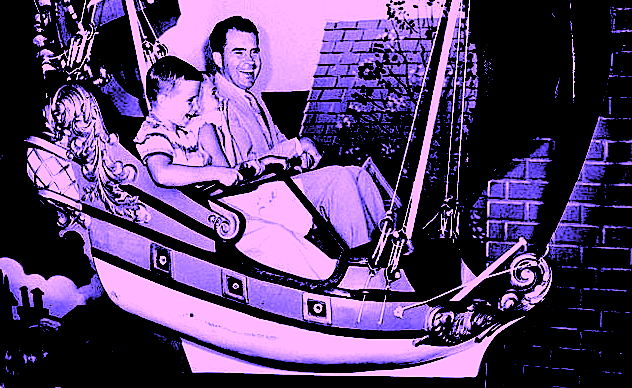
Let’s hear it one more time! (Or maybe not.)

Nixon on peter pan ride

Did my odd mid-week hiatus leave you wondering if I had slipped off for some holiday merry-making? No such luck; just swamped with work. That, and being comatose with depression over some recent news, international, national, and personal. I doubt 2009 is a year I shall remember fondly.

Or that writers in general will: this was the year that advances plummeted, especially for first-time authors. I was reading only just today that in the UK, advances as low as £500 on debut novels are now considered acceptable, even from major publishing houses. Lest those of us on this side of the pond are tempted to feel superior, the average advance for first-timers has dropped between 30 and 50%, although advances to authors already on the bestseller lists continue to spiral upward.

As the old-timers used to say: don’t quit your day job until someone other than your mother is buying copies of your work. To which I would add the latter-day caveat: and that work is your fifth book.

Sorry to be the bearer of such awful news, but I’m constantly meeting aspiring writers with completely unrealistic expectations about what publishers are willing to pay for brilliant writing. Many sincerely believe that it’s routine for writers who have successfully sold a first book to quit their proverbial day jobs the next day, but honestly, it’s been true for a long time that advances, especially on first novels, tend to be more in the new car range than the retire-for-life range.

And recently, they’ve been in the used car range, unless the manuscript happens to be one of the few that sells at auction. That’s just what it says on the box: if more than one publisher is interested in a book — a logistical impossibility for novels agents choose to submit, as many do, to only one editor at a time — then they will bid against each other for the rights. If the competition is fierce, that price can go quite high, of course, but for a first-time author, that’s pretty rare.

Why? Well, think about it: publishers can make educated guesses about what readers will buy, but there’s no way to know for certain, short of hopping on a time machine, what’s going to be the hot book a couple of years from now, right? So given the choice of shelling out up front for a book by an author who already has an established readership and one whose work is brand-new to bookstores, they tend to opt for the former.

All the more so in the last couple of years, when authors are increasingly being held responsible for promoting their own books, something considerably easier for an established author to do. And if you’re thinking, “Hey, wait a minute — if advances are dropping like stones, where is the small-but-serious author to get the resources to promote her own book?” congratulations; you’re understanding the current dilemma of many an exceptionally talented published author.

Starting to see why most published authors don’t quit their day jobs? And why staring glumly at the Senate health care debate on C-SPAN might have seemed like the least depressing way to spend a few hours than blogging about writing?

So how do the authors making a living at it make a living at it? For fiction, usually by having a number of books out. And teaching. And promoting the heck out of their books. Or by writing in different book categories, up to and including nonfiction.

For nonfiction, the picture is a trifle less grim, and remains so. That’s largely because (a) historically, it’s been easier to sell nonfiction than fiction, except for memoir, (b) a nonfiction writer doesn’t have to write the entire book before selling it, and thus can potentially market proposals for several different books in any given year, and (c) unlike fiction, which is typically sold on a finished manuscript, nonfiction writers are often paid to write the book before they’ve written the book (see point b). Yet even there, publishers are becoming increasingly cautions, even to the point of canceling long-established book contracts — especially the later books covered by multi-book contracts — if they’re not absolutely positive that the books in question will sell well.

See earlier comment about advances rising for bestselling authors. We writers often forget just how much greater a gamble taking a chance on a new writer actually is.

I mention all this not because misery loves company, but because writing a novel is so many day-job-having writers’ plan B. And plan Bs — and Cs and Ds and Qs — tend to get trotted out in a slow economy. Which, perversely, means that there’s simply more competition for the increasingly few publishing slots in any given year, both at the publishing house and agency level.

Translation: it’s been harder than usual to find an agent or sell a manuscript this year in the English-speaking world. Significantly harder. Just ask all of those published authors toiling away at their day jobs.

So please, as the year and the decade wind down, don’t fall into the trap of judging your writing purely by the yardstick of whether an agent fell in love with it, or an editor was able to move an editorial committee to cough up a couple of thousand dollars for the rights. Plenty of good books, plenty of brilliant books, even, got rejected this year.

Keep your chin up, literarily speaking, and remember: there will be other years. Recessions don’t last forever.

So what does a savvy-but-depressed writer do while waiting for advances to rise again? Why, the same thing one does during the annual Thanksgiving-through-New-Year’s publishing world slow-down: work on one’s craft. And revise, revise, revise, so one’s manuscript’s chances are even better in the year to come.

Let’s hear some enthusiasm, people. I, for one, am raring to go.

Oh, no: I’ve inadvertently used the evil phrase, the one involved in my first A CLOCKWORK ORANGE-like aversion therapy for repetitive phrase use. The screen goes wavy, and I see it all before me: I was six years old, standing in line for the Peter Pan ride at Disneyland, back in the days when the quality and popularity of the ride was easily discernable by the level of ticket required to board it. E was the best; I believe this particular ride was somewhere in the B range.

So there I was, all brown eyes and braids, holding my mother’s hand while my father watched my older brother go on D and E ticket rides, waiting in a queue of inexplicable length to cruise around an ersatz London with Peter, Wendy, and the gang. Not that I was particularly enamored of PETER PAN as a story, even then; the business of telling children that if they only wish hard enough, their dead loved ones will come back from the dead has always struck me as rather mean. Because, honestly, what does that story about the motivations of all of those kids whose late relatives remained dead?

So I was not especially psyched to take this particular ride; it was merely one of the few the guidebook deemed appropriate to literary critics of my tender age. And the longer we stood in line, the less enthused I became.

Why, the six-year-old in all of us cries? Because as each ship-shaped car took a new crew of tourists whirring into the bowels of the ride, Peter’s voice cried out, “Come on, everybody, raring to go-o-o-o!” After about five minutes of listening to that annoying howl while inching toward the front of line, I started counting the repetitions.

By the time it was our turn to step into the flying ship, Peter had barked that inane phrase at me 103 times. It’s all I remember about the ride. I told the smiling park employee who liberated us from our ship at the end of the ride that it would have been far, far better without all of that phrase at the beginning.

And that, my friends, is how little girls with braids grow up to be editors.

Actually, it’s probably fortunate that I was aurally assaulted by a cartoon character chez Mouse in my early youth; it’s helped make me very, very aware of just how much repetition is constantly flung at all of us, all the time. Not just in everyday conversations — although it’s there, too: if you doubt this, walk into a popular café during a midwinter cold snap and count the variations on, “Wow, I’m cold?” you hear within a 15-minute period — but in TV and movies as well.

Most of us become inured through years of, well, repetition to the film habit of repeating facts and lines that the screenwriter wants to make sure the viewer remembers, information integral to either the plot (“Remember, Gladys — cut the RED cord hanging from that bomb, not the yellow one!”), character development (“Just because you’re a particle physicist, George, doesn’t mean you’re always right!”), or both (“You may be the best antiques appraiser in the British Isles, Mr. Lovejoy, but you are a cad!”)

My all-time favorite example of this came in the cult TV series Strangers With Candy, a parody of those 1970s Afterschool Special that let young folks like me into esoteric truths like Divorce is Hard on Everyone in the Family, Outsiders are Teased, and Drugs are Bad. (See, I even remembered the morals, doubtless due to incessant repetition.) In SWC, the heroine, Jerri Blank, often telegraphs upcoming plot twists by saying things like, “I would just like to reiterate, Shelly, that I would just die if anything happened to you.”

Moments later, of course, Shelly is toast.

It was funny in the series, of course, but it’s less funny to encounter in a manuscript, particularly if your eyes are attuned to catching repetition, as many professional readers’ are. Characters honestly do say things like, “But Emily, have you forgotten that I learned how to tie sailors’ knots when I was kidnapped by pirates three years ago?”

All the time. Even when the first 200 pages of the manuscript dealt with that very pirate kidnapping. And every time such a reference is repeated, another little girl with braids vows to grow up and excise all of that ambient redundancy.

Okay, not really. But it does make Millicent the agency screener mutter into her too-hot latte, “I KNOW that. Move on!” more than the average submitter might like.

At base, conceptual repetition is another trust issue, isn’t it? The writer worries that the reader will not remember a salient fact crucial to the scene at hand, just as the screenwriter worries that the audience member might have gone off to the concession stand at the precise moment when the murderer first revealed that he had a lousy childhood.

Who could have predicted THAT? How about anyone who has seen a movie within the last two decades?

Television and movies have most assuredly affected the way writers tell stories. One of the surest signs that a catch phrase or particular type of plot twist has passed into the cultural lexicon is the frequency with which it turns up in manuscript submissions. And one of the best ways to assure a submission’s rejection is for it to read just like half the submissions that came through the door that day.

Come closer, and I’ll tell you a secret: repetition is boring. REALLY boring. As in it makes Millicent wish she’d gone into a less taxing profession. Like being an astronaut or a nuclear physicist.

Why, you ask? Here’s another secret: people who read manuscripts for a living are more likely to notice repetition than other readers, not less. (Perhaps Peter Pan traumatized them in their younger days, too.) Not only repetition within your manuscript, but repetition ACROSS manuscripts as well.

We all know how agents and editors feel about manuscripts that bore them, right? In a word: next!

It may not be a problem to which your manuscript falls prey — and if so, hurrah for you; it’s hard to strip a manuscript of them entirely, because they are so pervasive. But just to be on the safe side, here’s a depression-avoidance project for a rainy winter day: sit down with your first 50 pages and highlight every line of dialogue in there that you’ve ever heard a TV or movie character say verbatim. Ever.

Was that giant slurping noise I just heard the sound of the blood rushing out of everyone’s faces at the realization of just how much dialogue that might potentially cover?

No? What if I also ask you to highlight similar phrases in the narration? First-person narration is notorious for echoing the currently popular TV shows. So is YA.

Often, it’s unconscious on the writer’s part: it’s brainwashing from all of that repetition. It would be surprising if common dialogue hadn’t made its way into all of our psyches, actually: according to CASSELL’S MOVIE QUOTATIONS, the line, “Let’s get outta here!” is heard in 81% of films released in the US between 1938 and 1985.

Care to take a wild guess at just how often some permutation of that line turns up in submissions to agencies? Better yet, care to take a wild guess at how many agents and editors notice a particular phrase the second time it turns up in a text? Or the second time it’s turned up in a submission this week?

“Come on, everybody, raring to go-o-o-o!”

Unfortunately, just because a writer doesn’t realize that he’s doing lifting lines doesn’t mean that an agency screener won’t notice and be annoyed by it. Particularly if three of the manuscripts she’s seen today have used the same line.

It happens. Or, to put it in Afterschool Special terms, Checking for Both Types of Repetition is Good.

I know, I know, it’s tempting to assume that you haven’t used any of the standard catchphrases or plot twists, but believe me, even the most innovative writers do it from time to time. And for good reason: the rest of the population is subjected to the same repetitive teleplays and screenplays as writers are.

Over time, people do tend to start to speak the way they would if they were playing themselves onscreen. (A writer of very good hardboiled mysteries tells me that he is constantly meeting private detectives who sound like Sam Spade, for instance.) But remember, just because people do or say something in real life doesn’t mean it will necessarily be interesting translated to the printed page.

Check. Weed out both repetition within your manuscript AND material unconsciously borrowed from TV and movies. Or, better yet, have a good reader you trust check for you. (And if you’re not sure whether a particular twist or line is common enough to count, film critic Roger Ebert maintains a database of them.)

Often, it’s surprising how small a textual change will turn an incipient cliché into a genuinely original moment. But a writer cannot perform that magic trick without first identifying where it should be applied.

Okay, it’s time for me to go-o-o (curse you, Pan!) for today. Keep those creative spirits riding high, everyone, and as always, keep up the good work!

At the risk of stating the obvious: well, duh

editing-hand-bleachedediting-hand-bleachedediting-hand-bleachedediting-hand-bleached

Is everybody enjoying our ongoing self-editing series? Or, if enjoy doesn’t precisely capture the emotion current swelling your breast at the prospect of another installment of it, may I at least assume that everyone’s been learning a little something each time?

As I mentioned in passing last time, the art of self-revision is so difficult to teach that many writing gurus eschew it altogether –- and not merely because there is no magical formula dictating, say, how often it’s okay to repeat a word on the page or how many summary statements a chapter can contain before Millicent the agency screener rends her garments and cries, “Enough with the generalizations, already! Show, don’t tell!”

Although experience leads me to believe that the answer is not all that many.

Also, there’s just no getting around the fact that professional readers — i.e., agents, editors, contest judges, agency screeners, editorial assistants, writing teachers — tend to read manuscript pages not individually, like most readers do, but in clumps. One after another. All the livelong day.

Why might that affect how someone reads over time? Well, let me put it this way: if you saw the same easily-fixable error 25 times a day (or an hour), yet were powerless to prevent the author of submission #26 from making precisely the same rejection-worthy mistake, wouldn’t it make you just a mite testy?

Welcome to Millicent’s world.

If you’re at all serious about landing an agent, you should want to get a peek into her world, because she’s typically the first line of defense at an agency, the hurdle any submission must clear before a manuscript can get anywhere near the agent who requested it.
In that world, the submission that falls prey to the same pitfall as the one before it is far, far more likely to get rejected on page 1 than the submission that makes a more original mistake.

Why, you cry out in horror – or, depending upon how innovative your gaffes happen to be, relief? Because, from a professional reader’s point of view, common writing problems are not merely barriers to reading enjoyment; they are boring as well.

Hey, don’t shoot the messenger. Blame the sheer repetition.

In not entirely unrelated news, today, I shall be acquainting you with a manuscript problem frequently invisible to the writer who produced it, yet glaringly visible to a professional reader, for precisely the same reason that formatting problems are instantly recognizable to a contest judge: after you’ve see the same phenomenon crop up in 75 of the last 200 manuscripts you’ve read, your eye gets sensitized to it.

I’m talking, of course, about those most cut-able of sentences in any manuscript, statements of the obvious. You know, the kind that draws a conclusion or states a fact that any reader of average intelligence might have been safely relied upon to have figured out for him or herself.

I heard some of you out there chuckle ––you caught me in the act, didn’t you? Yes, the second sentence of the previous paragraph IS an example of what I’m talking about; I was trying to test your editing eye.

Why do I want you to develop a sensitivity to this kind of statement? Well, let me put it this way: any sentence in a submission that prompts Millicent to mutter, “Well, duh is a likely rejection-trigger.

Yes, all by itself, even if the rest of the submission is pretty darned clean, perfectly formatted, and well-written to boot. Read on to find out why.

I mention that, obviously, because I fear that some of you might not have understood that in a written argument, discussion of a premise often follows hard upon it. Or maybe I just thought that not all of you would recognize the difference between a paragraph break and the end of a blog.

Rather insulting to the intelligence, isn’t it? That’s how Millicent feels when a sentence in a submission assumes she won’t catch on to something self-evident.

“Jeez,” she murmurs indignantly, “just how dim-witted does this writer think I am? Next!”

Lest that seem like an over-reaction to what in fact was an innocent line of text, allow me to remind you: when you’re reading in order to catch mistakes – as every agency screener, agent, editor, and contest judge is forced to do, faced with mountains of submissions – you’re inclined to get a mite testy. Liability of the trade.

In fact, to maintain the level of focus necessary edit a manuscript really well, it is often desirable to keep oneself in a constant state of irritable reactivity. Keeps the old editing eye sharp.

To a professional reader in such a state, the appearance of a self-evident proposition on a page is like the proverbial red flag to a bull; the reaction is often disproportionate to the offense. Even – and I tremble to inform you of this, but it’s true — if the self-evidence infraction is very, very minor.

Don’t believe me? Okay, here is a small sampling of some of the things professional readers have been known to howl at the pages in front of them, regardless of the eardrums belonging to the inhabitants of adjacent cubicles:

In response to the seemingly innocuous line, He shrugged his shoulders: “What else could he possibly have shrugged? His kneecaps?” (Insert violent scratching sounds here, leaving only the words, He shrugged still standing in the text.)

In response to the innocent statement, She blinked her eyes: “The last time I checked, eyes are the only part of the body that CAN blink!” (Scratch, scratch, scratch.)

In response to The queen waved her hand at the crowd: “Waving ASSUMES hand movement! Why is God punishing me like this?” (Scratch, maul, stab pen through paper repeatedly.)

And that’s just how the poor souls react to all of those logically self-evident statements on a sentence level. The assertions of the obvious on a larger scale send them screaming into their therapists’ offices, moaning that all of the writers of the world have leagued together in a conspiracy to bore them to death.

As is so often the case, the world of film provides some gorgeous examples of this larger-scale writing problem. Take, for instance, the phenomenon film critic Roger Ebert has dubbed the Seeing-Eye Man: after the crisis in an action film has ended, the male lead embraces the female lead and says, “It’s over,” as though the female might not have noticed something as minor as Godzilla’s disappearance or the cessation of gunfire or the bad guys dead at their feet. In response to this helpful statement, she nods gratefully.

Or the cringing actor who glances at the sky immediately after the best rendition of a thunderclap ever heard on film: “Is there a storm coming?”

Taken one at a time, such statements of the obvious are not necessarily teeth-grinding events – but if they happen too often over the course of the introductory pages of a submission or contest entry, they can be genuine deal-breakers.

So here’s a little self-editing tip: you’re better off cutting ALL of them — and yes, it’s worth an extra read-through to search out every last one.

That’s true, incidentally, even if your manuscript does not fall into this trap very often. Remember, you have absolutely no control over whose submission a screener will read immediately prior to yours. Even if your submission contains only one self-evident proposition over the course of the first 50 pages, if it appears on page 2 and Millicent has just finished wrestling with a manuscript where the obvious is pointed out four times a page, how likely do you think it is that she will kindly overlook your single instance amongst the multifarious wonders of your pages?

You’re already picturing her astonishing passersby with her wrathful comments, aren’t you? Good; you’re getting the hang of just how closely professional readers read.

The trouble is, virtually all the time, self-evident statements appear to the writer to be simple explanation. Innocuous, or even necessary. But provide too much information about a common experience or everyday object, and the line between the practical conveyance of data and explaining the self-evident can become dangerously thin.

I’ve been using only very bald examples so far, but let’s take a look at how subtle self-evidence might appear on a page:

The hand of the round clock on the wall clicked loudly with each passing second, marking passing time as it moved. Jake ate his pie with a folk, alternating bites of overly-sweetened ollallieberry with swigs of coffee from his mug. As he ate, farmers came into the diner to eat lunch, exhausted from riding the plows that tore up the earth in neat rows for the reception of eventual seedlings. The waitress gave bills to each of them when they had finished eating, but still, Jake’s wait went on and on.


Now, to an ordinary reader, rather than a detail-oriented professional one, there isn’t much wrong with this paragraph, is there? It conveys a rather nice sense of place and mood. But see how much of it could actually be cut by removing embroideries upon the obvious:

The round clock on the wall clicked loudly with each passing second. Jake alternated bites of overly-sweetened ollallieberry pie with swigs of coffee. As he ate, farmers came into the diner, exhausted from tearing the earth into neat rows for the reception of eventual seedlings. Even after they had finished eating and left, Jake’s wait went on and on.


The reduction of an 91-word paragraph to an equally effective 59-word one may not seem like a major achievement, but in a manuscript that’s running long, every cut counts. And the shorter version will make the Millicents of the world, if not happy, at least pleased to see a submission that assumes that she is intelligent enough to know that, generally speaking, people eat pie with cutlery and drink fluids from receptacles.

Heck, a brave self-editor might even go out on a limb and trust Millicent to know the purpose of plowing and to understand the concept of an ongoing action, trimming the paragraph even further:

The round clock on the wall clicked loudly with each passing second. Jake alternated bites of overly-sweetened ollallieberry pie with swigs of coffee. Farmers came into the diner, exhausted from tearing the earth into neat rows. Even after they had left, Jake’s wait went on and on.


That’s a cool 47 words. Miss any of the ones I excised, other than perhaps that nice bit about the seedlings?

Fair warning: self-evidence is one of those areas where it honestly is far easier for a reader other than the writer to catch the problem, though, so if you can line up other eyes to scan your submission before it ends up on our friend Millicent’s desk, it’s in your interest to do so.

In fact, given how much obviousness tends to bug Millicent, it will behoove you to make a point of ASKING your first readers to look specifically for instances of self-evidence. Hand ‘em the biggest, thickest marking pen in your drawer, and ask ‘em to make a great big X in the margin every time the narrative takes the time to explain that rain is wet, of all things, that a character’s watch was strapped to his wrist, of all places, or that another character applied lipstick to — wait for it — her lips.

I am now going to post this blog on my website on my computer, which is sitting on my desk. To do so, I might conceivably press buttons on my keyboard or even use my mouse for scrolling. If the room is too dark, I might pull the cord on my lamp to turn it on. After I am done, I might repeat the process to turn it off.

You never can tell; I’m wacky that way. Keep up the good work!

SIOA, Part IV: some tips on combating the “Oh, God — have I blown it?” blues

billie

Still hanging in there, everyone? Or have my several days of admonitions to SIOA — Send It Out, Already! — materials requested in months past sent some of you scurrying into the back of your coat closets, whimpering amid the cast-off galoshes of Januaries past?

I certainly hope not. I was kind of hoping that significant numbers of you would find this series empowering — at least enough to, say, spend this coming weekend frantically reading requested pages IN THEIR ENTIRETY, IN HARD COPY, and preferably OUT LOUD before popping them in the mail next week. You know, before agents and editors go on their traditional long winter’s nap.

In other words: rah, rah, Team Literate!

Earlier this week, I told you the story of SIOA-avoider Zack, who had talked himself into a fairly common agent-seeking writer’s dilemma. He had pitched successfully at a conference last summer — so much so that he had been asked to send both the first 50 and the whole manuscript, respectively, to a number of different agents, so well done, Zack — but he had become so intent upon revising the book into a pinnacle of perfection that he never quite managed to get any of those requested materials packets out the door.

Not that he intended not to send them out when he was pitching, of course. No, at the time, and even for a few weeks after the conference, he was willing — nay, eager! — to place his work under as many agents’ noses as possible. He certainly stressed out often enough about it. But somehow, he kept delaying making those last crucial changes.

And one day, he woke up to realize that five months had gone by. Or seven. Or a year.

It may have been as little as three or four weeks, but regardless of the actual number of cast-off calendar pages involved, it was long enough to prompt that thought always so close to the front of a writer gearing up for submission’s mind:

“Oh, God, have I blown my big chance?”

From that cri de coeur, it was only a small step to Zack’s talking himself into believing that the agents in question would be miffed over the delay, so his submission really didn’t have a chance, anyway. Why, he reasoned, waste postage, now that rejection was a foregone conclusion?

For one very, very good reason, Zack: it wasn’t.

What doomed the submission was not anything that happened on the agent’s end; what guaranteed failure was Zack’s not pulling out of the SIOA-avoidance spiral. There are, of course, plenty of things a submitter can do to render rejection more LIKELY, but — take out your hymnals and sing along, please, long-time readers — the only manuscript that has absolutely no chance of being picked up by an agent is one that no agent ever sees.

So today I’m going to ask the Zacks of the world: if you’ve already decided that rejection is a foregone conclusion because so much time has passed, what precisely do you have to lose by sending it out at this point? ,

And yes, that’s a perfectly serious question.

Admittedly, I wouldn’t ADVISE waiting 7 or 8 months to submit requested materials (or pushing it for longer than a year, regardless of the reason), but it’s not as though Millicent the manuscript screener will take one look at the return address, consult a list of expected arrivals, and toss it aside unread, muttering, “Well, we’ll never know if THAT one had potential, will we?”

For one thing, handling it this way would require her to take the 14 seconds required to check a list — and for someone to have gone to the trouble of creating and maintaining such a list in the first place. Yes, the requesting agent probably jotted a few words down next to your name on his conference appointment sheet, but it’s unlikely to the point of hilarity that our pal Millicent will have that sheet next to her when she receives your manuscript. So the only point at which anyone concerned is at all likely to take a peek at that who-pitched-me list is the agent for whom Millicent is screening — which means that Millicent has to think your submission is very, very good indeed.

What is she likely to do instead of going off to double-check precisely when her boss originally requested Zack’s long-delayed manuscript? Well, here’s a hint: ripping open an envelope marked REQUESTED MATERIALS and starting to read is a pretty time-consuming task, when multiplied by a hundred manuscripts.

That’s right: she’s almost certainly just going to — you guessed it — rip open the envelope and start reading. Oh, she may roll her eyes at the line in Zack’s cover letter that mentions at which conference her boss requested the enclosed pages (all of you conference pitchers are mentioning where the agent or editor heard your pitch, right?), if she happens to recall off the top of her head how long ago it was. But in all likelihood, she’s going to take a gander at the first page, at least.

And if the agent or editor requested pages in response to a written query, she’s not going to blink twice if it took 11 months to reach her desk. Unless, of course, the agency or publishing house is not longer handling that type of book.

Yes, it happens — all the time, in fact. If it’s been a VERY long time since the agent of your dreams requested those pages, you might want to double-check — but not, I beg of you, by sending the agent another query letter, asking if it’s still okay to send those long-awaited materials. A quick, discreet trip to the agency’s website or listing in the most recent edition of one of the standard agency guides should tell you whether the AOYD has moved on to other book categories while you’ve been revising.

PLEASE do not, however, regard the likelihood that Millicent simply will not care how long ago her boss requested materials as carte blanche to push off revising that requested material until some dimly-imagined future point when you’ll have unbroken time to revise. Some agents do take umbrage at long delays, particularly after face-to-face pitching.

You can see their point, can’t you? Listening to many pitches in a row is pretty exhausting, after all, and one of the first reactions someone who makes her living by selling books is likely to have to the pitch that truly excited her is to start brainstorming quietly about which editors might be interested in the book in question. Don’t you want to keep that train of thought going — or at least (hold on, racking my brains for a train metaphor here) place your good writing under her nose while that moment of excitement is still within living memory?

(Couldn’t come up with an appropriate follow-up railroad metaphor, obviously. We all have our off days.)

If you want to build upon the excitement generated by a pitch or query letter, it’s prudent to try to get it out the door within 6 weeks of the request (not counting standard publishing not-at-home periods, like the three weeks leading up to Labor Day). The common wisdom dictates 3, but since agents hear SO many pitches at conferences and Millicent sees SO many queries, it’s unlikely that either is going to recall details of a pitch or query.

It IS nice, though, if you can get it to ‘em soon enough so something about your project seems at least vaguely familiar. More recognition than that isn’t necessary, strictly speaking, because you will have written REQUESTED MATERIALS in big, fat marker on the outside of the envelope and reminded them in the first line of your cover letter that they did, in fact, ask to see it. (If anything in the last sentence came as a surprise to you, I would highly recommend taking a gander at the HOW TO PUT TOGETHER A SUBMISSION PACKET category at right.)

Less than 6 weeks is ideal, but if you can send it out in under 3 months, there really is no need to apologize for the delay, or even to mention it. (As writers often do, and at great length. Often whilst groveling.) Longer than that, though, and it’s a good idea to add a sentence to your cover letter, apologizing for the delay.

What you most emphatically do not need to do is — wait for it — query again and ask for permission to send it at all. A crisp, businesslike cover letter set on top of your requested materials will do beautifully. Something like this is ample:

Dear Mr./Ms. (Requesting Agent’s Last Name),

Thank you for asking to see the first fifty pages of my novel, INVISIBLE INK. Please find it enclosed, along with a SASE for its safe return.

I had hoped to get these pages to you a trifle sooner, but the confluence of an unusually protracted work crisis and a bright idea for improving Chapter Two rendered my proofreading eye a bit slower than usual. I apologize for the delay.

Thank you for considering this, and I look forward to hearing from you soon.

Sincerely,

Charlotte Brontë

See? No obsequiousness required at all; just the facts, ma’am. If our Charlotte had pitched at a conference last March, she should mention it, but without calling attention to how long it’s been. If she has overcome her SOIA-avoidance sufficiently to send requested materials out to everyone who has asked to see them, she should bring that up, too:

Dear Mr./Ms. (Requesting Agent’s Last Name),

Thank you for asking to see the first fifty pages of my novel, INVISIBLE INK. Please find it enclosed, along with a SASE for its safe return.

I enjoyed speaking with you at the Desperate Writers’ Proving Ground Conference. I had hoped to get these pages to you sooner, but each of the agents and editors I pitched there asked for something slightly different. Please be aware that several of them will be considering this project simultaneously with you.

Thank you for your interest in my writing, and I look forward to hearing from you soon.

Sincerely,

Charlotte Brontë

Nice, clean, professional — and most importantly, not maudlin. No need to go on at length about what actually delayed you; you’re just being polite here, not filling in a long-lost buddy about the last six months of your life. (If you don’t like the work crisis motif, try a computer meltdown: everyone can identify with that.) All you really need to do here is to establish that you realize that you may have been slow to SIOA, and that you don’t plan to make a habit of it.

If you DO plan on making a habit of it — a way of life I do not recommend any writer’s embracing — you can buy yourself some additional time if you are polite about any anticipated delays early on. Naturally, if you experience a genuine life crisis, that’s beyond your control. If one occurs within the first couple of months after a request, it is perfectly proper to send out a courteous (and BRIEF) e-mail or letter to the requesting agent, stating that there’s going to be an unavoidable delay in sending those pages he asked to see. Perhaps something along the lines of…

Dear Mr./Ms. (Requesting Agent’s Last Name),

Thank you for requesting the full manuscript of my novel, INVISIBLE INK. Unfortunately, a fire has just consumed half of my neighborhood, so it may be a few months before I can reconstitute the text from my back-ups. I shall send it to you just as soon as I am able.

Thank you in advance for your patience — and I am looking forward to submitting to you soon.

Sincerely,

Charlotte Brontë

See? Even if the writer has a genuinely tragic justification for the delay, it’s possible — indeed, preferable, not to make a big deal of it. Just provide a simple, straightforward explanation, and leave it at that.

Do everything in your power, though, to keep the lapse between request and submission under a year, especially for a follow-up on a conference pitch. (Since conferences are annual, and agencies frequently send different agents in different years, it can be really, really obvious if a submitter’s cover letter refers to the 2009 or 2008 conference.)

One more piece of practical advice: if you are SIOAing after a substantial delay, I would HIGHLY recommend submitting your work via regular mail, rather than as an e-mail attachment, unless the agency categorically refuses to consider hard copy submissions. Yes, even if the agent or editor originally suggested that you send it via e-mail.

Why? Because while Millicent will almost certainly open even a months-late envelope, she may not open a months-late attachment. Especially if the first line of the e-mail runs something like, “Please, please, PLEASE forgive me for taking eighteen months to send these pages to you…”

Or she may not read the accompanying e-mail at all, if she mistakes it for an unsolicited submission. (Since e-mailed queries and submissions typically have swifter turn-around times, the probability of a what’s-been-requested list is substantially higher.) Most agencies will not open unrequested e-mail attachments, ever, due to fear of viruses, and the chances of your submission’s being mistaken for unsolicited grows as your name recognition at the agency fades.

If, knowing all this, you still find yourself firmly in the do-not-send-it-out-until-Groundhog-Day camp, I have one last question for you: are you absolutely positive that you really want to submit this book to professional scrutiny at all?

That may sound flippant, but listen: chronic SIOA-avoidance is a extremely common phenomenon, but in my experience, its severity does not correlate with how ready the book in question is to be marketed or the inherent talent of its writer. It’s very frequently a manifestation of fear of rejection, a way to protect one’s baby from criticism.

Completely understandable, right? A manuscript that is never submitted cannot be rejected; it’s logically impossible.

So for many aspiring writers, it just feels more comfortable to cut the process short by not mailing requested materials — in essence, rejecting their own work before the agent can do it — than to take the risk of exposing their books to professional critique. That way, they can never learn for sure whether their books are marketable or not.

Let me be clear here: I have absolutely nothing negative to say about writers who create solely for their own pleasure. Bless the Emily Dickinsons of this world, I say, who limit their audience to people they already know. That route can be wonderfully fulfilling, if the writer is honest about it, embracing the desire for an intimate readership — and doesn’t torture herself by continually trying to find an agent and/or editor she doesn’t really want or need.

However, the VAST majority of writers write in order to be read by people they DON’T know. To do that necessarily means risking rejection.

And let’s not kid ourselves about the kind of personal strength taking that level of risk requires: you have to be damned brave to send your work out to hyper-critical strangers. There aren’t a lot of professions where the practitioner’s FIRST official act is to take a piece of her soul and allow people a couple of time zones away to examine it under a microscope for minute flaws.

So, just for today, let’s celebrate how courageous we are when we do send out our work, rather than castigating ourselves when we don’t. Just for today, let’s clap our hands for all of us who have taken the great leap of submission. And for those who are going to pluck up the courage to break the SIOA spiral now.

I would swear that I can still hear some of you SIOA avoiders out there saying, “But…but…” Next time, I’m going to tackle some of the lingering buts that have troubled readers past.

In the meantime, chins up, my friends, and keep up the good work!

Words for writers to live by — and a contest!

lifelines

Before I launch into today’s wit and wisdom, a great big shout of congratulations to Askhari Johnson Hodari and Yvonne McCalla Sobers on this week’s publication of LIFELINES: THE BLACK BOOK OF PROVERBS, released by little publisher some of you may perhaps have heard of, Random House. Thanks for giving all of us quote-lovers such a rich treasure trove!

Not to mention such a great resource for writers looking to deepen the dialogue and background of their African and African-American characters — something for which all of us here at the Author! Author! community already know Askhari, if you will recall. Remember back in February, when she celebrated the release of her book, THE AFRICAN BOOK OF NAMES, by writing that terrific guest blog on choosing character names?

Yes, you read that correctly: this is her second book out this year. I only blandish the best guests to delight and enlighten you. Because, as they say in Uganda, “They who possess much wisdom, have it in their ears; they who possess little wisdom, have it on their lips.”

Like a lot of writers, I’m completely addicted to quote books, and LIFELINES includes hundreds of proverbs I’ve never seen before. But don’t take my word for it — here’s the publisher’s blurb:

Lifelines: The Black book of Proverbs travels to all corners of the globe to reclaim and preserve African wisdom. This book offers the remarkably wise heart of Africa and her children to readers experiencing career changes, new births, weddings, death, and other rites of passage. Readers will find truth in the African saying, “When the occasion arises, there is a proverb to suit it.”

Proverbs are presented in vibrant story-poem form; and are uniquely arranged by key life cycle events such as birth, initiation, marriage, and death. The proverbs can be found under themes such as “wealth”, “parenting”, “change” and “strength.” Inspired illustrations introduce each section along with beautiful vignettes showing how African proverbs comfort, inspire and instruct during different phases of life.

Lifelines illuminates how traditions, civilization and spirit survive and thrive, despite centuries of loss of freedom, family, identity, language, land, and wealth. The proverbs offer wisdom for every stage of our lives. Collected in one place as never before, it is the perfect addition to the book shelves of families large and small, from Nairobi to New Orleans and every city in between.

From birth: Every cackling hen was an egg at first. -Rwanda

to marriage: A woman’s clothes are the price her husband pays for peace. -Central Africa, East Africa, and Southern Africa (Bantu)

and elderhood: Every time an old man dies it is as if a library has burnt down. -West Africa

as well as every stage of life in between, the proverbs found in Lifelines offer the guidance and wisdom to last a lifetime.

Unlike other collections of proverbs, Lifelines hews closely to the cycle of life and draws inspiration from the authors combined 110 years of experience. Askhari Johnson Hodari and Yvonne McCalla Sobers have set out to let their proverbs both tell a story and stand alone. So whether you flip it open to a random page, read it through from start to finish, or go searching for a proverb to match your unique circumstance, you’ll find just the right lifeline to provide the comfort and guidance you’re looking for.

And, as I said, it’s utterly addictive, particularly for writers. Don’t you wish you had always had this little gem handy to toss at the well-meaning kith and kin who ask at holiday dinners, “So, is the book done yet?”

Those who eat eggs don’t know whether the chicken suffered. (Martinique)

Now that’s a comeback. Those of you who would like to get your mitts on a copy right away can, of course, pick one up on Amazon or for those of you who prefer to purchase from an indie bookstore, Powell’s, as well as directly from the publisher. (The last is a trifle more expensive than the first two, but receiving a box with RANDOM HOUSE as the return address might make many an aspiring writer’s heart go pitter-pat.)

But I promised you a contest, didn’t I? Askhari and Yvonne have been kind enough to arrange a book give-away for you fine people. This one is going to be fun for all of us. The rules:

1. Pick your all-time favorite proverb or quote about writing.

2. Figure out why you love it so much, and write a paragraph about why it inspires you. (Keep it under 100 words, please.)

3. E-mail the quote and your paragraph, along with the quote’s original source (if you know it) and your name to anneminicontest@gmail.com by midnight Pacific Standard time on Wednesday, November 25th.

4. Wait in eager anticipation for me to announce the winner on December 4th, when I’ll post the most stirring quotes.

Easy, right? I’m really looking forward to hearing the quotes that help you keep the faith — and to giving away the book.

To get those quote-finding juices flowing, I’m going to devote the rest of today’s post to talking about keeping the faith — not merely while you’re gnawing your nails, waiting to hear back from an agent or editor, or while you’re girding your loins to send out those queries and/or requested materials out before the NYC-based publishing industry slows to a crawl between Thanksgiving and Christmas. Most of the work of writing, after all, occurs long before the submission stage, alone in the dark of night.

Or light of day, depending upon your writing schedule.

So I was very pleased to stumble across a delightfully apt quote for aspiring writers, courtesy of Anaës Nin’s DIARY (Vol. 3, 1939-1944): “Life shrinks or expands in proportion to one’s courage.”

While I don’t think that’s always true — dear self is not, after all, the absolute center of the universe — it’s certainly true of trying to break into print. The only book concept that has absolutely NO chance of getting picked up by an agent is the one that no agent ever sees. Consequently, opportunities do in fact expand for those courageous to keep pitching and querying.

The converse is also true: opportunities contract for those not willing to put their writing out there. Too many aspiring writers reject their own work before a soul in the industry has an opportunity to take a look at it.

Creative minds are uniquely qualified, unfortunately, to talk their owners out of taking the big risk. The what if? muscles in writers’ brains tend to be rather well-developed, after all. And, as Ruth Gordon informed us in L’OFFICIEL, courage, “like a muscle, it is strengthened by use.”

(Oh, like you don’t go scurrying to your quote book when you find a good new one to add, and then start leafing through what’s already there?)

Again, true of both querying and submission: plenty of writers never get past the first rejection letter; it crushes them, because they read it as an entire industry’s — nay, the entire world’s! — rejection of what they have to say.

If you have fallen into this category for even twenty consecutive minutes, ever — and who among us hasn’t? — let me ask you to take on faith, at least provisionally, something I have learned from long, long experience: the 4th rejection hurts less than the first, and the 147th less than the 146th.

Virtually any currently published author could confirm that. Believe it or not, the vast majority of writers who have landed agents and publishing contracts have had their work rejected dozens upon dozens — if not hundreds upon hundreds — of times over their professional lifetimes. Including yours truly. But we kept ploughing ahead until the industry started to take us seriously.

As Louise Nevelson wrote in DAWNS + DUSKS, “I think all great innovations are built on rejections.”

I’m not going to lie to you — it takes courage, and plenty of it, to keep querying and submitting your work to total strangers. And while I’m on a truth-telling binge, allow me to add: I think that those of us who don’t have to query anymore (i.e., already agented writers) and those who never had to query in the first place (agents, editors, pretty much everyone on the business side of the publishing industry) have a nasty habit of pretending that querying is just like sending out any other business letter.

It isn’t, of course; it requires facing down the naysayers in your own head and risking the rejection of people you do not yet know. Yet have you noticed how often speakers at writers’ conferences and writers of articles on querying imply that it’s the easiest thing in the world?

“There is plenty of courage among us for the abstract,” Helen Keller wrote in LET US HAVE FAITH, “but not for the concrete.”

Having been on both sides of this particular aisle, I’m here to tell you: tackling the day-to-day necessities of maintaining an ongoing querying campaign is much, much, MUCH more difficult than standing up and gassing about querying techniques from behind a podium. So the next time you’re at a conference being lectured about it, remember to pat yourself on the back a little for being braver than the speaker, in all probability.

It is SO easy to forget whilst hiking the querying-and-submission trail that it honestly does take more courage on the part of an agent to sign a previously unpublished writer than a published one, just as it requires more bravery for an editor to take a chance on a brand-new writer than upon the 17th work by an established name. This is why, in case you were wondering, those of us who have been in the biz for a while cringe when we hear an aspiring writer say, “Well, my book is at least as good as the rest of the junk out there.” The standard against which a new writer’s work is held is not that of the current market, contrary to popular belief, but considerably above it.

Don’t believe me? Okay, try this little experiment: read five books by first-time authors in your chosen book category that have come out within the last year — then go and take a gander at what the time-honored leaders of the genre have put out lately. Do they honestly seem to be edited, let alone written, to the same standard?

It’s a good idea in general to get into the habit of reading the work of new authors in your book category, anyway, to keep abreast of what is being bought and sold recently — I can’t tell you how many times I’ve heard agents and editors complain about aspiring writers’ not being familiar with the current market, as opposed to what was hot ten years ago.

Besides, if you want to live in a world where publishers are eager to buy books like yours, it only makes sense to convey that preference through buying them yourself, right? Right?

And if neither is incentive enough to spur you to curl up this autumn with the latest offerings in your chosen book category — or to ask the Furtive Non-Denominational Gift-Giver to stuff a few of ‘em into your stocking — here’s another: reading first-time authors is a great way to pick up agent leads.

Why first-time authors, as opposed to the other kind? Because the vast majority of books sold to publishers each year in this country are written by the already-published. Why? Well, they have track records. And think about it: how often do you — or did you, prior to adopting the practice of actively seeking out first-time authors I suggested above — buy books by first-time authors?

Okay, what about ones you don’t know personally, or who haven’t won major awards?

Readers tend to gravitate toward names they know — and bookstores often encourage the practice. Unless the writer is a celebrity in another medium or a politician, first books are substantially less likely to be placed in a prominent position in a chain bookstore. Certainly, they are less likely to be place face-out on the bookshelf, which decreases that probability of being browsed considerably. Naturally, this results in sales statistics that show very plainly that established authors sell better than new ones.

So your chances of getting picked up are higher if you already know a particular agent has been successful selling a first-timer like yourself. You know, at any rate, that the agent has been exceptionally brave at least once.

And wouldn’t you know it, Helen Keller has ANOTHER pithy statement that’s appropriate here, and from the same book? “Avoiding danger is no safer in the long run than outright exposure. The fearful are caught as often as the bold.” Are you listening, agents?

Because the agent who compulsively sells first novels is something of a rarity, let me once again urge you to draw a firm distinction in your mind between agents whose listings in the standard agents’ guides SAY they are open to queries from previously unpublished writers, and those who have a successful TRACK RECORD of selling first books.

As Abigail Adams seems to have written to her troublemaking husband in 1774, “We have too many high sounding words, and too few actions that correspond with them.” Amen, Abby!

To be fair, agents — the successful ones, anyway — only take on what they’re pretty sure they can sell. As anyone in the industry will tell you at great length after he’s had a few drinks (oh, like it’s accidental that writers’ conferences almost always take place in hotels with bars in them…As Agnes Repplier was prone to say, and even wrote in 1891’s POINTS OF VIEW, “If a man be discreet enough to take to hard drinking in his youth, before his general emptiness is ascertained, his friends invariable credit him with a host of shining qualities which, we are given to understand, lie balked and frustrated by his one unfortunate weakness.”), a first book, unless it is written by a celebrity, is quite a bit harder for an agent to pitch to a publisher than a second or third.

In fact, on average, less than 4% of the fiction published in any given year is by first-time authors.

Sorry to be the one to break it to you. But as George Sand apparently wrote to some friend of hers in 1863, “Let us accept truth, even when it surprises us and alters our views.” Or, if you prefer Thomas Jefferson, “We must not be afraid to follow the truth, wherever it may lead.”

I’m sure I could find a dozen more quotes on the subject if I really took a spade to the Bartlett’s, but I’m sure you catch my drift. My point is, it’s not all that difficult translate your reading habit into querying leads — because while life may shrink or expand in proportion to one’s courage, chance also favors the prepared mind. Or so said Louis Pasteur.

What, you thought the boiling milk thing just came to him one day while he was thinking of something else?

Getting into the habit of reading every (or as close to every as possible) first book published in your book category this year — and next year, and the year after that — will give you a very solid sense of how editors and agents conceive of the category, making it easier to tell whether your work genuinely falls within it. It will help convey a sense of upir target readership as well.

While this may seem like a very large task to set oneself, most book categories actually sport relatively few first-time authors in any year’s harvest of publications. For years, I made a practice of reading every first literary or mainstream novel written by an American woman under 40 published by a major publishing house each year. Care to guess how long that took?

I wish I could report that it was a full-time job, but in truth, it wasn’t all that time-consuming. There were few years where more then 25 books answered that description; one year, there were only 7.

And those 7 were represented by only 3 agencies, I discovered. Guess who I queried the instant I uncovered THAT unsavory little fact?

The realization could have made me despair — but instead, it convinced me to sit down and take a good, hard look at the novel I was shopping around at the time, to see if there was any way that I could make it more mainstream, because that opened up so many more querying possibilities. And sure enough, after I had taken most of the semicolons out of the text and readjusted the thought/action ratio a little, I found that my novel was about equally welcome to agents who represented adult fiction, women’s fiction, and literary fiction — which makes some sense, as there is considerable overlap amongst the readers of all three.

Heck, literary fiction aimed at women is considered downright redundant in the industry. But unless a writer became awfully darned familiar with the book market, how is she to know that?

There is another, more immediately practical reason to get in touch with one’s submarket and remain so, of course: it’s a great way to identify agents to query. As I mentioned many, many times throughout my recent HOW TO WRITE A REALLY GOOD QUERY LETTER series (conveniently viewable under the category of the same name on the archive list at right), every agent on the planet is flattered by queries that begin, “Since you so successfully represented Unknown Author’s recent novel, FIRST BOOK, I hope you will be interested in my novel, PROJECT I’VE BEEN WORKING ON FOR A DECADE…”

They are far likely to be buttered up, in my experience, by mentions of novels them may have struggled to sell than by similar references to their better-established clients. (Because, presumably, as Edith Sitwell tells us: “The aim of flattery is to soothe and encourage us by assuring us of the truth of an opinion we have already formed about ourselves.”)

Use this quirk to your advantage.

To slather on the butter with a more lavish hand, go ahead and say something nice about the book in your query letter to its agent. (Quoth Marie von Ebner-Eschenbach in APHORISMS: “We are so vain that we even care for the opinion of those we don’t care for.”) Naturally, nice-saying is going to be a whole lot easier if you have actually read the book in question.

Although truth does compel me to say that if you are in a hurry, you can’t go far wrong with something along the lines of, “As the agent who so ably represented Keanu Reeves’ BRAIN SURGERY AT HOME, I believe you will be interested in my book…”

That being said, on conscientious grounds, I really should reiterate that you ought to read, if not actually buy, all of the books you are using as launching pads for query letters to agents. Buying them is ideal, of course: after all, the sales of an agent’s current clients subsidize hiring Millicent to screen submissions from new writers.

Not to mention the good karma factor. The world would be a substantially better place for writers if we supported one another by purchasing books by first-time authors early and often. Because, after all, who can forget Hamelyn’s 1719 pronouncement, “Stinginess does not enrich; charity does not impoverish”?

However, good old Hamelyn aside, books ARE expensive, and I know that some of you will be in too much of a hurry to check all of the relevant books out of the library. So here are a few tips on how to expand your reading list without buying out Borders.

1. You don’t need to until a book is actually published before complimenting it agent on the achievement of selling it.
Given predictable lag times between book contract and actual publication, you may be able to spot a relevant sale as much as two years before it turns up in a bookstore near you.

So in a sense, even a very hip bookstore is a graveyard of passé contracts. (As Mary Webb informed us in PRECIOUS BANE, “We are tomorrow’s past.”) What you are seeing in bookstores today, then, is not an infallible guide to what agents are selling now.

And as I am probably not the first to point out, the early bird catches the worm. By querying the agent BEFORE the book comes out, you will beat the crowd of writers who inevitably swamp the agent of any commercially big book. (Sorry, no quote for that one. This is harder than it looks, people.)

Also, your promptness will tell the agent indirectly that you are a savvy writer familiar with market trends — and you will become one, if you become a regular reader of book sales. It is surprisingly addictive, and you will quickly learn a great deal about what is and is not being sold to publishing houses right now.

2. Use the industry’s own press to keep abreast of who is representing what right now.
Start reading the trade journals, such as Publishers’ Weekly, or subscribe to Publishers Lunch, which lists pretty much every sale to a North American publishing house, by title, author, agent, and often a one-line description of the book as well.

Fringe benefit: many times, these sources will give a general indication of the advance offered, too, so you can start getting some idea of what your writing is potentially worth. (Hint: pretty much every aspiring writer believes that the average advance is exponentially larger than it actually is.)

To quote my former agent, “We don’t really have any idea of a book’s market value until we start to shop it around.” (Come on — you expected me to have a famously relevant quote ready for that one?)

3. Find out who is representing first books right now.
If you are a novelist, pay particular attention to the debut novels, which are often broken off into their own section in industry listings. Again, there is no better way to tell which agents are willing to take on new writers than to find out who is putting that inspiring level of openness into action.

(As George Eliot told us in ADAM BEDE, “If you could make a pudding w’ thinking o’ the batter, it’d be easy getting dinner.” So true, George, so true.)

4. Keep an eye out for trends, so you may send out your queries at the best time for your book.
Keeping abreast of who is selling what will also allow you to target your queries more effectively as agents’ (and agencies’) tastes change over time. (As Zora Neale Hurston liked to put it, “research is formalized curiosity. It is poking and prodding with a purpose.”)

Since a pre-publication query is a situation where you could not possibly have read the book before querying (unless you happen to be a member of the author’s critique group), you need not worry about complimenting the book; by noticing the sale, you will be complimenting the AGENT, which is even better.

In fact, you should make sure NOT to compliment the book, since anything you say is bound to come across as insincere. Has not Pearl S. Buck taught us that “Praise out of season, or tactlessly bestowed, can freeze the heart as much as blame”?

A good all-purpose opening, to steer clear of the slightest hint of misdirected flattery: “Congratulations on your successful sale of BOOK X! Since you so skillfully represent (BOOK X’s type of book), I hope you will be interested in my book…”

Yes, being this talented an agent-butterer does take time, as well as quite a bit of work. But unlike so many of the mundane tasks we writers need to perform to attract an agent’s attention, forming the twin habits of reading what’s newly in your area and keeping abreast of what editors are acquiring right now for your future reading pleasure will not merely be helpful in blandishing the agent of your dreams into taking a gander at your work. These are habits that will help you in later years be a more marketable — and perhaps even better — author, well versed in all of the pretty things writers in your category can do to enchant their readers.

“Unhappiness,” Bernadin de Saint-Pierre wrote in THE INDIAN HUT, “is like the black mountain of Bember, at the edge of the blazing kingdom of Lahor. As long as you are climbing it, you see nothing but sterile rocks; but once you are at the peak, heaven is at your head, and at your feet is the kingdom of Cashmere.”

Try to think of all this self-assigned reading as continuing education for your dream profession. Keep those chins up. And, of course, keep up the good work!

“So many manuscripts, so little time.” — Millicent

voici les temps

I’m feeling a bit cryptic today, my friends. I’m writing something in a teenage voice, and I can’t say that I particularly like what it’s done to my emotions. Blame my Method acting training; I’ve even broken out. Here’s hoping that the result is worth my rolling my eyes at the slightest provocation.

But enough about me: back to our ongoing concerns. Isn’t it amazing just how much there is to know about the ostensibly straightforward task of printing out requested materials, placing them in an appropriate mailing container, and sending them off to an agent or editor?

Underscore presents itself: you all know NEVER to submit unrequested pages, right? I mean (roll eyes), who DOES that?

Again, I’m not talking about queries sent to agencies whose guidelines specify that you should tuck the first 50 pages into the packet — I mean the unwise practice of just sending along a manuscript before an agent or editor is even aware that it exists. Almost universally, unsolicited manuscripts are rejected unread. Even at the rare agency or publishing house that accepts unrequested manuscripts, it’s going to end up in what’s known as the slush pile, the stack of submissions that stretches, Dr. Seuss-style, skyward, awaiting the day when someone will have the time to review them.

Normally, I would have dug up a marvelous picture to illustrate that. Unfortunately, I can’t see well enough through my clouds of angst to do that. Or my bangs. (Sigh.)

It can take a LONG time just to go through the manuscripts they asked to see. Care to guess how tempting that fact renders tossing aside those they didn’t request? Long-time readers, pull out your hymnals and sing along: because agencies and publishing houses get so many submissions that their PRIMARY goal is to weed out the one they are reading at the moment. The faster they can do that, the better for them.

Yet despite the ubiquity of the reject-the-unsolicited-on-sight policy, amazingly few of the writers rejected for doing so are even aware that jumping the gun might even have played a role in their rejection. Like aspiring writers who submit without a SASE, with too much material, or without following the strictures of standard format, gun-jumpers usually receive exactly the same form-letter rejection as writers whose work was rejected for writing-related reasons.

So they keep submitting incorrectly time after time, never understanding that a few relatively simple changes could get the pros to take their manuscripts more seriously. It saddens me.

“Um, Anne?” I hear a few quick-reasoning readers pipe up. “Since submitting via e-mail would obviate the lack-of-SASE problem entirely, and since if I send my materials as an attachment to an e-mail, Millicent the screener won’t know how many pages I’ve submitted unless she reads through them all, wouldn’t I pretty much always be better off submitting my work electronically?”

Well, you could make a good argument for that, computer-huggers. While an unsolicited e-submission will, admittedly, tend to meet the same fate as an unsolicited paper submission — a quick and quiet rejection, almost invariably with a form letter — e-submission does undoubtedly have many perqs. It’s substantially cheaper than printing up and mailing a submission, for one thing, especially so for writers submitting to US agents from outside the country, not to mention less wasteful of paper. Agencies often respond to e-queries more rapidly than paper queries, and an electronic submission may easily be e-mailed around the office.

Even taking all of that into consideration, given the choice, I would always opt for submitting in hard copy, rather than electronically. Fortunately, with many agencies, a submitter does in fact have that choice to make.

Why are paper submissions are worth all the additional effort and expense? Well, for starters, it’s more likely to get there — even if your mail system is reliable, not everybody’s is — and less likely to be deleted accidentally. (Also true of e-queries, incidentally: many agencies that accept pages with initial queries specifically ask in their guidelines that queriers not follow up to find out if the e-mail actually arrived.)

Then, too, hard copy manuscripts are typically read more closely then e-mailed submissions, for the extremely simple reason that people read faster on a screen. Electronic rejection is as easy as Millicent the agency screener’s hitting a button a nanosecond after a sentence displeases her — far, far less energy- and time-consuming than having to dig out the SASE, reach for the form rejection letter to stuff inside it, insert the rejected manuscript, and eventually carry the whole shebang to the mail room.

Yes, you read that correctly: Millicent’s begrudging, mercurial attention to your first printed page is the BETTER option. The world is a strange place.

Also, a writer can control more factors in hard copy. As much as a pain as pulling a physical submission packet together may be, at least you know that the formatting will show up on the other end as you want it.

“Wha–?” I hear the more computer-reliant of you out there exclaiming.

I hate to be the one to break it to you (although that’s never stopped me yet, I notice), but if you e-mail a submission, you have absolutely no way of knowing that all of your precious formatting arrived intact. Copying and pasting a writing sample into the body of an e-mail (or one of those little comment boxes on agencies’ websites) will, naturally, eliminate most of the formatting, but even if you have included the pages as a Word attachment, different operating systems and versions of Word can play havoc with the cosmetic attributes of a page.

I can feel some of you getting restive under the onslaught of so much cynicism (bleak is my outlook, people. Bleak!), so instead of throwing any more at you today, I’m going to give you the opportunity to put some of what we’ve learned over the past few weeks into practice.

That’s right; it’s example time again. Hold your applause, please, until we’re done.

Submission scenario 1: After months on end querying her short story collection, WHAT I DID FOR LOVE AND OTHER DRY-CLEANING ANECDOTES, Antoinette receives an e-mail from Clara, the agent of her dreams, asking to see the entire manuscript. Alternately overjoyed and petrified (a very common twin mental state at this juncture, incidentally, although even amongst ourselves, we writers tend to talk only about the joy), she prints up her manuscript that very day and rushes it into the nearest cardboard container.

Specifically, the slightly dented box her mail carrier dumped on her doorstep on a recent rainy afternoon. (Our Antoinette is pinching pennies, you see.)

I already feel some of you blushing. We’ve all received (or sent) that box that began life as an mail-order shipping container, but now is covered with thick black ink, crossing out the original emporium’s name. My mother takes this process even farther, turning the obfuscating lines into little drawings of small creatures cavorting on a cardboard landscape. As dandy as this recycling is for birthday presents and the like, it’s considered a bit tacky in shipping a submission. Which is unfortunate, as the ones from Amazon tend to be a perfect footprint for manuscripts. Don’t yield to the temptation, though.

Back to our fair Antoinette. She makes it to the post office five minutes before it closes. When she plunks down the hefty box and asks to overnight it, she turns pale at the price, but pays it anyway. Exhausted but happy, she rushes home to plan what she’s going to wear for her appearance on Oprah to discuss the book.

Afraid to miss Clara’s response — which, naturally, she begins to expect within a day of learning that Clara has received it through the magic of delivery confirmation — Antoinette cancels her gym membership, turns down Eugene’s seven requests to have dinner with him, and — sacre bleu! — gives up reading my blog in order to pursue the more rewarding activities of staring at her e-mail inbox and repeatedly checking to see that her phone is working.

Clearly, madness has taken hold of her. A very, very common type of madness, unfortunately: it never occurred to her that Clara would not simply drop everything else she’s doing to pay attention to her submission the instant it arrived in the office.

A couple of weeks later, another agent, Bertrand, asks to see the first 50 pages. Before Clara’s request, this prospect would have thrilled Antoinette beyond words, but now, she does not even respond. “I’ve already committed to Clara,” she tells kith, kin, and the neighbor who comes over to complain about Antoinette’s having turned her phone’s ringer up to glass-shattering levels, so she won’t miss calls when she’s in the shower. Or a coma.

An anxious three months pass before Clara returns the manuscript to her, its rejection explained only by a boilerplate: we regret that your manuscript does not meet our needs at this time.

Okay, what did Antoinette do wrong here, other than use a recycled box? (Hint: what she did wrong here probably didn’t have any impact whatsoever on whether the manuscript got rejected or not. But it was still a faux pas.)

Antoinette’s first error was to overnight the manuscript. It was hugely expensive — and completely unnecessary. It would have gotten exactly the same read had she sent it via the much cheaper Priority Mail, or even regular mail. (Book rate is very, very slow, so I wouldn’t recommend it.)

Also, one suspects, in her rush to get it out the door and into an agent’s hands, she neglected to sit down and give it a final once-over, reading it IN ITS ENTIRETY, IN HARD COPY, and OUT LOUD. It’s also not a bad idea to flip through the manuscript as it prints out to make sure that no pages are smudged or missing; I don’t know about your printer, but mine occasionally blithely decides to slip a blank piece of paper into a manuscript when I’m not looking.

Since we are talking about Antoinette here, I’ll spare you the story about the time I forgot to check, and page 47 of my master’s thesis was nowhere to be found. My defense turned a mite ugly as a result.

The more interesting question here is why would Antoinette, or any other aspiring writer, spend money unnecessarily on postage? One of two reasons, typically. First, many writers assume — wrongly — that an overnighted package is taken more seriously in an agency’s mailroom. In their minds, the mail sorter says takes one look at that FedEx package and cries, “My God! This must be urgent!” and runs it directly into the agent’s office, where it is ripped open immediately and perused that very day.

Just doesn’t happen anymore, although it may have 20 years ago, at the dawn of overnight cross-country shipping. At this point in human history, though, writers have done this too often for an overnighted package to generate any enthusiasm at all at the average agency. Now, overnight packaging is just another box.

Save yourself some dosh.

Antoinette’s other mistake was to put the rest of her submissions on hold, effectively granting the agent of her dreams an unrequested and totally unnecessary exclusive look at the manuscript. Oh, you can see her reasoning easily enough: if her top pick offered representation, she wouldn’t need to query or submit anymore. But since Clara didn’t — and took her own sweet time saying so — Antoinette just took 8 weeks of potential submission (and querying) time and threw it out the window.

Sometime later in her writing career, she may wish she had that time back. The most probable first expression of that wish: about 35 seconds after she reads Clara’s form-letter rejection. Shouted at the top of her lungs.

I can think of couple of reasons — and good ones — to keep submitting and querying right up to the moment an agent makes you an offer. First, finding and landing the right agent for your work can take some serious time — if your book is genuinely ready to send out, why wait a month (or more) to hear back from each?

Second, few agents assume that a good writer will be submitting to only one agency at a time. If there isn’t competition over you, they sometimes conclude that no one else is interested.

Long-time readers, chant it with me now: unless an agency SPECIFICALLY says that it will accept only exclusive submissions, it does not expect them. The writers’ conference rumors that say otherwise are just not true. But do double-check each agency’s website and/or agency guide listing, just to be sure; policies do vary.

Third — and I’m sorry to have to say this, Antoinette, but it’s true — for the sake of your long-term happiness, it’s never a good idea to hang all of your hopes on a single submission. This is a tough business; being realistic about that can help take some of the sting out of rejection. Keep plowing forward.

I’m off to cultivate my attitude problem by engaging in a few hours of brooding about why my hair isn’t curly and other burning existential issues, but rest assured, I have more submission exemplars up my capacious sleeve. Keep up the good work!

Wrapping up on wrapping up: what precisely should go in that box?

brain in shipping box

Are you excited to have reached the end of this extended megaseries on everything and anything that should go in a query or submission packet — other than the manuscript, that is? Did that collective “Nyeah” I just heard mean that you’re thrilled to have all of this knowledge under your belt, in preparation for that supercharged, tense day when you’re asked to bundle your pages together and send ‘em off, or that the long-term readers amongst you are just pleased to have this info in consecutive posts, for easy future reference? Or is it merely that you will be awfully glad when I stop yammering on about these less-than-thrilling practicalities and wend my way back to craft?

However it may be, last time, I launched into an extensive discussion of the kind of boxes a writer should (sturdy, clean, size-appropriate) and should not use (grease-stained, mangled, clearly last used to ship books from Amazon) to send a manuscript to an agent, editor, or contest. Today, I’m going to round off our discussion of submission packets with some examination of what a writer might conceivably want to stuff into that box.

Let’s pretend for a moment that you have just been asked to submit materials to the agent of your dreams. To be absolutely clear, I’m talking about REQUESTED materials here, not just sending pages to an agency that asks queriers to include the first chapter, a few pages, or a synopsis with a query — all of these would, in the industry’s eyes, be unsolicited pages crammed into a query packet.

I know, I know: it’s a bit counter-intuitive that a blanket statement on a website, in an agency guide, or from a conference dais that a particular agent would like to receive these materials from all queriers doesn’t constitute solicitation, but it doesn’t. The logic runs thus: guidelines that recommend submitting extra material with a query are generic, aimed at any aspiring writer who might conceivably be considering sending a query.

By contrast, a solicited submission, a.k.a. requested materials, is one that an agent is WAITING to see because she has asked a particular writer to send it following a successful pitch or query. Because the agent expressed positive interest in seeing those pages, the lucky requestee is fully justified in scrawling REQUESTED MATERIALS in letters two inches high in the lower right-hand corner of the envelope or shipping box, just to the left of the address, to assure that the submission lands on the right desk instead of the slush pile made up of, you guessed it, unsolicited manuscripts.

Everyone clear on the difference between solicited and unsolicited materials? Because if you don’t by this point in this megaseries, I can only fling my hands into the air and tearfully inquire of any deities who might happen to be listening just where I went wrong in bringing you up.

Just as generic requests vary in what agents ask queriers to send, so do requests for solicited material. Out comes my favorite broken record again: while every agency and small publishing house seems to have a slightly different idea of what constitutes a standard submission packet (word to the wise: read those requests CAREFULLY), here are the most commonly-requested constituent parts, in the order in which they are generally expected to appear in the packet:

1. Cover letter
You HAVE been sending cover letters with your submissions, right? As I mentioned a few days ago, just sending a manuscript all by itself is considered a bit rude, as well as strategically unwise.

“Oh, please, Anne,” I hear the submission-weary complain. “Rude? What do you call making a successful querier or pitcher write ANOTHER letter to an agent who has already agreed to read my work?”

I sympathize with the submission fatigue, oh weary ones, but don’t get your hackles up. In the first place, there’s no need for a long-winded missive — a simple thank-you to the agent for having asked to see the materials enclosed will do. It’s hardly onerous.

In the second place, the submitter is the one who benefits from including a cover letter — all the more so because so few submitters remember to tuck one into their packets. An astonishingly high percentage of submissions arrive without a cover letter, and often without a title page as well, begging the question: what makes these submitting writers so positive that the requesting agent will still remember their queries or pitches well enough to render page one of chapter one instantly recognizable?

I’m not going to depress you by telling you just how unlikely this is to be the case.

Suffice it to say that it’s in your best interest to assume that the person who heard your pitch or read your query won’t be the first person to screen your submission, for the very simple reason that it is, in fact, often a different person. Thus, it doesn’t really make sense to presume that everyone who sets eyes on your manuscript will already be familiar with who you are and what you write.

And it’s not problematic purely because a Millicent new to your project might get offended by not being addressed politely from the moment she opens the manuscript box. Does anyone out there want to take a guess at the PRACTICAL reason omitting both a cover letter and a title page might render a submitter less likely to get picked up?

If you instantly cried, “Because it renders the agency’s contacting the submitter substantially more difficult!” give yourself a gold star for the day. Like a query letter and a title page, a good cover letter should include all of the sender’s contact information — because the last response you want your submission to generate is a heart-felt, “Oh, it’s too bad we have no idea who sent us this or how to contact him or her; all we have is the author’s last name in the slug line. This saddens me, because I really liked this manuscript!”

Okay, so that little piece of dialogue is pretty lousy, now that you mention it. But you get my point, right?

“Okay, Anne,” the former head-scratchers concede, “I get why I should include a cover letter. What does it need to say?”

Glad you asked. Under most circumstances, all it needs to say is the following. (If you’re having trouble reading this, try either double-clicking on the image or saving it to your hard disk as a PDF.)

Seriously, that’s all there is to it. Like any other thank-you letter, the courtesy lies more in the fact that the sender took the time to write it, rather than in what it actually says.

A couple of caveats:

(a) If you met the agent at a conference, mention that in the first paragraph of the letter, to help place your submission in context. As crushing as it may be for the writerly ego to contemplate, an agent who spent days on end listening to hundreds of pitches probably is not going to remember each one. No need to re-pitch, but a gentle reminder never hurts.

While you’re at it, it’s not a bad idea to write the name of the conference on the outside of the envelope, along with REQUESTED MATERIALS. Heck, it’s a very good idea to write the conference’s name on the outside of a query to an agent one has heard speak at a conference, too, or to include the conference’s name in the subject line of a query e-mail. The point here is to render it pellucidly clear to the agent why you’re contacting her.

(b) If another agent is already reading all or part of the manuscript you’re sending — or has asked to see it — be sure to mention this in your cover letter. No need to say who it is or how long s/he has had it; just tell the recipient that s/he’s not the only one considering representing this book. Unless the agency has a policy forbidding simultaneous submissions, withholding this information will only generate resentment down the line if more than one agent wants to represent your book.

Yes, even if that agent to whom you submitted 9 months ago has just never responded. Actually, it’s in your strategic interest to contact that non-responder to let her know that another agent is interested.

(c) Make sure ALL of your contact information is on the letter, either in the header (letterhead-style, as I have shown above) or under your signature. Again, you want to make sure that the agent of your dreams can call you up and rave about how much she loved your submission, right?

(d) Make absolutely certain that the letter includes the title of your book, just in case the letter and the manuscript end up on different desks. (Yes, it happens. Don’t ask; just be prepared for this horrifying contingency.)

Everyone comfortable with the cover letter? For more tips on how to construct one with aplomb, please see COVER LETTERS FOR SUBMISSIONS (where do I come up with these obscure category titles?) on the list at right.

2. Title page
ALWAYS include this, if ANY manuscript pages have been requested — yes, even if you have already sent the first 50 pages, and are now sending the rest of the book. (If you have never formatted a professional manuscript before, please see the TITLE PAGE category at right.)

Why? Long-time readers, chant it with me now: because the submission looks more professional that way.

Also, like the cover letter, the title page renders it easy for an agent to track you down. Believe me, if the agent of your dreams falls in love with your manuscript, you’re going to want to hear about it right away.

3. The requested pages in standard format, unbound in any way.

The operative word here is requested. If an agent or editor asked you for a partial, send PRECISELY the requested number of pages. Don’t fudge here — even if your novel features a tremendous cliffhanger on p. 51, if the agent of your dreams asked for the first 50 pages, send only the first 50 pages, period.

Actually, in this instance, you should send only the first 50 pages even if they do not end in a period. Even if the designated last page ends mid-sentence, stop there.

As to sending pages in standard manuscript format, please, don’t get me started again the desirability of sending professionally-formatted submissions. For a month after I run a series on standard format , the rules keep running through my head like a nagging tune.

If you’re brand-new to reading this blog and thus successfully avoided my recent series on the subject, or have somehow avoided my repeated and vehement posts on standard format for manuscripts over the last three years, please see the MANUSCRIPT FORMATTING 101 and STANDARD FORMAT ILLUSTRATED categories on the list at right.

For the benefit of those of you who are going to blow off that last piece of advice because you’re in a hurry — oh, I know that you’re out there; I can hear your shallow, panicked breathing — allow me to add something you might not have picked up from those posts on formatting: a manuscript intended for submission should not be bound in any way.

Oh, and do use at least 20-lb, bright white paper. Cheaper paper can begin to wilt after the first screener has rifled through it. Yes, it does increase the already quite substantial cost of submission, but this is one situation where being penny-wise can cost you serious presentation points.

4. Synopsis, if one was requested, clearly labeled AS a synopsis.
With fiction, when an outline is requested, they usually mean a synopsis, not the annotated table of contents appropriate for nonfiction. For nonfiction, an outline means an annotated table of contents.

Most of the time, though, what an agent will ask to see for either is a synopsis.

As I mentioned earlier in this post, I haven’t done a synopsis how-to in a while, so I shall be revisiting it beginning this coming weekend. For those of you in a greater hurry, please check out the HOW TO WRITE A SYNOPSIS category at right. (Again, how do I come up with these category titles?)

5. Author bio, if one was requested.
Which you already have in your hot little hand, right? Aren’t you pleased with yourself?

For those of you joining us late in this series, an author bio is a one-page (double-spaced) or half-page (single-spaced) plus photo account of the submitting writer’s professional credentials. Typically, when an agent submits a manuscript or book proposal to editors, the author bio is tucked immediately at the end of the manuscript or sample chapter.

6. A SASE big enough to fit the entire manuscript.
This should be automatic by now, but to recap for those of you who will read this weeks or months from now in the archives: that’s a self-addressed, stamped envelope, for those of you new to the game. Always use stamps, not metered postage, for the SASE.

I’m really running through that stack of old records today, but to reiterate: send a SASE large enough for the return of your materials EVERY time, regardless of whether the agency (or publishing house) to whom you are submitting has actually asked for a SASE. If the requested pages fit in a Manila or Priority Mail envelope, it’s perfectly acceptable to fold a second one in half, stamp and address it, and tuck it in the submission package.

How does one handle this when using a box as a SASE? Well, since it would be impracticable to fold up another Priority Mail box inside, if you have been asked to send so many pages that you need to pack ‘em in a box, paper-clip a return mailing label and stamps to your cover letter, along with a polite request that the agent would affix both to the shipping box in the event of rejection.

To be on the safe side, explain HOW you want them to reuse the box: peel the back off the mailing label, stick it over the old label, affix new postage, and seal. You didn’t hear it from me, of course, but sometimes, they evidently have trouble figuring it out.

You can also nab one of those tough little everything-you-can-cram-in-here-is-one-price Priority Mail envelopes, self-address it, add postage, and stick it into the box. If you don’t care if your manuscript comes back to you a little bent, this is a wonderfully cash-conscious way to go. Those envelopes are surprisingly tough, in my experience — what are they made out of, kryptonite? — and while the pages don’t look too pretty after a cross-country trip in them, they do tend to arrive safely.

In case you couldn’t tell, I’m not a big fan of writers over-investing in impressive return postage. It’s bad enough that we writers are expected to underwrite the costs of agencies rejecting our work. (Which is, effectively, what the SASE accomplishes, right?) If you’re getting the manuscript back, it’s because they’ve rejected it. Who cares if the pages show up on your doorstep bent?

“But Anne,” I hear the ecology-minded writers out there murmur, “surely it would be easier, cheaper, and environmentally friendlier to ask the agent or editor to recycle the submission pages if s/he rejects it?”

Yes, it would be all three, but I would strenuously advise against making this request of any agency or publishing house that doesn’t state directly on its website or in its agency guide listing that it will recycle rejected manuscripts. Most won’t, but many, many agencies will instruct their Millicents to reject any submission that arrives without a SASE.

Do you really want to chance it?

7. Optional extras.
If you want to send a second, business-size envelope SASE as well, to make it easy for them to request the rest of the manuscript, place it at the bottom of the packet (and mention it in your cover letter.)

Since the vast majority of agencies are congenitally allergic to submitters calling, e-mailing, or even writing to find out if a manuscript actually arrived — check the agency’s website or guide listing to be sure — it’s also a fair-to-middling idea to include a self-addressed, stamped postcard for the agency to mail to you to acknowledge receipt of the manuscript. To generate a chuckle in a hard-worked Millicent, I always liked to send a SASP that looked like this — although with a stamp attached, of course:

Don’t worry about this causing trouble; it doesn’t, and you will have proof that they received it. This is important, because manuscripts do go astray from time to time.

8. Pack it all in a durable container that will keep your submission from getting damaged en route.

Why, this suggestion seems strangely familiar, somehow…oh, yes, we spent all of yesterday’s post talking about it.

And that, my friends, is the low-down on the submission packet. Don’t forget that EVERYTHING you send to an agency is a writing sample: impeccable grammar, punctuation, and printing please. No smudges or bent corners, either.

In other words, make it all pretty and hope for the best. And, of course, keep up the good work!

How to write a really good author bio, part II: the impossible will take a little while

billie-holiday bluebillie-holiday blue

As will this series of series on < a href=”https://www.annemini.com/?p=6634″>what goes into a query or submission packet, apparently. As those of you who read your way through yesterday’s long-but-I-hope-entertainingly-persuasive post already know, the necessity of writing an author bio is often sprung upon an aspiring writer. Not in a delightful, hands-over-the-eyes way, but in brusque, business-like manner: “You’ll have it to me in the morning, right?” requesting agents and editors are prone to say. “Or you can just e-mail it to me right now, if you like.”

Some writers never get the resulting lump out of their throats again.

Those of us who have been at the writing game for a while have learned not to voice dismay at this kind of request. Surviving in the ultra-competitive literary environment is just easier for be an upbeat, can-do kind of writer, the sort who says, “Rewrite WAR AND PEACE by Saturday? No problem!” than the kind who moans and groans over each unreasonable deadline. Or reasonable one, for that matter.

Hey, the energy that you expend in complaining about an outrageous request could be put to good use in trying to meet that deadline. As the late great Billie Holiday so often sang – and all of you blues lovers out there should feel free to join in:

The difficult
I’ll do right now.
The impossible
will take a little while.

Will it vitiate my moral too much if I add that the name of the song was “Crazy, He Calls Me”? (Clearly, Billie must have spent a lot of time hanging out with my agent.) Which reminds me: if memory serves, I also spent yesterday encouraging you to put together an author bio for yourself as soon as possible, against the day that you might need to produce one, immediately and apparently effortlessly, in response to a request from an agent or editor.

And a good two-thirds of you groaned audibly.

I know, I know: we writers are expected to produce a LOT on spec; it would be nice, especially for a fiction writer, to be able to wait to write SOMETHING affiliated with one’s first book after an advance was already cooling its little green heels in one’s bank account.

I hate to be the one to break it to you, but when that happy day comes, you may not have the time. At that point, you’ll be asked to write more for your publisher’s marketing department, a whole lot more –heck, if you’re a nonfiction writer, you’ll be asked write the rest of the book you proposed — so you’ll be ecstatic to have even one task already checked off the list.

In other words: get the bio out of the way now.

Even if juggling the demands of your publishers’ many departments seems impossibly far away to you, think of bio-writing as another tool added to your writer’s toolkit. Not only the bio itself, although it’s certainly delightful to have one on hand when the time comes, but the highly specialized skills involved in writing one.

I’m deadly serious about this — just knowing in your heart that you already have the skills to write this kind of professional document can be marvelously comforting. Every time I have a tight deadline, I am deeply, passionately grateful that I have enough experience with the trade to be able crank out the requisite marketing materials with the speed of a high school junior BSing on her English Literature midterm. It’s definitely a learned skill, acquired through having produced a whole lot of promotional materials for my work (and my clients’, but SHHH about that) over the last decade or so.

Frankly, at this point, I can make it sound as if all of human history had been leading exclusively and inevitably to my acquiring the knowledge, background, and research materials for me to write the project in question. ANY project. The Code of Hammurabi, you will be pleased to know, was written partially with my book in mind.

Which book, you ask, since I have several in progress? Which one would you like to acquire for your publishing house, Mr. or Ms. Editor?

Another reason to start penning the thing well in advance of when you need it (and you WILL need it, if your writing career is at all successful) is that it will give you time to experiment with how you would like to present yourself to the literary world — and to your future fans. And I’m not merely talking about the many, many tries it takes most of us to come up with an author photo we like enough to want to see on a dust jacket.

Those of you who have been following this blog for a while are probably not be astonished to hear that your author bio, like any other promotional material for a book, is a writing sample. The bio is also a creative writing opportunity. Not an invitation to lie, of course, but a chance to show what a fine storyteller you are.

This is true in spades for nonfiction book proposals, by the way, where the proposer is expected to use her writing skills to paint a picture of what does not yet exist, in order to call it into being. Contrary to popular opinion (including, I was surprised to learn recently, my agent’s — I seem to be talking about him a lot today, don’t I? — but I may have misunderstood him), the formula for a NF proposal is not

good idea + platform = marketable proposal

regardless of the quality of the writing, or even the ever-popular recipe

Take one (1) good idea and combine with platform; stir until well blended. Add one talented writer (interchangeable; you can pick ‘em up cheaply anywhere) and stir.

Just as which justice authors a Supreme Court decision affects how a ruling is passed down to posterity, the authorship of a good book proposal matters. Or should, because unlike novels, which are marketed only when already written (unless it’s part of a multi-book deal), NF books exist only in the mind of the author until they are written. That’s why it’s called a proposal, and that’s why it includes an annotated table of contents: it is giving a picture of the book that already exists in the author’s mind.

For those of you who don’t already know, book proposals — the good ones, anyway — are written as if the book being proposed were already written; synopses, even for novels, are written in the present tense. It is your time to depict the book you want to write as you envision it in your fondest dreams.

Since what the senior President Bush used to call “the vision thing” is thus awfully important to any book, particularly a NF one, the author bio that introduces the writer to the agents and editors who might buy the book is equally important. It’s the stand-in for the face-to-face interview for the job you would like a publisher to hire you to do: write a book for them.

The less of your writing they have in front of them when they are making that hiring decision — which, again, is usually an entire book in the case of a novel, but only a proposal and a sample chapter for nonfiction, even for memoir — the more they have to rely upon each and every sentence that’s there, obviously. Do you really want the words that describe your background to be ones that you wrote in 45 minutes in the dead of night so you could get your submission into the mail before you had to be at work in the morning?

Let me answer that one for you: no, you don’t.

Are you chomping at the bit to get at your own author bio yet? Good. Then you are in the perfect mindset for your homework assignment: start thinking about all of the reasons you — yes, you — are far more interesting than anyone else on the planet.

I’m not talking about boasting, mind you; I’m talking about uniqueness. What makes you different from anyone else who might have written the book you are trying to sell?

Don’t worry for the moment about how, or even whether, these things have any direct connection to the subject matter of the book you’re writing or don’t sound like very impressive credentials. Just get ready to tell me — and the world! — how precisely you are different from everybody else currently scurrying across the face of the planet.

Don’t tell me that you’re not. I shan’t believe it.

Why? Because I know, as surely as if I could stand next to God and take an in-depth reading of each and every one of your psyches, that there is no one out there more truly interesting than someone who has devoted her or his life to the pursuit of self-expression. I’ve met writers I didn’t like, certainly, but I’ve never met a genuinely boring one.

Okay, so maybe I need to get out more. I spend an awful lot of time at my keyboard, expressing myself.

But I digress. And I’m about to do it some more, so bear with me here. Feel free to keep brainstorming about your qualifications as I continue. I have a couple of thoughts I’d like to share with you before any of you tell me that you don’t have any writing credentials worth including in your author bio.

How did I know that some of you were thinking that already? Read on, MacDuff.

As long-time Author! Author! devotées are no doubt already aware, I have mixed feelings about the utility of much of the traditional old chestnuts. I often advise all of you dear folks to take the usual old writing truisms with a massive grain of salt? Write what you know, for instance, has been radically over-used, and not always to good effect. All too often, it’s been used as a battering ram to deprecate the genuinely original and exciting work of science fiction and fantasy writers, for instance. “Stop being all imaginative,” WWYK-mongers have historically snarled at those who have eschewed slice-of-life storylines. “Stick to what actually happened; it won’t be plausible otherwise.”

Don’t you just hate it when someone uses imaginative as an insult? In some genres, it’s one of the highest compliments a writer can get on her work.

As a freelance editor, I see a heck of a lot of manuscripts in any given year, and I hate to tell you this, WWYK-huggers, but being lifted from real life most emphatically does NOT render something plausible on the page. Or even enjoyable. And who said that holding the mirror, as ’twere, up to nature was the only way to produce good writing, anyway?

Well, perhaps most famously, the renowned editor Maxwell Perkins, for one. I imagine that many of you who have spent much time in writing classes have already been bored by the oft-repeated story of how Perkins browbeat poor Marjorie Kinnan Rawlings into abandoning her first love — historical romance, if memory serves — to delve deep into real life and produce THE YEARLING, so I’ll spare you.

And yes, I’ll grant you, THE YEARLING is a very good book; it won the Pulitzer Prize in 1939, and I’m quite fond of it. Rawlings was an exceptionally talented writer, by virtually everyone’s admission.

So why is it that one NEVER hears this particular write-what-you-know story told as though Rawlings were a talented enough writer to genre-jump, or as evidence that even the greatest editors harbor personal tastes that may or may not have anything to do with the actual demands of the marketplace? Literally every time I have ever heard a writing teacher share this anecdote, it’s always been told with sense a smug satisfaction that Rawlings hadn’t managed to gain literary recognition until she stopped fighting her editor.

Of course, I wouldn’t want to rewrite history so THE YEARLING was never written. But aren’t you just a bit curious about what might have happened if Rawlings had bumped into a publisher who actually liked historical romance?

Instead of one who rolled his eyes over her manuscripts and sighed, “”Stop being so imaginative, Marjorie.”

Why do I bring this up today, other than because the overuse of write what you know is, as you may perhaps have noticed, a pet peeve of mine? Because the author bio is one instance where Perkins’ advice to Rawlings is indeed quite applicable: in an author bio, you should absolutely write what you know — and only what you know — rather than trying to inflate your background into something it is not.

Didn’t see that conclusion coming after all that build-up, did you?

Before I get too carried away on the vital importance of sticking to the truth in your bio, let’s define what we’re talking about for those of you joining us in mid-series: an author bio is an entertaining overview of the author’s background, an approximately 200-250 word description of your writing credentials, relevant experience, and educational attainments, designed to make you sound like a person whose work would be fascinating to read.

Go back and re-read that last bit, because it will prevent your making the single biggest mistake to which first time bio-writers fall prey. If your bio does not make you sound interesting, it is not a success. Period.

Aren’t you glad that I asked you to come up with a list of all the ways that you are fascinating before I mentioned that last little tidbit? I thought it might make you feel better at this juncture.

While you are going to want to hit many of the points you brainstormed earlier in this series (if you don’t have a list of your book’s selling points handy, please see the category at right that I have named, with startling originality, YOUR BOOK’S SELLING POINTS), you will also want to include some of your quirks and background oddities, especially if they are relevant to the book.

I can hear the wheels of your brains turning, reeling at the possibilities. While they do, let me get the logistics out of the way:

(1) Use the third person, not the first.

(2) Start with whatever fact on your fascination list is most relevant to the book at hand, not with “The author was born…”

(3) Mention any past publications (in general terms), columns, lecturing experience, readings, as well as what you were doing for a living at the time that you wrote the book.

(4) Also toss in any and all educational background (relevant to the book’s subject matter or not), as well as any awards you may have won (ditto). But naturally, if your last book won the Pulitzer Prize, for instance, this would be the place to mention it. (I’m looking at you, Marjorie.)

(5) If the most interesting thing about you is not even remotely relevant to the book, consider mentioning it anyway. You want to be memorable, don’t you?

(6) Bios are virtually always single-page documents. Don’t make it longer unless an agent, editor, or contest guidelines ask you to do so.

#6, at least, should sound bit familiar. In case it doesn’t (and so I don’t get an avalanche of comments from readers worried that their bios are 15 words too long), what we’re talking about here is 2-3 paragraphs, a 1/3 — 1/2 page (single-spaced) or 2/3 — 1 full page (double-spaced) in 12-pt. type, Times, Times New Roman or Courier, with 1-inch margins.

(If that last sentence read like Urdu to you or just seemed like micro-managing, PLEASE hie you hence to the STANDARD FORMAT ILLUSTRATED category on the list at right with all possible speed. Trust me, your work will be much, much better received if it conforms to the norms of the biz.)

I sense some restlessness out there, don’t I? “But Anne,” I hear some conscientious rule-followers murmur, “haven’t you misspoken here? I could have sworn that you just said that the bio could be single-spaced — but that’s absurd, because you’re always telling us that everything that passes under professional eyes MUST be double-spaced with standard margins.”

Well-caught, rule-followers: this is indeed an exception to the general rule. Stand back, and I’ll shout it: unlike positively everything else you will ever produce for passing under an agent or editor’s beady eyes, it is sometimes acceptable to single-space an author bio.

Generally speaking, though, bios are only single-spaced when the author bio page contains a photograph of the author, and…wait, did I just feel the photo-shy amongst you just seize up? Don’t worry; it’s optional at this stage, and I shall talk about this contingency later in this series.

Like pretty much everything else in a query or submission packet, the tone and parameters of what is and isn’t acceptable content vary by book category. So before you launch into writing your own bio, you might want to slouch your way into a bookstore on your day off and start pulling books of the shelves in the area where you hope one day to see your book sitting. Many of my clients find this helpful, as it assists them in remembering that the author bio is, like a jacket blurb, a sales tool, not just a straightforward list of facts.

Don’t just look at books in general; be category-specific. Find books like yours. If you write tragic romances, read a few dozen bio blurbs in tragic novels already on the market. If you write cyberpunk, see what those authors are saying about themselves, and so forth. Is there a pattern?

In good bios, there tends to be: the tone of the author bio echoes the tone of the book. This is a clever move, as it helps the potential book buyer (and, in the author bio, the potential agent and/or editor) assess whether this is a writer in whose company she wants to spend hours of her life.

For two FABULOUS examples of such matching, check out ENSLAVED BY DUCKS and FOWL WEATHER author Bob Tarte’s bio, as well as Author! Author! guest blogger and comic genius Jonathan Selwood’s. Both of these writers do an AMAZING job of not only giving a genuine taste of the (wildly different) senses of humor inherent to their books, but making themselves sound like no one else on the face of the earth.

Yet if you read their bios closely, apparently, the Code of Hammurabi itself was written as a precursor to their bringing their respective works to the reading world. Now that’s a great author bio.

Why? Because it’s a terrific way to establish a credible platform without hitting the reader over the head with one’s credentials — yet, true to the bio-writing author’s brief, it presents the author as he actually is: interesting.

REALLY interesting.

Don’t believe me? Think a stodgy list of credentials might have done it better? Take another gander at Bob Tarte’s. His animal-related background is genuinely impressive and might well look good just listed, but doesn’t this:

Bob Tarte and his wife Linda live on the edge of a shoe-sucking swamp near the West Michigan village of Lowell…Bob and Linda currently serve the whims of parrots, ducks, geese, parakeets, rabbits, doves, cats, hens, and one turkey.

make you more likely to pick up his books than a simple, straightforward list of credentials?

Clever authors often tailor their bios to the book being promoted — because, let’s face it, the personality traits and background that might help a writer push a dead-serious political book would probably not be all that useful if the same writer was trying to sell chick lit. Fortunately, most of us creative types are pretty darned complex people; few writers have so few quirks in their backgrounds that they cannot afford to pick and choose the bits most appropriate to the book being promoted.

Are you not believing me AGAIN? Okay, you asked for it — here’s the opening to the bio Jonathan Selwood posted on his website to promote his serious comic novel, THE PINBALL THEORY OF APOCALYPSE, a story of pop art, dinosaur bone theft, and partying with billionaires punctuated by a massive earthquake, LA style:

I was born in Hollywood, California. In other words, the first time I played doctor as a kid was on a neighbor’s circular fur-covered waterbed with a mirror on the ceiling. The girl’s parents and two younger siblings were busy out by the pool hosting a nude cocaine party.

Not a traditional author bio, admittedly — but do you believe that Mssr. Selwood might have just a bit of insight into the partying habits of that part of the world? Absolutely.

And that’s one of the reasons that I really like these two authors’ bios: they have not — and this is unusual for an author bio — leaned on their formal credentials too heavily. In fact, I happen to know (my spies are everywhere, after all) that one of these gentlemen holds an MFA from a rather prestigious writing program, but you’d never know it from his bio.

And no, I’m not going to tell you which it is.

Why might he have left it off? Well, this is just a hunch on my part — my spies may be everywhere, but they’re not mind-readers — but I would imagine it’s because he’s a savvy marketer: mentions of Ivy League MFAs generally conjure heavily introspective books of exquisitely-crafted literary short stories about tiny, tiny slices of life in the suburban world. (Such exquisite little gems are known in the biz as “MFA stories,” a term that is often spoken with a slight, Elvis-like curl of the lip. Since they tend not to sell very well, they have as many detractors in the industry as enthusiasts.)

In short, I would imagine that he left off that genuinely impressive credential so he wouldn’t send the wrong single about the book he is trying to sell NOW. Because an author bio is, ultimately, not a cold, impersonal Who’s Who blurb, designed merely to satisfy the reader’s curiosity, but a piece of marketing material. If it doesn’t help sell the book, it’s just book flap decoration.

Happy bio hunting, folks: ferret out some good ones. If you find any that strike you as especially effective/unusual/genre-appropriate, drop a line in the comments about them — examples are always helpful, and I’m never averse to helping good authors attract a little attention to their books. (Fair warning, though: I will be double-checking all of them to make sure they’re legit.)

Next time, I shall talk a bit about what makes a less-effective bio less effective, and then delve further into the mechanics of constructing your own. Because like so many other things worth doing, writing a good author bio isn’t something that should be done at the very last minute — or the very last hour.

Like the impossible, it will take a little while. Keep up the good work!

The art of self-portriature

Anne Mini multiplied

Yes, that’s yours truly, apparently wielding a wee supernova. I prefer to think the repeated iterations of the image are not a mirror effect, but glimpses of future images of me on the covers of literary magazines. (Oh, as if you wouldn’t frame them for your mother.)

But enough about me. Let’s talk about you. Specifically, let’s talk about how you’re going to portray yourself in your author bio.

Saw that one coming, didn’t you? I expect so: for the last — yow, has it been a month already? — I’ve been concentrating upon query packets, submission packets, and the things that go in them. Not that I’m recommending that any of you just go cramming any of the items we’ve been discussing into the envelope, of course; as always, the guiding principle of querying and submission remains give them precisely what they ask to see.

No more, no less — and this applies equally well to query packets as submissions, by the way. If an agency’s submission guidelines say to query with a synopsis, the first five pages, and an author bio, that’s precisely what the savvy querier’s envelope should contain, along with a SASE. (If you don’t know what any of these things are, please consult the archive list at right.) By the same token, if an agent responds to a query with a request for the first 50 pages, the submission packet should contain a cover letter (don’t worry; we’re getting to that), the title page, 50 pages of text, and a SASE large and stamp-heavy enough to get the whole shebang back to you.

That’s it. No home-baked cookies, even if you’re marketing a cookbook; no synopses for the other five manuscripts in your desk drawer, and certainly no page 51. Remember, part of what you’re demonstrating in a query or submission packet is that you’re both capable of and willing to follow directions to the letter.

Which is why what I’m about to say may surprise you: I always advise aspiring writers to include an author bio with requested pages. I’m not talking about that 5-page writing sample some agents ask to see, naturally, but even if it’s as little as 50 pages or a chapter, consider tucking your bio at the bottom of the stack.

Why? Well, when an agent circulates a novel to editors, it’s generally with an author bio as the bottom page in the stack; it’s also commonly the last page of a book proposal. So including it in a full manuscript submission tends to come across as professional, rather than trying to slip additional information in under the wire.

But if some additional information might slip under the wire this way, is that such a bad thing?

Before those of you who currently have requested materials floating around agencies or small publishing houses begin to panic, I hasten to add: including an author bio is not required. Unless, of course, the agent or editor in question has asked to see one.

Increasingly, they are asking, even at the querying stage — which is why, in case you’ve been wondering for the duration of the last few paragraphs, why I am writing about it now, within the context of our ongoing examination of query packets and the things that go in them. Unlike just a few years ago, agents now frequently request author bios with submissions, especially for nonfiction, agents will often want to know up front who this writer is, what s/he does for a living, and what else s/he’s writing.

Stop hyperventilating — you can do this.

Soothingly, author bios are one of the few marketing materials in the writer’s promotional kit that tends not change much throughout the agent-finding-through-publication process. Nor, even more comforting, have the basics of writing one changed much in the last 30 years.

Refreshing, huh?

Don’t go sinking into that lavender-scented bath too quickly, though, because one thing about the author bio HAS changed in recent years: the author is now expected to write it, and increasingly early in the publication process.

How early, you ask? Um, do you have time to start work on yours right now?

Don’t look so shocked — although agents and editors are asking for author bios earlier in the process than in days of yore, it’s hardly a surprise that you’d have to come up with one, is it? Any of you who has ever read a hardcover book with a dust jacket must have at least suspected that your bio was somehow relevant to the process, right?

I sense some glancing at the clock out there, don’t I? “But Anne,” those of you on your way out the door to mail requested materials whimper, “I’m aware that I’m going to need to construct one sometime, but need it be NOW? Wouldn’t it make more sense to wait until someone actually asks to see it?”

Well, to be quite honest with you, you could. But as I mentioned last time, writing an eye-catching author bio isn’t easy; just as it’s much less stress-inducing for an aspiring writer to cobble together a synopsis almost anytime other than immediately after an agent or editor has asked her to produce one, tossing together an author bio when you’re frantically trying to proofread your novel at 3 AM and figure out how much postage to slap on your SASE for its safe return is quite a bit more challenging than, say, devoting a free afternoon to the task three months before you’re planning to query at all.

I just mention. The results also tend to be — if not better, than at least of a quality that would not make the writer cringe should a shortened version ever turn up on a dust jacket.

Seventeen dozen hands just shot up in the air. “Shortened version?” the confused shout in unison. “Wait, isn’t the author bio identical to that 50-word paragraph I’ve been seeing for years inside the back flap of book covers, a belief apparently corroborated by your crack above about how we all should have expected to have to write one eventually?”

Touché on that last point, and it’s a good question in general: many, if not most, aspiring writers simply assume that what they see in print is precisely what the publishing industry expects to receive. But just as a professionally-formatted manuscript does not resemble a published book in many respects — and if that’s news to you, PLEASE take a gander at the HOW TO FORMAT A MANUSCRIPT and/or STANDARD FORMAT ILLUSTRATED categories on the archive list at right before you even consider querying or submitting your work — the kind of author bio the pros have in mind differs fairly significantly from the kind found on dust jackets.

For one thing, it’s longer. Usually in the neighborhood of 250 words — or, to put it in visual terms, a single double-spaced page or just over half a single-spaced page with an author photo at the top. (Don’t worry: I’ll be going over your formatting choices in exhaustive detail soon, I promise.)

Think of it as the 1-page synopsis of your writing life.

“Um, Anne?” the time-pressed pipe up again. “That sounds as though you’re about to ask me to rattle off my selling points as an author, and as we discussed at some length not so long ago, I don’t feel that my writing credentials are all that impressive. Besides, it’s awfully difficult many of us to carve out time in our schedules to write, much less to market our work to agents. I’m in the middle of my tenth revision of Chapter 3, and I’m trying to get a dozen queries in the mail before Thanksgiving. I also have a life. May I be excused, please, from dropping all that in order to sit down and compose something I only MIGHT need if one of those agents asks to see the book?”

Well, first off, clock-watchers, congratulations for having the foresight to send off a flotilla of queries well before the onset of the holiday season. As long-term readers of this blog are already aware (I hope, given how frequently I mention it), the publishing industry is notorious for slowing W-A-Y down between Thanksgiving and the end of the year.

Best to get your query letters in before the proverbial Christmas rush, I always say. Because, really, if you don’t, you’re probably going to want to hold off on sending the next batch until after the Martin Luther King, Jr., holiday.

Yes, in response to all of those shouted mental questions from those of you who do not happen to be U.S. citizens: I do mean after January 20th. 2009.

Why wait so long, you howl? Several reasons. First, as we discussed before, during, and after the traditional mid-August-through-Labor-Day publishing vacation period, Millicent’s desk is going to be piled pretty high with envelopes when she returns after her winter holidays. Place yourself in her snow boots for a moment: if you were the one going through all of that backlog of unopened queries, would you be more eager to reject any given one, or less?

I’m going to leave the answer to that between you and your conscience.

Second, in the US, agencies are required by law to produce tax documents for their clients by the end of January, documenting the royalties of the previous year. Yes, everyone knows it’s coming, but common sense will tell you that the vast majority of the inmates of agencies were English majors. Have you ever watched an English major try to pull together his tax information?

‘Nuff said, I think.

Third — and to my mind, the best reason by far — do you REALLY want your query (or submission) to get lost amongst similar documents from every unpublished writer in North America who made the not-uncommon New Year’s resolution, “By gum, I’m going to send out 20 queries a month, beginning January 1!”

Fortunately for Millicent’s sanity, the average New Year’s resolution lasts a grand total of three weeks — which, this coming January, lands quite nicely near Inauguration Day.

All that being said (and I had a surprising amount to say on the subject, didn’t I, considering that it could have been summarized quite adequately as, “Start getting those queries out now!”), I would encourage all of you who are at the querying stage of your careers to set aside anywhere from a few hours to a couple of days to sit down and hammer out a great author bio for yourself.

Ideally, sometime really, really soon. Again, how does now sound?

Why I am I pressing you on this? For very, very practical reasons: often, the request for a bio comes when your mind is on other things, like doing a lightning-fast revision on your book proposal so you can send it to that nice editor who listened so attentively to your pitch at a conference or just before you start dancing around your living room in your underwear because your before-bed e-mail check revealed a response to a query.

Agents and editors tend to toss it out casually, as if it’s an afterthought: “Oh, and send me a bio.” The informality of the request can be a bit misleading, however: your one-page author bio is actually a very important tool in your marketing kit.

Yeah, I know: over the years (and definitely over this last summer, when I devoted a whole lot of our time together to querying, pitching, and submission issues), I have told you that many, many things were important tools in your marketing kit. Your synopsis, for instance. Your query letter. Your pitch. Your first 50 pages. Your first page.

And you know something? I wasn’t lying to you any of those times. They’re all important.

So just how important is the author bio, you ask? Well, it’s not unheard-of for editors, in particular, to decide to pass on the book they’re being offered, but ask the agent to see other work by the author, if the bio is intriguing enough.

Yes, really: it’s happened more than once. Heck, it’s happened to me more than once.

Admittedly, I come from a pretty wacky background (detailed in my bio, if you’re interested), but I think a general axiom may be derived from the fact that attracting interest in this manner has happened to any writer, ever: it is not a tremendously good idea just to throw a few autobiographical paragraphs together in the last few minutes before a requested manuscript, proposal, or synopsis heads out the door.

Which is, as I hinted gently, precisely what most aspiring writers do. In the extra minute and a half they have left between dashing off a 20-minute synopsis and when the post office door locks for the night.

Big, big mistake: if the bio reads as dull, disorganized, or unprofessional, agents and editors may leap to the unwarranted conclusion that the writer is also dull, disorganized, and/or unprofessional. After all, they are likely to reason, the author’s life is the material that he should know best; if he can’t write about that well, how can he write well about anything else?

I know; wacky. But remember, these folks usually don’t know the writers who submit: Millicent and her ilk have to draw conclusions based upon the evidence on paper in front of them.

A good bio is especially important if you write any flavor of nonfiction, because the bio is where you establish your platform in its most tightly-summarized form. All of you nonfiction writers out there know what a platform is, don’t you? You should: it is practically the first thing any agent or editor will ask you when you pitch a NF book. Your platform is the background that renders you — yes, YOU — the best person on earth to write the book you are pitching. This background can include, but is not limited to, educational credentials, relevant work experience, awards, and significant research time.

You know, the stuff we discussed at length both when you were crafting your pitch back in the summer and again in September, when you were thinking about the biographical paragraph of your query letter. For a NF writer, the author bio is a compressed résumé, with a twist: unlike the cold, linear presentation of the résumé format, the author bio must also demonstrate that the author can put together an array of facts in a readable, compelling fashion.

Actually, the same holds true for a novelist’s author bio — and lest any of you fiction writers out there be tempted to cling to the old-fashioned notion that you’re exempt from this daunting challenge, think again. “A bio?” novelists say nervously when agents and editors toss out the seemingly casual request. “You mean that thing on the back cover? Won’t my publisher’s marketing department write that for me?”

In a word, no. They might punch it up a little down the line, but in the manuscript-marketing stages, you’re on your own.

That tendency to assume that someone else will take care of the bio is practically universal amongst writers — until they have been through the book publication process. Unfortunately, despite the ubiquity of this misconception, hemming and/or hawing about the production of one’s bio is NOT the way to win friends and influence people in an agency.

Or a publishing house, for that matter. You think the marketing department isn’t eager to get to work reorganizing your bio?

So if you take nothing else from today’s post, absorb this enduring truth and clutch it to your respective bosoms forevermore: whenever you are asked to provide extra material whilst marketing your work, train yourself not to equivocate.

Instead, learn to chirp happily, like the can-do sort of person you are: “A bio? You bet!”

Yes, even if the agent or editor in question has just asked you to produce some marketing data that strikes you as irrelevant or downright stupid. Even if what you’re being asked for will require you to take a week off work to deliver. Even in you have to dash to the nearest dictionary the second your meeting with an agent or editor is over to find out what you’ve just promised to send within a week IS.

Or, perhaps more sensibly, drop me an e-mail and inquire. That’s what Author! Author! is here for, you know: to help writers get their work successfully out the door.

Why is appearing eager to comply and competent so important, I hear you ask? Because professionalism is one of the few selling points a writer CAN’T list in an author bio — and to most people in positions to bring your work to publication, it’s regarded as a sure indicator of how much extra time they will have to spend holding a new author’s hand on the way to publication, explaining how the industry works.

How much extra time will they want to spend on you and your book, I hear you ask, over and above the time required to sell it? (My readers are so smart; I can always rely on them to ask the perfect questions at the perfect times.) It varies from agent to agent, of course, but I believe I can give you a general ballpark estimate without going too far out on a limb: none.

Yes, I know — all the agency guides will tell the previously unpublished writer to seek out agencies with track records of taking on inexperienced writers. It’s good advice, but not because such agencies are habitually eager to expend their resources teaching newbies the ropes.

It’s good advice because such agencies have demonstrated that they are braver than many others: they are willing to take a chance on a new writer from time to time, provided that writer’s professionalism positively oozes off the page and from her manner.

I’ll bet you a nickel that the writers these agencies have signed did not respond evasively when asked for their bios.

Professionalism, as I believe I have pointed out several hundred times before in this forum, is demonstrated in many ways. Via manuscripts that conform to standard format, for instance, or knowing not to call an agency unless there’s some question of requested materials actually having been lost. It is also, unfortunately for those new to the game, demonstrated through familiarity with the basic terms and expectations of the industry.

This is what is known colloquially as a Catch-22: you get into the biz by showing that you know how people in the biz act — which you learn by being in the biz.

So, as you have probably already figured out by now, “Bio? What’s that?” is not the most advisable response to an agent or editor’s request for one. Nor is hesitating, or saying that you’ll need some time to write one. (You’re perfectly free to take time to write one, of course; just don’t say so up front.)

Why is even hesitation problematic, I hear you ask? (Another terrific question; you really are on the ball today.)

Well, let me put it this way: have you ever walked into a deli on the isle of Manhattan unsure of what kind of sandwich you want to get? When you took the requisite few seconds to collect your thoughts on the crucial subjects of onions and mayo, did the guy behind the counter wait politely for you to state your well-considered preferences?

Or did he roll his eyes and move on to the next customer? And did that next customer ruminate at length on the competing joys of ham on rye and pastrami on pumpernickel, soliciting the opinions of other customers with the open-mindedness of Socrates conducting a symposium, or did he just shout over your shoulder, “Reuben with a dill pickle!” with the ultra-imperative diction of an emergency room surgeon calling for a scalpel to perform a tracheotomy with seconds to spare before the patient sustains permanent brain damage from lack of oxygen?

If you frequent the same delis I do when I’m in town, the answers in both cases are emphatically the latter. Perhaps with some profanity thrown in for local color.

NYC-based agents and editors eat in those delis, my friends. They go there to RELAX.

This regional tendency to mistake thoughtful consideration or momentary hesitation, for malingering or even slow-wittedness often comes as an unpleasant shock to those of us who are West Coast bred and born, I must admit. Here in the Pacific Northwest, we like to encourage meditation in daily life; there are retail emporia in the greater Seattle metropolitan area where the Buddha himself could happily hold a full-time job with no significant loss of contemplative time.

Even in retail. “I’m here if you need anything,” the Buddha would say, melting into the background to think. “Just let me know if you have questions about those socks. There’s no rush.”

This is why, in case you have been wondering, NYC-based agents and editors sometimes treat those of us out here like flakes. In certain minds, we’re all wandering around stoned in bellbottoms, offering flowers to strangers at airports, reusing and recycling paper, and spreading pinko propaganda like, “Have a nice day.”

That is, when we’re not writing our books in moss-covered lean-tos, surrounded by yeti in Birkenstocks. (Oh, you laugh, but I’m not entirely sure that my agent understands that I’m not composing my current novel in a yurt by light provided by a squirrel-run generator.)

My point is, it would behoove you to have an author bio already written by the time you are asked for it, so you will not hesitate for even one Buddha-like, yeti-consulting moment when the crucial request comes. And make mine tempeh, avocado, and sprouts on sourdough, please, with a side of smoked salmon for my yeti friend here.

We’ve got some author bios to write. Abundant practicalities to come, of course, and as always, keep up the good work!

How to write a really good query letter, part XII: pulling together a query packet without a demigod’s help

labors of Herakles

I’m a bit frazzled today, I’m afraid: I am currently suffering under one of the more common professional writers’ ailments, an impending deadline. How do I feel about my prospects of meeting it? Well, here’s a clue: the ancient Greek vase above depicts one of the labors of Herakles.

To quote the late, great Billie Holiday: the difficult I’ll do right now/the impossible may take a little while.

I couldn’t bear to lock myself into my isolation tank, however, until I had wrapped up this series by talking about how to put together a query packet — a question I’ve been hearing often enough in recent months that I’ve started a category for it on the archive list on the bottom-right side of this page.

Hey, I’m all about ease of reference. FYI, if you can’t find a heading on the category list that matches the question that happens to be burning in your mind in any dark midnight, try typing a keyword or two into the site’s search engine, located in the upper right-hand corner of this page. If you still can’t find a few pertinent words of wisdom, feel free to drop me a line in the comments.

To tell you the truth, I’ve resisted writing much on this topic, for the exceedingly simple reason that I didn’t want anyone to confuse a query packet (i.e., the stack of things an agency’s website or listing in one of the standard agency guides might ask a querier to send along with the query letter) with a submission packet (the array of papers an agent has SPECIFICALLY asked a writer to send after a query or a pitch).

The former known in the industry as unsolicited materials, the latter as requested materials.

And already the confusion starts: “But Anne,” some of you new to the process protest, and who could blame you? “I’m confused. If the agency’s website, guide listing, or page on that always-useful resource for writers seeking agents, Publishers’ Marketplace tells aspiring writers that they should send a synopsis or the first 50 pages with a query, in what sense is that not a request? Especially when half of those listings refer to their standards as submission requirements?”

I see your logic, oh rules lawyers, but you’re confusing passive guidelines with an active request. Anyone able to track down an agency’s website or listing might discover its submission guidelines, the prerequisites to which an aspiring writer must adhere in order to get a query under one of their agents’ spectacles at all. But as any agent or editor in the biz could tell you, agencies draw a very firm distinction between preliminary materials sent out of the blue (from their perspective) and pages that they actually asked a writer to submit, based upon a successful query or pitch.

How seriously do they take that distinction? Well, let me put it this way: I’ve seldom heard anyone who has worked within five blocks of an agency refer to any pages sent with a cold query (i.e., a query letter from a writer who has had no previous contact with the agency and hasn’t been referred by someone they know) as a submission.

Judging by the knitted brows out there, that little explanation didn’t leave you unconfused, did it? “Okay, Anne,” the brow-knitters say, arms folded and all ready for an argument, “I believe that they make a distinction, but I still think I’m right to think of those 50 pages the agent of my dreams’ website told me to send as both requested materials and a submission. If not, why would they call them submission guidelines, huh? Got a glib answer for that one?”

Actually, I have several. You’d better get comfortable.

In the first place, if your dream agent’s website stated that queriers should go ahead and send sample pages, it didn’t ask YOU to do so; it asked everyone who might submit to them. Given that such a public request effectively narrows down the potential pool of querier to every writer on earth who currently doesn’t have an agent, you can hardly blame those who work at the agency for not considering those guidelines in the same light as a specific request to a specific writer.

In the second place, submission guidelines is an industry term; publishing houses use it as well, but like word count or literary fiction, the definition in use at the moment is in the mind of the speaker. It’s not as precise as those coming into the conversation from the outside might like.

For all its imprecision, the term’s use in this context performs a pretty specific function: it catches the eye of writers so new to the industry that they are unaware that they shouldn’t just mail off a full manuscript to any agent who happens to catch their innocent imaginations. Understood that way, an agency’s guidelines are in fact submission guidelines — they tell aspiring writers not to submit at all, but to query instead.

In the third place, I hate to be the one to bring this up, have you by any chance compared the guidelines on the agency’s website with those in one of the standard agency guides and/or the individual agent’s listing on the aforementioned Publishers’ Marketplace?

It’s a bit time-consuming to check multiple sources, but often worthwhile: not only do guide listings tend to have different emphases than website blurbs (thus enabling you to fine-tune your query list), but it’s also surprisingly common for the various sources to ask queriers to send different things.

Yes, really. It’s not at all unheard-off for the most recent Guide to Literary Agents to suggest querying with a synopsis, the agency’s website to ask for a query plus the first ten pages, and the individual agent’s Publisher’s Marketplace page to specify a query plus the first chapter and an author bio. Heck, it isn’t even all that unusual for one source to say that an agency welcomes paper queries, while another insists that it will only accept queries via e-mail and the website has a form to fill out and submit electronically.

No wonder writers are confused. I’m not bringing this up, however, to criticize agencies, but as part of my ongoing quest to convince agent-seeking writers that being hyper-literal and rules-lawyerish is not necessarily helpful at the querying stage.

Why, you ask? Well, remember how I had mentioned earlier in the summer that conference-goers sometimes confuse an individual agent’s personal preferences with an industry-wide norm? Sometimes, what guidelines end up in an agency guide are a function of the preferences of whoever happened to fill out the form — or of no one at the agency’s thinking to go back and update its Publishers’ Marketplace listing when the guidelines on the agency’s website have changed.

It doesn’t really matter why it happens, does it? My point is this: if a particular agency has two or three sets of guidelines floating around out there, it follows as night the day that its resident Millicent must be seeing two or three different kinds of query packet on any given day.

What were you saying about taking a guide listing or website’s guidelines as a request?

In the fourth place (yes, I’m still working on the original question), as I have pointed out earlier in this series, just because if an agency’s site/listing/representative at a writers’ conference expresses a generic interest in seeing extra materials — a synopsis, for instance, or a bio, or even pages — that doesn’t mean its screener Millicent will necessarily read them. If the query doesn’t spark her interest, she’s extremely unlikely to give the book project a second chance just because additional materials happen to be in front of her.

Before you get all huffy about that, brow-knitters, allow me to add hastily: this is largely a function of time not being infinitely elastic. It’s Millie’s job to weed out queries, right?

“But wait,” my brow-knitting friends ask hesitantly, “is it possible that I’m misunderstanding you here? From what you’re saying, it sounds as though my being able to send pages along with my query isn’t necessarily an advantage — all it really does is save Millicent the trouble of asking to see them.”

Well, if that’s the conclusion you want to draw from all this, I would be the last to stop you. One of the Labors of Herakles is calling me.

Another is calling you, oh querier: do your homework before you send out that query. And send precisely what the agent expects to see.

How might one figure out just what that means, in the face of conflicting guidelines? Generally speaking, although the Publishers’ Marketplace and the Herman Guide listings tend to offer the most information (again, useful for figuring out which agent at the agency to approach), agencies’ websites usually offer the most up-to-date guidelines. I’d advise following them — but checking another source or two is always a good idea.

Especially if you’re not especially fond of copying and pasting your first few pages into the body of an e-mail or into a miniscule box on an online form. It can wreak havoc with formatting.

Querying via form on a website
Those forms are self-explanatory (part of their popularity, I suppose): many of them simply tell aspiring writers to paste their query letters into a form, along with a writing sample. I trust that you can figure them out on your own.

And if you can’t, I probably won’t be able to help: they’re too individualized for me to create general rules of thumb for dealing with ‘em. Sorry about that. Have you considered checking one of the standard agency guides to see if the agency with the troublesome form would accept a mailed query letter instead?

E-mailed query packets
E-mailed queries are not so straightforward, especially if the guidelines (wherever you found them) ask for additional materials. DO NOT, under any circumstances, include attachments in an e-mailed query; virtually every agency in North America has an iron-clad policy against opening unrequested attachments. They’re just too likely to contain viruses.

Hey, I’m not casting aspersions upon your no doubt squeaky-clean computer. I’m just reporting what the process looks like from the other side of the desk.

If the agency’s website SPECIFICALLY asked for attachments, send them in Word (the industry standard), but do not send them as .docx. Many, many agencies are running older versions of Word (on PCs, usually) and will not be able to open .docx files.

Like any file-transferring snafu between an agency and a writer, this is considered the writer’s fault. And no, Millicent won’t e-mail you back, asking you to send a different version. Nor will the agency call upon its crack computer support staff, for the simple reason that, as astonishing as this may seem to those of us living in the Pacific Northwest, NYC-based agencies seldom have an in-house computer expert. Probably because s/he would be so like to tell them to upgrade what version of Word they’re using.

I’m telling you: a little foresight will go a long way toward getting her a document someone at the agency can actually open.

If you happen to be running a recent version of Word, your document may be saved as a .docx automatically, so use the SAVE AS… function to save your document as a Word 97-2004 document (.doc). Mac users, do be aware that your system may allow you to give your documents longer names than an older PC’s system might recognize as valid.

How do you include additional materials without attachments? Copy and paste them into the body of your e-mail, a few skipped lines after the end of your query. Fair warning, though: as I mentioned above, formatting often gets lost in the transition.

Particularly vulnerable, for some reason: double-spacing. Even if you have to change the spacing in the e-mail by hitting the RETURN key at the end of every line, make sure any text you send is double-spaced.

Always start an e-mailed query packet with the query letter itself, then move on to any requested materials in the order they were listed on the website. Unlike a paper query, an e-mailed query need not include date and full address of the recipient, but do open with a salutation: Dear Ms. Smith…

Why? Well, think about it from Ms. Smith’s perspective: wouldn’t a mass e-mail be the most efficient way of broadcasting 2,000 generic Dear Agent queries? Do you really want your e-query mistaken of one of those?

Most of you probably knew most of this, though, right? Let’s move on to a little-known trick o’ the trade — located in the part of the e-mailed query to which writers tend to give the least thought.

The subject line of an e-mailed query
The subject line is key to an e-query’s ending up in the right place, so you are going to want to make that space count. Or at any rate, prevent your e-mail from getting relegated to the spam file.

Most agents prefer writers to include the word QUERY in it, presumably so they don’t mix up your e-mail with that invitation to their high school reunion. If you just heard the agent speak at a conference, include the name of the conference in both the subject line and the first line of your query; many agencies will give priority to post-conference queries.

Conversely, if you already have an in with the agent, make sure to include that in the subject line, too. If you met the agent at a conference and she told you to send her a query (as opposed to sending materials; it happens), write REQUESTED QUERY and the name of the conference in the subject line; if you were lucky enough to garner a referral from an existing client, type QUERY — (Client’s name) REFERRAL.

Getting the picture? Good. Let’s move on to mailed query packets.

Querying the old-fashioned way: on paper
Here, too, the running order is important: the query letter itself should be on the top of the pile, no matter how many pages of material the agency’s website said to send. It needs to be the first thing Millicent sees; she’ll want to read it first.

Underneath the letter, you may stack any pages the guidelines said you could send. Send ONLY the maximum number of pages — if the guidelines said to send ten pages, send only ten, even if that means leaving Millicent in mid-sentence.

Hint: double-check the agency’s guidelines to see whether the number of pages is a hard requirement or an up-to. Often, if the number of pages is significant, the requirements will say something like you may send up to 50 pages. In such cases, if your Chapter 2 ends on page 43, it’s perfectly acceptable to send only 43 pages.

Heck, Millicent might even be grateful for your restraint. She has a lot of reading to do in a day, you know.

Include a title page on top of the pages; it’s traditional, and the information included there will both make you look more professional and render it easier to contact you if the answer is yes. if you don’t know how to format a title page (and yes, Virginia, there is a specific way to do it), please see the aptly-titled TITLE PAGES category on the list at right.

Traditionally, the synopsis comes after manuscript pages, with an author bio always at the very end of any kind of submission packet. (True of book proposals, too, by the way.) Again, though, you’re going to want to read the submission guidelines carefully: a few agencies prefer a 1-page synopsis to precede manuscript pages.

Speaking of book proposals, I know that many agencies’ guidelines say a writer can just go ahead and send them with a query, but speaking as someone who has sold a couple of nonfiction books, I would be hesitant to send one out unsolicited, especially in paper form; that’s a lot of paper to mail, and it’s not as though you can copyright a book idea. Personally, then, I would simply send a query and wait to be asked to send the proposal.

Old-fashioned? Perhaps. But one thing that’s easy to overlook amid all of these conflicting expectations is you’ll almost never go wrong if you just send a query letter without additional materials.

So if you’re in any doubt, keep it simple. Millicent can always ask to see more.

The SASE
Most aspiring writers are aware that every paper query should include a SASE (self-addressed, stamped envelope), but many do not know that a SASE should be large enough and contain sufficient postage for the return of EVERYTHING sent in the query packet, as well as a single-page reply.

That surprised some of you, didn’t it? “Whoa, Anne!” some red-faced brow-knitters exclaim. “What do you mean, it needs to be able to hold everything? I’ve just been sending regular #10 business envelopes as my SASEs, even when I’ve been submitting my entire manuscript!”

Not what the agent of your dreams had in mind. The purpose of the SASE is to send your materials back to you, not merely so the agency doesn’t have to pay postage on a form-letter rejection. Okay, so it’s also so the agency doesn’t have to pay to reject writers, but it’s genuinely for the writer’s protection: do you want your pages wandering off just anywhere?

And then there’s the practical consideration: think how much paper Millicent handles in a week, especially if she happens to work in an agency that permits queriers to include manuscript pages. If she didn’t have a quick and painless way to get all of those pages off her desk as soon as she had rejected them, within a month, she wouldn’t even be able to get to her desk chair.

Within six months, no one would be able to get into the office at all. Poor Millie would be trapped under a mountain of unsolicited submissions, screaming, but nobody would be able to hear her. Paper makes terrific insulation, you know.

Save her from that dreadful fate: send a large enough SASE with enough US stamps — not metered postage, please; you want Millicent to be able to toss it into the nearest mailbox — to get back to you. In order to pull that off if your query packet contains more than 4 pages, you’re probably going to want to send it in a Manila envelope, rather than a business-sized envelope.

That way, there will be plenty of room for the SASE, right?

Traditionally, the SASE goes at the bottom of the pile: present if needed, but not distracting. In years past, it used to be considered kind of stylish to include both an adequately-large SASE with a submission, in case of rejection, AND a business-sized one, in case of acceptance, but in a query packet, that’s likely to strike Millicent as overkill. Besides, these days, she’s every bit as likely to e-mail you a request for more pages as to send it in your SASE.

And that, my friends, is the story of query packets; like so much else in writer-agent relations, the practices were much more streamlined back in the days before the rise of the personal computer, much less the Internet. In fact, a case could be made, and a cogent one, for the popularity of the Internet’s being the cause of each agency’s specifying that it wants different materials in query packets: back when the standard agency guides and word of mouth were the primary ways that writers found out what standards were, pretty much everyone just asked for a query, or query + synopsis.

In fact, the industry truism of yore dictated that a writer should NEVER send manuscript pages or a proposal unless and agent had specifically asked him to do so. Frankly, I think that expectation was a bit easier on writers: there was far less stressful guesswork involved.

So are agencies asking for more materials up front just because they can? Maybe, or maybe some of them just wanted to streamline the rejection process by arranging to have a writing sample on hand as soon as Millicent read the query letter: that way, she can rule out promising book concepts whose writing doesn’t deliver in one contact with the writer, rather than the former two.

Or perhaps — and I’m not saying this is true; I’m merely speculating — providing guidelines that are unlike those of other agencies is a clever means of discovering just how good a prospective client is at following directions; if every agency asks for something slightly different, the Dear Agent queriers who treat every agent on earth as identical are going to stand out like the proverbial sore thumbs, right?

Just in case I’m right on that last one, follow the individual agency’s directions. To the letter. And if that means choosing from amongst several sets of guidelines, pick one and cling to it like a leech.

Trust me, both you and Millicent will feel better if you do. In an often confusing and alienating process, concrete direction can be very reassuring.

Keep up the good work!

How to write a really good query letter, part VII: differentiating yourself from the rest of the crowd intent upon storming the castle

angry-mob
Still hanging in there, everyone? Or are you getting a trifle impatient to pop those query letters into the mail?

Actually, I wouldn’t be at all surprised if some of you had the opposite reaction: visiting the site, glancing at the title, exclaiming, “Oh, I don’t want to think about that!” and clicking hastily away to another, less challenging writerly forum. Who could blame the hasty retreaters? For the past few posts, I have been urging you to take a long, hard look at your query letter, to make sure that you are projecting the impression that you are an impressively qualified, impeccably professional writer waiting to be discovered.

As opposed to the other kind, who in agents’ minds swarm in legions like the mobs in Frankenstein movies, wielding pitchforks, pitch-soaked flaming torches, and unbound manuscripts, chanting endlessly, “Represent my book! Represent my book!” It’s like a bad horror film: no matter how many of those manuscripts Millicent the agency screener rejects, they just keep coming, relentlessly, pouring into the agency seemingly through every crack and crevice, appearing magically from some ever-renewing source.

You hadn’t been thinking of your query letter as part of an implacable daily onslaught, had you? Today, I’m going to talk a bit about the inevitability of a query letter’s being part of that perpetually angry mob — and how to avoid sounding in your query letter as if you are wielding the third pitchfork from the left.

Why might that be to your advantage, you ask? Novelty, among other things: you wouldn’t believe how many query letters read virtually identically. (If you don’t know why a query letter’s sounding generic is a bad idea, please see my earlier post in this series on the dreaded cloning effect.)

The other reason is — wait for it — professionalism. Too many aspiring writers mistakenly believe that a generic query filled either with overly-broad summary statements (my protagonist is Everyman struggling with quotidian life), promotional copy (this is the most exciting book featuring childbirth since GONE WITH THE WIND!”), or just plain one-size-fits-all rhetoric (Dear Agent: please read my book) makes their work seem professional. If the query reads just like what they’ve seen online, they reason, it has to be good, right?

Not necessarily. Typically, if it reads that way, it’s just like a good half of the query letters Millicent’s seen that week, and thus hardly likely to stand out amongst the forest of torches storming the castle. Next!

But when a query is unique and yet professional, the result can be semi-miraculous. For a talented querier, the ubiquity of poorly-constructed queries is actually helpful.

Why? Call up that angry mob in your mind, the one that’s casually dropping by en masse to ask Dr. Frankenstein if that undead thing lurching about Geneva belongs to him. Now picture yourself pushing through that crowd, impeccably dressed, to knock on that castle door. For Dr. F to open the door, she’s going to have to believe that you’re not merely a cleverly-disguised villager intent upon destroying her secret laboratory where he dabbles in revivifying the dead.

So, too, with Millicent: a politely-worded, grammatically impeccable, well-written query is going to catch her eye, simply because such a low percentage of what crosses her desk meets those criteria. And frankly, that fact is very useful to her, because she can quickly reject the angry mob’s attempts to get her attention.

Okay, so that analogy was a trifle forced; very few of the screeners of my acquaintance actually make a habit of prying open those well-known doors that mankind is not meant to open, and not all rejections are that knee-jerk. But you can’t deny that picturing Millicent triple-bolting the castle door made a change from imagining her burning her lip on yet another too-hot latte, right?

My point is, in the face of a constant barrage of queries, even the most prose-loving Millicent is going to have to reject the vast majority that cross her desk, if only in self-defense. Our goal in this series is to rid your letter of the most common rejection-provokers.

And before anyone says it: yes, yes, I know that it seems impossibly nit-picky to concentrate this hard upon a page of text that isn’t even in your manuscript. I’m just trying to save you some time, and some misery — and a whole lot of rejection.

So print up your latest query letter draft, please, and let’s ask ourselves a few more probing questions before we pop that puppy in the mail.

To pull out my broken record again: please, before you ask yourself the following questions, read the entire letter aloud, so it is clear in your mind — and to catch any lapses in logic or grammar, of course. I don’t care if you did it yesterday: do it again, because now you’re doing it in hard copy, where — long-time readers, chant it with me now — you’re significantly more likely to catch itty-bitty errors like missed periods.

Why aloud? Because it’s the best way to catch a left-out word or logic problem.

Don’t feel bad if you find a few: believe me, every successful author has a story about the time that she realized only after a query or a manuscript was in the mailbox that it was missing a necessary pronoun or possessive. Or misspelled something really basic, like the book category.

Yes, it happens. All the time.

And if you don’t read it aloud IN HARD COPY one final time between when you are happy with it on your computer screen and when you apply your soon-to-be-famous signature to it…well, all I can do is rend my garments and wonder where I went wrong in bringing you up.

All right, I’ll hop off the guilt wagon now and back onto the checklist trail. Let’s recap what we’ve covered so far:

(1) Is my query letter longer than a single page in standard correspondence format?

(2) If my query letter just refuses to be shorter, am I trying to do too much in it?

(3) If my query letter is too long, am I spending too many lines of text describing the plot?

(4) Is my query letter polite?

(5) Is it clear from the first paragraph on what precisely I am asking the agent to represent?

(6) Does my letter sound as though I am excited about this book, or as if I have little confidence in the work? Or does it read as though I’m apologizing for querying at all?

(7) Does my book come across as genuinely marketable, or does the letter read as though I’m boasting?

(8) Have I addressed this letter to a specific person, rather than an entire agency or any agent currently walking the face of the earth? Does it read like a form letter?

(9) Do I make it clear in the first paragraph of the letter SPECIFICALLY why I am writing to THIS particular agent — or does it read as though I could be addressing any agent in North America?

(10) If I met this agent or editor at a conference, or am querying because I heard him/her speak at one, or picked him/her because s/he represents a particular author, do I make that obvious immediately?

(11) Am I sending this query in the form that the recipient prefers to receive it? If I intend to send it via e-mail, have I double-checked that the agency accepts e-mailed queries?

(12) Am I absolutely positive that I have spelled the agent’s name correctly, as well as the agency’s? Am I positive that the letter I have addressed to Dear Mr. Smith shouldn’t actually read Dear Ms. Smith? Heck, am I even sure that I’m placing the right letter in the right envelope?

Everyone clear on those? Now would be an excellent time to speak up, if not. While you’re formulating questions, let’s move on.

(13) Is the first paragraph of my query compelling? Does it get to the point immediately? If I were an agency screener, would I keep reading into the next paragraph?
This may seem like a draconian question, but think about it from Millicent’s perspective: if you had to get through 200 queries before the end of the afternoon, would you keep reading the one in front of you if the first paragraph rambled? Or, heaven forefend, contained a typo or two?

Oh, yes, you SAY you would. But honestly, would you?

I have been dwelling upon the first paragraph of the query letter because — oh, it pains me to be the one to tell you this, if you did not already know — countless query letters are discarded by agents and their screeners every day based upon the first paragraph alone. (Yet another reason I advise against e-mail queries, incidentally, except in the case of agents who specifically state they prefer them over the paper version: it’s too easy to delete an e-mail after reading only a line or two of it.)

Take a good, hard look at your first paragraph, and make sure it is one that will make the agent want keep reading. Does it present the relevant information — why you are querying this particular agent, book category, title, etc. — in a professional, compelling manner?

Cut to the chase. All too often, when writers do not make their intentions clear up front — say, by neglecting to mention the book category — the letter simply gets tossed aside after the first paragraph.

All right, on to paragraph two:

(14) Is my brief summary of the book short, clear, and exciting? Have I actually said what the book is ABOUT?

Frequently, authors get so carried away with conveying the premise of the book that they forget to mention the theme at all. Or they try to cram the entire synopsis into the query letter. Given that the entire query letter should never be longer than a page, your summary needs to be very short and sweet, just like your hallway pitch.

Here’s a quick way to tell if your letter is hitting the mark: unearth that book keynote you came up with earlier in this series for a pitch, and compare it with your summary paragraph in the query. Do they read as though they are describing the same book?

If you’re worried about leaving out salient points, here’s an idea: include the synopsis in your query packet. While you have an agency screener’s attention, why not have a fuller explanation of the book ready to hand? That’s 1-5 entire, glorious pages to impress an agent with your sparkling wit, jaw-dropping plot, and/or utterly convincing argument.

Did I hear a few gasps out there? “But Anne,” I hear those timorous about storming the castle cry, “the agency’s listing in the standard agency guide and/or website does not mention sending a synopsis with my query. I thought I was supposed to send only EXACTLY what the agent requested?”

Well caught, oh anonymous voices: sending only what is requested is indeed the rule for SUBMISSIONS. And obviously, you should check what the particular agency wants to see. If an agency asks for something special in its querying guidelines, such as the first 5 pages of your manuscript (the agency that represents yours truly encourages writers to send a first chapter, but that’s rare), you should send precisely that.

However, most agencies do not spell out so clearly what they want to see stuffed in that query envelope: even the most cursory flip through the Writer’s Digest Guide to Literary Agents will produce many repetitions of the minimal phrase query with SASE that it becomes slightly hypnotic.

In my experience, the Millicents at such agencies may not always read an included synopsis, but they don’t go around automatically rejecting queries that include them, either. With one exception: if a synopsis is sent as an attachment with an e-mail query.

Actually, it’s pretty much always a mistake to send an attachment with either a query or a submission; unless the agent specifically requests it, it will almost always go unread. Most agencies have policies against opening unrequested attachments, so if you include a synopsis with your e-query, add it in the body of the message, after the letter itself.

In a paper query, I think a good synopsis is usually worth including, provided that it is brief, well-written, and professional. (If the very idea of producing such a synopsis makes you wince, I would urge you to consult the HOW TO WRITE A SYNOPSIS category on the list at right.) Including it will free you to concentrate on the point of the query letter, which is to capture the reader’s attention, not to summarize the entire book.

Within the query letter itself, you honestly do have only — chant it with me now, long-time readers — 3-5 sentences to grab an agent’s interest, so generally speaking, you are usually better off emphasizing how interesting your characters are and how unusual your premise is, rather than trying to outline the plot.

(15) Does my description use unusual details and surprising juxtapositions to make my story come across as unique or my argument as original? Or is the descriptive paragraph a collection of generalities that might apply to many different books within my chosen category?
This is a tough one for most queriers — as we discussed in my recent Pitching 101 series, the overwhelming majority of queriers and pitchers resort to vague generalities in order to cram as much plot into that short descriptive paragraph as humanly possible.

The result: a whole lot of summaries that sound pretty generic. One of those torches waving in the night might be pretty, but when everyone in the village is brandishing one, it gets old fast.

Not the best strategy when one is trying to convince an agent that the book in question is DIFFERENT from what’s already on the market. As in a pitch, the first commandment is thou shalt not bore, and believe me, nothing is more boring to someone who reads for a living than seeing the same kind of descriptions over and over again.

So why not spice things up with details that only you could devise?

Remember, too, that a query letter, like everything else an aspiring writer submits to an agency, is a writing sample; you’re going to want your summary to show off your well-honed storytelling skills (for fiction or creative NF) and/or argumentative acumen (for NF). In addition, you’re going to want to make your story concept or argument sound fresh.

Hark! Do I hear an angry mob beating on my battlements, chanting, “How may we pull all that off in a brief paragraph? In a word: juicy details.

Okay, so that was two words. It’s still a great strategy.

As I argued in an earlier post on pitch construction, what makes a book summary memorable, whether it is fiction or nonfiction, is not usually its overall arc but its vividly-rendered details. Especially to a reader like Millicent who reads 50 such descriptions in a sitting, the difference between a ho-hum descriptive paragraph and one that makes her sit up and say, “Hey, I’d like to read this book!” tends to lie in the minutiae.

Not in a superabundance of minutiae, mind you: just a few careful-selected details. Remember, your goal in the query letter is not to tell the book’s entire plot or reproduce its primary argument, but to present its premise in a way that invites further scrutiny.

Unsure where the line between too many generalities and too much detail lies, flaming torch-bearers? When in doubt, stick to the central conflict.

Why, you ask? Okay, let’s step into an agency screener’s shoes for a minute. Read these three summaries: which would make you ask to see the first fifty pages of the book and why?

<>Basil Q. Zink, a color-blind clarinetist who fills his hours away from his music stand with pinball and romance novels, has never fallen in love — until he meets Gisèle, the baton-wielding conductor with a will of steel and a temper of fire. But what chance does a man who cannot reliably make his socks match have with a Paris-trained beauty? Ever since Gisèle was dumped by the world’s greatest bassoonist, she has never had a kind word for anyone in the woodwind section. Can Basil win the heart of his secret love without compromising his reputation as he navigates the take-no-prisoners world of the symphony orchestra?

Quite a few unique and unexpected quirks packed in there, aren’t there? I’d ask to read that book. Contrast this description with the far more common style of entry #2:

Clarinetist Basil Zink has fallen hopelessly in love with his conductor, temperamental and beautiful Gisèle. On the rebound from a ten-year marriage with Parisian bassoonist Serge, Gisèle scarcely casts a glance in Basil’s direction; she hardly seems to be aware that he’s alive. Menaced by an ultra-competitive co-worker, Basil must overcome his fears to capture the woman he loves and save his orchestra.

Interesting how different it is from the first, isn’t it, considering that both describe the same story? Yet since #2 relies so heavily on generalities and is so light on unusual details, it comes across as a tad generic, not to say clichè-ridden.

Let’s take a gander at version #3, where a love of detail has apparently run amok:

BATON OF MY HEART is a love story that follows protagonist Basil Q. Zink, whose congenital color-blindness was exacerbated (as the reader learns through an extended flashback) by a freak toaster-meets-tuning-fork accident when he was six. Ever since, Basil has hated and feared English muffins, which causes him to avoid the other boys’ games: even a carelessly-flung Frisbee can bring on a flashback. This circle metaphor continues into his adult life, as his job as a clarinetist for a major symphony orchestra requires him to spend his days and most of his nights starting at little dots printed on paper.

Life isn’t easy for Basil. Eventually, he gets a job with a new symphony, where he doesn’t know anybody; he’s always been shy. Sure, he can make friends in the woodwind section, but in this orchestra, they are the geeks of the school, hated by the sexy woman conductor and taunted by the Sousaphonist, an antagonist who is exactly the type of Frisbee-tossing lunkhead Basil has spent a lifetime loathing. The conductor poses a problem for Basil: he has never been conducted by a woman before. This brings up his issues with his long-dead mother, Yvonne, who had an affair with little Basil’s first music teacher in a raucous backstage incident that sent music stands crashing to the ground. Basil’s father never got over the incident, and Basil’s…

Okay, ersatz agency screener: how much longer would you keep reading? We’re all the way through a lengthy paragraph, and we still don’t know what the essential conflict is!

Worn out from that extensive compare-and-contrast exercise? Let’s take a break with a simple yes or no question.

(16) If I am querying anything but a memoir, is my summary paragraph in the present tense?
This is one of those industry weirdnesses: one-paragraph summaries, like pitches and synopses, are ALWAYS written in the present tense. Even when the author is describing events that happened before the fall of the Roman Empire. Go figure.

And apparently, writers are supposed to know this because the synopsis fairy descends from the heavens when one reaches a certain level of craft and bops one on the head with her magic wand. Or because they have attended an expensive class or conference that told them so.

I’m not a big fan of keeping expectations like this secret, so let’s shout it to the rooftops: THE SUMMARY SHOULD BE IN THE PRESENT TENSE.

The only major exception is, interestingly enough, memoir, probably because it simply doesn’t make sense for an adult to say: “Now I am six, and my father tells me to take out the garbage. But I don’t want to take out the garbage, and in a decision that will come back to haunt me in high school, I choose to bury it in the back yard.”

It’s confusing to a sane person’s sense of time. But then, so are the querying and submission processes, frequently.

Oh, and before it slips my mind: all too often, memoirists refer to themselves in the third person in query letters, pitches, and synopses of their books, puzzling Millicents exceedingly. If your memoir is about you, say so; go ahead and use the perpendicular pronoun.

That was restful, wasn’t it? I could shift back to the knottier questions, but I think that’s enough for you to think about for the nonce.

As long as you remember this: what makes a manuscript or book proposal great is not how similar it is to already-published books, but rather how it is different.

Oh, I don’t mean that a querier is likely to get anywhere with Millicent by claiming that his manuscript is like nothing she has ever seen before — that, too, has been said so often in queries that it has become a cliché— or that it’s a good idea to ignore the current literary market. You won’t, and it isn’t. In order to sell any first book, however, a writer needs to be able to demonstrate that (a) it fits into an existing book category but (b) offers readers who already buy books in that category something they can’t already get by just walking into a bookstore.

Or, to cast it in grander terms: what will your book add to the literary world that it hasn’t already got? Why will the reading world be a better place if your book is published?

Deep questions, eh? I leave you to ponder them.

But as you do, never forget that part of what a writer is marketing is her unique voice. How could a query letter that sounds just like everyone else’s possibly do justice to that?

Keep up the good work!

How to write a really good query letter, part VII: differentiating yourself from the rest of the crowd intent upon storming the castle

angry-mob
Still hanging in there, everyone? Or are you getting a trifle impatient to pop those query letters into the mail?

Actually, I wouldn’t be at all surprised if some of you had the opposite reaction: visiting the site, glancing at the title, exclaiming, “Oh, I don’t want to think about that!” and clicking hastily away to another, less challenging writerly forum. Who could blame the hasty retreaters? For the past few posts, I have been urging you to take a long, hard look at your query letter, to make sure that you are projecting the impression that you are an impressively qualified, impeccably professional writer waiting to be discovered.

As opposed to the other kind, who in agents’ minds swarm in legions like the mobs in Frankenstein movies, wielding pitchforks, pitch-soaked flaming torches, and unbound manuscripts, chanting endlessly, “Represent my book! Represent my book!” It’s like a bad horror film: no matter how many of those manuscripts Millicent the agency screener rejects, they just keep coming, relentlessly, pouring into the agency seemingly through every crack and crevice, appearing magically from some ever-renewing source.

You hadn’t been thinking of your query letter as part of an implacable daily onslaught, had you? Today, I’m going to talk a bit about the inevitability of a query letter’s being part of that perpetually angry mob — and how to avoid sounding in your query letter as if you are wielding the third pitchfork from the left.

Why might that be to your advantage, you ask? Novelty, among other things: you wouldn’t believe how many query letters read virtually identically. (If you don’t know why a query letter’s sounding generic is a bad idea, please see my earlier post in this series on the dreaded cloning effect.)

The other reason is — wait for it — professionalism. Too many aspiring writers mistakenly believe that a generic query filled either with overly-broad summary statements (my protagonist is Everyman struggling with quotidian life), promotional copy (this is the most exciting book featuring childbirth since GONE WITH THE WIND!”), or just plain one-size-fits-all rhetoric (Dear Agent: please read my book) makes their work seem professional. If the query reads just like what they’ve seen online, they reason, it has to be good, right?

Not necessarily. Typically, if it reads that way, it’s just like a good half of the query letters Millicent’s seen that week, and thus hardly likely to stand out amongst the forest of torches storming the castle. Next!

But when a query is unique and yet professional, the result can be semi-miraculous. For a talented querier, the ubiquity of poorly-constructed queries is actually helpful.

Why? Call up that angry mob in your mind, the one that’s casually dropping by en masse to ask Dr. Frankenstein if that undead thing lurching about Geneva belongs to him. Now picture yourself pushing through that crowd, impeccably dressed, to knock on that castle door. For Dr. F to open the door, she’s going to have to believe that you’re not merely a cleverly-disguised villager intent upon destroying her secret laboratory where he dabbles in revivifying the dead.

So, too, with Millicent: a politely-worded, grammatically impeccable, well-written query is going to catch her eye, simply because such a low percentage of what crosses her desk meets those criteria. And frankly, that fact is very useful to her, because she can quickly reject the angry mob’s attempts to get her attention.

Okay, so that analogy was a trifle forced; very few of the screeners of my acquaintance actually make a habit of prying open those well-known doors that mankind is not meant to open, and not all rejections are that knee-jerk. But you can’t deny that picturing Millicent triple-bolting the castle door made a change from imagining her burning her lip on yet another too-hot latte, right?

My point is, in the face of a constant barrage of queries, even the most prose-loving Millicent is going to have to reject the vast majority that cross her desk, if only in self-defense. Our goal in this series is to rid your letter of the most common rejection-provokers.

And before anyone says it: yes, yes, I know that it seems impossibly nit-picky to concentrate this hard upon a page of text that isn’t even in your manuscript. I’m just trying to save you some time, and some misery — and a whole lot of rejection.

So print up your latest query letter draft, please, and let’s ask ourselves a few more probing questions before we pop that puppy in the mail.

To pull out my broken record again: please, before you ask yourself the following questions, read the entire letter aloud, so it is clear in your mind — and to catch any lapses in logic or grammar, of course. I don’t care if you did it yesterday: do it again, because now you’re doing it in hard copy, where — long-time readers, chant it with me now — you’re significantly more likely to catch itty-bitty errors like missed periods.

Why aloud? Because it’s the best way to catch a left-out word or logic problem.

Don’t feel bad if you find a few: believe me, every successful author has a story about the time that she realized only after a query or a manuscript was in the mailbox that it was missing a necessary pronoun or possessive. Or misspelled something really basic, like the book category.

Yes, it happens. All the time.

And if you don’t read it aloud IN HARD COPY one final time between when you are happy with it on your computer screen and when you apply your soon-to-be-famous signature to it…well, all I can do is rend my garments and wonder where I went wrong in bringing you up.

All right, I’ll hop off the guilt wagon now and back onto the checklist trail. Let’s recap what we’ve covered so far:

(1) Is my query letter longer than a single page in standard correspondence format?

(2) If my query letter just refuses to be shorter, am I trying to do too much in it?

(3) If my query letter is too long, am I spending too many lines of text describing the plot?

(4) Is my query letter polite?

(5) Is it clear from the first paragraph on what precisely I am asking the agent to represent?

(6) Does my letter sound as though I am excited about this book, or as if I have little confidence in the work? Or does it read as though I’m apologizing for querying at all?

(7) Does my book come across as genuinely marketable, or does the letter read as though I’m boasting?

(8) Have I addressed this letter to a specific person, rather than an entire agency or any agent currently walking the face of the earth? Does it read like a form letter?

(9) Do I make it clear in the first paragraph of the letter SPECIFICALLY why I am writing to THIS particular agent — or does it read as though I could be addressing any agent in North America?

(10) If I met this agent or editor at a conference, or am querying because I heard him/her speak at one, or picked him/her because s/he represents a particular author, do I make that obvious immediately?

(11) Am I sending this query in the form that the recipient prefers to receive it? If I intend to send it via e-mail, have I double-checked that the agency accepts e-mailed queries?

(12) Am I absolutely positive that I have spelled the agent’s name correctly, as well as the agency’s? Am I positive that the letter I have addressed to Dear Mr. Smith shouldn’t actually read Dear Ms. Smith? Heck, am I even sure that I’m placing the right letter in the right envelope?

Everyone clear on those? Now would be an excellent time to speak up, if not. While you’re formulating questions, let’s move on.

(13) Is the first paragraph of my query compelling? Does it get to the point immediately? If I were an agency screener, would I keep reading into the next paragraph?
This may seem like a draconian question, but think about it from Millicent’s perspective: if you had to get through 200 queries before the end of the afternoon, would you keep reading the one in front of you if the first paragraph rambled? Or, heaven forefend, contained a typo or two?

Oh, yes, you SAY you would. But honestly, would you?

I have been dwelling upon the first paragraph of the query letter because — oh, it pains me to be the one to tell you this, if you did not already know — countless query letters are discarded by agents and their screeners every day based upon the first paragraph alone. (Yet another reason I advise against e-mail queries, incidentally, except in the case of agents who specifically state they prefer them over the paper version: it’s too easy to delete an e-mail after reading only a line or two of it.)

Take a good, hard look at your first paragraph, and make sure it is one that will make the agent want keep reading. Does it present the relevant information — why you are querying this particular agent, book category, title, etc. — in a professional, compelling manner?

Cut to the chase. All too often, when writers do not make their intentions clear up front — say, by neglecting to mention the book category — the letter simply gets tossed aside after the first paragraph.

All right, on to paragraph two:

(14) Is my brief summary of the book short, clear, and exciting? Have I actually said what the book is ABOUT?

Frequently, authors get so carried away with conveying the premise of the book that they forget to mention the theme at all. Or they try to cram the entire synopsis into the query letter. Given that the entire query letter should never be longer than a page, your summary needs to be very short and sweet, just like your hallway pitch.

Here’s a quick way to tell if your letter is hitting the mark: unearth that book keynote you came up with earlier in this series for a pitch, and compare it with your summary paragraph in the query. Do they read as though they are describing the same book?

If you’re worried about leaving out salient points, here’s an idea: include the synopsis in your query packet. While you have an agency screener’s attention, why not have a fuller explanation of the book ready to hand? That’s 1-5 entire, glorious pages to impress an agent with your sparkling wit, jaw-dropping plot, and/or utterly convincing argument.

Did I hear a few gasps out there? “But Anne,” I hear those timorous about storming the castle cry, “the agency’s listing in the standard agency guide and/or website does not mention sending a synopsis with my query. I thought I was supposed to send only EXACTLY what the agent requested?”

Well caught, oh anonymous voices: sending only what is requested is indeed the rule for SUBMISSIONS. And obviously, you should check what the particular agency wants to see. If an agency asks for something special in its querying guidelines, such as the first 5 pages of your manuscript (the agency that represents yours truly encourages writers to send a first chapter, but that’s rare), you should send precisely that.

However, most agencies do not spell out so clearly what they want to see stuffed in that query envelope: even the most cursory flip through the Writer’s Digest Guide to Literary Agents will produce many repetitions of the minimal phrase query with SASE that it becomes slightly hypnotic.

In my experience, the Millicents at such agencies may not always read an included synopsis, but they don’t go around automatically rejecting queries that include them, either. With one exception: if a synopsis is sent as an attachment with an e-mail query.

Actually, it’s pretty much always a mistake to send an attachment with either a query or a submission; unless the agent specifically requests it, it will almost always go unread. Most agencies have policies against opening unrequested attachments, so if you include a synopsis with your e-query, add it in the body of the message, after the letter itself.

In a paper query, I think a good synopsis is usually worth including, provided that it is brief, well-written, and professional. (If the very idea of producing such a synopsis makes you wince, I would urge you to consult the HOW TO WRITE A SYNOPSIS category on the list at right.) Including it will free you to concentrate on the point of the query letter, which is to capture the reader’s attention, not to summarize the entire book.

Within the query letter itself, you honestly do have only — chant it with me now, long-time readers — 3-5 sentences to grab an agent’s interest, so generally speaking, you are usually better off emphasizing how interesting your characters are and how unusual your premise is, rather than trying to outline the plot.

(15) Does my description use unusual details and surprising juxtapositions to make my story come across as unique or my argument as original? Or is the descriptive paragraph a collection of generalities that might apply to many different books within my chosen category?
This is a tough one for most queriers — as we discussed in my recent Pitching 101 series, the overwhelming majority of queriers and pitchers resort to vague generalities in order to cram as much plot into that short descriptive paragraph as humanly possible.

The result: a whole lot of summaries that sound pretty generic. One of those torches waving in the night might be pretty, but when everyone in the village is brandishing one, it gets old fast.

Not the best strategy when one is trying to convince an agent that the book in question is DIFFERENT from what’s already on the market. As in a pitch, the first commandment is thou shalt not bore, and believe me, nothing is more boring to someone who reads for a living than seeing the same kind of descriptions over and over again.

So why not spice things up with details that only you could devise?

Remember, too, that a query letter, like everything else an aspiring writer submits to an agency, is a writing sample; you’re going to want your summary to show off your well-honed storytelling skills (for fiction or creative NF) and/or argumentative acumen (for NF). In addition, you’re going to want to make your story concept or argument sound fresh.

Hark! Do I hear an angry mob beating on my battlements, chanting, “How may we pull all that off in a brief paragraph? In a word: juicy details.

Okay, so that was two words. It’s still a great strategy.

As I argued in an earlier post on pitch construction, what makes a book summary memorable, whether it is fiction or nonfiction, is not usually its overall arc but its vividly-rendered details. Especially to a reader like Millicent who reads 50 such descriptions in a sitting, the difference between a ho-hum descriptive paragraph and one that makes her sit up and say, “Hey, I’d like to read this book!” tends to lie in the minutiae.

Not in a superabundance of minutiae, mind you: just a few careful-selected details. Remember, your goal in the query letter is not to tell the book’s entire plot or reproduce its primary argument, but to present its premise in a way that invites further scrutiny.

Unsure where the line between too many generalities and too much detail lies, flaming torch-bearers? When in doubt, stick to the central conflict.

Why, you ask? Okay, let’s step into an agency screener’s shoes for a minute. Read these three summaries: which would make you ask to see the first fifty pages of the book and why?

<>Basil Q. Zink, a color-blind clarinetist who fills his hours away from his music stand with pinball and romance novels, has never fallen in love — until he meets Gisèle, the baton-wielding conductor with a will of steel and a temper of fire. But what chance does a man who cannot reliably make his socks match have with a Paris-trained beauty? Ever since Gisèle was dumped by the world’s greatest bassoonist, she has never had a kind word for anyone in the woodwind section. Can Basil win the heart of his secret love without compromising his reputation as he navigates the take-no-prisoners world of the symphony orchestra?

Quite a few unique and unexpected quirks packed in there, aren’t there? I’d ask to read that book. Contrast this description with the far more common style of entry #2:

Clarinetist Basil Zink has fallen hopelessly in love with his conductor, temperamental and beautiful Gisèle. On the rebound from a ten-year marriage with Parisian bassoonist Serge, Gisèle scarcely casts a glance in Basil’s direction; she hardly seems to be aware that he’s alive. Menaced by an ultra-competitive co-worker, Basil must overcome his fears to capture the woman he loves and save his orchestra.

Interesting how different it is from the first, isn’t it, considering that both describe the same story? Yet since #2 relies so heavily on generalities and is so light on unusual details, it comes across as a tad generic, not to say cliché-ridden.

Let’s take a gander at version #3, where a love of detail has apparently run amok:

BATON OF MY HEART is a love story that follows protagonist Basil Q. Zink, whose congenital color-blindness was exacerbated (as the reader learns through an extended flashback) by a freak toaster-meets-tuning-fork accident when he was six. Ever since, Basil has hated and feared English muffins, which causes him to avoid the other boys’ games: even a carelessly-flung Frisbee can bring on a flashback. This circle metaphor continues into his adult life, as his job as a clarinetist for a major symphony orchestra requires him to spend his days and most of his nights starting at little dots printed on paper.

Life isn’t easy for Basil. Eventually, he gets a job with a new symphony, where he doesn’t know anybody; he’s always been shy. Sure, he can make friends in the woodwind section, but in this orchestra, they are the geeks of the school, hated by the sexy woman conductor and taunted by the Sousaphonist, an antagonist who is exactly the type of Frisbee-tossing lunkhead Basil has spent a lifetime loathing. The conductor poses a problem for Basil: he has never been conducted by a woman before. This brings up his issues with his long-dead mother, Yvonne, who had an affair with little Basil’s first music teacher in a raucous backstage incident that sent music stands crashing to the ground. Basil’s father never got over the incident, and Basil…

Okay, ersatz agency screener: how much longer would you keep reading? We’re all the way through a lengthy paragraph, and we still don’t know what the essential conflict is!

Worn out from that extensive compare-and-contrast exercise? Let’s take a break with a simple yes or no question.

(16) If I am querying anything but a memoir, is my summary paragraph in the present tense?
This is one of those industry weirdnesses: one-paragraph summaries, like pitches and synopses, are ALWAYS written in the present tense. Even when the author is describing events that happened before the fall of the Roman Empire. Go figure.

And apparently, writers are supposed to know this because the synopsis fairy descends from the heavens when one reaches a certain level of craft and bops one on the head with her magic wand. Or because they have attended an expensive class or conference that told them so.

I’m not a big fan of keeping expectations like this secret, so let’s shout it to the rooftops: THE SUMMARY SHOULD BE IN THE PRESENT TENSE.

The only major exception is, interestingly enough, memoir, probably because it simply doesn’t make sense for an adult to say: “Now I am six, and my father tells me to take out the garbage. But I don’t want to take out the garbage, and in a decision that will come back to haunt me in high school, I choose to bury it in the back yard.”

It’s confusing to a sane person’s sense of time. But then, so are the querying and submission processes, frequently.

Oh, and before it slips my mind: all too often, memoirists refer to themselves in the third person in query letters, pitches, and synopses of their books, puzzling Millicents exceedingly. If your memoir is about you, say so; go ahead and use the perpendicular pronoun.

That was restful, wasn’t it? I could shift back to the knottier questions, but I think that’s enough for you to think about for the nonce.

As long as you remember this: what makes a manuscript or book proposal great is not how similar it is to already-published books, but rather how it is different.

Oh, I don’t mean that a querier is likely to get anywhere with Millicent by claiming that his manuscript is like nothing she has ever seen before — that, too, has been said so often in queries that it has become a cliché — or that it’s a good idea to ignore the current literary market. You won’t, and it isn’t. In order to sell any first book, however, a writer needs to be able to demonstrate that (a) it fits into an existing book category but (b) offers readers who already buy books in that category something they can’t already get by just walking into a bookstore.

Or, to cast it in grander terms: what will your book add to the literary world that it hasn’t already got? Why will the reading world be a better place if your book is published?

Deep questions, eh? I leave you to ponder them.

But as you do, never forget that part of what a writer is marketing is her unique voice. How could a query letter that sounds just like everyone else’s possibly do justice to that?

Keep up the good work!

How to write a really good query letter, part VI: toiling productively in the vineyards of literature, or, would Pavlov’s doggie like a biscuit?

Those of you who have been hanging around Author! Author! for a while may well recognize this gorgeous image from the Book of Hours. I like to yank it out of the mothballs every now and again, because it is such an accurate depiction of how so many aspiring writers view the work of querying these days: a long, toilsome effort aimed toward impressing the powerful folks in the white castle on the hill — who may or may not be paying attention — under a sky that (we hope) conceals at least a few minor deities rooting for the underdog’s eventual success.

What’s that you say, campers? That’s what it felt like back I was trying to find the right agent back in the dimly-remembered mists of the Paleolithic era, but everyone concerns feels perfectly marvelous about the process today? Whew, that’s a relief — thanks for clearing up that little misconception.

On the off chance that I wasn’t the only writer who ever shivered in the face of seemingly unalterable industry coldness, I feel an obligation to point out from the other side of the Rubicon that even those newest to querying are not as entirely helpless in the face of it as we writers tend to tell ourselves we are. Although much of a writer’s progress along the road to publication is dependent upon factors outside her control — fads in style, fashions in content, and what kind of memoir has garnered the most scandals recently, to name but three — how an aspiring writer presents her work to the industry is in fact entirely under her own control.

Which is a really, really nice way of saying that from a professional reader’s point of view, scads of query letters traject themselves like lemmings straight from the envelope into the rejection pile with scarcely a pause in between.

Sadly, the vast majority are rejected for reasons that don’t necessarily have anything to do with the potential personality fit between the author and agent, the agent’s ability to sell the book in question, or even the quality of the writing. Because agents and their screeners read hundreds of the darned things per week, even if only 20 of them share the same basic mistake — and trust me, more of them will — the 21rst query that carries even a shade of similarity is likely to trigger a knee-jerk reaction so strong that even Dr. Pavlov would shake his head and say, “No kidding? Just because the letter was addressed to Dear Agent, rather than to an individual?”

Oh, yes, Dr. Pavlov, there are few epistolary errors that engender a stronger — or quicker — negative response than a Dear Agent letter. But that’s merely the best-known of the notorious query-readers’ pet peeves.

I heard that giant collective huff of indignation out there: you’re thinking that Millicent the agency screener is hyper-sensitive, far more eager to reject a query than to accept it, and perhaps even downright mean. Heck, judging by the expressions on your faces, you probably wouldn’t be remotely surprised to learn that she regularly eats live kittens for breakfast, snarls at babies, and honks her horn when Boy Scouts assist people with canes across the street.

Don’t be ridiculous. Millicent lives in New York City; she doesn’t drive a car.

Perhaps she does reject writers for a living, but that doesn’t mean that rejections are necessarily her fault: as I mentioned earlier in this series, many, many, MANY query letters just scream from their very first paragraph, “Reject me! I have no idea what I’m doing on your desk, much less what book category the manuscript my rambling prose professes to promote might best fit into, so why not put me out of my misery right away?”

The ubiquity of such self-rejecting letters means that the all-too-common writerly practice of blaming the rejector is not the best strategy for landing an agent. Call me zany, but if a query elicits a rejection for any reason other than that the storyline or argument in the proposed book didn’t grab Millicent or her boss, my first question is not, “Oh, how could the screener have made such a mistake?” but “May I have a look at that letter, so see how the writer may improve it?”

Why do I tend to leap straight to that conclusion, you ask? Experience, mostly. If there is a single rule of thumb that may be applied at every stage of any successful author’s career, it’s that it ALWAYS behooves us to look critically at our own writing before assuming that the only possible explanation for frowned-upon writing lies in the eye of the predisposition of the reader to frown.

My, that was a convoluted sentence, wasn’t it? Let me put it more simply: offense does not always lie in the propensity of the affronted to take umbrage. Millicent may indeed be a bit rejection-happy at times, but any writer can learn how to avoid provoking her.

As with a manuscript, the writer of a query will virtually always be better off taking steps to improve what she can control than blaming the rejection upon other factors. It is possible to learn from one’s own mistakes, even in the current insanely competitive agent-seeking environment, where the vast majority of queriers are never told precisely what made Millicent slide their letters directly into their SASEs with a copy of the agency’s prefab one-size-fits-all rejection note.

Or, in the case of e-queries, to hit the REPLY key, sending the prefab rejection reply. (You didn’t honestly believe that Millicent or her boss actually re-typed those platitudes every time, did you?)

In the spirit of trying to avoid being the object of either dismal fate, I began running through a checklist of some of the most common query letter mistakes yesterday. Let’s recap, shall we?

(1) Is my query letter longer than a single page in standard correspondence format?

(2) If my query letter just refuses to be shorter, am I trying to do too much here?

(3) If my query letter is too long, am I spending too many lines of text describing the plot?

(4) Is my query letter polite?

(5) Is it clear from the first paragraph on what precisely I am asking the agent to represent?

(6) Does my letter sound as though I am excited about this book, or as if I have little confidence in the work? Or does it read as though I’m apologizing for querying at all?

(7) Does my book come across as genuinely marketable, or does the letter read as though I’m boasting?

Please do take the time to re-read your query before you answer these questions or the ones to come. Yes, even if some of these points sound a trifle redundant to those of you who have been reading my blog for a while: you would be well within your rights to think, honestly, don’t all of us know by now to avoid sounding bitter in a query letter? Or to be polite while doing it?

Well, probably so, but humor me here, because it’s quite easy to fall into the habit of pumping out those queries without really pondering their content — or whether this particular letter is the best means of marketing to that particular agent.

In fact, serial queriers often do not change anything but the first paragraph, address, and salutation between each time they sent out their mailed letters, more or less insuring that a mistake made once will be replicated a dozen times. Copying and pasting the text of one e-mailed query into the next guarantees it.

And those of you who habitually did this were surprised to receive form-letter rejections? The electronic age has made it much, much easier to be dismissive.

In short, it’s worth reviewing what’s going out every once in a while, to ascertain that the query matches the recipient well. Which, coincidentally, brings me to the next question on the checklist:

(8) Have I addressed this letter to a specific person, rather than an entire agency or any agent currently walking the face of the earth? Does it read like a form letter?

Many aspiring writers approach quite a few agents simultaneously — and with good reason. At this point in publishing history, when many agencies don’t even respond to e-mailed queries if the answer is no, waiting to hear back from one agent before approaching the next is poor strategy. One-by-one queries can add years to the agent-finding process.

Do I hear some restless murmuring out there? “But Anne,” I hear some of you conference veterans protest, “I heard that some agents will become furious if they find out that a writer is sending out many queries simultaneously. I don’t want to scare them away from my book by breaking their rules right off the bat!”

I agree with the general principle imbedded in this cri de coeur — it’s only prudent to check an agency’s website and/or its listing in one of the standard agency guides to ascertain that you know what precisely the agent you are addressing wants to see in a query packet. If you haven’t been agent-shopping lately, the differentials can be astonishing: some want queries only, others want synopses, many ask for pages to be placed in the body of an e-mail, a few ask queriers just to go ahead and send the first 50 pages unsolicited.

The moral: there is no such thing as a one-size-fits-all query packet. In order not to run afoul of these wildly disparate expectations, a querier must be willing to do a bit of homework and follow individualized directions.

Admittedly, sometimes an agency’s listing in one of the standard guides, its website, and what one of its member agents will say at a conference are at odds. In the event of a serious discrepancy, don’t call or e-mail the agency to find out which they prefer. Go with the information that appears to be most recent — in my experience, that’s usually what’s posted either on the website or on Publisher’s Marketplace.

What no agency will EVER leave off any of its expressions of preference, however, is mention of a policy forbidding simultaneous querying, the practice of sending out queries to more than one agent at a time. Some do have policies against simultaneous submissions, where more than one agent is reading requested materials at the same time, but believe me, the agencies that want an exclusive peek tend to be VERY up front about it.

So If you have checked to ascertain that the agent of your dreams — or at least the next on your list — does not have an exclusivity policy, you should assume that s/he doesn’t. End of story. Trust me, if an agent who does prefer an exclusive peek doesn’t want other agents seeing it, s/he will let you know.

Until then, it’s a waste of your valuable time to grant a de facto exclusive to someone who hasn’t asked for it. (For some tips on dealing with an actual request for an exclusive, if and when it comes up, please see the EXCLUSIVES TO AGENTS category on the list at right.)

So why does the rumor that that most agents secretly crave exclusives (and thus penalize queriers who don’t read their minds and act accordingly) remain so pervasive? Beats me. If I had to guess, I would say that it is an unintended side effect of agents’ standing up at writers’ conferences and saying, “For heaven’s sake, don’t send out mass queries — if I see a query that’s clearly been sent to every agent in the book, I send straight it into the rejection pile.”

Since everyone in the room will nod sagely in response, the agent will not unnaturally assume that the entire audience knows that s/he is referring not to the practice of querying several agents simultaneously, but to the astonishing common feat of sending (often via e-mail) an IDENTICAL query letter to, say, a hundred agents all at once. (And if you don’t know why that’s a bad idea, you might want to check out this archived post before you launch a flotilla of your own.)

As we have discussed, a query letter designed to please all is unlikely to be geared to the specific quirks and literary tastes of any particular agent — one of the many reasons that this shotgun approach seldom works. The other, believe it or not, is that mass submitters often render the fact that they don’t know one agent on their lists from another by sending out what is known in the biz as a Dear Agent letter. As in one that begins:

Dear Agent,

I haven’t the vaguest idea who you are or what you represent, but since the big publishing houses don’t accept submissions from unagented authors, I come to you, hat in hand, to beg you to represent my fiction novel…

Why, when there is so much to resent in this (probably quite honest) little missive, would the salutation alone be enough to get this query rejected without reading farther? Well, to folks who work in agencies, such an opening means only one thing: the writer who sent it is sending an identical letter to every agent listed on the Internet or in one of the standard agency guides.

Willy-nilly, with no regard to who represents what and consequently who is likely to be interested in the book at hand.

Which means, they reason, that it is unlikely to the point of mockery that the book being proposed is going to fit the specific requirements and tastes of any of the agents currently domiciled at the agency. And, most will additionally conclude, the writer hasn’t bothered to learn much about how the publishing industry works.

Yes, yes, I know: I’ve talked about this phenomenon before in this series, but I live in terror that even one of my readers will make this fundamental mistake in the interest of saving time. Since virtually any Millicent will simply pitch a Dear Agent letter into the reject pile, if not actually the trash (Dear Agent letter-writers seldom know to include SASEs), it’s in your best interest to make it quite, quite obvious to whom you are addressing your missive. In fact, the query most likely to succeed is one that is specialized not only in the salutation, but in the first paragraph as well.

How, you ask? Good question.

(9) Do I make it clear in the first paragraph of the letter SPECIFICALLY why I am writing to THIS particular agent — or does it read as though I could be addressing any agent in North America?

This is a corollary of the last, of course — to put it another way, writers aren’t the only ones screaming at the heavens, “Why me? Why me?” Agents scream it, too, albeit with a slightly different meaning.

No, but seriously, agents (and their screeners) wonder about this. Given half a chance and a martini or two, many agents will complain vociferously about queries that read as though the writer simply used a mail merge to address letters to every agent listed on a particular website or in a given guide.

Those of you who have been following this blog for a while may find this question SLIGHTLY familiar, and for good reason: this is a NOTORIOUS agents’ pet peeve.

So it’s worth taking a look at your query letter and asking yourself if it answers the question: there are hundreds and hundreds of literary agents in the United States alone — why did you choose this one, out of all others, to query? What specifically about this agent’s track record, literary tastes, and/or bio led you to say, By gum, I would like this person to represent my work?

And no, in this context, because she is an agent and I desperately want to sell my book, is not a reason likely to impress Millicent. She hears it too often.

Remember, agents — like most other people — tend to be proud of their best work: if you want to get on their good side, showing a little appreciation for what they have done in the past is just good strategy. Especially if you can honestly compliment them on a project they really loved, or one that was unusually difficult to sell.

See why I kept urging you earlier this summer to ask those panels of agents at conferences some pointed questions about their favorite projects? I was just looking to help you glean some useful information.

I picked this little trick up not at writers’ conferences, but in academia. When a professor is applying for a job, she is subjected to a form of medieval torture known as a job talk. Not only is she expected to give a lecture in front of the entire faculty that is thinking of hiring here, all of whom are instructed in advance to jump on everything she says with abandon, but she is also expected to have brief private meetings with everyone on the faculty first.

It’s every bit as horrible as it sounds, like going through a series of 20 or 30 interviews with authors who think simply everyone in the universe has read their work. (Everyone smart, anyway.) If you’re the job candidate, you’d better have at least one pithy comment prepared about each and every faculty member’s most recent article, or you’re toast.

Gee, I can’t imagine why I didn’t want to remain in academia. But it did teach me something very valuable indeed: pretty much every human being affiliated with every book ever published likes to be recognized for the fact.

Fortunately, it’s very easy to work a compliment into a query letter without sounding cheesy or obsequious. If the agent you are querying has represented something similar to your work in the past, you have a natural beginning:

Since you so ably represented X’s excellent book, {TITLE}, I believe you may be interested in my novel…”

I had lunch a while back with a writer who used this method in a pitch with triumphant success. The agent was blown away that the writer had taken the time to find out whom she represented and do a little advance reading.

There are many ways to find out what an agent has represented. Check the acknowledgments of books you like (authors often thank their agents), or check the agency’s website to see whom the agent represents. If all else fails, call the book’s publisher, ask for the publicity department, and ask who the agent of record was; legally, it’s a matter of public record, so they have to tell you.

Actually, with small publishers, this isn’t a bad method for finding out what they are looking to publish. I once had a charming conversation with an editor at a small Midwestern press, who confided to me that when she had acquired the book about which I was inquiring, the author did not yet have an agent. Sensing an opportunity, I promptly pitched my book to her — and she asked me to send her the first fifty pages right away.

Moral: sometimes opportunities are hiding in some unexpected places. For instance…

(10) If I met this agent or editor at a conference, or am querying because I heard him/her speak at one, or picked him/her because s/he represents a particular author, do I make that obvious immediately?

I am surprised at how often writers seem reluctant to mention this, but since such a low percentage of the aspiring writers out there attend conferences (under 4%, according to the last estimate I saw), attending a good one that the agent you’re querying also attended is in fact a minor selling point for your book: the prevailing wisdom goes that writers who make the investment in learning how to market their work professionally tend to have more professional work to present.

A kind of old-fashioned notion, true, but if you’re a conference-goer, it’s one you should be riding for all it is worth.

If you have heard the agent speak at a conference, read an article she has written in a writer’s magazine or online, or even just noticed that your favorite author thanked her in the acknowledgments of a book you liked, mention that in the first line of your query letter. If you have no such personal reason, be polite enough to invent a general one:

Since you represent literary fiction, I hope you will be interested in my novel…

I would suggest being even more upfront than this, if the conference in question was a reputable one and you did in fact attend it. Why not write the name of the conference on the outside of the envelope, in approximately the same place where you would have written REQUESTED MATERIALS had you pitched to the agent successfully there?

And if you are an e-querying type, why not mention it in the subject line of the e-mail? (Also a good idea to include: the word QUERY.)

Oh, and lest I forget to mention it later in this series:

(11) Am I sending this query in the form that the recipient prefers to receive it? If I intend to send it via e-mail, have I quadruple-checked that the agency accepts e-mailed queries?

Stop laughing, hard-core web fiends. The publishing world runs on paper — even as I write this, it’s still far from unusual for a prestigious agency not to accept e-submissions at all. Even agencies with websites (which not all of them maintain, even today) that accept submissions directly through the website often employ agents who prefer paper queries, even from writers residing in foreign countries for whom getting the right stamps for the SASE is problematic. (Don’t worry, those of you reading this abroad: I’m going to be talking soon about how to deal with the stamp problem.)

Double-check the agency’s policy before you e-query. This information will be in any of the standard agency guides, and usually on the website as well.

If you’re in any doubt, query via regular mail — strategically, it’s a better idea, anyway.

Yes, you read that correctly. Generally speaking, I’m not a fan of querying via e-mail, for the exceedingly simple reason that it’s far, far less work to reject someone by the press of a single button than by stuffing a response into a SASE. A truly swift-fingered Millicent can reject 50 writers online in the time that it would take her to reject 10 on paper.

Not to mention the fact that the average reader scans words on a screen 70% faster than the same words on paper. (Or at least she did the last time I checked the statistics.) I can’t conceive of any writer who has thought about it actively longing to have Millicent spend less time reading his letter than she already does, can you?

The relative speed of scanning e-queries is why, in case you’re wondering, quite a few of the agencies that actively solicit online queries tend to respond more quickly than those that don’t. Or not at all — which means that it’s also worth your while to check an agency’s policy on responding to e-queries before you approach them; many have policies that preclude responding to a querier if the answer is no.

I sense an unspoken question hanging in the air right now. Go ahead; ask.

“But Anne,” I hear many of you shout, “what happens if I accidentally send an e-query to an agent who doesn’t like them, or a paper query to one who prefers to be approached electronically? That won’t result in an automatic rejection, will it?”

Not necessarily. But let me ask you this: who would you prefer to read your letter, an agent calmly going through a stack (or list) of queries, or an agent whose first thought upon seeing your epistle is, “Oh, God, not another one! Can’t any of these writers READ? I’ve said in the last ten years’ worth of Herman’s Guides that I don’t want to be queried via e-mail!”

I don’t know about you, but given my druthers, I would select the former.

Call me old-fashioned, but I believe that just as it’s polite to address a person the way he prefers to be addressed, rather than by a hated nickname, a courteous writer should approach an agent in the manner she prefers to be approached. Those with strong preferences either way seldom make a secret of it; verify before you send.

And before anyone out there asks: yes, most agents will assume that a writer worth having as a client will have gone to the trouble of learning something about their personal preferences. If they have expressed a pet peeve in one of the standard agency guides, they will assume that you are aware of it.

While we’re on the subject of double-checking, allow me to sneak in one more quick question before I sign off for the evening:

(12) Am I absolutely positive that I have spelled the agent’s name correctly, as well as the agency’s? Am I positive that the letter I have addressed to Dear Mr. Smith shouldn’t actually read Dear Ms. Smith? Heck, am I even sure that I’m placing the right letter in the right envelope?

I hear some titters out there, but you wouldn’t BELIEVE how common each of these gaffes is. The last is usually just the result of a writer’s being in a hurry to get the next set of queries in the mail, and tend to be treated accordingly, but the first two constitute major breaches of etiquette.

And yes, an agent with a first name that leaves gender a tad ambiguous is every bit as likely to resent an incorrect salutation as a Rebecca or Stephen would. Often more, because a Cricket, Chris, or Leslie would constantly be receiving queries apparently addressed to someone of the opposite sex.

If you’re in serious doubt, call the agency and ask point-blank whether the agent is a Mr. or Ms. (Quick note for those querying US agents from other parts of the world: currently, Mr. or Ms. are the only two options, unless the person in question happens to be a doctor or a professor; unless a woman makes a point of identifying herself as a Miss or Mrs., Ms. is the proper salutation.)

I know, I know: you’ve heard 4500 times that a writer should NEVER call an agency until after he has a signed representation contract in hand or the agent has left a message asking him to call back, whichever comes first. While it is quite true that allowing the agent to set the level of familiarity in the early stages of exchange is good strategy, most offices are set up to allow a caller to ask a quick, anonymous question, if he’s polite about it.

As long as you don’t ask to speak to the agent personally and/or use the occasion to pitch your book, you should be fine.

Have you noticed how many of these tips boil down to some flavor of be clear, do your homework, and be courteous? That’s not entirely accidental: as odd as it may seem in an industry that rejects so many so brusquely, manners honestly do count in this business.

As my grandmother was fond of saying, manners cost nothing. But as I am prone to tell my clients and students, not exhibiting courtesy can cost an aspiring writer quite a lot.

So sit up straight, brush your teeth, and help little old ladies across the street; it will be great practice for working with an agent or editor.

More of the checklist follows next time, of course. In the meantime, keep up the good work!

Writers’ Conferences 101, part VIII: but what happens if they LIKE my pitch?

massive-kite

Had I mentioned lately that I’m proud of you, readers?

Seriously, I am, especially those of you who have mustered up the courage to pitch, query, and/or submit recently. It takes genuine bravery to put yourself and your work out there; I don’t think the writing community gives aspiring writers enough credit for that.

You’ve chosen a hard path, after all, and are approaching it rationally; it would be easier, let’s face it, just to sit around dreaming about how nice it would be to be a published author. But few of the authors whose books currently grace the shelves got them there by dreaming alone — most put in years, if not decades, perfecting their craft and learning how to market their work.

As you continue to do, I hope. So I’ll say it again: I’m proud of you.

In an effort to become even prouder of those of you who do not have easy access to face-to-face pitching opportunities and — dare I say it? — the vast majority of you who do not have the resources readily available to attend a first-rate writers’ conference, I am going to show you how to apply those lessons we learned in constructing a pitch to crafting a pleasing query letter. I hope you’ll pardon me, though, if I put that worthy topic on hold for a day to go over how to put together a submission packet.

I know, I know: I’ve been lavishing a lot of attention on pitching lately, and I freely admit that the timing on this week’s series is all about trying to help those pitching this conference season. However, since all of you, I hope, will be facing the joyous-but-stressful prospect of responding to a request for pages at some point, whether you get there by querying or pitching, I feel justified in dealing with this all-important topic now.

Another reason to leap right into submission packets: for those of you who aren’t already aware of it, much of the NYC-based publishing industry goes on vacation between mid-August and Labor Day — and yes, that includes the staff of the average agency. So if you’re pitching or querying this summer (or already have), you’re better off waiting until after Labor Day.

Actually, as I mentioned a couple of weeks ago, you might want to hold off for a week of so after that. Why? Well, do the math: if the average agency receives somewhere in the neighborhood of 800-1200 queries per week, and most of the staff has been out of the office for a good three weeks, how many square inches of Millicent the agency screener’s desk are going to visible on the morning after Labor Day?

Got that answer firmly in mind? Okay, if you were Millicent and had to plow through all of those stacks of extra letters (and virtual stacks of e-mails) before you could even begin the current week’s avalanche, would you (a) sit down to read in a joyous, lighthearted mood, refreshed from your time away, or (b) be looking even more fiercely than usual for the most miniscule excuse to reject the query or submission in front of you, simply to have one less piece of paper on your desk?

Give her a week or so to get that urge out of her system. Trust me on this one.

So if you haven’t had the opportunity to read your pages for submission IN HARD COPY, IN ITS ENTIRETY, and OUT LOUD, might want to take advantage of the last few days of the annual August break to do that. Ditto if you have yet to get good feedback from first readers outside of your circle of family and close friends (who tend to have a hard time giving unbiased feedback, no matter how gifted they are as readers; for more on the hows and whys of selecting good first readers, please see the GETTING GOOD FEEDBACK category at right).

Even as I was typing those last two paragraphs, however, I could see that mad light in some recent pitchers’ eyes. It happens in the wake of every large writers’ conference in North America: scads and scads of aspiring writers suddenly become speed-obsessed, determined not to sleep, eat, or take your multivitamins until they get those requested materials out the door.

Last week, I brought up several reasons that an aspiring writer might not want to give in to that common urge…but wait; what is that strange whirling object floating in the air before you? You are getting sleepy, I tell you. Very, very sleepy…

Did it work? Have those of you who harbor the belief that you absolutely must submit before the requesting agent forgets on which side you part your hair abruptly woken up, exclaiming, “Wait a minute — that agent heard dozens of pitches at the conference, and she appeared to be taking fairly thorough notes. Would it not thus make significantly more sense to invest a couple of weeks in polishing and revision, since the request for materials is a one-shot opportunity? Might I not, for instance, indulge in another round of spell-checking?”

I thought not. Worth a try, though, because the single best piece of advice those of you who have pitched or queried successfully recently could get right now is RELAX.

Actually, it’s some of the best advice you could take at any point of the marketing process: you are relaxing, I tell you, RELAXING in the face of your upcoming pitching appointment…your only goal is to get these people to ask to see your work…you are buttonholing agents in at conference events and successfully giving your hallway pitch…you are calmly going through your 2-minute pitch to an agent who is delighted to hear it…your only goal is to get these people to ask to see your work, and you are thrilled when they do…

Did it work that time?

No? Well, for the sake of argument, let’s assume for the moment that the mantras I’ve been chanting at you for the last few weeks have worked, and an agent or editor has asked to see the first chapter, the first 50 pages, or even the entirety of your manuscript.

What do you do next?

In the first place, you should send your submissions simultaneously to everyone who asked for them.

Stop looking at me with those eyes of glowing reproach; it honestly is in your best interest to have more than one agent interested in your work. Yet most successful pitchers do not think of the luxury of being able to choose between offers (awfully nice, as I can tell you from experience), or the advantage of being able to mention in their cover letters to each that others are also considering the pages (nothing adds to a manuscript’s attractiveness like the news that other agents also believe it is marketable), or even the undeniable strategic pluses of being in a position to e-mail a reading agent the news that another agent has already made an offer (you wouldn’t believe how much that little bulletin can speed up the reading process).

What do they do instead? Typically, pick the agent they liked best personally (almost invariably the one who was nicest during the pitch meeting) and submit the requested pages to her only. Then they sit around and wait for her to get back to them before submitting or querying anybody else.

This strategy made a little more sense back when turnaround times were shorter — and a lot more sense back in the days when agents always sent a rejection letter. Now, a writer playing favorites might not hear back on a submission for three or four months, if at all.

So why do so many pitchers maximize the probability of living in limbo for months on end by playing favorites, essentially granting the friendliest agent an exclusive he did not request? Perversely, it’s often because they believe that such an approach will save them time.

“If I already know I like Agent Q best,” they reason, “why should I go to the trouble of multiple submission?”

Because a writer’s time is valuable, that’s why. If you honestly feel that your manuscript is ready to market now, why waste months by submitting only one at a time, if you are dealing with agents who do not request exclusives? (A question even better worth asking if you are querying one by one, by the way. Unless an agency has a formal policy forbidding simultaneous queries — which only a tiny minority does — most agents just assume that a savvy writer is querying broadly.)

Another popular reason for embracing the wildly inefficient submit-wait-submit-wait strategy is the aftereffect of the phenomena we saw in action in last weekend’s little dramas: many, many pitchers mistake an agent’s professional friendliness for the beginning of a long-term friendship.

“But I promised Agent Y that I would send her my pages,” these starry-eyed souls protest. “She’ll be hurt if she finds out I also sent requested materials to Agent Z. I don’t want to mess up our relationship.”

I hate to burst anyone’s bubble, but if the only contact a pitcher had with an agent or editor was in a pitch meeting or hallway exchange, there isn’t a relationship yet. It was just a nice conversation about your work.

Treat it like a professional opportunity, not like a junior high school crush. Don’t sit by the phone, willing that agent to call.

Stop rolling your eyes at me, romantics. Your heart may tell you to give that dreamy agent who was so nice to you an unrequested exclusive, but believe me, your brain should be telling you to play the field.

Don’t tell me that love is blind. Wear your glasses, for heaven’s sake.

Second, you should send precisely what each agent asked you to send.

The first 50 means just that: the first 50 pages in standard format. Under no circumstances should you round up or down, even if pp. 49 or 51 is the last of the chapter.

Yes, even if that means stopping the submission in mid-sentence. (And if you aren’t absolutely positive that your manuscript IS in standard format or if you were not aware that manuscripts are NOT formatted like published books, please run, do not walk, to the FORMATTING MANUSCRIPTS category at right. Improperly-formatted manuscripts are like a vacation in an envelope to Millicent: the second her eyes light upon one, she knows that she may be excused from reading it. Coffee break!)

Why follow the rules to the letter? Because part of what you’re demonstrating with the submission packet is that you are a writer who can follow directions — a rarer bird than you might think. Many, if not most aspiring writers believe, wrongly, that if their writing is good enough, no other considerations matter.

Here I go, bursting pretty bubbles again: poppycock. If an aspiring writer demonstrates at the submission stage that he isn’t very good at following directions, can you blame an agent for concluding that that he might later ignore prevailing formatting expectations when they were preparing to submit to an editor, or that he would kick and scream about incorporating editorial suggestions?

That, in short, he would be a pain to represent, and that he might be better off signing another writer?

Believe me, an agent who decides to sign a writer will be issuing a LOT of directions between that initial handshake and sending out that book or proposal to editors. A writer who cannot follow basic packaging directions (such as “Send me the first 50 pages, please.”) is inherently more time-consuming to represent. Thus, tractability and attention to detail are rather desirable attributes in a potential client who might reasonably be expected to meet sudden deadlines or make surprise revisions down the line.

Which first impression would you rather your submission convey?

Remember what I was saying over the weekend about the desirability of impressing the agent of your dreams with how easy you would be to work with down the line? Well, this is your chance to prove it: no slipping in an extra five pages because there’s nifty writing in it, no adding a videotape of you accepting the Congressional Medal of Honor, no cookies or crisp $20 bills as bribes.

Need I say that I know writers who have done all these things, and now know better?

If you’re asked for a specific number of pages, don’t count the title page as one of them or number it — but no matter how long an excerpt you have been asked to send, DO include a title page. (If you don’t know how to format a professional title page, or even that there is a professional format for one, please wend your way to the YOUR TITLE PAGE category at right.)

If asked for a synopsis, send one; do not enclose one otherwise. Ditto for an author bio (don’t worry; I’ll be talking about how to build one soon; if you’re in a hurry, check out the AUTHOR BIO category on the list at right), table of contents (unless you’ve been asked to submit a book proposal), illustrations, letters of recommendation from your favorite writing teacher, and/or the aforementioned cookies.

Just send what you’ve been asked to send: no more, no less.

With two exceptions: unless an agency SPECIFICALLY states otherwise, you should include a SASE, industry-speak for a stamped (not metered), self-addressed envelope for the manuscript’s safe return, and you should include a cover letter.

Why the cover letter? Well, in the first place, render it as easy as humanly possible to contact you — the last thing you want is to make it hard for them to ask for more pages, right? But also, you should do it for the same good, practical reason that I’m going to advise you to write

(Conference name) — REQUESTED MATERIALS

in 3-inch letters on the outside of the envelope: so your work doesn’t end up languishing in the slush pile of unsolicited manuscripts (which are, incidentally, almost invariably rejected).

Why mark up the outside of your pretty envelope? Well, agents and editors hear a LOT of pitches in the course of the average conference; no matter how terrific your book is, it’s just not reasonable to expect them to remember yours weeks after the fact (which it almost certainly will be, by the time they get around to reading it) simply by its title and your name.

Thus, it is in your best interest to remind them that they did, indeed, ask to see your manuscript.

Be subtle about the reminder — no need to state outright that you are worried that they’ve confused you with the other 150 people they met that day — but it is a good idea to provide some context. Simply inform the agent or editor him/her where you met and that s/he asked to see what you’re sending. As in,

Dear Mr. White,

I very much enjoyed our meeting at the recent Conference X. Thank you for requesting my fantasy novel, WHAT I DID TO SAVE THE PLANET.

I enclose a SASE for your convenience, and look forward to hearing from you soon. I may be reached at the address and phone number below, or via email at…

Regards,

A. Writer

That’s it. No need to recap your plot or re-pitch your concept. Simple, clean, businesslike.

But do NOT, I beg you, present it in block-indented business format, as the rigors of blog format have forced me to do above — indent your paragraphs.

Why? Long-time members of the Author! Author! community, chant it with me now: many folks in the industry regard business format as only marginally literate, at best.

Don’t stand there, arguing that since this is a business transaction, business format is appropriate. Trust me, they don’t care what you do in the multi-million dollar factory you run: indent those paragraphs whenever you are dealing with anyone in publishing.

Oh, and if other agents or editors requested pages, mention that others are also looking at it. No need to be specific. This is considered good manners, and often gets your submission read a bit faster.

The other reason that mentioning where you met is a good idea is — and I tremble to tell you this, but it does happen — there are some unscrupulous souls who, aware that pitch fatigue may well cause memory blurring, send submissions that they CLAIM are requested, but in fact were not.

“Oh, like he’s going to remember ANY pitcher’s name,” these ruthless climbers scoff, stuffing first chapters into the envelopes of everyone who attended a particular conference.

Such scoffers occasionally receive a comeuppance redolent with poetic justice: VERY frequently, the roster of agents and editors scheduled to attend a particular conference changes at the last minute. How well received do you think a, “I enjoyed our conversation at last weekend’s Conference That Shall Not Be Named,” letter goes over with an agent who missed a plane and didn’t show up at that particular conference?

Tee hee. Serves the sender right.

Most importantly for the sake of your blood pressure, though, bear in mind that you do NOT need to drop everything and mail off requested materials within hours of a conference’s end. The standard writers’ conference wisdom advises getting it out within three weeks of the conference, but actually, that’s not necessary.

Especially this time of year.

And no, an agent or editor’s perceived friendliness during the pitching session should NOT be regarded as a legitimate reason to rush a submission out the door willy-nilly. Out come the hymnals again: a nice conversation with an agent or editor at a conference is just a nice conversation at a conference, not a blood pact.

Nothing has yet been promised — and it can’t have been. As I have mentioned several dozen times throughout my recent Pitching 101 series, no agent is going to sign you on a pitch alone; no matter how good your book concept is, they are going to want to see actual pages before committing.

Why? I refer you to that crusty old industry truism: “It all depends upon the writing.”

By the same token, you are not bound to honor the request for materials instantaneously. And no, the fact that you said you would send it the moment you got home from the conference does NOT mean that you should send it off without proofing and performing any necessary revisions; unless they asked for an exclusive, they do not expect you to send it within a day or two, or to overnight it.

Besides, it is very much to your advantage that they see your work at its absolute best, after all, not as our work tends to be before a hard-copy proofing.

Long-time readers, chant it with me now: take the time to read EVERY page you intend to submit to ANYONE in the industry in hard copy, out loud, every time.

There is no better way to weed out the mistakes that will strike you a week later as boneheaded (for real-life samples of these, see the archived Let’s Talk About This on the subject), and the extra couple of weeks fixing any problems might take will not harm your chances one iota.

I know that I have been asking you to trust me quite a bit throughout this post, but please do it one more time: agents and editors meet too many writers at conferences to sit around thinking, “Darn it, where is that Jane Doe’s manuscript? I asked for it two weeks ago! Well, I guess I’m just going to reject it now, sight unseen.”

A common writers’ negative fantasy, but it just doesn’t happen. These people are simply too busy for that. If you wait 6 months to send it, they may wonder a little, but 6 days or 6 weeks? Please.

So unless you already have the manuscript in apple-pie order (which includes having read it — take a deep breath now, so you can say it along with me — in its ENTIRETY, IN HARD COPY, and ALOUD), it’s worth your while to take the time for a final polish.

You want your book to be pretty for its big date, right?

And yes, Virginia, I do in fact plan to go over how to pull together a submission packet that just bellows, “This writer has done her homework! How refreshing!” However, I had promised some weeks ago to take all of you on a breathless little joyride through the ins and outs of producing a stellar query letter before the end of Labor Day week, so I shall be devoting the rest of this week to that. I shall return to submission packets immediately thereafter, though.

Hmm, what could a writer with a request for materials burning a hole in her computer do in the meantime? You are relaxing about getting those requested materials out the door, I tell you…relaxing…

Keep up the good work!

Pitching 101, part XXV and Writers’ Conferences 101, part V: surviving a conference with your sanity — and energy — in one piece, or, if a stone can smile, so can you

That’s an actual stone in my yard, believe it or not, one that apparently went out of its way to anthropomorphize itself for my illustrative pleasure. If rocks can be that friendly and helpful, it gives me great hope for human beings.

Which is my subtle way of leading into asking: after these last few weeks of posts, have you start to have dreams about pitching? If they’re not nightmares, and you’re scheduled to pitch at a conference anytime soon, you’re either a paragon of mental health, a born salesperson, or simply haven’t been paying very close attention. Either that, or I’ve seriously underemphasized the potential pitfalls.

For the next couple of days, I’m going to assume that you either ARE waking up in the night screaming or that I haven’t yet explained this adequately. So fasten your seatbelts — I’m going to be taking you on a guided tour of false expectations, avoidable missteps, and just plain disasters.

Hey, forewarned is forearmed. Or at least less surprised.

One of the fears first-time pitchers often harbor is inadvertently making a poor impression upon an agent or editor, thereby nullifying their chances of being able to wow ‘em with a pitch. I wish I could say that this is an unfounded fear, but actually, it’s pretty reasonable: one doesn’t have to spend much time hanging around that bar that’s never more than 100 yards from any writers’ conference in North America to hear a few horror stories about jaw-droppingly rude writers.

Before anybody out there begins to panic, let me hasten to add that jaw-droppingly is the operative term here. These anecdotes are almost invariably about genuinely outrageous approach attempts — and not just because “You’re not going to believe this, but a pitcher just forgot to tell me whether is book is fiction or nonfiction” isn’t nearly as likely to garner sympathy from fellow bar denizens as “This insane writer just grabbed my arm as I was rushing into the bathroom and refused to stop talking for 20 minutes.”

For one thing, the former is too common a phenomenon to excite much of a response from other agents. Unfortunately, though, the latter happens often enough that some agents turn against hallway pitching for life.

However — and this is a BIG however — the aspiring writers who sit around and fret about being the objects of such anecdotes are virtually never the folks who ought to be worrying about it, in my experience. These are not the kind of faux pas that your garden-variety well-mannered person is likely to commit, if you catch my drift.

The result: polite people end up tiptoeing around conferences, terrified of doing the wrong thing, while the rude stomp around like the football star at the homecoming dance.

Case in point: technologically-savvy reader wrote in to ask if it was considered appropriate to take notes on a laptop or Blackberry during conference seminars. It’s still not very common — surprising, given how computer-bound most of us are these days — but yes, it is acceptable, under two conditions.

First, if you do not sit in a very prominent space in the audience — and not solely because of the tap-tap-tap sound you’ll be making. Believe it or not, it’s actually rather demoralizing for a lecturer to look out at a sea of faces that are all staring at their laps: are these people bored out of their minds, the worried speaker wonders, or just taking notes very intensely?

Don’t believe me? The next time you attend a class of any sort, keep your eyes on the teacher’s face, rather than on your notes, your Blackberry, or that Octavia Butler novel you’ve hidden in your lap because you can’t believe that your boss is making you sit through a talk on the importance of conserving paper clips for the third time this year.

I guarantee that within two minutes, the teacher will be addressing half of her comments directly to you; consistent, animated-faced attention is THAT unusual in a lecture environment. The bigger the class, the more quickly she will focus upon the one audience member who is visibly interested in what she is saying.

In the university department where I used to teach, active listening was so rare that occasionally, one or another of my colleagues would get so carried away with appreciation that he would marry a particularly attentive student. One trembles to think what these men would have done had they been gripping enough lecturers to animate an entire room.

Back to the Blackberry issue. It’s also considered, well, considerate to ask the speaker before the class if it is all right to use any electronic device during the seminar, be it computer or recording device.

Why? Think about it: if your head happens to be apparently focused upon your screen, how is the speaker to know that you’re not just checking your e-mail?

Enough about the presenters’ problems; let’s move on to yours. Do be aware that attending a conference, particularly your first, can be a bit overwhelming. You’re going to want to pace yourself.

“But Anne!” I hear conference brochure-clutching writers out there crying, “The schedule is jam-packed with offerings, many of which overlap temporally! I don’t want to miss a thing!”

Yes, it’s tempting to take every single class and listen to every speaker, but frankly, you’re going to be a better pitcher if you allow yourself to take occasional breaks. Cut yourself some slack; don’t book yourself for the entire time.

Why? Well, let me ask you this: would you rather be babbling incoherently during the last seminar of the weekend, or raising your hand to ask a coherent question?

Before you answer that, let me add: since most attendees’ brains are mush by the end of the conference, it’s generally easier to get close to an agent or editor who teaches a class on the final day. Fewer lines, less competition.

Do make a point of doing something other than lingering in the conference center. Go walk around the block. Sit in the sun. Grab a cup of coffee with that fabulous SF writer you just met. Hang out in the bar that’s never more than 100 yards from any writers’ conference; that tends to be where the already-agented and already-published hang out, anyway.

Skipping the occasional seminar is NOT being lax about pursuing professional opportunities: it is smart strategy, to make sure you’re fresh for your pitches. If you can’t tear yourself away, take a few moments to close your eyes and take a few deep breaths, to reset your internal pace from PANIC! to I’m-Doing-Fine.

I know that I sound like an over-eager Lamaze coach on this point, but I can’t overemphasize the importance of reminding yourself to keep taking deep breaths throughout the conference. A particularly good time for one is immediately after you sit down in front of an agent or editor.

Trust me: your brain could use the oxygen right around then, and it will help you calm down so you can make your most effective pitch.

And at the risk of sounding like the proverbial broken record, please, please, PLEASE don’t expect a conference miracle. Writing almost never sells on pitches alone. You are not going to really know what an agent thinks about your work until she has read some of it.

Translation: it’s almost unheard-of for an agent to sign up a client during a conference. (And no, I have no idea why so many conference-organizers blithely hand out feedback forms asking if you found an agent at the event. Even the most successful conference pitchers generally don’t receive an offer for weeks.)

Remember, your goal here is NOT to be discovered on the spot, but to get the industry pro in front of you to ask to read your writing. Period.

Yes, I know: I’ve said this before. And I’m going to keep saying it as long as there are aspiring writers out there who walk into pitch meetings expecting to hear the agent cry, “My God, that’s the best premise since OLIVER TWIST. Here’s a representation contract — and look, here’s my favorite editor now. Let’s see if he’s interested.”

Then, of course, the editor falls equally in love with it, offers an advance large enough to cover New Hampshire in $20 bills, and the book is out by Christmas. As an Oprah’s Book Club selection, naturally.

Long-time readers, chant along with me now: this is not how the publishing industry works.

The point of pitching is to skip the querying stage and pass directly to the submission stage. So being asked to send pages is a terrific outcome for this situation, not a distant second place to an imaginary reality.

Admittedly, though, that is SO easy to forget in the throes of a pitch meeting. Almost as easy as forgetting that a request to submit is not a promise to represent or publish.

To reiterate: whatever an agent or editor says to you in a conference situation is just a conversation at a conference, not the Sermon on the Mount or testimony in front of a Congressional committee. Everything is provisional until some paper has changed hands.

This is equally true, incidentally, whether your conference experience includes an agent who actually starts drooling visibly with greed while you were pitching or an editor in a terrible mood who raves for 15 minutes about how the public isn’t buying books anymore. Until you sign a mutually-binding contract, no promises — or condemnation, for that matter — should be inferred or believed absolutely.

Try to maintain perspective.

Admittedly, perspective is genuinely hard to achieve when a real, live agent says, “Sure, send me the first chapter,” especially if you’ve been shopping the book around for eons. But it IS vital to keep in the back of your mind that eliciting this statement is not the end of your job as a marketer, because regardless of how much any given agent or editor says she loves your pitch, she’s not going to make an actual decision until she’s read at least part of it.

So even if you are over the moon about positive response from the agent of your dreams, please, I beg you, DON’T STOP PITCHING IN THE HALLWAYS. Try to generate as many requests to see your work as you can.

I’m serious about this. No matter who says yes to you first, you will be much, much happier two months from now if you have a longer requested submissions list. Ultimately, going to a conference to pitch only twice, when there are 20 agents in the building, is just not efficient.

Also, it is VERY much in your interest to send out submissions to several agents at once, rather than one at a time. If several asked, thank your lucky stars and mail those manuscripts to all of them at the same time.

I heard that gasp, but no, there is absolutely nothing unethical about this, unless (a) one of the agencies has a policy precluding multiple submissions (rare) or (b) you promised one agent an exclusive. (I would EMPHATICALLY discourage you from granting (b), by the way — and if you don’t know why, please see the EXCLUSIVES TO AGENTS category at right before you even CONSIDER pitching at a conference.)

Just mention in your cover letter to each that other agents are also reading it; trust me, that’s not going to annoy anyone. That old saw about agents’ getting insulted if you don’t submit one at a time is absolutely untrue; unless an agent ASKS for an exclusive look at your work, it’s neither expected nor in your interest to act as if s/he has.

So there.

Back to why you should keep on pitching in those hallways: it tends to be a trifle easier to get to yes than in a formal pitch. Counter-intuitive, isn’t it? Yet in many ways, casual pitches are easier.

Why? For one simple reason: time. In a hallway pitch, agents will often automatically tell you to submit the first chapter, in order to be able to keep on walking down the hall, finish loading salad onto their plates, or be able to move on to the next person in line after the agents’ forum.

If the agent handles your type of work, the premise is interesting, and you are polite, they will usually hand you their business cards and say, “Send me the first 50 pages.”

Okay, pop quiz to see who has been paying attention to this series so far: after the agent says this, do you:

(a) regard it as an invitation to talk about your work at greater length?

(b) say, “Gee, you’re a lot nicer than Agent X. He turned me down flat,” and go on to give details about how mean he was?

(c) launch into a ten-minute diatribe about the two years you’ve spent querying this particular project?

(d) thank her profusely and vanish in a puff of smoke so you may both pitch again and read the requested pages IN THEIR ENTIRETY, IN HARD COPY, and OUT LOUD before you submit them?

If you said anything but (d), go back and reread the Pitching 101 series — and the entirety of the INDUSTRY ETIQUETTE category at right as well. You need to learn what’s considered polite in the industry, pronto.

In a face-to-face pitch in a formal meeting, agents tend to be more selective than in a hallway pitch. (I know; counterintuitive, isn’t it?) Again, the reason is time. In a ten-minute meeting, there is actual leisure to consider what you are saying, to weigh the book’s merits — in short, enough time to save themselves time down the line by rejecting your book now.

Why might this seem desirable to them? Well, think about it: if you send it to them at their request, someone in their office is ethically required to spend time reading it, right? By rejecting it on the pitch alone, they’ve just saved Millicent the screener 5 or 10 minutes.

Also, sitting down in front of an agent or editor, looking her in the eye, and beginning to talk about your book can be quite a bit more intimidating than giving a hallway pitch — it helps to be aware of that in advance, I find. In a perverse way, a formal pitch can be significantly harder to give successfully than a hallway one.

So get out there and pitch, pitch, pitch! Think of it this way: every time you buttonhole an agent and say those magic first hundred words is one less query letter you’re going to need to send out.

Still hanging in there? Still breathing at least once an hour? Good; I’ll move on.

As a veteran of many, many writers’ conferences all over the country, I can tell you from experience that they can be very, very tiring. Especially if it’s your first conference. Just sitting under fluorescent lights in an air-conditioned room for that many hours would tend to leech the life force out of you all by itself, but here, you will be surrounded by a whole lot of very stressed people while you are trying to learn as much as you possibly can.

As you may have noticed, most of my advice on how to cope with all of this ambient stress gracefully is pretty much what your mother probably said to you when you went to your first party: be polite; be nice to yourself and others; watch your caffeine and alcohol intake, and make sure to drink enough water throughout the day. Eat occasionally.

And you’re not wearing THAT, are you?

Oops, slipped too far into Mom mode. Actually, on the only occasion when my mother actually made that comment upon something I was wearing, she had made the frock in question. For my senior prom, she cranked out a backless little number in midnight-blue Chinese silk that she liked to call my “Carole Lombard dress,” for an occasion where practically every other girl was going to be wearing something demure and flouncy by Laura Ashley.

It was, to put it mildly, not what anyone expected the valedictorian to wear she hastened to alter it. Even with the alterations, most of the male teachers followed me around all night long. The last time I bumped into my old chorus teacher, he spontaneously recalled the dress. “A shame that you didn’t dress like that all the time,” he said wistfully.

Oh, what a great dress that was. Oh, how inappropriate it would have been for a writers’ conference — or really, for any occasion that did not involve going out for a big night on the town in 1939. But then, so would those prissy Laura Ashley frocks.

Which brings me back to my point (thank goodness).

I wrote on what you should and shouldn’t wear to a conference at some length in an earlier post, but if you find yourself in perplexity when you are standing in front of your closet, remember this solid rule that will help you wherever you go within the publishing industry: unless you will be attending a black-tie affair, you are almost always safe with what would be appropriate to wear to your first big public reading of your work.

And don’t those of you who have been hanging around the industry for a while wish someone had shared THAT little tidbit with you sooner?

To repeat a bit more motherly advice: do remember to eat something within an hour or two of your pitch meeting. I know that you may feel too nervous to eat. but believe me, if you were going to pick an hour of your life for feeling light-headed, this is not a wise choice. If you are giving a hallway pitch, or standing waiting to go into a meeting, make sure not to lock your knees, so you do not faint. (I’ve seen it happen, believe it or not.)

And practice, practice, practice before you go into your meetings; this is the single best thing you can do in advance to preserve yourself from being overwhelmed. As I pointed out yesterday, you will also be surrounded by hundreds of other writers. Introduce yourself, and practice pitching to them.

Better still, find people who share your interests and get to know them. Share a cookie; talk about your work with someone who will understand. Because, really, is your life, is any writer’s life, already filled with too many people who get what we do? You will be an infinitely happier camper in the long run if you have friends who can understand your successes and sympathize with your setbacks as only another writer can.

I know this from experience, naturally. The first thing I said to many of my dearest friends in the world was, “So, what do you write?”

To which the savvy conference-goer replies — chant it with me now, everyone — the magic first hundred words.

In fact, the first people I told about my first book deal — after my SO and my mother, of course — were people I had met in precisely this manner. Why call them before my college roommate? Because ordinary people, the kind who don’t spend all of their spare time creating new realities out of whole cloth, honestly, truly, sincerely, often have difficulty understanding the pressures and timelines that rule writers’ lives.

Case in point: the FIRST words by mother-in-law uttered after hearing that my book had sold: “What do you mean, it’s not coming out for another couple of years? Why the delay?”

This kind of response is, unfortunately, common. I don’t think any writer ever gets used to seeing her non-writer friends’ faces fall upon being told that the book won’t be coming out for a year, at least, after the sale that’s just happened, or that signing with an agent does not automatically equal a publication contract, or that not every book is headed for the bestseller list.

Thought I got off track from the question of how to keep from getting stressed out, didn’t you? Actually, I didn’t: finding buddies to go through the conference process with you can help you feel grounded throughout.

Not only are these new buddies great potential first readers for your manuscripts, future writing group members, and people to invite to book readings, they’re also folks to pass notes to during talks. (Minor disobedience is a terrific way to blow off steam, I find.) You can hear about the high points of classes you don’t attend from them afterward.

And who wouldn’t rather walk into a room with 300 strangers and one keynote speaker with a newfound chum than alone?

Making friends within the hectic conference environment will help you retain a sense of being a valuable, interesting individual far better than keeping to yourself, and the long-term benefits are endless.

To paraphrase Goethe, it is not the formal structures that make the world fell warm and friendly; friends make the earth feel like an inhabited garden.

So please, for your own sake: make some friends at the conference, so you will have someone to pick up the phone and call when the agent of your dreams falls in love with your first chapter and asks to see the entire book! And get to enjoy the vicarious thrill when your writing friends leap their hurdles, too.

This can be a very lonely business; I can tell you from experience, nothing brightens your day like opening your e-mail when you’re really discouraged to find a message from a friend who’s just sold a book or landed an agent.

Well, okay, I’ll admit it: getting a call from your agent telling you that YOU’ve just sold a book is rather more of a day-brightener. As is the call saying, “I love your work, and I want to represent you.”

But the other is still awfully darned good. Start laying the groundwork for it now.

One more little thing that will help keep you from stressing out too much: while it’s always nice if you can be so comfortable with your pitch that you can give it from memory, it’s probably fair to assume that you’re going to be a LITTLE bit nervous during your meetings.

So do yourself a favor — write it all down; give yourself permission to read it when the time comes, if you feel that will help you. Really, it’s considered perfectly acceptable, and it will keep you from forgetting key points.

I would advise writing on the top of the paper, in great big letters: BREATHE!

Do remember to pat yourself on the back occasionally, too, for being brave enough to put yourself on the line for your work. As with querying and submitting, it requires genuine guts to submit your ideas to the pros; I don’t think writers get enough credit for that.

In that spirit, I’m going to confess: I have one other conference-going ritual, something I do just before I walk into any convention center, anywhere, anytime, either to teach or to pitch. It’s not as nice or as public-spirited as the other techniques I have described, but I find it is terrific for the mental health. I go away by myself somewhere and play at top volume Joe Jackson’s song Hit Single and Jill Sobule’s (I Don’t Want to Get) Bitter.

The former, a charming story about dumbing down a song so it will stand a better chance of making it big on the pop charts, includes the PERFECT lyric to hum walking into a pitch meeting:

And when I think of all the years of finding out
What I already knew
Now I spread myself around
And you can have 3 minutes, too.

If that doesn’t summarize the difference between pitching your work verbally and being judged on the quality of the writing itself, I should like to know what does. (Sorry, Joe: I would have preferred to link above to your site, but your site mysteriously doesn’t include lyrics.)

The latter, a song about complaining, concludes with a pretty good mantra for any conference-goer:

So I’ll smile with the rest, wishing everyone the best
And know the one who made it made it because she was actually pretty good.
‘Cause I don’t want to get bitter.
I don’t want to turn cruel.

I hum that one a LOT during conferences, I’ll admit. Helpful, I find, when a bestselling author whose agent is her college roommate’s cousin tells a roomful of people who have been querying for the past five years that good writing always finds a home.

Perhaps, but certainly not easily.

What you’re trying to do certainly is not easy, or fun, but you can do it. You’re your book’s best advocate. And remember, all you’re trying to do is to get these nice people to take a look at your writing. No more, no less.

It’s a perfectly reasonable request, and you’re going to be terrific at making it, because you’ve been sensible and brave enough to face your fears and prepare like a professional.

Take a deep breath on me, everyone, and keep up the good work!
Pitching 101, part XXIV and Writers’ Conferences 101, part IIII: working up the nerve to pitch — or to ask pointed questions, for that matter

At the opera the other night, I saw something I’d never seen before: the orchestra leaving its pit during the curtain call — and at a rather specific point, too, when the singer playing the lead was walking out for her solo curtain call. (And no, that’s not a picture of Brünnhilde; it’s Frank Gorshin as the Riddler on the old Batman show.) Why would they have done such a rude and unprofessional thing? I cannot say for sure, but my guess would be that it was for the same reason the audience members in my part of the balcony stopped yelling “Bravo,” sat down, and engaged in golf claps when she appeared.

It wasn’t because she didn’t have a marvelous voice; far from it, as she had demonstrated in Act III. She’s world-famous for playing this role. Unfortunately, in anticipation of Act III, she had not sung full voice in Act II. As a result, the Valkyrie most closely associated with belting out the notes was barely audible past the tenth row for a good hour.

Did she have a sore throat? Had she lost her nerve? Or did she merely figure that this was Seattle, not New York or Berlin, so she could afford to phone in half of her performance?

Performance anxiety, medical excuse, or apathy — we in the audience will never know. All we can judge her by is how she sang.

Performance anxiety is on my mind today, campers, because I’m going to be concentrating in this post upon the delicate art of working up nerve to approach agents to pitch. And — brace yourselves — to start to think of the pitching process as your interviewing agents as much as their interviewing you.

Okay, perhaps not quite as much, given just how competitive the agent-finding market is these days, but certainly, it’s not a face-to-face meeting to approach uncritically. As, alas, the vast majority of pitchers — and queriers, for that matter — seem to do.

Oh, I’m not saying that it isn’t understandable — undoubtedly, it is. In the flurry of pitching and querying, signing with an agent can start to feel like the end goal, the point at which all of the hard work is going to end, rather than a victory to be celebrated along the way. Yes, you do want an agent to fall in love with your writing — but never forget that the point of having an agent is to market your book.

Before an army of Valkyries shouts, “Well, duh!” at me at a volume certain divas would have done well to emulate, allow me to add a spin to that observation that may not have occurred to some pitchers: since a pitch meeting is a professional encounter, not a social event, it is very much in your interests to consider whether the person in front of you is a good bet for helping you meet your ultimate goal of publication, rather than whether you happen to like this person.

There’s more to an agent-writer relationship than friendship, you know. In fact, that’s often a relatively small element. Obviously, you’re going to want to be able to trust your agent, but whether the two of you clicked during your ten-minute chat is far less important to how well you will work together than your ability to communicate — and, yes, the agent’s contacts with editors who happen to publish books in your category.

So the common writerly fantasy that a friendly pitch meeting automatically equals a long-term personal connection is not only seldom true in actual practice; it can lead aspiring writers do make foolish choices. “Oh, but I really clicked with Agent Z,” they will protest. “I couldn’t possibly submit those pages Agent Q requested until I hear back from Z.” Or: “Since I had such a great pitch session with Agent R, why should I bother to pitch to anyone else at this conference? He’s sure to sign me.” Or even: “Yeah, it’s been 10 months since I submitted those pages Agent B requested, but I’m not going to keep querying or contact the agency to see if they have lost my submission packet. She seemed to like me; I don’t want to mess that up.”

All of these are poor strategic choices, based upon a misunderstanding of the pitching relationship. Successful pitchers’ hopes often rise sky-high, leading them to confuse a request for pages for an implied commitment. It isn’t, and it shouldn’t be interpreted as such.

Far too few pitchers seem to understand that. Here’s a useful rule of thumb: until an actual offer is on the table, a good pitch meeting is just a nice conversation at a conference.

But even if a smiling request for materials did imply more (which it doesn’t), the mere fact of liking an agent personally is not the best determinant of whether this is the right person to represent your manuscript. Or even whether the two of you can work well together under stressful conditions.

Yes, I said work together, because believe me, the author’s work does not end when the ink dries on the agency contract: its nature merely changes. It’s rare that a manuscript or proposal does not go through at least some revisions after the agency contract is signed, generally at the new agent’s request. So before you think about committing your manuscript or proposal to anyone’s hands, you’re going to want to ask some questions about who these people are, what they typically represent, and how they like to work with writers.

Stop cringing — if you’re going to be a successful author, this is CRUCIAL information.

Why? Well, agenting styles are very different: some are very hands-on, line-editing the work they represent, and some prefer to, as the saying goes, “leave the writing to the writers.” Some enjoy explaining the publishing process to their clients, and some are infuriated by it. Some want their authors to check in regularly, while others roll their eyes if a client has the temerity to inquire whether the manuscript the agent sent out six months ago has met with any results yet.

It really does behoove everyone concerned, therefore, that such preferences be aired up front.

I know: a pitch meeting is an intimidating situation, and you don’t want to offend anybody. But remember, these people come to a conference to discover people like YOU. Don’t talk yourself out of approaching them. Yes, the deck is stacked, but that does not mean that it’s impossible to make it: writers find agents at conferences all the time.

Including, incidentally, yours truly. After asking simply mountains of very pointed questions. Hey, I was merely being honest about the kind of client I would be.

Fortunately, you need not wait until your pitching appointment or you have buttonholed an agent in the hallway to ask such questions: most writers’ conferences feature panels where agents and editors talk about their work. Almost universally, the moderator will ask for questions from the audience.

That prospect should make you start rubbing your hands in glee like the villain in a melodrama: here’s a risk-free chance to ask many agents at once about what they like in a book — and in a client.

It’s a golden opportunity, yet much of the time, it’s is squandered with the too-specific question of the conference newbie who thinks this is an invitation to pitch. “Would you be interested,” such a fellow will stand up and ask, “in a book about a starship captain who finds himself marooned on a deserted planet where only mistletoe grows, and his only chance of escape is to court the ancient Druidic gods?”

Now, personally, I would probably want to take a gander at that particular book, if only for giggles, but that’s not really the issue here: this guy is trying to give a mass pitch to everyone on the panel. Universally, this kind of approach-disguised-as-question falls flat on its face.

Why? Manners, my dears, manners. Question time at an agents’ forum is NOT an appropriate venue for pitching.

Let me repeat that, as it may sound a bit strange coming from the fingertips of the queen of the hallway pitch: the agents’ and editors’ forums should NOT be construed as pitch sessions. You may, if you can work up the nerve, walk up to the panelists afterward to try out your hallway pitch, but you will make a much, much better impression if you use the question time for, um, questions.

Still not convinced? Okay, let’s take a gander at what happens when our misguided friend above ignores this dictum — as, I assure you, someone invariably does at every major conference. If the agents are feeling kind, one of them will try to turn this too-specific question into an issue of more general concern, as in, “It’s interesting that you ask that, because the SF market right now is very much geared toward (some other focus entirely)…”

The other, less charitable and more common response is for the agents all to say no and the moderator to ask for the next question from the audience. Like hallway pitching, the response all depends upon the mood and generosity level of the agents approached — and how politely the writer has made the request.

Even if you are Emily Post personified, however, don’t bother with the broadcast pitch approach: it’s not worth the risk. Most likely, the only result will be your getting talked about negatively in the bar that’s never more than 100 yards from any writers’ conference in North America. Trust me on this one.

A popular variation on this faux pas is a questioner’s standing up, describing his book, and asking how much he could expect to receive as an advance. From the writer’s point of view, this certainly seems like a reasonable question, doesn’t it? Yet to industry-trained ears, it says very clearly that the asker has not gone to the trouble of learning much about how publishing actually works.

Why is that so evident to the pros? Well, in the first place, advances vary wildly. Think about how deal memos are constructed: pretty much everything that has to do with the author’s cut is a matter of negotiation. (If you have no idea what a deal memo is, you might want to take a gander at the HOW DO MANUSCRIPTS GET PUBLISHED? category on the archive list at right. Even aspiring writers who have done their homework often harbor misconceptions about how the process works.)

Second, a manuscript that attracts competitive bidding today may not interest any editor at all six months from now. So really, when an aspiring writer asks such a question, what an agent tends to hear is, “I want you to predict the market value of a book you know absolutely nothing about, which may or may not be any good, and I expect this advice to be applicable at any time I may try to market this book concept.”

Again: not the best idea.

So how does one use question time correctly, you ask? You’re going to want to keep your question general and, if at all possible, have everyone on the panel answer it, so you don’t appear to be targeting one of them for critique.

Oh, it happens. It’s pretty to see how quickly agents — who, after all, are in competition with one another just as much as writers are — will rush to defend one of their own.

Another common faux pas is to challenge what an agent on the panel has already said. Often, the writers who go this route will cite another source, for added credibility, “You said X ten minutes ago, but Miss Snark says…”

If you take nothing else I say into the Q&A session, remember this: this type of question will not help you win friends and influence people.

Why? Well, no one particularly likes to be contradicted in front of a roomful of people, right? Being told that someone out there is laying down rules of her conduct is far more likely to raise hackles than provide clarification. Human nature, I’m afraid.

And it’s not as though the average agent reads the many writing blogs out there, even if she happens to write one herself. So any name you cite — up to and including Miss S’, who even at the height of her blog’s popularity enjoyed at best a mixed reputation amongst agents — is unlikely to seem like an unimpeachable source.

Although should you happen to bump into MY agent at a conference, you may certainly feel free to preface your remarks to him with, “I really like Anne Mini’s blog,” should you be so moved. As long, that is, as you did not add immediately thereafter, “…and she says that what you told us before is wrong.”

Trust me: as an opening gambit, it just doesn’t work.

So what should you ask that intimidating row of agents? A few suggestions that designed to elicit information you would probably have a hard time gleaning anywhere else — and will generally provoke interesting comments, rather than the usual bleak diagnoses of how tough the market is right now:

“What was the last book each of you picked up at a conference? What made that book stand out from the others you heard pitched?” I love this question, as it gives pitchers hints about how the agents like to hear a book described; darned useful information.

“Who is your favorite client, and why?” This is a question agents tend to love, as it enables them to promote a client’s work. Make a great show of writing down names, nodding vigorously to indicate that you either believe that the author mentioned is the best thing to happen to literature since Homer first got the idea of telling the story of the Trojan war or that you are intending to rush to the nearest brick-and-mortar bookstore the instant the conference is over and buy all of that author’s books.

Hey, agents make a living from their clients’ royalties. You think they DON’T mention their clients at conferences partially in order to stimulate some book sales?

“How long do you stick with a book you really love that’s not selling before you give up on it?” In many ways, this is the single most important thing to know about an agent with whom you’re considering signing — and it’s an agent-friendly question, because they almost invariably answer it by talking about a pet project that was hard to place, but eventually succeeded.

Word to the wise: while it’s tempting to be impressed by the story about how the agent showed a particular manuscript to 43 agents before it got picked up, it’s worth asking the follow-up question, “Is that your regular practice, or did you especially love that book?” It’s not unheard-of for an established agent to recycle a single heroic incident from the very beginning of his career throughout a couple of decades’ worth of writers’ conference panels. What he was willing to do for the best manuscript he ever read back in 1982 isn’t necessarily indicative of how he might handle your book now.

“If I were looking to understand what a great first novel (or first book in your chosen category) would read like from an agent’s point of view, what books recently out would you suggest I read?” Another question that tends to be popular with panelists — because, trust me, no agent on earth is going to name a book that s/he DIDN’T represent.

“How is selling a first-time author’s book different from selling the work of someone more established?” They’ll like this question less, but it will give you a pretty good idea of who has sold a debut novel lately and who hasn’t.

“Are you looking for a career-long relationship with a writer when you consider a submission, or are you only thinking about the book in front of you? If you thinking in the long term, how often do you expect your clients to produce new books?” This last varies a LOT, but in the last year or so, many fiction agents have been on the look-out for career writers, rather than those with only one great book in them. Asking panelists this question will let you know to whom to mention the other three manuscripts you have sitting in a drawer.

“How much feedback do you give your clients before you submit their books? Do you usually ask for a revision before you send a book out? How much do you like to get involved in the revision process?” Yes, this is an enormous question, but the agents who never edit at all will usually say so immediately. Translation: they don’t like to take on unpolished manuscripts, even if they have great market potential.

“Is there any kind of book you specifically do NOT want to hear pitched this weekend?” Hey, someone’s got to pull the pin on that grenade. Sometimes they will answer this question unsolicited, however, so do keep an ear out during the forum.

What was the last book you picked up from a conference pitch and why? What made that pitch stand out to you? The benefits of this question are twofold: it will enable agents to gush about clients whose books have not yet been released (always fun for them), and you might just glean a pitching tip or two.

Do be aware, however, that some agents will respond defensively to this type of question, disliking the implication that they might EVER sign a writer without having read the manuscript in question. The usual deflecting response: “Well, I don’t really judge by the pitch; it all depends upon the writing.”

“I’ve been hearing that many of the big agencies employ submission screeners. How many other people need to read a submission before it will reach your desk — and what kinds of comments to you like to see from them?” It can be difficult to get an answer to this question — some agents who normally employ screeners pride themselves on reading requested materials from pitchers themselves — but it can reveal quite a lot about the unwritten rules of screening.

“What’s the worst query letter you ever got, and why?” This is a great question to ask if you’re not planning to do any hallway pitching, but only intend to query the attending agents after the conference. (Beginning your query, naturally, with the magic words, “I so enjoyed hearing you speak at the recent XYZ conference…) The responses are usually pretty colorful.

Do you have any automatic red flags for submissions? Any pet peeves we all should avoid? You are well within your rights to ask this one — and everyone in the room will bless you for it. Every agent has a different representation style, and you will want to know about any pet peeves or preferences before you stick your pages under their respective noses, right?

Fair warning about the response to this one: it’s very, very common for agents to imply that their individual pet peeves are shared by every other agent currently walking the earth’s crust. Sometimes it’s true; sometimes it isn’t.

However, should you EVER hear an agent mention a pet peeve on a panel, scour your work for that problem before you send that agent anything. If an agent makes the effort to warn you, s/he means it.

You’ll be pleased to hear, after all that, that there is really only one question that someone absolutely needs to ask at the editors’ forum — although most of the questions above will work in this context, too. Since most publishing houses now have policies forbidding their editors from picking up unagented work, everyone in the room will be happier in the long run if you just pull the pin on the grenade:

“If you found a fabulous book here at the conference, which of you could sign the author directly, and which of you would have to refer her to an agent?”

Yes, it’s a bit in-your-face, but the fact is, all of the major US publishing houses currently have policies forbidding editors from signing unrepresented writers — a policy of which editors tend to assume that pitchers are already aware. So much so that editors new to conferences are sometimes surprised that writers want to pitch to them. Often, senior editors are at the conference merely to give a class, network, or make connections with the already-established authors that often hang out at their local conferences; they may only have agreed to participate in pitch meetings to fill the time in between. (Hey, it happens.)

Asking to know whether you’ll be pitching to someone who could act directly or not can help you streamline your pitching attempts. Generally speaking, an editor from a small publishing house is more likely to be able to say yes to a manuscript, but if, for instance, an editor at HarperCollins is given to perusing its online competitive submission site, asking about direct submissions will probably elicit that information.

These questions will also help you decide to whom to pitch (in the hallways, probably) on a more professional basis than whether the agent or editor struck you as a nice person whilst speaking on the dais. This is not the best criterion to use, and certainly not the best ONLY criterion to use, because:

(a) Most people are rather different when speaking to large groups than one-on-one, which is how a signed writer would be dealing with them; your first impression might not be an accurate one.

(b) Agent and editor fora tend to be rather early in the morning, and folks in the arts are often not morning people (see conclusion on previous point).

(c) The pro who comes across as nastiest may in fact just be trying to save writers some chagrin. Telling the hard truth from a podium is not usually conducive to popularity, but the truth about the publishing industry is what you paid to come to the conference to hear, right?

(d) The pro who just oozes affection for writers and good writing may not have the best track record for picking up clients.

Finding out more about these people’s personal tastes and professional interests is also just good manners — and this is an industry where manners do count to a surprisingly great extent. From a more self-interested perspective, wouldn’t you rather learn in an impersonal forum that Agent A isn’t remotely interested in your kind of book than during a face-to-face, one-on-one meeting?

Of course you would. See why I was so adamant about your picking a book category?

Once you have figured out which agents and editors from small houses (again, all of the major US publishers currently have policies against picking up unagented authors) represent books in your category and like your type of voice (not always the same thing, in practice), try to get appointments with ALL of them.

Standing by the appointment desk and listening for cancellations is a good way to do this — although fair warning: this practice does tend to annoy the volunteers manning the appointment desk. Also, many conferences lay down rules barring signing up for extra appointments (unless you pay for them). However, even at such conferences, the eager beaver who happens to be standing by the desk when someone cancels can sometimes nab the extra slot.

A great, great time to do this: immediately after the agents’ forum. Would-be pitchers who have just heard their assigned agents declare from the dais that the appointment was a mismatch are often overjoyed to switch appointments with someone else, or even just cancel their own.

If you can’t get appointments, try to pitch to your likely candidates in the hallways. Again, immediately after the agents’ forum is an opportune moment for this.

I felt your chest seize up, but please, don’t be afraid: you’re there to learn how to market your work better, and they are there to pick up new writers. You are not a second-class citizen begging the nobility for a favor, as so many first-time pitchers seem to think: you are trying to find the best collaborators for your writing career.

As Francis I of France put it: “The sun shines for me as for others. I should very much like to see the clause in Adam’s will that excludes me from a share of the world.”

You deserve to be heard, in short. Don’t let ‘em intimidate you.

But if you DO find yourself too intimidated to walk up to someone in the industry and gasp out your magic first hundred words, do not despair: that information you gathered at the agents and editors’ forum will still serve you well. After the conference, you can query ALL of them — or at least the ones on your narrowed-down list.

And do you know what I would do in your quivered-in shoes? (Hint: I mentioned it above.)

If you said, “By Jove, you would go ahead and write the name of the conference on the outside of the envelope or put it in the subject line an e-mailed query,” give yourself a gold star for the day.

Why is this a dandy idea? Because in most agencies, conference-goers are regarded as a bit savvier than the average querier; their queries, therefore, tend to be taken a bit more seriously AND read with greater attention. So it’s well worth your while.

Oh, and before I forget: make sure to write REQUESTED MATERIALS in great big letters on the outside of the envelope or place it in the subject line of your e-mail, for the reasons above. (Assuming, of course, that an agent or editor DID request those materials. Don’t scrawl it otherwise.)

But whatever you do, don’t be a silent wallflower at a writers’ conference: take a few polite risks, and don’t be afraid to approach editors from smaller presses. The Brünnhilde who perpetually saves her voice for the final act has a hard time making a good first impression.

Sing out, Hildy. This could be your big break.

Tomorrow, a few hints on maintaining your energy throughout what can be a pretty exhausting event. Keep up the good work!

Pitching 101, part XXIII and Writers’ Conferences 101, part III: the bare necessities of pitching — and no, I’m not just talking about 3 lines scrawled on the back of a business card

glass-of-water

I honestly am trying to wrap up our weeks-long series on formal and informal pitching, but the fact is, if I’m going to talk about getting the most out of (often quite expensive) writers’ conferences, it only makes sense to give a few more practical tips on pitching while I’m at it. So please bear with the absurdly long and complicated titles for a while: labeling discussions as series makes it easier for late-joining readers to follow them in the archives, I’ve found.

Since we’ve all been so very good for so very long, I have a fun-but-practical topic for today: what materials should you bring with you to a conference — and, more importantly, to your pitch sessions with agents and editors? Other than good, strong nerves, an iron stomach, and faith that your book is the best literary achievement since MADAME BOVARY, of course.

At minimum, you’re going to want a trusty, comfortable pen and notebook with a backing hard enough to write upon, to take good notes. You’ll also want to bring all of the paperwork the conference organizers sent you, including a copy of your conference registration, information about your agent and/or editor appointments, and tickets to any dinners, luncheons, etc. for which you may have paid extra. (As, alas, one almost invariably does now at literary conferences. I can remember when rubber chicken banquets were thrown in gratis, and folks, I’m not that old.)

I’m already sensing some shifting in chairs out there, amn’t I? “But Anne,” those of you new to writing great big checks to conference organizers protest, “why would I need to burden myself with all of that paperwork? I already signed up for those events, as well as my pitch appointments. Won’t the conference folks have all that on file?”

I hate to burst anyone’s bubble here, but not necessarily. Remember, most writers’ conferences are organized by hard-working volunteers, not crack teams of hyper-efficient event organizers assisted by an army of support staff with Krazy Glue on their fingertips. Details occasionally fall through the cracks.

So it’s not very prudent to assume that your paperwork has not been crack fodder — or even that the selfless volunteers working the registration tables will have access to their computers to double-check what you paid to attend. Few literary conferences are held in the offices or homes of the organizers, after all, and while being able to get into the dinner where you paid $60 to hear the keynote speaker may be vitally important to you, the volunteers on site will probably neither have the time nor the inclination to run home to double-check a misprinted list of attendees.

All of which is to say: if you registered electronically, make sure to bring a hard copy of the confirmation. And if everything goes perfectly when you check in, please remember to thank the volunteer who helped you.

As my grandmother used to say: manners cost nothing.

While you’re printing things out, go ahead and produce a hard-copy confirmation of your hotel reservation as well, if you’re not attending a conference that permits you to sleep in your own bed at night. Again, I hate to be the one to break it to you, but it is not at all unheard-of for a hotel hosting a conference to over-book.

Also, it’s a good idea to bring a shoulder bag sturdy enough to hold all of the handouts you will accumulate and books you will buy at the conference. This is not an occasion for a flimsy purse. Think grad student backpack, not clutch bag.

Don’t underestimate how many books you may acquire. It’s rare that a literary conference doesn’t have a room devoted to convincing you to buy the collected works of conference speakers, local writers, and the folks who organized the conference. (At the Conference That Shall Not Be Named, for instance, only organization members’ and conference presenters’ work are typically featured.)

Don’t expect to receive discounts on those books, however; because the conference typically gets a cut of sales, offering a members’ discount seldom seems to occur to organizers. On the bright side, it’s usually child’s play to get ‘em signed. Even if the author is not hovering hopefully behind a pile of his literary output, if he’s at the conference at all, he’s going to be more than happy to autograph it.

Don’t be shy about walking up to ‘em in hallways and after speeches to ask; this is basic care and feeding of one’s readership. And if you’re polite about it — introducing yourself by saying how much you loved the author’s latest work and/or speech last night, perhaps, or via the Magic First Hundred Words — who knows? You might just end up with a marvelous literary friend.

Which is one of the reasons you signed up to go to a conference in the first place, right?

Do be aware, though, that when major bookstore chains organize these rooms (and at large conferences, it’s often a chain like Barnes & Noble), they often take an additional payment off the top, so a self-published author may well make less per book in such a venue. And if an author with a traditional publisher has shown up with her own copies, purloined from the sometimes generous stash of promotional copies publishers often provide authors because the expected copies did not show up on time for the conference (yes, it happens), the sales may not count toward official sales totals.

This is not to say that you should hesitate to purchase a book from the writer with whom you’ve been chatting in the book room for the last half an hour. You should. However, if the book is self-published, you might want to ask the author if s/he would prefer for you to buy it elsewhere. Generally, authors will be only too glad to steer you in the right direction.

Speaking of requests folks in the industry are thrilled to get, if you are struck by a particular agent or editor, you can hardly ask a more flattering question than, “So, are there any books for sale here that you worked upon? I’d like to read a couple, to get a sense of your taste/style/why on earth anyone would want to spend years on end editing books about horses and flamingos.”

Hard for even the surliest curmudgeon scowling at early morning light not to be pleased by that question.

By the way, at a conference that offers an agents’ or editors’ panel (and most do), do not even CONSIDER missing it. Attendees are expected to listen to what the agents and editors are seeking at the moment and — brace yourself for this — note where it does not match what was said in the conference guide blurb or on the agents’ websites.

Oh, did I forget to tell you to sit down before I mentioned that?

Tastes change. So does the market. But blurbs tend to get reused from year to year. Even the standard agency guides, resources that actually are updated yearly, often don’t represent what any given member agent wants right this minute.

No comment — except to say that you will be a much, much happier camper if you keep an ear cocked during the agents’ and editors’ fora to double-check that the agent to whom you were planning to pitch a vampire romance isn’t going around saying, “Heavens, if I see ONE more vampire romance…”

In addition to noting all such preferences in my trusty notebook, I always like to carry a few sheets of blank printer paper in my bag, so I can draw a diagram of the agents’ forum, and another of the editors’, to keep track of who was sitting where and note a few physical characteristics, along with their expressed preferences in books.

Why do I do this? Well, these fora are typically scheduled at the very beginning of the first full day of the conference — a very, very long day.

By the time people are wandering into their appointments at the end of the second day, dehydrated from convention hall air and overwhelmed with masses of professional information, I’ve found that they’re often too tired to recall WHICH editor had struck them the day before as someone with whom to try to finagle a last-minute appointment.

Being able to whip out the diagrams has jogged many a memory, including mine. It’s also a great help a month or two after the conference, to help you remember which of the dozen agents who spoke struck you as worthwhile to query instead of pitching, and which left you with the impression that they eat books, if not aspiring writers, for breakfast.

On my diagrams, the latter tend to be depicted with horns, pitchfork, and tail. But that’s just me.

I always, always, ALWAYS advise writers to bring bottled water to conferences — even to ones where the organizers tend to be very good about keeping water available. A screw-top bottle in your bag can save both spillage and inconvenience for your neighbors.

Why? Well, when you’re wedged into the middle of a row of eager note-takers in a classroom, it’s not always the easiest thing in the world to make your way to the table with the pitcher on it, nor to step over people’s legs with a full glass in your hand.

If I seem to be harping on the dehydration theme, there’s a good reason: every indoor conference I have ever attended has dried out my contact lenses, and personally, I prefer to meet people when my lenses are not opaque with grime.

I’m wacky that way.

If your eyes dry out easily, consider wearing your glasses instead. Men may not make passes at girls who wear ‘em, to paraphrase the late great Ms. Parker, but looking bookish is seldom a drawback at a writers’ conference.

Even if you have perfect vision, there’s a good reason to keep on sippin’. If you are even VAGUELY prone to nerves — and who isn’t, while preparing to pitch? — being dehydrated can add substantially to your sense of being slightly off-kilter. You want to be at your best. Lip balm can be helpful in this respect, too.

Both conferences and hotels, like airports, see a lot of foot traffic, so the week leading up to the conference is NOT the time to skip the vitamins. I go one step further: at the conference, I dump packets of Emergen-C into my water bottle, to keep my immune system strong.

If this seems like frou-frou advice, buttonhole me at a conference sometime, and I’ll regale you with stories about nervous pitchers who have passed out in front of agents. Remember, if you find yourself stressed out:

*Take deep breaths. Not just every so often, but on a regular basis.

*Don’t lock your knees when you’re standing. People who do tend to fall over.

*If you need to sit down, say so right away, no matter who happens to be standing in front of you. Trust me, that editor from Random House doesn’t want to have to pick you up off the floor.

*Don’t drink too much coffee, tea, or alcohol. (Even though everyone else will be doing so with enthusiasm.)

*Go outside the conference center every so often. A glimpse of blue sky can provide a lot of perspective.

*Make some friends. You’ll have more fun, and you can meet in the hallway later to swap notes about seminars happening simultaneously.

*If you’re feeling nervous or scared, talk about it with some nice person you met in the hallway, rather than keeping it bottled inside.

*Be willing to act as someone else’s sounding board. Just for the karma.

Trust me, this is a time to be VERY good to yourself. A conference should not be an endurance test. If I had my way, the hallways at any pitching conference would be lined with massage chairs, to reduce people’s stress levels.

While I’m sounding like your mother, I shall add: don’t try to pitch on an empty stomach.

I’m VERY serious about this — no matter how nervous you are, try to eat something an hour or so before your pitch appointment. When I ran the Pitch Practicing Palace (a safe space for those new to the game to run their pitches by agented writers BEFORE trying them out on an agent or editor, to weed out potential problems), I used to keep a bowl of candy on hand, because so few pitchers had remembered to feed themselves.

Trust me, even if your stomach is flipping around like the Flying Wallendas on speed, you’ll feel better if you eat something. If you are anticipating doing a lot of hallway pitching, or dislike the type of rubber chicken and reheated pasta that tends to turn up on conference buffets, you might want to conceal a few munchies in your bag, to keep yourself fueled up.

It’s also not a bad idea to bring along some mints or ginger candy, just in case you start to feel queasy. As a fringe benefit, the generous person with the tin of Altoids tends to be rather popular in the waiting area near the pitching appointments.

Since you will most likely be sitting on folding chairs for many, many hours over the course of the conference, you might want to bring a small pillow. I once attended a conference where instead of tote bags, the organizers distributed portable seat cushions emblazoned with the writers’ organization’s logo.

You should have heard the public rejoicing.

In the spirit of serious frivolity, I’m going to make another suggestion: carry something silly in your bag, a good-luck charm or something that will make you smile when your hand brushes against it. It can work wonders when you’re stressed, to have a concealed secret.

Honest, this works. I used to advise my university students to wear their strangest underwear on final exam day, for that reason — it allowed them to know something that no one else in the room knew.

(It also resulted in several years’ worth of students walking up to me when they turned in their bluebooks and telling me precisely what they were wearing under those athletic department sweats — and, on one memorable occasion, showing me, à la Monica Lewinsky. So I say from experience: resist the urge to share; it’s disconcerting to onlookers.)

If you suspect you would be uncomfortable wearing your 20-year-old Underroos or leather garter belt (sorry; you’re going to have to find your own link to that) under your conference attire, a teddy bear in your bag can serve much the same purpose. Anything will do, as long as it is special to you.

So far, my advice has been concerned with your comfort and welfare. From here on out, the rest of today’s tips will be all about networking.

That’s right, I said networking. Conferences are about CONFERRING, people.

Because you will, we hope, be meeting some God-awfully interesting at your next writers’ conference, you will want to bring some easily transferable pieces of paper with your contact information printed on it: a business card, for instance, or comparably sized sheets from your home printer.

I mention this now, so you may prepare in advance. Having to scrabble around in your tote bag for a stray scrap of paper upon which to inscribe your vitals every time you meet someone nice gets old FAST.

Besides, if you file a Schedule C to claim your writing as a business, the cost of having the cards made is usually tax-deductible – and no, in the US, you don’t necessarily have to make money as a writer in every year you file a Schedule C for it. Talk to a tax advisor experienced in working with artists. Heck, all of those books you buy might just be deductible as market research.

Seriously, it is VERY worth your while to have some inexpensive business cards made, to print some up at home, or to ask Santa to bring you some professional-looking jobs for Christmas. First, it’s always a good idea to be able to hand your contact info to an agent or editor who expresses interest in your work. They don’t often ask for it, but if they do — in a situation, say, where an editor from a major press who is not allowed to pick up an unagented book REALLY wants to hook you up with an agent — it’s best to be prepared.

Second, unless you make a point of sitting by yourself in a corner for the entire conference, you are probably going to meet other writers that you like — maybe even some with whom you would like to exchange chapters, start a writers’ group, or just keep in contact to remind yourself that we’re all in this together.

The easier you make it for them to contact you, the more likely they are to remain in contact. It’s just that simple.

I’m sensing some ambient rustling again. “But Anne,” some rustlers exclaim, “I’m going to the conference to meet folks in the industry who can help me get my work published. Why would I waste my time chatting up other aspiring writers, who are ostensibly there for precisely the same reason?”

A very good question, oh rustlers, and one that deserves a very direct answer: because it’s far from a waste of time.

Besides, avoiding the unpublished is just a wee bit snobbish, I think. I would urge you to avoid the extremely common mistake of walking into ANY writers’ gathering thinking that the only people it is important for you to meet are the bigwigs: the agents, the editors, the keynote speakers. It requires less energy to keep to yourself, true, but it is a tad elitist, not to say short-sighted: in the long run, casting a wider acquaintance net will pay off better for you.

Why? For one very, very simple reason: the more writer friends you have, the easier it is to learn from experience.

Why make your own mistakes, when you can learn from your friends’, and they from yours? What better source for finding out which agents are really nice to writers, and which are not? And who do you think is going to come to your book signings five years from now, if not that nice writer with whom you chatted about science fiction at lunch?

Obviously, if you can swing a one-on-one with the keynote speaker, go for it — I once spent several hours stranded in a small airport with Ann Rule, and she is an absolutely delightful conversationalist. (Especially if you happen to have an abnormally great interest in blood spatter patterns; she’s a well-respected expert on the subject.)

But try not to let star-watching distract you from interacting with the less well-known writers teaching the classes — who are there to help YOU, after all — or the writer sitting next to you in class. I have met some of the best writers I know by the simple dint of turning to the person rummaging through the packaged teas on the coffee table and saying, “So, what do you write?”

Don’t tell me that you’re too shy to handle this situation — I happen to know that you have a secret weapon. Remember those magic first hundred words? This is the time to use ‘em.

Believe me, it’s worth doing. Someday, some of your fellow conference attendees are going to be bigwigs themselves — realistically, can you rule out the possibility that the person sitting next to you in the session on writer’s block ISN’T the next Stephen King? — and don’t you want to be able to say that you knew them when?

And even if this were not true (but it is), writing is an isolating business — for every hour that even the most commercially successful writer spends interacting with others in the business, she spends hundreds alone, typing away. The more friends you can make who will understand your emotional ups and downs as you work through scenes in a novel, or query agents, or gnaw your fingernails down to the knuckle, waiting for an editor to decide whether to buy your book, the better, I say.

Even the most charmed writer, the one with both the best writing AND the best pure, dumb luck, has days of depression. Not all of us are lucky enough to live and work with people who appreciate the necessity of revising a sentence for the sixth time. Writers’ conferences are the ideal places to find friends to support you, the ones you call when your nearest and dearest think you are insane for sinking your heart and soul into a book that may not see print for a decade.

So stuff some business cards into your conference bag along with a folder containing several copies of your synopsis AND five copies of the first five pages of your book, as a writing sample.

Why five pages, specifically? Well, not all agents do this, but many, when they are seriously taken with a pitch, will ask to see a few pages on the spot, to see if the writing is good enough to justify the serious time commitment of reading the whole book.

Having these pages ready to whip out at a moment’s notice will make you look substantially more professional than if you blush and murmur something about printing it out, or simply hand the agent your entire manuscript.

Don’t, however, bother to bring your entire manuscript with you to the conference, UNLESS you are a finalist in one of the major categories. You will never, ever, EVER miss an opportunity by offering to mail or e-mail it instead.

In fact, agents almost universally prefer it. This is often true, bizarrely, even if they insist that they want to read it on the airplane home.

Why the exception for the contest finalists? Well, I don’t think it should come as much of a surprise to anyone that agents tend to be pretty competitive people. The primary reason that an agent would ask for the whole thing right away, in my experience, is if he is afraid that another agent at the conference will sign you before he’s had a chance to read it — and the writers who tend to be the objects of such heart-rending scenes of jealousy are almost invariably those sporting blue ribbons.

So while I have known agents to read a chapter or two of the winners’ work in their hotel rooms, the chances of its happening in the normal run of a pitch day are roughly the same as finding the complete skeleton of a dinosaur in your back yard.

It could happen — but it doesn’t really make sense to plan your life around a possibility that remote.

Otherwise, don’t hurt your back lugging the manuscript box around; the sample will do just as well. And no, don’t bother to bring an electronic copy of your book — it’s actually considered rather rude to hand out CD-ROMs willy-nilly.

Why? Well, because not everyone is as polite as my lovely readers. It’s not at all uncommon for a total stranger to come charging up to an agent, editor, or someone like yours truly at a conference, shove a soft copy into our astonished hands, and disappear, calling back over her retreating shoulder, “My contact information’s on there, so you can let me know what you think of it.”

Without exception, electronic media presented in this manner ends up in the trash, unread.

Why? Well, apart from the general impoliteness involved in insisting that just because someone is in the industry, s/he has an obligation to read every stranger’s work, there’s also the very real risk that a stranger’s disk is going to be infected with a computer virus; it would be rather imprudent even to try to check out its contents.

Even if the recipient happened to have a really, really good firewall, this method also conveys a tacit expectation that the recipient is going to go to the trouble and expense of printing the book out — or risk considerable eyestrain by reading an entire book onscreen. Not very likely.

These days, if an agent or editor wants an electronic copy of your book, s/he will ask you to e-mail it. Trust me on this one.

Regardless, your 5-page sample should be in hard copy. If you feel that an excerpt from the end of the book showcases your work better, use that, but if you can at all manage it, choose the first five pages of the book as your sample — it just exudes more confidence in your writing, as these are the first pages a screener would see in a submission.

From the writer’s POV, the sole purpose of the writing sample is to get the agent to ask you to send the rest of the book, so although I hammer on this point about twice a month here, I’m going to say it again: as with everything else you submit to any industry pro, make sure that these pages are impeccably written, totally free of errors, and in standard format.

Seriously, this is not a moment when you want your pages to cry out, “The author’s unfamiliar with the standards of the industry!”

If the fact that there IS a standard format for manuscripts — and that it does NOT resemble the formatting of published books — is news to you, rush into the archives at right immediately, and take a gander at the HOW TO FORMAT A MANUSCRIPT and STANDARD FORMAT ILLUSTRATED categories at right. Even if you’re relatively sure you’re doing it right, it isn’t a bad idea to double-check.

Stop groaning, long-time readers; we all could use a refresher from time to time. As long as I am writing this blog, no reader of mine is going to have his or her work rejected simply because s/he didn’t know what the rules of submission were.

Again, I’m funny that way.

Keep practicing those pitches, everyone, avoid dehydration like the plague, and keep up the good work!

Pitching 101, part XXI, and Writers’ Conferences 101, part I: lingering on the right track, or, how not to drive yourself completely insane while preparing to pitch

All right, I’ll cop to it: I could have brought our ongoing series on how to construct various stripes of winning conference pitches to a close last Friday; I had, after all, covered all of the basics of writing both formal and informal pitches. So I could, as promised, launch right into a new series today, showing you how to use the lessons we’ve just learned in pulling together one heck of a query letter.

But I’m not going to do that — at least not today. Why not? Well, I visit conference pitching here on the site only once per year — a long visit, admittedly, of the type that may well make some of you long for the houseguests to go home, already, but still, I don’t talk about it that often.

Perhaps that’s a mistake, since writers’ conference attendance has been skyrocketing of late. Blame the hesitant economy; writing a book is a LOT of people’s fallback position. Interesting, given how few novelists actually make a living at it, but hey, a dream’s a dream.

The problem is, literary conferences can be pretty hard to navigate your first time around — and that’s unfortunate, because the darned things tend not to be inexpensive. Like pitching and querying, there are some secret handshakes that enable some aspiring writers to hobnob more effectively than others, as well as norms of behavior that may seem downright perplexing to the first-time attendee.

Up to and including the fact that there’s more to getting the most out of a conference than just showing up, or even showing up and pitching.

For the next week or so, then, I’m going to be talking about the nuts and bolts of conference attendance, with an eye to helping you not only pitch more successfully, but also take advantage of the often amazing array of resources available to aspiring writers at a good conference. Not to mention feeling more comfortable in your skin while you’re there.

So it’s out with the old series and in with the new. Everybody ready? Goo.

Last week, I brought up a couple of the more common conceptual stumbling-blocks writers tend to encounter while prepping their elevator speeches and formal pitches. The first and most virulent, of course, is coming to terms with the necessity of marketing one’s writing at all — in other words, to begin to think of it not just as one’s baby, but as a product you’re trying to sell.

Half of you just tensed up, didn’t you?

I’m not all that surprised. From an artistic perspective, the only criterion for whether an agent or editor picks up a manuscript should be the quality of the writing, followed distantly by the inherent interest of the story. For many writers, the burning question of whether a market for the book already demonstrably exists doesn’t even crop up during the composition process; they write because they are writers.

Naturally, it comes as something of a shock to learn that books do not get published simply because someone has taken the trouble to write them — or even because they are well-written. The sad fact is, an aspiring writer must make the case that this is not only a great yarn, but one that will fit into the current book market neatly, BEFORE anyone in the industry is willing to take a gander at the actual writing.

I know, I know: it seems backwards. But as I believe I have mentioned 1700 times before, I did not set up the prevailing conditions for writers; I merely try to cast them in comprehensible terms for all of you.

If I ran the universe — which, annoyingly, I evidently still don’t, as nearly as I can tell — writers would be able to skip the pitch-and-query stage entirely, simply submitting the manuscripts directly with no marketing materials, to allow the writing to speak for itself. Every submitter would get thoughtful, helpful, generous-minded feedback, too, and enchanted cows would wander the streets freely, giving chocolate- and strawberry-flavored milk to anyone who wanted it.

Being omniscient, I would also naturally be able to tell you why the industry is set up this way. Heck, I’d be so in the know that I could explain why Nobel Prize winner José Saramago is so hostile to the conventions of punctuation that he wrote an entire novel, SEEING, without a single correctly punctuated piece of dialogue.

I would be THAT generous a universe-ruler.

But I do not, alas, run the universe, however, so Señor Saramago and certain aspects of the publishing industry remain mysteries eternal. (Would it kill him to use a period at the end of a sentence occasionally? Or a question mark at the end of a question?)

Long-time readers, chant it with me now: if a writer hopes to get published, the marketing step is a necessity, NO MATTER HOW TALENTED YOU ARE. Even if you were Stephen King, William Shakespeare, and Madame de Staël rolled into one, in the current writers’ market, you would still need to approach many, many agents and/or editors to find the right match for your work.

And even if you approach an agent who does in fact ask writers to send pages along with the initial query, instead of by special request afterward (as used to be universal), if the marketing approach is not professionally crafted, chances are slim that those pages will even get read. Remember, a good agency typically receives somewhere between 800 and 1200 queries per week; if Millicent the agency screener isn’t wowed by the letter, she simply doesn’t have time to cast her eyes over those 5 or 10 or 50 pages the agency’s website said that you could send.

No, that’s not being mean; that’s trying to get through all of those queries without working too much overtime.

Unfortunately, the same imperative to save time usually also dictates form-letter rejections that the querier entirely in the dark about whether the rejection trigger was in the query or the pages. (Speaking of realistic expectations, please tell me that you didn’t waste even thirty seconds of YOUR precious time trying to read actual content into it didn’t grab me, I just didn’t fall in love with it, it doesn’t meet our needs that this time, or any of the other standard rejection generalities. By definition, one-size-fits-all reasons cannot possibly tell you how to improve your submission.)

All of which is to say: please, I implore you, do not make the very common mistake of believing that not being picked up by the first agent whom you pitch or query means that your work is not marketable. Or adhering to the even more common but less often spoken belief that if a book were REALLY well written, it would somehow be magically exempted from the marketing process.

It doesn’t, and it isn’t. Everyone clear on that?

Why am I bringing this up now, at the end of a long, difficult series on cobbling together a pitch? Because unfortunately, unrealistic expectations about the pitching — and querying — process can and do not only routinely make aspiring writers unhappy at conferences the world over, but frequently also prevent good writers from pitching well.

Yes, you read that correctly. Misinformation can really hurt a writer — as can a fearful or resentful attitude. Part of learning to pitch — or query — successfully entails accepting the fact that from the industry’s point of view, you are presenting a PRODUCT to be SOLD.

Not, as the vast majority of writers believe, and with good reason, a piece of one’s soul ripped off without anesthesia.

So it is a TEENY bit counter-productive to respond — as an astonishingly high percentage of first-time pitchers do — to the expectation that they should be able to talk about their books in market-oriented terms as evidence that they are dealing with Philistines who hate literature.

To clear up any possible confusion: you’re not, and they don’t.

That doesn’t mean the situation doesn’t beg certain questions, however. Why, for instance, do so many pitchers respond to the pros as though they were evil demons sent to earth for the sole purpose of tormenting the talented and rewarding the illiterate? Or why even mention in a pitch or query that the book has been rejected before, or that its author has submitted 700 queries for it already?

Selling books is how agents and editors make their livings, after all: they HAVE to be concerned about whether there’s a market for a book they are considering. They’re not being shallow; they’re being practical.

Okay, MOST of them are not just being shallow. My point is, a pitching appointment is not the proper venue for trying to change the status quo. Querying or pitching is hard enough to do well without simultaneously decrying the current realities of book publishing.

And yes, in response to that question your brain just shouted, aspiring writers DO bring that up in their pitches and queries. All the time. Don’t emulate their example.

This isn’t just poor strategy, I suspect — it’s symptomatic of a fundamental misunderstanding of what makes an author successful. Selling is a word that many writers seem to find distasteful when applied to trying to land an agent, as if there were no real distinction between selling one’s work (most of the time, the necessary first step to the world’s reading it) and selling out (which entails a compromise of principle.)

C’mon — you know what I’m talking about; if not, just bring up the issue over a sandwich at your next writers’ conference.

When aspiring writers speak of marketing amongst themselves, it tends to be with a slight curl of the lip, an incipient sneer, as if the mere fact of signing with an agent or getting a book published would be the final nail in the coffin of artistic integrity. While practically everyone who writes admires at least one or two published authors — all of whom, presumably, have to deal with this issue at one time or another — the prospect of compromising one’s artistic vision haunts many a writer’s nightmares.

That’s a valid fear, I suppose, but allow me to suggest another, less black-and-white possibility: fitting the square peg of one’s book into the round holes of marketing can be an uncomfortable process. But that doesn’t mean it is inherently deadly to artistic integrity — and it doesn’t mean that any writer, no matter how talented, can legitimately expect to be commercially successful without going through that process.

That is not to say there are not plenty of good reasons for writers to resent how the business side of the industry works — there are, and it’s healthy to gripe about them. Resent it all you want privately, or in the company of other writers.

But do not, I beg you, allow that resentment to color the pitch you ultimately give. Or the query letter.

I know, I know: if you’ve been hanging out at conferences for a while, deep-dyed cynicism about the book market can start to sound a whole lot like the lingua franca. One can get a lot of mileage, typically, out of being the battle-scarred submission veteran who tells the new recruits war stories — or the pitcher in the group meeting with an editor who prefaces his comments with, “Well, this probably isn’t the right market for this book concept, but…”

But to those who actually work in the industry, complaining about the current market’s artistic paucity will not make you come across as serious about your work — as it tends to do amongst other writers, admittedly. Instead, it’s likely to insult the very people who could help you get beyond the pitching and querying stage.

Yes, you may well gulp. To an agent’s ears, such complaints tend to sound more like a lack of understanding of how books actually get published than well-founded critique of a genuinely difficult-to-navigate system.

Besides, neither a pitch meeting nor a query letter is primarily about writing, really: they’re both about convincing agents and editors that here is a story or topic that can sell to a particular target audience.

Yes, you read that correctly — and out comes the broken record again: contrary to what the vast majority of aspiring writers believe, the goal of the pitch (and the query letter) is NOT to make the business side of the industry fall in love with your WRITING, per se — it’s to get the agent or editor to whom it is addressed to ASK to see the written pages.

Then, and only then, is it logically possible for them to fall in love with your prose stylings or vigorous argument. I’ve said it before, and I’ll doubtless say it again: no one in the world can judge your writing without reading it.

This may seem obvious — especially to those of you who read my comments-in-passing on the subject earlier in this series — outside the context of a pitching or querying experience, but it’s worth a reminder during conference season. Too many writers walk out of pitching meetings or recycle rejections from queries believing, wrongly, that they’ve just been told that they cannot write.

It’s just not true — but by the same token, a successful verbal pitch or enthusiastically-received query letter is not necessarily a ringing endorsement of writing talent, either. Both are merely the marketing materials intended to prompt a request to see the writing itself.

Which means, of course, that if you flub your pitch, you should not construe that as a reflection of your writing talent, either; logically, it cannot be, unless the agent or editor takes exception to how you construct your verbal sentences.

I know, I know, it doesn’t feel that way at the time, and frankly, the language that agents and editors tend to use at moments like these (“No one is buying X anymore,” or “I could have sold that story ten years ago, but not now”) often DOES make it sound like a review of your writing.

But it isn’t; it can’t be.

All it can be, really, is a statement of belief about current and future conditions on the book market, not the final word about how your book will fare there. Just as with querying, if an agent or editor does not respond to your pitch, just move on to the next on your list.

Does all of that that make you feel any better about the prospect of walking into a pitch meeting? Did it, at any rate, permit you to get good and annoyed at the necessity of pitching and querying, to allow all of that frustration to escape your system?

Good. Now you’re ready to prep your pitch.

Did I just sense some eye-rolling out there? “But Anne,” I hear some chronically sleep-deprived preppers cry, “can’t you read a calendar? I’ve been working on my pitch for WEEKS now. I keep tinkering with it; I know I have the perfect pitch in me, but I can’t seem to bring it out.”

I know precisely what you mean — after staring for so long at a single page of text (which is, after all, what a formal pitch ends up being, at most), it can feel like it’s taken over one’s life.

One of the dangers of being embroiled for too long in the editorial process, I find, is becoming a bit too literal in one’s thinking. As with any revision process, either on one’s own work or others’, one can become a touch myopic, both literally and figuratively.

How myopic, you ask? Let me share an anecdote of the illustrative variety.

A couple of years ago, I went on a week-long writing retreat in another state in order to make a small handful of revisions to a novel of mine. Small stuff, really, but my agent was new to the project and wanted me to give the work a slightly different spin before he started submitting it. (He had taken it over from another agent within my agency — and for the benefit of those of you who just clutched your chests and whimpered that you thought you were getting into a life-long relationship: authors get reassigned within agencies all the time, especially if they write within more than one book category.)

Basically, he wanted it to sound a bit more like his type of book, the kind editors had grown to expect from his submissions. Perfectly legitimate, of course (if it doesn’t sound like that to you, please see both the GETTING GOOD AT ACCEPTING FEEDBACK and HOW TO BE AN AGENT’S DREAM CLIENT categories on the list at right before you even consider getting involved with an agent), and I’m glad to report that the revisions went smoothly.

At the end of my week of intensive revision, a friend and her 6-year-old daughter were kind enough to give me, my computer, and my many empty bottles of mineral water (revision is thirsty work, after all, and the retreat did not offer glass recycling, believe it or not) a ride back from my far-flung retreat site. Early in the drive, my friend missed a turn, and made a slight reference to her Maker.

Nothing truly soul-blistering, mind you, just a little light taking of the Lord’s name in vain. Fresh from vacation Bible school, her daughter pointed out, correctly, that her mother had just broken a commandment and should be ashamed of herself. (Apparently, her school hadn’t yet gotten to the one about honoring thy father and thy mother.)

“Not if God wasn’t capitalized,” I said without thinking. “If it’s a lower-case g, she could have been referring to any god. Apollo, for instance, or Zeus. For all we know, they may kind of like being called upon in moments of crisis. It could make them feel important.”

Now, that was a pretty literal response, and one that I subsequently learned generated a certain amount of chagrin when the little girl repeated it in her next Sunday school class. Not that I wasn’t technically correct, of course — but I should have let the situation determine what is an appropriate response.

Sometimes, you just have to go with the flow.

That’s true in pitching, too, you know. (You were wondering how I was going to work this back to the topic at hand, weren’t you?) Hyper-literalism can cause quite a bit of unnecessary stress during conference prep as well.

In part, that’s the nature of the beast: since aspiring writers are not told nearly enough about what to expect from a pitching appointment (or a potential response to a query), they tend to grasp desperately at what few guidelines they are given, following them to the letter.

And to a certain extent, that makes perfect sense: when going into an unfamiliar, stressful situation, it’s natural to want to cling to rules.

The trouble is, as I have pointed out throughout this series, not everything writers are told about pitching, querying, or even — dare I say it? — what does and doesn’t sell in writing is applicable, or even up-to-date. Adhering too closely to rules that many not be appropriate to the situation at hand can actually be a liability.

Anyone who has ever attended a writers’ conference has seen the result: the causalities of hyper-literalism abound.

Let me take you on a guided tour: there’s the writer who lost precious hours of sleep last night over the realization that her prepared pitch is four lines long, instead of three; there’s the one who despairs because he’s been told that he should not read his pitch, but memorize it. The guy over here is working so many dashes, commas, and semicolons into his three-sentence pitch that it goes on for six minutes with only three periods. In another corner mopes the romance writer who has just heard an agent say that she’s not looking for Highland romances anymore — which, naturally, the writer hears as NO ONE’s looking to acquire them.

You get the picture. As writers listen to litanies of what they are doing wrong, and swap secrets they have learned elsewhere, the atmosphere becomes palpably heavy with depression.

By the end of the conference, after the truisms all of these individuals have been shared, bounced around, and mutated like the messages in the children’s game of Telephone, and after days on end of every word each attending agent, editor, and/or teacher says being treated with the reverence of Gospel, there is generally a whole lot of rule-mongering going on.

Take a nice deep breath. The industry is not trying to trick you into giving the wrong answer.

What it IS trying to do is get you to adhere to under-advertised publishing norms. While some of those norms are indeed inflexible — the rigors of standard manuscript format, for instance — most of the time, you are fine if you adhere to the spirit of the norm, rather than its letter.

In other words: at a conference, try not to take every piece of advice you hear literally. (Except that one about keeping your query letter down to a single page.)

So those of you who are freaking out about a few extra words in your elevator speech: don’t. It needs to be short, but it is far better to take an extra ten seconds to tell your story well than to cut it so short that you tell it badly.

Yes, you read that one correctly, to: no agent or editor in the world is going to be standing over you while you pitch, abacus in hand, ready to shout at you to stop once you reach 101 words in a hallway pitch, any more than he will be counting its periods.

Admittedly, they may begin to get restive if you go on too long — but in conversation, length is not measured in number of words or frequency of punctuation. It is measured in the passage of time.

Let me repeat that, because I think some reader’s concerns on the subject are based in a misunderstanding born of the ubiquity of the three-sentence pitch: the purpose of keeping the elevator speech to 3-4 sentences is NOT because there is some special virtue in that number of sentences, but to make sure that the elevator speech is SHORT, brief enough that you could conceivably blurt it out in 30-45 seconds.

To recast that in graphic terms, the elevator speech should be short enough to leave your lips comprehensibly between the time the elevator shuts on you and the agent of your dreams on the ground floor and when it opens again on the second floor.

Remember, though, that no matter what you may have heard, AN ELEVATOR SPEECH IS NOT A FORMAL PITCH, but a shortened version of it. The elevator speech, hallway pitch, and pitch proper are primarily differentiated by the length of time required to say them.

So if you feel the urge to be nit-picky, it actually makes far more sense to TIME your pitch than it does to count the words.

Try to keep your elevator speech under 45 seconds, your hallway pitch to roughly 60 – 75 seconds max, and your pitch proper to 2 minutes or so. While these may not seem like big differences, you can say a lot in 30 seconds.

But DO NOT, I beg you, rend your hair in the midnight hours between now and your next pitching opportunity trying to figure out how to cut your pitch from 2 minutes, 15 seconds down to 2, or plump it up from a minute seventeen to 2, just because I advise that as a target length.

I’m not going to be standing there with a stopwatch, after all, any more than an agent is — and no matter what any writing guru tells you, none of us advice-givers is right 100% of the time. Don’t treat any rule that any of us give you as inviolable.

Seriously, not even mine. While I am fortunate enough to enjoy a large acquaintance in the industry, until I rule the universe, I can pretty much guarantee that no agent or editor, even my own, is ever going to say, “Well, that WOULD have been a great pitch, but unfortunately, it was 17.4 seconds longer than Anne Mini says it should be, so I’m going to have to pass.”

Even if I DID rule the universe (will someone get on that, please?), no one would ever say that to you. It’s in your best interest to adhere to the spirit of my advice on the pitch — or anyone else’s — not necessarily the letter.

How might one go about doing that? Well, remember that elevator speech I wrote a couple of weeks ago for PRIDE AND PREJUDICE? No? Okay, here it is again:

19th-century 19-year-old Elizabeth Bennet has a whole host of problems: a socially inattentive father, an endlessly chattering mother, a sister who spouts aphorisms as she pounds deafeningly on the piano, two other sisters who swoon whenever an Army officer walks into the room, and her own quick tongue, any one of which might deprive Elizabeth or her lovely older sister Jane of the rich husband necessary to save them from being thrown out of their house when their father dies. When wealthy humanity-lover Mr. Bingley and disdainful Mr. Darcy rent a nearby manor house, Elizabeth’s mother goes crazy with matchmaking fever, jeopardizing Jane’s romance with Bingley and insisting that Elizabeth marry the first man who proposes to her, her unctuous cousin Mr. Collins, a clergyman who has known her for less than a week. After the family’s reputation is ruined by her youngest sister’s seduction by a dashing army officer, can Elizabeth make her way in the adult world, holding true to her principles and marrying the man she passionately loves, or will her family’s prejudices doom her and Jane to an impecunious and regretful spinsterhood?

Because I love you people, I went back and timed how long it would take me to say: sixty- two seconds, counting gestures and vocal inflections that I would consider necessary for an effective performance.

That’s perfectly fine, for either a hallway speech or pitch proper. Actually, for a pitch proper, I would go ahead and add another sentence or two of glowing detail.

To be fair, though, it is a bit long for an elevator speech, if I intended to include any of the first hundred words as well. If I had just spent a weekend prowling the halls of the Conference-That-Shall-Not-Be-Named, for instance, buttonholing agents for informal hallway pitches, I would have tried to shear off ten seconds or so, so I could add at the beginning that the book is women’s fiction and the title.

Oh, and to have the time to indicate that my parents loved me enough to give me a name, and manners enough to share it with people when I first meet them.

But seriously, I would not lose any sleep over those extra ten seconds, if I were pinched for time. Nor should you.

To do so would be a literal reaction to the dicta of the proponents of the three-sentence pitch, those scary souls who have made many writers frightened of adding interesting or even necessary details to their pitches. They don’t do this to be malicious, really: they are espousing the virtue of brevity, which is indeed desirable.

It is not, however, the ONLY virtue a pitch should have, any more than every single-page letter in the world is automatically a stellar query.

Pull out your hymnals, everybody, and sing along: if you’re marketing a novel, you need to demonstrate two things: that this is a good story, and that you are a good storyteller. Similarly, if you are pitching a NF book, you need to show in your pitch that this is a compelling topic, and that you are the world’s best person to write about it.

As any good storyteller can tell you, compelling storytelling lies largely in the scintillating details. I have been listening to writers’ pitches for significantly longer than I have been giving them myself (in addition to my adult professional experience, I also spent part of my wayward youth trailing a rather well-known writer around to SF conventions; aspiring writers were perpetually leaping out from behind comic books and gaming tables to tell him about their books), so I can tell you with authority:

Far more of them fail due to being full of generalities than because they have an extra fifteen seconds’ worth of fascinating details.

Embrace the spirit of brevity, not the letter. If you must add an extra second or two in order to bring in a particularly striking visual image, or to mention a plot point that in your opinion makes your book totally unlike anything else out there, go ahead and do it.

Revel in this being the one and only time that any professional editor will EVER tell you this: try not to be too anal-retentive about adhering to pre-set guidelines. It will only make you tense.

As the song says, spirits high, pulses low. Keep up the good work!

Another Internet scam that targets — English professors? Or, yet another way that writing well can help you win friends and influence people.

I’ve just received a scam message, purportedly from my friend, Bruce A., a well-respected writing teacher and poet:

How are you doing? I am sorry I didn’t inform you about my traveling for a Missionary program called Empowering Youth to Fight Racism, HIV/AIDS, Poverty and Lack of Education. It is currently held in Nigeria, Sweden and Kenya. I am presently in Nigeria. It as been a very sad and bad moment for me because I got robbed on my way to the hotel where I lodged. My ID, Credit card, cash and other valuables I have with me got stolen, I contacted the embassy here to help me out but it will take some time to get back to me. I urgently need your financial assistance. The total sum of money that i would need would be $2,450 to sort-out my hotel bills and get myself back home. I will appreciate your help, I promise I will pay you back upon my return, Let me know if you can assist me so that i can send you the details to use when sending the money through western union.

Hope to hear from you soon.

Now, even if I hadn’t heard from Bruce a couple of weeks ago, I would have known instantly that he didn’t send this message: he’s far too good a writer to have capitalized credit card and not have capitalized Western Union. Incorrect capitalization is the practice of people who don’t read much in English other than advertising. Also, he would have used a second comma in the list of countries and a third in the ostensible name of the group (EYFRHAPLE is a terrible acronym, isn’t it?), would have known that sort out should not have been hyphenated, and have been aware that the last thing in the world he should have sent to an editor is a sentence containing the phrase the hotel where I lodged.

Any editor in the English-speaking world would have snapped immediately, “Why would you have been going to a hotel where you weren’t lodged?” That’s how our minds work; we’re trained to leap upon even implied redundancy.

I knew right away that this couldn’t possibly be from Bruce, and thus must be a scam. Habitual good grammar and punctuation save the day again!

It only goes to show you: in writing, the little details matter. Please, everybody, watch out for this scam — and Bruce, in case the hackers have locked you out of your account, your address book denizens are receiving some pretty odd e-mails with your name on them.

Pitching 101, part X: becoming fluent in conference-speak, or, walking into the lion’s cage sans whip and chair

Why feel like this at a conference...

Why feel like this at a conference…

...when you could feel like this?

…when you could feel like this?

Welcome back to my ongoing series on the philosophy, strategy, and construction of an effective verbal pitch. I know that I may be covering this material in rather too great depth for those of you eyeing upcoming conference dates circled in red with PITCH HERE! written on your calendars — so for those of you wondering whether I’m going to be wrapping this all up by, say, this coming weekend’s Conference That Shall Not Be Named (they don’t need the free publicity), the short answer is no.

The long answer is that if you’re in that much of a hurry, please run, don’t walk, to the HOW TO WRITE A PITCH AT THE LAST MINUTE category on the archive list at the lower right-hand side of this page. Feel free to leave comments on the current posts if you have questions — believe me, I would much, much rather that you asked me to clarify things before you pitched than to hear afterward that you wished mid-pitch that you’d asked a trenchant question or two.

For those of you feeling a little less rushed, please sit back and enjoy learning how to approach pitching not as a one-time blurt of a short memorized paragraph, but as a helpful, civil conversation with an agent or editor about your book.

Lest that still seem like a far-away goal, take a moment to pat yourselves on the back for how much better prepared for that conversation you are now than you were a couple of weeks ago. If you’ve been following this series faithfully and doing your homework, you have already constructed several significant building blocks of your pitch. (You’ve constructed several of the constituent parts of a good query letter, too, but I’ll come back to that after I’ve run all the way through the pitching cycle.)

Seriously, we’ve come a long way, babies: you’re already far more prepared to market your work than 90% of the writers who slink into pitch meetings.

Think about it: by now, you have faced some of the most basic fears most writers harbor about pitching (July 14-16), determined your book’s category (July 17 and 20), identified your target market and figured out how to describe it to folks in the industry (July 21-23), figured out what about it is fresh (July 23), come up with a few strong selling points (July 23 and 27), and developed a snappy keynote statement (July 27).

To put all that in terms of gaining fluency in a foreign language, you’ve already learned enough to order a meal in a fancy restaurant in Publishingland. By the end of the next couple of posts, you’re going to be able to chat with the waiter.

Impossible, you say? Read on.

Today, I’m going to show you how to pull all of the elements you’ve already constructed together into the first hundred words you say to anyone you meet at a writer’s conference. With these first hundred words, even the shyest, most reclusive writer can launch into a professional-sounding discussion with anyone in the publishing industry.

And I do mean ANYONE, be it an agent or editor to whom you are pitching, a writer who is sitting next to you in a class, or the person standing next to you while you are dunking your teabag in hot water, trying to wake up before the 8 a.m. agent and editor forum.

Nifty trick, eh? And a darned useful one, in my humble opinion: no matter what you’ve heard, it’s darned hard to land an agent via a pitch unless you can talk fluently about your book.

As in during an actual conversation, not in a few memorized lines.

Once again, I must add a disclaimer about my own tendency toward iconoclastism: this strategy is an invention of my own, because I flatly hate the fact that the rise of pitching has made it necessary for people whose best talent is expressing themselves at length and in writing to sell their work in short, verbal bursts. I feel that pitching unfairly penalizes the shy and the complex-minded, in addition to tending to sidestep the question that agents and editors most need to know about a brand-new writer: not can she speak, but can she write?

However, as long as aspiring writers in North America are were stuck with pitching and querying as our primary means of landing agents, we need to make the best of it. But — as some of you MAY have figured out by now — I don’t believe that just telling writers to compress their lives’ work into three sentences is sufficient preparation for doing it successfully.

For that reason — and I warn you, conference organizers tend to dislike my expressing it this way — I believe that encouraging writers to think that those three sentences are all that is needed to sell a book is short-sighted, inaccurate, and is an almost sure-fire recipe for ending up feeling tongue-tied and helpless in a pitching situation. I’m not convinced that all pitching disasters are, as conference organizers often imply, the result of writers who simply don’t prepare adequately; in my experience, flubbed pitches are often the result of mismatched appointments, lack of confidence, or even over-preparation.

No, really — I’m quite serious about that last one. Over the years, I’ve watched hundreds and hundreds of stammering writers struggle to express themselves at conferences all over the country. Not just because pitching is genuinely hard, but also because they had blindly followed the pervasive pitching advice and prepared only three sentences — no more, no less — about their books.

Which left them with precisely nothing else to say about it, or at least nothing else that they had polished enough to roll smoothly off their tongues.

This species of brain freeze happens all the time to good writers, squelching their big chance to make a connection with the right person to help their book to publication. Frequently, these poor souls forget even to introduce themselves prior to giving their official 3-line pitch; most of the time, they walk out of the pitch without having told the agent what kind of book it is.

Leaving the agent or editor understandably confused and frustrated, as you may well imagine. The results, I’m afraid, are relatively predictable: a meeting that neither party can feel good about, and one that ends without a request to submit pages.

Frankly, I think it’s rather cruel to put talented writers in this position. There is certainly a place in the publishing industry for the three-sentence pitch — quite a significant place, as we will be discussing later in this series — but there is information about you and your book that should logically be mentioned BEFORE those three sentences, so the agent or editor to whom you are pitching knows who you are and what the heck you are talking about.

In answer to that gigantic unspoken cry of, “What do you mean, I have to say something to an agent or editor BEFORE I pitch! I was told I had to prepare only three sentences, total, and I would be home free!” we all just heard, I can only reply: yes, yes, I know. I’ve never seen a conference brochure that gave advice on what to say BEFORE a pitch.

The fact is, simple etiquette forbids charging up to a total stranger, even if you have an appointment with her, and blurting, “There’s this good actor who can’t get a job, so he puts on women’s clothing and auditions. Once he’s a popular actress, he falls in love with a woman who doesn’t know he’s a man.”

That’s a screenplay-type pitch for TOOTSIE, by the way, a great story. But even if you run up to an agent and shout out the best pitch for the best story that ever dropped from human lips, the agent is going to wonder who the heck you are and why you have no manners.

Don’t tell me that you don’t have time for manners: presenting yourself politely, as a reasonable person should, requires only about a hundred words. Even in the swiftest pitching situation, you will have the ten seconds to utter a hundred words. Even writers who limit their pitches to three lines have time for that.

The goal of my first hundred words formula is to give you a lead-in to any conversation that you will have at a writer’s conference, or indeed, anywhere within the profession. Equipped with these magic words, you can feel confident introducing yourself to anyone, no matter how important or intimidating, because you will know that you are talking about your work in a professional manner.

Now doesn’t that sound more civilized than walking into a pitch meeting with a whip and a chair, terrified and desiring only to keep criticism at bay?

While mastering my formula for the magic first hundred words will not necessarily transform you from the Jerry Lewis of pitchers into the Cary Grant of same, it will go a long way toward helping you calm down enough to give an effective pitch. Ideally, both pitcher and pitchee should feel at ease; observing the niceties is conducive to that.

And not just for reasons of style; I’m being practical. Trust me, in the many, many different social situations where a writer is expected to be able to speak coherently about her work, very few are conducive to coughing up three sentences completely out of context. There are social graces to be observed.

Ready to learn how to introduce yourself gracefully? Relax — it’s going to be easy:

”Hi, I’m (YOUR NAME), and I write (BOOK CATEGORY). My latest project, (TITLE), is geared toward (TARGET MARKET). See how it grabs you: (KEYNOTE).”

Voilà! You are now equipped to start a conversation with anybody at any writing event in the English-speaking world. These magic words — which, you will note, are NOT generic, but personalized for YOUR book — will introduce you and your work in the language used by the industry, establishing you right off the bat as someone to take seriously.

You’re welcome.

The beauty of the first hundred words formula (if I do say so myself) is its versatility. If you learn them by heart, you can walk into any pitching situation — be it a formal, 15-minute meeting with the agent of your dreams or a chance meeting at the dessert bar when you and an editor are reaching for the same miniature éclair — confident that you can comport yourself with ease and grace.

Why is so important to introduce yourself urbanely — and get to your point quickly? Well, agents and editors are (as I believe I may have mentioned seven or eight hundred times before) MAGNIFICENTLY busy people; they honestly do prefer to work with writers to whom they will not have to explain each and every nuance of the road to publication.

That’s my job, right?

It’s natural to be hesitant when approaching someone who could conceivably change your life. But think about what even a brief flare-up of shyness, modesty, or just plain insecurity at the moment of approach can look like from their perspective. By the time the average pitcher has gotten around to mentioning her book after several minutes of shilly-shallying, the agent in front of her has usually already mentally stamped her foreheads with “TIME-CONSUMING” in bright red letters.

Which means, in practical terms, that in any subsequent pitch, her book is going to have to sound amazing, rather than just good, for the agent to want to see it. And in a hallway encounter, she might not get to pitch at all.

By introducing yourself and your work in the lingua franca of the industry, however, you will immediately establish yourself as someone who has taken the time to learn the ropes. Believe me, they will appreciate it.

I’ve pushed a few insecurity buttons out there, haven’t I? “But Anne,” I hear some of the more modest amongst you protest, “I DON’T know much about how publishing works. They’ll see through my false mask of confidence right away. And look — that agent has a knife! AHHHHHH!” (Sound of talented body thudding onto the ground.)

Would this be a good time to point out that the vast majority of aspiring writers radically overestimate how scary interacting with an agent or editor will be, building it up in their minds until it can seem downright life-threatening? Which is, of course, ridiculous: in my experience, very few agents come to conferences armed.

In their natural habitat, they will only attack writers if provoked, wounded, or very, very hungry.

Seriously, writers tend to freak themselves out unnecessarily with fantasies about agents and editors being mean to them, but that’s hardly the universal pitching experience. Most conference-attending agents and editors genuinely like good writing and good writers; apart from a few sadists who get their jollies bullying the innocent, they’re not there to pick fights.

Or, to put it a bit more poetically: when an agent or editor agrees to hear a writer’s pitch, either in a formal or an informal context, he’s virtually never trying to trick an aspiring writer into making a career-destroying mistake. They come to these conferences to find talent.

They want to like you, honest. But they will like you better if you meet them halfway.

Worried? Can’t say as I blame you, but I suspect it might set your mind at ease to gain a sense of how most aspiring writers begin pitch meetings. Assuming that we all know why the ever-popular sit-there-in-terrified-silence approach might not charm and agent or editor, let’s take a look at two other common entrance speeches:

”There’s this woman who is in love with a man, but they work together, so it’s a problem. After a while, something happens to lock them in an elevator together, where they discover that they’ve actually been yearning after each other for years.”

Vague, isn’t it? Most rambling pitches are. The hearer is left to guess: what kind of a book is it? And, lest we forget, who is saying this, beyond the person who happened to be assigned to the 10:45 pitching slot?

See the problem, from the agent or editor’s point of view? Good. Now let’s look at another popular entrance strategy:

”Well, my book isn’t really finished, and you’re probably not going to be interested in it, but I’ve been working on it for eight years and I keep getting rejected, so maybe…well, in any case, here goes: there’s this woman who is in love with a man, but they work together…”

Doesn’t exactly ooze confidence, does it?

With those querying faux pas firmly embedded in your brainpans, let’s take another gander at those magic first hundred words, to see precisely how far your approach is likely to try their patience. You’ve just walked into your pitch appointment and said:

”Hi, I’m (YOUR NAME), and I write (BOOK CATEGORY). My latest project, (TITLE), is geared toward (TARGET MARKET). See how it grabs you: (KEYNOTE).”

Believe me, to an agent or editor who has been listening to writers stammer helplessly all day, this simple speech will be downright refreshing. Quite apart from the content conveying what they actually want to KNOW — again, something of a rarity in a three-line pitch — the magic first hundred words also say:

”Hi, I’m a polite and professional writer who has taken the time to learn how you and your ilk describe books. I understand that in order to make a living, you need to be able to pitch good books to others, so I have been considerate enough to figure out both the BOOK CATEGORY and TARGET MARKET. Rather than assuming that you have no individual tastes, I am now going to run the premise by you: (KEYNOTE).”

That’s perfectly honest, right? Over the past couple of weeks, you HAVE done all these things, haven’t you?

Practice your magic first hundred words until they flow out of your smoothly, without an initial pause — you know, like a conversation. Only repetition will make them feel like natural speech.

And don’t just say them in your mind: practice OUT LOUD, so you get used to hearing yourself talk about your work like a professional.

Which is a perfectly lovely reason not to save the magic first hundred words for the important folks at a conference, but to use them to introduce yourself to the writer standing ahead of you in the registration line. And the one behind you, as well as the people sitting around you at the first seminar on the first day. In fact, it would be perfectly accurate to say that any writers’ conference anywhere in the world will be stuffed to capacity with people upon whom to practice this speech.

Knock yourself out. You might make a few friends.

One caveat about using these words to meet other writers at a conference: they’re a great introduction, but do give the other party a chance to speak as well. It is accepted conference etiquette to ask the other party what HE writes before you start going on at too great length about your own work.

Courtesy counts, remember?

So if you find that you have been speaking for more than a couple of minutes to a fellow writer, without hearing anyone’s voice but your own, make sure to stop yourself and ask what the other writer writes. In this context, the very brevity of the first 100 words will ensure that you are being polite; if your new acquaintance is interested, he will ask for more details about your book.

I mention this, because it’s been my experience that writers, especially those attending their first conferences, tend to underestimate how much they will enjoy talking to another sympathetic soul about their work. It’s not at all unusual for a writer to realize with a shock that he’s been talking non-stop for twenty minutes.

Completely understandable, of course. We writers are, by definition, rather isolated creatures: we spend much of our time by ourselves, tapping away at a keyboard. Ours is one of the few professions where a touch of agoraphobia is actually a professional advantage, after all.

It can be very lonely — which is precisely why you’re going to want to use the magic first hundred words to introduce yourself to as many kindred souls as you possibly can at a conference. What better place to meet buddies to e-mail when you feel yourself starting to lose momentum? Where else are you more likely to find talented people eager to form a critique group?

Not to mention the distinct possibility that some of those people sitting next to you in seminars are going to be household names someday.

This is, in fact, an excellent place for a writer to find new friends who GET what it’s like to be a writer. And at that, let no one sneeze, at lest not in my general vicinity.

Let’s face it, most of our non-writing friends’ curiosity about what we’re DOING for all that time we’re shut up in our studios is limited to the occasional, “So, finished the novel yet?” and the extortion of a vague promise to sign a copy for them when it eventually comes out.

(Word to the wise: get out of the habit NOW of promising these people free copies of your future books: nowadays, authors get comparatively few free copies; you don’t want to end up paying for dozens of extra copies to fulfill all those vague past promises, do you?)

Back to my original point: at a writers’ conference, or even at a pitch meeting, the euphoria of meeting another human being who actually WANTS to hear about what you are writing, who is THRILLED to discuss the significant difficulties involved in finding time to write when you have a couple of small children scurrying around the house, who says fabulously encouraging things like, “Gee, that’s a great title!”

Well, let’s just say it’s easy to get carried away.

For the sake of the long-term friendships you can make at a conference, make sure you listen as much as you talk. For your conversational convenience, the magic first hundred words transform readily into questions about what concerns writers:

”Hi, what’s your name? What do you write? Who is your target audience? What’s your premise?

Sensing a theme here?

By all means, though, use your fellow conference attendees to get used to speaking your first hundred words — and your pitch, while you’re at it. It’s great practice, and it’s a good way to meet other writers working in your genre. Most writers are genuinely nice people — and wouldn’t it be great if, on the day your agent calls you to say she’s received a stellar offer for your first book, if you knew a dozen writers that you could call immediately, people who would UNDERSTAND what an achievement it was?

Trust me on this one: you won’t want to have to wonder whom to call when that happy day comes; you will want to have those numbers on speed-dial.

Practice, practice, practice those first hundred words, my friends, until they roll off your tongue with the ease of saying good morning to your co-workers. They’re going to be your security blanket when you’re nervous, and your calling card when you are not.

Starting tomorrow, we’ll be moving to the elevator speech (that’s those pesky three sentences we’ve all heard so much about), so do plan to take some time off from barbequing and watching fireworks to join us here.

After that, we’ll be ready for the home stretch: pulling it all together for the pitch proper. Can the query letter be far behind?

Congratulations on all of the progress you’ve made over the last couple of weeks. Keep up the good work!

Onion loaf, OCD, and other indispensable accoutrements of the comedy writer: an interview with AND HERE’S THE KICKER author Mike Sacks

sacks-cover
Hello, campers —

Since we’ve all been working so hard throughout this series on pitching, I have a treat for you today — or at any rate, I had planned a treat: an interview between Mike Sacks, author of the recently-released AND HERE’S THE KICKER: CONVERSATIONS WITH 21 TOP HUMOR WRITERS ON THEIR CRAFT and legendary comedy writer Merrill Markoe.

I was excited about this, because the book is a good one, full of the kind of serious analysis the craft of comedy writing seldom receives, performed by writers who have spent years honing their craft.

By the time I was halfway through the book, I was even more excited, because quite a lot of the interviews speak very directly to our pet subject of the moment: AND HERE’S THE KICKER contains some amazing anecdotes about the difficulty of pitching comedy to the humorless — or to funny people who are just bad listeners.

Who among us couldn’t use some advice from the pros on that?

To render it even more useful for those of you out there who write comedy, the interviews are bookended with sections billed as Quick and Painless Advice for the Aspiring Humor Writer, on topics that should make aspiring writers’ hearts sing:

Getting Your Humor Piece Published in The New Yorker

Finding a Literary Agent for Your Humor Book Idea

Acquiring an Agent or Manager for Your Script

You’re starting to feel the excitement now, too, aren’t you?

Seriously, ever since I’ve had the book in the house, I’ve been picking it up every time I start to feel even the vaguest twinge of depression. Nothing cheers me up like learning something new about my art form, you see — and frankly, I’ve been pretty astonished at how much solid information about craft and marketing is crammed into these relatively brief interviews.

We often hear super-serious authors discussing the inspiration and difficulties underlying their craft, but comedy writing is usually treated like magic: all the audience really knows is whether the bit works. How it is done remains a mystery. Here, however, the pros actually do talk about the tricks o’ the trade, sometimes in quite extensive detail.

How much detail, you ask? Well, let me put it this way: it’s always a good sign, I think, when I pick up a book aimed at aspiring writers and exclaim ten pages in, “Wow, why hasn’t someone written this before?”

I have to admit, though, that as a reader, much of what I’ve enjoyed about AND HERE’S THE KICKER has had little to do with insights into craft or illuminating marketing tips. I’ve been getting a big kick out of some of the behind-the-scenes peeks into pitch sessions and writers’ meetings.

Who’d have thought, for instance, that the catchphrase-based humor that took over skits at Saturday Night Live would annoy some former SNL writers as much as it does yours truly? (Catchphrases are antithetical to genuine humor, in my opinion: the laugh comes merely because the line is expected.) Or that an actor/director/writer whose work I’ve always felt was hugely overrated would strike me as similarly full of himself in the context of a serious interview about the far, far more talented artists with whom he’s had the good fortune to work?

Hey, I’m only human; I enjoy having my prejudices confirmed as much as the next person.

In short, I was pretty psyched at the prospect of bringing Mike here to Author! Author! to talk about his book. So, as I always do when I’m considering introducing an author of a new book to you fine people, I tracked down the publisher’s blurb:

Every great joke has a punch line, and every great humor writer has an arsenal of experiences, anecdotes, and obsessions that were the inspiration for that humor. In fact, those who make a career out of entertaining strangers with words are a notoriously intelligent and quirky lot. And boy, do they have some stories.

In this entertaining and inspirational book, you’ll hear from 21 top humor writers as they discuss the comedy-writing process, their influences, their likes and dislikes, and their experiences in the industry. You’ll also learn some less useful but equally amusing things, such as:

* How screenwriter Buck Henry came up with the famous “plastics” line for The Graduate.
* How many times the cops were called on co-writers Sacha Baron Cohen and Dan Mazer during the shooting of Borat.
* What David Sedaris thinks of his critics.
* What creator Paul Feig thinks would have happened to the Freaks & Geeks crew if the show had had another season.
* What Jack Handey considers his favorite “Deep Thoughts.”
* How Todd Hanson and the staff of The Onion managed to face the aftermath of 9/11 with the perfect dose of humor.
* How Stephen Merchant and Ricky Gervais created the original version of The Office.
* What it’s really like in the writers’ room at SNL.

Funny and informative, And Here’s the Kicker is a must-have resource – whether you’re an aspiring humor writer, a fan of the genre, or someone who just likes to laugh.

And that, my friends, is how a not-very-stirring pitch can undersell a marvelous book. Oh, it drops the relevant names well enough, but does that very mainstream list tell you that this book is filled with insights that will startle you? Or educate you as a comedy writer?

Did it, in short, stir in you excitement to rush out and read this book?

For me, it didn’t, and that’s a real shame — the interviews with Bob Odenkirk and Dick Cavett alone offer more genuine insight into figuring out what is and isn’t going to be funny to an audience than anything else I’ve seen on the subject in years.

Call me zany, but when a reader already in love with a book takes a gander at the blurb and thinks, “Wow, that certainly undersells what’s between the covers,” I suspect that it might not be doing its job as well as it should.

Ditto with a pitch, whether it is given verbally or in a query letter: if it doesn’t make the hearer or reader long to read the manuscript in question, it’s not an effective pitch, by definition. As we’ve just seen, simply listing a book’s attributes — a strategy embraced by many a pitcher — isn’t always the best means of grabbing potential readers.

So eschew the blurb above, which also, I notice from the book at my elbow, happens to be the back jacket copy. I suspect that the interview below will give you greater insight into why AND HERE’S THE KICKER might be the book for you. As would flipping through it in a bookstore — which, contrary to the dire moans we keep hearing from the general direction of the publishing industry, inveterate readers still do on a regular basis.

For those of you who prefer the new-fangled, less-browsable route, AND HERE’S THE KICKER is also available on Amazon, naturally. And for those of you who like to support independent bookstores but don’t happen to live near any, you can always pick it up at Powell’s.

As for me, I’ve depressed myself into a stupor, thinking about all of the great books out there that are languishing, under-pitched. I’m just going to have to read another interview to cheer myself up.

Enjoy!

sacks-pizza-coney-island-1

My name is Mike Sacks. I have a new book out this month from Writers Digest Press called “And Here’s the Kicker.” The book contains full-length interviews that I conducted over the past two years with 21 famous humor writers.

One of those writers is the great Merrill Markoe, who was a huge influence not only on me, but on my entire generation. Merrill was the first head-writer for Late Night with David Letterman, and she’s also published a ton of great articles and seven fantastic humor books that every comedy fan should own.

I asked Merrill if she’d be willing to talk with me about my book, exclusively for Author! Author!, and she said yes. Last month, in a private room in the Santa Monica Outback Steakhouse, over a giant onion loaf and two orders of sweet-glazed roast pork tenderloins, we sat down to talk about various subjects, including what it really takes to become a humor writer, beyond merely depression and OCD…

Hope you enjoy…

MERRILL: Mike, did you know I was a vegetarian when I agreed to do this interview with you?

SACKS: Onion loaf is a vegetable, is it not?

MERRILL: Moving on…What did you do at the Washington Post?

SACKS: I worked in the Washington Postsyndicate office. We edited and then sent out the work of various blow-hard columnists, such as George Will and Charles Krauthammer, EJ Dionne, etc. I’m from the DC area originally, but I don’t miss the bowties, lawyers in suspenders, and self-important vice-presidents of do-nothing associations.

Can you tell I didn’t fit in?

MERRILL: What do you on the editorial staff at Vanity Fair?

SACKS: Mostly what I do is editorial, although I also write for the magazine. Also, and I’m not thrilled about this, I’m in charge of Dominick Dunne’s ever-changing hairdo.

MERRILL: You’ve freelanced for various magazines, such as The New Yorker, GQ, Esquire, Time, Radar and Vice. Were those freelance pieces that you submitted or did you contact them and pitch?

SACKS: Most of those pieces were the result of me coming up with an idea and sending it to someone on staff, usually someone I knew.

It’s up to you to make a pitch, and (this is important) you should never send your pitch to the editor-in-chief. They just don’t care. Send it to either someone you know or someone further down the editorial ladder, who might have time to read a query and help you through the process.

I’d say that most of the younger editorial staffers prefer email. So, make your pitch very short, no longer than four paragraphs. You can always add details later.

MERRILL: What did you want to be when you grew up?

SACKS: I wanted to be a pilot and then a brain surgeon, but I got dizzy easily and I nearly flunked high school biology. No joke.

Failing that, I really wanted to work in a record store in suburban Maryland, as a clerk making $5.65 an hour . . . and I did so, off and on, for the next ten years! A dream come true!

MERRILL: Where did the idea for doing the KICKER book begin? Were there things you wanted to know about the comedy writing process, or were you just aware that there wasn’t a book like this and you wanted to read one?

SACKS: Both, really. I could never find a contemporary book of interviews with today’s humor writers. The only books I found dealt with shows from the 50s through 70s, such as Your Show of Shows or Saturday Night Live. Those programs are great, but how much can you read about them already?

Another problem with a lot of humor books is that they tend to be written by people who have not made a living in comedy (at least at the highest level). I wanted to ask successful humor writers what to do and (just as importantly) what NOT to do.

For instance, if you want to get a humor piece published in a magazine, don’t try to be funny in the cover letter. It just annoys the editor.

Here’s another bit of advice from the pros: when you apply to become a writer at a late-night show, never include with your submission the funny T-shirt you created, or bumper sticker you printed up, or Rupert Pupkin–style tape you made of yourself telling jokes in your bedroom. I’m sure you can concur. It just doesn’t help your chances.

The book is filled with such advice that will hopefully help younger writers navigate the system to becoming a success.

MERRILL: When you interviewed me, you seemed to have a lot of information about things I’d done. Did you just Google people and read or what?

SACKS: I try to read as much as possible about each of the interviewees. It shows the interview subjects that you’ve done your homework and that you respect them enough to have done the hard work of preparation. Second, and most importantly, the interview will turn out better for it. It will be more comprehensive and, most likely, a lot more interesting.

MERRILL: How long did the book take to write?

SACKS: Two years, every night after work, and on every weekend. My wife just loved it.

MERRILL: Who turned out to be the least like you thought they would be?

SACKS: Truthfully, I did so much research for each interview (up to 30 hours) that I could basically predict how it was going to go. Of course, there are exceptions to that. I conducted a total of 40 interviews and I would say that three or four subjects were either very, very busy or very, very rude.

MERRILL: Did any interview turn out so badly that you didn’t end up using it? Does that happen much with interviews?

SACKS: Yes, sometimes my fault, sometimes theirs. And sometimes you think an interview has gone beautifully, but when you begin to edit the interview and put it together, you realize that it’s kind of weak. You can then perform follow-up interviews, but sometimes you just realize that you’re never going to get what you want no matter how many questions you ask. It might just be a bad fit between you and the interviewee.

MERRILL: A lot of writers like attention because writing is so damn solitary. But were there some who were reluctant? Hard to interview?

SACKS: Sure, there were many who didn’t want to be interviewed, and most of them were (for some strange reason) women. I asked about 15 top female humor writers, and all said no (or never got back to me). I don’t know why this was the case, although I’m guessing two reasons: one, a lack of ego, and two, there are so few top women humor writers that they are constantly being asked to give interviews and are tired of it already.

Do you find this to be the case, Ms. Top Woman Humor Writer?

MERRILL: No. That doesn’t make any sense to me and certainly doesn’t sound like a typical gender trait. Or I’m such an egomaniac that I can’t recognize it. Maybe between work and home life, they were all just too busy . Or maybe their OCD was kicked off by mere proximity to you and they had to wash their hands.

Who was the hardest one to get to agree that he/she would do the interview?

SACKS: No one was really too hard to pin down, but I found that the older generation (Larry Gelbart, Al Jaffee, Irv Brecher) was the easiest to get a hold of. I think it took Larry Gelbart five minutes to get back to me by email (and not from an assistant, mind you). All these senior guys were incredibly classy. I’m sure Al Jaffee had other things to be doing, and yet he could not have been more gracious and more of a sweetheart.

Irv Brecher was 93 when I interviewed him, and he spoke to me for hours. It was one of the last interviews he conducted before he died at the age of 94.

MERRILL: You mentioned a high incidence of OCD among comedy writers. I have never been especially aware of this among writers, although comedians are so insane that I don’t know if there is any mental disabilities that they DONT have. OCD stands for Original Comedian Disorder. But what indications did you have that the people you were interviewing had OCD?

SACKS: Well, for the simple reason that I came right out and asked. And I only asked because I, too, suffer from it. I would say that 70% of those I interviewed said they had it.

I emailed Dr. Oliver Sacks (no relation, minus the mental illness factor) and asked if there was a connection. He said he wasn’t aware of one. Maybe there isn’t, I don’t know.

I just found it all to be, at the very least, a strange coincidence.

MERRILL: Seventy percent is NO coincidence.

Are you comfortable talking about your OCD in this interview? What are your symptoms and do they keep you from writing or force you to write?

SACKS: I don’t mind talking about it, as long as I can talk about it for exactly three minutes and forty seconds. My symptoms are excessive thoughts, hand washing and the urge to kiss the homeless on the subway.

I would say that the OCD does absolutely help with the writing, if only because I literally think about the writing all day and most of the night. And I feel I have to get it perfect, even though that’s an impossible trick. If I don’t write every day, I get nervous.

MERRILL: Oh my God. I definitely do that. I also do it about going to the gym. Maybe I should give hand-washing a shot and see if it takes.

On an unrelated topic: whither The Freedonian?

SACKS: The Freedonian was a humor website that I ran with some friends in the early 2000s. We published a lot of writers who went on to have great careers, like Neal Pollack and a few writers for The Daily Show.

But we got burned out, and, truthfully, it was too difficult to consistently find good pieces. We were thinking of putting the best pieces out in a book compilation…

MERRILL: When you were Nerve’s Crush of the Week, did you get a lot of interest? Didn’t your wife freak out?

SACKS: My wife couldn’t have cared less, truthfully. She thought it was ridiculous. I did hear from some women, but they mostly wanted to talk about splitting infinitives. Dirty, dirty women writers…

MERRILL: Of the writers you talked to, what advice or approach did you come away thinking about? Did anyone have a method you hadn’t considered before?

SACKS: Larry Gelbart talked about how one’s writing style is formed by what you can’t write. I thought this was really interesting, and I think it’s a good lesson for beginning writers.

In other words, if you want to write comics, write comics. If you want to write short humor pieces, that’s fine, too. You should be content writing whatever works for you and whatever interests you. Don’t feel guilty if you don’t want (or can’t) write short stories like Hemingway. Not everyone has to do that; there are plenty of other niches to fill.

MERRILL: Was there a common denominator among the writers in terms of approach to writing?

SACKS: The common denominator was to just keep working, day after day, even though the writing may not be going well. Just keep at it. Everyone, even the writers at the top of their game, struggle from time to time. The trick is to remain consistent; sit yourexpletive deleted down and keep at it, day after day, week after week, year after year.

MERRILL: Was there any one thing besides OCD that these people all had in common?

SACKS: Just this inability to feel content. All of the writers, no matter how popular or famous, still want to achieve a lot more. They each have a tremendous hunger to keep going and to keep writing and to keep achieving.

MERRILL: Did anyone actually LIKE writing?

SACKS: It seems as if the great writers have no choice BUT to write, even if they don’t necessarily love the day-to-day process. But all seem to love having accomplished something that they’re proud of, even if getting there was brutally difficult.

MERRILL: Do you have a favorite quote? I shouldn’t ask this because you will piss off all the writers you overlook, but…what the hell. You don’t have to see them now, do you?

SACKS: I liked Harold Ramis’ quote: find the smartest person in the room, and if isn’t you, go stand next to them.

I think this is great advice. Find like-minded people with similar goals who are also talented and try to make it together. It’s very important to network and to have support, rather than making a go of it alone. It’s tough enough as it is…

Thank you, Merrill. Now let’s get back to our onion loaf, shall we?

MERRILL: Do you mind if we put a napkin over the dismembered pig carcasses?

SACKS: I do not. Pass the hot sauce.

sacks-pizza-coney-island-1Mike Sacks has written for Vanity Fair, Esquire, GQ, The New Yorker, Time, McSweeney’s, Radar, MAD, New York Observer, Premiere, Believer, Vice, Maxim, Women’s Health, and Salon. He has worked at The Washington Post, and is currently on the editorial staff of Vanity Fair.