Wrapping it all up, part II: what precisely should go in that box?

Last time, at a reader’s request, I launched into an extensive discussion of the kind of boxes a writer should (sturdy, clean, size-appropriate) and should not use (grease-stained, mangled, clearly last used to ship books from Amazon) to send a manuscript to an agent, editor, or contest. It seems appropriate to follow that up with some examination of what a writer might conceivably want to stuff into that box.

Let’s pretend for a moment that you have just been asked to submit materials to the agent of your dreams. To be absolutely clear, I’m talking about REQUESTED materials here, not just sending pages to an agency that asks queriers to include the first chapter, a few pages, or a synopsis with a query — all of these would, in the industry’s eyes, be unsolicited pages.

I know, I know: it’s a bit counter-intuitive that a blanket statement on a website, in an agency guide, or from a conference dais that a particular agent would like to receive these materials from all queriers doesn’t constitute solicitation, but it doesn’t. The logic runs thus: guidelines that recommend submitting extra material with a query are generic, aimed at any aspiring writer who might conceivably be considering sending a query.

By contrast, a solicited submission, a.k.a. requested materials, is one that an agent is WAITING to see because she has asked a particular writer to send it following a successful pitch or query. Because the agent expressed positive interest in seeing those pages, the lucky requestee is fully justified in scrawling REQUESTED MATERIALS in letters two inches high in the lower right-hand corner of the envelope or shipping box, just to the left of the address, to assure that the submission lands on the right desk instead of the slush pile made up of, you guessed it, unsolicited manuscripts.

Everyone clear on the difference between solicited and unsolicited materials? Dandy.

Just as generic requests vary in what agents ask queriers to send, so do requests for solicited material. While every agency and small publishing house seems to have a slightly different idea of what constitutes a standard submission packet (word to the wise: read those requests CAREFULLY), here are the most commonly-requested constituent parts, in the order in which they are generally expected to appear in the packet:

1. Cover letter
You HAVE been sending cover letters with your submissions, right? Just sending a manuscript all by itself is considered a bit rude, as well as strategically unwise.

“Oh, please, Anne,” I hear the submission-weary complain. “Rude? What do you call making a querier write ANOTHER letter to an agent who has already agreed to read my work?”

I sympathize with the submission fatigue, oh weary ones, but don’t get your hackles up. In the first place, there’s no need for a long-winded missive — a simple thank-you to the agent for having asked to see the materials enclosed will do. It’s hardly onerous.

In the second place, the submitter is the one who benefits from including a cover letter — all the more so because so few submitters remember to tuck one into their packets. An astonishingly high percentage of submissions arrive without a cover letter, and often without a title page as well, begging the question: what makes these submitting writers so positive that the requesting agent will still remember their queries or pitches well enough to render page one of chapter one instantly recognizable?

I’m not going to depress you by telling you just how unlikely this is to be the case.

Suffice it to say that it’s in your best interest to assume that the person who heard your pitch or read your query won’t be the first person to screen your submission, for the very simple reason that it is, in fact, often a different person. Thus, it doesn’t really make sense to presume that everyone who sets eyes on your manuscript will already be familiar with who you are and what you write.

And it’s not problematic purely because a Millicent new to your project might get offended by not being addressed politely from the moment she opens the manuscript box. Does anyone out there want to take a guess at the PRACTICAL reason omitting both a cover letter and a title page might render a submitter less likely to get picked up?

If you instantly cried, “Because it renders the agency’s contacting the submitter substantially more difficult!” give yourself a gold star for the day. Like a query letter and a title page, a good cover letter should include all of the sender’s contact information — because the last response you want your submission to generate is a heart-felt, “Oh, it’s too bad we have no idea who sent us this or how to contact him or her; all we have is the author’s last name in the slug line. This saddens me, because I really liked this manuscript!”

Yes, that little piece of dialogue is pretty lousy, now that you mention it. But you get my point, right?

“Okay, Anne,” the former head-scratchers concede, “I get why I should include a cover letter. What does it need to say?”

Glad you asked. Under most circumstances, all it needs to say is this:

Seriously, that’s all there is to it. Like any other thank-you letter, the courtesy lies more in the fact that the sender took the time to write it, rather than in what it actually says.

A couple of caveats:

(a) If you met the agent at a conference, mention that in the first paragraph of the letter, to help place your submission in context. As crushing as it may be for the writerly ego to contemplate, an agent who spent days on end listening to hundreds of pitches probably is not going to remember each one. No need to re-pitch, but a gentle reminder never hurts.

While you’re at it, it’s not a bad idea to write the name of the conference on the outside of the envelope, along with REQUESTED MATERIALS. Heck, it’s a very good idea to write the conference’s name on the outside of a query to an agent one has heard speak at a conference, too, or to include the conference’s name in the subject line of a query e-mail. The point here is to render it pellucidly clear to the agent why you’re contacting her.

(b) If another agent is already reading all or part of the manuscript you’re sending — or has asked to see it — mention this in your cover letter. No need to say who it is or how long s/he has had it; just tell the recipient that s/he’s not the only one considering representing this book. Unless the agency has a policy forbidding simultaneous submissions, withholding this information will only generate resentment down the line if more than one agent wants to represent your book.

Yes, even if that agent to whom you submitted 9 months ago has just never responded. Actually, it’s in your strategic interest to contact that non-responder to let her know that another agent is interested.

(c) Make sure ALL of your contact information is on the letter, either in the header (letterhead-style, as I have shown above) or under your signature. Again, you want to make sure that the agent of your dreams can call you up and rave about how much she loved your submission, right?

(d) Make absolutely certain that the letter includes the title of your book, just in case the letter and the manuscript end up on different desks. (Yes, it happens. Don’t ask; just prepare for the contingency.)

Everyone comfortable with the cover letter? For more tips on how to construct one with aplomb, please see COVER LETTERS FOR SUBMISSIONS (where do I come up with these obscure category titles?) on the list at right.

2. Title page
ALWAYS include this, if ANY manuscript pages have been requested — yes, even if you have already sent the first 50 pages, and are now sending the rest of the book. (If you have never formatted a professional manuscript before, please see the YOUR TITLE PAGE category at right.)

Why? Long-time readers, chant it with me now: because the submission looks more professional that way.

Also, like the cover letter, the title page renders it easy for an agent to track you down. Believe me, if the agent of your dreams falls in love with your manuscript, you’re going to want to hear about it right away.

3. The requested pages in standard format, unbound in any way.

The operative word here is requested. If an agent or editor asked you for a partial, send PRECISELY the requested number of pages. Don’t fudge here — even if your novel features a tremendous cliffhanger on p. 51, if the agent of your dreams asked for the first 50 pages, send only the first 50 pages, period.

Actually, in this instance, you should send only the first 50 pages even if they do not end in a period. Even if the designated last page ends mid-sentence, stop there.

As to sending pages in standard manuscript format, please, don’t get me started again the desirability of sending professionally-formatted submissions. For a month after I run a series on standard format , the rules keep running through my head like a nagging tune.

If you’re brand-new to reading this blog and thus successfully avoided my recent series on the subject, or have somehow avoided my repeated and vehement posts on standard format for manuscripts over the last three years, please see the MANUSCRIPT FORMATTING 101 and STANDARD FORMAT ILLUSTRATED categories on the list at right.

For the benefit of those of you who are going to blow off that last piece of advice because you’re in a hurry — oh, I know that you’re out there — allow me to add something you would have learned from those posts on formatting: a manuscript intended for submission should not be bound in any way.

Oh, and do use at least 20-lb, bright white paper. Cheaper paper can begin to wilt after the first screener has rifled through it. Yes, it does increase the already quite substantial cost of submission, but this is one situation where being penny-wise can cost you serious presentation points.

4. Synopsis, if one was requested, clearly labeled AS a synopsis.
With fiction, when an outline is requested, they usually mean a synopsis, not the annotated table of contents appropriate for nonfiction. For nonfiction, an outline means an annotated table of contents.

Most of the time, though, what an agent will ask to see for either is a synopsis.

As I mentioned earlier in this post, I haven’t done a synopsis how-to in a while, so I shall be revisiting it beginning this coming weekend. For those of you in a greater hurry, please check out the HOW TO WRITE A SYNOPSIS category at right. (How do I come up with these category titles?)

5. Author bio, if one was requested.
An author bio is a one-page (double-spaced) or half-page (single-spaced) plus photo account of the submitting writer’s professional credentials. Typically, when an agent submits a manuscript or book proposal to editors, the author bio is tucked immediately at the end of the manuscript or sample chapter.

6. A SASE big enough to fit the entire manuscript.
This should be automatic by now, but to recap for those of you who will read this weeks or months from now in the archives: that’s a self-addressed, stamped envelope, for those of you new to the game.

Always use stamps, not metered postage, for the SASE. Why? Because since 9/11, someone who wants to mail a pre-metered package that weighs over two pounds via USPS has to tote it to a post office. Due to the paper-consumptive rigors of standard format, one rarely, if ever, meets a full-length manuscript that weighs less than two pounds.

When you send requested materials via mail (as opposed to submitting as an e-mail attachment), include in your submission packet an envelope or box addressed to yourself, along with sufficient postage for the safe return of EVERYTHING you have submitted, not just a #10 envelope so the agency may contact you to ask for more pages. If you feel like being really, really considerate, it’s nifty to include a #10 SASE, so the agent may contact you to ask for more pages, but in the age of e-mail and relatively inexpensive long-distance calling, that request is unlikely to come via regular mail.

Send a SASE large enough for the return of your materials EVERY time, regardless of whether the agency (or publishing house) to whom you are submitting has actually asked for a SASE. If the requested pages fit in a Manila or Priority Mail envelope, it’s perfectly acceptable to fold a second one in half, stamp and address it, and tuck it in the submission package.

How does one handle this when using a box as a SASE? Well, since it would be impracticable to fold up another Priority Mail box inside, if you have been asked to send so many pages that you need to pack ‘em in a box, paper-clip a return mailing label and stamps to your cover letter, along with a polite request that the agent would affix both to the shipping box in the event of rejection.

To be on the safe side, explain HOW you want them to reuse the box: peel the back off the mailing label, stick it over the old label, affix new postage, and seal. You didn’t hear it from me, of course, but sometimes, they evidently have trouble figuring it out.

You can also nab one of those tough little everything-you-can-cram-in-here-is-one-price Priority Mail envelopes, self-address it, add postage, and stick it into the box. If you don’t care if your manuscript comes back to you a little bent, this is a wonderfully cash-conscious way to go. Those envelopes are surprisingly tough, in my experience — what are they made out of, kryptonite? — and while the pages don’t look too pretty after a cross-country trip in them, they do tend to arrive safely.

In case you couldn’t tell, I’m not a big fan of writers over-investing in impressive return postage. It’s bad enough that we writers are expected to underwrite the costs of agencies rejecting our work. (Which is, effectively, what the SASE accomplishes, right?) If you’re getting the manuscript back, it’s because they’ve rejected it. Who cares if the pages show up on your doorstep bent?

“But Anne,” I hear the ecology-minded writers out there murmur, “surely it would be easier, cheaper, and environmentally friendlier to ask the agent or editor to recycle the submission pages if s/he rejects it?”

Yes, it would be all three, but I would strenuously advise against making this request of any agency or publishing house that doesn’t state directly on its website or in its agency guide listing that it will recycle rejected manuscripts. Most won’t, but many, many agencies will instruct their Millicents to reject any submission that arrives without a SASE.

Do you really want to chance it?

7. Optional extras.
If you want to send a second, business-size envelope SASE as well, to make it easy for them to request the rest of the manuscript, place it at the bottom of the packet (and mention it in your cover letter.)

It’s also a good idea to include a self-addressed, stamped postcard for the agency to mail to you to acknowledge receipt of the manuscript. To generate a chuckle in a hard-worked Millicent, I always liked to send a SASP that looked like this — although with a stamp attached, of course:
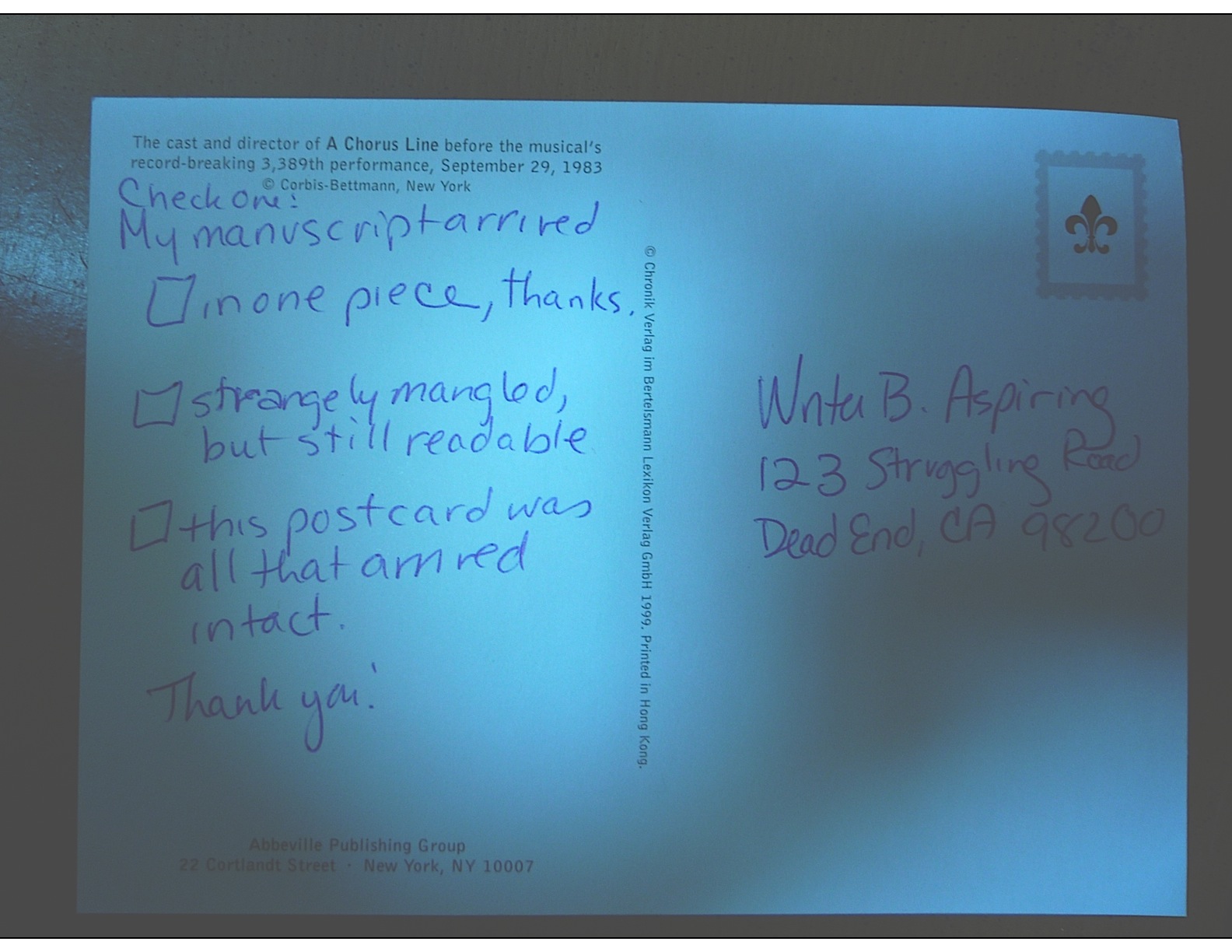
Don’t worry about this causing trouble; it doesn’t, and you will have proof that they received it. This is important, because manuscripts do go astray from time to time.

8. Pack it all in a durable container that will keep your submission from getting damaged en route.

Why, this suggestion seems strangely familiar, somehow…oh, yes, we spent all of yesterday’s post talking about it.

And that, my friends, is the low-down on the submission packet. Don’t forget that EVERYTHING you send to an agency is a writing sample: impeccable grammar, punctuation, and printing please. No smudges or bent corners, either.

Make it all pretty and hope for the best. And, of course, keep up the good work!

Manuscript formatting 101, part II: presenting your writing nicely framed

Welcome back to my refresher course on standard format for manuscripts. Since I know that many of you are scrambling like crazy, trying to get submissions out the door before the dreaded holiday publishing world malaise sets in, or scrambling like crazy to get submissions in shape in anticipation of the moment that the agent of your dreams answers affirmatively to the query letter that you are sending out before the annual malaise, or are scrambling like crazy after yesterday’s post, since you hadn’t realized that there WAS a standard format for manuscript submissions, I wanted to take another run at it.

My apologies for revisiting this to those of you who are already formatting your manuscripts perfectly — but unless you are ABSOLUTELY POSITIVE that you are, you might want to sit in on this series, too.

If you’re not willing to do it for your own sake, do it for mine. It breaks my heart to see good writers, even great ones, making the same formatting mistakes year in and year out, getting rejected for reasons that are apparent to professional readers from halfway across the room.

And no, Virginia, I’m not kidding about the halfway across the room part.

Although it pains me to confess it, how a manuscript looks can have an IMMENSE impact upon how an agent, editor, contest judge, or even a book doctor like me will respond to it. Talent, style, and originality count, of course, but in order to notice any of those, a reader has to approach the page with a willingness to be wowed.

That willingness can wilt rapidly in the face of incorrect formatting — which isn’t, in response to what half of you just thought, the result of mere market-minded shallowness on the part of the reader. Reading manuscripts for a living makes deviations from standard format leap out at one. As do spelling and grammatical errors, phrase repetition, clichés, and all of the many notorious agents’ pet peeves. (If you think I’m exaggerating, check out some of the lulus under the FIRST PAGES AGENTS DISLIKE and AGENCY SCREENERS’ PET PEEVES OF THE NOTORIOUS VARIETY categories on the list at right.)

The sheer repetition of mistakes across manuscripts means that professional readers tend to focus on technical details when scanning the work of a new writer. Because all professional manuscripts are formatted identically, it’s INCREDIBLY obvious when one isn’t.

This is a really, really good thing to know BEFORE you submit to an agent or editor: even if 99.9% of the format is right, that .1% deviation actually will distract a professional reader from even the most beautiful writing.

And that’s not merely a matter of being obsessive-compulsive (although truth compels me to say that in this line of work, OCD is hardly an occupational drawback) — as I shall be showing you later on in this series, to someone who reads manuscripts for a living, deviations from standard format might as well be printed in blood-red ink.

So while it may seem tedious, annoying, or just a whole lot of work to go through your submissions with the proverbial fine-toothed comb in order to weed out this kind of distraction.

I hear those of you who have spent years slaving over your craft groaning out there — believe me, I sympathize. I fully realize that many of the tiny-but-pervasive changes I am about to suggest that you make to your manuscript are going to be irksome to implement. Reformatting a manuscript is time-consuming and tedious – and I would be the first to admit that at first, some of these rules can seem arbitrary.

At least on their faces, that is.

Speaking as someone who reads manuscripts for a living, I can let you in on a little secret: quite a few of these restrictions remain beloved of the industry even in the age of electronic submissions because they render a manuscript a heck of a lot easier to edit in hard copy — still the norm, incidentally. As I will show later in this series, a lot of these rules exist for completely practical purposes — designed, for instance, to maximize white space in which the editor may scrawl trenchant comments like, “Wait, wasn’t the protagonist’s sister named Maeve in the last chapter? Why is she Belinda here?”

As I said above, this is one line of work where a touch of compulsiveness is a positive boon. Treat this brain pattern with the respect it deserves.

And treat your own writing with the respect it deserves by taking the time to present it professionally. Obviously, competition to land an agent and get published is very intense, but if you’re going to get rejected, wouldn’t you rather it be because an agent or editor legitimately disagreed with your writing choices, instead of because you didn’t follow the rules?

Or, more commonly, because you weren’t aware of them?

Frankly, it’s bad for writers everywhere that these rules are not more widely known. Okay, so it keeps freelance editors like me in business, but it has created a submission environment where poor formatting is generally considered a warning sign of poor WRITING to come.

By Millicent the agency screener, her cousin Maury the editorial assistant, and their aunt Mehitabel the contest judge, in any case.

And that drives conscientious aspiring writers, the ones who — like you, perhaps — have invested considerable time and sweat in learning something about the trade, completely batty. Because, like so much generalized criticism, the fine folks who take the advice most seriously tend to be the ones who need it least, I know that there are thousands of you out there who stay up nights, compulsively going over their manuscripts for the 147th time, trying to ferret out that one last bit of less-than-professional presentation.

Bless your heart, if you’re one of those. You’re helping raise aspiring writers’ collective reputation within the industry.

One quick caveat before we get started today: the standard format restrictions I’m listing here are for BOOK submissions, not for short stories, poetry, journalistic articles, academic articles, or indeed any other form of writing. For the guidelines for these, you may — and should — seek elsewhere.

Let me repeat that, because it’s important: the guidelines in this series are for BOOK manuscripts and proposals, and thus should not be applied to other kinds of writing. Similarly, the standards applicable to magazine articles, short stories, dissertations, etc. should not be applied to book proposals and manuscripts.

Which is a gentle way of saying that the formatting and grammatical choices you see in newspapers will not necessarily work in manuscripts. AP style is different from standard format in several important respects, not the least being that in standard format (as in other formal presentations in the English language), the first letter of the first word after a colon should NOT be capitalized, since technically, it’s not the beginning of a new sentence.

I don’t know who introduced the convention of post-colon capitalization, but believe me, those of us who read the submissions of aspiring book writers for a living have mentally consigned that language subversive to a pit of hell that would make even Dante avert his eyes in horror.

Everyone clear on that? Good, because — are you sitting down, lovers of newspapers? — embracing journalistic conventions like the post-colon capital and writing out only numbers under ten (see below) will just look like mistakes to Millicent and her ilk on the submission page.

And no, there is no court of appeal for such decisions. So if you were planning to cry out, “But that’s the way USA TODAY does it!” save your breath.

Unfortunately, although my aforementioned heart aches for those of you who intended to protest, “But how on earth is an aspiring writer to KNOW that the standards are different?” this is a cry that is going to fall on deaf ears as well. Which annoys me, frankly.

The sad fact is, submitters rejected for purely technical reasosn are almost never aware of it. With few exceptions, the rejecters will not even take the time to scrawl, “Take a formatting class!” or “Next time, spell-check!” on the returned manuscript. If a writer is truly talented, they figure, she’ll mend her ways and try again.

Call me zany, but I’d like to speed up that learning curve. I think that the way-mending might go a TRIFLE faster if the writer knew that the manuscript was broken

It’s not as though the strictures of standard format are state secrets, after all. To recap from yesterday:

(1) All manuscripts should be printed or typed in black ink and double-spaced, with one-inch margins around all edges of the page, on 20-lb or better white paper.

(2) All manuscripts should be printed on ONE side of the page and unbound in any way.

(3) The text should be left-justified, NOT block-justified. By definition, manuscripts should NOT resemble published books in this respect.

(4) The preferred typefaces are 12-point Times, Times New Roman, Courier, or Courier New — unless you’re writing screenplays, in which case you may only use Courier. For book manuscripts, pick one (and ONLY one) and use it consistently throughout your entire submission packet.

Everyone clear on those? PLEASE pipe up with questions, if not. In the meantime, let’s move on.

(5) The ENTIRE manuscript should be in the same font and size. Industry standard is 12-point.

No exceptions. I hate to be the one to break it to you, but there’s a term in the industry for title pages with 24-point fonts, fancy typefaces, and illustrations.

It’s “high school book report.” Need I say more?

The font rule also applies to your title page, incidentally, where almost everyone gets a little wacky the first time out. No matter how cool your desired typeface looks, or how great the title page looks with 14-point type.

No pictures or symbols here, either, please. Just the facts. (If you don’t know how to format a title page professionally, please see the TITLE PAGE category on the list at right.)

(6) Do NOT use boldface anywhere in the manuscript BUT on the title page — and not even there, necessarily.

Yes, you read that correctly: you may place your title in boldface on the title page, if you like, but that’s it. Nothing else in the manuscript should be bolded.

This rule is a throwback to the old typewriter days, where only very fancy machines indeed could darken selected type. Historically, using bold in-text is considered a bit tacky for the same reason that wearing white shoes before Memorial Day is in certain circles: it’s a subtle display of wealth.

(You didn’t think all of those white shoes the Victorians wore cleaned themselves, did you? Shiny white shoes equaled scads of busily-polishing staff.)

(7) EVERY page in the manuscript should be numbered EXCEPT the title page.

Violating this rule will result in instantaneous rejection virtually everywhere. Number those pages if it’s the last thing you do.

Few non-felonious offenses irk the professional manuscript reader (including yours truly, if I’m honest about it) more than an unnumbered submission — it ranks right up there on their rudeness scale with assault, arson, and beginning a query letter with, “Dear Agent.”

Why? Gravity, my friends, gravity. What goes up tends to come down — and if the object in question happens to be an unbound stack of paper…

Did that seem like an abstract metaphor? Not at all. Picture, if you will, two manuscript-bearing interns colliding in an agency hallway.

You may giggle, but anyone who has ever worked with submissions has first-hand experience of this, as well as what comes next: after the blizzard of flying papers dies down, and the two combatants rehash that old Reese’s Peanut Butter Cup commercial’s dialogue (“You got romance novel in my literary fiction!” “You got literary fiction in my romance novel!”), what needs to happen?

Yup. Some luckless soul has to put all of those pages back in the proper order. Think about it: just how much more irksome is that task going to be if the pages are not numbered?

Number your pages. Trust me, it is far, far, FAR easier to toss the entire thing into the reject pile than to spend the hours required to guess which bite-sized piece of storyline belongs before which.

FYI, the first page of the text proper is page 1 of the text, not the title page, and should be numbered as such. If your opus has an introduction or preface, the first page of THAT is page 1, not the first page of chapter 1.

Why, you ask? Long-time readers, pull out your hymnals: BECAUSE A MANUSCRIPT SHOULD NOT LOOK IDENTICAL TO A PUBLISHED BOOK.

To run over the other most popular choices for pages to mislabel as page 1: manuscripts do not contain tables of contents, so there should be no question of pagination for that. Also, epigraphs — those quotations from other authors’ books so dear to the hearts of writers everywhere — should not appear on their own page in a manuscript, as they sometimes do in published books; if you feel you must include one (considering that 99.9999% of the time, Millicent will just skip over it), include it between the chapter title and text on page 1.

If that last sentence left your head in a whirl, don’t worry — I’ll show you how to format epigraphs properly later in this series. (Yes, including some discussion of that cryptic comment about Millicent.)

(8) Each page of the manuscript (other than the title page) should have a standard slug line in the header. The page number should appear in the slug line, not anywhere else on the page.

Most writing handbooks and courses tend to be a trifle vague about this particular requirement, so allow me to define the relevant terms: a well-constructed slug line includes the author’s last name, book title, and page number, to deal with that intern-collision problem I mentioned earlier. (The slug line allows the aforementioned luckless individual to tell the romance novel from the literary fiction.) And the header, for those of you who have not yet surrendered to Microsoft Word’s lexicon, is the 1-inch margin at the top of each page.

Including the slug line means that every page of the manuscript has the author’s name on it — a great idea, should you, say, want an agent or editor to be able to contact you after s/he’s fallen in love with it.

The slug line should appear in the upper left-hand margin (although no one will sue you if you put it in the upper right-hand margin, left is the time-honored location) of every page of the text EXCEPT the title page (which should have nothing in the header or footer at all).

Traditionally, the slug line appears all in capital letters, but it’s not strictly necessary. Being something of a traditionalist, the third page of my memoir has a slug line that looks like this:

MINI/A FAMILY DARKLY/3

Since the ONLY place a page number should appear on a page of text is in the slug line, if you are in the habit of placing numbers wacky places like the middle of the footer, do be aware that it does not look strictly professional to, well, professionals. Double-check that your word processing program is not automatically adding extraneous page markers.

Do not, I beg of you, yield like so many aspiring writers to the insidious temptation add little stylistic bells and whistles to the slug line, to tart it up. Page numbers should not have dashes on either side of them, be in italics or bold, or be preceded by the word “page.”

If that news strikes you as a disappointing barrier to your self-expression, remember, professional readers do not regard formatting choices as conveyers of personal style. The point here is not to make your slug line stand out for its innovative style, but for your manuscript’s pages to look exactly like every other professional writer’s.

And yes, I AM going to keep making that point over and over until you are murmuring it in your sleep. Why do you ask?

If you have a subtitle, don’t include it in the slug line — and if you have a very long title, feel free to abbreviate, to keep the slug line from running all the way across the top of the page. The goal here is to identify the manuscript at a glance, not to reproduce the entire book jacket.

Why not? Well, technically, a slug line should be 30 spaces or less, but there’s no need to stress about that in the computer age. A slug, you see, is the old-fashioned printer’s term for a pre-set chunk of, you guessed it, 30 spaces of type.)

Keep it brief. For instance. my agent is currently circulating a novel of mine entitled THE BUDDHA IN THE HOT TUB — 26 characters, counting spaces. Since my last name is quite short, I could get away with putting it all in the slug line, to look like this:

MINI/THE BUDDHA IN THE HOT TUB/1

If, however, my last name were something more complicated, such as Montenegro-Copperfield — 22 characters all by itself, including dash — I might well feel compelled to abbreviate:

MONTENEGRO-COPPERFIELD/BUDDHA/1

(9) The first page of each chapter should begin a third of the way down the page, with the chapter title appearing on the FIRST line of the page, NOT on the line immediately above where the text begins.

That’s twelve single-spaced lines, incidentally. The chapter name (or merely “Chapter One”) may appear on the FIRST line of the first page — not on the last line before the text, as so many writers mistakenly do. The chapter title or number should be centered, and it should NOT be in boldface or underlined.

Don’t panic if you’re having trouble visualizing this — I’ll be giving concrete examples of what the first page of a chapter should look like later in this series.

Why shouldn’t the title appear immediately above the text, as one so often sees? Because that’s where the title of a SHORT STORY lives, not a book’s.

Very frequently, agents, editors and contest judges are presented with improperly-formatted first pages that include the title of the book, “by Author’s Name,” and/or the writer’s contact information in the space above the text. This is classic rookie mistake. To professional eyes, a manuscript that includes any of this information on the first page of the manuscript (other than in the slug line, of course) seems term paper-ish.

So where does all of that necessary contact information go, you ask? Read on.

(10) Contact information for the author belongs on the title page, NOT on page 1.

This is one of the main differences between a short story submission (say, to a literary journal) and a novel submission. To submit a manuscript — or contest entry, for that matter — with this information on page 1 is roughly the equivalent of taking a great big red marker and scrawling, “I don’t know much about the business of publishing,” across it.

Just don’t do it.

“But wait,” I hear some of you out there murmuring, “I need a title page? Since when?”

Funny you should mention that, because…

(11) Every submission should include a title page, even partial manuscripts.

This one seems to come as a surprise to a LOT of aspiring writers. You should ALWAYS include a title page with ANY submission of ANY length, including contest entries and the chapters you send after the agent has fallen in love with your first 50 pages.

Why, you ask? Because it is genuinely unheard-of for a professional manuscript not to have a title page: literally every manuscript that any agent in North America sends to any editor will include one. Yet, astonishingly, 95% of writers submitting to agencies seem to be unaware that including it is industry standard.

On the bright side, this means that if you are industry-savvy enough to include a professionally-formatted title page with your work, your submission automatically looks like a top percentile ranker to professional eyes from the moment it’s pulled out of the envelope. It’s never too early to make a good first impression, right?

If you do not know how to format a proper title page (and yes, Virginia, there IS a special format for it, too), please see the TITLE PAGE category at right. Or wait a few days until I cover it later in this series. It’s entirely up to you.

Before anyone asks: omitting a title page is too common a mistake to be an automatic deal-breaker for most Millicents; she’s almost certainly not going to toss out a submission ONLY because it has a properly-formatted title page or none at all. And yes, one does occasionally run into an agent at a conference or one blogging online who says she doesn’t care one way or the other about whether a submission has a title page resting on top at all.

Bully for them for being so open-minded, but as I point out roughly 127,342 times per year in this forum, how can you be sure that the person deciding whether to pass your submission upstairs or reject it ISN’T a stickler for professionalism?

I sense some shoulders sagging at the very notion of all the work it’s going to be to alter your pages before you send them out. Please believe me when I tell you that, as tedious as it is to change these things in your manuscript now, by the time you’re on your third or fourth book, it will be second nature to you.

Why, I’ll bet that the next time you sit down to begin a new writing project, you will automatically format it correctly. Think of all of the time THAT will save you down the line.

More importantly, if you embrace these standards, any submissions you might happen to send out in the near future will look like the work of a pro. Again, call me zany, but I would rather see an agent or editor evaluate your book on the basis of your writing and your story, not your formatting knowledge.

I’m funny that way.

Next time, I’m going to finish going through the rules, so we may move on swiftly to concrete examples of what all of this formatting looks like in practice. Keep up the good work!

Author bios, part IV: the grass is NOT always greener on the other side of the fence, I tell you, although now that you mention it, the neighbors’ yard does seem to be less plagued by giant moles than mine

Yes, I’ll admit it: I’ve been a bad mood for the last couple of weeks. Nothing, and I do mean nothing, seems to be going as planned. Noses continue to sniffle, well-meaning distractors keep appearing on my doorstep during my writing time, people who I had thought I was paying to serve my interests have been falling down on the job in fairly remarkable ways, and my mother-in-law called yesterday to report that she’d accidentally invited five more people to Thanksgiving dinner. At my house.

Presumably, the new guests will be sitting on the piano. Or perhaps stuffed inside it, pressed against the harp. It might render the playing of Auld Lang Syne a trifle tricky.

My SO is scheduled to have a Little Talk with his mum on the subject tomorrow.

I seem to have spent the last few weeks traveling from one Little Talk to another. Case in point: remember that yard renovation that we started eons ago, the intended repair after the inadvertent destruction of my garden last March? Would it surprise those of you whose hair has gone grey in the course of similar projects to learn that it’s still not completed, three growing seasons later?

My SO is having a Little Talk with the landscaper as I write this.

Apparently, it’s a source of astonishment to the latter that anyone WOULDN’T want a gigantic hole in the middle of her patio, or that some unreasonable souls might conceivably expect the drip irrigation hoses to be hooked up to something, or that sun-loving plants moved to murky spots under drooping pine trees to get them out of the way of gigantic, soil-gouging machinery couldn’t walk by themselves back to their original plots. In our last Little Talk, he suggested with an absolutely straight face — and some asperity — that if we wanted him to do these things, we should have made sure that they were spelled out explicitly in our original agreement.

Oh, how I wish I was making that last part up. There’s a reason that I’m no longer present for these Little Talks.

Even in the midst of 8 months of my dashing outside continually, screaming, “DON’T DRIVE THE BACKHOE OVER THAT ROSE BED!” at people who, for some reason that I have not been able to fathom, can’t see an established plant without wanting to mash, mangle, yank, behead, or prune it to the point that my great-grandchildren will be wondering what army took a tank to that majestic Douglas fir and why, I can recognize that there’s quite a bit of beauty here, despite and often because of the ambient carnage. I took the picture above yesterday, in fact, standing on my dangerously unstable back porch.

(“You mean you DIDN’T want your back door to open onto a yawning chasm? Lady, if you’d only TOLD me…”)

I have to admit, this photo stunned me after I took it. It wasn’t that I hadn’t noticed that there were pretty things in the yard — why, I spent an hour only last week trying to convince the landscaper that I did not now nor had I ever wanted him to cover those lovely leaves with beauty bark, an abomination upon the earth — but I had, I admit, become a bit myopic. I had been so focused upon what had been going wrong in the yard for so long that I had stopped looking at the big picture.

How myopic, you ask? Well, if I’m honest about it, when I looked at the area above, most of what I saw was this:

A potentially pretty space that had apparently been attacked by giant moles, in short, and ones who were rather careless in the placement of their irrigation lines at that. Had I known that the landscaper’s most consistent preference was for replicating the mole-infestation experience on a mammoth scale as often as possible, I might have placed a stipulation in the original contract that he, well, refrain from burrowing gratuitously.

I also, I suppose, could have had the foresight to mention that I also did not wish him to dive-bomb, set fire to, or spray-paint the Douglas fir in our front yard. The things one realizes in retrospect, eh?

Did I hear some of my long-time readers chuckle in the course of these ruminations on my conceptual near-sightedness? “Gee, Anne,” these sharp-witted aspiring writers observe, “it sounds as though you’ve been looking at your yard with your editorial eyes. What you’ve just described sounds virtually identical to how you’ve depicted Millicent the Agency Screener reading through queries and submissions, zeroing in on the flaws rather than searching for loveliness on the page.”

Well observed, oh chucklers. It’s also how good writers who have been revising and revising their manuscripts start to look at their own work after a while — and how virtually everyone approaching writing his own author bio for the first time views his own credentials.

Oh, you thought that I was just complaining about my yard renovation?

Au contraire, mon frère. (Actually, since there are quite a few of you reading this, if the number of regular hits to this site are to be believed, that should have been mes frères, but don’t stop me; I’m on a roll.) Even aspiring writers with pretty darned good credentials — an MFA, for instance, or being a finalist in a well-respected contest — tend to shake their heads at the prospect of bio-construction, sighing, “But I’ve never been published!”

I’ve got good news for you: that’s not necessarily a barrier to pulling together a killer bio for yourself.

No, seriously. Read on, MacDuff.

Yesterday, I advised all of you to run right out to the nearest well-stocked bookstore and take a gander at a bunch of author bios on the dust jackets of books recently released in your chosen category — not on jackets in general, but on those gracing books like the one that you have written or are writing.

The most helpful ones will probably be those produced by first-time authors in your book category, but ideally, I would like you to spend an hour or so looking at every bio in every book on the relevant shelf at Barnes & Noble. Not only will this help you get a sense of the tone and extent of successful author bios in the section of the publishing world in which you hope to publish, but it will give you a feel for what does and doesn’t work in a bio.

A sense of where the irrigation hoses tend to be left hanging in mid-air, so to speak. Reading each one, ask yourself, “Does this description of the author make me more or less likely to want to buy this book?”

If your local B&N is stocked like mine, you may be surprised at how often the answer is no.

Actually, I probably should have warned you about this yesterday: there are a LOT of lousy author bios out there, littering up the covers of otherwise perfectly fine books. Clearly, a boring or hastily-written bio is not a significant barrier to publication — which is interesting, because a really great bio can be such a valuable marketing tool for a book.

Reading the duds may seem like a waste of your time, but actually, you can learn a lot from the bad ones, which typically share some common traits. You can learn what to avoid.

After you’ve read a couple of dozen, what makes the bad ones bad becomes apparent. The bad ones are too similar, which renders them inherently dull. At their worst, they are merely lists of where the author went to school, if anywhere, what the author did (or does) for a living before (or besides) writing, where they live now, and their marital status.

For those of you who have not yet scoured your local bookstore, scores of them end up sounding something like this:

Turgid McGee was born in upstate New York. After attending the Albany Boys’ Reformatory, he served a term in the U.S. Air Force. After graduating from Princeton University, McGee attended law school at the University of Oklahoma. Now retired, McGee now lives in Bermuda with his wife, Appalled, and his three children, Sleepy, Dopey, and Sneezy. He is currently working on his second book.

Yes, it lists a bunch of fairly impressive facts about the author, but it doesn’t exactly make you want to run right out and pick up McGee’s book, doesn’t it? That’s precisely the reaction that Millicent, her boss the agent, and any editor to whom they might happen to mention this book will probably have: YAWN.

But inducing boredom is not ol’ Turgid’s worst offense here. The biggest problem with this blurb is that it’s poor marketing material.

Unsure of the difference? Okay, here’s an easy test that will make the marketing shortcomings rise to the top. Quick, based solely on that bio, answer these essential questions:

What is Turgid’s book about? 

Why is he uniquely qualified to write it?

Does he have any background in writing at all?

Does he have any sense of humor, derring-do, or other desirable human characteristic?

If you picked up this book in a used bookstore years from now, would you have any interest in checking the shelves to see what his second book was?


Turgid’s bio fails as marketing because it does not even begin to address any of these crucial issues — all matters in which the denizens of any potential publisher’s marketing department would be vitally interested, I assure you.

And yes, in case you’re wondering, this set of questions can — and should, if you happen to be the author writing it — be applied to any author bio. if the answer to any of these questions is murky, it’s not put together very well.

Turgid also made a subtle mistake here, one that perhaps only those who have read a whole lot of author bios — such as, say, an agent, an editor, or a me — would catch. Any thoughts?

Give yourself three gold stars for the day if you said that Turgid mentions he attended the University of Oklahoma, not that he graduated from it. This means something very specific in bio-speak, something that Turgid probably did not intend.

Attended is the standard industry euphemism for not having finished a degree program — when a publishing professional reads “Daffy Duck attended Yale University” in an author bio, she is automatically going to assume that poor Daffy dropped out after a year.

And this is problematic in the current case, since (and knowing dear old Turgid so well, I can say this with authority) he actually did obtain his law degree. With honors, no less.

Moral: if you graduated from a school, say so.

And as a personal favor to me, never, ever make the astonishingly common grammatical error of saying that you graduated a school, a misstatement that would put virtually any language-loving Millicent’s teeth on edge; retain the necessary preposition and say that you graduated from it.

Trust me, that’s not a mole hole you want to leave exposed.

To his credit, Turgid did this part correctly: he introduced his law school experience of indeterminate length and success with After graduating from Princeton University…. Had he utilized the unfortunately common structure After graduating Princeton… that would have meant, literally, that he handed the school the diploma, not the other way around.

I can’t tell you how many times I have been introduced as the speaker who “graduated Harvard.” It makes my molars grind together.

Speaking of my own credentials, looking at my own bio on this website, I’m not sure that I’ve avoided all of Turgid’s mistakes, but as far as the industry is concerned, the 50-word bio (i.e., what’s likely to be on Amazon or most blogs, for instance) and the 250-word bio (for submission and a book jacket) are entirely different animals. What I’ve posted on this site is a specimen of the latter. The former does tend to be a list, but the latter is the author’s big chance to prove to the publishing industry that she is not only a talented writer, but a person who might actually be interesting to know.

But if you can possibly make that 50-word bio intriguing, rather than a rote recitation of biographical facts, I, for one, would love to see it.

If you are in doubt about whether a certain tidbit is appropriate to include, use this three-part test:

(1) Would you be comfortable having that fact displayed on the dust jacket of this particular book for all eternity?

(2) Even if your sainted mother were to pick up a copy? What about your sainted grandmother and her entire bridge club?

(3) More importantly, is it a detail that would help build the reader’s confidence that the author of this book is has credibly mastered its subject matter?

Note that I specified THIS book. It is perfectly legitimate to have different bios for different projects; in fact, it’s sometimes advisable, if your various projects have very different emphases or target markets, to highlight the relevant parts of your character in each.

I used to do quite a bit of food and wine writing (under an alter ego, now gratefully defunct). That bio emphasized the fact that I grew up on the second floor of a winery in the Napa Valley — which is true, incidentally. For the nonfiction book I sold last year, a serious examination of political and environmental subjects, however, the winery connection is less relevant, and my credibility more, so the bio I used for it gave greater prominence to the fact that I hold degrees from some pretty prominent and snotty schools.

I graduated from them, thank you very much.

It is perfectly acceptable to make your bio funny, especially if your book is funny. My comic novel, currently cooling its heels in my agent’s office for what seems like an awfully long time, relies heavily on my quirky sense of humor, so I was able to pull out all the stops and gear the accompanying author bio for maximum comic value. It mentions, among other things, that I learned to run a still when I was in elementary school and that when I was a delegate to a national political convention which shall remain nameless, an over-eager cameraman chasing a minor candidate knocked me over, spraining both my ankles. The next day of the convention, I covered my bandaged limbs with political stickers and propped them up on a rail; the AP spread photographs of this, billed as evidence of the dangers of political activism, all over the globe.

As impressive as some of my other credentials? No. But do you think the editors who read my bio are going to remember me?

As you may see, I think it is of paramount importance for an author’s bio not to be boring, provided that everything said there is true. (Yes, my father really did teach me to make brandy when I was in elementary school. Yours didn’t?)

If you honestly can’t think of anything memorable about yourself, try asking a couple of friends to describe you. Chances are, they will mention the top few things that should be in your bio.

If that doesn’t work, try asking a couple of people who can’t stand you. The traits they dislike most may well enchant Millicent. (I’m only half-kidding about this; warm personal enemies can be very insightful.)

Remember, this is the document your agent will be using in order to describe you to editors, and editors to other editors at editorial meetings while arguing in favor of buying your book. If your full-fledged author bio doesn’t give the impression that if the reader were trapped in a snowstorm for three days with you, you would be capable of keeping the reader entertained with anecdotes the whole time, your bio isn’t interesting enough.

And, perhaps, if you’re lucky, something in your bio will stick in your agent’s mind enough down the road that it will occur to her to pitch your offhand reference to it to a sniffly editor in an elevator, or to poke you in the ribs at a party and urge you to pitch an on-hold project.

That’s the kind of thing that happens to interesting people.

Whatever you do, though, don’t beat yourself up if you don’t have the credentials that people typically think of as résumé-fodder for an author: prior publications, awards, the blessings of the Iowa Writers’ Workshop, a hug from a grateful president or prime minister after s/he has hung a medal around your neck and declared you a national treasure. The fact is, the vast majority of the authors who have sold first books within recent memory did not have those credentials when they first began querying.

Yes, really. Unless they happened to be blessed with a self-confidence that would make your average messiah blush for shame, you can bet your next-to-bottom dollar that at some point early in their writing careers, they all spent at least a few bad hours staring ruefully at their lifetime of achievements, seeing only the mole holes and missing the beauty of the landscape.

Don’t worry; I’m far from finished with my suggestions about where you might want to start looking in your yard. But don’t ask me to recommend a landscaper in Seattle; clearly, I’m not qualified.

Keep mulling over what makes you fascinating, everybody — and keep up the good work!

Author bios, part II, or, the impossible will take a little while


Yes, I’m still singing the blues today. Why do you ask?

Actually, I’m feeling a little better, thanks. Writing yesterday’s post reminded me just how comforting it is that there are SOME constants in the ever-changing literary world; unfortunately, many of the unchanging verities don’t exactly work in the aspiring writer’s favor. Expecting everyone who has ever had a good book idea to know — by magic, presumably — about standard format for manuscripts, for instance; those rules haven’t changed much in 30 years, but how is a brand-new submitter to know that?

That question was one reason I started this blog. So if you’re new to the game and by some remarkable chance the format fairy has not yet visited you in the night to tuck a list of manuscript rules under your pillow, run, don’t walk, I implore you, to the STANDARD FORMAT BASICS and/or STANDARD FORMAT ILLUSTRATED categories on the list at right.

In my capacity as stand-in for the format fairy, I’m going to move on with the ins and outs of author bios.

As those of you who sat through yesterday’s long, rambling, but I hope entertainingly persuasive post already know, the necessity of writing an author bio is often sprung upon an aspiring writer. Not in a delightful, hands-over-the-eyes way, but in brusque, business-like manner: “You’ll have it to me in the morning, right?” requesting agents and editors are prone to say. “You can just e-mail it to me now, of course?”

Some writers never get the resulting lump out of their throats again.

Those of us who have been at the writing game for a while have learned not to voice dismay at this kind of request. Surviving in the ultra-competitive literary environment is just easier for be an upbeat, can-do kind of writer, the sort who says, “Rewrite WAR AND PEACE by Saturday? No problem!” than the kind who moans and groans over each unreasonable deadline.

Hey, the energy that you expend in complaining about an outrageous request could be put to good use in trying to meet that deadline. As the late great Billie Holiday so often sang,

The difficult
I’ll do right now.
The impossible/will take a little while.

(Will it vitiate my moral too much if I add that the name of the song was “Crazy, He Calls Me”? Clearly, Billie must have spent a lot of time with my agent.)

I also spent yesterday, if memory serves, encouraging you to put together an author bio for yourself as soon as possible, against the day that you might need to produce one, immediately and apparently effortlessly, in response to a request from an agent or editor.

I know, I know: we writers are expected to produce a LOT on spec; it would be nice, especially for a fiction writer, to be able to wait to write SOMETHING affiliated with one’s first book after an advance was already cooling its little green heels in one’s bank account.

Trust me, at that point, you’ll be asked to write more for your publisher’s marketing department, a whole lot more –heck, if you’re a nonfiction writer, you’ll be asked write the rest of the book you proposed — so you’ll be even happier to have one task already checked off the list.

Get the bio out of the way now.

Even if the happy day that you’re juggling the demands of your publishers’ many departments seems impossibly far away to you, think of bio-writing as another tool added to your writer’s toolkit. Not only the bio itself, although it’s certainly delightful to have one on hand when the time comes, but the highly specialized skills involved in writing one.

I’m deadly serious about this — just knowing in your heart that you already have the skills to write this kind of professional document can be marvelously comforting. Every time I have a tight deadline, I am deeply, passionately grateful that I have enough experience with the trade to be able crank out the requisite marketing materials with the speed of a high school junior BSing on her English Literature midterm. It’s definitely a learned skill, acquired through having produced a whole lot of promotional materials for my work (and my clients’, but SHHH about that) over the last decade.

At this point, I can make it sound as if all of human history had been leading exclusively and inevitably to my acquiring the knowledge, background, and research materials for me to write the project in question. The Code of Hammurabi, you will be pleased to know, was written partially with my book in mind.

Which book, you ask, since I have several in progress? Which one would you like to acquire for your publishing house, Mr. or Ms. Editor?

A word to the wise, though: your author bio, like any other promotional material for a book, is a creative writing opportunity. Not an invitation to lie, of course, but a chance to show what a fine storyteller you are.

This is true in spades for NF book proposals, by the way, where the proposer is expected to use her writing skills to paint a picture of what does not yet exist, in order to call it into being. Contrary to popular opinion (including, I was surprised to learn recently, my agent’s — I seem to be talking about him a lot today, don’t I? — but I may have misunderstood him), the formula for a NF proposal is not

good idea + platform = marketable proposal

regardless of the quality of the writing, or even the ever-popular recipe

Take one (1) good idea and combine with platform; stir until well blended. Add one talented writer (interchangable; you can pick ‘em up cheaply anywhere) and stir.

Just as which justice authors a Supreme Court decision affects how a ruling is passed down to posterity, the authorship of a good book proposal matters. Or should, because unlike novels, which are marketed only when already written (unless it’s part of a multi-book deal), NF books exist only in the mind of the author until they are written. That’s why it’s called a proposal, and that’s why it includes an annotated table of contents: it is giving a picture of the book that already exists in the author’s mind.

For those of you who don’t already know, book proposals — the good ones, anyway — are written as if the book being proposed were already written; synopses, even for novels, are written in the present tense. It is your time to depict the book you want to write as you envision it in your fondest dreams.

Since what the senior President Bush used to call “the vision thing” is thus awfully important to any book, particularly a NF one, the author bio that introduces the writer to the agents and editors who might buy the book is equally important. It’s the stand-in for the face-to-face interview for the job you would like a publisher to hire you to do: write a book for them.

The less of your writing they have in front of them when they are making that hiring decision — which, again, is usually an entire book in the case of a novel, but only a proposal and a sample chapter for nonfiction, even for memoir — the more they have to rely upon each and every sentence that’s there, obviously. Do you really want the ones that describe your background to be ones that you wrote in 45 minutes in the dead of night so you could get your submission into the mail before you had to be at work in the morning?

Let me answer that one for you: no, you don’t.

I mention all of this as inducement to you to write up as many of the promotional parts of your presentation package well in advance of when you are likely to be asked for them. This is a minority view among writers, I know, but I would not dream of walking into any writers’ conference situation (or even cocktail party) where I am at all likely to pitch my work without having polished copies of my author bio, synopsis, and a 5-page writing sample nestled securely in my shoulder bag, all ready to take advantage of any passing opportunity.

Chance favors the prepared backpack, as Louis Pasteur is rumored to have said. Or at least something very, very like it.

Once you’ve been asked to give an unexpected pitch at 3:30 in the morning to a bleary-eyed, heavy-drinking editor at an industry party, believe me, you never go near walk out the door unprepared. (The request, incidentally, was made by my agent, who is apparently always looking out for our joint interests, bless his book-mongering heart. Unless he was trying to barter my company for the evening in exchange for reading another client’s work; I’ve never been precisely sure.)

Are you chomping at the bit to get at your own author bio yet? Good. Then you are in the perfect mindset for your homework assignment: start thinking about all of the reasons you are far more interesting than anyone else on the planet.

I’m serious — and I’m not talking about boasting; I’m talking about uniqueness. What makes you different from anyone else who might have written the book you are trying to sell?

Don’t worry for the moment about how, or even whether, these things have any direct connection to the subject matter of the book you’re writing or don’t sound like very impressive credentials. Just get ready to tell me — and the world! — how precisely you are different from everybody else currently scurrying across the face of the planet.

Don’t tell me that you’re not. I shan’t believe it. Why? Because I know, as surely as if I could stand next to God and take an in-depth reading of each and every one of your psyches, that there is no one out there more truly interesting than someone who has devoted her or his life to the pursuit of self-expression. I’ve met writers I didn’t like, certainly, but I’ve never met a genuinely boring one.

Okay, so maybe I need to get out more. I spend an awful lot of time at my keyboard, expressing myself.

We’ll put those lists of attributes to good use next time, I promise. In the meantime, I’ll keep singing the blues, and keep up the good work!

The president-elect’s passive protagonist, fair use of other people’s words, and a change in my long-standing strategic advice

Happy the one whom the muses love,
the one from whose lips language flows sweet.

— Hesiod

I thought about you the other night, readers, while I was listening with what I will admit was great pleasure to a certain acceptance speech…

Okay, before I go on, I should stop and say: I am not bringing this up to invite political debate. In the interests of making this site as accessible to as broad a range of writers as possible, I have a general policy of discouraging two types of discourse here at Author! Author! — I remove any language that would not be appropriate for the family hour, if you catch my drift, and I avoid discussion of political beliefs, mine or other people’s. However, I’m going to make an exception today.

Why? Well, the speechwriters made me do it: did you catch the narrative problem in the president-elect’s speech, a classic storytelling no-no, one we have discussed at some length here in the past? Say, in its primary illustrative anecdote?

Yes, decades of editing manuscripts does warp how one hears things. Why do you ask?

I refer, of course, to the anecdote about 106-year-old Georgia voter Ann Nixon Cooper. An inspirational story, undoubtedly, and an apt one for the occasion — which is precisely why it bugged me that it was not presented in a more effective manner. More importantly for our purposes here, its narrative problem is one to which submitted manuscripts are notoriously prey.

So let’s take an instructive walk through the text of the anecdote, shall we? (Word to the wise: ignore the misused semicolons; they’re not the biggest problem here.)

“She was born just a generation past slavery; a time when there were no cars on the road or planes in the sky; when someone like her couldn’t vote for two reasons — because she was a woman and because of the color of her skin. And tonight, I think about all that she’s seen throughout her century in America…At a time when women’s voices were silenced and their hopes dismissed, she lived to see them stand up and speak out and reach for the ballot…When there was despair in the dust bowl and depression across the land, she saw a nation conquer fear itself with a New Deal, new jobs, a new sense of common purpose…When the bombs fell on our harbor and tyranny threatened the world, she was there to witness a generation rise to greatness and a democracy was saved…She was there for the buses in Montgomery, the hoses in Birmingham, a bridge in Selma, and a preacher from Atlanta who told a people that “We Shall Overcome.”…A man touched down on the moon, a wall came down in Berlin, a world was connected by our own science and imagination. And this year, in this election, she touched her finger to a screen, and cast her vote, because after 106 years in America, through the best of times and the darkest of hours, she knows how America can change.”

Did you notice the narrative problem, one that substantially weakened the hearer’s (or, in this case, reader’s) sense of the protagonist? Anyone who reads manuscripts for a living would have. But admittedly, not all of us are blessed with Millicent’s ability to leap to conclusions about protagonists’ characters (big hint) from the word choices in the narratives they inhabit.

To see what this text would look like from a professional reader’s perspective, let’s highlight all of the verbs for which the admirable Ann was the subject:

She was born just a generation past slavery; a time when there were no cars on the road or planes in the sky; when someone like her couldn’t vote for two reasons — because she was a woman and because of the color of her skin. And tonight, I think about all that she’s seen throughout her century in America…At a time when women’s voices were silenced and their hopes dismissed, she lived to see them stand up and speak out and reach for the ballot…When there was despair in the dust bowl and depression across the land, she saw a nation conquer fear itself with a New Deal, new jobs, a new sense of common purpose…When the bombs fell on our harbor and tyranny threatened the world, she was there to witness a generation rise to greatness and a democracy was saved…She was there for the buses in Montgomery, the hoses in Birmingham, a bridge in Selma, and a preacher from Atlanta who told a people that “We Shall Overcome.”…A man touched down on the moon, a wall came down in Berlin, a world was connected by our own science and imagination. And this year, in this election, she touched her finger to a screen, and cast her vote, because after 106 years in America, through the best of times and the darkest of hours, she knows how America can change.”

Did you catch it that time? No? Okay, let’s isolate all of those verb phrases — what do they tell you about the protagonist of this story?

She was born
she was a woman
she’s seen
she lived to see
she saw
she was there to witness
She was there
she touched her finger to a screen
she cast her vote
she knows

If you said, “Hey, wait a minute — these verb choices make our Ann seem like an awfully passive protagonist; the verb choices imply that she didn’t actually do anything until she cast her vote this year, as if she were merely an observer of the events of her time, rather than a participant in them,” give yourself a gold star for the day. Any professional reader would have derived this impression, too, simply from the word choices.

Fascinating, isn’t it, how much something as simple as the selection of verbs can affect a reader’s perception of a character? Especially, as in this case, when the verb choices are repetitive, conceptually as well as literally.

I’m going to be honest with you: this particular type of stultifying verb choice is so common in submissions that as an editor, I found myself thinking by the time the president-elect uttered the second passive verb in this anecdote, “Oh, please tell me that the first active thing she does in this story ISN’T going to be voting for him…”

Seriously, I did. Ask anyone who was sharing a room with me at the time.

Passive verb choices don’t only affect the pros’ perception of a protagonist, however. As a reader (okay, originally a hearer), I would have found Ann’s story substantially more engaging had it depicted the protagonist doing more than just sitting around and observing. I would bet a nickel that a more active telling would be more factually accurate, too: wouldn’t you tend to assume that someone who has lived through such exciting times would have done some pretty darned interesting things over the course of 106 years?

That nagging feeling that the narrator is concealing interesting material is precisely why a novel, memoir, or NF piece with passive protagonist tends to grab Millicent and her fellow agency screeners far less readily than a telling of the same story that presents the protagonist as actively engaged in the depicted events.

Gripping protagonists DO, not just observe. Yes, even in NF anecdotes — and no, an exciting story does not necessarily an active protagonist make.

Do I sense some shifting in chairs out there, at least amongst copyright-huggers? “Um, Anne?” I hear some of you pointing out, and rightly. “I appreciate seeing a concrete example of a passive protagonist in action — if that’s not a contradiction in terms — but didn’t you use a pretty hefty chunk of someone else’s writing to illustrate your point? Is that kosher?”

Well caught, chair-shifters: a writer should always exercise caution in quoting the work of others.

I’m not a lawyer, so do run off and consult one who specializes in copyright law if you are a quotation addict, but US-based authors observe some basic rules of thumb that help the inclined-to-excerpt stay out of trouble. It’s generally accepted, for instance, that political speeches are fair game for excerpts — they are, after all, usually read aloud, so one could arguably quote from that, rather than the printed version — but with published writing not yet in the public domain, anything beyond 50 consecutive words pushes the boundaries of fair use.

Beyond that, you will need to request permission from the copyright holder. As in formally, in writing, and often in exchange for payment.

And yes, authors are usually responsible for obtaining copyright permission, not publishers — and these days, the former are almost always the ones who end up paying for the rights, too. Sorry to be the one to break that to you.

Oh, and if you wish to use an excerpt of ANY length from a song’s lyrics, you will need to obtain formal permission. (For an interesting and amusing description of just how difficult that can be, please see FAAB Joel Derfner’s guest blog on the subject.)

While we’re talking about copyright protection — aren’t you glad that you brought it up? — this seems like a good time to announce that I have decided to reverse my long-standing position on whether NF writers should register the copyright for their book proposals and sample chapters before submitting them to agents and publishing houses. In the past, I have not pushed it; it seemed like an unnecessary expense added to a promotional process that can be quite expensive for the writer.

I am reversing that position, in light of recent events: I now believe that it is in a US-based NF writer’s best interest to register the copyright for a book proposal, sample chapter, and related promotional materials prior to submission, if s/he can possibly afford it.

Don’t worry, though: the last time I checked, it cost a grand total of $35 if you register your work online. Even if you elect to register via mail, it merely involves filling out a one-page form.

More of you are shifting in your chairs anyway, though, aren’t you? “But Anne,” some long-term Author! Author! readers point out, and who can blame them? “The last time you went over copyright issues — recognizing that you’re not a lawyer, of course, but were only expressing opinions based upon your personal experience in the series of posts beginning here — I derived the impression that a writer owns the copyright to his work as soon as he writes it; the registration process is merely the legal confirmation of that fact. Is that not true anymore?”

Well, those of you who are worried about it would do well to consult an attorney well-versed in this area, but as far as I know, copyright does inherently rest with the author. Registration is the best way to enforce that.

For many types of manuscripts, enforcement is virtually never necessary. For novels and other books where the writing, rather than the subject matter per se, is the primary selling point, or for memoirs, where the author is the only person on the planet who can tell that particular story from that perspective, it’s unlikely that authorship would ever be a matter of debate.

NF proposals are a rather different kettle of fish, however: while a proposal’s writer obviously owns her own writing — synopsis, sample chapter, the annotated table of contents that sets out the planned book’s structure, etc. — it would not be technically impossible for another writer to co-opt a topic after a proposal is written. It’s not beyond imagining, for instance, that someone who reads a fabulous book proposal could try to run off with a beautifully fleshed-out concept, passing it off as her own. Or, heaven help us, for an agent to say, “Hey, that’s a great book concept!” and hand it to a better-established author.

If your heart just stopped, shouldn’t you be calling 911, instead of reading on?

I’m not saying that this happens often — thank goodness, it seems to be exceedingly rare, even in these ethics-trying tough economic times — but frankly, the authorial grapevine has been buzzing with some pretty astonishing stories these days. In some of them, I can’t help but notice that writers who were active protagonists, guarding their own interests zealously, seem to be enjoying happier endings than the passive ones who merely sat around observing changing conditions around them.

Again, I’m the last person that anyone should ask for legal advice, of course. I’m just saying that when I hear these stories, I’m very glad that I have been an active protagonist in my NF books’ storylines.

Watch those verb choices, everyone, and keep up the good work!

Synopsis-writing 101, part XII: that pesky synopsis checklist revisited, or, when Millicent checks the freshness seal

Welcome to day two of my list of questions to put to your synopsis before you send it on its merry way, a sort of hit parade of the most commonly-made mistakes. Rather than regarding the synopsis as a tedious bit of marketing trivia, yet another annoying hoop for the aspiring writer to jump through on the way to landing an agent, I would encourage you to regard it as an opportunity to encapsulate your writerly brilliance in capsule form.

Okay, so it’s still probably going to be tedious and annoying to produce. But addressing these questions will help it show off your talent more effectively.

Got your highlighting pens all ready? Excellent.

Before I suggest anything new, however, let’s take a gander at the points we’ve hit so far — and FYI, those of you who slogged through my Book Marketing 101 series in the summer of 2007 or indeed any of my earlier posts on the fascinating subject of synopsis-improvement, some of these questions are new, freshly minted to torment you and improve your submissions. You’re welcome.

(1) Does my synopsis present actual scenes from the book in glowing detail, or does it merely summarize the plot?

(2) If the reader had no information about my book other than the synopsis, would the story or argument make sense? Or is more specific information necessary to render the synopsis able to stand alone?

(3) Does the synopsis make the book sound compelling? Does it make me eager to read it?

(4) Does the synopsis tell the the plot of the book AS a story, building suspense and then relieving it? Is it clear where the climax is and what is at stake for the protagonist? Or does it merely list all of the events in the book in the order they appear?

(5) Have I mentioned too many characters in the synopsis? Does each that I mention come across as individually memorable?

Is everyone happy with those? Or, if not precisely happy, because revising a synopsis can be a heck of a lot of work, at least conversant with why I might have suggested such darned fool things?

I’m electing to take all of that silence out there in the ether as a resounding, “By Jove, yes!” from each and every one of you. (If by some strange fluke that’s not your personal reaction, by all means, chime in with a question.) Let’s move on, shall we?

(6) In a novel synopsis, is it clear who the protagonist is?

I can hear some of you laughing at the first part of that question, but actually, fiction synopses that imply the book is about every character, rather than following the growth of a single one. For a multiple-protagonist or multiple point of view novel, this kind of ambiguity might make some sense — but for the vast majority of novels that focus on a particular individual, or at most two, it’s unnecessarily confusing to Millicent the agency screener if the synopsis doesn’t specify who the protagonist is.

And no, in answer to what some of my more literal-minded readers just thought very loudly indeed, you should NOT clarify this point by the inclusion of such English class-type sentences as The protagonist is Martha, and the antagonist is George, any more than you should come right out and say, the theme of this book is… Industry types tend to react to this type of academic-speak as unprofessional in a query, synopsis, or book proposal.

Why? Veteran synopsis-writers, take out your hymnals and sing along: because a good novel synopsis doesn’t talk ABOUT the book in the manner of an English department essay, but rather tells the story directly. Ideally, through the use of vivid imagery, interesting details, and presentation of a selected few important scenes.

I sense the writers who love to work with multiple protagonists squirming in their chairs. “But Anne,” these experimental souls cry, “my novel has five different protagonists! I certainly don’t want to puzzle Millicent, but it would be flatly misleading to pretend that my plot followed only one character. What should I do, just pick a couple randomly and let the rest be a surprise?”

Excellent question, lovers of many protagonists. Essentially, my suggestion for handling this particular dilemma in a synopsis would be the same as my advice for handling it in a pitch: tell the story of the book, not of a particular character.

And before anybody point it out: yes, I’m aware that this approach might cause a conscientious writer to run afoul of Point #6, but honestly, the multiple-protagonist format doesn’t leave the humble synopsizer a whole lot of strategic wiggle room. Concentrate on making it sound like a terrific story.

And, above all, be certain that your synopsis doesn’t violate Point #7.

(7) Does my protagonist/do my protagonists come across as an interesting, unusual person(s) involved in an interesting, unusual situation?

Again, this question may make some of you giggle, but you’d be surprised at how often novel synopses stress the averageness of their protagonists, the everydayness of their dilemmas, and seem to taunt Millicent with a lack of clear motivation or major plot twists. “How on earth,” she is wont to exclaim, “is this super-ordinary character/this very common situation going to maintain my interest for 350 pages, when s/he/it is already starting to bore me a little in this 5-page…zzzz.”

Clearly, Millicent could use a sip or two from one of her favorite too-hot lattes, eh?

Seriously, super-ordinariness has been the death knell for many a novel synopsis — which I suspect may come as something of a surprise to many of you.

What makes me think that, you ask? Many aspiring writers deliberately go out of their respective ways in order to present their protagonists as completely ordinary, normal people leading lives so aggressively mainstream that George Gallop is inclined to sit up in his grave at the very mention of them and shout, “At last! People so average that we don’t need to perform broad-based polling anymore! We’ll just ask these folks!”

Or, to put it in a less melodramatic manner, these writers are fond of slice-of-life writing.

The problem is, book-length slice-of-life writing can be pretty hard to sell — and nearly impossible to synopsize excitingly. Even the most character-driven of literary fiction needs to have a plot of some sort and a protagonist engaging enough (or appalling enough) to render the reader willing to follow him/her through the relevant high jinks, right?

Stop wailing, please, literary fiction writers; yours is a highly specialized market, and you shouldn’t be sending out synopses to agents who don’t represent your kind of writing, anyway.

“Okay, Anne,” some of you literary fiction writers say, bravely wiping your eyes, “I realize that I’ve chosen to write in a book category that represents only about 3-4% of the fiction market; I know that I’m going to have to target my queries very carefully. But I have a wonderful slice-of-life novel here about Everyman and Everywoman’s universal struggles to deal with the everyday. How should I go about synopsizing it?”

In a way that may well strike you as running counter to your goal in writing such a book: by emphasizing what is different, fresh, and unusual about your protagonist and his/her dilemmas.

Before any of you get huffy at the prospect of soft-selling your aim of holding, as ’twere, the mirror up to nature, listen: no agent, no matter how talented, is going to be able to sell a novel by saying, “Oh, this book could be about anybody”; no matter how beautiful the writing may be, the agent of your dreams is eventually going to have to tell an editor what your book is about.

In industry-speak, ordinary is more or less synonymous with dull. Sorry to have to be the one to break that to you, but it’s true.

I’m guessing, though, that your protagonist actually isn’t dull — so why isn’t s/he, precisely? How is s/he different from every other potential protagonist out there? What quirks render her or him fascinating on the page? What about her/his situation is unique?

Getting the picture? The synopsis needs to demonstrate not only that you can write, but that your book concept is fresh.

Actually, the questions above are dandy ones to ask about any fictional protagonist, not just those who grace the pages of literary fiction. What makes this character interesting and different from the protagonist of any other novel currently on the market — and how can you make those traits apparent on the synopsis page?

(8) In a memoir synopsis, is it clear who the protagonist is? Does s/he come across as an interesting, unusual person involved in an interesting, unusual situation?

Sounds eerily familiar, doesn’t it? And you would have thought that the identity of a memoir’s protagonist would be awfully hard to hide for long, wouldn’t you?

If you walked a mile in Millicent’s shoes (sipping her latte, no doubt), or cozied up to Mehitabel the contest judge, you would know otherwise. To your sorrow, probably.

Just make it clear who the narrator is, okay?

Actually, memoir synopses scuttle themselves even more frequently by running afoul of that second criterion — the one about being an interesting character embroiled in an interesting situation — for the very simple reason that memoirists are prone to regard their stories as self-evidently interesting just because they are true.

As any memoir-representing agent could tell you, that’s not always the case. In fact, s/he is very likely to tell you that s/he sees very dull-sounding memoir synopses all the time.

So the synopsis-writing memoirist has an additional goal: not only to present her life story as important and intriguing, but also to render it pellucidly clear precisely how her life has differed from other people’s. A memoir synopsis that doesn’t convey this information within the first paragraph or so — ideally, by showing, rather than telling — tends not to maintain Millicent’s interest thereafter.

If you find it hard to figure out what to emphasize, try thinking of yourself as a fictional character. Why would a novel-reader want to follow you throughout a 500-page plotline?

While we’re on the subject, another good way to determine what might make dear self interesting to others…

(9) In either a novel or a memoir synopsis, is it clear what the protagonist wants and what obstacles are standing in the way of her getting it? Is it apparent what is at stake for the protagonist if she attains this goal — and if she doesn’t?

To twist these questions in a slightly different direction, does the synopsis present the book’s central conflict well?

If ordinariness tends to raise Millicent’s am-I-about-to-be-bored? sensors, the prospect of conflict usually makes her ooh-this-is-interesting antennae twirl around in circles — but nothing flattens a reader’s perception of conflict like the impression that the outcome doesn’t matter very much to the characters.

Admittedly, not every good novel features life-or-death stakes. Nevertheless, your story is going to be more memorable to someone who reads synopses for a living if the conflict appears to be vitally important to the protagonist.

Trust me on this one.

(10) In a NF synopsis that isn’t for a memoir, is it clear what the book is about? Does the subject matter come across as interesting, and does the synopsis convey why this topic might be important enough to the reader to make him/her long to read an entire book about it?

Again, this is a stakes issue: remember, however passionately you may feel about your chosen topic, Millicent, her cousin Maury the editorial assistant, and her Aunt Mehitabel will probably not already be conversant with it. It’s your job as the writer to get them jazzed about learning more.

Yes, even at the synopsis stage.

One of the more reliable methods of achieving this laudable goal is not only to present your subject matter as fascinating, but also to demonstrate precisely why your readers will find it so.

In other words, why does your subject matter, well, matter? Which leads me to…

(11) Does my synopsis make the book sound just like other books currently on the market, or does it come across as original?

When agents specialize in a particular kind of book (and virtually all of them do limit themselves to just a few types), you would obviously expect that they would receive submissions within their areas of specialty, right? So it’s reasonable to expect that an agency screener at an agency that represents a lot of mysteries would not be reading synopses of SF books, NF books, romances, and westerns, mixed in with only a few mysteries. Instead, that screener is probably reading 800 mystery synopses per week.

Translation: Millicent sees a whole lot of plot repetition in any given pay period..

This may seem self-evident, but it has practical ramifications that many aspiring writers do not pause to consider. That screener is inundated with plots in the genre…and your synopsis is the 658th she’s read that week…so what is likely to happen if your synopsis makes your book sound too much like the others?

Most likely, the application of Millicent’s favorite word: next!

”Wait just a cotton-picking second!” I hear those of who have attended conferences before protesting. “I’ve heard agents and editors jabbering endlessly about how much they want to find books that are like this or that bestseller. They say they WANT books that are like others! So wouldn’t an original book stand LESS of a chance with these people?”

Yes, you are quite right, anonymous questioners: any number of agents and editors will tell you that they want writers to replicate what is selling well now. Actually, though, this isn’t typically what they mean in practical terms.

Since it would be completely impossible for a book acquired today to hit the shelves tomorrow, and extremely rare for it to come out in under a year — and that’s a year after an editor buys it, not a year from when an agent picks is up — what is selling right now is not what agents are seeking, precisely. They are looking for what will be selling well, say, a couple of years hence.

Which. common sense tells us, no one can possibly predict with absolute accuracy.

So when agents and editors tell writers at a conference that they are looking for books that resemble the current bestseller list, they really mean that they want you to have anticipated two years ago what would be selling well now, have tracked them down then, and convinced them (somehow) that your book was representative of a trend to come, and thus had your book on the market right now, making them money hand over fist.

I’ll leave you to figure out by yourselves the statistical probability of that scenario’s ever happening in our collective lifetimes.

Or, to put it in terms of the good joke that was making the rounds of agents a couple of years back: a writer of literary fiction reads THE DA VINCI CODE, doesn’t like it, and calls his agent in a huff. “It’s not very well written,” he complains. “Why, I could write a book that bad in a week.”

”Could you really?” The agent starts to pant with enthusiasm. “How soon could you get the manuscript to me?”

Given how fast publishing fads fade, I will make a prediction: the same agent who was yammering at conference crowds last month about producing book X will be equally insistent next months that writers should write nothing but book Y. You simply cannot keep up with people who are purely reactive. Frankly, I don’t think it’s worth your time or energy to get mixed up in someone else’s success fantasy.

The fact is, carbon copies of successful books tend not to have legs; the reading public has a great eye for originality. What DOES sell quite well, and is a kind of description quite meaningful to agents, is the premise or elements of a popular work with original twists added. So you’re better off trying to pitch LITTLE WOMEN MEETS GODZILLA than LITTLE WOMEN itself, really.

Which is why, I suspect, that much-vaunted recent experiment where someone cold-submitted (i.e., without querying first, and without going through an agency) a slightly modified version of PRIDE AND PREJUDICE to an array of major publishers, only to have it summarily rejected by all.

At the time of the experiment, there was much tut-tutting discussion of how this outcome was evidence that editors wouldn’t know great literature if it bit them, but my first thought was, how little would you have to know about the publishing industry to think that an unsolicited, unagented novel would NOT be rejected unread by the big publishers? Mightn’t this have actually been a test not of how literature fares, but what happens to submitters who do not follow the rules?

My second thought, though, was this: at this point in publishing history, wouldn’t even an excellent rehashing of PRIDE AND PREJUDICE seem old hat? How could the submitter possibly have presented it in a manner that seemed fresh?

After all, it’s been done, and done brilliantly — and re-done in many forms, up to and including BRIDGET JONES’ DIARY. I can easily imagine pretty much any English-speaking editor’s taking one look, roll her eyes, and say, “Oh, God, here’s somebody ripping off Jane Austen again.”

My point, in case you were starting to wonder, is that agents and editors tend to be pretty well-read people: a plot or argument needs to be pretty original in order to strike them as fresh. The synopsis is the ideal place to demonstrate how your book differs from the rest.

And what’s the easiest, most direct way of doing that, for either fiction or nonfiction? By including surprising and unique details, told in creative language.

Even if your tale is a twist on a well-known classic (which can certainly work: THE COLOR PURPLE is a great retelling of the Ugly Duckling, right?), you are usually better off emphasizing in the synopsis how your book deviates from the classic than showing the similarities. Here again, vivid details are your friends.

Okay, that’s enough mental chewing gum for one day. The rest of the checklist follows tomorrow. Keep up the good work!

Synopsis-writing 101, part XI: the dreaded rise of the Peanut Butter Index, or, it’s time to dig out those highlighting pens again

Is everybody comfortable? Would you like to grab yourself a cup of tea, a cookie or two, perhaps a nice sandwich? Before we resume our ongoing discussion of synopsis troubleshooting, I need to talk to you about something serious, so you might want to have sustenance readily to hand, to fortify you.

Not that I want to add to the general air of gloom pervading pretty much every source of information in the continental U.S. at the moment, but I’d like to put a bug or two in your ear — who ever came up with that revolting expression, I wonder, and why did anyone think to perpetuate it? — about what hard economic times tend to do to the publishing industry. Don’t worry, though: I come not to bury the industry, but to praise it, at least indirectly.

As pretty much everyone who has heard a Manhattan-based agent or editor speak within the last six months is already aware, the mainstream publishers have been rather nervous about the economy for quite some time now. Rumor has it that it’s rendered some already risk-averse people even more risk-averse.

What does that mean translated out of economic-speak? It’s harder than ever to convince an editorial committee to take a chance on an unusual book — or an untried author.

Not that it’s ever been a particularly easy sell, of course.

What’s the rationale behind this increased difficulty, you ask? Well, when the average Joe (he of the much-vaunted six-pack, presumably) faces economic uncertainty — or, for that matter, the certainty of a lost job — he tends to slow his purchase of non-necessities. Apparently, to those benighted souls not hopelessly enslaved to the power of the written word, books fall into the non-essential category.

I know; weird.

What does sell well to ol’ Joe in uncertain times? In the U.S., peanut butter and jelly, cereal, ramen, and other inexpensive comfort foods. In fact, PB & J sales are such a good indicator of consumers’ feelings about the economy that trend-watchers keep an eye on ‘em.

Seriously — it’s called the Peanut Butter Index. (One also hears about it as the PB&J Index, the Oreo Index, or the Mac & Cheese Index, but these terms all refer to the same basic trend.) It may sound a bit silly, but I assure you, folks in the publishing industry take it very seriously: when the PBI is high, the prevailing wisdom goes, new book sales tend to be low.

Library card usage, interestingly, tends to rise. (Hey, readers are smart. And good sandwich-makers, apparently.)

What does a high PBI mean for the average aspiring writer, you ask? Well, typically, the difficulty of landing an agent increases, especially for writers of books that do not easily fit into the traditional big-sales categories. This has absolutely nothing to do with anyone concerned wanting to be mean to the aspiring: agents, bless their ever-picky hearts, don’t like to take on books that they aren’t relatively certain they can sell in the current literary market.

The second reason may surprise you a little: submissions to agencies and publishing houses have historically rises fairly dramatically in tough economic times. (You didn’t think the Great Depression’s literary richness was a coincidence, did you?)

Why? Well, as you may have noticed in chatting at cocktail parties with people who say they WANT to write but produce a million and twelve reasons why they haven’t been able to finish a book/screenplay/that e-mail they’ve been meaning to respond to for months, authorship is not an uncommon Plan B for people who don’t write habitually. And, let’s face it, as hobbies go, writing is a relatively inexpensive one, at least until one starts to query and submit.

Human nature in all of its hopeful glory: when ambient circumstances block the road leading toward one dream, the intrepid soul often seeks out another. Kind of sweet, isn’t it?

It’s can also be problematic for the habitual writer, because I can tell you now, in the months to come, agencies and small publishers are going to see an upsurge in queries and submissions. Which means, unfortunately, that Millicent the agency screener is almost certainly going to find even higher piles of reading material on her desk.

Those of you who have been visiting Author! Author! for a while are probably already cringing, aren’t you? Let’s let the whole class in on why: when Millicent has more to read, she must perforce scan each query and/or submission faster. Her rejection rates may be expected to rise accordingly.

Why? Because it’s not as though time expands when she has more to read each day — or as if her agency is likely to increase the number of writers it intends to sign this year just because the absolute number of queries rises.

I’m telling you this not to depress you — honest! — but so that you may adjust your expectations and plans accordingly. In the months to come, it’s probably reasonable to expect Millicent’s critical eye to be just a little sharper than normal, her boss to be just a little less eager to fall in love with a new author, and turn-around times in general to be just a little bit lengthier.

None of which will have anything to do with you personally, the quality of your manuscript, or your potential as a writer. Remind yourself of that early and often, please.

I would also strenuously suggest that those of you who were considering sending out a raft of queries anytime in the near future (or have been tinkering with a promised submission in an effort to get it perfect) to plan on mailing them out sooner rather than later. I know — it may seem like poor timing to submit during a sharp stock market decline, but if the PBI remains high for the rest of the year, the always heavy post-New Year query and submission avalanche will probably be of epic proportions.

Not to send you into a flurry of panic, but if you could manage to get those queries and submissions out before Thanksgiving, you’ll probably be even better off. The publishing industry tends to slow to a crawl during the winter holidays, anyway, so why not beat the proverbial Christmas rush?

There’s something else you can do to improve your chances of being one of the lucky few who will manage to get their books published within the next couple of years: even in the face of grim economic news, don’t stop buying books in your book category.

Ideally, books that share some significant characteristics with what you write so well. Written by first-time authors, if you can manage it, or at least penned by those who are still walking amongst the living. And no, checking them out from the library will not do, alas.

This advice may sound flippant, but listen: agents and editors are smart, too; they keep a close eye on trends. We’ve also seen how even a single bestseller in a previously lax category can suddenly send the pros scrambling to find similar manuscripts — think about what COLD MOUNTAIN did for historical fiction, for instance, or BRIDGET JONES’ DIARY for chick lit.

By the same token, when new sales decline in any book category, everyone who writes that type of book suffers.

It’s a sort of domino effect. When a certain type of book stops selling well — or never sold well in the first place — denizens of publishing houses start muttering amongst themselves, “Well, I guess, I won’t be acquiring any more of those books anytime soon.” When editors begin so muttering, agents who make their livings by selling that sort of book turn pale — and tell their Millicents that they’re really not looking to pick up clients in that category just now.

And guess what that does to her rejection rates?

What’s the best way to change their collective minds about how marketable a particular book category is? Increasing sales in it, that’s how. Industry types tend to be very sensitive to even minor upsurges in sales.

So I repeat: this would be a very, very good time to continue — or get into — the habit of purchasing the kind of book that you write, especially books published within the last 5 years (the industry’s outside limit for current sales). Think of it as market research, a way to keep up with what the industry is interested in seeing these days. Heck, I know many authors who routinely claim buying competitors’ books as income tax deductions — although I since neither they nor I are tax experts, you should talk to someone who is familiar with taxes for artists before you start filling out those forms.

I hear some incredulous huffing out there. “Yeah, right,” some cynics will sneer. “My buying a single book is going to reverse a major economic trend. While I’m at it, I think I’ll juggle the Empire State Building, the Statue of Liberty, and the Golden Gate Bridge.”

Of course, no single book sale will alter conditions for aspiring writers everywhere. But if you get into the habit of buying books in your chosen category and encourage all of your kith and kin to do the same, it’s a start. If aspiring writers all across the English-speaking world embraced the same laudable practice, editorial minds could indeed be changed — and where editors minds go, good agents’ are never slow to follow.

Yes, even when the PBI is at an all-time high.

Okay, that’s enough economic theory for one day; let’s get back to the business at hand, learning how to craft a winning synopsis.

It turned out that yesterday’s nagging feeling that I was about to produce a checklist of common synopsis mistakes to avoid was 100% accurate. Kind of predictable, actually, as I am addicted to such lists and synopses vary so much that there honestly is no single reliable formula for producing the perfect one.

But you can steer clear of the problems agents and their screeners see every day, right?

Let’s assume that you have completed a solid draft of your synopsis, and are now in the editing phase. (Let us be even more optimistic and further assume that you have launched upon the synopsis-creating process long enough before you need one that you have time for an editing phase.) Print it out, ensconce yourself in the most comfortable reading chair you can find, and read it over to yourself OUT LOUD and IN ITS ENTIRETY.

Why out loud, and why in hard copy? And why does that question make my long-time readers chuckle?

I freely admit it: this is one of my most dearly-held editing rules. It is INFINITELY easier to catch logical leaps in any text when you read it out loud. It is practically the only way to catch the redundancies that the space constraints of a computer screen virtually guarantee will be in the text, and it will make rhythm problems leap off the page at you.

Don’t even think of cheating and just reading it out loud from your computer screen, either: the eye reads screen text 75% faster than page text, so screen editing is inherently harder to do well. (And don’t think for an instant that publishing professionals are not aware of that: as an editor, I can tell you that a text that has not been read in hard copy by the author usually announces itself with absolute clarity — it’s the one with a word missing here or there.)

After you have read it through a couple of times, clearing out repeated words, ungraceful phrases, and stuff that you don’t quite remember why you wanted to include in the first place, ask yourself the following questions. Be honest with yourself, or there is no point in the exercise; if you find that you are too close to the work to have sufficient perspective, ask someone you trust to read the synopsis, then ask THAT person these questions.

(1) Does my synopsis present actual scenes from the book in glowing detail, or does it merely summarize the plot?

You want the answer to be the former, of course. Why? Well, if you’ve been following this series for the last couple of weeks, you should be chanting the reason in your sleep by now, but allow me to repeat it: the synopsis is, in fact, a writing sample that you are presenting to an agent or editor, every bit as much as the first 50 pages are.

Make sure it demonstrates clearly that you have writing talent.

Not merely that you had the tenacity to sit down and write a book, because in these days of steeply-rising PBI, agents and editors will be hearing from tens of thousands of people who have done that, but that you have a gift with words and sharp, clearly-delineated insights.

It is far, far easier to show off your writing in detailed summaries of actual scenes, rather than in a series of generalities about the plot and the characters. And if your favorite line or image of the book does not make a guest appearance in the synopsis, whyever not?

(2) If the reader had no information about my book other than the synopsis, would the story or argument make sense? Or is more specific information necessary to render the synopsis able to stand alone?

This is another excellent reason to read the synopsis out loud: to make sure it stands alone as a story. Since part of the point of the synopsis is to demonstrate what a good storyteller you are, flow is obviously important.

If you have even the tiniest reservations about whether you have achieved this goal, read your synopsis out loud to someone unfamiliar with your project — and then ask your listener to tell the basic story back to you. If there are holes in your account, this method will make them leap out at you.

Insofar as a hole can leap, that is.

(3) Does the synopsis make the book sound like a good story? Does it hang together? Does this presentation make me eager to read it?

This is where most synopses stumble, frankly, because it is hard for a writer to notice about his own work: most synopses summarize plot or argument adequately, but in the rush to fit everything in, the telling becomes a bit dry. The goal here is not to provide a laundry list of major plot points, after all, but to give an overview of the dramatic arc of the book.

The easiest way to tell if the synopsis is holding together as a good yarn is to hand it to someone who has NOT been around you while you have been writing the book (trust me, you’ve been talking about your plot or argument, if only in your sleep). Ask her to read it over a couple of times.

Then chat with her about something else entirely for half an hour.

At the end of that time, ask her to tell you the plot of the book — WITHOUT looking at the synopsis again. Don’t comment while she does it; just write down the points that fell out of her account.

After you have thanked this kind soul profusely and sent her on her way, highlight the missed points on the synopsis pages. Read through the synopsis, omitting the highlighted bits: does the story hold together without them?

If so, are those bits really necessary?

If the storyline suffers from the omissions, go back over the individual sentences that depict those plot points. Chances are, your reader found these points unmemorable because they were summarized, rather than enlivened with specific details — or because they concerned subplots that aren’t strictly necessary to understanding the central storyline.

(4) Does the synopsis tell the the plot of the book AS a story, building suspense and then relieving it? Do the events appear to follow logically upon one another? Is it clear where the climax falls? Or does it merely list all of the events in the book in the order they appear?

You wouldn’t believe — at least, I hope you’re far, far too good a storyteller to believe it readily — what a high percentage of the fiction synopses Millicent sees consist simply of X happened, then Y happened, then Z happened. Yes, a synopsis is short, but this is not the most effective way to tell even a truncated story, is it?

Fortunately, to a professional eye, there are a couple of pretty good structural indicators that a synopsis has fallen into laundry-list mode. Once again, your trusty highlighting pen is your friend here. Go through the synopsis and mark every use of the word AND and THEN, as well as every instance of the passive voice.

Then revisit each marked sentence with an eye to revision. All of these phenomena tend to be symptomatic of rushed storytelling.

Of course, it’s perfectly understandable that a writer trying to crush an 80,000 word story or argument into three pages might conceivably feel a mite rushed. But trust me on this one: that is not the primary impression you want to give an agency screener.

Another good indicator of a tendency toward laundry-listing is…

(5) Have I mentioned too many characters in the synopsis? Does each that I mention come across as individually memorable, or are some mentioned so quickly that they might start to blur together in the reader’s mind?

Including a cast of hundreds, if not thousands, is an extremely common first novel phenomenon; mentioning too many of them in a synopsis is another.

Why is a too-large cast problematic? Well, lest we forget, Millicent tends to scan synopses awfully darned quickly — that’s why we capitalize each character’s name the first time it appears, right? If too many character names show up too close together in the synopsis, she’s not necessarily going to keep all of them straight in her mind.

Don’t be too hard on her about this, please: remember, she won’t just have your 27 characters tumbling about in her head, but also the 15 characters in the synopsis she read immediately before yours, the 38 from the one before that, and the 183 from that novel she was scanning on the subway. (She’s a Tolstoy fan, apparently.)

How many is too many, you ask? The hand-the-pages-to-a-relative-stranger trick is dandy for determining this: ask a kind soul to read the synopsis, chat about other things for ten minutes, then have him tell the story back to you. Unless your characters’ names are unusually wacky, chances are good that the teller will remember only the names that are most active in the plot.

If you’re too shy or too rushed to attempt this test, trot out your highlighter pens and mark all of the proper names the first time they appear in the synopsis. After you’re done, arrange the pages along a table, countertop, or even along the floor, then go do something else. Move the laundry from the washer to the dryer, for instance, or take a nice, brisk walk around the block.

You spend too much time sitting in front of your computer screen, you know. I worry about you.

When you return, stand a couple of feet away from the pages, admiring the proportion of highlighted to non-highlighted text. In most professional synopses, the highlighting will be heaviest in the first couple of paragraphs, with occasional swipes every paragraph or two later on.

If, on the other hand, your pages look as though they fell into an unusually vivid inkwell, you might want to consider reducing the number of characters you mention.

More checklist items follow next time, of course. Try not to fret too much about the economy, and keep up the good work!

Referral-seeking, part IV: asking for pull without pushing

My, but everyone’s been quiet while I’ve been going over the dos and don’ts of approaching authors for referrals to their agents — an unusual state that I choose to attribute to the fact that all of my readers are gentle, polite, super-talented souls who would never dream of imposing unduly upon new acquaintance in order to advance their careers.

Deliberately, anyway. One of the reasons that I like to post from time to time on industry etiquette is that I’m convinced that most of this species of writerly faux pas are more the result of being unfamiliar with the rules of the game than any inherent tendency toward overreaching.

Truth compels me to say, however, that as a group, aspiring writers do have a reputation for being immensely pushy when interacting with agents and editors — if you doubt this, just drop by that bar that’s never more than 100 yards from any writers’ conference in North America and listen to the pros complain to one another. Everyone seems to cherish a personal horror story or two.

Since at every conference I have ever attended — and they have been legion — the vast majority of attending writers have tripped over backwards in their eagerness NOT to offend the visiting agents and editors, I have always suspected that the pushy label is the result of the actions of a relatively small percentage of writers. Hey, any large group of people is going to contain an array of personalities, right?

Today’s post is specifically aimed at the more aggressive end of the spectrum.

Which is a nice way of saying: I have been trying to keep this series on approaching the established and the industry insider for recommendations upbeat, I feel it would be remiss not to address some of the faux pas that are less inadvertent. Before I conclude this series, I want to spend a day dealing with…

Well, one hates to use a term as ugly as dishonesty. Let’s just say that these examples are frowned upon in the industry, and leave it at that.

For those of you joining us late, for that past few days, we’ve been discussing the possibility of using an introduction from an established client as a stepping-stone to getting an agent’s attention. Generally speaking, there are two ways in which established writers make such an introduction without excessive trouble to themselves: either they can grant you permission to use their names in your query letter (as in the sterling beginning, Your client Rufus Rudyard recommended that I contact you about my book…), or they can forward your work to their agents themselves, with suitable commentary about how terrific you are.

Either way, the results are potentially very good for you. Such a recommendation usually means that the agent will actually see the query letter, rather than just a screener. At minimum, the query will be taken more seriously; there is considerable anecdotal evidence to indicate that referred manuscripts tend to be read with a slightly kinder eye.

As Dr. Laurence J. Peter and Raymond Hull informed us in the brilliant and hilarious sociological classic, THE PETER PRINCIPLE — which, if I ruled the universe, would be issued gratis to every new employee in every bureaucracy on her first day of work — it is always better to pull than to push.

Nice work if you can get it, in other words — but what such referral typically does NOT mean, as we have seen over the last couple of days, is that the recommender will effectively become the book’s unpaid agent and cheerleader.

Authors tend to have reservations about forwarding other writers’ work themselves, for very good reasons: it’s a lot of responsibility, assuring an agent that the forwarded writer is the next great find; if the agent is slow or hostile in response, the referring author feels he’s let the writer down; if the writer turns out to be hard to work with, unprofessional, or just not very talented, the author’s credibility with his agent may be compromised. Oh, and by introducing his agent to another writer, the author is bringing into the agency someone with whom he will have to compete for the agent’s usually already stretched-thin time.

Given all of those disincentives, it’s not a great surprise that most authors are more than a little reluctant to go this route, is it?

The other, infinitely more common approach is to say, “Sure — this is my agent’s name; go ahead and say that that I recommended you to him.” While this may not at first blush seem like much of a favor, bear in mind that all of the disincentives above still apply – this route is merely less work for the author – so it is still a piece of assistance well worth your gratitude.

Because such recommendations are so valuable, over-eager aspiring writers occasionally fudge just a little in their use, implying more of a recommendation than the author in question was actually offering. The most famous form of this, of course, is the query that begins, “Saul Bellow said my work is the best thing he’s read for the last ten years.”

A recommendation that would be considerably more impressive if Mssr. Bellow had been alive for more of those ten years than he actually was, no?

Sometimes, though, recommendation blurring of reality is unintentional — the aspiring writer merely misunderstood how much of a leg up the author was actually offering:

Referral-farming scenario 10: at a book signing, Rachel meets Rapunzel, a writer she has admired for years. Rachel, being a polite writer, approaches Rapunzel with respect: she arrives at the reading well-versed in Rapunzel’s work, including her latest novel, LIFE AFTER HAIR; she asks intelligent questions during the reading; she brings a book to have Rapunzel sign, and buys another for her mother, and she gushes at Rapunzel long enough after the signing that the author spontaneously asks her what she writes.

So far, so good, right?

In fact, they hit it off so well that Rapunzel gives Rachel her e-mail address. After a reasonable exchange of not-very-time-consuming questions and answers, the author tells Rachel that she may use the valuable Rapunzel name as a reference in approaching her agent, Rafaela.

Rachel is thrilled — and promptly sends her entire manuscript off to Rafaela, saying that Rapunzel had told her to send it. She is astonished to see her manuscript returned within a week with a form- letter rejection.

This may seem like an odd question, under the circumstances, but what did Rachel do wrong?

She misunderstood, quite innocently, what Rapunzel was offering her: the opportunity to use her as a reference in a query letter, period. If she had pursued this less aggressive route, Rafaela probably would have asked to see the manuscript. By sending her manuscript before Rafaela asked for it, however, Rachel just sent an unsolicited submission. As such, Rafaela may not even have read any of it.

Yes, even with a valid recommendation from her favorite client, Rapunzel.

Here again, we see that asking follow-up questions could have saved the writer a lot of grief. But to be fair, it’s hard to hold Rachel very responsible for the outcome: she simply did not know enough about how agencies worked to realize how much unsolicited submissions are despised.

Not all referral mistakes are this innocent, however.

Referral-farming scenario 11: Samuel met agented writer Samantha at a writers’ conference a few years ago. They have been cordial ever since whenever they met, and occasionally e-mail about their respective publishing progress. Having heard so much about Samantha’s agent, Sydney, Samuel feels as though he knows her.

One rainy Monday morning, Samantha is startled to see an e-mail from Sydney in her in-box. (At work: since she has only sold a couple of mid-list books, Samantha still can’t afford to quit her secretarial job; starting to notice a pattern here?)

“Can you tell me something about this writer you recommended?” Sydney writes. “I’ve been thinking about getting into representing this kind of book, but his bio was really sketchy. Can you fill me in about why you thought he might be a good fit for my list?”

Huh? Samantha thinks.

A few days later, Samuel receives his manuscript and a form-letter rejection with an angry scrawl in the margins. “Our client didn’t recommend you,” it reads, “and we do not accept unsolicited manuscripts.”

What did Samuel do wrong? Without seeing his query, it’s a trifle hard to tell, precisely, but we can certainly make some educated guesses.

At best, Samuel seems to have fudged his initial query, turning an acquaintance into a recommendation. Perhaps, if asked, he would respond that since Samantha had spoken so often and so glowingly of Sydney, he thought she was making a recommendation.

But regardless of why he did it, or if he intended to misleading, he’s blown his chance with Sydney — and his friendship with Samantha — forever: evidently, it didn’t occur to him that the agent might check.

Word to the wise: they do. Habitually.

If you harbor even the slightest doubt about whether an agented author is offering a recommendation — and you should, unless the author has actually produced the words, “Tell my agent I sent you” — for heaven’s sake, ASK.

Rather than wasting our energies upon trying to figure out what Samuel could have been thinking, let’s look at another version of the misused recommendation. This one is hard to read as anything but manipulative, but at least the exemplar in this instance is clever enough to be cautious about the possibility of the agent’s checking up on her:

Referral-farming scenario 12: Tanya met agented author Tremaine through networking; he’s the friend of a friend. Because she seemed to be a pleasant, well-read person and was complimentary about his work, Tremaine was happy to answer a few of Tanya’s questions via e-mail. Lately, however, he’s been deliberately slowing his responses.

Why? Well, she’s started to e-mail him every day.

Clearly, he thinks, Tanya is thinking of this as a friendship, rather than what it actually is, an author being nice to a reader. So instead of answering right away, he waits three days, then a week, mentioning in each response just how busy he is. When she still doesn’t take the hint, he begins responding to only every third or fourth message — and then only very tersely.

One sunny Tuesday, Tremaine sees yet another e-mail from Tanya in his inbox. Sighing, he leaves it to answer another day.

On Friday, he opens it, and is startled to find a cheerful missive from Tanya, informing him she has already sent a query to his agent, Trevor — using Tremaine’s name as a reference. Would Tremaine mind following up with Trevor, to confirm the recommendation and try to speed up the process? Thanks so much!

Tanya’s put Tremaine in a tough situation here, hasn’t she? On one level, she has used his name without his permission, and he would be well within his rights to pick up the phone and tell Trevor that she used his name without his permission, killing her submission’s chances.

On the other hand, doing so would make him look bad in the eyes of his agent: if he confesses to having been used, the next time Tremaine actually does want to recommend an aspiring writer, he will have to pass the manuscript along to Trevor personally, to avoid the possibility of another misappropriation of his name.

Which, as we have seen, will be a whole lot of work for him.

Of course, it was Tanya’s responsibility to ASK Tremaine for permission to use his name, not merely to impose upon his good nature and tell him about it afterward. And while it is possible that she DID ask, but Tremaine overlooked her question because of the sheer volume of her e-mails, it is never legitimate to assume that silence equals consent.

A good rule of thumb in any context, actually.

What happened to Tremaine happens to famous writers ALL the time: unfortunately, there are plenty of aspiring writers out there who have mistaken professional kindness to a fan for the beginning of a lifetime friendship. And friends help one another, right?

Before you use a recommender’s name, make ABSOLUTELY sure that you have the recommender’s permission to do so; you may make an honest mistake, but because some unscrupulous folks have used this leg-up technique on purpose, the knee-jerk assumption on the agent’s end is almost certainly going to be that there was no misunderstanding at all. Just misappropriation.

It’s not worth the risk.

A graceful way to confirm: if you are meeting in person, ask the recommender to write the agent’s name on a handy piece of paper for you. Then ask, “And it’s really okay for me to say that you sent me?” If said in a pleased, wondering tone, this will be perceived as a compliment — Wow, YOU’re willing to recommend little old me? — rather than doubting the author’s word.

Via e-mail, it’s even easier: if the language of the offer has been at all ambiguous, e-mail the recommender, saying that you are going to contact the agent. But make sure, unlike Tanya, you do it BEFORE you contact the agent in question.

The overarching moral of all of the examples across the last few days: it is ALWAYS better to ask a follow-up question or two than to assume that someone intends to help you more than his words have stated specifically. If the recommender is indeed offering to help, the question is merely considerate; if not, it’s far better you know about it before you act, right?

And regardless of the outcome: remember to express gratitude for the help you did get. As well as, of course, keeping up the good work!

Referral-seeking, part III: avoiding the wrath of the feathered serpent, or, how to win friends and influence people

My, but yesterday’s little homily was unsettling, wasn’t it? For those of you tuning in late, I was waxing poetic over the weekend about how appallingly easy it is for a perfectly innocent writer, unburdened with much knowledge of industry norms of conduct, to alienate a pro who was previously all ready to help him.

Not to mention the person who hasn’t yet said no, or whom one has yet to meet. Because, let’s face it, the publishing industry is a world where writers do need people they barely know — or don’t know at all yet — to do them favors.

In case anyone out there is confused on the subject: anytime an aspiring writer asks someone affiliated with the industry to assist him or her in skipping or speeding up the standard steps involved in querying, pitching, finding an agent, and/or getting published, s/he is asking a favor. While it is indeed agents’ and editors’ jobs to discover new talent, it’s not typically their only job, and helping out the aspiring isn’t even mentioned in a published author’s job description.

So if someone is willing to extend a helping hand, it’s generally because they’re nice. This is not a business where being pushy, or even being a good salesman, is necessarily going to work.

That’s why I refer to the finesse that allows savvy writers to avoid such faux pas as industry etiquette: like the old tried-and-true Emily Post guidelines, following these rules may not allow you to relax much around agents, editors, and published authors, but at least you know you won’t come across as a (fill in the clumsiness metaphor of your choice here).

As the British used to tell their children, manners cost nothing — but, as we saw in poor Pablo’s case yesterday, sometimes not having manners can be very costly indeed.

Yesterday, I ran through some of the common permutations Pablo’s ilk of misapprehension tends to take, but I assure you, there are others: topping the hit parade, for instance, are handing a manuscript to an agented friend and just assuming he will pass it along to his agent, but so is bot giving any sort of writing sample to an agented writer at all, but asking her to recommend you to her agent anyway and e-mailing an unrequested manuscript to an agented writer with a request that it be passed along.

Really, these are all fruit of the same tree – the initial assumption that someone else is going to do the writer’s legwork for him.

Everyone clear on that? Good. Now that you all know not to sling your manuscript in the general direction of anyone who might conceivably be able to introduce you to an agent, I’m going to concentrate today and tomorrow on more creative ways to mess up a relationship with a potential helper.

While you’re reading through, keep asking yourself this question: what single, simple thing could each of these exemplars has done to prevent falling into the proverbial soup?

Referral-farming scenario 9: Quincy and Quetzalcoatl (hey, there aren’t a whole lot of Q names) have known each other for years, having met at a writer’s conference a long time ago. Although they live on different sides of the country, thanks to e-mail, they have kept in touch as well as they would have had they lived in the same major metropolitan area.

Perhaps more so: writers, as we all know, make far and away the best e-mail correspondents.

I hate to be the one to break it to you, but when ordinary citizens e-mail one another, they exchange only a couple of lines. Gospel. Some — oh, I tremble to tell you this — don’t even put that much of themselves into correspondence with their friends, but instead merely forward jokes written by other people and photographs of their infants drooling!

I know; shocking.

So, being writers, Quincy and Quetzalcoatl have shared the highs and the lows of their quest for publication in great, multi-page detail. Last year, Quetzalcoatl successfully self-published a slim volume on how to use commas to maximum effect, and has been going around to conferences ever since, speaking and promoting his book. Sensibly, he made a point of chatting with all of the agents at these conferences, with an eye to ending up on one of their representation lists.

After one such conference, Quetzalcoatl e-mails Quincy, all excited. “You’re not going to believe it,” our serpent king writes, “but agent Quibble jabbered for ten minutes about the kind of book he’s looking to represent, and it sounded just like yours!”

Quincy is astounded and grateful, of course — he has been shopping his epic, QUO VADIS, around since the last millennium, raking in stacks and stacks of rave rejections, but no offers.

So he immediately e-mails Quetzalcoatl back: “Tell Quibble about me!” To make it easier for his friend, he attaches a complete e-mail version of QUO VADIS for Quetzalcoatl to forward to Quibble.

Quetzalcoatl is nonplused: yes, he met Quibble at the conference, but they certainly don’t know each other well enough to be exchanging unsolicited manuscripts. Uncomfortable with the position into which Quincy has placed him, he suggests gently that his friend should approach Quibble in the standard manner, via a query, perhaps mentioning that Quetzalcoatl had recommended him as a potential good fit.

“It would have a better chance,” Quincy writes back immediately, “coming from you.”

Although Quincy waits for months to hear that his big break has arrived, he never hears from Quibble at all. Suspecting that Quetzalcoatl never bothered to follow through, Quincy stops returning his e-mails, and the friendship fades.

Finish wiping your eyes over this sad tale of loss and betrayal, put away your handkerchiefs, and consider: what did Quincy do wrong, other than jump to unwarranted conclusions about his long-term friend? (Fie! Fie!)

At one level, Quincy made Pablo’s mistake: he assumed that because he was being offered help, the helper would be doing all the requisite legwork from here on out. However, his follow-up misconception was a subtler oneL he thought, mistakenly, that he was being offered a personal introduction to Quibble, and before he took advantage of it, he wanted to make sure that Quetzalcoatl had already pitched his book in glowing terms.

Essentially, he wasn’t willing to put effort into pursuing the opportunity Quetzalcoatl had turned up for him until he was already assured a warm reception.

But he did not tell his friend that, so Quetzalcoatl in his turn assumed, naturally enough, that a querier as experienced as Quincy would automatically have leapt upon the tip and run with it. He would have been flatly astonished to learn that Quincy did not follow up on it, but since Quincy was too busy fuming to say anything at all, Quetzalcoatl has never heard one way or the other. All he knows is that for some unexplained reason, Quincy has disappeared.

Could be a lof of reasons for that, right?

It’s vital to remember that it’s not the helper’s job to second-guess what the helpee thinks is going on; it’s precisely the other way around. In point of fact, Quetzalcoatl was offering something quite different than Quincy assumed: a lead to an agent who had stated publicly that he was already interested in Quincy’s kind of work.

As those of us who have been through the querying mill a few dozen times know, such a tip is not to be sneezed at, upon, or even near. It’s valuable information, and Quetzalcoatl had every reason to expect Quincy to be at least a little bit grateful for it.

So what should Quincy have done instead? Sent out a query to Quibble that very day, of course, including in the first paragraph the sentiment, “Since you announced at Conference X that you were interested in Roman epics, I hope you will be open to reading my novel, QUO VADIS…” Basically, he should have taken the precious information Quetzalcoatl had given him, run with it, and blessed his friend eternally for providing it.

Instead, he just waited for the person who had just helped him to help him still more — essentially expecting Quetzalcoatl to act as his agent (as if he didn’t have his hands full fighting off Cortez, the conquistadors, and smallpox AND marketing his own book). Then, still less excusably, instead of talking to his old buddy Q about what should happen next, he kept quiet until he began to resent that Quetzalcoatl hadn’t done MORE for him.

Pretty meagre payback for Quetzalcoatl’s having done his friend a favor, isn’t it?

In essence, Quincy let a long-term friendship deteriorate because it did not occur to him that his own conception of what he was being offered was inaccurate. From an outside perspective, this seems rather silly, because a few simple questions would have elicited the fact that Quetzalcoatl was not in fact in a position to offer Quincy anything more than a little inside information.

Truth be known, Quetzalcoatl is not on terms of close personal friendship with Quibble: in reality, they sat at the same table for lunch on one day of a three-day conference, chatting about their favorite science fiction books. While waiting for his own lecture to start, Quetzalcoatl sat in on a class Quibble taught — and that was where he learned of Quibble’s love for QUO VADIS-like literature.

Now, this information could not help him personally – Quetzalcoatl’s next book is a NF tome on the historical importance of the ampersand. Yet, like the sterling member of the aspiring writer community that he is, he immediately bethought himself of his friend’s book, and passed the info along.

Thus was a good deed punished. And, should Quetzalcoatl ever find out why Quincy stopped speaking to him, how likely is he ever to do a similar favor for another aspiring writer again?

The moral of this story is not, as a cynic might tell you, never to stick your neck out for a friend. No, I think we can all agree that the world — or at any rate our little corner of it — would be a far, far better place if more of us acted like Quetzalcoatl. No, not by being friendly to the plague-carrying conquistadores; by using what we learn at conferences, classes, online, etc., to help our writing friends whenever and wherever we can.

The actual moral is that it’s ALWAYS a good idea to ask follow-up questions of people offering to help you get ahead in the industry. Make sure you know precisely what kind of assistance is on the table — and what you will need to do to take advantage of it without stepping on anyone’s toes.

Oh – and remember to thank your benefactors, for heaven’s sake, regardless of the ultimate outcome of their assistance. Regardless of his original misapprehension, it wouldn’t have killed Quincy to scrawl “Thanks for the tip” in a holiday card. By doing so, he might have saved the friendship – and restored Quetzalcoatl’s faith in humanity.

A scant handful more examples, and then I’m through. Visualize synopses beginning Wednesday. In the meantime, keep up the good work!

Referral-seeking, part II: et tu, Brute? You want me to recommend you to my agent, too? But I referred Cassius last week!

Yes, yes, I know: I had implied — okay, said that I was going to start running through the rigors of constructing a professional-reading synopsis this weekend. Honestly, I have been thinking about it endlessly, trying to rack my already-taxed brain to come up with something new, scintillating, and enlightening to say on what is arguably most writers’, established and aspiring both, least favorite task ever.

How have I been coming along, you ask? Well, does the fact that I’m running a second post on the dos and don’ts of seeking out referrals from authors to their agents give you a clue?

Actually, I have been wanting to revisit the pitfalls associated with approaching established writers to ask for their assistance in landing an agent for quite some time now, because as the literary market tightens, such referrals skyrocket in value. Not because, as many writers seeking such a recommendation apparently believe, it is an automatic entrée into representation — as the agents themselves like to say, it all depends up on the writing – but because being able to say so-and-so sent me is necessary to get your submission read at all at some agencies.

Basically, garnering recommendations from authors can open some doors that are otherwise hermetically sealed to the average querier — and even at agencies where the doors are relatively easy to open, a good word from an established client can often increase the probability of the agent’s requesting pages.

Obviously, this would be beneficial at any time, but the harder it is for agents to sell books to editors at any given moment — as, for instance, when the big publishers are worried about a recession — the more selective your garden-variety agent will probably be in taking on new clients.

Translation: some doors that usually swing pretty freely have been known to stick a bit of late. Thus, introductions are more in demand.

And trust me, aspiring writers have been demanding them, both directly and indirectly. The results tend to look a little something like this.

Referral-farming scenario 3: after years of polishing her craft, seeking out the Larry, the right agent for her work, and producing several books for Larry to market, Laurentina has just signed a publication contract for her first novel. Thrilled, she lets everyone on her Christmas card list know about her success. Before Valentine’s Day, she’s received half a dozen requests from writer friends to be connected with Larry, since HE’s been so successful.

“If you want to read my manuscript first,” the seventh of these requesters generously offers, “I’d be happy to give you a copy.”

Staring at the six manuscripts already piled on her desk, Laurentina is seriously tempted just to say, “Sure — just say in the first line of your query letter that I sent you.” A second later, she reconsiders: obviously, she’s not going to jeopardize Larry’s good opinion of her by sending him a potential client without finding out first whether that person can write. But in the face of the mountain of revisions her new editor has requested, how is she ever going to find time to read a seventh novel?

“I feel like Millicent,” she grumbles, trying to figure out how to tell #7 that if he wants her help, he’s going to need to wait six months to a year. “Who died and made me Larry’s manuscript screener?”

In a way, Laurentina is lucky: at least the referral-seekers who approached her were already her friends. It’s not at all uncommon for a published (or even just agented) writer to receive similar requests from people she’s never even met. A couple of common examples:

Referral-farming scenario 4: Dario’s second novel has just come out; by dint of tireless travel to every bookstore within driving distance and working word of mouth, he managed to sell almost 4.000 copies his first, a sensitive literary fiction depiction of the relationship between a coal miner’s daughter and the crow who loves her. His publisher hopes that the second, a sensitive literary fiction depiction of the relationship between a salmon fisherman’s daughter and the seagull who loves her, will do at least as well.

Suffice it to say that Dario is pretty eager to charm potential book-buyers.

So when he receives a comment on his blog, THE GIRL-FISH ROMANTIC, asking him for a recommendation to his agent, Darlene, Dario doesn’t hesitate to fire back a long e-mail in her praise.

Within an hour, he hears from the requester again: “No, stupid,” it reads. “I wasn’t asking you to recommend Darlene to ME; I was asking you to recommend ME to HER.”

Don’t like that one much? Understandable. Here’s an even more pervasive one:

Referral-farming scenario 5: established writer Tammy has earned the right to some free time: after years of struggle to find an agent and find a publisher for her hyper-realistic novel, YEARS OF STRUGGLE FINDING AN AGENT, and the subsequent success of her follow-up titles, WHEN ALL ELSE FAILS, WRITE WHAT YOU KNOW, and WHAT DO YOU MEAN, I HAVE A THREE-BOOK CONTRACT?, she is now finally making enough in royalties that by teaching half-time, she can quit her day job. Well done, Tammy!

One day, taking a break from working on her fourth novel, MY AGENT SAYS I HAVE IT IN ME, Tammy opens her e-mail and finds a message from Tina, the girlfriend of a former coworker. “Tom said you wouldn’t mind,” the e-mail gushes. “I’ve written a mystery novel, and I want to know how to get it published. Can you help me?”

Tammy glances at the shelf full of books, articles, conference brochures, and weekend workshops she had to plow through in order to figure out how to break into the business. Where, she wonders, could she even start to answer Tina’s overly-broad question? How can she even inquire how much homework Tina has already done on the subject? And what on earth does Tom think that she writes, to have sent her a mystery novelist.

I’ll get you for this, Tom, she thinks, searching her schedule for a day when she can have lunch with Tina.

Yet when she tries to explain the process over lunch, Tina looks at her with the eyes of the proverbial deer caught in the headlights. “Oh, that sounds like a whole lot of work,” she cries, dismayed. “Isn’t there another way? Maybe you could just ask your agent about it?”

What would I say? Tina thinks, reaching for the check. Hey, Teresa, here’s someone who thinks being a professional writer isn’t hard work?

Didn’t like that one any better? Okay, try this on for size:

Referral-farming scenario 6: Editor Pablo’s old college friend Pierre doesn’t keep in touch very much, but when he does, Pablo always enjoys chatting with him. After all, Pierre’s a funny guy: on an ordinary day, Pablo likes to save his e-mails for last, as a treat; on a bad day, he reads them first, as a boost.

Today, however, Pierre’s message proves to be neither: “Hey, Pablo — I’ve just met this guy, Peter, who wants to be a writer. I think he’s been working on a memoir. He wants to find an agent — can you help him?”

Naturally, this places Pablo in a quandary: he spends the next half an hour trying to come up with a funny way to say that he cannot possibly assess his ability to assist someone about whose talent he knows nothing in placing a book about which he knows nothing.

In the end, he gives up. “Gee, I’d love to help out,” he writes hurriedly, “but I’m afraid I’m just swamped.”

Have you flung your hands over your eyes in horror yet? No? Okay, let me reward you for your bravery by showing you an example of how someone who HAS done his homework about the biz might unwittingly push the boundaries of request-reasonableness:

Referral-farming scenario 7: Barry has been querying his memoir, 47 THINGS I DID TO HERONS, for a couple of years now. He’s gotten a couple of nibbles from agents who have asked to see his book proposal (and, in one case, the first 50 pages), but for some reason, the quotidian plight of a boy raised by waterfowl doesn’t seem to strike any of them as particularly marketable.

Worried that he lacks the necessary perspective to revise his work for the 151rst time, Barry joins an already-established writers’ group, one where the participants take the responsibilities of critique very seriously indeed. A few sessions in, a fellow memoir-writer, Barbara, mentions something her agent had said about building the dramatic arc in a memoir. “Just because it actually happened,” she quotes, “doesn’t mean it will necessarily work on the page. Cull, cull, cull.”

Barry feels as though he has been hit by the proverbial stroke of lightning: could he have been providing too many details in his memoir? He’s reluctant to believe that his story could be told in under 1,015 pages, but hey, if that’s what the pros want, it’s worth a try.

Two months and 600 pages of cuts later, Barry appears at critique group, beaming. “I took your agent’s advice,” he announces to a startled Barbara. “When can you get him my manuscript?”

See the problem here? Barbara never actually offered to put Barry in touch with her agent; because his request is so abrupt, he has placed her in the awkward position of having to decide on the spot (a) whether she likes Barry’s writing enough to recommend him, (b) whether she thinks Barry will handle himself professionally enough after such a recommendation not to embarrass her, (c) whether, based upon what she knows of her agent’s tastes, he’s at all likely to be interested in Barry’s work, (d) whether Barry is going to hold her responsible if he doesn’t, and thus (e) whether doing this favor may result in her having to find another writers’ group.

Do I hear some huffing out there from those who identify with Barry more than Barbara? “Oh, come on, Anne,” some of you point out, “isn’t Barbara being a little paranoid here? All Barry is asking her to do is put in a good word for him with her agent — after all, it’s up to the agent whether to accept or reject Barry. She may have qualms, but she’s just being a dog in the manger if she says no.”

Actually, Barry gave Barbara a pretty good reason to hesitate: instead of asking for a referral, he assumed that not only would she be willing to help him, but that she would be happy to take on the responsibility of conveying the manuscript as well.

Essentially, he’s making the case that because she was kind enough to give him advice before — actually, in this case, to pass along second-hand advice from her agent — that she should continue to help him. Like many a referral-seeker before him, Barry hasn’t paused to consider the gravity of the favor he’s asking; apparently, he’s only thought about Barbara’s assistance in terms of what it could mean to HIM.

Does this assumption strike you as a wee bit familiar? It should: all of today’s examplars have suffered from it.

This is an oversight to which frustrated agent-seekers are especially prone: the notion that people in the publishing industry OWE assistance to up-and-coming writers — or, if not to all of them equally, at least to oneself.

It’s an understandable feeling, of course. When marketing one’s first book to agents and editors, it is all too easy to forget that EVERY writer with whom they have contact loves his or her book, too, longing for its success with all of the fierce passion that each of us devotes to ours.

In the face of literally millions of similarly passionate hopers, it is perhaps not altogether surprising that agents and editors tend to get a bit jaded by the sight of writerly excitement.

This is why, to pull out one of my favorite broken records again, the tactic of querying or pitching by saying, “This is the best book you’ll ever read!” literally never works. This kind of hyperbolic praise rings in the industry’s ears as hollow, as if they had just asked a group of doting parents watching their third-graders in an aesthetically God-awful elementary school production of THE WIZARD OF OZ which kid currently mangling the choreography is destined for stardom.

The invariable answer: “Why, my child, of course.”

The problem of the overenthusiastic writer who assumes that everyone who stands between himself and publication can (and what’s more, should) drop whatever they’re doing in order to help him (and, one assumes, only him) is not discussed much on the conference circuit — or rather, it’s not discussed much in front of contest attendees. It IS discussed by agents, editors, and authors backstage at conferences all the time, I assure you, and in outraged tones.

Why? Because while the majority of aspiring writers are polite in their approaches, a predictably large minority, bless their warm and impetuous hearts, overstep the bounds of common courtesy pretty regularly. Ss I can tell you from direct personal experience, it’s not easy being the first personal contact a writer has with the industry: one tends to be treated less as a person than as a door or a ladder.

And no one, however famous or powerful, likes that. Case in point — and this time, I warn you, there is going to be a quiz at the end, so do pay attention:

Referral-farming scenario 8: at a writers’ conference, Karl meets Krishnan, a writer who has recently acquired an agent. The two men genuinely have a great deal in common: they live in the same greater metropolitan area, write for the same target market, and they share a love of the plays of Edward Albee. (Don’t ask me why; they just do.) So after hanging out together in the bar that is never more than 100 yards from any writers’ conference venue, it seems perfectly natural for Karl to e-mail Krishnan and ask him to have coffee the following week.

When Krishnan arrives at the coffee shop, however, he is dismayed when Karl pulls a hefty manuscript box out of his backpack. “Here,” Karl says. “I want to know what you think before I send it to the agents who requested it at the conference. And after you read it, you can send it on to your agent.”

Krishnan just sits there, open-mouthed. As soon as his cell phone rings, he feigns a forgotten appointment and flees.

Okay, what did Karl do wrong here?

Partially, he succumbed a more advanced case of the plague of galloping assumption that afflicted our friends above: he just assumed that by merely being friendly, Krishnan was volunteering to help him land an agent.

However, there are a LOT of reasons that industry professionals are nice to aspiring writers at conferences, including the following, listed in descending order of probability:

*Krishnan might have just been being polite — which will no doubt thrill his mother.

*Krishnan might have regarded Karl as a potential buyer of his books, and as such, did not want to alienate a future fan — which will no doubt thrill his future editor.

*Krishnan might have been teaching a class at the conference, or hoping to do so in future, and wanted to make a good impression — which will no doubt thrill…well, probably nobody, but it was intended to thrill Karl.

*Krishnan is lonely — writing is a lonely craft, by definition, right? — and is looking for other writers with whom to commune, which could potentially cause them to thrill one another.

*Krishnan is looking for local writers with whom to form a critique group — which, again, might cause them to thrill one another, but probably will be less than thrilling to everyone concerned’s SOs.

*Krishnan’s agent might have asked him to be on the lookout for new writers at the conference (rare, but it does happen occasionally), which would have been precisely the thrill Karl was seeking, had he played his cards right.

Of these possibilities, only the last two would dictate ANY willingness on Krishnan’s part to read Karl’s work — and the next to last one definitely implies that reading would be exchanged, not one-way. However, if either of the last two had been Krishnan’s intent, it would have been polite for Karl to wait to be ASKED.

Ditto with Karl’s request that Krishnan pass the manuscript on to his agent. Even with a super-open agent, an agented author cannot recommend others indiscriminately. If Krishnan recommends Karl, and Karl turns out to be a bad writer, a constant nuisance, or just plain nuts, that recommendation will seriously compromise his ability to recommend writers in future.

Unpleasant but true: writers like Karl, while usually well-meaning in and of themselves, collectively make it harder for everyone else to get this kind of recommendation.

There’s another reason Krishnan would be inclined to run from such an approach: underlying resentment. Not of Karl’s rather inconsiderate assumptions that he would automatically be willing to help someone he’s just met, but of Karl’s attempt to cut into a line in which Krishnan stood for quite some time.

Just as it is relatively safe to presume that the more recently a writer landed an agent, the more difficult and time-consuming the agent-finding process was — because, by everyone’s admission, in this market, it’s harder than it was ten or even five years ago to wow an agent — it is a fair bet that an agent who has been signed but has not yet sold a book will be lugging around quite a bit of residual resentment about the process, or even about his agent.

If an agented writer’s hauling a monumental chip on his shoulder about his agent seems a little strange to you, I can only conclude that your experience listening to those whose first or second books are currently being marketed by their agents is not vast. Almost universally, a writer’s life gets harder, not easier, in the initial months after being signed: as exemplar Laurentina would be happy to tell you, practically any agent on earth will ask for manuscript revisions of even a manuscript she loves, in order to make it more marketable, and no one, but no one, on the writer’s end of the game is ever happy about the speed of submission.

Even if Krishnan’s agent is a saint and habitually works at a speed that would make John Henry gasp, Karl was unwise to assume that Krishnan would be eager to speed up the agent-finding process for anyone else. For all Karl knows, Krishnan struggled for YEARS to land his agent — and, unhappily, human nature does not always wish to shorten the road for those who come after.

Just ask anyone who has been through a medical residency. Or a Ph.D. program.

Note, please, that all of the above applies EVEN IF Krishnan actually has time to read the manuscript in question. Which, as the vast majority of agented-but-not-published writers hold full-time jobs and have to struggle to carve out writing time — as do many of the published writers I know; not a lot of people make a living solely from writing novels — is NOT a foregone conclusion.

The best rule of thumb: establish an honest-to-goodness friendship before you ask for favors.

It may well have turned out that Karl had a skill — computer repair, eagle-eyed proofreading, compassionate dog-walking — that Krishnan would be pleased to receive in exchange for feedback on Karl’s book. Krishnan might even have asked Karl to join his critique group, where such feedback would have been routine. But Karl will never know, because he jumped the gun, assuming that because Krishnan had an agent, the normal rules of favor-asking did not apply to him.

The same rule applies, by the way, to any acquaintance whose professional acumen you would like to tap unofficially. If I want to get medical information from my doctor about a condition that is plaguing a character in my novel, I expect to pay for her time.

Nor, outside of a formal conference context, would I expect a professional editor to read my work, an agent to give me feedback on my pitch, or an editor to explain the current behind-the-scenes at Random House to me unless we either already had a close friendship or I was paying for their time, either monetarily or by exchange.

Be very aware that you are asking a favor, and a big one, when you ask an author to help you reach his agent. Not only are you asking the author to invest time and energy in helping a relative stranger – you are also expecting him or her to put credibility on the line. And that, dear readers, is something that most authors – and most human beings – do not do very often for relative strangers.

No, not even if Tom or Pierre ask it on someone else’s behalf. Go figure.

Tread lightly — and keep up the good work!

“Tell me again — who sent you?”

Autumn’s in the air, which means two things in my line of work: the release this year’s crop of literary fiction likely to be nominated for major awards and Millicent the agency screener, her boss, and the editors to whom the latter likes to pitch getting back to work, digging their respective ways through the piles upon piles of submissions lingering after the annual summer hiatus, not to mention the new, post-conference submissions..

It is, in short, a great time to be querying and submitting.

Since I know that many of you are spending your weekends/spare time/whenever your boss isn’t looking over your shoulder at work pulling together lists of agents to query, this seemed like an especially good moment to answer a question sharp-eyed reader Jake asked a few months back:

Just to be sure, if an agency does say it only accepts clients through recommendations, am I to assume they’re listing off these guidelines, but expecting to see the recommendation in the query? (I don’t actually know anyone who can refer me, but I’m wondering if querying these agents anyway is worth the hassle or a waste of time and money)

Before I answer Jake’s question, let’s define our terms, shall we? In some agency guides, agencies will list themselves as accepting clients by referral . In plain English, this means that a querier who has not either been invited by one of their agents to submit or had the way smoothed by a third party might as well not query at all.

Don’t call us, in other words; we’ll — well, actually, we won’t call you.

A more common notation is accepts clients mostly through recommendations — and here, the unconnected writer need not despair as thoroughly. It’s a simple statement of fact, information a would-be querier needs to know: this agency is more likely to pick up a new client through a referral than via a cold query.

So to whom do such agencies look for these recommendations, referrals, and general good word of mouth — and how does an aspiring writer go about procuring same?

Most of the time, agents receive referrals from their already-signed clients — and not necessarily those who already have books out, by the way — editors who have met writers at conferences, journalists, their college roommates…in short, from the people they know.

Which is why, in case those of you living outside the greater New York City metropolitan area have been wondering, you’re far more likely to hear authors from that part of the country say at book readings, “How did I meet my agent? Oh, networking,” than those domiciled anywhere else.

That is not to say that writers residing elsewhere need write off this means of entrée into an agency. It’s merely a little more work.

Okay, so it’s a lot more work, but often worth it: even at an agency that obtains new clients mostly through querying and conference-trolling, a recommendation from a standing client, particularly one they like, does tend to increase the likelihood of being asked to send pages.

Why? Well, good writers who have been kicking around in the field for a while tend to know other good writers — or, at any rate, know ones who have done their homework about what being a professional writer means, over and above being talented: presenting a manuscript in standard format, the desirability of meeting deadlines without undue whining, and the learned skill of taking intensive feedback without regarding it as a personal attack, to name but three desirata.

How might a professional writer spot these traits in others? By being in a critique group with them, for one thing, or by exchanging manuscripts. A perceptive observer can learn a lot about a writer by how s/he responds to feedback.

Kind of changes how you might think of joining a writers’ group, doesn’t it, or staying in one? One of those people might well hit the big time someday and be in a position to say either, “Clarice? Oh, she’s a great writer, really even-tempered,” or “Well, Clarice is talented enough, but if you suggest changing so much as a comma in her work, she bursts into noisy tears and accuses you of trying to poison her.”

If that last comment seemed like an exaggeration to you, you either haven’t been in many critique groups or have been fortunate enough to be in really good ones.

Most of the time, though, aspiring writers pick up referrals to agents in the most straightforward manner imaginable: by walking up to an established writer IN THEIR BOOK CATEGORY (important; an author in another genre may reasonably be expected to be able to provide a referral to an agent with a track record of selling books in his own book category, but not necessarily in others) at a book reading, conference, or other literary occasion, striking up a conversation, and eventually, asking for a referral to the author’s agent.

It’s the eventually part that tends to be problematic. Too many aspiring writers just blurt out the request right away, with little or no preamble.

To understand why this might land the requester in hot water, let’s take the case of Isabelle.

Referral-farming scenario 1: Isabelle notices in her local paper that Ignatz, a writer whose work is similar to hers and is aimed at the same target market will be giving a reading at a local bookstore. She makes a point of attending the reading, and during question time, asks who represents him – and asks permission to use him as a query reference.

Ignatz laughs uncomfortably, tells an agent-related anecdote, and when she presses for a name, tells her to see him afterward.

Isabelle waits patiently until all those who have bought books have presented them to Ignatz for signing, then repeats her question. “I haven’t read your book,” she tells him, “but from the reviews, our work has a lot in common.”

Ignatz, professional to the toes of his well-polished boots, casts only a fleeting glance at her empty hands before replying. “I’m sorry,” he says, “my agent has asked me not to refer any new writers to him.”

What did Isabelle do wrong? (And, for extra credit, what about Ignatz’s response marks it as a brush-off?)

Isabelle committed two cardinal sins of author approach. First, she did not evince ANY interest in Ignatz’s work before asking him for a favor — and a fairly hefty favor, at that. She did not even bother to buy his book, which is, after all, how Ignatz pays his rent. But since he is quite aware, as any successful writer must be, that being rude to potential readers may mean lost business down the line, he can hardly tell her so directly.

So he did the next best thing: he lied about his agent’s openness to referrals.

How do I know he lied? Experience, my dears, experience: had his agent actually not been accepting new clients, his easiest way out would have been simply to say so, but he did not. And, realistically, most agents rather like it when their clients recommend new writers; it saves the agent trouble, to use the client as a screener.

Hey, who doesn’t like to have someone to blame if a blind date goes horribly, horribly wrong?

So, generally speaking, if an agented writer says, “Oh, my agent doesn’t like me to recommend,” he really means, “I don’t like being placed in this position, and I wish you would go away.”

How has Isabelle placed Ignatz in a tough position? Because she has committed another approach faux pas: she asked for a reference from someone who has never read her work.

From Ignatz’s point of view, this is a no-win situation. He has absolutely no idea if Isabelle can write – and to ask to see her work would be to donate his time gratis to someone who has just been quite rude to him. Yet if he says yes without reading her work, and Isabelle turns out to be a terrible writer (or a terrible pest), his agent is going to be annoyed with him. And if he just says, “No, I don’t read the work of every yahoo who accosts me at a reading,” he will alienate a potential book buyer.

So lying about his agent’s availability is Ignatz’s least self-destructive way out. Who can blame him for taking it?

Let’s hope and pray that Isabelle has learned something from this encounter. Manuscript in hand, let’s send her to another reading.

Referral-farming scenario 2: Isabelle spots another reading announcement in her local newspaper. This time, it’s an author whose work she’s read, Juanita; wisely, she digs up her dog-eared copy of Juanita’s first novel and brings it along to be signed, to demonstrate her ongoing willingness to support Juanita’s career.

She also, less promisingly, brings along a copy of her own manuscript.

After the reading, Isabelle stands in line to have her book signed. While Juanita is graciously chatting with her about the inscription, Isabelle slaps her 500-page manuscript onto the signing table. “Would you read this?” she asks. “And then recommend me to your agent?”

Juanita casts a panicked glance around the room, clearly seeking an escape route. “I’m afraid I don’t have time to read anything new right now,” she says, shrinking away from the pile of papers. “Oh, my phone is vibrating — will you excuse me, please?”

This, believe it or not, happens even more that the first scenario – and with even greater frequency at writers’ conferences. Just as some writers have a hard time remembering that agents have ongoing projects, lives, other clients, etc. whose interests may preclude dropping everything to pay attention to a new writer, so too do established writers – many, if not most, of whom teach writing classes and give lectures in order to supplement their incomes.

So basically, Isabelle has just asked a professional author to give a private critique of her manuscript for free. Not the best means of winning friends and influencing people, generally speaking.

Yes, the process of finding an agent is frustrating, but do try to bear in mind what you are asking when you request help from another writer. Just as querying and pitching necessarily cuts into your precious writing time, so do requests of this nature cut into established writers’ writing time. Other than your admiration and gratitude, tell me, what does the author who helps you get out of it?

This not to say that some established writers aren’t willing to offer this kind of help; many do, and some of them like it. (Others charge a pretty penny for it, but that’s another story.) But even the most generous person tends to be nonplused when total strangers demand immense favors.

Establishing some sort of a relationship first – even if that relationship consists of nothing more than the five-minute conversation about the author’s work that precedes the question, “So, what do you write?” – is considered a polite first step.

In other words: whatever happened to foreplay, baby?

Don’t jump the gun, my friends. Remember, established writers are climbing up the publishing ladder, too, and respect their time accordingly. Make the effort to read, or at least buy, an author’s work before you approach her – and producing a little well-phrased, well-informed flattery never hurts, either.

I want to run through a few other examples illustrating the dos and don’ts of approaching an author for a recommendation, but that’s a project for another day. Right now, for the sake of confining the answer to Jake’s question to a single post (the easier to find it in the archives, my dear), let’s address the question of how an aspiring writer lucky enough to garner such a recommendation should USE it.

Jake’s assumption is correct: whatever else an agency says in its listing or on its website still applies when you have a referral. A referred writer should not, for instance, send an unsolicited manuscript or telephone and say, “Your client, Penny Scribbler, told me to contact you.”

A much, much better — not to say more courteous — approach would be to send a query letter beginning, “Your client, Penny Scribbler, suggested that I contact you about my thriller, BODY PARTS…” and proceeding like any other query letter targeting that particular agent.

That way, the agent or her Millicent knows from line 1 precisely why you are contacting her — and that she might want to pay a bit more attention to this query.

Naturally, you should ONLY open a query in this manner if Penny Scribbler actually did refer you — and if Penny’s agency makes it clear in its agency guide listings or on its website that it’s not very open to queries unaccompanied by a referral, think very carefully about whether it is worth your while to approach her agent without one. I have known a couple of writers who have landed agents by cold-querying agents who list themselves as requiring referrals, but it’s extremely rare that someone gets picked up that way, for all of the obvious reasons.

Personally, I would hold off.

However, if an agent that’s listed in a guide as only accepting referred queries seems like a particularly good fit for your book, it’s worth checking its website to see if that policy is still in effect, if every agent within the agency operates that way, etc. Sometimes, guide listings are out of date; unless there’s been a big personnel shift, many agencies will simply use the same listing for years. A new agent at such an agency may well be looking for new clients.

But, generally speaking, when agents set the referral limitation, they mean it.

Another reason to check out their websites, latest listings, etc., is to find out who their clients are and see if THEY have websites, give readings, etc. Many a writer who has written a fan letter has ended up with a recommendation to the author’s agent down the line.

Which brings us right back to Isabelle’s situation, doesn’t it? As I said, that’s a topic for another day. Next time, I shall run through a few more of the common gaffes eager referral-seekers tend to commit — because, after all, it’s far, far better that my fictional exemplars stumble into those gopher holes than my readers, right?

Keep up the good work!

The submission packet, part II: “So many manuscripts, so little time.” — Millicent

Well, when I digress, no one can say that I don’t do it thoroughly: having begun thinking about the problems that typically assail a first-time submitter, I realized that I have at least a few days’ worth of ostensibly wise, potentially helpful, and possibly witty things to say on the subject. As is true of so many of the hills dotting the long and curvy road to publication, knowing what the way ahead holds can help the aspiring writer avoid taking any of the multitude of wrong turns.

Since I doubt I can milk that metaphor any further, let’s move on to pastures new — or at any rate nearby.

To put it another way: isn’t it amazing just how much there is to know about the ostensibly straightforward task of printing out requested materials, placing them in an appropriate mailing container, and sending them off to an agent or editor?

Underscore presents itself: you all know NEVER to submit unrequested pages, right?

Why? Because almost universally, unsolicited manuscripts are rejected unread. Even at the rare agency or publishing house that accepts unrequested manuscripts, it’s going to end up in what’s known as the slush pile, the stack of submissions that stretches, Dr. Seuss-style, skyward, awaiting the day when someone will have the time to review them.

It can take a LONG time just to go through the manuscripts they asked to see. Care to guess how tempting that fact renders tossing aside those they didn’t request?

Long-time readers, pull out your hymnals and sing along: because agencies and publishing houses get so many submissions that their PRIMARY goal is to weed out the one they are reading at the moment. The faster they can do that, the better for them.

Yet despite the ubiquity of the reject-the-unsolicited-on-sight policy, amazingly few of the writers rejected for doing so are even aware that jumping the gun caused it. Like aspiring writers who submit without a SASE, with too much material, or without following the strictures of standard format, gun-jumpers usually receive exactly the same form-letter rejection as writers whose work was rejected for writing-related reasons.

So they keep submitting incorrectly time after time, never understanding that a few relatively simple changes could get the pros to take their manuscripts more seriously. It saddens me.

Do I see a raised hand or two out here? “Um, Anne?” I hear a few quick-reasoning readers pipe up. “Since submitting via e-mail would obviate the lack-of-SASE problem entirely, and since if I send my materials as an attachment to an e-mail, Millicent the screener won’t know how many pages I’ve submitted unless she reads through them all, wouldn’t I pretty much always be better off submitting my work electronically?”

Well, you could make a good argument for that, computer-huggers. While an unsolicited e-submission will, admittedly, tend to meet the same fate as an unsolicited paper submission — a quick and quiet rejection — e-submission does undoubtedly have many perqs. It’s substantially cheaper than printing up and mailing a submission, for one thing, especially so for writers submitting to US agents from outside the country, not to mention less wasteful of paper. Agencies often respond to e-queries more rapidly than paper queries, and an electronic submission may easily be e-mailed around the office.

So if I were in the market for an agent (which, thank the gods, I’m not), would I be querying and submitting electronically? No, I can’t say I would.

Why are paper submissions are worth all the effort and expense? Well, for starters, they are typically read more closely then e-mailed submissions, for the extremely simple reason that people read faster on a screen. Electronic rejection is as easy as Millicent’s hitting a button a nanosecond after a sentence displeases her — far, far less energy- and time-consuming than having to dig out the SASE, reach for the form rejection letter to stuff inside it, insert the rejected manuscript, and eventually carry the whole shebang to the mail room.

Yes, you read that correctly: Millicent;s begrudging, mercurial attention to your first printed page is the BETTER option. The world is a strange place.

Also, a writer can control more factors in hard copy. As much as a pain as pulling a physical submission packet together may be, at least you know that the formatting will show up on the other end as you want it.

“Wha–?” I hear the more computer-reliant of you out there exclaiming.

I hate to be the one to break it to you (although that’s never stopped me yet, I notice), but if you e-mail a submission, you have absolutely no way of knowing that all of your precious formatting arrived intact. Copying and pasting a writing sample into the body of an e-mail (or one of those little comment boxes on agencies’ websites) will, naturally, eliminate most of the formatting, but even if you have included the pages as a Word attachment, different operating systems and versions of Word can play havoc with the cosmetic attributes of a page.

Given the choice, I would advise opting for paper submission.

While I’m on the subject of stuffing your submission into a box, let me bring up a rather important piece of advice I forgot to mention yesterday: as desirable as it might be for your pocketbook, your schedule, and the planet, do NOT send your manuscript in a box that has already been used for another purpose.

You know what I mean, don’t you? We’ve all received (or sent) that box that began life as an mail-order shipping container, but now is covered with thick black ink, crossing out the original emporium’s name. My mother takes this process even farther, turning the obfuscating lines into little drawings of small creatures cavorting on a cardboard landscape.

As dandy as this recycling is for birthday presents and the like, it’s considered a bit tacky in shipping a submission. Which is unfortunate, as the ones from Amazon tend to be a perfect footprint for manuscripts. Don’t yield to the temptation, though.

“But wait!” I hear the box-savvy cry, “those Amazon boxes are about 4 inches high, and my manuscript is about 2 inches high. Wouldn’t a box that size be too big?”

In a word, no.

In general, it’s better to get a box that is a little too big than one that’s a little too small. To keep the manuscript from sliding around and getting crumpled, insert wads of bubble wrap around it. (This technique will also make a larger-sized Priority Mail box work.)

If you’ve been asked to send more than one copy of a manuscript — not all that uncommon after you’ve been picked up by an agent — insert a piece of brightly-colored paper between each copy. Just make sure it’s not construction paper, or the color will rub off on your lovely manuscripts.

I can feel some of you getting restive under the onslaught of so many dos and don’ts, so instead of throwing any more at you today, I’m going to give you the opportunity to put some of what we’ve learned into practice.

That’s right; it’s example time again. Hold your applause, please, until we’re done.

Submission scenario 1: After months on end querying her short story collection, WHAT I DID FOR LOVE AND OTHER DRY-CLEANING ANECDOTES, Antoinette receives an e-mail from Clara, the agent of her dreams, asking to see the whole manuscript. Alternately overjoyed and petrified (a very common twin mental state at this juncture, incidentally, although even amongst ourselves, we writers tend to talk only about the joy), she prints up her manuscript that very day and rushes it into the nearest cardboard container.

She makes it to the post office five minutes before it closes. When she plunks down the hefty box and asks to overnight it, she turns pale at the price, but pays it anyway. Exhausted but happy, she rushes home to plan what she’s going to wear for her appearance on Oprah.

Afraid to miss Clara’s response — which, naturally, she begins to expect within a day of learning that Clara has received it through the magic of delivery confirmation — Antoinette cancels her gym membership, turns down Eugene’s seven requests to have dinner with him, and gives up reading my blog in order to pursue the more rewarding activities of staring at her e-mail inbox and repeatedly checking to see that her phone is working.

Clearly, madness has taken hold of her.

A couple of weeks later, another agent asks to see the first 50 pages. Before Clara’s request, this prospect would have thrilled Antoinette beyond words, but now, she does not even respond. “I’ve already committed to Clara,” she tells kith, kin, and the neighbor who comes over to complain about Antoinette’s having turned her phone’s ringer up to glass-shattering levels, so she won’t miss calls when she’s in the shower. Or a coma.

An anxious three months pass before Clara returns the manuscript to her, its rejection explained only by a boilerplate: we regret that your manuscript does not meet our needs at this time.

Okay, what did Antoinette do wrong here? (Hint: what she did wrong here probably didn’t have any impact whatsoever on whether the manuscript got rejected or not. But it was still a faux pas.)

Antoinette’s first error was to overnight the manuscript. It was hugely expensive — and completely unnecessary. It would have gotten exactly the same read had she sent it via the much cheaper Priority Mail, or even regular mail. (Book rate is very, very slow, so I wouldn’t recommend it.)

Also, one suspects, in her rush to get it out the door and into an agent’s hands, she neglected to sit down and give it a final once-over, reading it IN ITS ENTIRETY, IN HARD COPY, and OUT LOUD. It’s also not a bad idea to flip through the manuscript as it prints out to make sure that no pages are smudged or missing.

Since we are talking about Antoinette here, I’ll spare you the story about the time I forgot to check, and page 47 of my master’s thesis was nowhere to be found. My defense turned a mite ugly as a result.

The more interesting question here is why would Antoinette, or any other aspiring writer, spend money unnecessarily on postage? One of two reasons, typically.

First, many writers assume — wrongly — that an overnighted package is taken more seriously in an agency’s mailroom. In their minds, the mail sorter says takes one look at that FedEx package and cries, “My God! This must be urgent!” and runs it directly into the agent’s office, where it is ripped open immediately and perused that very day.

Just doesn’t happen anymore, although it may have 20 years ago, at the dawn of overnight cross-country shipping. At this point in human history, though, writers have done this too often for an overnighted package to generate any enthusiasm at all at the average agency. Now, overnight packaging is just another box.

Save yourself some dosh.

Antoinette’s other mistake was to put the rest of her submissions on hold, effectively granting the agent of her dreams an unrequested and totally unnecessary exclusive look at the manuscript.

Oh, you can see her reasoning easily enough: if her top pick offered representation, she wouldn’t need to query or submit anymore. But since Clara didn’t — and took her own sweet time saying so — Antoinette just took 8 weeks of potential submission (and querying) time and threw it out the window.

Sometime later in her writing career, she may wish she had that time back. The most probable first expression of that wish: about 35 seconds after she reads Clara’s form-letter rejection.

I can think of couple of reasons — and good ones — to keep submitting and querying right up to the moment an agent makes you an offer. First, finding and landing the right agent for your work can take some serious time — if your book is genuinely ready to send out, why wait a month (or more) to hear back from each?

Second, few agents assume that a good writer will be submitting to only one agency at a time; if there isn’t competition over you, they tend to conclude that no one else is interested.

Long-time readers, chant it with me now: unless an agency SPECIFICALLY says that it will accept only exclusive submissions, it does not expect them. The writers’ conference rumors that say otherwise are just not true.

Third — and I’m sorry to have to say this, Antoinette, but it’s true — for the sake of your long-term happiness, it’s never a good idea to hang all of your hopes on a single submission. This is a tough business; being realistic about that can help take some of the sting out of rejection. Keep plowing forward.

Signing off for today, but a few more submission tips follow tomorrow. In the meantime, keep up the good work!

While I’m at it, let’s go ahead and talk about how to put together a submission packet

After I signed off yesterday, I began to experience a qualm or two: yes, I had gone over how to use a SASE (that pesky self-addressed, stamped envelope queriers and submitters are expected to tuck into their queries and submissions), but had I really said enough about what should and should not go into a submission packet? Had I, in fact, explained it all clearly enough that a reader wrapped up in the dizzying excitement of receiving her first request to submit pages could skim it (when trying to get a manuscript out the door, who has time for deep reading?), comprehend it, and slap together a bang-up submission packet on the spot, without digging into the archives?

And the ghostly voices in the ether I choose to attribute to my readers moaned, “No…”

In short, I think it’s worth delaying my promised series on synopsis-writing a day or so in order to round out our discussion of all things mailed, don’t you?

I’m choosing to take all of the silence out there as a yes. Let’s pretend for a moment that like my fantasy reader above, you have just been asked to submit materials to the agent of your dreams.

To be absolutely clear, I’m not talking about sending pages to an agency that asks queriers to include the first chapter, a few pages, or a synopsis with a query — all of these would, in the industry’s eyes, be unsolicited pages. I know; it’s a bit counter-intuitive that a blanket statement that the agent would like to see these materials from all queriers doesn’t constitute solicitation, but it doesn’t.

A solicited submission is one that an agent is WAITING to see, usually following a successful pitch or query.

Let’s further assume that your manuscript (or whatever portion of it an agent or editor has requested that you send to be perused by Millicent, the Platonic agency screener) is already in tip-top formatting shape, all typos and logic problems removed, and thus what the industry calls clean — and if you’re not absolutely positive that your pages meet ALL of those conditions, stop right here and make a plan for tidying up your pages.

Trust me, this is a situation where spelling counts. As does grammar.

But once your work is in apple-pie order, as Louisa May Alcott used to say, what next? What should your submission packet include, and in what order?

In part, this is a trick question, because — long-time readers, chant it with me now — the packet should include precisely what the agent asked you to include, no more, no less. In the words of the immortal Fats Waller, find out what they like and how they like it, and let ‘em have it just that way.

Okay, so he wasn’t talking about literature when he sang that. Roll with me here.

Agents are usually quite specific about what they want in a submission. If you doubt this, check out an agency’s website or one of the standard agency guides, then attend a conference where agents are scheduled to speak. Raise your hand and ask whether it’s okay to send, say, the 55 pages it would take to round out a chapter when an agent has asked to see the first 50. You will be astonished at how people who say their preferences in clients are as vague as writers who produce “good writing in any genre” will suddenly transform into rule-hugging lovers of draconian efficiency.

To save you the trouble of asking, let me tell you what they will say: never, ever, EVER send what you THINK they want to see instead of what they have asked to see. Of course, you may offer in your cover letter to send more, but that is all.

Which means, in practice, that if you’ve been asked for the first 50, and the chapter ends in a blow-your-socks-off cliffhanger on p. 51, you should still only send the first 50. Of course, if you wanted to be Machiavellian about it, you could always perform a little strategic snipping prior to that, so said cliffhanger topples just on the bottom of p. 50. No one would fault you for that.

However — and this should sound familiar on the secret handshake front — any agent is going to assume that a writer of your caliber is already aware that certain requests imply certain inclusions. Here they are, in the order in which they are generally expected to appear in the packet:

1. Cover letter
An astonishingly high percentage of submissions arrive without a cover letter, and often without a title page as well, begging the question: what makes these writers so positive that the requesting agent will still remember their queries or pitches well enough to render page one of chapter one instantly recognizable?

I hate to burst anyone’s bubble, but it’s not going to be — in fact, in many agencies, the person who heard the pitch or read the query won’t even be the first person to screen the submission. So it doesn’t really make sense to assume that everyone who sets eyes on your manuscript will already be familiar with your work.

Besides, including a cover letter is polite. No need for a long-winded missive — a simple thank-you to the agent for having asked to see the materials enclosed will do.

If you met the agent at a conference, mention that in the first paragraph of the letter, to help place your submission in context. (As crushing as it may be to the writerly ego to contemplate, an agent who spent days on end listening to hundreds of pitches probably is not going to remember each one. No need to re-pitch, but a gentle reminder never hurts.

If another agent is already reading all or part of the manuscript you’re sending — or has asked to see it — mention this in your cover letter. No need to say who it is or how long s/he has had it; just tell the recipient that s/he’s not the only one considering representing this book. Unless the agency has a policy forbidding simultaneous submissions, withholding this information will only generate resentment down the line if more than one agent wants to represent your book.

Yes, even if that agent to whom you submitted 9 months ago has just never responded. Actually, it’s in your strategic interest to contact that non-responder to let her know that another agent is interested.

Most importantly, make sure ALL of your contact information is on the letter, either in the header (letterhead-style) or under your signature, and do be absolutely certain that the letter includes the title of your book, just in case the letter and the manuscript end up on different desks.

Yes, it does happen. You want them to be able to get ahold of you to tell you how much they love your writing, don’t you?

2. Title page
ALWAYS include this, if ANY manuscript pages have been requested – yes, even if you have already sent the first 50 pages, and are now sending the rest of the book. (If you have never formatted a professional manuscript before, please see the YOUR TITLE PAGE category at right.)

Why? Long-time readers, chant it with me now: because the submission looks more professional that way.

Also, like the cover letter, the title page renders it easy for an agent to track you down. Believe me, if the agent of your dreams falls in love with your manuscript, you’re going to want to hear about it right away.

3. The requested pages in standard format.
Oh, please, don’t get me started again on the necessity of sending ONLY the pages the agents asked to see…or about the desirability of sending professionally-formatted manuscript pages. This time of year, when I have a lot of clients calling me up all excited because they’ve pitched successfully at a conference, the rules keep running through my head like a nagging tune.

If you’re new to reading this blog, or have somehow avoided my repeated and vehement posts on standard format for manuscripts, please see the HOW TO FORMAT A MANUSCRIPT and STANDARD FORMAT ILLUSTRATED categories on the list at right.

For the benefit of those of you who are going to blow off that last piece of advice because you’re in a hurry — oh, I know that you’re out there — allow me to add something you would have learned from those posts on formatting: a manuscript intended for submission should not be bound in any way.

Oh, and do use at least 20-lb, bright white paper. Cheaper paper can begin to wilt after the first screener has rifled through it. Yes, it does increase the already quite substantial cost of submission, but this is one situation where being penny-wise can cost you serious presentation points.

4. Synopsis, if one was requested, clearly labeled AS a synopsis.
With fiction, when an outline is requested, they usually mean a synopsis, not an annotated table of contents. For nonfiction, an outline means an annotated table of contents.

Most of the time, though, what an agent will ask to see for either is a synopsis.

As I mentioned earlier in this post, I haven’t done a synopsis how-to in a while, so I shall be revisiting it beginning this coming weekend. For those of you in a greater hurry, please check out the HOW TO WRITE A SYNOPSIS category at right. (How do I come up with these category titles?)

5. Author bio, if one was requested.
An author bio is a one-page (double-spaced) or half-page (single-spaced) plus photo account of the submitting writer’s professional credentials. Typically, when an agent submits a manuscript or book proposal to editors, the author Since these are far from easy to write, I always recommend that aspiring writers construct them well in advance, so they have a great one on hand to tuck into the submission packet.

I suspect that I’m going to yield to those nagging voices in the ether and revisit how to write an author bio soon — but dag nab it, I really want to get back to craft. For those of you who need to toss one together while this internal debate rages, you can find a step-by-step guide to writing one under the AUTHOR BIO category on the list at right.

6. A SASE big enough to fit the entire manuscript.
This should be automatic by now, but to recap for those of you who will read this weeks or months from now in the archives: that’s a self-addressed, stamped envelope, for those of you new to the game. Always use stamps, not metered postage, for the SASE.

Why? Because since 9/11, someone who wants to mail a pre-metered package that weighs over two pounds via USPS has to tote it to a post office. Due to the paper-consumptive rigors of standard format, one rarely, if ever, meets a full-length manuscript that weighs less than two pounds.

If you’ve been asked to submit an entire manuscript, rather than a partial, it is, as I mentioned yesterday, completely acceptable to ask the agency to reuse the original shipping box as the SASE. Include a return mailing label, already made out to you, the proper stamps for postage (metered strips will not work here), and add a paragraph to your cover letter explaining that you want them to reuse the box. To be on the safe side, explain HOW you want them to reuse the box: peel the back off the mailing label, stick it over the old label, affix new postage, and seal.

You didn’t hear it from me, of course, but sometimes, they evidently have trouble figuring it out.

7. Optional extras.
If you want to send a second, business-size envelope SASE as well, to make it easy for them to request the rest of the manuscript, place it at the bottom of the packet (and mention it in your cover letter.)

It’s also a good idea to include a self-addressed, stamped postcard for the agency to mail to you to acknowledge receipt of the manuscript. Don’t worry about this causing trouble; it doesn’t, and you will have proof that they received it. This is important, because manuscripts do go astray from time to time.

8. Pack it all in a durable container that will keep your submission from getting damaged en route.
I hear all the time from writers stressing out about what kind of box to use, and not without good reason. In the old days — say, 30+ years ago — the author was expected to provide a box, and a rather nice one, then wrap it in plain brown paper for shipping. These old boxes are beautiful, if you can still find one: dignified black cardboard, held together by shining brass brads.

However, now, if you can get the requested materials there in one piece box-free (say, if it is an excerpt short enough to fit into a Manila folder or Priority Mail cardboard envelope), go ahead. Do bear in mind, though, that you want to have your pages arrive looking fresh and unbent, so make sure that your manuscript fits comfortably in its holder in such a way that the pages are unlikely to wrinkle.

Remember my comment above about its being penny-wise and pound-foolish to use cheap paper for submissions? This is part of the reason why.

Or, to put it another way: if your submission is the next one opened immediately after Millicent has burned her lip on that latté that she never seems to remember to let cool, do you think you’ll be better off if the pages are slightly mangled, or if they are smooth?

Yeah. Appearances count.

For an entire manuscript, find an inexpensive box. You’re going to want a box with the right footprint to ship a manuscript without too much internal shifting. Going a little big and adding peanuts or bubble wrap is usually your best bet. (Avoid the temptation to use newspaper; newsprint stains.)

Most office supply stores carry perfectly serviceable white boxes, but if you live in the greater Seattle area, funky plastic junk store Archie McPhee’s, of all places, routinely carries fabulous red and blue boxes exactly the right size for a 450-page manuscript WITH adorable little black plastic handles for about a buck each. AND you can get a bobble-head Edgar Allan Poe doll that bears an uncomfortably close resemblance to Robert Goulet — and if that’s not one-stop shopping, I should like to know what is.

Your local post office will probably stock manuscript-sized boxes as well. Do be warned, though, that the USPS’ 8 1/2” x 11” boxes only LOOK as though they will fit a manuscript comfortably without bunching the pages. the actual footprint of the bottom of the box is the size of a piece of paper, so there is no wiggle room to, say, insert a stack of paper without wrinkling it.

Trust me, that’s NOT something you want to find out after you’ve already printed out your submission.

Yes, yes, I know: the USPS is purportedly the best postal service in the world, a boon to humanity, and one of the least expensive to boot. Their gallant carriers have been known to push forward through the proverbial sleet, hail, dark of night, and mean dogs. But when faced with an only apparently manuscript-ready box on a last-minute deadline, the thought must occur to even the most flag-proud: do the postal services of other countries confound their citizens in this way? What do they expect us to put in an 8 1/2” x 11” box OTHER than a manuscript?

Okay, that’s out of my system now. But whatever difficulties you may have finding an appropriately-sized box, DO NOT, under any circumstances, reuse a box clearly marked for some other purpose, such as holding dishwashing soap.

Yes, it’s been known to happen.

The most economical box source for US-based writers are those free Priority Mail boxes that the post office provides, the ones that are about 2 inches deep. They’ll actually hold two 400-page manuscripts side-by-side quite comfortably, so add padding to keep the unbound manuscripts from bouncing around too much. I want it to look good when it gets there, after all.

Since it would be impracticable to fold up another Priority Mail box inside, I advise enclosing the label and postage, as I described above, or just nabbing one of those tough little everything-you-can-cram-in-here-is-one-price Priority Mail envelopes, self-addressing it, adding postage, and sticking it into the box.

If you don’t care if your manuscript comes back to you a little bent, this is a wonderfully cash-conscious way to go. Those envelopes are surprisingly tough, in my experience — what are they made out of, kryptonite? — and while the pages don’t look too pretty after a cross-country trip in them, they do tend to arrive safely.

In case you couldn’t tell, I’m not a big fan of writers over-investing in impressive return postage. It’s bad enough that we writers are expected to underwrite the costs of agencies rejecting our work (which is, effectively, what the SASE accomplishes, right?). If you’re getting the manuscript back, it’s because they’ve rejected it. Who cares if the pages show up on your doorstep bent?

Unless, of course, you intend to iron those pages and submit them somewhere else.

And that, my friends, is the low-down on the submission packet. Don’t forget that EVERYTHING you send to an agency is a writing sample: impeccable grammar, punctuation, and printing please. No smudges or bent corners, either. Make it all pretty.

Questions? Comments? Anyone up for a nice, long walk where we talk about something else entirely?

Keep up the good work!

What does standard format look like, anyway? Part IX: why you SHOULDN’T take all writing advice as Gospel (yes, even mine), or, why does Cookie Monster have a tummy ache?

Hello, campers –

Every so often, I like to make a quick tour of blogs that have linked to mine, just to see if we here at Author! Author! have sparked interesting discussions or raised new questions elsewhere. I’ve gotten many ideas for new posts this way. Today, I was doing a spot of surfing and came upon a very engaging manuscript-reviser’s cri de coeur at Thoughts in Yellowwood Forest, appropriately entitled “arrgggrrrrggggggggggggggggggggggggggggg.” In it, the author mentioned having applied some archived advice of mine, then observed,

I’ve just got to stop doing research about writing. It’s driving me nuts. I want this to be the very best it can be, but trying to follow all of everyone’s rules is driving me nuts.

I find this excellent, a truly healthy attitude toward revision: there is so much advice out there, and so much of it conflicting, that I can easily imagine that an attempt to avoid every possible decried pitfall — or even to try to form a single, coherent plan based upon all the advice floating around out there — could eat up years of an aspiring writer’s time.

In fact, hardly a week passes here at Author! Author! when I don’t hear from some frantic soul who has, bless his or her heart, been gobbling up online writing and marketing advice like Cookie Monster in a well-intentioned attempt to understand the publishing industry — only to find her/himself stymied by two or more of us writing gurus decreeing opposite modes of approach.

In defense of my tribe, it is honestly quite difficult to give generalized writing advice at all, especially based upon reader questions, which are seldom accompanied by actual examples. As they like to say in the industry, it all depends on the writing. So without actually seeing the manuscript itself, it can be very difficult to give a helpful answer — and impossible to formulate one that is applicable to every similar case.

Yet what often seems to happen is that one of us will post an answer to a reader’s specific question, and violà, through the magic of the Internet, that innocent piece of advice suddenly turns up all over the place as a general axiom, to be applied everywhere, every time. Sometimes, too, the advice gets mutated a bit through repetition, as in the children’s game of Telephone, until the version being shared between participants at writers’ conferences bears little resemblance to the original advice.

And don’t even get me started on all of the many areas where experts legitimately differ, matters of individual literary taste, and competing schools of thought. Gobbling all of that up together, no wonder Cookie Monster sometimes finds himself with a tummy ache!

Do bear this in mind the next time you discover conflicting advice — as you inevitably will, if you are looking online for it, attending conferences, and/or taking a lot of writing classes. Not every piece of writing advice out there is necessarily applicable to YOUR manuscript — and not every self-proclaimed rule being bandied about is universally accepted, even amongst the pros.

Good writing requires far more complex alchemy than that, after all. Use your judgment, and when what any advice-giver says doesn’t make sense to you, track down the original source and start asking questions BEFORE you accept what any of us say as Gospel.

Yes, even if I’m the one who gave the advice. As far as I’m concerned, the object of this exercise is to help you improve your submissions, not to bend the masses to my will. (The latter will have to wait until my ongoing plot to rule the universe finally comes to fruition. I’ll keep you posted.)

That being said, do I think it’s worthwhile for EVERY writer to take the time learn what the most common rejection reasons are? Yes, because constantly submitting a manuscript containing easily-rectified problems can also suck up years of an aspiring writer’s time. Ditto with the rules of standard format, basic principles of pacing, characterization, marketing, etc. Doing one’s homework can ultimately save quite a bit of time.

But please, don’t make tracking down and following advice your life’s work. If you’re a writer, you already have an avocation, the grandest there is.

In this spirit, I’m re-running a post from last December, one I wrote in response to a reader’s expressed grumpiness (and who could blame her?) about the prospect of changing her manuscript from one space after each period and colon to two, as I had advised and indeed the vast majority of the industry prefers. But I’m not going to lie to you: even amongst agents, preferences do differ on this particular subject; although I’ve literally never heard of an agent’s asking a client to remove that second space, not every agent will tell his Millicent to take umbrage at its not being there.

So here, for your perusing pleasure, is my take on one of those areas where advice does legitimately differ. Enjoy!

After yesterday’s post, an intrepid reader Paula wrote in to take issue with my stand about the burning issue of whether the language has, without the intervention of the English professors of the world, spontaneously changed to require only one space between sentences and after colons, rather than two. And, as you may perhaps be able to tell from that last sentence, it’s a topic upon which, as an editor, I have some fairly strong feelings.

After I was well into my fourth page of response, it occurred to me that the comment sections aren’t subject-searchable. So I’m going to put off the next installment in my series on how and why standard format is so easily recognizable to professional readers in order to devote an entire post to the issue, where future readers will be able to track it down.

Fasten your seatbelts; I’m about to go to town.

Every time I do a post on standard format, readers write in to tell me that the rules have changed, on this point or on others. And frankly, they SHOULD be commenting, if they believe I have misspoken, or even if they feel a particular point requires further elucidation: false modesty aside, quite a few people do read this blog on a regular basis, and the last thing that I want to do is lead anyone astray inadvertently.

So please, folks, keep sending in those constructive comments.

Apart from the community-support reason to ask follow-up questions, there is another, more self-interested reason that you should consider giving a shout if you think I’ve just told a real whopper: no writer, aspiring or otherwise, should apply a rule to her book without understanding WHY its application is a good idea.

Yes, even with something as basic as standard format. If a particular suggestion doesn’t make sense to you, PLEASE don’t do it just because I say so. Do it because you have thought about it and decided that trying it might help you market your writing.

I know, I know: life would be a whole lot easier if it came with a foolproof set of directions, and nowhere is that more true than in one’s first approaches to the publishing industry. It’s definitely confusing to a newcomer, fraught with unspoken expectations and counterintuitive requirements. As someone who has spent a lifetime around it, I could just give you a list of standard format requirements, dust off my hands, and traipse off to finish my holiday shopping.

That’s not my style, however. I like to take the time to explain the rules, both to render submission less of a big, ugly mystery and to give my readers a chance to make up their minds for themselves. Call me wacky, but in the long run, I think my way helps people more than pronouncements from on high.

Speaking of pronouncements from on high, my correspondent began, charmingly, by quoting one of mine:

“In fact, in all of my years writing and editing, I have never — not once — seen a manuscript rejected or even criticized for including the two spaces that English prose requires after a period or colon. ”

Have you heard of a manuscript being rejected for using only ONE space between sentences? Within the past five years or so?

Isn’t that a trenchant question? Isn’t it about time I stopped yammering about the desirability of discussion and got around to answering it?

Here’s the short answer: rejected SOLELY upon that basis, no; criticized as unprofessional, yes, often. Knocked out of finalist consideration as contest entries, absolutely. And I’ve certainly heard it listed among several equally subtle points that led to rejection at agencies; basically, like the other minor restrictions of standard format, it’s contributes to the sense that a writer just doesn’t know the ropes.

The irony, of course, is that the sources that claim the language HAS changed — and permanently, at that — tend to insist that skipping the second space after a period or colon, as our dear old white-headed English teachers taught us to do, automatically stamps a manuscript old-fashioned, obsolete, and generally silly.

How do they justify this? The logic, as I understand it, runs thus: since printed books, magazines, newspapers, and to a great extent the Internet have been omitting these spaces in recent years, the language must therefore have changed. So much so that not only is leaving out the second space now permissible — which it definitely was not until very recently; Paula’s estimate of the last five years is pretty accurate — omitting it is now REQUIRED.

That sounds very serious, doesn’t it? Scary, even. The problem is, if it is required, why isn’t the industry enforcing it in the ways that formatting restrictions are generally enforced, by agents and editors asking writers to change their submissions accordingly?

I’m not being flippant about this: while this rather radical formatting rule change has been popping up in a lot of fora that give advice to aspiring writers over the past five years, the actual practices of the industry have not seemed to be the engine behind the change. I have literally never seen (or heard) an argument in favor of omitting the second space made by anyone who works within the publishing industry — although I have chatted with a number of agents (including my own), who don’t mind the single space omission.

So it’s safe to say that the doubled space is still the norm — as long as we’re talking about MANUSCRIPTS.

Printed books, well, those are a different story — and here, I think, is where the confusion lies, because many publishers have made this change in their newer releases. Essentially, the proponents of eliminating the second space between sentences are arguing that what one sees in print is what one should reproduce on the manuscript page.

As I pointed out yesterday, publishers have made this shift in order to save paper. Which, as those of you who followed this summer’s Book Marketing 101 series already know, is most emphatically NOT the goal of manuscript format, which aims toward ease of reading and hand-editing.

Omitting that second space does, as I mentioned yesterday, render it considerably harder to write corrections on hard copy. It may not seem like a lot of room, but believe me, when you’re trying to make four grammatical changes within a single sentence legibly, any extra bit of white space is a boon.

Hey, carrots are room-consuming. So are scrawls that read confusing, expand this, or Aristotle who?, all of which editors have bestowed upon my manuscripts at one time or another.

I suspect that the underlying assumption of the second-space elimination movement is that editing on hard copy has gone the way of the dinosaur (it hasn’t), just because it is now feasible to send and edit manuscripts electronically. But just because it is technically POSSIBLE to eliminate paper from the process doesn’t mean that it occurs in practice all the time, or even very often.

Remember when Internet-based shopping first became popular, and technology enthusiasts assured us all confidently that the supermarket and shopping mall would be obsolete within a decade? Turns out that a lot of people still wanted to squeeze melons and try on clothes before they bought them.

Who knew?

Also, for the argument that the extra spaces are obsolete to makes sense on a practical level — or, at minimum, to generate the levels of resentment amongst agents and editors that its proponents predict — the industry would have to expect that every submission would be camera-ready by the time it hits a prospective agent’s desk.

In other words, in EXACTLY the format that it would appear in the finished book. Anybody seeing a problem here?

As those of you who have been following the current See For Yourself series are already aware, standard format for MANUSCRIPTS has little to do with how BOOKS are formatted. As I have been demonstrating for the past few days, manuscripts differ in many important respects from the format the Chicago Manual tells us to expect in a published book, or that AP style urges us to produce in a magazine or newspaper.

Which prompts me to ask: is it really so astonishing that spacing would also differ? And why would a change in publishing practice necessarily alter what professional readers expect to see in a manuscript — especially when that alteration would unquestionably make their jobs harder?

And that, in case you were interested, is why I don’t embrace the practice of eliminating the second space between sentences in manuscripts. Until I see strong evidence that agents, editors, and contest judges have begun to FROWN upon the extra space, I’m going to continue to recommend it.

So there.

I can certainly understand why aspiring writers who had gone the single-space route would be miffed at this juncture, though; changing that fundamental an aspect of a text could eat up a LOT of time. As, indeed, my insightful correspondent pointed out:

It took a lot of effort to train myself to STOP using the two spaces. It’s one of those grammatical rules that seems to have all but disappeared (much like the rather perplexing fad to omit the comma before the word “too”). If it’s necessary, I suppose there’s an easy “find and replace” way to correct my manuscript to add an additional space between sentences?

I’m very glad that the commenter brought up the comma elimination fad, because it provides a perfect parallel to what has happened with the spaces. Just because a rule of grammar’s relaxation becomes common doesn’t mean that the rule itself has disappeared; it just means that breaking the rule has become marginally more acceptable.

For instance, these days, few people other than my mother would stop a conversation in order to correct a speaker who referred to “everyone and their beliefs,” but technically, it remains incorrect. To preserve subject-object agreement, it should be “everyone and his beliefs” or “everyone and her beliefs.” The reason for this shift is primarily sociological, I suspect: when American businesses (and television writers) began to take active steps to make language more friendly to women, the incorrect version sounded less sexist, and thus became widely accepted.

Does that mean that “everyone and their beliefs” magically became grammatically correct overnight? Not on your life. And the better-educated the intended reader- or listenership for the sentence, the more likely that the error will raise hackles.

Had I mentioned that Millicent, along with pretty much everyone who works in her agency, was probably an English major? Heck, she probably wrote her senior thesis on this kind of colloquial speech.

The fact is, the grammatical rule about the requisite number of spaces between sentences and after colons HASN’T changed — the PRACTICE has in many published works; in manuscripts, academic work (almost always the last to accept any sea change in the language), and private writing, the rule most emphatically has not.

And, as with splitting infinitives or ending sentences with prepositions, while most people won’t care, the ones who DO care feel very strongly about it indeed. To them, it’s more serious than formatting: it’s a matter of literacy.

Don’t believe me? The next time you’re at a book signing by a Grand Old Literary Figure, walk up to him or her and speak a sentence ending with a preposition. (“Which college did you go to?” would suffice, for experimental purposes.) Then count the number of seconds of wincing before the GOLF can compose his or her features enough to respond to you with the courtesy due a long-time fan.

That may seem surprising, given that most of the aspiring writers who have embraced the practice of eliminating the second space report that they are doing it because some apparently authoritative source told them to make the switch — but tellingly, those sources’ certainty on the matter didn’t stop howls of protest from the professional reading community when Miss Snark (among others) suddenly started advising aspiring writers to leave it out.

Props to Miss S, the result was pretty dramatic: mysteriously, half the submissions agents received were harder to read, and the change happened more or less overnight — and since most agents don’t read even the major writing blogs, it seemed to come out of nowhere.

How loud were those howls, you ask? Suffice it to say that the grumbles continue to this day. No one who edits text for a living would vote for this particular change. To most professional eyes, it still just looks wrong.

To get return to my correspondent’s last comment, I don’t know of an easy way to make the change universally, alas; Word’s grammar checker currently accepts both single and double spaces between sentences as correct, treating it as a stylistic choice rather than a grammatical one. (If the language had actually changed to require only a single space, presumably Word would follow, eventually.) Like most of the population, the good folks at Microsoft seem perplexed by the dual standard.

Yes, it’s a pain for the writer — but as you have probably already noticed, the industry is not exactly set up to minimize effort for writers. Sorry. If I ran the universe…well, you know the rest.

If anyone reading this HAS figured out a simple way to make the change universally throughout a document, PLEASE write in and share it with the rest of us. Aspiring writers the world over will bless your name, and who wouldn’t want that?

A wiser person would probably sign off now, but I’m going to bite the bullet and bring up the question that is probably on many, many minds at this juncture: barring a flash of insight from a reader or a well-timed act of celestial intervention, could you get away with retaining the single-space convention in a document already written?

As you may have gathered, I would not advise it, especially in a contest submission. However, it really is up to the individual writer. As much as writers would LIKE for there to be a single standard upon which every single person in the industry agreed, it just doesn’t happen. There are exceptions in what individual agents and editors want; you might strike lucky.

If you DO decide to go the single-space route (picture me rending my garments here), make absolutely certain that your manuscript has NO other problems that might trigger Millicent’s ire. Also, be prepared for an agent to ask to make the change before the manuscript is submitted to editors — and, if asked, do it cheerfully and without explaining at length why you originally embraced the single-space practice.

Not that YOU would do such a thing, of course, but for those who don’t know better: agents and editors tend not to be amused when writers of first books lecture them on how the industry has changed.

And this is definitely an instance where folks outside the industry have been making pronouncements about how the industry should operate for quite a while. Even if you are completely polite in how you express it, chances are that the last writer who made the case to Millicent’s boss was not.

The word Luddite may actually have been uttered.

One more caveat before I sign off: I would caution any aspiring writer against assuming that any single problem, formatting or otherwise, was the ONLY reason a manuscript was getting rejected. Most of the time, it’s quite a few reasons working in tandem — which is why, unfortunately, it’s not all that uncommon for Millicent and her cohorts to come to believe that an obviously improperly-formatted manuscript is unlikely to be well-written. So changing the spaces between sentences alone probably isn’t going to be the magic bullet that results in instant acceptance.

Whatever course you decide to pursue, though, make it YOUR decision — and stick to it. Don’t leap to make every change you hear rumored to be an agent’s pet peeve unless you are relatively certain in your heart of hearts that implementing it will make your manuscript a better book.

Yes, even if the suggestion in question came from yours truly. It’s your manuscript, not mine.

Thanks for the great question, Paula, and everybody, keep up the good work!

What does standard format look like, anyway? Part V: God bless the Millicents, every one

Hello, campers –

I’m still under the weather (which, in a Seattle summer, could mean being oppressed by either sunny heat or chilly grayness, sometimes within the same day), but since my sniffles have been providing me with a dandy excuse to re-run some extremely practical posts on how to format a manuscript professionally. Even if you are a long-time Author! Author! reader, and thus have seen me run over these points before or do not anticipate being ready to submit anytime this year, PLEASE do not just skip these posts — everyone could use a refresher from time to time.

Trust me, your future agent will be really, really glad that you did, because literally every page s/he will be submitting to the editor of your dreams — be it manuscript, book proposal, or synopsis — will need to be in standard format.

Or, to put it another way: of the pieces of paper you might be conceivably be sending an agent or editor, only query letters and e-mails AREN’T expected to be in standard format. (Don’t worry; I’ll be showing you how to format a query letter next week.) So it really will save you time in the long run if you just write everything from first draft to final revision in standard format.

As you may gather from the Yuletide references throughout, I originally wrote this as Christmastime, but actually, the Cratchit family analogy works surprisingly well for this time of year, too: since most of the NYC-based publishing industry goes on vacation about this time of year (basically, from now through Labor Day), the Millicent who gets left behind to mind the store in muggy midtown might well feel Scrooge-oppressed just now.

Think she’s grumpy to be left alone with all of those piles of paper? Or, if she’s one of the lucky most scurrying out of the office right about now, imagine her state of mind upon returning September 2 to find her desk buried in enough submissions to wallpaper her entire floor — and enough piled-up query letters to build a cabin larger than her Brooklyn apartment.

Not a pretty picture, is it?

Even if you aren’t in the habit of empathizing with people who reject writers for a living, there’s a good self-interested reason you should care about her state of mind right about now: even with the best will in the world, grumpy and/or rushed readers tend to be harder to please than cheerful, well-rested ones.

Not a bad excuse to hold off on sending her anything, be it query letter or requested materials, until after Labor Day, is it?

For the last couple of days, I’ve been pursuing the dual goals of trying to show you just how obvious it is to a professional reader when a submission ISN’T in standard manuscript format (as opposed to being set up to ape the format of published books) and to drum up a little holiday sympathy for Millicent, everybody’s favorite agency screener.

She’s the Tiny Tim of the literary world, you know; at least the Bob Cratchits a little higher up on the office totem pole get paid, but our Millie often doesn’t. Even if she’s not an intern, she’s still unlikely to be paid very much. Her hours are typically long, and quite a lot of what she reads in the course of her day is, let’s face it, God-awful.

Yes, that thought that suddenly sprang into your mind is precisely right: rejecting queries and manuscripts by the score IS considered on-the-job training for a fledgling agent, in much the same way as an editorial assistant’s screening manuscripts at a publishing houses is the stepping-stone to becoming an editor.

You didn’t think determining a manuscript’s literary merits after just a few lines of text was a skill that came naturally, did you?

The aspiring writer’s learning curve is often not dissimilar to Millicent’s, actually: no one is born knowing the rules of manuscript formatting. (Okay, so I practically was, growing up around so many writers, but I’ma rare exception.) Like Millicent, most of us learn the ropes only through reading a great deal.

She has the advantage over us, though: she gets to read books in manuscript form, and most aspiring writers, especially at the beginning of their journeys to publication, read mostly books. The format is, as I believe that I have pointed out, oh, several hundred times before in this very forum, quite different.

So what writers tend to produce in their early submissions are essentially imitations of books. The problem is, there are many reasons that a manuscript in book format would be hard for an agent or editor to handle — and not merely because the individual pages would appear unprofessional to Millicent.

For starters, published books are printed on both sides of the page, manuscripts on one. Why the difference, in these days of declining tree populations and editors huffily informing writers at conferences that paper is expensive?

Simple: it’s easier to edit that way.

Believe it or not, even in these days of widely available word processors, most professional editing is still done by hand. Why? Well, it’s hard to give trenchant feedback while traveling in a crowded subway car if you have to maneuver a laptop, and many agencies remain far too virus-fearful to allow their employees solicit attachments from writers who aren’t already clients. (Those who do generally have a policy that forbids the opening of unsolicited attachments.) Even in agencies that have caved in to new technology sufficiently to send their member agents on long airplane flights to writers’ conferences armed with a Kindle with 17 manuscripts on it, hand-commenting is still the norm, even if it means scanning hand-proofed pages and e-mailing them back to the author.

Ultimately, most editors edit in hard copy because they prefer it. The human eye is, of course, to blame for this: reading comprehension drops by about 70% when the material is presented on a computer screen; the eye tends to skim.

Which is why — you can hear this coming, can’t you? — a wise writer always reads her ENTIRE manuscript IN HARD COPY before submitting it to anyone even vaguely affiliated with the publishing industry. It’s much, much easier to catch typos and logic problems that way.

In case anyone has missed the last two weeks’ worth of posts,manuscripts should also be typed (don’t laugh; it’s not unheard-of for diagrams to be hand-drawn in submissions, or for late-caught typos to be corrected in pen), double-spaced, and have 1-inch margins all the way around.

Time to see why, from an editing point of view. To call upon our old friend Dickens again, a page of a manuscript should look like this:

To give you some idea of just how difficult — or even impossible — it would be to hand-edit a manuscript that was NOT double-spaced or had smaller margins, take a gander at this little monstrosity:

Reader-hostile, isn’t it? Millicent would reject a submission like this immediately, without reading so much as a word.

Why? Well, even with nice, empty page backs upon which to scrawl copy edits, trying to cram spelling or grammatical changes between those lines would be well-nigh impossible. Knowing that, Millicent would never dream of passing such a manuscript along to the agent who employs her; to do so would be to invite a stern and probably lengthy lecture on the vicissitudes of the editorial life.

Don’t tempt her just to reject it unread — and don’t, I beg you, provide the same temptation to a contest judge. Given the sheer volume of submissions they read, they’re not all that likely to resist.

Even if the sum total of the provocation consists of a manuscript that’s shrunk to, say, 95% of the usual size.

You know what I’m talking about, don’t you, past contest entrants and submitters who wanted to squeeze in a particularly exciting scene before the end of those requested 50 pages? Faced with a hard-and-fast page limit for submission, some wily writers will shrink the font or the margins, to shoehorn a few more words onto each page. After all, who is going to notice a tenth of an inch sliced off a left or right margin, or notice that the typeface is a trifle smaller than usual?

Millicent will notice, that’s who, and practically instantly. As will any reasonably experienced contest judge; after hours on end of reading 12-point type within 1-inch margins, a reader develops a visceral sense of when something is off.

Don’t believe me? Go back and study today’s first example, the correctly formatted average page. Then take a look at this:

I shaved only one-tenth of an inch off each margin and shrunk the text by 5% — far less than most fudgers attempt. Yet admit it — you can tell it’s different, can’t you, even without whipping out a ruler?

So could a professional reader. And let me tell you, neither the Millicents of this world nor the contest judges tend to appreciate attempts to trick them into extraneous reading. Next!

The same principle applies, incidentally, to query letters: often, aspiring writers, despairing of fitting a coherent summary of their books within the standard single page, will shrink the margins or typeface.

Trust me, someone who reads queries all day, every day, will be able to tell.

The other commonly-fudged spacing technique involves skipping only one space after periods and colons, rather than the grammatically-requisite two spaces. Frequently, writers won’t even realize that this IS fudging: ever since published books began omitting these spaces in order to save paper, I’ve seen a theory propounded all over the Internet (and sometimes even in writing classes, where the teachers should know better) claiming that skipping the extra space is obsolete. Frequently, the proponents will insist that manuscripts that include the space look old-fashioned to agents and editors.

Well, guess what: standard manuscript format IS old-fashioned, by definition; that fact doesn’t seem to stop anyone in the industry for using it. In fact, in all of my years writing and editing, I have never — not once — seen a manuscript rejected or even criticized for including the two spaces that English prose requires after a period or colon.

I have, however, heard endless complaint from professional readers — myself included — about those second spaces being omitted. Care to guess why?

Reward yourself with a virtual candy cane if you said that cutting those spaces throws off word count estimation; the industry estimates assume those doubled spaces. And give yourself twelve reindeer if you also suggested that omitting them renders a manuscript harder to hand-edit.

We all know the lecture Millicent is likely to get if she forgets about that, right?

Again, a pro isn’t going to have to look very hard at a space-deprived page to catch on that there’s something fishy going on. Since Dickens was so fond of half-page sentences, the examples I’ve been using above won’t illustrate this point very well, so (reaching blindly into the depths of the bookshelf next to my computer), let’s take a random page out of Elizabeth Von Arnim’s VERA:

There are 310 words on this page; I wasn’t kidding the other day about how far off the standard word count estimations were, obviously. Now cast your eye over the same text improperly formatted:

Doesn’t look much different to the naked eye, does it? The word count is only slightly lower on this version of this page — 295 words — but enough to make quite a difference over the course of an entire manuscript.

So I see some hands shooting up out there? “But Anne,” I hear some sharp-eyed readers cry, “wasn’t the word count lower because there was an entire line missing from the second version?”

Well spotted, criers-out: the natural tendency of omitting the second spaces would be to include MORE words per page, not less. But not spacing properly between sentences was not the only deviation from standard format here; Millicent, I assure you, would have caught two others.

I tossed a curve ball in here, to make sure you were reading as closely as she was. Wild guesses? Anyone? Anyone?

The error that chopped the word count was a pretty innocent one, almost always done unconsciously: the writer did not turn off the widow/orphan control, found in Word under FORMAT/PARAGRAPH/LINE AND PAGE BREAKS. This insidious little function, the default unless one changes it, prevents single lines of multi-line paragraphs from getting stranded on either the bottom of one page of the top of the next.

As you may see, keeping this function operational results in an uneven number of lines per page. Which, over the course of an entire manuscript, is going to do some serious damage to the word count.

The other problem — and frankly, the one that would have irritated a contest judge far more, but probably Millicent slightly less — was on the last line of the page: using an emdash (“But—“) instead of a doubled dash. Here again, we see that the standards that apply to printed books are not proper for manuscripts.

Which brings me back to today’s moral: just because a particular piece of formatting looks right to those of us who have been reading books since we were three doesn’t mean that it is correct in a MANUSCRIPT.

Millicent reads manuscripts all day; contest judges read entries for hours at a time. After a while, a formatting issue that might well not even catch a lay reader’s attention can begin to seem gargantuan.

As I pointed out yesterday, if the writing is good, it deserves to be free of distracting formatting choices. You want agents, editors, and contest judges to be muttering, “Wow, this is good,” over your manuscript, not “Oh, God, he doesn’t know the rules about dashes,” don’t you?

Spare Millicent the chagrin, please; both you and she will be the happier for it. Keep up the good work!

But what happens if they LIKE my pitch?

Congratulations to long-time reader Auburn McCanta, who took third place in the Pacific Northwest Writers’ Association’s literary contest’s poetry division! Well done, Auburn!

Please join me in a big round of applause to everyone who was nominated, and I’ll keep reporting good news as it rolls in. Or not, as the case may be. But I’m proud of all the finalists, and everyone who was brave enough to enter.

Congratulations, too, to all of you who have mustered up the courage to pitch, query, and/or submit this year. It takes genuine bravery to put yourself and your work out there; I don’t think the writing community gives aspiring writers enough credit for that. I’m proud of you, though.

In an effort to become prouder of those of you who do not have easy access to face-to-face pitching opportunities or — dare I say it? — the vast majority of you who do not have the resources readily available to attend a first-rate writers’ conference, I am going to show you how to apply those lessons we learned in constructing a pitch to crafting a pleasing query letter. I hope you’ll pardon me, though, if I put that worthy topic on hold for a week or so to go over how to put together a submission packet.

I know, I know: I’ve been lavishing a lot of attention on pitching lately, and I freely admit that the timing on this week’s series is all about trying to help those pitching this conference season. However, since all of you, I hope, will be facing the joyous-but-stressful prospect of responding to a request for pages at some point, whether you get there by querying or pitching, I feel justified in dealing with this all-important topic now.

Another reason to leap right into submission packets: for those of you who aren’t already aware of it, much of the NYC-based publishing industry goes on vacation between mid-August and Labor Day — and yes, that includes the staff of the average agency. So if you’re pitching or querying this summer (or already have), you’re better off either sending your submission within the next couple of weeks or waiting until after Labor Day.

If you haven’t had the opportunity to read your pages for submission IN HARD COPY, IN ITS ENTIRETY, and OUT LOUD, might want to take advantage of the annual August break to do that. Ditto if you have yet to get good feedback from first readers outside of your circle of family and close friends (who tend to have a hard time giving unbiased feedback, no matter how gifted they are as readers; for more on the hows and whys of selecting good first readers, please see the GETTING GOOD FEEDBACK category at right).

But I see that mad light in some recent pitchers’ eyes — some of you are determined not to sleep, eat, or take your multivitamins until you get those requested materials out the door, right?

Okay, let me tackle your dilemma…but wait; what is that strange whirling object floating in the air before you? You are getting sleepy, I tell you. Sleepy…

Did it work? I thought not. Worth a try, though, because the single best piece of advice those of you who have pitched or queried successfully recently could get right now is RELAX.

Actually, it’s some of the best advice you could take at any point of the marketing process: you are relaxing, I tell you, RELAXING in the face of your upcoming pitching appointment…your only goal is to get these people to ask to see your work…you are buttonholing agents in at conference events and successfully giving your hallway pitch…you are calmly going through your 2-minute pitch to an agent who is delighted to hear it…your only goal is to get these people to ask to see your work, and you are thrilled when they do…

So let’s assume for the moment that the mantras I’ve been chanting at you for the last few weeks have worked, and an agent or editor has asked to see the first chapter, the first 50 pages, or even the entirety of your manuscript. What do you do next?

In the first place, you should send your submissions simultaneously to everyone who asked for them, for reasons I explained via example over the weekend: it’s in your best interest to do it..

Your heart may tell you to give that dreamy agent who was so nice to you an unrequested exclusive, but believe me, your brain should be telling you to play the field. Don’t tell me that love is blind. Wear your glasses, for heaven’s sake.

Second, you should send precisely what each agent asked you to send.

The first 50 means just that: the first 50 pages in standard format. Under no circumstances should you round up or down, even if pp. 49 or 51 is the last of the chapter.

Yes, even if that means stopping the submission in mid-sentence. (And if you aren’t absolutely positive that your manuscript IS in standard format or if you were not aware that manuscripts are NOT formatted like published books, please run, do not walk, to the FORMATTING MANUSCRIPTS category at right. Or wait a few days until I run over the rules again.)

No slipping in an extra five pages because there’s nifty writing in it, no adding a videotape of you accepting the Congressional Medal of Honor, no cookies or crisp $20 bills as bribes.

Need I say that I know writers who have done all these things, and now know better? Remember, showing the beauty and innovation of your writing is not the only purpose of submission — part of the point of this exercise is to show that you can follow directions, a rather desirable attribute in a potential client who might be expected to meet sudden deadlines or make surprise revisions down the line.

Believe me, an agent who decides to sign a writer will be issuing a LOT of directions between that initial handshake and sending out that book or proposal to editors. A writer who cannot follow basic packaging directions (such as “Send me the first 50 pages, please.”) is inherently more time-consuming to represent.

Is that really the first impression you want your submission to convey?

If you’re asked for a specific number of pages, don’t count the title page as one of them — but no matter how long an excerpt you have been asked to send, DO include a title page.

I shall be going over how to construct one in a few days, but if you’re in a hurry and if you don’t know how to format a professional title page, or even that there is a professional format for one, please wend your way to the YOUR TITLE PAGE category at right. (You see, I really have been preparing my readers for this moment.)

If asked for a synopsis, send one; do not enclose one otherwise. Ditto for an author bio (don’t worry; I’ll be talking about how to build one soon; if you’re in a hurry, check out the AUTHOR BIO category on the list at right), table of contents (unless you’ve been asked to submit a book proposal), illustrations, letters of recommendation from your favorite writing teacher, and/or the aforementioned cookies.

Just send what you’ve been asked to send: no more, no less. With two exceptions: you should include a SASE, industry-speak for a stamped (not metered), self-addressed envelope for the manuscript’s safe return, and you should include a cover letter.

Why the cover letter? Well, in the first place, render it as easy as humanly possible to contact you — the last thing you want is to make it hard for them to ask for more pages, right? But also, you should do it for the same good, practical reason that I’m going to advise you to write

(Conference name) — REQUESTED MATERIALS

in 3-inch letters on the outside of the envelope: so your work doesn’t end up languishing in the slush pile of unsolicited manuscripts (which are, incidentally, almost invariably rejected).

Agents and editors hear a LOT of pitches in the course of the average conference; no matter how terrific your book is, it’s just not reasonable to expect them to remember yours weeks after the fact (which it almost certainly will be, by the time they get around to reading it) simply by its title and your name.

Thus, it is in your best interests to remind them that they did, indeed, ask to see your manuscript.

Be subtle about the reminder — no need to state outright that you are worried that they’ve confused you with the other 150 people they met that day — but it is a good idea to provide some context. Simply inform the agent or editor him/her where you met and that s/he asked to see what you’re sending. As in,

Dear Mr. White,

I very much enjoyed our meeting at the recent Conference X. Thank you for requesting my fantasy novel, WHAT I DID TO SAVE THE PLANET.

I enclose a SASE for your convenience, and look forward to hearing from you soon. I may be reached at the address and phone number below, or via email at…

Regards,

A. Writer

That’s it. No need to recap your plot or re-pitch your concept. Just simple, clean, businesslike.

But do NOT, I beg you, present it in block-indented business format, as the rigors of blog format have forced me to do above — indent your paragraphs. Why? Well, many folks in the industry regard business format as only marginally literate, at best.

Trust me, they don’t care what you do in the multi-million dollar factory you run: indent those paragraphs whenever you are dealing with anyone in publishing.

Oh, and if other agents or editors requested pages, say that others are also looking at it. No need to be specific. This is considered good manners, and often gets your submission read a bit faster.

The other reason that mentioning where you met is a good idea is — and I tremble to tell you this, but it does happen — there are some unscrupulous souls who, aware that pitch fatigue may well cause memory blurring, send submissions that they CLAIM are requested, but in fact were not.

“Oh, like he’s going to remember ANY pitcher’s name,” these ruthless climbers scoff, stuffing first chapters into the envelopes of everyone who attended a particular conference.

Such scoffers occasionally receive a comeuppance redolent with poetic justice: VERY frequently, the roster of agents and editors scheduled to attend a particular conference changes at the last minute. How well received do you think a, “I enjoyed our conversation at last weekend’s Conference That Shall Not Be Named,” letter goes over with an agent who missed a plane and didn’t show up at that particular conference?

Tee hee.

Do remember, though, for the sake of your blood pressure, you do NOT need to drop everything and mail off requested materials within hours of a conference’s end. The standard writers’ conference wisdom advises getting it out within three weeks of the conference, but actually, that’s not necessary.

Especially this time of year. Had you heard that the publishing industry pretty much shuts down from early August until after Labor Day, anyway?

And no, an agent or editor’s perceived friendliness during the pitching session should NOT be regarded as a legitimate reason to rush a submission out the door willy-nilly. As I believe I said half a dozen times in the week leading up to the Conference That Shall Not Be Named, a nice conversation with an agent or editor at a conference is just a nice conversation at a conference, not a blood pact.

Nothing has yet been promised — and it can’t have been. As I have mentioned several dozen times throughout this series, no agent is going to sign you on a pitch alone; no matter how good your book concept is, they are going to want to see actual pages before committing.

Why? Consult that old industry truism: “It all depends upon the writing.”

By the same token, you are not bound to honor the request for materials instantaneously. And no, the fact that you said you would send it the moment you got home from the conference does NOT mean that you should send it off without proofing and performing any necessary revisions; unless they asked for an exclusive, they do not expect you to send it within a day or two, or to overnight it.

Besides, it is very much to your advantage that they see your work at its absolute best, after all, not as our work tends to be before a hard-copy proofing.

Long-time readers, chant it with me now: take the time to read EVERY page you intend to submit to ANYONE in the industry in hard copy, out loud, every time.

There is no better way to weed out the mistakes that will strike you a week later as boneheaded (for real-life samples of these, see the archived Let’s Talk About This on the subject), and the extra couple of weeks fixing any problems might take will not harm your chances one iota.

Trust me, agents and editors meet too many writers at conferences to sit around thinking, “Darn it, where is that Jane Doe’s manuscript? I asked for it two weeks ago! Well, I guess I’m just going to reject it now, sight unseen.”

A common writers’ negative fantasy, but it just doesn’t happen. These people are simply too busy for that. If you wait 6 months to send it, they may wonder a little, but 6 days or 6 weeks? Please.

So unless you already have the manuscript in apple-pie order (which includes having read it — take a deep breath now, so you can say it along with me — in its ENTIRETY, IN HARD COPY, and ALOUD), it’s worth your while to take the time for a final polish.

You want your book to be pretty for its big date, right?

While you’re doing that, I’m going to be running over how to pull together a submission packet that just bellows, “This writer has done her homework! How refreshing!” So do keep checking in throughout the next week or so.

In the meantime, you are relaxing about getting those requested materials out the door, I tell you…relaxing…

Keep up the good work!

More conference lore: learning the difference between a kind soul, a helping hand, and a career-long commitment

Hello, readers:

Since most of the faux pas writers tend to make at conferences are simple matters of not being aware of the unwritten rules of the industry, this weekend I have been taking break from my ongoing series on pitching and querying to re-run excerpts from some conference-related older posts on how not to run afoul of agents and editors.

Okay, so I’ve punched them up a little. Also, these little homilies may be a touch on the depressing side, since my fictional exemplars do EVERYTHING wrong, but hey, better them than you, right?

Today’s drama concerns that ubiquitious conference misapprehension: not being versed enough in the ways of publishing folk to tell the difference between a nice conversation at a conference, an offer of help, and the beginning of a beautiful friendship. Sometimes, they can look awfully similar. But as the international relations folks say, where you stand depends on where you sit.

Enjoy! Tomorrow, we’ll dive into the meaty subject of what to do if a real, live agent or editor asks you to send materials — other than celebrate, of course.

Yesterday, as part of my ongoing series on how to recognize and avoid common faux pas writers make in their initial encounters with agents, I introduced exemplar Lorenzo, an intrepid soul who believed that arguing with the agent who rejected him would cause her to change her mind and take him on as a client. Instead, he merely impressed her as an ill-mannered boor and unprofessional writer who could not deal with rejection well.

Um, bad idea.

In an industry where even ultimately very successful books are often rejected dozens of times before being picked up by an editor or publishing house, that latter quality is NOT one any agent is likely to be eager to embrace in a client. Because, contrary to common expectation amongst the pre-agented, those of us lucky enough to have signed with someone terrific tend to spend a LOT of time gnawing on our nails, waiting for the phone to ring.

(Yes, it IS a lot like dating in high school. Sorry to be the one to break that to you.)

A writer does not necessarily need to go over the top to bug an agent with over-persistence. Sometimes, the trick is knowing when to stop following up. Take, for example, the case of Mina:

Blurry boundary scenario 3: After several years of unsuccessful querying, Mina goes to her first writers’ conference. There, her learning curve is sharp: much to her astonishment, she learns that the ostensibly tried-and-true querying and submission techniques she had been using are seriously out of date; as a result, her submissions may not even have been read for more than a paragraph or two before being rejected.

“What?!?” she scrawls all over the conference program. “Why didn’t anyone mention this possibility before? I had thought that they were reading every syllable twice before rejecting me!

Like many writers when first faced with an accurate realization of just how hard it is to land an agent, Mina reacts with depression. Fortunately, she has made friends with a couple of more experienced writers at the conference, one of whom introduces her over drinks to Simon & Schuster editor Maxine.

After having spent many, many years trolling for clients at conferences, Maxine instantly recognizes the source of Mina’s despair, and takes the time to speak to her encouragingly. At the end of their chat, seeing that Mina is still a little blue, Maxine hands her a card and tells her to go ahead and send the first chapter of her novel.

For the rest of the conference, Mina chatters excitedly about her new friend Maxine. (To Lorenzo, as it happens, but he is too busy talking about Loretta to hear her.) Since they clicked so well, Mina reasons, there doesn’t seem to be all that much point in pitching to anyone else, but hey, she paid for those appointments, so she goes ahead and pitches to a couple of agents and an editor. Two of the three ask for pages.

Mina is feeling terrific about herself and her work — but as soon as the conference is over, when she sits down again to pull together her post-pitching packets, her former depression returns, even more strongly. Why even try, she wonders, when she now knows that it’s so easy to get rejected?

So she seeks out the help that worked before: she sends a friendly, chatty e-mail to her new buddy. Maxine never replies. Wondering what went wrong, Mina tries again — and again, no response.

Mina is shattered, deciding that since Maxine’s friendliness had obviously been a sham, she must also have been utterly insincere in her request for pages. But wait — since Maxine was so much nicer than everybody else, and she turned out not to want the pages, doesn’t that mean that the other agents and editors who requested submissions wanted it even less? Why bother?

Having talked herself out of the possibility of ever succeeding, Mina ultimately never sends out any packets at all.

Okay, what did Mina do wrong?

She made that oh-so-common conference mistake: like Lauren and Lorenzo, she did not understand that a nice conversation at a conference is just a nice conversation at a conference, not necessarily the beginning of a lifelong friendship.

Nor was a lack of effusiveness an indication that the other agents were not going to read her work carefully — the behavior of one person, however well connected in the industry, is just the behavior of one person.

Yet, like about 40% of writers asked at conferences to submit materials, Mina managed to convince herself that she shouldn’t bother to place her ego on the line further: it was easier to decide instead that all of these people were too mean, too self-centered, too hostile to writers, etc.

But this train of thought (which is a common one, unfortunately) followed Maxine’s non-response, rather than prompted it. So what was Mina’s INITIAL mistake?

If you shouted out that it was not knowing Simon & Schuster’s policy on picking up unagented authors, give yourself partial marks: being aware of that would have helped her here. But Mina’s primary mistake was not so much a professional lapse in judgment as an interpersonal one: she mistook someone in the industry’s being nice to her as an invitation to take advantage of similar kindness in the future.

This, I assure you, happens ALL the time, not only to agents and editors, but to anyone who speaks at conferences, teaches writing classes, publishes a book, or even — I must say it — writes a reasonably informative blog.

Doubt this? Okay, the next time you’re at a conference, wander into the bar that’s never more than 100 yards away, stand on a chair, and offer to buy a drink for anyone in the industry who will tell you about the time that some aspiring writer mistook friendliness for a commitment. You may well go bankrupt before you run out of takers.

The sad part is, from the writer’s perspective, it almost always begins fairly innocuously: after an initial contact, a writer will e-mail or call with a question. Then e-mail or call again — and again, and again, until soon, it starts to look to the industry professional as though the writer is inventing excuses for contact, for precisely the same reason Mina did: to try to evoke a human response from an industry that from the outside appears monolithic, cold, and hostile to new writers.

That’s nonsense, of course: the industy’s not monolithic; it’s polychromatically cold and hostile.

From the encroaching writer’s POV, of course, the progression of contact doesn’t look out of line at all, right? Mina just thinks that she has a friend on the inside who can help her retain hope; most of the time, writers who e-mail or call speakers at conferences have legitimate questions.

But it’s a slippery slope: there’s a big difference between calling on a resource person who is happy to help out with the occasional quick question, starting to regard that person as one’s FIRST stop for any publishing-related question — and e-mailing four times a day simply because one enjoys having contact with someone in the industry.

All of the above are real examples, by the way, and all have happened many times to every conference speaker I know.

By all means, seek expert advice, but tread lightly: remember, by definition, people involved in the publishing industry are trying to make a living at it — and as my agent keeps hinting, no one has ever made a living dispensing free advice.

Except Dear Abby.

“Wait just a minute!” a protesting cry emerges from cyberspace. “Maxine gave Mina her card! Why would she do that, if not to encourage future contact?”

For precisely the reason Maxine said: so Mina could send the first chapter to her.

While handing over a card may well have seemed like the heavens opening and St. Peter reaching out his staff to a writer who has been buffeted for a long time by rejection, it was actually a fairly low-commitment (and certainly low-effort) thing for Maxine to do. Simon & Schuster, like all of the major US publishers, has an absolute policy against picking up unagented writers: even if Maxine fell in love with Mina’s work at the first paragraph, the best assistance she could have offered would be a recommendation to an agent, not a publication contract.

In that case, what was so wrong with Mina dropping a friendly line?

Well, as I hope any long-time reader of this blog now parrots in her sleep, there is NOTHING that people in the industry hate more than having a nanosecond of their time wasted. So extraneous e-mails, letters (beyond queries, cover letters for requested materials, and perhaps a simple thank-you note), and virtually any phone call that is not initiated by the agent are all regarded as symptoms of unprofessionalism in a writer.

Why is that a bad thing, in a writer marketing a first book? Well, agents are pretty tenacious of their time, and a neophyte, by definition, is going to have a lot of questions to ask.

That’s fine, if they’re intelligent, thoughtful questions — but the next time you’re at a conference, ask any agent you happen to meet for a definition of their nightmare client, and I can assure you that it will include a shuddering reference to someone who contacts them so often that they can’t get on with their work.

Is it unfair for Maxine to assume that Mina is one of these fearsome types based upon a single chatty e-mail? Probably. But Mina made one other mistake: she sent the e-mail INSTEAD of mailing (or e-mailing) off the chapter Maxine requested.

Even if she requested it only to be nice (as seems probable here), a professional request is a professional request; by not complying with it, Mina announced to Maxine as effectively as if she had used it as the subject line of her e-mail that she’s not industry-savvy enough to be likely to break into the industry very soon. So, professionally speaking, Maxine would lose nothing by brushing her off.

Beggars, the old adage goes, can’t be choosers, and aspiring writers, as we all know to our cost, cannot set the terms of engagement with prospective agents. Sometimes, perhaps even most of the time, these terms are unfair; certainly, agents have set the rules to their own advantage.

Which means, perversely, that there is a fail-safe fallback rule governing your interactions with them: let the agent determine the level of intimacy between you.

Within reason, of course. Obviously, it makes sense for you to take the initiative to pitch and query your work; equally obviously, it is to your advantage to send out your work promptly after it is requested.

Perhaps less obviously, it behooves you to follow up if an agent has sat on a project of yours too long without responding.

Beyond that, however, let the agent set the pace of your progressing relationship. Save the chatty e-mails for after she has started to send them to you; call only after she has established that she welcomes your calls. And keep the contact professionally courteous until you have solid, ongoing evidence that your agent regards you as a friend as well.

Trust me on this one: agents are not typically shy people; habitual reticence would be a serious professional impediment. If an agent has decided to make you a lifelong friend, she’s going to let you know about it.

Keep your chins up, everybody, and keep up the good work!

Working up the nerve to pitch — or to ask pointed questions, for that matter

Sorry to have missed posting yesterday, campers, and during conference season, too: I had a lulu of a migraine, so my activities yesterday were limited to (a) moaning, (b) telling the cats to keep it DOWN, already, and (c) contemplating rolling over, then not doing it. Miserable stuff; I don’t recommend its cultivation.

As my SO (and cats) can attest, a fairly high percentage of my moans were about the fact that I really wanted to post yesterday, because I had planned to talk about a rather important topic for conference season: working up nerve to approach agents to pitch.

And — brace yourselves — to start to think of the pitching process as your interviewing agents as much as their interviewing you.

Okay, perhaps not quite as much, given just how competitive the agent-finding market is these days, but certainly, it’s not a face-to-face meeting to approach uncritically. As, alas, the vast majority of pitchers — and queriers, for that matter — seem to do.

Oh, I’m not saying that it isn’t understandable — undoubtedly, it is. In the flurry of pitching and querying, signing with an agent can start to feel like the end goal, the point at which all of the hard work is going to end, rather than a victory to be celebrated along the way. Yes, you do want an agent to fall in love with your writing — but never forget that the point of having an agent is to market your book.

Before you shout, “Well, duh!” at me, allow me to add that this means it is very much in your interests be considering if the person in front of you is a good bet for helping you meet your ultimate goal of publication, rather than whether you happen to like this person.

Because believe me, the author’s work does not end when the ink dries on the agency contract: its nature merely changes. So you’re going to want to ask some questions about who these people are, what they typically represent, and how they like to work with writers.

Stop cringing — if you’re going to be a successful author, this is CRUCIAL information.

Why? Well, agenting styles are very different: some are very hands-on, line-editing the work they represent, and some prefer to, as the saying goes, “leave the writing to the writers.” Some enjoy explaining the publishing process to their clients, and some are infuriated by it.

It really does behoove everyone concerned, therefore, that such preferences be aired up front.

I know: it’s intimidating, and you don’t want to offend anybody. But remember, these people come to a conference to discover people like YOU. Don’t talk yourself out of approaching them. Yes, the deck is stacked, but that does not mean that it’s impossible to make it: writers find agents at conferences all the time.

Including, incidentally, yours truly. After asking simply mountains of very pointed questions.

Fortunately, you need not wait until your pitching appointment or you have buttonholed an agent in the hallway to ask such questions: most writers’ conferences, including this coming weekend’s Conference That Shall Not Be Named, feature panels where agents and editors talk about their work. Almost universally, the moderator will ask for questions from the audience.

That prospect should make you start rubbing your hands in glee like the villain in a melodrama: here’s a risk-free chance to ask many agents at once about what they like in a book — and in a client.

It’s a golden opportunity — yet much of the time, it’s is squandered with the too-specific question of the conference newbie who thinks this is an invitation to pitch. “Would you be interested,” such a fellow will stand up and ask, “in a book about a starship captain who finds himself marooned on a deserted planet where only mistletoe grows, and his only chance of escape is to court the ancient Druidic gods?”

Now, personally, I would probably want to take a gander at that particular book, if only for giggles, but question time at an agents’ forum is NOT an appropriate venue for pitching.

Let me repeat that, as it may sound a bit strange coming from the fingertips of the queen of the hallway pitch: the agents’ and editors’ forums should NOT be construed as pitch sessions. You should feel free to walk up to the panelists afterward to try out your hallway pitch, but you will make a much, much better impression if you use the question time for, um, questions.

What is likely to happen when our misguided friend above ignores this dictum — as, I assure you, someone invariably does? One of two things, depending upon the mood and generosity level of the agents so approached. If they’re feeling kind, one of them will try to turn this too-specific question into an issue of more general concern, as in, “It’s interesting that you ask that, because the SF market right now is very much geared toward…”

The other, less charitable and more common response is for the agents all to say no and the moderator to ask for the next question from the audience.

Just don’t do it. It will get you talked about negatively in the bar that’s never more than 100 yards from any writers’ conference in North America. Trust me on this one.

A popular variation on this faux pas is a questioner’s standing up, describing his book, and asking how much he could expect to receive as an advance.

From the writer’s point of view, this certainly seems like a reasonable question, doesn’t it? Yet to industry-trained ears, it says very clearly that the asker has not gone to the trouble of learning much about how publishing actually works.

Why is that so evident? Well, in the first place, advances vary wildly. Think about the deal memo: pretty much everything that has to do with the author’s cut is a matter of negotiation.

Which leads to the second point: a book that attracts competitive bidding today may not interest any editor at all six months from now.

So really, when an aspiring writer asks such a question, what an agent tends to hear is, “I want you to predict the market value of a book you know absolutely nothing about, which may or may not be any good, and I expect this advice to be applicable at any time I may try to market this book concept.”

Again: not the best idea.

So how does one use question time correctly, you ask? You’re going to want to keep your question general and, if at all possible, have everyone on the panel answer it, so you don’t appear to be targeting one of them for something he said.

Oh, it happens. It’s pretty to see how quickly agents — who, after all, are in competition with one another just as much as writers are — will rush to defend one of their own.

Another common faux pas is to challenge what an agent on the panel has already said. Often, the writers who go this route will cite another source, for added credibility, “You said X ten minutes ago, but Miss Snark says…”

If you take nothing else I say into the Q&A session, remember this: this question format will not help you win friends and influence people.

Why? Well, no one particularly likes to be contradicted in front of a roomful of people, right? Being told that someone out there is laying down rules of her conduct is far more likely to raise hackles than provide clarification.

And it’s not as though the average agent reads the many writing blogs out there, even if she happens to write one herself. So any name you cite — up to and including Miss S’s, who enjoys at best a mixed reputation amongst agents — is unlikely to seem like an unimpeachable source.

Although should you happen to bump into MY fabulous agent at a conference, you may certainly feel free to preface your remarks to him with, “I really like Anne Mini’s blog,” should you be so moved.

As long, that is, as you did not add immediately thereafter, “…and she says that what you told us before is wrong.” Trust me: as an opening gambit, it just doesn’t work.

So what should you ask that intimidating row of agents? A few suggestions that designed to elicit information you would probably have a hard time gleaning anywhere else — and will generally provoke interesting comments, rather than the usual bleak diagnoses of how tough the market is right now:

“What was the last book each of you picked up at a conference? What made that book stand out from the others you heard pitched?” (I love this question, as it gives pitchers hints about how the agents like to hear a book described; darned useful information.)

“Who is your favorite client, and why?” (This is a question they tend to love, as it enables them to promote a client’s work. Make a great show of writing down names.)

“How long do you stick with a book you really love that’s not selling before you give up on it?” (In many ways, this is the single most important thing to know about an agent with whom you’re considering signing — and it’s an agent-friendly question, because they almost invariably answer it by talking about a pet project that was hard to place, but eventually succeeded.)

If I were looking to understand what a great first novel from an agent’s point of view read like, what books recently out would you suggest I read?” (Another question that tends to be popular — because, trust me, no agent on earth is going to name a book that s/he DIDN’T represent.)

“How is selling a first-time author’s book different from selling the work of someone more established?” (They’ll like this question less, but it will give you a pretty good idea of who has sold a debut novel lately and who hasn’t.)

“Are you looking for a career-long relationship with a writer when you consider a submission, or are you only thinking about the book in front of you? If you thinking in the long term, how often do you expect your clients to produce new books?” (This last varies a LOT.)

“How much feedback to you give your clients before you submit their books? Do you usually ask for a revision before you send a book out? How much do you like to get involved in the revision process?” (Yes, this is an enormous question, but the agents who never edit at all will usually say so immediately.)

“Is there any kind of book you specifically do NOT want to hear pitched this weekend” (Hey, someone’s got to pull the pin on that grenade. Sometimes they will answer this question unsolicited, however, so do keep an ear out during the forum.)

“I’ve been hearing that many of the big agencies employ submission screeners. How many other people need to read a submission before it will reach your desk — and what kinds of comments to you like to see from them?” (It can be difficult to get an answer to this question — some agents who normally employ screeners pride themselves on reading requested materials from pitchers themselves — but it can reveal quite a lot about the unwritten rules of screening.)

“What’s the worst query letter you ever got, and why?” (This is a great question to ask if you’re not planning to do any hallway pitching, but only intend to query the attending agents after the conference. The responses are usually pretty colorful. It’s also worth asking if they have any automatic red flags for submissions.)

These are pretty fundamental questions, but you are well within your rights to ask them. Every agent has a different representation style, and you will want to know about any pet peeves or preferences before you stick your pages under their respective noses, right?

You’ll be pleased to hear, after all that, that there is really only one question that someone absolutely needs to ask at the editors’ forum — although most of the questions above will work in this context, too. Since most publishing houses now have policies forbidding their editors from picking up unagented work, everyone in the room will be happier in the long run if you just pull the pin on the grenade:

“If you found a fabulous book here at the conference, which of you could sign the author directly, and which of you would have to refer her to an agent?”

Yes, it’s a bit in-your-face, but the fact is, the editors from houses that have this policy tend to assume that pitchers are already aware of it. Asking to know whether you’ll be pitching to someone who could act directly or not can help you streamline your pitching attempts.

These questions will also help you decide to whom to pitch (in the hallways, probably) on a more professional basis than whether the agent or editor struck you as a nice person whilst speaking on the dais. This is not the best criterion to use, and certainly not the best ONLY criterion to use, because:

(a) Most people are rather different when speaking to large groups than one-on-one, which is how a signed writer would be dealing with them; your first impression might not be an accurate one.

(b) Agent and editor fora tend to be rather early in the morning, and folks in the arts are often not morning people (see conclusion on previous point).

(c) The pro who comes across as nastiest may in fact just be trying to save writers some chagrin. Telling the hard truth from a podium is not usually conducive to popularity, but the truth about the publishing industry is what you paid to come to the conference to hear, right?

(d) The pro who just oozes affection for writers and good writing may not have the best track record for picking up clients. (Of which, more in a couple of days.)

Finding out more about these people’s personal tastes and professional interests is also just good manners — and this is an industry where manners do count to a surprisingly great extent. From a more self-interested perspective, wouldn’t you rather learn in an impersonal forum that Agent A isn’t remotely interested in your kind of book than during a face-to-face, one-on-one meeting?

Of course you would. See why I was so adamant about your picking a book category?

Once you have figured out which agents and editors from small houses (again, all of the major US publishers currently have policies against picking up unagented authors) represent books in your category and like your type of voice (not always the same thing, in practice), try to get appointments with ALL of them.

Standing by the appointment desk and listening for cancellations is a good way to do this — although fair warning: this does tend to annoy the volunteers manning the appointment desk. If you can’t get appointments, try to pitch to them in the hallways.

I felt your chest seize up, but please, don’t be afraid: you’re there to learn how to market your work better, and they are there to pick up new writers. You are not a second-class citizen begging the nobility for a favor, as so many first-time pitchers seem to think: you are trying to find the best collaborators for your writing career.

As Francis I of France put it: “The sun shines for me as for others. I should very much like to see the clause in Adam’s will that excludes me from a share of the world.”

You deserve to be heard, in short. Don’t let ‘em intimidate you.

But if you DO find yourself too intimidated to walk up to someone in the industry and gasp out your magic first hundred words, do not despair: that information you gathered at the agents and editors’ forum will still serve you well. After the conference, you can query ALL of them — or at least the ones on your narrowed-down list.

And do you know what I would do in your quivered-in shoes? I would go ahead and write the name of the conference on the outside of the envelope or put it in the subject line an e-mailed query.

Why? Because in most agencies, conference-goers are regarded as a bit savvier than the average querier; their queries, therefore, tend to be taken a bit more seriously AND read with greater attention. So it’s well worth your while.

Oh, and for those of you who will be pitching this weekend and are already determined to ignore my advice about waiting until after my submission packet series next week to send off requested materials: make sure to write REQUESTED MATERIALS in great big letters on the outside of the envelope or place it in the subject line of your e-mail, for the reasons above.

Assuming, of course, that an agent or editor DID request those materials. Don’t scrawl it otherwise.

Tomorrow, a few hints on maintaining your energy throughout what can be a pretty exhausting event — that is, if my head remains clear. Keep up the good work!

Building block of the pitch #9: stacking all of those pieces together to construct the pitch proper

Yesterday, perhaps unwisely, I introduced those of you new to pitching appointments to the unique joys and stresses of a garden-variety pitching room. Why did I do such a thing? Well, I think it’s important that first-time pitchers are aware what the environment into which they will be stepping is like.

Why, you ask again? Because we writers — c’mon, admit it — have an unparalleled gift for freaking ourselves out by imagining all kinds of strange things waiting for us on the other side of the pitching table. Like, for instance, a pitch meeting’s rocketing us to instant fame within the week, or an agent who says, “I hate your plot AND your tie!”

Please believe me when I say that in years and years and years of attending conferences as both would-be pitcher and presenter, I have not even heard of either of these extremes coming true in real life. Honest.

As I MAY have hinted a few times over the last couple of weeks, adhering to the common fantasies about what can happen in such meetings both raise expectations and increase fright. Knowledge really is power, at least in this instance. By learning what to expect, you can prepare more effectively — and psych yourself out less in the process.

All of which is to say: if the prospect of pitch preparation appalls you, take heart, my friends — if you have been following this series step by step and doing your homework, you already have almost all of the constituent parts of a persuasive formal pitch constructed.

How is that possible, you cry? Well, for starters, you’ve already wrestled some of the most basic fears most writers harbor about pitching until they lay panting (June 20, 21, 24l July 6 and 9), gone over how to narrow down your book’s category (June 26-27), figured out who your target market is (June 27-28), brainstormed selling points for your book (June 29-July 1) and a platform for you (June 19, July 1, July 6), and constructed a snappy keynote statement (July 1-2). We’ve seen how to introduce ourselves and our work with the magic first 100 words (July 2), to keep it pithy with the elevator speech (July 3-6), and to take advantage of the happy accidents chance may provide with a hallway pitch (July 7-8).

Today, with all that under your proverbial belt, we’re going to begin to pull it all together into a two-pronged strategy for a stellar formal pitch: first, you’re going to impress ’em by your professionalism, then you’re gonna wow ’em with your storytelling ability.

Piece o’ cake, right?

Actually, it’s a heck of a lot easier than it sounds, once you understand what a formal pitch is and what you’re trying to achieve with it. To that end, I’m going to let you in on a little trade secret that almost always seems to get lost in discussions of how to pitch: contrary to popular opinion, a formal pitch is NOT just a few sentences about the premise of a book, nor is it a summary of the plot, or even a statement of what the platform is for a NF books.

A formal book pitch is A MARKETING SPEECH, designed not only to show what your book is about, but also precisely how and why it is MARKETABLE.

Once you understand this — and once you accept that, within a publishing context, your book is not merely your baby or a work of art, but a PRODUCT that you are asking people who SELL THINGS FOR A LIVING to MARKET FOR YOU — an agent or editor’s response to your pitch is a much, much less frightening moment to contemplate. It’s not an all-or-nothing referendum on your worth as a writer or as a human being, but a PROFESSIONAL SELLER OF WRITING’s response to a proposed BOOK CONCEPT.

Regardless of whether the agent liked your tie or not.

What a formal pitch can and should be, then, is the extraordinary opportunity of having an agent or editor’s undivided attention for ten minutes in order to discuss how best to market your work. For this discussion to be fruitful, it is very helpful if you can describe your work in the same terms the industry would.

Why, what a coincidence: if you will be so kind as to cast your eye back over my breakdown of this series above, you will see that you have already defined your work in those terms.

Really, you’re almost there. If it came right down to it, you could construct a quite professional short pitch from these elements alone.

Oh, wait, here is another remarkable coincidence: you already have. It’s called your hallway pitch (July 7-8), which I sincerely hope that those of you who are imminently conference-bound have already begun practicing on everyone you meet.

Out comes the broken record again: it takes lots of repetition to get used to hearing yourself talking about your work like a pro, rather than like a writer talking to other writers. When we’re in creative mode, we speak amongst ourselves about our hopes, fears, and difficulties — entirely appropriate, because who else is going to understand your travails better than another writer?

But when we’re in marketing mode, as in a formal pitch meeting, it’s time to put aside those complicated and fascinating aspects of the creative process, and talk about the book in terms the non-creative business side of the industry can understand.

It’s time, to put it bluntly, to speak of your book as a commodity that you might conceivably want someone to buy.

Recognizing that is not the first sign of selling out, as so many aspiring writers seem to believe: it’s a necessary step along the undiscovered (and unpaid) artist’s road to fame, fortune, and large readerships. Or even small ones.

My point is, walking into a conference believing that agencies and publishing houses are primarily institutions devoted to the charitable promotion of good art tends to lead to poor pitching. A savvy pitcher understands that good marketing and good art can are not natural enemies.

How might one go about satisfying the demands of both in a formal pitch meeting? I’m so glad you asked. I feel a theoretical structure about to emerge.

Step I: First, you would begin with the magic first hundred words:

“Hi, I’m (YOUR NAME), and I write (BOOK CATEGORY). My latest project, (TITLE), is geared toward (TARGET MARKET). See how it grabs you: (KEYNOTE).”

As in a query letter, if you can work in a flattering reference to a specific past project upon which the agent or editor has labored, even if it’s not in your genre, just after your name is a great place to do it. As in,

“Hi, my name is J.K. Rowling, and I got so excited when you said on the agents’ panel earlier that you are looking for YA books where children solve their problems without adult information! That sounds like a jacket blurb for my novel. My latest project, HARRY POTTER AND THE SORCERER’S STONE is middle-grade fiction aimed at kids who feel like outsiders. See how it grabs you…”

If you are pitching nonfiction, this is the step where you will want to mention your platform. For example,

“Hi, my name is Bill Clinton, and I used to be President of the United States. I write political books, buidling upon that expertise. My latest project…”

Step II: After you finish Step I, with nary a pause for breath, you would launch into an extended version of your elevator speech, one that introduces the protagonist, shows the essential conflict, and gives a sense of the dramatic arc. The resulting equation would look like this:

“(Protagonist) is in (interesting situation).” + about a 1-minute overview of the book’s primary conflicts or focus, using vivid and memorable imagery.

Again, do NOT tell the entire plot: your goal here, remember, is to get your hearer to ask to read the book you’re pitching, not to convey the plot in such detail that your hearer feels he’s already read it.

Remember, make sure to identify your protagonist — by name, never as “my protagonist” — in the first line. It’s substantially easier for a hearer to identify with a named character than an amorphous one. Introduce her as an active struggler in the conflict, rather than a passive victim of it.

(And if you don’t know why a story about a passive protagonist is usually harder to sell than one about her more active cousin, please see the PURGING PROTAGONIST PASSIVITY category at right before your next pitch appointment.)

Step III: Then, to tie it all together, you would give the agent or editor a brief explanation of why this book will sell to your intended readership.

If you have demographic information about that target market, or a comparison to a similar book released within the last five years that has sold very well, this is the time to mention it:

“I’m excited about this project, because of its (SELLING POINTS). Currently, there are # (TARGET MARKET members) in the United States, and this book will appeal to them because (more SELLING POINTS).”

And that, my friends, is how I like to give a pitch. Again, my method is a trifle unusual, a little offbeat structurally, but in my experience, it works. It sounds professional, while at the same time conveying both your enthusiasm for the project and a sense of how precisely the worldview of your book is unique.

Now, you could manage those three steps in two minutes, right?

Of course you could: with aplomb, with dignity. Because, really, all you are doing here is talking about the work you love, telling your favorite story, in the language that agents and editors speak.

It’s perfectly all right to walk into a meeting with these steps written on an index card or piece of paper; if you remember to look up occasionally, no one will fault you for reading your pitch, rather than blurting it out from memory. That way, you will be sure to hit all of those important points.

And to include each and every memorable detail.

One last thing, then I shall let you run off to ponder what details you would like to append to your elevator speech to render it even more memorable:

Step IV: once you have gone through all of the steps above, SHUT UP and let your hearer get a word in edgewise.

Most pitchers forget this important rule, rambling on and on, even after they have reached the end of their prepared material. Or even after the agent or editor has said, “Great; send me the first chapter.”

Don’t keep trying to sell your book; it won’t help your case. It’s only polite to allow the agent to respond, to be enthusiastic.

It’s in your self-interest, you know. If even you’re going to hand your listener a cliffhanger worthy of the old Flash Gordon radio serials, it is likely to fall flat if you don’t leave time for your listener to cry, “But what happened NEXT?”

A good storyteller always leaves her audience wanting more — and a good salesperson knows when to take yes for an answer.

Most of us have been turned off by a too-hard sell in other contexts, right? If your primary concern in choosing a vehicle is the gas mileage, you’re going to start to feel impatient if the car dealer keeps rattling off details about how many bags of groceries you could fit in the trunk.

Besides, by rambling, you’ll be missing out on a golden opportunity to demonstrate what a good listener you are. Remember, you’re not only trying to convince the agent or editor that your book is well-written and interesting — you’re also, if you’re smart (and I know you are), attempting to convey that you’d be an absolute dream to work with if they signed you.

I don’t know why this point so seldom comes up in pitching classes or in agent and editor Q&As at conferences, but being a considerate, careful listener is a definite selling point for a writer. So is the ability to ask thoughtful questions and an understanding that agents and editors in fact have jobs that are extraordinarily difficult to do well.

Treating them with respect during your pitch session will go a long way toward demonstrating that you have been working those delightful skills.

Why, there’s yet another coincidence: if you’ve been following this series from the very beginning, you have been building the knowledge base to handle your pitch encounters as professional meetings, not as Hail Mary shots at a nearly impossible target to hit. You’ve done your homework about the people to whom you are intending to pitch (or query), so you may speak to them intelligently about their work; you have performed a little market research, so you may discuss your target market and sales trends for your type of book; you have figured out why people out there will want to buy your book and no other.

Okay, you’ve caught me: I’ve been pursuing a dual agenda here. I’ve not only been helping you prepare to pitch, but I’ve been pushing you to develop the skills that will make you a great client for an agency and a wonderful writer for a publishing house.

Call me zany, but I like win-win outcomes.

Tomorrow, I shall tackle how to track down those vivid little details that will make your pitch spring to life. In the meantime, keep up the good work!

Building Block of the Pitch #3, in which we begin to figure out PRECISELY why the world not only wants your book, but needs it

Welcome back to my series on building the toolkit to construct a stellar pitch — or a brilliant query letter, for that matter. As I may PERHAPS have intimated before, the essential skills a writer uses for creating each are, if not the same, at least closely related. Note that I called them skills, and not talents. Contrary to popular belief, success in marketing one’s work is not entirely reliant upon the quality of the writing; it’s also about professional presentation.

Which is, in fact, learned. As in any other business, there are ropes to learn.

I cannot stress this enough: pitching and querying well require skills that have little to do with talent. No baby, no matter how inherently gifted in finding la mot juste, has ever crawled out of the womb already informed by the celestial talent-handlers how to make her work appealing to the publishing industry, I assure you.

I wish this were a more widely-accepted truth on the conference circuit. Writers so often plunge into pitching or querying with sky-high hopes, only to have them dashed. But an unprofessional pitch or query letter is generally rejected on that basis, not necessarily upon the book concept or the quality of the writing. Until a book has been marketed properly, it’s virtually impossible to glean writing-related feedback from rejections at all.

So, onerous as it is, it truly behooves writers to start to think like marketers, at least for the few weeks immediately prior to attending a literary conference or sending out a flotilla of queries.

Today, I am — surprise, surprise — going to talk about something pitching classes very seldom address, identifying a book’s selling points. Over the next couple of days, we’re going to work on developing a list of selling points for the book to be pitched or queried.

Specifically, I’m going to ask you to prepare a page’s worth of single-sentence summaries of attributes (the book’s or yours personally) that make the book the best thing since the proverbial sliced bread.

And why bullet-pointed, rather than paragraphs? So you can retrieve precisely the piece of information you need at any given moment, without fumbling for it. Even if sweat is pouring down your face into your eyes and your heart is palpitating, you will be able to sound professional.

And that, my friends, is nothing at which to be sneezing.

Why am I encouraging you to do this? Because a really well-prepared list of selling points is like a really, really tiny press agent that can travel everywhere your manuscript goes. And whose book couldn’t benefit from that?

To be clear: this is not something you absolutely NEED to prepare before you pitch or query, but I think it’s a really, really good idea. But unless you happen to be pitching to my agent after having identified yourself as one of my blog’s readers, it’s unlikely to the point of hilarity that an agent is going to look at you expectantly as soon as you walk into the meeting and say, “Well? Where’s your list.

Even if you are not planning to pitch anytime soon, it is still worth constructing your list of selling points. Pulling together such a document forces you to come up with SPECIFIC reasons that an agent or editor should be interested in your book.

Other than, of course, the fact that you wrote it.

I’m only partially kidding about this last point. Nonfiction writers accept it as a matter of course that they are going to need to explain explicitly why the book is marketable and why precisely they are the best people in the known universe to write it — that mysterious entity called platform. These are specific elements in a standard NF book proposal, even.

Yet ask a fiction writer why his book will interest readers, let alone the publishing industry, and 9 times out of 10, he will be insulted.

Why the differential? Well, as I mentioned earlier in this series, a lot of writers, perhaps even the majority, do not seem to give a great deal of thought to why the publishing industry might be excited about THIS book, as opposed to any other.

Interestingly, though, many do seem to have thought long and hard about why the industry might NOT want to pick up a book. As a long-time pitching coach, I cannot even begin to tote up how many pitches I’ve heard that began with a three-minute description of every rejection the book has ever received.

Not only will constructing a list help you avoid this very common pitfall — it will also aid you in steering clear of the sweeping generalizations writers tend to pull out of their back pockets when agents and editors ask follow-up questions.

Did that gigantic gulping sound I just heard ripping across the cosmos emit from you, dear readers? “Follow-up questions?” the timorous quaver. “You mean that in addition to gasping out a pitch, I have to have enough brain power handy to answer FOLLOW-UP QUESTIONS? I always thought that the agent or editor just listened to the pitch, said yes or no, and that was that.”

Um, no — at least, not if the agent or editor likes what s/he heard you say. As in ordinary conversation, follow-up questions after a pitch are a common indicator of the hearer’s interest in what’s being discussed. One very, very common follow-up question, as it happens, is “Okay, why do you think this story will appeal to readers?”

Stop hyperventilating. It’s a perfectly reasonable question.

What most pitchers do when caught off-guard by such a question is EITHER to start making wild assertions like, “This book will appeal to everyone who’s ever had a mother!” or “Every reader of horror will find this a page-turner!” OR to hear the question as a critique of the book they’re pitching. “Oh, I guess you’re right — no one will be interested,” these poor souls mutter, backing away from the bewildered agent.

Neither course will serve you. As I mentioned the other day, agents and editors tend to zone out on inflated claims about a novel’s utility to humanity in general — although if your book actually CAN achieve world peace, by all means mention it — or boasts that it will appeal to every literate person in America (a more common book proposal claim than one might imagine). They also tend, like most people, to equate a writer’s apparent lack of faith in her own work with its not being ready for the slings and arrows of the marketplace.

A writer’s having thought in advance about what REALISTIC claims s/he can legitimately make about why readers might like the book thus enjoys a significant advantage on the pitching floor.

In short, the selling point sheet prevents you from panicking in the moment; think of it as pitch insurance. Even if you draw a blank three sentences into your pitch, all you will have to do is look down, and presto! There is a list of concrete facts about you and your book.

”Yeah, right,” I hear the more cynical out there thinking. “What is this list, a Ginzu knife? Can it rip apart a cardboard box, too, and still remain sharp enough to slice a mushy tomato?”

Doubt if you like, oh scoffers, but his handy little document has more uses than duct tape — which, I’m told, is not particularly good at mending ducts.

How handy, you ask? Well, for starters:

1. You can have it by your side during a pitch, to remind yourself why your book will appeal to its target market. (Hey, even the best of us are prone to last-minute qualms about our own excellence.)

2. You can use it as a guideline for the “Why I am uniquely qualified to write this book” section of your query letter. (If you don’t know why you might want to include this section, please see the HOW TO WRITE A QUERY LETTER category on the list at right before you write your next.)

3. You can add it to a book proposal, to recap its most important elements at a glance. (My memoir agent liked the one I included in my proposal so much that she now has her other clients add them to their packets, too.)

4. You can tuck it into a submission packet, as a door prize for the agency screener charged with the merry task of reading your entire book and figuring it out whether it is marketable.

5. Your agent can have it in her hot little hand when pitching your book on the phone to editors.

6. An editor who wants to acquire your book can use the information on it both to fill out the publishing house’s Title Information Sheet and to present your book’s strengths in editorial meetings.

Okay, let’s assume that I’ve convinced you that pulling together this list is a good idea. (Just ignore the muffled screams in the background. People who can’t wait until the end of a post to register objections deserve to be gagged, don’t you find?) What might you include on it?

Well, for starters, the names of similar books that have sold well (along with some indication of why your book is different, better, and will appeal to the same demographic), your past publications, credentials, trends, statistics, high points in your background — anything that will make it easier to market your book.

Why are you the best person in the universe to tell this story (or to put it another way: what’s your platform?), and why will people want to read it?

Those of you wise to the ways of the industry are probably already thinking: oh, she means the items on my writing résumé. (And for those of you who do not know, a writing résumé is the list of professional credentials — publications, speaking experience, relevant degrees, etc. — that career-minded writers carefully accrue over the years in order to make their work more marketable. For tips on how to build one from scratch, please see the aptly named BUILDING YOUR WRITING RESUME category at right.)

Yes, list these points, by all means, but I would like to see your list be broader still.

Include any fact that will tend to boost confidence in your ability to write and market this book successfully — and that includes references to major bestsellers on similar topics, to show that there is already public interest in your subject matter.

So it’s time for a good, old-fashioned brainstorming session. Think back to your target market (see the posts of the last two days). Why will your book appeal to that market better than other books? Why does the world NEED this book?

Other than, obviously, the great beauty of the writing.

And yes, literary fiction writers, it would be in your best interest to give some thought to this point, too. As I’ve said before and will doubtless say again, even the most abstruse literary fiction is about something other than just the writing.

So why will the subject matter appeal to readers? How large is the book’s target demographic? And if you were the publicity person assigned to promote the book, what would you tell the producer of an NPR show in order to convince him to book the author?

No need to write pages and pages of justification on each point — a single sentence on each will serve you best here. Remember, the function of this list is ease of use, both for you and for those who will deal with your book in future. Keep it brief, but do make sure that you make it clear why each point is important.

Possible bullet points include (and please note, none of my examples are true; I feel a little silly pointing that out, but I don’t want to find these little tidbits being reported as scandalous factoids in the years to come):

(1) Experience that makes you an expert on the subject matter of your book. This is the crux of a NF platform, of course, but it’s worth considering for fiction, too. If you have spent years on activities relating to your topic, that is definitely a selling point.

Some possible examples: Marcello Mastroianni has been a student of Zen Buddhism for thirty-seven years, and brings a wealth of meditative experience to this book; Clark Gable has been Atlanta’s leading florist for fifteen years, and is famous state-wide for his Scarlett O’Hara wedding bouquets; Tammy Faye Baker originally came to public attention by performing in a show featuring sock puppets, so she is well identified in the public mind with puppetry.

(Actually, I think this last one is at least partially true. But I should probably state up front that otherwise, my examples will have no existence outside my pretty little head, and should accordingly remain unquoted forever after.)

(2) Educational credentials. Another favorite from the platform hit parade. Even if your degrees do not relate directly to your topic, any degrees (earned or honorary), certificates, or years of study add to your credibility.

Yes, even if you are a fiction writer: a demonstrated ability to fulfill the requirements of an academic program is, from an agent or editor’s point of view, a pretty clear indicator that you can follow complex sets of directions. (Believe me, the usefulness of a writer’s ability to follow directions well will become abundantly apparent before the ink is dry on the agency contract: deadlines are often too tight for multiple drafts.)

Some possible examples: Audrey Hepburn has a doctorate in particle physics from the University of Bonn, and thus is eminently qualified to write on atomic bombs; Charlton Heston holds an honorary degree in criminology from the University of Texas, in recognition of his important work in furthering gun usage; Jane Russell completed a certificate program in neurosurgery at Bellevue Community College, and thus is well equipped to field questions on the subject.

(3) Honors. If you have been recognized for your work (or volunteer efforts), this is the time to mention it. (Finalist in a major contest, in this or any other year, anybody?)

Some possible examples: Myrna Loy was named Teacher of the Year four years running by the schools of Peoria, Kansas; Keanu Reeves won the Nobel Prize in Chemistry in 1990 for his research on THE MATRIX; Fatty Arbuckle was named Citizen of the Year of Fairbanks, Alaska. As a result, newspapers in Fairbanks are demonstrably eager to run articles on his work.

(4) Your former publications and public speaking experience. Another good one from the standard platform list. If you have any previous publication whatsoever, list it, EVEN IF IT IS OFF-TOPIC. If your last book in another genre sold well, or if you were affiliated somehow with a book that sold well, mention it.

If you have ever done any public speaking, mention it, too: it makes you a better bet for book signings and interviews. If you have done a public reading of your work, definitely mention it, because very few first-time authors have any public reading experience at all.

Some possible examples: Diana Ross writes a regular column on hair care for Sassy magazine; Twiggy has published over 120 articles on a variety of topics, ranging from deforestation to the rise of hemlines; Marcel Marceau has a wealth of public speaking experience. His lecture series, “Speak Up!” has drawn crowds for years on eight continents.

I feel some of you tensing up out there, but never fear: if you have few or no previous publications, awards, writing degrees, etc. to your credit, do not panic, even for an instance. There are plenty of other possible selling points for your book — but of that array, more follows next time.

Keep up the good work!