Building block of the pitch #2, part II: the book market’s a banquet of possibilities, and most poor pitchers are starving to death

Last time, I urged you to think about your target reader — and why that reader really wants to read your book, rather than any other book currently on the market. Not only is this useful information to include in your pitch (yes, yes, we’re getting to it) and query letter, but it ALWAYS pays to be prepared in as many ways as possible for questions you may be asked about your book’s market potential.

Remember, your goal in preparing to pitch is not to compress the plot into a single breath’s worth of sentences, to be gasped out as quickly as possible before you fall in a dead faint at the agent’s feet: it’s to be able to present your work intelligently and professionally in a variety of promotional contexts. (And yes, I’m aware that most conference brochures will tell you the opposite. They’re wrong.)

And if you’re going to be talking about your book to people you want to sell it for you, “Who is your target audience?” is not, after all, an unreasonable question for them to ask. Telling them up front shows that you understand what they do for a living.

Which, at most literary conferences, will render you something of a novelty.

Yesterday, I suggested in passing that one good way to identify your book’s target market is to seek out how many people are already demonstrably interested in the book’s subject matter. Not the good folks who are already out there buying novels like yours, bless ‘em, but potential readers with an interest in some aspect of the story you are telling.

What do I mean? Well, in even the most personal literary fiction, even the most intimate memoir is about something other than the writing in the book, right? A sensitive novel about a professional mah-jongg player who falls in love with a bricklayer she meets in her Morris dancing class is arguably not only going to be of interest to inveterate readers of women’s fiction; potentially, those who already participate in mah-jongg, bricklaying, and Morris dancing might well find your book fascinating.

If you doubt that such interests translate into book sales, take a gander at how many books only marginally related to golf there are: quite a few, probably disproportionate to the percentage of the reading population who actually plays the game. But think about Christmas and Father’s Day: these books answer the perennial question, “What do you give the golfer who has everything BUT a thriller about a 5 iron-wielding maniac?”

These people are as legitimately your book’s target market as readers who regularly buy books in your chosen category. Declare them as such. It’s not enough just to tell agents and editors that these additional demographics exist, however. For this information to help you market your book, you’re going to have to get specific.

To go back to yesterday’s example, let’s say you’ve written a charming novel about Tina, a Gen X woman who finds herself reliving the trauma of her parents’ divorce when she was 12. As the better-prepared incarnations of Suzette informed us yesterday (you had to be there), there are 47 Gen Xers currently living in the U.S., roughly half of whom have divorced parents. And half of them are, like Tina, female.

So without reaching at all, Suzette could safely say that almost 12 million Americans already have life experience that would incline them to identify with Tina. That’s a heck of a lot more persuasive, from an agent’s point of view, than merely pointing out that daughters of divorced parents might conceivably find resonance in Suzette’s book.

Nor need Suzette limit herself to the demographic closest to her protagonist’s; she could consider the vocations and avocations of minor characters as well. If Tina’s father is a collector of classic cars, do you think he’s the only one in the country? If her best friend has a child with Down syndrome, wouldn’t your book be interesting to parents dealing with similar issues?

And given that one of the greatest gifts the internet has bestowed upon us all is the ability to create interest-based communities amongst far-flung people, what’s the probability that a simple web search will turn up a support group or an article containing statistics about just how many of these fine people are currently navigating their way across the earth’s crust?

”Whoa!” I hear some of you cry indignantly. “Who do I look like, George Gallup? Wouldn’t any agent or editor who specializes in a book like mine have a substantially better idea of the existing market than I ever could — and what’s more, infinitely greater practical means of finding out the relevant statistics? Do I have to do ALL of the agent’s job for him? When will this nightmare end, oh Lord, when will it end?”

You’re beautiful when you get angry. Especially, as in this case, when annoyance stems from a very real change in the publishing industry: even ten years ago, no one, but no one, would have expected a fiction writer to be able to produce relevant potential target market statistics for her book. (It’s always been standard for NF book proposals.)

And even now, you could probably get away with not quoting actual statistics, as long as you are very specific about whom your ideal reader will be. However, if you do, you run the very serious risk of the agent or editor to whom you are pitching underestimating how big your potential market is.

And when I say underestimating, I’m not talking about a merely imprecise ballpark estimate. I’m talking about an extremely busy publishing professional who hears a pitch or reads a query and thinks, “This would be really appealing to readers who’ve recently experienced deaths in their immediate families, but realistically, how many of them could there be in the United States in any given year? Maybe a hundred thousand? That’s a niche market.”

Niche market, incidentally, is the industry’s polite term for any group of people too small to deserve its own floor-to-ceiling shelf at Barnes & Noble.

But the book described above has millions of readers with direct personal experience of dealing with a loved one’s death. How do I know this? I did some research: in 2004, 8 million people in the US suffered deaths in the immediate family; of those, 400,000 of the survivors were under the age of 25. Before they are old enough to vote, more than 2% of Americans have lost at least one parent. Furthermore, widows and widowers make up 7% of the U.S. population; 45% of women over the age of 65 have been widowed at least once.

If that’s a niche in the book-buying market, I’d hate to see a cave.

How much harm could it possibly do if your dream agent or editor misunderstands the size of your book’s potential audience? Let me let you in on a little industry secret: people in the industry have a very clear idea of what HAS sold in the past, but are not always very accurate predictors about what WILL sell in the future. THE FIRST WIVES’ CLUB floated around forever before it found a home, for instance, as, I’m told, did COLD MOUNTAIN.

And let’s not even begin to talk about BRIDGET JONES. My point is, it might be worth taking some of the prevailing wisdom floating around writers’ conferences with a grain of salt. Acquiring a book is ALWAYS a speculation.

Historically, a book’s getting rejected quite a bit hasn’t necessarily proven a very good predictor of its eventual success. In fact, five of the ten best-selling books of the twentieth century were initially refused by more than a dozen publishers who simply did not understand their market appeal — and refused to take a chance on a first-time author. Get a load of what got turned down as appealing to only a niche market:

Richard Hooker’s M*A*S*H — rejected by 21 publishing houses. {“How many Army doctors could there possibly be?” they must have scoffed. “And who else would care?”)

Thor Heyerdahl’s KON-TIKI — rejected by 20 publishing houses. (Yes, THAT Kon-Tiki. “This might appeal to people who sail for pleasure, but can we afford a novel for the yacht-owning niche?”)

Dr. Seuss’ first book, AND TO THINK THAT I SAW IT ON MULBERRY STREET — rejected by 23 publishing houses. (“Do we really want to confuse children?”)

Richard Bach’s JONATHAN LIVINGSTON SEAGULL — rejected by 18 publishing houses. (“The only person I have ever known who cared about seagulls was my mad great-aunt Kate, who spent her last years wandering down to the beach to offer them caviar on crackers. Next!”)

Patrick Dennis’ AUNTIE MAME — rejected by 17 publishing houses. (I have no idea what they were thinking here; sorry.)

To render these rejections more impressive, these first books were passed upon back when it was significantly easier to get published than it is now. Back then, the major publishing houses were still willing to read unagented work; it was before the computer explosion multiplied submissions exponentially, and before the array of major publishing houses consolidated into just a few.

With this much editorial rejection, can you imagine how difficult it would have been for any of these books to find an agent today, let alone a publisher?

And yet can you even picture the publishing world without any of them? Aren’t you glad they didn’t listen to the prevailing wisdom?

But if you were Richard Hooker today, wouldn’t you take a few moments to verify the number of Korean War veterans (or veterans of any foreign war, or doctors who have served in war zones, or…) BEFORE you composed your first query letter? If for no other reason than to make it easier for your agent to pitch the book to editors, for your editor to pitch it in-house, and the marketing department to pitch it to distributors.

The Internet is a tremendous resource for finding such statistics, although do double-check the sources of statistics you find there — not all of the information floating around the web is credible.

How can you verify the numbers? Call the main branch of public library in the big city closest to you, and ask to speak to the reference librarian. (In Seattle, the Quick Information Line number is 206-386-4636, and the staff is amazing. Send them flowers.) They may not always be able to find the particular fact you are seeking, but they can pretty much invariably steer you in the right direction.

One caveat about information line etiquette: every time I have ever given this advice in a class, at least one writer has come stomping back to me. “I called and asked,” this earnest soul will cry with ire, “but they said they couldn’t help me.” When prodded, they all turn out to have made the same mistake: they called up an information line and said something on the order of, “I am marketing a YA novel about a serial killer. What statistics can you give me?”

Naturally, the info line folks demurred; it’s not their job, after all, to come up with marketing insights for aspiring writers’ books.

What their job does render them eminently qualified to do, on the other hand, is to answer questions like, “Can you tell me, please, how many US high schools offer gun safety classes? And how many students take these classes each year?”

The moral: make your questions as specific as possible, and don’t ask more than three in any given call. (You can always call back tomorrow, right?)

And please, don’t waste their time by telling them WHY you want to know, or you’re likely to end up with statistics about how many first novels on coal-mining beauty queens were sold within the last five years. Keep it short and to the point.

Tomorrow, I shall move on to the next building block of a great pitch: identifying your book’s selling points. In the meantime, keep up the good work!
Building block of the pitch #2: never assume — and other lessons gleaned from Saturday morning cartoons

Did I overwhelm you yesterday, by cramming everything you always wanted to know about book categories but were afraid to ask into a single post? I hope not; I’ll try to take my Building Blocks of the Pitch series a touch more slowly from here on out. And, as always, if any of you out there find what I’m suggesting confusing, I would MUCH rather that you ask me about it BEFORE you follow my advice than after.

I’m funny that way.

What I hope none of you will do is simply zone out during this series because you aren’t planning on pitching anytime soon. Believe it or not, learning how to give a verbal pitch well will improve your ability to write query letters and synopses — all three are built, after all, out of the same essential components, based upon a firm understanding of how the industry does and doesn’t work.

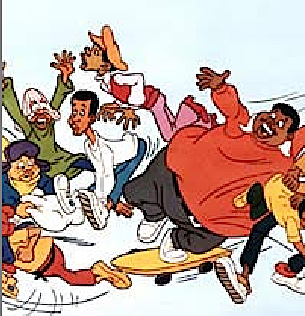
So as Fat Albert used to say, if you’re not careful, you might learn something before it’s done.

Yesterday, I introduced (quickly) the first building block of a successful pitch: the book category, the terminology that enables everyone in the industry to know instantly which presses, editors, and agents might be interested in a particular book.

Being able to describe one’s book in market terms is as essential for a killer pitch as for an effective query letter. As much as writers seem to adore describing their work as, “Well, it’s sort of a romance, with a thriller plot, a horror villain, and a resolution like a cosy mystery,” agents and editors tend to hear ambiguous descriptions as either waffling, a book’s not being ready to market, or the author’s just not being very familiar with how the industry actually works. The more specific you can be about your book’s category, the more professional you will sound.

Which means, incidentally, that within the pitch setting, you might want to avoid those ever-popular terms of waffle, my writing defies categorization, my book is too complex to categorize, my book isn’t like anything else out there, no one has ever written a book like this before, and it’s sort of autobiographical. Which, translated into industry-speak, come across respectively as I’m not familiar with how books are sold in North America, I don’t know one book category from another, I’m not familiar with the current market in my area of interest — which means, Mr. Agent, that I haven’t been buying your clients’ work lately, I’m not familiar with the history of the book market in my area, and I was afraid people would hurt me if I wrote this story as a memoir.

Hey, I just report the rules; I don’t make ‘em up.

My point is, walking into a pitch meeting NOT knowing how the industry would categorize your book is not smart strategy. It may feel like writing your own tombstone, but commit to a category and state it at the BEGINNING of your pitch, rather than making your hearer guess.

Why? Well, among other things, being up front about it will permit your pitch-hearer to listen to the CONTENT of your pitch, rather than thinking the whole time, “Well, that sounds sort of like a romance, with a thriller plot, a horror villain, and a resolution like a cosy mystery. How on earth am I going to categorize that?”

‘Nuff said, I think.

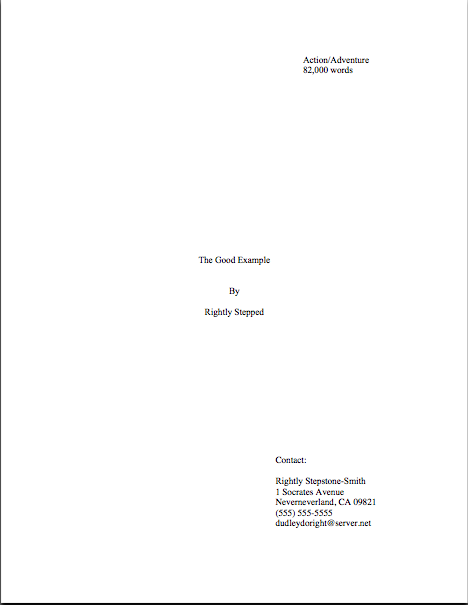
So let’s assume that you have in hand that vital first building block, your book’s category. This handy tool will not only feature prominently in your pitch, but also on the title page of your manuscript and in the first few lines of your query letter. (If it’s news to you that your title page should include these elements — or if it’s news to you that your manuscript should include a title page at all — please see the YOUR TITLE PAGE category at right before you even CONSIDER submitting any material to an agent or editor.)

Next, I shall be moving on to a more sophisticated marketing tool, one that is not technically required, but will instantly stamp your pitch/query as more professional. I refer, of course, to identifying your target market.

Or, to be more precise, to preparing a concise, well-considered statement of your book’s target market, including an estimate of how many potential buyers are in that demographic group. And yes, Virginia, that can mean talking — dare I say it? — statistics.

Intimidating news to those of us who vastly preferred the verbal section of the SAT to the math, isn’t it? (Actually, I was always good at math, but I suppose my high school calculus teacher didn’t nickname me Liberal Arts Annie for nothing. Still, there’s no fool like a fool playing hooky, so let’s press on.)

I’m not talking about publishing statistics here; I’m talking about easy-to-track-down population statistics — and that comes as a big surprise to practically every aspiring writer who has ever taken my pitching class. “Why,” they almost invariably cry, “shouldn’t I go to the trouble to find out how many books sold in my chosen category last year? Wouldn’t that prove that my book is important enough to deserve to be published?”

Well, for starters, any agent or editor would already be aware of how well books in the categories they handle sell, right? Mentioning the Amazon numbers for the latest bestseller is hardly going to impress them.

Instead, it makes far more sense to discover how many people there are who have already demonstrated interest in your book’s specific subject matter. But before I talk about how one goes about doing that, let’s discuss what a target market is.

Simply put, the target market for a book is the group of people most likely to buy it. It is the demographic (or the demographics) toward which your publisher will be gearing advertising.

Or, to put it another way, who out there needs your book and why?

I know these are not the first questions we writers like to ask ourselves, but if you pictured your ideal reader, who would it be? What books does this reader already buy? Who are her favorite living authors, and what traits do your books share with those that would draw your ideal reader to both?

While we’re at it, who represents her favorite authors, and would those agents be interested in your book?

Do I hear some disgruntled muttering out there? “I’m not a marketer; I’m a writer,” I hear some of you say. “How the heck should I know who is going to buy my book? And anyway, shouldn’t a well-written book be its own justification to anyone but a money-grubbing philistine?”

Well, yes, in a perfect world — or one without a competitive market. But neither is, alas, the world in which we currently live. As nice as it would be if readers flocked to buy our books simply because we had invested a whole lot of time in writing them, no potential book buyer is interested in EVERY book on the market, right? There are enough beautifully-written books out there that most readers expect to be offered something else as well: an exciting plot, for instance, or information about an interesting phenomenon.

To pitch or query your book successfully, you’re going to need to be able to make it look to the philistines like a good investment.

And before anybody out there gets huffy about how the industry really ought to publish gorgeously-written books for art’s sake alone, rather than books that are likely to appeal to a particular demographic, think about what the pure art route would mean from the editor’s POV: if she can realistically bring 4 books to press in the next year (not an unusually low per-editor number, by the way), how many of them can be serious marketing risks, without placing herself in danger of losing her job?

Do Fat Albert and the Cosby kids really need to break down these issues into a song for the likely outcome here to be clear?

It’s very much worth your while to give some thought to your target readership BEFORE you pitch or query, so you may point it out to that nervous editor or market-anxious agent. Try to think about it not as criticism of your book, but as a legitimate marketing question: who is going to read your book, and why?

As with choosing a book category, it pays to be specific. For one thing, it will make you stand out from the crowd of pitchers.

Why? Well, to put it charitably, the vast majority of fiction writers do not think very much about the demographics of their potential readers — which is to say, most don’t seem to consider the question at all. (A luxury, I might point out, that NF writers do not have: NF book proposals invariably have an entire SECTION on target audience. No one ever seems to think that is incompatible with the production of art.) Or when fiction writers are forced to answer the question, they identify their readership in the broadest possible terms.

PLEASE, for your own sake, avoid the oh-so-common trap of the dismissive too-broad answer: women everywhere will be interested in this book; every American will want to buy this; it’s a natural for Oprah. Even in the extremely unlikely event that any of these statements is literally true in your book’s case, agents and editors hear such statements so often that by this point in human history, they simply tune them out.

Especially the one about Oprah.

Seriously, if I had a dime for every time I have heard it, I would own my own publishing house — and the island upon which it stood, the fleet of sailboats to transport books from there to market, and a small navy’s worth of shark-wranglers to keep my employees’ limbs safe while they paddled between editing projects.

Why do sweeping generalizations tend to be ineffectual, you ask? Well, agents and editors do have quite a bit of practical experience with book marketing: they know for a fact that no single book will appeal to EVERY woman in America, for instance. Since they hear such claims so often, after awhile, they just block out all hyperbole.

Coming from authors, that is. Anyone who has ever read a marketing blurb knows that they’re not all that shy about using hyperbole themselves.

Make sure your target market are believable — but don’t be afraid to use your imagination. Is your ideal reader a college-educated woman in her thirties or forties? Is it a girl aged 10-13 who doesn’t quite fit in with her classmates? Is it an office worker who likes easy-to-follow plots to peruse while he’s running on the treadmill? Is it a working grandmother who fears she will never be able to afford to retire? Is it a commuter who reads on the bus for a couple of hours a day, seeking an escape from a dull, dead-end job?

While these may sound like narrow definitions, each actually represents a very large group of people, and a group that buys a heck of a lot of books. Give some thought to who they are, and what they will get out of your book.

Or, to put a smilier face upon it, how will this reader’s life be improved by reading this particular book, as opposed to any other? Why will the book speak to him?

Again, be as specific as you can. As with book category, if you explain in nebulous terms who you expect to read your book, you will simply not be speaking the language of agents and editors.

If you want to make their lives even easier, throw in some concrete numbers, showing just how big your target market actually is — it will make it MUCH easier for them to sell the book to higher-ups. Sales and marketing departments expect agents and editors to be able to speak in numbers — and no matter how much the editors at a publishing house love any given book, they’re unlikely to make an actual offer for it unless the sales and marketing folks are pretty enthused about it, too.

Doesn’t it make sense to make sure the agent and editor fighting for your book have that demographic information at their fingertips, when it’s relatively easy for you to put it there?

Not yet convinced that it would behoove you to go to the additional effort? Let me give you a concrete example of what can happen if a writer is vague about her target market’s demographics.

Aspiring writer Suzette has written a charming novel about an American woman in her late thirties who finds herself reliving the trauma of her parents’ divorce when she was 12. Since the book is set in the present day, that makes her protagonist a Gen Xer, as Suzette herself is. Let’s further assume that like the vast majority of pitchers, she has not thought about her target market before walking into her appointment with agent Briana.

So she’s stunned when Briana, the agent to whom she is pitching, says that there’s no market for such a book. But being a bright person, quick on her feet, Suzette comes up with a plausible response: “I’m the target market for this book,” she says. “People like me.”

Now, that’s actually a pretty good answer — readers are often drawn to the work of writers like themselves — but it is vague. What Suzette really meant was, “My target readership is women born between 1964 and 1975, half of whom have divorced parents. Just under 12 million Americans, in other words — and that’s just for starters.”

But Briana heard what Suzette SAID, not what she MEANT. Since they’ve just met, how reasonable was it for Suzette to expect Briana to read her mind?

The result was that Briana thought: “Oh, God, another book for aspiring writers.” (People like the author, right?) “What does this writer think my agency is, a charitable organization? I’d like to be able to retire someday.”

And what would an editor at a major publishing house (let’s call him Ted) conclude from Suzette’s statement? Something, no doubt, along the lines of, “This writer is writing for her friends. All four of them. Next!”

Clearly, being vague about her target audience has not served Suzette’s interests. Let’s take a peek at what would have happened if she had been a trifle more specific, shall we?

Suzette says: “Yes, there is a target market for my book: Gen Xers, half of whom are women, many of whom have divorced parents.”

Agent Briana thinks: “Hmm, that’s a substantial niche market. 5 million, maybe?”

Sounding more marketable already, isn’t it?

But when Briana pitches it to editor Ted this way, he thinks: “Great, a book for people who aren’t Baby Boomers. Most of the US population is made up of Baby Boomers and their children. Do I really want to publish a book for a niche market of vegans with little disposable income?”

So a little better, but no cigar. Let’s take a look at what happens if Suzette has thought through her readership in advance, and walks into her pitch meetings with Briana and Ted with her statistics all ready to leap off her tongue.

Suzette says (immediately after describing the book): “I’m excited about this project, because I think my protagonist’s divorce trauma will really resonate with the 47 million Gen Xers currently living in the United States. Half of these potential readers have parents who have divorced at least once in their lifetimes. Literally everybody in that age group either had divorces within their own families as kids or had close friends that did. I think this book will strike a chord with these people.”

Agent Briana responds: “There are 47 million Gen Xers? I had no idea there were that many. Let’s talk about your book further over coffee.”

And editor Ted thinks: “47 million! Even if the book actually appealed to only 1% of them, it’s still a market well worth pursuing.”

As scary as it may be to think about, if you are going to make a living as a writer, you will be writing for a public. In order to convince people in the publishing industry that yours is the voice that public wants and needs to hear, you will need to figure out who those people are, and why they will be drawn toward your book.

If you don’t want to make a living at it, of course, you needn’t worry about marketing realities; writing for your own pleasure, and that of your kith and kin, is a laudable pursuit. But if you want total strangers to buy your work, you are going to have to think about marketing it to them.

As I have said before, and shall no doubt say many times again: art for art’s sake is marvelous, but an author’s being cognizant of the realities of the market renders it far more likely that her book is going to be successful.

And, to paraphrase Fat Albert, those who don’t do their homework are not as likely to succeed as often as those who do.

Tomorrow, I shall talk about how to dig up specifics about your target demographic relatively painlessly. In the meantime, don’t play hooky, try not to assume, and keep up the good work!

Conference pitching warm-up, part II, in which you may be surprised to learn that you and the agent or editor on the other side of the pitching table actually want the same thing. Honest.

Yesterday, I was waxing poetic on an must-follow piece of conference-preparation advice — if you are looking for an agent (as the vast majority of writers willing to shell out the dosh to attend major conferences are), it makes sense only to invest in attending conferences where agents with a proven track record of selling with your type of book will be available for your pitching pleasure.

Feel free to derive an important corollary from this excellent axiom: from this moment on, ONLY pitch or query your book to agents who represent that kind of book.

Seems so simple, put that way, doesn’t it?

Yet every year, literally millions of aspiring writers either take a scattershot approach, querying fairly randomly (thus all of those “Dear Agent” letters that folks in the industry hate so much) or let the conferences do the selection for them, pitching to whoever is there with a winsome disregard for matching their books with the right agent.

Sigh.

I cannot say this often enough: you do not want to be signed by just ANY agent — although, in the throes of agent-seeking, it’s certainly very easy to start believing that any agent at all would be better than none. You want the agent who is going to be able to sell your work quickly and well.

Believe it or not, even the surliest agent who ever strode contemptuously into a literary conference and brushed off a pitcher wants this as well. Agents, perversely enough, want to sign authors of books they know they can sell.

Which is, in case you were wondering, why they tend to be so quick to reject what doesn’t fall within their sphere of influence. Since they are inundated with queries and pitches, it is in their best interests to weed out the absolutely-nots as swiftly as humanly possible — and although it may not feel like it at the time, in yours as well.

Don’t believe me? Ask any author who has found herself spending a year or two in the purgatory of a representation contract with an agent who didn’t have the contacts to sell her book, but still snapped up the book because it was in an at-the-time-hot book category. (Yes, it happens.)

So if an agent who doesn’t represent your kind of work rejects you — and this is equally true if it happens at a conference or via query — be open to the possibility that it may not have anything to do with the quality of your writing or the idea you are pitching.

It might just be a bad fit.

I know it’s hard to accept this philosophically when your baby is rejected out of hand, but it is vital for your professional mental health that you bear the issue of fit in mind constantly while you are pitching and querying. Not only isn’t anything personal about a bad-fit rejection — it does not even begin to be a fair test of how the book will fly with an agent who does represent that kind of work.

Let me repeat that, because it’s awfully important: a book’s being rejected by an agent or editor who doesn’t represent that type of work is NOT a viable test of its marketability amongst those who do. Thus it follows with an elegant inevitability that if you want to know whether your book is marketable, you should pitch or query it only to those with whom such a test WOULD be a good indicator of how the publishing industry might view it.

Or, to put it another way, the best way to avoid this kind of rejection is not to pitch or query your book to any agent that isn’t predisposed to be interested in it. Check before you pitch.

Even better, check before you register for the conference where you intend to pitch.

Ditto with editors, by the way. No editor in the business acquires across every conceivable genre; in fact, most editors’ ability to acquire is sharply limited by their publishing houses to just one or two types of book.

So it would be a waste of your pitching energies to, say, try to interest an editor who does exclusively mysteries in your fantasy novel, right? Right?

Another thing that any writer pitching at a North American conference ABSOLUTELY MUST KNOW: all of the major NYC publishing houses currently have policies forbidding their editors to acquire work by unagented writers.

Don’t believe me? Check their websites. At least for the adult market, the policy is uniform. (Some YA imprints have different policies; again, it’s in your interests to check.)

This means, in essence, that the BEST that could happen if you pitched your book to an editor from one of these houses is that he might help you hook up with an agent. Although it’s somewhat counterintuitive, an editor at a smaller or regional house might have more leeway to pick up your book.

Sort of changes how you view those much-vaunted conference appointments with bigwig editors, doesn’t it?

I’m bringing this up because in most of the flavors of common being-discovered-at-a-conference fantasy, an editor from Random House or somewhere similar hears a pitch, falls over backwards in his chair, and offers a publication contract on the spot, neatly bypassing the often extended agent-seeking period entirely.

Conference today, contract tomorrow, Oprah on Thursday.

In reality, even if an editor was blown over (figuratively, at least) by a pitch, he might buttonhole one of the attending agents at a conference cocktail party on your behalf, and they might together plot a future for the book, but you’re still going to have to impress that agent before you can sign with the editor.

In other words, pitching to an editor at a major house might help your book in the long run, but it will not enable you to skip the finding-the-agent step, as so many aspiring writers believe. Sorry.

Frankly, I think it’s really, really unfair to the editors from these houses that more writers’ conference promotional materials are not up front about this policy, considering that it is in fact common knowledge — which means, incidentally, that most editors will assume that a writer attending the conference is already aware of it. It’s not as though the individual editor could change the status quo, after all, or as if he’s following the policy merely because he likes to taunt the hopeful.

Before any of you protest that at the last conference you attended, editors from the Big Five asked for your work as though they intended to pick you up regardless of your representation status, let me hasten to add that you are not alone: the we-accept-only-the-agented is most assuredly NOT the impression that most conference pitchers to editors receive.

There’s a reason for this: unless they are asked point-blank during an editors’ forum how many of them have come to the conference empowered to pick up a new author on the spot — a question well worth asking, hint, hint — most editors who attend conferences will speak glowingly about their authors, glossing over the fact that they met these authors not in settings like this, but through well-connected agents.

See earlier comment about common knowledge. They honestly do think you know. It doesn’t mean that they can’t give you some valuable advice.

Yet few conference brochures or websites are honest enough to feature the major houses’ policies next to the appropriate attending editors’ listings. In fact, most conference rhetoric surrounding pitch appointments with editors directly states the opposite, encouraging pitchers to believe that this meeting could be their big break.

I don’t think that conference organizers do this in order to be mean or misleading — I just think many of them are not hip to the current conditions of the industry. Trust me, no editor is going to jeopardize his job at Broadway by handing a contract to a writer his boss would throw a fit if he signed.

So why, you may be wondering, do editors from the majors attend literary conferences — and, once there, why do they request submissions?

This is an important question, because editors from the major houses request manuscripts from pitchers all the time — but not because they are looking to sign the author instantly on the strength of the book. They just want to get in on the ground floor if the book is going to be the next…

You guessed it: no editor wants to be the one who passed on the next DA VINCI CODE. It’s a gamble, pure and simple.

So even though they would almost certainly not in fact pick up the next DA VINCI CODE if its author DID pitch to them at a conference, having a personal connection with the author is a great means of queue-jumping. If one of them is nice enough to you, you might tell your agent (once you hook up with one) that you want your potential bestseller sent to that editor first.

Heck, if she’s nice enough to you, you might be gullible enough to insist that she gets an exclusive peek at it.

Don’t laugh: it’s not a bad gamble, from their perspective. Aspiring writers, as I believe I have pointed out a couple of hundred times before, can get some strange ideas about loyalty owed to industry types who met them for a grand total of fifteen minutes once.

But trust me: deep in their steamy little hearts, those editors from major houses who ask you to send chapters will be hoping that you will land an agent before they get around to reading the manuscript they requested you send. If you are looking to pitch to an editor who might conceivably pick up your book right away, you are generally better off pitching to an editor from a smaller or regional house.

The overall moral: learning what individual agents and editors are looking for AND what their bosses will allow them to pick up (aside from the next DA VINCI CODE, of course) will help you target both your conference pitches and your queries more effectively.

Everyone — agents, editors, and writers alike — are happier when you do. Honest. Nobody concerned wants to break your heart gratuitously.

Keep repeating to yourself between now and the conference: they don’t reject to be mean; they don’t reject to be mean; they don’t reject to be mean. They’re doing it to fight their way to the book they can support wholeheartedly.

Getting a trifle depressed? Don’t worry — I’m almost through with the don’t list; very soon, we’ll be moving on to the dos, which are far more empowering. Keep up the good work!

Guest blogger Joel Derfner: I need permission to what?

Hello, gang –

Anne here. In writing yesterday’s post, I think I strained something while stretching to make yesterday’s analogies work. My credulity perhaps, or yours. That will teach me not to rush off and write a post the instant after I receive bad news, eh?

The timing couldn’t be better for me to take a day off, though — FAAB (Friend of Author! Author! Blog) Joel Derfner, better known to us here as witty commenter and fabulous blogger Faustus, MD has graciously written us a guest post for today.

And on a lulu of a topic I seldom address, too: getting permission to quote songs in your book.

Was that giant sucking nose I just heard your collective gasp at the realization that you might conceivably need such permission — and that obtaining it might be the author’s responsibility? Read on, MacDuff.

But first, for those of you who missed my crows of joy last week, Joel’s second book, Swish: My Quest to Became the Gayest Person Ever has just been released by Broadway Books, a division of Random House. And hoo boy, has it been garnering some enviable reviews. Lookee:

“Whether recounting his stint at New York’s cheerleading squad or the eye-opening week he spent undercover at a North Carolina “ex-gay” ministry, his inner terrain of hope and devastation is recognizable to anyone who has felt the scrutiny of peers. In one typically sidesplitting passage Derfner leads his step aerobics class, seemingly with unflappable confidence, while harboring private fantasies of boosting student morale with a tray of homemade brownies.

“‘I have these moments of insecurity quite often,’ Derfner admits. ‘If you can point to your flaws in a way that reveals them to be universal, then your flaws are not unattractive — just human.’ Whether he’s the next Noël Coward or a male Bridget Jones, one thing is clear: Queer America needs Derfner. In a culture where we disguise vulnerability with physical perfection and material success, Derfner skewers heartache with Wildean wit.” — Out.com

“These witty, fun and poignant essays knocked me on my ass more than once. I desperately want to hang out with him.” — Booksplosion!

“The ultimate swish-quest, indeed, though it makes for more than a delightfully breezy, campy read, for the humorous anecdotes morph into movingly evocative memoirs when, for instance, he recalls his liberal, civil-rights-activist parents’ response to his teenage coming out: Not At All Good. His mother never accepted it, and he and she never achieved more than an uneasy détente. Thus this superficially facile book becomes more than the sum of its parts, as Derfner indicates when he observes, ‘Writing about my quest to become the gayest person ever led me to realize I was actually on a quest to become myself.’” — Booklist

May all of our books be greeted with such delighted enthusiasm. (And make sure to let me know when they do — I love gloating over readers’ successes.) Both Swish and Joel’s hilarious first book, Gay Haiku are available on Amazon, or for those of you who prefer to deal with independent bookstores, Powell’s.

Take it away, Joel!


You know how you open a book and there are quotes from song lyrics all over the place? And how you figure the author just sent the manuscript in and somebody at the publishing company took care of getting permission to quote those lyrics?

You’re wrong.

I mean, you may not be wrong as far as, say, Stephen King is concerned. I don’t know. But excepting extraordinary cases the author is usually contractually obligated to get licenses for anything s/he quotes. (S/he is also contractually obligated, by the way, to pay for licenses for anything he quotes.)

Okay, I thought when I discovered this as I was finishing my book, that’s a hideous miscarriage of justice, but worse things have happened in the world. I mean, it’s not like I have to go camping or anything. It was in this frame of mind that I submitted my manuscript, which quoted lyrics from nine songs. I’d even taken the time to footnote songwriters and publication dates, just so Random House would see how diligent I was being.

But when my editor gave me his feedback, one of the things he said was, “Getting permissions can sometimes be tricky, so you might want to cut some of these. Actually, you might want to cut all of them.”

To appease him I went through the manuscript and cut as many of the lyrics as I could, replacing them with non-copyright-infringing prose references to the songs in question. Of course I knew he was worrying needlessly, but I am nothing if not accommodating (okay that’s totally a lie I’m not accommodating at all but I worry that if I don’t obey him he’ll stop giving me chocolate every time I show up at his office), so I didn’t have a problem doing this. In the end there was only one lyric I felt couldn’t be cut without doing real damage, “Without You” on pages 115-6.

THANK ^%$*ING GOD.

I tell you, I might as well have been trying to get my hands on the Hope Diamond.

At first it wasn’t so difficult. After a half hour or so with the Internet I figured out that the copyright was owned by a company (we’ll call it Company A) in Britain. My editor’s assistant called them (because I live in the ghetto and have a ghetto phone plan that would sooner let me destroy its headquarters in a rain of fire than allow me to call a country in Europe) and got the name of the guy I needed to talk to about permissions.

So far, so good.

I e-mailed the guy— I’ll call him Guy A, though over the course of time I would find many more names for him—asking him what I needed to do. He e-mailed back the next day and said I needed to get in touch with Company B, which managed Company A’s licensing in the U.S. I went to Company B’s website and put in a licensing request on their convenient licensing request page.

A week later I’d heard nothing. I was not particularly concerned; I assumed that the workings of Company B, like the workings of most companies, functioned at the speed of stalactite creation. But since I hadn’t even gotten an automated response I figured I might as well check in. “Oh, you’ll hear back a week or two from now,” said Guy B when I called.

Three weeks later I’d heard nothing. “You’ll hear back soon,” said Guy B. When I asked whether I could speak to the person in charge of licensing just in case, he said, “Okay, I’ll transfer you to Gal C.” I ended up leaving a very friendly message on Gal C’s voice mail asking her to call or e-mail me.

Two weeks later, no word.

I e-mailed Gal C again.

Nothing.

I cced Guy A at Company A asking him whether he had any suggestions. His response was, “I’m sorry, I have no ideas for you.”

Guy A can go jump in a lake, I thought.

Finally I e-mailed Gal C and cced Guy A, hoping that he was in some nebulous position of authority over her and that this move would inspire her to action. Whether because of my e-mail or not, she wrote back and asked for a few pieces of information, which I sent immediately.

I e-mailed again a month later.

And again a week and a half later.

I called again a week after that but when Guy B answered the phone he said, “We’re moving offices, so she doesn’t have a phone now.”

“Well,” I said, “can I just leave her a voice mail?”

“She doesn’t have voice mail either. Can I take a message for her?”

I left one, not believing for a moment it would do any good.

A few weeks later, I was visiting friends in Los Angeles and had the brilliant idea of actually going to the physical headquarters of Company B and asking to speak with Gal C. She wouldn’t be able to ignore me if I was standing in front of her.

So of course the office was closed. Nobody was there. At 11:00 a.m. on a Tuesday.

I e-mailed Gal C again a week later (ccing Guy A again)—oh, God, you know what? This is so incredibly tedious I can’t even bring myself to go on. Suffice it to say that I finally got permission from Gal C at Company B to use the lyrics (for $300).

Then like two months before publication I got an e-mail from my editor’s assistant saying that so-and-so in the legal department wanted to know whether this permission applied to Canada as well or just the United States. Company B said no, it was just for the U.S., and they had no idea who I should talk to for Canada. Company A said the same thing.

In the end I had to call Guy D and Gal E at Companies C and D in the U.S. (neither of them knew the answer to my question, and Gal E actually began explaining the basics of copyright law to me as if I were twelve, except she kept getting things wrong). Then I called Guys F, G, and H at Companies E, F, and G in Canada.

By this point it was too late to make any changes to the book, so all I could do was show that I was making a good-faith effort to secure permission, so I asked Gal I from Company G to have Gal J e-mail me saying that they’d received my request. Gal J did so and I forwarded the e-mail to my editor’s assistant.

To get permission to quote twelve lines of one lyric has taken me six months, countless phone calls, and probably two years of my lifespan. And $300 plus whatever Company G says I owe them.

I am never, ever, ever going to quote any copyrighted material in anything I write ever, ever again.

Addendum:

I just got an e-mail from Gal J at Company G. I have permission to use the lyrics in Canada.

Once I send them $755.

Remember that I had to pay Company B $300.

Right now I have $34.62 in my bank account.

On the one hand, I believe that Company G is much, much better at its job than Company B.

On the other hand, Company G’s superiority obviously consists not only in communicating much more responsibly but also in getting its clients much more money.

I am never, ever, ever going to quote any copyrighted material in anything I write ever, ever again.


Swish: My Quest to Become the Gayest Person Ever and Gay Haiku author Joel Derfner is from South Carolina, where his great-grandmother had an affair with George Gershwin. After fleeing the south as soon as he possibly could, he got a B.A. in linguistics from Harvard. A year after he graduated, his thesis on the Abkhaz language was shown to be completely wrong, as the word he had been translating as “who” turned out to be not a noun but a verb. Realizing that linguistics was not his métier, he moved to New York to get an M.F.A. in musical theater writing from the Tisch School of the Arts.

Musicals for which he has written the scores have been produced in London, New York, and various cities in between (going counterclockwise). In an attempt to become the gayest person ever, he joined Cheer New York, New York’s gay and lesbian cheerleading squad, but eventually he had to leave because he was too depressed. In desperation, he started knitting and teaching aerobics, though not at the same time. He hopes to come to a bad end.


Finding your voice, or, yet another post featuring a small, nagging bug

I begin today with some terrific news about one of our own, FAAB (Friend of Author! Author! Blog) and fabulous writer Caleb Powell has just signed with agent Diane Nine of DC-based agency Nine Speakers, Inc.. Congratulations, Caleb!

Keep that good news rolling in, everybody — we all love hearing about it.

Despite being happy for Caleb, I’m feeling a bit stuffy-headed today, perhaps due to the fact that the great big crabapple tree in my backyard has suddenly burst into magnificent masses of pink blooms. Very beautiful, very pollen-laden.

It reminds me of the small town — a village, really, ensconced within an agricultural preserve — where I grew up, in the Napa Valley. (Note to those not from those parts: PLEASE don’t refer to the entire area as Napa; it makes the locals apoplectic. Napa is a well-developed city on the south end of the quite rural Napa Valley. If you’re thinking of vineyards, you actually mean the latter. Thank you.)

Tourists overrun the Napa Valley in the autumn, when the grapevines sport leaves ranging from bright green to mellow gold to sunburned red, but my favorite time there has always been the early spring, this time of year, when the vines are dormant and the vineyards are full of knee-high fluorescent yellow mustard flowers: acres and acres of neon brilliance.

The local truism runs that if you don’t suffer from pollen allergies during a Napa Valley spring, you never will. Because I am inherently contrary, I never suffered from pollen allergies while I was living there. Then, years later, I moved to Seattle, where the pollen apparently especially virulent.

A-choo.

I bring this up, not merely because my head is stuffy, but as an apt metaphor for today’s topic. Some weeks back, intrepid and curious reader Gordon wrote in to ask:

Anne – How do we tell if our voice is actually …our voice—? Is there an easy answer, or do we rely on our early reader to tell us? Or our editor?

Terrific question, Gordon, and one that is surprisingly rarely discussed at literary conferences or in writing classes. There’s a pretty good reason for this: while craft is general, voice is individual.

Which is, I must admit, why my first response to this question was, “God, no — by definition, the best arbiter for a truly original voice is its author.” Authorial voice can’t really be taught (although there are some writing teachers who would disagree with me on that point): typically, it arises organically, often after years of cultivation.

I already hear some disgruntled muttering out there. “Very pretty, Anne,” these mutterers say, “but we’re looking for practicality here, not philosophy. What precisely IS voice, and why should I worry about whether my work exhibits a unique one?”

For those of you who have heard it bruited about in literary circles but were afraid to ask for a definition, voice is that combination of tone, worldview, vocabulary, rhythm, and style that makes one author’s work differ from another’s, even if they are telling the same story.

It is, to put it as simply as possible, what makes YOUR work sound like YOU, and not like someone else.

In a book with a strong, well-developed voice, every paragraph — indeed, every sentence — will be in that voice, a phenomenon the pros call consistency. And that’s darned hard for a writer to pull off, particularly (as is often the case for those new to the craft) if the writer in question isn’t quite sure what his voice IS.

But think about it: as a reader, don’t you expect consistency of voice — and haven’t you ever read a book where the tone, vocabulary, and/or style abruptly altered so much that it jarred you out of the storyline?

Most readers dislike that feeling of being pulled out of the story, so industry pros tend to edit with an eye to removing it. The result: the authors we tend to love are those whose voices are so consistent that if we took a two-line excerpt from Chapter 2 and another from Chapter 8, we could tell that the same person wrote them.

“Golly,” say the former scoffers, “that sounds awfully important. Why doesn’t every writers’ conference devote huge amounts of time to helping aspiring writers seek out and develop theirs?”

Beats me — unless it’s because by definition, teaching a group means catering to commonalities; to help a writer develop his voice, an instructor would have to read enough of his work to figure out what he does better than any other writer on the planet, the literary acumen to weed out those elements that are borrowed from other authors’ styles (more common than you might think), and the time to encourage the writer, draft after draft, to cater to his own strengths.

Kind of a tough brief for a one-time two-hour seminar with twenty students, no?

To be fair to conference organizers, most submissions do fall under the weight of formatting, grammar, and clarity problems, not an inconsistency of voice, so it does make some sense to offer instruction on those issues first. And when a writer is still struggling to express herself clearly and in a way that will appeal to an established market, those are definitely the skills she should master first.

Or, to put it another way, if her manuscript is not in standard format, contains many grammatical errors, and is confusing to read, an agent or editor’s rending his garments and crying, “But the voice is not consistent!” is probably the least of her worries.

So, to reiterate Gordon’s question, how does a writer know when he’s found his voice? For starters, it’s extraordinarily rare that an author’s distinctive personal voice shows up in her first writing projects, except perhaps in flashes.

Why? Well, as much as we might like to think of ourselves as expressing ourselves as no one else does, doing so in writing is a rather difficult skill to master. Most writers begin by imitating the voices of authors they admire, so it’s not at all uncommon to see a manuscript scene that contains a patch that reads a bit of Annie Proulx, a terse dialogue reminiscent of Ernest Hemingway, and a blistering line or two of Jay Mcinerney cynicism, all tied together by a few straightforward declarative sentences.

Tell me, out of all of those disparate elements, which part is the writer’s own voice?

Usually — and brace yourselves, because some of you may find this rather discouraging — a writer comes to recognize her own voice because over time, it becomes the most natural for her to use. Its consistency sits up and announces itself to be how she should be writing all the time.

Which means, Gordon, that I have quite an annoying answer to your excellent question: you may not know what your voice IS, but you will probably recognize it when you see it.

I know, I know; that sounds very woo-woo, but I swear that it’s true. For most good writers, one day, after seemingly endless writing, a personal voice abruptly emerges and takes over the narration, like all of those crabapple and mustard flowers bursting into bloom.

And the writer says, “Hey, I like that. I think I’m going to write like that all the time.”

To complicate matters, just as those early spring flowers make some people smile and others sneeze violently, a strong, original voice will not appeal to all readers, so not all published writing DOES exhibit an individual narrative voice. The more distinctive the voice, the greater the risk, in a way — it can irritate in a way that a merely clear, pleasant, generic voice may not.

And that, in case you were wondering, is one of the many reasons that journalists are trained to sound so much alike: they are urged to keep their individual voices out of the story, so as not to distract the reader.

The ambient mutters have been steadily growing to a near-roar. “Okay, now I’m REALLY confused,” I can hear some of you saying. “If I understand you correctly, it’s safer NOT to write in an individual voice, but if I want to be known for the beauty of my writing, I need not only to do just that, but to do it consistently throughout my manuscript.”

Nicely summarized, ghostly mutterers: it is a genuine paradox. It’s also a choice that every writer has to make for himself.

Feet continue to shuffle out there, and hips to shift uncomfortably on computer chairs. “What I’m really asking, I guess, is what separates a good voice from a bad voice. Or, to put it another way, how on earth can an agent, editor, or contest judge rate voice on anything but personal preference?”

Remember back in my Book Marketing 101 series, when I pointed out that, contrary to popular opinion amongst the aspiring, a writer shouldn’t want to sign with just ANY agent; she should aspire to signing with one who truly loves her work? This is precisely why — response to voice IS quite individual.

Is the common rejection line I just didn’t fall in love with it making a bit more sense now?

In order to represent you successfully, an agent needs not only to like your voice, but to be able to identify what is individual about it lucidly enough to be able to go to an editor and say truthfully, “Look, based on the books you have been buying lately, I think you are going to like this author’s voice, for these twelve reasons…”

Because a runny nose is apparently conducive to decoding cosmic mysteries, allow me to add: that’s why nonfiction is reputed to be easier to sell than fiction; fiction is inherently much more heavily reliant upon voice, right? Particularly literary fiction, where the freshness and strength of the voice is the book’s primary selling point.

And, let’s face it, no matter how strong a story is, few readers will finish a novel if they dislike the author’s voice. “I just couldn’t get into it,” they will say, setting it aside.

Nonfiction, on the other hand, is much more concerned with the interest of the subject matter, the slant of the approach, and — yes, I must say it — the credentials of the author. (Oh, stop your groaning — you didn’t honestly expect me to talk about selling NF {without} bringing up platform, did you?) While a strong voice may be an additional selling point, clarity is generally the main desiratum.

Unless, of course, it’s a memoir, where voice is nearly as important as in a novel.

Is your head spinning from all this? Not to worry; tomorrow, I shall discuss voice choices in greater detail.

For today’s purposes, it’s less important that you come away from this with a clear idea of the strategic uses of voice than to realize that you may well have more than one voice lurking inside you — and that before you can make it consistent throughout the narrative, you are going to want to give some thought to tailoring the one you choose to emphasize to the book project at hand.

“I’ve got just one more question,” the disgruntled mutterers who have been dogging me throughout this post are piping up to say. “Why did you decide to start talking about voice in what I sincerely hope is the middle, not the end, of a series on keeping our narratives moving?”

Because, my friends, there is more to revising a manuscript than deciding whether this sentence is necessary, that paragraph is clear, or a scene tells rather than shows. All of these are necessary, of course — but ideally, a revising writer should also be asking himself, “But does this part of the manuscript fit with the overall voice? Does it sound like ME?”

Just a small, noisy bug to stick in your ear while you’re reviewing your manuscript. Keep up the good work!

Getting good at incorporating feedback: oh, dear

no-move.jpg

Today, thank goodness, is the last installment of my series on how to deal with revision requests — and buckle your seatbelts, everybody; it’s going to be a bumpy night.

I have been dealing with this topic at length, because for all of the complaints one hears amongst writers about unreasonable editorial demands, writers actually do not tend to talk much amongst themselves about practical means of accommodating or rejecting requested changes.

Yet another area, I suspect, where fear of appearing less accomplished than other writers (“Of course, I can make those changes! In my sleep! Hanging upside-down from my toes like a bat!”) keeps us from sharing common experiences.

Also, most published writers are too nice (or too reputation-savvy) to discuss the problems their books have encountered on the way to publication, even in the relative safety of a writing class or literary contest. So their published comments on the subject tend to sound as though they’ve just joined a major sports franchise: “Everyone here has been wonderfully supportive. I’m just trying to do my best for the team.”

Understandable, of course, but not as helpful to constructing aspiring writers’ expectations of the publishing process as it might be.

Especially for a first book. If you are new to the writing game, you are, unfortunately, far more susceptible to micro-editing than a better-established author; from the editor’s prospective, you have fewer bargaining chips, and from yours, you do not yet have the market experience to be able to put your foot down with credibility.

To put it bluntly, you do not yet have a comeback to that all-too-common editorial comment, “Look, I know what sells, and you don’t.”

While it definitely behooves a new author to recognize that this statement is usually true, today, we’re going to tackle the worst-case scenario for when it isn’t: what do you do if your agent or, still worse, your editor has asked you to make a major textual change that you genuinely feel would be harmful to the book AND every polite, professional means of demurring has failed?

Before I move on to the final steps of the process, I want to repeat my earlier disclaimer: please do NOT take the steps advised below before taking the ones described in my last post — or, indeed, the ones from throughout this entire series. Starting the delicate negotiation process in the middle will not speed your efforts; it will, however, greatly increase the probability of insulting your editor and/or agent, upon whose good opinion your work is largely dependent.

Take it slowly, and remember to be polite at all times.

If you have taken the steps in order, by the time you are ready to proceed to the more serious argumentative steps below, you will have learned enough about your critiquer to be able to avoid his pet peeves in argument. You also will already have taken the minor points off the table, in order to concentrate on the primary issues; Steps 1 — 10 (explained in my last posts) will achieve that.

Even if you cannot resolve all of your contested points, you will at least have learned a great deal about WHY the editor wants the changes — and how flexible he is. If he’s a my-way-or-the-highway kind of guy, or if he is terrified of symbolism, or if he’s a point-of-view Nazi, you’re MUCH better off knowing that early in the editing process.

This may not, in short, be someone accustomed to compromise.

From here on out, I am going to assume that you have been a model of restraint and courtesy throughout your dealings with the poor advice-giver. Let’s move on to what you do when your editor or agent has refused to fall in with your first genteel indications of displeasure.

(11) Make the changes you have already agreed to make — then reassess.

It’s a good idea to wait a few days, deadlines permitting, before implementing ANY changes you conceded in your earlier discussions. It’s been my experience that my clients tend to feel rather let down if they make the changes right away, as though they had lost the fight entirely. Taking some time to let the intense feelings subside permits you to reassess the text calmly.

Then take a look at the remaining contested points: is there any way at all that you could make those changes, now that you have won some of the concessions that you wanted? In other words, are you sure that you want to push this fight to the next level?

(12) Make your case — but do not, under any circumstances, resort to ultimatum.

I know, I know: so far, this has been a list of dos, rather than don’ts. I mention this because it’s almost always the first thing a writer wants to do at this juncture.

Heck, for many writers, it’s the first thing they want to do when any conflict arises with their agents or editors; I’ve known writers who have threatened to dump agents who went three days without answering an e-mail.

I can’t imagine how writers gained a reputation for being a hypersensitive bunch.

I’m not bringing up our collective reputation flippantly — it does affect how folks in the industry respond to our e-mails when we’re angry. It’s not all that uncommon for an agent to hold off on answering a writer’s anguished outcry for a few days or even a week, waiting for this author to calm down.

Unfortunately, many writers interpret silence as rejection. (Can’t imagine why they would leap to that conclusion, can you, when some agencies now no longer bother to inform submitters that their manuscripts have been rejected?) After a few such missives, upping the ante to an ultimatum may well appear to be the only means to get an agent or editor’s attention.

Don’t do it.

Even if you are 100% right, engaging in a pitched battle with your editor after the book is often like a Mini Cooper’s contesting the right of way with a Mac truck: legally, the truck may have to yield to the Mini, but if it does not, the Mini is going to be far more damaged than the truck, right?

As I MAY have mentioned before, the steps to come are to be reserved for ONLY those situations where you have tried several rounds of tactful, non-confrontational approaches to ironing out your differences with your editor or agent FIRST. If you escalate the conflict too early in the discussion process — as, alas, too many writers do — before you have tried the preliminary steps, you run the risk of being dismissed as unable to take criticism.

At worst, your passion in defense of your book may come across to your editor as an ultimatum: take my book as is or not at all. Or, in the case of a revision request impasse with an agent, as an implied threat: stop asking me to change my manuscript and start sending it out to editors, or I’ll take it to another agency.

Bad, bad, BAD idea. This is not an industry that takes well to ultimata. They’re far too likely to say, in the words of the immortal Noël Coward, “Pack up your talent; there’s always plenty more.”

Yes, even with the author of a book they love. Most standard publishing and agency contracts are specifically written to make it far from difficult for an editor to dump an uncooperative writer.

So do try your utmost not to allow the situation to degenerate into ultimatum-flinging. You may be hopping mad, and thus have to do violence to your emotions in order to take the early non-confrontational steps I advised earlier, but trust me, it’s honestly in your best interest to be as sweet as pie socially while you are raising hell textually.

(13) Separate the fact-based issues from the opinion-based issues, and demonstrate that you are correct about the facts.

This may seem as though you should have done it at the beginning of the process, but providing someone who regards himself as an authority on a book with evidence that he is flat-out wrong is actually a fairly confrontational move. Few of us like admitting that we are wrong, and occasionally, one does meet an editor or agent who is on, as we say on this coast, his own little power trip. Even if you absolutely have to prove your contentions, it’s best not to humiliate your opponent.

Be very clear about whether it is the fact in your book your critiquer is contesting or your interpretation of them — an issue very likely to be muddied in a memoir or other nonfiction book. If you have done your homework and can back up your claims, the should be non-negotiable; if it is the facts, quietly provide photocopies of reputable print sources for your contentions. (Print sources are better than electronic ones in this instance, as the printed word has greater power in the publishing industry than does electronica.)

On questions of grammar, for instance, simply photocopy the page in one of the standard editing guides — you own a copy of Strunk & White, right? — and mail it to your critiquer. Write a nice cover letter, of course, saying, “Hey, after our discussion about this, I thought I should double-check my facts, and…”

Don’t gloat, and don’t negotiate: you are sending this corroboration as a courtesy, not as persuasion. This evidence is merely your way of explaining why you will NOT be making the requested factual or grammatical changes. Do it politely, and finish your cover letter with an assurance that you’re already busily working on the OTHER changes he’s requested.

At the end of this step, you should have a list of all of the remaining contested issues that are purely matters of opinion. Again, reassess: are the remaining points worth a fight?

(14) Bring in outside help, if appropriate.

If you have an agent, this is a great time to turn the matter over to her — the situation has gone beyond your ability to negotiate. Your agent may well know more about this editor than you do, or about editorial imperatives within the publishing house. There may be more going on here than you realize — such as, for instance, the hiring of a new senior editor who has just declared strong opposition to the kind of argument you are making in your book.

If you do turn the issue over to your agent, you must recognize that you are no longer one of the negotiators. As such, you must accept the outcome.

Think of it like the electoral college: technically, you are not voting for a presidential candidate, but for an elector who has PLEDGED to vote for that candidate. Like delegates taking the primary and/or caucus results from their states to the national elections (who are bound to vote for particular candidates only on the first ballot, FYI; the media seem a little fuzzy about how that fact might conceivably affect the Democratic nomination this year), electors can in fact change their votes in a pinch.

In other words, your agent may come back with a compromise that does not please you.

If the agent is the one making the suggestions, however, or if you do not have an agent and are in dispute with an editor at a small press, you may need to explore other options for outside help.

Running the remaining suggestions past your first readers, for instance. Your bargaining position will be marginally stronger if you can legitimately go back to your critiquer and say,

Hey, I know that you are pretty firmly committed to my removing the Ellen character, but none of my 15 first readers drew the same conclusion you did about her. Your concern was about male readers, and half of mine were men. Would you be open to reading a revised manuscript that did retain Ellen, to see if any of the compensatory changes I made alters your dislike of her?

If you are writing nonfiction, consider calling in an expert in the field to back you up. Having spent many years teaching in a university, I can tell you that most academics will very happily devote half an hour to talking to any writer who is interested in their life’s work.

You may have trouble tracking down a famous professor to corroborate your points, but it is often surprisingly easy to get to one of the top people in the field. Offer to add a footnote or a line in your acknowledgments in exchange.

If the expert supports your view, resist the urge to gloat. Call your agent or editor and say, “Hey, I’ve been thinking a lot about what you said about point X, and you raised an excellent point.” (Even if he didn’t.) “I thought I should double-check, so I contacted…” (Refer to your expert by every title she has ever held.) “And SHE says…”

Few editors or agents would continue to argue with you at this point. You will have given them a piece of proof that they can use if higher-ups at the publishing house raise the concern.

(15) For the opinion-based suggestions, recognize that you are dealing with someone else’s OPINION, not fact, and you may not be able to change his mind.

If the editor/agent categorically refused to negotiate certain points (or all of them), you may have found yourself reduced to steps #13 and #14 rather quickly. Once you have winnowed out all of the fact-based objections and tried to prove that you are not alone in believing as you do, you just have to face that your critiquer may not actually have any rational reasons for certain of his objections. Something in your book may have rubbed him the wrong way, and he wants it out.

“In all matters of opinion,” Mark Twain wrote, “our adversaries are insane.”

It is seldom worth the energy to debate the merits of a personal dislike, but if you try, keep your tone respectful. Frequent use of such phrases as, “I respect your opinion, but…” and “I can see what you mean, but I think…” will go a long way toward keeping the conversation civil.

In an extremity, you can always go the Gaslight route — implying gently that the fault is not in the text, but in the beholder — but I warn you, it can provoke anger. Tread carefully as you say: “I’ve been over all of Ellen’s dialogue several times now, and I’m afraid I still don’t see where it is overtly political. If you can identify it, I’d be happy to take out any particular phrase that strikes you as untoward.”

You can fight the good fight for only so long, though, so do not allow this kind discussion to go for many rounds. Try to keep the squabbles brief, so that they do not come to dominate your relationship with your editor or agent.

(16) Know when to stop arguing. Either walk away or give in — but either way, keep a copy of your original version.

Ultimately, you cannot move forward in the publication process unless your agent and editor approve of your work. Period. If you have done everything possible to make sure that you understand how and why your agent or editor thinks they are necessary, and you still genuinely feel that incorporating the last of the requested revisions will ruin the book, take your book and go home.

Or — and once most authors ponder it a little, they tend to prefer this route — go ahead and make the changes. If your agent is indeed right about the book’s being more marketable that way, it may well be worth trying. (You can always discuss the possibility of changing it back with the acquiring editor after she picks it up, after all.)

What you should NOT do is allow the conflict to drag on for months or even weeks after both sides have made their positions clear. It’s not in your interest, and it’s almost impossible not to sound whiny at that juncture.

Nor should you try the surprisingly common reviser’s trick of just skipping certain parts of the requested revisions. Once you have discussed it and lost your appeal, you do need to keep up your end of the deal. Trust me, although you can sometime get away with not making minor changes that were not the bones of contention, I can assure you that your critiquer WILL notice if you do not make the major ones.

If, after you make your case as persuasively as you can while still remaining polite, and you have exhausted your other options for proving your point, prove that the book, and not the passage, is most important to you. Make the changes.

Yes, I know it’s awful, but your only other viable option remaining would be to produce precisely the ultimatum I advised you above to avoid at all costs: take my book as is or forget it. Strategically, it’s always a poor idea to offer a this-or-that choice unless you are comfortable with BOTH of the options you are presenting.

With an agent, this may well be a choice you are willing to offer — although it is not one that you should consider lightly, in light of how hard it is to land an agent these days. If you have another book in the drawer that your agent might interested in representing, this might be a good time to pull it out.

With an editor who has already bought your book, however, you have considerably less leeway. Given how VERY likely it is that an affronted editor will drop the book, and how very much harder it will be for your agent to re-sell it, now that it has a history of conflict, do make very sure that you’re willing for the answer to be, “Fine — go ahead and take the book away.”

Many unpublished writers have romantic conceptions about the purity of their visions, but honestly, I have seen very few books where the entire point of the book was lost due to a stupid editorial decision. Consider this: you need to get your book published before you can make a name for yourself as an author.

If the disagreement between you becomes a pitched battle, you are inevitably the loser in the end. Do not allow the argument to go on long enough or become vicious enough that the editor considers dropping the book — or your agent considers dropping you.

Just get on with it — and move as swiftly as possible from revision to working on your next book.

(17) Be proud that you handled it professionally, regardless of the outcome — and move on with your life.

After you decide to play ball, get the manuscript off your desk as soon as humanly possible; don’t give yourself time to continue to agonize. No need to send a cover letter admitting that you’ve thrown in the towel — a polite note accompanying the manuscript, saying that you have revised it, along with a numbered list of major changes, will suffice.

I know this all sounds like a nightmare for your reputation, but often, poor editorial choices harm the author less than you’d think within the industry. Forced editorial changes that are bad ideas are a well-recognized phenomenon, after all: most reasonable folks in the publishing industry will merely shrug sympathetically and believe you when you mention in later years that your did not want to make the changes in question.

If you make sure to keep a copy of the original version of the book, the one before any of the hateful changes, you can always reinstate your vision in future editions — or, and this actually isn’t terribly far-fetched, if the editor is replaced anytime in the near future. Editors move around a great deal these days, you know.

In the shorter term, notice what has happened here: although it may not feel like it at the time, you are actually better off than you were at the beginning of the revision process. By being polite and professional, you will have established yourself as being reliably pleasant under pressure, a trait publishing house like to know that their authors have before sending them on publicity tours. By going through the steps methodically, you probably will have gained at least a few concessions, so you will be better off than you would have been if you had just kept quiet and made them all.

You will definitely be better off than the many, many writers who, upon being faced with nasty editorial demands, just throw up their hands and hide for months on end, procrastinating about dealing with the book at all. I can’t even begin to count the number of times I have heard agents and editors complain bitterly about writers who do that.

Instead, you kept your dignity and worked through the problem like a professional. Bravo! (Or brava, as the case may be.)

I hope that you will never be in a position to need this advice, of course — but now you are prepared if you ever should. Starting next week, I shall be moving on from this ultra-depressing topic to lighter, more congenial matters, such as increasing conflict in a storyline and how to kill off your characters with aplomb. A relief for everyone, I expect, including your humble correspondent.

And since you have all been such brave little troopers throughout this disturbing series, I have a treat in store for you tomorrow. So make sure to tune in — and keep up the good work!

Getting good at incorporating feedback: tiptoeing through the tulips…and land mines

roundabout.jpgroundabout.jpg

For those of you joining us mid-series, I have been writing for the last couple of days about the unfortunately not unheard-of dilemma of a writer’s being asked by an agent or editor to make changes that the writer not only does not want to make, but believes might do serious harm to the book. Again, I sincerely hope that none of you find yourselves in this situation, but it happens to enough writers — especially first-time ones — that anyone currently on an agent hunt or with a book in editorial circulation should be aware of the possibility.

Why? Well, are you familiar with the old truism about a camel’s being a horse put together by a committee?

As I pointed out earlier in this series, a LOT of people are going to have an opportunity to comment upon a book between the time a publishing house acquires it and when it actually comes out. The editor who acquires it, for instance. Her assistants, who will probably read it before the editor does. Other editors on the committee that approves the acquisition. Their bosses. The marketing department. Advance reviewers.

And, increasingly, agents. Now that agents are expected to have books and book proposals all but print-ready by the time editors see them, they are starting to get the reputation for being rather nit-picky readers, too.

With all of these individuals with widely divergent personal tastes making suggestions on how to make a book more marketable, no wonder authors often become confused — and begin to feel downright embattled.

If this happens to you, take a great deep breath. This is not a situation with which you should be dealing in the heat of anger, which will only render misunderstandings more likely.

And there’s a LOT of room for misunderstanding in any feedback situation — as clever and insightful reader Faustus, MD pointed out yesterday, when first confronted with a list of requested changes, the writer may not necessarily know just how or why the agent or editor is asking for any given revision point.

One reason to go through ALL of the steps we’ve been discussing over the last couple of days is to maximize the probability of any honest-to-goodness misunderstandings coming to light — which I can virtually guarantee you that they will not if the writer storms into a meeting with an agent or editor in a rage.

Hey, let’s take another look at those steps, shall we?

(1) Go through the requested changes one more time, and make sure that you understand what you are being asked to do.

(1a) Print up the editorial memo or letter from your agent and go through the requested changes one by one, highlighting those that seem reasonable enough to make without further discussion.

(1b) Go back through the revision request document again and highlight the requests about which your considered reaction is merely tepid, rather than raising your blood pressure to dangerous levels.

(2) Go through the manuscript and make every change you highlighted. Right away.

(3) Go through the suggestions you have not yet highlighted and ranked them in order of distastefulness.

(3a) Write down a few specific arguments for and against doing each of the suggestions on the I Don’t Wanna list — text-based arguments, rather than merely the fact that you hate the suggestion in question. Be as specific as you can.

(3b) Go through the I Don’t Wanna list, concentrating particularly on the suggestions that you ranked low in noxiousness and the ones that you have determined would not require major manuscript overhauls. Could you see your way clear to making those changes now?

(3c) Make as many of the changes on the list as you can bear, reserving a couple of particular bugbears for further discussion, if you must.

(4) CALMLY and PROFESSIONALLY, ask your editor or agent for clarification of the contested points, mentioning first that you have already made the bulk of the requested changes.

(5) After politely soliciting this further feedback, reassess.

(6) If suggestions remain that you feel you cannot in good faith implement, THEN prepare to negotiate by selecting the 1-3 points you feel are most important.

A necessary disclaimer before I launch into point 7: Before taking ANY of the further steps I am about to discuss, I would STRONGLY suggest going back and read my last two postings in their entirety, because today’s advice is to be reserved for ONLY those situations where you have tried tactful, non-confrontational approaches to ironing out your differences with your editor or agent FIRST.

If you leap to these later steps — as, alas, too many writers do — before you have tried the preliminary ones, you run the risk of being dismissed as unable to take criticism. Trust me, you don’t want that.

If your objections to the advice you’ve been given are justified (and you will have to judge for yourself whether they are), the book will be best served by your clearing the discussion of all extraneous elements; Steps 1 — 5 (explained in my last two posts) will achieve that for you. From here on out, I am going to assume that you have already done that, and have been a model of restraint and courtesy throughout your dealings with the poor advice-giver.

Okay, so now you have been so reasonable that you feel as though your head is going to burst if you have to be polite for a single additional second. What do you do if all of this has not been enough to get your powerful critiquer to drop his most ill-conceived demands?

(7) Present your case for a couple of points — calmly, politely, and in a tone that implies that you are consulting a trusted authority figure for much-appreciated advice.

Please note that I have NOT advised your arguing the point until this step. Up until now, you have been as cooperative as humanly possible, right? All you did before was ask for clarification, thus leaving your critiquer a face-saving way to back down from the advice you consider silly. Since that did not work to your satisfaction, you are well within your rights to make a sane, well-organized argument in favor of your position.

PROVIDED that you pick only a couple of points to argue. I’m quite serious about this — more, and you’re going to sound as though you’re rejecting the whole shebang out of hand.

Be polite in your discussion, and reiterate up front (and without whining) that you have already made the bulk of the requested changes. Identify each change that you have already made in the text (aren’t you glad now that you took my advice and generated a revision list?), then explain precisely what it is you think you have been asked to alter, and give your reason for believing each will not help the book.

Even if you think the effort is going to kill you, it’s IMPERATIVE that you state our case without making your critiquer seem stupid for having suggesting such a ludicrous thing. Try, for instance, to avoid using words like disembowel, destroy, or decimate; they inflame tempers on both sides of the discussion.

Instead, state your fears about what such a change will do to the integrity of the book.

Let’s say you’ve been asked to remove a strong secondary character, Ellen, because twice in the course of the plot, she makes feminist statements (yes, it happens). When you asked your editor to explain why in Step 4, he said that the character was too political, and that male readers would not like her. He advised, instead, that your 40-year-old protagonist, Natasha, should have an extremely non-threatening teenage sister who resembles Natalie Portman in many significant physical respects, in order to make your novel more filmic.

Your original instinct, I’m guessing, might have been to frame your answer rather like this:

You sexist idiot, you have missed the entire point of my novel! What are you going to suggest next, that the courtroom scene take place in the middle of a Girls Gone Wild video taping?

While undeniably emotionally satisfying in the moment, such a response is unlikely to elicit the kind of let’s-work-together vibe conducive to long-term problem-solving.

It would serve both you and the book better if your answer went something like this:

I’ve finished almost all of the revision that you asked me to do, but I am still having difficulty conceiving how I can remove Ellen from the plot entirely. She is the voice of ethics in the plot, and as a neurosurgeon, she is able to speak with authority about their mother’s dementia. If Ellen were a high school senior, I fear that her statements about brain chemistry might lack credibility. I would welcome any bright ideas you may have for getting around this problem.

BE BRIEF, refrain from invective, and ALWAYS end with a request for advice.

Why that last bit? Asking shows respect, and even if you don’t understand how your editor could possibly have graduated from a decent elementary school, given his language skills, you need to maintain professional respect.

Unless you already have a well-established working relationship with the agent or editor requesting the changes, it is almost always easier to make these points in writing, rather than on the phone or in person. Most of the writers I know prefer expressing themselves in writing, anyway, and it permits you to state your case in its entirety before your agent or editor has a chance to interrupt you.

(8) Suggest alternatives.

For each requested change, offer to make a DIFFERENT change that you think will better achieve the goal. If you are presenting your arguments in writing, it would make tremendous sense to incorporate this step with the previous one.

Be practical, and offer your editor a smorgasbord of appetizing choices, so he can feel good about changing his mind. Could a scene that was not cut go instead of the cut one, for instance? Could your book’s argument be made stronger if you simply added another example, instead of deleting a point?

Do be up front about any plot or argumentative problems these changes will cause — and never, ever, EVER suggest any change that you are not willing to make. (Yes, Virginia, writers occasionally do.)

In the case of the novel about Ellen’s sister, you could simply add a paragraph to the previous one:

I have been considering giving Ellen a husband and a couple of children, to make her more sympathetic to the male readers you mentioned. This would require substantial revision of the timeline of the flashback sequence, where Natasha and Ellen are children together, which I am not sure I can complete by our two-week deadline. (Were you anticipating the flashback being cut entirely if I incorporated a teenage sister? If Ellen is 25 years younger than Natasha, they could not have been children together.)

Alternatively, if the deadline is indeed firm, I could give Ellen a wacky hobby, such as beekeeping in her attic, to make her bon mots come across more as a general sense of humor, rather than political commentary. Do you think this is a good idea? I am not convinced that the head of neurosurgery at Manhattan General would have the time (or the attic space) for such a hobby, but that could be part of the humor.

If you cannot come up with alternatives that please you, offer trade-offs from the lower rungs of your I Don’t Wanna list. If you make a less detestable change, can you retain a plot element that your heart is set on keeping? If length is the issue, is there something else you could cut that would allow you to keep your favorite scene?

What you’re trying to do here, of course, is to see the book from the editor’s perspective: is the change he is suggesting at all likely to make it impossible to keep a part he particularly liked? Is there a compromise you can suggest that would allow both of you to be partially pleased with the outcome?

Here’s a strategic solution to the Ellen problem that would make everybody happy:

Since Ellen’s medical expertise saves much exposition in the book, I am reluctant to remove her entirely. If I don’t have a fairly significant character working at the hospital, I don’t know how I can justify keeping that scene in the nurses’ locker room; as we both agreed, it is a highlight of the book, but for the joke to work, a female doctor has to walk into the room. However, I have had a bright idea that would allow keeping that scene and give the book a teenage girl character without eliminating Ellen: what if I gave Ellen a Portman-esque teenage daughter who is a candy striper?

(9) Be receptive to — and grateful for — suggestions for resolving the contested issues.

Listen carefully to your editor or agent’s response. If you are contesting a major point in the critique, you probably will not gain a total victory, but you will probably pick up some minor concessions along the way. Don’t turn your nose up at these; they add up.

Make absolutely sure to express gratitude for any concessions you do win. This may not seem necessary in the moment, but trust me, your agent or editor will remember it the next time s/he’s warming up to giving you feedback again.

(10) Document your agreement.

If the previous steps involved verbal discussion, it’s a good idea to send an e-mail the next day, recapping what you believe the mutual decisions to have been. It’s not a bad idea to do this even if the back-and-forth was in writing.

That way, you minimize the possibility of — chant it with me now, everybody — misunderstandings about what you have been asked to do.

Keep it brief — you really do not need to present more than a numbered list, accompanied by a preamble about wanting to double-check that you have understood correctly — and again, be as polite as humanly possible. Thank your agent or editor profusely for taking the time to discuss these points.

In the vast majority of cases, following these will get an author to a point where she can live with the suggested revisions, without engaging in bloody battles for dominance. In my next post, I shall discuss the hair-raising possibility of dealing with an editor or agent who — sacre bleu! — refuses to negotiate.

So may sleep tonight: rest assured, those cases are exceedingly rare; everyone concerned is ostensibly on the same side here, right?

Keep up the good work!

Getting good at incorporating feedback: there’s reasonable, and then there’s REASONABLE

give-way-sign.jpg

Congratulations, everybody: we have now made it through protracted and sometimes painfully self-revealing discussions of something writers seldom discuss amongst themselves, learning how to become better hearers, readers, and incorporators of feedback on our manuscripts. A round of applause to all of you for being brave enough to hang in there all the way through it.

From this point through the rest of the series, we’re going to be upping the ante a little, to talk about a common feedback situation that almost invariably stresses out even the best-prepared writer new to the biz. Today, I would like to talk about how to handle authoritative revision requests, the ones that are — or at least appear — non-negotiable because they come from your agent (or prospective agent) or editor.

Before we begin, however, a word or two of caution.

I know that I’ve been harping on this for the entire series, but I would like to reiterate yet again: it is VITALLY important that you do not blow up when first asked to change your work. At least, that you do not blow up in front of the person asking for the changes — and the farther you and your manuscript move along the bumpy road to publication, the more vital this is.

While it would be merely impolite to snipe at a well-meaning critiquer of your work within the context of a writers’ group, it might well harm your reputation if you snarl back at an agent (even after you have signed with her) or an editor, NO MATTER HOW WELL JUSTIFIED YOUR RESPONSE MAY BE.

I’m quite, quite serious about this: just don’t do it. Even when confronted with the world’s biggest buffoon screaming in the world’s loudest voice, if you reply in kind, it is YOUR reputation that will be hurt, not the critiquer’s.

You need to maintain the reputation of being an easy-to-work-with writer, because it is a selling point for any future book you write. In the shorter term, being calm in the face of criticism will also bring rewards. You want your agent to send your work out eagerly and to speak of it positively, don’t you? You would like your editor to look upon your next draft with favor, don’t you?

However friendly your agent and/or editor may be, until you are a relatively well-established writer, they honestly do have power over you. So please, don’t insult them if you can possibly avoid it.

Among other plusses, if you remain pleasant when criticized, you will have the element of surprise on your side. As I hinted the other day, as a group, agents and editors tend think of us as people who will instantly begin howling with outrage if they suggest that we change so much as a semicolon of our precious work.

(This is one of the reasons, by the way, that it is easier for writers with even the most minor journalistic experience to find agents and sell their work. Journalists, the publishing world believes, have learned through hard experience how to take critique without quibbling. See why I keep urging you to try to place pieces in your local community paper as eye-catching query letter candy?)

Writers have a simply TERRIBLE reputation amongst agents and editors as crybabies, whiners, and folks who just don’t seem to understand that publishing is a BUSINESS, people. They believe, in short, that most of us so fall in love with our own words that we bleed when they are cut.

We have all met a few writers like that, of course; they pop out of the woodwork regularly at writers’ conferences. You’ve met them, haven’t you? They are the ones who tell horror stories about how an agent — get this! — had the nerve to ask for the book to be revised! Clearly, the agent was an idiot who did not understand the brilliance of the book.

They are the ones who sent out a query letter once, got rejected, and never sent another because they were too furious. Clearly, there is a conspiracy to keep great work off the shelves.

They are the ones who unstrategically begin their pitches with, “Well, I know you’re going to say that this is too radical/too conservative/too original ever to sell, but…”

They are, in a word, inflexible.

I can feel some of you squirming in your desk chairs. “All right, already, Anne,” I hear some of you muttering. “I GET it: I need to present myself as a super-reasonable person to my agent and editor, even when I’m secretly seething. I’m sure I’ll be able to control myself when the time comes.”

Not that my faith in my readers isn’t close to infinite, but…are you positive about that?

We all like to think of ourselves as reasonable people, but here’s a hypothetical that should make your toes curl: what if you, after struggling for months or years to make your work market-ready, receive an e-mail from your agent or an editorial memo suggesting something that you firmly believe, after you have thought about it long and dispassionately, that you feel will ruin the book if you complied with it?

I would love to be able to tell you that this never happens, but sometimes it does. Just as not every agent will be the best advocate of your work, not every editor will have the judgment to maximize its potential. Yours might be that editor’s first book, or the first book of its type, or the editor’s heart might not be in it.

That’s not as far-fetched as it might sound. I have — and I tremble to say this, but its true — actually seen friends’ and clients’ work CHANGED by an untalented editor from being grammatically correct to being grammatically incorrect.

No, that wasn’t a misprint. Not so long ago, I had had a rather pointed argument with an otherwise reasonable editor at a major NYC publishing house who insisted that “everyone and his Uncle George” was wrong. He thought it should be “Everyone and their Uncle George.” I referred him to Strunk and White, of course, and privately cursed his high school English teachers, but my point here is that it is not very uncommon for the writer to have a better grasp of the rules of grammar than junior editors.

I know. It’s awful, and the universe really should not work that way. Shame on it.

While you can always part company with an agent who seems to misunderstand your work, after a press buys it, you will have considerably more difficulty walking away from an editor with whom you do not click. You do not want to earn the reputation of being a contract-breaker, any more than you want to be known as someone who blows up over every suggested change.

So how can you handle this ticklish situation?

Let’s assume that you have already exercised the patience of a saint, and not immediately said, “Wow, that’s the worst idea I have every heard — did you even read the book?” when the authority figure first vouchsafed the suggested changes. Let’s further assume that you gave yourself a few days to calm down before re-reading the contested passages, and generally adhered to the guidelines we’ve been discussing for incorporating any set of feedback.

What should you do next?

Here are some practical steps to take — and do make them in order:

(1) Go through the requested changes one more time, and make sure that you understand what you are being asked to do.

Yes, even if you have already gone through each and every step in the strategies we’ve discussed so far. The ante is high enough here that it’s truly in your best interests to make absolutely certain that there’s NO chance that you’re misinterpreting the purport of the requested changes.

As we saw earlier in this series, it is awfully easy for the writer to overreact to manuscript critique, or at the very least, allow a few criticisms to burgeon mentally into a damnation of the entire work. Receiving a hostile editorial memo or other set of negative feedback from an agent or editor renders this stripe of self-destructive reaction even more likely.

Take a nice, deep breath. Chances are, that’s not what your editor or agent meant to convey. Give yourself a little time to cool down — then proceed to step 1a:

(1a) Print up the editorial memo or letter from your agent and go through the requested changes one by one, highlighting those that seem reasonable enough to make without further discussion.

I’m not using highlighting in its metaphorical sense here — dig up an actual pen and physically mark the pages.

Why? Because until you separate the changes you don’t mind making from the ones that engender insensate rage, you can’t even begin to gain a true sense of how reasonable this set of feedback actually is; being blindsided by even a single request for major changes usually seriously jaundices the writer’s eye to even the most sensible small suggestions that flank it.

Make a separate list of everything you highlighted. These are the textual changes you’re going to make without a murmur.

I know, I know: you’re going to want to fight about it all, but trust me, there’s a good strategic reason to pick your battles here. (More on that later in this series.)

(1b) Go back through the revision request document again and highlight (either in a different color or not, as you choose) the requests about which your considered reaction (rather than your first one) is merely tepid, rather than raising your blood pressure to dangerous levels.

This is a particularly wise course of action if the feedback came in the form of notes in the margins of your manuscript. A LOT of editors have particular words that they like or dislike intensely; don’t take it personally if your critiquer crossed out a bunch of your words and replaced them with synonyms.

Most of the time, accepting such alterations will make little difference to the quality of the manuscript overall. If you don’t care much one way or another, this is an easy concession to make.

Making two passes over the manuscript will help clarify in your mind whether the requested changes that so outraged you at first are worth a fight. If you are going to get into an argument with someone who has power over you and your work, it’s a good idea to narrow your focus down to what is truly objectionable, rather than the critique in its entirety.

If you’ve received feedback in memo form, the same principle applies: if you’re going to have to wrangle over some of the suggested changes, it’s vital that you have a list in hand of what you’re willing to concede.

Yes, even if you’re not happy about it.

(2) Go through the manuscript and make every change you highlighted. Right away.

This is the single best thing you can do to preserve your reputation as a hard-working, reasonable writer. That way, you establish firmly that you are willing to revise the text; it is the CONTENT of certain changes that disturbs you, not the fact of being criticized.

Granted, it may take a little time to plow through them all, but if there was ever a moment in your career not to procrastinate, this is it.

It’s tempting to set the work aside, hoping that your critiquer will change his mind. It’s tempting to think that if you sit on the manuscript for a while, a magic solution that requires no effort will occur to you. Unfortunately, many, many writers before you have faced this temptation, too, and fallen before it.

Agents and editors complain constantly about writers who suddenly disappear for half a year at a time, ostensibly revising. However good the writer’s reasons may be, in the publishing industry, such a delay is considered passive-aggressive and annoying.

Go ahead, allow that irony to sink in for a moment. In an industry where it routinely takes a month to respond to a query, several months to consider a manuscript for representation, and months on end to read a manuscript with a eye to purchasing it, the writer who goes mute upon being asked to revise work is singled out as passive-aggressive.

Go figure.

There are more steps to come, naturally, but since I’m recommending a pretty emotionally-difficult course of action here, I’m going to stop for today, to let you catch your breath. Get a good night’s sleep, everyone, and keep up the good work!

Becoming a good acceptor of feedback: getting right down to the wire

a-spotlight.jpg

At long last, a light at the end of the tunnel: this will be the last set of generalized advice on incorporating written feedback, at least for the nonce; since I’ve gotten you all thinking about revision, I’m eager to get back to some hands-on self-editing tips.

Has this series seemed kind of, well, dark? Having plowed through it, I certainly have a better understanding of why so few writing gurus seem to tackle it — since everyone’s level of sensitivity is different, it’s genuinely hard to give advice that’s going to be helpful to most, let alone everyone.

And yet, interestingly, writers tend to speak the same way about suggested revisions, regardless of the actual level or intensity of the feedback: at first, it’s all pretty outrageous and unreasonable, right? Just as the querier frustrated after sending out five queries vents in more or less the same terms as the querier frustrated after a hundred, rendering it difficult for the listener to understand the situation without follow-up questioning, writers faced with all kinds of change requests often express their feelings about them in the same terms.

Why is that potentially problematic? Well, it complicates the professional lives of those of us who help writers incorporate such changes, for one thing, and for another, it renders critique groups less able to support their members through revisions. It even makes it hard for writer friends to sympathize with one another.

If you doubt that last part, at your next literary conference, try eavesdropping on conversations amongst the agented. I can virtually guarantee you that in any group of five agented writers actively marketing their work, at least two of them will be quite happy to complain to their buddies about the ASTONISHING things their agents or editors have recently asked them to do to their manuscripts — a quandary that, let’s face it, most agent-seeking writers would gladly giver their toes to have.

Of course, the primary negative effect of this phenomenon is that old bugbear we’ve kept seeing crop up throughout this entire series: over the years, it has given the fine folks in the publishing industry the impression that writers as a group are simply unwilling to alter the ways they arrange words at all.

Which can make even the most reasonable author-initiated discussion about suggested changes sound at best like negotiation and at worst like whining.

Sorry about that. I just report the news; I don’t create it. Unfortunately, most writers new to the biz are entirely unaware of this stigma.

I believe it’s only fair to tell writers up front about our collective reputation for being, um, resistant to feedback, if only so they will learn to become strategic in venting. For a writer become known as an exception, s/he has to be ostentatiously reasonable and cheerful about revision requests.

In that spirit, let’s take a fond last gander at the strategies we’ve been learning to incorporate feedback in a way that defies expectations:

1. Don’t argue about the feedback with the feedback-giver.

2. Read, reread — and get a second opinion.

3. Don’t decide right away how you’re going to handle the critique — or how you’re going to apply its suggestions to your work.

4. Remember that you and the critiquer are on the same side. Even when it doesn’t feel like it.

5. Don’t use an industry professional as the first — or only — reader of your manuscript.

6. Don’t expect your readers to drop everything to read your work. Especially if they happen to work in or with the publishing industry.

7. Don’t try to do it all at once.

8. Make a battle plan, setting out reasonable deadlines for each step.

9. Allow some room in your battle plan –and time in your schedule — to respond to inspiration, as well as to experiment.

10. Make sure that you’re not over-estimating the critiquer is requesting.

11. When in doubt about what a critiquer expects you to do, ASK.

12. Avoid making the same mistake twice — at least for the same feedback-giver.

13. Keep excellent records about what you have done to the manuscript — and keep both hard and soft copies of EVERY major version of the book.

I fully realize that collectively, or even individually, this is a tough group of guidelines to follow with a smile, particularly on a tight deadline — or, as so often happens these days to newly-agented writers, when the agent keeps demanding changes to that manuscript that s/he praised as remarkable when s/he first read it. Ten years ago, it was relatively rare for an agent to get heavily involved in pre-circulation editing, but now that the market is so very tight in most fiction categories, the practice has exploded.

Much to the chagrin of the writers concerned, naturally…which leads me to my next strategy:

14. Vent to other sources early and often — preferably including at least a handful who have been in your situation.

Does this seem like a contradiction of Strategy #1? Actually, these tips work remarkably well together — and the farther a manuscript is along the road to publication, the more these two practices bolster each other.

Naturally, receiving critique — particularly of the notoriously blunt kind favored by the time-pressed industry — is going to generate some pretty intense feelings, but as I’ve been pointing out throughout this series, the feedback-giver is the LAST person at whom the writer should be venting.

If the writer plans on continuing to have a working relationship with the critiquer, at any rate.

Yet as we have seen with some of our exemplars, bottling up those feelings doesn’t necessarily assist either the writer or the revision process. So to whom should a writer vent?

Remember my GETTING GOOD FEEDBACK series (easily accessible in the category list at right, in case you’re interested), where I suggested that your nearest and dearest — personal friends, coworkers, family members, and anyone who has ever shared your bed, however briefly — do not make the best first readers for a manuscript? Well, it turns out that they are perfectly delightful at acting as sounding boards for writerly angst.

Before you begin breathing fire, however, I would suggest that you lay down one ground rule — and the closer you are emotionally to your sounding board, the more important it is that you establish it. Preface your venting with something along the lines of, “Honey, I value your opinion, and I really appreciate that you’re willing to let me unload about this. However, to make this easier on both of us, I want to make it clear that I am not asking for advice on how to handle this situation — I just need to talk about it.”

Why take this reasonable precaution? Because the world of writing and publishing is downright opaque to those not involved with it, my friends. The more a non-writer hears about how a critique group operates (“What do you mean, you sit around and tear one another’s writing to pieces?”), how the writer and the agent seldom share an opinion on when a manuscript is ready to market (“Wait — doesn’t your agent work for YOU? Why would the timing on submitting your book to editors be his call?”), how much control the editor and publishing house have over the final book (“It’s your book — why don’t you just say no?”), and how much of the burden of promotion now falls on the author (“I always thought that authors were paid to go on book tours.”), the more incredible it seems.

In my experience, mid-revision is not the best time to hear, “Why are you doing this to yourself?”

So to whom do you turn for advice? Ideally, writers who have trodden this path before you — or at any rate writers, who will at least understand the power relationships between authors and the various parts of the industry.

I’ve said it before, and I’ll doubtless say it again: writing is an isolating avocation, and simply not knowing whether one’s own situation is normal can generate a fair amount of stress. In a requested revision situation, this is especially true.

So believe me when I tell you: while you are struggling to incorporate a whole raft of suggested changes is NOT the time to bury yourself in your burrow.

Work time into your revision schedule to talk to other writers, either in person or online, on a regular basis. Think of it as mental health insurance. Vent your frustrations; get some sense of being a part of a community of people under similar pressures.

A fringe benefit to reaching out at the point when most writers withdraw: the writer friends willing to hold your hand through a revision are almost always the ones who end up making the best promoters for your book after it is published. These are the folks who don’t mind calling up bookstores and asking if they carry your novel, or turning your book face-out on the shelf, so it’s more likely to be picked up by a browser, or even carrying your memoir around Barnes & Noble for a while, then placing it conspicuously on one of the bestseller tables.

Bless ‘em.

15. Don’t confuse resentment over being asked to revise the manuscript at all with disliking the content of the revision request.

We dealt with various stripes of this one in the first part of this series, on taking verbal feedback well, but it bears repeating here: a writer’s emotions tend to run high in the wake of any text-based feedback other than, “Wow, this is the best novel about lust since TOM JONES.”

Normal and natural, of course. And of course, it’s normal and natural to want to ask the critiquer who has the gall to tell you differently, in ways as subtle as pointing out misused semicolons or as broad as advising you to rearrange the running order of the plot, who the heck s/he thinks s/he is.

I’ve already expended quite a lot of blog space on why precisely voicing that natural impulse would not be good for your writing career. Right now, though, I want to turn the question on its head and ask those of you in the throes of critique shock a fundamental question:

If you’re really, really honest with yourself, how much of your reaction to the feedback is actually a response to your feelings being hurt?

As unpleasant as such self-scrutiny may be to face, this is a crucial question to keep asking constantly throughout the revision process, especially if some of the feedback strikes you as completely off the mark. On days when the answer is above 50%, consider leaving the manuscript alone that day.

I’m not just suggesting this as a means of giving those emotions time to cool, either — resolving to keep a weather eye on how you’re feeling toward the revision is a means of granting yourself permission for those feelings to fluctuate.

And trust me, they will.

16. Remember, no-holds-barred critique is the industry’s unique way of complimenting talent.

Strange but true.

These days, if an agent or editor doesn’t think a manuscript has publication potential, she will generally get it off her desk so fast it doesn’t even leave a dent on the piles of papers already on her desk. But if a pro likes those pages enough to want to see them make it into print, she’s not going to waste a gifted writer’s time by sugar-coating her opinions on what could be improved.

As much as the writer might prefer that she would.

You’d think, wouldn’t you, that this practice would apply exclusively to professional feedback? I’m here to tell you, though, that many of us who have been mucking about in the trenches for a good long time tend to absorb this attitude, apparently by osmosis.

In fact, I would go so far as to posit this as an axiom: the longer someone’s been in the biz, the less likely s/he is to waste valuable critique time on a manuscript that doesn’t reveal genuine talent and carry a strong probability of publication success.

Remember, TIME is one of the most valuable commodities in the publishing industry — an easy thing to forget from our end of the biz, as writers are routinely expected to invest vast quantities of time and effort gratis toward the creation and promotion of a book.

But when someone who is in the habit of reading half a page of a submission before rejecting it — and does so 700 times per week — takes the time to read your work closely enough to come up with specific ways to improve it, that’s a compliment. As is thinking of the writer who produced the manuscript as enough of a pro to understand the value of such a donation of time.

I like to think of this kind of scrutiny in terms of stage lighting. The literary market is a three-ring circus, with masses going on at any given moment. While much of the action is potentially interesting, the professional reader — or one who’s been kicking around the industry long enough to be — has only one spotlight at his command with which to follow the action.

(Stop chortling; you’re going to scare the elephants. This analogy is going to make sense in a second.)

He can focus that spotlight on only one small part of the big top at a time, right? So he swirls it around the rings, trying to get a sense of what’s there. Out of the cast of thousands, he finds a solitary performer who interests him deeply: he captures a tightrope walker in his light for a full minute before moving on.

In the glare of his scrutiny, of course, quite a bit of the glamour of tightrope walking evaporates. The super-bright light reveals where sequins have fallen off the costume, where dust has gathered on tights, arm gestures that could be better executed, and so forth.

For the tightrope walker, that minute is going to be darned uncomfortable, unavoidably — the bright intensity of a spotlight can be pretty blinding. Her costume might seem a bit shabbier under that glare than it did under shadier conditions.

She could, of course, just live in fear of that spotlight’s ever falling upon her again. Or, if she sewed on the extra sequins that the light revealed were necessary, practiced her arm swoops until they were perfect, and dusted from her knees the residua from previous falls, she might become a star.

Which would mean, essentially, doing her act CONSTANTLY under a spotlight.

And that, my friends, is why the pros are often a bit mystified by the intensity of writers’ reactions to straight-to-the-point feedback; they’re assuming that a talented tightrope walker WANTS to perform under a constant spotlight.

Anyway, at what point would a reasonable person prefer to be told that she needs to tack on a few more sequins, when there’s still time to make improvements — or when the reviewers show up?

Bears a bit of thought, I think. Keep up the good work!

Becoming a good acceptor of feedback: the written rules

popping-thing.jpg

Welcome back to my series on developing that most essential of professional writer skills, taking critique well. As I’ve been explaining in various ways for the past week or so, the oh-so-common aspiring writer’s fantasy that a manuscript — any manuscript — will require no further changes once the author declares it finished is very much at odds with the way the path to publication is actually constructed. Many, many other parties have a right to stick in an oar and start rowing.

Contrary to the horror stories with which we writers like to scare one another around literary conference campfires — okay, around the bar that is never more than a hundred yards from any such conference — the overall result of outside feedback is generally GOOD for the book in question. Not every suggestion will be stellar, of course, but every manuscript in existence could use a second opinion.

Yes, I’m aware that last statement made half of you squirm. Nevertheless, it’s true.

After I completed yesterday’s post on what can happen when writers respond poorly to written feedback, I realized that logically, it would have made a dandy lead-in to the first strategy on this week’s list. I also realized that, due to a slight brain malfunction on my end, I neglected to mention why you might want to be preparing yourself for WRITTEN feedback in particular.

Most of the major decision-makers in the U.S. publishing industry are concentrated in a very few places in the country: New York, Los Angeles, to a lesser extent the San Francisco Bay Area, Chicago, and Minneapolis. Apart from a few scattered presses elsewhere, that’s about it.

Most of the writers whose books they produce do not live in one of these places.

As a result, the common aspiring writer expectation that signing with an agent or selling a book to an editor means copious in-person contact is seldom accurate. These days, communication between author and agent or editor is usually by e-mail, supplemented by telephone conversations.

In fact, it’s actually not unheard-of for an author never to meet her agent in the flesh at all.

Manuscript critique is still usually performed in the margins of the manuscript, with larger-scale requests conveyed via editorial memo or in the body of an e-mail. Obviously, then, most of the feedback a writer could expect to receive from her agent and editor, not to mention the publishing house’s marketing department, PR people, etc. would be in writing.

Before the shy among you breathe too great a sigh of relief at the prospect of being able to receive necessary change requests at an emotionally safe remove, cast your mind back over yesterday’s examples. Responding to written feedback is not necessarily easier than face-to-face; it merely requires a different set of coping mechanisms.

This is not to say that you should throw last week’s set of guidelines out the window the moment you receive an e-mailed critique; you shouldn’t. In many instances, those strategies will also be helpful for written feedback.

This week, however, I’m going to be tackling some of the more virulent knee-jerk responses to written critique, and giving you some tips on heading them off at the past.

Ready? Here goes:

1. Don’t argue.

Oh, I know: it’s tempting to tell off the agent who’s asked you to kill off your favorite secondary character or the editor that is apparently allergic to words of more than two syllables, but trust me on this one — it’s a waste of energy AND it won’t help preserve your artistic vision.

That last bit made some of you trouble heaven with your bootless cries, didn’t it? “In heaven’s name,” anguished voices moan, “why?”

Well, several reasons. First, as we discussed last week, generally speaking, feedback-givers offer critique with an eye to improving the book in question, not as the initial salvos in an ongoing debate. The critiqued writer may take the advice or leave it, but from the point of view of a reader concentrated on the quality of the end product, what’s said ABOUT the book doesn’t really matter, except insofar as it helps make the book better.

The important thing is what ends up on the PAGE.

The closer one’s manuscript gets to publication, the more likely this is to be the critiquer’s expectation — and, like so much else in this wacky industry, that’s partially a function of time. Agents and editors are busy, busy people, often working on rather short and overlapping deadlines: they don’t really have time to mince words. (That’s the official reason that professional feedback tends to be so terse, anyway.)

Because they feel rushed pretty much all the time, they tend to prefer to hand a list of suggested changes to the author and walk away, secure in the expectation that the writer will weigh each point carefully, make appropriate changes to the text, and return with a much-improved manuscript.

When a writer gives in to that initial urge to argue about the changes — and for those of you who have not yet experienced the receipt of professional-level feedback, the desire to respond can feel as imperative as a sneeze — a debate is inevitable. And debate, my friends, is a great eater of time.

This is not to say that you should not be willing to fight for the integrity of your work — you should. Later in this series, I shall talk at length about what to do if, upon mature consideration, a PARTICULAR piece of feedback seems impossible or inadvisable to incorporate.

In practice, however, writers who accede to the temptation to snipe back are seldom responding to a single questionable suggestion — they’re usually lashing back at the very notion of changing the book at all. Sound familiar?

Honestly, I’ve seen quite a few of these diatribes (usually when a sobbing author is seeking help in appeasing a much-offended agent or editor), and they tend to make it quite apparent that the writer is rejecting the proffered advice in toto. Generally, these missives are phrased in such a way as to render future compromise on the most important change requests significantly more difficult than if the author had just kept mum.

If your first impulse is to come up with 47 reasons that the suggested changes could never work, fine: write it all down. But don’t do it as an e-mail, and don’t send it to your critiquer.

Some of you out there just HATE this advice, don’t you? “But Anne,” I hear the rambunctious mutter, “you seem to expect us just to roll over and play dead.”

As a matter of fact, I don’t. What I DO expect you to do is be strategic in how you make your case, picking your battles, and proceeding in a way that protects the best interests of the book, not authorial ego — and certainly not in a manner that achieves nothing but venting at precisely the wrong people.

How might one go about this? The next tip is a good place to start.

2. Read, reread — and get a second opinion.

Not to cast aspersions on anyone’s reading comprehension skills, but it’s been my experience that writers’ first reads of critique tend to be just a touch inaccurate. Completely understandable, of course: at first blush, it’s very, very easy to be angered by certain trigger words and phrases — and once the kettle of the brain is already boiling, it’s hard to consider further suggestions with anything remotely resembling detachment.

Read it once, then run off and punch a pillow. Repeatedly. Stomp. Scream. Christen the closest stuffed animal within reach with the name of your feedback giver and read it the riot act. Just do not, whatever you do, respond directly to the critiquer. (See rule #1.)

After you’ve had a chance to calm down — and whether that will take an hour, a week, or a month varies wildly from writer to writer — go back and print the critique. Read it again; you will probably be surprised at how many fewer changes it’s requesting than you initially thought.

Set it aside again, returning to it at a point of blessed calm, when you will not be interrupted. Go through the feedback line by line, making a list of what it is actually asking you to do. Then take the initial missive, fold it twice, and stash it away somewhere, safe from human eyes.

Or, if you’re still boiling, hand the list to a good reader whom you trust implicitly and as HIM to make out a list.

When you first approach the manuscript, have the list by your side, not the critique in its original form. (I know it sounds wacky, but seeing the change suggestions in one’s own handwriting often seems less threatening.) Read through the ENTIRE manuscript, noting on the list where the pages and chapters where the requested changes would be applied.

Note, please, that I have not yet said anything about deciding whether to APPLY the feedback or not. At this juncture, you’re merely gathering information. Be as impartial as you can.

Call it a fact-finding tour of the manuscript.

Those of you reading this while facing tight deadlines can probably feel your blood pressure rising at this juncture, can’t you? “But Anne,” I hear these stressed-out souls cry, “this will take FOREVER. I need to make these changes NOW, don’t I?”

Not necessarily — writers almost always underestimate how much time they have to respond to revision requests, assuming imminence simply because they haven’t asked point-blank for a due date. (Don’t worry, stress-mongers: I shall be discussing the ticklish business of deadline-setting later in the week.)

The simple fact is, though, that no matter how tight the actual deadline may be, a writer in the throes of critique shock is in no shape to make critical decisions affecting his manuscript. He needs to calm down first — and calming down takes time.

No, seriously. Ask a doctor: once the body is revved up, those weirded-out stress hormones don’t just vanish in a puff of smoke merely because the brain decides it has work to do.

Wait.

If, after a week or two, you still aren’t calm enough to be able to approach the suggestions or your manuscript in a constructive frame of mind, consider asking a writer friend (other friends probably will have a hard time understanding the power dynamics between critiquer and reviser) to read over the feedback and summarize it for you.

Ideally, this would be someone who has already read the manuscript, but who isn’t, say, sharing your bed or workplace on a regular basis. Or who didn’t give birth to you. You want someone who cares about you, but who can be impartial when you cannot.

(Spoiler alert: once you’ve established a good working relationship with your agent, s/he is going to be a great person to ask for perspective when you receive upsetting critique from your editor. But part of setting up that rapport and trust involves the writer’s demonstrating a willingness to respond professionally to feedback.)

Why is finding an impartial second opinion important? Because — and I’m sticking this bug in your ear now, because you may not be able to feel it kicking around your brain immediately in the wake of receiving a raft of feedback — there’s probably some good advice lurking in that morass of critique. You wouldn’t want to reject it wholesale, would you?

Well, actually, in the first moment of receiving it, you almost certainly would. May I suggest that wouldn’t be the most appropriate instant to weigh the quality of the critique, let alone make career-shaking decisions?

More coping strategies follow next time, of course. Keep taking those nice, deep breaths — and keep up the good work!

Entr’acte: let’s talk about this, or, if it could happen to Tru, it could happen to you

/200px-n47697.jpg

I was prowling my bookshelves last night, seeking out the source of a dimly-remembered quote, when I came across a marvelous writer-taking feedback scene in Truman Capote’s BREAKFAST AT TIFFANY’S, of all places. I had to laugh, because the narrator goes through so many of the reactions to in-person feedback we’ve been discussing for the last week.

Take a gander:

Very few authors, especially the unpublished, can resist an invitation to read aloud. I made us both a drink and, settling in a chair opposite, began to read to her, my voice a little shaky with a combination of stage fright and enthusiasm: it was a new story, I’d finished it the day before, and that inevitable sense of shortcoming had not had time to develop. It was about two women who share a house, schoolteachers, one of whom, when the other becomes engaged, spreads with anonymous notes a scandal that prevents the marriage. As I read, I each glimpse I stole of Holly made my heart contract. She fidgeted. She picked apart the butts in an ashtray, she mooned over her fingernails, as though longing for a file; worse, when I did seem to have her interest, there was actually a telltale frost over her eyes, as if she were wondering whether to buy a pair of shoes she’d seen in some window.

“Is that the end?” she asked, waking up. She floundered for something more to say. “Of course I like the dykes themselves. They don’t scare me a bit. But stories about dykes bore the bejesus out of me. I just can’t put myself in their shoes. Well, really, darling,” she said, because I was clearly puzzled, “if it’s not about a couple of old bull-dykes, what the hell is it about?”

But I was in no mood to compound the mistake of having read the story with the further embarrassment of explaining it. The same vanity that had lead to such exposure, now forced me to mark her down as an insensitive, mindless show-off.

Holly Golightly wasn’t the only one fidgeting during this recital, was she? Did I feel some of you out there who were only familiar with the story via the Audrey Hepburn movie (or by reputation) exclaim a little over the use of such language in a bestseller from 1958? Holly’s salty talk is not the only thing the screenwriters buffed away, incidentally: the story’s about the relationship between a gay man and a straight woman who makes her living by being a professional tease, essentially.

It’s a beautiful story. Someday, someone really ought to make a movie out of it.

In addition to engendering this “Oh, my God — tone it DOWN!” reaction from moviemakers, BREAKFAST AT TIFFANY’S is an interesting work from an editorial point of view. Revision requests dogged it practically from its inception.

Which is fascinating, since Capote’s devotion to sentence-level perfection was already legendary. This was most emphatically not a novella that sprang from its creator’s head fully formed and armored, like Athene. Purportedly, the first draft of the first page — which, in its final form, is for my money one of the best openings in English prose — looked a little something like this:

/firstdraft.jpg

By all accounts, it was far from a smooth writing process: he had trouble coming up with an ending for the story (which remains the novella’s primary weakness, I think), which lead to some deadline-meeting difficulties. To complicate matters, although he already had a book deal with Random House for a collection of stories, he had also contracted with Harper’s Bazaar (a magazine for whom two of the novella’s characters work, amusingly enough) to print THIS story as a teaser for the book.

The year was 1958, if you will recall. Can anyone out there familiar with the text — or, for that matter, anyone who read the excerpt above — anticipate what happened when the manuscript fell on the magazine’s editorial desks?

Hint: it has a great deal to do with our current series.

You guessed it: a positive avalanche of revision requests, ones that cut to the very heart of the piece. They asked Capote, for instance, to remove all of what were then primly called four-letter words from the novella AND, um, change how Holly paid the rent, if you catch my drift.

Naturally, Capote was furious — surely, all of us can identify with that, no? After all, Holly was, as he said in later interviews, his all-time favorite creation.

So what did he do? He refused point-blank to make the requested changes — and Harper’s Bazaar cancelled the publication contract.

Oh, were you hoping for a happy ending for that anecdote? Actually, there was one, but it took a while to happen: the book came out to huge acclaim; naturally, the well-publicized battle attracted readers in droves. Capote’s literary star rose even higher, and he reportedly made scads of money from the movie rights.

And the movie studio promptly disemboweled his story to turn it into a romantic comedy. A pretty good one, as it happens.

Since our pal Tru did ultimately get the last laugh: in having stuck to his guns to an extent that a less well-established author (or a less well-heeled one) would not have been able to have afforded to do, he did ultimately bring out what is arguably one of the best novellas of the twentieth century, a work that remains surprisingly fresh today.

But there’s no denying that the short-term cost of this literary bravery was very, very high.

I’m telling you this story not merely because, after a week of learning tongue-biting strategies, an author who fought back might seem rather refreshing, but also as fodder for discussion. So let me ask you, readers:

How do you think the narrator of the story could have handled his first reading better, to minimize the pain to himself and improve potential feedback?

If you were in Capote’s situation today, selling your work in the current hyper-competitive market, would you have made the choice that he did? If not, how might you have gone about it differently?

I know, I know — these are the kinds of questions that you might expect to see on your American Literature 203 midterm, but for a career writer, these are practical issues of earth-shattering importance.

So while there are no right or wrong answers here, I would encourage you to think of this not as a literary exercise, but as an opportunity to test-drive your feedback-accepting reactions in a supportive environment. Before, you know, the stakes are as high as they were for Truman.

The usual Let’s Talk About This caveats apply, of course. Let’s try to keep this constructive, and do bear in mind that a comment posted on a website tends to stay there for an awfully long time. Please feel free to post your responses anonymously, if it makes you more comfortable being honest — but try to keep the language acceptable for Harper’s Bazaar, okay?

I’m looking forward to what you have to say. Keep up the good work!

Picking the right literary contest for you, part VI: got the time tick tick ticking in my head

time-running-out-jpeg.jpg

In case you’re joining us mid-series, for the past few posts, I’ve been discussing criteria a sensible writer might use in determining which contests make the most sense to enter and which to eschew. Today, I am going to talk about something rarely discussed, even amongst writers who routinely enter literary contests: the widely differing time commitments necessary to meet contest criteria.

That knowing chuckle you just heard echoing through the ether was the concurrence of every literary contest winner, placer, shower, and finalist who has every walked the planet.

How do I know that they’re the chucklers? Because — wait for it — the folks who put in the extra time tend to be the ones who place best.

But really, it’s hard to find a contest whose rules DON’T require the investment of quite a bit of time over and above the actual writing. In fact, it often comes as something of a shock to those new to entering contests just how time-consuming many of them are.

Do I hear some unrealized wails out there from those of you who are considering entering your first contest? “But Anne,” some of you protest, and who could blame you? “I don’t understand. I’m not planning to enter a contest that requires me to write fresh material for it — I’m entering my novel/memoir/poem that I finished writing a year ago. To enter it into a contest, I just need to print it out, fill out a form, write a check, and find a mailbox, right?”

Oh, my sweet, dear innocents. To put it as gently as possible: no.

Unfortunately, there are few contests out there, especially for longer works, that simply require entrants to print up an already-existing piece, slide it into an envelope, write a check for the entry fee, and slap a stamp upon it.

How few, you ask? Well, off the top of my head, thinking back over the last dozen years or so, I would estimate that the grand total would be roughly…none.

At minimum, any blind-judged contest is going to require that you prepare a special rendition of your manuscript devoid of your usual slug line — because your slug line, of course, includes your name.

Translation: you can’t just photocopy or print your current MS and mail it to a contest. And anything beyond that is, alas, time-consuming.

I hate to tell those of you who write nonfiction this, but any blind-judged contest will require that you remove every reference to your name from the entry. In a novel, that may merely involve revising the slug line, but in a nonfiction piece about, say, your family, it may require coming up with fresh names for practically every character.

Yes, I’ve done it — my big contest win was, after all, for a memoir. And because I love you people, I’m not going to tell you just how long that took. I wouldn’t want to give you nightmares.

Why do I keep harping on the importance of valuing your time, in the face of a publishing industry which, to put it very gently indeed, doesn’t?

Precisely because the industry doesn’t. While dealing with agents who take three months to respond to queries, and editors who take a year to pass judgment on a submission, if you don’t treat your time as a precious commodity, it’s all too easy to conclude that the industry is right: writers’ time is as vast as the sea, and as easily replenished as a tidal pool adjacent to a beach.

I don’t think so.

I measure time by the standards of a professional writer: every waking minute spent away from my current writing project, or from editing my clients’ writing projects, is expensive. More expensive, I think, than the equivalent minutes in the average agent or editor’s quotidian lives, because they are not typically creating new beauty and truth in every spare nanosecond they can steal. What writers do is important, not only to the writers themselves, but to humanity.

So there.

I tend to doubt that what I’m going to say next will cause any of my long-term readers to fall over with surprise, but here is my credo, in case any of you missed it: since we writers control so little else along our paths to publication, I’m a great advocate of controlling what we can.

So let’s spend today’s post looking at how a contest-entering writer can make most efficient use of her time.

The time criterion (see earlier posts in this series for other criteria) is perhaps the most important factor to consider in evaluating a contest — other than whether your writing is ready to face competition, of course. Unlike the other criteria, which mostly focused upon the contest itself, this consideration is about you and your resources.

Parenthetically – because I am, as my long-time readers are already aware, constitutionally incapable of not following an interesting line of thought when it comes up — isn’t it amazing, given how much uncompensated time we all invest into our art, just how often time has been coming up in this blog as the single most common decision-making determinant? Such as:

* Your queries need to be pithy from the get-go because agency screeners only spend seconds upon each.

* You should send out simultaneous queries because your time is too valuable to expend the extra years single-shot querying can take.

* Agents don’t give rejection reasons because they don’t have the time to give substantive feedback to everyone. (I like to call this the Did You Bring Enough Gum for the Whole Class? defense.)

* Your submission (and contest entry) needs to elicit a “Wow!” for the writing and a “Whoa!” for the pacing on page 1 — or at the very latest, by page 5 — in order to cajole a professional reader into continue past the opening of the pages they requested you send.

* Although your story may legitimately take 600 pages to tell, agents and editors start to get nervous when a first novel rises above the 400-page mark — or 100,000 words, to use industry-speak. Even less, in some genres.

Need I go on?

Given that pattern, the advice I’m about to give next will probably come as a shock to no one: before you invest ANY time in prepping the entry, look very carefully at the requirements of any contest you are considering entering and ask yourself, “Is this honestly going to be worth my time?”

Pretty much every contest requires the entrant to fill out an entry form — which can range from requests for ultra-simple contact information to outright demands that you answer actual essay questions. (Applications for fellowships and residencies virtually always include essay questions, FYI.) And yes, Virginia, misreading or skipping even one of these questions on the entry form generally results in disqualification.

Or, at any rate, in an entry’s being tossed out of finalist consideration — which, from the entrant’s point of view at least, amounts to very much the same thing.

I wanted to state this explicitly, because last year, a number of entrants in feedback-giving contests sent me excerpts (or even, in a couple of cases, the entirety) of their judges’ critique, saying accusingly, “See? I didn’t follow your guidelines, and I wasn’t disqualified.”

Without exception, however, these independent-minded souls did not win, either.

Even if an entry does explicitly violate contest rules, it is highly unusual for the contest organizers to tell the entrant about it; most of the time, the entry is just quietly removed from next-round consideration. Which is unfortunate, in a way, because those entrants who violate the rules (often inadvertently) are thus prevented from learning from their mistakes.

But trust me, contest judges are REQUIRED not to give high marks to entries that violate the rules. Which means that if you don’t have the time to read, re-read, and read them again, modifying your pages accordingly, it’s probably not worth your time to enter the contest.

“But Anne,” I hear some of you cry, “you said only a few paragraphs ago that every contest will have some rules to follow. How can I tell if what any given contest is asking of me is de trop?

Good question, disembodied voices. One- or at most two-page application form is ample for a literary contest; a three- or four-page application is fair for a fellowship or residency.

Anything more than that, and you should start to wonder what they’re doing with all of this information.

A contest that gives out monetary awards will need your Social Security number eventually, for tax purposes (yes, contest winnings are taxable), for instance, but they really need this information only for the winners. I would balk about giving it up front.

I have also seen contest entry forms that ask writers to list character references, especially those contests aimed at writers still in school. It’s an odd request, isn’t it, given that the history of our art form is riddled with notorious rakes, ne’er-do-wells, and other social undesirables who happened to write like angels? Some awfully good poetry and prose has been written in jail cells over the centuries, after all.

Personally, I don’t believe that a contest should throw out the work of a William Makepeace Thackeray or an H.G. Wells because they kept mistresses…or to toss Oscar Wilde’s because he didn’t. Or, for that matter, close its entry rolls to a shy kid whose high school English teacher doesn’t happen to like her.

In practice, reference requests are seldom followed up upon, and even less frequently used to disqualify entries before they are read, but they are occasionally used as tie-breakers. A good literary contest is not going to refuse to read Percy Bysshe Shelley’s entry because of that bottle of laudanum he was fond of carrying in his pocket, or disqualify Emily Dickinson’s poetry submission because her neighbors noticed that she didn’t much like to go outside.

No, they’d wait until the finalist round to do that. (Just kidding. Probably.)

I have questioned contest organizers why they ask for references, and they claim they do it solely so they can rule out people whose wins might embarrass the organization giving the award — basically, so they do not wake up one day and read in the newspaper that they gave their highest accolade to Ted Bundy.

So they might well gently shove aside an entry whose return address was a state or federal prison, to minimize the possibility of handing their top honor to someone wearing manacles and accompanied by a guard.

Call me zany, but personally, I would prefer to see potential and former felons turn their entries to the gentle arts of the sonnet or the essay over other, less socially-useful pursuits like murdering people with axes, embezzlement, or arson of public buildings, but evidently, not every contest organizer agrees with me. Again, I’m not sure that they have an ethical right to limit literature this way, but as I believe I have made clear in the past, I do not run the universe.

The moral: if you don’t have friends as disreputable as you are to vouch for you in a reference-requiring contest, you need to get out more — or at least graduate from high school. Join a writers’ group; we write tremendous references for one another.

I must admit, though, that my suspicious nature rears its paranoid head whenever I see requests for references; back in my contest-entry days, I tended to avoid these contests. If an entrant lists one of the contest judges as a reference, is the entry handled differently? If I can list a famous name as a reference, are my chances of winning better?

Only the conference organizers know for sure.

Contest entry forms frequently ask you to list your writing credentials, which I find bizarre in contests where the judging is supposed to be blind. Again, perhaps I am suspicious, but I always wonder if entries from authors with previous contest wins or publication credentials go into a different pile than the rest. They shouldn’t, if the judging is genuinely blind.

But to quote the late great Fats Waller, “One never knows, do one?”

I’m not saying that you should rule out contests that make such requests — but I do think that the more personal information the organization asks for, the more careful your background check on the contest should be.

When I see a request for references, for instance, I automatically look to see if the listed judges and/or their students have won previous competitions. A lot of the requesters are indeed on the up-and-up, but there is no surer waste of an honest writer’s time, talent, and resources than entering a rigged contest — or one with a demonstrable bias.

But do not despair, dear readers: there are plenty of literary contests — and fellowships, too — out there that are absolutely beyond reproach. By keeping your eye out for warning signs before you sink your valuable time into filling out extensive applications, you will be keeping your work — and your entry fees — out of the hands of the greedy.

And hey, any of you out there who may be considering committing a felony in the days to come: take my advice, and take up short story writing instead. I assure you, everyone will be happier in the long run.

There! That’s another day of crime prevented; my work here is done.

Before you realize that you’ve never seen me and Superman together, I’m signing off. Keep up the good work!

(PS: The image at the top of this post appears courtesy of the fine folks as FreeFoto.com.)

Protecting your pages, part II: dude, where is my manuscript?

racoon-jpeg.jpg

Before I launch into today’s post, allow me to snap back into that periodic nagging mode that assails me every time I hear from a good writer experiencing a computer meltdown: when was the last time you backed up your hard disk — or, more importantly for our purposes, your writing files?

If it wasn’t either today or yesterday, may I cajole you into doing it soon — say, now-ish? If I ask really nicely? Because, really, picturing the anguish of one author of a possibly fried book in a day is all I can manage in my current weakened state.

Not that I’d try to guilt you into it or anything. But while you’re thinking about it, why not do it this very instant? I’ll still be here when you get back, languishing on my chaise longue.

(If you’re new to backing up your work, the BACK-UP COPIES category at right may prove helpful. I just mention.)

Back to the topic at hand. Yesterday, I broached the always-hot subject of protecting one’s writing from poachers. Once again, I’m not a lawyer, nor do I play one on TV, so if you are looking for actual legal guidance on a specific copyright-related matter, you’d be well advised to get advice from one who specializes in giving legal advice to such legal advice-seekers.

Everyone got that?

We can, however, go over some general principles here. To see how well I made my points yesterday, here’s a little quiz:

Llewellyn has written a tender novel with the following plot: boy meets girl; boy loses girl over a silly misunderstanding that could easily have been cleared up within five pages had either party deigned to ask the other a basic question or two (along the lines of Is that your sister or your wife?); boy learns important life lesson that enables him to become a better man; boy and girl are reunited.

At what point should Llewellyn be begin running, not walking, toward an attorney conversant with copyright law with an eye to enforcing his trampled-upon rights?

(a) When he notices that a book with a similar plot line has just been published?

(b) When he notices that a hefty proportion of the romantic comedy films made within the last hundred years have a similar plot line?

(c) When a fellow member of his writing group lands an agent for a book with a similar plot line?

(d) When he picks up a book with somebody else’s name on the cover and discovers more than 50 consecutive words have apparently been lifted verbatim from a Llewellyn designer original?

If you said (d), clap yourself heartily upon the back. (I know it’s tough to do while simultaneously reading this and making a back-up of your writing files, but then, you’re a very talented person.) Anything beyond 50 consecutive words — or less, if it’s not properly attributed — is not fair use. Then, we’re into plagiarism territory.

If you said (c), you’re in pretty good company: at that point, most writers would tell Llewellyn that he should be keeping a sharp eye upon that other writer. It would be prudent, perhaps, to take a long, hard look at the other writer’s book — which, as they’re in the same critique group, shouldn’t be all that hard to pull off.

But sprinting toward Lawyers for the Arts? No. Plot lifting is not the same thing as writing theft.

Why? Everyone who read yesterday’s post, chant it with me now, if you can spare time from making that backup: because you can’t copyright an idea for a book; you can only copyright the presentation of it.

That doesn’t mean that there aren’t a few small steps that Llewellyn might take to protect himself.

As I mentioned yesterday, the single best thing you can do to protect yourself is to deal with reputable agents, editors, and publishing houses. The problem is, you can’t always tell. The Internet, while considerably easing the process of finding agents and small publishers hungry for new work, also renders it hard to tell who is on the up-and-up.

I hope I’m not shocking anyone when I point out that a charlatan’s website can look just like Honest Abe’s — and that’s more of a problem with the publishing industry than in many others.

Why? Well, new agencies and small publishing houses pop up every day, often for very good reasons — when older publishing houses break up or are bought out, for instance, editors often make the switch to agency, and successful agents and editors both sometimes set up shop for themselves.

But since you don’t need a specialized degree to become an agent or start a publishing house, there are also plenty of folks out there who just hang up shingles. Or, more commonly, websites.

Which is one reason that, as those of you who survived last summer’s Book Marketing 101 series will recall, I am a BIG advocate of gathering information about ANY prospective agency or publishing house from more than one source.

Especially if the source in question is the agency’s website — and if the agency in question is not listed in one of the standard agency guides.

“Wha–?” I hear some of you cry.

Listing in those guides is not, after all, automatic, and like everything else in publishing, the information in those guides is not gathered mere seconds before the book goes to presses. The result: agencies can go in or out of business so swiftly that there isn’t time for the changes to get listed in the standard guides.

That’s problematic for aspiring writers, frequently, because start-ups are often the ones most accepting of previously unpublished writers’ work. But because it is in your interests to know precisely who is going to be on the receiving end of your submission — PARTICULARLY if you are planning to submit via e-mail — you honestly do need to do some homework on these people.

Happily, as I mentioned yesterday, there are now quite a few sources online for double-checking the credibility of professionals to whom you are considering sending your manuscript. Reputable agents don’t like disreputable ones any more than writers do, so a good place to begin verifying an agent or agency’s credibility is their professional organization in the country where the agency is ostensibly located. For the English-speaking world:

In the United States, contact the Association of Authors’ Representatives

In the United Kingdom, contact the Association of Authors’ Agents.

In Australia, contact the Australian Literary Agents Association.

I couldn’t find a specific association for Canada (if anyone knows of one, please let me know, and I’ll update this), but the Association of Canadian Publishers does include information about literary agencies north of the border.

Not all agents are members of these organizations, but if there have been complaints from writers in the past, these groups should be able to tell you. It’s also worth checking on Preditors and Editors or the Absolute Write Water Cooler, excellent places to check who is doing what to folks like us these days.

These are also pretty good places to learn about agents’ specialties, on the off chance that you might be looking for someone to query after the Great New Year’s Resolution Plague of 2008 recedes in a week or two.

Again, I just mention. And have you done that backup yet?

As with any business transaction on the Internet (or indeed, with anyone you’ve never heard of before), it also pays to take things slowly — and with a massive grain of salt. An agency or publishing house should be able to tell potential authors what specific books it has handled, for instance. (In the U.S., book sales are a matter of public record, so there is no conceivable reason to preserve secrecy.)

Also, even if an agency is brand-new, you should be able to find out where its agents have worked before — in fact, a reputable new agency is generally only too happy to provide that information, to demonstrate its own good connections.

Also, reputable agencies make their money by selling their clients’ books, not by charging them fees. If any agent ever asks you for a reading fee, an editing fee, or insists that you need to pay a particular editing company for an evaluation of your work, instantly contact the relevant country’s agents’ association. (For examples of what can happen to writers who don’t double-check, please see the FEE-CHARGING AGENTS category at right.)

Actually, anyone asking a writer for cash up front in exchange for considering representation or publication is more than a bit suspect. Unless a publisher bills itself up front as a subsidy press (which asks the authors of the books it accepts to bear some of the costs of publication) or you are planning to self-publish, there’s no reason for money to be discussed at all until they’ve asked to buy your work, right?

And even then, the money should be flowing toward the author, not away from her.

With publishing houses, too, be suspicious if you’re told that you MUST use a particular outside editing service or pay for some other kind of professional evaluation. As those of you who have been submitting for a while already know, reputable agents and editors like to make up their own minds about what to represent or publish; they’re highly unlikely to refer that choice out of house.

Generally speaking — to sound like your mother for a moment — if an agency or publisher sounds like too good a deal to be true, chances are that it is. There are, alas, plenty of unscrupulous folks out there ready to take unsuspecting writers’ money, and while many agencies and publishers do in fact maintain websites, this is still a paper-based industry, for the most part.

In other words, it is not, by and large, devoted to the proposition that an aspiring author should be able to Google literary agent and come up with the ideal fit right off the bat.

Do I hear some more doubtful muttering out there? “But Anne,” I hear many voices cry, “I certainly do not want to be bilked by a faux agency or publishing house. However, you’re not talking about such disreputable sorts potentially walking off with my submission. Weren’t we talking about protecting our writing, not our pocketbooks?”

Well caught, disembodied voices — and that’s part of my point. The fact is, if an unscrupulous agent or editor were seriously interested in defrauding aspiring writers, stealing manuscripts would not be the most efficient way to go about it. Historically, direct extraction of cash from the writer’s pocket has been the preferred method.

But that doesn’t mean that a smart writer shouldn’t take reasonable steps to protect both her pocketbook AND her manuscript.

Next time, I shall delve into manuscript protection itself, I promise. In the meantime, keep up the good work!

A few words on feedback, part IX: this above all things, to thy own self be true, or, would it kill you to ask for what you want?

blue-books.jpg

For those of you joining us late in this series, I’ve been talking recently how to get the most from non-professional feedback — which, let’s face it, is the vast majority of the substantive feedback aspiring writers get these days. While there are undoubtedly some agents and certainly many editors who give good editorial feedback to writers AFTER those contracts are signed, the agent or editor who gives concrete feedback to a rejected manuscript is rapidly growing as extinct as a bespectacled dodo speaking Latin and writing in cuneiform on the walls of a pyramid.

As, no doubt, those of you who have queried are already aware. The same practice often comes as a shock to those new to being asked to submit all or part of a manuscript, however.

Due to the sheer volume of submissions, it’s not even vaguely uncommon for a writer to receive the manuscript with no more indication of why than a polite Sorry, but I didn’t fall in love with this. Sad, but true, alas — and thus it’s not the most efficient use of your energies to resent an obviously form rejection when it is sent to you.

How do I know that some of you out there have been wasting your precious life force on trying to read deeper meaning into old chestnuts like It doesn’t meet our needs at this time or I don’t feel I can sell this in the current tight market?

Call me psychic. Or just experienced in the many ways that good writers can come up with to beat themselves up.

But how on earth is a writer to know what needs to be changed before a book looks yummy to the folks in the industry?

You could, of course, always pay a freelance editor to run through your work with a fine-toothed hacksaw, but most aspiring writers are reluctant to shell out the dosh for this service. After all, pretty much everyone who has had the self-discipline to write an entire book did so while living on the hope of other people paying to read it; to most writers, the prospect of paying a reader to struggle through their prose is pretty distasteful.

Come on, ‘fess up.

And even though I make a hefty chunk of my living being paid to do precisely that, I’m going to be honest with you here: most editors at major publishing houses, when asked at conferences if getting professional help is necessary, will get downright huffy at the notion. Good writers, they will tell you, need no such editorial help.

This sounds very noble, doesn’t it?

Until the 50th time you hear this exchange, when it dawns upon you that perhaps at least some of these editors hear the question not so much as a call to voice their opinions on the tenacity of talent as a critique of their ilk’s propensity to perform line editing. (A word to wise conference-goers: quite a few editors get cranky at the mention of the fact that they do a whole lot of things other than edit these days. Don’t bring it up.)

But think about it: in order for the contention that good writers do not need editorial assistance to be true, a good writer would have to be someone who never makes grammatical or spelling mistakes, is intimately familiar with the strictures of standard format, has a metronome implanted in her brain so that pacing is always absolutely even, has never written a bad sentence, plots like a horror film director…in short, such a writer would have to have an internal editor running around her psyche powerful enough to run Random House by telepathy.

That’s not a good writer; that’s a muse with her own editorial staff. For those of us who have not yet had Toni Morrison surgically implanted in our brains, blue pencil in microscopic hand, an extra pair of eyes can be very helpful.

However, if you are not getting feedback from someone who is being paid to do it (i.e., an agent, editor, writing teacher, or freelance editor), or members of a writing group with experience working on your type of book, or a writer in your chosen genre — which is to say, if you are like 99% of feedback-seekers in North America — then you are almost certainly going to be seeking feedback from first readers who have no previous experience in manuscript critique.

Which means that it’s not a particularly wise idea to make the first-time critiquer guess what kinds of problems to look for or how to point them out when he does. When the writer does not set out ground rules to guide inexperienced first readers, trouble often ensues.

All of which is a long-winded way of introducing the single best thing you can do to head off problems before they start: giving your first readers WRITTEN directions for how to give you feedback.

Ideally, these directions will include a list of specific questions you would like answered about the reading experience. Providing a brief list of written questions may seem a bit pushy at first, but believe me, if your reader finds herself floundering for something to say, she will be immensely grateful that you gave her some advance guidance.

And you, in turn, are far more likely to receive the kind of feedback most helpful to you than if you remain politely mum. Bringing your expectations into sync will substantially raise the probability of the exchange being positive for everyone concerned.

Coming up with specific questions will also force you to figure out what you in fact do want from your first readers. You may discover, for instance, that you actually do {not} want feedback; maybe you want support instead. Maybe you want recognition from your kith and kin that you have completed a project as major as a book.

Stop sniggering. This isn’t as uncommon as you might think; freelance editors see it all the time. It’s a perfectly reasonable thing to want.

As desires go, it’s a pretty harmless one — unless the writer is not up front about it. Why? Well, if the writer was seeking praise, and the reader thought he was looking for constructive criticism, both parties will end up unhappy.

If you feel this way, it is important to recognize it before you hear ANY feedback from your first readers. This will require you, of course, to be honest with yourself about what you really want and set realistic goals.

Hint: “I want for Daddy to say for the first time in my life that he’s proud of me” might not be the best reason to hand dear old Dad your manuscript. But “I want the experience of my work being read closely by someone I know is not going to say anything harsh afterward” is every bit as praiseworthy a goal as “I want someone to tell me how to make this book marketable.”

The trick lies in figuring out precisely what you want, finding a person who can deliver it, and asking directly to receive it.

And if that sounds like Miss Lonelyhearts advice to you, there’s an excellent reason: everyone is looking for something slightly different, so the more straightforwardly you can describe your desired outcome, the more likely you are to get what you really want.

There’s no need to produce a questionnaire the length of the unabridged Arabian Nights, of course, but do try to come up with at least three or four specific questions you would like answered. Ideally, they should not be yes-or-no questions; try to go for ones that might elicit an essay response that will provide you with clues about where to start the revision. Perhaps something along the lines of:

Did you find my main character sympathetic? Would you please note any point where you found yourself disliking or distrusting her/him/it?

Was there anyplace you found your attention wandering? If so, where?

Was it easy to keep the characters/chronology/list of who killed whose brother straight? Were any two characters too much alike?

Would you mind placing a Post-It™ note in the text every time you stopped reading for any reason, so I can recheck those sections for excitement level?

Would you mind keeping a list of plot twists that genuinely caught you by surprise? Would you also note any of plot twists that reminded you of another book or movie?

Remember, the feedback is for YOU, not for anyone else. Customize your request as much as possible. And if you are feeling insecure, it is completely okay to say:

Look, this is my baby, and I’m nervous about it. Yes, I would love it if you flagged all of the typos you saw, but what I think would help me most is if you told me what is GOOD about my book.

I cannot emphasize too much that it is PERFECTLY legitimate to decide that you actually do not want dead-honest critique, IF you tell your first readers that in advance. If upon mature reflection you realize that you want to show your work to your kith and kin in order to gain gentle feedback in a supportive environment (rather than in a cut-throat professional forum, where your feelings will not be spared at all), that’s a laudable goal — as long as neither you nor your first readers EXPECT you to derive specific, informative revision feedback from the experience.

“Don’t worry about proofreading, Sis,” you can say. “I have other readers who can give me technical feedback. Just enjoy.”

If you want to be a professional writer, however, you will eventually need to harden yourself to feedback; the rather commonly-held notion that really GOOD writing never gets criticized is a great big myth. Not only does professional writing routinely get ripped apart and sewn back together (ask anyone who has ever written a newspaper article), but even amongst excellent editors and publishing higher-ups, there will always be honest differences of opinion about how a book should unfold.

So the sooner you can get accustomed to taking critique in a constructive spirit, the better.

And the happier you will be on that dark day when an editor who has already purchased your manuscript says, “You know, I don’t like your villain. Take him out, and have the revision to me by the end of next week,” or “You know, I think your characters’ ethnicity is a distraction. Instead of Chinese-Americans from San Francisco, could they be Irish-Americans from Boston?” or “Oh, your protagonist’s lesbian sister? Change her to a Republican brother.”

You think these examples are jokes? Would you like me to introduce you to the writers who heard them first-hand? Would you like me to point out the published books where taking this type of advice apparently made the book more commercially successful?

“But Anne,” I hear some of you say, “didn’t you say earlier in this post that I can set up critique so I do not have to hear really draconian editorial advice? How will telling my first readers that I want them to reassure me first and foremost prepare me for dealing with professional-level feedback?”

Good question, anonymous voices: chances are, it won’t. But one doesn’t learn to ski by climbing the highest, most dangerous mountain within a three-state radius, strapping on skis for the first time, and flinging oneself downhill blindly, either.

Here’s a radical idea: use your first readers as a means of learning how you do and do not like to hear feedback, not merely as a device to elicit feedback applicable to the book in question.

In other words, try using it as an opportunity to get to know yourself better as a writer. Yes, a professional author does need to develop a pretty thick skin, but just as telling a first-time first reader, “You know, I would really prefer it if you left the pacing issues to me, and just concentrated on the plot for now,” will give you feedback in a form that’s easier for you to use, so will telling your future agent and editor, “You know, I’ve learned from experience that I work better with feedback if I hear the general points first, rather than being overwhelmed with specifics. Would you mind giving me your feedback that way?”

Self-knowledge is always a good thing, my friends. And why do we show our work to first readers if NOT to get to know ourselves better as writers?

Next time, I shall wrap up this little series on getting good feedback with a bit more discussion of how to ask for what you want. In the meantime, it’s a brand-new year: why not celebrate by backing up your writing onto a Greatest Hits of 2007 disk? Or at least back it up to your iPod?

Oh, and keep up the good work!

(PS: the photograph above — it’s an overloaded bookshelf, in case I got carried away in playing with it — appears courtesy of the fine folks at FreeFoto.com.)

A few words on feedback, part VIII: the coffee date you absolutely must keep

green-coffee.jpgcoffee-red.jpggreen-coffee.jpgcoffee-red.jpggreen-coffee.jpgcoffee-red.jpggreen-coffee.jpgcoffee-red.jpggreen-coffee.jpg

Last time, I stirred up some lovely discussion by taking an in-depth gander at one of the most perplexing of social situations in which a writer may find herself, the friend who asks to read a manuscript — then keeps it forever and a day.

(For those of you joining this series late, I have dubbed the remiss friend who turns your manuscript into a doorstop Gladys, but feel free to give her any face you like. I tremble to think how my readers picture Millicent by this point: the Wicked Witch of the West probably does not even come close. Go ahead and embellish; it’s a healthy way to work out pent-up hostility.)

Admittedly, I may be harping on this theme a little, but I have my reasons: although one occasionally encounters advice in writing manuals about whom to avoid as a feedback giver (it varies, but the universal no-no: spouses, significant others, POSSLQs, and anyone else who has ever spent any time in the writer’s bedroom other than to make the bed), I’ve never seen this problem discussed elsewhere, or heard a brilliant solution posited by a writing guru at a conference.

And this is a shame, I think, because it’s a genuinely difficult situation for the writer, the kind of experience that can make good writers swear off seeking reader feedback forever.

But a writer needs feedback, and not all of us have the luxury of a well-read, genre-appropriate, tact-spewing writers’ group meeting within a couple of miles of our domiciles, or the time to join it if one does exist. So I like to think of this series as a survival manual for trekking through the feedback wilderness.

Advance planning can go a long way toward avoiding a Gladys outcome. Observing some of the earlier tips in this series — especially making sure up front that the reader has time available soon to read your work, ascertaining that your first readers fully understand what you expect them to do, and that it involves significantly more effort than merely reading a book – may cost you a few potential readers, but being scrupulous on these points will both reduce the probability of your being left without usable feedback.

It will also help you hold the moral high ground if your Gladys starts to dither as the weeks pass. And frankly, you’re going to want to cling to the high ground, because some Gladioli have been known, as I mentioned last time, to get a mite defensive when confronted with the fact that they evidently read at the speed of a third grader.

Or, to refine the taunt for those more in the know, the speed of a busy editor at a major publishing house, who frequently take months to get around to a manuscript, simply because they have so many of them on their desks. Or propping up their coffee tables, gracing their couches, providing a papery pedestal that Tom Wolfe book they’ve been meaning to read forever…well, you get the point.

In fact, I suppose that an unusually broad-minded writer could construe the Gladioli of this world as prepping writers for the moment when their agents will say, “I know it’s been five months, but they haven’t gotten to it,” but unless Gladys IS an editor at a major publishing house, an agent, or another stripe of professional editor, she probably isn’t overwhelmed with manuscripts clamoring for her attention.

Enough obsessing about the problem: let’s talk solution. How does one set ground rules for first readers without sounding like a taskmaster to someone who is about to do you a great big favor?

First off, remember that unless she’s a member of your writing group or you’re paying her to do it, Gladys is under no obligation to help you and your book. Treating it like a favor from the get-go can go a long way toward minimizing problems down the line.

So why not take Gladys out to coffee or lunch to discuss it?

I would advise doing this on a DIFFERENT occasion than the one upon which you intend to hand her your manuscript, to give her the opportunity to back out gracefully if she discovers that she’s bitten off, as they say, more than she can chew. Trust me, if the task IS bigger than she can comfortably take on within the next month or so, you will be MUCH happier if you learn this in advance, even if it means having to track down another first reader.

Schedule it as soon as possible after Gladys has agreed to read your work — but not so soon that you haven’t had a chance to come up with a short, preferably written, description of what you would like your first reader to do to your manuscript.

Include in this list HOW you would like to receive feedback. Verbally? Writing in the margins? On a separate sheet of paper? A Post-It™ note on every page where the story flags?

Also, what level of read are you seeking? Should Gladys go over the manuscript with a fine-toothed comb (a real bore, for most readers, FYI), or just ignore spelling errors?

This level of specificity may seem a tad schoolmarmish, but having the list on hand will make the subsequent discussion substantially easier on both you and Gladys, I promise. (As long-term readers of this blog may have noticed, I’m not a big fan of leaving expectations unspoken.)

The catch: once you have made this list, you have an ethical obligation to stand by it; no fair calling Gladys up in the middle of the night after you get the manuscript back, howling, “How could you not have caught that the pages were out of order, you ninny?”

While you are explaining what it is you would like your first reader to do, mention that in order for the feedback to be useful to you, you will need it within a month. Or six weeks. Or, at the outside, eight.

You choose, but try not to make it much less or much more. That’s long enough for a spare-time reader to get through pretty much any manuscript under 500 pages without pulling any all-nighters, so you need not feel as though you are proposing a pop quiz, but not so long that Gladys will simply set it aside and forget it.

The point here is to select a mutually comfortable date that is NOT on top of one of your own deadlines for getting work out the door.

I cannot emphasize this last point enough: do NOT hand your manuscript to Gladys within a few weeks of a submission deadline, even a self-imposed one. Even if she does everything perfectly, it’s not fair to ask her to share your time pressure — and if she doesn’t respond as you like, it’s just too easy to blame her disproportionately if — heaven forfend! — you miss your deadline.

Before you roll your eyes at that last part, hands up, everyone who has ever had to revise on a tight deadline. Were YOU completely reasonable, or even marginally sane, two days before your deadline? I rest my case.

If you are working on a tight deadline — say, having to revise an entire novel within the next three weeks, as I had to do around this time last year; that’s not an unheard-of deadline for an agented writer, by the way — it’s just not fair to expect a non-professional to speed-read your manuscript quickly enough for you to be able to use the feedback. (Actually, most freelance editors would charge quite a bit extra for a turn-around time this short.) If you can cajole your writing friends into doing it within such a short timeframe, regard it as a great favor, of the let-me-send-you-flowers variety.

But if you thrust Gladys, a non-writer, into that position, don’t be surprised if you never hear from her again. Or if you are still waiting to hear back months after that pesky deadline.

If you like ol’ Gladys well enough to respect her opinion, don’t put that kind of strain upon your friendship. Agree upon a reasonable deadline, one far enough from any imminent deadlines of your own that you will not freak out if she needs to go a week or two over.

Make sure to explain precisely why you need it back in a timely manner. If she gives you feedback after the agreed-upon date (you will explain kindly in the course of this conversation), while you will naturally still value Gladys’ opinion, you will not have time to incorporate it into the book before your next submission. Being able to turn the book around that quickly (you will tell her) is the difference between being the kind of helpful friend who gets thanked in acknowledgments and the kind of friend who is appreciated in private.

After you state the deadline, ASK if it will be a problem. If Gladys hesitates at all, remind her that it’s perfectly okay to say no. In fact, you would appreciate it, because you are at a point in your career where you need prompt feedback, and while she was your first choice (even if she wasn’t), you do have others lined up (even if you don’t).

Say this whether it is true or not; it will make it easier for her to decline if she feels overwhelmed. By allowing her the chance to bow out BEFORE you’ve gone to all the trouble of printing up a complete manuscript, you are underscoring that you realize that she is promising something significant, and you appreciate it.

Discuss, too, what she should do if something comes up that will prevent her from turning it around as quickly as you and she would like. At minimum, ask her to call or to e-mail RIGHT AWAY, so you can find another first reader, rather than waiting until a few days before you expect to see it. Promise not to yell at her if she actually does need to make this call; tell her you’re already brainstorming about back-up readers.

A week before the deadline, call or e-mail, to ask how the reading is going. This will give Gladys yet another opportunity to back out, if she is feeling swamped.

No, this isn’t nagging. If she asked to read your manuscript out of simple curiosity — a very common motivation — she will have realized it by now. If this is the case, try not to make a scene; just set up a specific date and time to get the manuscript back.

And don’t forget to thank her for any feedback she has had time to give you.

If Gladys can’t make the deadline but still wants to go forward, set another deadline. It may seem draconian to insist upon specific dates, but inevitably, the writer is the person who loses if the feedback relationship is treated casually. If you are open at every step to Gladys’ backing out, you will significantly reduce the probability that she will let you down after two months.

Or four. Or a year. I’m fairly certain that at least one of the first readers of my first novel has had it since we were both in our mid-20s; perhaps she will get around to it just after we start collecting Social Security.

If you present these requests politely and in a spirit of gratitude, it will be hard for even the most unreasonable Gladys to take umbrage. If you respect Gladys’ opinion enough to want her to read your book, you should respect her ability to make an informed opinion about whether she can commit to doing so. By taking the time to learn her literary tastes, ascertain that she has time to give you feedback, and not allowing your manuscript to become a source of guilt for months to come, you will be treating her with respect.

Your writing deserves to be taken seriously, my friends — by others and by yourself. The more seriously you take it, by seeking feedback in a professional manner, the better it will become.

In my next post, I shall discuss how to elicit specific information from your first readers, to gain insight upon problems you already know exist in the book. In the meantime, keep up the good work!

A few words on feedback, part VI: combing out the snarls

mae-jpeg-iii.jpg

This past autumn, when I was couch-bound with mono, my SO decided that it would be a good time to adopt a new cat, as reclining while slowly petting a nervous animal was about as much exercise as I could muster. Because we like pets with a past, he trolled the local animal shelter for a kitty down on his luck, bringing home the largest, filthiest feline I had ever seen: matted fur, crusted eyes, snaggle-toothed. (I believe he was orange, but it was a month before we were sure.) In time, the kitty calmed down and began cleaning himself again, an activity he’d apparently abandoned while incarcerated. Gradually, as he wore away more and more of his layers of grime with his tongue and I with my brush, he became shiny, even fluffy.

A few weeks ago, he looked up at me while I was brushing him, and I realized that he had very pretty eyes. It had merely taken months of care and security before he could show them off.

Being me, I instantly thought of what a good parallel that was for editing a manuscript.

Trust me, freelance editors see some pretty mangy manuscripts: the trick is often to see potential under the matted fur, because much of the time, the problem isn’t a lack of talent or inventiveness, but of structure. Or of a writer’s not having completely found his voice yet — it’s exceedingly rare to discover it in the first draft of one’s first book. Or even simply not knowing how a manuscript should be formatted.

In days gone by, agents and even editors at major publishing houses had the time to take a comb to a manuscript that showed promise, to groom it for the big show. Now, unfortunately, writers are expected to make their work camera-ready unassisted by the pros.

And that’s where a good feedback-giver is can be a real boon. Slowly, gradually, and often much to the writer’s chagrin, it’s possible to comb out the snarls, to reshape the beast into something closer to the carefully-groomed animal an agent or publishing house would expect to see. And every so often, editor and writer alike are stunned when something of startling beauty emerges.

I’m bringing this up today because just as it’s hard to see (without special mirrors, at least) the back of one’s own head to check for wayward tangles, a writer can’t always see the snarls remaining in a manuscript she has been polishing for a while. A kind outsider with a good comb can help reveal the beauty underneath the problem, but to do so takes courage: one runs the risk of being scratched.

A careless outside observer with a heavy touch and a lousy comb, however, is just going to send the writer scurrying under the nearest couch, yowling.

Funny how this analogy sprang to mind again as soon as I began writing about first readers who hang onto manuscripts forever, isn’t it? From the poor writer’s perspective, these sorts offer the prospect of a good, thoughtful book combing, but leave the manuscript out in the rain to tangle still more.

Some of you know what I’m talking about, right? Yesterday, when I was discussing the desirability of setting time limits for your first readers, I’m quite sure I heard some chuckles of recognition out there.

But I also have been sensing some puzzled silence from those of you who have never solicited non-professional feedback outside a writing group. “Why is she setting up so many restrictions on who would make a first reader?” I’ve heard some of you muttering over well-bitten fingernails. “Why is she advising building as many fail-safes into the exchange as one might expect in your garden-variety nuclear test facility?”

In a word: experience.

As I keep pointing out throughout this series, for a non-writer — or for a not-very experienced-writer, even — being handed a manuscript and asked for feedback can be awfully intimidating. Yet in a publishing environment where agents and editors simply do not have the time to give in-depth (or often even single-line) responses to queries, writers hit up their friends.

Friends who all too often are too polite to say no or, heaven help us, think that giving feedback on a manuscript-in-progress is a jaunty, light-hearted, casual affair, as simple and easy as reading a book on a beach. To be fair, writers proud of their own work and expecting people to plop down good money in bookstores for it frequently share this assumption.

A sharp learning curve awaits both parties. At least the writer is aware that some commentary over and above, “Gee, I liked it,” is expected.

Imagine the reader’s surprise when she starts reading, though, spots problems — and realizes that the writer might genuinely have expected her not to be a passive consumer of prose, but an active participant in the creative process. Imagine her surprise when she asked not just to identify what she dislikes about the book, but also to come up with suggestions about what she’d like better.

Imagine her surprise, in short, when she learns that it’s actual work. (Hey, there’s a reason I get paid for doing it.)

Writers tend to complain about the feedback they get from kind souls decent enough to donate their time to feedback, but let’s pause for a moment and think about the position of a friend impressed into first reader duty. Chances are, this friend (I’ll call her Gladys because it looks good in print) committed herself to reading the manuscript without quite realizing the gravity of the offer — or perhaps not even that she’d made a promise at all.

Okay, I hate to be the one to break it to you, but to spare you some chagrin: from a non-writer’s POV, “Oh, I’d love to read your work sometime” is generally NOT an actual invitation to share a manuscript.

Honest — for most people, it’s just a polite thing to say in response to the news that an acquaintance is a writer. Among ordinary mortals, a conversational “I can’t wait to read it!” may most safely be translated as “I’m trying to be supportive of you,” “I’m looking forward to your being famous, so I can say I knew you when,” and/or “I have no idea what I should say to an aspiring writer,” rather than as, “I am willing to donate hours and hours of my time to helping you succeed.”

Not everyone who likes to pet a passing kitty is willing to get busy working out the tangles in his coat, if you catch my drift.

This is why, in case you were wondering, the Gladyses of the world (Gladioli?) are so often nonplused when a writer to whom they have expressed such overtly welcoming sentiments actually shows up on their doorsteps, manuscript in hand.

Poor Gladys was just trying to be nice. For the sake of Gladys and every kind soul like her, please consider adhering to my next tip:

Make sure IN ADVANCE that your first readers fully understand what you expect them to do — and that no matter how gifted a writer you may be, reading to give feedback necessarily involves significantly more effort than merely reading a book.

Do I hear members of good critique groups shouting, “Amen!” out there in the ether?

As those of us who have been in the position of feedback-giver can attest, it’s not enough just to be able to spot the problems in the text — the additional challenge is to be able to phrase the requisite critique gently enough that it will not hurt to comb out those snarls, yet forcefully enough for the writer to understand why it’s a good idea.

In other words, it’s a hard enough challenge for those who already know our way around a manuscript. Imagine how scary the prospect would be for someone who didn’t. In my experience, 99% of casual offerers have absolutely no idea what to do with a manuscript when it is handed to them.

In fact, Gladys is generally dismayed when someone takes her up on her request. Like most people, dear Gladys did not have a very good time in school, and you have just handed her a major reading comprehension assignment; in a flash, you have become her hated 8th-grade English teacher, the one who used to throw his keys at kids who walked in late.

Don’t worry; the school district forced him into early retirement.

It’s not that Gladys doesn’t WANT to help, though. But in her sinking heart, she is afraid of the book report she is going to have to give at the end of the process.

So what does Gladys do? Typically, she doesn’t read the book at all. Or she launches eagerly into it, reading perhaps ten or fifteen pages, then gets sidetracked by the phone ringing or piled-up laundry or the need to go to work.

And that, my friends, is where the problems begin, from the writer’s perspective. Remember, our Gladys isn’t a writer, so she does not have much experience in wresting precious minutes of concentration time out of a busy day. So she sets it aside, in anticipation of the day when she can devote unbroken time to it.

Unfortunately for writers everywhere, very few people lead lives so calm that a week of nothing to do suddenly opens up for their lowest-priority projects.

However good her intentions may have been at first, somehow the book does fall to her lowest priority — and, like the writer who keeps telling himself that he can only work if he has an entire day (or week or month) free, our well-meaning Gladys wakes up in six months astonished to find that she hasn’t made significant inroads on her task.

Hands up, everyone who has ever been the writer in this situation.

I hate to leave you with a cliffhanger in the midst of our little tragedy, but like Gladys, time is running short in my day. But being a writer, and thus used to wringing time to write from a jam-packed schedule, I shall renew the tale tomorrow.

Trust me, appearances to the contrary, it can have a happy ending. Keep up the good work!

My Path to Publication (so far) by guest blogger Thomas Norman DeWolf

/jpeg-of-toms-cover.jpg/jpeg-of-toms-cover.jpg/jpeg-of-toms-cover.jpg/jpeg-of-toms-cover.jpg/jpeg-of-toms-cover.jpg

Today, I am pleased to present the last of my holiday treats for all of the members of the Author! Author! community, and let me tell you, it’s a peach. Longtime blog reader Thomas DeWolf, whose fascinating book, Inheriting the Trade: A Northern Family Confronts Its Legacy as the Largest Slave-Trading Dynasty in U.S. History will be coming out January 9th (congratulations again, Tom!), has graciously given into my blandishments and agreed to share his experiences with us. He has even — brace yourselves — agreed to give us an author’s-eye view of what happened when throughout the publication process.

Pretty great, eh?

A couple of years ago, Tom was precisely where so many of the members of our little community are: he had a good manuscript to pitch, but was new to the publishing industry. Through a willingness to learn the ropes, persistence, and having a heck of a good story to tell, he was able to bring his book to publication.

He is living proof, in short, that it IS possible — and Tom has very kindly agreed to take the time during the INCREDIBLY busy last weeks before publication to tell us about it. (To give a tangible sense of just how busy he must be right now, and thus what a kindness this is: I have it on pretty reliable authority that Amazon has already started shipping the presale copies.)

So please join me in thanking him for joining us. Take it away, Tom!

/photo-of-tom.jpg/jpeg-of-toms-cover.jpg

Thank you, Anne, both for announcing the upcoming publication of my book, Inheriting the Trade, and for inviting me to write this “guest blog” for your site. Based on your message that your readers appreciate hearing about the post-contract phase of the publication process, here’s the condensed version of my experience so far:

For several years, as I dreamed of holding a hardbound book with my name inscribed on the cover and spine for the first time, I did my best to figure out how others successfully navigated the confusing, sometimes twisted path to publication. I attended trade shows to rub elbows with authors. I went to author readings and watched them on C-Span’s Book TV. I read about them. I asked for advice. I tried not to be too obnoxious, but occasionally probably was (sorry about shoving my children’s book manuscript into your hands, Richard Bach, I trust that the bruises have healed…).

My path over the past couple of years included attending both the American Society of Journalists and Authors’ annual writing conference in New York in April 2006 and the Pacific Northwest Writers Association’s annual conference in Seattle in July that same year. I couldn’t afford it. I went anyway. Prior to PNWA I found Anne Mini’s blog through her “resident writer” posts on the PNWA website. In addition to the helpful hints on writing in general—and my focus on query letters and book proposals specifically—I paid close attention to her profiles on agents. Based on the subject matter of my book I felt that about a dozen agents scheduled to attend the upcoming PNWA conference might be interested in my work. Rather than wait to approach them at the conference or after, I sent a query letter to each of them two weeks in advance of the conference. Approximately half of them responded to me before the conference began! All but one eventually asked to see my book proposal.

July 2006: At the conference, I took advantage of the Pitch Practicing Palace (sorry to learn it is no longer available), met every agent I could, or at least attended workshops where they were on the panel so I could confirm my impressions of their suitability for my book. I rewrote my book proposal for the umpteenth time and, after I returned home, sent it to the dozen agents who requested it.

September 2006: Within two months (and 16 rejections) after the conference, I received a call from Lauren Abramo, an agent with Dystel and Goderich Literary Management in New York who had attended PNWA. She offered to represent me (a moment’s pause while I relive my joyful scream…Yahoo! Okay, continue…).

After revising my book proposal to fit DGLM’s standards, Lauren sent copies to twenty publishers. In March 2007, I signed a contract with Beacon Press in Boston (pause again, more briefly due to looming deadlines… Yee-HAW! Okay, back to work…) and immediately began working with my editor, Gayatri Patnaik, to revise my manuscript. I understood that the typical publication timeframe, from contract to bookshelf, was at least 12-18 months. Beacon’s commitment with me was to have my book published in 10 months so that Inheriting the Trade: A Northern Family Confronts Its Legacy as the Largest Slave-Trading Dynasty in U.S. History would be available in time to coincide with the 200th anniversary of the abolition of the slave trade in the United States (which occurred in January 1808).

My completed manuscript ran approximately 450 pages. My contract called for no more than 350 pages. Though I agreed to the page limit, I’d already pared it down, over many, many rewrites and edits, from my original 1500 page manuscript (I know, I know, ridiculous, huh?), and couldn’t see how I could remove another 100 pages without cutting the heart out of my story.

March 20, 2007: Eleven days after reaching verbal agreement on a contract with Beacon Press (and one day after actually signing), I received the first half of my manuscript, along with comments from my editor, Gayatri. I actually didn’t even freak out. Yes, I realized, she’s cut a third of the first half of my book away. Yes, some of my favorite moments were gone. But I could see where she was headed. She has a vision for my book. This is going to work, I thought.

Then I received the second half of the manuscript with the rest of her comments. Now I freaked out. Key sections were eliminated. My last chapter, my favorite chapter in the whole book: gone. We talked. Gayatri explained that my book is her baby now, too. I need to trust her. She knows what she’s doing and part of her job is to protect me from myself. I had to think about that one for a bit.

Over the course of six weeks, we went through three complete revisions. Initially, first-timer that I am, I feared that the role of an editor was to simply take my work, cut-fix-shift-add-revise-submit-print it, and I would lose control over my work. That was not the case at all. I did as much writing in those six weeks as I had done the previous six months. Gayatri didn’t rewrite my manuscript. She told me what I needed to do to make the story work effectively. We cut sections, rewrote others, and added new ones. My 450 page manuscript that I agreed to cut down to 350 became 272. To this day I remain amazed at how that happened without my realizing it until after the fact. And even with all my “babies” we killed, I am pleased with our final manuscript.

May 2, 2007: My talk-every-day-sometimes-several-times-each-day routine with Gayatri abruptly halted. She handed me over to others for the next phase of the process and she moved on to other books. Copyediting is something completely foreign to me. Grammar, punctuation, and sentence structure are not my strong suits. But I’m learning. The manuscript was sent to the copyeditor hired by Beacon Press. She would copyedit the entire manuscript, and I would get it back, within three weeks. I sent the un-copyedited version of my newly revised (and incredibly thin!) manuscript to five others who are close to the project for their final input and fact-checking.

May 23, 2007: I received the copyedited manuscript and was given two weeks to review it, accept or reject proposed changes, and resolve any queries from the copyeditor. This would also be my last opportunity to make other necessary changes before the book was to be typeset. I read the manuscript three complete times, focusing on different aspects of the story each time (first, simple flow; second, making sure story arcs and character actions are complete and questions raised are all answered; third, nit-pick the details). I also learned a trick while reading Neil Gaiman’s website. He’s a heckuva blogger. I did a word search to check for “ly.” Most adverbs end in “ly” and this is a great way to locate and destroy them. The two new red pencils Beacon Press sent me to mark up the manuscript ended up as nubs. I returned the marked up (so much red; felt a bit like blood) pages to Beacon Press on June 6.

July 18, 2007: The fully-designed, typeset galleys for my book arrived via FedEx. I spent all day, every day for the next two weeks, proofreading my book. Four others agreed to proofread it as well and let me know what they found.

July 31, 2007: I returned the galleys to Beacon Press with approximately 55 proposed corrections and/or alterations that I felt were important and necessary for my book. And that was it. Other than responding to a few specific questions that resulted in a few more minor changes, I was finished writing my book.

August — October, 2007: I was surprised when my agent called to tell me she had sold the audio rights to Inheriting the Trade to Brilliance Audio (third brief pause to celebrate… Yippee!). Since my book is a memoir, I didn’t want anyone else’s voice narrating it but me. Brilliance agreed to allow me to audition for them. I downloaded some recording software to my computer and narrated the preface and first chapter along with an introduction that explained why I was the only logical choice to narrate my own work. Brilliance agreed and flew me to their studios in October where I worked with a director and an engineer to record my book over the course of three days. The audio version of Inheriting the Trade will be available at the same time the hardcover hits bookshelves in January.

The vast majority of my time since July has been dedicated to the business side of my book’s publication. I work closely with my publicist at Beacon Press to coordinate my book tour With strong support from James Perry, one of my distant cousins and fellow travelers in this journey who also happens to be quite savvy with computer technology (a trait I completely lack), we created a website and blog. I’ve read books on publicity (The Savvy Author’s Guide to Book Publicity and Publicize Your Book), media training (Media Training A-Z), and “buzz” (Unleashing the Idea Virus and Building Buzz).

I’ve made contact with people in the media I know and have asked friends and colleagues to send me contact information on reporters they know, all of which I pass along to my publicist as she prepares to send press kits and review copies of my book to media outlets, large and small, around the country (with emphasis on cities I’ll visit on tour). My publicist is working to set up television, radio, and newspaper interviews wherever she can as soon as the book is published. I’m working on an Op-Ed that she wants to submit for publication. The variety of ways to publicize my book seems almost endless.

I’ve heard stories quite different from my experience. Working with Beacon Press has been as close to perfect as I can imagine. I have received support and advice from other people in this industry (including some gracious agents and editors that rejected my proposal) that has proven quite valuable to my journey. I’ll do my best to share more about my experience (as it unfolds) on my own blog and hope that it will provide those who share the dream of getting published with a few tidbits now and then that I hope will prove useful.

One additional thought for writers and aspiring writers: part of the business of writing is finding ways to raise the visibility of your work and you. If someone asks you to write a guest blog, and it is appropriate to your work or subject matter, you graciously comply. Then you provide a link to your own blog. And you write a post in your own blog that links to the guest post you’ve written. Hopefully, other bloggers will then write about your “guest blog” on their own sites; all of which contributes to increasing the visibility of your web presence and spreads the word about your book while also helping raise the visibility of the blogs you’re linking to. If you are learning about me and my book, Inheriting the Trade, for the first time here you’ve just experienced all the evidence you need that what I’ve just explained works.

Thanks again, Anne. It’s been great reconnecting. I wish you all the best and send kudos your way for keeping up your amazing blog that helps other writers in so many ways.

Thanks, Tom, and best of luck on your book!

/jpeg-of-toms-cover.jpg/jpeg-of-toms-cover.jpg/jpeg-of-toms-cover.jpg/jpeg-of-toms-cover.jpg/jpeg-of-toms-cover.jpg

So you’re considering self-publishing, part III: the nonfiction path

smaller-bom-jpeg.jpg smaller-bom-jpeg.jpg smaller-bom-jpeg.jpg smaller-bom-jpeg.jpg smaller-bom-jpeg.jpg

For the past couple of days, I’ve been chatting with self-published authors Beren deMotier and Mary Hutchings Reed about the joys and trials of self-publishing. So far, the talk has been pretty marketing-oriented, but since I already had two such talented writers in my interviewing clutches, I couldn’t resist turning the talk to broader issues of writing and creativity.

I’m planning another post to share more of Mary and Beren’s marketing insights, of course, but as this particular is weekend ultra-busy for many people, I thought discussion of the more stressful aspects could wait until Monday. (Christmas eve shoppers aren’t going to have to time to read blogs, anyway, right?) And for these deeper topics, I felt a one-on-one discussion would serve our purposes better.

Today, I will be exploring the writing life in general and self-publishing in particular with Beren deMotier, the author of THE BRIDES OF MARCH. It’s a memoir, so we’re going to be talking about the peculiarities of nonfiction as well. To refresh everyone’s memory, here are the bright, shining faces of Beren and her book:

image0011.jpg
smaller-bom-jpeg.jpg

In the interests of full disclosure: I did write a blurb for her book cover. That’s not entirely surprising, considering how we met: I had read her award-winning entry in a prestigious literary contest (rather sensibly, the Organization That Shall Not Be Named places copies of the winners and placers’ entries in the hallway for perusal), and when I later saw Beren’s name on her nametag, I stopped her in another hallway to tell her how impressed I was.

True story, honest. There are witnesses. I’m pretty enthusiastic about good writing.

Anne: Welcome back, Beren! You’re no stranger to the world of online communities, right? You’re a blogger yourself.

Beren: Yes, I write a blog blogs, as well as a Livejournal page more specifically about getting published.

Anne: I know that we’ve been talking obliquely about your book for a couple of days now, but as readers often join us in mid-series, pretend that we haven’t. Tell us what your book is about, please.

Beren: I wrote The Brides of March so that readers could ride with us on the roller coaster ride of getting a marriage license (after three kids and seventeen years together), literally running to the church in case of court injunction to get married while it was still legal, then celebrating with friends and family the wedding we’d never expected to experience, even while letters to the editor reviled us, signatures mounted for a constitutional amendment making darned sure no more same-sex marriages happened in Oregon, and nine months later, Oregon voters marked us as “unworthy” of marriage.

Anne: As we editors like to say, you were already a walking memoir. A wild story like yours probably wouldn’t have seemed plausible as fiction.

Beren: But there’s more! The state supreme court was debating whether our marriages were still legal, while the public debated our social status, and we debated whether moving to Canada was the best bet for equality when the 3000 same-sex marriages in Oregon (including ours) were declared null, void, and non-existent. All that wrapped in a slice-of-life memoir of life as a lesbian mom, just trying to get through the day on five Diet Cokes or less.

Anne: Agents often like to be told up front what popular book a potential client’s manuscript resembles, but I have to say, I would be hard-pressed to come up with a close parallel for yours. In my
mind, that’s a good selling point for a memoir, maybe even a great selling point. But since I know that not everyone agrees with me on that point, did the paucity of books on the subject make it harder for you to pitch this book to agents?

Beren: It was hard to make an elevator pitch—it certainly isn’t Marley & Me meets Find Me.

Anne: Although I can certainly imagine a misguided agent TRYING to pitch it that way, merely in order to compare it to a couple of bestsellers.

Beren: I came up with the line “A giddy leap through a legal window, straight onto the barbeque pit of public debate,” which about sums it up.

There were no parallel books, and that likely scared off publishers, who have to invest thousands in every book they take on. Keeping in mind that publishers have to put about sixty thousand dollars into each book they accept helped me not take rejections as personally.

Anne: That’s a very sane way to think of it. It’s SO easy to regard rejections as attacks upon one’s very being. But often, it’s simply a matter of the querier or submitter’s simply not giving the agent what she is expecting to see — or what some editor said over lunch last week, “Gee, you know what I would love to read right now? A book like X.”

Beren: I have read a lot of books about writing and pitching, but the best advice has come from agents at writing conferences, specifically the PNWA and Willamette writers conferences, who have told writers to do their research: don’t address letters “Dear Sir” when they are mailing queries to a predominantly female industry, for instance.

Anne: A fact of which many aspiring writers, particularly those querying US agencies from abroad, are not even aware. What other wisdom did you glean?

Beren: Know who takes on your kind of book and target those agents. Write a professional query letter with all the elements an editor or agent needs to know, including genre, length, your credentials and how to contact you.

The other advice I’ve heard that has helped is to remember that editors and agents are people—they may be trying to take care of business, but they are humans and fallible. If you are positive, polite and professional, you’ve just been a high point in their day, even if they can’t work on this project. Keep the door open for the next.

Anne: Oh, that’s SUCH good advice: SO much of the reaction they see from writers is hostile, understandably, and that makes trust harder for everybody. The industry is not very big, and an agent or editor who can’t take on today’s book may well be delighted with tomorrow’s. If I get a really thoughtful rejection, I send a thank-you note.

Since you were pitching a memoir — which, as so many aspiring memoirists apparently aren’t aware, is marketed like nonfiction, via a book proposal, not necessarily as fiction is, via the entire manuscript — I assume that every agent and editor you approached asked you immediately what your platform was. It’s such a hard question for a memoirist to answer, because obviously, each of us is the world’s best authority on our own life, but that’s not the kind of self-evident answer an agent or editor who asks the question wants to hear.

So how did you go about trying to convince them that you were the best person on earth to write this particular story?

Beren: Well, I certainly thought I was the best person on earth to write it! Not only was I there getting married in the moment, I’d had the experience of writing about same-sex marriage for over a decade (I think I’d published twelve columns about it), and had done the research to give it a political context as well as the personal. I’ve specialized in writing in a conversational voice; some have described the book as if a good friend was telling you the story while standing at the edge of a soccer field waiting for your kid. It is accessible.

Anne: That was one of the things that first drew me to the book: the voice was so much fun. Given how frustrating your experience was, it would have been very easy for the voice to become — I hate this term, because it so often applied to any woman with an opinion — strident. It reads as the voice of a very likable friend who gets swept up in larger forces — a great authorial choice for this story, I think.

Beren: From a professional point of view, the thing that made me the best to write it was having hundreds of articles published in newspapers, which gave me a decade to polish my style. I like to call it my apprenticeship. I had started publishing in national magazines, so that I had a built-in readership.

Also, I’d had my website up for quite some time, so it was easy to get a blog started and add a site for the book. One of my biggest personal achievements (besides birthing three babies without painkillers and learning to swim at 35), is to have built my own sites—I’m a terrible technophobe, but I was tired of my high tech industry spouse rolling her eyes at my inability to copy and paste, so I took it on and learned.

Anne: Since writers brand-new to querying and submission often don’t have publications to use in building their platforms, they often have to get a bit creative in coming up with credentials. In retrospect, what would you say was the best thing you ever did to boost your writing resume?

Beren: Contests. I won the Kay Snow Award for my first screenplay — and I would highly recommend learning how to write a screenplay for any kind of writing. Cynthia Whitcomb of Willamette Writers teaches courses, plus has two books out—one on writing screenplays, the other on selling them, that are fantastic.

That screenplay, a family comedy called Chaos, also made a final round in the Writer’s Digest annual screenplay contest, which is pretty good. The Brides of March took second place at the PNWA contest in 2006, and received Honorable Mention in the Writer’s Digest Self-Published Book Awards this fall.

The second thing I would say helped was having articles in print. The more you publish the more you can publish, since you have a track record of providing professional material. I worked with one editor on three different publications, which was wonderful, and those added up to writing for Curve magazine, which has a great circulation rate.

Anne: How long did it take you to write this book?

Beren: I started the book in March 2004, and thought I was finished the summer of 2006 and then added a couple more chapters that September.

Anne: That’s a pretty good clip for a memoir. Do you adhere to a regular writing schedule, or are you a wait-for-the-Muse-to-drop-by writer?

Beren: Most of the book was written in our Toyota Sienna minivan while the toddler was napping. I’d drive for about five minutes then park in front of the house and work on my laptop. If you are vigilant, it is amazing what you can get done.

Anne: I find that, too — once you learn to stop saying, “Oh, I have to leave in 20 minutes, so I can’t possibly write anything now,” you can find quite a bit of writing time in the midst of a packed day.

Beren: Having that regular time kept me going. Also, when there was something overwhelming to do, like a major edit or writing promotional copy, I sometimes checked into a hotel for a night or two and did nothing but write, eat, and sleep.

Anne: I do that, too; you actually don’t have to go far away to set up a great writing retreat. Sometimes, it’s as simple as just being where the people who usually need your attention are not for a short period of time. If I ran the universe, every writer would have staff to screen phone calls for her.

Do you take micro writing retreats often?

Beren: I probably did that about five times during the two and a half years before publication. Knowing that the time was designated for that purpose helped me focus. I would start writing at about 8 am, take a break at noon, then work until five, eat dinner, then work until about 11, then do it again the next day.

Anne: Did you run this manuscript past a critique group?

Beren: Writing groups don’t work for me. I’m too thin-skinned during the writing process, and freak out easily. It is better for me to hole up while writing than to share too soon.

Anne: I know a lot of writers who feel that way, but that can result in being even more thin-skinned when it comes time to receive feedback from agents and editors. I recall that you got some real lulus from agents and editors.

Beren: I had comments like “good writing, important story, can’t sell it,” and one editor told me she thought it wasn’t a book—maybe a screenplay?

I have a file with a list of all the agents and editors I contacted, and their letters. For a time I pasted them on the wall (my brother-in-law kindly told me it took 200 “nos” for one “yes”) but decided I didn’t want to focus on the negative. It is good to know I survived them, though, and kept writing and working on getting the book published.

Anne: It’s funny how one picks up habits, growing up in a writing family — we only learned recently that we share that background. The rejections posted above the desk was a familiar sight for a lot of us. Both Philip [K. Dick] and my mother favored it; it was fashionable as a motivational technique in the 1940s and 50s. My father was from an older generation of writers, and he thought it was a really bad idea; I guess that writers had enough bad news on their minds during the Great Depression.

I have to say, I’m with him: the last thing I want to see every time I sit down to work is a whole bunch of “NO!” staring at me.

Speaking of support systems, have your writer friends been supportive of your decision to self-publish? I have a very distinct recollection that my first reaction was to try to talk you out of it until I learned just how widely you had submitted the book.

Beren: Yes, they have been supportive, more than non-writer friends, who have a vision of the publishing world that doesn’t come close to reality, and have the understandable view of vanity publishing—there is the first reaction of “Oh!” to hearing you have a book out, but when they learn it is self-published, it changes to, “Ah.”

Anne: I know precisely the tone shift you mean. As if the publishing industry were motivated solely by book quality, so any difficulty landing an agent must necessarily be a commentary on writing quality. In real life, it just doesn’t work like that.

Beren: I’ve had several published authors tell me self-publication is the wave of the future, and the book became more “real” to doubting friends or relatives when it received reviews, when I was interviewed on the radio or did a reading. That made it a real book.

Anne: Ooh, that’s a distinction that drives me nuts — manuscripts are real, too; I hardly think that I imagine the piles of them in my office, or in my agent’s.

But back to the notion of self-publishing’s being the coming thing: it’s certainly becoming more and more respected. Especially with books not aimed at a mainstream market.

Beren: Gay & lesbian memoirs are often self-published, because there are so few outlets, and because we all have a story to tell. Because of the need to actually “come out” at some point, I think there is a greater willingness to put it all out there in writing, so there is a slew of self-published memoir and fiction by gay & lesbian writers. How the quality holds up, I don’t know, because I’ve been on a murder mystery bender for the last thirty years.

Anne: And yet in a lot of people’s minds, there is still a stigma automatically attached to a self-published book.

Beren: I think the stigma is still there; I know that I came into this with it hanging over my head. However, things are changing, especially since self-published manuals and specialty professional books have become so common. There are established examples of books that were self-published and great, so that makes people believe it could be the case with your book.

Blogging is certainly changing minds about the power of self-publishing, both by demystifying the writing and publishing process, and by making it clear that there is a LOT of competition for readership.

Anne: Hoo boy, yes. The publishing industry has been kind of slow to realize that — even now, a blogger often needs to be mentioned in the New York Times before she’s considered to have a viable audience, even if literally millions of people have been dropping by her blog regularly for a year or two.

What do you most wish you had known about self-publishing before you committed to it? Knowing what you know now, is there anything you would have done differently?

Beren: I wish I’d done it earlier, and not waited so long for a traditional publishing contract.

Anne: That’s interesting.

Beren: With such a current social topic, it would have been advantageous to get the book out sooner. But it is a big investment; sometimes it is hard to bring yourself to throw more time and money into a writing project when there has been no reward.

Self-publishing successfully takes lots of work — it is a leap of faith.

Also, I began querying agents and editors soon after starting it, but the book I pitched at them changed significantly during the writing; it began as a celebratory piece and ended up a roller coaster ride.

Anne: Was there anything about the process that completely surprised you, pleasantly or otherwise?

Beren:There is nothing like seeing your book on a bookstore or library shelf, and knowing it is being read. However it happens, it’s a miracle.

Anne: That seems like a pretty good note to end upon for today. Thanks, Beren!

And keep up the good work, everybody!

smaller-bom-jpeg.jpg smaller-bom-jpeg.jpg smaller-bom-jpeg.jpg smaller-bom-jpeg.jpg smaller-bom-jpeg.jpg

Beren deMotier has written humor/social commentary for Curve, And Baby, Pride Parenting, Greenlight.com, www.ehow.com, as well as for GLBT newspapers across the nation. She’s written about same-sex marriage for over a decade, and couldn’t resist writing the bride’s eye view after marrying in Multnomah County. She lives in Portland, Oregon, with her spouse of twenty-one years, their three children, and a Labrador the size of a small horse.

Her current book, THE BRIDES OF MARCH is available on Amazon and, for those of you who prefer to patronize independent bookstores, Powell’s.

See for yourself, part VI: but wait, there’s more!

I was all set to clamber onto my moral high horse again and dispense more of yesterday’s philosophy, honest — but then sharp-eyed long-time reader Janet caught, as is her wont, the missing puzzle piece in my illustrated romp through standard format. So I’m sliding elevated ethical questions to the back burner for the nonce and diving right back into practicalities.

As Janet so rightly pointed out, I completely skipped over one of the more common first-page-of-chapter controversies (and yes, in my world, there are many from which to choose), whether to place the title and/or chapter designation at the top of the page, or just above the text.

To place the options before you, should the first page of a chapter look like this:

/snapshot-2007-12-19-20-40-58.tiff

Or like this?

/snapshot-2007-12-19-20-42-20.tiff

Now, I had been under the impression that I had waxed long and eloquent about the side I took in this burning debate, and that quite recently, but apparently, my eloquence has been confined to posts more than a year old, exchanges in the comments (which are not, alas, searchable, but still very worth reading), and my own fevered brain.

So let me clear up my position on the matter: the first version is in standard format; the second is not. No way, no how. And why do they prefer the first?

Chant it with me now: BECAUSE IT LOOKS RIGHT TO THEM.

Yet, if anything, agents and contest judges see more examples of version #2 than #1. Many, many more.

Admittedly, anyone who screens manuscripts is likely to notice that a much higher percentage of them are incorrectly formatted than presented properly, this particular formatting oddity often appears in otherwise perfectly presented manuscripts.

And that fact sets Millicent the agency screener’s little head in a spin. As, I must admit, it does mine and virtually every other professional reader’s. Because at least in my case — and I don’t THINK I’m revealing a trade secret here — I have literally never seen an agent submit a manuscript to a publishing house with format #2. And I have literally never even heard of an agent, editor, or anyone else in the publishing industry’s asking for a chapter heading to be moved from the top of the page to just above the text.

Oh, I’ve heard some pretty strange requests from agents and editors in my time, believe me; I’m not easily shocked anymore. But to hear a pro insist upon placing the chapter heading where you have to skip down a third of a page to read it…well, that would have me reaching for my smelling salts. (Do they even make those anymore?)

But clearly, somebody out there is preaching otherwise, because agents, editors, and contest judges are simply inundated with examples of this formatting anomaly. We see bushels of ’em. Hordes of aspiring writers are apparently absolutely convinced that the sky will fall in if that chapter heading is located anywhere but immediately above the text.

In fact, it’s not all that uncommon for an editor to find that after she has left a couple of subtle hints that the writer should change the formatting…

/snapshot-2007-12-19-20-56-36.tiff

…the subsequent drafts remain unchanged. The writer will have simply ignored the advice.

(Off the record: editors HATE that. So do agents. Contest judges probably wouldn’t be all that fond of it, either, but blind submissions mean that a writer must submit the same chapter two years running to the same contest, have the entry land in the same judge’s pile — in itself rather rare — AND the judge would have to remember having given that feedback.)

This may seem like a rather silly controversy — after all, why should it matter if the white space is above or below the title? — but sheer repetition and writerly tenacity in clinging to version #2 have turned it from a difference of opinion into a vitriol-stained professional reader pet peeve. (See earlier comment about how we tend to react to our advice being ignored; it isn’t pretty.)

Which, unfortunately, tends to mean that in discussions of the issue at conferences degenerate into writing-teacher-says-X, editor-at-Random-House-says-Y: lots of passion demonstrated, but very little rationale beyond each side’s insisting that the other’s way just looks wrong.

However, there is a pretty good reason that moving the chapter heading information to just above the text looks wrong to someone who edits book manuscripts for a living: it’s a formatting tidbit borrowed from short stories, whose first pages look quite different:

/snapshot-2007-12-19-20-58-59.tiff

There, as you may see for yourself, is a mighty fine reason to list the title just above the text: a heck of a lot of information has to come first. But that would not be proper in a book-length manuscript, would it? Let’s see what Noêl’s editor has to say, viewing this as the first page of a book:

/snapshot-2007-12-19-21-02-21.tiff

Ouch. (That last bit would have been funnier if the entire page were readable, by the way, but my camera batteries were running low.) But as Millicent and that angry mob of pitchfork-wielding ignored editors would be only too happy to tell you, short stories don’t HAVE chapters, so who on earth are they to be telling those of us in the book world how to format our manuscripts?

Stick with version #1.

While I’ve got the camera all warmed up, this would probably be a good time to show another ubiquitous agent and editor pet peeve, the bound manuscript. As with other ploys to make a manuscript appear identical to a published book, binding the loose pages of a manuscript for submission will NOT win you friends in the publishing world.

Why? Not only does this not look right (I spared you the chanting this time), but it seems so wrong that Millicent will be positively flabbergasted to see a submitter to do it.

Seriously, this is one of those things that is so engrained in the professional reader’s mind that it seldom even occurs to authors, agents, or editors to mention it as a no-no at writers’ conferences. Heck, I’m not sure that I’ve mentioned it once within the last six months — and by anyone’s standards, I’m unusually communicative about how manuscripts should be presented.

So pay attention, because you’re not going to hear this very often: by definition, manuscripts should NEVER be bound in any way.

Not staples, not spiral binding, not perfect binding. There’s an exceedingly simple reason for this: binding renders it impossible (or at least a major pain in the fingertips) to pull out a chapter, stuff it in one’s bag, and read it on the subway.

Hey, paper is heavy. Would YOU want to lug home ten manuscripts every night on the off chance you’ll read them?

In practice, I’m sorry to report, a bound manuscript will seldom survive long enough in the screening process for the chapter-separation dilemma to arise, because — and it pains me to be the one to break this to those of you who’ve been submitting bound manuscripts, but if I don’t tell you, who will? — those pretty covers tend never to be opened.

Remember that immense pile of submissions Millicent has to screen before going home for the day — and it’s already 6:30? Well, when she slits open an envelope that reads REQUESTED MATERIALS on the outside, she fully expects to see something like this lurking between the cover letter and the SASE tucked underneath:

/snapshot-2007-12-11-01-28-43.tiff

But in the case of the bound manuscript, she instead sees something like this:

/snapshot-2007-12-19-21-05-59.tiff

Kind of hard to miss the difference, isn’t it? And unfortunately, nine times out of ten, the next sound a bystander would hear would be all of that nice, expensive binding grating against the inside of the SASE.

Honestly, it’s not that she is too lazy to flip open the cover; she just doesn’t see why she should. Her logic may not be fair or open-minded, but it’s a fairly common argument throughout the industry: if this submitter does not know this very basic rule of manuscripts, how likely is she to know the rules of standard format? And if she does not know either, how likely is she to be producing polished prose?

Yes, this logic often does not hold water when it comes down to an individual case. But from her perspective, that matters less than we writers would like — because, as unpleasant as it is for aspiring writers to realize, her agency is going to see enough technically perfect submissions this week to afford to be able to leap to unwarranted conclusions about this one.

Don’t waste your money on binding.

Now that I have depressed you all into a stupor, let me add a final note about learning to conform to these seemingly arbitrary preconditions for getting your book read: any game has rules. If you saw a batter smack a baseball, then dash for third base instead of first on his way around the diamond, would you expect his home run to count? Would an archer who hit the bulls-eye in her neighbor’s target instead of her own win the grand prize? If you refused to pay the rent on Park Place because you didn’t like the color on the board, would you win the Monopoly game?

I can go on like this for days, you know.

My point is, submitting art to the marketplace has rules, too, and while your fourth-grade P.E. teacher probably did not impart them to you (as, if I ran the universe, s/he would have), you’re still going to be a whole lot better at playing the game if you embrace those rules, rather than fight them.

You’ll also, in the long run, enjoy playing the game more.

And remember, you’re playing this game by choice: you could, after all, make your own rules and publish your book yourself. Weigh the possibilities, and keep up the good work!

See for yourself, part V: appearances for appearances’ sake — and happy birthday, Philip!

Many thanks to all of you sweet souls who forwarded me links to the many literary and SF sites out there that commemorated what would have been my good old friend Philip K. Dick’s 79th birthday. This was the first year that I received a whole boatload of these messages, so it was great fun — rather like receiving a flotilla of birthday cards in the mail.

I needed the cheering up, I’m afraid, as usually, I throw a little dinner party on this particular day. Not only out of respect for my first serious writing teacher, but also as a birthday shindig for some of the other great artists born today: Beethoven, Sir Noël Coward, Sir Arthur C. Clarke (of 2001 and CHILDHOOD’S END fame), and of course, Author! Author!’s own beloved, wise auntie, Jane Austen.

You could do worse than to raise a glass to that crowd. But this year, I’ve just been too wiped out to allow anyone but the postman to drop by — and some days, I’m not even up to seeing him.

Thus, no dinner party this year, more’s the pity. I did a little too much last week, so this weekend, all I did was sleep and make groggy suggestions about how to maneuver the Christmas tree in order to make it stand up straight. (Which actually is necessary in our household: due to a truly spectacular bracken-and-cat interaction a few years back, we now tie the top of the tree to a ring firmly attached to the ceiling, so the tree does not need to be completely vertical in order to keep from toppling over.)

But enough about me; let’s talk about you.

While I was incapacitated, a group of my wonderful readers was holding down the fort here, trading tips on how to deal with that pesky problem, how to add a second space between sentences if a writer had mistakenly typed the whole thing thinking there should only be one. If you have even a passing interest in this topic, I implore you, check out the comments on the last two days’ posts; it’s well worth it.

We have only few rules of standard format left to cover in this series, so my first instinct was to use the text of one of Philip’s short stories for the examples. (Seemed appropriate, given that he used to mark deviations from standard format on stories I wrote for school and send them back to me for correction. What 11-year-old girl wouldn’t have loved THAT?) But since fair use permits only 50 consecutive words in a quote without explicit permission from the copyright holder, and the copyright holders in his case have a nasty habit of waving $2 million lawsuits in my general direction (and my quondam publisher’s) every time I so much as breathe his name, that didn’t seem entirely wise.

So I thought, in honor of the day, I would use a little something that I am undoubtedly entitled to reproduce here. Here is the first page of Chapter Six of my memoir:

snapshot-2007-12-17-21-59-42.tiff

Every chapter should begin like this: on a fresh page, 12 single lines (or 6 double-spaced) from the top. As with the first page of text, the only reference to the author’s name or the title should appear in the slug line, located in the upper left-hand margin. (And in answer to reader Janet’s intelligent question: the slug line should appear .5 inches from the top of the paper, floating within the 1-inch-deep top margin. I can’t believe I never mentioned that before.) The page number belongs within it, rather than anywhere else on the page.

The slug line confuses a lot of aspiring writers; until you have seen piles and piles of professional manuscripts, it looks kind of funny, doesn’t it? And when you’ve been told over and over again that a manuscript should have a 1-inch margin on all sides, it can seem counterintuitive to add a line of text, even such a short one, IN that margin.

But I assure you, it’s always been done that way. And why? Followers of this series, chant it with me now: BECAUSE IT LOOKS RIGHT.

Yes, that logic IS tautological, now that you mention it. If you have a problem with that, I would suggest taking it up with the powers that rule the universe. I, as I believe the reference above to my memoir’s troubled path makes abundantly clear, apparently do not rule the universe.

If I did, today would be a holiday for every writer on the planet. Especially the ones who are having trouble getting their work published, like, oh, Philip K. Dick, Arthur C. Clarke, and Jane Austen all did at the beginning of their fiction careers. (I just mention.)

Back to business. Placing the slug line in the header (located in Word under the VIEW menu) also enables the writer to take advantage of one of the true boons of the advent of word processing, pages that number themselves. Every so often, I will receive a manuscript where the author has, with obviously monumental effort, HAND-numbered each page, so it looks like this:

snapshot-2007-12-17-22-04-43.tiff

See how pulling the slug line down into the text messes with the spacing of the page? An entire line of text is sacrificed to it — and let me tell you, that line is not going to go quietly.

Why not? Well, what’s going to happen if new writing is inserted on a page formatted this way? That’s right — the author is going to have to go back and move each and every one of those slug lines to match the NEW pagination.

I’d show you a picture of this, but it’s just too ugly to contemplate. Trust me, it would be a heck of a lot of work.

See any other problems with this page? How about the fact that the slug line includes the word PAGE? Shouldn’t be there; just the numbers will suffice.

Did I just hear some huffs of indignation out there? “But Anne,” I hear the formatting-ambitious cry, “it’s kind of stylish to include PAGE before the page number, isn’t it? It’s just a matter of personal style — who could be hurt by including it, if I like the way it looks?”

Well, you, for starters. And why? (Chanters, ready your lungs.) BECAUSE IT JUST WOULD NOT LOOK RIGHT TO A PROFESSIONAL READER.

I’m quite serious about this; I’ve seen screeners get quite huffy about this one. :Does this writer think I’m STUPID?” Millicent is prone to huff. (Don’t answer that first question; it’s rhetorical.) “Does she think I DON’T know that the numeral that appears on every page refers to the number of pages? Does she think I’m going to go nuts and suddenly decide that it is a statistic, or part of the title?”

Don’t bait her. Do it the standard way.

Okay, do you spot any other problems? What about the fact that the first paragraph of the chapter is not indented, and the first character is in a different typeface?

The odd typeface for the first letter, in imitation of the illuminated texts hand-written by monks in the Middle Ages, doesn’t turn up all that often in manuscripts other than fantasy and YA, for one simple reason: books in that category are more likely to feature this it’s-a-new-chapter signal than others. But once again, what an editor may decide, rightly or wrongly, is appropriate for a published book has no bearing upon what Millicent expects to see in a manuscript.

Save the bells and whistles for someone who will appreciate them. Hop in your time machine and track down a medieval monk to admire your handiwork, if you like, but in this timeframe, keep the entire manuscript in the same typeface and size.

The non-indented first paragraph of a chapter is fairly common in mystery submissions, I have noticed; I’ve been told by many mystery writers that this is an homage to the great early writers in the genre, an echo of their style.

But you know what? Almost without exception, in Edgar Allan Poe’s time all the way down to our own, the EDITOR has determined the formatting that appeared on any given printed page, not the author. To professional eyes, especially peevish ones like Millicent’s, a manuscript that implicitly appropriates this sort of decision as authorial might as well be the first step to the writer’s marching into Random House, yanking off a well-worn riding glove, and striking the editor-in-chief with it.

Yes, you read that correctly: it’s sometimes seen as a challenge to editorial authority. And while we could speculate for the next week about the level of insecurity that would prompt regarding a minor formatting choice as a harbinger of incipient insurrection, is the manuscript of your first book REALLY the right place to engender that discussion?

Exactly.

If you want to make Millicent and her bosses happy — or, at any rate, to keep them reading calmly — indent every paragraph of the text should the expected five spaces. It just looks right that way.

While we’re at it, how about the bolded chapter number and title? Nothing in a manuscript should be in boldface. Nothing, I tell you. Uh-uh. Not ever.

Well, you could get away with the title itself on the tile page, but frankly, I wouldn’t chance it.

Nor should anything be underlined — not even names of books or song titles. Instead, they should be italicized, as should words in foreign tongues that are not proper nouns.

I heard that gigantic intake of breath out there from those of you who remember constructing manuscripts on typewriters: yes, Virginia, back in the day, underlining WAS the norm, for the simple reason that most typewriters did not have italic keys.

If you consult an older list of formatting restrictions, you might conceivably be told that publications, song titles, and/or foreign words (sacre bleu!) should be underlined. But trust me on this one: any agent would tell you to get rid of the underlining, pronto.

And why? All together now: because IT JUST DOESN’T LOOK RIGHT THAT WAY.

All right, campers, do you feel ready to solo? Here are two pages of text, studded with standard format violations for your ferreting-out pleasure. (I wrote these pages, too, in case anyone is worried about copyright violation or is thinking about suing me over it. Hey, stranger things have happened.)

snapshot-2007-12-17-22-11-51.tiff

snapshot-2007-12-17-22-13-22.tiff

How did you do? Are those problems just leaping off the page at you now? To reward you for so much hard work, here are a couple of correctly-formatted pages, to soothe your tired eyes:

snapshot-2007-12-17-22-14-23.tiff

snapshot-2007-12-17-22-15-34.tiff

Whenever you start finding yourself chafing at the rules of standard format, come back and take a side-by-side gander at these last sets of examples — because, I assure you, after a professional reader like Millicent has been at it even a fairly short time, every time she sees the bad example, mentally, she’s picturing the good example right next to it.

And you know what? Manuscripts that look right get taken more seriously than those that don’t. And regardless of how you may feel about Millicent’s literary tastes, isn’t a serious read from her what you want for your book?

Keep up the good work!