First pages that grab: Normal Is What You Know, by 2010 Author! Author! Award for Expressive Excellence in Memoir winner Jennifer Lyng

jennifer_lyng

Is everyone getting excited for Querypalooza this coming weekend? I hope so; although I frequently teach query letter-development boot camps, I’ve never before done a weekend seminar here on Author! Author! The timing really couldn’t be better, however: as we had discussed early last month, most of the NYC-based publishing world goes on vacation from the end of the second week of August through Labor Day. So there really wasn’t much point querying recently.

Especially for those of you devoted to querying via e-mail. I’m not a big advocate of electronic querying in general, unless the agent of your dreams absolutely insists upon it: it’s significantly less time-consuming to reject via e-mail. That’s especially important to realize around this time of year, for just as e-queries sent between Thanksgiving and Christmas tend to pile up, to be read in droves when Millicent the agency screener is back from vacation, August-sent e-queries usually end up being read in an unusually great hurry (even by Millie’s standards). And since the quickest way to clear an e-query out of her inbox is to reject it…

Human nature, I’m afraid. Who doesn’t rush through the backlog on one’s desk after a few days out of the office?

What wisdom may we derive from this set of depressing observations? Well, for starters, it’s a safe bet that our Millicent is going to be pretty swamped right after Labor Day — so whatever you do, campers, do not send out an e-query between now and then.

Trust me, you do not want your query to be the 512th in her inbox. If you must e-query, wait a few days, until her inbox no longer looks like it was the RSVP site for Chelsea Clinton’s wedding.

So much for today’s cautions. On to the fun part: awarding a prize.

Today, I shall be discussing the 2010 Author! Author! Award for Expressive Excellence in Memoir winner, Jennifer Lyng’s NORMAL IS WHAT YOU KNOW. As with the three other A!A!AEE winners this year, Jennifer also won the Grand Prize in the Author! Author!/WHISPER Great First Page Made Even Better Contest.

After yesterday’s very technical discussion on the merits and liabilities of the A!A!AEE winner in Adult Fiction, I thought it might make for a nice change of pace to discuss this entry on a more visceral level — which is, not entirely coincidentally, the level at which the judges most enthusiastically responded to it. And, while we’re at it, to talk a little bit about how differently memoir tends to be evaluated from fiction at the submission and contest-judging stages.

For starters, as I hope most of you memoirists are already aware, the vast majority of memoirs currently acquired by publishers in the United States are sold via a book proposal, not an entire manuscript. That means, in effect, that a memoirist not have to have a complete draft in hand before beginning to query; technically, all that’s required is a book proposal and a beautifully-polished sample chapter or two.

Does that giant collective gasp mean that some of you had heard otherwise? I’m not entirely surprised; misinformation on this subject has been circulating rampantly around the writers’ conference circuit for at least a decade. But as an author who has successfully garnered publication offers for two memoir book proposals, I’m living proof that the you-must-write-the-whole-thing rumor just isn’t true.

For those of you who are already sprinting toward the archive list at right, you’ll find the guidance you’re seeking under the aptly-named HOW TO WRITE A BOOK PROPOSAL and HOW TO FORMAT A BOOK PROPOSAL categories. You’re welcome.

To be fair, though, one does encounter memoir agents who state categorically in their submission guidelines that they will only read the work of first-time memoirists, but that certainly is not an industry-wide preference. Prudently, these agents want to make sure before they sign a new writer that (a) she has a gripping book-length story to tell (not always apparent in the first draft of a proposal), (b) she has the writing chops to tell it well (ditto), and (c) she is already aware that writing a truly revealing memoir is awfully hard work, emotionally speaking.

Obviously, it is a whole lot easier to tell whether any or all of these thing are true if the writer has already produced a full draft. No imagination required: the potential of the book may simply be evaluated on the manuscript page, like a novel.

But even after a manuscript proves itself on (a), (b), and (c) levels, the acquiring agent will probably expect the by-now-exhausted writer to toss off a book proposal, anyway. That’s how memoir is sold in this country, you know.

(a), (b), and (c) are not the only reasons a cautious agent might want to see the whole thing right off the bat, though. Many a promising memoir heralded by an excellent book proposal has never seen the light of day as a book. And not just because first memoirs by non-celebrity writers have become significantly harder for agents to sell in the post-A MILLION LITTLE PIECES literary world. As I mentioned above, the darned things are emotionally draining to write.

Even for those lucky memoirists whose books’ publication is not stymied by threatened $2 million lawsuits. (Long-time readers, can you believe that as of last month, my A FAMILY DARKLY has been on hold for FIVE YEARS?)

The trouble is, a memoirist may not realize just how draining the process can be until he’s well into the writing process — which is to say, for a memoir sold on a proposal, perhaps not until after he’s penned the proposal or even sold the book. It can take a while to reconstruct one’s own past substantively enough to be able to write about it, after all. Unfortunately for personal happiness, but fortunately for the emotional truth of memoir, the brain and the body do not always make a strong distinction between a vividly-recalled event and one that is actually happening in the moment.

Please think about that, the next time you pick up a beautifully-written memoir on a searingly painful subject. The author had to walk through fire twice in order to tell you about her experience.

Which brings me back to Jennifer Lyng’s powerful entry. Frankly, the judges had not originally planned to have a separate memoir category in the Author! Author!/WHISPER Great First Page Made Even Better Contest; when I set up Category II: Adult Fiction and Memoir, I had anticipated simply including any winning memoirs in the general adult category.

Then we read Jennifer’s entry. It was clear right away that memoir deserved its own category.

Actually, I probably should have designed the contest that way in the first place: after all, as we discussed above, memoirs are not usually submitted in the same manner as novels. Yes, grabbing Millicent by the bottom of page 1 is still important, but let’s face it, if she has to plow through 30-50 pages of marketing material before she gets to it — sample chapters are placed at the end of proposals, typically — she’s probably not going to make it to page 1 if she is not already at least slightly interested in the subject matter.

That’s why for this contest, the judges read the memoir entrants’ brief book descriptions prior to turning to the first page, instead of the other way around. The result was a reading that more closely resembled how Millicent would approach the first page of a memoir.

Happily, Jennifer’s description was a lulu. So much so, in fact, that one of the judges immediately suggested, “Maybe you should run this on the blog to show queriers that it is actually possible to intrigue a reader with a one-paragraph description.”

Good idea, judge. Here it is, in all of its glory:

How does a child live with the man she believes killed her mother? My book, a combination of memoir and true crime, will answer that question, as well as detail the murder trial that took 17 years to unfold — one with no body, weapon or eyewitness.

Wow. You already want to pick up that book, right?

It also — and this is remarkable in a blurb this short — answers one of the first two questions the pros invariably ask about a non-celebrity memoir: is this a story that only this author could tell? If not, why is this author uniquely qualified to tell it in this particular way? Jennifer addresses these salient issues even more fully in her one-page description:
Normal is synopsis

Sends chills up your spine, doesn’t it? If you were Millicent, wouldn’t you run, not walk, to the first page of the sample chapter, to see how well the person who lived through this remarkable set of events can write?

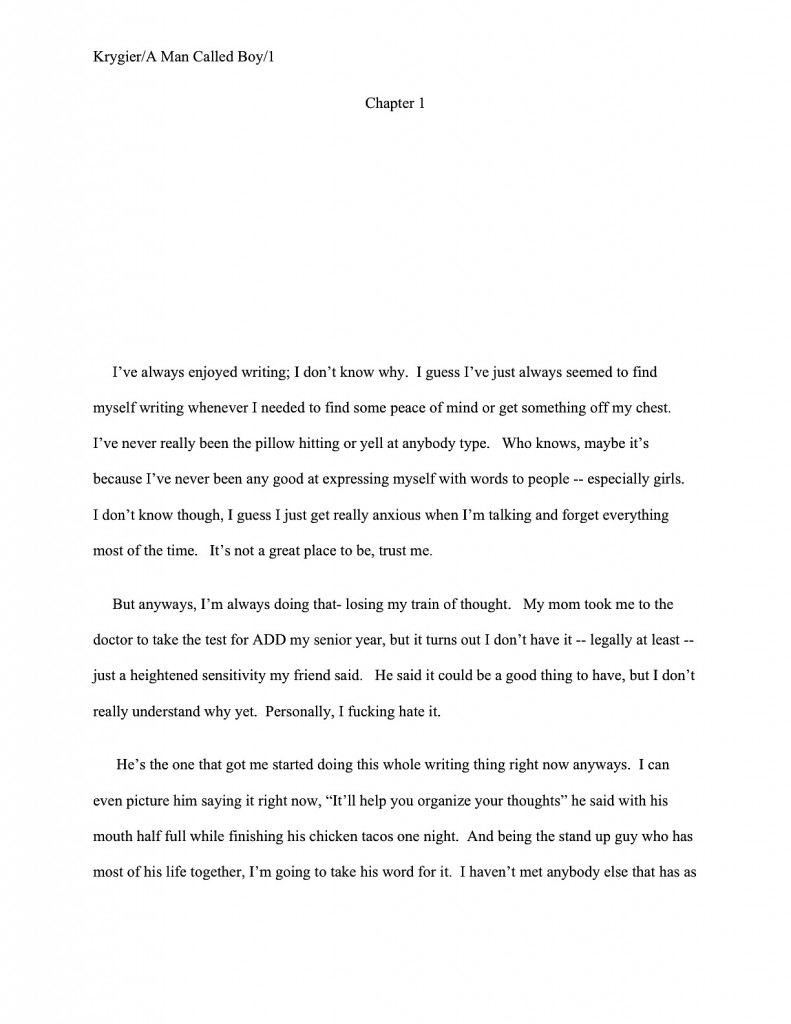
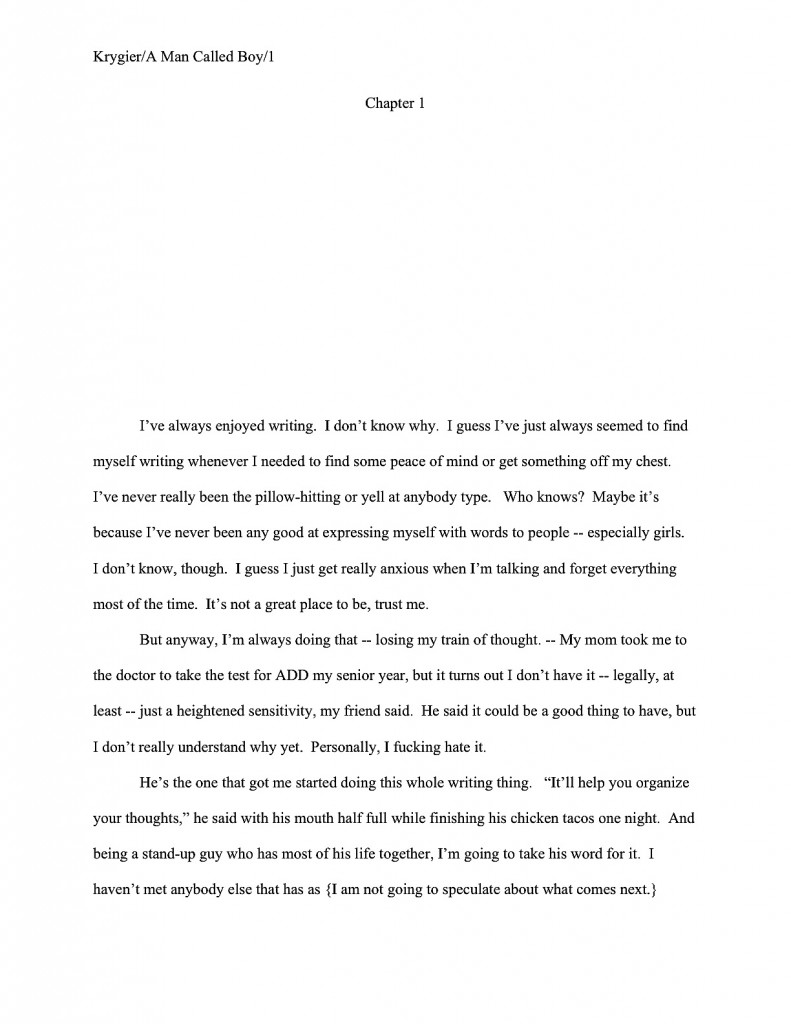
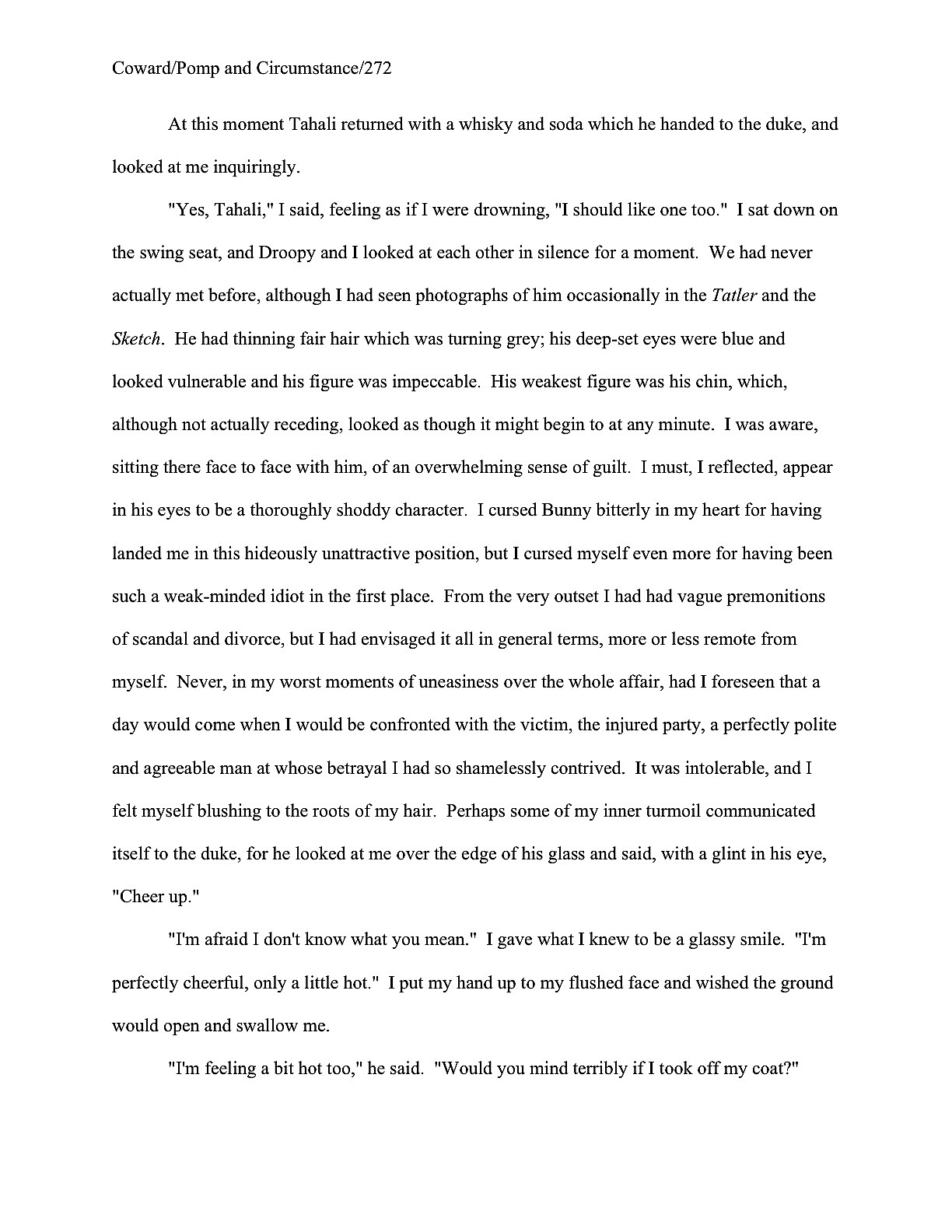
As it happens, quite well. Here is Jennifer’s first page, precisely as the judges saw it.
Lyng entry page 1

What do you think? More importantly for submission purposes, if you were Millicent and basing your decision whether to read on solely upon the descriptions above and this first page, would you? And if you were Millie’s boss, what conclusions would you leap to about (a), (b), and (c)?

The judges felt (and I concur) that this first page has a lot of promise — but not for the same reasons that a similarly-written novel opening might. Remember, the single biggest way in which fiction and nonfiction first pages are read differently is that it is ASSUMED that the nonfiction manuscript will be rewritten to the acquiring editor’s specifications. It is still to be written: the proposal is in essence the job application the writer submits to the publishing house in hopes of being paid to write it. A novel, on the other hand, is expected to be print-ready by the time the writer submits it to an agency.

Admittedly, agents often ask novelists for significant revisions after the representation contract is signed. So do editors, either before or after they acquire a manuscript. That may seem odd, given that they expect fiction to be polished to a high shine before they see it, but it makes abundant sense from a professional point of view: a writer who has the skills to perfect a submission, they reason, is the best candidate for making good revisions.

Part of the point of selling a memoir — or any nonfiction book, for that matter — via a book proposal, rather than a manuscript, is that the publisher will be able to tell the writer how it should be written. Although book proposals always include an annotated table of contents, it’s not at all unusual for an acquiring editor to ask for different chapters to appear in the finished book, for instance. It’s not even all that uncommon for the editor to request slight changes in authorial voice.

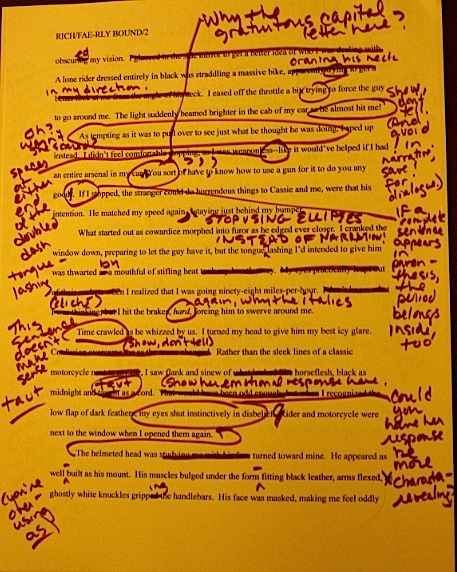
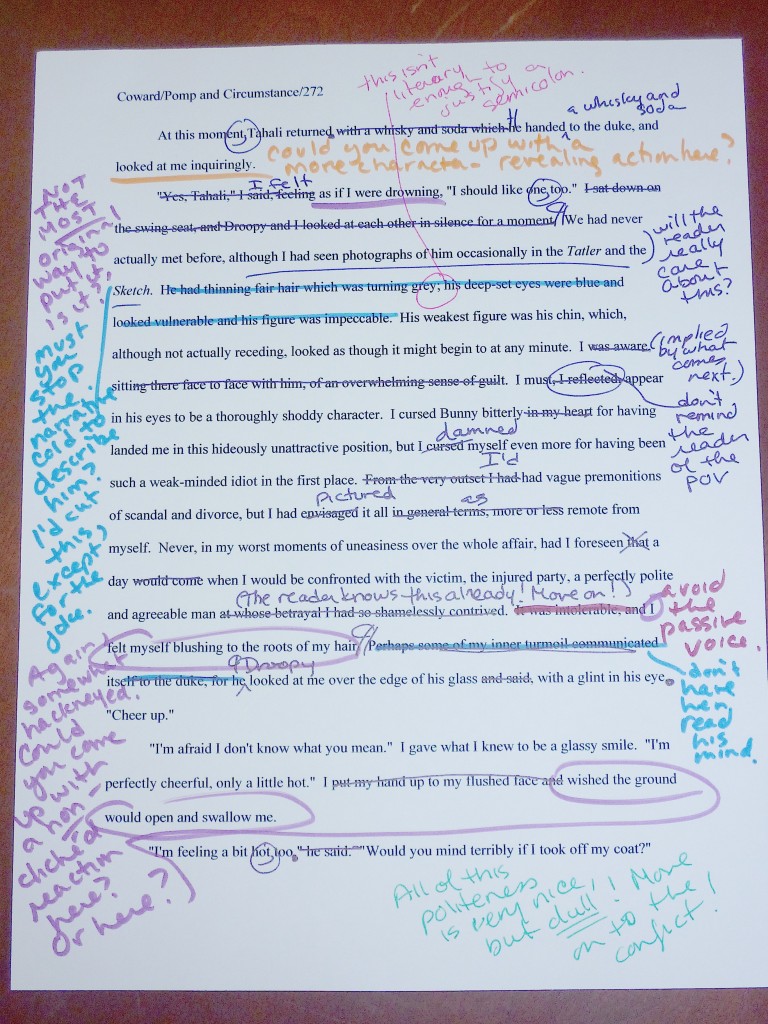
I mention all this in part because I suspect some of you novelists are going to be a smidge shocked when I show you how Millicent might respond to this first page on a sentence-by-sentence level. She’s expecting it to be revised between now and publication, so why not go to town on the feedback?
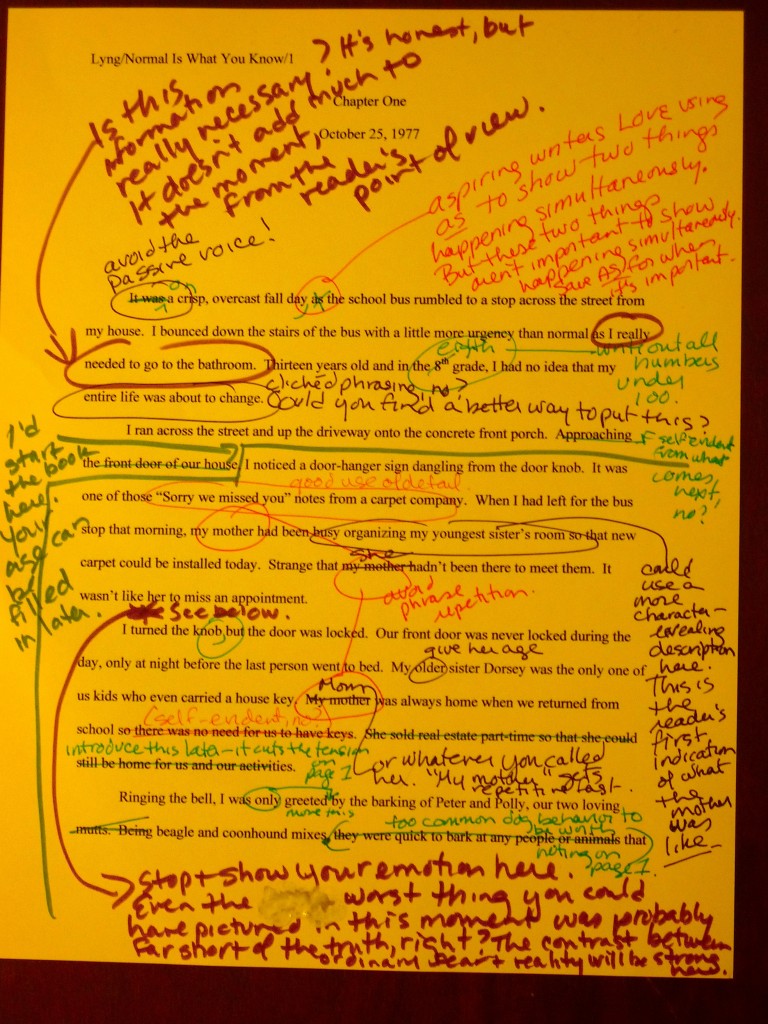
Lyng p 1 edited

(If you’re having a spot of trouble reading the comments, try enlarging the image by holding down the COMMAND key while pressing the + button. And no, I hadn’t realized that the light in this room was so very golden.)

Most of these points are pretty self-explanatory — beginning the page with the moment of dread, for instance, rather than showing a moment of normalcy first for contrast — but I want to take a minute to talk about the ones that turn up most often in memoir. I would have flagged the percussive repetition of my mother on any first page, but does anyone have a wild guess about why this redundancy is especially dangerous on the first page of a memoir?

Give up? It’s because virtually every first-time memoirist consistently refers to relatives as my mother, my father, my sister, and so forth, just as they would in a verbal anecdote. That’s fine in speech, but on the printed page, a constant reminder of characters’ relationship to the narrator quickly becomes tedious for the reader.

“What’s wrong,” Millicent fumes, “with referring to all of these people by NAME? They’re characters in a book, for heaven’s sake!”

That objection is relevant even in a case like this, where the single most likely name to replace the relationship marker is Mom. Believe it or not, simply changing two of the three my mothers to Mom would make most Millicents like it better.

The moral, should you not already have shouted it toward the sky: the little stuff matters. Especially on page 1.

It’s also both common and dangerous for a memoir to open with a sentence in the passive voice. As this one does: It was a crisp, overcast fall day… Any guesses why this simple statement of fact might raise Millicent’s hackles?

If you immediately cried, “Because it’s in the passive voice, by jingo!” give yourself a gold star for the day. As we have often discussed, the overwhelming majority of professional readers have been trained to regard the passive voice as poor writing. While that’s not quite fair — plenty of very good established authors use the passive voice all the time, after all — it is a belief worth noting.

In fact, I’m going to lay it down as an axiom: never, unless you are actually quoting someone else, use the passive voice on page 1 of a submission. And never, ever, EVER use it in the first sentence of a manuscript, or in the first sentence of any paragraph within the first few pages.

Why is the use of the passive voice more likely to make Millicent’s molars grind if they occupy those particular positions within the text? The first sentence of any paragraph is the one most likely to catch a skimmer’s eye. And if Millicent reads nothing else on page 1, she will take a gander at the first sentence.

The third common first memoir characteristic I’d like you to notice is much subtler than the first two: the emotional distance between the narrator and what is going on. On the first page of a memoir — and in memoir-writing in general — the more the reader can feel that he is observing the action from within the narrator’s body and psyche, the better.

Didn’t expect another axiom so soon, did you? Hey, I was on a roll.

Are some of you having trouble spotting the emotional distance, given how nicely Jennifer has set up the suspense here? A professional reader would appreciate the tangible sense that something awful is about to happen, but would note that while we’re seeing the narrator’s thoughts and reasoning in detail, the narrator is not telling us much about her own feelings, fears, or even physical sensations.

Yes, she mentions needing to go to the bathroom, but is that honestly the most character- or situation-revealing physical sensation the narrative could bring up here? At the risk of overloading this post with axioms, I would like to see this narrative be the protagonist’s head a bit less and in her body and emotions a bit more.

Jennifer’s in luck here: as she has presented this situation, it is particularly rich in opportunities for working in this kind of telling detail. The narrator could have a visceral reaction to the unexpected sensation of the doorknob fighting her hand, or to the sight of the “Sorry we missed you” sign. She could feel a rush of comfort when the dogs bark. Heck, she could even feel the cold coming through her jacket as she stood outside longer than she had expected.

Or — and this would be my first stop, revision-wise — the narrative could give us a peek at the most awful thing that 13-year-old could have imagined resulting in the door’s being locked. Given what the book description has led us to expect, the contrast between the normal fears of a kid and what is about to become her new reality would probably be quite poignant.

But you want to turn the page to find out, don’t you?

That, my friends, is the best possible evidence that a first page is a grabber — and yes, what constitutes a grabber does in fact often vary between fiction and nonfiction. Already, in just this page and her one-paragraph description for her query letter, Jennifer has made it clear that she has a fascinating story to tell, has the writerly tools to tell it well, and is ready to embrace the memoir-writing experience.

It’s as clear as (a), (b), (c), right? Congratulations on a job well done, Jennifer — the judges can’t wait to read the rest of the book.

In future posts, we shall continue apply what we’ve been learning all summer to the great first pages of more contest winners. (You did realize that’s what we’ve been doing, right?) Think of it as a master class in seeing submissions from Millicent’s perspective.

That noble effort will have to wait, however, until after Querypalooza — after so much craft, we’re all ready for a marketing weekend, right? Keep up the good work!

First pages that grab: Divided States, by 2010 Author! Author! Award for Expressive Excellence winner Jennifer Sinclair Johnson

Jsjohnsonphoto1

Yes, it’s been a lengthy process, campers, but today, at long last, I shall begin presenting you with the winning entries in the Author! Author!/WHISPER Great First Page Made Even Better Contest. For the rest of this week, I am delighted to be sharing with you the winning entries in Category II: Adult Fiction and Memoir.

And if you’re not careful, as the pundit Fat Albert used to say, you might learn something before it’s done.

Why start with Category II, you ask, instead of the more numerically logical Category I? Well, Phoebe Kitanidis, author of the HarperCollins’ new YA release, Whisper will be joining me after Labor Day to give feedback on the Category I: YA entries. We have some surprises in store that I hope will be worth another few days’ wait.

Let’s concentrate on the now, though, and Jennifer Sinclair Johnson’s winning first page, the opening to a manuscript she described for the judges thus:

What if Dorothy landed in Hollywood instead of Oz? DIVIDED STATES spins a new twist on Cozy Mysteries as a Midwestern insurance adjuster arrives, finding her coworker in earthquake rubble. Navigating natural disaster and local rules with more cracks than sun-baked Nebraska clay, she brings fresh perspective to light.

First off, kudos to Jennifer for winning not only the Grand Prize for Adult Fiction in the Author! Author!/WHISPER Great First Page Made Even Better Contest, but also this year’s Author! Author! Award for Expressive Excellence. For those of you who missed the initial contest announcement, I had decreed that the contest would have two levels: a straightforward competition for the most intriguing opening page for a manuscript, and an optional award level, if the judges felt that Grand Prize in the former was not sufficient to record their reactions to an entry.

I’m delighted to report that the judges required this extra outlet for their feelings not once, but four times in this contest. You shall see why in the days to come.

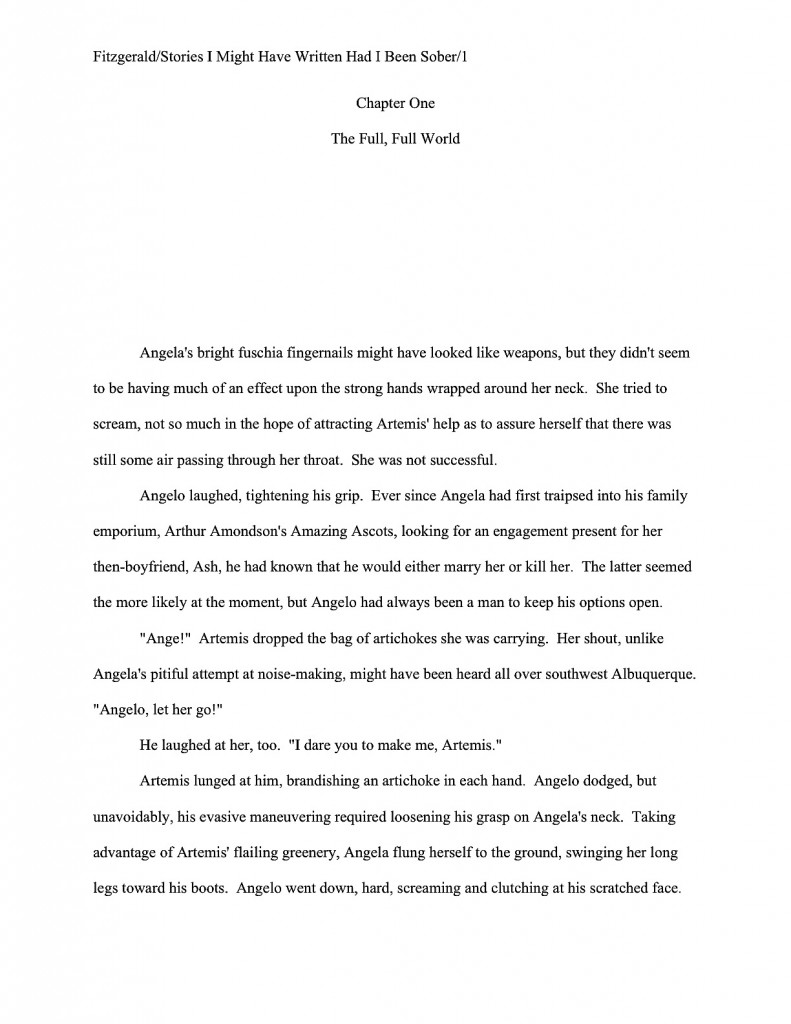
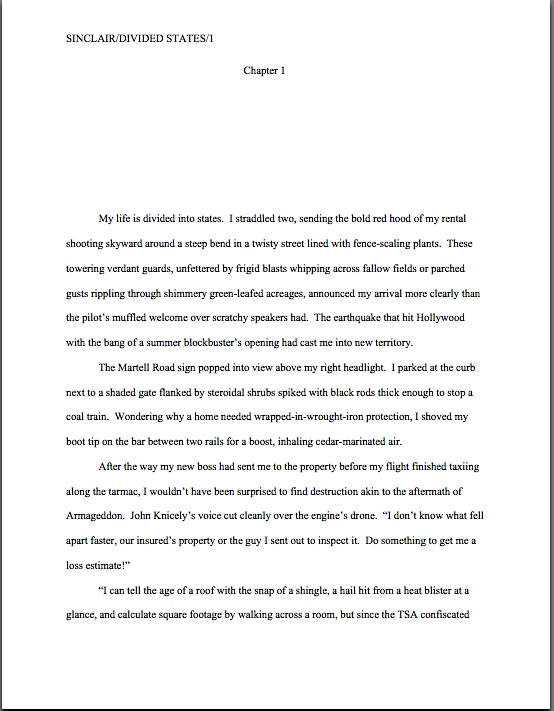
Jennifer’s was the Adult Fiction entry that elicited the more enthusiastic plaudits from the judges. Before I tell you why, let’s take a gander at what made them cheer until the rafters resounded. (If you are having trouble reading it, try holding down the COMMAND key while hitting +.)

Divided States page 1

The writing here is good, of course, crammed to the gills with telling details, but as we know from our summer of craft, there’s more to creating a great first page than collecting a series of strong, well-constructed sentences. In order to grab the reader — particularly a professional one like a contest judge or our old pal, Millicent the agency screener — a fiction first page needs to present the protagonist as an interesting person in an interesting situation.

Check. What else renders this first page so compelling?

If that question leaves you a trifle stumped, you’re not alone. Most aspiring writers know what they like, but have only a vague notion of what makes a first page compelling, marketable, accessible, and/or grabbing. There’s an excellent reason for that, of course: unlike professional readers, who read thousands upon thousands of page 1s in any given year, the overwhelming majority of aspiring writers have never read any manuscript’s first page but their own.

Or, at best, a writer friend’s. It’s not likely, in short, to be an impartial reading. While active members in a regularly-meeting critique group gain more exposure to the possible range of openings, participation in such groups is rarer than one might think.

But how is the isolated aspiring writer to learn what works on page 1? Typically, the average writer’s conception of what a good opening is comes from precisely the same source as any other readers’: what he’s seen in published books. As we have discussed, though, what an established writer can get away with on page 1 and what someone trying to break into the biz could slip past Millicent are often quite different things. Ditto with what might have caught an agent’s eye 5 or 10 years ago vs. now.

That’s why, in case you had been wondering, we have been spending so much time this summer concentrating on first page revision. I’ve been trying to move your conception of what makes a strong opening beyond a simple combination of what you like and what you have seen authors you respect do; all of these posts have been attempting to help you read more like a professional.

So let’s go ahead and turn to the pros for advice on how to assess today’s page 1. Specifically, let’s recall from last time the agent-generated list of qualities they like to see in a first page. How well do you think the example above meets these criteria?

1. A non-average character in a situation you wouldn’t expect.
Oh, do you see many stories about insurance adjusters newly transplanted to earthquake zones? Admittedly, it is not immediately apparent here whether our narrator is a man or a woman, but there isn’t much doubt that s/he is interesting, is there?

As we have discussed, as well as slice-of-life writing can work in short stories, plays, and novellas, it’s difficult to grab a novel reader — particularly a professional one like Millicent — on page 1 with a protagonist who is aggressively ordinary. A savvy writer is usually better off emphasizing what is unusual about his characters in an opening scene.

2. An action scene that felt like it was happening in real time.
This isn’t an action scene, so this one is not applicable. Remember, not all of these criteria will work for every opening.

3. The author made the point, then moved on.
In many first-person narratives, the self-analysis in page 1 would have extended for the rest of the page, if not beyond. Here, Jennifer has been quite restrained, moving the reader swiftly out of the protagonist’s head and into observation of the environment. That well-handled pacing will prevent Millicent from feeling that the story isn’t beginning fast enough.

4. The scene was emotionally engaging.
This lies largely in the eye of the beholder, of course. Perhaps a better way to approach this issue: based on this first page alone, do you want to read the rest of this book?

The judges did, unanimously. And if a quick scan of page 1 does not seem like an entirely fair basis for making a determination on an entire manuscript, bear in mind that Millicent often reads less than that before making up her mind.

5. The narrative voice is strong and easy to relate to.
Again, this is quite subjective, but the judges found this narrative voice quite likable. With a protagonist engaged in a work project on page 1, it would have been very easy to load the narrative voice down with industry-specific jargon. Jennifer has steered clear of that danger, offering us instead a narrator who seems swept up in the details of the beauty of her new environment.

The only sentence that gave any of the judges pause on a voice level was The earthquake that hit Hollywood with the bang of a summer blockbuster’s opening had cast me into new territory. Opinions were divided over whether using Hollywood and cast so close together was intended as a pun based on the double meaning of cast (to throw/to be given a part in a play or movie). Since the pun, if intentional, was not very funny, the judges expressed the hope that the word choice would be reexamined.

6. The suspense seemed inherent to the story, not just how it was told.
This is a subtle one. It’s clear that something is about to happen here, isn’t it? The reader isn’t sure what, but the suspense is palpable.

Again, some of the judges had a quibble with one of the sentences: After the way my new boss had sent me to the property before my flight finished taxiing along the tarmac, I wouldn’t have been surprised to find destruction akin to the aftermath of Armageddon. The ending image is strong, but the reader has to interpolate some action in order to make the first part make sense: since airline passengers are currently not allowed to use cell phones while the plane is in the air, and there’s no indication that the story is not taking place in the present, the narrator must have turned on her phone as soon as allowed, after the plane touched down.

So did her boss call her the second she powered up the phone? That would be the only way that the timing of his having issued the order could have conveyed urgency all by itself, but the narrative is in such a hurry (understandable, on a first page) that it leaves the reader to fill in the blanks.

Amid those blanks lies a logical question: how did he know that she had just turned it on? Is he psychic? Or — and this seems substantially more likely — had he been calling every five minutes since he thought her plane could possibly have landed? That in turn begs another question: did he call her, or did she turn on the phone, hear his 47 messages, and call him right away?

Yes, that is a whole lot of questions to have about a single event, now that you mention it. But that’s not an uncommon reaction to a page 1 where the narrative has left out logical steps in the interests of streamlining. Frankly, from a professional reader’s perspective, both that paragraph and that joke would have worked better if it hadn’t all been crammed into a single sentence.

That’s a small quibble, however, one likely too tiny to put off most Millicents. Even the judges who made it recognized that.

7. “Good opening line.”
Professional readers are notoriously fond of first sentences that contain some element of paradox. This opener does not disappoint.

8. ”There was something going on beyond just the surface action.”
Well? Did you think there was?

What is the benefit of presenting a layered reality over a completely straightforward one, when clarity is also so highly valuable on page 1? Simply put, a narrative that implies that there’s more going on that immediately meets the eye is a better reflector of reality. The protagonist appears to be inhabiting an actual world, rather than just a tale.

As fine as all of those criteria are for evaluating a first page, the judges in our contest were looking for a bit more. For instance, in a submission, as we have discussed, it’s vital to give some indication from the very top of page 1 what the book is about. Based on Jennifer’s opening, would you or would you not expect some intrigue to arise from the earthquake site her narrator’s boss is so eager to get her to see?

How did we judges know whether this was representative of the rest of the book? Advance thought, my dears: as some of you may perhaps recall, one of the contest requirements was a brief teaser, indicating the subject matter, book category, and what the manuscript to follow would add to the current offerings in that category. Here’s what Jennifer told us:

What if Dorothy landed in Hollywood instead of Oz? DIVIDED STATES spins a new twist on Cozy Mysteries as a Midwestern insurance adjuster arrives in Los Angeles to find her coworker lying unconscious in earthquake rubble. Navigating natural disaster and local rules with more cracks than sun-baked Nebraska clay, she brings fresh perspective to light.

Quite a close match with the opening, isn’t it? Millicent would appreciate that. So did the judges: all of them commented on how beautifully this page 1 fulfilled the promise Jennifer had made in the book’s description.

I can already sense literal-minded readers thinking about raising their hands. “But Anne,” these detail-oriented souls point out, “the protagonist doesn’t discover her coworker in the rubble on page 1, nor do we hear much about the differences between Nebraska and Los Angeles. So in what sense does her page 1 fulfill the promise of the description?”

Glad you asked, literal-minded ones; aspiring writers often confuse the imperative to let Millicent know right away what the book with an expectation that page 1 would be crammed with backstory. Usually, though, backstory-heavy openings are slow — your garden variety NYC-based Millie tends to prefer manuscripts that open with conflict (or at least the potential for it), with the backstory filled in later.

Jennifer’s page 1 contains several different species of conflict — we learn right away that her protagonist is a fish out of water, coming into an inherently dangerous situation with an already-tense boss breathing down her neck. Furthermore, it appears that the last person sent to do her job ran into some serious difficulties. That’s a pretty rich set of possibilities for a single page of text, no? But rather than stop the action short to explain what precisely happened to her predecessor that necessitated flying our heroine out from Nebraska, the reader gets to figure out the situation along with the narrator.

Thus, how this page fulfills the promise of the premise is not by resolving all of the questions it raises on page 1, but by (a) giving the protagonist hints about what the conflicts in store for her are and (b) doing so in a manner that allows the readers to speculate — yes, even by the bottom of page 1 — how she is going to be drawn into those conflicts-to-come.

Of course, as the organizer of this contest, I enjoy a considerable advantage in anticipating those conflicts. I had the power to ask for a longer description of the book:

Divided States description

The judges were also looking for page 1 to present a narrative voice appropriate to the intended target audience. Here, Jennifer is showing us a very literate, likable, thoughtful voice, appropriate for a high-end cozy mystery or women’s fiction.

Wisely, she has not designated this voice as literary fiction, as many aspiring writers would have done: it’s an excellent example of well-written genre fiction. Rather than trying to pitch the book on the writing alone, though, she has made the market-savvy choice of categorizing her manuscript by its subject matter.

The hyper-literal have raised their hands again, have they not? “But Anne, are you saying that the judges — or, even worse, Millicent — would have liked this page less had it been categorized as literary fiction? To my admittedly less experienced eye, the writing has literary sensibilities.”

In a word, yes. In several words, that’s to be expected, isn’t it?

Miscategorized submissions are, after all, among the easiest for Millicent to reject. As we have discussed many times before, no agent (or editor, or publishing house, or even most contests) handles every conceivable kind of writing. They specialize.

So when Millicent is confronted with even a very well-written submission that does not seem to fit comfortably into a book category that her boss represents, it just doesn’t make sense for her to keep reading once she’s determined it’s not something her agency is going to pick up. Even if she positively loves it, she is not in a position to help that book come to successful publication.

She has only one option, unfortunately: “Next!”

Starting to gain a better sense of what kind of first pages don’t provoke that response? If not, don’t despair — you’re going to get quite a bit of practice over the next week or two, as we continue to go over contest winner’s first pages. Except for the days during which we shall be taking a brief-but-content-heavy detour for Querypalooza, of course.

Lots of action in store at Author! Author! Tune in tomorrow for more first page high jinks.

Well done, Jennifer — and as always, everybody, keep up the good work!

Speaking of dialogue revision, part II: let’s revisit dialogue repetition…repetition…repetition…

broken-record

For those of you who haven’t joined us for a week or two, I’ve been busy spending my doctor-ordered take-it-easy-on-the-hands time by re-running a few older posts. Specifically, posts at least marginally related to the topic we were discussing when a car crash so rudely interrupted us: writing and revising dialogue so it rings true, adds to the story, and entertains the reader.

Or, to translate all that into the negative terms in which professional readers tend to critique work, so it doesn’t seem contrived, isn’t gratuitous, and prevents the reader from falling into the deep, refreshing slumber so often induced by dialogue ripped from real life.

To that end, I shall be repeating today the two tactics that worked so well (if I do say so myself) last time. First, I’m going to import material from that still most visited of my archival series, Seeing Submissions From the Other Side of the Desk, a lighthearted romp through dozens and dozens of reasons that our old pal, Millicent the agency screener, might feel compelled to reject a submission on page 1. Second, rather than re-run the dialogue-related posts in that series individually, I shall mash a couple together and add a bit more material, just to keep things interesting for those of you who were hanging around Author! Author! a year and a half ago.

So is it a re-run, if it is no precisely as it was the first time around? You tell me.

Enjoy!

As I may have mentioned before in this forum, Hollywood narration (dialogue wherein characters telling one another things they already know purely for the purpose of letting the reader know them, too) tends to annoy the dickens out of your garden-variety agency screener. Not merely because it is so common — and believe me, it is: TV and movie scripts abound with this sort of dialogue, which in turn influences both how people speak and what writers hear — but because it’s kind of an underhanded way of introducing backstory.

In a script, it’s understandable, as film has only sound and sight to tell a story. But a book has all kinds of narrative possibilities, right?

There was a sterling example of a VERY common subgenus of Hollywood narration read at the agents’ forum from which I derived the list of pet peeves we’ve been discussing. It was apparently a mystery that opened with the mother of a recently-recovered kidnap victim badgering the detective who was handling the case to find the kidnapper, pronto. My, but Mom was informative: within the course of roughly ten lines of back-and-forth dialogue, she filled in the detective on the entire background of the case.

Because, naturally, as the primary investigator, he would have no recollection of anything associated with it. (Maybe he was suffering from amnesia; having heard only the first page, I couldn’t tell you.) And, equally naturally, she insisted upon being brought in to collaborate on the investigation.

The agents on the panel tore it to pieces. Actually, the panelists’ reaction to this piece was fascinating, because every time one of them started to wind down his or her critique of it, another found yet more reason to object to it. Among the objections:

*The characters are telling one another things they already know.

*The opening scene was almost entirely dialogue, without giving the reader a sense of place or character.

*This scene has been in a LOT of books and movies. (Hey, blame Dashiell Hammett.)

*”I’ve never understood why third parties in mysteries always want to investigate the crimes themselves.” (I’m guessing that the agent who said this doesn’t represent a whole lot of cozy mysteries.)

*(After a slight lull in the bloodbath.) “If the kid is back safely after the kidnapping, why should we care?”

Brutal, eh, for less than a single page of dialogue? If you learn nothing else from this series, please take away this one thing: agency screeners virtually never cut any submission any slack. That opening page needs to SCREAM excellence.

So it would really behoove you to check your dialogue-based opening scenes very, very carefully to make sure that they are saying PRECISELY what you want them to say about you as a writer.

What can happen if an aspiring writer just assumes that what he’s got in mind is what Millicent will take away from the page? Well, let me put it this way: the writer who penned the opening I’ve just described– a gentle lady who had waited a year to be able to submit her opening page to this forum, I later learned — did not laugh along with the judges. She sat there, open-mouthed and blushing furiously, obviously stunned that anyone could read her innocent page 1 in such a manner.

Why did she feel so blindsided? Well, if I had to guess — and I do! I do! — it was probably because her opening gambit was one she had seen so often in the openings of TV shows, movies, and yes, even books.

Wait, where have I heard that before?

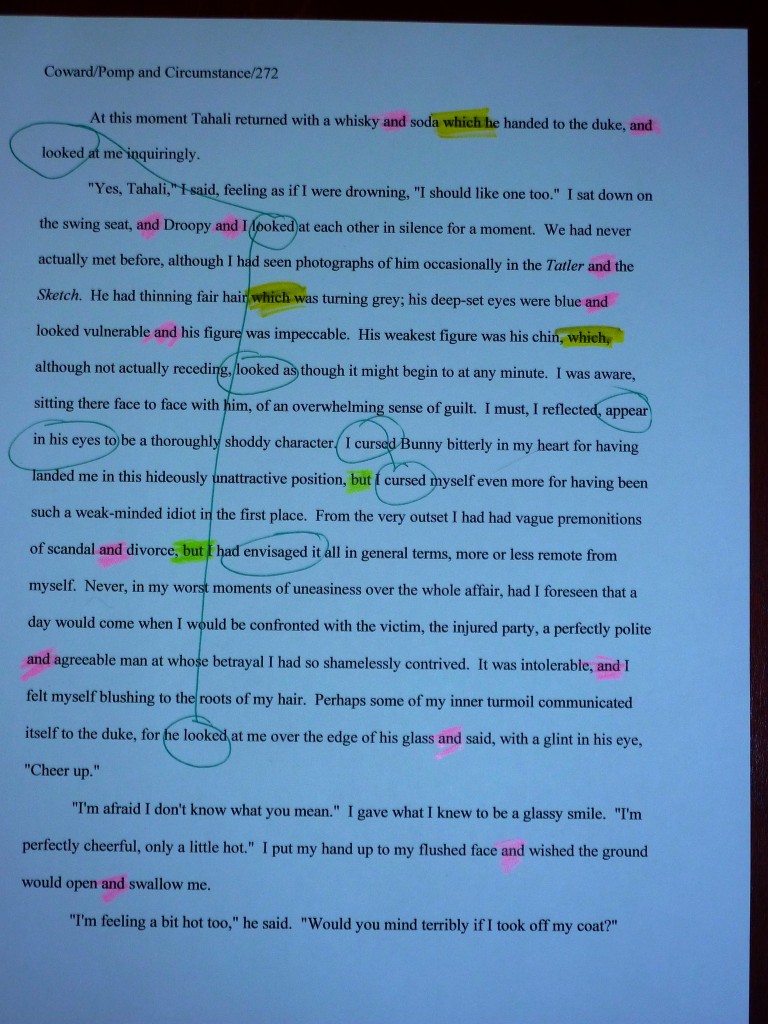
Seriously, this sub-species of Hollywood narration can be very hard for self-editors to catch. Take, for instance, the following example. (And if you can’t take it because the image is so small, try increasing the size by holding down the COMMAND key while pressing +.)

Hollywood narration2

While you were reading that little gem, did you think at least twice, Gee, is there a particular reason that the reader needs to be told all of this backstory on page 1? If so, congratulations: Millicent would have had the same thought. By the middle of paragraph 3.

But be honest now, campers: if you had encountered that page in a critique group yesterday, would you instantly have tapped its author on the shoulder and whispered, “Dear friend, what you have there is a classic example of Hollywood narration, and I implore you to reconsider opening your book in this manner?” Or would you simply have admired how quickly and economically the writer worked in all of that backstory?

The vast majority of aspiring writers would have opted for the latter. Just so you know, however, Millicent would appreciate it if the next time any of you should find yourself in this situation, you would start tapping some shoulders.

Why? Because she sees this sort of opening so very, very often. Which brings me to rejection reason #30: over-use of dialogue in the name of realism.

At the risk of dropping the needle on a broken record (have your grandparents explain that metaphor to you, children), real-life dialogue tends to be very repetitious, self-referential, and, frankly, not something that would tend to move a plot along. But in defense of realism, real-life dialogue seldom resembles Hollywood narration, either. If you’re in conversation with someone with whom you speak quite frequently, you will use shared metaphors that might not make sense to an outside observer, but you’re not very likely to be discussing anything crucial to the plot of your life over coffee with a coworker.

And even if you ARE, unlike a conversation in a book, where much matter can be compressed into a single exchange, there’s just not a whole lot of incentive in real life for the stakes to be high enough to settle major life decisions within just a couple of minutes’ worth of highly relevant dialogue. Nor are you likely to import lovely language or trenchant symbolism that enlightens the reader about the human condition. It’s not even all that likely to be entertaining to a third party.

It’s just talk, usually, something people do to lubricate relationships and fill time. I’m all for relationship-lubrication on the page, but time-filling can be deadly, especially on page 1 of a book. Move it along.

When talkers do fill one another in on personal backstory, it’s usually in the form of specific anecdotes (“When I was seventeen, I had just put on my favorite record when a condor flew into my bedroom…”) or personalized summaries of larger events (“I got married in the year the condors carried off my little brother…”), rather than in Hollywood narration-type generalities (“When I was young, condors were the number one municipal problem here in Ridgedale, the pleasant small town where you and I both grew up, Tony. Remember how often the black wings used to blot out the sun? Why, I was just reminding my wife, Martha, about how dark it was on our wedding day. Remember, dear? How you screamed as the black, black birds carried our ring bearer — my brother and your fishing buddy, Tony — off into the wild blue yonder…”

See the difference? If not, I’m sure Tony would be happy to go over your collective past with you a few more times.

Typically, at this juncture, I blithely suggest that writers enamored of the idea of reproducing dialogue precisely as it is heard in real life try a little experiment: sit in a crowded café for two hours, jotting down overheard conversations verbatim. Don’t fill in any logical gaps; reproduce it as is. Afterward, go home and type up those conversations as scenes, using ONLY the dialogue actually heard.

If you can complete the second part of that exercise without falling into a profound slumber, you either have an unusually high threshold for boredom or a great affection for the mundane. Either way, have you considered a career as an agency screener, where these traits would be positive boons?

It’s highly unlikely that you would be able to get the result of this exercise past Millicent, either as dialogue or as narrative. In professional writing, merely sounding REAL is not enough; a manuscript must also be entertaining.

So here’s a radical notion for all of you revisers out there: why don’t you edit your opening pages with an eye toward entertaining Millicent, as well as future readers, rather than using them merely as a medium for backstory?

I heard half of you groaning. Yes, oh groaners, your surmise is correct: I am indeed about to tell you that a savvy reviser should pay as much attention to word, phrase, and concept repetition in dialogue as in narrative paragraphs.

Yes, Virginia, even if your work happens to be literary fiction, if it’s book-length. Slice-of-life pieces can be quite effective IF they are short — but frankly, in my opinion, most of what goes on in the real world doesn’t rise to the standards of literature.

Far, far better to apply your unique worldview and scintillating ability with words to create something BETTER than reality, I say. The same goes for dialogue.

And yes, now that you mention it, that will mean a good deal more revision for most writers. Feel free to groan again.

Some of you are already reaching for your BUT PEOPLE REALLY TALK LIKE THAT! picket signs, aren’t you? That’s not too surprising. Many aspiring writers consciously strive for prose that echoes the kind of conversational rhythms and structures one hears every day, particularly when they are penning first-person or present-tense narratives. “I want it to sound real,” they say with engaging earnestness. “My goal is to hold, as ’twere, the mirror up to nature.”

Unfortunately, from Millicent’s perspective, most of these writers don’t realize just how widespread this particular goal is — or that much real-life conversation would be either deadly dull, logically incoherent, or at minimum not literarily interesting transferred directly to the printed page.

Why? Chant it with me now, long-time readers of this blog: because real-life speakers repeat both words and sentence structures to an extent that would make even the most patient reader rip her hair out at the roots in frustration.

If this sounds vaguely familiar, it’s probably because I spoke earlier in this series about how little Millicent appreciates repetition of any kind; I also rattled on a bit last time about how conceptually repetitious most real-life dialogue tends to be. But today, I want to talk about repetition on a smaller scale, within the actual writing.

As I have pointed out before, the single most common word appearing in submissions in every book category is and. Leaning on this multi-purpose word can lead to run-on sentences, dull action sequences, and contracting the bubonic plague.

Well, okay, perhaps not the last. But the results still aren’t pretty, from Millicent’s point of view.

You would not believe, for instance, just how often the sentence structure, X happened and Y happened turns up in dialogue. From a hold-the-mirror-up-to-nature point of view, that’s completely understandable, because it’s structure that speakers use all the time. Even when writers are constructing narrative rather than dialogue, they tend to find this structure appealing: like stringing together sentences beginning with conjunctions, it artificially creates the impression conversation-like flow, as in:

I woke up the next morning and poisoned my husband’s cornflakes.

See? Chatty, casual: the way your local poisoner is very likely to say it to her next-door neighbor, right? In a single sentence, it makes for a rather likable voice.

If this structure is used sparingly, it can work very well indeed — but as any professional reader who has been at it a while would be delighted to tell you, its advocates seldom seem to be able to restrain themselves. Let’s take a peek at several sentences of this type in a row, to see why it might annoy your garden-variety Millicent at the end of a long, hard day of rejection:

Esmeralda blanched and placed her lily-white hand upon her swiftly-beating heart. Rolando nodded with satisfaction and strode toward her, grinning. She grabbed a poker from next to the fire and glanced around for an escape. He chortled villainously and continued to move closer.

See what I mean? Although each of these sentences is in fact grammatically correct, and this structure reads as though it is merely echoing common spoken English, it’s also pretty much the least interesting way to present the two acts in each sentence: the and is, after all, simply replacing the period that could logically separate each of these actions.

By contrast, take a look at how varying the sentence structure and adding the odd gerund livens things up:

Esmeralda blanched, her lily-white hand clutching her swiftly-beating heart. Rolando strode toward her, grinning. She grabbed a poker from next to the fire and glanced around for an escape. He chortled villainously, moving closer every second.

Easier to read, isn’t it? Admittedly, the prose is still pretty purple — or at least flushing lilac — but at least the paragraph is no longer jumping up and down, screaming, “My author knows only one way to structure a sentence!”

Lest any of you just thought, “Well, all Millicent would have to do is read on to the next paragraph” (or next page, or next chapter) “to discover that I know a whole lot of ways to structure a sentence; I’m not going to worry about that,” may I remind you of one of the most startling truths divulged in this series, that most manuscripts get rejected on page 1? If the opening paragraphs of a submission are structurally repetitious, how likely is it that she’s going to keep reading to find out if the writer shakes things up a little later on?

The sad fact is, most agents, editors, and contest judges would not, alas, at least while perusing a manuscript by an author with whom they do not already enjoy a professional relationship. They tend to have a very low tolerance for over-use of this particular sentence structure.

Seriously. I’ve seen pens poked through manuscripts at the third instance of an X happened and Y happenedsentence within half a page. (See why I felt this issue was important enough to interrupt our review of the Idol list to cover?) At minimum, it would be very much in your submission’s best interest to ferret out over-use of the word and.

So while you are going over your first page with a fine-toothed comb in the wake of this series anyway, why not identify and considering reworking ANY sentence in which and appears more than once? Chances are high that such a sentence will be a run-on, in any case:

In evading the police, Zelda ran down the Metro stairs and out onto the platform and into the nearest train.

This is a classic run-on: too much information crammed into a single sentence, facilitated by those pesky conjunctions. Yes, people actually do say things like this in real life, but how much do you think the realism of this sentence is going to help its author get a manuscript past Millicent?

Uh-huh. Good writing matters in dialogue every bit as much as in narration. It’s merely harder to make sound realistic.

Some writers, of course, elect to include run-on sentences deliberately in their work, for specific effect: to make the narrator sound less literate, for instance, or more childlike, or to emphasize the length of a list of actions the protagonist has to take to achieve a goal. Or sometimes, the point is to increase the comic value of a scene by the speed with which it is described, as in this excerpt from Stella Gibbons’ classic comedy, COLD COMFORT FARM:

He had told Flora all about his slim, expensive mistress, Lily, who made boring scenes and took up the time and energy which he would much sooner have spent with his wife, but he had to have Lily, because in Beverly Hills, if you did not have a mistress, people thought you were rather queer, and if, on the other hand, you spend all your time with your wife, and were quite firm about it, and said that you liked your wife, and, anyway, why the hell shouldn’t you, the papers came out with repulsive articles headed “Hollywood Czar’s Domestic Bliss,” and you had to supply them with pictures of your wife pouring your morning chocolate and watering the ferns.

So there was no way out of it, Mr. Neck said.

Quite the sentence, eh? (Not the second, silly — the first.)

I’m going to part company with pretty much every other editor in the world for a moment and say that I think that a writer can get away with this sort of run-on every once in a while, under three very strict conditions — and no, none of them is optional to observe:

(1) IF it serves a very specific narrative purpose that could not be achieved in any other manner (in this example, to convey the impression that Mr. Neck is in the habit of launching into such diatribes on intimate topics with relative strangers at the drop of the proverbial hat),

(2) IF it achieves that purpose entirely successfully (not a foregone conclusion, by any means), AND

(3) IF the writer chooses to do this at a crucial point in the manuscript, s/he doesn’t use it elsewhere — or at least reserves the repetition of this choice for those few instances where it will have the greatest effect.

Why minimize it elsewhere? Well, as we have seen above, this device tends to create run-on sentences with and…and…and constructions, technically grammatical no-nos. YOU may be doing it deliberately, but as with any grammatical rule, many writers who do not share your acumen with language include them accidentally.

Let me ask you this: how is a speed-reading agency screener to tell the difference between a literate submitter pushing a grammatical boundary on purpose and some under-read yahoo who simply doesn’t know that run-ons are incorrect?

Usually, by noticing whether the device appears only infrequently, which implies deliberate use, or every few lines, which implies an ingrained writing habit.

I’ve sensed disgruntled rumblings out there since I mentioned point #3. “But Anne,” I hear some of you protest, “I read a great deal, and I see published literary fiction authors break this rule all the time. Doesn’t that mean that the language has changed, and people like you who go on and on about the rules of grammar are just fuddy-duddies who will be first up against the wall come the literary revolution?”

Whoa there, disgruntled rumblers — as I believe I have pointed out before, I invented neither the rules of grammar nor the norms of submission evaluation. If I had, every agency and publishing house would post a clear, well-explained list of standard format restrictions on its website, along with explanations of any personal reading preferences and pet peeves its staff might happen to be harboring. Millicent would be a well-paid, under-worked reader who could spend all the time she wanted with any given submission in order to give it a full and thoughtful reading, and the government would issue delightful little checks to compensate writers for all of the time they must now spend marketing their own work.

Clearly, then, these matters are not under my personal control, so kindly take me off your literary hit lists.

Even in literary fiction, it’s rather dangerous to include grammatically incorrect sentences in a submission. To someone who hasn’t read more of your work than the first few pages of your manuscript, it’s impossible to tell whether you are breaking the normal rules of grammar in order to create a specific effect, or because you just don’t know the rule. If an agency screener concludes that it’s the latter, she’s going to reject the manuscript, almost invariably.

Thus, unless you are getting a valuable effect out of a foray into the ungrammatical, it’s best to save your few opportunities to do so intentionally for when it serves you best. At the very least, make sure that two such sentences NEVER appear back-to-back, to avoid your submission’s coming across as the work of — gasp! — a habitual runner-on.

Sometimes repeated ands work rhythmically, but to an agent or editor, a manuscript that employs X happened and Y happened as its default sentence structure it just starts to read like uncomplicated writing — which makes it less appealing to the pros.

The other common conclusion trained eyes often draw from over-use of this technique smacks of the narrative’s trying to rush through an otherwise not very interesting series of events — which, if you’ve been paying attention throughout this series, should automatically make you cringe at the idea of boring Millicent.

And honestly, is a statement like Georgette ran down the stairs and out the station door, then she made a sharp left at the corner, proceeded a hundred yards past the fruit and flower stands, now at four o’clock sadly depleted, and dashed to the waiting taxi worth the risk?

This kind of dismissive reading is not always a fair assessment of an and-ridden text, of course. But when you do find patches of ands in your text, step back and ask yourself honestly: “Do I really NEED to tell the reader this so tersely — or all within a single sentence? Or, indeed, at all?”

“Perhaps,” (you’re still speaking to yourself here, in case you were wondering, despite the fact that most Millicents find soliloquizing protagonists a touch annoying) “I could find a way that I could make the telling more interesting by adding more detail? I notice by reading back over the relevant paragraphs that my X happened and Y happened sentences tend to be light on telling specifics.”

My, you’re starting to think like Millicent. Do keep it up.

Since your revision eye is getting so sophisticated, let’s consider the opposite possibility: in paragraphs where ands abound (or, sacre bleu, sentences!), are you rushing through the action of the scene too quickly for the reader to enjoy it? Are some of those overloaded sentences cramming four or five genuinely exciting actions together — and don’t some of these actions deserve their own sentences?

Or, to put it a bit more bluntly, is the repeated use of and in fact your manuscript’s way of saying COME BACK AND FLESH THIS OUT LATER?

C’mon, admit it — almost every writer has resorted to this device at the end of a long writing day, haven’t we? Or when we have a necessary-but-dull piece of business that we want to gloss over in a hurry? Or did you think you were the only writer in the history of the world who did this?

Don’t be so hard on yourself — writers do this all the time. When the point is just to get lines down on a page — or to get a storyline down before the inspiration fades — X happened and Y happened and Z happened is arguably the quickest way to do it.

It’s a perfectly acceptable time-saving strategy for a first draft — as long as you remember to go back later and vary the sentence structure. Oh, and to make sure that you’re showing in that passage, not telling.

When we forget to rework these flash-written paragraphs, the results may be a bit grim. Relying heavily on the and construction tends to flatten the highs and lows of a story: within them, actions come across as parts of a list, rather than as a sequence in which all the parts are important.

Which — you guessed it — encourages the reader to gloss over them quickly, under the mistaken impression that these events are being presented in list form because they are necessary to the plot, but none is interesting enough to sustain an entire sentence.

Which is not exactly the response you want your sentences to evoke from Millicent, right?

When in doubt, revise to minimize the ands. I hate to come down unfairly on any grammatically correct sentence, but the fact is, the X happened and Y happened structure is just not considered very literary in the business. So the automatic assumption if it shows up too much is that the material covered by it is to be read for content, rather than beauty of prose.

To quote Millicent’s real-life dialogue: “Next!”

I would prefer to see your submissions getting long, luxurious readings, on the whole, not getting knocked out of consideration over technicalities. I’m funny that way. Keep up the good work!

The scourge of the passive interviewer, part V: push-polling the reader, and other tell-tale signs that you’ve slipped into Hollywood narration

Aspiring writer on the job, keeping the metropolis safe from Hollywood Narration

Aspiring writer on the job, making the world safe from Hollywood Narration

Hello again, campers —

I’m hoping to get back to generating brand-new posts sometime next week; the hand doc turned pale at hearing how often and how much I usually post, but I entertain high hopes of his getting over the shock soon. In the meantime, I am re-running some older posts on constructing effective interview scenes, to keep those revision gears chugging in everybody’s brains. Just so those of you who read it the first time around won’t be too bored, I reserve the right to interpolate comments or make small changes from time to time — or, in this case, add huge, honking sub-sections — but for the most part, I shall be husbanding by hand strength by posting these pretty much as is.

Before anyone decides the result is unlikely to be relevant to the types of manuscript revision we have been discussing, the interview scene is one of the most frequently-muffed types of dialogue; unfortunately, it’s also among the most common, period. Interview scenes, for the benefit of those of you joining us late in this conversation, are spates of dialogue where one character (usually the protagonist) is trying to extract information (the pursuit of which is often the driving force behind the plot) from another character (sometimes, but not always, historically reluctant to spill.)

In discussing interview scenes, we’ve also talked quite a bit about Hollywood narration, my term for a scene where Character 1 tells Character 2 a bit of information or backstory of which both 1 & 2 are already aware, purely so the reader may learn it. Yet Hollywood narration is not the only questionable tool writers sometimes use to shovel heaping piles of extraneous facts into a narrative.

Today, I shall discuss a few others. Enjoy!

You know how I keep saying that real life perpetually volunteers examples at just the point I could really, really use them on the blog? Well, it’s happened again: I was actually writing yesterday’s post on Hollywood Narration and how annoying a poor interviewer character can be, when the phone rang: it was a pre-recorded, computerized political opinion poll.

Now, I don’t find polls much fun to take, but since I used to do quite a bit of political writing, I know that the mere fact that the polled so often hang up on such calls can skew the accuracy of the results. Case in point: the number of percentage points by which most polls miscalled the last presidential election’s results.

So I stayed on the line, despite the graininess of the computer-generated voice, so poorly rendered that I occasionally had trouble making out even proper names. A minute or so in, the grating narrator began retailing the respective virtues and aspirations of only two candidates in a multi-player mayoral race — neither of the candidates so lauded was the current mayor, I couldn’t help but notice — asking me to evaluate the two without reference to any other candidate.

In politics, this is called a push poll: although ostensibly, its goal is to gather information from those it calls, its primary point is to convey information to them, both as advertisement and to see if responders’ answers change after being fed certain pieces of information. In this poll, for instance, the inhumanly blurred voice first inquired which of nine candidates I was planning to honor with my vote (“I haven’t made up my mind yet because the primary is a month and a half away” was not an available option, although “no opinion” was ), then heaped me with several paragraphs of information about Candidate One, a scant paragraph about Candidate Two, before asking me which of the two I intended to support.

Guess which they wanted my answer to be?

Contrary to popular opinion, although push polls are usually used to disseminate harmful information about an opponent (through cleverly-constructed questions like, “Would you be more or less likely to vote for Candidate X if you knew that he secretly belonged to a cult that regularly sacrifices goats, chickens, and the odd goldfish?”), the accuracy of the information conveyed is not the defining factor, but the fact of masking advertisement under the guise of asking questions, In a well-designed push poll, it’s hard to tell which candidates or issues are being promoted, conveying the illusion of being even-handed, to preserve the impression of being an impartial poll.

Yesterday’s call, however, left no doubt whatsoever as to which local candidates had commissioned it: the list of a local city councilwoman’s attributes took almost twice as long for the robot voice to utter, at a level of clarity that made the other candidates’ briefer, purely factual blurb sound, well, distinctly inferior. Even his name was pronounced less distinctly. To anyone even vaguely familiar with how polls are constructed, it was completely obvious that the questions had, at best, been constructed to maximize the probability of certain responses, something that legitimate pollsters take wincing pains to avoid, as well as to cajole innocent phone-answerers into listening to an endorsement for a political candidate.

To be blunt, I haven’t heard such obvious plugging since the last time I attended a party at a literary conference, when an agent leaned over me in a hot tub to pitch a client’s book at the editor floating next to me. In fact, it’s the only push poll I’ve ever encountered that actually made me change my mind about voting for a candidate that I formerly respected.

{Present-day Anne here: FYI, she lost.}

Why am I telling you fine people about this at all, since I seldom write here on political issues and I haven’t mentioned who the commissioning candidate was ? (And I’m not going to — the pushed candidate is someone who has done some pretty good things for the city in the past, and is furthermore reputed to be a holy terror to those who cross her — although something tells me it may crop up when I share this story with my neighbors at the July 4th potluck. Unlike the polling firm, I’m not out to affect the outcome of the election.)

I’m bringing it up because of what writers can learn from this handily-timed phone call. True, we could glean from it that, obviously, far too much of my education was devoted to learning about how statistics are generated. A savvy interpreter might also conclude that cutting campaign expenditures by hiring polling firms that use badly-faked human voices is penny-wise and pound-foolish.

But most vital to our ongoing series, in an interview scene, it’s important to make it clear who is the information-solicitor and who the information-revealer.

If the interviewer’s biases are heavy-handedly applied, he/she/the computer-generated voice appears to be trying to influence the content of the answers by how the questions are phrased. (As pretty much all political poll questions are designed to do; sorry to shatter anyone’s illusions on the subject, but I’ve written them in the past.) While a pushy interviewer can make for an interesting scene if the interviewee resists his/her/its ostensibly subtle blandishments, the reader may well side against a protagonist who interviews like a push-poller.

The moral of the story: impartial questions are actually rather rare in real life. When constructing an interview scene, it’s vital to be aware of that — and how much interviewees tend to resent being push-polled, if they realize that’s what’s happening.

Got all that? Good. Because the plot is about to thicken in an even more instructive way. Let us return to our story of civic communicative ineptitude, already in progress.

Being a good citizen, as well as having more than a passing familiarity with how much a poorly-executed campaign ad (which this poll effectively was) can harm an otherwise praiseworthy candidate, I took the time out of my busy schedule to drop the campaign manager an e-mail. I felt pretty virtuous for doing this: I was probably not the only potential voter annoyed by the pseudo-poll, but I was probably the only one who would actually contact the campaign to say why.

You know me; I’m all about generating useful feedback.

So I sent it off and thought no more about it — until this morning, when the campaign manager sent me the following e-mailed reply:

Dear Dr. Mini,

Thank you for your comments. We appreciate the feedback on any of our voter contact and outreach efforts. In everything we do, we want to make the best and most professional impression. You are right that automated surveys are cost competitive {sic}. In this situation, the need for feedback from voters was important {sic} and we hope that almost everyone was able to hear the questions clearly.

I have included the following link to an article on what push polling is {sic} (address omitted, but here’s the relevant link). I assure you that our campaign does not and will not ever be involved in push polling.

Thank you for supporting (his candidate) for Mayor {sic}.

At first glance, this appears to be a fairly polite, if poorly punctuated, response, doesn’t it? He acknowledged the fact that I had taken the time to communicate my critique, gave a justification (albeit an indirect one) for having used computerized polling, and reassured an anxious potential voter that his candidate’s policy was to eschew a practice that I had informed him I found offensive.

On a second read, he’s saying that he’s not even going to check in with the pollsters to see if my objections were valid, since obviously I am stone-deaf and have no idea what push polling is. Oh, and since push polling is bad, and his candidate is not bad, therefore no polls commissioned on her behalf could possibly be push polling. Thank you.

In short: vote for my candidate anyway, so I may head up the future mayor’s staff. But otherwise, go away, and you shouldn’t have bugged me in the first place.

To add stupidity icing to the cake of insolence, the article to which he referred me for enlightenment on how I had misdefined push polling confirmed my use of the term, not his: “A call made for the purposes of disseminating information under the guise of survey is still a fraud – and thus still a ‘push poll’ – even if the facts of the ‘questions’ are technically true or defensible.”

Wondering again why I’m sharing this sordid little episode with you? Well, first, to discourage any of you from making the boneheaded mistake of not bothering to read an article before forwarding the link to somebody. An attempt to pull intellectual rank is never so apparent as when if falls flat on its face.

Second, see how beautifully his resentment that I had brought up the issue at all shines through what is ostensibly a curt business letter, one that he probably thought was restrained and professional when he hit the SEND key? If any of you is ever tempted to respond by e-mail, letter, or phone to a rejection from an agent or editor, this is precisely why you should dismiss the idea immediately as self-destructive: when even very good writers are angry, they tend not to be the best judges of the tone of their own work.

And when a writer is less talented…well, you see the result above.

Another reason you should force yourself not to hit SEND: such follow-ups are considered both rude and a waste of time by virtually everyone in the industry. (For a fuller explanation why, please see my earlier post on the subject.) Like a campaign manager’s telling an offended voter that her concerns are irrelevant for semantic reasons, it’s just not a strategy that’s at all likely to convince your rejecter that his earlier opinion of you was mistaken.

Trust me: I’ve been on every conceivable side of this one. Just hold your peace — unless, of course, you would like the recipient of your missive to do precisely what I’ve done here, tell everyone within shouting distance precisely what happened when you didn’t observe the standing norms of professionalism and courtesy.

Yes, it happens. As you see, the anecdote can be made very funny.

Okay, back to the business at hand. Last time, I sensed some of you writers of first-person narratives cringing at the prospect of minimizing the occurrence of Hollywood narration in your manuscripts.

Oh, don’t deny it: at least 10% of you novelists, and close to 100% of memoir-writers — read through my excoriation of Hollywood narration and thought, “Oh, no — my narrator is CONSTANTLY updating the reader on what’s going on, what has gone on, other characters’ motivations, and the like. I thought that was okay, because I hear that done in movies all the time. But if Hollywood narration on the printed page is one of Millicent the agency screener’s numerous pet peeves, I’d better weed out anything in my manuscript that sounds remotely like screenplay dialogue, and pronto! But where should I begin? HELP!”

Okay, take a deep breath: I’m not saying that every piece of movie-type dialogue is a red flag if it appears in a manuscript. What I’ve been arguing is that including implausible movie-type dialogue can be fatal to a manuscript’s chances.

Remember, in defining Hollywood narration, I’m not talking about when voice-overs are added to movies out of fear that the audience might not be able to follow the plot otherwise — although, having been angry since 1982 about that ridiculous voice-over tacked onto BLADE RUNNER, I’m certainly not about to forgive its producers now. (If you’ve never seen either of the released versions of the director’s cut, knock over anybody you have to at the video store to grab it from the shelf. It’s immeasurably better — and much closer to the rough cut that Philip K. Dick saw himself before he died. Trust me on this one.)

No, I’m talking about where characters suddenly start talking about their background information, for no apparent reason other than that the plot or character development requires that the audience learn about the past. If you have ever seen any of the many films of Steven Spielberg, you must know what I mean. Time and time again, his movies stop cold so some crusty old-timer, sympathetic matron, or Richard Dreyfus can do a little expository spouting of backstory.

You can always tell who the editors in the audience are at a screening of a Spielberg film, by the way; we’re the ones hunched over in our seats, muttering, “Show, don’t tell. Show, don’t tell!” like demented fiends.

I probably shouldn’t pick on Spielberg (but then, speaking of films based on my friend Philip’s work, have I ever forgiven him for changing the ending of MINORITY REPORT?), because this technique is so common in films and television that it’s downright hackneyed. Sometimes, there’s even a character whose sole function in the plot is to be a sort of dictionary of historical information.

For my nickel, the greatest example of this by far was the Arthur Dietrich character on the old BARNEY MILLER television show. Dietrich was a humanoid NEW YORK TIMES, PSYCHOLOGY TODAY, SCIENTIFIC AMERICAN, and KNOW YOUR CONSTITUTION rolled up into one. (He also, several episodes suggested, had a passing familiarity with the KAMA SUTRA as well — but hey, it was the ‘70s.) Whenever anything needed explaining, up popped Dietrich, armed with the facts: the more obscure the better.

The best thing about the Dietrich device is that the show’s writers used it very self-consciously as a device, rather than pretending that it wasn’t. The other characters relied upon Dietrich’s knowledge to save them research time, but visibly resented it as well. After a season or so, the writers started using the pause where the other characters realize that they should ask Dietrich to regurgitate as a comic moment.

(From a fledgling writer’s perspective, though, the best thing about the show in general was the Ron Harris character, an aspiring writer stuck in a day job he both hates and enjoys while he’s waiting for his book to hit the big time. Even when I was in junior high school, I identified with Harris.)

Unfortunately, human encyclopedia characters are seldom handled this well, nor is conveying information through dialogue. Still, as we discussed yesterday, most of us have become accustomed to it, so people who point it out seem sort of like the kid in THE EMPEROR’S NEW CLOTHES:

”Why has Mr. Spielberg stopped the action to let that man talk for three solid minutes about backstory, Mommy?”

”Hush, child. There’s nothing odd about that. In film, it’s an accepted narrative convention.”

In a book, there’s plenty odd about that, and professional readers are not slow to point it out. It may seem strange that prose stylists would be more responsible than screenwriters for reproducing conversations as they might plausibly be spoken, but as I keep pointing out, I don’t run the universe.

I can’t make screenwriters –or political operatives — do as I wish; I have accepted that, and have moved on.

However, as a writer and editor, I can occasionally make the emperor put some clothes on, if only for the novelty of it. And I don’t know if you noticed, but wasn’t it far more effective for me to allow the campaign manager to hang himself with his own words, allowing the reader to draw her own conclusions about his communication skills and tact levels before I gave my narrative opinion of them, rather than the other way around? Trick o’ the trade.

Trust me, when Millicent is pondering submissions, you want your manuscript to fall into the novelty category, not the far more common reads-like-a-movie-script pile. Which, as often as not, also serves as the rejection pile.

No, I’m not kidding about that. By and large, agents, editors, and contest judges share this preference for seeing their regents garbed — so much so that the vast majority of Millicents are trained simply to stop reading a submission when it breaks out into Hollywood narration. In fact, it’s such a pervasive professional reader’s pet peeve that I have actually heard professional readers quote Hollywood narration found in a submitted manuscript aloud, much to the disgusted delight of their confreres.

Funny to observe? Oh, my, yes — unless you happen to be the aspiring writer who submitted that dialogue.

What may we learn from this degrading spectacle? At minimum, that if your characters tell one another things they already know is not going to win your manuscript any friends. There’s a lesson about bad laughter to be learned here as well: if a device is over-used in submissions — as Hollywood narration undoubtedly is — using it too broadly or too often in a manuscript can in and of itself provoke a bad laugh from a pro.

And that, too, is bad, at least for your manuscript’s prospects of making it past Millicent. As a general rule of thumb, one bad laugh is enough to get a submission rejected.

This danger looms particularly heavily over first-person narratives, especially ones that aspire to a funny voice. All too often, first-person narratives will rely upon the kind of humor that works when spoken — the anecdotal kind, the kind so frequently used in onscreen Hollywood narration — not realizing that pretty much by definition, a spoken joke does not contain sufficient detail to be funny on the printed page.

Especially on a printed page where the narrator is simultaneously trying to sound as if he’s engaging the reader in everyday conversation and provide the necessary backstory for the reader to follow what’s going on. Think, for instance, of the stereotypical voice-over in a film noir:

Someone kicked my office door down, and this blonde walked in on legs that could have stretched from here to Frisco and back twice, given the proper incentive. She looked like a lady it wouldn’t be hard to incite.

Now, that would be funny spoken aloud, wouldn’t it? On the page, though, the reader would expect more than just a visual description — or at any rate, a more complex one.

Present-day Anne breaking in again here, feeling compelled to point out two things. First, people from San Francisco have historically hated it when others refer to it as Frisco, by the way. It’s safe to assume that Millicent from there will, too.

Second, and more important for revision purposes, memoirs fall into this trap ALL THE TIME — and it’s as fatal a practice in a book proposal or contest entry as it is in a manuscript. It may be counterintuitive that an anecdote that’s been knocking ‘em dead for years at cocktail parties might not be funny — or poignant, for that matter — when the same speech is reproduced verbatim on the page, but I assure you that such is the case.

The result? Any Millicent working for a memoir-representing agent spends days on end scanning submissions that read like this:

So there I was, listening to my boss go on and on about his fishing vacation, when I notice that he’s got a hand-tied fly stuck in his hair. I’m afraid to swipe my hand at it, because I might end up with a hook in my thumb, and besides, Thom hadn’t drawn breath for fifteen minutes; if the room had been on fire, he wouldn’t want to be disturbed.

The fly keeps bobbing up and down. I keep swishing my bangs out of my eyes, hoping he will start to copy me. Then he absent-mindedly started to shove his hair out of his eyes — and rammed his pinkie finger straight into the fly. That’s a fish story he’ll be telling for years!

Did those paragraphs make your hands grope unconsciously for highlighting pens and correction fluid? After all of our discussion of Frankenstein manuscripts and how to revise them, I sincerely hope so. Like so many verbal anecdotes, this little gem wanders back and forth between the past and present tenses, contains run-on sentences, and is light on vivid detail.

For our purposes today, however, what I want you to notice is how flat the telling is. Both the suspense and the comedy are there, potentially, but told this tersely, neither really jumps off the page at the reader. It reads like a summary, rather than as a scene.

It is, in short, told, not shown. The sad part is, the more exciting the anecdote, the more this kind of summary narration will deaden the story.

Don’t believe me? Okay, snuggle yourself into Millicent’s reading chair and take a gander at this sterling piece of memoir, a fairly representative example of the kind of action scene she sees in both memoir and autobiographical fiction submissions:

The plane landed in the jungle, and we got off. The surroundings looked pretty peaceful, but I had read up on the deadly snakes and vicious mountain cats that lurked in the underbrush. Suddenly, I heard a scream, and Avery, the magazine writer in the Bermuda shorts, went down like a sacked football player. He hadn’t even seen the cat coming.

While I was bending over him, tending his slashed eye, an anaconda slowly wrapped itself around my ankle. By the time I noticed that I had no circulation in my toes, it was too late.

Now, that’s an inherently exciting story, right? But does the telling do it justice? Wouldn’t it work better if the narrative presented this series of events as a scene, rather than a summary?

Ponder that, please, as we return to the discussion already in progress.

To professional readers, humor is a voice issue. Not many books have genuinely amusing narrative voices, and so a good comic touch here and there can be a definite selling point for a book. The industry truism claims that one good laugh can kick a door open; in my experience, that isn’t always true, but if you can make an agency screener laugh out loud within the first page or two of a partial, chances are good that the agency is going to ask to see the rest of the submission.

But think about why the Frisco example above made you smile, if it did: was if because the writing itself was amusing, or because it was a parody of a well-known kind of Hollywood narration? (And in the story about the campaign manager, didn’t you find it just a trifle refreshing that he didn’t speak exactly like a character on THE WEST WING?)

More to the point, if you were Millicent, fated to screen 50 manuscripts before she can take the long subway ride home to her dinner, would you be more likely to read that passage as thigh-slapping, or just another tired piece of dialogue borrowed from the late-night movie?

The moral, should you care to know it: just because a writer intends a particular piece of Hollywood narration to be funny or ironic doesn’t necessarily mean that it won’t push the usual Hollywood narration buttons.

I shudder to tell you this, but the costs of such narrative experimentation can be high. If a submission tries to be funny and fails — especially if the dead-on-arrival joke is in the exposition, rather than the dialogue — most agents and editors will fault the author’s voice, dismissing it (often unfairly) as not being fully developed enough to have a sense of its impact upon the reader. It usually doesn’t take more than a couple of defunct ducks in a manuscript to move it into the rejection pile.

I hear some resigned sighing out there. “Okay, Anne,” a few weary voices pipe, “you’ve scared me out of the DELIBERATE use of Hollywood narration. But if it’s as culturally pervasive as you say it is, am I not in danger of using it, you know, inadvertently?”

The short answer is yes.

The long answer is that you’re absolutely right, weary questioners: we’ve all heard so much Hollywood Narration in our lives that it is often hard for the author to realize she’s reproducing it. Here is where a writers’ group or editor can really come in handy: before you submit your manuscript, it might behoove you to have an eagle-eyed friend read through it, ready to scrawl in the margins, “Wait — doesn’t the other guy already know this?”

So can any other good first reader, of course, if you’re not into joining groups, but for the purposes of catching Hollywood narration and other logical problems, more eyes tend to be better than fewer. Not only are multiple first readers more likely to notice any narrative gaffe than a single one — that’s just probability, right? — but when an aspiring writer selects only one first reader, he usually chooses someone who shares his cultural background.

His politics, in other words. His educational level. His taste in television and movie viewing — and do you see where I’m heading with this? If you’re looking for a reader who is going to flag when your dialogue starts to sound Spielbergish, it might not be the best idea to recruit the person with whom you cuddle up on the couch to watch the latest Spielberg flick, might it?

I just mention.

One excellent request to make of first readers when you hand them your manuscript is to ask them to flag any statement that any character makes that could logically be preceded by variations upon the popular phrases, “as you know,” “as I told you,” “don’t you remember that,” and/or “how many times do I have to tell you that…”

Ask them to consider: should the lines that follow these statements be cut? Do they actually add meaning to the scene, or are they just the author’s subconscious way of admitting that this is Hollywood narration?

Another good indicator that dialogue might be trending in the wrong direction: if a character asks a question to which s/he already knows the answer (“Didn’t your brother also die of lockjaw, Aunt Barb?”), what follows is pretty sure to be Hollywood narration.

Naturally, not all instances will be this cut-and-dried, but these tests will at least get you into the habit of spotting them. When in doubt, reread the sentence in question and ask yourself: “What is this character getting out making this statement, other than doing me the favor of conveying this information to the reader?”

Flagging the warning signs is a trick that works well for isolated writers self-editing, too: once again, those highlighter pens are a revising writer’s best friends. Mark the relevant phrases, then go back through the manuscript, reexamining the sentences that surround them to see whether they should be reworked into more natural dialogue.

And while you’re at it, would you do me a favor, please, novelists? Run, don’t walk, to the opening scene of your novel (or the first five pages, whichever is longer) and highlight all of the backstory presented there. Then reread the scene WITHOUT any of the highlighted text.

Tell me — does it still hang together dramatically? Does the scene still make sense? Is there any dialogue left in it at all?

If you answered “By gum, no!” to any or all of these questions, sit down and ponder one more: does the reader really need to have all of the highlighted information from the get-go? Or am I just so used to voice-overs and characters spouting Hollywood narration that I thought it was necessary when I first drafted it but actually isn’t?

Okay, that’s more than enough homework for one day, I think, and enough civic involvement for one day. Keep up the good work!

The scourge of the passive interviewer, or, maybe if I hold my bill open, a worm will just drop into my mouth…

bizarre crow

Sorry that I missed our daily confab yesterday, campers. I got a new pair of eyeglasses the other day, with spiffy cutting-edge lenses that optometrist and optician alike assure me will be the optical standard ten years hence, and my eyes have been rather baffled by them. Headaches, blurriness, the works. I’m told that these minor side effects (such as NOT BEING ABLE TO SEE WELL) will pass off in a few days, as my eyes become used to the space-age materials currently before them, but on the whole, I thought it would be better if I did not share my thoughts with you fine people while I could not confirm that what I thought I was typing was actually what was appearing on the screen.

Hey, no one is that good a touch-typist.

Speaking of one’s eyes playing tricks on one, no, yours are not: the photo above does indeed depict a crow bending over backwards, for reasons best known to itself. When I first spotted him outside my studio window, I feared he had a broken neck. Ten minutes later, however, he startled me horribly by switching to this dignified pose:

bizarre crow 4

Followed closely by this equally majestic stance:

bizarre crow 2

He seemed to find this last position quite comfortable: he remained like that for the better part of an hour, squawking irritably at passing birds, presumably because they did not spontaneously drop food into his waiting gullet. Had he been a small bird, of a size and shape one might expect from a fledgling recently tumbled from a nearby nest, this behavior might have made more sense, but our hero was immense, a titan among crows.

He should, in short, have known better. And so should protagonists who go around asking other characters questions.

That’s right, campers. It’s time once again for my annual foray into concentrate upon one of my all-time favorite species of expendable text: the kind of dialogue that results from a protagonist’s being a really, really poor interviewer.

Oh, don’t roll your eyes; this is a serious manuscript megaproblem. A protagonist who doesn’t ask good questions — or necessary follow-up questions — can slow a novel, memoir, or creative nonfiction book to a limping crawl.

Why does it matter how skilled a questioner the protagonist is, you ask, unless s/he is a journalist of some sort? Simple: many, many, MANY novel plots require their protagonists to learn something that they do not already know — and, more importantly, that the reader does not already know. Who killed the Earl of Cheswick, for instance, or why so many people are interested in that darned ugly Maltese Falcon.

Don’t heave a sigh of relief, writers of anything but mystery or suspense. Most fiction plots feature at least one interview scene, regardless of book category. Let’s face it, few human beings currently treading the earth’s crust are omniscient; as a result, an extremely high percentage of plots involve the protagonist(s) trying to find something out. Why does everyone in town refuse to talk about the day the old mill burned down? Why does Uncle Mortimer limp? Why is the boss suddenly acting so standoffish? What’s in that casserole, anyway? Why don’t you love me like you used to do, when my hair’s still curly and my eyes are still blue?

Getting the picture?

In the pursuit of answers to these and other burning questions, the protagonist is, necessarily, frequently forced into the role of interviewer, trying to extract information from other characters. What a pity, then, that protagonists have a nasty habit of slowing down the collective search for truth by neglecting to promising lines of questioning, failing to follow up on something just said, or just plain being too polite to ask the questions the reader is dying to ask herself, but can’t.

The result? A protagonist standing there with his beak open, waiting for some passerby to drop something yummy into it.

The last time I wrote about this particular manuscript megaproblem, as so often happens when I have planned to attack a particular issue, craft or promotional, in this venue, the Fates trundled up with a wheelbarrow and dumped an excellent example right at my feet, the kind of real-life incident that novelists and memoirists alike love to incorporate into their narratives. It would have been ungrateful of me not to use it as an example, right?

Heaven forfend that we should disregard the gift of the Fates. See if you can catch the interviewing problem in the following story. To render it a trifle more instructive, I shall present it in standard manuscript format — and as usual, if you should have difficulty making out the words, try enlarging the image by holding down the COMMAND key and pressing +.

Pansy story 1
Pansy story 2

Okay, what did you identify as the problem here? If you pointed out the extremely common one of an actual event’s being substantially funnier to live through than to read, give yourself a gold star for the day. If, on the other hand, it occurred to you that I told the story, as so many recorders of real life do, as if any reader’s reactions would have been identical to mine in the moment, award yourself another.

Memoirs and fictionalized reality frequently suffer from both of these defects. And why? Haul out your hymnals and sing along with me, campers: just because something actually happened does not mean that it will be interesting, amusing, or even worth recording on the page.

But these were not the only weaknesses you spotted in this narrative, were they? If you blurted out something about my having told what happened, instead of showing it — an interpretive dance could cover a lot of different types of action, right? — be mighty pleased with yourself. If you said that I was attributing thoughts to Pansy that the first-person narrator of this piece could not possibly have heard without being as clairaudient as Joan of Arc, pat yourself on the back yet again.

Good job. Now — what would be the single easiest way to revise this scene to render it more engaging to the reader? That’s right: by making the narrator a better interviewer.

Had I asked more insightful questions of either myself (why did the song disturb me so much? Did it have something to do with the time I heard an entire van full of 11-year-olds sing Madonna’s “Like a Virgin” at the top of their lungs on my first day as an after school program volunteer all those years ago?) or of Pansy (did she realize that adults associate that particular kind of music with something she’s not supposed to know about for years to come, or had she simply heard in on a commercial? Was she trying to provoke a specific reaction in me, her uncle, the gerbil?), I could have rendered the situation more dramatic while simultaneously doing more character development. Had I written the dialogue with an eye to increasing conflict, I might even have avoided that hackneyed scene ender that we’ve all seen so often in TV shows and movies, the protagonist’s running out of the situation in order to avoid conflict that would have been interesting on the page.

Some of you are just dying to register an objection, aren’t you? “But wait — you were reproducing real-life dialogue,” all of you would-be objectors point out. “Wouldn’t it be less realistic if you changed it?”

In a word, no. In several words, not if I write the scene well.

As I’ve observed many times before and shall no doubt again, just because something actually happened doesn’t mean it will automatically read realistically on the page. It’s the writer’s job to craft dialogue — or any scene, for that matter — so it’s plausible, not the reader’s to make allowances because the writer observed someone saying or doing what ended up on the page. Besides, real-life dialogue is often dull.

That’s especially true in interview scenes, incidentally: few standard narrative devices annoy professional readers (like agents, editors, contest judges, and our old pal, Millicent the agency screener) who’ve been at it for a while than a narrator — or protagonist — who is a lousy interviewer.

Why? Well, for starters, lousy interviewers are so very common in submissions. On a manuscript’s page, a poor interview scene tends to run a little something like this:

“I swear,” Romeo claimed, one hand over his heart and the other hovering over the graying head of his sainted mother, “that’s all I know. Please don’t ask me any more questions.”

Juliet drummed her long piano-player’s fingers on the rich mahogany tabletop. Her every instinct told her that he was not telling the truth — or at least not the whole truth. The very fate of Western civilization rested upon her solving this puzzle before midnight tomorrow, and this one well-protected, diamond-encrusted lady obviously held the key.

She stood and offered her hand to the old woman. “Charming to meet you, Mrs. Montague. You must come to my house for brunch sometime. I hate to boast, but I make extraordinary deviled eggs.”

Romeo detached their clasped hands so quickly that Juliet’s hand burned. “Must you go so soon? Here’s your coat — I’ll walk you down to the cab stand on the corner before I release the vicious dogs that prowl our estate at night to discourage post-midnight visitors.”

Juliet fumed, but what could she do? “Goodbye,” she called back from the hallway.

“Don’t forget to sprinkle your eggs with paprika,” she could hear Mrs. Montague bellowing after her. “I love paprika.”

Why might an exchange like this prove annoying to a professional reader? For the same reasons that my anecdote about Pansy might strike ‘em as underdeveloped: because a poor interview scene represents a lost opportunity for intriguing conflict — rich potential for drama presented then abandoned by the narrative for no apparent reason.

Okay, so that’s not quite fair: writers often have what they consider pretty strong reasons for rushing their protagonists away from conflict. Trying to make them more likeable to the reader by demonstrating common courtesy, for instance, or forcing them to work harder to learn the Awful Truth.

Or wanting to stretch the novel from 100 pages to 200. My point is, regardless of the motive, this practice tends to render those of us who read manuscripts for a living a tad impatient.

Why? Well, think about it: in a first-person or tight third-person narrative, the protagonist is the reader’s surrogate in ferreting out information; as a reader, it’s not as though I can jump into the storyline, grab a microphone and tape recorder, and start grilling the usual suspects. After a while, an inept interviewer can start to annoy the reader simply by being a poor tour guide to the plot.

I sense some uncomfortable squirming out there, don’t I? “But Anne,” I hear some of you suspense-lovers cry, “a too-good interview could give the entire plot away! What about building tension?”

You have a fine point, suspense-mongers: revealing the truth in slow increments is one way to create suspense. It’s such a fine point that I’m going to spend most of the rest of the post talking about how to do just that.

Before I do, however, allow me to observe that making information unavailable through the simple expedient of not having the protagonist ask anyone about it for 200 pages tends to fall very, very flat with readers. And not only professional ones like Millicent, who tend to harbor a well-founded objection to narratives that toy with them too much.

Why might a lay reader object, you ask? Well, while readers do like to second-guess what’s going to happen next, trust me, it’s going to make your protagonist substantially less likeable if the reader keeps thinking, “Ask about the elephant in the room, you fool! Don’t just walk away!”

A professional reader — such as an agent, editor, contest judge, Millicent, or yours truly — is likely to react with even less sympathy, because a disproportionate percentage of submitted manuscripts create suspense by deliberately withholding information from the reader.

Especially if that information happens to be something that the protagonist already knows. We pros like to call this creating false suspense.

The most famous example, of course, is the sleuth from whose perspective the reader has viewed the entire case suddenly stops communicating his thoughts on the page — then gathers all of the still-living characters in the nearest drawing room (there always seems to be one handy, doesn’t there?) and announces, “You may be wondering why I asked you all here…”

Darned right we’re wondering — the reader wants to know why you suddenly withdrew your confidence from him, Mssr. Poirot.

Again, don’t start feeling too smug, those of you who write something other than mysteries — protagonists’ playing interviewer role is hardly limited to that genre. If you have ever constructed a narrative that involved dialogue, you’ve almost certainly written at least one interview scene.

What makes me so darned sure of that? It’s rare that any novel — or, indeed, any book with a plotline — does not contain a one scene where somebody is trying to extract unknown facts from someone else. Queries ranging from “Does that cute boy in my homeroom REALLY like me, Peggy?” to “Where did the cattle go, Tex?” aren’t just dialogue filler — typically, they call for character-developing and/or plot-satisfying responses.

In fact, it’s a fair bet that any scene that contains one character exclaiming, “What happened?” is the precursor to an in-text interview.

Are those of you who have survived previous craft series with me already warming up your highlighting pens, in anticipation of my ordering you to aim them at the interview scenes in your work? Good idea. Such scenes often beg to be flagged for revision, because they are so very hard to pace well.

Yes, even when the information being revealed is inherently exciting (“If you do not cross the bridge before sunset, giant bats will eat you, Evelyn.”), emotionally revealing (“The reason I turned to piracy is — YOU, Father!”), or just plain necessary to make the plot work (“Yes, Herbert, although I haven’t seen fit to mention it once in the course of our sixty-two-year marriage, I have always dreamed of going spelunking!”).

Why might presenting any of these plot points present pacing problems? (Try saying that seven times fast!) Well, when the point of a scene is for information to be revealed to the protagonist (and thus the reader), many writers become so focused upon that data’s being revealed entertainingly that they run to the opposite end of the reticence spectrum and have characters (secondary ones, usually) blurt out the necessary information practically BEFORE the protagonist asks for it.

This, too, is an interviewing problem — and one of the greatest sappers of narrative tension the world has ever known.

Many, many submissions where secrets that have been kept successfully for 25 years burst out of the mouths of the secretive practically the moment that the protagonist walks into the room. So why, the reader is left to wonder, if these secret-keepers are so willing to spill their guts to the first person to ask a direct question, has this information not been revealed before?

The apparent answer: because the plot required that it not be revealed before. And that, my friends, is never a sufficient motivation from the reader’s point of view. Or Millicent’s.

To be blunt about it, too-easy detective work makes the mystery seem less important. It’s hard to care much about a secret if the narrative makes it evident that the hidden information would have been laughably easy to get all along, if only someone had thought to knock on the door of the only person who actually observed that the setting of that fire a decade before that shaped the entire town’s subsequent history.

You can just imagine all of the townsfolk slapping their heads in unison behind closed doors after that perky newcomer digs up the arsonist’s name in a single afternoon: “Why oh why didn’t it occur to any of us to ask Aunt Bessie why her nephew kept the garage stuffed to the rafters with matches? How could we have missed so self-evident a clue?”

I can answer that, perplexed villagers: because the author didn’t want you to solve the mystery before her protagonist arrived on the scene.

Astonishingly often, the protagonist doesn’t even need to ask a question to elicit the revelations of tremendous secrets from minor-but-essential characters. Often, all she has to do is show up, and the legendary recalcitrant loner begins singing like a Rhine maiden: “So, Mr. Bond, now that I have you tied to that chainsaw, it’s time for me to reveal my evil plan…”

Or, as our friend the crow might put it: where’s my breakfast?

In many instances, the protagonist is reduced to helpful nods and murmured promptings on the order of, “Oh, really?” while the imparter engages in a soliloquy so long that Hamlet himself would start looking at his watch four paragraphs into it.

Yet a novel, the last time I checked, was not an opera: in real life, most people do not go around shouting out their deepest, darkest secrets at the top of their lungs to relative strangers. Yet when was the last time you heard an advocate of realism on the page object to the formerly mild-mannered librarian suddenly bursting into florid epic storytelling mode the instant a protagonist asks for a particular book?

What makes secrets interesting, generally speaking, is the fact that not everyone knows them. Good mysteries are hard to solve; intriguing truths are hard to dig up. In real life, it is actually rather difficult to convince folks to cough up the truth — partially because after one has lived with a lie long enough, one often starts to believe it oneself.

How’s that for an intriguing narrative possibility?

When you are trying to increase the overall level of tension throughout a novel, recognizing that truth is often difficult to elicit is a powerful tool, one that can revolutionize how you handle interview scenes. They do not need to be essentially one-sided information dumps they so often are. Instead of regarding them as just necessary exposition-through-dialogue, to be rushed through quickly, why not use the opportunity to introduce some conflict?

Or heck, if you really want to get adventurous, some character development?

How does one pull that off? Actually, there’s a pretty simple revision trick: try making the information-imparter more reluctant to cough up the goods.

This both forces the protagonist to become a better interviewer and renders the information-seeking process more difficult. Automatically, this small switch will render the scene more interesting, by introducing viable (if brief) conflict between Character A (who wants to learn something) and Character B (who has very good reasons not to pass on the information).

Yes, this will probably make the scene longer, but remember, the role of a hidden truth in any narrative is not to be solved as quickly as possibly, but as enjoyably for the reader as possible. Not to mention — and this isn’t an insignificant consideration when trying to get a submission past Millicent to her boss, the agent of your dreams — being less like the kind of clichéd interview scenes we’ve all so often seen in TV cop dramas, where the most common interview techniques consists of:

(a) asking the suspected criminal/accomplice/victim-who-turns-out-to-be-in-on-it direct questions,

(b) instead of asking follow-up questions, threatening him/her/the accomplice if the interviewee doesn’t instantly blurt out what the interviewer wants to know (what used to be known in old pulp mysteries as “singing like a canary”),

(c) if no blurting occurs, the interviewer’s stomping off in a huff to pursue other clues, thus prematurely ending a potentially interesting conflict.

Yes, there are probably real-life police officers who interview this way, but I can’t believe that they’re very good at their jobs. And even if they are, would reproducing this kind of dialogue in every interview situation be compelling in a book? Probably not.

Again, perish the thought that this basic principle applies only to mysteries. Let’s take a look at the interviewing strategy my narrator took vis-à-vis young Pansy:

(a) Auntie asks Pansy where she learned that, um, charming little ditty.

(b) Upon not receiving an adequate explanation, Auntie does not ask follow-up questions, but instead

(c) scurries off, embarrassed, to score some cupcakes, thus prematurely ending a potentially interesting conflict.

In real life, of course, it’s not all that surprising that someone might side-step the particular conflict in this anecdote. I’m not, after all, one of the girl’s parents; I have no idea how they might or might not have explained the musical scoring choices of adult filmmakers to their offspring. (Or at any rate I didn’t know at the time; I’ve since mentioned the incident to Pansy’s mom, to minimize the possibility that the child’s next bravura performance of that musical number will take place in school, where she might get into some real trouble. Or in church.) As a protagonist in a novel or memoir, however, slinking away from conflict just because it might prove uncomfortable is about the most boring choice I could have made.

Come on: you wouldn’t have liked that story to end with my telling you how and where Pansy learned the song? Or that you wouldn’t have liked me — in the story, at least — to have asked some follow-up questions? Or that as a reader, it doesn’t annoy you just a little bit to know that I did in fact learn the answer, but I’m just not telling you what it was?

Starting to empathize more with Millicent’s impatience when she sees this sort of interview scene in fourteen consecutive submissions in any given week? And she’s not the only one who is notoriously touchy about it: ineffectual interviewing and false suspense are both legitimately annoying narrative practices.

Take a page from the time-honored pirate’s manual: make your treasures hard to dig up, and don’t have your protagonist walk away from potentially interesting interview subjects at the first sign of resistance. The more difficult it is for your protagonist to ferret out the truth, the more engaged the reader will be in the search process.

Or, to put it another way: go forage for yourself, Mr. Crow.

How might a savvy reviser take this principle to heart? Consider eschewing the magic wand that turns the timid secretary who saw her boss murdered 15 years ago and ran off to live in a cave to avoid talking to the police into the operatic diva belting out precisely the information she has devoted to her life to hiding, simply because someone finally asked her a direct question about it. Banish the clue that only required someone opening the right cupboard drawer to find. Give your protagonist some killer interview skills — and give your interview subjects stronger backbones.

Your manuscripts will be more interesting for it, I promise. Keep up the good work!

The dreaded Frankenstein manuscript, part XXIII: how much detail is tutu much?

degas dance class pink

The blogger’s life is all about constantly creating new content to foist upon an eager world, but I have to say, I was so pleased with the way yesterday’s post turned out that I was tempted, albeit briefly, just to pretend that I couldn’t get to my computer for the next week or so. That way, the post would have lingered at the top of the blog for a nice, long time, all of you would have had some time to ponder your individual authorial voices, and I would have gotten a bit of a vacation.

Wait, why did I decide not to do this? It sounds like a great idea.

Oh, yeah: we’re rapidly heading toward August, and I didn’t want to slow down anyone’s revision efforts. Specifically, I did not want any of you coming to me in mid-September, saying, “Wow, Anne, I wish I’d known some of the editing fixes you were talking about late in the summer before I sent off my submission to the agent of my dreams! But there we were, just a few short weeks before the annual August exodus, and you decided to take a week off. Unbeknownst to anyone concerned, the piece of advice that would have enabled me to turn my opus from pretty good to yowsa would be in the very next post!”

Oh, you may laugh — but would you care to hear just how often readers or students in my classes have said similar things to me?

A small forest of hands shot into the air in the middle of the quote from the fantasy creature I choose to regard as representative of future readers. Yes, hand-raisers? “But Anne, why would mid-to-late July be a particularly poor time for you to stop lecturing us on craft issues? And what did your imaginary friends mean about the annual August exodus?”

Ah, the answers to those two trenchant questions are interconnected, my friends. Traditionally, enough of the NYC-based publishing world goes on vacation between the end of the second week of August and Labor Day that it’s genuinely difficult to pull together an editorial committee in order to approve the acquisition of a manuscript or book proposal. That means, in practice, that agents are not all that likely to be able to sell books during this period, so they, too tend to go on vacation during that period. Oh, a Millicent or two might be left behind to watch the store while the rest of the agency seeks less humid climes, but generally speaking, it’s a dead zone.

What does that mean for aspiring writers, you ask? Why, that mid-August through mid-September isn’t usually the best time to query or submit. Unless, of course, one happens to harbor an active desire to have one’s query or manuscript sit on a desk for a month or two.

Did that vast collective gasp mean that at least some of you were expecting to hear back sooner — or at any rate, for Millicent and her boss to get cracking immediately after midnight on Labor Day? Think about it: if you didn’t go into work for a few weeks, how much mail would pile up on your desk?

Got that image firmly in mind? Good. Now imagine the state of that desk if you routinely received 800-1200 queries per week.

On a not entirely unrelated note, had I mentioned that the next few weeks would be a great time to get those queries out the door? Or to polish up and send off those requested materials?

To facilitate your pursuing one or both of those laudable goals, I’m going to be winding down the Frankenstein manuscript series with today’s post. Oh, we’re not going to be leaving the wonderful world of craft — beginning with my next post, we’re going to take a serious foray into pepping up your dialogue. But for the nonce, we’re going to be stepping away from manuscript-polishing issues, so that you may more easily take the time to…well, polish your manuscript.

And honestly, weren’t you getting just a little tired of all those Roman numerals?

To round out the series with a bang, I’m going to devote today to challenging you to assess yet another reader’s actual text. Rather than present you with her opening pages, however, I’m going to show you an action scene, of a sort, and encourage you to try to spot potential revision opportunities.

Why launch into a mid-book scene, you ask, rather than my usual target of choice, the opening pages? Partially, so we could talk about pacing — as the expressive industry term sagging in the middle may already have led you to suspect, narratives are more likely to slow there than at either the beginning or the end — but also, as is my wont, to answer a reader’s question. Quoth abbreviation devotee Kathy:

What if your world, so to speak, involves a skill that not everyone is familiar with? In my case, my MC is a dance student, and much of the WIP occurs during her classes at a studio.

I’ve gotten comments from critters saying both put in more details about the step or combinations and leave out the details. So how do I balance out the necessary details so non-dance readers can visualize my MC’s dance movements and not put in so many that it stalls the action?

As delighted as I am at the mental image of critters providing feedback on a manuscript (and as concerned as I am that not every reader will know that MC = protagonist and WIP = work in progress; while WIP is arguably writing-class jargon, MC is not), this question has been causing me some chagrin. As we have seen throughout this series, this is precisely the kind of question that is impossible to answer without taking a close look at the scene in question — as much as aspiring writers might like for there to be hard-and-fast formulae for figuring out this kind of proportion, what works honestly does vary from story to story.

Yet now that we have a nice, well-stocked revision tool kit, we need fear no writing fix-it challenge. So let’s take a peek at Kathy’s pages with an eye to improving them, shall we?

Before we do, though, I have a confession to make: when I use readers’ examples here, I have been known to clean up the formatting prior to posting them. That way, the reader kind enough to allow me to write about actual text gets the benefit of specific feedback, and you, dear readers, don’t become confused by seeing improperly formatted pages.

Since this is going to be the last concrete example in this series, however, I’m going to show at least the first page of this one initially as it arrived in my e-mail. Kathy’s made two extremely common mistakes for a submitter; Millicents whose boss agents accept e-mail queries and submissions see these all the time. I’m rather pleased to be able to show them to you in their natural habitat, as most professional readers will automatically reject requested materials with either.

See if you can catch them on her first page. Hint: either would be apparent to Millicent the agency screener from ten feet away.

Kathy as is

See the problem? This page is not formatted like a manuscript page: it lacks a slug line (and thus any way to identify this page, should it become separated from the rest of the submission), and there is a skipped line between each paragraph. Also, although it may be hard to tell in this version, the writer skipped only one space after each period and colon, rather than two, rendering it significantly harder to edit. (Which, admittedly, some agents would prefer; check their websites for specific instructions on the subject.)

It’s formatted, in short, as though it were intended for insertion into the body of an e-mail, not as samples from a manuscript page. Which would have been appropriate only had the professional reader in question (in this case, me) specifically asked for the materials to be sent — wait for it — in the body of an e-mail.

In case anyone’s wondering, that request is usually reserved for electronic queries where the agency likes to see a few pages of text or a bio. It’s virtually never the expectation when an agent or editor asks a successful querier or pitcher to send actual manuscript pages.

That’s why, in case you’d been wondering, I’m particularly pleased to be able to show you this phenomenon in action as I wrap up the Frankenstein manuscript: this level of formatting gaffe might easily be sufficient to prevent Millicent from reading any of the text at all, at least if her agency asked (as I did) for the pages to be sent as a Word attachment, the industry standard means of online submission.

In case I’m being too subtle here: formatting counts in submissions, even e-mailed ones.

That’s not, alas, as widely-known an axiom as it should be. Like so many aspiring writers, Kathy probably mistakenly believed that what this professional reader wanted to see was the content of the requested pages, but that’s not the only thing being judged in a submission. Any professional reader would also be looking to see if the submitter was aware of how manuscripts should be put together.

Why is it problematic if a submission consists of just writing, rather than writing presented in standard manuscript format? Even if Millicent read it and fell in love with the writing, the presentation just screams that this would be a time-consuming client to take on: clearly, she would need to be shown the ropes.

And that, from the other side of the submission desk, is a problem — or, depending upon how serious Millicent is about ever seeing her desktop again, a solution. Given that a good agent will routinely receive 800-1200 queries per week (yes, even during the August break), and that she gets enough properly-formatted submissions to fill her few new client spots hundreds of times over, why should she instruct her Millicent to read improperly formatted materials? By the same token, why should Mehitabel the contest judge consider those same materials for finalist status in a literary contest?

That last bit was not entirely rhetorical, by the way. In the Great First Pages contest I sponsored here in May, a good third of the entries were not properly formatted. Rather surprising, as the rules asked that entries be submitted in standard format as a Word attachment. Or it might have surprised me, had I not so often served as a contest judge; experience had taught me how often contest entrants simply do not read the rules with care. (But don’t worry, Great First Page entrants: finalists have been selected, and the winners shall be announced soon.)

The moral, should you care to hear it: unless an agency, small publishing house, or writing contest’s rules either ask you to submit your writing in the body of an e-mail or SPECIFICALLY ask for some other kind of presentation, you should assume that they’re expecting to see standard manuscript format. And if you don’t know what that should look like on the page, run, don’t walk, to the posts in the aptly-named HOW TO FORMAT A MANUSCRIPT category on the archive list at right.

Heck, for starters, you could just look at today’s example again, now that I’ve taken the time to format it as Millicent would expect to see it. (As usual, if you are having trouble reading the example, try holding down the COMMAND key simultaneously with +, to enlarge the image.) To protect the innocent, I’ve taken the liberty of changing the last name of the submitter, as well as the title of the book.

Kathy page 1
Kathy page 2

Ready to tackle Kathy’s question now? Well, probably not, if you’ve been following this series closely. I’m guessing that what jumped out at your first was all the word repetition, right?

In case it didn’t, let’s apply our usual test for word and phrase frequency, to see how this page would have looked to Millicent’s critical eye. Notice in particular the name repetition.

Kathy's marked 1
Kathy's marked 2

Colorful, isn’t it? Since we have already discussed word choice stagnation in general and name repetition in particular in some detail in this series, I don’t want to dwell too much on these problems as they manifest here. Except to point out one thing: notice how hard it is to evaluate the text on any other basis while all of that repetition is starting you in the face?

It’s every bit as hard for professional readers. So should anyone still be looking for a great first step toward an overall revision, I would highly recommend starting with word and phrase repetition.

But where, if a savvy reviser had to choose, would the next level of revision start? Would it, as Kathy suggests, be at the jargon level, reassessing the amount of actual dance steps in this scene?

That’s a legitimate concern, but I tend to doubt that would be the very next problem Millicent would notice. Assuming that word repetition is off the table, here are the kinds of issues that might concern her.

Kathy edit 1
Kathy's edit 2

Again, where to begin? My vote would be in the first paragraph, with a problem that dogs many a manuscript these days, especially in YA: having more than one character speak or think per paragraph.

Actually, paragraph #1 presents a couple of rather interesting thought dilemmas. Take a gander as it currently stands:

After class, several classmates huddled outside the large observation window while Miss Sylvia showed Melissa and Peter the first steps of the dance. Both did the same moves, which were simple enough, in Melissa’s mind. Miss Sylvia said, “Peter, offer your right hand to Melissa. Melissa, put your right hand in it and step into relevé arabesque.” Melissa’s heart fluttered for a moment. Finally, some actual partnering.

The perspective is a trifle puzzling here, even for an omniscient narrative. In the first sentence, the action is seen by third parties, from the other side of a window. In the next sentence, the narrative jumps into Melissa’s head, but in sentences #3 and #4, Miss Sylvia is speaking. Yet in sentences #5 and #6, we’re back in Melissa’s perspective, underscored by #6′s italicized thought.

A touch confusing to the spatial sense, is it not? No worries — a bit of judicious application of the pinkie to the RETURN key will instantly clarify matters:

After class, several classmates huddled outside the large observation window while Miss Sylvia showed Melissa and Peter the first steps of the dance. Both did the same moves, which were simple enough, in Melissa’s mind.

“Peter, offer your right hand to Melissa,” Miss Sylvia said. “Melissa, put your right hand in it and step into relevé arabesque.”

Melissa’s heart fluttered for a moment. Finally, some actual partnering.

See how the simple act of giving each perspective its own paragraph removes any possibility of perspective drift? Not to mention being allowing a far more conventional presentation of dialogue.

Do I see some raised hands out there? “But Anne,” italicized thought-lovers everywhere exclaim as one, “why did you remove the italics around Melissa’s thought? They were used correctly the first time around, weren’t they?”

Well, yes, they were — although that’s a qualified yes, since there are plenty of Millicents out there for whom italicized thought equals lazy writing. (Their rationale: “Shouldn’t a genuinely talented writer be able to alert the reader to the fact that the protagonist is thinking without resorting to fancy typefaces?”) Amongst those who do accept this convention, though, Kathy’s use here would definitely fly.

So why did I chose to eschew italics here? Simple: there are so many French terms in this scene. On the manuscript page, it’s rather confusing to the eye to have both the foreign terms and the thought italicized; as the French had to be italicized, the thought was the obvious one to change.

And I ask you: wasn’t it still clear that the last sentence was Melissa’s thought?

Of course, for an editorial change like this to work, it would have to be made consistently throughout the entire manuscript — altering it in this scene alone, or even only in the jargon-heavy ballet scenes, might well result in text that read like a mistake. Every fiction writer needs to decide for herself whether to italicize thought or not, and then cling to that resolve like a leech. (But if you would like some guidance on how to italicize thought correctly, you might want to check out the ITALICS AND WHEN THEY ARE CORRECT TO USE category on the archive list at right.)

There’s another structural problem, also related to RETURN key usage, that might also strike your garden-variety Millicent’s eye forcefully. Any guesses?

If you instantly sent your fingertips shooting skyward, shouting, “By gum, there are a couple of single-sentence paragraphs in this excerpt, but it takes at least two sentences to construct a narrative paragraph,” you have either been paying close attention throughout this revision series, or your eyes are sharp enough to have picked up the rather dim red marginalia above. While a dialogue paragraph can indeed be a single sentence long:

“But I like single-sentence paragraphs,” Kathy pointed out.

it’s technically incorrect to limit a narrative paragraph to a single sentence, like so:

He nodded.

As we’ve discussed, the prevalence of single-sentence paragraphs in newspaper and magazine writing (in AP style, they are perfectly acceptable) has led to an ever-growing acceptance of the things in published books, particularly nonfiction. That’s not going to help you, however, if your Millicent should happen to have graduated from a college with a particularly good English department.

If you just like the way single-line paragraphs look — many an aspiring writer seems to positively pine for them — use them as judiciously as you would profanity. To co-opt Mark Twain’s quip about taking the Lord’s name in vain, select a time when it will have effect. How about, for instance, limiting their use to when the statement that follows a full paragraph is actually surprising?

Again, we’ve already talked about this issue earlier in the series, so I shall not harp upon it. For the moment, it’s enough to realize that Millicent would notice and zero in such paragraphs — enough so that it really would behoove the writer to make sure that he’s deriving some significant benefit from breaking the rules. In this excerpt, at least, neither of the single-line paragraphs rises to that level of usefulness.

I hear a positive fusillade of fingertips drumming on desks. “But Anne,” cut-to-the-chase types protest, “while all of this is interesting, from a self-editing perspective, you haven’t yet addressed Kathy’s question. Is there a reason that we needed to discuss all of these technical matters before getting to the issue of whether she’s overusing detail here?”

Yes, actually, a very good reason: from a professional reader’s perspective, it’s difficult to assess questions of style before the more basic writing issues — spelling, grammar, clarity — and presentation requirements — our old pal, standard format; choices like word repetition and italic use that might produce eye distraction on the page — have been resolved. That’s partially why I’ve been talking about attacking a Frankenstein manuscript in waves of revision: as each level of text scrubbing takes place, the style and voice lying just beneath can emerge.

It follows, then, as dawn succeeds the night, that as a self-editing writer winnows away his manuscript’s technical problems, underlying stylistic difficulties may leap to the fore. In the case of today’s example, two related problems have cropped up — maintaining narrative tension and the use of necessary technical jargon.

Let’s tackle the latter first. Kathy had asked how best to tell how much detail to include in her dance studio scenes, but from the perspective of a reader unfamiliar with ballet terminology, there’s actually not a great deal of detail in this scene. There is, however, quite a bit of dance jargon, a series of phrases that leap off the page by virtue of being italicized.

Why, we were discussing the eye-distraction potential of those words and phrases just a few moments ago, were we not? What a coincidence.

The fact that so many of these terms are in French, and thus require italicization, is not the only reason that the ballet jargon is problematic in this excerpt, however. Much of the time, the jargon is taking the place of description, not adding to it.

What’s the difference, those of you who have done some time in ballet class ask? The answer to that one is easy: please tell us, readers who don’t know an arabesque from the proverbial hole in the ground, how are you picturing the action in this scene?

Not very clearly, I’m guessing — which is almost always the case when a narrative leans very heavily upon jargon for its descriptions. Naming an action or object is not the same thing as showing what it looks like, after all.

That’s genuinely a pity in this scene, as I suspect (having put in my time in ballet class) that the movements the characters are making would be quite pretty to see. So my first choice for stylistic revision would be to replace at least some of the jargon with some lyrical description of flowing arms and tremulous balances, enough so that a reader who did not know much about dancing could still enjoy the movement of the scene.

And you thought I wasn’t going to answer Kathy’s question!

The other problem — maintaining narrative tension — also speaks to her concern. If the level of detail is too high, the tension of the scene can suffer; as we discussed last time, one way to keep an action scene moving along is the thoughtful application of summary statements.

So I ask you: is the level of detail appropriate for the ideal pacing of the scene?

I’m turning it over to you in part because personally, I find that question a trifle difficult to answer; I suspect a reader who had not spent her wayward youth glissading and pas de bouréeing would have quite a different response than one who had. If the target audience is made up solely of girls who live in leotards, the level of detail may not need to be tweaked much. If, however, the intended readership includes — and I think it should — kids who always wanted to take dance classes but have not had the opportunity, the illustrative details should be ramped up a thousandfold.

You want them to feel as though they are in that dance studio, don’t you?

Not convinced that’s a pacing issue? You bet your boots it is. A reader already familiar with the terminology would be able to skim through this scene in 60 seconds flat. She might long for more connection to the plot and characters as they exist outside of the dance studio — all three characters in this scene seem to be living entirely in the moment, a relatively rare condition for both real-world residents and characters in books — but I doubt she would feel that the scene dragged. Its characters have a goal to achieve, and they attain it in under two pages.

But what of our other reader, the one who will either be puzzled by the undefined jargon or will simply skip over it? (Not an uncommon response to encountering technical talk on the page, by the way.) To her, the scene might well seem slow, or even confusing. What are these people doing, she wonders, that cannot be described adequately in English?

Hey, I wasn’t kidding about revision solutions seldom being one-size-fits-all; a savvy self-editor is constantly juggling any number of relevant issues. Because this is a not a simple process we’re talking about, my friends — like an onion, a Frankenstein manuscript with potential has many, many layers.

And can induce tears.

Keep those good craft questions rolling in, everybody, and many thanks to Kathy for letting us take an informative peek at her manuscript. Next time, we tackle dialogue — but may I suggest taking a glance at the calendar and perhaps resolving to send out a query or two on the side?

Keep up the good work!
The dreaded Frankenstein manuscript, part XX: banishing that dreaded feeling of déjà vu

pear blossoms1pear blossoms3
pear blossoms2pear blossoms

Since we’ve been on such a roll, discussing dialogue with vim, I’ve been rather reluctant to wrest us back to a subject that we absolutely must cover before we round out the Frankenstein manuscript series, conceptual redundancy. (Don’t worry, dialogue-huggers; I’ll be getting back to it in a few days.)

Actually, as topics go, it’s not all that far removed from edit-worthy dialogue: as I mentioned in passing just a few days ago, real-life dialogue tends to be rife with both phrase, idea, and even fact repetition. Add to that the simple truth that since it can take a heck of a long time to write a book, a writer does not always remember where — or even if — he’s made a particular point before, and even if he does, he may not be confident that the reader will remember it from 200 pages ago, and our old pal, Millicent the agency screener, ends up grinding her teeth and muttering, “You TOLD us that already!” a great deal more than any of us might like.

Yes, do take a moment to admire that last epic sentence. I doubt we’ll see its like again.

We’ve already talked about some reasons that redundant dialogue bugs your garden-variety Millicent so much, but at least the problem is easy for a reviser to spot. Heck, if your antagonist favors a catchphrase — please tell me she doesn’t — the fix is downright easy: a quick confab with Word’s FIND function, a few creative substitutions, and voilà! Problem solved.

Conceptual redundancy, however, requires both time for close reading of the entire manuscript and a retentive memory for a reviser to catch. Even if that reviser happens to have been blessed with both, after slaving over a Frankenstein manuscript for months or years on end, repeated or largely similar snippets of dialogue, explanations, and even relatively important plot points can seem…well, if not precisely fresh, at least not memorable from earlier in the latest draft.

Unfortunately, this quite predictable byproduct of revision burnout does not always fill professional readers with sympathy for the writer’s dilemma. Quite the opposite, in fact.

“Great jumping Jehoshaphat!” Millicent groans over many a submission. “Didn’t this writer bother to read this manuscript before sending it to us? Couldn’t she see that she TOLD us this already!”

To give you a sense of just why she might have this reaction, allow me to regale you with an anecdote from the dim reaches of my past. Some of you may remember it; it’s an example I have often used before when discussing conceptual redundancy.

I was six years old, standing in line for the Peter Pan ride at Disneyland, back in the days when the quality and popularity of the ride was easily discernable by the level of ticket required to board it. E was the best; I believe this particular ride was somewhere in the B- range.

Frankly, my tepid-to-begin-with enthusiasm had begun to fade practically as soon as I stepped into a queue of inexplicable length to cruise around an ersatz London with Peter, Wendy, and the gang. All brown eyes and braids, I had already spent several hours holding my mother’s hand while my father took my older brother on D and E ticket rides. And I was not particularly enamored of PETER PAN as a story: the business of telling children that if they only wish hard enough, their dead loved ones will come back from the dead has always struck me as rather mean.

Because, honestly, what does that story about the motivations of all of those kids whose late relatives persistently remain dead?

So I was not especially psyched to take this particular ride. It was merely one of the few the guidebook deemed appropriate to literary critics of my tender age. The longer we stood in line, the harder I found it to muster even the appearance of childish joie de vivre.

Why was I feeling so oppressed, the six-year-old in all of us cries? Because as each ship-shaped car took a new crew of tourists whirring into the bowels of the ride, Peter’s voice cried out, “Come on, everybody, raring to go-o-o-o!”

After about five minutes of listening to that annoying howl while inching toward the front of line, I started counting the repetitions. By the time it was our turn to step into the flying ship, Peter had barked that inane phrase at me 103 times.

It’s all I remember about the ride. I told the smiling park employee who liberated us from our ship at the end of the ride that it would have been far, far better without all of that phrase at the beginning.

He patted me on the back as he hurried me toward the exit. “I know,” he whispered. “By the end of the day, I want to strangle someone.”

I was mightily impressed by the power of so much mindless repetition. And that, my friends, is how little girls with braids grow up to be editors.

Actually, it’s probably fortunate that I was aurally assaulted by a cartoon character chez Mouse in my formative years — it’s helped make me very, very aware of just how much repetition is constantly flung at all of us, all the time. Not just in everyday conversations, but in TV and movies as well.

Most of us become inured through years of, well, repetition to the film habit of repeating facts and lines that the screenwriter wants to make sure the viewer remembers, information integral to either the plot (“Remember, Mortimer — cut the RED cord hanging from that bomb, not the yellow one!”), character development (“Just because you’re a particle physicist, Yvette, doesn’t mean you’re always right!”), or both (“You may be the best antiques appraiser in the British Isles, Mr. Lovejoy, but you are a cad!”)

My all-time favorite example of this phenomenon — again, this may seem a tad familiar to some of you, but that sort of is the point here — came in the cult TV series Strangers With Candy, a parody of those 1970s Afterschool Special that let young folks like me into esoteric truths like Divorce is Hard on Everyone in the Family, Outsiders are Teased, and Drugs are Bad. In case, you know, kids might not have picked up on any of that.

The writers and producers of the Afterschool Specials seemed genuinely concerned about the retentiveness of its young viewers’ memories, or perhaps our general level of intelligence: it was rare that any point was made only once — or that the fate of the Good Kid Who Made One Mistake was not obvious from roughly minute five of the program. True to this storytelling tradition, Strangers With Candy’s heroine, Jerri Blank, often telegraphed upcoming plot twists by saying things like, “I would just like to reiterate, Shelly, that I would just die if anything happened to you.”

Moments later, of course, Shelly is toast.

It was funny in the series, of course, but foreshadowing is substantially less funny to encounter in a manuscript, particularly if your eyes are attuned to catching repetition, as many professional readers’ are. Characters honestly do say things like, “But Ernest, have you forgotten that I learned how to tie sailors’ knots when I was kidnapped by pirates three years ago?”

Seriously, Millicent sees this all the time. Yes, even when the first 50 pages of the manuscript dealt with that very pirate kidnapping. And every time such a reference is repeated, another little girl with braids vows to grow up to devote her life to excising all of that ambient redundancy.

At base, conceptual repetition is a trust issue, isn’t it? The writer worries that the reader will not remember a salient fact crucial to the scene at hand, just as the screenwriter worries that the audience member might have gone off to the concession stand at the precise moment when the serial killer first revealed — wait for it — that he had a lousy childhood.

Wow — who could have predicted THAT? How about anyone who has seen a movie within the last two decades?

Television and movies have most assuredly affected the way writers tell stories. As we discussed earlier in this series, one of the surest signs that a catch phrase or particular type of plot twist has passed into the cultural lexicon is the frequency with which it turns up in manuscript submissions.

That’s a problem, because one of the best ways to assure a submission’s rejection is for it to read just like half the submissions that came through the door that day. We all know how agents and editors feel about manuscripts that bore them, right? In a word: next!

Come closer, and I’ll tell you a secret: repetition is boring. Really boring. As in it makes Millicent wish she’d gone into a less taxing profession. Like being a test pilot or a nuclear physicist.

Why, you ask? Here’s another secret: people who read manuscripts for a living are MORE likely to notice repetition of every variety than other readers, not less. (Perhaps Peter Pan traumatized them in their younger days, too.) Not only repetition within your manuscript, but repetition across manuscripts as well.

Yes, I am indeed saying what you think I’m saying. If 6 of the last 10 submissions Millicent has screened were conceptually redundant — a proportion not at all beyond the bounds of probability; it’s hard to strip a manuscript of them entirely, because they are so pervasive — your first repetition may annoy her as much as the eighth in her first manuscript of the day.

And no, there’s absolutely nothing you can do to affect where your work falls in her to-read stack. Thanks for asking, though.

All a savvy reviser can do is — speaking of concept repetition — re-read his submission or contest entry IN ITS ENTIRETY, IN HARD COPY, and OUT LOUD before allowing it to see the inside of a mailbox or hitting the SEND key. Minimizing the conceptual redundancy within the manuscript is the best (indeed, the only) insurance policy a writer can take out against the submissions read just before hers is to make hers as clean as possible.

I see some of you shrugging. You don’t think your manuscript could possibly fall prey to that level of bad luck? Okay, oh confident ones, here’s a challenge for you: sit down with your first 50 pages and highlight every line of dialogue in there that you’ve ever heard a TV or movie character say verbatim. Ever.

Was that giant slurping noise I just heard the sound of the blood rushing out of everyone’s faces at the realization of just how much dialogue that might potentially cover?

Did you find even one? Then you actually do need to worry about Millicent’s cry of, “Oh, no, not THIS again!”

For those of you who did not turn pale: what if I also ask you to highlight similar and culturally-common phrases in the narration, as well as the dialogue?

First-person narration is notorious for echoing the currently popular TV shows. So is YA. Often, it’s unconscious on the writer’s part: it’s brainwashing from all of that repetition.

Honestly, it would be surprising if common dialogue hadn’t made its way into all of our psyches: according to CASSELL’S MOVIE QUOTATIONS, the line, “Let’s get outta here!” is heard in 81% of films released in the US between 1938 and 1985.

Care to take a wild guess at just how often some permutation of that line turns up in submissions to agencies? Better yet, care to take a wild guess at how many agents and editors notice a particular phrase the second time it turns up in a text? Or the second time it’s turned up in a submission this week?

“Come on, everybody, raring to go-o-o-o!”

Unfortunately, just because a writer doesn’t realize that he’s been lifting lines doesn’t mean that an agency screener won’t notice and be annoyed by it. Particularly if three of the manuscripts she’s seen today have used the same line.

It happens. Or, to put it in Afterschool Special terms, Checking for Both Types of Repetition is Good.

I know, I know, it’s tempting to assume that you haven’t used any of the standard catchphrases or plot twists, but believe me, even the most innovative writers do it from time to time. And for good reason: the rest of the population is subjected to the same repetitive teleplays and screenplays as writers are.

Over time, people do tend to start to speak the way they would if they were playing themselves onscreen. A writer of very good hardboiled mysteries tells me that he is constantly meeting private detectives who sound like Sam Spade, for instance.

But remember — once again, this concept should be at least slightly familiar by now — just because people do or say something in real life doesn’t mean it will necessarily be interesting translated to the printed page.

Check. Weed out both repetition within your manuscript AND material unconsciously borrowed from TV and movies. Or, better yet, have a good reader you trust check for you. (And if you’re not sure whether a particular twist or line is common enough to count, film critic Roger Ebert maintains a database of them.)

Often, it’s surprising how small a textual change will turn an incipient cliché into a genuinely original moment. A writer cannot perform that magic trick, however, without first identifying where it should be applied.

Is your head aching from all of the homework I’ve heaped upon you already today? Oh, but I’m far from done.

For starters, here’s a pop quiz: did any of you sharp-eyed self-editors happen to catch the really, really subtle test of your conceptual editing skills cleverly concealed in this post so far?

If your hand immediately shot into the air, accompanied by a vigorous shout of, “By Jove, Anne, I’m glad you brought this up; it’s been driving me mad. Your comments on conceptual redundancy were themselves conceptually redundant. You’ve made some of the points above two or three times — and via examples you’ve used before, too. How relieved I am to hear that you did it on purpose!” not only should you award yourself a full seventeen gold stars for the day, but you should start thinking about offering your services to your writer friends as a first reader.

You, my friend, are starting to read like Millicent the agency screener and Mehitabel the contest judge. Please, for the sake of your sanity, do not attempt to ride the Peter Pan ride anytime soon.

Even if you were not actively annoyed by my repeating myself, you may well have been a trifle insulted by it. Repeating a concept, fact, or sentence too often — or even once, if the bit in question was particularly memorable the first time around — does convey an impression to readers that the author does not trust them to be able to recall salient matters without a narrative nudge. Or perhaps does not believe they are intelligent enough to figure out even self-evident logical connections without assistance.

What other purpose, after all, would a writer have for producing a sentence like I would just like to reiterate, Shelly, that I would just die if anything happened to you?

“In heaven’s name, why must anyone leap to such an unflattering conclusion?” scream those who currently have pages under Millicent’s critical eye. “I could see being a trifle annoyed by hearing a similar argument a week apart, but why would any sane creature have such an intensely negative reaction to it?”

A couple of very sane reasons, actually. First, the Millicents of this world aren’t typically reading just one manuscript in any given day, but dozens. (Rejecting most of them on page 1 speeds up the screening process like you wouldn’t believe.) So in all likelihood, the manuscript that irritates her by repeating herself isn’t the only redundant submission she has handled that day — and certainly not that week. Conceptual redundancy is one of the more common manuscript megaproblems out there, cutting across lines of genre, book category, and the fiction/nonfiction divide.

All of which should sound annoyingly familiar by now, right? Getting the picture?

To be fair, Millicent was probably pretty even-tempered the first fifty times a narrative assumed that she couldn’t remember basic plot elements. Around the 750th time, however, it had gotten old.

By then, too, she would probably have figured out what an experienced editor could have told her — and this is the second sane reason a professional reader might find conceptual redundancy annoying: writers quite frequently retain multiple iterations of the same point simply because they like the writing of each section that discusses it.

Or, as I did above, because they have an illustrative anecdote that they’d really like to shoehorn into the text. (I admit it: I love the Peter Pan example.) Either way, conceptual redundancy is a signal that a manuscript requires quite a bit more revision.

You can feel more homework coming, can’t you? Clever you; you must have seen this movie before.

(1) Print out all or part of any pages you plan to submit to Millicent or anyone remotely like her.

You may use any part of your manuscript, of course, but as submissions tend to get rejected in the early pages — thus leaving the rest unread unfortunately often — page 1 is a dandy place to start.

(2) Read through it, using a highlighting pen — say, yellow — to mark every time the text repeats the same information.

If you have the time to get fancy, it will make your post-exercise life easier if you take the time to make notes on a separate sheet of every time a specific repetition occurs. That list will render figuring out which iteration to keep much, much easier.

(3) Using a different color of highlighter — pink is nice — mark the first couple of paragraphs (or even the scene) that immediately follows the repeated information.

Why, you ask? Hold your horses; I’m building suspense.

(4) Go back and re-read the yellow sections. Are all of them genuinely necessary for the reader to follow what’s going on? Or could some of them be cut without endangering the reader’s ability to follow the plot?

In answering question #4, assume that the reader is of normal intelligence and average memory, but is reading your book in a single sitting. (Millicent’s boss probably will read it in installments, but Millicent often will not.) Ditto with a contest entry: Mehitabel generally reads each one just once.

(5) Immediately after reading each yellow section, re-read the pink section that follows it. Are all of the highlighted bits actually adding something new to the plot, characterization, or argument? Or are they included primarily because you kind of liked how they sounded?

If it’s the latter, don’t be too hard on yourself: the old writing chestnut kill your darlings was coined for a reason. Remember, this is need not be the only book you ever write; you needn’t include every nice piece of writing that falls off your fingertips.

Save something for the sequel, for heaven’s sake. You needn’t always be raring to go-o-o-o.

(6) Be especially attentive to those pink bits in first-person narratives, memoirs — or in a real-life story told as fiction. Are these sections necessary to the story you’re telling, or are they included merely because these things happened in real life?

Often, this is another of Millicent’s most cherished pet peeves — and this one is usually shared by her boss and the editors to whom the agent typically sells. Far too much of the time, memoirists (and novelists who write in the first person) forget that writing the truth from a sympathetic point of view is not enough to make a good book — it must also be an engaging story.

Ditto with novelists who incorporate the real into the texts: just because something actually happened does not mean that it will necessarily be interesting to read. Or add to the storyline of a book.

Gee, where have I heard all of this before?

Judicious cutting is especially important when writing the real. No reader, however intrigued by a premise, wants to hear everything that ever happened to a character, any more than he wants to plow through a complete list of every object in a room where an important scene occurs. Include only what your story needs to make it shine.

Now that I have alerted you to the twin dangers of factual redundancy intended to remind readers of salient points (“As I mentioned back in Ch. 2, Eleanor, I stand to inherit a hefty chunk of change when my Uncle Fritz dies.”) and screen clichés that have made their way into real life (“Say ‘ah,’” kindly Dr. Whitehairedman told the terrified child.), it’s only fair to mention that both types of repetition also tend to be, I am happy to report, some of the easiest lines for a self-editor to identify and cut.

Redundant sentences can often be trimmed wholesale, with no cost to the text at all. And clichés, like pop culture references and jokes that don’t quite work, are often digressions in a scene or dialogue, rather than integral to it. Much of the time, they can be deleted without adding any additional writing.

Which is a pretty good indicator all by itself that a line should be cut anyway, actually: if you wouldn’t miss a sentence if it were gone, it should probably go.

Take, for instance, the following piece of purple prose, full of sentences just begging to hop into the tumbrel and ride to the guillotine. As you read, think about just how much trimming could occur without harming the relationships or plot of the scene:

Marcus Aurelius paced the room, frowning, revisiting in his mind his last encounter with Cardinal Richelieu, two months before, when they had shot those rapids together in the yet-to-be-discovered territory of Colorado. Despite hours of manly good fellowship and moments of undeniable passion, they had not parted friends. The powerful holy man was known for his cruelty, but surely, this time, he would not hold a grudge.

“Can I bum a cigarette?” Marcus asked, to buy more time to recap the plot in his head.

Richelieu laughed brutally, but with an undertone of affection. “How on earth did you pick up the habit? Tobacco had not come to Europe in your time.” He shook two out of the pack and stuck both into his mouth. “And barely in mine.”

He lit the pair and handed both to his erstwhile lover. They sat in silence for a moment, the smoke winding its way around the cardinal’s red hat and through the halo of St. Jerome, who was standing nearby.

Finally, Marcus Aurelius decided he could take this brutal wordlessness no longer. “I’ve come for some information, Armand.”

Richelieu’s hand tightened on the sawed-off shotgun that seldom left his side. “You’re wasting your time.”

“I’m not leaving until you tell me what I need to know.”

“It might,” St. Jerome suggested gently, “go a little faster if you were more specific.”

“Yes, do come to the point.” Richelieu waved a bejeweled hand toward his wall-sized TV screen. “American Idol is on in an hour.”

Yes, text-retentive ones you are correct: I’ve used this example before, too. No exertion of laziness has been spared to drive today’s points home. (Oh, and happy Bastille Day, Cardinal.)

But tell me, how much cutting did you manage to do? Other than the obvious, that is — as a major Stoic, Marcus Aurelius clearly would not have folded so quickly under the pressure; I give you that.

Even ignoring the philosophical problems and the time travel that seems to have happened here, there’s room for some fairly painless trimming that would speed up the scene. Take a gander:

Marcus Aurelius paced the room, frowning. The powerful holy man before him was known for his cruelty, but surely, he could not still be holding a grudge about how they’d parted in Colorado. “Please tell me, Armand. For old times’ sake.”

Richelieu laughed brutally, but with an undertone of affection. The smoke from his cigarette wound its way around his red hat and through the halo of St. Jerome, leaning against the fridge.

“It might,” St. Jerome suggested gently, “be helpful if you were more specific about what you wanted.”

“Yes, do come to the point.” Richelieu lifted a bejeweled hand from his sawed-off shotgun to wave languidly toward his wall-sized TV screen. “American Idol is on in an hour.”

That’s 123 words, down from 253, a substantial cut obtained through the simple expedient of removing the movie clichés (the double cigarette bit was straight out of the Bette Davis vehicle NOW, VOYAGER, right?) and unnecessary conceptual repetition.

How did I know, within the context of an isolated excerpt, that the references to the Colorado scene probably referred to something that happened earlier in the book? Call it well-honed editorial instinct: this kind of micro-flashback almost invariably recaps a scene told more fully elsewhere – and when it isn’t shown at some point in the book, it probably should be.

Seem paradoxical? It isn’t.

A micro-flashback usually provides one or more characters’ motivation(s) in the scene occurring at the moment: here, the earlier romantic interlude has set the stage for Marcus’ belief that Richelieu would do him a favor, as well as Richelieu’s current attitude toward Marcus. Clearly, then, this past episode is important enough to the development of both characters that the reader would benefit from seeing it in its entirety.

Which makes removing the micro-flashback from this scene an easy editorial call. To work as character development — as explanatory asides that deal with motivation must, right? — the reader really should have this information prior to the scene.

What would that mean for our example? Well, if the Colorado rapids scene did happen earlier in the book, the micro-flashback would be redundant; if it did not, the micro-flashback is not memorable enough in itself to make a lasting impression upon the reader.

In other words: snip, snip.

Long-time readers of this blog, chant it with me now: emotionally important scenes are almost always more powerful if they are SHOWN as fully-realized scenes, rather than merely summarized. (Oh, come on — you don’t want to know what happened on those rapids?) Keep an eye out for those micro-flashbacks, my friends: they’re often signposts telling the editor what needs to be done to improve the manuscript.

In this case, the cut can only help: by removing the explanatory summary here, the author will need to make sure that the earlier scene made enough of an impression upon the reader that she will remember it by the time Marcus Aurelius comes looking for information on page 348.

Yes, even if that means going back and writing the earlier scene from scratch. Sometimes, adding a fresh scene is actually a quicker and easier fix for a manuscript that drags than merely trimming the existing text.

The metaphor that I like to use for this kind of revision comes from flower arranging, believe it or not — and yes, I’ve used it before. I simply will not have my long-time readers walking away from this post willing to tolerate conceptual redundancy.

Think of your draft as a wonderful bouquet, stocked with flowers you have been gathering over the last couple of years. It’s lovely, but after it has been rejected a few dozen times, you’ve come to realize that maybe it’s too big for the room in which the agent of your dreams wants to place it; it does not fit comfortably into the only vase she has.

So you need to trim it — but how? A good place to start would be to pull out half of the daisies; a few are nice, but handfuls make the daisy point a bit more often than necessary.

Then you could start searching for the flowers that have wilted a little, or are not opening as well as others. Pulling out the wilted flowers renders the bouquet both smaller and prettier – and the ones that wilt the fastest are the ones that are borrowed from other sources, like movie tropes, which tend to date a book, anyway.

Already, your bouquet is looking lighter, more vibrant, but you liked the color that some of the discarded flowers added. Rather than pulling the cast-off blooms out of the compost bin and putting them back into the vase (as most self-editors will do), adding a fresh flower here and there is often more beneficial to the overall beauty of the bouquet.

Be open to the possibility that trimming your manuscript may well mean writing a fresh scene or two, for clarification or character development. Search your manuscript for micro-flashbacks that may be telling you what needs further elucidation, as well as darlings that could be, if not killed, then at least set aside to grace another book. If you apply a truly diligent eye, you may well find that a single, well-developed scene inserted early on will replace scores of micro-flashbacks down the line.

It happens. All the time. Like a good joke, motivation goes over better with the reader if it can be presented cleanly, without excess in-the-moment explanation.

Okay, it’s well past the time for me to go-o-o (curse you, Pan!) for today. Keep those creative spirits riding high, everyone, and as always, keep up the good work!

The dreaded Frankenstein manuscript, part XVI: oh, say, can you see?

Monseurrat and rear view

Since my last post focused so tightly on the nit-picky aspects of revision (go through and check all the tabs? Scrutinize every semicolon? Really, Anne?), I thought I would let it sink into your brains slowly over a couple of days. Today, however, I’m back and full of vim for editing.

Why so excited? Because today, my friends, I’m going to be walking you through an even nit-pickier type of revision.

Oh, you may laugh, but this time around, I’m going to be challenging you to catch some pretty subtle stuff. (Can’t you feel the excitement burbling through the air?)

I certainly can. Since we concentrate so often here at Author! Author! on problems within a writer’s power to fix — as opposed to larger, less predictable pitfalls that fall outside a submitter’s control, such as whether a particular book category will still be popular a year hence, or if Millicent the agency screener has just burned her lip on a too-hot latte immediately before reading your query — I tend to show negative examples. That’s been especially true in this series on Frankenstein manuscripts, stuffed to the proverbial gills with practical illustrations, so you may learn to spot creeping manuscript illnesses in their natural habitat.

Today, I’m going to turn my usual approach on its head, approach it from another angle, sneak in the back door, and engage in any other euphemism for changing tactics you might happen to name. This time, I’m going to present you with a very good set of opening pages and challenge you to find the subtle problems that might tempt Millicent to change her “Wow!” to “Oh, so close.”

Interestingly, today’s example first came to my attention because of its writer’s doubts about whether she had pulled off a conceptually difficult passage in her work. Those of you who have been following this series may recall reader Christie’s thought-provoking question on a recent post:

You really made me think today, and I thank you, Anne. I have a scene that was bothering me anyway that came to mind when I read your post. My difficulty lies in the fact that the scene involves looking into a rear-view mirror, and I am finding it hard not to resort to all of the visual words associated with looking. I know that I still have too many of them, but it’s hard to know how to change them.
When I printed the pages in question, and read them aloud, I realized how irritating it would be to a reader. I had never considered reading my manuscript aloud until I came upon your blog recently… Any other advice you might offer on the subject would be appreciated.

I love good questions from readers — especially when, like this one, they are so politely phrased. But Christie’s question was unusually hard to answer: as we have seen in recent posts, the answer to how much repetition is too much? varies from book category to book category, as well as from manuscript to manuscript. What works on Writer X’s page 1 will often not work at all on Writer Y’s.

I could, of course, have given my standard answer: when in doubt about what is stylistically acceptable in your chosen book category, rush off to a well-stocked bookstore, start pulling recently-released books akin to yours off shelves, and start reading random pages.

This trick works equally well for writing-based questions ranging from establishing the vocabulary level of your target audience, getting a feel for the expected narrative tone in your subgenre, and determining when, if ever, semicolons may appear in a manuscript. Just make absolutely certain to select pages from many different books, rather than those by your favorite authors, and that any book you consult came out within the last five years. (Longer than that, and you won’t be learning about the current market.)

Since the phenomenon Christie was talking about was unlikely to turn up very often in a well-edited published book, however, this answer, though good advice in itself, seemed a trifle dismissive. So I did what any self-respecting nit-picker would do: I took a look at the pages in question.

Here, by her kind permission, is her opening scene. (If you have trouble reading it, try increasing the size by holding down the COMMAND key while pressing +.)

Christie page 1
Christie page 2
Christie page 3

Pretty good grabber, isn’t it? It introduces the characters well, establishes the protagonist as an interesting person in an interesting situation, and tosses the reader smack into the middle of an ongoing conflict, all in a believably chatty first-person narrative voice. This scene is, in short, a good hook for a submission. The closing dialogue is a bit conceptually repetitive, but overall, well done, Christie!

But I come to address her question, not to praise her. So I ask you: are there too many visual references in these pages? If so, which do you think should go?

While you’re pondering those two pertinent issues, allow me to raise another: in which fiction book category would you say, based solely upon these three pages, does this opening belong?

I imagine that each of us will have a slightly different answer to those three questions. Let’s get technical for a moment, to make sure that we’re all concentrating upon the same things. To keep things interesting, let’s apply the same test I’ve been advising for ferreting out any kind of repetition: highlighting every instance of it. Take a gander:

Christie 1 marked
Christie 2 marked
Christie 3 marked

Seems like quite a few more vision-based references now, doesn’t it? To a professional reader, all of those references to sight would have popped out the first time around, without all of the green ink.

And yet compared to most fiction and memoir submissions, these pages actually rely upon vision and visually-based conclusions rather less than most. In fact, it’s hardly an exaggeration to say that in 90% of first pages, no sensations either than sight or sound appear at all.

Happily, Christie has been savvier than that: her opening paragraph is stuffed to the brim with sensual imagery. That choice saves the page, from a reader’s perspective: yes, there is quite a bit of reliance upon sight here, but all of that seeing and appearing (what, you hadn’t regarded that as a vision-based term?) is balanced by observations based upon the narrator’s other senses. (Kudos again — but, nit-picker that I am, I would have liked to see that trend continue for the rest of the scene.)

That’s the answer from the reader’s perspective — but the writer is not the reader, right? So short of running out into the street the moment she finished her most recent revision, grabbing the nearest stranger, and forcing him at knifepoint to read these pages, how might a writer go about trying to answer the just right or too much question herself?

Ah, but we highlighted those visual references for a reason. The real test here is how often those green boxes rear their frog-like little faces: how many are there per page, and do they occur in clusters?

Here, the eye activity is not pervasive, but congregated in certain parts of the text. Guess where it would make the most sense to begin revising?

Is the scratch-scratch-scratch sound I’m hearing an indication that half of you are making furious notes to yourself about what to tackle next in your Frankenstein manuscripts, or has a race of giants suddenly all found its respective tummies itchy?

Some of you are managing to raise your hands while taking notes, I see. “But Anne,” those who are thinking strategically inquire, “while the marked-up pages certainly make clear where the writer might start revising, I’m not quite sure how she might go about it. Should she just proceed from box to box, eliminating as many references to sight as she can?”

Actually, that’s not where I would advise making changes first. Since, as Christie herself points out, quite a few of the sight references are integral to the action, I would first try removing all of the non-essential visual words.

Oh, didn’t those leap out at you? They would have at Millicent.

1. Words and phrases that imply seeing
Remember, many words and phrases can mean different things in different contexts; our exemplar may not have been thinking of some of these words and phrases as visually-based, but the reader may perceive them that way.

For instance, several of the word choices here are visually based, logically speaking: apparition, apparently (as I said, almost everyone overlooks that one, so to speak), em>appeared (ditto), vanishing act (although it is used literally here, it often is not), hallucination. Simply selecting other words would substantially reduce the amount of vision-based description in this narrative voice.

Other candidates for changing the wording: some of the phrases used to describe activities other than seeing. Tried to focus, for example. The narrator is not literally trying to focus upon anything, but within a scene with a lot of visual references, is this really the best way to phrase it?

2. Activities that would require seeing, but use different words
This is a subtle one, so stick with me here: as we have discussed before, most manuscripts rely almost exclusively upon the senses of sight and sound, as if no others existed. We could quibble endlessly about how much the ubiquity of these two senses in narrative prose may be attributed to the rise of television and movies, which can use only sight and sound to make their points.

Writers of books, on the other hand, have more possibilities, and you really should take advantage of them. Why must your protagonist see that field of flowers through her window, for instance, instead of smelling it?

That’s a change that would tend to please a professional reader. A revision far less conducive to Millicent’s happiness would be — and don’t pretend that this hasn’t occurred to you throughout this series — when a writer just seeks out all of the visual words (see, look, regard, etc.) and replaces them with other ways of saying that the protagonist is seeing something.

This is such a common revision tactic for Frankenstein manuscripts (especially, I suspect, in the months after we have been discussing repetition here) that even if the writer intends no such thing, Millicent may well draw the conclusion that someone’s been very busy indeed with the search-and-replace function.

In an opening like this one that contains a lot of visual references, that would be a dangerous conclusion for her to draw. But it’s not at all unlikely: go back and re-read the first ten lines of our example, if you don’t believe me.

They contain 8 visual references, right? Of them, 3 are necessary for the reader to understand what is going on: the protagonist checked the rear view mirror; she felt watched; the lights behind her flashed in the mirror. Another, momentarily blinding me is a reaction to the flashing, and thus probably worth keeping.

The other 4, however, could easily be changed; indeed, we’ve already discussed altering one of them. But what are we to make of the repetition of I checked the rear view mirror (line 3) and I kept hastily checking (line 7)?

I can tell you now what an eye-weary Millicent would make of them. She would either assume that the writing in the rest of the manuscript relied on relatively few verbs (not a fair assessment, given the rest of this scene) or that the writer did a word search, noticed two instances of I looked in the rear-view mirror, and changed them both to I checked the rear-view mirror.

Which, of course, is another way of saying that the protagonist looked at something. And, as you may already have noted, is also word-repetitious.

In order to slay the I looked dragon, it’s not enough just to change specific words. Often, the writer will have to come up with both a different way of phrasing and another means of showing the reader what is going on.

3. Visually-based emotional shorthand
There are also places in the text where vision is invoked as a means of expressing emotion: my eyes practically leapt out of their sockets, to give him my best icy glare, my eyes shut instinctively in disbelief, I blinked in total bewilderment. If these emotions could be expressed other than through eye activity — especially since in context, none of them need be conveyed through the eyes — half of the visual references on page 2 would be gone.

4. Head-hopping and narrative assumptions
Stand well back, because I’m about to trumpet a rule: for a first-person narrative to ring true to the reader, it must adhere to two basic rules: report in the narrative only what the narrator could actually have seen, heard, felt, etc., and don’t make unwarranted guesses about other characters’ motivations, feelings, or thoughts.

So mentioning a visual detail that could only be observed from outside the narrator (his own eyes glazing over, for instance), or saying why another character is doing something is not playing fair. That’s just logical, right? One person cannot say for sure what another is seeing or feeling, any more than he can be absolutely certain that he knows why somebody else does something.

Thus, when a first-person narrator reports that her pursuer was trying to get a better look at me, that’s technically a perspective slip. It may be a correct conclusion, but it is necessarily a conclusion, not a fact. For the same reason, the helmeted head was studying me is our heroine’s best guess of what the person on the motorcycle was doing; she may not be correct about that.

5. Characters who look instead of doing something more interesting
As we discussed earlier in this series, aspiring writers often have characters look, as if the act of looking were to the independent observer particularly fascinating. It isn’t, usually — so why not enliven your text by having all of those lookers do, well, almost anything else?

Christie could cut quite a few of the visual references from this scene in this manner. What if, for example, the thing she fears is following her wasn’t sitting in the back seat with an axe, instead of being bottom-lined as nothing stared back at me? How about if the narrator did or said something in response to being startled, rather than just blinking, as my eyes shut instinctively in disbelief and I opened them again imply?

6. Reminding the reader that the narrator or protagonist is in fact the one observing things.
We’ve already talked about this one, right? Once a first- or tight third-person narrative has established that the reader is being shown only a single perspective, anything that the narrative reports is ASSUMED to be from that character’s perspective. Continually inventing narrative excuses to remind the reader who is seeing what (or, more commonly, to justify including a description) is unnecessary — and, when done in excess, downright annoying to Millicent.

The good news is that this type of reminder can usually be cut in its entirety, with no cost to the text. For instance, removing I glanced in the side mirror to get a better idea of who I was dealing with could be excised from the top of page two without lessening the tension or altering the reader’s perception of the flow of events at all.

Notice anything, campers? Once all six kinds of looking are revised away, not even the hardest-nosed Millicent would carp over the amount of visual references in this scene.

So I ask you again: were there too many in the original text?

For my taste, yes — but not by very much. Since the tension level was consistently high throughout the first two pages (it flags a bit once the conversation starts, since the narrator is no longer conveying panic), I would have kept reading.

But that’s just me; another professional reader might feel differently.

Also, it’s important to remember that even though we are focusing for the sake of discussion upon visual references, they might not strike every Millicent as the potential red flags in this opening. Remember, professional readers are trained VERY closely; not much gets past them. So while Christie has presented us with an unusually clean manuscript, that doesn’t mean that solving the vision problem is necessarily all of the revision she would want to do.

Scratching your head, wondering what else she might try afterward? Let’s take a peek at how Millicent might see these pages, to see if she can help steer us in the right direction. (Speaking of visual criteria, my apologies for these photos; apparently, my studio was invaded by some bright red lights today.)

Page 1
Page 2
Page 3

That’s a lot of purple ink, isn’t it, for an opening few pages that we all saw for ourselves were in pretty good shape. And they are in pretty good shape, by submission standards — even if Christie decided to embrace each and every one of Millicent’s suggestions, this is probably only a few hours’ worth of revision. (Don’t strain your eyes, Christie — I’ll send you the marked-up pages.)

That places these pages far, far ahead of the vast majority of what our Millie sees. But that doesn’t mean that they could not use some further revision. In all probability, no individual issue we’ve discussed today would be sufficient to provoke a knee-jerk rejection, but together? Who knows?

Contrary to popular opinion amongst aspiring writers, every professional reader has slightly different tastes in literary style. What virtually all of us share, however, is an affection for nicely-written, well-proofread, grammar-checked, professionally formatted text that tells a good story well.

Which means, in essence, that going over your submission line by line, checking for red flags, is not just likely to increase your chances of pleasing Millicent; it’s her minimum expectation of what a talented writer will do. It’s not as though most manuscripts are rejected based upon a single problem, after all; like formatting problems, writing goof-ups tend to travel in groups.

A high bar to leap? You bet. Lest we forget, Millicent’s standard for comparison is not merely the other submissions that cross her desk on the same day as yours; it’s presentation perfection, solid writing, and a marketable book concept.

That may seem like a gigantic set of goals for as detail-oriented a process as revision, but what you’re doing here is not merely ironing out the rough spots in this manuscript. Working through a really conscientious manuscript revision is going to change the way you write — for the better, if you’ve done your homework. Those old-fashioned schoolteachers who used to make their students write out sample sentences a hundred times had a point, you know — once you’ve devoted a few days to tracking down and examining every single visual reference in a 350-page manuscript, the probability that you’ll have to perform the same search on your next manuscript is rather low.

Trust me on this one. A Frankenstein manuscript can offer a magnificent growth experience for a writer. Like most growth experiences, it’s not much fun in the moment, but the results are ultimately worth it.

Please join me in extending many thanks to Christie for the excellent question and the great example, everybody, and keep up the good work!

The dreaded Frankenstein manuscript, part XV: the creature rises afresh, or, this is what nit-picking gets you

son-of-frankenstein poster

Is everyone rested and refreshed after the long weekend our brief hiatus from discussing revision issues? I thought very seriously of posting on the 4th, for the benefit of those of you who had no intention of barbecuing anything or endangering your precious, manuscript-creating fingers with fireworks, but a page into critiquing the Declaration of Independence by modern editorial standards (will your audience consider those truths self-evident, Tom? It’s just lazy writing not to explain the underlying logic here), the whole enterprise began to feel a tad disrespectful.

So even though the darned thing is stuffed to the gills with ands, nouns capitalized for no apparent reason, and paragraphs made up of only a single, often run-on sentence, I left it alone. Perhaps I will get back to it fourscore and seven years hence.

Note to readers outside the United States: that running joke actually was kind of funny. Honest. You’d have to be here.

Before I leave the Founders to their own devices, however, I would like to give all of us a running start back into nit-picking mode by borrowing a couple of sentences from Jefferson’s immortal document to talk about a phenomenon that plagues many a modern-day manuscript: misused semicolons. Cast thy worthy eyes over these classic sentences, citizens, and see if you can spot the problem:

Prudence, indeed, will dictate that Governments long established should not be changed for light and transient causes; and accordingly all experience hath shown, that mankind are more disposed to suffer, while evils are sufferable, than to right themselves by abolishing the forms to which they are accustomed.

Did it leap out at you, as it probably would have at our old friend Millicent the agency screener (and almost certainly would have at her aunt Mehitabel, the veteran contest judge)? No? Here’s another specimen of semicolon abuse:

He has forbidden his Governors to pass Laws of immediate and pressing importance, unless suspended in their operation till his assent should be obtained; and when so suspended, he has utterly neglected to attend to them.

He, by the way, was King George III; I wouldn’t want the resemblance to current political events to confuse anybody. That last sentence, incidentally, was a correct use of a semicolon: it joined two complete sentences together. Functioning as an effective contraction of comma + and, a semicolon allows two complete sentences to occupy the same sentence without technically creating a run-on.

See the problem now? Like so many aspiring (and, unfortunately, established as well) writers of our own day, our third president evidently did not understand that ; and is inherently redundant. That’s why, in case anyone out there had been wondering, it’s technically improper to place a semicolon before the and in a list: this thing is red; that thing is blue; and the other thing is chartreuse. is, it pains me to tell you, incorrect. It should be: this thing is red; that thing is blue, and the other thing is chartreuse.

Fortunately, this species of semicolon abuse is extremely easy to rectify, either by the means I just used above, changing the improper semicolon to a comma, or by removing the and allowing the semicolon to function as God intended.

He has forbidden his Governors to pass Laws of immediate and pressing importance, unless suspended in their operation till his assent should be obtained; when so suspended, he has utterly neglected to attend to them.

A reviser could also, should s/he be of revolutionary propensities, simply turn the gargantuan sentence into two, removing the necessity for the semicolon altogether. While I’m at it, I can’t resist cleaning up the commas a little:

Prudence, indeed, will dictate that Governments long established should not be changed for light and transient causes. Accordingly, all experience hath shown that mankind are more disposed to suffer while evils are sufferable, than to right themselves by abolishing the forms to which they are accustomed.

Yes, yes, I know, semicolon-lovers: a semicolon indicates a pause longer than a comma, but not the full stop of a period. It is not beyond belief that in these specific sentences, Jefferson might have been making a point by cramming two sentences’ worth of information into single sentences.

I grant you that — but as an editor, I cannot in good conscience forbear pointing out that if that was his goal in these sentences, it would have worked better if he had not made it his goal quite so often. Long-time readers of this blog, chant it with me now: the more often a writer uses a literary device or sentence-level trick within a short run of text, the less effective each subsequent use will be.

The Declaration of Independence (or, more properly, The Unanimous Declaration of the Thirteen United States of America, a cumbersome mouthful) is almost five pages long in standard format. Tell me, do you believe that a modern-day Millicent would keep turning the pages after the second misused semicolon? What about Mehitabel?

Actually, depending upon the book category, they might take umbrage at the first semicolon, properly used or not. Although ubiquitous in nonfiction (due, no doubt, to their popularity in journalism), the semicolon is not particularly welcome in most fiction book categories. Other than literary fiction, science fiction/fantasy, mainstream and high-end women’s fiction — the fiction categories that also assume the largest vocabularies in their respective target audiences — semicolons tend to be rare in published novels, at least in the U.S.

Enough so that it’s usually in a reviser’s best interest to minimize their use, unless the manuscript he’s slaving over happens to fall in one of the categories mentioned above. It may not be necessary to omit them altogether — although, frankly, most freelance editors would tell you that it’s virtually always a good idea in a submission — but do your best not to use more of them per page than is common in first novels in your chosen book category.

Yes, scanning enough recent releases to see what kind of writing the popular kids are selling these days is going to be a lot of work, now that you mention it. Sorry about that, but using either what the bigwigs in the field can get published or what was considered the best writing in your category ten, fifteen, or fifty years ago won’t give you a very clear idea of what Millicent’s level of tolerance for semicolons — or, indeed, any other literary trick you might happen to favor — is now, will it?

Besides, we all know in the depths of our creative little hearts that most semicolons turn up in manuscripts not because they are essential to the paragraphs they grace, or even for rhythmic effect, but because so many writers really like them. Some really, really like them. They like them so much, in fact, that they often find ways to work ‘em in four times a paragraph.

Is Millicent’s objection to them starting to make a bit more sense? She sees so many dots over commas that her desk sometimes seems overrun with aphids. To see yet another reason why that might be annoying, let’s seek out more evidence of Jefferson’s apparently troubled relationship with punctuation:

He has endeavoured to prevent the population of these States; for that purpose obstructing the Laws of Naturalization of Foreigners; refusing to pass others to encourage their migration hither, and raising the conditions of new Appropriations of Lands.

Funny how pertinent some of his issues still seem, isn’t it? Not just politically, but grammatically: what on earth was he thinking, using more than one semicolon within a single sentence? Happily, this, too, is easy to fix.

He has endeavored to prevent the population of these States. For that purpose, he has obstructed the laws of naturalization for foreigners, refused to pass others to encourage their migration hither, and raised the conditions of new appropriations of lands.

Doesn’t really lose anything by being freed of semicolons, does it? Neither does the average sentence in your garden-variety semicolon-laden manuscript.

I’m bringing this up, not to sadden those of you who worship the semicolon, but to remind you just how closely professional readers scrutinize manuscript submissions and contest entries. Remember, they do not read like folks who read for pleasure; for the opening chapters of a manuscript, at least, they tend to be on the look-out for reasons to reject it.

So while it may seem tedious — heck, may be tedious — to search a 400-page haystack for needles, going over each page with the proverbial fine-toothed comb to make sure that every sentence is your best writing, Millicent and her boss would not consider such behavior above and beyond the call of duty for a serious writer.

Do you know what they would consider it? A good writer’s job.

That’s why, in case you’ve been scratching your collective head over it, I’ve been hammering so hard throughout this series on the importance of re-reading your work not only for story and characterization, but also for sentence-level stumbling blocks like word repetition. Or seemingly unimportant formatting issues.

Everything adds up to create an impression. Believe me, Millicent would be much, much happier about recommending a manuscript that just bellows, “Look! My writer is capable of taking infinite pains in order to present her story and voice in their best possible light!” than one that sighs, as so many do, “Well, my writer may be talented — if you look past the technical mistakes, you’ll find evidence of it.”

Remember, too, that even a Millicent or Mehitabel willing to invest the effort to ferret out the occasional beautiful sentence in a poorly-presented manuscript may be put off by formatting problems. They have been trained to zero in on them, after all — just as no entry is so easy to knock out of finalist consideration as one that has broken one of the contest’s rules, no submission is as easy to reject as one whose very margins declare that the writer hasn’t done his homework about what professional manuscripts are supposed to look like.

In fairness to Millicent and Mehitabel, once your eyes are accustomed to spot the small stuff, it’s pretty hard to overlook. That’s a pity, because the small stuff is often the most difficult for the reviser to catch.

If that last paragraph didn’t automatically make you murmur, “And that’s why it’s a good idea to read your submission or contest entry IN ITS ENTIRETY, IN HARD COPY, and OUT LOUD before sending it off,” well, I must not have repeated it enough in this series. Which I find rather hard to believe.

To illustrate just how difficult it can be to see the little problems that would jump up and down on the page as a screener or contest judge scanned it, clamoring distractingly for attention, I have called upon a brave reader to allow me to use his opening page as an example. Reader Nick has kindly provided us with the following:

krygier example

Did the little problems flag you down, distracting you from the narrative? Believe it or not, as few and small as the gaffes here, they would have made it difficult for Mehitabel or Millicent to be drawn into the unfolding story.

I see raised hands out there, trying to flag me down. Yes, hand-wavers? “But Anne,” many of you protest breathlessly, “I don’t see anything wrong with Nick’s page, technically. I suppose Millicent might quibble about the semicolon in the opening sentence, depending upon the book category, but it is properly used. What’s she reading with, those X-ray specs that used to be advertised in the back of comic books?”

No, merely the eyes of experience. Let’s take a look at this page as she would have preferred to see it presented.

krygier example2

See the difference? Admittedly, I tinkered with a few of the style choices here — while anyways may have been intended to show that the narrator is not well-educated, using it twice on the same page invites Millicent to recognize that it isn’t proper. Since the narrator here clearly means anyway, it was an easy change. Ditto with the redundant use of right now: excising it does not alter the meaning of the second sentence, so why antagonize Millicent with the word repetition? (Speaking of things that might annoy her: who is the friend mentioned in paragraph 2, the reader wonders? Is this a sarcastic reference to the doctor? The text does not offer an explanation.)

While either Millicent or Mehitabel would have caught all of these problems on a first read-through, drawing conclusions accordingly, those are probably not the gaffes that would have caught their attention first. The fact that the text began too high on the page would have struck any professional reader, as would the fact that each paragraph is indented five spaces, not .5 inch.

This is a mistake that I have suddenly begun seeing with great frequency within the last six months or so; it was relatively rare before, perhaps because it’s a gaffe that someone who had taken a typing class would be unlikely to make. Word sets an automatic tab at .5 inch, so all one has to do to indent the right amount is to hit the TAB key.

It’s less trouble, honest. Speaking of going to unnecessary trouble, did you spot the most serious formatting problem on the first page?

Instead of the lines of text falling evenly on the page, there is extra space between paragraphs. This would look quite wrong to a professional reader — and since it’s usually not the default in Word, it’s probably the result of some writerly tinkering in the FORMAT/PARAGRAPH/INDENTS AND SPACING box. Not only is this sort of fancy manuscript formatting annoying to set up — it’s improper. Just allow the lines to fall naturally, equidistant on the page.

And all that’s visible before Millicent or Mehitabel read so much as a single sentence of the submission. See why it might be a good idea to take a gander at your work IN HARD COPY, even if you are planning on submitting it electronically?

Of course, either dear lady would have caught some problems within the text itself. The dashes are not consistently doubled, with a space at either end, and there’s a comma missing from the quote — neither perhaps rejection reasons individually, but together, they would indicate to a pro that this page had not been proofread for consistency.

As we discussed earlier in this series, consistency in formatting, grammar, and voice is much, much more important to professional readers than most self-editors even begin to suspect. Inconsistencies are jarring — more so, sometimes, than consistent mistakes. To prove that, we need look no farther than the dashes in the first example: obviously, given the correct second usage, the writer here knows that dashes should be doubled; he evidently just forgot to do it the first time around.

And what would have been the best way to catch a nit-picky problem like that, campers, an oversight that a spell- and grammar-checker would not pick up? That’s right: reading this page IN ITS ENTIRETY, IN HARD COPY, and OUT LOUD.

Which, you must admit, is quite possible that the writer already did before letting me post this (thanks again for that, Nick); most of these are, after all, quite small cosmetic problems. The vast majority of aspiring writers would not even have looked for at least half of these.

But we aspire to high standards than that, don’t we?

Scarcely had this set of admittedly small revisions fallen off my weary fingertips when I sensed a certain amount of disgruntlement in the peanut gallery. “Oh, God,” a fairly hefty percentage of you murmured, “revising my Frankenstein manuscript is going to be an infinitely more complex matter than I had previously anticipated. Or so I nervously surmise from the fact that Anne is now talking about problems I could not solve, or at any rate locate, with a simple search-and-replace. Horrors!”

Actually, my finely-tuned silent, far-flung reader detector picked up three distinct flavors of chagrin floating around out there, each a fairly common response to being greeted with advice to perform any sort of microsurgery on a manuscript. (If there’s a fourth type of stressed-out writer who does not become at least momentarily distraught at the notion of spending days, weeks, or even moths months nit-picking his way through the submission he thought would be snapped up by an agent a year ago, let’s just say I haven’t bumped into him recently on the writers’ conference circuit.)

The first kind is someone I suspect all of you who have spent any time around aspiring writers have met in spades: the oh-it’s-too-much-bother. “But Anne,” representatives of this easily-discouraged type exclaim. “Going through my manuscript to check for something as minor as dash consistency is going to take WEEKS. I know that you like to set high standards for all of us here in the Author! Author! community, but aren’t you over-reaching a bit here? Surely, no reasonable agent or editor is going to back off from a good submission for something that minor. I’m just going to hold off and wait until my future agent/editor/reviewers of my bestseller tells me point-blank that I need to correct this type of problem. In fact, I think I’m going to put off dealing with any revision problem that requires a tool more sophisticated than a simple search-and-replace or spell-check.”

Whoa, revision-eschewers — for such you almost certainly are, or will end up being — who is over-reaching now? As we have discussed throughout this series on revising Frankenstein manuscripts, the firm belief that books by new writers get picked up before they are polished is, while rather charmingly old-fashioned, one that tends to make those of us who read manuscripts for a living smile sadly and murmur to ourselves, “Oh, this one’s going to have a hard time landing an agent.”

Why? Because a writer who does not habitually proofread implicitly expects that other people will do it for her. While many agents will provide a limited amount of editorial feedback to their clients, especially to new ones, few would be eager to send out manuscripts filled with eye-distracting errors. And in these sad days when even very large publishing houses are laying off editorial staff, is it really a good idea to assume that even the editor who falls in love with your book enough to push it through an editorial committee will have either the time or the inclination to go over the text with that fine-toothed comb I mentioned earlier?

Especially when, if you’ll pardon my bringing it up again, that’s your job?

Just in case any of you are still harboring illusions on the subject, at this point in literary history — and this was true even before the recent economic downturn sent the publishing industry into its current let’s-lay-off-a-third-of-our-editors spree, by the way — aspiring writers are held 100% responsible for the diagnosis and treatment of their manuscripts’ ills. It could hardly be otherwise: Millicent sees so many technically perfect, beautifully-written submissions that she seldom has qualms about rejecting ones that are merely in pretty good shape.

Translation: if your manuscript has a slight cough, it’s up to you to provide the cough drops before she sees it.

With a Frankenstein manuscript, it can be very hard to tell when enough revision is enough, though. Increasing warmth of rejection letters as a writer revised and submitted, then revised and submitted again until an agent snapped up the book, used to provide a pretty good barometer of how a manuscript was improving over time. (That’s why, in case you’d been fretting in the dead of night about it, you might have heard an agent or editor say at a conference that getting only form-letter rejections is always a sign that a manuscript needs intensive revision: in the good old days, that would have been true.)

Now, the MS with emitting the occasional ladylike “Ahem!” usually received precisely the same prefab rejection letter as the MS infected with an advanced case of whooping cough. Or, still worse, with no reply at all. As hard as rejected writers might try to read specific meaning into general statements like I just didn’t fall in love with this story or while the writing is strong, I just don’t think I can sell this in the current market, personalized rejection letters have mostly gone the way of the dodo.

We’ve all heard that such creatures once roved the earth, but few of us have ever seen one in person.

The second variety of revision suggestion-induced panic runs to the opposite extreme, plunging aspiring writers into orgies of incessant worry about whether they’ve cleaned up their manuscripts enough prior to submission. Faced with the kind of alarm I’ve been raising throughout this post, the victim immediately snatches up her editing pens and shouts, “Thanks for telling me, Anne! I’ll clear my schedule for the next three weeks to attend to the matter!”

She is, in a word that I suspect I’m making up on the spot, over-conscientious.

Most of us have probably encountered advanced cases of panic #2, right? Every time the sufferer runs into a new writerly axiom, he rushes to apply it to his work. Adherents of this philosophy would rather spend their time cleaning minute specks of dust off their writing with a toothbrush like an archeologist exhuming the ruins of Troy than run the risk of anything whatsoever being wrong with their work by the time some kind mailman pops it under Millicent’s nose.

In moderation, such devotion to detail is laudable. Over-indulgers, however, can fret themselves into an absolute standstill. Since there’s never any shortage of ostensibly never-fail writing advice out there, a writer who becomes addicted to dipping his cup into the stream of wisdom too frequently can feel as though he’s trying to drain Lake Titicaca with a teaspoon.

The third type, of course, is the one who exclaims, “Oh, my God — the publishing industry is so unreasonable! No wonder nothing of value ever gets published! I might as well give up now.” Which is no skin off Millicent’s freckled nose, of course: see my earlier comment about the number of technically perfect manuscripts she sees in any given year, far more than her boss agent could ever hope to sign to representation contracts.

Welcome to the joys of living in a great, big country filled with talented, creative people. Isn’t competition grand?

By now, I suspect that I’ve given all three types a common cause upon which they agree absolutely. “Heavens, Anne,” they cry in unison, “if your goal was to depress us into a stupor, you’ve certainly succeeded. Knock off for the day, will ya?”

Actually, that wasn’t my goal — although, admittedly, it’s an achievement into which I stumble with some frequency whenever I talk about being realistic about the grim odds that face even an excellent agent-seeking manuscript. (Although while you’re already antsy: if you don’t mind my asking, when’s the last time you made a back-up of your writing files? Or, to put it less gently, if — heaven forfend! — anything happened to your computer tomorrow, would you have to go back and re-make all of those changes you’ve already made on your manuscript? See my point?)

The intention behind bringing up the common stripes of over-reaction to revision suggestions is to encourage all of you to stop yourself from heading toward any of these extremes.

When faced with the prospect of ferreting out and fixing either a manuscript megaproblem or a whole string of little gaffes, what serves a writer best is to come up with a practical plan of attack. Nothing is better at staving off that feeling of being overwhelmed by complete strangers’ extremely high and sometimes rather arbitrary standards.

Trust me on this one. You’ll have a substantially happier life as a writer if you train yourself not to give in to any of the very natural emotional first reactions.

Like, say, to a post like this. Ponder manuscript matters small and great, everybody, and keep up the good work!

Naming names, part III: hey, I don’t make the rules

tvmountietvmountietvmountietvmountietvmountietvmountie

Happy Canada Day, neighbors to the north! Way to combine those provinces and keep them together!

At the risk of sounding trite, my most memorable Canadian experience actually was Mountie-related. I was leaving an exhibit of ancient Egyptian artifacts in a museum in Victoria, I thought the sudden transition to bright sunlight had done something terrible to my eyes: everywhere I looked, I saw blaring red. Every square foot of public space was filled with Mounties in uniform — scarlet jacket, shiny black boots, the works — chatting with friends and relatives. Hundreds, at least, a veritable red sea.

The sight was, I need hardly say, staggering. I felt as though I had accidentally stumbled into a recruitment poster.

Back to business. In the roughly 24 hours since I wrote my last post on name selection, I have sensed a certain amount of reader bewilderment. (Never mind how I know that. Blogging imbues one with super-sharp sensory perceptions.) At least a few hands, I suspect, are still raised from Wednesday. Not too surprising, I suppose, since I have been writing all week about how to avoid confusing readers.

For the last couple of posts, I have waxed long on the Cast of Thousands phenomenon, manuscripts that name every character, no matter how minor, down to the dogs and the goat tethered in the back yard in Chapter 3. “Who,” the befuddled reader cries helpfully, “are Ernest, James, and Algernon, and what are their respective relationships to Delilah, the character I have been caring about for the last hundred pages? Have they been mentioned earlier in the book, and I have simply forgotten them, or is this their first appearance?

Don’t dismiss this cri de coeur as the just punishment of an inattentive reader, my friends — from a reader’s perspective, manuscripts afflicted with COT can get overwhelming pretty fast. Especially, as we have discussed, if the COT members have similar names, either beginning with the same capital letter (to which the skimming eye is automatically drawn, right?), ones that replicate letter patterns and sounds, or — and we have not yet talked about this much — are too like the other proper names in the book.

Still in doubt about the eye-distracting effect of all of those capitals? I wouldn’t want you to have to take my word for something like that — cast your gaze over this sterling piece of prose.

Names first letters

See the problem? No? Okay, get up from your desk chair, take two giant steps backward, and look at it again. Notice where your eye is drawn first?

Even when the names don’t look anything alike, introducing too many of them in one fell swoop can prove equally frustrating to the reader. Again, take a gander:

Names in abundance

An avalanche of characters on page 1, in particular, before the narrative has established a context in which they might be understood, tends to have a character-blurring effect.

“Who are all these people?” the reader muses. “And why are they all dressed in the quite striking uniform of the Royal Canadian Mounted Police?”

Either variety of confusion, it pains me to say, causes readers to cast otherwise well-written books aside, it pains me to report. If that’s not a strong enough reason for a writer self-editing a Frankenstein manuscript to say, “Hmm, perhaps I should devote a few hours of my precious revision time to weeding out some of the extras lurking in the corners of my story,” here’s another: our old pal Millicent, the agency screener, tends to become impatient when characters pile up.

As, indeed, do editorial assistants, contest judges, and other professional readers; just because it’s their job does not mean that they possess a magical ability to absorb 23 names in a single page without mixing them up. “How,” the hapless peruser of a COT-riddled manuscript wonders, “am I supposed to keep all of these characters straight? Is this writer planning to market this book with a program, or perhaps dress the background characters in numbered jerseys, so the reader can possibly tell the individual members of this mob apart?”

Or, as Millicent likes to put it, “Next!”

Ooh, the notion of the pros not putting in the necessary effort to keep track of all of your characters ruffles a few writerly feathers, doesn’t it? “Wait just a minute” I hear some of you murmuring indignantly. “An ordinary reader may not have options if s/he forgets who is who, but Millicent does. If she finds she’s forgotten who a character is, she has a perfectly easy way to find out — her boss asked that I send a synopsis along with my submission. All she has to do is flip to the back of the packet. Or are you saying that if I have a lot of characters in my opening scenes, I should place my synopsis first in the packet?”

To take the last question first, no — at least, not unless an agency specifies in its submission guidelines that it prefers to see submissions packaged that order. Why is it in your interest to pay attention to such minor niceties? Long-time readers, chant it with me now: a submitter should always send a requesting agent PRECISELY what s/he asked to see.

No more, no less. Yes, even if she asked for the first 50 pages and your chapter ends a paragraph into page 51. No fudging.

And please trust a frequent literary contest judge (hey, I don’t spend all of my scant leisure time wandering around Canadian museums) when she tells you that rule applies to stated length restrictions in contest rules, too. Part of what you are demonstrating by your submission or entry is that you can follow directions, after all. Professional readers tend to harbor great affection for writers who pay attention to the details of requests; it’s so rare. Writers who start printing out pages after reading only the first line of a request for materials seem to be the norm, unfortunately, not the exception.

That giant tsunami-like rush of air you just heard was every agent, editor, and denizen of every publisher’s marketing department sighing in unison. They honestly do have a reason to be cranky on this point.

But enough of their pain — I’m sensing more conceptually-based disturbances of the ether out there, especially from those of you just on the cusp of stuffing synopses into submission envelopes. “But Anne,” the more literal-minded ether-rockers cry en masse, “I just read a blog by an anonymous agent/heard an agent say at a conference/happened to be eavesdropping in that bar that’s never more than 100 yards from the dais at any writers’ conference, and this guy said he didn’t care about exact page count in requested materials; he just wanted the first three chapters. So aren’t you, you know, wrong about the importance of sticking to 50 pages?”

Actually, literal rockers, you’ve provided evidence in support of my point, not against it. Remember, no matter how much aspiring writers would like for there to be an absolutely uniform set of expectations for submissions — and a well-publicized one, at that — individual differences do exist. So once again, long-time readers, please take out your hymnals and sing along: if your submission-requester says he wants to see something specific in your submission packet, for heaven’s sake, give it to him.

Ditto with contest rules, incidentally. General submission or entry guidelines only kick in when the requester doesn’t ask for something different — which is to say, the vast majority of the time. (As always, if you’re unfamiliar with how professional manuscripts differ from printed books or other commonly-scene formats, I implore you to check out the STANDARD FORMAT BASICS and/or STANDARD FORMAT ILLUSTRATED categories on the list at right. Actually, I would strongly recommend any reader new to this blog to take a gander at those categories first.)

Which is to say: if the agent you overheard wants four chapters, you should send four chapters. If she asks you to give your pitch in mime while juggling seventeen oranges, you should consider doing that, too, because she’s the one who is going to be deciding whether she wants to represent you or not.

That being the case, is your first professional contact with her truly the best time to say (at least implicitly), “Look, I know what you said you wanted to see, and that request was based upon your far greater knowledge of both how the publishing industry works and how you like to read, but I’m just going to assume that I’m right and you’re wrong. Got a problem with that?”

I can tell you now: she will. So will her Millicent and any contest judge you might see fit to treat in a similar fashion.

That being said, don’t revere such requests so highly that you fall into the extremely common trap of generalizing any such quirky individual preferences into industry-wide expectations. Writers brand-new to the biz make this mistake all the time, learning only through hard experience that such extrapolations seldom pay off. Just because one agent, small publisher, and/or contest has a wacky preference doesn’t mean that any other agent, small publisher, and/or contest will share it.

Or, to express it in mathematical terms, 1 agent’s preference ? every agents’ preference.

Bear that in mind, please, the next time you find yourself confronted with the latest panicky iterations of “Oh, my God, I heard an agent speak last week, and submission standards have completely changed!” that trouble the literary world in the wake of every conference season.

Whenever you encounter any hyper-specific submission guidelines that deviate sharply from the rules of standard manuscript format that an agency might post on its website or an agent might specify at a conference — like, say, specifying that submissions may only be in Helvetica or that they should be bound, both usually no-nos — should be treated as applicable to THAT REQUESTER ALONE, rather than to every authors’ representative currently walking the earth.

Everyone clear on that? Good.

Back to the original question, and thence to my argument already in progress: why wouldn’t a professional reader who got a large character list mixed up simply fish out the synopsis for reference? And if helping a busy Millicent keep the characters straight is a legitimate purpose for a synopsis, shouldn’t it come first in the packet?

In a word, no. If you put the synopsis at the front of your packet, Millicent is just going to toss it aside and go straight to the first page of your manuscript. If dear Millie reads all the way through your submission and likes what she sees, THEN she will read the synopsis.

Maybe.

You’re hoping that I’m kidding, aren’t you? Bizarre but true, that synopsis you slaved to make short enough is not always considered at the submission stage. Reading the synopsis is often not necessary to determining whether to ask to see the rest of the book — and why would Millicent bother to read the synopsis of a manuscript she has just finished reading in its entirety?

Seriously — ask at the next writers’ conference you attend. There’s a certain logic to this, at least for fiction. After all, if a book made it to the submission stage, presumably, the novel’s premise was deemed acceptable by the query screener or the agent to whom the writer pitched it. The only reason to read the synopsis at the submission stage, then, would be to find out what happens after the last page of the submission.

Try not to waste any energy being annoyed about this. If Ernest, James, and Algernon appearance in Ch. 2 was brief enough, chances are that they wouldn’t have shown up in the synopsis, anyway.

While I’m apparently free-associating about any and all topics related to character names, and since this contest entry season, this seems like a dandy time to talk about character name choice that could get a writer into a whole lot of trouble. Yes, Virginia, I’m talking about that pesky but oh-so-common literary contest rule that forbids entrants from mentioning their own names anywhere in a submission.

Kind of inconvenient for memoirists and other writers of the real, isn’t it? In practice, this ubiquitous rule means that entrants in memoir and personal essay categories, not to mention those many fiction writers who like to blur the line between fiction and nonfiction by making themselves characters in their own narratives, have to select new monikers for themselves.

Stop laughing, oh writers of thinly-veiled autobiographies passing as fiction. For a writer who has embraced the unique difficulties of thinking of herself as a character in a book, renaming himself can be a genuine chore. Novelists attached to their characters’ names should be sympathetic to that: if it’s trying to track down and change every mention of Monique to Madge when she’s your creation, imagine the emotional difficulties involved when Monique has to rechristen herself.

That’s not to say that the no-name rule itself is objectionable. However annoying renaming may be to contest-entering writers of the real, it exists for a very good reason: for a contest to be worth its salt, it must be able to claim that its judging procedures are not biased; the first step to assuring lack of personal bias is to institute blind judging, where no judge knows the name of any given author. Admittedly, some competitions are only apparently unbiased, but for the most part, contest organizers take authorial anonymity very seriously indeed.

So no, finding a clever way to get around the rules is not going to endear you to them. Not at all.

Which is why I am about to turn very hard-line: if you are submitting a memoir entry, FOLLOW THE RULE ABOUT NOT HAVING YOUR OWN NAME APPEAR ANYWHERE IN THE MANUSCRIPT. And do bear in mind that this rule applies to not only your entire name, but either your first or your last appearing alone as well.

That may seem like rather redundant advice — every contest entrant everywhere should follow all the rules in the contests he enters, right? — but this is the single most common way memoir entries get themselves disqualified. For a memoir entry, you should never just print up the opening chapter of your book and send it in; check the rules very carefully and apply them to your pages first.

You could, of course, sidestep the issue entirely by not entering a piece of writing in which dear self is a character — which is, again, a trifle difficult for memoirists and other habitual writers of the real. The second-best way that I’ve found is to christen oneself anew with the name that you wish your parents had had the wit and wisdom to give you in the first place.

Come on — none of us had the name we wanted in junior high school. Pick the one you believe would have made your life lovely and do a search-and-replace.

Obviously, you’re going to want to make a duplicate document of the chapter or essay you’re planning on entering in the contest before you perform this bit of minor surgery — as I said, it’s never a good idea just to print up the requisite number of pages from your already-existing manuscript and send off to a contest. (Your slug line in your submitting-to-agents version will have your name in it, for one thing.) Perhaps less obviously, you’re going to need to perform the search-and-replace function for both your first and last name, as well as any nicknames you might have incorporated into the manuscript.

Even when you’ve gone to all the trouble of using a pseudonym, it is a good idea to add a note on the title page, saying that since the contest forbids the author to mention his own name, you will be using “Bobby” (not your real name) throughout.

Why take that extra precaution, you ask? Because it’s practically impossible not refer to yourself by name in the story of your own life. Since judges are aware of that, and become accordingly eagle-eyed.

And don’t think being coy about it will help you evade their scrutiny, either. Make yourself comfortable; I’m going to tell you a little story.

I went to college with Danny, a very clever, very ambitious writer who eagerly contributed pieces to the on-campus humor magazine. (As those who happened to be hanging around Harvard at the time would no doubt be quick to point out, I use the term humor loosely here: the magazine was seldom actually funny to those who were not in the writers’ clique, but bear with me.) Danny had every reason to try to get his articles published: the magazine had long ago spawned an extremely profitable off-campus humor magazine, so a successful Lampoon piece could be a stepping-stone to a career as a comedy writer.

Despite or perhaps because of these articles’ worth as resume-candy, it was the practice of the magazine to publish all of its pieces without bylines, to encourage collaboration amongst members of the writing club. But as I said, Danny was ambitious: he, like many of the other writers in the club, was anxious to graduate with clippings he could use to promote his work later on. So Danny did something exceptionally crafty: he inserted his own name into every ostensibly anonymous piece he wrote, much as Jerry Lee Lewis used to refer to himself in his own lyrics, so radio listeners would know who sang the song.

His favorite way of doing this was to insert an imaginary conversation with himself into the text, so an alter ego could address him by name, as in, “Danny boy, you’re really in trouble now!” Occasionally, he would vary it by having an authority figure yell at his narrator: “Wilson, you’re out of line!” (Because Danny is now a fairly prominent magazine writer, I should say straight away: to protect his identity, Wilson is not Danny’s actual last name. See me practicing what I’ve been preaching?)

Now, as my parenthetical aside just told you indirectly, Danny’s little stratagem actually did help him generate the clippings he coveted, but he was relying upon his club’s editorial indulgence to let him get away with breaking the rules. In a contest, however, this practice would have gotten him disqualified immediately.

I bring this up not because I suspect that there are legions of Machiavellian-minded rule-breakers out there, but because I have seen so many contest entrants apparently doing inadvertently what Danny did on purpose. Within the first-person narrative common to memoirs, narrators tend to talk to themselves all the time, à la Hamlet: “Danny, you get ahold of yourself, now.” And that single reference, to a judge who was looking to pounce upon contest rule violations, could get a memoir entry disqualified.

Yes, Virginia (if that’s even your real name), even though it would be highly unlikely, without the judge’s having the list of memoir entrants by his side for first-name cross-referencing purposes, for the judge to guess the author’s identity. Simply the implication that the author might have referred to himself can appear to be a rule violation.

So a word to the wise: innocent naming mistakes can knock your entry out of competition. It would behoove you, then, to prepare your entry, like your queries, under the assumption that the judge who is going to read it is the nastiest, most curmudgeonly nit-picker since, well, me.

“But Anne,” I hear you cry, quite rightly pale at the prospect of encountering yours truly as a contest judge, “if this mistake is usually made inadvertently, how can I hope to avoid it?”

Well asked, oh fearful trembler. Experience sharpens the editing eye. Rest yourself upon the judge’s reading couch for a moment, and take a look at where these slips most commonly occur.

Let’s say the memoir’s author is named Biddy MacAlister-Thames, not a name anyone’s eye is likely to encounter on a page without noticing. Even if Biddy has had the foresight to rename herself Libby McPherson-Seine and do a search-and-replace accordingly, she should double-check her entry especially carefully in the following places:

(1) When another character directly addresses the narrator: “Biddy, have you seen the our pet tiger, Max?”

(2) When another character is talking about the narrator behind her back: “Ward, I’m worried about the Beaver. He’s paying too much attention to that Biddy next door.”

(3) When another character refers to the narrator by an abbreviation that a search-and-replace might not catch. “I’m talking to you, Bid,” is substantially less likely to get changed automatically than, “I’m talking to you, Biddy.”

(4) And, in the VAST MAJORITY of childhood memoirs, when the narrator gets in trouble, some adult shouts some version of: “Elizabeth Deirdre MacAlister-Thames, you come in this house this instant!”

Remember, in order to violate the rule, even if a character other than the author appears with the author’s last name, it can cost you. So keep our Biddy should keep her eye out for these kinds of situations, too:

(5) When a third party addresses a family member: “Mrs. MacAlister-Thames, your daughter is under arrest.”

(6) When the narrator refers to her family collectively, or to a possession as theirs: The Easter Bunny had been unusually generous to the MacAlister-Thames family that year.

Remember, as I pointed out above, self-references to either your first or last name, not just to both together, count as rule violations. So Biddy would be wise to do a search-and-replace for BOTH her first AND last names in her entry before she printed it up, would she not?

Yes, it’s a tedious thing to have to do, Biddy (or whatever you’re calling yourself these days), and yes, you have my sympathies for having to do it. But frankly, I would rather see you annoyed and on the finalist list than not proofread and disqualified.

I’m funny that way, at least since I was partially blinded by a Mountie convention. Keep up the good work!
The dreaded Frankenstein manuscript, part XIV: lookee, lookee! Or, could you possibly stand yet another post on redundancy?

new world map detail

I’ve got show-and-tell on my mind today, campers, and not only because this lengthy series on Frankenstein manuscripts — works that have been written and rewritten so often and/or over such a long period of time that they read like the stitched-together remnants of several authors’ voices — has been quite heavy on practical examples of late. No, I’ve been thinking about concept illustration because the author reading I attended yesterday was provided such a glorious pragmatic illustration of a point I brought up last time, the necessity for a good reviser (or good writer, for that matter) to consider not only his own point of view when deciding whether a passage of text was clear, but also a reader’s.

To recap for the benefit for those of you who missed it: I suggested, albeit gently, that if the action on the page is confusing to a reader — say, our old nemesis, Millicent the agency screener — it’s the writer’s responsibility to clarify the writing, not the reader’s to figure out what is going on. Especially if that would mean going back and re-reading the sentences in question; Millicent simply doesn’t have time to do that.

So what is her usual response to prose that leaves her guessing? Chant it with me, those of you who have been following this series faithfully: “Next!”

Because writing is a solitary art — yes, even after one lands an agent and sells one’s book to an editor — it’s astonishingly easy to lose sight of the end reader, particularly in the revision stage. When we writers are up on our high horses, we tend to talk about our artistic visions and the importance of being true to our voices, but while we’re being down-to-earth about it, we have to admit that if we can’t (or won’t) take the time to make those visions and voices accessible to the reader AND at least somewhat pleasant to read, we aren’t completing our mission.

Does that mean dumbing down complex concepts or compromising original voices? No, not if revision is performed intelligently. It does mean, however, that the writer of a Frankenstein manuscript owes it to any complex concept that might be lingering with in it, as well as to her own narrative voice, to try to read the text as a reader might.

Why, you may be wondering, was I pondering this necessity at an author reading? For the same reason that I often find myself musing about how easy it is for a writer to get stuck thinking about his text from only a writerly perspective: as is lamentably often the case at such readings, the author read excerpts from her book in a monotone, without once lifting her eyes from the page to connect with her audience.

A great pity, because actually, the scene she chose to read was well-written, beautifully paced, and contained some genuinely surprising plot twists. As if the Muses had gone out of their way to demonstrate to this author just how much she was underselling her own excellent prose stylings, the venue had booked a second author to read at the same event, one whose obviously well-rehearsed, excitingly voiced reading, punctuated by frequent merry glances up at her fans, kept the crowd enthralled.

Now, I have nothing but sympathy for the shy; I happen to enjoy public speaking, but I know that it positively terrifies many. Reading one’s own work in public is hard — which is why, incidentally, I would STRENUOUSLY recommend that any and all of you who intend to see your work in print some day start practicing reading it in front of others as soon as humanly possible. Reading well out loud is something that few of us manage to pull off the very first time we try, after all.

Like so many other skills required of a professional writer, public reading is a learned skill, one that requires practice to perfect. It also requires — you saw this coming, didn’t you? — the writer to take the time to consider what that passage of perfect prose might sound like to someone who, unlike herself, might not have read it before.

Sounds familiar, right? It should: a writer’s ability to step outside his own head and consider what’s actually on the page, rather than what he thinks is on the page, is crucial to good revision.

Case in point: the question we have been discussing over the last couple of posts, the delicate balance between referring to characters by name often enough for clarity, but not so much that all of those capital letters distract the reader’s eye and send Millicent’s hand groping for the form-letter rejection stack. This is a problem that’s not likely to trouble the sleep of a writer who doesn’t think much about what her readers might be taking away from any particular page of her story, right?

In fact, the very question might strike her as just a little bit stupid. “Why, I should have thought that was obvious,” she would huff.

If the writing on that page is clear, her intended meaning may well be obvious; if not, her submission could well end up confusing Millicent — or, still worse, expecting her to fill in gaps in logic, background scenery, character motivation…

You know, all of those thrilling, character- and plot-revealing details that we talk about so much here at Author! Author! as the hallmark of expressive prose. Millicent’s on the lookout for style, recall, not just a gripping story. If she — or any reader, for that matter — has to devote even a few seconds of her scant time with your submission to sorting out confusing logistics, unclear character motivations, or just plain trying to figure out what’s going on, that’s a few less seconds she is spending noticing how likable your protagonist is and how gracefully you describe cloud patterns, right?

I couldn’t help but notice that not all of you immediately shouted, “Right, by Jove!” Does it seem a trifle hostile to literature that our Millie tends to concentrate far more on a submission’s faults than its beauties? Okay, let’s step into in her practical two-inch heels for a moment, and consider the strengths and weaknesses of the kinds of manuscripts we’ve been discussing.

Got your Millicent cap firmly pulled down around your ears? Excellent. Picture four manuscripts before you, each written by a talented writer eager for a break. Which one will you decide to show to your boss, the bigwig agent, and which three will you reject? Your choices are (1) a narrative that assumes you will put in extra effort to sort out what is going on in certain confusing passages, like so:

He woke up with her hair in his mouth. She rolled sideways. Trees swayed outside the unfamiliar window, giving him no clue of his whereabouts. Ow — his knee! He pulled on his boots.

(2) A submission that just summarizes the story, leaving you to fill in most of the details, rather than providing interesting and surprising specifics from which you might derive your own impression of what’s going on, thus:

Fritz woke up dazed, disoriented, under what seemed to be a pouf of somebody else’s hair. There was a girl next to him; for the life of him, he could not remember her name, nor did the trees swaying outside the window give him any clue about where he was. His knee hurt, as if something had smashed against it recently. He had to get out of there. He crept out of bed, pulled on his boots, and left.

(3) the most extreme form of Frankenstein manuscript, one so rife with spelling, grammar, perspective, and consistency problems that even its author appears not to have taken the time to read it all the way through.

But, I wake up with her hair in his mouth. She rolled sideways, pearing at the unshaven face near to her foot. No help there so quite as a mouse, I syruptitiously looked at the trees outside the window, but they didn’t tell me where I had managed to get myself to. Something had cracked against his knee. Where had those darned boots gotten to, and who was this girl anyway?

(That one was genuinely hard for me to write, by the way; I kept having to undo my instinctive corrections.)

(4) A manuscript where the writer has clearly taken the reader’s perspective into account sufficiently to clarify all of the relevant issues of the page, skillfully using a plethora of telling details to convey to the reader a complex reality and consistent enough in tone that you can discern, however faintly, an individual authorial voice.

Fritz woke up gasping for breath. Was he being smothered under a fuzzy scarlet blanket, or had his bangs grown down to his mouth, choking him with a lamb-like pouf of curly hair? Wait — his hair hadn’t been curly since he had been the spelling champion of Mrs. Chellini’s third-grade class. His dim memories of her classroom seemed like Technicolor spectaculars, compared to his recollection of last night.

He yanked a particularly wavy red lock from the corner of his mouth, following it gingerly — better not move too much, head — across the rough Navaho blanket to its source. The mascara-streaked face wasn’t familiar, but the Hooters t-shirt was. Tammy, maybe? Tina? And was that blood on his bare knee? No wonder it hurt: that gash would need stitches.

Tell me, Millicent-for-a-day: which would you choose to pass on to your boss, and which would you reject?

There’s nothing wrong with expecting your reader to draw conclusions from what you say on the page, but much of the time, style lies in the essential difference between showing and telling. If the writer chooses to beguile the reader with enough details about a situation that he walks away from the scene with the mental image the author intended, that’s showing. If, on the other hand, the writer elects to tell her tale in generalities, or to spell all of the necessary conclusions for the reader instead of allowing the reader to draw them for himself, that’s telling.

Of course, to write a complex tale, you’re probably going to have to do both. Let’s face it, telling can be quite useful from time to time, particularly in a fast-paced action scene or a chunk of narrative that needs to cover a hefty chunk of passing time. More often than not, however, writers use summary statements as a kind of shorthand writers to get past activities that are necessary to the plot, but just don’t interest them that much.

Which brings me, conveniently enough, to one of the most commonly over-used verbs in manuscript submissions — and, not entirely coincidentally, to one of Millicent’s lesser-known pet peeves. Contest judges complain vociferously about it, too, so I could not in good conscience polish off our discussion of textual redundancy without talking about it. Not that I mind: this particular phenomenon is a favorite bugbear of mine as well, because its astonishingly pervasive use tends, in my experience, to flatten description and characterization.

Have I piqued your curiosity sufficiently yet? And have I given you strong enough evidence that withholding information from the reader purely for the sake of building suspense is darned annoying?

Actually, one forward-thinking reader was apparently thinking about it before I even started building up the false suspense, for she brought it up in the comments just the other day. Quoth Elizabeth — not the same one with the excellent pronoun question from last time, as it happens, but another frequent bringer-up of thought-provoking points:

I did buts and thens and I’m working on ands right now.

I had a lot of “looked” in there, too, I noticed, after my first revision. That’s a very hard word to avoid.

Elizabeth is quite right that looked is ubiquitous. Aspiring writers rely upon it, and upon vision-related verb phrases in general, quite heavily, and not always because most human beings glean most of their information about the world around them through their eyes.

Often, characters — particularly protagonists — will look things as a means of introducing those things into the narrative. This is particularly common in first-person or tight third-person narratives, as a means of reminding the reader from whose perspective she’s seeing. As in:

I looked at the beautiful blue sky and the hopeful buds on the green trees; they made me sad.

That’s one way to alert the reader to the existence of the buds on the trees and the beauty of the sky — which is, we are told explicitly, blue, as opposed to all of those other colors beautiful skies are always sporting — but it’s not the only narrative possibility, and usually not the most imaginative one. Think about it: what’s more interesting, the fact that the trees are budding hopefully, or the fact that our narrator saw the buds?

Even if the image hitting the narrator’s cornea actually were the most important part of this particular sentence, in most storylines, the point of the protagonist’s looking at things is not the action itself, but to alert the reader that the objects being seen exist. Unless this device is used — wait for it — very sparingly, though most readers will tire pretty quickly of being told over and over again that the protagonist is seeing or noticing everything around her. To them, it’s self-evident: the object is present in the environment, so naturally, the protagonist sees it. So?

Millicent’s reaction, as usual, is quite a bit less forgiving. “Stop telling me over and over that the protagonist is seeing things!” she will mutter, reaching for her third latte of the afternoon. “You don’t need to keep reminding me of the narrative perspective!”

So what’s a reviser to do with this type of Millicent-annoying look? Cut ‘em without mercy. With a little careful planning, it’s almost always possible simply to have stimuli external to the protagonist just show up, without reminding the reader that the players in the scene have seen them or having the protagonist acknowledge their existence.

Once a reviser accepts that principle, it’s usually quite a bit easier to winnow out most of those looks. Fringe benefit: because this approach encourages the things in question to be more active, the result is often a more vibrant narrative. Lookee:

The sun shone in a cloudless sky, sending a caressing warmth to encourage the hopeful buds on the green trees. Their very exuberance made me sad.

Another extremely common use of looked is as a substitute for other reactions or emotions. Frequently, characters look at one another instead of evincing a more revealing response to something that has just happened.

All of a sudden, the wind chime over Vanessa’s left shoulder began ringing violently; Gerry’s chair seemed to be slipping sideways beneath him. They looked at each other.

“What’s happening?” Imogene cried.

Doesn’t add all that much to the scene, does it? That’s because from the reader’s perspective, the mere fact that Vanessa and Gerry chose that moment to look at each other isn’t all that illuminating. Described this flatly, it’s such a generic act that mentioning it doesn’t either advance the plot or reveal character. As you are revising a passage like this, ask yourself: how did they look at each other? Why did they look at each other?

Or, better still: is there something that one or both of them could do or say here that would do a better job of advancing the plot and/or revealing what these people are thinking or feeling in this particular moment?

Be on the lookout, so to speak, for versions of she looked away, a sentence widely used as shorthand for a character’s conscious attempt to avoid conveying emotion to another character. While flesh-and-blood people do actually look away from one another from time to time, and for that very reason, this phrasing, too, can start to feel pretty redundant if characters do it very often.

Besides, looking away is also not usually the most interesting reaction a character can have to a stressful situation. Frequently, this action is a drama-killer, a means of allowing a character to avoid a direct confrontation. That may be desirable in real life, but since Millicent likes to see conflict on every single page of a novel or memoir, do you really want to squander a golden opportunity for injecting more of it into your story?

In short, you’re going to want to take a close look at all of those looks, evaluating on a case-by-case basis. Each time it appears, ask yourself: is this an effective way to convey the meaning I want to the reader, or is this just shorthand? Would the plot or characterization would benefit from a different kind of sentence?

What you should NOT do, however, is simply do a search for the word and cut every use indiscriminately. You’re going to want to exercise your judgment — always bearing in mind, of course, that the reader cannot read your mind, and thus may not interpret shorthand in quite the way you intended. You can’t blame her for that: since all she knows about the story you are telling is what the narrative shows and tells her, if you don’t fill in the details, she has to rely upon her imagination.

Don’t believe that little old look could do quite so much damage all on its own? Oh, but it is used in so many context to mean so many things. To sharpen your eye to the sneaky little verbs many tricks, let’s take a gander at few frolicking in their natural habitat.

He looked at me passionately. “But I want you to marry me, Mary!”

Quickly, I looked down at the fringe decorating my skirt. “I think you should go, George.

“Go?” He gave me a look of disbelief. “Didn’t you hear what I just said?”

I looked up. “Didn’t you hear what I just said?”

Taken individually, each of these uses of look is perfectly legitimate, right? But the problem here isn’t just the word repetition — it’s that looking is acting as a stand-in for a whole lot of potentially interesting human interaction.

Don’t look away — we already know what do in this situation, right? When confronted with characters merely looking in response to stimuli, we ask: could they have more character-revealing (or situation-revealing) responses?

The possibilities are endless, of course — which is precisely why I’m a big fan of this particular revision strategy; it can open a simple scene up in some fascinating ways. For instance:

He kissed my hand passionately. “But I want you to marry me, Mary!”

I abruptly became absorbed in studying the fringe decorating my skirt. “I think you should go, George.

“Go?” His tone implied that I’d just asked him to leap off a fifty-foot cliff. “Didn’t you hear what I just said?”

So much for sparing his feelings. “Didn’t you hear what I just said?”

Is everyone comfortable with the prospect of tackling all of those looks in context, retaining some, and coming up with interesting and creative substitutes for others? Good. Now that you’ve started thinking about revising with your reader’s reaction in mind, let’s go back and apply the principles we’ve been discussing to the problem of proper noun repetition in a manuscript.

Oh, did you think we were through with that? Not a chance — over the past few posts, we have established a method for dealing with word repetition, right? Now that we have added the last tool, placing ourselves behind the reader’s spectacles in order to figure out whether the over-used word in question is serving the narrative well, to our writer’s tool belt, aren’t you just dying to trot out the whole set of wrenches?

I’m going to take that look you’re all giving me as a yes.

Suppose for a moment that in mid-revision, you have suddenly become overwhelmed with doubt: have you been over-using proper names? Rather than panic in the face of such a dreadful possibility, you know precisely what to do: first, ascertain just how many of the darned things there are in your manuscript, so you may see just how serious the problem is — and where to begin to attack it.

So you, wise soul, print up a hard copy of your manuscript, pull out your trusty highlighter pens, and mark every time a character’s name appears, dedicating one color to each character. After highlighting up a storm for a chapter or two, you go back and flip through the pages. If a single color appears more than a couple of times on a page, you know that you might want to see where you could trim.

This test, which can be used to diagnose any suspected repetitive pattern in a manuscript, will reveal the most about Millicent’s probable reaction if you begin marking on page 1, of course, rather than at some random point in Chapter 12. If you can only find time to do a few pages, though, you might not want to start marking on page 1. A good, quick check on your name-usage habits is to highlight a two-person dialogue between major characters from the middle of the manuscript.

Why a two-character scene, you ask? See if this pattern seems at all familiar:

”I’ve never seen that giant centipede before,” Tyrone lied. “It just crawled into the house, Mom.”

Angela placed her fists upon her ample hips. “I suppose it opened the back door by itself?”

“It certainly has enough legs to do it,” Tyrone said, examining it. “Or it could have crawled through the keyhole.”

“Next you’ll be telling me that the cat is the one who has been opening the kitchen cabinets,” Angela retorted.

“I’ve seen her do it!” Tyrone insisted.

Angela placed her hand upon his head. “Tyrone, I hate to break it to you, but cats don’t have opposable thumbs. Neither do centipedes. So unless you’re harboring a chimpanzee I don’t know about, I’m going to assume that human hands did all these things.”

The boy cast a nervous glance at his closet door; did Mom know about Archie? “If you say so.”

Did you catch the problems here? If you immediately said, “By gum, a skimming reader’s eye might mix up Angela and Archie, since they both start with the letter A,” give yourself a gold star for being able to remember that far back in this series. Take another star out of petty cash if you also murmured, “This writer is identifying speakers far, far more often than necessary. I wonder if the same pattern persists throughout the manuscript?”

In this excerpt, the pattern is clear, right? In case those baleful looks you’re giving me mean no, let me ask a follow-up question: how do we know that this scene doesn’t really require this many tag lines?

After the first set of exchanges, there really isn’t any doubt about who is speaking when, is there? So why does the reader need to be reminded so frequently who is who, when the speeches are alternating in a predictable rhythm?

The over-use of tag lines is quite pervasive in submissions, and for good reason: like over-abundant proper names, aspiring writers often believe that they reduce confusion. But to professional eyes, the author of the example above has apparently invented unnecessary opportunities for repeating her characters’ names.

Be on the lookout, too, for frequent use of relational terms as substitutes for names: her mother, my brother, her boss. Often, writers who lean heavily upon name usage will pepper their manuscripts with these, too — and again, physically marking them in the text is generally the best way to figure out if there’s too much pepper in your manuscript.

Okay, so that was a bad joke, but it was intended to soften a hard reality: until repetitions of these phrases are actually highlighted in a text, it’s well-nigh impossible for most aspiring writers to understand fully why this particular type of repetition drives the pros mad. Relationship repetition may seem merely descriptive or innocuous to a casual reader, but it leaves professional readers apoplectic; they read it as the writer’s insecurity about the reader’s caring enough – or not being smart enough — to remember how these people are related.

Speaking of over-reactions: “Criminy,” Millicent has been known to mutter. “Is there a REASON you feel the need to tell me three times per page that Roger is Yvette’s son?” Do you think I have no memory at all?”

Sound at all familiar?

In this instance, I think Millicent has some justification for feeling that the writer is talking down to the reader. Unless you are writing a story that will be published in serial form, as so many of Dickens’ works were, it’s not necessary, and can be downright annoying, to keep referring to a character by her relationship to the protagonist.

Especially when, as often happens, the reader is presented with the relationship from several different perspectives. As in:

Brenda looked up at her mother. “Are you sure he’s dead? Couldn’t it be another false alarm?”

Mona cradled her husband’s blue-tinted face in her wrinkled but bejeweled hands. “You’re thinking of my last husband, Martin, the swimmer. Bert’s not capable of holding his breath this long.”

“I didn’t say he was faking it.” Brenda lifted her stepfather’s lifeless arm, dropped it. “I’m just saying that there’s a big difference between comatose and dead.”

“Fine.” Mona kicked her purse at her daughter. “Root through there until you find my compact, and hold the mirror under his nose. If he’s alive, it’ll fog up.”

“For heaven’s sake!” Millicent will be crying by this point in the manuscript, startling fellow screeners in adjacent cubicles. “If Mona is the mother, OF COURSE Brenda is the daughter! What do you think, I’m an idiot?”

Generally speaking, the formal relationship between two characters, particularly if one of those characters is the protagonist, needs to be mentioned to the reader only once in a chapter, at most. If it’s a significant relationship, it may well need to be brought up only once in the book, unless there honestly are issues of mistaken identity involved.

Otherwise, try giving the reminders a bit of a rest.

While you have your marking pens out, it’s not a bad idea to check your submission pages for other instances of phrase repetition as well. I’m not talking about pet phrases here — come on, admit it: every writer has a few phrases and words he likes enough to reuse with some frequency — but overworked nouns and descriptive phrases. Those have a nasty habit of offending the professional eye, too.

You’d be astonished at how much the repetition of even a single verb in two consecutive sentences, for instance, can make a manuscript seem less interesting. Especially — and this is almost impossible to catch when editing on screen, but genuinely irksome to see on a printed page — if the same word or phrase begins or ends two or more sentences in a row.

If you are clever and professional-minded enough to scan your manuscript IN ITS ENTIRETY, IN HARD COPY and OUT LOUD (gee, where have I heard THAT advice before?), it will immediately become clear why: it reads as though the point of the paragraph is to get through the information within it as quickly as possible, rather than to write about it as beautifully as possible.

In a race run amongst the stylish, my friends, even a couple of lines that fall down on the job can cost you a head start. You’re in this to express yourself marvelously: try to be consistent about it, but use your best judgment on a case-by-case basis.

That’s such a pretty thought that I am going to sign off here for the day. Keep your reader in mind as you revise, campers — and keep up the good work!

The dreaded Frankenstein manuscript, part XI: yes, I am fully aware that real people use run-on sentences in everyday speech, and good dialogue strives for realism, and first-person narratives should sound like real speakers, but honestly, must we go overboard?

gin and tonic 4

Before we joined hands in my last post to skip merrily through several different levels of feedback on a single page, we were embroiled in an energetic discussion of that most overused of words in manuscripts, and. As we have seen close up and personal in my last couple of posts, too great an affection for this multi-purpose word can lead, to run-on sentences, dull action sequences, and contracting nasty warts all over one’s kneecaps.

Well, okay, perhaps not the last. But the results still aren’t pretty, as far as Millicent the agency screener is concerned. Seriously, any reasonably busy professional reader sees and in print so often that she might as well have a WANTED poster with its image plastered on the wall above her desk.

And‘s crime? Accessory to structurally repetitive prose.

Let’s face it: no other individual word is as single-handedly responsible for text that distracts the eye, enervates the mind, and wearies the soul by saying different things in more or less the same way over and over again on the page. Take, for instance, that immensely popular sentence structure, X happened and Y happened:

Vivian had her cake and ate it, too.

There’s nothing inherently wrong with this sentence, of course, standing alone. Solitude, however, tends not to be its writer-preferred state. A perennial favorite in both submissions and contest entries, the X happened and Y happened sentence structure all too often travels in packs.

Vivian had her cake and ate it, too. Jorge ate what was left of Vivian’s cake and then went out and baked his own. After having tried his cake, Frankenstein’s monster broke into his apartment and destroyed his oven.

“I’m stopping him,” the monster told reporters, “before he bakes again.”

See the problem? Like any kind of sentence that appears too often within a short run of text, its tends to bore the reader after a while, even if the subject matter is inherently interesting — and yes, Virginia, even if every sentence in the run isn’t put together in precisely the same way. That’s and‘s fault, you know; when too many of them appear on a page, even the untrained eye starts unconsciously counting them up.

How does a trained eye like Millicent’s respond, you ask, especially if the ands in question have rampaged all over page 1 of a submission — or even, heaven help us, a query letter? Here’s a clue: what’s the most over-used word in Millicent’s vocabulary?

That’s right: “Next!”

That’s not to say, naturally, that the X happened and Y happened sentence structure doesn’t have some legitimate uses. It is appealing to writers because, let’s face it, it can provide a quick way to inform the reader of quite a bit of action in a short amount of text.

Instead of having to write a brand-new sentence for each verb with the same subject, all of the action can be presented as a list, essentially. That can be especially handy if the individual activities mentioned are necessary to plot, characterization, or clarity, but not especially interesting in and of themselves.

Weary from a long day at work, Ernie sat down and removed his heavy steel-toed boots.

Nothing wrong with that, right? The reader doesn’t need to spend two sentences mulling over Ernie’s rather predictable post-workday actions. Now, while we’ve got our revision spectacles on, we could debate from now until next Tuesday whether the reader actually needs to be told that Ernie sat down — it’s not exactly a character-revealing move, is it? — but that’s a matter of style, not proper presentation, right? Technically, this is a perfectly legitimate way to convey what’s going on.

Often, though, aspiring writers will treat even quite a thrilling string of events in this manner, purely in the interest of telling a tale rapidly. This tactic is particularly popular amongst synopsis-writers trying to compress a complex plot into just a page or two.

ERNIE (27) comes home from work one day, removes his steel-toed boots, and discovers that the third toe on his left foot has transformed into a gecko. He cuts it off in a panic and takes it to a veterinarian, DR. LAO (93). Dr. Lao examines the gecko-toe and determines it has the capacity to knit exquisite sweaters. He and the gecko kill Ernie, go into business together, and soon take the skiwear market by storm.

Not the most scintillating way of describing the story, is it? The repetitive structure gives the impression that none of these potentially quite exciting plot developments is important enough to the story to rate its own sentence. Obviously, that’s a problem in a synopsis, where the goal is to present the story you’re telling as interesting and exciting.

Perhaps less obviously — brace yourself, and-lovers; you’re not going to like this — this structure can create a similarly dismissive impression on a manuscript page. I hate to be the one to break it to you, but skimming eye like You-Know-Who’s will frequently note only the first verb in a sentence and skip the rest.

Before any and-hugger out there takes umbrage at the idea of every sentence in his submission or contest entry not getting read in full, let’s take a moment to think about verb-listing sentences from Millicent’s perspective — or, indeed, any reader’s viewpoint. If an action is not crucial enough to what’s going on for the writer to have devoted an entire sentence to it, why shouldn’t a reader assume that it’s important to the scene?

I sense some squirming out there. “But Anne,” some of you and partisans hasten to point out, “while I admit that sometimes I lump a bunch of activity together in a few short, list-like sentences in order to speed things up a bit, that’s not the primary way I use and in my prose. As you yourself have mentioned, and not all that long ago, stringing together sentences beginning with but or yet, it creates the impression conversation-like flow. Isn’t that essential for a convincing first-person narrative?”

Actually, partisans, echoing recognizable speech patterns is only one technique for constructing a plausibly realistic first-person narrative voice — far and away the most popular technique, as it happens; just ask Millicent how often she sees it on any given day of submission-screening. There’s a pretty good reason for that, of course; it would be hard to denying that

I woke up the next morning and poisoned my husband’s cornflakes.

is chatty, casual, echoing the way your local spouse-poisoner is likely to describe her activities to her next-door neighbor. True, it doesn’t quite match the arid eloquence of Ambrose Bierce’s

Early one June morning in 1872, I murdered my father — an act which made a deep impression on me at the time.

But then, what does?

You would not be alone, then, if you feel that the heavy use of and is downright indispensable in constructing dialogue or a first-person narrative. Many actual living, breathing, conversation-producing people do incorporate the X happened and Y happened structure into their speech with great regularity.

In many cases, with monotonous regularity. Certainly, it can feel awfully darned monotonous to the reader, if it appears on the printed page with anywhere near the frequency that it tumbles out of the average person’s mouth.

Yes? Do those of you who have been following this series have anything you’d like to add here? Perhaps the observation that no matter why a word, phrase, sentence structure, and/or narrative device appears over and over again within a short span of text, it’s likely to strike a professional reader as repetitive?

No? Were you instead thinking of my oft-repeated axiom that just because something happens in the real world doesn’t necessarily mean that a transcript of it will make compelling reading?

Despite the sad fact that both of these observations are undoubtedly true, few real-world patterns are as consistently reproduced with fidelity in writing as everyday, mundane verbal patterns. Sociological movements come and go unsung, jargon passes through the language literarily unnoted, entire financial systems melt down without generating so much as a mention in a novel — but heaven forfend that redundant or pause-riddled speech should not be reproduced mercilessly down to the last spouted cliché.

And don’t even get me started on the practically court-reporter levels of realism writers tend to lavish on characters who stutter or — how to put this gracefully? — do not cling tenaciously to the rules of grammar when they speak. In some manuscripts, it seems that if there’s an ain’t uttered within a five-mile radius, the writer is going to risk life and limb to track it down, stun it, and pin it to the page with quotation marks.

Again, I’m not saying that there aren’t some pretty good reasons for this impulse. Many aspiring writers consciously strive for prose that echoes the kind of conversational rhythms and structures one hears every day, particularly when they are penning first-person or present-tense narratives.

“I want it to sound real,” they say with engaging earnestness. “My goal is to hold, as ’twere, the mirror up to nature.”

Unfortunately, from Millicent’s perspective, most of these writers don’t realize just how widespread this particular goal is — or that much real-life conversation would be either deadly dull, logically incoherent, or at minimum not literarily interesting transferred directly to the printed page.

Why? Well, for plenty of reasons, but to concentrate upon the one most relevant to us today: because real-life speakers repeat both words and sentence structures to an extent that would make even the most patient reader rip her hair out at the roots in frustration.

And I’m talking arm hair here, people. If you doubt the intensity of this reaction, here’s a little experiment:

(1) Sit in a crowded café for two hours, jotting down the conversations around you verbatim.

No fair picking and choosing only the interesting ones; you’re striving for realistic dialogue, right?

(2) Go home and type up those conversations as scenes, using only the dialogue that you actually overheard.

No cheating: reproduce ALL of it.

(3) Wait a week.

(4) Seat yourself in a comfy chair and read the result in its entirety.

If you can peruse the result without falling into a profound slumber, congratulations! You have an unusually high threshold for boredom; perhaps you have a future as an agency screener. Or maybe you have cultivated an affection for the mundane that far outstrips that of the average reader.

(5) Ask yourself honestly: does the dialogue you overheard have any entertainment value at all when reproduced in its entirety? Or are only selected lines worth preserving — if, indeed, any lines deserve to be passed down to posterity at all?

Even if you are lucky enough to stumble upon an unusually witty group of cafÉ denizens, it’s highly unlikely that you would be able to get the result past Millicent, either as dialogue or as narrative. In professional writing, merely sounding real is not enough; a manuscript must also be entertaining enough to hold a reader’s interest.

Yes, Virginia, even if the manuscript in question happens to be literary fiction, if it’s book-length. Most of what goes on in the real world, and nearly everything that’s said, doesn’t rise to the standards of literature.

Not of good literature, anyway. And that’s as it should be, as far as I’m concerned.

There’s more to being a writer than having adequate transcription skills, after all; merely reproducing the real isn’t particularly ambitious, artistically speaking. Think about it: wouldn’t you rather apply your unique worldview and scintillating ability with words to create something better than reality?

In that spirit, let’s revisit that sentence structure beloved of the real-life speaker, X happened and Y happened and see if we can’t improve upon it. Why, here’s an example of it wandering by now.

Ghislaine blanched and placed her lily-white hand upon her swiftly-beating heart. Orlando nodded with satisfaction and strode toward her, grinning. She grabbed a poker from next to the fire and glanced around for an escape. He chortled villainously and continued to move closer.

Did it bug you that time? Each of these sentences is in fact grammatically correct, and this structure reads as though it is merely echoing common spoken English. It’s also pretty much the least interesting way to present the two acts in each sentence: the and is, after all, simply replacing the period that could logically separate each of these actions.

By contrast, take a look at how varying the sentence structure and adding the odd gerund livens things up:

Ghislaine blanched, her lily-white hand clutching her swiftly-beating heart. Orlando strode toward her, grinning. She grabbed a poker from next to the fire and glanced around for an escape. He chortled villainously, moving closer every second.

Easier to read, isn’t it? Admittedly, the prose is still pretty purple — or at least a blushing lilac — but at least the paragraph is no longer jumping up and down, screaming, “My author knows only one way to structure a sentence!”

Most agents, editors, and contest judges would agree with the paragraph’s assessment of its creator, alas. They tend to have a very low tolerance for over-use of this particular sentence structure. Seriously, I’ve seen pens poked through manuscripts at the third instance of this kind of sentence within half a page. Screaming has been known to ensue after the sixteenth use within the same space.

If that seems like an over-reaction, consider this: most professional readers go into the job because they like to read. Adore it. Can’t get enough of lovely prose. Lest we forget, people who work at agencies are individuals with personal preferences, rather than the set of automatons sharing a single brain that many aspiring writers presume them to be. I can guarantee, however, that they all share one characteristic: they love the language and the many ways in which it can be used.

What does that mean in practice, you ask? Millicent screens manuscripts all day at work, pulls a battered paperback out of her bag on the subway home, and reads herself to sleep at night; her boss totes submissions back and forth on that same subway because he’s so devoted to his job that he does half of his new client consideration at home. And no matter how many manuscripts they reject in a given week, both wake up each and every day hoping that today, at last, will bring an amazing manuscript into the agency, one to believe in and shepherd toward other lovers of good literature.

With such an orientation, it’s genuinely frustrating to see a great story poorly presented, or an exciting new voice dimly discernible through a Frankenstein manuscript. Or — and this happens more often than any of us might care to think — when a talented writer was apparently in such a hurry to get a scene down on paper that a series of potentially fascinating actions degenerated into a list that barely hints at the marvelous passage that might have been.

I sense that some of you still don’t believe me. “But Anne,” you cry, “I just love the charge-ahead rhythm all of those ands impart to a passage! If the writing is strong enough, the story gripping enough, surely a literature-lover like Millicent would be able to put her repetition reservations aside?”

I see that it’s time to get ruthless: I’m going to have to show you just how much damage an injudicious application of ands can inflict upon even the best writing. To make the lesson sting as much as possible, let’s resurrect an example I used a week or two ago, the exceptionally beautiful and oft-cited ending of F. Scott Fitzgerald’s THE GREAT GATSBY. To refresh your memory:

And as I sat there brooding on the old, unknown world, I thought of Gatsby’s wonder when he first picked out the green light at the end of Daisy’s dock. He had come a long way to this blue lawn, and his dream must have seemed so close that he could hardly fail to grasp it. He did not know that it was already behind him, somewhere back in that vast obscurity beyond the city, where the dark fields of the republic rolled on under the night.

Gatsby believed in the green light, the orgiastic future that year by year recedes before us. It eluded us then, but that’s no matter — tomorrow we will run faster, stretch out our arms farther… And one fine morning–

So we beat on, boats against the current, borne back ceaselessly into the past.

Even before I finished typing this, I could sense hands shooting up all over the ether. “Aha, Anne! He began two sentences with and! And he used the very X happened and Y happened structure you’ve been complaining about for the last two posts. So you must be wrong about them both, right?”

No, actually — I selected this passage precisely because he does incorporate them; he also uses the passive voice in one sentence. He does it sparingly, selectively.

Look at the horror that might have resulted had he been less variable in his structural choices. (I apologize in advance for this, Scott, but I’m making a vital point here.)

And I sat there brooding on the old, unknown world, and I thought of Gatsby’s wonder when he first picked out the green light at the end of Daisy’s dock. He had come a long way to this blue lawn, and his dream must have seemed so close that he could hardly fail to grasp it. He did not know that it was already behind him, and that it was somewhere back in that vast obscurity beyond the city, and it was where the dark fields of the republic rolled on under the night.

Gatsby believed in the green light, and in the orgiastic future that year by year recedes before us. And it eluded us then, but that’s no matter — tomorrow we will run faster and we will stretch out our arms farther… And one fine morning–

So we beat on, boats against the current, borne back ceaselessly into the past.

The moral: even when the writing is very good indeed, structural repetition can be distracting. (Take that, writers who believe that they’re too talented for their work ever to require revision.)

Where might one start to weed out the ands, you ask? Glance over your pages for sentences in which and appears more than once.

Chances are high that such a sentence will be a run-on, in any case. So you may be sure to spot them in the wild, a multiple-and run-on will probably look something like this:

In avoiding the police, Babette ran down the Metro stairs and out onto the platform and into the nearest train.

This is a classic run-on — too much information crammed into a single sentence, facilitated by those pesky conjunctions. Ask yourself: is there another, more interesting way I could convey all of this information? If not, is all of this information even necessary?

Some writers, of course, elect to include run-on sentences deliberately in their work, for specific effect: to make the narrator sound less literate, for instance, or more childlike, or to emphasize the length of a list of actions the protagonist has to take to achieve a goal. Or sometimes, the point is to increase the comic value of a scene by the speed with which it is described, as in this excerpt from Stella Gibbons’ immortal comedy, COLD COMFORT FARM:

He had told Flora all about his slim, expensive mistress, Lily, who made boring scenes and took up the time and energy which he would much sooner have spent with his wife, but he had to have Lily, because in Beverly Hills, if you did not have a mistress, people thought you were rather queer, and if, on the other hand, you spent all your time with your wife, and were quite firm about it, and said that you liked your wife, and, anyway, why the hell shouldn’t you, the papers came out with repulsive articles headed “Hollywood Czar’s Domestic Bliss,” and you had to supply them with pictures of your wife pouring your morning chocolate and watering the ferns.

So there was no way out of it, Mr. Neck said.

Quite the sentence, eh? (Not the second, silly — the first.) I’m going to part company with pretty much every other editor in the world for a moment and say that I think that a writer can get away with this sort of run-on every once in a while, under three very strict conditions:

(1) IF it serves a very specific narrative purpose that could not be achieved in any other manner (in this example, to convey the impression that Mr. Neck is in the habit of launching into such diatribes on intimate topics with relative strangers at the drop of the proverbial hat),

(2) IF it achieves that purpose entirely successfully (not a foregone conclusion, by any means), and

(3) If the writer chooses to do this at a crucial point in the manuscript, s/he doesn’t use it elsewhere — or at least reserves the repetition of this choice for those few instances where it will have the greatest effect.

Why minimize it elsewhere? Well, as we have seen above, this device tends to create run-on sentences with and…and…and… constructions, technically grammatical no-nos. You may be doing it deliberately, but as with any grammatical rule, many writers who do not share your acumen with language include them accidentally.

Let me ask you this: how is a speed-reading Millicent to tell the difference between a literate submitter pushing a grammatical boundary on purpose and some under-read yahoo who simply doesn’t know that run-ons are incorrect?

Usually, by noticing whether the device appears only infrequently, which implies deliberate use, or every few lines, which implies an ingrained writing habit.

I’ve been sensing disgruntled rumblings out there since point #3. “But Anne,” I hear some of you protest, “I read a great deal, and I see published literary fiction authors break this rule all the time. Doesn’t that mean that the language has changed, and people like you who go on and on about the rules of grammar are just fuddy-duddies who will be first up against the wall come the literary revolution?”

Whoa there, disgruntled rumblers — as I believe I may have pointed out before, I invented neither the rules of grammar nor the norms of submission evaluation. If I had, every agency and publishing house would post a clear, well-explained list of standard format expectations on its website, along with explanations of any personal reading preferences and pet peeves its staff might happen to have. Millicent would be a well-paid, under-worked reader who could spend all the time she wanted with any given submission in order to give it a full and thoughtful reading; her boss would be able to afford to take on a difficult-to-market book project every month or so, just because he happens to like the writing, and the government would issue delightful little checks to compensate writers for all of the time they must now spend marketing their own work.

As simple observation will tell you that these matters are not under my personal control, kindly take me off your literary hit lists.

Even in literary fiction, it’s dangerous to include grammatically incorrect sentences in a submission — to someone who hasn’t read more of your work than the first few pages of your manuscript, it’s impossible to tell whether you are breaking the normal rules of grammar in order to create a specific effect, or because you just don’t know the rule. If an agency screener concludes that it’s the latter, she’s going to reject the manuscript, almost invariably.

Then, too, the X happened and Y happened structure is just not considered very literary in the business. So the automatic assumption if it shows up too much is that the material covered by it is to be read for content, rather than beauty of prose.

To quote Millicent’s real-life dialogue: “Next!”

Unless you are getting an extremely valuable effect out of a foray into the ungrammatical, it’s best to save your few opportunities to do so intentionally for when it serves you best. At the very least, make sure that two such sentences NEVER appear back-to-back.

Why? To avoid that passage appearing to Millicent as the work of — horrors! — a habitual runner-on, or even — sacre bleu! — the rushed first draft of a writer who has become bored by what’s going on in the scene.

Neither may be a fair assessment in your case, of course. But when you do find patches of ands in your text, step back and ask yourself honestly: “Do I really NEED to tell the reader this so tersely — or all within a single sentence? Or, indeed, at all?”

“Perhaps,” (you’re still speaking to yourself here, in case you were wondering) “I could find a way that I could make the telling more interesting by adding more detail? I notice by reading back over the relevant paragraphs that my X happened and Y happened sentences tend to be light on telling specifics.”

My, you’re starting to think like an editor, reader. A Frankenstein manuscript just isn’t safe anymore when you’re in the room.

Since your eye is becoming so sophisticated, take another look at paragraphs where ands abound and consider the opposite possibility: are you rushing through the action of the scene too quickly for the reader to enjoy it? Are some of those overloaded sentences cramming four or five genuinely exciting actions together — and don’t some of these actions deserve their own sentences?

Or, to put it a bit more bluntly, is the repeated use of and in fact your manuscript’s way of saying COME BACK AND FLESH THIS OUT LATER?

C’mon, admit it — almost every writer has resorted to this device at the end of a long writing day, haven’t we? Or when we have a necessary-but-dull piece of business that we want to gloss over in a hurry?

You thought you were the only one who did this, didn’t you?

Don’t be so hard on yourself — writers do this all the time. When the point is just to get lines down on a page — or to get a storyline down before the inspiration fades — X happened and Y happened and Z happened is arguably the speediest way to do it. It’s a perfectly acceptable time-saving strategy for a first draft — as long as you remember to go back later and vary the sentence structure. Oh, and to make sure that you’re showing in that passage, not telling.

When we forget to rework these flash-written paragraphs, the results may be a bit grim. Relying heavily on the and construction tends to flatten the highs and lows of a story.

But we all already know that, right? When actions come across as parts of a list, rather than as a sequence in which all the parts are important, the reader tends to gloss over them quickly, under the mistaken impression that these events are being presented in list form because they are necessary to the plot, but none is interesting enough to sustain an entire sentence.

Which, I’m guessing, is not precisely the response you want your sentences to evoke from Millicent, right? Call me psychic — and keep up the good work!

The dreaded Frankenstein manuscript, part X: wait — could this tree in front of me possibly be part of a forest?

trees in Oregon3

My apologies about the uncharacteristic multi-day silence, campers — once one of the houseguests discovered just how comfy my desk chair was, I couldn’t get near it again. An alien laptop invaded my desk for days on end. Which just goes to show you that as delightful as it can be to nab the most engaging room in the house for one’s writing space, it has its drawbacks.

Back to business, therefore, toute suite. After my last post on the desirability of minimizing and repetition, clever and insightful reader Adam made an observation that caused me to pause, take three steps back from our ongoing series, and reassess my methodology. Quoth Adam:

This really is helpful. Not even so much about this particular conjunction, but the habit of viewing one’s manuscript on a multitude of levels. Learning to read one’s own work with poor Millie’s eyes is one, though what caught my attention this time around perhaps relates to your posts on MS format: how the appearance of a page or the prevalency of particular words on a page can stand out just as much or more than the meaning we want to convey.

The bit about the habit of viewing one’s manuscript on a multitude of levels leapt out at me, I must confess. Egads, thought I, in discussing how to diagnose the many and varied ills that frequently plague the Frankenstein manuscript — that frightening entity written by a single author, but reads as though it had been written by several, so inconsistent are the voices, perspectives, and even word choices throughout — had I encouraged my readers to place their noses so close to the page that the larger picture has started to blur? In applying tender loving care to the scars holding together the Frankenstein manuscript, had we lost sight of the entire creature?

Nah, I thought a moment later. But I may not have made it perfectly clear yet that different types of revision, or even revision based upon different varieties of feedback, can yield quite different results.

Why worry about such niceties, when your garden-variety Frankenstein manuscript could, quite frankly, use quite a bit of scar-buffing to get it ready for prom night? (Bear with me while I’m breaking my metaphor-generator back in, please — my desk is evidently out of practice.) Contrary to popular belief, even amongst writers who should know better, there is no such thing as a single best way to revise a narrative, any more than there is a single best way to tell a story.

Part of the charm of individual authorial voice is that it is, in fact, individual — but you’d never glean that from how writers (and writing teachers) tend to talk about revision. All too often, we speak amongst ourselves as though the revision process involved no more than either (a) identifying and removing all of the objectively-observable mistakes in a manuscript, or (b) changing our minds about some specific plot point or matter of characterization, then implementing it throughout the manuscript.

These are two perfectly reasonable self-editing goals, of course, but they are not the only conceivable ones. When dealing with a Frankenstein manuscript — as pretty much every writer does, at least in a first book — a conscientious self-editor might well perform a read-through for voice consistency, another for grammatical problems, a third for logic leaps, a fourth because the protagonist’s husband is no longer a plumber but the member of Congress representing Washington’s 7th District…

And so forth. Revision can come in many, many flavors, variable by specificity, level of focus, the type of feedback to which the writer is responding, and even the point in publication history at which the manuscript is being revised.

Does that all sound dandy in theory, but perplexing in practice? Don’t worry; I haven’t been away from my desk so long that I have forgotten that I am queen of the concrete example. To help you gain a solid sense of how diverse different of levels of revision can be, I’m going to treat you to a page from one of my favorite fluffy novels of yore, Noël Coward’s Pomp and Circumstance, a lighthearted romp set in a tropical British colony on the eve of a royal visit.

I chose this piece not merely because it retains a surprisingly high level of Frankenstein manuscript characteristics for a work by a well-established writer (possibly because it was Coward’s only published novel), or even because it deserves another generation of readers. (As it does; his comic timing is unparalleled.) I think it’s an interesting study in how literary conventions change: even at the time of its release in 1960, some critics considered it a bit outdated. Coward’s heyday had been several decades before, they argued, so the type of sex comedy that used to shock in the 1920s was a bit passé, and wasn’t it a bit late in the literary day to steer so firmly away from sociopolitical commentary?

Now, sociopolitical commentary has largely fallen out of style, at least in first novels, and sex, as Coward himself was fond of observing, seems to be here to stay. Here is a page from the end of the book, where our narrator, a harried British matron living on a South Sea island, finds herself entertaining Droopy, the husband of her best friend Bunny’s would-be mistress.

P&C sample

Amusing, certainly, but a bit Frankensteinish, is it not? At first glance, how would you revise it? Would your revision goals be different if this were page 5, rather than page 272?

Before you give your final answers, here’s that page again, after it has been subjected to just the kind of repetition-spotting mark-up I’ve been asking you to perform of late. (Sorry about the dark image; I honestly didn’t take the photograph in a particularly gloomy room. If you’re having trouble reading the specifics, try either pressing command + to make the window larger or saving the image to your hard disk.)

P&C edit 1

Quite a lot of repetition, isn’t it? By today’s book publication standards, as Millicent the agency screener would no doubt be overjoyed to tell you, it would deserve instant rejection on that basis alone. But would you agree? After all, the narrative voice in the excerpt, replete with all of that structural redundancy, actually is not all too far from the kind of writing we all see every day online, or even in the chattier varieties of journalism.

We can all see why some writers would favor this kind of voice, right? Read out loud, this kind of first-person narration can sound very natural, akin to actual speech. So why, do you suppose, would Millicent cringe at the very sight of it?

Those of you who have been following this series on Frankenstein manuscripts faithfully, feel free to sing along: because the level of repetition that works in everyday speech is often hard to take on the printed page.

Now that you see all of those ands and other word repetition marked on the page, you must admit that they are mighty distracting to the eye; by repeating the same sentence structures over and over, our buddy Noël is practically begging Millicent to skip lines while skimming. Nor is all of the redundancy here literal; there’s a certain amount of conceptual repetition as well. Take note of all of those visually-based verbs: not only do people look a great deal, but our heroine envisages AND tries to imagine how she might appear in his eyes.

That should all sound fairly familiar from our recent discussions, right? You might well have spotted all of those problems in your first glance at the non-marked version of the text. But does that mean there’s not any more revision to be done here?

Not by a long shot. Did you catch the over-use of subordinate clauses, all of those whiches in yellow? Back in the day, literature was rife with these; now, most Millicents are trained to consider them, well, a bit awkward. While a tolerant Millie might be inclined to glide past one every ten or fifteen pages, even a screener noted for her restraint would begin to get restless with as many as appear on a single page above.

That almost certainly would not have been a major objection raised by Millicent’s forebears in 1960, however. The literary gatekeepers would have concentrated on quite different parts of this page — the grammatically-necessary missing commas, for instance, and the back-to-back prepositions.

Longing to see how Millicent’s grandmother would have commented on this page? Well, you’re in luck; I just happen to have her feedback handy.

P&Eedit2

Let’s linger a moment in order to consider Grandma M’s primary quibbles. First, as she points out so politely in red at the top of the page, it takes at least two sentences to form a narrative paragraph. In dialogue, a single-line paragraph is acceptable, but in standard prose, it is technically incorrect.

Was that gigantic clunk I just heard the sound of jaws belonging to anyone who has picked up a newspaper or magazine within the last decade hitting the floor?

In theory, Grandma M is quite right on this point — and more of her present-day descendants would side with her than you might suppose. Millie’s grandmother did not bring her up to regard setting grammar at naught lightly, after all.

But does that necessarily mean it would be a good idea for you to sit down today and excise every single-sentence narrative paragraph in your manuscript? Perhaps not: the convention of occasionally inserting a single-line paragraph for emphasis has become quite accepted in nonfiction. The practice has crept deeply enough into most stripes of genre fiction that it probably would not raise Millicent’s eyebrows much.

How can you tell if the convention is safe to use in your submission? As always, the best way of assessing the acceptability of a non-standard sentence structure in a particular book category is to become conversant with what’s been published in that category within the last few years. Not just what the leading lights of the field have been writing lately, mind you, since (feel free to shout along with me now, long-time readers) what an established author can get away with doing to a sentence is not always acceptable in a submission by someone trying to break into the field. Pay attention to what kinds of sentences first-time authors of your kind of book are writing these days, and you needn’t fear going too far afield.

As a general rule of thumb, though, even first-time novelists can usually get the occasional use of the single-sentence paragraph device past Millicent — provided that the content of the sentence in question is sufficiently startling to justify standing alone. As in:

The sky was perfectly clear as I walked home from school that day, the kind of vivid blue first-graders choose from the crayon box as a background for a smiling yellow sun. The philosopher Hegel would have loved it: the external world mirroring the clean, happy order of my well-regulated mind.

That is, until I tripped over the werewolf lying prone across my doorstep.

Didn’t see that last bit coming, did you? The paragraph break emphasizes the jaggedness of the narrative leap — and, perhaps equally important from a submission perspective, renders the plot twist easier for a skimming eye to catch.

The fact remains, though, that Grandma M would growl at this construction (“My, Granny, what big teeth you have!”), and rightly so. Why? Well, it violates the two-sentences-or-more rule, for starters. In the second place, it really isn’t ever necessary, strictly speaking. In a slower world, one where readers lived sufficiently leisurely lives that they might be safely relied upon to glance at every sentence on a page, all of this information could have fit perfectly happily into a single paragraph. Like so:

The sky was perfectly clear as I walked home from school that day, the kind of vivid blue first-graders choose from the crayon box as a background for a smiling yellow sun. The philosopher Hegel would have loved it: the external world mirroring the clean, happy order of my well-regulated mind. That is, until I tripped over the werewolf lying prone across my doorstep.

I bring this up not only to appease Grandma M’s restless ghost, currently haunting an agency or publishing house somewhere in Manhattan, but so that those of you addicted to single-line paragraphs will know what to do with hanging sentences: tuck ‘em back into the paragraph from whence they came.

At least a few of them. Please?

Really, it’s in your submission’s best interest to use the single-line paragraph trick infrequently, reserving it for those times when it will have the most effect. Why, you ask? Because amongst aspiring writers who like the impact of this structure, moderation is practically unheard-of.

Just ask Millicent; she sees the evidence every day in submissions. Many, if not most, novelists and memoirists who favor this device do not use the convention sparingly, nor do they reserve its use for divulging information that might legitimately come as a surprise to a reasonably intelligent reader.

As a result, Millie tends to tense up a bit at the very sight of a single-sentence paragraph — yes, even ones that are dramatically justifiable. Hard to blame her, really, considering how mundane some of the revelations she sees in submissions turn out to be. A fairly typical example:

The sky was perfectly clear as I walked home from school that day, the kind of vivid blue first-graders choose from the crayon box as a background for a smiling yellow sun. The philosopher Hegel would have loved it: the external world mirroring the clean, happy order of my well-regulated mind.

Beside the sidewalk, a daffodil bloomed.

Not exactly a stop-the-presses moment, is it?

Often, too, aspiring writers will use a single-line paragraph to highlight a punch line. This can work rather well, if it doesn’t occur very often in the text — pull out your hymnals and sing along, readers: any literary trick will lose its efficacy if it’s over-used — AND if the joke is genuinely funny.

Much of the time in manuscripts, alas, it isn’t — at least not hilarious enough to risk enraging Grandma M’s spirit by stopping the narrative short to highlight the quip.

The sky was perfectly clear as I walked home from school that day, the kind of vivid blue first-graders choose from the crayon box as a background for a smiling yellow sun. The philosopher Hegel would have loved it: the external world mirroring the clean, happy order of my well-regulated mind.

My Algebra II teacher would have fallen over dead with astonishment.

Gentle irony does not often a guffaw make, after all. And think about it: if the reader must be notified by a grammatically-questionable paragraph break that a particular line is meant to be funny, doesn’t that very choice indicate a certain doubt that the reader will catch the joke?

Grandma M’s other big objection to Noël’s page 272 — and this pet peeve, too, she is likely to have passed down the generations — would be to the many, many run-on sentences. Like so many aspiring novelists, our Noël favors an anecdotal-style narrative voice, one that echoes the consecutiveness of everyday speech. That can work beautifully in dialogue, where part of the point is for the words captured within the quotation marks to sound like something an actual human being might really say, but in narration, this type of sentence structure gets old fast.

Why might that be, dear readers? Chant it along with me now: structural repetition reads as redundant. Varying the narrative’s sentence structure will render it easier, not to mention more pleasant, to read.

Are some of you former jaw-droppers waving your arms frantically, trying to get my attention? “Okay, Anne,” these sore-jawed folk point out, “I get it: Millicents have disliked textual repetition for decades now. No need to exhume Grandma M’s grandmother to hammer home that point. But I’d had the distinct impression that Millie is a greater stickler for bigger-picture problems than her forebears. Don’t I have more important things to worry about than grammatical perfection when I’m getting ready to slide my manuscript under her nose?”

Well, grammatical perfection is always an asset in a manuscript, ex-jaw-droppers, so I wouldn’t discount it too much in your pre-submission text scan. You are right, however, that present-day Millicents do tend to be weighing a great many more factors than their grandmothers did when deciding whether the manuscript in front of them has publication potential. But not all of those factors involve large-scale questions of marketability and audience-appropriateness; Millicent is also charged with going over the writing with the proverbial fine-toothed comb.

What kinds of manuscript problems might catch on her comb that Grandma M’s would have missed, you ask with fear and trembling? See for yourself — here’s her response on the page we’ve been examining:

P&E edit 3

I sincerely hope that your first thought upon seeing her much, much higher expectations was not to wish that you’d had the foresight to try to land an agent back in 1960, rather than now. (Although I would not blame you at all if you kicked yourself for not launching your work back in the 1980s, when the home computer was available but not yet ubiquitous, astronomically increasing the number of both queries and submissions Millicent would see in a given week.) True, the competition to land an agent is substantially fiercer now, but it’s also true that a much, much broader range of voices are getting published than in Grandma M’s time.

Back then, if you weren’t a straight, white man from a solid upper-middle class home, Granny expected you at least to have the courtesy to write like one. If you did happen to be a SWMFaSUMCH, you were, of course, perfectly welcome to try to imagine what it was like not to be one, although on the whole, your work would probably be more happily received if you stuck to writing what you knew. And if there was a typo in your manuscript, well, next time, don’t have your wife type it for you.

(You think I’m making that last bit up, don’t you? That’s a quote, something an agent told a rather well-known writer of my acquaintance the 1960s. The latter kept quiet about the fact that he was (a) unmarried at the time and (b) he composed his books on a typewriter.)

Let’s return from that rather interesting flashback, though, and concentrate upon the now. For the purposes of this series on Frankenstein manuscripts, it’s not enough to recognize that literary standards — and thus professional expectations for self-editing — have changed radically over time. It’s not even sufficient to recognize, although I hope it’s occurred to you, that what constituted good writing in your favorite book from 1937 might not be able to make it past Millicent today. (Although if you’re going to use authors from the past as your role models — a practice both Grandma M and I would encourage — you owe it to your career as a writer also to familiarize yourself with the current writing in your book category.)

Just for today, what I would like you to take away from these insights is that each of the editorial viewpoints in these examples would prompt quite different revisions — and in some specific instances, mutually contradictory ones. This is one reason the pros tend not to consider the revision process definitively ended until a book is published and sitting on a shelf: since reading can take place on many levels, so can revision.

Don’t believe me? Okay, clap on your reading glasses and peruse the three widely disparate results conscientious reviser Noël might have produced in response to each of the marked-up pages above. For the first, the one that merely noted the structural, word, and concept repetition, the changes might be as simple as this:

P&C basic edit

Notice anything different about the text? “Hey, Anne!” I hear some of you burble excitedly. “Despite the fact that Noël has added a couple of paragraph breaks, presumably to make it easier for the reader to differentiate between speech and thought, the text ends up being shorter. He snuck another line of text at the bottom of the page!”

Well-caught, sharp-eyed burblers. A thoughtfully-executed revision to minimize structural redundancy can often both clarify meaning and lop off extraneous text.

I hope you also noticed, though, that while that very specifically-focused revision was quite helpful to the manuscript, it didn’t take care of some of the grammatical gaffes — or, indeed, most of the other problems that would have troubled Grandma M. Let’s take a peek at what our Noël might have done to page 272 after she’s taken her red pen to it. (Hint: you might want to take a magnifying glass to the punctuation.)

P&C revision 2

Quite different from the first revision, is it not? This time around, the punctuation’s impeccable, but the narration retains some of the redundancy that a modern-day Millicent might deplore.

Millie might also roll her eyes at her grandmother’s winking at instances of the passive voice and the retention of unnecessary tag lines. Indeed, for Noël to revise this page to her specifications, he’s going to have to invest quite a bit more time. Shall we see how he fared?

P&C final edit

Not every close-up examination of a single tree, in short, will result in a pruning plan that will yield the same forest. A savvy self-editor will bear that in mind, rather than expecting that any single pass at revision, however sensible, will result in a manuscript that will please every reader.

Wow, that bit about the trees was a tortured analogy; Grandma M would have a tizzy fit. I guess my desk is still insufficiently warmed up. I’ll keep working on it until next time, when it’s back to the ands.

Keep up the good work!
The dreaded Frankenstein manuscript, part VIII: but, then, what’s your function?

conjunction junction train

For the last couple of posts, I’ve been talking about how professional readers tend to respond to repetition in submissions. (To summarize their reaction for those of you joining us mid-series: not at all well.) While we’re on the subject, I’d like to digress from classic Frankenstein manuscript problems to tackle a related issue. I cannot in good conscience round off my lobbying for reduced repetition in your manuscripts without discussing those ever-popular transients passing through Conjunction Junction: and, but, and then.

(And if that very thought made you long to rush out and find a copy of the old Schoolhouse Rock videos for your kids, you may find them here. You can buy them on other sites as well, but this one also features those great old Bop-Em Bozo inflatable punching bags! What’s not to love?)

Undeterred by that rare (for me) parenthetical commercial plug, positive legions of hands shoot into the air, waving for my attention. Yes, grammar mavens? “But Anne,” you point out, and rightly so, “then isn’t a conjunction! Why, then, would you include it in your discussion of conjunctions, when there are so many legitimate conjunctions — yet, for instance — deserving of your august scrutiny?”

In the first place, you’re right: when used properly, then isn’t strictly speaking a conjunction. However, enough writers are using it these days as if it were a synonym for and in a list of actions (as in The Little Red Hen kneaded the bread, baked it, then fed it to her forty-seven children.) that I feel justified in — nay, compelled to — include it here.

Language does grow and change, of course. Back in the bad old days, when dinosaurs roamed the earth Roosevelts were presidents Dorothy Parker was still speaking to Ernest Hemingway editors like Maxwell Perkins called the shots in the publishing world, it was considered hugely improper to begin ANY sentence with and, but, or then; amongst the literate, these words were purely intra-sentence phenomena. As my Uncle Alex (a fairly well-known SF short story writer in the 1950s, an editor at the LA Free Press, and a stickler for grammar for his entire life) used to scrawl in the margins of letters I had written when he returned them to me, a conjunction, by definition, connects one part of a sentence to another.

“Therefore,” he would ink in large letters, “they may not BEGIN a sentence. How’s your mother?”

There are easier things than growing up in a family of writers and editors. Toward the end of his long, colorful, and largely scurrilous life, Uncle Alex was even known to shout grammatical advice at the TV screen when newscasters –sacre bleu! — began their sentences with conjunctions.

Despite Uncle Alex’s best efforts, time and the language have been marching on, and at this point in North American history, it’s considered quite acceptable to begin the occasional sentence with a conjunction. In fact, as you may have noticed, I do it here all the time. So do most bloggers and columnists: it’s a recognized technique for establishing an informal, chatty narrative voice.

That mournful crashing sound you just heard was Uncle Alex and his late cronies from the LA Free Press stomping their feet on the floor of heaven, trying to get all of us to cut it out, already. Back to your celestial poker game, boys — your heavenly cacophony isn’t going to work.

Arguably, there can be perfectly legitimate stylistic reasons to open a sentence with a conjunction. They can, for instance, be very valuable for maintaining an ongoing rhythm in a paragraph:

Emily spotted the train pulling into the station. But would Jason be on it? He would — he had to be. And if he wasn’t, well, she was just going to have to call him to find out why. Or not. Anyway, she wasn’t going to waste her energy speculating on what would be a moot point the second Jason stepped off that train and caught her in his arms.

As Uncle Alex would undoubtedly have been the first (and last, and middle) to tell you, classic English grammar has an elegant means of preventing those conjunctions from hanging out at the beginnings of those sentences: by eliminating the periods and replacing them with commas. The result would look like this:

Emily spotted the train pulling into the station, but would Jason be on it? He would — he had to be, and if he wasn’t, well, she was just going to have to call him to find out why — or not. Anyway, she wasn’t going to waste her energy speculating on what would be a moot point the second Jason stepped off that train and caught her in his arms.

To old-fashioned eyes — sorry, Uncle — this paragraph’s meaning is identical to the first; it is merely cleaner grammatically. However, I suspect that most current readers of English prose would recognize a difference in the rhythm. A period is, as the English like to call it, a full stop; a comma, on the other hand, indicates a pause. A dash indicates a slightly longer and more pointed pause. To this millennium’s sensibilities, the first example has a choppiness, a breathless quality that conveys the subtle impression that Emily’s breathing is shallow, her pulse racing.

The periods my uncle would have forbidden, then, could be regarded as indicators of protagonist stress. At least to those in the habit of breaking paragraphs down into their constituent parts to see what their functions are.

Which is, of course, why any of us pay a visit to Conjunction Junction, right?

Before the next train leaves the station, though, a pop quiz: did you happen to notice any other editorial pet peeves in that first example? No? Okay, let me whip out my editorial machete pen and remove a couple of Millicent’s pet peeves.

Emily spotted the train pulling into the station, but would Jason be on it? He would — he had to be, and if he wasn’t, well, she was just going to have to call him to find out why. Right now, she wasn’t going to waste her energy speculating on what would be a moot point the second he stepped off that train and caught her in his arms.

Any guesses why I made those three changes?

Award yourself a big, fat gold star for the day if you immediately said, “Why, word repetition is word repetition, Anne — which is why you removed the second Jason in the paragraph.” Stack another star on top of the first if you added, “Anyway is often how speakers inform hearers that they’ve digressed from their point. Is there a reason the narrative should go out of its way to inform readers that it has digressed?” And give yourself three more stars if you have gotten in touch with your inner Millicent sufficiently to have mused, “You know, to find out why — or not is logically rather redundant. Would the paragraph lose any actual meaning if I cut or not?”

I hear all of your muttering under your collective breath, and you’re quite right: this is nit-picky stuff. Both good writing and professional presentation are made up of lots and lots of nit-picky stuff. Your point?

While you’re trying to come up with a sufficiently scathing comeback for that one, let’s tie the anyway revelation (i.e., that what’s considered acceptable in everyday speech may not work so well in a narrative voice on paper, even if it happens to be in the first person), back to our ongoing discussion of and and but. Conjunction-opened sentences can sometimes mirror actual speech better than more strictly grammatical ones, so the former can be a positive boon to dialogue.

Not sure how that might work? Okay, contrast this sterling exchange:

“And I tell you, Maurice, it was eerie. I’m never going back into that deserted house again. And that’s final.”

“But Yvette, you’re ignoring the conventions of our genre! You’re a scantily-clad, unattached female who screams easily, often while tossing your dreamy long red (or blonde) hair. But you are fleet of foot in the face of danger. Therefore, you must return to face the danger that any sane person would take extreme measures to avoid!”

“Or what? Or you’re going to come after me with an axe?”

“Or else, that’s all.”

“Fine. Then give me the key to the tool shed.”

“If you insist. But don’t come crying to me when an axe comes crashing through your door at the closed-for-the-season hotel.”

with the same dialogue after the conjunctions have been tucked into the middle of the sentences:

“I tell you, Maurice, it was eerie. I’m never going back into that deserted house again. That’s final.”

“Yvette, you’re ignoring the conventions of our genre! You’re a scantily-clad, unattached female who screams easily, often while tossing your dreamy long red (or blonde) hair, but you are fleet of foot in the face of danger; therefore, you must return to face the danger that any sane person would take extreme measures to avoid!”

“Is there some penalty attached to my refusal? Are you going to come after me with an axe?”

“You must, that’s all.”

“Fine. Give me the key to the tool shed.”

“If you insist, but don’t come crying to me when an axe comes crashing through your door at the closed-for-the-season hotel.”

The difference is subtle, but to a professional reader, it would be quite evident: the second version sounds more formal. Partially, this is a function of the verbal gymnastics required to avoid the colloquial Or what? Or else.

But these are not the only ways aspiring writers utilize sentence-beginning conjunctions in narrative prose, are they? As anyone who has ever been trapped in a conversation with a non-stop talker can tell you, beginning sentences with conjunctions gives an impression of consecutiveness of logic or storyline. (As was the case with the first sentence of this paragraph, as it happens.) Even when no such link actually exists, the conjunctions give the hearer the impression that there is no polite place to interrupt, to turn the soliloquy-in-progress into a dialogue.

I’m not going to give you an example of this, because we all hear it so much in everyday speech. If you feel that your life lacks such monologues, try this experiment the next time you’re at a boring cocktail party (they’re coming back, I hear):

(1) Walk up to another guest, preferably a stranger or someone you do not like very much. (It will soon become apparent why.)

(2) Tell a lengthy anecdote, beginning every sentence with either and, but or then. Take as few breaths as possible throughout.

(3) Time how long it takes a reasonably courteous person to get a word in edgewise.

Personally, I’ve kept this game going for over 15 minutes. The imminent threat of fainting due to shortness of breath alone stopped me.

Which is, in case you happen to be writing a book about such things, why panhandlers and telemarketers so often speak for minutes at a time in what seems to the hearer to be one long sentence: it discourages interruption. Almost invariably, this phenomenon is brought to you by the heavy lifting skills of and, but and then.

For this reason, aspiring writers just LOVE to tuck conjunctions in all over the place: to create the impression of swift forward movement in the narrative. Or, even more often, to create that chatty-sounding first-person narrative voice I mentioned above.

Sometimes, this can work beautifully, but as with any repeated stylistic trick, there’s a fine line between effective and over-the-top. Because it is a device that professional readers see so very much, you might want to screen your submission for its frequency.

Particularly, if you’ll forgive my being a bit pushy and marketing-minded here, in the early pages of your manuscript. And absolutely on the first page.

Why especially the opening? Long-time readers, chant it with me now: agents, editors, and contest judges tend to assume that the writing on pages 1-5 is an accurate representation of the style throughout the entire manuscript. It’s in their interest: just think how much time Millicent can save in rejecting a submission if she assumes that what is found on the first page, or even the first paragraph, is an infallible indicator of subsequent writing quality.

Was that sudden blinding flash an indication that light bulbs just went off over some of your heads? That’s right: this often-unwarranted assumption, renders rejection on page 1 not only logically possible, but reasonable. It certainly underlies the average Millicent’s practice of not reading past any problems that might turn up on page 1 of a submission: once you’ve seen a modicum of this author’s writing, she reasons, you’ve seen enough.

No comment.

Let’s concentrate instead on what a writer can control in this situation. Narrative structure and voice are not just matters of style; to a market-savvy writer, they are also matters of strategy. If you over-use any single narrative tool in those early pages, Millicent and her ilk are not going to stick around to see whether you’ve mended your ways by page 25, alas. They’re going to stop reading, so they may move on to the next submission.

Do I hear some moaning out there that’s not attributable to my late relatives’ heavenly cohort? “But Anne,” these disembodied voices moan, bravely beginning their protest with a conjunction, thus risking a thunderbolt flung by Uncle Alex and whatever minor deities he may have managed to befriend in his time in the choir eternal; he always did throw great parties, “not every book’s best writing falls on its first page, or even within its first chapter. Many, many writers take a chapter or two to warm up to their topics. So doesn’t this practice give an unfair advantage to those writers who do front-load their work?”

In a word, yes. Next question?

In fact, I would highly recommend front-loading your submission with your best writing, because I want your work to succeed. So instead of complaining about the status quo (which I’m sure all of us could, at great length), I’m going to give you some hints about how to minimize the problem early on, so your work can get a comparatively fair reading.

Whip out your trusty highlighter pens, and let’s get to work.

(1) Print out the first 5 pages of your submission; if you want to be very thorough, print the entire first chapter, as well a random page from each subsequent chapter.

(2) Pick a color for and, one for but (go ahead and use it for the howevers and yets, too), and one for then.

Why these words and no others? Well, these particular ones tend to get a real workout in the average manuscript: when writers are trying to cover material rapidly, for instance, and, but, and then often appear many times per page. Or per paragraph.

Or even — yes, I see it all the time — per sentence.

(3) Mark where those words appear in your manuscript.

Not just where these words open a sentence, mind you, but EVERY time these words show up on those pages.

(4) After you have finished inking, go back and re-examine every use of then, asking yourself: could I revise that sentence to cut the word entirely? If it begins a sentence, is that the most effective opening?

At the risk of seeming draconian, you should seriously consider excising every single use of then in those opening pages — and at least toy with getting rid of most of the ones thereafter. Sound drastic? Believe me, I have an excellent reason for suggesting it: many professional readers have a visceral negative reaction to repetitive use of then that sometimes borders on the paranoiac.

Why? Well, it’s one of the first words any professional editor would cut from a text, because in written English, pretty much any event that is described after any other event is assumed to have happened later than the first described, unless the text specifies otherwise. For instance:

Jean-Jacques poached the eggs in a little butter, slid them onto the plate, then served them.

Ostensibly, there’s nothing wrong with this sentence, right? Perhaps not, but given the average reader’s belief that time is linear, it is logically identical to:

Jean-Jacques poached the eggs in a little butter, slid them onto the plate, and served them.

Technically, then is unnecessary here. In fact, thenis almost always omittable as a purely temporal marker.

Yet it is very widely used in submissions as a matter of style — or, if appears frequently enough, as a characteristic of authorial voice. To professional eyes, though, it’s logically redundant, at best. At worst, it’s a sign that the writer is getting a bit tired of writing interestingly about a series of events and so crammed them all into a list.

Which brings me back to my earlier suggestion: in your first five pages, you would be wise to avoid provoking this reaction by cutting all of the thens. Actually, it’s not a bad idea to omit temporal thens altogether in your writing UNLESS the event described after them is a genuine surprise or happened suddenly. Here’s an instance where the use is undoubtedly justified:

Jean-Jacques poached the eggs in a little butter, slid them onto the plate — then flung their steaming runniness into Anselmo’s astonished face.

Now THAT’s a then that signals a change in sentence direction, isn’t it? Reserving the device for this use will render your thens substantially more powerful.

(5) Turn now to the buts, howevers, and yets on your marked-up pages. Each time they appear, ask yourself: is the clause that immediately follows the word ACTUALLY a shift in meaning from what has come immediately before it? If not, consider excising the words altogether.

I hear more squawking from the non-celestial peanut gallery. “But Anne,” they cry, bravely persisting in their long-term habit of opening every protest hurled my way with a conjunction, “you can’t seriously mean that! Don’t you mean that I should carefully rewrite the sentence, substituting another word that means precisely the same as but, however, or yet? The whole point of my introducing however and yet was to give my but a periodic rest, after all.”

Good question, but-resters, but I did mean what I said. But, however, and yet all imply contradiction to what has already been stated, but many aspiring writers use these words simply as transitions, a way to make the sentence before seem to flow naturally — that is, in a way that sounds like conversation — into the next. What I’m suggesting here is not that you remove every legitimate negation, but rather that you should remove the negative conjunctions that are misused.

How may you tell the difference? Let’s take a look at some practical examples:

Bartholomew wanted to answer, but his tongue seemed to be swelling in his mouth. Was it an allergic reaction, stress, or had Musette poisoned him? He felt panic rising within him. However, his epi pen was in the pocket of his fetching dressing gown, so he need not panic. Yet now that he began to search for it, his personal first-aid kit seemed to have vanished from its usual resting-place.

“Cat got your tongue?” Musette asked sweetly, adding another lump of strangely-colored sugar to his tea.

I would vote for keeping all of buts, howevers, and yets in this paragraph, because each is serving its proper function: they are introducing new facts that are genuinely opposed to those that came just before the conjunction.

That is not always the case, however. Take a look at a version of the same scene where none of these words is ushering in a twist related to the last information before it:

Bartholomew settled his fetching dressing gown around him irritably, but his tongue seemed to be swelling in his mouth. Was it an allergic reaction, stress, or had Musette poisoned him? He felt panic rising within him. However, he could not breathe. Yet his asthma seemed to be kicking in full force.

“Cat got your tongue?” Musette asked sweetly, adding another lump of strangely-colored sugar to his tea.

See the difference? By including conjunctions that imply an opposition is to follow, but not delivering upon it, the transitional buts, howevers, and yets ring false.

Yes, this level of textual analysis IS a heck of a lot of work, now that you mention it. Strategically, though, it’s worth it, for this device is so popular amongst aspiring writers that the transitional but has become, you guessed it, a common screeners’ pet peeve.

Harrumphs all round from my interlocutors, earth-bound and otherwise. “No big surprise there,” they huff. “To hear you tell it, it doesn’t take much for a writerly preference to graduate to industry pet peeve.”

Actually, it does take much — much repetition. It just doesn’t take very long manning the screening desk to discover the first 100 submissions that all share the same narrative device.

And yes, Virginia, the transitional but IS that common. As is the unnecessary then. Trust me, agents and editors alike will bless you if your manuscript is relatively light on these overworked words.

Or if you don’t overuse favorite words in general. English is a marvelous language for prose because contains so very many different words; it enables great precision of description.

“So why on earth,” Millicent wonders, impatiently waiting for her latte to cool (for once), “do these submissions keep leaning so heavily on to be, to have, to think, to walk, to see, to say, and to take? If it happened in, say, one submission out of fifty, I could cope with it, but every other one?”

Good question, Millie.

Varying your word choice almost always makes a better impression upon professional readers than leaning too heavily on the basics. That’s a fact that I wish more first-time submitters knew, but usually, US writers have been taught just the opposite: all throughout their school years, teachers kept flinging THE OLD MAN AND THE SEA at us and quoting either Mark Twain or Somerset Maugham’s (depending upon how old the teachers were, and what examples their teachers had used) overworked axioms about never using a complex word when a simple word would do.

The reason that your teachers told you this is not that simple, straightforward words are inherently better than polysyllabic ones, but because they were trying to prevent you from making the opposite mistake: a narrative that sounds as if it has swallowed a thesaurus whole, dragging in pretentious or obsolete words inappropriate to the book category or target market. For most manuscripts, this is still pretty good advice.

Now, however, it’s considered less a matter of style than of marketing. Remember, the standard vocabulary expectation for adult fiction is a 10th-grade reading level; in many genres, it’s even lower. Doing a bit of reading in your chosen category can help you figure out where to pitch your word choices — and how broad a vocabulary Millicent is likely to expect in your manuscript.

Why is this a good idea? Not only is the gratuitous induction of polysyllabic terminology into a tome projected for a less erudite audience not liable to electrify a professional reader into spontaneous cries of “Huzzah!” (see how silly it looks on the page?) — it can also stick out like the proverbial sore thumb, knocking the reader out of the story.

The much-hyped 2007 movie JUNO contained such an excellent example of this that you might want to consider renting it just to see this phenomenon in action. After spending fully two-thirds of the film establishing the protagonist’s father as a Working Man with a Heart of Gold, living in a house that apparently contains no books, repeatedly telling better-heeled folk that he’s just a plain man, and who never once mentions to his pregnant 16-year-old daughter that her condition might conceivably (so to speak) affect any future college plans she might have (to be fair, the film never indicates that she has any, although her boyfriend does), he says to his daughter, “You look morose.”

At which, naturally, half of my fellow theatergoers laughed, believing this line to be a joke. Morose didn’t seem to be a word that this character would ever use. Yet from context, it wasn’t intended humorously: evidently, the screenwriter simply liked the word.

Nothing wrong with that, of course — but authorial affection is not always sufficient justification. If a word is not book-category appropriate, think seriously about finding a substitute. That’s not compromising your artistic vision; that’s gearing your voice to your audience.

Don’t toss out those marked-up Frankenstein pages, please: we shall be talking more about overused conjunctions in the days to come. Next time, it’s on to the ands!

Yes, yes, I know: today’s picture might well have led a reasonable person to believe that ands would occupy us today, but a girl can only do so much in a single sitting. Keep up the good work!
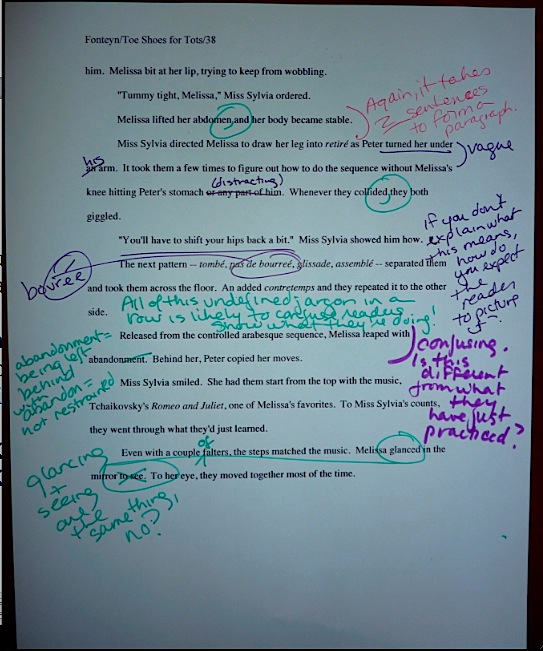
The dreaded Frankenstein manuscript, part VI: the phrase so nice I used it twice, or, hey, look at what I can do!

Nicholas brothers jumping

Have these last two series on self-editing been keeping you up at night, campers? Now that you’re starting to gain a sense of just how closely professional readers (like, say, agents, editors, and people like Millicent who screen submissions for them) peruse pages, have you found yourself gnawing your fingernails up to the elbow, worried about that manuscript you sent out last month? Speculating on just how deeply Millicent’s X-ray eyes will bore into your page 1, are you?

And now aren’t you glad that I spared you a picture of X-ray eyes to top this post? Enjoy the chipper photo of the Nicholas brothers! (Which doesn’t really do that remarkable dance team justice, I must say. If you are even remotely interested in the dance, do yourself a favor and check out any of the many movies from the 1940s that they enlivened.)

Not that I’m in a position to soften how the pros read, but I do worry about the effects of these blogs on you fine people, you know. Knowing the score can be stressful — although I continue to believe that in the long run, having a realistic understanding of how books do and do not get published is actually quite a bit less stressful than the far more popular route of just assuming that any well-written book will inevitably attract an agent and get published.

Presumably, the moment a truly gifted writer types the last word of her first manuscript, an air-raid siren goes off somewhere in Manhattan, alerting agents to swarm. That must be the case, because when the writer sends out her first (and only, doubtless) query, the lucky recipient knows to snap it up right away, regardless of whether that agent happens to represent that kind of book or not.

Or perhaps the Manuscript Fairy makes the introduction. Whatever the magical mechanism, the writer is signed with an agency with a week, sells her manuscript for a six-figure advance within a month, and is smilingly chatting about her newly-published book with Oprah in less than the time it would take to grow nasturtiums from seed to flower.

For the non-gardeners among you, that’s not all that long.

The trouble is, there is no Manuscript Fairy, and good writing often has an exceptionally difficult time finding a home. Believe me, it’s far better for you to know all that before you submit; realistic expectations have kept many a fine fledgling writer from giving up in despair after just a few tries. (Hint: if you can still name every agent you have queried with your latest book, your query list is probably quite a bit too short, given the current market.)

But before I sit you down for some straight talk about Santa Claus, let me hasten to add that the vast majority of submitted manuscripts disqualify themselves from serious professional consideration — and often for reasons that would not even occur to their writers as important to consider. Like, say, how often a particular sentence, image, or insight appears in a manuscript.

Hey, we were just talking about that, weren’t we? And with good reason: as I pointed out last time, professional readers are trained to seek out and deplore redundancy.

Unfortunately, writers — especially those who do not take the time to re-read their manuscripts IN THEIR ENTIRETY, IN HARD COPY, and OUT LOUD prior to submission — seldom catch repetition of their favorite phrases and ideas. Heck, they’re frequently unaware that they’re leaning on some verbs harder than others…or that Millicent regularly gnashes her teeth over the fact that such a high percentage of submitters apparently all attended the same school of leaning.

Why, just a month or two ago, I was chatting with Teresa (not her real name, of course, but a cunning pseudonym), an aspiring writer of some promise who’d just had her first run-in with an editor — and thus with the X-ray vision a savvy writer associates with professional readers. “He yelled at me for writing too much in the passive voice,” she fumed. “In fact, he told me that any sentence with the verb to be in it was bad writing.”

I laughed, as I often do at writing rules apparently constructed out of the chewed-up remains of seven or eight genuinely solid pieces of literary advice. “That was a rather common high school English assignment in the 1980s: write an essay or story without using to be even once. It was designed to broaden the array of verbs students were using, not to criminalize was.”

Teresa thought about that. “But he said it was a rule!”

“Matters of style are not really conducive to one-size-fits-all rules. However, I can easily imagine an editor — or any professional reader, for that matter — getting so tired of seeing a particular word or phrase repeated in a manuscript that he would say, ‘As far as I’m concerned, you may never use look again in writing. Heck, I would be relieved if you never used a seeing verb again, because in this manuscript, you have used up your lifetime supply.’ But that doesn’t make it a rule every writer should follow.”

I chose look advisedly, because in this TV-, movie-, and internet-saturated culture, seeing verbs are some of the most overused. After all, most people gain most of their information through their eyes; as a direct result, Millicent sees (see?) many, many submissions on any given day where sight and sound provide virtually all of the information to the reader. This tendency is so pronounced that if an alien from the planet Zarg who knew nothing of human life were suddenly to switch places with Millie (hey, she could use the vacation), it might easily conclude from reading all of those submissions that sight and hearing were the only senses that people possess on Earth.

Hands up if your immediate first response to that was to cry, “From this day forth, by gum, I’m going to gladden Millicent’s heart by incorporating more smell, taste, and touch details into my writing! In fact, just as soon as I finish reading this blog post, I’m off to search through my manuscript for places where the narrative relies too heavily on visual descriptions, so I may mix up the sensory descriptors more,” congratulations. You have already begun to think of revision in professional terms.

First-person and tight third-person narratives are particularly prone to over-reliance on visual detail — and are frequently riddled with seeing verbs. That’s completely understandable: from the writer’s perspective, reminding the reader that Our Hero is in fact seeing everything in the story makes perfect sense. It’s true, for one thing — and at first glance, at least, it can make the protagonist seem involved in action he is in fact merely observing. But upon closer examination, that proves not to be the case:

I watched Billy tear through the contents of my locker, looking for his now-meaningless love letter. I cringed, seeing textbooks, rulers, my pointiest protractor fly over his burly shoulder. Periodically, he glared at me, as if daring me to stop him. Pointedly, I looked away.

I had the strange sense I was being observed. Removing my gaze from the destruction of nearly all of my school supplies, I discovered the source: my nemesis, Stacey, was staring at me from the other end of the locker bay, exchanging amused glances with her friends. Their contemptuous scrutiny made me burn with shame.

Surreptitiously, I eyed the diary hanging from Billy’s back pocket, estimating the number of steps it would take me to rush forward, snatch it, and run away to read it in peace. The look in Billy’s eyes made me hesitate, but having an audience watching me rendered me bold.

“Now see here,” I began nervously…

See? The narrator is involved in the scene, certainly, but until the last line, she isn’t actually an actor in it. Her only action involves looking at this or that. Oh, she’s thinking up a storm for the reader’s benefit, but to an outside observer of the scene, she would be merely passively watching what’s going on.

“Aha!” rules-lawyering revisers of Frankenstein manuscripts will exclaim. “So that’s your real objection here: the narrator is a passive protagonist. I agree that is a problem, but I thought we were talking about textual repetition. This example doesn’t really show that. Correct me if I’m wrong, but each time Our Heroine (or anybody else, for that matter) saw something, the author used a different verb to describe it. How then is it repetitious?”

Good question, rules-lawyers. The repetition here is conceptual — all of that eye use — but to a veteran reader, all of those synonyms for sight might actually leap off the page as if they were all the verb to see. To Millicent’s overworked eyes, it would look like this:

I watched Billy tear through the contents of my locker, looking for his now-meaningless love letter. I cringed, seeing textbooks, rulers, my pointiest protractor fly over his burly shoulder. Periodically, he glared at me, as if daring me to stop him. Pointedly, I looked away.

I had the strange sense I was being observed. Removing my gaze from the destruction of nearly all of my school supplies, I discovered the source: my nemesis, Stacey, was staring at me from the other end of the locker bay, exchanging amused glances with her friends. Their contemptuous scrutiny made me burn with shame.

Surreptitiously, I eyed the diary hanging from Billy’s back pocket, estimating the number of steps it would take me to rush forward, snatch it, and run away to read it in peace. The look in Billy’s eyes made me hesitate, but having an audience watching me rendered me bold.

“Now see here,” I began nervously…

My point, should anybody have started to wonder if I had one, is this: if a writer is going to become a good self-editor, she needs to stop believing in the Manuscript Fairy, learn how to read her own work as critically as Millicent would, and take responsibility for every word in the manuscript. By definition, redundancy doesn’t add anything new to a manuscript — so does it really need to be there at all?

The answer, since not all of you shouted it out in unison, is no — and that’s as true for conceptual repetition like relying exclusively upon seeing verbs as it is for recycled metaphors and self-plagiarism. A redundant text is, among other things, predictable. At the sentence level, varying your word choices and sensory details is as important to keeping a reader guessing as providing good plot twists at the story level.

The trick to sifting through a Frankenstein manuscript, though, is not only identifying and pouncing upon repetition; it also involves learning how to spot, preserve, and highlight what works. That, alas, is a goal that all too often gets swept under the proverbial rug when a writer is suddenly hit with an apparently impossible-to-apply piece of editorial advice like never use the verb to be.

But good revision, like good feedback, isn’t entirely about pointing out broken rules. It’s also about — wait for it — style, and that means, often, that generic rules don’t always apply. Oh, you’re going to want to use punctuation correctly, and you’re going to want to make the voice consistent throughout, but you’re also going to want the to manuscript sound like you.

And that, my friends, is one of the grave dangers of blindly adhering to one-size-fits-all style formulae: there’s no writing rule in the world that’s going to tell you what your individual voice should be. Nor should it, because part of the charm of a great voice is that it is unique.

Was that giant bang I just heard the sound of everybody out there who wants to be handed an infallible set of directions for how to get published slamming the door on his way out?

In order to define and polish personal literary voice, it’s vital to figure out what’s the best part of your writing, so you may draw the reader’s attention to it. That may not involve finding the best scene or paragraph, necessarily, or even your strongest sentence; it may mean identifying a particular strength in your writing. It can be something very general — a good ear for realistic dialogue, for instance, or a gift for helping the reader care about the protagonist — or something very specific, like being a magnificent describer of the interiors of automobiles or a world-class expresser of silent disgruntlement.

Whatever it is — or whatever they are; good writers often start off with many strengths, and build still more through practice — being aware of how it shows up in your text will render revision infinitely easier, particularly if you happen to be dealing with a Frankenstein manuscript. Think about it: without knowing what to emphasize, self-editing is a grueling process of ferreting out mistakes and correcting them. If you can play to your strengths as a writer, however, then revision is a matter of winnowing away anything that obscures them, so your best writing may shine.

Sounds like a whole lot more fun than yelling at yourself for a bunch of mistakes, doesn’t it? Not to mention significantly gentler on the ego.

That’s why, in case you’d been wondering, a huge part of being a good writing teacher or developmental editor — as opposed to a good copyeditor, who concentrates on making sure that the writing is clear and the sentences grammatically correct, bringing the work to the minimum standard for professional writing — involves not only checking for possible red lights that might lead to rejection, but also figuring out what a manuscript’s strengths are, as well as why it will appeal to its target audience. (And no, Virginia, those three are not all necessarily the same thing, but that’s a topic for another day.)

Aspiring writers frequently do need to be reminded, I’ve noticed, about what is good about their work, other than the fact that they themselves sat down and wrote it. Heck, many apparently need to be told what the selling points for their books are, if the typical responses to the perfectly straightforward questions, “Who is your target audience, and why will your book appeal to those folks?” are any indication.

As is the case for so many pervasive phenomena on the creative side of the submission process, there’s a pretty good reason for this, at least from the writer’s point of view. Throughout the writing process, it’s awfully easy to start to think of the effort you’ve put into a book as its most important characteristic, isn’t it? But realistically, books literally never get acquired and published simply and exclusively because someone went to the trouble to write them.

Okay, so books by celebrities and politicians occasionally do. I’m talking about works of literary merit here.

The vast majority of the time, manuscripts sell because of their strengths — you know, those marvelous things that I urged you earlier to take the time to track down and highlight in your work. This is not a business that gives As for effort, after all. In fact, should you ever happen to find yourself chatting about your book with an agent or editor, the length of time it took you to write a book is precisely the wrong thing to mention in a pitch — or in a query letter, for that matter.

Was that echoing collective gasp of horror a subtle indication that some of you would like to know why? As hard as it might be for any of us to accept, to Millicent and her ilk, the amount of effort that a writer put into a writing project doesn’t really matter. What matters is what’s on the page, not what Herculean efforts it took to get there.

Or, to put it another way, everyone concerned is perfectly aware that every book requires Herculean efforts to bring from conception to completion, much less to publication. So what agents and editors tend to conclude when writers rattle on about those efforts is not, “Gee, this book must be worthwhile,” but “Heavens — if a single draft took five years, how long will it take this writer to make any revisions I may want?”

I know: it’s unfair. In actual practice, how long it takes to write a book is not a particularly good indicator of how long it would take to revise. Or even how good the writing will be at the end of the process.

But as submitting writers are all too prone to forget, publishing is a business, not an art form. Agents and editors acquire books they believe are marketable, not just ones they believe are well-written. And, as I believe I have mentioned several hundred times before in this very forum, they do not — contrary to the hope of most aspiring writers — read the entire submission before making up their minds on either point.

Anyone care to tell the class at what point in the average submission Millicent stops reading? (Hint: it doesn’t necessarily correlate to the number of pages her agent boss asked you to send. Not at all.)

How do the business orientation of agents and editors relate to the revision process, you ask, or to this series on Frankenstein manuscripts? Merely this; the swift judgments endemic to agencies, publishing houses, and yes, even contest judging mean that if you have limited revision time at your disposal, it’s smart strategy to concentrate on the first 50 pages of your manuscript — the usual first request from an agent — or, in a pinch, the first five.

If, say, you were intending to comb your work for any of the many knee-jerk rejection reasons in the FIRST PAGES AGENTS DISLIKE category at right. Or even just to minimize any redundancy in the manuscript. From a submission perspective, investing your time in culling all of those synonyms for seeing out of your first chapter, then turning your efforts to making absolutely certain that the voice is consistent all the way through that chapter before you pop it in the mail, is better strategy than working and re-working Chapter 10 until it’s perfect before you re-read the opening pages. Especially if the agent of your dreams has only asked to see Chapters 1-3.

Just make sure that after you’ve met your short-term deadline, you go back and implement those changes all the way through the manuscript. Lest we forget, that kind of spot-specific, I-want-to-get-this-in-the-morning-mail type of revision is quite conducive to producing a Frankenstein manuscript.

There, you have your homework: make your opening pages impeccable, then make the rest admirable. Well, my work here is done…

If you should find yourself shaking your head in the dead of night over your very own Frankenstein manuscript, try not to despair. What you have in front of you is not just an unevenly-written story or argument; it’s also potentially a spectacularly rich source of information about what you do well as a writer. If you have the time — and I would urge you to make some, even if you feel as if you’re up against a deadline; does that submission REALLY need to be e-mailed the day after that agent requested it? — it’s well worth your while to cuddle up with your Frankenstein manuscript in a comfortable reading chair.

Who knows? You might just find gold. Or at least a promising site to pan for it.

Yes, in response to what you just thought: that’s going to be a heck of a lot of work. One might even call it a Herculean task. Nobody ever said that writing a great book was easy.

Nobody who didn’t believe in the Manuscript Fairy, at any rate.

Try to think of the work not as the value of the manuscript, but as the training and practice you need to become a master at your art. Contrary to popular opinion, there’s more to this gig than just sitting in front of a keyboard and typing the darned thing. You have to figure out what you write well — which isn’t necessarily what you like to read, right? — and use that skill to tell the story you were born to tell.

That’s a tall order, but the results are worth it. Jumping off a staircase and landing in the splits isn’t the kind of thing most of us can do on the first try, after all. Keep up the good work!

The dreaded Frankenstein manuscript, part III: the light at the end of the passage, or, but wait, I WANTED it to read that way!

light along castle walls

Over the long holiday weekend (originally dedicated, in case those of you reading this from abroad had been wondering, to remembering the fallen on both sides of the Civil War), I introduced you to the Frankenstein manuscript. This alarming entity that is presented as a book written by a single author, but reads as though it had been written by several, so different are the voices, perspectives, and even word choices throughout. To professional readers — e.g., agents, editors, contest judges, and our old pal Millicent, the agency screener — this kind of patched-together manuscript is indicative of a not-yet-fully-developed authorial voice.

And why is that, boys and girls? Chant it with me now: because a fully-developed voice is consistent throughout the entire narrative.

Everyone with me so far? Except, perhaps, those of you who have had your hands in the air since I started this series?

“But Anne,” the patient many protest, and with good reason, “were we or were we not talking as recently as five weeks ago about multiple-perspective novels? I could see how a third-person novel could maintain an even tone and voice while dealing with different perspectives, but stylistically, I kind of like it when the writing is different when different perspectives are being portrayed. Also, wouldn’t it actually be a very bad idea indeed for a multiple first-person novel to have the same voice throughout?”

Excellent points both, multiple perspective-lovers. An argument, and an exceptionally strong one, could be made for structuring a multiple-perspective third-person narrative so the text ran slower when a more dim-witted character dominated, quicker when a more impatient one prevailed, and so on. An even better argument could be made for giving each first-person narrator a distinctively individual voice. Acting upon either argument well would require a lot of writerly pondering and meticulous craft.

Acting on either would also require an even greater editorial attention than to a manuscript with narrated by a single voice throughout, however. Why? Well, if a writer is going to wow readers by switching between compelling multiple voices, he must (a) develop equally compelling multiple voices, so the reader won’t tire of one or another, (b) render those voices different enough that the reader can easily tell the difference between a scene written in one voice and a scene in a second, and (c) make absolutely sure via rigorous re-reading and revision that there’s no blurring of those voices.

In short, every voice in the book would need to be separately consistent.

But craft wasn’t all that concerned you hand-raisers, was it? “That’s right, Anne,” they instantly reply. “I was thinking more of how Millicent would respond to my multiple-perspective novel’s switches in voice — particularly the one between the first scene (pp. 1-3 of my current manuscript) and the second (pp. 4-17). Isn’t she likely to, you know, assume that my book doesn’t have a consistent voice?”

The short answer: yes — if you do not make it clear in the text whose perspective is whose.

The long and infinitely more disturbing answer: unfortunately for those who like to experiment with multiple voices, voice-meandering Frankenstein manuscripts are common enough that tend to become profoundly suspicious of any manuscript that changes style or voice abruptly — at least, if those manuscripts were produced by first-time authors. With the super-quick readings that manuscripts generally receive in the pre-acquisition stage (and always get in the first round of contest judging), the Frankenstein manuscript and the manuscript genuinely setting out to do interesting things with perspective are easily confused.

Before anyone cries out upon the inherent unfairness of this, allow me to do it for you: there are many, many fine examples of good books where authors have adopted a Frankenstein format self-consciously, in order to make a point. It’s especially common in literary fiction.

For instance, if you are even vaguely interested in experiments in narrative voice, you should rush out and read Margaret Atwood’s ALIAS GRACE. In this novel-cum-historical account-cum narrative nonfiction book, Atwood tells the story of a murder, alternating between a tight first-person point of view (POV, for the rest of this post, to spare my back a bit of typing time), straightforward third-person narrative, contemporary poems about the case, letters from the parties involved, newspaper clippings and even direct quotes from the murderess’ confession.

It is an enjoyable read, but for writers, it is also a rich resource on how to mix battling narrative styles and structures well; as one might expect from a stylist as gifted as she, Atwood constructs her patchwork narrative so skillfully that the reader never has to wonder for more than an instant why (or how) the perspective has just changed.

Which is, in case you had been wondering, one of the primary reasons Millicents usually object to narrative shifts: in multiple POV manuscript submissions, it’s not always clear when the perspective switches from one character to another. It’s especially confusing if the different viewpoints — or worse, various narrators in a multiple first-person narrative — are written in too-similar voices.

Is everyone clear on the distinction I’m making here? A Frankenstein manuscript often displays unintentionally displays a multiplicity of voices, tones, vocabulary levels, etc. A well-written multiple POV novel, by contrast, presents each point of view and/or first-person narrative voice as distinctly different, so the reader doesn’t have any trouble following who is in the driver’s seat when, plot-wise.

Or, to put it another way, the Frankenstein manuscript is evidence of a lack of authorial control, consistency, and often, proofreading; a good multiple POV narrative is beautiful evidence of a sure authorial touch, a strong sense of character, and great attention to detail.

That does not, however, mean that the latter would necessarily find favor with Millicent, it is just a hard fact of submission that it’s a whole lot easier for an established author to impress professional readers with a multiple POV novel — or, indeed, any sort of experimental writing — than someone trying to break into the biz. I admire Margaret Atwood tremendously as novelist, poet, and essayist; I have spent years crossing my fingers as she hovered around the short list for the Nobel Prize. However, I suspect that even she would have had terribly difficult time marketing ALIAS GRACE if it were her first novel, at least in the current market, due to its arguably Frankenstein structure.

Ditto for the inimitable Mario Vargas Llosa’s AUNT JULIA AND THE SCRIPTWRITER, one of my favorite novels of all time, and also a must-read for any writer considering playing funny tricks with narrative voice. Vargas Llosa is something of a structural prankster, folding, spindling, and mutilating the ordinary rules of storytelling in order to keep the reader off-balance.

The result, I must admit, might confuse a reader who wasn’t already in love with his writing from other books. One might be tempted, upon encountering the third or fourth startlingly radical shift in tone, vocabulary, and apparently intended audience, to conclude that this is just a Frankenstein manuscript by a writer who couldn’t make up his mind what the book is about.

Personally, I admire Vargas Llosa’s dash; when he was running for president of Peru (yes, really), he published an erotic novel, IN PRAISE OF THE STEPMOTHER, about…well, you can probably guess.

He lost the election, incidentally — and he, too, has been rumored to be on the short list for the Nobel Prize for an awfully long time. But if he were trying to market AUNT JULIA AND THE SCRIPTWRITER right now as a first novel…

You know the tune by now, don’t you?

The rather sticky moral: once you’ve gained international acclaim as a prose stylist, you have a lot more leeway to mess with the conventional rules of writing. So please don’t kid yourself that just because your favorite author got away with an experiment, you can necessarily do so as well.

Heck, Alice Walker made up entirely new punctuation rules for THE COLOR PURPLE, and that won the Pulitzer Prize. And as I mentioned last time, in SEEING, José Saramago treated us to an entire narrative devoid of punctuation that I, for one, consider necessary to clear communication, and he won the Nobel Prize.

But that doesn’t mean you should try either of these things at home. It’s just too likely that Millicent will take one look at your fascinating experiment and exclaim, “Here’s another one who doesn’t know how to use a semicolon!” or “Criminy, what makes this guy think I’m going to read more than two sentences of a book without any periods?”

Sad, but true. In your first book, in the current market, you probably cannot get away with breaking more than one or two of the rules — and even those need to be immistakably marked, so agents, editors, and contest judges know that you broke them for a reason, rather than out of ignorance.

Trust me, no one on the Pulitzer committee seriously believed that Alice Walker did not know how to use a semicolon properly.

“Wait a gosh-darned minute,” I hear some of you exclaiming. “I take some liberties with narrative style, but it becomes pellucidly clear over the course of the book why I’m doing it. By the end, my tactics seem downright clever to the reader — or so my spouse/mother/best friend since the age of 2/beloved cocker spaniel tell me. Do you mean to say that if my narrative strategy is not clear in the first 50 pages, or whatever short excerpt the agent, editor, or contest has asked to see, my innovative experiment in English prose might just get thrown into the reject pile because it will be mistaken for bad writing?”

The short answer is yes. Next question?

Before you fret and fume too much about how the intense pre-screening of the current agency system prevents genuinely bold experiments in writing from reaching the desks of publishers at the major houses, take a moment to consider the Frankenstein manuscript from the point of view of the agent, editor, or judge who finds it on her desk one busy morning.

It’s not a pretty sight, I assure you; stitched-together corpses seldom are.

As a freelance editor, the first thing the sight of a Frankenstein manuscript says to me is that it’s going to be unusually time-consuming to edit — and thus probably quite a bit more expensive, in terms of both money and revision time, for the writer. At minimum, I’m going to need to sit down with the writer, have a major discussion about what she wants the book be, and help guide the work toward more internal stylistic consistency. Basically, the process will entail identifying and compiling a list of all of the battling styles, making the author come up with a justification for using each, and having the justifications duke it out until one (or, rarely, two) is declared the winner by the author.

It takes time, and it’s generally worth the effort. But had I mentioned that freelance editors are generally paid by the hour?

When a screener at an agency or an editor at a publishing house receives a Frankenstein manuscript, however — and yes, some manuscripts are so internally scattered that the problem becomes apparent in just the first chapter or first 50 pages — she is unlikely to have the time to figure out which voice and/or style is going to end up dominating the book. Even if Millicent absolutely loves one of the styles or voices, her hectic schedule does not allow time for equivocation.

She must that she select one of two options, and quickly: either she commits her boss agent (or, in the editor’s case, himself) to nursing the author through precisely the kind of boxing match I described above, or s/he can simply reject the work and move on to the next submission, in the hope of finding a writer whose book will not need as much tender loving care.

With literally hundreds of new submissions coming in each week, which option do you think Millicent will select more often?

When a contest judge receives a Frankenstein manuscript, the choice is even quicker and more draconian. Mehitabel the judge knows that there’s no question of being able to work with the author to smooth out the presentation; in the vast majority of literary contests, the judge won’t even know who the author is.

Plop! There it goes, into the no-prize-this-year file. Better luck — and first readers — next year.

The moral, I devoutly hope, is obvious: if you are attempting to play with unconventional notions of structure or style, make sure that it is magnificently clear in the manuscript exactly what you are doing. Don’t leave it to the reader to guess what you’re up to, because, as I’ve shown above, professional readers just don’t have the time to figure it out.

How might one pull this off, you ask? Consider making your deviations from standard structure and narrative rules bold, rather than slipping them in here and there — and, at the submission stage, at least toy with devoting the entirety of the first chapter to a single voice. Experimenting with several styles within a short number of pages is decidedly risky — and perversely, the less daringly experimental you are, the riskier it is, because tentative attempts look to professional eyes like unfinished work.

Or, as critics of modern art used to like to snipe early and often: what’s the difference between a canvas painted by a 5-year-old and a canvas by a serious artist in the style of a 5-year-old? Intention, my dears, and craft.

To borrow E.F. Benson’s wonderful example, let’s say you were planning to paint a picture of a house down the street. The house has a crooked chimney. The novice painter would paint it exactly as is, unskillfully, and viewers of the finished painting would wonder forever after if the chimney had really looked like that, or if the novice just couldn’t paint straight lines. An intermediate painter would paint the chimney as straight, to rule out that conclusion.

But an expert painter would add 10 degrees to the angle of the chimney, so there would be no doubt in the observer’s mind that he had painted it that way intentionally.

The more deliciously complex and groundbreaking your chosen style is, the more clearly you should announce it. Unless, of course, you want to wait until you’re on the short list for the Nobel Prize before you start getting wacky.

I haven’t dissuaded many of you intrepid literary experimenters from trying, though, have I? “But I don’t want to exaggerate my stylistic choices,” some of you argue, and who could blame you? “I’m a big fan of subtlety, as it happens. So how can I revise my work in order to avoid running afoul of Millicent?

Well, your first step should be to steel yourself for a certain amount of rejection. When the pieced-together nature of a book is intentional, and its similarity to the standard Frankenstein tome will render it very, very easy for agents and editors to dismiss. If you are given to experimenting with multiple points of view, for instance, or changes in voice, or structural alterations in mid-story, you need to be very, very aware that professional readers may well be mistaking your conscious choices for symptoms of Frankenstein array of incompletely-realized narrative ideas.

Many years ago, I met Stan, a promising writer, at a writers’ conference. Stan described his novel impeccably: a coming-of-age story about a boy so engrossed in the messages of the TV shows and movies he saw in the late 1950s that he incorporated these styles into how he viewed his life. The result, Stan told me, was intended to be a picaresque account growing up from the kid’s perspective, real-life stories told as cowboys and Indians, spy thriller, spaceman adventure, etc.

Well, to be frank, I wasn’t all that enthused by his description; it didn’t seem like a particularly fresh book concept. But being well aware that I am not the best audience for works about prepubescent boys, I gave him a patient hearing. (Why am I not ideally suited for such stories, you ask? As someone who spent her formative years sitting through sensitive European films where an earthy older woman’s charms gently coax some suspiciously attractive and precocious young boy toward manhood, I become leery every time a young protagonist goes anywhere within five miles of the town bad girl, his best friend’s older sister’s window, or anybody’s mother but his own. But that’s just a fluke of my upbringing.

From a marketing perspective, I think that at this point in literary history, such stories are a hard sell to experienced readers, unless they are AWFULLY well told. There are countless films about 8-to-12 year-old boys learning important life lessons the hard way; if the age is so darned important, why aren’t there as many films from the perspectives of girls in that age group? (An important exception to this: Kasi Lemmons’ excellent film EVE’S BAYOU tells such a story from a young girl’s perspective amazingly well.) I think that if you choose to tackle such a well-documented age group in a work intended for adult readers — particularly if you want to stick to the well-worn ground of white, middle- or upper-middle class boys in suburbia or in small towns with swimming holes — you really have to come up with something startling to rise above the sheer volume of competition.)

So as I say, I was leery, but we exchanged manuscripts, despite my trepidations. And lo and behold, long before 50 pages had past, his intrepid wee protagonist had grabbed his fishing pole and skipped his way toward the edge of town, where the local voodoo priestess/cajoler of young boys into manhood lived.

Imagine my surprise.

Yet the fact that I’d seen the plot, conservatively speaking, 2700 times before was not what put me off the book. No, the problem was the fact that each stylistic switch came as a complete and utter surprise — even to yours truly, who knew the premise of the book going in. Each episode was indeed presented in the style of some well-worn visual media style. Quite well, as a matter of fact.

However, since the writing style changed radically every ten pages or so, pretty much any reader was guaranteed to fall into one she disliked occasionally. And since there was no overarching framework to make this junior Walter Mitty’s account of himself hang together, it read like a collection of short stories, unrelated articles of clothing hanging side-by-side on a clothesline, rather than as a cohesive book.

It read, in short, like a Frankenstein manuscript.

Because I liked Stan and thought he was a pretty good writer on the sentence level, I wanted to help him out, so I worked up nerve to make a bold suggestion. “What if you set up very plainly in the first chapter that your protagonist sees life through a directorial lens?” (Sort of like Fellini’s 8 1/2, I added to myself, as a cinematic footnote from my childhood.) “That way, the reader would be in on the conceit right from the beginning, and could enjoy each switch as play, rather than leaving the reader to guess after the style has changed 6 or 7 times that you have a larger purpose here.”

To put it mildly, Stan did not cotton to this advice; it sounded, he said, just like the feedback he had gotten from the agents and editors at the conference, or indeed, every agent he had queried. (Again, imagine my surprise.) Obviously, he said huffily, we all just didn’t like the fact that he was experimenting with narrative structure, doing something new and exciting and fresh.

We were, in his considered opinion, sticks in the proverbial mud.

Well, we may have been, but we also evidently all knew a Frankenstein manuscript when we saw one, for the exceedingly simple reason that any professional reader sees so very, very many in any given year. So from that perspective, Stan’s trouble was not that he was trying to do something original; it was that his manuscript had an extremely common consistency problem.

Yet Stan was absolutely convinced that what was being critiqued was his artistic vision, rather than his presentation of it, so while he was perpetually revising to sharpen the differences between the segments, he never seemed to get around to sitting down with the entire manuscript to see if his critics might have had a point about the overall manuscript. Predictably, he continued to have trouble placing his book, because, to professional eyes, such a manuscript means only one thing: the investment of a tremendous amount of editorial time and energy to make the work publishable.

My friend with ambitions to rewrite HUCK FINN had constructed his creature self-consciously, but far more often, writers are not even aware that the style shifts are visible. Particularly in first novels, as I mentioned last time, the stylistic changes are often the inevitable result of the writer’s craft having improved over the years spent writing the book, or simple inexperience in carrying a late-added theme all the way through a story.

In the most extreme cases, the shifts are so pronounced that the Frankenstein book can actually read as a sort of unintentional anthology. I’m not talking about multiple-perspective pieces — although if I have not yet sufficiently hammered into your brainpan that it is very easy for a book relying upon several storytelling voices to end up as a Frankenstein work, without a cohesive narrative thread tying it all together, I can only advise scrolling back up to the beginning of this post and re-reading it from the beginning.

No, in a good multiple-perspective novel, each voice and/or POV is sharp, distinct, differentiated to the extent that a reader familiar with each could open the book at any page and know within a paragraph who is speaking. Our old pal, THE POISONWOOD BIBLE, for instance, juggles multiple perspectives and voices beautifully, so that although the reader is treated to the overarching story in bits and pieces, the whole blends into seemingly organic coherence.

In a Frankenstein manuscript, no such organic coherence exists, even if the overall plot makes linear sense. The reader is jerked from writing style to writing style, as if the same story were being told on all available networks, but an indecisive child held the remote control, so the style of telling leaps from soap opera to broad comedy to PBS documentary.

It’s tiring to read, and often, hard to follow — and almost invariably conducive to the reader’s getting pulled out of the story from time to time. It also says pretty clearly to anyone who reads manuscripts for a living that the author has not yet performed a thorough, beginning-to-end edit on the book. And this is a serious problem for the editor, as it is her job to strengthen the dominant style and muffle the rest, so the whole can stand as a unified piece of prose.

It is also a serious problem for the author, since it’s difficult to sell a piece that meanders stylistically. Just ask Stan.

Next time, I shall talk about practical measures to keep your manuscript from falling accidentally into the Frankenstein realm, but before I sign off for the day, I should mention one more confluence of writing events that may result in a Frankenstein manuscript: when the writer doesn’t realize until several revisions in how she wants the book’s voice to sound.

Stop laughing. This happens to talented new writers all the time.

A few years back, an editing client of mine called me in the dead of night (a practice I discourage, as a rule) burbling with excitement because she had just made a major breakthrough with her book. This surprised me a little, I must admit: she had, to put it mildly, not been particularly receptive to feedback; I have it on good authority that she once took a match to a marked-up page of text, just so she would not have to look at my suggestions about comma use again.

One day, after months upon months and chapters upon chapters of experimenting with different styles — writing which she had never before perceived to be experimentation, but finished draft — she suddenly stumbled upon precisely the tone and perspective that worked for the book, an engaging voice she could maintain consistently throughout the entire story. As happens sometimes, what had been a mess of words just suddenly congealed into something sharp and analytical and true.

It was beautiful. So beautiful, she was overjoyed to report, she was quite confident that I would have nothing whatsoever to write in the margins this time around.

She was wrong about that, of course; when one does not listen to one’s editor about proper comma usage, one attracts marginalia.

Which just goes to show you that even a beautifully-written manuscript can usually stand at least a bit more improvement — a fact that tends to fill first-draft enthusiasts with dismay. “But it’s done!” they cry, whipping out their cigarette lighters to singe feedback off the edges of their pages. “I’m the author — I get to be the one who decides when it’s finished!”

That’s not true, actually, at least if one wants to get a manuscript published. As far as folks in the industry are concerned, a manuscript is never finished until it is printed and sitting on a shelf at Barnes & Noble — and for nonfiction, sometimes not even then. As a direct result, writers under contract are frequently expected to revise their books long after the point that they consider the darned things complete. It’s not even uncommon for them to have to make requested revisions that they firmly believe will harm the book.

So put those lighters away, first-drafters: to the pros, unwillingness to revise is simply a mark of inexperience. And rightly so, because — who knows? — that next revision may abruptly reveal a book far more beautiful than you ever dreamed.

Hold that positive thought until next time, please, when I shall be delving back into practicalities. Keep up the good work!

The dreaded Frankenstein manuscript, part II: consistency, consistency, consistency. And did I mention consistency?

partial trees

A quick reminder before we get begin today’s free-for-all: this coming Monday, May 31, is the deadline for the Author! Author!/WHISPER Great First Page Made Even Better Contest. To allow each and every one of you to squeeze every last second of productive time out of your Memorial Day weekend, entries do not need to be date-stamped until midnight in your time zone.

I would especially love to see entries from those of you who have spent the last couple of weeks reading my super-close analysis of a reader’s opening pages and slowly turning bright green with envy: here is your chance to subject YOUR first page to similar scrutiny, free, gratis, and without charge. And not only my scrutiny, either: the quite genuinely fabulous Phoebe Kitanidis, author of the newly-released YA novel WHISPER, has graciously agreed to join me in this critiquing venture.

The complete rules, should you care to take a peek at them, may be found here. We shall now rejoin the blog already in progress.

Yesterday, as sometimes happens, the universe obligingly stepped up and provided me with a simply delightful metaphor for what we were already in the depths of talking about here at Author! Author! Accompany me, if you will, to the wildlife-harboring, honeybee-attracting, neighbor-annoying thicket of blackberry bushes that spans the wee creek running outside my house.

Okay, so maybe the snapshot above doesn’t really give you much of an idea of it. If you squint at that mass of green behind the trees, though, you may see the yellow glint of raccoon eyes.

Due to a brisk little bout of rezoning a few years back, all of the land above us on our hill has been concreted or asphalted over, so we like to keep some of our yard wild for the sake of the critters. (Also, so the abundant local rainfall has someplace to go — hasn’t anyone else noticed that as more and more land is paved and built over, overflowing rivers have less and less ground to suck up excess? Why is anyone surprised that flooding ensues?)

Not all of our neighbors are crazy about our impromptu wildlife sanctuary. Why, only last autumn, one set of civic-minded folk expressed their aesthetic opinions by flinging a large wooden pallet formerly used for their building materials into the aforementioned blackberry bushes.

I was all for moving it immediately: it was partially on public land. What if, I asked my significant other, the city suddenly took it into its collective head to cut back the part of the thicket that impinges upon the road, as it occasionally does? Once the blackberries grew over the pallet, wasn’t a sleepy public employee only too likely to run his mower smack into it? And since I was neither physically strong nor raccoon-repellent enough to extricate the pallet from its green grave myself (wildlife interprets my cries of “Shoo!” as “Here’s your dinner!”), was my SO not the logical candidate to head off that municipal disaster by moving the silly thing before, say, any city-owned machinery were permanently incapacitated and we were fined?

In the time-honored tradition of inter-spouse communications all over this great land of ours, my SO chose to regard these questions as purely rhetorical. He must have found them interesting food for thought, however, if not action, as the pitter-patter of tiny raccoon feet on wood slats prompted me to repeat these questions roughly once per month. I can only attribute his not actually doing anything about the pallet to a great and abiding love of the sound of my voice — and to an oft-expressed opinion that the neighbors should clean up their trash themselves.

Yesterday, about a month after the neighbors in question had moved away (much to the relief of local wildlife), I was startled from my daily creative reverie by the immistakable racket of heavy machinery being driven up our hill by someone rather unused to the task. The clipper attachment dragged on the ground.

I went running into my SO’s study. (Actually, I limped slowly, due to my recent back injury, but allow me a bit of creative latitude here.) “They’ve come for our blackberry bushes! Did you ever manage to move that pallet?”

He admitted that he had not; the neighbors, he said, should have taken care of it. Upon further questioning and a spirited discussion on the nature of reality vs. wishful thinking and the annoying imperatives of linear time, he was heard to opine that it was now too late now to do anything about it.

Well, as long-time readers of this blog are, I hope, quite well aware, I’ve never been a big fan of letting fixable problems just lie there. Upon my repeated urgings, he begrudgingly invested the roughly 2 1/2 minutes required to shout at the operator to stop, free the pallet, and moving to our garbage bin. He explained glibly throughout about the nature of linear time and our deadbeat ex-neighbors’ ethical shortcomings.

The municipal handyman was effusively grateful. “I never would have seen that. It would have smashed up my machine.”

“Naturally,” my SO said, with a perfectly straight face. “Anyone could have predicted that.”

What does this little domestic homily have to do with our ongoing discussion of necessary manuscript revisions, you ask? Why, I should have thought that was obvious: if you wish to please a professional reader like Millicent the agency screener, there’s just no substitute for taking the time to learn the rules of grammar, spelling, structure, and formatting, incorporate them consistently into your text — and then, before you submit your manuscript, double-checking how you have implemented those rules by reading your submission IN ITS ENTIRETY, IN HARD COPY, and OUT LOUD.

Oh, that wasn’t your first thought after reading that anecdote? How puzzling. What about if I put it this way: if you know the rules but don’t implement them every time, you should expect Millicent to be annoyed when she stumbles over them in your submission.

But most of us writers don’t expect that, do we? In fact, even the submitters of the most egregiously error-prone manuscripts and contest entries are both astonished and hurt when agents, editors, and contest judges respond as though not unprofessionally-presented writing were bad writing, or as if an apparently unproofread first page were an infallible indicator of a manuscript rife with spelling, grammatical, and logic problems.

To spare anyone reading this any shocks in future: they will respond that way, predictably. In their minds, it’s the writer’s job to free a manuscript of distracting errors, rather than a professional reader’s job to try to see past those errors in order to discover new writing talent.

And it’s not enough to present your writing professionally in some parts of your manuscript and not others, either; a pallet hidden deep in the weeds is as likely to wreck the machinery as one left out in the open. But if the inflexible rules of spelling, grammar, and connective logic are the necessary foundation of a strong submission, consistency is the hallmark of a strong authorial voice.

Just in case I’m being too subtle about what this means for submissions: the Millicents of this world just abhor inconsistency in manuscripts, whether those gaffes lie in the realm of format, spelling, grammar, story details, style, or tone — and with good reason. People who read manuscripts for a living are trained to spot and deplore unevenness.

That’s the bad news. Here’s the good news: as a result of this necessary but rather pedantic focus, a manuscript whose voice is sure and consistent tends to strike Millicent’s tired eyes like the sight of a cool river on a blazing summer day.

Why is it such a rare sight? Well, think about it: very, very few of us, no matter how talented we might happen to be, find our authorial voices the first time we sit down to write a novel. Or memoir. Or any other type of book, for that matter. It’s not even all that uncommon for a good writer to finish the first draft of her first novel, only to discover that her voice is significantly stronger, or even quite different, at the end of the book than at the beginning.

That should not surprise us very much, should it? After all, no one is born a technically perfect writer. And even after a writer has honed her professional toolkit, consistent authorial voice requires work to produce — and usually quite a bit of revision and re-reading.

Those of you who write only when you feel inspired are squirming right now, aren’t you?

I’m not astonished by that reaction — all too often, we writers talk about voice as though it were more or less synonymous with talent, as if it were something a writer is either born with or not. I don’t think that’s true. Oh, it’s true enough that talent can’t be learned, but craft can be, and many a great sentence-builder has missed becoming a great writer because she relied too much on the former at the expense of developing the latter.

Here’s a novel thought: consistent voice is almost always the product not of original inspiration, but of conscientious revision.

Let that one sink in for a moment. I’ll wait. I’ve got this pretty view to ponder.

Voice is more than self-expression, a way of writing a sentence, or even inspiration: it’s tone, level of detail, analytical perception, sense of humor, rhythm, and all of the other hyper-personalized ways in which one writer tells a story differently than another. Learning to wield these weighty tools to produce a consistent and seemingly effortless result takes practice, patience, and much trial and error.

Or, to put it another way: it’s a whole lot harder to write a good book than a good individual sentence, paragraph, or scene. Why? Because the alchemy doesn’t need to come together only once, as it does in a well-written sentence; it has to come together every time, and in a similar way.

On an artistic level, I’m always thrilled when a client (or any other talented writer, for that matter) finds her voice, but as an editor, I know that in the short term, it means a lot more work to come. Because, you see, once a writer discovers the right voice and perspective for the story he’s telling, he will have to go back through the rest of the book with a fine-toothed comb, to make the voice that now has emerged sound consistent throughout the entire story.

Which brings me, rather neatly, back to the Frankenstein manuscript, doesn’t it? Funny how that worked out.

A Frankenstein manuscript, for those of you joining us late, is a book that meanders in voice, tone, perspective, structure, and/or style so much that it sounds as though it had been written by a committee, instead of an individual writer. All of these are cobbled together, like the body parts of Dr. Frankenstein’s creature, may create the illusion of a whole entity, but it lacks the spark, the true-to-life continuity of a story told from beginning to end by a sure authorial voice.

To forestall your getting blank looks at writers’ conferences, I should hastily add: this is my personal nickname for such a book, not an industry-wide moniker. (Although since this blog has readers in circles in circles that might surprise you, the term has been gaining currency over the last couple of years.) I assure you, however, every single agent and editor currently working in North America is aware of the phenomenon and dreads it — because they know, as I do, that its appearance heralds months and months of fine-combing to come.

The sad thing is, the Frankenstein tendency is almost always accidental, and generally goes entirely unnoticed by the writer. Especially, alas, a writer so excited by an agent’s request for materials that he simply prints out the latest version of his manuscript and sends it off right away. Regardless of where it might happen to be in the revision process, getting it out the door before the requesting agent changes her mind seems more important than taking the time to make sure that each and every revision has been implemented consistently all the way through the manuscript.

I won’t make those of you who have fallen into this trap, only to kick yourself later, raise your hands. You know who you are.

The fact that aspiring writers generally don’t realize that their manuscripts are uneven should not surprise us unduly, right? Writing a book takes a long time: authorial voices, preferences, and even underlying philosophy can change radically over the course of a writing project. As revision is layered on top of revision, many writers become too absorbed in the details of the book to sit down and read it straight through AS A BOOK — which, unfortunately, is the only way to recognize a Frankenstein manuscript.

Let me repeat that, as it’s awfully important: there is absolutely no way to diagnose and treat a manuscript’s Frankensteinish tendencies without sitting down and reading the whole darned thing. Preferably IN HARD COPY, IN ITS ENTIRETY, and OUT LOUD, in as few sittings as possible.

If the prospect of improving artistically is not enough to set you running for your comfy reading chair, pronto, here’s an excellent marketing incentive to send you scurrying in that direction, manuscript in hand: unfortunately for writers of Frankenstein pieces, reading a manuscript straight through, at least the first part of it, is how agents and editors determine whether they want to work with an author.

Translation: if you don’t catch the problem, they will. If you have a Frankenstein manuscript on your hands, you are far, far better off recognizing the fact yourself before you submit it, because from the diagnosis of professionals, there is no appeal.

Again, not precisely a surprise, is it?

But for most aspiring writers, tackling an entire manuscript, even if its their own, is a rather overwhelming prospect — so much so that many simply dismiss the idea of reading their own manuscripts in their entirety, much less fixing them, as impracticable. To assuage some of those fears, let’s embrace the old-time editors’ trick of attacking only one manuscript megaproblem at a time.

Seriously, revision is a process, not a one-time deal: breaking up that immense task into bite-sized pieces and eating them one at a time is far more sensible than trying to force your psyche to think about every conceivable problem in a 400-page manuscript simultaneously. Worry about the totality of the diagnosing and revising down the line — just for now, focus on only one easily fixable gaffe and repair that.

You can read through your work, searching for only a single problem, can’t you? Piece o’ proverbial cake.

Then, after you are positive that your manuscript is perfect in that respect, pick another megaproblem and work on that — for every page of the manuscript, so you may be absolutely positive that you haven’t missed anything. Repeat as often as necessary. When you are pretty sure that you’ve systematically rooted out all of the ongoing problems, sit down and read your manuscript — wait for it — IN HARD COPY, IN ITS ENTIRETY, and OUT LOUD, to catch any remaining Frankenstein tendencies.

Sound time-consuming? It is. But it’s far, far less likely either to drive you mad or lead you to throw up your hands in despair and abandon the book altogether than trying to tackle a universal revision in one fell swoop.

Don’t shrug off the latter danger as improbable, please: revision burnout is a very real phenomenon. I’ve seen many, many more promising manuscripts tossed into trash cans by their writers out of despair over how long revision might take than out of anger at rejection.

In the spirit of incremental progress, let’s begin with a single, extremely common manifestation of Frankensteinery with an eye to rooting it out of the manuscript: the text that hasn’t yet really decided which tense it is in, and so meanders back and forth between (usually) the present and the past.

In fiction, the explanation for this phenomenon is usually pretty straightforward: the writer thought at one point that it would be nifty to write the book in the present tense, realized part-way through that it’s darned difficult to tell a story that way (how does one writing in the present tense of events that have been in progress for some time, for instance?), and changed to the past. Only in the transition process, not all of the verbs got changed.

Oops. What an annoying-yet-easily-fixable problem.

Spotting this particular Frankenstein problem is great practice for sharpening your editorial eye, because once you’re on the look-out for improper tenses, they will just start leaping off the page at you. (Hint: don’t try to catch them on your computer screen; sit down with a hard copy of your latest draft and a highlighting pen.) Quite quickly, you’ll begin to regard those tense slips in the same light as Millicent does: like an indicator that the writer did not take the time to sit down and re-read his work after revision.

Hmm, where have I heard before that such a course of action really isn’t the best strategic move? I’m sure it will come to me…

Fair warning: sometimes tense slips are intentional. Sometimes — and this one is more common in nonfiction, notoriously so in memoir — the writer just thinks it’s cool to present past events in the present tense. It sounds more colloquial that way, she reasons, the way someone might tell an anecdote verbally.

The trouble is, flipping past actions into the present tense can rapidly become darned confusing for the reader. To illustrate how and why, let’s take a gander at a favorite (and kind of surprising, from so usually consistent a writer) example of mine, Sarah Vowell’s THE WORDY SHIPMATES:

Williams in Salem is such a myopic researcher of biblical truth he doesn’t care who gets hurt. His intellectual fervor, coupled with a disregard of practical consequences, reminds me of nuclear physicist J. Robert Oppenheimer, running his secret Manhattan Project lab in Los Alamos with a single-minded zeal, then quoting the Bhagavad Gita as the first test of his atomic bomb lights up the desert. “Now I am become Death, the destroyer of worlds,” he said.

Now, this paragraph makes perfect sense, on one level: an intelligent reader could figure out that the narrator is in the present, talking about Oppenheimer and Williams in the past. But quick, tell me based upon this passage alone: who was born first, Oppenheimer or Williams?

If you said Oppenheimer, you were following the hint given by the tense choices in this passage. Since Oppenheimer is clearly speaking in the past, and Williams is presented in the present tense, the implication is that Williams is the more recent trodder of the earth’s crust, right? Perhaps even a contemporary of Vowell’s?

So would it astonish you to learn that Williams was obsessing in 1635, not 2008, when the book came out?

For some reason best known to herself, Vowell chose to describe the actions of Williams and his fellow Puritans in both the present and the past tense, sometimes within the same paragraph. Since her background is in radio (by definition a speaker’s medium), I am forcing myself to conclude that this was a well-considered authorial choice, not merely the result of a reluctance to re-read her own work (which she does regularly on NPR) or an editorial oversight.

As a well-established nonfiction writer, she was, obviously, able to get away with this choice, but that does not necessarily mean that the writer of a first book could. As we have often discussed, the standards for breaking into the biz are quite a bit more stringent than those for the folks already in it. So it would behoove you to consider this authorial choice very carefully before submission: when most aspiring writers slip around in time, it’s because they’re trying to mirror the patterns of common speech or believe that actions described in the present tense are more immediate to the reader.

While you are weighing your revision options, you might want to bear in mind that Millicent (a) tends not to be all that big a fan of narrative text that reads just like the spoken word UNLESS the manuscript is written in the first person singular, and (b) very few professional readers believe that ordinary readers are sufficiently now-oriented to prefer the present tense to the past. (“Wait — this isn’t happening right now? Why should I pay attention to it, then?”)

And then there’s the very real possibility that Millicent will simply assume that any slips between tenses are not a narrative choice, but a mistake. A mistake made by — chant it with me now, readers — a writer who did not bother to read his submission IN HARD COPY, IN ITS ENTIRETY, and OUT LOUD, to make sure that the tense choices are consistent.

I like using THE WORDY SHIPMATES as an example of this dilemma, as it is one of the rare cases where reviewers were as uncharitable to a well-respected author’s efforts as Millicent would have been had THE WORDY SHIPMATES crossed her desk as a submission from a previously unpublished aspiring writer. “As a whole,” the New York Post’s reviewer commented dryly, “the book reads like an unedited manuscript.”

Like, in other words, a Frankenstein manuscript.

In Ms. Vowell’s defense, I can think of a number of strategic reasons the frequent tense changes might have seemed like a good idea at the composition stage. Casting so much of the Puritans’ story in the present tense might have been a deliberate attempt to draw a parallel with current political conditions at the time the book came out, for instance (which may be why the book already seems a trifle dated). Or perhaps it was an effort to make the lives of our long-dead forebears seem more immediately relevant to the reader.

But whatever the motivation, I don’t think it worked — which irritated me, as this is an author for whom I harbor a great deal of ongoing respect. As a reader, though, I have to say that I found the frequent temporal shifts jarring every single time they occurred in the book. I thought they made the historical tale she was telling significantly harder to follow on the page.

But some of you out there share the belief that writing in the present tense is inherently more grabbing than writing in the past, don’t you? Certainly, those of you who feel this way are not alone: there has been quite a bit of literary fiction over the last 20 years (particularly short stories) that has embraced that notion that placing a narrative in the now is more immediate.

Personally, I don’t think it’s true, largely because anyone who reads on a regular basis is already well versed in the not-very-difficult mental process of becoming absorbed in a past tense story as though it were happening in present time. A reader has to be awfully darned literal to perceive himself to be distanced from action simply because it is presented in the past tense. I also know from experience that writing an entire book in the present tense necessarily entails quite a few technical difficulties that may be avoided almost entirely by placing it in even the most recent of pasts. Even the most minimal tense slip-up runs the risk of yanking the reader out of the world of the book and back into mundane reality.

All that being said, tense choices are entirely up to the author — if you love the present tense and feel it’s the best means of telling your story, by all means write in it. I ask only one thing, for your own sake: if you’re going to write in the present tense, do it consistently.

Again, if you’re not willing to heed this advice for artistic reasons, embrace it because it’s good marketing. Manuscripts that tense-flip for no apparent reason tend to get dismissed as poorly proofed, at best, and poorly revised at worst. So unless a reader has a pretty darned good reason to assume that your authorial choices are deliberate — like, say, Sarah Vowell’s extensive track record of excellent published writing — assume that he’s going to interpret tense inconsistency not as a matter of style, but as a mistake, and an easily preventable one, at that.

Am I suggesting that you might want to save the major experimentation until after you’re already an established writer? Well, I hate to seem cynical, but it’s usually simpler to break into the book market that way. (The norms of the short story market remain quite different, I am grateful to report.) Many a well-respected literary luminary has cut his teeth on less radical ways to make English prose interesting, then moved on later to challenge the language.

Hey, Nobel laureate José Saramago wrote an entire book devoid of periods. Do you honestly believe that a first-time writer could have gotten away with the same trick?

Yes, yes, I know: it’s unfair that the already-published should be judged by less exacting standards than those just breaking into the biz, but I’m not going to lie to you: that’s how it works. I don’t think that THE WORDY SHIPMATES would have made it past Millicent had it been written by a previously unpublished writer.

Which would have been a shame, as it’s an interesting book with some wonderful insights and some very memorable sentences crammed into it. But plenty of interesting books with wonderful insights and memorable sentences don’t clear the first hurdle at agencies or in literary contests.

Why? Often, because those insights and sentences come across as flukes, occasional narrative bright spots not entirely integrated into the overall narrative. The voice is not consistent.

Cue the monster; he’s on again.

Don’t despair, however, if you fear your manuscript has Frankenstein tendencies. Next time, I shall go into what happens to a Frankenstein manuscript when it reaches an agency or a publishing house — as well as methods you can use to catch and mend the problem before it passes under professional eyes. In the meantime, keep up the good work!

Millicent, may I introduce the Frankenstein manuscript, scourge of revisers everywhere?

bride meets frankenstein

For the last week and a half, I’ve been going over a real, live manuscript with the same variety of fine-toothed comb that Millicent the agency screener, Maury the editorial assistant, and Mehitabel the veteran contest judge so frequently pass around amongst themselves. While the experience of seeing just how closely professional readers scan manuscripts can be quite scarifying for a writer new to the game, just being aware that no gaffe, however small, is likely to pass unnoticed under Millicent’s watchful gaze can render that poor, trembling, crestfallen writer a significantly better reviser for the rest of his writing life: never again will he assume, as the vast majority of aspiring writers seem to do, that pretty good is close enough where submissions are concerned.

Or, to put it another way: perfect formatting, impeccable spelling and grammar, and a flowing, likable narrative voice are the minimum requirements for Millicent, Maury, and Mehitabel to admire a manuscript, and a legitimately gripping hook, an interesting protagonist(s), and an intriguingly conflict-ridden plot are generally necessary to keep them reading beyond page 1.

This is hardly a well-kept secret, right, accessible only to those brave enough to climb to the top of Manhattan’s tallest building, turn around three times, and sacrifice 17 first editions of PEYTON PLACE on a bonfire to the literary powers that be? In these days of easy Internet access and free dissemination of information, an aspiring writer could hardly make it through the first 20 entries of a web search under getting published without learning that the competition is so fierce for agents these days that the average Millicent sees hundreds of technically perfect submissions in any given year.

Yet most aspiring writers submit manuscripts that fall short in one or more of these areas — and then are astonished when their work is rejected. Whether they admit it openly or not, they had been operating on the presumption that if the writing were stylish enough and/or the story intriguing enough, professional readers everywhere would be perfectly willing to overlook every other manuscript problem.

In fact, most aspiring writers are downright indignant when they first learn that this is not the case. I hate to be the one to break it to you (although that’s never stopped me before, has it?), but to Millicent and her ilk, technically flawless presentation of writing is simply a quality of professionalism, not the ultimate goal of a collaborative editorial process that happens mostly after a writer lands an agent.

Have I convinced you yet that proofreading before submission might be a prudent notion? Think about it: how are you ever going to know for sure how stylistically strong your writing is until it is free of distracting gaffes?

How distracting are those so-called little things, from a professional reader’s perspective? Let’s take a peek at what might happen if the first page of one of the great classics English literature if it happened to land on Millicent’s desk before she’s had her second cup of coffee?

edited-oliver-twist

See? Even a great story well told could use a little presentation help. Or at least a touch of updating: norms of literary style vary over time, like any other aesthetic trend.

I wanted to bring that up, on the off chance that any of you should be trying to land an agent for an aggressively 19th-century style novel. Or in case anyone had been casting about for a comeback for the next time that guy standing next to you at that bar that’s never more than 100 yards from any writers’ conference in North America starts griping about how the publishing world isn’t really interested in literature anymore. Why else, he reasons, could anyone possibly have rejected his manuscript?

Even without reading it, I would be willing to hazard a guess: the little things. And probably not just one or two of ‘em, either.

What makes me so sure of that? Well, experience: although submissions get rejected all the time for what most writers would consider nit-picky reasons, it’s virtually unheard-of for any manuscript to have only one problem. As we like to say here at Author! Author! — like ants, writing problems seldom travel alone.

That’s vital for a submitting writer to understand, particularly in these decadent days, when even entire manuscripts are frequently rejected with no explanation at all — or, still worse but increasingly common, rejected without even so much as a form letter notifying the writer. Because it’s so easy to guess wrong when casting about for a rationale, I would STRONGLY caution any aspiring writer against leaping to the conclusion that any single problem, formatting or otherwise, was the only reason a manuscript was getting rejected. As we have seen in recent posts, Millicent’s decision to reject is often based upon quite a few reasons working in tandem.

Which is why, unfortunately, it’s not all that uncommon for your garden-variety Millicent, Maury, or even Mehitabel to come to believe that an improperly-formatted manuscript, or one containing a few misspellings, will inevitably turn out to be poorly-written overall. In their experience, it’s unlikely to the point of laughability that changing only one thing, even a major one, in the average manuscript would render it rejection-proof.

There is no such thing as a rejection-proof manuscript, you know. While it would indeed be delightful if there were a magical formula that could be applied to any manuscript to render it pleasing to every Millicent currently screening manuscripts, that formula simply doesn’t exist; individual tastes and market trends vary too much. Not to mention the fact that the slow economy is making most agents and editors really, really cautious about picking up any first manuscript at all right now.

Even, alas, very clean ones, free of formatting problems and grammatical mistakes. At the moment, no first-time author is getting a free ride. But you can bet your boots that the ones that are getting picked up are being selected from amongst the cleaner manuscripts.

But clean doesn’t mean devoid of individual style, right? Right? Do stop erasing adverbs from your tag lines long enough to answer me.

It’s most helpful, I’ve found, to think of revising your manuscript as clarifying your style, rather than forcing your story and voice into some mythical conception of perfect writing, the color of which Millicent happens to be thinking while she’s screening manuscripts. Like standard format, manuscript cleanliness is not a magic wand that can be waved over a submission to make every agent, editor, and contest judge on the face of the earth squeal with delight at the very sight of it.

It’s merely is a means of presenting your writing professionally, so Millicent, Maury, and Mehitabel will be able to weigh it on its non-technical merits.

Or, to put it another way: taking the time to clean up your manuscript will make it less likely that your submission will be rejected on a knee-jerk basis. But it’s just a fact of publishing even a perfectly clean manuscript is going to garner its share of rejections, if it’s sent out enough.

So what should a savvy submitter be editing toward, over and above minimizing the more notorious of Millicent’s pet peeves? Come closer, and I’ll let you in on a secret of good writing: it flows smoothly. A compelling narrative voice is a consistent one.

Pulling that off is a lot harder than it sounds, you know; a seamless narrative is virtually always the result of many, many careful attempts at revision. The more successful those attempts, the less labored the result will seem — and the more writers brand-new to the writing game will derive the quite mistaken impression that their favorite books were their respective authors’ first drafts, and thus (they assume) that their own first drafts should be marketable without further revision.

That’s an unfortunate misconception, because the author of a well-crafted narrative works hard to create the illusion of spontaneous consistency. Awfully hard. Seamlessness doesn’t happen by accident, you know.

I blame the stubbornly pervasive real talent = first draft so good it needs no tweaking myth for the fact that many aspiring writers become quite testy when even manuscript faults easily discovered in a quick proofreading are pointed out to them. “Oh, the little stuff doesn’t matter,” they insist when some kind soul takes it upon herself to explain that the period belongs within the quotation marks, not after them, or that while a .75 inch bottom margin may well shrink the length of an overlong manuscript, Millicent is quite likely to see through the ruse. “The technical problems can be cleaned up later. All a good agent (editor, contest judge) will really care about is a good story well told.”

Had that ever actually been the case in publishing history — and offhand, I can’t think of a period when these were the only criteria for getting published — a good ten percent of the manuscripts Millicent sees every year would get snapped up immediately. The author would provide the story and the overall voice, and some luckless soul confined to the bowels of the publishing house would be assigned to excise all of the misspellings, grammatical problems, logic problems, continuity problems, storytelling problems, and all other text-based snafus prior to publication.

All the author would have to do is cash the royalty checks and show up to the occasional book-signing. Unfortunately, the publishing world doesn’t work like that.

In the first place, the average agent is not in a position to pick up the 10% of submissions that are well-written — or even her 10 favorite manuscripts of the year, usually. In the current literary market, most agents are picking up just a few clients per year. Given the choice between signing a client who produces impeccably-edited manuscripts and one whose work needs extensive revision, which would you choose?

Or, to put it another way: had you considered applying to medical school instead of trying to land an agent? Your chances of getting accepted are quite a bit higher.

In the second place, as publishing profits have dropped lower and lower — and it was not all that profitable a business to begin with — fewer and fewer people are charged with shepherding a manuscript from acquisition to publication. It’s a rare editor who has the time to proofread, much less the inclination. Consequently, the value of a writer who can (and does) produce beautifully-edited pages all on her own grows greater with each passing day.

Or, to put it another way: expect to be 100% responsible for copyediting your own work — and for book promotion as well, most likely. Your editor will probably make general revision suggestions, but bringing the finished manuscript up to professional standards is ultimately going to be up to you.

I’m not bringing all of this up merely to depress you, contrary to what 2/3rds of you had been thinking very loudly indeed throughout the last few paragraphs — although frankly, given how radically speakers at most writers’ conferences soft-pedal these realities, I suspect a little well-timed depression-inducement might keep a lot of aspiring writers from assuming that the only possible reason that their work hasn’t landed them an agent is the writing quality. I’m bringing it up so writers may begin to come to terms with the reality that revising your writing is not extraneous to the writing life; it’s an integral requirement of it.

And when I say revising, I mean reworking your pages under the assumption that your target reader’s eye is as critical as this:

page 2 comments

Or, to put it another way (and if the repetition of that phrase automatically made your teeth grind this time, congratulations; you’re starting to read like a professional): it’s in your competitive interest to assume an uncharitable first reader. This places the onus for presenting your writing in its best light squarely where it should be: on you, the writer.

Yet even as I typed that last paragraph, I could feel all of this excellent (if I do say so myself) advice bouncing off the heedless many who simply submit whatever opening pages they happen to have saved on their hard disks at the moment an agent requests materials, even if those pages haven’t even been proofread or spell-checked yet. Yes, well-meant guidance ricochets straight off those people, landing instead upon the already beleaguered heads of compulsive revisers everywhere.

You know who you are: you’re the ones who gasp every time I start a new series of revision tips, scurry toward your manuscripts, and stay up half the night revising. You not only spell-check and proofread — you’ve stared at individual scraps of dialogue so long that you are no longer sure anymore whether the dialogue makes sense. You grind your teeth over battle scenes, wondering if there’s enough conflict on each page. And three days after you have submitted requested materials to an agent, you find yourself compulsively reading over your submission, searching for flaws that could scuttle your chances of making it past Millicent.

In short, you’re just like most working authors, bless your perfection-seeking hearts. We’re a worry-prone breed.

While that worry can be an outright blessing over the course of a book-long revision — what, stop halfway through Chapter 17, when there are 8 more chapters to go? — it can be something of a curse when trying to get requested materials out the door in a hurry. All too often, what chronic revisers end up sending is an uneven draft, hovering somewhere between Revision #12 and Revision #23.

How does that happen? Well, page 1 made it all the way through Revision #23, but at the time the agent of your dreams requested those first 50 pages, page 2 was still in the throes of an incomplete #17. Pages 3-10 are mostly the same as they were way back in #4, while Chapter Two is entirely new as of a week ago.

Getting the picture? The urge toward conscientious, ongoing revision — that drive for constant textual improvement that any agent in her right mind would be overjoyed to find in a new client — can often result in a submission that looks at first glance, ironically, as though it hasn’t been revised at all.

I know: bummer. I like to call it the Frankenstein manuscript phenomenon. Like Frankenstein’s monster, it’s made up of a part from here, a part from there…

Why is that a submission problem, you ask? Again, to put it another way: what do you think Millicent, Maury, or Mehitabel thinks when they encounter, say, one sentence that’s in the past tense, followed by three that are in the present, because the phone happened to ring while the writer was in mid-revision? Or a character is named George on page 8 and Jorge on page 127, because the writer just didn’t have time to implement a late-breaking name change all the way through the manuscript?

Or even a problem as subtle as the unintentional perspective shift that follows, because Junior accidentally caught Sissy’s braids in the blender an hour and ten minutes after Mom realized with a shock that the story she had almost finished drafting with an omniscient narrator would work much better as a tight third-person piece focused solely upon the protagonist?

Great heavens, Edna thought irritably, isn’t anything going to go right today? First, the apple pies burned because she stayed too long on the phone with Mom, listening to her complain about her lumbago (what is that, anyway?), then it was so hot in the American Legion lodge’s kitchen that all of her carefully-applied make-up had melted right off her face and down onto her seersucker collar. Jeremy White had been so startled by her appearance when he bumped into her in the corridor that he had to bite the inside of his cheek to keep from screaming aloud. She couldn’t possibly serve the veterans while sporting runny eyeliner, could she?

You wouldn’t have caught it if you hadn’t been looking for it, would you? (And in case you didn’t catch it: in three of the four sentences, the perspective remains squarely with Edna; in sentence #3, the reader is treated to what’s going on inside Jeremy’s head. Perfectly proper in an omniscient narrative, of course, but out of bounds in the tight third person with a single protagonist.)

Sometimes, the monster’s ways are subtle, as you may see, and sometimes blatant. However he may choose to manifest in the submission at hand, I must repeat my earlier question: what, I ask you, would a professional reader’s response be to any of these perfectly explicable clashes of incomplete revision passes?

“Inconsistency,” Millicent, Maury, or Mehitabel breathe in unison. “This manuscript needs more work.”

Or at least (if I may be permitted to chime in here) a good authorial read-through IN ITS ENTIRETY, IN HARD COPY, and OUT LOUD.

So here, my dear chronic revisers, is a revision series aimed squarely at you. For the next week or so, we’re going to be talking about how to transform that Frankenstein manuscript into a submission that positively glows with professionalism.

And you thought I wasn’t going to give you a Memorial Day present! Keep up the good work!

PS: speaking of Memorial Day, why not spend a few minutes this weekend sending in an entry to the Author! Author!/WHISPER Great First Page Made Even Better Contest? The deadline is this coming Monday at midnight in your time zone. Fortunate entrants will win hard-nosed professional critique of their opening pages BEFORE submitting them to Millicent, Maury, or Mehitabel!

Juggling multiple protagonists, part VII: describing your book well is a matter of focus

leaves in bird feeder

Sorry about the odd timing of my posts this week, campers — a nasty, lingering migraine leapt through my studio’s window and gobbled up a couple of days. I emerged only long enough yesterday to announce the Author! Author!/WHISPER Great First Page Made Even Better Contest, then crawl back into the dark cave under my blankets.

Just in case my brain-befogged state rendered the rules less than perfectly clear, what YA author Phoebe Kitanidis and I are inviting the Author! Author! community to do is submit the actual first page of your manuscripts, in precisely the format you would send to an agent who requested pages. Phoebe and I will critique the lucky winners’ first pages in a future blog post.

In other words: if you’d like to know what Millicent the agency screener would say about your first page before you send it to her, this contest would be a great opportunity.

Let’s get back to business. In my last post in this series, we discussed . Regardless of whether you chose to emphasize only one of the characters’ storylines or tell the story of the novel, not of each protagonist, I encouraged you to emphasize the most original parts of your story.

That’s not a bad rule of thumb for writing a query for any manuscript, by the way, regardless of your voice choices within it. Since agents tend to specialize in just a few book categories, Millicent sees a whole lot of queries promoting rather similar-sounding stories — or so they start to seem to her, after she’s read 20,000 of them. The more unexpected details you can work into that descriptive paragraph, then, the more likely your query is to cause her to exclaim, “Hey, I want to read this manuscript — it sounds fresh.”

I also suggested that attempting to summarize the entire plot of a 400-page manuscript in a scant paragraph is a Herculean task for even a single-protagonist novel; trying to pull it off for a seven-protagonist novel is akin to the labors of Sisyphus. For those of you not up on your Greek mythology, he’s the guy the gods condemned to roll a giant rock up a steep hill, only to have it keep rolling back down again, for all eternity.

Which I’m guessing sounds like a lighthearted romp in the park to those of you who have spent months trying to concoct an effective query letter or pitch for a multiple-protagonist novel.

Instead of continuing to push that boulder up the hill, why not borrow a page from Scheherazade’s book, and leave some of the story to Millicent’s imagination? After all, as we’ve discussed, all a successful query or pitch really has to do is show Millie an interesting protagonist(s) in an interesting situation(s), right?

Or, to put it in terms that would be easier to describe in a hurry, a good query or pitch introduces the player(s), their goal(s), and the barrier(s) to achieving them. Like every page of a strong manuscript, the descriptive paragraph should contain conflict.

You wouldn’t want Millicent to dismiss your query as offering her a book about a passive protagonist, would you?

As I’ve been typing those last few paragraphs, I could hear the trees outside my window buffeted by some pretty massive gusty collective sighs. I understand: many, if not most, of you multiple-perspective lovers feel — and with good reason — that how you have chosen to tell your characters’ stories is as integral to your book as the stories themselves. Necessarily, the reader’s experience of the story is going to be inextricably tied up with how it is written.

But that doesn’t mean that this information is going to be helpful to your query or pitch, in practical terms.

Remember, neither the descriptive paragraph in a query or a two-minute pitch is intended to be a substitute for reading the manuscript in question. Their sole purpose is to get Millicent or the agent to whom you are pitching to ask to read it.

So it honestly is not in your interest to give away too much of the story, or even to talk too much about all of the nifty narrative tricks you’ve worked into the text. Let all that come as a pleasant surprise. Instead, try regarding your descriptive paragraph or pitch as an opportunity to demonstrate how well you can tell a story — and a fresh one at that.

Part of it, anyway.

How does one decide which part? You’re the one who understands your storyline well enough to divide it up into multiple perspectives — you tell me.

The cedar tree in my yard is still bending with the force of those sighs, I notice. “Okay,” the sighers concede reluctantly, “I can sort of see why I might need to lighten my storyline a bit in order to query or pitch it, if we want to reduce the discussion to mere marketing terms. But I still don’t understand why simplifying my extraordinarily complex plot would help my query or pitch. From where I’m standing, its complexity is its main selling point. Wouldn’t narrowing the focus of my description just make it sound, well, simple?”

Well, there’s are a couple of practical reasons narrowing the focus usually helps — and then there’s a different kind of practical reason. Let’s take the most straightforward one first.

From a query-reader or pitch-hearer’s point of view, once more than a couple of characters have been introduced within the first couple of sentences, new names tend to blur together like extras in a movie, unless the description makes it absolutely clear how they are all tied together. Typically, therefore, Millicent will assume that the first mentioned by name is the protagonist.

So if you started to describe a multiple protagonist novel on pure plot — “Melissa is dealing with trying to run a one-room schoolhouse in Morocco, while Harold is coping with the perils of window-washing in Manhattan, and Yvonne is braving the Arctic tundra…” — even the most open-minded agent or editor is likely to zone out on everybody but Melissa. There’s just too much to remember.

And if remembering three names in the course of a two-minute pitch doesn’t strike you as a heavy intellectual burden, please see my earlier post on pitch fatigue. Even the most hardened Millicent is likely to start to experience plot blurring after a few hours of screening.

It’s easy to forget that yours is almost certainly not the only query or pitch that agent has seen or heard within the last 24 hours, isn’t it, even if you’re not trying to explain a book that has several protagonists? Often, pitchers of multiple-protagonist novels will make an even more serious mistake than overloading their elevator speeches with names — they will frequently begin by saying, “Okay, so there are 18 protagonists…”

Whoa there, Sparky. Did anyone ask about your perspective choices? So why present them as the most important single fact about your novel?

I mean, you could conceivably pitch Barbara Kingsolver’s multiple-narrator THE POISONWOOD BIBLE as:

A missionary takes his five daughters and one wife to the middle of Africa. Once they manage to carve out a make-do existence in a culture that none of them really understand, what little security the daughters know is ripped from them, first by their father’s decreasing connection with reality, then by revolution.

That isn’t a bad summary of the plot, but it doesn’t really give much of a feel for the book, does it? The story is told from the perspectives of the various daughters, mostly, who really could not agree on less and who have very different means of expressing themselves.

And that, really, is the charm of the book. But if you’ll take a gander at Ms. Kingsolver’s website, you’ll see that even she (or, more likely, her publicist) doesn’t mention the number of narrators until she’s already set up the premise.

Any guesses why?

Okay, let me ask the question in a manner more relevant to the task at hand: would it be a better idea to walk into a pitch meeting and tell the story in precisely the order it is laid out in the book, spending perhaps a minute on one narrator, then moving on to the next, and so on?

In a word, no. Because — you guessed it — it’s too likely to confuse the hearer.

Hey, do you think that same logic might apply to any complicated-plotted book? Care to estimate the probability that a pitch-fatigued listener or bleary-eyed Millicent will lose track of a grimly literal chronological account of the plot midway through the second sentence?

If you just went pale, would-be pitchers and queriers, your answer was probably correct. Let’s get back to Barbara Kingsolver.

Even though the second descriptive paragraph above for THE POISONWOOD BIBLE does not do it justice, if I were pitching or querying the book (and thank goodness I’m not; it would be difficult), I would probably use it above, with a slight addition at the end:

A missionary takes his five daughters and one wife to the middle of Africa. Once they manage to carve out a make-do existence in a culture that none of them really understand, what little security the daughters know is ripped from them, first by their father’s decreasing connection with reality, then by revolution. The reader sees the story from the very different points of view of the five daughters, one of whom has a mental condition that lifts her perceptions into a completely different realm.

Not ideal, perhaps, but it gets the point across.

But most pitchers of multiple POV novels are not nearly so restrained, alas. They charge into pitch meetings and tell the story as written in the book, concentrating on each perspective in turn as the agent or editor stares back at them dully, like a bird hypnotized by a snake.

And ten minutes later, when the meeting is over, the writers have only gotten to the end of Chapter 5. Out of 27.

I can’t even begin to estimate how often I experienced this phenomenon in my pitching classes, when I was running the late lamented Pitch Practicing Palace at the Conference-That-Shall-Remain-Nameless, and even when I just happen to be passing by the pitch appointment waiting area at your average conference. All too often, first-time pitchers have never talked about their books out loud before — a BAD idea, by the way — and think that the proper response to the innocent question, “So, what’s your book about?” is to reel off the entire plot.

And I do mean entire. By the end of it, an attentive listener would know not only precisely what happened to the protagonist and the antagonist, but the neighbors, the city council, and the chickens at the local petting zoo until the day that all of them died.

Poor strategy, that. If you go on too long, even the most patient agent may well draw some unflattering conclusions about the pacing of your storytelling preferences, if you catch my drift.

This outcome is at least 27 times more likely if the book being pitched happens to be a memoir or autobiographical novel, incidentally. Bad idea. Because most memoir submissions are episodic, rather than featuring a strong, unitary story arc, a rambling pitching style is likely to send off all kinds of warning flares in a pitch-hearer’s mind. And trust me, “Well, it’s based on something that actually happened to me…” no longer seems like a fresh concept the 783rd time an agent or editor hears it.

So how well do you think it’s going to work if you open the descriptive paragraph of your query that way?

Word to the wise: keep your description snappy, emphasize the storyline, and convince the hearer that your book is well worth reading before you even consider explaining why you decided to write it in the first place.

Yes, in answer to that indignant gasp, both memoirists and writers of autobiographical fiction work that last bit into their pitches and queries all the time. Do not emulate their example; it may be unpleasant to face, but few in the publishing industry are likely to care about why you wrote a book until after they’ve already decided that it’s marketable. (Sorry to be the one to break that to you, but publishing is a business, after all.)

Which brings me to the second reason that it’s better to tell the story of the book, rather than the story of each of the major characters: perspective choices are a writing issue, not a storyline issue per se. And while you will want to talk about some non-story issues in your pitch — the target audience, the selling points, etc. — most of the meat of the pitch is about the story (or, in the case of nonfiction, the argument) itself. And in the descriptive paragraph of the query letter, it’s the only meat.

In other words, the agent or editor will learn HOW you tell the story from reading your manuscript; during the querying/pitching phase, all they need to hear is the story.

Or to put it in more practical terms: hands up, pitchers of multiple-protagonist novels who have seen an agent or editor’s eyes glaze over just after hearing the words, “Well, I have these three protagonists…”

It’s an understandable thing to say, of course, because from the writer’s perspective, the structural choices are monumentally important. But from the marketing perspective, they’re substantially less so.

Don’t believe me? Okay, when’s the last time you walked into a bookstore, buttonholed a clerk, and asked, “Where can I find a good book told from many points of view? I don’t care what it’s about; I just woke up this morning yearning for multiplicity of perspective.”

I thought not. Although if you want to generate a fairly spectacular reaction in a bored clerk on a slow day, you could hardly ask a better question, come to think of it.

There’s another very good reason not to overload your query or pitch with too much in-depth discussion of how the story is told, rather than what the story is. Writers very, very frequently forget this, but the author is not the only one who is going to have to pitch any given book before it get published.

Let’s face it: the main reason writers query or pitch a manuscript is to render pitching it someone else’s responsibility, isn’t it?

Think about it. A writer has chosen the multiple point of view narrative style because it fits the story she is telling, presumably, not the other way around, right? That’s the writer’s job, figuring out the most effective means of telling the tale. That doesn’t change the fact that in order for an agent to sell the book to an editor, or the editor to take the book to committee, he’s going to have to be able to summarize the story.

That’s right — precisely the task all of you would-be pitchers out there have been resenting throughout this entire post. And inveterate queriers have been resenting for years.

What does this mean in practical terms? If the story comes across as too complex to be able to boil down into terms that the agent or editor will be able to use to convince others that this book is great, your query or pitch may raise some red flags for Millicent. So it really does behoove you not to include every twist and turn of the storyline — or every point of view.

Does the fact that a branch just flew off my cedar tree indicate that my arguments have not quelled all of the righteous indignation, out there? “But Anne,” I hear some of you upright souls cry, “all I want to do is to present my manuscript honestly in my query or pitch. If I ignore 90% of the story, isn’t that misleading?”

Not really, considering that you’re presenting your book in a context that absolutely precludes telling the entire story — and everyone involved understands those limitations. Trust me, once Millicent and her boss fall in love with your manuscript, neither is ever going to say to you, “Hey, the descriptive paragraph in your query letter led me to expect a simpler, less delightfully complex narrative! Begone with you, lying scum!”

Brevity is simply the nature of the beast. If you accept that the point of the query or pitch is not to distill the essence of the book, but to convince someone in a position to help you get it published to ask to read it, all you’re doing is delaying Millicent’s delighted discovery of just how complex your narrative is.

Preserve some of the mystery the first time out. A query or pitch is not a synopsis, after all.

Before your gasps do my cedar any more damage, let me add hastily: next time (probably this weekend, headaches permitting), I shall be giving you some tips on how to construct a synopsis for a multiple-protagonist novel. So regularize your breathing, everyone, and keep up the good work!

Juggling multiple protagonists, part VI: but how do I TALK about my book without making it sound like it goes on endlessly?

radiator in Victoria

Before I begin today, a brief word to the silly people who keep posting parts of readers’ old comments as fresh comments, in an attempt to imbed links on this site: first, you’re assuming that I won’t remember the real comments from the first time they posted; I do. Second, if you’re trying to trick me into letting ‘em by, you might want to avoid using comments I posted myself.

Seriously, this has happened 50 times over the last couple of days. So if you see your own comment showing up twice, let me know that one got through my shielding.

But enough about stupid marketing tactics for today. Let’s talk about some smart ones. During our recent discussion of Point-of-View Nazis and their narrative-limiting ways, reader AM made a great suggestion:

Now what we need is your take on writing a query letter for a multiple POV novel. Or maybe I just need to find an attractive combination of money and chocolate bribe to get your input on mine. Hmm.

See, spam marketers? There is a polite way to get my attention. Now if I can make my way through this roomful of bundled dollar bills and baskets of truffles, I’ll get right to AM’s perfectly reasonable request.

Just kidding. I don’t like chocolate all that much.

What AM is talking about, of course, is not the entire query letter, but that pesky paragraph where the aspiring writer attempts to give some indication of what the book is about. You know, the second paragraph of a standard query letter, or the third paragraph of this one:

mars query

There’s a reason that lovers of multiple-protagonist stories find constructing that paragraph frustrating, and a darned good one. Let’s face it: that’s not a lot of space to talk about a perfectly straightforward boy-meets-girl story, let alone one following five protagonists, seventeen subplots, and fourteen generations of bunnies on an epic trek across four continents.

So I’ve got a radical suggestion: don’t try.

I’m quite serious about this. Instead of attempting to force a super-complicated plot into the space of a scant paragraph, just show enough of the premise to intrigue Millicent the agency screener into asking to see the manuscript.

Which is, after all, the actual goal of any query letter or pitch, right? I said: right?

If you didn’t respond immediately in the affirmative, you’re not alone. Most queriers and pitchers new to the game assume, wrongly, that if only their query or pitch is good enough, an agent is going to say yes on the spot. Since that literally never happens — no agent in his right mind would agree to represent a manuscript or book proposal he hasn’t read, unless it was written by someone who is already a celebrity in another field of endeavor — and the assumption renders the hard process of coming up with that descriptive paragraph even harder, the sooner an aspiring writer can jettison it, the better.

Is that dangerous notion out of your system? Excellent. Embrace this much more workable principle instead: the point of the descriptive paragraph in the pitch is NOT to distill the essence of the book; it is to convince the agent or editor to ask to READ it. Thus, your job is not to summarize the plot, but to present it in a fascinating manner.

Again, this is a tall order, even for a novel focusing on a single protagonist. Within the space of a paragraph, it’s genuinely difficult to make someone sound like an interesting character in an interesting situation. Generally speaking, your best bet is to focus on what’s most unusual about the protagonist and/or the situation.

Don’t believe me? Okay, if you read as many queries as Millicent, which would intrigue you more:
an accountant confronted with an ethical dilemma , or

a goose-loving accountant forced to decide between betraying his parfait-scarfing boss and being kidnapped by a mob of crazed azalea gardeners?

One’s generic; one’s fresh. Or, to put it querying terms, the second one is far, far less likely to make Millicent roll her bloodshot eyes and mutter, “Oh, God, not another accountant in a dilemma story. Just once, I’d like to see one of ‘em do the wrong thing.”

Okay, okay: so that’s a pretty jaded response. And the second presentation’s details are a little weird. But it caught your attention, didn’t it?

Those of you writing about multiple protagonists are scratching your pretty little heads right about now, aren’t you? “But Anne,” these sterling souls inquire politely, because they know that’s the best way to get me to answer. (I’m looking at YOU, prose-stealing spammers!) “That sounds like great advice, but how does that apply to my novel? All seven of my protagonists are interesting people in interesting situations, but there just isn’t room in a 1-page query letter to introduce them all that way. Help!”

Superlative question, head-scratchers. In theory, a good multiple-protagonist novel is the story of LOTS of interesting people in LOTS of interesting situations.

That can make a great read, but it definitely presents a space-usage problem in a query letter. Take, for example, what the descriptive paragraph of John Steinbeck’s East of Eden would look like if Uncle John were (a) querying it today, (b) not already famous by the time he wrote it, and (c) he didn’t already know that the manuscript’s first 10 pages being almost exclusively concerned with the soil conditions of the Salinas Valley would probably lose Millicent pretty quickly:

Adam Trask and his brother Charles have a problem — and not just that their father has built a career on lying about his experiences in the Civil War.

Allow me to pause there for a moment: the story’s grabbed you already, hasn’t he? See what I mean about the hook value of unusual details?

But let’s assume for the purposes of argument that Millicent hasn’t already e-mailed him and asked to see the manuscript without reading the rest of the letter. (Hey, she’s busy; she already knows she wants to see it.) See how the energy fades as the description piles on more and more protagonists:

Adam Trask and his brother Charles have a problem — and not just that their father has built a career on lying about his experiences in the Civil War. For reasons Adam is powerless to explain, insensate rage overcomes Charles anytime their overbearing father shows so much as a flicker of preference for his brother. Sent off to the Indian Wars against his will, Adam loathes killing the innocent; Charles, deserted at home, farms and longs for his brother’s return. Meanwhile, wee sociopath Cathy Ames blithely leads young men to their doom in her home town. After a young teacher kills himself for her sake, her parents attempt to curb her — such a pity that they underestimate Cathy’s familiarity with kerosene. Out in California, Samuel, a family patriarch who bears a suspicious resemblance to the author, proves himself incapable of making money, but is the most respected advice-giver in the whole Salinas Valley. Samuel is the first to notice that Lee, Adam and Cathy’s hired hand, loses his pidgin accent as soon as anyone speaks to him intelligently. After Cathy unwillingly gives birth to twins Cal and Aron, she flees to Faye’s house of ill repute. Trusting Faye comes to love Cathy — now calling herself Kate — like a daughter, unaware of how the young woman has historically treated her relatives. The Sheriff of Monterey County worries about Kate and Adam, but can do little as she builds her business. As the Trask boys grow, secure in Lee’s love and Adam’s depressed indifference, three of Samuel’s children have their own individual adventures. Abra, a beautiful young girl visiting the Trasks with her parents, is charmed by eleven-year-old Aron’s beauty, but repelled by Cal’s rudeness.

That’s not the plot, mind you — that’s just a basic list of the protagonists and their initial conflicts. And I haven’t gotten to the part where the James Dean film version of the book began. Even starting 2/3rds of the way into the book, to make the story fit within the film’s running time, it completely got rid of Lee and transformed Abra into a love-crazed simp.

That’s a pity, because it honestly is a marvelous book — one that any serious novelist interested in handling multiple protagonists might want to read, incidentally. Steinbeck was incredibly skilled at weaving perspectives together into a solid, real-feeling world.

Clearly, though, no matter how wonderful the novel, focusing upon all of the protagonists isn’t going to work in the query letter. What other alternatives would Uncle John have?

What many writers would choose to do in Uncle John’s place would be simply to select one protagonist and present that character as if he were the only protagonist. This can work wonders, in terms of simplifying the story for querying purposes. Take a gander:

Adam Trask has a problem — and not just that his father has built a career on lying about his experiences in the Civil War. For reasons Adam is powerless to explain, his brother Charles is overcome with insensate rage anytime their overbearing father shows so much as a flicker of preference for his brother. When a mysterious battered beauty arrives bleeding on their doorstep, Adam abruptly decides to pursue his dream: move across the country with a woman he barely knows to create his own garden of Eden in the most beautiful place he has ever seen. But is his lovely new wife a craftier version of Charles, only too eager to wreck his hard-won paradise?

Gets right to the point, doesn’t it? Here, Adam’s an interesting character from an interesting family, faced with interesting conflicts. As a bonus, the description even tells Millie how he intends to overcome those conflicts and move toward what he wants. (And did you like how I worked in the word dream? Millicent loves seeing that word in a descriptive paragraph. Other faves: passion, desire, longing, want, love, happiness.)

It does not, however, give a particularly complete sense of the book, does it? Partially, that’s a function of focusing on the premise — as is often the case, restricting the description to merely the set-up means that the query letter virtually ignores two-thirds of the book. (And not the two-thirds ignored by the movie version.)

That’s not a bad strategy for a query or pitch, by the way. Borrow a page from Scheherazade’s book: don’t tell too much of the story; leave Millicent curious to hear more.

But is concentrating upon only one of several protagonists the only way to produce a query for a complex multi-protagonist novel? Not by a long shot. Here’s an even better suggestion: introduce the story of the book in the descriptive paragraph, not the stories of the various characters.

Does that sound like an oxymoron? Allow me to explain.

For a novel with multiple protagonists to draw the reader along from storyline to storyline, it must necessarily have an underlying unitary narrative. (Unless the chapters and sections are a collection of unrelated short stories — which would make it a short story collection, not a novel, and it should be pitched as such.) Even if it is told from the point of views of many, many people, there is pretty much always some point of commonality.

That area of commonality should be the focus of your descriptive paragraph, not how many characters’ perspectives it takes to tell it. Strip the story to its basic elements, and pitch that.

Those of you juggling many protagonists just sighed deeply, didn’t you? “But Anne,” lovers of group dynamics everywhere protest, “why should I limit myself to the simplest storyline? Doesn’t that misrepresent my book?”

Not more than other omissions geared toward brevity — you would not, for instance, take up valuable query space with telling an agent that your book was written in the past tense, would you? Or in third person? Or that you’ve chosen to tell the story from seven different perspectives.

In case the answer isn’t obvious: no, you shouldn’t. You’re not there to talk about the novel, as you would if you were reviewing it or analyzing it for a class; you’re there to interest Millie in the story.

So tell the story. Let your narrative choices be a happy surprise at manuscript-reading time.

Yes, yes, I know: when you describe your novel to another writer, the first thing you say is, “Well, it’s got three protagonists…” but that’s going to sound like a book report to Millicent. (That’s even the industry’s term for this kind of query, pitch, or synopsis: high school book report.) In a query, you’ve got one or at most two paragraphs to convince Millicent that this is a story she should read.

Talking about a novel’s structure is almost never the best means of doing that. At the querying stage, how a writer chooses to tell a story is far less relevant than the story itself.

Before anyone steps up onto that nearby soapbox to inform me huffily that in a good novel, the writing is the story — a statement with which I happen to agree, by the way — let me show you why concentrating on the narrative structure seldom sells a story well. I’m certain the wandering spirit of Uncle John will forgive me if I use his story again as an example:

EAST OF EDEN is a multiple-protagonist novel covering three generations of the Trask family, as well as three generations of the author’s own family history. Told from the competing and sometimes factually inconsistent points of view of both fathers and sons, as well as the lover, wife, mother, and madam who alternately rules and destroys their dreams, this sweeping epic tells three different versions of the Biblical story of Cain and Abel — and the bystanders who see the tragedy reenacted again and again. Through the eyes of Lee and Samuel, the less-privileged characters supporting Adam and his sons, the reader gains a clear if limited picture of the casual racism, conflicting cultural values, and philosophies of the period.

That’s analysis, not description. It might get you an A on an American Literature exam, but the publishing industry just doesn’t talk about novels in academic terms.

At the risk of repeating myself: tell Millicent a compelling story. Let the narrative choices reveal themselves when the agent reads your manuscript — long after your query has been received and answered.

Has a high wind risen on the horizon, or have some of you been indulging in gusty sighs for the past few paragraphs? “Okay, Anne,” the sighers concede reluctantly, “I can see that I should plan to use the descriptive paragraph to show off my skills as a storyteller, rather than getting bogged down in a general discussion of the structure. But I write character-driven fiction — my story is my characters!”

Pardon me for doubting you, oh sighers, but in a well-told narrative, that’s almost never true. Even memoirs are seldom solely about their protagonists and nothing else. Protagonists live within contexts; they face obstacles to pursuing their goals; they encounter conflict. If they don’t, it’s hard to envision much of a dramatic arc.

Even in the extremely unlikely event that your book is such pure literary fiction that the characters and plot are irrelevant — again, almost unheard-of — concentrating instead upon experiments in writing style, your book is still about something, isn’t it? The interactions between the protagonists? Their hopes and dreams? The way that plain white wall changes in the light over 400 pages of the protagonists’ staring at it and nothing else?

That something can be the focus of your descriptive paragraph. Why? Because just as any agent is going to have to know what the book is about in order to interest an editor in it, Millicent’s going to have to be able to tell her boss what kind of novel she thinks the agency should consider representing.

Well, that should give you quite a bit of food for thought between now and my next post…wait, what’s that you say? You’d like to see just how I’d follow this last piece of advice for Uncle John’s notoriously plot-heavy 600-page novel?

I was afraid you’d ask that. Frankly, if I were querying EAST OF EDEN to most agencies, I’d probably use the Adam-centric descriptive paragraph above; it’s a pretty good teaser for the first part of the novel. However, if I were approaching an agent who specialized in lengthy, character-driven epics written in a literary voice, I might try a more theme-oriented approach. For this book, I’d concentrate on the great big conflicts, opening with a wacky, memorable detail:

Invalided half an hour into his Civil War service, Cyrus Trask builds a career on lying about his many battles. He raises his sons, Adam and Charles, as miniature soldiers, but by the time they come of age, volatile Charles is too violent for even the Indian Wars. Forced to shoot at innocents against his will, meek Adam vows to use the rest of his life to create, not destroy. When mysterious beauty Cathy arrives at the Trask farm, nearly beaten to death, Adam abruptly decides to abandon his family to pursue his dream: move across the country with a woman he barely knows to create his own garden of Eden in the most beautiful place he has ever seen. But crafty Cathy longs to escape his hard-won paradise and carve out a safe haven for herself as madam, even if she must murder those who stand in her way. Left to raise his twin sons with only the help of Lee, his quietly scholarly housekeeper, can Adam avoid passing his legacy of violence down to yet another generation?

The answer to that question is, as any American literature major could tell you, is no. But there’s no need to tip Millicent off before she requests to read the manuscript, is there?

Ponder all of this until next time, please, when I’ll be talking about how to pitch a multiple-protagonist novel. Keep up the good work!