Identifying agents to query, part X: how much does size matter, really?

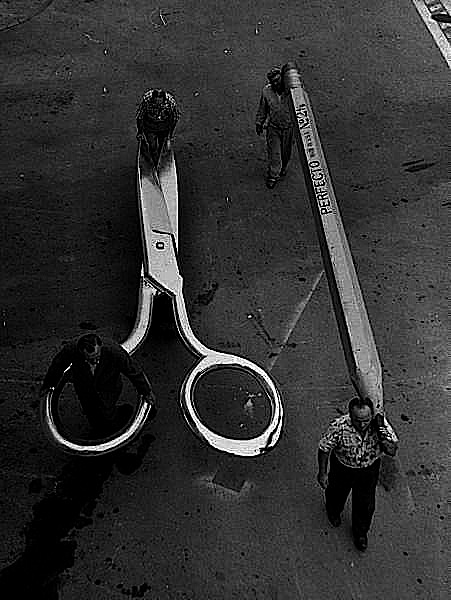
giant scissors, pencil

Well, that was an unexpected blogging hiatus, wasn’t it? I plead ambitiousness: in addition to prepping for this coming Saturday’s at the master class on querying at Words & Music conference in New Orleans, I have also been gearing up for the close textual analysis component of the third-place prizes in the Author! Author! Great First Pages Made Even Better Contest. Since giving feedback on the winning entries is so rightfully time-consuming — and something that I was not originally going to do alone — I’ve kept telling myself, “Oh, you need a few solid hours to devote to this — you can fit that in tomorrow.”

Then tomorrow came…and the day after…and before I knew it, a few days had gone by between posts. Sorry about that. I should have a few hours this evening to leap into that much-anticipated close textual analysis.

Just in case I get distracted again (what’s the probability?), I wanted to post again this morning on our ongoing topic, how to find agents for your query list. Because, let’s face it, even if you weren’t planning to drop by the Hotel Monteleone Saturday afternoon at 3:30 p.m. for a crash course in querying, there’s nothing like talking about what kind of agent is right for your book to get one’s momentum going for that end-of-the-year querying push.

You were planning an end-of-the-year querying push, were you not? Or a beginning-of-next-year one? If not, why not?

Last time, I mentioned that, contrary to popular belief amongst aspiring writers, a great big agency is not necessarily the best choice for any particular book project, any more than signing with just any agent is a sure path to publication. While queriers, understandably, tend to focus on how picky agents are about what projects they take on, it’s worth giving some serious thought at the query list-generating stage to what kind of agency — and agent — is most likely to have the connections not only to sell your book well, but to walk you through the often difficult and perplexing publication process.

So while admittedly every agency — and indeed, every agent — is different, let’s spend this morning pondering some sweeping generalities about size, shall we?

I am certainly not the first to write on this topic, nor, I suspect, the last. Writers’ periodicals seem to have an especial fondness for the issue — so much so that I sometimes wonder if a visiting alien picking up a writers’ magazine would not automatically assume that every writer in America chooses representation based upon size alone.

It’s a big country, the alien might reason. They like everything big.

There are, of course, some reasons for this preference — and not just because it’s kind of cool when you mention your agency at writers’ conferences or industry parties and people say, “Oh!” as if they’ve just learned that you won the silver medal in pole-vaulting two Olympics ago. (Although admittedly, that’s gratifying.)

As the client of a large agency, a writer does enjoy many benefits: the prestige of signing with a recognized name, more support staff to answer your questions (or not, depending upon prevailing attitudes), and often more collective experience upon which you can draw. Just as with a well-known agent, in going with a major agency of good repute, you are working with a known quantity, with verifiable connections.

Emphasis on connections. Read Publishers Weekly or Publishers Marketplace for even a couple of months — not a bad idea, by the way, if you intend to stick with this writing gig for the long haul — and you’re likely to notice the same agency names turning up again and again, coupled with particular publishing houses. Agencies do specialize, and obviously, it’s in a writer’s interest to be affiliated with one of the top agencies for her book category.

Even when an agency does not focus on a particular category to the exclusion of others, the agents within it often will — and that, too, sets a discernable pattern. It’s not at all uncommon for an editor who concurs an agent’s literary tastes to buy books from several of his or her clients.

Which makes a certain amount of empirical sense, right? There isn’t universal agreement across the industry about what constitutes good writing, even within a single book category. Individual tastes differ, and what one editor at Random House likes to see in a mainstream novel will not necessarily be what an editor at HarperCollins is seeking. If Editor Sam already knows from past acquisitions that she likes the kind of books that Agent Maureen enjoys, Sam is probably going to be more open to a pitch from Maureen than one from Agent Joe, who hasn’t sold her a book before.

Remind yourself of this dynamic, please, the next time you hear an agent say at a conference that a particular kind of book just can’t be sold anymore. What this usually means is that he would have trouble selling it to his already-established editorial connections.

How is a savvy querier to find out what connections any given agent has? Chant it with me now, long-time readers: research.

And I’m not just talking about plugging a book category into a search engine or Googling literary agency, either: I mean going through the standard agency guides, reading carefully through agency websites, checking the acknowledgements pages of first and second books by authors in your category. In order to track down who might be able to sell a book like yours right now, you will — wait for it — need to find out who has been selling books like yours recently.

At a big, well-established agency, this information is usually pretty easy to track down: my great big agency, for instance, simply lists its clients on its website (although the list is not always current). With a new agency, it can be harder to assess connection claims until a track record of sales has been established.

Don’t write off an agency just because it is new or small, however. As I mentioned last time, it’s not uncommon for a successful agent to break off and form her own agency, taking her connections — and often her clients as well — with her.

At the moment, there seem to be many more new agencies than usual; since the economic downturn, quite a few agents have been branching off on their own. (This is one reason why, in case you were wondering, I like the Publishers Marketplace database so much — you can look up agents by name, not just by agency, so you can see how their representation preferences change as they move around. An agent with a passion for SF might not be able to give free rein to it as the junior agent at an agency that specializes in mysteries, but might well have leapt into SF after a promotion or move elsewhere.)

That can be a good thing for a querying writer: often, new agencies are actively seeking out new clients. As are, typically, junior agents even at large agencies, so don’t overlook the young and the hungry.

The hungry can be excellent gambles — they are often more energetic in pursuing sales. Even if a relatively new agent does not appear to have a long solo track record, check her bio: a lot of junior agents were formerly assistants at large agencies. (Or even Millicents. Hey, everyone has to begin somewhere.)

An former assistant may well walk into her first solo gig with some pretty good connections already established. She may well be more open to first-time authors than her better-known counterparts. In fact, she may be counting on discovering the next Great American Novel in her inbox — and with good reason: lest we forget (because it’s not mentioned much at writers’ conferences, for some reason), how many of the big agents initially established themselves in the industry was by taking a chance on an unknown client who turned out to be a major author.

So f your book sells quickly and/or well, you can be the favorite steed in the shiny, new stable. Which probably means you and your work will get more attention than with a similar achievement at a larger agency, where you would be just one of their in-house stars.

Even before that (and frequently after as well), a hungry agent often offers services that a bigger agency or a busier agent might not provide. Intensive coaching through rewrites, for instance. Bolstering the always-tenuous authorial ego. Extensive free editing. (If you missed my earlier discussions of fee-charging agencies, or you are unfamiliar with how much freelance editing can cost, you might want to check out the relevant categories on the archive list at right before you discount the value of such an offer.)

This is more a matter of math than a matter of nice: an agent with 10 clients is going to have a lot more time to devote to these helpful services than an agent with 80. If you are a writer who wants a lot of personal attention from an agent, the less busy agent might well be the way to go.

Does it seem presumptuous to think about what an agent can offer you, rather than what you can offer an agent? To the kind of thoughtful querier who knows better than to send out rude letters that say things like, “This is the next bestseller!” it often does. (Begging for attention for a good long while can do that to you.)

But think about it: if you are a writer lucky enough to garner multiple representation offers — and let’s all keep our fingers crossed for that — do you really want to realize with a shock that you do not have any criteria for picking an agent other than the willingness to say yes to you?

Stop laughing; established authors don’t admit this much, but this is not an uncommon dilemma for good writers to face. It certainly happened to me. Some years back, I received simultaneous offers from three agents, each of whom was apparently a nice person AND I had researched enough to know that each had a dandy track record selling the kind of book I had been pitching them — and I was stunned to recognize that I was utterly unprepared to judge them on any other basis.

Fortunately, I had many agented friends eager to offer me advice. Mountains of it, in fact. But that’s a luxury not every writer has.

So believe me when I tell you: giving some advance thought to what you want from your future agent, over and above the willingness and ability to sell your book, is not a symptom of creeping megalomania. It’s a means of coming to understand the value of your work and how it might conceivably fit into the already-existing literary world.

It can also, to descend from the heady heights of hope for a moment, give you some solid clues about how to prioritize a lengthy potential query list. It would be prudent, for instance, to consider very, very carefully how important personal contact is to you, because if this relationship works out, you will be living with your decision for a very long time.

Will you, for instance, go nuts with speculation if an editor has your manuscript — and you haven’t heard from your agent in a month? Many writers would, you know; I’ve heard justifications by authors of manuscripts that have been sitting on an agent’s desk for 4 or 5 months that positively rival the tales of the Brothers Grimm for invention.

The actual reason a writer hasn’t heard back tends not to be all that interesting, by comparison: typically, if you haven’t been told yea or nay, the submission has yet to be read. The paperweight was invented for a reason, you know: to keep bits of unread manuscripts from migrating all over agents’ and editors’ desks.

Once you have established where you fall on the update-need continuum, there are other questions to ask yourself. Do you want to hear the feedback of editors who have rejected your work, so you can revise accordingly, or would you rather get through as many submissions as quickly as possible? Would you prefer an agent who wants to micro-manage your book proposal, guiding you through its steps, or would you be happier with one who leaves more of the writing decisions to you?

How prone are you to ask questions or take concerns to your agent? When you do, would you be happy with the occasional e-mail to answer your questions, or would you prefer telephone calls? (If you live outside the United States, this last question is even more essential: the farther away you reside, the less likely it is that you will ever meet your agent face-to-face, right? Many small agencies would not be able to afford unlimited international phone calls.)

The answers to all of these are very much dependent upon how busy the agent is, and what kind of demands the agency places upon her time. Generally speaking, the bigger the agency, the busier the agent.

Seems a bit counter-intuitive, doesn’t it? Big agencies have greater resources for support staff (or did before the economic downturn), whereas in a small agency (or with a stand-alone agent) the agents may be doing support work as well; it would make sense if the small agency agents were busier.

However, nowhere is the old adage tasks expand in direct proportion to the time available to perform them more evident than in the publishing industry: as an agent becomes more important, he takes on more clients. Big equals powerful here.

There are exceptions to this rule, of course. A few boutique agencies deliberately keep themselves small in order to occupy a very specific niche, but it is rare.

There’s no mistaking these agencies — they ALWAYS identify themselves as boutique in their blurbs, lest anyone mistakenly think that they were small because they were unsuccessful. Often, they sharply limit the proportion of unpublished writers that they will represent, or do not represent the unpublished at all. They do, however, tend to lavish attention upon the few they select.

As do, admittedly, some agents at major agencies, but do bear in mind that no matter who represents you, no matter how much your agent loves your work, you will be only one of the authors on the agent’s list. Time is not infinitely flexible, despite anyone’s best intentions.

So before you set your heart upon a big agency or a major agent, it’s a good idea to ask yourself: do I really want to be someone’s 101rst client?

This sounds like a flippant question, but actually, it is a very practical one, and one that speaks very directly to your personal level of security about your work. Big agencies and important agents have made their names, generally speaking, on high-ticket clients; often, that high-recognition client is why aspiring writers covet their representation skills.

However, it takes time to cater to a bigwig client. I once had a lovely chat with a past president of AAR who handled one of the biggest mystery writers in the biz; apart from handling her book negotiations, he told me, he also spent a week a year with her in a mountain retreat — not skiing, but micro-editing her next work to make its market appeal as broad as possible.

Nice perq of fame, isn’t it? Beulah, peel me a grape.

Before you float off into fantasies about being successful enough to command your own personal slave copyeditor and/or mountain lodge, stop and think about the implications of being one of this agent’s other clients. That’s a week a year when he is not available to pay even the most fleeting attention to the needs of Clients 2 – 143.

So who do you think ended up handling those other clients’ concerns? That’s right: not the bigwig agent at all, but his I’m-working-my-way-up-the-ladder assistant. Who was, to put it mildly, somewhat overworked — and ended up moving on to become a full agent at another agency within the next year or two. She’s so successful now that she is no longer accepting new clients.

Which raises an interesting question: if a writer is actually dealing most of the time with the agent’s assistant, rather than the agent, with whom is the long-term, mutually beneficial interaction occurring?

Still, you cannot deny the appeal of the contacts and oomph of a big agency, even if you are not represented by the most important agent in it. Ultimately, it’s going to take more than enthusiasm about your project for an agent to sell your first book.

It’s going to take connections — the right connections for your project. You don’t have to attend very many conferences before you meet your first hungry new agent, willing to promise the moon, nor to meet your first 100-client bigwig. It’s in your interests to look beyond the generalities.

Again, chant it with me now, campers: there’s no such thing as an agency that’s perfect for every single conceivable book. This process is — or should be — about finding not just acceptance, but forming the best possible alliance with someone who is going to help you build a career as a writer.

Give some hard thought to how you want to be supported on that path, and make your querying choices accordingly. Keep up the good work!


Querylistpalooza, part IX: the face one presents to the world, or, whose proverbial mug of oolong is your book?

gold mask 2

A quick scheduling note before we launch into today’s festivities, campers: I shall be giving in-person feedback on aspiring writers’ query letters at the upcoming and always-scintillating Words & Music conference, November 17-21 in New Orleans. Do consider snatching up your latest query draft and meeting me there.

For those of you who don’t already have a draft already burning a hole in your desk drawer, I shall also be teaching a master class on how to write a query letter on Saturday, November 20th at 3:30 p.m. — and yes, you may drop in for the class, even if you can’t make (or afford) the entire conference. Or even several classes, at a very reasonable à la carte fee.

As I mentioned a couple of weeks back, the Words & Music conference is one of my favorites — and believe me, I go to a lot of writers’ conferences. Run by the Pirate’s Alley Faulkner Society, the conference is more ambitious than your usual craft-and-marketing fest. Yes, there is always abundant discussion of writing style and the ins and outs of publishing, along with opportunities to meet agents and editors, but there are also wonderfully arty discussions of literature, art, and music. To sweeten this writer-friendly experience even more, the conference is set the French Quarter, Tennessee Williams’ Vieux Carré, home to some of the best food and jazz in the world.

In other words: I’ll be your excuse to go if you will be mine. It’ll be a hoot.

Speaking of querying and its many challenges, as I mentioned back in the heady days of Querypalooza, queries tend to work best when they are sent to specific agents who habitually sell similar books. Not just because recent sales are the single best indication of what the agent in question likes to read — although that’s definitely useful to ascertain before you query, if the information is publicly available — but also because it’s a dandy indication that the agent has some pretty good connections with editors who happen to like to acquire that type of book.

For that excellent reason, I have so far been approaching our discussion of agency guide listings and websites on the assumption that you will want to narrow down your first-round query list to just a handful of near-perfect matches. To that end, I’ve been encouraging you to track down as much specific sales information as possible on the agents you’re considering.

That strategy, I suspect, will not be everyone’s proverbial mug of oolong. “Wait just a minute,” I have heard some of among you murmuring, and who could blame you? “What you’ve been suggesting is a heck of a lot of work. Frankly, I don’t know enough about the industry yet for a list of sales to make me cry, ‘Yes! This is the agent for me!’”

Oh, how I wish there were a quick and easy way to avoid the sometimes-lengthy research process! Honestly, if I knew of one, I would share it with you toute suite. (I would also bottle it and make a million dollars, but that’s another story.)

My sympathetic regret didn’t really satisfy you murmurers, did it? “I’m willing to do some legwork, but for heaven’s sake, querying eats into my writing time, and the agency guide before me lists a hundred agencies that accept books in my category! Since these agents have said point-blank that they want to see books like mine, why shouldn’t I simply take their word for it, querying them all without researching the last few years of sales for each and every agent at all hundred of those agencies, a Herculean endeavor that would take me until next March at the earliest?”

Whoa, take a deep breath there, Sparky. You’re going to need that extra oxygen for the long, difficult road ahead — and the often puzzling task of rank-ordering your query list so you know whom to query first.

You weren’t planning on approaching all hundred of those agents simultaneously, were you — or doing it alphabetically? The record-keeping alone would be prohibitively time-consuming. You’re going to want to figure out which among those many, many possibilities are most likely to be interested in a book like yours.

And I don’t just mean figuring out whether any given agent on your list represents authors in your chosen book category — although, as we have discussed before, knowing into which category your book falls is a necessary first step to searching for appropriate agents. (If that comes as a hideous surprise to you, or if you aren’t sure which of the preexisting professional categories is the best fit for your book, you might want to take a gander at the aptly-named HOW TO FIGURE OUT YOUR BOOK’S CATEGORY posts on the archive list at right.) I mean finding out enough about individual agents to make an accurate guess about whether they tend to enjoy books like yours within the book category.

Think about it: if you write cozy mysteries, and Agent #12 on your alphabetical list has a track record primarily in police procedurals, he might not be the agent you should approach first. If Agent #37 sells nothing but cozy mysteries, she would be a better choice for a top slot on your list.

That’s the good news. Here’s the less-good part: simply generating a who-represents-this-book-category list on a search site or taking a peek at the index of one of the standard agency guides probably is not going to provide sufficient information to make this decision. Their listings just don’t provide enough information, typically.

Hold onto your hats, because I’m about to say something all of you list-generators are going to like even less: that information may also not be up-to-date, or even accurate.

Yes, even down to which book categories any given agency habitually represents. It’s just a hard fact of agency-list generation that it does pay in the long run to double-check what one finds in the guides against another source — the agency’s website, for instance, or an agent’s Publishers’ Marketplace page.

Why? Well — are you still clutching those chapeaux? — not every agency that lists itself as representing (or even actively seeking) a particular book category will be equally receptive to queries for that kind of book. Or, as we saw last time, will would-be queriers perceive them to be open to first-time authors in that category.

How might an agent-seeking writer become confused by what at first glance may appear to be a perfectly straightforward list of desired book categories? One of the most common: being drawn to those agencies that appear to be open to virtually any kind of book — or at least to so many categories that it’s extremely difficult to tell without substantial further research what any given member agent’s actual specialties are.

Or so some might surmise from the oft-seen guide entry this agency prefers not to share information on specific sales. Or rather vague assertions like we’re open to any good writing, we accept all genres except YA, or literary value considered first. One even occasionally hears such statements emerging — usually quite sincerely and with the genuine intention of helping aspiring writers — from the mouths of agents and editors at conferences. A pretty good case could be made that to a writer seeking to figure out who might conceivably represent say, a Western romance, such statements are at best marginally useful and at worst bewildering.

What we have here is a vicious circle, right? The vast majority of queriers rely solely upon book category-only search results to generate their query lists, resulting in a high volume of queries that simply end up on the wrong desks. If an agency’s guide listing or website is not very specific about what it is seeking — or what it is seeking right now — that would tend to increase the percentage of queries it receives for books outside their areas of specialty in any given day’s mail drop. The inevitable result of both: queries rejected summarily and Millicents wringing their overworked hands, troubling the ceiling with their bootless cries about why oh why are these people sending queries for books that the agency doesn’t even represent. Because of the incredibly high volume of queries, though, they send out form rejection letters, so queriers who have misdirected their missives never find out that was the problem — which in turn results in our Millie gnashing her teeth over still more queries for book categories her agency doesn’t want.

Excuse me, driver, but I’d like to get off; this merry-go-round is making me dizzy. I’m guessing that it’s made those of you given to staring helplessly at vague guide listings dizzy, too.

I freely admit it: I have never understood why the difficulty of deciphering such statements is not a perpetual topic of impassioned discussion at writers’ conferences. (Unless I happen to be teaching at the one in question — had I mentioned that New Orleans is very nice at this time of year?) Oh, there are often classes on querying, but seldom on how to generate a query list. Indeed, if a conference attendee is bold enough to ask a panel of pros about it, she is far more likely to be told — with a certain impatience of tone — that the only reason that a query might end up in the wrong hands is if its writer did not do his or her homework, rather than given any practical guidance. The information, the implication runs, is all easily available to anyone who looks for it.

Has this been your invariable experience, campers? I’m guessing not, if you have been at it a while: as we saw earlier in this series, there is a wide range in the level of information that agencies make available to potential queriers. Compounding the problem: a great deal of it is in industry-speak, the meaning of which may not be immediately apparent to those new to the biz.

The look that tends to cross experienced queriers’ faces when talking about this phenomenon always reminds me of a line from ULYSSES: “Stephen, patently crosstempered, repeated and shoved aside his mug of coffee, or whatever you like to call it, none too politely, adding: we can’t change the country. Let us change the subject.”

Let’s not, for once: we writers can’t control how agencies choose to present their preferences; we can, however, learn to be better interpreters of those preferences by recognizing that there are some informational gaps out there. We can teach ourselves the norms of querying, what tends to work, what tends not to work, and thereby save ourselves a whole lot of chagrin.

So there. I never said it wasn’t going to be a lot of work. And if I’m wrong, and every listing out there conveys with pellucid clarity precisely what every agent currently representing books in the English language would and would not like to see arrive in their offices on Monday morning, well, as Jane Austen would say, at least the credit of a wild imagination will be all my own.

What is a savvy query list-generator to do, though, when faced with guide listings (and sometimes even agency websites) that seem to portray the agency in question represent books virtually every major book category? You’ve seen such listings, haven’t you? They tend to look a little something like this:

Represents: nonfiction books, novels, short story collections, novellas. No picture books or poetry.
Considers these fiction areas: action/adventure, contemporary issues, detective/police/crime, erotica, ethnic, experimental, family saga, fantasy, feminist, gay/lesbian, glitz, graphic novels, historical, horror, humor, literary, mainstream, military, multicultural, mystery, regional, religious/inspirational, romance, romantica, science fiction, spiritual, sports, supernatural, suspense, thriller, westerns, women’s fiction, YA.

Considers these nonfiction areas: agriculture, Americana, animals, anthropology/archeology, art/architecture/design, autobiography…

And that’s just the As. Such voluminous lists are potentially problematic. To pick a quandary out of that hat I told you to cling to, their breadth often tempts queriers into thinking that they do not need to specify a book category when they query. After all, the logic runs, if the agency says it represents all three of the closest marketing categories, why take the trouble to figure out into which the book fits?

A good question, certainly. Querypalooza veterans, chant the answer with me now: because book categories are how the industry thinks of writing, that’s why. Agents and their Millicents tend to reject queries that do not specify a book category out of hand.

Quoth Joyce: “The actions of men are the best interpreters of their thoughts.” (Hey, I had to double-check the earlier quote, anyway; I did a little quote-shopping.)

Even though it is honestly is in their own best interest to be specific, there are a number of perfectly legitimate reasons an agency might say it is actively seeking a list of categories that looks less like an agent’s specialties than the entire stock of your local Borders. For example, they might have the editorial connections to place all of those different types of books successfully. This kind of reach is certainly not out of the question for a large, well-established agency, but a great big agency is not necessarily the best choice for every writer and/or every book. (Don’t worry; I’m going to talk how and why next time.)

Fortunately, the standard agency guides routinely print how many clients any listed agency represents, so you need not necessarily track down their entire client list. If it is good-sized — 300 clients, for instance, handled by six or seven agents with different specialties — your task is clear: do a bit of further research to figure out which of those probably well-connected agents has been selling books in your category lately.

Do I hear more murmuring out there? “But Anne, the agents’ guide sitting on my desk at this very moment frequently lists a single agent as the contact person for the entire agency. Isn’t that the person to whom I should address my query, regardless of which agent at the place actually represents my kind of book?”

In a word: no. In several words: not without checking the agency’s website (if it has one) to see if they actually want you to do it that way. These days, most agencies don’t — and they frequently will say so in their submission guidelines. It’s generally in the best interest of the writer to write directly to the member agent who represents a specific kind of book, rather than the listed contact.

There’s no substitute for double-checking, though: if the guide listing is the only source available, then by all means, do as it says.

Okay, so that was quite a few words, but this is important. While some agencies are still set up with a single contact directing incoming queries into the right inbox, the rise of agency websites — and thus the comparative ease of conveying agency-specific querying preferences — has rendered that rare. So why do so many guide listings still list only a single contact? Well, I’m not positive, of course, but my guess would be that it’s simply that the form agencies are asked to fill out includes a space for it.

Oh, you laugh, but the last time you filled out a form, did you spontaneously offer more information than it asked you to provide? Or did you just work your way through, writing in answers every time there was a line?

Be glad of some of those lines, because they allow the guide to collect some very useful information. If the agency in question is small, check to see how long it’s been around — this is routinely listed in agency guides, and with good reason. Selling books to publishers is hard work; agencies go in and out of business all the time. Before they have established a reputation and connections within particular book categories, new agencies — and new agents — sometimes spread a pretty wide net for new clients. In such cases, the list of categories they are seeking can turn into a wish list, rather than a true reflection of what they have sold in the past.

Let me repeat that, because it too is important: a list of categories is not necessarily proof positive that an agency has actually sold books in each of them within the last couple of years — or even within living memory. It can also be a list of what the agency wants to sell over the next couple of years. That’s a definitional haziness not limited to small agencies, certainly, but common to them.

Which means, in practice, if a particular book category is hot right now, or industry buzz says it will be the next big thing, it’s going to turn up on the lists of quite a few agencies that have not yet sold that type of book — and thus in the index of this year’s agency guide.

See the problem? Ideally, you would like to be represented by an agent with a solid track record selling your type of book — and as I have mentioned, oh, 70 or 80 times in this autumn of ‘Paloozas, agents specialize. So do editors. If you write women’s fiction, even a brilliant agent whose sole previous focus are in self-help will probably have a harder time selling your book than someone who sells women’s fiction day in, day out.

An agent who has managed to sell a particular category of book in the past is not only going to have a better idea of who is buying that type of book these days — she’s infinitely more likely to be able to call up the right editor and say, “Listen, you know that fantasy I sold you six months ago? I have one you’re going to like even better.” Or if she’s not more likely to say it, she’s more likely to be believed when she does.

Seems pretty straightforward, right? But when editors start saying things like, “You know what I’m really looking for right now? A book from Hot Category X,” it’s not unheard-of for an agent without a track record in Hot Category X to think, “Hmm, I wish I had one of those handy right now.” Completely understandable, right?

It’s also completely understandable that industry trends often move faster than yearly guide release schedules. Perhaps a category that was hip seven months ago, when the agency filled out the guide questionnaire, but has since fallen out of fashion. Just be aware that if an agency was seeking a particular kind of book only because of its marketing potential at a particular moment, and not because they love that kind of book, and it stops selling — or selling easily — they’re going to tell their Millicents to look askance at queries for it.

Unfortunately, from the perspective of a Hot Category X writer new to the business, it can be pretty hard to tell the difference between an enthusiastic neophyte and a seasoned veteran of Hot Category X sales. Every professional writer I know seems to have a story about an author who got caught in this trap. Many are the horror stories about a great chick lit, historical romance, and/or memoir writer who was hotly pursued by an agent who later turned out to have few (or even no) editorial connections in that direction — and who, having unsuccessfully shopped the book around to 4 of the wrong editors, dropped it like a searing stone. Yet another reason that it’s an excellent idea to double-check actual sales before you commit to a representation contract.

Or indeed, before you query. Perhaps even before you place an agent on your querying list.

None of this is to say, of course, that agencies that represent a dizzying array of book categories don’t exist. Many large agencies do. Also, if the lead agent of a smaller concern (whose name, as often as not, will also be the name of the agency) peeled off recently from a great big agency, taking her clients with her, she may well have a track record of selling across many, many book categories. Connections definitely carry over — and since the agent will probably want to advertise that fact, check the listing, website, or conference blurb for a mention of where she worked last.

Then check out THAT agency, to see what they sell early and often.

In short, do your homework, but try not to get paranoid about it. Yes, it’s a whole lot of work, but as our old pal Joyce wrote about something entirely different, :Writing in English is the most ingenious torture ever devised for sins committed in previous lives.”

He was talking mechanics, of course, but I doubt you’d find a querier who has been at it for a while who wouldn’t wholeheartedly agree to add trying to sell to the front of the statement. Keep up the good work!

Assessing who should be on your query list-palooza, part VIII: learning to recognize a gift when it’s offered

torn bird of paradise

Wow, this has been a sad, strange week, campers. Prime evidence: I gave two — count ‘em, two — friends editorial feedback on their respective fathers’ obituaries, to run in local newspapers in different states. I suppose I am the person even I would call for trustworthy proofreading at a time like that, but still, I can’t help but feel that this has been no ordinary week.

I don’t know if you have ever written an obituary or eulogy, but it’s a strange, sad, marvelous process. Like the bird of paradise above, the result should be beautiful, but it will always appear to fall short of perfection. It requires real art to pull off well: few lives have a single coherent narrative, and most are so complex that the eulogizer must be extremely selective about what to include. Like any other synopsis, it can be written entirely in generalities, naturally, but the best are full of the telling details that could have come from no one else’s life but the dear departed.

I’m not bringing this up purely to depress everyone, I assure you. The necessity to summarize complex realities into a few pithy statements is actually quite germane to a matter we have been discussing at some length of late: how to glean information from agency guide listings and websites, to make sure that your query list includes only those agents genuinely and demonstrably interested in representing your type of book.

And half my readership does a double-take. “But Anne,” logic-huggers everywhere cry, “I don’t see the connection — and by the way, the flaws in that bird of paradise appear to have been externally-inflicted, not intrinsic to the flower itself. How is having to summarize an entire lifetime in a few short paragraphs remotely similar to agents having to boil down the possibly quite wide array of books they have represented, are currently representing, and hope to represent in future to just a few short sentences? Or have I just answered my own question?”

Why, yes, you have, logic-lovers — and good point about the flower. The difference lies in the perspective of the beholder. While no one expects an obituary or eulogy to give a complete picture of every nuance of the living person, aspiring writers frantically scanning agency guides and websites are often disappointed, or even frustrated, to find agents’ preferences expressed in only the most general of terms.

That’s unfortunate, because as I mentioned last time, agencies that give clear indications about what they do and do not want to see in a query or a submission are a boon to the savvy query list-generator: by being up front about what kinds of book projects stand a chance of success in the hands of their screener (our old pal Millicent, to be sure), these agencies save writers of other kinds of manuscripts buckets of time.

How, you ask? Conscientious followers of this series, chant it with me now: querying agents who do not habitually represent books in one’s chosen book category is a waste of an agent-seeking writer’s time and energy.

It’s also, not entirely coincidentally, a waste of Millicent’s time and energy to screen a query for a manuscript her boss would not even consider. That’s why, in case any of you fine folks had been wondering, agencies that are not in the market for first-time authors are usually quite blunt in their guide listings about not being particularly open to submissions from new writers. This is actually kind of them: like the agent who stands up at a conference and says, “By the way, although my agency does represent romances, I don’t, so please don’t pitch them to me,” an outright statement of reluctance in an agency guide can save a writer the time, energy, and disappointment of a fruitless approach.

But that’s not how the overwhelming majority of aspiring writers read such statements in guides and on agency websites, is it? Instead, they hear: you’re not important enough for us to consider or ha! We’ve just slammed a door in your face, newbie. Or even: if you were truly talented, oh previously unpublished one, we would already know who you were. Therefore, since we do not, you must not be a very good writer.

Okay, so that last interpretation is a trifle on the paranoid side. But after several straight hours surfing websites or flipping through guide pages, searching for agents who might conceivably be open to representing one’s groundbreaking SF/Western/Highland romance/cookbook, every indicator of lack of interest in one’s own type of book can start to feel like a personal micro-rejection, right?

Don’t believe that search fatigue affects overall querying patterns? Think again. Just as the alphabetically first-listed businesses under a category in the Yellow Pages tend to get called marginally more often, aspiring writers tend to query the agencies at the beginning of the alphabetical listings more frequently than those whose names begin with, say, L: in the face of so many similar-sounding listings, many queriers simply lose steam midway through the Cs. Because some begin at the end and work backwards through guides, the agencies at the end of the alphabet tend to see slightly more query traffic than those between M and T.

Seriously, it’s true, especially just after the first of the year: a hefty percentage of all of those New Year’s resolution-keepers (“This year, I’m going to start sending out a query each day until I land an agent!”) will pick up a standard agency guide, turn to the As, and work forward, or turn to the Zs and work backward. ?So you might want to avoid the A and B agencies, as well as the W-Zs, until well after the first of the year, to avoid being caught in the January rush.

Don’t worry: the average New Year’s resolution lasts less than three weeks. After Martin Luther King, Jr., day, you can feel free to approach those As and Zs; their Millicents will have worked their way through the piles of mail sufficiently to catch a glimpse of their desks again.

But I am digressing, amn’t I? “But Anne,” admirers of linear thought point out, “we were talking about how to read those listings, weren’t we? As fascinating as those last couple of paragraphs on alphabetical order were, shouldn’t we be getting back to the point?”

So we should, consecutive reasoners. Sometimes, the statements in the guides a trifle ambiguous, as if the agency wants to leave itself a bit of definitional wiggle room. Check out this slightly murky piece of guidance, either culled from the agency guide at my elbow or a figment of my extremely vivid imagination:

In approaching with a query, the most important things to me are your credits and your biographical background to the extent it’s relevant to your work. I (and most agents) will ignore the adjectives you may choose to describe your own work.

Now, many aspiring writers would instantly interpret this as don’t bother to query if you don’t already have a book out, but is that in fact what’s being said here? Let’s approach this like one of those nasty reading comprehension problems from the SATs. Is the agent in question actually expressing a preference for

(a) receiving queries from only the previously published (because of that reference to credits),

(b) receiving queries for nonfiction books only (because that first sentence seems to be talking about platform),

(c) receiving queries that are very terse and business-like, containing only minimal mention of the actual content of the book (because the agent who wrote it harbors an inexplicable animosity toward adjectives), or

(d) not trying to limit the scope of queries at all, but only meaning to give some well-intentioned general advice about the desirability of mentioning one’s credentials in a query letter.

How can a savvy querier tell which is the correct interpretation? Actually, she can’t — at least based upon the original quote alone. The fact is, it just isn’t possible to tell what’s meant without reading the rest of the listing — and even then, I would still recommend rushing right over to the agency’s website to double-check its submission guidelines.

Why go to the extra trouble? Well, going over a list of recent sales, the agent in question emerges as someone with a track record of representing science fiction and mystery extremely well. Would you have gleaned that from the statement above?

I’m guessing not. Leaving the thoughtful guide-peruser to wonder: what biographical background would be especially relevant to, say, a SF story set on Pluto? Need one actually have committed a murder to interest this agent in a mystery, or would it just be a nifty selling point?

Even just a basic web search can often turn up clarifying extras. If I told you that the agent responsible for our example also wrote an article recently for a SF fanzine, would your sense of how open he is to new writers increase? Might you even conclude that while this agent is primarily interested in science fiction, his agency is just beginning to expand its nonfiction list? And if so, mightn’t the comment about platform be aimed at nonfiction book proposers, rather than novelists?

A quick search of the last couple of years of this agency’s sales showed this to be precisely the case. (Sorry to disappoint all of you axe murderers out there who had gotten your hopes up.)

See why I think it’s a good idea to do some double-checking — and not to take every statement made in a blurb or listing at face value? Sometimes, industry-speak requires translation.

While we’re on the subject of nonfiction (and industry-speak), let’s take a look at another fairly common type of guide listing statement:

Nonfiction author and/or collaborator must be an authority in subject area and have a platform. Send a SASE if you want a response.

I must admit, I love the if you want a response part: if there is a querier out there who sends out missives WITHOUT wanting a response, I’ve never met him.

But is don’t bother to query if you’re too lazy to include a SASE the only message this agency is trying to send? Definitely not. The first sentence gives some indication of probable rejection criteria (hooray); the second sentence is most likely just giving general advice. Actually, it was probably intended as a bit more than kindly advice: from the phraseology, it’s probably safe to conclude that they simply toss out queries that arrive without a SASE, as many agencies do.

Which does, I suppose, boil down to don’t bother to query if you’re too lazy to include a SASE, now that you mention it. But if you had simply gone with your first knee-jerk reaction to that part, you would have missed the implication that this agency would welcome queries from legitimate experts on nonfiction subjects, wouldn’t you?

That’s not all an experienced eye could glean from this only apparently off-putting statement, however. I find the first sentence interesting as much for what it doesn’t say as what it does: while it would not be wildly inappropriate to conclude that, like our first exemplar, this agency’s Millicents have been trained to reject any NF query that does not include a clear statement of relevant credentials, it is not saying that the agency is only interested in the previously published — not an uncommon restriction for NF agencies. It also, by specifically mentioning a collaborator, is indicating that it is open to queries from ghosts.

So if I were considering querying this agency, I would run, not walk, to my list of selling points. Why? To cull bullet points to cram into my query letter about why I (and/or my collaborator) is the best person in the known universe to write this particular book, and why my target audience will be fascinated to read it.

On the off chance that I’m being too subtle here: There is no substitute for reading agency guide listings and websites IN THEIR ENTIRETY. All too often, would-be queriers mistakenly cross great potential agents off their query lists based upon impressions derived at a first glance — or even based on a perceived tone.

What kind of tone might engender this reaction, you ask? Perhaps an ambiguous beauty like the following:

We prefer that writers be previously published. However, we would take on an unpublished writer of outstanding talent.

That one made you a trifle hot under the collar, didn’t it? Go back and read it again, slowly. I put it to you, dear readers: is this agency open to queries from the previously unpublished or not?

To my eye, the answer is both. They probably would not reject a query outright for not including the credentials paragraph so strongly urged by the agent in our previous example — but a query from a previously unpublished writer would really, really have to wow ‘em to be considered. Or, to put it more crudely, they probably don’t want to rule out the possibility of the author of the next DA VINCI CODE’s not querying them because they said in their listing that they only represented previously published writers.

Remember, a listing, website, or conference blurb is not necessarily the obituary for an agency, depicting with impeccable accuracy its sales achievements to date, but unable to give any hint about the future. Usually, it also reflects what they hope to represent as well. Sometimes, as here, the actual content of that hope is left ambiguous.

And you thought I’d abandoned my obituary analogy. I’m more tenacious than that.

So is it worth a previously unpublished writer’s time to query an agency that seems to be hedging its bets like this? Possibly — provided that the agency has a solidly impressive track record in selling book’s in the writer’s chosen category and that it has sold a first book within the last couple of years.

Why that last caveat? As I have mentioned before, sometimes agency listings are rerun unchanged year after year. Websites are not always up-to-date reflectors of recent sales, either, and many, many agencies will list only their best-known clients. The expressed openness to writers of extraordinary talent expressed in a guide listing, then, might not be a current enthusiasm. Or even a recent one.

How can a savvy writer tell? Fly straight to its sales record. This need not be time-consuming: instead of concentrating on its client list in its entirety, focus on debut novel sales. (Most of the industry databases will include this information.) Or if you write nonfiction, first books in general.

If you don’t see any, you might want to rely more heavily on their assertion that they prefer the previously published and save yourself a stamp. Again, they have done you a favor.

Starting to get the hang of this? Let’s take a look at one more listing statement — or, better yet, let’s compare these three:

We care about writers and books, not just money, but we care about the industry as well. We will not represent anyone who might hurt our clients or our reputation. We expect our writers to work hard and to be patient. Do not send a rude query; it will get you nowhere. If we ask to see your book, don’t wait around to send it or ask a bunch of irrelevant questions about movie writes and so forth…If you can’t write a synopsis, don’t bother to query us. The industry is based upon the synopsis; sometimes it is all the editor ever sees. Be professional and follow our guidelines when submitting. And don’t believe everything you hear on the Internet about editors and publishers — it isn’t always true.

Present your book or project effectively in your query. Don’t include links to a webpage rather than use a traditional query, but take the time to prepare a thorough but brief synopsis of the material. Make the effort to prepare a thoughtful analysis of comparison titles. Why is your work different, yet would appeal to the same readers?

We are not interested in receiving poorly written submissions from authors with grandiose attitudes; don’t compare yourself to Jane Austen, J.R.R. Tolkien, etc. Blackmail never works — don’t tell us that you’ll only send your manuscript to us if we can guarantee you will be published. Please always send a SASE or else we won’t be able to contact you. Write stories that make sense; research everything down to the bone. Most importantly, be proud of your work; no self-deprecation.

Okay, what’s wrong with these three excerpts from guide listings?

From an aspiring writer’s point of view, absolutely nothing; they’re stuffed to the brim with thoughtful, practical advice about how to avoid these agents’ respective pet peeves. Well done, blurb writers, who may or may not exist outside my head!

To more cynical eyes, these responses might perhaps indicate questionnaire-answerers with a fair amount of time on their hands — the first lines of the first do carry a mission-statement aura about them. If I had to guess, though, I would say that pretty much all of these admonitions refer to individual queries they have received recently, rather than to general trends.

Faced with this sort of broad-reaching statement, a cynical querier might verify the size and longevity of the agency. Very small agencies — say, under 25 clients — will frequently have more specific blurbs, and for a very good reason: they can accept fewer clients per year than an agency that represents a couple of hundred clients. So probabilistically, they tend to be slightly worse bets than the larger concerns.

But it is awfully nice of them to tell writers up front what will trigger an automatic rejection, no? Make no mistake, that is what they are doing here — and indeed, what any agent who chooses to give specific querying advice almost certainly intends.

Trust me, no one likes to see her advice neglected. It’s in your interest to follow it to the letter, if not in all your queries, than at least in queries aimed toward the advice-giver’s agency.

In short, it is very much in a writer’s interest to read blurbs and listings very, very carefully — and in their entirety. Weigh all of the information you are being offered, even if it seems ambiguous or downright opaque: if an agent took the time to write more than the bare minimum, he’s probably trying to tell you something.

That’s also often true of obituaries and eulogies, come to think of it: a rushed, careless, or simply overwhelmed eulogizer might well fall back on generalizations and platitudes. It’s the telling details, though, that give the reader or hearer a sense of the actual person being described.

When individual preferences pop up in agency guide listings or in submission guidelines, cherish them. Appreciate them for the useful signposts that they are, and be glad that someone at that agency was kind enough to give aspiring writers some guidance. Because, really, is it in anybody’s interest for a query to end up on the wrong agent’s desk?

Oh, yes, I have more to say on the subject. Tune in next time, and keep up the good work!

Cobbling together a query list-palooza, part VI: eureka! Oh, wait, maybe I haven’t found it

old miner panning for gold

Still no suggestions for a fun-yet-appropriate name for this series, campers? Really? I’m on the verge of giving up entirely and just christening the darned thing Herbert. That would be a pity, not only because it’s not a particularly evocative name (unless, of course, one is writing about the Great Depression), but because this series has a lot of character.

Or characters, potentially: for those of you tuning in late, I have devoted the last week to going over the standard advice about how to find out who represents whom, so that you can query the agents of authors whose work resembles yours. As those of you paying close attention have probably noticed, most of the methods I have covered so far involve a heck of a lot of legwork for the writer: spending hours in bookstores, searching for acknowledgment pages that may or may not exist, going to author readings, making use of connections made at conferences and through writing groups, the works.

In essence, this advice is predicated on the assumption that the information is indeed out there to find; it’s simply the would-be querier’s responsibility to search for it. Admittedly, in a world where even reputable journalists’ primary research methodology is the Internet search, this seems agonizingly slow.

But as anyone who has ever typed the words literary agency into a standard search engine, trolling for agents online is not necessarily any faster. Indeed, it is sometimes even slower, as the results of a generalized search can be pretty indiscriminate. Even when one finds an agency’s website via a generic search, it often takes significant further research to figure out if it is reputable, has a good track record, and represents what you write.

A writer does need to be careful, after all: an attractive website does not necessarily credibility prove, and there are, unfortunately, scammers out there who pose as legitimate agents. For someone new to the game, it can occasionally be hard to tell the gold from, well, the other stuff in the pan.

Why might a scammer lick his unscrupulous chops at the prospect of taking advantage of eager-but-underinformed writers seeking agents? Catering to those treading the early steps on the path to publication is big business. The aspiring writer market is immense: just look at how many conferences, seminars, books, and magazines are aimed at it. Because success is elusive and the process genuinely confusing even to many who have been at it for a while, a business that offers what appears to be a means to bypass all or part of the usual long, hard slog can sound awfully appealing to many.

Like it or not, though, there just isn’t a shortcut around the hyper-competitive querying and submission process. You can certainly learn how to go about it more professionally — thus the autumn of ‘Paloozas — but as far as I know, no one has yet bottled sure-fire literary success and offered it online to any comer.

So let the writer beware. At the risk of perpetuating a cliché, if a publishing-oriented website offers aspiring writers a break that seems too good to be true, it probably is.

Many of the businesses that profess to give aspiring writers a leg up are clever about it, though, so do proceed with caution. Sometimes, websites aimed at appealing to the desperation of the querying writer give judicious small tweaks to their sites to give the impression that they are offering legitimate representation, whereas they are actually offering something quite different.

Usually, it’s an editing service — at a price far, far higher than a reputable freelance editor would charge.

A good rule of thumb for weeding out the questionable: if an agency requests money from potential clients up front — usually called a reading fee — it should set off warning bells in your pretty little head. (If you’re in doubt about what fees are and are not reasonable, please see the FEE-CHARGING AGENCIES category at right.) Ditto if the agency demands that potential clients pay for a professional evaluation, either performed in-house or via a specific editing service, before it will consider you as a client. Or even implies that paying for a specific set of editing services will increase your chances of their taking you on as a client.

Why should an agency that charges to read your work render you suspicious? Because reputable agencies earn their money through commissions on their clients’ writing — and that requires selling books. If an agency’s website tells you otherwise, it would behoove you to double-check its credentials.

How can you check? First, if the agency is located within the U.S., find out if it is a member of the Association of Authors’ Representatives. The AAR takes the ethics of its members very seriously, bless ‘em, and it flatly forbids them to charge their clients extraneous fees. A fee-charging agent — including one who accepts kickbacks from an editing service — cannot be a member of the AAR.

So you see, I’m not the only one who considers agents’ charging reading fees highly questionable.

The United States is not the only country in the English-speaking world whose reputable agents have banded together, I am delighted to report. In the United Kingdom, contact the Association of Authors’ Agents. In Australia, contact the Australian Literary Agents Association. As far as I am aware, Canada does not have an agents’ association (if anyone north of the border knows otherwise, please let me know, and I’ll be delighted to update this), but the Association of Canadian Publishers’ website does include information about literary agents.

Not all agents are members of these organizations, but if there have been complaints from writers in the past, these groups should be able to tell you. They are there to help writers make crucial decisions about who should represent their work, so don’t be shy about availing yourself of their resources..

Please don’t dismiss the notion doing some minimal checking to assure the agents reading your work are on the up-and-up as writerly paranoia — who represents your work is too important to your writing career to leave to chance. Remember, not everyone who slaps up an official-looking website is actually an agent, and good writers too nice to want to seem confrontational get burned all the time.

Another good place to check is the Preditors and Editors website, which allows you to look up both individual agents and agencies. P&E acts as a clearinghouse for complaints; if they learn that an agency has been charging fees, they will say so. Also — and this is useful — they code their listings by whether they have been able to verify if an agent or agency has actually sold any books.

Well might that implication make you gulp. The mere fact that they have seen fit to note that should give you some indication of just how many good aspiring writers have been burned by fake agencies.

You also might want to stop by the Absolute Write Water Cooler, where aspiring writers’ comments on individual agents and agencies are indexed (and thus searchable) for your perusing pleasure. They also garner information on publishers and share advice about avoiding scams. Writer Beware, a website sponsored by the Science Fiction and Fantasy Writers of America, provides a wealth of resources for those who want to learn about scams aimed at writers.

If the mere idea of having to do a background check on the agent who has just asked to see your first 50 pages makes you feel like fainting, there is an easier way to limit your query list to the reputable. Both of the most reliable agency guides are in book form, the Herman Guide and that perennial bestseller, Guide to Literary Agents limit their listings to the legit. Both come out every year — and since agents move around so much, it is a good idea to rely upon the current guide, rather than one from a couple of years ago.

Yes, buying them every year can be a mite spendy — but there’s no law saying that you and twelve of your writer friends can’t all chip in on a single copy, is there?

While it may seem Luddite-like to suggest buying a — gasp! — book in order to conduct research, these guides are both excellent places to find contact information for agents. Which is to say: most of the queriers I know find them more useful to get the nitty-gritty on agents already identified as appropriate for a particular book than as a first stop for agent-searching.

It certainly would be possible to use them as a first stop, however. Both list agents by specialty — a boon for anyone seeking basic information about whom to solicit — and both routinely ask agents to specify which book categories they are seeking, and which they would reject on sight. Personally, I prefer the Herman Guide — it is chattier and tends to ask more interesting questions — but usually, it covers a smaller range of agencies.

So why shouldn’t you just flip to the index, make a list of every agent who represents your kind of book, and send the same category-specific query to each without further research?

Well, frankly, you could; truth compels me to say that I do know many authors who landed their agents that way. However, this kind of broad, one-size-fits-all solicitation tends not to be as successful: it is geared for a generic audience, rather than the desires of a particular human being. (For some impassioned disquisition on why vague querying is unstrategic, please see the WHY GENERIC QUERIES DON’T WORK category at right.)

As you may be gathering, I’m a fan of gathering information from a number of sources — which the guide listings’ seeming completeness often discourages. Since the amount of information offered varies quite a bit from agency to agency (I’ll explain why later), most aspiring writers simply assume that where there is little presented, there just isn’t much to tell.

However, that’s often not true. Most guide listings are pretty terse by design, focusing upon the agency’s preferences as a whole rather than those of the member agents. Although admittedly, there are exceptions, it can be very difficult to glean enough information to personalize a query well. The usual problem: when they list what authors an agency currently represents, they tend to stick to the best-known clients.

Or, to put it in terms that might affect you more directly: generally not those who have sold a first book within the last year or two. Yes, it’s nice to see names that you recognize, but an agency’s big sellers are often neither their most recent sales nor a particularly good indicator of that they are looking for now in a new client.

Why is getting up-to-date info so important? Well, agents’ preferences change all the time; so does the book market. What a particular agent was hot to represent three or four years ago isn’t necessarily what s/he is seeking today. What the agent has sold within the last year is the most reliable indicator of what s/he would like to see in a query next week.

And even in the rare instances where the blurbs do provide up-to-date titles, few of the guides include the authors’ names in the index, so the aspiring writer is reduced to skimming the entire book, looking for familiar writers. Not terribly efficient, is it?

Oh, I can feel some of you preparing to throw up your hands in despair. You’re contemplating reverting to non-personalized queries, aren’t you, in order to save yourself some research time? On the off chance that I have not yet talked each and every one of you out of simply conducting a generalized search of every agent in the country who represents your book category and sending the same query to all of ‘em, I beg you now to consider: we all know how annoying it is to be solicited by a telemarketer or spammer who hasn’t the faintest idea of our personal likes and dislikes, right? That kind of mass marketing operates on the assumption that if it sprays widely enough, it will eventually hit someone who is actually interested it what its purveyor is selling.

As applied to queries, that strategy is every bit as annoying to agents — and still more to our old friend Millicent the screener, who reads queries all day, every day. Targeting makes more sense. Yes, it is time-consuming to do the legwork to find out about individual agents’ literary preferences, but ultimately, it’s more likely to be successful.

I know that it seems practically Victorian to say this in the age of instant web searching, but often, tracking down those preferences requires looking in more than one place. It requires, in fact, a bit of cross-checking, not only because preferences change and agents change agencies but — as I’m sure those of you who have been at it a while have are already aware — frequently, the information one finds about a particular agency will vary, depending upon where you happen to be looking.

Yes, you read that last part correctly: often, the information published or posted about an agency in one source does not match what is available elsewhere. It’s not all that unusual for, say, an agent’s preferences on the agency’s website to differ from what is listed in the 2011 guide you just bought, or for the blurb in a conference brochure to contradict what has been printed in the guide’s last eight editions.

Was that massive gust of wind I just heard a sigh of relief from everyone who thought this perverse variability was just his imagination?

Heavens, no. Heck, it’s not particularly unheard-of for an agent speaking at a conference to say she absolutely does not want to be pitched a genre of book that her agency’s listing — or even website — says it is actively seeking to represent.

Faced with such discrepancies, the frustrated aspiring writer can only shake a fist at the heavens and cry, “What gives?”

Actually, there are some pretty good reasons that this happens — and no, Virginia, none of them have to do with loathing literature and taking active steps to trip up the nice folks who produce it. Perfectly nice agents at perfectly wonderful agencies sometimes have outdated blurbs. But most writers only find out about what is outdated after they’ve been rejected — and sometimes, not even then.

When the average aspiring writer reads information about an agency or a particular agent in printed form — in an agents’ guide, in a conference brochure, on a website — s/he tends to expect, not unreasonably, that what is there is 100% accurate. Certainly, it would not be impossible to derive that impression from all of those marketing experts who shoo writers toward those guides, agents who give speeches at conferences urging writers to do their homework before querying, or even the guides themselves.

But the sad fact is, not all of the information out there is either reliable or up-to-date. Or even consistent across sources.

Which, to be fair, is true of pretty much anything one might desire to seek out via the Internet: we are all aware, I sincerely hope, that not everything posted online is true. Part of the charm of the web is that it is not refereed; its very accessibility encourages disagreement. As reasonable, logical people, we expect to need to use our wits to weigh relative credibility.

To coin a phrase, consider the source — and read carefully. If the pancake recipe you have just found calls for you to add four rats’ tails, seven jellybeans, and fourteen agate marbles, you’re probably not going to want to follow it.

For most web searches, the mere application of common sense is sufficient, because the stakes aren’t very high. But if you send a query to an agent who is no longer with a particular agency — and some of ‘em move around quite a bit — that is going to harm you. Ditto if you send the first 5 pages of your chick lit masterpiece to an agent who no longer represents chick lit and has decided that screening writing samples is an inefficient use of her Millicent’s time.

Oh, you can insist until you’re blue in the fact that the guide in your hand insists that chick lit is that agent’s primary focus. You can jab your finger at the guide page that says every query should be accompanied by a 5-page writing sample. But you’re going to be wasting your time. Standards change — and if the agent in question has updated her website to reflect them, she will expect you to be aware of that change even if the most recent agents’ guidebook says otherwise.

In the virtual classroom, I just saw 37 hands shoot up into the air. “But Anne,” I hear some of you pleading with trembling lips, “the standard agency guides are updated every year, presumably for this very reason. Can’t I rely upon them?”

Good point, disembodied voices. Yes, this year’s guide should technically be up-to-the-minute, but one does occasionally find discrepancies between, say, an agency’s guide listing and its Publishers’ Marketplace page. For one very simple reason: guide listings and blurbs tend not to be updated very often.

Certainly not as often as minds and the writing market change. And before you yield to the temptation of resenting the guides for not coming out more often, let me hasten to add: it isn’t really their fault. Much as a website is only as current as its last update, the standard guides rely upon the participating agencies’ willingness to answer questionnaires every year.

Think about that for a moment. Agents tend to be busy, busy people. (Just ask ‘em.) And responding to those questionnaires is generally a volunteer activity.

So would it be surprising if they were often done in an extreme rush? Or if, to save a little time, many just submitted the same replies, year after year?

Uh-huh. Ditto with conference blurbs. And how often do any of us update our bios on our business websites?

Much of the time, admittedly, little is lost by recycling the old blurb. When the information that’s changed since the last questionnaire or website overhaul is not market-related, like an update of recent sales or the news that a member agent has just completed her MFA, I don’t think even the most detail-oriented researching writer would quibble.

But when agents move or change specialties, it’s a different story. That has real consequences for queriers, who honestly do need to find an accurate reflection of what a particular agent is looking to pick up now, not two years ago.

Hands up, everyone who has ever queried an agency listed as seeking a particular category, only to receive a form rejection letter stating categorically that they will not even consider that type of book. Or if you have shown up at a writers’ conference, all excited to pitch to that agent whose blurb sounded just perfect for your book, only to be crushed when he announces from the podium that if he hears another query for a book in your category, he’ll begin screaming uncontrollably. Or if — and this is surprisingly common — you took the time to check both an agency guide, the agency’s website, and the agent’s latest interview, and the submission guidelines you gleaned from the three were not only contradictory, but mutually hostile.

A lesser aspiring writer might take umbrage, of course — but you’re too savvy for that, aren’t you? You’re fully aware that fretting about the many, many parts of the querying and submission process outside the writer’s control is a waste of your valuable energies. Philosophical soul that you are, you merely murmur to yourself, “Someone has not been updating his or her agency guide listing,” and proceed on your merry way.

If it makes you feel any better, I can assure you that lack of accurate information leads to frustration on both ends of the querying exchange. For every writer left scratching his head over a seemingly inexplicable categorical rejection, there’s a Millicent out there muttering, “Why on earth do people keep sending us queries for a genre we haven’t represented for the last five years?”

Because, Millie, there’s an apparently credible source somewhere out there saying otherwise. Had I mentioned that there was not a Consistency Fairy policing the web?

“Okay,” I hear some of you saying wearily, “being too busy to update from year to year or conference to conference makes sense for the guide listings and agent blurbs that are stuffed to the brim with useful, specific information about precisely what they would like to see. But flipping through the guide in front of me, I notice that most of these listings are really, really minimal, just basic data like mailing address and what percentage of their clients are previously unpublished authors, but others include extensive discussion of what they look for in submissions, or even little essays on how they deal with clients. Why are the listings so uneven?”

My, you’re asking great questions today, disembodied voices. You’re absolutely right, of course: the level of detail listings varies wildly, ranging from generic advice about querying (No unsolicited manuscripts, Query first, Query with SASE, etc.) to expressions of preferences for particular types of books. This inconsistency of information carries over to websites, too, I notice: some are chock-full of genuinely useful information about individual agents’ preferences — and some are, well, not. Partially, I think, the variation comes from a certain amount of disagreement about the purpose of a listing or blurb — or so I surmise from the fact that they differ in style, tone, and content as much as individual agents’ platform speeches at conferences.

You’ve seen this for yourself, right? Some listings appear to be trying to narrow down what is being sent to them by giving bread-and-butter accounts of what they do and don’t want to represent; others try to recommend their services by mentioning well-known authors on their client lists. Still others, bless ‘em, attempt to bolster the hopes of struggling writers by giving general advice. Sometimes, though, these laudable attempts to be encouraging result a certain well-meaning vagueness.

Come on, admit it: not all of it is of immediate practical use. We love good writing, while a charming sentiment, actually does not tell a writer much about what kind of book an agent might conceivably like to read, does it? There is good writing in every genre.

“Okay,” I hear you say. “I understand that, but is there a way I can use these differences to my advantage? Since, obviously, it would take far less time to scrawl that those few lines on a questionnaire than to write a lengthy description of one’s every pet peeve and preference, should I assume that the writers of the just-the-facts blurbs are not as interested in attracting new clients? In other words, is a longer blurb an invariable sign of a hungry agent?”

I would caution against reading too much into which route an agency has chosen for its listings. There are plenty of excellent agents out there who routinely submit terse blurbs, as well as ones who rhapsodize about adoring writers while habitually dropping books after submitting them to only a small handful of editors.

As I mentioned above, these are busy, busy people — and busy people have been known occasionally to fill out forms rather quickly. Especially those who are not, after all, writers by avocation, given to expressing themselves with ravishing sensibility on the printed page at the drop of the proverbial hat. An ability to write lyrically isn’t necessary to be a first-rate agent.

An ability to sell books, however, is. Specifically, for your purposes, books like yours. What you can — and should — take away from how they have chosen to present themselves in print is a list of questions for further research.

Stop groaning — I’m talking about legitimately important stuff here.

If an agency says it represents books in your category, what similar books have they sold lately? Which agent sold them, so you know to whom to address your query letter? How tightly does this agency define categories — do they, for instance, have a good track record of selling the occasional book that stretches its genre? If they list sales from five or ten years ago (not unusual, even on agency websites), have they sold similar books recently? If they list recent sales, which were by first-time authors? If you have an idea for a future book in another book category, does the agency have a solid track record in representing that kind of book, too?

Further information on any of these points would help you write a better query letter, right? Yet a lot of the standard sources, as you may have noticed, are light on this kind of detail.

By all means, check the guides and the websites: the information found there can be very useful to figuring out which agents would make the most sense to approach. Besides, you absolutely must follow any submission guidelines an agency has gone to the trouble to post. But I would seriously advise widening your research to more than one source before you fire off that query to someone who said — last year? Eight years ago? — that he was eager to represent your kind of book.

I know, I know: after a few rounds of queries, it can start to get mighty tempting to regard any agent willing to say yes to your book as equally desirable, but you honestly will be better off with an agent who already has the connections to place your manuscript under the right eyes. The more you know about an agent’s sales record and preferences, the more specifically you can personalize the query letter.

Next time, I shall talk about other means of tracking down that information. Keep panning for gold, everybody, and keep up the good work!

Query lists and the fine folks who appear on them-palooza, part VII: perhaps not what you were expecting, but…

attacked-by-squid II

Okay, okay, so that’s not a particularly snappy title, but since we are nearing the end of this ‘Palooza on how to find agents to query (nope, already used that one), we should probably be expecting my title inventiveness to be wilting a trifle. Frankly, I’m eager to get back to some issues of craft…although, of course, given my very practical focus, I shall probably discuss them within the context of common manuscript failings that make agency screeners’ hair stand on end.

Which wouldn’t have been a bad image to use on Halloween, come to think of it: our old pal Millicent in a fright wig, permanently scarred by the haunting memory of submissions past. Have sympathy for her, campers; yes, she’s responsible for a heck of a lot of rejections, but hers is a very difficult job.

Unless, of course, aspiring writers are kind enough to make her life easy by sending her queries for books in categories nobody at her agency represents — or no longer represents. Then, her job’s a piece of proverbial cake.

Not entirely coincidentally, I waxed long, if not eloquent, in my last post on the desirability of bolstering the information one might find in a standard agents’ guide, a conference blurb, or even an agency’s website with a little further research. Today, I’m going to talk about where to seek out that additional info.

Let’s assume, for the sake of argument, that a savvy querier like you has been conscientiously haunting the library for the past month, shaking the Dewey Decimal System vigorously until a dandy list of authors of books like yours dropped out of it. Because you are market-aware, you have naturally limited your search to books that have come out within the last five years; because you are hip to booth just how tight the literary market is right now and how much more difficult it can be for an agent to sell a first-time author’s work than an established one’s, you have been focusing your efforts on first and second books, on the very sensible theory that the agents who represented them might be more likely to take a chance on a fresh new voice than others. You’ve already tracked down the agents thanked in these books’ acknowledgments.

Now, savvy querier, you’re all set to track down who represented the books ungraced by acknowledgement pages. Having embarked upon that laudable endeavor, one question is ringing in your mind like the Liberty Bell: why on earth is this most basic information so difficult to come by?

I wish I could tell you that there is some esoteric reason for that, having perhaps to do with national security or fear of offending the muses by breaking a millennium-old code of silence. In principle, since all publishing deals in the U.S. are matters of public record — not the financial specifics, perhaps, but definitely the players — gathering this data should be the proverbial walk in the park.

But it undoubtedly isn’t, at least without paying for access to a publishing industry database. While there are a few websites that offer searches by author represented, they are often also for-pay sites, and if the complaints one hears ringing through the bars that are never more than 100 yards from any writers’ conference in North America are accurate, the data on them is not always up-to-date; authors switch agencies almost as often as agents do.

Is that giant collective gasp of indignation that just rocked the ether an indication that neither of those last couple of revelations was what a writer seeking an agent wants to hear?

I hate to be the one to break it to you gentle souls, but landing an agent is not like tag: a writer doesn’t necessarily get to connect with It once, then drop out of the game. There are plenty of reasons an already-agented writer might find herself treading the wearisome querying road for a second time. An author might decide to write a book outside her agent’s interests, for instance, or the agent’s may decide he no longer wants to represent the kind of book a client writes. When an agent moves from one agency to another, his clients may or may not go with him. A mammoth, literature-deploring squid might attack Manhattan, reaching through the windows of major agencies and wrapping its grasping tentacles around any unlucky soul wandering the hallways.

Okay, so that last bit was to see if you were paying attention. Squid attacks on agencies are exceedingly rare.

My point is — you hadn’t thought I’d forgotten it, had you? — just as it would be foolish for an author looking to change agencies to revert to her query list from five or six years earlier, when she had last been in the market for representation, it would be counterproductive for an aspiring writer looking for a first agent to work off information that’s, well, a trifle on the elderly side. Or to assume that what was true a year and a half ago, when he first put together his querying list, is necessarily still true now.

Conditions change, even without the intervention of super-sized marine cephalopods.

So how might one update a query list — or add to it? The web is an invaluable tool: sometimes, you can learn who represents an author quite quickly, via a simple web search. However, as I’m sure some of you know from frustrating experience, this method can be very time-consuming, and it won’t always yield the results you want.

Why? Well, a standard search under the author’s name will generally pull up every review ever published about her work. As well as every article in which she is mentioned, prompts to buy her book at Amazon and B & N — not in that order — as well as the author’s own website. (Which, before you get your hopes up, may or may not tell you who represents her. Surprisingly often, established authors’ websites don’t.) Wading through all of that information can be a long slog, and does not always lead to what you need.

That doesn’t mean, however, that none of what turns up will help you. If you are searching for the agent who represented a specific book, it is worthwhile to check out the industry reviews excerpted on the booksellers’ sites. Or just go directly to one of the standard advance review sites: Kirkus, Library Journal, and Publishers Weekly. Occasionally, the agent’s name is listed at the end of these reviews.

(Why would these reviews list such an arcane detail? Well, the industry reviews are written primarily for the benefit of retailers who are considering stocking the book, not readers who might conceivably buy it from retailers. They appear considerably before the release date; long enough, in fact, that it is not unheard-of for editors to pull a book from the print queue that has received a less-positive-than-anticipated advance reviews, so that the book may be revised prior to release. (Or, more commonly, re-re-re-revised.) Print reviews, by contrast, tend to coincide with the book’s release, and are aimed at the general reading public. Thus, they seldom contain information of interest only to people in the industry.)

Actually, Amazon, B&N, and Powell’s all routinely post industry reviews, too, and it’s always worth checking to see if Publishers Weekly did an article on the deal. If you really wanted to take a month to get a feel for who was who in your genre, you could sit down and read the last year’s worth of advance reviews. (If you do, and you write SF/fantasy, stick with Kirkus. Trust me on this one.)

But honestly, who has the time to read all of that and write?

You were thinking that already, weren’t you? I can hear chairs shifting out there; skepticism is in the air. “Anne, Anne, Anne,” I hear some of you restless-but-observant types muttering, “you’ve been telling me for over five years that agents and editors are massively busy people who may well become impatient during the course of a two-minute pitch. Do you seriously expect me to believe that if they wanted to find out who represented a particular book, they would go shuffling though 50 websites?”

Okay, you’ve got me there: they wouldn’t. They would consult one of the standard industry databases. The catch: those databases are by subscription.

Translation: it’s gonna cost you something over and above your time.

Usually, you ostensibly join a sort of club, and one of the perqs of membership is database access. Almost invariably, you buy membership in specified time increments (often a month), rather than per-use, so if you are up for gorging yourself on agent info, you could conceivably lock yourself in a room with your computer for a week or two and generate a list of a couple of hundred names, along with the specifics of who has sold what lately, then cancel your membership.

You might be a little sick to your stomach afterward, having learned so much about what is and isn’t selling at the moment, but at least you would have a very up-to-date list.

Personally, I prefer the Publishers Marketplace database; it’s not terrifically expensive, and agents often use it themselves. It has a very straightforward function called WHO REPRESENTS, very easy to use. Feed in your favorite authors’ names, and presto! you have instant access to who sold their most recent projects. This, as those of you who have been trying to ferret out such information already know, can save you literally months of research time.

You can also track individual agents, to see whom they represent and what they have sold in the last few years. If you sign up for the for-pay Publishers Lunch e-mailings (which isn’t a bad idea, as such a high percentage of US-based publishing folks read it and/or Publishers Weekly; it’s a great way to gain a basic idea of how the biz works and how swiftly publishing fads change), you will gain access to this database.

PM charges month-to-month, so if you are strapped for cash, you could easily generate a list of authors, join for a month, search to your little heart’s content, then cancel. (But you didn’t hear it from me.) Or you could corral a few of your writer friends to go in on an ongoing subscription with you, with the understanding that you’ll share the data.

Even then, you might find it a little spendy, so I hasten to add: as savvy reader Nadine pointed out, PM’s website does allow non-members to search at least part of its database; if you’re looking for who represented a book sold within the last few years, this is a good quick option. I notice, however, that such searches do not yield specific deal information — which renders it considerably more difficult to check what, for instance, an agent has sold in the last 6 months.

Personally, I kind of like being able to look up everything that’s sold in my genre within the last month, but as we all know, my tastes a trifle odd. But why might access to such a database make a difference to the usefulness of your querying list?

Several reasons, actually. First, if you want to query every agent who has sold a book like yours in the last year, obviously, a search engine that would enable you to pull up the sales in your chosen book category over that period of time would save you quite a bit of time. Second — and this one should sound a trifle familiar to those of you who have been ‘Paloozaing of late — it’s always a nice touch to be able to mention an agent’s most recent sale of a book like yours in a query letter: Congratulations on your recent sale of Author McWriterly’s GREAT AMERICAN NOVEL. As my writing is similar, I hope you will be interested in my novel… Third — and this one should ring a few bells, too — because both the market and agency personnel are changing so fast these day, information about who is selling books in your category right now, as opposed to a year or two ago, when the books hitting the shelves now were being acquired by editors, might enable you to fine-tune your querying list.

Please pick your jaws off the floor, writers brand-new to the publishing process. Especially if you are writing fiction, it’s imperative to be aware that from an agent’s perspective, what is selling in bookstores right now is not necessarily an accurate reflection of what she can sell to a publishing house right now. Since there is typically at least a year between a publisher’s acquiring a book and its release, trolling the New Releases shelf will tell you what interested editors a while ago — not today, or even yesterday.

See why a query list-generator might want to garner up-to-the-minute sales information?

Before you dismiss the idea of spending money on professional database access, do sit down and figure out how much your time is worth. Why? Well, the practically-free method of acquiring the same information that I am about to suggest is so time-consuming that shelling out for a subscription service may start to look downright reasonable.

If you do have the time to invest, there is a free way to find out who represented any book, if it was published within the United States. As I mentioned above, the sale of a book is a matter of public record, and as such, publishers must provide information about who represented the author to anyone who asks.

So how do you get ‘em to cough up the information? Pick a book, call the publisher (there is often a phone number listed on the copyright page, to facilitate further book sales; if not, try the publisher’s website), and ask to speak to the publicity department. When you reach a human being (have a magazine handy; it can take awhile), ask who the agent of record was for the book.

You may encounter a certain amount of incredulity at your old-fashioned approach, but do not let that deter you. They are obligated to give you the information, and often, they’re rather charmed to hear that someone liked one of their books so much that he was willing to go to such significant effort to find out who represented it.

See why I thought you might find it a tad on the time-consuming side? Don’t worry; I still have a few time-saving tricks up my sleeve.

I sense a bit of disgruntlement out there. “Yeah, right, Anne: people at publishing houses are going to be happy to hear from readers. Pull the other one. I’ve always heard that under no circumstances should an aspiring writer ever call a publishing house or an agency. And why would they be nice to an aspiring writer, anyway?”

Well, for starters, that advice about never calling? It’s intended to prevent this conversation, and this conversation alone: “Hello, agency/publishing house? I have a book that’s a natural for Oprah, and…hello? Hello?”

A writer familiar enough with the ropes to be querying is probably not going to make that mistake. A dedication to playing by the rules is why, I suspect, that a weary What do you mean, you’re going to treat me like a human being? cynicism tends to pop from the mouths of aspiring writers who have been querying for a good long time.

It’s completely understandable, of course. After a couple of dozen form-letter rejections — which entail, basically, being told by a faceless entity that one’s writing is not good enough, but not being told how or why — it’s very, very easy to start to believe that agencies and publishing houses are staffed by writer-hating ogres, leering loreleis who cajole writers into sending in their hopes and dreams, purely for the pleasure of smashing them into the ground.

No wonder the giant squid has it in for them, if so. But happily for writers everywhere, this just isn’t the case.

There are a few mean people, of course, as in any profession, and I suppose it’s not out of the question that some perversely masochistic hater of the written word might choose to torture herself by becoming an agency screener. For the most part, though, if you have the opportunity to talk to an agent, editor, or one of their overworked Millicents, you will discover someone who genuinely adores good writing and is sincerely eager to promote the interests of those who produce it.

Stop laughing, jaded queriers. It’s true.

Not everyone agrees on what constitutes good writing, of course — one doesn’t have to hang around the industry very long to realize that plenty of pros apparently don’t make too strong a distinction between what is marketable and what is well-written — but contrary to the gloomy rumors perennially circulating on the writers’ conference circuit, it’s rare to find an agent or editor who genuinely regards writers as merely the necessary evil behind a successful book.

So why do so many of their form-letter rejections, conference speeches, websites, and even statements in agency guides convey, to put it politely, the opposite impression? An array of reasons — absolutely none of which have anything to do with you or your writing. Please, for your own sake, do not fall into the trap of taking it personally.

In the first place, form-letter rejections are now the industry norm. Period. Even for submissions — yes, even when an agent or editor has asked to see the entire book. In fact, sending out rejections at all is one of the more polite responses; as I am sure many of you are already aware, many agencies have a stated policy that they will not respond at all if the answer is no.

It’s annoying as heck for the writer who receives them, of course, but non-responses, like boilerplate rejections, are the industry’s reaction to the incredible rise in queries since the advent of the home computer. Like so many other puzzling aspects of the submission process, these phenomena can be explained by the agents’ desire to save time.

Which, as long-time readers of this blog know, can be darned hard in an agency that receives 1500 queries per week. While reason tells us that it would take only a few seconds per query for the agent or screener to scrawl a couple of words of explanation in the margin of a pre-printed rejection (which does happen occasionally, if a screener has mixed feelings about the rejection), the sheer volume of envelopes on Millicent’s desk tends to discourage it.

See why I don’t think you should take it personally? Or even necessarily as an indication of the quality of your writing?

Do I hear still more disgruntled murmuring out there? “But Anne,” a few hoarse voices cry, “this isn’t what I’ve heard. I’ve always been told — sometimes by agents speaking at writers’ conferences — that if I have been querying for a while and receiving only form rejections, I must be doing something terribly wrong.”

I’ve heard that one, too — and interestingly, I’ve sometimes heard agents who use form-letter rejections heavily say it at conferences, so aspiring writers come by this impression legitimately. However, it is an outdated notion. Gone are the days when only those illiterate queries and submissions without a prayer of being salvaged were brushed off in this manner.

Although, to tell you the truth, since the invention of the photocopier, there have always been more agencies and publishing houses using boilerplate rejections than was generally recognized. Stuffing form-letter rejections into SASEs is just too good a way to plow through the day’s mail.

To understand why, place yourself in Millicent’s moccasins for a moment: she’s been screening submissions all day, and she wants to go home on time in order to crank out those grad school applications. (Oh, she dreams big, our Millicent!) Standing between her and the door are the 350 query letters that arrived in the morning’s mail and/or e-mail — probably more, if it’s a Monday — and she knows that another 350 or so will be dumped on her desk tomorrow. Isn’t it in her interest to get through each of those queries as quickly as humanly possible?

This is precisely what she does, of course. Dear Agent letters and queries for book categories her agency doesn’t represent are rejected barely read, of course, as are letters that fail to conform to the norms of submission. (For a crash course on just what those norms are, please see the QUERYPALOOZA! category at right.) For each, she stuffs the agency’s boilerplate rejection into the accompanying SASE and moves on to the next query.

And that, too, is partially a function of time. Think about it: since an acceptance requires a personalized letter or e-mail, it takes longer to accept a query than to reject it, right? If Millicent has already decided to reject a query, which is she more likely to do when she’s trying to get out of the office, give a detailed explanation why, or just reach for that pile of rejection letters?

Would it affect your answer to know that take the easy route might save her a full two minutes? Not a lot of time in the life of the writer who has poured years into writing the book being queried, I’ll allow, but the sheer volume she faces precludes lingering. Don’t believe me? Do the math: 350 queries x 2 minutes/query = 700 minutes.

11.6 hours. In other words, longer than a standard work day.

If she works at an agency that accepts e-mailed queries — still not universal, but becoming more common all the time — her rejection rate is probably even faster. One of the reasons that some agencies prefer e-queries is, after all, the greater ease of rejection. She is probably using pretty much the same boilerplate: all she has to do is copy-and-paste it into a return e-mail. Unless she simply hits DELETE.

The fact that e-mailed rejections are usually phrased identically to paper form-letter rejections often comes as a surprise to many habitual e-queriers: after all, how long could it possibly take to give a sentence or two of actual feedback?

We writers tend to forget this, but to most of the earth’s population, the transposition of thought into written sentences is a time-consuming and sometimes even painful process. A good reader is not always a good, or even adequate, writer. Which is a nice way of saying that Millicent is unlikely to reinvent the wheel each time she taps out an e-rejection. It’s much more time-efficient to paste the same only-apparently-kind language her agency has been cramming into SASEs for years.

To experienced eyes, the same stock phrases — and often even the same sentences — are evident in pretty much every boilerplate rejection, be it electronic or paper-based. I’m sure you recognize them: Your manuscript does not meet our needs at this time. We are only accepting clients selectively. I just didn’t fall in love with it. There’s some strong writing here, but I just don’t think I can sell this in the current competitive market.

Okay, I’ll admit it: all of this may not be the best way to make my point that most agents and editors are really rather fond of writers and their work. I would argue, though, that precisely because such practices — form-letter rejections, non-response rejections — are impersonal by definition, it doesn’t make sense, logically, to read them as a reflection upon your work.

Seriously, there is nothing to read into a statement like I’m sorry, but this does not meet our needs at this time, other than a simple, unnuanced No, is there?

Which, admittedly, is lousy enough to hear — but it certainly is not the same as hearing, You know, I really liked your premise, but I felt your execution was weak, feedback that might actually help a writer improve the next query or submission. And it’s definitely better than hearing what so many writers read into such statements, hostility that amounts to Take it away — everything about this book concept is loathsome!

At minimum, it should NEVER be read as, since I’m saying no, no one else will ever say yes. Just note the response — and send out the next query immediately.

I sense some lightening of writerly hearts out there, but still, some strategic-minded spirits are troubled. “But Anne,” a few quiet voices point out, “this is all very well as encouragement, but why in Sam Hill are you telling us this in the midst of a series of posts on how to build a querying list?”

Because, sharp-minded questioners, in preparing these blog posts, I have been reading through quite a few listings, websites, and conference blurbs. In short, I have been sifting through what a writer trying to glean some sense of a particular agent’s preferences might find. Over the years, I haven’t been able to help but notice that just as many aspiring writers read a certain hostility into form rejections, they sometimes read a coldness into the listings and blurbs themselves.

I don’t think this tendency to leap to the most cynical conclusion is in an aspiring writer’s best interest, as far as pulling together a querying list goes. While some agencies seem to go out of their way to be encouraging, others come across as off-puttingly intimidating. Most of the time, though, what they are actually saying is just businesslike advice: Query first by mail. Include SASE. Query before submitting. No e-mail queries.

A bit terse, perhaps, but nothing to cause undue dismay. Sometimes, though, these statements — which are, the shy writer assumes, how the agency is choosing to promote itself to potential clients — can come across as positive discouragement to query at all.

Chief among these, naturally, are the ones that actually ARE intended to discourage queriers: We do not accept submissions from previously unpublished writers. New clients considered by recommendation only. Does not consider science fiction, fantasy, or mysteries. Or my personal favorite from the first page of the guide currently at my elbow: Although we remain absolutely dedicated to finding new talent, we must announce that until further notice we can no longer accept unsolicited manuscripts. We also cannot accept queries or submissions via e-mail.

While a thoughtful peruser might be left wondering, how precisely the agency in question acts upon the absolute dedication it mentions, having so emphatically cut off the most logical manners of exercising it, it is usually best to take such statements at face value. To my eye, what that last admonition was actually saying was not do not approach us, but please send queries by mail only, and if you send unrequested pages with it, we won’t read them.

Not particularly hostile to new talent, is it?

Read such statements very, very carefully — believe it or not, agencies post them to help you. If an agency isn’t considering books like yours, or if it relies upon its existing client list to recruit new writers for them (not all that unusual), querying them isn’t going to be a very efficient use of your time, right? Similarly, when a listing or blurb includes a simple statement of preference, along the lines of No phone calls or Include first five pages with query, this information can help the savvy querier avoid annoying Millicent.

Hey, I’m all for anything that keeps Millicent’s itchy finger away from that delete button. Why wouldn’t a reasonable writer want to know practical information like We never download attachments to e-mail queries for security reasons, so please copy and paste material into your e-mail?

I consider specificity a very good sign in an agency guide listing or website’s submission guidelines; as anyone who has flipped through one of the standard guides can tell you, it’s fairly rare. Whenever I see a website whose organizers have taken the time to give the logic behind their preferences, I shout, “Wow, this agency has given the process some creative thought. Vive la difference!

But listings, websites, blurbs, and even conference speeches that bark advice at the writer — and, once notice, it tends to be the same advice, over and over again — can be harder to decipher. Does the assertion that I do not take on books described as bestsellers or potential bestsellers, for instance, mean that the agent is specifically looking for less commercial work, that he doesn’t like to see target market demographics in an e-mail, or just that he’s tired of receiving boasts? Does This agency prefers not to share information on specific sales mean that they don’t have many big names on their client list, that they tend to sell to smaller presses, that they are too new an agency to have many clients’ books on the shelves yet — or just that the guy whose job it was to fill out the questionnaire was in a hurry?

Here, too, the impulse to read character into the responses can easily run amok — but what a temptation some of agencies do provide! For example, does the order Be professional! mean that the agency stating it is interested in working with a writer new to the business, or doesn’t it? And why, the nervous would-be querier wonders, does this agency immediately leap to the conclusion that I intend to be unprofessional in my approach?

Actually, there’s a pretty good reason for that: expressing such preferences is usually an attempt to save themselves some time. An agent doesn’t have to receive very many phone calls from aspiring writers before she notices that each takes up quite a bit more time than reading a query letter, after all, or be buried under an avalanche of unrequested manuscripts before establishing a policy that she will read only what she has asked to see.

So yes, a lot of queriers do approach unprofessionally, but let’s face it, those are probably not the ones who are likely to take the time to read the agency’s guidelines, anyway. In my experience, the habitual readers of the standard agency guides — at least the ones who are predisposed to follow directions — are not the ones who need to be told always to include a SASE, or never to send an unsolicited manuscript; these are the wholly admirable souls who have done their homework, bless ‘em.

But the overwhelming majority of generic queries — and pretty much all of the much-deplored “Dear Agent” variety — come from aspiring writers who have not taken the time to learn the rules of the game. (Unlike, say, you.) This is way the terser listings and blurbs tend to focus upon what NOT to do or send, implying a focus upon the avalanche of queries an agency receives, not on the plight of the sender of this week’s 657th letter.

So when a listing strikes you as off-putting, ask yourself, “Is this snappish list of don’ts aimed at me — or at the nameless person who sent a query without knowing to include a SASE? If it’s the latter, I’m just going to glean this listing or website for what applies to me.”

That may sound like denial, but actually, it is a sane and rational response to what is being said in most agency listings and submission guidelines. Keep reminding yourself: this is generic advice, not intended for your eyes, but the last querier who annoyed the agent in question. Nor is it a personality evaluation for the agent who wrote it — again, probably not a professional writer.

“I can understand why an agent might want to give generic querying advice at a conference or on a website,” some of you argue, and cogently, “but the standard agency guides have entire articles about how to query, for goodness’ sake! Do we really need 74 agents also reminding us to query before sending a manuscript?”

Good point, oh skeptical one. But it brings me back to my earlier point: most agents are not writers. Thus, few of them have ever queried a book of their own.

That means, among other things, that the average agent may not be aware of just how hard it is for even the best manuscript to attract representation these days. (Tell the truth now: if someone had told you how hard it was before you tried it yourself, would you have believed it?) They may not realize that it is now quite common for a very good writer with a truly fabulous book to need to query 50 or 100 agents before finding the right fit.

Which makes it entirely safe to conclude that they are not given to thumbing through the nearest agency guide in their odd leisure moments. I seriously doubt most of them are aware just how much repetition there is in the listings.

Again, that’s useful information for the writer who is predisposed to reading character into trifles (and what novelist isn’t?) If you approach those pithy little bursts of advice recognizing that their producers could conceivably believe that this listing might well be the first time anyone has ever heard of a SASE, they make considerably more sense.

Whew, this is a long post, isn’t it? And yet, amazingly, I still have a bit more to say on the subject of how to read agency listings, believe it or not. Steer clear of literature-loathing squid, everybody, and keep up the good work!

Query list-buildingpalooza, part V: say, have you heard the one about…

chatting couple at Lourdes 2

I open today’s post my favorite way: with an announcement of good news about a member of the Author! Author! community. Congratulations to Jay Kristoff, who has just signed a representation contract with Matt Bialer of Sanford J. Greenburger Associates. Kudos, Jay!

And another heaping helping of kudos to Jay for having not only thoughtfully documented his frankly pretty exciting querying and submission process on his blog, but also being generous enough to have posted his query letter there. It’s always helpful, I think, for aspiring writers to see what is working right now.

It can be done, folks: keep pressing forward. Keep that good news rolling in!

Speaking of writers being generous to those treading the early steps on the long and winding road to publication — how’s that for a graceful segue, eh? — in my last post, I suggested a surprisingly underused method for figuring out which ones might be open to your work: the straightforward expedient of going to author readings in your book category and asking the speaker who represents her. Later in the same posts, however, I may have dashed some hopes out there by pointing out several ways in which aspiring writers frequently bungle such approaches, in the hope of helping you avoid them.

How do I know about these faux pas? Because agents, editors, and established authors just love to trade stories about outrageous approaches, that’s how. Trust me, you don’t want to become famous that way.

Unfortunately, open-handed friendliness to aspiring writers is rare; in approaching most agencies, as well as most presses and even literary competitions, it helps to be aware that, to put it mildly, an overwhelming desire to smooth the path of the aspiring is most emphatically not the norm. There are just too many aspiring writers for too few representation, publication, and winner spots for each new aspirant to be greeted with open arms, personalized responses, and a big box of chocolates.

It’s nothing personal: Millicent the agency screener merely sees thousands of queries and dozens of submissions every month. It’s her job to narrow down the competitive field as quickly as possible. For the same reason, contest judges look for reasons to knock entries out of the running for top honors, and editors want to be wowed by the end of line 2.

It is in the aspiring writer’s best interest, then, to assume that any professional reader will be uncharitably nit-picky. I would assume that those of you who have been querying, submitting, and/or entering contests for a while — and certainly those who have been following the ‘Paloozas this autumn — are already aware of that. You may not, however, have embraced the course of action dictated by these harsh conditions.

Do consider embracing it, and hard, if you have any intention of approaching the agented — or, indeed, anyone affiliated with the publishing industry — for assistance: if you are a writer asking for individual attention and assistance, it behooves you to make it as easy as humanly possible for people to help you — and to make that relative ease apparent from your very first interaction with them.

Does that seem self-evident? In theory, perhaps, but it’s not often put into practice. As we saw in our recent spate of negative examples, from the established authors’ perspectives, the writers requesting help often seem to be working overtime to make it difficult to help them — and to demand as a right what is actually a gigantic favor. There’s a reason that every pro has three or four horror stories about rude aspiring writers: there’s never any shortage of ambitious souls who take one look at the patient, consistent, well-informed effort required to land an agent, assume that route is for suckers, and try to bypass the usual methods of approaching agents.

“But you have to help me!” these uncourteous souls insist after they have cornered established authors, agency employees, and/or editorial assistants at cocktail parties. “Agent X would be great for me, and I want to get published more than anything else in the world!”

That, my friends, is not the best way to get someone to help you. Minimizing the effort required to do you a good turn is.

There’s another reason that the hyper-pushy approach seldom works: every aspiring writer worth his salt wants to get published more than anything else in the world. The situation is hardly unique.

So why should someone in a position to provide an introduction to an agent pick one particular aspiring writer to assist, rather than any of the tens of thousands of others who would just love to jump the queue? Three reasons, typically, and simple ones: because that writer asked, because she did it politely — and because she had taken solid, practical steps render it as simple as possible for her designated helper to give her a leg up.

You would be astonished — at least, I hope you would — at how seldom hello, stranger, would you help me get my work in front of your agent’s eyes? requests meet even one of those criteria, much less all three. Here are a couple of ways that writers often fumble the approach without realizing it.

Misguided approach 1: Pablo covets established author Pauline’s agent, Percy, so her has gone about seeking a referral in a sensible, respectful manner: he read her work first, was able to give her a charming, well thought-out compliment on her latest book, and established a cordial relationship before asking for any favors at all. Eventually, Pauline asks to read some of Pablo’s work. It’s very good, so enthused, she sends him an e-mail saying that she is willing to recommend him to Percy.

Success, right? Not so fast.

“That’s marvelous,” Pablo writes back immediately. “Send Percy the manuscript I gave you, and let me know what he says.”

He is astonished never to hear from Pauline again. Nor, to his shock, does he ever hear from Percy at all. “How rude,” he mutters. “If Percy didn’t like the manuscript, he could at least have made the effort to tell me so.

Did you catch Pablo’s tactical error — and his misinterpretation of subsequent events? No? Okay, let’s consider: does Pablo have any legitimate reason to believe Percy even saw his manuscript, much less rejected it? If the answer is no on both counts, Pauline is the one who did not follow through here, not Percy. That’s an important distinction, since Pablo could conceivably still query Percy independently if he has not already rejected the manuscript, right?

So it is in Pablo’s best interest not to waste his energy resenting Percy. Instead, he should ask himself: did I do anything that might have made Pauline change her mind about helping me?

Glad you asked, Pablo: you certainly did. You violated the golden rule of assistance-seeking: you made it apparent that it would be difficult to help you.

How so? Pablo assumed that because Pauline was willing to help him at all, she would automatically be eager to put in a great deal of leg work on his behalf, too. Suddenly finding herself expected to perform a massive favor when she had merely offered to do a smallish one, Pauline froze and backed off.

This kind of authorial freeze happens all the time — a pity, since it is easily preventable with a bit of forethought. And just a bit of expectation-modification.

What scared Pauline off was Pablo’s sudden revelation that he expected more assistance than she was in fact willing to give — and far more than she had actually offered. That must have seemed strange to her, because what she was willing to do was potentially so helpful: give him a personal recommendation to her agent, something few previously unpublished writers ever garner. So In her mind, her contribution to his querying success would consist of allowing Pablo’s to open his query letter to Percy with Your client Pauline has read my manuscript and recommended that I contact you about it…

That’s it. It may not sound like an immense favor, but as it would place Pablo’s work in a different pile than every other query that came into Percy’s agency, it could potentially have made an enormous difference to Pablo’s querying success. In fact, until fairly recently, such a query would have resulted in what is known as a courtesy read, regardless of whether the work in question was likely to interest Percy or not. Since the economy tightened, however, agents are not granting courtesy reads to their clients’ friends as often as in days of yore — yet another reason, if you still require one, to be as polite as possible in approaching an author for a recommendation. An author whose agent habitually refuses courtesy reads is placed in quite a pickle by such requests.

Pablo didn’t think about any of that: all he heard was that she was willing to help him. In his mind, she had just volunteered to take all of the effort and chagrin of submission off his shoulders.

That was a completely unrealistic expectation. If she felt very enthusiastic indeed, she might conceivably have called or e-mailed Percy, to let him know that Pablo’s work was coming, but that would be the absolute limit to what an established writer like Pauline would do for a new acquaintance. She could potentially offer to do more down the line, but realistically, Pablo should have accepted this much with gratitude and, taking the initiative to promote his own work, followed through himself.

Instead — and herein lay his biggest mistake — he not only appalled her by ratcheting up his expectations, but insulted her by telling her so. In brushing aside her actual offer in a way that inadvertently came across as dismissive, he pushed 100% of the follow-up responsibility onto Pauline, essentially expecting her to be his unpaid agent, pitching his work to her agent.

Think about it from Pauline’s point of view: why on earth would she do this? Even if Pablo is a brilliant writer, the utmost personal benefit she could possibly derive from the transaction is the glow of having done a good deed and Pablo’s gratitude. Perhaps she could look forward to a line on a future acknowledgement page. But if Pablo begins the process by appearing ungrateful, why should she lift single well-manicured finger to help him at all, much less put her own credibility with her agent on the line to promote his work?

Yet we can’t help but feel a bit sorry for Pablo, can we? He botched an opportunity for which many another aspiring writer would gladly have given his pinkie toes. From am aspiring writer’s point of view, he really made only one small slip, and that inadvertent.

So what should he have done instead? His response to Pauline’s offer should have been all about her, not him: “That’s fabulous, Pauline; thank you so much. How would you like me to proceed?”

While we could debate from now until Doomsday whether the punishment fit the crime here, the overall message is clear: when you want someone to do you a favor, your best strategy is to minimize, not maximize, the amount of effort your patron will need to invest to assist you. Don’t simply assume it’s understood — ask questions about how you can make it less trouble to help you.

I’m not talking about tossing off a 5-page demand that the pro explain the entire process to you; I’m merely suggesting that you ask a question or two to clarify precisely what your potential helper is willing to do — and what you would need to do in order to support her efforts. When in doubt, you can always fall back on the most basic, most welcome question of all: “What can I do to make helping me easier for you?”

That’s a bit counter-intuitive, I know: ostensibly, this process is about others helping you, not you helping others. But trust me on this one: the simpler you make it to assist you, the more likely you are to receive assistance.

Adopting that attitude toward helping hands will, I promise you, make you more welcome in virtually any industry gathering, both now and in years to come. Why? Because it will make you a better addition to the professional writers’ community.

I can feel some of you timid souls trembling from here. “But Anne,” you wail, searching the area around your feet frantically for any toes upon which you might have accidentally tread, “I’m terrified that I’ll do something wrong, since I’m going to be walking into a situation where I don’t know anybody concerned very well. Is it to much to ask that my friend in high places would tell me what to do? I mean, seriously, isn’t this all Pauline’s fault for not being clearer with Pablo up front?”

Those are loaded questions, timid tremblers: from the aspiring writer’s side of the equation, it’s understandable that you might want guidance. But yes, it is too much to ask that a busy relative stranger — or even an actual friend who has already landed an agent — would drop whatever she typically does with her time (like, say, writing) in order to devote energy to promoting your career. You would be flabbergasted if the bigwig said, “Okay, I’ll help you, but only if you agree to spend five hours this week standing in a bookstore, hawking my latest release,” wouldn’t you?

So if Pauline neglected to send Pablo a bullet-pointed list of directions, it’s understandable, is it not? Ditto if she was unwilling to instigate an argument by e-mailing someone who has already imposed upon her to explain that he should impose upon her a little less.

She might also have heard a horror story or two from a fellow author about the dangers of being nice enough to cater to the sometimes quite unreasonable expectations of those looking to break into the biz. Take, for instance, the difficulties her friend Tremaine ran into when he was trying to help a friend of Pauline’s — a debacle for which Pauline most likely still apologizing, years later.

Misguided approach 2: Tanya met agented author Tremaine through networking: her college roommate Pauline, an aspiring writer who had not yet found an agent, had taken a seminar with him at a writers’ conference. Pauline raved about his trenchant insights so much that when Tanya had her first novel ready to query, soliciting his advice seemed only natural.

She shot off a polite e-mail to him, explaining that she was a friend of Pauline’s. Would he have some time to give her the benefit of his years of experience, please?

Because Tanya seemed to be nice and was complimentary about his books, Tremaine was happy to answer a few of her questions via e-mail; it amused him to think that someone who had taken a half-day seminar with him five years ago would remember what he’d said enough to recommend him to a friend. After the first couple of exchanges, however, he began deliberately slowing his responses to Tanya’s questions, because she started to e-mail him every day. Each time, her messages got longer — and more personal.

Tremaine recognized the pattern: this has happened before. Clearly, Tanya had begun thinking of their exchanges as a burgeoning friendship, rather than what it actually was, an author being nice to a reader.

One sunny Tuesday, Tremaine spotted yet another e-mail from Tanya in his inbox. Sighing, he left it to answer another day. On Friday, he opened it, and was startled to find a cheerful note from Tanya, telling him she has already sent a query to his agent, Trevor, using Tremaine’s name as a reference. Would Tremaine mind following up with Trevor as soon as possible, to confirm the recommendation and try to speed up the process?

Cursing, he vows never to be nice to a fan again. But what on earth is he going to tell Trevor?

I want to discuss this sorry tale of mismatched expectations on two levels: first, by figuring out what Tanya did wrong, and second, by examining just how much trouble her acting upon her misconceptions has created for her mentor. Not to mention the poor friend whose name she used to get to the mentor in the first place.

I would hope that her central faux pas is apparent to all of you, but just in case, let me be absolutely clear: it is always the aspiring writer’s responsibility to ask the more established one for permission to use his name in advance, not tell him about it afterward. And while it is possible that Tanya did ask, but Tremaine overlooked her question due to the sheer volume of her e-mails, it is never legitimate to assume that silence equals consent.

A good rule of thumb in any context, actually.

Compared to that egregious boundary-busting, Tanya’s other sins pale in comparison. She rushed Tremaine into a friendship, interpreting his being nice enough to answer a few questions as an invitation to increased intimacy — and did it in such a way that he probably will cringe the next time he hears Pauline’s name. People seldom talk about this, but the flip side of networking is that being the connection between a polite person and a rude one makes the connector look bad, invariably. Since Tanya knew that Pauline was also an aspiring writer, she owed it to her friend to be on her best possible behavior when approaching Tremaine.

What happened to Tremaine happens to famous writers all the time, incidentally: unfortunately, there are plenty of aspiring writers out there who have mistaken momentary professional kindness to a fan for the beginning of a lifetime friendship. And friends help one another, right?

Again, let’s phrase it as an axiom: before you use a recommender’s name, make absolutely sure that you have the recommender’s permission to do so. Yu may make an honest mistake, but because some unscrupulous folks have used this leg-up technique on purpose, the knee-jerk assumption on the agent’s end is almost certainly going to be that there was no misunderstanding at all. Just misappropriation.

It’s just not worth the risk.

A graceful way to confirm: if you are meeting in person, ask the recommender to write the agent’s name on a handy piece of paper for you. Then ask, “And it’s really okay for me to say that you sent me?” If said in a pleased, wondering tone, this will be perceived as a compliment — “Wow — YOU’re willing to recommend me?” — rather than doubting the author’s word.

Via e-mail, it’s even easier: if the language of the offer has been at all ambiguous, e-mail the recommender, saying that you are going to contact the agent. But make sure, unlike Tanya, you do it BEFORE you, well, contact the agent in question.

The overarching moral: it is always better to ask a follow-up question or two than to assume that someone intends to help you more than his words have stated specifically. If the recommender is indeed offering to help, the question is merely considerate; if not, it’s far better you know about it before you act, right?

Regardless of the outcome, remember to express gratitude for the help you did get. And don’t treat the granting of one favor as permission to ask for more — or, as Tanya did, to escalate the imposition.

Over and above the ethics of the situation, Tanya’s put Tremaine in a tough situation here, hasn’t she? On one level, she has used his name without his permission, and he would be well within his rights to pick up the phone and tell Trevor so, killing her submission’s chances.

On the other hand, doing so would make him look bad in the eyes of his agent: if he confesses to having been used, the next time Tremaine actually does want to recommend an aspiring writer, he will have to pass the manuscript along to Trevor personally, to avoid the possibility of another misappropriation of his name.

Which, as we have seen in Pauline’s struggles with Pablo will be a whole lot of work. Enough so that both Tanya and Pablo may reasonably expect to be the subjects of Tremaine and Pauline’s cocktail party horror stories for years to come.

Yet another very good strategic reason that you will want to bend over backwards to be easy to help: the publishing world is, as some of you may have already noticed, an arena where a poor reputation gets one talked about far more than a good one. You really, really do not want to be the subject of the hilarious story an established writer — or, still worse, an agent — is telling as a cautionary take at writers’ conferences this season.

But that does not mean you should be shaking in your boots, terrified that you will inadvertently say the wrong thing. The truly good stories tend not to be about aspiring writers who breach minor points of etiquette without knowing it, but those who come up with real whoppers.

Like the person who told a certain male agent of my acquaintance during a pitch meeting that he couldn’t possibly understand women’s fiction well enough to represent it. When he tried to tell her that he does, in fact, sell women’s fiction all the time, she implied that he was lying. She gave every evidence of being astonished when he said, “Then maybe you should not be pitching to me.”

Now that’s a good cocktail party story.

Seriously, when an author recommends a writer to her agent, she isn’t merely recommending the writing, but the person as well. As with any recommendation, the recommendee’s poor behavior tends to reflect poorly upon the recommender. And even if it didn’t, no one wants to be the client of whom the agent says at parties, “Oh, you would not believe what the writer she sent me did!”

Building a reputation for being easy to work with — the standard euphemism for being cooperative, following directions well, not prone to gratuitous temper tantrums, and knowing a bit about how the industry works going into a relationship with an agent or editor — carries legitimate value in agencies and publishing houses. Cultivate it. You really do want your agent to be able to say with a clear conscience, “Oh, she’s a peach. You’ll love working with her.”

I look forward to hearing that about you at a cocktail party, in fact. Keep up the good work!

Trolling for agent leads-palooza, part IV: a little assistance in angling for the big fish

puffer fish and friend

No, your bugged-out eyes are not deceiving you: I did in fact manage to work two — count ‘em, two — puns on the ubiquitous landing an agent trope into that capacious title, thank you very much. I can keep coming up with new names for this series until the proverbial cows come home, people, but until I hear some suggestions from my audience, the puns are just going to keep getting worse.

Don’t say I didn’t warn you. (And yes, I did take the disturbing photo of the floating fish myself.)

All week, we have been talking about how to generate a nice, substantial, and — dare I say it? Apparently, I do — appropriate list of agents to query. Because it’s a waste of your valuable time to write (not to mention Millicent the agency screener’s to read) letters to agents who do not regularly represent books in your category, the unfortunately common would-be querier’s strategy of simply opening one of the standard agency guides, casting a quick glance that the index, and sending essentially the same letter to every agent who seems remotely feasible is not in your best interest. While it can take some serious effort to come up with an intelligently targeted list, containing only agents with a proven track record of recent sales of books like yours (ideally, first books like yours), in the long run, selective querying is far more likely to yield requests to see manuscript pages than a scattershot approach.

And why is that, campers? Pull out your hymnals and sing out: agents specialize. So does a savvy querier.

To that end, we concentrated last time upon the sometimes difficult task of tracking down who represents whom, so that you may query agents who represent books similar to yours. I recognize, though, that to the more impatient among you — an aspiring writer impatient to see his work in print? Alert the media! — the level of background research I suggested yesterday might well have seemed a bit arduous. So today, I thought I would make a slight detour to a cut-to-the-chase agent-finding strategy long favored by the bold: walking up to a published writer (or a pre-published but agented one) and simply blurting out, “Excuse me, writer-whom-I-envy, but do you mind if I ask who represents you?”

You’d be surprised how often the answer is something along the lines of, “Why, no, not at all. My agent is Dealmaker McWheelerdealerson at Rainmaker Literary.” Writers tend to be nice people; they’re often very happy to give a spot of advice and encouragement to someone new to the game.

Given how very useful responses to this question can be for aspiring writers, it’s kind of astonishing how infrequently one hears it at author readings. Perhaps aspiring writers are shy; perhaps, too, they don’t go to as many book readings — especially by first-time authors — as they should.

Oh, you know a better place to run into a kind soul who demonstrably already has an agent? Or one more eager to talk to a potential reader? At an under-attended reading, a respectful aspiring writer might end up chatting with that new author for hours.

Yet even when aspiring writers are clever, resourceful, and community-supportive enough to find out when authors of books in their chosen categories are going to be signing and committed enough to show up, they are often afraid to come right out and ask the crucial question. They don’t want to bore other reading attendees. If you should happen to be laboring under this belief, allow this veteran of thousands of author readings to set your mind at rest: these days, “Who represents you, and how did you land your agent?” almost always elicits a response that’s interesting enough to entertain the non-writers in the audience, too.

Especially if you ask anyone who has landed an agent within the last seven or eight years, when the trolling has been quite a bit more difficult than in days of yore. I’ve seldom met a new author who isn’t positively relieved to launch into a diatribe about the 147 agents she approached before she heard those happy words every aspiring writer longs to hear: why, yes, I’d be delighted to represent your writing.

While you have your hymnals out, let’s sing another ditty: contrary to popular belief, good manuscripts do not always get snapped up right away. In the current ultra-competitive literary market, a savvy writer should expect to send out many, many queries before finding the right agent for her work.

So trot on out there and start asking some questions of the recently-published. If you live in or near a big city with some good bookstores, chances are very good that there are readings going on somewhere in town practically every day of the week. Again, don’t be afraid to ask some questions at your local bookstore or library: trust me, if you walk into the best bookstore in town, saunter up to the register or information desk, and ask for a calendar of readings, the staff will be OVERJOYED to direct you to one. Or put you on a mailing list.

Here in Seattle, we’re pretty lucky: not only do we have several very good independent bookstores that regularly host readings and signings, but we also have The Stranger, a free newspaper that routinely lists all of the author readings for any given week, along with brief summaries of their books. Heck, it’s even the rare newspaper that still — gasp! — reviews books. (Possibly because the editorial director, Dan Savage, won the PEN West award for a memoir a few years back.)

When you’re agent-hunting, it’s usually more worth you while to go to readings by first-time authors than people whose names have graced the bestseller lists for quite some time. Often, new authors are downright grateful to anyone who shows up, and doubly so to anyone who asks an interesting question. And if they are not grateful enough to their agents just after their first books come out to want to talk about them, they probably never will be.

As a fringe benefit, new authors will often blandish their local writer friends — publishers’ publicity departments generally ask authors for lists of cities where they have lots of friends, and set up readings accordingly — into attending their readings, just so someone shows up. Sometimes, these helpful friends are willing to tell you who their agents are, and what they represent.

Seriously, it’s always worth inquiring, especially if the reading author is new to the publishing biz. To be blunt about it, you’re far more likely to garner an actual referral from a first- or second-time author than a better-established one, especially if you listen politely, laugh at the jokes in the reading, and hang out to talk afterward.

Why do the established tend to be more stand-offish about it, you ask? Contrary to popular opinion, it’s not usually because they’re snooty. Just experienced.

Let’s face it, the etiquette in this situation can be a little murky from both sides of the podium — after all, authors at public readings need to regard anyone who approaches them at a reading as a potential book buyer, and thus may come across as friendlier than they intend. And because the road to recognition is so very long and winding, many aspiring writers seek to speed things up a trifle by enlisting the help of the already established on their behalf by not only asking for information about who represents them, but by requesting (or, in some unfortunate cases, demanding) to be allowed to open their query letters with the eye-catching statement, Your client, Madeitaftertwentyyears Paidherdues, recommended that I contact you about my book…

Half of you just started salivating, didn’t you? Before you get too slobbery, I hasten to add: experienced authors tend to make this sort of recommendation fairly rarely.

To illustrate just why an author might become rather jaded to this species of request over time, allow me to introduce you to who a few hypothetical souls who gamely walked up to published authors and asked for their help — badly. Like everything else, there’s a right way to do it and a wrong way.

The right way to ask an author for information about his agent, should you care to know it, involves treating him with precisely the same respect you would enjoy were you in his shoes. Approach politely, say something nice about his writing before you ask anything, and don’t be pushy. When you do come out with the big question, phrase it as the greatest of favors — which, incidentally, a referral to one’s agent undoubtedly is.

No need to be craven — anything beginning, “I’m sure you get this question all the time, Your Wonderfulness, but would you mind terribly if I asked…” is probably a bit over the top — but do indicate that you are aware that the author might not want to grant this request to a total stranger. Then, too, asking for advice usually works better than a direct request: something along the lines of, “My novel is rather similar to yours, and I was thinking of querying your agent. May I ask for some suggestions about the best way to approach her?” is often more successful than, “Hey, can I tell your agent that you sent me?”

That’s the right way. Journey with me now to the land of hypotheticals, to explore the wrong way. Or, more accurately, several wrong ways.

Author-approaching scenario 1: Isabelle notices in her local paper that Ignatz, a writer whose work is similar to hers and is aimed at the same target market, will be giving a reading at a local bookstore. She makes a point of attending the reading, installs herself in the front row, and bides her time, awaiting her moment. During question time, she stands up and asks point-blank who represents him, couching the question within a request for permission to use him as a query reference.

Ignatz laughs uncomfortably, tells an agent-related anecdote, and when she presses for a name, tells her to see him after his talk is over. Any other questions?

Isabelle waits patiently until all those who have bought books have presented them to Ignatz for signing, then repeats her question. “I haven’t read your book,” she tells him, “but from the reviews, our writing has a lot in common.”

Ignatz, professional to the toes of his well-polished boots, casts only a fleeting glance at her empty hands before replying. “I’m sorry,” he says, “my agent has asked me not to refer any new writers to him.”

What happened here, and how did Isabelle harm her own chances of success? For extra credit, what about Ignatz’s response marks it as a brush-off, rather than a simple statement of his agent’s feelings on the subject?

Isabelle committed two cardinal sins of author approach. First, she did not evince ANY interest in Ignatz’s work before asking him for a favor — and a fairly hefty favor, at that. She did not even bother to buy his book, which is, after all, how Ignatz pays his rent. But since he is quite aware, as any successful author must be, that being rude to potential readers may mean lost business down the line, he can hardly tell her so directly.

So he did the next best thing: he lied about his agent’s openness to new clients.

How do I know he lied? Experience, my dears, experience: had his agent actually not been accepting new clients, his easiest way out of this awkward situation would have been simply to say so. He did not, however: what he said was that his agent asked him — personally — not to recommend any new writers.

A subtle difference, but a crucial one, as far as tactfully refusing requests like Isabelle’s is concerned. Most agents rather like it when their clients recommend new writers: it saves the agent trouble to use the client as a screener. So if an agented writer says, “Oh, my agent doesn’t like me to recommend,” he generally really means, “I don’t like being placed in this position, and I wish you would go away. Please buy my book anyway.”

How has Isabelle placed Ignatz in a tough position? Because she has committed another approach faux pas: she asked for a reference from someone who has never read her work — and indeed, didn’t know she existed prior to the day of the request.

From Ignatz’s point of view, this is a no-win situation. He has absolutely no idea if Isabelle can write –- and to ask to see her work would be to donate quite a bit of his time gratis to someone who has just been quite rude to him. Yet if he says yes without reading her work, and Isabelle turns out to be a terrible writer (or still worse, a terrible pest), his agent is going to be annoyed with him for sending her along. And if he just says, “No, I don’t read the work of every yahoo who accosts me at a reading,” he will alienate a potential book buyer.

So lying about his agent’s availability is Ignatz’s least self-destructive way out. Who can blame him for taking it?

Because I’m a great believer in the try, try again approach to agent-seeking, let’s next assume that Isabelle has learned something from this encounter. Manuscript in hand, she decides to try her luck at another author reading.

Author-approaching scenario 2: this time, Isabelle makes a smarter choice, going to hear an author with whose work she has already read. Wisely, she digs up her dog-eared copy of Juanita’s first novel and brings it along to be signed, to demonstrate her ongoing willingness to support Juanita’s career. She also brings along a copy of her own manuscript.

After the reading, Isabelle once again stands in line to have her book signed. While Juanita is graciously chatting with her about the inscription, Isabelle slaps her 500-page manuscript onto the signing table. “Would you read this?” she asks. “And then recommend me to your agent?”

Juanita casts a panicked glance around the room, seeking an escape route. “I’m afraid I don’t have time to read anything new right now,” she says, shrinking away from the pile of papers.

Oh, you may laugh, but #2 happens even more that the first scenario –- and with even greater frequency at writers’ conferences than book signings. Just as some aspiring writers have a hard time remembering that agents have ongoing projects, lives, other clients, etc. whose interests may preclude dropping everything to pay attention to the total stranger who has just pitched or queried them, the pushy often forget (or never knew in the first place) that many, if not most, working authors who show up at conferences are there to promote their books, teach writing classes, and give lectures in order to supplement their incomes, not merely to win karma points by helping out the aspiring.

That’s an important distinction in this instance — basically, Isabelle has just asked a writing teacher she has never met before to give a private critique of her manuscript for free. Just as querying and pitching necessarily cuts into your precious writing time, so do requests of this nature cut into established writers’ writing time. And for very little benefit.

Oh, you hadn’t thought of it that way? Okay, tell me: other than Isabelle’s admiration and gratitude, what would Juanita get out of saying yes? A single book sale, at most?

This not to say that some established writers don’t like to offer this kind of help; surprisingly many will routinely read at least a few pages of politely-offered aspiring writers’ work. But even the most generous person tends to be nonplused when completely strangers demand immense favors. Establishing some sort of a relationship first –- even if that relationship consists of nothing more than the five-minute conversation about the author’s work that will prompt her to ask you, “So, what do you write?” — is considered a courteous first step.

This particular set of problems is not discussed much on the conference circuit – or, to be precise, they are not discussed much in front of contest attendees; they are discussed by agents, editors, and authors backstage at conferences all the time, I assure you, and in outraged tones.

Why? Because, alas, for every hundred perfectly polite aspiring writers, there are a handful of overeager souls who routinely overstep the bounds of common courtesy –- and, as I can tell you from direct personal experience, it’s not always easy being the first personal contact a writer has with the industry: one tends to be treated less as a person than as a door or a ladder.

No one, however famous or powerful, likes being climbed. Case in point:

Author-approaching scenario 3: at a large writers’ conference, Karl meets Krishnan, a writer who has recently acquired an agent. The two men genuinely have a great deal in common: they live in the same greater metropolitan area, write for the same target market, and share a love of the plays of Edward Albee. (Don’t ask me why; they just do. Suspend your disbelief a little, for goodness’ sake.) After hanging out together in the bar that is never more than 100 yards from any writers’ conference venue, it seems perfectly natural for Karl to e-mail Krishnan and ask him to have coffee the following week.

Within minutes of Krishnan’s arrival at the coffee shop, however, he is plunged into embarrassed confusion: Karl pulls a hefty manuscript box out of his backpack. “Here,” Karl says. “I want to know what you think before I send it to the agents who requested it at the conference. And after you read it, you can send it on to your agent.”

Krishnan just sits there, open-mouthed. As soon as his cell phone rings, he feigns a forgotten appointment and flees.

Okay, what did Karl do to make Krishnan feel like he was being used? Partially, he echoed Isabelle’s mistake: Karl just assumed that by being friendly at the conference, Krishnan was volunteering to help him land an agent. Because he was so focused on his own career, he didn’t pause to consider Krishnan, either as a writer or as a person.

In Karl’s mind, the only reason Krishnan could conceivably have agreed to have coffee with him was to discuss how he could help Karl land an agent. However, there are a LOT of reasons that industry professionals are nice to aspiring writers at conferences. A small sampling, in descending order of probability:

(1) Krishnan might have just been polite because his mother brought him up to be nice to strangers.

(2) Krishnan might have regarded Karl as a potential buyer of his books, and as such, did not want to alienate a future fan.

(3) Krishnan might have been teaching a class at the conference, or hoping to do so in future, and wanted to make a good impression.

(4) Krishnan is lonely — writing is an isolating craft, right? — and is looking for other writers with whom to have coffee every now and again between chapters. (Was it too much to expect a nice conversation about Zoo Story?)

(5) Krishnan is looking for local writers with whom to form a critique group and wanted to test-drive Karl as a conversational partner.

(6) Karl is a heck of a lot more attractive than he thinks he is.

(7) Krishnan has long been desperate to get some feedback on Chapter 3 of his doctoral dissertation, Edward Albee, A Study of Every Line of Every Play in Exhaustive Detail. His backpack contains a draft for Karl’s perusal.

(8) Krishnan is actually a serial killer who lurks at writers’ conferences, trolling for victims because he likes to bury body parts and manuscript pages together, or,

(9) Krishnan’s agent might have asked him to be on the lookout for new writers at the conference (rare, but it does happen occasionally).

Of these possibilities, only #5 would dictate ANY willingness on Krishnan’s part to read Karl’s work — and only if feedback would be exchanged, not a one-way arrangement. Even if #9 were true, it would be highly unusual for Krishnan to volunteer himself as a first reader; it’s a time-consuming task, and potentially awkward if Karl’s work does not turn out to be something that might conceivably interest Krishnan’s agent. Again, what would be in it for the agented writer?

Regardless, if either #5 or #9 had actually been Krishnan’s intent, it would have been polite for Karl to wait to be ASKED to share his work. As any Millicent would be only too happy to tell you, even a cursory scan of a manuscript can take quite a bit of time.

But what of Karl’s request that Krishnan pass the manuscript on to his agent? This, too, placed Krishnan in an awkward position. Even with a super-open agent, an agented author cannot recommend others indiscriminately. Think about it: if Krishnan recommends Karl, and Karl turns out to be a bad writer, a constant nuisance, or just plain nuts, that recommendation will seriously compromise his ability to recommend writers in future.

That’s right: writers like Karl, while usually well-meaning in and of themselves, collectively make it harder for everyone else to garner recommendations to agents.

There’s another reason Krishnan would be inclined to run from such an approach: resentment. Not of Karl’s rather inconsiderate assumptions that he would automatically be willing to help someone he’s just met, but of Karl’s attempt to cut into a line in which Krishnan probably stood for quite some time.

See earlier comment about just how long it can take even the most gifted writers to land an agent these days. Karl was unwise to assume that Krishnan would be eager to speed up the agent-finding process for anyone else. For all Karl knows, Krishnan invested a decade in finding absolutely the right agent for his work — and, unhappily, human nature does not always wish to shorten the road for those who come after.

Just ask anyone who has been through a medical residency. Or a Ph.D. program.

Err on the side of caution: presume that the more recently a writer landed an agent, the more difficult and time-consuming the agent-finding process was. And if he is in the throes of submission to editors, assume that he may be stressed out about that, too.

If an agented writer’s fretting about submissions seems a little strange to you, I can only conclude that your experience listening to those whose first or second books are currently being marketed by their agents is not vast — and thus that you have probably not been hanging out after very many new authors’ readings lately. Almost universally, a writer’s life gets harder, not easier, in the initial months after of being signed: practically any agent on earth will ask for manuscript revisions of even a manuscript she loves, in order to make it more marketable, and no one, but no one, on the writer’s end of the game is ever happy about his agent’s turn-around time.

Don’t see how that relates to Karl’s request? Well, think about it: even if Krishnan’s agent is a saint and habitually works at a speed that would make John Henry gasp, every second she spends reading new work is one second less devoted to reading Krishnan’s latest revision — or marketing it. Some authors are a mite touchy about that, so tread carefully.

Note, please, that all of the above applies even if Krishnan actually has time to read the manuscript in question. Which, as the vast majority of agented-but-not-published writers hold full-time jobs and have to struggle to carve out writing time — as, actually, do many of the published writers I know; not a lot of people make a living solely from writing books — is most emphatically not a foregone conclusion.

The best rule of thumb: establish an honest friendship before you ask for big favors. Until you know an author well, keep your requests non-intrusive.

And be polite, always. Krishnan probably would not have minded at all if Karl had simply asked for his agent’s name after half an hour of pleasant chat. Heck, Krishnan might have offered the information unsolicited in that time — or even permission to use his name in the first line of a query letter.

I can picture it now: since you so ably represent Krishnan Jones, I hope you will be interested in my novel… Too bad Karl blew such an opportunity by being hasty, eh?

Another good reason to get to know your intended helper a bit first: it may well have turned out that Karl had a skill – computer repair, eagle-eyed proofreading, compassionate dog-walking — that Krishnan would be pleased to receive in exchange for feedback on Karl’s book. Krishnan might even have asked Karl to join his critique group, where such feedback would have been routine.

But Karl will never know, because he jumped the gun, assuming that because Krishnan had an agent, the normal rules of favor-asking did not apply to him.

The same rule applies, by the way, to any acquaintance whose professional acumen you would like to tap unofficially. If I want to get medical information from my doctor about a condition that is plaguing a character in my novel, I expect to pay for her time. (And have actually done so, by the way.) Nor, outside of a formal conference context, would I expect a professional editor to read my work, an agent to give me feedback on my pitch, or an editor to explain the current behind-the-scenes at Random House to me unless we either already had established a friendship or I was paying for her time, either monetarily or by exchange.

That does not mean, of course, that you should be shy about asking an agented writer who represents him. Just tread lightly, and be very aware that you are asking a favor, and a big one, when you ask an author to help you reach his agent. Not only are you asking the author to invest time and energy in helping you — you are also implicitly imploring him or her to put credibility on the line.

And that, my friends, is something that most authors — and most human beings — do not do very often for relative strangers.

Next time, I shall examine a few more pitfalls that commonly open up under the unwary feet of aspiring writers seeking assistance in generating their query lists. Not exactly cheerful, I know, but I would far, far rather that you hear some of these unpleasant truths from me than for even a single member of the Author! Author! community accidentally tumbled into one of them. Keep up the good work!

Agentfindingpalooza, part III: ta da! Thank you, thank you; really, you’re too kind.

Annex - Curtis, Tony (Houdini)_02

Well, had you noticed yet, campers? Author! Author! has undergone a bit of cosmetic surgery. Go on, take a look around and see if you can spot the difference.

Hint: if you’ve been archive-trolling, you probably will. Based upon many, many readers’ complaints that my ever-burgeoning archive category list was just a trifle on the intimidating side, I bit the proverbial bullet yesterday and broke it down into sections. Overall, it’s still in alphabetical order, but if an intrepid reader were, say, to be on the look-out for posts on craft, s/he could simply peruse the categories gathered under the CRAFT AND PLENTY OF IT heading, rather than scrolling through the entire archive list, sniffing out categories that might conceivably be craft-related. The same goes for querying, synopsis-writing, formatting, and many of the other topics we like to cover early and often in this forum.

Do let me know if you find it easier to use, archive-spelunkers. I suspect you will, but you are honestly the best judges. I can already tell that it’s going to be a trifle more cumbersome from my side of the blog, but I’m not going to be the one searching frantically at 4 a.m. for a post on how to put together the contest entry that has to go into the mail at 9 a.m., am I? (For the benefit of those whose blood pressure shot skyward at the very thought: you’ll find the information you need under the CONTESTS AND HOW TO ENTER THEM SUCCESSFULLY heading. See, wasn’t that easier?)

Speaking of trolling for information, over the last couple of days, we’ve been chatting about means of coming up with a list of agents to query — other than simply opening the Herman Guide at random, hammering your finger down on a page, and sending a letter to the one grazed by your fingernail, that is. Easy as such a method might be — and surprisingly common prior to the advent of agent-search websites — it’s not particularly likely to yield the result you want: the name, contact information, and

Yesterday, I was discussing querying the agents who represent writers you like to read. Perhaps it goes without saying — I hope so, as I do not seem to recall having said it — but skip querying the agents of your favorite authors who work in genres other than your own. Chant it with me now, ‘Palooza-followers: a query to an agent who does not represent your kind of work is not worth the investment in postage, much less your energy.

By sticking to favorite authors within your own book category, you will minimize the chances of generating a self-rejecting query. Let’s face it, Millicent the agency screener would lose her job if she routinely went to her boss with letters in her hand, whining piteously, “I know that you don’t actually represent this type of book, but I liked this query so much that I thought just this once, we could make an exception…”

Not going to happen. Yet you would not believe how many queries she sees that seem to expect her to do just that — or so we must surmise from the sheer volume of letters sent every year to agents whose websites and/or agency guide listings clearly state that they do not represent books in the categories the queries are pushing.

The I am writing you because you so ably represent Author X… technique works best, naturally, when the querying writer’s work bears some striking resemblance to that of the cited author. I wouldn’t advise hitting up cyberpunk author William Gibson’s agent (who was, the last time I checked, Martha Millard) with hard-core literary fiction, any more than I would tell you to send Michael Moore’s agent (Mort Janklow) a book of hard-right political analysis or a rollicking comedy to Annie Proulx’s (Liz Darhansoff).

Unless, that is, I had it on rock-solid authority that right now, these fine agents were actively looking to represent any of these kinds of books.

However, if your well-read friends and trusted first readers say, “Hey, has anyone ever told you that you write like Francine Prose?” it’s worth checking to see if Francine Prose’s agent (Denise Shannon) is accepting new clients, right? And mentioning, if at all possible, specific ways in which your work resembles, say, Ms. Prose’s well-respected HUNTERS AND GATHERERS, rather than falling back on that dreaded query letter bugbear, Hey, someone of whom you have never heard says I write just like your client, Francine Prose, so I was hoping you would be interested in my novel…

Please tell me that I don’t have to tell you Querypalooza veterans what’s wrong with that. Or that by contrast, Since you so successfully represent Francine Prose… doesn’t sound like a brilliant way to open a query letter should your work in fact be demonstrably akin to the illustrious Ms. Prose’s.

Need I repeat here that there are significant perils attached to drawing parallels to books that you have not read? Never, ever, EVER succumb to the temptation of comparing your manuscript to a book with which you are unfamiliar — especially to the unknown book’s agent, who may well have been the person who purged the book of typos and semicolons. The chances of such an analogy backfiring are simply too high.

How high, you ask? Well, ask a writer I know who, while querying a novel filled with scenes of people ripping into rare steaks, succulent veal, etc., happened to spot a copy of Ruth L. Ozeki’s MY YEAR OF MEATS in a bookstore. Without reading anything but the acknowledgments page, the querier shot off a letter full of meat-loving details to Ms. Ozeki’s agent, Molly Friedrich of the Friedrich Agency.

Unfortunately, MY YEAR OF MEATS is an exposé of abuses in the meat-production industry so vivid that it is considered in some circles an excellent argument for vegetarianism. But those of you who write novels steeped in dramatic irony probably saw that one coming, didn’t you?

Just don’t do it. If you’re not interested enough in an agent to read at least one book by one of her clients…well, since this is a teen-friendly site, I’m not going to reproduce the language folks in the industry use to talk about aspiring writers like that. I’ve never met an agent yet who wasn’t pleased to meet someone who admired his clients’ writing.

If you are legitimately familiar with the work in question, it’s not at all a bad idea to devote some query space to pointing out specific ways in which your book is similar to the one you cite. Do be aware, though, that from most agents’ points of view, the mere fact of sharing narrative choices alone (such as multiple first-person narrators or present-tense narration, to name two of the most popular) does not necessarily constitute enough of a similarity to inspire automatic professional interest.

But if a particular agent has represented a whole lot of books about horses, for instance, and your book is fairly bursting with ‘em, I see no reason to make his screener guess that’s why you picked him to query. Far be it from me to say neigh.

If you are going to be specific, stick to comparisons of important plot, character, or narrative worldview similarities between your book and another. Hedging your bets by vague statements like, It’s been said that my book reads just like THE DA VINCI CODE! will not win you friends and influence agents.

Why not? Well, in this instance, it begs the question, said by whom? And just because a book happened to be a bestseller doesn’t necessarily mean that every agent in the world will think it was the bee’s knees — although if you happen to be querying the agent who sold that bestseller, it’s probably a pretty safe bet to assume that she, at least, thought it had some literary merit.

In general, though, such statements are far more likely to annoy than impress. Take, for instance, the oft-used assertion this book is a natural for Oprah! Once Millicent has seen a claim like this more than thrice in a single week — and I assure you, if she’s a screener at a major agency, she’s been seeing it at least three times a day since she landed the gig — it loses its efficacy on her.

If, indeed, it ever would have worked. Our Millie is a pretty sharp cookie.

Why? Well, think about it: just how many times per day do you suppose the average chick lit agent was seeing My book is the next BRIDGET JONES’ DIARY! in the first paragraphs of query letters when it was a bestseller? Do you really want your query letter to sound like a quarter of the ones already in the rejection pile?

Of course not. You need to make your work sound unique, not merely marketable.

“But Anne,” I hear some of you protest, “the similarities I have in mind lie in the writing, not the subject matter. Shouldn’t I point that out, in case Millicent by some strange mischance fails to notice how much my query sounds like the voice of the agency’s most famous client?”

Well, yes and no; it depends upon how you go about it. Generally speaking, opening a query with something like Everyone says I write just like David Guterson will not play as well as Since you represented SNOW FALLING ON CEDARS, you may be interested in my novel…

This is true, incidentally, even if one of the people who told you that you wrote just like David Guterson was David Guterson’s mother. (A lovely woman, incidentally; on one memorable occasion, she held me captive in the frozen food section of our local Trader Joe’s until I promised to rush out and buy a copy of OUR LADY OF THE FOREST that very day. That’s the kind of mother every writer should have.)

It pains me to say it, but the vast majority of agents will simply cast aside a query that quotes someone they have never heard of praising the book being offered. And aspiring writers, unfortunately, quote non-famous opinions of their work all the time — which, over time, comes to have precisely the same effect on Millicent as the Oprah assertion.

So you really should avoid saying, My writing teacher says this is the best book since BLEAK HOUSE or A friend told me that I write just like Audrey Niffenegger. (Represented by Joe Regal of Regal Literary, I’m told.)

Both of these are quotes from actual query letters, incidentally, presented to me for feedback on why they were not garnering enthusiastic responses. Both of the queriers subsequently revised their letter to omit these phrases, and are now happily represented, I am delighted to report.

Of course, if you can legitimately say, Colin Powell says my memoir, LUST FOR WAR, is the best war story since ALL QUIET ON THE WESTERN FRONT, by all means, say it. But as always, make sure that the person you are quoting is well-known (or at least well-known to the agent you are querying) AND that the quote is truthful.

Yes, you heard me correctly: unfortunately, one really does need to say that last part. You’d be amazed — at least I hope you would — at how many queriers gratuitously quote the famous without their permission, on the theory that the agent will never check. (Fie! Fie!)

But, hey, if you can justifiably say that the late great Kurt Vonnegut wept over your text, place that information in the first line of your query letter — whether you are querying his former agent (Knox Burger of Harold Ober Associates) or not. It’s too valuable a commendation not to use. In the first paragraph of your query, ideally.

Do not give in to the temptation of quoting out of context, however. Years ago, when I was in grad school, I took a seminar with Saul Bellow. I still have the term paper on which he wrote, “You are a very engaging writer.” Oh, how easy it would have been to present that quote as though he had said it about my first novel, especially as by that time, Professor Bellow was no longer among the living! But obviously, I couldn’t legitimately that luscious little blurb out of context.

I know, I know. Sometimes honesty looks an awful lot like stupidity. But at least I am 100% certain that I will never be caught in a self-promoting exaggeration at an industry meeting, where it could cost me serious credibility points. Leave the puffing up of your work to your publisher’s marketing department; at the querying stage, let the quality of your writing speak for itself.

Remember, the reference to the agent’s already-established client is intended not so much as a name-dropping power play, meant to stun with importance, than as a bow to the agent’s past professional successes and a preliminary answer to the obvious question in any query-reader’s mind: “Why is THIS author targeting THIS agency with THIS book?”

Chant it with me now, Querypalooza veterans: if any reasonably intelligent English-conversant reader could read more than half of your query letter without knowing the answer to that question, the query is almost certainly going to be rejected. Kind of surprising that most querying classes and guidebooks don’t point it out more often, isn’t it?

Wait — have some of you had your hands in the air since yesterday? By all means, go ahead. “But Anne,” some of you point out, rubbing your numb arms vigorously, “I want to get back to that time-worn suggestion that we should all be scouring acknowledgment pages, looking for agents to query. So much of the advice I’ve ever seen about how to do this is vague, predicated on the false assumption that every book will HAVE an acknowledgements page — and that a good writer should only need a short list of querying prospects. Well, I’ve been querying for several years now, and frankly, most new releases (at least those by first-time novelists) don’t contain acknowledgement pages. At the risk of seeming pitiful, HELP!”

You’re quite right, arm-rubbers: as anyone who has queried within the last five years knows, these assumptions are somewhat outdated. It’s harder now than it used to be for even a great book to find its best agent, and many a publisher cuts a few pennies out of the cost of printing a book by removing such niceties as half a page devoted to thanking one’s agent, one’s mother, and the members of one’s critique group.

Which, frankly, is a trifle irksome to those of us who rather enjoy the communal aspect of literary success. Yet I gather from my agent’s perpetual astonishment at my enthusiasm for other writers’ work (I’m notorious for pitching my friends’ books at conferences — particularly at conferences where the friend in question is a couple of time zones away), not everyone regards publication as a team sport.

But hey, we writers can use all the mutual support we can get, right?

To paraphrase everyone’s favorite writing auntie, Jane Austen (I grew up surrounded by writers and artists, but not everyone did. If you don’t have literary relatives, adopt ‘em, I say), we writers are an oppressed class: we need to stick together.

Heck, I’ll just go ahead and quote that wonderful passage from NORTHANGER ABBEY — a novel, by the way, that Aunt Jane’s publisher bought and sat upon for years and years without publishing, just like a certain memoir of my own authorship — so it’s safe to say that she knew a little something about writerly frustration. The quaint punctuation, for those of you new to Aunt Jane’s style, is hers:

Yes, novels; — for I will not adopt that ungenerous and impolitic custom so common with novel writers, of degrading by their contemptuous censure the very performances, to the number of which they are themselves adding — joining with their greatest enemies in bestowing the harshest epithets on such works, and scarcely ever permitting them to be read by their own heroine, who, if she accidentally take up a novel, is sure to turn over its insipid pages with disgust. Alas! if the heroine of one novel be not patronized by the heroine of another, from whom can she expect protection and regard? I cannot approve of it. Let us leave it to the Reviewers to abuse such effusions of fancy at their leisure, and over every new novel to talk in threadbare strains of the trash with which the press now groans. Let us not desert one another; we are an injured body. Although our productions have afforded more extensive and unaffected pleasure than those of any other literary corporation in the world, no species of composition has been so much decried. From pride, ignorance, or fashion, our foes are almost as many as our readers. And while the abilities of the nine-hundredth abridger of the History of England, or of the man who collects and publishes in a volume some dozen lines of Milton, Pope, and Prior, with a paper from the Spectator, and a chapter from Sterne, are eulogized by a thousand pens — there seems almost a general wish of decrying the capacity and undervaluing the labour of the novelist, and of slighting the performances which have only genius, wit, and taste to recommend them.

Amazing how modern Aunt Jane remains, isn’t it? If you substituted “the 900th interpreter of the Middle East conflict” for the bit about the History of England, and changed the anthologizer mentioned into a reference to CHICKEN SOUP FOR THE SOUL (or indeed, to most of the textbooks currently used in English and American literature classes), the critique is still valid now.

Heck, throw in a hostile word or two about James Frey’s A MILLION LITTLE PIECES or Kaavya Viswanathan’s HOW OPAL MEHTA GOT KISSED, GOT WILD, AND GOT A LIFE, this passage could have appeared in a trade journal within the last five years.

I bring up the question of mutual aid advisedly, as no discussion about how to track down agents to query would be complete with out some reference to a way in which published writers are not always very nice to their less-recognized brethren and sistren: helping them land agents. And not just by saying no when a fellow writer asks, very nicely, for an introduction to one’s agent.

As my sore-armed questioners pointed out above , writers-conference wisdom dictates that the best means of finding out who represents an author is to check the book itself for acknowledgments. Often, authors will thank their agents — and if not, the common cant goes, maybe you should think twice about that agent, anyway. (The notion that perhaps the author might merely be rude does not come up much in conference discussions, I notice.)

In fact, I cannot even count the number of times that I’ve heard conference speakers advise aspiring writers to walk into a major bookstore, plop down in front of the genre-appropriate shelves, and start making a list of every agent thanked in every well-packaged book. That way, these speakers assure us, you know that you will be dealing with agents who have made sales recently, and thus must have fairly up-to-date connections amongst editors, who are notorious for moving from one publishing house to another at the drop of the proverbial chapeau.

Remember how, in earlier ‘Paloozas, I was bemoaning how a lot of the standard marketing advice writers get is quite out of date? Well…

It’s definitely worth checking a few books, but don’t be surprised if a couple of hours at Borders yields only a few names of queriable agents. The fact is, acknowledgements are simply a lot less common than they used to be — and as nearly as I can tell, it’s not because writers have become less grateful as a group.

With the rise of trade paper as a first-printing medium for novels (as opposed to hardback, paperback, and pulp), fewer and fewer first-time authors are being allowed to include acknowledgments at all. For one very simple reason: one less page per book saves publishers money.

As the fine folks who work on the business end of the business are so fond of saying, paper and ink are expensive.

And that, in case you’ve been wondering, is why so few books have dedications anymore — or have stuck them someplace the average reader would not know to look for them, such as the copyright page.

Obviously, this means that it’s harder now than in days of yore to pick up agent recommendations from acknowledgment pages: it’s pretty difficult to search what isn’t there. Even more unfortunately for searching purposes, first book authors, whose agents have demonstrated, and recently, their openness to new talent, are the least likely to be granted the ability to thank the people we would like for them to thank.

Yet for some reason I am unable to fathom, relative few authors include acknowledgment pages on their websites — although it’s definitely worth doing a quick web search to check. Occasionally, a well-disposed author, kindly thinking of the aspiring, will just say who represents her. Heck, sometimes they will even include a link.

Like the one in the upper right-hand corner of this page, say.

Changes in paper usage and website problems aside, though, I think that most advisors of acknowledgment-trawling overlook one salient fact: just because an author thanks an agent does not necessarily mean that the agent has been overwhelmingly helpful — or, more to the point from an aspiring writer’s point of view, especially open to new manuscript ideas.

That tepid mention in the back of the book, then, may not actually constitute a recommendation, per se. It’s simply expected. Think about it: while the author is thanking everyone else, it would look a little funny not to thank even the least helpful agent, wouldn’t it? Most of the professional acknowledgements you do see are fairly compulsory — this is not a business where it pays to burn bridges, after all.

Nor is this expectation of blanket thanks limited to mainstream publishing, by the way. Back in my bad old university days, I was STUNNED to discover that in academic work, acknowledgments are absolutely mandatory. I actually could not have gotten my dissertation accepted without the requisite page of thanks to the professors in my department who kept telling me throughout the writing process that they thought I should concentrate on a different topic entirely. Go figure.

So why do we occasionally see acknowledgments that apparently bear no mention of the author’s agent? Request, often. Some agents who aren’t particularly interested in attracting new clients will actually ask their authors not to mention their names on acknowledgement pages. Or to mention only their first names. Or at least not to identify them as agents.

This species of request is why, in case any of you had been wondering, you so often see a list of a dozen names loosely identified as helpers in the publishing process, rather than that standby of former days, I’d like to thank my wonderful agent, Jan White…

This practice, naturally, makes it significantly harder to track down who represented what. Let’s try to put that unpleasant fact in perspective: as I keep telling you, the vast majority of hurtful things agents do in the course of rejecting writers aren’t actually aimed at hurting writers or making our lives more difficult. Usually, our annoyance is merely a side effect, not the explicit goal: sending out form rejection letter, for instance, saves agencies boatloads of time; the fact that such rejections convey no actual feedback to writers is, from their point of view, incidental.

Refusing to allow one’s clients to thank one, however, is undoubtedly intended to make aspiring writers’ lives more difficult. But don’t blame the agents — or at any rate, don’t blame ONLY the agents. Blame the unscrupulous aspiring writers I mentioned yesterday, because such actions are generally adopted in self-defense.

Seriously. Stop laughing. Agents do it, my friends, because they have heard the same advice at conferences as we all have. They are increasingly hip to the fact that people who are neither buying nor reading their clients’ work (i.e., those lingerers in front of shelves at B&N) are still sending them letters beginning, Since you so ably represented Author X, I am sure you will be interested in my book…

See why it’s so helpful to be able to drop in a specific compliment about Author X’s book? It’s the calling-card of legitimacy.

There’s another reason to be a bit wary of relying too exclusively upon acknowledgment-searching — at least enough so to query an agent found that way without also checking out the agency’s website (if it has one; even in this day and age, surprisingly many don’t) AND one of the standard agency guides to make sure that the agent in question is, indeed, still open to representing books similar to the one you found in a bookstore. A very simple reason: many published writers are represented by agents who do not accept queries from previously unpublished writers.

And that’s not something the acknowledgments page is at all likely to tell you. “See here — my favorite author thanks her agent profusely,” query list-generators tell me tearfully. “But I can’t seem to figure out how to contact that agent!”

I hate to be the one to break it to these eager souls, but if an agent is not listed in one of the standard agency guides or on Preditors and Editors, it’s usually because

(a) she has stopped being an agent, due to retirement, promotion, death, becoming an editor, or intraoffice politics (the turnover at some agencies is pretty rapid),

(b) she’s between agencies (see a),

(c) she’s not yet back from (or is just about to depart for) maternity leave, rehab, and/or a retreat to write that novel she’s felt for 20 years she has rattling around inside her, and other agents within the agency are handling her client list, or

(d) she’s no longer looking for new clients, and thus did not bother to send the questionnaire back to the guide’s editors.

To put it bluntly, if an agent is impossible for an aspiring writer to find, it may well be because she is not looking to be found by aspiring writers. Check one of the standard guides, ask around at the Absolute Write water cooler, or check with the Association of Authors’ Representatives, but if you hit a blank wall, assume that the agent is not looking for new clients and move on.

(A) is particularly likely, by the way, if the author who thanked the agent so profusely was originally published more than ten years ago or works at a boutique agency, the kind that caters to a very few, very successful group of clients, often in a particular niche market. While such agents do occasionally have openings on their client lists, small agencies by definition take on few writers, rendering the probability of getting past their screeners rather low.

Call me wacky, but if you’re going to be expending time that you could be devoting writing on expanding your query list, I would rather see you concentrate first on agents who are actively looking for new writers.

All of which is to say: the acknowledgments route is not a bad way to come up with a few names to add to your query list, but like so much else in the agent-attracting process, it’s considerably harder to do successfully than it was even seven or eight years ago. So, realistically, since you will probably only be able to glean enough for one round of simultaneous queries, you should try to minimize how much time you invest in this method.

Fortunately for us all, there are other sources for finding out who represents whom — and rest assured, I shall move on to them over the next few days. In the meantime, enjoy the new archive list, read a good book every now and again, and keep up the good work!

Generating a query list-palooza, part 2: is honesty the best policy, or merely a very, very good idea?

passionflower vine

What do you think, campers? Was yesterday’s How to Find Agents to Query-palooza a better title for this series, or do you prefer Generating a Query List-palooza? I’m not thrilled with either, frankly, but I like FindingAgentstoQuerypalooza even less. I suppose I could always turn it into an acronym (FAQpalooza has a certain visual appeal, I must admit), yet in my experience, if the title doesn’t instantly tell the reader what the post is about, they tend to click onward.

All of which is to say: I’m open to suggestions. And don’t be surprised if every day of this series has a different moniker up front.

So much for the superficial; on to the substance. Last time, I extolled the virtues of figuring out one’s book category before embarking upon the arduous task of seeking out agents to query.

Why? Well, an array of reasons, the most pertinent to your list-generating success being (a) agents think of manuscripts as inherently belonging to marketing categories, thus (b) they tend to express their preferences for what they do and don’t want to represent in those terms. Since (c) it is a complete waste of your time to query an agent who does not represent books in your category — or no longer represents them — having narrowed down your book’s category to, if not a single choice, then at least the nearest two or three, will not only help you avoid rejection {because (d) no query is easier to reject than one for a kind of book the agency does not handle}, but will also make it significantly easier to figure out which agents are even possibilities for inclusion on your querying list.

Whew. Try saying that last sentence three times fast.

It will even help you if you are planning to pitch at a writers’ conference. As any of you who have found yourselves on a conference-throwing association’s mailing list are probably already aware, attending a conference — particularly one that features face-to-face pitching appointments — is one of the best ways for an aspiring writer to connect with an agent. Although not necessarily in the way that conference brochures often imply: contrary to both popular opinion amongst aspiring writers and the marketing materials aimed at them, it’s extremely rare that an agent will hear a conference pitch and fall so in love with a book’s concept that she shrieks at the pitcher, “I adore this book! I’m going to sign you this very minute!”

Why not? Think about it: why would she presume that a person who can describe a book well verbally must necessarily also be able to write well? She describes books well for a living, yet she has probably never written one. She is going to want to see the actual manuscript before she commits to anything.

So much for the myth of instant signing. What conference pitching can do for you — and don’t sneeze at this; it’s not an inconsiderable advantage — is allow you to skip the querying phase altogether. If the agent to whom you are assigned to pitch (or whose attention you manage to engage politely between conference sessions) thinks your book sounds marketable, he will ask you to send either a partial or a full manuscript.

In other words, the best-case scenario is that he will respond precisely the way his screener, Millicent, would respond to a written query.

He will only ask for pages under certain conditions, of course. And what are those conditions, you ask with bated breath?

In order to pique an agent’s interest, a pitch must demonstrate that the book in question

(1) is on a subject that the agent finds fascinating (a matter of individual taste, always),

(2) is something the agent might be able to sell with his current connections in the literary market conditions of today (which change constantly, AND

(3) falls into one of the book categories he (or someone at his agency) already represents.

These should sound at least vaguely familiar to those of you who have been following this autumn’s ‘Palooza series: they are precisely the same conditions a query must fulfill in order to prompt Millicent to request materials. Obviously, whether one is pitching or querying, though, one’s chances of fulfilling Condition #3 are considerably higher if (a) one has already taken the time to figure out one’s book category (perhaps with the assistance of the aptly-named HOW TO FIGURE OUT YOUR BOOK’S CATEGORY posts on the archive list at right) and (b) one has done sufficient research on the agents one is approaching to know whether they represent that category.

And why would investing that time in research save you chagrin in the long run, campers? Shout it with me now: because it’s a complete waste of time to query or pitch to an agent who doesn’t represent your book category.

I cannot sufficiently stress the importance of doing your homework before signing up — or signing a check — to pitch at a conference. The overwhelming majority of first-time pitchers assume, wrongly, that conference organizers will automatically assign them to the right agent. Or — sacre bleu! — that it doesn’t matter which agent hears their pitches. All agents are identical, right? If a book is really marketable, any agent currently inhabiting this side of the earth’s crust will immediately snap it up. If not, well, the writing must not be very good.

If reading those last four sentences made you feel slightly sick to your stomach, you’re not alone: they represent a very, very common writerly misconception about agent-landing. If, on the other hand, those sentences made you laugh heartily, congratulations: you’ve been doing your homework about how agencies actually operate.

In the U.S. literary market, there is no such thing as an agent who represents every kind of book, any more than there is a publishing house that publishes indiscriminately, regardless of book category. These people and institutions are specialists.

So if you are trolling the Internet for pitching opportunities, it might not actually be in your best interest to assume that the one geographically closest to you will provide the best value for your conference-going buck. Again, think about it: if a conference does not feature agents who represent your book category, what good could it possibly do for you to make a pitching appointment there?

Instead, stick to conferences that either specialize in your book category — many genres host their own regional or national gatherings — or whose scheduled attending agents do so. Most conference brochures and websites will include brief bios for invited agents; since those short blurbs are often rather vague, you might also want to look up the agents in one of the standard agents’ guides or online before you register.

That’s one way to meet agents — one of the most expensive, unfortunately. Typically, conferences that offer pitch sessions are costlier to attend than those that do not; some even charge an extra fee per pitching appointment. (Yet another reason to do one’s homework before registering, eh?) Even if you opt for a conference that does not offer formal appointments, however, you may still be able to make an informal hallway pitch or have a conversation with an agent who happens to be giving a lecture.

Which brings me back to a suggestion from last time: even if you did not get an opportunity to pitch to an agent at a conference, you may still want to send her a query. Perhaps one beginning: I enjoyed hearing you speak at the recent Conference X. I hope you will be interested in my novel… I also, if you will recall, suggested tracking down who represents your favorite authors.

I have a more words of advice about the latter method yet to dispense, but before we move on, I feel ethically obliged to revisit the former briefly, to address a questionable querying practice I have seen in my travels. It pains me to report that some wily aspiring writers out there who do not actually attend conferences, but send out queries implying that they have.

How do they pull that off? These unscrupulous souls habitually surf the web, finding out which agents are scheduled to speak at which conferences and when, wait a week or two, then send the attending agents I so enjoyed your talk at Conference X, and I hope you will be interested in my work… queries. These unscrupulous have even been known to write Conference X attendee in big red letters on the outside of their query packets or type it in the subject lines of their e-mails.

And why do these clever-but-underhand writers do this? Because they have been hanging around the industry long enough to know that

(a) by a couple of weeks after a large conference, the average agent might not remember be able to pick everyone who pitched to her out of a police line-up, much less remember who was or was not in the audience during her how-to-wow-me speech,

(b) even at a small conference, many writers are too shy to approach an agent directly, so chances are, the agent will not have met everyone there, and

(c) at a big agency, a reasonably well-established agent will have a Millicent going through her queries for her, anyway.

Therefore (these cads reason) the chances of being caught in the lie about attending are next to nil, and since the benefits of being able to claim conference attendance can be fairly significant — as I mentioned last time, conference-going queriers’ letters usually end up in the closer scrutiny pile — they have no scruples, apparently, about dressing themselves in borrowed clothes. Why not, these abandoned types reason: at worst, being caught means the query and/or eventual submission’s being rejected, that’s all.

Fie, fie.

Actually, there are a couple of ways in which such bold souls do tend to get caught, and since I am here to preach practicality, rather than morality, I feel honor-bound to point them out. First, agent rosters for conferences are NOTORIOUSLY malleable; many a Millicent loves to tell tales of the query letters they’ve received that extolled the pleasures of meeting an agent who was not even in the time zone of the mentioned conference on the date mentioned.

Second, since agents routinely talk at conferences about their specific book needs of the moment, it’s quite common for Millicents to find their inboxes inundated with queries for their bosses’ latest yen a week or two after a conference. Agents are equally likely to announce at conferences what no longer represent — which means, in practice, that what they say there is often substantially different than what’s in the blurb they gave the fine folks who put together the conference brochure several months ago. It’s not even all that unusual for a conference brochure to re-use a blurb from the last time that agent attended, even if his preferences have changed in the meantime.

You can see the pretend attendee’s mistake coming, I hope? If a querier says, I was so pleased to hear you say at Conference Y that you are looking for paranormal romance, and I hope you will be interested in mine, and Millicent knows that her boss marched into Conference Y and declared, “I’m so sick of paranormal romances that I wish never to see a query for one again,” that’s obviously an automatic rejection offense. True, since changing preferences are often not expressed in the latest edition of an agency guide, the unprincipled conference-claiming writer will probably only be making the same mistake as aspiring writers working from an outdated guidebook, but still, fie.

Brace yourself for #3, campers, because it represents some pretty hardened criminality. If you are easily shocked, you might want to avert your eyes.

Some dodgy writers are not satisfied with merely imposing upon Millicent with an untrue statement in a query letter. Sometimes, they will send the first 50 pages of their manuscripts to an agent who attended a conference, along with a disingenuous letter thanking the agent profusely for requesting the materials at a conference so jam-packed with writers that the agent might well have been the recipient of dozens of hallway pitches.

Fie, fie, FIE!!! I find this one particularly offensive — although truth compels me to say (off the record, of course) that I do know several successfully published authors who got their agents this way.

But that doesn’t make it right, my friends; it only makes it common. You’re better than that. I know you are.

Now that we’re all sadder but wiser about the ways in which this wicked, wicked world works, let’s talk about how to track down and solicit established writers’ agents without resorting to sordid trickery. Just where does a writer go to find out who represents what, in order to target her queries effectively?

Last time, I talked about the most common advice agents give to aspiring writers: find out who represents your favorite authors, usually through trolling acknowledgments pages, and querying their agents. (Actually, the most common advice agents give to writers is to go away and query someone else — the previous axiom is merely the most frequently-given advice about how to FIND an agent. But I digress.) This can be a dandy way to find a good agent with a proven track record in representing a particular kind of book.

Do be aware, however, that if the authors whose agents you approach are well-known, have published more than a couple of books, and/or are award winners, their agents may not be altogether keen on picking up the unpublished. This is especially likely to be the if the books you are checking happen to have come out more than a year or two ago — or if the authors in question were overnight successes tend to linger at the top of the NYT bestseller lists.

Check agency websites and standard agents’ guides before you invest a stamp on a query: the agent willing to fall in love with a previously-unpublished writer a decade ago may well not have done so again anytime within the last couple of years. Not all agencies are open to first-time authors. Another reason to double-check those acknowledgements: it’s entirely possible that the agent representing a major author now is not the same one who first took a wild chance on him as an unknown back in the 80s.

Why? Well-established authors often move up to more important agents as they gain prestige, so by the time that a Pulitzer Prize-winner like Alice Walker ends up at the Wendy Weil agency, she may have traded up two or three times. The exceptionally gifted memoirist Barbara Robinette Moss, for instance, traded up to Ms. Weil; I don’t know if that’s how essayist Sarah Vowell ended up there. But see my point?

Authors change agents all the time, and client-poaching, for lack of a nicer term for it, goes on more than most aspiring writers expect. And for good reason: as I believe I MAY have mentioned before in this very post, both market and individual tastes change, and not all agents enjoy an equal ability to sell a particular book.

Some have better connections for an author’s next book than others: some habitually lunch and cocktail party with editors at larger publishing houses, for instance; some went to college with more fine folks who ended up at imprints devoted to literary fiction than others. It may even be as simple as a particular agent’s having sat next to a particular editor at a writing conference’s rubber chicken dinner, but the fact is, different agents enjoy different levels of access to the people who would need to approve the acquisition of any given book.

So after an author has a major success, or even a modest one, with his original agent — that hard-working soul who was willing to take a chance on an unknown, bless her — it’s not all that unusual for him to start looking toward a better-established agency. Or for a more prominent agent to begin courting him.

Which sometimes leads to some rather amusing odd head jerkings in restaurants and bars adjacent to writers’ conferences: “What’s Author X doing having brunch with Agent R?” Agent B will hiss, pretending to drop his napkin as a cover for turning around to look. “I nursed X through three novels!”

The moral, should you care to know it: it’s not in your interest to assume that the agent whom the author thanks in the acknowledgments in his most recent book is necessarily the one who got him his first break. If the book in question is very successful, or is the follow-up to a success, that name could as easily be Agent R as the guy who dropped his napkin surreptitiously to stare at their clandestine meal.

Checking an established author’s FIRST book’s acknowledgements is often a better bet, especially if that author only broke into the big time within the last few years. Be aware, though, that a laudable willingness to take a chance on a hot new talent is not always how agents end up representing a particular author. Like John Irving, an author may have married his agent, Janet Turnbull Irving of the Turnbull Agency, a feat you could hardly hope to reproduce between now and Christmas.

Although let me know if you do, and I’ll send along a wedding present.

It’s also not unheard-of for an agent to make her reputation on a single well-known client, and to concentrate most of her efforts on that client, rather than on new ones. Often, these bestselling authors’ prestige was probably the key that opened the door to the top-flight agencies, rather than their beginning-of-the-career raw talent.

Generally speaking, you will be better off if you place the agents of writers on the bestseller lists lower on your priority roster, and concentrate on midlist or first-time authors. If you do decide to go hunting for the big game, bear in mind that that a Millicent Writers House, for instance, will inevitably open a LOT of queries that begin, As you handle Ken Follett…, Since you sold Nora Roberts’ last book…, and Since you so ably represent Neil Gaiman…

Such queries will not get any points for novelty, if you catch my drift.

Recall, too, that an agent who represents a bigwig author will often spend the bulk of his time catering to the bigwig’s business — and thus may well have little time to lavish on a new-but-brilliant client. (If you should ever find yourself within shouting distance of the delightful Don Maass of the Donald Maass Agency, ask him about how many days per year he devotes to a client like Anne Perry, as opposed to a client he’s just signed. Go ahead, he won’t be offended: he talks about it at conferences.)

In short, setting your heart on your favorite bestseller’s agent may not be the best use of your time and energy. Where the Since you so ably represent Author Q, I believe you will be interested in my work… gambit will serve you best is with lesser-known writers, particularly those who are just starting out.

Seriously, many agents nurturing a pet author or two, someone whose books currently sell only a few thousand copies, but the agency hopes be breaking into mainstream success any day now. Where recognition is scant, any praise is trebly welcome, so the clever writer who is the first (or tenth) to identify the up-and-coming writer as THE reason for picking the agent is conveying a subtle compliment to eyes hungry to see it. The agent (or her Millicent) often thinks, “My, here is a discerning person. Perhaps I should give her writing a chance.”

Good reason to go to first-time authors’ public readings, eh? The less famous the writer, the less well-attended the reading usually is. Maybe, if you are very nice (and one of the three people who showed up for the book signing), the brand-new author might even agree to let you begin your query letter, Your client, Brand-New Author, recommended that I contact you…

Again, do you think such a letter will get more or less attention than the average query?

A couple of words of warning about using this strategy, however. First, if you value your credibility (and you should), do not state, even as an indirect implication, that the author recommended you contact the agent unless it is true.

Oh, you may laugh, but aspiring writers do this all the time; it’s a well enough known dodge that agents routinely ask their clients, “Hey, what can you tell me about this writer?” If the response is, “Who?” using the recommendation might actually carry a negative value.

If you do indeed have a recommendation, great. If you do not, however, it’s just not wise to tempt fate.

But in response to what half of you just thought very loudly indeed, in terms of pure ethics, I think that a famous writer’s telling you at a conference, “Gee, you should talk to my agent,” constitutes a recommendation, and you are entitled to use it accordingly. A word to the wise, however: since it is not unheard-of for a touring writer not to recall the names and/or book titles of every soul with whom she had a conversation on a 9-state tour or at a 450-attendee conference — I tremble to tell you this, but it’s true — you might want to play it safe by sending off a brief, polite thank-you note to the recommender before you query her agent. (Most publishing houses will forward readers’ correspondence to their authors.)

Yes, it’s a bit time-consuming, but yet again, I would encourage you to think about it: wouldn’t you rather that famous author’s response to her agent’s inquiry about you were, “Oh, yes, that charming young writer; he just sent me a note,” than “Who are you talking about, Maisie?”

Also, it’s dangerous to use the names of writers whose work you do not like as calling card with their agents– and downright perilous to use the names of writers whose work you have not read. It’s only prudent to assume that, at some point, you will be having a conversation with the agent about the author whose work you praised.

The more obscure the author, in my experience, the more likely this conversation is to happen. If you hate the prose stylings of Alan Hollinghurst (whose work I love, personally; the last I checked, he was represented by Fletcher & Co.), or if you have never read any Dorothy Allison (Frances Goldin Agency), it’s probably not the best idea to present yourself as an enthusiast to their respective agents, or indeed to anyone who knows their work very well.

Your mother was right, you know: honesty is the best policy. Go give her a call, and keep up the good work!

How to find agents to query-palooza, or, hunting and gathering the smart way

hunter cave painting

I had planned to move away from practical marketing issues today, campers, and back to the nitty-gritty craft issues that we all so love. After a quick barefoot run through some of your comments in the earlier ‘Palooza series, I realized with the proverbial shock that I had entirely forgotten that I had promised another: a how-to on how to come up with a list of agents to query.

That would render all of those beautifully-written queries quite a bit more useful, wouldn’t it? I was stunned to discover that I hadn’t done an in-depth series on generating a query list since 2007. (How time flies when we’re talking craft, eh?) And there’s no time to lose if I’m going to ‘Palooza on the subject this fall, because savvy queriers aiming for the New York-based agency market will, naturally, be aiming to get the rest of the season’s queries out before Thanksgiving week.

That’s the fourth Thursday in November, for those of you reading this in foreign climes. Try to crank those queries out before then. It’s even a good time to send out a few additional queries for those of you already on the query-a-week plan.

Why treat this as a general querying deadline for the year, you ask? Well, not a lot goes on in the U.S. publishing industry between Thanksgiving and Christmas; I know many, many agents who, as in August, simply do not bother to send submissions to editors between mid-November and the New Year.

It’s a time for merrymaking — and for catching up on all of that reading that’s been piling up over the preceding 10 1/2 months. Given that the average agent’s office is well enough insulated with as yet unread piles of paper to allow him to survive the next ice age in toasty comfort, the comparatively great time to read is universally regarded as a boon.

What does that mean from the aspiring writer’s perspective? Chances are good that a query or a manuscript sent during these yearly doldrums would languish unopened for a month — or more.

Why more? A couple of reasons. By law, US-based agencies have to produce tax information for the previous year’s earnings by the end of January: paperwork central. And since agenting tends to attract former English majors, rather than accounting majors, this deadline can result in a few weeks of rather frayed tempers.

Which tend to be exacerbated by the positive avalanche of queries they receive within the first couple of weeks of the new year. It’s not uncommon for Millicent to greet a gray January morning by seeing 4 or 5 times the usual volume of mail dumped upon her desk.

That’s enough to make anyone burn her lip with a too-hasty sip on her latte.

Does Santa Claus bank down the reindeer engines from his Yuletide travels by bringing good little agency screeners buckets of additional queries? No, it’s a phenomenon of group think: virtually all of the aspiring writers of North America make it their New Year’s resolution to query the heck out of their books.

The result: the first few weeks of January finds Millicent the agency screener overwhelmed, her bosses stressed, and everyone concerned in an even more rejection-happy mood than usual.

I know; hard to picture. But true. I always advise my clients to avoid querying, or even submitting requested material, before Martin Luther King, Jr. Day — or, to translate that into European terms, before Federico Fellini’s birthday on January 21.

Hey, if we’re taking nominations for a patron saint of aspiring writers, Fellini isn’t a bad choice. An enhanced appreciation of the surreal, the advent of the miraculous in modern life, and the value of sitting around in cafés, brooding and looking fabulous, is actually very helpful for those of us trudging the long path to publication.

So let’s talk hunting and gathering. Specifically, hunting down names of agents who might be interested in your work and gathering that information into a list that will carry even the most intrepid querier through the end of the year. Or at least until Thanksgiving.

But where, as writers everywhere routinely cry to the heavens, does one FIND agents to query? Opening the Manhattan Yellow Pages and sticking a pin randomly on the page? Tracking down the four biggest agencies and querying every agent in them? Just querying every name listed in the Herman Guide?

The short answer, of course, is no. (The long answer is NOOOOOOOO.)

Bear with me, long-time readers, while I repeat an underappreciated truth of the industry: not every agent represents every kind of book, or even every stripe of book within a particular genre.

Instead, agents specialize; they nurture connections primarily in their areas of interest. And they uniformly tell their screeners — our old friend Millicent and her ilk — to reject outright any query that falls outside those parameters.

Yes, you read that correctly: agencies typically reject ANY query about a book category they do not represent, regardless of quality. Even if it’s the most marketable idea for a book since Helen Fielding said, “You know, I think I’m gonna rewrite Pride and Prejudice in a modern setting, with more sex.” This is the primary reason that agents prefer queries to state the book category in the first paragraph, if not the first line: so they may weed out the kinds of books they have no experience representing.

Ready for another hard, oft-overlooked truth? It is simply a waste of an aspiring writer’s time, energy, and resources to send a query to an agent who does not specialize in that writer’s type of book. No matter how well-written a query may be or how inherently marketable a book concept is, it is futile to query an agent who has devoted her life to promoting bodice-ripper romances with a futuristic fantasy where bosoms remain unheaved, and vice versa.

Oh, the misery that would be averted if more aspiring writers were aware of this salient fact! Every year, hundreds of thousands of hours are wasted in both writing misdirected query letters and summarily rejecting them, causing needless depression on one end and habitual chagrin on the other. Although, really, Millicent should be grateful that so many aspiring writers make this mistake: queries sent to the wrong agent are self-rejecting, after all.

To heighten the wails of woe even further, it isn’t even enough for a writer to target an agency that represents his kind of book: he needs to target the right agent within it. One of the classic agency screener pet peeves is to see the same query letter sent simultaneously to every agent on staff at a particular agency a query in the hope of hitting the right one.

To all too many queriers, the necessity to do some homework on who represents what comes as a gargantuan surprise — and an annoying inconvenience. After all, it just seems efficient to write to every member agent listed under an agency’s listing. “Who’s going to know there’s overlap?” these busy souls mutter to themselves, industriously stuffing envelopes. “The average agency receives 800-1500 queries per week!”

Actually, it’s fairly likely that someone will notice: Millicent is often opening the mail for more than one agent. And although I hate to be the one to break it to you, but the vast majority multi-member agencies have a policy that they will reject such blanket queries outright.

Not that an agency will usually tell writers that they’re being rejected for this reason, mind you; blanket queriers almost invariably get the same form-letter rejection as everyone else. Which is why, in case you were wondering, there are invariably so many blankly dismayed faces in the audience after an agent casually mentions from a conference podium that he and his colleagues won’t even consider a project proposed to everyone in the agency simultaneously.

Before anyone jumps to any conclusions: this pervasive practice of rejecting multiple queries to the same agency is often mistakenly confused with the writers’ conference circuit myth that agents uniformly become incensed if they learn that a particular writer is sending out queries to agents at different agencies simultaneously. The former is a common pet peeve; the latter is most emphatically not. To drag out my broken record player yet again:

broken-recordUnless an agency states SPECIFICALLY in its agency guide listing or on its website that it insists upon an exclusive for any submission it considers, these days, it is assumed that a market-savvy writer will be sending out simultaneous queries.

Why would they presume any such thing? For one very simple, very practical reason: querying agents one at a time, waiting weeks (or even months) to hear back from one before sending out the next, can add YEARS to the agent-finding process.

Trust me, agents understand this. They tend to be impatient people by nature.

So why would they find a writer’s querying every agent in a particular agency simultaneously annoying? To insider eyes, it’s a sign of inexperience, an indicator that the querier has not sufficiently researched who represents books in a given category sufficiently — and is thus unlikely to be a very industry-savvy client.

Why? Chant it with me now, ‘Palooza followers: writers who don’t do their homework are likely to need more of the process explained to them, and are thus significantly more time-consuming to represent than those who already know how the process works. (Than, say, aspiring writers who had invested the time in reading through the posts in the HOW THE PUBLISHING INDUSTRY WORKS — AND DOESN’T category on the archive list at right. Conveniently placed, is it not?)

Realistically, there is another, more practical reason for the one-agent-per-agency policy: if 5 of the 150 envelopes Millicent slits open tomorrow morning have the same name on the letterhead, or sport the same title in the first paragraph, she can save many valuable minutes by rejecting #2-#5 as soon as she spots the repetition.

And she may not even get as far as the first paragraph of an e-mailed query that lists half a dozen agents on its recipient list.

Do I hear some disgruntled murmuring out there? “But Anne,” I hear some of you cry, “that isn’t fair! How on earth is a writer new to the industry to learn who represents what?”

Glad you asked, disgruntled mutterers. My project for the rest of the week shall be to answer this question.

Yes, readers who have had your hands in the air since the beginning of this post? “I know how to solve this one, Anne!” you announce proudly. “I would go to one of the many online agent search engines, plug in my book’s category, and query everyone whose name comes up!”

Well, yes, you could do that, proud hand-raisers. You could also pick up one of the standard agency guides, turn to the index, and see who is listed as representing your book category. Either would be a terrific first step toward generating a query list.

Yes, I did say first step, now that you mention it. Neither method is likely to give you the information you need in order to prioritize which agents you should query first. That’s problematic, as it tends to prompt writers brand-new to the querying process to produce a single generic query letter to send to all 50 — or 70, or 212, depending upon the popularity of one’s chosen book category — who are listed as being interested in their type of book.

Three months later, they find themselves saddled with 21 rejections, 29 non-responses, and a query list with no more names on it. Since one of the unspoken-but-universal expectations of agency life is that a writer may query a particular agent only once with the same project, where is the disappointed mass-querier to turn next?

Hold that horrifying thought, please. I have another few species of query-list nightmares with which to frighten you.

Some aspiring writers query only one agent at a time — so by the time they hear back (or not) from the first ten, the information upon which they based their initial agent-ranking preferences may have become obsolete. This can happen for a lot of reasons: the market for in a particular book category may have changed; individual agents may have changed what they are looking to represent; editors who had bought reliably an agency in the past may have been laid off. Then, too, agents move from agency to agency all the time, not to mention taking maternity leave, getting fed up with a difficult literary market, or even dying.

Oh, you may laugh, but do you really want to be the writer who queries the agent who died six months ago? To be useful over years of querying, a query list should be updated and its facts rechecked about twice a year.

Is all of that groaning I hear coming from those of you who had been querying one or two agents at a time? “But Anne,” you protest, and who could blame you? “I’ve been querying slowly because I didn’t have the time to do extensive research on many agents at once! I have a general list, of course, but I only look up the person I am planning to query next. Are you saying that I also need to check that general list that I gleaned from the index of Guide to Literary Agents three years ago, to check that the agents on it represent what they did back then?”

In a word, yes. (In several words: yes yes yes yes yes.) Agencies are very fluid places these days.

But let’s pause a moment to consider this practice of querying one agent and waiting to hear back before moving on to the next. If you’re intending to approach agencies with a we-will-only-respond-if-we-are-interested policy (sometimes stated openly on agency websites and in guide listings, but not always), it’s just not realistic. Unless you have your heart set on an agency that demands an exclusive look at queries — extremely rare, by the way — it’s disrespectful to your own time not to continue to send queries out on a regular basis while you’re waiting to hear back from your first choice.

I suspect that is an argument that will resonate with some of you one-at-a-timers, not necessarily because you believe the old saw about agents’ expecting querying exclusivity (although many who embrace this practice do), but because, let’s face it, it takes a heck of a lot of work and emotional energy to send out even one query, let alone keeping six or ten out at any one time. It will probably make less sense to the ilk of one-at-a-timers who have such high expectations for their books’ prospects that they just assume that the first agent they query will snap the manuscript up immediately.

For each of these rather disparate initial rationales, the subsequent reasoning is surprisingly similar: why should I bother to send out more queries? If the first agent on my list says yes, it will just be wasted effort. And once a writer starts thinking that way, the reasoning seems just as valid for one’s 85th query as one’s second.

I understand exhaustion, hubris, or just plain lack of time, but in these days of months-long turnaround times and not hearing back at all if the answer is no, what usually ends up happening to queriers who reason this way is that they wake up one day a year into the querying process to discover that they have barely made a dent in their querying lists — and thus have to research them all over again. Or, even more common, they simply have given up by a year into the agent search.

I’ve said it before, and I’ll send it again: because the object here is not to land just any agent, but the right one for a specific book, even the most talented writers often have to send out dozens or even hundreds of queries before finding the right one. It honestly is in your manuscript’s best interest, then, to keep pressing forward. The only book that has NO chance of getting published is the one that no agent or editor ever sees.

You’re going to want to keep sending out those queries. Yes, even if the best agent in the known universe has the full manuscript of your novel sitting on her desk even as I write this.

Was that loud crash a multitude of jaws hitting floors across the English-speaking world? Believe me, you will be a much, much happier camper if you already have queries, or even submissions, in other agents’ hands if — heaven forfend — the one who asked to see a partial or full turns you down.

Think of keeping the query flow going as insurance: if something goes wrong with your top prospect, you will have possible alternates waiting in the wings. Or at the very least will be spared the effort of having to come up with a new prospect from scratch. Besides, contrary to pervasive belief amongst aspiring writers, being sought-after by more than one agent is a GOOD thing — after all, nothing speeds up reading turn-around like the news that another agent has already made an offer.

I know it’s tempting to rest on your laurels while waiting to hear back on a partial or a full, but The law of inertia tells us that a process already in motion tends to remain in motion; as anyone who has done serious time in the querying trenches can tell you, it takes quite a bit more energy to restart your querying engines again after they have gone cold than to keep plowing forward.

I know you’re tired of querying; it’s a whole lot of work. You have my sympathy, really. Now go out and send a couple of fresh queries this week. And next, and the week after that. Repeat until you’re picked up — although if you wanted to take a break between Thanksgiving and Martin Luther King, Jr., day, that might save you some effort.

As my long-time readers are well aware, I’m of the keep-querying-until-the ink-is-actually-dry-on-the-contract school of thought. But to keep that flow going, you’re going to need to generate a hefty list of prospects of agents who represent writing like yours.

And by writing like yours, I don’t mean books along vaguely similar lines — I’m talking about books in the same marketing category. Those of you who worked your way through Querypalooza should already have a fairly clear idea of which categories come closest to your work — and if you do not, please run, not walk, toward the posts under the aptly-named HOW TO FIGURE OUT YOUR BOOK’S CATEGORY listing at right.

Why is nailing down your marketing category so important? Because it is the language agents and editors use to describe books. Until you know in which category (or categories; many overlap) your baby falls, you will have great difficulty not only understanding agents express their professional preferences at conferences, but also deciphering their wants as stated in agency guides and on their websites.

As you may perhaps have gathered from how often I have said it in this post, I cannot overstress the importance of targeting only agents appropriate to your work, rather than taking a scattershot approach. (See? I even put it in boldface that time.) There’s a reason I’m hitting the point so hard: if you’ve ever heard a successful agent talk about the business for five consecutive minutes, chances are you’ve already heard four times that one of the biggest mistakes the average aspiring writer makes is to regard all agents as equally desirable, and thus equally smart to approach.

As a rule, they don’t like being treated as generic representatives of their line of work, rather than highly-focused professionals who deal in particular types of books. This is true, incidentally, even of those agents who list every type of book known to man in the agency guides, because they are loath to miss out on the next bestseller, regardless of whether they typically represent that type of book or not. Go figure.

So as those of you Querypalooza survivors may recall, the single best thing you can do to increase your chances of acceptance is to write to a specific person — and for a specific reason, which you should state in the letter. Agents all have specialties; they expect writers to be aware of them.

Later in this series, I will go into why this isn’t a particularly fair expectation, but for now, suffice it to say that it’s expected. Respecting the agents’ preferences in this respect marks the difference between the kind of writer that they take seriously and the vast majority that they don’t.

This is probably old news to most of you, right? If you’re taking the time to do research on the industry online, you have probably encountered this advice before. Although perhaps not its corollary: it’s not an efficient use of your querying energies to approach agents — at conferences, via e-mail, or through queries — unless they have a proven track record of representing your type of writing successfully.

Limiting your queries by past sales records is for your protection, as much as to increase your probability of querying success. Think about it: do you really want to be your new agent’s FIRST client in a particular genre?

Of course not; it will be twice as hard to sell your book. Just expressing interest in your type of book may not be sufficient; you want an agent who already has connections with editors who buy your type of work on a daily basis.

Which brings me to the most logical first step for seeking out agents to query.

1. Agents who attended the same conference(s) you did
If you attended a conference within the last year, now is the time to send letters to the agents to whom you were not able to pitch. However, be smart about it: don’t bother to query those who client lists do not include books like yours.

I’m serious about this. No matter how much you may have liked the agent personally at the conference: the second easiest ground of rejection — after a generic “Dear Agent” salutation — is when the query is for a kind of book that the agent does not represent. Like “Dear Agent,” an agency screener does not need to read more than a couple of lines of this type of query in order to plop it into the rejection pile.

Allow me to repeat: this is true, no matter how much you may have liked the agent when you met her, or how well you thought the two of you clicked, or that the second agent from the left on the panel bears a startling resemblance to your beloved long-ago junior high school French teacher. Deciding whom to represent is a business decision, not a sentimental one, after all — and it will save you a tremendous amount of time and chagrin if you approach selecting your querying list on the same basis.

So do a little homework first. If you didn’t take good notes at the conference about who was looking for what kind of book (and didn’t keep in touch with the person sitting next to you, scribbling like a fiend), check out the standard agents’ guides, where such information abounds. Or the agency’s website.

Then, when you find the right fits, go ahead and write the name of the conference on the outside of your query envelopes, and mention having heard the agent speak at the conference in the first line of your letter; at most agencies, this will automatically put your query into a different pile, because conference attendees are generally assumed to be more industry-savvy, and thus more likely to be querying with market-ready work, than other writers.

If you went to a big conference, this strategy might yield half a dozen more agents to query. Where do you go after that?

This is a serious question, one that I have argued long and hard should be addressed explicitly in seminars at writing conferences. Far too many aspiring writers abandon their querying quests too soon after their first conferences, assuming — wrongly — that once they have exhausted the array of attending agents, they have plumbed the depth and breadth of the industry.

This is simply not true. The agents who show up at any given conference are just that — the agents who happened to show up for that particular conference, people with individual tastes and professional preferences. If you didn’t strike lucky with that group, it doesn’t necessarily mean that you would have the same luck with another.

But obviously, conferences are expensive; few writers can afford to attend an unlimited number of them. So how else can you find out who is eager to represent what?

2. Agents who represent authors you respect within your chosen book category
The common wisdom on the subject, according to most writing guides and classes, is that you should start with the agents of writers whose work you like, advice predicated on the often untrue assumption that all of us are so myopic that we will only read writers whose work resembles ours.

Me, I’m not so egocentric: I read books by a whole lot of living writers, most of whose styles are nothing at all like mine; if I want a style like my own, I read my own work.

However, especially if you write in a genre or nonfiction, querying your favorite authors’ agents is not a bad idea. Certainly, the books already on your shelves are the easiest to check the acknowledgments page for thank-yous.

Actually, you should get into the habit of checking these pages anyway, if you are planning on a career in this business: one of the best conversation-starters you can possibly whip out is, “Oh, you worked on Author X’s work, didn’t you? I remember that she said wonderful things about you.”

Trust me, there is not an agent or editor in the business who will not be flattered by such a statement. You would be amazed at how few of the writers who approach them are even remotely familiar with the average agent’s track record. But who doesn’t like to be recognized and complimented on his work?

So, knowing this about human nature, make an educated guess: would an agent would be more or less likely to ask to see pages from a writer whose well-targeted query began, “Since you so ably represented Author X’s GREAT AMERICAN NOVEL, I believe you will be interested in my work…”

You bet your boots, baby.

So I hear some disgruntled murmuring out there? “But Anne,” I hear some of you call out, “I already knew about querying agents I saw at conferences and checking acknowledgement pages. (Which, due to the rising costs of paper and binding, aren’t nearly so common in newly-published books as they used to be in the past.) Aren’t there more creative ways to expand my query list?”

As a matter of fact, there are — but that’s a topic for next time. Hang in there, campers, and keep up the good work!

First pages that grab: Author! Author! Great First Page Made Even Better second-place winners in YA: Suzi McGowen’s A Troll Wife’s Tale and Sherry Soule’s Dark Angel (a.k.a. Beautifully Broken)

Suzi McGowen author photoSherry Soule author photo

No, I haven’t taken a look at the daunting task that is Synopsispalooza and abandoned it in terror — I shall be posting again in that excellent endeavor this evening. This morning, however, I would like to press forward with the next of the winning entries in the Author! Author! Great First Page Made Even Better Contest, the takers of second-place honors in Category II: YA, Suzi McGowen and Sherry Soule.

That’s Suzi on the left, Sherry on the right. Today, they are going to take us into the very trendy worlds of YA urban fantasy and YA paranormal.

Take a good gander at those well-constructed author photos — one of the reasons I asked the A!A!GFPMEB winners to provide them was to start all of you thinking about your author photos well before Authorbiopalooza in October. (It’s a Paloozapalooza this autumn at Author! Author!) Why think begin to ponder it well in advance? Well, two reasons. First, for most writers, coming up with a photo they like takes a few tries. Or a few hundred. Second, when the request for an author photo (or author bio, for that matter), it tends to be rather last-minute.

As in, “Oh, I’m going to start sending out your manuscript to editors tomorrow, Author McWriterly. Can you e-mail me a bio with a photo tonight?”

Trust me, you’ll be a much, much happier camper if you already have that photo — and that bio — in hand. (That’s true of synopses, too, actually, so be sure to tune back in tonight for more guidance on that front.)

Back to the business at hand. One of the problems faced by aspiring writers trying to break into a book category that happens to be hot at the moment — and remember, all publishing trends are temporary; what’s hot today may not be next year — is that, inevitably, there will be greater competition for the admittedly greater number of publishing slots. It’s an industry truism, as predictable as the flowers in spring: 1-2 years after a breakout bestseller appears, agencies will be flooded with queries and submissions with eerily similar premises.

And if there’s a series like TWILIGHT or HARRY POTTER that hits the big time? So many submissions for books like them will appear that entire subgenres may be formed.

In a way, this phenomenon is good for aspiring writers, especially for those who happened to be working on, say, YA paranormal romances when the first TWILIGHT book came out. The nice thing about the ever-changing book market is that it actually does tend to reward writers who keep weeding their own particular patch of it year in, year out: eventually, their chosen category may well become trendy.

That’s important to bear in mind, because there are always plenty of people, including agents and editors at conferences, eager to declare a particular book category dead — or impossible to sell, which in the publishing world amounts to the same thing. Just ask anyone who was trying to land an agent for historical fiction six months before COLD MOUNTAIN was a surprise bestseller.

That’s why they’re called surprise bestsellers: even the pros don’t necessarily see ‘em coming. Then they spend the next two years actively soliciting similar manuscripts, the following two tolerating similar manuscripts, and the next four wondering why in heaven’s name aspiring writers keep sending them similar manuscripts. Don’t they know the market has moved on to the next trend?

Of course, the cycle is longer with a breakout series; one has only to read the daily acquisitions listings on Publishers’ Marketplace or Publishers’ Weekly to see that books similar to TWILIGHT are still being picked up in droves. So naturally, thousands upon thousands of writers continue to describe their YA paranormals in TWILIGHTish terms, their YA fantasies in Potterish language, etc.

That strategy makes quite a bit of sense at the front end of a trend, or even at its height. The longer a wave continues, however, the harder it is to make a case that a manuscript by a writer who has never published before in that book category — like, say, the million or so adult fiction writers who have stampeded into the YA market over the past few years — is adding something new and original to the current offerings. And all too often, queriers abet that difficulty by emphasizing how their work is akin to the iconic bestseller in the category, rather than how it is different.

Which brings me back to today’s winning entries. As those of you who entered the contest may recall, one of the required elements was an identification of the entry’s book category and a brief explanation of what this manuscript would bring to that category’s already-existing target market. As so often happens with the descriptive paragraph of the query letter, most entrants mistook this requirement for either a request for a boasting back-jacket-style puff piece (This book will revolutionize Westerns!) or, you guessed it, an invitation to compare one’s own work with bestsellers.

Both of these approaches tend to sell original writing radically short. No matter how many times agents march into writers’ conferences and declaim, “I’m looking for books like Bestseller X,” the publishing industry has never been very taken with carbon copies. What these agents actually mean is, “Since editors are eager to replicate the success of Bestseller X, I am looking for new writers whose manuscripts will appeal to the same target demographic, those folks who have already demonstrated that they are willing — nay, excited about — buying similar books. So I want to see a manuscript with a fresh voice that nevertheless shares certain selling points with Bestseller X.”

Given that motivation, such an agent is unlikely to tell her agency screener (our old pal Millicent, natch) just to request pages from every querier whose descriptive paragraph says this book is just like Bestseller X, right? If a book category happens to be trendy, 70% of what crosses Millicent’s desk will be able to make that claim; by definition, surprise bestsellers change the expected selling points for new manuscripts in their book categories.

So what’s a better strategy for catching her eye? Assuming that any agency that represents that book category is already aware of Bestseller X’s selling points. Instead of telling her that your book shares them, why not show her how it is different, yet will appeal to the same target audience?

I can feel some of you who write in currently hip categories fighting that last paragraph. “But Anne, you said throughout Querypalooza that a querier has only a few lines to grab Millicent’s attention. So how can labeling my book as one with similar bestseller potential possibly undersell it?”

Glad you asked, conclusion-resisters. A lot of aspiring writers believe that a generic comparison to an established author’s work — which most this is the next Bestseller X! claims boil down to being, right? — is inherently more effective at promoting a manuscript than a specific demonstration of the book’s original elements.

As it happens, today’s winning entries disprove that assumption quite nicely. Here is Suzi’s brief description for A TROLL WIFE’S TALE:

You’ve heard of urban fantasy? That dark and gritty world of modern day cities, where elves and witches roam? My novel is the Young Adult version. Call it a suburban fantasy, where a female troll sets out to right wrongs, save the world, oh, and become a tooth fairy.

And here is Sherry’s for Dark Angel. (Please note: between the time that Sherry entered the contest and when we informed the winners — admittedly, a long time; my apologies — she changed the book’s title to BEAUTIFULLY BROKEN. A good call, I think — BEAUTIFULLY BROKEN is a perfectly marvelous title — but obviously, the judges had to work with the original entry. I hope this does not cause any confusion in future web searches, after the book comes out.)

DARK ANGEL is a twist on the young adult, boy meets girl, supernatural love story. This time the boy is the “normal” one and the girl is the supernatural and attractive teenager.

Both of these descriptions make the books in question sound rather generic, don’t they? The first doesn’t bring up an original element until the last few words. Not the best structure, strategically, as Millicent is likely to find the first three sentences a trifle perplexing: there is already a well-established YA urban fantasy category, so why not just state the book category up front and move swiftly on to what’s fresh, original, and exciting about this book?

Especially since there is so very much that is fresh, original, and exciting about this book. Take a gander at Suzi’s one-page description:

Troll Wife could use a job, so when she finds the poster on the telephone pole that says, “Any fae may apply,” she does. She’s as surprised as anyone when she’s accepted for training as a tooth fairy.

She’s also surprised by the impressive number of injuries she racks upon the job. A broken bone and a concussion? Eh, maybe she should have expected that. After all, learning to fly isn’t as easy as it sounds. But the gunshot wound? That was because she was fighting a monster that she ran into while collecting teeth.

The monster, called Oubliette, was a soldier in the war between the humans and the fae, hundreds of years ago. Now Oubliette wants to start the war all over again. This time, it wants to kill all the humans, not just most of them. The other tooth fairies should be her allies in this war against Oubliette, but Troll Wife doubts that any fae that smells like cotton candy can help save the world.

Troll Wife only has days to learn how to fight the Oubliette, protect the human children from it, and make sure that she collects her quota of teeth. While she’s at it, she needs to find out what dark secret the tooth fairies are hiding, and rescue herself from their tangled web.

Sounds like a genuine hoot, eh? But did you gain a sense of that delightful whimsy in the brief description?

DARK ANGEL’s brief description falls into an even more common querying trap: it presents the story as merely a gender-flipped twist on a bestseller. It also assumes — wrongly, based upon the longer description and the first page — that the similarity to that bestseller’s premise is the most interesting thing about this manuscript.

That made the judges rather sad, since on the page, it’s the least interesting thing about this story. Furthermore, the stories do not seem very similar. Take a peek at her longer description:

A sixteen-year-old impetuous outcast has seen ‘shadows’ for as long as she can remember and they always turn up when something bad is about to happen.

When those dark companions follow, Serenity Broussard to church with her family it begins no differently than any other day, except that she gets her first glimpse of the hot new guy in town. It’s a small town so it doesn’t take long for the gossip to spread about Trent Donavon, especially when he moves into his family’s rumored-to-be haunted mansion.

Trent and Serenity began to date and the seemingly perfect state of their relationship is thrown into chaos after she takes a job as an intern, helping restore his family’s estate. It doesn’t take Serenity long to realize that something is terribly wrong. The mansion is full of ghosts and secrets.

The house awakens latent psychic powers in Serenity, who finds herself being stalked by a ghost who tries to communicate with her in terrifying ways. The shadows lurking around Serenity—ever present and insubstantial are something else. Lacking in the description is one common denominator unifying the different types of shadows entering our world—darkness—malevolence.

Shadows had another thing in common—an attraction to Serenity.

When Serenity finds Trent’s mother’s diary, it sends her on a quest to uncover the mystery surrounding the woman’s untimely death. Except things aren’t as black and white as Serenity thinks. Because not all ghosts want help crossing over, some want vengeance.

Admittedly, a few of the narrative choices here are genuinely distracting from the storyline being presented (are the dark companions in paragraph 2 the same as the shadows in paragraph 1, for instance, and if so, are they individual characters? Why is shadows in quotation marks — and why, for an American audience, in single quotation marks? Why risk Millicent’s wrath with two technically incorrect single-sentence paragraphs, when it would be so easy to form the concepts there into narrative paragraphs with at least two sentences? Why aren’t there spaces at the ends of the dashes, since any synopsis should be in standard manuscript format?), but those would all be quite easily fixed. What I want you to notice here is that the brief description and the longer description could be for entirely different books.

That wouldn’t be too surprising to Millicent — aspiring writers undersell their manuscripts’ originality this way all the time. Sad, but true. Yet if we’re honest with ourselves, can we really blame Millicent for not being able to look at the first description of either of these books and extrapolate the second description?

That outcome would be a particular shame in the case of TROLL WIFE, because its premise is so darned charming and full of potential. (All of the judges preferred the title shortened, by the way, Suzi, although several of the judges — yours truly included — wondered if young girl readers would be a bit disturbed that the protagonist’s name and her social role are apparently identical.) That charm is apparent on page 1:

Suzi McGowen p1

Now, this page could use some revision — I suspect, for instance, that a hard-copy read-through would have caught that the narrative tells the reader twice that the protagonist is a tooth fairy, once at the end of paragraph one and again at the beginning of paragraph 2 — but is that why Millicent might start reading this with a jaundiced eye? Chant it with me now, campers: because professional readers stare at manuscripts all day, any deviation from standard format will leap off the page at them, distracting them from the writing.

There’s a reason I keep showing you so many before-and-after page 1s, after all. Take a peek at the same page after 2 minutes of cosmetic revision, and see if it doesn’t come across as more professional. For extra credit, compare it to the original revision and tell me what I changed.

Suzi revised

How did you do? I made five changes here: (1) moved the slug line to left margin (not mandatory, but the norm), (2) changed the chapter title from all caps to title case (thus the name: title case), (3) changed the spacing from an odd specific set to double-spaced, (4) changed the font from Courier to Times New Roman (again, not mandatory, but the norm for novel manuscripts), and (5) changed 14 in line 2 to fourteen. Of these five, only #5 — not writing out numbers under 100 in full — might have prompted Millicent to stop reading.

Yes, it really is that serious an offense against standard format — unfortunate, since so many aspiring writers mistakenly believe that the AP style restriction of writing out only numbers under ten applies to manuscripts. It does not: AP is for newspapers and magazines, and not all literary magazines adhere to it.

Having worked with Suzi and Sherry’s entries in soft copy (the better to show you before-and-after formatting, my dears), I suspect that both were relying on some sort of macro for the PC for their formatting — it was impossible, for instance, to alter the paragraph heading without deleting the title and the space above the text entirely and starting again from scratch. I realize that macros that purport to format a manuscript for a writer may be comforting, but actually, the restrictions of standard format are so simple that anyone reasonably familiar with Word should be able to set them up in five minutes flat. (If you don’t know what the requirements of standard manuscript format are, or indeed that there is a specific professional format for manuscripts, it would behoove you to take a peek at the HOW TO FORMAT A MANUSCRIPT category on the archive list located on the bottom right-hand side of this page.)

I hear some impatient huffing out there, do I not? “But Anne,” macro-huggers across the globe wail, “that sounds like a lot of extra work! I want my computer to do it all for me.”

Well, it is a touch of extra work — although not nearly as onerous as writers tend to speak of it as being — but let me put it this way: if a macro is wrong, its feelings are not going to get hurt when the submission gets rejected. The writer’s will. So who really should be in charge of making sure that the formatting is in apple-pie order?

True, one or two minor formatting gaffes are probably not going to be enough to trigger an automatic rejection. But then, it’s exceedingly rare that a first page gets rejected for only one reason. Presentation problems, like wolves, tend to run in packs.

So is it really all that astonishing that an experienced Millicent might open a submission packet, glance at a misformatted page 1, and assume that more presentation, proofreading, or even writing problems await her? Or that her patience for subsequent problems might be lower than for a perfectly-formatted page 1? Or, more to the point at submission time, that the first typo, grammatical error, or missing word in the text might combine in her mind with formatting problems to equal rejection?

See why I harp on formatting so much? To sharpen your eye for presentation, let’s see how the macro treated Sherry’s page 1:

The problems affect the sharp-eyed reader almost subliminally, don’t they? However, there’s one formatting error here that would draw Millicent’s eye as quickly as if the lines containing it were printed in red ink.

Oh, you didn’t catch it? Here is the same page, properly formatted.

Did you catch it that time? If you are already jumping up and down, shouting, “I saw it the first time, Anne! The text uses an emdash instead of the standard format-requisite spacedashdashspace!” give yourself a gold star for the day. (Hey, I told you there was going to be extra credit for the eagle-eyed.) Because manuscripts do not resemble published books in many important respects, the emdash — the Autoformat fix for dashes in Word that transforms them into straight lines connecting the surrounding words with no intervening spaces — is not correct in a manuscript. As you may see in the revised version above, the first word should be followed by a space, then two dashes, another space, then the second word. No exceptions.

Yes, I know that Autoformat will change what I just suggested into an emdash. Change it back, or risk the wrath of Millicent.

Okay, what else did I change? Interestingly, not what Suzi’s use of apparently the same macro might have lead us to expect: (1) moved slug line from the right to the left, (2) removed extra spaces in slug line (why have so many aspiring writers started adding spaces before and after the /s within the last year? It’s not correct, and it was not nearly so common before. It’s not as though standard format has changed in this respect.) (3) Moved the chapter title to the top line of the page, and, while I was at it, (4) changed the single space after the period to two, since that’s still the standard for manuscripts.

Long-time readers, chant it with me now: if the agent requesting your pages prefers the published book-style single-space convention, her agency’s submission guidelines should tell you so. If that’s what she wants, for heaven’s sake, give it to her, because for the agents who feel strongly enough about this to make public statements about it, it often is a rejection-worthy offense. Not only because they dislike the normal spacing, but because violating an individual agency’s stated submission standards just screams, “This writer not only cannot follow directions — he may not even have taken the time to check whether this agency had its own preferences!”

Why might that in itself render Millicent more likely to reject a submission? Because this is a detail-oriented business, writers who neglect the small stuff tend to be substantially more time-consuming for agencies to take on as clients.

“But Anne,” some of you new to the Author! Author! community — specifically, those of you who have not yet worked your way through one of my famous standard format series yet, I’m guessing — protest vehemently, “this is ridiculous. Surely, it’s the writing and the book concept that determine whether a manuscript gets accepted or rejected, not the petty little details. The agent or editor can always fix the small stuff before publication, after all. Even if a bunch of tiny, insignificant gaffes appear on page 1, I can’t believe that Millicent would just stop reading my submission.”

Oh, dear. I wasn’t going to do this, but if it saves even one good writer from undeserved rejection on formatting grounds, it’s worth it. Since Sherry revised her manuscript after the contest winners were announced, she was kind enough to send along the new version — indeed, the entire first chapter — for the judges to peruse. Obviously, it would not have been fair to the other entrants to judge the revised version, or even to provide extensive commentary upon it, but because it contained a couple of formatting problems that the original entry did not, I cannot in good conscience not flag them. One of them is, in fact, a presentation problem that might actually lead to Millicent’s not reading the submission featuring it at all.

So yes, you caught me: I have in fact structured this discussion to lead us to this point, necessitating showing you the revised version. Please, everybody, take these next examples in the spirit they are intended. (Seriously, I don’t want to see any snarky snickering about this in the comments; a tremendous number of aspiring writers make these particular mistakes, and we should all be grateful to Sherry for bringing them to our attention.)

So calmly, respectfully, wiggle your tootsies into Millicent’s moccasins and pretend you have just opened a submission packet to find this first page:

Beautifully Broken title

And this second one:

Beautifully Broken page 1

When you were expecting to find this:

Sherry's title

And this:

Sherry #2

Still don’t believe that formatting makes a difference to how Millicent perceives a manuscript? From the aspiring writer’s perspective, it might not seem to make much of a difference whether the title page is professionally formatted, or if it is in a wacky typeface, or if the first page of text is numbered 2 instead of one. But to her — and to agents, editors, and well-informed contest judges — there’s more than just words on a page at stake.

This is about respecting tradition. The publishing world values its traditions, and even if it did not on general principle, as those of you who have followed my past series on standard format are aware, manuscripts look a particular way for a variety of practical reasons. Every industry has the right to establish and maintain its own standards; most of the assertions that this or that has changed in manuscript format come from the outside.

Also, favoring professionally-formatted submissions a matter of practicality: an aspiring writer who takes the time to learn how to present his writing professionally is usually also one who has found out how publishing does and does not work. Thus, he is more likely than the average aspiring writer (who does not do his homework, as a general rule) to have realistic expectations about what an agent can and cannot do for him, the kind of turn-around times to expect on submissions to publishing houses, the necessity for not pouting when the editor asks for revisions, the imperative to promote one’s own book after it comes out, rather than passively waiting for the publishing house (or one’s friends who happen to be bloggers) to do it for him, and so forth. He’s just an easier client to promote.

What are we to conclude from all of this? Well, first, that I should plan to add a Formatpalooza to this autumn’s festivities; it actually was quite surprising to me how few of this contest’s entries arrived properly formatted. I don’t want any of my readers to get rejected on technical grounds, if a few weeks of my effort every year can help prevent it.

Second, have you noticed that since I’ve had to spend so much time going over the presentation and formatting problems, I haven’t had the luxury of talking about the writing much? That’s a pretty accurate representation of how distracting these issues are for professional readers: if the presentation and formatting are off, it’s awfully hard for good writing even to get noticed.

And that’s a real shame here, because there were some writing choices that we could have discussed productively. The prevalence of the incorrect single-sentence paragraph that we’ve already discussed in this series, for instance — in English prose, a narrative paragraph properly consists of at least two sentences; established authors like Joan Didion began breaking the rule not because they were unaware of it, but because to the hyper-literate, it is genuinely shocking to see a non-dialogue single-sentence paragraph. Thus the emphasis that this narrative choice places on the offset sentence: it shouldn’t be that way without a very good reason.

Unfortunately, in common usage, as well as in both of these pages, single-line paragraphs are used not for emphasis, but for rhythm. To a professional reader, this is not a very sophisticated way to establish beats. Save the single-sentence paragraphs for only that occasion when what is being said in them is going to come as a genuine surprise to the reader.

I would also have liked to talk about the and then convention, a notorious Millicent’s pet peeve. In a written narrative that does not involve time travel, events are assumed to be presented in the order that they happened chronologically. Thus, professional writing typically avoids the and then so dear to aspiring writers’ hearts, because it is logically redundant. The pros reserve it for only those occasions when the then part seems to come out of nowhere.

Hey, where have I heard that logic before?

Then, too, there’s the trailing off with an ellipsis… trope. Quite a few Millicents, especially the classically-trained ones, will have a knee-jerk negative to a narrative sentence or paragraph that ends in that manner. It’s fine in dialogue, where those three dots are expressing an audible phenomenon (the speaker’s voice trailing off or the effect of being interrupted in mid-thought), but the practice of borrowing that dialogue convention to make a narrative voice seem more conversational is, again, considered a not very sophisticated writing trick.

Because, really: aren’t there thousands of ways a narrative paragraph could generate suspense without resorting to punctuation?

Oh, how I wish I had time and space to talk about all this. In lieu of that, I’ll have to content myself with just posting the marked-up versions. (And mailing them to their authors, of course, but I do that routinely, so those brave enough to submit their work for critique here do not have to squint.) Here’s Suzi’s:

Suzi edit 2

And here’s Sherry’s:

Sherry edit 2

Moral: there’s no such thing as a detail too small to escape a professional reader’s notice — and no such thing as a first page that could not use one last going-over before being submitted. Join me at 7 pm PST for the resumption of Synopsispalooza, everyone, and keep up the good work!

Querypalooza, part XXVI: what if an agent is ready to say I do, and I can’t?

1885-proposal-caricature

This is, honest to goodness, the last day of Querypalooza: this morning’s post on practical problems of multiple submissions, and this evening’s final foray into the delights and challenges of writing a query letter for a book either without an obvious preexisting target audience or for which the writer cannot for the life of him seem to come up with a single relevant life experience that might conceivably be spun as a credential. (Oh, you have a background that includes residence on the planet Targ, where your fantasy novel is set? Somehow, I suspect that Millicent may have a hard time believing that.)

After that, we shall be plunging straight back into page-level craft again, with my patented close textual examination of the winning entries in the Author! Author! Great First Page Made Even Better Contest. Then, beginning on September 25th, we’re off on another mad dash through professional practicalities with Synopsispalooza.

This autumn is starting off with a bang, hasn’t it? Let’s get back to saving some aspiring writers some chagrin.

Yesterday morning, we began discussing the benefits and perils of simultaneous submission, the usually quite sensible practice of organizing one’s query timing to maximize the probability that more than one agent will want to be reading all or part of one’s manuscript at any given time. Ideally, a agent-seeking writer should want to have several agents interested simultaneously; it’s always nice to be able to choose between competing offers.

Stop laughing; it does happen. But it doesn’t happen all by itself: the writer has to plan for it.

I speak from personal experience here: I had three offers on the table and manuscripts out with four more agents when I decided to go with my agency. Admittedly, my memoir had just won a major contest at a writers’ conference that at the time habitually made a point of rounding up the winners in its top categories and herding them into a room with agents, but I was the only winner that year who ended up garnering an offer from one of those agents. (Word to the wise: it’s not all that uncommon for even agents who attend many conferences not to pick up new clients there, or for conference organizers to render hallway pitching difficult. Before you plunk down the sometimes hefty conference registration fee, you might want to ask point-blank how many of last year’s attending agents actually signed a writer met that that conference.)

That wasn’t accidental: I had been fortunate enough to have friends who had won in previous years, and mirabile dictu, I had even listened to their advice. Based upon it, I knew not to grant an exclusive to anyone; that would have tied my hands and meant, effectively, that if the first agent who asked for an exclusive (and several did) made an offer, I wouldn’t be able to sound out the others before saying yes or no.

I’m sensing some bewilderment amongst those of you who walked in halfway through this discussion. To recap: an exclusive is an arrangement whereby a writer allows an agent to read a particular manuscript while no other agent will be reviewing it. The agent requests an exclusive because he would prefer not to compete with other agents over the manuscript; the writer agrees, presumably, because if this agent says yes, she will neither need nor want to approach other agents.

Everyone clear on that? Good. Now it’s back to me, me, me.

Because I had seen past contest winners wait for agents to seek them out, a hopeful passivity that left them with no offers at all, I knew that if the win were to do me any good — and not all contest wins do, even major ones — I would need not only to speak with every agent at that conference, but follow up with a blizzard of submissions. I also knew that while I was making it snow manuscript pages at some agencies, I should be continuing to query others. Just in case.

Once this multi-pronged strategy paid off in the form of offers, though, I realized I had a dilemma: each of the three agents professing eagerness to represent my work was equally qualified to do it. Oh, they had different styles, as well as different tastes, but their connections were more or less identical. So I had to ask myself: what do I want out of the writer-agent relationship other than the agent’s having the connection, energy, and will to sell my books?

Or, to put it another way, what made an agent the right one for my writing, other than a desire to represent it? When you get right down to it, what makes one agent different from another?

The vast majority of aspiring writers do not ever give serious thought to this question, interestingly. Oh, the ones who do their homework — does that phrase make you twitch a little by now? — ponder what various agents represent, as well as their track record for selling the work of first-time authors (usually quite a bit more difficult than convincing an editor to acquire a book by someone who already has a demonstrable audience; that’s why many agents choose to represent only the previously-published). But let’s face it, these examinations are really geared to the question how likely is this agent to want to represent me? rather than is this the best conceivable agent to represent my writing?

Let that bee buzz around your bonnet for a while. The resulting synaptic activity will be useful in pondering the implications of the rest of this post.

Typically, writers don’t give serious thought to the what do I want from an agent, other than willingness to represent me? conundrum unless they find themselves in one of two situations: our questioner’s from yesterday, who wanted to know what she should do if she had already agreed to let one agent sneak an exclusive peek at her manuscript, but another agent had asked afterward to see it non-exclusively, or the dilemma faced by an already-agented writer whose representation doesn’t seem to be working out. (I don’t want to frighten you, but in the current extraordinarily tight literary market, the latter is every bit as common as the former. It’s quite simply harder to sell books than it used to be; inevitably, that’s going to cause some writer-agent relationships to fray. See why I want you to start thinking about qualities you want in an agent before you’re fielding offers?)

Since the second situation is an extremely complicated kettle of worms, let’s stick to the first. What’s an (extremely fortunate, by any standard) aspiring writer to do if other agents want to take a peek at a manuscript that Agent #1 has asked to see exclusively?

The short answer: abide by her commitment to Agent #1 for the duration of the agreed-upon period of exclusivity. Ethically, she can do nothing else.

The only apparently shorter answer: what honoring that agreement means vis-à -vis approaching other agents really depends upon the terms of the exclusivity agreement. And unless that exclusivity agreement was open-ended — as in the agent has until the end of time to make up her mind about whether to represent it — the writer has every right to start sending out her work to other agents the instant the exclusive expires.

See why one might want to keep querying, even if an agent is reading one’s manuscript exclusively? Or why it might be prudent to keep querying while several agents are reading it simultaneously?

Let’s be clear about what an exclusive means in practice, campers: the writer guarantees that nobody else will be in the running while the requesting agent is pondering the pages. Anyone see a potential problem with that?

Give yourself a large, shiny gold star and a pat on the back if you instantly pointed out, “Wait, what happens if the request for an exclusive comes in while another agent is already considering the manuscript?” That would indeed present a problem, because by definition, a writer cannot grant an exclusive if any agent is currently reading any part of the manuscript in question; in order to comply with a request for an exclusive, the writer must wait until all of the agents reading it at the time the exclusivity request arrived have informed him of their decisions.

Doesn’t seem like all that complicated a premise, does it? Yet hardly a month goes by when I some exclusive granter doesn’t tap me on the shoulder (physically or electronically) to ask, “Um, Anne, do you remember that request for an exclusive I was so excited about a week and a half ago?” (Or a month and a half, or six months.) “Contrary to your advice that I take some time to read my manuscript IN ITS ENTIRETY, IN HARD COPY, and OUT LOUD before sending it off, I popped it in the mail right away. Today, I’ve heard from another agent who wants to see it, too. What should I do?”

What, indeed. To complicate things even further, let’s add to the mix another potential problem that some of you clever readers probably came up with three paragraphs ago: what happens if an agent who asked for an exclusive doesn’t get back to the writer within a reasonable amount of time? Is the writer still bound by the exclusivity agreement? Or is there some point at which it’s safe to assume that silence equals thanks, but we’re not interested rather than hold on, we haven’t gotten around to reading it yet?

The short answers to each of those last three questions, in the order asked: it depends on the terms of the original agreement; it depends on the terms of the original agreement; it depends on the terms of the original agreement.

Why? Those of you who read breathlessly through yesterday’s post, shout it along with me now: how a writer can ethically respond to any of these situations rests entirely upon whether he had the foresight to set an end date for the exclusive when he first agreed to it. If an exclusive is open-ended, the writer cannot ethically send out requested materials to other agents until one of two things happens: the exclusive-requester informs the writer that she has rejected the manuscript, or so many months have passed without word from the agent that it’s safe to assume that the answer is no.

Even then — say, six months — I’d still advise sending an e-mail, asking if the exclusive-seeking agent is finished with the manuscript. It’s only polite.

Or avoid this dilemma entirely by hedging your bets from the get-go: grant the exclusive, but send the manuscript along with a cover letter that mentions how delighted you are to agree to a three-month exclusive. The agent can always come back with a request for more time, but at least you won’t be left wondering six months hence whether you’ll offend her if you move on.

I’m sensing some severe writerly disgruntlement out there. “But Anne!” exclaim aspiring writers who want there to be more options than there actually are. Being ethical is a tough row to hoe. “Why should I borrow trouble? Surely, you don’t expect me to run the risk of offending an agent by implying that he’s not going to get back to me in a timely manner?”

Hey, I don’t expect anything; do as you think best. I’m just the person that aspiring writers keep asking how to get out of an exclusive that hasn’t panned out as they had hoped.

To help you weigh the relevant risks, let’s look at the phenomenon from the other side of the agreement. Generally speaking, agents will request exclusives for only one of three reasons: they fear that there will be significant competition over who will represent the project, they don’t like to be rushed while reading, or it is simply the agency’s policy not to compete with outside agencies, ever.

Do I feel some of you out there getting tense over that third possibility, doing the math on just how many years (if not decades) it could take to make it through your list of dream agents if you had to submit to them one at a time? Relax, campers: requests for exclusives are actually fairly rare.

Why rare? Well, the first kind of exclusive request I mentioned yesterday, the one Agent A might use to prevent Agents B-R from poaching your talents before A has had a chance to read your manuscript (hey, A’s desk is already chin-deep in paper), tends to be reserved for writers with more than just a good book to offer. Celebrity, for instance, or a major contest win fifteen minutes ago. Basically, the agent is hoping to snap up the hot new writer before anybody else does.

Or before the HNW realizes that s/he might potentially be in the enviable position of being able to choose amongst several offers of representation. Since pretty much every respectable agency offers the same service, such choices are often made on the basis of connections, how well-established the agency is, or even how well the writer and the agent happen to hit it off. If an agent fears that the other contenders might be able to offer a rosier prospect (or, in a conference situation, just have more engaging personalities), it might well be worth her while to buttonhole the HNW and get her to commit to an exclusive before anyone else can get near.

So if you suddenly find yourself the winner of a well-respected literary contest or on the cover of People, remember this: just because an agent asks for an exclusive does not mean you are under any obligation to grant it. Because the writer owns the manuscript, she, not the agent, is technically in control of an exclusivity agreement.

Oh, pick your chin up off the floor. Aspiring writers are typically not used to thinking of the submission process this way, but the agent is only allowed to read your manuscript because you say it is okay. While I would not recommend setting conditions on a submission if there is no question of an exclusive peek (indeed, the average agency reviews far too many manuscripts for any given submitter to be in a position to bargain at that point), you are the person in the best position to determine whether granting an exclusive is in your manuscript’s best interests.

Yes, even if the alternative is not allowing the exclusive-seeking agent to see it at all. It doesn’t always make sense to say yes to a request for an exclusive. If several agents are already interested in your work, it might not be — because, again, the implicit understanding in an exclusive-read situation is that if the agent makes an offer, the writer will say yes immediately.

But it’s not necessarily in your best interest to sign with the first agent who makes an offer — you will want the one with the best track record of selling books like yours, right? Why not pick the one who asks first and be done with it? Chant it with me now, long-time readers: you do not want to land just any agent; you want the best agent for your work.

If you would like to be in a position to compare and contrast offers from different agents, you should be hesitant to grant exclusives. Or to say yes to them before you’ve heard back from another agent whom you feel would be a better fit for your work.

Does that loud choking sound I just heard mean that some of you weren’t aware that a writer doesn’t need to drop everything and respond to a request for an exclusive immediately? It’s not as though the request is going to expire five days hence; unless an agent actually asked you to over-night your manuscript, she’s probably not expecting it right away. In the first heat of excitement, it’s tempting to get pages out the door that very day, but again, it might not be in your book’s best interest.

Besides, if you attach your manuscript as a Word attachment to your same-hour reply to that nice e-mail from Millicent, when will you have time to review your submission IN ITS ENTIRETY, IN HARD COPY, and OUT LOUD, to catch any previously-missed typos or rejection triggers?

Like it or not, timing submissions is a matter of strategy. If you are already murmuring, “Yes, by Jove: I want to query and submit in a manner that maximizes the probability to be fielding several offers at once!”, then I suggest you consider two questions very carefully before you decide which agents to approach first:

(1) If an agency has an exclusives-only policy, should it be near the top of my query list, potentially forcing me to stop my submission process cold until they get back to me? Or are there agents who permit simultaneous submissions that I could approach all at once before I queried the exclusive-only agency?

(2) Is there an agent on this list to whom I would be OVERJOYED to grant an exclusive, should he happen to request it after seeing my query or hearing my pitch, or would I be equally happy with any of these agents? If it’s the former, should I approach that agent right off the bat, before sending out queries to any exclusives-only agents on the list?

The disgruntled murmur afresh: “Okay, Anne, I get it: an ounce of prevention is worth a pound of cure. But where does this leave Virginia and the many other writers out there who have granted exclusives to the first agent who asked, only to find themselves chafing under the agreement down the line, when other agents asked to see the manuscript? Can’t you offer just a few ounces of cure?”

Again, it depends: why did the agent asked for the exclusive in the first place, and how long it has been since the writer granted it?

If the agent asked for it because her agency has an advertised policy that it will only consider exclusive submissions, then the writer is indeed obligated to hold off on further submissions. If the agreed-upon period has elapsed, Virginia can always contact the agent and ask point-blank if s/he needs more time.

What the writer should most emphatically NOT do when dealing with an exclusives-only agency is contact the agent, explain that others want to read the work, and ask if it’s okay to submit simultaneously — which, incidentally, is very frequently the writer’s first impulse, if those who contact me on the sly to ask my advice are any indication. Bless their optimistic little hearts, they seem to believe that of only the agent in question understood how eagerly they want to find representation, the agent’s heart would melt.

“Of course, you may indulge in multiple submissions,” the agent would say, tossing candy to the world’s children from Santa’s sleigh, assisted by the Easter Bunny, Bigfoot, and a miraculously still-alive Amelia Earhart. “My agency was just kidding about that whole exclusives-only thing.”

Call me a pessimist, but I simply don’t believe that’s going to happen.

This desire to throw oneself upon the agent’s mercy is even stronger, if that’s possible, in writers who already have submissions out with other agents, and THEN receive a request for an exclusive from an agent. For many such submitters (who, again, have a problem most aspiring writers would LOVE to have), the fact of previous submission seems to obviate the agent’s request, or even an exclusives-only agency’s policy.

They couldn’t really mean it in my case, these writers think.

I hate to burst your bubble, Glinda, but I can assure you that they could — and do. Trying to negotiate one’s way out of this situation only tends to change the representation question from whether the agent likes the writer to whether he really wants to deal with someone who has difficulty following directions.

Don’t believe me? Okay, let’s take a gander at an e-mail exchange between an agent and a writer who already has a submission out to another agent:

Dear Melissa:

Thank you for querying me with your novel, TERMINAL INDECISIVENESS. Please send the first fifty pages.

As you may already be aware, our agency will accept only exclusive submissions. Please enclose a SASE.

Regards,

Clinton McPicky

Dear Clint:

Thank you for your interest in my novel. I would be happy to give you an exclusive, but the fact is, two other agents already have partial manuscripts, and I don’t know when I shall be hearing back from them. I’m really impressed with your agency, though, and I certainly don’t want to knock it out of consideration.

Since it would obviously be impossible for me to give you an exclusive on material that’s already elsewhere, is it okay if I just go ahead and send you what I’ve sent the others?

Melissa

Dear Melissa:
As I mentioned, my agency only accepts submissions on an exclusive basis.

Clinton

What happened here? Melissa tried to shift responsibility for solving her dilemma onto Clinton’s shoulders, that’s what. (Also, she addressed him by a familiar nickname, rather than the name with which he signed his letter; a small thing, but rather rude.) From her point of view, this strategy made perfect sense: his request had caused a problem, so she asked him to modify his request.

She was just being honest, right?

She was also wasting his time. From Clinton’s point of view, Melissa was asking him to change agency policy for the sake of a single writer who, for all he knows, simply did not bother to check what those policies were before querying. What possible incentive could he have for saying yes?

Got the impulse to quibble out of your system, Melissa? Good. Next time, double-check every agency’s submission guidelines before you pop any requested materials in the mail.

So what should Melissa have done instead? Waited either until she had heard back in the negative from the other agents (she wouldn’t need to worry about Clinton if one or both responded positively, right?), then sent her manuscript to Clinton, along with a cover letter saying that she would be delighted to grant him an exclusive for 6 months.

No need to bug him with explanatory e-mails in the interim. What does Melissa think, that he’s cleared his schedule in anticipating of reading her work?

Once he has the manuscript, though, Melissa will have to abide by their agreement: allow Clinton an exclusive until the agreed-upon time has elapsed. If he has not gotten back to her by a couple of weeks after the appointed time, she could then inform him that unless he would like an extension upon his exclusive (which you are under no obligation to grant, Mel), she will be submitting it to the other agents who have requested it.

What’s that you say, Melissa? Isn’t Clinton likely to say no at that point? Perhaps, but not necessarily — and you will have done your level best to conduct your submission process honorably.

“Okay,” the formerly disgruntled agree reluctantly, “I guess that makes some sense. But what about the writer — say, Melissa’s brother Melvin — who has an open-ended exclusive arrangement with Jade, an agent whose agency does not insist upon solo submissions? She’s had it for months, and four other agents have asked to see his book! Given how many are interested, can’t he just move on without telling her, and hope that she will be the first to make an offer, so he doesn’t have to ‘fess up about sending his manuscript elsewhere?”

The short answer is no. The long answer is that it depends upon how much time has elapsed.

Melvin should check the agency’s website, its agency guide listing, and the letter Jade sent him, asking for an exclusive: has it been at least as long as any mentioned turn-around time — or, to be on the safe side, a few weeks longer? If not, he cannot in good conscience send out requested materials to any other agent regardless of whether others requested exclusives in the meantime.

Don’t even consider it, Melvin. Otherwise, your promise to Jade would be meaningless, no?

For some reason, the vast majority of the Melvins who creep into my atelier in the dead of night seeking my advice on the subject — a practice I discourage, incidentally; the comment section is there for a reason — almost always seem surprised, or even hurt, by this response. But the situation honestly is pretty straightforward, ethically speaking: Melvin agreed to the exclusive, so everyone in the industry would expect him abide by it.

And contacting everyone concerned to explain the dilemma will not eliminate it; all that will do is tell all of the agents involved that Melvin is trying to change the rules. Either trying to renegotiate with Jade at this point or telling the others they will need to wait, will not win him points with anybody: it will merely look, and probably rightly so, as though he didn’t understand what an exclusive was when he granted it.

Here’s how I would advise Melvin to handle this dilemma with his integrity intact: wait it out for the stated turn-around time (plus two weeks), then send the polite note I mentioned above: remind Jade that she asked for an exclusive, but inform her that he has had other requests for materials. Do not leave that last bit out: it’s imperative that Jade is aware before she makes a timing decision that others are indeed interested.

If Jade writes back and says she wants to represent him, he has only two options — saying yes without sending out further submissions or saying no and sending out to the other four. If Jade does make an offer he wishes to accept, it would be courteous of Melvin to send a polite note to the other four, saying precisely what happened: another agent made an offer before he could send out the materials they requested. They’ll understand; this happens all the time.

If Jade asks for more time, Melvin should consider carefully whether he is willing to grant it. If he does, he should set a date — say, a month hence — beyond which he will start sending out manuscripts to the other four.

If, however, Jade doesn’t respond to his polite follow-up e-mail within three weeks, he should not, as many writers in this situation are tempted to do, overload her inbox with increasingly panicked e-mails. On day 22 (three weeks + 1 day), Melvin should send the requested materials to the four agents, along with cover letters explaining that others are looking at it simultaneously. No need to specify who is doing the looking, just that they are.

To deal courteously with Jade at this point, he should send a letter, saying that while she is still his first choice (the implication of an exclusive, always), since the exclusive has now expired, he is now sending out requested materials to other agents. As, indeed, he had already given her notice that he might do if she didn’t get back to him. If she is still interested in continuing to review his manuscript, he would be delighted to hear from her.

Again, this happens all the time. As long as a writer does what he said he was going to do, he’s unlikely to run into much trouble with an exclusive — but remember, this is an industry where reputations count; in the long run, it’s in your interest every bit as much as the agent’s that you honor the exclusivity agreement, if you grant it in the first place.

A tip for figuring out how long to suggest a requested exclusive should be: take the amount of time you feel you could wait calmly if you had a second request for materials burning a hole in your pocket. Now double it.

Take a gander at that number: is it expressed in days or weeks, rather than months? If so, may I suggest gently that you may be too impatient to exist happily with any length of exclusive?

You can always say no, right? Right? Can you hear me?

Frankly, I think most submitters faced with an exclusive request overreact to the prospect of a comparatively short wait — or did not have a realistic sense of how long it can take these days for an agent to make up his mind about a manuscript. 3 to 6-month turn-around times are the norm these days, at least for manuscripts that make it past Millicent’s hyper-intense scrutiny of page 1. And let’s face it, holding off for a few days or weeks before responding to subsequent requests for pages is not going to harm the writer’s chances with the agents requesting them.

Chances are that they’re reasonable people. After all, it’s not as though they requested the materials, then cleared their schedules for the foreseeable future in order to hold their respective breaths until the submission arrived. Since a startlingly high percentage of requested materials never show up at all (yes, really: aspiring writers often query, then realize with horror that the manuscript is not ready to submit), they’d get awfully blue.

And, please, I implore you, do not grant de facto exclusives. If an agent did not ask for an exclusive and the writer did not agree to it, the writer is perfectly at liberty to continue to submit, query, and pitch until a representation contract is signed.

While not continuing to pursue other leads while an agent is perusing your work may seem like a well-deserved break, a reward for successful querying, it’s usually counterproductive. It’s effectively like applying to only one college per year: you might get in eventually, but it’s a far more efficient use of your time to apply to many simultaneously.

So submit widely — and keep those queries and submissions circulating until you land an agent. Just make sure that when you have requested materials out to more than one agent, you tell each that others are looking at it.

Trust me, they’ll want to know, even if they aren’t exclusive-minded. Gives ‘em just a touch of incentive to read faster.

This evening, I shall wrap up Querypalooza with a final blizzard of examples. Keep those expectations reasonable, folks, and keep up the good work!

Querypalooza, part XXIV: torn between two agents, feeling like a fool…is submitting to both of you breaking all the rules?

marriage-proposal1

I’m much more cheerful today, thanks. So much so, that I shall be returning to my cherished-since-last-Friday tradition of submission practicalities in the mornings, query content in the evenings as of right now. I have a couple of posts’ worth of letter examples waiting in the wings, but since posting them will extend Querypalooza yet another day beyond its previously-planned limits (hey, I have a lot to say on the subject), I’m going to go ahead and spend the next couple of submission posts to address a set of similarly-themed questions that I get about once per month from aspiring writers.

To whit: what’s the deal with simultaneous submissions? Or multiple querying, for that matter? Will any agent get angry at a writer for already having a submission out with someone else, and, if so, does that mean a writer should only submit to one agent at a time? Wouldn’t that take years, potentially?

This is a great set of questions, ones that fit into this series not only practically, but conceptually as well. Much of the art of successful querying and submission does lie in learning, figuring out, and sometimes outright guessing what the agent of one’s dreams wants one to do: how to approach, what elements should be in the query packet, what kind of first page will most grab her screener, and so forth. As theoretically-minded reader Jens commented so thoughtfully just the other day, a central theme running through Querypalooza has indeed been THOU SHALT OBEY.

I prefer the more gentle Fats Waller iteration: find out what they like and how they like it, and let ‘em have it just that way.

Part of the problem is, of course, that an aspiring writer doesn’t merely need to wade through multiple agency submission guidelines in order to learn the ropes — it’s more or less expected that a writer serious about getting published will invest the time in some class or Internet series like this. The way queries and submissions are presented professionally isn’t a secret; they’re just not self-evident. A writer new to the biz generally does need to find out how it’s done from a writer who isn’t.

That necessity tends to compound the confusion for many writers, alas: surely, I don’t have to tell any of you reading that there’s an awful lot of querying and submission advice out there, much of it contradictory. (Which is, in case you’d been wondering, why I always provide such extensive explanations for everything I advise: I know that you have to choose amongst quite a bit of competing information; it’s as important that you know why I’m suggesting something as to understand how to implement the suggestion. I never, ever want any of my readers to do what I say just because I say so. So there.)

As those of you following this series may have noted with alarm, an awful lot of the common wisdom about querying and submission just isn’t true, or at any rate, just isn’t true anymore. How, then, is someone brand-new to the process supposed to figure out what to do?

Frequently, aspiring writers attempt to resolve this dilemma by turning to someone like me — often, unfortunately, after they’ve inadvertently stumbled into an industry faux pas. Some of the most heart-rending perennial problems are the result of believing the common wisdom and applying it to every agent one might ever want to approach, rather than carefully reading each agency’s submission guidelines and treating each query/submission situation as unique.

Sometimes, though, even that level of hedging doesn’t prevent a writer from falling into a ditch. Witness, for instance, the situation into which completely innocent and well-meaning reader Virginia tumbled not too long ago:

I submitted only two queries to two agents. One got back to me quickly and did ask for exclusive right to review. A few days after I agreed to this, the second agent replied and asked for pages. I don’t want to violate my agreement, but how do I tell the second agent I’m really happy she wants to see more but she has to wait?

Successful queriers end up in this kind of dilemma all the time, often without understanding how they ended up there or why they’re stressed out about what is in fact the outcome they wanted: more than one agent interested in reading their work. An exclusive is always a good thing, they reason nervously, a sign that an agent was unusually eager to see a queried or pitched book, and thus decided to bypass her usual method of requesting manuscripts.

Not always, no. Sometimes, a request for an exclusive genuinely is the result of an agent’s being so excited by a query or pitch (especially if that book has just won a contest) that she’s afraid that another agent will snap it up first. But far more often, a surprise request for an exclusive is the natural and should-have-been-expected outcome when a writer queries an agency that has an exclusives-only policy that the querier simply didn’t do enough research on the agency to know about, and so is surprised by the request.

Especially gobsmacked by this (usually predictable) outcome: queriers who do what virtually every aspiring writer asked to submit materials does (and what I suspect occurred here), sending out pages within hours of receiving the request. Overjoyed at what they assume (in this case, wrongly) will be the only interest their queries will generate, many multiply-querying writers don’t pause to consider that multiple requests for manuscripts are always a possible outcome while sending out simultaneous queries. Thus, it follows as night the day, so is a situation where one of those agents requests an exclusive.
This is why, in case any of you inveterate conference-goers have been curious, agents, editors, and those of us who teach classes on marketing writing invariably sigh when an aspiring writer raises his hand to ask some form of this particular question — and it’s not for the reason that other aspiring writers will sigh at it. (The latter wish they had this problem, and who could blame them?) The pros will sigh because they’re thinking, Okay, did this writer just not do his homework on the agents he approached? Or is he asking me to tell him that he can blithely break the commitment he’s made to Agent #1? Does this writer seriously believe all agents are in league together, that I would be able to grant permission to insult one of my competitors?

That’s why everyone else will sigh. I, however, sigh whenever I hear this question because my thought process runs like this: okay, I have to assume that the questioner is someone who hasn’t read any of my blog posts on querying or submission, as much as that possibility pains me to consider. But since I have no fewer than four explicitly-named categories on my archive list — conveniently located at the bottom right-hand side of my website’s main page: EXCLUSIVES AND MULTIPLE SUBMISSION, EXCLUSIVES TO AGENTS, SIMULTANEOUS SUBMISSIONS, and WHAT IF MORE THAN ONE AGENT ASKS TO SEE MY MANUSCRIPT? — directly aimed at answering this question, and eight more that deal with it within the larger context of submission (AFTER YOU RECEIVE A REQUEST FOR PAGES, AFTER YOU SUBMIT, HOW LONG BEFORE THE REQUEST FOR PAGES EXPIRES? HOW SOON MUST I SEND REQUESTED MATERIALS? INDUSTRY ETIQUETTE, IS IT OKAY TO SUBMIT TO SEVERAL AGENTS AT ONCE? and REQUESTED MATERIALS), as well as a dramatically-reenacted scenario directly related to this issue in the Industry Etiquette series, I also have to assume that the questioner is facing a situation that I have managed to overlook addressing in any of these posts. So I shall eschew the temptation just to send the questioner to any or all of those categories, try to understand how and why this situation is unique, and answer the darned question for the 477th time.”

Yes, I can think with that much specificity in mid-sigh, thank you very much. It’s just one of my many, many talents.

All that being said — or at any rate thought loudly — it actually isn’t fair to leap to the conclusion that if aspiring writers read agents’ websites and agency guide listings more thoroughly, they would never end up in this situation. Sometimes, this request does come out of a genuinely blue sky, whacking a conscientious multiple querier or submitter right in the noggin.

In fact, it seems to be happening to aspiring writers more and more these days, and for a couple of excellent reasons. First, as a group, you’re querying more widely. That’s a good thing, as querying just a handful of agents isn’t a legitimate test of a book concept’s marketability. Second, as a group, agencies are taking significantly longer these days to get back to queriers and submitters, if they get back to them at all. That’s a bad thing, because quite a bit of the common wisdom out there dictates that writers should wait to hear back on one submission before sending out the next.

Poppycock.

Excuse my salty language, but now that many agencies routinely just don’t respond to queries at all if the answer is no, it would be equally silly for a savvy writer to query them one at time and to wait to hear back from all of those simultaneous query recipients before submitting to the first agent who asks to see pages.

Ditto, unfortunately, for submissions in an environment where even a requested full manuscript may well sit on a corner of an agent’s desk for a year. (Millicent already decided she liked it.) If an agency has a no-reply-if-the-reply-will-be-no policy, stated or unstated, the hapless submitter can have no idea whether silence means no or I just haven’t had time to read the rest of it yet.

Yes, really. As agencies have been cutting their staffs over the last couple of years (and aspiring writers who wouldn’t have had time to query or submit three years ago have been digging old manuscripts out of bottom desk drawers now that they’ve been downsized), turn-around times have gotten demonstrably longer. So has the practice of not telling a submitter if the answer is no — or even hanging on to a manuscript someone at the agency likes in the hope that market conditions will change.

The result: I’ve been hearing more and more from writers who just don’t know whether their submissions have been rejected, are still in the reading pipeline, or have simply been lost. How could they, when industry etiquette dictates that submitters should not bug agents while they are considering?

But back to the question of exclusivity. Often, the writer simply will not know that exclusivity is a possibility until an agent asks for it. Unless an agency has an exclusives-only policy (and some do; check), the prospect generally will not be mentioned in its submission guidelines.

Then, too, the request for an exclusive is seldom formulated in a manner that informs a writer not already aware of the fact that she can say no. Or that she can grant it at a later date. Or put a time limit on the exclusive, if she agrees to it at all.

All of these things are perfectly legitimate writerly responses to an exclusivity request, incidentally. Unless an agency informs would-be queriers in advance that it has an exclusives-only submission policy, a submitting writer is under no obligation to grant an exclusive to an individual agent. And, as with any other favor, the writer has the right to place conditions on it if she grants it.

Was that deafening crash I just heard the sound of thousands of eyebrows hitting the ceiling? Yes, yes, I know: all of that runs counter to the tiptoe-around-the-agents common wisdom.

Other than much the common wisdom being seriously out of whack on this issue, why do so many aspiring writers not understand their options at this juncture? Well, for starters, 99.999% of the time, what an aspiring writer asked for an exclusive thinks the agent is saying in the request is not, “Okay, this sounds interesting and marketable, but I don’t want to have to rush to beat competing agents in reading the manuscript. Please remove the necessity of my having to hurry by agreeing not to show it to anyone else until I’ve gotten back to you.”

Which is, by the way, what a request for exclusivity means, at base. Rather deflating to think of it that way, isn’t it?

What 99.999% of aspiring writers in this situation hear is “Oh, my God — this is the most exciting book premise/query/pitch I’ve ever heard. I’m almost positive that I want to represent it, even though I have not yet read a word of the manuscript or book proposal. Because my marrow is thrilled to an unprecedented extent, I shall toss all of my usual submission expectations and procedures out the nearest window. If you grant my request for an exclusive, I’m going to clear my schedule so I may delve into this submission the nanosecond it arrives in my office. May I have it today — or, at the very latest, tomorrow — so I can stop holding my breath until it arrives?”

And then the giddy aspiring writer is astonished when weeks or months pass before the agent makes a decision, precisely as if there had been no exclusive involved. The only difference, from the writer’s point of view, is that she was honor-bound not to approach other agents until she heard back.

Pardon my asking, but what precisely did the writer gain by granting that exclusive?

I think that a couple of factors contribute the confusion so many agent-seeking writers seem to feel on this subject. First, many writers confuse initial interest with a commitment — why would an agent ask to see a manuscript exclusively, they reason, unless they already thought they might want to sign the author?

The short answer: typically, an agent won’t ask for an exclusive (or for pages, for that matter) unless he thinks representing it as a possibility; it is a genuine compliment. However, since agents who ask for exclusives seldom make the request of only one writer at a time, a writer should not assume that his is the only exclusive on the agent’s desk.

If that last bit made your stomach drop to somewhere around your knees, don’t feel blue, or even slightly mauve: the vast majority of writers who have ever been asked for an exclusive peek at their work were under laboring under the same misconception. The temptation to believe the request means more than it actually does is incalculable.

Second, as I mentioned above, aspiring writers agree to an exclusive, they don’t necessarily understand what it actually entails — and usually are either too excited or too shy to ask follow-up questions before they pack off those requested materials. So let’s invest some blog space into going over what granting that solo peek will and will not entail.

Within the context of submission, an exclusive involves a writer agreeing to allow an agent a specific amount of time to consider representing a particular manuscript, during which no other agent will be reviewing it. In practice, both the agent and the writer agree to abide by certain rules:

– ONLY that agent will have an opportunity to read the materials;

– no other agent is already looking at it;

– the writer will not submit it anywhere else;

– in return for these significant advantages (which, after all, pull the manuscript out of competition with other agents), the agent will make a legitimate effort to read and decide whether or not to offer representation within a specified time period, but

– if no time restriction is specified in advance, or if the agent always requests exclusives (yes, such agents do exist), the manuscript may simply be considered on precisely the same time scale as every other requested by the agency.

Is everyone clear on the rules? Be honest, now: they differ quite a bit from what you were expecting, don’t they?

Now that we know what Virginia agreed to do in granting an exclusive to Agent #1, let’s take a gander at her options after she has received a request for materials from Agent #2. If she wants to play by the rules — and she should, always — her choices are three.

If she specified a time limit on the exclusive — which an agent will rarely propose spontaneously; it’s not in his interest — the answer is very simple: if less than that amount of time has passed, don’t send the manuscript to anyone else until it has. On the day after the exclusive has elapsed, she is free to submit to other agents.

What is she to tell the other agent in the interim? Nothing, if the agreed-upon length of the exclusive is reasonable — say, between one and three months. (Three weeks used to be standard, but see remarks above re: backlogs at agencies.) Agents are perfectly used to writers taking some time to revise before submitting requested materials. Virginia’s second agent probably wouldn’t blink twice if she didn’t get back to him before then.

Remember, it’s not as though an agent who requests materials sits there, twiddling his thumbs, until he receives it. He’s got a lot of manuscripts already sitting on his desk — and piled on the floor, and threatening to tumble of his file cabinet, and waiting in Millicent’s cubicle…

Besides, what would Virginia gain by telling him she’d already promised an exclusive to another agent, other than implicitly informing him that she had already decided that if the other Agent #1 offered representation, she would take it? How exactly would that win her Brownie points with #2? Or, indeed, help her at all?

In practice, all waiting on fulfilling the second request means is that Virginia will have an attractive alternative if Agent #1 decides to pass on the manuscript. That’s bad because…?

Oh, wait: it isn’t. Actually, it’s an ideal situation for a just-rejected submitter to find herself occupying. Way to go, Virginia!

Worrying about what might happen to Virginia if Agent #1 doesn’t get back to her within the specified time frame? Relax; she still has several pretty good options: one completely above-board, one right on the board, and the last slightly under it.

First, the high road: about a week after the agreed-upon exclusive expires, Virginia could send Agent #1 an e-mail (not a call), reminding him that the exclusive has elapsed. Would A1 like more time to consider the manuscript solo, or should Virginia send the manuscript out to the other agents who have requested it? Naturally, if he selects the latter, she would be delighted to have him continue to consider the manuscript also.

That’s fortunate, because I can already tell you the answer will be the former. Or — and this has become disturbingly common of late — the answer will be silence, which it’s in a savvy Virginia’s interests to take as the former. (Yes, silence might mean that the agent’s no longer interested, but it might also mean that he intended to answer and forgot. Or that he honestly believes he can get to the manuscript before another agent has a chance to make an offer.) In any case, Virginia has been perfectly above-board here: ethically, she is no longer bound by that exclusive. She should it out to Agent #2.

The writer doesn’t achieve much by taking the high road, usually, other than possibly an extension of the exclusive. The level road is cosmetically similar, but frees the writer more.

Virginia could write an e-mail to the agent, informing him politely that since the agreed-upon period of exclusivity has elapsed, she’s going to start sending out requested materials to other agents. Then she should actually do it, informing Agent #2 in her cover letter that another agent is also considering the work.

That way, she gets what she wants — the ability to continue to market her work — while not violating her agreement with Agent #1. All she is doing is being up front about abiding by the terms of the exclusive.

The slightly subterranean but nevertheless justifiable third option would be not to send an e-mail at all, but merely wait until the exclusive has lapsed to send out the manuscript to Agent #2. She should, of course, inform A2 that there’s also another agent reading it. I don’t favor this option, personally, because despite the fact that Virginia would be perfectly within her rights to pursue it — the agent is the one who breached the agreement here, not the writer — because if Agent #1 does eventually decide to make an offer, Virginia will be left in a rather awkward position.

Enviable, of course, but still a bit uncomfortable.

When an exclusive does not carry an agreed-upon time limit — and most don’t, because writers don’t ask — the ethics are more nebulous, the costs to the writer significantly higher. Sometimes enough so that being asked to grant an exclusive turns out to be an actual liability.

As exciting as a request for an exclusive may be, it does tie the writer’s hands, for precisely the reason Virginia feels conflicted: throughout the duration of the exclusive, the writer agrees not to show the manuscript to any other agent. If other agents are also interested, this can mean a substantial delay in getting the manuscript onto their desks — not to mention the fact that if Agent A offers to represent it, B and C may not see it at all.

In an environment where it often takes months to hear back on a submission, it’s not all that hard to envision a situation where a writer might actually want to say no to an exclusive, is it?

While you’re pondering the implications, I’ll be changing the subject slightly, to underscore a few points. But never fear: I’m going to talk about the perils and escape hatches of the unlimited exclusive tomorrow; it’s too complex to toss off in just a few paragraphs.

For now, let’s concentrate on the kind of exclusives a savvy writer should be delighted to grant. To that end, I want to make absolutely certain that each and every querier and submitter out there understands two things — no, make that three:

1) As flattering as a request for an exclusive is to an aspiring writer, granting it is optional.

2) Since by definition, a writer cannot submit to other agents during the exclusive period — yes, even if the writer queried the others first — it’s ALWAYS a good idea to set a time limit.

3) Since granting it limits the writer’s options, it’s best reserved for situations where one’s top-choice agents are interested in the book.

Why limit it to your favorite picks? Try to think of granting an exclusive as if you were applying for early admission to an Ivy League school: if the school of your dreams lets you in, you’re not going to want to apply to other universities, right?

By applying early, you are saying that you will accept their offer of admission, and the school can add you to its roster of new students without having to worry that you’re going to go to another school instead. It’s a win/win, in other words.

So if the best agent in the known universe for your type of writing asks for an exclusive, you might genuinely want to say yes. But if you have any doubt in your mind about whether Harvard really is a better school for your intended studies than Yale, Columbia, or Berkeley — to mix my metaphors again — you might want to apply to all of them at the same time, so you may decide between those that do admit you.

To put it another way, if you are asked for an exclusive because your work is sought-after, it is up to you whether you would prefer to go steady right off the bat or date around a little. Got it?

If not, I can keep coming up with parallels all day, I assure you. Don’t make me start sending you to past posts.

That doesn’t mean you should necessarily say no to this type of exclusivity request, but if you say yes, set a reasonable time limit on it, so you don’t keep your book off the dating market too long. This prudent step will save you from the unfortunately common dilemma of the writer who granted an exclusive a year ago and still hasn’t heard back.

Yes, in response to that gigantic collective gasp I just heard out there: one does hear rumors of agents who ask for exclusives, then hold onto the manuscript for months on end. Within the past couple of years, such rumors have escalated astronomically.

Set a time limit. Three months is ample. (And no, turning it into three weeks will almost certainly not get your manuscript read any faster. This is no time to be unreasonable in your expectations.)

No need to turn asking for the time limit into an experiment in negotiation, either: simply include a sentence in your submission’s cover letter along the lines of I am delighted to give you an exclusive look at my manuscript, as you requested, for the next three months.

Simple, direct — and trust me, if the agent has a problem with the time you’ve specified, he’ll contact you to ask for more.

Of course, protecting your ability to market your work isn’t always that simple: negotiation is not possible with the other type of exclusive request, the kind that emerges from an agency that only reviews manuscripts if no one else is; the writer is not offered a choice in the matter. Consequently, a request for an exclusive from these folks is not so much a compliment to one’s work (over and above the sheer desire to read some of it, that is) as a way of doing business.

In essence, exclusive-only agencies are saying to writers, “Look, since you chose to query us, we assume that you have already done your homework about what we represent — and believe us, we would not ask to see your manuscript if we didn’t represent that kind of writing. So we expect you to say yes right away if we make you an offer.”

Noticing a homework theme in all of these unspoken assumptions? Good. Let me pull out the bullhorn to reiterate: because agents tend to assume that any serious writer would take the time to learn how the publishing industry does and doesn’t work, querying and submitting writers who don’t do their homework are significantly more likely to get rejected than those who do.

Okay, bullhorns down; back to the issue at hand. Why might an exclusive submissions policy be advantageous for an agency to embrace?

Well, for one thing, it prevents them from ever having to experience the fear associated with the first type of exclusive request. If you send them pages, they may safely assume that you won’t be e-mailing them a week later to say, “Um, Agent Q has just made me an offer, slowpoke. I still would like to consider your agency, so could you hurry up and finish reading my manuscript so you can give me an answer? As in by the end of the week?”

Okay, so you wouldn’t really be that rude. (PLEASE tell me you wouldn’t be that rude.) But let’s face it, agents who don’t require exclusive submissions do receive these types of e-mails fairly often: nervous writers often assume, mistakenly, that they should be sending agents who have their manuscripts constant updates. And agents hate the kind of missive mentioned in the last paragraph, because nobody, but nobody, reads faster than an agent who has just heard that the author of the manuscript that’s been propping up his wobbly coffee table is fielding multiple offers.

Agencies who demand exclusivity are, by definition, unlikely to find themselves in an Oh, my God, I have to read this 400-page novel by tomorrow! situation. After even the third or fourth panicked all-nighter, exclusives might start to look like a pretty good policy.

Increased speed is the usual response to multiple offers, note. Since people who work in agencies are perfectly well aware that turn-around times have been expanding exponentially of late, the mere fact that other agents are considering a manuscript isn’t likely to affect its place in the reading queue at all.

What does the writer get in return for agreeing not to submit to others for the time being? Not a heck of a lot, typically, unless the agency in question is in fact the best place for his work and she would unquestionably sign with them if they offered representation. But if one wants to submit to such an agency, one needs to follow its rules.

Happily, agencies that maintain this requirement tend to be far from quiet about it. Their agents will trumpet the fact from the conference dais. Requires exclusive submissions or even will accept only exclusive queries will appear upon their websites, in their listings in standard agency guides, and on their form replies requesting your first 50 pages.

(Yes, in response to that shocked wail your psyche just sent flying in my general direction: positive responses are often form-letters, too, even when they arrive in e-mail form. I sympathize with your dismay.)

If exclusives-only agencies had company T-shirts, in short, there would probably be an asterisk after the company’s name and a footnote on the back about not accepting simultaneous submissions. If they’re serious about the policy, they’re serious about it, and trying to shimmy around such a policy will only get a writer into trouble.

Do I feel some of you tensing up again? Relax — agencies with this requirement are not very common.

Why? It limits their querying pool. Because they require their potential clients to bring their often protracted agent search to a screeching halt while the submission is under consideration, such agencies are, in the long run, more time-consuming for a writer to deal with than others. As a result, many ambitious aspiring writers, cautious about committing their time, will avoid querying agencies with this policy.

Which, again, is a matter of personal choice. Or it is if you happened to notice before you queried that the agency in question had this policy.

Do check their T-shirts in advance, though, because I assure you, no one concerned is going to have any sympathy for a writer complaining about feeling trapped in an exclusive. They’ll just assume that she didn’t do her homework.

Tomorrow morning, I shall discuss other aspects of this particular dilemma. In tonight’s 8 pm post (hey, I need a bit of time to recover after physical therapy), it’s back to query example analysis. In the meantime, keep up the good work!

Querypalooza, part XX: the skinny on partials — at least the ones that are skinnier than entire manuscripts

showtime-skeleton

Yesterday’s query-submission packaging in the morning/query content in the evening dichotomy worked so well that I’ve decided to continue it for the rest of this series. Or Tuesday morning, whichever comes first. Hey, posting multiple times a day + doing anything else at all = a certain level of tiredness not conducive to good projective record-keeping. Or retroactive record-keeping, for that matter.

Something the bear in mind on those weekends when you’ve ordered yourself to send out 15 queries before you go to bed on Sunday night, incidentally. Or convinced yourself that if the agent of your dreams asked to see all or part of your manuscript at a conference on Saturday, or in reply to an e-mailed query on Friday, she will be massively offended if the materials aren’t winging their way through the mails or flying toward her e-mail account by noon on Monday. The latter is just not true, for one thing — no agent holds his breath or rearranges his schedule while waiting for requested materials — but regardless of why you’re hurrying, nothing is so conducive to missing important details than a self-imposed deadline.

Yes, you read that correctly: I said self-imposed. Confusing speed of response with meeting a professional expectation is a classic rookie submitter’s mistake. 99% of the time, the unrealistic lapses new writers allow themselves between requests for pages and sending them out neither serve the manuscript’s interests nor have any basis whatsoever in the requesting agent’s actual expectations about when those pages are going to show up.

But that’s not what it feels like when you receive a request for pages, is it? The adrenaline starts pumping: this is my big break!

It isn’t, really — it’s simply the threshold from the first phase of the querying/pitching process to the submission stage. Yet practically every conference-pitcher I’ve ever met has gotten so excited by the first time she was asked by a real, live agent to send real, live pages that she simply dropped everything, printed out her manuscript right away, and popped it into the mail on the next business day. Or had hit the SEND button on an e-mailed submission within hours.

Ditto with receiving a positive response to a query. Often, our heroine chooses to hasten her submission’s arrival even more by paying extra for overnight shipping, under the mistaken impression that it will get her work read faster.

And then she’s horrified to realize three days later that there’s a gigantic typo on page 1. Or that she forgot to include page 58 in the packet, because it wafted out of the printer and behind a nearby chair.

Word to the wise: it’s ALWAYS worth your while to take the time to double-check that everything in your query or submission packet is as it should be. You almost certainly have time to do it: unless an agent specifically asked you to get your materials to him by a specific deadline, or to overnight them, he is not expecting them right away.

Yes, really. And yes, I know that in the first thrill of your writing being treated with respect, it won’t feel that way at all. But trust me on this one: your work will be treated with even more respect if you take the time to make sure that you have presented it professionally.

And what does a professional writer do to assure that? Pull out your hymnals this fine Sunday morning and sing along, campers: by reading every piece of paper that goes in a query or submission packet IN ITS ENTIRETY, IN HARD COPY (yes, even if you are planning to e-mail it; it’s easier to catch typos on a printed page), and preferably OUT LOUD (ditto).

Yes, that’s going to be time-consuming. Your point?

Seriously, would you rather that Millicent judge your writing with that great big typo, or without? With page 58, or without? With the cover letter that was still sitting on your dining room table after you sealed the submission packet, or without?

And so forth. Queriers and submitters often become so focused on getting the darned things out the door that they forget that their success is dependent upon the writing in those packets, not the mere fact of those materials showing up at agencies unscathed. Don’t be so eager to push SEND or tote that box to the post office that you overlook something important.

Like, say, including the synopsis that the agency’s guidelines specified all queriers should include in their query packets. Make a list of what’s required, check it twice — then check it again before you tape up that box.

To help you dot all of the Is and cross all of the Ts, I’m going to devote this morning’s post to giving you the skinny on requests for pages, rather entire manuscripts — what’s known in the biz as a partial. (You’d be surprised at what comes up in a web search of skinny; it was either this or models, interestingly enough. (These fabulous animated bones appear courtesy of Feebleminds, by the way.)

Quite a few aspiring writers seem to find both the logic behind the partial and the logistics behind sending it perplexing. Quoth, for instance, the intrepid reader Kim:

An agent recently requested a partial of ms. and not being able to find much on how to format that I just included the title page, and the requested pages of the ms. Is there a correct format or protocol for partials?

I was delighted that Kim brought this up. Although a partial always refers to a manuscript by definition — the term is shorthand for partial manuscript — this is yet another one of those situations where aspiring writers often get confused by publishing industry terminology.

Yes, I said yet another, because as so often seems to happen in the rumor echo chamber in which those trying to break into the biz must operate, many are the terms that mean more than one thing, or which would mean one thing to an agent and another to, say, a submitting writer. Here we have a prime example of the former: a partial can refer to two different kinds of manuscript, depending upon the context.

So let’s start this discussion by defining our terms before we really give the skeletons something to cavort about, shall we?

The two distinctly different flavors of partial: the first pages
The first kind of partial, the kind to which Kim refers, is a specified number of pages an agent may request a successfully querying or pitching writer who is not yet a client to send. Emphasis on specified: no agent is simply going to tell an aspiring writer, “Send me a partial,” leaving the writer to guess how many pages and from what part of the book.

Instead, she will typically say, “Send me the first chapter/first 50 pages/first three chapters/first 100 pages.” In this context, then, a partial equals precisely the number of pages an agent has requested to see.

Emphasis on precisely: if an agent asks to see the first 50 pages, don’t make the mistake of sending 52, even if page 50 ends in mid-sentence or the chapter ends on the bottom of page 52. Demonstrate that you may be relied upon to do ask you are asked, rather than make up your own rules.

Don’t look at me that way; overstuffed query and submission packets rank among Millicent’s most notorious pet peeves. “But Anne,” those of you glaring daggers in my general direction protest, “that doesn’t make any sense to me. Surely, the agent will be impressed that I paid attention enough to realize that page 50 ended in the middle of a paragraph, and that page 56 provides a natural stopping-point with a real cliffhanger. Or are you suggesting that I should produce a revised manuscript for partial submission in which the cliffhanger is on page 56?”

No — although if you honestly believe there are 6 pages of text in your manuscript that Millicent doesn’t need to see, I would strongly advise doing a bit of revision before you submit, on general principle. It sounds like that text is toting around some extra verbiage. But otherwise, it’s actually a good thing if you’re confident enough in your writing and your understanding of submissions to allow Millie to stop reading in mid-sentence, if that’s what is on the bottom of page 50.

From an agent’s point of view, an ability to follow directions well is a very, very desirable trait in a potential client; clients who second-guess about what’s really meant by straightforward requests are inherently more time-consuming to handle than those who do not.

That’s why, should you have been wondering, the rule of thumb for any submission or query packet is send the agency precisely what it is expecting to see. No more, no less.

Besides, just between us, submitters who round up or round down just to make the writing excerpt complete make Millicent roll her eyes like a teenager in an adult novel. “Wow, this writer is confident,” she mutters, riffling through the ostensible stack of 50 pages that obviously includes at least 10 more. “Confident that I have unlimited amounts of time to spend on a single submission, that is. How big an ego must he have to assume that I would desperately want to keep reading to the end of the chapter after I have already made up my mind whether to request the full manuscript or not? It’s not as though I’m going to remember how these pages left off by the time a requested full arrived. If I were an umbrage-taker, I might even conclude that he thinks I’m too stupid to understand that the book doesn’t end on page 50. I have seen a manuscript before, you know.”

Millicent has a very valid point here: the oh-I-must-send-a-complete-section attitude misses the point of the agency’s having requested a partial in the first place. Basically, this type of partial is a writing sample, similar in function to the pages agents sometimes list in their submission requirements as addenda to the query packet or the brief writing samples agencies sometimes want queriers to include in their query packets: the agent is asking for these pages primarily in order to see whether this aspiring writer can write.

Judging whether the book would be a good fit for the agency comes a close second, of course. However, if Millicent isn’t caught by the style in that partial or writing sample, even a perfect plotline for that agent’s interests is likely to be rejected.

Oh, should I have warned you not to take that great big sip of coffee just before you read that rather disturbing paragraph? Go ahead and clean up; I don’t mind waiting.

I understand your shock at hearing it so bluntly put, oh spit-takers, but ruling out 98% of submissions as quickly as humanly possible is, after all, Millicent’s job. Her boss can only take on a handful of new clients in any given year, right? In order to save the agent time, she makes sure that the only requested materials to reach his desk are well-written, properly formatted, and the kind of story or argument the agent is actively looking to represent.

When an agency requests a partial rather than the entire manuscript, it’s essentially a means of streamlining this winnowing-down process even further. Not to mention saving our Millie from having to shuffle, and thus lift, a ton of paper: instead of her desk being piled up to her chin at any given moment with boxes of full manuscripts, the weekly influx of requested partials may reach only up to her sternum. Once she has screened those, her boss can decide which of the surviving partials have piqued their interest sufficiently to request the entire manuscript.

A process known, both colloquially and within the industry, as asking to see the entire manuscript.

So asking for a partial adds an intervening step between the initial query or pitch and the request for the full manuscript — but before those of you who would prefer your work to be judged in its entirety invest too much energy in glowering in Millicent and her boss’ general direction for sending writers jumping through this additional hoop, let me hasten to add that until fairly recently, most agencies always asked for a partial first; requesting the entire manuscript right off the bat used to be a sign that an agent was really, really excited about a book project and wanted to get the jump on any other agent who might have merely requested a partial.

Nowadays, the decision whether to request a partial or entire manuscript is less often an indicator of enthusiasm than a straightforward matter of agency policy. In fact, contrary to pervasive writerly opinion, being asked for a partial rather than a full can sometimes be an advantage: at some agencies, having the entire manuscript on hand earlier can enable even speedier rejection of a near-miss project.

Think about it: instead of having to ask for pages 51-372 and wait for them to arrive in order to pass a final judgment on a book, Millicent can simply read to page 60. Or page 2.

If the verdict is yes, this can lop quite a bit of time off the agent-seeking process, from the writer’s perspective. Unfortunately, if the verdict is no, and the agency is one of the vast majority that utilize form-letter rejections, the submitter ends up with no idea whether the impetus to reject came on page 1 or page 371.

Renders it rather difficult to guess how to improve the manuscript prior to the next submission, doesn’t it?

Before that rhetorical question depresses anybody too much, let’s return to defining our partials. 99% of the time, the kind of partial an aspiring writer will be asked to provide is this first kind: a requested number of pages, beginning on p. 1 of the manuscript, for submission to an agent. There is, however, another variety.

The two distinctly different flavors of partial: the taste of what is to come
After an author is already established, it is not unheard-of for her agent to be able to pull off a conjuring trick known as selling the next book on a partial. This is pretty much what it says on the box: the author produces the first X number of pages of a not-yet-completed novel, and the agent convinces an editor that it will be to the publishing house’s advantage to snap the book up before the author has polished it off.

This can be a very good deal for the publisher: buying a book on a partial prevents other publishers from bidding on the finished work. Also, earlier involvement in the writing process often enables the editor to help shape the book more, in much the same way as an editor on a nonfiction book (typically sold on a book proposal, not the full manuscript, lest we forget) is able to dictate which of the proposed chapters will and will not be in the finished manuscript.

Not to mention the fact that if the book happens to be written by a famous author or celebrity in another field, the bidding could potentially get quite high. This is why one occasionally hears of a publisher’s acquiring a half-written novel at a cocktail party, because some celebrity simply handed ten pages to him along with his seventh martini: the publisher recognizes the potential marketing value of the name.

For your garden-variety serious novelist, however, such a situation is unlikely to arise. If her agent manages to sell her next book on a partial, it’s generally to the editor who acquired her last. Since so many first-book publishing contracts grant the publisher right of first refusal over the author’s next book, anyway — meaning that the publisher gets an exclusive peek at the book before anyone else can place a bid on it — selling on a partial is mostly a means to speed up the approval process.

Everyone clear on the difference between that kind of partial and the first kind? Excellent.

Now let’s assume that, like Kim, you have just been asked to submit a partial to the agent of your dreams. Let’s further assume that your manuscript (or whatever portion of it an agent or editor has requested that you send to be perused by Millicent, the Platonic agency screener) is already in tip-top formatting shape, all typos and logic problems removed, and thus what the industry calls clean — and if you’re not absolutely positive that your pages meet ALL of those conditions, stop right here and make a plan for tidying up your pages toute suite.

Trust me, this is a situation where spelling counts. As does grammar, punctuation, and everything else your 9th grade English teacher begged you to take seriously.

But once your work is in apple-pie order, as Louisa May Alcott used to say so frequently, what next?

What should a partial submission packet include, and in what order?
In part, this is a trick question, because — chant it with me now, campers — any submission packet should include precisely what the agent asked you to include, no more, no less. In the words of the immortal Fats Waller, find out what they like and how they like it, and let ‘em have it just that way.

Okay, so he wasn’t talking about literature when he sang that. Roll with me here.

As I mentioned above, agents are usually quite specific about what they want in a submission, up to and including the number of pages they want to see. If you doubt this, check out an agency’s website or one of the standard agency guides, then attend a conference where agents are scheduled to speak. Raise your hand and ask whether it’s okay to send, say, the 55 pages it would take to round out a chapter when an agent has asked to see the first 50.

You will be astonished at how people who say their preferences in clients are as vague as writers who produce “good writing in any genre” will suddenly transform into rule-hugging lovers of draconian efficiency, appalled at the very notion of extending the length of the partial. Or, indeed, at the notion of the writer being the one to decide what should and should not be in the submission packet.

To save you the trouble of asking, let me tell you what they will say: never, ever, EVER send what you THINK they want to see instead of what they have actually ASKED to see. Of course, you may offer in your cover letter to send more, but that is all.

So — and this should sound a teensy bit familiar by now — if you’ve been asked for the first 100, and the chapter ends in a blow-your-socks-off cliffhanger on p. 101, you should still only send the first 100, exclusive of the title page. (Since the title page is not numbered, it is not included in the page count, by the way.)

Of course, as we discussed above, if you wanted to be Machiavellian about it, you could always perform a little strategic snipping prior to that, so said cliffhanger topples just on the bottom of p. 50. No one would fault you for that, for the very simple reason that it’s extremely unlikely that Millicent will ever sit down with your partial and full manuscript simultaneously. Remember, if an agency approves enough of a partial submission to want to see the rest of the novel, they’re going to ask for the entire manuscript, not, say, pages 51 through 373.

Oh, you thought Millicent was going to invest time in digging out your partial, unpacking your second submission, and fitting the two together like a jigsaw puzzle? Does that really sound like reasonable behavior to expect from the person too impatient to allow her latte to cool before taking her first sip?

At the risk of repeating myself: send precisely what you are asked to send.

However — and this should sound familiar on the secret handshake front — any agent is going to assume that a writer of your caliber is already aware that certain requests imply certain inclusions. Here are the extra bits, in the order in which they are generally expected to appear in a packet containing a partial:

1. Cover letter
An astonishingly high percentage of submissions arrive without a cover letter, and often without a title page as well, begging the question: what makes these writers so positive that the requesting agent will still remember their queries or pitches well enough to render page one of Chapter 1 instantly recognizable the nanosecond Millicent pulls it from the packet?

I hate to burst anyone’s bubble, but it’s not going to be — in fact, in many agencies, the person who heard the pitch or read the query won’t even be the first person to screen the submission. There may even be several Millicents who need to approve it before it gets anywhere near the agent of your dreams. So it doesn’t honestly make sense to assume that everyone who sets eyes on your manuscript will already be familiar with your work.

Besides, including a cover letter is polite — and more or less necessary, if you have been asked to submit your pages as attachments to an e-mail, right? Just remember: NEVER e-mail pages unless specifically asked to do so, or unless that preference is explicitly expressed in the agency’s submission guidelines. (And if you do e-mail requested materials, send them as Word attachments, saved as .doc files; other word-processing programs, Text Edit files, and/or PDFs are not currently acceptable at US agencies. So if you have been writing in another program, do bear in mind that you will need to switch to industry-standard Word before an agent can submit your work to a publishing house.)

The cover letter needn’t be a long-winded missive, or even chatty: a simple thank-you to the agent for having asked to see the materials enclosed will do. Something, perhaps, along the lines of this little gem:

cover letter for partial

A miracle of professional blandness, is it not? That’s fine — the cover letter isn’t where you’re going to wow Millicent with your sparkling prose and trenchant insight, anyway. All you have to be here is courteous.

If you met the agent at a conference, mention that in the first paragraph of the letter, to help place your submission in context. As crushing as it may be to the aforementioned writerly ego to contemplate, an agent who spent days on end listening to hundreds of pitches probably is not going to remember each one. No need to re-pitch, but a gentle reminder never hurts.

If another agent is already reading all or part of the manuscript you’re sending — or has asked to see it — be sure mention this in your cover letter. No need to say who it is or how long s/he has had it; just tell the recipient that s/he’s not the only one considering this project. Unless the agency has a policy forbidding simultaneous submissions, withholding this information will only generate resentment down the line if more than one agent wants to represent your book.

Yes, even if that agent to whom you submitted 9 months ago has just never responded. Actually, it’s in your strategic interest to contact that non-responder to let her know that another agent is interested; it often speeds up the evaluation process. (If you’re unclear on why, please see the WHAT IF MORE THAN ONE AGENT ASKS TO SEE MY MANUSCRIPT? category on the archive list at right.)

Most importantly, make sure all of your contact information is on the letter, either in the header (letterhead-style, as in the example above) or just under your signature, and do be absolutely certain that the letter includes the title of your book, just in case the letter and the manuscript end up on different desks.

Yes, it does happen — and if it does to yours, do you seriously expect Millicent to have to dig back through her recycling bin or deleted e-mails for your original query in order to dig up your contact information. No, you understand the overwhelming influx of queries and submissions too well for that. Fortunately, you have the option to include another safety net, one that’s more likely to stay with your pages.

2. Title page
Since a professionally-formatted title page contains the writer’s (or, after you’ve landed an agent, the representing agency’s) contact information, this is where Millicent will look first for yours. So you should always include a title page in a submission packet, if any manuscript pages have been requested — yes, even if you have already sent the first 50 pages, and are now sending the rest of the book.

No need to state on the title page that it’s a partial, either. Millicent will be able to figure that out from your cover letter and the thickness of the stack of paper. Just use the same title page that you would have used if the agent of your dreams had requested the entire manuscript, and you’ll be fine:

Austen title good

Not precisely a thrill-fest, but undoubtedly professional-looking. Just make sure that it’s in the same typeface as the rest of the attached manuscript. (If this all sounds completely cryptic to you, or if you have never formatted a professional manuscript before, don’t panic — you’ll find a step-by-step explanation of what to do under the HOW TO FORMAT A TITLE PAGE category at right.)

There’s another excellent reason to include a title page. Long-time readers, chant it with me now: because the submission looks more professional that way. Speaking of which…

3. The requested pages in standard format.
Again: only the pages they’ve asked to see, beginning on page 1, professionally formatted. No substitutions, unless the agency website specifically asks for something else.

You absolutely must check the agency’s submission guidelines — usually available on its website or in its listing in one of the standard agency guides — before you submit, because as we have already discussed, not every agency wants to see precisely the same thing. The vocal minority of agents who now prefer only one space after periods and colons (not the new universal norm, no matter what you’ve heard), for instance, tend to feel strongly enough on the subject that you might even want to do a quick web search under the requesting agent’s name, to rule out the possibility that s/he has expressed this opinion on a blog or in an interview lately. (And yes, if s/he blogs, the Millicents who work at that agency will expect you to be familiar with those expressed preferences. Again, time-consuming, but ultimately worth it.

Does that anguished wailing mean that somebody out there has a follow-up question? “But Anne,” those of you who were under the impression that the one- vs. two-space debate had already been settled in some mythical convention of agents and editors that never in fact took place, “I’ve already changed my manuscript from two post-period spaces to one, because I heard somewhere that was what everyone expects now. Isn’t that true? And do you mean anything else by the ominous-sounding term standard format?”

Why, yes, oh wailers, I do — and the existence of actually industry-wide standard format expectations is the main reason I draw such a strong distinction between them and even rather commonly-held individual agents’ preferences. (You’ll find a complete list, in-depth analysis, and visual examples of the former in the aptly-named HOW TO FORMAT A MANUSCRIPT and STANDARD FORMAT ILLUSTRATED categories on the list at right.) To continue with our example already in progress: standard format still calls for two spaces after a period or colon, because it’s much, much easier to edit a manuscript in that format. However, a hefty percentage of agents (particularly younger ones or those who work primarily with genre fiction) have come out of late in favor of manuscripts that echo the new paper-saving publishing practice of leaving only one.

In fact, many of them express it as a pet peeve. So when you are submitting pages to these specific agents, it would not be very wise to include that literacy-requisite second space, would it?

But it would be almost as foolish to submit a manuscript with only one space after a period or colon to an agent who did not adhere to this preference. (I say almost, because advocates of tradition tend to be less doctrinaire on the subject — and, frankly, there are plenty of agents out there who just don’t care.) If an agent already knows that the editor to whom she planned to take a manuscript will take offense at the newfangled disregard of standards that have been in place for about 150 years, the argument but I heard somewhere that it had changed! just isn’t going to fly.

I repeat (and shall continue to repeat): there is no substitute for doing your homework about what the specific agent you are approaching expects to see, either on the page or in a packet.

For the benefit of those of you who are going to blow off that last piece of advice because you’re in a hurry — oh, I know that you’re out there — allow me to add something you would have learned from those posts on formatting, had you been paying attention: a manuscript intended for submission should not be bound in any way. No staples, no paper clips, and certainly no spiral binding.

Oh, and do use at least 20-lb, bright white paper when you print it out. Cheaper paper can begin to wilt after the first screener has riffled through it. Yes, it does increase the already quite substantial cost of submission, but this is one instance where being penny-wise can cost you serious presentation points.

“So basically what you’re saying, in your patented lengthy and meticulously-explained manner,” those of you who have been paying close attention point out, and rightly, “is that Kim did everything right. Aren’t you?”

Why, yes, I am — kudos for your submitting savvy, Kim! You’re an example to aspiring writers everywhere, all the more so, in my opinion, because you were brave enough to ask the question. Now, everyone who has been wondering about it can benefit.

Sometimes, though, agents ask to see additional materials slipped into a submission packet with a partial. Tomorrow morning, we’ll be taking a swift barefoot run through the usual suspects, as well as revisiting the difference between a partial and a writing sample — or a partial for a contest entry and a writing sample, for that matter.

Hard to contain the excitement, isn’t it? No wonder the skeleton is dancing up a storm. See you back here this evening around 8 pm PST (a writer’s coming over to talk plot, so I’m not sure I’ll be back at my computer in time for a 7:00 post) for more talk of query content, everybody, and keep up the good work!

Querypalooza, part XVIII: wrapping it all up and (not) tying it with a big, pretty bow

Okay, I admit it: I’m being a bit inconsistent today. Last night, I got so carried away talking about how to write a query for a multiple-protagonist novel that I completely forgot that I would not have time this morning to polish off the example-rich follow-up post I had planned. So I woke up this morning with half a dozen entirely unrelated query examples, no framework in which to put them, no time in which to create that framework, and a significant other cheerfully calling out, “So you’ll be ready to go in an hour, right?”

The result: this morning, you’re going to see that I had originally prepared to run this morning. This evening, running-around schedule permitting, I shall be inundating you with lovely examples of good and bad queries, so you may gain a stronger sense of what it looks like when it all fits together well.

Try to think of it as cross-training.

To our muttons. Before I decided to plunge back into the nitty-gritty of query composition, we were chatting about how to put together query packets, as well as their more illustrious cousins, submission packets. Even in these mercurial days of e-mailed queries, electronic submission, and Hubble telescope photographs of far-flung celestial bodies (I’m a sucker for a nice snapshot of Jupiter), most agencies still prefer paper submissions. Heck, many still insist on mailed queries as well.

Why? Well, fear of computer viruses, for one thing. But even more important: it’s so much easier for an electronic submission to get lost.

Hey, when Millicent gets on an online submission screening roll, she hits the DELETE key more than any other. Not too surprising that her finger would slip occasionally, is it? Force of habit, really.

For reasons both of tradition and prudence, then, a lot of writers are going to be in the market for shipping containers for their manuscripts in the months to come. Yet as insightful long-time reader Jen wrote in to ask some time back:

Sending off all those pages with nothing to protect them but the slim embrace of a USPS envelope seems to leave them too exposed. Where does one purchase a manuscript box?

This is an excellent question, Jen: many, many aspiring writers worry that a simple Manila envelope, or even the heavier-duty Priority Mail envelope favored by the US Postal Service, will not preserve their precious pages in pristine condition. Especially, as is all too common, if those pages are crammed into an envelope or container too small to hold them comfortably, or that smashes the SASE into them so hard that it leaves an indelible imprint in the paper.

Do I sense some readers scratching their heads? “But Anne,” some of you ask, “once a submission is tucked into an envelope and mailed, it is completely out of the writer’s control. Surely, the Millicents who inhabit agencies, as well as the Maurys who screen submissions at publishing houses and their Aunt Mehitabels who judge contest entries, are fully aware that pages that arrive bent were probably mangled in transit, not by the writer who sent them. They can’t blame me for mashed mail, can they?”

Well, yes and no, head-scratchers. Yes, pretty much everyone who has ever received a mauled letter is cognizant of the fact that envelopes do occasionally get caught in sorting machines. Also, mail gets tossed around a fair amount in transit. So even a beautifully put-together submission packet may arrive a tad crumpled.

Do most professional readers cut the submitter slack for this? Sometimes; as I’ve mentioned before, if Millicent’s just burned her lip on that latté that she never seems to remember to let cool, it’s not going to take much for the next submission she opens to annoy her. In the case of contest entries, I don’t know Aunt Mehitabel personally, but I have heard contest judges over the years complain vociferously to one another about the state in which entries have arrived on their reading desks.

All of which is to say: appearances count. You should make an effort to get your submission to its intended recipient in as neat a state as possible.

How does one go about insuring that? The most straightforward way, as Jen suggests, is to ship it in a box designed for the purpose. Something, perhaps, along the lines of this:

Just kidding; we’re not looking for a medieval Bible box here. What most professional writers like to use looks a little something like this:

This is the modern manuscript box: sturdy white or brown corrugated cardboard with a lid that is attached along one long side. Usually, a manuscript box will hold from 250 to 750 pages of text comfortably, without sliding from side to side.

While manuscript boxes are indeed very nice, they aren’t necessary for submission; the attached lid, while undoubtedly aesthetically pleasing, is not required, or even much appreciated at the agency end. Manuscripts are taken out of the boxes for perusal, anyway, so why fret about how the boxes that send them open?

In practice, any clean, previously-unused box large enough to hold all of the requested materials without crumpling them will work to mail a submission.

Some of you are resisting the notion of using just any old box, aren’t you, rather than one specially constructed for the purpose? I’m not entirely surprised. I hear all the time from writers stressing out about what kind of box to use — over and above clean, sturdy, and appropriately-sized, that is — and not without good reason. In the old days — say, 30+ years ago — the author was expected to provide a box, and a rather nice one, then wrap it in plain brown paper for shipping. These old boxes are beautiful, if you can still find one: dignified black cardboard, held together by shining brass brads.

For sending a manuscript, though, there’s no need to pack it in anything extravagant: no agent is going to look down upon your submission because it arrives in an inexpensive box.

In fact, if you can get the requested materials there in one piece box-free — say, if it is an excerpt short enough to fit into a Manila folder or Priority Mail cardboard envelope without wrinkling — go ahead. This almost always will work for the briefer stack of materials acceptable to send in a query packet.

Do bear in mind, though, that for either a query or submission packet, you want to have your pages arrive looking fresh and unbent. Double-check that your manuscript will fit comfortably in its container in such a way that the pages are unlikely to wrinkle, crease, or — perish the thought! — tear.

Remember the Sanitary Author’s advice about printing all of your query and submission packet materials on bright white 20 lb. paper or better? This is part of the reason why. It honestly is penny-wise and pound-foolish to use cheap paper for submissions; not only does heavier paper ship better, but it’s less likely to wilt over the course of the multiple readings a successful submission will often see at an agency. (Good rule of thumb: if you can look at a stack of printed pages and see even a vague outline of page 2 while you’re examining page 1, your paper isn’t heavy enough.)

Look for a box with the right footprint to ship a manuscript without too much internal shifting. In general, it’s better to get a box that is a little too big than one that’s a little too small. To keep the manuscript from sliding around and getting crumpled, insert wads of bubble wrap or handfuls of peanuts around it, not wadded-up paper.

Yes, the latter is more environmentally-friendly, but we’re talking about presentation here. Avoid the temptation to use newspaper, too; newsprint stains.

Most office supply stores carry perfectly serviceable white boxes — Office Depot, for instance, stocks a perfectly serviceable recycled cardboard variety — but if you live in the greater Seattle area, funky plastic toy store Archie McPhee’s, of all places, routinely carries fabulous red and blue boxes exactly the right size for a 450-page manuscript WITH adorable little black plastic handles for about a buck each. My agent gets a kick out of ‘em, reportedly, and while you’re picking one up, you can also snag a bobble-head Edgar Allan Poe doll that bears an uncomfortably close resemblance to Robert Goulet:

If that’s not one-stop shopping, I should like to know what is.

Your local post office will probably stock manuscript-sized boxes as well, as does USPS online. Post offices often conceal some surprisingly inexpensive options behind those counters, so it is worth inquiring if you don’t see what you need on display.

Do be warned, though, that the USPS’ 8 1/2” x 11” boxes only LOOK as though they will fit a manuscript comfortably without bunching the pages. The actual footprint of the bottom of the box is the size of a piece of paper, so there is no wiggle room to, say, insert a stack of paper without wrinkling it.

Trust me, that’s not something you want to find out after you’ve already printed out your submission.

Yes, yes, I know: the USPS is purportedly the best postal service in the world, a boon to humanity, and one of the least expensive to boot. Their gallant carriers have been known to pursue their appointed rounds despite the proverbial sleet, hail, dark of night, and mean dogs. But when faced with an only apparently manuscript-ready box on a last-minute deadline, the thought must occur to even the most flag-proud: do the postal services of other countries confound their citizens in this way?

What do they expect anyone to put in an 8 1/2” x 11” box OTHER than a manuscript? A beach ball? A pony? A small automobile?

All that being said, far and away the most economical box source for US-based writers are those free all-you-can-stuff-in-it Priority Mail boxes that the post office provides:

Quite the sexy photo, isn’t it, considering that it’s of an object made of cardboard? Ravishing. If you don’t happen to mind all of the postal service propaganda printed all over it, these 12″ x 12″ x 5 1/2″ boxes work beautifully, with a little padding. (Stay away from those wadded-up newspapers, I tell you.)

While I’m on the subject of large boxes, if you’ve been asked to send more than one copy of a manuscript — not all that uncommon after you’ve been picked up by an agent — don’t even try to find a box that opens like a book: just use a standard shipping box. Insert a piece of colored paper between each copy, to render the copies easy to separate. Just make sure to use colored printer paper, not construction paper, or the color will rub off on your lovely manuscripts.

Whatever difficulties you may have finding an appropriately-sized box, DO NOT, under any circumstances, reuse a box clearly marked for some other purpose, such as holding dishwashing soap. As desirable as it might be for your pocketbook, your schedule, and the planet, never send your manuscript in a box that has already been used for another purpose. Millicent considers it tacky.

Don’t pretend you’ve never thought about doing this. We’ve all received (or sent) that box that began life as an mail-order shipping container, but is now covered with thick black marker, crossing out the original emporium’s name. My mother takes this process even farther, turning the lines intended to obfuscating that Amazon logo into little drawings of small creatures cavorting on a cardboard-and-ink landscape.

As dandy as this recycling is for birthday presents and the like, it’s not appropriate for shipping a submission. It’s unprofessional — and if there’s ever a time when you want your work to be presented as professionally as possible, it’s when you’re submitting it.

Think about it: do you really want your manuscript to arrive looking as if you just grabbed the nearest cardboard container? Or to prompt an allergy-prone Millicent to mutter between sneezes, “Why does this submission smell of fabric softener?” (One drawback of nicer paper: it soaks up ambient smells like a sponge. My memoir editor evidently smoked a couple of cartons over my manuscript, and even now, years later, the marked-up pages still smell like the employee handbook in a Marlboro factory.)

“But wait!” I hear the box-savvy cry, “those Amazon boxes are about 4 inches high, and my manuscript is about 3 inches high. It just cries out, ‘Stuff your manuscript into me and send me to an agent!’”

A word of advice: don’t take advice from cardboard boxes; they are not noted for their brilliance. Spring for something new, and recycle that nice Amazon box for another purpose.

And you do know, I hope, that every time you send requested materials, you should write REQUESTED MATERIALS in great big letters in the lower left-hand corner of the submission envelope, don’t you? (If you have been asked to submit electronically, include the words REQUESTED MATERIALS in the subject line of the e-mail.) This will help your submission to land on the right desk, instead of in the slush pile or recycling bin.

Yes, readers who have had your hands raised since this post began? “This is all very helpful, Anne, but a bit superficial, literally. I want to know what goes INSIDE that manuscript box and in what order.”

Okay, let’s pretend for a moment that you have just been asked to submit materials to the agent of your dreams. To be absolutely clear, I’m talking about REQUESTED materials here, not just sending pages to an agency that asks queriers to include the first chapter, a few pages, or a synopsis with a query — all of these would, in the industry’s eyes, be unsolicited pages.

I know, it’s a trifle counter-intuitive that a blanket statement on a website, in an agency guide, or from a conference dais that a particular agent would like to receive these materials from all queriers doesn’t constitute solicitation, but it doesn’t. The logic runs thus: guidelines that recommend submitting extra material with a query are generic, aimed at any aspiring writer who might conceivably be considering sending a query.

By contrast, a solicited submission, a.k.a. requested materials, is one that an agent is WAITING to see because she has asked a particular writer to send it following a successful pitch or query. Because the agent expressed positive interest in seeing those pages, the lucky requestee is fully justified in scrawling REQUESTED MATERIALS in letters two inches high in the lower right-hand corner of the envelope or shipping box, just to the left of the address, to assure that the submission lands on the right desk instead of the slush pile made up of, you guessed it, unsolicited manuscripts.

Everyone clear on the difference between solicited and unsolicited materials? Dandy.

Just as generic requests vary in what agents ask queriers to send, so do requests for solicited material. While every agency and small publishing house seems to have a slightly different idea of what constitutes a standard submission packet (word to the wise: read those requests CAREFULLY), here are the most commonly-requested constituent parts, in the order in which they are generally expected to appear in the packet:

1. Cover letter
You HAVE been sending cover letters with your submissions, right? Just sending a manuscript all by itself is considered a bit rude, as well as strategically unwise.

“Oh, please, Anne,” the submission-weary murmur. “Rude? What do you call making a querier write ANOTHER letter to an agent who has already agreed to read my work?”

I sympathize with the submission fatigue, oh weary ones, but don’t get your hackles up. In the first place, there’s no need for a long-winded missive — a simple thank-you to the agent for having asked to see the materials enclosed will do. It’s hardly onerous.

In the second place, the submitter is the one who benefits from including a cover letter — all the more so because so few writers remember to tuck one into their packets. An astonishingly high percentage of submissions arrive without a cover letter, and often without a title page as well, begging the question: what makes these submitting writers so positive that the requesting agent will still remember their queries well enough to render page one of chapter one instantly recognizable?

I’m not going to depress you by telling you just how unlikely this is to be the case. Suffice it to say that it’s in your best interest to assume that the person who heard your pitch or read your query won’t be the first person to screen your submission, for the very simple reason that it is, in fact, often a different person.

It doesn’t really make sense to presume that everyone who sets eyes on your manuscript will already be familiar with who you are and what you write. In fact, you should assume precisely the opposite. (Why do you think a properly-formatted manuscript has a slug line identifying the author on each and every page?) The poor strategic value of not being polite enough to identify your work and thank the agent for asking to see it aside, though, it’s very much in your self-interest to include a cover letter.

Does anyone out there want to take a guess at the practical reason omitting both a cover letter and a title page might render a submitter less likely to get picked up?

If you instantly cried, “Because it renders the agency’s contacting the submitter substantially more difficult!” give yourself a gold star for the day. Like a query letter and a title page, a good cover letter should include all of the sender’s contact information — because the last response you want your submission to generate is a heart-felt, “Oh, it’s too bad we have no idea who sent us this or how to contact him or her; all we have is the author’s last name in the slug line. This saddens me, because I really liked this manuscript!”

Yes, that little piece of dialogue is pretty lousy, now that you mention it. But you get my point, right?

“Okay, Anne,” the former head-scratchers concede, “I should include a cover letter. What does it need to say?”

Glad you asked. Under most circumstances, all it needs to say is this:

Seriously, that’s all there is to it. Like any other thank-you letter, the courtesy lies more in the fact that the sender took the time to write it, rather than in what it actually says.

A couple of caveats:

(a) If you met the agent at a conference, mention that in the first paragraph of the letter, to help place your submission in context. As crushing as it may be for the writerly ego to contemplate, an agent who spent days on end listening to hundreds of pitches probably is not going to remember each one. No need to re-pitch, but a gentle reminder never hurts.

While you’re at it, it’s not a bad idea to write the name of the conference on the outside of the envelope, along with REQUESTED MATERIALS. Heck, it’s a very good idea to write the conference’s name on the outside of a query to an agent one has heard speak at a conference, too, or to include the conference’s name in the subject line of a query e-mail. The point here is to render it pellucidly clear to the agent why you’re contacting her.

(b) If another agent is already reading all or part of the manuscript you’re sending — or has asked to see it — mention this in your cover letter. No need to say who it is or how long s/he has had it; just tell the recipient that s/he’s not the only one considering representing this book. Unless the agency has a policy forbidding simultaneous submissions, withholding this information will only generate resentment down the line if more than one agent wants to represent your book.

Yes, even if that agent to whom you submitted 9 months ago has just never responded. Actually, it’s in your strategic interest to contact that non-responder to let her know that another agent now has your manuscript.

(c) Make sure ALL of your contact information is on the letter, either in the header (letterhead-style, as I have shown above) or under your signature. Again, you want to make sure that the agent of your dreams can call you up and rave about how much she loved your submission, right?

(d) Make absolutely certain that the letter includes the title of your book, just in case the letter and the manuscript end up on different desks. (Yes, it happens. Don’t ask; just prepare for the contingency.)

Everyone comfortable with the cover letter? For more tips on how to construct one with aplomb, please see COVER LETTERS FOR SUBMISSIONS (where do I come up with these obscure category titles?) on the list at right.

2. Title page
ALWAYS include this, if any manuscript pages have been requested — yes, even if you have already sent the first 50 pages, and are now sending the rest of the book.

Why? Long-time readers, chant it with me now: because the submission looks more professional that way.

Also, like the cover letter, a properly-constructed title page renders it easy for an agent to track you down. Believe me, if the agent of your dreams falls in love with your manuscript, you’re going to want to hear about it right away.

3. The requested pages in standard format, unbound in any way.
The operative word here is requested. If an agent or editor asked you for a partial, send PRECISELY the requested number of pages. Don’t fudge here — even if your novel features a tremendous cliffhanger on p. 51, if the agent of your dreams asked for the first 50 pages, send only the first 50 pages, period.

Actually, in this instance, you should send only the first 50 pages even if they do not end in a period. Even if the designated last page ends mid-sentence, stop there.

As to sending pages in standard manuscript format, please, it’s impossible to over-estimate the desirability of sending professionally-formatted submissions. If you’re brand-new to reading this blog or have somehow avoided my repeated and vehement posts on standard format for manuscripts over the last five years, please see the HOW TO FORMAT A MANUSCRIPT and STANDARD FORMAT ILLUSTRATED categories on the list at right.

For the benefit of those of you who are going to blow off that last piece of advice because you’re in a hurry — oh, I know that you’re out there — allow me to add something you would have learned from those posts on formatting: a manuscript intended for submission should not be bound in any way.

4. Synopsis, if one was requested, clearly labeled AS a synopsis.
With fiction, when an outline is requested, they usually mean a synopsis, not the annotated table of contents appropriate for nonfiction. For nonfiction, an outline means an annotated table of contents.

Most of the time, though, what an agent will ask to see for either is a synopsis. As I mentioned last time, I haven’t done a synopsis how-to in a while, so if you would like me to run a Synopsispalooza, drop me a line in the comments. For those of you in a greater hurry, please check out the HOW TO WRITE A SYNOPSIS category at right. (How do I come up with these category titles?)

5. Author bio, if one was requested.
An author bio is a one-page (double-spaced) or half-page (single-spaced) plus photo account of the submitting writer’s professional credentials. Typically, when an agent submits a manuscript or book proposal to editors, the author bio is tucked immediately at the end of the manuscript or sample chapter. (Authorbiopalooza, anyone?)

6. A SASE big enough to fit the entire manuscript.
This should be automatic by now, but to recap for those of you who will read this weeks or months from now in the archives: that’s a self-addressed, stamped envelope, for those of you new to the game, and for a submission or query packet, it should be large enough to send back every scrap of paper you’re mailing to the agency.

Emphasis on the stamped part: always use stamps, not metered postage, for the SASE. That’s probably going to be a lot of stamps: due to the paper-consumptive rigors of standard format, one rarely, if ever, meets a full-length manuscript that weighs less than two pounds.

If the requested pages fit in a Manila or Priority Mail envelope, it’s perfectly acceptable to fold a second one in half, stamp and address it, and tuck it in the submission package. But how does one handle this when using a box as a SASE?

Well, it would be impracticable to fold up another box inside. If you have been asked to send so many pages that you need to pack ‘em in a box, paper-clip a return mailing label and stamps to your cover letter, along with a polite request that the agent would affix both to the shipping box in the event of rejection.

To be on the safe side, explain HOW you want them to reuse the box: peel the back off the mailing label, stick it over the old label, affix new postage, and seal. (You didn’t hear it from me, of course, but sometimes, they evidently have trouble figuring it out.)

You can also nab one of those tough little everything-you-can-cram-in-here-is-one-price Priority Mail envelopes, self-address it, add postage, and stick it into the box. If you don’t care if your manuscript comes back to you a little bent, this is a wonderfully cash-conscious way to go. Those envelopes are surprisingly tough, in my experience — what are they made out of, kryptonite? — and while the pages don’t look too pretty after a cross-country trip in them, they do tend to arrive safely.

If you’re getting the manuscript back, it’s because Millicent’s rejected it. Who cares if the pages show up on your doorstep bent?

In case you couldn’t tell, I’m not a big fan of writers over-investing in impressive return postage — or of aspiring writers shelling out the dosh to overnight their submissions. Neither is necessary, and quick shipping most emphatically won’t get your work read faster.

Or taken more seriously. Don’t waste your money.

7. Optional extras.
For a partial, if you want to send a second, business-size envelope SASE as well, to make it easy for Millicent to request the rest of the manuscript, place it at the bottom of the packet (and mention it in your cover letter.)

It’s also a good idea to include a self-addressed, stamped postcard for the agency to mail to you to acknowledge receipt of the manuscript. To generate a chuckle in a hard-worked Millicent, I always liked to send a SASP that looked like this — although with a stamp attached, of course:

Don’t worry about this causing trouble; it doesn’t, and you will have proof that they received it. This is important, because manuscripts do go astray from time to time. You can also have the post office track the box for a low fee.

8. Pack it all in a durable container that will keep your submission from getting damaged en route.

Why, this suggestion seems strangely familiar, somehow…oh, yes, we spent the top half of this post talking about it.

And that, my friends, is the low-down on the submission packet. Don’t forget that EVERYTHING you send to an agency is a writing sample: impeccable grammar, punctuation, and printing please. No smudges or bent corners, either. Make it all pretty and hope for the best.

This evening — that’s 7 pm PST, for those of you new to Querypalooza — we shall be plunging back into the murky world of query creation. Have a nice Saturday, and keep up the good work!

Querypalooza, Part VII: pretty is as pretty does, or, what makes you think that bell bottoms are still in style, Barbie?

Barbie ad

Still hanging in there, campers? Last night, I threw all of you queriers a bit of a curve ball: in the midst of talking about how to polish a basic query letter — polite salutation, title, book category, brief description, writing credentials/platform for writing the book, courteous sign-off, your contact information, SASE if you’re going to send it via mail — I insisted ordered blandished you into suggested that you write it not in your own good prose, but in the language of the publishing industry.

Why might you want to invest the time in doing that? To elevate a ho-hum query that features just the basics into one that veritably leaps off the incoming mail stack at Millicent the agency screener.

That made your eyes pop open this fine morning, didn’t it? “Wait,” some of the bleary-eyed call out, “back up a little. Did you just give a formula for a bare-bones query in the middle of that paragraph? Before I was fully awake? Is that fair?”

Never mind that — you’re beyond basic querying now, my friends. You’ve even, if you have been following Querypalooza with an open heart and inquisitive mind (or even vice-versa) moved past the quite good query letter we discussed in Part I of this series. (Was that only 48 hours ago? This weekend has, I must confess, been a lengthy one for me.) You’re ready to become so conversant with the logic of querying that you could toss out future queries in a pain-free hour or two, instead of an anguish-filled week or month.

And what’s the magic wand that’s going to enable you to make that radical transformation? Learning how to describe your work as an agent or editor would.

The first two steps: nailing down a book category for it and figuring out who your ideal reader is. A savvy querier needs to do more than assert that such a reader exists, however; she must provide some evidence of it.

Which is to say: once you’ve identified your target audience, it’s greatly to your advantage to do a bit of research on just how big it is. Throwing some concrete numbers into your query, demonstrating just how big your target market actually is, will make it MUCH easier for Millicent to talk about your book to higher-ups — and, in turn, for an agent to pitch it to anyone at a publishing house.

Why? Well, sales and marketing departments expect agents and editors to be able to speak in hard numbers — and no matter how much the editors at a publishing house love any given book, they’re unlikely to make an actual offer for it unless the sales and marketing folks are pretty enthused about it, too. So doesn’t it make sense to make sure the agent and editor fighting for your book have that demographic information at their fingertips, when it’s relatively easy for you to put it there?

Some of you are still not convinced that it would behoove you to go to the additional effort, aren’t you? “But Anne,” I hear those of you writing for some of the bigger markets protest. “Surely, everyone with a pulse is aware of how big my particular target audience is and why they would find my book appealing. Wouldn’t it be, you know, a little insulting if my query assumed that the agent wasn’t sufficiently aware of the world around him to know these things?”

Well, yes, if you happen to be pitching a YA book about a teenage girl’s relationship with a vampire or another book whose appeal to a recent bestseller’s already-established readership is so self-evident that any agent with a brain would pitch it as, “It’s basically TWILIGHT, but with twist X…”

But the fact is, few books that aren’t really, really derivative of current bestsellers have that obvious a target audience. Let me tell you a parable about what can happen if a writer is vague about her target market’s demographics.

Aspiring writer Suzette has written a charming novel about an American woman in her late thirties who finds herself reliving the trauma of her parents’ divorce when she was 12. Since the book is set in the present day, that makes her protagonist a Gen Xer, as Suzette herself is. (“It’s sort of autobiographical,” she admits, but only amongst friends.) Like the vast majority of queriers, she has not thought about her target market before approaching agent Briana.

So she’s stunned when Briana tells her that there’s no market for such a book. But being a bright person, quick on her feet, Suzette comes up with a plausible response: “I’m the target market for this book,” she shoots back in an e-mail. (Something a rejected querier should NEVER, EVER do, by the way, but necessary here for the sake of drama.) “People like me.”

Now, that’s actually a pretty good answer — readers are often drawn to the work of writers like themselves — but it is vague. What Suzette really meant was:

“My target readership is women born between 1964 and 1975, half of whom have divorced parents. Just under 12 million Americans, in other words — and that’s just for starters.”

But Briana heard what Suzette SAID, not what she MEANT. Since they’ve just met, how reasonable was it for Suzette to expect Briana to read her mind?

Given this partial information, Briana thought: “Oh, God, another book for aspiring writers.” (People like the author, right?) “What does this writer think my agency is, a charitable organization? I’d like to be able to retire someday.”

And what would an editor at a major publishing house (let’s call him Ted) conclude from Suzette’s statement? Something, no doubt, along the lines of, “This writer is writing for her friends. All four of them. Next!”

Clearly, being vague about her target audience has not served Suzette’s interests. Let’s take a peek at what would have happened if she had been a trifle more specific, shall we?

Suzette says: “Yes, there is a target market for my book: Gen Xers, half of whom are women, many of whom have divorced parents.”

Agent Briana thinks: “Hmm, that’s a substantial niche market. 5 million, maybe?”

Sounding more marketable already, isn’t it?

But when Briana pitches it to editor Ted this way, he thinks: “Great, a book for people who aren’t Baby Boomers. Most of the US population is made up of Baby Boomers and their children. Do I really want to publish a book for a niche market of vegans with little disposable income?”

So a little better, but still, no cigar. Let’s take a look at what happens if Suzette has thought through her readership in advance, and walks into her pitch meetings with Briana and Ted with her statistics all ready to leap off her tongue.

Suzette says (immediately after describing the book in her query): “I’m excited about this project, because I think my protagonist’s divorce trauma will really resonate with the 47 million Gen Xers currently living in the United States. Half of these potential readers have parents who have divorced at least once in their lifetimes. Literally everybody in that age group either had divorces within their own families as kids or had close friends that did. I think this book will strike a chord with these people.”

Agent Briana responds: “There are 47 million Gen Xers? I had no idea there were that many. I want to see the manuscript; this has market potential.”

And editor Ted thinks: “47 million! Even if the book actually appealed to only a tiny fraction of them, it’s still a market well worth pursuing. Yes, Briana, send me that manuscript by your new client.”

The moral of this exciting fairy tale: even the best book premise can be harmed by vague assertions about its target audience; it can only helped by the query’s talking about in marketing terms.

There is one drawback to using up-to-the-minute demographic statistics, of course — if you end up querying the same project over a long period (not at all unusual for even very well-written manuscripts, at this point in literary history), you may have to go back and update your numbers. Actually, it’s not a bad idea to reexamine your query’s arguments every so often anyway. it’s quite easy to fall into the habit of pumping out those queries without really pondering their content — or whether this particular letter is the best means of marketing to that particular agent.

Speaking of which, let’s return to our ongoing query-improvement list.

(10) Have I addressed this letter to a specific person, rather than an entire agency or any agent currently walking the face of the earth? Does it read like a form letter?
Some of you just did a double-take, didn’t you? “But Anne,” you cry in unison, and who could blame you? “I’m experiencing déjà vu. Didn’t we already cover this in #5, Is it clear from the first paragraph that I am querying the appropriate agent for my work?

Well, yes and no. Yes, I made some suggestions in Querypalooza VI (was that only last night?) for some tried-and-true reasons for explaining why approaching a particular agent makes sense for your book. But no, we didn’t discuss how to fix a generic-sounding first paragraph.

Basically, you fix it by not using the same first paragraph in every query.

As I mentioned in an earlier post in this series, experienced queriers will tweak their basic query letters to personalize them for each agent on their list. Less experienced serial queriers, though, often do not change anything but the first paragraph, address, and salutation between each time they sent out their mailed letters, more or less insuring that a mistake made once will be replicated a dozen times. Copying and pasting the text of one e-mailed query into the next guarantees it.

And those of you who habitually did this were surprised to receive form-letter rejections? The electronic age has made it much, much easier to be dismissive. Although it may seem needlessly time-consuming, it’s worth reviewing every single query to ascertain that the opening paragraph speaks specifically to the recipient’s tastes and placement record.

Most aspiring writers don’t even consider doing this — and frankly, it’s easy to see why. Many approach quite a few agents simultaneously — and with good reason. At this point in publishing history, when many agencies don’t even respond to e-mailed queries if the answer is no, waiting to hear back from one agent before approaching the next is poor strategy. One-by-one queries can add years to the agent-finding process.

Do I sense some restless murmuring out there? “But Anne,” some of you conference veterans protest, “I heard that some agents will become furious if they find out that a writer is sending out many queries simultaneously. I don’t want to scare them away from my book by breaking their rules right off the bat!”

I agree with the general principle imbedded in this cri de coeur — it’s only prudent to check an agency’s website and/or its listing in one of the standard agency guides to ascertain what precisely the agent you are addressing wants to see in a query packet. The differentials can be astonishing: some want queries only, others want synopses, many ask for pages to be placed in the body of an e-mail, a few ask queriers just to go ahead and send the first 50 pages unsolicited.

broken-recordThere is no such thing as a one-size-fits-all query packet. In order not to run afoul of these wildly disparate expectations, a querier must be willing to do a bit of homework and follow individualized directions.

Admittedly, sometimes an agency’s listing in one of the standard guides, its website, and what one of its member agents will say at a conference are at odds. In the event of a serious discrepancy, don’t call or e-mail the agency to find out which they prefer. Go with the information that appears to be most recent — in my experience, that’s usually what’s posted either on the website or on Publisher’s Marketplace.

What no agency will EVER leave off any of its expressions of preference, however, is mention of a policy forbidding simultaneous querying, the practice of sending out queries to more than one agent at a time — if it has one, which is exceedingly rare. Some do have policies against simultaneous submissions, where more than one agent is reading requested materials at the same time, but believe me, the agencies that want an exclusive peek tend to be VERY up front about it.

So If you have checked to ascertain that the agent of your dreams — or at least the next on your list — does not have an exclusivity policy, you should assume that s/he doesn’t. Trust me, if an agent who does prefer an exclusive peek doesn’t want other agents seeing it, s/he will let you know.

Until then, it’s a waste of your valuable time to grant a de facto exclusive to someone who hasn’t asked for it. (For some tips on dealing with an actual request for an exclusive if and when it comes up, please see the EXCLUSIVES TO AGENTS category on the list at right.)

So why does the rumor that that agents secretly crave exclusives (and thus penalize queriers who don’t read their minds and act accordingly) remain so pervasive? Beats me. If I had to guess, I would say that it is an unintended side effect of agents’ standing up at writers’ conferences and saying, “For heaven’s sake, don’t send out mass queries — if I see a query that’s clearly been sent to every agent in the book, I send straight it into the rejection pile.”

In other words, don’t send out generic queries. They’re just not worth your time.

A query letter designed to please all is unlikely to be geared to the specific quirks and literary tastes of any particular agent — one of the many reasons that this shotgun approach seldom works. The other, believe it or not, is that mass submitters often render the fact that they don’t know one agent on their lists from another by sending out what is known in the biz as a Dear Agent letter. As in one that begins:

Dear Agent,

I haven’t the vaguest idea who you are or what you represent, but since the big publishing houses don’t accept submissions from unagented authors, I come to you, hat in hand, to beg you to represent my fiction novel…

Why, when there is so much to resent in this (probably quite honest) little missive, would the salutation alone be enough to get this query rejected without reading farther? Well, to folks who work in agencies, such an opening means only one thing: the writer who sent it is sending an identical letter to every agent listed on the Internet or in one of the standard agency guides.

Willy-nilly, with no regard to who represents what and consequently who is likely to be interested in the book at hand.

Which means, they reason, that it is unlikely to the point of mockery that the book being proposed is going to fit the specific requirements and tastes of any of the agents currently domiciled at the agency. And, most will additionally conclude, the writer hasn’t bothered to learn much about how the publishing industry works. Virtually any Millicent will simply toss it into the reject pile, if not actually the trash. (Dear Agent letter-writers seldom know to include SASEs, alas.)

Since this is such a NOTORIOUS agents’ pet peeve, I’m going to trouble you with yet another question aimed at making that first paragraph a beautiful case that you — yes, you — are the best possible fit for the agent you happen to be querying at the moment. And to make that case pellucidly clear even to a Millicent who has only 30 seconds or so to devote to each query.

(11) Do I make it clear in the first paragraph of the letter SPECIFICALLY why I am writing to THIS particular agent — or does it read as though I could be addressing any agent in North America?
This is a corollary of the last, of course — to put it another way, writers aren’t the only ones screaming at the heavens, “Why me? Why me?” (Agents scream it, too, but with a slightly different meaning.)

No, but seriously, agents (and their screeners) wonder about this. So it’s worth taking a look at your query letter and asking yourself if it answers the question: there are hundreds and hundreds of literary agents in the United States alone — why did you choose this one, out of all others, to query? What specifically about this agent’s track record, literary tastes, and/or bio led you to say, By gum, I would like this person to represent my work?

And no, in this context, because she is an agent and I desperately want to sell my book to a publisher is not a reason likely to impress Millicent. She hears it too often.

The best way to justify your agent choice is by mentioning one of the agent’s recent sales. Remember, agents — like most other people — tend to be proud of their best work: if you want to get on their good side, showing a little appreciation for what they have done in the past is just good strategy. Especially if you can honestly compliment them on a project they really loved, or one that was unusually difficult to sell.

I picked this little trick up not at writers’ conferences, but in academia. When a professor is applying for a job, she is subjected to a form of medieval torture known as a job talk. Not only is she expected to give a lecture in front of the entire faculty that is thinking of hiring here, all of whom are instructed in advance to jump on everything she says with abandon, but she is also expected to have brief private meetings with everyone on the faculty first.

It’s every bit as horrible as it sounds, like going through a series of 20 or 30 interviews with authors who think simply everyone in the universe has read their work. (Everyone smart, anyway.) If you’re the job candidate, you’d better have at least one pithy comment prepared about each and every faculty member’s most recent article, or you’re toast.

Gee, I can’t imagine why I didn’t want to remain in academia. But it did teach me something very valuable indeed: pretty much every human being affiliated with any book ever published likes to be recognized for the fact.

Fortunately, it’s very easy to work a compliment into a query letter without sounding cheesy or obsequious. If the agent you are querying has represented something similar to your work in the past, you have a natural beginning:

Since you so ably represented X’s excellent book, {TITLE}, I believe you may be interested in my novel…”

There are many ways to find out what an agent has represented. Check the acknowledgments of books you like (authors often thank their agents), or check the agency’s website to see whom the agent represents. If all else fails, call your favorite book’s publisher, ask for the publicity department, and ask who the agent of record was; legally, it’s a matter of public record, so they have to tell you.

Actually, with small publishers, this isn’t a bad method for finding out what they are looking to publish. I once had a charming conversation with an editor at a small Midwestern press, who confided to me that when she had acquired the book about which I was inquiring, the author did not yet have an agent. Sensing an opportunity, I promptly pitched my book to her — and she asked me to send her the first fifty pages right away.

Sometimes opportunities are hiding in some unexpected places. For instance…

(12) If I met this agent or editor at a conference, or am querying because I heard him speak at one, or picked him because s/he represents a particular author, do I make that obvious immediately? If I picked him purely because he represents my book category, have I at least made that plain?
Queriers often seem reluctant to mention bring up having heard an agent speak, but since such a low percentage of the aspiring writers out there attend conferences (under 4%, according to the last estimate I saw), attending a good one that the agent you’re querying also attended is in fact a minor selling point for your book.

broken-recordThe prevailing wisdom dictates that writers who make the investment in learning how to market their work professionally tend to have more professional work to present. A kind of old-fashioned notion, true, but if you’re a conference-goer, it’s one you should be riding for all it is worth.

I would suggest being even more upfront than this, if the conference in question was a reputable one and you did in fact attend it. Why not write the name of the conference on the outside of the envelope, in approximately the same place where you would have written REQUESTED MATERIALS had you pitched to the agent successfully there?

And if you are an e-querying type, why not mention it in the subject line of the e-mail? (Also a good idea to include: the word QUERY.)

If you have not heard the agent speak at a conference, read an article she has written in a writer’s magazine or online, or noticed that your favorite author thanked her in the acknowledgments of a book you liked — all fair game to mention in the first line of your query — don’t give in to the temptation not to personalize the first paragraph. Be polite enough to invent a general explanation for why you added her to your querying list:

Since you represent such an interesting array of debut fiction about women in challenging situations, I hope you will be interested in my novel…

(13) Am I sending this query in the form that the recipient prefers to receive it? If I intend to send it via e-mail, have I quadruple-checked that the agency accepts e-mailed queries? If I am sending it via regular mail, have I checked that the agency still accepts paper queries?

Stop laughing, hard-core web fiends. The publishing world runs on paper — even as I write this, it’s still far from unusual for a prestigious agency not to accept e-submissions at all. Even agencies with websites (which not all of them maintain, even today) that accept submissions directly through the website often employ agents who prefer paper queries, even from writers residing in foreign countries for whom getting the right stamps for the SASE is problematic.

Double-check the agency’s policy before you e-query. This information will be in any of the standard agency guides, and usually on the website as well.

If you’re in doubt, query via regular mail — strategically, it’s a better idea, anyway.

broken-recordit’s far, far less work to reject someone by the press of a single button than by stuffing a response into a SASE. Also, the average reader scans words on a screen 70% faster than the same words on paper. Thus, a truly swift-fingered Millicent can reject 50 writers online in the time that it would take her to reject 10 on paper.

The relative speed of scanning e-queries is why, in case you’re wondering, quite a few of the agencies that actively solicit online queries tend to respond more quickly than those that don’t. Or not at all — which means that it’s also worth your while to check an agency’s policy on responding to e-queries before you approach them; many have policies that preclude responding to a querier if the answer is no.

“But Anne,” I hear many of you shout, “what happens if I accidentally send an e-query to an agent who doesn’t like them, or a paper query to one who prefers to be approached electronically? That won’t result in an automatic rejection, will it?”

Not necessarily, but often. But let me ask you this: who would you prefer to read your letter, an agent calmly going through a stack (or list) of queries, or an agent whose first thought upon seeing your epistle is, “Oh, God, not another one! Can’t any of these writers READ? I’ve said in the last ten years’ worth of Herman’s Guides that I don’t want to be queried via e-mail!”

I don’t know about you, but given my druthers, I would select the former.

Call me old-fashioned, but I believe that just as it’s polite to address a person the way he prefers to be addressed, rather than by a hated nickname, a courteous writer should approach an agent in the manner she prefers to be approached. Those with strong preferences either way seldom make a secret of it; verify before you send.

And before anyone out there asks: yes, most agents will assume that a writer worth having as a client will have gone to the trouble of learning something about their personal preferences. If they have expressed a pet peeve in one of the standard agency guides, they will assume that you are aware of it.

While we’re on the subject of double-checking, allow me to sneak in one more quick question before I sign off for the morning:

(14) Am I absolutely positive that I have spelled the agent’s name correctly, as well as the agency’s? Am I positive that the letter I have addressed to Dear Mr. Smith shouldn’t actually read Dear Ms. Smith? Heck, am I even sure that I’m placing the right letter in the right envelope?
I hear some titters out there, but you wouldn’t BELIEVE how common each of these gaffes is. The last is usually just the result of a writer’s being in a hurry to get the next set of queries in the mail, and tend to be treated accordingly, but the first two constitute major breaches of etiquette.

And yes, an agent with a first name that leaves gender a tad ambiguous is every bit as likely to resent an incorrect salutation as a Rebecca or Stephen would. Often more, because a Cricket, Chris, or Leslie would constantly be receiving queries apparently addressed to someone of the opposite sex.

If you’re in serious doubt, call the agency and ask point-blank whether the agent is a Mr. or Ms. (Quick note for those querying US agents from other parts of the world: currently, Mr. or Ms. are the only two options, unless the person in question happens to be a doctor or a professor; unless a woman makes a point of identifying herself as a Miss or Mrs., Ms. is the proper salutation.)

I know: you’ve heard 4500 times that a writer should NEVER call an agency until after she has a signed representation contract in hand or the agent has left a message asking him to call back, whichever comes first. While it is quite true that allowing the agent to set the level of familiarity in the early stages of exchange is good strategy, most offices are set up to allow a caller to ask a quick, anonymous question, if she’s polite about it. As long as you don’t ask to speak to the agent personally and/or use the occasion to pitch your book, you should be fine.

Have you noticed how many of these tips boil down to some flavor of be clear, do your homework, and be courteous? That’s not entirely accidental: as odd as it may seem in an industry that rejects so many talented people so brusquely, manners honestly do count in this business.

As my grandmother was fond of saying, manners cost nothing. But as I am prone to tell my clients and students, not exhibiting courtesy can cost an aspiring writer quite a lot.

So sit up straight, brush your teeth, and help little old ladies across the street; it will be great practice for working with an agent or editor.

Think we’re at the end of the query-refining questions? Not by a long shot. Tune in at 6 pm for my next installment, and keep up the good work!

Querypalooza, part V: before you pop that missive in the mail…

Anne Mini and the mail slot

We’ve just been zipping through the diagnosis and treatment of the ailments from which your garden-variety query letter tends to suffer, haven’t we? There’s a good reason for that: many, many aspiring writers stateside are using this long weekend to prepare their next barrages of query letters, and I wanted my readers to have freshly updated advice on hand for the beginning of the autumn foray.

It’s not only the queriers who are feeling autumn in the air these days; it’s prime polishing time for submitters, too. Labor Day marks the dividing line between the summer writers’ conference season and the fall conference season, so pitchers who received requests for materials over the summer are starting to feel antsy about sending out those submissions. Another week’s worth — or month’s worth — of proofreading won’t harm their books’ chances, actually, but still, most savvy manuscript-owers feel that they should send out summer-requested materials by the time school starts.

The cumulative result, naturally, is that when Millicent, her fellow agency screeners, and their boss agents come dragging into the office on Tuesday, they will be greeted by a month’s backlog of queries and submissions. Inboxes both literal and virtual will be stuffed to overflowing.

So it’s probably not the world’s worst idea to hold off for a couple of weeks or so before you mail yours off, if only to wait until Millie’s in a better mood. At minimum, do not even dream of e-mailing a query until at least Thursday, when the into-the-agency flood will have subsided a little. (You already knew not to e-mail queries on weekends in general, right? Monday morning always greets Millicents and their agents with overloaded inboxes.)

All of which is to say: just because we’re devoting this weekend to all things query-related does not mean that you absolutely have to send something off by the end of the weekend, or even the end of the week. I’d much, much rather see my readers spend an extra week or two on drafting a really good query letter than to have any of you kicking yourselves a month from now, wishing you’d queried differently.

Especially if the difference between popping it in the mail on this Tuesday a.m. and next means being able to have someone whose literary (and grammatical) opinion you trust read your query draft. Even if a writer’s been at it a while, it can be pretty hard to see the flaws in one’s own query letters — and for some reason I have never been able to fathom, even aspiring writers professional enough to be routinely soliciting feedback on their manuscripts often guard their queries jealously from any human eyes other than Millicent’s.

Whose peepers, as those of you who have been visiting this blog for a good long time are already aware, are not generally charitably-oriented. And that’s as much of a problem for writers accustomed to the querying process as for those new to it: since most experienced queriers will tweak their basic query letters to personalize them for each (don’t worry; I’ll be getting to that), there tends to be a lot of cutting, pasting, and general rewriting going on between mailings and/or strikings of the SEND button.

And what is an extremely likely outcome when any piece of writing is constantly being revised over time? Shout it out, those of you who were hanging around this blog earlier in the summer: it can turn into a Frankenstein manuscript, an unholy mish-mash of half-completed revisions.

The single most common type of Frankenstein query, as we saw last time, is the mismatched salutation and address. Nothing screams out I’m doing a mass mailing of queries, and you, sir, are palpably on the bottom of my wish list! like a letter that runs thus:

wrong names query

See the problem? In the stress of sending out multiple queries — a smart strategy in its own right, by the way; with sometimes months-long turn-around times at some agencies and no-reply policies at others, waiting to hear back from Agent A before querying Agent B is a sure-fire strategy for wasting years of your life — Mssr. Flaubert copied the address of one agent onto a letter personalized for another.

What he intended to send (and probably didn’t ever notice he didn’t send) was this:

Our Gustave fell victim to query fatigue, in short. Quite understandable, of course, but how do you think Ms. Marketer is likely to respond not only to being addressed by the wrong name and with the honorific for the wrong sex, but being congratulated for her speech at a conference she never attended?

That’s right, campers: “Next!”

So please, proofread every single query every single time . Yes, even e-queries. Many a Millicent has been left shaking her head regretfully over a dropped word or misspelling in an otherwise admirable query.

Better yet, have a first reader you trust go over it. This is an excellent contribution to your writing career for any significant others, family members, or friends whom you, in your great wisdom, have deemed too fond of you to be trusted to provide critical feedback on your manuscript. (Trust me, “But my mom loved it!” is not an argument that flies well in the publishing industry.)

Whatever you do, don’t fall into the oh-so-common trap of getting complacent about your basic query. Just because a letter has garnered chapter requests in the past does not mean that it couldn’t use a bit of punching up. Even if you are a querying veteran, at least cast your eye over this list of garden-variety query turn-offs.

That’s right, campers: it’s another of my famous faux pas check-lists.

Why should a writer who has been querying a while take the time to go through a do-not list? Well, for most aspiring writers, it takes quite a bit of rejection to open their eyes to the possibility that their query letters themselves might be problematic. Okay, out comes the broken record:

broken-recordUnfortunately, writers all too often automatically assume that it’s the idea of the book being rejected, rather than a style-hampered querying letter or a limp synopsis.

But how is this possible, without a level of mental telepathy on the screener’s part that would positively stun the Amazing Kreskin?

Are the rejecting agents seeing past the initial letter to the manuscript itself, decreeing from afar that the writing is not worth reading — and thus that the writer should not be writing? Do they have some sort of direct cosmic link to the Muses that allows them to glance at the first three lines of a query and say, “Nope, this one was last in line when the talent was handed out. Sorry,” before they toss it into the rejection pile?

No, of course not. Only editors have that kind of direct telephonic connection to the demi-gods.

Yet this particular fear leaps like a lion onto many fledgling writers, dragging them off the path to future efforts: it is the first cousin that dangerous, self-hating myth that afflicts too many writers, leading to despair, the notion that if one is really talented, the first draft, the first query, and the first book will automatically traject one to stardom.

It never –- well, almost never — turns out like that. Out comes the broken record player again:

broken-recordBeing a professional writer is work, and what gets the vast majority of queries rejected is a lack of adherence to professional standards. Which can, my friends, be learned.

As, indeed, we’ve seen over the course of Querypalooza. But what if you already have a query letter that meets all the technical criteria, and it’s still not getting the responses you want?

Pull up your chairs close, boys and girls: it’s time for the master class on querying. Today, we’re going to concentrate on fine-tuning the delicate art of query diagnosis.

Why? I feel another broken record coming on:

broken-recordThe querying market is even tighter than it was the last time I visited this issue. It’s as competitive now as it has ever been in my lifetime.

And I’m not nearly so young as I look. (Nor is my hair always as wild as it appears in the photo at the top of this post, but that’s another story.)

Seriously, it’s a jungle out there, to coin a phrase. But before you begin to feel for your submission’s pulse, please (wait for it):

broken-recordRe-read everything in your query packet IN HARD COPY and OUT LOUD: your query letter, synopsis, author bio, and ANY pages the agency’s website or agency guide listing has asked queriers to include in a querying packet.

Better still, read them over AND have someone you trust read it over as well, checking for logical holes and grammatical problems. For any attached pages, the best choice for this is another writer, ideally one who has successfully traversed the perils of the agent-finding ravine. Let’s slap another broken record on the turntable:

broken-recordAs much as you may love your mother, your spouse, and your best friend, they are, generally speaking not the best judges of your writing.

Look to these fine folks for support, encouragement, and the occasional spot-check for salutation-matching, not for technical feedback on your writing. Find someone whose LITERARY opinion you trust — such as, say, a great writer you met at a conference, or the person in your writing group who keeps being asked to send sample chapters — and blandish her into giving your query packet materials a solid reading.

(Lest you think I am casting unwarranted aspersions upon your mother, your spouse, or your best friend, let me add that my own fabulous mother spent her twenties editing the work of Philip K. Dick and others; fifty years later, she is one of the best line editors I have ever seen, in my professional opinion, but as she is my mother, I would never dream of using her as my only, or indeed even my primary feedback source. Naturally, that doesn’t stop her from line editing while she reads my work, as I do for hers — years of professional editing causes a particular type of myopia that prevents one from ever reading again without brandishing a vicious pen that attacks margins with the intensity a charging rhinoceros — but I respect my work enough to want first reader feedback from someone who was NOT there when I took my first toddling steps.)

As excellent as this advice is, I sense that some of you are already merrily making plans to disregard it. If you are planning to be the only pre-Millicent peruser of your query packet…

broken-recordMake sure that you read all of the constituent parts of your submissions in hard copy, not just on a computer screen. Proofreading is far easier –- and more likely to be accurate — in hard copy.

I’m quite serious about treating this a final flight-check: don’t leave rooting out the proofreading and logic problems until the last minute. As Gustave knows to his sorrow, it’s just too easy to skip them when you’re in a hurry.

Once you have cleared out any grammatical or spelling problems and made sure your submission pieces say what you thought they were saying (you’d be surprised how many don’t), sit down with yourself and/or that trusted first reader and ask yourself the following questions.

(1) Is my query letter longer than a single page in standard correspondence format?
I covered this earlier in this series, speaking of broken records, but it bears repeating: even e-mailed queries longer than a page are seldom read in their entirety. I know it’s hard to cram everything you want to say to promote your work into a single page, but it’s just not worth it to go longer.

And please, for your own sake, don’t take the common escape route of shrinking the margins or the typeface; trust me, any screener, agent, editor, or contest judge with even a few weeks’ worth of experience can tell. (For a quick, visual-aid-assisted run-down on why their being able to tell that is bad news for the querier who does it, please see my last post.)

Remember, if you are sending a paper query or any pages at all (even if the agency’s guidelines ask you to imbed them in an e-mail),

broken-recordYou must indent your paragraphs in a mailed query letter — or, indeed, in any writing sample of any length intended for agent-dwelling eyes. No exceptions; business format is not acceptable in this context.

For those of you unclear on the difference between correspondence format and business format (or, to put it another way, those who are coming upon this checklist in my archives, rather than reading it as today’s post), please see my earlier post on the subject.

(2) If my query letter just refuses to be shorter than a page, am I trying to achieve too much in it? Specifically, is my query trying to do more than get the agent to ask to see the manuscript?
Is it perhaps trying to convince the agent (or the screener) that this is a terrific book, or maybe including the plot, rather than the premise? Is it reviewing the book, rather than describing it? Is it begging for attention, rather than presenting the book professionally? Is it trying to suit the tastes of every agent to whom you might conceivably send it, rather than the one to whom it is currently addressed?

All of these are extremely common ways in which query letters over-reach. Like pitches, queries often turn into litanies of summary, rather than convincing, professional presentations of a book’s category, premise, and selling points. As I have advised before,

broken-recordDon’t try to cram a half an hour’s worth of conversation about your book into a scant page. Just present the information necessary to interest an agent in your manuscript, then STOP.

(3) If my query letter is too long, am I spending too many lines of text describing the plot?
The attempt to force the query to serve the purpose of the synopsis or book proposal is, of course, the most common letter-extender of them all. All too often, the plot or argument description overflows its allotted single paragraph so dramatically that other necessary features of the query letter — why the querier has selected THIS agent and no other, the intended readership, the book category — get tossed overboard in a desperate attempt to keep the whole to a single page.

The simplest fix for this, in most instances, is to reduce the length of the descriptive paragraph.

broken-recordRemember, your job in the query is not to summarize the book (that’s what the synopsis is for), but to pique enough interest to generate a request for pages. Keep it brief.

How brief? Well, let’s just say that if you can’t say the first two paragraphs of your query letter — the ones where you say why you are approaching that particular agent, the book category, and the premise — in under 20 seconds of normal speech, you might want to take a gander at the ELEVATOR SPEECH category at right.

(4) Is my query letter polite? Does it make me sound like a professional writer it might be a hoot to get to know?
You’d be amazed at how often writers use the query letter as a forum for blaming the agent addressed for prevailing conditions in the publishing industry, up to and including how difficult it is to land an agent. But (feel free to sing along; you should all know the words by now)

broken-recordMillicent and her ilk did not create the ambient conditions for writers; treating them as though they did merely betrays a lack of familiarity with how the industry actually works.

And even if they had plotted in dark, smoke-filled rooms about how best to make writers’ lives more difficult, pointing it out either explicitly or implicitly would not be the best way to win friends and influence people. In my experience, lecturing a virtual stranger on how mean agents are is not the best tack to take when trying to make a new friend who happens to be an agent, any more than cracking out your best set of lawyer jokes would be at a bar association meeting.

I’ve seen some real lulus turn up in query letters. My personal favorite began Since you agents have set yourself up as the guardians of the gates of the publishing world, I suppose I need to appeal to you first…

A close second: I know that challenging books seldom get published these days, but I’m hoping you’ll be smart enough to see that mine…

And third: Before you dismiss this query without reading it, just let me point out…

Remember, even if you met an agent at a conference (or via a recommendation from a client) and got along with him as though you’d known each other since nursery school, a query is a business letter. Be cordial, but do not presume that it is okay to be overly familiar.

Demonstrate that you are a professional writer who understands that the buying and selling of books is a serious business. After hours staring at query letters filled with typos and blame, professional presentation comes as a positive relief to Millicent.

The checklist shall continue in my late-night (2 am Pacific) Querypalooza post. Keep plowing forward, everyone, and keep up the good work!

Speaking of dialogue revision, part VI: and then there’s the fine art of doing it right, or, love, agent-style

pre-butchered fir tree

This, I am happy to say, used to be one of the views from my studio window, a sweet fir tree stuffed to the proverbial gills with cavorting crows, mischievous blue jays, and a small family of squirrels deeply devoted, for reasons best known to themselves, to digging up my crocus bulbs, saving them for a month or two, then replanting them in entirely different locations. I used to enjoy watching them before the strange men from the phone company showed up unannounced yesterday and slashed a ten-foot hole in the middle of the tree in order to make room for a half-inch cable scheduled to be installed three months from now. As one does.

Actually, it would have been a twenty-foot hole — quoth the foreman: “But those other branches were, like, in our way! We would have had to work around them!” — had I not managed to hobble out front to stop them in mid-slice. (Never underestimate the moral force of a crutch-wielding Valkyrie with a rudimentary knowledge of property law.) The damage has been done, though: this morning, there are no birds in the defiled tree.

Why does this seem like an apt time to wrap up this series on revising dialogue?

I can tell you why: all too often, in the first glow of enthusiasm following a newly-acquired self-editing tip — or, if you’ve been following our intensive discussions of craft this summer, a whole mess of ‘em — writers will, to put it succinctly, over-cut. Fired up by the time-honored advice to kill their darlings, they hack and slash with gusto, assuming, sometimes incorrectly, that if a line or two of dialogue runs afoul of the freshly-learned rule, the entire speech should go. Or the entire scene. Or the entire chapter.

But not all darlings are apt candidates for slaughter. Sometimes, too-vigorous cutting can do some serious harm to the tree. You don’t want to scare off the pretty birds, after all.

(I know — isn’t it amazing how often my day-to-day life provides PRECISELY the metaphor for what we’ve been discussing? Somebody up there must have a great fondness for blogs. Either that, or a monumental antipathy toward trees.)

Which is to say: not all of the results of revision are necessarily intentional. Over-enthusiastic cutting can, among other things, result in uneven tone, the loss of information the reader might need to know later in the plot, confusion of motivation, the omission of that foreshadowing sneer that alerts the attentive reader to the possibility that the protagonist’s mild-mannered coworker may turn out to be the super villain intent on destroying every ice cream stand in Gotham…

It can lead, in short, to a Frankenstein manuscript. There is no such thing, then, as a revision that would not benefit from a follow-up re-reading of the ENTIRE manuscript (preferably IN HARD COPY and, especially if it is dialogue-heavy, OUT LOUD) to make absolutely certain that the post-cut scenes not only read well on the page, but still pull their weight in the plot.

With that incentive for caution in mind, here is a final post in our revisit to 2009’s Seeing Submissions From the Other Side of the Desk series. Actually, it’s a mash-up of two posts in that series, presented in composite form for your perusing pleasure. When I originally posted the second, John Updike had just died — providing, yet again, a nudge toward a blog-friendly example.

Enjoy! But please, employ your pruning shears judiciously — and sparingly — after reading it.

Are you surprised to see another post on first-page rejection reasons coming after I’ve already gone over the agent-generated list of submission red flags? What can I possibly still have to say on the subject, after nearly three weeks of harping upon it?

Plenty, as it turns out. As excellent and extensive as the agent-generated list was in its day, as full of classic submission problems as any such list could possibly be, the agents in question generated it several years ago. As I’ve been shouting from the rooftops practically since I began writing this blog, the standards for what agents are seeking in a manuscript change all the time, along with the literary market itself.

Contrary to popular belief amongst aspiring writers, good writing, a solid premise, and catchy character names are not necessarily enough to catch an agent’s eye today. Yes, a novel or memoir submission typically needs all of those elements to be successful, but now as ever, it needs something else: to be a book that the agent can picture selling in within not an ideal market, but the one in which s/he is currently attempting to sell books.

Yes, I do realize what I just said: a manuscript could conceivably be perfectly marvelous and still not be what an agent would consider marketable in the literary market right now.

Why right now in particular? Well, agents have always made their living by selling their clients’ work to publishers — since reputable agents don’t charge fees over and above their contracted percentage of a book sale, they make money only when they hawk their clients’ books successfully — but even a cursory glance at PUBLISHERS WEEKLY or PUBLISHERS MARKETPLACE will tell you that these are exceptional times for the publishing industry.

What does this mean for aspiring writers? Probably, that agents will be a bit warier about picking up new clients until the publishing houses decide what their new strategies will be. That, and that vampire books like the TWILIGHT series will continue to get snapped up at a prodigious rate until the next surprise bestseller comes along. {Present-day Anne here: amazingly, although I originally posted this a year and a half ago, this statement remains true. That’s how cautious agents have become.}

So the best thing you could possibly do right now is rush right out and buy 50 books similar to yours — and convince 100,000 of your friends to do the same. Like it or not, that’s now new marketing trends are made.

Since my readership is made up almost exclusively of writers, I’m going to go out on a limb here and assume that none of you like it.

I don’t pretend to be able to predict the next big thing — other than the novel I’m about to finish writing, of course — but there are a few trends in what gets rejected and accepted that I’ve noticed cropping with increasing frequency over the last year or so. Since once a pet peeve is established, it tends to hang around for a while on Millicent the agency screener’s red flag list, it’s probably a good idea to avoid them for the foreseeable future.

I know — kind of ironic, given how opaque the future of publishing is right now. Let’s plow ahead anyway. Some stuff that hasn’t been playing well lately {and, again, this list remains astonishingly current}:

1. Unprofessionally formatted manuscripts.

I know that I harp on this one quite a bit — as evidence and for the benefit of readers new enough to this blog not to have lived through my extensive discussions of what publishing professionals expect manuscripts to look like, please see the HOW TO FORMAT A MANUSCRIPT and STANDARD FORMAT ILLUSTRATED categories on the archive list at right — but it honestly is true that if a submission does not look professional, Millicent is more likely to reject it, regardless of the quality of the writing. Since the volume of queries and submissions has been skyrocketing as the economy has worsened (writing a book is a LOT of people’s Plan B, apparently), she can afford to be even pickier than usual.

Take the time to make it look right.

2. “I’ve seen that before.”

This is a practically inevitable side effect of the aforementioned volume of queries and submissions rising, but standard storylines, stock characters, and literary clichés in general seem to be getting judged more harshly of late, probably because Millicent has been seeing the same things over and over again.

Does this mean that this is a great time for writers who embrace radical originality. Not exactly, because…

3. Fiction that challenges the status quo very strongly.

This is one of the truisms of the publishing industry for the last century — during uncertain economic times, comforting and escapist plot lines tend to sell better. Unfortunate, but true. It has to do with what’s known as the Peanut Butter and Jelly Index: when Americans are feeling insecure about the future, sales of inexpensive comfort foods tend to rise — as do books that make readers all warm and fuzzy.

Historically, agents and editors have followed these trends, shying away from more challenging plot lines, unusual worldviews, and even experimental use of prose. Since I’m personally a big fan of challenging plot lines, unusual worldviews, and experimental use of prose, I’m not all too happy about this, but it might be worth holding off on submitting any of the above for a few months, until the industry has had time to get used to new economic realities.

I know; it’s annoying. {Even more annoying: that this advice is still apt, to a very great extent.}

4. Vocabulary or tone inappropriate to book category.

I’ve been hearing a LOT of complaints in that bar that’s never more than a 100 yards from any literary conference in North America about submissions from writers who don’t seem aware of either the target audience or the conventions of the categories in which they have written books. From coast to coast, Millicents and their bosses have been railing about YA with too-adult word choices, literary fiction with a fourth-grade vocabulary, cynical romances, paranormals where vampires cavort in the sun…

I suspect that the increased pervasiveness of this one is actually an expression of the publishing industry’s smoldering resentment that book sales have dropped; if the writers of these books were actually buying the new releases in their genres, the logic goes, they would be more conversant with what’s selling right now. Having met scads of writers who say, “What do you mean, what do I read? I don’t have time; I’m too busy writing,” I have to say, I have some sympathy with this one.

Remember, from the pros’ point of view, a writer’s being up on the current releases for her type of book is considered a minimum standard of professionalism, not an optional extra. At least take the time to go to a well-stocked bookstore and thumb through the recent releases, to make sure that your submission doesn’t fly too far out of the acceptable range.

5. Narrative voices that read as though the author has swallowed a dictionary.

This is a perennial complaint that’s been getting more play recently, probably because of the convenience of the Thesaurus function in Word, but for Millicent, a submission crammed with what used to be called three-dollar words does not necessarily read as more literate than one that relies upon simpler ones. Especially if — and this problem turns up more often than anyone would like to admit — not all of those words are used correctly.

Or, to put it as some aspiring writers might: without embroiling us in superfluous polysemousness, it must be averred that the aesthetic propensities of a vainglorious tome toward prolixity or indeed even the pseudo-pragmatic co-optation — as by droit du seigneur — of an antiquitarian lexis, whilst purportedly an amendment to the erudition of said opuscule and arguably consanguinean (metaphorically speaking) and perhaps even existentially bound up with its literary apprizal, can all too facilely directionize in the azimuth of fustian grandiloquence or unmanacle unpurposed (or even dystelelogical) consequences on a pith and/or douceur de vivre level vis-à-vis even the most pansophic reader. As Pliny was wont to quip in his cups…

Come on, admit it: this is a BIT over-the-top for YA.

Yes, yes, I know that English is a beautiful language crammed to the gills with fabulous words, but use that thesaurus sparingly: from a professional reader’s point of view, the line between erudite and pretentious can sometimes be pretty thin. Few readers, they argue, will actually stop reading in order to go and look up a word in a novel written in their native tongue.

They speak from personal experience: it’s something Millicent would literally never do while scanning the first few pages of a submission.

Here again, your best guideline is the current market for your type of book: generally speaking, a writer will always be safe sticking to the vocabulary level of recent releases in his book category. If you want to sneak in more obscure words here and there, make sure that their meaning is evident from context. Trust me on this one.

6. Humor that Millicent doesn’t find funny.

Perhaps it’s due to the major presidential candidates’ having employed speechwriters last time around who wrote better jokes for them, but in the last few years, more aspiring writers seem to be trying to incorporate humor into their work. Since genuinely funny writing is a rare and wonderful thing, I can only applaud this trend.

Just make sure that it’s actually funny before you submit it on the page — not just to you and your kith and kin, but to someone who has never met you and is from a completely different background. And no, having one character laugh at a joke another character has just made will not cause Millicent to find it humorous.

Remember, too: nothing dates a manuscript faster than borrowing a joke from the zeitgeist. Particularly if the joke in question is lifted from a sitcom. (Have your parents explain why they ever thought “Whatchoo talkin’ about, Willis?” was funny, children.)

If you choose to open with humor, run your first scene (at least) by a few good, unbiased first readers before submitting it. Even those of us who write comedy professionally are heavily reliant on reader reaction to determine what is and is not legitimately funny.

7. Unlikable protagonists.

This is another golden oldie that’s been cropping up with increasing frequency of late: it’s long been an industry truism that if the reader doesn’t find the protagonist likable, she’s not going to want to follow him through an entire book. And I don’t just mean finding him kind of tolerable; Millicent’s going to want to find the guy actively engaging.

Why might this perennial objection be flying out of Millicent’s mouth more often recently, you ask? Did you read that one above about the Peanut Butter and Jelly Index?

And don’t tell me that your protagonist or narrator becomes more likable as the reader gets to know her. If the writing on page 1 doesn’t grab Millie, it doesn’t matter if the protagonist is marvelous on page 15.

It’s not as though agents or editors open books at random to check out the writing, after all. Millicent honestly does expect to see your best writing on page 1 of your submission — and that since she is going to assume that the writing on page 1 IS your best writing, it’s worth taking exceptional pains over it.

Begin at the beginning, as a reader would, when you revise. Your time investment will bear the greatest returns there. As agents have been known to tell one another when they’re in their Pliny-like cups (in that bar that’s never more than 100 yards from any writers’ conference, natch), they want to fall in love on page 1.

All that being said, a moment of silence, please: John Updike is dead.

When I heard the news — repeatedly; one of the mixed blessings of being widely known as a writer and descendent of a long line of writers is that people very considerately call to break the news to me whenever any well-established author kicks the bucket, as if everyone who has ever set pen to paper were a distant cousin of mine whose death I should not be forced to learn from the standard media sources — I naturally went straight to my bookshelf and glanced through some of his work. In light of our ongoing series on opening pages and the fact that his first novel, THE POORHOUSE FAIR, came out in 1959, I expected his initial pages would, to put it politely, have a tough time making in past today’s Millicents, thus underscoring Updike’s frequently-made point about how literary fiction has been all but brought to earth over the last 40 years.

I was pleased to find that quite the opposite was true: his first pages were grabbers. Take that, eulogists of literary fiction!

More to the point of the latter part of this series, his hooks largely operated not through garish action, but interesting character development. Take a gander, for instance, at the first two paragraphs of THE WITCHES OF EASTWICK (1984):

“And oh yes,” Jane Smart said in her hasty yet purposeful way; each s seemed the black tip of a just-extinguished match held in playful hurt, as children do, against the skin. “Sukie said a man has bought the Lenox mansion.”

“A man?” Alexandra Spofford asked, feeling off-center, her peaceful aura that morning splayed by the assertive word.

Now, we could speculate all day about the probable insecurities of a male author who felt compelled not only to have a female character repeat the word man here, as though the very concept of the Y chromosome were inherently unsettling to heterosexual women (at least the frail kind discombobulated by assertive words) but also to employ splayed, a term commonly associated with the things models do in the centerfolds of men’s magazines, to describe a mental state. It might not be too much of a stretch to assume based upon this opening that Mr. Updike wasn’t picturing much of a female readership for this book when he wrote it — intriguing, since in 1984 as now, women were far and away the most common purchasers of literary fiction.

But none of that concerns us at the moment. Look, I ask you, at how beautifully he has used visceral details to establish both a mood and character in the first lines of this book.

It’s a heck of an opening in general. Let’s take a moment to ponder why: instead of easing the reader into the story by an extensive description of the physical space in which we discover these characters, or the even more common physical description of the characters themselves, Updike introduces these women by providing specific insight into their mental processes and motivations. Instead of just telling us that Jane is mean and Alexandra shy, he shows us through an analogy and word choices that we might not expect.

Yes, what you just thought is absolutely right: this opening would grab Millicent because it’s not only well-written, but surprising.

Seeing all the elements in action helps to clarify what we’ve been talking about, doesn’t it? But while we’re at it, let’s be thorough about this. Quick, without rushing back and checking our initial list of red flags that often lead Millicent to reject a submission on page 1, what might strike her as problematic if she saw this opening in a submission by a brand-new writer today?

If you pointed out the typo in the very first sentence, give yourself a great big gold star for the day. (Technically, there should be a comma between oh and yes; as Mr. Updike was a graduate of my alma mater, I’m relatively certain that he should have been aware of this.) While some Millicents might be kind enough to read past a first sentence grammatical or spelling error, it’s not a foregone conclusion.

Proofread.

While we’re giving out prizes for observation, take a red ribbon out of petty cash if you flagged the repetitive dialogue. As we discussed earlier in this series, repetitive dialogue tends to annoy agents and editors, since they’ve been trained since they were pups to excise redundancy. Besides, characters who simply echo what has already been said tend to come across as less intelligent than those who actually add something new to the conversations in which they participate — always a tad risky in a protagonist.

Anything else? What about the unnecessary tag lines (Jane Smart said, Alexandra Spofford asked), now out of fashion? Since Mr. Updike had already been established in the first rank of North American authors by the time for decades by the time the use of tag lines fell out of fashion, this might seem like an unwarranted quibble, but remember, we’re judging this by the standards that would apply to a writer trying to break into the biz now.

Long-time readers, pull out your hymnals and sing along with me now: an established author can often get away with things that someone new could not.

Did any of you red-flag the semicolon? If Mr. Updike were submitting this to Millicent labeled as anything but literary fiction, you’d be right to consider cutting it. Generally speaking, in fiction that isn’t aimed at a college-educated audience — as literary fiction is, ostensibly, but most fiction is not — semicolons are considered a bit highbrow.

Admittedly, the fact that Millicent regularly sees manuscripts whose vocabulary barely scrapes the 10th grade positively peppered with semicolons might have something to do with this. No one but writers really like semicolons, and not even all of us use them correctly (as the late John Harvard would no doubt be delighted to note, Mr. Updike has done properly above), but my, don’t we like to shoehorn them into a manuscript!

Unless you’re submitting your work as literary fiction to an agent with a successful track record of representing a whole lot of it AND her client list fairly bristles with semicolon-wielding authors, you might want to minimize their use.

All of which, as fate would have it, is a perfect lead-in to my wrap-up of the rejection reasons because, really, it’s important to recognize that while, in the past, agents tended to be open to working with their clients in order to work out the technical kinks prior to submission to publishing houses, now most of them expect writers to submit manuscripts so clean and camera-ready that the agency screener could confidently walk them directly from the agency’s mail room to the desk of even the pickiest editor. Thus these last few weeks of weeding out the most common submission problems, at least on page 1: we’ve been going over these points exhaustively precisely so you can meet standards far higher than when the late, great Mr. Updike faced when he was first trying to break into the biz.

Today, however, we get to see the reward: the kind of manuscript that makes agents weak in the knees.

Surprisingly, agents and editors tend not to talk too much at conferences about what they love to see in manuscripts. They tend to stick to describing what is marketable, because that is, after all, their bread and butter. Remember, agents (most of them, anyway) don’t hold submissions to such high standards in order to be mean — they want to take on books that they know they can sell within today’s extremely tight market.

Which is to say: it’s not enough for an agent to love your work; she needs to be able to place it at a publishing house for you. Contrary to popular opinion amongst aspiring writers, that’s in the writer’s interest as much as the agent’s.

But as those of you who have been querying strong, marketable projects for a while already know, agencies often reject submissions for perfectly marketable books, a fact that is very confusing to those who believe that every agent is looking for the same thing, or that a single rejection from a single agent means that everyone in the industry will hate a book. Or that there exists writing so beautifully literary that every agent currently drawing breath will instantly exclaim, “Oh, of course — I’ll represent that!”

Especially for first fiction or memoir, it’s not enough for an agent to recognize that a writer has talent and a book has market potential: they like to fall in love. If you’re a good pitcher, you already know the reaction I’m talking about: the eyes becoming moist with desire, the mouth appearing to go dry with lust. When an agent wants a project, the symptoms strongly resemble infatuation, and as this series has taught us, it’s often a case of love at first sight.

As with any other type of love, every agent has his own particular type that is likely to make his heart beat harder, his own individual quirks and kinks. Just as an agent will train his screeners to rule out submissions containing his pet peeves, he will usually set some standards for the kind of project he would like to see forwarded to his desk.

So, in a way, our old pal the underpaid, latte-quaffing, late-for-her-lunch-date screener is her boss’ dating service. Literarily, of course.

With an eye toward getting your submission on the litero-romantic short list, here’s the list of what the Idol panelists said would light their fires sufficiently to ask for a second date. In other words, these are the traits they said would lead them to want to read beyond page 1 of a submission:

1. A non-average character in a situation you wouldn’t expect.

2. An action scene that felt like it was happening in real time.

3. The author made the point, then moved on.

4. The scene was emotionally engaging.

5. The narrative voice is strong and easy to relate to.

6. The suspense seemed inherent to the story, not just how it was told.

7. “Good opening line.”

8. ”There was something going on beyond just the surface action.”

Notice anything about this list? Like, say, that the opening of THE WITCHES OF EASTWICK knocks every single one of these criteria out of the proverbial ballpark?

Hey, I told you Updike’s work stood up well.

Notice anything else? How about that all of these criteria could be applied equally well to a memoir and a novel? That’s something that memoirists often forget: just because a story is true does not mean that it will be judged by less stringent requirements than a fictional one. A good memoirist, like a good novelist, is first and foremost a storyteller.

“Hey,” I hear some of you out there saying, “isn’t there something missing from this list? Shouldn’t ‘This is a marvelous writer,’ or ‘That’s the best metaphor I’ve ever seen for a love affair gone wrong,’ or ‘Wow, great hook’ have made the list? Shouldn’t, in fact, more of these have been about the craft of writing, rather than about the premise?”

Excellent questions, both. Would you like the cynical answer, or the one designed to be encouraging to submitters?

Let me get the cynicism out of the way first: they are looking for a book that can sell quickly, not necessarily a writer whose talent they want to develop over a lifetime, and that means paying closer attention to an exciting plot than pure beauty of voice. Yes, they are seeking good writing with a genre-appropriate voice, but at first glance, they are looking to fall in love with a premise.

The less cynical, and probably more often true, reason is that this is not the JV team you are auditioning to join: this is the big league, where it is simply assumed that a writer is going to be talented AND technically proficient AND able to draw the reader immediately into a pulse-elevating plot.

Unless an agent specifically represents literary fiction — not just good writing, mind you, which can be produced in any book category, but that specific 3-4% of the fiction market which is devoted to novels where the loveliness and/or experimental nature of the writing is the primary point of the book — the first question she is going to ask her screener is probably not going to be, “Is it well-written?”

Why not? Well, presumably, if any submission weren’t fairly well-written and free of technical errors, it would not make it past the screener. Thus, her question is much, much more likely to be, “What is this book about?”

Before you sniff at this, think about it for a minute: the last time you recommended a book to someone, did you just say, “Oh, this is a beautifully-written book,” or did you give some description of either the protagonist or the plot in your recommendation? Even the most literary of literary fiction is, after all, ABOUT SOMETHING.

Ideally, any good novel will be about an interesting character in an interesting situation. Why does the protagonist need to be interesting? So the reader will want to follow her throughout the story to come, feeling emotionally engaged in the outcome. Why does the situation need to be interesting? So the reader will not figure out the entire book’s plotline on page 1.

If you have included both of these elements in your premise, and you have presented them in a way that avoids the 74 rejection reasons I’ve been discussing throughout this series, most of the rest of the criteria on this love-it list will follow naturally. Not necessarily, but usually.

If the reader cares about the protagonist, the stakes are high enough, and the pacing is tight, the scene is much more likely to be emotionally engaging than if any of these things are not true. If you eschew heavy-handed description and move straight to (and through) the action, conflict is more likely to seem as though it is happening in real time, no one can complain that you are belaboring a point, and the suspense will develop naturally.

So really, this avalanche of critique has been leading directly to the characteristics of an infatuation-worthy book. (You’re welcome.)

Of course, all of this IS about the quality of the writing, inherently: in order to pull this off successfully, the writer has to use a well-rehearsed bag of tricks awfully well. Selecting the right narrative voice for a story, too, is indicative of writerly acumen, as is a stunning opening line. Each of these elements is only enhanced by a beautiful writing style.

However, most agents will tell you that lovely writing is not enough in the current market: the other elements need to be there as well. As well as a certain je ne sais quoi that the pros call an individual voice.

All of which is to say: submission is not the time to be bringing anything but your A game; there really is no such thing as just good enough for a first book in the current market. (Unless, of course, you’re already established, like John Updike, or a celebrity, or you happen to have written the story that the agent always wanted to write himself, or…) Playing in the big leagues requires more than merely telling a story well — that’s the absolute minimum for getting a serious read.

Which brings me to #8, ”There was something going on beyond just the surface action.” Submission mail bags positively burgeon with clear accounts of straightforward stories, as well as with manuscripts where every nuance of the plot is instantly accessible to the reader as soon as it is mentioned. Books that work on a number of different levels simultaneously, that give the reader occasion to think about the world to which the book is introducing her, are rare.

That the Idol agents would be looking actively for such a book might at first blush seem astonishing. How much subtlety could a screener possibly pick up in a 30-second read of the first page of a manuscript?

Well, let me ask you: the last time you fell in love, how much did you feel you learned in the first thirty seconds of realizing it?

On that note, I’m going to close this series. Pat yourselves on the back for making it all the way through this extremely sobering list, everybody: this was good, hard, professional work, the kind that adds tangible skills to your writer’s tool bag. Be pleased about that — and keep up the good work!

Speaking of dialogue revision, part V: genius is no excuse for lack of polish, or, quoth the raven, “Next!”

tenniel-theraven

What a week it has been, campers! On top of the annoying crutches, the difficult physical therapy, and the seemingly endless series of doctors’ appointments, I seem somehow to have contracted a cold. Can’t imagine how that happened, spending all of that time next to sneezers in medical waiting rooms…

Fortunately, my will to communicate is apparently stronger than my scratchy throat’s ability to inhibit it. Onward and upward!

Before we launch into today’s installment from our long-ago and much-beloved fearedcommented-upon series, Seeing Submissions From the Other Side of the Desk, I must mention: something happened that exactly mirrored one of the attitudes I discuss in this post. I won’t tell you about it up front, though — you’ll appreciate the story much more, I suspect, if I introduce it afterward. Enjoy the anticipation!

We’re almost at the end of our very, very long examination of reasons agents tend to reject a submission on page 1, Can’t you feel the air buzzing with excitement? Haven’t you noticed the bees murmuring in their hives, the birds stopping in mid-air to gape, and every little breeze seeming to whisper, “Louise!” like Maurice Chevalier?

No? Are your dreams still haunted by Millicent the agency screener hovering over your workspace, intoning “Next!” in the same sepulchral tone in which Edgar Allen Poe’s raven purportedly squawked, “Nevermore!” while you try to crank out query letters?

Quite understandable, if so. Facing the truth about just how harsh agents and their screeners can be in their readings — and need to be, in order to thin out the steady barrage of applicants for very, very few client positions available in any given year — requires great bravery.

“True genius,” Winston Churchill told us, “resides in the capacity for evaluation of uncertain, hazardous, and conflicting information.” You can say that again, Win.

At first, it’s can be easier to keep cranking out those queries and submissions if a writer isn’t aware of the withering gaze to which the average submission is subjected. The pervasive twin beliefs that all that matters in a submission is the quality of the writing and that if an agent asks for a full manuscript, s/he is actually going to read the entire thing before making up his or her mind has buoyed many a submitter through months of waiting for a response.

Be proud of yourself for sticking around to learn why the vast majority of manuscripts get rejected, however — and not just because, as Goethe informs us, “The first and last thing required of genius is the love of truth.” (So true, Johann Wolfgang, so true.)

In the long run, a solid understanding of the rigor with which the industry eyeballs manuscripts is going to serve you well at every stage of your writing career. While the truth might not set you free of worry, it will at least enable you to take a long, hard look at the opening pages of your manuscript to scout for the most common red flags, the ones that have caused Millicent to grind her teeth so much that she has TMJ syndrome.

She has to do something with her mouth between cries of, “Next!” you know.

Speaking of jaws, you may find yours dropping over today’s selection of submission red flags. Even in this extensive list of fairly subjective criteria, I have saved the most subjective for last. In fact, this set is so couched in individual response that I have reported them all within quotation marks.

Why, you ask? Because these, my friends, are the rejection reasons defined not by the text per se, but by the reader’s response to it:

64. “Overkill to make a point.”

65. “Over the top.”

66. “Makes the reader laugh at it, not with it.”

67. “It’s not visceral.”

68. “It’s not atmospheric.”

69. “It’s melodramatic.”

70. “This is tell-y, not showy.”

From an agent, editor, or contest judge’s point of view, each item on this subset of the list shares an essential characteristic: these exclamations are responses to Millicent’s perception that the submission in front of her is unlike what she and her cohort expect a marketable manuscript to resemble. Not because it’s formatted incorrectly or uses language poorly (although submissions that provoke these cries often exhibit these problems, too), but because the writing doesn’t strike them as professional.

Since most aspiring writers operate in isolation, often without even having met anyone who actually makes a living by writing books, this distinction can seem rather elusive, but to the pros, the difference between professional’s writing and that of a talented amateur not yet ready for the big time is often quite palpable. How so? Because a professional writer is always, always thinking about not only self-expression and telling the story she wants to tell the way she wants to tell it, but about the effect of the writing upon the reader.

What makes that thought so obvious to Millicent on the printed page? A combination of talent and meticulous polish. As Thomas Carlyle liked to put it at the end of a long day, “Genius is the capacity for taking infinite pains.”

I’m not merely bringing up the concept of genius for comic effect here, but as a conscious antidote to the all-too-pervasive belief amongst aspiring writers that if only a writer is talented enough, it’s not necessary for him to follow the rules — literarily, in terms of formatting, or by paying any attention to his work’s marketability. Trust me on this one: every agent and editor in the biz has fifteen stories about writers who have tackled them, shoving manuscripts into their startled hands, claiming that their books are works of unusual genius.

Maybe they are and maybe they aren’t — who could possibly tell, without reading each and every one? — but this kind of approach is a very poor way to win friends and influence people in the industry. Why? Because so many writers who don’t happen to be geniuses so frequently make precisely the same claim. Or, if they do not state it outright, they at least imply by how they present their work that they are so talented that it should not matter whether they follow the rules of standard format (or even grammar) at all. It’s Millicent’s job, their attitude proclaims, to see past all of the presentation problems, not the writer’s to clean them up.

Quoth Millicent: au contraire.

A much, much better way for honest-to-goodness genius to get itself noticed (not to mention a more polite one) is by polishing that manuscript to a high sheen, then submitting it through the proper channels. Yes, it’s a great deal of work, but as Thomas Alva Edison urged us to bear in mind, “Genius is one percent inspiration and ninety-nine percent perspiration.”

Or, to put it rather more bluntly, Millicent can generally tell the difference between a submission that the writer just tossed off and one that has been taken through careful revision. Ditto with a half-revised Frankenstein manuscript. Many a potentially marketable book has blown its chance with an agent by being stuffed into an envelope before it was truly ready for professional scrutiny.

I just mention, in case any of you were on the cusp of sending out requested materials before having read them IN THEIR ENTIRETY, IN HARD COPY, and OUT LOUD, to catch any lingering unpolished bits.

Yes, now that you mention it, I have suggested this a few thousand times before. I’m perfectly capable of repeating that advice until the proverbial cows come home, and shall probably continue doing so as long as talented aspiring writers keep submitting manuscripts containing mistakes that even a cursory proofreading would catch.

Enough banging on that particular tom-tom for now. Let’s get back to today’s list of red flags, shall we?

Present-day Anne here again, all ready to share today’s beautifully illustrative example. I had mentioned, I think, that since I have been posting a little less often post-accident, more readers have evidently been combing my archives — or so I surmise from the wildly increased volume of questions on years-old posts. Sometimes, the questions are simple to answer; sometimes, I have written on the topic since, and can quickly refer the questioner to the relevant subsequent post (or series — it’s always worth checking the archive list at the bottom right-hand side of this page); sometimes, I give a brief answer to a complex question, then file the matter away on my ever-burgeoning to-blog-about-soon list.

The vast majority of questions on past posts fall into one of these three categories. From time to time, however, a well-meaning writer will simply unload a barrage of hopes, fears, and inquiries.

Lest that sound like a fever-induced exaggeration, today’s correspondent left four pages’ worth of questions — not a record for an Author! Author! comment, by the way, or even a posted list of questions here. Most of his concerns were relatively straightforward, easily addressed in a paragraph or two, or, failing that, a referral to some subsequent posts. The last question, however, made my heart bleed for the asker: he claimed, in all seriousness, to be unable to follow either the rules of standard format or the usual formatting for dialogue. Instead, he wanted to know if he could submit the dialogue in play format, while the rest of the manuscript was formatted like, well, a manuscript.

The short answer is no, by the way, but that was not why his question made me sad. What made me sigh far more over his short last question than the long, long list that preceded it was that he argued that he should be able to ignore the prevailing structures and hard-and-fast rules because he was creating a new form of writing, a mash-up of screenplay and novel, something he seemed unaware had ever been done before. (It has.) He thought that switching between formats lent something to the dialogue that fleshed-out scenes would not convey as well. He genuinely seemed to believe, in short, that violating the formatting rules would strike the literary world as exciting and different, rather than — and I hated to be the one to break it to him — ill-informed about the norms of the biz.

In short, interesting, innovative, and/or experimental are not the words most likely to spring to Millicent’s mind upon seeing a mixed-format manuscript. The only word we can be almost positive she would use is, “Next!”

I’m not bringing this up to make fun of the obviously earnest writer who asked about it — believe me, I don’t particularly enjoy bursting people’s creative bubbles — or even solely to discourage other readers from embarking upon ambitious formatting experiments in a first novel. (Save those for later in your career, when your work won’t have to make it past a Millicent.)

No, my reasoning was more basic: while the specifics of this writer’s approach were unusual, his reasoning is unfortunately all too common amongst aspiring writers. Any professional reader has heard a hundred versions of my writing/book concept/gift for {fill in the blank} is so obviously good that I don’t need to follow the rules; it’s the standard excuse used by aspiring writers exasperated by the necessity of following submission requirements. Or even those requirements’ existence.

Oh, they may not express that attitude openly, but what other conclusion could Millicent be expected to draw from a single-spaced submission in 10-point type? While most deviations from standard format are the result of simple ignorance — hey, I don’t discuss the rules several times a year here because they’re widely-known — some are so extreme that they come across as deliberate.

Indeed, some aspiring writers evidently believe flouting the rules is a legitimate means of making their queries and submissions stand out from the crowd. But as any pro could tell you, while submitting your book proposal in a hot pink folder, or your manuscript bound in leather, would indeed make Millicent notice your work, it would not be for the right reason. No aspiring writer should want the first impression she makes on an agency to be, “Wow, this one’s not very professional.”

That’s why, should any of you conference-attendees have been wondering, so many agents say from the conference podium, “Please, don’t send me cookies/balloons/DVDs of interpretive dance versions of your story along with your query or submission.” The sad fact is, they have been sent all of these things in the past — and that strategy has never once worked in attracting positive attention to the book projects to which those goodies were attached.

Don’t believe me? Okay, the next time you hear an agent bring up the no gifts, please policy at a conference, ask about the last time she or anyone at her agency has received such an extra in a query or submission packet. If so, ask her to name the title of the book, its author, or what it was about.

I guarantee you that in even the most egregious case, she will not be able to remember the first two. And if she can recall the third, it will be because the gift in question was directly related to the book’s subject matter.

As in, “Oh, God, remember the time that the live iguana crawled out of the box holding that jungle survival memoir?”

Trust me, that’s not how you want Millicent — or anyone else at an agency, on a contest-judging panel, or at a publishing house — to remember you or your work. Nor, really, do you want to be memorable primarily as the person who sent the wacky formatting. Ultimately, wouldn’t you rather be remembered for the beauty of your writing, the poignancy of your plot, the trenchancy of your analysis, the depth of your character development…

Well, you get the picture. If you happen to be a genius — and, again, who am I to say, without first examining the evidence? — removing the distractions of unusual formatting, non-standard spelling or grammar, and so forth can only help Millicent notice it. Positively, that is.

Let your writing speak for itself. The same holds true, of course, for magnificent dialogue. Read on!

Obviously, whether a particular opening page constitutes overkill, over the top, laughable, or is melodramatic (rejection reasons nos. 64, 65, 66, and 69, respectively) lies largely in the eye of the reader — specifically, in the reader’s sense of the possible. The agents on the panel cried, “Unbelievable!” and “Implausible!” a lot in response to the submitted first pages that they rejected for these reasons.

That’s not all that surprising: whether a situation is believable or not is largely dependent upon the reader’s life experience, isn’t it? Since my childhood strongly smacked at times of having been directed by Federico Fellini, I tend to find a broader array of written situations plausible than, say, someone who grew up on a cul-de-sac in an middle-class suburb, attended a minor Ivy, and was working at a first job in Manhattan while her parents paid a significant portion of her living expenses because that glamorous entry-level job in the publishing industry didn’t pay enough to live.

Does that mean I would probably be a more sympathetic reader for most manuscripts than the average agency screener or editorial assistant? Probably — but remember, these people are individuals with individual tastes, not manuscript-scanning robots sharing a single computerized brain. Naturally, not every Millicent or Maury (Millie’s cousin who screens submissions at a publishing house, if you’ll recall) is from the background I mentioned above; some have conceptions of the probable that would undoubtedly make mine seem downright prosaic.

So what kind of level of credulity should an aspiring writer expect in a professional reader? Good question — but not one with an easy answer.

The safest strategy is to bear in mind that even if you hit the submission jackpot and your work slides under the eyes of a Millicent very open to the worldview and style of your particular book, it’s the writer’s job to depict that world believably — and to do so not merely for her ideal reader. No matter how sophisticated you expect your target audience to be, the first person who reads your submission at an agency or publishing house is probably going to be new to the milieu you are painting in your book.

Sometimes, this shows up in surprising ways. Recently, I found myself dealing with a well-respected publishing professional who was surprised to learn that couples often pay for their own weddings now, rather than relying upon their parents’ wallets. Apparently, she was not yet old enough to have many friends well-heeled enough to run their own shows.

Yeah, I know: where has she been for the past 30 years? (Partially, not yet being born, I would guess.)

While there’s no way to disaster-proof a manuscript so no conceivable reader could ever find it implausible, not all of the rejection reasons above invariably spring from personal-experiential approaches to judgment. Most of the time, these criticisms can be averted by judicious presentation of the story.

And that, my friends, the writer can control.

For instance, #64, overkill to make a point, and #65, “over the top,” usually refer to good writing that is over-intense in the opening paragraphs. It’s not necessarily that the concept or characterization is bad, or even poorly-drawn: there’s just too much of it crammed into too short a piece of prose.

Since most of us were taught that the opening of any piece of writing needs to hook the reader, the critique of over-intensity can seem a bit contradictory, if not downright alien. As we’ve discussed many times before, good writers are people of extraordinary sensitivity; “Genius,” Ezra Pound taught us, “is the capacity to see ten things where the ordinary man sees one.”

Setting aside the fact that as much could be said for the delusional — is it genius that produces dancing pink elephants in one’s peripheral vision? — Mssr. Pound’s observation may be applied productively to talent. Good writers do notice more than other people, typically.

So is it really all that astonishing when an aspiring writer attempting to catch an agent’s attention (especially one who has attended enough writers’ conferences to learn that Millicent LIKES books that open with action) begins with slightly too big a bang? Not really, but this is a classic instance of where additional polishing can make the difference between an exciting opening scene and one that strikes Millicent as over-the-top.

The trick to opening with intensity is to get the balance right. You don’t want to so overload the reader with gore, violence, or despair that she tosses it aside immediately. Nor do you want to be boring. Usually, it is enough to provide a single strong, visceral opening image, rather than barraging the reader with a lengthy series of graphic details.

Before half of you start reading the opening page of THE LOVELY BONES to me, allow me to say: I know, I know. I don’t make the rules; I just comment upon them.

Allow me to remind you: there is no such thing as a single book that will please every agent and editor in the industry. If you are worried that your work might be too over the top for a particular agency, learn the names of four or five of their clients, walk into your nearest well-stocked bookstore, and start pulling books from the shelves. Usually, if your opening is within the intensity range of an agency’s client list, your submission will be fine.

The same tactic works well, incidentally, for dialogue. If you want to gain a sense of what kind of — or how much — dialogue the agent of your dreams thinks is just right for an opening page, take a judicious gander at page 1 of that agent’s clients’ most recent books. Ideally, the clients who have published their first or second books recently. (Don’t bother with releases more than five years old; they won’t necessarily be reflective of what the agent is selling now.) If that particular agent isn’t a fan of opening with dialogue, or prefers a higher character-development to action ratio, that should become apparent pretty quickly, once you have an array of books you know he likes in front of you.

No need to be slavish about it — “His clients average 6.7 lines of dialogue on page 1, so I must revise until I have no fewer than 6 and no more than 7!” would, in fact, be an insanely literal response. There’s no magic formula here. Just aim for the same ballpark.

You could also, I suppose, apply this standard to the question of plausibility. (Ah, you’d thought I’d forgotten about that, hadn’t you?) For that test to be useful, though, you should limit your book selections to titles within your chosen book category.

Oh, does somebody out there think what would be believable in a paranormal urban mystery would also fly in a Highland romance?

#69, “It’s melodramatic,” and #66, “Makes the reader laugh at it, not with it,” are the extreme ends of the plausibility continuum. Both tend to provoke what folks in the movie biz call bad laughter, chuckles that the author did not intend to elicit; because the writing seems mismatched to the action (the most common culprit: over-the-top or clichéd dialogue), the reader’s willing suspension of disbelief is broken.

Thus, both #69 and #66 refer to ways in which the narrative pulls the reader out of the story — the exact opposite of the goal of the hook, to draw the reader into it.

What’s the difference between melodrama and just plain old drama, you ask? The pitch at which the characters are reacting to stimuli. Although most of us tend to think of melodrama as being constantly concerned with operatic, life-and-death issues (“I can’t pay the rent!” “You must pay the rent!” etc.), usually on the page, melodrama is the result of the stakes of the conflict shown not being high enough for the characters.

Lowering the intensity level to drama then is making the stakes and the reaction seem proportionate. For example, if your protagonist bursts into tears because her mother has died on page 1, that will generally come across as dramatic. If, however, she sings a self-pitying aria because there is no milk for her cornflakes on page 1, chances are good that you’ve strayed into melodrama. (Or comedy.)

Need I even say that the rise of reality TV, which is deliberately edited to emphasize interpersonal conflict, has increased the amount of melodrama the average agency screener encounters in submissions on any given day? Or any given hour?

A good rule of thumb for revision purposes: it’s dramatic when a character believes that his life, welfare, or happiness is integrally involved with the outcome of a situation; it’s melodramatic when he ACTS as though his life, welfare, or happiness is threatened by something minor. (Before anyone rolls his eyes at me: as I’ve mentioned earlier in this series, “But the protagonist’s a teenager!” is not an justification that generally gains much traction with Millicent.)

If you open with a genuine conflict, rather than a specious one, you should be fine, but do bear in mind that to qualify, the conflict has to matter to the reader, not just to you. As I pointed out above, one mark of professional writing is a clear cognizance of the reader’s point of view; many a manuscript has been scuttled by bad laughter at a submission’s overblown insistence that a minor inconvenience is one of the major slings and arrows to which flesh is prey.

As Carl Sagan so trenchantly informed us, “the fact that some geniuses were laughed at does not imply that all who are laughed at are geniuses. They laughed at Columbus, they laughed at Fulton, they laughed at the Wright Brothers. But they also laughed at Bozo the Clown.” Hard to argue with that, Carl.

And this goes double if you are writing comedy, because the line between cajoling the reader into laughing along with the narrative and at it is a fine one. Overreaction to trifles is a staple of film and television comedy, but it’s hard to pull off on the printed page. Especially on the FIRST printed page, when the reader is not yet fond of the protagonist or familiar with the protagonist’s quirks — much sitcom comedy relies upon the audience’s recognizing a situation as likely to trigger character responses before the character realizes it, right?

Generally speaking, comedy grounded in a believable situation works better in a book opening than a scene that is entirely wacky, or where we are introduced to a character via his over-reactions. The more superficial a situation is, the harder it is for the reader to identify with the protagonist who is reacting to it.

#71, “It’s not visceral,” and #72, “It’s not atmospheric,” also share a continuum. The latter deals with a sense of place, or even a sense of genre: if a reader can make it through the first page and not be sure of the general feeling of the book, you might want to rework it before you submit. Ditto if the reader still doesn’t have a strong impression of what it would be like to stand in the room/in the wilderness/on the burning deck where your opening scene takes place.

Not that you should load down your opening with physical description — that was a bugbear described earlier on the rejection list, right? Just provide enough telling details to make the reader feel as if he is there.

Because, after all, “The essence of genius is to know what to overlook,” as William James teaches us.

And, if you can, do it through action and character development, rather than straightforward narrative. That way, you will avoid pitfall #70, “This is tell-y, not showy.” Because of all the common writerly missteps that a pro would polish away from both fiction and memoir, nothing prompts Millicent to cry, “Next!” faster than prose that tells, rather than shows.

Hey, there’s a reason that show, don’t tell is the single most frequently-given piece of manuscript critique. The overwhelming majority of writing out there — yes, including the first pages of submissions — is generality-ridden. Just ask Millicent.

Visceral details don’t just show — they give the reader the impression of physically occupying the protagonist’s body, vicariously feeling the rude slap of air-conditioning upon sun-warmed skin, the acrid smudge of smoke on the tongue while fleeing the scene of the fire, the sweet tang of the slightly under-ripe peach that girl with long, red hair has just slipped into the protagonist’s mouth.

“The patent system,” Abraham Lincoln noted, “added the fuel of interest to the fire of genius, in the discovery and production of new and useful things.” (Oh, you thought it was easy to come up with an apt quote every time? Besides, I had to get that redhead’s oral incursions out of your head somehow.)

Okay, okay, if you insist, here’s a better one: “What is genius,” Elizabeth Barrett Browning asked us, “but the power of expressing a new individuality?”

That’s lovely, Liz, and couldn’t be more appropriate to the struggle to create genuinely memorable writing and a unique authorial voice. Try to view the imperative to keep the reader in mind not as a limit upon your personal creativity, but as an extension of it, an opportunity to share the world you have created in your book more fully with your audience.

Yes, to pull that off, you’re probably going to have to invest quite a bit of time in revision and polishing, but as F. Scott Fitzgerald observed, “Genius is the ability to put into effect what is on your mind.”

I couldn’t have said it better myself, Scotty. More on ramping up those visceral details follows next time — keep up the good work!

Speaking of dialogue revision, part IV: sins of excess, prose that flushes purple (or at least mauve), and the effect of all of that caffeine on Millicent’s reading sensibilities

St Therese at Albi 2St Therese at Albi 3

I think that revisiting some of our well-beloved (and much-hated) list of reasons agents give for rejecting submissions on page 1 is being very fruitful, but it’s a mite depressing, isn’t it? I’m re-posting only selected ones, moving through the dialogue-relevant ones, as swiftly as I can, but still, it feels a bit like wading through mud. Thick mud, the kind that doesn’t come off easily in the wash.

Not to nag, but I suspect it feels that way in part because folks have been chiming in less than usual in the comments. That could mean one of three things: you don’t have anything to say, you’re all off madly pulling together queries and submissions in anticipation of the annual Return of the Literary to New York-based agencies and publishing houses after Labor Day , or even this limited dip back into the dreaded rejection list has stunned and shocked half of you into a coma.

Present-day Anne here: the comments on this post the first time I ran it indicated that the coma option was the most popular response, followed closely by manuscript-shredding despair. As honest and incisive reader Reba pointed out:

Having spent the afternoon reading this entire series, I am struggling to not permanently trunk everything I’ve ever written. Fortunately, that whinging reaction triggered my stubborn streak and I have come to accept that what is necessary is a good, hard look at what I’ve written and, I shudder to say, an enormous amount of actual WORK before I subject the poor Millicents of the world to my prose.

I find this attitude very healthy, truth be known. Naturally, it’s annoying to hear that professional standards for breaking into the biz are quite a bit higher — as well as quite a bit more specific — than the average aspiring writer has been lead to believe, or even than what that same writer may have seen done in books published ten years ago or by already-established authors. Those of you who have poured your heart, time, and intellect into producing a manuscript have every right to find that news irritating. Have a good, old-fashioned tantrum about it, then do what Reba did: take a critical look at your own work and move on.

Why am I bringing this up just before we launch into today’s blast from the archived past, you ask nervously? Well, I’m hoping to be winding up out trip down memory lane fairly soon — before Labor Day, we’ve got contest-winning first pages to discuss at length and a truly exciting guest blog (more on that later). In this interval, I also hope many of you are busily preparing your entries for the Author! Author!/Hard Time Words Across the Water literary contest; deadline for entries is midnight (in whatever time zone you happen to be occupying) on September 6.

Why the rush to get through all of that before Labor Day? Well, that’s when the NYC publishing world’s annual exodus ends. While it might be a bit much to expect dancing in the streets, it will once again make sense to send queries and submissions in Manhattanite agents’ general direction.

Not entirely coincidentally, I like to mark the occasion with an intense discussion of what does and does not make a good query letter. Heck, we’re close enough to this exciting time of the year that I have punched up today’s revisited post, to alter its original January-specific submission advice to some that’s more applicable to this time of year.

So why are we sitting around gabbing? We have a lot to do this hot August evening. As the saying goes (or should, at any rate), no rest for the weary, the wicked, and the agent-seeker.

One caveat about the post to come: although some of the points below are not directly related to the construction and the revision of dialogue per se, all of them could be applied to dialogue scenes. In their rush toward reproducing dialogue realistically, aspiring writers often overlook opportunities to use dialogue for character development. But shouldn’t interesting characters say interesting things?

Worth pondering, at least. Enjoy!

Does that large-scale collective whimpering I’ve been hearing over the last week, a sort of humanoid version of a slightly rusted machine cranking gears in stasis back into unaccustomed action, mean that many of you have leapt back into action and are laboring feverishly to prep those queries and long-requested submissions with an eye to popping those materials into the mail in a couple of weeks? If so, good thinking: early to mid-September is a grand time to be getting those marketing materials out the door.

Since some of you are probably planning to labor toward that laudable goal during the upcoming (and aptly-named) Labor Day weekend, this seems like an apt time to remind everyone of something I haven’t mentioned in a while: if you’re planning to query or submit electronically, either via e-mail or through an agency or small publisher’s website, don’t do it between Friday afternoon and Monday at noon.

Stop laughing; I’m quite serious about this. Anecdotal evidence strongly suggests that rejection rates are higher for queries and submissions sent over the weekend.

I’m not talking merely about this particular weekend, mind you, but any weekend, especially those that contain a national holiday on either end. Trust me, you don’t want your e-query or e-submission lost in the just-back-from-vacation backlog.

Why avoid weekend e-submissions, when it’s usually the most convenient time for the writer? For precisely that reason: because weekends are far and away the most popular time for contacting agents, their inboxes are almost invariably stuffed to the gills on Monday morning. If you wait to send off your missive until after lunchtime in New York, you will probably be dealing with a less surly and thus easier to please agent.

Or, more likely, a less overwhelmed screener, a Millicent who has had time to let her scalding-hot latte cool — or possibly be on her second or third — before reading what you sent. That increase in caffeine and concomitant decrease in grumpiness gives your query or submission a slight competitive edge over those that she finds stacked up in her inbox first thing Monday morning, when all she wants to do is weed through them as quickly as humanly possible.

Admittedly, this is often her goal, especially with queries, which routinely arrive at any well-established agency by the truckload. But as the Carpenters so often whined back in the 1970s, rainy days and Mondays always get her down.

So tell me: if you were she, would you be more or less likely than usual to shout “Next!” over the first submission or query that happened to run afoul of one of your pet peeves?

On a not entirely unrelated note, shall we get on with the many, many reasons Millicent is likely to reject a submission on page 1, so you can continue prepping to send out those submissions? As you may have noticed over the course of this series, most of the professional readers’ pet peeves we’ve been discussing are at the larger level — paragraph, conception, pacing, choosing to include a protagonist with long, flowing red hair, etc. — but today’s subsection of the list falls squarely at the sentence level:

55. Took too many words to tell us what happened.

56. The writing lacks pizzazz.

57. The writing is dull.

58. The writing is awkward.

59. The writing uses too many exclamation points.

60. The writing falls back on common shorthand descriptions.

61. Too many analogies per paragraph.

Most of these are fairly self-explanatory, but I want to zero in on a couple of them before I talk about sentence-level red flags in general. Objection #55, took too many words to say what happened, is to a great extent the offspring of our old friend, the thirty-second read-prior-to-rejection, but to professional eyes, text that takes a while to get to the point is not problematic merely because Millicent has to wait too long to see the action in action. To an agent or editor, it is a warning signal: this is probably a book that will need to be edited sharply for length.

Translation: this manuscript will need work.

Why might that in and of itself raise a raise flag for Millicent? Well, as we have learned over the course of this series, your garden-variety NYC-based agent would much, much rather that any necessary manuscript reconstruction occur prior to their seeing the book at all. Rather ironic, considering that same agent may well ask the producer of that 1-in-10,000 camera-ready manuscript for some fairly hefty revisions after signing her, but hey, the pros reason, an aspiring writer capable of producing a clean, compelling draft might reasonably be expected to produce a clean, compelling revision, too.

The reverse expectation applies as well, of course — and that can be most unfortunate for a Frankenstein manuscript that needs only one more solid revision pass to be market-ready. While the writer might well ( and with good reason) regard such a manuscript as close enough to perfect that it’s worth starting to submit, it can be pretty hard for a swiftly-scanning Millicent to differentiate between a voice that’s uneven because the writer was in a hurry to get it out the door and a voice that’s uneven because the writer has not found the proper narrative voice for the book yet.

Why might that difficulty be problematic for a submitter? Because Millicent’s boss would have to invest a great deal more time and energy in giving guidance to the writer still experimenting with voice; by contrast, all the agent would have to do for the writer who just hasn’t ironed out the kinks yet is make a few generalized revision requests. By the same token, when faced with writing that’s not polished, our Millie is left to guess whether the writer just hasn’t had a chance to go back and buff it up a bit (and thus might be relied upon to do so without much coaching) or if — heaven forfend — the writer simply isn’t experienced enough to be able to tell which sentences flow well and which do not.

That’s why, in case you’d been wondering, even a quite beautifully-written submission that takes a while to warm up will often find itself in the rejection pile. Millicent does not want to risk running into her boss’ office, exclaiming, “Here’s one that you’ll really like — but fair warning, the writer doesn’t seem to realize that the book doesn’t start until page 17. You don’t mind explaining that to her, do you?”

Chances are that he will mind. Quite a lot, actually.

Which is a pity, especially for the large contingent of writers enamored of either most books written before 1920 or quite a lot of the literary fiction still being published in the British Isles, which often take pages and pages to jump into the story proper. Many’s the time that I’ve picked up a volume that’s the talk of London, only to think, “This is lovely, but Millicent would have been tapping her fingers, toes, and anything else that was handy four pages ago, muttering under her breath, ‘Will you please get on with it?’”

This should sound at least a trifle familiar, yes? US-based agents tend to prefer books that start with action, not character development for its own sake, even in literary fiction. And I’m not necessarily talking about CGI-worthy fireworks, either: for the purposes of literature, conflict is action.

Which means, in practice, that even an unquestionably gorgeous 4-page introduction that deftly situates the protagonist with respect to time, space, social status, costume, dialect, educational level, marital status, voting record, and judgment about whether ice dancing is too harshly judged in the Olympics is less likely to be read in its entirety than a substantially less stylistically sound scene that opens, say, mid-argument.

The same principle applies to a dialogue scene that dwells on the same argumentative point for too long — or, even more common, consists entirely of people being polite and pleasant to one another. Remember, the point of good dialogue is not to hold a tape recorder up to actual speech; it’s a tool to show interpersonal conflict, develop character, and move the plot along.

What should a reviser do when confronted with dialogue that does none of these things? Well, I don’t know about you, but I find it warms up my editing shears wonderfully to imagine Millicent muttering, “Get ON with it!”

I know; it’s limiting to have to think in these terms. But being aware of the pacing imperative prior to submission enables the talented writer with the 4-page opening to move it later in the book, at least in the draft she’s marketing, and open with an equally beautiful conflict, right? As I’ve said many, many times before: a manuscript is not set in stone until it’s set in print — and not always even then.

Translation: you can always change it back after the agent of your dreams signs you, but that can’t happen unless you get your book past Millicent first.

To be fair, her get on with it, already! attitude doesn’t emerge from nowhere, or even the huge amounts of coffee, tea, and Red Bull our Millicent consumes to keep up with her hectic schedule. Just as most amateur theatrical auditions tend to be on the slow side compared to professional performances, so do most submissions drag a bit compared to their published counterparts.

Sorry to be the one to break that to you, but the tendency to move slowly is considerably more common in manuscript submissions than an impulse too move too fast. As in about 200 to 1. Millicent often genuinely needs that coffee.

Yes, even to make it through dialogue scenes. When a reader sees as much dialogue as our Millie does, it’s genuinely rare that a character says something that simultaneously makes sense for the ongoing scene, adds to character development, AND surprises her.

But that doesn’t mean you shouldn’t try. Especially on page 1.

Also, because so few submissions to agencies come equipped with a professional title page, most screeners will also automatically take the next logical (?) step and assume that a prose-heavy first page equals an overly long book. (Interestingly, they seldom draw the opposite conclusion from a very terse first page.) See why it’s a good idea to include a standard title page — if you are not already aware of the other good reasons to do this, please see the TITLE PAGE category at right — that contains an estimated word count?

In short, it is hard to over-estimate the size of the red flag that pops out of an especially prolix first page.

And in answer to the question that half of you mentally howled at me in the middle of the last paragraph about how long is too long, it obviously varies by book category and genre, but for years, the standard agents’ advice to aspiring writers has been to keep a first novel under 100,000 words, if at all possible.

Again, in case you’re wondering: that’s 400 pages in standard format, Times New Roman.

Before any of you start rushing toward the COMMENTS function below to tell me that you asked an agent at a recent conference about your slightly longer work, and she said rather evasively that it was fine, 60,000 – 110,000 words is fairly universally considered a fine range for a novel. (This is estimated word count, of course, not actual; if you do not know why the pros figure it this way, or how to estimate the way they do, please see the WORD COUNT category at right.)

Shorter than 60,000, and it’s really a novella, which would usually be packaged with another work (unless the author is already very well-established); longer than 110,000, and it starts becoming substantially more expensive to print and bind (and yes, they really do think about that as soon as they lay eyes on a novel). Do check, though, about the standards in your particular genre and sub-genre: chick lit, for instance, tends to be under 90,000 words, and a quick romp through any well-stocked bookstore will demonstrate that many romances, mysteries, and humor books weigh in at a scant 40,000 – 60,000.

If your manuscript falls much outside that range, don’t despair. Or at least don’t despair until you’ve worked your way step by step through this checklist:

(1) Double-check that it is indeed in standard format

If you’re not positive, please see the MANUSCRIPT FORMATING 101 and STANDARD FORMAT ILLUSTRATED categories on the archive list at right. If the margins are too wide or the font too big (Times New Roman is one of the most space-efficient), those choices can apparently add specious length to a manuscript.

(2) Make sure that you are estimating correctly

Actual word count is typically quite a bit higher than estimated. (Again, if you’re unsure, please see the WORD COUNT category at right.) If actual and estimated are wildly different, use the one that’s closest to the target range.

(3) If your word count is well out of range, don’t include the word count in your query letter or title page.

I heard that great big gasp out there; I know that I’m one of the rare online writing advice-givers that recommends this. But frankly, since agents routinely have their clients leave the word count off too-length manuscripts, I don’t see an ethical problem with an omission that will help your work get past the querying stage so it can be judged on the merits of the writing.

(4) Consider editing for length.

If it’s too long to render that feasible, consider chopping the storyline into a pair of books or a trilogy, for marketing purposes. (What was that I said earlier about the possibility of changing it back later?)

(5) If 1-4 fail to solve the problem, you have my permission to panic.

Well, that took us rather far afield from sentence-level red flags, didn’t it? Let’s get back to those proverbial brass tacks.

Like taking too long to come to the point, #59, too many exclamation points and #61, too many analogies are also sins of excess, but the uncharitable conclusion screeners tend to draw from them are more about their perpetrators than about the books in question. What is that conclusion, you ask? The writer doesn’t think this story or these characters are interesting enough to retain a reader’s attention, and thus relies on punctuation and/or writing tricks to compensate.

Hey, I warned you that it was uncharitable.

To a professional reader, a manuscript sprinkled too liberally with exclamation points just looks amateurish. In much the same way that an insecure comedy writer will depict characters rocking with laughter in order to convey that a situation or speaker is supposed to be funny, a barrage of exclamation points reads like an artificial attempt to make prose exciting through punctuation.

Since these particular prejudices are shared by most of the writing teachers in North America, agents and editors will automatically assume that such a manuscript was produced by someone who has never taken a writing class. Not a good one, anyway. And while that is not necessarily a bad thing (professional readers often complain that they see too much over-workshopped writing), they tend, as a group, to eschew writers whom they perceive to still be learning their craft, because — wait for it — such writers are more time-consuming clients.

Yes, yes: of course, we’re all still learning our craft as long as we live, but to be on the safe side, save the exclamation points for dialogue.

That made some of you dialogue-revisers sit up and take notice, didn’t it? Generally speaking, exclamation points are far more comfortable in dialogue than in narrative paragraphs — but even then, take care not to go overboard. Punctuation is not really designed to take the place of description, after all; if a character is excited, there are a million ways to show it over and above simultaneously hitting the SHIFT and 1 keys.

If you suspect that your dialogue is exclamation point-heavy, try this experiment: select a chapter and circle all of the exclamation points. Then pick up a highlighting pen (you knew I wouldn’t let you keep ‘em in the drawer for long, didn’t you?) and mark every non-dialogue sentence that ends in one of the pesky things. Take another color and highlight every piece of dialogue spoken by the protagonist that ends in an exclamation point. Using different colors for each speaker, repeat.

Now flip back through the chapter. What color predominates? How many pages between highlighting? How many paragraphs? How many lines?

Once you have identified patterns, you can begin to make strategic choices. If you find, for instance, that exclamation points tend to congregate in scenes between particular characters, ask yourself: am I using punctuation as a substitute for character or relationship development here? If you are using the exclamation points primarily for younger characters (a rather common unconscious authorial choice, by the way), are there speech patterns or vocabulary choices that would make the same point? What would happen if you picked the most exclamation point-using character, and removed the exclamation points from other characters’ speech, to make the emphasis a character trait?

And so forth. There is no formula for how much exclamation point use is too much, but as with semicolons, norms vary from book category to book category. For most adult fiction and memoir, though, you should seriously consider removing most or all of the exclamation points from narrative sentences.

While over-use of exclamation points is often a mark of inexperience, #61, too many analogies, on the other hand, is often the result of having been exposed to too much writing advice. Most of us, I think, had similes and metaphors held up to us as examples of good writing at some point in our formative years, and I, for one, would be the last to decry the value of a really good analogy.

But too many in a row can make for some pretty tiresome reading. An amazingly high percentage of first pages are feature narration positively peppered with as if, as though, and our old friend like. While all of these analogy-introducers are perfectly acceptable in moderation, a too-heavy reliance upon them is one of the classic birthmarks of a first manuscript.

Why, you ask? Well, descriptive flights of fancy are by definition deviations from what’s going on in the moment, right? As such, they can slow down a nice, dramatic scene considerably — and can weigh down an opening so much that it can’t get off the ground. Take a gander at this lightly lavender-tinted passage, for instance:

Like a rat in a maze, Jacqueline swerved her panther of a sports car through the Habitrail of streets that is Nob Hill as if she were being pursued by pack of wolves howling for her blood. Her eyes were flint as she stared through the rain-flecked windshield, as reflective as a cat’s eye at night. She had left her heart behind at Roger’s apartment, bloodied and torn; she felt as though she had put her internal organs through a particularly rusty meat grinder, but still, she drove like a woman possessed.

Now, that’s not a bad piece of writing, even if I do say so myself. The prose isn’t precisely purple, but still, the analogies are laid on with a trowel, not a tweezers.

Taken individually, of course, there is nothing inherently wrong with any of the clauses above, but all in a row, such writing starts to sound a bit evasive. It reads as though the author is actively avoiding describing the car, the streets, or Jacqueline’s feelings per se. To a screener who is, after all, in a hurry to find out what is going on in the book, all of those things that are like other things could provide distraction from what the story is ABOUT.

#60, writing that falls back on common shorthand, could be interpreted as a subsection of the discussion of clichés earlier in this series, but actually, you would have to read an awful lot of manuscripts before you started identifying these as tropes. Still, tropes they are, radically overused in submissions as a whole.

There are far too many stock phrases to list here, of course, but the agents on the panel specifically singled out She did not trust herself to speak, She didn’t want to look, and a character thinking, This can’t be happening — all of which are, from a writer’s POV, are simple descriptions of what is going on.

But then, so is the opening, It was a dark and stormy night, right? Many a night has been devoid of significant light, and a significant proportion of those see storms. However, that doesn’t mean It was a dark and stormy night isn’t the champagne of clichéd first lines.

Or that Millicent doesn’t see pointlessly resentful teenagers rolling their eyes, protagonists sighing as the sole indicator of disgruntlement, children growing up too fast, women pressuring men to get married, and men wanting more physical contact than their partners (possibly with those half their partners’ ages) dropped into every third manuscript she sees. To a professional reader, such overused phrases and hackneyed concepts represent wasted writing opportunities.

Yes, they convey what is going on concisely and clearly, but not in a way that hasn’t been done before. Remember, you want an agent to fall in love with YOUR unique voice and worldview, so using the phrases of others, even when apt, is not the best way to brand your work as your own.

Ultimately, though, you should tread lightly around all of today’s objections for strategic reasons, because they imply something to a professional reader that you might not want to convey: because virtually any good first reader would have called the writer’s attention to these problems (well, okay, perhaps not #60), they make it appear as though the screener is the first human being to read the submission. (Other than the author’s mother, spouse, lover, best friend, or anyone else who has substantial incentive not to give impartial feedback, that is, but of that, more another time) To the pros, these mistakes make a submission read like a work-in-progress, not like one that is ready to market.

Uh-oh. Did that red flag just mean that this submission needs further work?

Remember, it’s not all that uncommon for any given agent or editor to perceive him/herself to be the busiest human being on the planet. (Try not to dwell on the extremely low probability of this being true; it will only confuse the issue.) Your chances of impressing them favorably rise dramatically if your work cries out, “I will not make unwarranted inroads onto your time! You can sell my work as is!”

Please, I implore you, do not make an agency screener the first impartial reader for your work. Frankly, they just are not going to give you the feedback you need in order to learn how to bring your book to publication. They simply don’t have — or believe they don’t have– the time.

Acknowledging that you need feedback to bring your work to a high polish does not make you a bad writer; it makes you a professional one who recognizes that there is more going on in a submission that your expressing yourself. It makes you a savvy one who knows that a book is a product to be sold, in addition to being a piece of art.

It also makes you, if I may be blunt about it, a better self-marketer than 98% of the aspiring writers who enthusiastically fulfill their New Year’s resolutions by licking stamps for SASEs on January first, or who will be blithely hitting the SEND button on their electronic queries and e-mails just after Labor Day.

Don’t worry, weary first page-revisers: we’re very close to being done with the rejection reason list. Hang in there, and keep up the good work!