People do judge a book by its cover, by guest blogger Joel Derfner

swishcoverblog
Hello again, campers –
This has been a star-studded month here at Author! Author!, hasn’t it, cram-packed with visits from illustrious literati? First, we heard from an exciting array of guest bloggers on the subject of censorship, up to and including my review of a new book on the subject by a bunch of Nobel Prize winners and short-listers. Earlier this week, award-winning mystery novelist Stan Trollip dropped by to give us a behind-the-scenes peek at how multi-book contracts work.

As if all that weren’t enough to fill our collective cup of joy to overflowing, memoirist Joel Derfner has arrived today to illuminate the opaque process by which book covers spring to life. Then, this weekend, you’re all going to send in your entries to the first periodic Author! Author! Awards for Expressive Excellence.

While I suppose I might take the cynical view that all of this is delightful because people other than me are doing most of the writing on the blog this week — not an inconsiderable boon, given that I’m still on retreat in France — I genuinely do enjoy alerting all of you when an author who deserves to make it big has a book coming out.

In case I’m being too subtle here: today’s guest blogger deserves to make it big.

In fact, speaking as a memoirist myself (and no matter what Amazon keeps telling people, my memoir is not in fact out of print — my publisher still has not released it, due to lawsuit threats), Joel’s current book, SWISH: My Quest to Become the Gayest Person Ever and What Happened Instead, represents some of the best memoir writing of the last decade.

For those of you not up on recent autobiography, the last decade has been a pretty great time for memoir.

So it was not by accident that Joel ended up as the last star to glitter in this month’s Milky Way, as it were. I’m really delighted to bring him to you today.

Am I still being too subtle? This is an author I genuinely admire, and one whose work I would very much like to see more widely known. Call me zany, but I think the book world could use more brilliance in these dark times.

All of you blog aficionados out there may already know Joel’s writing through his hilariously pointed blog, the Search for Love in Manhattan. Here at Author! Author!, he is better known as frequent commenter Faustus, MD. He’s also been generous enough to guest blog in the past on common mistakes writers make in contest entries — which might be worth a gander while you’re prepping for the first periodic Author! Author! Awards for Expressive Excellence, since you’re going to enter, right? — and how authors obtain permission to use song lyrics in their books.

In answer to what lyric-lovers across the globe just thought: yes, you have to, even if you’ve used only a line, if the song is not yet in the public domain — and yes, in the United States, it’s typically the author’s responsibility to obtain permission for reprinted lyrics, not the publisher’s.

Hey, don’t take my word for it — ask Joel.

SWISH has had an honestly jaw-dropping publishing history — but wait, I’m getting ahead of myself. Here’s the publisher’s blurb; see if you can pick up the faint subtext in this marketing excerpt about whom they expect to be the primary audience for this book:

Joel Derfner is gayer than you.

Don’t feel too bad about it, though, because he has made being gayer than you his life’s work. At summer day camp, when he was six, Derfner tried to sign up for needlepoint and flower arranging, but the camp counselors wouldn’t let him, because, they said, those activities were for girls only. Derfner, just to be contrary, embarked that very day on a solemn and sacred quest: to become the gayest person ever. Along the way he has become a fierce knitter, an even fiercer musical theater composer, and so totally the fiercest step aerobics instructor (just ask him—he’ll tell you himself).

In Swish, Derfner takes his readers on a flamboyant adventure along the glitter-strewn road from fabulous to divine. Whether he’s confronting the demons of his past at a GLBT summer camp, using the Internet to “meet” “men” many, many men—or plunging headfirst (and nearly naked) into the shady world of go-go dancing, he reveals himself with every gayer-than-thou flourish to be not just a stylish explorer but also a fearless one. So fearless, in fact, that when he sneaks into a conference for people who want to cure themselves of their homosexuality, he turns the experience into one of the most fascinating, deeply moving chapters of the book. Derfner, like King Arthur, Christopher Columbus, and Indiana Jones—but with a better haircut and a much deeper commitment to fad diets—is a hero destined for legend.

Written with wicked humor and keen insight, Swish is at once a hilarious look at contemporary ideas about gay culture and a poignant exploration of identity that will speak to all readers—gay, straight, and in between.

Anyone manage to crack the code here? Would it help if I called your attention to a name that appears twice on the cover above to Joel’s once?

If you immediately exclaimed, “By gum, I strongly suspect that the target audience here is gay men and the people who like them,” give yourself a great big gold star for the day. Reading marketing blurbs is a magnificent exercise for an aspiring writer, as a means of learning how the publishing world thinks: for them, there is no such thing as a publishable book without a target readership.

Which is why, in case you’ve been wondering, blurbs seldom leave much doubt about the type of reader they’re trying to reach. This lack of ambiguity tends to be reflected in reviews as well — or at least in how they’re placed. Take a gander at some of the reviews of Joel’s memoir:

“In a culture where we disguise vulnerability with physical perfection and material success, Derfner skewers heartache with Wildean wit . . . [Derfner is] the next Noël Coward.” —Out.com

“Searing.” —Washington Blade

“Derfner’s writing is perfect. . . . He’s your best friend. He’s your brother. He is you.” — EDGE Los Angeles

“Sometimes hilarious, sometimes poignant, always clever, and unpredictable.” —Philadelphia Gay News

Again, seeing a pattern here? When SWISH first came out — it’s about to be re-released, for reasons that Joel will tell you all about below as soon as I stop yammering about book promotion and let him get on with it — the marketing focus was even tighter.

So if you responded by the pop quiz above by murmuring, “Hmm, it seems as though the target market here is people just like Joel,” you’re not far off; memoirs are very, very frequently marketed to the author’s own demographic — or demographics, as is often the case.

And while it’s not really fair to summarize SWISH’s first marketing campaign as aimed at humorous gay men with linguistics degrees from Harvard and graduate degrees in musical theatre, I do feel compelled to point out that even though I LOVED this book when it came out last year (if I hadn’t yet made that clear), I might not even have heard about it, because I did not fall into any of the targeted audiences.

Which is a little weird, frankly, as Joel and I have quite a bit in common, including an alma mater.

I’m bringing this up for a couple of reasons. First, first-time authors are frequently stunned at how specific book marketing tends to be, as well as how little say they have over it; while the writer is generally asked for input, the publisher’s marketing department makes the actual decisions about book promotion.

And about the cover, generally, and about the title. Give that some thought the next time you’re browsing in a bookstore.

Second, and more relevant to this particular author, having read SWISH, I feel very strongly that I was — and am — very much part of this memoir’s ideal readership, despite being straight, female, and some undefined number of years older than Joel. I think this book would speak to any woman, any person really, who has struggled with the paradox of attraction and desirability, or with the tension between wanting people to think you’re beautiful and wanting them to think you’re smart.

Which is to say: I think a huge part of this book’s audience is going to be intelligent women who love good writing — who, incidentally, tend to be major-league book-buyers.

So I’m going to be honest here: I was one of the naysayers Joel mentions below. Not only did I feel when the book came out that the original cover, while a lot of fun, was not an accurate representation of the book within; I felt very strongly that SWISH was being marketed to far too narrow an audience, pigeonholed because of its subject matter.

Yes, this memoir deals in what is euphemistically called gay subject matter, but at base, it’s a beautifully written, insightful memoir about working through a whole array of very human insecurities — about whether one is attractive enough, smart enough, lovable enough.

These are universal worries, and Joel’s memoir handles them in an unusually subtle manner. There are insights in this book that I’ve never even seen touched upon in print before — and believe me, people, I read a lot of books and manuscripts in any given year.

In short, it’s a great read, and I was pretty miffed that it wasn’t being marketed that way. SWISH should have been read by a broader range of people when it came out last year; it should have been nominated for awards.

Not being noted for reticence on such subjects, I believe I said so. About 500 times. As both Gore Vidal and I have been pointing out for quite some time now, there is no human problem that could not be solved if only everyone would do exactly as I advise.

Imagine my delighted surprise, then, to learn that a new, improved, updated and retitled SWISH is coming out in June. I’ll let Joel tell you all about it. However, in an industry that’s not exactly notorious for second chances, I think this re-release is something worth celebrating.

As is, however belatedly, the chance to dance in the streets, shouting, “I told you so!”

So please join me in congratulating a great author whose writing is getting the second chance it so richly deserves, Joel Derfner. Take it away, Joel!

joel_inset_2

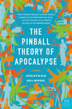
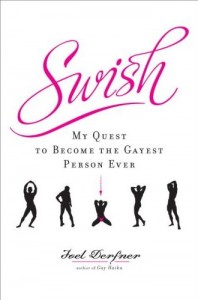
When Broadway Books sent me the cover for my memoir, Swish: My Quest to Become the Gayest Person Ever, I was thrilled, because it was hysterically funny:
swish-cover
The ridiculous, over-the-top Spencerian quality of the script, the silhouettes of the posing bodybuilders, the pink thong — they were a perfect foil to the book itself, which started with ideas as shallow and stereotypical as these images and moved from there to (if I do say so myself) depth, insight, and humanity. So we both thought the cover was perfect. We suspected there might be some difficulty in navigating the marketing divide between humor and depth, but we figured that if we erred toward the side of humor we’d be okay, because, as I said to my editor, funny is always better.

So the book was released, perfect cover and all, and I was delighted, and then reviews started coming in, and I was even more delighted, because for the most part they were very good. But then I started to notice something, which was that almost every one said something along the lines of, “From the cover I thought this was going to be silly and annoying, but then I read it and I loved it.” Then people who had read the book started e-mailing me, and almost every one said something along the lines of, “From the cover I thought this was going to be silly and annoying, but then I read it and I loved it.”

And we started getting worried. If so many people who read the book had seen the cover and thought it was going to be silly and annoying, how many people saw the cover, thought the same thing—and didn’t pick up the book?

The answer, unfortunately, turned out to be “a lot.” The problem was that there’s a subgenre of gay literature that appears similar to my book on the outside—flashy, clever, shallow—and that is also flashy, clever, shallow on the inside (Behind Every Woman There’s a Fabulous Gay Man, for example, or How to Get Laid: The Gay Man’s Essential Guide to Hot Sex). Since I knew myself, and since my editor knew me, we got a kick out of the disjunct between the cotton-candy outside of my book and the rich center. Unfortunately, we forgot that the book-buying public did not know me. Seeing the unsubstantial outside, therefore, they assumed that book had an unsubstantial inside as well. It was awful.

The following things gradually became clear:

  1. Straight people thought the book would be interesting only to gay people, so they didn’t buy it.
  2. Gay people who liked good writing though the book would be interesting only to people who liked fluff, so they didn’t buy it.
  3. Gay people who liked fluff bought the book and then, quite often, got angry when it wasn’t fluffy. (Seriously. A couple reviews were like, what is this? Where’s the Cher? There are hunky guys on the cover, why is he telling us about his dead mother?)

(There’s also of course the possibility that the reason people didn’t buy the book is that it was bad. But in that case this post would be completely unhelpful, so let’s assume for the sake of discussion that this wasn’t so.)

During this time I also sent a few pieces around to magazines and newspapers, none of which expressed any interest. Again, it could be that what I sent was bad, or that it simply wasn’t what the people I sent it to were looking for, but I have to believe that when they saw the title of my book in a cover letter or e-mail it didn’t do me any favors.

My agent took me to lunch and told me that Broadway was planning to sell the paperback rights, which is very bad; it usually means that the publisher has given up on a book and wants to get out while they can still make some sort of profit. “This failure isn’t your fault,” she said.

“Failure?” I said, and wanted to die.

Then I got a phone call from Elton John.

He had read the book and loved it, he said; he also offered to blurb it or write a foreword or help in any way he could.

After I regained the power of speech—which, as you can imagine, took some time—I called my agent and told her, and after she regained the power of speech she called Broadway and told them, and somehow it didn’t seem quite as urgent that they sell the paperback rights.

After a long and undoubtedly agonizing negotiation (none of which I had anything to do with, thank God), Broadway decided that not only would they issue the paperback themselves, but they wanted to repackage the book entirely, with a new cover and a new subtitle. It took literally months to come up with them, but my editor’s assistant told me that I should see this as a good sign, because they wouldn’t spend so much energy on something they didn’t really believe in. (Then my editor got laid off, but her assistant stayed, so I felt I could still trust her advice.)

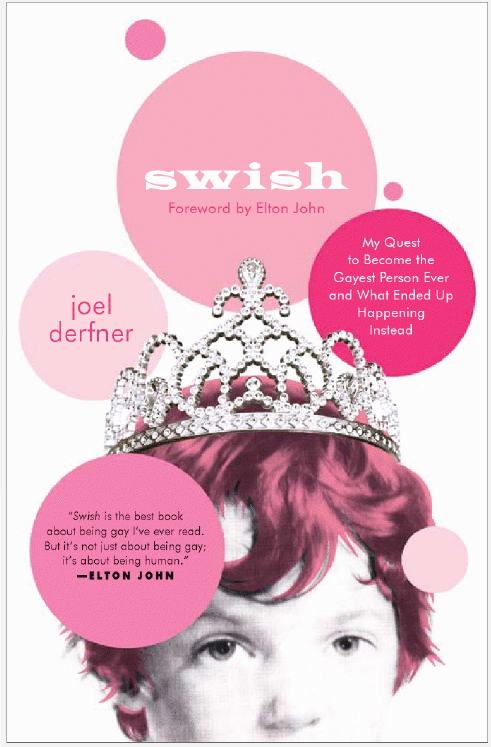
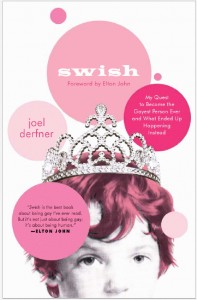
So the paperback is being released in a couple weeks. It’s called Swish: My Quest to Become the Gayest Person Ever and What Ended Up Happening Instead, it has a beautiful cover that matches the material inside, and it’s graced with a foreword by Elton John. Of course I hope it will become a smash hit, but mostly I’m just grateful that the book has gotten a second chance.

And I’ve learned a valuable lesson for next time, which is that if I’m not careful, my work won’t reach my intended audience because they just won’t pick it up in the first place. Or, more simply put, that people do judge a book by its cover.
swishcoverblogswish-covergay_haiku
joel_portraitSwish: My Quest to Become the Gayest Person Ever and Gay Haiku author Joel Derfner is from South Carolina, where his great-grandmother had an affair with George Gershwin. After fleeing the south as soon as he possibly could, he got a B.A. in linguistics from Harvard. A year after he graduated, his thesis on the Abkhaz language was shown to be completely wrong, as the word he had been translating as “who” turned out to be not a noun but a verb. Realizing that linguistics was not his métier, he moved to New York to get an M.F.A. in musical theater writing from the Tisch School of the Arts.

Musicals for which he has written the scores have been produced in London, New York, and various cities in between (going counterclockwise). In an attempt to become the gayest person ever, he joined Cheer New York, New York’s gay and lesbian cheerleading squad, but eventually he had to leave because he was too depressed. In desperation, he started knitting and teaching aerobics, though not at the same time. He hopes to come to a bad end.
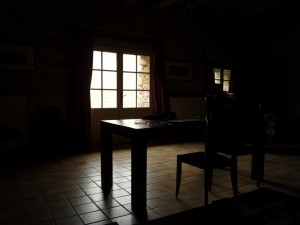
Vrai et faux amis, or, the debate I would have had with Edith Wharton had she blogged

view-from-la-muse-library

For those of you who are tuning in late, I’m currently in residence at an almost mind-bogglingly beautiful artists’ retreat in Southwestern France — thus all of the photos of castles and cathedrals, in case any of you have been wondering if I’d suddenly gone mad for stonemasonry. Another major result of my being here, in case you missed my announcement earlier in the week: the new deadline for the First Periodic Author! Author! Awards for Expressive Excellence has been extended to midnight on Monday, June 1.

You’re welcome.

Let me tell you, I’ve gotten some great entries, in both the Expressive Excellence and Junior Expressive Excellence categories. I’m really looking forward to running the winners here — and to hearing from more of you!

Okay, back to work. If I seem to be talking an unusual amount about cause and effect these days, blame it on the fact that this is my first retreat in a foreign land — at least in one that is not primarily English-speaking; I have retreated in Canada. I must say, I’ve been fascinated by the enlivening effect on the brain caused by switching languages between my writing time (somewhere between 8 and 12 hours per day, in case you’re curious) and out-and-about time (usually about an hour per day, with the occasional day of shopping and/or sightseeing).

While I must confess that one of the effects has been to unearth from the depths of my psyche the perfect word or phrase for the moment in Italian or Greek, another has been a much heightened awareness of how much people think while they’re speaking, even in their native tongue. It’s definitely affecting the way I write dialogue.

I’ve also become very conscious of what the French call faux amis (false friends), words and phrases that sound the same in another language, but mean something quite different in the one you happen to be speaking at the time. Take, for instance, actuellement — it seems as though it should translate as actually, doesn’t it? En fait (in fact, the phrase one uses when one means actually here), it means currently.

And don’t even get me started on the confusion if one refers to an ad as l’avertissement (warning sign) rather than as la publicité. Or if you speak of the book you’re working on as la nouvelle, which means short story, rather than as le roman, a novel.

Because so many English words are lifted from other languages, it is stuffed to the gills with les faux amis, of course, which is why it’s so difficult a language in which to become fluent. Something else a writer in English might want to take into account whilst constructing dialogue, perhaps?

Enough about false friends for the moment. Let’s move on to talking about true ones.

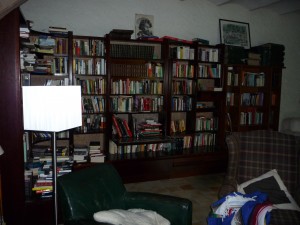
One of the great things about attending a formal writing retreat (that is, an ongoing one for which you apply) is seeing what other writers are reading. Not just the people who are in residence when you are — at La Muse, as at many retreats, that number is pretty small; actuellement, there are four writers, including myself, and two painters — but what those who have been there in the past were toting around in their bookbags.

The happy result: Boccaccio nestles next to Mary Renault and Somerset Maugham; Stan Nicholls abuts Günter Grass and Arundhati Roy. Gabriel García Márquez’ LOVE IN THE TIME OF CHOLERA stands tall next to many volumes of Isaac Bashevis Singer and an apparently misshelved copy of Adam Smith’s THE WEALTH OF NATIONS. Biographies of J.R.R. Tolkien and Charles Bukowski jostle memoirs by Billie Holiday, Roald Dahl, and INCIDENTS IN THE LIFE OF A SLAVE GIRL, WRITTEN BY HERSELF.

Combine that with what the retreat’s organizers consider essential — here, both the complete works of both Charles Dickens and William Shakespeare, as well as many bound volumes of Paris Match, as well as masses of dictionaries in four languages, an extensive array of psychological theory, and mysteriously, a guitar — and you usually find yourself presented with a pretty eclectic collection.

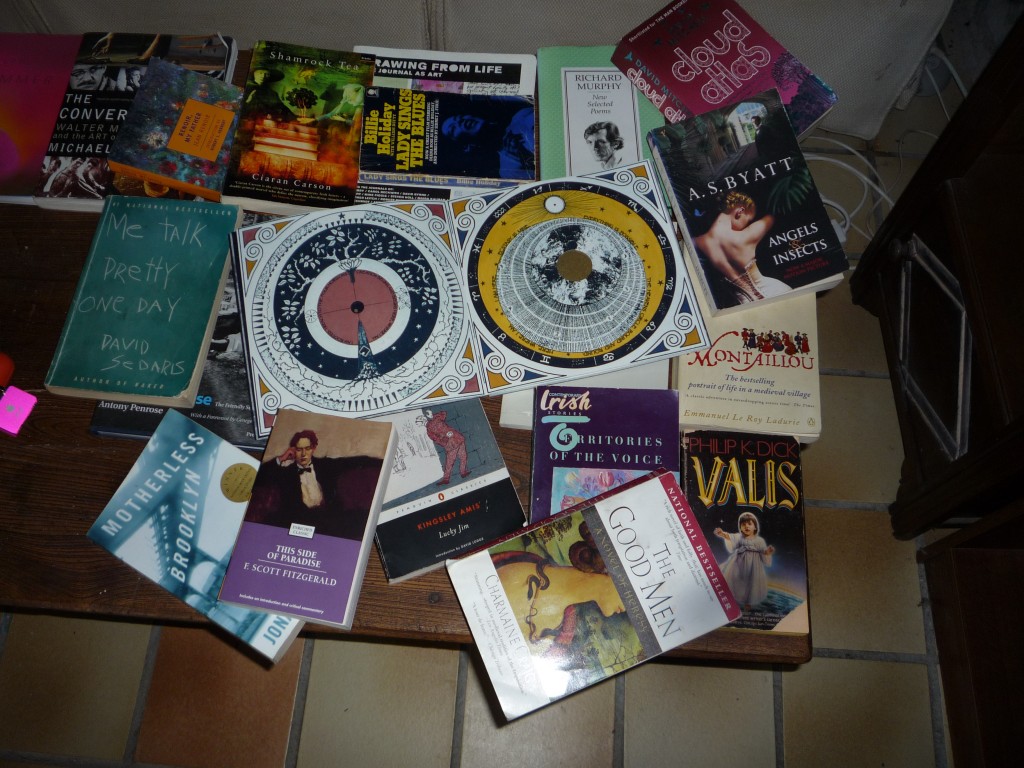
Trust me on this one: you’re going to find something interesting that you have never encountered before. Take a gander at just part of what’s here for the reading:

library-at-la-muse

Yummy, eh?

As a direct and happy result of this kind of ongoing book accumulation, it’s generally well worth your while at an organized writers’ retreat to budget some fairly hefty time for reading. And not just for manuscripts in the library, either — you’re probably going to meet at least one writer with whom you would like to exchange work.

Lovely and rewarding, often, but still, time-consuming. Make sure to allot some time for it.

Truth compels me to mention, however, that actuellement, my opinion on the subject may well be colored by a fellow resident’s just having walked into the library with her thumb drive so I could download her just-this-second completed novel. (And no, this is not the first time I’ve seen someone do this at an artists’ retreat; people like to share. It’s wise to keep your writing schedule flexible enough to make field trips to admire freshly-completed sculptures and canvases upon which the paint is still wet, if you catch my drift.)

At this retreat, all attendees are asked to donate at least two volumes to the library, one that represented the kind of art we would be producing while in residence and one that reflected the part of the world that had produced us. Since I happened to know that a Seattle-based novelist had attended La Muse within the year, bringing with her the works of Garth Stein and Layne Maheu, I opted to dig deeper into my past and tote along VALIS, a largely autobiographical Philip K. Dick novel that happens to contain a scene set at my childhood home, right next to the hutch where my pet rabbits resided.

So if the moppet on the cover at the bottom right looks a trifle familiar, well, there’s a reason for that:

noras-book

Yes, I’m perfectly well aware that this photo is gigantic; I wanted you to notice that glorious volume in the middle. As you may see, my contributions paled in comparison to the absolutely gorgeous hand-made book one of the painters brought, but that’s to be expected, right? (If the book-lovers out there want to see more of Nora Lee McGillivray’s astonishingly beautiful individually crafted volumes, check out her website. It will tell you which museums to visit to see them in person.)

Since I’m currently working on a novel set at my alma mater, Harvard, I also imported (literally; I had to hand-carry it through Customs) F. Scott Fitzgerald’s THIS SIDE OF PARADISE, his paean to Princeton. A fascinating novel, if you’ve never read it, the one that catapulted him to early fame. It’s far less polished than his later work, as first novels so often are; the value of repeated revision is not always apparent to the first-time author.

Which brings me to back to my subject du jour, the writer’s true and false friends, via the small miracle of having discovered in this very library a thin volume of rare nonfiction by Edith Wharton that I had never read before.

The front cover bills THE WRITING OF FICTION as “The Classic Guide to the Art of the Short Story and the Novel,” a contention which, if true, renders it even more surprising that I’d never even heard of it before. However, since the back cover’s incorrectly contends that THE AGE OF INNOCENCE, the novel for which our Edith won the Pulitzer Prize — the first woman to do so, incidentally — was her first, whereas if memory serves, THE CUSTOM OF THE COUNTRY came out a good 7 years before, and the lovely THE HOUSE OF MIRTH 15, perhaps the claim of classicism is exaggeration for marketing purposes, rather than a statement of historical fact.

THE WRITING OF FICTION is very thought-provoking, however; it’s sort of what you would have expected a grande dame of letters to have blogged about the current state of literature in 1924, had blogs existed back then.

Yet quite a lot of what she has to say remains astonishingly applicable to today’s writers. Take, for instance:

The distrust of technique and the fear of being original — both symptoms of a certain lack of creative abundance — are in truth leading to pure anarchy in fiction, and one is almost tempted to say that in certain schools formlessness is now regarded as the first condition of form.

Now, the verbiage might be a bit old-fashioned, but this is a true friend. Not entirely coincidentally, it is also sentiment that agents and editors still express at writers’ conferences all the time. They’re perpetually receiving manuscripts that lack structure, either due either to deliberate authorial choice or a writer’s lack of literary experience.

Apparently structure-less scenes containing dialogue are particularly common. Proponents of slice-of-life fiction — an approach that tends to win great applause in short stories, and thus in writing classes that focus upon short works — will frequently make the mistake of trying to make dialogue in a novel absolutely reflective of how people speak in real life.

Why might that be problematic, you ask? Well, ride a bus or sit in a café sometime and eavesdrop on everyday conversation; it’s generally very dull from a non-participant’s perspective.

More to the point, it’s often deadly on the printed page. Real-life conversation is usually repetitive, cliché-ridden, and frankly, not all that character-revealing. It requires genuine artistry, then, to reproduce it well in manuscript form.

Or, as Aunt Edith might have put it, it takes technique. For some pointers on how to put that technique in action, you might want to check out the DIALOGUE THAT RINGS TRUE and DIALOGUE THE MOVES QUICKLY categories on the archive list at right.

For the moment, I want to return to what Aunt Edith was saying. Because I know that you’re all busy people, I’ll skip her comparison of Dostoyevsky and Tolstoy (whose WAR AND PEACE, you may be amused to hear, Henry James once called, “a loose baggy monster,” speaking of structure) and move on to the next part that deals with technique:

…the novelist who would create a given group of people or portray special social conditions must be able to identify himself with them; which is a rather long way of saying that an artist must have imagination.

Not so fast there, Edith: this analogy is a false friend. I think you’re conflating empathy with one’s characters with the ability to imagine what it would like to be them, usually related but not identical phenomena. The first involves feeling for one’s characters enough to present them, if not sympathetically, then at least with fairness; the second can be purely a matter of conjecture, without necessarily involving any actual empathy with the characters at all — or, indeed, any information about how such characters in real life might actually feel or think.

Hey, if it’s purely a matter of imagination, why not just project your own feelings and thoughts onto them? Or, to fall back on my earlier example, to a reader who is already steeped in the culture you’re describing, it’s going to make a big difference whether a character within that culture says actuellement when he actually means en fait, right?

Here, imagination could lead a writer into a fairly major mistake. Another common mistake springing from relying too heavily on imagination alone — no, make that two: characters made up out of whole cloth tend to be prone to falling into stereotypes, and if the author doesn’t care about a character enough to empathize with him, why should the reader?

Ponder that last one a moment. I’ll wait.

The stereotyping problem is particularly rampant, and not just in terms of clichés. Think about how villains, or even just plain unlikable characters, tend to be portrayed in fiction — or in memoir and creative nonfiction, for that matter. One sees quite imaginative but essentially unsympathetic approaches to bad guys all the time.

And even to not-so-bad guys. Few writerly attitudes lead so surely to two-dimensional characters as the dismissive assumption that the reader isn’t going to like ‘em, anyway.

As it happens, I have a GREAT example right at my fingertips. Not long ago, a friend from my home town alerted me to the fact that a recent bestselling account of the rise and fall of a Napa Valley wine dynasty contained a rather odd reference to my late father, Norman Mini. Not all that surprising; he was, among other things, quite a well-respected winemaker descended from centuries of winemakers; it would have been rather difficult to write about enology in Northern California without at least passing reference to someone in my family.

Yet when I looked up the actual reference, it was quite apparent that his winemaking acumen had nothing to do with why the author had mentioned him: on the page, he comes across as that paragon of writerly false friends, the straw man who is mentioned only to be knocked down.

Speaking of phrases that wouldn’t translate all that well into other languages.

The funny thing is, enough of the facts in the story she tells are correct that you might actually have had to meet the man (or interview someone who had, as her website claimed she had done in some 500 instances) in order to realize just how far from the truth the book’s account is. How is that possible, you cry? Well, although the bulk of the anecdote about him is more or less as it happened, barring some easily-corrected factual errors (which is why I am not mentioning the book or the author’s name here, in order to allow her time to correct them in the next edition), the purport of the anecdote as folks in my former neck of the woods have habitually told it for the last 30 years showed him in quite a positive light, even a charming one.

As the anecdote is re-told in this book, however, he comes across as a quite sinister character.

I’m sensing some disbelief out there. “Just a moment, Anne,” come the incredulous murmurs. “Again, how is that possible, since the book in question is nonfiction? Isn’t the whole point of objective reporting to avoid this sort of contretemps? Just the facts, ma’am.”

Well, not having written the pages in question myself, I naturally cannot be absolutely sure how an ostensibly true story ended up untrue on the printed page, but my guess would be that the author relied on a false friend or two. A lack of authorial empathy, perhaps, combined with an incomplete set of facts, with the holes filled in by imagination.

What did that look like in practice? Actually, the misrepresentation was quite skillfully done: the author simply opened the anecdote by describing my father as a Napoleonic 5’4″ of bowl haircut aspiring to be taller, thereby establishing him as self-deluded. From there, all it took was some generalities about how his outspokenness rubbed a few people the wrong way to convey the impression of an abrasive, in-your-face lecturer. (Quoth my learned and soft-spoken father: “Never trust someone whom everybody likes. He’s got to be lying to someone.”) The author then went on to bolster the impression of thwarted power selective quotes from another source, something Henry Miller wrote about my father in BIG SUR AND THE ORANGES OF HIERONYMUS BOSCH.

Et violà! After such a set-up, what reader wouldn’t look upon the anecdote that followed with a jaundiced eye?

While I can think of any number of problems with this approach — up to and including the fact that I know from long extended-family experience that once a biographical untruth appears in print, it will be repeated elsewhere; lies are far more durable than truths, evidently — here are the three least contestable:

(1) my father was fully 6 feet tall;

(2) his hair was so curly that he could not possibly have achieved the haircut she described as integral to his character, and

(3) a full reading of even the page from which she had cherry-picked Miller quotes would have demonstrated clearly that the man I knew as Uncle Henry intended the passage she cited to create exactly the opposite impression in his book from what she was trying to convey in hers.

Since Edith Wharton was notoriously careful about checking factual details, I can’t believe that she would have approved, despite her quip above. Since neither my father nor our Edith are, alas, still around to defend their points of view, I naturally tracked down the author’s website and e-mailed her to point out — politely, I thought, given the provocation — that her book contained a few inaccuracies.

Her response was, at best, huffy. Her research for the book had been extensive, she explained to me so it was unlikely that she had made a mistake. In making her case that perhaps I was at fault, she cited by name three people known to me in my early childhood as The Nice Man Who Gave Me a Puppy, Mr. Bob, and That Woman Who Broke Up Mr. Bob’s Marriage as the most likely sources of, say, a misidentified photo, if indeed any misidentification had occurred. Although she was willing to believe that I hadn’t contacted her just to insult her, I really should have checked her book’s 800 notes before even considering contacting her, because any photo would probably (her word) have been cited there.

Yeah, I know — I seriously considered posting her answer in its entirety as the centerpiece about how NOT to respond to a question from a reader, ever. Simply thanking me for my note and telling me that she would look into it would have served precisely the same purpose — getting me off her back, me with my annoying propensity to regard things like height and incidents that occurred within my memory as matters upon which I have a right to express myself — without leaving me with an anecdote that any professional author would have expected me to pass along to at least a couple of other people.

The general rule of thumb for avoiding insulting one’s readers, in case you’re wondering, is that an author should ALWAYS be polite to anyone who approaches her about her book, even if she feels that the yahoo currently in front of her is being rude. Even if the author is in the right, bad word of mouth tends to spread much, much faster than “Gee, I met this author, and she was so nice.”

Human nature, I’m afraid. Just as an untruth in one biography tends to spawn repetitions in the next ten, a rebuffed reader can tell fifty potential book-buyers to stay away from that jerk — or 5,000, if he chooses to share the anecdote online. The rise of the Internet has made bad reputations much, much easier to establish.

In fairness to my rebuffer, I probably should have contacted her publisher directly about the quite easily verifiable factual errors, The extent of her research was something she also boasted about on her website, which should have placed me on guard that she might conceivably be touchy about it: as experienced nonfiction writers tend to assume that thoroughness is the minimum requirement for the job, not an additional selling point, it’s rare for the author of a nonfiction book on a not particularly contentious topic actually to list the number of interviews she conducted. In the bio on her website, no less.

All that being said, it would be easy just to write this situation off as poor research — I suspect what actually happened here is that she mistook someone else for my father in a photograph, and just didn’t bother to double-check. (There I go again, fact-hugging.) But let’s think about the writing strategy involved in producing the questionable impression on the page:

a) An author had a real-life character she wanted to use for a specific purpose in her book. In order to make that character come to life, she uses her imagination. I suspect all of us can identify with that, right?

b) Because that specific purpose was negative, she chose her descriptions (and, in this case, quotes) in order to bolster that effect — again, something most writers do.

c) In a search for telling details that would convey the desired impression — which, lest we forget, was necessarily a product of the writerly imagination, since the author never actually met the man she was describing — and because she was not approaching the character with empathy, she selected bits that conformed to her preconceived notion of the character. Again, this is a fairly standard writing practice.

d) Unfortunately, the research that provided those bits was insufficient, and she ran into trouble.

Obviously, this was an instance that annoyed me, as did her reaction to my pointing out the factual errors in this part of her book. (If I understood her correctly — and her response contained enough spelling and grammatical errors that I’m not sure that I did — she was trying to argue that my recollections of my father’s height were more likely to be mistaken than her research.)

But did you notice the narrative trick I employed in telling you this real-life story — one that I used to comic effect even in the last paragraph?

No? Let me be brutally honest about my writerly motivations: I was writing an anecdote about a person I have some legitimate reason to dislike, so I don’t have a lot of incentive to present her with empathy, do I? So while the facts in the anecdote are all true, my telling of them clearly reflected that dislike — and in order to make you, dear readers, dislike her, too, I used my imagination in order to create motivations for her.

Oh, all of the actions I described did in fact occur. But there is no such thing as a story that creates its own tone or word choices, is there?

Starting to get the picture?

If those of you who write memoir are shaking in your booties, you probably are. The fact is, for all of the blather about the desirability of objective distance from one’s subject, if a writer is trying to create an emotional response in the reader, objectivity is often not possible. Nor, especially in memoir, is it always desirable.

However, an ostensible just-the-facts presentation is sometimes a false friend to the reader — and to the writer as well. Yes, even in fiction: if a writer tries to scare up some empathy for even the characters the reader isn’t supposed to like, the result is usually more complex characters and better character development.

In other words, it’s a better means of creating three-dimensional characters.

Case in point: in the anecdote I told above, the characters were pretty black-and-white — the maligned late father, the unsympathetic writer. Yet had I exercised a bit more empathy toward the latter, I could have told factually the same story, yet conveyed the impression of a more well-rounded — and consequently more interesting, from the reader’s perspective — villain. Lookee:

An old friend pointed out to me that a bestselling book contained some rather odd assertions about my father. I checked, and it was true: the anecdote about him was told unsympathetically, and the physical description was so off-base that she could only have been describing someone else. She specifically said that he was eight inches shorter than he actually had been, for instance, with straight hair fashioned into a haircut that had not been fashionable since ancient Rome.

Puzzled, I contacted her and asked: was it possible that someone had misidentified a photo for her? Would she be open to correcting the factual errors in a future edition?

She responded so quickly that she must have received the message on her Blackberry. She was on a research trip for her next book, she said, and thus could not possibly check her notes to see if I was correct until she got back to her office; if my story did turn out to have merit, she would of course take steps to correct the minor errors in future editions. However, if I had troubled to check through the book’s 800 notes about her 500 interviews — a number that would have represented approximately 20% of my home town’s population at the time, incidentally — the photograph in question was doubtless referenced, so she doubted that she had any errors. She was quite sure, she concluded, that I hadn’t intended to impugn her journalistic credibility by implying that she hadn’t done her homework properly.

I was entirely mistaken about my father’s height, in other words; presumably, she had a source that had said so. Clearly, I owed her an apology for having brought any of it up at all, especially when, as the author of a single book that sold well, she is so important to the literary world that her research trips are times of well-advertised mourning in bookstores everywhere. At the very least, I should have waited until she got back.

Quite a different story, isn’t it? Yet in some ways, she’s a more effective villain in the second version than the first: by allowing some of her good points some page space, she comes across as having more complex motivations. (I also think this version is funnier, because it presents more of her response from her perspective, rather than mine.)

“Philosophy is not insensitivity,” as brilliant novelist, nonfiction writer, and inveterate fact-checker Mme. de Staël tells us. An authorial inability — or outright unwillingness — to empathize with her characters’ points of view does not always equal an admirable objectivity. Sometimes, it’s the result of a failure of imagination, rather than a surfeit of it.

But in order to create well-rounded, plausible characters, whether from scratch out of one’s imagination or lifted from real life, a good writer needs both empathy and imagination.

Okay, so maybe I wanted to tell this particular story — which, as you may be able to tell by how miffed I am about it, just transpired about a week ago — more than I wanted to engage in banter with Edith Wharton. As a writer, that’s certainly my prerogative: I have the power to focus my narrative in the direction that I find the most satisfying. And as a blogger, I also have the power to return to the debate with Edith in a future post. There honestly is a lot to talk about there.

Hey, the lady had some great insights into true and false friends.

Which brings me back to some semblance of my original point — believe it or not, I did have one throughout this long, wide-ranging post. First, it always behooves a writer to read widely, whether in doing manuscript research (cough, cough) or just to see how others have done what you’re trying so hard to do well. If you don’t have access to a thoughtfully-constructed, inspirational library like La Muse’s, start asking writers you respect for recommendations.

Most writers are book-lovers, after all. It’s a question that seldom fails to elicit a smile at a book signing, even from the most retiring author.

Second — and you’ve heard this one from me before — just because someone’s won a Nobel prize in literature (or has 800 notes in her bestseller) doesn’t automatically mean that everything she says in print is true. Use your own judgment, especially about writing advice.

Don’t be afraid to examine a gift horse’s dental hygiene before accepting it as your own, if you catch my drift.

Third, if you’re writing about real people, the false friend of ostensible objectivity is no excuse not to treat them with the empathy with which a good writer habitually approaches her fictional characters. Quadruple-check your facts before committing them to the printed page, and try to present even the characters you don’t like as well-rounded, plausible characters. You may even find that they work better as villains that way.

You also never know whose daughter is likely to blog about you, right?

Keep up the good work!

Who said that? Wait, I did. Or was it Oscar Wilde?

hall-at-la-cite

All this week, I have been discussing the Frankenstein manuscript, the text whose author either kept changing his mind about the style he wished to embrace — or tone, or target audience, or book category — or just kept revising it so often that the narrative reads like a patchwork of different prose styles. Today, I would like to talk about the Frankenstein manuscript’s prettier and more socially-acceptable cousin, self-plagiarized repetition.

Where the Frankenstein manuscript varies substantially as pages pass, the self-plagiarized text merely becomes redundant: scenery described the same way, for instance, or a clever line of dialogue repeated in Chapters 2, 5, and 16.

Nonfiction writing in general, and academic writing in particular, is notoriously prone to redundancy. Once you’ve gotten into the habit of footnoting everything in the least questionable, it’s pretty easy to reuse a footnote, for instance, or to come to rely upon stock definitions instead of writing fresh ones every time.

Or, in a memoir, to tell the same anecdote more than once.

My point is, most of the time, self-plagiarization is inadvertent; a writer simply finds a certain turn of phrase appealing and forgets that she’s used it before. A great way to catch this sort of redundancy is — wait for it — to read your manuscript IN HARD COPY, IN ITS ENTIRETY, and OUT LOUD.

Oh, had I suggested that before?

Sometimes, though, self-plagiarization is deliberate. If a line was clever once, the writer thinks, the reader will find it so the second time — and the fifth, and the forty-seventh. Deliberate redundancy is particularly common with humor: since situation comedies tend to rely upon repetition of catch phrases, many aspiring writers believe — mistakenly, often — that the mere fact of repetition will render a line funny.

On the page, it seldom works. (Sorry to be the one to break it to you sitcom lovers.)

Nowhere is the practice of self-plagiarization more prevalent than in the garden-variety political speech. And if you doubt that, tell me: do you think people would remember that the Rev. Dr. Martin Luther King, Jr. had a dream if he had said it only ONCE in his famous March on Washington speech?

There’s a good narrative reason for that, of course: the repetition of an idea makes it memorable. The ideas — and usually even the actual phrases — of the beginning of a political speech invariably recur throughout, to drive the point home.

And, as anyone who has listened to two consecutive State of the Union addresses can tell you, political speeches often sound the same from year to year. No matter how fiercely THE WEST WING tried to promote the notion of presidential speechwriters as ultra-creative writers, if you look at speeches given by the same politician over time, self-plagiarization is of epidemic proportions.

On paper, phrase repetition is problematic, but in and of itself, it is not necessarily self-plagiarization. On paper, phrase repetition can be used for emphasis (as I have just done here). A lot of good writers choose to repeat phrases within a single paragraph for rhythmic reasons, which can bring a passage a feel of invocation. Take the ending of the St. Crispin’s Day speech from HENRY V, for instance:

If we are mark’d to die, we are enow
To do our country loss; and if to live,
The fewer men, the greater share of honour.
God’s will! I pray thee, wish not one man more.
By Jove, I am not covetous for gold,
Nor care I who doth feed upon my cost;
It yearns me not if men my garments wear;
Such outward things dwell not in my desires.
But if it be a sin to covet honour,
I am the most offending soul alive.
No, faith, my coz, wish not a man from England.
God’s peace! I would not lose so great an honour
As one man more methinks would share from me
For the best hope I have. O, do not wish one more!
Rather proclaim it, Westmoreland, through my host,
That he which hath no stomach to this fight,
Let him depart; his passport shall be made,
And crowns for convoy put into his purse;
We would not die in that man’s company
That fears his fellowship to die with us.
This day is call’d the feast of Crispian.
He that outlives this day, and comes safe home,
Will stand a tip-toe when this day is nam’d,
And rouse him at the name of Crispian.
He that shall live this day, and see old age,
Will yearly on the vigil feast his neighbours,
And say ‘To-morrow is Saint Crispian.’
Then will he strip his sleeve and show his scars,
And say ‘These wounds I had on Crispian’s day.’
Old men forget; yet all shall be forgot,
But he’ll remember, with advantages,
What feats he did that day. Then shall our names,
Familiar in his mouth as household words-
Harry the King, Bedford and Exeter,
Warwick and Talbot, Salisbury and Gloucester-
Be in their flowing cups freshly rememb’red.
This story shall the good man teach his son;
And Crispin Crispian shall ne’er go by,
From this day to the ending of the world,
But we in it shall be remembered-
We few, we happy few, we band of brothers;
For he to-day that sheds his blood with me
Shall be my brother; be he ne’er so vile,
This day shall gentle his condition;
And gentlemen in England now-a-bed
Shall think themselves accurs’d they were not here,
And hold their manhoods cheap whiles any speaks
That fought with us upon Saint Crispin’s day.

Now THAT’s a political speech.

Unfortunately, a lot of poor writers favor this device, too, so it tends to be a rather risky trick to try to pull off in a short piece, such as a synopsis, or even in the first few pages of a manuscript submitted for a contest or as part of a query packet. To professional eyes, trained to search for the repetition of a single verb within a paragraph as evidence of boring writing, “we few, we happy few” will not necessarily jump off the page for its rhythm. In an ultra-quick reading (as virtually all professional readings are), it may be mistaken for an incomplete edit: you meant to change “we few” to “we happy few,” but you forgot to delete the words you did not want.

Let’s see if you’ve been paying attention for the last few days: why would a savvy submitter not want to convey the impression of an incomplete editing job?

That’s right: because that’s the birthmark of the dreaded Frankenstein manuscript, the fish that Millicent the agency screener is only too happy to throw back into the sea.

Self-plagiarization tends to raise red flags with professional readers for other reasons, however. The writer may not realize that she has reused a particularly spectacular image from Ch. 1 in Ch. 3, but believe me, if there is repetition, professional readers will catch it. Remember, the pros are trained to catch redundancy; editors are notorious for remembering entire pages verbatim.

I am no exception: when I was teaching at the University of Washington, I was known for noticing when term papers resubmitted in subsequent quarters, even though I read literally hundreds of papers per term. I would even remember who wrote the original.

As you may well imagine, I quickly acquired a reputation amongst the fraternities and sororities who kept files of A term papers for their members to, ahem, borrow.

Which reminds me to tell you that paraphrasing what you’ve said earlier in the manuscript tends to be significantly less frowned-upon than outright literal repetition. That’s why, in case you were wondering, while very similar passages may earn you an ill-humored rebuke from a professional reader, generalized repetition usually will not knock you out of consideration if the self-plagiarized bits occur far apart, such as at the beginning and end of a book.

However, in a shorter piece, or in those first 50 pages of your novel that nice agent asked you to send for consideration, it certainly can cost you. Repetition sticks in the professional reader’s craw, nagging at her psyche like a pebble in a shoe, so it is best to do it as little as possible.

“Now wait a minute,” I hear some of you out there grumbling. “Oscar Wilde repeated the same quips in one play after another. It became his trademark, in fact. So why should I be punished for using a single particularly sterling line 150 pages apart in my novel?”

You have a point, of course, oh grumblers. You might also have bolstered your argument by mentioning that Aaron Sorkin reused not only lines and speeches from SPORTS NIGHTin THE WEST WING, but entire plot lines and basic characters.

Tell you what — after you make it big, I give you permission to establish a trademark phrase and use it as often as you like. Until you do — as I sincerely hope you will — all I can do is tell you what tends to annoy agents, editors, and contest judges.

All writers of book-length works have repeated themselves at one time or another; if a simile struck us as the height of cleverness last week, chances are good that we will like it next week as well. Each time we use it, it may seem fresh to us.

These little forays into self-indulgence are so common, in fact, that literary critics have a name for them: tropes.

F. Scott Fitzgerald was a notorious troper in his short stories. A thwarted heroine’s sobbing out (usually with her face hidden by her hair), “I’m so beautiful – why can’t I be happy?” immediately before she does something self-immolatingly stupid to remove herself from the possibility of marrying the story’s protagonist occurs at least four times throughout his collected works.

Why our Scott found that particular line so very attractive in a pretty woman’s mouth remains a mystery eternal — it’s hard to believe he ever actually heard a sane female utter it, even in jest. But he did, and now it’s stuck to his name for all eternity.

Learn from his unhappy fate, I beg of you.

Usually, though, self-plagiarization is less obvious to the untrained eye than ol’ Scott’s outright line reuse. Spread out over an entire text — or as it often appears in the case of successful writers of series, once per book — self-plagiarization may be fairly innocuous, the kind of thing that might only bug someone who read manuscripts for a living.

For example, E.F. Benson, author of two delightful series, the Lucia books and the Dodo books, was evidently extraordinarily fond of using Arctic analogies for one person suddenly grown cold to another. To mention but three examples:

“It was as if an iceberg had spoken,”

“It was as if the North Pole had spoken,” and

“icebergs passing in the North Sea” must speak to one another so.

Admittedly, it’s not a bad analogy, if not a startlingly original one. The problem is, as a Benson enthusiast, I was able to come up with three of them without even pulling any of his books off the shelf. These repetitions, deliberate or not, stick with the reader, just as surely as repeated phrases stick with the audience of a political speech.

Here, yet again, is an awfully good reason to read your entire book (or requested chapters, or contest submission) out loud before you submit it. Believe it or not, just as dialogue that seemed fine on the page can suddenly seem stilted when spoken aloud, phrases, sentences, and images that your eye might not catch as repetitious are often quite obvious to the ear.

Another good reason to read aloud: to make sure that each of your major characters speaks in a different cadence. It’s substantially easier for the reader to follow who is speaking when that way.

Don’t tell me that all of Aaron Sorkin’s and David Mamet’s characters speak in identical cadences, as though they all shared one vast collective mind; to my sorrow, I am already well aware of that fact. Remember what I said earlier this week about the dangers of those new to the biz assuming that what the already-established have done, they may get away with as well?

Uh-huh. In a first-time author, it would be considered poor craft to have every character in the book sound the same. Not to mention poor character development.

While I’m on the subject, keep an ear out in your reading of your manuscript for lines of dialogue that cannot be said aloud in a single breath without passing out — they tend to pull professional readers out of the story.

Why, you shout breathlessly? Well, in real life, listeners tend to interrupt speakers when the latter pause for breath, so cramming too many syllables into an uninterrupted speech usually doesn’t ring true on the page. Remember to allow your characters to breathe occasionally, and your dialogue will seem more realistic.

Oh, bother; I’ve written past the time I allotted myself for blogging today; on retreat, one needs to adhere to a schedule. Oh, I’m so beautiful — why can’t I be happy?

Keep up the good work!

PS: to repeat a footnote from yesterday, the deadline for submitting entries to the First Periodic Author! Author! Awards for Expressive Excellence is now Monday, June 1, at midnight wherever you are. Follow this link to the rules and descriptions of the fabulous prizes, and may the best writer win the ECQLC! (Eye-Catching Query Letter Candy, that is.)

The Frankenstein manuscript, part III: the monster always returns

la-cite-at-night
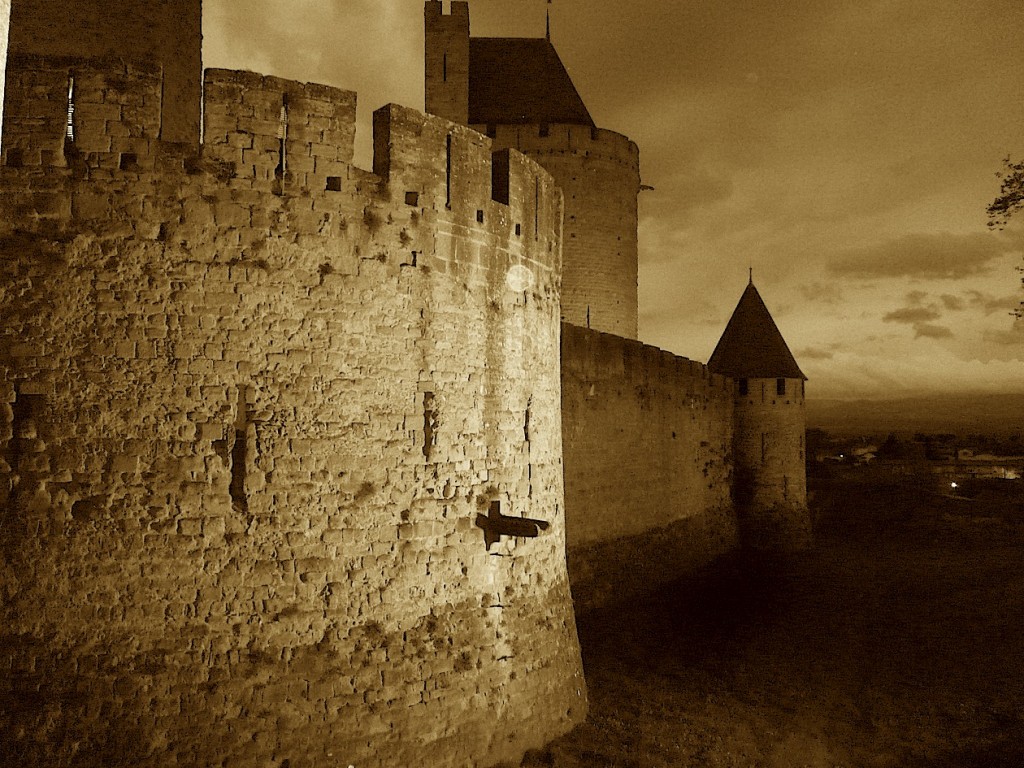
Yes, I really did take this photo myself — and yes, I really did take it within the last few weeks. Cathar country is positively rife with castles of various descriptions.

Not that one positively requires castles nearby in order to enjoy a productive writing retreat, of course. But I have to say, it doesn’t seem to hurt.

Well, I got sidetracked in my last post, didn’t I? I got you all excited about the Frankenstein manuscript phenomenon, promised to tell you how to work through it — and then wrote about other things for a couple of days.

Sorry about that; I’m back in the saddle today.

For those of you just tuning in, a Frankenstein manuscript is a work that — usually inadvertently — is written in so many different voices, styles, structures, and even quality of writing that it reads as though it had been written by a committee. Since I have literally never heard a single speaker at a writing conference address this very common problem — but have so often heard agents, editors, contest judges, writing teachers, and freelance editors complain about it in private — I wanted to alert my readers to it, lest the monster return again.

Because it will, you know. The first rule of horror is that the monster always returns.

In a way, a Frankenstein manuscript is a gift for a busy agent, editor, or judge, because it’s so very easy to reject. While I am generally very much in favor of writers doing everything they can, short of laundry or house-painting, to make their agents’ and editors’ lives easier, trust me, you do not want to be on the donating end of such a gift.

Seriously, from a professional reader’s point of view, it’s no-brainer rejection if ever there was one: clearly, Millicent the agency screener thinks, if the author herself did not catch the Frankensteinish inconsistency of the text, the book needs to go through at least one more major edit.

And believe me, this needs another editing run-through is not something you want Millicent to think while considering whether to pass your submission on to her boss, the agent of your dreams. Remember, in order to reject the manuscript, all she needs to think is, “While it’s an interesting premise,” (or voice, or style, etc.) “the author needs to work on craft, structure, and consistency.”

In other words: “Next!”

I know I say this a lot, but it bears repeating: aspiring writers tend to overestimate, sometimes radically, the amount of time and energy an agent will be willing to invest in their first books. Think about it: every moment an agent devotes to nursing a new client’s manuscript into a publishable state is a moment that he is not spending selling books. Or reading the new works of clients who have already made him money. Or, perhaps closer to the hearts of agent-seekers everywhere, scanning submissions from aspiring writers.

Contrary to popular opinion, agencies are very seldom charitable institutions, devoted selflessly to the promotion of great literature. Even agencies that do in fact represent great literature are in the game to make money. In order to do that, they need to sell books.

Which means, in case I’ve been too subtle so far, that they’re looking for manuscripts that they not only could conceivably sell to publishing houses, but sell quickly in the current market. By definition, a manuscript that needs a whole lot of work is not going to be ready to market as soon as one that does not.

Besides, agencies receive too many letter-perfect submissions to devote much time to fixer-uppers. They figure that the fixer-uppers will come back to them eventually, anyway, all cleaned up.

Without their intervention. The average agent’s faith in the tenacity of the talented is unbounded. He honestly does believe that his dream client can figure out what to give him all by herself.

So trust me on this one: you want yours to be the submission that causes Millicent to exclaim, “Oh, this one’s ready to go out to editors right now!”

A Frankenstein manuscript is virtually never going to provoke that last exclamation, because inconsistency of voice, vocabulary, tone, etc. is a pretty sure sign that the writer has not finalized the narrative. Oh, she may have revised it until she’s blue in the face, but she hasn’t yet gone through the entire thing and smoothed it out so it reads like a unified story.

Here’s a word to the wise: if you are working on your first novel — or any other writing project — over the course of years, do yourself a favor and check it for stylistic consistency before you submit it to ANY agent, editor, or contest.

If you find that your voice wavers a bit throughout, don’t despair. It’s actually quite rare that writers, even extremely gifted ones, find their specific voices right away; allow for the possibility that yours developed while you were writing the book.

Then embrace a two-part revision goal: find the voice, the style, the structure you like best, then make sure that every sentence in the book reflects it.

Incidentally, you simply cannot pull off Part I of that tall order by reading your work in screen-sized chunks. In order to make absolutely sure that your book hangs together cohesively, YOU MUST READ IT IN HARD COPY.

In its entirety. Preferably in a few long sessions, and, if you change narrative voice very often, out loud, to ascertain that your various voices remain absolutely distinct throughout.

Although that last piece of advice is unlikely to come as much of a surprise to long-time readers of this blog, I hear some of you grumbling out there. “But Anne,” the disgruntled protest, “I feel like I’ve been working on this book forever. I’ve revised it so often that I could recite huge chunks of it from memory. And yet you’re telling me to reread the whole thing — aloud, yet?”

Yes, I am. Actually, it may actually be more important for inveterate revisers to read their work IN HARD COPY, IN ITS ENTIRETY, and OUT LOUD.

Why, you gasp in horror? Because the more you revise a novel — or any book — the more likely it is to turn into a Frankenstein manuscript. It is an unintended downside of being conscientious about honing your craft.

Allow me to repeat that: the MORE you work on a novel, the MORE likely you are to end up with a Frankenstein manuscript.

Think about it: over time, you move passages around; you insert new scenes; you add or subtract subplots, characters, dialogue. All of these inevitably affect other parts of the book. Can you really be sure, for instance, that you remembered to remove your protagonist’s sociopathic sister from EVERY place she has ever appeared, even as a shadow on a wall?

And no, in response to what two-thirds of you just thought: merely doing a search-and-replace on the sister’s name is not sufficient, because if a novel is complex and rich, the spirit of individual characters lingers, even when they do not appear on the page. Necessarily, you would need to write the consciousness of the sociopathic sister out of the psyches of every other character in the family.

And that’s just the fall-out from a single change. The vast majority of revision is minor — which does not mean that any given change might not carry resonance throughout the book.

See now why I have been harping on the necessity of sitting down and reading your manuscript in its entirety, in hard copy, AND getting unbiased readers to look it over before you submit it to an agent, editor, or contest? Yes, it’s the best way to catch grammatical, spelling, and continuity errors — but it is also really the only way to notice where a deleted character or plot point still affects the rest of the book.

While you’re reading, do be aware that It is far from uncommon for fledgling writers to incorporate the style, vocabulary, and/or worldview of whatever author they happen to be reading at the moment into their work. It’s sort of like catching an accent when you’re staying in another country: you may not realize that you’re doing it, but others hear and wonder why your accent keeps wandering back and forth between London and Brooklyn.

I’ll admit it: this is my personal Frankenstein bête noire. When I was writing the novel my agent is currently marketing, I was reading a whole lot of Noël Coward. An extremely witty writer; I enjoy his work very much. However, he wrote almost exclusively about (a) pre-WWII British people and (b) people who inhabited now-transformed British colonial possessions. My novel is about the adult lives of children who grew up on an Oregon commune, so obviously, my characters should not talk like Coward’s.

(Although it would have been amusing to try: “My dear, your hot tub attire is simply too killing!” “Reginald, I must implore you to desist from taunting the yoga instructor!” “May one inquire whether this tabbouleh is indeed vegan? The most frightful consequences may ensue otherwise.” “While your sincerity is charming on a multiplicity of levels, Felicia, I cannot fail to notice that you have once again evaded your duties in tending to the sauna’s controls.”)

I made a deliberate effort not to incorporate educated British cadences into my dialogue, and in self-editing, deleted any lines of thought that smacked even vaguely of 1920s urbanity. However, being a very experienced editor, I was aware that I would probably miss a few, so not only did I read the entirety of my novel out loud (much to the astonishment of my cats and neighbors), but I also passed it under the eyes of first readers I trust, with the instruction to keep an eye out for Britishisms.

And you know what? I had missed three in my on-screen revisions.

My point here — other than providing some fascinating footnote material for some graduate student fifty years from now who wants to write her thesis on Noël Coward’s influence upon American novelists — is that no matter how good you get at self-editing on a page-by-page basis, in order to avoid sending out a Frankenstein manuscript, you simply must take additional steps in screening your work.

Get used to it now: you will never outgrow the need. No writer does.

Partially, it is a focus problem. In the throes of the revision process – especially on a computer screen, which encourages reading in a piecemeal, episodic fashion not conducive to catching overarching patterns — it is terribly easy to lose sight of your book AS A BOOK.

This is where a writers’ group, a good writing teacher, a freelance editor, or even someone you’ve met at a writers’ conference with whom you can exchange work can be most helpful to you: helping you identify what in the finished book jars with the integrity of the whole. These sources are also great for pointing out continuity errors, such as when the sociopath is named Janet for three chapters in the middle of the book, and Marie-Claire for the rest.

Not only will dependable outside eyes weed out Frankenstein tendencies, but the mere fact of having to defend your authorial choices to them will force you to make all of your deviations from standard narrative conscious, rather than accidental.

Such discussions are also terrific practice for wrangling with your future agent and editors, by the way.

If you’re going at it alone, my advice is this. Once you have read through the whole manuscript, go back and read it again, projecting onto it the style and/or voice you like best.

Does it work? If not, pick another style or voice from the text, and project it through the entire manuscript.

When you find one you like, save the original manuscript as a separate file (so you have the option of changing your mind later; it’s been known to happen), and work through a separate copy, establishing the new style. Then, after you have finished, read the entire thing out loud again, for consistency.

Heck, yes, this is going to take you a lot of time. Honestly, it will take you far, far less time, in both the diagnosis and repair stages, if you take your Frankenstein manuscript on a field trip to other readers before you submit it to an agent or editor. If a writing group or class seems too time-consuming, consider hiring a freelance editor; if a freelance editor seems too expensive, join a writing group.

When you are making these calculations, do not forget to weigh the value of your time into the equation. If joining a group or paying an editor saves you a year’s worth of solo work, it might well be worth it.

Which brings me to the great question that loyal reader Pam submitted sometime back: how does one FIND a freelance editor like me?

Well, Pam, as it happens, I have established a rather extensive set of posts addressing that very question. They may be found collected on the archive list at right, under the startlingly original category title HOW DO I FIND A FREELANCE EDITOR? Those posts will give you a sense of what services an editor provides (not all of us do the same thing), what to expect to pay (which varies depending upon the level of editing), and what questions you might want to ask before you sign anything that looks even remotely like a contract.

For writers in the Pacific Northwest, another great resource is the Northwest Independent Editors’ Guild’s website. For each member editor, there’s a small blurb and contact information. You can search by geographic region, the type of book you want edited, even preferred style manual, or you can post your job for editors to see.

You’re going to want either to go through an organization or get a referral to find a reputable editor, because emotionally, handing your book over to a total stranger for criticism is a difficult thing; you will want to make sure in advance that you can trust the recipient. NWIEG verifies that each member has significant editorial experience — and believe it or not, we actually do argue about punctuation on our members’ forum — so you can feel relatively secure that any editor listed will have the skills and background s/he claims s/he does.

Do take the time to have a conversation or e-mail exchange with any freelance editor before you make a commitment, however. A good personality fit is very important, and it is perfectly legitimate to ask a potential editor whether s/he has ever edited your type of book before.

Just as no agent represents every variety of book under the sun, no freelance editor will have experience with every book category. While there are plenty of editors out there who are willing to take pretty much anything (for a price), working with someone who is intimately familiar with the particular demands of your book category in the current market is probably going to be more helpful to you than working with a generalist.

One more word on the subject: if you are thinking about asking a freelance editor to work on a tight deadline, do not wait until the deadline is imminent. Good freelance editors are often booked up months in advance, and if you want a careful, thoughtful, professional read, you need to allow time for the editor to do her job.

Thanks for the good question, Pam — and keep up the good work, everybody!

PS: in case anyone missed Monday’s announcement, the deadline for submitting entries to the First Periodic Author! Author! Awards for Expressive Excellence is now Monday, June 1, at midnight wherever you are. Follow this link to the rules and descriptions of the fabulous prizes, and may the best writer win the ECQLC! (Eye-Catching Query Letter Candy, that is.)

The Frankenstein manuscript, part II: when you should be wary about following in the footsteps of the greats

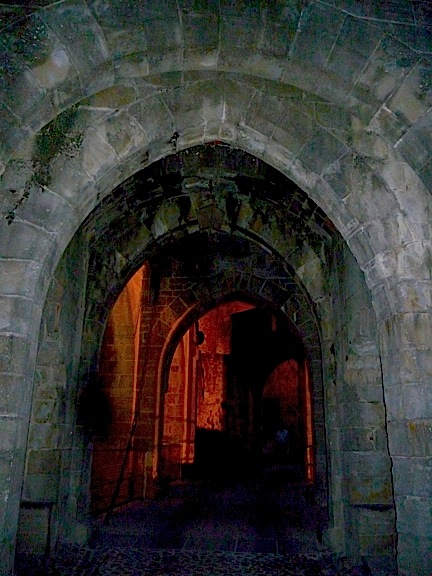
moat-at-la-cite
Isn’t this a great horror movie castle? It’s the (dry) moat around La Cité in Carcassonne, a 19th-century reconstruction of a medieval walled city. Not just any medieval walled city, mind you — the one that used to be on that very spot.

It’s also, and probably more to the point at the moment, a half-hour drive from La Muse, where I am currently enjoying a particularly productive writing retreat.

Speaking of which: I begin today by repeating yesterday’s announcement about the new deadline for the First Periodic Author! Author! Awards for Expressive Excellence: entries are no longer due yesterday. Although as those of you who are already working with agents and editors can probably attest, I need it yesterday actually isn’t all that unusual a request in the publishing industry (which seems to run on two speeds: delay and panic; alternate and repeat as necessary), as you may have heard someplace, I’m on a writing retreat.

In fact, I’ve decided to extend the retreat another couple of weeks. I’m writing up a storm, and where there’s such great support for writing AND magnificent cheese…

So l’m also extending the contest deadline. Entries are due via e-mailed by midnight on Monday, June 1.

Yesterday, I introduced you to the Frankenstein manuscript, the frightening entity that is presented as a book written by a single author, but reads as though it had been written by several, so different are the voices, perspectives, and even word choices throughout. To professional readers — e.g., agents, editors, contest judges, and our old pal Millicent, the agency screener — this kind of patched-together manuscript is a sign of a not-yet-fully-developed authorial voice.

And why is that, boys and girls? Chant it with me now: because a fully-developed voice is consistent throughout the entire narrative.

Unfortunately for those who like to experiment with multiple voices, such meandering manuscripts are common enough that tend to become profoundly suspicious of any manuscript that changes style or voice abruptly — at least, if those manuscripts were produced by first-time authors. With the super-quick readings that manuscripts generally receive in the pre-acquisition stage (and always get in the first round of contest judging), the Frankenstein manuscript and the manuscript genuinely setting out to do interesting things with perspective are easily confused.

There are many fine examples of good books where writers have adopted a Frankenstein format self-consciously, in order to make a point. If you are even vaguely interested in experiments in narrative voice, you should rush out and read Margaret Atwood’s ALIAS GRACE. In this novel-cum-historical account-cum narrative nonfiction book, Atwood tells the story of a murder, alternating between a tight first-person point of view (POV, for the rest of this post), straightforward third-person narrative, contemporary poems about the case, letters from the parties involved, newspaper clippings and even direct quotes from the murderess’ confession.

It is an enjoyable read, but for writers, it is also a rich resource on how to mix battling narrative styles and structures well; as one might expect from a stylist as gifted as she, Atwood constructs her patchwork narrative so skillfully that the reader never has to wonder for more than an instant why (or how) the perspective has just changed.

Which is, in case you were wondering, one of the primary reasons Millicents usually object to narrative shifts: in multiple POV manuscript submissions, it’s not always clear when the perspective switches from one character to another. It’s especially confusing if the different viewpoints — or worse, various narrators in a multiple first-person narrative — are written in too-similar voices.

Is everyone clear on the distinction I’m making here? A Frankenstein manuscript often displays unintentionally displays a multiplicity of voices, tones, vocabulary levels, etc. A well-written multiple POV novel, by contrast, presents each point of view and/or first-person narrative voice as distinctly different, so the reader doesn’t have any trouble following who is in the driver’s seat when, plot-wise.

Or, to put it another way, the Frankenstein manuscript is evidence of a lack of authorial control, consistency, and often, proofreading; a good multiple POV narrative is beautiful evidence of a sure authorial touch, a strong sense of character, and great attention to detail.

That being said, it is just a hard fact of submission that it’s a whole lot easier for an established author to impress professional readers with a multiple POV novel — or, indeed, any sort of experimental writing — than someone trying to break into the biz. I admire Margaret Atwood tremendously as novelist, poet, and essayist; I have spent years crossing my fingers as she hovered around the short list for the Nobel Prize. However, I suspect that even she would have had terribly difficult time marketing ALIAS GRACE if it were her first novel, at least in the current market, due to its arguably Frankenstein structure.

Ditto for the inimitable Mario Vargas Llosa’s AUNT JULIA AND THE SCRIPTWRITER, one of my favorite novels of all time, and also a must-read for any writer considering playing funny tricks with narrative voice. Vargas Llosa is something of a structural prankster, folding, spindling, and mutilating the ordinary rules of storytelling in order to keep the reader off-balance.

The result, I must admit, might confuse a reader who wasn’t already in love with his writing from other books. One might be tempted, upon encountering the third or fourth startlingly radical shift in tone, vocabulary, and apparently intended audience, to conclude that this is just a Frankenstein manuscript by a writer who couldn’t make up his mind what the book is about.

Personally, I admire Vargas Llosa’s dash; when he was running for president of Peru (yes, really), he published an erotic novel, IN PRAISE OF THE STEPMOTHER, about…well, you can probably guess. (He lost the election, incidentally.) He, too, has been rumored to be on the short list for the Nobel Prize for an awfully long time.

But if he were trying to market AUNT JULIA AND THE SCRIPTWRITER right now as a first novel…well, you know the tune by now, don’t you?

The moral here is this: once you’ve gained international acclaim as a prose stylist, you have a lot more leeway to mess with the conventional rules of writing. So please don’t kid yourself that just because your favorite author got away with an experiment, you can necessarily do so as well.

Heck, Alice Walker made up entirely new punctuation rules for THE COLOR PURPLE, and that won the Pulitzer Prize. In SEEING, José Saramago treated us to an entire narrative devoid of punctuation that I, for one, consider necessary to clear communication, and he won the Nobel Prize.

But that doesn’t mean you should try either of these things at home. It’s just too likely that Millicent will take one look at your fascinating experiment and exclaim, “Here’s another one who doesn’t know how to use a semicolon!” or “Criminy, what makes this guy think I’m going to read more than two sentences of a book without any periods?”

Sad, but true. In your first book, in the current market, you probably cannot get away with breaking more than one or two of the rules — and even those need to be immistakably marked, so agents, editors, and contest judges know that you broke them for a reason, rather than out of ignorance.

Trust me, no one on the Pulitzer committee seriously believed that Alice Walker did not know how to use a semicolon properly.

“Wait a gosh-darned minute,” I hear some of you exclaiming. “I take some liberties with narrative style, but it becomes clear over the course of the book why I’m doing it. By the end, it will seem downright clever to the reader. Do you mean to say that if it is not clear in the first 50 pages, or whatever short excerpt the agent, editor, or contest has asked to see, my innovative experiment in English prose might just get thrown into the reject pile because it will be mistaken for bad writing?”

In a word, yes. Next question?

Before you fret and fume too much about how the intense pre-screening of the current agency system prevents genuinely bold experiments in writing from reaching the desks of publishers at the major houses, take a moment to consider the Frankenstein manuscript from the point of view of the agent, editor, or judge who finds it on her desk one busy morning.

It’s not a pretty sight, I assure you; stitched-together corpses seldom are.

As a freelance editor, when I receive a Frankenstein manuscript, I have the option of sitting down with the author, having a major discussion about what she wants the book be, and helping guide the work toward more internal stylistic consistency. Basically, the process entails identifying and compiling a list of all of the battling styles, making the author come up with a justification for using each, and having the justifications duke it out until one (or, rarely, two) is declared the winner by the author.

It takes time, and it’s generally worth the effort. But had I mentioned that freelance editors are generally paid by the hour?

However, when a screener at an agency or an editor at a publishing house receives a Frankenstein manuscript — and yes, some manuscripts are so internally scattered that the problem becomes apparent in just the first chapter or first 50 pages — she is unlikely to have the time to figure out which voice and/or style is going to end up dominating the book. Even if she absolutely loves one of the styles or voices, her hectic schedule does not allow time for equivocation.

She must that she select one of two options, and quickly: either she commits to nursing the author through precisely the kind of boxing match I described above, or she can simply reject the work and move on to the next submission, in the hope of finding a writer whose book will not need as much tender loving care.

With literally hundreds of new submissions coming in each week, which option do you think she’ll select more often?

When a contest judge receives a Frankenstein manuscript, the choice is even quicker and more draconian. The judge knows that there’s no question of being able to work with the author to smooth out the presentation; in the vast majority of literary contests, the judge won’t even know who the author is.

Plop! There it goes, into the no-prize-this-year file. Better luck – and first readers – next year.

The moral, I devoutly hope, is obvious. If you are attempting to play with unconventional notions of structure or style, make sure that it is pellucidly clear in the manuscript exactly what you are doing. Don’t leave it to the reader to guess what you’re up to, because, as I’ve shown above, professional readers just don’t have the time to figure it out.

Also, consider making your deviations from standard structure and narrative rules bold, rather than slipping them in here and there. Experimenting with several styles within a short number of pages is decidedly risky – and perversely, the less daringly experimental you are, the riskier it is, because tentative attempts look to professional eyes like unfinished work.

To borrow E.F. Benson’s wonderful example, let’s say you were planning to paint a picture of a house down the street. The house has a crooked chimney. The novice painter would paint it exactly as is, unskillfully, and viewers of the finished painting would wonder forever after if the chimney had really looked like that, or if the novice just couldn’t paint straight lines. An intermediate painter would paint the chimney as straight, to rule out that conclusion.

But an expert painter would add 10 degrees to the angle of the chimney, so there would be no doubt in the observer’s mind that he had painted it that way intentionally.

The more deliciously complex and groundbreaking your chosen style is, the more clearly you should announce it. Unless, of course, you want to wait until you’re on the short list for the Nobel Prize before you start getting wacky.

Tomorrow, I shall talk about practical measures to keep your manuscript from falling accidentally into the Frankenstein realm.

In the meantime, keep up the good work!

The Frankenstein manuscript, part I, or, Puritans in the present?

puritan-family-painting

Yes, yes, I know: you were expecting a nice, scenic photograph of France, perhaps something in a medieval castle or a vineyard. But I’m on a writing retreat, people: I’m indoors, tapping away at my keyboard, not traipsing around the countryside with my camera.

Which is as it should be, of course. My work on my novel is going far more quickly than I had expected — hooray! — so much so that I’ve decided to extend my retreat by another couple of weeks.

All the more reason, then, to keep sitting here instead of wandering around outside.

And yet it’s a pity, because the weather is very nice, as nearly as I can tell from this side of my French (in every sense) windows. I’m getting quite a lot of revision done, the point of my being here, but every so often, that cartoon devil sitting on my shoulder does whisper that I could actually work on the novel anywhere, but how often am I in France?

By that same token, I do plenty of blogging back home, so I’m going to be posting some short ones this week, revising some craft issues rather than launching the promised new series on retreating. Because, really, how often am I in France?

Spending hours and hours revising my work, tinkering with voice and story, reminded me of a semi-magical moment a few years back, when an editing client of mine has just made a major breakthrough with her book. One day, after months upon months and chapters upon chapters of experimenting with different styles — writing which she did not perceive to be experimentation, incidentally, but finished draft — she suddenly stumbled upon precisely the tone and perspective that worked for the book, an engaging voice she could maintain consistently throughout the entire story. As happens sometimes, what had been a mess of words just suddenly congealed into something sharp and analytical and true.

Remember what I was saying last week about how the Millicents of this world just abhor inconsistency in submissions, whether those gaffes lie in the realm of format, spelling, grammar, story details, or tone? People who read manuscripts for a living are trained to spot and deplore unevenness. As a result of this necessary but rather pedantic focus, a manuscript whose voice is sure and consistent tends to strike Millicent’s tired eyes like the sight of a cool river on a blazing summer day.

(The view from the aforementioned French windows is really pretty spectacular. A river is involved.)

We writers don’t talk about voice nearly enough, I think, especially the fact that very, very few of us, no matter how talented we might happen to be, find our authorial voices the first time we sit down to write a novel. Voice is more than self-expression: it’s tone, level of detail, analytical perception, sense of humor, rhythm, and all of the other hyper-personalized ways in which one writer tells a story differently than another. Learning to wield these weighty tools to produce a consistent and seemingly effortless result takes practice, patience, and much trial and error.

Or, to put it another way: it’s a whole lot harder to write a good book than a good individual sentence, paragraph, or scene. Why? Because the alchemy doesn’t need to come together only once, as it does in a well-written sentence; it has to come together every time, and in a similar way.

Yet all too often, we talk about voice as though it were more or less synonymous with talent, as if it were something a writer is either born with or not. I don’t think that’s true. Oh, it’s true enough that talent can’t be learned, but craft can be, and many a great sentence-builder has missed becoming a great writer because she relied too much on the former at the expense of developing the latter.

Here’s a novel thought: consistent voice is almost always the product not of original inspiration, but of conscientious revision.

Let that one sink in for a moment. I’ll wait. I’ve got this pretty view to ponder.

On an artistic level, I’m always thrilled when a client (or any other talented writer, for that matter) finds her voice, but as an editor, I know that in the short term, it means a lot more work to come. Because, you see, once a writer discovers the right voice and perspective for the story he’s telling, he will have to go back through the rest of the book with a fine-toothed comb, to make the voice that now has emerged sound consistent throughout the entire story.

Which brings me, rather neatly, back to a topic that reared its ugly head last week: the Frankenstein manuscript, a book that meanders in voice, tone, perspective, structure, and/or style so much that it sounds as though it had been written by a committee, instead of an individual writer. All of these are cobbled together, like the body parts of Dr. Frankenstein’s creature, to create the illusion of a whole entity, but it lacks the spark, the true-to-life continuity of a story told from beginning to end by a sure authorial voice.

This is my personal nickname for such a book, but I assure you, every single agent and editor knows what it is, and dreads it – because they know, as I do, that its appearance heralds months and months of fine-combing to come.

The sad thing is, the Frankenstein tendency is almost always accidental, and generally goes entirely unnoticed by the writer. Writing a book takes a long time: as was the case for my editing client, authorial voices, preferences, and even underlying philosophy can change radically over the course of a writing project. As revision is layered on top of revision, many writers become too absorbed in the details of the book to sit down and read it straight through AS A BOOK – which, unfortunately, is the only way to recognize a Frankenstein manuscript.

Let me repeat that: there is no way to diagnose and treat a manuscript’s Frankensteinish tendencies without sitting down and reading the whole darned thing. Preferably IN HARD COPY, IN ITS ENTIRETY, and OUT LOUD, in as few sittings as possible.

If the prospect of improving artistically is not enough to set you running for your comfy reading chair, here’s an excellent marketing incentive to send you scurrying in that direction, manuscript in hand: unfortunately for writers of Frankenstein pieces, reading a manuscript straight through, at least the first part of it, is how agents and editors determine whether they want to work with an author.

Translation: if you don’t catch the problem, they will. If you have a Frankenstein manuscript, you are far, far better off recognizing the fact yourself before you submit it, because from the diagnosis of professionals, there is no appeal.

Sometimes, the pieced-together nature of a book is intentional, and its similarity to the standard Frankenstein tome will render it very, very easy for agents and editors to dismiss. If you are given to experimenting with multiple points of view, for instance, or changes in voice, or structural alterations in mid-story, you need to be very, very aware that professional readers may well be mistaking your conscious choices for symptoms of Frankenstein array of incompletely-realized narrative ideas.

Many years ago, I met Stan, a promising writer, at a writers’ conference. Stan described his novel beautifully: a coming-of-age story about a boy so engrossed in the messages of the TV shows and movies he saw in the late 1950s that he incorporated these styles into how he viewed his life. The result, Stan told me, was intended to be a picaresque account growing up from the kid’s perspective, real-life stories told as cowboys and Indians, spy thriller, spaceman adventure, etc.

Well, to be frank, I wasn’t all that enthused; it didn’t seem like a particularly fresh book concept. But being well aware that I am not the best audience for works about prepubescent boys, I gave him a patient hearing. Why am I not ideally suited for such stories, you ask? As someone who spent her formative years sitting through sensitive European films where an earthy older woman’s charms gently coax some suspiciously attractive and precocious young boy toward manhood, I become leery every time a young protagonist goes anywhere within five miles of the town bad girl, his best friend’s older sister’s window, or anybody’s mother but his own. But that’s just a fluke of my upbringing.

From a marketing perspective, I think that at this point in literary history, such stories are a hard sell to experienced readers, unless they are AWFULLY well told. There are countless films about 8-to-12 year-old boys learning important life lessons the hard way; if the age is so darned important, why aren’t there as many films from the perspectives of girls in that age group? (An important exception to this: Kasi Lemmons’ excellent film EVE’S BAYOU tells such a story from a young girl’s perspective amazingly well.) I think that if you choose to tackle such a well-documented age group in a work intended for adult readers — particularly if you want to stick to the well-worn ground of white, middle- or upper-middle class boys in suburbia or in small towns with swimming holes — you really have to come up with something startling to rise above the sheer volume of competition.

So as I say, I was leery, but we exchanged manuscripts, despite my trepidations. And lo and behold, long before 50 pages had past, his intrepid wee protagonist had grabbed his fishing pole and skipped his way toward the edge of town, where the local voodoo priestess/cajoler of young boys into manhood lived.

Imagine my surprise.

Yet the fact that I’d seen the plot, conservatively speaking, 2700 times before was not what put me off the book. No, the problem was the fact that each stylistic switch came as a complete and utter surprise — even to yours truly, who knew the premise of the book going in. Each episode was indeed presented in the style of some well-worn visual media style. Quite well, as a matter of fact.

However, since the writing style changed radically every ten pages or so, pretty much any reader was guaranteed to fall into one she disliked occasionally. And since there was no overarching framework to make this junior Walter Mitty’s account of himself hang together, it read like a collection of short stories, unrelated articles of clothing hanging side-by-side on a clothesline, rather than as a cohesive book.

It read, in short, like a Frankenstein manuscript.

Because I liked Stan and thought he was a pretty good writer on the sentence level, I wanted to help him out, so I worked up nerve to make a bold suggestion. “What if you set up very plainly in the first chapter that your protagonist sees life through a directorial lens?” (Sort of like Fellini’s 8 1/2, I added to myself, as a cinematic footnote from my childhood.) “That way, the reader would be in on the conceit right from the beginning, and could enjoy each switch as play, rather than leaving the reader to guess after the style has changed 6 or 7 times that you have a larger purpose here.”

To put it mildly, Stan did not cotton to this advice; it sounded, he said, just like the feedback he had gotten from the agents and editors at the conference, or indeed, every agent he had queried. (Again, imagine my surprise.) We all obviously, he said huffily, just didn’t like the fact that he was experimenting with narrative structure, doing something new and exciting and fresh.

We were, in his considered opinion, sticks in the proverbial mud. Well, we may have been, but we also evidently all knew a Frankenstein manuscript when we saw one, for the exceedingly simple reason that any professional reader sees so very, very many in any given year. So from that perspective, Stan’s trouble was not that he was trying to do something original; it was that his manuscript had an extremely common consistency problem.

But Stan was absolutely convinced that what was being critiqued was his artistic vision, rather than his presentation of it, so while he was perpetually revising to sharpen the differences between the segments, he never seemed to get around to sitting down with the entire manuscript to see if his critics might have had a point about the overall manuscript. Predictably, he continued to have trouble placing his book, because, to professional eyes, such a manuscript means only one thing: the investment of a tremendous amount of editorial time and energy to make the work publishable.

My friend with ambitions to rewrite HUCK FINN had constructed his creature self-consciously, but far more often, writers are not even aware that the style shifts are visible. Particularly in first novels, the stylistic changes are often the inevitable result of the writer’s craft having improved over the years spent writing the book, or simple inexperience in carrying a late-added theme all the way through a story.

In the most extreme cases, the shifts are so pronounced that the Frankenstein book can actually read as a sort of unintentional anthology.

I’m not talking about multiple-perspective pieces — although it is very easy for a book relying upon several storytelling voices to end up as a Frankenstein work, without a cohesive narrative thread tying it all together. No, in a good multiple-perspective novel, each voice and/or POV is sharp, distinct, differentiated to the extent that a reader familiar with each could open the book at any page and know within a paragraph who is speaking. THE POISONWOOD BIBLE, for instance, juggles multiple perspectives and voices beautifully, so that although the reader is treated to the overarching story in bits and pieces, the whole blends into seemingly organic coherence.

In a Frankenstein manuscript, no such organic coherence exists, even if the overall plot makes linear sense. The reader is jerked from writing style to writing style, as if the same story were being told on all available networks, but an indecisive child held the remote control, so the style of telling leaps from soap opera to broad comedy to PBS documentary.

It’s tiring to read, and often, hard to follow. It also says pretty clearly to anyone who reads manuscripts for a living that the author has not yet performed a thorough, beginning-to-end edit on the book. And this is a serious problem for the editor, as it is her job to strengthen the dominant style and muffle the rest, so the whole can stand as a unified piece of prose.

It is also a serious problem for the author, since it’s difficult to sell a piece that meanders stylistically. (Just ask Stan.)

Another extremely common manifestation of Frankensteinery is the text that hasn’t yet really decided which tense it is in, and so meanders back and forth between (usually) the present and the past. In fiction, the explanation for this is generally pretty simple: the writer thought at one point that it would be nifty to write the book in the present tense, realized part-way through that it’s darned difficult to tell a story that way (how does one handle events that have been in progress for some time, for instance?), and changed to the past. Only in the transition process, not all of the verbs got changed.

Oops.

And what does the end result look like to a professional reader like Millicent, everybody? That’s right: like an indicator that the writer did not take the time to sit down and re-read his work after revision.

Hmm, where have I heard before that such a course of action really isn’t the best strategic move? I’m sure it will come to me…

Sometimes, though — and this one is more common in nonfiction, notoriously so in memoir — the writer just thinks it’s cool to present past events in the present tense. It sounds more colloquial that way, she reasons, the way someone might tell an anecdote verbally.

The trouble is, flipping past actions into the present tense can quickly become darned confusing for the reader. To take a recent random (and kind of surprising, from so usually consistent a writer) example from Sarah Vowell’s THE WORDY SHIPMATES:

Williams in Salem is such a myopic researcher of biblical truth he doesn’t care who gets hurt. His intellectual fervor, coupled with a disregard of practical consequences, reminds me of nuclear physicist J. Robert Oppenheimer, running his secret Manhattan Project lab in Los Alamos with a single-minded zeal, then quoting the Bhagavad Gita as the first test of his atomic bomb lights up the desert. “Now I am become Death, the destroyer of worlds,” he said.

Now, this paragraph makes perfect sense, on one level: an intelligent reader could figure out that the narrator is in the present, talking about Oppenheimer and Williams in the past. But quick, tell me based upon this passage alone: who was born first, Oppenheimer or Williams?

If you said Oppenheimer, you were probably following the hint given by the tense choices in this passage: since Oppenheimer is clearly speaking in the past, and Williams is presented in the present tense, the implication is that Williams is the more recent trodder of the earth’s crust, right? Perhaps even a contemporary of Vowell’s?

So would it astonish you to learn that Williams was obsessing in 1635, not 2008, when the book came out?

For some reason best known to herself, Vowell chose to describe the actions of Williams and his fellow Puritans in both the present and the past tense, sometimes within the same paragraph. Since her background is in radio (by definition a speaker’s medium), I am forcing myself to conclude that this was a well-considered authorial choice, not merely the result of a reluctance to re-read her own work (which she does regularly on NPR) or an editorial oversight.

The New York Post’s reviewer’s response was less charitable — and more, I suspect, like Millicent’s would have been had THE WORDY SHIPMATES crossed her desk as a submission from a previously unpublished aspiring writer. “As a whole,” the review comments dryly, “the book reads like an unedited manuscript.”

Like, in other words, a Frankenstein manuscript. Which is sad, because I really, really wanted to love this book. (I don’t take just any author’s work with me to read on retreat, you know.)

In Ms. Vowell’s defense, I can think of a number of strategic reasons the frequent tense changes might have seemed like a good idea. Casting so much of the Puritans’ story in the present tense might have been a deliberate attempt to draw a parallel with current political conditions at the time the book came out, for instance (which may be why the book already seems a trifle dated). Or perhaps it was an effort to make the lives of our long-dead forebears seem more immediately relevant.

But whatever the motivation, I don’t think it worked. As a reader, I have to say that I found the frequent temporal shifts jarring every single time they occurred in the book. I thought they made the historical tale she was telling significantly harder to follow on the page.

Now, I suspect that some of you out there may share the belief that writing in the present tense is inherently more grabbing than writing in the past. Certainly, those of you who feel this way are not alone: there has been quite a bit of literary fiction over the last 20 years that has embraced that notion that placing a narrative in the now is more immediate.

Personally, I don’t think it’s true, largely because anyone who reads on a regular basis is already well versed in the not-very-difficult mental process of becoming absorbed in a past tense story as though it were happening in present time. I think that a reader has to be awfully darned literal to perceive himself to be distanced from action simply because it is presented in the past tense. I also know from experience that writing an entire book in the present tense necessarily entails quite a few technical difficulties that may be avoided almost entirely by placing it in even the most recent of pasts.

However, tense choices are entirely up to the author –but if you’re going to write in the present tense, please do it consistently.

Again, if you’re not willing to heed this advice for artistic reasons, embrace it because it’s good marketing. Manuscripts that tense-flip for no apparent reason tend to get dismissed as poorly proofed, at best. Unless a reader has a pretty darned good reason to assume that your authorial choices are deliberate — like, say, Sarah Vowell’s extensive track record of excellent published writing — he’s likely to interpret tense inconsistency not as a matter of style, but as a mistake.

So you might want to save the major experimentation until after you’re already an established writer; first, cut your teeth on less radical ways to make English prose interesting. Or, to put it another way: José Saramago wrote an entire book devoid of periods; that doesn’t mean that a first-time writer could get away with it.

Yes, yes, I know: it’s unfair that the already-published should be judged by less stringent standards than those just breaking into the biz, but I’m not going to lie to you: that’s how it works. I honestly don’t think that THE WORDY SHIPMATES would have made it past Millicent had it been written by a previously unpublished writer.

Which would have been a shame, as it’s an interesting book with some wonderful insights and some very memorable sentences crammed into it. But plenty of interesting books with wonderful insights and memorable sentences don’t clear the first hurdle at agencies or in literary contests.

Why? Often, because those insights and sentences come across as flukes, occasional narrative bright spots not entirely integrated into the overall narrative. The voice is not consistent.

Cue the monster; he’s on again.

Don’t despair, however, if you fear your manuscript has Frankenstein tendencies. Tomorrow, I shall go into what happens to a Frankenstein manuscript when it reaches an agency or a publishing house — as well as methods you can use to catch and mend the problem before it passes under professional eyes.

In the meantime, keep up the good work!

PS to those of you who intended to enter the First Periodic Author! Author! Awards for Expressive Excellence, but don’t think you can get your entry in by midnight (your time) tonight: go ahead, take another couple of weeks.

After all, I am.

Yes, you read that correctly: if you can get your entry e-mailed by midnight on Monday, June 1, it will still be eligible to win fabulous prizes. (Hey, I happen to have it on good authority that the primary judge is on a writing retreat.)

The Hilarity of Carnage, by guest blogger Jonathan Selwood

deadbunny

Hello again, all — Anne here. For those of you who have found the ongoing Author! Author! series on subtle censorship a trifle, well, depressing, I have a great treat in store for you today: a guest post by Jonathan Selwood, in my humble opinion one of the funniest dark comedy writers currently drawing breath within the continental United States.

Who better, then, to share his thoughts on dark comedy with all of us here at Author! Author! — or to talk about the risks a writer takes by walking the thin line between outrageously funny and just outrageous? Or, frankly, to lighten all of our moods whilst enlightening us?

How funny a writer is Jonathan, you ask? Well, while reading his first novel, THE PINBALL THEORY OF APOCALYPSE (Harper Perennial), on an airplane, one paragraph started me laughing so hard that passengers in adjacent rows came tumbling out of their seats to come to my rescue, convinced that I was having some sort of fit that required immediate medical attention, if not actually turning the plane around. When I had caught my breath enough to apologize and read the relevant paragraph to my would-be helpers, their laughter kicked up such a din that two flight attendants came running. (They thought the passage was pretty funny, too.)

That’s right: parts of this novel are so subversively funny that they disrupt air travel. Take a gander at the publisher’s blurb:

pinball theory cover selwood

For years, painter Isabel Raven has made an almost-living forging Impressionist masterpieces to decorate the McMansions of the not-quite-Sotheby’s-auction rich. But when she serendipitously hits on an idea that turns her into the It Girl of the L.A. art scene, her career takes off just as the rest of her life heads south. Her personal-chef boyfriend is having a wild sexual dalliance with the teenage self-styled Latina Britney Spears. If Isabel refuses to participate in an excruciatingly humiliating ad campaign, her sociopathic art dealer is threatening to gut her like an emu. And her reclusive physicist father has conclusively proven that the end of the world is just around the corner.

Now, with the Apocalypse looming — and with only a disaffected Dutch-Eskimo billionaire philanthropist and his dissolute thirteen-year-old adopted daughter to guide her — there’s barely enough time remaining for Isabel to reexamine her fragile delusional existence…and the delusional reality of her schizophrenic native city.

Would this be the right moment to tell you that THE PINBALL THEORY OF APOCALYPSE is available for sale at Powell’s, Amazon, and other purveyors of fine books? Or that if you want to read more of Jonathan’s words of wisdom on the writing of startling comedy, you could also check out his earlier guest post on this very site?

Or that he’s recently yielded to popular demand and started a blog, Terminal Alienation? He describes it as n exercise in Evangelical Absurdism. Its goal is not just to support the billions of terminally alienated people around the globe, but to help snuff out the last flicker of hope in those still holding a tenuous connection to the culture at large.

All of which is to say: I’m overjoyed that he has agreed to guest-post. I hope that those of you who are planning to push the proverbial envelope in your writing pay close attention and come up with good questions, because it honestly is rare to be able to glean insights from a comedy writer this talented.

So please join me in giving a big Author! Author! welcome to Jonathan Selwood. Take it away, Jonathan!

jonathans-cover-tiny2jonathans-cover-tiny2jonathans-cover-tiny2jonathans-cover-tiny2jonathans-cover-tiny2jonathans-cover-tiny2

“An amateur thinks it’s really funny if you dress a man up as an old lady, put him in a wheelchair, and give the wheelchair a push that sends it spinning down a slope towards a stone wall. For a pro, it’s got to be a real old lady.” — Groucho Marx

1992 was the year I first read the novel Lolita, first saw the movie Reservoir Dogs, and first decided to dedicate my life to writing. The connection? Dark Comedy.

As far as literary genres go, Dark Comedy is usually considered something of a bastard child. While it can certainly sell well, it rarely rakes in the staggering sums of mass market blockbusters like Da Vinci Wears Prada Traveling Pants. And yet, it’s precisely its lunatic fringe position within the culture that makes it — in my unbiased opinion — the greatest genre.

Tragedy, in simplest terms, is the story of a character who falls away from society and its rules and therefore suffers — think Oedipus. Comedy is the story of a character who is initially alienated from society and its rules, but happily rejoins in the end, traditionally with a wedding — think Elizabeth Bennet. (Yes, I know these are gross oversimplifications, but bear with me.) Dark Comedy combines elements of both Tragedy and Comedy to critique society itself–think Humbert Humbert.

By its very nature, Dark Comedy has to be the bastard child. A comedic novel with a sociopathic child molester for a protagonist (i.e., Lolita) is always going to upset the mainstream, because it’s supposed to upset the mainstream. It’s hands-down my favorite novel of all time, and it even upsets me — particularly now that I have a child of my own. But given the truly deplorable state of the economy, the environment, and just about everything else in the world right now, WE SHOULD BE UPSET!

Lolita is not some sick attempt on Nabokov’s part to make us sympathize with child molesters, it’s an absolutely genius attempt to make us reexamine American society as a whole. There will always be “mainstream” people trying to ban Dark Comedy — from Catch-22 to South Park–precisely because it’s a very real threat to society and the “mainstream” they hold so dear. At the end of a Dark Comedy, there’s no tragic lesson warning us not to break the rules, nor is there a society-reaffirming marriage. But if the work is successful, it can expose the flaws in society itself.

As if that wasn’t enough, where a regular comedy (or, to be more derisive, a “Light Comedy”) will make you laugh, a Dark Comedy will make you gasp. The most obvious example is when a standup comedian tells a joke that’s right on the line. If it goes over, it will likely be the funniest moment of the entire show and elicit that bizarre “Ahhhhhh…” sound that humans produce when the laughter center of their brains suffer petite mal seizures.

Of course, that’s a big IF the joke goes over. Not only is Dark Comedy the funniest form of humor (again, in my unbiased opinion), but it’s also the most likely to flop. And while a standup comedian can quickly move on to the next joke and at least have a chance of making the audience forget, a novelist is most likely going to get his book tossed onto the bedside table for good.

So, in addition to being the greatest and funniest literary genre, it’s also the most risky. But hey, if you were a coward, you never would have thrown your hat into the literary ring in the first place, would you?

Let’s face it, people don’t make a “rational” decision to become writers. It’s an inherently irrational pursuit, and in the years since I decided in 1992 to be a writer, it’s only become more irrational. (If you’re a writer and don’t know what I’m talking about, than I think it’s safe to assume you require immediate hospitalization.) So if the pursuit is irrational in the first place, and we’ve already established that you’re not a coward, why not go all the way?

I invite you all to join me on the Dark Side…

Oh, and if you live in the Northwest (or anywhere else, for that matter), pre-order a copy of Portland Noir. Not only do I have an (unbiased, yada yada yada) masterpiece in there, but it’s really a great collection.

portlandnoircover selwoodExplore the dark, rainy underbelly of one of America’s most beautiful but enigmatic cities through brand-new stories by Gigi Little, Justin Hocking, Chris A. Bolton, Jess Walter, Monica Drake, Jamie S. Rich (illustrated by Joelle Jones), Dan DeWeese, Zoe Trope, Luciana Lopez, Karen Karbo, Bill Cameron, Ariel Gore, Floyd Skloot, Megan Kruse, Kimberly Warner-Cohen, and Jonathan Selwood.
From the downtown streets littered with strip clubs and gutter punks to the north side where gentrification and old school hip-hop collide, Portland, Oregon, is a place that seems straight out of a David Lynch movie. It’s a city full of police controversies, hippie artist houses, and overzealous liberals, where even its fiction blurs with its bizarre realities.

Portland Noir is an encompassing literary journey where your tour guides take you to the Shanghai Tunnels, dog parks, dive bars, sex shops, Powell’s Books, Voodoo Doughnuts, suspiciously quiet neighborhoods, the pseudo-glitzy Pearl District, Oaks Amusement Park, and a strip club shaped like a jug. Violent crime, petty mischief, and personal tragedy run through these mysterious tales that careen through this cloudy, wet city.

Portland Noir is sure to both charm and frighten readers familiar with this northwest hub and intrigue those who have never traveled to this proudly weird city.

jonathans-cover-tiny2jonathans-cover-tiny2jonathans-cover-tiny2jonathans-cover-tiny2jonathans-cover-tiny2jonathans-cover-tiny2

selwood-1Jonathan Selwood is the author of The Pinball Theory of Apocalypse. He also enjoys talking very loudly when intoxicated, composting kitchen scraps, excessively rolling his Rs when ordering burrrrrritos… using ellipses…

How to format a book manuscript properly, part XII: not all truths are self-evident, or, why a sensible writer should hang onto that massive grain of salt

signing-the-constitution

I’ve been making a Herculean effort not to gloat too much here at Author! Author! about being on a writing retreat in France — or at least to hold off on it until we’ve made it through this series on standard format so I can settle into a nice, luxurious series on how to apply for and what to expect from formal artists’ retreats. But I shall burst if I don’t chortle about just two things today — no, make it three.

First, this is my writing space:
la-muse-writing-room
I’m ALONE in that, incidentally. You can’t see the other fireplace or the wood stove, but I assure you that they’re there.

Second, this is the view from one of the four six-foot-high French windows in my writing space:
window-view
Third, when I asked the very kind proprietors if I might have another lamp in my writing space, they promptly installed what appears from here to be a early 20th century chandelier:
other-end-of-la-muse-writing-space
I’d been thinking something more along the lines of a $20 lamp from IKEA, but hey, I’ll live with it. I could throw an intimate dinner party in the armoire.

I’m just saying: La Muse is a very, very nice place to write. And yes, there are fellowships available — but you’ll be hearing more about all of this in the weeks to come.

Okay, the chortling is out of my system now, more or less. Back to business.

The last few times I have come to the end of an extended series on manuscript formatting — book manuscripts, that is; please be aware that short stories, magazine articles, theses, dissertations, and other types of writing are subject to other restrictions — I’ve ended with a rather peevish little discussion about why, in the face of so much conflicting information about submission requirements floating around these days, professional advice-givers like me don’t either:

(a) check out every other source out there to make sure that we’re all saying precisely the same thing (which would be so time-consuming that none of us would have time to give any further advice),

(b) take it upon ourselves to force every single individual who is empowered to pass judgment upon a manuscript within the confines of North America to agree upon a single (and preferably single-page) set of rules to which everyone without exception would adhere (which would require a convention so large that the framers of the U.S. Constitution would turn pale at the very thought), or

(c) shut up entirely and let those new to the biz try to figure out some genuinely counter-intuitive rules all by themselves.

I can’t speak for everyone currently giving advice on the subject, of course, but in my own case, the answer is really pretty straightforward: the norms I’ve been explaining throughout this series are in fact the ones I have used successfully myself for many, many years. Since neither I, any of my editing clients, or (as far as I know) any reader of this blog who has followed this advice to the letter has ever been asked by an agent or editor to make a single purely formatting change to his/her manuscript, I feel quite confident in continuing to give this particular set of advice.

But I will say something that one seldom hears advice-givers say: whether you choose to adhere to the rules of standard format I’ve set out here is ultimately up to you. But once you choose to follow a particular rule, you must obey it 100% of the time in your manuscript.

Let me repeat that, because it’s monumentally important: it’s not enough to adhere to a formatting rule most of the time; you must cleave to it in every single applicable instance in the text.

Why? You should know the words to the song by now: because inconsistency isn’t going to look professional to people who read manuscripts for a living.

I used to think that I didn’t actually need to state this requirement — after all, isn’t the part of the point of a rule that it should be followed on a regular basis, rather than just periodically? However, within the last year, I’ve seen enough manuscripts and contest entries (yes, I still judge from time to time) by good writers who sometimes use a single dash and sometimes a doubled one (if you’re not absolutely certain which is correct, I can only suggest that you return to the first post of this series and read through it again), or whose Chapters 1-3, 6, and 17 have a (ugh) single space after periods and colons, whereas Chs. 4, 5, and 10-12 have two, and the rest feature both…

Well, you get the picture. Apparently, the need for consistency is not as self-evident as I had previously believed.

I would point the finger at a few culprits for this astonishingly pervasive manuscript problem. First — and I’m quite positive that those of you who have been hanging around Author! Author! for a while have felt this one coming practically since the top of this post — the vast majority of aspiring writers simply do not reread their own work enough. I’m not talking about revision here (although most submissions could use more liberal helpings of that, frankly), but rather actually sitting down and scanning a manuscript IN ITS ENTIRETY, IN HARD COPY, and OUT LOUD.

What tips me off that very few writers actually do this before submitting their pages to an agent or a contest? Well, for starters, inconsistent formatting. And spelling errors. And repeated words. And scenes where characters do or say things that they’ve done or said half a page before.

You know, the kind of stuff that any reader would catch if s/he sat down with the actual pages and read them closely.

Often, such errors are not the result of compositional carelessness, but of repeated revision –the second culprit I’m dragging before the court in irons today. Zeroing in on the same page, paragraph, or even sentence over and over again without re-reading the entire section can easily result in what I like to call a Frankenstein manuscript, one that reads in hard copy as though it were cobbled together from the corpses of several drafts, sometimes ones written in different voices.

Come closer, and I’ll let you in on a secret of good writing: it flows smoothly. A sure narrative voice is a consistent one. That’s why writers brand-new to the writing game so often labor under the quite mistaken impression that their favorite books were their respective authors’ first drafts, and thus (one assumes) that their own first drafts should be marketable without further revision: because a the author of a well-crafted narrative works hard to create the illusion of spontaneous consistency.

Awfully hard. Seamlessness is no accident, you know.

So what do you think a professional reader like Millicent the agency screener, her cousin Maury the editorial assistant, or their aunt Mehitabel the veteran contest judge thinks when they encounter, say, one sentence that’s in the past tense, followed by three that are in the present? Or a character named George on page 8 and Jorge on page 127?

“Inconsistency,” they breathe in unison. “This manuscript needs more work.”

Or at least a good authorial read-through IN ITS ENTIRETY, IN HARD COPY, and OUT LOUD.

I’m going to be talking at greater length about the Frankenstein manuscript phenomenon soon, you’ll no doubt be happy to hear. Since it’s such a natural follow-up to the standard format series, I may defer my discussion of writing retreats to attend to it first. I’ll have to give it some thought. (Don’t worry: either way, you’ll be seeing some nice pictures of France.)

The third culprit — and I have yet another excellent question from a reader to thank for reminding me to bring it to your attention — is the fact that sometimes presenting a manuscript professionally means breaking one of the standing rules.

Yes, you read that correctly. Among the many, many things that those new to submitting to agencies and publishing houses are magically expected to know is the one instance where using boldface is not only acceptable, but generally expected. No one will hurt you if you don’t use it, mind you, but your future agent may ask you to change your book proposal if you don’t.

I’m talking, in case you’re wondering, about section headings in book proposals. And sometimes in nonfiction manuscripts, but it really depends upon the agent or editor’s personal preference. Brace yourselves, because this logic is going to be a bit convoluted: boldface shouldn’t be used for emphasis, but it’s okay to use in a section heading in nonfiction; some agents actively prefer it, as did my memoir’s publisher.

But seriously, don’t use boldface anywhere else.

Confused? You’re not alone. Quoth curious reader Odin:

I’m having trouble finding a credible source which discusses how to format when there are location headings at the start of sections within a chapter. In a published book, they’d be left-justified with a blank line between it and the start of the text. After a section, there would be two or three blank lines, then the next left justified heading.

How do I do this in a manuscript? Left-justified chapter heading, then a # for the blank line, then start the section. At the end of the section, one # for the blank line, then the heading, etc? I don’t like the # between the heading and the text it heads because when the manuscript is double spaced, it tends to float all alone. I put the headings directly above the text and just used one blank line with a # between the end of one block and the next. It gets the idea across and I’m consistent with it throughout the manuscript, but I’d love to know how to do it right.

I freely admit it: I’m always a bit nonplused when I get a question like this, one that cites as law a rule that just isn’t used in professional manuscripts. But since I do hear from readers who have stumbled across advice like this quite often, I shall pass along a tip for assessing its helpfulness: if the sources you’ve been consulting are telling you to mark skipped lines with # or *, you probably haven’t been consulting sources conversant with the current book market. (The # is used for short stories and articles, not book manuscripts, and I’ve never seen a professional manuscript (as opposed to a contest entry) use * to mark a skipped line.)

It’s also — again, brace yourself, if you’ve been hobnobbing with old rule lists — not at all necessary in a current book manuscript to add any marker at all to indicate a skipped line in the text. Just hit the return key and call it good.

Before those of you who have fallen under the spell of short story and article rules start shouting, “But…but…” allow me to remind you that as we discussed earlier in this series, NOT EVERYTHING THAT FALLS UNDER THE RUBRIC OF WRITING SHOULD BE FORMATTED IDENTICALLY.

Have you happened to notice that amazingly few sources out there bother to tell aspiring writers that?

I suspect that it’s not entirely a coincidence, therefore, that so many aspiring writers assume that all writing should be formatted precisely the same way, regardless of where it will be submitted. That’s just not true — but without some fairly hefty cross-source research, how is someone new to the professional writing to know that?

Case in point: Odin’s dilemma. Pretty much any US-based agent would make her take the #s out of her manuscript, because short story formatting would imply to an editor that both the author and the agent are inexperienced in dealing with book manuscripts. In a submission process where tiny details often make an immense difference, that’s a chance that few agents are going to be willing to take.

So as you make your way through the bewildering forest of advice out there, toting your massive grain of salt, be aware of the fact that many seemingly authoritative sources out there disagree on certain points for the very simple reason that they’re talking about different things, although they often do not say so explicitly. Bear in mind that because such a high percentage of the aspiring writers’ market wants easy answers, preferably in the form of a single-page list of rules universally applicable to every writing venue, the temptation to produce a short, one-size-fits-all list of rules is considerable.

That doesn’t mean you should disregard such lists entirely, of course. Just keep in mind that any list that purports to cover every type is necessarily going to run afoul of some established standard somewhere.

Just to make it perfectly clear: if anyone is looking for terse, bullet-pointed to-do lists for writers, I think any of my long-term readers can tell you that this blog is NOT the place to start. As the thousands of pages of archived posts here can attest, I am the queen of elaboration.

Lots and lots of elaboration.

Which is why Odin’s question so delighted me, I must say: in compiling my own quite specific list, I had overlooked the section heading exception. Yet another opportunity to elaborate and clarify!

So I am pleased to present the two options for what a section heading in a nonfiction book (or proposal) should look like — first, utilizing boldface:

wharton-section-break-example11

Quite straightforward, isn’t it? This format also — and this is important in a book proposal, as they are often read very quickly — renders skimming easy.

That being said, there are anti-boldface hard-liners who might object to this; they’re rare, but they exist. So here is an alternate, bold-free version:

wharton-section-break-example2

Again: simple, elegant, non-confrontational. And — again, important — it would be clear what is happening where, even to a rapidly-skimming eye.

I must confess, however, that I don’t like it as much as the first. Why? Pull out your hymnals, everyone: because it just doesn’t look right.

While I’m on the subject of unnecessary doohickeys writers are sometimes told to shoehorn into their book manuscripts and proposals, let’s talk about what should happen on the last page. For a BOOK manuscript, the proper way to end it is simply to end it.

No bells, no whistles, no # # #, no -86-. Just stop writing.

Even the ever-popular THE END is not needed. In fact, I know plenty of Millicents (and their bosses, and editors, and contest judges) who routinely giggle at the use of THE END to indicate that a manuscript is not, in fact, going to continue. “What is this writer thinking?” they ask one another, amused. “That I’m going to keep reading all of that blank space after the last paragraph, wondering where all of the ink went? That I’m incapable of understanding why there aren’t any more pages in the submission? Please!”

Remember what I was saying earlier in this series about professional critique being harsh? Don’t even get me started on professional ridicule.

Personally, I have sympathy for how confusing all of the various advice out there must be for those who have never seen a professional manuscript up close and personal — that is, as I have said many times, why I revisit this decidedly unsexy topic so often. But honestly, some of the rules that commenters have asked about over the last three years must be from sources that predate World War II, or perhaps the Boer War. I’ve been editing book manuscripts for most of my adult life (and proofing galleys since early junior high school), and I have to say, I’ve literally never seen a single one that ended with “-86-”

So truth compels me to admit that I can sort of see where Millicent might find it amusing to see in a submission.

But you can sort of see her point of view here, can’t you? To people who read book manuscripts for a living in the US, the very notion of there NOT being a consensus is downright odd: why, the evidence that there is a consensus is sitting right in front of them. The mailman brings stacks of it, every single day.

“Oh, come on — everyone doesn’t already know these rules?” Millicent asks, incredulous. “This information is widely available, isn’t it?”

That’s a QUOTE, people — but as someone who regularly works with folks on both sides of the submission aisle, I have come to believe that the wide availability of the information is actually part of the problem here. The rules governing book manuscripts haven’t changed all that much over the years, from an insider’s perspective, but from the POV of someone new to the game, the fact that they have changed at all, ever — coupled with these rules not being applicable to every conceivable type of professional writing — can look an awful lot like inconsistency.

And we all know how Millie, Maury, and Mehitabel feel about that, don’t we?

Which is why, in case you have been wondering, I always spend so much time and space here explaining the logic behind each rule I advise using. I’m just not a fan of the do-it-because-I-say-so school of teaching, and besides, I want the right way to sink into your bones, so it may save you time for the rest of your writing career.

If the flurry of rules starts to seem overwhelming, remind yourself that although submissions do indeed get rejected for very small reasons all the time, it’s virtually unheard-of for any manuscript to have only ONE problem. They seldom travel alone.

So I would caution any aspiring writer against assuming that any single problem, formatting or otherwise, was the ONLY reason a manuscript was getting rejected. Most of the time, it’s quite a few reasons working in tandem — which is why, unfortunately, it’s not all that uncommon for Millicent and her cohorts to come to believe that an obviously improperly-formatted manuscript is unlikely to be well-written. The notion that changing only ONE thing, even a major one, in the average manuscript would render it rejection-proof is not particularly easy for a professional reader to swallow.

There is no such thing as a rejection-proof manuscript, you know. While it would indeed be dandy if there were a magical formula that could be applied to any manuscript to render it pleasing to every Millicent out there, that formula simply doesn’t exist; individual tastes and market trends vary too much.

This is vital to understand about standard format: it’s not a magic wand that can be waved over a submission to make every agent, editor, and contest judge on the face of the earth squeal with delight at the very sight of it.

But it is a basic means of presenting your writing professionally, so your garden-variety Millicent will be able to weigh it on its non-technical merits. All I can claim for standard format — and this isn’t insignificant — is that adhering to it will make it less likely that your submission will be rejected on a knee-jerk basis.

However, I’m not going to lie to you: even a perfectly-formatted manuscript is going to garner its share of rejections, if it’s sent out enough. Why? Because every agent out there, just like every editor, harbors quirky, individuated ideas about how the perfect book should be written.

Sorry. If I ran the universe…well, you know the rest.

Whatever set of rules you decide to embrace, though, make it YOUR decision — and stick to it. Don’t leap to make every change you hear rumored to be an agent’s pet peeve unless you are relatively certain in your heart of hearts that implementing it will make your manuscript a better book.

Yes, even if the suggestion in question came from yours truly. It’s your manuscript, not mine.

Keep up the good work!

Author! Author! How to format a book manuscript properly, part XII: not all truths are self-evident, or, why a sensible writer should hang onto that massive grain of salt

signing-the-constitution

I’ve been making a Herculean effort not to gloat too much here at Author! Author! about being on a writing retreat in France — or at least to hold off on it until we’ve made it through this series on standard format so I can settle into a nice, luxurious series on how to apply for and what to expect from formal artists’ retreats. But I shall burst if I don’t chortle about just two things today — no, make it three.

First, this is my writing space:
la-muse-writing-room
I’m ALONE in that, incidentally. You can’t see the other fireplace or the wood stove, but I assure you that they’re there.

Second, this is the view from one of the four six-foot-high French windows in my writing space:
window-view
Third, when I asked the very kind proprietors if I might have another lamp in my writing space, they promptly installed what appears from here to be a early 20th century chandelier:
other-end-of-la-muse-writing-space
I’d been thinking something more along the lines of a $20 lamp from IKEA, but hey, I’ll live with it. I could throw an intimate dinner party in the armoire.

I’m just saying: La Muse is a very, very nice place to write. And yes, there are fellowships available — but you’ll be hearing more about all of this in the weeks to come.

Okay, the chortling is out of my system now, more or less. Back to business.

The last few times I have come to the end of an extended series on manuscript formatting — book manuscripts, that is; please be aware that short stories, magazine articles, theses, dissertations, and other types of writing are subject to other restrictions — I’ve ended with a rather peevish little discussion about why, in the face of so much conflicting information about submission requirements floating around these days, professional advice-givers like me don’t either:

(a) check out every other source out there to make sure that we’re all saying precisely the same thing (which would be so time-consuming that none of us would have time to give any further advice),

(b) take it upon ourselves to force every single individual who is empowered to pass judgment upon a manuscript within the confines of North America to agree upon a single (and preferably single-page) set of rules to which everyone without exception would adhere (which would require a convention so large that the framers of the U.S. Constitution would turn pale at the very thought), or

(c) shut up entirely and let those new to the biz try to figure out some genuinely counter-intuitive rules all by themselves.

I can’t speak for everyone currently giving advice on the subject, of course, but in my own case, the answer is really pretty straightforward: the norms I’ve been explaining throughout this series are in fact the ones I have used successfully myself for many, many years. Since neither I, any of my editing clients, or (as far as I know) any reader of this blog who has followed this advice to the letter has ever been asked by an agent or editor to make a single purely formatting change to his/her manuscript, I feel quite confident in continuing to give this particular set of advice.

But I will say something that one seldom hears advice-givers say: whether you choose to adhere to the rules of standard format I’ve set out here is ultimately up to you. But once you choose to follow a particular rule, you must obey it 100% of the time in your manuscript.

Let me repeat that, because it’s monumentally important: it’s not enough to adhere to a formatting rule most of the time; you must cleave to it in every single applicable instance in the text.

Why? You should know the words to the song by now: because inconsistency isn’t going to look professional to people who read manuscripts for a living.

I used to think that I didn’t actually need to state this requirement — after all, isn’t the part of the point of a rule that it should be followed on a regular basis, rather than just periodically? However, within the last year, I’ve seen enough manuscripts and contest entries (yes, I still judge from time to time) by good writers who sometimes use a single dash and sometimes a doubled one (if you’re not absolutely certain which is correct, I can only suggest that you return to the first post of this series and read through it again), or whose Chapters 1-3, 6, and 17 have a (ugh) single space after periods and colons, whereas Chs. 4, 5, and 10-12 have two, and the rest feature both…

Well, you get the picture. Apparently, the need for consistency is not as self-evident as I had previously believed.

I would point the finger at a few culprits for this astonishingly pervasive manuscript problem. First — and I’m quite positive that those of you who have been hanging around Author! Author! for a while have felt this one coming practically since the top of this post — the vast majority of aspiring writers simply do not reread their own work enough. I’m not talking about revision here (although most submissions could use more liberal helpings of that, frankly), but rather actually sitting down and scanning a manuscript IN ITS ENTIRETY, IN HARD COPY, and OUT LOUD.

What tips me off that very few writers actually do this before submitting their pages to an agent or a contest? Well, for starters, inconsistent formatting. And spelling errors. And repeated words. And scenes where characters do or say things that they’ve done or said half a page before.

You know, the kind of stuff that any reader would catch if s/he sat down with the actual pages and read them closely.

Often, such errors are not the result of compositional carelessness, but of repeated revision –the second culprit I’m dragging before the court in irons today. Zeroing in on the same page, paragraph, or even sentence over and over again without re-reading the entire section can easily result in what I like to call a Frankenstein manuscript, one that reads in hard copy as though it were cobbled together from the corpses of several drafts, sometimes ones written in different voices.

Come closer, and I’ll let you in on a secret of good writing: it flows smoothly. A sure narrative voice is a consistent one. That’s why writers brand-new to the writing game so often labor under the quite mistaken impression that their favorite books were their respective authors’ first drafts, and thus (one assumes) that their own first drafts should be marketable without further revision: because a the author of a well-crafted narrative works hard to create the illusion of spontaneous consistency.

Awfully hard. Seamlessness is no accident, you know.

So what do you think a professional reader like Millicent the agency screener, her cousin Maury the editorial assistant, or their aunt Mehitabel the veteran contest judge thinks when they encounter, say, one sentence that’s in the past tense, followed by three that are in the present? Or a character named George on page 8 and Jorge on page 127?

“Inconsistency,” they breathe in unison. “This manuscript needs more work.”

Or at least a good authorial read-through IN ITS ENTIRETY, IN HARD COPY, and OUT LOUD.

I’m going to be talking at greater length about the Frankenstein manuscript phenomenon soon, you’ll no doubt be happy to hear. Since it’s such a natural follow-up to the standard format series, I may defer my discussion of writing retreats to attend to it first. I’ll have to give it some thought. (Don’t worry: either way, you’ll be seeing some nice pictures of France.)

The third culprit — and I have yet another excellent question from a reader to thank for reminding me to bring it to your attention — is the fact that sometimes presenting a manuscript professionally means breaking one of the standing rules.

Yes, you read that correctly. Among the many, many things that those new to submitting to agencies and publishing houses are magically expected to know is the one instance where using boldface is not only acceptable, but generally expected. No one will hurt you if you don’t use it, mind you, but your future agent may ask you to change your book proposal if you don’t.

I’m talking, in case you’re wondering, about section headings in book proposals. And sometimes in nonfiction manuscripts, but it really depends upon the agent or editor’s personal preference. Brace yourselves, because this logic is going to be a bit convoluted: boldface shouldn’t be used for emphasis, but it’s okay to use in a section heading in nonfiction; some agents actively prefer it, as did my memoir’s publisher.

But seriously, don’t use boldface anywhere else.

Confused? You’re not alone. Quoth curious reader Odin:

I’m having trouble finding a credible source which discusses how to format when there are location headings at the start of sections within a chapter. In a published book, they’d be left-justified with a blank line between it and the start of the text. After a section, there would be two or three blank lines, then the next left justified heading.

How do I do this in a manuscript? Left-justified chapter heading, then a # for the blank line, then start the section. At the end of the section, one # for the blank line, then the heading, etc? I don’t like the # between the heading and the text it heads because when the manuscript is double spaced, it tends to float all alone. I put the headings directly above the text and just used one blank line with a # between the end of one block and the next. It gets the idea across and I’m consistent with it throughout the manuscript, but I’d love to know how to do it right.

I freely admit it: I’m always a bit nonplused when I get a question like this, one that cites as law a rule that just isn’t used in professional manuscripts. But since I do hear from readers who have stumbled across advice like this quite often, I shall pass along a tip for assessing its helpfulness: if the sources you’ve been consulting are telling you to mark skipped lines with # or *, you probably haven’t been consulting sources conversant with the current book market. (The # is used for short stories and articles, not book manuscripts, and I’ve never seen a professional manuscript (as opposed to a contest entry) use * to mark a skipped line.)

It’s also — again, brace yourself, if you’ve been hobnobbing with old rule lists — not at all necessary in a current book manuscript to add any marker at all to indicate a skipped line in the text. Just hit the return key and call it good.

Before those of you who have fallen under the spell of short story and article rules start shouting, “But…but…” allow me to remind you that as we discussed earlier in this series, NOT EVERYTHING THAT FALLS UNDER THE RUBRIC OF WRITING SHOULD BE FORMATTED IDENTICALLY.

Have you happened to notice that amazingly few sources out there bother to tell aspiring writers that?

I suspect that it’s not entirely a coincidence, therefore, that so many aspiring writers assume that all writing should be formatted precisely the same way, regardless of where it will be submitted. That’s just not true — but without some fairly hefty cross-source research, how is someone new to the professional writing to know that?

Case in point: Odin’s dilemma. Pretty much any US-based agent would make her take the #s out of her manuscript, because short story formatting would imply to an editor that both the author and the agent are inexperienced in dealing with book manuscripts. In a submission process where tiny details often make an immense difference, that’s a chance that few agents are going to be willing to take.

So as you make your way through the bewildering forest of advice out there, toting your massive grain of salt, be aware of the fact that many seemingly authoritative sources out there disagree on certain points for the very simple reason that they’re talking about different things, although they often do not say so explicitly. Bear in mind that because such a high percentage of the aspiring writers’ market wants easy answers, preferably in the form of a single-page list of rules universally applicable to every writing venue, the temptation to produce a short, one-size-fits-all list of rules is considerable.

That doesn’t mean you should disregard such lists entirely, of course. Just keep in mind that any list that purports to cover every type is necessarily going to run afoul of some established standard somewhere.

Just to make it perfectly clear: if anyone is looking for terse, bullet-pointed to-do lists for writers, I think any of my long-term readers can tell you that this blog is NOT the place to start. As the thousands of pages of archived posts here can attest, I am the queen of elaboration.

Lots and lots of elaboration.

Which is why Odin’s question so delighted me, I must say: in compiling my own quite specific list, I had overlooked the section heading exception. Yet another opportunity to elaborate and clarify!

So I am pleased to present the two options for what a section heading in a nonfiction book (or proposal) should look like — first, utilizing boldface:

wharton-section-break-example11

Quite straightforward, isn’t it? This format also — and this is important in a book proposal, as they are often read very quickly — renders skimming easy.

That being said, there are anti-boldface hard-liners who might object to this; they’re rare, but they exist. So here is an alternate, bold-free version:

wharton-section-break-example2

Again: simple, elegant, non-confrontational. And — again, important — it would be clear what is happening where, even to a rapidly-skimming eye.

I must confess, however, that I don’t like it as much as the first. Why? Pull out your hymnals, everyone: because it just doesn’t look right.

While I’m on the subject of unnecessary doohickeys writers are sometimes told to shoehorn into their book manuscripts and proposals, let’s talk about what should happen on the last page. For a BOOK manuscript, the proper way to end it is simply to end it.

No bells, no whistles, no # # #, no -86-. Just stop writing.

Even the ever-popular THE END is not needed. In fact, I know plenty of Millicents (and their bosses, and editors, and contest judges) who routinely giggle at the use of THE END to indicate that a manuscript is not, in fact, going to continue. “What is this writer thinking?” they ask one another, amused. “That I’m going to keep reading all of that blank space after the last paragraph, wondering where all of the ink went? That I’m incapable of understanding why there aren’t any more pages in the submission? Please!”

Remember what I was saying earlier in this series about professional critique being harsh? Don’t even get me started on professional ridicule.

Personally, I have sympathy for how confusing all of the various advice out there must be for those who have never seen a professional manuscript up close and personal — that is, as I have said many times, why I revisit this decidedly unsexy topic so often. But honestly, some of the rules that commenters have asked about over the last three years must be from sources that predate World War II, or perhaps the Boer War. I’ve been editing book manuscripts for most of my adult life (and proofing galleys since early junior high school), and I have to say, I’ve literally never seen a single one that ended with “-86-”

So truth compels me to admit that I can sort of see where Millicent might find it amusing to see in a submission.

But you can sort of see her point of view here, can’t you? To people who read book manuscripts for a living in the US, the very notion of there NOT being a consensus is downright odd: why, the evidence that there is a consensus is sitting right in front of them. The mailman brings stacks of it, every single day.

“Oh, come on — everyone doesn’t already know these rules?” Millicent asks, incredulous. “This information is widely available, isn’t it?”

That’s a QUOTE, people — but as someone who regularly works with folks on both sides of the submission aisle, I have come to believe that the wide availability of the information is actually part of the problem here. The rules governing book manuscripts haven’t changed all that much over the years, from an insider’s perspective, but from the POV of someone new to the game, the fact that they have changed at all, ever — coupled with these rules not being applicable to every conceivable type of professional writing — can look an awful lot like inconsistency.

And we all know how Millie, Maury, and Mehitabel feel about that, don’t we?

Which is why, in case you have been wondering, I always spend so much time and space here explaining the logic behind each rule I advise using. I’m just not a fan of the do-it-because-I-say-so school of teaching, and besides, I want the right way to sink into your bones, so it may save you time for the rest of your writing career.

If the flurry of rules starts to seem overwhelming, remind yourself that although submissions do indeed get rejected for very small reasons all the time, it’s virtually unheard-of for any manuscript to have only ONE problem. They seldom travel alone.

So I would caution any aspiring writer against assuming that any single problem, formatting or otherwise, was the ONLY reason a manuscript was getting rejected. Most of the time, it’s quite a few reasons working in tandem — which is why, unfortunately, it’s not all that uncommon for Millicent and her cohorts to come to believe that an obviously improperly-formatted manuscript is unlikely to be well-written. The notion that changing only ONE thing, even a major one, in the average manuscript would render it rejection-proof is not particularly easy for a professional reader to swallow.

There is no such thing as a rejection-proof manuscript, you know. While it would indeed be dandy if there were a magical formula that could be applied to any manuscript to render it pleasing to every Millicent out there, that formula simply doesn’t exist; individual tastes and market trends vary too much.

This is vital to understand about standard format: it’s not a magic wand that can be waved over a submission to make every agent, editor, and contest judge on the face of the earth squeal with delight at the very sight of it.

But it is a basic means of presenting your writing professionally, so your garden-variety Millicent will be able to weigh it on its non-technical merits. All I can claim for standard format — and this isn’t insignificant — is that adhering to it will make it less likely that your submission will be rejected on a knee-jerk basis.

However, I’m not going to lie to you: even a perfectly-formatted manuscript is going to garner its share of rejections, if it’s sent out enough. Why? Because every agent out there, just like every editor, harbors quirky, individuated ideas about how the perfect book should be written.

Sorry. If I ran the universe…well, you know the rest.

Whatever set of rules you decide to embrace, though, make it YOUR decision — and stick to it. Don’t leap to make every change you hear rumored to be an agent’s pet peeve unless you are relatively certain in your heart of hearts that implementing it will make your manuscript a better book.

Yes, even if the suggestion in question came from yours truly. It’s your manuscript, not mine.

Keep up the good work!

Jon’s Jail Journal, by guest blogger Shaun Attwood

shaun-attwood-author-photo

Welcome again to our ongoing series on censorship, subtle and otherwise. Fair warning: today’s is of the not-so-subtle variety, so as they say on television, viewer discretion is advised.

I’m quite serious: this is most emphatically not going to be a guest post for the queasy. It is, however, an important voice talking about often-taboo subjects — and, I think, a fairly stunning tale about a writer struggling against incredible odds to tell a story that desperately needed (and still needs) to be told.

Therefore, I’m delighted to be introducing today’s guest author, Shaun Attwood, blogger extraordinaire. Since 2004, he has been writing Jon’s Jail Journal — and yes, in response to what half of you just thought, it was not safe for him to write under his own name when he first began trying to expose the grim realities of prison life.

Inexplicably, the folks who ran the prison took exception to that. I imagine that the authorities in the Dreyfus case objected to Emile Zola’s writing about that, too.

As my parents liked to point approximately once every 42 seconds throughout my excruciatingly literary childhood, that’s precisely what good writers are supposed to do, isn’t it?

To give you a sense of the scope of the incredible story Shaun has to tell, here is a blurb for his memoir-in-progress — which I, for one, cannot wait to read — that he was kind enough to share with me:

Green Bologna and Pink Boxers: Surviving Sheriff Joe Arpaio’s Jail is an account of my journey through America’s most notorious jail system, a netherworld revolving around gang violence, drug use and racism. It provides a revealing glimpse into the tragedy, brutality, comedy and eccentricity of jail life and the men inside. It is also a story of my redemption, as incarceration leads to introspection, and a passion for literature, philosophy, and yoga. The book ends with me starting Jon’s Jail Journal, exposing the conditions in the jail.

Call me zany, but I suspect he knows more than most of the rest of us about institutional censorship. So I am positively overjoyed that he has agreed to share some of his thoughts on the subject with all of us here at Author! Author!

Those of you reading in the UK may already be familiar with Shaun’s writing, either through excerpts of his prison diary published in The Guardian or the numerous articles on his efforts to bring public attention to appalling conditions for prisoners. He also speaks to young people about his jail experiences and the consequences of his drug use.

Even if prison memoir is not your proverbial cup of tea — even if memoir isn’t your usual reading material — please try not to turn away from the horrendous story Shaun is about to share with you. Read it, and read his bio, below. Consider visiting his blog to read what a talented writer has to say about being denied the right to share his writing with the world.

As writers, no one knows better than we the vital importance of self-expression to the human soul; this entire series has been about that, hasn’t it? After all, telling the truth, regardless of obstacles, is what good writers are supposed to do.

So please join me in welcoming a very brave and interesting writer, Shaun Attwood. Take it away, Shaun!

arpaios-underweararpaios-prisonersarpaios-underwear

Towards the end of my stay at the Madison Street jail in Phoenix, Arizona, I asked a guard how Sheriff Joe Arpaio got away with flagrantly violating federal law by maintaining such subhuman conditions.

“The world has no idea what really goes on in here,” he replied.

I decided that was about to change.

sheriff_joeSome of you may be familiar with Sheriff Joe Arpaio, the star of the reality TV show, Smile…You’re Under Arrest! He’s the sheriff who feeds his prisoners green bologna, puts them to work on chain gangs, and makes them wear black-and-white bee stripes and pink underwear.
He has labelled himself “America’s toughest sheriff,” but he never mentions that he is the most sued sheriff in America due to the deaths, violence and medical negligence in a jail system subject to investigation by human rights organisations including Amnesty International and the American Civil Liberties Union.

In a maximum-security cell — about the size of a bus-stop shelter, with two steel bunks and a seatless toilet — I used a golf pencil sharpened on the cement-block wall to document the characters, cockroaches, suicide attempts, and deaths. Wearing only pink boxers, I wrote at the tiny stool and table bolted to the wall, trying to ignore the discomfort from my bleeding bedsores. Outdoor temperatures — that sometimes soared up to 120 °F — converted the cell into a concrete oven, making it difficult to write without the sweat from my hands and arms moistening the paper.

Here are the first few paragraphs I wrote:

19 Feb 04

The toilet I sleep next to is full of sewage. We’ve had no running water for three days. Yesterday, I knew we were in trouble when the mound in our steel throne peaked above sea level.

Inmates often display remarkable ingenuity during difficult occasions and this crisis has resulted in a number of my neighbours defecating in the plastic bags the mouldy breakfast bread is served in. For hours they kept those bags in their cells, then disposed of them downstairs when allowed out for showers. As I write, inmates brandishing plastic bags are going from cell door to door proudly displaying their accomplishments.

The whole building reeks like a giant Portaloo. Putting a towel over the toilet in our tiny cell offers little reprieve. My neighbour, Eduardo, is suffering diarrhoea from the rotten chow. I can’t imagine how bad his cell stinks.

I am hearing that the local Health Department has been contacted. Hopefully they will come to our rescue soon.

Fearing reprisals from guards notorious for murdering prisoners, I wrote under the pseudonym Jon. As the mail officer could inspect outgoing letters, posting my words was too risky. To get my words out undetected by the staff, I employed my aunt.

She visited every week, and I was allowed to release property to her, such as mail I’d received, legal papers, and books I’d read. The visitation staff’s chief concern was stopping incoming contraband such as drugs and tobacco, so they never thoroughly examined outgoing property.

I hid my words in the property I released to my aunt. She smuggled them out of the jail, typed them up and emailed them to my parents who posted them to the Internet. Considering the time involved in maintaining a blog, I was lucky to have such outside help.

That’s how Jon’s Jail Journal came about. It was one of the first prison blogs, and went on to attract international media attention after excerpts were published in The Guardian.

After serving almost six years for money laundering and drugs, I’m now a free man. I’ve kept Jon’s Jail Journal going, so the friends I made inside can share their stories.

Like most prisoners, those in Arizona do not have Internet access. To get their writing online, they need outside help. Unfortunately, most of them do not have family members willing to run a blog for them.

I started Jon’s Jail Journal unaware Arizona had been the first state to censor its prisoners from the Internet. This came about after the widow of a murder victim read an online pen-pal ad in which her husband’s murderer described himself as a kind-hearted lover of cats. A law passed in 2000 carried penalties for prisoners writing for the Internet. Privileges could be taken away, sentences lengthened.

The freedom to speak without censorship or limitation is guaranteed by the First Amendment, so the ACLU stepped in and challenged this law. In May 2003, Judge Earl Carroll declared the law unconstitutional. Since then, no other state has attempted to introduce such a law.

But even with that law repealed, any inmate writing openly about prison is running the risk of reprisals from the staff and the prisoners. The threat of being harmed or killed by your custodians or neighbours is a strong form of censorship.

I always got permission from the prisoners I wrote about. I hate to think of the consequences if I hadn’t. But even with that safeguard in place, I still ran into occasional problems.

I once wrote about how the prisoners made syringes from commissary items. A prisoner received a copy of that blog in the mail, and circulated it on the yard. Some of the older white gang members gave the order to have me smashed, claiming they were concerned the staff would read that blog and stop the inmate store from selling the items the prisoners needed to make the syringes.

Fortunately, I was writing stories about some well-established prisoners at the time. Like Two Tonys, a Mafia associate classified as a mass murderer. Frankie, a Mexican Mafia hitman. C-Ducc, a Crip with one of the toughest reputations on the yard. They intervened, pointing out that the staff were well aware of how the prisoners made syringes, and that I hadn’t divulged anything that the staff didn’t already know about. After a few tense days during which they instructed me not to walk the yard alone, the matter died down.

sheriffarpaioprisonerspinkshirts

To avoid conflict with the administration, I never used real staff or prisoner names. Using real names would have enabled the administration to classify me as a threat to the security of the institution. If you are deemed such a threat, the administration can invoke laws that strip you of your standard human rights. You can lose your privileges, be housed in the system’s darkest quarters, and if the staff really have it in for you, you may suddenly receive a gorilla-sized cellmate intent on using you as his plaything.

On that front, I must credit Shannon Clark — my friend in prison who writes the blog Persevering Prison Pages — for being a much braver man than I. He has sprinkled guards’ names liberally throughout his blog, and he’s not exactly praising them for their humanity. Shannon has a reputation for being fast to slap lawsuits on the staff, which I hope continues to protect him from major retaliation.

After my release in December 2007, I figured my censorship battles with the Arizona Department of Corrections were over. I was maintaining the blog mostly for the stories of the friends I’d made inside, stories they were mailing to me in England. But in August 2008, I stopped receiving mail from them. Then in September, I received a disturbing email:

I wanted to let you know that *** called me today with a message for you. I guess the prison spoke to all of the guys that write to you and told them they are not allowed to write to you anymore. He thinks it’s because they (the prison) don’t like what is being said on your blog. It is a free country isn’t it? Can they do that? It’s ridiculous!

Attempting to sabotage Jon’s Jail Journal, certain staff members had ordered the contributors to stop writing to me. If they continued to write to me, they would receive disciplinary sanctions such as losing their visits, phone calls, and commissary.

This violation of their freedom of speech earned me a nerve-racking live spot on Sky’s headline news. The publicity attracted a prisoners’-rights attorney, and the problem eventually went away.

With all of these obstacles, it’s unsurprising that so few prisoners are writing for the Internet.

Googling for prison bloggers, I immediately noticed the absence of women in this fledgling community. I found one writer, but she had been released. Hoping to bring the voices of women prisoners online, I wrote to two women — Renee, a lifer in America serving 60 years, and Andrea, a Scottish woman arrested for the attempted murder of her abusive boyfriend in England. I’m delighted that these two women are now regular contributors to Jon’s Jail Journal, giving their unique insights on what it’s like in women’s prisons.

To keep Jon’s Jail Journal going, I’ve had to overcome censorship from many angles, some foreseen, some unexpected. The blog has managed to survive these challenges, and to build up a loyal readership over the years. It has become a bridge to the outside world for my prisoner friends. They really enjoy the feedback from the public, and some of them receive pen pals from around the world. Through blogging, they are cultivating their own writing skills, and focusing on something positive in such a negative environment. Jon’s Jail Journal has come a long way since when I lived with the cockroaches.

shaun-attwoodShaun Attwood grew up in North West England where he was an early participant in the burgeoning rave scene that soon took over the whole country. Graduating from Liverpool University in 1991 with a business degree, he immigrated to Phoenix, Arizona to try his luck in the world of finance, and rose quickly through the ranks to become a top-producing stockbroker.

But it was not quite plain sailing. Shaun lost control of his life and finances in the mid-nineties, declared bankruptcy and quit his job.

The rave bug had never left him, and Shaun started to throw raves in Arizona while investing in technology stocks online. By 1999, he was living in a luxurious mountainside home in Tucson’s Sin Vacas, working as a day trader in the day and partying at night. It was the time of the dot-com bubble and he made over a million on paper, but the bubble was soon to burst and Shaun lost most of his fortune and moved back to Phoenix.

In May 2002, he was arrested in Scottsdale during a SWAT-team dawn raid, and alleged to be the head of an organisation involved in a club-drug conspiracy. The local media described him as “bigger than Sammy the Bull.” Facing a life sentence, he entered a lengthy legal battle.

In 2004, Shaun started the blog,Jon’s Jail Journal, documenting the inhumane conditions at the cockroach-infested Madison Street jail run by Sheriff Joe Arpaio. After two years of being held on remand while three trial dates were cancelled, Shaun signed a plea bargain admitting guilt to money laundering and drug offences. He was sentenced to 9 ½ years, of which he served almost 6.

Shaun had only read finance books prior to his arrest. While incarcerated, he submerged himself in literature – reading 268 books in 2006 alone, including many literary classics. By reading original texts in philosophy and psychology he sought to better understand himself and his past behaviour. His sister sent him a book on yoga, which he still practices.

In September 2004, blog excerpts were published in The Guardian attracting further media attention, including several BBC news stories.

Shaun was released in December 2007, and has since kept Jon’s Jail Journal going by posting prison stories sent to him from the friends he made inside. In July 2008, Shaun won a first prize, a Koestler/Hamish Hamilton Award, for a short story, which he read to an audience at the Royal Festival Hall. In February 2009, Shaun moved to London to work for the McLellan Practice speaking to audiences of youths about his jail experiences and the consequences of his drug taking. He is presently working on his memoir, Green Bologna and Pink Boxers: Surviving Sheriff Joe Arpaio’s Jail.

The marketability of the unexpected, by guest blogger Mary Hutchings Reed

marys-cover-jpeg.jpg

Welcome back to our ongoing-but-episodic series on the various species of censorship authors today face. While we’re going to be talking about formal, state-sponsored censorship later in this series, this month, I’ve asked a number of the most interesting authors I know to share their thoughts on ways in which writers are discouraged from writing what they want — and how they want.

Today, I am delighted to introduce the brilliantly incisive Mary Hutchings Reed, author of the startling COURTING KATHLEEN HANNIGAN a Star’s “Hot Book of the Week.” Based on Mary’s personal knowledge of what goes on behind those beautifully venerred law firm doors, lawyer Kathleen Hannigan shrewdly plays the partnership game with her whole heart until she is called to testify in a sex discrimination suit and is forced to choose between her partners and her principles.

A prolific writer, Mary writes across a wide variety of categories, from novels to short stories (including one in the most recent issue of Ars Medica to, believe it or not, a well-received musical comedy about golf. But her first novel is why I blandished her into speaking to us today.

COURTING KATHLEEN HANNIGAN is a book that flies in the face of prevailing notions of what goes on in law firms — including those behind-the-scenes thrillers written by authors who, like Mary, have spent years in the trenches. Unlike some of those glossier works, this reads like the real thing because it is.

Why might that have proven problematic for the book at the marketing stage? Well, remember our chat a few weeks ago about book categories, those conceptual containers into which a manuscript must fit in order to be marketable to a major US publisher? While the industry is always looking for fresh book concepts, as well as new spins on well-worn stories, it’s sometimes difficult to convince agents and editors that an audience exists for a kind of book that doesn’t fit comfortably into any of those boxes.

Why, you ask? By definition, the only way to demonstrate positively that there are readers already eager to buy a story would be the successful recent publication of a similar story, right? So how one prove that readers would want to buy a particular kind of book, but have not yet hat the chance.

COURTING KATHLEEN HANNIGAN was not the kind of book agents and editors tend to expect people with Mary’s staggeringly impressive credentials to write — and this made it a rather problematic to market as well. But I’ll let Mary tell you all about that. (If after you read today’s post, you want to learn more about CKH’s very interesting road to publication, please see my interview series on the subject beginning here.)

I shall only add this: women writers (especially good literary ones like Mary) often get pigeonholed, as any agented mainstream or literary fiction writer who has been stunned to find her work summarily recategorized as women’s fiction can attest. If a writer is female and so is the author, yet the novel is not genre fiction, that category assignment tends to be automatic.

And that can be limiting, because within women’s fiction, a protagonist is expected first and foremost to be likable. Of course, depending upon genre, all protagonists are subject to the criticism of not being likable Which makes some sense, since the reader is going to need to feel positively enough about the protagonist in order to want to follow him or her as the plot unfolds, right? Yet as those of you who have been pitching, querying, or submitting a novel or memoir centered on a strong female protagonist may already know from personal experience, highly educated female characters — like, say, lawyers — or ones engaged in professions where aggressiveness is a positive trait — like, say, lawyers — are often, if not dismissed out of hand as not particularly likable, are at least under suspicion of soon becoming so. That can be very limiting for a writer trying to produce a convincing protagonist acting within a realistic present-day work situation.

I just mention.

Please join me in a big round of applause for today’s guest blogger, Mary Hutchings Reed. Take it away, Mary!

marys-photo-jpeg.jpg

My first novel, Courting Kathleen Hannigan, was a disappointment to literary agents. I was a lawyer. I was female. I was from Chicago. Unread, they’d anointed me the next Scottie Turow or at least Scottoline.

But I let them down. I’d written a novel about the life of a woman lawyer in a powerful law firm—the life of any person, actually, who has to overcome the handicap of being different in order to succeed — I’d not written the novel they were looking for, a legal thriller by woman lawyer.

Adding insult to injury, more than one said how well-written CKH was, but lamented that it had a very limited audience. When I had the chance to speak with agents at literary conferences, I heard comments like, “Who wants to read about a woman lawyer in a law firm?”

My first defense of course was that there were more than 300,000 women lawyers in this country, and another couple hundred thousand paralegals, and they all had mothers and friends (check Facebook) and secretaries and husbands and brothers and fathers who might want to know what their little girl’s life was life, especially in the early years of women in law. (I also knew, from readers of the novel in manuscript form, to know that much of what was true in the seventies and eighties continues to plague women in the profession today, although perhaps in more insidious, less visible ways.)

My second response, of course, was just that Kathleen Hannigan happens to a strong and interesting woman character attempting to exercise some power over her own destiny—certainly a universal-enough theme. (It hadn’t occurred to me, until Anne asked to guest here, that “powerful woman character” was itself a no-no, but it may be.)

“Yes, but it’s not a thriller.”
One could draw several different conclusions from my first encounter with the gatekeepers. You could conclude that publishers and literary agents aren’t interested in strong female characters or women characters wielding power. You could conclude that lawyers should stick to lawyering, with the exception of Turow, Grisham, Scottoline and other former prosecutors (or criminal defense lawyers) who can translate their blood-and-guts experiences into suspenseful (and commercially viable) plots.

You could conclude, quite rightly that practicing law at that powerful law firm is a helluva lot more lucrative than writing novels.

On the other hand, you could conclude that if a novel is that limited in its appeal, it ought to be self-published, since the audience—only half a million, off the top!—is also easily targeted. You could also conclude that if you a writer, you write; you write about the things that interest you and worry later about the commercial viability of your work product.

Luckily for me, I drew these last two conclusions, publishing Courting Kathleen Hannigan in the fall of 2007, and going on to write six more novels, two of which are now placed with an agent, April Eberhardt of Reece Halsey North.

(OK, these new novels are not about lawyers, but they are about strong women characters — a street musician and a mother dealing with her daughter’s sex-change operation in a small town. My agent was intrigued with these stories, even though I warned her they were doomed to failure: How many street musicians are there? Surely, not even half a million. And small towns? Lots, of course, but people don’t read books there, do they? And they certainly don’t buy books–they go to the library!)

Self-publishing Courting Kathleen Hannigan was a wonderful experience—I get new sales every day and “fan” mail from women of my generation (Yale Law ’76) thanking me for telling their story, for validating their experiences, for writing the social history of women in law so that today’s young women might understand how hard fought were their maternity leaves and diversity committees and mentoring programs.

I also get letters from audiences I hadn’t considered: a thirtyish insurance broker who serves the legal industry, a sixty-year old gay partner at a big firm who identifies with the story because, he, too, felt he was living a “double life” in the seventies, trying to be himself and to be the person the law firm assumed him to be.

So, I’ve learned that I was right about the audience for the book, and I was wrong to give heed to the “censors.” Nurses, secretaries, boyfriends, fathers, women in corporations—all have found Kathleen Hannigan to be a character they could relate to, admire, cry with, root for. If I’ve made a mistake in marketing Courting Kathleen Hannigan, it was in listening to the literary agents/censors who dubbed the book “for women lawyers only.” (Most of the reviews on Amazon, for instance, are from attorneys.)

In marketing the book, I concentrated there; I have not reached out broadly to corporate women generally, and only recently sent out a mailing to book clubs, joined Facebook, etc. (Visit my website for the book club questions/fact sheet.)

The nice thing about self-publishing: nothing stops me from doing now what I maybe should’ve done before — having now glimpsed how my thinking about my own book was warped by other people’s characterizations of it, I can do something about it. I can reach out to non-lawyer readers and assure them that if they are looking for a book about a powerful woman character (and given that you read Anne Mini’s blog, you probably like such characters), they should rush off to Amazon and buy now — either paperback or Kindle!

The point is, I suppose, that when you are aware of censorship, you can respond to it. The more insidious is the censorship that seeps in to our consciousness, as with my marketing of my first novel.

As writers, we need to be on-guard against the censorship of the marketplace, the censorship that could prevent our strong women characters from making it to the page in the first place. It would’ve been easy to conclude that the only book the publishing world wanted from me was a legal thriller, and I suppose I could have learned enough and borrowed enough from the genre to have turned one out.

But that’s not who I am as a writer; crime stories, like criminal law, don’t interest me, except on TV when I’m too worn out to pay attention to anything else. Strong women, women who take charge of their lives, women who seek power and women who wield power—they do intrigue me, and I enjoy meeting them, both real and imagined.

So, in order to write my second novel, and the third, and each one up to the seventh, which is in progress as we blog, I’ve had to forget the market, forget that I’m a lawyer, ignore those expectations for what a woman lawyer from Chicago will write about, and write.

marys-cover-jpeg.jpgmarys-cover-jpeg.jpgmarys-cover-jpeg.jpgmarys-cover-jpeg.jpgmarys-cover-jpeg.jpg

marys-photo-jpeg.jpgEver since turning 40 a few years ago, Mary Hutchings Reed Mary has been trying to become harder to introduce, and, at 57, she finds she’s been succeeding. Her conventional resume includes both a bachelor’s and master’s degree from Brown University (both completed within the same four years, and she still graduated Phi Beta Kappa), a law degree from Yale, and thirty-one years of practicing law, first with Sidley & Austin and then with Winston & Strawn, two of the largest firms in Chicago. She was a partner at both in the advertising, trademark, copyright, entertainment and sports law areas, and now is Of Counsel to Winston, which gives her time to write, do community service and pursue hobbies such as golf, sailing, tennis, and bridge.
For many years, she has served on the boards of various nonprofit organizations, including American Civil Liberties Union of Illinois, YWCA of Metropolitan Chicago, Off the Street Club and the Chicago Bar Foundation. She currently serves on the board of the Legal Assistance Foundation of Metropolitan Chicago (and chair of its fundraising committee); Steel Beam Theatre, and her longest-standing service involvement, Lawyers for the Creative Arts.

Her current book, COURTING KATHLEEN HANNIGAN, is available on Amazon or directly from the author herself on her website.

Ducking Responsibility: Details to Include in your Pet Memoir and a Topic You Might Want to Leave Out by guest blogger Bob Tarte

bobtarte

Welcome to the second installment of my periodic series on censorship issues large and small, concentrating especially on ways writers are discouraged from writing on or what they want. As you may recall from last week, I’ve asked a number of interesting authors to share their thoughts about subtle censorship — and I’ve been blown away by their enthusiastic and generous response.

I’m especially delighted to bring you today’s guest blogger, the inimitable and hilarious Bob Tarte, author of the brilliant pet memoirs ENSLAVED BY DUCKS and FOWL WEATHER. Bob’s got a great voice, highly personalized, an essential for effective memoir — anyone seriously interested in writing humorous memoir should take a gander (so to speak) at his seemingly effortless wit.

In case those of you who are not comedy writers are wondering why: there’s nothing more difficult than appearing to be spontaneously funny; it takes great art.

Those of you who have been hanging around Author! Author! for a while may recall Bob’s name: his is one of my standard examples of a fabulous author bio. If you haven’t yet written your bio (and you should be thinking about it, if you are querying or submitting; it’s not the kind of project that benefits from being tossed together at the last minute), you might want to check his out: in a scant few paragraphs, he manages not only to showcase his writing credentials beautifully, but also create an indelible impression of a fascinatingly quirky personality.

But let’s get to the question doubtless on everyone’s mind: what’s a pet memoir, you ask?

I’ll let Bob’s books speak for themselves — or at least the publisher’s blurbs do it for them. Let’s start with his first book, ENSLAVED BY DUCKS, to which I’m told Patricia Heaton from “Everybody Loves Raymond” has already bought the film rights:

enslavedbyducksjacketEnslaved By Ducks
How One Man Went from Head of the Household to Bottom of the Pecking Order

When Bob Tarte left the city of Grand Rapids, Michigan for the country, he was thinking peace and quiet. He’d write his music reviews in the solitude of his rural home on the outskirts of everything.

Then he married Linda. She wanted a rabbit. How much trouble, he thought, could a bunny be?

Well, after the bunny chewed his way through the electrical wires and then hid inside the wall, Bob realized that he had been outwitted. But that was just the beginning. There were parrots, more rabbits, then ducks and African geese. The orphaned turkeys stranded on a nearby road. The abandoned starlings. The sad duck for sale for 25 cents.

Bob suddenly found himself constructing pens, cages, barriers, buying feed, clearing duck waste, spoonfeeding at mealtime. One day he realized that he no longer had a life of quiet serenity, but that he’d become a servant to a relentlessly demanding family: Stanley Sue, a gender-switching African grey parrot; Hector, a cantankerous shoulder-sitting Muscovy duck; Howard, an amorous ring-neck dove; and a motley crew of others. Somehow, against every instinct in him, Bob had unwittingly become their slave.

He read all the classic animal books — The Parrot Who Owns Me, The Dog who Rescues Cats, Arnie the Darling Starling, That Quail Robert, The Cat Who Came for Christmas — about the joys of animals, the touching moments. But none revealed what it was really like to live with an unruly menagerie.

Bob Tarte’s witty account reveals the truth of animal ownership: who really owns who, the complicated logistics of accommodating many species under one roof, the intricate routines that evolve, and ultimately, the distinct and insistent personalities of every animal in the house – and on its perimeter. Writing as someone who’s been ambushed by the way in which animals — even cranky ones — can wend their way into one’s heart, Bob Tarte is James Herriott by way of Bill Bryson.

Then there’s FOWL WEATHER, one of NPR’s Nancy Pearl’s Under-the-Radar Books for January 2008. Quoth Madame Nancy: “If you’re longing for a book that will make you laugh out loud, then run, don’t walk, to the nearest library or bookstore and pick up a copy of Bob Tarte’s Fowl Weather.”

Before you lose yourself in daydreaming about receiving a review like that, cast your eyes over the official blurb:

fowlweatherjacketFowl Weather
How Thirty-Nine Animals and a Sock Monkey Took Over My Life

Bob Tarte’s second book, Fowl Weather, returns us to the Michigan house where pandemonium is the governing principle, and where 39 animals rule the roost. But as things seem to spiral out of control, as his parents age and his mother’s grasp on reality loosens as she battles Alzheimer’s disease, Bob unexpectedly finds support from the gaggle of animals around him. They provide, in their irrational fashion, models for how to live.

It is their alien presences, their sense of humor, and their unpredictable behaviors that both drive Bob crazy and paradoxically return him to sanity. Whether it’s the knot-tying African grey parrot, the overweight cat who’s trained Bob to hold her water bowl just above the floor, or the duck who bests Bob in a shoving match, this is the menagerie, along with his endlessly optimistic wife Linda, that teaches him about the chaos that’s a necessary part of life.

No less demanding than the animals are the people who torment Bob and Linda. There’s the master gardener who steps on plants, the pet sitter applicant who never met an animal he didn’t want to butcher, and a woman Bob hasn’t seen since elementary school who suddenly butts into his life.

With the same biting humor and ability to capture the soul of the animal world that made Enslaved by Ducks such a rousing success, Bob Tarte shows us that life with animals gives us a way out of our small human perspectives to glimpse something larger, more enduring, and more wholly grounded in the simplicities of love — even across species lines.

Speaking of radio, Bob also hosts a podcast for PetLifeRadio.com called What Were You Thinking? that is, he says, ostensibly about exotic pets, but as frequently lapses into “a chronicle of life with his own troublesome critters.” It’s well worth a listen, whether you own pets or not.

As clever souls among you may well have gathered by now, I’m a great admirer of Bob’s work — which is currently available both on Amazon US, with a different cover on Amazon Canada and Amazon UK, and, for the indie bookstore-minded, Powell’s, should you be interested. However, that’s not the only reason that I’m genuinely tickled to present his guest post today as a combination Orthodox Easter treat (it’s Sunday, in case you were wondering; like many another nice Greek-American girl, I’m cooking up a storm even as you read this) and reward to all of you for having made it successfully through my recent very dense HOW DO MANUSCRIPTS GET PUBLISHED, ANYWAY? series.

When Bob and I were discussing his guest post, I realized something startling: I have literally never run a post about how an author might handle readers’ responses to his work. How on earth had I missed the topic of the fan letter — and the anti-fan letter? Bob has been kind enough to remedy this oversight — and to give us his insight on how seemingly uncontroversial topics can abruptly bloom into a forest of unexpected feedback.

So join me, please, in a big round of applause for today’s guest blogger, Bob Tarte. Take it away, Bob!

fowlweatherjacket-4enslavedbyducksjacket-4fowlweatherjacket-4enslavedbyducksjacket-4fowlweatherjacket-4enslavedbyducksjacket-4

I write humorous books about pet ducks and bunnies. And I get hate mail.

Most of the comments from readers of Enslaved By Ducks and Fowl Weather josh me about spoiling our animals, and deservedly so. My wife Linda used to sing a lullaby to our grumpy rabbit Binky. And we once kept a goose named Liza on our front porch for an entire summer while nursing her through a lung infection — plying her with bowls of duck pellets, dandelion greens, water, and gourmet-quality mud.

So I’m surprised when I’m occasionally scolded for not lavishing enough care upon our pampered critters. And a few times, I’ve been accused of outright animal abuse.

“You People Make Me Sick”
Binky died from an unknown malady after acting listless for a few days. Linda rushed him to the vet when he suddenly grew worse. After we had buried him, I was so distraught that I constructed a neurotic backyard monument to him complete with winding walking paths.

We hadn’t realized that once a bunny shows signs of illness, it is often too late to help. We had read books on keeping rabbits, phoned the breeder frequently for help, and did our best for him. But this was in the pre-Internet era when life’s mysteries were further than a Google search away. We know much more about our critters now, though this doesn’t make us feel any better about past mistakes.

Maybe I should have included a disclaimer to this effect. A reader responded to Binky’s story in Enslaved By Ducks by sending me a sheet on basic rabbit care adorned with a sticky-note that said, “You people make me sick.”

The same book contains the story of Weaver, a starling we rescued who was unable to fly. We had just started raising and releasing orphaned songbirds for Wildlife Rehab Center in Grand Rapids, and Linda successfully brought Weaver and his siblings to a state of ear-splitting good health.

She fed them the standard-recipe formula that rehabbers use with insectivorous birds: kitten kibbles, pureed chicken baby food, a squirt of liquid vitamins, and water, all slushed together in a blender. Weaver eventually took wing and left us. But a reader emailed me, outraged and frothing at the keyboard that we had fed him such a concoction. “I would bring charges against you if I could,” she wrote.

Because of comments like these — as well as an online review criticizing Enslaved By Ducks as a lousy ‘how-to’ book, though I had written it as a ‘how-not-to’ book — I find myself over-explaining things these days rather than assuming that readers will realize we’re not secretly running a taxidermy service here. But there’s a stronger reason for over-explaining than staving off criticism from the occasional malcontent. I want to decrease the odds of my contributing to anyone’s animal mishap.

Weaver

Weaver

Inoculate Yourself
Here’s an example of what I’m blathering on about. I’m writing a book about our six cats called The Funnel of Happiness. My sister Joan and her husband Jack with their 12 cats make several appearances, beginning with Jack live-trapping three feral cats with the help of a wireless video camera and the hindrance of many sleepless nights.

Once the cats are settled on the front porch, and after one of the females unexpectedly has kittens, Joan and Jack take them successively to the vet to get them spayed or neutered. Before releasing them into the house to mingle with Winston, Gizmo, Mimi, Linus, Libby Lou, and Max, they also have them tested for feline leukemia.

I mention this fact more than once in The Funnel of Happiness, but not because it contributes to my madcap narrative. I include it because I don’t want a single reader to introduce a feline leukemia-positive kitty into their home and endanger their other cats due to information that I failed to include.

Some details, however, are probably best excluded from a pet book.

In Fowl Weather I chronicled a horrendous July in which five of our animals died, including a Muscovy duck who managed to hang himself in the fencing while trying to get at a rival in an adjacent pen, and two khaki Campbell ducks that fell victim to a burrowing raccoon.

A reader chided me for being reckless about housing our animals, and he was right at least in the case of the industrious raccoon, but was fetching from afar when it came to the suicidal duck. We’ve taken steps to make the recurrence of these occurrences improbable, but it’s impossible to plan for everything.

This past March we lost more birds to a predator. I opened the barn one Saturday morning and was shocked to discover a dead and partially eaten hen on the floor. I didn’t see how any animal could have gotten inside, so I decided that the elderly chicken had succumbed to natural causes, and a rat, perhaps, had taken advantage of the situation. When closing the barn that evening, I checked the shadows for a lurking raccoon, then took care to batten down all hatches. The next morning two more hens had been killed.

Mink Attack
The banks of the Grand River are usually 500 feet from us. But they raised their skirts and scuttled to within 100 feet of our barn, thanks to an early March snowmelt and lots of rain. A mink apparently moved forward with the flowing water. We deduced this after our handyman Gary looked over the dead hens and concluded that an animal with a small mouth had killed them — and after a buddy of our neighbor’s reported seeing a mink cross his driveway after dark.

With Gary’s help, I fortified an old, unused chicken coop that occupies a corner inside the barn, covering the open side with chicken wire and plugging up any cracks and holes large enough to wiggle a couple of fingers through — because minks can weasel in almost anywhere. Linda examined the outside of the barn, identifying a slit in a window frame here, a knocked out knothole there, which I sealed as I best as I could.

Our rehabber friends weren’t encouraging, though. If a mink or weasel really wants to get inside, there’s little you can do to keep it out — especially if you house your ducks and chickens in a 100-year-old barn that’s not exactly airtight. Herding our birds into the coop, keeping the lights on, and playing a talk radio station for a few nights paid off, because we didn’t lose another bird.

In addition to shoring up structural security and setting live traps for the mink, we took a more direct and drastic step. We hired our friend Charlie to stand guard with his .22 rifle for a couple of hours after sunset the first two nights with our blessing to blast the mink into fur hat-dom if it reappeared.

I mention Charlie’s sentry duty in the “Mink Attack” episode of my podcast What Were You Thinking? for PetLifeRadio.com. And I’m planning on working the mink story into my cat book, which funnels in tales of our other animals. But I haven’t made up my mind whether or not to include Charlie’s contribution. It’s probably best to leave it out. Many people who read pet memoirs are opposed to killing animals under any circumstances.

I’m with these folks in spirit. But I loved the hens that died. They were delightful creatures who greeted me at the barn door for treats each evening, pressing so close that I had to carefully wade through the flock. So, in a choice between losing more chickens or forfeiting a mink, I picked the hens, or would have, had it come down to that choice. Charlie never caught a glimpse of the nocturnal marauder. The river receded, and our birds once again have the full run (and flight) of the barn each night.

Victor, Juanita, and Two Tone

Victor, Juanita, and Two Tone

It’s Hopeless, So Just Give Up
In the end, you can write and write and write, but people will still read into your book whatever they want to.

At the beginning of Fowl Weather I include a cast of characters, because our many animals (36 at the time) are hard for readers to keep track of. I grouped the cast under three headings: ‘Nonhuman’ for animals, ‘Humans’ for us lesser beings, and ‘Inhumans’ for entities like the telephone that have power over our lives. Just for a gag, I put my friend Bill Holm in the ‘Nonhuman’ category to emphasize his standing as an annoyance.

A book reviewer for a North Carolina newspaper was generous in her positive comments about Fowl Weather. And she chuckled about the scenes that featured my “imaginary friend Bill Holm.”

Being imaginary came as quite a bombshell to the real-life Bill Holm, who insists that he exists, and if he doesn’t, people who have heard him speak when he accompanies me on book signings are due for intensive therapy. Apart from the joke in the cast of characters, nothing in the book suggests that Bill is merely a product of my imagination, even though from time to time I find myself wishing that he were.

That critic accurately recounted all other facts about Fowl Weather in her review, unlike another who groused that she found it impossible to finish the book because of its supposed prejudice against the elderly. Ignoring the fact that I’m hardly in the bloom of youth myself, the comment is breathtaking considering that a major thread of the memoir is my mom’s fight with Alzheimer’s disease and my family’s efforts to help her. I’ve received countless emails from readers who are going through a similar situation with a family member, and to a person they have appreciated how I treat the subject.

A few years ago, Linda ran an ad in our local paper seeking help with a strenuous landscaping job. One man who applied had an obvious physical impairment that made it difficult for us to imagine how he could perform the work. When I wrote about the incident in Fowl Weather, I didn’t want readers in our community to say, “Oh my, gosh, that’s so-and-so,” so I disguised the man by making him asthmatic.

I also often play fast and loose with the gender and location of our vets, since there are so few avian veterinarians in our county and they could be readily identified. Nevertheless, I get emails that say, “Hey, we go to the same guy.”

Anyway, that critic who accused me of age discrimination decided that my passage about the asthmatic was more evidence of my grudge against the elderly, even though the age of the fellow was never alluded to in any way.

I should have noted in Fowl Weather that he was in his forties, and I should have taken pains to emphasize Bill Holm’s corporeality, too.

Frannie

Frannie

Unbearable Recklessness
This brings me back to the reader who posted the online comment that we lost some of our animals due to substandard housing. The afternoon of the second mink attack, Linda took a walk through the woods behind our house by sticking to the high ground (which I need to learn to do in my books). Spotting what she thought was a crow’s nest in a tree, she focused her binoculars and backed slowly away after realizing that the big brown heap was, in fact, a bear.

I didn’t believe her at first. We’re way too far south in Michigan for bears, but I saw the sleeping animal myself and backed away at a speedier clip than she had.

In the fifteen years that we’ve been keeping ducks and hens in our barn, we’ve never had problems with a mink until this spring. I’ll explain this in The Funnel of Happiness, of course, partly to alert other poultry keepers of a potential problem if they live near a river, and also to ward off criticism that we were reckless enough not to have identified every possible element that might go wrong in our lives.

But what if the bear had come crashing through the woods to tear our backyard goose pen apart as if it had been made of matchsticks? What potential havoc might Michigan’s version of Bigfoot wreak on the outdoor pets? Shouldn’t we anticipate these potential threats and act accordingly?

I’m afraid I can’t answer these questions. I’m too busy at the moment. I’ve started work on a meteor deflection screen for the top floor of the house to protect our parrots on the first floor, and I’ll definitely include the plans in the appendix of my next book.

I just hope I’m not overdoing the over-explaining. It’s humorous pet book I’m writing, after all.

bobtarteBob Tarte and his wife Linda live on the edge of a shoe-sucking swamp near the West Michigan village of Lowell. When not fending off mosquitoes during temperate months and chipping ice out of plastic wading pools in the depths of winter, Bob writes books about his pets, namely Enslaved by Ducks and Fowl Weather. He’s currently working on a book about his six cats called The Funnel of Happiness.

Bob has written the Technobeat world music review column for The Beat magazine since 1989 and posts his columns at . He has also written for The New York Times, The Boston Globe, and The Miami New Times newspapers.

He hosts a podcast for PetLifeRadio.com called What Were You Thinking? that’s supposedly about ‘exotic pets’ as a general topic, but just as often turns into a chronicle of life with his own troublesome critters. For a direct link to Bob’s show, click here.)

Bob and Linda currently serve the whims of over 50 animals, including parrots, ducks, geese, parakeets, a rabbit, doves, cats, and hens. They also raise and release orphan songbirds (including woodpeckers) for the Wildlife Rehab Center, Ltd. in Grand Rapids and have the scars to prove it.

Visit Bob Tarte’s website for photos of Bob, Linda, and the animals, information about Bob’s books, links to Bob’s music review website and pet podcast, Bob’s email address, and several totally useless videos.

enslavedbyducksjacket-4fowlweatherjacket-4enslavedbyducksjacket-4fowlweatherjacket-4enslavedbyducksjacket-4fowlweatherjacket-4

So how does a book go from manuscript to published volume, anyway? Part XI: routes to publication other than through a major house

a-winding-road

For the last couple of weeks, I’ve been going over what I consider the absolutely most important information for any aspiring writer to know prior to beginning to market her work. As so often happens when I really get my teeth into a topic, I began by thinking, “Oh, I can polish this off in a couple of days. And now, ten awfully long (even by my rather prolix standards) posts later, I keep coming up with more to say.

Several lessons to be learned from this, I suspect. First, the simplest questions –in this case, How do books get published? often have really, really complicated answers, and having the space and audience to give them their due is an invitation not to minimize their complexity. Hey, boiling down multifaceted reality into bite-sized aphorisms is hard. Glancing back through what I’ve written so far, I was reminded of the old joke about the reporter interviewing the famous college professor about how long it typically takes him to write a half-hour lecture.

“Oh, all day,” the professor says, “if it’s a topic I’ve never lectured on before. Sometimes several days.”

The reporter is awfully impressed at that level of dedication. “Wow, that’s a lot of work. How long to write an hour-long lecture on the same topic?”

The professor shrugs. “About three hours.”

The reporter wonders if he has misheard the response. To be safe, he asks, “Well, how long would it take you to prepare a three-hour lecture, then?”

The professor smiles. “Would you like me to start right now?”

I suspect that I was reminded of this joke because I couldn’t help noticing that each post in this series was approximately the length of my usual notes for an hour-long lecture, factoring in time for digression and questions — you can take the professor away from the rostrum, but not the rostrum out of the professor’s mind, apparently — but I also believe that there’s a vital lesson here for those who are used to receiving their information about getting published in the kind of sound bites one hears the pros spouting at conferences.

It’s this: while brief, snappy advice may seem simpler, it’s actually significantly harder to produce, at least if it’s done thoughtfully. Unless, of course, the advice-giver is merely parroting the conventional wisdom on the subject, which tends to be expressed in dismissive one- or two- sentence bursts.

See my earlier post on translating these truisms.

The problem is, trying to follow sound-bite advice is rather like gnawing on cubes of bouillon instead of drinking broth: the two substances may well contain the same ingredients, but it’s certainly easier to digest in the watered-down form. Particularly when, as in this case, the prevailing aphorisms are deceptively simple — which brings me to the second lesson to be derived from this series (other than the masses and masses of information contained within it, of course).

Lesson #2: it’s profoundly important that an aspiring writer learns that the prevailing wisdom is the bouillon version, not the broth itself.

In other words, there’s a whole lot more to know about getting published than the brevity of the usual saws imply. I firmly believe that the combination of those over-concentrated pieces of advice that every writer has heard — the full range from basic writing tips like write what you know and show, don’t tell to the types of things agents and editors like to say at writers’ conferences like good writing will always find a home and it all depends on the writing — with the flat-out wrong popular conception that any genuinely good book will automatically find a publisher instantly very often leads good writers to waste time along the road to publication.

Or, even worse, to assume that if their manuscripts don’t get picked up right away, the problem must be in the quality of the writing.

These conclusions are completely understandable, of course: it’s what the truisms have taught us all to believe. But they are not the whole story, any more than a packet of bouillon is a vat of delicious soup.

Am I being profound, you’re probably wondering, or am I merely hungry? A little of both, I expect. Yet because I have dropped so much potentially quite intimidating information about how books typically get published upon all of you so quickly, I would imagine that the comparatively simple standard aphorisms might be sounding pretty good right about now.

I could bore you all at this juncture with some ennobling platitudes of my own about knowledge being power and valuable for its own sake — see my earlier comment about taking the professor out of the girl — but I’m not going to do that. Anyone with the dedication to have plowed through this, let’s face it, often-depressing series doesn’t need that pep talk. And you’re all bright enough, I’m sure, to have picked up from my SUBTLE HINTS throughout this series that the archive list at right is so extensively categorized precisely so my readers may find answers to specific practical questions as they come up.

Instead, I’m going to posit Lesson #3: the primary reason that it often takes even excellent manuscripts quite a long time to find agents and a home with a major publisher is that this process is hard. Anyone who tells you otherwise is probably either trying to promote a book or classes on how to get published — or is attempting to encourage all of the discouraged good writers out there to keep on going in the face of some pretty steep odds.

Here’s an aphorism that you’re unlikely to hear at a writers’ conference that is nevertheless true: most aspiring writers give up on finding a home for their manuscripts too quickly. Given how deeply affected by mercurial market fads agents’ and editors’ choices necessarily are, that’s truly a shame. Especially right now, when the economy is forcing the major publishing houses to be even more cautious in what they acquire than usual.

In other words: hang in there. To produce some bouillon of my own, the manuscript that gets rejected today may well not be the one that will get rejected a year or two from now.

But some of you may not be willing to wait that long to see your books in print. This, too, would be completely understandable: contrary to what agents often seem to believe, most aspiring writers care more about having their writing available for others to read than about making scads of money on the deal.

Which is why, in case those of you with agents have been wondering, it makes perfect sense to an agent to set aside a manuscript that he professes to love if it doesn’t elicit a fairly lucrative offer in its first circulation, in favor of marketing a client’s next book. In the agent’s mind, the first book hasn’t been discarded; it’s merely waiting to be part of a future multi-book deal. If an agent thinks a writer has a voice that might hit it big someday, continuing to market that first manuscript to smaller or regional presses might seem like a bad career move, even though going with a smaller press might bring the book into print years earlier. (If this paragraph sounds like gibberish to you, you might want to go back and re-read the earlier posts in this series.)

Obviously, this is not necessarily logic that would make sense to a frustrated writer, particularly one who may have spent years landing that agent. Heck, even the expectation that there would be a second book ready to go by the time a handful of editors at big publishing houses have had a chance to take a gander at the first would make a lot of aspiring writers turn pale.

If not actually lose their respective lunches. Especially a writer who might have only intended to write one book in the first place.

Which might not even occur to an agent excited by a new author’s voice, by the way; there’s a reason that “So, what’s your next book?” is such a common question even before the ink is dry on the representation contract. Since even authors whose books are released by major publishers seldom make enough to quit their day jobs — remember, few books are bestsellers — planning to write several marketable books makes very good career sense for a writer who wants to make a living at it.

The fact is, though, that’s not every aspiring writer’s goal. If getting that first — and possibly only — book into print is a writer’s highest priority, investing a great deal of time and energy in landing an agent might not seem like a reasonable trade-off. Others may feel that the large or mid-sized publisher route isn’t for them, or not be too thrilled about the prospect of an agent’s insisting upon changes to the manuscript in order to render it more marketable to the majors.

The good news is that there are other options — and I imagine those of you who have been sufficiently virtuous to keep working through this series’ concentrated account will be overjoyed to hear that a great deal of what I’ve said so far will not apply to the last two sub-topics on our publishing hit parade: publishing through a small house and self-publishing.

No need to conceal your joy; I know, I know.

For the rest of today’s post, I’m going to be talking about the various stripes of small publisher. So for the vast majority of you who have your heart set on a contract with a major publisher, take the rest of the day off.

The small publishing house
Also known as an independent publisher because they are not affiliated with any of the major publishing houses (as imprints are), small presses are often willing to work with authors directly, rather than insisting upon receiving submissions only through agents. Going this route can sometimes pay off big time for an author: in recent years, some of the most exciting new fiction has started its printed life at a small press and gotten picked up later by a major publisher.

And because some of you will be able to think of nothing else until I answer the question you just mentally screamed two sentences ago, one approaches them precisely as one does an agent: after having done some research on who publishes what, find out how they prefer to be approached, and send a query. (Both the Herman Guide and Writer’s Market have good listings of reputable small publishers.)

In other words: as with an agency, it’s never a good idea to send unsolicited manuscripts. Ask first.

I cannot stress sufficiently how important doing your homework is — many an aspiring writer has wasted time and resources approaching a major house’s imprint in the mistaken impression that it’s an independent press, ending up summarily rejected. Check the copyright page of a published book to see if the press that produced it is an indie or an imprint of a larger house.

Also, it’s important to select a small press that has a track record of publishing books like yours before you approach. Rather than publishing across a wide variety of book categories, the smaller publishing house tends to specialize. This often turns out to be a plus for authors, as targeting a narrow market often means that a small press can afford to take more chances in what it acquires.

Why can they afford to take more chances, you ask with bated breath? Generally speaking, because their print runs are smaller and they spend less on promotion.

Translation: the advance is often small or non-existent. (For an explanation of how the size of the initial print run affects the size of the author’s advance, please see the ADVANCES category on the archive list at right.) Also, the author usually ends up arranging the book tour himself. (While I’m referring you elsewhere, tor some useful tips on posts about how one might go about doing that, check out the posts by guest blogger Michael Schein beginning here.)

In fact, over the last couple of years, it’s gotten downright common for small publishers, especially those who market primarily online, to employ the print-on-demand (POD) method, rather than producing a large initial print run, as the major houses do, and placing it in bookstores. (For an explanation of how print-on-demand works, please see the aptly-named PRINT ON DEMAND category on the archive list at right. Hey, I told you that it was broken down into very specific topics!)

Check about this in advance, because POD carries some definite marketing drawbacks: POD books have an infinitely more difficult time getting reviewed (check out the GETTING A BOOK REVIEWED category for more details), and most US libraries have strict policies against buying POD books. So do some bookstore chains that shall remain nameless. (They know who they are!) Even some online retailers won’t carry POD books.

Why, you exclaim in horror? Well, for a lot of reasons, but mostly for because POD still carries a certain stigma; many, many bookbuyers who should know better by now still regard POD as the inevitable marker of a self-published book. More on why that might be problematic follows next time — for now, what you need to know is that a small publisher that does not go the POD route is going to have an easier time placing your book on shelves and into the hands of your future readers.

On the bright side, an author often has much more input into the publication process at a small press than a large one. Because it is a less departmentalized operation than a major publishing house, editors at indie presses often have the time to work more intensively with their authors. For a first-time author who gets picked up by a really good editor, this can be a very positive experience.

It can also, perversely, render an author more attractive to agents and editors at the majors when he’s trying to market his next book. (Since indie presses seldom have much money to toss around, multi-book contracts are rare; see that earlier comment about miniscule advances.) A recommendation from an editor will give you a definite advantage in the querying stage: a query beginning, Editor Y of Small Publisher X recommended that I contact you about representing my book… is probably going to get a pretty close reading from any agent’s Millicent.

Why? Well, having a successful track record of pleasing an editor at an indie press is a selling point; as those of you who recall my GETTING GOOD AT ACCEPTING FEEDBACK series may recall, not all authors are equally receptive to editorial commentary. Also, from an agent’s point of view, the fact that there is already an editor at a press out there who is predisposed to read and admire your work automatically means her job will be easier — if the majors pass on book #2, the editor who worked on book #1 probably will not.

Which is to say: if your first book with a small press does well, they will probably want you to stick around — and might become a trifle defensive if you start looking for an agent for book #2, especially if it is a press that ONLY works with unagented authors, or who prefers to do so. Such presses are rare, but they do exist; it is undoubtedly cheaper to work with unagented writers (again, see that earlier comment about advances). If this is their policy, however, they have set up a situation where their authors HAVE to leave them in order to pursue their careers. Consequently, they expect it.

However, people who work for small presses also understand that it’s far from uncommon for a writer to start out at a small press and move up to a big one with the help of an agent. Actually, the more successful they are at promoting your first book, the more they could logically expect you to move onward and upward. Authors move from press to press all the time, without any hard feelings, and when well-meaning industry professionals genuinely respect an author, the last thing they want to do is to harm their future books’ chances of commercial success. In fact, if your subsequent books do well, the small press will benefit, because new readers will come looking for copies of your first book.

Everybody wins, in short.

That being said, a right of first refusal clause over your next book is a fairly standard contractual provision. In essence, it means that when you sold the first book, you agreed to let them look at it before any other publisher does. They already know that they like your writing (which means that it is not at all presumptuous for you to assume that they might want your next, incidentally), and they would rather not have to compete in order to retain you.

Translation: you might not see an advance for your next book, either. But if getting your work out there is your primary priority, is that really going to annoy you all that much?

The regional publishing house
This is industry-speak for small publishers located outside the publishing capitals of the world — unless you happen to be talking to someone who works at a major NYC agency or publishing house, in which case pretty much any West Coast publisher would fall into the regional category. Sometimes, these presses are affiliated with universities, but many are not.

I bring up conversational use of the term advisedly: if you’ve attended any reasonably large writers’ conference within the last two decades, you’ve probably heard at least one agent or editor talking about regional publishing houses as an alternative to the major publishers. Specifically, you may have heard them answer an attendee’s question with something along the lines of, “Well, I wouldn’t be interested in a romantic thriller about wild salmon conservation, but you might try a Pacific Northwest regional press.”

If you’re like most conference attendees, this probably felt like a brush-off — which, in fairness, it almost certainly was. Most NYC-based agents who deal with major publisher houses prefer to concentrate on books (particularly novels) that have what they call national interest, rather than mere regional appeal.

Basically, national interest means that a book might reasonably be expected to attract readers from all across the country; books with regional appeal, by contrast, might have a fairly substantial market, but it would be concentrated in one part of the country. Or, to put it another way, books of national interest will strike agents and editors in New York City (or, to a lesser extent, Los Angeles, San Francisco, Toronto, and/or Chicago) as universally appealing.

Interestingly, books set in any of the boroughs of New York are almost never deemed of merely regional interest, even though novels set in Brooklyn do not, as a group, enjoy a demonstrably higher demand than those set in, say, Minneapolis. As far as I know, readers in Phoenix have not been storming bookstores, clamoring for greater insight into daily life in Queens, Chelsea, or Ozone Park. Yet it’s undeniable that many a Manhattan-based agent or editor would find such insights more accessible than those of the fine citizenry of eastern Nevada or the wilds of British Columbia. (Remember, it’s not all that uncommon for an NYC based agent or editor (as well as their respective Millicents) never to lived anywhere but the upper eastern seaboard of the United States.)

Here’s another bit of bouillon for you: regional marketability, like beauty, most definitely resides in the eye of the beholder.

Which is precisely why a writer of a book with strong regional appeal should consider approaching a local small publisher — which, in most cases, means the local publisher — or at any rate one based in your time zone. A book on homelessness in San Francisco may well strike a Bay Area editor as being of broad interest in a way that it simply wouldn’t to an agent in Manhattan.

That recognition doesn’t necessarily mean that a regional press will be able to get such a book national exposure (although it’s been known to happen.) Like other small publishers, presses that concentrate on a particular part of the country usually don’t have much money for book promotion; what they have tends to be concentrated within a small geographical area. For some books, this works beautifully, but it’s unlikely to land an author on the New York Times’ bestseller list.

Fair warning: contrary to the agent’s comment I reported above, few regional presses actually publish fiction these days, at least in novel form. (Some presses who specialize in regional nonfiction do publish short story collections; others will publish regional children’s books.) Again, you’re going to want to do your homework before you query or submit.

At least more homework than the agent who dismissed the Pacific Northwest novelist above. Given that regional presses have mostly been concentrating on nonfiction for a couple of decades now, I’m not sure why pros at conferences so frequently glibly refer aspiring novelists in their direction.

Speaking of shifts in publishing, there’s something else you might want to know about approaching a small publisher.

Remember how I had said that things change? Well…
As pretty much any writer whose agent has been circulating a book for her recently could tell you (but might not, for fear of jinxing the submission process), selling a book to a major publisher has gotten a heck of a lot harder in recent months. So much so that agents who might not otherwise have considered taking their clients’ work to an indie publisher a year or two ago have been thinking about it very seriously indeed.

More importantly for those of you who might be considering approaching a small publisher on your own behalf, some of them are actually doing it.

What does that mean for the unagented writer? Well, more competition, among other things, and often more polished competition. Also, as you may recall from earlier in this series, reputable agents only make money when they sell their clients’ books, so it’s very much in their interest to try to haggle up the advances on books sold to small publishers.

In a company where there isn’t, as I mentioned above, much money to throw toward authors, guess what that tends to mean for the advances available for unagented books? Uh-huh. But again, if your primary goal is to see your work in print, is that necessarily a deal-breaker?

Speaking of money, do make sure before you submit to a small publisher that it isn’t a subsidy press, one that requires authors to put up some percentage of the costs of publication. Unfortunately, not all subsidy publishers are up front about this; the latter’s websites can look awfully similar to the former’s. Before you cough up even one red cent — or, ideally, before you approach them at all — check with Preditors and Editors to see whether the publisher charges fees.

And if chipping in to get your book published sounds like a reasonable idea to you, just you wait until next time, when I’ll be talking about self-publishing.

In any case, you’re going to want to proceed with care — and do your homework. Naturally, this swift overview isn’t the last word on small publishers: as I said, an aspiring writer thinking about going that route should do extensive research on the subject. One of the best places to start: hie yourself to a well-stocked bookstore, start pulling books in your category off the shelves, and see who published them. Then find out whether any of those presses are open to queries from unagented authors.

Keep up the good work!

bunny-eggPS: yes, I know that this series has been long and dense, but I have a fabulous reward in store for you at the end of it: a guest post from an author I’ve been eager to get here to talk to you for a very long time. Hint: he’s funny, and appropriately for the season, there will be small, fluffy animals involved.

I Need a Hero! by guest blogger Eileen Cronin

eileen-cronin-author-photo

Hello, everyone –
I have always been very interested in every aspect of censorship, from the official variety where a government chooses to jail authors it considers seditious to groups yanking a book from the shelves to destroy all available copies of it to aspiring writers being discouraged from writing about certain topics — or even about mainstream topics in non-mainstream ways — to the self-censorship that leads writers to avoid saying certain things in print. I could go on about it all day; it fascinates me.

However, since a blog is, by definition, one writer yammering at great length on her chosen topics, I thought I would open up the conversation for the next couple of months, at least from time to time, to hear what some other writers have to say on the subject. To this end, I have been busily soliciting many interesting authors to contribute guest blogs on how various aspects of censorship affect the writing life.

You’re going to be hearing from them periodically in the weeks to come, I’m delighted to report. There’s also going to be a contest, some door prizes, a book review, and what I hope will be a genuinely illuminating interview, but you’ll hear about all that when the time is ripe. For now, let me introduce the first guest blogger in my subtle censorship series, Eileen Cronin.

Eileen has the kind of writing credentials that make query letter-writers drool. An assistant editor for Narrative Magazine, she’s currently in the running for the coveted Pushcart Prize. Last year, she won the Washington Writing Prize; she has thrice been a finalist in the Pirate’s Alley Faulkner-Wisdom competition.

Currently, her novel, Orphan Sanctuary, is a quarter-finalist in the Amazon Breakthrough Novel Awards. If you want to help out with the judging, download her entry (as well as any others that might interest you, of course) and write a review before April 15.

I asked Eileen to write the first guest post in this series for a couple of reasons. First, I knew that I would not agree with everything she would say, something that strikes me as quite appropriate for this series. I want guest bloggers who will disagree with me. (And it turned out that I was right that we would not see eye-to-eye on the post: I wouldn’t characterize Amy Tan as infamous, for instance; my understanding of the 1970s film term blaxpoitation is quite different from hers, and as a long-time fan of actor Peter Dinklage, I’m quite surprised to hear that anyone would have had a problem with his role in Elf. But apparently we both rolled our eyes and cried, “Oh, come on!” at precisely the same point in The Poisonwood Bible.)

Another reason has to do with why I, at least, rolled my eyes at The Poisonwood Bible: I’ve noticed that there are not all that many complex disabled characters turning up in novels these days. One of the two protagonists in Eileen’s novel — yes, the one that’s up for the Amazon award, so you may read an excerpt for free here — is an amputee, a complex character who sidesteps the vast array of stereotypes surrounding disability.

Who better to ask, then, to talk to us about how and why fiction readers aren’t seeing many well-rounded disabled characters of late? Take it away, Eileen!

eileen-cronin-author-photoeileen-cronin-author-photoeileen-cronin-author-photo

If you were pressed to come up with the names of five contemporary writers with physical disabilities, could you do it? Now, how about writers of fiction with physical disabilities?

Are you scratching your head? I am, and I have a physical disability.

Memoir is what most often comes to mind with respect to writers with physical disabilities, and there are some lovely examples. The Diving Bell and the Butterfly, written by the former editor-in chief of Elle Magazine Jean-Dominique Bauby, is one such book.
5cd0228348a033301b1f3110lAfter his massive stroke caused a type of paralysis known as locked-in syndrome, Bauby dictated his book to a transcriber using the blink of an eye. His prose is incisive and ethereal as he guides us on his journey inward with the curiosity of a New World explorer.
But physical disabilities should not be limited to memoir nor should writers with physical disabilities. I’ve heard it said in writers’ workshops that disability is a “subject” best handled in memoir, as if disability had no place in fiction. I’ve also heard workshop leaders advise that characters with disabilities should remain secondary or tertiary characters so as not to bog the story down. But writers of fiction tend to write about what they know, so where does that leave the fiction writer with a physical disability?

In my case, I have written a novel with an amputee as the protagonist, Orphan Sanctuary. An excerpt is now online as one of the quarter-finalists in the Amazon Breakthrough Novel Awards — reviews are welcome! — and it was a finalist in the Novels-in-Progress category of the Pirate’s Alley Faulkner-Wisdom competition.

It was difficult to write this story, as the choice of protagonists spawned from my own experience as an amputee. I know that students of writing are encouraged to write the “universal” story and in the past that has been interpreted as: Caucasian, college-educated, able-bodied heterosexuals. Those attitudes are shifting as we see more stories published by writers from different cultures.

Every year at the Squaw Valley Community of Writers, a summer workshop, Amy Tan, an infamous Chinese-American writer, generously allows the administrators to post a selection of her own rejection letters for all new writers to witness. My personal favorite is one from a publisher who questioned why Tan would rely so heavily on the “Chinese idiom.” Tan’s success proves the point that in the past stories about characters from cultures outside of Caucasian were called “ethnic stories,” today they are called “bestsellers.”

But writers with physical disabilities, even characters with physical disabilities are not nearly as visible.

And disability, by the way, is not as “marginal” as it has been characterized in the publishing industry. Given that estimates of persons with a disability (of any kind) could amount to up to twenty percent of the U.S. population, with numbers as high as fifty million, it’s likely then that disability affects most Americans, if not directly, then at least through a familial or personal connection. Disability is in fact “universal.”

And as persons with physical disability are more likely to be restricted to more sedentary activities, reading and/or writing perhaps occur more commonly in this population. I have only logic to rely on in this case—logic and Laura Hillenbrand.
51bz6ngy6yl_sl500_
Hillenbrand, the author of Seabiscuit, was diagnosed with Epstein-Barr, also known as Chronic Fatigue Syndrome, a disease which often limits a person’s physical activity substantially. She has said in interviews that in becoming disabled she was forced to be more introspective; she had more time to read and write.

Other than Hillenbrand, where are all the writers of fiction with physical disabilities?

To find a few, I Googled “physically disabled writers” and the only contemporary writer I found was a woman named Noria Jablonski.
534100367_mJablonski’s collection of short stories, Human Oddities, has been compared to the photography of Diane Arbus, although in my estimation Jablonski’s strong suit is more her ear than her eye. Ironic when you consider that her disability is a partial hearing loss.
Jablonski is most often cited for her story, “Pam calls her mother on five-cent Sundays,” which is about Siamese twins, Fern and Rose, and this is an excerpt from a scene in a beauty salon where Fern and Rose are having their hair done:

“If we could,” said Fern, “we’d go back to being show folks. But live shows are kaput. People look down on them. Also, they’re so expensive to run. Now, if you’re lucky, maybe you could get a two-headed baby in a pickle jar—”
“Or a five-legged cow,” said Rose.
“Or one of those kids with a unicorn horn,” said Fern…

This dialogue works beautifully because the characters lack the self-consciousness that most would assume as part and parcel of being a Siamese twin. The characters are fresh, and while provocative, they are humorous and enchanting. The dialogue is musical.

It might even be that the driving force behind that marvelous ear is Jablonski’s hearing loss. Perhaps she hears things differently than most of us?

Jablonski’s work is noteworthy for bringing the physically disabled from the unmentionable and invisible into the spotlight. Still, her writing might also be criticized as another form of sensationalism; and many with physical disabilities could justifiably argue that there is a demand for characters whose physical disability is only one of many traits instead of the defining feature.

For me, the challenge in the invention of a hero is in developing a psyche, a cohesive blend of unique traits mixed with irony. Even more difficult is the task of unveiling humanity in its most compassionate light.

There have been recent portrayals of characters with physical disabilities by more famous contemporary writers who have no known physical disability.
2534-1In The Plot Against America, Philip Roth includes Alvin, a World War II veteran with an amputation and the all too familiar “chip on his shoulder,” the plague of so many amputees in novels. Heaped onto this chip is Roth’s fascination with the festering wounds on the amputation: a metaphor no more evolved than the concept of Heggedy Peg. In the end, the rotting limb becomes symbolic of a rotting soul.

What’s new in that? And what a shame. There were so many fascinating aspects of Alvin left undeveloped.

imgthe-poisonwood-bible-a-novel3In The Poisonwood Bible, Barbara Kingsolver includes one twin, Adah Price, with hemiplegia (a paralysis on one side of the body). In doing so Kingsolver brings out a complex family dynamic: When disaster strikes, the twins’ mother grabs the able-bodied twin in the rush to evacuate, while the neurologically impaired twin has to survive on her own strength.

The scenario is beautifully rendered until the end of the book when the impaired twin grows up to become a neurologist and cures herself, which seems unlikely. Besides, it begs this question: Must a heroine be physically cured in order to make a viable heroine?”

For my money, the film industry has made more evolved choices than the publishing industry with regard to physically different characters in recent years. I doubt that this is due to an influx of screenwriters with physical disabilities, but somehow, disabled characters are sneaking in under the wire. My two favorite examples being: 3:10 to Yuma and The Station Agent.

3-10-to-yumaIn 3:10 to Yuma, the hero is an amputee (so of course I love it). The concept is realistic enough without being weighty and yet it’s dynamic. Christian Bale as the one-legged-rancher-turned-bounty-hunter is soulful. His character (seen in the photo as crouching on what must be his “good leg”) exudes both heteroerotic as well as homoerotic sensuality. The dialogue is classic Western with a down-on-luck spin that takes an unexpected twist when the hero turns out to be an amputee.

My favorite line from the movie is when Bale’s character speaks as a man who has been kicked around one too many times. He’s arguing to his wife that he’s going to become a bounty hunter because he’s tired of watching his boys go hungry, his wife go without, and his ranch fall apart; he says: “I been standin’ on one leg for three long years waitin’ for God to do me a favor…and he ain’t listenin.’”

He got me at “standin’ on one leg.”

stationagent_1And then there’s The Station Agent, a film about a very short man with a larger than life persona. This film made it clear to me that an enduring sense of integrity could be sexier to some than six-pack abs. Peter Dinklage’s wry, terse style is disarming. Even in films where he plays a self-effacing caricature of a “dwarf,” he dominates the screen and comes out with his dignity intact. Some would argue that he loses points for roles such as the “angry dwarf” in Elf but I would argue that once established as a noteworthy ensemble actor, Dinklage has created the freedom to laugh at himself.

And that really is what’s at stake for writers and even characters with disabilities. In fact, that is what’s at stake for any group that is marginalized by the “taboo” label.

For those of us in the physical disability taboo box, it’s cumbersome to argue after every stereotypical portrayal. If physical disability were treated as multifaceted in literature, then perhaps the disabled would feel less of an affront each time a stereotype creeps in. Physical disability would move (as race has) closer to the mainstream.

shaftConsider the movie Shaft, for example. The same film concept with a slightly different spin over three decades yielded a vastly different result. In 1971, Shaft was considered “Blaxploitation,” (a term coined in the seventies to describe films that exploited black actors). But the 2000 remake was a success. Why is that? It’s because in the period between those movies an increasing number of films featured African-Americans in multifaceted roles. By the year 2000, the stereotype had lost much of its power.

In advancing the storyline, the freedom of expression expands and we all feel a bit less constrained.

So maybe the publishing industry should give a closer look at physical disability. Take it seriously. Take it out of the closet. In doing so, we can all lighten up because we will have one less cultural taboo bogging us down.

And for those interested in accessing my novel, Orphan Sanctuary, please feel free to download it on Amazon!

Yes, I KNOW that lots and lots of people use run-ons in everyday speech, but Millicent isn’t judging every word that falls out of the guy sitting next to you in the café’s mouth, is she? Anyway, what’s your hurry?

janiece-coverjaniece-hopper-and-dwarfy

Before I launch into our topic du jour, I’ve some delightful news to announce about a member of the Author! Author! community: Janiece Hopper’s CRACKED BAT has won first prize in both the best book from the Pacific West region and the Religion/Spirituality category in the 2008 Reader Views Literary Awards, (receiving an honorable mention) and BEST in the Pacific West Region. It also received an honorable mention in the General Fiction Category. While she was at it, CRACKED BAT also won the Author’s Marketing Experts Award for the Best Regional Book of the Year!

It just goes to show you: clearly, the Muses smile upon those authors generous enough to share their wisdom here with us at Author! Author!, at least at award-granting time.

For those of you who missed Janiece’s two guest posts (one on dealing with that perennial writers’ bugbear, repetitive strain injuries, the other on the ins and outs of self-publishing, here’s a brief synopsis of CRACKED BAT:

Linnea Perrault is the editor of The Edge, a successful community newspaper. Happily married to Dan, Spinning Wheel Bay’s premier coffee roaster and owner of The Mill, she is the mother of an adorable four-year-old daughter who insists upon lugging a fifteen-pound garden dwarf everywhere they go. When Linnea’s wealthy father returns to their hometown to make amends for abandoning her to a cruel stepfather twenty-eight years earlier, she painfully resurrects his old place in her heart. He buys the local baseball team. Before long, fairy tales, Islamic mystics, and a host of cross-cultural avatars come into play as the team is propelled to the top of the league. After a foul pass and an accident at the stadium, Linnea finds herself locked in the stone tower of pain as she realizes how much the man she married is like the father she never knew. Doctors can’t diagnose her debilitating condition, but kind, magical strangers give her a chance to save her soul. Cracked Bat is dedicated to the approximately five million people who have experienced the mystifying and frustrating ailments of myofascial pain syndrome, fibromyalgia, and chronic fatigue.

Congratulations, Janiece, and may there be many more awards in your future!

Okay, let’s get back to the subject at hand. How are you enjoying our recent foray into craft issues and revision tips? Inspiring? Annoying? A little of both? A trifle too theoretical?

Never fear — here at Author! Author!, we never stray very far from marketing issues. As much as I love to talk about writing qua writing, my focus throughout this series is going to remain practical: how to revise your manuscript to minimize its chances of running afoul of screener Millicent’s hyper-critical eyes.

Last time, I began discussing that most overused of words in manuscripts, and. Leaning on this multi-purpose word can lead, I argued, to run-on sentences, dull action sequences, and contracting the bubonic plague.

Well, okay, perhaps not the last. But the results still aren’t pretty, as far as Millicent is concerned.

One result of writerly over-reliance on and is the pervasiveness of that immensely popular sentence structure, X happened and Y happened. A perennial favorite in both submissions and contest entries, it’s appealing because, like stringing together sentences beginning with conjunctions, it artificially creates the impression conversation-like flow. For instance:

I woke up the next morning and poisoned my husband’s cornflakes.

See? It’s chatty, casual, echoing the way your local spouse-poisoner is likely to say it to her next-door neighbor. True, it doesn’t quite match the arid eloquence of Ambrose Bierce’s

Early one June morning in 1872, I murdered my father — an act which made a deep impression on me at the time.

But then, what does?

My point is, in moderation, there’s nothing wrong with X happened and Y happenedsentence structure. In fact, as I mentioned yesterday, it can be very helpful — and downright indispensable in constructing dialogue or a first-person narrative. Why? Because actual English-speaking people incorporate this structure into their speech with great regularity.

In many cases, with monotonous regularity.

Few real-world patterns are as consistently reproduced with fidelity. Sociological movements come and go unsung, slang enters and leaves the language literarily unnoted, but redundant or pause-riddled speech is frequently reproduced mercilessly down to the last spouted cliché. (How ’bout them Red Sox?) And don’t even get me started on the practically court-reporter levels of realism writers tend to lavish on characters who stutter or — how to put this gracefully? — do not cling tenaciously to the rules of grammar when they speak.

In some manuscripts, it seems that if there’s an ain’t uttered within a five-mile radius, the writer is going to risk life and limb to track it down, stun it, and affix it to the page within quotation marks.

There are some pretty good reasons that authors might feel so inclined, of course. Many aspiring writers consciously strive for prose that echoes the kind of conversational rhythms and structures one hears every day, particularly when they are penning first-person or present-tense narratives. “I want it to sound real,” they say with engaging earnestness. “My goal is to hold, as ’twere, the mirror up to nature.”

Unfortunately, from Millicent’s perspective, most of these writers don’t realize just how widespread this particular goal is — or that much real-life conversation would be either deadly dull, logically incoherent, or at minimum not literarily interesting transferred directly to the printed page.

Why? Well, to take the reason most relevant to us today, because real-life speakers repeat both words and sentence structures to an extent that would make even the most patient reader rip her hair out at the roots in frustration.

If you doubt this, here’s a little experiment: sit in a crowded café for two hours, jotting down the conversations around you verbatim. Afterward, go home and type up those conversations as scenes, using ONLY the dialogue that you actually overheard. No cheating: reproduce ALL of it.

If you can complete the second part of that exercise without falling into a profound slumber, you have an unusually high threshold for boredom; perhaps you have a future as an agency screener. Or perhaps you have a great affection for the mundane.

In any case, it’s highly unlikely that you would be able to get the result past Millicent, either as dialogue or as narrative. As I pointed out a few days ago, in professional writing, merely sounding REAL is not enough; a manuscript must also be entertaining.

Yes, Virginia, even if it happens to be literary fiction, if it’s book-length. Slice-of-life pieces can be quite effective IF they are short — but frankly, in my opinion, most of what goes on in the real world doesn’t rise to the standards of literature.

Not of good literature, anyway. Far, far better to apply your unique worldview and scintillating ability with words to create something BETTER than reality, I say.

In that spirit, let’s look at that sentence structure beloved of the real-life speaker, X happened and Y happened and see if we can’t improve upon it, eh?

If this structure is used sparingly, it can work very well indeed — but its advocates seldom seem to be able to restrain themselves. Let’s take a peek at several sentences of this type in a row, to see why it might annoy your garden-variety Millicent at the end of a long, hard day of rejection:

Esmeralda blanched and placed her lily-white hand upon her swiftly-beating heart. Rolando nodded with satisfaction and strode toward her, grinning. She grabbed a poker from next to the fire and glanced around for an escape. He chortled villainously and continued to move closer.

See what I mean? Each of these sentences is in fact grammatically correct, and this structure reads as though it is merely echoing common spoken English. It’s also pretty much the least interesting way to present the two acts in each sentence: the and is, after all, simply replacing the period that could logically separate each of these actions.

By contrast, take a look at how varying the sentence structure and adding the odd gerund livens things up:

Esmeralda blanched, her lily-white hand clutching her swiftly-beating heart. Rolando strode toward her, grinning. She grabbed a poker from next to the fire and glanced around for an escape. He chortled villainously, moving closer every second.

Easier to read, isn’t it? Admittedly, the prose is still pretty purple — or at least flushing lilac — but at least the paragraph is no longer jumping up and down, screaming, “My author knows only one way to structure a sentence!”

Most agents, editors, and contest judges would agree with the paragraph’s assessment of its creator, alas. They tend to have a very low tolerance for over-use of this particular sentence structure.

Seriously. I’ve seen pens poked through manuscripts at the third instance of this kind of sentence within half a page. Screaming has been known to ensue after the sixteenth use within the same space.

If that seems like an over-reaction, consider this: most professional readers go into the job because they like to read. Adore it. Millicent screens manuscripts all day at work, pulls a battered paperback out of her bag on the subway home, and reads herself to sleep at night; her boss totes submissions back and forth on that same subway because he’s so devoted to his job that he does half of his new client consideration at home.

I know that I spend a lot of time on this blog explaining that these are individual people with personal preferences, but I can guarantee that they all share one characteristic: they love the language and the many ways in which it can be used. Consider, for instance, the exceptionally beautiful and oft-cited ending of F. Scott Fitzgerald’s THE GREAT GATSBY:

And as I sat there brooding on the old, unknown world, I thought of Gatsby’s wonder when he first picked out the green light at the end of Daisy’s dock. He had come a long way to this blue lawn, and his dream must have seemed so close that he could hardly fail to grasp it. He did not know that it was already behind him, somewhere back in that vast obscurity beyond the city, where the dark fields of the republic rolled on under the night.

Gatsby believed in the green light, the orgiastic future that year by year recedes before us. It eluded us then, but that’s no matter — tomorrow we will run faster, stretch out our arms farther… And one fine morning–

So we beat on, boats against the current, borne back ceaselessly into the past.

Even before I finished typing this, I could sense hands shooting up all over the ether. “Aha, Anne!” the more literal rule-followers out there point out triumphantly. “He began two sentences with and! And he used the very X happened and Y happened structure you’ve been complaining about for the last two days. So you must be wrong about them both, right?”

No, actually — I selected this passage precisely because he does incorporate them; he also uses the passive voice in one sentence. He does it sparingly, selectively. Look at the horror that might have resulted had he been less variable in his structural choices (I apologize in advance for this, Scott, but it must be done):

And I sat there brooding on the old, unknown world, and I thought of Gatsby’s wonder when he first picked out the green light at the end of Daisy’s dock. He had come a long way to this blue lawn, and his dream must have seemed so close that he could hardly fail to grasp it. He did not know that it was already behind him, and that it was somewhere back in that vast obscurity beyond the city, and it was where the dark fields of the republic rolled on under the night.

Gatsby believed in the green light, and in the orgiastic future that year by year recedes before us. And It eluded us then, but that’s no matter — tomorrow we will run faster and we will stretch out our arms farther… And one fine morning–

So we beat on, boats against the current, borne back ceaselessly into the past.

The moral: even when the writing is very good indeed, structural repetition can be distracting. Take that, writers who believe that they’re too talented for their work ever to require revision.

Where might one start to weed out the ands, you ask? Glance over your pages for sentences in which and appears more than once. Chances are high that such a sentence will be a run-on, in any case:

In avoiding the police, Irene ran down the Metro stairs and out onto the platform and into the nearest train.

This is a classic run-on: too much information crammed into a single sentence, facilitated by those pesky conjunctions.

Some writers, of course, elect to include run-on sentences deliberately in their work, for specific effect: to make the narrator sound less literate, for instance, or more childlike, or to emphasize the length of a list of actions the protagonist has to take to achieve a goal. Or sometimes, the point is to increase the comic value of a scene by the speed with which it is described, as in this excerpt from Stella Gibbons’ classic comedy, COLD COMFORT FARM:

He had told Flora all about his slim, expensive mistress, Lily, who made boring scenes and took up the time and energy which he would much sooner have spent with his wife, but he had to have Lily, because in Beverly Hills, if you did not have a mistress, people thought you were rather queer, and if, on the other hand, you spent all your time with your wife, and were quite firm about it, and said that you liked your wife, and, anyway, why the hell shouldn’t you, the papers came out with repulsive articles headed “Hollywood Czar’s Domestic Bliss,” and you had to supply them with pictures of your wife pouring your morning chocolate and watering the ferns.

So there was no way out of it, Mr. Neck said.

Quite the sentence, eh? (Not the second, silly — the first.)

I’m going to part company with pretty much every other editor in the world for a moment and say that I think that a writer can get away with this sort of run-on every once in a while, under three very strict conditions:

(1) IF it serves a very specific narrative purpose that could not be achieved in any other manner (in this example, to convey the impression that Mr. Neck is in the habit of launching into such diatribes on intimate topics with relative strangers at the drop of the proverbial hat),

(2) IF it achieves that purpose entirely successfully (not a foregone conclusion, by any means), and

(3) If the writer chooses to do this at a crucial point in the manuscript, s/he doesn’t use it elsewhere — or at least reserves the repetition of this choice for those few instances where it will have the greatest effect.

Why minimize it elsewhere? Well, as we have seen above, this device tends to create run-on sentences with and…and…and constructions, technically grammatical no-nos. YOU may be doing it deliberately, but as with any grammatical rule, many writers who do not share your acumen with language include them accidentally.

Let me ask you this: how is a speed-reading agency screener to tell the difference between a literate submitter pushing a grammatical boundary on purpose and some under-read yahoo who simply doesn’t know that run-ons are incorrect?

Usually, by noticing whether the device appears only infrequently, which implies deliberate use, or every few lines, which implies an ingrained writing habit.

I’ve been sensing disgruntled rumblings out there since point #3. “But Anne,” I hear some of you protest, “I read a great deal, and I see published literary fiction authors break this rule all the time. Doesn’t that mean that the language has changed, and people like you who go on and on about the rules of grammar are just fuddy-duddies who will be first up against the wall come the literary revolution?”

Whoa there, disgruntled rumblers — as I believe I may have pointed out before, I invented neither the rules of grammar nor the norms of submission evaluation. If I had, every agency and publishing house would post a clear, well-explained list of standard format restrictions on its website, along with explanations of any personal reading preferences and pet peeves its staff might happen to have. Millicent would be a well-paid, under-worked reader who could spend all the time she wanted with any given submission in order to give it a full and thoughtful reading, and the government would issue delightful little checks to compensate writers for all of the time they must now spend marketing their own work.

Clearly, then, these matters are not under my personal control, so kindly take me off your literary hit lists.

Even in literary fiction, it’s rather dangerous to include grammatically incorrect sentences in a submission — to someone who hasn’t read more of your work than the first few pages of your manuscript, it’s impossible to tell whether you are breaking the normal rules of grammar in order to create a specific effect, or because you just don’t know the rule. If an agency screener concludes that it’s the latter, she’s going to reject the manuscript, almost invariably.

Thus, unless you are getting a valuable effect out of a foray into the ungrammatical, it’s best to save your few opportunities to do so intentionally for when it serves you best. At the very least, make sure that two such sentences NEVER appear back-to-back, to avoid your submission’s coming across as the work of — gasp! — a habitual runner-on.

Sometimes repeated ands work rhythmically, but to an agent or editor, a manuscript that employs X happened and Y happened as its default sentence structure it just starts to read like uncomplicated writing — which makes it less appealing to the pros.

The other common conclusion trained eyes often draw from over-use of this technique smacks of either the narrative’s trying to rush through an otherwise not very interesting series of events. This is not always a fair assessment, of course. But when you do find patches of ands in your text, step back and ask yourself honestly: “Do I really NEED to tell the reader this so tersely — or all within a single sentence? Or, indeed, at all?”

“Perhaps,” (you’re still speaking to yourself here, in case you were wondering) “I could find a way that I could make the telling more interesting by adding more detail? I notice by reading back over the relevant paragraphs that my X happened and Y happened sentences tend to be light on telling specifics.”

My, you’re starting to think like an editor, reader.

Since your revision eye is getting so sophisticated, let’s consider the opposite possibility: in paragraphs where ands abound (or, sacre bleu, sentences!), are you rushing through the action of the scene too quickly for the reader to enjoy it? Are some of those overloaded sentences cramming four or five genuinely exciting actions together — and don’t some of these actions deserve their own sentences?

Or, to put it a bit more bluntly, is the repeated use of and in fact your manuscript’s way of saying COME BACK AND FLESH THIS OUT LATER?

C’mon, admit it — almost every writer has resorted to this device at the end of a long writing day, haven’t we? Or when we have a necessary-but-dull piece of business that we want to gloss over in a hurry?

You thought you were the only one who did this, didn’t you?

Don’t be so hard on yourself — writers do this all the time. When the point is just to get lines down on a page — or to get a storyline down before the inspiration fades — X happened and Y happened and Z happened is arguably the quickest way to do it.

It’s a perfectly acceptable time-saving strategy for a first draft — as long as you remember to go back later and vary the sentence structure. Oh, and to make sure that you’re showing in that passage, not telling.

When we forget to rework these flash-written paragraphs, the results may be a bit grim.

Relying heavily on the and construction tends to flatten the highs and lows of a story: within them, actions come across as parts of a list, rather than as a sequence in which all the parts are important. Which — you guessed it — encourages the reader to gloss over them quickly, under the mistaken impression that these events are being presented in list form because they are necessary to the plot, but none is interesting enough to sustain an entire sentence.

Which is not precisely the response you want your sentences to evoke from an agency screener, right?

When in doubt, revise to minimize the ands. I hate to come down unfairly on any grammatically correct sentence, but the fact is, the X happened and Y happened structure is just not considered very literary in the business. So the automatic assumption if it shows up too much is that the material covered by it is to be read for content, rather than beauty of prose.

To quote Millicent’s real-life dialogue: “Next!”

I would prefer to see your submissions garnering long, luxurious readings, on the whole, not getting knocked out of consideration over technicalities. I’m funny that way.

Wow, this is a lengthy post, even for me, isn’t it? That does it: I’m taking the weekend off, so I can curl up with a good book. Keep up the good work!

Structural redundancy, part IV: the percussive use of and — and a favor

Roland's film We Pedal Uphill

We begin today with a shameless plug for a writer/director friend of mine’s film, out today in New York: Roland Tec’s WE PEDAL UPHILL. For those of you who live within driving distance of Cinema Village (where the film opens TODAY, incidentally) yet weren’t sufficiently blows away by the glowing New York Times Review, here’s the blurb:

One man drives an entire day to thank another for rescuing his family from the floodwaters of Katrina. A secretary to an election official must decide whether to bend the truth or lose her job. A PR handler scours the Redwood forest for the perfect spot for a presidential photo op. A mother watches silently from the window as her gay teenage son runs away from home in the middle of the night. These are just some of the characters brought to life with humor and empathy in Roland Tec’s tapestry of post-9/11 America. The thirteen stories that fill the landscape of We Pedal Uphill offer an intimate portrait of those who either stood bravely against the tide of fear or found themselves helplessly swept up in it..

If you happen to be anywhere near Greenwich Village within the next week, would you do me a favor and drop by to see it? I was supposed to be in NYC for the opening, but my doctors vetoed it, due to my latest hacking cough. Never mind that I’ve known Roland since he was a pup, or that I broke all land-speed records to make it to the San Francisco premiere of his first film, ALL THE RAGE: all that matters, apparently, is my not getting pneumonia again.

I suspect that doctor characters in my next three novels are going to be rather unpleasant characters. I really would have liked to see it hot off the presses, so to speak. I believe that the film is going to be coming out to my neck of the woods on its way around the art-house circuit, but it’s not quite the same, is it?

Okay, that’s enough about me for one day. Let’s talk about you: are your fingers still stained with highlighter ink, readers?

If they are, I’m proud of you: last time, I urged you to scan your submission pages (in particular, the first five, or all of a contest submission) for over-use of the words and, but, and then. Because the average manuscript submission is positively peppered with ‘em, I suggested that you print out these pages and highlight these words throughout, so that you might get a sense of just how often you tend to utilize them.

Well marked-up hands are thus today’s infallible indicator of Revisionist Virtue. Well done, messy-handed ones.

Of course, I assume that not all of you leapt right in and did it, or that still others of you started the task and gave up three buts into the task. “What was Anne thinking,” I heard some of you muttering, “to advise such a time-consuming (and potentially ink-consuming) exercise? Doesn’t she realize that a writer’s time is valuable?”

Yes, as a matter of fact, I do — which is precisely why I’m advising your investing a little time now in exchange for not having masses of your time wasted later by submissions that push Millicent the agency screener’s rejection buttons.

Why focus on conjunctions in particular, you ask? Well, quick-reading agency screeners, editorial assistants (who screen submissions for editors) and contest judges are routinely ordered to subtract points (Brownie in the case of the former two, literal in the case of the contest submission) for grammatical errors — and word repetition is always high on their penalty list.

As is that habitual roommate of conjunctions, the run-on sentence. Not sure what one looks like? Here’s a lulu:

Unsatisfied with Antoinette’s response, Guillermo withdrew his sword then wiped it disdainfully back and forth across his pantaloons to remove the blood and the gristle without bothering either to sheath it or thrust again afterward, because he would only need to draw it again if Claude turned out to be alive still and Antoinette wasn’t worth it in any case, but still, something about her facial expression, awed no doubt at his virile violence on her behalf but still feminine in its modesty, caused him to reconsider her earlier response, because mightn’t her apparent shock indicate mere innocent-bystanderish surprise and maidenly horror at what now seemed likely to have been his all-too-precipitate assumption that simply because Claude was in Antoinette’s drawing-room at half-past four in the afternoon and unaccompanied by a duenna or chaperone of any sort, he must perforce have been on the cusp of forcing himself upon her, although in retrospect, that seemed unlikely, since Claude had been cradling a cup of delicately-scented tea, eighteen smallish chocolate cakes, and a lap dog on the chintz couch — now covered in the sanguinary evidence of what now seemed a slight error of judgment, as well as quite a bit of chocolate frosting and Lhasa apso fur — whilst Antoinette was playing the spinet, the gift of her redoubtable grandfather who first founded the steel mill and thus founded the family fortune, all the way across the room against the far wall, the one which gave pride of place to that copy of the Mona Lisa Antoinette’s great-uncle had commissioned some starving artist to make for him in Paris that he always claimed in later years was the original.

Laugh if you like, but would it astonish you to learn that this is SHORTER than some of the sentences my aged eyes have beheld in manuscripts? I’ve seen sentences that have dragged on for more than a page, and although I have apparently lived to tell about it, there’s really no legitimate justification for dragging the reader through such an epic.

Run-on sentences, much like the repetition of a favorite word or phrase, are seldom the result of well-thought-out and purposeful writerly strategy. (Or, if so, it’s poor strategy: “I know! I’ll bore my reader AND annoy Millicent by making her read the sentence twice in order to understand it!”) The vast majority of the time, writers stumble into the habit without really noticing.

Believe me, professional readers WILL notice — and reject accordingly.

Yet another great reason to read your manuscripts OUT LOUD, IN HARD COPY, and IN THEIR ENTIRETY before you submit them.

Hint: if you can’t say any given sentence within a single breath, it might be a run-on. Another tip-off: where run-ons gather, there will be ands aplenty also, typically.

So take up your marked pages, please, and let’s observe the reproduction habits of and.

If you’re like most writers, your marking project probably revealed two major patterns of usage: in lists and in the HUGELY popular X happened and then Y happened structure. See if you can spot instances of both here:

Abe took a deep breath and ran his palms over his face. He pulled his handkerchief from his pocket and mopped the red and black tattoo over his left eyebrow, folded it twice, and stuffed it back into his coat. Outwardly composed, he smiled and extended his hand to Emile.

How did you do? Admittedly, we’re looking for something a bit subtle here. Although the types of repetition used in this example may sound merely chatty when read out loud, they come across as structurally redundant on the page. Even minor word repetition can set editorial teeth on edge, because they — like other professional readers — are trained to zero in on redundancy.

To see how this orientation might affect how one reads, let’s look at this same paragraph with a screener’s heightened antennae:

Abe took a deep breath and ran his palms over his face. He pulled his handkerchief from his pocket and mopped the red and black tattoo over his left eyebrow, folded it twice, and stuffed it back into his coat. Outwardly composed, he smiled and extended his hand to Emile.

See? The repetition of all those ands can be downright hypnotic — the percussive repetition lulls the reader, even if the action being described on either end of the and is very exciting indeed.

There’s a technical reason for that, you know, and if you’ve been paying attention throughout this series, it has probably already occurred to you: the swiftly-scanning eye’s automatic tendency is to jump between repeated words on a page, in very much the manner that a CLUE player might move his piece from the study to the kitchen via the secret passage about which everyone in the game is evidently quite well-informed. (Hey, it’s an editor’s job to demand precise word usage.)

The result: Miss Scarlet did it in the kitchen with the revolver.

Oops, wrong chain of events: the result relevant to us is a submission page read far, far more quickly than any of us might wish. Not only by Millicent and her ilk, but by the average reader as well.

The best way to avoid triggering this skimming reaction is to vary your sentence structure. A great place to start: keep an eye out for any sentence in which the word and appears more than once. As in:

Ezekiel put on his cocked hat, his coat of many colors, and his pink and black checked pantaloons. And he dusted himself out before heading toward the big top, clown shoes a-flopping.

Did your eye catch the subtle problem here? No? Take a gander at it as Millicent would see it:

Ezekiel put on his cocked hat, his coat of many colors, and his pink and black checked pantaloons. And he dusted himself out before heading toward the big top, clown shoes a-flopping.

All of the ands are serving slightly different functions here, two of which would be perfectly valid if they stood alone: the first is connecting the second and third items in a list; the second is connecting two characteristics in a shorter list. And the third — as in this sentence — is the kind of usage I discussed yesterday, where a conjunction gives a false sense of chatty consecutiveness between the first sentence and the second.

When I first began writing that last paragraph, I didn’t intend it to be an illustration of just how visually confusing word repetition may be on the page — but as I seemed to be succeeding brilliantly at doing just that, I figured I’d just run with it.

You’re welcome. Let’s highlight the repetition here, to determine precisely why a skimming reader might find it confusing:

All of the ands are serving slightly different functions here, two of which would be perfectly legitimate if they stood alone: the first is connecting the second and third items in a list; the second is connecting two characteristics in a shorter list. And the third — as in this sentence — is the kind of usage I discussed yesterday, where a conjunction gives a false sense of chatty consecutiveness between the first sentence and the second.

The twin revising morals:

(1) EVERY writer, no matter how experienced, will occasionally write a poorly-constructed sentence or paragraph, so there will NEVER be a point where any of us can legitimately assume that our first drafts require no revision whatsoever, and

(2) Just because a given word may carry more than one meaning — or, as here, refer to distinct categories of things — that fact doesn’t nullify the effects of repetition.

Because we writers tend to think of words according to their respective functions within any given sentence, rather than as images on a page, this kind of repetition often flies under our self-editing radars. Unless one is looking for it specifically, it’s easy to overlook.

Thus the highlighting pens, in case you were wondering. I’m just trying to make that repetition jump out at you.

Incidentally, words that sound alike but are spelled differently — there, they’re, and their, for instance — often strike readers as repetitious if they are used in too close proximity to one another. As in:

“They’re going to look for their zithers in there,” Thierry pointed out.

Why might this sentence give a reader pause? Because many pronounce silently in their heads while they scan.

Particularly with names, I’ve noticed. As we discussed last week, the screenwriters’ axiom of avoiding christening characters with names that begin with the same letter — since skimming eyes zero in on capital letters, readers are likely to confuse Darren, Dirk, and Denise — makes perfect sense. However, names that sound similar can produce a similar effect.

Change ‘em so they don’t sound so much alike. Millicent will thank you — and, having survived editing a manuscript whose characters were Maureen, Marlene, Doreen, Arleen, and Darlene, I will thank you, too.

Next time, I shall delve into some other problems that commonly arise from an over-reliance upon ands. In the meantime, in between time, try to minimize word and sentence structure repetition, and keep up the good work!

Still more thoughts about redundancy: but…but…but…

schoolhouserock-best-of

Yes, dear readers, it’s time once again to revisit Conjunction Junction. (And if that very thought made you long to rush out and find a copy of the old Schoolhouse Rock videos for your kids, you may find them here. You can buy them on other sites as well, but this one also features those great old Bop-Em Bozo inflatable punching bags! What’s not to love?) Since I’ve spent the last couple of posts taking about how professional readers tend to respond to repetition in submissions — summary for those of you who missed it: not well — I cannot in good conscience round off my lobbying for reduced repetition in your manuscripts without discussing those ever-popular inhabitants of Conjunction Junction: and, but, and then.

Ooh, that last sentence caused the grammar mavens out there to sit up and pay attention, didn’t it? Okay, you caught me: then isn’t strictly speaking a conjunction. However, enough writers are now using it as if it were a synonym for and in a list of actions (as in, Sophia kneaded the bread, baked it, then fed it to her forty-seven children.) that I feel justified in — nay, compelled to — include it here.

Language does grow and change, of course. Back in the bad old days, when dinosaurs roamed the earth and Roosevelts were presidents, it was considered improper to begin ANY sentence with and, but, or then; amongst the literate, these words were purely intra-sentence phenomena. As my Uncle Alex (a fairly well-known SF short story writer in the 1950s, an editor at the LA Free Press, and a stickler for grammar for his entire life) used to scrawl in the margins of letters I had written when he returned them to me, by definition, a conjunction connects one part of a sentence to another.

“Therefore,” he would ink in large letters, “they may not BEGIN a sentence. How’s your mother?”

There are easier things than growing up in a family of writers and editors. Toward the end of his long, colorful, and largely scurrilous life, Uncle Alex was even known to shout grammatical advice at the TV screen when newscasters began their sentences with conjunctions.

But despite Uncle Alex’s best efforts, time and the language have been marching on, and at this point in North American history, it’s considered quite acceptable to begin the occasional sentence with a conjunction. In fact, as you may have noticed, I do it here all the time, as do most bloggers and columnists.

That mournful crashing sound you just heard was Uncle Alec and his late cronies from the LA Free Press stomping their feet on the floor of heaven, trying to get me to cut it out, already.

Back to your celestial poker game, boys — your heavenly cacophony isn’t going to work. There are legitimate stylistic reasons to open a sentence with a conjunction. They can, for instance, be very valuable for maintaining an ongoing rhythm in a paragraph:

Evelina spotted the train pulling into the station. But would Jeremy be on it? He would — he had to be. And if he wasn’t, well, she was just going to have to call him to find out why. Or not. Anyway, she wasn’t going to waste her energy speculating on what would be a moot point the second Jeremy stepped off that train and caught her in his arms.

As Uncle Alex would undoubtedly have been the first (and last, and middle) to tell you, classic English grammar has an elegant means of preventing those conjunctions from hanging out at the beginnings of those sentences: by eliminating the periods and replacing them with commas. The result would look like this:

Evelina spotted the train pulling into the station, but would Jeremy be on it? He would — he had to be, and if he wasn’t, well, she was just going to have to call him to find out why — or not. Anyway, she wasn’t going to waste her energy speculating on what would be a moot point the second Jeremy stepped off that train and caught her in his arms.

To old-fashioned eyes — sorry, Uncle — this paragraph’s meaning is identical to the first; it is merely cleaner grammatically. However, I suspect that most current readers of English prose would recognize a difference in the rhythm. A period is, as the English like to call it, a full stop; a comma, on the other hand, indicates a pause. A dash indicates a slightly longer and more pointed pause. To this millennium’s sensibilities, the first example has a choppiness, a breathless quality that conveys the subtle impression that Evelina’s breathing is shallow, her pulse racing.

The periods my uncle would consider forbidden, then, could be regarded as indicators of protagonist stress. At least to those in the habit of breaking paragraphs down into their constituent parts to see what their functions are.

Which is, of course, why any of us pay a visit to Conjunction Junction, right?

Conjunction-opened sentences can also mirror actual speech better than more strictly grammatical ones, so the former can be a positive boon to dialogue. Contrast this sterling exchange:

“And I tell you, Maurice, it was eerie. I’m never going back into that deserted house again. And that’s final.”

“But Yvette, you’re ignoring the conventions of our genre! You’re a scantily-clad, unattached female who screams easily. But you are fleet of foot in the face of danger. Therefore, you must return!”

“Or what? Or you’re going to come after me with an axe?”

“Or else, that’s all.”

“Fine. Then give me the key to the tool shed.”

“If you insist. But don’t come crying to me when an axe comes crashing through your door at the closed-for-the-season hotel.”

with the same dialogue after the conjunctions have been tucked into the middle of the sentences:

“I tell you, Maurice, it was eerie. I’m never going back into that deserted house again. That’s final.”

“Yvette, you’re ignoring the conventions of our genre! You’re a scantily-clad, unattached female who screams easily, but you are fleet of foot in the face of danger; therefore, you must return!”

“Is there some penalty attached to my refusal? Are you going to come after me with an axe?”

“You must, that’s all.”

“Fine. Give me the key to the tool shed.”

“If you insist, but don’t come crying to me when an axe comes crashing through your door at the closed-for-the-season hotel.”

The difference is subtle, but it’s there: the second version is sounds more formal. Partially, this is a function of the verbal gymnastics required to avoid the colloquial Or what? Or else.

But these are not the only ways aspiring writers utilize sentence-beginning conjunctions in narrative prose, are they? As anyone who has ever been trapped in a conversation with a non-stop talker can tell you, beginning sentences in this way gives an impression of consecutiveness of logic or storyline. (As was the case with the previous sentence, as it happens.) Even when no such link actually exists, the conjunctions give the hearer the impression that there is no polite place to interrupt, to turn the soliloquy-in-progress into a dialogue.

I’m not going to give you an example of this, because we all hear it so much in everyday speech. If you feel that your life lacks such monologues, try this experiment: the next time you’re at a boring cocktail party (they’re coming back, I hear), try this experiment, preferably on a stranger or someone you do not like very much: tell a lengthy anecdote, beginning every sentence with either and, but or then. Take as few breaths as possible throughout — and time how long it takes a reasonably courteous person to get a word in edgewise.

Personally, I’ve kept this game going for over 15 minutes. The imminent threat of fainting due to shortness of breath alone stopped me.

Which is, in case you happen to be writing about such things, why panhandlers and telemarketers so often speak for minutes at a time in what seems to the hearer to be one long sentence: it discourages interruption. Almost invariably, this phenomenon is brought to you by the heavy lifting skills of and, but and then.

For this very reason, aspiring writers just LOVE to tuck conjunctions in all over the place: to create the impression of swift forward movement in the narrative. Or, even more often, to create a chatty-sounding first-person narrative voice.

Sometimes, this can work beautifully, but as with any repeated stylistic trick, there’s a fine line between effective and over-the-top. Because it is a device that professional readers see so very much, you might want to screen your submission for its frequency.

Particularly, if you’ll forgive my being a bit pushy and marketing-minded here, in the early pages of your manuscript. And absolutely on the first page.

Why especially the opening? Long-time readers, chant it with me now: agents and editors tend to assume that the writing on pages 1-5 is an accurate representation of the style throughout the entire manuscript. Heck, many of them proceed on the assumption that what is found on the first page, or even the first paragraph, is an infallible indicator of subsequent writing quality.

This often-unwarranted assumption, in case you’re interested, underlies Millicent’s practices of not reading past any problems that might turn up on page 1 of a submission: once you’ve seen a modicum of this author’s writing, she reasons, you’ve seen enough.

No comment.

As I’ve been hinting at over the last few posts, narrative structure and voice are not just matters of style; to a market-savvy writer, they are also matters of strategy. If you over-use ANY single narrative tool in those early pages, Millicent and her ilk are not going to stick around to see whether you’ve mended your ways by page 25, alas. They’re going to stop reading, so they may move on to the next submission.

Do I hear some moaning out there that’s not attributable to my late relatives heavenly cohort? “But Anne,” these disembodied voices moan, bravely beginning their protest with a conjunction, thus risking a thunderbolt flung by Uncle Alex and whatever minor deities he may have managed to befriend in his time in the choir eternal; he always did throw great parties, “not every book’s best writing falls on its first page, or even within its first chapter. Many, many writers take a chapter or two to warm up to their topics. So doesn’t this practice give an unfair advantage to those writers who do front-load their work?”

In a word, yes.

I would highly recommend it, in fact, because I want your work to succeed. So instead of complaining about the status quo (which I could, at great length), I’m going to give you some hints about how to minimize the problem early on, so your work can get a comparatively fair reading.

So whip out your trusty highlighter pens, and let’s get to work.

Print out the first 5 pages of your submission; if you want to be very thorough, print the entire first chapter, as well a random page from each subsequent chapter. Pick a color for and, one for but (go ahead and use it for the howevers and yets, too), and one for then.

Why these words and no others? Well, these particular ones tend to get a real workout in the average manuscript: when writers are trying to cover material rapidly, for instance, and, but, and then often appear many times per page. Or per paragraph.

Or even — yes, I see it all the time — per sentence.

So ready, set, start marking. Not just where these words open a sentence, mind you, but EVERY time these words appear on those pages.

All finished marking? Good. Now go back and re-examine every use of then, asking yourself: could I revise that sentence to cut the word entirely? If it begins a sentence, is that the most effective opening?

At the risk of seeming draconian, you should seriously consider excising every single use of then in those opening pages — and seriously considering getting rid of most of the ones thereafter. Sound drastic? Believe me, I have an excellent reason for suggesting it: many professional readers have a visceral negative reaction to repetitive use of then that sometimes borders on the paranoiac.

Why? Well, it’s one of the first words any professional editor would cut from a text, because in written English, pretty much any event that is described after any other event is assumed to have happened later than the first described, unless the text specifies otherwise. For instance:

Herve poached the eggs in a little butter, slid them onto the plate, then served them.

Ostensibly, there’s nothing wrong with this sentence, right? Perhaps not, but given the average reader’s belief that time is linear, it is logically identical to:

Herve poached the eggs in a little butter, slid them onto the plate, and served them.

Technically, then is unnecessary here. In fact, thenis almost always omittable as a purely temporal marker.

Yet it is very widely used in submissions as a matter of style — or, if appears frequently enough, as a characteristic of authorial voice. To professional eyes, it’s merely redundant, if not a sign that the writer is getting a bit tired of writing interestingly about a series of events and so crammed them all into a list.

Which brings me back to my earlier suggestion: in your first five pages, you would be wise to avoid provoking this reaction by cutting all of the thens. Actually, it’s not a bad idea to omit temporal thens altogether in your writing UNLESS the event described after them is a genuine surprise or happened suddenly. Here’s an instance where the use is undoubtedly justified:

Herve poached the eggs in a little butter, slid them onto the plate — then flung their steaming runniness into Anselmo’s astonished face.

Now THAT’s a then that signals a change in sentence direction, isn’t it? Reserving the device for this use will render your thens substantially more powerful.

Let’s turn now to the buts, howevers, and yets on your marked-up pages. Each time they appear, ask yourself: is the clause that immediately follows the word ACTUALLY a shift in meaning from what has come immediately before it? If not, consider excising the words altogether.

I hear more squawking from the non-celestial peanut gallery. “But Anne,” they cry, bravely persisting in their long-term habit of opening every protest hurled my way with a conjunction, “you can’t seriously mean that! Don’t you mean that I should carefully rewrite the sentence, substituting another word that means precisely the same as but, however, or yet? The whole point of my introducing however and yet was to give my but a periodic rest, after all.”

Good question, but-resters, but I did mean what I said. But, however, and yet all imply contradiction to what has already been stated, but many aspiring writers use these words simply as transitions, a way to make the sentence before seem to flow naturally — that is, in a way that sounds like conversation — into the next. What I’m suggesting here is not that you remove every legitimate negation, but rather that you should remove the negative conjunctions that are misused.

How may you tell the difference? Let’s take a look at some practical examples:

Bartholomew wanted to answer, but his tongue seemed to be swelling in his mouth. Was it an allergic reaction, stress, or had Musette poisoned him? He felt panic rising within him. However, his epi pen was in the pocket of his fetching dressing gown, so he need not panic. Yet now that he began to search for it, his personal first-aid kit seemed to have vanished from its usual resting-place.

“Cat got your tongue?” Musette asked sweetly, adding another lump of strangely-colored sugar to his tea.

I would vote for keeping all of buts, howevers, and yets in this paragraph, because each is serving its proper function: they are introducing new facts that are genuinely opposed to those that came just before the conjunction. That is not always the case, however. Take a look at a version of the same scene where none of these words is ushering in a twist related to the last information before it:

Bartholomew settled his fetching dressing gown around him irritably, but his tongue seemed to be swelling in his mouth. Was it an allergic reaction, stress, or had Musette poisoned him? He felt panic rising within him. However, he could not breathe. Yet his asthma seemed to be kicking in full force.

“Cat got your tongue?” Musette asked sweetly, adding another lump of strangely-colored sugar to his tea.

See the difference? By including conjunctions that imply an opposition is to follow, but not delivering upon it, the transitional buts, howevers, and yets ring false.

Yes, this level of textual analysis IS a heck of a lot of work, now that you mention it. Strategically, though, it’s worth it, for this device is so popular amongst aspiring writers that the transitional but has become, you guessed it, a common screeners’ pet peeve.

Harrumphs all round from my interlocutors, earth-bound and otherwise. “No big surprise there,” they huff. “To hear you tell it, it doesn’t take much for a writerly preference to graduate to industry pet peeve.”

Actually, it does take much — much repetition. It just doesn’t take very long manning the screening desk to discover the first 100 submissions that all share the same narrative device.

And yes, Virginia, the transitional but IS that common. As is the unnecessary then. Trust me, agents and editors alike will bless you if your manuscript is relatively light on these overworked words.

Or if you don’t overuse favorite words in general. English is a marvelous language for prose because contains so very many different words; it enables great precision of description.

“So why on earth,” Millicent wonders, wrathfully waiting for her latte to cool (for once), “do these submissions keep leaning so heavily on to be, to have, to think, to walk, to see, to say, and to take? If it happened in, say, one submission out of fifty, I could cope with it, but every other one?”

Fact: varying your word choice almost always makes a better impression upon professional readers than leaning too heavily on the basics.

That’s a fact that I wish more first-time submitters knew, but usually, US writers been taught just the opposite: all throughout their school years, teachers kept flinging THE OLD MAN AND THE SEA at us and quoting either Mark Twain or Somerset Maugham’s (depending upon how old the teachers were, and what examples THEIR teachers had used) overworked axioms about never using a complex word when a simple word would do.

The reason that your teachers told you this is not that simple, straightforward words are inherently better than polysyllabic ones, but because they were trying to prevent you from making the opposite mistake: a narrative that sounds as if it has swallowed a thesaurus whole, dragging in pretentious or obsolete words inappropriate to the book category or target market. For most manuscripts, this is still pretty good advice.

Now, however, it’s considered less a mater of style than of marketing. Remember, the standard vocabulary expectation for adult fiction is a 10th-grade reading level; in many genres, it’s even lower. Doing a bit of reading in your chosen category can help you figure out where to pitch your word choices.

Not only is the gratuitous induction of polysyllabic terminology into a tome projected for a less erudite audience not liable to electrify a professional reader into spontaneous cries of “Huzzah!” (see how silly it looks on the page?) — it can also stick out like the proverbial sore thumb, knocking the reader out of the story.

The much-hyped 2007 movie JUNO contained such a sterling example of this that you might want to consider renting it just to see this phenomenon in action. After spending fully two-thirds of the film establishing the protagonist’s father as a Working Man with a Heart of Gold, living in a house that apparently contains no books, repeatedly telling better-heeled folk that he’s just a plain man, and who never once mentions to his pregnant 16-year-old daughter that her condition might conceivably (so to speak) affect any future college plans she might have (to be fair, the film never indicates that she has any, although her boyfriend does), he says to his daughter, “You look morose.”

At which, naturally, half of my fellow theatregoers laughed, believing this line to be a joke, because it didn’t seem to be a word that this character would ever use. Yet from context, it wasn’t intended humorously: evidently, the screenwriter simply liked the word.

More on overused conjunctions follow in the days to come, so don’t toss out those marked-up pages, please: next time, it’s on to the ands. In the meantime, keep up the good work!

More thoughts about redundancy — what is this, part II? Part III?

okeeffe-headache-drawing
Did you miss me during my multi-day hiatus? As those of you who have been hanging around Author! Author! for a while are no doubt already aware, I seldom skip posting for that many days in a row, but I had a lulu of a migraine. An occupational hazard, I’m afraid, amongst those of us who spend 12-hour days staring at backlit screens and poring over manuscripts, pouncing on redundancies.

Seriously, most of the editors of my acquaintance are plagued by some form of chronic headache. We squint a lot. (As did painter Georgia O’Keeffe, apparently: the picture above is her drawing of a headache.)

And for good reason. Over the course of hours and hours of scanning manuscripts — as opposed to published books, which typically have already been subjected to at least one editorial eye — all of that repetitive word and phrase use starts to seem downright percussive. If not actually deliberate. So if you picture our pal Millicent the agency screener and me at our desks on the opposite sides of the country, fretfully rubbing our respective weary foreheads, you won’t be far off.

Admittedly, since many of you will be reading this the morning after St. Patrick’s day, all you may need to do to spot someone nursing an aching head is to glance into the next cubicle at work, but I’m making a point here. You will make all of the professional readers lurking in your future much, much less likely to associate your writing with aspirin if you put some effort into minimizing repetition in your submissions.

Why, look: we’ve returned to where we left off last time. This blog is a marvelous atmosphere for coincidence.

Last time, I brought up the issue of repetitive structure, the phenomenon of a writer’s falling in love with a certain kind of sentence and consequently over-using it throughout a manuscript. Like any other kind word and phrase repetition, professional readers find this distracting, and tend to dock manuscripts points for it. If you’re planning to slide your pages under the nose of Millicent, who tends to reject submissions after deducting the second (or even the first) point, or beneath the spectacles of a contest judge, who knows that two or three points often make the difference between an entry that reaches the finals and one that doesn’t, you might want to bear this in mind.

In case you forgot throughout the course of that long last sentence what you were supposed to be bearing in mind, here it is again: like any other kind of repetition, you might want to think twice about incorporating too much structural repetition into your preferred authorial voice.

After I made a similar suggestion last week, I could have sworn I sensed eyes rolling heavenward in writers’ garrets all across the globe. “Okay,” I heard repetition-huggers worldwide admitting reluctantly, “I can see why, for strategic reasons, I might want to minimize the use of repetitive structures in the first few pages of my manuscript, to get past Millicent or to improve my contest entry’s chances. As you said in your last post, though, an invocatory rhythm can be really cool at the end of a book, as well as to mark moments of emotional climax. If I minimize its use at the beginning of my manuscript, may I keep it elsewhere, or will Millicent fly into a tizzy if she spots it on page 102?”

The answer is, as it is so often in this business: it depends. If Millicent has already fallen in love with your voice, platform, and/or story, probably not. (Isn’t it fascinating just how many of the industry’s euphemisms for dealing with a book are amorous? I didn’t fall in love with this character; I adore this writer’s voice; the editor’s flirting with the idea of acquiring it, the critics are having a love affair with this author: it all sounds so torrid.)

Speaking as an editor, however, I have to say, an abrupt descent into the not-so-wonderful world of redundancy would make me wonder if the manuscript had been incompletely revised — and if the rest of the book was going to be first draft, instead of the second draft version that I had been enjoying so far. I would speculate about which was the real voice.

Would that suspicion just be the cynicism of an editor who has felt let down by too many promising beginnings in too many submissions? Not really — patchily-revised manuscripts are the norm for submissions, not the exception. A text that carefully varied its rhythms for 101 pages, but was redundant for the next 50, tells a professional reader that the writer either gave up mid-edit or changed his mind about what he wanted his voice to sound like in the middle of writing the book.

“Does that mean that Millicent would give that writer the benefit of the doubt?” I hear some of you piping up hopefully. “After all, the first 101 pages demonstrated that he could polish up his work. Wouldn’t it be worth taking a chance on a writer like that?”

Well, it depends, hopeful pipers-up. Does she have a repetition-induced migraine coming on?

That’s not an entirely flippant answer: the pros have a point about redundancy, you know. Even when the word choices vary enough to keep things interesting, it’s simply more tiring to read the same kind of sentence over and over than to read text where the form varies more. To see why this is true, we need look no farther than the early reader books of our youth.

You know the type, right? See Spot run. See Spot bite Dick. See Dick shiv Jane. Stab, Dick, stab.

Dull, from an adult perspective, weren’t they? But dull with a purpose: part of their point was to encourage new readers to recognize letter patterns as particular words. Varying the sentence structure enough to render the insipid story interesting to more advanced readers would merely have distracted from the task at hand.

So we were treated to the same sentence structure for what seemed like the entire book. I have a distinct memory of taking my kindergarten copy of FROG FUN home from school (Hop, frog, hop. Hop, hop, hop: hardly Thackeray), derisively reading a two pages of it to my father, and both of us deciding simultaneously that no reasonable human being would keep slogging through that much narrative repetition. He wrote a very amusing little note to my teacher about it.

I’ll spare you his choice comments about this particular authorial choice. Suffice it to say that my teacher quickly learned to send me to the library for alternate reading material. See Anne pick a better book. Pick, Anne, pick.

Millicent’s teachers, unfortunately, probably kept her nose to the simple sentence grindstone for quite a bit longer — and that’s bad for submitters. Why? Well, when a professional reader sees a manuscript that uses the same sentence structure or the same few verbs use over and over, the specters of Dick, Jane, and Spot seem to rise from the page, moaning, “This is not very sophisticated writing!”

Reject, Millie, reject.

Word and phrase repetition tends to engender this knee-jerk reaction, surprisingly, even if the chosen structure is quite complex. When one’s eye is trained to zero in on detail, it doesn’t take much redundancy to trigger a negative response. In fact, a good professional reader will often catch a repetition the FIRST time it recurs — as in the second time something is mentioned in the text. It’s not unheard-of for an editorial memo to contain a angry paragraph about “your inordinate fondness for phrase X” when phrase X shows up only three or four times in the entire manuscript.

As in over the course of 400 pages. We pros are trained to be extremely sensitive to redundancy.

Imagine, then, how much more annoying they find it when every third sentence begins with, It was cold when… or Breathlessly, George was… or the ever-popular, As she was doing X… .

Not a vivid enough horror picture for you? Okay, picture Millicent’s reaction to It was the best of times; it was the worst of times…

Reject, Millie, reject.

To repetition-sensitive eyes, the effect is like badly-done CGI in movies, where battle scenes between thousands of characters are created by filming 50 extras flailing at one another, copying that image, and plastering it seventeen times across the scene, perhaps alternated with two or three other images of the same actors in different positions.

Honestly, to those of us who count patterns for a living, repetition can be downright migraine-inducing. And I hate to be the one to break it to you, but repetitive phraseology can render even the most exciting, conflict-ridden scene quite a bit less nail-biting than its activity level should dictate.

“Wait just a nit-picking minute, Anne!” I hear you self-editors out there exclaiming. “English grammar only permits so many ways of arranging sentences properly. Isn’t ANY manuscript going to exhibit a certain amount of pattern repetition?”

Yes, of course — but that does not give writers carte blanche to use the same structures back-to-back, or to utilize a favorite complex sentence form twice per paragraph. And that’s unfortunate, because it’s not as though your garden-variety writer is repeating herself on purpose: the writer simply likes a kind of sentence or a particular verb enough to use it often.

I see that you’re not going to believe me until I give you a concrete example — nor should you, really. Since yesterday’s example from A TALE OF TWO CITIES was so obvious, here’s a subtle one. See if you can catch the problem:

Rubbing his sides for warmth, Stephen glanced unhappily at his fellow cheerleaders. Waving his pom-poms in a wan impression of good sportsmanship, he reminded himself never to be stupid enough to accept one of his sister’s bets again. Pulling up his flesh-colored tights — oh, why hadn’t he listened to Brian, who had told him to wear nylons under them on this near-freezing night? — he wondered if Tammy would be vicious enough to demand the performance of the promised splits before the game ended. Sighing, he figured she would. Realizing that running away now would only delay the inevitable ripping of his hamstrings, he furtively flexed his feet, trying to warm up his thigh muscles.

Quite the gerund-fest, isn’t it? Individually, there is nothing wrong with any given sentence in this paragraph. Yet taken communally — as sentences in submissions invariably are — the repetition of the same kind of opening each time starts to ring like a drumbeat in Millicent’s head, distracting her from the actual subject matter, the quality of the writing — and, alas, even the blistering pace the writer worked so hard to achieve on the page.

That’s not just a voice problem — it’s a marketing problem, because agents and editors generally cannot afford to work with specialists in a single type of sentence. (The career of Ernest Hemingway to the contrary.)

The sad thing is, most of the time, writers don’t even realize that they’re repeating patterns, because unless the repetition bug has really bitten them, the redundancy isn’t in EVERY sentence. Or if it is, the repetition often lies in words or phrases that are similar, but not identical:

Arnold began sweating, sweating as though his sweat glands were going on strike tomorrow. Should he go to the window and throw it open, beginning the cooling-down process? Or should he go downstairs, into the basement, to the cool of the pickle cellar?

Or the structures a writer favors may be common enough in themselves that he would actually need to read his pages IN HARD COPY and OUT LOUD (hint, hint) to catch the problem. As in:

“But I didn’t steal the payroll,” Claire insisted, “because I had no reason.” 

“But you did take it,” Edward shot back, “because you needed the money for your sainted mother’s operation.”

Claire’s eyes filled with tears. “You leave my sainted mother out of it, since you don’t know her.”


These three lines of dialogue feature different words, of course, but they sport identical structures. That may not seem like a serious problem on any given page, but once a professional reader notices a manuscript exhibiting this kind of repetition a couple of times, she will simply assume (almost always rightly, as it happens) that the pattern will recur throughout the manuscript.

How does s/he know, you ask? Experience, my dears, experience. Let me put it this way: how many horror films did you have to see before you realized that the monster/killer/Creature from the Black Lagoon wasn’t REALLY dead the first time it appeared to be?

There’s another problem here. Go back and re-read that last example out loud: did you notice how similar those three paragraphs sound in the mouth — almost as though they were not actually the words of two different speakers?

The repetitive structure here makes Claire and Edward speak in essentially the same rhythm, as though they were echoes of the same voice. (Which, from an authorial point of view, they are.) When two characters speak in the same rhythm, it mutes the conflict between them a little. Check out how varying the sentence structure ramps up the tension between them, even in an excerpt this short:

“But I didn’t steal the payroll,” Claire insisted, “because I had no reason.”

“You lie,” Edward shot back. “You needed the money for your sainted mother’s operation.”

Claire’s eyes filled with tears. “You leave my sainted mother out of it. You don’t know her.”

Nifty trick, eh? That, in case you were wondering, is the kind of benefit a writer is likely to derive from reading her work OUT LOUD. (Had I mentioned that was a good idea?)

But a writer need not only pay attention to how many times he’s using the same words or similar sentence structures in back-to-back sentences, but also on any given page, or even over the course of a scene. Let’s take a look at how non-consecutive repetition might play out on the page:

As the car door opened, Bernice swallowed a horrified gasp. It was Harold’s severed hand, dragging itself around the latch mechanism, one grisly fingertip at a time. As she reached for the gun, her intestines palpitated, but she forced her arm to remain steady. While she loaded the bullets into the chamber, she thought about how much she had loved Harold, back when his constituent parts were all still interconnected as a human’s should be. It was a shame, really, to have to keep blowing him to bits. But blow him to bits she would continue to do, as often as necessary, until this nightmare of a prom night was over.

To most self-editors, this paragraph would not seem especially problematic. However, to a professional reader, it contains two of the most commonly-repeated structures, the While X was Happening, Y was Occurring and the It Was Z…, both big favorites with the aspiring writing set.

You kids today are into some crazy things.

Standing alone as sentences, either form is perfectly valid, of course; the problem arises when either appears too frequently on the page. Let’s take a look at how the paragraph above would scan to Millicent:

As the car door opened, Bernice swallowed a horrified gasp. It was Harold’s severed hand, dragging itself around the latch mechanism, one grisly fingertip at a time. As she reached for the gun, her intestines palpitated, but she forced her arm to remain steady. While she loaded the bullets into the chamber, she thought about how much she had loved Harold back when his constituent parts were all still interconnected as a human’s should be. It was a shame, really, to have to keep blowing him to bits. But blow him to bits she would continue to do, as often as necessary, until this nightmare of a prom night was over.

See how even spread-out repetition jumps off the page, once you’re attuned to it? Millicent –like her boss, and the editors at the publishing house across the street, and even the average contest judge after reading the first handful of entries — is SO sensitive to it that she might not even have made it as far as the end of the paragraph.

Reject, Millie, reject.

Of course, you may strike lucky: your submission may be read by a screener who hasn’t been at it very long, a contest judge brand-new to the game, or an agent whose tolerance for pattern repetition is unusually high. Heck, your work may even land on the desk of that rara avis, the saint who is willing to overlook some minor problems in a manuscript if the writer seems to have promising flair. In any of these cases, you may be able to put off winnowing out pattern repetition until after the book is sold to an editor — who is VERY unlikely to be so forgiving.

But do you honestly want to risk it at the submission stage?

Because editorial response to this kind of repetition tends to be so strong — I wasn’t kidding about those migraines — you would be well advised to check your first chapter, ESPECIALLY your opening page, for inadvertent pattern repetitions. Actually, since quick-skimming pros tend to concentrate upon the openings of sentences, you can get away with just checking the first few words after every period, in a pinch.

How might a time-pressed aspiring writer go about doing this, you ask? Sit down with five or ten pages of your manuscript and a number of different colored pens (highlighters are dandy for this). Mark each kind of sentence in its own color; reserve a special color for nouns and verbs that turn up more than once per page.

You probably already know what your favorite kinds of sentence are, but it would be an excellent idea to pre-designate colors for not only the ever-popular While X was Happening, Y was Occurring and the It Was… sentences, but also for the X happened and then Y happened and Gerund Adverb Comma (as in Sitting silently, Hortense felt like a spy.) forms as well, just on general principle.

After you have finished coloring your pages, arrange all of the marked-up pages along some bare surface — against the back of a couch, along a kitchen counter, diagonally across your bed — and take three steps backward. (Sorry, kitty; I didn’t mean to step on your tail.)

Does one color predominate? If you notice one color turning up many times per page — or two or three times per paragraph — you might want to think about reworking your structures a little. Or perhaps learning a few more.

If this all seems terribly nit-picky to you, well, it is. But the more you can vary the structure and rhythm of your writing, the more interesting it will be for the reader — and, from a professional perspective, the more it will appeal to educated readers. Think about it: good literary fiction very seldom relies heavily upon a single sentence structure throughout an entire text, does it?

You know what kinds of books use the same types of sentences over and over? The ones marketed to consumers with less-developed reading skills. If that is your target readership, great — run with the repetitive structure. (Run, Jane, run! Don’t let Dick stab, stab, stab you.) But for most adult markets, the industry assumes at least a 10th-grade reading level.

Then, too, agency screeners and editorial assistants typically hold liberal arts degrees from pretty good colleges. That’s a long, long way from the reading level that was contented to watch Dick and Jane running all over the place with Spot, isn’t it?

Let your structural choices be as exciting as the writing contained within them — and let your voice emerge as more than a repetitive collection of your favorite words and sentences. Let your beloved monsters appear rarely enough that their every groan and roar feels like a revelation.

I sense that I have at least one more post on redundancy in me, so I shall be revisiting the subject next time. Keep up the good work!

Some thoughts on character names, part VII: there’s no need to panic

lake-titicaca

Honestly, there isn’t. Should you feel tension rising within your delicate system over the course of reading this blog post, I invite you to ponder the limpid pool above and calm your frazzled nerves.

The points I’ve been raising throughout this series on character names (and naming) may well have struck some of you as a mite nerve-frazzling. Last time, I went on at some length about the yawn-inducing effect of over-use of major characters’ names in a narrative. As I tried to show, the repetitive force of all those capitals can be somewhat hypnotic, or at any rate distracting from the story itself. It’s worth the novelist’s while, then, to work with the text a little to try to reduce their frequency.

It’s also worth the memoirist’s while, and the creative nonfictionist’s. In fact, it’s likely to behoove pretty much any writer who presents characters in a format other than a list to keep an eye on the percussive repetition of those proper nouns, particularly if the names in question begin with the same first letters or sound similar.

As our friends from last time, Biddy and Libby, may well attest, the reading eye can leap to unwarranted assumptions.

Scarcely had this set of suggestions fallen off my weary fingertips when I sensed a certain amount of disgruntlement in the peanut gallery. Actually, my finely-tuned silent, far-flung reader detector picked up three distinct flavors of chagrin floating around the Author! Author! community, each a fairly common response to being greeted with advice to perform any sort of large-scale surgery on a manuscript. (If there’s a fourth type of stressed-out writer who does not become at least momentarily distraught at the notion of spending the next two months nit-picking his way through the submission he thought would be snapped up by an agent nine months ago, let’s just say I haven’t bumped into him recently on the writers’ conference circuit.)

The first kind is someone I suspect all of you who have spent any time around aspiring writers have met in spades: the oh-it’s-too-much-bother. “But Anne,” I’m quite confident that representatives of this easily-discouraged type exclaimed at yesterday’s suggestion. “Going through my manuscript to check for something as minor as name overuse is going to take WEEKS. I know that you like to set high standards for all of us here in the Author! Author! community, so I suspect you of over-reaching here. Surely, no reasonable agent or editor is going to back off from a good submission for something that minor — I’m just going to hold off and wait until my future agent/editor/reviewers of my bestseller tells me point-blank that over-naming is a problem. In fact, I think I’m going to put off dealing with any revision problem that requires a tool more sophisticated than a simple search-and-replace or spell-check.”

The firm belief that books by new writers get picked up BEFORE they are polished is, while rather charmingly old-fashioned, is one that tends to make those of us who read manuscripts for a living smile sadly and murmur to ourselves, “Oh, this one’s going to have a hard time landing an agent.” Just in case any of you are still harboring illusions on the subject, at this point in literary history — and this was true even before the publishing industry launched into its current let’s-lay-off-a-third-of-our-editors spree — aspiring writers are held 100% responsible for the diagnosis and treatment of their manuscripts’ ills. Millicent the agency screener sees so many technically perfect, beautifully-written submissions that she seldom has qualms about rejecting ones that are close to being so.

Translation: if your manuscript has a slight cough, it’s up to you to provide the cough drops before she sees it.

The trouble is, of course, that the MS with emitting the occasional ladylike “Ahem!” usually received precisely the same prefab rejection letter as the MS infected with an advanced case of whooping cough. As we spent much of January discussing, personalized rejection letters have mostly gone the way of the dodo: we’ve all heard that such creatures once roved the earth, but few of us have ever seen one in person.

The second variety of revision suggestion-induced panic runs to the opposite extreme, plunging aspiring writers into orgies of incessant worry about whether they’ve cleaned up their manuscripts enough prior to submission. Faced with the kind of alarm I raised yesterday, the victim of this type of panic immediately snatches up her editing pens and shouts, “Thanks for telling me, Anne! I’ll clear my schedule for the next three weeks to attend to the matter!”

She is, in a word that I suspect I’m making up on the spot, over-conscientious.

Most of us have probably encountered advanced cases of panic #2: every time a sufferer runs into a new writerly axiom, he rushes to apply it to his work. Adherents of this philosophy would rather spend their time cleaning minute specks of dust off their writing with a toothbrush like an archeologist exhuming the ruins of Troy than run the risk of anything whatsoever being wrong with their work by the time some kind mailman pops it under Millicent’s nose.

In moderation, such devotion to detail is laudable. Over-indulgers, however, can fret themselves into an absolute standstill.

Why? Well, since there’s never any shortage of never-fail writing advice out there, a writer who becomes addicted to dipping his cup into the stream of wisdom too frequently can feel as though he’s trying to drain Lake Titicaca with a teaspoon.

(And yes, in response to what you just thought: the calm water scene above does indeed depict Lake Titicaca — and yes, that was rather a reach to work a mention of it into this post. You think it’s easy to find appropriate images to decorate the blog each day?)

The third type, of course, is the one who exclaims, “Oh, my God — the publishing industry is SO unreasonable! No wonder nothing of value ever gets published! I might as well give up now.” Which is no skin off Millicent’s freckled nose, of course: see my earlier comment about the number of technically perfect manuscripts she sees in any given year, far more than her boss agent could ever hope to sign to representation contracts.

Welcome to the joys of living in a great, big country filled with talented people.

By now, I suspect that I’ve given all three types a common cause upon which they agree absolutely: “Heavens, Anne,” they cry in unison, “if your goal was to depress us into a stupor, you’ve succeeded. Knock off early for the day, will ya?”

Actually, that wasn’t my goal — although, admittedly, it’s one into which I stumble with some frequency whenever I talk here about being realistic about the grim odds that face even an excellent agent-seeking manuscript. My point in bringing up the common stripes of over-reaction to revision suggestions is to encourage all of you to stop yourself from heading toward any of these extremes.

When faced with the prospect of ferreting out and fixing a manuscript megaproblem — something we’re going to be talking about quite a bit in the weeks to come, so brace yourselves — what serves a writer best is to come up with a practical plan of attack. Nothing is better at staving off that feeling of being overwhelmed by complete strangers’ extremely high and sometimes rather arbitrary standards.

Trust me on this one. You’ll have a substantially happier life as a writer if you train yourself not to give in to any of the very natural emotional first reactions.

To give you some practice, let’s talk about a reasonable, effective strategy for diagnosing and treating the problem of over-use of character names.

If you’re in doubt whether you are over-naming, here is a reliable diagnostic test: print up a hard copy of your manuscript, pull out your trusty highlighter pens and mark every time a character’s name appears, one color per character. Highlight up a storm for a chapter or two, then go back and flip through the pages. If a single color appears more than a couple of times on a page, you might want to see where you could trim.

This test will reveal the most about Millicent’s probable reaction if you begin marking on page 1, of course, rather than at some random point within the manuscript. If you can only find time to do a few pages, though, you might not want to start marking there. A good, quick check on your name-usage habits is to highlight a two-person dialogue between major characters.

Why a two-character scene? See if this pattern seems at all familiar:

“I’ve never seen that giant centipede before,” Tyrone lied. “It just crawled into the house, Mom.” 

Angela placed her fists upon her ample hips. “I suppose it opened the back door by itself?”

“It certainly has enough legs to do it,” Tyrone said, examining it. “Or it could have crawled through the keyhole.”

“Next you’ll be telling me that the cat is the one who has been opening the kitchen cabinets,” Angela retorted.

“I’ve seen her do it!” Tyrone insisted.

Angela placed her hand upon his head. “Tyrone, I hate to break it to you, but cats don’t have opposable thumbs. Neither do centipedes. So unless you’re harboring a chimpanzee I don’t know about, I’m going to assume that human hands did all these things.”

The boy cast a nervous glance at his closet door; did Mom know about Archie? “If you say so.”


Did you catch the problems here? If you immediately said, “By gum, a skimming reader’s eye might mix up Angela and Archie, since they both start with the letter A, give yourself a gold star for the day. Award yourself three if you also murmured, “This writer is identifying speakers far, far more often than necessary. I wonder if the same pattern persists throughout the manuscript?”

How do we know that this scene doesn’t really require so many tag lines? After the first set of exchanges, there really isn’t any doubt about who is speaking when, is there? So why does the reader need to be reminded so frequently who is who, when the speeches are alternating in a predictable rhythm?

The over-use of tag lines is quite pervasive in submissions, and for good reason: writers often believe that they reduce confusion. But to professional eyes, the author of the example above has apparently invented unnecessary opportunities for repeating her characters’ names. And that’s rather poor marketing strategy at the submission stage because, as I’ve mentioned before, many professional readers consider frequent use of tag lines (he said, she said) as a sign of unpolished writing, so you are going to want to minimize them, anyway.

Be on the lookout, too, for frequent use of relational terms as substitutes for names: her mother, my brother, her boss. Often, writers who lean heavily upon name usage will overuse these, too — and again, physically marking them in the text is generally the best way to bring the perils of frequency home.

To be perfectly frank, until repetitions of these phrases are highlighted in a text, I suspect it’s well-nigh impossible for a non-professional reader to understand fully why this particular type of repetition drives the pros mad. Relationship repetition may seem merely descriptive or innocuous to a casual reader, but it leaves professional readers apoplectic; they read it as the writer’s insecurity about the reader’s caring enough — or not being smart enough — to remember how these people are related.

Speaking of over-reactions: “Criminy,” Millicent has been known to mutter. “Is there a REASON you feel the need to tell me three times per page that Roger is Yvette’s son?”

This may sound funny — “C’mon,” I hear some of you saying, “who is really so insecure about his own intelligence that he worries if a manuscript is calling him dim-witted?” — but I assure you, I’m dead serious about this. As I can tell you from long, hard personal experience, there is nothing like reading a thousand manuscripts in a row for developing literary pet peeves.

Yet in the case of this particular pet peeve, I think Millicent has some justification for feeling that the author is talking down to the reader. Unless you are writing a story that will be published in serial form, as so many of Dickens’ works were, it’s not necessary, and can be downright annoying, to keep referring to a character by her relationship to the protagonist.

Especially when, as often happens, the reader is presented with the relationship from a number of different perspectives. As in:

Brenda looked up at her mother. “Are you sure he’s dead? Couldn’t it be another false alarm?”

Mona cradled her husband’s blue-tinted face in her wrinkled but bejeweled hands. “You’re thinking of my last husband, Martin, the swimmer. Bert’s not capable of holding his breath this long.”

“I didn’t say he was faking it.” Brenda lifted her stepfather’s lifeless arm, dropped it. “I’m just saying that there’s a big difference between comatose and dead.”

“Fine.” Mona kicked her purse at her daughter. “Root through there until you find my compact, and hold the mirror under his nose. If he’s alive, it’ll fog up.”

“For heavens sake!” Millicent will be crying by this point in the manuscript, startling fellow screeners in adjacent cubicles. “If Mona is the mother, OF COURSE Brenda is the daughter! What do you think, I’m an idiot?”

No heckling from the peanut gallery on that last point, please. Millie honestly does have a point here.

Generally speaking, the formal relationship between two characters, particularly if one of those characters is the protagonist, needs to be mentioned to the reader only once in a chapter. If it’s a significant relationship, it may well need to be brought up only once in the book, unless there honestly are issues of mistaken identity involved.

Otherwise, try giving the reminders a bit of a rest.

While you have your marking pens out, it’s not a bad idea to check your submission pages for other instances of phrase repetition as well. I’m not talking about pet phrases here — come on, admit it: every writer has a few phrases and words he likes enough to reuse with some frequency — but overworked nouns and descriptive phrases. Those have a nasty habit of offending the professional eye, too.

You’d be surprised at how much the repetition of even a single verb in two consecutive sentences, for instance, can make a manuscript seem less interesting. Especially — and this is almost impossible to catch when editing on screen, but genuinely irksome to see on a printed page — if the same word or phrase begins or ends two or more sentences in a row.

If you are clever and professional-minded enough to read your manuscript in hard copy and out loud (gee, where have I heard THAT advice before?), it will immediately become clear why: it reads as though the point of the paragraph is to get through the information within it as quickly as possible, rather than to write about it as beautifully as possible.

And in a race run amongst the stylish, my friends, even a couple of lines that fall down on the job can cost you a head start. You’re in this to express yourself marvelously: try to be consistent about it.

And, of course, keep up the good work!

While we’re on the subject of repetition, let’s keep talking about redundancy. Again and again and again.

heracles-vase-painting

Did you find my recent series on character names enlightening? Mildly entertaining? Did I at least talk you out of naming your protagonist and his five brothers Harold, Harry (as a nickname for Henry, natch), Herbert, Norbert, Bertrand, and Humbert?

No? Well, did I manage to convince you not to refer to each of them by name fifteen times per page?

Even if you chose to blow off 99.2% of my advice in the series, please tell me that you checked the first five pages of your manuscript for these problems. Or that you will definitely do so before even thinking about slipping them into an envelope with a SASE and mailing them off to an agent, editor, or contest.

Don’t just make a vague, affirmative-sounding noise: I’m waiting for an actual promise here. Aspiring writers who are lax about checking for this type of repetition keep book doctors like me up at night.

Part of being a good developmental editor — as opposed to a good copyeditor, who concentrates on making sure that the writing is clear and the sentences grammatically correct, bringing the work to the minimum standard for professional writing — involves not only checking for possible red lights that might lead to rejection, but also figuring out what a manuscript’s strengths are, as well as why it will appeal to its target audience.

(And no, Virginia, those are not necessarily the same thing — but that’s a topic for another day.)

Most aspiring writers DO need to be reminded, I’ve noticed, what is good about their work, other than the fact that they themselves sat down and wrote it. Heck, many apparently need to be told what the selling points for their books are, if the typical responses to the perfectly straightforward questions, “Who is your target audience, and why will your book appeal to those folks?” are any indication.

There’s a pretty good reason for this, actually. Throughout the writing process, it’s awfully easy to start to think of the effort you’ve put into a book as its most important characteristic, isn’t it? But realistically, books literally never get acquired and published simply because someone went to the trouble to write them.

Okay, so books by celebrities and politicians occasionally do. I’m talking about works of literary merit here.

The vast majority of the time, though, manuscripts sell because of their strengths. In fact, should you ever happen to find yourself chatting about your work with an agent or editor, the length of time it took you to write a book is precisely the WRONG thing to mention in a pitch — or in a query letter, for that matter.

Why? Well, from a professional point of view, what matters is what’s on the page, not what Herculean efforts it took to get there. Or, to put it another way, everyone concerned is perfectly aware that every book requires Herculean efforts to bring from conception to completion, much less to publication.

So what agents and editors tend to conclude when writers rattle on about those efforts is not, “Gee, this book must be worthwhile,” but “Heavens – if a single draft took five years, how long will any revisions I want take?”

I know: it’s unfair; in actual practice, how long it takes to write a book is not a particularly good indicator of how long it would take to revise.

But as submitting writers are all too prone to forget, publishing is a business, not an art form — agents and editors acquire books they believe are marketable, not just ones they believe are well-written. And, as I believe I have mentioned several hundred times before, they do not — contrary to the hope of most submitting writers — read the entire submission before making up their minds on either point.

Anyone care to tell the class at what point in the average submission Millicent stops reading? For those of you who started reading this blog in February or later: it doesn’t necessarily correlate to the number of pages her agent boss asked you to send. Not at all.

How does this relate to the revision process, you ask, or to yesterday’s insights about the perils of name repetition on the manuscript page? Well, the swift judgments endemic to agencies, publishing houses, and yes, even contest judging mean that if you have limited revision time at your disposal, it’s smart strategy to concentrate on the first 50 pages of your manuscript — the usual first request from an agent — or, in a pinch, the first 5.

If, say, you were intending to comb your work for any of the many knee-jerk rejection reasons in the FIRST PAGES AGENTS DISLIKE category at right. Or even just to minimize the name repetition.

And yes, in response to what you just thought: that’s going to be a heck of a lot of work. One might even call it a Herculean task. Sorry about that.

While you’re rolling up your proverbial sleeves to launch into it, you might want to keep an eye out for a very, very common type of textual repetition, especially in book openings end endings: invocatory rhythms that don’t quite work.

Invocatory rhythms are one of the most popular tools aspiring writers use to beautify their narratives, a kind of sing-song rhythm that alerts the reader that Something Literary is Going on Here. As so many writers have been delighted to discover, one of the easiest ways to add this music to a text is through word and phrase repetition:

Geraldine ran through the corridor, ran like the wind, ran as though lions were behind her and the open arms of a knight in shining armor in front. Didn’t she deserve her freedom, after all this time? Didn’t she deserve a life free of the incessant demands of boss, husband, co-worker, photocopy machine, cat? Didn’t she, in fact, deserve to breathe the fresh air of autonomy?

That’s a relatively moderate use of invocatory rhythm. Here’s a galloping case of it:

Bewildered, Paul hung his head in shame. Not in shame, precisely: he hung his head partially in pride, a fierce pride that he had done the right thing, made the brave choice, under extremely trying circumstances. No, it was not in shame that he hung his head — that much was clear to him, even in the midst of the wilds of bewilderment. He was proud, pleased-proud, surprised-proud, PROUD in capital letters. He wouldn’t have canceled out his supposed shame even if he could have turned back time with a wave of his hand.

Yes, the rhythm here is indeed driving, but what a heck of a lot of word repetition! That’s what a professional reader is likely to take away from this paragraph, incidentally, not the emotional intensity. In fact, here’s how it’s likely to burn itself into Millicent the agency screener’s overworked retinas:

Bewildered, Paul hung his head in shame. Not in shame, precisely: he hung his head partially in pride, a fierce pride that he had done the right thing, made the brave choice, under extremely trying circumstances. No, it was not in shame that he hung his head — that much was clear to him, even in the midst of the wilds of bewilderment. He was proud, pleased-proud, surprised-proud, PROUD in capital letters. He wouldn’t have canceled out his supposed shame even if he could have turned back time with a wave of his hand.

To put it less graphically, it’s the repetition that Millicent is likely to notice, rather than the poetic rhythm. Notice, too, that it’s not only the verbatim word and phrase repetition that will make her grind her teeth: words that scan similarly, like wild and Bewildered are likely to stick in her craw as well. As will different forms of the same verb.

Just in case any of you were thinking of using have, having, and had within the course of a single paragraph.

I’ve been sensing some head-shaking out there throughout my discussion of these examples. “I see that there are repeated words here, Anne,” these disapprovers say, “but surely that is a stylistic choice on the author’s part, a matter of bending the ordinary rules of writing in order to produce a particular type of voice — in this case, one that sounds like chanting. Unless you have just inadvertently proven your oft-made point about not every reader’s liking every voice, and you are demonstrating yourself to be the kind of knuckle-dragging troglodyte who eschews the joys of literary fiction in favor of novels that — ugh — have a plot?”

Actually, I’ve been known to read and enjoy both, oh ye quick to judge — and what’s more, I’ve read plenty of literary fiction with strong plots AND genre fiction that features beautiful language. So there.

But you are right that the example above is far more likely to have dropped from the fingertips of a writer with specifically literary aspirations than one who was aiming for a more mainstream market. Since invocatory rhythms are quite common in poetry, this style turns up very frequently in the work of writers who write it. Unfortunately for Millicent’s aching eyes, it’s also a frequent guest device in novel and memoir submissions, particularly in those that are either literary fiction or are other types of manuscript written with an overtly literary voice.

It just SOUNDS pretty, somehow.

“If the writing’s pretty,” the head-shakers argue, “how could THAT be problematic in a submission?”

In many ways, believe it or not. Rather than telling you why, let’s look at the single most famous piece of invocatory prose in English literature, the opening to Charles Dickens’ A TALE OF TWO CITIES. (Yes, yes, I know: I’m fond of this particular example, but honestly, it’s one of the best examples of how not to write a first page ever written. Bear with me here.) Just for kicks, pretend that you have never seen it before, and try to read like an agency screener:

It was the best of times, it was the worst of times, it was the age of wisdom, it was the age of foolishness, it was the epoch of belief, it was the epoch of incredulity, it was the season of Light, it was the season of Darkness, it was the spring of hope, it was the winter of despair, we had everything before us, we had nothing before us, we were all going direct to Heaven, we were all going direct the other way – in short, the period was so far like the present period, that some of its noisiest authorities insisted on its being received, for good or for evil, in the superlative degree of comparison only.

There were a king with a large jaw and a queen with a plain face, on the throne of England; there were a king with a large jaw and a queen with a fair face, on the throne of France. In both countries it was clearer than crystal to the lords of the State preserves of loaves and fishes, that things in general were settled for ever.

Or if you want to don Millicent’s eyeglasses even more thoroughly, take a gander at it in standard manuscript format:

2-cities-good

Now, this voice is certainly distinctive, isn’t it? Hard to conceive of a more memorable opening, rhythmically speaking. (Clearly, I haven’t been able to get it out of my head, since I used it as an example of something else entirely not too long ago.) But it’s also true that if these were the first two paragraphs of a submission, pretty much any professional reader today would have rejected it by line three.

Close your eyes, channel Millicent, and tell me why.

If you said that it was because the first paragraph is one interminable run-on sentence — 119 words, connected incorrectly by commas, rather than semicolons, sacre bleu! — give yourself lollipop, a pat on the head, and an A for the day.

Ditto if you zeroed in upon the apparently random capitalization of nouns, the criminal punctuation choices, the ubiquitous logical contradictions (yes, I know Dickens meant it to be ironic; stop parroting your high school English teacher and think like a screener for a moment), and the fact that two paragraphs into the piece, the reader still has absolutely no idea who the protagonist is or what’s going on.

And can’t you just picture an editor furiously scribbling in the margins: “Which was it — the best of times or the worst of times? Commit to one or the other! The reader only knows what you tell him!”

However, there is a subtler reason — which will be abundantly apparent if you stand up right now, take two steps backward from your computer monitor, and take another look at Dickens’ opening.

See the visual pattern? Millicent would have spotted it as soon as she pulled the first page out of the envelope.

If you’ve been revising for a while (or if you paid close attention to the title of this post), you might have caught that the problem was repetition without backing away: the first ten verbs are identical, after all. But it’s not just the repeated words and phrases that would raise professional readers’ weary eyebrows here: it’s the structural repetition, the phenomenon of consecutive sentences being set up in the same way.

Dickens, bless his now-still heart, has provided us with a lulu of an example of why structural repetition is problematic in print. No matter how great your high school English teacher told you this particular opening was, it’s an undeniable fact that it’s dull for the reader to read the same It was X, it was Y sentence structure over and over again.

Or, indeed, any given sentence structure, if it is repeated often enough within too few lines of text. Even had Dickens wielded all of those semicolons correctly (he didn’t, by current grammatical standards), Millicent would have known at a glance that an opening this repetitious was unlikely to be an easy sell, either to readers or to her boss, the agent.

And for precisely the same reason: it’s both conceptually boring and hard on the eyes to read that many similarly-structured sentences in a row.

Unfortunately, a lot of writers really LIKE structural repetition: it reads a bit like a prayer — or if your tastes are more secular, like a poem. As we saw in all of today’s examples, it can provide a driving, almost galloping rhythm to a page. Many aspiring writers see that rhythm in the work of authors they admire and say, “Wow, that’s cool. By jingo, I’m going to make my paragraphs read like that!”

That’s a perfectly legitimate voice choice — provided that it is used sparingly. Like any magic trick, however, repetitive structure loses its ability to charm when the reader sees it too often; after a while, it can start to come across less as an interesting stylistic choice than as a sort of narrative tic.

How often is too often? Well, let me ask you: how many iterations of It was… did Dickens put you through before you first murmured, Oh, come on, Chuck; get on with it?

For Millicent, that number is likely to be as low as two, even if the repetition isn’t in consecutive sentences. Why so few? Well, editors are trained to zero in on redundancy and excise it, so it shouldn’t come as too much of a surprise to anybody that the contest judges, agents, and Millicents who cull the herd of submissions should develop a sensitivity to something likely to offend an editor’s sensibilities. If a particular stylistic choice is unlikely to sell to a publishing house, those whose job it is to find the bestsellers of tomorrow have to pay attention that editorial preference.

So yes, in answer to what practically all of you were thinking at the beginning of the last paragraph, Millicent — or any other professional reader who has been at it a while — honestly may notice structural repetition the first time it occurs, not the seventh. But that’s a matter of speculation, as she is very, very unlikely to still be reading long enough to stumble upon #7.

Heck, it’s not all that uncommon for a professional reader to sit bolt upright in the middle of page 172, exclaiming indignantly, “Hey, this writer is reusing sentences!” if the first iteration occurred on page 3. Millicents tend to have good memories for text.

So do agents, editors, contest judges, writing coaches, and pretty much everyone else who reads work-in-progress for a living. Which is why, in case you’ve spent years wondering, recipients of professional feedback are so often stunned by assertions that their manuscripts use particular words or phrases constantly. To someone with a memory trained for editing, four times in a 300-page submission may feel pretty constant.

Don’t repeat yourself more than is absolutely necessary.

“Okay, okay,” I hear some of you rules lawyers out there murmuring, “I understand that Millicent is hyper-sensitive to reused sentences and repeated sentence structures. But as you pointed out yourself, Anne, many writers like to open and close their books with poetic rhythms; that doesn’t necessarily mean that the entire book will be written that way. A TALE OF TWO CITIES doesn’t continue repetitively, after all. So why doesn’t Millicent just assume that the device will end in a page or two and read on?”

Well, the easy answer is something that we spent most of last January discussing: Millicent seldom makes it all the way to the end of page one. She’s not in the habit of reading on until she gets to a patch of text she likes. (Too bad our pal Chuckles blew his chance by repeating himself so much, eh?)

I could sidestep the crux of the question by leaving it at that, but the real issue is why a professional reader would assume that the way a manuscript opens is necessarily indicative of what is to come. It’s an excellent question, because this assumption does underlie any rejection on page one. The fact is, though, that this presumption is not always inaccurate, at least with regard to redundancy. More often than not, when a manuscript opens with repetitive structure, it will continue with repetitive structure.

Obviously, this renders invocatory repetition dangerous for a writer to use in the first pages of a submission. Or book proposal. Agents and editors are just so used to this tendency that they’re all too likely — fairly or not — to conclude that to read on would be to be treated to the same type of sentence over and over, ad infinitum.

And that, my friends, would be less poetic than soporific.

Next time, I shall talk about ways to tell which is which in your writing, to figure out when and how invocatory rhythms will help your work. Keep up the good work!